Barrie Penrose
Nice works if you can get them
BARRIE PENROSE | OUT OF THE AIR | THE LISTENER | THURSDAY 8 APRIL 1976
For 30 years, Frank Lloyd, British owner of the world’s largest chain of art galleries, Marlborough Fine Art, has carved a fortune marketing the work of living artists, old masters and the post-impressionists. Unlike many dealers, Lloyd has been more successful selling the art of living artists than dead ones.
In fact, Marlborough’s bumpy setback this year stems directly from the moment when American (and Marlborough) painter, Mark Rothko, cut his wrists and committed suicide at his Manhattan East Side studio, in 1970.
When Rothko was alive, and then when he was dead, his reputation and work were carefully groomed by the Marlborough— experts in creating money out of art. But, in the six years since his death, Rothko’s abstract paintings have been overshadowed by a legal tug-of-war between Marlborough and the executors of the artist’s estate, comprising 798 canvases, currently worth anything from six to ten million dollars. In a New York court, the artist’s children, Kate and Christopher, claimed they were being cheated out of their inheritance.
Earlier this year, Judge Millard L. Midonick assessed damages against Lloyd and the Marlborough amounting to nearly ten million dollars. The judge found that two executors of the Rothko case, Bernard Reis and Theodoros Stamos, were receiving money from the Marlborough when they should have been looking after the estate’s beneficiaries.
Arena spoke, in New York, to New York State’s Assistant Attorney-General, Gustav Harrow, who presented the case against the Marlborough.
‘Essentially, within three months of the artist’s death, the New York Marlborough acquired 100 of his best paintings for $18,000 each.
They also had the right to sell 698 others at a commission of 50 per cent and pay the estate for them over a 12-year period, without interest. When you consider that Marlborough sold just one painting by Rothko to Paul Mellon for $180,000, it is clear that the gallery acquired 100 pictures, worth nearly two million dollars, for nothing.’ For the first time, the relationship between a dealer and a painter has been brought out into the open in all its harsh detail. For many artists, Frank Lloyd now personifies everything they see wrong with the bourgeois art market, where paintings can be sold like stocks and shares. Already, some artists are turning away from the sale of potentially saleable art objects, and replacing them with more transitory ‘happenings’ and ‘conceptual art’ experiences.
Despite their expulsion from the American Art Dealers Association because of the Rothko affair, Marlborough remain moguls in the international art business. Originally a British family firm, and now based in Liechtenstein, Marlborough opened up shop in London in 1946 when two Austrian refugees, Harry Fischer, a Viennese bookseller, and Frank Lloyd, who ran a chain of petrol stations, began selling books in England. Soon, they began selling Van Goghs and Monets, and bidding at auction for Rembrandts which sold for well over £750,000. By the 1960s, they had built up a network of 21 galleries and companies, one a floating gallery on board the QE2. Then, four years ago, Fischer left the Marlborough and opened his own London art gallery.
Marlborough’s reputation was established in the late 1950s by a series of impressive (and often borrowed) prestige exhibitions. Behind the Klees, Modiglianis and Picassos on the walls, the gallery’s top salesmen, like the Duke of Beaufort’s heir, David Somerset, built up a rich and international clientele. Marlborough’s taste, flair and hard cash also tempted top British artists like Henry Moore, Ben Nicholson, Barbara Hepworth, Francis Bacon and Ceri Richards, among others. Some, like Hepworth, Bacon and Richards, became contract artists—an almost unheard-of arrangement in Bond Street—and began receiving what amounted to regular salaries. Painting for Lloyd brought the advantage of being able to exhibit work anywhere from New York to Tokyo.
But rival dealers claim they were bruised by Marlborough’s success. Erica Brausen, who promoted Francis Bacon and other avantgarde artists at her Hanover Gallery lost—like other dealers—several hot properties to the Marlborough. ‘They were glamorous, they had lots of money, they weren’t lovers of art, but they were extremely good business people. I was in Paris and got a phone call from my secretary: “Bacon has been poached by the Marlborough.” It was an unhappy day.’
In 1950, Miss Brausen had difficulty in selling a Bacon portrait to the Museum of Modern Art in New York for £150. Today, the same portrait on the open market would fetch more than £100,000. Bacon concedes that, apart from any artistic merit his work may have, the Marlborough had a Midas-like magic to turn well-painted canvases into spiralling investments. And Frank Lloyd has always boasted to his staff: ‘I collect money, not art’.
Francis Bacon now spends most of his time at his studio in Paris. ‘I don’t care about the fact that my work sells for enormously high prices sometimes. And I know there’s probably a dichotomy between what I get paid and what Frank Lloyd sells them for,’ says Bacon. Would he be as well-known internationally if it hadn’t been for what the Marlborough call a ‘marketing programme’? ‘Probably not. They have galleries all over the world, and they expanded my name,’ he says tersely.
I asked Bacon whether, as a painter, he was worried when he read about the Marlborough and the Rothko affair? Could it perhaps happen to him? ‘It’s quite simple. It won’t matter to me, because I shall be dead.’
Henry Moore is not so cavalier about his relationship with a dealer. ‘I’ve just met Picasso’s son in Paris. He wanted to talk to me about one or two things, the problems he was having with the Picasso estate. I’m trying to make safeguards for myself when I die. One is that no bronzes, no casts should ever be made after my death. But, as for dealers, the British Council did much more for me than any dealers I ever had. No, I don’t resent the money they make from my work, although I can’t say I’m amused by it. For instance, a carving I sold for £30 before the war recently went for £40,000.’
Ceri Richards’s widow, Frances, is critical of her husband’s dealings with the Marlborough, where he was under contract. ‘I think they had a very bad effect on Ceri. He was unsuitable temperamentally for any kind of outside pressures. He was very romantic and unbusinesslike. There should be more to a relationship than just money.’
Last month, a Ceri Richards that Frank Lloyd presented to Princess Margaret, in gratitude for opening ‘The English Eye’ exhibition in New York, came up at Sotheby’s. The saleroom estimated it would sell for almost £2,000, but it slumped to less than £500. Why?
‘An artist needs to be supported by his dealer in the saleroom,’ says Mrs Richards. ‘The Marlborough no longer handle his work exclusively, and. despite the fact that his work is in public museums all over the world, it has to be supported in the market.’ Barbara Hepworth, who died in a fire last year, stipulated that no more casts of her work should be made. But she left behind three million pounds’ worth of work, some of which can eventually be sold. Gilbert, son of Frank Lloyd, admits that he would not like to see all that come on the market at once. ‘I would say that, with the advice of the executors, there will be a very careful marketing programme. There will be chosen exhibitions at all our galleries and museums. Museums engender sales after the show closes.’
Sir John Rothenstein, director of the Tate until 1965, remembers the Marlborough’s keenness to get work into public collections like the Tate. ‘They promised me a special price,’ he says affectionately. ‘You see, museum-shows influence the art market. I know of one case where the Tate had a retrospective and his dealer immediately doubled his prices.’
Although Barbara Hepworth stipulated in her will that no more bronze casts were to be made after her death, it is now technically possible to produce unlimited editions of her sculptures. George Wilkinson was her assistant for 12 years and, under her supervision, did most of her late carving. ‘From the original plasters, and with rubber mouldings, 100 or 1,000 could be reproduced identically. But dealers don’t want works of art issued like newspapers, do they?’
Marlborough, who were Barbara Hepworth’s dealers, certainly would not. Although Eric Gibbard of the Morris Singer bronze foundry in Basingstoke, where she had much of her work cast, agrees that it could be done. Frank Lloyd, however, always insisted that his sculptors kept to editions of not more than ten. This gives an artist control over his work, and the dealer control over their prices.
When a sculptor, like Sir Jacob Epstein who was not a Marlborough artist, refused to play the art game the dealers’ way, the market became very nervous and his prices sagged. Christie’s, for example, believed that Epstein’s portrait of Churchill was in an edition of ten; a Canadian paid £10,000 privately for one. Today, nobody knows exactly how many multiplying heads there are, especially as the artist’s widow, Lady Epstein, has also made casts since her husband died.
‘We’ve always guaranteed the absolute authenticity of the works we sell,’ says Gilbert Lloyd. ‘Some dealers pretend to be shy about the investment angle in buying works of art. We are not shy about it. We’re rather proud of the fact that virtually all the works of art we’ve sold for more than 25 years have appreciated.’ But what about the Rothko affair? Does this not worsen relations between artists and the art market? Surely the Marlborough has damaged the image of the private art gallery all over the world?
‘Pure jealousy, I would say,’ says Mr Lloyd defiantly. ‘We helped create Rothko’s reputation and his prices. Our competitors in the art world are perhaps jealous of an English gallery that went to New York and became physically bigger and more successful than they were.’
Barrie Penrose reported on the international art dealers for ‘Arena’ (BBC2).
Last night’s television
By TERRY GRIMLEY
TERRY GRIMLEY | ARTS REVIEW | THE BIRMINGHAM POST | THURSDAY, APRIL 8, 1976
In the last Arena programme on art and design in the present series, Art for Money’s Sake? (BBC-2). Barrie Penrose took a look at the life and times of Marlborough Fine Art.
This international company, now based in Liechtenstein, was at the centre of a recent scandal over the way it acquired the paintings of the American artist Mark Rothko, who committed suicide in 1970: two executors of Rothko’s estate were shown to have a close connection with the gallery. The mud stuck well enough for Marlborough to be expelled from the American Art Dealers Association.
What was perhaps more disturbing were the suggestions of the way in which galleries like the Marlborough nurture the reputations of their artists. Since esteem in the art world is closely related to market value, it can enhanced by artificially inflating prices. Marlborough, naturally, denied that it does any such thing.
Francis Bacon and Henry Moore, Marlborough’s two most eminent British artists, answered Penrose’s questions patiently, though clearly neither was particularly interested in the ethics of the art market.
One could sympathise with their readiness to offload all sordid commercial considerations on to willing and efficient shoulders but the other side of this Faustian pact is seen in the case of Rothko or of the late Dame Barbara Hepworth, who left sculpture to Marlborough valued at around £3 million which will now be the subject of a careful “marketing programme.”
And we’re winners in the Arts
Genius of the Big Two
TWO of the world’s greatest living artists are British. Today, the influence of painter Francis Bacon and sculptor Henry Moore reaches right across the world. A painting by the self-taught Bacon fetches £50,000 and more.
The foreign demand for his work is overwhelming. Yet Bacon, 66, shows indifference to success and no interest in money—apart from gambling and buying champagne.
Five years ago an international poll of museum directors and curators voted him the world’s finest living painter. Yet Bacon describes himself as “very direct and simple.”
Henry Moore, 77-year-old son of a Yorkshire miner, has been described as “perhaps the most original of the great sculptors of all time.”
In cash terms, his power is staggering. Three hundred Moore works, presented to Toronto Art Gallery in 1974, are valued at £10 million. Next year, Paris will see works worth twice that!
A portrait by Francis Bacon of a man on a sofa fetched 160,000 (£90,000) dollars last night — a record auction price in New York for a picture by a living British artists.
The painting was bought by a European private collector.
By GERALDINE NORMAN | SALE ROOM CORRESPONDENT
High prices are obtainable for important paintings of the 1960s and 1970s. That was, clear at Sotheby Parke Bernet in New York on Thursday night; many auction records toppled but the prices were as expected in view of the large sums paid in private deals.
Francis Bacon
The other auction records were: $140,000 (estimate $120,000 to $150,000) or
£78,651
for Arshile Gorky
The sale contained 67 lots and 26 of them were unsold; it was generally the lesser items which failed to sell. The auction of postwar and cotemporary art totalled £827,588.
On Thursday afternoon Parke Bernet sold nineteenth and twentieth-century
drawings and watercolours. Of about one hundred lots, 39 were unsold and the,
knock-down total was £389,030. The top price was $50,000 (estimate $40,000 to
$60,000) or £28,089 for a Cézanne watercolour of 1895,
Christie’s were represented in America on Thursday when the head of their wine department, Mr Michael Broadbent, auctioned wines in New Orleans on behalf of Hublein Inc.
A world auction record price was established for a single bottle of wine at $14,200 or £7,888. That was paid by a Texan oil millionaire for a single bottle of Chateau Lafite-Rothschild of the 1806 vintage. It is the oldest Lafite offered for public auction in modern times.
The wine was recorked at the chateau in 1953 and bears an additional sliplabel to that effect signed by Baron Elie de Rothschdld. It is believed to be one of the outstanding wines of the early nineteenth century and to have been appreciated by Thomas Jefferson. The wine was consigned from a Paris cellar as a good. will gesture in honour of the bicentennial year.
BACON PAINTING
BRINGS £89,887
SALE RECORD
By Our Arts Sales Correspondent
ARTS SALES CORRESPONDENT |
A painting, “Sienna, orange and black on dark brown” by the American Mark Rothko who died in 1970 was bought by a European dealer for £106,741 at a New York sale by Sotheby Parke Bernet.
It is a large painting 76in by 69in and dates from 1962.
The price was one of several records in the sale on Thursday of postwar and contemporary art which totalled £827,588 for 67 lots.
The £89,887 given by a European buyer for a Francis Bacon painting, “Reclining man with sculpture,” the auction record for the artist’s work.
The previous highest price in a sale was £71,500 paid in Rome in 1975.
LONDON LETTER
JOHN TORODE | LONDON LETTER
BIG DAY today for George Weidenfeld, probably the most attractive and almost certainly the least controversial instant aristocrat to emerge from Harold Wilson’s final honours list.
For George, the Viennese Jewish refugee who arrived at Victoria Station in 1939 with 16s 6d in his pocket will today be formally introduced to the Lords y two of the biggest names in the business (sorry to disappoint the gossips: Lady Falkner is not among them).
Instead Weidenfeld has chosen Lord Longford (“a very old friend – it goes back to the end of the war”) and the young Lord Peter Melchett (known to the pop papers as Lord Trendy since he produced the pro pop festival report for the Government.
The mixture makes sense. Longford represents the old established England with its emphasis on learning, Melchett the newer, richer, distinctly more swinging Jewish aristocracy (his grandfather was Alfred Moritz Mond who ran ICI half a century ago). Weidenfeld moves with obvious pleasure between the two worlds.
Weidenfeld is still smarting from the going over given to almost everyone on that last honours list – and especially those who happen to get on with Marcia Williams (“she is a sensitive person and they hit her about personal matters where she can’t hit back”).
But he seems more worried at the suggestion – documented in meticulous detail in the Sunday Times – that large numbers of Wilson peers are business men who have precious little contact either with the Labour Party or with the House of Lords itself.
“I intend to take the Labour Whip and play an active part in the affairs of the
Lords,
He also knows very clearly just where he wants to make his mark. Foreign affairs
interest me more than anything else in the world. Anglo-American relations,
European affairs, the Middle East
But it is Weidenfeld himself – sitting in the elegant black-painted study over-looking the Thames with the Francis Bacon on the wall (“It’s one of his screaming popes but this one isn’t actually screaming”) – who drags the conversation back to foreign affairs. There is no doubt about it. He wants to be taken seriously. He is a diplomat who, by chance, fell among publishers.
The son of a serious-minded university lecturer turned banker, George was brought up for a diplomatic career – educated in Italy, France and the UK. But the Anschluss put an end to the Austrian diplomatic, service and career prospects for the son of a Jewish banker in Hitler’s foreign office looked none too bright. Hence the escape to England.
“After a spell in the BBC monitoring service I started broadcasting diplomatic commentaries on European affairs in English. That was when I got to know De Gaulle, and all the other ‘free’ leaders.”
After the war Weidenfeld launched Contact – a foreign affairs magazine published
simultaneously throughout Europe. “But there was a paper shortage and you
couldn’t get permission to expand a new magazine.
So he turned himself into a book publisher to bend the rules a little and get
the paper to publish the things he originally wanted to appear in Contact. And,
as a publisher, Weidenfeld had an immediate nose for unlikely winners. One of
his first authors was a former government statistician – a Mr James H. Wilson
whose new deal for coal was not an obvious best seller. In the long run,
Weidenfeld joined the Wilson camp long before there was a Wilson camp – certainly before there was anything obvious in it for him. He was also an old-fashioned social democrat from way back (no nonsense about changing his political views to fit with Harold’s). A Zionist too – long before it was fashionable.
George took a crucial year out in 1950 to go to Israel to serve as chef de cabinet to Chaim Weizemann because he felt he ought to. If retiring prime ministers are allowed to hand out peerages to personal friends then George Weidenfeld, social democrat and diplomat manqué, is no bad choice.

Picasso’s ‘Repas’ fetches £55,000
AT Christie’s, there was a good sale of prints which totalled £166,755. A mixed,dispersal of French furniture brought in £580,400. Completion of the disposal of the Hartman collection of Japanese metalwork was disappointing.
The big news was among prints where an early Picasso etching, Le Repas Frugal, was sold to the Shickman Gallery of New York for £55,000, plus 10 per cent. buyer’s premium. This is a rare impression, pulled before the plate was steei-faced, and the price was on target. Another New York dealer, David Tunick, paid £8,000 for a Degas, etching, Au Louvre, and £7.000 for a set of 20 Durer woodcuts on Life of the Virgin.
The French furniture sale was one of the best in quality for years but failure to sell two top lots took away some excitement A Louis XV kingwood and tuliip wood parquetry bureau de dame stamped ’BVRB, was bought in at £42,000, and the Royal commode made for the bedchamber of Louis XV at Fontainebleau which has a twin in the Wallace Collection, was even more disappointing, being bought in at £19,000.
There were successes: a pair of transitional commodes, attributed to J. Dautriche, sold well above target for £26,000 to a French buyer and a French dealer, Roberts, paid £24,000 for a Louis XV table attributed to Oeben. The same sum acquired a Louis XVI porcelain mounted mahogany jewel cabinet, attributed to Adam Weisweiler. A table, probably from the same maker, was sold for £22,000.
Other good prices were £18,000 for a, Louis XVI porcelain, mounted, tulipwood secretaire by Martin Carlin; £16,000 from Blairman for a Louis XV bureau plat; and the same price for a table a cafe of the same period. The Victoria and Albert paid £12,000, almost double presale forecast, for a set of four panels of Sancerre needlework.
There was the completion of the Hartman Collection, the biggest sale of Japanese metalwork organised in London, with 676 lots. The very mass of items overwhelmed buyers and getting on for 40 per cent. of the potential was unsold. Even so, the total of £353,296 was the highest for a Japanese sale, and yesterday a 19th-century decorated tsuba went for £3,190 to Sternberger, who also bought an iron tsuba for £2,600.
At Sotheby’s there was an auction of contemporary art, always a difficult market The two most highly esteemed pictures, an unusual Francis Bacon, Landscape with Car, and a David Hpckney, Still Life with TV, a work of 1968, were bought, in at £25,000 and £12,200 respectively. Narrow Gauge, an acrylic picture of vertical lines, measuring 89 in. by 14 in., by the American Morris Louis, fetched £15,000. A tempere abstract by another American, Mark Tobey, was on target at £13,400. A Mark Rothko, Untitled, went for £11,500. in a sale which totalled £321,272.

THE CECIL BEATON DIARIES
SIR CECIL BEATON, photograph, designer for the stage and films, and friend of the famous, has added a fifth volume to his Diaries, covering the period 1955 to 1963 and entitled “The Restless Years”. In this the fret of two extracts he writes of three famous artists, the painters Augustus John and Francis Bacon and the sculptor Henry Moore, and tells the stories, at once sad and uproarious, of two portraits of the author which promised everything and came in the end to nothing.
February, 1960
Bébé Bérard did a remarkably fine portrait of me and I think of it as my definitive likeness. It is as I would like always to be. Alas, 20 years have passed since then.
It would be pointless to sit to the usual portrait-painter. But I did like the idea of Francis Bacon trying his hand at me. He had recently done an interesting “portrait” of Sainsbury, the art collector. The sittings would doubtless be highly enjoyable, for Francis is one of the most interesting, refreshing and utterly beguiling people. He is wise and effervescent and an inspired conversationalist.
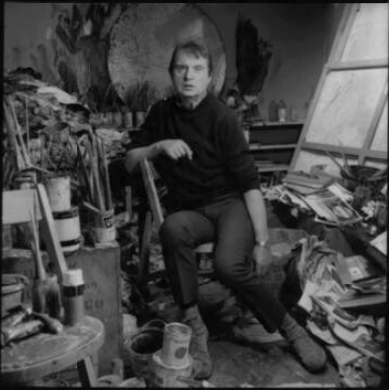
Francis began the painting of me two years ago. He had just returned from a winter in Tangier where he had been too harassed and ill to paint. But he was then recovered and full of the joy of London life. Be was bursting with health and vitality, in his extraordinarily messy, modest drawing room studio in a most unlikely block of scarlet brick flats in Overstrand Mansions, Prince of Wales Drive, Battersea. He showed me an enormous black paint covered canvas, and said he hoped I wouldn’t be alarmed by the size of it but that the portrait would be cut down, if necessary, when he had finished it. Francis started to work with great zest, excitedly running backwards and forwards to the canvas with gazelle springing leaps — much toe-bouncing. He said how enthusiastic he was at the prospect of the portrait, which he said would show me with my face in tones of pink and white. He did not seem interested in my keeping still . . .
I went to America, came back, saw Francis once or twice, and he came to dinner, but no mention of the picture from me or from him. Eventually, an opportunity presented itself and I asked Francis if he’d hate to go on with the painting of me.
Francis, bubbling with amusement, smiled and with his usual marvellous manners said nothing would give him greater pleasure than to finish the picture that he’d long had of me in his mind. An enormous black canvas, the only one with its face not turned to the wall, depicted a monster cripple—a nude figure, with no apparent head, but with four legs. It was painted with brushes that had been of allowed to slide around in the manner children are taught not to employ.
The forms were so gauche that when Francis pointed to the picture and said it was a failure, I was somewhat in agreement. But Francis explained that he wanted more than anything else to be able to do something of that same cripple who had inspired Muybridge, that great photographer at the end of the last century.
Francis showed me a huge canvas covered with emerald green dye-paint. Again he said my picture wouldn’t be as large as that when finished, but that all the works for his next exhibition were going to be on these green backgrounds. I had imagined myself as a sort of Sainsbury floating in, stygian gloom and wondered what an emerald green picture would look like in any of my existing rooms.
I sat on a kitchen chair placed so, and according to instructions turned my head a bit this way. “No—further! That’s it.” Francis started to work with energy, but he seemed to took harassed, not; at all happy . . .
Occasionally Francis would sit down on an old chair from which the entrails were hanging and which had been temporarily covered with a few French magazines and newspapers. His pose reminded me of a portrait of Degas. He curved his head sideways and looked at his canvas with a beautiful expression in his eyes. His plump, marble-like hands were covered with blue-green paint. He said he thought that painting portraits was the most interesting thing he could ever hope to do: “If only I can do them! The important thing is to put a person down as he appears to your mind’s eye. The person must be there so that you can check up on reality — but not be led by it, not be its slave. To get the essence without being positive about the factual shapes — that’s the difficulty. It’s so difficult that it’s almost impossible! But that’s what I’m trying to do. I think I’m closer to it than I ever have been before.”
With Francis the air is mountain fresh: one feels invigorated. I used to go to his studio before taking the train for Salisbury. As the weather was particularly cold, dark and foul, I would be dressed for the country in a very warm, brown suit. Francis was all radiance, even if he said he had been appallingly drunk on vodka the night before. He would expatiate on those evenings: though he didn’t really remember much about them, but he’d left an American who had ‘passed out’ before dinner, gone on to Soho, turned up at his usual ‘Club’ and didn’t know where the rest of the night had gone.
One morning I asked Francis: “Does it matter my being in a different suit?”
“No — that’s a lovely colour. But I want you to put your hands up on this extra chair like this. Anyhow, it doesn’t matter.”
During the morning I purposely moved the position of my hands several times to see if Francis would ask me not to change their position. Once he said: “The hands are splendid like that.’ But never again did he ask me to go back to the same pose. Neither did he seem to mind if I moved my head. “But that’s what’s so awful about having to sit to Lucian,’ said Francis. “He makes you sit by the hour without moving an eyelash, and I find sitting very unnerving, exhausting work.”
Francis had, during his drunken haze last night, caught a glimpse of Lucian Freud. Lucian had returned from Sweden where he had gone to paint Ingmar Bergman for a cover of Time, but there had been too many interruptions for Lucian to produce any result, and he now hated Time magazine, Bergman and Sweden. We then talked of Lucian’s latest painting — how he seemed, in an effort to paint quicker, to have lost some of his intensity. Lucian was intelligent enough to know that his painting up to now was not a complete expression of himself. He now found himself in the awful predicament of having to try and discover himself again. That, for someone of Lucian’s vanity, was a difficult thing to do.
We discussed Lucian’s intellectual brilliance, his complete independence and strength as a man who knew exactly what he wanted out of life. But we admitted that Lucian was no angel. After a row, his wife Caroline had said: “If you want to know what Lucian is like, just see him drive.” Mercifully, Lucian has now been forbidden to drive, for he is reckless at the wheel.
I admitted I found it difficult to be loyal to Lucian all the time. I could not understand the mentality of gamblers, and it worried me that Lucien should lose so much so readily.
Francis said the Bérard portrait of me was a great likeness. (In many ways the two painters resemble one another: both ignoring convention, and living in their own purity — uncontaminated by the asphyxiating cocoon of respectability.) He considered people didn’t appreciate Bérard nearly highly enough as a painter at this time. One day they would, since he was definitely one of the great. His use of paint was never thin in quality even if it was spread lightly over the canvas: maybe he had learnt that from Vuillard. How lovely some of the late Vuillards were! And painted with quite a lot of oil. At one time Vuillard and Bonnard were almost indistinguishable, but they went on in their separate ways getting better and better. From the piles of rubbish on the floor Francis extracted a colour reproduction of a Bonnard he had cut out of Paris Match and stuck onto a piece of cardboard. The colours were vivid: oranges, reds, red-browns, brilliant blues, enough colours for three pictures. “I don’t know what time of day it represents, or is it night?” With outstretched arms, Francis enjoyed the picture to its fullest. “You see, people don’t appreciate paint today; that’s why nobody sees how absolutely marvellous Rembrandt is.”
Suddenly he said: “I’m very pleased with this portrait. I think it’s going to be all right: one of the best things I’ve done. Next time you’re here, I’ll show it to you because it doesn’t need much more work on it. When they go well, they go very quickly. ... ”
Francis opened the door, smiled and said: “The portrait’s finished! I want you to sit in that chair over there and look at it.’ I walked towards Francis’s degutted chair in the corner, not glancing at the canvas on the way. I turned round square and sat to get the full effect. It was as well that I was sitting, otherwise I might have fallen backwards. In front of me was an enormous, coloured strip-cartoon of a completely bald, dreadfully aged — nay senile — businessman. The face was hardly recognisable as a face for it was disintegrating before your eyes, suffering from a severe case of elephantiasis: a swollen mass of raw meat and fatty tissues. The nose spread in many directions like a polyps but sagged finally over one cheek. The mouth looked like a painful boil about to burst.
He wore a very sketchily dabbed-in suit of lavender blue. The hands were clasped and consisted of emerald green scratches that resembled claws. The dry painting of the body and hands was completely different from that of the wet, soggy head. The white background was thickly painted with a house painter’s brush. It was dragged round the outer surfaces without any intention of cleaning up the shapes. The head and shoulders were outlined in a streaky wet slime.
Francis expected that I would be shocked. He was a little disconcerted. He said it gave him a certain pain to show it to me, but if I didn’t like it I needn’t buy it. The Marlborough Gallery would want it. I stammered: “Well — I can’t say what I think of it. It’s so utterly different from anything of yours I’ve ever seen!” To me the picture was of an unusual violence. The brushwork, the textures, the draughtsmanship were against all the known rules. Francis suddenly exclaimed: “Oh, I unearthed these beautiful Egyptian figures for you to see. Look, here they are! How beautiful they are! They’re only three feet tall, but the way the faces are painted ...” But what did that signify now to me?
Francis could not have behaved more typically gallantly and charmingly about the fee d’amis for the painting. “Take the picture, and if you don’t like it, or your friends object, send it back in time for it to be sold in the Marlborough show.”
I was baffled. Could I ever hang the canvas in any place that I live in? The harshness and ugliness would surely give me a ‘turn for the worse’ each time I saw it. But I’d gone to Francis for a painting because I genuinely considered him a unique painter. If this was what he felt like doing at this particular moment I must respect it, even if I could not understand or appreciate it.
If the Marlborough Gallery would give him so much more for it than he had asked me, then perhaps it would be an investment. I asked him if he’d mind if after I bought it and found I didn’t want to keep it, I could sell it again? “Of course! It’s yours to do what you want with.” I took a gulp and said I would like to have it.
I came away crushed, staggered, and feeling quite a great sense of loss. The sittings had been so harmonious; we had seemed to see eye to eye. I had hoped that many of Francis’ theories about life, art and beauty were going to be incorporated in the portrait.
No sooner had I written the above than the telephone bell rang from London. It was Francis. In an ecstatic voice he said: “This is Francis, and I’ve just destroyed your portrait.” “But why? You said you liked it? You thought it such a good work, and that’s all that matters!”
“No — I don’t like my friends to have something of mine they don’t like. And I often destroy my work in any case; in fact, I’ve destroyed most of the pictures for the Marlborough. Only I just wanted to let you know so that you needn’t pay me.”
It seemed little to Francis to waste all that work. He seemed jubilant at not getting paid, at not finishing a picture. He said that perhaps one day he’d start again, or do one from memory: “They often turn out best,” he said.
I don’t really know what is at the back of Francis’ mind. I am sorry that the canvas is destroyed and that there is no visible result from all those delightful, interesting and rare mornings.
I bold Augustus John that Francis Bacon hard painted me looking like a piece of raw offal against an emerald green background. “You deserve it for sitting to him.” Augustus said; and, then, with infinite sarcasm: “These idiosyncrasies are the prerogative of genius.”

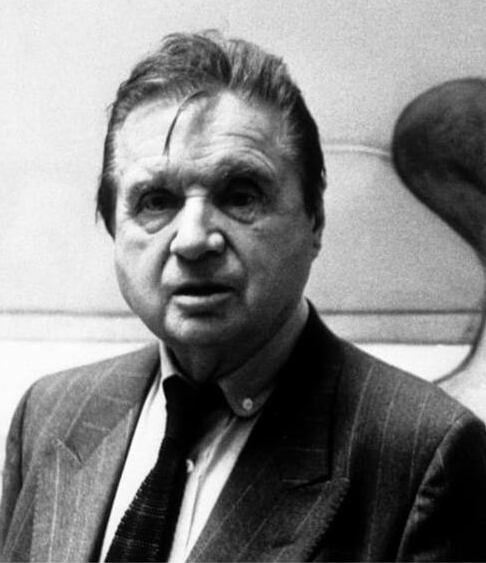
The young Francis Bacon by Beaton: “Wise . . . inspired conversationalist. ”
The Velazquez Hippopotamus
FRANCIS BACON. By Lorenzo Trucchi.
Translated from the Italian by John Shepley.
280 pages. Illustrated. Harry N. Abrams. $37.50.
“… the only possibility of renewal lies in opening your eyes and seeing the present-day disaster, a disaster which can’t be understood but which must be permitted to come in because it is the truth.” The quotation is from Samuel Beckett, but it is used by Lorenza Trucchi to characterize the painter Francis Bacon, Like so many of Miss Trucchi’s remarks in “Francis Bacon,” it is both melodramatic and apt. As she observes of Mr. Bacon in another place, “the human body has perhaps never said more, never expressed events more bleak, more tragic or pathetic, by its mere but violent presence.”
While many classical paintings distorted the human body in the pursuit of grace and beauty, just as many modern painters seem to distort it in the pursuit of anguish and ugliness. Anguish and ugliness are the “honesty” of modern art, an image of man in which his “authenticity” is valued above his vanity. One suspects that the truth—the psychological as well as the physical truth—lies somewhere between. Just as there are people whose ugliness might furnish Ivan Albright or George Grosz with the particular sort of inspiration they need, or those who could model for the anguish of Egon Schiele or some of Picasso’s figures, there are also those who might have stepped out of the idealized canvases of Raphael, Ingres, Pontormo or El Greco.
‘Animal Primitiveness’
“Truth almost always leads to scandal, knowledge to wisdom. It is in man, within
his instincts, within his flesh; that Bacon creates his own scandal of truth.”
Scandal is a good word for Mr. Bacon
Mr. Bacon declared that he wanted “to paint like Velazquez but with the texture
of a hippopotamus skin.” Our skins have thickened since Velazquez’s time. One of
Mr. Bacon
Mechanism vs. Vitalism
Sometimes Miss Trucchi allows herself such flights that the reader feels that he has only an insecure grasp on a hangglider. Here is an example: “moving beyond the élan vital of Bergson, Bacon eliminates the contradiction between mechanism and vitalism by opting for a total psychophysical unity.” Here is another: “It follows that now the diagnosis is more categorical, ruthlessly applied to figures and the few objects and creating the feeling of a gelid and spectacular imperiousness. Bacon indeed achieves in his recent works a kind of epic, inverted but liberating. The era of great events and great figures is over, but at the center of his pictures man yet remains—nonhistorical and instinctive.”
It is not necessary, however, to take Miss Trucchi
It is difficult to say what Mr. Bacon
ARTIST Francis Bacon whose pictures sell for anything up to £100,000, has just bought a new house ... a surprisingly modest, £6,500 terraced house in Wivenhoe, Essex, not far from the Constable country.
The great man is being equally modest with his new neighbours. Few have managed the opportunity to exchange greetings. And one who did, and proceeded further, found himself discussing the enthralling subject of — runner beans.
THE ART OF PESSIMISM
Broadcasting and the Arts
Paul Bailey
The limitations of despair
For some years now, I have been nursing the opinion that Francis Bacon is not a great painter. I have stared and stared at his screaming Popes (after Velazquez), at his lumps of meat, dripping blood (after Rembrandt), at his relatively tranquil homage to Van Gogh (after Van Gogh), and I have not been stirred by what I have so conscientiously stared at. I suppose the word that best describes my reaction to the Bacon oeuvre—or should I say, the claims made for it —is ‘bewildered’. I am bewildered because I have been assured that they are works of genius, those representations of decay and physical ugliness, those revelations (for such they would appear to be for many cultivated people) of the darker aspects of human behaviour. I am bewildered when I look at those caged creatures, one after another, and find myself resisting the meanness of Bacon’s viewpoint, the unrelieved stridency of its expression, its closeness in spirit to Grand Guignol: I say ‘viewpoint’ rather than ‘imagination’ simply because I am unable to detect a quality in his work I should care to call imaginative. Bacon’s horrors strike me as being too easily summoned up, too readily at his disposal. I consider his determination to shock aesthetically shocking.
Bacon’s art is praised for its power to disturb. It reminds us, his admirers
maintain, of our fallen state; it brings home to us the truth of the dictum that
man’s life on this planet is
The enemy he or she faces for our eventual enlightenment is his, or her, own
madness—the once suppressed, but now befriended enemy within. No longer kept in
check, no longer held at bay, his disturbing presence is welcomed rather; even
cherished. The artist takes his hand and goes with him into the abyss, to the
very edge of experience. And there, waiting on the sidelines, is the approving
critic, who will—when, and if, the artist survives, and actually manages to
produce something: a poem, a novel, a painting—give his assessment. He will say,
from the comfort of his chair in the wings, if the risks were worth taking; if
the artist has really chanced his arm, and not just put on a convincing
performance; if the whole terrible ordeal has produced a work of art that
disturbs him. For his strong need to be disturbed must be satisfied. One critic
in particular, the American, Leslie Fiedler, feels this need very strongly. The
artists who don’t disturb him are guilty of indulging in
Madness was much in fashion until very recently—madness as a spur to creativity, that is. The fashion began in the mid-Fifties and only now seems to be dying out. The best poets were those who had suffered mental distress (and had been in and out of institutions to prove it), and the best novelists, and the best painters. They had all been to the edge, and some of them had returned. The humane discoveries of Dr R. D. Laing (principal among which was the theory that the schizophrenic can benefit intellectually and emotionally from his illness) gave way gradually to the cant preached by Dr David Cooper, for whom madness is the true sanity. Insanity became a cult, and the artists who had flirted with it were admired for the ‘seriousness’ with which they tackled the dreadful business of living. If you hadn’t been to the abyss, it was argued, then you weren’t being serious.
For a time, it seemed that every other novel, every other film, every other television play was about someone enduring—or not enduring—a nervous breakdown. A good many of them had praiseworthy qualities—insights into what life is like in periods of extreme misery —but I cannot remember any of them providing the larger insights, the calm awareness of the richness and variety of human experience I find in the works of artists who genuinely merit the description ‘great’—an artist such as John Clare, for example, the least appreciated of our great poets, and the subject not so long ago of a television documentary of unequalled obtuseness. His calm awareness— of birds, of plants, of landscape, of people—was neither discussed nor explored in the programme which, since it went out at the height of the madness boom, concerned itself almost entirely with the fact that Clare, spent many years as an inmate at Northampton Asylum. We were shown little or nothing of the wonderfully alert young man who celebrated the eternity of nature, but were invited instead to look at some lumbering clod. The real John Clare was replaced by a dull-eyed madman; someone to satisfy John Clare: calm awareness our craving for disturbance.
I am not, of course, arguing that writers should not write about madness, that painters should not paint their visions of hell—only a Philistine would propagate such an opinion. Middlebrow uplift is an abuse of the intelligence; an insult to our deepest aspirations. What I am taking issue with is the notion that the artist must chance his arm in the most literal sense, must drive himself to a condition of suicidal despair, before he can comment with any authority on life in extremis. There is something repulsive about a notion which holds that, in order to enlighten us, a human being must first degrade himself. But how, then, is he to be saved? Art, presumably, will come to his rescue: art, the ultimate healer.
Thanks to this notion of art as therapy, a great deal of recent poetry and
fiction has been of the wound-licking, leper-bell-ringing kind. The walking
wounded have committed their howls of pain to paper, and not without a certain
relish. The noise has been, on occasion, deafening. At its worst, its power to
disturb—this writing of clamorous self-absorption—lay merely in its shrill
insistence:
But the Plath cult proceeds apace, and nothing looks like hindering it, in spite of the fact that the critic who set it in motion, A. Alvarez, now finds its existence distasteful. One day, perhaps, her work will be judged as poetry, something separate from the agony she endured. Its survival will depend on that separateness. The finest art stands on its own feet: the facts of its creator’s life should be irrelevant to its power, particularly its power to disturb.
Auden, in one of his early poems, came up with a definition of the novelist’s
duty which greatly appeals to me. The novelist, he wrote, must ‘suffer dully all
the wrongs of man’. It is a definition that has no appeal at all to writers of
the ‘Love me, love my anguish
I like to believe, as Keats believed, that
But, then, completeness—a completeness of vision which recognises that madness is one distressing fact of life among many—is not what minimalists like Bacon, Plath and others are after. They know there is no completeness, only fragmentation, only alienation. Most intelligent men and women possess this knowledge, too; and. if forced to confess that they have it, will probably admit that they gained it in some period of acute depression or despair. Some of them have—with that quality of common sense so often derided as complacency by deep-feeling intellectuals—balanced that unhappy experience against other, equally valid, experiences, and have elected to make an attempt at renewal. In their anxiety to reveal the horrors lurking inside themselves, the artists who travel to the edge of experience assume a superiority of feeling—in their creations, if not in their actual lives—not infrequently founded on ignorance.
This minimalist approach has been taken up by critics, too. They see Shakespeare, variously, as a madman, a psychopath, a psychotic, thus diminishing his concerned, marvellous aloofness. ‘Ripeness is all’ has been reinterpreted as ‘Grimness is all’. Even critics of Dickens are out to prove that comedy is incidental to his main purpose—those symbols (river, dust-heaps, fog) are what matter. I have read a dozen or more recent essays on Little Dorrit, the Dickens novel currently in vogue, and not one of them has more than glanced at the fierce, comic element that contributes to the book’s total effect: they all drone on about the Marshalsea prison as a symbol of the state of 19th-century capitalism, whilst ignoring the minutely observed details that make it a masterpiece. Through this approach, miniaturists like Sylvia Plath become labelled with the tag ‘major’—she suffered, she was there, she could write well; it follows, therefore, she is major. The nadir of lunacy was reached when Lindsay Anderson’s film of David Storey’s This Sporting Life was compared to Goya’s last paintings.
The great artists of this century, have involved themselves—with a dedication as gruelling at times as a trip into the abyss; indeed, they are not dissimilar experiences— with other powers: of instruction, of delight, of consolation. It is salutary to remember that Stravinsky’s Symphony in C—not an especially disturbing work, but one of singular beauty—was written at a tragic time in the composer’s life. His first wife had died, so had one of his daughters, and he himself was desperately ill, yet the music, dedicated to the glory of God, is transfiguring. He upheld, while he was living in darkness, standards of excellence which we cannot afford to ignore or diminish. Eugenio Montale, a poet who has pursued those standards unremittingly, did something similar in the sequence of poems called Xenia, the gift he gave to his dead wife, whom he called Mosca—poems of celebration, or remembered happiness, of a reciprocal love enduring beyond the grave; poems of a transfiguring humanity. It is a celebration of both the fragility and the toughness of tenderness.
It is a toughness I find in two books by an .Italian chemist, Primo Levi, a survivor of Auschwitz and a man and writer of enormous distinction. If This is a Man and The Truce are about his descent into, and escape from, hell: an unsolicited hell, a hell unwelcomed. They do not flinch from describing man’s inhumanity to man, nor his selfish concern for his own gratification; yet they also describe, with a shaming lack of emphasis, his unquenchable need for dignity, his need to function among his fellows, to break down the limitations of despair. But there is also humour in Levi’s two books, written years after the appalling events they so quietly take account of—humour, not black comedy. They disturb us, or should do if we are properly appreciative, because they remind us of our responsibilities to the selves we should aspire to make complete, the selves our disturbing artists have sought to alarm, if not destroy.
What alarms and disturbs me about these disturbers is the smallness of their ambitions—to embarrass us, to fill our nostrils with the stench of self-involvement, to remind us, in adolescent fashion, that they are in pain. Subsequently, the art they create—-or heave up out of the depths—is one that is not cognisant of the fact that grimness does not necessarily guarantee seriousness, that the direst sentimentality also has the power to disturb, that the healing possibilities available to the wretched are not the same things as bourgeois complacency or middlebrow optimism. It turns its back on the idea of completeness, an idea without which we scarcely function as people, and only marginally as artists. It is an idea we cannot live without for long.
Radio 3
The art of despair
SIR:
Paul Bailey is a writer I have admired for a number of years and I was very
surprised to see him venture into print—and on to the air—with such silly views
(THE LISTENER, 20 January). I am sure that the next time something savage
happens that disrupts his
Having recently published one of Mr Bailey’s madness boom books (Anna),
it has been interesting for me to live in a Scandinavian country that is
ignorant of, even bored by mental illness. As far as I can see, no
Of course, I sympathise with Bailey. Madness is frightening—just as violence in Ulster or torture in South America. But it does, unfortunately, exist in its various guises, and I am disappointed to see Mr Bailey pontificating on the subjects with which artists should concern themselves, let alone readers and art-lovers. I have yet to meet a real artist who indulges himself deliberately in madness. Mr Bailey is a sensitive and imaginative novelist who, presumably, paints what is closest to his heart. I long to read his next work. In the meantime, though, I wish he would let other artists paint what is closest to their souls.
DAVID REED London W1
ART
Agony and the Artist
For weeks the Parisian art world has been gearing up for the great day. French Minister of Culture Francoise Giroud will be there in company with other prominent government officials. So will the cream of le tout Paris and a legion of Europe’s top art critics. (One group of Italian critics and gallery owners plans to arrive in ii chartered jet.) To make sure things don’t get out of hand, the section of the narrow rue. des Beaux . Arts that runs in front of the Galerie Claude Bernard may well have to be closed to traffic an understandable precaution in view of the fact that the staff of the fashionable gallery is braced for, an onslaught of as many as 5,000 people within a matter of a few hours.
For any living painter to be the object of this kind of hub-bub is unusual. What will make this particular hubbub all the more remarkable is the fact that the occasion for it will be the opening this week of a six week showing of a selection of recent works by English artist Francis Bacon a man whose painting critics have variously described as “ nightmarish,” “grotesque” and “sadistic.”
And not without reason. One of Francis Bacon’s favorite themes is a human face –
often his own caught as if at the instant of a nuclear holocaust. Another is a
disembodied mouth, teeth bared in a scream. A third recurrent subject is a
contorted nude figure retching into a bathroom sink in one version, nailed to a
cot by a hypodermic syringe in another. Whatever the theme, the mood is one of
stark isolation and the impact is always disturbing.
HIGH
PRICED. Bacon’s
grisly visions have outraged scores of critics and made devoted disciples of
many others. And the furious controversy that has swirled around him and his
paintings has helped make Bacon one of the world’s highest priced and most
courted artists. One work by Bacon that sold in 1953 for a mere $85 is now
valued at $171,000, and among the paintings on display in the Claude Bernard
show will be a massive three panel work priced at $500,000. (A painting by
jasper Johns that sold for $240,000 in 1973 holds the price record at Sotheby
Parke Bernet for a living American artist.) When New York’s Metropolitan Museum
of Art mounted a three month show of Bacon’s work two years ago, nearly 200,000
people flocked to see it.
Bacon’s road to such international renown and financial success has been neither short nor straight. Although his appearance is that of a man in his early 50s, he was born 67 years ago, the son of an English trainer of race horses in Dublin. (Some biographers have said that Bacon is a collateral relative of the Elizabethan philosopher Sir Francis, but the painter himself has never bothered to verify the claim.) By the age of 16, Bacon had become a wanderer: he spent most of his youth in Paris and Berlin, dabbling in the seamier sides of life and working intermittently as an interior decorator and furniture designer. Despite the fact that both the French and German capitals were humming with artistic experimentation at the time, Bacon recalls that he had little real interest in becoming an artist. “I regret not starting to paint earlier,” he says now. “It is one of the few things I do regret.”
It was not until World War II that Bacon, who by then had returned to Britain, got down to painting in earnest. Excused from his duties on a civil defense team because of asthma, he found himself with little to do and turned increasingly to art. Characteristically, he shunned any form of professional instruction and his early, work showed it. He managed to get individual pictures into group shows off and on for a number of years, but none attracted much serious attention. Only with his first, major one man show in 1949, when he was 40, did Bacon’s name begin to come up regularly in critical circles.
DEFIANT PURSUIT. What drew attention to Bacon then was his striking use of diverse, visual references to produce a style that resembled virtually nothing else that was happening in the art world at the time. While most mainstream artists in Europe and America plunged eagerly into abstraction and then pop, Bacon defiantly pursued his own brand of allusive realism. One reference that appears repeatedly in Bacon’s paintings of the 1950s is, the portrait of Pope Innocent X by the seventeenth century Spanish master Velázquez; in Bacon’s hands, Innocent frequently becomes a shrieking demon strapped to his throne.
Another of Bacon’s favorite references. during this period was the bloody face of the wounded governess who appears in Sergei Eisenstein’s epic film, “Battleship Potemkin.” A third source was a series of motion studies by English-born photographer Eadweard Muybridge,, whose nudes are transformed in Bacon’s early paintings into writhing, faceless victims of unknown agonies.
At first, many. critics condemned Ba¬con’s quasi realistic style as outdated
and. his choice of subject matter was branded as sensational. (His reputation in
the U.S. was not helped by his description of the work of pioneering abstract
expressionist Jackson Pollock as “a lot of old lace.”) But despite all
resistance, Bacon’s reputation continued to grow. In 1965, he was hailed by the
influential English art critic John Richardson as “the first modem painter of
international caliber that the British have produced.” A 1971 retrospective of
108 Bacon paintings at the Grand Palais in Paris was an overwhelming success.
And the turnout for the 1975 show at New York’s Metropolitan Museum which seldom
grants such an honor to a living artist constituted a triumph in a bastion of
anti Bacon feeling.
EVEN
MORE TORTURED. The
show that opens in Paris this week includes 37 major works, many of which have
never been shown publicly before. In addition to the $500,000 “Triptych” one of
a series Bacon has done over the years in the traditional three panel form some
of the most intriguing works on display are the portraits of George Dyer, a
close friend of Bacon’s who died five years ago. Bacon insists that he dislikes
using himself as a model, but there are also several self portraits in the show.
“I have been reduced to doing a lot of them recently,” he says, “because all my
friends are dead.”
In contrast to much of Bacon’s earlier work, many of the paintings at the
Galerie Claude Bernard show a greater assurance in choice of color and line. The
technique is no less striking, but it is subtler, even mellowed. What has not
mellowed is Bacon’s choice of subject matter. His faces are less crude, but
their expressions are no less agonized. The figures are more refined, but, if
anything, they are even more tortured. There is no better illustration of this
than the painting entitled “Three Figures and Portrait,” done in 1975. The left
hand figure is bent double on his knees, his hands apparently tied behind his
back as if to await execution. The neck is wrenched at an impossible angle and
the vertebrae of his spine have been entirely stripped of flesh.
‘MAN
IS AN ACCIDENT.’ If
Bacon’s painted images leave any doubt about the persistence of his grim
interpretation of human experience, his words do not. In an interview fourteen
years ago with David Sylvester, a British art critic and personal friend, Bacon
declared: “Man now realizes that he is an accident, that he is a completely
futile being, that he has to play out the game without reason.” In a talk with
Sylvester only last year, Bacon said: “I think of life as meaningless; we create
certain attitudes which give it a meaning while we exist, though they in
themselves are meaningless, really.”
It is Bacon’s refusal or inability to abandon this litany of despair that has provoked most of the criticism of his work in recent years. In a review of the Metropolitan show, Hilton Kramer of The New York Times asserted that, in the wide open world of contemporary art, “to traffic in images of sexual violence and personal sadism is a good deal less shocking than, say, to be avowedly Methodist.” Prof. Rainer Crone of Yale University’s Department of Art History faults Bacon for not participating in any of the new technical developments of contemporary art. Bacon, argues Crone, “is still dealing with the issues that were relevant before or during cubism.” Even more bitingly, André Fermigier, art critic of Le Monde and one of France’s most influential writers on art, has admitted: “Personally, I find Bacon’s obsessions somewhat monotonous.”
A renegade from the outset of his career, Bacon has never set much store by other people’s opinions about art, whether his own or anyone else’s. He dismisses ,that durable favorite of the critics Joan Miró as “pleasing and decorative, but definitely lightweight.” He finds the current school of hyper realism “boring.” And he has little patience with criticism of his own work. In response to attacks on his fascination with grim subject matter, Bacon recently declared: “I’ve always hoped to put over things as directly and rawly as I possibly can, and perhaps if a thing comes across directly, people feel that is horrific. People tend to be offended by facts or what used to be called the truth.” Curiously enough, while American scholars and critics have proved to be some of Bacon’s most energetic opponents, American artists have provided him with some of his strongest support. Pop master Larry Rivers, who concedes that Bacon does some “very peculiar work,” nevertheless considers the Englishman “one of the best” of living artists. Another American who has high praise for Bacon is Jim Dine, a leading figure of the New York school of pop art. “There are only a handful of painters in the world whom I respect,” says Dine, “and I consider Bacon a great, great painter.” Andy Warhol, the man who enshrined the Campbell’s soup can and is now virtually an institution in the U.S art world, admits to paying Bacon the sincerest form of flattery. “I copy his color,” says Warhol, “and his skulls.”
Despite his conspicuous success, Bacon pursues a private life little changed
from that of his Wanderjahre before the war. He occasionally shares a fiat with
a friend in Paris and he owns a small country house near Colchester in Essex.
But he spends most of his time in the familiar clutter of his London studio. The
furnishings of the living area there include two battered sofas, a broken mirror
and naked lightbulbs. The workroom, also lit by a bare bulb, is piled literally
knee deep in torn photographs, art books, medical texts and assorted other
detritus of Bacon’s craft.
‘MEMORY TRACKS.’ Bacon
once explained the semi squalor of his quarters to Henry Geldzahler, the
organizer of the Metropolitan show in New York, by saying that “the places that
I live in … are like an autobiography. I like the marks that have been made by
myself, or by other people, to be left. They’re like memory tracks for me.” For
all the grim themes of his paintings, Bacon revels in witty and amusing company.
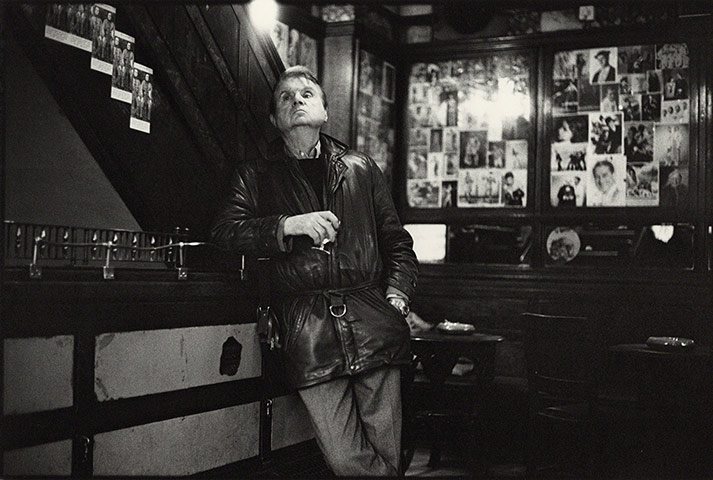
But he seldom goes out on the town and when he does, the destination is likely
to be Muriel’s, a London watering hole frequented by a mixed crowd that includes
a sprinkling of Fleet Street journalists. He drinks heavily (champagne bottles
tend to pile up around his works in progress) and on those occasions when he
indulges in luxury outings to London’s better restaurants he tips outrageously
and refuses to let anyone else contribute to the bill. Although discreet about
details of his social life, Bacon makes no secret of the fluet that he is
homosexual and occasionally jokes about the turbulence of his emotional affairs.
Although the massive amounts of cash paid for his paintings have not tempted
Bacon to put a fresh coat of paint on his studio walls or even to add much to
his two suit wardrobe, they have given almost free rein to his long time passion
for gambling. In his early years in London, Bacon used to convert his Cromwell
Place studio into a night time casino hilly equipped with a roulette wheel and a
chemin de fer table. The artist himself served as croupier, and to hear him tell
it, he made a bundle. “But,” he recalls, “as soon as one could travel after the
war, I went off to Monte Carlo and lost the lot in two weeks.” The experience
did little to cool his preoccupation with gaming and he continues to bet with
enthusiasm. But his luck has apparently not changed significantly since the
early days. “As an ex croupier,” he says, ‘I know how to gamble, but that’s
never helped me much.”
“INTUITION AND LUCK.’ Perhaps
more than anything else, Bacon’s devotion to gambling offers a clue to his
refusal to abandon his own visions and join the mainstreams of contemporary art.
In 1953, in a tribute to the British painter Matthew Smith, Bacon wrote that
“painting tends towards a complete interlocking of image and paint, so that the
image is the paint and vice versa. Here the brush stroke creates the form and
does not merely fill it in. Consequently, every movement of the brush on the
canvas alters the shape and implications of the image. That is why real painting
is a mysterious and continuous struggle with chance” More recently, Bacon told
David Sylvester that painting is “pure intuition and luck, and taking advantage
of what happens when you splash the bits down.”
Bits of paint, chips, dice or cards. At the gaming table, ‘says Bacon, “I feel I
want to wins but then I feel exactly the same thing in painting. I feel I want
to win even if I always lose.” If the excitement surrounding the new show at the
Galerie Claude Bernard is any indication, Bacon is riding a winning streak.
‘I Only Paint for Myself.’ On the eve of Francis Bacon’s major show at the
Galerie Claude Bernard in Paris, European Regional Editor Edward Behr sat down
with the artist for a wide ranging discussion of his life, his work, his critics
and the contemporary art scene in general. Below, excerpts from their
conversation:
BEHR: How
do you account for the hostility your paintings arouse?
BACON: If
I thought about what the critics said, I shouldn’t have gone on painting.
Q. But
how do you feel about the critics who say you put too much emphasis on death and
decay and angst? Self portrait, 1969: ‘Death is always with us’
A. To
me that is so totally stupid. If one thinks of life, what is it? The
inevitability of death is always with us, from birth onward. I don’t emphasize
it. I accept it as part of one’s existence. One is always aware of mortality in
life, even in a rose that blooms and then dies. I’ve never understood this
aspect of criticism against me and I don’t, now, take any notice of it. It seems
to me that the people who think in this way have never really thought about
life. ‘One has only to turn to the great art of the past to Shakespeare, to the
Greek tragedies to realize how much of it was concerned with mortality. I’m not
interested in violence. During the Vietnam war there was more violence on
American television every afternoon than there is in all of my work. I accept
violence, yes, I accept it as part of one’s existence.
Q. What
about the so called morbid aspect of your paintings? Some say that you have even
used anatomical books for inspiration.
A. There
was this book, which I picked up at a second-hand bookstore in Paris a long time
ago before I really began painting at all, that was about skin diseases in the
early nineteenth century. It was hand colored and very beautiful. I’m allergic
to turpentine and wear gloves when I’m painting. But nevertheless, I
occasionally get rashes on my hands and their color is tremendously suggestive
to me, not necessarily horrific.
Q. There’s
also the charge leveled against you that you are a loner who has failed to
influence anyone else.
A. True,
I don’t know of any painter whose work interests me and in whose work I see any
[of my] influence.
Q. Are
there any young painters whom you find to be interesting?
A. Not
at the moment, and I consider that an unfortunate thing.
Q. What
does interest you as you survey the current art scene?
A. I
have the feeling that something very remarkable will come out of the United
States. As I’ve repeatedly said, I also feel that someone like Jackson Pollock
is the most overrated artist. Americans are determined to make an American art
that hasn’t been influenced by anything else. I’m not sure this won’t limit them
in some way. Communication being what it is, why not accept the whole thing? I’m
not interested in the abstract artists. I understand that this type of painting
was a logical course to embark on. But it seems to me the subject matter in
abstract art, no matter how far you take it and how far you destroy it,
instantly seems to degenerate into a form of decoration. And just now figurative
art is the most difficult and problematic thing. Many people are trying to
return to it, but what are they returning to? They’re returning to illustration
and hyper realism and what’s the point of that? It’s of no interest at all. I
must say that to me pop art is more interesting than abstract expressionism and
hyper realism, which are ridiculous and boring.
Q. Is
there anyone among recent contemporary painters you admire?
A. I
admire Marcel Duchamp. He explored things within his lifetime in a remarkable
way. Though he wanted art that wasn’t art, he was the, most aesthetic, probably,
of all artists of the twentieth century.
Q. Were
you influenced by Duchamp?
A. It’s
difficult to say. I have been influenced by practically everything from
prehistoric artifacts onward. I have looked at everything. I am rather like a
grinding machine through which everything has gone. And what comes out is what
comes out. All visual things have always been of immense interest and assistance
to me. How are the influences felt? One would have to know how the unconscious
works.
Q. Have
you ever been tempted to undergo analysis to find out how your unconscious
works?
A. I
don’t feel it would help me in my work and it wouldn’t help me otherwise. I’ve
never had those problems in my life because I accept my problems.
Q. You’ve
repeatedly described how at a certain point in your work, accident and
irrationality actually take over, that you are, in effect, a medium through
which the paintings actually happen. Are you also a medium in other respects,
are you interested in the occult?
A. It’s
perfectly true that I work hoping that chance and accident will just run for me.
But I’m not interested in the occult nor do I believe in it. I’m a very rational
person. I use my sensibility in painting. I don’t think I’m one of those gifted
people. But I’ve looked at everything, and I think that I am profoundly critical
and that out of my critical sense I’m able to use the accident that comes to me.
Q. In
the past you used a number of key paintings the Cimabue crucifixion, the
Velázquez portrait of Pope Innocent X as keys which unlocked some of your own
visual experiences. But you have not done so in the last ten years. Why not?
A. Maybe
it’s because I’ve absorbed them all and they’re beginning to make their own
compost within me.
Q. When
you were in Rome, I understand. you, did not. bother to see the original of Pope
Innocent X. Why not?
A. I’m
a very lazy person. When I see pictures even that I like I can’t. look, at them
for long because I find that it’s afterward that they begin to work on me, that
they unlock valves of sensation within me. It’s what I receive from them that
counts.
Q. To
what do you attribute the development of the: idea for the $.500,000 “Triptych”
that is included in the Paris. show?
A. The
center panel came to, me after’ I’d looked at photos of some Australian
cricketers. Suddenly this, image, which was nothing like cricket, began to form
itself. The head in the left panel happens to be someone I know.
Q. Everyone
who writes about you notes how ‘much younger you look than you really are. Do
you do anything to keep that way?
A. It’s
a family thing, I think. We tend to look younger than we are. But apart from my
mother, who lived to be 87, we also tend to die young. Do I consciously keep in
shape? No, I don’t. I do a lot of’ standing, especially with the big canvases,
and I like that. There are certain days when you feel the muscles are not going
to work for you. I like living in an overheated atmosphere because for me that’s
when brain and muscle come together. I’ve always drunk too much. I’m not a
person who can sit down and relax. I’m always active in a sense. And work breeds
work.
Q. Do
you have any interest in your paintings when they’re finished?
A. I
can’t believe my paintings are for people. I can only paint for myself. I try to
give myself a kick. But I don’t know where my paintings are.
It
used to be a real production line. They used to go to the Marlborough Gallery in
New York and then they just went. I didn’t want to see them again. The few I own
are at the Paris showing; Living as I do, what am I going to do with them? I’m
glad when they go.
Q. But
don’t you care about people’s reactions to your work?
A. One’s
always pleased when a few people one likes and whose opinions one respects
happen to like one’s work or part of it. But otherwise I don’t really care,
because I don’t think many people are interested in painting. Oh, yes, there’s a
great interest in the financial side of it in painting as business, as a stock
market, but very few people have any real, feelings about painting certainly not
the critics.
Q. But
surely you’re glad that your works is in the major museums around the world?
A. Except
for a few people, it’s the only way the larger triptychs can be seen. Most
people simply don’t have enough room for them.
Q. Would
you like to see some kind of Bacon Foundation to house a permanent collection of
Bacons after you’ve gone, as some other major painters have made provision for?
A. I
don’t care. I find the profound vanity of these old men who try to immortalize
themselves through foundations very boring. I hope there’ll be a foundation for
the best of Picasso’s work, but they would have to be so carefully selected that
I expect it’s out of the question. I’m lucky, since my work is not really liked
and difficult to sell, to live my life by something that obsesses me to try and
do. I paint to please myself. I suppose I could have done other things. But it’s
real luck to be able to earn something by doing what you obsessively feel you
have to do.
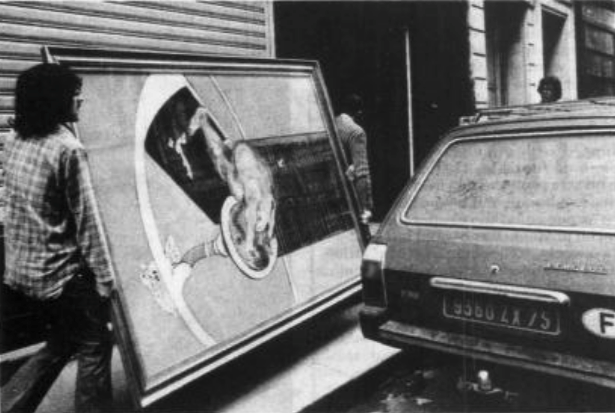
MAX
WYKES JOYCE
“I am both knife and wound,” says Baudelaire in a poem, “both cheek and blow. I am the limbs and the rack, the victim and the torturer.”
This is also
obviously what makes the attraction and the ascendency of Bacon’s work today.
One should make a careful distinction between the private person and the his
art. The suggestion that
The paintings, on the other hand, are a public statement and call for a response. It is significant that Bacon has a liking for the triptych, a favoured form of religious art. And what are the saints that Bacon enshrines? They are not so much individuals as they are activities, and specific bodily activities, sometimes explicitly portrayed, sometimes filtered by allusive shadows and gut symbolism.
Bacon’s work carries an undeniable shock, and shock in our age has become to be considered as a high aesthetic value. Why? Bacon’s painting, as seen by the public, may hold some of the fascination of a controlled nightmare. But this again would not amount to anything were it not that his statements are made with the authority of the accomplished artist.
This is what can make his nightmares convincing and swell them with power. His mutilated faces and vivisected bodies lend themselves to a multitude of interpretations by those who perceive them intellectually. Their major impact is on the emotional level; they come at the viewer with an insatiable rage and an insatiable avidity — a violent contrast and contradiction, a tension, in fact, that burns though the highly controlled and aesthetic qualities of craft and art.
The burning nihilism of Bacon’s view reduces man and the world to a bowl of bitter ashes, life to vivisection and demeaning gestures, death to terror. One need not go along with that, though one may note the real agony such a view implies even as it sardonically sweeps away the evidence of its existence.
Francis
Bacon, Galerie Claude Bernard, 5, 7, 9 Rue des Beaux-Arts, Paris 6,
Crowds visiting the new Francis Bacon exhibition in Paris have
caused huge traffic jams. SAM WHITE reports

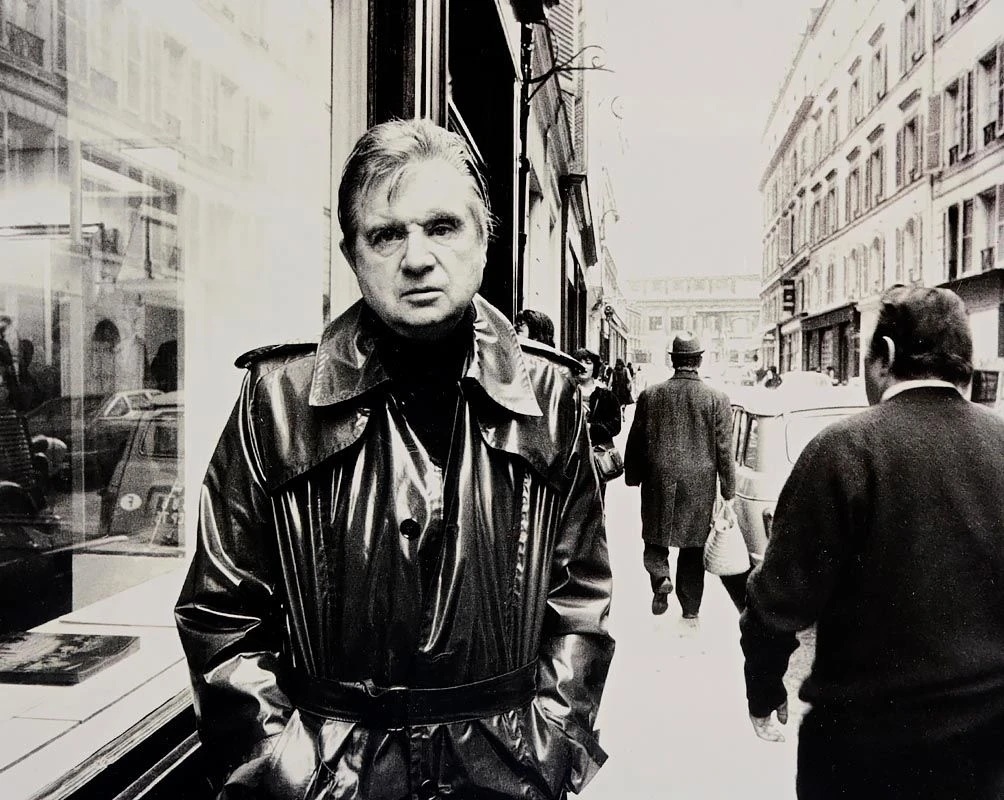
SLIGHTLY puzzled by the adulation: Francis Bacon in Paris beside his work Triptych 1976. Picture by John Minihan
WHETHER Paris first discovered Francis Bacon, whose current exhibition in La Rue des Beaux-Arts is causing traffic-jams (Sam White, January 25) I do not know. But certainly Helen Lessore introduced him to London at her Beaux Arts Gallery, which was off Bruton Street—as she did another artist, the sculptor Raymond Mason who had actually settled in Paris.
Curiously enough, Mason’s large, evocative and vivid sculpture, Les Halles, against three huge screens capturing his colours, has just been on show in the great church of St Eustache, in what was Les Halles.
At a time when we are inclined to forget or belittle our native genius, it is very heart-warming to see two British artists at the very centre of the prestigious Parisian artistic scene at the same time.—Norman Chisholm, Law Road, NW3.
THE credit of giving Francis Bacon his first London show belongs, not to me [Friday Forum, January 28] but to Erica Brausen who was the very first dealer to buy his work, which she later showed many times at the Hanover Gallery.
— Helen Lessore. Champion Grove, SE5.
What is profoundly stirring is Bacon’s almost legendary handling of paint. He’s
said that he wanted “a very ordered image but I want it to come about by
chance,” that he has wanted
The art of despair
SIR:
David Reed (Letters, 3 March) seems both to patronise Paul Bailey and to
misunderstand Bailey
No great artist (no real artist, Mr Reed) has produced a lifetime
The trouble I have with Bacon’s paintings is not that I am frightened by the
violence of all that sado-masochistic despair, as no doubt Mr Reed would
diagnose, but rather that such deliberate exploitation of horror to the
exclusion of everything else (
JOHN BALL
London NW3
The
art of Francis Bacon
By Michel Leiris
In the second of his published conversations with his friend David Sylvester (Interviews with Francis Bacon, Thames and Hudson, 1975), where he is most revealing about both his life and his art (as they appeared to him between 1962 and 1975, to be exact, because neither the life nor the art are yet complete and the person concerned is not someone to be taken in by the belief that he has discovered some truth once and for all), Francis Bacon introduces what is, I think, the key term that enables us to “place”—in so far as one can place an artist whose exhibitions display how capable he is of renewing himself—a painter recognized as one of the greatest of our time and yet hard to characterize because he departs from the beaten track.
The game of questions and answers which the two partners are ostensibly playing quickly comes round to the crucial problem of figurative and non-figurative art. Bacon claims explicitly to be a figurative artist, but in the course of the discussion he several times stresses his distrust of what he calls “illustration”—that is, a too literal transcription—declaring in his own words:
You see, I believe that art is recording; I think it’s reporting. And I think that in abstract art, as there’s no report, there’s nothing other than the aesthetic of the painter and his few sensations. There’s never any tension in it.
“Tension”: it is this idea, introduced into the discussion by the painter himself, which could act as a guideline for anyone who wants to discover what it is about the work and personality of Bacon that is so extraordinarily fascinating. A tension, first of all, between these two poles: on the one hand, the determination to be figurative and so not to be abstract; on the other, the determination not to “illustrate” and thus to make an image removed from the representation considered normal by common sense and hence relatively abstract. As a result of this twofold desire, Bacon’s work takes on the appearance of a battle conducted on two fronts, perpetually under threat of allowing itself to be dominated by one or other tendency and to fall either into abstraction or into illustration.
To paint figuratively without being illustrative is, if one sets about it rigorously, like trying to square the circle. For a long time Bacon attempted to solve this problem by speculating on what might be called the subjugation of chance. Chance intervenes in two ways: as pure accident, in the necessary uncertainties involved in the handling of a pencil or brush, and as provoked accident, whereby the painter would project paint on to his canvas more or less at random, and rub or smear those shapes that were becoming too lifelike and so restore chaos. Bacon exploited these effects either directly or by adopting them as suggestions, and they helped him to avoid an unduly straightforward figuration.
This, however, had to be counterbalanced by a concerted effort to adhere to the motif—whether it be the motif he had started out with or some other motif that had presented itself along the way—since, if it did not refer to something real or representable, the image could be nothing but a futile assemblage of shapes and therefore not even a true image. Hence that enhanced tension peculiar to Bacon’s work, as he not only steers his course between two tendencies he knows to be contradictory, but also employs irrational means in order to achieve a “recording” which he wants to be faithful and which he hopes will be all the more “poignant” (a term quite without sentimental connotations for Bacon) for having been obtained by a kind of loser-take-all.
Bacon’s entire oeuvre, his portraits and figure paintings as well as his large compositions, is the answer to this more or less deliberate search for the highest possible tension; the compositions are less stage-sets on which some narrative might be developed than confrontations between human beings or objects which strike us by their presence and do little except to be there, without anything transpiring between them in the least, dramatic or anecdotal (except when, among other images of struggle or fusion, copulation often unites two of these creatures, who are then fused into a single, indivisible motif by love, or in other words by the very essence of tension and ambiguity).
Although drama and tragedy have too strong a narrative element and are therefore excluded on principle from Bacon’s art, it cannot be denied that tragedy flares up openly in such disturbing works as the posthumous portraits of George Dyer, which are the unrestrained expression of an intimate grief, or the imposing triptych of 1976 which, as much for the brutal formal contrasts of which its severe architecture is the setting as for its central theme (a man, our contemporary, at grips with a vulture), achieves a sombre power enabling us to see it as the Promethean apotheosis of those earlier paintings which Bacon called “Crucifixions”.
Notwithstanding the artist’s own discretion in the matter, am I wrong to see in his work an art based on the interaction of antagonistic onistic terms which, as if marked from birth, is always revealing a tragic tension? The most manifest of these antagonisms is the more or less constant contrast between the intensity of the human or other figures and the neutrality of their surroundings, the first built up of layer upon layer of lines and colours (like stormy accumulations mutations from which the scene stands out), the second painted perfectly flat. The starkly realists aim that Bacon pursues most zealously is that there should arise out of a theatrical, almost abstract space where nothing occurs that can be reduced to a “plot”, a presence which is, essentially, the “arising” of a presence. Bacon turns his backgrounds to account less to create atmosphere than to provide the logical conditions for such sudden arisings.
Similarly, it would seem, with the kinds of stage properties which appear in a number of his pictures (props whose sole function is to make us see more clearly by providing a frame for the subject in the same way as someone writing underlines the passage he wants to “bring out”), and one may even wonder whether it is not with some analogous intention—that the object be it only the imaginary elements which Bacon readily associates with the real ones, should be seen with the starkness of an event—that he has several times happened to use as his springboard the theme of crucifixion. From it he takes apart from the display of meat almost as in a butcher’s shop, of the body on the cross the traditional armature of its representations; from the version in which the pagan figures of the Furies are paradoxically incorporated into the Christian myth, Bacon moves on to those even freer versions in which the religious drama undergoes a wholly secular and contemporary transposition, though this organization loses nothing of its dignity.
On the thematic plane there is a tension in this particular case between tradition and modernity—a modernity sharply accentuated ain in a great deal of Bacon’s work by the industrial accessories of our everyday lives; it is almost as if the painter had—spontaneously—taken over Baudelaire’s phrase to the effect that one half of art is “l’eternel et I’immuable” and that the other half, the modernity, is “le transitoire, le fugitif, le contingent”. And Bacon’s painting generally reveals a similar degree of tension on the plastic plane proper, since its presentation asserts respect for the great art of the past while its technique declares it to be an art of today, open to the most extreme distortion.
The tension, in short, stems from the confrontation between, on one side, the irrational—the “accidents” on which the artist relies, and his surrender t0 the dictates of instinct—and, on the other, the rational: the exercise of his critical intelligence in the choice of a starting point and then in the discriminating use of chance. The conflict leads to an equilibrium whose results do not appear as the harmonious products of a compromise but as a shattering testimony to a contest of strength which has found no appeasement.
Is it not sell-evident, in any case, that any such detente would be incompatible compatible with the aims of a man so repelled by the idea of a possible respite that he says, in essence, in one of his dialogues with Sylvester, that, however keenly he might aspire to it, ultimately he would be fearful of any absolute success, of achieving a unique and perfect work, because it would eliminate all future development.
It is not at all surprising that in life Bacon should have a passion for gambling (not for chess, like Marcel Duchamp, but for that wilder game, roulette, played without the support of any mathematical system). Indeed, it could be said that he conducts his work very largely in the way in which one chances one’s luck, hoping, admittedly, for the jackpot, but enjoying above all the risks. For it is Bacon’s view that the art of our own time can be nothing more than a game because it lacks myths to justify or nourish it, and that if the artist wants to produce something valid then he must “deepen”.
To have a passionate love of life and to live it avidly, knowing all the while that life is meaningless and that one can give it meaning only for oneself and for a terribly limited space of time: this is the awful conviction which seems to endow Bacon with a surplus of energy, such (so far as we can judge from what he himself has said) is the fundamental tension which makes him personally so fascinating. Tempered by his despotic desire always to be painting more, and by an instinctive prudence which saves him when others would have gone under completely, Bacon’s furious desire to live and to deny himself nothing goes with a lucidity that deprives him of all hope. A situation to make the mind reel, but it means surely that this effervescent yet controlled man, whose violent outbursts go with a great delicacy of manner, ought to be taken literally when he confides to Sylvester that he feels himself spinning between life and death like a coin that has been tossed in the air in a game of heads or tails.
Bacon is a painter who wants to be nothing other than a painter (and perhaps a sculptor, as he says he dreams of being), but who could never be content to be merely a brilliant manipulator of shapes and colours unanimated by any demon; he is a painter who will not allow himself to dramatize and who aims at nothing but a certain “immediacy”, yet who is constantly in the stranglehold of the tragic. The creations which result are all the more striking for the absence of any sly attempts to attract our attention, or of lyricism, or demagogic trickery. They are quivering, at time strident creations, and always taut to the point of disintegration; in every case their coherence is the obvious product—narrowly and precariously achieved, but all the more vital for that—of a positive altercation between intelligence and impulse, between the phlegmatic and the frantic, between balance and unbalance.
The art of despair
SIR: It is undoubtedly an event when a critic of Mr Bailey’s standing revolts publicly against gratuitous horror as displayed in the paintings of Francis Bacon (THE LISTENER, 20 January), but such a choice of target happens to be, in a way, unfortunate. No one can deny that Bacon is technically highly accomplished, even if there is something distinctly derivative about his manner, to add to the defects of deliberate mystification and Grand Guignol gruesomeness.
In the majority of modern literary and pictorial artists whom the critical establishment’s weakness for extremes has rendered fashionable, what we see is a cult of infantilism and a virtual abandonment of all sophistication and contrivance, based on the very naive principle that the best way to demonstrate the utter futility of human life is to adopt the most rudimentary, even kindergarten, forms of expression in art. The Theatre of the Absurd patently belongs to this category of neotenic regressiveness, but even more go the boringly simplistic paintings of Johns and Rothko and the pictorial litter-bins of Rauschenberg.
G. REICHARDT
Chepstow, Gwent
Bacon
The spectator of contemporary art knows that he is almost certainly going to have to make a mental effort to analyse the intentions of the artist before he can perceive the work. The artist who ignores this premiss today does so at his peril, courting the danger of having his work dismissed as merely decorative, or “expressionistic”. For the present generation particularly reared on the super-cool art of the past decade, the experience of looking at a painting by Francis Bacon is peculiarly alarming. Bacon’s paintings suck up energy, and it is only when the spectator is emotionally sapped that he can begin to intellectualise the process to define for himself what the painting has given out. The process is exhausting, and all but the strongest sensibilities may become numb and dazed when when confronted by his work en masse. A further difficulty engendered by a large exhibition of Bacon is that he restricts himself to a very limited range of formats, and it becomes impossible to to avoid a certain monotony in formal terms. At the Galerie Claude Bernard, twenty of his recent paintings were hung in three separate irregularly-shaped galleries, which made it easier to confront each painting as an entity, undistracted by gestures which corresponded across the walls.
Bacon has spoken a great deal about the role of chance in his paintings, which he tells us is crucial. It is difficult to believe however that these paintings contain a single gesture accidently conceived. Even the substance of the figures, flayed until flesh and bone coalesce, are laid on in powdery whiplashes of paint, placed with icy brilliance. The impression of flow is illusory throughout; the nameless pink blobs which flow out of the figures of a Triptych of 1972 have coagulated into contained pools, seen starkly on the smooth grey bareness of the ground. The greatest precision of all is demanded by the placing of the figure within the space it occupies. It is a crucial problem, on which the success or failure of these paintings depends, and it is one in which Bacon draws our attention to, continually and sometimes unwisely, through the use of his various emblematic devices.
The protagonists of Bacon’s dramas require props and settings in order to convey the full potential of their existence. And Bacon equips them magnificently. Quite often his figures dispose themselves in relation to the utilitarian artifacts of plumbing systems. Their living flesh comes into contact with vitreous enamel, as they crouch on lavatories or fling themselves over the chasm of a basin supported on a curving pipe. Again and again he shows a naked light bulb suspended forlornly over the heads of his victims. Shadows are used only when they have a formal or dramatic part to play, as in the batlike shape which precedes the torso of a man emerging from darkness. In general the lighting is harshly even, so that the solitary occupants of the cell-like spaces are mercilessly exposed. Most often the space is enclosed, and curved to emphasise the fact, although sometimes the claustrophobia is partially alleviated by a black space opening out. Even the figure who swaggers down a flight of stairs has just emerged from a cell of darkness.
The implacable bleakness of these settings provides a grim backdrop for the grossly pathetic posturings of the figures within. If they are not hunched and tense, his figures confront themselves in violent movement. They indulge in frantic scrabblings prompted either by lust or a desperate desire to escape, or perhaps a combination of the two. Mirrors provide Bacon with a useful vehicle for sharpening our voyeuristic impulse to examine every detail of a man stripped of all protection. The reflection of his naked haunches robs the figure seated writing at his desk of any semblance of dignity suggested by his occupation. Francis Bacon presents us with a vision, dredged out of an immensely potent sense of alienation. And the means by which he conveys his thoughts and feelings become evermore horrifyingly acute.
A well-known figure in art circles
A well-known figure in- art circles, Mr Harry Fischer, a well-known figure in art circles in many parts of the world, died on April 12 at the age of 73.
H. R. Fischer was born on August 30, 1903. His father, a solicitor, and his mother, a beautiful socialite, belonged to the Jewish upper middle class of Imperial Vienna. Thus their eldest son spent his childhood years in the sumptuous and highly cultured environment of the capital of the Austro Hungarian monarchy before the years of crisis and downfall.
He was an individualistic and rebellious child. Unlike his brother who followed the career set out for him by their father, H. R. Fischer left school at the age of 17 and worked in a leading Viennese bookshop. After some years in Germany, where he became familiar with the German book trade, he returned to Vienna and set up his own bookshop, which became a centre for artists and intellectuals of the period between the two world wars.
There he met Robert Musil and became a close friend of another great. Austrian writer, Hermanni Broch. During these years he also started his own publishing firm. Among his collaborators was Walther Neurath, who was, after the war, to start Thames and Hudson in London. His publishing activities were soon interrupted by Hitler’s takeover in 1938. Fischer fled and came to England. During the war he served in the Pioneer Corps in the British Army. After demobilization he worked briefly for the Financial Times and then he became involved in the St George’s Gallery.
Later he joined
forces with another Viennese expatriate whom he had met in the Army, F. K.
Lloyd, to start a new art gallery
To begin with,
they dealt in rare books, prints and pictures, .but focusing their interest on
French nineteenth and twentieth-century works. One of, their early coups was to
sell a complete edition of Degas bronzes, the Tate acquiring the
Harry Fischer
was one of the first, in the mid-fifties, to realize the true importance of£
the, neglected field of Expressionist painting, and
— movements like
—
“Die Briucke”,
“Der Blaue
Reiter”,
and
“Das Bauhaus”.
He also confronted the British, art market with the works of the great
independents of that period: Nolde and Kokoschka. The culmination of these
activities was the exhibition
At about the same time Fischer saw the importance and potential of the major living British artists, and within a few years had organized exhibitions of Francis Bacon, Graham Sutherland, Ceri Richards, John Piper, Barbara Hepworth, and most notably, Henry Moore which led to the foundation of a lasting friendship and collaboration resulting in the acquisition of Moore’s work by many leading collectors.
Another special friendship linked Fischer with Kokoschka. When Kokoschka, during his years of exile in England, could not reach beyond a small circle of loyal friends and admirers, it was Harry Fischer who was able to foster interest in his work, organizing several exhibitions and eventually helping with the great Arts Council retrospective at the Tate Gallery in 1962.
His enthusiastic temperament and his quick wit won him innumerable friends among, artists, critics, museum directors and collectors all over the world.
In 1971 he decided to sever his connections with Marlborough. In June 1972 he started a new venture and opened, together with his son Wolfgang, Fischer Fine Art in King Street, St James’s.
It was a
personal satisfaction for him to bring back to Europe. for the opening
exhibition, two rare and outstanding works by the two artists he admired most,
Henry Moore’s unique large elmwood carving of 1945, and the early Kokoschka
During the last twelve months’ of his life he worked on a large exhibition of German art of the period 1910-1939 which opened a fortnight before his death under the title “Apocalypse and Utopia” which will now serve as an appropriate memorial to his position in the London art scene. He is survived by his wife, Elfriede, his son Wolfgang and three grandchildren, Flora, Bettina and Toby.
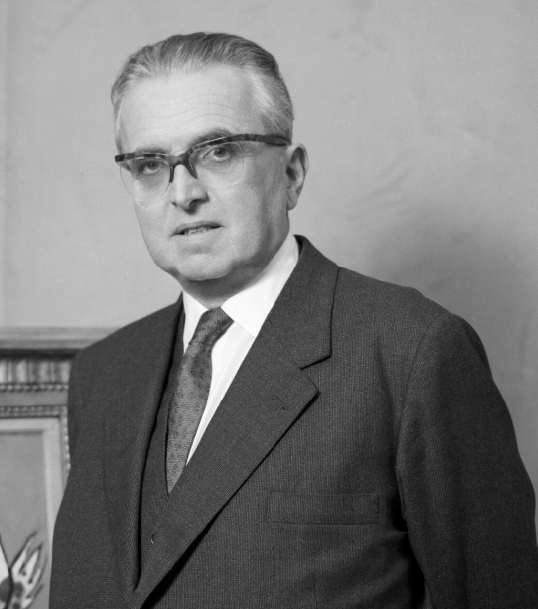
Elektra
Covent Garden
Isabel Lambert’s setting and costumes for Richard Strauss’s Elektra were designed in 1953 for the Royal Opera House; they are still in use and good condition, handsomely lit, at the current revival 24 years later. Then the conductor was Erich Kleiber, now it is his son Carlos who last night wheedled from the Covent Garden orchestra playing of a splendour the more extraordinary because so much of it was restrained, delicate, ravishingly lyrical and euphonious.
Our ancestors who heard Elektra when it was quite new would have found those last epithets incredible (some readers today may have attended the British premiere under Beecham in 1910): Elektra was regarded as the last word in noisy dissonance then, and for many years later. Carlos Kleiber gives full dignity to the opening Agamemnon theme, but plays the first scene modestly, the venom drawn from the maids’ cruel gossip; even Elektra’s first monologue sounds controlled in its grief and longing for revenge.
The music’s savage passion and moments of dynamism are not ignored: there are fewer of them than one remembers from Beecham in 1947, or Kleiler senior, or even Kempe, and when Carlos Kleiber unleashes them, in the Clytemnestra scene for instance (much cut, alas), they are all the more powerful and moving. Kleiber junior must want us to remember the composer’s advice, “Play it like Mendelssohn–fairy music!”, and to appreciate that there was truth as well as jocularity in the bon mot.
The two scenes for Elektra and Chrysothemis are full of lyrical, lovable music, worth singing beautifully above a discreet, appreciative orchestral background when the voices are as beautiful as those of Birgit Nilsson and Gwyneth Jones. So too the recognition scene where Nilsson and Kleiber together explored the bitter-sweet poignancy of Elektra’s grief over her supposedly dead brother. At the moment of recognition Kleiber allowed the music to explode, as if for the first time: it was like a cataclysm. There was another shattering climax for the murder of Clytemnestra, then a return to euphony, rich string music in E major and the solemn pulse of Elektra’s Totentanz.
Perhaps Kleiber’s concern for the beauty in Strauss’s score will disappoint those who demand to be exhaustively shaken and horrorstruck by Elektra.
Nilsson is a statuesque Elektra, more princess than maenad (even so, her sophisticated urban sandals look extravagantly inappropriate); her voice is voluminous in power, but even more eloquent when she can inflect it subtly at lower levels. Gwyneth Jones, a girlish, wide-eyed, admirably ardent Chrysothemis, is vocally steadier when not obliged to shout (she forced her tone sometimes, even with Kleiber to assist her). The new Clytemnestra, Márta Szirmay from Hungary, proved greatly impressive with her cavernous alto register, potent declamation, and sinister posturing.
John Copley had staged the revival with some new and intelligent touches: Elektra digs for the axe off-stage behaves most weirdly in the conspiratorial scene with hic sister, and several times pauses dementedly during her final dance.
He, and the opera, deserve a new production. It is a miracle that the old one can still make some effect.
Covent Garden
Elektra
by RONALD CRICHTON
Birgit Nilsson’s Elektra is still the tops in strength and brilliance. Her attack remains fearless. Certainty is total, if not always accuracy. No less impressive than the full-force high notes are the soft ones, found and placed with a skill which must reduce less naturally gifted dramatic sopranos to wondering envy. At this stage of her career Miss Nilsson is not likely to modify her idea of the role: her acting remains monumental in stillness and in economical movement. The finer shades, the feeling that for all her degradation and determination Elektra is a still vulnerable young woman, sister to the terrified Chrysothemis, are not much in evidence. Nor is the collapse at the end wholly convincing: more likely, one feels, that this Elektra would have hacked her way into the palace to help Orestes.
For this latest revival, rapturously received on Friday night, Miss Nilsson is starrily surrounded. Gwyneth Jones, singing her first Chrysothemis at Covent Garden, easily held her own with the central figure. The voice shone, even through one or two phrases too impetuously taken. Miss Jones looked superb, perhaps too superb for a girl condemned to such a wretched, frustrating existence. The Clytemnestra was a newcomer. Marta Szirmay, a contralto from Budapest, has a big voice with colour and character, rather overlaid on Friday by grotesque totterings half-Goya, half-Gingold. Much of what Miss Szirmay did was effective in a gory way, but Clytemnestra’s corruption is not only on the surface. A complete interpretation must come near to attracting sympathy, to making one feel that Elektra is unforgiving and unreasonable.
The evening’s main honours were shared with Miss Nilsson by the Covent Garden orchestra and the conductor, Carlos Kleiber. His reading is worth careful attention, not only for singing tone and the keen impact of the climaxes, but for the fiendish delicacy with which he fills in the nauseous nooks and crannies of the score, supplying what the singers fail to give, not by attracting undue attention to the pit but by scrupulously observing what Strauss wrote. Above everything, Mr. Kleiber has the rare but for an opera conductor invaluable gift of knowing how to let the voices tell through playing of full intensity at all levels.
Isabel Lambert’s set dates from the first post-war revival at Covent Garden, conducted by Mr. Kleiber’s father, at a time when Elektra was an uncertain draw. It has simplicity in its favour, but the single palace window at the back where more are needed prevents much effect being made with Clytemnestra’s procession. Perhaps that is why John Copley, responsible for the present revival, has concentrated on the Queen’s own antics. He has given sharp relief to the men – Donald Mclntyre’s suggestively quiet Orestes and Michael Langdon’s laconic Tutor.
Only Charles Craig’s Aegisthus (whom Elektra would not class among the men) was too dry in manner, not in voice. The serving-maids at the beginning of the opera are too firmly individualised. Only the overseer (Milla Andrew) and Fifth Maid (Teresa Cahill) need to stand out: the others are Hofmannsthal’s substitute for the Greek chorus.
From Charles Hargrove
Bordeaux May 9
WEST EUROPE | THE TIMES | TUESDAY MAY 10 1977
One of the finest and most comprehensive exhibitions of three centuries of British painting, from Gainsborough to Francis Bacon, was opened today by the Prince of Wales at the Galerie des Beaux-Arts of Bordeaux. It is staged within the framework of the Queen’s silver jubilee celebrations. It is the result of the initiative of Madame Gilberte Martin-Méry, the curator of the Musées and Galerie des Beaux-Arts of Bordeaux.
In the words of the Prince, she “displayed treasures of tenacity and perseverance to convince the keepers of museums and galleries in France and in Britain, and even from as far afield as Budapest and Los Angeles, to part temporarily with 200 masterpieces”.
The exhibition will be open throughout the summer. It includes portraits and landscapes by Wright of Derby, Lambert, Girtin, Crome, Cotman and Cox. There is a striking portrait from Glasgow of Captain Sir Thomas Lindsav by Alan Ramsay, and another by Richard Wilson of Boulter Tomlinson. The National Gallery of Ireland has lent a fine landscape by Thomas Sautelle Roberts.
Modern art is well represented by the Camden Town group and the London group, the surrealism of Nash. abstract paintings by Ben Nicholson and Passmore and the symbolism of Piper, Sutherland and Francis Bacon.
At a luncheon in his honour the Prince drew laughter by remarking from the outset that he was aware of the speculation in France about his matrimonial future “I am also conscious that this has aroused some hopes among French ladies who hope to become Queen of England. But the last British sovereign to marry a French princess was executed. So I must be careful”, he said.
He recalled that the first Prince of Wales had ordered 1,000 pipes of “Gascon wine” as it was called at the time, for his coronation in 1907. His own visit to Gascony eight years ago, when he was a student at Cambridge, had left a lasting impression on his liver.
Artist declines a C.H.
BY RICHARD HOLLIDAY | SUNDAY TELEGRAPH | JUNE 5, 1977
The C.H. is traditionally awarded to those who have “rendered conspicuous service of national importance.”
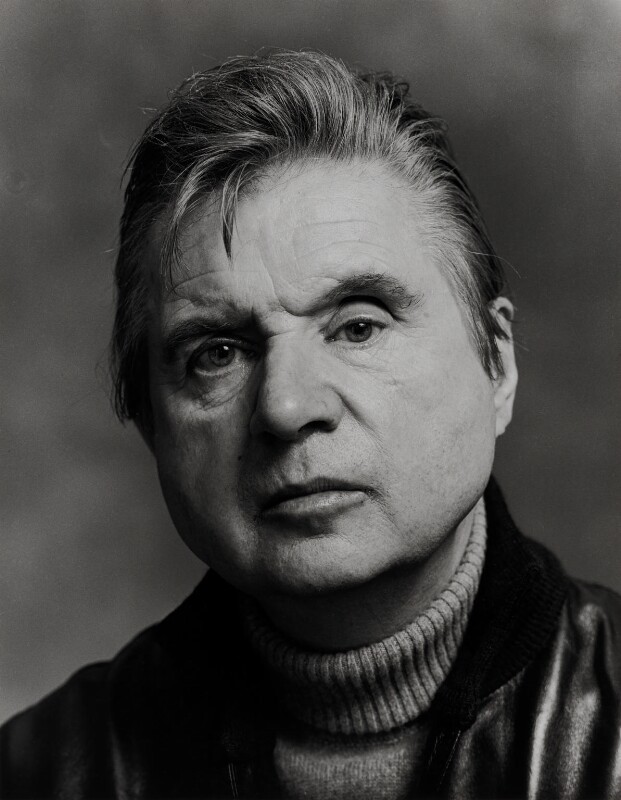
Francis Bacon work fails to reach reserve
BY OUR ART SALES CORRESPONDENT |
A PAINTING by Francis Bacon, for which the estimate was £85,000-£95,000, failed to reach its reserve and was bought in at £72,000 at Sotheby’s yesterday.
The property of an unnamed Irish artist, it is entitled “Study for a Portrait,” and dates from 1953.
The knock-down total for the sale of contemporary art was £563,890, for 146 lots, but 57 per cent of this total was for lots which were unsold.
A panting by Jean Fautrier, for which the estimate was £25,000-£30,000, went to a Japanese buyer for £22,000, the auction record for the artist’s work, and the Louisiana Museum, Copenhagen acquired an Yves Klein for £11,200, compared with the estimate of £14,000-£17,000.
GERALDINE NORMAN | SALE ROOM CORRESPONDENT | THE TIMES SATURDAY REVIEW | JULY 9 1977
Image of the Week: theatre of art
LAWRENCE GOWING | LIFESPAN ARTS | THE SUNDAY TIMES MAGAZINE | JULY 10 1977
Francis Bacon is the most highly regarded and best rewarded figure painter in the world. He is also the most enigmatic; in a problematic business, he is singular in leaving his public in almost total doubt about which way he is going and where his riveting style and imagery come from. So when there is the chance of a clue, when the D’Offay gallery is showing a picture he dated 42 years ago, one makes for Dering Street (off Bond Street).
The first impression of Composition 1935 is not of the figure, nor even of figurative painting. It looks more like abstraction engineered in the manner of the late John Tunnard. But here the style of English painting in the 1930s is transfigured by a sense of emotional emergency it generally lacked.
At a second look, this is not abstract. It is a great space like a stage scene
or a Piranesi prison, shot with fire and a puff of sulphurous smoke where some
apparition has lately vanished. In theatrical mood one can fancy that a Callot-like
insect-man is climbing a rope
But this stage is special. It is the theatre of art. A canvas edge and an easel leg show this is a studio, with floorboards and a wall panelled with planks, which appeared in some of Francis Bacon’s other pictures. The black framework like towering girders evokes the shape of the studio in Royal Hospital Road, where he lived and worked. In other pictures similar dark shapes resolve themselves into the likeness of a painter at work.
Here the resolution is still impending. The sensational rediscovery of figure painting is in the future. That is the emergency — and essentially it is the same as the drama of the emergent image that fills his painting today.
Lawrence Gowing.

THE ARTS | THE TIMES | TUESDAY JULY 26 1977
Last weekend the Austrian Minister of Education and Art, Dr Fred Sinowatz, opened the exhibition, English Contemporary Art, in Bregenz at the start of the festival.
The exhibition is the first of its kind in Austria: 334 paintings, drawings and sculptures of 45 contemporary British artists including Henry Moore, Francis Bacon, David Hockney, Graham Sutherland, Ben Nicholson, E. Paol0zzi, R. B. Kitaj, Barbara Hepworth, Peter Blake, Joe Tilson, Lynn Chadwick, Anthony Caro and Mark Boyle are being shown.
Failing into place
PETERBOROUGH
MORE THAN HALF the 199 artists chosen for the Royal Academy’s exhibition, “British Painting 1952-77, ” turned up to vet it yesterday, Robin Denny, Patrick Procktor, Sir William Coldstream and Fred Pollock among them. Francis Bacon, who is showing five canvases, one of them for the first time, had slipped in and out earlier.
Surprisingly, perhaps, where opinions are so various and egos so strong, there
were no scenes and the Academy, having spent £50,000 on
Some minor adjustments, however, were made. John Latham pointed out that his “roller
blind” canvas
should be rolled up a foot
TRIP INTO THE PRESENT
PETER SENN | ART
BRITAIN’S stuffiest art gallery, the Royal Academy, has finally caught up with the times.
It is mounting an exhibition devoted solely to modern British artists of the past 25 years.
A gallery spokesman admitted: “It is probably the most adventurous exhibition the gallery has put on in its 209-year history. You can say this is a breakthrough.”
Even established moderns like Graham Sutherland and Francis Bacon, who have never bothered to show before the academy, are represented for the first time.
One of our foremost abstract painters, Peter Sedgley, admitted: “Normally, I would never dream of submitting a picture to the Academy. The annual Summer Exhibition is full of works by people who think that painting is just a nice thing to do. Gentlemen painters you could call them.”
Spirit
But he felt excited enough about the new exhibition to come over specially from Berlin, where he now lives. Sandra Blow, one of the only six women Royal Academicians, said yesterday: “A new spiritis sweeping through the Academy.”
Going modern, though, has presented its problems for the gallery.
They hung one abstract by Cyril Reason upside down. The artist gently pointed out their error. And a triptych — a three-piece work — by Scottish artist John Bellany is still incorrectly placed. The two panels flanking the central picture are on the wrong sides. Bellamy wasn’t too happy about that yesterday.
PETER SENN Current Affairs
ART EDWARD LUCIE-SMITH
Contemporary British painting
EDWARD LUCIE-SMITH | ART
|
THE ILLUSTRATED LONDON NEWS
This year the Royal Academy’s Winter Exhibition is devoted not merely to British art, but to contemporary British art. After seeing the reception accorded to some of its immediate predecessors, such as the two parts of the Hayward Annual, one can only wish it luck.
The Academy’s spacious premises are far more suited to this kind of massive survey exhibition than those of the Hayward, and the sheer size of the exhibition is a bonus. It has enabled the selectors to put on view a very wide range of work indeed. Almost every kind of British painting is represented, and the show is thus what the annual Summer Exhibition ought to be and never is: a relatively unprejudiced gathering of all artistic tendencies. No artist has refused the organizers’ invitation to exhibit, and Francis Bacon hangs under the same roof as a dyed-in-the-wool Academician such as Norman Blamey.
One of the things which gives the exhibition its special character is the fact that it is restricted to painting alone. Many people concerned with modern art will feel that this, willy-nilly, imposes a traditional character on the event, since so much avant-garde energy in recent years has been devoted to putting forward the idea that painting itself is an obsolete activity.
Certainly one of the surprising things about the show is its relative coherence. It is typified by a certain temperate romanticism. The rebels (Bacon again) merely make the point by contrast. Nature and the reaction to the forces of nature are an important part of what British contemporary painting is about, now as in the 19th century. Another theme is the painter’s reaction to the social environment. The Kitchen Sink School of the 1950s more and more appear as the direct ancestors of the Pop artists of the 1960s, and the failure of British art to come up with something equally relevant as a comment on society in the 70s is one thing which makes it currently seem disappointing. There is, indeed, a feeling about the whole enterprise of hopes deceived and expectations disappointed, of a breakthrough which never came.
British artists have nevertheless been extraordinarily active during the two-and-a-half decades covered by the exhibition. The quantity of art produced has been enormous. The question of its quality remains open. The blandness which underlies even its most strenuous gestures worries the thoughtful critic.
So, too, must the question of what all this activity is about, in terms of audience and patronage. Today British painters find their main patrons either abroad, or among a handful of official agencies such as the Tate Gallery and the Arts Council. There are few private individuals with the money, the self confidence or even the will to collect the work of contemporary artists on their own account.
To my mind this gives a curious flabbiness to the British art scene. The ferocity of New York rivalries is unknown here; but so, too, is the feeling that the artist’s performance has been honed to a fine edge by the competitive circumstances in which he finds himself, and by his own desire to excel his rivals. Rivalry needs an informed audience, and that is something which British artists have never possessed in recent years. A vague, generalized, lukewarm approval is not enough.
Now the climate seems to be changing, and at first sight for the worse. The cries of discontent aroused by some of this year’s Jubilee exhibitions, and the widespread feeling that contemporary art has been over-exposed and found wanting, provides the Academy with a severe test. Can it change the now hostile critical climate? Can it reverse the tendency towards falling attendances for exhibitions of this sort?
If it does these things it will have scored a historic success. But it looks like a tall order.
Love among the artists
By Alan Ross
MICHAEL WISHART: High Diver
ALAN ROSS | BIOGRAPHY | THE TIMES LITERARY SUPPLEMENT | NOVEMBER 25 1977
Michael Wishart seems to be forty-nine — though he is fairly vague and confusing about chronology; had his first show of paintings when he was sixteen and has had numerous exhibitions since, mainly at the Redfern. The only example of his work in this autobiographical volume adorns the dust-jacket: a 1976 painting called “Straits of Gibraltar. Apparition of my lost monkey”. The background is richly painted in a manner somewhere between Arthur Boyd and Dennis Wirth-Miller and the animal in the foreground holding a fan — which I would not have identified as a monkey — owes a lot to Picasso. There is a fey and whimsical element in Wishart’s painting, a rather overblown romanticism which probably more than anything else has prevented him from making a greater mark than he has done.
Why should one be interested in his life which is reconstructed in this book in disorganized, often amateurish and naive fashion, full of careless repetitions clumsy phrases and idiotic paragraphs that read like extracts from “Jennifer’s Diary”?
Aly took us to drinks with a film actor, Van Johnson, who had a beautiful wife. They were staying at Eden Roc Aly’s other guests included Ivan Foxwell and his beautiful wife Lady Edith and Liz Whitney who frequently telephoned to one of her racehorses horses in America who was recovering covering from an operation for cancer
We are told several times, twice in successive paragraphs, that David Tennant
owned the Gargoyle —“a remarkable combination of beauty, intelligence and wit .
. . he flew his own aeroplane. It is sad that later the brandy bottle became his
joystick”; and more than once that Victor Brauner had an eye put out by his
fellow surrealist, the elephantine and sado-masochistic Spaniard Oscar
Dominguez, who is reported as having thrown Murie Laure de Noailles into the
“filthy
oily waters
And yet, with all its faults, this is a rewarding readable and informative book, deeply felt and oddly moving. For a start, the cast list is studded with the great, the glamorous, the talented and the beautiful. Aragon, Francis Bacon, Christian Berard, Caroline Blackwood, Roy Campbell, Cocteau, Cyril Connolly, Anne Dunn (to whom the author was married for ten years Margot Fonteyn, Lucien Freud, David Gascoyne, Giacometti, Peggy Guggenheim, Augustus John Nijinsky, Nureyev, Tabitha Getty, Barbara Skelton, Graham Sutherland, Tchelitchew, Peter Watson among others. None of thee-e is in for show, about most of them Wishart has something new or relevant to so and to several of them for a period Wishart was genuinely close.
His own background is not without out genetic interest. If he were a yearling earning up at the Newmarket market sales he would look good in the catalogue related to several winners His father the son of Colonel Wishart one of H George Vs Lieutenants foe the City of London and a sheriff founded tile publishing house of Wishart and Co which brought out in 1925 the excellent literary periodical The Calendar of Modern Letters (edited by Edgell Rickword) but later acquired the defunct firm of Martin Lawrence and became exclusively political. His mother, the ninth and youngest child of an “almost legendary” doctor, had two equally striking sisters one of whom married Roy Campbell and the other Epstein. “Two of my cousins married Lucian Freud and Laurie Lee”, Wishart adds, a sentence that might have been more accurately constructed.
Wishart was born when his mother was only seventeen and it was not long before she took off, for an unspecified period. A lonely child, he was sent first to a dame school. —“For two years I droned in unison son ‘Our Father Wishart in Heaven. Hello! It be thy name’ ” — then to a council school where he was bullied. (In the holidays from this school he seduced a German POW. “I have never since experienced physical cal desire comparable to that which I fcit for the German POW a love which the improbability of the situation merely intensified.”) He went next to Bedales, where he was coached at tennis by Kay Stammers and where Thorn Gunn was a fellow low pupil He enrolled subsequently at the Central School of Art, having discovered an early facility for painting, and ended up at the Anglo-French School in St John’s Wood: “It was here that I met a young man Adrian Morris who unknown to the public is unhurriedly developing into a very original artist indeed I know of no other painter of my age whose work is more likely to interest posterity.”
There followed a short stay with the Roy Campbells — about Roy Campbell Wishart is both affectionate and revealing — and then it is off to Paris. Here he stayed with Lucian Freud, who drew him, met tile poet Olivier Larronde, Andre Malraux, Bérard, Marie-Lame de Noailles, the dancer Jean Babilée and, perhaps disastrously, Peter Watson the rich, much-loved proprietor of Horizon, art-collector and generous supporter of many art enterprises Through Watson, Wishart became hopelessly involved with the great love of Watson’s life, Denham Fouts a nocturnal American can from Jacksonville, Florida, already irrecoverably on the road to his death from a combination of opium, heroin, cocaine, and drink. The weeks that followed their meeting at which Fouts initiated Wishart into some of his habits were an exquisite torture, ended only by sudden separation and a few months later by Fouts’s death. This tragic episode is perceptively and vividly described.
It seemed to me that [Denham] was committing suicide in slow motion, savouring it enjoying a unique joie de mourir, mocking the threat of maturity as a fearless less fighter pilot dives into a bank of black cloud, paying no attention to his instruments. Anything thing that gave him a feeling of being in the grave . . . appealed to him.
Back in London Wishart became friendly with Francis Bacon:
I enjoyed watching Francis make up his face He applied the basic foundation with lightning dexterity born of long practice. He was more careful even sparing with the rouge For his hair he had a selection of Kiwi boot polish in various browns He blended these on the back of his hand selecting a tone appropriate for the particular evening and brushed them through his abundant hair with a shoe brush He polished his teeth with Vim.
Bacon sent Wishart as an emissary to deliver a loan to Anne Dunn, daughter of the millionaire Sir James Dunn, by his second marriage to Irene, Marchioness of Queensberry. In no time at all they were married, setting up their respective easels in Paris, St Tropez, London, Nice, Venice, Algiers and Vienna. A son was born. They had guests such as the Connollys, Francis Wyndham, David Gascoyue, visited Aly Khan, who confided his problems lems of premature ejaculation met Nancy Cunard, Utrillo, Elsa Maxwell well among others. Then the blow falls: “The realisation that Anne had a lover came as the severest shock I have experienced She was the only person whose fidelity I never doubted.”
The ensuing weeks of grief and drinking led to the public ward of a hospital in Paris where Wishart was treated for DTs with paraldehyde, and thence to what he calls an asylum for aversion therapy: “In that clinic I think I saw something like Hell, such was the concentration of anguish, unreason and despair.” Four weeks later he left, physically fit but demoralized, obliged to embark on the routine of an unwished-for divorce: “I was increasingly aware of Anne’s impatient longing for a renewal of happiness in which I lad absolutely no part.”
Eventually, after further unhappiness painting, and a short interlude with Barbara Skelton, whose descriptions of the period and its characters in short stories and a novel got her publisher into a lot of trouble there developed an infatuation for a young man called Nicky. For years I could have sacrificed a limb rather than lose his presence Nicky was a painter too and decorator and his wardrobe robe grew in direct ratio to my overdraft.
Two years, and many trips to France, London, Venice and New York, later, Nicky departs for America: “One of the sat things about homosexuality is that lovers and friends are seldom the same person.” There is a reunion but it does not last. After several more unhappy years the attachment fades: “Falling out of love is the most thrilling emotion I have experienced Perhaps leaving prison after a four-year sentence feels as good.”
Michael Wishart is a mere thirty-three when the book ends. What he has written of those years is often self-indulgent, sometimes soppy, but equally often affecting and compelling. There are some fascinating, unfamiliar photographs of the main characters, and a great many of the author, including paintings of him by Hockney, Procklor and Sir Francis Rose (during Wishart’s Kojak period), as well as what looks like a resembling portrait of Nureyev by the author.
Fame
PETER SIMPLE | THE WAY OF THE WORLD | THE DAILY TELEGRAPH | THURSDAY, DECEMBER 8, 1977
“I ENJOYED watching Francis make up his face. He applied the basic foundation with lightning dexterity born of long practice. He was more careful, even sparing, with the rouge. For his hair he had a selection of Kiwi boot polish in various browns. He blended these on the back of his hand, selecting a tone appropriate for the particular evening, and brushed them through his abundant hair with a shoe brush. He polished his teeth with Vim”.
This passage about the painter Francis Bacon comes from a new book of reminiscences by Michael Wishart. It is quite possible that in some future age, now unimaginable, this little domestic detail may be the only thing for which this absurdly overrated painter is generally remembered. It is also possible that it is only as a source for the passage about Bacon, quoted in some footnote, that this column will be remembered — and only by specialist scholars at that. Such is the way of the world.
Peter Simple
LONDON GALLERIES by Richard Seddon
Corruption of human image
RICHARD SEDDON | LONDON GALLERIES | YORKSHIRE POST | MONDAY, DECEMBER 12, 1977

Francis Bacon: painting with passion.
PAUL OVERY | THE ARTS | THE TIMES | TUESDAY DECEMBER 13 1977
Even after man began to heard animals and grow crops, the hunt continued as a ritualized contest between man and animals and as such was one of the most popular subjects of courtly art until the time of the Renaissance and beyond. Some of the liveliest and most vital animal art was£ made by the nomadic Scythian tribes, and more recently by the Eskimos. The sections in the British Museum exhibition, Animals in Thought and Religion, Signs and Emblems and Stories and Fables show how men in widely different cultures have used animals as religious and moral symbols, Often creatures were visualized as half-man, half-animal, like satyrs or centaurs, or, the Hindu god Ganesa, half-elephant, half-man, the remover of obstacles who helps his worshippers attain their desires.
The final section, Animals Studied and Described, which traces the naturalistic visual descriptions of animals, is, not surprisingly, largely focused on Western European art although it also includes examples from China and Japan. Often European attempts to depict exotic animals were based on verbal descriptions, not on direct knowledge of the animals, like Dürer’s famous woodcut of a rhinoceros, although Rembrandt’s beautiful chalk drawing of an elephant was clearly done from life, probably from a travelling circus. But generally, as representation becomes more accurate and realistic. the animal forms lose their vitality and their capacity to incorporate man’s desires and moral beliefs. The exhibition, which is beautifully presented, continues until February 25.
I have always found the uncritical acceptance of Francis Bacon’s reputation difficult to understand. Bacon, began as a designer of Bauhaus-influenced furniture and textiles in the early Thirties. His work as a painter looks like a violent reaction against the utopian idealization, the belief in a world perfectible by technology, which the design movements of the Twenties and Thirties represented. The reaction is understandable and necessary, but its violence appears essentially immature and adolescent. At best Bacon’s paintings are melodrama, at worst Grand Guignol.
His exhibition at the Galerie Claude Bernard earlier this Year contained a number of paintings of figures sitting at stool or being sick into washbasins. The Marlborough Gallery’s small display of four paintings (one is a triptych) includes only one of these, Man Standing at a Washbasin. Others contain familiar earlier imagery, like figures seated under ’umbrellas or on plinths in what look like caricatures of a modern designed environment. Although the effect of these is generally more restrained than that of the Paris show (if any Bacon can ever be described as restrained) the dominant these remains that of self-paraody.
Frank Auerbach is an artist who has been constantly underrated. In fact he is one of the best painters in England. He is having a retrospective at the Hayward next year and the Marlborough are now showing recent paintings. The three of Primrose Hill at the front of the gallery are impressive, particularly Winter Evening with its glowing dark reds and white bobs of lamps. Two views of The Camden Theatre show how Auerbach uses a heightened version of Sickert’s tonality to fine effect. The portrait heads sometimes come too close to the violent slithering of paint one associates with Bacon, but the tactile quality of the pigment (Bacon is never tactile) usually prevents this. The two shows continue until January 22.
A GLIMPSE AT OUR TOP PAINTER
DIARY | MEWS | EVENING NEWS | WEDNESDAY, DECEMBER 28, 1977
THE remarkable artist Francis Bacon has at last decided to give Britain a chance to see some of his recent work.
Despite hugely successful showings on the Continent the British artist has not had an exhibition in this country for ten years. But now his London agents say they are planning a show in the New Year.
An international poll of museum directors in 1971 voted Bacon the world’s finest living painter. But the great man, now 67, lives the life of a recluse in Wivenhow, Essex, in a terraced house worth £7,000.
London
CURRENT AND FORTHCOMING EXHIBITIONS
KEITH ROBERTS | THE
BURLINGTON MAGAZINE |
Francis Bacon’s recent paintings, on view at Marlborough Fine Art, are datable to an era of peace and affluence but reflect a spiritual and emotional world at war with itself. The I974 Triptych (Figs.34-36), partly repainted since being shown in New York, employs an outdoor setting that only adds to the sense of claustrophobia because the space is airless and the distance forlorn.
The nameless, faceless figure battling with an umbrella, a new but soiled Laoco6n, is both haunted and hunted. The increased use of bathroom imagery in Bacon’s work suggests an anguished, almost Lady Macbeth-like despair at the loss of purity and innocence. The Triptych is a superb work, painted at full stretch and with no sign of staleness whatever.
Patrick Heron does not operate at this level of intensity but his recent gouaches (I970-77), lately on view at The Waddington and Tooth Galleries II, are extremely agreeable. What I particularly like about them is the way Mr Heron finds for his bold, jagged jig-saw shapes precisely the right intensities of orange, grass green and sharp yellow. Shape and colour are in perfect harmony.
Bacon’s contempt
EDWARD LUCIE-SMITH | LONDON ART REVIEW | EVENING STANDARD | THURSDAY, JANUARY 5, 1978
FRANCIS BACON is unquestionably the most celebrated and the most prestigious of British painters. An exhibition of his work anywhere in the world is always a major artistic event.
In Paris and New York he has broken through the resistance to British art, and is fast approaching the status which was once accorded to Picasso himself.
Setting aside any twinges of chauvinism, this is interesting for two reasons. One is that Bacon seems to have aims which are very different from those of nearly all his contemporaries.
The second is that his reputation has increasingly started to come under attack here in England.
Currently Marlborough Fine Art are showing a small group of new works which offer an opportunity to re-assess what Bacon is up to and allow us to decide if the criticisms have any substance.
The pictures at the Marlborough are, as always, large figurative compositions. They show distorted figures in what seem to be interiors dreamed up by some mad decorator of the 30s, or else in bleak landscapes which might be borrowed from an Antonioni film.
There are a number of familiar properties
These suggest something already obvious: that Bacon inhabits a very restricted imaginative world.
He returns obsessively not so much to certain themes as
to certain emotions
These emotions are presented in a manner which owes more to the old masters and less to the discoveries of the modern movement than one would find in the work of any other contemporary painter of comparable stature, with the single exception of Balthus.
Many interpretations have been given to the series of variations on Velázquez’s portrait of Pope Innocent X which Bacon painted some years ago. But there is no doubt that one of the things he took over from his 17th century model was a kind of unabashed baroque grandeur.
He has been in love with this quality ever since, and the paintings now at the Marlborough are as much in search of it as ever.
Why does Bacon feel impelled to link this grandeur to the most ignoble themes he can find? There is a defiant image here of a figure being wretchedly sick into a washbasin which is Bacon at his most typical.
Two explanations are usually offered. One is that Bacon is a savage critic of a hideous world. The work which made his reputation, the Three Studies For A Crucifixion (now in the Tate) was after all an oblique indictment of the atom bomb.
The other is that the great artist can turn anything into art.
I am not sure I find either of these completely acceptable. The grand manner put at the service of deliberate squalor needs more justification than that.
What emerges from Bacon’s late paintings is a contempt for the audience which is also, perhaps, the painter’s contempt for himself.
Can art as great as Bacon’s is supposed to be, base itself upon a sneer?
.

BACON at a Paris exhibition a year ago.
Convulsive
By JOHN McEWAN |
For some years Frank Auerbach has tended to be presented as Francis Bacon’s protégé, and now again they are paired in an exhibition of their recent work at the Marlborough (till 20 January). One way and another there can be no English painter of the post-war period who has not been influenced by Bacon, and Auerbach is no exception. In fact he has undoubtedly been more directly influenced than most, being a longstanding friend quite apart from anything else, but, except in his studies of reclining figures, there is little of this influence to be seen in his work. Bacon’s idealism, his tastes in painting, even his clogged studios, are all things shared to some degree by Auerbach, but these things should not detract from Auberbach’s achievement in withstanding the competition on this occasion.
The paint in Auberbach’s earlier work was so constantly applied that the final
encrustation qualified as sculptural relief. Today his method is no less
painstaking but whereas before he continually overpainted he now scrapes off.
This process is merely a measure of his own dissatisfaction and may continue in
certain paintings for as long as two years. The final image, though guided by
these previous failures, will have been completed as usual in a single session,
the paint brushed, fingered, wiped and even squirted straight from the tube on
to the canvas in a crisis of spontaneous effort. By these arduous means he hopes
to
As before, Auerbach paints what is most familiar to him. The same people if possible, the same cityscapes always. Primrose Hill, Mornington Crescent, views of Camden near where he works.
Even when he substitutes Rimbaud’s portrait for the mural surmounting the chancel of a baroque church, the interior is specific not imaginary. His views are no less so. A night study of Primrose Hill will have entailed numerous on site sketches at night, though the final oil painting will be done at the studio. This does not mean that the trees and colours will be naturalistically reproduced, but the canvas will only be abandoned, the truth celebrated, when it conveys a satisfactorily precise experience of the place, a place viewed from a particular point at a particular time. These details are also worth emphasising because, just as Auerbach is distractingly associated with Bacon, he is no less erroneously called an expressionist artist, though his colour is not symbolically emotive, nor are his brushstrokes psychological deliberations.
These paintings are his most free and expansive to date. The view of Primrose Hill seen from below the overhang or against the zig-zag of branches, and even flying birds, lose nothing of their spaciousness through the grip of such structural devices; the most disparate strokes and colours when viewed in isolation successfully combined in his challengingly angled portraits; and both the Rimbaud paintings are particularly successful, one of them echoing Sickert at his most sumptuous.
Both Auerbach and Bacon are scheduled to have retrospectives, Auerbach at the Hayward in the summer and Bacon at the Royal Academy in 1980. Then, with the benefit of seeing comparative developments, will be the time to discuss their work in greater detail. This applies especially to Bacon who can hardly be discussed in terms of the relatively new half-dozen or so paintings in the back gallery at the Marlborough. This is not to belittle Auerbach’s achievement in holding his own in the front galleries, merely to keep things in proportion. On the basis of this limited sample Bacon is not as powerful as formerly. Male nudes, frustrated by their own convulsive energy, hold the centre of the stage, but while the shadows are oddly green and the pastel provides a feverish glitter, there is a feeling of lassitude. Volume and points of significance continue to be denoted by diagrammatic circles and arrows, the potency of the central figure dissipated by marginal props and activities. In the large ‘Triptych’, the big brother figures are relatively conventional, the background a view of the sea. Two distant horsemen come trotting out of Gauguin to the rescue. These are still grand enterprises, but for that beauty of the mutual antagonism of opposites which Bacon holds so dear, the small triptych of a head hidden away round the corner is the answer.
On the Beaton track
ANTHONY HOLDEN |
SIR CECIL BEATON was back home in Wiltshire last week, after a quick flip around
North and South America to prepare for publication later this month of his sixth
and last volume of diaries. It covers “The Parting Years”
Beaton lives a dozen miles west of Salisbury, at Broadchalke, once the homey of another social diarist, the brief biographer John Aubrey. He has lived there for 30 years (without ever visiting Aubrey’s house), in, a rambling 17th-Century brick pile. Its interior is English manorial out of cosmopolitan. Marble tables, huge blue pots, busts, Roman plates, pictures and walls of books crowd, around you as you move between the flower room (full of Beaton’s characteristic hats), the winter garden, the studio (a portrait of Picasso lying casually, the famous photo of Rex Whistler at a fete galante).
Beyond the famous Hockney drawing of Beaton lies the mellow cavern which
contains the man himself; by a blazing fire in his sitting room Sir Cecil awaits
you, extends his left hand. He is a spruce 74, poised and elegant as expected,
with a white silk scarf knotted at the neck; precise in his delivery, though now
a little forgetful. This last volume of diaries, elegiac in tone, is filled with
the deaths of friends; Beaton himself is regretful, despite what others would
see as just worldly deserts;
A
benevolent raconteur, he nonetheless keeps his publisher’s libel lawyers on
their toes. Last time round, a large chunk about Francis Bacon had to be
excised. More has gone from this volume, though one can’t help remarking that an
amorous adventure of that same publisher, Lord Weidenfeld, has remained. The
only person Beaton seems genuinely to have disliked is Evelyn Waugh, with whom
he had a running feud down the years:
What of Beaton’s own notorious snobbery, which flourished at the onset of fame?
He is now
“cured”
of it, he says. He is
One such is David Hockney, born far from Beaton’s milieu and generation whose
friendship he clearly cherishes. Both could be adjudged the finest portraitists,
and among the leading stage designers of their respective generations; but his
is not the source of their affinity.
Beaton tells of the day Hockney bought a car in Los Angeles without ever having learned to drive. He set off down the St Bernardino freeway, found he couldn’t get off it, and four hours later wound up in Las Vegas; so he turned the car round, and after another four hours realised he had learnt to drive.
Beaton’s other famous young friend is Mick Jagger—
Paintings from 1951
. . . at Birmingham Museum and Art Gallery
By TERRY GRIMLEY
Birmingham Post Art Critic
This exhibition, 25 Paintings from 1951, organised by Sheffield City Art Galleries, is a partial reconstruction of an earlier one, 60 Paintings for ’51, which was the Arts Council’s major contribution to the Festival of Britain.
In keeping with the prevalent mood of optimism, the Arts Council invited 60 British artists to submit large pictures and supplied them with canvas. The exhibition toured Britain and provoked much public comment and controversy.
With the benefit of hindsight, it appears that the insistence on “big” pictures was brave but foolhardy. This was not a vintage period for British painting, and seeing its shortcomings blown up on to acres of canvas does not flatter it. Even Ben Nicholson, who stands head and shoulders above most of his contemporaries, was here lured into producing a canvas of striking vacuousness.
Some of the exhibits are simply
embarrassing. Paintings by Elinor Bellingham Smith, Hans Feibusch and Vanessa
Bell might today be accepted as competent illustration, but surely not as
serious painting. There is a curious aberration by Carel Weight
Patrick Heron’s interior, Christmas
Eve, which I can imagine looking interesting in reproduction, does not begin
to justify its scale, but three well-known painters
The two painters who emerge with most credit are Lucien Freud, whose Interior near Paddington is not only a masterpiece within its own oeuvre but also carries a strong sense of the period. and Victor Pas-more. Perhaps judged on its own merits, Pasmore’s Snowstorm, Spiral Motive is not so remarkable, but compared with most of the picture here it is extraordinarily fresh and demonstrates how original his work of this period was.
The exhibition is open August 12. Monday 10 a.m. to 5.30 p.m. until to Saturday 10 a.m. to 5.30 p.m.
Bacon saved
PUBLIC EYE | THE OBSERVER | SUNDAY 10 DECEMBER 1978
THE ART world failed to solve an intriguing internal mystery last week when one of that not always good-tempered artist Francis Bacon’s paintings came up for auction at Sotheby’s.
Prospective buyers were told tartly that the artist had ‘abandoned’ the work ‘Study for a Man on a Chaise Longue’. Indeed a note was specially placed beside it during the viewing.
No one at Sotheby’s was prepared to disclose why Bacon had abandoned the work, nor who would have received the £35,000—£40,000 it was worth, beyond admitting ‘the vendor had every right to sell the painting.’
Bacon himself is distinctly terse about his work, but the mystery remained unresolved because no one was prepared to offer the reserve price.
ART SALE MAY HALT RATE RISE
A COUNCIL may sell its art treasures to help prevent a 25 per cent, rates increase and a £500,000 public spending cut.
Kirklees council may auction some of its works of art, valued at more than £1 million. The Tory-controlled council has 181 art works, including a Henry Moore bronze, “Fallen Warriors,” thought to be worth more than £30,000. There is also a Francis Bacon painting valued at £100,000 and a Lawny painting thought to be worth £13,000.
Tory leader Councillor Tom Cliffe explained yesterday that the council was in a desperate financial position because of the Government’s £3-5 million cut in its rate support grant. Inflation and the prospect of pay awards to council workers and teachers aggravated the situation.
“We have already cut spending in the last 12 months by more than £750,000 and we
are cutting back by a further £2 million in the coming year.
“Many of our works of art are hidden away in vaults and are not even seen by the public.”
PAY increases for about 19,000 council employees is one main reason for the proposed sale of art treasures by Kirklees metropolitan district council, a council official said yesterday.
The council has faced a £4 million cut in its rate support grant for 1979-80. which would add at least 6p to a 51p rate, he said.
The Tory-controlled council said on Wednesday that it was considering selling some of its 400 pictures and sculptures, worth £1
Pay increases for the council’s
employees were expected to be live per cent, said the official.
Bacon painting
The art collection has been built up over a number of years by the three boroughs of Huddersfield, Dewsbury and Batley that became Kirklees with reorganisation in 1974. They are kept in the towns’ art galleries.
Among the works, mostly at Huddersfield Art Gallery, is a Francis Bacon
painting,
“Figure
Study 2.”
valued at £85,000, presented by the Contemporary Art Society to Batley; a Henry
Moore bronze,
About 50 per cent. of the Works, largely 20th century, have come from bequests, or have been bought with substantial help from Government grants, and these will not be sold.
Klein makes record £43,000
A RECORD £43,000 was paid for a work by Yves Klein, the French artist, at Sotheby’s contemporary art auction yesterday.
The buyer was a German private collector. The work, a blue pigment relief on panel consisting of sponges and pebbles, was completed in 1960. The previous record for Klein (1928-62) was £26,250 in 1974.
An oil picture of 1949 by the French-German painter known as Wols and entitled “Etoiles Variables” made £18.000 — a record for the artist. Another oil painting by him in 1947 also went for £18,000. An oil on canvas work by Jean Fautrier. signed and dated 1956, made £18,000.
A disappointment of this otherwise successful auction was the Francis Bacon portrait of Henrietta Moraes, painted in 1964, which failed to sell. It was bought in at £54,000. The total for the 150-lot sale was £507,696.
OBITUARY
Beneath her avowedly mercenary priorities lay a rich stratum of kindness. For many years she raised money for a school for children suffering from muscular dystrophy, everyone of whom was generously remembered on its birthday. This was as important to her as anything else and there were many other beneficiaries.
She will be mourned by all her membership for her wit and style, and also for her dignity and goodness, which though earlier sometimes in doubt, became more and more discernable as her true essence.
When Soho had a soul
DANIEL FARSON takes a nostalgic look back
WHEN I first stumbled into Soho, I was 20 years old. It was a strange new world to me and I was hooked.
In the morning it was a village, with a local dairy and blocks of ice dripping expectantly outside the shuttered restaurants. At lunchtime it was food and drink by far the most varied in London. At night it was more food and drink, combined with music and fun. Always fun.
Even then it amused me that Soho was known as the square mile of vice when it was really so gentle. I remember meeting one “notorious Soho Character” (was it Jack Spot or Billy Hill?) but he was retired and I remembered him only because of his complexion which was the colour and texture of foam-rubber.
Admittedly SOHO MURDER! was a popular placard but, if you checked, it happened miles away. Soho has always been an easy label. Only recently, a TV documentary concentrated on Piccadilly and Leicester Square, when the real Soho lies north of Shaftesbury Avenue. My addiction was due to the characters I met there. Most were highly respectable but in Soho they could find their fantasies. Others were outrageous, like ‘Phyllis’, a man who sold roses to passers-by and was given a gangster-style funeral by the warm-hearted stall-holders of Berwick Market.
Some were searching for their own identities, as I was; many knew themselves too well, like Nina Hamnet who had been a model for Modigliani and was now a walking scaffolding of sticks after various drunken tumbles. Or Gerald Hamilton who escaped to Ireland in World War I dressed as a nun “Mother Superior” he corrected me and was rumoured to have sold forged passports to German Jews before World War II and then passed on the numbers to the Nazis.
“Is it true,” I asked him, “that you are the wickedest man in Europe?” “The wittiest man in Europe,” he giggled. “Oh, you're too kind!” I met them in the Caves de France in Dean Street. It has gone. Opposite was the Gargoyle Club, where you rose in a tiny lift and then descended down a staircase into a room with 20,000 squares of glass designed by Matisse.
When I arrived, Guy Burgess had just departed for chillier climes, but I saw the painter John Minton dancing wildly with himself to his favourite tune, I’m g to sit right down and write myself a letter, which he paid the small group to play again and yet refrain. A generous, febrile personality, he had enough talent to recognise his lack of true genius, killed himself a few years later. Today, the Gargoyle is a high-end strip-club.
Down the street was the York Mininster, better known as the French Pub, still run by Gaston Berlemont. Today we don't see eye to eye, in other words I'm barred, but in those early days I drank there with Brendan Behan, 11 early one morning met Dylan Thomas for the first and last time. He sat there sober, subdued and apprehensive, waiting to leave for his last, disastrous lecture tour of America. Noticing my copy of a Raymond Chandler story, he asked if he could take it on the flight and cheered up slightly.
All too quickly I sat beside Caitlin Thomas in the Caves one afternoon as she waited to fly to America to join him. She had just been told that he was dying in a New York hospital (from ‘alcoholic insult to the brain’). Naturally distraught, at one moment she seized a bottle to brain the man sitting on the other side of her, John Deakin, the photographer, another famous Soho character. Luckily he ducked. But she left a nasty gash on the bar and the glass flew everywhere
Best of all, next to the Caves, was and still is The Colony Room, better known as Muriel’s because of its owner, Miss Muriel Belcher. For once, the title “Queen of Soho” is correct. When I first crept round that door I thought that she and her members were the most extraordinary people I had ever seen. I still do.
She perched on her corner stool as if she was holding court, as indeed she was. As someone put it: “She assembled a power-house of talent.” The only people she could not stand were bores and she forced them into a position where they had to buy round after round for everyone else until they fled.
In those early days, a courteous old man called Leonard Blackett, and a promising painter, Francis Bacon, were given free drinks -their presence was sure to draw in wealthy customers. It is impossible to convey her style without entering her peculiar world in which total strangers were addressed as Clara; Hitler was Miss Hitler; and Blackett as ‘a gallant little woman in the Somme’.
Her genius as a club-owner was her ability to mix people so that the club was never typed, never predictable. You never knew what was going to happen. It was far from being a grand place. You passed some dustbins beside a restaurant and climbed some shabby stairs. Before I arrived, the restaurant had at one point been overrun by rats.
One evening as she counted the till, she noticed two sets of beady red eyes staring at her from a corner. She stared back: “You two can buzz off.” But, as she was a kind woman, she gave them the explanation: “You see, I’ve called last orders. Anyhow, you’re not fully paid-up members.”
Obviously, such a club is not to everyone’s taste. I was told that Michael Parkinson refused to go there because it was full of ‘failures’. Such is failure! I wondered this as I climbed those stairs recently and ran into Thea Porter, whose fashion house is in Greek Street; John Hurt, the actor; and Francis Bacon whose paintings fetch more than £150,000 today.
Not long ago I was invited to give an address at the memorial service for Muriel Belcher at St. Paul’s, Covent Garden. I am not good at such things. I dreaded it. But as I stood at the lectern and looked at everyone there, I realised it really was a Thanksgiving for our good luck in having known her.
Even so, I mentioned that I was in some embarrassment, talking about Muriel in church: “For her wit was dry and her language so colourful that it once had her barred from a Chinese restaurant in Limehouse.” To my surprise this was greeted with a roar of laughter and applause. I never knew that people clapped in church, but it was not offensive. If there is no humour in heaven it must be a dull place indeed.
At the end I quoted the writer Paul Potts, one of the few colourful characters left in Soho today, who told me once that “she could have run a great hospital if she had wanted to. But drink and conversation are her materials and she has caused a large amount of happiness to come people’s way.”
Outside the church, in the sunlight, faces from the past gathered and remembered her wit. But there was a sadness, too. Bacon was there, incredible to think that he is 70, and I have never seen him so desolate. We celebrated in The Colony afterwards, but I had to accept that part of my Soho had gone. Of course, I have changed as well.
How wide-eyed I had been in the famous Fitzroy Tavern, full of sailors in uniform and people trying to pick them up, while a bearded pianist in a kilt got everyone singing. It had the vitality of an American musical, before it was raided. How flattered I was, the first time I was accosted by one of the smiling tarts in the street. What zest there was before Wolfenden!
Now the prostitutes have moved off the streets. Most of the restaurants and food-stores are left, but too many have been replaced by porno shops and strip joints. What shocks me is not their sleaziness but their sameness; not the sexiness but their sadness. How ironical that Soho is furtive today when it used to be boisterous. People did not whisper then, they shouted! Perhaps there is no need for Muriel any more.
Certainly, something good has died in Soho.
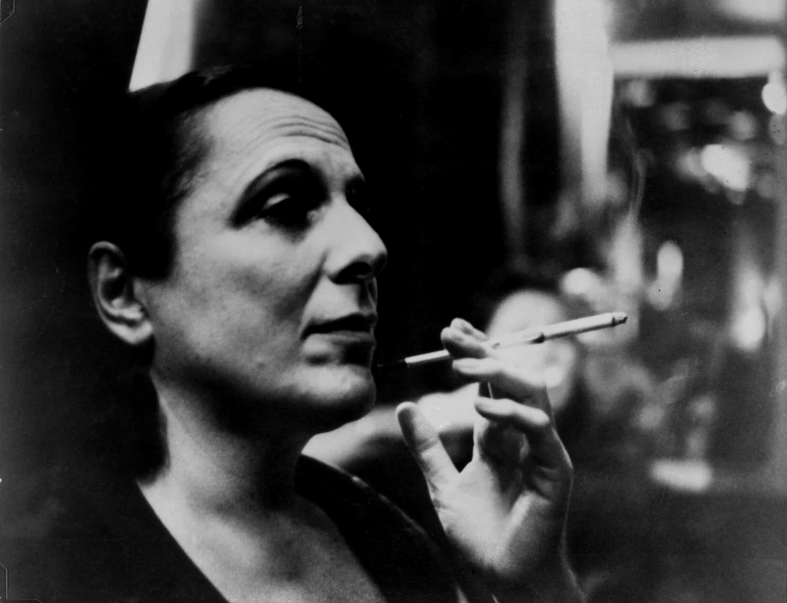
SO MANY CHARACTERS
SOHO . . . in the morning it was a village . . . at night a place of music and fun and always full of extraordinary people like Muriel Belcher, then “Queen of Soho” and owner of The Colony Room.
OBITUARY
MR GRAHAM SUTHERLAND
Eminent figure in modern British painting
Mr Graham Sutherland, OM, who died yesterday at the age of 76, gained a
special eminence among modern British artists as one who combined a native
romantic quality of feeling with the influence of European Surrealism in works
which showed an exceptional gift of colour and design. Much of his mature work
might be described as
“visual
metaphor”,
his suggestions of natural form having a double significance as ideas or symbols
or as being stirringly evocative of other forms. A characteristic instance was
his cultivation of the thorn motif, not only as a curious structural feature of
design but (he himself remarked)
He was not confined to the vegetable world by this imaginative attitude.
The thorn pictures of 194546 prepared the way for the
Graham Vivian Sutherland, eldest son of G. H. V. Sutherland, a civil
servant and lawyer under the Board of Education, was born in London on 24 August
1903 and educated at Epsom College. After some training in engineering, which
took him to the Midland Railway works at Derby, he attended the Goldsmiths’
College of Art at New Cross, specializing in engraving and etching. He made his
first reputation as an etcher of landscapes in the spirit of Samuel Palmer’s
early pastorals. Palmer’s romantic intensity inspired a group of younger etchers
and draughtsmen who were encouraged by the proprieter of the Twenty-One Gallery,
Adelphi, and it was there that Sutherland had his first one-man show of drawings
and engravings in 1925, followed by a second in 1928. Previously, in 1923, a
drypoint of his,
From this early graphic work, with its feeling for the poetry of English
landscape and the picturesque effects of time and weather on barns, cottages and
old trees, he turned in 1930 to experiment in painting and poster design for
Shell-Mex and London’s underground. One Shell-Mex poster in particular,
representing the Great Globe at Lulworth, comes to mind as a piece of accidental
surrealism in the unexpected relationship of natural and artificial shape. It is
evident that the Surrealist movement, so strong in this decade, and the
International Surrealist Exhibition of 1936 had an effect as stimulating on him
as on Paul Na§h and Henry Moore among others. At this period he made a series
of remarkable transitions from the linear definition of his etchings to a broad
handling of oil paint; from the exhibitor at the R.A. and R.E. (he was expelled
from the latter society in 1933) to the independent
His first exhibition of painting, held at the Paul Rosenberg and Helft
Gallery in London in 1938, was summed up by The Times as an extreme distillation
of landscape moods in terms of pigment Fallen trees and hollow tree trunks were
prominent as, motifs to which the artist gave weird and varied suggestion. A
second exhibition was held at the Leicester Galleries in 1940 and a
retrospective exhibition at Temple Newsam (with Henry Moore and John Piper) in
1941. In some degree his war paintings and the Northampton
Undertakings on a large scale are of especial note from the 1950s
onwards. The mural canvas,
A departure of another kind was into portrait painting, beginning with a remarkable study of character in the portrait of Somerset Maugham (1949) now in the Tate Gallery. It was followed in 1951 by the striking but somewhat less successful portrait of Lord Beaverbrook (Beaverbrook Art Gallery, Fredericton).
The finished portrait of Sir Winston Churchill, a portrait so little to
its subject’s liking that it was eventually destroyed, was not publicly shown,
but numerous studies displayed the care Sutherland brought to rendering the
pugnacity and determination of Churchill’s features. Among many memorable works
a brilliant study of the German statesman, Dr Konrad Adenauer (now in the
Staatsgalleries, Stuttgart) merits special mention. It need not be assumed t-hat
the portraits represent a divergence in Sutherland’s art from his imaginative
productions to an unadventurous kind of academic realism. This would do less
than justice to an approach to nature in general with which his portraiture was
consistent and the uncompromising search for truth to physical appearance,
without Picasso-like distortion or intended cruelty, that places his
The consistency with which be saw nature as a whole was one of his outstanding qualities, exemplified in the series of aquatints devoted to bees and a poetic rendering of the processes of growth and change in the hive, which he produced in 1977 (published jointly by Marlborough Fine Art and 2RC Editrice, Rom). Sutherland gained wide recognition both at home and abroad. He is represented by paintings in the world’s principal museums of modern art and by etchings at the British Museum and Victoria & Albert Museum. He was a Trustee of the Tate Gallery, 1948-54 and was awarded the Order of Merit in 1960. Honorary distinctions conferred on him included the degree of Doctor of Literature in the University- of Oxford, 1962, election as Fellow of the American Academy of Arts and Letters, 1972, as Commandeur des Arts et des Lettres, France, and Fellow of the Accademia di San Luca, Rome, 1973. In 1974 he was the first artist to be awarded the Shakespeare Prize, Hamburg. Principal accounts of his work are Graham Sutherland (The Penguin Modern Painters, 1943, revised editioit 1955), an appreciation, by his friend Edward Sackville-West; The Imagery of Graham Sutherland by Robert Melville and, the most comprehensive survey of his art, extensively illustrated, The Work of Graham Sutherland by Douglas Cooper, 1961.
Sutherland married in 1927 Kathleen Frances Barry. They settled at the village of Trottiscliffe, Kent, making a-periodical stay in the South of France where they bought a house in 1955. They had no children. A permanent foundation, the Graham Sutherland Gallery, was opened in 1976 at Picton Castle in Pembrokeshire, a region in which he had found much landscape inspiration.
A private view of British art
From Mr Douglas Cooper
Sir, Your over-hasty corr6spondent, R. Berthoud (February 20) has distorted the sense and purport of my writings about the painting of the late Graham Sutherland.
I can see nothing in the work of any British artist of the twentieth-century
which obliges me—judging,
of course, by international and eternal standards of achievemen
For a short period before 1970, I thought I saw in Graham Sutherland a gifted painter and a creative artist, who was inadequately appreciated and misunderstood. I attempted, therefore, through a few exhibitions and essays to describe,, explain and justify to the public what my eyes and mind understood as constituting the essence of Sutherland’s special value as an artist.
I compared him to no one, nor did I need to
I still think, however, that Sutherland achieved more as a painter, with more originality, than the innumerable nonentities of the British School in his day, though I never for a moment believed or claimed that Graham Sutherland was, in the historical perspective, an artist of major stature.
Sincerely yours,
DOUGLAS COOPER,
Monte-Carlo Star,
15 Boulevard Louis II,
Monte-Carlo,
Monaco.
February 21.
By
VIVIEN RAYNOR | THE NEW YORK TIMES
FRANCIS BACON’S 13 new canvases at the Marlborough Gallery (40 West 57 Street) show him pretty much as he appeared at the Metropolitan Museum of Art five years ago. That exhibition impressed the British artist, who had shown here only twice before, on the American consciousness and, accompanied by some repetitive personal publicity, cleared away some of the mystery clinging to him.
Interviews presented Mr. Bacon as a cool personality who believes that great
art is not made by egalitarianism but by
“the
suffering of people
Some of Mr. Bacon’s statements were tinged with camp, such as the one about not
caring to live in the country because he hated
The artist’s figures, which usually are derived from photographs, seem neither dead nor alive, but in some transitional state. Often, they are contorted as if in self-disgust, waiting alone or in pairs in airless chambers, where the harsh light casts ambiguous shadows. The major work at Marlborough is a triptych nearly 15 feet long containing four characters. The two in the middle panel are engaged in non-specific sexual combat on a pale blue, roughly circular bed in a tangerine-colored room of the same shape; the other characters repose on either side on trestle-shapes of unpainted canvas against an orange background. Except that they seem to be waiting their turn, the figures recall Michelangelo’s personifications of night and day on his tombs for the Medicis. There are extra curves in one of the central figures that could be interpreted as female, but more likely this is an all-male enterprise, as usual.
The picture is a shining example of the artist’s unique blend of beauty and squalor. Combing into a single, unshapely mass of grisly flesh, the two protagonists, one with mouth open in the familiar Baconian scream, slog it out among pillows and discarded newspapers. A massive black rectangle behind the bed and a frame of black lines around it complete the composition, adding considerably to its scale.
Both reclining attendants are clad in white briefs, and parts of their bodies are blackened. Punctuating the back of the figure on the left is a long flesh wound, while the man on the right has a thin streak of yellow curving out from the knee of one bent leg, across the orange ground, to the foot of the other.
Such accents — arcs and ellipses that are linear or filled with color — are a
feature of Mr. Bacon’s art; they activate blank spaces and make the action even
more cryptic. The spurt of thick paint with which the painter has so frequently
“defaced”
his figures, is virtually absent from this show except in the canvas titles
“Two
Seated Figures.”
Here, it defiles the white wall behind two seated men who wear identical
brown-black hats and coats — a canvas reminiscent of the artist’s starker style.
Other surface embellishments are the hatching of fine lines in bright red or
blue with which Mr. Bacon
The artist draws figures primitively and is given to rhetorical whiplash gestures of paint. But as a designer, a colorist and a master of forgettable Fuseli-like images, he can be superb. Now 70 and probably Britain’s grandest painter, he does not, understandably, project the sadomasochistic fervor of his more self-destructive years. Nevertheless, it is unlikely that he will ever be called upon to paint any royal portraits. (Through June 7.)
JOHN RUSSELL TAYLOR
While the grand museums and galleries are casually bringing out some of their lesser known treasures in unexpected contexts to beguile away the summer, the less august are turning to — mostly — the twentieth century for their various mid-year miscellanies. I am not sure whether the Serpentine would qualify as “less august” — certainly as a rule the art it shows is more wayout than any of the other public galleries, even the Hayward, and at the m6ment it is falling in line with many of the commercial galleries int using this less-remarked time to give a showing to lesser-known artists of its acquaintance. The Summer Show here comes in three parts, ea0i with its own selector, and’ if you hurry along you have the rest of this week to catch up with Part One, selected by Alan Miller.
As it happens, a little haste might be worth it, since the show is particularly interesting and varied and on Saturdays and Sundays at 3 pm you get the extra bonus of one of the nine artists included talking about his work and answering questions. If the artists have anything else in common, it is in a distinct move away from the minimal. Even the artist whose work looks at a glance the least worked upon, Heinz-Dieter Pietsch, proves on closer examination to be not a random tearer of paper, but an intricately illusionist watercolourist whose works depict the rough, abraded, sometimes chipped or cracked surfaces of plaster and cement with uncanny fidelity. You might not be quite sure why he wanted to do it, but the skill brought to the task is phenomenal.
Otherwise, the collection consists of three sculptors, two painters, two print-makers, and one unclassifiable. Of the sculptors, Peter Grieve does spindly, geometrical constructions (outside), Ian Friend does odd, blobby, vaguely organic figures which look like Giacomettis left out in the sun to melt, and Neil Talbot does small, meticulous reliefs in white marble — of a cup, a chipped bowl, a chisel — which suggest rather a monumental stone-mason gone a bit funny. Chris Baker paints black-and-white abstracts, apparently on top of collage, which are some times provided with trompe-l’œil shadows just to throw the spectator off-balance a bit; David Wiseman paints feathery, highly coloured abstract-expressionist canvases which take their cue from landscape, however indistinguishable this may be in the finished work.
All these are talented and individual: no out-and-out duds in this show. But the three artists I liked best are the print-makers and the unclassifiable. Michael Heindorff quotes a critic on Piranesi to give us the feel of his large, dark dryp6ints (so rich and dark that they look like mezzo- tints) of Victorian workshop interiors, but the nightmarish atmosphere of these satanic mills comes across very well without that clue. Ian Granger, more jolly, does elaborate pastiches and send-ups of baroque and romantic engraving, to faintly surrealist ends. And Stephen Young paints on wood constructions these weird polymorphic figures in a state of tadapole-transformiation — menacing and haunting and rather like Francis Bacon in dimension. If Part. Two, which opens on August 16,lives up to Part One, we shall have amazingly little to complain of.
While we are on the subject of Bacon, there is a rare chance to see new works by the old master at Marlborough Fine Arts, where the. summer show includes, as well as a selection from gallery artists such as Schwitters and Feininger, the latest works of Frank Auerbach and Francis Bacon. The Auerbachs include a couple of his near-indecipherable portraits, in which the basic physical conformation has been so overlaid by paint built up almost sculpturally that the result is abstract all but the title, and a brand-new landscape, Primrose Hill, Autumn 1979-80, which is strengthened by its- more apparent vestiges of representation and is also rather less funereally coloured than ’the portrait heads. Of the Bacons, all of them large, the triptych Three Studies of the Male Back was painted in 1977, but has not been shown in London before; the male in question is shaving dangerously. Sphinx—Portrait of Muriel Belcher is, as the title suggests, a further exploration of his sphinx imagery. The newest painting, however, Carcass of Meat and Bird of Prey, does share with last year’s water-splash paintings a new freshness and irectness’: the horror is not laid on so thick, and does not seem to come quite so easily. Instead, the design is more sparse and seems to be informed with a greater concern than for some years with the formal management of the composition. Who knows, maybe in his seventies Bacon is going to go through a neo-classical phase, or at any Francis Bacon: Carcass of Meat and Bird of Prey rate a withdrawal from the extremes of expressionism. It certainly sparks a renewed interest in, because a new uncertainty about, whatever he may choose to do next.
Elsewhere there is at least one show which I have already mentioned in passing and promised myself I would come back to in more detail if I got the chance. This is Abstraction 1910-1940, at Annely Juda in Tottenham Mews. The gallery has of course had for some years a singular dedication to “the non-objective world”, and the present show constitutes a sort of summation: there are so many works in the catalogue (170, to be precise) that there is not room to get them all up on the walls, and just about every phase and facet of early twentieth-century abstractionism is represented by at least one piece. Among such riches it is hard to know even where to start. But the Russian contingent shows to particularly good effect, with a typical painting and three drawings by Malevich, an interesting selection of Alexandra Exter’s stage work, and a funny, not very typical. Tatlin in which he plays whimsically with Spanish motifs. There are also a Doesburg and one of van der Leck’s more abstracted man-and-woman pictures (where it has become a sort of join-up-the-dots game) which are as good as anything you would find outside a museum these days. And some of the less familiar artists, like Robert Michel, with. his intricate space-machines, are very intriguing and suggestive. Moreover, it is one of those shows where you can really fall in love with something: I would love, for instance, to carry off a small, mosaic-like gouache by Sophie Tauber-Arp, but I would guarantee that anyone with arsy taste at all for abstracts will find something here to lust after.
Finally, a few odes and ends from mixed shows. At the Redfern I was particularly struck by the work of Ian Pollack and David Evans. Both have probably been struck in their turn by the Neue Sachlichkeit show at the Hayward two years ago, or something similar. Ian Pollack draws drunks and tarts in Amsterdam or on the Bowery with biting wit but at the same time sufficient human respect. David Evans is more given to fantasizing on themes from bars and discos, and in one extraordinary large painting entitled Men’s Hairdressing, within its conventionalized infinity of mirror images, he suggests very clearly that he is the natural successor of Edward Burra, whom one would have thought a one-of-a-kind artist if ever there was one.
Up the road at the Mercury are holdovers from recent shows, including several, of Elizabeth Blackadder’s large watercolours, a vibrant still-life by Aine Redpath and an appealing Mary Fedden. But the real fascinations of the show date further back: a very fine early John Craxton, Greek Landscape, and a characteristic MacBryde, Woman by a Fireplace, are both intense reminders of Forties neo-romanticism; there are two excellent Lovat Frasers, and a really superb, large, theatrical Etude Ornamentale of 1915 by Gontcharova which fuses her Russian peasant style with Rayonnist sophistication to devastating effect.
And at the Maclean Gallery in George Street, if you are tempted in by the Malcolm Drummond in the window you will find much else to your taste, mostly from the first quarter of the Twentieth century, give or take a few years, and all British. Instantly recognizable Sickerts, a small James Pryde gouache, one of William Nicholson’s easy, liquid Downland scenes (and one of his very rare preparatory drawings, for the painting of the Plaza de Toros, Malaga, at present in the Nicholson show at the Fitzwilliam), and a couple of Steers, one of his rather silly (though beautifully painted) evocations of Boucher eroticism, The Pillow Fight, and a most surprising neo-Etty roundel Venus and Cupid Asleep, of 1904. Plus some later drawings, including a sinister Spencer, Carrying Girls (the girls being carried all trussed up and suspended like mutton) and a lovely louche Burra, showing the exit to -what looks like a rather rowdy theatre or dance-hall, labelled Backdrop (to what, I wonder ?). The summer may be a slack period, but with pleasures such as these it offers its own compensations.
John Russell Taylor
Francis Bacon
MARLBOROUGH GALLERY
JEANNE SILVERTHORNE | REVIEWS
The thing about FRANCIS BACON is that he’s an original. Who knows where he gets his bizarre notions of space or anatomy? Why are his people’s faces interrupted by floating discs that sometimes rest in places (where they act as natural sockets) but often don’t? What about those omnipresent shadows? Why does a naked man lock a door with the key held between his toes?
Actually, the last question is answerable, or at least discussable. The acrobatic doorman is a perfect example of Bacon’s economy, here in the service of narration. The balletic sweep of leg compresses the fact of locking out the descending figure on the other side of the door with the impression of kicking him out. Is the banished one a lover or bill collector? Hard to say. The crumpled paper on the floor could be a billet-doux, a Dear John note, or a reminder of accounts due (there are many illegible communiqués scattered throughout these canvases). It doesn’t matter because every lover in a Bacon scene is also a creditor, a taxman come to take something away—a pound of flesh, probably. Triptych—Studies of the Human Body conveys the idea that any coming together (central panel) is so violent that the participants must separate (end panels) to lick their wounds, flesh scooped out to reveal a rawness. Which brings us back to the subject of those floating discs. At first glance, Bacon’s faces and bodies seem to contain the normal amount of mass, but distorted, pushed this way and that; in fact, he detaches hunks which leave these holes or eclipses and then rubberizes what’s left.
Everything costs. Movement interests Bacon (Muybridge is invoked), but it’s pricey, so every sum spent on it must stretch. The door being locked seems to have just been slammed as well because of an incomplete oval, the corner’s tail of its swing, as economic in its expenditure of means as the curves denoting a windy day in a comic strip. In a scuffle, arms or legs will be lost, their attrition camouflaged by the smooth union between remaining parts—see The Wrestlers after Muybridge, for instance. Figure in Movement is even more to the point. Whereas Muybridge adds one unit to the next to depict motion, Bacon subtracts. The somersaulting creature in this painting rounds himself into an extended fetal knot, but the juncture where his head and shoulders were at the beginning of the tumble is depicted as a void; quite simply, one has a sense that the new position has been achieved by ripping it out of the old. In other words, while Muybridge, with his succession figures, argues that there is a new self growing out of the old for each passing moment, Bacon argues that there is but one and its passage into the future, into the next move, can occur only at the cost of its erasure from the past.
Movement may be costly, but as long as you’re paying you know you’re alive. The alternative Portrait of Muriel Belcher, the single completely immobile subject in this show, and as the only woman very much the “other,” is given the liniment of a sphinx, a being about whom Oscar Wilde wrote: “Inviolate and immobile she does not rise, she/does not stir/For silver moons are naught to her and naught/to her the suns that reel.” This is a stillness unto death. No wonder Bacon’s other figures, even when seated, fidget enough to seem in transit. They may be stymied, but they’re not dead.
Bacon’s productions are decidedly sphinxlike. Words shatter on impact when launched against his impervious paintings. Maybe those scraps of incomprehensible letters are the Babel-like debris of this bombardment. Despite all the explications, mysteriousness seeps back in under the edges of these portraits and studies; they remain a riddle. By now Bacon has called off his famous search for the perfect painting, but the oeuvre is no less immutable, remaking itself, like his characters, oblivious to what it’s done before or what it will do again.
PS
NIGEL DEMPSTER | PS
INSTEAD of presenting a fashion show of her new designs, Thea Porter has been inviting clients to her Soho shop where crates of champagne have been Installed to soften their resistance.
But the drink also attracted afternoon men Francis Bacon and Peter Langan who
have taken up temporary residence, and to do their bit, the two boozers offered,
when Thea
PS
NIGEL DEMPSTER | PS
INSTEAD of presenting a fashion show of her new designs, Thea Porter has been inviting clients to her Soho shop, installing crates of champagne to soften their resistance.
The drink has also attracted afternoon men like artist Francis Bacon and restaurateur Peter Langan.
Their offers to don Thea’s creations were turned down and she told her would-be
mannequins:
Robert Hughes: The Shock of the New, VI
Expressionism and the
death of Romanticism
ROBERT HUGHES | BBC 2
The chief Expressionist in France was a Polish Jew named Chaim Soutine (18941943). He was wretchedly poor and his art became a way of stealing substance from the world. He was obsessed with food: the scraggy chicken on a hook stared at for days—life seen as meat and as a preparation for death. He could give the carcase of an ox the pathos of the Crucifixion. In painting that mass of bone, meat and fat he was paying homage to Rembrandt, who had painted the same subject—but Soutine gave it an even more intense carnality, as though the thick-painted Self were also a paste of meat smeared on the canvas.
After the Second World War, the Anglo Irishman Francis Bacon took up Soutine’s theme of the dismembered carcase to set forth his own vision of a cannibal’s world from which all moral relationships had been erased. In Bacon the ideal body of classical art is dismissed. The nude becomes a two-legged animal with additions. All sexuality is turned into violence: the sort of dog-like grappling in closed rooms whose furnishings you can’t identify; the bed suggests a cage or an operating table, the walls and floor are of the colour used in bad motels. Bacon has always denied that his work has anything to do with Expressionism—‘I have nothing to express,’ he once told a BBC interviewer, with apparent sincerity—and certainly it shows no trace of the longing for spiritual transcendence that was one of the main features of Expressionism. On the other hand, Bacon’s is perhaps the extreme voice of the misère des hôtels, the sense of being trapped within the city by unassuageable and once almost unnamable appetites.
The other important painter of the disquieting human figure in the 1950s was a Dutchman who had emigrated to America —Willem De Kooning. His paintings of women came partly out of the American ads—the white smiles and big, dominating glamour girls in the lush pop landscape of America’s postwar boom—Doris Day with shark’s teeth. Like Kirchner’s and Munch’s, De Kooning’s women are about anxiety. They take the Expressionist fear of the fatal woman to an almost comic extreme:] squat, broad, overwhelming and primitive, glimpsed but not analysed, the sex goddess changes into a fiercer and older kind of idol. A spontaneity of touch and looking ran all through De Kooning’s work, both figurative and abstract. But he and Bacon were among the very few artists who could handle Expressionist distortion after the Second World War, because reality had now outstripped art.
Art was in fact now ill-equipped to compete with print, photography or film in explaining what the political catastrophes of the 20th century meant. There was a postwar flurry of ‘existentialist’ art, especially sculpture—ragged, pinheaded figures, blow-torched or welded together, full of allusions to the death camps, Hiroshima, and the plaster casts of dead Pompeians. None of it was of lasting consequence. After World War One there had been a surge of interest in Utopian abstraction by which, it was hoped, a shattered world might reconstruct itself in an ideal and final order. The years after World War Two, in the moral shadow of the A-bomb, were conducive neither to Utopian schemes nor to any marked belief in the future. Nevertheless, the same pattern repeated itself up to a point: in the wake of catastrophe, artists once again became interested in transcendental abstractions, based on a spiritualised idea of nature. Just before the First World War, a group of German artists that called itself Der Blaue Reiter—‘the Blue Rider’—had looked at pure nature for transcendental images.
BBC 2
An interview with Francis Bacon
ART
This interview is extracted from the new, greatly enlarged, up-dated and re-designed edition of Interviews views with Francis Bacon by David Sylvester, to be published by Thames and Hudson in paperback on November 24, at £4.95.
DS You’ve been painting a lot of self-portraits. Though you said you weren’t going to do any more in fact you’ve done more than ever.
FB Exactly. It’s just expediency: there wasn’t anyone else around to paint.
DS It’s not that you’ve become more involved in the problem of doing self-portraits?
FB No.
DS In doing them do you use photographs Do you look in the mirror.
FB I look at myself in the mirror and I look at photographs of myself as well.
DS If you’re using photographs, you could use photographs of someone one else.
FB I could. That’s true.
DS You haven’t done any heads of George lately?
FB No. It’s always more difficult—or seems more difficult to me—to do heads of people who are dead.
DS Yes.
FB I don’t know that it does make much difference really whether one paints things of people who are dead or alive. I mean, if you don’t need the model before you. . . . But the thing, is painting myself is really expediency because, well, I was there, and I just hadn’t got anybody else at that time to paint. As you say, I could paint from photographs. But sometimes one needs to see the person, also, while one’s painting.
DS And you’ve done so, of course, I suddenly realize that, when you were doing portraits from photographs graphs of Isabel [Rawsthorne] or Lucian [Freud] or Henrietta [Moraes], they were around a great deal, weren’t they?
FB Yes, they were. But I suppose I see really fewer and fewer people. I think one tends to do that with age.
DS So, although you weren’t actually painting from them, you might have seen them the night before, and that would have made the memory of them vivid again. It all suggests that, really, the photographs are much less important than your memory of how people are.
FB Well, yes. I suppose yes and no. Because I’m always hoping to deform people into appearance; I can’t paint them literally. For instance, I think that, of those two paintings of Michel Lewis, the one I did which is less literally like him is in fact more poignantly like him. What is curious about that particular one of Michel is that it does look more like him and yet, if you think about Michel’s head, it’s rather globular, in fact, and this is long and narrow. So that one doesn’t know what makes one thing, seem more real than another I really wanted these portraits of Michel to look like him: there’s no point in doing a portrait of somebody body if you’re not going to make it look like him. But, being rather long and thin, that head in fact has nothing to do with what Michel’s head is really like, and yet it looks more like him. At least I think it locks more like him. But that is always one of the things in painting that is really impossible to explain. And I would like to make my pictures more and more artificial, more and more what is called distorted—well, certainly more and more artificial For instance stance in a painting I’m trying to do of a beach and a wave breaking on it I feel that the only possibility of doing it will be to put the beach und the wave on a kind of structure which will show show them so that you take them out of their position, as it were, and re-make the wave and a piece of the beach in a very artificial structure. In this painting, I have been trying to make the structure and then hope chance will throw down the beach and the wave fur me. But I just hope that this painting, no matter how artificial it is, will be like a wave breaking on a seashore.
DS You want to make it like?
FB I want to make it like but I don’t know how to make it like.
DS But you’re sure that you can only make it like in a very oblique way?
FB Yes. That I’m sure of. Otherwise, I’d just do one more picture of a sea and a seashore.
DS What will make it something that isn’t just one more picture.
FB Only if I can take it far enough away from being another picture if I can elevate as it were the shore and the wave almost cut it out as a fragment and elevate it within the whole picture so that it looks so artificial and vet so much more real than if it were a painting of the sea breaking on the shore.
DS You’re wanting it to look both real and artificial?
FB Yes.
DS You’re looking for a certain unexpectedness? You’re wanting to surprise yourself too?
FB Naturally.What else would you go on painting for?
DS And what’s the surprise? That the more artificial the thing gets, the more like it gets.
FB Yes. The more artificial you can make it, the greater chance you’ve got of its looking real.
DS Now, it’s clear that in any art there’s a mixture 01 intention and what takes the artist by surprise.
FB Yes. Without the intention, he’s not going to start at all.
DS What you seem to say is that in your own case surprise takes over from intention quite early on.
FB You see, one has an intention, but what really happens comes about in working—that’s
the reason it’s so hard to talk about it
DS And in the application of his critical sense, he has no defined criteria; it’s a purely instinctive kind of criticism. Is that what you mean?
FB I do mean that; yes. And he will never know whether he was right or not to leave it, because, after all it takes too long really to know whether things are any good or not.
DS This painting of a wave: did the idea come to you in the way you’ve talked
about ideas you’ve had before
FB No. I just happened to see it. I just happened to see the sea break when I was down in the South of France some months ago.
DS Does that happen often that some particular moment or scene fixes itself in your mind?
FB I’ve done so little in landscape or seascape that it hasn’t happened a great deal And it happens less you see with people.
DS It happens less with people?
FB Yes, because they are people I know. Do you see what I mean? For instance, I just happened to see this wave breaking in this way.
DS Do you not sometimes, with someone you know in your room, see a certain gesture, a certain turn of the head of the body, that stays in your mind as something you want to recapture in a painting?
FB No, not in the same way. With the body, it’s generally just that I want to do the body in a certain position.
DS What makes you do a figure turning a key in a door with his foot?
FB I think that came—I don’t know why I made it turn with the foot—it very much came from that poem of Eliot’s: “I have heard the key/Turn in the door once and turn once only. . . .” You know. It comes from The Waste Land. I don’t know why I should have made it turn with the foot. But it did come from that poem. I don’t know why I made it turn with the foot.
DS It’s a marvellous example of the interplay of intention and result The intention the Eliot image that’s your private thing.
FB Absolutely DS It’s not visible in the work.
FB Not at all.
DS While the thing that’s most evident dent in the work, the thing the picture seems to be about, was unplanned.
FB Yes. I suppose those things perhaps haps come through from Surrealism too, to some extent. It’s that one thinks it’s going to be more immediate ate somehow, if the key is being turned by the foot than if it is turned, as it usually is, by the hand.
DS Yes, it does relate to Surrealism realism doesn’t it? I mean, Magritte was always writing about the mystery of banal reality and of his wanting to use painting to evoke that mystery. But he painted a fruit or a loaf floating in mid-air; he displaced the thing to make mystery that was more immediate, although, as he said, a fruit or a loaf on a table is full of mystery.
FB Yes, that’s very much the same thing as turning the key with the foot.
DS I never guessed there was any connection between this painting and Eliot, though I know well that you’ve always been haunted by The Waste Land. Are there other lines of his that have actually inspired particular paintings? Apart from the Sweeney Agonistes triptych, of course.
FB I always feel I’ve been influenced by Eliot The Waste Land especially and the poems before it have always affected me very much. And I often read the Four Quartets, and I think perhaps they’re even greater poetry than The Waste Land though they don’t move me in the same way. But I’ve hardly ever done things directly inspired by particular lines or poems. I admire them and they excite me and they goad me to try and work much more That is the way they influence me It’s very difficult to use any poetry for one’s painting: it’s the whole atmosphere of it that affects one. I’ve also been very affected by a great number of Yeats’s poems. Perhaps one thing I admire so much about Yeats is the way he made himself—perhaps he was always a remarkable poet, but he seems to me to have really worked on himself in a quite extraordinary way. But we’re talking about modern poets, and you would find the whole of Eliot and Yeats and everything and practically every other poet in Shakespeare, who just enlivens life, no matter how futile you think it is in a way that nobody else has ever been able to do He just opens it out in such an extraordinary way He enlivens it both by his profound despair and pessimism and also by, you may say, his humour. And his absolutely, really, in a way, diabolical cynicism. I mean, what can be more cynical than Macbeth at the end in “To-morrow and to-morrow and to-morrow”? Do you want me to get it for you? Because I was just reading it today, and I thought well, once again it really is about the most extraordinary summing-up.
Twenty-four hours in the life of
SOHO
Behind the facade of good food and bad women, the London community of Soho is fighting for survival. Barely a generation ago the village flourished. Italians, Frenchmen, East European Jews, even Englishmen , lived and worked there in pokey but homely circumstances. Now the craftsmen are being chased away, while the population dwindles and ages. Property developers, vice merchants and the Westminster City Council might already have delivered the knock-out blow
DENIS HERBSTEIN
There is a time in the early morning, somewhere between four and five, when Soho finally turns out the light and lies down to rest. The winos snooze fitfully in die alleyways under their blankets of newspapers, the ‘models’ have long since switched off their come-up-and-see-me lights, the sated cats have climbed back on to the rooftops. Even the mah-jong players in Chinatown are stifling yawns. The village sleeps.
Then, some time before six, signs of life, of people getting up rather than going to bed. Pastry cooks converge on the Cappuccetto, the Amalfi, the Maison Bertaox in Greek Street, which even rivals concede makes the best cakes in Soho. They take the dough out of the fridge, roll it flat, cut out triangles, pick up two ends and swing the third over several times, put the crescents in trays, the trays into proving ovens and soon the day’s croissants will be done.
Quiet returns, briefly, to be disturbed by the clatter of hooves. Men and horse of the Household Cavalry trot through Piccadilly Circus, down Shaftesbury Avenue, left at William Page, catering equipment, into Dean Street , down to Soho Square, left into Oxford Street, left again at Wardour Street (against the one-way system) down to St Anne’s Church gardens raised six feet above the pavement to accommodate the 100,000 parishioners buried beneath, and so out of the square half-mile of Soho.
For an hour, horse droppings mark the spot. Then council streets-weepers set
about once more on their Sisyphean task. One quarter of Westminster’s refuse is
collected in Soho alone. If neighbouring Covent Garden was once Lon don ’s
stomach, Soho is its mouth. Richard John Pugh, Pugh the Milk, he who came to
Soho in 1919 from
Soho, that exotic name, was once no more than a rallying cry in that most
English of pursuits, bloodsporting. Thanks to a decree of. Elizabeth I
forbidding new buildings within three miles of the gates of the City of London,
Soho lazed longer than it dared hope in an early green belt. Later, the Stuarts,
being
Not much sign of them this Thursday morning , as the first of the 70,000 commuters who work in Soho converge on shops and offices, market stalls, kitchens and watering holes, fun places and vice dens. From Tottenham Court Road tube station into Soho Square, where the freckly planes are rare trees, and where these days the pastor at the French Protestant church says a prayer for the Catholic church of Notre Dame de France in Leicester Square. The workers hurry past 58 Greek Street, dated 1733, once the home of John Palairet , who taught French to the children of George II, today the Soho Sex Centre.
Or Dean Street, with the deserted synagogue and the Quo Vadis restaurant where the room in which Karl Marx spent five long years worrying over Das Kapital is now used for storage to number 69, early Georgian, original pilasters, dentilled cornices and fine fenestration, inhabited, at different times, by the 4th Viscount Castlecomer, Sir John Wynn, the Hon Baron Grant, Sir Lionel Darell, Sir Thomas Bell, the Novello family and, latterly, Stuart McCracken, auctioneer, who, finding the increasing rentals intolerable, left, to be replaced, permission of the Westminster City Council, by the Way Ahead sauna-massage parlour, ‘assisted showers’ an optional extra. Or they come from Oxford Circus, past the deserted jean-land of Carnaby Street, the Marshall Street wash-house, the well outside the pub in Broadwick Street where Dr John Snow discovered that cholera was a water-borne disease; thence into Wardour Street, ugly edifices housing black hole of Calcutta rooms in which the finest technicians shoot, record, cut and edit film — straight or blue. In Jacobean times Wardour Street was called Coleman Hedge Lane, and it was there, on July 31, 1616, that a fornicating couple were pulled out oft he said hedge by a prying constable.
At 9.30 Reael, the black-bearded Barbadian who lives rough and asks no more than the money for a beer, warms himself next to a hot-air duct. Giovanna polishes the gold ‘Gennaro’ plate outside the restaurant of that name. Crusty croissants are dunked in pitch-black espresso at the Bar Italia in Frith Street. An almost life-sized poster records Rocky Marciano’s progress to the world heavy-weight boxing crown. The patrons, in frayed coats and peasant moustaches, linger on the pavement exchanging week-old gossip from Milano
Children, Chinese, Bengali, Italian, a few British, converge on St Peter’s and St James’s C. of E., Great Windmill Street, Soho’s last remaining school. Next to the clanking iron playground gates the Emmanuelle cinema club offers ’close-ups of hard-core Swedish, Danish, American, German films’, but warns: ‘If you are easily offended, do not enter.’ Next door, Harmony Time sports a fine selection of sex aids, artificial vaginas of the very best latex. In the 16th century, school children used to recite a verse that helped them remember the counties of England.
Derbyshire for lead, Devonshire for tin,
Wiltshire for plovers’ eggs, Middlesex for sin.
Today, behind the high wall, the boys play soccer and the girls, certainly those in pigtails, clap hands at Siu Ming, which is Chinese for little girl. David Barton, the headmaster: “Soho is the kind of community where people stay for a generation and then move on. This school is 100 years old, but we have rarely had many Anglicans. The Jews came and went, then the French, and the Italians are declining. Now the Chinese are in the majority, but the Bengalis are moving in . . .”
Soho’s working day has begun. At the end of the village in Carlisle Street, the
Rossdales, Harry, Gus, Alec and Barney, theatrical costumiers, have clambered up
two flights of creaky stairs and begun to dress dummy soldiers for the English
National Opera’s Fidelio. The brothers have 160 years of
working together, but next year the lease is up for renewal. “It’s in the lap of
the gods or, more explicitly, Lord Samuel’s Metropolitan Estates,
Before the last war several hundred craftsmen worked in a dozen gunshops in Soho. Now, the firm of John Wilkes in Beak Street is the sole survivor. It was founded in 1830 by great grandfather John, who claimed illegitimate ancestry from the litigious parliamentarian of the same name.
A gun costs £8000 and is 800 hours in the making, which means Wilkes’s produce no more than 10 a year. “Three-quarters of our guns are exported,” says the present John Wilkes. “Instead of competing with the Japs on mass production, we are exporting our skilled labour. Still, the whole annual production of London’s gun trade can be loaded into a 15001b. van. The Soho craft industry is designed to die... you cannot fit a 19th-century industry into the 20th century.”
Four years ago the Soho Society asked 500 tailoring, film, jewellery, bookbinding, graphic art and other craft firms employing a total of 7000 people how they stood with their leases. More than half the workshops or offices had four years or less of their lease or rental to run. No follow-up survey has been done, but it is an easily observable fact that more and more craftsmen have since been chased away by intolerable rent increases or ‘redevelopment’.
Aromatic Old Compton Street, the mortadelloed, Gorgonzolaed, Havanaed Soho highway infiltrated with blends from the Algerian Coffee Stores, shrugs itself out of the hangover. Parmigiani Figlio has bresaola and dolce lane with mascarpone; I. Camisa vouchsafes its own home-made tortellini with spinach and ricotta; and on the comer of Tisbury Court, at the Epicerie Francaise, Mmes Anna Maletti and Sabine Bourdet have miniature liqueurs, crystallised orange petals, cans of haricots verts, mousse defoie d’oie truffée and Moka Malabar Coffee, ‘famous in six reigns’. When the lease expires, the épicerie will be closed now that the building has been acquired by the vice. Another gap in Old Compton Street’s tasty facade.
Gomez Ortega, dried salted fish hanging over the door, gone. King Bomba’s baguettes, Roche’s 100 cheeses, Del Monica’s other 100 cheeses, Benoit Bulcke’s calf’s head and stuffed veal, the Continental Fruit Store’s fennel seeds and pomegranates, Café Bleu, its old dearies serving coffee on marble tables; all vanished. Replaced by ‘entertainment’. Blue movies for blue Wensleydale.
In West End Central police station, beyond the Regent Street border of Soho, officers of Britain’s largest Porn Squad prepare to raid a bookshop in Old Compton Street. A room in the basement is being cleared for cataloguing and storing the haul of books and video-cassettes, which may be worth £20,000. The chief super is looking for the hottest stuff around, kiddy’s porn and bestiality from Germany, Scandinavia and the United States. British porn-makers, like the car-makers, are being squeezed out by foreigners.
Mid-morning. In Valerie’s coffee shop a sleek model, a real model, thinks of her session this afternoon showing off swimsuits, eschews the plate of mille feuilles, tones aux pommes, strudel, and orders a black coffee. Pink-haired girls , silver cans of film under arm, proceed chirpily along Wardour Street.
Outside a building in Berwick Street seven people are hoping for a glimpse of Sophia Loren, at this moment upstairs at the Cine-Lingual Sound Studios ‘re-voicing’ a scene from a film that didn’t sound quite right. A market fruit trader nudges the fluff from a peach, as if he were wiping a tear from a loved one’s cheek, and replaces it, bruise-side down, in the straw.
A tramp with a beery gait and the name of Jock puts out his arm to a Japanese tourist in Shaftesbury Avenue and says, “Hey, Jimmy, baud on a minnit.” The Japanese takes Jock’s picture and leaves. A young married mother from Sheffield propositions another Japanese outside the Regent Palace Hotel. She is one of a new breed of pin-money prostitutes who commute daily from the north, using British Rail’s ‘have-it-away-a-day’ facility. Michael Patrick O’Leary unlocks the door of his bookshop in Peter Street. “I’ve told my mother in Dublin I run a bookshop, but I’ve not explained what sort of books. She goes to Mass, you know.”
In a basement in Meard Street, Lou Walters bites through a strand of cotton and completes another jacket for Savile Row. Round the corner, in their flat in Wardour House, his wife Lily, the kippe, sews buttons to Lou’s trousers. The going price for a two-piece suit these days is £160 and, what is more, waistcoats are coming back. But the master tailors, tailors, pressers, machiners, kippers, who once worked in a thousand bare-bulbed rooms along Lexington, Beak, Carnaby, Greek Streets, are today numbered in their hundreds.
In the Berwick Street market Percy offers chocolate seemingly undamaged in its fall. “Luwerly Sue Charred choclits, pound-a-pound. I sell to anyone, Pakis, nignogs, ’oarwers, lesbians, queers.” Lunchtime. Alberto Camisa, swallowing disappointment at the defeat, after penalties, of Fratelli Camisa to arch-rivals Bifulco (butcher’s and poulterer’s of Frith Street) in the Soho Society six-a-side soccer cup final, sells 6oz. of cheddar made from cows fed on the tangy grass of a high English summer. EMI executives scan the à la carte at the Braganza, hoping for some new dish with which to satisfy their expense account hunger. Melvin Bragg sits under a photograph of himself on the first floor at Bianchi’s and discusses another book with his agent.
Salvino and Maria Rotondo lunch on a salami omelette and green salad under a plastic haut relief of the virgin and child in their three-roomed flat at number 93 St James Residences, home for 51 years. Salvino arrived in Soho from Bollengo in Piedmont in 1911, and Maria followed soon after from Ivrea, the next village along. With a break in the Italian army in the First World War, he has been there ever since. “I never worked for Italians. First was Capital Hotel in Regent Street, then the Holborn Restaurant in Kingsway, the Cafe Royal, and finally to St Ermine’s” — from where he retired in 1961 with a pension of two guineas a week.
Signora Rotondo remembers,
A first-floor flat in Frith Street. Christine, French prostitute, lunches on cold ham and salad with her Italian maid, Maria. She is pleased, for her three-year-old Yorkshire terrier, Sammy, has “lost ’ees virginité” with a certain Pinky. At 1.30, when the light above the bell downstairs goes on, Sammy and Christine move into the bedroom, the dog lying in a box next to the door where clients are entertained. Sammy is not afraid to snap at unwanted heels and today, what with Northern football supporters in town, he may be overworked.
Christine is one of a dying race. A dozen or so French prostitutes now work in Soho, of the scores who once provided a taste of the enlightened decadence of the third Empire. “I love England. In Paris nobody would talk to a prostitute. ’Ere, everybody accept me, the market men, the butcher, baker, poulterer. Sometime I see a client in the street with ’ees waaif and I say, ‘Mais non, monsieur,’ but ’e come and kiss me. Sometimes the waaif sends ’er ’usband to me. ‘Go’n service that woman’... !”
The doorbell rings. Maria looks through the spy-hole for a head-on view of the
caller on the landing. Christine, in her bedroom, sees him from right angles. It
is a regular
Greek Street, once the thoroughfare of a thousand omelettes, has lost the fines herbes at l’Escargot Bienvenu. Here, under the Nineties ownership of Georges Gaudin, snails and frogs legs were first offered to the barbaric English palate. Now it’s gone.
Francis Bacon, painter, heads for the Colony Club in Frith Street, where alcohol may be served in pub-closing hours. He once worked here. Muriel Belcher, the late and not-forgotten hostess, suggested he bring his friends along in exchange for as much liquor as he needed to consume. Bacon smiles angelically. “I don’t talk about painting here. They’d be bored stiff.” He waves to a tipsy array of lesser Indian princesses, a poet eyeing the billiards on television, a fellow tinkering with the blues on a peeling Bechstein, and walks arm-in-arm with his friend John to Charlie Chester’s Casino for an hour of pontoon.
It is 3.20. Pugh the Milk lies down for an hour before the late afternoon rush. Two waiters from Capannini are in Denny’s, restaurant outfitters of Old Compton Street, pricing shirts. The false fronts, the dickies, are no more. Can’t get the celluloid. These days they are mainly used for BBC period pieces.
Suzi Ramone trips along Dean Street, a bag under arm containing page proofs and a G-string, to meet the third terpsichorean deadline of her day. Suzi dances across the strip clubs of Soho, at the Sunset, the Nell Gwynne, the Lido in Frith, and, busy person, is in journalism, too. She writes the Obscene Letters page in Rustler magazine under the name of Tina Cream. Mrs Anne Liebermann, aged 88, resident of Blake House, council accommodation on the spot where the painter-mystique was born, makes her way to the synagogue club in Dean Street to be entertained to dancing, singing and teas.
In Walker’s Court, just along from the Raymond Revue Bar, the public has been invited to ‘find the queen’ in a game known as the five-card shuffle. As the dealer is about to turn the trick, his mate shouts “Filth” (for police) and he grabs cards, fruit box and the notes and makes off. Zut, mince, merde. A French tourist, suddenly abandoned, loudly protests that he has lost five pounds.
P. W. Man of the Man clan looks down from the Great Wall supermarket at Tong Yahn Gai, Cantonese for Chinese People’s Street (Gerrard Street to the inscrutable British) at faces right out of a Chinese village. Many of the Soho Chinese hail from the small Man-clan village of San Tin where the inhabitants trace their lineage back to a common 16th-century founder. Their plane trip to England was organised by a Man travel agency. And now they work for one of the Clan MacMan’s restaurants, tea houses, groceries.
Chinatown is the part of Soho between Shaftesbury Avenue theatreland and the seedy paving stones of Leicester Square. Watch for red snapper steamed in ginger, fresh from Hong Kong, for bean curd, two-year-old eggs wrapped in barley and mud and stored in china jar , for Tiger Balm that cures all, and bamboo steaming pots, and acupuncturists, banks and never-ending restaurants. But, most of all, Chinatown is a bye-word for Triad heroin-peddling. No, they were Chinese from Singapore, Malaysia, anywhere but Hong Kong. Our big vice is not drugs, they tell you, but gambling.
This afternoon Chinese waiters and chefs stream towards the Golden Nugget casino in Shaftesbury Avenue, once the Joe Lyons banqueting rooms. Inside there are also Indians and Pakistanis, Greek waiters, market traders, old-age pensioners. The Iranian students are sadly missed.
Mark Blunt, casino manager: “The Chinese never lose their love for gambling. The excitement at the turn of a card, the spin of a wheel. It’s not even the money. They take their winnings when we close at four in the morning and you see the same money at one the next day when we open for business.”
Under a top-floor fanlight in Poland Street, Stanley Bray, of Sangorski and Sutcliffe, book-binders, angles for a change of fortune. Before the First World War, the late Sangorski made a cover for a unique volume of The Rubdiydt of Omar Khayyam, with 1000 semi-precious stones and 5000 pieces of leather. It was bought by an American and promptly sank with the Titanic. Twenty years later, in 1931, young Stan, lately out of his apprenticeship, began again. By the beginning of the next war, he had done it, and he wisely deposited the cover in a bank vault in the City. This time it was hit by a bomb. The turquoise stones turned black. It was not insured but he got £400 from the government as compensation for war damage. Now he has started again.
The Hands, Bunty and Derek of Lexington Street, trace their descent to Huguenot weavers two centuries back. The firm made lace for Queen Victoria, cord and braid for Wellington’s army at Waterloo. They were quoting on saddle cloths for the Shah of Persia when he was overthrow. “But we’re not fussy,” says Bunty. “We supply pennants for West Ham and Arsenal, and the naval peak for the monkey in the Brooke Bond tea advert.”
All the leases here expire next year and the owners, Sir Richard Sutton Settled Estates, might want to pull the building down. But the looms, which are grounded in the basement and come up to the ground floor, cannot be moved. So they would have to give up weaving and cords and make do with embroidery. “Most of our work is exported, indirectly, through the fashionable tailors in Mayfair. Now, I suppose, our custom will go to Hong Kong."
The entrepreneurs are looking for custom. Two young Maltese in the doorway of the Blue City strip club in Peter Street (once a milliner’s, then a lampshade shop) joke with a fellow countryman across the road outside the Cin Cinema, where a legendary Annie once sold fish and chips. Is it a good show ? “No, not very good. The girls? huh huh ... ” He’s dismissive.
Geordie sixth-formers approach. “Hey, you wanna see real-live strip show, best in London?” The boys pluck up courage, go in, pay money, and then come out, trek across to Greek Street, to Mr Alfred Camilleri’s Phoelix Theatre Club. For, like half-a-dozen misleading teasing frontages, the Blue City is simply a booking office. Where once there were 40 or so strip shows in London, mostly in Soho, now there are only five. Good girls are difficult to come by and, besides, hard-core films are more explicit.
At the bottom of Peter Street six boys are playing football in a dingy playground, an amenity provided by the Westminster City Council in its efforts to keep the youth of Soho healthy in mind and body. A Bengali boy kicks the ball over the fence into Green’s Court, where a man loitering in the doorway of the Balihai Club throws it back. ‘If easily offended,’ window shoppers are warned, ‘please do not come in — we show close-ups of hard-core porn.’ Yes, American, Danish, German.
Next door, Janus Books claims the best range of spanking literature in London, while on the corner a city gent (rolled umbrella, pin-striped suit) goes into a little booth, puts 50p in the slot and views on the inside of the door the soundless film Zeugmstag Rohrstocktag, which runs for two minutes and then stops abruptly just as a Luftwaffe pilot is about to correct a blonde lady for some trifling misdemeanour.
Round the corner in Peter Street a nude model offers herself in various poses for students of photography, price £8 an hour, open 11 to 11, seven days a week. The quiet corner is perhaps no more or less salubrious than any one of a dozen in Soho these days. Except that the buildings in which the vice shows operate are owned by the Westminster Council. And have been since 1964. Last November, council officials renewed the lease of a substantial nomographer in the area.
A man’s world, as Soames Forsyth saw it: “. . . untidy, full of Greeks,
Ishmaelites, cats, Italians, tomatoes, restaurants, organs, coloured stuffs,
queer names, people looking out of upper windows, it dwells remote from the
British Body Politic
It is 4.30, and in a room on the 20th floor of the Westminster City Hall in Victoria Street far away from Soho the town planning sub-committee gathers for its weekly meeting. Three of the five members are Conservatives rotated from the full town planning committee, with the others from Labour or the independents. It is this powerful weekly assembly, closed to public scrutiny and able to take decisions with a quorum of two, which has, by its actions or, more properly, inaction, allowed Soho to become a sex ghetto.
Soho’s day shift is going home. Miss Ruble, who makes ostrich-feather designs for the London stage, packs up and leaves her attic studio near Golden Square. Dennis Few of H. Peen, shoe last and treemakers (to Groucho Marx and Prince Charles) steps out into Meard Street. Charles Grech, Soho property owner and sex merchant, quits his record shop next to the Rupert Street market and drives home to Kilburn (the porn merchants don’t live in Soho). Dietrich Kessler (of Withers’, fiddle makers since 1765) puts away resin and chiselled hickory in his basement workshop and is soon lost in the scurrying crowds of lower Wardour Street.
Behind a Georgian bowed window in Soho Square, Richard Williams, film animator, approves the last of several hundred engravings for a television commercial portraying a clockmaker leaving his shop and walking past the church for a pint of Ben Trueman in the local. As five chimes, Mike McCoy climbs the narrow steps of the St Anne’s Church tower to wind the clock (1884) that he has restored and which now tells the time for the village to an accuracy of three seconds a week.
A blue Cortina rolls off its all-day spot in the car park in front of the church
tower, exposing a gravestone:
In the downstairs room of the tower next to the memorial to Dorothy L. Sayers, the mystery writer, Dick Laurie and Liz Jenkins plan the next edition of the Soho Society’s monthly newspaper, the Clarion. The voice of the village began life in 1973 with a bleak front page asking, ‘Must Soho Die?’ By then, large blocks of the village had been bought by developers (Lord Samuel, Sir Charles Forte, Sir Eric Miller) who were poised to raze and put in offices and luxury maisonettes. Whole streets of craftsmen and working-class residents were given ‘notice to quit’. But the boom burst, comprehensive redevelopment was finished and much of Soho was given listed building protection.
The buildings were saved, but the community was dying. Central London has a three-tier letting system — owner, head lessee and tenant, which means that the great family or newly-enobled land baron need not concern himself too much with the niceties of what goes on in his property. In Soho, ‘the vice’ moved in, buying some 150 buildings,or renting from others. They pay £200 a week for a small frontage where, a month before, a grocer or ironmonger was paying £50. Despite this, the Clarion believes that Soho can live.
Soho is drinking in 61 public houses. Plain clothes coppers swig ale at the Star and Garter. Film dubbers and editors at The Ship, cutters at the Crown and Two Chairmen, producers and owners of small film companies at the Dog and Duck’s gin-and-tonic land. In the streets, Soho’s nocturnal face beckons to young blades (‘Rare butterfly needs mounting’), to jaded rotarians on a night off from pearls and cashmere, to curious tourists, heroin addicts, dippers, policewomen from the Tom Squad.
One attraction is the Astral Cinema in Brewer Street (formerly Hammett’s, the poulterer’s), which provides a choice of three oeuvres, Secret Love Games, Erotic Inferno and Sex is my Game. Under 21s not allowed on the premises, and that includes the Blue Coat boys from Christ’s Hospital in Horsham, Sussex. Until recently, the school owned the Astral building, sub-letting to a cinematographic pornographer who, after much persuading by residents, removed a poster showing a Boeing 707 flying into a naked lady’s crutch. The school motto: ‘Fear God, Honour the King and Love the Brotherhood.’ Now they have sold the building to the vice.
Members of the Soho local history group take tea and biscuits in the waiting room of the House of St Barnabas, Soho’s proudest structure, now a refuge for ‘women made homeless through no fault of their own’.
Dr David Avery, once a Soho councillor, talks on Sexual Offences in Middlesex 1612-1618. “In those days, too, constables used to break into a house without a warrant if there was any suspicion that a man was in bed with a woman not his wife. I get the impression that further action was often overlooked on the payment of a small fee to the constable.” (Muttering from Soho residents, sensing an unbroken tradition, “Bent coppers!”)
Two commissionaires from the Prince of Wales find relief from Evita Peron at the Coach and Horses. At the Queen’s Theatre, Tom Courtenay and Freddie Jones are well into the first act of The Dresser. On the next corner, outside McDonald’s fast foods, a cruising police car rocks to a halt and disgorges a large policeman in shirt sleeves who chases a small dark man into an amusement arcade. The two return, arm in arm, plus a spring-loaded punch, standard tool for breaking into automobiles.
Says the P.C.: “Haven’t seen you for years, Pete. You shouldn’t have run when our eyes met.” Pete, head in hands, says: “Jesus Christ.” He has many previous convictions for theft from cars. The P.C.: “There are two car gangs, one Italian, the other Maltese. They get upset when we pick them up too soon.” Nowadays, since the Special Patrol Group (SPG) were called in to deal with car break-ins, the offence has lost some of its popularity.
Soho’s residents are at home, living lives of Victorian rectitude. In flat 16, Blake House, Mrs Leah Goldberg, Russian immigrant, 1910 intake, widow of a gentleman tailor, closes the curtain once more on the lights of London. In their two-roomed no-bathroom flat in St James Residences, Rene and Orlando Tempia watch News at Ten in one corner of the room while their twin daughters prepare in the other corner for law and nursing exams. Soon the housing association will knock out the walls of an adjoining flat to give them a home in which they can swing a cat.
Soho’s youth is off the streets. Some of the 200 children who survive in this ageing community are at the Jubilee Hall youth club in Covent Garden, engaged in judo, ping pong, indoor soccer. Tim Millar, once the Soho probation officer, hardly ever saw local kids in the courts, “and that’s very surprising in Central London”.
Paul Raymond, accompanied by friends, lieutenants, his actress-dancer favourite, Di of Sherbourne, taking souper at L’Epicure (meat from Myall’s in Romilly Street; poultry and game from Fenn, Frith Street; milk from the Express Dairy; fruit and veg from the market) asks in a nasal scouse for Worcester sauce to pour all over his cote de bceuf.
The theatres empty, then the pubs, the cars disappear from the pavements and streets. Christine is giving up for the night. “These football fans. If only they come up one by one, but there are 20 on the stairs. So we close the doors. I am so sorry, for it is their only chance thees year ... ”
Bill Walker checks in the last of the night’s ‘homeless, rootless and those in need of resettlement’ at the West End House reception centre, perhaps helping some to stay off drugs or male prostitution in the Piccadilly ‘meat rack’. They come from Scotland, the North East and Ireland, where finding a job is no joke and to whom London, and Soho in particular, is where it all happens.
By midnight the village is almost quiet. Raucous laughter echoes through the wet streets. Chefs race for the last tube. Taxis deliver men to models and models to men. There is a nasty scene in Meard Street. A sailor, back from the southern seas, has enjoyed several drinks with a clipgirl and then parted with £50 in the expectation of further amusement. Jack Tar has waited for two hours outside a rendezvous in Peter Street, but the lady has not shown up. Now, her appearance altered by a different wig and coat, she is on the beat once more. The prowling sailor recognises her, throws her to the ground, puts a knife to her neck and demands his money back. The other ‘models’ have a whip round, pay him off and he disappears, cursing loudly, watched by neighbours from behind lace curtains in their unlit rooms.
Buddy de Franco does the late gig at Ronnie Scott’s. A tipsy couple are indulging in the Jacobean sport of ‘knee tremblers’ in the courtyard of St James Residences. At 430 a handful of smoky rooms round Gerrard Street are still awake, for it takes more than the law to close down an absorbing game of mah-jong. Soho sleeps . . . until the horses hooves are heard again. ©
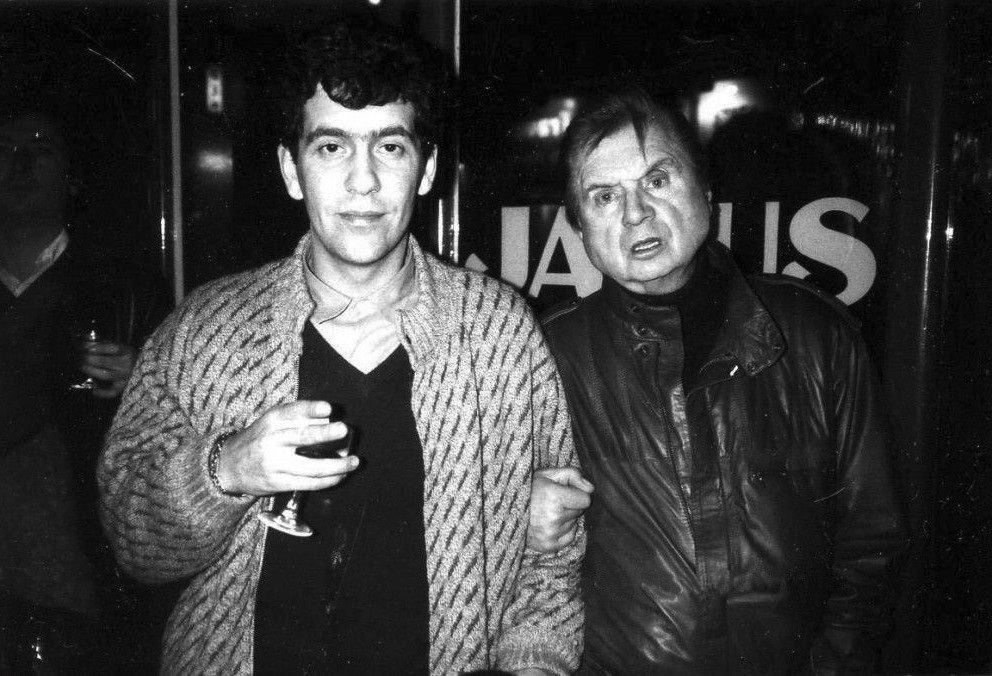
Bacon walks arm-in-arm with his friend John to Charlie Chester’s Casino for an hour of pontoon.
BRINGING HOME BACON
Francis Bacon finds beauty in a screaming mouth and inspiration in a passport photo.
In this rare interview with the artist, MIRIAM GROSS talked to him in his studio about
his painting, his love of poetry and about his private life.
MIRIAM GROSS
MIRIAM GROSS: When did you first have any idea or intimation that you might become a painter?
FRANCIS BACON: I never really thought about it. I didn’t start painting till I was about thirty: I was in Paris and I saw an exhibition of Picassos and I thought, well, why shouldn’t I try and paint. And that’s really how it started. You see, I came from a family – my father was a trainer of racehorses – where no one was the slightest bit interested in any of the arts. And in Ireland, where I mostly grew up, we never really went to school. I don’t know whether that’s a good thing or a bad thing. My father didn’t believe in schooling, my mother absolutely adored entertaining – giving parties and that kind of thing and they were so busy enjoying their social life that they didn’t want to spend much money on their children.
And what kind of life did you lead as a young man?
I left home when I was sixteen or so, and I didn’t work at anything very much. I had friends who were very kind to me; and I can’t say that when I was young I was at all honest. I used to steal money from my father whenever I could, and I was always taking rooms in London and then disappearing – not paying the rent, not being able to pay it. What’s called morality has grown on me with age. But in those days I managed to get buy on petty theft and on living off people.
I did have one or two jobs at that period. I worked as a servant, for example, for a solicitor in Mecklenburgh Square: I had to be there early in the morning to get his breakfast, then I was supposed to ‘do’ the place and come back in the evening to cook the dinner. When I gave in my notice, as they say, I always remember him saying I don’t know why he’s bothering to go because he never does anything. I also worked in a wholesale shop for women’s cloths in Poland Street, in Soho. I knew nothing about the business; they more or less employed me just to answer the telephone.
I never thought about painting at all during that time. I did try to do some furniture designing but it was entirely influenced by the German and French things being done then. There was nothing at all original about it.
Do you think that not going to art school or having any kind of formal training has helped you or hindered you as a painter?
Well, I don’t think that in a time lie ours, when there’s no tradition at all, there’s anything you can possibly teach. I remember I once stood in for a friend, Johnnie Minton, who asked me if I’d take over his job for two or three months at the Royal Academy of Art – which I did. But I couldn’t teach anything at all. All I could do was go there, for two days a week, and if the students wanted someone to talk to, I was there.
You don’t think that being taught draughtsmanship, life drawing or that sort of thing, helps?
I don’t think it does. One sees the people who have been taught, who are painting nowadays. What are they doing? After all, they never make anything new. they just go back to a kind of academic drawing which would have been much better done by artists in the past.
The first of your paintings which really caught people’s attention was the Figures at the Base of a Crucifixion which is in the Tate, and you’ve painted other studies of crucifixions as well. As far a I know you’re mot religious, and I wonder why you were so strongly drawn to this subject.
It was not through belief and it was not through disbelief that I did them. It was because there was no image that interested me as much at the time, and I was interested in the way it had been used in the past. After all, some of the greatest painting of the West have been inspired by that theme. I was influenced, for instance, by photographs I’d seen of the Grunewald Crucifixion, and the Cimabue one, in Florence.
But weren’t you also drawn to it as a symbol of suffering and cruelty?
Well, I don’t know .... People always seem to think that in my paintings I’m trying to put across a feeling of suffering and the ferocity of life, but I don’t think of it at all in that way myself. You see, just the very fact of being born is a very ferocious thing, just existence itself as one goes between birth and death. It’s not that I want to emphasise that side of things – but I suppose if you’re trying to work as near to your nervous system a you can that’s what automatically comes out. Unless you put a veil between yourself and life, it is just filled, really, with suffering and despair.
To what extent do you think an artist’s experience of life, of suffering, goes into his painting? Do you yourself paint under the influence of emotions that are going on in your life?
No. I don’t really know what I’m doing: I just put down the images and I hope that I will be able to excite myself.
A lot of your paintings do undoubtedly convey a sense of despair and often shock – one feels that the human figures in them are in the process of turning into a different kind of creature.
For me the distortions in my work are not there for the sake of distortion, but to bring back, as it were, the reality of the image – to bring it back as strongly as I can onto my own nervous system. I’m not setting out to give any feeling of horror, I’m just attempting to record my own sensibility, my own sensations – which seems to me the only thing one can do at a time when there’s no longer a tradition in art.
Have you ever been tempted to do any purely abstract painting?
Well, I did design a few rugs and things which were totally abstract, but I don’t think I’ve ever done an abstract painting. I feel that on the whole abstract art is a form of decoration. Possibly there could be tremendous bursts of colour, but you’ve had that, at its best with people like Monet – and there the colour was used for a reason. If it isn’t, it automatically becomes just decorative.
In your marvellous book of conversations with David Sylvester you say that you’ve always been interested in the mouth as an image. I think you say that you would have liked to do a Monet-like version of a mouth.
If you think of all those wonderful paintings by Monet of the Nympheas especially – well, the mouth, if one looks at it, the tongue and the lips and the teeth and everything, has got all those colours in it. Also, when I was young, I think it was in a second-hand bookshop in Paris, I found a book on diseases of the mouth with very beautiful illustrations, and they fascinated me I’m sure that psychoanalysts and people like that would say that there are much deeper reasons, but I don’t know.
And do you paint the image of meat that one finds in your paintings for the same kind of reason? Yes, it’s to do with the colour. You’ve only got to go into a butcher’s shop – it’s nothing to do with mortality, as people often think, it’s to do with the great beauty of the colour of the meat.
A lot of your paintings are triptychs and a lot of your figures seem to be in motion. Do you think you’ve been influenced in all this by the cinema?
Yes, I do. I think that if I’d been born later, rather than trying to paint, I’d have attempted to make films. I think it’s a medium which hasn’t been really explored yet.
I know that one image which made an enormous impact on you was the famous short of the screaming nurse in ‘The Battleship Potemkin.’ That surely is another moment of extreme anguish.
Yes, but I don’t think it’s the anguish in it that appealed to me: it was the beauty of that shot, the mouth, and I was excited by the idea of it being done in colour, the colour of the lips and the flesh and tongue.
What about your series of popes some of them screaming, too.
I don’t think they were at all successful: I was hypnotised by two things at that time: Eisenstein’s screaming nurse, and Velasquez’s portrait of Pope Innocent X, and I thought I would try to catch something of the beauty of the Velasquez and the beauty of the scream in the same image. I think I must have been terribly immature; if I’d thought more about it I would never have done those paintings. You see, they look as though one was searching for a form of sensationalism, and perhaps one was in one’s immaturity. I can’t remember back, but I look at them now really with disgust.
Haven’t you also done some paintings inspired by Van Gogh?
Yes, I was having an exhibition at the Hanover Gallery and I absolutely couldn’t paint anything, and about two weeks before the exhibition was due to open I thought, oh well, I can’t do anything now, I’ll just do some things influenced by Van Gogh. I’m afraid only one of them worked at all, a figure walking down a slope.
For me, Van Gogh is one of the very greatest painters who ever lived; what I admire is his ability to put across a tremendously complex sensation in such a simple way. People often assume he was a simple man, but if you read his letters you’ll see what an extremely complex character he really was. There’s his extraordinary little painting of a baby, for example, which is in the museum in Amsterdam – it has all the essence and horror of a new-born child, its awful little bracelet and iys horrible look. People think of Van Gogh mainly as a landscape painter, but he was also a marvellous painter of portraits and self-portraits.
You’ve always done a lot of self-portraits yourself, haven’t you?
Generally I only do a self-portrait because I haven’t got another subject around at the time, not because I’m interested in my own appearance though of course one one does know something about the contours of one’s own face, from seeing it everyday in the mirror. I also work from photographs, in fact I often go to those booths where one takes passport photos, just to see how they’ll turn out; but all photographs distort enormously, which most people never seem to realise. Anyway I mainly do self-portraits when I haven’t got anyone else to paint.
Do you think Rembrandt did self-portraits for the same reason?
I’ve no idea why he did them. although I certainly think that his self-portraits, from his youth to his old age, are among his most remarkable paintings.
And you’re not conscious at all of making a kind of records of your inner feelings through your own self-portraits?
Not at all. You see, I don’t think one knows what one’s inner feelings are. I mean, you know what they are when you are very fond of somebody, for instance, but it’s not in the least enlightening about your own character. It’s true that when one thinks of Rembrandt’s self-portraits from the very early ones to the later ones, one can read into them an extraordinary graph of his life, but whether he meant it in that way one doesn’t know.
Tell me a bit about how you work, how you organise your day.
I get up in the morning and start painting, and just hope that something will come about, you know, I get up early, as soon as there’s light. A lot of painters prefer working by night, and I used to years ago, but now I much refer working by day I generally work for five or six hours and then I stop unless it happens to be going very well.
Do you start work with a feeling of excitement?
No, I don’t. I think it’s awful to be confronted with a ghastly blank canvas. I have a generalised idea of what I want to do, but I really don’t know how to do it and I don’t know what’s going to come. I only enjoy it when it begins to work, when the possibilities of developing the image come about.
And what about when you stop painting? I believe you do quite lot of gambling, for instance.
Yes, I often gamble in the evenings. It excites me up to a point and it’s also a way of passing the time. It can become a drug, an obsession, but it isn’t really in my case. I was brought up in an atmosphere of horse-racing and gambling from a very early age and I think it probably comes from there.
Do you mind losing money?
Naturally I prefer to win but I’m a stupid gambler, and if I’ve got the money I don’t regret it terribly if I lose it. After all, nearly all gamblers are losers.
What sort of people have your friends tended to be?
I naturally like people, as we all do, who’ve got reasonably good looks; and if they’re not struggling to earn money all the time, that’s always a help. I used to prefer the company of crooks – or villains, as they like to call themselves – although I’ve had various things stolen from me – I find them less boring than most people.
Do you think spending so much of your childhood in Ireland has had a lasting influence on your character and outlook?
I think it must have had an influence on one’s character. I’m not Irish, unfortunately – both my mother and my father were English – but I’m very attached to Ireland: I like the people and I particularly like their natural gift for making sentences, their vivid conversation. You can see it in so many of their great writers – Yeats, Joyce, Wilde.
I know that literature means a great deal to you, that you read a lot of poetry. Does it give you ideas for painting?
Very much so. In an odd way, poems often create stronger images for me than things I’ve seen. Yeats had an enormous effect on me, and the early Eliot poems Just now I’m thinking of starting a triptych suggested by the Agamemnon. Unfortunately I can’t read Greek, but even in translation – I’ve read three or four different ones – you can see how terrible powerful Aeschylus is. There’s the wonderful imagery, and even if it seems exaggerated, in an odd way it says something very powerful and very fundamental about existence.
I know this is a delicate question, but what effect do you think being homosexual has had on your painting?
I suppose it’s made this difference, that when I paint the human body I tend to paint men rather than women. But the whole business of homosexuality is so complex; I don’t think one has even begun to understand it. But then what does one understand about emotions?
Has it made you unhappy?
No, it’s never made me unhappy. I suppose in someway it’s a misfortune or limiting to be a homosexual, but I can’t say that I’ve ever regretted it myself. It certainly made my parents very unhappy and upset when they realised – which they did when I was very young – that I had that tendency, or drive; but the morality of that time was so different from what it is now. It was considered outrageous to be a homosexual in those days, but then of course they didn’t think historically about the thing at all.
Talking of history, has it ever made any difference to you that you’re called Francis Bacon?
My father was actually descended from the family to which the Elizabethan Francis Bacon belonged, and they’ve always gone on calling one of their children Francis, and I happened to be the one. It’s an unfortunate name to have, because he was such a very remarkable man, but I’ve never thought much about it or bothered to go into the details of my ancestry. Strangely enough the original Francis Bacon was homosexual too.
Do you take much interest in politics?
I can’t say that I have any strong feeling about which government is in power. Of course we’ve been lucky in this country, though I don’t know how long it can go on for, in that we’ve had comparative freedom, and I think all one can ask for is as much freedom as one can reasonably have. I really don’t care whether it’s Conservative or Labour who’s in, but one hopes not to have to liver under a totalitarian regime – at least, I do.
And you’ve never wanted to express a political theme or message in your work?
No, because I’ve no message to give. When I look at my paintings, I don’t know what they are really about. But then in general when one thinks of works of art of the past one either doesn’t know what they mean or the meaning they once had no longer matters in the way it did.
For instance, to me one of the great images of the world is the Sphinx, but I’ve no idea what the Sphinx is or represents. I know originally it was probably some kind of religious symbol, but to me its beauty is in the image – and the same is just as true of paintings of the Crucifixion.
Do you regret that you haven’t got a religion or a tradition to work in, some belief that you can celebrate in your painting?
In a way I do. But if you think of somebody like Monet, he painted in celebration of beauty, the beauty of his garden and his water-lilies. I can’t say that I paint in that way myself, but I think it is marvellous to have a subject that one is obsessed by.
Has becoming very well-known as an artist made much difference to you?
Well, my pictures still only sell with great difficulty. They’re not at all liked and not at all popular, but every so often somebody buys them. And if I have become better known, I certainly don’t think it has made the slightest difference to me as a painter.
A new, enlarged edition of ‘Interviews with Francis Bacon’, by David Sylvester, was published last week (Thames and Hudson, £4.95).
MRS SONIA ORWELL
JOHN SPURLING
John Spurling writes:
Sonia Orwell, who died on December 11, was of course best known as the widow of George Orwell. The difficulty of assigning its true value to her life is that nearly everything she did was done through or behind others. John Lehmann, writing of the time when she captivated Orwell, remembers “her darting, gaily cynical intelligence and insatiable appetite for knowing everything that went on in the literary world: her revolt against a convent upbringing seemed to provide her life in those days with a kind of inexhaustible rocket fuel”.
She had been briefly John Lehmann’s secretary on New Writing in 1941 before going to work for the Ministry of War Transport. Her first contact with artists came about through living in a flat opposite the Euston Road School where she was called, because of her beauty and electrifying effect, “The Euston Road Venus”. There are portraits of her by Coldstream and Moynihan.
From 1945 until it folded in 1950 she was Horizon’s editorial secretary and in fact often the working partner, when its cofounders (Peter Watson and Cyril Connolly) were absent or indisposed. In the 1960s she co-edited the Paris-based international review Art and Literature. Her powerful effect on the literary and artistic world of London had been extended to France just after the war, when intellectual Paris – Leiris, Bataille, Lacan, Merleau Ponty and others – was bowled over by her in turn.
What was this effect? Apart from her looks and vitality, she was the most stimulating friend and patron. She raised people’s spirits with parties and celebrations as well as with personal kindness and actual money, but the real help she gave was her passionate and discriminating enthusiasm for art and literature and its makers. She believed in the value of art and the humanity expressed in it as Elizabeth in England, and she made those she picked out feel like her Drakes and Raleighs.
Among the writers she especially encouraged were Angus Wilson, Nigel Dennis and Jean Rhys. She was a close friend of Francis Bacon, Virgil Thompson, W. H. Auden, Ivy Compton-Burnett and Marguerite Duras, some of whose work she translated.
She was born on August 25, 1918, at Ranchi in India, where her father, Charles Neville Brownell, who died when she was a few months old, was a freight-broker. She married George Orwell in 1949, just before he died. and secondly, in 1958, Michael Pitt-Rivers – a marriage which lasted only four years. Her favourite character in literature was Odysseus and it was his qualities of adventurousness, self-reliance, high-spirits, intelligence, courage and style which she most admired in others and for which she stood right to the end, even through the pain and humiliation of her last illness.
Accident control
by Michael McNay
MICHAEL MCNAY
The sense of pressure on the skin, of grip and twist is precisely what is lacking in Bacon’s own work: his nudes are invertebrate: tortured visions, but visions of flaccid jellied meat. For all his talk of studying X-ray photographs, Bacon does not see the skull beneath the skin, only the yielding flesh.
This explains two things further: why his blurred pictures of figures in motion, based on the photographs of Muybridge, are more successful than his figures in repose, and why his technique of rubbed and thrown paint is so essential to his method.
Bacon himself argues that he could very easily paint illustrative portraits, but that these have no interest for him and the use of profitable accident is central to the vitality of his work. In the twentieth century, Bacon argues, the illustrative function has altogether disappeared from art because photography and film have usurped that role, but at the same time abstract art has proved a dead letter.
Then how do you explain, Sylvester asks, that many critics like myself react just as viscerally to abstract painting as to figurative work? Bacon replies badly.
Furthermore, says Bacon, since the wide acceptance of religion and the after-life has vanished as a frame of reference the painter is thrown back on his own nerve ends: he must work as close to his own nervous system as he can manage.
All this is deeply fascinating, because Bacon is undoubtedly right in saying that even the greatest painter cannot know the effect on the canvas of a brush loaded with pigment until the brushstroke is completed; in this sense painting is a conjunction of controlled accidents. Discussing a Rembrandt self-portrait, Bacon says:
“I think that the mystery of fact is conveyed by an image being made out of non-rational marks. And you can’t will this non-rationality of a mark. That is the reason that accident always has to enter into this activity, because the moment you know what to do, you’re making just another form of illustration.”
Of course, Bacon adds, behind that “was Rembrandt’s profound sensibility, which was able to hold onto one irrational mark rather than onto another.” Of course. And training too. Which raises one final question: had Bacon gone to art school instead of being self-taught, had his grasp of observed act been more tenacious, would the backbone have been there, would Bacon’s art have been as great as it is usually claimed for it?
Violent reality
INTERVIEWS WITH FRANCIS BACON
— David Sylvester (Thames & Hudson, £4.95, paperback)
EMMANUEL COOPER
Now over 70, Francis Bacon is still one of our major painters though he often
confounds and confuses both critics and public with his dramatic and emotional
canvases
Artists writing about their work rarely do so with insight and perspicacity: usually their descriptions are too subjective. Even David Hockney’s film A Bigger Splash, which must rank as one of the bravest attempts of the century to describe how an artist works, was very much about technique and methods rather than ideas and issues. Fortunately Bacon, who has a great deal to say about painting, neither dwells on technique (though he does mention it) nor does he attempt to say what his paintings are about. Rather he talks about the processes of painting as part of a general attitude to life.
Rejecting quite firmly any psychological interpretations of the signs and
objects he produces, he draws a clear distinction between the appearance of
things, what he describes as their illustrational quality, and the essence, the
meaning —
What is particularly interesting in these interviews is the way biographical
details are included (Born in Ireland in 1909; father a racehorse trainer spent
time in Berlin in the
At this point David Sylvester persists in suggesting that many of Bacon’s
images, such as those of the Pope, are “father images”
These interviews, fascinating as they are, left me longing for more; especially for questions about emotional upheavals in his life and the highly charged emotion of the images he creates.
Emmanuel Cooper
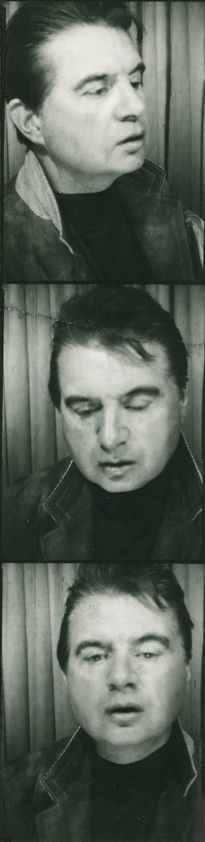
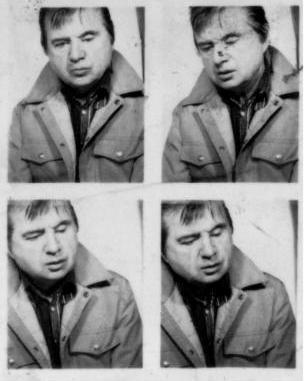
ROBERT MELVILLE
In the preface to his new edition of montaged interviews with Francis Bacon, David Sylvester draws our attention to what has become the last section of the fifth interview. Altogether, there are seven interviews but Sylvester considers the end of the fifth to be the most illuminating passage in the book: ‘I always think of myself not so much as a painter but as a medium for accident and chance … I think perhaps I am unique in that way; and perhaps it’s a vanity to say such a thing. But I don’t think I’m gifted. I just think I’m receptive.’
Bacon is, of course, thinking of his unique hit-and-miss co-operation with the fluidity of oil paint. The American painter Philip Guston had a not dissimilar intention when he was practising Abstract Expressionism: he said he had in mind the late self-portraits of Rembrandt and hoped that a face might one day emerge from the brushstrokes. The day never came. Perhaps when handling the brush he should have held a photograph in his other hand.
I’m sure Bacon wouldn’t like the word, but I don’t think it would be unreasonable to describe him as a virtuoso. His knowledge of the marks which different quantities of paint on different sizes of brushes are likely to make on the canvas under different pressures and movements of the hand must be immense and the skill with which he transforms mischance into revelation is a gift, a natural endowment.
He himself speaks of an accident which he has preserved without alteration and which appears to have a built-in intention. It is in one of the side-panels of a triptych of a man in three stages of a hangover; in this panel he is being sick over a wash-basin. Bacon says that at the very last moment he flicked his brush at the canvas and a splash of white paint went onto the dark background. To get it off, he would have had to scrape it with a knife, then scrub the background and repaint it. He just left it. It reads as a splash of vomit that has rebounded off the wash-basin and flung itself over the man’s shoulder.
There is another, earlier work called ‘After Muybridge: Woman Emptying Bowl of Water and Paralytic Child on all Fours’ (1965), in which a white splash plays a crucial part. Both figures are perched on a narrow circular rail high above the ground, as if they sometimes have an audience. The child is crawling carefully round the rail. The hag of a woman is perilously balanced to fling out the water, which wanders in a curving ribbon out of the picture. The splash of white paint has been aimed at the woman and has blinded her in one eye. It is unlike any other passage in the painting. It has a kind of joyous freedom and is positively lyrical. The two figures are richly painted and are dazzling examples of painterly animation, adding a lovingly sadistic excitement to the distorted forms.
Bacon now repudiates the screaming Popes, which he based on the Velasquez Pope Innocent X, with the scream of the nursemaid from Eisenstein’s The Battleship Potempkin inserted into the face. No less than eight versions are reproduced in the book, and several pages later, Munch’s The Scream is reproduced but not mentioned either by David Sylvester or Francis Bacon. Its relevance to Bacon’s screamers as a precursor is ignored. Instead, David Sylvester says: ‘One thing that’s clear is that you’re not concerned in your painting to say something about the nature of man, in the way that an artist like, say, Munch was.’ ‘I’m certainly not. I’m just trying to make images as accurately off my nervous system as I can. I don’t even know what half of them mean ... I’m probably much more concerned with the aesthetic qualities of a work than, perhaps, Munch was.’ Munch’s treatment of sky and water in the background of The Scream was superb, but the picture is primarily a remarkable psychological document and is not among his most beautiful works. Francis Bacon’s implication that his own works are of a higher aesthetic value than Munch’s is both arrogant and absurd.
During the last two or three years he has disclosed a tendency to dispense with the kind of brushwork he attributes to accident and chance. In the past, these accretions have obviously enriched his matière. One of the recent paintings looks like an attempt to transcribe a dream. It’s a study of a male nude demonstratively turning the key in a door with his foot. It reminds me of that well-known leg outstretched to kick the dog in Millais’s Isabella.
It was Bacon’s turn to portraiture in the early 1960s, making studies of the faces of actual people, that brought about the most radical transformation of his brushwork, its most drastic turns and twists. It was by this means that he hoped to bring out hidden likenesses, and although the outcome often looked extremely brutal, as if he were destroying the last shred of dignity in some of his closest friends, the effects could be awe-inspiring. He has been obsessed by a few faces for nearly twenty years – the faces and sometimes the entire figures of a tight inner circle of sitter/friends – intent on remaking the image and penetrating many levels of feeling.
It is noticeable that Surrealism is scarcely mentioned, although accident and chance were being endlessly discussed by the Paris group at a time when Bacon was only making furniture. Duchamp’s name comes up a couple of times. There is no reference to Breton, yet his ‘beauty will be convulsive or cease to be’ is far more relevant to Bacon’s art than Duchamp’s readymades, or his moustache for the Mona Lisa. It was relevant when Bacon made his first important painting, ‘Three Studies for Figures at the Base of a Crucifixion’. This is dated 1944, but was worked on for several years. It is dependent on drawing and has none of the painterliness that characterises so much of his later work. Bacon says the three figures are the Eumenides – that is to say, the Erinyes, avengers of murder within the family. He also says they were influenced by the fantastically-rearranged anatomies of beach girls drawn by Picasso at Cannes in 1927. The beach girls are deliciously comic, the Bacon figures have been brought to a state of convulsion by their hysterical ferocity. They remain as powerful as ever. They will always have to be reckoned with in any account of Bacon’s career. One of the figures is supported by a stool, another stands behind a pedestal. They are the earliest examples of his use of furniture or invented constructions, which have been features of his work ever since. The third figure rests its only arm on a curious fragment of grass. In 1978, the subject of one of his pictures is a patch of grass enclosed in a transparent box with a cloudy lid. Sylvester remarks that the grass has an extraordinary animal energy. I agree with him. Its texture suggests a sort of silky harshness like the fur of a wild beast.
The last reproduction in the book is ‘Figure in Movement’, and, to use Bacon’s own word for it, it is very concentrated. It brings to mind Picasso’s comical ‘Swimming Woman’, painted two years after the beach girls, and for me brings Bacon’s creative adventure full circle.
CAROLINE TISDALL
THE OPENING of the National Centre of Photography in Bath was an event that would have amazed Sir John Herschel, the pioneer who first used the word "photography" in the English language, and who coined the terms "positive", "negative" and "snap-shot." As a scientist and man of ideas he contributed energetically to spreading the techniques of this new, accessible Victorian discovery.
At the centre’s opening the up-turned gaze of the famous portrait of Herschel by Julia Margaret Cameron, looked even more glazed than usual, averted from the unedifying sight of modern photography’s most loony twist: the Royal Rota. This is a selection from the hordes of photographers who dog the Royal family’s every move and who are allocated exclusive publication rights. So much for the ideals of the pioneers.
Bill Brandt, widely recognised as Britain’s most eminent photographer, had the honour of showing Princess Margret, Countess of Snowdon, round the inaugural exhibition of his work. He felt that the Princess, close though her association with photography may have been, was not very taken with his efforts, particularly his studies of nudes in landscape. They may by now seem over-familiar, even somewhat over-exposed.
Like Herschel, Brandt’s contribution to photography tells the story of his times. This exhibition covers 50 years’ sensitive seeing and contains several surprises, so much so that Brandt, now in his mid-seventies, could not recollect having taken some of the older landscape scenes.
One of the earliest photographs foretold of the social conscience that was to guide much of his later work. It’s a study of a blind beggar taken in Barcelona in 1932-33, superbly reproduced at that time in the annual Photographie, and never seen again. It’s typical of Brandt that when asked recently if he had ever taken a portrait of Ezra Pound he went to his files and produced a study of 1928, unconsidered since then, which others would have proudly distributed but which he had laid aside.
Brandt is cagey about the details of his early life, spent mostly abroad. What is certain is that he returned to England after his association with the Surrealists and brought to it the fresh vision of a child or a stranger arriving in a foreign country, He saw a country of contrasts, encouraged by commissions.
With uncanny accuracy, Brandt’s photographs trace the passing decades. He felt the decline of the Upstairs Downstairs life before the Second World War took its toll. He shared the documentary spirit of John Grierson and the dark mysteries of Hitchcock’s 39 Steps. His portrait of the young Graham Greene succeeds in fusing all that into a single image of those times, just as the 1963 study of Francis Bacon freezes the anxieties of a later time when the "nausea, lassitude and irritability" he had detected overtaking sensitive people were taking their toll.
The news that he is now concentrating on a series of contemporary portraits is welcome for they will certainly provide an equally accurate barometer of the Eighties.
Sir John Herschel and the Invention of Photography; Bill Brandt; Polaroid Photography – exhibitions at the Royal Photographic Society, National Centre of Photography, Bath until, June 27.

Fishy
I didn’t know Bernard Walsh who owned Wheelers at all well, but when I heard that he’d died this week I naturally started to think about the branch in Old Compton Street which has played such a big part in my life, as it has to so many people addicted to Soho. As far as I’m concerned Wheelers is Old Compton Street and all the other branches are mere imitations. The reason for this is twofold, My mob go there more for the ambience and because of the staff than for the actual food and I’d like to point out, lest anyone think I’m trying to do a Taki, that in all the hundreds of visits I’ve made there, about nine times out of ten I’ve been taken as somebody’s guest.
When I was a teenage bum and layabout, it was one of my pathetic ambitions to go to Wheelers, and I can still remember, so much did it impress me, my first visit there. I was taken by Tony Hubbard who was a Woolworth heir and someone I went to prep school with. At that time he’d just successfully cut a swimmer’s foot off with the propeller of his motorboat on the Riviera and had, by so doing, earned himself a place in The Guinness Book of Records, having had to shell out about £50,000 in damages. Quite a considerable sum of money in those days, I’m told.
In those early days I thought it all terribly posh. It’s not and although it’s terribly expensive, a very mixed bunch go there and the staff certainly put up with some strange behaviour. Peter Jones the conductor, Arthur, Bert, Charles, Ken, Tim, Henry on coats and John behind the bar are an excellent band. The three people I used to go to Wheelers with most frequently were Alan Rawsthorne and Frank Norman and Francis Bacon. Alan and his wife Isabel were marvellous to have lunch with, and the lunch that sticks out most in my mind was pretty typical of Alan’s dry wit. Very young I was, and trying to show off a little, I told Alan I didn’t think much of Szigetti. ’Oh dear,’ he said. ’Why, what’s wrong?’ I asked. ’Well, I’ve just dedicated a sonata to him,’ he answered.
Out of the countless times Francis Bacon has taken me there, two lunches are memorable for what he said. On one occasion, during a lull in the general conversation, he asked me loudly, ’Now that you’ve lost your looks what are you going to do?’ As you may imagine, that broke the entire place up. But more memorable was the time he asked me — again in a natural quiet, the entire restaurant with their feet in the trough — ’Who would you most like to fuck in the entire world?’ My brain raced thinking of the Cyd Charisse legs and the Loren face and I said, ’Oh Christ, I don’t know. What about Monica Vitti? It’s impossible. Anyway, what about you?’ He thought for a moment and said, ’Out of everybody in the world I think I’d rather fuck Colonel Gadaffi than anyone.’ Four American tourists at a nearby table immediately got up and left.
Now, you may not be aware of it but Wheelers do a very good takeaway service. I remember being with Frank Norman late one night in the Stork Club when he was sick over a hostess. She screamed, poor cow, and someone rushed over and said, ’What’s that?’ Cool as ever, Frank replied, ’That’s a lobster thermidor.’
Of course the greatest nutter ever to grace Wheelers was the greatest eccentric and sometime actor, Dennis Shaw. He was barred for the umpteenth time once and thought he’d get his own back. One Friday night, after they’d put the dustbins out, he dragged one into the packed restaurant and tipping it out he shouted, ’This is what you’re all eating with sauce TARTARE!’
Although quite a few of the customers have been mad, they did actually have a mad employee there once — a Cypriot doorman. He’d go round the corner to the betting shop for me and put on bets and then he’d come back and blurt out — particularly if I was having lunch with someone I was feigning reliability and respectability to — ’Lester Peegott he get stuffed.’
I can’t bring myself to be as nice as I’d like to be about Wheelers. You know what happens when you recommend a place, suddenly it’s full of ghastly, respectable bloody businessmen and that would never do. It’s just right as it is. Now I must pop along there and see if they’ve got a tip for today.
By GERALDINE NORMAN | SALE ROOM CORRESPONDENT
A triptych painted by Francis Bacon in 1971 in memory of his friend George Dyer became the most expensive work by a living British artist ever sold at auction when it sold for $350,000 (£166,666) to a New York private collector at Christie’s on Monday night. George Dyer died on the lavatory in his Paris hotel room on the eve of Francis Bacon’s immensely successful 1971 Paris retrospective exhibition; he had flown over for the show.
The triptych was the first work painted by Bacon on his return to London. An even more explicit memorial of his friend’s death, starkly complete with plumbing, painted in May-June 1973 was also included in the Christie’s sale. The bidding presumably ran as high, but not high enough for the owner; it was bought in at $380,000. Christie’s had been suggesting a price around $400,000 on both triptychs.
These two paintings formed part of the collection of Saul P. Steinberg, aged 41, a computer millionaire. The collection was dispersed by Christie’s in a two-session sale totalling £3,330,309, with 35 per cent left unsold. The collection was formed two to three years ago; divorce proceedings have brought Mr Steinberg’s Park Avenue home and collection on the market.
Dealers’ selling prices are generally substantially higher than can be hoped for at auction and Mr Steinberg could not hope to recoup his total outlay after only two years. That was reflected in selling prices below estimates and a substantial unsold percentage. By auction standards, however, there were many exceptionally high prices: a new auction record price for the work of Max Beckmann at $600,000 (estimate $400,000 to $500,000) or £285,714 paid by a New Yorker for “Selbstbildniss mit wveisser Mutze” of 1926; an auction record price for a Giacomo Manzu bronze, “Cardinale Seduto” of 1975 to 1977 at $175,000 (estimate $150,000 to $200,000) or £83,333. A fireplace surround symbolizing “La Poesie” painted by Matisse for Nelson Rockefeller in 1938 was the most expensive failure, left unsold at $S50,000 or £404,761. A price around $1m had been hoped for.
Art goes West
JOHN MCEWAN | ARTS
Westkunst (Rheinhallen, Cologne, till 16 August) and Paris-Paris, 1937-1957 (Centre Georges Pompidou, Paris, till 2 November) are two mammoth exhibitions that, collectively, go most of the way towards wrapping up Western art history to the present; but, to a rare degree, they are also charged with political and symbolic significance. Westkunst, in a general as well as German context, is a deliberately provocative title. Have we it asksin the facetious sense, gone west? Are we going west? ‘No Future!’ may be the battle cry of Punk, but the whole impetus of Modernism is belief in the future. Such questions are very ticklish indeed in West Germany at the moment, with front-line tension high, the economy faltering and a sense of disillusionment, not least with America, in the air. But Westkunst, considered geographically, is not so much ironical as educational, even challenging. There can never have been a show that confronts Germans so forcefully with the magnitude of their cultural deprivation through the suppression of the Reich and the consequent flight of their artists; or one that more poignantly exposes the defiance of the spirit in times of war. And an even more explicit treatment of this delicate subject confronts the French in Paris-Paris, where photographs, uniforms, texts and knick-knacks support the art, and document collaboration as well as resistance in the dark days of the Occupation. Already in the Beaubourg series there has been a ParisBerlin show, now, with Westkunst surveying the period from 1939 to the present, we have a French show in tandem with a German. This was not planned, apparently, and Westkunst is, in any case, sponsored by the city of Cologne, not the West German government, but nevertheless it lends a further political intricacy to the exhibitions that would be missing if they were being shown in other countries.
Westkunst takes place in a vast hangar of a building normally reserved for trade fairs. There is an introductory film programme, a sandwich bar, an art bookshop, but basically none of the pandering to general taste that makes such a spatial discomfort and intellectual confusion of Paris-Paris. It is a specialist show, divided into two, separately catalogued, parts. Much the larger and correspondingly more important of these is devoted to a survey of Western art, mostly in the form of painting, from 1939 (the end of Surrealism and Constructivism as fashions) to 1972 (similarly the end of Minimalism and Conceptualism); with the second part devoted exclusively to some of the stars of 1981, selected and presented, for financial reasons, by a random number of the classier contemporary art galleries in Europe and America. It is therefore most accurately described as two exhibitions one a historical survey, the other an art fair with the absence of anything very much to do with the Seventies (video, photography in particular) creating the divide.
The first thing to report from an English point of view is that there are only a handful of English artists included, however, their effect proves disproportionate to their number. Three of them Moore, Bacon and Hamilton are honoured with the inclusion of several works a piece, and easily stand the test of this extension of interest. There is no sculpture by Moore, which seems a reasonable decision in view of the exhibition policy to select works on the basis of their originality rather than popularity. His sculptural explorations were essentially complete by 1939, and he is accordingly represented by the apogee of his graphic work, the wartime sketches of Londoners sheltering from the Blitz in the.. Underground; an image of confinement complemented by Oskar Schlemmer’s secretive views from a window during his last discredited days as an artist in Germany at much the same date. Next, as we follow the fairly strict chronological order of the exhibition, comes one of the highlights of the entire display: an array of full-blooded Francis Bacon pictures, the series on the theme of ‘Study for Portrait of Van Gogh’ once more reunited. Here, in the convulsive meeting of abstract and figurative tendencies, is the paradox that forms the mainstream concern of painting today. ‘You know,’ says Bacon discussing these pictures in his celebrated interview with David Sylvester (Thames & Hudson, f4.95), ‘my case all painting and the older I get, the more it becomes so is accident.’ A remark that dismisses notions of progress and signals the end of Modernism, the real story of post-war culture and, inevitably, Westkunst but, in the late Fifties, not yet. In 1956 another highly significant contribution is made by an English artist, Richard Hamilton, with his prophetic installation for the Whitechapel’s This is Tomorrow exhibition. A reconstruction, specially made by the artist for the present show, can be seen to anticipate all manner of pictorial styles and images that were to obsess Op and Pop practitioners in the Sixties: the black and white dazzles of Bridget Riley; Rosenquist’s enormities of slippery food; Andy Warhol’s Marilyn Monroe all are foretold. It may have proved a false dawn, but Hamilton read the art-historical moment to perfection.
Up to, and for a few years beyond this point, the survey meanders to great
effect. In the early rooms Kandinsky
Paris-Paris,
finishing with 1957, avoids this backwash. It is a maze of a show, a case of
complete cultural overkill. It would take a year just to read one
Various Approaches
Fischer Fine Art
JOHN RUSSELL TAYLOR | THE ARTS
Since these days Francis Bacon paints only a very few large paintings each year, and firmly avoids the proliferation of minor works in the form of drawings and graphics, we usually have to keep a sharp eye open on Marlborough’s mixed summer shows for what is normally the August silly season to find out what he has recently been up to. This year is no exception: the present show (until September 23) includes a new triptych and four individual paintings, three of which have not been seen before.
From this evidence, it seems that Bacon is, as we suspected last year, going through an extraordinary new phase of creativity. The familiar qualities of sinister observation and apparent anguish are still present, but the new works show a renewed fascination with the details of the painting process, and a turning-away from those large, bald, rather unappetizing expanses of grating orange or stomaturning pink which have been so much in evidence over the last decade. There is a striking, if not very recognizable, self-portrait on black, and another black painting, Study from the Human Body, which looks like a man disappearing into a mirror and produces the right sort of uncanny frisson.
The triptych is a further play on motifs from Muybridge photographs, and nothing very pleasant seems to be happening in it. But the real masterwork of the group, and Bacon’s most extraordinary painting for some time, is Sand Dune, described as being in the extraordinary medium of oil and pastel on canvas (though I gather it contains also sand and dust from Bacon’s studio). It evidently takes off from where his almost equally striking recent painting of a water-splash left-off: there are similar pipes, a hint of sea in the background, and in the centre this mysterious presence, pinkish-brown, with suggestions both of sand and of mist, and at the same time a feeling that it might be something animal in very rapid motion. Whatever it is, the textures are exquisitely delicate and the total effect haunting: it is not often one can say of a Bacon painting, as of this, that it is just beautiful.
At Fischer the usual “representational eye” definition of the summer show has been widened a bit to include some elegant, eloquent abstractions by Jules de Goede. Most of the rest are pleasant, if neither here nor there, but Michael Leonard’s latest series of men dressing and undressing have all the high tensile strength we have come to expect of his work, nicely balancing eroticism with architecture, and Roberto Gonzalez Fernandez, whose work I was recently admiring in Edinburgh, comes up with a group of very strange, intense modern reinterpretations of texts from the Bible. The technique — a minute realism in pencil and crayon — is stunning, and the point of view very odd, whether Fernandez is suggesting a Lazarus risen from the grave with bound wrists and a handkerchief over his head or a fallen angel from some street corner. It may seem a little outré, too, for David to be handing Jonathan a jock-strap, but at least there the Bible offers ample justification.
Figurative Painters in Yale Show
By VIVIEN RAYNOR | ART | THE NEW YORK TIMES | SUNDAY, NOVEMBER, 29, 1981
NEW HAVEN
IT looks as if the current swell in representational art is here to stay for a while. And, to judge from Eight Figurative Painters, at the Yale Center for British Art, the situation is much the same on the other side of the Atlantic. Nevertheless, this show which, after closing here on Jan. 3, moves to the Santa Barbara Museum of Art in California, is not a parade of hot young talents.
Far from it: These are seasoned painters around the age of 50 except for two who are in their early 70’s. All are well known in England but only Francis Bacon (one of the septuagenarians) has a major international reputation. The others, except for Lucian Freud and Frank Auerbach, both of whom have soloed in New York City, will most likely be strangers to the American audience.
Organized by Andrew Forge, dean of the Yale School of Art, the exhibition is neither a survey nor a sampling of a movement but is, rather, a selection of painters the curator considers to be remarkable. “There is nothing quite like them anywhere,’’ he states in the catalogue’s preface. “They must be seen in this country now, when discussions of figurative issues are running in full gear.’’
What determines the successful export of a style remains mysterious but almost certainly political and economic ascendency has as much to do with it as ideals held in common. Aside from that, it seems improbable that these artists will make much of a dent here. Approximate counterparts for them already exist, for one thing; their concerns are too closely connected with recent English art history, for another. Other than that, evidently, spontaneity in realism is as hard to attain there as here, the Eight’s message seems to be that nothing much has changed since the mid-50’s. The taste for common-sense representation has not diminished and, as before, there is room in this tradition for eccentricity, some of it expressionistic. Dominating everything is a sense of cautious, well-read intelligences at work, all of whom are closely involved with each other socially.
Identifying Francis Bacon and Sir William Coldstream as the exhibition’s ’’linchpins,’’ Mr. Forge postulates a line running between the extremes their work represents and says that everything else can be related to it. In actuality, the balance of power is in Sir William’s favor — and rightly so, if only because of the enormous influence he has wielded as co-founder of the Euston Road School, in 1938, and as a professor at the Slade School of Art from 1949 to 1975.
Chances are, though, that American viewers will find this power mystifying, for Sir William is anything but a magnetic painter. He is given to outlining his stolid portraits and nudes with many dark, thin strokes and to constantly checking and rechecking their placement with small dots and crisscrosses. He leaves this structure visible under and between dabs of dry, thin color as if to proclaim the honesty of his intent. Only in a still life and a view of Westminster does the artist relax from what Mr. Forge calls “the passionately controlled mapping of interval.’’
A more naturalistic painter, Patrick George is closer to the Impressionistic style of Walter Sickert, though he hints occasionally at Francis Bacon’s grand architectural space. A mid-50’s study of a pregnant woman in bed, the rest of the room reflected in a mirror behind her, is quite beautiful, as are the later studies of houses with windows that seem to quote Mondrian. But in the later landscapes, the Coldstreamian geometry has tightened its grip and the impression is of a Lake-poet sensibility trapped in a system for viewing nature.
Michael Andrews, who shows no recent work, has moved from an Expressionism not unlike Francis Bacon’s in his Van Gogh period to compositions involving Giacometti-like figures collaged to silkscreened backgrounds of buildings lit up at night. In between, there is some good bravura painting, notably in a bar scene where Francis Bacon and Lucian Freud are among the customers, and in a straight early portrait of a boy standing in a doorway.
Leon Kossoff’s muted, heavily impastoed canvases deal with crowds — in the London Underground and a swimming pool — as well as portraits and figures. Unlovely though they are, the pictures are well organized and rhythmically executed. So are Frank Auerbach’s works, which are so heavily encrusted that they can sometimes only be read at a distance — the reclining figure, for instance, that is but a few dabs of chrome yellow and pink emerging from a dark gray background.
The king in this department is, of course, Francis Bacon, with a selection of heads and figures from the last 30 years. Conveying his agony as suavely as ever, Mr. Bacon nonetheless comes across here as a marvelous colourist, with his carnal reds, liturgical purples and grays that speak of decomposing matter.
Finally, there is Lucian Freud, a grandson of the great doctor who came to England at the age of 12. Mr. Freud once practiced a Germanic Magic Realism, producing portraits of such notables as Mr. Bacon. The technique is now more naturalistic, but the Surrealist mystery remains, as in the portrait of the artist’s aged mother lying down, her freckled skin mimicked by the pattern of her dress. Preoccupied also by sexual anatomy, Mr. Freud shows one study of a female viewed from the reproductive end, another of an aggressively naked, redheaded man with legs spread and one hand grasping a live rat.
Except for the vertigo-inducing catalogue essay by Lawrence Gowing, it’s as if England had never been buffeted by Neo-Dada, Abstract Expressionism or Conceptualism.

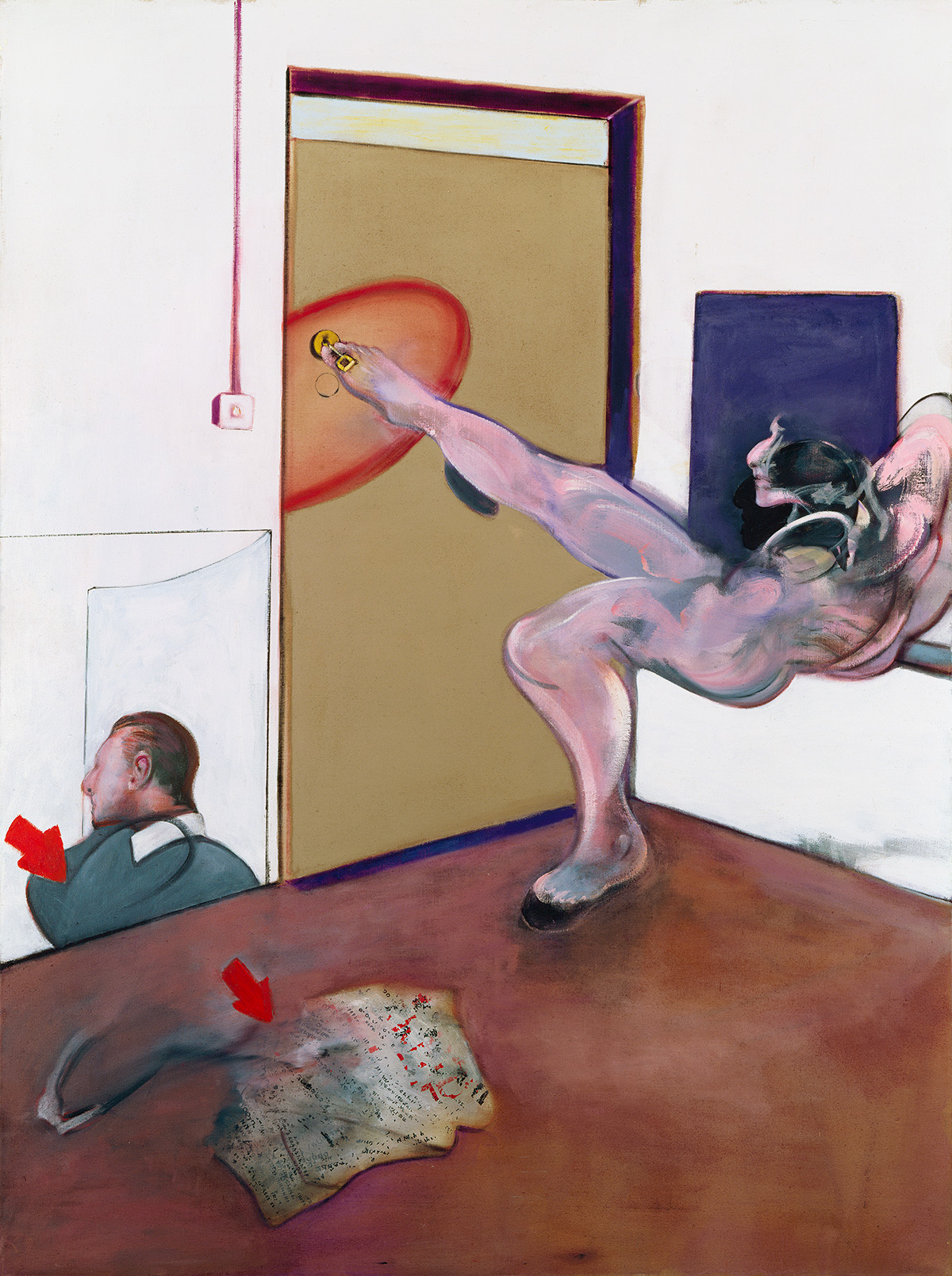
Bacon painted
LONDONER’S DIARY | THE STANDARD | MONDAY, DECEMBER 21 1981
‘‘I’d never heard of the place,’’ Clark tells me, ‘‘but the first person I saw when I walked through the door was Francis. They threw me out, but not before Francis bought me a drink.’’
Interviews with Francis Bacon 1962 — 1979 by David Sylvester
London: Thames and Hudson (distributed by W.E. Norton & Co.), 1981), 176 pages, 129 illustrations
BY KELLY WISE | BOOKS | ART FORUM
David Sylvester’s Interviews with Francis Bacon presents a portrait of a tough-minded artist, a man who is father-conflicted, compulsive, driven to surpass himself, productive in spite of (or perhaps because of) his cynical world view. In the preface, Sylvester suggests that the seven interviews spanning 17 years from 1962 to 1979 form an extended dialogue. That is a prodigious claim, and while Sylvester has elicited the kind of candid information from Bacon that one can only elicit from a long-standing friend, the control and wit in this collaborative effort are clearly Bacon’s.
Carefully preserving the artist’s distinctive “turn of phrase,” Sylvester has altered the sequence of the responses and edited the interviews into a unified and intriguing statement, enhanced by over 1oo black and white illustrations. Over the years, Sylvester has taken pains to map out a strategy that leads Bacon into deeper and deeper revelations about his art. The resulting conversation communicates the exhilaration and detached despair of Bacon’s life, but, unexpectedly, it is communicated without pretense or conceit.
Bacon assaults life as he assaults figuration in his art. He abhors abstraction, as well as the banal, the predictable, or mere illustration of visual fact. “What I want to do is to distort the thing far beyond the appearance,” he explains, “but in the distortion to bring it back to a recording of the appearance"—which is, for him, a new and more vivid representation. Occasionally he works from a photograph but never from a sketch or a live model. (He is loath to practice before his subjects “the injury that I do to them in my work.”) When Sylvester observes that the grotesque side of Bacon’s portraits may reveal ambivalence towards the subjects, Bacon deflects the notion as though it were a faulty serve. Bacon’s eye is penetrating, restless. He is dedicated to the creation of images that he himself may not understand, but whose potency depends upon working “as closely to the nervous system as one possibly can.” Critics may pull their chins and fabricate whatever explanations they wish about his odd and shifting figures or about the transparent walls and boxes within his paintings, but such critics mistake his point. His work is not predicated upon a literary or philosophical system.
Like a Samuel Beckett slogging through a sorry existence, Bacon is smitten by a sense of absurdity. His world view is relentlessly bleak. Life is pure accident: man’s lot is futile. He recounts an incident from his youth: “I remember looking at a dog shit on the pavement and I suddenly realized there it is—this is what life is like. Strangely enough, it tormented me for months, till I came to, as it were, [accept] that here you are, existing for a second, brushed off like flies on the wall.” Art, Bacon contends, is merely a game of protective distraction, a game—given the death of God in modern times—whose ante is quadrupled.
As he has grown older, Bacon has forced himself to greater creative freedom. He is fascinated with “marks that are made quite outside of reason.” He details the necessary risks involved in addressing the visual unknown. To sling a gob of paint at a finished or nearly finished painting and to leap after that gesture in a frenzy of invention is to cast oneself grandly to chance. (Bacon would not live otherwise). Yet he acknowledges that some fine paintings have been sacrificed by his method, that even though traces remain upon his memory of their unblemished states, the particular spirit of these paintings can never again be captured.
“I’ve always hoped in a sense to paint the mouth like Monet painted a sunset,” Bacon admits. There are other obsessions: the inverted cruciform Christ and Diego Velasquez’s Pope Innocent X: strange obsessions for a committed atheist. The artist also cites his admiration for Rembrandt, Sergei Eisenstein, Nicolas Poussin and Henri Michaux.
But is is Eadweard Muybridge and Michelangelo who are mixed forever in his mind. However, be believes that the greatest images of art are found not in painting or film but in sculpture. What makes one skilful artist seem superior to another, he argues, is simply “the critical sense”. He believes that the elements of form forged by chance possess a coherent inevitability. And he regards himself not so much gifted as “receptive. ” He even offers an opinion on friendship: it should be abrasive, for in tearing one another apart, some profound learning may take place.
Bacon appears unafraid of any part of himself. The roulette he plays is for outrageous stakes. His paintings stand upon the lively invention of his figures. As he asserts, in them “the beauty of paint” is secondary. His work continues to magnetize because it is true unto itself and authentic in structure. These searching interviews testify to the artist’s bold intention.
Sex shop jam
SOHO NEWS
CROWDS OF men collect outside the Ann Summers sex shop in busy Brewer Street, Soho, and pedestrians have to walk on the road.
The shop, with its brightly lit outside signs and sex aid equipment in its windows is opposite a block of flats now being refurbished for local families. So said councillor Mrs. Loise Peltz when she gave evidence to the Department of Inquiry where 29 sex shop and film booths are challenging closure for breaking planning laws with outside signs.
“This shop is in conflict with the immediate area where flats are being refurbished for 150 local people, in St. James’s Residences. It is close to the primary school and surroundedby food shops.” Counsel for Ann Summers shop Mr Rich, said there was nothing offensive in its windows.
Mrs. Peltz said some Soho women were afraid to give evidence to the Inquiry. “The Soho Society has received letters from women who would like to give evidence but who fear intimidation. They asked for their letters not to be passed to the appellants for fear of the consequences. I speak here today on behalf of the women of Soho,” she said. The Soho cases are expected to end this week.
Also this week, the Inquiry turns to look at the two Paddington sex shops
challenging the enforcement notices
Francis Bacon, Britain’s foremost artist, a long-time supporter of the Soho
Society, and founder of ‘Save our Crafts’
SUTHERLAND IN RETROSPECT
A visionary at the Tate
EDWARD LUCIE-SMITH | ART
The Graham Sutherland retrospective at the Tate Gallery from May 19 to July 4 is overdue. It should have taken place in Sutherland’s lifetime, and was postponed only because the artist had expressed a preference for the galleries in the Tate’s new extension and the delays in building this caused the rescheduling of the project. Nevertheless, I have the feeling that a Sutherland exhibition now is more useful and more significant than it might have been even two or three years back. The artist’s reputation is perhaps the most ambiguous in the entire history of 20thcentury painting in Britain.
Some critics have rated Sutherland very high indeed. Douglas Cooper, in what is
still the best study of the artist, published in 1961, wrote that Sutherland
was
During the last years of his life he had to put up with hurtful criticism, which pointed quite another way. The generality of English critics was for two decades inclined to denigrate his work, though he remained a major celebrity in media terms, receiving constant support in particular from the Beaverbrook Press. Beaverbrook himself bought his work in quantity for his art gallery in Fredericton, New Brunswick. Perhaps crueller still was the fact that Cooper changed his mind, and proclaimed that the man he had once supported so enthusiastically was after all a very second-rate talent.
The row with Cooper was one of a series which punctuated Sutherland’s professional life. For a man who was celebrated not only for his gifts as an artist but for his charm, he was unfortunate in this respect. The two most celebrated of these imbroglios were his resignation from the Tate Gallery trusteeship (the so-called “Rothenstein affair” which came to a climax in January, 1954), and the controversy over his portrait of Sir Winston Churchill. Sutherland’s career can be split into 64,three main phases. The first is the time before he discovered his true identity. In many ways he was extraordinarily slow to discover himself. He started to make a reputation as an engraver during the mid 1920s, when he was still a student at Goldsmiths’ College, and did well out of the boom in modern prints which collapsed with the American stockmarket crash of 1929.
His work underwent a significant change in the early 30s, when he began to
concentrate on painting, though he was also forced to earn part of his living by
doing posters and by making designs for china and fabrics. In 1934 he made a
decisive first visit to Wales, and discovered the strange Pembrokeshire
landscape that was to form an important part of his subject-matter from that
time forward. Characteristically he now rendered the unexpected details of
landscape — tree-stumps
and boulders
Sutherland paid his first visit to the south of France in 1947, and spent more
and more time there after 1949. His reputation became international rather than
purely national after the exhibition of his work at the Venice Biennale of 1952,
and the subsequent showing of the same exhibition at the Musée
d’Art Moderne in Paris. Another major event took place slightly earlier
The Sutherland of the 30s and early 40s is comparatively easy to place. Clark’s
initial judgment that here was someone who had managed to revive the true spirit
of Romanticism, and who used the ideas of Blake’s little band of
But what about the rest? In trying to assess the value of what Sutherland did from the late 40s onwards, it is necessary to look not only at the gigantic achievement of foreign contemporaries, such as Picasso, but at the work of two English artists, both of whom have now outstripped Sutherland in reputation. They are Henry Moore and Francis Bacon. Bacon is the more immediately obvious comparison. Sutherland was quick to recognize Bacon’s gifts. There is now some controversy among the surviving witnesses about which of them exerted the more decisive influence on the other. That the influence itself was reciprocal is not in question. Bacon probably started by borrowing certain devices from Sutherland, who was in the 40s by far the better-known and better-established of the two. But it seems that the current soon reversed itself — Sutherland’s colour schemes, his subject matter, his actual application of paint and even the relationship of the subject to its background all show his fascination with Bacon’s achievement, and it may legitimately be felt that in a picture like his ambitious Christ Carrying the Cross of 1953 the artist is using an idiom which is no longer his own.
Moore’s impact on Sutherland has been less often discussed, but is to my mind
even more interesting. From the 40s onward Sutherland often seems to be painting
images which derive from sculpture. The process starts with the Thorn
Heads and Thorn Trees sparked off by the
commission for a large picture of The Crucifixion for
the church of St Matthew, Northampton, which Sutherland accepted during the war.
The images, however, become much more recognizably
It is necessary to emphasize that these hallucinatory forms are nevertheless imaginative, as well as being simply imaginary. Sutherland is inventing complex shapes and combinations of shapes which suggestively combine the vegetable, the animal and the mechanical, and painting them in such a way that he convinces the spectator that these non-existent and indeed impossible objects actually exist.
Yet he pays a price for this intermingling of the imaginary and the real world. His late pictures seldom have a coherent surface, as is invariably the case with Matisse, an artist Sutherland adored and with whom he would have liked to be ranked. There is a feeling that the image exists separately from the way it has been embodied.
Sutherland did at one point dabble with the idea of making sculpture
In trying to decide what really characterizes his work, I am often driven right
back to his origins in the visionary art of the English 19th century. The most
persistent fault from which Sutherland suffers is the one most often detected in
Blake

Pure presences
By Colin Gordon
GILLES DELEUZE: Francis Bacon logique de la sensation
Two volumes. 112 + 120 pp. Paris: Editions de la Différence. 120fr.
COLIN GORDON | ART
Announced by its publishers as the first of a series entitled
Deleuze is an acute and convincing guide to the scenery of Bacon’s work: the
enfolding cylindrical flats of colour, the membrane-like outlines, the
impedimenta of armatures, pedestals and rails, armchairs and washbasins,
aureole-umbrellas and arena roundels that at once embrace and isolate the
spectacle of Bacon’s bodies: the catastrophic energies discharged upon the human
figure in motion (in motion even in repose) – the
head beneath the face, the
Deleuze cites Klee’s aphorism: the artist does not seek to render the visible,
but to render visible. Bacon’s paintings are about rendering visible
The chosen dilemma of Bacon’s career, the double refusal of straight abstraction
and the illustrational figure, connects with the underlying incompatibility of
his aims with any surrender, however playful or sophisticated, to the mediation
of an optical code. Dcleuze, following Sylvester and John Russell, notes the
complexity of Bacon’s feelings for photography: the haunted fascination for
Muybridge, for medical plates, for pictures of wild animals, the abandonment in
the automat self-portrait shots, but also the radical hostility.
The most intricate and exacting part of Deleuze’s analysis has to do with this
art of creating what he calls the
Tate/Imperial-War Museum
Graham Sutherland
by WILLIAM PACKER
WILLIAM PACKER | THE ARTS
A death simplifies, clarifies many things, and when the death is of an artist, and we come to consider his life and work, so often we find our attitudes, for or against, become subtly changed for that clearer air, or perhaps a slight shift of ground for a clearer, broader view. The point may seem over-obvious one to make, but its implicit caveat is necessary nonetheless. Difficult artists excite controversy, volatile ones hostility and partiality: if they are good at all they win a loyal following, and if inconsistent they are certain to win uneven and contradictory criticism.
Over his long career Graham Sutherland was all these things and more besides, and now his various qualities are remarked and celebrated in two major and indeed important exhibitions and the coincidental publication of the authorised biography: the full retrospective at the Tate (until July 4), his drawings for the War Artists’ Commission at the Imperial War Museum (until July 14), the biography by Roger Berthoud (Saber and Saber: 328 pp: £12.50). Sutherland died suddenly, early in 1980, at the age of 76, when preparations for these several celebrations were already under way. Had he lived to enjoy them, it is fairly safe to say that few of the reviews and critical responses, certainly not my own, would have been quite as they now are. This is no easy excuse or apology: while the artist lives the critic must work close to what has lately been done, for he must hope with the artist that the work goes on.
Mr Berthoud has given us an extremely useful Life, a clear chronology as fascinating as it is informative in anecdote and incident. He is particularly good in throwing light on much that was dim and murky in British art politics, most especially in the 20 years or so after the War, what with the Churchill debacle, the difficulties with the Coventry tapestry, and above all the Tate Affair, with Leroux Smith Leroux and Douglas Cooper the principals, and Sir John Rothenstein the embattled Director. No one, certainly not Sutherland himself, comes out of that story terribly well; and Berthoud is throughout admirably objective and unsentimental in his account of his subject’s psychological awkwardnesses and foibles, his defensive, difficult, even obsessive temperament.
And, quite rightly, he also makes much of the general antipathy of the English critics, to Sutherland’s later work, both the indifference at best of the younger writers and the recantations and apostasies of their seniors. Sutherland was fully alive to comment of all kinds and, likely to misread much of it, resented and was wounded by anything he thought adverse; it is of course right to be told as much.
This is a personal rather than a critical or analytical account, one which takes the quality and nature of the work, and indeed the fact of achievement or distinction, as matters safely to be assumed. Outside the scope of the book, the practical argument falls to the exhibitions, which is to say the work itself, the very evidence on which such judges as Kenneth Clark and Douglas Cooper founded their early assessment and support.
The Tate exhibition puts it all very well indeed; and what it shows most clearly of all is that not only that earlier enthusiasm, but also the later general critical suspicion and doubt were reasonable and soundly based. Here we see no artist moving inexorably on from strength to strength, but an ageing and troubled man with a reputation to maintain and believe in himself, and yet out of sorts, unreconciled to what one might have thought he knew he could do best. And all that late celebrity and honour, all those rich commissions and inflated images, out of scale and unresolved, are quite beside the point.
Vermeer was not Veronese, and we do not hold that against him; but it seems to be the tragedy of so many artists in our time that they assume the larger scale to be necessary to their professional integrity and standing. We look closely at these larger works, almost all of them the product of the last 30 years of Sutherland’s life. and cannot but discover he had no facility at all to sustain the paint across their surface. There they stand, portraits, landscapes, interiors, beasts and still-lifes, inflated self-parodies all, so laboriously squared up, picked at and on that surface, as dry as death.
As for those portraits, that kept him so busy in those last decades, the evidence of our eyes is unmistakable. Where one or two may well have stood as remarkable enough, remarkable that is to say in a comparative isolation (and the Churchill is perhaps a substantial loss), more and more followed, to be compared and criticised. He would not trust his direct and immediate response and touch, but worried every inch, squaring up, photographing, working at a remove, fiddling endlessly. He found it all very difficult, and did not do it at all well. Sutherland the greatest portrait painter of the age is an artist who never existed.
It is all a question of touch and scale, and when we move back into the earlier phases of the career, the story is rather different, the point the same. Through most of the forties, Sutherland and Francis Bacon worked closely together and clearly were mutually influential, but Bacon’s instinct was to work expansively, direct on a canvas that was in fact a kind of stage or arena; and he edited ruthlessly. Sutherland never could release himself so uninhibitedly on so public a scale, but more intimately and directly, sur le motif, his touch and eye were ever wonderfully fresh, inventive and sure: and they remained so, even to the end.
The Imperial War Museum show is a wonderful testimony to his consummate ability to command a fluid or graphic medium within the natural compass of the wrist, or the lateral flick of the eye. Steelworks, bomb-sites, mines and factories are caught and legitimately exploited creatively in images that require, though the Tate shows that they often got, further amplification. The notebooks are a delight, the variations too often no more than earnest variations.
And indeed it is during the War and in the half decade just before, when he was working so fruitfully in South Wales, producing the body of paintings and drawings that really established him as a major figure, that we see Sutherland at his natural best. He had been a slow developer, a conscientious and accomplished etcher but one more influenced than original, whether by Palmer and the Ancients, or by F. L. Griggs, or by Paul Nash; and only when the market in contemporary prints collapsed at the end of the twenties did he turn seriously to painting. The Welsh period, from 1934 on, was one of true self-discovery and release; and the work he produced then still generates the excitement and true feeling of a newly-activated visual sensibility. The influences may still be evident, Nash, and Surrealism, and Picasso, but they are unselfconsciously so and quite assimilated.
Inhibition was. o return, and all but cripple him entirely. Uncritical support never helps, and he was not helped by all those assurances of central importance, that he won so suddenly and were never quite what they seemed: his consequent vulnerability to criticism is all too understandable. But Graham Sutherland is still an important and significant figure, and will remain so deservedly for his work in the 15 years before 1950. The Tate exhibition, sponsored by Mobil, is especially timely, a necessary and salutary exercise that makes certain a reputation that in so many respects was in real danger of being made false.

Splash of Miro, dash of Bacon at Sutton Place
By GODFREY BARKER
DRAW up outside the imposing wrought iron gates of Sutton Place, the country residence near Guildford of the late Mr Paul Getty, a hidden eye inspects you. The gate swings slowly open on buried wires, then close ominously behind. You are now trapped. It is a one-mile drive to the house, through a dense wood and over a bridge controlled by a lonely, mysterious traffic light. That is about all that is predictable about this magnificent Tudor house and estate, leased to an American millionaire as shy and reclusive as Mr Getty, Mr Stanley Seeger. From hereon it is all surprises.
Hill under construction
Alert visitors will notice that a dolphin-shaped lake is being dug in full view of the deep oriel windows of the handsome Henry VIII facade. It is about the size of the Serpentine. Behind it, a hill is under construction. The butler is normal enough. So also, at the front door, is Mr Roger Chubb, the ex-director of Sotheby’s who presides ducal style over a staff of 48 at Sutton Place as arbiter elegantium, art buyer and estate director for Mr Seeger.
As he shows you into the Great Hall, one sees curiously that the Tudor/Jacobean panelling has been removed to expose white plaster walls. Upon them hang three giant and important pictures by Francis Bacon. These are not violent or nightmarish in much of Mr Bacon. Rather they are in soothing pastel colours to match the tasteful pink, green and blue in which the Tudor staircase has been painted.
Cascade of water
What is going on at Sutton Place, it, should be said at this point, is one of the most fascinating or startling (depending on your viewpoint) of modern art on to an important old house in Britain. Outside, earthworks in what is a largely undisturbed Tudor landscape are taking place on a scale not seen in this century since the Astors built the Tudor village behind Hever Castle. Responsible for the latter development is Sir Geoffrey Jellicoe, whose chef d’oeuvre this is. His projects, beside the lake and hill, include an allegedly Miro-infiuenced swimming pool in a Gertrude Jekyll garden and Magritte-influenced windows in brick walls.
Then there is the cascade of water falling in a series of glass and concrete pools, to be cut at the end of the formal topiary lawn at the rear. Equally unexpected, upon rounding a Serpentine path in a tall beech clump, is the vast theatrically placed rectangular block of Carrara marble superimposed with plane slabs and pierced with shallow circles by Ben Nicholson, fronting an oak w00d. It will all be visible to the interested public at a fee on a strictly appointment-only basis (maximum number of visitors 30 at any time) from next month.
Exhibitions planned
Mr Chubb, who plans exhibitions, dinners, concerts and lectures, starting on June 30, will show you round the contemporary art collected by Mr Seeger and the important Victorian pictures collected by himself. All behold in the eye of the Some, including the D o E inspectors of listed buildings, are reluctant if not upset. But Mr Chubb argues in defence of the admitted culture shock that country houses are the product of many centuries of development, the 20th Century no less than others.
The ownership of Sutton Place by Mr Getty was just one of several love affairs between rich Americans and Tudor houses which are an episode in the history of taste. But he did little to the house beyond adding fibre-glass ceilings. What Mr Seeger has done, employing the services of Sir Hugh Carson inside the house and Sir Geoffrey Jellicoe outside, is near unique. It is also extremely expensive. And in many eves it is important too. Triumph or disaster, for half judgments are not possible, it should be seen.
The telephone number for appointments; from next month is 0485 504455.
a.jpg)

c.jpg)
Francis Bacon, Triptych — Studies of the Human Body, 1979
Money, Art And a Mansion
Sutton Place — A Royal Refurbishing By a Latter Day Howard Hughes
GUILFORD, England — Sutton Place, an elegant Tudor mansion here with 14 bedroom suites, surrounded by a thousand acres of lovely fields, has already had quite a history. Henry VIII built the place for one of his favorite courtiers in 1521, then chopped off the head of the man's son and heir, who dared to dabble with the monarch’s wife, Anne Boleyn. Other descendants lived on.
Centuries later, in 1959, the house and grounds were bought by J. Paul Getty, the oil billionaire, who, among other things, installed pay telephones in a cabinet on the first-floor landing for the use of his guests. He also limited central heating to the small part of the house where he lived — and, in 1976, died.
Today, under the beneficence of another rich American with a strongly personal style, Sutton Place enters a new era, which should prove its most dazzling. The new money man is Stanley J. Seeger, a 52-year-old bachelor patron of the arts, whose inherited wealth is estimated in the vicinity of $200 million. According to Roger Chubb, who is supervising the lavish refurbishing of Sutton Place, Seeger is “incredibly shy, today's version of Howard Hughes.”
What does he look like? Chubb won’t say. Where does he live? “Abroad.” Where does the money come from? Railways and oil and —“Please,” says Chubb, “Don’t ask me more . . . ”
Mystery aside, Stanley J. Seeger has plainly put a great deal of money into Sutton Place since acquiring it and plans to spend very much more. The estate, about 45 minutes from London, was sold in 1980 to a Houston property investment company called Anglo-Texas Corp. for about $16 million. Seeger then paid an undisclosed (but large) sum for a very long lease, which in Britain usually means 999 years. Why this method of sale was used is yet another unanswered question.
His intention, explains Chubb, a former executive at Sotheby’s, is to turn the house and gardens into a model of perfection, the best example extant of a British country house, “the ultimate 20th-century landscape" and, Chubb adds, an “expression of confidence in the future.”
In practice, that means Sutton Place is home for Seeger’s art collection, which includes works by Manet, Monet, van Gogh, Cezanne, Rodin, Matisse, Delacroix, Whistler, Picasso, Henry Moore, Ben Nicholson, Francis Bacon and David Hockney, not to mention erotic Indian miniatures, some older masters, drawings, tapestries and furniture gems such as an oak table that seats 42 and was last owned by William Randolph Hearst.
But the most spectacular feature of the establishment may in time be its gardens. Seeger has retained Sir Gordon Jellicoe, Britain’s leading landscape architect, now 80, and given him what must be virtually unlimited funds to turn the grounds into a series of outdoor masterpieces. Already under way are Paradise, Child's Paradise (a great bed of moss under a tree that has to be 400 years old) and a cascade of waterfalls with a glass-bottomed fountain. All these will supplement a lake inspired by Henry Moore, a series of trick perspectives in the style of the surrealist Magritte and and a swimming pool designed to look like a Miro.
You might think that a person as reclusive as Seeger plans to keep this beauty for himself and what Chubb calls “his three friends.” But in fact, just recently Seeger put Sutton Place into the hands of a Heritage Trust which opened it to the public for concerts, exhibits, lectures and tours. At a cost that Chubb estimates to be about $5,000 a day for staff (there are 60) and maintenance, Sutton Place is Stanley J. Seeger’s gift to his fellow humans.
“He is fulfilling a dream here,” says Chubb, a 39-year-old who, as executive trustee, is the only person now living in the house permanently. “He can enjoy what is happening here in a detached way, making visits from time to time to assure that his vision is still being fulfilled.”
Not that Sutton Place is going to become another Disneyland. The number of visitors is restricted; tour groups of no more than 15 are admitted by appointment only; concerts are limited to about 150 persons. Fees of $7 and up are charged. There are no souvenir or soda stands. The entrance is an ornate remote-controlled gate (installed by Getty) onto a half-mile road. Security is discreet but pervasive. There are television cameras monitored by a central control, and for good measure, trained Alsatian watch dogs.
But as word gets around (only one small advertisement has appeared so far and already there are almost no vacancies for the rest of the year), Sutton Place is bound to be a major draw for lovers of music and art, flora and fauna. Some may be attracted too by the ethereal, benign presence of Stanley J. Seeger, dispensing largesse in the manner if not the amounts of J. Beresford Tipton in the old television series, “The Millionaire.”
Chubb’s reluctantly tendered tidbits, plus a check of computerized newspaper clipping libraries in London, Washington and New York, provide a few more tantalizing details on Seeger’s identity. He comes from Wisconsin, reportedly attended Princeton and is sometimes described as a musician, but aside from his art patronage apparently is not employed. At the time he acquired Sutton Place he was on his way home from Greece, and the Manchester Guardian said he was a specialist in Hellenic studies.
Also about that time, he was said to be in Mexico, producing a movie on the life of writer D.H. Lawrence called “Priest of Love,” starring Ava Gardner. A short while later, he bid $6.3 million by telephone from London on a landscape by the British master J.M.W. Turner, which was being auctioned at Sotheby’s in New York. He lost out by $100,000 to Flora Whitney Miller, who paid the highest price ever recorded for a painting.
Chubb met Seeger through Sotheby’s and was chosen to run the Heritage Trust, he says, because of his background in art acquisition and estate management. His spacious apartment in a wing of the mansion is clearly meant for gracious entertaining, featuring much of the modern and erotic art collection, the best of silk and velvet coverings , the Hearst dining table and two expert chefs. “Pull down the blinds,” he says contentedly, “and you could be anywhere in the world.”
The public areas are also being updated. Oak paneling in the large halls is being taken down and replaced by pink and gray walls. The artistic centerpiece of the main drawing room is an abstract triptych by the British painter Francis Bacon, whose specialty is ravaged female anatomy. There is a contemporary Italian sofa set against medieval chests and Middle Eastern rugs, an electic assemblage that Chubb explains reflects Seeger’s tastes.
In Chubb’s view, “Most English country houses stopped in time around the First World War. You get the image of faded chintz. Few people have the money or courage to do a house for the 1980s. People generally want to embalm a house like this. But Sutton place is alive.”
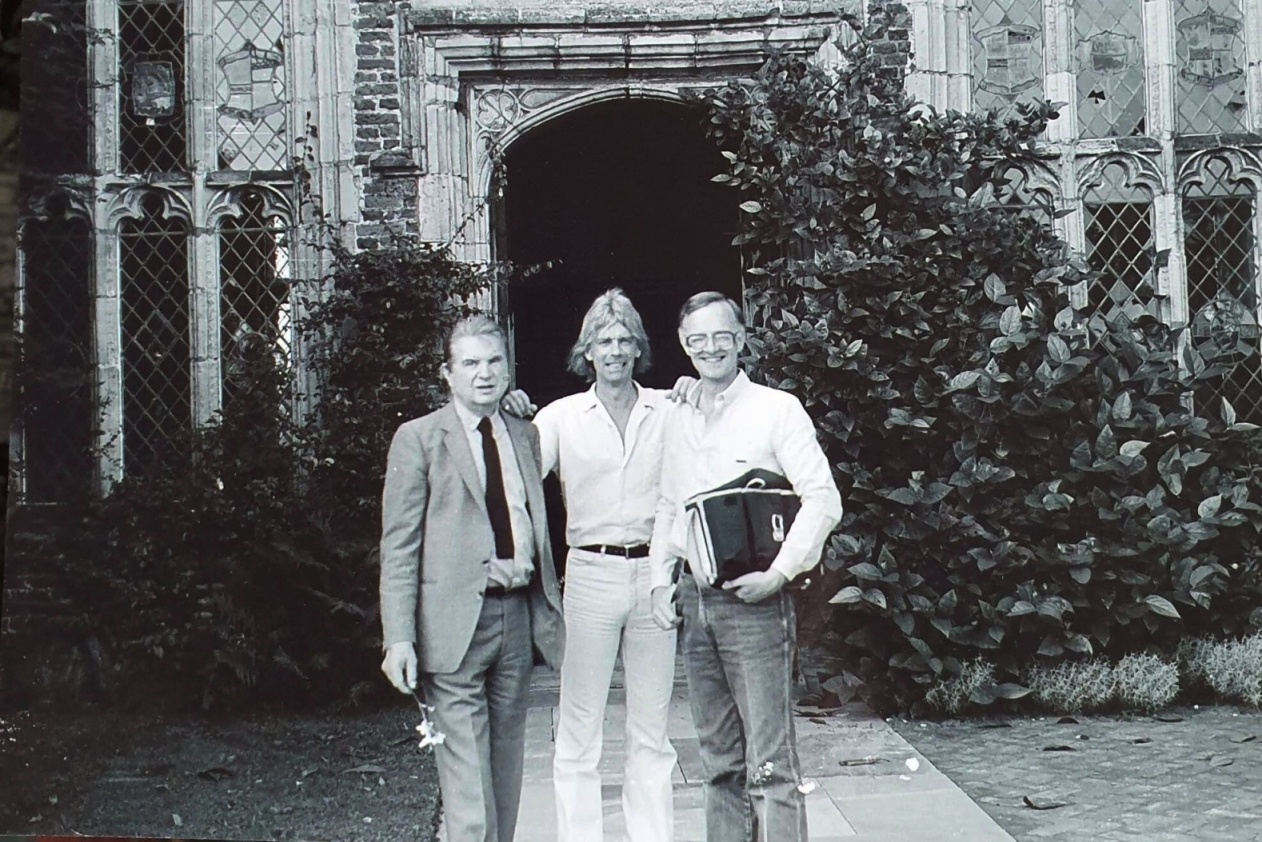
Francis Bacon, Barry Joule and Roger Chubb at Sutton Place in Guilford, England in 1981
How Soho artists become Belgravia celebrities
DURING THE first half of this century British painters and writers, and the artistic fringe generally, gathered amid the gilt mirrors and plush banquettes at the Cafe Royal in Regent Street, London. In the second half their spiritual heirs chose to assemble and make merry in the Colony Room, a dingy place approached via a squalid stairway, flanked by dustbins, in Dean Street, Soho.
Founded in 1948 by Muriel Belcher, the daughter of Portuguese-Jewish parents who owned the Alexandra Theatre in Birmingham, the Colony, or Muriel’s as it was better known, is an afternoon drinking club of unsurpassed seediness. Muriel died in 1979, but the club lives on, not quite its former self.
In its 30-year heyday the list nf painters who drank at the Colony Room would have included nearly all of the best British, post-war artists. Michael Andrews painted Muriel holding court; Francis Bacon, probably her greatest friend, made several studies of her and observed: “She was a very, beautiful woman—it’s as simple as that.”
This week an exhibition entitled “Artists of the Colony Room Club: a tribute to Muriel Belcher” opens at the Parkin Gallery in Belgravia. a long way from Dean Street in all but miles. Some 40 artists are featured — or should one say “members.” Muriel having been very strict on membership. Given out from her perch on a stool at the doorway, her decision on whether one belonged was arbitrary and final.
Lucian Freud. Francis Bacon, Frank Auerbach. Bodngo Moymhan and Eduardo Paolozzi are merely among the best-known of a distinguished gathering. The contributions of writers habitués of Muriel’s come in the form of catalogue introductions from Dan Farson. George Melly and Molly Parkin.
“I never got the impression that Muriel felt much for painting.” recalls Melly, “although possibly rather more than she did for writing; and there were after all as many celebrated authors who climbed up and staggered down those famous odoriferous stairs as there were painters and sculptors.”
What she did like were people of temperament, all the better lf it extended in the direction of putting money over the bar.
Many now-celebrated artists were down on their luck much of the time (and here Muriel’s financial as well as spiritual generosity often helped), but when they did sell a picture much of the proceeds would end up in the Colony Room till.
The painters may have come a distance from Soho to Belgravia in more ways than one. Quite a proportion of pictures in the show are loaned, anonymously, by members of the Colony circle, now cautious of admitting to the ownership of the increasingly valuable paintings by their afternoon drinking pals.
Wednesday evening, when they gather to toast Muriel’s memory, should be quite an event. Maybe Lucian Freud and Francis Bacon will end their feud and speak to one another; perhaps Paolozzi will consent to be in the same room as either of them.
Without Muriel Belcher probably none of it will happen. As Melly says in his introduction; “Painting is a lonely business. On the other side of Muriel’s heavy door sat the enchanting antidote to the empty studio.”


Taking a quick drink
STEPHEN FAY takes to the streets of London
ON JEFFREY BERNARD’S 18th birthday, he offered to buy a drink for Gaston, owner
of the Yorkminstcr in Dean Street. “He got quite angry.” recalls Bernard,
“because I’d started drinking in the Yorkminster a couple of years earlier when
I was 16.
When we met him last week in the Coach and Horses on Greek Street, where he was publicising High Life, Low Life. published by Unwin Paperbacks (Bernard is often low; his co-author Taki is sometimes high), we commiserated with him about the deterioration of Soho. “I used lo see Dylan Thomas every morning, and there were lots of painters here. Now only Lucian Freud and Francis Bacon come in, and Bacon only uses Wheelers and the Colony Room. Wolfenden ruined it by taking the whores off the streets.
“The pubs have been taken over by assholes in the blue-denim-suited brigade making advertising films, and, oddly enough, despite the dirty bookshops and the amusement arcades, Soho is more furtive than it was. Bui the liberal brigade has taken over Hampstead and Chelsea’s finished. There’s nowhere else lo go.” Taki, who believes there is, soon made his way back to Mayfair.
THE ARTS
An exhibition of dance photographs, paintings and drawings is to be auctioned by Lynn Seymour in aid of London Contemporary Dance Theatre at the Fischer Fine Art Gallery, 30 King Street, SW1 on November 22. The exhibition will be open to the public from 2 pm to 4 pm. The sale, for which admission is by invitation, is at 7.15 pm.
Bringing in the Bacon
LONDONER’S DIARY | THE STANDARD | FRIDAY, NOVEMBER 19 1982
ALEXANDER RUSSELL, 24-year-old son of film director, Ken Russell, is among those whose works will be auctioned next week at the Fischer Fine Art Gallery to raise money for the London Contemporary Dance Theatre. He has sent me this intriguing photograph of himself which he took himself with a tripod and timer. He suggests “Self-portrait as madman’’ for the title.
Russell Jnr, a painter who lives in Hampshire because “there’s more room to work down there,’’ also works on a nature reserve “to get some money’’ His painting, he explains, is “very influenced by Francis Bacon.’’
“I met him through my father and I know him quite well. He likes some of the drawings.’’
The fact that the notoriously elusive Bacon is expected to put in an appearance at the auction is surely an indication of his enthusiasm for his young acolyte’s work.
Others who have given work include Shirley Russell, Alexander’s mother and Ken’s ex-wife, who has donated some of her designs from films like Reds and The Music Lovers. Photographer Anthony Crickmay has given signed studies of individual members of LCDT company which are part of a special series commissioned by the company and which will be on show at Sadler’s Wells throughout its season which opened this week. The auctioneer is Lynn Seymour, Crickmay’s favourite subject.

At home with Muriel
There are dealers who deal, and there are dealers who vary the pace a bit, arranging a show from time to time around a certain theme that might seem to them a good idea. Michael Parkin has always been conspicuous among them, devoting quite as much time and energy as discrimination to his researches within his particular field, which roughly stated is British Art since Whistler: and specialising further still, he appears to have made his own the almost sociological though never earnest study of the connection that has existed at different times between certain coteries of the art world and particular social establishments, usually primarily concerned with the provision of food and drink.
The old Café Royal, Boulestin, The Fitzroy Tavern: now it is the turn of Muriel’s, that is to say The Colony Room, the Soho drinking club set up by Muriel Belcher just after the war, and over which she presided, by all accounts, with such benign aggression. She died three years ago. but her club survives, and this exhibition at the Parkin Gallery (until December 4), of work by some of the artists who hate used it, is a tribute to her memory.
They are a very mixed lot, and there are no conclusions to be drawn from their association, no new theory or gloss to be applied to hold our post-War art together in some fresh coherency: but it is odd how representative of their time they are, and remarkable how good so many of them are, or were, Lucian. Freud, Francis Bacon (who painted a number of significant portrait studies of Miss Belcher), Michael Andrew, (who painted the Colony R6orr itself, and whose own portrait by Freud is here on show) Frank Auerbach, Peter Blake the Roberts Colquhoun and Mac Bryde, John Minton (his portrait too by Freud and shown here), Eduardo Paolozzi, Huber Dalwood, Karl Weschke, Keltl Vaughan, Robert Buhler — the list is arbitrary and long. An if Augustus John presides at the Grand Old Man of the catalogue, artists of a much younger generation were made welcome too: Tim Berhens, Martil Fuller, Michael Clark.
These things cannot bi forced. The English, artist: and all, are riot informally am publicly clubbable in the easy Continental way of café and brasserie, and whatever social focus does appear for a while to serve its turn is all the more welcome for that: the pub perhops, the particular cafe or restaurant, the louche, clandestine drinking club, in each case the entrée given by word of mouth and accidents of the round. We do indeed love to ex take our pleasures secretly. Nibs Dalwood was always arranging to meet me at hit Muriel’s, but he never did. He died, the moment passed, and I never went there, to my great in regret. It is good to know that under Ian Board the Colony th Room goes on, and the opportunity is not altogether lost.
Bryan Robertson is another great organiser of exhibitions, indeed one of the best, but he it, was never a dealer at all. Curator at the Whitechapel in the 50s and 60s, one of the most distinguished gallery directors in modern times, he is still that it in a somewhat looser way as programme director for the Warwick Art Trust in Pimlico. His policy has been not to bring on the talented young, nor yet the celebrated and well established, but rather to give to artists of reputation in mid-career the chance both to declare and to review their achievement so far. The al disciplines are tight: the galleries, beautiful though they are, are small and difficult to use, and the work must be rigorously chosen, and as carefully disposed. Robertson himself, loyal as he is to the artists with whom he has been e associated over the years, is hard to please. A show at the Warwick has already become a kind of accolade.

Muriel
Muriel’s men
Although I only visited the Colony Room Club once while Muriel Belcher was alive, it remains vividly in my memory. Situated at the top of a shabby staircase in the middle of Soho this down-at-heel but welcoming space has been a favourite haunt British artists ever since she started it in 1948.
Francis Bacon, Lucian Freud, Frank Auerbach and Michael Andrews are perhaps the most distinguished of the painters who have frequented it. Their work dominates an affectionate tribute to Muriel Belcher at Michael Parkin Fine Art but the show emphasises that an extraordinary range of other artists also enjoyed hard-drinking visits to its premises.
Robert Colquhoun and John Minton were among its regular clientele in the 1950s, and nowadays it attracts younger artists like Michael Clark whose sensitive studies of both Bacon and Belcher are outstanding in the show.
Artists always retained a special place in Muriel Belcher’s affections and after getting to know her they realised that beneath the formidable exterior was a kind and perceptive woman who deserved their love.
Artists of the Colony Room Club at Michael Parkin Fine Art, 11 Motcomb St. SW1, until December 4th.
Revenge on orthodoxy
“The Colony Room” writes George Melly in the catalogue to this exhibition (16pp £2), “was the nearest thing to a Paris cafe this bleak and private city could offer since the great days of the Café Royal.” Melly does not pursue the comparison for there is after all a vast difference between a large and sumptuously decorated café in Regent Street and a private club situated on the first floor over an Italian trattoria in Dean Street. The gilded interior of the Café Royal has appeared in several paintings, but there is scant pictorial record of the dim and smoky conditions that prevail at the Colony Room. An exhibition celebrating the Café Royal (such as Michael Parkin organized in 1972) evoked a milieu this show is primarily concerned with personalities.
Chief of these is the late Muriel Belcher, to whom this exhibition is a tribute. From all accounts, the success of the Club was due to her, a ladv perched perennially on a bar stool and given to unrelenting abuse. Those who withstood her initial attack often became her most loyal clients, fed her scurrilous gossip and responded to the challenge of her inexorable honesty and command of expletives. She was it seems a person of huge character and no inhibitions. Like Rosa Lewis of the Cavendish Hotel, she had an ambivalent attitude towards wealth. Whereas at Rosa’s the order “a bottle of wine” always brought champagne and the wealthiest person present was charged the bill, Muriel won free drinks for all by commanding an unwanted customer, “Open your bead hag Lottie”. The unfortunate male usually obliged
She may not have cared much for painting but she respected creativity. Her Soho court included John Minton, Keith Vaughan, Colquhoun and MacBryde, Craxton, Adler, Bacon, Auerbach, Michael Andrews, Buhler, Burra Dalwood, Moynihan, Paolozzi and Lucian Freud, an impressive list of post-war artists and each given token representation in this show. One outstanding item is Freud’s 1952 portrait of John Minton in which considerable exaggeration heightens hut never breaks the realist mode. The huge eyes, sallow flesh tones and taut linearity create a haunting evocation not only of Minton’s troubled personality but also of the age in which it was painted Freud’s more recent portrait of Mr and Mrs Michael Andrews has no such ramifications. Attention remains concentrated on the artist’s technique, the incisive tonal contrasts and vigorous modelling the greater solidity and finish which, nevertheless, do not disguise the weak shape made by Mrs Andrews’s right arm.
Colony artists may not form any recognizable school hut most share an interest in distortion. It directs Bacon’s bruised and disjointed portraits and, to a lesser extent, those of Michael Andrews. It justifies Auerbach’s obiiterative strokes which, in their sweep and blur, suggest that the head he is painting has suddenly moved. And Freud’s cursive modelling often follows emotive distortion rather than the actual shape of the face This need to create through destruction descends from Picasso but mostly lacks his investigative playfulness. It asserts the artist’s control over appearances and tends to dehumanise the subject. It has a peculiar vindictiveness as if seeking revenge, like Muriel Belcher’s language, on restrictive orthodoxy. It can put a distance between us and the subject: even Freud’s intense scrutiny of physical appearances often leaves one unfamiliar with the person.
This show, however, includes many likenesses of familiar names associated with the Club. There are portraits of Dan Farson, John Deakin and Muriel Belcher (on her deathbcd), and several of Francis Bacon. There are also photographs of certain regular habitués — none labelled, since part of the game is, of course, knowing who’s who. If Muriel Belcher recognized talent she also made sure that others did too, and Colonv Room members turned up in force at these artists private views. And though her gift for spreading intoxication is widely known, Muriel Belcher’s black charm may have had more influence than historians have so far even hinted.
Artists or the Colony Room Club Michael Parkin Gallery, 11 Motcomb Street, London SW1
LCDT self help
CHIT CHAT | THE STAGE | THURSDAY, DECEMBER 2, 1982
In a determined effort to generate funds from the private sector, London Contemporary Dance Theatre last week organised an unusual evening at the Fischer Fine Art Gallery.
The main event was an auction of paintings, drawings and photographs. It was conducted by Hilary Kaye from Sotheby’s, who was aided and abetted by Lynn Seymour, making energetic pleas to wealthy art connoisseurs to part with their money. Many of the exhibits, which included works by Anthony Crickmay, John Furnival, Ellen Kuhn, Jo Parker (Mrs Stuart Burge), Shirley and Alex Russell, and Inka Sobein, were generously donated to the cause, and a net profit of £2000 was raised.
This was LCDT’s first self-help initiative in the desperate struggle to raise funds, and the committee is now hard at work planning future events.
Obituary
SUZY SOLIDOR
SUZY SOLIDOR, who has died at Cagnes aged 83, was a fashionable nightclub entertainer in Paris in the 1930s and 1940s, who amassed a collection of 221 portraits of herself, many by some of Europe’s leading artists.
She was the original of the song: “If You Knew Suzi like I knew Suzy.”
Born in St Malo, Brittany, she opened an antique shop in Paris, and only began singing when she was 32 because business was bad. The painter Van Dongen advised her: “If you want to save your furniture, sing. And sing from the depths of your belly.”
She converted the antique shop into a nightclub, and appeared every evening, dressed as a matelot, to sing about the seafaring life in a deep, gravelly voice. She was already known to many artists as a model, and her songs included “La Mer” and “Tout Comme Un Homme.”
Her nightclub, called “La Vie Parisienne,” was the most modish in Paris for well over 10 years, and artists who painted her included Vlaminck, Van Dongen, Picabia, Kiesling, Francis Bacon, Marie Laurencin, Dufy, Cocteau, and Domergue.
When she left Paris for Cagnes in 1958, she opened another antique shop. In the house next door, where she lived, the 221 portraits of her in her singing days, said to be worth well over £I million, were ranged round her living room walls. But she did not keep a single one of her records.
‘‘I Think about Death Every Day’’
Francis Bacon tells why his paintings seem so violent
and how the upheavals in his life influenced him
JOSHUA GILDER | FLASH ART | MAY 1983
Early on, Francis Bacon became identified with the imagery of his paintings; the split-open carcases and strings of offal. He says he could often see the dismay register in people’s eyes as he approached, the unspoken thought, ‘‘Oh, here come the meat racks.’’ Bacon’s relationship with his public was bound to be uneasy from the beginning when, at the age of 35, he unveiled his Three figures at the base of a Crucifixion. It was almost a visual assault, these visions of unrelieved horror and disfigurement, Bacon had plumbed the depths of human agony, and he had surfaced with a primal scream of terror so intense it seems to rip the tormented figures apart.
In recent years the terror has subsided somewhat. Today one senses a greater distance between the artist and his subject. There is now a contemplative aspect to his paintings, one that allows room for mystery, and even for beauty.
The original Francis Bacon, the great Enlightenment photosphere, does in fact number among the artist’s ancestors. From the Elizabethan court, the line of collateral descent found its way to into Ireland with Bacon’s father, who was a horse trainer. Growing up in an English family in revolutionary Ireland, the young Bacon was prey to his share of anxieties. These were compounded by constant money worries brought on by his father’s gambling, a vice that Bacon says has entered his blood.
Bacon, 71, now divides his time between his London studio where he lives and an apartment in Paris he rents from a friend. He likes to start painting at the first light of day, and generally leaves his wok by noon. We talked one afternoon in the office of his London dealer at the Marlborough Gallery.
JOSHUA GILDER: Do you think of your painting as violent?
FRANCIS BACON: People always interpret them as violent. I’m certainly not trying to do that. I’m really trying to make them as real from my point of view as I possibly can. I mean, you’ve only got to think about life for just ten minutes, what it’s really like: it’s a horror which I certainly wouldn’t have the talent to be able to trap—the real awfulness of life. It’s marvelous, but yet it’s awful.
JG: Does painting that horror ever move you, emotionally?
FB: Emotion is such a funny word. What is motion? It’s a horrible thing to say, but what is emotion really?
JG: Well, sometimes you’re painting images of extraordinary pain.
BACON: I’ve lived through two world wars, and I suppose those things have some influence on me. I also remember very well, growing up in Ireland, the whole thing of the Sinn Fein movement. I remember when my father used to say—this is when people were being shot all around—‘‘if they come tonight, just keep your mouth shut and don’t say anything.’’ And I has a grandmother who was married to the head of the police in County Kildare and used to live with windows sandbagged all the time, and we used to dig ditches across the road so cars would go into them.
After, when I left home, I was 16 0r 17, I went to Berlin. That was the Berlin of the Weimar Republic, it was just before Hitler came into power, and there was also a tremendous sense of unease. As I’m old now, I’ve lived through a period of tremendous upheaval and tension. Perhaps those things have affected me.
But most people never think about life. If you think of the way we live, we’re living on the compost of the earth. The world is just a dung heap. It’s made up of compost of the millions and millions who have died and are blowing about. The dead are blowing in your nostrils every hour, every second you breathe in. It’s a macabre way of putting it, perhaps; but anything that’s at all accurate about life is always macabre. After all, you’re born to die.
JG: But can’t one live with a consciousness of death without being macabre?
BACON: Ah, yes. You certainly can. But I don’t think of my work as being in the least bit macabre. I think of it as being slightly truthful sometimes.
JG: Which contains that consciousness of death?
BACON: I never go through a day without thinking sometime about death. It just comes into everything that you do. Into everything that you see. Into every meal you eat. It’s just part of nature.
JG: Is death the subject of the painting you’ve been working on this morning?
BACON: I’m at the moment just painting a sand dune. The setting is a sort of industrial background, and out of this the sand dune, I’m hoping, seems to have started to emerge.
JG: Do you usually start with an image in mind, in this case the sand dune or the industrial background?
BACON: It differs. For instance, with my painting Jet of Water (1979): I was in France somewhere and I saw a wave breaking on the shore and I thought I would like to do that. And when I came to try and do it, it looked more like a jet of water. So I turned it into a jet of water.
JG: Does that often happen?
BACON: Vet often, yes. The painting changes from one thing to another constantly. You often think, there’s a certain thing you want to do. But in the process of doing it, it may completely change, and sometimes, if you’re lucky, change into something much better.
JG: What inspires the change? Is it a feeling evoked by the image?
BACON: I think if one were able to have a camera running all the time while one’s working you would be able to see how things change much better than any words can possibly describe. Painting is not, after all, a static process. It’s not all that difficult to sit down and illustrate a wave breaking on the shore, but that’s just going to be one more illustration of a wave breaking on the shore, which is better done by photographs. And so you have to find a ay by which you can present this wave breaking. But with the sand dune, well, I think it looks rather like a sand dune. You see, I want to make it as strongly into a sand dune as I possibly can. And to do this I must cut away its naturalistic surroundings.
JG: Why is that?
BACON: It gives it, to me, a greater presence. You see, each artist, especially in our time, when there’s no tradition at all, works according to his own nervous system. Well, then it’s the question of the quality of the nervous system. Only time will tell whether that’s any good or not. One will be dead before that’s sorted out.
JG: Do you paint quickly?
BACON: When things work for me, I work very quickly.
JG: And then are there times when it doesn’t seem to come together?
BACON: Oh, yes. I mean, I’ve got dozens and dozens of canvases that are just half done and left.
JG: Why do you think it is that a picture won’t come together?
BACON: It’s something in you. I hate starting a picture. It’s only when things begin to happen, when you feel things arising from your instinct, that it becomes interesting at all.
JG: How do you get to that stage?
BACON: Chance usually brings it along. I think that my paintings look perhaps very conscious, but they actually come about in a very unconscious sort of way. You see, so much of my work, and the better work, is when things come together accidently. It’s a very difficult thing to talk about what accident is—or chance, whatever you like to say. When things seem to work for you.
JG: The surrealists spoke of accidents as a way of subverting the conscious or the super-ego. Do you agree?
BACON: I think so. The difficulty is, so much in surrealism was really interesting as ideas, but the actual painters, the real surrealist painters, were not very interesting. Their technique was very academic and boring.
JG: Who has influenced you?
BACON: Well, I didn’t start painting, really, until I was about 30. And I never went to an art school. I was born in Ireland, where it’s more important to know the shape of a horse’s hoofs than to know anything about painting. Neither my mother nor father was the slightest bit interested in painting. I left home when I was 16, and did all sorts of little jobs and things, and then about 1928 I saw an exhibition of Picasso’s in Paris. I thought about it for a long time, and certainly was influenced by Picasso. I’ve been influenced by everything really.
JG: You seem to incorporate some of the techniques of the abstract expressionists.
BACON: I’m sue I learned a great deal from them, because I take anything that I think is going to be useful to me.
JG: You spoke once to David Sylvester of your painting as ‘‘walking a tightrope between figurative painting and abstraction.’’
BACON: Well, I may have. To tell you the truth, no abstract painting has ever given me the exhilaration of figurative painting. In fact, it bores me. Profoundly. When I first heard of Rothko, I thought, well, here is going to be somebody doing the most marvelous somebody doing the most marvelous things, like Turner, in abstraction. But the problem—with all of abstract expressionism—comes from lack of subject. I think that no matter how far you deviate from it, you need the discipline of the subject. You need the pulsation of the image, the force of the image, to go beyond decoration. Which Rothko didn’t have. It was always a beautiful decoration. And perhaps I’m peculiar, but I ask from painting something more than decoration.
JG: Something human?
BACON: An image. Not necessarily ... well, you can call it human, yes; but an image, on that unlocks the barrels of sensation in a more profound way, which abstraction never does. The abstract expressionists did away with the subject and went directly after beauty. But they were bound to be disappointed. After all, beauty is only a hind product of desire.
JG: Do you start with the subject in the foreground, or the background?
BACON: I start with the foreground, the figure, and then that determines the raw colour of the background.
JG: For instance, in this portrait of Muriel Belcher you would have painted the sphinx first?
BACON: Yes. yes. And then I gradually put in the colors. I wanted this image, or agitation, to exist in a very clam background.
JG: The lines you draw around your figures are often thought of as reference to the glass box surrounding Eichmann at his war-crimes trial. Do you think of them that way?
BACON: No, I don’t. I think of them simply as methods of containing the image. I feel that, in this portrait of Muriel, for instance, without those lines around it, the image would be sort of floating in that orange too much. I’m sure there are more satisfactory ways, but I haven’t discovered one yet. Perhaps I will one day.
JG: You’ve spoken of how difficult portraiture is today. Why is that?
BACON: Well, because, firstly, the tremendous developments of photography in portraiture. The only real thing now in portraiture is to make not just an illustration of the person but to make an image of them. People talk, for instance, of giving a person’s character, but I don’t think portraits very often do that.
JG: In many of you your portraits, despite the distortion, one can still see the likeness. It’s not all distortion.
BACON: No, it isn’t all distortion. But then, you see, I always hope to distort into reality.
JG: To distort into reality?
BACON: And not distort away from it. To my point of view I’d like to make a marvellous image which also looked like the person, if I could do it. I have done one ... perhaps one or two have been successful. I did a set of three of Muriel. They were very deformed, but I think they were deformed into appearance.
JG: If I said that I saw tenderness in some of your portraits?
BACON: Absolutely. For instance, this one of Muriel, who was a great friend of mine. Well, people hate this thing. But I find that this portrait of Muriel is very, very tender and happens to be very like her.
JG: You spoke of your triptychs as stills in a movie. Is there a narrative?
BACON: There’s no narrative. I just try to make images, really. I mean, one knows through history to some extent what the sphinx is supposed to be. But I never think of what it is supposed to be. I think of what it is to me.
JG: The way way an image can move one despite its historical context?
BACON: Yes. Absolutely. Its historical reasons don’t really touch me at all. With the great Egyptian art, for instance, which I think is among the greatest art, there are very, very few things that are known. It was really made by workmen, who probably in their own way put their own kind of personality into the work. But one doesn’t really know. This cultivation of the personality is a very modern thing, really, and not at all interesting, finally. I mean, somebody may have an extraordinary personality, but in a work of art it’s not their personality one is interested in; what’s interesting is what they’ve made—the image they’ve made.
JG: Are you in a sense trying to transcend personality, to create almost mythic images?
BACON: I don’t think I’m trying to do anything beyond make images that excite me. I’ve nothing to say in that sense. I think images say say a great deal, but each person interprets an image as they want. Insofar as I could say what I’m trying to do, I’d say I’m a maker of images, that’s all. But images not for other people. Images for myself.
JG: You don’t care if they communicate to other people?
BACON: No. You may say that’s a very egotistical point of view, but I really don’t mind. I’m just very lucky that I’ve been able to not have to do some other work and be able to earn my living by something that obsesses me.
Magnum force
THE health inspectors who are touring London have lighted on a lesser-known spot, the Colony Room Club. This Soho haunt has had an enforced facelift after 35 years.
Moans proprietor lan Board: “I asked them if I could have the carpet cleaned
—
which would be sacrilege anyway, considering what
The new carpet did not find favour with our greatest living painter, Francis Bacon. He called for a magnum champagne, and emptied the lot all over it of.
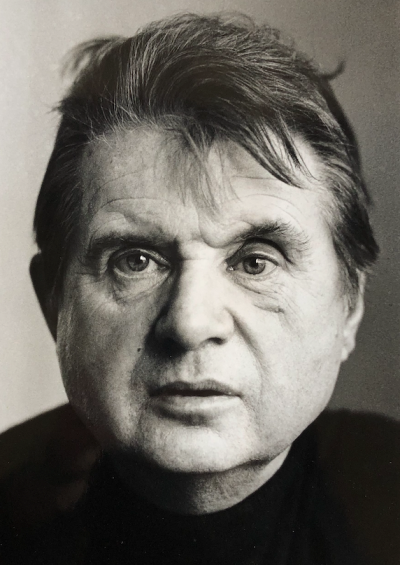
Bacon ... bubbly
KENNETH CLARK IS DEAD AT 79;
WROTE ‘CIVILISATION’ TV SERIES
Kenneth Clark, art historian, museum director, author and narrator of the television series “Civilisation” and for many years a preeminent figure in British cultural life, died yesterday in a nursing home in Hythe, England, after a short illness. He was 79 years old.
Though best known throughout the world for “Civilisation” — the most successful television series of its kind ever made, and a pioneer achievement in its time — he was a man of restless ambition and manifold achievement who left his mark not only on the art world in many of its ramifications but on the concept of governmental patronage and the development of opera, ballet and theater in Britain.
He was knighted in 1938 for his services to art and was made a life peer, becoming Lord Clark, in 1969. Sir John Pope-Hennessy, chairman of the department of European paintings in the Metropolitan Museum of Art, said yesterday: “Kenneth Clark’s life was one of an incomparable richness of achievement. In his television programs he exerted a wide and lasting influence. A critic of immense intelligence and of unfailing discrimination, his role in the modern world was comparable to that of Ruskin in the 19th century.
“He was at the same time the most naturally gifted art historian of his generation. Though published over 40 years ago, his monograph on Leonardo da Vinci and his great catalogue of the Leonardo drawings at Windsor have never been surpassed.
“By temperament, however, he was intolerant of specialization, and his most widely read books, ‘The Nude’ and ‘Landscape Into Art,’ were works of synthesis of great originality. As director of the National Gallery in London he proved himself the most effective holder of that post since Sir Charles Eastlake, 130 years ago. Its galleries bear witness to the many inspired purchases that he made.”
Kenneth Mackenzie Clark was born on July 13, 1903. He was the son of Kenneth McKenzie Clark and Margaret Alice McArthur Clark. The family owned a cotton-thread business that yielded a very substantial income. The young Mr. Clark was educated at Winchester School and Trinity College, Oxford. After graduation he worked for two years in Florence with Bernard Berenson, the most celebrated art historian of the day.
At the age of 28 he became Keeper of Fine Art at the Ashmolean Museum in Oxford, and at 30 he became director of the National Gallery in London. In the same year he was appointed Surveyor of the King's Pictures, with direct responsibility for the thousands of paintings and drawings that are to be found in Buckingham Palace, Windsor Castle, Hampton Court and other royal establishments.
Aided English Artists
Quite apart from these duties, he began to take an active interest in the more gifted English artists of the day, many of whom he was able to help at a time when help was badly needed. While still a young man, he also found time to publish “The Gothic Revival” in 1929, a catalogue of Leonardo drawings at Windsor Castle in 1935 and a concise general study of Leonardo in 1939. He also produced, in “100 Details in the National Gallery,” which appeared in 1938, a work of popularization that was widely enjoyed and no less widely copied.
By way of homage to an old friend whose prowess as a lecturer on art was comparable to his own, he edited in 1939 the “Last Lectures” of Roger Fry. It was in that year he was knighted.
From 1939 to 1941 Sir Kenneth worked in the Ministry of Information, where he was responsible among much else for the establishment of a roster of official war artists. Henry Moore’s widely celebrated “shelter drawings” were among the works that resulted from this project, which had the further advantage of supporting a group of artists at a time when patronage, whether public or private, had virtually ceased to exist.
In 1945 he resigned from the directorship of the National Gallery to devote himself to writing, lecturing and the pursuit of study for its own sake. As Slade Professor of Fine Art at Oxford from 1946 to 1950 he produced the lectures that were published as “Landscape Into Art,” and over the next quarter century he wrote “Piero della Francesca,” published in 1951, “The Nude” in 1955, “Rembrandt and the Italian Renaissance” in 1966 and “The Drawings of Botticelli for Dante’s Divine Comedy” in 1976. He also wrote two volumes of autobiography, “Another Part of the Wood,” published in 1974, and “The Other Half,” in 1977.
Sought a Wider Audience
Though fitted both by nature and by a substantial private income for a life of learning and seclusion, he was eager throughout his life to reach a larger and more popular audience than the one that was alert to every nicety of scholarship. He was also much concerned with the possibility of direct Government action in the patronage of the arts. This led him to accept such major appointments as the chairmanship of the Arts Council of Great Britain, from 1953 to 1960, and of the Independent Television Authority, from 1954 to 1957. He was also very active in the affairs of the Royal Opera House, Covent Garden and the National Theater.
While associated with the National Theater he became aware of the immense — and at that time unrealized — potential of television as an educational force. Though sometimes disconcerted by the customs of the marketplace as manifested in an area where large fortunes were being made, he determined after leaving the Independent Television Authority to produce films on art that would both instruct and delight a mass audience. This was the spirit in which “Civilisation” was made for BBC Television in 1969.
‘Civilisation’ Popular in U.S.
Though greeted with caution by some specialists, “Civilisation” soon proved to be a great success in Britain — and, if anything, an even greater success in the United States, where it was shown repeatedly both on public television and in museums all over the country.
Not everyone in the American art world applauded either the matter or the manner of the series. But though it was elliptic and highly personal in its survey of human achievement in architecture, music and the fine arts, “Civilisation” did a remarkable job of popularization and one that was no less successful in book form.
After the appearance of “Civilisation” Lord Clark was more than ever in demand both as a writer and - in this country, above all - as a lecturer. In recent years his health did not allow him to visit the United States as often as he would have liked, but he took a particular pride in the Gold Medal of the City of New York that was given to him by Mayor Abraham D. Beame during his last visit to the city in 1977.
Books Given to Morgan Library
By way of return for the pleasure he had always derived from traveling in this country and from the company of his American friends, he made it known some years ago that he intended to bequeath many of the most important books in his personal library to the Pierpont Morgan Library in New York.
“During the last 50 years the United States has been infinitely generous to Great Britain,” he said on that occasion. “They have not only saved us from extinction in two wars, but they have saved buildings and books that mean much to us. As far as I know, the movement has been all one way. My offer to the Morgan Library is small — a very small — sign of recognition of what we owe to the United States.”
Charles Ryskamp, director of the Morgan Library, said that the most remarkable of the books in question dated from the 16th century. “We have chosen superlative copies of very rare books by or relating to Alberti and Michelangelo, and books of comparable importance by Ariosto, Dante and Lorenzo de’ Medici,” he said. Son Is an M.P.
Kenneth Clark was married twice. By his first wife, the former Elizabeth Martin, who died in 1976, he had two sons and a daughter. One son, Alan, is a historian and has been Member of Parliament for Plymouth Sutton since 1974. The other son, Colin, now living in California, is a television producer who worked with his father on many occasions. His daughter, Colette, is a director of the Royal Opera House.
In 1977 he married Nolwen de Janze-Rice, who survives him. He was made a Companion of Honor in 1959 and received the Order of Merit in 1976, and was accorded numerous academic and other honors, national and international. They included a Gold Medal and Citation of Honor from New York University.

Kenneth Clark
Queer Street
Homosexual, poof, queer, gay? I was brought up to use the word queer. And queers aren’t what they used to be. I was discussing sex as usual with Francis Bacon in the Colony Room Club the other afternoon and we both came to the conclusion that the decline in the quality of homosexuals dates from the time that gay became their title. What a silly word! Speaking as an obsessional heterosexual I’m very gay usually after four or five large ones but most of the poofs I know seem to be fairly gloomy about their condition. Years ago I used to put the gloom down to the fact that they mostly had to pay for their sex games when it was against the law, but now that homosexuality is practically de rigueur that can no longer be the case. AIDS must be a tiny bit worrying of course but it all ends in death anyway. When the talk gets around to sex, which as I say it inevitably does, Francis is fond of verbally chastising me by reminding me that I used ‘to lead poofs up the garden path’. Well I did but I can’t feel guilty about it. When I was a teenager with the delinquent looks that queers fancied so much, they only ever fell for, bought drinks and meals for, and gave money to ’normal’ boys. That was their hang up, not mine. But I must say I’m extremely grateful to the gentlemen who gave me handouts in those days.
But I did have some strange times. John Minton took me to France, Spain, Majorca and Ibiza when I was 17 and it was pretty appalling really. There was a tremendous amount of sulking on his part because I wouldn’t have sex with him and on my part because I couldn’t screw the entire female population of the world, which is, oddly enough, what boys aged 17 want to do. When he lived in Hamilton Terrace he actually made me a weekly allowance of £3 10s: ten bob a day. A kept poodle. My sulks stopped in Paris on the way home when for a few days he gave me 500 franc notes to pop upstairs in a cafe called Ambiance to have short times with a girl called Mimi. Even that came to an end due to my introduction to Pernod.
One of the strangest queers who took a shine to me was a film producer who’d been a naval officer in the war. During the action in Which the Bismarck was sunk he picked up survivors from that ship. He claimed that as the German sailors climbed up the rope ladders he’d pulled the handsome ones up and pushed the ugly ones back into the water saying, ‘Not you dear.’ Then there was the extraordinary man who was a professional bridge player and who played for England. He used to take me to a marvellous old restaurant in Frith Street almost every day for lunch — creme des legumes, escalope of veal, a glass of red wine: 3/6d — and he used to let me take girls back to his flat, which was pretty nasty of me. On second thoughts, he probably liked the idea.
But, as I was saying, there has been a decline in the quality of queers and it may not have been since the word gay was coined. It may have started with it being made okay in the eyes of the law. I’d quite like to see a law introduced making fornication illegal. It might bring some spice back to sex and make all those lunches preparatory to the afternoon legover seem worthwhile and value for money. As it is I haven’t noticed much change in women since they’ve discovered they’re equal. The only woman who ever takes me to lunch is my ex-wife and I suspect that’s purely because she’s defused me and rendered me harmless.
Which brings me to another point. At just what age do women become equal? I’ve noticed that women under 30 hardly ever buy a round of drinks. Mind you, young men are pretty callow too in pub etiquette. Worst of all is the animal called student. I really don’t know what should be done about these people. When someone tells me that they are reading English at Oxford at public expense — I wonder why on earth they can’t read English in the kitchen at home. I didn’t get where I am today by going to Balliol and I can’t think of a better place to study politics, philosophy and economics than in the Coach and Horses. Norman is a gas on economics. The place oozes philosophers and we have mathematicians who can work out place bet yankees in seconds. As for the aforementioned business of gays, we haven’t got any. All we’ve got is the next best thing. Danny La Rue is a customer.
A brush with ebullient despair
The Times Profile: Francis Bacon
IN his book on Bacon (Phaidon, £50) published today the French critic Michel Leiris declares that Francis Bacon’s searing paintings
Bacon’s images crawl in the mind: human trunks (or perhaps it is a smeared foetus?) like refugees from an abattoir squatting on a flat tightrope in some limbo, Figures with distorted, apparently tormented, faces desolate in denuded rooms. What is he up to? Is he really concerned with presenting pictures of man dispossessed?
Painters have one impenetrable defence: they insist, as Bacon does, that they are concerned only with form. Bacon has never done abstract painting; his very recognizable figures, if only by their deformity, appear to be yowling out some message about human distress. But Bacon denies this. He experiments with form, he says, in the hope that some
That is enough for the painter, but the journalist has to dig for some clues as to what al this is about, and what kind of person lies behind this activity. The accumulation of evidence suggests that Bacon has been all his life — and still is at 74 — a greedy and incorrigible youth with no social conscience; a roulette gambler (he also makes repeated reference to the element of luck in a successful painting) who stumbled on to something fluid going on in his head which when transferred to canvas corresponded to a satisfactory enough challenge to reality — or perhaps temporary defeat of reality — for him to want to go on doing it all his life. He doesn’t give a damn about critics or public.
After that its gambling, champagne (but as a nourishment not a frivolity) and friends. He posed for this portrait with great good will. He lives, on springy feet, a dapper man, mysteriously youthful, in a mews studio in South Kensington whose appearance avalanches from untidiness to squalor.
There seemed to be a promising clue to his, unadmitted, anguish in the fact that he was born in Dublin (son of an English horse trainer) and until the age of 16 hung around within contagious range of the priests’ training college, Maynooth. Was he perhaps exposed from an early age to a sacerdotal miasma which regularly rinsed his soul with torment?
Not at all. His story is that he was born and raised in Ireland without having become any kind of an Irishman. Then what were all his popes and crucifixions about? Nothing what- ever to do with religion.
"I wanted to do a portrait of the body raised from the ground. Christ on the cross seemed one way of doing it and I couldn’t think of any other." No Irishman could give an answer like that, even as a joke. So we must accept that he, a member of an English family, who was warned to keep his mouth shut if the IRA paid a visit to their Kildare home in 1918, saw and recognized the local obsessions but was totally distanced from them.
Nor will he admit that his experience with the ambulance rescue squad carting around the wounded during the Blitz (his asthma kept him out of the army) made any special impression. He did not begin painting until he was about 30, then survived on £3 a week from his mother and working as cook and valet to a couple in Holborn.
"You claim your work is not about illustrating anything."
"No. I always think what painters and poets do for you is unlock the valves of sensation and bring you nearer to a kind of reality. Much more than telling you anything. They just make you aware without it being a dictatorial awareness", he replied. "I think of myself as an image maker."
One of the most obsessive of these images came from an old hand-painted medical book on diseases of the mouth he found in Paris. "I always thought", he said, "that if I could take just the interior of the mouth, the saliva, the tongue, the colour of the flesh, I would be able to make the mouth as beautiful as a Monet sunset.
"Well, you can see the possibilities", he said, a shade defensively, in response to my silent stare. "It was a rather unlikely road to want-to travel?", I suggested. "It was an unlikely road", he agreed, generously, "and it didn’t come off’. He laughed. "You never know where the images come from, he said".
"A book on birds of prey. And advertisement in a newspaper".
"So medical books are as useful to you as an art gallery?"
"Certainly. Or old Mrs Beaton’s cookery book".
Or Bunuel’s Un Chien Andalou; the woman screaming on the Odessa steps in Eisenstein’s Potemkin, a poem by Eliot; a translation from the Greek. Bacon has had only the most capricious association with the recognized art world. he never went to art school. One of the most powerful influences on his painting has been Velázquez’s “Pope Innocent X” which he regards as one of the greatest paintings in the world. He studied scores of photographs of it, but when in Rome never bothered to see it. I could not prise out of him.
"How can you be sure it is perhaps the greatest painting in the world when you have never actually seen it"?
"I know just by the way its laid out", he said a trifle testily ... "I rarely go to art galleries. I just take what I can find. I don’t think this is uncommon among artists. I think all people who create are like that. They are just greedy for themselves. Painting is about nothing more than what it does to me".
"When you do portraits, are you attempting to unlock feelings about the sitter?"
"No. No. I am really working for the form. I am hoping that the form will become a likeness. People say my work is deformed. But it is certainly not deformed for the sak1e of deformity. I am always hoping to deform into reality."
"And in your preoccupation with the Shout, is any aspect of it anguish?."
"It’s not the anguish. I hate expressionist painting. But unfortunately that came into it. It was a silly thing to do. I am not at all an anguished person."
"You’re not? That will surprise people."
"No. I’m not. If it comes out in my work well there it is, its something that comes out. I never think of it as anguish. I think of it in so far as it works as extremely realistic. As life is packed with anguish the more realistic you are the more your work will be packed with the anguish of life. Isn’t that clearly put?" he demanded with self-admiration. (He frequently felt he was being incoherent, which was never the case).
"Have you a strong awareness of social Injustice?"
"If you started to worry about what you thought was social injustice your whole life would be fucked up."
"Are you saying that in your own life you are not a tormented person, but very jovial, gregarious?"
"I wouldn’t say I am jovial. I am gregarious. The thing about it is of course when one’s been young, been emotionally involved with people there are always moments of anguish that people go through. But I am not a worrier in life at all. I’m not tormented. I mean I haven’t got a sense of sin. I am lucky in that way but then I wasn’t brought up to have it. The only way I would feel I had committed a sin would be if I consciously tried to bring harm to somebody else."
"What is the attraction of gambling for you?"
"Just for a moment you think that luck is working for you. As in painting when things are going well you think for a moment chance is on your side."
"You have said that when a painting works there is a very high level of accident. What other people might call inspiration?"
"Inspiration is such a high-falutin word, it’s easier for me to say accident or chance."
"You destroy your work?"
"Very frequently, yes ... I should have scrapped a great many more," he muttered reflectively.
"Do you not regret, then, when a successful painting Is sold and goes abroad to someone’s collection?"
"I’m glad to see the last of it."
"So the satisfaction is only in the process of work itself?"
"Yes."
"You realize other people cannot live as emotionally independent as you do? Most
people have to succeed on other peoples
"They do. To be a painter is to be extremely lucky. Don’t think I dismiss the fact that I have been very lucky to be able to earn my living at something which obsesses me to try and do. But practically no one understands anything or feels anything about painting". (This did not appear to particularly concern him).
"What about the critics?"
"If I took any notice of what critics said I’d never work at all. They loathe my work. I never sell in this country."
I had asked him if he drank and he had replied: "Oh I do," with particular cosiness. We had already had a whiskey and Bacon then invited me to join him and an old friend from the World Bank for lunch and a few bottles of wine.
About the third bottle of wine, time began to speed up. There were whizzing taxis and climbing stairs to a Soho drinking club and then the serious business of drinking champagne.
This gave rise to an anecdote or two — Bacon telling me how he went to Crockfords the other night with £6,000 but carefully divided it into two jack-et pockets. This appeared to be his notion! of prudence: having to dig into a second pocket would be a severe obstacle to losing it all. It wasn’t.
He spoke of Yeats: "As an old man he worked on himself, made himself more remarkable."
I asked him what he thought of old age, which judging by his form he appeared to have pretty well tamed.
"It’s a bloody nuisance," he said, with a touch of melancholy. "Well, you are nearer death. But so long as the brain goes on and one can move about!" After that there were only images, of endlessly circulating bottles of champagne, dark, beaded with moisture, which drew out of the gloom what appeared to be hands with greedy mouths in their palms. And Bacon standing by the bar jaunty in old age.
It was one of those evenings where you ask yourself next morning: what the hell was that all about? Chance provided the answer. I found a crumpled card in my coat pocket on which I had scribbled, in collapsing handwriting, one of his, phrases: "Ebullient despair."
Peter Lennon
Following the signs at new art’s crossroads
Marina Vaizey on the Tate, and Francis Bacon
“NEW ART at the Tate”: a 26-foot-high black metal animated Hammering Man, a mix of Disney, fairy stories and comic books, by the American artist Jon Borofsky, startlingly welcomes visitors in the Tate’s central rotunda, and sets the mood. Borofsky, who works with video, installations, environments, and even old fashioned drawing and painting, is typical of the multi-media diversity explored by’ most of the eighty-two artists (including just five women, none of whom are painters) from Europe, Britain and America that make up the Tate’s ambitious mini-survey of the concerns of art now. It is the first such in London for nearly twenty years, a welcome look outside from our insular world.
It is a confusing, hectic show. Even the signposts guiding visitors each have two arrows pointing in opposite directions; the show is in three adjacent areas, not fully integrated. In the exhibition, too, there is no one ‘ism’, dominant pattern, or single viewpoint; rather there are many things going on.
Vividly coloured, large scale neo-expressionist painting, from Italy and Germany, uses a fierce series of fragmented images or large, set scenes to echo recent history or fearsome personal nightmare. Immendorfs huge painting “Café Deutschland”, Rainer Felling’s “Another Murder at the Anvil”, like a 1920s low-life movie redone in lurid Dayglo colours, echo the terrible events of the Germany that existed before these artists were born. Thus, too, Anselm Kiefer (b 1945), whose vast “Parsifal” paintings (1973) and “Heliogobal” (1983), a huge black-pillared hall with fires burning (we almost expect to see and hear thunder and lightning), come close to stealing the show.
There is some stunt work: Julian Schabel’s “Humanity Asleep” tosses enormous swirls and clots and drips of paint over a surface of broken crockery; I’m not sure how humanity slept through the sound of smashing china. There is role-playing: Cindy Sherman is a young blonde American who pouts, smiles, frowns her way as both subject and object of her own big colour photographs, in the process exploring the variety of appearances we demand both of stars and the girl-next-door. Robert Mapplethorpe’s impeccable silvery grey photographs take the body as sculpture: a curved, shining back, the knobbed spinal column like a path through the flesh; a black body walking; an outstretched arm. The Tate accepts such artists, and the English ones here – Hilliard, Long and Fulton – who also use Photography; but not everyone realises the Tate is alone among international modern museums in ignoring photography itself.
A number of sculptures and paintings take on traditional techniques, as does Stephen Cox’s “Gethsemane” – huge lumps of stone carved and coloured with great virtuosity, spread over a wall like fragments from some great decorated classical building. Charles Simmonds makes instant ruins – ritual towers, old settlements – from tiny terracotta bricks. In one corner Jannis Kounellis has made a big wall drawing in black lines showing a village street, with two real stuffed pigeons in the sky, each held by an arrow through the breast.
Paul Thek sends tip the idea of the past with bronze tableaux of mice and “Dead Sea Scrawls” and a loaf of bread, implying destruction and impermanence with permanent materials. Bertrand Lavier questions tradition with a glass cabinet and a golden framework, painted all over with ripples of translucent acrylic, so that the outlines of the piece of furniture become irregular and wavering.
And the German artist Sigmar Polke combines the echoes ofthe past and the freedom ofthe present with a shimmering painting in muted, light-filled colours, like a rainbow shattering; in this curtain of colour black dots (like newspaper photographs ) indicate the classic broken statue, the “Winged Victory”, facing a bland little man making a speech, the little dictator. In this international gathering, the British painters, masters of form and colour (Setch, Walker, Le Brun), and sculptors (Cragg, Houshiary, Woodrow, Kapoor, Deacon, Willats) are among the most interesting, inventive – and hopeful – to be seen. Doom and gloom here seems more a Continental p re-occupation.
The single most memorable piece, though, is the most strikingly simple: Magdalena Jetlova’s huge oak and iron staircase, each tread, roughly carved, at a crazy angle, the whole leading up and on into the blankness of a museum wall, a staircase of aspiration and hope, going nowhere, beautiful, blank, and very affecting. Jetlova is a Czech, who carves wooden fragments – resembling chairs, clothes, cupboards, staircases – just occasionally shown semi-secretly in temporary shows in Prague’s ancient courtyards. Her emergence here has an impressive simplicity.
The exhibition as a whole is not only New Art, but Hot Art, news that these works – witty, ironic, powerful, despairing, crude, and sometimes just ugly for the sake of it – indicate too a new energy in the art market. The new art is being rapidly validated in museum shows in Europe and America, and the Tate is buying hot off the easel. A substantial proportion of this show is Tate-owned.
Francis Bacon has plenty to say through the medium of paint, and at the Marlborough, to commemorate the publication of “Francis Bacon Full Face and in Profile” by Michel Leiris (Phaidon, £50), a dozen or so new paintings by Bacon are on view for a week. Several are masterpieces, and slightly new departures too. There is a fantastic, compelling use of colour scarlet on orange, the orange a mixture of paint and pastel. There is a street scene, shadowy, hurrying figures held in a force-field of lines, going past a heap of flesh in its own cage. “Sand Dune” takes an enormous, amorphous piece of flesh which almost seems to pulsate as we look at it, and cages it – but it bursts its cage. There is a triple self-portrait, the face partly distorted; Bacon’s distortion, Leiris tells us, borders on disruption, recalling Breton’s statement, “Beauty will be convulsive or not exist at all”.
Bacon suggests both the achingly physical presence of flesh, its palpability, and its imminent dissolution, dust to dust. These powerful paintings, triptychs, portraits, figure-studies, and compositions based on Ingres, are not as immediately shocking as much of his earlier work. But in their refined strength, their use of many spaces within the same painting, the cages that are also rooms and windows, the paint surfaces ranging from ridged patterning like wave-marks in sand to silky-smooth , these paintings are not only some of Bacon’s most courageous and defiant, but among the finest of the 20th century.
At Nigel Greenwood’s, Ian McKecver’s new, colourful meditations on landscape, and on the relationships between painting and photography, are more interesting and beautiful than ever. It is lyricism revivified, put through the mill of abstract expressionism, Jackson Pollock superimposed on placid pools, Jramatic seaside, and birch woods. Huge black-and-white photographs of landscape are almost blotted out by vast swirls of paint, the colours echoing the moods – evening, autumn, spring leaves, dawn, wave-licked Scottish seas – of the underlying image which emerges from underneath the paint in small silvery fragments.
The thoughtful process of falling off a log
If exhibitions are to be judged by the magnitude and unexpectedness of their revelations, then, even in this week of extraordinary exhibitions, the Matthew Smith show at the Barbican Art Gallery must surely take pride of place. We can hardly pretend, of course, that Matthew Smith is an unknown quantity: he is automatically listed as one of the great figures of twentieth-century British art, part of the canon created by Sir John Rothenstein in his three classic volumes of Modern English Painters. And yet enshrining an artist is one of the most infallible ways to forget him and there has not been a major exhibition of Smith in London since the memorial show in 1960. Meanwhile, we have taken him tor granted: oh yes, nudes, landscapes, still-lifes; brilliant Fauve colouring; English Matisse, but not so good; admirable, evidently, but limited and light-weight.
That is not, at all, the way he looks in the heart-warming, and at moments heart-stopping, show at the Barbican until October 30. The idea of the show comes, apparently, from the little-publicized possession by the Corporation of London of the cream of Smith’s studio, more than a thousand paintings, drawings, watercolours, pastels and sketch-books, with the concomitant requirement, as yet unhonoured, to show a reasonable proportion of them. (They were left to the Corporation by Mrs Mary Keene, Smith’s principal heir, in 1974.) The present show has been created by Vera Russell, with characteristic persistence and flair, and contains many works from the legacy never before seen in public, as well as practically all the other key works, borrowed from all over the world. There are in all 93 oils, plus works on paper and personal relics so it is not quite the full-scale retrospective which might have been wished. but on the other hand it gains by concentration. and by including no work which is. in its way, less than first-rate.
The first misconception the show puts paid to is the idea that Smith was lacking in variety and development. True, his work is amazingly consistent almost from the first, but his range proves to be considerable, and, though Francis Bacon is quoted in the catalogue as (correctly) singling out Smith’s brilliance as a direct painter rather than a filler-in of outlines, some of the drawings, such as the remarkable series of First World War prisoners. indicate that he had, when he needed it, a masterly grasp of draughtsmanship and of the bare. stripped essentials of composition: for all their sensuous surface, these paintings are rigorously thought out. Many of paintings in the show make the whole process look as easy as falling off a log. but now one can sense also the fundamental brainwork which went into getting Smith to this state of actual as apparent case and spontaneity.
Smith has also sometimes been accused of lacking in human warmth. treating his Junoesque nudes just the same way as he did a bowl of apples. If this is true at all, it speaks well for his attitude towards apples rather than ill of his attitude towards humans. But there is, especially in some of the earliest paintings of Vera Cunningham, the more-than-Junoesque love of his middle years, an extraordinary tenderness and grace — this is certainly the look of love. And there are nudes in that same room (the intransigent space of the Barbican has been handled with consummate skill), such as the Falling Model of c. 1925-26 and Vera Cunningham with Daffodils of c.1922-23, with its mysterious quality of light from within which are among the great paintings of their era and a complete revelation. The few portraits of men, such as the Roaldl Dahl. are also remarkable for their affection and penetration of character.
If the Smith show gives us back a master, to be judged on an international rather than merely parochial scale, the small show at Marlborough Fine Art devoted to his admirer Francis Bacon is an unexpected, valuable and brief (it is on only until Friday) opportunity to catch up with the painter’s most recent work, occasioned by the publication of Michel Leiris’s resplendent picture book Francis Bacon (Phaidon, £50). Normally Bacon paints so little, and sells it so quickly, that there is no chance of putting together a one-man show of current work — the last in London was, I believe, in 1967. This collection not only re-asserts his mastery, but shows his moving in some promising new directions, particularly in the stunning Sand Dune from a year ago, with its haunting ambiguity (is the pinkish-fawn mass in the middle flesh or landscape or both?) and the brand-new Statue and Figures in a Street, with its palpable, almost science-fiction atmosphere. Clearly all fears that, in his mid-seventies, Bacon might be prepared to rest on his laurels. or a least agonize comfortably on his ch1osen bed of thorns, can be decisively laid to rest.
Talking of revelation, the selection from the Costakis Collection of Art of the Avant-Garde in Russia (Royal Academy, until November 13) must absolutely not be missed by anyone interested in the progress of art in the twentieth century, or for that matter anyone who responds at all, on any level, to beauty and invention in the visual art. Much the same applies to this show’s timely companion-piece. The First Russian Art Show, in which Annely Juda has ingeniously assembled (until December 3) a commemoration and in part reconstruction of the Van Dicinen Exhibition in Berlin in 1922.
The emphasis in The First Russian Art Show was, and is. primarily on the Constructivist, geometrical side of Revolutionary Russian art, fascinated as it was, like the Futurists in Italy, with speed and the machine. The Coslakis Collection, or the proportion of it which Mr Costakis was permitted to bring out of Russia with him, covers this aspect of the period admirably, but it also fills in the other side of the picture, the side of Russian art around 1917 best known from the music of Scriabin, with its sensual mysticism, its involvement in Theosophy. Spiritualism and various esoteric tendencies in quasi-religious thought. The free-form abstractions of the Ender clan. B.V. and M.V. in particular, and the symbolistic early works of Kliun, not to mention those of the later apostle of white-on-white, Malevich, fill in whole areas of the map previously uncharted in the West, and make it clear just why some of Russia’s most uncompromising modernists continued to feel that, for them. modern art began with Vrubel.
Finally, and briefly, I must touch on New Art, at the Tate until October 23. Within its limitations (of mostly one work per artist) it is a useful quick conspectus of present trends and the names which are at the moment being bandied about. If you do not know quite what a Chia, a Clementc, a Baselitz, a Kiefer or whatever looks like, and want to find out easily, this is the show for you. To the credit of the selector, Michael Compton. in almost every case a superior example of the artist’s work has been chosen, so that the overall effect is (perhaps unduly) optimistic. And despite the implications of the enormous Borofsky sculpture of a Hammering Man, which is the first thing to greet you as you enter the gallery, the show is not even to punishing or heavy-going. The final effect, indeed, is almost cheery. Can so many loudly angst-ridden artists really have meant that?
John Russell Taylor
HENRY PORTER

Bacon: hung
A painting of a male head, dated 1951, by the influential artist Francis Bacon (b. 1909) has recently been acquired by The Cleveland Museum of Art (Cover and Figure 1),1 Simply entitled Head, it is one of a series on this subject painted by the artist over the years beginning in the late 1940s. It manifests Bacon’s overwhelming interest in the human figure, often a portrait, as subject matter. An artist whose fully mature works emerged in the late 1940s and the 1950s, he is a contemporary of such American Abstract Expressionists as Jackson Pollock and Willem de Kooning and their Taschist counterparts on the Continent, including Wols (Alfred Otto Wolgang Schulze) and Georges Mathieu. Bacon’s insistence on clinging to the human image as subject matter links him to a few painters such as Balthus and Alberto Giacometti in Europe and Willem de Kooning in the United States. Older masters such as Velázquez, Rembrandt and Vincent van Gogh are the artists he most admires, however, and it is against them that he measures himself as a painter.
The Cleveland picture is one of Bacon’s earliest paintings of heads and it may well be a portrait. He almost variably uses close friends as the subjects of his portraits, and this canvas belonged for some yeas to his friend, the artist Lucian Freud. He did a full-length portrait of Freud in 1951, and it might might well be that this image was derived from his recollections of his friend. (Bacon almost never works directly from the model but rather depends on visual recall and feelings often supported by photographs.)
In the painting the figure sits quietly in a dark room; three straight light lines, forming one end of a rectangle, suggest the back of a chair. A cord pull and tassel slant down across the figure’s left shoulder. (Such cords are familiar devices in Bacon’s compositions and sometimes are replaced by translucent curtains.) The business suit and tie suggest a modern figure, while what appears to be a loaf-shaped hat is typical of those appearing in his many paintings of popes. Freud is reported to have said the figure started out as a pope but became the first portrait in the series that Bacon did of van Gogh.2 However, in a letter to the author dated 27 August 1983, Freud wrote: "I bought it the day he did it and quite some time later when he was looking at it in my house he said that that was the first time he thought about painting van Gogh. [Italics mine.] I did not say it was the first in a series."
The many heads that Bacon painted during the late 1940s and early 1950s are nearly always terribly distorted. This figure is almost unique in its quiet posture and absence of grimace. The apprehensive expression of the eyes and the blurred flesh are enough to indicate fear, while the isolated image and indication of a shade imply solitude. Such subtle suggestions of emotions are often more effective than attempts to portray them directly. The structure of the head and features can be seen as shadowed forms beneath the smeared, thick, light pigment that covers and blurs them. Typically, Bacon has used a broad brush to define these forms. The forehead and cheekbones are clear, but the lower part of the face, including the nose, appears as if it were in the process of movement or perhaps decomposition.
The few lines implying the back of a chair and the curtain pull are enough to suggest a room and to define a certain space. The chair back is clearly behind the figure, while the cord is in front. One is forced to infer a space of at least three or four feet to the chair back, and the wall is obviously some distance behind this object. Thus, with a minimum of means the artist has placed the figure in a specific and defined space. From 1945 through the 1950s, Bacon produced some of his most original and effective images. Head 1 (Figure 2), in the Richard S. Zeisler Collection, is one of the most violent and horrific of the images of screaming heads. The head itself is suggested entirely by a mouth stretched wide in a terrifying grimace – revealing terrible rows of teeth with sharp and extended canines – an ear, and an indication of a neck and shoulders. In contrast to the new Cleveland painting, pure terror is here graphically depicted. Such fearful expressions, with mouths stretched in terrible screams, indicate a particular concern of the artist. In a lengthy interview with David Sylvester Bacon said:
I’ve always been very moved by the movements of the mouth and in the teeth. People say that there have been all sorts of sexual implications, and I was very obsessed by the actual appearance of the mouth and teeth... it was a very strong thing at one time.3
Later he remarked: "I’ve always hoped in a sense to be able to paint the mouth like Monet painted the sunset."4
Born in 1909 of English parents living in Dublin (where his father was employed as a race horse trainer), Bacon did not devote himself exclusively to painting until he was in his mid-thirties. Alienated from his family – especially his father – at an early age, he lived in Berlin and Paris for two years before going to London in 1928, where he designed interiors and made furniture and rugs. He painted intermittently during the 1930s, but with Three Studies for Figures at the Base of a Crucifixion (Figure 3), completed in 1944, he began his career as a serious, full-time painter. After World War II until 1950 he lived in Monte Carlo, where he indulged a passion for gambling.
The major role of chance in life and art is an idea that has always intrigued Bacon. He often refers to the importance of accident in making a picture. Drink or drugs, he believes, may help free the artist as he works, and he agreed with Sylvester’s suggestion that it is important to have "the will to lose one’s will."5 in order to achieve complete freedom. He never does sketches or drawings, he explained because: "the actual texture, color, the whole way the paint moves, are so accidental any sketches that I did before could only give a kind of skeleton ... the way the thing might happen." 6 Finally, Bacon assented that that "allowing chance to work, one allows the deeper levels of the personality to come across." He added that "they come over inevitably – they come over without the brain interfering with the inevitability of the image. It seems to come straight out of what we choose to call the unconscious..." Such conviction could well be taken for those Surrealists such as Andre Breton or Max Ernst in the mid-1920s.
Despite Bacon’s Surrealist-like attitude, he does not seem to recognise the formal achievements of the Surrealist such as Joan Miro and Surrealist-influenced Abstract-Expressionists such as Arshile Gorky (who was in fact a Surrealist), Jackson Pollock, Robert Motherwell, William Baziotes, and Mark Rothko in carrying forward the notion that form alone can reveal inner feelings. Bacon has mentioned that he thought of painting as a duality with "abstract painting being an entirely aesthetic thing. It always remains on one level. It is only really interested in the beauty of its own patterns or its shapes ... I think that abstract artists believe that in these marks that they’re making they are catching all those sorts of emotions. But I think that, caught in that way, they are too weak to convey anything."8
Somewhat later later, however, he asserted: "when you are painting somebody, you know that you are ... trying to get near not only to their appearance but also to the way they are affected you, because every shape has an implication.9 Furthermore, he agreed that it is an emotional implication. Thus paradoxically, he first denied and then acquiesced that formal elements – such as pure shapes – have the power to provoke affective responses in the viewer. Admittedly, it may only be the degree of the power of form alone to convey emotions that he questioned, for he insisted that the image adds another dimension to a picture giving specific direction to the feelings aroused in the viewer.10
The disquieting Head recently acquired by this Museum (Cover and Figure 10 demonstrates the artist’s point about an image giving direction to the feelings it arouses. The blurred features mask specific characteristics that would precisely identify the model, but the haunted eyes do provide insight to the particular emotions of loneliness and fear.
Blurring the features of the image was achieved by dragging a wide brush or perhaps a rag or painting knife across the painted surface while it was still wet. In describing such methods, Bacon added: "I’m certain Rembrandt [also] used an enormous amount of things."11 However, he vehemently denied that he is trying to say something about the nature of man "in the way that an artist like Munch was,"12 insisting that he is "just trying to make images as accurately off my nervous system as I can. I don’t even know what half of them mean. I’m not saying anything."13 However, an artist’s words often are intended to disguise his meaning and also to deny the critical clichés he finds abhorrent. By insisting that he’s not saying anything, Bacon might well mean that he is not intentionally delivering didactic messages.

Francis Bacon, Head, Oil on canvas, 1951 Purchase, Leonard C. Hanna Jr. Bequest.
The art of Francis Bacon
FRANCIS BACON, by Michel Leiris (Phaidon, £50)
PETER FULLER
THEIR heads are eyeless and tiny, their mouths huge. Two of them are baring their teeth. All have long, stalk-like necks. The one on the left, hunched on a table, has the sacked torso of a mutilated woman; the body of the centre creature is more like an inflated abdomen propped up on flamingo legs behind an empty pedestal; the third could be a cross between a lion and an ox: its single front leg disappears into a patch of scrawny grass.
They exude a sense of nature’s errors: errors caused by some unspeakable genetic pollution, embroidered with physical wounding. One has a white bandage where eyes might have been. All are an ominous grey, tinted with flesh pinks: they are set off against backgrounds of garish orange containing suggestions of unspecified architectural spaces.
Francis Bacon painted this triptych, Three Studies for Figures at the Base of a Crucifixion, now in the Tate Gallery, in 1944. It was first exhibited at the Lefevre Gallery the following April, where it hung alongside works by Moore, Sutherland, and others who had sought to redeem the horrors of war through the consolations of art. Although Bacon referred to traditional religious iconography, he did not wish to console anyone about anything. Indeed, he seemed to want to rub the nose of the dog of history in its own excrement.
When Three Studies was first shown, the war was ending and it was spring. Bacon was out of tune with the mood of his times. Certainly, as far as the fashionable movements in art were concerned, he was to remain so. And yet his star steadily ascended. By the late 1950s he was one of an elite handful of ‘distinguished British artists’.
Today his stature among contemporary painters seems unassailable. And yet Bacon – who recently held an exhibition of new work at Marlborough Fine Arts to mark the publication of this major monograph by Michel Leiris – must be the most difficult of all living painters to evaluate justly. His work is so extreme it seems to demand an equally extreme response.
Bacon has always denied that he set out to emphasise horror or violence. In a chilling series of interviews conducted by David Sylvester, he qualified this by saying: ‘I’ve always hoped to put over things as directly and rawly as I possibly can, and perhaps, if a thing comes across directly, people feel that that is horrific’. He explained that people ‘tend to be offended by facts, or what used to be called truth’. He has repeatedly said that his work has no message, no meaning, or statement to make beyond the revelation of that naked truth.
Bacon’s serious critics have largely gone along with his own view of his
painting. Leiris, a personal friend of the painter’s, is no exception; he argues
that bacon presents us with a radically demystified art, ‘cleansed both of its
religious halo and its moral dimension’. Again and again, Leiris calls Bacon a
‘realist’, who strips down the thing he is looking at in a way which retains
‘only its naked reality’. He echoes Bacon himself in arguing that his pictures
have no hidden depths and call for no interpretation ‘other than the
apprehension of what is immediately visible’.
No doubt the ‘horror’ has been over-done in popular and journalistic responses to Bacon. But it is just as naïve to think Bacon is simply recording visual facts, let alone transcribing ‘truth’.
Creatures like those depicted in Three Studies can no more be observed slouching around London streets than haloes can be seen above the heads of good men, or angels in our skies. Of course Bacon’s violent imagination distorts what he sees.
But the clash between Bacon’s supporters and the populists cannot be dismissed as easily as that. The question remains of whether Bacon’s distortions indeed reveal a significant truth about men and women beyond the facts of their appearances, or whether they are simply a horrible assault upon our image of ourselves and each other, pursued for sensational effects. And this, whether Bacon and his friends like it or not, involves us in questions of interpretation, value and meaning.
The stature of Bacon’s achievement from the most unpropitious of beginnings is not to be denied. Although his father named his only son after their ancestor, the Elizabethan philosopher of sweet reason, he himself was an unreasonable and tyrannical man – a race-horse trainer by profession. Nonetheless, Francis, a sickly and asthmatic child, felt sexually attracted to him. Francis received no conventional schooling and left home at 16, following an incident in which he was discovered trying on his mother’s clothes.
He worked in menial jobs before briefly visiting Berlin and Paris in the late 1920s; soon after, he began painting and drawing, at first without real commitment, direction or success. In the early 1930s, he was better know as a derivative designer of modern rugs and furniture, although an earlier Crucifixion, in oils, was reproduced by Herbert read in Art Now. Bacon subsequently destroyed almost all his early work; his public career thus effectively began only with the exhibition of Three Studies in 1944.
Bacon then began to produce the paintings for which he has become famous: at first there were some figures in a landscape, but soon he moved definitively indoors. He displayed splayed bodies, surrounded by tubular furniture of the kind he had once designed, in silent interiors. A fascination; with the crucifix and triptych format continued, but he painted the naked, human body – usually male – in all sorts of situations of struggle, suffering and embuggerment. A 1953 picture of two naked figures wrestling on a bed is surely among his best. But a series of variations on Velaszquez’s Portrait of Pope Innocent X – which he now regrets – became among his most celebrated. By the 1960s, the echoes of religious iconography and the Grand Tradition of painting had become more muted. Bacon could never be accused of ‘intimism’: ‘homely’ is one of the qualities he hates most. The large, bloody, set-piece interiors continued: but the forms of their figures became less energetic, more statuesque. Bacon seemed increasingly preoccupied with portraits usually in triptych format, of his friends and associates: Isabel Rawsthorne, Henrietta Moraes, George Dyer, his lover Muriel Belcher, the owner of a drinking club in Soho he frequented, and himself.
Bacon has repeatedly said that he is not an ‘expressionist’: it is easy to show what he means by this by contrasting his work with that of the currently fashionable, but lesser painter, George Baselitz who is. Baselitz deals with a similar overt subject matter, but he invariably handles paint in an ‘abstract expressionist’ manner: that is in a way which refers not so much to his subjects as to his own activity and sentiments as an artist. Anatomy, physiognomy, gesture, and the composition of an architectural illusion of space mean nothing to him: to Bacon, they are everything.
Or almost everything, for if he has sought to work in continuity with the High Art of the past, Bacon recognises that the painter, today, is in a very different position. He has regretted the absence of a ‘valid myth’ in within which to work: ‘when you’re outside tradition, as every artist is today, one can only want to record one’s own feelings about certain situations as closely to one’s nervous system as one possibly can.’
He stresses that the echoes of religion in his pictures are intended to evoke no residue of spiritual values; Bacon is a man for whom Cimabue’s great Crucifixion is no more than an image of ‘a worm crawling down the cross’. He is interested in the crucifix for the same reason he is fascinated by meat and slaughterhouses, and also for its compositional possibilities: ‘The central figure of Christ is raised into a very pronounced and isolated position, which gives it, from a forma point of view, greater possibilities than having all different figures placed on the same level. The alteration of level is, from my point of view, very important.’ But, for Bacon, the myth of vicarious sacrifice, incarnation, redemption, resurrection, salvation and victory over death, mean nothing – even as consoling illusions.
The appeal to a meaningful religious iconography, rooted in a shared symbolic order, is in effect, replaced in his work by an appeal to photography; similarity, in his pictures, as in his life, the myth of a jealous and omnipotent god has been replaced by the arbitrary operations of by chance.
Bacon’s fascination with Muybridge’s sequential photographs of men, women and animals in motion is well-known. References to specific Muybridge images are often discernible in his pictures; even his triptych format seems to relate more to them than to traditional alter pieces. He seems to believe that Muybridge exposed the illusions of art, and freed it from the need to construct such illusions in the future. Unlike many who reached such conclusions, they did not, of course, lead Bacon to narrow aestheticism or abstraction. Rather, he sometimes insists that the artist should become even more ‘realist’ that the photographer, by getting yet closer to the object; and, at others, that as a result of photography’s annexation of appearance, good art today has become just a game.
But this insistence on ‘realism’, and reduction of art to its Indic and aleatory aspects, are not, in Bacon’s philosophy, necessarily opposed. Accident and chance play a central role in his pursuit of ‘realistic’ images of men; they enter into his painting technique through his reliance on throwing and splattering. In fact, of course, Bacon exercises a consummate control over the effects chance gives him; yet, as he once said, ‘I want a very ordered image, but I want it to come about by chance’. He fantasises about the creation of a masterpiece by means of accident. The religious artists of the High Tradition attributed their ‘inspiration’ to impersonal agencies, like the muses or gods; and Bacon too, is possessed of an overwhelming need to locate the origins of his own imaginative activity outside of himself.
The role of photography and chance in his creative process relate immediately to the view of man he seeks to realise. ‘Man’, he has said, ‘now realises that he is an accident, that he is a completely futile being, that he has to play out the game without reason’. Thus, in reducing itself to ‘a game by which man distracts himself’ (rather than a purveyor of moral of spiritual values) art more accurately reflects the human situation even than photography … The human situation, that is, as seen by Bacon.
Bacon then has achieved something quite extraordinary. He has used the shell of the high Tradition of European painting to express, in form as much as in content, a view of man that is utterly at odds with everything that tradition proclaims and affirms. Moreover, it must be admitted that he has done so to compelling effect. It is perfectly possible to fault Bacon, technically and formerly: he has a tendency to ‘fill-in’ his backgrounds with bland expanses of colour; recently, he has not always proved able to escape the trap of self-parody, leading to mannerism and stereotyping of some of his forms. But these are quibbles. Bacon, in interviews, has good reason constantly to refer back to the formal aspects of his work: he is, indeed, the master of them.
But this cannot be the end of the matter in our evaluation of him. Leiris maintains his ‘realism’ lies in his image of ‘man dispossessed of any durable paradise … able to contemplate himself clear-sightedly’. But it is ‘realistic’ to have a Baconian vision of man closer to that of a side of streaky pig’s meat, skewered at random, than to anything envisaged by its rational ancestor?
Nor can we evade the fact that Bacon’s view of man is consonant with the way he lives his life. He emerges from his many interviews as a man with no religious beliefs, no secular ethical values, no faith in human relationships, and no meaningful social or political values either. ‘All life,’ he says, ‘is completely artificial, but I think that what is called social justice makes it more pointlessly artificial… Who remembers or cares about a happy society?’ One may sympathise with Bacon because death wiped out so many of his significant relationships; but his life seems to have been dedicated to futility and chance. It has been said that, for him, the inner city is a ‘sexual gymnasium’. He is obsessed with roulette, and the milieu of Soho drinking clubs. He wants to live in ‘gilded squalor’ in a state of ‘exhilarated despair’. He is not so much honest as appallingly frank about his overwhelming ‘greed’.
And it is, of course, just such a view of man which Bacon made so powerfully real through his painterly skills, because he refuses the ‘expressionist’ option, he also relinquishes that ‘redemption through form’ which characterises, say, Soutine’s carcases of beef or Rouault’s prostitutes. But it may, nonetheless, be that there is something more to life than the spasmodic activities of perverse hunks of meat in closed rooms. And perhaps, even if the gods are dead, there are secular values more profound and worthwhile than the random decisions of a roulette wheel.
I believe there are; and so I cannot Bacon as the great realist of our time. He is a good painter; he is arguably the nearest to a great one to have emerged in Britain since the last war. (Though personally I believe Frank Auerbach and Leon Kossoff are better). Nonetheless, in the end, I find the vision of man he uses his undeniable painterly talents to express quite odious. We are not mere victims of chance: we possess imagination – or the capacity to conceive of the world other than the way it is. We also have powers of moral choice and relatively effective action whether or not we believe in God. And so I turn away from Bacon’s work with a sense of disgust, and relief: relief that it gives us neither the ‘facts’ nor the necessary ‘truth’ about our condition.
Critical side of Bacon upsets a painter
PETER TORY
OUR leading artist FRANCIS BACON cast his eye over a gentle watercolour hanging upon a wall of the club in which he was drinking.
The irascible painter, not always the most charitable of critics, grew agitated by the style and quality of the work. Suddenly, with little warning and goaded on by those about him, he drenched the painting with champagne.
The simple study in pastel colours, a portrait of the Soho club’s proprietor, slowly dissolved and trickled into the lower edge of the frame. This event was accompanied by much laughter and was thereafter forgotten.
Some time later
—the other day in fact—the man whose painting it was, an artist of the very outset of his creative career, learned of this abuse of his efforts.Barbadian SYLVAN ALLEYNE, a former student of the St. Martin’s Art School in London, told us:
“I was very shocked to discover that it was Mr. Bacon amongst those who destroyed my painting.If I had done that to one of his, I would be up for criminal damage.
However some compensation would be nice.”
The club owner IAN BOARD has little difficulty in remembering the occasion.

ARTIST: Bacon
Those secret worlds
ART
LAWRENCE GOWING
GILLES DELEUZE | BOOKS | ART FORUM | VOLUME 22 | NUMBER 5 | JANUARY 1984
In light of his book Francis Bacon: Logique de la sensation Editions de la difference, Paris 1981 (published in two volumes, one of text, the other of reproductions), we asked the philosopher Gilles Deleuze to contribute the following related text.
This painting is of a very special violence. Bacon, to be sure, often traffics in the violence of a depicted scene: spectacles of horror, crucifixions, prostheses and mutilations, monsters. But these are overly facile detours, detours that the artist himself judges severely and condemns in his work. What directly interests him is a violence that is only involved with color and feature: the violence of a sensation (and not of a representation), a static or potential violence, a violence of reaction and expression. For example, a cry rent from us by a foreboding of invisible forces: “to paint the cry rather than the horror. . .”
In the long run Bacon’s Figures aren’t wracked bodies at all, but ordinary bodies in ordinary situations of constraint and discomfort. A man ordered to sit still for hours on a narrow stool is bound to assume contorted postures. The violence of a hiccup, of a need to vomit, but also of a hysterical, involuntary smile ... Bacon’s bodies, heads, Figures are of flesh, and what fascinates him are the invisible forces that model flesh or shake it. This is not the relationship of form and matter, but of materials and forces; to make those forces visible through their effects on flesh. There is, before anything else, a force of inertia that is of flesh itself; with Bacon flesh, however firm, descends from bones; it falls or tends to fall away from them (hence those flattened sleepers who keep one arm raised, or thighs lifted from which flesh seems to cascade). What fascinates Bacon was not movement, but its effects on an immobile body; heads whipped by wind, deformed by a shock, distended by an aspiration–but also the interior forces that climb through flesh. To make spasm visible. The entire body becomes plexus. If there is feeling in Bacon, it is not a taste for horror, it is pity, an intense pity; pity for flesh, including the flesh of dead animals. . .
There is another element in Bacon’s painting: those large fields of color on which the Figure detaches itself, fields without depth or only with the kind of shallow depth 1 that characterizes post-Cubism. These large beaches are themselves divided in sections, or else crossed by tubes or very thin rails, or else sliced by a band or largish stripe. These form an armature, a bone structure. Sometimes they are like a ship’s rigging, suspended in the sky of the field of color, upon which the Figure executes its taunting acrobatics.
These two pictorial elements do not remain indifferent to one another, but instead draw life from one another. It often seems that the flat fields of color curl around the Figure, together constituting a shallow depth, forming a hollow volume, determining a curve, an isolating track or rink at the core of which the Figure enacts its small feats (vomiting in a sink, shutting the door with the tip of its foot, twisting itself on a stool). This kind of situation only finds its equivalent in theatre, or in a Beckett novel such as Le Dépeupleur (published in English in 1972 as The Lost Ones)–"inside a flattened cylinder . . . light . . . his yellow"–or else it is found in visions of bodies plunging in a black tunnel. But if these fields of color press toward the Figure, the Figure in turn presses outward trying to pass and dissolve through the Fields. Already we have here the role of the spasm, or of the cry; the entire body trying to escape, to flow out of itself. And this occurs not only in Bacon’s sinks, but through his famous umbrellas which snatch part of the Figure and which have a prolonged, exaggerated point, like vampires: the entire body trying to flee, to disgorge itself through a tip or a hole. Or else, on the contrary, it will flatten itself into a thick mirror, lodging itself entirely into this width until it separates and dissipates like a lump of fat in a bowel of soup. The Figures themselves always present clean zones and foggy ones which attest to this dissipation. As of 1978–79 we can speak of a few paintings still rare with Bacon wherein the Figure has in effect disappeared, leaving a trace or a geyser, a jet of water, of vapor, of sand, of dust, or of grass. This new period, which seems so rich to us in possibilities for the future, is an abstraction which is purely Bacon’s. It consummates the double motion, of fields of color toward the Figure, and of the Figure toward the fields.
Bacon is a very great colorist. And color with him relates to many different systems, two most importantly–one of which corresponds to the Figure/flesh, and the other to the color field/section. It is as though Bacon has reassumed the entire problem of painting after Cézanne, Cézanne’s "solution"–basically a modulation of color by means of distinct touches that proceed accordingly to the order of the spectrum–in effect gave birth or rebirth to two problems: how, on the one hand, to preserve the homogeneity or unity of ground as though it were a perpendicular armature for chromatic progression, while on the other also to preserve the specificity of a form in perpetual variation? It was the new problem for Van Gogh as much as for Gauguin. A problem with two pressing dangers, since the ground could not be allowed to remain inert, nor could the form become murky or dissolve into grisaille. Van Gogh and Gauguin rediscovered the art of the portrait, "the portrait through color," by resorting to the ground vast monochrome fields that carry toward infinity, and by inventing new colors–"far from nature"– for flesh, colors which seem to have been bakes in a kiln and which rival ceramics. The first aspect has not yet ceased to inspire experiments in modern painting: those great, brilliant monochrome fields that take life not in variations of hue, but in very subtle shifts of intensity or saturation determined by zones of proximity. This would be Bacon’s path, where these zones of proximity are induced either by sections of fields of color, or by virtue of a white stretched band or larger stripe which crosses the field (in Barnett Newman one finds an analogous field-stripe structure). The other aspect, the colors for flesh, was to be resolved by Bacon along lines that Gauguin presaged by producing "tons rompus" (tonal chasms 2), as though baked in a furnace and flayed by fire. Bacon’s genius as a colorist exists in both of these ideas at once while most modern painters have concentrated on the first. These two aspects are strict correlaries in Bacon; brilliant, pure tone for the large fields, coupled with a program of intensification, tonal chasms for flesh, coupled with a procedure of rupturing or "fire blasting," a critical mixture of complementaries. It is as though painting were able to conquer time in two ways, through color; as eternity and light in the infinity of a field, where bodies fall or go through their paces; and in another way as passage, as metabolic variability in the enactment of these bodies, in their flesh and on their skin (thus three large male backs with varying chasms in value). It is a "Cronochromie," in the spirit in which the composer Olivier Messiaen named one of his works.
The abandonment of simple figuration is the general factor of Modern painting and, still more, of painting altogether, of all time. But what is interesting is the way in which Bacon, for his part, breaks with figuration: it is not impressionism, not expressionism, not symbolism, not cubism, not abstraction . . . Never (except perhaps in the case of Michelangelo) has anyone broken with figuration by elevating the Figure to such prominence. It is the confrontation of figure and field, their solitary wrestling in shallow depth, that rips the painting away from all narrative but also from all symbolization. When narrative or symbolic, figuration only attains the bogus violence of the represented or signified, but it expresses nothing of the violence of sensation–in other words of the act of painting. It was natural, even necessary, that Bacon should revive the triptych: in this format he finds the conditions for painting and for color exactly as he perceives them to be. The triptych has thoroughly separate sections, truly distinct, which in advance negate any narrative that would establish itself among them. Yet Bacon also links these sections witha kind of brutal, unifying distribution that makes them interrelate free of any symbolic undercurrent. It is in the triptychs that the colors become light, and that light divides itself into colors. In them one discovers rhythm as the essence of painting. For it is never a matter of this or that personage, this or that object possessing a rhythm. On the contrary, rhythms and rhythms alone become personages, become objects. Rhythms are the only personages, the only objects. The triptych’s function is precisely to this point–to make evident that which might otherwise risk remaining hidden. What a triptych’s three panels in various ways distribute is analogous to three basis rhythms–one steady or "witness" rhythm, and two other rhythms, one of crescendo or simplification (climbing, expanding, diastolic, adding value), the other of diminuendo or elimination (descending, contracting, systolic, removing value). Let us consider every Bacon triptych: in any given case, where is the witness-Figure, where is the adjunctive or the reductive Figure? A 1972 Triptych shows a Figure whose back is "diminished," but whose leg is already complete, and another Figure whose torso has been completed, but who is missing one leg and whose other leg runs. These are monsters from the point of view of figuration. But from the point of view of the Figures themselves, these are rhythms and nothing else, rhythms as in a piece of music, as in the music of Messiaen which makes you hear "rhythm personages." If one keeps the development of this triptych in mind, of this way Bacon has of effecting relationships between painting and music, then one can return to the simple paintings. No doubt one would see that each of them is organized as though through a triptych, that each already encompasses a triptych: each distributes rhythms, at least three, as though so many Figures resonating in the field, and that the field separates and joins them, superposes them, of a piece.
Gilles Deleuze is the author of many books, including Nietzsche (1965), Logique du sens (1969), Spinoza, philosophie pratique (1981), and, with Félix Guattari Mille Plateaux (1981)
2. A French technical term, common in the 19th century and possibly earlier. Translator’s note: other possible translations of this phrase are "chasms in value," "tonal faults," or "tonal breaks."

By MARILYN AUGUST
Paris —Francis
Bacon, the painter, who like Aeschylus cannot get the smell or human blood out
of his sight, has brought his mutilated bodies, twisted torsos and disfigured
faces to the French public.
"Even though there is glass protecting these paintings, it wouldn’t take much to turn this gallery into butcher shop," wrote Franck Maubert in news weekly L’Express. Bacon’s grim message has been received here with unexpected enthusiasm. The gallery reports several hundred visitors a day, and up to 1,500 on weekends.
"The show’s success has surpassed our expectations, with visitors who rarely venture into art galleries. We have had busloads of school children, senior citizens and punks," said Ann Galllard, press attache for the prestigious Right Bank gallery. "Not even Mlro, Chagall or Giacomctli shows were this popular." she added.
Bacon did not begin painting until the early 1940s after asthma kept him out of the army. In this exhibition, his self-portraits and studies of Michel Leiris — a French author who has written extensively on Bacon — are three-dimensional dissections of the human face.
A 1976 portrait of Leiris lacks a chunk of chin. Another has a bashed-in skull. Bacon never painted in the presence of his models, saying he preferred working from memory or photographs. The most sensational paintings feature torsos or hunks of amputated flesh mounted on pedestals against a bright orange or red background. For Bacon, orange was the color of both the sun and fire, life and death.
Blood abounds. It drips from unrecognizable carcasses. It trickles into the spectator’s line of vision from behind partially closed doors. In "Oedipus and the Sphinx After Ingres" (1983), blood seeps through the bandaged leg of a muscle-bound Oedipus contemplating a deformed sphinx.
In "Statue and People in a Street" (1983), which is also done against a fiery orange background, tiny fuzzy figures are juxtaposed with a bizarre form enclosed in a glass box. The form has four buttocks, a thigh and a calf. Other major works, which Bacon calls "studies because they capture, slates of movement," highlight humanity’s inherent brutality.
"What emerges from this merciless confrontation ... is the substance antruth of a body in crisis, at the height of tension and vulnerability," wrote Jacques Dupin in the show’s catalog. Gallery Director Francois Bruller reported one sale and several offers. The works will be at the Maeght Lelong until the end of February when they will go to the Marlboro Gallery in London.
The Associated Press
PHILADELPHIA ENQUIRER
British painter Francis Bacon has brought his mutilated bodies, twisted torsos and disfigured faces to the French public. Sixteen large works, priced at $300,000 each, are showing at the Maeght Lelong Gallery. For the 73-year-old Bacon, who is regarded as one of the most powerful contemporary painters, it is his first one-man show here since 1977, and a prelude to a major retrospective next year at the Tate Gallery in London.
Critics say the works illuminate Bacon’s obsession with murder, cruelty and violence. But the Irish-born artist says he is simply conveying the reality of the 20th century as he sees it. That reality, critics say, is "deeply disturbing, even disgusting," for it tragically portrays humanity in deterioration and death.
Bacon’s grim message has reportedly been received here with unexpected enthusiasm. The gallery reports several hundred visitors a day, and up to 1,500 on weekends Bacon did not begin painting until the early 1940s, after asthma kept him out of the army.
In this exhibition, his self-portraits and
studies of Michel Leiris [1969] [1976] [1978]
The most sensational paintings feature torsos or hunks of amputated flesh mounted on pedestals against a bright orange or red background. For Bacon, orange was the colour of both the sun and fire, life and death. Blood abounds. It drips from unrecognizable carcasses. It trickles into the spectator’s line of vision from behind partially closed doors. In Oedipus and the Sphinx after Ingres (1983) blood seeps through the bandaged leg of a muscle-bound Oedipus contemplating a deformed sphinx.
In People in a Street (1983), which is also done against a fiery orange background, tiny fuzzy figures are juxtaposed with a bizarre form enclosed in a glass box. The form has four buttocks, a thigh and a calf. Other major works, which Bacon calls "studies because they capture states of movement," highlight humanity’s inherent brutality.
"What emerges from this merciless confrontation . . . is the substance and truth of a body in crisis, at the height of tension and vulnerability," wrote Jacques Dupin in the show’s catalogue. Gallery director Francois Bruller reported one sale and several offers. The works will be at the Maeght Lelong until the end of February, when they will go to the Marlborough Gallery in London.
FRANCIS BACON IN PARIS
ANNE SINGTON went to an exhibition at the Galerie Maeght
that has made a huge impact in the French capital
POWERFUL bodies, maimed and tortured, set in the echoing emptiness of flatly bright geometric planes. A terrible butcher’s consciousness of blood and protoplasm and organs held together by bland pink skin pervades the latest works of Francis Bacon exhibited at the Galerie Maeght.
Sixteen large canvases, including two tryptiques, fill the eye with straining torsos, headless or trepanned, caught in a two dimensional world of orange or beige or blue. Interspersed are smaller works in a more familiar style. Garbled portraits with dark paint splurged on twisted mouth or staring eye.
The exhibition has had tremendous impact on a city which had not encountered Bacon for six years. It is also directing attention to a remarkable book “Francis Bacon,” by Michel Leiris, whose mildly alert eye, set in a scooped-out socket, stares out from one of the sombre mixed-up portraits.
The Leiris book scoops the retrospective exhibition planned by the Tate Gallery next year, with a lavish and excellently reproduced selection of the artist’s output since 1944 — chosen by Bacon himself. He is, says the author, An authentic realist, single-mindedly seeking to express life. Accused of perpetrating violent works, he told on Paris paper: “Violence? What does that mean? Is life something other than violence?”, and concluded that, even in the painting of a flower: “Where there is no more violence there is death.”
His preferences for the word “real” rather than “realist” or “realistic.” This comes out strongly in what he says about Picasso, whose work first made him want to paint. Describing a series of seaside pictures done in Dinard in the late 1920s — his first introduction to the painter — he said: “Those images are profoundly unillustrative but profoundly real about figures,” and cites “a curious curved image unlocking the door of a bathing hut” as, “far more real than if it were an illustration of a figure unlocking the door of a bathing hut.”
The vision seems to have persisted over the years. One of Bacon’s 1983 works shows a curious hunched nude, headless, one leg ending jaggedly below the knee. A bunched hand reaches up to the keyhole of a cream-coloured door, set between orange walls merging into orange floor. There is a despairing promethean vigour in this, which reflects itself in the other paintings.
Two strange paintings break the alternation of the human head and human body. Whatever their titles claim to the contrary, there is an anatomical quality to them. “Sand Dune” (Dinard again) a lumpy flesh-tinted mass — either painted on a pale-blue screen and spilling over into a third dimension, or all three-dimensional and oozing out from an enclosing, partly transparent cube — is palpably human, even if not acknowledged to be so.
“Desert Landscape” has a great marbled-grey bit of jigsaw puzzle superimposed on what might be a section of buttock, or again a bit of the earth’s surface as seen from a satellite. The latter theory is strengthened by the dark iridescence of outer space, which occupies the top of the canvas, and by a hint of holocaust added by a crumpled newspaper.
Many French critics have Bacon tagged as cruel. The word keeps cropping up. If cruelty is taking a butcher’s or a surgeon’s look at the human face, then perhaps this is cruel. But Bacon sees himself and his fellows, not with a cruel eye, but with one that perceives man’s very existence as a cosmic accident.

Francis Bacon
Francis and Vanessa
F
Phaidon, 271 pp, £50.00, September 1983, ISBN 0 7148 2218 3
In Elizabeth Taylor’s novel The Wedding Group, published in 1968, there is a grand old painter called Harry Bretton. He is modelled, I would guess, on Eric Gill, for the Life, and Stanley Spencer, for the Work. Musing by the studio window, he considers his place in history:
Turner was the greatest English painter, and was safely dead, did not encroach or suggest comparisons. But at the end he had petered out, not grown and gone ahead like Picasso – grown and gone ahead monstrously, Harry considered; in old age he had shown recklessness and a complete lack of humility. It was annoying how his name, once mentioned, could not be put out of Harry’s mind ... There was also the recurring discomfort of undue homage paid to Francis Bacon – a gathering menace.
If Harry Bretton has survived in the limbo where fictional characters live ever after he will find Bacon as menacing as ever. He has not petered out, and even his critics admit his achievement. Peter Fuller who ‘turns away from Bacon’s work with a sense of disgust and relief’ also describes him as ‘a good painter, arguably the nearest to a great one to have emerged in Britain since the war’. And greatness is, Bacon says, the only thing worth attempting: ‘You see art has now become completely a game by which man distracts himself ... what is fascinating now is that it is going to become much more difficult for the artist, because he must really deepen the game to be any good at all.’ The painter is, he says, great or he is nothing:
When there’s no tradition at all, there are two extreme ends. There is direct reporting like something that’s very near to a police report. And then there’s only the attempt to make great art ... the in-between art really, in a time like ours, doesn’t exist.
The painting is assumed to work on the viewer in a traditionless vacuum. It is either effective or ineffective; it is not a commentary, gloss or argument. If it works as Bacon hopes, a painting will ‘open the valves of sensation’.
Neither his critics nor his friends are willing to leave Bacon’s defences unprobed. In the essay which prefaces Phaidon’s handsome volume of colour plates, Michel Leiris writes: ‘As an authentic expression of Western man in our time Francis Bacon’s work conveys, in the admirably Nietzschean formula he himself has coined to explain the sort of man and artist he is, an “exhilarated despair”, and so – however resolutely it may avoid anything in the nature of sermonising – it cannot but reflect the painful yet lyrical disturbance felt by all those who, living in these times of horror spangled with enchantment, can contemplate them with lucidity ... Although the artist himself declares he has no message to deliver, I have found from personal experience that his pictures help us, most powerfully, to feel the sheer fact of existence as it is sensed by a man without illusions.’ There is something here of the pride of a man relishing a particularly smelly cheese which others at the table have not the stomach for. Peter Fuller thinks Bacon is lacking more than illusions: ‘Bacon emerges from his many interviews as a man with no religious beliefs, no secular ethical values, no faith in human relationships and no meaningful social or political values either ... he is not so much honest as appallingly frank.’ A cad, in fact, and no matter how good he is at painting he will need to answer some stiff questions about value and meaning if he is to avoid being sent up for gratuitous violence.
His pictures are compulsive viewing. But so are the illustrations in textbooks of pathology, televised disasters, and snaps discarded outside photobooths. So one turns again to the pictures to try to sort out the great painter from the visual bully. It is a sign of greatness that his paintings make you go on looking at things which you do not like to look at. You might look away from a mangled animal on the road: here you go on looking. They are affecting pictures. Leiris speaks of ‘direct access to an order of flesh and blood reality not unlike the paroxysmal experience provided in everyday life by the physical act of love’. Flesh and blood are, of course, often quite literally his subject-matter. But he is not unique in that: meat is common enough in European painting. Representations of it evoke a range of responses – consider, for example, the effect of Rembrandt’s slaughtered ox, Goya’s picture of a calf’s head and hunks of meat, Chardin’s Kitchen Table, and any of the series of paintings of a carcass of beef painted by Soutine in 1925.
In the Rembrandt and the Soutine the dead animal has been decapitated and eviscerated: it is drawn but not yet quartered, and the architecture of muscle and bone is intact. It is so hung that the four legs are spread out like the limbs of a crucified human being. There is a grandeur to the bulk of the creature, and beauty of structure and colour. Not all our elegance shows, we realise. We too have bodies which would, unpacked, reveal, like those of any animal, blue-white connective tissue, creamy fat, clots of crimson blood and veins of blue and lilac. In Chardin’s kitchen scene the ribs and halved vertebrae of a piece of loin are painted with even, clotted touches of pigment: dignified by the gravity of the painter’s attention, meat, white cloth, copper pan and crockery become beautiful. But Goya’s still-life, with its severed head and ill-butchered joints, is evidence of an atrocity – as disturbing as his Saturn eating his children or Cannibals, and easily reminding you of hacked-up bodies in the engravings of the Disasters of War. Of all the paintings, this one challenges most strongly the distinction between bits of animals and cuts of meat. The sacrificial drama of Rembrandt and Soutine, the exquisite texture and colour of Chardin’s painted surfaces, Goya’s unwavering stare at the facts of butchery–all these are relevant to Bacon’s work. One can, forcing the issue a little, sometimes find them all relevant to one work: the triptych Three Studies for a Crucifixion, for example.
The left-hand panel of this work shows two figures, ambiguous from the waist down, like shadows cast on a screen, but with the faces clear (although distorted, as if two images had been superimposed, or the face flattened like that of Tolund Man in his bog). The foreground is dominated by a carcass, split in half. Ribs lining the pleural cavity, vertebrae, pelvic bones and a truncated leg can be identified. Because the halves of the animal match, the shape they make resembles a Rorschach blot. Meaningless blobs are sinister–perhaps because they look like significant marks when they are not. It is not extravagant to find something of the pitiful dignity of Rembrandt’s ox in the pieces of meat, but unease bred by lack of specificity in the human figures suggests that if their function is priestly it is also nasty. (This is not an attempt to interpret the painting, merely a guess at the source of responses to it.)
In the central panel a figure lies on a bed. The lilac stripes of a mattress appear below the sheet at the end of the bed facing you – the figure is foreshortened like the corpse in Rembrandt’s Anatomy Lesson, but in that unbloody dissection a craftsmanlike opening-up has taken place. Here blood spatters bed and pillow. Teeth show – it is one of those bodies only a dentist could identify. The painting is violent. Limbs are shaped by Soutine-like swirls. The bloody red is as crisply spattered as a Pollock background. A few streaks of curdled white contrast beautifully with the worked surface of brush marks and the red dots. The apoplecticly violent image draws you forward (as Chardin’s still-life does) until it becomes a surface full of delectable surprises – the agile swirls and smears of the brush marks, and the accidentals, like the streaks of white, as serendipitous as cherished faults on a Korean tea bowl. In the viewer’s eye and brain, the thing, which is horrible, and its beautiful representation co-exist.
In the right-hand panel another side of meat – again leg, vertebrae and ribs can be seen – hangs in the centre of the picture. At the bottom of the carcass is an open, fanged mouth, surrounded by flesh – it looks like a skinned cat’s head. A white bag-like structure spreads below this, across an orange plinth. A black shape, like the painter’s (or the viewer’s) shadow cast forward onto the floor and plinth, rises from the bottom of the canvas. This panel, because it is closest in shape to the crucifixions of the Western tradition (its winding shape resembles that of the Cimabue crucifix), seems an assault on the memory we have of other paintings – paintings which make the hanging body both tortured and transfigured. As rhetoric, the effects are coarse, as gratuitous as the violence in a Peckinpah Western. They draw on the fear any sentient creature feels at the sight of the disintegration of guts and sinews like its own. The explanation of these excesses, however, lies less in the horror-spangled enchantment of Leiris’s 20th century than in the problem of keeping up momentum when a great stylistic wave has passed its peak. The excesses of Webster make more sense as an attempt to step out of Shakespeare’s shadow than as a new perception of the nature of man. Mannerism was, in this sense, a way of dealing with the problem of what to do after Michelangelo, and Bacon’s more monumental works with the problem of what to do after Picasso. Bacon’s meat, unlike that of Chardin, or Goya, or even Soutine, does not reconcile us to our animal condition, but suggests that beauty and horror are inextricably mixed in it.
In his paintings of faces and of people less ferocious dramas take place. You come across them as scenes glimpsed through half-open doors, or happening so fast that you cannot understand what is going on. In a horror story the thing half-seen is often more terrible than the beast seen plain. Bacon has made paintings in which interest in (as well as fear of) the half-comprehended is sustained. The dark rooms of the earlier paintings in which coupling bodies or screaming heads phosphoresced has given way to rooms brightly lit by a single electric bulb. Their ambiguities are not less powerful for this reason.
Ambiguity holds the attention. When more than one possible interpretation is held in the mind the image becomes, in a sense, more real. This heightened actuality is Bacon’s avowed aim and highest achievement. His portraits in particular offer up their information in a disturbingly disrupted form. The face is pulled apart, the parts are rejoined by curved marks which look like the blurs that movements make in a photograph. Presented, as they often are, in triptychs, three versions make up the whole. The eye, scanning them, establishes a single presence. Bacon speaks of wanting to make pictures which ‘will be portraits of people, but, when you come to analyse them, you won’t know – or it would be very hard to see – how the image is made up at all.’ The violence Bacon does to likeness is not a caricaturist’s – in some ways he is more like a geographer unfolding the surface of a globe to make a flat projection. But anything – disease, violence, congenital deformity – which twists a face evokes a mixture of pity and revulsion. Confronted by it, one must put aside the notion that the face is the man. To mimic deformity in painting is to force the viewer either to discard this response or turn away from the painting, not so much repelled as recognising something unreadable. Once the challenge has been accepted, a residual sense of the vulnerability of the deformed remains. The poignancy (a word Bacon himself has used when speaking of his intentions) of his work is real, but it is achieved at the expense of distortions of the emotional spectrum. If he is right, and greatness is the only thing left for a painter to strive for, one must hope that his is not the only reading of that imperative.
Whether or not Bacon’s pictures tell stories is, in one sense, beside the point. They seem to, and no denial of narrative intention can diminish the narrative effect. They breed speculation. Moreover they carry a freight of pictorial references. Early images took more or less famous images – Velasquez’s Pope Innocent X, Van Gogh on his way to work, Muybridge’s sequences of people and animals in motion – and made them carriers of charges of irrational energy. The Pope’s scream suggests demonic possession, and crouched figures hobgoblins. His painting does not entirely avoid bringing to mind the banalities of horror – Fuseli’s Nightmare, or the explosion of guts in Alien. Seriousness is not an index of greatness, however: Watteau is greater than West, and the power of Bacon’s images is not diminished by these comparisons. From his answers to questions about his way of working, a model can be constructed of a process of controlled spontaneity, of marks made with unpremeditated directness and urgency to create images which are monitored for effect by a critical faculty that is quick to destroy failures and demand reworkings. The distance Bacon sets, in what he says, between his feelings and intentions, and the feelings which seem to be bound up with even the most objective of his paintings, between our heat and his cool, can, on this supposition, be read as a defence of that part of his talent which is anarchic and (for all his dislike of the term) expressionist.
Bacon sometimes seems like a midwife refusing to take responsibility for the children she has brought into the world. It is the superabundant independent life of Bacon’s paintings which cannot be ignored, which forces his images into unwilling skulls. For some, this life may derive from Bacon’s perception of the tortured and isolated condition of 20th-century man, but no proof that they bear false witness in this respect will diminish their power. This can be eroded by time or changing taste, but not by argument.
OBITUARY
MR DOUGLAS COOPER
Art collector and historian
OBITUARY
Mr Douglas Cooper, the art collector, historian and critic, died in London on April 1 at the age of 73. A man of strongly held opinions, who could be withering in his attacks, he made a considerable contribution to knowledge of the Cubists, and of other painters of the 19th and 20th centuries, not least through the exhibitions he helped to organize.
He was born in London on February 20, 1911, of British parents who owned extensive property in Australia. He was educated at various European universities, including Cambridge, and on coming into a substantial fortune decided to devote himself to the study of 19th and 20th century art, and to the formation of a collection of paintings by contemporary artists.
He spent some time in Paris in the 1930s, making friends with many of the artists -who were active there, and building up a collection of mainly Cubist works, then much less fashionable and expensive than they have since become.
His earliest articles, written under the pseudonym of Douglas Lord, showed at once his learning, his critical power, and his pugnacity. In 1940 he was in France and joined the French Red Cross with a friend, their experiences later being described in a book written in collaboration, The Road to Bordeaux. Later he served in the Royal Air Force in Egypt and Malta.
At the end of the war he resumed his studies, and during the following years published a series of articles and short books on the great painters of the late 19th century — Degas, van Gogh, Cézanne, Renoir, Toulouse-Lautrec and Douanier Rousseau — and on the masters of Cubism, the style which he most deeply admired.
His monographs on Braque and Léger will long remain standards works, as will the catalogue he published in 1978 of the works of Juan Gris. His catalogue of the Courtauld collection of paintings, published in 1954, was something of a landmark in scholarship, since in it the principles of scholarship as they had been evolved in the analysis of earlier art were applied for the first time to the study of late 19th century painting.
For some years Cooper lived in the Château de Castille, near Avignon, which he had bought and restored, and which housed his magnificent collection of paintings.
The collection was formed on very strict principles to illustrate the art of Cubism in all its most important aspects. Picasso. Braque, Gris and Léger, were all represented by exceptionally fine examples of their works in the Cubist manner and in other phases related to the evolution of Cubism and in addition there were’ important groups of works by Miro and Klee.
The collection, the late 18th,century chateau in which it was displayed, and the ruined colonnade linking the housie with the road made the whole of unique charm.
In the world of art, Cooper enjoyed and sought controversy. If he disapproved of a scholar or an institution he attacked frontally, sometimes in the heat of the fight doing more harm than good to the cause he was supporting by the violence with which he pursued his opponents, and sometimes condemning in others faults of which he was himself guilty.
In the 1950s, he played an active part in attacks on Sir John Rothenstein, then director of the Tate Gallery, and in the attempts to dislodge him, Cooper criticized the Tate, and the British generally, of failing to appreciate and support modern rt.
That particular, hatchet was buried, however, last year when Cooper acted as one of the selectors for the remarkable exhibition at the Tate, The Essential Cubism, and part-author of the catalogue.
It followed an earlier exhibition, also on Cubism, which he had helped to organize at the Metropolitan Museum in New York in 1971; and was only the latest of the many exhibitions Cooper arranged, including one of Braque for the 1973 Edinburgh Festival, remarkable for the skill with which the works were chosen and the scholarship with which they were presented.
In 1957-58 he was Slade Professor of Fine Art at Oxford, and for many years he contributed art criticism of great distinction to The Times Literary Supplement.
Cooper was a close friend of many distinguished artists, including Graham Sutherland among the British, and Léger and Braque among the French. Towards the end of his life he sold the Château de Castille, and moved into a flat in Monte Carlo, disposing of some of the pictures he could not take with him.
His last work, virtually complete at his death and due to be published in France, was a complete catalogue of the works of Gauguin.
Art: Recent Paintings By Francis Bacon
By JOHN RUSSELL | ART
ONE of the most remarkable images that we have seen in New York lately is the variant after “Oedipus and the Sphinx” by Jean-Dominique Ingres that is included in the exhibition of recent paintings by Francis Bacon at the Marlborough Gallery, 40 West 57th Street.
The sphinx as subject matter has always brought out the best in Bacon. A recent example is the portrait of Muriel Belcher, done in 1979, in which sphinx and sitter become one. Mrs. Belcher, one of the most formidable London characters of her day, was a club owner renowned for her insubordinate spirit and hallucinatory freedom of speech. In Bacon’s portrait, she lends her fine-boned physical structure to the sphinx of tradition. As for her gaze – from which nothing that was material could ever be kept – it merged completely with the static posture and elongated forepaws of the Egyptian riddler.
In painting his variant of the Ingres (which exists in several versions), Bacon produced a chesty little sphinx, built somewhat like Goldie Hawn and on the face of it more sportive than terrifying. Facing her, with a clear-browed stare, is an Oedipus still not much disquieted. This Oedipus flaunts a leg and a foot that are covered with blood, as if still marked by his childhood experience on the mountainside. No mean hand at confrontations of which none can foresee the outcome, Bacon here comes on very strong indeed.
But then, the show as a whole is full of new notions. Bacon has still not got around to making the sculptures that he has long been thinking about, but two new paintings here indicate that the preoccupation is still very much alive. One shows a giant sculpture in a public space, with dwarfed human figures making a detour around it. Another deals with sculpture in terms of a subject for still life. We might take the sculpture in question for a fragment from the antique; did it not relate rather to recent paintings in which the human body is metamorphosed into a free-form jug or vessel to which genitals and legs happen to be attached.
Bacon in his 75th year is as inventive as ever. Not only has he a whole new slew of images – some based on that unmistakable piece of English sporting equipment, the cricket pad – but after nearly half a century of painting in oils, he began not long ago to use both oils and pastels in the same picture. To the idiosyncratic sweep and smear of his oils there is therefore added, in more than one of the paintings in the show, the soft crumble of pastel.
And although it is not in his nature to sit idly by and watch the passing scene, there is distinctly a new resonance to the triptych dated 1983 that occupies a predominant position in the show. Where at one time all three panels might have been filled with implacable activities of one kind or another, the left- and right-hand panels now bear images of something close to a monumental resignation. Only in the central panel – an abduction scene, as powerful as it is enigmatic – does he revert to the hyperactive imaginings that have made his work ’’an almost wounding presence’’ (I quote from Michel Leiris, a French admirer of long standing) ever since the last years of World War II. (Through June 5.)

Oedipus and the Sphinx after Ingres (1983) Francis Bacon
Francis Bacon’s new paintings demonstrate again his secure mastery of a by-now-familiar vocabulary, and yet, with the artist aged 75, still strike new notes. Bacon’s position seems toweringly high at this moment. Through the ages of abstraction and minimalism he remained one of the very few representational painters about whom even dedicated formalists could feel good. Now the forefront of things has caught up with him, in both his quoting–of Cimabue, Van Gogh, Velázquez, Ingres, and of photographic images–and his kind of exploration of space. The opposition between the illusionistic, three-dimensional space of representation and the flat, concrete space of minimalist abstraction offers a conceptual dilemma which Bacon was among the first to bring into the open, exploring, as he put it, “the difference, in fact, between paint which conveys directly and paint which conveys through illustration.” Since about 1950 his canvases have involved limited areas of illusionistic depth surrounded and separated by areas of flat paint suggestive of fabric. Certain areas remain highly ambiguous as to which view of space they more openly express. Recent work called post-Modern has been prominently occupied with this question, juxtaposing and interpenetrating the two kinds of space in ways that often question the reality of either.
In Bacon’s new work his familiar vocabulary of depth definition is used. Hints of perspective poke through orange grounds (a feature of his earliest paintings) and create momentary theaters for the drama of the representation. Furniture also performs the space-thickening function of wresting an illusionistic platform from the engulfing bend of the ground. As in the “Pope” paintings of 1951, areas of three dimensionality are sometimes marked off by surrounding perspectival boxes or booths.
Most of the new works show naked male humans whose anatomy streaks off into speed blurs and melts into drippings on the floor. Seen through the distorting veils of time, the figures are headless, often have legs and feet where arms and hands are expected, and, in their four-legged-monster aspect, seem homoerotic icons of a buttocks-centered humanity. These figures act out what Bacon has called “the shortness of the moment of existence between birth and death,” undergoing before hour eyes an impersonal drama of absorption into the void ground. Cadaverous as if on operating tables, partial as if on meat racks, they briefly and weakly state the message of their existence and their desire. Space itself, the property of being embodied, erodes them instantly, flattening the illusionistic self into mute objecthood. Here Bacon turns the contradiction between the two painterly models of space into pure content, crucifying his figures upon it. Though elegantly sweetened by pastel amid the acrylic, these works still exert something of the “exhilarated despair,” as Bacon called it, of the earlier works. Two paintings of less familiar type take Bacon’s sense of spatiality and expand it, first into an outdoor urban scene in Statue and Figures in a Street, 1983, then into cosmography in A Piece of Waste Land, 1982. These pieces hint at new wonders that may flow from Bacon’s confrontation with the facts of body, space and the world.
Francis Bacon at 75
NEWS IN BRIEF
FRANCIS Bacon (above) is “one of the few modern painters who can be called great in the traditional sense,” says critic Susan Sontag.
The artist, whose 75th birthday is being celebrated with a BBC television documentary and a retrospective exhibition at the Tate Gallery, seldom gives interviews.
But in tomorrow’s TELEGRAPH SUNDAY MAGAZINE, he talks to SHUSHA GUPPY about his fondness for gambling and drinking as well as his work.

THE IMAGES OF A MASTER
Francis Bacon has been described at the first British painter since Turner and Constable to achieve universal recognition.
For four decades his stark paintings have excited critics and collectors.
Now 75, he airs his unguarded opinions and recollections in this exclusive interview.
BY SHUSHA GUPPY
In 1945 a major exhibition of contemporary British artists work (Henry Moore, Graham Sutherland, Matthew Smith and others) included Three Figures at the Base of a Crucifixion a triptych by an unknown painter Francis Bacon. The Figures, isolated in an empty space, were nightmarish freaks, half human half beast, with necks like twisted snakes, eyes blind or blindfolded, mouths screaming. Seeming to express all the horrors of war, they were not a popular success in a postwar period when people were more concerned with trying to forget the privations of the recent years.
It was believed the perpetrator of the unrelieved horror would disappear without trace. Instead, in the decades which followed, he went on to produce some of the most haunting images of our time and became acknowledged as one of the century’s most important painters.
Today, Bacon’s paintings of screaming popes, crucifixions, solitary caged figures and distorted faces are part of the iconography of art. “He is one of the few modern painters who can be called great in the traditional sense, having affiliations with the heroic figures of Western painting; Michelangelo, Titian, Rembrandt, Goya”, said U.S. critics Susan Sontag, writing about a recent exhibition in New York.
In a new book full of praise for Bacon’s work, Michel Leiris, one of France’s most distinguished poets and critics, writes, “Francis Bacon expresses the human condition as it truly and peculiarly is today — man dispossessed of any durable paradise and able to contemplate himself clear-sightedly”; and philosopher Gilles Deleuze recently published a philosophical treatise, The Logic of Sensation, on Bacon’s art.
Bacon is a cult figure in France, and his last exhibition in Paris attracted 8,000 in the first 24 hours, causing the police to cordon off a whole street.
This year Bacon’s 75th birthday is being celebrated with a series of events. The BBC is screening a documentary about his life and work on November 16 and the Tate Gallery is preparing a retrospective of 120 of his works which will travel subsequently to Berlin.
“Not since Turner and Constable has a British painter achieved such universal recognition”, says Richard Francis, the young curator who helped the artist select the works. “The interesting this is that so many young artists acknowledge his importance and influence without trying to imitate him”.
Francis Bacon looks uncannily youthful for his age. A blond forelock hangs over a face at once cheerful and tormented, cherubic and impish. His figure is firm and his gait springy. His clothes are elegant but casual and when he smiles he has the expression of innocent wonderment which artists tend to share with bright children. Since 1959 he has lived and worked in a two-room mews flat in South Kensington. One room is his studio, piled with 25 years of clutter: hundreds of paint tubes, brushes, rags, photographs. The walls are covered with thick paint, like an immense palette.
“I live in squalor”, he explained. “The woman who cleans is not allowed to touch the studio. Besides I use the dust — I set it like pastel”.
The other room, his living space, has an oval bed at one end, covered with a Moroccan bedspread — a tent cover — which provides a patch of dazzling colour in an otherwise stark room. At the other end is a large table covered with the overspill of books from shelves laden with everything from Aeschylus to Eliot.
Bacon was born in Dublin on October 28 1909: My father was a horse-trainer, he said, and my mother — who was 20 years younger than him — loved entertainment and parties. As a child I suffered from asthma so I had no proper schooling. At 16 he came to London. “I didn’t do anything much. I had one or two small jobs: once I worked a a servant for a solicitor and his wife in Holborn. I had to make breakfast, ‘do’ the house, and come back to give them dinner. When I gave in my notice, I remember him saying, I don’t know why he bothers to go — he never does anything.
“Then I worked in a wholesale shop in Soho, but generally I drifted. I confess I was not at all honest. I would rent rooms and disappear when I couldn’t pay the rent, and I’d live on petty theft and other people’s kindness. What you call morality has grown on me with age.
“When I was 20 I went to Berlin, But I only stayed about six weeks, just living and looking at things. It was before the Nazis took over, but there was already an atmosphere of unease and tension. Then I went to Paris.”
Paris was then the artistic capital of Europe: Picasso, Braque, Giacometti and many more lived and worked there: I never met any of them, as I didn’t move in those circles. But I went to an exhibition of Picasso’s paintings. I can’t remember if I liked them or not, but I was impressed and thought I might try and paint.”
Back in London in 1929, Bacon rented a converted garage and began to paint and design furniture. My designs were very derivative of what was being done on the Continent, and not good. I didn’t really paint until I was over 30. I had one picture in a group show but no one took any notice of it and I later destroyed it.
“Then the war came. Because of my asthma I was not eligible for active service, so they put me in the Rescue Service in Chelsea. But the heat and the congestion of night vigil aggravated my asthma and I was discharged. Then I began to paint.”
Had all those years of drifting been constructive?
“One can only say you absorb all types of things which go into a kind of pulveriser in the unconscious and may come out as something quite different later. I was always fascinated by images, and I looked at everything. I destroyed most of those early pictures as I didn’t like them, but I was influenced by Picasso, especially the paintings he did between 1925 and 1927 of figures on a beach.
“Everybody is influenced at the start — it is the spark that sets one off. I don’t think it matters even if one goes on being influenced — some of the greatest paintings, like Cimabue’s Crucifixion, are based on what has been done before; only someone new comes along and does it better. Any painting that works today is linked to the past.
“In a way it was better when there wasn’t so much individuality. But because today there is no tradition and no myths, people are thrown back on their own sensibility. Abstract art was perhaps one attempt at getting away from this, but it never worked because the artists made their own patterns in their own ways.
“That is why American art is, on the whole, boring. They want to start from nothing. I understand their position: they are trying to create a new culture and identity. But why try to be so limited?
All through those early years Bacon lived a precarious life of insolvency, without patronage: “I had one or two friends who helped me and encouraged me to go on. In particular a friend of mine, Eric Hall, who bought that early triptych and donated it later to the Tate Gallery Tate. The Tate didn’t want to have it all, but in the end they accepted it. It will be in their new exhibition.
“Then someone took me to The Colony Room, a drinking club in Soho, and the owner, Muriel Belcher, befriended me. I had met a few writers and artists through Lucian Freud, and Muriel offered to pay me £10 a week if I took friends there from time to time. It was possible to live on it, almost, before the pound went to confetti. Eventually, Erica Brausen, who had opened a gallery in London, came to see my pictures and offered me a show. She bought one picture straight away which she later sold to the Museum of Modern Art in New York. It was called Painting 1946.
It was that one man show at the Hanover Gallery in 1949 which launched Bacon. Within five years he was Britain’s representative at the Venice Biennale of 1954. Other exhibitions followed in France and America. Francis Bacon became an international name. Few painters are so identified with the imagery of their pictures: the open carcases, the strings of offal, the screaming faces, are supposed to express human suffering and the primal scream.
“But I am certainly not trying to put across suffering, or violence, he says. Life is violent, though, just the fact of being born is a ferocious event. I grew up in Ireland with the Sinn Fein movement.. I remember my father saying: ‘If they come tonight, keep quiet and say nothing’.
“My grandmother was married to the chief of police in County Kildare and used to live with sandbagged windows and ditches dug on the road to ambush cars. And I have lived through two world wars. I suppose all that leaves some impression. You can’t separate life from suffering and despair. But life is also wonderful, and I believe the aim of art — however violent or sad or grim — is to produce joy.
“Otherwise it has failed. I am trying to work as close to my own nervous system as I can, but my painting is not illustrative and has no message; it is an image. If I wanted to express philosophy I would write — use words, not paint.
“People forget that, since photography, painting no longer has to record events. There are wonderful paintings of the past that have the function of recording, like Velázquez’s at the court of Philip IV. You can say that painting has become more limited, but its possibility of intensity is even greater. It makes images and people can interpret the images as they wish.
One of Bacon’s most famous paintings, The Screaming Nurse, was inspired by Sergei Eisenstein’s film Battleship Potemkin. And there are his series of popes with similar expressions. Did these not convey human anguish?
“It is not the aguish in Eisenstein’s film which attracted me but the beauty and intensity of the image. The lips, the mouth, flesh, would look so beautiful in colour, I thought. I was obsessed by that image and at the same time by Velázquez’s portrait of Innocent X, one of the great paintings of the world. I thought perhaps I could bring the two together in a single image. But I don’t think it worked and I now regret having done them”.
One of Bacon’s influences was the work of the pioneer photographer Edward Muybridge, and he is known to use passport photographs of his sitters and of himself.
“I only paint people I know very well. When they are not around I use their photos to remember, not to copy. I have just finished three portraits of a friend and the problem, as usual, was how to make an image and keep the likeness. There is no point doing a portrait unless there is a likeness. To combine the two is what creates tension and excitement.
“However late I get to bed, I get up as soon as there is light, because the early light is so good. I work six or seven hours and then I stop — unless it is going very well; then I might go on all day. It is a terrible thing to be confronted with a blank canvas; it is only when an image begins to emerge that is becomes exciting.
“Sometimes I feel I am not working at all, just pushing the brushes here and there. In some of my most successful pictures the image has come through as a result of accidental movements of the brush.
Bacon has an answer for those who criticise his fondness for gambling and drinking. “Gambling comes from my background. My father used to send me to the Post Office to place a last bet before ‘the off’. It is the peculiar feeling that the gods are with you and you are going to win. I don’t go to a casino thinking I will lose.
“In Ireland there were professional gamblers who made a living out of it, but then they had very good inside information, The most stupid form of gambling — which depends entirely on chance — is roulette, which is what I play! But I don’t play for the high stakes that some do.
“As for drinking, well a drink relaxes me. But I certainly don’t drink to drown my sorrows, nor do I get drunk often, I have known a good many drunks and they are such crashing bores!”
Does he regret his homosexuality?
“In many ways it is an affliction, and limiting. But there it is! I am not at all unhappy about it and never have been. My father was a descendant of the Elizabethan Francis Bacon and the family have always called one son Francis. But funnily enough the original Francis Bacon was said to be a homosexual too, in Aubrey’s Brief Lives. But Aubrey was a gossip”.
Bacon’s paintings are among the most expensive by a contemporary artist. But how rich is he really?
“Listen, you don’t get rich in this country. Most of my money goes in tax. But I don’t mind. I don’t particularly want to be rich. I don’t mind the high taxes either, it is the price we pay for living in a country which is still relatively free. I have no wish to become a tax-exile — imagine all those rich people boring one another.
“However, I love living in Paris. I work quicker and better here, so I don’t often go there.
“You mustn’t think that I am popular and sell a lot. In fact they still have difficulty selling my picture here, and in America they don’t like me much. It is only on the Continent that they like my work”.
Bacon’s conversation is laced with quotations from poets and writers. He is supposed to have been influenced by Eliot’s early poetry: “Sweeney Agonistes and The Wasteland are my favourites”.
Although Bacon looks preternaturally youthful and in excellent health despite recurrent asthma, does he wonder about death and after life?
“I believe one is born and one dies and only what one does between these two absolute points counts.
“Also, painting is an old man’s occupation. Some of the greatest have done their best work in old age; Titian and Picasso and others. So I hope I shall go on and drop dead while working. When all is said and done what matters is instinct”.
Friday BBC2
The loaded
BRUSH
The Arena portrait of Francis Bacon marks the
painter’s
Here the case for placing Bacon among the greats is argued by Brian Sewell
BRIAN SEWELL
FOR MORE THAN a generation, the art establishment has concerned itself with young men who have declared themselves to be artists; they range from the bucket and slosh brigade, content with any accident of colour and texture, to those using spray guns.
Critics, dealers, collectors, museums and the Arts Council have offered them praise, support and patronage, without recognising that their self-indulgence is as limited in appeal and achievement as Bach’s Air on the G String would have been had it consisted only of the note G.
David Hockney is the most widely known of the few painters to resist these trends, and his popularity must in part be responsible for their tentative reversal among art students today; but Francis Bacon has for far longer consistently rejected and ignored them, in his surviving work always deliberately pursuing the forms of realism, transformed and heightened by the painter’s perceptions and the painter’s paint.
Hockney is a virtuoso playing to the gallery. Bacon works in the tradition of a Renaissance master, and is only a painter — no etchings, lithographs, finished drawings, or designs for the theatre. His subjects are not pretty things for the drawing-room, and the scale of his work suggests that he makes no concessions to the private patron.
He deals with Renaissance themes of religious and temporal power, authority, corruption, conflict and lust, and has compiled his own pantheon of superhuman images with which to demonstrate them. Titian turned to the great texts of classical mythology, the New Testament, and to portraiture to express the human predicaments of an age riven by Reformation, counter-Reformation, and political struggle; Bacon turns to Popes, presidents, businessmen and the tormented nude to make comments on our day — astute, perceptive and horrifying.
His figures are often caged; the effect can be as aloof and remote as the appearance of a bland politician on the television screen, but the same devise has become a trap, with the occupant screaming for release. He defines small spaces within his canvases, setting a stage for the action as in a circus or a fashion photographer’s studio, and what is beyond the bright light is irrelevant; the creatures performing are human, but they often have animal references in the way that they walk, or move, or squat, distorted far beyond our ape relatives and into the world of the butchered carcase.
Paired figures on a bed are not seen in any affectionate contiguity, but in the attitudes of erotic violence; they stem from photographs of footballers, boxers and wrestlers, but Bacon brings them close to hard-core pornography and then elevates them with his vision and technique into an abstracted allegory on which he makes a savage, shuddering visceral comment.
He is the master of the moving multiple image, not by the intellectual and analytical methods of Cubism, nor the near caricatural distortions of Picasso — though he recognises their power — nor by any obvious adaption of the photography that he acknowledges as his source material. Within a generalised and recognizable silhouette that makes a bold and simple statement of the pose or action, there are subsidiary indications of movement that may complement or run counter to it.
In a pictorial sense they are secondary, but they provide a limited narrative — even so simple a thing as the cord that switches on a single naked light bulb, symbol of imprisonment and torture, has another image that indicates movement, and, in relation to the naked figure below, that movement suggests a violent reaction to an unseen violent act just completed.
In more complex structures Bacon may introduce two profiles in a single head, facing in opposite directions, without destroying the integrity of the whole — it is a kind of re-thinking that Renaissance painters allowed themselves in their drawings, when looking for a more effective alternative to a first idea, but with Bacon it is not an alternative but an added dimension.
All this might suggest that Bacon is a draughtsman. In the mid-40s there was indeed a drawn quality to his painting, common to Graham Sutherland and a host of English painters of that generation descended from the romantic tradition of Samuel Palmer, but within a decade his handling of the loaded brush had become so assured, and so powerful, that he was no longer dependent on the careful delineation of an element to give it effect.
Now it is all pure paint, and the length, breadth, loading and pressure of a single brushstroke contains all the information about the structure, character and movement of the thing painted, as well as its more obvious colour and texture. Bacon has claimed that this painterly skill is often accident — I believe it is as accidental as Alfred Brendel playing a perfect scale.
All this is the more remarkable because Bacon is self-taught; he has no academic background, and his only technical training came from his friendship with Australian painter Roy de Maistre, but he has an intuitive and analytical eye that enabled him to learn direct from paintings. Inspired first by Picasso of the late 20s, his work refers openly to Van Gogh, Velázquez, Rembrandt, Grunewald and Giacometti; these were not merely the sources of his powerful imagery, but of his techniques.
From them he derived the strength to create some of the most ferocious images of this century, keeping open, as he said, ‘the line to ancestral European painting while producing something that comes across as entirely new’ — when he paints the themes of crucifixion, it is as a commentator on the beastliness of man and not as a believer in Christianity, yet his paintings have all the conviction of passionate Christian belief.
David Sylvester, who interviews Bacon for Arena, has long been Bacon’s apologist, perceptively teasing him into statements s of shrewd self-analysis and revelation — without his published interviews, the response of most critics and writers would be floundering , and the public would be far behind, seeing only violence and ugliness.
But look at the paintings: any man who has handled a brush, or has an empathic response to the action of painting, must find in Bacon’s pictures an astonishing mastery. Among post-Renaissance artists he is a great painter; in the wilderness of post-war art he is the towering giant.

friend of many years, the distinguished writer and critic David Sylvester.
Richard Cork attended a preview of the film
RICHARD CORK
Anyone looking at Francis Bacon’s paintings might be forgiven for concluding that the man who made them was a tortured introvert, entirely absorbed in the turbulence of his own imagination. Bacon’s self-portraits do little to contradict this disturbing and reclusive image. Over the years he has painted a number of small triptychs exploring his face in close-up, the features battered and twisted into unnerving distortion. Bacon’s flesh, often livid and swollen like a boxer after a particularly bruising fight, seems to be spotlit against a midnight background which accentuates his isolation.
The sense of loneliness becomes even more acute in his full-length self-portraits, where Bacon maroons himself within characteristically vast and empty rooms. One picture shoes him perched on a small wooden stool, anxiously clutching his trouser-leg as if to retain his balance while the diagonal lines of steeply inclined floorboards rush beneath his feet. Although one eye appears to be hidden by a massive gash of black pigment, the other gazes pensively into the distance. Bacon looks withdrawn and resigned as he sits in a harshly illuminated arena with only a lilac door, a table and a crumpled newspaper for company.
His mood gives way to outright melancholy in another large self-portrait, where he leans against a sink and claps his bowed head in dejection. The carefully delineated watch on his wrist reveals that it is nearly eight o’clock, but there appears to be no way of telling whether morning or night is intended. Under the remorseless glare of the light-bulb dangling from the top of the picture, he endures a private agony which the passing of time does nothing to alleviate. But meeting Bacon himself quickly dispels the illusion that he must be gloomy, self-absorbed and incommunicative. When I interviewed him in 1971, just before his major retrospective exhibition at the Grand Palais in Paris, he confounded all my expectations. Although Bacon lives in a cramped, ramshackle Kensington mews and carefully maintains his seclusion, he is marvellously convivial. He takes an eager interest in the people around him, and discuses painting with a gusto which animates his entire body.
Far from adopting a diffident or enigmatic attitude to questions about his work, he throws himself energetically into the task of defining his aims as an artist. An intensely physical man, Bacon always uses gestures to reinforce the meaning he wants to convey. When he talks about seizing and trapping the ‘brutality’ of life, his hands thrust outwards as if to grasp the image he is trying to describe. Watching him gesticulate and move restlessly across the seat he sat in realised how this energy becomes translated into paintings which express a writhing and exclamatory vision of humanity. Although many critics have accused him of exaggerating and even sensationalising the violence of existence, Bacon is entirely sincere. He has never lost the capacity to be at once startled and captivated by ‘the rawness of life’.
The brooding awareness of mortality which haunts all his pictures is matched by an ebullient desire to clutch at the pulse of vitality while it lasts. It is surely no accident that the stark, cage-like structures which enclose so many of his figures bear a disconcerting resemblance to condemned cells, for Bacon finds that the imminence of death makes him still more determined to intensify his fierce involvement with life at its most frenetic.
The man who painted these images of galvanised humanity has just celebrated his 75th birthday, so I wonder whether David Sylvester’s new filmed interview would disclose that Bacon is becoming quieter and more sedate than before. His face has inevitably has grown deeply lined, and its shadowy crevices sometimes make him uncannily like the pummelled heads in his own self-portraits. He speaks more slowly too, pausing to collect his thoughts and occasionally appearing to tire of the effort involved in rehearsing the events of his life. But, on the whole, Bacon remains astonishingly alert, articulate and energetic. In one sequence he stands in a studio strewn with accumulated debris and talks about the unpredictability of painting, its capacity to surprise him even when he despairs of making a coherent picture at all. Bacon’s arms describe swift arcs in the air, almost mimicking the actions he employs while painting, and I was struck by the lithe agility of his movements. They seem to belong to a much younger man, an exuberant painter who should, with luck, have many active years still ahead of him.
Bacon is more at ease here than in the previous television interview he gave to Sylvester in 1975. It took place in an LWT studio for Aquarius and I recall that both participants looked wary, hunched and faintly embattled. They talked well enough, but the formability of the setting stiffened the conversation and at one point the crash of falling equipment somewhere in the background gave Bacon a shock which ran through his furrowed features like a seismic tremor. He appeared as aghast as one of the screaming Popes in his series inspires by Velázquez’s portrait of Innocent X. At that moment his expression disclosed a great deal about the heightened sensitivity of his nervous system, but the Aquarius interview did not do justice to the Bacon I had met in the studio. The new programme succeeds where its predecessor failed. By filming him on his home ground, and dispensing with the solemnity of a formal interview, director Michael Blackwood allows Bacon to relax. Rather than sitting stiffly in a tubular television chair he is able to move around at will on his own sofa, leaning forward whenever an urgent point is being made but also breaking off to welcome his friend John Edwards into the room. Although separated in age by perhaps half a century, Bacon and Edwards are clearly very devoted to each other. Bacon has painted some unusually tender portraits of the younger man, who reveals a dead-pan sense of humour at one point in the film. They go into the studio, and after surveying the extraordinary chaos strewn across its floor Edwards says: ’It’s reasonably tidy at the moment isn’t it Francis?’
In other words, the programme shows us something of how Bacon lives as well as allowing him to air his opinions. Sylvester’s contribution should not be underestimated in this respect, for he has been a friend and admirer of Bacon for almost 40 years. The film opens with a steeply angled shot of Sylvester ascending the narrow stairs of the mews studio, and his commentary emphasises at the outset that familiarity has not dulled him to the compelling quality of Bacon’s pictures: ‘They go on being mysterious’. Sylvester has conducted an extensive series of interviews with Bacon since 1962, and they have been published in an outstanding book which displays both men’s exceptional ability to talk about painting with clarity and precision. Occasionally, in this new programme, the realisation that they have already discussed Bacon’s work in exhaustive detail appears to inhibit them; they are understandably reluctant to go over old ground. But whenever Bacon seems to tire of attempting to explain his aims, Sylvester knows just how to give his old friend a murmur of gentle encouragement.
As a result, we learn a great deal about Bacon’s working methods. While the camera glides unobtrusively over the photographs scattered around the room, he explains his ambivalent attitude towards these often torn and creased images. Although he relies very heavily on photographs of friends as a springboard for his imagination, and finds them ‘much less inhibiting than the people sitting there in front of me’, Bacon is at pains to stress that he has no intention of vying with photography. On the contrary: it frees him to explore a kind of imagery which the camera could never supply—more direct, less reliant on the illustration of observable reality. Coining one of his most memorable phrases, Bacon declared that ‘you have to abbreviate it into intensity’, and he constantly emphasised the importance of ‘reinventing’ the subjects he paints. Blackwood reinforces Bacon’s explanation by fading from photographs of sitters like Lucian Freud, George Dyer and Isabel Rawsthorne to the paintings they have inspired. In every case a dramatic transformation has taken place, retaining the essential structure of the face but moulding it like rubber and charging it with a furious new vitality.
Bacon points out how much he admires the ‘brutality of fact’ in Picasso, whose exhibition at the Rosenberg Gallery in Paris first stimulated him to start painting around 1928. Picasso’s influence is clear enough, especially in the most cartoon-like of Bacon’s distortions (there is a fascinating book to be written on the impact of the comic strip on 20th century art). But I have always wondered about the German paintings Bacon must have encountered in 1927 during a formative stay in Berlin. He remembers it as ‘one of the great decadent years of Berlin’, and explains that the ‘night life was very exciting to me, coming from a very puritanical society like Ireland’. But apart from describing Berlin in a suggestive phrase as ‘a wide-open city’, Bacon fails to mention German art. He has always flatly refused to be categorised as an Expressionist, and is far too sturdily individual to deserve pigeon-holing as a follower of any avant-garde movement. All the same, the ferocity of his work marks him out from most other British painters, either present or past, and I suspect that Bacon’s debt to German art may be more substantial than he imagines.
Ultimately, though, Bacon’s work derives much of its distinction from his ability to combine aggression with nicety, headlong abandon with hair’s-breadth calculation. He knows the virtue of restraint as well as the exhilaration of onslaught, and the convulsive passages in his art are always countered by areas of extreme understatement. Bacon’s paintings are exquisite as well as impetuous, and one of the most revealing moments in the programme occurred when he talked about the ‘fastidiousness’ of Velázquez. The theatrical disorder of Bacon’s studio is deceptive. Although he is genuinely attached to the shambles in his room. and felt ‘utterly castrated’ when he tried moving to ‘a beautiful studio round the corner’, Bacon also has a passion for exactitude. The jumble of paint-pots, books, magazines and photographs gives way, at one telling point in the film, to a shot of faultlessly clean and neat brushes laid out with care on a white sheet. Bacon is a virtuoso manipulator of paint, and he pointed with particular pride to the picture where the image of water splashing wildly from a tap was surrounded by large expanses of bare canvas. He liked the fact that its pristine surface was undisturbed by even the tiniest smudge of pigment.
Thriving on an audacious delight in improvisation and accident, but at the same time driven by a stern desire for order and discipline, Bacon manages to reconcile these two seemingly opposed urges in his finest work.
On the evidence of this programme, however, he is less certain about the meaning his pictures finally convey. Bacon insists that ‘I don’t think there’s anything horrific about my work’, and he does seem genuinely unaware of any wish to cultivate violence. But the fact remains that his art can become oppressive in its relentless preoccupation with rawness and brutality.
Sylvester asked a very thoughtful and pertinent question about the possible elements of both disgust and self-disgust in the paintings. Bacon’s reply was untypically evasive, and he was no more illuminating when Sylvester inquired why he had once painted a nude woman with a syringe stuck in her arm. Bacon admitted at the end of the programme that he never thought anyone would by his pictures at the beginning of his career, and even today he still maintains an attitude of stubborn indifference to what people think of his work. It is a defiant stance, essentially, and may have prevented him from appreciating quite how threatened we can feel when confronted by his narrow but compulsive vision of the world.

Artist’s brush with the grotesque
MARY KENNY
I HATE modern art : it is usually ugly and frequently meaningless.
The collector who paid £3 million for a Picasso the other day was well and truly swindled by the old fraud, it seems to me.
Picasso was the great inspiration for Francis Bacon, it emerged in Arena (BBC 2). Until he saw a Picasso in 1928 he had been hanging around doing nothing in particular.
A pity it wasn’t a Vermeer or a Delacroix which inspired him, for Francis Bacon certainly has a powerful sense of image and is a gifted artist. It is just that the end result is so painful. Like the gargoyles on Notre Dame his pictures have a prominent place in the Pantheon of art, but let us not pretend that they are pretty.
Despite his preoccupation with the brutal and the grotesque, Bacon came across as an amiable figure, 75 years old and living with hit young friend John in a studio flat of winning Bohemian untidiness.
Though English, he was brought up in an Irish RM world where they ate 11-course Edwardian meals, and to this day he retains the madcap Anglo-Irish streak. Cooking a stew recently, he added a £90 bottle of wine to flavour it. He was, he giggled, fairly stewed himself when he did it.

AMIABLE : Francis Bacon
Obituary
Douglas Cooper (1911-1984)
ONE of the points that Douglas Cooper would want his obituarist to emphasise is that he was not Australian. True, his antecedents had acquired a considerable fortune, not to speak of a baronetcy, down under, but they returned to England around the turn of the century; and they sold their Australian holdings, including much of the Woollahra section of Sydney, some years later. Given his father’s lifelong possession of a British passport and his mother’s Dorset lineage, Cooper understandably resented his countrymen’s tendency to endow him with an erroneous — i.e. Australian — provenance. A very minor irritant, one might have thought. Unfortunately resentment made for paranoia; paranoia made for anglophobia; and anglophobia made for the outlandish accents, outré clothes and preposterous manner that Cooper cultivated. Bear in mind, however, that many of his idées fixes only made sense if turned upside down, or seen in the light of wilful provocation or perversity. Anglo-phobia was the only form of patriotism that Cooper could permit himself.
Cooper’s importance for art history is that he was the first person to study and systematically collect cubism with the reverence and scholarship hitherto reserved for the old masters. Cooper’s education was somewhat random: Repton, which he loathed, and a year or so successively at Cambridge, Marburg in Hessen and the Sorbonne. When he was twenty-one, (1932), he came into £100,000. This enabled him to defy his Bouguereau-owning parents, who tried in vain to make a diplomat or a solicitor of him. Instead he chose to become a scholar like his erudite uncle, Gerald Cooper, the musicologist and collector of Purcell manuscripts. Cooper did a brief stint as a dealer — in partnership with Freddy Mayor of the Mayor Gallery — but he was not prepared to make the concessions that this metier demanded. Thenceforth he devoted all his energies to chronicling modern art (an edition of Van Gogh’s letters to Emile Bernard, published under the pseudonym of Douglas Lord,* was his first contribution to scholarship), and to collecting cubism.
Most orderly by nature, Cooper set aside a third of his inheritance; and with this he went to work charting the development of the four most important artists of the cubist movement (Picasso, Braque, Gris, Léger) subject by subject (still life, figure, landscape), medium by medium and year by year. Cooper was lucky in that his chosen field was still relatively untilled. Much of the cream of cubism, which had been thrown on the market ten years earlier, by the four forced sales in Paris of Kahnweiler’s stock, was not only still available, but prices had hardly changed over the previous decade. Moreover, Cooper found he had very few serious rivals. Thanks to his fastidious eye, hard-headed scholarship and sufficient means, he managed in less than ten years to put together a collection that was unique in scope and quality. The very few gaps — a major Braque figure composition (a necessary pendant to Picasso’s Homme à la clarinette of 1911), a Picasso landscape of 1908-09 and a ‘rococo’ still life of 1914 — were more than made up for by Cooper’s acquisition of such landmarks as the first recorded papier collé (Braque’s Nature morte à la guitare of September 1912), and an incomparable group of Léger’s Contrastes de forme (four paintings, and several large gouaches bought from Léonce Rosenberg in about 1935 for around £5 each).
In his initial phase as a collector Cooper was greatly helped by his friendship with the shadowy German marchand amateur, G. F. Reber. Reber had originally made a collection of major post-impressionist paintings, most of which he subsequently exchanged (except for Cezanne’s Garçon au gilet rouge, later sold to Emil Bührle) with Paul Rosenberg for important works by the artists that Cooper was acquiring. In addition to Cooper the principal client for Reber’s remarkable stock was a young Sudeten art historian, the late Ingeborg Eichmann, who was also in the market for great modern paintings. According to Cooper, Reber always hoped — in vain — that marriage might ultimately link the two collections that he had helped to form. When short of cash — a frequent occurrence — Reber would sell one or other of his protégés a Picasso or a Braque. This is how Cooper acquired his greatest treasure, Picasso’s Trois masques, (1907) — the most important work of the ‘Negro’ period left in private hands — but only after redeeming it from Geneva’s municipal pawnshop.
On the outbreak of war Cooper characteristically chose to remain in Paris and join a French ambulance unit organised by a fellow mécène, Comte Etienne de Beaumont. When the Germans invaded, Cooper’s valiant care for the wounded won him the Médaille Militaire. He subsequently recounted his adventures in a book, The Road to Bordeaux (written with Denys Freeman), part of which was reissued by the Ministry of Information as a pamphlet against panic. On disembarking in England, Cooper — who had a lifelong horror of passing unperceived — contrived to get himself gaoled (the loathsome English again!), for no better reason, he claimed, than that he was wearing French uniform. Thanks to the intervention of a former Minister of Air, Cooper was rescued and commissioned in the Intelligence (R.A.F.). Given linguistic abilities that included a mimetic command of German — Hochdeutsch to Fiakermilli — Cooper proved to be a demon interrogator of prisoners-of-war during the North African campaign, but the nervous strain was considerable, so was the toll on his psyche.
After a further spell of intelligence work in Malta at the height of the siege, he was transferred to the Monuments and Fine Arts Branch, Control Commission for Germany. Once again his knowledge of the German language and character proved invaluable, and Cooper briefly found fulfilment in passionate pursuit of Nazi art thieves and the dealers who had collaborated with them. He was especially proud of the hornets’ nest he stirred up when he discovered the reason why Herr Montag — one of Hitler’s leading looters — kept eluding his Vautrin-like grasp; Montag owed his liberty to having taught Churchill how to paint. One of the by-products of Cooper’s work for the Commission was a small collection of fine works by Paul Klee, which he made in the course of investigative visits to Switzerland.
Back in London, Cooper moved in with his old friend, Lord Amulree, hung as much of the collection as the walls of 18, Egerton Terrace would hold, and embarked on a career of Kunstwissenschaft punctuated by controversy. The articles on nineteenth- and twentieth-century art which poured from his pen were at their best brilliant, trenchant and innovative; at their worst, petty and spiteful — sometimes all these contradictory things at the same time. For instance, Cooper’s catalogue of the Courtauld collection abounds in original ideas (some of them Benedict Nicolson’s), but his searching analysis of the impact that impressionism had on English art and collecting was so marred in its original draft by attacks on Roger Fry that the Vice Chancellor of London University (the book’s sponsor) was moved to ask if Fry had made off with Cooper’s wife. And despite many remarkable contributions to The Times Literary Supplement (thoughtful essays on Ingres and Fénéon in particular), Cooper too often used the anonymity of the journal as cover from which to snipe on friend and foe alike, castigating them in interminable sottisiers for misplaced accents and typos rather than more significant shortcomings.
No wonder the British art establishment felt wary of Cooper, and vice versa. No wonder official recognition failed to materialise. And no wonder he decided to ‘get the hell out!’ When Cooper (and the present writer) discovered an abandoned folly, the colonnaded Chateau de Castille, for sale in the depths of Provence, he lost no time in moving — lock, stock and paintings — to the country he had always preferred to his own.
By the summer of 1950, the chateau was habitable, and for the first time Cooper’s collection could be seen in its plenitude. Since there was no comparable conspectus of cubist art in France — public or private — Castille soon became a pilgrimage place for anyone interested in the subject. After L’Oeil magazine published an article on ‘Le chateau des cubistes’, the trickle of pilgrims grew to a stream — art-historians, dealers and American tourists poured through the house. Cooper basked in their interest and adulation, but what he most enjoyed were visits from the artists whose work was represented on his walls. Léger came for his second honeymoon, but Picasso was the most assiduous guest, so much so that Cooper saw himself in some respects replacing Gertrude Stein in the artist’s life. Besides giving Cooper countless drawings (including a major study for the Demoiselles d’Avignon, later bequeathed to the Kunstmuseum, Basel), Picasso made a series of maquettes for the great murals (carried out in sand-blasted cement by Karl Nesjar) in the former magnanerie at Castille. These decorations are still in situ, unlike Léger’s vast Circus painting — executed (largely by assistants) for the chateau’s staircase — which is now in the National Gallery of Australia. Besides artists, students were always especially welcome; however, given the split in Cooper’s personality — it was as if an angel and a demon child were perpetually fighting for control — there was always the risk, indeed the probability, that the chatelain’s solicitude and hospitality would change abruptly into irrational ire.
From his Provençal stronghold Cooper continued to collect — later works by former cubists for the most part — and he made all manner of contributions to modern art history. He proved to be a most effective organiser of exhibitions, remorselessly brow-beating artists, collectors, dealers and institutions, the world over, into making loans (seldom reciprocated) to a succession of path-finding shows: Monet and Braque in London and Edinburgh, Picasso in Marseille and Arles, Braque in Chicago, The Cubist Epoch in Los Angeles and New York — to name but a few. He wrote books on Picasso, Gris, Léger and de Staeil, and edited a coffee-table compendium on great collections. He was Slade professor at Oxford in 1957-58 and visiting professor at Bryn Mawr in 1961. He also was a tireless lecturer — in French, German and Texan as well as his own tongue. But he never outgrew his penchant for controversy, as witness countless reviews of books and exhibitions whose point was apt to be their shock value. Alas, even when he was in the right, as he often was, Cooper would press his case to such vituperative lengths that he would consolidate the targets of his wrath in their job, opinions or reputation, rather than the other way round. A case in point was ‘The Tate Affair’, which wasted much of his time and energy in the mid fifties. This business was the more regrettable in that it not only failed to right a wrong, but put Cooper under an un- fortunate obligation to his comrade-in-arms, Graham Sutherland.
An implicit quid pro quo for Sutherland’s resignation as a Tate Gallery trustee — a key move in the campaign to unseat a director they thought inept — was that Cooper should write a monograph on the artist. The text that materialised discredit to the author or his subject. As Cooper later confessed, ‘a taste for Sutherland was incompatible with a taste for cubism’. He should have resisted, he said, the pressure to accord a minor British painter the accolade he had hitherto reserved for ‘the giants’ of the Paris school. Cooper’s much publicised fight with Sutherland, many years later, was an inevitable outcome of the false position in which the author found himself vis-a-vis the artist. In the circumstances it is a wonder that the portrait commemorating this ill-starred friendship escaped destruction. Cooper was always threatening to ‘do a Lady Churchill’ and consign it to the boiler, but allowed himself to be dissuaded from doing so. It is only appropriate that a preliminary drawing — far livelier than the finished portrait — is published here for the first time (Fig.57), since Cooper owned a block of shares in THE BURLINGTON MAGAZINE, bought, as Benedict Nicolson ruefully observed, for their potential nuisance value.
After thieves broke into Castille in 1974 and made off with some of the smaller works (yet to be recovered), Cooper decided to sell the château and move somewhere safer and less remote. In 1977 he acquired what he described as ‘a bunker’, a couple of small apartments in a modern building overlooking the sea in Monte Carlo. Since space was limited, he sold some of his larger paintings (including Picasso’s Homme d la clarinette, now in the Thyssen-Bornemisza collection). However, even in its reduced form the collection retained its historical integrity; and enough fine things remained — indeed still remain in the hands of the collector’s adopted son, William McCarty Cooper — to constitute a monument to the cubist movement as well as to Cooper’s discrimination. In his later years a self-destructive taste for feuding (he even managed to quarrel with his hero, Picasso), combined with failing health, condemned him to a relatively reclusive life. This was a good thing in that it enabled him to concentrate on such serious tasks as putting the finishing touches to the Juan Gris Catalogue raisonné, on which he had been working for forty years, and to complete an as yet unpublished catalogue of Gauguin’s oeuvre. Did Cooper, one wonders, come to have second thoughts about his native land? The last major exhibition he organised (with Gary Tinterow), Essential Cubism (1983) at the Tate Gallery, constituted something of a rapprochement with England. This and the loan of his Braque Atelier led the Tate to believe that the hatchet had been buried. However, the collector’s fickle old heart had found yet another target, the Prado. And the pride of Cooper’s last years was that he was the first foreigner to become a member of that museum’s Patronato. In gratitude he gave the Prado a masterpiece by a Spanish master virtually unrepresented in Spain: Juan Gris’s portrait of his wife. He also left the Prado his no less important Nature morte aux pigeons (1912) by Picasso and the palette that this artist had used while working on his Déjeuner sur l’herbe versions.
Cooper had started his career as a rebel in the cause of cubism; he ended as a rebel without any cause at all except a loathing for contemporary art, as witness his hysterical denunciation of the Tate’s Carl Andre. It is not hard to see how this change of heart came about. His view of cubism as the only valid yardstick by which to judge the art of this century doomed Cooper to regard virtually everything done by post-cubist artists, above all non-figurative ones as a perversion or a dégringolade.
In line with h
is old fogeyism, he adopted an apoplectic manner and took to dressing up as one of his horsey forebears, only in m’as tu vu colour schemes. Like Evelyn Waugh in old age, he relished the role of sacred clown, and cherished the belief that everyone was out of step but himself. As Cooper was often in considerable pain, the clowning must have taken a lot of courage to sustain, but his alternately fiendish and childish wit never failed him. His end was in character. ‘I propose to die on April Fool’s day’, he announced as he went into hospital for the last time. And after three days in a coma, that is exactly what this clown of genius did.JOHN RICHARDSON
*This pseudonym was inspired by Lord Alfred Douglas

Douglas Cooper, by Graham Sutherland.
Pencil, ink and water-colour, 30.5 by 23.4 cm. (Private collection).
THEY AIL KNEW SUZY...
Today there are no records to be bought of the great French singer Suzy Solidor. But her face lives on for she asked dozens of artists to paint her picture. Many of these drawings and canvases she retained — a unique record of the image she presented in life. Now, Just two years after her death, they are on show in a château-museum near her home. Here Bryan Robertson completes the portrait
She sang mainly in Paris at her own nightclub, La vie Parisicnne, to a mixed but mostly cultivated, upper-class and well-dressed public which included the more affluent and better turned-out members of Bohemia, from Jean Cocteau, Marie-Laure de Koailles and the Princesse de Polignac to Louise Jouvet and Georges Simenon. Her love affairs among both sexes in this milieu were frequent and unmentionable, either because of the married status or because of the unorthodox sexuality of her many lovers.
Her time was from die late Twenties through to the end of the Fifties and she was at her peak in the Thirties: a vividly, luminously blonde woman with a strong, elegant presence, above average height, with long arms and legs, a strong back and a good figure sheathed in tight-fitting silk. She dressed well and kept her own style. Her face was memorable: eccentrically beautiful with its long hooked nose, like an aristocratic prizefighter’s, and calm but oddly reserved, rather quizzical smile.
Half singer, half diseuse, she sang in a warm, deep voice songs about the sea from her native Brittany and she recited poems about ports and voyagers. She sang Miss Otis Regrets and Night and Day and most of the other songs heard in New York or London — and she sang a lot of those edgy, catchy popular French songs about the tyrannies of love which have such a plaintive call upon our memories with their lilting, nostalgic fragments of waltz-time and short, insistently-stabbing melodies. She died in France in January 1983, the same age as the century, in her home at Haul-de-Cagnes, just outside Nice.
What Suzy did and how she did it is still within the memory of an older generation scattered around the world, for in her day Solidor was almost as familiar in France as Ambre Solaire, but her voice now is unknown to anyone under 50. The homogenising pressure of the pop music industry in the past 20 years, with the parallel decline of interest in more serious singers, means that you can’t find any Suzy Solidor recordings on the commercial market in Paris or London. The voice, the style, has sunk without trace; the name is barely known in the record shops.
But unlike all the other singers and dancers and entertainers who leave only memories for a few years and then enter oblivion, Suzy is still here among us, exactly as she was as a smartly dressed performer, in almost every stage of her life. She commissioned portraits of her self, from her early youth onward, from an extraordinary array of distinguished or sometimes merely fashionable painters and this collection of portraits was given by Suzy, a decade before her death, to her local museum — originally one of the beautiful Grimaldi residences, like the Picasso Museum in Antibes. In a recently opened room in the Chateau-Museum at Haut-de-Cagnes, the 42 portraits fill a naturally-lit, spacious but intimate room, and Solidor lives forever.
To be surrounded by these portraits of a youthful and eventually well-preserved blonde singer permanently on show in her grande tenue as a cabaret singer is a bizarre experience, at first less touching than it might be because of the well-dressed, guarded, carefully made-up character of the sitter — and the conventional three-quarter length or head-and-shoulders format of the paintings. Historically, the idea of successive images of one person has mostly rather solemn precedents: the rich humanism, for example, and the increasing inventiveness of execution in Rembrandt’s handful of questioning self-portraits.
It is odd to be continually face to face with a sophisticated woman, always “on stage”, whose carefully lipsticked mouth and bright blonde hair hardly changes from the age of 27 to 70—by which time Suzy sang occasionally in retirement in a friend’s night club at Haut-de-Cagnes next door to her own house, dressed in a black hat and cape rather like the posters of Aristide Briand. As a cumulative document the portraits are moving. They provide also a fascinating record of our changing attitudes to portraiture itself, with the dash and wit of the Twenties and early Thirties well represented by Tamara de Lempicka’s bare-breasted, wide-eyed Amazon or Picabia’s garlanded and mischievously calculating Persephone.
The frugal exactness of Picabia’s full-faced smiler and de Lempicka’s more massively Léger-like caryatid are conspicuous, but so are the superb drawings by Dufy and, surprisingly, by Cocteau who also wrote material for Solidor. Well to the fore are the beautiful paintings in the Twenties by Foujita — whose Japanese fine taste and strength in placing a quintessential image perfectly in silver space like an ikon is well served by Solidor’s rather mannish, cravatted costume and severely bobbed hair — and Marie Laurendn, whose painting is only an elusive, shadowy likeness of the singer but still remains a strong link in her airy sequence of doe-eyed, pensive sitters. Van Dongen, that under-rated flàneur, gets it right, of course, with the fringe and sailor suit, and so does the equally under-valued Paul Colin, the great stage designer, illustrator and poster artist, an inseparable member of the small group of artists and writers, which included Suzy, who met each week for years in Paris in the Thirties for lunch at Moise Kisling’s.
Suzy showed courage in allowing Bengt Lindstrom to paint her in her old age, probably to please a connoisseur friend: the painting is really a travesty of her aged but still strong face. Francis Bacon painted her from photographs sent from a friend of Solidor’s who commissioned the painting. Bacon had admired and enjoyed Solidor’s performances in Paris in the late Forties but, given the lack of personal contact or friendship, he could only use the photographed head and features as the basis for a characteristic Bacon essay in portraiture, the pretext for another disruptive re-examination on of physical shape and feature rather than identity. The Bacon painting was not included in the donation to the museum at Haut-de-Cagnes — it is known to have been sold — and a number of other portraits were also sold or given away over the years.
Finally, in the ultimate resonance of the collection as a whole, artistic excellence gives place to the authority of the total record, the sheer sweep of time articulated by the images. Many links in it are disagreeable, or faintly tawdry, or smack of academic commercial art but there are enough vibrant paintings of their period to redeem the sequence. It must be unique in its scrutiny of a courageous public personage: glamorous, but also abrasive in the later studies of Suzy in tough-faced deliquescence.
Suzy came from a good background in Brittany and was descended from the Corsican filibuster Surcouf, who changed sides and became an heroic figure in French naval history. Suzy was proud of her historical connection, and had the enamelled plaque “rue Surcouf” fixed to the side of the house that she eventually retired to at Haut-de-Cagnes in 1962.
She was a self invention. When she came to Paris as a young girl, she changed her family name, Rocher, to Solidor, after a well-known coastal tower in St Malo near her birthplace, and gravitated instantly to the intellectual world of artists, writers and actors and actresses. After she was established as a singer, Suzy had learned enough from her friends to run her own antique shop on the quai Voltaire. She kept the business going at Haut-de-Cagnes in her retirement.
Without doubt, she was one of the great singers of popular songs in this century, chronologically and stylistically half way between Piaf and Juliette Greco but with a richness of timbre, feeling for words and faintly grand manner all of her own. Although Solidor only appeared a few times as a serious actress in Giraudoux’s L’Ecole des Homines and in the Brecht/Weill L’Opfni de Quatre Sous (The Threepenny Opera) there was in her nightclub performance always a slight sense of grande dame, of a serious actress letting her hair down.
But it was a wholly uncondescending performance: she sang with warmth and evident relish. There was a highly personal intelligence in her presence and in each syllable of her majestic intonation. She bad a deep, vibrant voice, more mezzo than soprano, too richly mellow to be called acrid or smokey, the usual tags for women with strong voices and strong material, but her voice had a seriousness of intonation — a steadiness rather than sobriety — and a certain implacable edge that was dead right for her sadder songs. The pathos and the rasping despair of Piaf were quite different.
Suzy had the kind of faintly androgynous beauty that can disturb some women but also give some men pause, although it’s a kind of beauty that doesn’t generally appeal to men. She had the smoothly carved clarity of mouth, cheekbones, nose and eyes that made the luminously beautiful Michèle Morgan a household name. Such a kind of beauty is essentially northern French: you find it in the carved faces of saints in French churches and it floods through all the popular representations of Jeanne d’Arc.
But Suzy wasn’t saintly. Her sexually ambiguous presence basked in the new sportif atmosphere
of the Thirties, when the actively gallant identities of Suzanne Longlen, Amelia
Earhart or Amy Johnson co-existed with an original fictional breed of crisply
sophisticated adventuresses who defied convention. At the popular light-weight
level there was Iris March in Michael Allen’s The Green Hat. On stage
there was Tallulah Bankhead — both heroines to a fair-sized public, but hardly
the female type that mothers would wish their daughters to emulate. In the
movies, Joan Crawford, Carole Lombard, Bette Davis or Myma Loy projected various
degrees of feminity but they weren
In this discreetly permissive climate, Suzy dressed with great flair to embody the new emancipation. All-white or all-black outfits, or long, shimmering, metallic dresses of silver or gold suited her blonde good looks. They also reflected the new stylistic tonalities invented by the decorator Sam Marx in Chicago with his all-white interiors to offset jet-black patent-leather and tubular-steel furniture, a style in décor transmitted on a popular front by those sophisticated film comedies of the Thirties in black and white, directed by Lubitsch, Borzage or Sturges.
Suzy’s singing, her material and its phraseology and intonation, stemmed from an established and wholly French sequence of dramatic women singing of prostitutes and their pimps, girls betrayed by brutish lovers, the loneliness and (he pain of love rather than its felicities, and they sang with a new realism in their despair and urgency, deep-throated, rasping or plaintive. Cocteau and many other writers paid tribute to Solidor, whose sultry voice and original material extended the tradition of a special understanding between artists and a handful of gifted entertainers in Paris.
Long before Greco, Suzy sang songs with lyrics by Jacques Prévert, the poet and immortal scriptwriter for the film-maker Marcel Carné. Cocteau wrote panegyrics about her. She sang, faultlessly and more movingly than anyone else, the most poignant and haunting of Reynaldo Hahn’s songs, D’une Prison, a setting of Verlaine’s verse, and this is perhaps because the song is also a great poem, a wonderful vehicle for her expressive delivery. Most famously, Suzy sang La Filles de Savu-Malo, songs about sailors and the sea, and the lilting but weirdly menacing La Fiancée du Pirate, a great song by Kurt Weill with its staccato jabs from an accordion building up tension between the verses.
She read poetry very well, in a slightly declamatory way but with a dry wit, also, and she was never a mere performer, content to come on and do her number and then go off to supper. La vie Parisienne was very much her own place where she was the centre of a kind of salon, receiving homage from regular admirers and greeting old habitués after absences of many years. She wasn’t a serious intellectual but she was shrewd and knowledgeable — as a girl, she had heard Breton ballads and legends sung and declaimed by one of the last travelling bards in Brittany, Botrel, who visited great chateaux or simple cottages in his travels as a troubadour and story teller, and this affected her choice of subjects, ports, sailors and love affairs, and her own style.
Her songs have gone and so has her style. The irony is that soon hardly anyone will know what Suzy did and how she did it, unless the record companies risk the reissue of a record or two, but what Suzy looked like will live forever as a celebration in the gallery in the Château Musée Grimaldi at Haut-de-Cagnes and her portraits say something also about visual, human style, meretricious or profound, and endurance in our century.
Why Bacon missed the bottle
WILLIAM HICKEY
★ WHILE viewing the exhibition of Chateau Mouton Rothschild wine labels this week at the Victoria and Albert Museum, I was surprised at the absence of our most illustrious painter, FRANCIS BACON, from the 38 artists.
Since 1945 BARON PHILIPPE DE ROTHSCHILD has annually commissioned artists like JEAN COCTEAU, PABLO PICASSO, SALVADOR DALI and HENRY MOORE to adorn the labels on his Médoc.
Bacon is a sprightly 75, no doubt because of his weekly intake of £100-a-bottle Chateau Petrus. He remains stoical about it. “Baron Philippe did approach Francis,” confides a friend. “He sub-mitted a painting and received the customary consignment of Mouton Rothschild for his trouble.”
“But he never heard from the French again. Perhaps it was because Francis manages to turn any subject into a hanging in a butcher’s shop.”
Bacon’s semi-abstract pictures of lecherous popes and nude gentlemen doing their ablutions are indeed grisly.
Even so, one of his pictures fetched £160,000 at auction in 1981.

Stoical: Bacon
SIDES OF BACON
Francis Bacon: the artist by his friends
I first met Francis Bacon in 1949 when he had a studio opposite South Kensington tube. John Minton had taken me along with him and when we walked into the studio Bacon was perched on high, painting his ceiling. What amazed me about the project was that he was wearing a – new, I discovered later – Savile Row suit, oblivious or uncaring as to the paint splashes that were accumulating by the minute.
He has been amazing me ever since in one way or another. By his paintings,
certainly, which I
I once heard him say of one of his best male friends,
Sex is, of course, our main topic of conversation
He used to run a roulette game in the South Kensington studio. Younger readers won’t be aware of the fact that gambling in those days wasn’t just illegal, but extremely dangerous. If you got nicked you were in fairly deep trouble. Anyway, typical Bacon. He rand the game and took as his insurance four men, lookouts on the pavement outside, all of them dressed up as workmen with all the props of paint brushers, buckets and ladders. But the piece de resistance was the fact that he got his beloved nanny to play the part of doorman. God alone knows what she must have been dressed up in but she probably wore a grey wig like a footman. Another touch of style mixed with lunacy was the time he was in the Prince de Galles Hotel in Paris. Someone was late for a drink and, bored out of his mind, he spotted a jeweller’s shop opposite and decided to buy himself a £3,000 Patek Philippe watch. In England, three days later, he pulled a bit of rough trade and took him home to South Kensington. Experienced and thoughtful, he put the £3,000 watch under the carpet while the hooligan was in the bathroom before coming to bed. As the vision approached him a few minutes later, and Bacon waiting the while in bed, he heard to his slight disgust the crunch of a Patek Philippe being trod under foot by the young man. £3,000 down the drain or underfoot and Francis can still laugh.
Another memory I like is of the time he announced in a Soho pub, ‘I hate old people. They should be shot at birth.’ And once out of sheer greed, but with some sort of feeling for my daughter when she was born in 1970, I asked him if he would consent to be her godfather. I thought that that way at least shed get a present every year. But he said, ‘Good God, no. I loathe babies and children. They smell really awful.’ The other day he took me to Wheeler’s on a Sunday. One of the waiters whom we’ve both known for years spoke to me on the way out. He tapped me on the shoulder and said, ‘Jesus, what a remarkable man. I knew him when he was painting lumps of meat. I knew him when he cut off Van Gogh’s ears and I knew him when he made popes scream. I love the man.’
His friends on BACON by BRUCE BERNARD
I believe that Francis Bacon is England’s greatest painter of this century. He is also the most extraordinary and remarkable person that many of us have ever met. He can be very daunting indeed and often seems to be made of a substance much harder and more resilient than steel. He has used this extraordinary toughness to order his own life to a unique degree and to work almost ceaselessly without any regard at all for those who still feel that art exists to provide untaxed and unearned reassurance. He has also used it to ensure that he can enjoy himself with an equal lack of shame and while doing so infect his fortunate companions with a marvellous sense of fun and well-being. On such occasions the presence of greatness seems an almost unnecessary bonus.
Lucian Freud has made his now great reputation mainly as a painter of the people
he knows well, and one of his early discoveries of his true subject matter is
recorded in the unforgettable small image of Francois Bacon which was bought by
the Tate in 1952. Although their relationship has not always been entirely
smooth, he has probably seen as much of Bacon over a long period of time as
anyone else. He thought him quite extraordinary on their first meeting, and
reckoned him to be the wisest and wildest person he had ever met. His work
seemed to Freud as remarkable as his character, though he believes it became
even more so when Bacon began to let his personal life take over as subject
matter. Until the early Seventies he thinks that Bacon produced an unparalleled
stream of moving and exciting images. Among the marvellous things he sees in
Bacon is something that one finds in Degas pastels, where a contour line whose
primary purpose is one of definition suddenly assumes a separate and beautiful
existence of its own. He does not feel so happy about the recent work but added,
perhaps without complete conviction:
Apart from wisdom and wildness Freud also found great kindness in Bacon. When
Freud was once alarmingly ill with undiagnosed pancreatitis,
Here are three stories that Lucian told me the first about work. Freud visited
Bacon
Next came (to me at least) a funny one. Bacon had been having what must have
been a serious and very polite conversation with Henry Moore about the future of
sculpture.
Finally not a joke but a tribute. John Skeaping, the capable but conservative
animal sculptor (and a bit of a sorting gent) who taught at the Royal College in
the early Fifties, as Bacon briefly did:
Brian Sewell writes about Francis Bacon, page 24.
Freudian slops
Bringing Home the Bacon
MELVYN BRAGG
We are sometimes sniffy about calling a particular artist “the best”, and often rightly so. Dickens represents one kind of excellence, Chekhov another and Evelyn Waugh yet another. And so it is by colours, and not by degrees, that we know them. Gambling, though, is compulsive on this course — especially as no one will be alive to confirm the real winners or collect any of the prizes. Time is perhaps the truest and the only real critic. Yet the very length of the odds encourages the sporting flutter. And of course hype, envy, king-making, politics and all the merry growths and undergrowths of ambitious life play part.
Is Francis Bacon the best painter alive today? There are those who believe so. His imminent retrospective at the Tate will give the gallery-going public the opportunity to test their notes against those great and powerful bookmakers of the Arts ring — buyers, dealers, critics, fixers and public benefactors.
The gallery-going public is worth a small digression. The queues for the Renoir exhibition have been alarmingly long, and the Chagall exhibition was wildly well-attended. There is now an eager and proven public for serious painting, especially when it is carefully gathered and organised — as is invariably the case with our major exhibiting centres. Nor is this merely a metropolitan phenomenon. Just as the RSC sells out on its annual visits to the North-East, so the Renior exhibition — were it transported to Newcastle — would outpull the Magpies. The fundamental reason for the juice in the recent Arts skirmish was not, I suggest, the relatively articulate nature of that particular middle-class lobby (as was claimed), but the widespread realisation that, for an increasing number of people in this country, art matters. Artists count, and they do have validity. It may be personal, but it is none the worse for that. What the count adds up to, and what it portends, is harder to say. Their “following”, though, is growing and it is emphatic.
There’s little doubt they will turn up in their thousands and in their tens of thousands to see the Francis Bacon exhibition. About twenty of his triptychs have been gathered in from around the world. After an initial anxiety that people would not part with the paintings, the response has proved generous and the Tate will be filled with the tormented forms, the splayed flesh and inalienable, gorged and fierce portraits of Bacon. It will be a force to be reckoned with.
Bacon has long been considered to be a painter peculiarly for our times. Every one is contemporary: no escape. But there are those who become the voice of the age and — for better or worse, as time tells — we acknowledge that they speak for us. Bacon speaks for violence, for form fighting against destruction, for self-destruction, for bared meat and distorted shapes, for horror, above all for impact. He is the great hit-man of modern art.
There is a sense in which many of those descriptions could be deflected as being little more than lightly disguised accusations. But the charge of horror, for instance, which can be brought when you look at a portrait with its face smashed by a fling of paint distorting the man beyond recognition, can be answered in several ways. Have you studied, for instance, as Bacon has, the still frame close-ups of a boxer’s face when a particularly heavy punch lands splat on the snout. It really does hurt, and bend and flatten, displace, distort.
Or, speaking more generally of horror in painting, what about Cranach? What about the Saint Sebastians and the crucifixions, the Baptist heads and billing sides — all the gore of Christian pictorial history? And speaking most generally of all, what about the “horror” out there, brought into the living-room on the nine o’clock, ten o’clock, one, two, three o’clock news? Bacon’s horror, in any one of those contexts, is the merest reminder. The reason for the flinching is the reason for his greatness: his paintings have impact.
Impact matters more than anything else to Bacon. Firstly, the impact on himself. If he can excite himself, then that will do. He has exciting standards. His idea of a thoughtful back-drape is the slung carcasses of meat in a giant butcher’s hall. His undisguised delight in the life which forces him to the very limits of stamina and endurance accompanies — if it does not directly influence — the ferocity of his work. Secondly, impact on the human body. While abstraction reigned and the fashionable painters bopped away to the lucrative aesthetic of New York Abstract Experiment chic, Bacon painted people. Smashed people, stretched and depressed people, people out of darkness and people screaming to be heard but always people. People who looked as if they had suffered badly in the accident of life.
Accident matters to his life, as to his work. He talks almost reverently of the
role of chance, the way unconscious brush-strokes can turn an entire painting.
Pressed on the idea of chance, he holds on to it ferociously
Bacon has managed to conduct a lifestyle which keeps danger in play. The rewards for most successful artists today are security, fat comforts and flash trinkets. Bacon’s paintings now change hands for up to £1 million, but he lives in a mews flat which makes the word modest seem a boast. His studio is so small he cannot line up his own triptychs in the space. There is a galley of a kitchen and one other room. His books, too, hold on to that fin de siecle edge of danger and romanticism — Nietzsche balanced by Proust, and a heap of photographic books on wild animals, sportsmen, exotica, medical matters and Muybridge (who revolutionised the depiction of movement by showing it, frame by frame, for what it is). And there is his life outside the work, his gambling at the tables, his afternoons in the green gloom of the Colony Club, his risks.
The exhibition comes at a perfect time. Contemporary figurative painting has quite suddenly and remarkably discovered an audience and a critical following. Bacon’s faces and figures will stand in the gallery wonderfully secure in their own force. Only a very few paintings can enjoy this privilege.
EDWARD LUCIE-SMITH
THE ARTS COUNCIL, which nearly let the Hayward Gallery slip from its grasp, is now putting its best foot forward there with Edgar Degas: The Painter as Printmaker from May 15. Degas’s prints are too little known, perhaps because so few of them were commercially published.
This
exhibition, originally put together last year by the Boston Museum for the 150th
anniversary of Degas’s birth, gives an intimate view of one of the greatest
artists of the 19th century. A number of Degas’s monotypes and small bronzes
have been added for the London showing.
The last Francis Bacon retrospective held in Britain was at the Tate Gallery in 1962-nearly a quarter of a century ago. From May 22 the Tate is showing Bacon (born 1909) again in a comprehensive exhibition which spans his career since 1944.
It concentrates on the most ambitious part of the artist’s work the series of major triptychs and aims to reveal Bacon as a European Existentialist who has retained Existentialism’s essential values.
New artists break 16 records
By Geraldine Norman
GERALDINE
NORMAN
Sotheby’s set 16 new auction price records for contemporary artists in its biggest-ever sale of contemporary art in New York on Thursday. The top runner was Barnett Newman, whose painting “Ulysses”, of 1952, made $1,595,000 (estimate over $1 million), or £1,286,290. The lift canvas contains one stripe of navy blue and one of black. Willem de Kooning’s “Ruth’s Zowie”, a big abstract of 1957, sold for $1,540,000 (estimate $500,000 to $I million), or £1,241,935. It is the second most expensive de Kooning to pass through auction.
The British school was represented by Francis Bacon, whose “Landscapes near Malabata. Tangier”, a 6ft painting of 1963, sold for $517,000 (estimate $250,000 to $350,000), or £416,935, to a private collector, setting an auction record for his work.
Other notable records included the $797,500 (£643,145) for Clifford Still and $522,500 (£421,370) for Roy Lichtenstein. The others ranged down to $18,700 (£15,080) for David Novros. There were 80 lots in the sale, of which only 65 found buyers, although between them, they fetched a total of £9.7 million, by far the largest sum ever raised by a sale, of contemporary art.
In London Sotheby’s broke another price record when it sold an imposing Marlin brothers pottery owl for £47,300 (estimate £20,000 to £25,000) to Richard Dennis. The piece sold yesterday is a punch bowl as well as an owl and bears the date 1893. The sale of decorative arts totalled £134,035 with 3 percent unsold. • A peach-shaped Meissen teapot made £44,000 at Bearnes in Torquay on Thursday, not £4,000 as reported.
DANIEL FARSON
Rumour has it that Mrs Thatcher expressed dismay when she was told that Francis Bacon is recognised as our greatest living painter: ‘Not that dreadful man who paints those horrible pictures!’ The reaction is not uncommon. Though it is a compliment to Bacon that he retains the power to shock, this rarely comes from people who have seen the original canvases which reveal his mastery of paint, and never from those who know the man himself. Far from the tortured figure of his reputation, Francis Bacon is usually in excellent humour. The quality his friends would agree on is that of laughter. He is the strongest-minded man I know, and devoid of doubt.
Anyone attempting to write about him will know the hazards involved. The late Frank Norman abandoned the attempt after trailing him for several days around the bars and restaurants of Soho: ‘I felt like a spy,’ he wrote to me later. ‘He spoke marvellously about Berlin in the 1920s but things soon deteriorated and I was reduced to keeping my ears open, nipping into the lavatory to scribble notes on bits of toilet paper! In the morning I’d find all these screwed up pieces in my pockets scrawled in a barely legible hand with such choice remarks as: ‘I have never had love in the whole of my life and what’s more I don’t want it. All I can do is cast my rod into the sewers of despair and see what I come up with.’
I can hear Bacon’s voice ringing with ridicule as he said it, for mockery is the pivot for much of his conversation. ‘Despair? I have grown accustomed to its face,’ he told me in a burst of laughter, ‘I don’t believe in tragedy.’
His wit is hard to convey in the cold print of morning because his intonation is inimitable. ‘I’m just a simple idiot’ sounds trite unless you heard him declare it over dinner at L’Escargot, pronounced with an exaggerated emphasis as ‘iddy-ott’. Then it was hilarious. When my lamb arrived in a succulent sauce he studied the plate with a bemused expression, ‘I hope I don’t have gravy on mine,’ he said, investing that word with the dolefulness of a Victorian workhouse.
Though he can be extraordinarily kind, the precision of his voice, varying from Mayfair-cockney to a carefully injured French, can lacerate. I achieved a final reconciliation with Graham Sutherland with whom he exhibited as far back as 1937, though they had fallen out since then. We met in the neutral territory of Jules Bar in Jermyn Street and after a moment’s hesitation they leapt on each other like dogs welcoming their owner home. It was heartening to witness and when Bacon suggested moving on to Wheeler’s fish restaurant in Old Compton Street, Graham and Kathy Sutherland, who had vowed to do nothing of the sort, agreed without a flicker of apprehension. As soon as we sat down I sensed that Bacon’s mood had changed and winced when Graham Sutherland leant forward sympathetically and confided, ‘I’ve been doing some portraits, I wonder if you’ve seen any of them?’
‘Yes, I have,’ said Francis emphatically, and the warning bells began to ring, though not for Sutherland who continued: ‘And what did you think of them?’
‘Very nice, if you happen to like the covers of Time magazine.’ They did not meet again, which was sad for they had been the closest of friends.
As I know from experience, it can be an awesome moment when he turns, though he argues — ‘If you can’t be nasty to your friends, who can you be nasty to?’
He does not like being reminded of remarks he has made in the past. When Barry Driscoll, the wildlife artist, asked him, ‘Tell us, Francis, if you weren’t an artist what would you have liked to have been?’, Bacon replied with deceptive artlessness — ‘a mother’; but when Driscoll was rash enough to quote this two years later, Bacon swung round imperiously: ‘I never said such a thing.’ Turning to Driscoll’s two sons who happened to be standing nearby, he demanded, ‘Do you like your father?’
‘Of course,’ they stammered.
‘Well I don’t. I think he’s an absolute bastard.’ Since then he greets Driscoll warmly, without the slightest indication that they have ever met before.
When I reminded him of his claim that 95 per cent of people are passive, waiting to be entertained and brought to life, he stared at me suspiciously: ‘Did I really say that? How foolish of me. I should have said 991/2 per cent.’
Bacon is that other half per cent. Lord Gowrie says he is one of the most intelligent men in the country and even Mrs Thatcher might succumb if she dared to meet him, though Bacon would probably decline the invitation.
One of his outstanding qualities is constancy. He has gone his way regardless of fashion or expedience. In the early 1950s he was so poor that he lived like a millionaire, lunching on oysters at Wheeler’s before moving on to the Colony Room in Dean Street where he ordered champagne on credit, pouring it with gusto as he echoed the Edwardian toast: ‘Champagne for your real friends; real pain for your sham friends!’ The Colony was an after- noon drinking club enlivened by the wit of the woman who owned it, Muriel Belcher, one of the few people Bacon has been fond of. When the club opened in 1948 she offered him £10 a week and free drinks to introduce new members who might be good ‘spenders’. Both she and Bernard Walsh, who owned Wheeler’s, had faith in his future and when he sold a painting he lopped something off their bills. Once he needed cash immediately and asked me if I knew of someone who might buy one of the large canvases based on the Velasquez portrait of Pope Innocent X. I persuaded a college friend to do so, almost wrecking his marriage for his wife grew to detest the figure which screamed in silence at the top of the stairs terrorising their tiny cottage. To my surprise when I handed over the 1150 in notes, Bacon gave me £15 as a dealer’s commission; he has always been a generous friend. Today that picture is worth far more than £150,000.
Little has changed since the time when he lived ‘between the gutter and the Ritz’. The mews house in South Kensington still looks as if it is waiting for the furniture to arrive, with blankets over the windows instead of curtains, and naked light bulbs glaring down on a debris of brushes and exhausted tubes of paint. Wheeler’s remains his favourite restaurant, and though Muriel is dead he frequently continues to the Colony where he has a sparring relationship with her successor, Ian Board. The champagne might be replaced by a better vintage and the caviar sent back because it tastes too salty, otherwise he is uncorrupted by success. While some artists would sell their reputation for a knighthood, he has rejected the honours which have been offered to him with the same contempt that he treated his accountants when they suggested he should move to Switzerland — ‘Can you imagine anything more boring? All those fucking views!’
Bacon distrusts the blandishments of television, which most people seem unable to resist, and agreed to be interviewed by me at Wheeler’s in 1958 simply because Bernard Walsh was prepared to wipe out his appalling bill by charging it to publicity. On that first appearance, I mentioned that some critics found his work unpleasant: ’Sometimes I have used subject matter which people think is sensational because one of the things I have wanted to do was record the human cry — the whole coagulation of pain and despair — and that in itself is something sensational.’ Since the curious Arena on BBC2 last year, Bacon has vowed that he will not appear on television again.
Consequently, because his face is unfamiliar, it is possible to drink with him in a pub where he is so unknown that he was offered a job decorating a house when someone heard he was a painter. With Chagall’s death, and Dali just alive but no longer painting, Bacon is the most important artist who is working today. There is no hint of this when you are in his company though there was a moving moment at a recent lunch in Wheeler’s when an American couple stopped at his table to tell him, Shyly, how honoured they were to be in his Presence. His reputation is higher in New York and Paris than it is here.
To say he looks young for his age is irrelevant to a man who has always been ageless. At 76 there is a harder edge to his lean distinction and after a night of drink and gambling he can look fiercely haggard, though later in the day he might be radiant. He still dresses with studied carelessness, entering a room with a curious tread as it he is venturing out on deck in a high sea, Clutching his throat as if to protect himself against the wind, with a smile breaking across his face. Young admirers of his work who might be daunted by his reputation are disarmed when they meet him: ‘He hits so deep, his triptych of Christ is really horrific,’ an art student told me, but she added: ’yet whenever I have met him he has the most darling sweet face and one wonders where the pessimism is.’
It comes as a jolt to hear him described as pessimistic, but critics go further than that: ‘His blood-chilling pictures of alcoholics and madmen, sadists and perverts, epitomise all the sickness of our period,’ wrote John Richardson, a view confirmed by an arty television programme which mixed the newsreel clichés of Hitler, Hiroshima and Buchenwald with illustrations of Bacon’s screaming figures and bleeding carcases of meat, concluding that the artist was tormented by the atrocities of the 20th century. If proof was needed of the arrogance in interpreting an artist’s motives this was it, for Bacon is fascinated by the image rather than the message. As he explained to Miriam Gross, his attraction to raw, red flesh is simpler: ‘You’ve only got to go into a butcher’s shop — it’s nothing to do with mortality, as people often think, it’s to do with the great beauty of the colour of the meat.’
This does not mean that Bacon is indifferent to the violence around us; when I asked him for his definition of ‘horror’ he gave it instantly: ‘People bashing someone’s brains in for no particular reason, just to pass the time — pour passer le temps.’
Now he is poised for the most crucial exhibition of his life, 25 years to the day after that first memorable retrospective also held at the Tate. It is a cause for celebration, but with the opportunity to see his recent work assembled with the old this will also be the ultimate test of his genius. Increasingly, he expresses his disillusionment with contemporary art, asking, ‘Does it do anything that a colour photograph can’t do better?’ Equally, he has little patience with abstract design.
In one of his rare tributes to another artist, he wrote: ‘I think that painting today is pure intuition and luck and taking advantage of what happens when you splosh the bits down, and in this game of chance Mathew Smith seems to have the gods on his side.’ Bacon may have been thinking of himself as well, but this is slightly disingenuous for he knows better than anyone that the creative accident needs a calculated audacity too.
The new paintings will speak for themselves — ‘If you could say it, you wouldn’t paint it’ — but the last time we met he stated his aim: ‘It is necessary to re-invent the language.’
It is a measure of his originality that he has done exactly that, even if some people find it hard to understand.
‘Greatest living painter’
PROFILE | THE OBSERVER | SUNDAY 19 MAY 1985
THIS week, the Tate Gallery pays the artist Francis Bacon a rare compliment: the second major retrospective exhibition to be held there in his lifetime will open 25 years to the day after the first. Alan Bowness, the Tate’s director, hails Bacon as the greatest living painter in a forward to the catalogue, which contains no notes on the 126 works on show. At a late stage in its preparation, at the artist’s request, the catalogue’s records of the vagaries of critical response to each painting were summarily scrapped.
Francis Bacon’s reputation and temperament can inspire fear in both strangers and friends. He is an unusually courteous and charming man to meet; there are many first-hand reports of his generosity and kindness. But in his artistic judgment he is as pitiless as the Aeschylean Furies he paints.
He does not like other people’s explanations and interpretations of his work — ‘One knows the rubbish critics write’, he says, and insists he does not know a single one he respects. He says he does not admire any other living artist, either, though he has been friends with a number of them (Graham Sutherland, Frank Auerbach, Lucian Freud).
As a result, as he has complained, he has ‘nobody to talk to’: though he does not believe in talking about painting, anyway. ‘Painting is its own language, and when you try to talk about it, it’s like an inferior translation.’ When he chooses, he will nevertheless talk a good deal, and brilliantly, in all sorts of company. But there is a profound aloneness in Bacon’s life, as in his work.
He is self-taught, never having gone to art school (‘Thank God’); though he acknowledges the influence of Picasso, he distances himself from the artistic movements of this century with which he has been identified, like Expressionism and Surrealism. His paintings are usually of figures alone, and he always paints alone in his studio, a chaos of source material, pigment and junk in a Kensington mews. Even when painting the portrait of a close friend, he prefers to work alone, using photographs as his model.
Bacon was born in Dublin in 1909 and spent much of his early life in Ireland, though (to his regret) his parents were both English. His father, a descendent of the Elizabethan Francis Bacon, trained racehorses; his mother gave and went to a lot of parties.
He has spoken of ‘always living through forms of violence.’ He remembers a British cavalry regiment galloping up the drive of their house near the Curragh and carrying out manoeuvres just before the start of the First World War; later he lived in houses sandbagged against Sinn Fein attack. His father banished him from home, when he was about 16, for the crime of trying on his mother’s underwear. He went to Berlin in the late 1920s, then to Paris, where a Picasso exhibition made him decide to try to paint, ‘to se if I could do it.’ He ‘dabbled’ in the 1930s, designed furniture, did various jobs (he was once a manservant); ‘enjoyed myself’. He began painting in earnest during the Second World War, in which he was exempted from active service because of his asthma.
His work first came to wide public attention in April 1945 when his triptych Three Studies for Figures at the Base of a Crucifixion was shown at the Lefevre Gallery together with works by Henry Moore, Matthew Smith and Graham Sutherland. A war-weary London rejected them as ‘freaks, monsters’ (recalls Bacon’s friend and critic John Russell) ‘the product of an imagination so eccentric as not to count in any possible permanent way’.
Four decades later, Bacon’s paintings are probably treated with more seriousness and respect than those of any other living artist in the world. As he has notes with satisfaction, people may still not like his work, but they now buy it for ever-increasing six-figure sums, and hang it in their national galleries, if not (especially if they are British) in their homes. He acknowledges with smiling insouciance that he has always enjoyed greater appreciation in Europe, particularly France, and in America, than in his own country.
In the Tate last week, the technology of foreign film crews tangled round stacks of canvases stoically guarded by wardens whose predicament they echoed: a man alone in empty space, immobilised and confined. But they were in uniform; Bacon’s paintings are essentially of human and animal flesh. The flesh maybe wounded, racked, mangled; liquefying or mingling; trickling blood, shedding offal; torn away to reveal the viscera and bone beneath. ‘I deform and dislocate people into appearance,’ says Bacon, with his smile: ‘or hope to.’
As Bacon’s subject-matter has remained remarkably constant in these decades, so have the words he uses to say what and how he is trying to paint. Wrapped in his raincoat in the sanctuary of Marlborough Fine Art, he politely retold his fascination with Velázquez’s portrait of Pope Innocent X, with a hand-coloured French book about diseases of the mouth, with Eisenstein’s screaming nurse in ‘Battleship Potemkin’ and the colours of meat in a butcher’s shop.
He leaves to his critics and commentators the discussion of violence in his work. ‘I don’t think of it as horror. I think of it as life. I think they have never really thought of the anguish of the life which surrounds them from hour to hour.’ He points again to the great works of the past that have excited his own ‘nervous system’, like the crucified Christs of Grünewald and Cimabue. In all this he is eloquent and exact and impregnable in the assertion that he finds nothing horrific in his paintings himself.
Admits failure
He has often spoken of ‘the mystery of reality’ and ‘the game of chance’ that is his attempt to trap and concentrate that reality in an image. In describing that attempt he is at pains to demystify — disarmingly so. ‘I’ve always painted to excite myself. I don’t know what they’re about. There is no explanation.’
He begins painting early in the morning and continues for five or six hours, or all day it its going well. He makes no preliminary sketch or drawing, but draws directly on the canvas with paint. He uses any aid to hand ‘to transmit the realism of images, to remake images into realism,’ rages, scrubbing brushes, throwing paint from his hand. He constantly admits failure; destroys canvases as he goes along; will call even acclaimed successes — like his screaming Popes and Crucifixions — ‘a great mistake.’
He can also speak with frankness to demystify his public persona though in the process he has left several interviewers even more baffled and impressed 9as well as drinking them under the table).
At 75, Bacon likes to say he is an old man (which is alright, because painting is ‘an old man’s occupation’): but he has an agile and commanding physical presence. ‘When Francis arrives, it’s as if the place has been in darkness, and everyone suddenly becomes alive and alert and full of vitality,’ says a friend. ‘I’ve seen him do that without even opening his mouth.’
In his conversation he may flirt with and flaunt the anguish and despair that most people find in his paintings. But he is also an exceptionally amusing man: a gambler (mainly roulette), a drinker, and (at least formerly) an unabashed homosexual adventurer. On a good day in the Colony Club in Dean Street, he will go round filling the glasses of everyone cramped into the room, a bottle of champagne in either hand. His cronies once egged him on to do something about an unpopular painting of the club proprietor hanging near the bar; Bacon popped and spurted a bottle of champagne at it with such force that the watercolours dissolved and al the lights went out.
At the heart of Francis Bacon’s double image the solitary prisoner of the paintings, the convivial carouser around town — there is a core of privacy whose approach is too perilous for most people to contemplate. And there has undoubtedly been pain in his life. In what John Russell calls one of the most terrible blows life has to offer, Bacon’s friend George Dyer committed suicide in Paris in 1971, on the eve of the opening of Bacon’s major retrospective at the Grand Palais, and only months after Bacon had been acquitted of a drugs charge brought after Dyer had reported him to the police.
But Francis Bacon is now a the height of his fame, and — as he himself feels — his power. The happiness of his friendship with John Edwards, the model for much if his recent work, illuminated a recent ‘Arena’ profile of him (though Bacon did not like the film). He says that he feels he has enjoyed his life and his luck ‘to be able to live by something that obsesses me to try to do.’
Unlike his old friend Lucian Freud, he has refused and will refuse any honour he is offered by his country. ‘I want to die as I was born — with nothing. I just want my work to be better. I hope I shall go on painting — in between drinking and gambling — until I drop dead: and I hope I shall drop dead working.’
FRANCIS BACON: ARTIST OF ENDGAME
reassess his achievements.
Here Lord Gowrie, the Arts Minister and an admirer for many years, writes an appreciation of Bacon’s work
GREY GOWRIE | THE SUNDAY TIMES MAGAZINE | SUNDAY, MAY 19, 1985
To an
existential artist like Bacon, chance is very important, both as a rubric for
the universe (his hobby is roulette) and for what it throws up on the canvas.
In Lying Figure (1966) a female nude lies on a bed, her head south to the
viewer, limbs akimbo, bed and body seemingly about to slide down a great
escarpment of carpet. Facial features are blurred in Bacon’s way as if they and
the pigment from which they are formed had been pummelled into the final image.
(This is often literally the case, since he paints with rags and his hands as
well as with brush.) But across the whole width of the face is a superimposed
white drip or tache of paint extraneous to the image yet formally devastating in
the way it cancels an already pretty terminal environment. Stripped of its
associations, the picture has the vibrance
Bacon’s
belief in unaccommodated man, his identification with London low life and
sleaze, his gambling, his generosity with money and caustic tongue, his
frightening ability to drink a great deal and remain at the height of his
intellectual and artistic powers at 75
He made his
historical debut in 1930 as an interior decorator and furniture designer; he
worked in what we would call the Art Deco style, based on the Constructivism of
the previous decade. He studied the art of Picasso, at that time involved in
attenuated semi-geometrical figure paintings which were beginning to look
haunted and surreal. Inspired, he taught himself to paint. His early work,
nearly all of which he subsequently destroyed, attempted to give abstracted
hominoid shapes a similarly heightened air
At first
glance this work still owes much to Picasso. It is a study, like the paintings
and sketches of the Guernica period, of how to assault the nervous system of an
onlooker with formal equivalents for pain, mental stress, distortions not of art
merely but of daily living and his own hold on it. Closer acquaintance suggests
that here is someone who has looked very hard and imaginatively at the whole
baroque tradition of wrenching the human figure until it is, literally, dragged
towards that self-extension known as the sublime. But although the triptych is a
very strong, even terrifying, picture one is at least as much aware of the
scepticism and control underlying the element of shock. It is as if the artist
were playing
Bacon then
dropped the linear, attenuated style of the triptych in favour of something much
more solid. He was teaching himself oil paint’s correspondence with the destiny
of the observed world; the Courbet road to nature. Figure Study I (1945-6)
shows a coat and a hat in a landscape. This painting seems to have inaugurated
the interest in clothes (no 20th-century painter has rendered them so
attentively) which reflected Bacon’s preoccupation with Velasquez’s Innocent
X and led to his own robed and enthroned popes. The effect of Figure Study is
surreal, but not only on account of the garments and their location. A strong
formal understanding of the kind of space clothes are designed to occupy draws
shocking, and effective, attention to the absence of any owner. ‘What
modern man wants,’ Bacon has said, quoting Valery, ‘is
the grin without the cat’:
In the
following decade, Bacon’s
iconography juxtaposed the violent signs of our century with the gravities,
hollow maybe, but socially and spiritually well anchored, of earlier epochs. His
habit of working from photographs and news-clippings is in this decade
everywhere apparent. It affected younger English painters like Richard Hamilton
and the new figuration of Pop Art. Himmler and Goebbels, silent or in oratorical
flood; Nadar’s
captivating photographs of Baudelaire’s
sidelong look; people rushing for shelter during street fighting in Petrograd in
1917; Marius Maxwell’s
photograph of animals in equatorial Africa; the Screaming Nurse from Eisenstein’s
film Potemkin; a postcard of the Promenade des Anglais in Nice; a few
friends or relations
The work of recent years has in the main turned from public and private scenes. Bacon’s originality is on as firm ground here, and slightly less susceptible to the aesthetics of shock. Memory traces of friends, nudes and the urban interiors which provide a natural setting for all but our most superficial human encounters, are re-created, hit and miss, in the very large body of work which has made his international name. Bacon is unique in this century in his ability to render the indoor, overfed, alcohol-and-tobacco-lined flesh of the average urban male. His painting is how most of us look. Bacon paints beds, platforms, chairs and sofas with the attention of Courbet gave to rocks. The effect is a suffocating enclosure: the landscape of hell done as hell’s hotel bedroom; the non-world of Sartre’s Huis Clos and Beckett’s Endgame. The implied theatricality seems to be deliberate. Compositional layout is very much like a conventional stage set; at any moment another figure, bearing hypodermic or ashtray, may enter left or right. Sofas and tables have, like flesh, puffed out and turned flabby, their Art Deco youthfulness long gone. These interiors reveal a truism of art impossible to over-emphasise. The function of any medium is to offer interchange, metamorphosis, the telescopic sliding-together of our perceptions until they are gathered back to their solitary neutral source.
Like
Eliot’s
early poetry (a direct influence) Bacon’s
paintings are documentaries of nervous stress. They maybe stage contemporarily
but they are always performed
An exhibition of Francis Bacon’s work is at the Tate Gallery, London, from May 22 to August 18. Francis Bacon by Dawn Ades and Andrew Forgs is published by Thames and Hudson on May 20, £30, and is the hardback version of the catalogue.
Francis Bacon
An art of anguish?
“Art is a method of opening up areas of feeling-.... I want to give the sensation without the boredom of its conveyance. And the moment the story enters. the boredom comes upon you.” So says Francis Bacon, a descendant from his famous Elizabethan namesake and arguably Britain’s (some say the world’s) greatest living painter. The viewer has a brief glimmering of understanding. as he turns the words over. then the pictures are out of focus again and the elusiveness of this man’s art returns. For all that this sophisticated and intelligent man has talked at length about his complex preoccupation with making images and his repugnance of story-telling, it is still not easy to be comfortable with his work.
That said, the exhibition of 126 of Bacon’s works at London’s Tate Gallery (until August 18th) has a powerful impact. It spans 40 years of painting and a remarkable consistency of effort after his early work, the “Three Studies for Figures at the Base of a Crucifixion”, with its nightmarish, sightless bird-animals.
The large triptych arrangement, with each canvas just as big as his studio door will take, suits Bacon. He plays one canvas off against the other, like film shots, but they do not read sequentially. Suffering, sexuality and death obsess him. Bacon paints his friends, usually from photographs, in situations he conjures up, perhaps undressing them, perhaps putting them on a bed or chair. He plays down the sense of violence and horror that his raw, mangled flesh arouses. Nor, he maintains, is he trying to denigrate humanity; the frames, which sometimes enclose his figures are there to concentrate attention on them, not suggest confinement. He paints whatever arouses excitement in him, inspired perhaps by a film, perhaps by reading Shakespeare, Eliot or Proust.
Whatever may be thought of Bacon’s subject-matter, he is a wonderful manipulator of paint. By chance, he discovered that the unprimed back of a canvas-was a better surface for the pastel he finds essential for some of his coloration, particularly his oranges. He uses oils for his central images, acrylic or household paints for the background. He may daub paint quickly on with a rag or seize a scrubbing brush to spread it thinly; he often mixes in dust or sand. The ultimate effects are rich.
Though a notoriously heavy drinker at times, Bacon is almost invariably sober when he paints. Surprisingly, perhaps, for nowadays, he seems sensitive and very English about his homosexuality. He refers to “coupling” figures when dearly buggery is going on.
At his request, the Tate catalogue excludes the customary notes on each picture—which is a pity. When the gallery’s Richard Francis—who came to “like” (as opposed to admire) Bacon’s paintings only in the course of-organising the exhibition—showed Bacon his first set of commentaries, the artist apparently took exception to the recall of some appraisals of his first major showing in 1962. (A version of these commentaries is available in a separate pamphlet.) Bacon’s work today seems less startling than it did the, when abstract art was riding high. Look at it long enough and the “terrible beauty” that Alan Bowncss, the Tate’s director, sees in it may become apparent.

Not a comfortable artist.
Galleries
John Russell Taylor
assess the new
Francis Bacon show
at the Tate
A master of deep disquiet
JOHN RUSSELL TAYLOR
None should guess more accurately than Francis Bacon, inveterate gambler that in
private life he is, the risks attached to a major retrospective. Though
sometimes
All the same, Bacon has taken the challenge, accepting that the chances are against him: the big show (120 paintings) at the Tate Gallery until August 18 is even the second he has had there.
For Bacon, who does not produce drawings or graphics, works almost always on a
large scale and is not in any case enormously prolific, it amounts to putting
the major part of his surviving work since 1944 on show: despite his own
statements that he
The gamble pays magnificently. Though we may be left asking ourselves, with one
of Pinter
If we say that the show is profoundly disturbing we must give equal weight to
the adverb and the adjective. The terrors of Bacon
One might expect such a parade of horrors and deformations to anaesthetize our
responses
And, if there is an element of anaesthesia, it is of a very different and
beneficent sort. It gradually lulls us into acceptance of the pain and the
horror of the images, but only to sharpen and liberate our aesthetic
perceptions. Bacon is one of the century
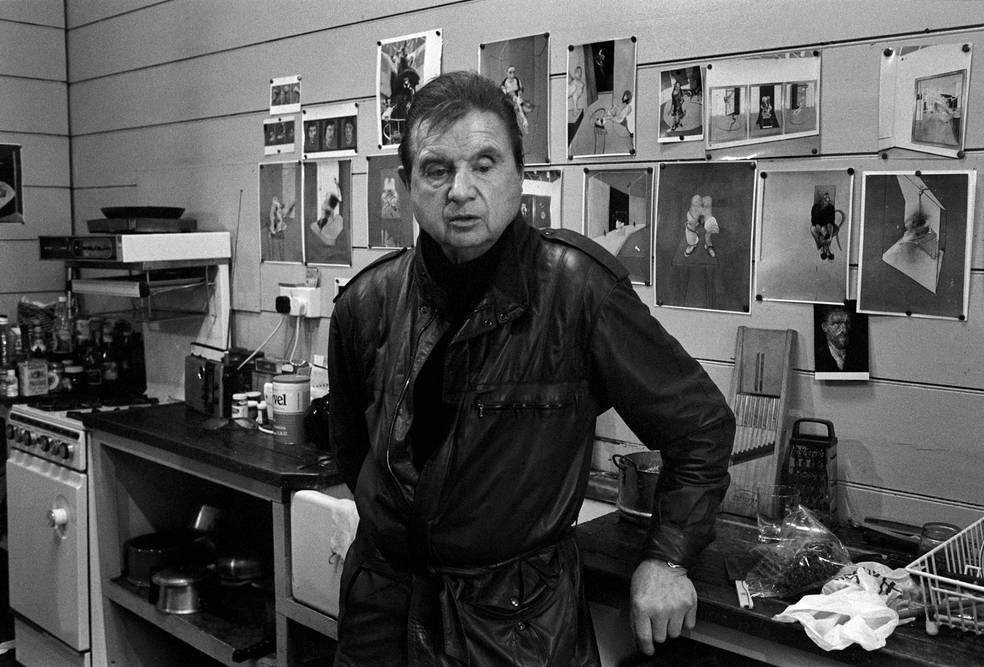
BRIAN SEWELL reviews FRANCIS BACON
A painter
BRIAN SEWELL | THE LONDON STANDARD | FRIDAY, MAY 24, 1985
He is indeed a painter’s painter and no man who has ever held a brush in his hand can fail to respond with the thrill of awe and envy to the bravura piling up of paint at one extreme and the miniaturist delicacy of detail at the others.
His subjects are not pretty and the great gallery scale of his work, often in inseparable groups of three, makes no concessions to the private patron.
He is the Titian of today, turning to Popes, Presidents and the tormented nude to express the human predicaments of a society riven by religious and temporal power, unreasoning authority, corruption and prejudice.
For the great amatory episodes of classical mythology with a moral sting he substitutes pairs of figures in attitudes of mindless erotic violence; many derive from photographs of boxers, wrestlers and footballers brought close to pornography and then elevated into a savage allegory that makes the bowels shudder.
He seems to sense no beauty, grace or heroism in man, seeing him only as a creature with animal references in the way he walks and squats, butchering him to loins and tripes and bloody rib-cages in the private abattoir of his imagination.
Where Titian put saints through the torments of martyrdom with the sure knowledge of redemption, Bacon kills off his friends with the hypodermic syringe and vomit in the lavatory, graceless and obscene.
Even his portraits are tormented, lonely figures trapped in a patch of light or a barred framework, fidgeting and threatened, more interrogated prisoners than friends observed with compassion and affection.
Bacon is the master of the moving multiple image, acknowledging the analytical methods of Cubism and Picasso’s distortions, as well as photography, but reaching far beyond their limits.
Into simple bold statements of pose or action he introduces subsidiary indications of movement that provide a limited narrative. He develops variations on the trick of the mirrored portrait within the portrait, even suggesting the passage of time with the stubs of a dozen cigarettes.
And in his small portrait heads, painted with the same scale and breadth of brush-work as in the larger pictures, he has consistently laid image over image, seeming at first to destroy the form and blur the features, yet in his super-imposition he provides a sequence of recollections of the sitter, each of mood and attitude simultaneously recognisable.
As
with Titian at a great age there is no falling away of power in his most recent
work
I am not convinced that cricket pads and a naked crutch make a telling universal truth but the dissolving body on the doorsteps has his old nightmare strengths and his Oedipus with a bloody bullet-wounded foot angrily confronting the smooth-faced Sphinx, with a bat-winged liver fluttering in the night, is a disturbing and violent enigma.
In the presence of these ferocious images, brilliantly, claustrophobically displayed, you must sense an astonishing mastery.
Bacon is that rare thing, a painter to join the pantheon of Michelangelo and
Raphael and Titian, a towering giant of his century, a living painter whose work
would add lustre to the National Gallery
Francis BACON, The Tate Gallery, until August 13. Monday-Saturday 10.0-5.50. Sunday 2.0-5.50. Admission £2.
Some of Francis Bacon’s finest work is of fellow painter Lucian Freud
One of his most important paintings, however, and one which Bacon desperately wished to include in the exhibition, will not be seen.
It is his “Two Figures”, painted in 4953 and owned by Lucian Freud. According to Robert Hughes, the art critic, Freud refuses to release it.
TERRENCE MULLAY | ART
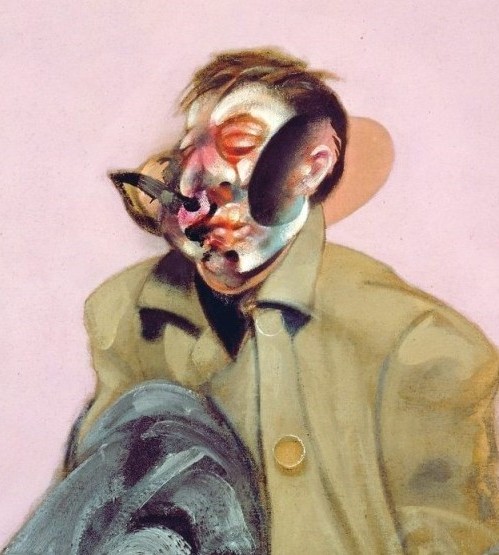
ART MICHAEL SHEPHERD
Eye of feeling
MICHAEL SHEPHERD | ART | THE SUNDAY TELEGRAPH
CRITICS may criticise; appraisers appraise; and analysts analyse; but when it comes down to it, the value of art for each of us is in what it actually does for us.
I find it fascinating, emerging from a great retrospective exhibition on to familiar Millbank or Piccadilly or the South Bank, to see, in what lies in front of me, whether the artist has imposed his own vision on me — or better, activated it to see the previously unseeable. So I came out, visually stunned, from the retrospective of 126 works by Francis Bacon at the Tate Gallery (until August 18) wondering what would come of it.
The answer wasn’t long in coming. Ten minutes later, in a sandwich bar, I suddenly watched transfixed, as the chap at the next table, with nothing to do except wait for his order, went through a series of facial expressions, like a speeded-up silent film, every one of which vividly recalled Bacon’s painting: half-formed thoughts, emotions, desires, fears, hopes, instincts, moods: the idling mind scanning fluidly at random, its deepest inner life. Most striking, visually, were the moments when the eyes were following one inner image, but the thoughts, visibly, were sliding and running in another direction.
Bacon asserts that he has no “message for humanity,” nor has he any intention to shock with the distorted and horrific for its own sake, but rather to “unlock the valves of feeling and therefore return the onlooker to life more violently.” In the horrific 20th century — perhaps no more or less horrific than any other, but one where our vision and responses have been uniquely numbed with photographs and film of unceasing horror, and the flesh still warm — an artist has just the tradition, his acquired technical skills, and his powers of observation, to help him find a way to unlock our feelings and sharpen our response to life.
Can artists still provide that catharsis — the purging though pity and terror — which is the classical definition of tragedy, to restore afresh our humanity to us? This Tate retrospective provides a chance to test whether the generally acknowledged “world’s greatest living painter,” now in his sprightly 76th year, does this for us, individually.
Anyway, this exhibition — selected by Bacon himself in association with the Tate Gallery — should provide a corrective to those who suppose Bacon to be just a horror merchant, concerned only with humanity’s dark side and its animal degradation.
It was certainly difficult in earlier days, confronted at the Hanover Gallery with a whole room of screaming popes which represented that year’s obsessive image for Bacon, or four walls of blandly evil bureaucrats and business men, to assimilate his art with much sense of balance. And the panting in the Tate’s permanent collection which virtually began Bacon’s public career, the “Three Studies for Figures at the Base of a Crucifixion” of 1944 (painted the year before Dachau, Belsen and Auschwitz were opened up; exhibited the year after) is the more disturbing for being a more explicit, painterly, three-dimensionally formed treatment of images long familiar from Picasso in his more linear but less explicit treatment — in the mind, not made flesh.
Bacon made his name internationally in the Venice Biennale of 1954, and was given his first Tate retrospective in 1962. But for me, the first full revelation of the tenderness and beauty in Bacon came with the great retrospective at the Grand Palais in Paris in 1971.
There, huge resonant canvases fit for a palace were set off by the many of the triptych portraits of Bacon’s intimate friends. It could be seen — as it can abundantly at the Tate show — that Bacon’s art is built on the close observation of the inner life of humanity, in his friends; as well as the 20th century’s unique frozen Niagara of photographed and filmed material.
Then Bacon’s fascination with the “extreme situation” (in violence or isolation), his technical brilliance with paint, which fills in the gaps, so to speak, in Picasso’s graphic cubism, and above all, his dependence on chance whilst actually wielding the paintbrush, produces these masterly fluidly epigrammatic images; any one of which in this show would surely earn him a place in any public gallery of the 20th century even if he painted nothing else.

Francis Bacon at the Tate
Saving Bacon
WILLIAM FEAVER
looks back at Bacon,
celebrated at The Tate
WILLIAM FEAVER | ART | OBSERVER REVIEW

Bacon: genius who walks alone
MARINA VAIZEY | ART | THE SUNDAY TIMES | SUNDAY, MAY 26, 1985
THE largest exhibition yet held of the art of Francis Bacon, almost universally considered the greatest of living English painters, has just opened at the Tate Gallery. He and Henry Moore are the international stars of British art; Bacon, for example, has been the subject of special exhibitions at the Grand Palais, Paris, the Metropolitan, New York, the National Gallery, Berlin, and had a major retrospective of 20 years of his art at the Tate in 1962. Moore is the most widely distributed sculptor in the world.
Both, while rooted in tradition, are towering individuals, who have founded no group, and have no following — there is no School of Moore, no School of Bacon. They have legions of admirers, but no following. The same is true of Turner, an eccentric genius and Turner’s and Turner’s critical and curatorial popularity in the last two decades has risen as his paintings have reached enormous sums in the market place.
A major Moore — an elmwood reclining figure, part woman part landscape — and a major Bacon, Study for a portrait of van Gogh, are part of the introductory room to the current Hayward Annual. This year the Annual is a one-man choice of 22 artists, picked out by the dealer Nigel Greenwood as a deeply personal portrayal of contemporary British art.
The result is very English: here are individuals, not groups, and they are — except for that other strain of unforced whimsicality and ceremonial narrative that is also very English — focussed on colour, light and landscape.
The English it is always said, are clubbable — but they are, I think, rarely groupable. Neither Bacon nor Moore are members of the Royal Academy, nor are any of the exhibiting artists in the Hayward. Bacon is himself a famous drinking companion. But the art is strikingly individual; more, there is specifically a Northern quality.
For as Bacon’s overwhelmingly generous exhibition makes clear, he is a master of colour and light and atmosphere and ambiguity. Bacon’s subjects are always people, floating in coloured space, although often loosely anchored to chair, mattress and lavatory.
Bacon’s first absolutely major work, shocking and extreme, the Three Studies for Figures at the Base of a Crucifixion, 1944, shows snarling open-mouthed, full-toothed humanoid creatures, set in vast spaces of livid, acid orange. That the emotions are powerful there is no doubt. But just as with Moore’s reclining figure, we are uncertain as to whether we are looking at breast and leg, or valley and hill, so with Bacon we don’t know whether we are witnessing growls of rage, howls of pain, or silent screams of laughter.
Bacon’s paintings are usually — and unusually for many paintings nowadays — glazed. The glazing puts all the raw, undigested emotion at a little distance, echoing the distance Bacon must put himself at, and giving the spectator, too, just a little breathing space.
Bacon’s technique is very unusual among modern painter: he mixes oil paint and pastel, the pigment is often thin and powdery, making the sudden swooping eruptions of brushwork like clotted cream, or a rivulet of colour streaking across the canvas like an aeroplane’s vapour trail, all the more succulent.
Bacon’s creatures have surfaced in a curious way from the imagination, the act of painting them somehow — the viewer feels — acted out intuitively. Above all, Bacon know when to stop: visual interest is sustained throughout the large scale Bacon habitually uses, the figures are kept in an equilibrium between clarity and dissolution.
Although the subject matter is so ostensibly different, what comes to the mind’s eye are Turner’s late watercolours, sublime and minimal, suggesting, with just a few streaks of colour, landscapes of grandeur that somehow sum up human aspiration. Bacon is the underside of that grandeur — his is the art of inescapable dissolution, of mortal remains, his terrain the landscape of the human body. The only real landscape Bacon has ever used comes from a painting by Van Gogh.
In Bacon, there is a tension that is nerve-wracking for the spectator between the awesome beauty of the handling of his physical material — the work is beautifully painted, as though with tinted steam — and the distressing nature of the subject matter, a butcher’s shop of humankind. There is always a sense of movement because of the vertiginous angles at which bodies are arranged and heads held. Sometimes, indeed, Bacon has painted arrows on his images, directional signs as though these were maps of a territory of the emotions: this was for angst, over there for anxiety.
An introductory section in the corridor of the Tate leading to the Bacon exhibition is full of paintings couched in that lyrical romantic surrealism sometimes touched with acid that was characteristically English in the 1930s and 1940s. From Stanley Spencer to Edward Burra, this suggests a group ethos from which Bacon’s art grew. But however rooted, it is still Turner and at times Moore who seem the appropriate context.
With Turner there is the same overwhelming fascination with colour, the irresistible urge to experiment with materials, the absorption with textures and surfaces. All three are preoccupied by the contrast between definition and resolution. As Turner used Swiss mountain passes and lakes, the raging sea, so Bacon uses the life-marked faces of his friends.
At the Hayward Annual, landscape is inescapable. The vast, grainy black and white paintings by Anthony Zych, made of varnish and gravels, are a look into endless horizon. The tiny photographs of Thomas Joshua Cooper, contrasts of dark and light, show nature disporting in varied fancy dress, wearing carpets of leaves, jewellery of twig and rock. Fred Williams’ scenes of Australian mining land, Bridget Riley’s light-filled paintings of glittering stripes, all tell us of landscape.
That is the British love affair: clouds of colour, evanescent changes in atmosphere. It is moving to see in this company how very individual Francis Bacon is, a genius unlike any other; and yet, how very English.
Art/William Packer
The haunting vision of Francis Bacon
WILLIAM PACKER | THE ARTS | FINANCIAL TIMES


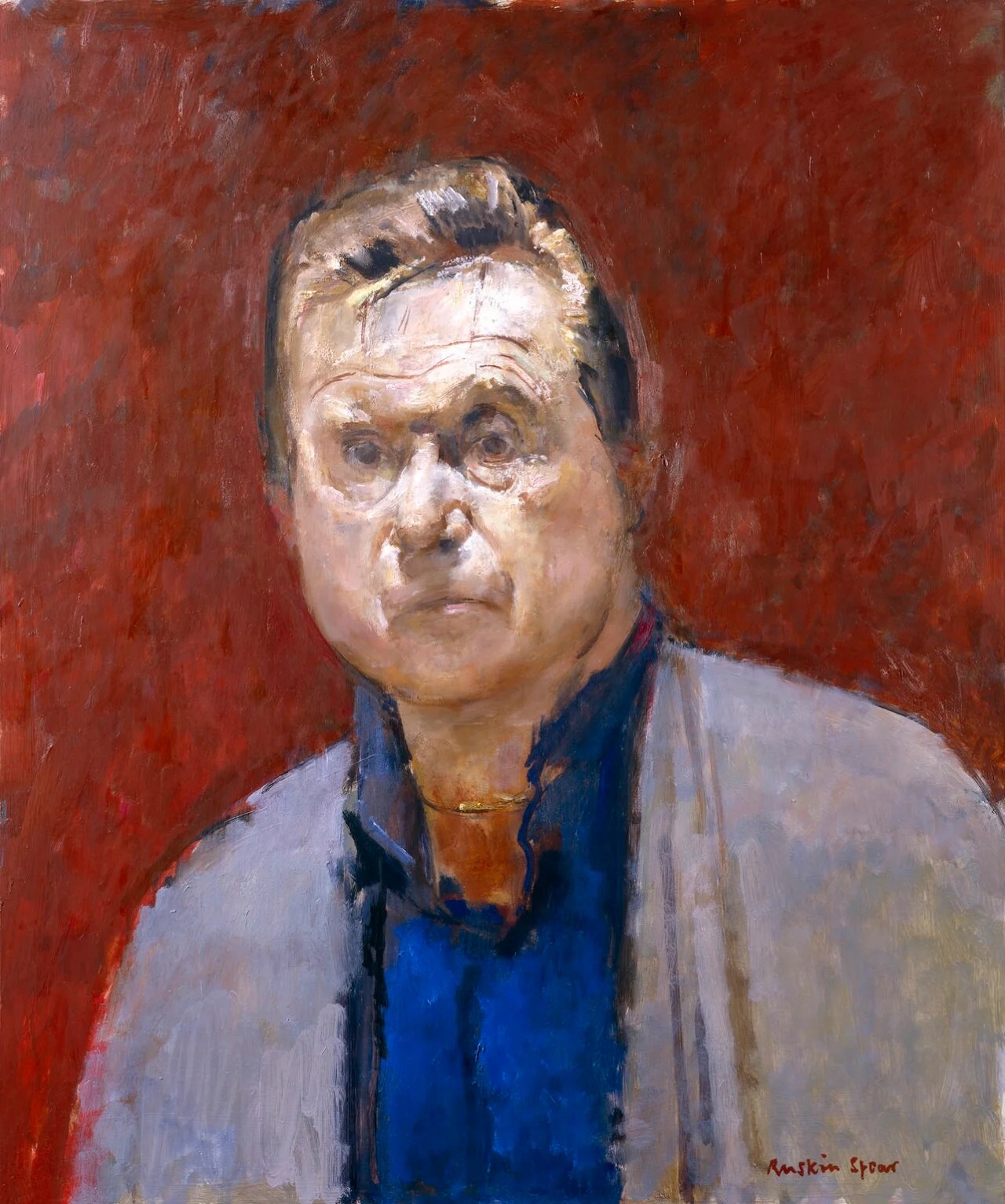
ALISTAIR HICKS
Francis Bacon
GILES AUTY
At last the opportunity has come to assess a lifetime’s work by one thought by many to be the world’s foremost living painter. However, amid the Niagaras of praise tumbling from other pens, I find myself an isolated advocate of caution.
To explain my reservations I should quote first the well-known tale of the disillusioned art lecturer who said, ‘By now, all art students know that Rembrandt was a very great artist. The problem is that none of them know why.’
So, too, with Bacon.
Within the pages of this paper, two weeks ago, Daniel Farson wrote ‘With Chagall’s death, and Dali just alive but no longer painting, Bacon is the most important artist who is working today.’ I doubt whether Bacon would necessarily be flattered by the company chosen for him, but in the Sunday Times Magazine Lord Gowrie makes a rather more attractive comparison: ‘Francis Bacon is the greatest painter in the world and the best this country has produced since Turner.’ Alan Bowness, director of the Tate, makes an equally ambitious and rather more controversial claim: ‘His own work sets the standard for our time, for he is surely the greatest living painter; no artist in our century has presented the human predicament with such insight and feeling.’ With the wind of such words gusting in our ears, it is hard to keep hold of our critical hats.
Unlike many writers, including my co- correspondent on this journal, I have not spoken to the artist for many years. The last time we exchanged words, as I recall, was in a British Rail dining car, wherein the ferocious appearance and expressions of the artist’s travelling companion rendered the railway fare even more indigestible than usual to the more typical run of passenger. Before this our paths had crossed briefly in Cornwall where the artist was once kind enough to share a bottle of the excellent whisky sent him by his gallery for Christmas. An afternoon of interesting and perceptive conversation — on the artist’s part, at least — about Bonnard, among others, was abbreviated by the return of an earlier companion of the artist, to whom art discussion was clearly anathema. I claim no insight whatsoever from these brief talks, other than to suggest that much of the artist’s work is far more personal than earlier schools of criticism have claimed. Unlike Dr Bowness, I do not feel that the artist presents the human, so much as his own, predicament in his work. His view of the world and its flesh, however powerful, is deeply idiosyncratic. As I wrote many years ago, attempts by others to discover universal truth in the artist’s highly personal vision, probably irritate him even more than they do me.
In the past decade, there has been a major shift in the critical tack. Wisely many critics have dropped the ‘universal predicament’ story. Manifestly the artist’s intensely urban and claustrophobic vision is not, for example, about a young farmer’s struggle to make a living for his family in the Scottish or Cymric hills. Of course, the farmer — and his family — will no doubt die and decay in God’s good time, but not necessarily from wounds which are self-inflicted.
More recently we have been generally enjoined to concentrate on the painterly, rather than the vision-bearing aspect of the artist’s abilities. Here I am in much stronger agreement. The artist’s formal audacity and versatility have built up steadily from years of dedicated work. Bacon’s discoveries are made in the physical battleground of the studio, rather than in the arid contemplation of art magazines or work by contemporaries. Equally I share the depth of the artist’s respect for past art and lack of interest in purely abstract forms. Bacon is a powerful, original and unfashionable form-maker, whose use of colour can be darkly sensual. For most visitors to the Tate, however, colour will probably seem a secondary issue compared with the often grotesque ambiguities of the fleshly forms. Accident and physiological re-arrangement combine with stock Baconian devices circular areas of magnification and pointing arrows, for instance — to form unnerving distortions. Simply with paint, Bacon makes creatures with a worrying credibility, whose souls may be laid bare before us like secrets divulged under torture. Indeed torture — literally twisting — whether of paint or bodies is a pervading presence. Perhaps the psyches that we glimpse in his portraiture are those which only pain or fear would ordinarily uncover. But are these revelations ultimately ‘truer’ than those encouraged by love or compassion?
Earlier, I wrote of Bacon as an ‘unfashionable’ artist, whose great strength lies in discovering his own formal means of personal expression. Yet, in another sense, the artist has always been unwittingly fashionable, the violence and nihilism in his work providing a frisson for those whose first reaction to risk in life would be to run for their insurance brokers. At a lower level, admittedly, films of violence and horror are notably popular with la jeunesse doree. The automatic equation of despair with artistic force is a fallacy so obvious that it needs pointing out only to art bureaucrats. This is not the fault of this or any other artist, of course, but is a tendency that should be noted.
In her explanatory essay in the exhibition catalogue, Dawn Ades writes, ‘Bacon’s figures . . . are painted not as self-controlled, social creatures, but as beings driven by those urges or instincts Bacon describes as the irresistible counter-point to the despair of contemplating death.’ And later, ‘The meaninglessness that Bacon takes for granted is that of life lived without belief in an after-life, or any moral absolutes.’
The superbly mounted and organised Tate Gallery retrospective, containing many works never previously seen there, show Francis Bacon to be an immensely powerful and inventive artist. Within the gallery walls, time is indeed suspended in an atmosphere at once hypnotic and claustrophobic. On leaving the exhibition I called in briefly to look at the Turners. Outside, cloud to the South of London was breaking up. Mercifully, the sun, when it finally appeared, did not dangle naked from the sky by a length of flex.

DANIEL FARSON

A preview of Francis Bacon’s retrospective at the Tate Gallery this week
JANE WITHERS & ANTHONY FAWCETT
There was a heavy pause on the line. “You know how difficult it is to say anything about painting — you feel the images themselves. Well somehow that’s all there is to say.” Nevertheless Francis Bacon agreed to meet us on site that afternoon, at the installation of his retrospective at the Tate Gallery, which opens on Wednesday.
It is 23 years since Bacon had a substantial show in this country — the last was also at the Tate. The idea this time is to build an exhibition around the triptychs — a format where three panels hang together as one picture — that Bacon has used since the beginning for many significant works.
Of the 120 or more works gathered for the show, most are from the last 20 years. It is an ultimate test — the recent paintings will be put up against the best of the early work. The arrangement of the exhibition, rising to a crescendo in the last of the 13 rooms, leaves no doubt as to the confidence of the curator.
The exhibition opens with a sharp kick in the face — confronting the entrance will hang ‘Three Studies for Figures at the Base of a Crucifixion’, 1944. The figures are the Eumenides — nightmare ghouls, more beast than human, twisting and craning their stumped, tubular necks, confronting their voracious jaws into savage grimaces. Painted when Bacon was 35, this is the earliest work he acknowledges. Others from this period have been all but exorcised from memory.
Accustomed to paint with the first light in his South Kensington studio — a few rooms where he lives and works secreted up a dusty staircase in one of those industrial mews enclaves that divide the smart stucco squares — Bacon’s highly disciplined lifestyle has changed little of the years. He still frequents the Soho bars where he has drank champagne for over 40 years — only the vintage, and credit, have got better.
When he first joined the Marlborough Gallery in 1958 they were alarmed at his profligate gambling. Now it scarcely matters. At Sotheby’s in New York this month, a landscape (‘Landscape near Malabata, Tangier’ 1963, hung in the exhibition) sold to a private collector for $475,000, breaking Bacon’s previous auction record.
Bacon, punctual to the dot, strolls into the gallery as if it were a restaurant, ignoring his pictures propped uncomfortably against the walls. He is dressed with a dapper, studied carelessness — a double-breasted grey suite, button-down collar, a raincoat folded over one arm. His ageless bearing is dwarfed by that remarkable head; it resembles nothing so much as an owl’s — feathers puffed out chuffily, eyes hooded and with an uncanny ability to pursue and trap with their roving gaze.
“Well, these are really the first paintings. I had done very few things before. Very bad I think. I destroyed all I could get hold of,” he pronounced with a finality that forbade further probing.
Gesturing to the blank wall where the first triptych will hang, he said: “I showed this first at the LeFevre gallery in ’46. Then everybody absolutely loathed those, really hated them. I think they hate them now. I did think I was going to do a whole crucifixion — these were going to be the images around the base, but I never did the rest of it.”
This was not the first time he had merged the crucifixion with the Greek tragedies. “They are much more interesting than the crucifixion. I haven’t got religious beliefs, never at any time. But I used the crucifixion as am armature on which to hang all kinds of emotions. I haven’t used it for years and years. I don’t use it at all now, I couldn’t.”
We are steered briskly through a dimly lit room haunted by the popes drenched in black and purple, screaming and staring from the floor. “With Rembrandt, Velázquez is one of the very very greatest painters and I was always very attracted by the paintings he did of the Pope. In a way I rather regret the things I did of it because it’s such a remarkable thing, really one should have just left it alone.”
Emerging from the papal drama is like coming up for air — only to be slapped down by the blooded charnel house of ‘Three Studies for a Crucifixion 1962’ — a triptych finished just in time for the last Tate show and containing many elements taken up in the triptychs of the later 1960s. Undaunted Bacon smiles: “I love the right hand one most”, pointing to the hanging carcass, its humanoid head twisting up to bite its own body. It is one of the few images for which Bacon has given a direct historical reference — to Cimabue’s Crucifixion.
He explained the connection in his work between carcass and crucifixion. “If you go into one of those big butcher’s shops, especially Harrods — it is not to do with mortality like lots of people think, but it’s to do with the colour of the meat. The colour of meat is so powerful, so beautiful really.” An image springs irrepressibly to mind of Bacon lurking in the Food Halls, staring out from avenues of meat hooks, and with it a photograph taken by his great friend John Deakin, of Bacon, his head flanked by sides of meat like one of his own popes. “Yes, that was rather amusing. It was published in Vogue, you know.”
Does he think of his paintings as violent? In a pause a cascade of noise — the squeak of trolleys on parquet, the dull thud of pictures landing on foam pads — assume a surreal backdrop. “No, it’s not that so much. People ask me why my pictures have this feeling of rawness and mortality. If you think of a nude, if you think of anything going on around you, think how raw it all is. How can you make anything more raw than that?”
As if on cue we turn to face the hunched figure of Van Gogh, black and shadowy, as if he had been evaporated by the searing sun ravaging the landscape with energised sweeps of red and yellow.
“I think he’s such an astonishing painter. These came about when I was having a show at the Hanover Gallery — it was one of those times when I had a completely blank period, I couldn’t think what to do. I decided on a series of these ones of ‘Van Gogh on the Road to Tarascon’. The original painting had disappeared, it was bombed in the last war. I always particularly liked that Van Gogh. So I did these paintings about it, very quickly in about three weeks. I often regret them really.”
Bacon once lived in Monte Carlo, where the night-life and gambling made it difficult for him to work. “But it was one of those fortunate things. I paint on the reverse side of the canvas. It started in Monte Carlo when I had run out of canvas and I hadn’t got the money to buy more, I’d lost it all at the casino. So I changed a canvas to the opposite side to work on the back and I found it worked much, much better on the unprimed side of the canvas, the pastel holds very well to that rough texture.”
In the presence of his early work Bacon shifts edgily as if trapped in a foreign country. Quickening the pace he leads us on to the mid 1960s — where he has left behind the props of the past, the popes and Van Goghs, confident enough in his own mastery to tackle the human condition in more everyday guises. It is the world starting from about this time that Bacon himself proffers. “I know a lot of people don’t think it but I just feel things get a bit better with age. Perhaps not but I feel they’re better the latter ones.”
The tour becomes a sort of hide and seek as Bacon stalks ahead. “This one warns you never go into a sleeping car.” He smiles drily at the carnage in the central panel. “Those two have been in Chicago but one of the people in the committee didn’t like the idea of the penis showing. That was that.”
We halt before ‘Triptych May-June 1973’. Three views — like stills from a movie look though an open door into a suffocating dark room. On the left the figure is rumpled on the lavatory, on the right the graceless nude heaves over the basin, in the centre his face is a lurid, fleshy red in the harsh glare of the bare bulb, the soot black spills out of the room into the corridor in a bat-shaped shadow, horned and satanic.
The tenderness evident in this painting of George Dyer is banished from the factual tone of his voice. “This picture — it is of somebody — a great friend of mine. When I had a show in Paris in ’71 he committed suicide. He was found on the lavatory like that and he was sick into the basin. And I suppose in so far as my pictures are ever any kind of illustration this comes close as any to a kind of narrative.”
Bacon has been said to work without ever thinking of an audience. “I really work to try and excite myself. I never expected my work to sell at all. I do sell bits but not with any ease. I always thought I’d have to take some other kind of job but I think I’m very lucky that I can live by something that obsesses me to try and do. That is lucky, isn’t it?”
Arranged along one wall are four figureless landscapes — a rare subject for Bacon. In one, water splashes out across a surreal, industrial-looking landscape. “When I did this I just mixed the colours in a pale of water and threw it on like that. I had meant it to be a wave breaking but it didn’t turn into that. I had to turn it into a jet of water..” Some of the marks “just came” — but others were done with “some pushing and scraping.”
Next to it is ‘Sand Dune’. A hot, dusty cloud obscures a similar landscape. “This was sprayed on and a lot of it was painted with dust from the floor — that lasts forever. After all where I live it’s absolutely surrounded with dust. Wherever I live becomes appalling disorder at once. For some reason I find I can work much easier with chaos around me.”
In recent years Bacon has done a remarkable number of self-portraits. As he confronts a triptych of heads, little over life size and arranged in a row like mug-shots, the likeness is startling; loaded swoops of white carve the line of the nose, merging contour with face. Examining our reactions, Bacon remarks, “Shaving in the mirror everyday, looking at oneself, doing one’s hair or anything — you have a very good idea. I only do self-portraits when I have no one else to do. I hate doing self-portraits. Probably they don’t look anything like me but there it is.”
He diverts our attention to his friends, the small cast of characters whose faces he knows almost as well as his own. He has painted them repeatedly since he first started naming portraits as such in the early 1950s. He glances down at Isabel Rawsthorne: “In a deformed way it’s quite like her. She was a great friend of Giacometti’s. A lot of the very early things Giacometti did are about her. Somebody with fantastic vitality.”
What had the effect of the camera been on portraiture? “The only real thing now is to make not just an illustration of the person, but an image of them.” The powerful profile of Muriel Belcher, the Queen of the Colony Room who ruled Soho with her serrated wit, twists in the paint. Mention of her names prompts Bacon: “These ghastly English laws, you can’t have a drink, can’t do anything. Do you think they’ll ever change them? I don’t think so — the church will stop them, you can be certain. I can take you up to that awful Colony Room, if you like?”
We hailed a cab to Dean Street and Bacon led the way up the dark green stairs. In the smoky mirrored room hung with mementoes of the artists who frequent it, the buzz was all about his opening. The whole club, it seemed, had been invited to dine at the Tate.
Francis Bacon at the Tate Gallery, May 22-Aug 18.
Behind the brutality of Bacon
Waldemar Januszczak takes a fresh look at the powerful and savage paintings
that have won Bacon the rare honour of a second Tate retrospective
WALDEMAR JANUSZCZAK

ARTIST
DAVID SYLVESTER | ARCHITECTURAL DIGEST | JUNE, 1985
Since 1961 Bacon has mainly worked in a small studio in a mews flat in London, reached by a staircase, the steepness of which threatens a broken arm or leg or neck. It had two other rooms, one of them combining bedroom and sitting room, the other combining kitchen and bathroom. The neighbourhood is South Kensington where he has had several other studios, all of them larger and grander than this one. Among them was the studio he had in the late forties and early fifties, when he was reaching his stride as an artist — he was a late developer. "It was an enormous billiard room like the Edwardians used to have in the back at the back of their houses, but it was a wonderful studio," he recalls. Among the several studios he had during the following years was one nearby that he borrowed from a friend. "It was a beautiful studio with a beautiful skylight. But it had trees above it, and they waved in the wind so that the light moved and you thought you were underwater. So it was like attempting to paint a picture underwater."
He had similar troubles more recently when he tried to paint in a house he bought that was adjacent to real water. It was a marvelous old house in the East End, overlooking the river. "As the Thames is tidal, when the tide was in and the sun was out there was a continual glitter inside the place that made it extremely difficult to work in."
But the mews studio, stark as it is and small as it is, has suited him for more than twenty years now. "For some reason, the moment I saw this place I knew that I could work here. It was rather like the place I have in Paris, which is only one big room, but I knew from the moment I went into it that it was a place I could work in. But the fact is, I haven’t worked in it as much as I expected to. I found that because I know London better than Paris, I’m able to work more easily here."
In the 1950s Bacon lived in Tangier for a time. "I painted a certain amount there, but not at all successfully, he says. "I think perhaps the light was too strong. I have tried to work in a lot of places. At one time I lived in Monte Carlo and I tried to work there, but again, I am not used to light as strong as that, and in a sense it interfered with me."
Despite the effect light has on his ability to work, it was not the light that first attracted to him to his present studio. In fact, once he had it, he altered the light by having the ceiling taken off and a small skylight put in.
"Even now this light is not especially good, because it’s east
and west. But the room had an atmosphere that made me know I could work here. I
just hope I shall be able to keep the place; it’s all supposed to be coming down
to be developed. But I hope it will last me out. I feel at home here in this
chaos because chaos suggests images to me. And in any case, I love living in
chaos. I like things to be clean

Richard Cork on Francis Bacon
Fleshy school
RICHARD CORK
The rest of Francis Bacon’s paintings, now assembled for an overwhelming Tate retrospective (until 18 August), explain why this agitated figure is so anxious to get the door open. For everybody in Bacon’s relentless world is enclosed by a claustrophobic structure from which there seems to be no escape. The surroundings his people endure may not be as overtly prison-like as the cages hemming in the baboon and chimpanzee, who, in two glowering canvases of the 1950s, roar with helpless rage at the confinement they suffer. But there is still something lacerating about the rooms inhabited by Bacon’s human protagonists. In his early canvases the interiors are murky, illuminated only by a blurred face or a pale body passing indistinctly through curtains. Sometimes a sinister safety-pin shines with unexpected precision in the gloom. On the whole, though, Bacon does not specify the cause of the disquiet he creates with such macabre conviction. Shuttered like bedrooms where the inmates are too distressed to expose themselves to the light beyond, these penumbral spaces are permeated with unseen menace.
The men whose blanched and smeared features can be discerned here are dressed as correctly as business executives. But their formality can easily be undermined. In one tripartite work, which resembles three stills from a strip of film, the grinning face on the left is transformed into a yelling grotesque and then disintegrates completely, as if incapable of withstanding his hellish environment any longer. Even the Pope, who should be better able than most to defend himself against the terrors of the void, suffers from their onslaught. Short of all the spiritual sustenance and power his position should provide, he clings to his throne and screams like a condemned murderer shuddering from lethal voltage in the electric chair.
Occasionally, Bacon’s paintings do appear to break out of these unnerving regions and enter more spacious locations, supposedly in the open air. But they turn out to be just as disconcerting as the oppressive rooms. One figure seems so intimidated by the parched grassland stretching around him that he squats in the middle of it, unable to move. In another canvas a dog freezes on a pavement, staring down at the gutter and refusing to follow the legs of his owner walking past. Perhaps the animal realises that there is no point in exploring a street bounded by the same blackness which restricts the people in Bacon’s interiors. The copulating lovers in a canvas called Two Figures in the Grass seem unaware that the edges of their field are hung with curtains. If they pause and look around them, however, the intolerable sense of restriction will once more press in on them. Bacon’s so-called landscapes all turn out in the end to be variations on the theme established by the prison-like indoor settings, and even when he takes his cue from Van Gogh’s The Painter on the Road to Tarascon the confinement does not really ease. For the artist’s bowed silhouette looks burdened by the knowledge that he is restricted to the narrow route ahead.
Soon afterwards, most of these deceptive references to an ‘outside’ world drop away. By 1960 the clinical room has become the prime stage-set for Bacon’s theatrical tableaux, and he makes it more oppressive still by ousting the former darkness. The bare light-bulb dangling from the ceiling in so many of these interiors possesses a merciless glare. It makes their surfaces blaze with strident oranges, crimsons and cyclamen pinks which ensure that everything is exposed with terrible clarity. In the formidable Crucifixion triptych of 1962, surely the most harrowing set of images Bacon has ever produced, two figures stand transfixed. One of them extends his arms towards the wall, as if anxious to leave. But his legs seem glued together in a single bulbous mass, and his companion’s head appears to have been wrenched away from the shadowy profile suspended in space behind him. Both men are unable to prevent themselves looking back towards the source of their unease: the crucified feet thrusting down to the base of the cross, skin stripped away so that exposed bones, and organs glisten bloodily in the light.
Far from discovering in the Crucifixion a symbol of salvation, Bacon sees it as the ultimate degradation. The corpse sliding head-first down the right panel of this triptych is little more than a carcass, its white spine and rib-cage picked out with surgical precision from the surrounding skeins of red meat. Bacon is more obsessed by mortality than any other modern artist, and a haunted apprehension of the human body’s frailty underlies all his work. So does an acute awareness of isolation. In most of his paintings single figures are presented, confronting their loneliness. On the rare occasions when another person appears, Untitled triptych: ‘no escape’ there is little contact between occupant and newcomer. The one observes the other from the sidelines, like a voyeur concerned above all to keep his identity hidden. And the presence of cameras, perched on tripods resembling the legs of some monstrous predator, only adds to the suspicion that surveillance is the first priority.
Nor do the naked couples who sometimes appear in the centre of Bacon’s triptych offer much consolation. One painting shows them lying side by side in identical poses, without acknowledging each other’s existence. And when they are seen making love, their urge to overcome loneliness gives them a furious quality. The figures close on one another with extraordinary forcefulness, as if attempting to ameliorate their solitude by merging flesh with flesh in a single pulsating organism. The sense of union is only momentary, too. Most of the time Bacon reasserts stern solitude, and when he assembles three figures in a triptych they are separated by the gaps between each canvas. Ensnared in an alien environment, where they are obliged to endure isolation without any respite, these beleaguered people could be excused for giving way to despair.
But the paradox is that Bacon’s vision never seems limp and defeatist. A marvellously defiant belief in the essential exuberance of human life characterises all his work. The flatness and severity of his floors, walls and ceilings, which show how intelligently he has learned from abstract painting at its most refined, provide an ideal foil for the twisting, wriggling energy of the robust bodies they contain. Bacon’s superbly resourceful manipulation of his materials gives these figures an astonishing eloquence, as he pummels, caresses, obliterates and coaxes the paint into forms which transcend arbitrary distortion.
This wonderful finesse, coupled with an instinctive monumentality which gives his work its grandeur, counteract the depressing aspects of Bacon’s world. Indeed, his exhilaration seems all the more persuasive precisely because it is pitched against such absolute pessimism about the bleakness, confinement and vulnerability of the human condition. Bacon’s assertion of an ecstatic vitality could not be more hard-won. No one can doubt the extremity of the violence and suffering from which his bruised figures emerge with undaunted élan. That is why the leg striving to put a key in the lock is such a magnificent image, insisting against all the odds that the door might one day be opened and offer a way out of the cruel and desolate cell.
Projections of intransigence
Robert Melville
Francis Bacon
Tate Gallery, until August 18
ROBERT MELVILLE
The thunder and lightning in the first hour of the Press View of Francis Bacon’s Retrospective at the Tate Gallery was possibly nature’s acknowledgement of a painter who for forty years has been presenting natural man’s involuntary voluntary contortions and excesses in a series of masterpieces of unceremonious grandeur. The exhibition justifies the claim made by Alan Bowness in his foreword to the catalogue (Francis Bacon by Dawn Ades and Andrew Forge. 286pp. Thames and Hudson. £30 paperback, £12. 0 500 09167 6) not only that Bacon is the greatest painter alive, but that the paintings are “among the most memorable images ages in the entire history of art”. It is a huge exhibition and of the many pictures I have seen before, and was hoping to see again, only four of those that I particularly admire are not there: “Painting 46”; “Portrait of Lucian Freud” (1951); “Two Figures” (1953); “Study for Three Heads” (1962).
Bacon began to paint in early middle age and worked for several years without exhibiting His public career as a painter began with his famous panels “Three Studies for Figures at the Base of a Crucifixion” In conversation he refers to the figures as Eumenides, a euphemism ism for the Furies, and they are so screwed up with anger, so hysterically fierce, that they are clearly waiting to tear to pieces whoever is brought down from the cross. There is one humanoidal monster in each of them on the left the very long neck cranes forward and pushes the head down — the band that keeps a strip of cloth up to its breast is coming loose: in the centre, a body like the backside of a chicken stands on long thin legs, the face, edged by a white rag, is all mouth, “an oval O cropped out with teeth”, obviously hissing; on the right a naked figure coming in from the side has only one arm and bends low in order to lean it on a patch of grass (Grass is one of Bacon’s obsessions and patches of it appear throughout the exhibition.) The figure has an extremely long neck which terminates in a huge mouth stretched to its widest limits to emit what must be unearthly screams.
It took Bacon a long time to complete the panels but it was finally possible to date them 1944 and start his career with a triptych. As projections of his own intransigence they have never become closed to him and from time to time one sees a reference to one or other of the figures. He did not paint another triptych until eighteen years later but that was the start of the large-scale ones which have made an immensely important contribution to his work and have not yet come to an end. They all have the “terrible beauty” of which Bowness speaks. The first of them, painted in 1964 takes up the crucifixion theme again. This time the concern is with the victim and not with the troublemakers, but like the 1944 triptych the painting is a superb visual account of what André Breton meant when he said that beauty would have to be convulsive or cease to be. Overwhelmingly frenetic, it is equalled only by Picasso in “Guernica”.
Bacon doesn’t tell stories and there is not one here, but there is a lot going on In the left hand panel two sides of beef are leaning towards wards one another as if attendants talking in whispers. Behind them two men move towards the centre panel, but they don’t look as if they can hear the screams that must be coming from it. The right hand panel contains a figure that looks as if it is slowly being lowered headfirst from a cross that isn’t there Macabre though it is (the exposed ribs and backbone suggest that the creature has already paid a visit to the slaughterhouse, but must still be alive because screaming the image conveys a strong impression ion of a Crucifixion, and a long time ago Bacon said that it was based on a Crucifixion by Cimabue, which gave him the feeling that the Christ was “undulating down”. The reds whites and blue-blocks of the figure are lovely and it wears the interior paraphernalia of its belly like regalia. The figure in the centre panel is in a fearful state and blood comes out of him everywhere but he is not as tortured as the crucified one. One pillow is soaked in blood, the others are spattered, along with the mattress tress and window blinds. The flesh is a magenta and pink mush, the very substance of pain.
Three years later, in 1965, Bacon painted another Crucifixion triptych, using two of the figures again, in a different arrangement. The crucified is brought into the centre panel, he is still upside down but he is silent and his eyes are closed His arms are bandaged but two knobs of bone are exposed. The bloody one lies in the left hand panel, screaming at a girl who is tripping out of the scene, and in the right hand panel there is a standing figure with hair slicked back, wearing a swastika armband. These two crucifixions are major examples of the painter’s period of extreme situations, in which torment and dread are explicit.
Since then his figures do not scream or shout or bare their teeth, and although inexplicable things can happen, the activities are as a rule what one does every day. Man shaving, riding a bicycle, writing, reading, sitting on the lavatory, putting keys into locks, visible signs of hangovers and sleepless nights, turning on the light, staring at a sashcord, vomiting into a washbowl. They are transformed into startling happenings by paint that seems to seethe and sometimes emit flames as soon as Bacon stirs it.
A male couple embracing is a recurring activity in his painting, like putting keys into locks, and takes the central panel of a triptych again and again. But the two figures in “Two Figures on a Bed with Attendants”, 1968, forego go a shudder in the loins to turn on to their side with legs drawn up and lie close together. One is asleep, the other stares at nothing. An anarchic chic splash of white paint crosses the bed but stops before it reaches the side In the same year Bacon painted a curious double portrait of George Dyer. He is the subject of a painting on a large black canvas propped against a wall in the room in which he is also seated in a chair in a dark suit, with one leg crossing the other. A thick trickle of white paint runs down one leg of his trousers and on to the floor. He is a nervous or careless smoker; many cigarette ends are on the floor. The portrait on the canvas against the wall is a nude. The face emerges from a cluster of paintmarks with a look off grim stillness. At first it seems as though the figure is sitting Buddha-like on the floor; he is very low in the canvas, but actually he is sitting on a chair with one leg crossed over the other in much the same way as the figure in the room. The really odd thing is that the Dyer in the canvas is pierced in his limbs by long nails, which are carefully rendered in a trompe loeil technique with cast shadows.
There is a small group of paintings, usually triptychs, which are not about what we usually think of as extreme situations but the figures in them are in a bad way and their condition appears to have been brought about by excess of some kind. In the case of the triptych of May-June 1973 it was probably alcohol In one panel a male figure is bent double on the lavatory, in the centre panel he looks very ill and in the third he is vomiting into the washbasin and there is blood in the vomit. Two stubby white arrows are in the foreground, pointing pointedly at lavatory and washbasin. In spite of the subject it’s a handsome picture. A large self-portrait operates as its sequel It’s the same washbasin , empty and clean, and Bacon, sitting in a chair, leans an arm on the edge of the basin and puts his hand to his forehead.
Two of the later triptychs — 1967 1976 — remain in close touch with the period of extreme situations. The earliest is “Triptych Inspired by T S Eliot’s Poem Sweeney Agonistes”, and there is a quite evident connection between painting and poem The key lines in Sweeney are Sweeney’s reply to Doris after she cuts the cards and draws the coffin: “Any man has to needs to wants to / Once in a lifetime do a girl in.” In the left-hand panel of the triptych, two women are lying down; they are not embracing, they could be dead. A chest of drawers is reflected in a mirror. An item of clothing hangs out of a drawer, others are on the floor. In the opposite panel, a male couple continues to embrace in the manner of Eadweard Muybridge’s wrestlers. A man reflected in a mirror is telephoning. It’s clear that a murder has taken place in the central panel but there is no body. An overnight bag has been opened and possibly searched. A bloodstained stained pillow sits on some outer garments. A window behind is half drawn; outside, the night is black. The chorus has the last say in “Sweeney” and one of its lines — “you’ve got the hoo-ha’s coming to you” — must mean that the Furies will be gathering for vengeance.
The other triptych that I have in mind was painted in 1976. It does not have a name, but the image in the middle of the central panel is based on the Fury in the left hand panel of “Three Studies for Figures at the Base of a Crucifixion”, but rather fearsomely transformed formed. The roundness of the shoulders remains mains but the long neck bending down is scraped almost to the bone and the head dips down between parted knees; this is where all resemblance ceases. A bird of prey pecks at the shoulders, and other, not quite identifiable creatures increase the atmosphere of disquiet. However, another reference to the Oresteia joins the image of the Fury. This is the bowl filled with wine in the foreground which is one of the libations for Agamemnon’s tomb ordered by his murderer Clytemnestra in the hope of warding off vengeance. A triptych painted in 1981 is entitled “Triptych Inspired by the Oresteia of Aeschylus” but it would have been more suitable for the untitled 1976 triptych.
The many small portraits — standard size 14 x 12 inches — are often brought together to make triptychs They are devoted almost exclusively to the head with a glimpse of shirtcollar collar on a man or in the instance of a woman more of her throat. A triptych sometimes presents portraits of three people, but more often depicts one model from three viewpoints Bacon brings about an agitation in the flesh of the portrait by a roughening of the texture or a dislocation of the features or both, and sometimes times by using an oval of flat colour to wipe out a cheek or an eye or by increasing its size to dispose of half the face. The model plays no part in this game either cooperatively or defensively. The portrait is never done from life but from photographs preferably snapshots and taken by other people not the artist. Often enough photographs have to be reinterpreted to yield a recognizable likeness. Miraculously, often an uncannily revealing likeness does come out from a welter of beautiful, disfiguring, spasmodic paintmarks. This is particularly true of Bacon’s friend Isobel Rawsthorne Henrietta Moraes has been more vulnerable. There is a lovely study of her head painted in 1969, which nevertheless has the same pinched mouth as the seated nude in the large (also 1969) “Study of Nude with Figure in a Mirror”. The nude is on display and the man in the mirror is a voyeur I think this is the only study of such a subject that Bacon has painted.
It is hard to tell if the recent studies from the human body (1982 and 1983) are a development of Bacon’s style or a deviation from it. The painting of human flesh is much smoother and more naturalistic than before — pink moist and fresh. There are no heads, but every body has legs and one has arms They look radiant and a bit foolish against their orange backgrounds grounds. One of the bodies is female and doesn’t wear anything. All the male bodies wear cricket pads, and the one with arms adopts the stance of a wicket-keeper. Eccentricity seems to be creeping in.

Billed as “the greatest living painter,” Francis Bacon’s power to jangle the nerves with some of the most
disquieting images of 20th-century art remains undiminished after more than five decades of painting.
MICHAEL WISE | PHILADELPHIA INQUIRER | SATURDAY, JUNE 8, 1985
His pictures of writhing, snapping beasts, neither human nor wholly animal, upset many people when first shown in London in 1945. They still disturb, as do scenes of slaughter, lone figures in desolate chambers and a set of portraits that have come to be known as “the screaming popes." All are back on view among more than 120 works by Bacon in a major retrospective that just opened at London’s Tate Gallery.
Bacon, 75, shuns attempts to explain his work and believes many people dwell too
much on what they see as horror in it.
“Talking about painting is like reading a
bad translation from a foreign language,
Bacon, descended from the 16th-century philosopher whose name he bears, has also
studied pictures from medical textbooks and of animals about to be killed. He
bridles against interpreting his apparent obsession with cruelty as a response
to war or genocide. Of an art critic who sees a likeness of Roosevelt at the
1945 Yalta conference in the figure in a 1946 picture containing bloody slabs of
meat, he said,
“That’s completely wrong.
He says his paintings, often done as triptychs, do not consciously mirror the
world but adds: "We live with this vast sea which we call the unconscious and
which we don’t know. . . . Everything which is going on probably sinks into it.
Every so often these images refloat.
Many of his later works are portraits of himself and his friends, the faces
violently distorted, frequently smeared. Like other modern artists, he says
portraiture has been forever altered by the invention of the camera.
Chance, he says, has a big part in a painting’s outcome. Bacon has loved gambling since childhood in Dublin, where his father, a former British army officer, retired to train racehorses.
He left home at the age of 16 and spent several years in Paris and Berlin. After working briefly as a furniture designer and interior decorator, he decided to become a painter without any formal art training.
Now a passionate roulette player, Bacon says painting successfully is very much
like winning at the gaming tables he frequents.
“It’s the moment of feeling that
chance is just smiling on you for one second.
These days Bacon does not need monetary gain at the wheel. Museums and
collectors avidly seek his paintings. One fetched half a million dollars at a
New York auction last month. But he still occupies a sparsely furnished London
mews house
He admires Michelangelo’s
Narrative art holds no interest for him, and he dissociates himself from
expressionism or surrealism. Asked to elaborate on one of the cricket pads or
pieces of flesh, he responds with a degree of annoyance:
“I just like the image
in itself.
Bacon
has no patience for critics who view it all as the product of personal torment.
“I enjoy life but I have absolutely no belief in anything,
Time Vindicates Francis Bacon’s Searing Vision
“Bacon is still reinventing himself in situations of maximum risk.” (John Russell)
By JOHN RUSSELL
London: The retrospective exhibition of paintings by Francis Bacon at the Tate Gallery in London is not an event about which I shall pretend to be objective. Among the many thousands of exhibitions that I have seen on business and for pleasure, none is more vivid to me than the first sight of Bacon’s "Three Studies for Figures at the Base of a Crucifixion" at the Lefevre Gallery in London in April 1945. They are in every book on Bacon. They are the predestined point of departure for every retrospective exhibition of his work. They have been described a thousand times. But, when seen at first hand, they still startle.
It should be said in this context that in April 1945 the war in Europe was about to end. No one knew what peace would be like, but there was a general reluctance in England to believe that there was in human nature an element that was irreducibly evil. After nearly six years at war, people preferred to think that everything was going to be all right, and that we could go to an exhibition of new art in a spirit of thanksgiving for dangers honourably surmounted (with some help from others).
Bacon’s Three Studies put forward a less comfortable point of view. They suggested that people would always go on doing dreadful things to one another, and that other people would always come by to gloat. That was not the whole meaning of the Three Studies, but it was one of their meanings, and it made a lot visitors hightail it out of the gallery. On any reading, these were terrifying images. The three figures in question had anatomies that were part human, part animal and part conundrum. They could probe, bite and suck, but their functioning in other respects was mysterious. Ears and mouths they had, but two at least of them were sightless. One was unpleasantly bandaged. Common to all three figures was a mindless voracity, an automatic unregulated gluttony and a ravening undifferentiated capacity for hatred. Each was as if cornered, and only waiting for a chance to drag the observer down and savage him.
As a view of humankind, this was thought to be as pessimistic as it was untimely. Was not violence about to be outlawed from the world? If people had been on the wrong side, was it not usually because they had had no choice? All that was needed to bring them back into the fold was a little reeducation in civics. As for those who had fought on the right side, no future could be too bright for them. (Anyone who saw Kate Nelligan in David Hare’s play, "Plenty," will have seen this latter point of view set out with an almost unbearable poignancy.)
Bacon in all this was the troublemaker, the specter at the vestigial feast, the doomsayer whom people wished away. But he didn’t go away, and the paintings had a weight and an authority that had nothing to do with the newsreels of the day, terrifying as those were beginning to be. Bacon in 1945 was not a beginner, but a man pushing 36 who had been about the world in an irregular, noctambular, totally unprejudiced way. As a boy in Ireland, where his grandmother was married at one time to the chief of police for County Kildare, he had known violence on the road, violence in the house, and violence in the ditch. He had lived in Weimar Berlin at the time when it was the only truly free city in Europe (and quite possibly the most dangerous). Nothing human was alien to him, and it came out in his paintings.
But in the late 1940’s and early 50’s he was thought of as someone who habitually supped full on horrors and came back for seconds. Only slowly did it get through that he had done no more than reassert the terrible rightness of the summation that Shakespeare gives to Thersites in "Troilus and Cressida". ’’Lechery, lechery; still wars and lechery: nothing else holds fashion,’’ is what Thersites says, and if we look round the world we shall see that this estimate has not gone out of style.
As had happened with the "Three Studies" — which were painted in 1944, by the way, and were in no way a commentary on the news that came in thick and fast as the Allied armies pressed ever deeper into Germany -there were paintings that with hindsight seemed to have a premonitory air. (The most famous of these was the image that prefigured the look of Eichmann on trial in Jerusalem.)
Yet eventually it emerged that Bacon’s concern was as much with love and affection, and with the annals of an idiosyncratic domesticity, as it was with public events. As a portraitist, whether in the grand style or in the intimacy of close-up, he was in the tradition formulated by Vincent van Gogh when he said that he wanted his paintings to be ’’inaccurate and anomalous in such a way that they become lies, if you like, but lies that are more truthful than literal truth.’’ Here again, time has vindicated Bacon. His portraits — a record, in most cases, of loves and friendships long preserved, though sometimes subject to intermittences — have turned out to be, as van Gogh wished, ’’more truthful than literal truth.’’ On the basis of long acquaintance with some of his more regular sitters, I can attest that, like Bacon’s portraits of himself, they grow more accurate year by year.
Partly for this reason, Bacon’s earlier retrospective in London (in 1962, at the Tate Gallery) left a memory of long walls hung with tall paintings of single figures that created an Old Masterly effect, as if they were van Dycks of the Genoese period that had undergone (but not been diminished by) an unaccountable mutation. This element in his work has come out more and more strongly in recent times, though once or twice an unwonted sweetness has crept in. (In the triple portrait of Mick Jagger in the present show the veteran troubadour gets, for instance, a soft and easy run.) As against that, the portrait heads of his close friend, the French anthropologist, autobiographer and authority on African art, Michel Leiris, have a power, a discernment and a concision that make most of the other portraits of our day look ridiculous.
Yet the locus of Bacon’s deepest and most reverberant activity may lie in images in which people carry on as if they do in life when they think that nobody is looking at them. With a formal portrait, no matter how searching, the presence of the artist is a given — built in, that is to say, and inescapable. No matter how total the candour — and Bacon in painting his friends (as in talking about them) is candour personified — we look at the sitter’s eyeballs and see, or think that we see, the image of the painter reflected. Bacon may well be most himself when the subject is left free to move around, dressed or undressed, in a purposeful but abstracted way.
At such times he can make the most strenuous activity — murder, not least — seem a matter of every day. He can also give an unnerving intensity to actions like shaving, switching off the light, riding a bicycle and (in one case) turning a key with one’s toes. Mating the mythical with the quotidian, singling out this detail or that from a commonplace interior, reinventing the human body as if no one had ever painted it before, he makes us aware of the volatility and the irrationality of many a notion that we are raised to think of as normal.
Reading the Tate Gallery catalogue, it may strike us that whereas in England and in France Bacon’s work has prompted some of the best art writing of the last 30 and more years, it has never had a comparable impact among Americans. This for instance is what Andrew Forge, the English painter now teaching at Yale, has to say about the treatment of the human body in Bacon’s George Dyer Crouching (1966). ’’The figure, scrunched up at the end of a diving board, is formless at first sight. Then one hits upon an eye, flat on the side of the head, precisely defined, unwinking, dryly glittering.’’
Once that eye is seen, ’’the weight and thickness of the thighs, the downward stretch of the arm, the massive crest of muscle upon the shoulders, the massive concentration of the lowered head, all seem to leap out of the paint, triggered by the hard saurian eye which, as with some fantastic knobbly lizards, seems to be embedded like a living jewel in material that follows another order of form.’’ Anyone who can provoke writing of that quality has to have been doing something right.
The exhibition can be seen in London through Aug. 18, and will travel later to Stuttgart and Berlin. Apart from assembling many a classic piece from the whole length of Bacon’s career, it shows that at a time of life when many a senior painter settles for lucrative and easygoing replication, Bacon is still reinventing himself in situations of maximum risk. Who else now working would paint a sand dune in such a way as to give it so powerful an erotic suggestion? Or find a way to convince the authorities at the Pompidou Center that they simply could not go on without a figure painting that takes as its point of origin the game (never yet seen in France) of cricket?

Portrait of the artist . . .
LUCY
HUGHES—HALLETT
| WEEKEND VIEW
FRANCIS BACON is not one of those painters who enjoy telling the world what their paintings mean.
He ignores the problems he poses, describing his
anguished, dissolving faces blandly as
Melvyn Bragg interviewed him for the South Bank Show (LWT). They stood in the basement store at the Tate, the light falling like bars across their faces, looking at slides.
Bacon, never meeting the camera’s eye, dismissed
Pollock,
When his self-approval came, it came bafflingly.
Francis Bacon, the painter of dumb chums? The characterisation is too bizarre even to be funny.
But even if Bacon wasn’t going to explain himself and his work to us, this profile, made by David Hinton, went quite a long way towards doing so.
Images — of a snarling leopard, a pig, a pair of
wrestlers
Gradually the film established a kind of distance. It wasn’t that Hinton and Bragg were catching Bacon out in fibs, more that Bacon himself repeatedly demonstrated that what he would like to be true is not.
Bragg asked him about the
But the struggles he depicts aren
He told Bragg why his figures’ mouths loom so large.
Hinton’s film, after its introduction in the underworld of the Tate, followed Bacon through a day in his life, beginning in the studios, progressing to a restaurant for lunch that and plentiful red wine, then on to the Colony Room Club and finally a casino.
In the Colony Room, Bacon’s face, looking more and more like one of his paintings as the day’s drinking blurred it, loomed among those of the increasingly rowdy clientele.
“I am optimistic — about nothing,” Bacon told Bragg several times. This film convincingly conjured up that mingled euphoria and fatalism, giving a valuable insight into the motive forces behind his marvellous work.
Bringing home Bacon
SEAN DAY-LEWIS
THE PRESENT Francis Bacon exhibition at the Tate Gallery provides an experience like passing a bloody road accident. There is shocking evidence of our mortality. There is much vitality and contortion as the rescue services go to work. Adrenalin flows freely with other bodily substances. If Bacon is “widely held to be the greatest living painter in the world,” as Melvyn Bragg asserts, it is a narrow world.
There can be no doubt that Baron, his work and his life, makes excellence television. This was demonstrated last November with Michael Blackwood’s formal film for BBC2’s “Arena” and was shown again last night with the more relaxed portrait by David Hinton for London Weekend’s The South Bank Show (ITV).
The BBC interviewer was David Sylvester. an art critic who finds it useful to be close to the modern artist whose work he admires. This made for a concentrated and fairly static examination, the more cerebral and precise of the two. preserving a measure of reserve with the reverence. No silly “greatest living painter” labels were hung round the Bacon neck.
The painter, as he said, has a way of life which at some points would not suit LWT’s Mr Bragg. But the pair appeared to get on well, especially after a lavishly lubricated lunch at Mario’s in Brompton Road. At this point guards were down: Melvyn was hanging desperately on to Francis’s Christian name and the GLP (Greatest Living Painter) was flinging thoughts around rather as he likes to fling paint at the canvas.
The Hinton film was indeed a skilfully made exercise in impressionism. Particularly so with the opening sober conversation at the Tate storeroom where Bacon gave an illustrated talk on his art and influences, and where the lighting so played about, and distorted, his extraordinary features that it created a new series of self-portraits.
It was a pity perhaps that in following this youthful 75-year-old about his Soho drinking and gambling places Hinton was not able to film Bacon losing his LWT fee at roulette. But the contradiction of the hedonist and the very serious and exacting artist was well made, and I guess that the treatment helped him to reveal just a little more than he intended.
The only new drama of the weekend Sanne (C4), a puzzled. good-looking 17-year-old child of a broken home lately arrived in Amsterdam with her mother, to complete her schooling. We are promised a pleasingly shot story of a girl finding herself against a background of anti-nuclear protest.
As yet is no more than a promise. For some reason this Dutch screen play, by Willem Cantevn, Carel Donck and Hugo Heinen, has been cut into nine 30-minute weekly parts. This meant that part one could only establish-h the main characters and their circumstances. Presumably the drama will start next Saturday.
I doubt if it will ever catch up with Ennio de Concini’s Octopus—Power of the Mafia (C4), so telling both in its psychological explorations and in the onion-skin construction of its plot, each peeling producing a new outlook on the crime under investigation. For me this Italian production is the most intelligent bought-in series since “The Boat” and the most realistic crime series on any channel since “The Price.”
Sean Day-Lewis
Reality reassured

A natural talent for symbolism
Francis Bacon
Marlborough Fine Art
JOHN RUSSELL TAYLOR
In certain respects it is remarkable that Surrealism did not make more of a dent on the British art scene in the Thirties: in others it is surprising that it got as far as it did. This apparent contradiction has a lot to do with the, general discrepancy between what British artists want to do and what British collectors, private and institutional, want to buy. The phenomenal sales at this year’s Royal Academy Summer show, even before n was properly opened, demonstrate an ingrained conservatism in the art buying public. And yet the natural form of artistic discourse for the British painter or sculptor, at least since the onset of the Romantic movement, seems to have been, from Turner to Bacon and beyond, some form of Symbolism: pictures need not actually tell a story, but they are very likely to convey a teasing sense that something lies beyond the scene, whether it be a pantheistic interpretation of landscape or some kind of psychological or emotional puzzle which the interested spectator feels invited to unravel.
For such painterly inclinations Surrealism, would seem to be a ready-made vehicle. But unfortunately it was generally regarded in Britain as some new-fangled foreign subversion, and, though the 1936 International Surrealist Exhibition, which had on its committee such notables as Henry Moran, Herbert Read, Paul Nash, Humphrey Jennings and McKnight Kauffer, achieved quite a swards de scandale, the British artists who contributed to it and others who followed in their wake continued to he viewed with suspicion. Many of them turn up for re-examination in A Salute to British Surrealism 1930-1950, which began its career at the Minories in Colchester, is now in London at Blond Fine Art until: June 22 then moves to Hull. It is, even at a glance, a very lively show, foil of eccentricity and invention and covering with the general label of Surrealism an amazing variety of talents and approaches.
And most of it seems very British indeed. A certain amount, naturally, dispenses the small change of international Surrealism, evoking wan moonlit landscapes of dream or peopled with die amoeboid creatures that seem to surge out of anyone’s unconscious at the slightest provocation. But even John Armstrong manages to import to his astral geometry a faint but definite hint of die South Downs, and the distracted young women who drift through Conroy Maddox’s skeletal upper floorslook more like refugees from Lewis Carroll than objects of polymorphously perverse passion.
There are minor but telling works by Moore. Nash and that other stalwart of the British chapter, Roland Penrose. And there are some very telling works by almost entirely unfamiliar names, such as Reuben Mednikoff, who has a highly original way with robot-like creatures halfway between L6ger and & G. Hulme Beaman, or Edith Rimmington, whose Oneiroscopist. a man/ bird in a diving suit, is certainly an image to conjure with in the small hours. Some of the best work, in fact, is by women artists, some of them still going strong (and Surrealist), like Eileen Agar and lthefl Coiquboira, whose worryingly anthropomorphic Pine Family stays firmly lodged in the memory.
On the whole, though, it remains true that the British Surrealists did best when they moved away from this alarmingly avant-garde sounding categorization. Ceri Richards, for instance, who is represented here and turns up in fullerforce at the unfailingly interesting Gillian Jason Gallery in Camden Town (until July 26) in a one-man show subtitled The Lyrical Vision, where his transformative images of plants that might be birds that might be people that might be landscapes (and areprobablyall at the same time) flutter and flower on all sides with something so unconfined that it must be joy.
Frauds Bacon too, child of Thirties Surrealism as in many senses he was, while always carefully avoiding the label is adding currently to the staggering achievement of his retrospective at the Tate with a show at Marlborough Fine Art (until July 31) which includes striking early works like Landscape, South of France (1952), one of his very few “pure” landscapes which is yet foil of indefinable menace, as well as the most recent, the extraordinary “poster” (actually a major painting) for a Van Gogh show which may or may not happen in Arles in 1988, and Painting March 1985, another of the new series of landscape/interiors which have turned away from direct confrontation with the human figure. Symbolist painting of the most intense kind, where your may not feel at all sure you know what you are looking at, but have no doubt that whatever order of reality it belongs to is just as intensely real as any you know through the direct evidence of your own two eyes.
Alfred Whiteley shares, the same kind of other-worldly atmosphere, though technically his approach could hardly be more different. In Bacon everything is on the verge of dissolution, turning into something else almost before, it can be caught aud fixed- on the canvas. Whiteley’s curious visions, on the contrary, are held in a timeless moment of monumental immobility, like the figures on a Grecian urn; even the painting which, in subject-matter, comes closest to Bacon country, Dad and the Black Pudding Man, an evocation of the slaughter-house in which his lather worked, manages to endistance us with its cool formalism so that for a moment we do not realize what the painting is about, and even when we do the impression obstinately, remains of men manhandling merry-go-round horses rather than living flesh and blood.
The paintings referring to the First World War, Wounded Flyer and The Fallen Flyer, have a similarly strange air of showing grown-ups playing children’s games rather than being directly engaged in matters of life and death. The Neue Sachlichkeit clarity of outline in Whiteley’s work helps to create a dreamlike quality which allies him, unconsciously I suspect, with the Surrealists. But, whether because of his long isolation from the practising art world (at 57 this is his first oneman show) or because of a natural, untarnished singularity of vision, Whiteley remains almost defiantly his own man, perfectly possible to find mystifying but quite impossible to ignore. The paintings, most of his product during the last 10 years, are at the Odette Gilbert Gallery until July 5.
Nor must we forget sculpture. Michael Sandle, germanic as in many ways he is, what with his obsessive interest in Gotterdammerung and Armageddon, also belongs very noticeably to the good old British Symbolist tradition. His latest show, at Fischer Fine Art until June 21, contains sculptures of a vaguely memorial type which it is very interesting to compare, in their gloomy fatalism, with the kindred, but more definably heroic works of Charles Sergeant Jagger now at the Imperial War Museum. Jagger celebrated, with becoming sobriety, the consummation of a great cause; Sandle seems cast down because there are no great, brave causes left. But the images of his despondency are amazing: especially the brandnew standing figure which tellingly manages to evoke in one piece every war from Troy to Vietnam. His drawings make the connection with the Symbolist movement even more explicit; there is even one which refers dearly to Bocklin’s Isle of the Dead. An uncomfortable talent certainly; but a major talent nevertheless.
John Russell Taylor
BY CHRISTOPHER NEVE | COUNTRY LIFE | THURSDAY, JUNE 13, 1985
MANY people hate these paintings because they feel threatened by them.
They always have, since 1944. It is not like other painting. It is about
the nervous system, not the soul. And yet everybody has a nervous
system, and the terrible business of physical limitation
Probably they seem more violent, more deliberately offensive now, because this is a euphemistic period, when things are tidied away, cleared up, softened or explained, either physically or by psychiatry; when genuine responses can be mistaken for over-reaction, when real experience is confused with the gratuitous or meretricious, and when the vicarious often takes the place of real life. But even the least vulnerable person knows times when posing and affectation are knifed through by human experience. Then you are in Bacon’s windowless room, with its curve like the curvature of the earth, the area of the extreme situation.
He has always been concerned with behaviour. That is, with life rather than with art. And he works from a kind of chaos, which must be an unconscious metaphor for the mess of life, to produce very specific, ordered images which are, also like life, ambiguous and chancy. This is the very opposite of religious art. It is about man’s drives between life and death. Like Heidegger and Sartre, he is concerned with the physical processes of being in the world: beyond the body is silence, nothing. It is as if the body’s capacity for pain and exhilaration is the only method, in a hopeless situation, of securing meaning.
Sometimes Bacon seems to treat the whole body, as Freud said, as an erogenous zone. More often it is a living carcass, meat, both winner and loser in a futile battle against the gods. But who has not felt similar revulsion and pity when confronted by the terrible broken foot of the Karlsruhe or Colmar Grunewald crucified Christ (not in homely reproduction, but the dreadful object itself)? Bacon, too, used often to paint crucifixions, but he thought of them as a species of self-portrait, an armature on which to hang ideas, and the figures at the foot of the Cross were certainly the Eumenides. One of the most frightening and affecting aspects of this is the combination of the factual and the totally arbitrary. Bacon has said that he wants his pictures to work first on the sensations and “to leak back slowly into fact.”
His idea is to make specific images and allow the spectator’s own experience to extract the truth from them. Oil paint, which has the odd capacity to become fleshy, is exactly the mysterious and profound medium for this. Lucian Freud has said that much of the urgency in Bacon’s painting derives from the necessity to push through this one medium. It is this, as much as their subjects, that makes the pictures violent. He can give ferocious power to a painting by damaging the image. Very often there is the sense of a clear and factual shape overlaid and partly obscured.
In the earliest work, where popes had grey hippopotamus skin and sand was added to the paint, the division was hardly discernible, but now it is conspicuous. The black patch that would appear on a face or neck in the ’60s has become the spurt or stream of dropped or thrown paint, adjusted, wiped out or just left, like oil paint dropped on a newspaper photograph. No one knows better than Bacon how painting can benefit from the accidental, how in a way the whole picture is a sequence of images risked and lost in the hope of making fresh emotional gains that are partly matters of chance.
That you recognise the images beyond their damaged and composted form is part of their shock. Long before the protagonists are named, and all pictures seem to be portraits. And very soon, though they may have moved in front of the camera so that they are blurred or divided or cut across, you come to recognise the features of George Dyer, Isabel Rawsthorne, Muriel Belcher or Bacon, tortured, himself. He is a marvellous portrait painter Nothing and nobody is ever generalised. They are trapped in the flat and sometimes nearly empty groundwork of the picture as though isolated for X-ray.
Their isolation, in the ’70s, was emphasised pitilessly my the brightness and bare light bulbs, which seemed to make everything in their light-box shiny: mirrors, chromium tubular furniture, delirium. Their amorphous, bat-like shadows are pools, inseparable from them. The smaller portraits, stripped up in rows and frighteningly close, are like police mug shots. There is no escape. And now you can see why, the length of this large exhibition, Bacon has used the old-fashioned and ostensibly religious form of the triptych. It reappears over and over again, exactly the same size, enabling him to show three figures simultaneously, but always in isolation and unable to communicate with each other.
In medical diagrams or radiographers’ photographs, there is sometimes a ring drawn round the “target”area for investigation. It is an objective-looking device, this cool, superimposed halo, and Bacon often positions it on areas of pain or ectoplasm as if to single them out for particular treatment. But he does this with equal emphasis when placing teeth or an eye. In the first portraits the figures have no tops to their heads so that they are all mouth, all scream, and later there are almost featureless faces, smoothed over into hardly more than stumps as though wearing stocking masks.
Within this distortion or fragmentation the sudden and unarguable fact of a clearly painted eye or an enlarged mouth is totally terrifying. The teeth of a chimpanzee at an unexpected angle in the grey, dissolving, half-formed face of a man is the beginning of it, but he has taken it much further, liking the “glitter and colour that comes from the mouth”. He has said: “I’ve always hoped to be able to paint the mouth like Monet painted a sunset.”
The degree of slippage from the real is what is so frightening. The screaming nursemaid from the Battleship Potemkin still, the medical and news pictures, the terrible grappling figures adapted from Muybridge photographs of bodies in movement, the figures originating in pictures by Ingres, van Gogh and Velasquez: they are all as recognisable and specific as the faces in the portraits, and yet transformed, removed ambiguously from the fact by what happens to them in the paint.
Nothing needs happen to them in the way of action. All they have to do is exist; that is quite appalling enough. There is no need, in some of the more recent paintings, for their violent or dramatic activity. The bullfight pictures may, because of this, be a mistake. Drama beyond the paint has a way of looking gratuitous, and Bacon has always taken the greatest care to avoid illustration or to imply one of a sequence of events. The closest he came to this was in 1971 when he painted the death of his friend George Dyer.
Instead he shows the recognisable condition. His most terrifying figures are silent, by themselves in rooms. The violence is in the paint and in what the paint does to them, though the pigment itself is often synonymous with a wound. A deep cut across the back of an otherwise athletic seated man, in a triptych of 1979, is almost impossible to contemplate. Bacon has described painting as an old mans art. Now that, oddly, he is over 70, the figures have become more artificial and more distinct, as though by this time he has invented and established his own anatomy. Bodies no longer dissolve. They end in the clear, curving horizon of pectoral muscle or breasts. There is nothing Expressionist about this, no imprecision. He is as specific as Ingres. What he has produced over 40 years, in a period at least half of which was obsessed with abstraction, has transformed our view of ourselves. He shows what it is like to be alive and to be about to die, without explaining, without psychoanalysis and without clichés: the helplessness of the human process.
To see this repeatedly, with absolute precision, is deeply distressing. It makes you realise the extent to which all great painting, until now, has been religious, on the side of the spirit. What Bacon shows unmistakably, as though greedy to excite himself, is not the spirit but its agonised trap. In the process he uses something up that cannot be replaced except by more violence in the paint and more sensation. He has referred often to Greek tragedy, and the Oresteia is a vital source: the scream of blood, the red carpets of the palace where Clytemnestra is murdered, the Furies as the pursuing guilt we all carry within us, death as the shadow of life. The greatest painter of our period, it is because of the period that he is ultimately unfulfilling. This is life, but life as a muscular spasm, an outburst of cursing.
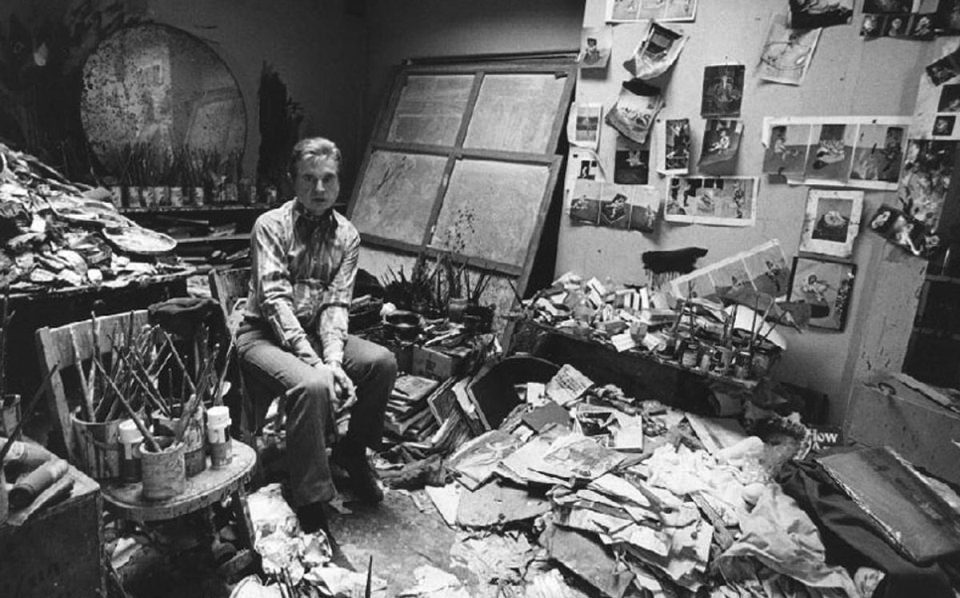
FRANCIS BACON IN HIS STUDIO. The retrospective exhibition of his paintings, the second he has held there, is at
the Tate Gallery, Millbank, London, until August 18. It includes a sequence of 18 large triptychs painted since 1962
Bringing home the Bacon
BY JULIAN BARNES
IS Melvyn Bragg real? The answer might seem obvious to you; but there are evidently parts of the country where the matter is still being debated. On The London South Ban Show (LWT) the presenter asked Francis Bacon (over a lunch where the food never seemed to arrive) whether he was interested in fantasy. ‘T’m interested in reality,’ replied the painter with a vinous thump on the table. ‘Reality is what exists. Are you real? To me you’re real. There you are. There you are, Melvyn Bragg, you are absolutely real to me, there you are, flesh and blood, performing.’
Well, there you are, there you are, now we know. This drolly instructive moment came in the course o an excellent profile. If you thought you’d had enough Bacon hommages for the next decade, and perhaps even enough of those dead-meat pictures (‘The major influence on Bacon has been his own surname,’ muttered a slumped but aphoristical co-watcher at my elbow), you would have been wrong. The painter’s impish presence lit up the hour; director David Hinton made thoughtful connection between the images which excite Bacon and the finished paintings; while Bragg, absolutely real, flesh and blood, performing, prompted carefully.
Interviewing painters is tricky (as Bragg’s no-show with Howard Hodgkin demonstrated); and some think it’s a futile project anyway, however pleasant. Can words explain paint? Not very well. In addition, the painter is always tempted to tease the interviewer a bit, to decline explanation, to be opaque, to be oracular: ‘I am an old man, but I am profoundly optimistic about nothing.’ The painter’s favourite shot is often the dead bat: Do you remember what you felt when doing this painting?’ ‘No — I don’t feel anything when I do paintings nothing to feel.’
The interviewee can get over-confident, of course. When asked why he painted mouths so much, Bacon went off into a glittering flight about how the mouth was like a Turner, full of colour, light, action, texture and whatever. ‘But Francis,’ interposed Bragg, ‘most of your mouths are black.’ Bacon’s reply — ‘I’ve never been able to make the really successful mouth’ — was more than a bit limp in the circumstances.
The film took Bacon round London, starting with a slide show in the Tate storeroom (where he stomped on Pollock and Rothko) and moving on to his studio, which is so chaotic a to make a skip look orderly. Then to a liquid lunch where Bacon admitted the non-secret that ‘I like men’ (in a recent profile, when asked whom he would most like to sleep with, he replied ‘Colonel Gaddafi’); and finally to the Colony Club, a murky Soho drinking establishment. Bacon characteristically described the place as being full of warmth, wit and charm, but the camera told another, more familiar story: it was a junior hell of bawling mouths, brutal camaraderie and drunken distortion. If you dismiss Bacon’s surname as a major influence on his art, then try the Colony Club instead. That screaming Pope of his might just as well be some camp alcoholic in drag calling for a double brandy at four in the afternoon.

Streaky Bacon
GEORGE MELLY | SUMMER NUMBER | PUNCH | JUNE 19 1985
THERE’S been a lot written about Francis Bacon’s magnificent exhibition and about him, too. I was lucky enough to be on the guest-list for a party at the Tate the night before the private view and there he stood, the begatter of all those monstrous and beautiful children screaming and deliquescing behind their glass; a benign presence on this celebratory evening, our most convincing, if least reassuring, genius.
The art world was out in force but equally there were many faces not necessarily associated with a Kunst thrash, but perfectly explicable in the circumstances; the habituées of “The Colony Room” alias Muriel’s, a small but celebrated drinking club in Dean Street, Soho. Ian, the one-time barman and present proprietor of “The Colony” was there, of course; so often host to Francis, on this occasion he was his guest. Muriel herself died a few years ago. She was one of the painter’s closest friends.
I didn’t actually meet Francis at the Colony Room. He used to come into the London Gallery when I was an assistant there, in the late Forties and my boss, the Belgian poet, collagist and art dealer, E. L. T. Mesens, was trying unsuccessfully to persuade the British public that it might be worth investing about a hundred pounds in a Magritte, or about fifty in a Paul Klee. As E.L.T. spent more and more of his time in the nearest pub, and the staff of four was eventually reduced to myself, I was usually left alone behind the desk, rising only to welcome the very occasional visitor, and dreaming of the evening and my growing involvement in the jazz world.
An assistant in an art gallery is an ungrateful occupation; it’s amazing how rude and dismissive people can be, and in general the only job to which I would find it preferable now is that of the man who follows the greyhounds round the track at White City with a small brush and pan. Nevertheless, there were exceptions amongst the visitors, and one of them was Bacon, just beginning to paint seriously but still completely unknown, and he was absolutely charming to the scruffy youngster desperate for the sound of a human voice. He would ask my opinion of the pictures and respond seriously to what I had to say. I remembered his name because of it being the same as the Elizabethan writer’s; a remote ancestor as it transpired.
A year or two later, by which time I was a singer, I was first
introduced to the Colony Room and happily, for it was never a foregone
conclusion, Muriel Belcher took a shine to me. Francis was, by this
time, famous in the comparatively small circle interested in modern art
but his prices were still modest and his financial position, given a
taste for oysters and champagne, shaky. Muriel, according to a recent
piece of Daniel Farson, actually staked
,He also painted her, and there, at the Tate, she is to be seen in
triplicate. One of the most extraordinary qualities of Bacon is how
At one point I found myself in conversation with Alan Bowness, the
Tate’s curator.
GALLERIES
GALLERIES | SUMMER NUMBER | PUNCH | JUNE 19 1985
NOW HERE’S A CURIOUS THING. IN the two long essays in the catalogue for the current retrospective exhibition of paintings by Francis Bacon at the Tate Gallery, the word homosexual is not used once. Nor have we seen it appear, even in the form of an aside, in any of the many pieces recently written about the painter’s work. Why is this, when a most significant part of his subject matter is devoted to male homosexual activity? And not the delicate and gentle aspects of gay life, but the violent, rough-trade end where muscular, thick-necked plebs grapple on oval beds like so much raw offal piled up on dinner plates. As there is nothing wrong about such subject matter (which, incidentally, seeps into a great deal of his work), why this reticence, especially when Bacon’s own distinctive techniques of distortion are so perfectly attuned to it?
His style also marries well with other areas that interest him, notably violent abuse and injury to the human body — this propensity particularly demonstrated in his Crucifixion triptychs where the central figures are disembowelled and hung up head down. Bacon is also interested in meat carcases and clinical photographs of disease, and these, too, find their way into his pictures. All in all then, a pretty obnoxious stew? Not so. This is a very large exhibition and towards the end the queasy visitor might feel he has been assaulted more than enough, but it reveals Francis Bacon as a major 20th-century artist and a very fine painter.
We stress painter because he uses old-fashioned oil paint on stretched canvas, albeit the reverse of the canvas and the oils are augmented with acrylic, emulsion, and liquid pastel. He uses old-fashioned brushes, too, but also rags, finger rubbings, and textures printed from bits of corduroy. His colour harmonies are absolutely beautiful, carefully selected from a range of greys, beiges, biscuit, and lilac, supercharged with red-lead, orange, black, sharp viridians and acid yellows. As for the compositions, they are consistently immaculate; not in anyway according to the book but poised in perfect asymmetrical equilibrium. He invariably uses photographs as reference-from magazines and medical books but particularly from the famous Muybridge series of nude figures in action. The early grimacing Velázquez Popes are here, and those portraits that seem to be viewed through bull’s eye glass.
Every Bacon painting is highly charged and disturbing; they are concerned only with his own private sensations and feelings — they are not “statements for our time” — and therefore they inevitably reveal some of the darker recesses of his psyche. Bacon himself rightly steers away from any analysis of his work, but will discuss the act of painting: “Painting today is pure intuition and luck and taking advantage of what happens when you splash the stuff down.”
Until Aug 18, Mon to Sat: 10.0-5.50, Sun: 2.0-5.50 Admission: £2 (concessionary: £1). Excellent catalogue/ book: £12
Bernard Levin: the way we live now
BERNARD LEVIN | THE TIMES DIARY | THE TIMES | FRIDAY JUNE 28 1985
Ever since the Fall, there has been in the world a vast quantity of
cruelty, hate, pain and fear: it is likely that that state of affairs
will continue to the end of time itself. On a less abstract level, the
world at any moment contains ample reserves of excrement, vomit and
spilt blood. Meanwhile, deformity and madness seem to be forever
ineradicable.
No one, I think, will dispute those claims: most of us, however, would say that they were not worth making. They were not worth making because they are so obviously true, just as one goes about insisting that the sun is hot and the moon is cold, though no one would challenge such assertions.
But now let us make it, ostensibly at any rate, more difficult. Suppose there was a man of enormous gifts, penetrating vision and ruthless single-mindedness of purpose who had conceived his role as saying, day in and day out and with overwhelming force and conviction, that the night is usually dark, and certainly darker than the day, that to be tortured is almost always a very unpleasant experience, and that sometimes a small child plucking a flower is bitten by a poisonous snake and subsequently dies in agony. Now let us tale a vote: are these things more worth saying (taking into account that they are said very forcefully and with a wealth of expression) than my own list? Those who say yes should hasten to the Tate Gallery for the Francis Bacon exhibition; those who say no should not trouble themselves to do so.
The puffing and booming of Francis Bacon seems to me one of the silliest aberrations even of our exceptionally silly time. Here, summing up the silliness, is the director of the Tate, Mr Alan Bowness, in his foreword to the catalogue (a particularly sumptuous catalogue, incidentally, with every picture reproduced in colour).
“His own work sets the standard for our time, for he is surely the greatest living painter; no artist in our century has presented the human predicament with such insight and feeling. The paintings have the inescapable mark of the present: I am tempted to add the word alas, but for Bacon the virtues of truth and honesty transcend the tasteful. They give to his paintings a terrible beauty that has placed them among the most memorable images in the entire history of art. And these paintings have a timeless quality that allows them to hang naturally in our museums beside those of Rembrandt and Van Gogh.”
“The greatest living painter; no artist in our century ...” Let us leave the living painter theme: the world is not exactly awash with genius in painting at the moment, and anyway we do not want to get into an argument about the precise meaning of “greatness”. But “no artist in our century has presented the human predicament with such insight and feeling”? Here is a short list of artists in our century (taking that to mean artists who did at least a significant proportion of their work after 1900) whose insight and feeling in understanding and presenting the human predicament are manifestly greater than Bacon’s — manifestly at any rate, to any one less silly than the director of the Tate and les parti-pris than the seedy throng of Bacon groupies:
Bonnard, Braque, Chagall, Chirico, Derain, Ernst, Gris, Grosz, Kandinsky, Kokoschka, Magritte, Matisse, Matta, Miro, Moore, Munch, Picasso, Rivera, Rouault, Soutine, Sutherland, Utrillo, Vlaminck and Vuillard.
Note that I have been strict with the definition. The slightest stretching of “human predicament” would have enabled me to add Arp, Dufy, Klee, Leger and Mondrian, and a slight more generous treatment of dates would have brought in Degas, Monet and Renoir (who, after all, lived to 1917, 1926 and 1919 respectively). Nor have I seized on Mr Bowness’s distinction between “painter” (Bacon the greatest living) and “artist” (Bacon unrivalled at presenting the human predicament); if I had added the sculptors the list would have swollen substantially.
My objection to Bacon is the same as my objection to those clever young play wrights who finally who finally drove me to give up the job of a dramatic critic; what is the point of being good at saying things if you have nothing to say — or at least, nothing other than that the world is rotten, human beings are rotten, love is rotten, society is rotten, life itself is rotten? In the first place, the claim is obviously untrue; in the second, it runs counter to some 30 centuries of human experience distilled in art — 30 centuries, moreover, in which the world was by no means free, anymore than it is today, of envy, hatred, malice and all unchartibleness, nor of battle, murder and sudden death, nor of war, famine and pestilence.
Wandering through the huge Tate exhibition, I looked for evidence that Bacon had ever read a Winter’s Tale, listened to the G minor Symphony of Mozart, seen À Nous la Liberté. There is no such sign. But there is much else. There is a baboon, also a chimpanzee; both are screaming, as are a very large proportion of the human beings, man and animal — not to be distinguished anyway — trapped alike in endless torment. (There is a dog which is not screaming, it is, however, tugging at its lead because it wishes to inspect a drain it is passing.) There are those endless deformations of faces and bodies which are the artist’s most intense obsessions, and which suggest a degree of misanthropy verging on madness. There are the Velázquez variations, those Bacon Popes burning in their own hell (I wonder what Velázquez would think of Bacon — for that matter, I wonder what Bacon thinks of Velázquez, if indeed he ever thinks about Velázquez at all), and there is another parody of a well-known work, which seems to me very significant.
It is based on the Ingres painting of Oedipus and the Sphinx in the Louvre. Bacon has imitated the pose of Oedipus, with one leg raised on a rock; but Bacon’s Oedipus is a simian figure, and the raised foot is covered in a filthy and bloodstained bandage. There is an indefinable figure in the background, part bat, part jellyfish, part bird; it, too, is bloodstained. An essay in the catalogue says that Bacon sees the creature as one of the Eumenides; if so, he must have forgotten how the Orestia ends — in Bacon’s mythology there is neither Apollo to plead for the sinner nor Athena to win over the Furies.
Bodies couple, in hate not love; other bodies writhe on beds, one of them swelling with the effects of the hypodermic embedded in its arm; naked men squat at stool; carcasses of beef hint at human carcasses; “Reclining Woman” reclines, significantly, more hanging than lying; “Woman Emptying a Bowel of Water” is accompanied by “Paralytic Child on All Fours”. Disgust is kept at bay by the feeling that there is nothing sufficiently real in all this waste and folly to make disgust an appropriate reaction.
Bacon is not a charlatan; he feels everything he expresses. Nor has he invented or imagined the darkness in man’s soul; Auschwitz and Kolyma are not fairy-tales, nor is the Crucifixion. But Bacon’s version of the latter illustrates perfectly the fatuousness of Mr Bowness’s claim that Bacon would “hang naturally in our museums beside those of Rembrandt and Van Gogh”.
What is the second most noticeable, striking and important fact about the Crucifixion? That it is a story of shame, degradation, failure and death. What is the most noticeable, striking and important fact about it? That it is a story of shame put to shame, degradation raised incorruptible, failure turned to overwhelming triumph and death transmuted into eternal life. What is wrong with Francis Bacon? He has not noticed that, half-way through, the Crucifixion turns into its opposite. Tintoretto noticed; so did Rembrandt; even Dali noticed.
It is much too late to turn the tide. The received wisdom among the bien-pensants is that Francis Bacon is a great artist, and his work a series of imperishable masterpieces; my claim that the received wisdom and his work alike are very great nonsense will convince nobody except small boys who notice that the Emperor has no clothes. True, those who live for another 50 years will be able to acquire Bacon’s paintings for about £2 a hundred-weight, but the puffers and boomers will be safely dead by then. All the same, we have a duty to the present, and one part of that duty is to distinguish constantly between the true and the false. And in art, perhaps more than in any other category, those distinctions are necessary and important; which is why I have chosen to draw a few today.
Bacon’s back at the Tate
FESTIVAL WITH MARK GALE
HERE are 126 works dating from 1944 in the Francis Bacon exhibition which is proving a big attraction at the Tate Gallery. Many of the artist’s favourite works are included and paintings have been lent from collections in Europe, North America, Japan and Australia.
Bacon was given a retrospective at the Tate in 1962 and it is rare occurrence for a living artist to have two major retrospective exhibitions there.
A spokesman for the Tate told Festival: “In the case of Francis Bacon there should be no surprise about it. Since 1962 he has continued to produce work of outstanding quality.”
Bacon’s career as an artist really took-off in 1946, with the showing in London of Three Studies for Figures at the Base of a Crucifixion and it is with this work that the current exhibition begins.
Suffering, sexuality and mortality are the artist’s main themes but these are conveyed with a poctic appreciation which has been likened to Shakespeare and the Greek tragedies.
The exhibition which continues until August 18 will be seen later in Germany.
By ROBERT HUGHES
All of a sudden, in a rush, the English know what they
have got. “Surely thhe greatest living painter,’’ wrote Alan Bowness,
director of London’s Tate Gallery. “The greatest painter in the world,’’
claimed Lord Gowrie, England’s Minister for the Arts, “and the best this
country has produced since Turner.’’ The artist is Francis Bacon, 75,
whose second retrospective exhibition at the Tate (the first was 23
years ago) opened last month.
Some art
is wallpaper. Bacon’s is flypaper, and innumerable claims stick to it:
over the past 40 years it has attracted extremes of praise and
calumniation. There are still plenty of people who see his work as icily
mannered, sensationalist guignol. He is the sort of artist whose work
generates admiration rather than fondness. The usual evolution of major
artists in old age, whereby they become cozily grand paternal figures,
patting their juniors on the back and reminiscing in autumnal mellowness
about their dead coevals, has not happened to Bacon, who is apt to
dismiss nearly everything painted in the 20th century with bleak
contempt. He has gone on record as admiring Giacometti and Picasso; for
a few others, a few words of respect; beyond that, the sense of
isolation is ferocious. The motto of an aristocratic French family
declared: “Roi ne puis, prince ne daigne, Rohan je suis’’ (King I cannot
be; prince I do not deign to be; I am a Rohan). Shift the context and
you have the epitome of Bacon’s own view of his place in 20th century
art.
The
lexicon of Baconian imagery is famous. Its most familiar component is
the screaming Pope, smearily rising from blackness like carnivorous
ectoplasm, his throne indicated by a pair of gold finials, the whole
enclosed in a sketchy cage — homage to an original that Bacon firmly
denies having ever seen, the Velasquez portrait of Innocent X in the
Doria collection in Rome. There are the Crucifixion motifs, reflections
of Grunewald and the Cimabue Crucifixion in
Santa Croce that was partly destroyed by the 1966 Florence flood, whose
sinuous and near boneless body Bacon once startlingly compared to “a
worm crawling down the Cross.’’ There are the humping, grappling figures
on pallets or operating tables; the twisted, internalized portraits; the
stabbings, the penetrations; the Aeschylean furies pinned against the $
windowpane; and the transformations of flesh into meat, nose into snout,
jaw into mandible and mouth into a kind of all-purpose orifice with
deadly molars, all of which aspire, in the common view, to the condition
of documents. Here, one has been told over and over again, is the outer
limit of expressionism: these are the signs of the pessimistic
alienation to which a history of extreme mass suffering has reduced the
human image. The collective psyche has imploded, leaving only the
blurred individual meat, hideously generalized. The paintings “reflect’’
horror. Their power is in their mirroring. They are narratives, though
not always openly legible ones.
Bacon
utterly rejects this view. He sees himself not as an expressionist but
as a realist who nevertheless stakes the outcome of his art on an
opposition between intelligence (ordering, remembering, exemplifying)
and sensation. His paintings do not strive to tell stories, but to clamp
themselves on the viewers’ nervous system and offer, as he puts it, “the
sensation without the boredom of its conveyance.’’ He once remarked: “An
illustrational form tells you through the intelligence immediately what
the form is about, whereas a nonillustrational form works first upon
sensation and then slowly leaks back into the fact.’’ The nub of the
difference between Bacon’s figures and those of expressionism is that
his do not solicit pity. They are not pathetic and do not try to call
you into their own space. Everything unwinds in silence, on the other
side of the glass wall. (Maybe this is why Bacon insists on putting even
his biggest canvases behind glass: it makes the separation literal,
though sometimes too literal. The glass becomes an element, even a kind
of collage.)
As Art Historian Dawn Ades acutely notes in her catalogue
essay to the Tate show, there is a lot in common between Bacon’s vision
of human affairs and the neurasthenic, broken allusiveness of early
Eliot
The host with someone indistinct
Converses at the door apart,
The nightingales are singing near
The Convent of the Sacred Heart,
And sang within the bloody wood
When Agamemnon cried aloud
And let their liquid siftings fall
To stain the stiff dishonoured shroud.
That “someone
indistinct” is,
of course, a key figure in Bacon. The real peculiarity of his figurative
style is that it manages to be both precise and ungraspable, for its
distortions of face and limb bear little relationship to anything that
painters have done to the human body since Cezanne. Forms are governed
by slippage: they smear sideways, rotating, not like the succession of
displayed facts and transparent planes in cubism, but as though they had
endured some terminal rearrangement by massage. Their shape retains an
obstinate integrity, the precise result of a sudden movement. And by the
early to mid-’60s,
the time of the great triptychs, when Bacon decisively abandoned the “spectral,” scumbled
evocations of the face used in his Popes and caged businessmen, his
figures had begun to embody an immense plastic power. Sometimes these
creatures, knotted in contrapposto, seem desperately mannered; but there
are other moments when the smearing and knotting of flesh, not so much
depicted as reconstituted in the fatty whorls and runs of paint, take on
a tragic density closer to Michelangelo than to modernism. Among those
artists who, in the past century, have tried to represent the inwardness
of the body, Bacon holds a high place, along with Schiele, Kokoschka and
Giacometti.
He breaks the chain of pessimistic expectation by taking his prototypes
beyond themselves into grandeur. In earlier art there was a repertoire
of classical emblems of energy and pathos, starting with the Laocoon,
that painters could draw on for this operation. Bacon
None of this would be possible without Bacon’s mastery of the physical side of painting. Much has been made of his reliance on chance, but it seems to have affected his life (he is an inveterate gambler, an addict of the green baize) more than his art. One could say the ejaculatory blurt of white paint in a painting like Two Studies for a Portrait of George Dyer, 1968, is chancy, but that kind of chance is easily manipulated with practice, and it rhymes suspiciously well with other curves in the painting (like the back of the chair in the picture within a picture to the left). The truth is that the Bacon one sees this time at the Tate has much more in common with old masters than with contemporary painting. The paint acquires a wonderful plenitude in becoming flesh. One thinks of the coruscated light, the Venetian red interstitial drawing, in Tintoretto. This kind of paint surface is part of the work of delivering sensations, not propositions, and it is neither idly sumptuous nor “ironically” sexy.
But the one thing it cannot reliably do is fix the extreme disjuncture between Bacon’s figures and their backgrounds. The contrast of the two — the intense plasticity of the figures, the flat staginess of the rooms and spaces in which they convulse themselves — is what gives rise to the charge of “illustration.” It will not entirely go away, because Bacon only rarely manages to set up the whole field of the canvas as a coherent structure, every part exerting its necessary pressure on the next. One looks at the figures, not the ground. Hence the theatricality of his failures. But, like his successes, these too are the work of an utterly compelling artist who will die without heirs. No one could imitate Bacon without looking stupid. But to ignore him is equally absurd, for no other living painter has set forth with such pitiless clarity the tensions and paradoxes that surround all efforts to see, let alone to paint, the human figure in an age of photography.
Bernard Levin’s portrait of the artist
From Dr Alan Halliday
ALAN HALLIDAY,
11 Caxton Terrace,
Henley-on-Thames,
Oxfordshire.
From Mr Robert Buhler, RA
Sir,
Mr Levin, no doubt, is a deeply committed humanist and his articles are invariably well reasoned and argued with great skill and conviction. But today’s emotional piece on Bacon invites calmer comment.
According to Coleridge. “Painting is the intermediate somewhat between a thought and a thing.” If the idea is paramount the painting can become “illustration”, whereas purely abstract painting can become an object with no particular “message”. Admittedly. Francis Bacon’s aim is to touch; the raw of the central nervous system. Be that as it may, he seems to have succeeded with Mr Levin.
If — as
has been my experience — one
gets a strong impact of a painted image: original, authoritative and
free of borrowed language, one is confronted by an impressive presence.
I do not pretend to know what his painting is about, but I am always
amazed how good it looks on the wall. Perhaps Mr Levin
Both Mr Bowness and Mr Levin make extreme claims. Francis Bacon may or may not be the greatest living painter alternatively, it is unlikely that his work will be sold for £2 a hundredweight in 50 years from now. In the meantime Francis Bacon’s work has created great interest and controversy all over the world, not least among painters.
Staunch upholders of deeply held moral values, such as John: Ruskin and others. do not necessarily always get it right; but w ho can blame them in face of the magic and mystery of painting?
Yours faithfully,
ROBERT BUHLER,
33 Alderney Street, SW1.
From Miss A. M. O’Neill
Sir,
I was so pleased to read Bernard Levin’s forthright article on Francis Bacon and his art.
I respond with warmth to Mr Levin’s call for the unabashed truth in art. He decries the dictates of critical whimsy and seeks something finer to be representative of the contemporary human condition.
Truth is not interpretative or chamelon. It simply is: and Mr Levin’s affirmation of this is strong and honest. Mr Bacon’s defamation of humanity is only a half-truth and Mr Levin is eloquent in his attempt to complete the picture.
Yours faithfully,
ANNE MARGUERITE O’NEIL
Knoll House,
Studland, Dorset.
Sir,
How strange that Mr Levin (June 28), who presumably can appreciate the abstract in music, seems quite unable to understand that it is not the subject matter that is all-important in paining but rather how the subject matter has been organised.
The subject may or may not be a bonus, depending on fashion, but the design is the enduring intrinsic clement and of course at that Bacon is a master.
Yours faithfully,
F E MCWILLIAN
8a Holland Villas Road, W14.
Edible bacon
At the Francis Bacon exhibition I was overcome by a series of yawns. That is not meant as a piece of art criticism, or even as a comment to please the philistines. The yawns descended on me, volley after volley of them, making my eyes water, so I thought I had better leave.
Yawns are involuntary, of course, but not necessarily insulting. I had a wise old French master who liked people yawning in his class, it meant they were trying to pay attention, which is true. If you allow your thoughts to wander in their own sweet way you do not, I think, yawn.
However, I found when I was again outside his exhibition and in the narrow gallery by the entrance to it where I peered up at the Stanley Spencers and William Roberts and Edward Burras — other English painters gathered together, perhaps unwisely, as a prologue to him — that I stopped yawning. So I tried to apply my mind to the reasons for the yawns.
First, as far as I could discern through my welling eyes, the pictures, room after room of them, were very similar to each other, there was little variety, or none. Secondly, they were rather pretty. This may come as a surprise to some, but I stick to it. Those mauve backgrounds, or rust-coloured ones, are pleasant to look at, and the event inside the painting is placed elegantly within them; all is in the very best of taste. That the event may be a distorted human form, dripping a bit, or sitting on a bidet, seems to me neither here nor there. These are prettily painted too, if you look closely at them. The distorted heads of portraits, where a cheek or a jaw goes un- expectedly concave, are done with broad strokes of a brush that contains many colours at the same time: cream, strawberry, a delicious purply-grey that is also reminiscent of good puddings. It struck me as possibly lucky that Mr Bacon’s vision leads him to distort in this way, for people love to wince and sigh and frown in the presence of Truth. In fact the more they wince the Truer they think it is, I don’t know why. But were it not so I suspect that Mr Bacon, with his natural tendency towards the tasteful, even the edible, would be hanging in the back room of a paint-shop in St Ives and, being the man I am told he is, he would be equally content.
It was when I read the catalogue that I began to open my eyes and let them dry out. ‘His own work sets the standard for our time, for he is surely the greatest living painter;’ — well, if you say so, squire — ‘no other artist in our century has presented the human predicament with such insight and feeling.’ Now, it is important, not to hold such statements against Bacon himself, he makes no such claims: this Is Alan Bowness and when the cultural bullies really get going they let you have it with both barrels.
What Bacon himself says is more interesting, and made me sit up. ‘I want very, very much to do the thing Valery said —10 give the sensation without the boredom of the conveyance. And the moment the story enters, the boredom comes upon you.’
I take it that is an expression of Modernism, that he wants to get
straight to the expression of sensation without intellectual preconceptions and
hesitations. It is an enormous and natural ambition and the mention of Valéry reminded
me that it is precisely what poets want to do and are always held up by,
ANDREW BRIGHTON
This wonderful finesse, coupled with an instinctive monumentality which gives his work its grandeur, counteract the depressing aspects of Bacon’s world. Indeed, his exhilaration seems all the more persuasive precisely because it is pitched against such absolute pessimism about the bleakness, confinement and vulnerability of the human condition. Bacon’s assertion of an ecstatic vitality could not be more hard-won. No one can doubt the extremity of the violence and suffering from which his bruised figures emerge with undaunted élan. That is why the leg striving to put a key in the lock is such a magnificent image, insisting against all the odds that the door might one day be opened and offer a way out of the cruel and desolate cell.
It is extraordinary that one of the beacons of European painting in our time should have been working in England for the last forty years. There would seem to be so little in our suburban and puritanical high culture to sustain a great artist.
A terrible hymn composed in honour of fate and inescapable grief
On the 24th October 1971, in Paris, George Dyer, Bacon’s companion and model for the previous seven years, died. Two days later Bacon’s retrospective exhibition at the Grand Palais opened. ‘In the lives of all of us there is a human being whom we least wish to lose’, wrote John Russell. ‘Bacon sustained that particular loss at the time of his retrospective exhibition in Paris’, Back in London in November and December Bacon painted Triptych 1971. In the central panel the partially silhouetted figure of Dyer stands, a river of arm-like flesh cascades across and beyond the darkness of his back and holds a key in the Yale lock of an open door. Beyond him stairs turn into darkness. In Painting 1978 again, but this time naked and and with his foot, Dyer holds a key in the door. ‘I don’t know why I made it turn with the foot — it very much came from that poem of Eliot’s: "I heard the key/Turn in the door and turn once only ... ‘You know. It comes from The Waste Land. The next two lines of the poem read: ‘We think of the key, each in his prison/Thinking of the key, each confirms a prison.’
In his ‘Notes on the Waste Land’ Eliot attaches a quotation to this passage from that formative influence upon him, the Victorian and radically sceptical philosopher, J. H. Bradley. (Bradley for instance, argued that A can never in a proposition equal B. If A = B then A must be identified with B, in which case B is in fact A, and the proper form of the proposition is A = A. It follows from this that human reason and communication are profoundly faulted.)
The quotation Eliot gives is this: ‘My external sensations are no less private to my self than are my thoughts or my feelings. In either case my experience falls within my own circle, a circle closed on the outside; and, with all its elements alike, every sphere is opaque to the others which surround it ... In brief, regarded as an existence which appears in a soul, the whole world for each is peculiar and private o that soul.’ In Bradley’s philosophy and Eliot’s poetry man is profoundly not-at-home in the world. Each of us is isolated in faulty communication, in the burden of self-consciousness. No benign order, human, natural or divine, lies behind and unifies the world and the word. We give our lives meaning in defiance of their essential meaninglessness. At base we live as we die, alone. In one of his conversations with David Sylvester, Bacon is reported as saying; ‘I think life is meaningless; but we give it meaning during our own existence. We create certain attitudes which give it a meaning while we exist, though they in themselves are meaningless, really.’
A good picture, faithful and worthy of the dreams that give it birth, must be created like a world
How do you paint such a vision? Or rather, how does Bacon realize and elaborate such a vision. First you must go against one of the reoccurring requirements of aesthetics, the demand for aesthetic unity. The experience of a work of art’s formal unity has, since Kant, been seen as a manifestation of some metaphysical unity: the unity of the faculties of cognition, or as an intuition of the unity of Spirit. It is seen, in other words, as a symptom in one way or another man’s at-homeness in the world.
‘I hate a homely atmosphere’, Bacon has said in discussing the disjuncture between his painterly painting of forms and figures and the flat and linear handling of the backgrounds and inanimate objects with which they co-exist. ‘I always feel that malerisch painting has a too homely background ... I want to isolate the image and take it away from the interior and the home’.
Another device Bacon has used to isolate figures is the space-frame, those perspectival lines that seem to demark often invisible enclosures, but which sometimes become part of the architecture in which figures or forms exist. Bacon’s is an emotive pictorial space, the space-frames are spatially incoherent. They refuse a consistent depth as well as two-dimensional pattern. They help to deny the integrity of the picture plane, that connoisseur’s happy ending, that banality of good taste. Bacon’s space is unsystematic, renegotiated, tested against affective resonance, against its imaginative life.
Study for Portrait of Van Gogh, 1957, is suffused with blue. The darkness of the figure runs into the road to make a shadow like a crouching biped. The space-frame that dramatises the isolation of the figure is self-contradictory, it is both in the picture and on the picture. It joins up with and echoes the figure’s walking stick and this is in the picture, it is on the picture when it is arbitrarily scrubbed across the trees and sky. One leg of the frame stops at the horizon line, another disappears into the far side of the road of palette-knifed paint into the triangular black infinite abyss which is the flat foreground of the picture. Within this and other mashings of pictorial syntax is the image of a man, on a road, in a landscape. It is an image made in and assaulted by a conjuncture of pictorial languages, any one of which could be taken out and made into a coherent but different kind of painting.
In the age of systems, of consistently elaborated critical discourses, at a time when painting’s capacities have been dismembered, Bacon has made synthetic pictures that cohere only in their reception, their resonance, in imaginative culture.
The ’positivist’ says: ’I want to represent things as they are, or as they would be on the assumption that I did not exist.’ The universe without man. In the other camp are the imaginative ones who say: ’I want to illuminate things with my mind and cast its reflection on other minds.’
Positivism has haemorrhaged into moral life. The model of the physical sciences as an internally coherent and systematic discourse that gives ever-increasing mastery over its concern, its ‘area of competence’, to use Greenberg’s phrase, has profoundly affected the European culture of self-awareness, of which the culture of images is but a part. Bacon’s project is profoundly antipathetic to positivism’s contagious influence. Central to this is his rejection of non-figurative painting.
Positivism is essentially a set of inhibitions which seek to disqualify as knowledge statements that do not conform to rules supposedly derived from scientific method. This is often construed as a materialism which requires of painting that it offers nothing but what is given in the experience of its intrinsic properties. Paintings are supposed to speak for themselves. Attended to in a properly disinterested way, ‘the aesthetic attitude’, they offer a particular kind of pleasure. As I have said already, when speaking of aesthetic unity, this experience ha been given all kinds of metaphysical value. It is one of the ironies of Modernism that the anti-imaginative demands of positivism have been inserted into the culture of art clothed in the rhetoric of the spiritual.
For instance, Kandinsky, in Concerning the Spiritual in Art, spoke of the artist at the forefront, avant-garde, of humanity’s spiritual progress, communicating his own higher being through the non-allusive properties of form and colour. His own work is a complex, rich and in consistent elaboration of this hypothesis. Bacon’s paintings are made precisely by reaching into the lexicon of images, into the allusive life of representation.
Positivism and its echo in the professionalised culture of art is profoundly hostile to imaginative culture. One reason being that imaginative culture has no single grammar, no single set of rules that govern its articulation. Imagination mirrors our manifold experience of being in the world. It is a nexus, a conjuncture, of ways of knowing.
A second source for positivism’s hostility is is that imaginative culture is not an instrument of progress. It has the power to encompass the ambivalence and ambiguity of the world. It does not cut a concrete swathe of certainty through the forest of symbols. It is the medium of moral understanding, not of moral judgements. (As positivism does not allow of moral or aesthetic judgements as knowledge, judgements of art are now constituted as technical judgements. So works are given values as, for instance, the instruments of art’s development or of social justice.)
The whole visible universe is nothing but a storehouse of images and signs, to which man’s imagination will assign a place and relative value.
Bacon mixes grammars of representation. Above all he has submitted his talent as an image maker to the plenitude of painting as a medium and a culture. Submitted, in other words, to that culture of sensibility that has been elaborated through European painting. For instance, like Velasquez he has worked into darkness and used the discernible passage of the brush to evoke form. His drawing of the male form as full of a dense energy is indebted to Michelangelo. The outbreak of hysterical rhythms has precedents in Munch and the de-idealised display of the body stretched out comes partly from Degas.
Many other sources could be argued. But at base, what he has done is to master the capacities of paint’s sensual presence to act upon the sophisticated eye. To do this is to submit to a seemingly unnatural language, one removed and alienated from mundane, relatively unselfconscious communication. He has submitted his imagings to the resistance of painting rather as a poet submits to the resistance of the metre. The resistance is a stepping stone. It breaks up the banality of first conceptions. It forces translations and transformations into the otherness of a world apart. It gives and withholds meaning. A mirror with its own languages of representation.
‘He seems to me to be one of the very few English painters since Constable and Turner to be concerned with painting, that is with attempting to make idea and technique inseparable’. This could have been said of Bacon but was, of course, said by Bacon in his much-cited tribute to Matthew Smith. But Bacon, perhaps more than any other painter, has pulled images and ways of looking derived from the mechanical means of representation into the heart of painterly sensibility. He has, in other words, conjugated the most vulgar, the most seemingly ‘real’ language of representation with the most sophisticated.
His use of Muybridge’s photographs of the human body in motion, of newspaper photographs, of Eisenstein’s screaming nurse, of reproductions (rather than the picture itself) of Velasquez’s Pope Innocent X, of battered photographs of friends, of seedy photographic booth pictures of himself, all these are much referred to sources of Bacon’s imagery. But the way of seeing needs to be stressed.
The single figure in an expanse of interior is surely cinematic in origin, even if the symmetry of backdrop is theatrical; the height and closeness of our view is that of the camera. Michel Leiris reports that Bacon’s use of the triptych was partly suggested to him by the panoramic screens of certain cinemas. Particularly in the portraits, Bacon’s use of light and dark is more informed by photography than by painting. The painterly disrupts and abuses the mimetic force of photographic coherence. And Bacon’s vision of the skeleton, of naked jaw, teeth, spine and skull owes everything to X-ray photography and nothing to anatomical drawing.
Perhaps a source for the mixture of grammars itself as well as for the radical shifts of scale within the same figure, from the huge face in the 1957 Van Gogh study to the tiny body and giant head in Triptych 1976, is photomontage. The uneasy, slightly wrong, relationship between face and head, head and neck, neck and body, as in, for example, Portrait of Isabel Rawsthorne Standing in a Street in Soho, 1967, has precedents in the work of Hausmann, Grosz and Heartfield.
The work of the Berlin Dadaists might be described as cubist imagery not primarily because of the links that can be made with cubist painting and collage, but but because their conjunctural images would seem to echo the celebration of the multiplicity of the modern city found in the work of the cubist poets. And of course, Bacon’s debt to the imagery of poetry as a source and as a paradigm is vital to understanding why it is that he stands apart from so much post-war painting.
Like the city, Bacon’s paintings are a meeting of disparate systems, the painterly meets the photographic, the gobbet of thrown paint meets the diagramatic arrow, paint as muck, immaculate paint, the dribble of paint and the ruled line, images of steel and hair, bone and geometry, fag ends and sex, safety pins and teeth, blood and lightbulbs. Bacon is a painter of modern life.
The curses, blasphemies, complaints, These ecstasies, cries, tears, these Te Deums
In a nation whose high culture is so dominated and strangled by the
non-conformist conscience, by metaphysicless moralism, Bacon is an extraordinary
anomaly; a practitioner of pictorial blasphemy, a painter of original sin.
Ours is a suburban culture; one that hates the city and sentimentalises nature. When our Oxbridge-dominated apology for an intelligentsia attempts seriousness it reverts to sermonising in the manner of F. R. Levis. But Levis’s phrase ’doing dirt on life’ gives the game away. It supposes that life is clean. Such phrases speak only of a blindness to the mental and bloody violence that secures privilege. It is tight-arsed suburbia universalising its own complaisance Like us, even the shrubs around those damps and quite suburban gardens grow out of, are ordered and return the the chaos of dirt. At seventeen Bacon had his dog-dirt revelation: ’I remember looking at a dog-shit on the pavement and I suddenly realized, there it is — this is what life. Strangely enough, it tormented me for months, till I came to, as it were, accept that here you are, existing for a second, brushed off like flies on the wall’. Without re-inventing God, as science or history or any other modern theism, refute this proposition. You have only the rest of your life to answer the question.
In England art is dissolved in the spittle of good taste. Dissolved into a minestrone of natural and regular aesthetic emotion-giving moralism. It is not surprising that the critic who first began to get the measure of Bacon was The Enemy. It was that scourge of the bourgeoisie, the cultural as well as the commercial, Wyndham Lewis who wrote in 1949, ‘Bacon is a Grand Guignol artist: the mouths in his heads are unpleasant places, evil passions make a glittering white mess of the lips. There are, after all, more things in heaven and earth than shiny horses or juicy satins. There are the fleurs du mal for instance’. He wrote later in the same year, ‘of the younger artists, none actually paints so beautifully as Francis Bacon’.
There is little or no precedent in English painting for Bacon. The first eleven of English Surrealism was hardly a source with, perhaps, the exception of Edward Burra His googlies has a real sense of evil. But the captain of the team, Paul Nash, epitomises the English myth of nature, retold as domesticated surrealism. In his un-peopled landscapes the rhythms of nature become the rhythms of the picture. Art and nature are in organic sympathy. Ruskin lives.
In Bacon’s Study of a Figure in a Landscape, 1952, raw canvas is lost from sight only in the crouching naked man like a stain in the very centre of the picture. The dry strokes of paint that are a bald simulacrum for grass offer no organic rhythm and terminate at a ruled boundary line. This is a landscape scrubbed bare in an unsympathetic symmetry.
There is no precedent in English painting for the act of blasphemy that is Three Studies for Figures at the Base of a Crucifixion of 1944. How is Bacon’s work blasphemous? Blasphemy requires a notion of God to abuse. Pictorial blasphemy requires iconography and languages of painting that celebrate or assume God, that offer images of man in harmony with the fundamental order of the world, that offer visions of wholeness, visions of the external world as coherent and meaningful to us. Whereas much of modernist painting has attempted to reconstruct visions of unity in paintings from which traditional language of representation, with their residues of belief, have been extirpated, Bacon has explored the scars of God’s departure. They have abandoned the ship of pictorial tradition; he rides with it on to the rocks.
Three Studies 1944 alludes to that which it abuses, the tradition of Christian iconography, by its triptych form, by its trinity of monsters and by its title. In its central panel from a human crotch, anused, standing on stork legs, extends a snarling lingam its opened, red-lipped meatus is crowded with incisors. The bandage that would seem to blindfold the glans is thought to derive from Grunewald’s The Mocking of Christ.
Bacon has stated in a letter to the Tate that these three panels are ‘sketches for the Eumenides (the Greek Furies) which I intended to use as the base of a large Crucifixion’. The Eumenides are the antithesis of the Christian God’s love and forgiveness. They are the personifications of vengeance and guilt, they are blind to contrition and penitence. Orestes, at the end of Aeschylus’s Oresteian Trilogy, claims he is cleansed of his guilt by his sufferings and the purgative rituals he has performed. The Furies reply:
Neither Apollo not Athene can have power To save you. Lost, cast off, the very taste of joy — Forgotten, you will live the prey of vampire Powers.
In the early 1970s Bacon reintroduces images of the Furies. In Triptych Inspired by the Oresteia of Aeschylus the left hand canvas has a creature swinging like a bat by one human leg. This thing is still part crotch but now with a lobe-like wing, a hairless animal. It spits blood. It would seem to be smashing against a glass barrier in Oedipus and the Sphinx after Ingres, 1983, scratching at the window in in Seated Figure 1974, snarling on a coffee table in Three Figures and a Portrait 1975, it sits like a bird of prey in the central canvas of Triptych 1976. In Triptych May-June 1973, which depicts the death of George Dyer, it is the shadow of a Fury that engulfs Dyer in the central canvas.
The traditional languages of representation have meaning, as does any language, because they are born of and are enmeshed in human culture. They are enmeshed in those patterns of differentiation by which we order the world. Blasphemous conjugations violate these differentiations. So, for instance, clean and unclean, edible and inedible mixed together not simply taste but the very ordering of our lives. In his Eumenides, Bacon conjoins the site and apparatus of male sexuality with the teeth — exposing, blood-spitting energy of vengeance and guilt. Sewer and river of human emotions are mixed.
In the discontinuities of pictorial language and space Bacon articulates a rhetoric of the closed circle of the soul in a world that has lost meaning, lost coherence. But the isolation of figures within the space-frames is only an intensification of the predominant characteristic of most of his paintings; the isolated figure within the actual frame. Figures and forms alone within the rectangle of the canvas. There are exceptions and there is the exception.
In the exception, the repeated image of two figures in the same space, Bacon mixes two categories; sex and violence. He began with Two Figures, 1953. It is not in the Tate retrospective but six versions of the image are; the last one is Triptych August 1972. These two horizontal bodies arched in an eruption of movement are derived in part from a Muybridge photograph of two naked male wrestlers. Bacon plays upon the ambiguity of the bodily expression, upon the way that copulation and violent struggle can have the same appearance. In his adaptations and transformations the clarity of the photograph is suppressed. In the rich vagueness of the paint categories are confused and the ambivalence of the image speaks of the confused springs of desire, the ambivalence of lust’s assault, the eroticism of violence.
In Three Studies for a Crucifixion of 1962 Bacon returns to the triptych format. He made the pictures in an alcohol-battered fortnight. In the central canvas the unsavoury puddle of poured, spattered, brushed, wiped, red, pink and white paint on a bed is a writhing figure. Its snarling teeth disallow pity. It appears to have a hole in its foot. If this is Christ, he is screaming for revenge.
On the left canvas, drawn with great sense of rotundity in sweeps of dry brushed paint is a flayed and disembowelled torso. It hangs upside down, its head on a cushion of its own dirt and and pink and white skin. This is blasphemy. We know that Bacon derived this image from Cimabue’s Crucifixion: ‘I always think of that as an image — as a worm crawling down a cross’. The crucifixion is inverted, exposed teeth usurp the grace of Christ’s forgiveness.
Bacon’s blasphemies are profound because they are not political, they do not abuse the church and its hypocrisies, a jejune strategy best left for adolescents; they abuse God. They would seem to me to be enraged acts of mourning, it is the anger of the bereaved left isolated in a world without meaning by the death of God the Father.
Why is Bacon a Great Artist?
Why is Bacon a great artist? The first problem with the question is the appellation, great artist. It is a near meaningless cliché. It is something mouthed by media persons trained in the cynical production of texts in a culture that has little but a trivial and sentimental conception of art. We have to re-invent the term.
To attend to art as something more than delectation, entertainment, or distraction is not simply to attend to a certain class of objects. It is also to enter a tradition of discourse around those objects. Like the artist, in our thinking and talking our way into works of art, in making our understandings, we constantly re-invent what art is. We re-vivify that tradition of making and discourse.
For me art stands against the dominant current of our culture. Against the imperious demands of systematic discourse, against the apes of science. Such discourse speaks as if we can or do know the world and it does so, and again I echo Baudelaire, by speaking of the world as if we are not in it.
I take Bacon’s work to be predicated on the assumption that we do not know. He tears the veil off conventional representations to make a strange beauty. Through the qualities and resonances of the images realised in paint we are confronted with harsh mirrors of our being in the world, mirrors of the ambivalence of the wells of feeling. Great artists re-invent the greatness of art. Bacon reconstitutes the profundity of art and imaginative culture.
Painting as part of the reflective culture of Europe is a historical mutation. A mutation sustained by a concentration of disparate interests. Sustained, for instance, by its use: as a badge of wealth and cultivation as a speculative commodity, the object of scholarly industry and hack copy, as a receptacle of moral, sentimental, ideological and political values, and for practitioners as an addictive affective embodiment and articulation of themselves. The dealers and art-scribes are not invaders of the temple of art, they are amongst its architects.
This mutation, this tradition of images an discourse is always in crisis, for one of its sources of energy is the contested notion of its value. In the twentieth century it has had a rich and complex dialectic with the demands of positivist myths. In the post-war period it has been diminished an trivialized by the institutionalisation of the power of intellectuals. They, for example, with the rise of mass education, have become the priests in the rites of meritocratic social stratification, that process by which people are taught to internalise their own disqualification for power and status.
With the rise of the institutions of contemporary art comes a new profession whose members, by their mappings and orderings, have created a dominant evaluative discourse; a professional discourse, like any other, which aspires to achieve a systematic mastery over its area of competence. Bacon’s assertion of the heart of darkness is a beacon whose light exposes the herd hubris of professionalised culture and the political sentimentalities of our time as inadequate vessels for reflective culture, for the culture of self-awareness.
London
Francis Bacon
PETER FULLER
Since the second world war, Francis Bacon has consistently been regarded as a major artist; indeed, many would concur with the judgment of Alan Bowness, Director of the Tate, that he is ‘surely the greatest living painter’. But Bacon’s pictorial concerns and expressive techniques have often been seen as eccentric to those of the modern movement in art, a movement that is itself undergoing far-reaching convulsions and revaluations.
Francis Bacon’s second retrospective at the Tate Gallery (to 18th August) — the first was in 1962 — is thus both deserved and timely. And yet the responses it evoked demonstrated, once again, how hard it is to reach a just critical assessment of an artist whose work continues to raise disquieting aesthetic and moral issues.
Bacon was born in 1909, the son of a Dublin race-horse trainer. He worked in menial jobs before visiting Berlin and Paris in the late 1920s. Soon after, he be[1]gan painting and drawing without real commitment or success. In the early 1930s he worked as a designer: his conventional tubular furniture seems to recur in his later pictures in the form of a space-frame. Although Herbert Read reproduced a Bacon Crucifixion of 1933 in his Art Now, Bacon destroyed almost all his early painting, which is not even known through reproductions. His public career effectively began with the exhibition of Three studies for figures at the base of a Crucifixion, 1944, at the Lefevre Gallery in April 1945. This triptych, now in the Tate’s permanent collection, contains many of the elements which were to recur in Bacon’s later work. These include the use of extreme anatomical and physiognomic distortions as the principal means of expression; a general tenor of violence and relentless physicality; and iconographic and formal allusions — through reference to the Crucifixion, the triptych format, etc. — to an abandoned tradition of Christian religious painting. Three studies also reveals a disjunction between contorted foreground figures, and the illusory space which contains them.
The latter is constructed, pictorially, through relatively bland expanses of background colour, in this case a garish orange, broken by suggestions of the space-frame device. Bacon was to make frequent use of these compositional conventions in later paintings.
The Three studies was followed by a Figure in a landscape; but Bacon soon moved his mutilated creatures indoors where, with a few notable exceptions, they have tended to remain. In the late 1940s came a series of macabre, isolated heads which reflect Bacon’s personal obsession with the mouth and teeth, and a virtuoso ability to subject facial imagery to violent assault and reconstruction — while yet retaining a convincing likeness. The heads merged with a series of screaming popes, based on Velázquez’s great portrait of Innocent X. Though these remain among the most popular of Bacon’s paintings, he now regrets them, perhaps because they transparently display his dependence on the caricaturist’s means.
Further studies of caged animals, enclosed figures, and grinning popes in front of carcasses of beef followed. Many of these contain indications of Bacon’s preoccupation with photography. Regrettably, however, perhaps the most arresting painting which draws upon photographs by Edward Muybridge, Two figures, 1953, could not be obtained for this exhibition. The violent act of buggery depicted there announced Bacon’s preoccupation with sadistic, homosexual imagery. Towards the end of the 1950s, Bacon’s imagination, and his palette, briefly lightened: the studies which he made towards a portrait of Van Gogh (of which two were included in the Tate show) even contain suggestions of borrowed sun-light. But the 1960s saw his return to more characteristic themes and moods.
Three studies for a Crucifixion, 1962, is a massive triptych in virulent reds, oranges, purples, and blacks, the centre panel of which characteristically displays a naked and bleeding figure splayed upon a bed. A series of these vast triptychs ensued, among the most complex being one in[1]spired, according to Bacon himself, by T. S. Eliot’s poem, Sweeney Agonistes, which he made in 1967 (Fig.57). But if the painting fails to convince, it may have something to do with the fact that Bacon and Eliot’s sensibilities diverged widely. Bacon paints without faith, hope, or charity: Eliot craved all three.
Much of Bacon’s painting after 1959 was of a more personal, one hesitates to say ‘intimate’, character. He made increasing use of those in his personal circle as models — though he usually worked from photographs rather than life: the distorted faces and figures of Muriel Belcher, the owner of a Soho drinking club Bacon frequented, Isabel Rawsthorne, Lucian Freud, and George Dyer, Bacon’s lover, recur and recur. Bacon also made many self portraits (Fig.58), often using the triptych format. (A number of these portraits and self portraits were on show in an exhibition at Marlborough Fine Art which complemented the Tate’s.) In 1971, Dyer was found dead in a hotel room in Paris, where he and Bacon were staying for the opening of the latter’s exhibition at the Grand Palais. The circumstances of Dyer’s death brought forth from Bacon a triptych containing more nar[1]rative and incidental detail than any he had painted previously. Remembrances of Dyer continued to haunt his work.
The 1970s saw the restatement of by now well-established themes: figures seated in front of crucified carcasses; scenes of animal buggery; disintegrative portraits of self and others; and images of lonely and naked men seated on lavatories, beneath bare light bulbs, or vomiting into sinks. Bacon’s handling of his forms — though not of the paint materials themselves — is sometimes looser, nor is he always free of the dangers of stereotyping and repetition. A new mythic element begins to enter the painting; sometimes we become aware that the Eumenides, resembling blue and pink elephants, are haunting the sordid events in hotel rooms (Fig.59).
In the early 1980s, Bacon produced a series of paintings, with no figures, based on sand dunes and running water. In mood and draughtsmanship, these works have something of the narcissistic inconsequentiality of David Hockney’s pool paintings: Bacon seems to suffer from a glazing of vision when he looks at anything other than the male body. Indeed, the water studies remind us of how peculiarly dependent upon figuration Bacon’s work is: without it, he falls eerily silent.
His most recent works include a painting of a drastically foreshortened male torso standing in cricket pads upon a table, and a similar version of a female reminiscent of Magritte’s Le viol. Bacon now seems to be drawing less than before upon themes which have links with his day-to-day life in the ‘sexual gymnasium’ of the modern city; the references to a recognisable circle of friends have diminished; those to Aeschylus and Ingres greatly increased. Nonetheless, the relentless sense of surgical despair, of paint thinned not so much with turpentine, as with Jeyes fluid, continues. What are we to make of Bacon’s indubitably impressive, and yet harrowing achievement? Bacon’s critical supporters have repeatedly insisted he is not an expressionist, but rather should be seen as a great ‘realist’ — who paints the world as it is. In the first of these assertions they seem to me to be right, and in the second profoundly wrong.
Bacon certainly shows little interest in the expressive manipulation of paint as a substance. Instances of ‘painterliness’ in his handling tend to be celebrations of seemingly accidental effects. He does not use paint as a vehicle for the expression of his own emotions through intimate or rhythmical gestures. Indeed the way in which he primes his canvases from the back appears to be a deliberate attempt to deaden the life of the paint surface; and his glazing of them at the front seems intended further to remove the viewer from any ‘haptic empathy’ with the paint marks.
Bacon is working within an older expressive system, which depends upon the expressivity of his depicted subjects — that is, ultimately, upon his imaginative grasp of physiognomy and anatomy.
But what of the claim that Bacon is a realist? Michel Leiris has argued that Bacon ‘cleanses’ art ‘both of its religious halo and its moral dimension’. Bacon himself has said that his paintings can offend, because they deal with ‘facts, or what used to be called truth’. And yet it cannot credibly be argued — although Andrew Forge does in fact attempt so to argue in his catalogue essay — that Bacon is concerned with the revelation of particular truths about the character of his subjects. Bacon focusses upon the same aspect of everyone, and everything, upon which he gazes: he ignores all nuance of character, subtlety of affect, all suggestions of capacities for tenderness or intimacy, or, indeed, any intimations of an individual’s social, cultural, or spiritual life. In his view, men and women are raw and naked bags of muscle and gut, capable only of momentary spasmodic activity.
‘Realism’ in art inevitably involves the selective affirmation of values. Whether one accepts Bacon as a ‘realist’ or not will depend upon whether one shares his particular view of humanity. Is Bacon’s conception of human beings more ’realistic’ than, say, Henry Moore’s? Moore’s achievement is of comparable stature: and yet Moore finds no difficulty in affirming the possibilities of consoling relationships between mother and child, and even between adult individuals of the opposite sex. He also celebrates the potentialities of human inter-relationship with the natural world, beyond the walls of closed rooms. Bacon is an artist of persuasive power, and undeniable ability: but he has used his expressive skills quite literally to caricature one aspect of the human condition, and to present it to us as a necessary and universal truth. His skills may justly command our admiration; equally, however, this tendentious vision demands a moral response, and, I believe, a refusal.
PETER FULLER
JOHN MCEWEN
Bacon’s painting challenges verbal explanation and, at the artist’s request, we have not provided the customary notes on each picture’, explains Alan Bowness in his forward to the Bacon catalogue. Later, in Andrew Durham’s essay on Bacon’s technique, Lucian Freud is quoted as saying that he thought Bacon’ s ‘urgency’ in painting had to do with the fact that paint was his only means of expression. And yet Bacon’s highly articulate responses to David Sylvester’s questions must represent the most thorough explanation of his work by any artist in art history. This merely compounds the reviewer’s difficulty.
Of course, Bacon’s whole art is one of literal disruption, of evading description now that the camera has made description redundant. Its subject is transience, its method reactionary, its desired result a succession of visual shocks that short-circuit the intellect. ‘I’ve made images that the intellect would never make,’ he said in his South Bank Show interview with Melvyn Bragg. ‘I make images of realism. The violence of life, of sensation. I believe in nothing, except the sensation of the moment. I drift.’ The artistic drive of his long life, let alone the number of principles and convictions revealed by his many conversations, stand in amusing contradiction of the claim; but then, like Delacroix, he has a high-born disdain for consistency. He is true to his momentary, transitory, ever-dying self, in conversation as in art.
This makes Bacon a romantic of rare purity. He seems uncontaminated by the social guilt, the bourgeois unease of the nineteenth century. He is the real eighteenth century article, a dandy worthy of Baudelaire: a man, in other words, who has made a ‘cult’ of his emotions; who has never aspired ‘to money as to something essential’ but has literally proved himself to be ‘perfectly content with a limitless credit at the bank’; who does partake of the dandy’s supreme characteristic of ‘opposition and revolt’, ‘of combating and destroying triviality’; and a man of his time too, which inevitably signals one aspect of his ‘Englishness’.
Dandyism appears above all in periods of transition, when democracy is not yet all-powerful and aristocracy is only just beginning to totter and fall’.1 Bacon is no fresh in his opinion, so easy to meet on level terms, so youthful in appearance even now, that it is hard to imagine he was born before the First World War.
But if he represents the ideal of the warrior individual in the face of levelling democracy or egalitarianism, it is only his single-mindedness as a painter that distinguishes him from the romantic norm. His beliefs — the primacy of individual expression, trust in instinct, distrust of intellect, hatred of academicism, renunciation of the supernatural, worship of the natural — do not. Wyndham Lewis 2 noted the fleurs du mal strain Bacon as long ago as 1949 — it is not just a matter of attitude, but one of translation as well. What could be more Baudelairean than Bacon’s opalescent colour and invariable sense of claustrophobia?
‘How beautiful are the suns of sultry evenings; how space grows deep; how the heart compels! As I leaned towards you, my beloved, I seemed to breath the bouquet of your blood. How beautiful are the suns of sultry evenings!
The night was thickening round us like a wall, and in the dark my eyes were divining yours, and I drank the nectar, the poison of your breath, and your feet fell asleep in my fraternal hands, while the night was thickening round us like a wall.’
This from Baudelaire’s The Balcony summons up no less appropriate — and also too kittle commented upon — equivalence of Bacon and Genet
‘The set seems to represent a sacristy, formed by three blood-red, cloth folding-screens. The one at the rear has a built-in door. Above, a huge Spanish crucifix, drawn in trompe l’oeil. On the right wall, a mirror, with a carved gilt frame, reflects an unmade bed which, if the room were arranged logically, would be in the first rows of the orchestra. A table with a large jug. A yellow armchair. On the chair, a pair of black trousers, a shirt and a jacket. THE BISHOP, in mitre and gilded cope, is sitting in the chair. He is obviously larger than life.’ (Jean Genet, The Balcony, Scene I)
And yet such associations never hold for long, thanks to his assiduous uprooting. Who but Bacon could make a fetish of cricket-pads? An animal of a sand-dune? An ejaculation of a water burst? These images all occur in recent works which have been generally dismissed, even by his friends, with the very significant exception, given her connection with Sickert, of Helen Lessore (Bacon’s rawness — not least his use of raw canvas — owing more to Sickert, surely, than to any other English painter). She considers the recent work ‘stronger and richer’ than what had gone before. This hardly seems true of some of the portraits — of Mick Jagger, for instance, ‘The Mouth’ himself, who could surely have been more of ‘a Monet sunset’,4 though such tameness may reflect the personality of the sitters, not the age of the portraitist. However, the strength and richness of most of the large, late works is undeniable, despite being easy to overlook in their oddity and subtlety. Bacon himself thinks they are his best works, and the parallel with Picasso, whose later work was also dismissed in his lifetime, is obvious. The animalism of the inanimate, the daring shifts of scale, the Death in Venice intimations of Triptych (1974-77), the description-defying red of Study of the Human Body (1982) all this amounts to painting of the purest sensation he has yet contrived.
In this senstaionalism these works, though much more searching technically, are closer inventively to the heads and figures some of them painted thick enough to qualify as bas-reliefs of the late 1940s. They come closer, in other words, than the famous ‘screaming popes’ or even the van Gogh series — such a showstopper at Westkunst — to Bacon’s ideal of ‘trying to make images as accurately off his nervous system as possible’: because there is a knowingness in the latter paintings, that courts the intellectualism he has always seen as a canker.
The will to express sensation ends in transference, Bacon seemingly inhabiting the subject of his interest. It is well illustrated by Study for Bullfight No. 1 (1969) and the second version of the same picture. In the first Bullfight the crowd is visible and the matador has a face. The artistic viewpoint is that of a spectator and the picture accordingly verges on illustration. In the ‘improved’ version the crowd is virtually blanked out and the matador becomes no more than a shadowy presence. Greater emphasis is placed on the flung gobs of white paint. This is the bullfight from the point of view of the bull: blind, maddened, sapped of strength by the heat and spinning cape. Such transference is even more visible in his portraits. It hardly needs saying that he is at his most inventive and spontaneous when depicting close friends like Muriel Belcher, Isabel Rawsthorne, Lucian Freud or George Dyer. One feels he knows them inside out, which makes his use of X-ray photography as a pictorial inspiration all the more metaphorically appropriate. They also challenge his orderly sense of design. Miss Muriel Belcher (1959), Portrait of Isabel Rawsthorne Standing in a Street in Soho (1967) and Three Studies of Isabel Rawsthorne (1967) remain among his most original conceptions. In the recent work, as has been mentioned, he succeeds in identifying with such elemental forces as water and sand
‘You see, painting has now become, or all art has now become completely a game, by which man distracts himself. What is fascinating actually is, that it’s going to become much more difficult for the artist, because he must really deepen the game to become any good at all.’5
The more on looks at Bacon’s paintings, the more one is compelled by their concentration into the game they represent. There is the game of derivation: the notion of the game itself, from Duchamp; the sensationalism, with all its sexual and animal connotations, from Picasso; the aura of heat as a metaphor of time, casting shadows, melting and rotting flesh, a tribute to Dali; the flung paint, too, of Surrealism; the arrows of Dada; the futurists’ lines of force; even the colour-fields of the New York abstractionists he so mischievously feigns to disregard. While of films, Tod Browning’s Freaks is perhaps the most to the fore of the least mentioned. And then comes the game of spotting Bacon’s own influence: Hockney’s raw early style and men in showers; Lucian Freud’s seedy couches and pursuit of the painterly; Auerbach’s pigment bas-reliefs; Michael Andrews’ removed surfaces, as detached behind glass as Bacon’s arrows, chopped Letraset and stripes stamped with corduroy. Lost in the game, the common criticisms — that he can’t draw, that you can’t see the pictures for the frames, that he does dirt on life — become as superfluous to the viewer as the conceits of office to Bacon himself.
The fact remains — he is an autumn rose of Romanticism; England’s best, because most passionate, painter of the century.
JOHN McEWAN
Footnotes
2 ’Bacon is a Grand Guignol artist: the mouth in his heads are unpleasant places, evil passions make a glittering white mess of the lips. They are, after all, more things in heaven and earth than shiny horses or juicy satins. There are the ’fleurs du mal’ for instance.’ P Wyndham Lewis, ’Francis Bacon’, The Listener, 12 May, 1949.
3 Jeffrey and Bruce Bernard, ’Sides of Bacon’ Tatler, May 1985. See also Daniel Farson, ’A cause for celebration’, The Spectator, 11 May, 1985.
4 David Sylvester, Interviews with Francis Bacon 1962-1979. Thames and Hudson, page 80.
5 Ibid, page 29.
By WILLIAM WILSON
Bacon’s early work is so searing that its power cannot be ignored. One has the feeling, however, that if this exhibition were on view in Los Angeles it might not play, in the same sense that certain theater pieces that make perfectly good sense in London are incomprehensible in New York.
As time goes on, Bacon’s work grows ever larger and his backgrounds simplify to large areas of flat color. Sometimes it is a rather lugubriously dramatic crimson, others a gentle pastel, but always it is somehow decorative. Cynicism shifts its smug bulk and we are conscious that Bacon is now a famous painter and probably a rich one as well. How are we supposed to take this showy angst seriously?
In laid-back Los Angeles, where much of the world’s unpleasantness can be dismissed with a flick of the mind’s channel selector, Bacon could be tuned out as too hard to take. On his own turf, however, he makes a kind of inescapable sense as a preeminent articulator of a distinctive kind of tension that pervades Europe.
Partly this is because of the artist’s sheer, astonishing painterly authority and the way it exists in the matrix of Old World history. He takes the eloquent distortions of Picasso and gives them the substance of a Rembrandt. The results in small portraits of Michael Leiris and other friends have the hallucinatory plausibility, looking the way a face might at the instant we went quietly mad. Those big open backgrounds are theatrical in the same way as a small theater in the round. They are like a purposeful arena that tells us that that triptych about shaving, that homage to a stack of cigarette butts, that elegy on ghastly luggage, really does form the base of the drama of our absolutely isolated lives. Time and again, looking at Bacon brings to mind lines from T. S. Eliot, his ragged claws scuttling across the floors of silent seas, his one-night cheap hotels.
It’s not just the traveler who feels repulsed and guilty because he tried to overcome suffocating aloneness with a hooker and too much hooch. It’s Bacon surrounded by his little circle in London. It’s his friend Isabel Rawsthorne furiously waiting for someone on a London street. It’s everybody.
That, of course, is the truth we don’t want to face in Bacon, our legacy of anomie and the universal tentativeness that makes him title even some of his most finished works, “Study for. . . .” He constantly breaks up of any narrative theme or chronological line so that everything exists in a state of dissociation, and the pure ghastliness that Bacon sees as the basis of life.
In a catalogue essay by Dawn Ades he says, “When you go into a butcher’s shop and see how beautiful meat can be and then you think about it, you can think of the whole horror of life--of those stupid things that are said about bullfights. Because people will eat meat and then complain about bull-fighting covered with furs and with birds in their hair.”
It would seem the only consolation in Bacon is that always chilly satisfaction of seeing things the way they are. Maybe there is more. There is always his immense coiled vitality and the discovery of unexpected insight, the devastating exquisiteness of his own portrait sitting self-consciously next to the sink, a foot wrapping an ankle like a boa constrictor. And, as time goes by, there is a certain calm. We are still absolutely walled up in our own madness, but after a while it seems acceptable. When Bacon paints a guy writhing in his jockey shorts, there is a certain affection in it. When he painted “Three Studies for a Portrait of John Edwards” last year, the spectral image came out seeming, well, normal.
Maybe we and Bacon are finally getting over the shock of the legacy of isolation left by the great wars and learning to live with the fact that it is the granddaddy of hippie, yuppie and punk alike.
MARINA VAIZEY
Galleries/William Packer
WILLIAM PACKER
Bacon hangs his favourites
At the National Gallery, Francis Bacon
picks his personal selection of pictures
WILLIAM
FEAVER
Hereby hung some reputations
William Packer recalls some of the exhibitions of 1985
WILLIAM PACKER
1985 HAS been a year to look back on not for any great surprises, discoveries or innovations in the visual arts, but rather for trends continued and confirmed, and established reputations dusted off and celebrated. In London it is ending as it began, with a definitive review of the life’s work of an important figure in the story of art in the 20th century, important at least in terms of personal achievement if not of lasting influence upon the course and progress of modernism.
The two shows that followed in the summer were just as good but hardly as successful in drawing the crowds. This was something of a tragedy, for one of them, at least for me, was the show of the year. That t said, I must say at once that Degas: the Painter as Printmaker was also the most difficult for it asked of the visitor, more so even than the Schwitters, the closest attention and I application and a lot of time: although it occupied only the Hayward’s upper floor, it was not a small show. But what an extraordinary privilege it was to get so cloze to the working mind of one of the greatest artists of all time, and to follow him intimately through his peculiar process of the printed image: drawing, adding, scraping, changing, finally leaving off.
Downstairs meanwhile were the fruits of Nigel Greenwood’s brave undertaking to select the Hayward Annual. He was much abused for being a dealer, which after all is no more disreputable an occupation than barrister, politician, or journalist, and disarmed all prejudice with a lively and elegant anthology of his taste and judgement, from Moore and Bacon and Bridget Riley to Stephen Cox (who was also showing his carved reliefs at the Arnolfini), Dhruva Mistry, an Indian graduate of the Royal College with a show of Sculpture now touring the country, and Nicola Hicks, whose wart-hogs and other beasts enlivened Angela Flowers Gallery last month.
But for British art the year belonged not to these, nor to the John Moores exhibition in the spring, with Bruce Maclean racror ludorum, nor to the Tolly Cobbold, nor even to the Turner Prize in the autumn and its determined winner, Howard Hodgkin, but to Francis Bacon. To call him the greatest British painter since Turner is arguable but not unreasonable, and certainly since the death of Miro, in the world at large de Kooning is his only peer. The exhibition at the Tate in the summer to mark his 75th birthday was an astonishing personal triumph, and remarkable even to those familiar with the work for the surprises it sprang and the insights it afforded into a complex and subtle creative imagination. Delicacy and refinement, and indeed beauty, are not words one would have expected to come so readily or so often to mind.
Chagall, Schwitters, Renoir, Bacon: expressionism in its various guises has dominated the year, for each of these is in some sense assailable within that copious portmanteau of a movement. The great critical shift during the last ten years has established expressionism, and German art in particular, as the commanding creative strain of the century, and an exhibition that addressed itself to this point was bound to come.
HYSTERICAL PAINTING
Civilization and Francis Bacon’s exhibition of its discontents
A typical Francis Bacon painting shows a single figure, or a fragment of one (the face also is a fragment), sealed in a stage space, spare and schematic for all the boldness of its color. Sometimes there are two figures, locked in a struggle, or resting between "engagements."
The space is generally self-contained, geometrically emphatic, an isolation ward of sorts. It is a sacred space, the figure’s self-protective aura, the membrane of its dignity, confirming the figure’s character as a monad. The world comes into the space in various contingent ways. Sometimes it appears as fragmentary, rudimentary language, bits of alphabet repeated ad nauseam. This handmade but machinelike image of lettering has been mistaken for a representation of discarded newspapers, and for a kind of pseudo-Dada collage, but it is more like collapsed balloons of speech from which the language, like sand in an hourglass, has run out, confirming the silence of the figure. It is a distillation of the idea of language, like an eye chart whose letters are never fully in focus and irrationally blur in to meaninglessness. Other signs of the noisome, intrusive world the sections of nonhuman flesh that often appear suggesting that the world is a slaughter house. It is as though the space were insatiable and had to regularly fed animal meat lest it swallow its human inhabitant. The space is an abyss, which like a legendary monster, regularly needs a sacrifice to keep it quiescent. The meat is also the insignia of the figure, the trophy of a kill, it signals the figure’s secret carnivorous authority.
Bacon’s figure is spastic, a kind of aborted figura serpentina—hardly Michelangelesque, yet mutedly muscular. It is overdetermined and imploded. Of course it is psychically twisted as well as physically archaic, but that is only part of the story. What seems to me of crucial importance for an understanding of what is at stake in Bacon’s paintings is the fact that the isolated figure is blurred in its being. This is purely because of Bacon’s allusions to Eadweard Muybridge’s photographs of human and animal figures in normal and abnormal motion; each of his figures is like a transient duration in a hand-cranked movie. For all its photographic underpinning, however, Bacon’s figure is a paint-intensive creation, appropriating Pablo Picasso’s composites of multiple, shifting views of a figure in a concentrated space as much as it does Muybridge’s clinical studies. It is built of what Bacon calls cultivated chance moments—what I understand as forced painterly impulses, deliberately dredged-up libidinous charges. These charges can be regarded as "ingrown gestures"1 struggling to grow out—a pathological painterliness made manifest by the way the gestures seem to grow back into it and knot its fluidity. The figure seems about to be torn apart, brutalized by its own sensational discharges, and indeed in certain works it has lost some of its parts, becoming grotesque and crippled. The figure is often recognizable, or named in the painting’s title, but its blurred bodiliness contradicts, and almost obliterates, that public identity.
Gilles Deleuze has generalized this attack on the memorable figure as an attack on the cliché image, aligning Bacon with Paul Cézanne as an artist who, unable "to accept the ready-made clichés that came from his mental consciousness, stocked with memories and which appeared mocking at him on his canvas, spent most of his time smashing his own forms to bits."2 But in fact it is the authority of the figure that Bacon challenges, not appearances. At the same time, the figure is asserted through that challenge—through the bits of paint that subvert it. And it is not so much that Bacon is attacking the standardized version of a figure/person—one unburdened by a hidden self—as doubting its very right to exist. It is as though the figure is a reluctantly used subject matter for him; he seems disinclined to grant it its traditional fundamentality, but is stuck with it as a necessary evil However much he alludes to specific persons, Bacon questions not their particularity but the authority of their being at all. It is this authority that he "manhandles," that he breaks on the rack of his pathological painterliness.
Bacon forces us to remember and rethink what has all too frequently forgotten about Modern art as it has been socially assimilated—that it is at heart dissatisfied, rebellious, angry, violent, and violative, an incisive reflection of the discontents of civilization. The defiant unhappiness is customarily understood as an anguished sign of autonomy, a subversion of conventional worldly appearances to construct the integrity of art in spite of the world, but Bacon forces us to read it not as a wilful transcendence of the world but as a hysterical, and invariably histrionic, effort to recollect it in all its anxiety-arousing absurdity. Bacon’s paintings are ambivalently acts of recollection and of forgetfulness, an ambivalence that is at the centre of the Modern sense of illusion.
T.W. Adorno has written that "the truth of works of art hinges on whether or not they succeed, in accordance with their inner necessity, to absorb the non-conceptual and contingent. For their purposefulness requires the purposeless, which is illusion."3 Bacon’s paintings stretch the general problematic of portraiture to its limits, forcing the recognition that the uncategorizable, contingent personhood of the portrayed can never truly and completely grasped in and through paint. This leads to an aggravated attack of paint on the figure; the paint acquires added conviction and power, becoming painterly to an aggressive extreme, almost as though the painterliness were an expression of angry frustration at the ungraspable personhood of the figure. The art rises up to overwhelm the illusion of the person—the other—and in doing so achieves its own integrity. As if in spite, Bacon’s portraits seek to destroy the vestige of personhood available in the everyday appearance of the figure by assimilating it entirely into painterliness. The melancholy of his figures results from the residue of personhood that has survived the process of painterly absorption. The paint scourges the figure, stripping it of skin, assimilating its raw being. Bacon takes such authoritative historical figures as Pope Innocent X and Vincent van Gogh and reduces them outrageously to clots of paint. They are overwhelmed by paint, into which they sink as if in quicksand. Is the scream of Innocent X recognition of his dissolution? Bacon repeatedly "misinterprets" the strength of character he seems to find in the 1650 Diego Velázquez portrait of the Pope as sheer monstrousness, brutality. More than Picasso in his historicist paintings, Bacon destroys what he creates in the very act of recreating. The destruction no doubt has world-historical import—the sadistic character of the Pope is brought home by the sadistic way paint is applied to him, as if it were acid—but the key point is that paint triumphs over human reality, becomes the dominant expression of being.
This issue of illusion is more complex, however. Bacon’s paint spontaneously presents us with an authentic, compelling image—an image to which we feel committed, inescapably bound, just at the moment when we are most in despair of finding appearance to embody our own attachment to real being. His painterliness pushes the figure toward oblivion, but in the wake of painterliness comes a residue of the figure, its representation, which, however flimsy, holds us spellbound because of the energy and emotion that seem invested in it, and because of the way it has survived abuse by the painterliness. It is as though the painterliness had destroyed the conscious image so that the the unconscious image could emerge. What remains becomes freshly, all the more powerfully, an illusion of being. As we look at a painting we unconsciously desire an image—as though we could remember an image in and through the paint—and all we experience is paint, but we hallucinate an image in it. This is Bacon’s figure—a hallucinated image of absolute being, free of the underpinnings of conventional appearance. This appearance has been supplied, implicitly and explicitly, by photography, but Bacon has worked over the photograph, and the contemporaneity it implies, with his grandiose painterliness. The photographic appearance is imaginatively transformed into a representation of archaic selfhood. Where in many contemporary artists’ work reliance on the photographic image of reality disguises a failure of imagination, in Bacon’s the destruction of photographic appearance represents imagination’s aggressive reassertion of its rights.
Bacon gives us not simply an "expressive" illusion of a figure, but the illusion of being in the presence of a certain self. The figure has been transmuted in the alembic of painterlinesss into a kind of self. Bacon gives us the illusion of the self as it introspects itself, the painterliness filtering out the figure’s everyday appearance si that the urgency of its being itself can be felt. Purged of everydayness by painterliness, the figure is peculiarly self-possessed rather than owned by the world. Its existence in the limbo of the space confirms its self-realization and its authenticity.
Pure painting, then, is not necessarily an end in itself, for all of art’s desire to declare it so as a manifestation of art’s "autonomy". Such painting also has a "hysterical" purpose—by dissolving the everyday appearance, it can help us remember the obscure self that is forgotten underneath. Bacon’s painterliness is hysterical painting in the deepest and most precise sense: it struggles to remember an archaic experience that has been forgotten, an experience that has profoundly affected and shaped the sense of self operative through the figure. At the same time, it is a symptom of our forgetfulness of traumatically primitive experience. Simultaneously memory and amnesia, Bacon’s painterliness embodies the struggle between remembering and forgetting—representation and nonrepresentation—that is at the heart of the psychodynamic process that painting constitutes. Bacon’s archetypal hysterical figure is a "hyper-aesthetic memory,"4 a form of "strangulated" speech. His figure is in a "hypnoid state, "very intense but ... cut off from associative communication."5 This is its existence as a repressed yet nagging memory. At the same time, it is abreacted through through painterliness; the "strangulated affect" it embodies finds a "way out" through painterly speech. 6 Bacon’s painterliness has a double function: to articulate the intensity of the cut-off, dissociated figure, and to relieve it of its burden of feeling. His paintings have become less and less painterly, more and more flat in their their affect., more willful—less spontaneous—in their intensity, as though at last, after forty years, he has discharged the final bit of painful memory of the authoritative figure standing behind all the other figures. It is a figure whose substance was always doubted because it stood behind so many shadows and was associated with so many simulations of itself. In a sense, the polished glass that Bacon has for sometime insisted that his pictures be hermetically sealed under—finishing them off, packaging them, as it were,—shows just how determined he is to show the conflict between hysteria and its repression. He civilizes his pictures, makes their wildness museum-ready, by placing them behind glass, but he builds the material’s critical function into this act. Before one gets to the violent, hysterical painting, the glass intervenes, stopping one—anesthetizing one—so that its maddening impact is muted or controlled and one isn’t driven crazy by it. Bedlam is kept in and the spectator is kept out. The packaging also implies that the hysterical figure can be standardized, civilized, or at least caged, but it straitjacketing effect suggests that hysteria can still get out of hand. Painting and spectator circle each other, wary, two ambulatory patients in a ambivalently esthetic and sexual encounter, finally mirroring each other in a bizarre Dorian Gray manner: as we cling to our sanity in the face of the hysteria the picture induces in us, we transfer to the picture the energy of our struggle for control, so that the painting seems even more hysterical and even more representative of reality. The figure’s hysteria is its realism.
Bacon’s hysterical painting remains inseparable from "archaeologism." The importance of Bacon today, in this time of archaeologistic painting, is that he histrionically asserts the psychological root and purpose of such an approach. In his work this approach is unsubtle and unavoidable, whereas in other current archaeologies of the figure it is often nonexistent, forced, pseudosophisticated, or emptily didactic. I prefer the term "archaeologism" to "historicism," since it seems to go more to the root of the current culture of quotation. It suggests a conflicted attitude toward the past, at once celebrating it and denying its authority. Morris R. Cohen has described historicism as the "faith that history is the main road to wisdom in human affairs," but he notes that this belief has been much disputed throughout history.: "In the Old as well as the New Testament there is much of of the anti-historical philosophy so keenly expressed in the Book of Ecclesiastes to the effect that the earthly scene is all vanity and that there is nothing new under the sun. The canonical sayings of Jesus commanded men not only to take no thought of the morrow but to let the dead past bury its dead."7 Archaeologims combines the optimism of historicism with the pessimism of antihistorical philosophy, the recognition that while everything will change, nothing will be new. In Bacon, ambivalence toward the authority of the past is used to undermine it, or at least bring it into doubt.
Among the more striking recent images by Bacon is Study of the Human Body, 1982, showing an abbreviated male figure, naked except for cricketer’s leggings. The new figure recurs, in different poses, in Study from the Human Body—Figure in Movement, 1982, and in the left panel—another "Study from the Human Body"—of Diptych, 1982-84. The cricketer’s leggings are a sign of social identity of belonging to a certain class and world. The nakedness of the mutilated figure—a chunk of raw meat as much on display as the carcass in Rembrandt’s Slaughtered Ox, 1655, a recurrent image, in different forms, in many Bacon paintings—contradicts the social identity the leggings signify. This tension between the social reality of a figure and its naked bodiliness is a constant in Bacon’s paintings. His painterliness is used to strip the figure naked, not only to naked bodiliness but to naked emotion, as in the various pictures of Innocent X. Signs of social reality remain: the Pope still has his miter, Van Gogh still carries the instruments of his craft. (Bacon means to emulate Van Gogh in his stripping-down of the figure; Van Gogh was the inventor of the process and its first real master. As such he was the first truly Modern painter, in the sense in which to be Modern means to strip away superficial social appearances to reveal existential reality, that is, to reveal being as such—a revelation that is being’s only justification. Modernism, through its destructive process of stripping down, searches for a new starkness, the sign of genuine being.) The tension between the process of painterliness and the reality of society—between a generalized drive toward revelation of the irreducibly given, and socio-historical particularity—pervades in Bacon’s work. He brings the power of painterliness—of art as a stripping down to the embryonically naked, as at birth and death—to bear on the power of social authority, hoping to cancel it out, but he recognizes that it is ultimately as ineradicable as the naked body and the naked emotion. It is as much like fate as the emblematic, existentially raw meat of the body.
What Bacon accomplishes is a linkage of the power of the painterly process to the power of social authority. This is the source of the real sexual hysteria and theatricality of his paintings. The linkage is revealed in the convergence of his anorexic color planes—the background of the real world—and his bulemic figures, depressed for all the abundance of painterly nerves that testify to their hypersensitivity. Together, backgrounds an figures have the authority that comes from attracting tremendous attention— something that the hysterical and histrionic represented in Bacon by the theatrical staging) also have in common.8 Bacon’s paintings are not simply stark—, the way Van Gogh’s are, but exaggeratedly stark—to show off the figures’ blatant exhibitionism. (Exhibitionism is a major hysterical trait.) These figures are always on stage—but more like specimens on clinical display in a medical amphitheatre than like actors in control of their roles. Their isolation is a form of them privileging themselves—of making themselves stand out and seem more intriguing or charismatic than others. At the same time that Bacon dissects the charisma of exhibitionism, he celebrates it, and through his repetitive representation suggests that it is the only source of the figure’s authority.
It can be inferred from Bacon’s painting that he would agree with Anthony Storr in the idea that hysterical exhibitionism is a "defense against depression" in a person who regards him- or herself as defeated, and as a defence against recognition of the lack of ideal persons in the world. 9 But, at the same time, Bacon seems to posit hysteria as in its own dramatic way an ideal mode of representing oneself as a person. But there is a paradox here, for this idealization has an archaeologistic basis. In hysteria a person attempts to immortalize him- or herself by becoming extravagantly demonstrative, exhibitionistic, in effect announcing his or her being as absolute and indisputable. It is given a surplus of presence, as it were. Absolutization and exhibitionism reveal the archaeologistic perspective: a stage holding an isolated figure is as much a coffin displaying an embalmed body as it is the the hysterical psychodrama of a particular person. The painterliness that gives hysterical flair to the person also mutilates that being into oblivion, generalizing it toward nonbeing. That something can be so real and at the next moment an illusion belonging to the past expresses the ambivalence endemic in archaeologism, All Bacon’s figures live in a time warp, at once radically contemporary yet belonging to a dead world
Bacon’s hysterical painting is paradoxical, and never more so than when it gives authority to inherently unauthoritatve, almost banal figures. This is an authority the figures have borrowed from art, for the authority of are ultimately resides in the fact that it is the ultimate exhibitionism, making a more memorable splash than anything else, even if that splash destroys or cancels out—represses and buries—the reality it represents, and thus makes us more anxious about it.
Donald Kuspit is the editor of Art Criticism, published at the State University of New York at Stony Brook. He is a regular contributor to Artforum
2 Quoted in Dawn Ades, "Web of Images," in Francis Bacon, London: the Tate Gallery/Thames & Hudson, 1985, p. 22. This book is the catalogue for a large retrospective of Bacon’s work that showed at the Tate last summer and is now travelling . It is at the Staatsgallerie Stuttgart, until January 6, and at the Nationalgalerie, Berlin, from February 6 to March 31.
3 T.W. Adorno, Aesthetic Theory, London: Routledge & Kegan Paul, 1984, p. 149
4 Josef Breur and Sigmund Freud, Studies on Hysteria, New York: Basic Books, 1957, p. 16
5 Ibid. p. 12
6 Ibid p. 17
7 Morris R. Coehn, The Meaning of Human History, La Salle : Open Court Press, 1961, pp. 15-16
8. Anthony Storr, The Art of Psychotherapy, New York: Methuen, 1980, pp. 85-88
A celebration of painting
The Artist’s Eye:
Francis Bacon
National Gallery
ALISTAIR HICKS | THE ARTS | THE TIMES | TUESDAY NOVEMBER 26 1985
Walking into the National Gallery’s Sunley room must be among the most uplifting public experiences available to Londoners today. The pleasure does not merely lie in Francis Bacon’s concentration of 14 of the collection’s masterpieces in one room (until December 15). Bacon’s choice cuts through period and style: the works have been assessed purely on their inherent qualities as paintings. The spacious hanging and juxtaposition of pictures has been judged on their impact on the eye. It was no accident that the eye which grouped them together happens to be one of the greatest of the century. It is good to see the National Gallery renewing its long and close association with living artists in such an uncompromising manner.
In his own work Bacon is concerned with making and remaking images. He dislikes stones because they disperse attention. and he is only interested in concentrating emotion on the canvas. It is hardly surprising therefore to find on the first wall two portraits of Margaretha de Geer, Jacob Trip’s wife. Severing the head from the rest of the body with the massive ruff, Rembrandt focuses on the former. Tension is added by the hands, but the sheer power of the personality comes from the head.
Tracing influences on Bacon is not the main point of the exhibition. The artist underlines this by refusing to take advantage of his right to include one of his own works. He is his own fiercest critic, which is further indicated by the omission of Raplhael’s Julius 11, on which Velázquez based his Innocent X, which in turn inspired Bacon’s famous series of screaming popes. The artist’s pictorial language has developed, so instead he chose Velazquez’s Rokebyv Venus and contrasted her against Degas’s pastel Woman Drying Herself. Degas, in his positioning of models in interiors, undoubtedly helped Bacon achieve his own intense figures enclosed in domestic walls.
The Artist’s Eve demonstrates time and again how painters can concentrate years of emotion on to one canvas — the execution of an emperor in Manet, a train and a hare hurtling out of Turner’s mists or the contemplation of the secret life of a Velazquez woman. This small exhibition is a celebration of painting. Confronted by Michelangelo’s Entombment awed into silence, most people will recognize Bacon’s wisdom: "Painting is its own language and is not translatable into words".
It is sad that Bacon’s own exhibition at the Tate has now departed to Stuttgart, because an understanding of his knowledge of painting will win him new friends. After visiting the Hayward’s latest show, Homage to Barcelona: The City and its Art 1888-1936 (until February 23), you might decide to take a trip to include both Stuttgart and Barcelona. The Barcelona show is in extreme contrast to The Artist’s Eye. There are very few masterpieces in the Hayward, and it is shoddily presented; the lively spirit of the city is created by brilliant slide- shows and a strange process of osmosis.
Homage to Barcelona is clever in that it introduces the visitor to the city in a natural manner. Its two main achievements are in giving an illuminating idea of the city from which Picasso emerged and producing a triumphant display of Gaudi’s architecture. Picasso’s debt to the city goes far beyond the influence of local painters: the organizers of the exhibition have crammed the low-ceilinged galleries with decorative arts and constantly flash images of the Mediterranean city’s rich, flamboyant architecture.
Barcelona is famous for its exhibitions. Indeed the present show spans the period between the Universal Exhibition of 1888 and the International Exhibition of 1929 and a little beyond. It is not only Picasso’s, Dali’s and Miro’s international connections that are stressed, but the series of ambitious town-planning designs are seen as an endeavour to establish its world standing. From out of this serious intent, Gaudi’s magnificent buildings and projects evolve to seize the imagination. It is as though the splendid art nouveau buildings of Glasgow and Brussels have got up and frolicked in the midday sun in all their summer colours.
Kevin Coates’s exhibition at the Victoria and Albert (until January 9) gives us a revealing glimpse of the Strong vision of the future of museums. The jewellery galleries have been redesigned not once but twice in the past 10 years, so the Director’s anxieties over the display of the permanent collections should have been fully met. The well-it cases appear to glow out into the dark rooms with the dull gold power of the six thousand jewels. Coates’s contemporary work is blended carefully into the whole though, sadly, the mixture of old and new can occasionally be counter-productive and this is one of the rare occasions. A comparison between Atlhene Noctua, the titanium blue jewel commissioned by the museum, and the Canning Jewel does little for the work of the living goldsmith. Coates’s craftmanship is not in question, his mathematical and musicological theories may be interesting, but the emotional content is lacking. Whereas a Bacon could have sat happily in the Sunley room, because it would match the emotional and intellectual power of the other masterpieces, the Coates jewellery unfortunately is diminished by the splendour of the old.
MP’s visit
NEWS | ADUR HERALD | FRIDAY, FEBRUARY 14, 1986
London hunt starts for Marcos millions
THE Philippines government has asked two former exiles living in London to help trace the missing millions that the deposed President Marcos, his family and close associates salted away in Britain during their years in power. Alberto and Carmen Pedrosa, who headed British based opposition to Marcos for more than a decade, will begin work tomorrow in an attempt to hunt down the ill-gotten assets of the Marcos dynasty.
They have been appointed to the commission in Manila named last week by President Corazon Aquino to establish exactly how much Marcos owned outside the Philippines. The commission chairman, Jovito Salonga, told the Pedrosas last week that they should first make an inventory of all Philippine government property in Britain and then search for property owned by the Marcos family.
Locating houses and commercial buildings acquired by the former president and his extravagant wife, Imelda, will not be easy as it is known they used “front” nominees for many of their purchases. When the Marcos millions are traced in Britain and elsewhere, the Philippines government will attempt to have them returned to Manila to help clear the country’s enormous foreign debts.
Yesterday the Pedrosas discussed their official mission with Cardinal Jaime Sin, the Archbishop of Manila, who is on a visit to London. They told Sin that some Marcos purchases had already disappeared from Britain.
A valuable self-portrait by Francis Bacon, which belonged to Imelda, has apparently vanished from the Philippine embassy in London, where it was recently on loan. Missing too are vast quantities of English silver and furniture, further baubles which Imelda is know to have bought from London auction houses and which are believed to be stored somewhere in Britain.
‘Lock yourself in a room’
That was the advice Francis Bacon gave artist Jackie Stanley.
CIARAN CARTY spoke to her about her work
CIARAN CARTY | ARTS TRIBUNE | THE SUNDAY TRIBUNE | 20 APRIL 1986
“Work at it!’’ That’s all the advice Francis Bacon gave Jackie Stanley. “Take your paints and brushes, lock yourself in your room and get on with it!’’ That was at the Royal College of Art back in the late 1950s. “It was almost the only teaching he’s ever done,’’ she recalls. “He was very shy.’’ During the six months Bacon was her tutor, he simply left her free to paint whatever she liked.
Which is why she regrets the cutbacks which obliged the National College of Art and Design — where she’s lectured since coming to Ireland in 1974 — to drop its visitors programme enabling outside artists to come to the college to discuss their work with students. “I was opening up fresh views of what painting could be about, something that’s very important at that formative stage.’’
It contributed to the healthy breaking down of rigid attitudes — whether modernist or academic — that plagued contemporary art in Ireland.
Typical of that inhabiting dogmatism had been the trendy dismissal of landscape
as old hat.
THE quality of pubs and drinking clubs in Soho has been in steady decline
It is also these people, or anyone with an expense account, who have made prices soar to a quite ridiculous level. There is perhaps another factor. Most of the people who made drinking in Soho such a pleasure from the late Forties to the early Sixties have fallen off the perch. They seem to have been replaced by mindless space invader and fruit machines. The Gargoyle Club, with its marvellous mirrored interior designed by Matisse, is now a strip club. The Highlander, where I had some extraordinary evenings with the likes of Dylan Thomas, Louis MacNeice, Alan Rawsthorne, “The Roberts” Colquhoun and McBryde, John Minton etc, etc, is now called the Nellie Dean and is bursting with advertising people. The same is true of the Dog and Duck, which at one time used to burst at the seams with people who made real films.
On a more personal note, the saddest thing perhaps for me has been the slow but steady demise of the York Minster, now officially called the French Pub. Gaston Berlemont has always been the best landlord in Soho but now, seemingly on the brink of retirement, he cares less than he did about running a tight ship. The mornings and lunchtimes, when there was a charming and good restaurant on the first floor, used to be a delight. The fact that Soho was a village then was quite palpable in the French. All the local tradesmen would come in for their aperitifs and we all passed the time of day sipping pastis with the woman from the patisserie; the ice-man; Marie France, a delightful French prostitute; the butcher; the tailor; the baker-you name them. Later, at lunch, there was a fair sprinkling of talent on the ground too. That isn’t simply a matter of snobbery on my part; it is just a matter of fact that it is usually more interesting to talk to a film director than it is to a salesman.
So what is there now? Over the years the only pub I can see that has actually improved is the Coach and Horses. Although it is sometimes referred to as being the Private Eye pub and is still used by the gnomes who work for the magazine — it really took off when David Archer, the first man to publish Dylan Thomas, George Barker and David Gascoyne, had his bookshop opposite. But now it has become fashionable with actors and journalists and I fear I may have had something to do with it, writing as I do ad nauseam about Norman Balon, its more than eccentric landlord. Norman prides himself on being London’s rudest landlord and although he uses a constant stream of four-letter words in his conversation, he somewhat mistakenly thinks that the said four-letter words comprise wit. But he is a strange character, a dead ringer for Walter Matthau. His best kept secret is the fact that he is really very nice. Although he does lunches which are good in the school food and nursery manner, he prefers to eat Marks and Spencer sandwiches behind the bar, saying that his “are no bloody good.”
It is the cheapest pub around that I know of, a large measure costing £1.20. Customers, apart from Lord Gnome, include Tom Baker, Michael Elphick, John Hurt, Francis Bacon and a sprinkling of Young Fogeys. We do have some jolly times there but I am afraid it is something of a glue-pot. From there the tipplers of Soho proceed at closing time to either the Colony Room Club or, for those who can afford it, the Groucho Club.
There was a time — and you would never believe it to look at it now — when the Colony Room was actually smart. The legendary Muriel Belcher, who opened the Club in 1948, demanded that members be either titled, rich, famous or all three. It was a predominantly homosexual club in those days. Before fame arrived, Francis Bacon drank free and acted as a sort of hostess. Muriel allowed me in there because I had the knack of making her laugh, although I was working as a navvy for most of the time in those days. I shall never forget my surprise one evening at meeting E.M. Forster and Noel Coward there. A likely pair. And I remember a green newspaper reporter arriving one day and asking for Tom Driberg. Muriel said, “He’s the old queen at the end of the bar with his hand on that sailor’s leg.” It was a madhouse with style. Since her death it has fallen off. The carpet now resembles tarmac and not long ago I saw a cockroach on top of the piano, dancing in time to the music.
The Soho Brasserie has replaced the old pub The Helvetia, and how horribly trendy that is becoming for the advertising brigade. It isn’t really a place for serious drinking, though, and most people seem to go there to be seen. God alone knows who by. But the Groucho Club is by far and away my favourite club now. The new Moscow Club in Frith Street is a bitter disappointment and is simply so full of glass and mirrors that it looks like the last scene in The Lady From Shanghai. No, the Groucho is the best now, but can I afford it? Not really.
Sotheby’s sales over the two and a half days totaled $24.6 million and included a record single session auction of postwar art (the Monday night session, which totaled $13.2 million), and a record single-owner sale of such art (the $8.6 million from the Robert C. Scull sale Tuesday night). In these dispersals there were 18 records for artists, including the $3.6 million paid for Jasper Johns’s “Out the Window,’’ the highest price ever paid for a postwar work of art or for a work by a living artist.
.png)
.png)
£2½m paid for ‘sprawl’ as art prices rocket
BY GODFREY BARKER | ARTS EDITOR | THE DAILY TELEGRAPH | THURSDAY, NOVEMBER 14, 1986
CONTEMPORARY art has taken off in New York this week. Sotheby’s received £2,512,111 for Jasper Johns’ brilliant abstract sprawl “Out of the Window”, painted in 1949, which had an estimated value of £1 million to £1½ million. It also attracted a bid of £1,213,793 for one of Johns’ famous Flag Pictures of 1954, which we see now as a turning point between abstract expressionism in the 1940’s and pop art in the 1960’s (est. £1 million to £1½ million).
The same sale notched £1,441,379 for the billboard artist James Rosenquist’s most famous work, “F-111”, a gigantic, 86ft glossy montage of commercial images. That was twice the sum expected. Christie’s ran up a record £644,827 for Francis Bacon yesterday, paid for his “Seated Figure” of 1978.
Record prices
It was not just the great names who were being honoured. The whole contemporary art market seemed to be lifted by its bootstraps, and anyone interested in which living artists to buy will note the following records: Julian Schnabel (£83,448), Pierre Soulages (£62,206), A. R. Penck (£34,137), Francesco Clemente (£30,344). Ronald Davis (£21,241). Miguel Barcelo (£18,206) and Roger Brown (£15,172). All were at Christie’s and all handsomely exceeded estimates.
Half a million pounds is now routine to pay for artists laughed at 20 years ago. Roy Liechtenstein’s “Blang” (blang is what happens when a shell hits a tank) scored £546,206 at Christie’s to a Swiss dealer (est. £400,000 to £4 million). Back in Britain, Sotheby’s and Christie’s set new records for modern British paintings and found private buyers all too ready to believe that this corner of the market is still underpriced.
Violin glut
At Sotheby’s, it was not just Munnings who continued to attract top bidding. Stanhope Forbes made a record £38,600 for an archetypal Newlyn School picture, “In Newlyn Harbour”. Harold Speed made a record £52,800 with a languid sunlit interior called “Breakfast Time” and Dorothea Sharp was bought at prices up to £24,200.
Edwardian portraits also soared. Leggatts gave a record £126,000 for an Open at Christie’s, “The Blue Hat” (est. £30,000-£40,000). “Miss Harmsworth”, a pouting Orpen of 1910, made £33,000 at Sotheby’s (est. £15,000 to £20,000). In the same sale, Jacques Emile Blanche’s sub-Sargent job on the “Marchioness of Anglesey” made him a record at the same price. In musical instruments, two Stradivarius violins of pre–Golden Age vintage, were not wanted. There is a glut of Strads on the market and top prices are still falling.
Saleroom/ Antony Thorncroft
ANTONY THORNCROFT | THE ARTS | THE FINANCIAL TIMES | FRIDAY NOVEMBER 14 1986
A typically aggressive painting by Francis Bacon, “Seated figure”, which depicts a squatting man holding a bowl, covered by an umbrella, sold for £644,827 at Christie’s in New York on Wednesday night, an auction record for a Bacon.
It was part of the collection of Ted Ashley whose ten pictures brought in £3,038,275, underlining the terrific demand this week in New York for contemporary art. In the same sale “Blang”, by Roy Lichtenstein, originally the centre piece of a fine panel work entitled “Live ammo ”, was bought by a Swiss dealer for £546,206, a record for this “pop” artist “Light, earth and blue” by Rothko made £455,172.
The general sale of contemporary art which followed was more typical of the sector, totalling £2,891,862 with 26 per cent unsold. “Summer 1” by Sam Francis went for a record £568,965 while another Lichtenstein, “Still life with artists tools”, realised £288,275. There was also an auction record for that current enfant terrible Julian Schnabel: his “Tower of Babel” sold for £83,448.
At Christie’s Ip London yesterday continental furniture went according to plan, totalling £544,016 with 11 per cent unsold. There was one major surprise, an English pile carpet of the mid-19th century, with a central motif of summer flowers, was bought by the London dealer Sternberg for £35,200, as against a top estimate of £5,000.
A south German figured and burr walnut armoire of the 18th century quadrupled its forecast at £14,300, and a Dutch walnut and marquetry display cabinet of the late 18th Century was sold by the Duke of Buccleuch for £12,100.
Eskenazi, the London dealer, was a keen buyer at Sotheby’s sale of Japanese works of art, taking the four top lots in the morning session. A gold lacquer kodansu (portable group of boxes) sold for £27,500; a five box inro signed Zeshin, the leading 19th century lacquer artist made £25,300, and a Tabako-ire in the form of a pottery chaire by the same maker £13,750. A similar, from the same source realised £9,350.
In Geneva on Wednesday Sotheby’s disposed of jewels for £4,893,802. A diamond ring by Harry Winston, with a stone weighing 13.75 carats, exceeded its estimate at £306,048.


Century of ferment and experiment
ART: Kate Robinson on a major exhibition in London
KATE ROBINSON | ARTS AND BOOKS | SUNDAY INDEPENDENT | SUNDAY, FEBRUARY 15, 1987
THE art emerged of Britain into the twentieth century after Roger Fry presented the two Post-Impressionist Exhibitions of 1910 and 1912. Prior to this English art had been comfortably ensconced in tradition and representation, never really letting go of the Romanticism of the 19th century, built on narrative and literary references or the romantic realism of landscape portraiture, unchanged since Constable.
(British art is important to Ireland as so many of our own artists have worked and studied there,
especially at that great institution,The Exhibition of British Art in the Twentieth Century at the Royal Academy, London, traces the history of the various movements that arose during this century: they seemed to thrust vigorously into experimentation, as Lewis’s own Vorticist movement did, only to retreat for security back to representation as happened during the First World War.
The official War Artists, who included Lewis himself, knew that experimental art would mean nothing to the general population. The work of Paul Nash, William Roberts and Stanley Spencer show the realities of war in a traditional, comprehensible fashion.
The Vorticists were the artists at the “still centre” of a world filled with the cacophony of machine processes and political stridency: their forms embodied structures expressing noise and function.
The brazen sculptures of Epstein presented primitive, charged sexuality and the theme of procreation to the eyes of puritan Britain, a challenge that was met only by a select group of adventurous art-lovers whose numbers took decades to grow. The boundaries of England were narrow, comfortable and “nice”. But once the challenge had been presented and overcome it smoothed the path to the development of an Indian sexual unity, art form, influenced by the three-dimensional grotesqueries, or the magnificent or expressive forms in the great ethnic collections in the centre of Empire.
Eric Gill’s “Boys Boxing” is reminiscent of the Greek, and his “Ecstasy” is a modern version of an Indian sexual unity. Barbara Hepworth is an international female voice, a rare and gifted one, in a sphere usually dominated by men. Her strong integrated forms have both poise and subtlety, tranquillity evoke from the smooth materials and shapes. Henry Moore’s seminal sculpture is well-represented, in conjunction with a group of drawings which are works of art in themselves and not sketches for sculptural works.
Thanks to the Douglas Hyde Gallery and Rosc we have seen in Dublin many of the artists represented here, Lucian Freud, Frank Auerback, David Hockney, Gilbert and George. I preferred Hockney’s photographic work from the American continent to anything of his shown here: it had greater spontaneity and observation with a witty nod at the human predicament however smartly or luxuriously masked.
Lowry and his miniature mechanical men marching along their side-walks are missing. Northern Ireland’s William Scott, although mentioned in the Catalogue, is not represented, for some a grievous omission.
We in Ireland make a claim to Francis Bacon, who was born and brought up in Dublin. Influenced by the philosophy of Nietzsche, he is a self-taught artist, a man of wide culture and a great traveller. Remarkable among modern artists, he is as aware of the methods of modern painting as of Bosch, Michelangelo’s “terribilita” and enigma of Romanticism.
Velazquez’s breath-taking portrait, “Innocent X”, obviously left as moving an impression on Bacon as on most of its viewers. His re-working of the portrait in the modern idiom is shocking: it reveals, in the varying, shadowed levels through which the face is built up, with the mouth open in a scream, Bacon’s corrosive understanding of historical and modern reality, of culture, Pope and politician. The Pope is a prisoner and because he is trapped for ever in this chair for us to view, he remains a part of our own world.
Bacon’s method building up faces, as in “Three studies of Isabel Rawsthorne”,
hints at a source of influence for Louis le Brocquy’s psychological studies of
writers, Joyce, Beckett and Yeats, though having different purposes in view.
They both come from the basic modern distinction between the “realist look” and
the “real experience of seeing a head:” this being the
Robert Ballagh’s interiors, “Inside No. 3,” show the strong influence of Richard
Hamilton, whose art is a truly “pop
Hamilton collaborated with Rita Donagh, in 1983, in an exhibition at the Orchard
Gallery in Derry which was based on the Maze Prison. One of those paintings,
“Citizen,
It is interesting that this exhibition is entitled “British Art” although only artists working in England are represented. So we must question “Why British?” There have been good artists in Scotland and in Northern Ireland (still British) who are not represented at all.
DAVID SYLVESTER | LONDON REVIEW OF BOOKS | VOL. 9, NO.6 | 19 MARCH 1987


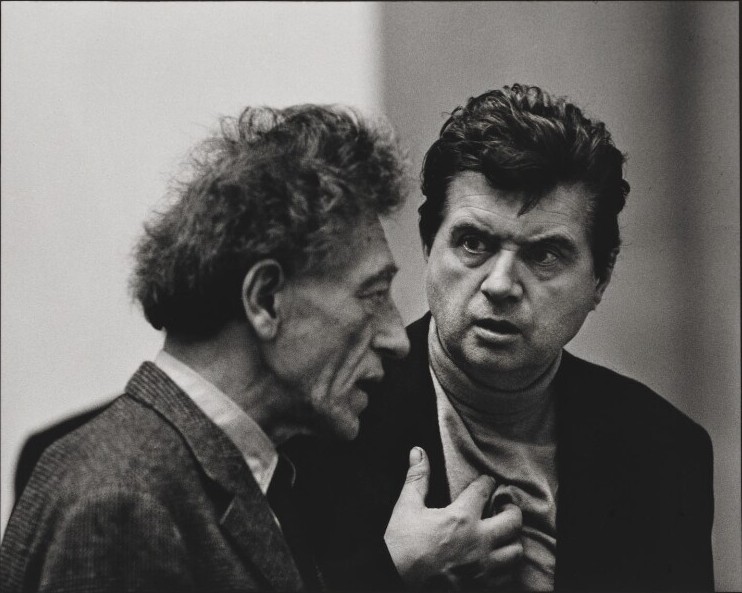


£1m cut of Bacon
GAZETTE UP TO DATE AROUND THE WORLD
EVENING GAZETTE | WEST LANCASHIRE | WEDNESDAY 6 MAY 1987
A PORTRAIT by Francis Bacon sold at auction last night for just over £1m, the highest price ever for a contemporary British artist.
The painting,
Work by Bacon Brings $1.76 million
.png)

.png)

Storming the bastion of art
Paris fêtes Francis Bacon as London shows
a French Revolutionary face
GEORDIE GREIG | ARTS | THE SUNDAY TIMES | 4 OCTOBER 1987
SPARIS has fallen completely under the hypnotic spell of Francis Bacon, whose new show opened at the Lelong gallery on Wednesday. For several days before the exhibition started, devotees gathered to stare at the paintings through the steel window shutters. All week France's newspapers and broadcasters focused on "le mythe Bacon". Even the rather sober Le Monde became so excited that it broke with custom and ran an arts story about the show on its front page.
"C'est sensation en Paris," intoned Francoise Guillard, the gallery's director, gleefully noting that, before Bacon, only an artist's death had merited front-page treatment.
The cause of all the excitement is a show of just 14 paintings. Only three are still for sale: a 1987 triptych priced at £2.4m, and two single canvases, both with price tags of £850,000. No other living British artist can command such veneration or such high prices.
Bacon, who will be 78 his month, evidently relishes the attention he is receiving. At the opening, the pin-striped and jaunty Dorian Gray figure was surrounded by admirers. Evidently seduced by the attention, he talked of moving permanently across the Channel. "I love France. I don't know why the French seem to like me but what I do know is that the critics in England loathe everything that I do."
Bacon's paintings have always provoked passion and controversy. Ever since April 1945, when his Three Studies for Figures at the Base of a Crucifixion was reviled as depicting "freaks and monsters" by war-weary London, his work has portrayed the rawest and most pained elements of human life. No 20th century artist has created such a relentless flow of uncompromising, iconoclastic images.
His new show is equally disquieting. The vocabulary of writhing bodies, twisted torsoes, bloody wounds trapped in spaceless structures is familiar. But again and again, his "images of ebullient despair", as he describes them, touch a raw nerve.
The sensation of viewing Blood on the Floor is similar to receiving an electric shock. The blood splattered on the grey floor in this cell-like orange room looks as if it has just burst from a wound. With the barest devices and with no human figures he has created the most disturbing narrative of human anguish with masterful understatement and ambiguity.
But Bacon has no time for theories or interpretations of his work. "I don't now how that painting came about. I think I just dropped some paint on the floor and thought I'd draw blood on the floor. It's just ... well, it's just blood on the floor.
"I never think of my work except in terms of images and I have never thought of it as violent. I just think of myself as a realist. It is its own language. I've just always painted to excite myself. There is no explanation."
For many no explanation is needed. One of his early patrons, Helen Lessore, who first showed his work in 1953 with a top price of £300 per canvas, flew over for the exhibition this week. She enthused: "The shape and rhythm of his images are still equal to any Renaissance Venus in a purely visual sense. For me they are the most beautiful paintings."
Geordie Greig
Scenes from a long life
RICHARD DORMENT | ARTS |

SIMPLE-MINDED BARBARIANS
FRANK DAVIS
WHAT a hard life I
lead! I have no sooner restored myself to respectability by welcoming
whole-heartedly the acquisitions by the Tate Galley from the Roland Penrose
estate of Picasso
Figure 2 is by Francis Bacon, self-taught and marvellously gifted. I can honestly say that I have never seen anything by him which does not make me shudder (a tribute to his skill) whether the subject is of the horrible men wrestling on a divan or such a painting as Figure 2 here.
This, to me, is no more than a portentous and impudent caricature of one of the greatest portraits in western art, that of the Medici Pope, Innocent X, whom Velasquez painted in 1644. More than a centaury later, it was described, by an evidently awestruck young Joshua Reynolds, as the finest painting in Rome. It still hangs there in the Doria Pamphili Palazzo. In my eyes, Bacon has degraded this dignified, far from saintly Pope from a clever statesman to a gawping, mentally deficient oaf.
I find that unforgivable, an insult both to the sitter and the great painter, on a par with the insult offered to Michelangelo by some bright ad-man when, to the giggling applause of fellow barbarians, he adapted the noble gesture of the Creator towards the newly created Adam by hanging a pair of blue jeans in God’s hand. There is clearly a cult for this kind of tasteless impertinence. What a way to spend money!
How pleasant it is to turn aside from such horror dreams, fit only, surely, for a swagger head-shrinkers casebook, to a few garden flowers, The Irises, of Figure 1 (New York at Sotheby’s), which were growing in the unkempt hospital garden at St Remy, where poor Vincent van Gogh committed suicide. He entered the hospital on May 8, 1889, and found relaxation and solace in the garden.

2—A caricature of the Medici Pope Innocent X, by Francis Bacon. 78 in by 57 in. $1.32 million
A brilliant monster
Richard Dorment on Douglas Cooper,
the flamboyant champion of Cubism
RICHARD DORMENT
A FAMOUS passage in Sir John Rothenstein’s auto biography recounts the former director of the Tate Gallery’s last nightmarish run-in with the art historian and collector Douglas Cooper.
“Immediately on arrival [at the Diaghilev exhibition on the night of Nov. 2 1954] I encountered Douglas Cooper, who promptly began to shout at me in a French accent. I hurried into the next room. Cooper followed me from room to room, shouting taunts from a distance.
“I tried to get further away. Several of those present remonstrated with him, but he persisted, and presently caught up with me in a room from which there was no escape. I turned and faced him. As the big face loomed close, anger welled up in me and I punched it hard. In a moment he was crawling on hands and knees, searching for his spectacles among the feet of the guests crowding around.” Rothenstein concludes: “Congratulations from all sides.”
Rothenstein’s well publicised blow formed the climax of the notorious “Tate Affair”, a vicious two-year campaign by Cooper and his allies to hound Rothenstein, whom they considered a reactionary from the Tate. Almost four years after Coo-per’s death, and in a final ironic postscript to the affair, a selection of works on paper from Cooper’s incomparable collection of Braque, Gris, Léger and Picasso goes on view at the Tate on Wednesday (until April 4).
By the time of his death, Cooper had quarrelled with
just about everybody in
the art world, from his own protégé
Graham Sutherland to his old friend Pablo Picasso. His
legacy, apart from his great collection and an arm
Even visually he cut an unforgettable figure. A big, powerfully built man with a piercing voice, he normally dressed with a flair for colour and pattern to rival the Brighton Pavilion, mixing in one outfit herring-bone trousers with a bright striped shirt, fantastic polka dot tie, screaming plaid jacket and, latterly, one of his many pairs of multi-coloured running shoes. Physically he was strong enough to recover from being stabbed three times in the stomach by a North African soldier in 1961.
Born in 1911, Cooper came from a middle-class English family whose fortune had been made in Australia in the 19th century. Educated at Cambridge, Freiburg and the Sorbonne, he spoke French and German perfectly though, curiously, in later life he sometimes affected to speak English with a heavy foreign accent. In 1932, influenced by his uncle, the musicologist and collector of musical manuscripts Gerald Cooper, he set aside a quarter of his inheritance, £25,000, to form a collection of Cubist art.
The sales in the 1920s of several important early
private collections, followed by a slump in prices for
Cubist pictures in the 1930s, meant that many great pictures
were on the market, and for Cooper the pursuit of Cubist
paintings “became [for me] the adventure of a lifetime”. In
less than a decade he had put together one of the finest
collections in Europe, a collection, moreover, which me
thodically charted the stylistic development of each of the
four artists whom Cooper considered
Cooper’s great contribution to art history was to approach the study of these artists with the same rigorous historical method hitherto reserved for old masters. He was an absolute authority on Cubist painting, and besides his many books and articles on the subject, he organised classic exhibitions in Edinburgh, Chicago, Los Angeles, New York and London. The last of these, “Essential Cubism”, was seen at the Tate in 1983.
The Tate Affair of 1954 shows Cooper at his best and worst — though any number of anecdotes could do that, for in the words of his obituarist John Richardson, it was as though an angel and a demon child were perpetually fighting for control of his personality. Cooper was not wrong to call attention to the backwardness of the Tate’s acquisitions policy. At a time when the Museum of Modern Art in New York under Alfred Baar was putting together its extraordinary collection of 20th-century art, the Tate either did nothing or bought the wrong paintings.
For a man of Cooper’s energy and intelligence, The Tate’s apathy and failure to cultivate private donors (including, one suspects, Cooper himself) was frustrating. Had Cooper been another man, able to use his consider able influence in a civilised way to put right a sad state of affairs he might have played an extraordinary educative for instance, of Sir Roland Penrose, founder of the Con-temporary Art Society. Indeed, given the force of Cooper’s personality and the violence of his opinions, he might, with a soupçon of diplomacy, have changed the way the English looked at art.
Instead, the breathtaking venom of his attacks actually lost him support, and finally confirmed Rothenstein as director of the Tate for a further 10 years. By the 1950s Cooper was no longer in the van vanguard of thinking about 20th-century 20th-art. What he didn’t like he By the 1950s Cooper was no longer in the vanguard of thinking about 20th-century art. What he didn’t like he rejected out of hand, and although his eye was extraordinary, his taste was extremely narrow.
The exhibition of selections from his collection at the Tate is the first important London exhibition of the year, and a fitting tribute to a brilliant monster.
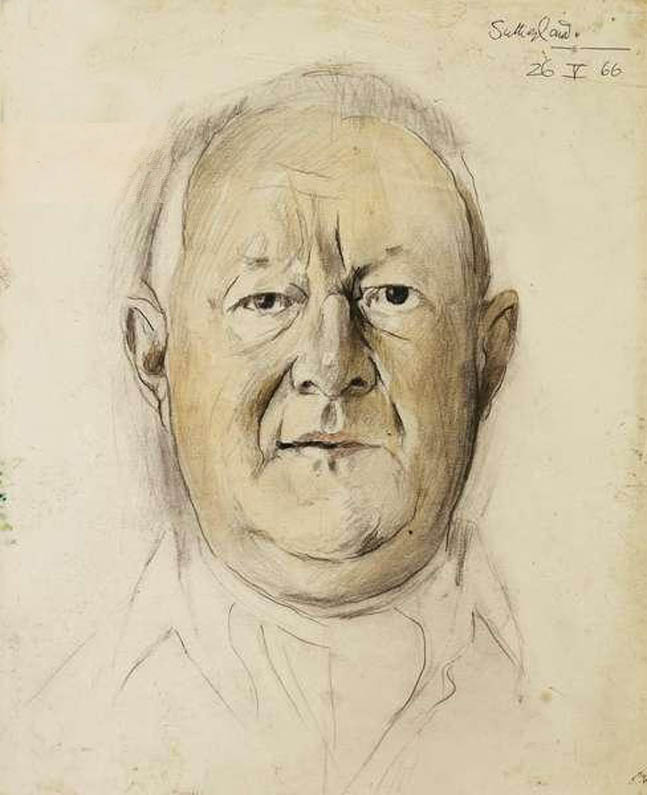
Graham Sutherland’s drawing of his friend, Douglas Cooper
Sides to
Bacon
PAPERBACKS
THE FIRST time I saw work by Francis Bacon was in the small municipal gallery in Hereford. It was a revelation. The tortured figures with distraught, dis-jointed faces smeared so generally with a bloody red were a reminder of our inescapable vicinity of violence.
I came away overwhelmed by the brilliance of colour that swathed the pulsating anatomical forms.
A brilliantly perceptive essay by Dawn Ades traces the development of the painter, his concerns with portraiture, abattoirs and Crucifixion (this not in any Christian sense) which all ultimately converge in the lunatic inevitability of violence to which humanity is subject.
The influence of Aeschylus, T.S. Eliot, Nietzsche as well as of Georges Bataille, Surrealism’s self-styled “old enemy from within”, is discussed. The sources of Bacon’s complex view of reality are multiple.
The book is a re-publication of the Catalogue for the retrospective Exhibition held in the Tate Gallery, London, in 1985.
KATE ROBINSON
NATURE AND RAW FLESH
.png)
Bacon for Russia
ARTS
SOVIET glasnost has led to a rare opening for Britain’s most expensive living artist, it was announced yesterday.
A two-month exhibition of the work of Francis Bacon opens in Moscow in September, the first by a contemporary British artist.
The major exhibition, arranged by the British Council after increasing Soviet Interest in the 78-year-old artist, heralds the start of a series of cultural exchanges behind the Iron Curtain.
The director of the British Council’s fine art department, Mr Henry Meyric Hughes, said yesterday: “This exhibition is the direct result of the very high regard in which Francis Bacon is held in the Soviet Union, and provides an invaluable opportunity to introduce the artist's work to a new and extensive audience.”
“It promises to be a major event in terms both of its artistic impact and in the context of international cultural relations.”
The council said a modern British art exhibition which was shelved at the time of the Soviet invasion of Afghanistan was being rescheduled for 1989.
The National Theatre is planning a visit in May and June. There have been no major exhibitions of British artists since the Turner festival in Moscow and Leningrad in 1975. The Bacon exhibition is being backed by Marlborough International Fine Art.
Bacon, born in Dublin to English parents, became the most expensive British artist after plus sale last year, at Christie’s in New York, of his 1973 Study For Portrait II.
.png)



Crisp look at Bacon
PROGRAMME GUIDE
ARTISTS on Film: Scenes from Working Lives, is an early evening treat on BBC 2.
Last week's look at the no-nonsense attitudes of Henry Moore, Augustus John and L.S. Lowry would have been entertainment even to people who have no interest in painting or sculpture.
More of the same is likely tonight when acclaimed painter Francis Bacon is seen at work in his studio, from a film made in 1966.
Sculptor Elizabeth Frink is also shown in her studio in the South of France in 1971, and there are small extracts from films about Barbara Hepworth, Peter Blake and Michael Ayrton.
CARA CHANTEAU
Painting theft:
Ransom denied
NEWS
| SHROPSHIRE STAR | THURSDAY, JULY 21, 1988
Scotland Yard has denied it is investigating a £1 million random demand over the theft of a painting owned by London’s Tate Gallery.
Xan Smiley notes Soviet reactions to Francis Bacon’s work
XAN SMILEY
It was quite fun and quite revealing to beard Russians coming out of Francis
Bacon’s
Moscow exhibition yesterday. What was their impression of the 30 or so major
works on show? They were
Generally, however, these first-time viewers could not say whether they liked it
or not. The overall reaction was puzzlement—
Bacon, of course, is alien to many solid Britons too. But the puzzlement was
different from the confident
Many of my interviewees apologised for giving a
Indeed, until recently they were not. And even today, it would be very hard for
a Russian equivalent of Bacon to find a gallery to place his work. With
glasnost, abstract or non conformist art is coming slowly back. So far, however,
it is mainly for foreigners to buy. for badly needed hard currency.
Incidentally, the avant garde Soviet painters who sold their work through
Sotheby
“If
you have a very strong feeling for life, a shadow of death is always with you,
Bacon’s
unabashed homosexuality, not at its most explicit in this selection for the
Russians, is also theoretically
“alien”
to Soviet man, who can still get five years in a labour camp for homosexual sex
(eight years for involvement with minors). There was more puzzlement when this
aspect was mentioned. Even the two or three ultra-glasnost Soviet articles which
in the past two years have dared to raise the question of homosexuality with
some sympathy have usually described it as a sickness or
“pathology
Of the 25 or so visitors whom I questioned, just one—the same enthusiast quoted
earlier—said with intensity:
“A
person is entitled to express any aspect of his internal life. We have been
frightened of that. We shouldn
As a footnote, I was amused by a slightly and no doubt unintentionally skewed
nuance in the Russian translation of Lord Gowrie
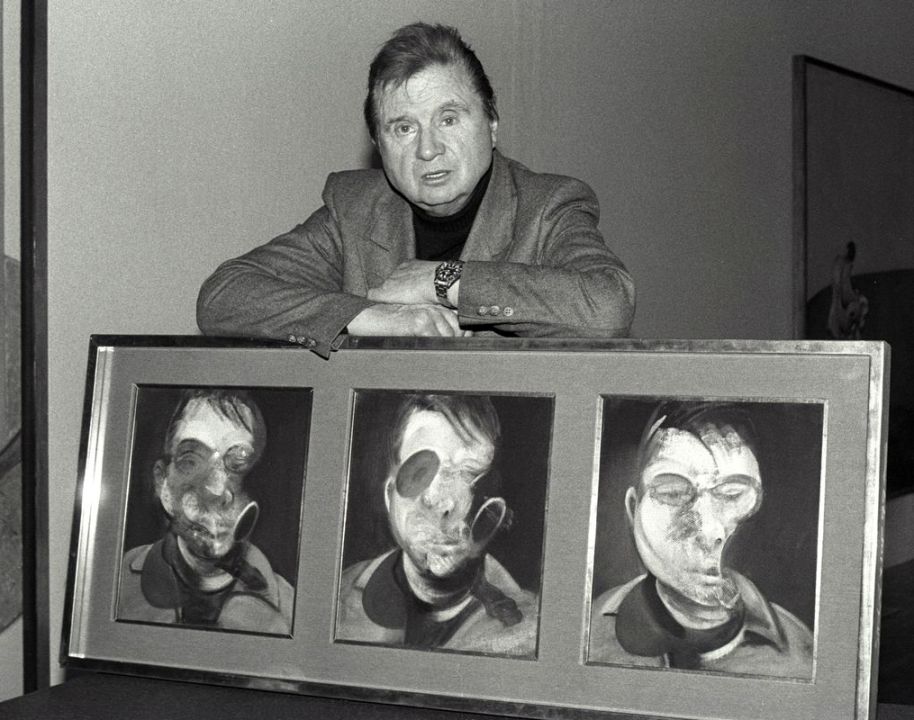
Francis Bacon, pictured at the Tate in 1985: “Alien to many solid Britons, too”
Master of ebullient despair
PROFILE: Francis Bacon, confounder of art critics
PROFILE | THE INDEPENDENT | SATURDAY 24 SEPTEMBER 1988
Mrs Thatcher does not regard Francis Bacon, an exhibition of whose work opened in Moscow on Thursday, as part of the acceptable face of cultural glasnost. She once described his as “that man who paints those dreadful pictures.” The remark caused outrage in the artistic community. ( “How dare she...” ) but Bacon, who once turned down a knighthood, cares as little for politicians’ opinions as he does for their baubles. He is not that kind of artist. Not for him those fashionable little dinner parties in north London where groups, named after the date on which they first met, are set up to fight Clause 28, cuts in welfare and other causes that disturb the digestion.
“The way you behave when you’re just a man in the street, the way you feel about Mrs. T. or killing dolphins; he has no interest in any of the things that engage ordinary mortals”, according to one acquaintance. “With a paint brush in his hand the imagination is at work.” Bacon, still bouncy at 79, prefers the low life of Soho, drinking champagne with friends like Geoffrey Bernard in the Colony Club, eating oysters at Wheeler’s or simply standing in the food hall at Harrods, eyes devouring the inspirational glitter of butchered meat.
He was upset because some of his more explicit paintings were excluded from the Russian show, but seemed content to let others make the fuss. David Sylvester, whose possessiveness of the Bacon legend causes irritation among London’s feuding artistic factions, speaks of censorship. “His most important work in the permanent collection is his central panel of buggers”, Sylvester says. “They’ve censored it. I feel the British Council quite rightly toes the line because it’s not like sending a cricket team to Russia is it? They wanted the work to be seen.
“Francis was frightfully excited about his show but he did lose some of his enthusiasm once they were censoring it. The main reason he’s not going there is because he’s had terrible asthma recently. Terrible. I can assure you that.” Sylvester paused. “I know what goes on”, he said. “His doctor’s a friend of mine. Who also happens to be my doctor.”
What the Russian public makes of Bacon’s work remains to be seen. Ten years ago its reaction could have been predicted. The yawning, distorted figures, screaming silently like bodies dug from a bomb disaster would have been embraced as further evidence of the decadence of Western society. “Now they’ll probably lean over backwards not to criticise it that way”, says the English critic Brian Sewell. “The problem will be they won’ t find anything they can attach to their own tradition. There’s no panting in Russia which in any way resembles Bacon’s work.”
Confusion about Bacon remains also a British problem. Few painters have caused such gargling literary agonies in that final refuge of purple prose, the English art room catalogue. Many critics, wrestling to understand his work, run to ground in thickets of verbal ambiguity. One described his Paired Figures on a Bed, an explicitly homosexual work, as follows: “Bacon brings them close to hard-core porn but then elevates them with his vision and technique into an abstracted allegory on which he makes a savage, shuddering, visceral comment.”
Thirty years of this kind of knowing gobbledygook have given Bacon a hearty dislike for most critics. Listening to them rummage through his paintings, many of which reflect intimate disappointments, he regards them as little better than burglars rifling his bedroom drawers. Occasionally, it must be said, Bacon seems to invite an incredulous reaction to the stories he has told about his early days. As a young man in Paris he bought a hand-painted book on diseases of the mouth. He says he was fascinated by the colours (imagining them turned into a Monet sunset) but the incident encouraged critics to indulge themselves over the surgical imagery of much of his post-war work. Bacon’s portraits are often seen as operations in which the subject is cut open and exposed. Cynics say that this is why his pictures of Mick Jagger were so bland; Bacon slit open the rubbery mask and could find nothing behind it.
His triptychs, launched in 1945 with Three Studies for Figures at the Base of a Crucifixion, followed the European tradition of altar pieces. Their mystical coldness, reducing the images of man to that of a godless animal, illustrate Bacon’s pessimism and can arouse extraordinary anger in people who feel that spiritual values, so central to Botticelli and Michelangelo, have been crudely betrayed.
English puritanism, coupled with the curiously British aversion to collecting contemporary art, may partly explain why Bacon has had to look abroad for his more appreciative audiences, despite two retrospectives at the Tate in 1962 and 1985 The French applauded “le mythe Bacon” at his exhibition in Paris in 1971. Queues for the show chanted his name. In America last year his Study for Portrait II became his first work to break through the auctioneer’s £1m barrier. Shrewd marketing by his dealers, Marlborough Fine Art, is another reason why Bacon’s paintings seem to disappear into thin air. A friend remembers meeting him in Soho just after VAT was introduced. Bacon looked very cheerful. “They just sell all my pictures abroad and there’s no VAT on exports.” For a man who is supposed to be indifferent to money, happy to lose thousands in an evening of roulette, Bacon can be very cute about the stuff.
Francis Bacon was born in 1909 in Ireland of English parents. His grandfather was the police chief in County Kildare and lived in fear of Sinn Fein behind road trenches and sand-bags. His father, who trained race-horses, was a descendent of the Elizabethan Francis Bacon whom Bacon once said was also a homosexual “though that’s only gossip”. The stories about his childhood are disturbing. His parents spent their money on parties rather than afford him a formal education. Bacon has said they became aware of his homosexuality at an early age. It was one reason why his father packed him off, aged 16, to survive on a small allowance.
He lived the life of a Bohemian vagabond in Europe and London designing art deco furniture, dabbling with a group of surrealists an abstractionists called Unit One, taking odd jobs (one of them as a solicitor’s house servant), stealing without remorse if the need arose. Even in his more prosperous years he still prefers the squalor of his tiny studio in South Kensington, its floor littered with debris and stalagmites of old paint. He still prefers o use the rougher surfaces of the backs of his canvases, once a frugal necessity when he lost all his money gambling at Monte Carlo.
Even as a painter struggling for recognition Bacon never allowed poverty intrude on his love of the good things. He was a favoured client of the Colony Club whose formidable owner Muriel Belcher became the subject of several portraits. Muriel called him “Miss Bacon” and paid him £10 a week to bring in the big spenders. He hated television but agreed to an interview in Wheeler’s with his old friend Daniel Farson to wipe out his bills there. Bacon destroyed most of his earliest paintings, putting his canvases down with a razor. “They were, I suspect, bloody awful,” one critic says. He’d had no training as a painter. Only when Ruskin Spear had taken him on one side and really hammered home the principle of strong drawing and painting did he pick himself up and start pushing.
A more important influence was John Minton, a teacher at the Royal College whose loping gait, haggard appearance and wild variations of mood reminded people of a preoccupied scarecrow. Bacon, eight years his junior, met him at the college where he was regularly fed and watered. “I suspect that Francis fund a kindred spirit in John,” says ne of Minton’s old friends. “John continually painting the sailors he had been to bed with the night before, released Francis from all sorts of reticences. It was a kind of sexual and artistic regeneration. Under Minton’s wings in the 1940s he managed to get rid of his inhibitions and behave quite freely.” In 1957, during a serious emotional downer, Minton killed himself.
Tragedy has always formed a seedy obverse face to the glamorous squalor of Bohemian life. Bacon recorded it like a reporter when it touched his own experience. His better known portraits include several of his one-time lover George Dyer, a petulant drunk who always acted as Bacons model and handyman. After a quarrel about money Dyer told the police that Bacon had cannabis in his studio. When the drug squad banged on his door Bacon, rather surprisingly for a Soho rake, asked “Can I telephone Lord Goodman?” He was acquitted in court. As an asthma sufferer the charge of smoking was absurd. Weeks later, on the eve of Bacon’s triumphant how in Paris, Dyer died of a haemorrhage on the lavatory in their hotel suite. Bacon consoled himself by painting two pictures of his friend’s undignified death.
Neither financial nor critical success have dislodged him from his old haunts or deterred him from his drinking sessions that bring younger men to their knees. Friends detect, however, a growing sense of mortality. “He’s actually terrified of death,” one of them said. “That’s why he dyes his hair and plays around like a 40-year old”. No one will have provided a more appropriate epitaph to an extraordinary life than the artist himself. The writer Peter Lennon found it in his pocket, scribbled shakily on a crumpled card, after a surreal night of boozing with Bacon and some of his cronies at the Colony Club. During that session, with champagne bottles materialising sweatily in the gloom, Lennon had managed to disengage a phrase which Bacon had used to describe his work. It read: “Ebullient despair.”
.png)
IN BLACK and white baseball shoes, a pink and white stripped shirt under his black leather bomber jacket, Francis Bacon looks the perfect picture of health, happiness and bonhomie. His whole body twists with a restless energy as he sits in a tubular steel and leather chair in his London gallery. Every sentence is animated by gesture.
His one regret, he says, is not being in Russia. The 78-year-old artist has been prevented by an attack of asthma from travelling to Moscow to see an exhibition of his paintings there. This was a rare opportunity missed as he is the first living Western artist to be honoured with a retrospective exhibition in the Soviet Union.
“It is a great disappointment. If it wasn’t for this bloody asthma I would be over there. I had been looking forward to it. Everything was closed up after 1917. It would have been fascinating to see the country now,” he mused glumly.
The show is the pinnacle of an extraordinary career. In Britain, Bacon has had the rare compliment of having two retrospectives at the Tate in his lifetime and was hailed by the gallery’s then-director, Alan Bowness, as “the greatest living painter.” The show in Moscow possibly eclipses even the Tate’s accolade.
It was arranged after James Birch, a Soho gallery owner, made the rounds of Soviet artists’ studios in 1986 and discovered how many of them were interested in Bacon’s work. He mentioned this to Bacon and a Soviet diplomat called Sergei Klokov, a member of his country’s Unesco delegation with exceptional contacts in artistic and government circles. And thus Bacon’s work – if not the artist himself – was brought behind the Iron Curtain.
Yet although he is pleased by the Moscow show, Bacon fends off questions about how it will be received. “All I know is that my pictures are some of the most disliked among any modern paintings. I have no idea what the Russians will make of them.”
Despite international fame and great wealth (his triptychs fetch more than £2m), Bacon lives and works as he always has done: aloof, alone and as anonymously as possible. He paints early in the morning in the two-room mews house in South Kensington where he has lived for many years; barely furnished, undecorated and cluttered by a chaos of paint pots, old newspapers and junk. He makes no preliminary sketches but draws straight onto the canvas.
He still constantly admits failure, destroys canvases as he goes along and spends his time outside his studio eating well, drinking hard and spinning the occasional roulette wheel late into the night around Soho. “I have lost 10 times more than I won but I always believe I am going to win.” Loses and gains run into thousands.
The one constant in his life remains art. “I do feel the need to paint. I paint for the excitement which comes when the image comes across but I also hope luck will work with me in paint. I have always painted to excite myself. For me images are ways of unlocking the valves of sensation. It is when you stop fumbling around and the images crystallises or when you realise you can take it further.”
The Dublin-born painter dismisses interpretations of his work, albeit with a
charming smile. Although he will be 80 next year, Bacon’s
physical appearance disturbingly belies his age. His fingers are stumpy and
strong like a workman’s. His face is
virtually unlined. His eyes can cut you dead or sparkle with a leprechaun
“When one talks about paintings, it’s all nonsense. It has its language and anything else is a bad translation.” He quotes, instead, from one of Van Gogh’s letters: “ ‘How to achieve such anomalies, such alterations and refashionings of reality so that what comes out of it are lies if you like, but lies that are more than literal truth.’ That for me is one of the truest things ever said about painting,” he said.
The Moscow show is just 22 pictures, a selection of his work from 1945 to the present day. On view is a selection of Bacon’s “images of ebullient despair”, as he himself describes them: the vocabulary of writhing bodies, twisted torsos, bloody wounds trapped in spaceless structures is familiar. “The same old stuff,” he humorously refers to it.
But there are also two new pictures which both retain and refine that disquieting quality of forcing people to stop in their tracks: Jet of Water and a portrait of his friend John Edwards, a monumental, classical and relatively restrained work.
Yet even when pressed about these, Bacon won’t be drawn into explanations. “It’s just ... well, it’s just a jet of water. That’s all I can say. Somebody said to me the other day it must represent an ejaculation but it’s not ... it’s just a jet of water.”
In painting as well in his gambling he makes chance a live element in his work. “In Jet of Water I did actually throw it on with a pailful of paint. It does have that energy of being thrown on. Everything that ever works for me comes through accident and accidents which I can then begin to evolve from,” he said.
Just like the poet W B Yeats, one of his favourite authors and a direct inspiration for several pictures, he is now reworking and refining themes from past works. This year he has just repainted a new and larger version of Three Studies for Figures at the Base of the Crucifixion, his 1946 triptych which first brought him wide public attention. “It actually looks rather good,” he enthuses in a rare moment of self-praise.
The difference is that in 1945 the paintings were reviled as depicting “freaks and monsters” by a war-weary London, while today they will be priced for millions of pounds and win admiration worldwide.
Last Thursday, nine hours before his Moscow show opened, queues had begun to form. Bacon just regrets he was unable to accept the Soviet Union’s invitation to join the throng.

THE Francis Bacon exhibition in Moscow, which opened on September 22nd, marks a high and visible point in cultural glasnost. Mr Mikhail Gorbachev’s new spirit of openness has allowed such recent well-behaved exchanges as the Pushkin/National Gallery swaps, but an exhibition by the vieux terrible of western art is candour of a different order.
For the past half-century, the only con-temporary art available to the Russian public has been Stalin’s state-sanctioned Soviet Realism, a high-minded, clean-limbed (and fully clad) celebration of Marxist-Leninist For the past half-century, the only contemporary art available to the Russian public has been Stalin’s state-sanctioned Soviet Realism, a high-minded, clean-limbed (and fully clad) celebration of Marxist-Leninist ideology. Mr Bacon’s exploration of the human condition, often through the medium of some of the most carnal flesh ever painted, could hardly be further removed, both in medium and in intent.
The British Council, which co organised the exhibition, was a little concerned that Muscovite viewers might find Mr Bacon’s iconography unpalatable. The artists homo-eroticism, hypodermic syringes and particular fondness for Trotsky’s blood-spattered writing desk were all represented in the show. Nobody need have worried. Nine hours before opening time on the first day, a queue of several hundred had formed outside the New Tretyakov building to see the paintings. These had been drawn from the artist’s entire creative period, from 1949 to 1988, and included two canvases-“Jet of Water” and “Portrait of John Edwards” on public display for the first time.
Once the crowd was in, adverse reaction to Mr Bacon’s work came from the same sort of quarters as it might have done at the Tate. An aged army officer suggested the painter belonged in an asylum; a young soldier spoke rather too approvingly (as might his Sandhurst equivalent) of Mr Bacon’s “torturing of the flesh”; and a mother, toddler in arms, confessed herself mystified as to “how any man could paint such things.”
Most viewers, however, pooh-poohed any suggestion that the artist might be decadent; they were more interested in the arcana of his brush technique and his relationship to mainstream Expressionism. Favourite pictures among the Muscovite public appeared to be Mr Bacon’s 1957 painting of the nanny from Eisenstein’s “Battleship Potemkin” (probably for reasons of national amour propre) and the artist’s recent triptych self-portrait.
Although many of these viewers are members of Moscow’s old cultural under-ground (in which Mr Bacon’s work enjoys a wide and devoted following), most are simply curious laymen. For these, especially, the English painter’s work has caused obvious bafflement. One engineer remarked, a little wistfully, “It is difficult for us to understand Francis Bacon’s work. We have no context in which to place it. Perhaps if he had come himself, he would have been able to explain.” (Mr Bacon, who is 78, was prevented from coming at the last minute by chronic asthma and an aversion to press circuses.)
Despite these difficulties, the Bacon exhibition continues to draw huge crowds and to excite both private and public discussion. Although there is a general curiosity among Russians about things western, the artist’s spectacular reception may, it seems, have deeper roots. Mikhail Sokolov, a Russian critic, suggests in an addendum to his essay in the show’s catalogue that Mr Bacon’s remorseless stripping away of human façades in search of truth makes him “the natural artist of glasnost”.
Perhaps the most profound observation on Mr Bacon’s work, however, came from a red-headed 70-year old woman, a member of the apparently infinite reserve of babushkas who haunt any Russian public gathering. “His pictures are very interesting, she pronounced after a thoughtful pause. “I think he is beginning to move in the right direction.”
Francis Bacon, at the Central House of the Artists, Moscow, to 6 November.
IN A letter to The Independent this week Lord Gowrie, poet, former art dealer, recent minister for the arts and present chairman of Sotheby’s, criticised last Saturday’s profile of Francis Bacon for dwelling on the painter’s private life rather than on his art. Gossip of that sort, he complained, fails to tell us why Bacon is, with Henry Moore, the most widely admired British artist since Turner. Lord Gowrie seemed to be suggesting that the private life of those who create works of art has no relevance to what they create; or, as TS Eliot put it, that “the more perfect the artist, the more completely separate in him are the man who suffers and the mind which creates”. That approach inspired a whole school of literary criticism, which reached its apogee in the 1970s. According to its adherents, a play, poem or novel is a self-sufficient entity which, once complete, cuts itself off from its creator and owes its real existence to the reader. The author’s motivation and intentions are irrelevant. All that matters is the end product.
As a corrective to an unduly biographical approach to criticism, such rigour was no doubt valuable in its day, and retains some validity: to search a Dickens novel for references to his private life may be fun, but is likely to diminish a full appreciation. Yet common sense and experience tell us that knowledge of the life and times of artists, writers and composers can greatly increase our understanding and enjoyment of their work. To a greater or lesser extent, their life is their raw material, and that is certainly true of Francis Bacon.
Such knowledge is, naturally, not essential to appreciation. We know little or nothing, for example, of the lives of Homer or Giotto. Yet even in the case of Old Masters like Michelangelo, Leonardo da Vinci and Rembrandt, some inkling of their struggles and of the range of their achievement gives their smallest drawing an extra resonance. From the Romantic movement onwards, the link between art and life grows stronger, pervading the work of some, less evident in others’. To remain with the fine arts: the cases of Van Gogh and his friend Gauguin demonstrate how some biographical knowledge deepens appreciation of their work.
Would we fully understand Van Gogh’s anguished canvases if we did not know that he suffered from hallucinations and depressions which led him to suicide? Does the nobility of soul revealed in his letters to his brother not give his landscapes, portraits and still lifes an extra poignancy? Gauguin’s voyage to Tahiti was not some touristic whim which he chose to illustrate with paintings, but an attempt to escape from the “disease of civilisation”, as he put it, to find the truth and become on’ with nature. Toulouse-Lautrec, Rodin, Picasso, Giacometti and Henry Moore were all, in their very different ways, obsessed with women, and to know even a little about their lives is to see their work with fresh eyes — though glibly to equate the holes in Moore's work with his First World War days as a bayonet instructor, as a recent television profile did, shows the pitfalls of the biographical approach.
There are even more writers than painters whose work is hard to divorce from their life. In English and American literature, Byron, Wordsworth, Dickens, Oscar Wilde, Scott Fitzgerald, Conrad, Hemingway and Henry Miller come to mind. In the case of Dr Johnson, life and work were virtually indivisible, Across the Channel, the same could be said to a greater or lesser extent of Montaigne, Victor Hugo, Zola, Rimbaud, Verlaine and Proust, among many others. Music being an abstract art, the interpenetration is subtler. Yet listening to the work of Mozart, Beethoven, Schubert, Tchaikovsky and Wagner, for example, we are aware of lives suffused by drama and pain. Knowing more about them may not increase our enjoyment, but can give it an extra dimension.
To acquire a greater sense of communion with such spirits by dipping into their lives is a far remove from the voyeuristic activity encouraged by many contemporary biographers. Pandering shamelessly to prurience, they lay exaggerated stress on the sexual exploits of their subjects, thus often distorting understanding of life and work alike. It is equally sad when a single human flaw comes to dominate a reputation, as in the case of Ezra Pound’s fascistic tendencies. But to deny the link between life and art is, ultimately, to suggest that the identity of the artist/author is of secondary importance: and for the chairman of Sotheby’s, a firm dedicated to the sale of correctly attributed works of art, that would do.
TUESDAY — Arriving in Moscow on a late September afternoon, I was just a little disappointed to find it not nearly so grim-looking as I had expected. The Kremlin and the former St Basil’s Cathedral, visible from our good old-fashioned bourgeois hotel, the National, seemed in an almost indecently pristine condition; but the large capital-city baroque and rococo buildings were simply well-preserved. They are stuccoed and painted with very gentle greens, yellows, greys and pinks, making an environment not at all like the capital of an “evil empire” — in appearance at least.
The guards on Lenin’s squat, shiny tomb look as if they have been embalmed on their feet, and they seem mere relics in the wonderful autumn sunlight. The absence of litter, graffiti and consumer advertising is soothing. The interpreter whom I share with my colleague from The Independent, Andrew Graham-Dixon, is a lady called Galina. She is a remarkably spirited person, a passionate though anxious supporter of perestroika and a tireless and formidable negotiator with taxi-drivers, restaurants or anyone at all.
WEDNESDAY — This morning we went to the Pushkin Museum. It was completed in 1912 as a centre for the study of casts of classical sculptures. It was the opening day of a generous and handsome exhibition of loans from the National Gallery in London. There was a queue about a hundred yards long outside, but I managed to jump it with the help of an impressive lady curator who unfortunately made me solemnly promise not to take any photographs inside. A good one would have been of 12 Russians sitting on a bench and looking very seriously indeed at Goya’s Doña Isabel de Porcel, which, curiously, had been given a starring role under spotlights at one end of the Grand Gallery.
After being pestered by some cheerful young currency dealers in the street, we went to see the Bacons being hung at the new Tretyakov Building facing Gorky Park, but all the pictures save one were already in position. The hanging and choice seemed as good as they could be.
I wondered again if the Russian authorities knew of the dramatic allusion to Trotsky’s murder by Stalin’s agent in one of the images in a triptych hanging in the exhibition. This was taken from a photograph of the victim’s study in Mexico City but not mentioned in its title. Later I dined alone at the Central, served by a good waiter with an amazing rococo moustache, then had a few drinks with the British contingent and Galina.
THURSDAY — This was the day of the opening of Bacon’s show; it was to be preceded by a press conference. But before that I went with Andrew and our indispensable guide to see an ageing dissident artist, Lev Kropivnitsky, who spent nine years in a labour camp just after the war on an entirely trumped-up charge. He became a kind of Abstract Expressionist after seeing the officially vilified show of modern American paintings in Moscow in 1958, but has since developed through a sort of post-Cubist phase to painting very deliberate semi-Expressionist daubs of figures, sometimes mythological in character. They reminded us of our own Ken Kiff and several others as well, so we concluded that the zeitgeist was to blame.
We felt a bit baffled by this polite, quiet man. After a very good lunch, with which we drank kvass, a strange, weak, sweetish beer made with rye bread, Galina took us to the nearby Cathedral of the Epiphany, the most important Orthodox shrine in Moscow. It was the most sumptuously deco-rated church (everything nineteenth century) I have ever seen, with an enormous gilded screen, elaborate brass ornamentation and very many icons, mostly kitsch but some beautiful as well. It was astonishing and saddening — but also very moving — to see oldish women fervently kissing the icons and abasing themselves with fore-heads pressed to the floor, meanwhile others were mopping and polishing everything in sight with great vigour — clearly determined to keep the place as splendid as any Tsar’s palace.
Then we went to the press conference, where our former arts minister, Lord Gowrie, addressed the assembled hacks and others. His speech and his preface to the catalogue demonstrate that he believes very strongly that Bacon is the greatest English painter since Turner.
We then went to the opening, and very crowded it was. Although many of the viewers at first seemed a little worried or sceptical, as Muscovites often do, most who were asked their opinion said they thought the work was very interesting, impressive or great. But Bacon would surely have failed if his images had not disturbed quite a few people. One girl said approvingly that he was a “classical painter” — a thought that was echoed by others. I myself can see no serious barrier which would prevent Russian people from appreciating the pictures, as they respond particularly to what is heroic and direct in art, and Bacon’s work is surely both. The paintings, which seem to declare a belief in human mortality combined with a spirited defiance of it, could scarcely seem alien to a nation into the fabric of whose very being both have been woven for so long.
We all felt that the occasion had been a great and historic one, and regretted not being able to toast the artist in person. So we toasted Francis in his absence, first at a party given by the Union of Artists and then in the National bars. We rose the next day feeling battered but unbowed.
FRIDAY — I was off quite early to photograph the queue for the exhibition. In the morning everyone looked horribly to the camera. To get to a reception given by the British embassy, I tried using the metro for the first time. It is beautiful, but I missed my station because of my poor command of the Cyrillic alphabet, and got involved with a mass of Russian pedestrians, who are alarmingly unwilling to avoid bumping into anyone who stands in their way. I became quite concerned about being knocked down and trampled on by this army, which might just as well have had snow on its boots. But finally I reached the embassy after a taxi ride and a walk through the Arbat, a handsome pedestrian street where there were bad pictures for sale — garish caricatures and paintings of onion-domed cities.
After an interrogation by three enormous and suspicious Russian soldiers, I was admitted to a spacious and comfortable apartment hung with good English water colours. I spoke to the ambassador, Sir Roderick Braithwaite, and discovered that I had known and admired his father, the conductor Warwick Braithwaite, when I worked for an opera company long ago. I found Braithwaite Jr a remark ably pleasant ambassador.
I went back to the exhibition. The queue was in a better mood, and there were crowds round a video screen which was showing Melvyn Bragg’s television programme about the artist. They looked as if they were watching life on another planet. The evening passed well and involved more conviviality at the National. I retired, sorry that it was our last night in Moscow.
SATURDAY — In the morning. Andrew Graham-Dixon, Galina and I set off in a taxi to do some shopping and see the market in the woods of Ismailovsky Park. Minor trouble arose in the taxi over currency: the driver wanted to be paid in Western cigarettes. We found another taxi. We bought some souvenirs in a folk-art shop and then headed for the market. It was suggested that I might like to photograph a vodka queue, a common and depressing sight and perhaps quite seriously the unacceptable face of perestroika. To a hard-currency drinker, the idea seemed unkind. I had been determined to try a Georgian restaurant, the Arakvi, that a friend in London had recommended. Galina telephoned; she had to tell them that we were very important journalists to get a table. At the Revolution Square metro station on the way there, we saw a staggering colonnade of bronze figures of workers, peasants, soldiers, athletes and scientists set in the archways giving on to the platforms.
They seemed to me the most remarkable examples of civic statuary I had ever seen. There have always been one or two Socialist Realist images I have liked, but I had never been moved by them before. I had also imagined the Moscow metro to have only a very few opulent stations, but there appear to be many. One or two seemed decorated with surprising and admirable restraint, but I have since learned that this is generally where overtly Stalinist emblems have been removed.
We then arrived at the restaurant and they still seemed very reluctant to admit us. But Galina triumphed again. We sat in one room and were told that the service would be quicker in another. So we moved and were told that the food would take one and a half hours to prepare. Galina went into action again and, after we had been shifted to another table, the food arrived in about 40 minutes. At 2.30pm the place was still only one-fifth full, and a great many customers must have been turned away.
The impassive waiter then explained that it was all the fault of the “social system”: “No incentives, low wages, tipping forbidden — why should I bother to work hard? I will emigrate as soon as I can anyway.” The Georgian food is good and seems utterly unlike any other. But as we had to get to the airport, we couldn’t finish the meal. It seemed a bizarre farewell to Moscow after three of the most interesting days I’ve ever spent abroad.
Galina came to the airport and fought another minor battle for us. If you go to Moscow, learn the Cyrillic alphabet and try to find her.

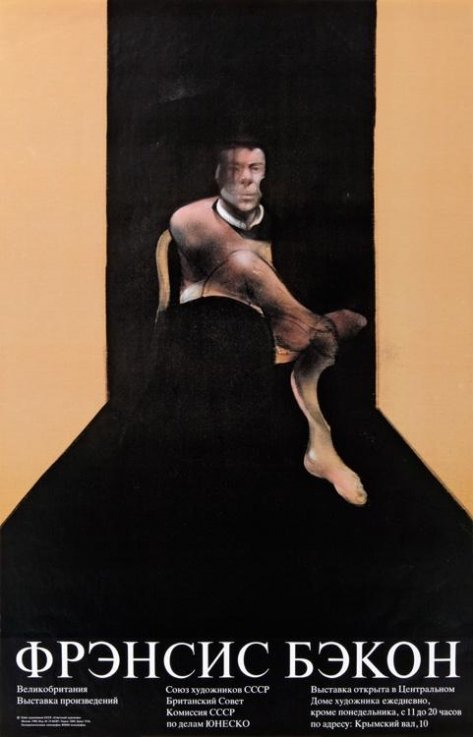

.png)

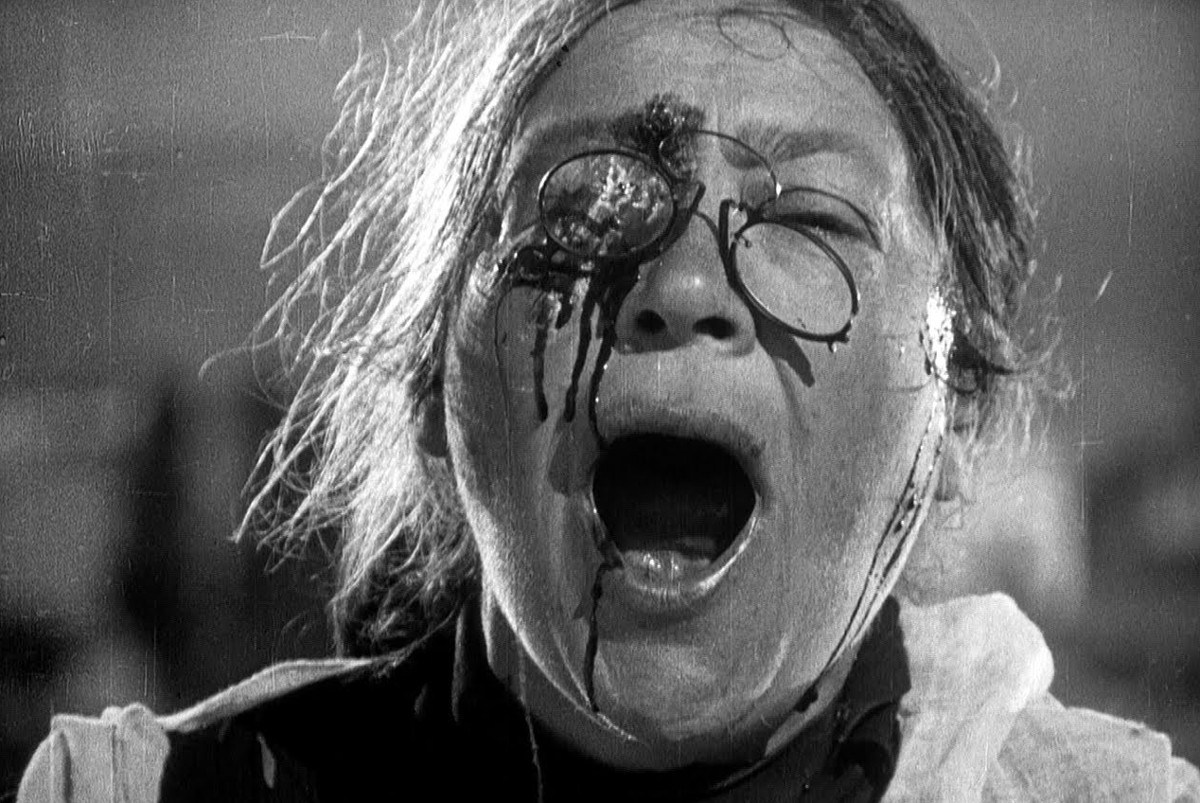

Tragedies without a Hero:
The Art of Francis Bacon

THEY should import some real English bacon, not this rubbish,” said one tired visitor to the Francis Bacon exhibition in Moscow, waving an empty shopping bag. Her comment was not typical: the exhibition of 32 canvases by the English artist, now being repacked into polystyrene and wooden cases, has been an outstanding success, writes Angus Roxburgh.
In just six weeks it was visited by 150,000 people, and the fat collection of
comments in the visitors
An architect commented that the paintings were the work of the devil. A man who described himself as a war vet-eran thought the only explanation was that Bacon suffered from “severe concussion of the brain”. A doctor diagnosed: “Bacon is a psychologically traumatised person.”
“Charlatanism!” exclaimed one brief note. Another read: “Total idiocy! A
nightmare! Sacrilege! What fool brought him here?” “Horrible, what do we need
him for?” ..“It’s
disgusting and repulsive!
Several writers were concerned about the effect the exhibition could have on
Soviet young people, and there were a fair number of nationalistic objections to
The exhibition evidently struck a chord with many visitors, who found the British painter had much of relevance to say about the Soviet predicament. One found the works to be a warning against the “terrible danger of totalitarianism and communism” a plague which he likened to Aids.
“Bacon teaches us how, in a democratic society, talent flowers and reminds us that, in our authoritarian bureaucratic state, educated people perish.”
A Ukrainian artist remarked that most of the visitors were like people in a prison looking at the sky through the tiny window: “Don’t believe the bad words written in this book, Mr Bacon, you are a great painter.” Some tried their hand at English: “I understand everythings in your fantastick ideas. Mayby I guess and think it’s you Mr Francis realised dreams in picture. Thank you very much.”
A serious objection was to the lack of catalogues (only 5,000 were produced) or of a guide to help to “explain” the pictures. Russians are used to having exhibitions explained to them, and Bacon’s pictures were such an invasion of alien culture into a society that is only just learning to think un-tutored thoughts that, to judge from the written comments, many visitors felt quite out of their depth.
One of the saddest but truest remarks was by an actress: “Excuse us, but throughout the period of Soviet power we have been fed with a different kind of art. We have been deprived of inner freedom, perception, thought, and feelings. And a great deal of time will yet have to pass before we are capable of taking in Bacon’s art.”
A monstrous idea
ROSS BENSON
“They tend to be older as they have to mature into Sacred Monsters,” Farson explained to me at his book launch party at Groucho’s in Soho. “They are more formidable than eccentrics and they have to be life-enhancing figures but still with a fun element.
To the utter indifference of the chattering party-goers — proving, if proof were needed, that Sacred Monsters still have some way to go before they are treated with the respect Farson believes they deserve.
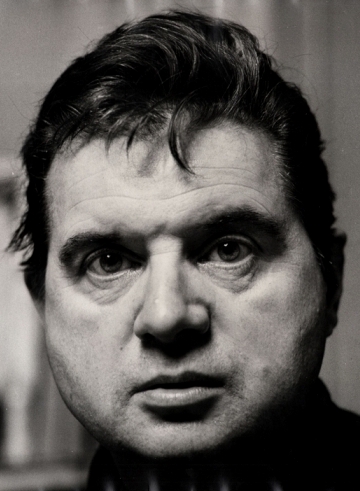

.png)

Lunch with Francis Bacon this week for the first time in quite a while. It used to be a weekly event but he has better things to do nowadays. I wish I had. We talked about the usual things, sex and death, over the salmon and reminisced about the Wheeler’s of yesteryear when Bernard Walsh owned it. The refurbishing — dreadful word — of the place took the charm away. There was such a nice little bar in a back room where we used to congregate. Sometimes we even got as far as lunch.
Francis was on to death within two minutes of coming into the pub. I asked him what he was up to and he said, ’I’m working on something I want to finish before I die.’ Never have I known a man so obsessed with death, not counting the one sitting at this typewriter. People’s various sexual kinks were also discussed and we thought it might make an interesting book if 200 famous people could be persuaded to come forward and own up about theirs. He then went on to say that he was a little bit fed up with homosexuals. Only Peter Watson and Peter Lacy came out well, and I must say Lacy was one of the really good men to have passed this way. A gentleman who could play a good cocktail piano, he died of pancreatitis in Tangier. Poor sod. What a place to get that illness.
After we parted I went back to the Coach and Horses to watch a couple of races on the box. It is serious stuff now. Trainers start to bring out the big guns at the first Newmarket meeting of the year. It was a bit irritating to be perched on a bar stool next to a man staring gloomily at a losing betting slip and complaining. He had lost £2. I lost a week’s money and shall cool it until the horse decides to open his mouth and talk. I bet too boldly after a good lunch. That could have been a week in Florence, which was what I had wanted, but the beast was running backwards as they came into the final furlong. Never mind. Next time. But, you see, I do mind. It will be on my mind for a few days like a nightmare always is.
Speaking of which, my nightmares are now very nearly every night and they are making me feel quite ill. Two friends told me that the way to cure myself of them is to resolve to turn myself into a hero in them. But how can a man clinging to a ledge 100 feet above the ground with no way up or down turn himself into a hero? I am not interested in the interpretation of dreams, I just want to get rid of anxiety. It is bad enough to have it in the daytime before the sun is over the yardarm. I am beginning to suspect that this frame of mind might be chemically induced just as madness can be. Dutch courage wears off during the early hours and I don’t intend to start drinking in bed.
I am also cheated in dreams for never have I had an erotic dream with a happy ending. Is there anything left not to feel anxious about? And the daughter has just phoned from Sydney. What the hell is going on down under, I wonder. Now I feel even worse about my bet at Newmarket. Never mind about needing the money to have two wisdom teeth extracted, with what I lost she could have had the lot pulled out. And now, with her teeth on my mind, I suppose there will be another nightmare tonight. You can bet that my dentist will be doing his business on the ledge of a skyscraper.


SIR ROBERT and Lady Sainsbury were unamused by the rain of gold which fell in New York last week upon contemporary art and upon British artists, led by Francis Bacon and David Hockney, in particular: “revolted”, was Sir Roberts first reaction, “horrible” his second, while Lady Sainsbury thought it “most unpleasant” that living artists were now valued in the saleroom “entirely as a question of investment”.
Robert and Lisa Sainsbury are two of the pioneering British art collectors of the 20th century, ranking with Samuel Courtauld in the range and imagination of their purchases. They bought Bacon, Moore and Giacometti for a song in the Fifties, when America had not heard of them and British taste was still focused on its navel; they gave all these and much more in 1973 to an unenthused University of East Anglia which is only now realising the huge significance of their gift.
Now, overnight, Bacon is a £4-million artist, Moore is advancing to £3 million, Giacometti is not far behind and students who once ignored the Sainsbury Centre for the Visual Arts on the Norwich campus, coo and ah over the Degas bronze of the Petite Danseuse de 14 ans, bought by Sir Robert in Paris in 1938 for next to nothing but now rated on the market at more than $10million (Sotheby’s New York, May 1988). Overnight, too, the University is making a fortune from owning the Sainsburys’ art a gift, said the Vice-Chancellor in 1973, comparable to those of Ash mole at Oxford, Fitzwilliam at Cambridge and Courtauld at London.
The Sainsburys, though, regret the financial glitter that attaches to their munificence and to the art market across the world. This is not how they want students to become fascinated by art, nor how they want the art market to be. They are the antithesis of the hungry “investors” who last week in New York turned Christie’s and Sotheby’s into a branch of the Stock Exchange.
Sir Robert, 82, has lived to be “embarrassed” that people might assume that his extensive array of Bacons had been bought for money; they were acquired in the dark days when the struggling artist was only secured at the bank by Sir Robert's intervention.
One senses that the Sainsburys’ dearest wish is that collectors may once again happen on art in the way that they did — via their eyes, not via their wallets and not via experts. Sir Robert, no art historian (he read history at Cambridge) began his collecting with Epstein at a point when Epstein was “execrated”, he says.
I wanted to know how he and Lisa had come by that independence of spirit which by 1940 had filled their flat with Moore, Modigliani, Matthew Smith, dance masks from the Congo and Niger Basins, broken Tang figures and a Japanese dancing girl utterly at odds with the taste of the day, so much so that “everyone guffawed at our Moore Mother and Child,” Robert recalls; “my father was horrified,” adds Lisa.
The answer would horrify the New York collectors of the Eighties: “We bought what we liked,” says Sir Robert. “We never asked scholars what we should buy or whether we could get anything more exciting, we consulted them on questions of genuineness but not much more.”
But how did Robert and Lisa acquire a taste that bought freely in art which their contemporaries could not stomach? (“In 1955 a friend once said ‘if you spend a weekend with the Sainsburys you will have to put up with their neurosis with Francis Bacon’,” recalled Lady Sainsbury memorably.) “We never had any problem with anything new,” was the simple answer.
Sir Robert, who had the market in art of Africa, Asia and Oceania almost to himself for a long period, saw his first African piece, a Fang mask from Gabon, in the window of Paul Guillaume in Paris in 1935 and was impelled to buy. Why? Was it a viewing on the road to Damascus? Did he have prior knowledge? None at all, it seems, beyond the opening of eyes to Africa which Picasso achieved from the Demoiselles d’Avignon on and which Modigliani, Naum Gabo and others reinforced.
The Sainsburys, in short, bought on the argument of their eyes and not for money and not on the advice of experts or dealers. They still back the judgment of their eyes: they have bought many works of an English sculptor, John Davies, who is little recognised, also the paintings of a Turk called Mubints.
Tonight the Prince of Wales will present this redoubtable couple with the National Art-Collections Fund's Benefactor of the Year award, honouring their past and present generosity to the University of East Anglia a munificence to academia without parallel since the War. During the last 50 years they have presented the university with art bought in the face of fashion, a Norman Foster building to house it and, in 1988, £4-5 million for an extension to house exhibitions, conservation and research.
It is to be hoped that Sir Robert, in accepting the award, will air his invigorating views indeed, that he and his wife may feel able to speak at the same time, for in the cut and thrust of their conversation they are as animating and fun to listen to as they are wise and perceptive.
BY ROBIN SIMON
IN the late Sixties a friend of mine was threatened with expulsion from the Central School of Art. His sin, they told him, was ‘painting people’.
He was ordered to ‘get with it’ and stick to abstract art, or get out. He got out.
Those were the days when all our art colleges, with the exception of the Slade School, were dominated by teachers set on aping America, where abstract art alone ruled OK. Only now is figurative art becoming respectable once again.
Even the most dogmatic modernists have finally
realised that some of the greatest artists alive today are not only British
—
Francis Bacon, Lucian Freud, Frank Auerbach,
David Hockney
—
but that they also paint people. And the rest
of the world is realising it, too. Recently
Unnerving At
BY MICHAEL KIMMELMAN
The art of ordered chaos
Francis Bacon, 80 next month, once summed up his life as
‘going from bar to bar and drinking and that kind of thing’.
Michael Kimmelman joined him
MICHAEL KIMMELMAN
He can be intensely private yet disarmingly frank. With almost no prompting, he describes in detail his fondness for alcohol and for men, his kinship with gangsters and drunks, his antipathy toward certain politicians, fashion designers and fellow painters. Friends know he can be difficult and unpredictable, especially after a few drinks, but they also know him as a man of tremendous generosity, wit and vulnerability. He talks about sex and alcohol the way most people discuss the weather, but he exudes a natural courtliness and grace, as if he were a good boy trying to be bad.
He is particularly eager to express opinions about art and literature. A few days earlier, over a leisurely lunch of wine, oysters and devilled crab at Bentley’s, Bacon talked about Velázquez and Degas, Boulez and Freud (“Does anyone go to analysis anymore?” he asked with apparent sincerity), Proust and Yeats (whose productivity in old age particularly intrigues him) with the passion of the self-educated. A recent exhibition of early works by Cézanne prompted waves of enthusiastic commentary.
Subtly, Bacon manipulates a conversation so that it never strays from subjects
he is prepared to discuss, and it is almost impossible to get him to talk about
anything else. He particularly dislikes analysing his own work:
He eschews almost all the trappings of success. When necessary, he reaches into his pocket for a wad of cash to cover expenses, which may include an elegant suit, gambling debts, medical costs for an ailing friend, lunch at a swanky restaurant or champagne for everyone at the Colony Room, the run-down drinking club in Soho he has been going to for more than 40 years. In an art scene that has become dominated by commercial excess and ironic posturing, Bacon seems like a character from an altogether different time, a genuinely serious painter, a survivor from the generation of post-war intellectuals for whom culture was not largely a matter of money.
Bacon settles himself behind a table next to the single window in his bedroom,
where four bare bulbs hanging on wires from the ceiling provide most of the
illumination on a grey day. A small bed is tucked at the far end of the room
behind two old couches and a couple of dressers. There is a space heater in one
corner. Years ago, Bacon owned paintings by Sickert and Auerbach, but he gave
them away. Several tattered photographs of his own works are now taped above the
kitchen sink and around the studio. Otherwise the walls are bare.
Only after a little while does the artist suggest taking a look at the studio, and even so, he clearly feels some hesitation about it, as if fearful of revealing one of his more intimate secrets. Bacon can appear very open and jovial to strangers, but he can be extremely reticent when it comes to certain aspects of his work, and this room is one of them.
The studio, on the other side of the kitchen, is shaped like the bedroom but has a skylight that Bacon installed some years ago. It is a mess. Aged paint tubes, discarded rags, brushes, papers and dust (he has incorporated the dust in certain paintings to suggest sand dunes) have accumulated over the course of two decades and been swept into waist-high piles around the floor. Bare bulbs dangle from the ceiling. “I once bought a beautiful studio round the corner in Roland Gardens with the most perfect light, and I did it up so well, with carpets and curtains and everything, that I absolutely couldn’t work in it,” he once told an interviewer. “I was absolutely castrated in the place. That was because I had done it up so well and I hadn’t got the chaos.”
Bacon has noted, only half in jest, that the closest he comes to abstract
painting is on the walls of his studio: he uses them as a palette, and they are
covered with multicoloured dabs of pigment. On one easel rests a small portrait
of Bacon
He suggests a walk to the Victoria & Albert Museum before lunch.
In April 1945, Bacon exhibited. at the Lefevre Gallery in London a triptych
entitled
At a time when painting in Britain, like so much else, had be come enervated, these potent images were a sign of renwed vitality. Those who went to the Lefevre Gallery may not have liked Bacon's work, but they surely wouldn't forget it. Bacon had made his mark.
During the next decades the artist developed his now-famous repertory of blurred
figures, screaming popes, butchered carcasses and twisted portraits images that
continue to occupy his attention today. They have inspired some critics to
classify him as a Surrealist or an Expressionist, and sceptics to describe him
as a sensationalist or a lunatic. Bacon insists he is a realist, that he does
not paint merely to shock.
Bacon maintains he is simply aiming to reproduce, as immediately and directly as
possible, what his friend, the French anthropologist and poet Michel Leiris,
calls
In part for this reason, private collectors have not stood in line to buy, and
although the work has always been very popular in France, Italy and Germany, it
has engendered more respect than enthusiasm in the United States and even in
Britain. The poet Stephen Spender, one of Bacon’s oldest friends, says:
There
are, however, few important museums of 20th-century art that do not own, or at
least covet, one of Bacon
The son of a racehorse trainer (and a collateral descendant of the great Elizabethan statesman and philosopher), Bacon moved with his family between Dublin and London during the first years of his life. He was the second of five children. He never got along with his parents, who, in turn, never supported the idea of his becoming a painter.
Asthma
made school a problem, so he was tutored by clergymen at home, where in general
he was left to his own devices. These involved what his heavy-gambling but
strict father considered behaviour so unacceptable — Bacon had sex with some of
the grooms at the stables and was once caught trying on his mother
There, in a city devoted to excess, Bacon could indulge in sexual escapades and
gambling sprees; he spent long nights in transvestite bars and endless hours
with the sort of rough-and-tumble characters who would always form a part of his
social circle. Berlin was a very violent place emotionally violent, not
physically and that certainly had its effect on me,
He also spent time in Paris, and although he says he was not interested in art, Bacon remembers attending an exhibition of Picasso’s surreal, biomorphic omorphic bathers painted in the Twenties. Over the years, he has given different accounts of how significant this event was to his own development, but he certainly left Paris with a particular notion of the artistic life properly spent.
Bacon has always cultivated an image of of himself as an instinctive painter, a
loner, someone who is unconcerned with success- qualities that make him resemble
more the French artist of the Twenties than the celebrity artist of today. He
returned to London in 1929 and for a brief period designed modernist furniture,
producing works that earned him a reputation as innovative and highly talented,
but that he now dismisses as “absolutely horrid” and “ghastly stuff”. A
Cubist-inspired pattern for a rug suggests Bacon
Bacon participated in a group show in 1933, the same year that the critic and
historian Herbert Read reproduced the artist’s ghostly
Bacon says it was not until 1944, when he began to work on
Upon arriving at the Victoria & Albert, Bacon immediately marches down one of the museum’s cavernous halls looking for an elevator to the floor where Constable’s paintings are displayed. He quickly becomes lost, asks directions from a guard, takes another wrong turn and again loses his way. The circuitous route leads him past some pottery, a display of raincoats, medieval wood carvings and jewellery, and in every case the artist becomes momentarily absorbed by what he sees. Just as he feels socially at se with both petty thieves and Wealthy patrons, he can become deeply intrigued by a Turner hanging in the National Gallery, and also by a chair he glimpses in the window of Conran’s on his way to lunch. Not surprisingly, Bacon’s paintings are full of references to Ingres and the daily press, to Picasso who, with Duchamp, remains just about the only 20th-century artist he ad mires and the latest fashions.
Finally, Bacon stumbles upon the lift and finds the Constables.
Bacon never makes preliminary drawings, but works directly on unprimed canvas,
where a way-ward brush stroke cannot easily be disguised.
Photographs have always been a source of inspiration for Bacon. Many of his ideas and quirky compositional devices have originated in the newspaper and magazine snapshots that he collects, and especially in the famous sequential photographs of prancing animals and walking, running and wrestling men that Eadweard Muybridge took during the last quarter of the 19th century. In the twisted, awkward, even bizarre movements of Muybridge’s figures, Bacon sees a potential repertory of images that are at once startling and commonplace, and it is this impression of something sudden and unposed, yet absolutely true to life, that the painter wants to convey in his own work. In painting portraits, he dispenses with a sitter and relies solely on photographs and memory. Bacon uses only intimate friends as subjects, and he fears they might be offended to see him manoeuvring and rearranging their faces — despite the unmistakable likeness that emerges.
He
Bacon insists his paintings are not about anything in particular, that nothing
should be read into his borrowings from certain im-ages, and that even his
triptychs, which might seem to be recounting a tale in three scenes, are in no
way narrative. He compares them to police mugshots of a suspect
It
is early afternoon, and so far Bacon has had nothing to drink. Once, when asked
to sum up his life, he said it consisted of
It
is a small, oddly shaped and rather claustrophobic place not unlike many of the
rooms in Bacon
During lunch, Bacon had described old age as
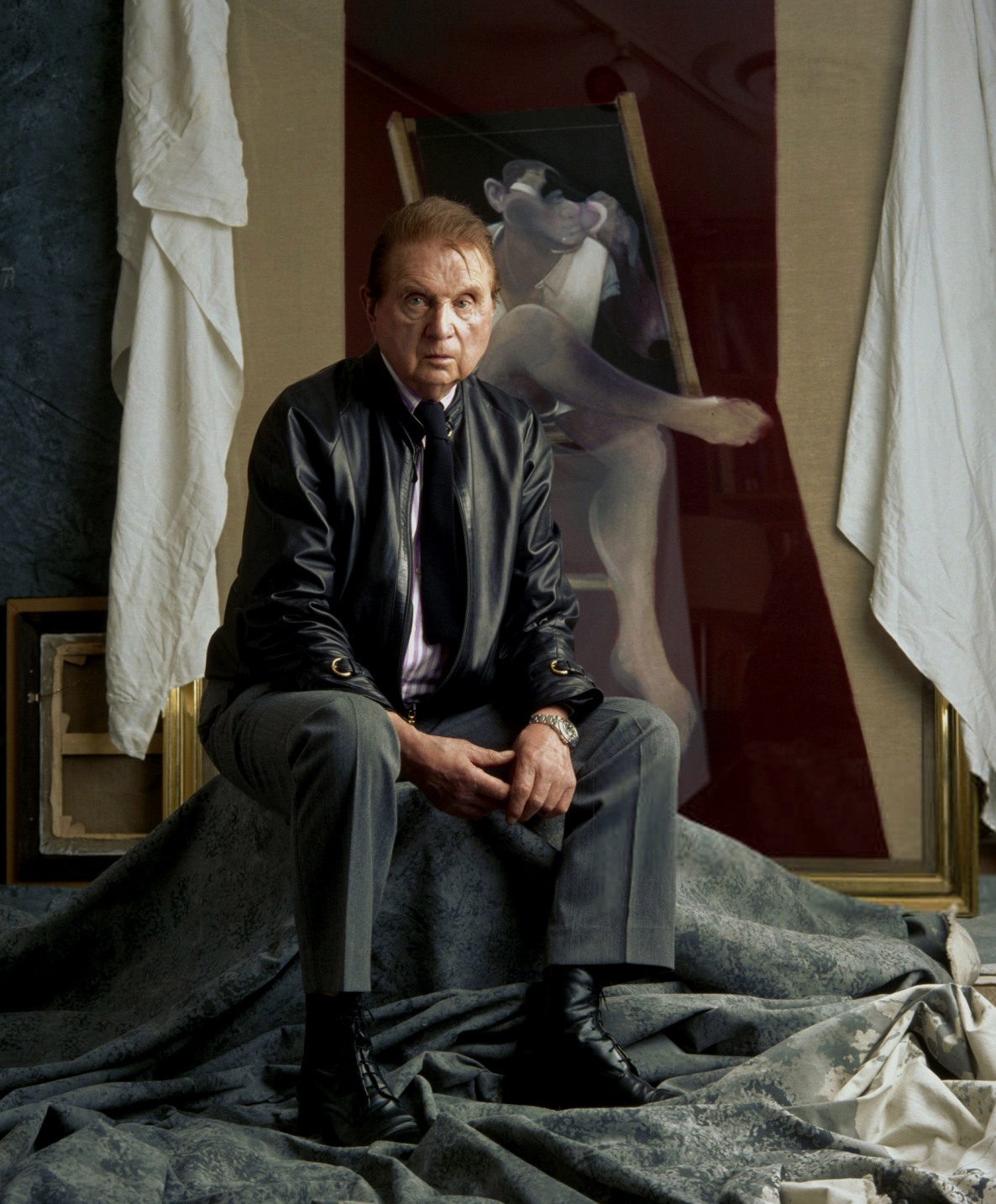
Realist with unnerving power: Francis Bacon in front of his 1989 painting “Study for Portrait of John Edwards”
The Crucifixion in Bacon’s Art
PAUL MOORHOUSE
(1) David Sylvester, The Brutality of Fact. Interviews with Francis Bacon, third edition, London: Thames and Hudson, 1987, p. 198. Unless otherwise indicated all quotations in this article come from this book.
(2) Letter to Michel Leiris, quoted in Michel Leiris, Francis Bacon, London: 1987. p. 13.
(3) Ibid, p. 56.
(4) Hugh Davies and Sally Yard, Bacon, New York: 1986, p. 110 (in an interview with Hugh Davies).
An Interview with Francis Bacon
Prompting Chance
The following interview was recorded in Francis Bacon’s London studio
MICHAEL PEPPIATT
You told me that you’d been to the Science Museum and you’d been looking at scientific images.
Yes, but that’s nothing of any interest. You see, one has ideas, but it’s only what you make of them. Theories are no good, it’s only what you actually make. I had thought of doing a group of portraits, and I went there thinking that, amongst various things, I might find something that would provide a grid on which these portraits could be put, but I didn’t find what I wanted and I don’t think it’s going to come off at all.
Are there certain things that you go back to a great deal, for example Egyptian images? You look at the same things a lot, don’t you?
I look at the same things, I do think that Egyptian art is the greatest thing that has happened so far. But I get a great deal from poems, from the Greek tragedies, and those I find tremendously suggestive of all kinds of things.
Do you find the word more suggestive than the actual image?
Not necessarily, but very often it is.
Do the Greek tragedies suggest new images when you reread them, or do they just deepen the images that are already there?
They very often suggest new images. I don’t think one can come down to anything specific, one doesn’t really know. I mean you could glance at an advertisement or something and it could suggest just as much as reading Aeschylus. Anything can suggest things to you.
For you, it’s normally an image that is suggested though, it’s not sound, it’s not words sparking off words. Words spark off images.
To a great extent. Great poets are remarkable in themselves and don’t necessarily spark off images, what they write is just very exciting in itself.
You must be quite singular among contemporary artists to be moved in that way by literature. Looking at, for example, Degas, doesn’t affect you?
No, Degas is complete in himself. I like his pastels enormously, particularly the nudes. They are formally remarkable, but they are very complete in themselves, so they don’t suggest as much.
Not so much as something less complete? Are there less complete things which do? For example, I know you admire some of Michelangelo’s unfinished things. And recently you were talking about some engineering drawings by Brunel and it sounded as though you were very excited by them.
In a certain mood, certain things start off a whole series of images and ideas which keep changing all the time.
Is there a whole series of images that you find haunting? There are specific images, aren’t there, that have been very important to you?
Yes, but I don’t think those are the things that I’ve been able to get anything from. You see, the best images just come about.
So that’s almost a different category of experience.
Yes, I think my paintings just come about. I couldn’t say where any of the elements come from.
Do you ever experiment with automatism?
No, I don’t really believe in that. What I do believe is that chance and accident are the most fertile things at any artist’s disposal at the present time. I’m trying to do some portraits now and I’m just hoping that they’ll come about by chance. I want to capture an appearance without it being an illustrated appearance.
So it’s something that you couldn’t have planned consciously?
No. I wouldn’t know it’s what I wanted but it’s what for me at the time makes a reality. Reality, that is, that comes about in the actual way the painting has been put down, which is a reality, but I’m also trying to make the reality into the appearance of the person I’m painting.
It’s a locking together of two things.
It’s a locking together of a great number of things, and it will only come about by chance. It’s prompted chance because you have in the back of your mind the image of the person whose portrait you are trying to paint. You see, this is the point at which you absolutely cannot talk painting. It’s in the making.
You’re trying to bring two unique elements together?
It has nothing to do with Surrealist idea, because that’s bringing two things together which has already made. This thing isn’t made. It’s got to be made.
But I mean that there is the person’s appearance, and then there are all sorts of sensation about that particular person.
I don’t know how much it’s a question of sensation about the other person. It’s the sensations within yourself. It’s to do with the shock of two completely unillustrational things which come together and make an appearance. But again it’s all words, it’s all an approximation. I feel talking about painting is always superficial. We have lost our real directness. We talk in such a dreary, bourgeois kind of way. Nothing is ever directly said.
But are there things that really jolt you? I know you love Greek tragedy, Shakespeare, Yeats, Eliot and so on, but do odd things, like newspaper photographs, jolt you every now and then?
I don’t think photographs do it so much, just very occasionally.
You used to look at photographs a lot. Do you still look at books of photographs?
No. Dalí and Buñuel did something interesting with the Chien andalou, but that is where film is interesting and it doesn’t work with single photographs in the same way. The slicing of the eyeball is interesting because it’s in movement...
But is your sensibility still
I don’t think so, but not much that is produced now jolts one. Everything that is made now is made for public consumption and it makes it all so anodyne. It’s rather like this ghastly government we have in this country. The whole thing’s a kind of anodyne way of making money.
I suppose one doesn’t have to be jolted as such to be interested, to be moved. One can be persuaded or convinced by something without it actually shocking one’s sensibility. And I am sure that people have come to accept images that begin by seeming extremely violent, war pictures for instance.
They are violent, and yet it’s not enough. Something much more horrendous is the last line in Yeats’ "The Second Coming," which is a prophetic poem: "And what rough beast, its hour come round at last,/Slouches toward Bethlehem to be born?" That’s stronger than any war painting. It’s more extraordinary than even one of the horrors of war pictures, because that’s just a literal horror, whereas the Yeats is a horror which has a whole vibration, in its prophetic quality.
It’s shocking too because it’s been put into a memorable form.
Well, of course that’s the reason. Things are not shocking if they haven’t been put into a memorable form. Otherwise, it’s just blood spattered against a wall. In the end, if you see that two or three times, it’s no longer shocking. It must be a form that has more than the implication of blood splashed against a wall. It’s when it has much wider implications. It’s something which reverberates within your psyche, it disturbs the whole life cycle within a person. It affects the atmosphere in which you live. Most of what is called art, your eye just flows over. It may be charming or nice, but it doesn’t change you.
Do you think about painting all the time, or do you just think about things?
I think about things really, about images.
Do images keep dropping into your mind?
Images do drop in, constantly, but to crystallize all these phantoms that drop into your mind is another thing. A phantom and an image are two totally different things.
Do you dream, or remember your dreams? Do they affect you at all?
No. I’m sure I do dream but I’ve never remembered my dreams. About two or three years ago I had a very vivid dream and I tried to write it down because I thought I could use it. But it was a load of nonsense. When I looked at what I’d written down the next day, it had no shape to it, it was just nothing. I’ve never used dreams in my work. Anything that comes about does so by accident in the actual working of the painting. Suddenly something appears that I can grasp.
Do you often start blind?
No, I don’t start blind. I have an idea of what I would like to do, but, as I start working, that completely evaporates. If it goes at all well, something will start to crystallize.
Do you make a sketch of some sort on the canvas, a basic structure?
Sometimes, a little bit. It never stays that way. It’s just to get me into the act of doing it. Often, you just put on paint almost without knowing what you’re doing. You’ve got to get some material on the canvas to begin with. Then it may or may not begin to work. It doesn’t often happen within the first day or two. I just go on putting paint on, or wiping it out. Sometimes the shadows left from this lead to another image. But, still, I don’t think those free marks that Henri Michaux used to make really work. They’re too arbitrary.
Are they not conscious enough, not willed enough?
Something is only willed when the unconscious thing has begun to arise on which your will can be imposed.
You’ve got to have the feedback from the paint. It’s a dialogue in a strange sense.
It is a dialogue, yes.
The paint is doing as much as you are. It’s suggesting things to you. It’s a constant exchange.
It is. And one’s always hoping that the paint will do more for you. It’s like painting a wall. The very first brushstroke gives a sudden shock of reality, which is cancelled out when you paint the whole wall.
And you find that when you start painting. That must be very depressing.
Very.
Do you still destroy a lot?
Yes. Practice doesn’t really help. It should make you slightly more wily about realizing that something could come out of what you’ve done. But if that happens...
You become like an artisan?
Well, you always are an artisan. Once you become what is called an artist, there is nothing more awful, like those awful people who produce those awful images, and you know more or less what they’re going to be like.
But it doesn’t become any easier to paint?
No. In a way, it becomes more difficult. You’re more conscious of the fact that nine-tenths of everything is inessential. What is called "reality" becomes so much more acute. The few things that matter become so much more concentrated and can be summed up with so much less.
In Francis Bacon’s studio
MICHAEL PEPPIATT
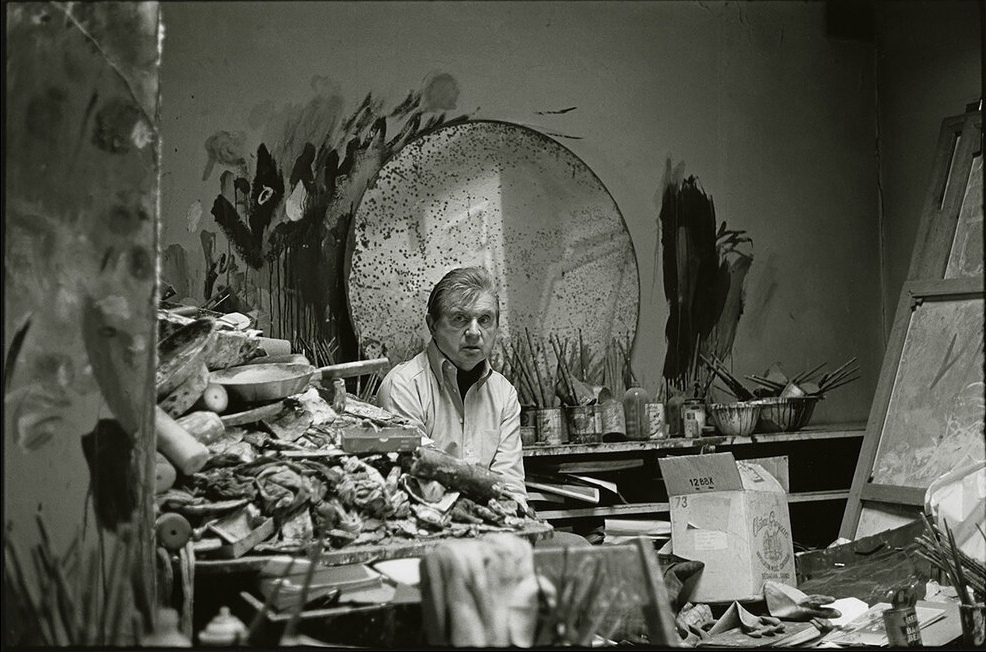
Francis Bacon, London, 1978. Photograph by Jesse Fernandez
TIMOTHY HYMAN
The David Sylvester interviews (1) are a whole issue in themselves. Because as much as Bacon’s actual work, those interviews bled into a whole generation. It was simply the most powerful book available about contemporary art. The painter Andrzej Jackowski wrote to me at the end of the seventies asking himself how close one can come to illustrating the object–which for him was the key issue with Bacon. In other words, the fear of illustration, the fear that by depicting someone more or less literally one would simply be an illustrator–these were the issues which came off the page. This fear was very much something one had to fight against in order to extend subject matter, or complexity of composition, or indeed any kind of literal depiction. It seemed that the highest authority we had, which was Bacon, had in a way tabooed depiction. All that was left to figuration would be a language made up of accident and chance. I felt this was a loss to painting. I think that Bacon has perhaps limited his own range through these convictions which are really just assertions. I don’t think that as soon “the story-telling element enters the boredom begins.” This was quite a widespread feeling.
Interpretations of the Body
A New Power of Laughter
for the Living
GILLES DELEUZE
The body is the Figure, or rather the material of the Figure. The material of the Figure must not be confused with the physical material structure that occupies space but remains in opposition to it. The body is Figure, not the structure. Inversely, the Figure, being a body, is not the face, and in fact, has no face. It does have a head, since the head is an integral part of the body. The body can even be reduced to nothing more than the head. As a portraitist, Bacon is a painter of heads, not faces, and there is a great difference between the two. For the face is a structured spatial organization that covers an area of the head, whereas the head is an adjunct of the body, albeit its summit. The head lacks spirit; rather it is spirit in bodily form, the vital breath of the body, an animal spirit, the animal spirit of man: a pig-spirit, a bull-spirit, a dog-spirit, a bat-spirit... Bacon’s goal as a portraitist is to dismantle the face, to rediscover the head or make it emerge from beneath the face.
The deformations experienced by the body also represent the head’s animal features. This has nothing whatsoever to do with a correspondence between animal forms and facial forms. In fact, the face loses its form as it is subjected to artist’s wiping and brushing techniques that disorganize it and make a head emerge in its place. Nor are the marks or features of animality animal forms; instead they are spirits that haunt the wiped-off parts, deforming, individualizing and describing the head without a face.(1)
These two techniques–wiping and the use of animal features–take on a special
meaning. A man’s head might be replaced by an animal’s; not the physical form of
the animal but a characteristic of it–for example, the quivering bird-like
presence that that spirals into an area of wiped-off paint while mock-portraits
on either side act as
This objective zone of imperceptibility is the whole body, but the body as flesh or meat. Of course, the body also consists of bones, but bones are only a spatial structure. A distinction is often made between flesh and bone, and even between the things related to them. The body is revealed only when it is no longer supported by the bones, when the flesh ceases to cover the bones, when the two exist for each other but separately, with, with the bones providing a supporting structure for the body and flesh as the bodily material of the Figure.
Bacon admires Degas’ After the Bath (1903), where the
foreshortened spine of the young woman appears to break through her flesh,
making it seem much more vulnerable and lithe, acrobatic. In an entirely
different context, Bacon painted just such a spine for a figure in a contorted,
upide-down position (see Three Figures and a Portrait on
page 40). This pictorial tension between flesh and bone is something he strives
to achieve. But it is the meat that creates the tension in the painting, as do
its splendid of its colours. Meat is the bodily state in which flesh and bone
are in confrontation instead of forming a structural whole. The same is true of
the mouth and the teeth, which are small bones. With meat it could be said that
the flesh hangs from the bones, while the bones hold up from the flesh. This is
a distinctive feature of Bacon’s work, as opposed to Rembrandt and Chaim
Soutine’s. If Bacon had a particular
Take
pity on meat! There is no doubt that meat is the chief object of Bacon’s pity,
the only object of pity, his Anglo-Irish pity. On this point, he is like
Soutine, with his immense pity for the Jew. This meat is not dead flesh. It
retains the sufferings and takes on all the colours of living flesh. If one sees
convulsive pain and vulnerability one is also such struck by a charming
inventiveness, strong colours and acrobatics. Bacon does not say,
But can one really say exactly the same thing about both meat and the head, namely that this is the zone of objective indecision in man and animal? Can one say objectively that the head is meat (just as meat is spirit)? Of all parts of the body, is not the head most like bone? Consider El Greco, or Soutine again. And yet it seems that Bacon does not think of the head in this way. Bone belongs to the face, not to the head. According to Bacon, there is no death’s head. The head is boneless, not bony. Yet it is firm and not at all soft. The head is flesh, and the mask itself is not a death mask, it is a block of firm flesh separate from bone: this can be seen in the studies for a portrait of William Blake, for example. Bacon’s painting of his own head is one of flesh haunted by a handsome stare that emanates from empty eyes. Here he pays tribute to Rembrandt, whose final self-portrait resembles a block of flesh with no eye sockets.
In Bacon’s oeuvre, the relationship between head and meat becomes increasingly intimate as it grows intensity. First, meat–flesh on one side, bone on the other–is placed at the edge of a track or a balustrade where the figure is seated or standing; but the meat is also the heavy carnal rain that surrounds the head and that blurs the face beneath the umbrella. The scream that comes from the Pope’s mouth, and the pity in his eyes, are for meat. Later on, the meat is given a head, which enables it to flee and descends from the cross, as in the two earlier Crucifixions. Later still, Bacon’s series of heads assert an identification with meat, and some of the most beautiful of these are painted in meat colours, red and blue. Finally, meat itself becomes the head. The head symbolizes the general power of the meat, as in Fragment of a Crucifixion, 1950 (see illustration on page 26) where the meat cries out under the gaze of a dog-spirit perched on top of a cross. Bacon dislikes this painting because of its apparently simple process: a mouth has simply been cut into meat. Still, it is important to understand the affinity of the mouth, and its interior, with meat, to the point where the open mouth has become nothing more than the section of sliced artery, or even a severed sleeve representing an artery, as in the bloody bundle of the Sweeney Agonistes triptych (1967), illustrated on page 33. The mouth then acquires a general power which turns all meat into a faceless head. The mouth is no longer an independent organ, but a hole through which the whole body escapes, and from which the flesh hangs (the freely made, involuntary marks are an essential part of this impression). Bacon calls the Scream, the whole body’s response to the immense pity that meat provokes. [...]
The
scream is of special importance. Why does Bacon see the scream as one of the
highest aims of his painting?
Alban Berg knew how to make music out of the scream in the scream of Marie,
which is very different from that of Lulu. But each time he established a
relationship between the sound of the scream and inaudible forces, those of the
Earth in the horizontal scream of Marie, and those of heaven in the vertical
scream of Lulu. Bacon creates the painted scream, because he establishes a
relationship between the visibility of the scream–the mouth like an abyss of
shadow–and the invisible forces which can only belong to the future. It was
Kafka who spoke of detecting the diabolical powers of the future knocking at our
door. Every scream is potentially full of these. Innocent X screams, but behind
a curtain, not just someone who can no longer be seen, but as someone who has
nothing left to see, whose only remaining function is to make us see the
invisible forces that cause him to scream, the forces of the future. This is
expressed in the phrase
Curiously enough, the scream is an extraordinary source of vitality. When Bacon
distinguishes between two kinds of violence—that of the spectacle and that of
feeling—and declares that one must be renounced to achieve the other, he
declares a kind of faith in life. Interviews with him are full of statements of
this sort: cerebrally pessimistic, as he describes himself, Bacon sees
nothing but horrors to paint—the horrors of the world. But, he says, his nervous
system
But
is it an act of faith to choose
Life
screams at death, but death is no longer this too-visible thing that makes us
falter; death is an invisible force that life detects, flushes out and reveals a
scream. Death is judged from life’s point of view, and not the reverse, as we
like to believe. Bacon, like Beckett, is an artist who, with an intensity of
life, calls for a life which is even more intense. He is not a painter who
The
same homage should be paid to Bacon that can be paid to Beckett and Kafka. In
the very act of
This article is a first English translation of an extract from Gilles Deleuze’s Logique de la sensation, published in 1984 by the Editions de la Différence, Paris
RICHARD PAUL
His canvases, worth millions each, hang in frames of burnished gold. They smell of blood and vomit. He is, as he set out to be, England’s greatest painter. He drinks the best champagne, competes with the old masters — and works in utter squalor. His stroke is magisterial. The howling beings he conjures — their faces smeared, their bodies flayed — writhe within their cages like men turned into meat.
EDWARD PHILIPS
And Another Thing
ROSS BENSON
I THOROUGHLY enjoyed the first night of
Jeffrey Bernard is Unwell
at
London
One person, however, appeared not to share my enjoyment. Francis Bacon, Britain’s greatest living painter who appears as a character in the piece. He sat stony faced through the first half. A smile did not once crease his creased features.
And come the interval Bacon did what Bernard has been doing all his life
With the William Hickey team John Roberts, Mary Corbett, Tessa Finch and Jani Allen
The Master of the Macabre, Francis Bacon
MICHAEL KIMMELMAN

ACCORDING to Alan Bowness, former director of the Tate Gallery, Francis Bacon’s work, “sets the standard for our time, for he is surely the greatest living painter”. Such is the accepted judgement on Bacon who is 80 today; but it is not one I can share.
Bacon is certainly an artist of considerable power who has shown an exemplary contempt for fashion and trivia. No one can be indifferent to his work. When his pictures are gathered in a major retrospective they exude what theologians call kerygma, or a “call to decision”. Yet the response they demand is not so much admiration as a moral refusal: for if Bacon is possessed by genius, it is of a life-diminishing kind.
He was born in Ireland, the son of a pugnacious race-horse trainer. He did not like his father but was plagued by confused sexual feelings about him. Late on, he described boxing and bull-fighting as suitable aperitifs to sex. He left home after an incident in which he was discovered wearing his mother’s clothing.
After an uncertain beginning as a designer and a ne’er-do-well, Bacon turned to painting. He was to destroy most of the pictures he made before the war. Asthma exempted him from military service; but in 1945 he painted Three Studies for Figures at the Base of a Crucifixion, now in the Tate Gallery. This triptych shows monstrous, amputated, bandaged, bleeding and shrieking creatures, coarsely drawn against a background of livid orange. Bacon had found himself.
In the years that followed, he produced some pictures of figures in distressed landscapes; but his heart was never in them. His imagination retreated behind closed doors into a world of bestial heads, screaming popes (après Velázquez), hell-hounds, and scenes of violent embuggerment après Eadweard Muybridge, a 19th century photographer.
Bacon said he wanted a feeling of “exhilerated despair.” He paints the world after the death of God. He has always tried to eschew consoling aesthetic illusions and has preferred to numb his pain with alcohol, gaming and what he once described as “the sexual gymnasium” of the modern city.
Even so, the heavy presence of God’s absence — or at least the ghost of the great tradition of European religious painting — hangs over much of what he produces, For him, Cimabue’s Crucifixion may be no more than, as he once put it, an image of “a worm crawling down the cross”; but in his own pictures, crucifixes and triptychs abound.
In the 1960s, however, Bacon’s emphasis shifted: he began to focus much more on self-portraits and portraits of a group of close friends, including his lover, George Dyer. There were certainly no precedents for these works. Some critics have argued they are really caricatures; but a caricaturist exaggerates particular facial features to travesty character. That doesn’t interest Bacon. Unlike most portrait painters, he is also indifferent to his sitters’ “social masks” and psychological depth.
Whomsoever Bacon paints, what he finds is always the same. The nearest parallel is perhaps the 18th-century artist, Sir Joshua Reynolds, who also searched for some universal aspects in everywhere: only where Reynolds idealised and ennobled, Bacon denigrates and destroys. He once justified this saying: “If I make people look unattractive, it’s not because I want to. I’d like them to look as attractive as they are”.
In Bacon’s more recent works, the emphasis has shifted again towards more anonymous and mythological subjects. The familiar themes persist; but something stereotyped, repetitious and smooth enters into his forms. The lonely figures still throw up in lavatory bowls beneath naked light bulbs; occasionally, they hunch together on couches for some barbarous act of congress, or lie sprawled disgorging their abdomens. But these gross scenes are often displayed against sickly, sometimes lavendery, pastel backgrounds — the sort of tones with which, I imagine, Cynthia Payne decorated the walls of her suburban bordellos.
In the interviews which, over the years, David Sylvester has recorded with Bacon, the artist makes it clear how he wants his work to be seen. He insists he has nothing to say about “the nature of man” or “the human condition”. “I’m just trying to makes images as accurately off my nervous system as I can.” He claims that the violence which concerns him is not his own, but that which is to be found in reality itself. “Perhaps,” Bacon comments, “I have from time to time been able to clear away one of two of the veils or screens.” And so, he sees himself as an uncompromising realist.
But none of us is the best judge of our own work. For myself, I don’t accept that Bacon is a “realist” at all. Perhaps it was unfair to visit his current retrospective in Washington so soon after seeing the great Velázquez show in New York; the experience certainly confirmed my prejudices about Bacon’s art.
When the wicked and suspicious Pope Innocent X first viewed his portrait by Velázquez he exclaimed “Troppo Vero!” (“Too true”). Even today, we know what the Pope meant. Bacon, of course, painted screaming travesties of this picture, which he himself now rejects as “silly”. They certainly have none of Velázquez’s devastating power to reveal truth, and none of his sumptuous, scarlet beauty. Indeed, I doubt whether anyone who looks at any Bacon portraits thinks anything except, “How very like Francis Bacon!”
Even when Velázquez was painting freaks and dwarfs, he did so in a way which celebrated their defiant human dignity. He handled his paint and composed his pictures so as to bring about what I like to call a “redemption through form”. But for much of his life Bacon applied pigment as if he hated the stuff, dragging it across raw, unsized canvas which drains it of beauty and of all semblance of life.
Bacon’s technical inadequacies seem inseparable from his spiritual dereliction. Psychologists describe certain individuals who are driven to reunite themselves with a reality from which they have lost emotional touch by perpetrating terrible acts of injury on others. Bacon’s paintings seem to me to offer a pictorial equivalent of such behaviour. They owe more to the violence and perversity of his imagination than to any love of the facts, let alone of truth.
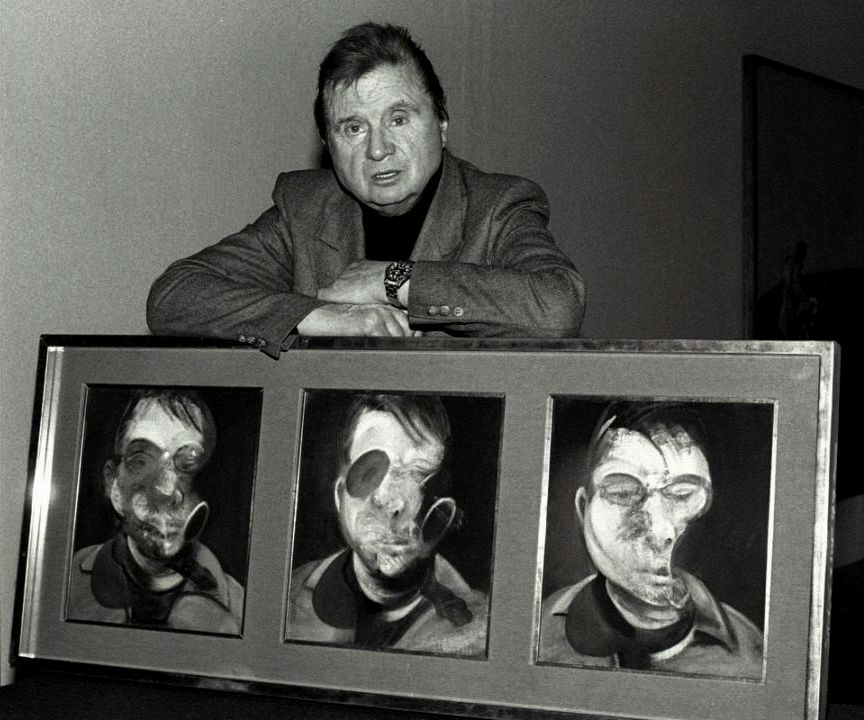


Eighteen years ago, an international poll of curators and museum directors named British artist Francis Bacon the world’s finest living painter.
At the time, it was a questionable choice, given that Bacon’s earliest and strongest influence, Pablo Picasso, was still alive. But Picasso had just reached 90, the re-evaluation of his late work had not yet begun and many felt he had already had more than his share of the limelight.
Now, with Bacon turned 80, the phenomenon repeats itself. For while Europeans tend to canonize Grand Old Men, Americans react differently, taking them down a peg or two, denying in life precisely the honours that will be acknowledged at death.
So the retrospective exhibition of 58 Bacon paintings at Washington D.C.’s Hirshhorn Museum, may not be quite the celebration its organizers intended. At the artist’s last big show in an American museum-36 paintings at the Metropolitan in 1975-critic Tom Hess wrote that “Bacon’s energy seems to flag” and artist Douglas Davis found “a parade of predictable images, mottled and distorted in predictable ways.” The fangs already had been bared. Still, the biggest problem with Bacon today is less his work than nearly a half-century of its interpretation. After all, he was supposed to be the one painter who consistently tried to sum up the agony of modern man. He looked into the abyss and took away a tragic vision. He was the messenger who brought depravity, decay and death.
What’s more, his images were said to have the strength of hammer blows. Crucifixions, screaming Popes, tormented animals, bestial lovers-all this was in Bacon’s painting. And there were few artistic refinements. Critics told us he was the mid-century’s most violent nihilist.
But to those who asked the artist about his art, the answers were
markedly different:
“I have nothing to express about the human condition . . . .”
“I can’t paint for other people. I can only paint to excite myself.”
“I have never tried to be horrific.”
“I believe that reality in art is something profoundly artificial and that it
has to be re-created.”
“. . . with all the mechanical means of rendering appearance, it means that a
painter, if he is going to attempt to record life, has to do it in a much more
intense and curtailed way.”
In sum, here was an artist who thought like an artist, and that should not have surprised anybody. But the fact that Bacon put aesthetics before philosophy and was less involved with ‘message’ than with colour and form has surprised people. And critics who saw his early paintings as existential illustrations later turned sour upon finding his newer works ever more concerned with the issues of art.
Admittedly, his view of life is unusual, insofar as he accepts calmly what others might find terrifying. But this way of seeing is an artist’s way, and it shows extraordinary detachment. Where viewers of his paintings may react strongly and rush to judge, Bacon himself does not. He is the archetypally cool observer.
He also is a miraculous portraitist who captures not only the subject’s appearance but what Bacon calls “the energy within the appearance.” This he achieves through radical abbreviations and distortions. As he has said, “What I want to do is to distort the thing far beyond the appearance, but in the distortion to bring it back to a recording of the appearance.” Put another way, he uses extreme artifice to reach verisimilitude.
Much of each painting Bacon attributes to chance. Working directly on the canvas without preliminary drawings, accidents often suggest new images, and so, what others again might see as a calamity, Bacon accepts as fortuitous.
He has tried to explain how he got that view, by recalling how his father caught him dressed in his mother’s lingerie and sent him from his home in provincial Ireland. The happy result was that young Bacon ended up in Berlin in the 1920s, one of the most open cities in the world.
He has cited, too, how he saw a Picasso exhibition in Paris and, with no formal training or idea of his skills, knew he would become a painter. Until then, Bacon had little schooling of any kind and a distracting appetite for pleasure. But happening upon that exhibition instantly gave him resolve. And notwithstanding a brief, moderately successful interlude as a furniture designer, his course remained fixed.
The results have fallen into three distinct phases, only two of which are ever shown. Bacon destroyed nearly all of the Picasso-inspired pieces from the ’30s, and no museum exhibition has ever brought the remaining ones together. Thus, his Three Studies for Figures at the Base of a Crucifixion (1944), which depicts mutants at once sorrowing and menacing, has often mistakenly been seen as a product of the war instead of a world view the artist developed long before it.
The chief influences of Bacon’s second phase were again other artists, though now through two specific works: Velasquez’ 1650 portrait of Pope Innocent X and the shot of the screaming nurse in The Battleship Potemkin, Sergei Eisenstein’s film from 1925. These images together are behind nearly a decade of Bacon’s most famous works.
Then, in the late ’50s, came the impress of motion studies by American photographer Eadweard Muybridge and Bacon’s decision to make friends and lovers his primary subjects. This phase, gradually becoming more seductive in colour and form, continues today. But in the early ’80s, Bacon also turned back to art, again taking inspiration from older paintings-including, surprisingly, his own.
The show at the Hirshhorn begins with the raw
For many, this will not be enough. Generations of viewers may well prefer Bacon’s works when the artist was technically groping and his awkwardness enhanced an overall impression of rawness. But one should remember that Bacon’s view of the world was always calm, distanced, matter of fact, and it was only natural that his formal delivery should one day also carry that tone.
The newer works are wonderful precisely in the degree that they intertwine beauty and ugliness without any great fuss and absolutely no recoil. However, at this stage in the 20th Century, everyone is anxious about the status of painting and its continued ability to communicate. In fact, everyone has such nostalgia for the days when painting was more central to life that it proves a terrible letdown to have to acknowledge painting is now only painting and not an agent of catharsis embedded in some incredibly far- reaching philosophical tract.
Bacon has faced this like everything else. He has said: “. . .all art has now become completely a game by which man distracts himself.” But he also has become awfully good at playing that game, and more’s the pity if viewers fail to see it.
Francis Bacon continues at the Hirshhorn Museum & Sculpture Garden, Independence at Eighth Street, Washington, D.C., through Jan. 7. Thereafter, it will travel to the Los Angeles County Museum (Feb. 11-April 29) and the Museum of Modern Art, New York (May 24-Aug. 28).
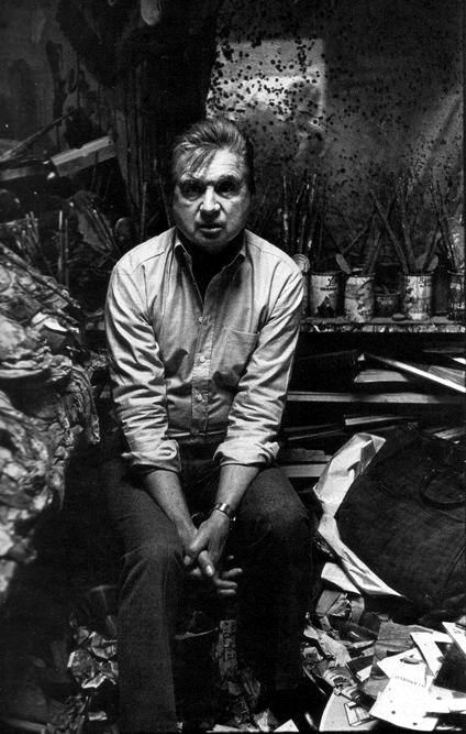

DANIEL FARSON
IN MOST countries, the 80th birthday of their greatest painter would be the cause of celebration and ceremony. With Francis Bacon, always the exception, there is celebration but a welcome absence of ceremony. Yesterday, reminding him of the scene in Somerset Maugham’s Cakes and Yale, when Edward Driffield, based on Thomas Hardy, reaches 80 and the Prime Minister arrives at his home with the Order of Merit, I asked if he expected Mrs Thatcher to come knocking on his door.
He has been described as a recluse, but it is hard to imagine anyone who approaches his stature yet lives so freely. With his extraordinary stamina he works hard in the early hours of the morning, breaking off in the afternoon to visit the restaurants, pubs or clubs of Soho ending up at Charlie Chester’s Casino where he gambles with ferocious intensity and frequently wins.
He enjoys parties, yet did not turn up at the one held in his honour last Thursday by the Marlborough Gallery, which has guided and guarded him so faithfully over the years. Formal occasions are not his scene and he has earned the right to avoid them. Instead, his presence was felt through the powerful paintings on loan.
If anyone expects a gloomy, introspective man, reflecting the despair which often features in his work, they are surprised to find a man of great charm and simplicity.
Unable to afford a ton of caviare, I sent him nothing, although I had taken him to the first night of Jeffrey Bernard is Unwell, unaware that Bacon was depicted briefly on stage as a camp painter in a smock, the negation of the truth. He had a convenient asthmatic attack in the interval and left.
Apart from flowers and caviare, what present can one give to a man who is so self-contained? A couple of birthdays ago, the artist Peter Bradshaw asked me to deliver a present he had painted in Bacon’s honour, a picture of the nurse, her glasses shattered, from the film still of Eisenstein’s Battleship Potemkin, a subject which has influenced Bacon.
Knowing Bacon’s aversion to material possessions and his detestation of contemporary paintings, I was relieved to see Bacon tear off the wrapping with the glee of a child at Christmas. It dawned on me that he rarely received presents because people assume he has everything he wants.
I was surprised even further as he studied the painting with such
intensity that I dared not interrupt. After a minute’s silence, he exclaimed:
Telephoning him to wish him a happy birthday, I was startled when he suggested meeting for lunch. I had assumed that a gala lunch was being held in his honour somewhere, but that is not Bacon’s style. He is a free spirit.
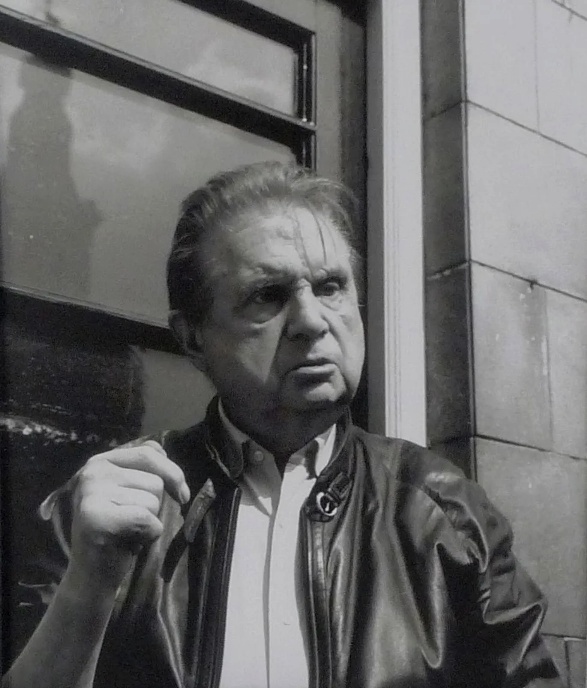
Francis Bacon
Out on his own from the start
Emilio Cola pays tribute to the incomparable Francis Bacon who
has just celebrated his 80th birthday
EMILIO COLA
DIFFICULT it is to realise that Francis Bacon is now an octogenarian, so vigorous and deeply involving is his inevitably controversial art. Probably the worlds greatest living painter, and undoubtedly the most genuinely original, Bacon was 80 on Sunday. A loner in the realm of art, it seems, in his day to day life, he pursues his personal vision, adverse criticism affecting him not at all.
His name as I recall meant little to me until Herbert Read, who did as much as anyone to project consistently the cause of modern art, first told me of Bacon’s work at a small party of artists in a house in Hampstead in 1933. That was the time of Unit One, a gathering of artists formed by Paul Nash, all of whom became greatly renowned.
A Dubliner born in Lower Baggot Street, Bacon was one of five children. His father, Edward Anthony Mortimer Bacon, served in the Army and had little means, living in the main by breeding and training race horses. It seems he was a bit of a gambler (a penchant his son had inherited) and a moralistic disciplinarian, a characteristic patently unacceptable to the free-thinking young Francis and one which ensured the permanent severance at any sort of relationship that existed between them. Francis’s mother, Christine Winifred, was 20 years younger than her husband and was temperamentally exactly his opposite.
The family moved to London where Edward worked in the War Office during the First World War, but regular visits were made to Ireland. After a domestic demeanour of miner importance that could, at a pinch, be accepted more humorously or tolerantly in other households (Francis tried on his mother’s underwear) the future painter was sent away from home in 1926 by an infuriated father.
Except for a part of a term at Dean Close School in Cheltenham (he ran away from it) and tutoring of a kind by the local parson, Bacon had no formal education, relying entirely — as he does to this day — on his own ability to assimilate knowledge, on his own powers of observation, on his innate conviction of his value and his individual talent.
Bacon is one of a kind that one meets occasionally, an artist who is, I feel, essentially alone even in company and in expansive mood. That, I must admit, is my impression for we have not met, although I had the opportunity to observe him in restaurants. Recalling, as I can without difficulty, the impact made upon me by my first sight of his 1933 painting of a crucifixion reproduced in Herbert Read’s book Art Now, I sensed even then that I was in the presence of a startlingly new image-maker who had the courage of his convictions. I felt then, and still do, that it was not painted merely to shock. That early work is in its way as relevant to Bacon’s entire creativity as his Popes, his late figure studies and portraits.
peter burton celebrates the painter who
likes “the excitement of things happening”
PETER BURRTON
“I’m
greedy for life; and I
Born in Dublin on October 28th, 1909, Francis Bacon is undoubtedly one of the
great figurative painters of the latter half of the Twentieth Century. His
figures are instantly recognisable
Despatched to pre-war Berlin by his horse-trainer father be-cause he had been found trying on his mother’s underwear, Bacon never had any formal art training and didn't make a real impact until his ‘Three Studies for Figures at the Base of a Crucifixion’ (now in the Tate Gallery) was shown in 1945; he is now represented in most of the world’s major collections.
Profoundly pessimistic, a believer in ‘chance’ (he was a great gambler) and a legendary drinker, Francis Bacon told David Sylvester “We are born and we die, but in-between we give this purposeless existence a meaning by our drives.” His paintings will remain one of the great artistic statements about our times.
Francis Bacon — Lawrence Gowing and Sam Hunter (Thames and Hudson (£24)
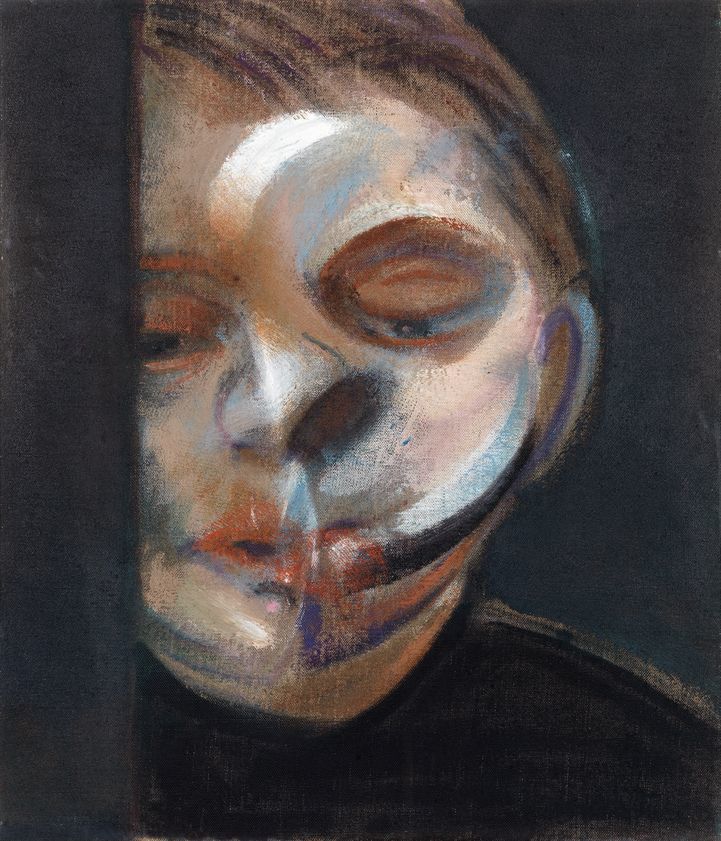
FRANCIS BACON ‘Self-portrait’, (1972)
Softer side of Sly Stallone
GORDON THOMAS
ACTOR
Sylvester Stallone is now the highest paid performer in cinema history
HE’S THE MAN who brought bulging biceps to the cinema screen. Yet underneath his tough guy image, actor Sylvester Stallone is a softie at heart. He grows pansies at his Malibu home; he writes poetry; he collects works of art. And he doesn’t just want to be remembered for his Rambo films.
He says: “My agent, my manager, those
close to me say, ‘You
“They
won’t know that I have always tried to keep my body and mind almost, as
Plato says, in equal proportions.”
It would be easy to smile and say the
words are the mumbling of a bored superstar
“Rambo
is a semi-real character to millions. I just wish people would accept the
Rambo movies for what they are adventures. Yet folks try seeing things that
are not there.
Different
Yet Stallone is still going to make
another Rambo film Rambo IV. This one, he promises, will be different.
Stallone’s home is a mansion overlooking the Pacific. It has towering walls, electronically controlled gates and guards who look about as friendly as the runners-up for Mr Universe. This forbidding place, with surveillance cameras and sensors in the walls, is called Little Pink. And beyond the gates pansies grow in the gardens.
Here Stallone lives a life far
removed from his physical, monosyllabic screen image. Not only does he tend
the pansies, he also reads Plato and Homer, and he combs the art world to
add to his already astonishing collection. He has just spent “a few million”
on a Rodin statue
Pride of place goes to a massive work
by the British artist Francis Bacon. It is surrounded by masterpieces by
Rubens, Dali and Warhol. This is the side of Sly Stallone that few know
about
Standing beneath a painting of Monet,
opposite a wall covered with a collection of lethal looking knives all used
in his Rambo movies
He pauses to inspect an Andy Warhol
silk screen print of Stallone himself. It captures what Sly has always been
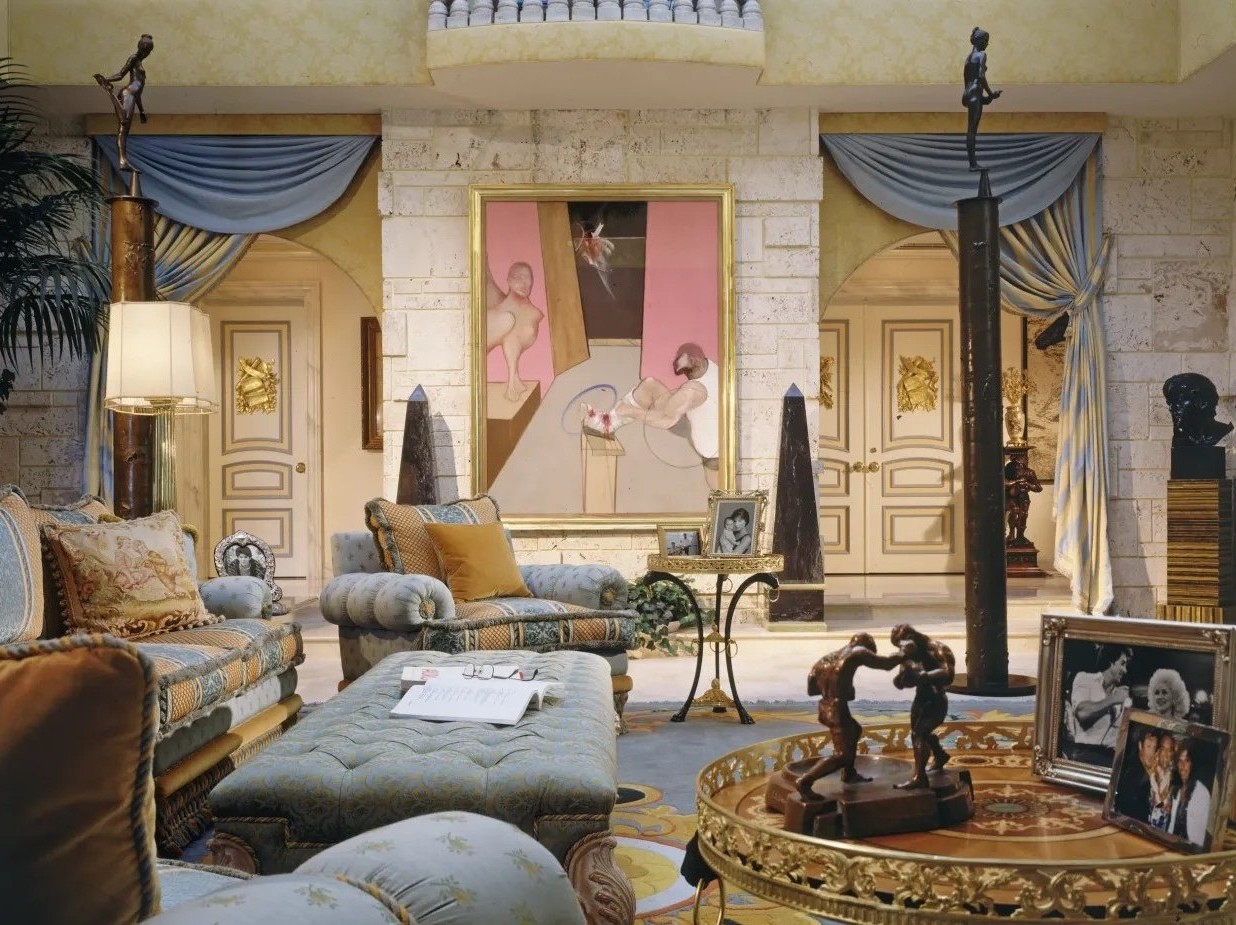
Bacon at 80
William Packer reviews the pick
of the London galleries
WILLIAM PACKER
WHETHER OR not there is a School of London that now leads the world, its leading light, primus inter pares by common consent, is Francis Bacon, just turned 80 and still prolific. And as with any show of his work these past 45 years, the small loan exhibition to mark that climacteric (Marlborough Fine Art, 6 Albemarle Street W1: until November 18) is naturally of some considerable interest.
It is retrospective, though with only 15 works it offers simply a summary or sketch rather than any proper study of the career. But the token, even so. stands for the man. marking on the one hand Bacon’s remarkably sustained creative energy and formal consistency: on the other the quite extraordinary originality and power of his early surreal expressionism. The Figure Study of 1946, that sinister, hunched tweed coat and felt hat, lurking beside the hydrangea bush, by itself confirms the reputation as it justifies the visit.
Peter Coker (Gallery 10, 10 Grosvenor Street W1: until November 16). now in his early sixties, is one of the most distinguished of our landscape painters. His fluent, open-handed post-impressionism has been a feature of the Academy for more than 30 years, and yet his gallery career, and with it his broader critical reputation, has not prospered as it should. This is a show of landscape drawings and studies, from the 1950s up to the present, that is a virtuoso demonstration of consistency in variety — and variety in consistency for that matter, as we see him return to the same spot after 20 years. Drawings are often the greatest bargain to be had, so direct and immediate in the experience they offer.
For the moment there are no better drawings than these to be found on show in London. One of the more recent studies, of nets laid out to dry, is quite extraordinary, an image at first formless and hard to read, that slowly realises itself as we too begin to comprehend, with the artist, that very formlessness.
Mick Rooney’s reputation (Mercury Gallery, 26 Cork Street W1: until November 25), has been growing steadily for some time, but only now, in his mid forties and with this show, does he emerge as an artist of distinctive quality and power. It is not so much the manner of his painting that has developed. though it has grown somewhat broader and more authoritative, as the matter of it. Gone is the whimsical and anecdotal, almost illustrative subject matter, drawn with a grotesque and comic eye upon domestic experience. Instead there appears something altogether more dense, ambiguous and profound.
Rooney has been reading Primo Levi, hut not Co illustrate him. Rather it is that Levi’s real world has come to haunt Rooney’s imagination, furnishing it with oblique reference and association rather than particular incident. These are images of collective melancholy, deep sadness, fraught with a sense of imminent departure and immanent loss. The family clings together on the platform: the dark train goes by. “Perche partiamo?” asks the title to the painting. “Why are we leaving?”
David Hepher (one of 3 individual shows at Flowers East, 199 Richmond Road E8; along with John Loker — prints; Nicola Hicks — sculpture & drawings: until November 26), in his mid fifties, is a painter of the urban landscape, and in particular that of the high-rise housing estate. The blank facade of the tower block, yet with each window and balcony rich with curtains, washing and potted plants, has been his familiar subject. But lately the space has deepened, as he has pushed the tower block back, to be seen across the older fabric of the city. An element of fantasy, too, has been openly admitted. Hepher has been looking at the career of Piranesi, and has superimposed, in larger and more vivid terms, that same vertiginous and vaulted space upon his blocks of flats. And with this opening out of the pictorial space has come a freer and more generous handling of the surface. These are impressive paintings.
Finally, Patrick Symons (Browse & Darby, 19 Cork Street W1: until November 25) is showing recent paintings and drawings of musicians, landscapes, and still lifes. Recent, however, is a word used advisedly, for Symons works with infinite visual scruple. This is only his third show since 1975, and the large composition of the string trio playing on the balcony has engaged him for most of the interval. It is a remarkable and major work.

IN HIS 60-YEAR CAREER, THE PAINTER HAS BEEN GUIDED
BY A RELENTLESS VIEW OF HUMAN FATE.
EDWARD J. SOZANSKI | INQUIRER | SUNDAY, NOVEMBER 12, 1989
Few painters in this century have pursued an aesthetic agenda with the single-minded intensity and persistence one finds in the work of Francis Bacon, who turned 80 on Oct. 28.
In 60 years of making paintings, Bacon has restricted himself to one theme, the existential helplessness of human beings in the face of an incomprehensible universe, and the agonies they suffer in trying to muddle through lives that are, in his view, essentially meaningless.
The 58 paintings at the Hirshhorn Museum and Sculpture Garden that make up a retrospective of Bacon’s work over the last 45 years confirm his dedication to this single grand investigation. His paintings from the mid-1940s, when his mature style emerged, are much the same as those from the mid-’80s.
They aren’t precisely the same, of course — Bacon’s imagery becomes more focused as he grows older — but there aren’t any digressions in content or style. Since the end of World War II, Bacon has remained committed to the figure, to symbol, and to his intuition and obsessions, of which death is perhaps the most prominent.
His art is about as stripped-down as painting can get. He rejects any suggestion of narrative or context. He refuses to offer any insight into what his paintings are supposed to mean, even assigning them bland or neutral titles — Study for a Portrait, for instance — that are obviously intended to deflect critical interpretations.
“I’m just trying to make images as accurately off my nervous system as I can,” he said in a 1973 interview. “I’m not saying anything. Whether (I’m) saying anything for other people, I don’t know.”
With disclaimers such as this, Bacon tries to portray himself as a kind of passive communicator of truths that emanate from the collective human experience. His deformed, distorted and sometimes grotesque figures represent not what he sees but what he feels.
When those feelings materialize as the large-format paintings that Hirshhorn director James T. Demetrion has assembled in this retrospective, viewers are apt to be startled, puzzled, disturbed or perhaps even repelled, for Bacon’s art is neither pretty nor facile.
On the other hand, it’s difficult to remain apathetic to Bacon. One is either mesmerized by the individuality and primal force of his images or one retires from the arena, for he offers neither emotional reassurance nor decorative flair and fashion.
Bacon is a loner; even though his painting has often been described as expressionistic or surrealistic, he neither belongs to nor espouses any movement. He has always worked by himself and within himself, avoiding the influences of whatever style happened to be in vogue at the moment and the status of celebrity artist.
One senses this even from the several books about him that have been produced in the last several years, including the catalogue for this exhibition. Bacon refuses to be photographed while working, and one presumes that he isn’t crazy about being photographed under any circumstances, for the books contain very few pictures of him.
As Bacon moves into his 80s, he’s being anointed as one of the most important artists of the 20th century. Clearly, he’s the premier British artist still working. He already has had two retrospectives at the Tate Gallery in London, the most recent in 1985, and the Tate rarely mounts more than one such show for a living artist.
The Hirshhorn exhibition is the first full-scale survey of his painting in the United States since a show at the Solomon R. Guggenheim Museum in 1963. After closing in Washington Jan. 7, it will travel to the Los Angeles County Museum of Art (Feb. 11 to April 29) and the Museum of Modern Art in New York (May 31 to Aug. 28).
The angst implicit in Bacon’s often bizarre images — contorted bodies, screaming heads, dissolving faces — reflects the mood in Europe in the aftermath of World War II. It’s the same mood that sculptor Alberto Giacometti expressed in a more melancholy way in his attenuated figures.
Even after 45 years, Bacon hasn’t softened his pessimism about man’s condition or his prospects. Yet although they’re psychologically bleak, the paintings convey a heroic eloquence through the way they’re conceived and painted and in the way that Bacon insists on presenting them in plain but substantial gold frames. Bacon is a curious figure among 20th-century artists in that before 1944, when he completed Three Studies for Figures at the Base of a Crucifixion, there weren’t many indications that he was going to amount to very much.
He was born in Dublin, Ireland, of English parents. His formal education was spotty, and he left home when he was about 16 to live in London, where he supported himself with various odd jobs. During his late teens and 20s he travelled in Germany and France, working sporadically as an interior decorator and furniture designer.
In 1927, inspired by a Picasso exhibition in Paris, he began to draw and make watercolours; two years later he began to paint in oils. As with his decorative work, he’s self-taught in art. Picasso appears to have been his only influence, although he has drawn source material from other artists, including Velazquez and the photographer Eadweard Muybridge.
The oddest thing about Bacon’s career, evident in this exhibition as in the one four years ago at the Tate, is that it appears to begin at full throttle in 1944. Bacon destroyed most of his early work in 1943, so the retrospective is incomplete in that it presents only his mature efforts.
Bacon’s life offers only one obvious clue, his early family existence, to the genesis of his bizarre and occasionally horrific imagery. He told art critic David Sylvester in 1984 that his relationship with his parents “was never good. We never got on.”
The antipathy was strongest between Bacon and his father. “He didn’t like me and he didn’t like the idea that I was going to be an artist,” Bacon observed. He had two brothers, both of whom died young. Because Bacon had severe asthma, he was rejected for service in World War II. So he didn’t experience the boredom, terror and random killing of the battlefield, which may be the ultimate existential experience.
One shouldn’t make too much of these circumstances, however, for belief in the absurdity and pain of existence can be induced in many ways. However his philosophy formed, Bacon has always expressed this belief through the figure; he considers abstraction formalist decoration that’s inadequate to the task.
He also has relied extensively on art-historical tradition — in his fondness for the triptych format, his references to mythological and religious themes such as the crucifixion, his reliance on the conventions of portraiture, and his custom of presenting his paintings as precious objects.
One of his more sensational pictures combining several of these issues is his 1949 paraphrase of Velazquez’s famous portrait of Pope Innocent X. Bacon portrayed the Pope as a spectral figure who seems to be screaming in agony or defiance. The bust-length Pope is framed by a box-like outline, a device Bacon uses frequently to focus attention on the central figure of a painting.
The primal scream is Bacon’s essential concern and message. A gaping mouth bristling with feral teeth and sometimes planted in a hideous, alien skull is a frequent motif. But Bacon uses other motifs that are equally unsettling — fantastically deformed bodies, contorted faces and impolite situations, like a naked man defecating.
Specific paintings refer to the Greek myths of Orestes being pursued by the Furies for murdering his mother, Clytemnestra, and of Oedipus murdering his father and marrying his mother. The visual references to these sources are obscure and distorted beyond recognition, but the agonized spirit of the paintings is consistent with them.
Bacon’s aspiration to Old Master gravity is pronounced. It’s evident not just in his themes but in his use of large formats and human-scale figures, along with his insistence on framing his paintings under glass to establish distance between the image and the viewer.
If the paintings were not so compelling, one might consider these tactics pretentious and arrogant. But one accepts Bacon’s strategy as reasonable because of his extraordinary ability to capture one’s attention and hold it, regardless of how one responds to a particular image.
Part of this is compositional; Bacon keeps his designs simple and devoid of extraneous details. He highlights figures with the framing box or by setting them against homogeneous black or pastel grounds.
The other part is the balance he strikes between “realism” and eccentricity; the pictures are recognizable and logical up to a point, but their ultimate fascination and meaning derives from their ambiguities. If the universe is the ultimate mystery, then Bacon’s paintings represent an intuitive leap into its infinite depths.
Their fundamental nature is clear, however: These are images from hell, from the deepest, darkest depths of the human psyche. If they fascinate, it’s because we recognize in them not just the soul of an individual artist but the souls of each and every person on earth.
John Keegan on two dangerous worlds
JOHN KEEGAN | BOOKS |
THE
SUNDAY TELEGRAPH


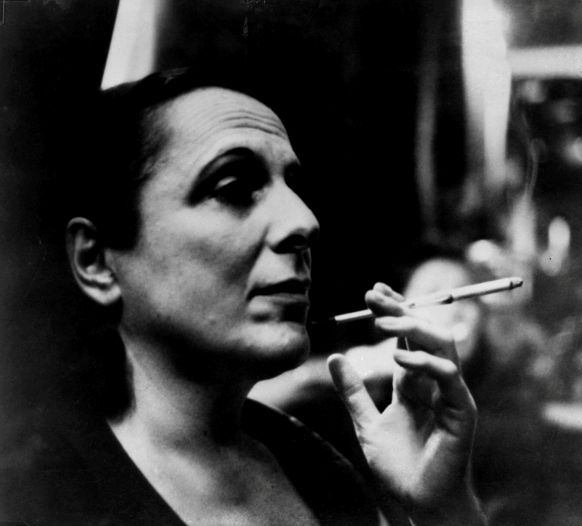

BY
ADRIAN WOOLDRIDGE | WORLD OF BOOKS: 2 |
DAILY
MAIL
Away with the abstract
The Arts in the Eighties: John Russell Taylor looks at
how the visual arts have re-embraced representation
JOHN RUSSELL TAYLOR | THE ARTS | THE TIMES | FRIDAY DECEMBER 29 1989
In 1980 there was a big show at the Hayward Gallery entitled Pier + Ocean, which summed up a lot of the minimal and conceptual art of the previous decade under a label borrowed from Mondrian, who happily was not around to be consulted. Thank heavens, I thought, that we are in the Eighties now, we do not even have to pretend to take most of this nonsense seriously any more. And I was right, though I had not at that point foreseen the creation of the Turner Prize to substitute establishment endorsement for serious assessment. For what the Eighties have signified above all in art has been a .return to representation.
Exhibitions are usually the heralds of such changes; they focus and dramatize what many people are vaguely thinking and feeling, and offer a formulation, often no doubt too snappy and simplistic, which grabs the imagination. The first thing of that bud to happen during the Eighties was an enormous show in Paris, at the Pompidou Centre, entitled Realismes 1919-1939. It sounds harmless and historical enough, but what it did was point oat that even among the most serious and forward-looking artists, there had always been a representational alternative to abstraction.
Far from being isolated reactionaries who could be overlooked while we surveyed with satisfaction the highroad leading from Impressionism through Cubism to Abstraction, Minimalism, Conceptualism and, presumably, silence, the painters of the Neue Sachlichkeit in Weimar Germany, Leger and his associates in France, the Magic Realists in Italy, and even our own cherished eccentrics like Spencer and Buna began to seem intensely relevant.
Revolutionary shifts of sensibility seldom start in Britain. But the next big happening was the Royal Academy’s 1981 show A New Spirit in Painting, which followed up such questionings of abstraction by launching internationally some dozen Italian and German artists who came to be known as Neo-Expressionists.
Whatever Kieferand Penck and Baselitz and Chia and Clemente were about, it was definitely representational; and when the same organizers followed up with an even bigger show of the same in 1982 in Berlin, the title Zeitgeist for once seemed to sum it up: like it or not, this was the spirit of the times.
Possibly the British participants in Zeitgeist were trailing a bit, but in 1985 it became evident that something really significant was happening North of the Border when New Image Glasgow showed beyond doubt that we had our own thriving school of Expressionist Realists just out of art school and ready to conquer foreword.
It has bean a decade of big shows. In 1980 people were confidently predicting that the international blockbuster of the Seventies, spawned by Tutankhamen, had had its day, rendered logistically impossible by the soaring costs of insurance and transportation, not to mention increasing concern for conservation.
Although this may be true, it has not appreciably reduced the number of blockbusters. Only in this decade the accent has been taken off the “treasures” show (that great British export to Washington Treasure Houses of Britain being an honourable exception), and squarely on to in-depth explorations of individual artists.
Naturally, given their approachability and the spectacular rises in their prices, the Impressionists and Post-Impressionists have led the field, with giant travelling shows devoted to Manet, Monet, Pissarro, Renoir, Degas, Gauguin and Toulouse-Lautrec, and no fewer than four of them to cover Gogh.
It has been a rather disturbing sign of foe times that Britain has missed out on most of these (of those mentioned we have had only Pissarro and Renoir), but we can claim credit for foe one which most spectacularly opened eyes and changed opinions, the Royal Academy’s Cézanne: The Early Years in 1988.
We can also say that with many of these artists we have too little to bargain with, in the way of essential works in our own collections, and it is natural that the shows should go where the essential exhibits are to be found. And yet this does not apply only to shows of early modems. During the decade, for instance, Spanish art has been re-explored in enormous moveable feasts devoted to El Greco, Zurbaran, Goya and Velázquez, but all we have seen is the saccharin Murillo.
Credit where credit is due: the Royal Academy has done well by us with its biennial series of surveys devoted to German, British and Italian art in the 20th century. Of course they have maddened just about everybody, for one reason or another, but they have started us talking and thinking, and put us on the spot to come up with better formulations.
We have also been, on a more modest level, exploring our own Romantic history in a series of shows which began with the Tate Gallery’s exemplary Pre-Raphaelites in 1984 and included the Barbican’s The Last Romantics this year and, out of order, A Paradise Lost (about the Romantic painters of the Forties) in 1987. Other memorable shows along these lines included Hard Times, also in 1987, which for those who made the trip to Manchester was most enlightening about the strain of working-class realism in Victorian art.
Coming more up to date, a decade which has seen the deaths of our three artist O.M.s, Sutherland, Moore and Nicholson, has also seen the universal (well, almost universal) acceptance of Francis Bacon as the greatest living painter, and the arrival without major mishap of David Hockney at his half-century, still amazingly public, amazingly private and following his own star.
Major disappointments were foe Royal Academy’s much touted Neapolitan show and foe Tate’s Gainsborough, both vitiated by — being apparently put together by scholars for scholars, with no care for the public at large, while the Saatchi Collection, in itself a fascinating phenomenon of the decade, fell spectacularly on its face by launching its acquisitions of NY Art Now in 1988 to almost unrelieved ridicule and contempt.
PETER JENKIN
Dan hit by a little French resistance
DESPITE all attempts to impose a veil of respectability on London’s square mile of excess, the rumbustious, Bohemian behaviour that is a traditional characteristic of Soho lives on.
It bubbled to the surface the other night in a flurry of shouts, Anglo-Saxon epithets and flying fists on the pavement outside the French, favourite drinking place of wartime resistance heroes, Charles de Gaulle and, more recently, myself and esteemed artist Francis Bacon.
It culminated with author and television broadcaster Dan Farson being punched to the ground and then humiliatingly booted into a nearby gay pub. The incident erupted when Farson, who usually flavours the bar at the Coach and Horses immortalised in the successful play, Jeffrey Bernard is Unwell, made an unscheduled stop at the French.
He was not well received. The previous patron, the legendary Gaston, had banned him some time ago for over-exuberance. The new patron, magnum-sized Noel Botham, was moments away from enforcing his own exclusion order.
Farson, great-nephew of Dracula author Bram Stoker, gave Botham and his lady patronne, Lesley Lewis, the benefit of his opinions. The air turned Gaulois blue.
Floored
Botham came to the imbibers side of the bar to escort the old Sohoian (though he never wears the tie) to the door. They stepped outside. Botham recalls: “On the pavement Farson raised a fist so I floored him and set him on his backside.”
As if that was not chastisement enough, Botham then picked Farson up by his belt
and coat collar and propelled him through the door of the nearby gay hostelry.
And there the matter rests, so to speak
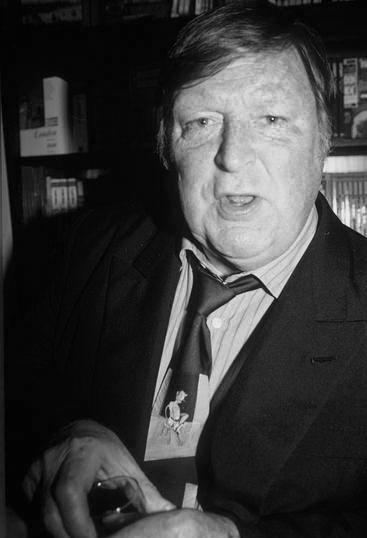
FARSON: Booted out
No beefs over bringing home the Francis Bacon
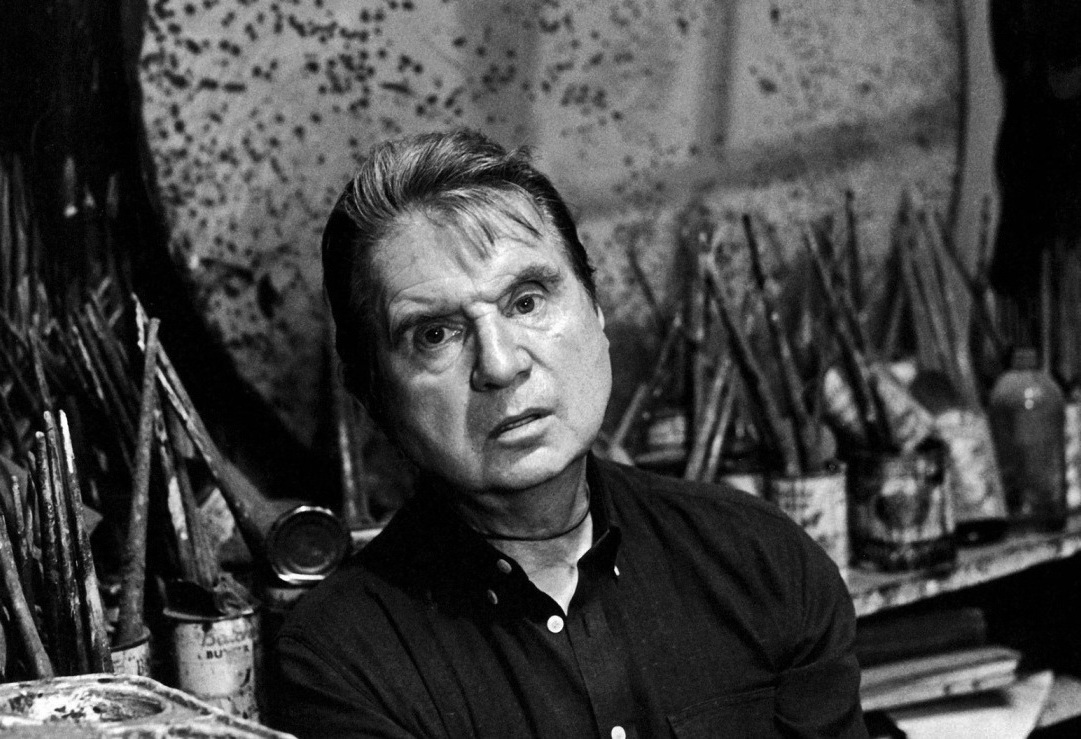
Francis Bacon, Master of Despair: At 80, the artist would seem to
belong to another era; why do his paintings still take us off guard?
In the mid-1950s, a UCLA exhibition included a new British artist--Francis Bacon. He was represented by “Study After Velasquez’s Portrait of Pope Innocent X.” Awed faculty dragged their budding-genius students down to have a look. It wasn’t surprising that the kids had never seen anything quite like it, but neither had grizzled art teachers, who had seen a good bit.
The sinister, crafty Pope was pictured suddenly screaming. That seemed significant enough, but the painting’s technique was even more striking--the Pope appeared flickeringly through vertical, thinly applied striations that suddenly gave way to the crazy, free-brushed drapery of his gown and then firmed up to an illusive but deftly realized rendering of his face and purple cap. The image seemed less seen than hallucinated.
Anti-Establishment beatniks roamed the campus in those days wearing black, drinking espresso and acting cool. Cool was the colloquialization of Alienation. Everybody was still learning about the Holocaust, Jean-Paul Sartre and Existentialism; Giacometti and Dubuffet; Beckett, Ionesco and Pinter. Smart people were learning that the Second World War had rendered the world Absurd.
In that ambiance, Francis Bacon had a certain inevitability. Besides, it looked to conservative artists as if this was the guy who would give new meaning to figurative painting in an era dominated by abstraction. Even among the Abstract Expressionists, there was a lot of talk that dribble-and-splash painting was washed up.
Now, some 35 years later, Samuel
Beckett has recently died and the County Museum of Art presents a 58-work survey
of Bacon’s oeuvre --the first in the United States in some 25 years. The
occasion marks the 80th birthday of the artist who has been called the world’s
greatest living figurative painter. Notable parallels exist between Beckett and
Bacon. Both were born in Ireland but moved away
Things about Bacon’s art invite
dismissal. Formalists like to kiss him off as little more than a juiced-up
version of Picasso in his surrealist period. The art often seems overly
theatrical, calculating its effects like the curtain-line in Pinter’s “The
Caretaker” when
Bacon’s work is increasingly full of empty, flat spaces punctuated by dramatically placed scumbles of figures. A recent diptych of studies from the human body is little more than a series of stagey red rectangles and risers bearing grotesque mutations of torsos. It’s all about effect and we remember that Bacon started his career as a decorator and designer.
His art is intensely mannered and
has changed only in nuance over the decades. His stylization invites
impersonation and has affected a long string of artists from the now
half-forgotten James Gill to Bay Area Figurative Art in general and Ron Kitaj,
David Hockney and recent James Dine in particular. Bacon’s mannerism leaves
observers with the impression that he has made a career of impersonating
himself. This effect is heightened by the character of the art. It seems fair to
ask how anyone as immensely successful
The quick answer to that is that the rich and famous are not necessarily content and Bacon has been strange and haunted all his life--an out-patient recluse, compulsive gambler, serious boozer and a homosexual of sometimes self-destructive bent. Also--when so inclined--almost predictably viciously witty and charming.
Given all this, one approaches the retrospective ready to snicker. At first, the once-haunting Pope looks like the payoff of a Monty Python skit where mouse has just run up the pontiff’s skirt. The snarling succubus in the 1950 “Fragment for a Crucifixion” has long since been made cuddly as E.T. Looking at a Bacon portrait where the skin of a face is peeling off, we think of a spy in “Mission: Impossible” pulling off the mask of a latex disguise. A study for a portrait of Van Gogh trudging the road begs for some such caption as, “Pardon me, madame, can you direct me to Arles?”
Today, we view Bacon across a gulf of time, with electronic culture on our side and modernist culture on his. On our side is a detached art inspired by the media and on his, an art that filters history through intense personal experience. His modernist culture included appreciation for ancient classical literature like the Oresteia of Aeschylus, which inspired one recent triptych, and then-contemporary culture, which still included T.S. Eliot’s “Sweeney Agonistes.” Bacon’s gang includes Rembrandt, lots of Goya, Muybridge, Eisenstein, Bunel, Godard and Eric Rohmer. Our side stands four-square with MTV.
As you begin to wonder if you haven’t somehow gotten onto the wrong promontory, Bacon begins to get to you again. Of course there is an element of humor in him as there is in Beckett. Humor and muffled horror combine to produce Absurdity. I was once in a head-on car crash I thought was going to kill me. I saw the face of this perfectly nice chap in the other car and thought, “So that’s what death looks like.” Dying felt, well, ridiculous. Bacon’s art still contrives to take you off guard like an unexpected anxiety attack in familiar, comfortable surroundings. Just as he rarely wanders far from his Chelsea studio, the paintings rarely stray from homey street corners or dowdy apartments. A sudden rush of Angst in such reassuring places peels back the armor of conventional assumption and gives us a glimpse of cauterizing fact.
Bacon jolts us into remembering that we are animals. There isn’t a dime’s worth of difference between the dog he painted after one Muybridge photo and the paralytic child he took from another, walking on all fours like his brother simians. All beasts are subject to sudden and violent extinction at the hands of other beasts. When he paints two nude men embracing in a field, they are like creatures in a zoo. You can’t tell if they are copulating or killing each other. Maybe both.
The 1946 “Painting” is a charnel house where a flailed carcass presides and a bloody-mouthed man grimaces. He hides under the umbrella of middle-class convention. It is another version of those invisible glass boxes where Bacon paints us imprisoned in rationality, bellowing against its constraints.
The artist is exquisitely aware of human vulnerability. If he weren’t so tough about it, he might seem sentimental or self-pitying. Actually he does sometimes, but not in “Portrait of George Dyer Riding a Bicycle,” where he transforms the innocent business of a nice peddle into a metaphor of life’s precarious balance. Dyer rides as if on a tightrope just as the Fool of the Tarot gambols on the edge of a cliff.
Bacon is a master of the tentative. Even his most finished paintings are called “studies.” He has a genius for the illusive, the not-quite-stated, the ominous. And he gets at it through plastic means. Triptychs like “Three Studies for a Crucifixion” do woozy things with space. We are in a red, circular room. Two men look over their shoulders at carrion lying in the foreground. In the next panel, we see a grinning, suppurating corpse on a bed and finally another dematerialized side of beef. It is never clear if the flailed meat is all human or if it is all the same thing viewed from different angles, so we seem to be floating around the room like a jerky balloon, a witness to something as vague as it is awful.
He also has a talent for the telling
detail. In the midst of some hairy, unclear scene of muted violence our
attention is drawn to a pack of cigarettes, a light switch or porcelain cabinet
handle
Significantly, the exhibition
(through April 29) runs concurrently with a retrospective devoted to the pioneer
New York stain painter Helen Frankenthaler, an artist sometimes thought of as a
maker of exceedingly pretty abstractions. Hearing of this unlikely
juxtaposition, one immediately wants to title the coincidental pairing “Beauty
and the Beast.” So much for our ideas about art. She turns out to be much
tougher than her reputation and he much more tender. The coupling leaves a nice
reminder that we can’t experience art according to our notions about it
STEVEN DORNBUSCH
Regarding William Wilson’s Feb. 11 review of the Francis Bacon exhibit at the Los Angeles County Museum of Art:
I admit to snickering at a recent LACMA exhibition. Not at Francis Bacon’s paintings — I snickered at all the people fawning over Robert Longo’s superficiality.
So Bacon belongs to the era of Existentialists and beatniks. Fine. Kurt Schwitters belongs to the era of Dadaists, revolutionaries and prophets. Cezanne and Goya belong to their times. I do not snicker at art because it belongs to another time.
Francis
Bacon has not changed much over the decades. He paints the same images. He
chooses to refine, rather than add new techniques. His subjects
—
death, alienation, violence and sex
Bacon rescues the viewer from Western “sophistication” of not feeling anything about much of anything. His paintings make us feel. Over and over again.
While his art belongs to another era, his place in art will not pass like so many fads. Wilson’s confused opinions will soon be forgotten. Like his MTV and “electronic culture.”
Violence, sex and death do not bore me. Banality does.
THE ART WORLD
Optimist
BY ADAM GOPNIK
IN the last half century, the visions of the English painter Francis Bacon have entered the prop room of the modern imagination: the screaming pope, the small, damaged figure racing on the polished tracks, the exhausted naked man curled up under the glare of a single unshaded bulb. Bacon’s admirers range from Graham Greene (who has compared the lengthy, sepulchral interviews that Bacon has given over the years to the journals of Delacroix) to Bernardo Bertolucci, whose “Last Tango in Paris” used Bacon’s paintings of doglike couplings and hung-over aftermaths as backdrops. For an entire European generation, Bacon’s art provides a model of sexual agony: desire expressed as rage, experienced as pain, and ending in isolation. Bacon, now eighty, has become a pop figure, too: in the film “Batman,” the Joker visits the Gotham art museum and destroys every painting there except a Bacon. A lot of people, perhaps as a consequence of Bacon’s popularity, are inclined to see him as a ham, someone who produces the kind of macabre modernism that only a cartoon villain could love. And some critics maintain that Bacon has never really cast off a love of decor—he began as a designer of glass-and-chrome coffee tables and of throw rugs—and has become a Grand Guignol artist with a line in stage blood and limelighted horrors.
A retrospective exhibition of Bacon’s paintings has been touring the United States; it was at the Hirshhorn Museum, in Washington, through early January, is now in Los Angeles, and will arrive in New York, at the Museum of Modern Art, in the late spring. The exhibit, curated by James Demetrion, and including more than sixty pictures, shows that Bacon, when seen whole, stands completely outside the Gothic-and-Expressionist tradition to which critics most often attach him. His resolved and mannered painting conveys no sense of an attempt to take away the masks of social roles and reveal a primal human condition, nor is there even a distant, formal echo of the austere, dried-blood palette of Munch or the pointed, barbed-wire bodies of Beckmann and Kirchner. Bacon’s gold-framed figural paintings, with their recessive enclosing spaces and their insistently smooth, curving patterns of looping brush marks and whorling paint, every knee or elbow rounded off like a neat sum, work entirely within a late-classical tradition of rhetorical pathos. His stylized agonies look back to the swooning martyrdoms of Counter-Reformation painting and, beyond them, to Michelangelo’s “Slaves” and to the attenuated sufferers of Pergamene altars. Bacon’s announced desire to “paint the scream rather than the horror”—to convey feeling rhetorically, even sentimentally—might have lacked all intensity had it not been for his unsettling discovery that this old rhetoric of suffering could be married to the little voluptuous sensations of French luxury painting. Bacon’s interiors, with their high-keyed coloring and purple shadows, descend from Matisse rather than Munch.
The power of Bacon’s pictures depends on the surrender to the decorative, which is sometimes supposed to be their weakness; his art attains its intensity by confronting the moral ambiguity in the aesthete’s undifferentiating eye. If this marriage of glamour and suffering can at its weakest and most grandiose make Bacon seem no more than the Arthur Rackham of the Age of Anxiety—a lush illustrator with a taste for spooky effects—Bacon at his best is a painter of beautiful indoor martyrdoms that become tragic because they lack any accompanying system of belief to make them exemplary. In his best paintings, most of which date from a short period in the mid-nineteen-fifties, and especially from 1953, a vintage year, Bacon manages to focus this marriage of formulaic pathos and near-at-hand sensation into an intensely particularized vision of English misery —a large expense of spirit in a small, confining waste of blue-gray drizzle and blinds and hotel rooms and back gardens—and to make an art that is poised weirdly and yet with complete authority somewhere halfway between the Laocoön and Philip Larkin.
The dialogue between décor and damnation in Bacon’s art began very early. The so-called armatures of Bacon’s mature paintings—the polished rails and tubular enclosures that so often encircle his figures—are in fact hallucinatory enlargements of his early glass-and-bent-chrome chairs and tables: small elegancies turned into metaphors of imprisonment. Bacon, rather than being an inventor of form, is first of all an inspector of the buried horror that resides in glamorous images. His earliest major painting (many of his works from the thirties are lost), the famous “Screaming Pope,” of 1953, depends for its structure on the marriage of two high-gloss reproductions: one of Bacon’s many postcards of Velázquez’s portrait of Innocent X (whose original he has not yet seen) superimposed on a movie still of the screaming woman from the Odessa-steps sequence of Eisenstein’s “Potemkin.” The palimpsest is made powerful by the way Bacon melts the two found images together with a Monet-like liquefaction, so that Velázquiz’s intense description of surfaces is transformed into a soft, runny unity.
The rituals of appetite, the relentless attempt to dress up in the costumes of social life the craving for sex and power and anesthetics, became Bacon’s obsessive subject. This sense that the free and seemingly unstructured hedonism of modern urban life—the world of “arts and leisure,” as that strange pairing still has it—could be understood with an almost anthropological detachment as a set of enforced, and even primitive, rituals had previously been achieved in painting only by Degas, in his images of the rites of the ballet and the racecourse. And it is from the late Degas pastels of ballet rehearsal that the surfaces of Bacon’s paintings of the late forties and early fifties derive. But if Degas’s touch— his dark violets and green pastels and his thrumming, repetitive stroking— could be taken over organically by Bacon, his figure drawing was beyond Bacon’s limited powers as a draftsman and, anyway, was too subtle for Bacon’s melodramatic needs. Bacon’s imagery of the human body therefore derived from Degas’s contemporary the photographer Muybridge, whose stop-action pictures of nude men wrestling and walking and dancing raised the anthropological detachment implicit in Degas to an almost pathological degree.
In the early fifties, Bacon began to collect Muybridge’s photographs and use them as a source, and in the awkward, anonymous grapplings and frozen choreography of Muybridge’s wrestlers he found a way to picture homosexual passion. The current exhibition, though it lacks such famous and intense Bacons as the so-called “Buggerers,” does include what is in some ways the most powerful of all Bacon’s images of copulation as contest: “Two Figures in the Grass,” of 1954. The picture is divided into an aggressively abstract pattern of flat horizontal bands: purple-black at the base, then the two men in the grass, and, above, not sunshine or sky but a black-on-white box of skeletal bars. The picture’s layout uncannily resembles that of certain American abstract paintings of the same period, and shares with American abstraction a source in French Fauve landscape. But Bacon has taken the even, all-over space that Rothko and Matisse share and broken it sharply at a right angle, so that it becomes an enclosing diorama—the landscape of pleasure reimagined as the topography of pain. The copulating men have the inarticulate shape and purple mottledness of hung game, and yet within this shape one suddenly makes out a clear and beautiful face upturned in ecstatic pleasure.
For all the ritual genuflection to Eliot and Yeats on which Bacon’s admirers insist, it is Auden (whose early biography in many ways duplicates Bacon’s own, including a year spent in Berlin in the late nineteen-twenties) who provides a real parallel for Bacon’s erotic imagery. Auden’s love poetry of the thirties and forties first articulated the sense, which Bacon’s art illustrates, that the beleaguered intensity of homosexual experience could become the harbinger of a new tragic consciousness. Where for other British painters who came of age in the fifties (Hockney is the most obvious example) the model was Isherwood’s elaboration on Wilde—the sense that the enforced isolation of the homosexual experience could combine ironic detachment with moral gravity—Bacon’s art descends from the tragic vision of Auden’s “Lullaby”: “Lay your sleeping head, my love, Human on my faithless arm.” Auden’s idea was that a life lived without an accepted public face—lived, under compulsion, in fear and fragments —could nonetheless feel its way toward an essential truth about love which was elsewhere anesthetized by the elaborate panoply of domestic ritual. All sex is, as sex, anonymous, Auden and Bacon alike suggest; what the homosexual experiences under duress is close to the real nature of desire. The blurrings and generalizations of Bacon’s paint in his erotic pictures— faces smeared on in a single swipe of the loaded brush—are meant to have the same effect that the burning away of given names and clear pronouns has in Auden’s love poetry: they suggest enforced anonymity as a near relation to romantic universality.
THE screaming pope and the secret lovers define the two poles of Bacon’s grim vision: the scream as psychotic rage bursting through the top of the social order, and the coupling as erotic energy released furtively at its base. Too often in his art, particularly during the nineteen-sixties, when he became fashionable, Bacon has just elaborated on and embroidered those two extreme images. Yet for a moment in the fifties—especially in 1953—he managed to create a kind of electric field between the poles of unassuageable rage and raw consummation, and produced his greatest and most humane pictures by looking at ordinary things that, caught in this field, were suddenly charged with an unexpected magnetism.
Bacon’s paintings of the fifties are filled with respectable-looking men in suits: they wait on benches, nurse headaches, curl up on hotel-room beds, tie their ties in the morning mirror. On one level, of course, they are simply the organization men—the conformists trapped in a conventional armor, who fill so much of the literature and art of the period—and in part Bacon wants to show them as convicts, captives. But Bacon’s men in suits are also the English middle-class cousins of Magritte’s expressionless businessmen and grave bowler-hatted detectives; their function is to act as trustworthy-looking ushers into a nightmare world of metamorphosis. In Bacon’s interiors of the period, beds become racks, bedsteads turn into prison grilles, and hotel rooms are detention chambers. Yet all this happens with so little hocus-pocus that one comes away with a sense less of Surrealist magic than of simple observed truth.
In Bacon’s 1953 “Study for a Portrait,” for instance, we see at first a middle-aged man sitting on a bed in a hotel room. He is facing front, double-chinned, wearing a good blue suit with notched lapels and a white shirt with a loosened tie; you can see the curtains open behind his head, revealing a bare brick wall across an airshaft. But his face is obscured by a rain of black paint that falls in bars from the ceiling—a kind of abstract echo of the bars on the bedstead—and his mouth is open in a horrible lopsided grimace: a self-conscious, shamed version of the pope’s full-out scream. His expression is in some ways intimate and confiding—the look on the face of a salesman telling a dirty joke to friends—but it is painted with such intensity, the teeth unnaturally bright, the jaw forced open at a nutcracker angle (the mouth, in fact, is an image taken from a manual on oral disease), that it becomes grotesque. Then, as the picture’s beautiful dark orchestration of blacks and violets and browns begins to resolve into discrete forms, it becomes plain that the bed is really a kind of torture device; that the man’s torso and single, upturned leg have no natural relation to each other; and that he has no hands. Perhaps agony has a different home in every nation and in England hell is what happens in little rooms. That sense of enclosure, of being stranded in the twilight city—it’s the reverse side of the English cult of coziness—finds a stronger, if necessarily strangled, voice in Bacon’s painting of the fifties than it does in any other art. Bacon’s “universal room,” as John Russell calls it, is the miserable, lulling hotel room that is around the corner from Larkin’s bedsit in Hull and Joe Orton’s flat in Islington.
Bacon lives in a state of pain but not a state of anger. Unlike the other great painters of misery—unlike Schiele or van Gogh—he is an intensely social artist. In his double portrait of his friends the painters Lucian Freud and Frank Auerbach, both men are shown naked save for white T-shirts, and are reclining on cherry-red sling chairs against a clean, green-and-beige Matisse interior. Though these are identifiable portraits, the faces of the two men have the same equine cheekbones and hollowed-out eyes of every other Bacon sitter. But this style, for all its apparent aggression, is not really “distorting.” Most of Bacon’s faces, once one accepts his painterly shorthand, are, in fact, extremely beautiful in a conventional way: high cheekbones, perfect coifs, strong, muscular necks, and sculptured chins—Bruce Weber models in stocking masks.
Bacon is almost aphasic in his lack of pictorial invention. From this aphasia comes the relentless scrutiny that he has given his storehouse of secondhand imagery. But when he feels compelled to invent something new he often reaches back, unconsciously, to a secondhand form that he does not quite know is secondhand: when he draws on his own imagination he comes up, unintentionally, with cartoons. The big diptychs and triptychs on which a great deal of his fame depends always suffer from a lack of original shapes, and from a compensatory overaccentuation in their drawing. The famous “Three Studies for Figures at the Base of a Crucifixion,” of 1944, for instance (which appears in the exhibition in a replica the artist painted just two years ago), is for many people Bacon’s breakthrough painting, the one in which he announced the iconic, altarpiece-like format that would be repeated again and again in his later work. It is in its way an impressive picture: three huge panels with the Three Furies represented, against a ceremonial background of blood-red cloths of honor, as blind, limbless, pigeon-colored polyps screaming to the Fates. The longer one looks at the picture, however, the more unintentionally comic it can seem—particularly the central Fury, who bears an uncomfortable resemblance to Thurber’s drawing of the ghoul in “The Night the Ghost Got In.”
Most of the diptychs and triptychs only reaffirm that Bacon’s real genius lies in portraiture and in domestic interior. The best of them are the most intimate, notably the “Triptych—May-June 1973,” in which the suicide of Bacon’s lover George Dyer is depicted in three oblique images. All three panels are seen from a brightly lit beige corridor looking into a black bathroom: Dyer curled up in a fetal position on the toilet; Dyer’s head, in a blurred double exposure, beneath a naked light bulb with a bat-shaped shadow penetrating out into the hall; Dyer’s eyes serenely closed as he bleeds into a sink. It may seem odd to talk about the aesthetics of such an image, but the point is that it has been intensely aestheticized by the artist. And it is painted with enormous pleasure—the curled-up muscular body coiling and uncoiling like a ferret, the controlled, one-touch, serpentine arabesques that define the powerful haunch and the heroic back as confidently as those in a Matisse odalisque. A didactic white arrow is superimposed on the left- and right-hand panels, pointing almost sardonically at the dying man. (These arrows, Bacon’s favorite distancing device, are sometimes explained as merely formal ways of preventing the viewer from reading the image too literally.
In reality, they do just the opposite, and insist that one treat the image as hyperexemplary, as though it came from a medical textbook.) The grief in the painting is intensified by the coolness of its layout and the remote detachment of its gaze. It has been Bacon’s insight that it is precisely such seeming detachment—the rhetoric of the documentary, the filmstrip, and the medical textbook—that has provided the elegiac language of the last forty years. This pained, detached gaze Bacon also turns on himself. In a triple self-portrait, painted in 1985, Bacon is seated on a small, low-backed revolving stool—a generalized example of the kind of pure modern design with which his career began. He turns, repositions himself, clasps his hands again. The room is full of a beautiful pure-white light, and Bacon is alone against a background of olive and cream—perfect, austere good taste. In the left panel, half of the painter’s head is atomized into a red mist, a little red arrow pointing at his mouth. It is, from one point of view, horrific, almost like a frame from the Zapruder film of the Kennedy assassination. Pain, violence, death itself are all held in quotes. Watching the painter turn and shift, you sense that he is always only a half turn away from comfort, contentment—happiness—in the beautiful studio with the handsome little stool.
The pessimism of Bacon’s vision leaves it disengaged from any modernist context of “progress” or advance, and this is one source of its strange equanimity, even of a certain serenity. It sometimes seems that in the work of artists like Bacon, poets of the void, all that remains is the problem of beauty. But maybe for Bacon one of the pleasures of the void is that beauty is no longer quite such a problem—something to be worried over and reinvented each time. If one really feels this way about life, the old vanguard desire to invent new forms, to “make a contribution,” must seem like the most absurd vanity of all. In Bacon, a stream of beautifully patterned sensation pours out—sensation that, having no particular need to justify itself, is remarkably generous and unaustere. By contrast, even in Philip Guston’s famously disillusioned figurative painting, with which Bacon’s strikingly shares a set of properties—the naked light bulb, the studio as cell, the alcoholic haze, and the stoic detachment—there is always an edge of puritanism, an austerity of tone and purpose, and a desire to advance modern style and to make a point.
“I am optimistic about nothing,” Bacon says simply, and that is not at all the same thing as being pessimistic about everything. For the other late-modern artists with whom Bacon is most often grouped, Beckett and Burroughs, the fact of meaninglessness was something that had to be preached with the severity of an early Church Father. With Bacon, the only obligation is the obligation to sensation itself. If there is despair in this vision, there is something else in it, too: something that can’t possibly be called “affirmation” but includes an obstinate allegiance to the fact of the body and the primacy of its appetite—a belief that the life of the body, for good or ill, is life. It is the oddly fixed faith that there is some value in cataloguing physical life in all its exhausting and grungy needs and betrayals which lets Bacon go on painting. This emotion has nothing upbeat in it; there’s no silver lining save for a stubborn and unsordid faithfulness to the integrity of its own position. Bacon reminds you in the end of Dante’s steadfast Epicureans, whose tombs in the Inferno are left unguarded, because everybody knows they would never abandon their exhausted mortal bodies even if God let them.
♦
Slice through life
“I WOULD like my pictures to look as if a human being had passed between them, like a snail, leaving a trail of the human presence and memory of the past events as the snail leaves its slime.”
This statement was made in 1955 by Francis Bacon and although the bluntness of
the expression may make one recoil, it captures the artist
By
coincidence, many of Bacon
Born in Dublin in 1909 of English parents, Bacon, a self-taught painter, travelled to Paris and Berlin as a teenager, drifting until gaining some reputation as an interior designer and painter in the early Thirties.
There followed a long fallow period — he worked as an air-raid warden during the
Second World War
His Three Studies caused a sensation when show at the Lefevre Galleries in London, as the critic John Russell recalled in his book on Bacon in 1964: “British art has never been quite the same since that day ... visitors tempted in to that gallery by the already familiar name of Graham Sutherland were brought up short by images so unrelievedly awful that the mind shut with a snap at the sight of them ... these figure had an anatomy, half human, half animal ... they were equipped to probe, bite and suck ... two at least of them were sightless. One was unpleasantly bandaged. They caused total consternation.”
Bacon
He
prefers to work from photographs or snapshots of his sitters, feeling their
presence as distracting and disturbing: “I think that if I have the presence of
the image there, I am not able to drift as freely as I am through the
photographic image... I don
Likewise his preoccupation with reproducing the human body as sides of meat are
powerful symbols of mortality. The colour and texture of meat fascinates Bacon
as a thing of beauty but it also represents death
The Tate Gallery has a long association with Bacon having presented retrospectives of his work in 1962 and 1985. Eleven of his studies are included in the Liverpool display, among them the important Triptych—August 1972 which concerns a tragic relationship with a close friend, and a work of 1957 which derives from a painting by Van Gogh. The Tate is also hoping to add at a later date a second version of his Three Studies, an image to which Bacon has returned recently.
Five further works are displayed in the Manchester exhibition, The Pursuit of the Real where Bacon is among 12 well-known British artists represented, along with Michael Andrews, Frank Auerbach, David Bomberg, William Coldstream, Lucian Freud, Leon Kossoff, John Lessore, Walter Sickert, Stanley Spencer, Euan Uglow and John Wonnacott.
In
the catalogue accompanying the show, the editor, Tim Wilcox, explains the
strands linking the 12:
“The pursuit of the real is the dynamo which drives the artist, while the knowledge is constant that the results will, always become something different in the making.”
They are “artists who have looked upon the world, often against the grain of our artistic and intellectual fashion, to give us paintings which will endure.”
Meanwhile, running parallel with the Francis Bacon exhibition at Liverpool, is an impressive display of 20th century German paintings, titled Expression and Engagement, highlighting the interlude between the strong traditions prevailing in Germany between the two world wars and the rediscovery and reformation by artists over the last two decades.
Artists on view include: E. L. Kirchner, Max Beckmann, Oscar Kokoschka, Carl Schmidt-Rottluff, Emil Nolde, Anselm Kiefer, A. R. Penck, and Georg Baselitz.
The Francis Bacon exhibition and Expression and Engagement continue at the Tate Gallery, Liverpool until January 13, 1991.
The Pursuit of the Real: British figurative painting from Sickert to Bacon at Manchester City Art Gallery is on show until April 22.
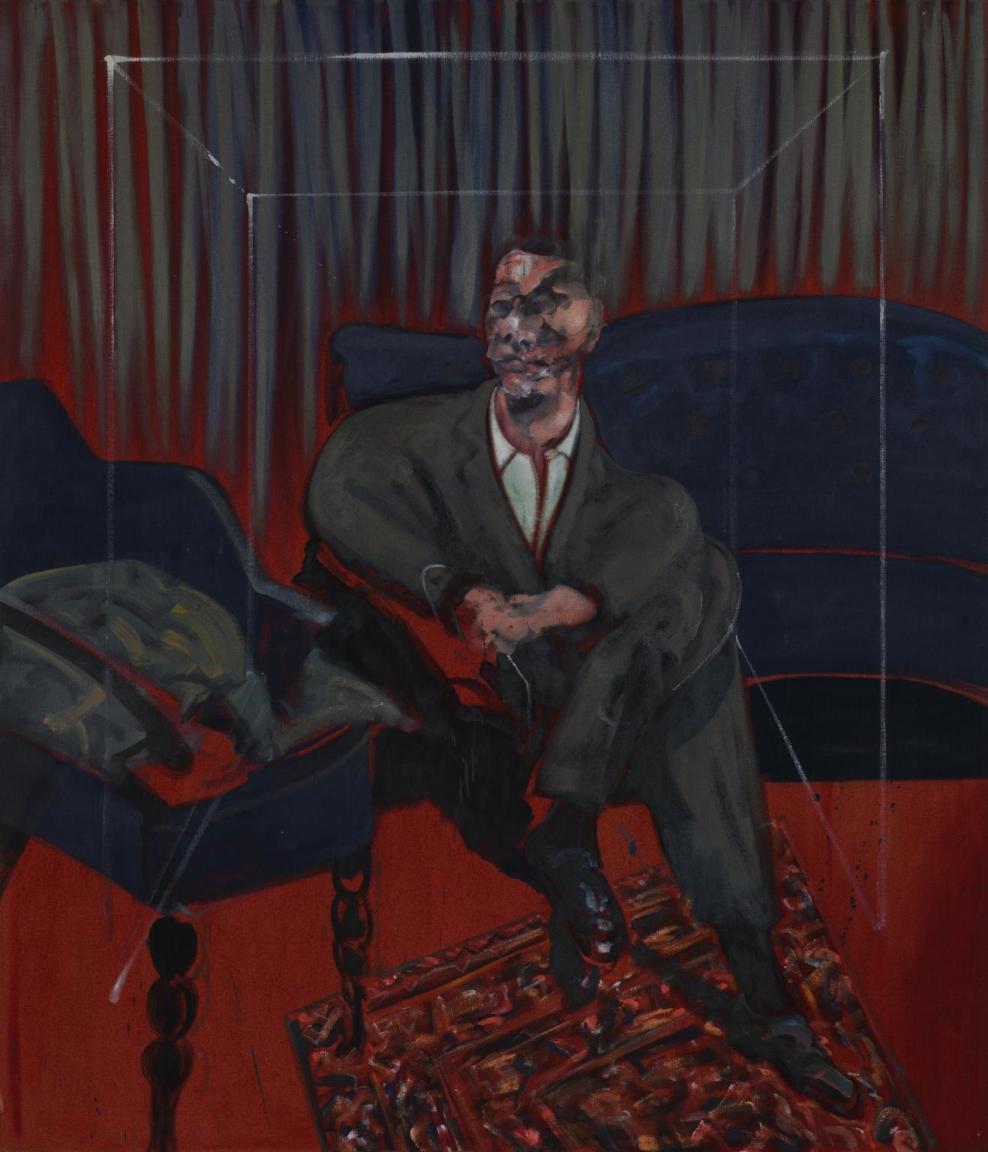
Birthday show
TWO CURRENT shows enjoying much national media interest are those on Francis Bacon and German painting.
Bacon, arguably Britain’s greatest living painter, is celebrated in an 80th birthday show, with works from the artist since 1944. They are mostly nightmare images, even the portraits having a spooky atmosphere.
They
are all called studies because, as Bacon has explained:
The German show, Expression and Engagement, is a selection of works from the 1930s and 1950s, mostly violent and angry looking. Two even use real blood.
Royal Academy visit by modern
Masters defies rising art prices
ALASDAIR STEVEN | ARTS
LARGE private collections are rapidly becoming a thing of the past. In these days of ludicrous art prices few can afford one great master let alone a clutch of them.
Therefore for the Royal Academy to have secured a visit from the Gelman Collection (Twentieth Century Modern Masters, until July 15) is commendable.
While the collection may lack a definite theme (apart from that of one
individual
The Spanish eyes ablaze are off-set by the brilliance of the blue tunic and the light green trousers. Also in this room are some delightful Bonnards.
There are Picassos from his various periods. These include a mystifying self portrait(pictured) which has a blackened eye. There follows a room devoted to Miro, Leger and Braque but which also includes the beguiling Still Life with a Guitar by Juan Gris.
The final room is a real stunner. Immediately the eye is caught by three Francis Bacon self portraits. Along another wall are some confusing but highly rewarding surrealists including Dali, Ernst and Tanguy.
The Miros are only on view for a limited period and from June 9 there is a specially reduced combined admission ticket for this exhibition and the RA annual jamboree.
Alasdair Steven
Old School Ties
Trying to reunite the class of 1990
Ever since RB Kitaj coined the intriguing phrase ‘a School of London’ in 1976,
debate has raged over what on earth it might mean. Putative membership of the
School continues to expand and contract with disconcerting ease, and any attempt
to define the artists’ shared aims quickly founders in contradiction. Kitaj
contented himself with the general declaration that ‘there are artistic
personalities in this small island more unique and strong and, I think, numerous
than anywhere in the world outside America’s jolting artistic vigour.
Four years later, several of the painters with a strong claim to belong to the School were included in the Royal Academy’s landmark survey, A New Spirit in Painting. They included Bacon, Freud and Auerbach, all of whom were committed to the renewal of figurative art by responding to their immediate surroundings with unusual intensity. Already, however, a sizeable gulf separated the clinical, meticulous observation of Freud from the far more impulsive, freely gestured brush-work favoured by Auerbach. Their robust individualism scotched any lingering thoughts of a homogeneous group or movement, and yet the ‘School of London’ concept stubbornly refused to disappear.
Now
it has resurfaced in an exhibition at the Barbican Art Gallery, under a fresh
rubric, The Pursuit of the Real. Its deviser, Tim Wilcox, declares in the
catalogue that the show might be described as an expression of an
In some respects, the endeavour makes a lot of sense. There are fruitful connections to be made across the decades between Sickert and Bacon, Bomberg and Auerbach, Spencer and Freud. But I would argue whether Cold-stream and his successor, Euan Uglow, sit easily in this company. They represent the pallid, at times anaemic side of British figurative painting, forever calculating with a nicety that ends up draining their art of nourishing vitality. They compare poorly with the prodigious vigour of Sickert, who begins the survey with a roomful of supple, searching images.
It’s a tonic to watch him proceed from the penumbral pathos of the earliest
picture on view, Mamma Mia Poveretta, gradually broadening and loosening
his brushmarks, until he approaches brusque abstraction in the audacious
Portrait of Hugh Walpole a quarter of a century afterwards. Sickert’s art
was powered by an incessant dissatisfaction, and his late photo-based works have
a raw immediacy that still has the capacity to astonish. Even a painting as
early as Le Lit de Cuivre, made around 1906, looks forward both in its
broken, reckless handling and in its voyeuristic mystery to Bacon
In this instance, the debt is freely acknowledged by the two younger men, who both studied at the legendary classes Bomberg held in the Borough Polytechnic after the Second World War. Perhaps the connection is clearest when we look at Bomberg’s smouldering 1944 canvas, Evening in the City of London, relating it to Auerbach’s equally passionate painting of Mornington Crescent Station and Kossoff's furrowed railway landscape near King’s Cross. All three artists are united by the strength of their headlong commitment to painting London in all its dirty, discordant yet compelling clangour. Cross-currents can be detected here as well: Bomberg studied for a time under Sickert, whose obsession with Camden Town has now been inherited by Auerbach.
Freud’s debt to Spencer is more speculative, and canvases like the latter’s
Cottages at Burghclere are far cosier in their vision of a rural English
idyll than anything Freud has produced. All the same, Spencer’s Seated Nude
of 1942 is uncannily close in style and feeling to Freud
The exhibition fails to make these links as revealing as they might have been, though. Spencer is separated from Freud by several rooms of very different work, and Bomberg is likewise positioned too far away from his former pupils. Further on, the selection of work by Michael Andrews falls short of making a powerful case for this uneven and enigmatic artist. Emphasis is placed on his early work, and The Colony Room I certainly allies itself with the bohemian Soho world inhabited by Bacon and Freud, but his later paintings seem bloodless in comparison. He suffers, too, from his proximity to the overwhelming roomful of Bacons.
The 1988 self-portrait by Andrews, although sensitive enough within its limits, looks disappointingly tentative when compared with Bacon’s far more robust self-portrait of 1969. Bacon exploits his flamboyant yet disquieting vision of the world with admirable verve, moving confidently from the modest dimensions here to the monumental Study for a Human Body, where the lunging act of switching on a naked light bulb is conveyed with a grandeur and momentous dynamism worthy of ancient Greek drama.
A similar light bulb illuminates John Wonnacott’s Grey Self-Portrait in the final section of the show. But Bacon is a demanding artist to be measured against, and neither Wonnacott nor John Lessore is in the same league as the redoubtable octogenarian. Although both are serious and committed painters, the voltage they transmit is too low to provide the exhibition with the finale it needs. On the evidence of this show, at least, the strength of British figurative painting today lies with its most senior practitioners. If the ‘School of London’ does indeed exist, its most powerful members clearly rejoice in their productive ability to mature with age.
The exhibition continues until 8 July, and then moves to Glasgow City Art Gallery

Bacon’s ‘Study for a Human Body’ — a dynamism worthy of Greek drama
A new exhibition devoted to British figurative painting marks a revival of interest in this once-unfashionable artistic style and celebrates the international success of painters such as Francis Bacon and Lucian Freud.
By JOHN MCEWEN
JOHN MCEWEN | THE INDEPENDENT MAGAZINE | SATURDAY 12 MAY 1990
In the catalogue for the exhibition The Pursuit of the Real: British Figurative Painting from Sickert to Bacon there is a photograph that is something of an icon in the history of post-War British art. It was taken at Wheeler’s restaurant in Soho in 1962 and shows Francis Bacon presiding at a convivial lunch, flanked by artistic acolytes such as Lucian Freud, Frank Auerbach and Michael Andrews. At the time, Bacon already enjoyed an international reputation but Freud, then 40, was known only in England and the others were no more than young and promising painters.
Today, 28 years later, Bacon is arguably the most revered living artist in the world. Freud is widely considered to have no peer as a portraitist; and Auerbach and Andrews, artists who have remained no less true to the depiction of the visible world, have also recently gained international status. Their elevation is all the more remarkable when one considers that for much of the intervening period figurative art has been in the doldrums of fashion and avant-gardists have frequently announced the death of painting altogether. Now, with the avant-garde in disarray and the market ruling as never before, their devoted constancy is celebrated in an exhibition which links the living by aesthetic association with the late Coldstream, Spencer, Bomberg and Sickert. For the purposes of illustration we have inclined to portraiture, but readers should be assured that among the 76 works in the exhibition there are landscapes, townscapes and even a bright Uglow still-life of fruit.
Sickert’s Mamma mia Poverella shows his characteristic social
compassion but is less generalised in feeling and earthy in technique than
usual. Spencer’s Seated Nude modulates its honeyed tones into a joyous
formal dance while also succeeding in describing a woman
Michael Andrews has always had a quizzical taste for surprising subjects; in his self-portrait he quizzes himself. Auerbach manages to convey a quite specific image of female nudity, while sacrificing nothing of the materiality of the paint from which the illusion has been forged. Euan Uglow owes his obsession with accurate measurement to his training at the Slade School of Art under Coldstream; but with the years his painting has become richer than Coldstream’s, both in its vibrant colour and its tender eroticism. There has been an attempt to group together some of these artists under the laughably dreary label of the “School of London”. Let us rather rejoice in their variousness and leave it at that.
The Pursuit of the Real, which was organised by Manchester City Art Galleries, is at the Barbican Art Gallery until 8 July and at Glasgow City Art Gallery from 28 July to 16 September
What price Bacon in town?
On the trail of artistic treasures
DAVID HAMMOND
THE VISITOR from down south was surprised. He
wrote of “the thrill of the unexpected.
He was referring to one of the treasures of Huddersfield Art Gallery, Francis Bacon’s Figure Study II, which the artist, now aged 80, painted in 1945-6.
“Sir John Rothenstein acknowledged this painting as one of Bacon’s finest,” says Mr Farson, a writer and TV presenter who devised the Channel 4 art quiz programme, Gallery.
In his new book, also titled Gallery, Mr
Farson points out that, to see some fine paintings, you do not need to go to
Paris, Amsterdam, Florence, or even London. There are exciting discoveries to be
made in many provincial collections
‘Finest collections’
“And who would have thought that Accrington contains one of the finest collections of Tiffany glass in the world?”
There
Mr Farson has words of praise for the works of art he found at Huddersfield. Without meaning to patronise, Huddersfield is not the place where I would expect to find such a fine collection of 20th century British art.”
He refers to the gallery’s work by such artists as Stanley Spencer, Sickert, David Bomberg, Frank Auerbach, Graham Sutherland and Wilson Steer. But it is the Bacon painting he finds the most spectacular. He tells his readers how the painting nearly left the area. Some town councillors did not like the work when it was donated to Batley Art Gallery in 1952 by the Contemporary Art Society.
But, happily, “they were defeated by the
director of the Batley Art Gallery at the time, Ronald Gelsthorpe, who believed
in the painting
Mr Farson asserts that, next to Stanley Spencer, Francis Bacon is the most important British artist of the 20th century.
“The likes of Hockney and Hodgkin come nowhere
near. Breaking through established barriers, Bacon is a true original. The
disturbing world he draws us into is one of his own making, and at times the
recognition of ourselves is shocking.
‘Stunning power’
The writer has known Bacon since the 1950s and says: “Whenever I return to his work, I am stunned by the power. Eighty years old in October 1989, he remains the most enthralling man I know.”
Daniel Farson writes in a down-to-earth, entertaining way about 70 galleries he has visited in the provinces and in Scotland, as well as a dozen in London. In and among are short, but fascinating, essays on some of the artists whose work he most admires.
His highly commendable book would prove a splendid companion for anyone wishing to set out on a similar marathon gallery trail as himself. But it would be equally useful for those, who, like myself, enjoy seeking out galleries when on holiday in a particular part of the country.
Gallery: A Personal Guide to British Galleries and Their Unexpected Treasures, by Daniel Farson, is published by Bloomsbury, at £20.
Figuring out painting’s value
IF ever Kirklees Cultural Services got into desperate financial straits, its officers might be tempted to use the Bacon to bring home the bacon, so to speak. For Figure Study II is almost certainly worth a seven-figure sum in these days of rising auction prices for well-known works of art.
‘Insurance’
Robert Hall, senior curator of Huddersfield Art Gallery, does not want to be drawn on the painting’s value. “But we have kept on increasing the insurance,” he says. The painting is currently on loan to the United States, where it forms part of a prestigious Francis Bacon exhibition at New York’s Museum of Modern Art. The show was previously on view at the Smithsonian Institution, Washington, and in Los Angeles.

Figure Study II, by Francis Bacon. “The flatness of the title conceals an act of mysterious violence,” says Daniel Farson. “An apparently naked figure, loosely draped with a herring-bone overcoat, mounted by an umbrella, leans over a palm, his mouth wide open in a scream. The background is the colour of blood. What has happened? There is no telling”
After the authentic
The Pursuit of the Real: British Figurative Painting from Sickert to Bacon,
Barbican Art Gallery, until July 8
MERLIN INGLI JAMES
Apropos the “realism” of the nouveau roman, Alain Robbe-Grillet commented that each artistic school thinks its particular vision is realist; that its opponents or predecessors fail to reflect reality. The definition of realism suggested by the present very selective survey of British figuration, “from Sickert to Bacon”, is as arbitrary and partial as any. A tradition of influences and common concerns is proposed, running from artists as diverse as David Bomberg and Stanley Spencer to those as different as John Lessore and Michael Andrews.
Painters are chosen partly for their preoccupations with the faithful transcription of visual perception, whether manifested in Euan Uglow’s or William Coldstream’s measured control of marks, Frank Auerbach’s or Leon Kossoff’s grapple with paint, or Lucian Freud’s fish-eye spread of perspective. Somewhat depressed subject-matter also appears to be a requirement in these meticulously or muddily hard-won images. Configurations of human form range from austere to acutely alienated. Thus an artist like Matthew Smith (permanently on show at the Barbican, and an interesting touch-stone to this exhibition) is excluded – despite Bacon’s admiration not only because his painterliness is more synthetic than analytic, but because he does not wear his Angst, or his ennui, on his sleeve.
The selection of this “first eleven” challenges rival realisms, in particular those emphasizing the reality of the art-work itself, like the high minimalism authorized by the Tate in 1969 as The Art of the Real. But it is not only dogmatic formalists who will miss, here, the “organic unity” that Matthew Smith liked to emphasize. After Sickert or Bomberg, the counterpointing, echoing and interlocking of shapes, the establishment of visual passages and rhythms, the juxtaposition of complementary or harmonic colours — all those rudiments of “significant form” — are dulled by notions of mimesis. Decoration is taboo, and with the exception of the artful Bacon, these painters rarely seem directly concerned with creating visual beauty. Where madeness is emphasized in Uglow’s nervous ticks or Auerbach’s heroic impasto it is as a supposed by-product of that earnest pursuit of reality.
At the core of
this exhibition is a (perhaps English) reluctance to espouse artifice.
Coldstream
In the matter of the limits of pictorial language, Sickert and Bomberg are telling precursors. Bomberg’s views of Toledo and Jerusalem, inaugurating his later, loaded expressionism, pointedly open up precise planar descriptions of buildings into loose swathes of paint, ambiguously suggesting rocky chasms. Sickert, astutely translating nature’s continuum into demarcated areas of colour and tone, tackles extremes of light and shadow which eat out detail, creating radically ambiva-lent, undifferentiated continents of form. He alone respects and explores, with utter sang-froid, the boundaries of the conventions with which he works.
For many of these “realists” the
world’s life-room is an arena for highly subjective dramas. Often the laboured
concern with direct perception disguises implausible, corny melodrama. Bacon is
the obvious example, compared with the unexpected, understated violence of
Sickert’s “Hugh Walpole”. Kossoff's crusty old men grow sentimental, and the
striken look of Freud’s models (a wounded, vacant stare that recurs throughout
the exhibition), slumming it in squalid interiors, rings false. Humourlessness,
again shared with his colleagues, makes Freud
Irrespective of these artists’
ultimate stature, much more might have been elucidated. In particular the
catalogue essay on
More particular kinships are evident between Freud and Francis Gruber, Lessore or Kossoff and Raymond Mason, or in Lessore’s Balthus “quotation” in “Artist and Model 1”. A glance at the short-lived X magazine, which ran for a few issues in the late 1950s and featured artists like Auerbach, Andrews and Freud, suggests the context: Beckett, Giacometti, Camus, Kokoschka and the nouveau roman. Robbe-Grillet saw descriptive method as “a starting point from which are invented lines, planes, a whole architecture, and our impression that these are being invented in the course of the description.” Uglow’s planes, Freud’s dabs, Auerbach’s slabs, all oddly undescriptive, might, optimistically, be so construed.
Many images of the primal human howl, but not primal smile.
The Francis Bacon exhibition that
opens Sunday at the Museum of Modern Art comprises 59 paintings. Most of them
are large, and some are made up of two or three canvases, each measuring 78 by
58 inches. They cover the years from 1945 to 1988. (Bacon was 80 years old last
October.) Many of the images in the show acquired classic status long ago and
have been regarded by enthusiasts as central to the concerns of our day. This
was already true when Bacon was believed, as the critic Sam Hunter writes in the
catalogue, to have echoed the
We see men discarded like rotting
meat. Behind what is presumably bulletproof glass, we see other men preaching,
talking, hallooing, ranting, raving or prey to manic, uncontrollable laughter.
(The primal human cry, King Lear
In the windowless echo chamber that
Bacon knew so well how to evoke, (as in
These are one-shot images, and most of them date from 40 years ago, but they still pack a formidable punch. Those who have grown up and grown old with them would have trouble imagining a world in which they had played no part. They are by now a permanent part of the furniture of the European imagination, and the paintings as we see them in the Museum of Modern Art come over again and again as grand formal statements in which order and clarity have long ago won out over disquiet.
That is why, for this critic, the present show does not come over as in any way sensational. Dreadful things are seen to be done, but they are nothing to what is done routinely, day by day, in the world around us. Besides, there is a whole other side to what Bacon does with paint. There are paintings in this show in which no one does much of anything except hang out, talk, ride a bicycle very, very slowly or sit bunched up as if in readiness for some tremendous outburst of erotic energy.
Once or twice, as in the
In the
No less essential to any anthology of rare human beings is the portrait of Muriel Belcher, the owner of a drinking club in London of which Bacon was for many years a habitue. Mrs. Belcher was notable in life for her piercing gaze, her almost unbelievably free speech and her sense of the precipitous ups and downs of metropolitan life.
Bacon portrays her as a sphinx, with long, delicate forearms that double as forelegs and feet. As no one was ever more ready than she with a plain answer to a plain question, Mrs. Belcher could be said to set here a new tone for sphinxes. But it is a glorious impersonation.
Images like these are not gratuitous
violations of either the face, the limbs or the dignity of the people portrayed.
Nor did they seem to me to deal with what Mr. Demetrion believes to be Bacon
They have come to look, on the contrary, like the contemporary equivalent of the ancestral portraits that we find in museums and palaces and great country houses all over Europe. In psychological terms, they have of course been pushed infinitely farther than the Old Masters would have thought it either possible or appropriate to go.
Bacon
The show also includes one of the
most mysterious of all Bacon
Those shifting, heaving, rolling sands do a double duty, in other words. Though perfectly convincing as one of the more precious features of the foreshore, they can also be read in terms of human bodies that form and reform themselves, half in and half out of the sand. Once we get the point, we may consider this as one of the most voluptuous evocations of the nude in 20th-century art.
Yet there are many observers — in the United States especially — who think of Bacon's work as simply a freak show, a horror show, a gratuitous monsterscape. Bacon himself is, of course, well aware of this. ''Who ever bought a painting of mine because he liked it?'' he once said to a friend.
That is doubtless why the last
full-career museum retrospective of Bacon
But Mr. Demetrion could count on the Hirshhorn Museum in Washington, where he has been director since 1984; on the Smithsonian Special Exhibition Fund and on an indemnity from the Federal Council on the Arts and the Humanities. The Los Angeles County Museum of Art took the show, and so did the Museum of Modern Art, which in 1946 was the first museum anywhere to buy a Bacon for its permanent collection.
Mr. Demetrion could also count on John Elderfield, the Modern's director of drawings since 1980. who has installed the show in a grave, uncluttered and unhurrying style that allows the big paintings to ride the wall at the height, and at the pace, that suits them best.
This, in short, is a very grand show, an affair of huge and often shattered presences that are entirely of our own day and yet seem on occasion to stretch back into antiquity. Bacon deserves a long second look in New York, and this show makes it possible.
Exhibitions to prove that art can be fun
TATE GALLERY LIVERPOOL | DAILY POST | LIVERPOOL | FRIDAY, JUNE 1, 1990
SINCE it was opened, by Prince Charles, 18 months ago, Tate Gallery Liverpool has attracted well over a million visitors. Some have been inspired, others bemused but none has been bored. Visiting the award-winning Tate at the Albert Dock is an experience to be savoured.
It is also fun. There is no need for serious faces and heads buried in programmes. Visitors do not have to understand or even like modern art to appreciate the wonderful surroundings, the friendly, helpful staff — and the variety of exhibits on show.
Contemporary art often frightened people, said curator Mr Richard Francis, which is why the gallery, with its well-stocked book shop and coffee shop, has an exhibition programme designed to appeal to a wide audience.
Recently the visiting Degas exhibition, Images of Women, attracted crowds and netted the Tate £40,000, which ensured that the show broke even. There is no entrance charge to the gallery, only to specially staged exhibitions.
Making the annual budget stretch is a mammoth task, so individual and corporate sponsors like Mobil, which is putting £50,000 into the forthcoming New North show, are crucial to the Tate’s survival. The current Sickert display, which finishes on February 4, will be followed, on February 21, by an exhibition, created mainly from the collection of paintings by renowned British artist Francis Bacon, who is now 80.
The work of Sickert, Degas and Bacon is inter-connected and this final exhibition in the series will be of interest to regular gallery visitors and newcomers. Bacon received no formal 1928 art training but in 1928, after seeing an exhibition of Picasso’s work, decided to try his hand at painting.
By MICHAEL LEVEY | ART NEWS | SUMMER 1990
En masse, the way [Francis] Bacon’s pictures are painted takes visual priority over what they depict—which is what should always happen, though we cannot help our conditioned impulse to look for what the areas of paint are “about.” Bacon might be accused of being something of a tease in this matter, for despite his understandable protests about his art neither illustrating nor narrating, he frequently alludes to circumstances of his own life that are bound to pique human curiosity.
But to enter a room of his pictures is to encounter paint first. It is the large-scale areas of applied pigment, often semiabstract in form, that make what can be a lasting impact: a curved pink-and-biscuit-colored expanse of a blackish brown rectangle slotted, half-Mondrian-like, into a far bigger rectangle of fawn. Such shapes have their own tautness and vitality. Although it may be that they have been added by the painter as backgrounds to his figures, they often appear fundamental to the composition. The surfaces of his paint read as though they were expanses of fabric stretched tightly over some invisible drum. In fact, they are much less formal than anything in Mondrian. Nor do they have anything of the sensuousness, in color and in shape, of Matisse. Color is altogether where Bacon’s art is least sure. yet there is a clean-cut, clear-cut feel to these sweeping fields of paint.
They may well be indications of austere interiors, with bare floors and blank windows. Fashionable analogies hover, prompting commentators to mention the constriction of urban modern life or even of prisons. But looked at directly, without literary overtones, they fail to be oppressive or claustrophobic. In much the same way, the paint in the foreground crisply defining a complex human shape, can enchant the eye before it resolves itself into the unpromising suggestions of mutilation and pain.
The apparent paradox between form and content brings one to the artist himself. It is difficult to think that he has experienced any particular disgust at the style of images he has created, or that he means his images to shock. There is neither horror nor pity in his pictures. Bacon’s art is not likely to produce a Guernica. It is too sealed in, within a narrow circle of self-reference merging into self-regard. His work partly draws its power from that concentration. After all, an artist is not necessarily a social commentator—or a social worker. There is no guarantee that the good artist will be a good citizen. Bacon can be seen as admirable in his refusal to be anything but an artist, refusing to let society have claims on him and scrupulously refusing to make claims on it. Such an uncompromising and isolated position has its romantic aspect. It may encourage the idea that the resulting art is bleak, severe in its emphasis on the individual, and finally pessimistic about the human condition.
Nevertheless, in what is perhaps the clinching paradox at the heart of Bacon’s art, there is about his pictures a sensation profoundly more positive than negative.
By ARTHUR C. DANTO | THE NATION | VOLUME 25 1 | ISSUE 4 | JULY 30, 1990
Grammar makes certain sentences available to us that are useless for any purpose other than philosophical jokes. "I am screaming" for example, is what philosophers term self-stultifying: The conditions under which it could be true are inconsistent with its being uttered, so it cannot but be false if said or even written. Thus the lie is transparent to all but the writer when the hateful and ludicrous Fanny Squeers, in Nicholas Nickleby, puts into a letter "I am screaming out loud all the time I write" as an excuse for mistakes. One cannot scream and write letters at the same time, in part because the circumstances that explain the scream rule out the possibility of concurrent rational action. The scream ordinarily implies some loss of will, something the screamer cannot help despite resolutions of silence, as in the torture chamber or the pit in hell. But that does not leave the will free for other pursuits. Or, if we can imagine someone knitting and screaming, it would have to be someone mad, and the scream, like the lunatic’s laugh, disconnected from the network of circumstances in which either expression has the meaning of terror, say, or mirth.
Much the same considerations apply to cases in which an artist paints a scream. It is always a reasonable inference in such cases that the scream cannot be the artist’s own, for the mere fact that the representation is clear enough to be recognized as of a scream is inconsistent with that. Painting, in whatever way it facilitates the expression of emotions, cannot be a kind of scream if it is in fact of a kind of scream. This is an important truth to keep in mind when viewing the painted screams of Francis Bacon.
Bacon’s images of screaming popes are among the great defining images of twentieth-century art, and certainly they were taken, in the early postwar years when they first appeared, to be artistic summations of an era of unspeakable agony and horror. And they affect us even today, and against the body of Bacon’s far less compelling subsequent work, perhaps because we cannot be indifferent to screams-not even when we know, for example, that someone is only practicing for a part that requires him to scream, just because that particular sound, issued through a human mouth, must trigger in us reflexes over which we have as little control as screamers themselves are supposed to have at the moment of impulse. And a painted scream comparably summons up associations through which it is vested with moral meaning. This is especially so when, as with Bacon’s popes, there is no context, within the painting, to account for the scream. When Poussin paints a woman screaming in his Massacre of the Innocents (a painting frequently cited as among Bacon’s early influences), her scream is a natural response to the butchery of helpless children. When Eisenstein shows the screaming nurse in Battleship Potemkin (another source unfailingly cited for Bacon), there is, in the massacre on the steps, all the explanation we need for the grimace of impotence and despair and pain condensed in the shape of her mouth. Seen just as a frame, clipped out of the film, the scream of Eisenstein’s nurse still implies a narrative which the shattered glasses and shot-out eye enable us to fill in. There is no available narrative for Bacon’s screaming pontiff, all the less so when we appreciate that the painting is itself a modified appropriation of the celebrated portrait by Velázquez of Innocent X. The occurrence of the word "innocent" in two of Bacon’s acknowledged sources is possibly worth keeping in mind, though the papal name, in the case of this particular bearer of it, was one of the great examples of ironic nomenclature in the history of mislabeling. Velázquez’s portrait simply shows the wily churchman, in white lace and red silk, enthroned in a curtained chamber, wearing an expression that rules out screams.
Everyone in fact admires the psychology of Velázquez’s portrait, and the larger meanings to which the psychology must contribute. Innocent is looking up from some document held loosely in his left hand, and looks out at us beaming authority, power, mercilessness, guile, defiance, resolution and contempt from his terrifying eyes. It is the look a shepherd might direct to his sheep only if his mind were fixed on mutton. Innocent may have been indifferent to the expression Velazquez gave him, or possibly he was pleased by it as an outward sign of a man dangerous to trifle with, but one cannot, today at least, refrain from drawing lessons from the fact that this highest position in the universal church should have been occupied by a man whose character was so at odds with the charity and love that ought to be emblemized physiognomically. It is a tension not easily rationalized, though in its own right it may express a deep truth of Catholicism. Bacon’s pope has no psychology to speak of, since the scream leaves no space for other expressions and is in any case not really an expression of someones character. A scream implies an absolute reduction of its emitter to whatever state it is that the scream outwardly expresses. There are no wry screamers, no crafty screamers. The scream is a momentary mask. Still, the fact that it is a pope who screams raises some delicate questions of interpretation. In the language of symbols, the image of the pope carries the obvious meanings that flow from his position as Christ’s surrogate on earth and intercessor for the salvational needs of mankind. The question is why someone with the extreme moral weight of a pope should be shown screaming when, within the canvas, there is nothing that accounts for the act.
It must of course be decided whether the pope is screaming at something whether there is an object-or whether, like the screams of the damned and the tortured, he cannot help screaming because of unendurable pain. There are screams of horror, after all, where the witness is overcome by something seen or heard. The pope’s scream cannot be objectless, one feels, since he is seated in his throne or on his palanquin (which is one way of reading the yellow curves in Bacon’s painting), unless he is supposed insane, like a crazy in the park. He could, if this were an internal symbol for Christians, be screaming at Christ’s agony, or in grief, like one of the Marys so often shown at the base of the cross. Whatever the object, it must be commensurate with the stature of the pope as pope. Think, for contrast, of the famous screamer in Munch’s The Scream, of 1895. A woman (one assumes) is shown running toward us, over a bridge, with a couple in the distance walking away, as if indifferent to her anguish. The screamer’s object (if there is one) must, one is certain, be some fraught personal situation she finds unendurable: The image is a depiction of personal extremity. And this fits with Munch’s work-his themes are sickness, jealousy, bereavement, madness, sexual torment-as well as what we know of his character and his life. But none of this would fit with the screamer’s being a pope, all got up in ecclesiastical regalia. Neither, in truth, does it fit with Bacon, from what we know of him as a person. And the assumption would have been, in the postwar years, that the pope was screaming as the only appropriate moral response to the fallenness of mankind and the world as slaughter-bench. As such, it could not but be a powerful image, even if somewhat crudely painted, save for the lavender capelet. Somehow, if a message, it must have seemed too urgent to be conveyed through a piece of elegant painting. The powdery white, the swipes of yellow and the vertical slashes that are vestigial reminders of Velazquez’s drapes, though they also suggest a deluge, are secondary marks of the moral lamentation of the howling prelate. One would have wanted to scream in sympathy: And with that cry I have raised my cry," as Yeats writes.
All of Bacon’s work in those years, whether or not of popes, appears to be of screams or to call for screams. In his, painting, of 1946, an early acquisition by the Museum of Modern Art, which is honouring Bacon with a retrospective exhibition (until August 28), the screamer is in a business suit, a yellow boutonniere in his lapel and the upper half of his face cast in shadow by his umbrella. He is surrounded by butchered meat, including, behind him, an immense gutted carcass hung by its legs. The carcass of beef, in Rembrandt’s painting of one, seems to connote helplessness of a nearly cosmic order and comes across as a symbol of suffering, as it does in a bloody painting by Soutine. There is a harsh contrast in Bacon’s image between the regular rhythm of bones and teeth and that of torn flesh and a world torn by the scream of the man, whose umbrella is an affecting symbol of ineffective protection, certainly against the forces that rend flesh, eviscerate bodies, consume in pain and flame. Painting, in context, had to have conveyed some political message and, to use the irrepressible word from those days, existential mood. And there are several images of heads that bear out this heavy inescapable reading, for they seem to have no discernible features other than toothed cavities, as if their owners had died, beaten to some pulp, with a terminal scream on their lips. In some cases, the screamer is seated, as the pope is, but in such a way and in such a space that it could be the electric chair they are in. And in all or most of these, the vertical lines rain down, cleansing perhaps, purging, or just adding to the agony, having no connection to the vertical fall of drapes from Velázquez.
So, if not strictly Bacon’s screams, these depicted screams seem to entitle us to some inference that they at least express an attitude of despair or outrage or condemnation, and that in the medium of extreme gesture the artist is registering a moral view toward the conditions that account for scream upon scream upon scream. How profoundly disillusioning it is then to read the artist saying, in a famous interview he gave to David Sylvester for The Brutality of Fact.- Interviews With Francis Bacon, " I’ve always hoped in a sense to be able to paint the mouth like Monet painted a sunset." As if, standing before one of those canvases, Bacon were to say, "Well, there, I think, I very nearly got a screaming mouth as it should be painted. Damned hard to do." Or to read that "Horrible or not ... his pictures were not supposed to mean a thing." So Cezanne painted apples, Renoir nudes, Monet sunsets, Bacon screams. To paint a scream because it is a difficult thing to paint, where the difficulty is not at all emotional but technical, like doing a human figure in extreme foreshortening or capturing the evanescent pinks of sunrise over misting water, is really a form of perversion. As a perversion, it marks this strange artist’s entire corpus. It is like a rack maker who listens to the screams of the racked only as evidence that he has done a fine job. It is inhuman. As humans, however, we cannot be indifferent to screams. We are accordingly victims ourselves, manipulated in our moral being by an art that has no such being, though it looks as if it must. It is for this reason that I hate Bacon’s art.
Bared teeth and exposed bones play a referential role in some of Bacon’s later works, particularly in two triptychs, one of which, Three Studies for a Crucifixion, shows the victim hung upside-down in the right panel, like an emptied carcass, with his head lying in what one supposes must be his own spilled viscera. But by this stage in his development, Bacon had begun to treat his figures virtually as viscera, as lumps and gobbets and tubes of flesh, not easily identified anatomically, pink and red and white, as if his subjects were what was left when skin and bones were removed. So shapeless are they, as piles and puddles of scraped and squeezed paint, that one is grateful at times for the mouths, as dentated wounds, to serve as some point of orientation. In the middle panel of this triptych, for example, a figure lies, like a pile of guts, on an elegant chaise longue, blood splattering the pillowcase and rising, like red bubbles, up past the black window shade in some piecemeal ascension. The teeth locate us in the gore, so we can identify eye sockets and a neat wound in one foot. In the left panel stand two uncrucified figures-witnesses, perhaps, patrons, executioners-one of them in a business suit, which could be Bacon himself, the other a blob in what might be black leather. The three panels, paradoxically in view of their content, are done in cheerful decorator colors, apart from the figures themselves: flat planes of pompeian red and cadmium orange, with black window panels. One cannot help thinking of Auden’s great poem on art and suffering, as the old masters showed it: "how it takes place/while someone else is eating or opening a window or just/walking dully along:' Auden went on, marvelously, "They never forgot that even the dreadful martyrdom must run its course/anyhow in a corner, some untidy spot/where the dogs go on with their doggy life."
How appropriate, one thinks, that the crucifixion should transpire in a tasteful salon, amidst the sort of fin de siecle color scheme Odette de Crecy would have favored when Swann at last found his way to her body. After all, the act of love, thrashing bodies and flashing teeth and animal hoots, also takes place in those ornamental spaces. (Bacon, who had some success as a decorator and designer of Art Deco furniture, also likes to paint coupled figures smeared against one another in damp intercourse.) Or one thinks of the crucifixion as a metaphor for terrible interrogations that took place behind shuttered windows on quiet boulevards that the screams couldn’t reach. There is a certain insight in Nietzsche that it is not suffering so much as meaningless suffering to which the human mind is opposed, so that it was, in Nietzsche’s view, the genius of Christianity to have made all suffering meaningful. Certainly, we stand before works Uke this-or the Triptych Inspired by the Orestia of Aeschylus-compelled, despite our will, to cover the brutalized bodies with a balm of interpretation, a redemptive coating of allegory, if only to comfort ourselves. So again one feels oneself to have been manipulated in some way when the artist disowns any meaning whatever, and draws our attention, in his interviews, just to paint, almost as if he were some sort of Abstract Expressionist with no antecedent view of what he was going to do when he faced the canvas. Why is he then not an abstract painter-why choose these charged images only to elicit, as involutarily as a scream, an interpretation he rejects, categorically, as beside the point? We cannot see gore as just so much scraped red pigment, cannot disinterpret a writhing limb as simply a marvelous wipe of white paint. And this stance is reinforced by the fact that we cannot succeed in giving meaning to a lot of what Bacon does in his portraits and figure studies, where the subjects are liable to distortions that ought to have an explanation in the world to which the figures belong but which will standardly be given an explanation from the world in which painting takes place-as something that happens not in meaningful spaces but on meaningless surfaces.
There is one absolutely marvelous painting in the show, worth anyone’s time to see. This is Study for Portrait of Van Gogh III, of 1957. It shows us what Bacon could have done had he given to the whole painting what he instead gives to isolated faces and figures. He shows Van Gogh as Van Gogh might have shown himself in a world that looks the way he represented it in paint-as if the world were made the way paintings are-trees of black paint squirming up out of fields of red paint, past fields of yellow paint and green paint. The artist stands on heavy feet, the kind that belong in his famous shoes, in a field of pink mud, casting blue shadows. He has a black all-purpose face; it could be the face of a horse as well as a human, or even of a fish. The face does not matter: It is the world according to Vincent, and we are seeing it from within. For its allusiveness, its power, its brilliance, its total engagement with its subject, it makes the rest of the show look like posters for some avant-garde guignol of yesterday. The portrait of Van Gogh is an homage, a celebration of the only values Bacon allows himself to mention, the values of painting as painting. It shows what his deflected talent is capable of when his heart is in his subject.
Eminent outrage
British painter Francis Bacon
By JAMES GARDNER | NATIONAL REVIEW | AUGUST 6, 1990
IN HIS MOST recent avatar at the Museum of Modern Art, Francis Bacon appears before us defanged and declawed. The primal rantings now sound like a petulant whimper. The spastic gestures and maimed movements now savour almost of balletic adroitness. And yet nothing has changed in the heart or mind of this octogenarian artist, the elder statesman of the British art world. The latest paintings in this retrospective manifest the same unyielding, implacable anguish that has been his hallmark for almost fifty years.
Rather it is we who have changed. For the past two generations at least, we have been assailed on all sides by art works of such calculated grotesqueness that we have lost all power to be genuinely shocked by anything. We analyze the forms or assay the political correctness of the artifact, depending upon our orientation. Sometimes we even go through the motions of outrage. But we know that ultimately it is only art. Anything Bacon can pitch, we can catch.
Yet, by any reasonable computation, Francis Bacon is as great an outrage as any generation should have to endure. And if the eminent artist has a sense of humour, as I suspect he does not, he must be chuckling heartily at the public’s eagerness to embrace each festering and deformed carcass he throws at it.
Though Bacon was born in 1909, he becomes relevant to us and to himself only after 1943. That was the year in which, through a negation verging on self-parody, he studiously destroyed almost all of the art he had made up to that date. That was the year in which he was reborn as the shrill, tormented sociopath the art world loves. Since that time, Bacon has evolved remarkably little. His art has consisted in endless variations upon a closely circumscribed canon of themes and forms. Bacon was and remains a surrealist, an unrepentant irrationalist. But whereas others of that strain turned to Freud and to the dream world of the unconscious mind, Bacon reverts with a vengeance to Darwin and to the jungles of instinct. Whereas the other surrealists never lost their grounding in the man-made world, Bacon voids his paintings of most human traces, filling them with shrieking gibbons, salivating dogs, and subhuman apemen cast against a chillingly blank field.
His earlier works, it is true, are busier than that, overladen as they are with props: umbrellas and whole sides of beef, densely patterned Oriental rugs and landscapes whose nervously thin lines reveal a lingering debt to British modernists like Henry Moore and John Piper. A few later works, such as Sphinx II and Study for a Portrait of Van Gogh III, represent slight departures as well. But by the late Forties, with the "Head" series, Bacon had defined the highly idiosyncratic style in which he would work for the rest of his life. Emerging from a blackness qualified only by those wiry perspectival lines that have become something of the artist’s signature, a massive, disembodied head appears. An ear floats absurdly to the side, perhaps torn away. The ill-defined eyes are shut in suspended rage; the mouth-like orifice is fixed in a noiseless ululation, exposing molars and fang-like canines. Were is there an end of it/The soundless wailing?" asks T. S. Eliot. For Bacon there is no end. That wailing, bitter, gnashing, self-consuming is the sound of life itself. All other sounds are lies.
Everything Francis Bacon depicts he distorts. And yet every depiction, even if we cannot describe or name the thing depicted, has the infallible ring of truth. An indescribable biomorph hangs down from a wire cage. A boneless, quivering mass of gelatinous flesh drowns in a sink or sits huddled over a toilet. Bacon is obsessed with movement within suspension, and with the suspension of movement. An expressionless face decomposes before our eyes into a psychotic omelette. A violent jet of water is frozen and immobilized as it streaks across the canvas.
To glance even cursorily at these paintings is to understand why they have come to seem the quintessential, unequivocal statement of the modem mood. But precisely for this reason it is too early to tell how good they really are. We shall need to be well out of the twentieth century before we can finally say whether Bacon was ever really on to something, or was merely a cantankerous, maladjusted misanthrope. Formally, his brilliant, stylish works are closer to masterpieces than anything else being done today. If some of the colouristic choices are of debatable merit, his way with a laden brush comes very close to perfection. What is wrong with the larger, spiritual dimensions of these sixty paintings at the Modern is their one-sidedness. To Bacon’s binary mind, man, because he is not an angel, can only be a beast. In this belief Bacon is surely not alone in contemporary culture. Rather he is the foremost embodiment of the prevailing trend, the regnant humbug of the age. This is the wilful fallacy which, in an age more happy than our own, may one day qualify the esteem in which we hold Francis Bacon and everyone like him.
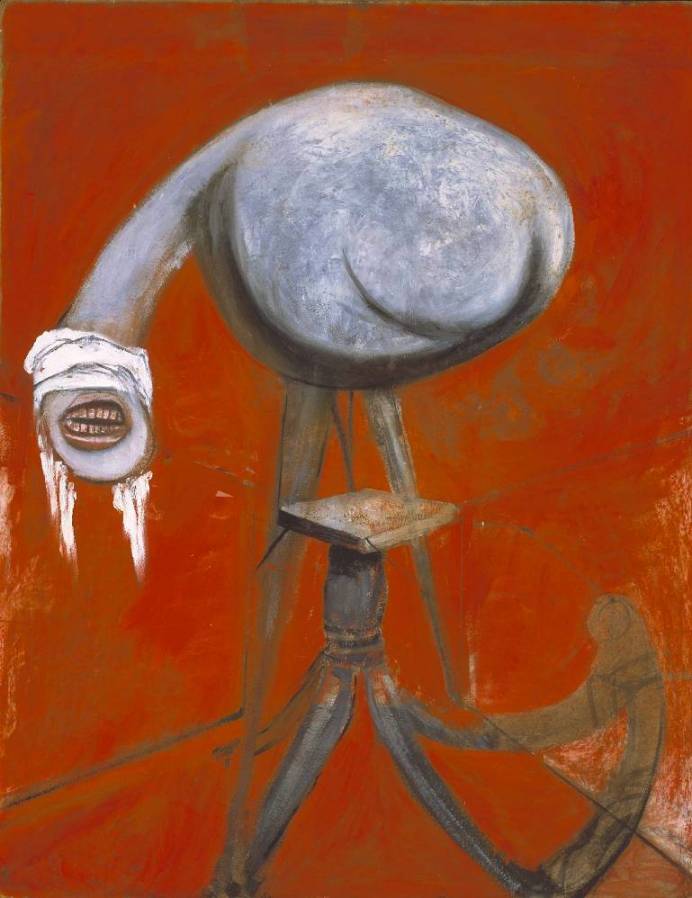
One of Bacon’s Three Figures at The Tate, Liverpool (051-709 3223)
A Trail of Human Presence
On Some Early Paintings of Francis Bacon (1962)
JAMES THRALL SOBY | THE MAGAZINE OF M.O.M.A | NUMBER 2 | VOLUME 4 | SPRING 1990
Considering Francis Bacon’s present-day eminence, it is surprising that many details of his life and career remain obscure.1 In part this is because he is himself almost totally indifferent to autobiographical information. As an example of this attitude, which is felt profoundly, he was once asked whether he was descended from the great Elizabethan writer whose name he shares. He replied that he had no idea whatever nor any curiosity about finding out. For a very long time it has even been difficult to discover his exact birthdate, which has varied from one biographical account to the next and, according to a close friend, on at least one occasion was invented by the artist himself as suggesting a fortuitous numerical sequence in playing roulette....
It is typical of Bacon that combinations of numbers in roulette should have prompted him to invent his own date of birth. His passion for gambling is well known to his intimates. On many occasions, after selling a canvas or two, he has set off for Monte Carlo to try out a self- invented and presumably fallible system for breaking the bank. This passion plays an important part in his philosophy as an artist, as he confessed when he wrote of his colleague, the late Matthew Smith, “I think that painting to-day is pure intuition and luck and taking advantage of what happens when you splash the stuff down ...”2 He prefers to paint very rapidly with a large brush — “a loaded one-inch brush of the kind that ironmongers stock,” to use Robert Melville’s words.3
Bacon generally chooses big canvases, as if he were playing for big stakes. Moreover, he is frighteningly quick to accept miscalculation and failure in his gambler’s choice as a painter. No one really knows how many pictures he has destroyed after completing them and finding them lacking. The number is great, and once more Robert Melville’s words are pertinent: “Francis Bacon has a horror of giving proofs of his powers. He paints at such phenomenal speed that, if the bulk of his work had been preserved, he would almost certainly have more large pictures to his name than any other living artist.”4 ... Bacon’s technique is ... impulsive and ... rapidity of execution is an integral accompaniment to his creative vision, as though he feels obliged to make his decisions before hearing an invisible and implacable croupier cry “rien va plus!”... Bacon’s destructive impatience with the slightest flaw or lessening of conviction in his work is refreshing in an era when many artists, good and bad, preserve and market the merest scraps from their studios. Sometimes, however, according to London friends, Bacon has destroyed pictures w4ose shortcomings were apparent to no one but himself. Even so, one cannot but admire the almost desperate severity of his self-criticism.
Though born in Dublin [in 1909], Bacon came from English stock.... His father was a trainer of race horses, and for professional reasons he preferred Ireland to his native England. The family was moderately prosperous, and Bacon’s upbringing seems to have been conventional except for the important fact that he was not for long forced by his parents to have the usual supervised education. In his own words, possibly exaggerated, “I had no upbringing at all, and I used simply to work on my father’s farm near Dublin. I read almost nothing as a child — as for pictures, I was hardly aware that they existed.”5 He did, however, travel often with his father to England, and in his late teens left home for good and made his way to France and Germany, settling for awhile in Berlin, whose sinister and debauched post- war atmosphere very likely appealed to him. In the late 1920s he moved to London and kept alive by designing rugs and furniture and acting as an interior decorator of considerable talent.
Bacon had no formal training as a painter, and he did not aspire to become a professional artist until he was nearly thirty. In reply to the writer’s question as to what had decided him to paint, he declared that he had no idea whatever. He added, typically, that he profoundly wished he had never started!6 During the later 1920s he began to execute some relatively abstract works of which perhaps the most ambitious is a tall screen in three sections. There is little indication in this or any other very early work of the kind of painter he was to become. These images, insofar as one can judge from reproductions, seem mild and purposefully decorative; they show some influence from older artists such as Edward Wadsworth in England and Lurpat in France. Obviously Bacon himself thought them derivative, since so far as is known none survive.
If Bacon’s progress as an artist was at first uncertain and halting, explosive forces of temperament must have been making themselves felt. In 1932, for example, he painted The Crucifixion (a picture better known as Golgotha, though Bacon apparently dislikes the latter title because of its dramatic overtones).... Around 1936 Bacon continued his search for authentic personality as a painter in a curious picture which portrays a monstrous seated figure accompanied by the dog which has recurred in [Bacon’s] art at intervals.... But it was not until 1945 that the theme of the Crucifixion once more gave Bacon the creative impetus he needed. At that time Graham Sutherland was making the preparatory studies for the large Crucifixion he had been commissioned to paint for the Church of St. Matthew in Northampton, England. There can be no doubt that Sutherland’s example acted as a catharsis on his younger colleague. Indeed, Bacon himself confirmed this fact when in a recent interview he said that “all his life he had been looking for some help to find a ‘Theoretical Background’ for his painting.” He added: “Once in [his] life he hoped Graham Sutherland might provide him with it.”7
Sutherland’s influence was important, but it must quickly be said that Bacon’s Three Studies for Figures at the Base of a Crucifixion (1944) are infinitely more distraught and violent than those of his elder. Sutherland’s interest tended to focus on such details from nature (or Grunewald) as the Crown of Thorns, while Bacon’s centered on images of human bestiality and deformation. The anguished spirit of the latter’s “studies” for the Crucifixion has been eloquently described by Stephen Spender: “These appalling dehumanized faces, which epitomize cruelty and mockery, are of the crucifiers rather-than the crucified. And this remains true of [Bacon’s] work until now. His figures are of those who participate in the crucifixion of humanity which also includes themselves. If they are not always the people who actually hammer in the nails they are those among the crowd which shares in the guilt of cruelty to the qualities that are-or were-beneficently human, and which here seem to have been banished forever.”8
It seems possible that during the mid-1940s Bacon was experiencing belatedly the effect in England of the International Surrealist Exhibition, held at London’s New Burlington Galleries in the summer of 1936. Specifically, as several critics have pointed out, there is some affinity between Bacon’s malformed figures for the Crucifixion and the ferocious imagery of a late recruit to the Surrealist movement, Matta Echaurren. But Bacon’s figures of 1945 announce the emergence of a thoroughly personal talent.... The scream now takes its place as a recurrent accent in Bacon’s lugubrious, piercing iconography, as though at intervals he has continued to be haunted by the agonized shrieking nurse in S. M. Eisenstein’s great film of 1925, Potemkin.
Bacon’s subject matter, though never fixed or predictable, began to assume its basic psychological identity in 1946, the year in which he exhibited a group of his studies for the Crucifixion at the Lefevre Gallery in London. His was and remains an iconography primarily concerned with the torments and hysteria of contemporary existence. Its aim has been well stated by the artist himself: “I would like my pictures to look as if a human being had passed between them like a snail, leaving a trail of human presence and memory traces of past events, as the snail leaves its slime.”9 But what gives his art its extraordinary force is that it is expressed in seductive rather than satirical terms. His technical handling is so deft and magic that he seems to caress rather than belabor his monstrous subject matter. In Sam Hunter’s words, “Bacon’s thoroughly modern horrors are connected still with a neo-Edwardian sense of luxury; and his satanism, despite an up-to-date clinical note, can suggest the Yellow Book. If Aubrey Beardsley’s generation were alive and given the benefits of a modern education, it would no doubt be painting in the style of Francis Bacon.”10 And Robert Melville has reinforced the point of the voluptuousness of Bacon’s art: “Never has there been more elation of execution, never a greater sense of freedom: yet it occurs in the atmosphere of a concentration camp.”11
In 1945 and 1946 Bacon created two unforgettable paintings: Figure in a Landscape and the major work known simply as Painting. It is astonishing to learn from the Tate Gallery’s fine catalog of the [1962] Bacon exhibition that the first of these two pictures was painted from a snapshot of the artist’s friend Eric Hall dozing in a chair in Hyde Park. But what an amazingly imaginative transcription of so commonplace a scene! The figure is seated outdoors before a railing on which a machine gun is mounted; his head is completely enshrouded by his upturned coat; the mood of the picture is distinctly ominous and certainly not at all suggestive of a friend asleep in a public park.
In Painting the man has moved indoors to what would seem to be one of the butcher shops which Bacon is said to have visited often in youth. Behind him hangs a huge carcass, its arms or legs outstrung as if it were crucified. The man’s face is now half-hidden by the shadow cast by an umbrella — a symbolic reference to the umbrella of Chamberlain, which became an uneasy token of appeasement in Europe? Before him on a circular metal structure are placed other carcasses, flanked by a battery of those microphones which have been the constant instrument of perverse oratory in our time. Behind the figure hang curtains with tassels, and here again as in the case of Bacon’s recurrent use of the human scream based on that of the wounded Potemkin nurse, a photographic reference is implicit. We know that Bacon always has been deeply interested in press photography in its more macabre aspects and that a snapshot in his possession shows Hitler exhorting a crowd in his hoarse and lurid rhetoric. Beside the dicta- tor on his balcony hangs a tasseled curtain whose idling tranquillity adds an ironic note of contrast to public hysteria. In physical terms Bacon’s Painting is rich and subtle, as though the artist intended to give a beguiling veneer to an image of frightening portent.
It is difficult to determine at what precise moment Bacon first made effective use of that scumbled technique which often gives his figures a quavering ambiguity of placing and stance. In the Head No. V also known as Figure with Monkey, for example, the man’s face merges with the curtain through which he peers at an ape whose head, too, dissolves in the drapery’s folds. The result is an uncanny evocation of motion through a rippled vibration of contours, as when a stone is dropped in a pond. One thinks of the magic sequence in the 1924 Buster Keaton film, Sherlock, Jr, wherein through trick photography the comedian disappears into and for the briefest second becomes part of a solid wall.
It seems to the writer among others that Bacon’s treatment of motion will rank as one of his most original and successful contributions to painting.... It is true, of course, that Bacon’s elders, like Marcel Duchamp and the Italian Futurists, had also sought a pictorial solution to the problem of representing figures and objects in motion. But their forms in transit were separately and quite well defined, whereas Bacon’s are often suggested through a deliberate blurring of the image, as if the figure moved during a time exposure. The difference between Bacon’s approach and that of the Futurists is apparent if we compare his Man with Dog (1953) with Balla’s celebrated Dynamism of a Dog on a Leash (1912), a painting which Bacon had almost certainly seen when it was exhibited at the Tate Gallery in the summer of 1952.
By 1949 — the year of his first one-man exhibition at the Hanover Gallery — Bacon’s art had assumed its own special character both in technique and iconography, and the influence of Sutherland had all but disappeared. In that year he painted Head VI, the first of an extensive series of pictures inspired by Velasquez’s famous Portrait of Pope Innocent X in the Palazzo Doria at Rome. It is interesting to note that Bacon has never seen the Spanish master’s famous portrait because, as he told Sir John Rothenstein, “When I was in Rome I felt reluctant to look at it.”12 But working from a reproduction he transcribed the Velasquez into a fascinatingly original image. The Pope’s head is bisected by the Hitlerian tassel, already mentioned, his mouth is agape in a scream like that of the nurse in Potemkin or in one of Goebbels’s more frenzied exaltations or in the figure in Munch’s great image, The Scream. His Holiness is shown within a glass case which isolates him from the outer world and muffles the sound of his despair. Later, in Bacon’s second series of paraphrases on the same subject, we ... discover a strange and personal solution of the kinetic problem, as though the artist were projecting still photographs in rapid succession.
Whatever its psychological implications, Head VI announces with full vigor an abiding obsession of the artist: the enclosures within which animals and humans alike live out their lives. When the Pope Innocent series reaches one of several high points of authority in the Study after Velázquez’s Portrait of Pope Innocent X (1953), its resplendent but horrified central figure has emerged from its glass case only to be imprisoned again by curtains and railings, even by the spiky ornaments of the Papal chair. Throughout a number of Bacon’s pictures in the Pope series there persists an odd physical illusion of the figure being elevated above the ground. In this connection it should be noted, as Sam Hunter was the first to observe, that among the many press photographs in Bacon’s studio is one of Pope Pius XII borne aloft on a sedia gestatoria. At least two of the three paintings from the Pope series which Bacon completed in 1951 are closer in pose and spirit to this modern snapshot than to Velasquez’s famous portrait in the Palazzo Doria.
In the final analysis Bacon’s paintings, whatever their theme, suggest the pangs of excommunication in its literal rather than sacerdotal sense. His apes are usually caged, his dogs slink helpless and cringing from their broken leashes, his humans are often segregated within small chambers or otherwise shielded from the ignominies of contemporary civilization. And yet in his paintings an inexplicable sense of opulence prevails, and David Sylvester is right in saying that Bacon
“prefers settings which are luxurious and simple: lush velvet curtains and a gilded armchair: like prison-cells for highborn traitors.”13
Notes
1. This article is excerpted from an unpublished text completed by Soby in 1962.
2. Francis Bacon, “Matthew Smith-A Painter’s Tribute,” in Matthew Smith: Paintings from 1909 to 1952 (London: The Tate Gallery, 1953), 12.
3. Robert Melville, “Francis Bacon,” Horizon 20, 120-121 (London, December 1949-January 1950), 422.
4. Melville, “The Iconoclasm of Francis Bacon," World Review (London, January 1951), 63.
5. John Rothenstein, introduction to Ronald Alley, Francis Bacon (New York: The Viking Press, 1964), 8.
6. H. R. Fischer to J. T. Soby, 25 January 1960, The Museum of Modern Art Archives: James Thrall Soby Papers. Soby sent a questionnaire to H. R Fischer, then a director of Marlborough Fine Art, London, which represents Bacon, in late 1959 or January 1960. (A copy of it is in the Soby papers in the Museum Archives. ) Fischer and Robert Melville interviewed the artist and Fischer summarized Bacon’s answers and remarks in this letter.
7. Ibid.
8. Stephen Spender, “Francis Bacon,” Quadrum 11 (December 1961), [off-print, unpaged].
9. Francis Bacon, statement in The New Decade: 22 European Painters and Sculptor (New York: The Museum of Modern Art, 1955), 63.
10. Sam Hunter, “Francis Bacon: The Anatomy of Horror,” Magazine of Art 45, 1 (New York, January 1952), 15.
11. Melville, “The Iconoclasm of Francis Bacon,” 64.
12. Rothenstein, Francis Bacon (London, 1967), 4.
13. David Sylvester, source not located.
JAMES THRALL SOBY
AND FRANCIS BACON
BY RONA ROOB
RONA ROOB | THE MAGAZINE OF M.O.M.A | NUMBER 2 | VOLUME 4 | SPRING 1990
A WRITER, COLLECTOR, connoisseur, and patron of the arts, James Thrall Soby (1906-79) became associated with The Museum of Modern Art in 1940, when he was appointed to the acquisitions and photography committees. Soby had previously been an assis[1]tant to A. Everett (“Chick”) Austin at the Wadsworth Atheneum in Hartford, Connecticut, from 1928 to 1938. During that decade he began to collect and write about the art of his time. Soby was Director of the Museum’s Department of Painting and Sculpture from October 1943 through January 1945, and Chairman of that department on an interim basis during 1947 and 1957. He served as a Trustee of the Museum (1942-79) and in various capacities on the Committee on Museum Collections (1940-67).
Soby directed and wrote the catalogs for more than fifteen important exhibi[1]tions at the Museum. These included one-person shows of works by Jean Arp, Balthus, Giorgio de Chirico, Salvador Dali, Juan Gris, Paul Klee, Ren6 Magritte, Joan Mir6, Amedeo Modigliani, Georges Rouault, and Yves Tanguy, and exhibitions on subjects such as Romantic painting in America (organized with Dorothy C. Miller) and twentieth-century Italian art (with Alfred H. Barr, Jr.). In the 1940s and 1950s he wrote a monthly column for The Saturday Review and was editor of Magazine of Art. His writings are models of solid scholarship combined with a sympathy based on personal acquain[1]tance with the artists about whom he wrote. Enriched by his broad experience as a museum man, his art criticism balanced a sense of history with discerning analyses of works of art.
Soby was an early admirer of Bacon. In 1948 Soby mentions him in an essay on younger British artists. Two paintings by Bacon, including Study of a Baboon (1953), which is included in the current exhibition, were part of Soby’s magnificent collection of over fifty paintings and sculptures, which he bequeathed to the Museum along with his papers. In 1959 the Museum asked Soby to write a monograph on Bacon, and in 1960 a circulating Bacon exhibition was proposed. Neither event occurred. Nevertheless, Soby did complete his text in the summer of 1962.
The typescript was discovered in his papers along with related correspondence with Bacon’s dealers, Erica Brausen (The Hanover Gallery), Robert Melville (The Arthur Jeffress Gallery) and H. R. Fischer (Marlborough Fine Art, London), with the English critics David Sylvester and Lawrence Gowing, and with the artist.
In July 1962 Soby sent Bacon the typescript for his monograph. Bacon cabled him: “TEXT RECEIVED PLEASE AWAIT MY LETTER BEFORE PUBLISHING.” Soby wrote to Bacon on August 7, 1962: “I’ve had a terrible struggle in writing about you because so little first-hand information was available and the accounts of you and your work often con[1]flict absolutely, as when Robert Melville . . . writes one thing about your technical methods and Mr. Sylvester now tells me the precise opposite. . . . [T] he only way we will ever resolve these problems is for you and myself to talk them out . . . If we can’t meet personally . . . I know that we could adjust the points to which you object by mail. I do want (and so does the Museum) to have my book ready at the time of your New York show in the spring [at the Solomon R. Guggenheim Museum in 1963] . . . ”
Bacon replied, “As all the information you have about me is second or third hand I think it is very difficult to do anything until we meet. Of course, if you leave out everything that I am supposed to think or say and just make your own interpretation of this work, it is another thing — I do not care what is said about my work: what I do care about is being quoted and supposed to have ideas about painting which I simply do not have. ” Bacon avoided meeting with Soby and would not talk about his paintings or discuss this text. Soby was greatly troubled by the book for he had never encountered such frustration in writing about other artists.
Soby also sent his text to Alfred Barr, then Director of Museum Collections, who suggested that Soby mention the Museum’s 1948 purchase of Bacon’s Painting (1946) as a factor in establishing Bacon’s international reputation. Barr wrote: “It was bought . . . two years after it was painted, before the one-man show at Brausen’s. . . . It was shown often in the Museum. . . . I know this purchase had an effect in England and encouraged the shows in Venice and NY. (The Tate [Gallery, London] didn’t buy or acquire a Bacon before 1950).”
The Museum of Modern Art was, in fact, the first museum to acquire a painting by Bacon. In July 1948 Barr had seen Painting at The Hanover Gallery in London. That October, when showing the picture to his colleagues, Barr told them that the artist had destroyed all but six of his paintings and that this canvas was one of the strongest and most original he had seen by a European artist under fifty. Barr mentioned that he had asked the artist what it meant and that Bacon had said that if he could have put it into words he wouldn’t have painted the picture. Painting is fragile and has not been permitted to travel in almost two decades. It will be seen only in New York during the tour of the eightieth anniversary exhibition Francis Bacon.
RONA ROOB IS MUSEUM ARCHIVIST
An excerpt from an essay on Francis Bacon, written by James Thrall Soby,appears for the first time in this issue of MoMA, beginning on page 8. Francis Bacon, a retrospective, opens June 3 at the Museum.
BAD FEELING
“...Francis Bacon is a one-note painter, an eccentric, who has
achieved effects within a claustrophobically small horizon...”
KAY LARSON | ART | NEW YORK MAGAZINE | MONDAY, JUNE 18, 1990
Francis Bacon is the grand old man of British painting, and it might be expected that his survival to an eighth decade (as though to spite the horrendous vulnerability in his art) would prod someone to celebrate. So, even though New Yorkers last saw his work in 1975, when Henry Geldzahler brought it to the Metropolitan, we get another chance to see it this summer, in a show (organized by the Hirshhorn Museum) at the Museum of Modern Art. I hadn’t noticed anyone waiting breathlessly or the sequel, but perhaps it's just me.
Bacon is one of those lucky painters who have had the consensus of history on their side from their first exhibition. One of the first pictures he sold (in 1948, two years after it was panted) went straight to the Modern and became everybody’s image of postwar existential anguish. This is MOMA’s famous meat-rack painting of slabs of butchered beef and strings of sausages draped like tinsel around a slack-jawed black-robed authority figure whose eyes are shadowed by a black umbrella — a blind judge, if you will. The “judge” holds court in a sterile U.N.-style amphitheatre you could associate with the Kafkaesque trials of individual and collective guilt that preoccupied Europe after the Nazi fell. Modern life unfolds in a panorama of sterility and butchery, ruled by the terrifying figure of an eyeless justice who talks with bared teeth and who shields himself from the rain of Heaven with a proper bureaucratic umbrella. As a primal cry out of the crumbling London of the Blitz, this painting had no match in its time.
Because it holds pride of place in MOMA’s collection, it has carried Bacon’s reputation locally for decades. I can’t buy it, unfortunately. On the basis of this exhibition (which is better at winnowing duplicates and editing weak spots than others I’ve seen), I’m more convinced than ever that he’s a minor master, with the emphasis on minor. Bacon is now untouchable. You can gauge the grandeur pegged to his name by noting who wrote the catalogue entries — Sir Lawrence Gowing and Sam Hunter, two of the most eminent living art historians — and adding up the superlatives that fall like snow. The English, Sir Lawrence included, place him in the same camp as T.S. Eliot, who wastelands he populated with squashed faces pulverised under modern boot heals.
What Bacon does best is suggest what it’s like to have your skin stripped off and your flayed nerves rubbed in the dirt. There is no small talent in being able to irradiate a painting with feeling. In the forties, Bacon proved himself in his fist show (and has adapted his style only slightly since). He seemed at the time to have sprung out of nowhere, an interior decorator turned painter who felt shattered as much by the open-mouthed screaming nurse in Eisenstein’s Potemkin as by Poussin.
To arrive at the state of painterly disintegration that would express that primal scream, the looked for his model, not surprisingly, from Picasso. (And in Surrealism and Hieronymous Bosch). In taking the lesson to heart, Bacon steered himself in an unusual direction. Most Picasso followers tried to extend and elaborate on the stunning formalist possibilities suggested by Cubism’s shattered viewpoint: Bacon focused on the pychic consequences of Cubist disintegration. In his hands, a profound formal invention an invention of the way we see — was dismantled and reconstructed in order to convey his turbulence. Very early in his career, he found a new path out of Picasso but one that led toward illustration (of emotion).
In the forties, the distinction between formalism and emotionalism was still new and crudely cut; it wouldn’t carry the weight it would acquire in the next decade, when the Americans (who also came out of Cubism and Surrealism) would create Abstract Expressionism by pushing the formal possibilities to the limit. Bacon’s reputation in England, where the British cast a glum eye on developments in America, continued to soar. He means something more in his homeland, you could speculate, because Abstract Expressionism and its descendants mean something less.
On this side of the Atlantic, Bacon’s achievements don’t look so glossy. He is undeniably a powerful illustrator of despair. On this bleak theme he produces as many plot changes as Stephen King; his sense of the grotesque is as developed as Salvador Dali’s. Like Dali and King, he’s a tactician of emotion. But when you reach saturation (with me it happens fast) and you look further, for evidence of painterly experiment and formal brilliance, form becomes formula rather quickly. Like Balthus or Henri Rousseau, Bacon is a one-note painter, an eccentric, who has achieved charmed effects within a claustrophobically small horizon. As I said, a minor master.
Describing himself, he says, “I’m just trying to make images as accurately as I can off my nervous system as I can.” The comment helps explains why he considers himself a realist. It all depends on how you define what’s real. Comparing him with that other grand British gent, Lucian Freud, you can see both painters as the poles of a continuum, a very British line of pragmatic observation. Freud screws his microscope to the surface of flesh whose minutest bumps and hollows form a topography of obsession. For Bacon, searching for catharsis, the ferocity and ugliness lie beneath the surface, and he mangles skin and bone to reveal it.
That the English buff him to such a golden sheen is slightly perverse, considering that the undercurrent of these paintings his homosexuality. The theme didn’t openly declare itself until Bacon began to let his figures roll in the grass together in the fifties. But even in the beginning, these pictures were about nakedness and carnal loathing, corruption, and the disease of humanness. The open-mouthed screaming orifices mounted on long throats are receivers as well as disseminators, attractors as well as repulsers. You’re not sure whether the gaping mouths aren’t getting ready to suck you in. Bacon revels in the ambiguities, surely, or he wouldn’t keep returning there, much as Joseph Conrad did in Heart of Darkness, mucking around in the horror within. Bacon, again like Balthus or Rousseau, has proved nearly impossible to imitate, and his spasms of conscience seemed dated and irrelevant for a long moment. But now his timing coincides the AIDS specter. The thin, toxic atmosphere inside Bacon’s generic rooms reminds me of the phosphorescent gloom of Ross Bleckner’s paintings in memoriam to the dead. Bacon’s pictures only work if you care about the message than the means, but the world supplies enough genuine horror to keep the message coming round again.
(11 West 53rd Street; through August 28.)
Bacon’s complexities Revealed at Museum of Modern Art
BY JULIE WYATT | ARTS & ENTERTAINMENT | THE DAILY GAZETTE | SCHENECTADY N.Y. | TUESDAY, JUNE 19, 1990
NEW YORK
Quizmaster in the hot seat
EVENING NEWS | SANDWELL
MAGNUS MAGNUSSON has been killing off the famous, and bringing the not-so-famous
back to life. It
The TV
Mastermind
inquisitor has just finished work on the
Chambers Biographical Dictionary
“We suddenly found we had killed off Cardinal Basil Hume,” he says. “A proof reached me with a death date on it.
“I thought it
was odd
“The artist Francis Bacon was in as having died in 1973. That happened because a profile piece written on him in 1973 somehow slipped into our obituary file. “From then on, he was dead! We just spotted that in time.
“Then when I
was going through the proofs, I suddenly thought,
Where the hell is Noel Coward?
He had been written up but he was not there.
Bacon and chips on menu for Fergie
BY PHILIPPA BELLIS | LATE EDITION | LIVERPOOL ECHO | TUESDAY, OCTOBER 30, 1990
FERGIE was viewing a modern art exhibition
The Duchess of York was making a private visit to the Tate Gallery at Albert Dock to see the Francis Bacon exhibition. And then she was moving on to Walton Hospital to tour the Regional Neuroscience Unit.
The unit is a pioneering centre of high-tech medicine and surgery serving three million people in Merseyside, Cheshire, Lancashire and the Isle of Man.
Fergie was bringing a welcome tonic to plucky pensioner Sarah Hillhouse who only a year ago lay bedridden and crippled by the creeping paralysis of motor neurone disease.
Even the muscles in her chest had wasted away, yet thanks to a miracle of modern medicine Sarah
— or Sally to her friends — is once again the sprightly bundle of fun she was before the illness took its toll.
Fergie was later to open two new nursing homes for the elderly in Park Road, Waterloo
Francis Bacon
Museum of Modern Art
DONALD KUSPIT | ART FORUM | VOLUME 29, NUMBER 3 | NOVEMBER 1990
Is the late economy of means successful? Certainly it is another way of
sustaining
Francis Bacon: picture that
KINGSLEY AMIS
WHEN people started taking notice of my novel Lucky Jim, which was not straight away as legend has it, the first person to write me something more than a fan letter about it, probably early in 1955, was a journalist then unknown to me called Dan Farson. Could he interview me for the Evening Standard (probably)? I decided straight away that indeed he could, but perhaps I should have thought about it a little longer. I expect I met Farson at Cardiff station, whither I would myself have had to come from Swansea.
When Farson arrived he was dressed, I thought, more appropriately for some hiking or rock-climbing expedition than lunch in a provincial town, and he has someone else with him as informally dressed, smallish, middle forties, nondescript.
“Do you know Francis Bacon?” asked Farson.
Well, I had come across that name in the papers as that of a man just beginning to make a reputation with paintings of cardinals, or perhaps popes, screaming inside transparent boxes.
“I
“I
thought you wouldn
“Not a bit,” I said, reasoning that, though Bacon was not as far as I knew a Welsh name, he might perfectly well have had an auntie in the area, or some similar reason for making the (in those days) three-hour journey down from Paddington. None emerged while we taxied the few minutes to the restaurant.
After the meal, Farson said he would like to look round the docks for a short while if that was all right. Nothing easier, I said: a couple of hundred yards walk would bring us to the start of them. So off we went. At that far-off time, Cardiff was still a flourishing coal port, one of the greatest in the world, but when the three of us reached the waterfront we found that most of that was going on at some distance, and abut all that was anywhere near us was a couple of ships, a couple of cranes and lots of reasonably dry mud. Never mind, said Farson, that would be enough for his purposes, whatever they might have been, and he climbed over a low wall and walked away over the mud. Neither Bacon nor I accompanied him. We stood side by side behind the wall rather as if waiting for the start of some sporting event. A minute or two later he stirred himself into action. He reached inside his jacket or blouse and brought out some sort of magazine, which he handed me.
“Are you interested in this sort of thing?” he asked.
It was a not very expensively produced piece of homosexual soft porn, featuring black-and-white photographs of young men in inviting or provocative poses, done in quite a refined way except for the taste in clothes shown, with nothing vital exposed or even prominent in close outline.
“No”, I said.
As far as I remember he said nothing to that, just nodded philosophically. Perhaps, unseen by me, he sent some signal to Farson, who at almost that very moment turned about and began making his way back to us. What among other things you might call a long shot, I mused as the three of us strolled off: a whole day ventured on the strength of — what? A newspaper photograph? Hardly. Faulty second sight? Odd, anyway.
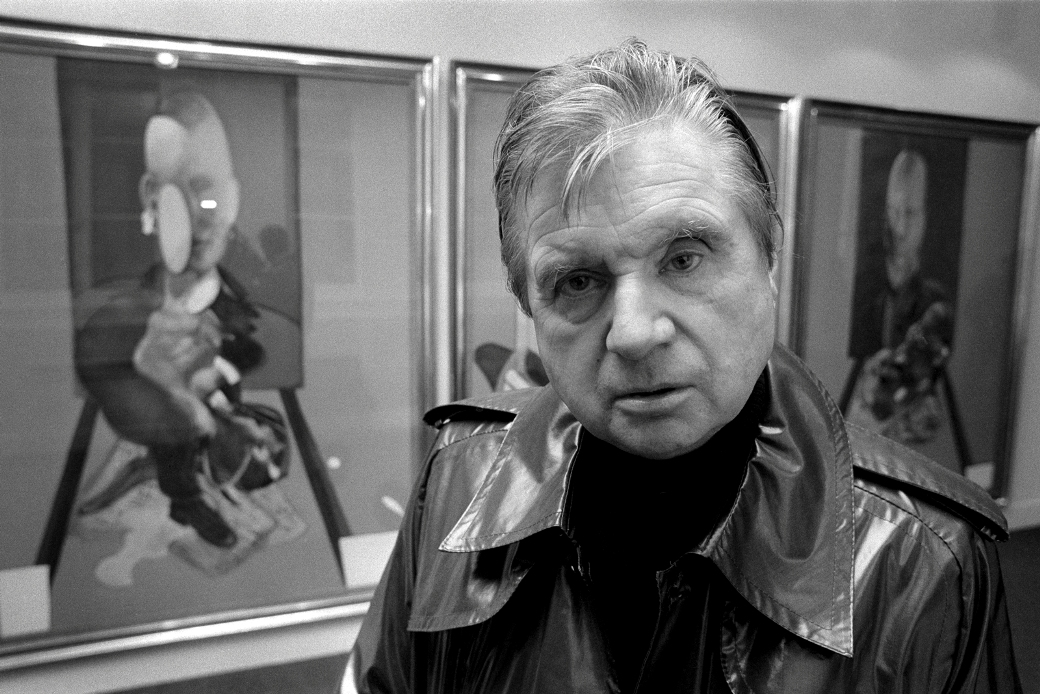
Francis Bacon: “Are you interested in this sort of thing?” he asked Amis, showing him a homosexual magazine.
Home thoughts from an incurable surrealist
Absorbed by his art; he scorns decoration; in fear of death, he is fascinated by the macabre.
Francis Bacon, master of the incongruous, talks to Richard Cork.
Photograph by Graham Wood.
RICHARD CORK
Entering Francis Bacon’s surprisingly Spartan bedsitting room in an uncanny experience, like finding yourself inside one of his own paintings. The walls are bare, and dangling from the ceiling are the same naked light bulbs that swing like demented pendulums in his pictures or bear down glaringly on a nude sprawled across a bed. Bacon’s preoccupation with reflections in many of his paintings is also echoed, with a startling dash of he macabre, by a wall-sized mirror. Its surface has been partially riven by a spectacular crack, as if somebody had picked up the small electric fire perched on a near by chair and hurled it straight at the glass. Rather than replacing the mirror, Bacon has taped up the largest slivers to prevent them falling off. The crack’s explosive power has been preserved, almost as disturbingly as one of the figures writhing in the immensity of a Bacon canvas.
When I remarked on the austerity of the room, with its single bed flanked by an angle-poise lamp at the far end, Bacon replied: "My surroundings simply don’t interest me very much." In one sense, his comment is understandable enough. The studiously neutral colour of the walls implies an utter lack of concern for the niceties of decoration. Two sofas, half-obscured by rows of clothes, likewise suggest that their owner has no time for wardrobes. The interior looks like a student’s digs, inhabited by somebody who disdains bourgeois propriety and feels impatient with the whole notion of possessions.
"I once had a very early Frank Auerbach," Bacon said, after I asked him about the absence of pictures. "At one stage I also bought a Sickert of a woman lying on a bed with a man seated next to her. But, like a fool, I gave it to Lucian Freud. I wish I had it now." He spoke like a man who lacked the financial resources to remedy his loss, and Bacon’s home certainly seems untouched by his ability to command millions of pounds for a single painting. "Earning vast amounts of money doesn’t affect me one bit," he said. "I’d be quite happy going back to the income I had as a young man, when I worked as a cook and general servant."
Looking round the room, I could see what he meant. There is nothing fixed or settled about this interior, no hint of and expenditure having been lavished on a place Bacon moved into 30 years ago. It resembles the room of a man in transit, someone unshackled by any of the conventional ties binding most people to their houses. Perhaps the truth is that Bacon is so absorbed in thinking about his art, and reading the books which festoon every available surface, that he has no time left for the external details of life.
In another sense, though, the parallels between this strange environment and his work indicate that it nourishes him as powerfully as the life-mask of William Blake once did. He still keeps it, on a cupboard next to an electric fan — a very Baconian juxtaposition. Its blanched and enigmatic features inspired a mesmerising sequence of paintings in the mid-Fifties. More recently, it also prompted him to have his own life-mask taken, an experience he regretted as soon as they started smothering his face with plaster. Now Blake’s life-mask presides over the room, mediating with stoicism on the inevitability of his eventual demise.
What, I wondered, did Bacon feel about the prospect of death of death? "Well, Picasso abhorred the thought of death: he loathed being reminded of mortality so much that he didn’t even want anyone to mention his 75th birthday when it arrived." Bacon, who refers to Picasso a great deal and regards him as by far the greatest artist of our century, understands exactly why he felt that way. "I hate the thought of death," he said. "I hate the thought of it all coming to an end." He paused, stared out of the window for a moment, and then brightened with a defiant rallying cry: "Shall we have some champagne?"
He leapt up with astonishing agility and, betraying no sign of an 81-yea old’s stiffness, disappeared into the kitchen. While he was away, I reflected that anyone who retains so much energy is bound to regard the whole notion of extinction as anathema. Within seconds he was back, bearing a bottle which he uncorked with seasoned ease. The two stemmed glasses he placed on the table were elegantly inscribed with the initials FB in flowing script. They were the gift, apparently, of an admirer in Germany, where his work is regarded with almost as much veneration as in France.
Did he think that his paintings are appreciated more warmly over there than in Britain? "Oh, they don’t like my work here at all," he said bluntly. "Maybe it’s the savagery they find in it, or maybe it’s the homosexuality which I suppose is in my work. I don’t go about shouting that I’m gay, but Aids has made it all much worse, you know. People are very, very odd about it. The other day a telephone engineer came round, so I offered him a drink. He looked at me strangely and said: ’You’re gay, aren’t you?' "
With characteristic honesty, Bacon has never made any attempt to hide his homosexuality. Some of his finest and most erotic paintings depict male figures embracing or making love. Moreover, he is intrigues by the fact that his distant ancestor, the celebrated Elizabethan Lord Chancellor Francis Bacon, was also homosexual. "It comes up in Aubrey’s Brief Lives," he said, bounding up from the table again and moving swiftly over to a pile of books on a cupboard near the bed. The search proved fruitless: "Where is it? What have I done with it? I’ve thrown all my books away, you know, because I’ve got no room for them."
I challenged his about the British perception of his work. He is, after all, widely regarded as this country’s most outstanding living painter, and over the past 30 years the Tate Gallery has paid him the unique honour of staging two great retrospectives. Now, in the Tate’s latest rehang, he has been given the accolade of a large room devoted solely to his work. It is immensely powerful, and prompted me to telephone him on impulse after I had visited the gallery. Bacon’s line was engaged for almost an hour, but then, quite suddenly, started ringing. He answered at once, and I told him that I had been particularly impressed at the Tate by his loan of a grand triptych, which he painted three years ago.
Bacon conceived it as a second version of a smaller and far more rasping triptych called Three Studies Figures at the Base of a Crucifixion. Painted in 1944, it seemed at the time to encapsulate the horror of war, by showing three monstrously deformed hybrids, half human and half beast, yelling their despair against a vehement orange ground. This disconcerting trio reappears in the 1988 version. But the two figures at the sides now point inwards rather than outwards, seeming to direct their anguish towards a blindfolded form with bared, vicious teeth in the centre. This time the extra space around each figure intensifies their isolation, and Bacon exchanges the parched, angry orange of the earlier triptych for a sumptuous deep crimson.
Having mentioned my fascination with these two versions, I asked Bacon if we might meet. To my surprise he agreed, and the next morning I went round to his mews home, in South Kensington, armed with his warning that its entrance had no name-plate to identify it. Although his work might suggest that Bacon is a reclusive and difficult man, he could not have been more convivial. Unusually for an artist, he is also very frank in his criticism of the work he had produced. "I did that second triptych because I’d always wanted to do a large version of the earlier one," he said. "I thought it might work, but I think the first one is the best. I should have reiterated the orange to give it a kick, because the red dissolves. But I may had been dissuaded by the boredom of putting it on, because mixing that orange paint with pastel and spraying it was a terrible lot of work."
Why, I asked, had he remained so obsessed with the crucifixion theme? "Well, I’m not in the least religious," he said, "even though I was brought up in the Protestant faith and went to church as a child. At my age, I’ve known many people die or commit suicide and I’ve never thought they were anything other than dead. I’m certain there’s nothing after that, and I like the finality of the American expression 'drop dead'. But I am fascinated by the great crucifixions which have been painted in the past by Cimabue and Grünwald.
Lying on the table beside us, next to an assortment of bottles and a Linguaphone course, was W. B. Stanford’s book on Greek Tragedy and the Emotions. It reminded me that Bacon’s gruelling interpretation of the crucifixion had been profoundly affected by his love of Aeschylus. One of his most haunting late triptychs was "suggested by" the Oresteia plays, and although he can only read Aeschylus in translation, "the whole surrealism is there". Picasso’s paintings of bathers from the surrealist period likewise influenced Bacon profoundly, to the extent of inspiring him to start painting. "But I’ve been influenced by everything," he said, "even the extraordinary colour photographs in medical text books, which I get from a bookshop in Gower Street. I got one there recently on small wounds."
He rose again and returned this time with a well-thumbed, paint-smeared copy of A Colour Atlas of Nursing Procedures in Accidents and Emergencies. I flinched from the pictures of syphilitic sores and other excruciating painful afflictions inside, all reproduced with glistening vividness. But Bacon seemed captivated rather than appalled as he leafed through the pages Why did he never even shudder at them? "I suppose when I look at these photographs, I think: 'My God, I’m lucky I don’t have that," he replied, pointing at a particularly gruesome wound. "But they don’t alarm me in the way that they do other people. Once I was driving through France with a friend, and we came across a terribly bad motor accident. There was blood and glass all over the road. But I remember thinking that there was a beauty about it. I didn’t feel the horror of it, because it was par of life."
Sensing that we were approaching the central reason why some people still recoil from Bacon’s art, I pressed him to speculate on the origins of his preoccupation with the normality of violence. "Well, you musn’t forget that I was born in Ireland," he said, "where my English father trained racehorses very unsuccessfully. I grew up there at a time when Sinn Fein was going around. All the houses in our neighbourhood were being attacked, and on all the trees you’d see the green, white and gold of the Sinn Fein flags.."
Although Bacon’s family moved to London at the beginning of the the first world war, when he was almost five, the atmosphere of fear did not abate. "We lived near Hyde Park, in Westbourne Terrace, and after the bombing started they sprayed the park with a phosphorescent substance from watering-cans. The idea was that the zeppelins would identify this glow as the lights of the city, and drop their bombs there. Then we went back to Ireland again, so I was brought up to think of life having this violence."
Even today it remains a powerful force driving his work. At an age when most men have mellowed and lost some, at least, of their youthful fire, Bacon stays close to his old obsessions. "I was planning this year to do a series of paintings about places where murder has been committed," he said, describing how there would have been, "one in a field, one on a pavement, and one in a room. But I’m going to abandon the idea."
One of these canvases sat half-finished on an easel in his studio, a modestly proportioned room reached by passing through a kitchen lined with colour reproductions of his work. A grey upper area in the painting led down to a central section spattered with blood. It had the rudiments of an authentically chilling image. But Bacon, an inveterate and ruthless destroyer of pictures he considers to be failures, said it was no good. He seemed reluctant to show me any of the other works-in-progress stacked against the wall.
Responding to my interest, though, he did allow me to explore the rest of the studio. It was cold, probably because his anxiety about the risk of fire prompts him to leave unheated the rooms he is not currently not using. The walls, like the doors, were gaudily covered with paint-splashes of every conceivable colour. As for the floor, it was heaped to the point of outright congestion with books, paint pots, squeezed-out tubes of pigment and smeared rags. How Bacon moves around in such a cluttered space remains unfathomable, but I did manage to bend down and retrieve a small canvas from the wreckage. The painted face it once contained had been cut out with a few swift slashes of the knife, leaving only a tantalizing vestige of a head behind.
In this cramped interior, lit by a skylight window which Bacon inserted for the purpose, he manages even to work on even the largest of his triptychs. When assembled, they must stretch across virtually the full width of the room, but Bacon finds this restriction oddly stimulating. "The best exhibition I’ve ever had was in 1977 at the Galerie Claude Bernard, in Paris, where the spaces are all small and the paintings looked more intense." So here, hemmed in by detritus in a studio which most artists would find claustrophobic, the indefatigable octogenarian repairs every morning. Unlike Lucian Freud, who painted a masterly little portrait of Bacon from nocturnal sittings almost 40 years ago, he prefers working in daylight. "I get up very early and paint in here until 1 pm. Then I’m finished, I’ve had it. I hate afternoons, I think they’re absolutely revolting, they’re a wash-out. But I feel better again in the evenings."
He looked spry enough as we talked, and while walking to a nearby Italian restaurant for lunch his gait seemed positively jaunty. The laced-up gym shoes, fawn pullover and corduroy slacks only accentuated the inner vitality of a man whose enthusiasm for work, and eagerness to talk about the artists and writers he admires most keenly, remains undimmed.
"I’ve thought of doing dozens of things which I’ve never done," he said, with an old man’s acute awareness of the role played by temporality and chance. "One’s energy fluctuates, and there’s never enough time. With life passing so quickly, you can never talk in ultimate terms, never plan for the future. It just happens." But, judging by the paintings he continues to produce, Bacon’s ability to seize the moment is still as formidable as ever.
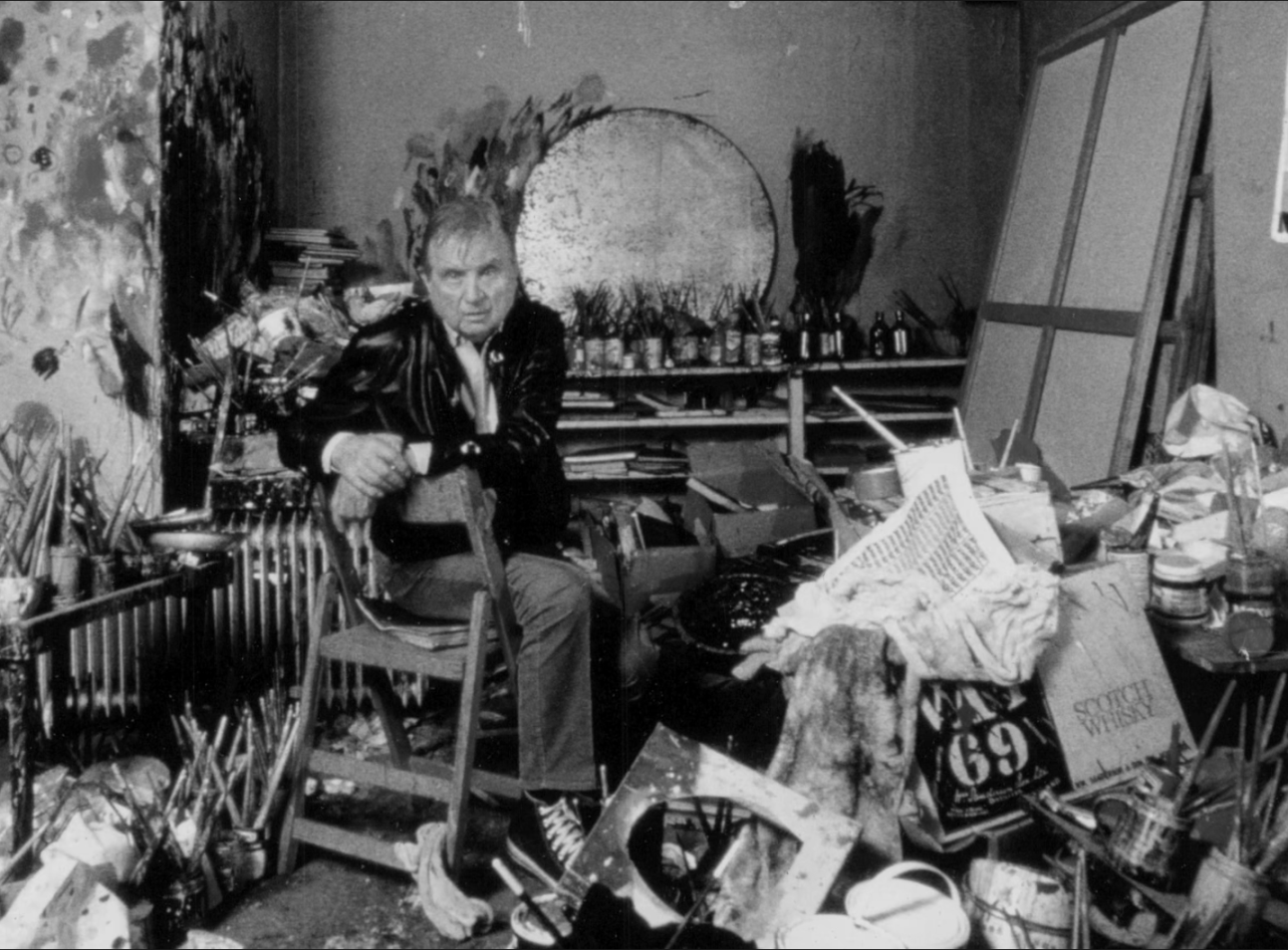
At home among the paintpots: “My surroundings simply don’t interest me”
STAN GEBLER DAVIES ON TELEVISION
A Colony in danger
STAN GEBLER DAVIES
One of Britain’s greatest cultural institutions, much beloved of the Irish, is in danger of closure. I refer not to the zoo at Regent’s Park, though that is going too, but to the Colony Room club in Dean Street, Soho.
I have belonged to this institution longer than any other and share membership with Britain’s (and Ireland’s; he was born in Dublin) greatest living artist, Mr. Francis Bacon, and with numerous other eminent and not-so-eminent artists, peers, writers, pimps, pornographers, whores and retired whores. Not to mention journalists.
The Colony Room commenced life more than 40 years ago as an afternoon drinking club, but was always more than that. It was always raffish, the behaviour of the members was frequently outlandish and the language unrestrained, but there was and is no better conversation in London and it has always been a kindly institution, tolerant and generous.
It is a tradition of the place that if anyone is overburdened with money he or she is expected to pass it behind the bar for the purpose of treating the house. Francis Bacon is frequently called upon to perform this function, sometimes paying the same bill twice over, with only the slightest grumble.
lan Board, the proprietor, pouring one of Francis’s bottles over Peter Langan who was lying on the floor, not precisely quarrelling with an incautious American lady he had just met, but pretty close to it. The purpose was to separate them.
Mr. Langan obliged us thereafter by improvising scatological lyrics to jazz classics, while still lying on the floor, accompanied on the piano by Barney of the razor blades (a child had attempted elsewhere to sabotage his performance by placing razor blades in between the keys of his piano), and bought much champagne himself.
Bacon threatened to resign once if the carpet was replaced, for he said it was soaked in history.
Members of the Irish nobility who attend frequently when they are in London are the Viscount Gormanston, the Baron Kinsale, the Hon. Garech Browne, his wife the Princess Purna of Morvi, and her mother the Maharanee and others too numerous to mention. Eminent actors are to be found there too. Tom Baker and John Hurt spring to mind.
Eminence gets you nowhere, however. You are as liable to be abused by Board, an Australian with a magnificent hooter, long-nurtured, if you are a peer or a star as if you are a pornographer (more so, in fact). It is the manner of the place, and it sorts out the men from the boys, so to speak, and the girls from the harridans.
The place is seedy, and tiny. It is on the first floor of a dilapidated building which the owner, Mr. Mustapha Ibrahim, wants to convert into another office block. His stated objections to the presence of the club are that Board is too rude, the members drink too much and many of them are homosexual.
There is a degree of truth to these allegations, but so what? It is a most genuine place and one of the few where phonies are not tolerated five minutes but driven down the rickety stairs by a chorus of abuse the like of which you would not hear this side of the Oireachtas.
Its fate is to be decided this week by Westminster Council. All Irish men and women of a generous and artistic nature must hope the British have the sense to preserve a cultural institution beyond price.
Intimate moments with 20th century greats
By CIARAN CARTY | ARTS | THE SUNDAY TRIBUNE | DUBLIN | SUNDAY, 30 JUNE, 1991
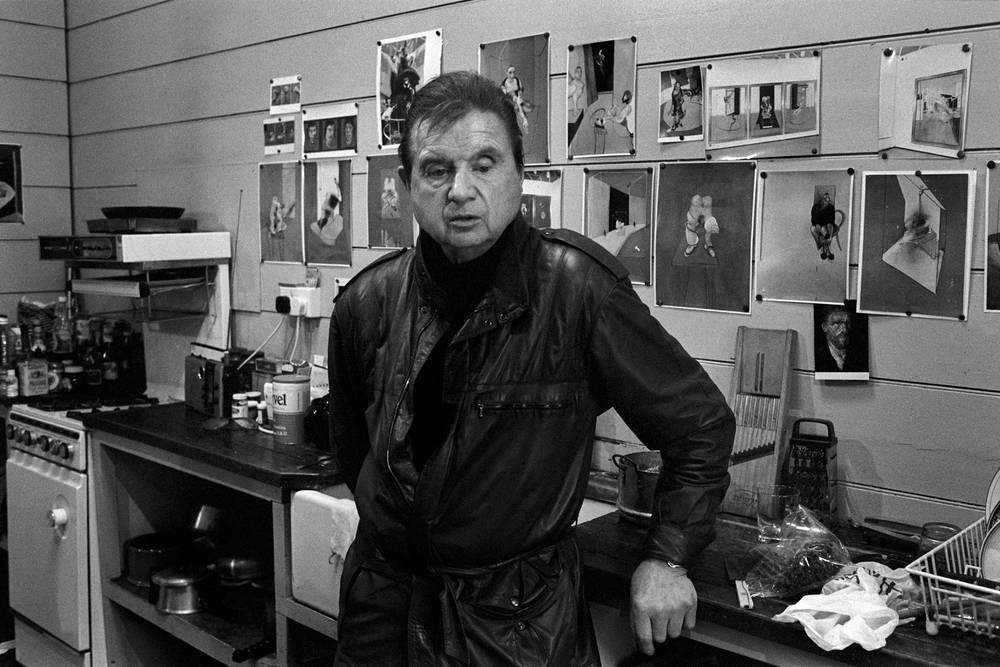
1000
MAKERS OF
THE TWENTIETH
CENTURY
FRANCIS BACON
British, b. 1909, painter
JOHN RUSSELL
Bacon (above) has had a profound effect on the life of the imagination since 1945, when his Three Studies for Figures at the Base of a Crucifixion turned out to forecast and epitomise those forces in human nature which were revealed in full strength, a few weeks later, when Belsen was overrun by the Allied armies. Many later pictures which looked at first like thunder-flashes of private fancy turned out, once again, to have a universal import. It was found that many a key figure in post-war demonology — the states-man on television, the multiple murderer, Eichmann (qv) in his glass box — could already be found in Bacon’s paintings, and with one skin less than their public image allowed. There were also huge set-pieces, of a multiple and ambiguous inspiration, in which Bacon brought the European “grand manner” back into painting; and, as counterweight to the sinister and calamitous aspect of human existence, he painted many portraits of friends which are metaphors for the resistance of the human personality to extreme stress. At a time when fashion ran the other way, Bacon kept alive an idea of human grandeur and an idea of the enduing validity of the painted image. JR

Visual feast of more than just Bacon
Norman Foster’s extension for Norwich’s Sainsbury Centre for Visual Arts
has opened with several outstanding “School of London” paintings from
the Tate. Richard Cork reports
RICHARD CORK | ARTS | THE TIMES | MONDAY SEPTEMBER 30 1991
Although so many universities are beleaguered
by cuts, spirits remain reassuringly buoyant at the Sainsbury Centre for Visual
Arts in Norwich. Sir Norman Foster
Sustained intensity lies behind the paintings
in this exhibition,
“The
Transformation of Appearance”,
and their overall mood of urgent scrutiny is seized in the first canvas to greet
the visitor, Frank Auerbach
His Girl with a White Dog, completed
exactly 40 years ago, has a glacial immobility. The sitter allows one ample,
pale breast to emerge from her robe. But sensuality is countered by the frozen
exactitude of Freud
In his early 1970
Endurance is also the keynote in Leon
Kossoff's work. An ailing woman dominates a bleak canvas of 1965, attended on either side
of her bed by peering relatives. By 1980, when he produced the equally looming
Two Seated Figures No 2, his handling of form had grown more slab-like. The
man and woman inhabit their chairs with the heaviness of Egyptian statues, but
Kossoff
Francis Bacon, however, I remains the undisputed master of perturbation. His nervous yet energetic portrait of Van Gogh on his way to work stresses isolation and death-haunted haste. But resilience asserts itself in the bravura bust of Isabel Rawsthorne, whose vigilant eyes preside over the swiped, splashed and smeared lower regions of her face. And when Bacon executed his 1972 Triptych in black, ochre, grey and pink, he flanked the writhing forms of lovers with single figures whose melancholy gives the entire work an elegiac air. This deserves to be ranked among Bacon’s finest works, and looks commanding in the cool, spacious installation devised for the exhibition.
The new extension appears to imply an
awareness, on the architec
The reserve collection is also exhibited with great elegance in Hahn cases, offering a corrective to the dismal storerooms where most museums incarcerate the work they have no space to display. Foster should be commissioned to redesign them all without delay.
The Transformation of Appearance continues at the Sainsbury Centre for Visual Arts, University of East Anglia (0603 56060) until December 8
The old master of chaos
A giant of the century who sill lives by his wits
DANIEL FARSON
AN ARTIST should belong to his time — or so they say. But if he is a true original the time should belong to him as he records, twists and even contradicts it.
Who will represent this tormented century? There are several contenders, but two men tower above the rest — the giants of 20th Century art.
Picasso encouraged us to look at life with new eyes when he changed the course of art with Les Demoiselles d’Avignon n 1907. Francis Bacon conveys our neurosis with his lonely figures trapped behind their glass in a silent scream. The brutality of his Three Figures At The Base Of A Crucifixion caused such a sensation when first shown in London in 1944 that people recoiled from shock.
Condemned in his time, Picasso hangs in the National Gallery today alongside Old Masters and his genius is undisputed. Yet if you mention Francis Bacon to people you meet today, many will reply: ‘You mean the man who wrote Shakespeare’s plays?’
Outside Britain he is recognised as the world’s greatest painter; here, his 82nd birthday next Wednesday will probably go unnoticed. And that is exactly how he wants it. Unlike other artists who back bashfully into the glare of the spotlight, Bacon shuns publicity.
He has been offered a knighthood and, I understand, the Order of Merit, and though this pleases him he has rejected them politely. He explained to me with a shrug: ‘In a sense they cordon you off from existence.’ Then, in a voice ringing with self-mockery, he added: ‘Anyhow, they’re so ageing!’
In Paris, he is mobbed, but in London he retains his anonymity so effectively that when we tramp the streets of Soho I indulge in the fantasy that I am accompanying Toulouse Lautrec on the way to the Moulin Rouge, except that Toulouse would be more conspicuous. In one pub, learning that he was a painter, someone offered him a job doing up a room. In another, talking to a genuine housepainter, Bacon discussed the merits of Dulux paint which he was considering for a background.
THEY would have been stunned to learn that a Bacon triptych sold in New York for £3.9 million. Such sums do not interest him. He deplores the current preoccupation with cost. ‘Prices are so ridiculous that people go to galleries because they are obsessed by the money.’
He is rich enough to afford his contempt for money, but has never taken it too seriously. Ever since he left his home in Ireland at the age 16 after a row with his horse-training father, he has lived on his wits. He was so broke when I met him first that he asked me if I knew of someone who might buy a picture that same day for £150. It is now worth a million. He said he divided his time ‘between the gutter and the Ritz’ and seemed at home at either address and equally himself.
His style of living has scarcely changed, for he survived on a diet of oysters and Champagne long before he could afford them, settling his bills when he sold a picture. Now the bills are paid on the spot, the Champagne is vintage, and the caviar sent back if too salty. He has no car and when his accountants urged him to reside in Switzerland he replied: ‘Can you imagine anything more boring, all those fucking views!’
He was persuaded to invest in a smart house and found he was unable to work there, returning quickly to the ‘chaos’ of the mews cottage in South Kensington. Though he has lived there for 40 years, it is sparsely decorated with naked light bulbs and blankets over the windows, but the paint-stricken studio is a work of art in itself.
I climbed those steep stairs to find him in a radiant mood. Bacon has always looked ageless with his pronounced jowls, staring eyes, and carefully dishevelled hair of indeterminate colour and as we shared a bottle of Krug I had brought as a present, it was impossible to accept that he was in his 80s. Retaining his venom as well as his vigour, he proceeded to demolish his contemporaries with a lacerating wit unrepeatable here.
‘It’s very sad that there’s nothing coming up at the moment. But don’t forget that at the end of the last century we had the Impressionists and Cubism and Picasso as a marvellous beginning to this one.’ Still anxious to learn, he went to the Pop Art show recently in the hope that he might be able ‘to steal one or two ideas. But it was all so boring, there was no excitement.’
Jasper Johns and Rauschenberg would have winced had they heard his comments. As for Julian Schnabel, that highly fashionable New York artist who embeds crockery on his canvases, he phoned Bacon on a recent visit to London suggesting ‘I think it would be nice if we got together.’
‘Well I don’t,’ said Bacon, putting down the phone. Even Picasso is open to criticism, though virtually sacrosanct. He was the inspiration when someone took Bacon to Berlin when he was 19, continuing on his own to Paris where he saw his first exhibition of Picasso drawings.
The two artists could not be more contradictory: Picasso experimented and dared to fail, releasing inferior ‘doodles’, while Bacon scrupulously destroys all work which displeases.
Picasso celebrated life, but though Bacon is one of the funniest people I know he insists that humour has no place in art. With Picasso you sense the exhilaration of simply being alive, with Bacon it’s the exhilaration of despair. As Bacon told the critic Richard Cork earlier this year: ‘If Picasso and I were both compelled by the erotic impulse, it would be a different eroticism as I am homosexual.’
Self-taught, Bacon exploited the element of chance encouraging a painting to take its own course. He describes how a portrait acquires likeness by a creative accident. When it works, a swirl of paint produces a portrait which is instantly recognisable. Occasionally this makes him sound like Tony Hancock’s artist in The Rebel who was asked how he mixed his paint: ‘In a bucket with a big stick.’
Trying to create a wave breaking on the shore, Bacon ‘collected an enormous amount of paint, put them all into a pot ... and just threw the paint on to the canvas’. Instead of the wave it became the famous Jet of Water 1979.
ALTHOUGH there is this element of chance, it is the calculated risk of the gambler, and Bacon is notorious for his all-night gambling in clubs before his dawn attack on canvas.
Otherwise he is the most ordered of men. In conveying the solitary nature of man he has struck a vein peculiar to this century. When the designers for The Silence of the Lambs wanted to illustrate Hannibal Lecter’s isolation, they turned to Bacon’s work for inspiration.
Yet for Bacon it is the image rather than the message that matters, and though his interpreters claim that he portrays man’s inhumanity to man, his explanation for the gore is often disarmingly simple: ‘You’ve only got to go into a butcher’s shop like Harrods’ Food Hall — its nothing to do with mortality, but it’s to do with the great beauty of the colour of the meat.’
It has never been Bacon’s intention to depict the prettier side of life, though I wish he had painted more of his extraordinary, strange landscapes.
I sense a deep compassion, a terrible beauty which will become more apparent in time. He understands why his mother implored him not to grow old — ‘it’s detestable’ — but he retains his restless energy and has just been travelling in France with a friend, staying with Baron Rothschild.
Bacon is fortunate to be so mentally alert, but has long been aware of hovering death, especially since his friend and model was found dead in their Paris hotel while Bacon was receiving President Pompidou at the opening of his memorable exhibition at the Grand Palais in 1971 — Bacon recorded the tragedy in three amazing triptychs.
Yet he is not a pessimist: ‘If you really love life you’re constantly walking in the shadow of death.’
When I asked about the future, he shrugged: ‘I hope I’ll go on working until I drop dead.’ In years to come, we shall be measured by his painting.
OBITUARIES
Sir John Rothenstein, Director of the Tate Gallery for twenty-six years (1938-64), died 27 February aged ninety. He received lengthy obituaries in the British press, which remembered his support for English artists such as Burra, Spencer, Moore, Bacon, Pasmore, Freud and Paolozzi. He was not, however, the chauvinist some took him to be, and he introduced the British public to a number of foreign artists, including Leger, Klee and Chagall.
In the early Fifties he passed through a difficult period when his directorship came under fierce attack from some art critics, none fiercer than the collector and famous critic of the Modern movement, Douglas Cooper.
This culminated, in 1954, with the episode which sent a delicious frisson around the English art Establishment and made Rothenstein’s popular reputation: going around the Diaghilev exhibition, he ran into Cooper, who started insulting him and then punched him. Opinions vary on what followed.
One account has it that Rothenstein laid out Cooper accidentally with his head as he straightened up; the other, that Rothenstein actually slogged him back.
Be that as it may, Cooper was spoiling for a fight, as this unpublished letter shows.
John Richardson tells us that its violent tone actually protected Rothenstein. When Cooper lobbied government to get rid of him it persuaded M.P.s that Cooper just had a bee in bonnet and was not to be taken seriously.
Received 13 June 1953
Dear Rothenstein,
Now that the Mexican president has provided you with the beak and talons of an Aztec eagle you may perhaps feel better equipped to face me in open contest. But do not deceive yourself into thinking that because your continual disservices to art bring you knighthoods and ribbons, I shall in any way weaken in my attack. There are still more than ten years in which to hound you out of Millbank [the Tate]—and it shall be done.
Yours, Douglas Cooper. P.S. Do not forget to circulate this to all the Trustees. Their dossiers should be kept complete, as complete as those of my friends to whom copies of the present missive have been sent.
[Tate Gallery archive 8726]
By HENRY TANG
HENRY TANG
WORLD famous artist Fran-cis Bacon has donated a £3 million painting to the Tate Gallery - but from next January it will be locked away in the gallery’s vaults. The market price of Bacon’s painting, called Second Version of Triptych 1944, far exceeds the Tate’s annual spending budget of £1.85 million.
But from next January it will be held in the Tate’s vaults because gallery
officials have decided that other works should be shown. A Tate spokeswoman
said: “The painting has been on display since January 1990 in a room devoted to
Francis Bacon.
Gallery
The Tate’s Liverpool gallery can exhibit 325 works.
Bacon’s painting which he completed in 1988 is a second version of a work he painted 44 years earlier. It consists of three panels, each of which consists of a figure in an agonised, contorted pose. These figures are thought to represent the three Furies, the ancient Greek goddesses of vengeance.
The Tate’s director, Nicholas Serrota, said: “It is a magnificent gift from a great living British artist who needs to be seen in the Tate in strength. With the Tate’s purchase grant frozen at £1.85 million a year, we would only have been able to buy one panel.”
Bacon’s painting has been on show at the Tate since January 1991 in a room which features the development of his work since 1944.
It will be on display until January 12, 1992.
ISABEL RAWSTHORNE
Isabel Rawsthorne designer, painter and model,
died at Little Sampford, Essex, on January 26 aged 79.
She was born in July, 1912.
MANY more people may know the face and character of Isabel Rawsthorne than know her name; for not only was she painted by Derain and Picasso, and sculpted by Epstein and Giacometti, but also from the 1950s she was friend and model to Frauds Bacon. In his great retrospective exhibition in Paris in 1971, the triptych of studies of Isabel stood out for the affectionate warmth revealed behind Bacon’s usual flaying ruthlessness. Since then, she has become one of the most profoundly scrutinised human subjects in Western art.
I
Divorcing in 1946, Isabel was proposed to by Constant Lambert, whom she had already met in Paris and who was in a low state — sad, sick, lonely and alcoholic Isabel brought companionship, if not moderation to his drinking and restored his zest for life. In 1947 they married, living in a happy if shambolic household with two pianos for him and a studio for her in Albany Street off Regent’s Park. They collaborated in 1951 on the ballet Tiresias, with Constant’s music, Ashton’s choreography, and Isabel’s sets. Marriage to Constant also brought her a stepson, the wayward, ebullient Kit, who became entrepreneur of the rock group “The Who”, though she saw little of him.
Lambert died in 1951 of a surfeit of alcohol (and perhaps the artistic failure of Tiresias). Isabel subsequently married, in 1954, Alan Rawsthorne, composer and the most loyal companion of Lambert They took a cottage in Essex, maintaining a convivial, bohemian social life. Isabel followed up Tiresias by designing for Covent Garden, under the name Isabel Lambert, the ballets Blood Wedding, Madame Chrysanthkme and Japez and the Devil, and the opera Elektra. From the 1950s, she continued to mix in the artistic circles of Soho, becoming one of Francis Bacon’s most regular portrait subjects. She described his studies of the details of her mobile, often laughing face as “fabulously accurate.” But after Rawsthorne’s death in 1971 she stayed on in Essex giving more time to her painting and drawing.
Isabel Rawsthorne
OBITUARIES
ISABEL RAWSTHORNE, who has died aged 79, spent her last years as a recluse in
East Anglia
—
in marked contrast to her younger days, when she was a celebrated artist
Most of her life was spent in the company of painters, writers and musicians. Her highly individual looks appealed to André Derain, Alberto Giacometti and Francis Bacon; while her husbands included Sefton Delmer, the Daily Express foreign correspondent, and the composers Constant Lambert and Alan Rawsthorne.
A master mariner’s daughter, Isabel Nicholas was born in Scotland in 1912 and studied art at Liverpool and in London before moving to Paris. There she soon met Derain, who allowed her to work in his studio and painted a series of portraits which show a vivacious girl with dark falling curls and the promise of a smile.
From then on young Isabel was much sought after as a model. She possessed a nervous energy which suggested constant movement, and had the surprised expression of someone who has just heard a delightful joke and wishes to share it. Her conversation was punctuated with roars of uninhibited laughter.
She described Derain as “the most French person you could meet, son of a baker
The painter she became closest to during her sojourn in France was Giacometti. He sculpted her head in bronze, a work which looked positively Egyptian by comparison with the elongated figures of his later period.
In 1935 she married Sefton Delmer, who took her off to the Spanish Civil War. Only when the bombardment of Barcelona became deadly serious did Delmer think to commandeer a taxi: I was the last across the frontier,” she would recall. “In Poland he put me on the last plane. When the Germans invaded France I left on the last boat for England. I was on the last thing from everywhere.”
Their marriage was dissolved in 1946, and the next year Isabel married Constant Lambert. Ninette de Valois described Lambert as the English Diaghilev; he was also supposed to have suggested the character of Hugh Moreland in his friend Anthony Powell's great novel A Dance to the Music of Time.
In Andrew Motion’s book,
The Lamberts,
Isabel explained why she accepted Lambert’s proposal when he was already in
decline: “He thought that if he married me I would bring him back to life. He
was a sad man, and a sick man, and a lonely man.
Notwithstanding
the good efforts of his wife, Lambert continued to suffer from a sequence of bad
luck, culminating in the ill-fated ballet of Tiresias
One of Lambert’s most loyal companions at that time was his fellow composer Alan Rawsthorne. “When they were together it was quite fantastic, she remembered, and it was to him that she turned for support when Lambert was taken into the London Clinic suffering from delirium tremens after a surfeit of alcohol.
Lambert died in 1951, and she subsequently married Rawsthorne. After his death
she lived on alone in East Anglia
In 1986 an exhibition of her stage designs, drawings and paintings was held at the October Gallery in London; and at the time of her death she was greatly looking forward to the retrospective due to open at the Woods Gallery, Leicester, on February 29. This will include her portraits of Rawsthorne and more recent scenes of Africa.
Isabel Rawsthorne’s singular nature has been captured by artists in work which can be seen all over Britain: Derain’s portrait in the Fitzwilliam Museum, Cambridge; Giacometti’s drawing and bronze head in the Sainsbury Centre at East Anglia University; and the portraits by Francis Bacon in numerous collections, notably in the Tate Gallery.
Bacon’s
Three Studies
(1967) and
Portrait of Isabel Rawsthorne Standing in a Street in Soho
(1967) are hung in the Berlin Nationalgalerie. In spite of the savage, swirling
strokes, Bacon’s portraits are instantly recognisable of Isabel Rawsthorne as
she once was.
Isabel Rawsthorne
EDWARD WILLIAMS
ISABEL RAWSTHORNE, the painter and ballet and opera designer, was born Isabel
Nicholas in London in 1912. The daughter of a sea-captain who subsequently
became a Mersey pilot, she went to Liverpool Art School before leaving for
London, at 18, to study briefly at the Royal Academy Schools, which she found
She was employed as an assistant and model in the studio of the sculptor Jacob Epstein, who produced a marvellous bust of her which was exhibited in the Tate Gallery and which led indirectly to her marriage to her first husband, Sefton Delmer, foreign correspondent for the Daily Express. In 1934 she went to Paris to her marriage to her first husband, Sefton Delmer, foreign correspondent for the Daily Express.
In 1934 she went to Paris to work at the life
classes at La Grande Chaumière; studies which she financed by posing for many
distinguished artists
Some time after this she met Sefton Delmer, who at once recognised her as the model for the Epstein bust which he had seen and admired several years earlier and they were soon married, staying and working in Paris right up to the outbreak of war. On their return to England Delmer became head of Black propaganda at Bletchley Park, where Isabel also worked designing leaflets and forging documents to undermine German morale.
She continued too to paint. After the war, a
divorce and a return to France, Isabel married the composer and conductor
Constant Lambert whom she had known for some years. She held her first post-war
exhibition at the Hanover Gallery, as a result of which the choreographer
Frederick Ashton invited her to design the ballet Tiresias (1951), a
cherished project of Lambert
After Lambert
Even for those of a younger generation who only knew her in her forties, she radiated the exhilarating personality, vitality and beauty which Epstein and later artists had caught so well.
Her circle included at this time many
musicians, writers and painters in the Soho of the Fifties and Sixties: the Soho
of the composer Elisabeth Lutyens, the poet Louis MacNeice and the painter
Francis Bacon, who also painted several studies and a portrait of her. But for
many of her friends the best of her was to be had in visits to her and Alan in
Essex, where the wine, conversation and laughter would more than make up for an
occasional irregularity in the commissariat, and where her sometimes rather
formidable
Edward Williams
Isabel Nicholas, painter and designer, born London July 1912, married c1936 Sefton Delmer (marriage dissolved), 1947 Constant Lambert (died 1951), 1954 Alan Rawsthorne (died 1971), died Little Sampford Essex 26 January 1992.
CLARE HENRY
From childhood he had always felt the ground ready to crumble away beneath his feet. His questioning of life in general and art in every aspect resulted in a determination to challenge, almost automatically. He presented the human predicament, on a knife-edge, yet with insight and feeling.
Many find his paintings
distasteful, even repulsive
He himself denied that he
ever intended his work to be horrific, yet he agreed that violence was
central to his art:
As a young man, Bacon did odd
clerical jobs until he was inspired to become a painter after seeing a Picasso
exhibition in Paris. He first exhibited in Young British Painters at Agnews,
along with Sutherland, Pasmore and Hitchens. In 1941, he was declared unfit for
military service. He also destroyed all his early paintings. By 1946 he was
living in Monte Carlo and in 1948 Alfred Barr purchased a major work for the
Museum of Modern Art, New York. From 1949-59, he showed with London
He taught briefly at the Royal
College as deputy to John Minton
During the past 25 years he
received many international awards and prizes including the Rubens Prize and the
Pittsburgh International. He travelled a great deal but remained based in London
in the same chaotic studio for 20 years.
BACON
Hugely skilled at self-promotion, always happy to go on television to chat charmingly about his sexual inclinations and boozy nightclubbing, Bacon was acclaimed as an original artist when, to put you in the picture, he was almost always thematically derivative. He lifted from Velasquez the image of Pope Innocent X, he lifted from Eisenstein the image of the screaming woman from The Battleship Potemkin, he composed in the imagery of others. For modernist critics this was the art of allusion writ large; for more discriminating spectators it was a pictorial confession of despair brought about by a banality of outlook.
Bacon began his career as an interior designer and never really moved from that precious mentality. His paintings, for all their confrontational gestures, do not seriously challenge the spectator with a vital vision. They are essentially decorative rather than emotionally or intellectually expansive, immensely attractive to the few who can afford them: wall-hangings for the well-placed.
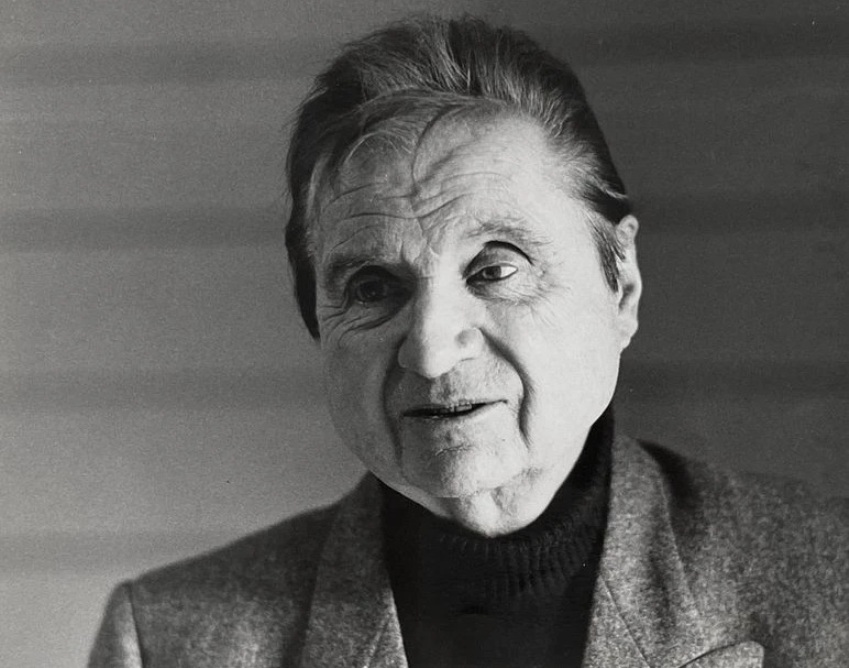
“a silent volcano of a man whose disregard for the norm and distaste for the sedate was readily apparent”
Bacon’s tortured vision
The death of Francis Bacon and Olivier Messiaen remove two leaders from their field of work.
Arts Editor TERRY GRIMLEY pays tribute to a giant of British painting while CHRISTOPHER
MORLEY recalls the life of one of this century’s greatest composers
TERRY GRIMLEY
He had a Dorian Gray quality about him, always looking a good 10 years younger than his real age. His famous love of champagne and oysters at Wheelers restaurant made him legendary and he once agreed to a television interview provided it was filmed there and his slate was cleared.
In 1971 he was given a
retrospective in Paris
Four years later he became the first living British painter to be given a one-man show at the Metropolitan Museum in New York. In 1988 his work went on show behind the Iron Curtain where it fascinated and perplexed Russians. Although some have described Bacon as the greatest British painter since Turner, the reputation of Turner lies to a great extent on his late visionary work. Bacon, by contrast, arrived with a bang and some believe his work of the three decades was an anticlimax. That is the sort of question which time will certainly judge.
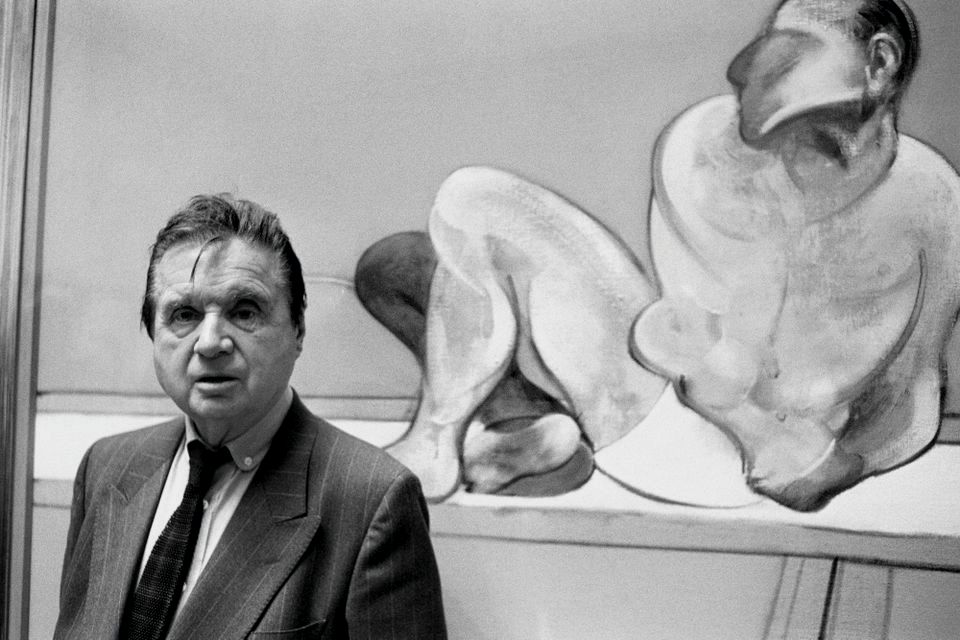
Mastering the art of the ugly
BRETT GORVY
Francis Bacon was not only Britain’s greatest post-war painter, but a modern master of international stature. While most of British 20th century art has been derided as derivative, insular and insipid, Bacon’s raw style knew no national boundaries nor would it be safely compartmentalised as belonging to a specific school or movement. An original, he had inspired generations of art students, both by his relentless dedication to his craft and by his refusal to compromise the ruthlessness of his vision.
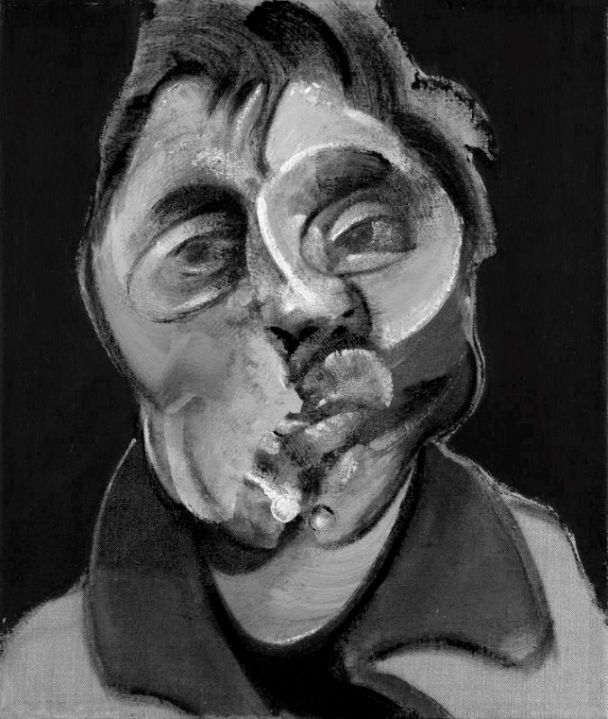

Picture of the artist: A gruesome self-portrait of Francis Bacon. Even the artist’s own face could not escape the brutality of his brush
OBITUARIES
His triptychs, which launched his career at the age of 35, followed the European tradition of alter pieces and came at the time when British art was very very weak. These strong exciting images became a symbol of renewed life. With no formal training he used his fingers, scrubbing brushes and rags to get the effects he wanted. His subject matter tended to revolve around the themes of sex and death. He combined different images from different mediums to produce startling images.
Inspiration came from poets, other
artists, photographs and even medical books. Some of his most famous and
striking pictures are the Screaming Popes. Here he combined references
from a still photograph from Sergei Eisenstein
Throughout his career he remained
mysterious about his work, always insisting that he had no story to tell. He
believed that if his art could be explained there would be no point in painting.
He had a Dorian Gray quality about him, always looking a good 10 years younger than his real age. His famous love of champagne and oysters at Wheelers restaurant made him legendary and he once agreed to a television interview provided it was filmed there and his slate was cleared.
In 1971 he was given a
retrospective in Paris
Four years later he became the first living British painter to be given a one-man show at the Metropolitan Museum in New York.
In 1988 his work went on show behind the Iron Curtain where it fascinated and perplexed Russians.
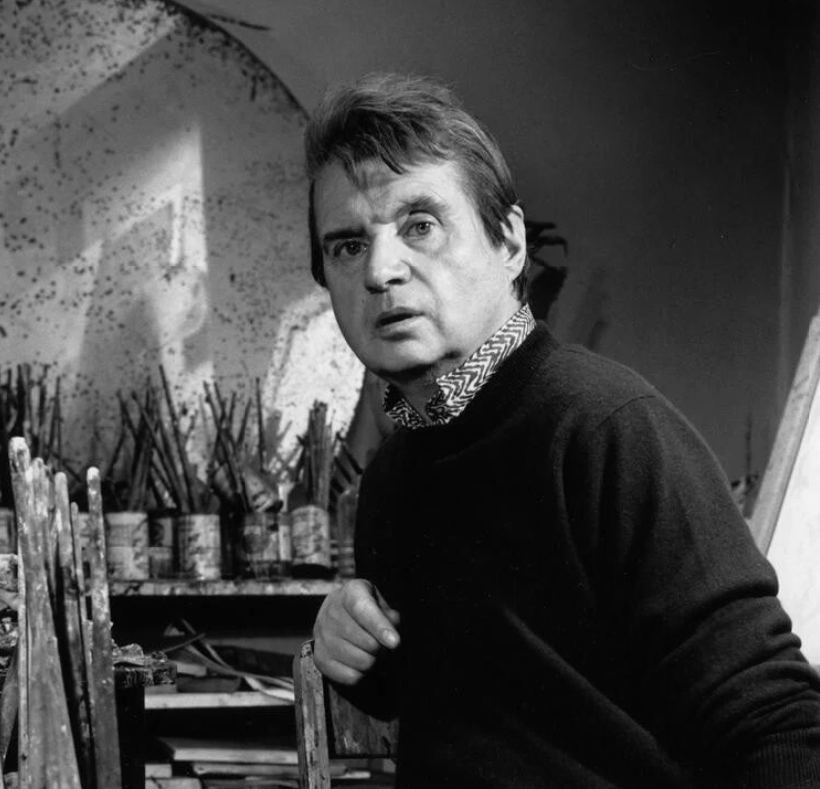
Francis Bacon: photographed in his studio at the time of his 1971 retrospective at the Grand Palais in Paris
.png)
Life as art
EDITORIAL | THE EVENING STANDARD
| LONDON
WHATEVER one thought of Francis Bacon’s art, his life was a modern masterpiece. Banished by his rich father at 16 for trying on his mother’s underwear, Mr Bacon drove a field ambulance in World War I, gallivanted in 1930s Berlin transvestite clubs, spent heavily on gabling, drank Soho dry every day, spurned a knighthood as being too common and died, aged 82, enjoying himself in Spain. Never mind the pictures: feel the life.
Francis Bacon, genius of the
violent style, is dead
FIRST EDITION | THE EVENING STANDARD | WEDNESDAY, APRIL 29, 1992
FRANCIS BACON died today of a heart attack in a Madrid hospital after being taken ill on holiday. The 82-year-old painter had been staying with friends in Spain. He had complained of not feeling well and was admitted to hospital where he died suddenly this morning, his London agent said. He had suffered from asthma throughout his life.
His body will be flown back to England for a private
funeral. Francis Bacon lived a life divided between the gutter and the Ritz.
Some said he was the greatest British artist since Turner — others considered
his art obscene. All over the world sales of his work attract top collectors and
record prices. Yet Bacon lived for most of his later life in a chaotic
two-bedroom mews house in South Kensington.
Born in Dublin in 1909, his English father was a retired Army officer and went
to Ireland to train horses. Bacon's relationship with his parents was not good
and they never really supported his ambitions as an artist. At the age of 16 he
was banished by his father after he was found wearing his mother
He returned to London in 1923 and began to design modernistic furniture.
However, Bacon
His triptychs, which launched his career at the age of 35, followed the European
tradition of altar pieces but his strong exciting images reinvigorated the
British art scene and became a symbol of renewed life. At the outbreak of the
Second World War he tried to enlist, but was turned down because of his asthma,
so joined the ambulance rescue squad. Some critics believe this experience with
death helped mould his violent artistic style. He had no formal training and
used his fingers, scrubbing brushes and rags, combining different images from
different media to produce startling images.
Inspiration came from poets, photographs and even medical books. Some of his
most famous and striking pictures are the Screaming Popes. Here he combined
references from a still photograph from Sergei Eisenstein's film Battleship
Potemkin and Velasquez's Portrait of Pope Innocent X to produce an unforgettable
image.
Aloof and alone when working, he could also be sociable, drinking in Soho
In 1971 he was given a retrospective in Paris
* CHANNEL 4 is screening a 1985 South
Bank Show on Francis Bacon at 9pm tonight.
MIRROR OF OUR VIOLENT TIMES
By BRIAN SEWELL | FIRST EDITION | THE EVENING STANDARD | WEDNESDAY, APRIL 29, 1992
IT
IS an irony that Francis Bacon should die in Madrid, the city of Velasquez,
whose heir he was as the last in the line of ancestral European painting. He was
heir too to the grandeurs of the Italian Renaissance and the bloodstained
violence of German art, ignoring the aesthetic nonsenses of abstract art and
other late 20th century fashion.
He
took the Crucifixion, stripped it of all its Christian implications, and
invested it instead with the universal beastliness of man and abattoir, running
with blood, deafened with screams. As a portrait painter he was not the friend
with insight but the harsh interrogator, the man outside the ring of light with
lash and electrodes close at hand. His prisoners, presidents, popes and old
friends squirmed.
He
used the ideas of the trap, the cell, the cage, the X-ray field and the heavy
fall of light to imprison and torment his subjects to distil the violence, and
to assault complacent senses with graceless nakedness on the lavatory pan and
vomit in the wash basin.
Francis Bacon was born in Dublin in 1909 but did not stay there long.
Ill-at-ease with his middle-class parents, Bacon's adolescence was spent alone
in Berlin and Paris, designing furniture and rugs, and it was only in 1929 that
he turned to painting.
He was entirely self-taught, rejected by the English surrealists for not being
sufficiently surreal, and as no one else paid serious attention to his early
work, he destroyed it. After the war, the friendship and support of Ruskin Spear
and John Minton, and the use of a studio in the Royal College of Art, gave his
work new strength and impetus.
In 1945 he exhibited Three Studies for figures at the base of a Crucifixion,
now in the Tate Gallery, a benchmark for all subsequent work, and in 1949 he was
given a one-man exhibition in London. It was an immediate success, and the first
of many all over the world, for Bacon broke all the timid rules of British art
and forced it into the European tradition. His work was eventually to be found
in major galleries all over Europe, Japan and America and was in such demand
that prices paid by private collectors often exceeded the £1 million mark.
He was held by Alan Bowness, former Director of the Tate Gallery and a close
friend, to be Europe's greatest living painter — others of us thought him the
greatest living painter in the world.
A very likeable man, a considerable drinker, he was in private life unassuming,
quick-witted and warm; he travelled by Tube as often as not, did his own
shopping, offered support to young painters whose work he liked and was never
formidable.
When interviewed by distinguished broadcasters and critics, he invariably saved
them from themselves, camouflaging the worst of their idiocies with quick and
reasonable answers to fumbling, incoherent questions. Made into something of a
guru by the media, his view of the future of painting was deeply pessimistic.
Bacon took the vile, sexually and politically obscene, the shudderingly
visceral, and lifted them with paint so that we might contemplate ferociously
profane images of cruelty and despair and see in them an inheritance from the
great Renaissance themes of religious and temporal power.
Titian, Rembrandt and Velasquez might not have cared for Bacon's work but they
would at once have recognised kinship in his astonishing mastery of paint and
the profound pessimistic atheism of his images. He was the perfect mirror of the
spirit of our age.
FRANCIS BACON, the self-taught artist seen by admirers as Britain’s greatest 20th century painter but by Mrs Thatcher as “that dreadful man who paints those horrible pictures”, died yesterday after suffering a heart attack while while on holiday in Spain. He was 82.
The conflict aroused by his work was prompted by his concentration on sex and death, often violently expressed. He also adopted a colourful lifestyle and was openly homosexual.
Mr Bacon lived to see his work command to prices. A 1973 triptych
fetched £3.75 million at Sotheby’s in New York in 1989, and a portrait was sold
last December for almost £2 million at Sotheby
A life between the gutter and the Ritz
Was Francis Bacon, who died yesterday, Britain’s greatest painter?
Daniel Farson, a friend for 40 years, traces his unconventional life and,
right, Richard Dormnet assesses his work
DANIEL FARSON |
THE ARTS |
THE DAILY TELEGRAPH |
WEDNESDAY, APRIL 29, 1992
He was one of a few painters to receive critical if not public acclaim during his life time. He was offered such honours as a knighthood and the Order of Merit, but he quietly declined them.
Though constantly surprising, his work did not change drastically over
the years but but developed his theme of human pain, despair and loneliness,
depicted with a violence which may become symbolic of the 20th century. He was
also one of the formidable figures of his time, a man who divided his life, as
he put it,
A heavy drinker and obsessive gambler, His stamina was exceptional and he appeared 20 years younger than his age. He was a brilliant conversationalist; his wit was spontaneous and his carefully measured sentences and lilting intonation could make the mundane sound hilarious.
His presence was equally welcome in the clubs of Soho or the salons of
smart society, and he was at his ease in both. Certainly, he had not time for
the trappings of success and lived for the last 25 years in a small mews
cottage near South Kensington which looked as if it was waiting for the
furniture to arrive, with blackened windows and naked light-bulbs.
Bacon directed his career with consummate skill while appearing to
ignore it, and he was careful not to be associated with any artistic school or
movement. He did not attempt to conceal his homosexuality, but tended to his
dislike of militant
When a historic exhibition of his work was held in Moscow in 1988—an
extraordinary honour of an artist who was frequently accused of
Francis Bacon was born in Dublin of English parents on October 28, 1909, and brought up in County Kildare where his father (a distant kinsman of the late 16th early 17th-century essayist, Francis Bacon) had a training stable. When the First World War broke out, the family moved temporarily to London, where his father worked for the War Office.
After repeatedly running away, Bacon was removed from a minor public school in Cheltenham after a year and given a weekly allowance of £3 by his mother at the age of 16. This marked the end of his education and his family life, which he admitted was unhappy. His father opposed his wish to become an artist.
At the age of 18 he went to Berlin. One explanation is that his father
was exasperated by his son
In the years that followed Bacon drifted between menial jobs. Applying
for a job as a
Self-taught, and never a draughtsman, he acknowledged several images
which helped him, such as the early photographs by Eadweard Muybridge of The
Human Figure in Motion and the film still of the screaming nurse on the
Odessa Steps, her glasses shattered, from Eisenstein
Why, I asked, had he remained so obsessed with the crucifixion theme?
Though he claimed that nothing in his work mattered until 1945, Bacon was influenced by his close friend, the Australian painter, Roy de Maistre, and particularly by Graham Sutherland. As early as 1934 he held his own show in a Curzon Street basement; his painting of a crucifixion (1933) was noticed by Herbert Read and reproduced in his book Art Now; the publisher Sir Michael Sadleir bought it by telegram.
During the Second World War Bacon was exempt from military service
because of his asthma. Instead, he ran private gambling parties in Millais’s
old studio in South Kensington, with his faithful nanny looking after the hats
and coats. It was now that he started to paint seriously.
In Monte Carlo immediately after the war, he resumed his friendship with the Sutherlands, who witnessed a win at the Casino so large that Bacon was able to rent a villa for a year and buy a year's supply at a delicatessen, before returning to lose the rest. It seems undeniable, though he tended to deny it, that Bacon gained from the encouragement of the more experienced artist.
In 1944 Bacon
This was a turning point and the studies were bought in 1953 by the Tate Gallery. Though rivalry now entered their friendship and finally eclipsed it, Sutherland remained supportive, introducing Bacon to such patrons as the ship-owner Sir Colin Anderson, and to Kenneth Clark, who left the studio murmuring “Interesting ... yes”, whereupon Bacon explained; “You see, you’re surrounded by cretins.”
That night Clark told Sutherland:
His importance was recognised by fellow Soho artists: John Minton, Lucian Freud, Rodrigo Moynihan, Frank Auerbach and Michael Andrews. They met in the Colony Room, run by Muriel Belcher, who became one of his few intimate friends. Outside this circle he remained virtually unknown and in spite of his patrons he was glad to sell his pictures for negligible sums. Bacon’s life changed dramatically in 1958 when he joined the Marlborough Gallery, whose initiative was instrumental in staging the first retrospective at the Tate in 1962, when the critics accepted him as a painter of extraordinary power.
This was the first of three landmarks, followed by the exhibition at the Grand Palais in Paris (1971), and the second retrospective at the Tate in 1985, when he gained new respect as —“Britain’s greatest living painter”, though there were dissenters. But public triumph was accompanied by personal tragedy. After the first Tate exhibition he opened a score of congratulatory telegrams, the last of which informed him of the death of Peter Lacy, a friend whom he was about to join in Tangier.
Then in Paris in 1971, as he waited at the Grand Palais to welcome President Pompidou, word was brought to Bacon that George Dyer, his close friend and model, had committed suicide. But in his final years Bacon had the support and companionship of a young East Ender, John Edwards. These years were among his calmest, though his energy seemed undiminished.
Benefiting from the boom in the art world, Bacon became a rich man. In 1987 a million pounds was paid at Christie’s in New York for Study of Portrait II, painted in the 1950s. Ever disdainful of success, he recoiled when an accountant advised him to live in Switzerland: “What a terrible prospect. All those fucking views!”
For a man who enjoyed the best of life — food, drink and friendship — there is no celebration in life as in the French Impressionists or Matisse. For a man who will be remembered for his laughter, there is none of the zest of Lautrec, and Bacon was adamant that humour has no place in art.
Like the greatest artists, he compelled you to look again at life and see it differently. People constantly misinterpreted his objective, finding sensation when he saw a terrible beauty. His attraction to raw flesh was simple: “You’ve only got to go into a butcher's shop, like Harrods food hall. It’s nothing to do with mortality but it's to do with the great beauty of the colour of raw meat.”
In his first television interview in 1958, he told me: “Sometimes I have used subject matter which people think is sensational because one of the things I have wanted to do was the human cry — the whole coagulation of pain and despair — that in itself is something sesnational.”
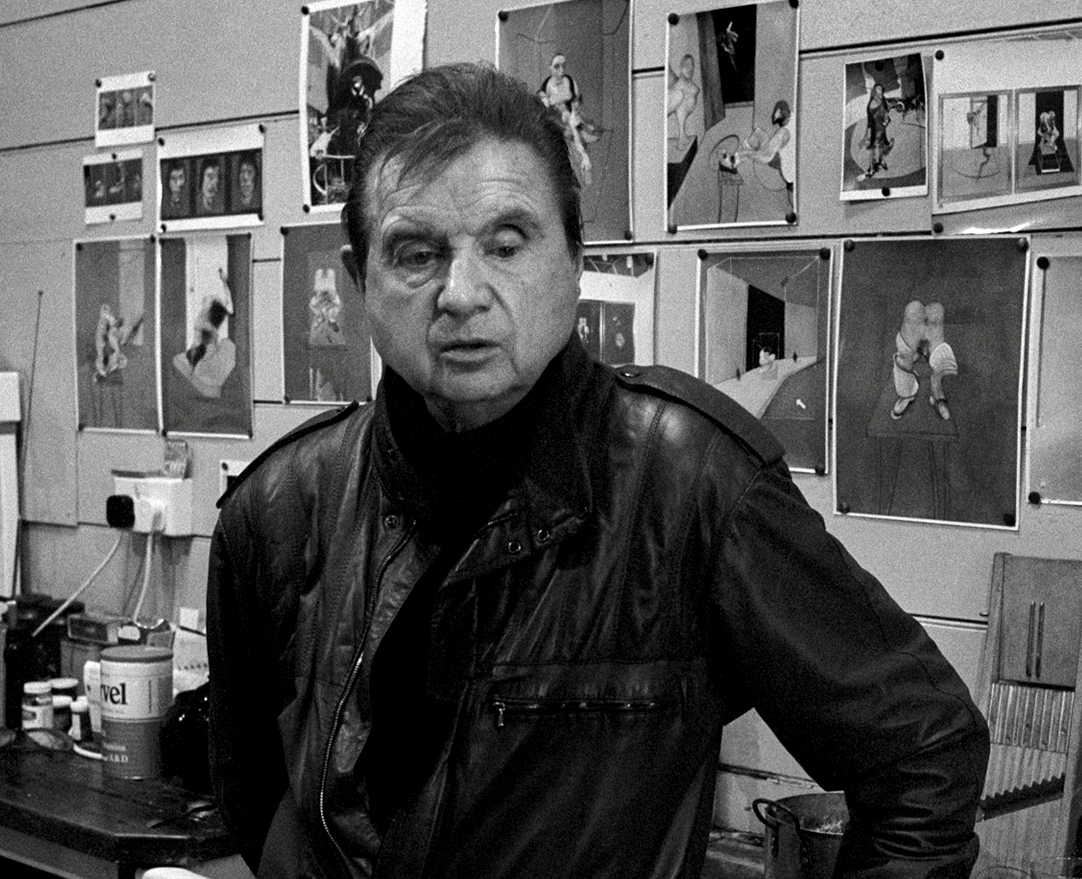
Francis Bacon at his spartan studio in 1984: ‘I feel at home in chaos,’ said the artist whose work sold for up to a million pounds
BY MICHAEL KIMMELMAN
| ARTS
Francis Bacon, the Irish-born painter whose abstract images of psychological and physical brutality made him one of the most exalted, and most disliked, artists of the postwar era, died yesterday at a hospital in Madrid. He was 82 years old and lived in London. He died of a heart attack while vacationing in Spain, according to a statement from his London dealer, Marlborough Fine Art.
Mr. Bacon first gained acclaim in 1945, when he exhibited Three Studies for Figures at the Base of the Crucifixion at the Lefevre Gallery in London. His angrily drawn image of writhing half-human, half-animal forms, perched atop pedestals and set in claustrophobic spaces, seemed to epitomize the grim spirit of postwar England and established the painter immediately as a master of the macabre.
That reputation was to be reinforced time and again by the screaming popes, butchered carcasses and distorted portraits that Mr. Bacon turned out over the next four and a half decades. Critics noted his links with, among other things, the Surrealist art of Picasso and with German Expressionism. Detractors — and there were always many of them, especially in the United States, where he seemed so out of step with the Abstract Expressionists of his generation — dismissed his art as sensationalistic and slick. Museums around the world bought his work, but private collectors were often loath to decorate their homes with it. The former British Prime Minister Margaret Thatcher once called him “that man who paints those dreadful pictures.”
But Mr. Bacon maintained that he was simply a realist and did not aim to shock. “You can’t be more horrific than life itself,” he was fond of saying.
Until his death, he continued to work in his cramped, cluttered studio in a small ramshackle mews house in South Kensington, with its bare bulbs, tattered photographs taped to the wall, and bathtub in the kitchen. Although his paintings sold for millions of dollars, Mr. Bacon eschewed most of the trappings of success. He would reach into his pocket and pull out a wad of cash whenever he wanted to indulge in lunches in swank restaurants or Champagne for the crowd at the Colony Room, the run-down drinking club in the Soho district of London, where he was a regular for more than 40 years.
A Raffish Youth
A man of striking contradictions, he cultivated a bad-boy reputation, speaking freely about his fondness for alcohol, his homosexuality and his kinship with gangsters. Friends knew he could be ornery and unpredictable, especially after a few drinks. But they also admired him for his generosity, wit and kindness, qualities that clashed so dramatically with the paintings for which he was famous.
The son of a hard-drinking racehorse trainer (and a collateral descendant of the great Elizabethan statesman and philosopher of the same name), Mr. Bacon spent his first years moving with his family between Dublin and London. Asthma made school a problem, so he was tutored by clergymen at home. He never got along with his mother and father. When, at the age of 16, he was discovered to have had sex with some of the grooms at the stables and was caught trying on his mother's underwear, his parents banished him.
Mr. Bacon traveled to Berlin, where he spent long nights in transvestite bars and endless hours with the sorts of rough characters who would be no less a part of his social circle than intellectuals like the poets Michel Leiris and Stephen Spender. He stopped in Paris, where he saw an exhibition of Picasso's surreal paintings of the 20’s, although he later said it had little impact on him.
In 1929, he settled in London, working briefly as a designer of modernist furniture, for which he achieved a modest reputation. Almost casually, and without any formal training, he took up painting, but he came to consider these earliest canvases “so awful” that he subsequently painted over or destroyed almost all of them. In 1933, he participated in a group show and was mentioned in a book called Art Now, by the critic and historian Herbert Read. Over the next few years he exhibited his work a little, but he treated art less as a career than as a distraction from the drinking, gambling and wandering around London that were his main preoccupations.
When World War II started, Mr. Bacon tried to enlist but was rejected because of his asthma. He supported himself through a string of odd jobs. The restlessness he recounted feeling during these years, his sexual indiscretions, his mood of frustration and claustrophobia, and his casual disregard for social mores and the opinions of others, would become characteristics of his art. But only as the war was ending did he begin to take painting seriously as an occupation.
The sources for his art were eclectic. He looked at the work of Old Masters like Velazquez, whose Portrait of Pope Innocent X he combined with a still photograph from Sergei Eisenstein's film The Battleship Potemkin to contrive his series of screaming popes. Mr. Bacon derived images from the newspaper and magazine photographs that he collected, and from the famous sequential photographs of moving figures and animals that Eadweard Muybridge made in the late 19th century. References to the latest designs in furniture and clothing regularly appeared in his art. He based one series of paintings on van Gogh; another series was inspired by the Oresteia of Aeschylus. “What is called Surrealism has gone through art at all times,” he once said. “What is more surreal than Aeschylus?”
And he was an extraordinary portraitist of his friends, somehow managing, despite the blurred and mangled features, to convey an unmistakable likeness and very often the attributes of beauty, wit and affection.
Although Mr. Bacon made a handful of landscapes over the course of his career, he was first and last a painter of the human body. His images twisted it, X-rayed it, made it bleed, transmogrify and unravel. The body became an expression of longing, exhaustion, illness and also lust. Few artists could render flesh so palpably and voluptuously, or endow even so mundane a subject as a man turning a bathroom faucet with Michelangelesque aspirations.
Often his figures were represented in what looked like cages or enclosures or in bleak rooms. In time, he came to favor gold frames and glass protection for his paintings, extravagant touches that intentionally contrasted with the shocking content of the pictures and underscored his desire to have his art considered in the company of museum masterpieces.
An Evolving Style
He consistently said his art was not about anything in particular, that his paintings conveyed no narrative. “I’ve no story to tell,” he said. Over the years, he was criticized for recycling a small repertory of images and devices. But if his subjects did not change, his style did. Increasingly, his paintings were characterized by a refinement of touch that made his startling subject matter all the more unexpected. In 1988, he made a second version of Three Studies for Figures at the Base of the Crucifixion, in which rawness has been replaced by an almost lyrical handling of paint and the figures seem less gruff, more incorporeal, as if they were memories of the earlier ones.
Mr. Bacon's paintings have connections with the work of divergent postwar artists without belonging to any specific movement. He is part of the tradition of English figure painting to which Lucian Freud, Frank Auerbach, Leon Kosoff and others belong. At the same time, like Alberto Giacometti, he explored the spirit of Existential anguish that pervaded European postwar culture. (He admired the writings of Samuel Beckett and Harold Pinter). Although he denied any interest in the American Abstract Expressionists, and although his art was generally thought to be in opposition to theirs, Mr. Bacon’s work invariably brings to mind the violent and distorted paintings of women by Willem de Kooning.
Through Pop, Minimalism, Conceptual art and every other movement of the 1960’s and early 70’s, Mr. Bacon stuck to his path, shunning fashion. But in the late 70’s and early 80's, he was taken up by the young Neo-Expressionists, who felt an affinity with his emphasis on the figure and the emotionalism of his imagery. In the last decades of his life, he was the subject of retrospectives at the Grand Palais in Paris, the Tate Gallery in London, the National Gallery of Modern Art in Tokyo and the Metropolitan Museum in New York. On the occasion of his 80th birthday, a traveling exhibition of his work was presented at the Hirshhorn Museum in Washington, the Los Angeles County Museum of Art and the Museum of Modern Art in New York.
Around the time of that
exhibition, Mr. Bacon, who is survived only by a sister in South Africa,
lamented that old age was “a desert because all of one's friends die.
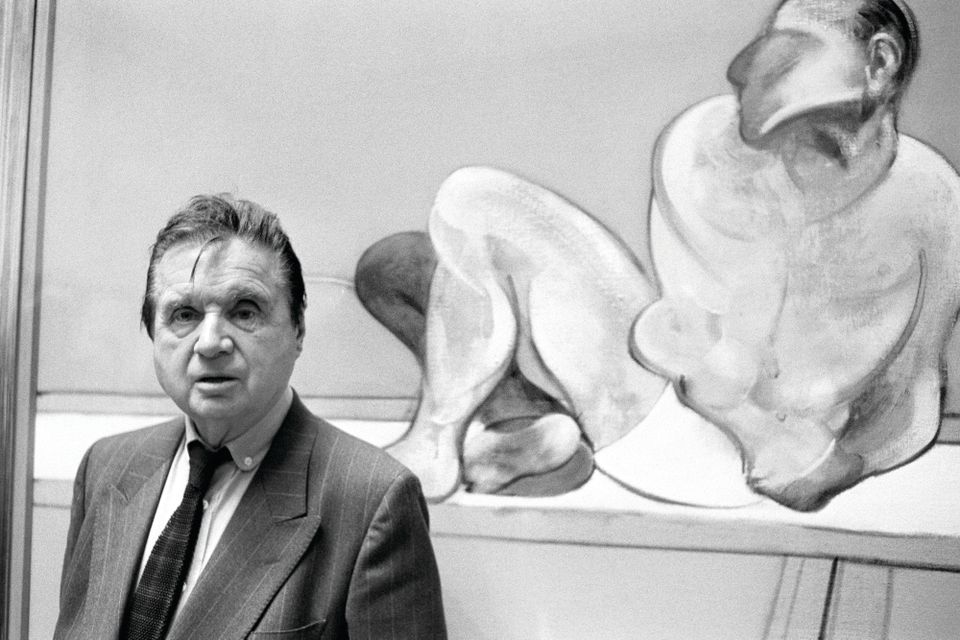
Francis Bacon in London in 1985 with his 1979 painting “Triptych: Studies of the Hunan Body.”
RICHARD DORMENT | THE ARTS | THE DAILY TELEGRAPH | WEDNESDAY, APRIL 29, 1992
TO HIS admirers, Francis Bacon was the most instinctive and visceral of 20-century British painters, the one who communicated most forcefully the grossness of human appetites and the emptiness that lies at the bottom of their gratification.
His was a world in which the concepts either of hope, or of the spiritual life, did not exist. Among his subjects were sodomy, drug addiction, anxiety and suicide. Voyeurism and violent death figure largely in his oeuvre. No artist painted so many toilets.
To many, all this came perilously close to self-indulgence. And yet at the 1985 retrospective at the Tate Gallery one understood what Alan Bowness, then director, meant when he described Bacon as the greatest living English artist. There was a grandeur in Bacon's art because his theme was a terrible one: a revulsion against his own humanity. He turned self-hatred into high art.
Indeed, the Tate retrospective revealed a much greater artist than many had realised. Visitors were stunned by Bacon’s ravishing sense of colour.
At times it almost seemed as though he had discovered an alternative rainbow made up of rich purples, shocking oranges, and artichoke greens. Whether one liked his subjects or not, Bacon emerged as a grand, dramatic painter with an innate sense of design. He had, too, a wonderful feel for the sensual laying on of paint to canvas.
In British art he belongs to a line of painters that looks back to Edward Burra and forward to Gilbert and George. He was an expressionist of extraordinary power. This year he exhibited his reworking of his famous Three Studies for Figures at the Base of a Crucifixion, using spray paint and considerably restricting and darkening the original colour range.
The result looked to me like a deliberate and measured summing up of his art, comparable in a way to the late works of other artists who stood on the brink of death, particularly Titian.
What made Bacon’s work so chilling was that there was no softening of the despair, no diminution of the ferocious loathing for the human condition.
Francis Bacon
BRUCE BERNARD | GAZETTE | THE INDEPENDENT | WEDNESDAY 29 APRIL, 1992
I FIRST came across the work of Francis Bacon at school. I was just becoming interested in “modern art” and was tremendously stimulated by Herbert Read’s Art Now. I don't know quite why the reproduction of Bacon's Crucifixion (1993) struck me as forcefully as it did, looking stronger in a way that the Picasso 1929 Baigneuse that it faced, but I was captivated by the mysterious presence.
When I saw the 1944 triptych Study for Figures at the Base of a Crucifixion that
made him famous in the art world at least, it confirmed my feeling that he was
an entirely remarkable painter. Moderate horror was expressed by the press at
the time and Michael Ayrton wrote a paragraph tying Bacon to Picasso's
“Bone
Period
It seemed that the confident radicalism of early-twentieth-century European painting might have found a worthy exponent in Britain for the first time. Graham Sutherland had been doing some of his best work (and had actually been influenced by the entirely unknown Bacon in the Thirties) but his pictures never gave one the confidence that they could travel, while Bacon's have done so triumphantly.
The next masterpiece was, I thing, Painting, 1946. Picasso's work had made Bacon want to be a painter when he saw a show in Paris in 1928 but, though always acknowledging his debt, he was, with Painting, 1946, now entirely himself. From then on his career started its inevitable upward progress. The Bacon "scream" was born (derived mainly from the nurses on the Odessa Steps in Eisenstein’s The Battleship Potemkin) and it appeared, though much less frequently than is thought, through ape-like heads, a series based on Velasquez's famous portrait of Pope Innocent X and several desperately isolated men in suits. Bacon always insisted that the Popes were a mistake but a few of them are, I’m sure, great paintings.
In 1953 he painted an outrageous picture which must surely be one of the great
figure paintings of the century. Bacon was, of course, homosexual and, although
he must have certainly enjoyed turning an Eadweard Muybridge photograph of two
wrestlers on their mat into Two Figures on a Bed, he
made it a mordant allegory of flesh and futility. Although latterly his male
figures became more
“voluptuous
Lucian Freud, who was a close friend of Bacon's for some 30 years, though later
their relations became very cool, once told me that when he first met Bacon in
1944 that he seemed
“the
wildest and wisest
Afternoons out with him in Soho during the Fifties and Sixties were mostly really exhilarating. To see him come into the French Pub around 12.30 (after having probably worked for six hours that morning) gave one, when not obliged to work oneself, a sense that one’s banal idleness might soon be redeemed by irresponsible pleasure and conversation. The bar staff and Gaston Berlemont were pleased to see him for reasons only very loosely connected to commerce and, if one did go on to Wheeler's for lunch, often with several others, the greeting from the staff and management there was equally pleased and expectant.
Nearly everyone likes being bought champagne and lunch but the real pleasure of these occasions was the spectacle of care being banished with such élan. Generally this feeling could be sustained all afternoon and evening, but occasionally it crumbled, either slowly or spectacularly, at Muriel Belcher's Colony Room. (Muriel, who had once paid Bacon £10 a week to bring in affluent customers, was one of the few people he really loved, and he made several paintings of her).
In the late Fifties, after producing at lightening speed a sensational show at the Hanover Gallery of pictures based on Van Gogh’s The Painter on the Road to Tarascon, Bacon started painting portraits of people he knew. At first he tried working from the model, but then found he was less distracted if he used photographs. (There is an interesting exchange with David Sylvester and Bacon on this subject in that essential book of conversations The Brutality of Fact.) The pictures were nearly always taken by a brilliant photographer called John Deakin who was one of the best British photographers of this century — if not quite the most productive or consistent.
Bacon will be remembered for a large number of single images and at least 20 of
his large triptychs, but his portraits will be considered as important as
anything in his oeuvre, particularly those involving
George Dyer, Henrietta Moraes and Isabel Rawsthorne (as well as the constant
stream of self-portraits). Those of Lucian Freud are powerful paintings but not
so impressively
The Seventies and Eighties brought Bacon new triumphs on a world-wide scale. The great series of the triptychs started in the Sixties was continued with some of the strongest images he ever made, including the ruthlessly poignant re-enactment of the death of his friend George Dyer.
For my taste the work of the Eighties is, with certain notable exceptions, less convincing than that of earlier decades as it seems done more for Bacon's private pleasure than the previous dramas acted out on a larger and more public stage. His technical virtuosity however was often as brilliant as ever. In 1988 a historic exhibition of Bacon's work was mounted in Moscow and provoked tremendous interest. Opinion was as polarised as ever, but the heroic element in the work was noted more than usual by those in favour of it.
Bacon was a tormented person in many ways
I am reluctant to believe that he chose the iconography of the Crucifixion
simply because it was an example of
Bacon was a deeper and more driven man than he would admit
Francis could be a marvellously out going person but would also conspire to make himself a lonely one. He was often simply kind. All manner of people and surviving friends will miss his presence in the world, and so will I.
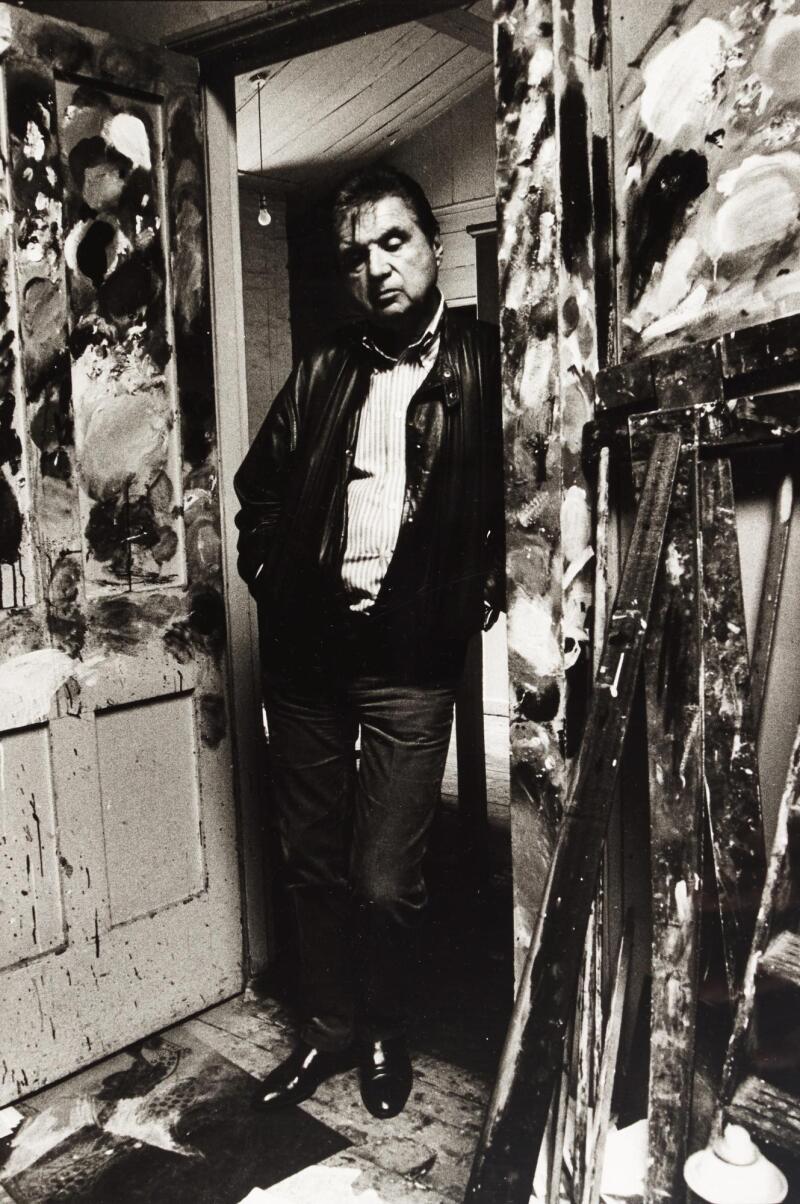
An artist whose work has ravelled triumphantly: Francis Bacon in the doorway of his studio, 1984
Photograph: Bruce Bernard
DAVID LISTER
FRANCIS BACON was being mourned yesterday not just in the great art galleries and salons of the world but in the Soho pubs and drinking clubs that he frequented for more than 40 years.
Bacon, in his prime a homosexual adventurer who once summarised his life as "going from bar to bar and drinking and that kind of thing", flitted between what was once the demi-mode of the now well-known Soho drinking clubs and the gaming tables of Monte Carlo.
The artist largely retained his anonymity in London, and was delighted, on going into a pub in Soho, to be offered a job doing up an old house by someone who had heard he was a painter.
Though long since a multi-millionaire with a penchant for champagne and oysters at Wheeler’s restaurant, Bacon occupied a corner seat in the Colony Room, a Soho drinking club, whenever he was in London and lobbied Westminster City Council last year when the building was threatened.
When he first went to the Colony in the late Forties, the then owner, whom he adored, Muriel Belcher, paid him £10 a week to bring in "good spenders".
Ian Board, his long-time friend, who now runs the Colony Room and spoke with Bacon only last week, said yesterday: "He was generous, marvellous, witty and bitchy. I will miss his viper’s tongue. I loved him even though he would call me a thieving, conniving bitch.
"He wasn’t fond of talking about art after the early days. Way back he would have a fling or two with Lucian Freud but they fell out because Lucien went common and took a title from the Queen. Francis refused two titles. He said he wanted to leave this world as he came in."
In the main, though, tributes focused on the supreme place that Bacon occupied in the history of modern art. David Mellor, Secretary of State for National Heritage, said: "Britain has been one of the great centres of modern art with a tremendously successful group of artists. Most people would accept Bacon as either leader of that group or certainly one of the two or three most precious figures."
Nicholas Serota, director of the Tate Gallery, to which the artist donated his Second Version of Triptych 1944, said last night: "Francis Bacon was not only the greatest British painter of his generation, but was also internationally recognised as one of the outstanding artists of the post-war era. His art stand in the great tradition of Western painting, addressing central themes of human existence in compositions grand in conception, rich in colour and powerful in presence."
Bacon did have his critics in Britain, including the former Prime Minister, Margret Thatcher. She once described him as "that man who paints those dreadful".
The late Peter Fuller wrote when he was editor of the magazine Modern Painter of Bacon’s "spiritual dereliction", saying his paintings owed more "to the violence and perversity of his imagination than to any love of the facts, let alone truth".
But these were rare voices. The description of Bacon by the former Tate director Sir Alan Bowness as "setting the standard for our time" was the one that found most echoes yesterday.
Bacon dies of a heart attack while staying with friends in Madrid. He suffered from asthma but always looked younger than his years. Born in Dublin, he began painting in 1929 but destroyed nearly all of his earlier works. His English father was a retired Army officer who went to Ireland to train horses.
Bacon’s relationship with his parents was not good and they never really supported his ambitions as an artist.
At the age of 16, Bacon was banished by his father after he was found wearing his mother’s underwear and was caught having sex with the grooms.
Bacon moved to London and then Berlin. In this city devoted to excess he indulged in all kinds of sexual escapades. He went on gambling sprees and spent nights in transvestite clubs.
At the outbreak of the Second World War he tried to enlist, but was turned down because of his asthma, so joined the ambulance rescue squad. Some critics believe this experience with death and bodies helped mould his artistic style.
In 1971 he was given a retrospective in Paris’s Grand Palais, an honour rarely afforded British artists. His former lover and model George Dyer committed suicide hours before the exhibition opened. Only months before Bacon had been acquitted on a drugs charge, brought after Dyer reported him to the police. To remember his friend, Bacon did a series of three paintings depicting Dyer’s death.
G
TIM HILTON | ARTS | THE GUARDIAN | WEDNESDAY APRIL 29 , 1992
FRANCIS BACON was the last of the major European expressionist painters who came to prominence in the years after the war, and for nearly five decades was a towering if somewhat remote figure in British art. He belongs to no school and had no close followers. His pictures sat uneasily in group exhibitions and often look out of place in museums. For many of his admirers — and those who relished Bacon’s art and company extended in the social range from rent boys to minor royalty - he was a truly existentialist painter, scornful of reward, convention and personal satisfaction.
He came late to painting, abandoned work on canvas for years and had no training whatsoever. Like his near contemporary Jean Dubuffet he was a more challenging artist because he had never studied professional skills and procedures. In the grand pomp of Bacon's most dramatic visions, characteristically enclosed in the ornate old master frames that he and his galleries preferred, there is always a trace of the amateur artist. Not that he painted as a hobby, or to make a point or to earn his living: he was an amateur because his work was the result of a personal compulsion.
Bacon was born in Lower Baggot Street in Dublin in 1909, one of the five children of an English racehorse trainer. His mother was well connected on both sides of the Irish sea and during Bacon’s childhood the family lived between England and Ireland in a succession of grand, often dilapidated houses. He had little formal education and later recalled that his teenage ambition was “to do nothing”. Thus he began the life of drifting in European capitals that gave a cosmopolitan background to his paintings' painful interior scenes.
By 1928 he was in Berlin and witnesses the last days of the Weimar Republic. In Paris he saw his first Picassos. In 1930 he returned to England and took a basement flat in South Kensington. The SW10 area was Bacon’s first home for the rest of his life. However, he spent long periods in Monte Carlo and other places in which he could indulge his passion for gambling, and made extended visits to southern Africa, fascinated both by big game and the atmosphere of a doomed white population. From the early seventies Bacon lived for part of each year in Paris.
In Kensington in the early thirties Bacon set up a desultory practice as a designer of rugs and art deco furniture. His drawings seem very much of their date, but the steel-and-glass furniture and bold black-outlined mirrors lingered in his imagination for tears, and may be seen in many paintings of crouching, naked, suffering figures. The short period when Bacon practiced as an interior designer was also the time when he began to paint. Like a gambler, he had immediate success followed by failure. A painting of a crucifixion was reproduced by Herbert Read in his 1933 book Art Now and was bought by the connoisseur Sir Michael Sadler. In the next year Bacon put on a private exhibition of his painting in a house in Curzon Street. The show flopped and with the exception of three canvases in a mixed exhibition in 1937, Bacon did not exhibit again until 1945.
An asthmatic, Bacon did not serve in the war apart from a brief enrolment in the ARP rescue service. He remained in London and had a kind of relish for the darkness and violence of the Blitz. As he later said, “We all needed to be aware of the potential disaster which stalks us at every moment of the day.” It is a neat encapsulation of his personal muse, born as he stalked bombarded London in search of places to gamble. Bacon now began to paint again, and most accounts agree that at some point between 1940 and 1945 his work at the easel became obsessive. He is the pre-eminent artist of post-war German angst and disillusion, so it is appropriate that his real career as a painter should have begun in fear, destruction — and lawlessness — of the blackout.
In every aspect of his temperament (though both men were united in assurance of their personal greatness) Bacon was the opposite of that other second world war artist, Henry Moore. Bacon’s art is about risk, catastrophe, murder and an abandoned but private sexuality. If Moore was a humanist and a guardian of tradition in the modern world, Bacon was the desperate maestro of immoderation and despair. Asked recently whether he was going to celebrate his 80th birthday, he replied "I celebrate every day". It was as though his daily intake of champagne were the thin ice above deep seas of horror. His exhibitions at the Lefevre Gallery in 1945 and 1946 established Bacon as an individual, authoritative and notorious painter. The shows also demonstrated the leading principle of his style, a manner that was pretty much constant for years afterwards. Three Studies for Figures at the Base of a Crucifixion (1944), now in the Tate Gallery, mingles Picasso with a use of photography as a source.
HISTORIANS will regard Bacon as one of the first important figurative painters whose inspiration came primarily from photographs rather than from human contact or close acquaintance with paintings by old or modern masters. Of course his disregard for other art helped Bacon towards an extraordinary personal licence: those vile background colours, slurred or slovenly brushwork and feigned nobility. And photography also helped him to be competitive. He could hardly have embarked on the series of Screaming Popes, perhaps now his most famous work, had he studied their source, Velasquez’s 1650 Portrait of Pope Innocent X in the original. While Bacon’s public career is pretty accurately documented, his personal life is often a matter of legend. His adolescent desire to “do nothing” came true for years at a time.
Nobody quite knows how he spent his time in Monte Carlo, when he wasn’t at the tables or in bed. Most recent reports of Bacon’s life stress his fondness for Soho, the French Pub, the Caves de France and the Colony Club. This was the standard Bohemian London of the late fifties and beyond, in which Bacon was indeed a leading figure; but there were other aspects of his life that seem, in retrospect, to have a faded Edwardian grandeur — grandeur despite the police around the corner, as often they were. At one time Bacon had a Cromwell Place flat in a house that had belonged to a grandee of Victorian painting, Millais. The chintz, the velvet, the sofas were all faded and stained. The carpet was covered with paint. Bacon's old nanny lived with him, muttering all the time of her obsession, capital punishment. She slept on the table. Bacon — like many generous grandees — was often surrounded by retainers with no obvious function. Yet this nanny had a particular job. She was the hat-check girl while Bacon gave his nightly, all-night gaming parties.
Nobody ever told him what to do. He liked discussion but never took advice, especially about painting. Little wonder that the quality of his art was so varied. Bacon was not a sensible judge of his own work. A wretched performance might mean as much to him as a far better canvas, presumably because of some personal association. His great fault was always the assumption of a high style. I suppose that he should have painted smaller — but then we would not have known the vulgar immodesty of those pictures that really did have something to say about modern times. Not for nothing was Eichmann in his box compared o the composition of a Bacon painting. Two sudden yet horribly complementary private griefs accompanied Bacon's largest public triumphs. His boyfriend Peter Lacy, a country gentleman character who played the piano in Dean’s Bar, Tangier, died on the opening day of his 1962 Tate Gallery retrospective.
Lacy’ssuccessor, George Dyer, of whom there are many living and posthumous portraits, died on the day of Bacon’s largest retrospective at the Grand Palais in Paris in 1975. In truth Bacon cared nothing for such official art-world occasions and did little to assist the preparations of further retrospectives at the Tate in 1985 and Moscow in 1988 where, somewhat surprisingly, he was presented as evidence of health in modern western culture. The enclosed world of his friendships was most important to him. Observing this, mainly from afar, I was often struck by an expression of delight on Bacon's face as he came into some drinking club or private view and saw a friend. Both faces would light up — I know it’s a cliché, but it’s true — with some kind of happy love. I got him to his feet once, when he had fallen down insensible. His face was all white and I thought he was dead before I realised it was make-up. It's the smile I remember most. Winning or losing, a great human smile.
Tim Hilton
G
BRYAN ROBERTSON | ARTS | THE GUARDIAN | WEDNESDAY APRIL 29 , 1992
WHEN the
Guardian printed a tribute to Francis Bacon from myself among several others on
the occasion of his 80th birthday, I hope he would live for many more years to
exemplify the truth of my opening lines. I said that Francis
The was in which Francis Bacon conducted his life presupposes a fundamental measure of talent - in his case, genius - or the frequent waywardness, mostly the drunkenness, would have been less easy to bear. Lie his two near-contemporaries and late — or neo — Edwardians, Sutherland and Moore, Bacon had come to professional maturity before the ameliorative and propagating work of the Arts Council and British Council came into being, and had learnt how to survive financially long before public commissions and grants for artists were established.
All three artists had hard years when young. Moore and Sutherland, like Piper, Pasmore and many others, eventually were helped tremendously by the patronage of Kenneth Clark. Bacon painted, designed screens, interiors and furniture, ran a gambling club briefly, and was more adventurous so far as patronage was concerned. Bacon enjoyed something like patronage in his stable relationship with a mildly well-off civil servant, Eric Hall, whose death not long after the 1939-45 war was a great blow for Bacon. But the point I want to make here is that, like Moore and Sutherland, Bacon had grown-up in a totally different artistic climate to those artists born during or after the 1939-45 war, in the sense that hard work and resourceful self-sufficiency were the order of the day and to be an artist for this earlier generation was to follow a vocation and not a highly publicised profession. Compared with an older generation, artists today often sound and behave like upwardly mobile dentists.
I became very friendly with the painter, Roy de Maistre, not long after I was appointed director of the Whitechapel Gallery in 1953. Before the war, in the thirties, Francis had lived near Roy de Maistre’s studio just off Ebury Street, and the two painters had become close friends, Roy acting as a kind of uncle or father figure to the much younger Francis, often trouble by one or other of the three usual problems: health, love or money. The third ember of what became a trio of close friends living round Ebury Street was the young and equally remarkable Patrick White, like Roy, coming from a cultivated background in Australia. Listening to Roy’s reminiscences, always absorbing, I often sat on a vast couch designed by Francis, backed by one of his screens. And Francis was sometimes a fellow guest at dinner, his affection and regard for de Maistre unchanged. I had met Francis first in 1948, when he had just returned from a long spell in the south of France, and the Lefevre Gallery and then Erika Brausen’s Hanover Gallery were becoming interested in his work. Francis took me out to many splendid dinners at the old Carlton Grill. He was a terrific companion, lively, well informed, well read and wholly irreverent about the art world. My only problem then, as always, was that although my love for drink was second to no man’s, Francis could drink me under the table and sometimes did.
ALL THE same, I braved the boozy stronghold of the Colony Club one spring day in 1951 to meet Francis and secure the location of a villa in the south of France that I wanted to rent for myself and some friends on holiday together. Francis arrived and told me how to rent his favourite villa on the heights above Monaco which he had taken for many winters as a place for himself and his old nurse. Francis painted all day, gambled all night, and the nurse knitted in the sun. That involuntary revelation of Francis’s kindness touched me, and the villa turned out to be delightful, secluded and spacious. It was amusing to find that the furnishings included the most comprehensive library of literature on sexual perversions imaginable, which added a certain zing to hot afternoon siestas, as well as a cupboard off my own bedroom filled with intensely alarming images on canvas left by Francis in various stages of abandonment.
I kept in touch with Francis over the years and cannot remember anything beyond mutual amusement at the follies of the art world and immense and unfailing kindness to those in need. Most recently, I asked him to help a hospice for Aids victims for which I was fund-raising among artists, asking for works for auction. Francis sent a conspicuously large cheque at once. We were fellow asthmatics and often compared notes over treatments and perhaps that bond of affliction inhibited Francis from running down, beyond the occasional flouncy bit of derision, the work of the abstract painters and sculptors that I exhibited and supported with much enthusiasm. He made an exception of Mark Rothko, whose work toughed him, but derided all the others.
That side of Francis rather bored me, particularly when I saw how swiftly he
lifted and made use of abstract devices in his own work. I remember a man
sitting and yelling his head off sitting on a long flight of steps which could
not have been painted without the incongruous example of Noland’s
tripe paintings. And of course the crux of all Bacon
There was some justice in the caustic verdict of my friend, Colin Colin MacInnes:
“The
Norman Hartnell of the horror movement.”
I too sometimes thought that there was something repellent about the imagery of
something like Belsen being presented as a chic cabaret turn. Bur Colin
But Bacon was unquestionably a marvellous painter; he caught a nerve in painting a no artist has ever done before and he created, despite some mechanically contrived triptychs and a few other weaker works, some of the strongest images of the century. Acutely sensitive to surface, he had little gift for psychological probity compared with early Kokoschka portraits, but he had a fantastic feeling for the figure in space: trapped, pinned down or imperilled like a moth or a hunk of meat.
Bryan Robertson
Francis Bacon, born October 28, 1909; died April 28. 1992
GREY GOWRIE
FRANCIS BACON was, until yesterday, the greatest living painter and the greatest British painter since Turner. These are high claims. You can make a case against them. Bacon had no formal training and it shows. He was an action painter; he attacked the canvas physically until it was finished, and usually denied himself oil painter's architectural possibilities, which allow painters to build a painting and strip it down again and rebuild it until it comes right. Inevitably, there were bosh shots.
Bacon should have obeyed his early instincts and destroyed more of his work. Then he relied sometimes, though not as often as people think, on the aesthetics of shock: a figure crapping or throwing up; a nude on a bed with a hypodermic syringe. These and other criticisms pale if you spend time with is best work. He was a very grand man, in the old and aristocratic sense of the word, and he brought grandeur back to modern painting. His handling of paint can be sumptuous. These are not the kind of words which it is easy to use in the context of modern art, but you can use them with Bacon as you can with Picasso, Van Gogh and Cezanne. I sometimes visit a collection in Lausanne where he hangs beside these masters. In the end, that is the way to decide things.
I was an acquaintance of Bacon for the last 10 years of his life. He had ceased to be the waspish, terrifying figure of the Colony Club days in fifties and sixties Soho. As Freud said we should, he reduced things to work and love. After a fraught life, though not one I can imagine him conducting differently, he combined the two. I suspect he was as happy towards the end of his life as he had ever been. Bu the allowed some time foe peripheral affection and for that I will always be grateful.
We met through a mutual friend, David Sylvester, whose Conversations With Bacon is one of the classic texts of modern art. Bacon liked an essay I had written about him. Since he was famously hard to please in this regard I pushed my luck and asked if I could write a life. I told him I was the only person who understood his background. Quite fortuitously, we shared the same roots, indeed the same village, in Co. Kildare, where Baco
nI asked him if it was his love life that was the trouble, and gave him my view that all love lifes are at once crucial and banal. I was interested in writing about the paintings as if they were battles: you need to know what the general is up to only insofar as it affects strategy and tactics. He told me that he had come to the view that homosexuality was an affliction, that it had turned him, at one point in his life, into a crook. The crookishness, not the sex, was a source of shame and if he talked at all, it was his nature to tell everything.
We both liked Proust and agreed that the beginning of Cities Of The Plain said all that needed to be said about being homosexual. He told me that a centre of his being was that he had disliked his father greatly and liked his mother, but that it was the father for whom he felt attraction. He suffered always from asthma; he could not visit Ireland without it becoming acute. He thought Yeats and Picasso the great artists of the century.
These and like conversations would take place over first-class claret. Taking Francis out was, financially, like buying one of his paintings. He could be polite about anything other than Petrus, Mouton, Cheval, Blanc, Margaux, Lafite, but only just. He liked politics in short bursts and worked under a star system. Mrs Thatcher was in favour for quite a while but yielded in time to Dr Owen. As a minister I felt obliged to point out that
“Clause 28” was designed to discourage homosexual propaganda and fell well short of a pogrom. He suffered through the breakdown of his friendship with Lucian Freud, whom he missed. He though Lucian thought him boring, and when you think that, you often are.
He lived at home like a student, out of doors like a prince. The three-roomed Kensington studio, up a ladder rather than a stairs, is more important for the nation than any Canaletto. We must work to preserve it. He gambled his money and gave money and paintings away. He had aristocratic indifference without aristocratic disdain. I am glad he died in Madrid, surronded by great paintings and with someone who had made him happy. Nothing will ever taste quite as good again as Francis talking in his intense physical way about paintings. He has left a dozen or so of his own which will live with the art.
Grey Gowrie
R
OBITUARIES
LONDON — Francis Bacon, 82, the British artist whose large paintings of misshapen or screaming figures explored human misery and isolation and gave the contemporary art world some of its most disturbing images, died April 28 at a hospital in Madrid after a heart attack. Mr. Bacon, who had asthma, was stricken while on vacation. He lived in London.
He had been hailed as one of the most influential figure painters of the postwar period and as one of the world’s greatest contemporary painters. A Bacon triptych recently sold in New York for almost $7 million. Last year, Mr. Bacon gave one of his major paintings, worth more than $5 million, to London’s Tate Gallery. He became the first living British painter to be given a one-man show at New York’s Metropolitan Museum of Art, and in 1988 received an exhibition in Moscow — a first-time honor for a living Westerner.
British contemporary painter Howard Hodgkin called him “the greatest English painter since Turner.” At least one other noted figure was not so kind. Former British prime minister Margaret Thatcher outraged London's artistic community when she once described him as “that man who paints those dreadful pictures.”
Mr. Bacon was best known for his biomorphic abstractions and representations of the male human form, often twisted or distorted shapes in a stark setting such as a bare room or on a platform-like arena. Sometimes his figures were surrounded by lines suggesting a cage or prison and a spirit locked in a private hell.
He often used contemporary images as a starting point for his work, including news photos and movie stills. Other of his works were based on old and classic works. These included his portrait of Pope Innocent X, which was based on a famous portrait by the Spanish artist Diego Velazquez — and shows the 17th century pontiff caged in plate glass and screaming. The picture is known as “The Screaming Pope.”
If the works were violent and shocking, and often based on a contemporary theme, they also featured a kind of epic grandeur of style, with what one critic called rich, sensuous handling of paint reminiscent of the 16th and early 17th century Venetian and Spanish painting.
Mr. Bacon, who was descended from the philosopher of the same name, was born in Dublin, the son of a former British Army officer and a race horse trainer. His father banished him from home at the age of 16 after he was found having sexual relations with the grooms. The future artist traveled to Berlin, where he threw himself into the life of a city renowned for its excesses in the 1920s and 1930s. He went on gambling sprees and spent nights in transvestite clubs.
In the 1940s, he concentrated more on the human form and male nudes, painting a series based on his friend Eric Hall as well as self-portraits. The central figures increasingly became abstract during the 1950s and 1960s — sometimes merging human and animal forms. He sometimes flanked the forms with depictions of raw meat or paint splashed on the canvas. “Animal movement and human movement are certainly linked in my images,” he told an interviewer in the 1950s.
He frequently returned to the crucifixion theme, including another triptych done during the mid-1980s. He demanded that all his paintings be covered by glass and they often had ornate frames. In interviews, Mr. Bacon cited one of his major influences as Sergei Eisenstein's 1925 film “Battleship Potemkin,” particularly a closeup shot of a screaming nurse. He also closely studied the early photography of Eadweard Muybridge, who made sequences of human and animal movement.
“What I want is to distort the figure far beyond the appearance, but in the distortion to bring it back to a recording of the appearance,” he said in an interview in the 195
THERE was endless speculation within the art world yesterday about who would benefit from the fortune of a man who had been Britain’s most expensive living artist. With one of his paintings, Triptych; May-June, 1973, he became the most expensive living British artist; it sold for £3.53m at Sotheby’s New York in 1989.
But Francis Bacon once said he preferred to be “surrounded by blank walls rather than paintings.” Apart from works in progress, the few works to be found in his ramshackle mews were mostly reproductions. Some say he used to sell a canvas to his dealers, Marlborough Fine Art, as soon the paint dried.
And just as he was unsentimental about his art, he cared little about the millions it made him. Money was there to be spent on gambling, drink and friends. One former friend said yesterday that Bacon “cannot have spent it all and must have been worth a few million at his death”. But as another of them put it, “knowing Francis, he would not have even written a will”.
It seems likely that Marlborough Fine Art will handle the Bacon estate. One art world source said that if there were any works that Bacon had not sold, he was unlikely to have left them to an institution. “He is more likely to have wanted friends and family to have them. He led a very private life, and didn’t particularly identify with any museums”.
Bacon was not particularly prolific, and only a handful of his works are brought to auction each year. Bacon is one of the few British painters with an international following among collectors, but as one auctioneer said, “it will take perhaps two or three years for the art world to revalue and evaluate Bacon’s art in the light of twentieth century painting. Even then, it is the art market in general that seems to be the overriding factor, rather than the death of an artist”.
The first test will come in July, when Christie’s brings a small portrait by him to auction.
PETERBOROUGH | THE DAILY TELEGRAPH | WEDNESDAY, 29 APRIL, 1992
WHO gets Francis Bacon’s palette? Bacon, who died yesterday, spurned the conventional palette which artists normally stick their thumbs through. Instead, he used his brightly daubed studio door.
It will probably go to Michael Leventis, a London-based Greek Cypriot artist whom Bacon encouraged after a chance encounter in a Soho restaurant eight years ago. “I admired the door and he indicated that I might have it,” said Leventis.
“I
already have one of Francis’s easels and a couple of signed prints. The easel
means a lot to me. It has all the colours he used on some of his best-known
paintings. I would never dream of using it.
There was a subdued air last night
around
Leventis had a different view. He
said: “Francis had a hard winter, couldn
Bacon’s violent vision shocked art world
BY BRUCE ARNOLD | ARTS EEDITOR | IRISH INDEPENDENT | WEDNESDAY, APRIL 29, 1992
FRANCIS Bacon, regarded as one of the greatest painters this century, died yesterday after a heart attack while on holiday in Spain. He was 82 and was admitted to a private clinic in Madrid five days ago. He consistently shocked the art world by the violence and horror of his vision, while at the same time ameliorating the damage done with the elegance and smoothness of the colour and texture of his paint.
There is a liquefaction in the tone and surface of his work which makes the screaming popes, the distorted portraits, the dismembered bodies and the howling, unhappy dogs, not just acceptable, but appealing. He took n and conquered the artistic world in a way that was unprecedented for an English artist; and he insisted on his Englishness though he had been born and brought up in Ireland, the son of a racehorse trainer on the Curragh. Francis Bacon had no formal training.
He began as a furniture designer, and was so reviewed in the
Studio magazine in 1930, before being taken up by the
Sombre-suited men in grey suits which seemed to epitomise the liquid, shimmering world of wealth and privilege developed into the most famous series of all – his paintings derived from the Velasquez portrait of Pope Innocent X. Both in these and in portraits, particularly of friends, Bacon created cages and prisons made out of lines, in which his subjects seemed to sit in frozen fear of their capture by the artist.
Inspired in part by images from film, particularly the screaming, broken head out of Eisenstein's Battleship Potemkin he created and developed a whole range of ‘screaming heads.’ From another source, the famous series of Muybridge photographs of the human nude male and female form in motion, Bacon also created a forbiddingly distorted group of paintings of wrestling and tangled figures.
This again he took even further, when he equated such powerful images as the carcass of the ox, painted superbly by an old master with whom Bacon had many similarities, Peter Paul Rubens, with the Crucifixion, again in treatments which were uniquely Bacon’s own. He established his reputation as an artist on a global scale, and had already won support and admiration in Germany, Brazil, Italy, Sweden, Switzerland and the United States when he took Paris by storm in 1966. His exhibition there, at the Gallerie Maeght, against all predictions, was a sell-out.
He had remarkable finesse. He was a most stylish technician. He handled paint always with a great sense of power, always using intense reds and blues, and never flinching from what seem to be ultimates of pain and horror. His subjects often seem to be his victims. Blood is never far from the surface. Anguish characterises the expression in the faces of his portraits, active torment seizes and at times eviscerates the bodies of his nudes, his groups, his carcasses and the fragments of meat and bone, all treated with the same respect and energy as he brings them to the surface of his canvas and there reveals all.
He expressed in modern art a relentless and haunted search for visual truth which transcended any idea of beauty or the giving of pleasure. He declined, with absolute firmness, the idea of being included in my own book on Irish art, but on the two occasions when I met him was charming and friendly. He was small in stature with intense, piercing eyes and a way of looking which was hypnotic.
He dominated the British art scene for 30 years, and has left the world an extensive legacy, powerful and admirable for its range and diversity, though one which is difficult to like. One would wish to claim him, but he belongs to a world and a set of values which would not fit harmoniously into this small island.

Bacon ... father trained horses on The Curragh.
FRANCIS BACON, PAINTER DRIVEN BY MORTALITY
BY ANDREW GRAHAM-DIXON
The painter Francis Bacon died yesterday. He was 82.
“I have often thought upon death and I find it the least of all evils,” wrote Francis Bacon’s namesake and ancestor, the Elizabethan philosopher.For Bacon the painter, the opposite was true. Death was the greatest of evils: “I have a feeling of mortality all the time,” he once said. “Because, if life excites you, its opposite, like a shadow, death, must excite you. Perhaps not excite you, but you are aware of it in the same way as you are aware of life, you are aware of life, you’re aware of It like the turn of a coin between life and death… I’m always very surprised when I wake up in the morning.”
Mortality was Bacon’s great theme, his keen sense of his own mortality, the driving force behind his art. His paintings are not pleasant, embodying a singularly bleak view of human existence, but they have a power born of obsession that is unique in British post war art. Storyless, enigmatic compositions, characteristically painted in triptych format, they place the emphasis on prime biological fact, figures usually male scream, couple bestially, vomit or defecate, depicted as lurid agglomerations of bodily matter, raw flesh that seems on the point of putrefaction. Their beauty is the beauty of rottenness.
“I’ve always been very moved by pictures about slaughter-houses,” he said and Bacon’s figures, frequently isolated on the flattest and most uninflected areas of pure colour, almost like clinical specimen, have something of the slaughterhouse about them. “We are meat, we are potential carcasses,” he said, and painted the fact.
Bacon’s place in art history is assured, yet it is also true that art historians have never known quite what to make of him. He distrusted interpretation of his paintings and when pressed on the possible symbolic significance of his work, insisted: “I’m not saying anything.” He was never the member of a school or movement in painting and neither did he found any.
Bacon was singular-an artist for whose work there are few if any precedents in modern art, an artist whose work has had little issue in subsequent painting – but he was also one of those rare artists who give visual expression to the mood of their times. His art, despite his protestations, has taken on the status of symbol, and that, in the end, is the source of its significance.
Bacon’s subject is twentieth century man, unaccommodated man, living in a world that has been voided of spiritual significance. His subject matter has often been, in one sense, traditional he is the only twentieth century painter, to have made a significant contribution to the tradition of crucifixion imagery yet in Bacon’s case that has tended to emphasise his originality the gap that separates him from the art of the past. Bacon’s crucifixions are bloody, thoroughly untranscendental paintings, his Christ a joint of raw meat or (as he once put it) “a worm crawling down the cross”.
They are not, strictly speaking, sacrilegious paintings; but they are profoundly pessimistic. Man, in Bacon’s world, Is an unregenerate, bestial creature, a secular being for whom “religious possibilities have been cancelled”. Among Bacon’s most famous paintings are the series of screaming heads he painted from the late Forties on. Questioned about the violence of his paintings, Bacon answered that he had lived in violent times. He spent the years of the First World War in London, and then lived in Ireland in the early years of the Sinn Fein movement; he was in Berlin in 1927-28 and then in Paris until the outbreak of the Second World War. It was this, perhaps that made possible for him to paint the crucifixion as “just an act of man’s behaviour, a way of behaviour to another.”
World of art pays tribute to Bacon
NICHOLAS WATT
Francis Bacon, hailed as one of Britain’s greatest painters, died yesterday morning in a Madrid hospital after a heart attack. His London agent said his body would be flown to Britain for burial.
Bacon, 82, was described yesterday as the finest British painter since Turner. Born in Dublin in 1909 he started painting in 1929 and was entirely self-taught. He destroyed nearly all of his earlier works but by the end of his career his paintings commanded some of the highest prices on the world art market. A triptych recently sold in New York for £3.9 million.
The first test of the value of his works, which are certain to rise following his death, will come at a Christies sale in London on July 2, when a portrait of one of Bacon’s regular models comes up for auction. It has been valued at between £180,000 and £220,000 and Christies anticipate strong interest.
Bacon, who turned down a knighthood, usually focused his art on the themes of sex and death. His work could be shocking and some regarded it as obscene.
David Hockney paid warm tribute to Bacon from his home in Los Angeles. “I first met Francis 30 years ago and met him again in Paris in the 1970s. He was a wonderful artist. He had quite a narrow way of looking at the world but this was very powerful.
“He was also a powerful person and I’ll never forget meeting him in Paris when his friend George Dyer died on the opening night ofhis big exhibition at the Grand Palais. We met in La Coupole and I said I was very sorry. He took out a large handkerchief and let out a big scream. He said all he could do was laugh or cry. During his life people thought Francis looked drunk, but he was very fit and looked after himself.”
Nicholas Serota, director of the Tate Gallery, which presented Bacon’s retrospective exhibitions of 1962 and 1985, said: “Francis Bacon was not only the greatest British painter of his generation, he was also internationally recognised as one of the outstanding artists of the post-war era. His art stands in the great tradition of Western painting, addressing central themes of human existence in compositions grand in conception, rich in colour and powerful in presence.” From today the gallery is displaying Bacon’s Second Version of Triptych 1944, painted in 1988, which he gave to the gallery. The original triptych of 1944 will be shown at the same time.
Lord Gowrie, the former arts minister and chairman of Sotheby’s said: “He was the greatest living painter and the greatest British painter since Turner.”
The artist Howard Hodgkin said: “He was a hero of English painting and there have been few of them.”
Bridget Riley said: “I admired Francis enormously and his death is a great loss. I saw his retrospective at the Tate and I think he had fulfilled his particular vision.”
Rober Hugues, art critic of Time magazine, said: “Francis Bacon went into areas of the human psyche that other modern painters didn’t touch. Because he had been around for so long many people felt that he was a bit of a living cliché. But his work went much further than the deployment of shock tactics.”
Melvyn Bragg, who produced a South Bank Show on Bacon in 1985, remembered visiting him at his messy mews house in South Kensington. “He was a man who went his own way and he lived as an old-fashioned bohemian. His flat was unbelievably tatty and should be preserved for the nation. He had a small room that was covered in paint because he mixed colours on the walls, a galley kitchen and his bedroom.
“He painted every day, starting in the morning, and then he went out and drank an immense amount of champagne. He was one of the world’s greatest painters in the second half of the twentieth century. He found his style and subjects in the mid 1940s and he never really changed from that.” Bacon will be sorely missed at the Colony Club where he drank his famous quantities of champagne. Ian Board, the club’s proprietor, said: “The club has lost its greatest member”.
Nicholas Watt

Portrait of the artist: Francis Bacon in his London studio standing
against the door on which he would try out colours for his canvases
Painted into a corner
DIARY
FRANCIS BACON
Francis Bacon, the internationally-renowned
British painter, died yesterday in Madrid aged 82.
He was born in Dublin on October 28, 1909.
OBITUARIES | THE TIMES | WEDNESDAY, 29 APRIL, 1992
NO OTHER post-war painter transformed British art with as much energy, flair and obsessive conviction as Francis Bacon. After a surprisingly tentative beginning, when he wavered between painting and designing furniture and rugs, the self-taught Bacon vision arrived fully-formed in 1944. And it already had the ability to unnerve. In a searing orange triptych, he painted three alarmingly distorted figures at the base of a crucifix. Half-human, half-animal, they writhe, push their distended necks forward and open their mouths in desolate howls.
When this excoriating triptych was exhibited at the Lefevre Gallery, it announced a new post-war mood of uncompromising anxiety. The advent of the cold war, combined with the horror of Hiroshima, confirmed Bacon’s preoccupations. He returned, time and again, to the image of a male solitary figure enclosed in a bare interior.
During the 1950s this anguished presence often gave vent to his disquiet with a scream, nowhere more vehemently than in an extended series of paintings based on Velasquez’s celebrated portrait of Pope Innocent X. In the original canvas, which Bacon never went to inspect in Rome, the Pope looks masterful and shrewd. But Bacon transforms him into a screaming grotesque, trapped like a prisoner in an electric chair, rather than a Pontiff’s throne.
In later life, Bacon himself came to regret spending so much time on the Pope images. He thought they were too sensational, and went on too long. But they were certainly instrumental in establishing him with a formidable international reputation. Another series, smaller in number and on the whole more powerful, took as its inspiration a Van Gogh painting of the artist walking through the French countryside on his way to work. Once again, Bacon changed the original image into a turbulent, troubled expression of his own ominous vision.
On the whole, though, Bacon’s figures remain indoors rather than out in the open. Landscapes were rare in his work, and the paintings of recent decades concentrate, with remarkable consistency, on clothed or naked figures in the archetypal Bacon room. As if to stress how little his art had changed, he embarked in 1988 on a second, larger version of his 1944 triptych. The lacerating orange became a more sumptuous red and the three figures are surrounded by more space than in the earlier version. But they twist and yell as hideously as before, and Bacon demonstrated his regard for the new triptych by presenting it to the Tate Gallery.
Francis Bacon was born of English parents. His father trained horses in Ireland. Bacon had little formal education except for a brief period at boarding school in Cheltenham. He left home early and spent some years in Paris and Berlin. By 1930 he was in London earning a precarious living as a designer of furniture and rugs.
He had already begun to paint, but of his first experiments very little remains. There were some abstract paintings — they are seen in a picture of the corner of his studio painted by a great friend of that time, Roy de Maistre. There are one or two pictures which found their way into private collections — the best know is a Crucifixion which was reproduced in Herbert Read’s Art Now (1933) — but everything else Bacon destroyed.
There was nothing tentative about his re-appearance in the closing years of the war. From 1945 onwards he began to show pictures of great technical assurance and startling originality. The crucial moment was his first one-man exhibition at the Hanover Gallery in 1949 which thrust him to the forefront of contemporary painting.
Just as the name Kafka has passed into the language as evocative of a certain kind of anxiety-ridden impasse, so Bacon’s name now began to be used descriptively. This is an indication of the way in which these pictures reflected a recognisable range of feelings. They were of men’s heads set against thick curtains or enclosed in glass boxes, their eyes often obliterated and their mouths stretched open as if to scream. Melodramatic, they were also contemplative and the mood of extreme, yet stoical, despair seemed of a piece with the mood of Sartre’s Huis Clos and the early Beckett novels.
It was perhaps this literary side to them which first captured the imagination of the public. Not since Fuseli had the horrific been the overt subject-matter of painting, and the novelty was both shocking and absorbing. There were other equally disturbing features. His painting was, for instance, the very antithesis of abstract at a moment when the general drift of painting seemed to be inexorably in an abstract direction. It was illusionistic, although in a novel and non-academic way; it drew upon the Old Masters, on Velasquez in particular, and equally on photography, not only for its imagery but for its surface appearance too.
It was impossible to place him comfortably within any existing framework. Certain critics, notably Robert Melville and David Sylvester, wrote about him brilliantly and with deep partisanship. Others tended to dismiss him as a morbid sensationalist and a light-weight, a view in which they were strengthened when in 1953, on the occasion of a retrospective exhibition of Matthew Smith at the Tate, Bacon contributed a short tribute to the catalogue in which he said: “I think that painting today is pure intuition and luck and taking advantage of what happens when you splash the stuff down...” However, within a year or two London was to become familiar with the achievements of the American painters of Bacon’s generations. Chance and intuition with paint had begun to take on wider meanings and Bacon looked less isolated, more profound and even more original than before.
His painting was shown in the British Pavilion at the Venice Biennale in 1954, and from now onwards his reputation rose steadily in Europe and America; indeed it could be said that as far as the international standing of British art went, Bacon did for painting what Henry Moore had done for sculpture a few years earlier. There was a major retrospective exhibition at the Tate Gallery in 1962, which later toured Europe, and from this point onwards hardly a year passed without some important showing somewhere in the world. He was the first English painter of this century to be taken seriously in Paris, where queues formed to see his retrospective at the Grand Palais in 1971-72. He was shown at the Metropolitan in New York in 1975.
In one of his first statements about his work Bacon had said: “Painting is the pattern of one’s nervous system being projected on the canvas." It was always to have for him this quality of naked attack. It was able, as nothing else, to convey feeling directly, to "come immediately onto the nervous system”. Above all it was able to do so through the mysterious equivalence of paint and flesh. He saw this power as an unbroken inheritance from the past, continually to be revived by the risks and intuitions of the present. He had little regard for abstract art, which in his view avoided the challenge that made painting worthwhile.
For him the proper subject for art was the human figure, and specifically the portrait. As his work matured he dropped much of the menacing mise-en-scène of the earlier pictures, and his figures became more particular portraits. He painted the same close friends over and over, working from photographs and memory, placing them in simple modern interiors, naked or clothed and concentrating on their faces with what to many observers seemed to be sadistic violence. Bacon would always deny this reading.
Neither his international reputation nor the success that went with it made Bacon a conformist figure. He sat on no committees and accepted no honours. He was indifferent to officialdom. Robert Melville once wrote of him: “He is at home in the complicated night life of big cities, interested in the exhibitionism and instability of the people he chooses to mix with and absorbed by extreme situations.” His art was very close indeed to his life, and his life was lived on the very fringes of normality.
He was a man of infinite charm and generosity with a great gift for friendship. A prodigious host, his life was uncluttered by possessions. His appearance was ageless. His influence on younger artists during the 1950s and 1960s was very considerable — not stylistically, for he had few imitators — but through his attitude to his work and the sense he gave of the ultimate seriousness of art.
Bacon’s outstanding reputation was recognised, in 1985, by a second retrospective exhibition at the Tate Gallery. Until then, no living British artist had been granted such an honour, and in his forward to the catalogue the then director, Sir Alan Bowness, categorically declared that Bacon’s “work sets the standard for our time, for he is surely the greatest living painter; no artist in our century has presented the human predicament with such insight and feeling. The paintings have the inescapable mark of the present; I am tempted to add the world alas, but for Bacon the virtues of truth and honesty transcend the tasteful. They give to his paintings a terrible beauty that has placed them among the most memorable images in the entire history of art. And these paintings have a timeless quality that allows them to hang naturally in our museums beside those of Van Gogh and Rembrandt.”
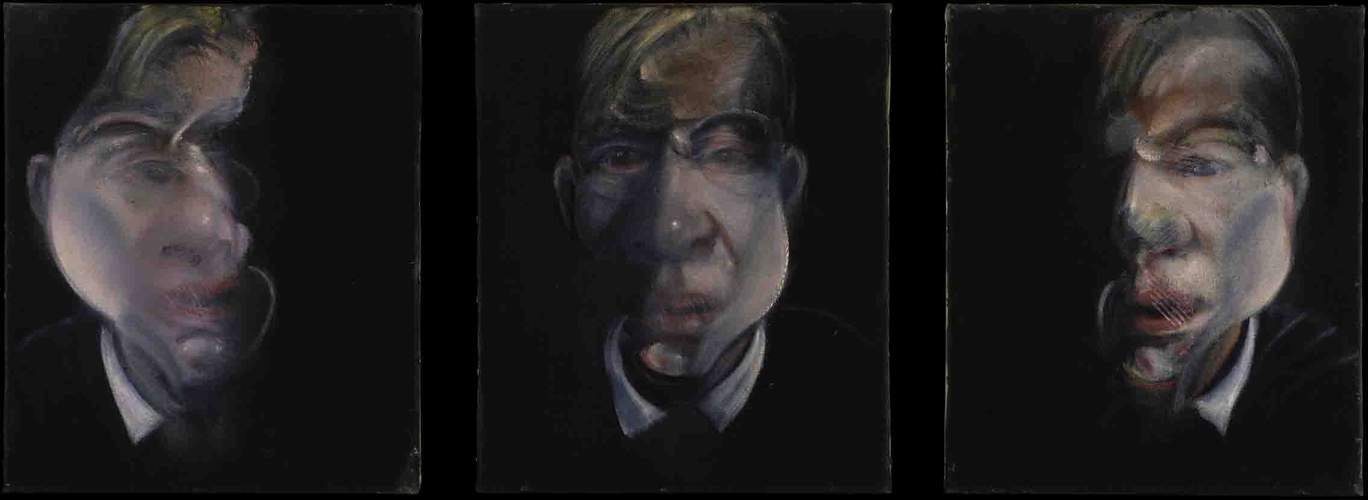

Painter bursting with exhilarated despair
With the death of Francis Bacon, Britain’s finest painter of his time,
art suffers a grievous loss, writes Richard Cork
THE first time I met Francis Bacon for an interview in the early 1970s, I approached him his South Kensington mews with trepidation. Would I be greeted by a writhing, turbulent figure, so obsessed with his own neuroses that conversation proved impossible to sustain?
My anxiety could hardly have been more misplaced. Charming, convivial and wonderfully eager to talk, he greeted me enthusiastically at the top of his steep, narrow stairs. Preparing at the time for his immense retrospective exhibitions at the Grand Palais in Paris, he was prepared nevertheless to spend the whole morning ranging inexhaustibly over art and literature, from Velazquez and Proust to Rembrandt, Greet tragedy and T.S. Eliot. Stimulating, often provocative and above all intensely energetic, the conversation continued over a bibulous Soho lunch and terminated tipsily in the ramshackle Colony Club.
I realised, on that bacchanalian day, just how much this animated man relished life. Far from viewing it with depressive morbidity, he savoured his defiantly unconventional existence with boundless zest. The same gusto animates his paintings. Isolated the figures may often be, but they are far from limp or defeated. At their most dynamic, they fill the entire canvas with protesting howls. But even when simply sitting on a chair, accompanied by one of the sinister shadows Bacon favoured, these solitary men have a tense, coiled dynamism that counters their awareness that each of us is, in the end, alone.
Bacon himself claimed that he looked on life with “exhilarated despair”. The horror is that all right, as well as the violence that erupted in the world on so many occasions during his lifetime. But Bacon’s awareness of man’s capacity for bestiality is offset by his stubborn belief in grandeur.
Viewers who recoil from Bacon in disgust are unable to grasp the more positive aspects of his art. But they are a vital part of his towering achievement. Bacon set great store by accident when painting, and his finest work is galvanised by an exuberant sense of risk. An inveterate gambler, he loved to surprise himself in painting as in life. The many canvases he destroyed throughout his career testify to his impatience with predictability. In Bacon’s greatest canvases his impulsive handling of paint has an astonishing eloquence as he pummels, caresses, obliterates and coaxes the pigment at will.
At the same time though, Bacon has a passion for order. His compositions are always calculated and refined, playing off the convulsive figures against areas of flat, semi-abstract colour. He liked immaculate painting and the tormented passages in his work gain enormously from their contrast with the clean, plain areas surrounding them. Bacon’s superb finesse, coupled with an instinctive monumentality, counteracts the depressing aspects of his world. Indeed his exhilaration seems all the more persuasive precisely because it is pitched against the confinement and vulnerability of the human condition. Bacon’s assertion of a resilient vigour could not be more hard won. And in some of his most impressive pictures naked figures close on one another with extraordinary erotic forcefulness, as if trying to combat their former isolation.
Bacon will be remembered, not only as the finest British painter of his time, but one of the most outstanding artists anywhere in the late 20th century world. With his death, painting suffers an incalculable loss. When we met for the last time a few months ago he told me that he hated the thought of death, before pausing and then brightening with a defiant cry: “ Shall we have some champagne?”
FRANCIS BACON
CONTROVERSIAL ABSTRACT PAINTER DIES AT 82
FEROCITY OF PAINTINGS EARNED BACONREPUTATION AS BRITAIN’S TOP ARTIST
DEATH NOTICE
GRAHAM HEATHCOTE
Bacon died of a heart attack while on holiday, in Madrid, said his agent, Mary Miller. He had been hospitalized, but was thought to be recovering and died unexpectedly. Bacon turned down a knighthood, had little regard for money and could be abrupt and difficult. But in his work, he insisted, he didn’t set out to shock. "You see, just the very fact of being born is a very ferocious thing," he explained in a 1980 interview with London’s Observer newspaper. "Life........ is just filled, really, with suffering and despair." On his 80th birthday, he told the Associated Press, "I’m not celebrating it. I’m not going anywhere and I don’t want any presents." Then he hung up. His paintings of violently distorted people and animals on garishly coloured backgrounds were regarded by some as obscene. But they hang in the great museums of London, New York, Chicago, Detroit and Ottawa. "He was not only the greatest British painter of his generation, but was also internationally recognized as one of the outstanding artists of the postwar era," said Nicholas Serota, director of London’s Tate Gallery. Sotheby’s Chairman Lord Gowrie said Bacon was Britain’s finest painter since 19th-century landscape artist J.M.W. Turner. In November, Bacon gave the Tate Gallery a painting that he could have sold for around 3 million pounds (then $5.3 million). Sotheby’s set the Bacon auction record of $6.27 million to an anonymous buyer in New York in May 1990 for Triptych May-June. His Study of a Pope had sold six months earlier at Christie’s in New York for $5.72 million. Bacon’s haunting paintings of the 17th-century Pope Innocent X – a series depicting the pope caged in plate glass and screaming – made Bacon world famous. Bacon had lived alone since his long time companion, George Dyer, committed suicide in 1971. A completely self-taught artist, the Irish-born Bacon began painting in London in 1929, but destroyed most of his earlier work with a razor. In World War II, he joined an ambulance rescue squad. Witnessing violent death helped inspire his style, especially the triptych form of three canvases linked together like a medieval altarpiece.
British Painter Francis Bacon Dies
At 82, he remained a figure of controversy whose powerful, boldly painted canvases divided critics and viewers alike.
WILLIAM TUOHY | TIMES STAFF WRITER | ART | LOS ANGELES TIMES | WEDNESDAY, APRIL 29, 1992 LONDON — Francis Bacon, widely regarded as Britain's greatest contemporary painter, died of a heart attack in a Madrid hospital Tuesday.Bacon, who had suffered from asthma, became ill while visiting friends in Spain. The 82-year-old painter was highly controversial in traditional artistic circles, since his powerful canvases, executed with splashing brush strokes, were often concerned with the themes of sex, suffering and death. Many regarded his paintings as obscene. But his work commanded high prices — a Bacon triptych recently sold in New York for $7 million — and in 1975 he was the first living British artist to rate a one-man show at New York's Metropolitan Museum.Bacon reportedly turned down a knighthood and other honors on the grounds, as he once said with a shrug, that "they cordon you off from existence". In 1962, his large retrospective exhibition at London#s Tate Gallery received considerable public and critical acclaim. Additional attention focused on his paintings in 1971, when he was given a rare retrospective at Paris’ Grand Palais that opened only hours after his model and lover, George Dyer, had committed suicide. Bacon later memorialized Dyer's death in a famous triptych of tormented paintings. It was reminiscent of one of his first works to draw international attention – a triptych called "Three Studies for the Figures at the Base of a Crucifixion. His paintings often depicted people such as Dyer in the throes of drug addiction and other agonies, and his "Screaming Pope" series was an unsettling reference to Diego Velazquez's portrait of Pope Innocent X. Bacon was an avowed homosexual who lived in a paint can-cluttered apartment and hung around the bars of London's raffish Soho district. While reticent about his work, he was personable and charming outside his studio. Bacon often said that his life was divided between “the gutter and the Ritz”. He normally consumed at least a bottle of champagne and a dozen oysters for lunch, and when not working he would pub-crawl through the day in Soho, often ending in fashionable South Kensington, where he lived and worked in a simple two-bedroom townhouse. He wandered the streets in a dark leather jacket, looking at least 10 years younger than his age and seldom recognize. Bacon seemed to care little about money, deploring the astronomical prices of paintings – including his own – with the comment, “Prices are so ridiculous that people go to galleries because they are obsessed by money.” He was born in Ireland in 1909, reportedly descended from the 16th-Century English philosopher and essayist whose name he bore. His English father was a retired army officer who banished him from home when Bacon was caught having sex with a stable hand. The teen-ager struck out for London and then Berlin, where he quickly began indulging in sexual escapades, gambling and nights in transvestite clubs. He returned to London in 1923 and designed modernistic furniture. It was not until 1929 that he turned to painting. In the 1930s, his supporters claimed that his work was revitalizing the British art scene. At the outbreak of the war, he tried to enlist but, rejected because of his longstanding asthma, joined the ambulance rescue squad instead. It was about this time that he decided his early work displeased him, and he destroyed much of it with a razor. In his work, Bacon broke all the staid rules of traditional English art and followed a more European tradition. With no formal art training, he sometimes painted with his fingers, scrubbing brushes and rags, combining different images from different mediums to produce startling picture. To those who abhorred his depiction of flesh – animal, human, and sometimes indeterminate – he once said: "You've only got to go into a butcher's shop.... It's nothing to do with mortality, but it's to do with the great color of the meat." Times art critic William Wilson, writing of a Bacon exhibit at the Los Angeles County Museum of Art two years ago, likened the artist to an Irish countryman, the playwright Samuel Beckett. Both men were philosophical exiles, Wilson said, “and (both) shocked the world with radical, disturbing art . . . which has changed only in nuance over the decades. . . .
“It
seems fair to ask how anyone as immensely successful
Bacon was once asked about the hostility that his paintings created among some viewers and answered, “If I thought about what the critics said, I shouldn't have gone on painting. He did not explain his obsession with sex and death in his paintings, but said, “If you really love life you're constantly walking in the shadow of death. “I don’t emphasize death,” he continued. “I accept it as part of one’s existence. One is always aware of mortality in life, even in a rose that blooms and then dies.”
BRITISH ARTIST Francis Bacon died yesterday of a heart attack in a Madrid hospital after being taken ill on holiday. The 82-year-old painter had been staying with friends in Spain. He had complained of not feeling well and was admitted to hospital where he died suddenly yesterday morning. His body will be flown back to England for a private funeral. His only surviving relative is thought to be a sister in South Africa. Born in Dublin, he began painting in 1929 but destroyed nearly all of his earlier works. Totally self-taught, by the end of his career his masterpieces were commanding top prices. Recently a Bacon triptych sold in New York for £3.9m but prices did not interest him. Bacon, who once turned down a knighthood, usually focused his art on the themes of sex and death. His work could be shocking and some regarded it as obscene. The artist largely retained his anonymity in London, and was delighted, on going into a pub in Soho, to be offered a job doing up an old house by someone who had heard he was a painter. Art critic John McEwen said, “He is the last of a generation that viewed art as a very serious and moral activity.” The Tate gallery plans to display Bacon’s Second Version of Triptych 1944, painted in 1988. It will go on show in the gallery for the next month and the original triptych will be shown simultaneously.
Francis Bacon in 1985.
Bacon ashes go home
NEWS LETTER CORRESPONDENT | ULSTER NEWS LETTER | THURSDAY, APRIL 30, 1992
BRITISH artist Francis Bacon, who died of a heart attack during a Madrid holiday on Tuesday, will be cremated in Spain and his ashes flown home. The hospital said that the illness was caused by the 82-year-old painter’s chronic bronchial asthma.
No date was given for the cremation.
Bacon, famous for his disquieting Images of sex and death, valued his privacy and nurses said he had just wanted to be treated like any other patient.
“He was a charming man who seemed much younger than he was,” a hospital spokeswoman said.
Bacon’s mortality proved
IN BRIEF | WORLD | THE CANBERRA TIMES | THURSDAY, 30 APRIL, 1992
LONDON: British painter Francis Bacon, who died on Tuesday at the age of 82, was deeply interested in death. “I have often thought upon death and I find it the least of all evils,” Francis Bacon’s namesake and ancestor, the Elizabethan philosopher, wrote. For Bacon the painter, the opposite was true. “I have a feeling of mortality all the time,” he once said. “Because, if life excites you, its opposite, like a shadow, death, must excite you. Perhaps not excite you, but you are aware of it in the same way as you are aware of life; you are aware of life, you’re aware of it like the turn of coin between life and death . . . I’m always very surprised when I wake up in the morning.” Mortality was Bacon’s great theme, his keen sense of his own mortality the driving force behind his art. His paintings are not pleasant, embodying a singularly bleak view of human existence, but they have a power born of obsession that is unique in British post-war art. Storyless, enigmatic compositions, characteristically painted in triptych format, they place the emphasis on prime biological fact; figures — usually male — scream, couple bestially, vomit or defecate, depicted as lurid agglomerations of bodily matter, raw flesh that seems on the point of putrefaction. “I’ve always been very moved by pictures about slaughter houses,” he said, and Bacon’s figures have something of the slaughterhouse about them. “We are meat, we are potential carcasses,” he said, and painted that. — The Independent
FRANCIS BACON
MICHAEL MASON
THE DEATH has occurred of Francis Bacon, sometimes described as
Britain’s greatest painter since Turner, always as the greatest British
painter of the century. His work hangs in most of the major museums
around the world.
He was 82 and died of a heart attack in Madrid on Tuesday.
Born in Dublin in 1909, the son of a greyhound trainer, Bacon received
no formal art training. But painting, particularly the work of Picasso,
fired him as a young man and he developed his own techniques to create
highly individual and characteristic works of violence and turmoil,
coming to the fore in the 1950s with a series of one man shows in
London, New York, Paris and Rome.
His central preoccupation was with the human form, a pessimistic view,
figures often contorted in pain or sexual climax, the same convolutions
you can see in his many portraits of anonymous individuals gleaned from
newspaper cuttings, or in the more, characterful and rounded pictures of
friends like Lucien Freud or lover George Dyer.
Ίhe paintings always shout for attention and reaction, and they get
them. If many find them masterly, others find them simply disturbing,
even obscene and blasphemous
—
criticism that Bacon rejected: “You only have to think about life, or to
have, experienced it, or think of the meat on your plate, to think how
disturbing what is called reality is.” It was a reality he learned in
challenging circumstances, during the Second World War as an ambulance
driver in the Blitz, for example, or amidst the human dereliction of the
inner city which constantly drew him.
Francis Bacon was a very private man who lived very publicly. He was a
familiar figure around Earl’s Court and South Kensington where he had
his studio, and frequently seen on the streets of Soho, or feasting with
panthers in its more threatening bars in a life which he described as
lived somewhere “betwen the gutter and the Ritz”.
But he did not feel the need to talk at length about his life and work.
It was only natural that he should have left his articulate painting to
say the rest.
Michael Mason
PORTRAYING MAN’S AGONY
To Francis Bacon, Life was the horror, not his paintings
ALAN G. ARTNER | CHICAGO TRIBUNE | FRIDAY, MAY 1, 1992
The death of Francis Bacon on Tuesday at age 82 brought to an end one of the most individual careers in the history of 20th Century painting. His vision was grisly, but he always maintained, realistic. He had few antecedents and attracted fewer disciples. Yet the strength of that vision indelibly impressed itself on art of our time and, contrary to his many statements, came to stand for a particular moment in Western cultural history. Nearly a half-century of interpreters have seen Bacon as the one artist who consistently tried to sum up the agony of modern man. They said his outlook was shaped by World War II and inevitably represented extreme states of feeling. Bacon himself was cooler, repeating again and again that he had nothing to express about the human condition. Life was the horror and his paintings were no match for it. Sometimes they captured a little bit of truth. But they did it in an intense and curtailed way, distorting beyond appearance yet working into the distortions something still recognizable. In short, Bacon was more concerned with the act of painting than the philosophy everyone said lay behind it. He was not in any sense a philosopher. As a young man, he merely had seen a dog defecate on the street and had accepted it as the most accurate representation of life. This viewpoint allowed him to look at every conceivable human act without surprise, disappointment, judgment or recoil. What was normal to Bacon was terrible to others, and, paradoxically, the extent of the terror accounted for his success. He often said he could not imagine anyone who really liked his paintings, but museums and collectors around the world acquired them, and they entered even the popular imagination through use on the opening credits of Bernardo Bertolucci’s film Last Tango in Paris. American critics frequently dismissed his work as “automatic angst” that, over the years, had become decorative in their composition and colour. Some gave him credit for being a great image maker, but denied him the status of great painter. This was transparent. Bacon rankled American critics only because he did not need them. Bacon never claimed to have brought anything new to painting and, in truth, he did not. Though self-taught, he recognized the value of history and freely approached it as a storehouse of images that might trigger his imagination. The most famous image he used was that of Velasquez’s 1650 portrait of Pope Innocent X, but there were many others, most notably from paintings by Picasso, Cimabue, Ingres and Van Gogh, and from photographs by Edweard Muybridge. Bacon was acutely aware of the predicament of the 20th Century painter who tried to record life, acknowledging that mechanical means could do it better. So he sought an intensity that came in part from the risk-taking of the artist, and he often ruined paintings by throwing pigment at them or by deliberately causing accidents upon which he hoped to capitalize. In 1988, a year before the 80th birthday exhibition at the Hirshhorn Museum and Sculpture Garden in Washington, D.C., Bacon returned to the work that first brought him notoriety, his Studies for Figures at the Base of a Crucifixion, 1944. This time, he did not rework the original but created a new triptych marked by telling refinements in composition, colour and touch. The piece reaffirmed that Bacon’s primary concern long had been painting, not subject matter. And it should have surprised no one. His words and deeds were consistent throughout his career and, decades before, while looking through a book on mouth diseases, he had said he wanted to paint the inside of a screaming mouth as beautifully as a Claude Monet sunset. That linkage between beauty and horror came naturally to Bacon, and it kept him from ever appearing sentimental about anything, including art. If not especially appealing, it is nonetheless extraordinary that a world-famous artist would say, simply and without guile: “I would like my pictures to look as if a human being had passed between them, like a snail, leaving a trail of the human presence and memory trace of past events as the snail leaves its slime.”
No mourners at artist’s funeral
Tim Brown in Madrid and Jenny Rees
NEWS | MADRID
THE BODY of Francis Bacon, arguably Britain’s greatest modern painter, was cremated yesterday in Madrid, where he died of a heart attack earlier this week. There was no service and none of his friends was present, in accordance with his wishes. There was one wreath, from The French House pub in Soho, one of his favourite London haunts. Only a few journalists gathered at a Madrid crematorium to see the coffin of the 82-year-old artist, who died in a local hospital while on holiday. “He made it clear to us that he did not want anybody at the cremation,” said Mr Ian Board, a close friend for more than 40 years, who runs the Colony Room, a Soho drinking club which Mr Bacon was a founder member. “He did not want flowers and if there was a bunch there, it would have, in his opinion, been one too many. “He didn’t want any fuss. He just wanted to be put in the gutter, or in the hedge or in the ditch.” Mr Board said his friend’s ashes were to be brought back to London and scattered in a “chosen place”. “I’m not going to tell you where. He wouldn’t like that. But it is somewhere he has chosen, in the country, and there will only be a few mates there. Then we will have a lively party with lot of champagne and lots of his friends.”
SASHA GRISHIN | ART
FRANCIS Bacon, Britain
When he was in his twenties and living with the Australian painter Roy de Maistre, he worked mainly as a decorator and designer and only gradually turned to painting to abandon all other art forms.
In 1945 he exhibited his Three studies for figures at the base of a Crucifixion in a London art gallery together with the works of Henry Moore, Graham Sutherland and Frances Hodgkins. These were the first of his noble grotesques which commented on the pain of the human condition and presented an attempt to resolve the dilemma of how to exist with dignity as a human being in the contemporary world.
Although at the time they seemed genuinely disorienting, now, when they are seen in the Tate Gallery, they have lost their sense of strangeness and appear as direct and vivid images of people who hasten to the scene of a human disaster.
Crucifixions, screaming popes, figures imprisoned in enclosed spaces,
figures on surgical couches or suspended in space are part of the
repertoire of types who inhabit Bacon
He said at one stage that in his process of work, “I think of myself as a kind of pulverising machine into which everything I look at and feel is fed ... the photographs become a sort of compost out of which images emerge”.
Bacon
Personally, I find the sense of ecstasy, revelation and the sheer celebration of the technique of painting the first and primary impact on encountering a Bacon painting, then gradually the images emerge to assert their haunting magic.
Within the context of the British tradition of painting, Bacon emerges as an unusual and maverick-like figure. Unlike his contemporaries, he was never a mood painter, a romantic landscape painter or a stylish modernist obsessed with the formal qualities of design. He invented a world for us and gave us a reading of reality, which later many of us came to believe in.
APPRECIATION
THE OUTCAST WHO MASTERED MISERY FRANCIS BACON, AND THE PAIN THAT COLORED HIS WORK
BY PAUL RICHARD | LIFESTYLE | THE WASHINGTON POST | SATURDAY, MAY 2, 1992
In the flesh, Francis Bacon suggested — as his paintings do — unexpected luxury pulled from piercing pain. It’s been nearly 17 years since I saw him last, in 1975. That Anglo-Irish master — who died at 82 on Tuesday of a heart attack in Spain — was seated in an overpriced mid-town New York restaurant. In between his smiles his face would sag in grief. He had a wad of $100 bills wedged into his pocket. His jacket was black leather, his sweater a black turtleneck. He kept speaking of his miseries, and pouring the champagne. He said, “Life is wholly futile.” His closest friends were dead, he said. “Wholly futile,” he repeated — and then he made a sudden movement with his arm. It was a gesture of odd beauty, as casually graceful as that of a Beau Brummell tying a foulard. The waiter bowed, attentive. “Another dozen oysters, please, ” Francis Bacon said. That same disturbing shift, from despondency and suffering to voluptuary elegance, is apparent in his art. His superbly painted pictures — with their gibberings and howlings, their sucking sounds of human flesh torn from living bone — clamp your heart with dread. Yet even as they do so, the beauty of the paint — that sumptuousness of surface, that perfectly controlled swooping of the brush — somehow sings in exaltation. The man could gild the ghastly. The highest of the high and the lowest of the low are blended in his art. His pictures have the glow, the grand expensive aura of European masterworks, yet they stink of stale cigarettes, of windowless hotel rooms, of paid-for sex on unmade beds. The tensions that divide them — between towering ambition and sordidness of subject, between faith in art's transcendence and unnameable despair, between imagined flesh and real paint — could tear your soul in two. He thought himself — and was — one of England's greatest painters. He set out to paint masterworks. He insisted they be shown, as one might display relics, behind gleaming panes of glass. He surrounded them with heavy frames sheathed in burnished gold. Yet he painted them in squalor. His decaying mews house in South Kensington in London had its bathtub in the kitchen. He could have lived in splendor, yet his studio was a filthy place of bare bulbs overhead and refuse underfoot, thick clots of paint and rags. The paintings he produced there sometimes sold, at auction, for nearly $7 million. His art was first seen in London just after World War II. His final retrospective, arranged by James Demetrion, opened in Washington at the Hirshhorn Museum and Sculpture Garden in 1989. A small memorial show of four of Bacon’s pictures is currently on view there. As he aged, his art grew grander, but his themes remained the same. You cannot see his pictures without thinking of the horrors of Europe at mid-century, not only of the public ones — corpses piled high, the stink of burned-out buildings — but of private horrors too. Bacon’s popes scream silent screams as if sensing for the first time the era’s desolations. Other men had shown us the underside of Europe — think of Jean Genet in jail, of Isherwood’s Berlin — but Bacon did so without showing us any touch of sweetness. He preferred to tear off scabs. His violent scenes of male sex are never warmed by love, his men are almost animals, his flesh is butchered meat. Yet he paints with such fierce brio that he conquers our revulsions. He forces us to see. He became an outcast early. “I never got on with my mother or my father,” he once told author David Sylvester. “They thought I was just a drifter... . As you know, {my father} was a trainer of racehorses. And he just fought with people. He really had no friends at all... . I disliked him, but I was sexually attracted to him when I was young. When I first sensed it, I hardly knew it was sexual. It was only later, through the grooms and the people in the stable I had affairs with, that I realized it was a sexual thing ...” “And then, when I was 16 or 17, I went to Berlin, and of course I saw the Berlin of 1927 and 1928 where there was a wide open city, which was, in a way, very, very violent... . And after Berlin, I went to Paris, and then I lived all those disturbed years between then and the war, which started in 1939. So I could say, perhaps, I have been accustomed to always living through forms of violence.” We feel his violence with our bodies. The people in his pictures, some bleeding in their business suits, some crouching in their bathrooms, writhe and retch and die. Bacon was above all else a figurative painter. At a time when other artists gave up the painted figure for the realms of pure abstraction (Willem de Kooning, with his “Women,” was a notable exception), Bacon kept the body at the center of his art. The strength of his adherence marked him as an Englishman. The British have for centuries given faces to their thoughts; they’ve personified ideas. Think of Shakespeare’s troubled kings, of Milton’s fallen angels, of Dickens too and Benny Hill. Bacon in his own way extended that tradition. Figure painting is nearly dead. Portraiture that’s something more than cartooning or photography is largely moribund in our land, and throughout most of Europe. But in Britain it’s alive. The figure painters there who followed Francis Bacon — Lucian Freud, David Hockney and Frank Auerbach among them — rank among the strongest, most convincing of our time. Bacon’s smeared and kneaded figures don’t participate in our world. Locked behind their panes of glass, or imprisoned in their narrow cells, or silhouetted oddly against blank enclosing walls of orange or light green, they writhe in isolation. They’re gruesome, magisterial and completely unforgettable. No one else could paint them. Though he sometimes borrowed images from the paintings of Velazquez, from photographs and movies, Bacon had no predecessors. And no followers survive him. The artist has now joined the pantheon of masters, but like the figures in his pictures, Francis Bacon is still alone.
The horror of Francis Bacon
BOOKS AND ARTS | THE ECONOMIST | SATURDAY MAY 2ND 1992
THE trauma of our age, after Auschwitz, after Hiroshima, haunts so many of his pictures. Francis Bacon, who died aged 82 on April 28th, was the greatest British painter since Turner but also something more. His works, like Picasso’s, have left their mark on everyman, not just the art public. He nearly always painted the human face and figure, stripped bare of civilised niceties, set against backgrounds of stark colour and a terrifying clinical vacancy. “I hate a homely atmosphere,” he once said, and there is nothing cosy or illustrative about his figures: screaming prelates; manically grimacing businessmen; naked men vomiting, defecating, wrestling (or making love) with each other. He compressed reality to the claustrophobia of the interrogation chamber, the screaming cell, the slaughterhouse.
In 1944 he painted “Three Studies for Figures at the Base of a Crucifixion”, in which humanoid creatures, grotesquely phallic in proportion, emit ineffable primal screams. The human cry, inspired by images such as that of the blooded nurse in Eisenstein’s 1925 film “Battleship Potemkin”, obsessed him. He always denied, however, being a visual terrorist out to shock gratuitously. “I’ve always hoped in a sense to be able to paint the mouth like Monet painted a sunset.” His first London exhibition in 1949 a shocked and riveted the art public. Its iconoclasm and gallows humour broke ever taboo, but, as always, with tremendous assurance of composition, acute sense of the figure in space and beautiful qualities of paint. Figures were depicted mid-howl; a pope in a transparent box, like a hunted specimen; a monstrous man with opened umbrella under suspended animal carcasses. By the late 1950s Bacon was internationally famous. In 1962 and 1985, he had retrospectives at London’s Tate Gallery. His 1988 Moscow retrospective was the first of a living, western artist to be held in the Soviet Union. His pictures commanded prices in seven figures. But he remained an elusive figure, avoiding interviews, parrying critics. “I’m just trying to make images as accurately off my nervous system as I can. I don’t even know what half of them mean. I’m not saying anything.” Yet as Cecil Beaton, a famous society photographer described him in 1960, Bacon provided lively, humorous company for his friends, gay and straight. His studio was incredibly dishevelled; he enjoyed heavy late-night drinking in London clubs; he was indifferent to the opinions of others. He lived and worked like this almost o the end. In his art, he desperately exorcised the ravaging tensions within. He described his portraiture as a kind of injury inflicted on the subject, and spontaneously applied paint almost as a physical assault on the viewer’s sensibilities. A flayed human body on a bed under a rude electric light bulb: this is Bacon’s tragic view of man. His are 20th-century icons, without a glimmer of redemption or release from horror.
JOHN EZARD | OTHER LIVES | THE GUARDIAN | SATURDAY, MAY 2, 1992
AFTER 50 years, the fond records of the Colony Room stretch round the walls and encroach on one window; canvases, busts, sketches, posters, postcards, letters by from or about Lucian Freud, Francis Bacon, Frank Auerbach, Colin MacInnes, John Deakin, John Minton and the extraordinary founder-hostess Muriel Belcher. Somewhere, too, will be IOUs from Dylan Thomas and Brendan Behan. “Those big shits,” Ian Board, the owner, growls tenderly. A few years more — and the only other window will be darkened by memorabilia of the household gods of Soho and Fritzrovia. In the week of Bacon’s death, during a quiet mid-afternoon, it can be mistaken for a shrine to superannuated bohemia. And then Clem Crosby calls in to pay his bar bill. In his twenties, a graduate of Nottingham College of Art, he now has his own studio but has not so far felt ready to show his work. He shows off a Polaroid of a collage of Bacon obituaries he has done for the nearby window of Shippley’s fine art bookshop in Charring Cross Road. Clem is one of a tribe of younger painters and sculptors to join the Colony, which was originally launched in the 1940s as an out-of-hours drinking den for the artists-wastrels of the quarter. Longer pub hours have shrunk that role but Clem says it gives him a sense of community with older artists which is reason enough for belonging. The younger generation, though it does not yet figure in the Soho nostalgia industry, has begun to create its own legends. One of the first to offer to help behind the bar when Muriel began to develop a fatal illness 10 years ago was another ex-student Michael Clark. He has since taken second prize at the Royal Academy summer show, won the National Portrait Gallery’s Imperial Tobacco Award twice and been commissioned to paint royalty. Fred Ingrams (son of Richard Ingrams) has given a show which, according to the author Dan Farson who wrote the programme notes, was inspired entirely by sex. Six of the paintings were inspired by Hazlitt’s work Liber Amoris, a very Soho-ish cautionary tale of a man destroyed by his infatuation with his landlady’s daughter, who turned out to be sleeping with him merely to get the rent. “The fun of the painted dummy torsos and the power of the thrusting nudes,” enthused Farson. In the strongest-stomached Francis Bacon tradition, another Colony member, Mark Quinn, extracted eight pints of his own blood over a leisurely period made a transparent cast of his own head complete with built-in refrigerator, and poured the blood into the head. The resulting frozen work of art, known as “the blood head” in the Colony, was snapped up by Saatchi. Such stories, ancient or modern, true or false, are part of the emotional juice that has kept the Colony going along with, Ian Board says, bloody hard work and love of the place. It is an improbable club, with no wine or beer cellar, crammed in to a smallish, green-painted first-floor room up a dark staircase in Dean Street. The only adjunct seems to be a gents’ cubicle toilet which is adequate unless it is being monopolised by Francis Bacon and boyfriend, as it used occasionally to be. Like Muriel before him Ian Board, under a veneer of curses, has an unusual capacity for paying attention to people and a remarkable recall for the feats of his 300 members. He can remember what school a very casual acquaintance taught at 20 years ago. Muriel recruited him to help start the Colony when he was an 18 year-old commis-waiter at the Jardin des Gourmets in Greek Street. It has been his life ever since. “In the early days a Chief Inspector who was at one of our parties said, ‘Too many of them here’, at a time when it was illegal. In her cleaver way Muriel sorted that out and gave us the mutually understanding mix we have now, about 25 per cent gay and 75 per cent straight — what I call liquorice allsorts.” In the summers he, she and Bacon used to shut the club and go to the Riviera. “Francis was a compulsive gambler who didn’t want to win. Once he ran out of money. We happened to know an American who was being kept by a very rich queen. We went to his hotel while he was out and Francis shinned up the drain pipe. He had tremendous strength and vitality. Then it was straight to the casino with the money — and he won. So he went straight back up the drain pipe with the money, put it back our morals were still working then — and the American never knew. We had enough money left over to settle hotel bills and get back to England.” Ian Board wasn’t prepared for Bacon’s death in Spain. “He rang me on Good Friday and said have a nice time.” He was told by Channel 4 News. That afternoon scores of younger members, including the rock singer Lisa Stansfield, swarmed into the Colony to raise his spirits with a champagne wake that lasted till 2am. Affording champagne, the club’s most fashionable drink, is a problem for many of the young ones, including Clem Crosby. “But they give you time to pay,” he says in mitigation. Ian says: “They’re divinely bitchy but fundamentally they’re a good bunch of comrades. If I’ve got any money I help a bit if anyone’s down on their uppers. Muriel did that. And they help each other. When they sell a painting, they have a good meal and a piss-up. They spend the money up the wall.” In his Guardian obituary of Bacon, Bryan Robertson wrote: Compared with an older generation, artists today often sound and behave like upwardly mobile dentists. Not at the Colony, they don’t; and behind the bar today is another young man with a good listener’s manner, Michael Wojas, whom Ian hopes will continue the tradition for another 40 years.
THE BOOK THAT
BACON BANNED
Francis Bacon died on Tuesday morning aged 82. BRUCE BERNARD,
visual arts editor of The Independent
Magazine and a longtime friend of Bacon’s, recalls the revealing saga of
‘About Francis Bacon a book approved by Bacon, monitored by Bacon, and –
at the last minute – blocked by Bacon.
BRUCE BERNARD | THE INDEPENDENT MAGAZINE | ISSUE
191
About five years ago, an art director at Macdonald Orbis, the publishers for whom I had compiled three books about painting, suggested that I should “do a book” about Francis Bacon. At first I thought that there was nothing I could contrive that would supersede or add anything significant to the books already published, but within a very short time I had an idea. Why not make the best possible picture book of Bacon’s work, with a text consisting mostly of extracts from press criticism of it from the very beginning (which turned out to be 1931)? One would break into this occasionally with a biographical narrative, and use documentary photographs of Bacon, his friends and models, and reproductions of magazine spreads and books such as Herbert Read’s Art Now of 1937, which showed a Bacon opposite a Picasso and had first aroused my interest in him when I was still at school. I naturally went first to the designer Derek Birdsall, who had designed two of my compilations, earning universal approval for his work on them, and he immediately bettered my proposed title with About Francis Bacon, and made a splendid dummy. He chose a squarish landscape format so that the numerous triptychs could be shown without resort to fold outs. Francis, whom I had known since 1949, and always been on friendly terms with, thought it looked “marvellous” (“like a scrapbook”, he said approvingly). Everyone else was equally enthusiastic, and the book was commissioned without delay. Bacon’s agents, Marlborough Fine Art, offered bill co operation and gave me access to their several tomes of press cuttings: I also found invaluable the bibliography prepared by Krzysztof Cieszkowski of the Tate Gallery. I commissioned translations of what three intelligent linguists thought the most interesting foreign language cuttings in the Marlborough books, and sent a patient assistant to Colindale Newspaper Library and the V & A to get copies of the most interesting looking pieces on the Tate list. It added up to a fascinating, if predictable, mixture of vilification, bewilderment, recognition of a remarkable talent, and the acknowledgement of greatness (the favourable notices perhaps too numerous for Francis’s taste). Comments such as Bernard Levin’s 1984 prediction that the paintings would be sold as scrap in 20 years or so have always been balanced by Lawrence Gowing, Andrew Forge, David Sylvester and others, carrying torches that illuminate, with all possible mixtures of feeling in between. I wrote a biographical narrative with personal comments on a few paintings which I believe to be among Bacon’s greatest, and showed it to him after one of the many dinners he gave me as the book progressed. He took my words home with him, and rang me early the next morning to say that owing to insomnia he had read it that night, and “rather liked it”. Later on he asked me to take out an anecdote that would cause someone embarrassment, and kept on insisting that I must declare that my “interpretations” of the works I mentioned were mine alone. I agreed, though this was perfectly obvious and needed no underlining. There were other minor objections, such as my use of the word “incarnation”, which he thought had unwelcome religious connotations, but he made no fundamental objection to the uneven text, which I admit might possibly have seemed presumptuous in parts. (I did not think a distinguished piece of art writing appropriate, and would have asked someone else to provide it if I had.) In view of his later objection to anything biographical in words or photographs, it should be borne in mind that Francis was particularly anxious that all the staff at Wheeler’s restaurant in Old Compton Street were fully named in my account of his very friendly relationship with them, and was pleased that I had found photographs of other friends. Many of the pictures had been taken by John Deakin, the remarkable photographer who had provided numerous portraits for Bacon to work from. Derek Birdsail soon produced layouts and Francis came to his workshop in Islington to look at them. He professed himself very pleased, using the word “marvellous” many times and voicing very few reservations. He then took me, Derek, and most of the Birdsall family out to lunch, and charmed us all with his generosity and customary enjoyment of such occasions. When the colour proofs arrived and were pasted down quite soon after this, he came to the workshop again. A lot of the colour was, as it so often is at this stage, depressingly inaccurate, and this seemed to worry him. I felt that it triggered other unspoken doubts, but we then had another lunch with family, scarcely less enjoyable than the first. The book was due to go to the printers within a fortnight. Two days later he phoned me, saying that he wanted to see me urgently, and his tone of voice was ominous. I went along to his place early the following morning, and after offering me tea in his usual hospitable way, he told me that he was insisting that all the photographs and my text (apart from the short introduction) should be removed, and that no work before the famous 1944 Tate triptych, Three Studies for Figures at the Base of a Crucifixion, should be reproduced. This seemed to me quite unacceptable, and although I was prepared to bargain to some extent about my text, which I considered the least of the book’s components, I was not prepared to surrender the idea of some kind of biographical narrative or illustration, or endure the embargo on his earliest work. The package of demands being so destructive of my own and Derek’s notion of the book, I did not stay to argue. Francis then asked for a meeting with the publishers, to whom he spelled out the same conditions. They declined to accept them, deciding quite rightly that the book would not arouse half the interest either here or abroad if they did. I sent him a letter pointing out his earlier co operation with the biographical aspect, his loans of personal photographs, and his general approval of my text when he first saw it. I also stated my belief that the elements he wanted removed in no way detracted from the impact of his work (I considered the sequence and juxtaposition of the paintings to be the best ever made). I never had an answer to my letter perhaps because it was unanswerable, though I can now see that several things I wrote in the book were unwise, and also that he couldn’t be expected to like the unavoidable sense of valediction at the end. If I had possessed a written agreement with his gallery concerning the use of the paintings we could, it seems, have printed the book with little fear of an injunction. But friendly agreements are, by their nature, vulnerable. If our friendship was a little dented by this episode, my regard and admiration for the best he did and was will never change. I feel honoured to have known him.
Homage to a slice of Bacon
MARTYN HARRIS | ODD MAN OUT | THE DAILY TELEGRAPH | SATURDAY, MAY 2, 1992
Francis Bacon’s body lay a moulderin’ in Madrid, but in London the Tate Gallery had already created what will doubtless be the first of many memorials. In Room 25 they have hung his last major triptych, Three Figures at the Base of a Crucifixion, which he gave to the gallery in 1991, and which is now flanked on one side with a vase of roses on a tasteful grey plinth – made of plywood, but trying hard to be stone. Bacon, who sneered equally at sentiment and kitsch, would have laughed at this, but already the public are arriving to pay homage, pausing respectfully to read the inscription, or sitting to meditate on the bench before the great painting. And so begins that mysterious translation from semi-ignored outsider to pillar of culture. Not so long ago, in a Soho pub, a man who had heard Bacon was a painter offered him a job doing up his house. This week Bacon takes full-page obituaries in every serious paper in the land. Most of the people passing by know he is dead, and some even know other Bacon paintings. “He did Screaming Popes.” “and Mick Jagger”, “sides of meat,” “and men having it off”. Asked for the first adjective that comes to mind in front of the crucifixion triptych they say, “nightmare”, “scary”, “slasher movie”, “alien”, “warped” and “weird”.
The triptych is actually a retread of a 1944 Bacon which hangs two rooms away. This shows three animal forms with lumpen greyish bodies, elongated necks and tiny snarling heads, set in windowless interiors painted a garish tomato soup colour. In the modern version the background is a more restful imperial purple, and the figures less agitated, more monumental.
Alexander, an art student from Nice, says the faces seem to be trying to escape from the bodies, like the threshing heads of straitjacketed lunatics. “But I don’t like to read meaning into painting you know. Proust says ‘a work of art which contains theories is like a present with the price tag still on’.” All the same there is a sense of revulsion here, from the flesh and mortality. I think of Yeats’s terror, at being a creative intelligence “chained to a dying animal”.
Quite a little seminar group is gathering now, in front of the painting. There are American couples in Burberries, filling in time before Starlight Express; French/Spanish students with Day-Glo bumbags full of postcards; and soi-distant “practicing artists” in black Levis and torn vests. Everyone looks at the label before the painting.
Burberries like to imagine messages behind the picture: “For me this is a feminist image on the left of the woman armless and bound...” Bumbags, on the other hand, prefer to find popular parallels; “Zis reminds me vair much of zis punk band album cover. I sink ze Ramones...” The black Levis lot are opposed to all attempts at interpretation and prefer words like “strong”, “sensual” and “interesting”.
They do all seem to like Bacon though, which, given his unpleasant material and limited range, seems strange. Looking through Michel Leiris’s book on the artist, there is hardly any development over the years in the pictures of flayed faces, doglike couplings, grungy rooms and screaming mouths – except that in the later paintings the distortions of bodies and faces look more wilful than pathological; colours are cleaner, edges neater, and the expression of disgust seems more factitious than felt.
Though his boozing and gambling friends like to portray him as a desperate character, Bacon actually had a remarkably placid and healthy life, from his comfortable home background to the cosy clubs of his declining years. The nearest he came to real horror was conscription to the Army in 1939, which he avoided by hiring an Alsatian dog from Harrods and sleeping beside it overnight. As he suffered from asthma and was allergic to dogs he was gasping for breath when he reported for his medical, and was rejected as unfit.
The British artist Alfred Stevens once remarked: “The artist who always paints the same scene pleases the public for the sole reason that it recognises him with ease and thinks itself a connoisseur.”
Perhaps that is all it is. Bacon did the same kind of painting for 50 years, and anyone who goes on for that long must have something to say, mustn’t he? Sheer persistence will finally wear away scepticism, and in any case Bacon did have something to say, though as years went by he said it with less venom and less real horror, until in the end it felt like a tic of style rather than genuine terror.
Out of decay, immortality
Giles Auty
By GILES AUTY | THE SPECTATOR | SATURDAY 2 MAY 1992
I was having lunch this Tuesday with a painter friend when news of Francis Bacon’s death reached us. Bacon was in his 83rd year and was felt by many who knew him well to have been lucky to have got so far. My friend celebrated him for another reason: ‘You’ve got to be grateful to old Francis for keeping the idea of figurative painting alive during those awful years of Pop and abstract expressionism.’ Francis Bacon outlived many more art movements than these and in a sense reaffirmed belief in the continuity of art rather than sharing in the idea of modernist schism. I first met the artist in the closing months of 1959 when we rented almost adjacent dwellings in St Ives. I remember especially talking with him during a long, sunlit after- noon largely on the subject of Bonnard. The artist was charming, considerate and well-informed. As dusk drew in a male companion of the artist who seemed to me none of these things made his return and I made polite excuses to depart. I encountered the artist intermittently over succeeding years, once in the restaurant car of a train. In days when Britain was less affluent, I suspect many users of restaurant cars seldom dined out other than when travelling. There was a subdued hush in the dining car broken only by the tinkle of cutlery and whispered discussions between long-married couples as to whether to order a half-bottle of Beaujolais. The waiter motioned me to an unoccupied seat at a table . . . ‘If you wouldn’t mind joining the other gentlemen, sir.’ Almost as I did so, Mr Bacon’s new companion, a brawny young man sporting a bright ginger crew-cut, complained very loudly of the heat: ‘Cor, Francis, it ain’t ’alf fuckin’ ’ot in ’ere.’ Throwing off his coat, he revealed a short-sleeved shirt, impressive musculature and brilliant braces. Several delicately poised fish knives clattered to the floor. The artist resisted the idea of a biography which would probably centre more on his private social habits — notably drinking, gambling and intense physical attachments — than on his art. A good deal of nonsense has been written about the latter, too, and I expect we must now fear the excesses, also, of his obituarists. Thus I do not share Sir Roy Strong’s view, already stated, that Bacon was the greatest British artist since Turner. The artist’s unusual life and background probably explain much more in his art than is commonly realised — but it would be strange if they did not do so. Bacon was a weak and asthmatic child sired by a domineering racehorse trainer in Ireland. He had little conventional schooling and no art training at all. He left home at 16 following a reputed incident of trying on his mother’s clothes. Unsurprisingly, his natural milieu became that of Bohemia and the demimonde in Berlin, Paris and London, where he worked before the last war as a designer of rugs and furniture. At the time I first met Bacon, his rise to artistic fame and fortune had merely begun. I believe the critic David Sylvester was as responsible as anyone for its subsequent acceleration. For years, whenever I remarked on the low standard of coverage on television of the visual arts, colleagues would refer me to a most illuminating interview between Bacon and Sylvester ... ‘if only you had seen that’. Not many years ago I did so and was acutely disappointed. Little doubt this footage will be re-run many times in the months to come. Bacon learned the craft of painting slowly but developed subsequent techniques which made his technical shortcomings difficult for most critics to comment upon. At the end of his life he was accused by former admirers of becoming almost too accomplished for his own good: of producing pastiches of his own mannerisms, in fact. For me, perhaps the greatest virtue of Bacon’s painting lay in his commitment to the activity itself. To the best of my knowledge he never complained of the inadequacy of the medium, recognising rightly that if the activity of painting were good enough for anyone from Rembrandt to Grünewald or Ingres to Goya there was no particular need to look elsewhere. Bacon’s often remarkable painting struck me always as a far more urgent reflection of his own, driven condition than that of humanity at large. His supposed assault on ‘reality’ accords more with vulgar conceptions of such matters than with the profound or philosophical. Paradoxically, there is often a taint of melodrama and sentimentality about visions of remorselessness, whether written or painted. Bacon’s over-insistence on decay and futility may have been an unintended argument for immortality. Though his friends may deny this, perhaps he was not such an old, existential romantic after all.
Francis Bacon, 7 Reece Mews, London, 1981 Photo Marc Tivier
Art, death and immortality over a Naked Lunch
IN 1986, while filming with BBC TV Bacon: I don’t know if critics of literature are the idiots that critics of paintings are in this country, because they’re the biggest idiots that exist, they know absolutely fuck all to begin with. They’ve got no instinct about it, they’ve just got theories. Burroughs: In Tangier, I remember, we had several discussions about painting. Bacon: Did we?
Burroughs:
Yes, much of the time. I remember you saying most of what is going on in
painting isn
Bacon:
Did I? Maybe we were talking about abstract painting. Once it was the
height of fashion, I don Burroughs: No, not mine. Bacon: I always think marvellous painting will come out of America, because it should, a country with an enormous mixed race. But it doesn’t, it’s so dreary, those super-realists, the abstract expressionists, all so very dreary. Burroughs: But there must be modern painters you admire?
Bacon:
Not many, not now. They Burroughs: And what about the Americans, say Jasper Johns? Bacon: I try never to think about Jasper Johns, I hate the stuff and don’t like him either. I met him in Paris. It was mutual, he didn’t like me. It does happen. I’ve been wondering if you are going to have any of your books filmed? I would have thought someone like Bunuel would have been the man to make something of yours. Burroughs: Oh there have been many attempts. I went out to Hollywood with a script of Naked Lunch, the studio people sent a Daimler but when they didn’t like the script our Daimler shrunk down to a two-seater. Really learnt about Hollywood.
Bacon:
It’s always those bastards with the money behind everything, but what do
they know? Nothing, nothing but money. I read somewhere that you write
to make people aware of what they know themselves. I don Burroughs: There was an exhibition of Monet in Chicago recently; I was excited by that, really beautiful.
Bacon:
The Impressionists, Cezanne, Picasso; you’re right, that’s wonderful
painting. Look at Cezanne, really look, and you realise that Cubism, as
good as it is, is perhaps only a kind of decoration on Cezanne Burroughs: Do you remember the alligator that Paul and Janie Bowles had in Tangier? Such a delicate little thing. Bacon: She died here you know, Janie. Burroughs: Didn’t she die in Malaga?
Bacon:
You’re right, you Burroughs: She always had a lot of pills around, was always taking pills. Bacon: Died in a madhouse in Malaga, it must have been the worst thing in the world. Looked after by nuns, can you imagine anything more horrible. Burroughs: The Egyptians believed that to be immortal you had to have your portrait painted on your mummy. Bacon: I don’t know if anyone ever painted Jane’s portrait. Burroughs: That if anything happened to that portrait or mummy your immortality was nullified. I t was a very precarious form of immortality. Bacon: I quite agree, but even then there is no immortality. Perhaps we may leave certain things by which we’re remembered, such as our work, but otherwise to me there isn’t immortality. Immortality, if it ever comes, will only come through scientists, doctors, learning to prolong life, to keep the body going.
Burroughs:
That
Bacon:
But unless you are a conscious electro-magnetic field it doesn
Francis and me
Henrietta Moraes recalls, with Peter Lennon, posing for her Soho drinking buddy
I WAS 18 and straight up from Northamptonshire. I had left school to work in a secretarial college in South Kensington. This was towards the end of the 50s. I wasn’t doing any of the things I was supposed to do. I had flown to Soho like an escape from . . . I don’t know what. A friend brought me to the Colony Club where I met Lucian Freud and Una McBride and Francis. He was a very striking figure with those blues eyes and dyed blonde hair, at least I think it was dyed. It was very flaxen. I had fallen in love with a documentary maker, Michael Law, who worked with the Crown Film Unit. We used all to go out to lunch at Wheeler’s and then to the French pub and the Colony Club and on to the Gargoyle, a night club in Dean Street. He drank a lot, a lot. I don’t think he worked while he was drinking. You wouldn’t see him for a bit and then he’d come back to Soho [from his chaotic studio in South Kensington]. For about three years he didn’t paint me at all. Then one day when we were drinking at the French pub he said that he was doing portraits of some of his friends and would I let him paint me. I said of course. Then he said would I mind if a photographer friend, somebody called John Deakin, took some photographs of me. You see I never posed for him. He painted from pictures. I did think that was a strange way of working. He always did it that way. He explained that people did not like what he painted and were very shocked. I think this embarrassed him. I did see how they could be shocked, But I wasn’t. I don’t think his portraits distorted me. He did it like a series of movie frames. I was a close friends but this might have been his way of getting a distance to the subject. Bacon always painted from photographs or postcards. Mrs Beaton’s cookery book was an inspiration; as was the nurse screaming on the Odessa steps in Eisenstein’s Battleship Potemkin. One of the most powerful influences on his painting was Velasquez’s Pope Innocent X; he studies scores of photographs of it but even in Italy he never bothered to go and see the original. WELL, John Deakin came over to my flat and told me to take my clothes off and I sat on the bed with my arms and legs crossed. Deakin said: “For God’s sake he doesn’t want a pieta. He wants you naked and lying on the bed and he’s told me the exact position he wants you in. Throw yourself back on the bed and abandon yourself.” So I had a couple of drinks and he started taking wide-angle shots of everything. I said: “Francis can’t possible want hundreds of shots of private parts!" But the I said: “Alright go ahead, it’s only images after all.” But next time I met Francis with Deakin in the Colony room he said: "Look this nitwit has not taken the shots of you I wanted. He will have to do it all over again. Do you mind doing a repeat performance?” Deakin was a bit of an alcoholic and he had done it from the wrong angle. So I had to do it again. This time upside down. For about ten years Henrietta Moraes was Bacon’s model. “All his nudes are me. I know that because of the photographs,” she said. She was also painted by Lucian Freud. But she was never a professional model for Bacon. (The other model was Isabel Rawsthorne who is now dead. She also posed via photographs). “ONE day I will give you a picture,” Francis said. But he never did. I waited about 20 years and then I asked him. He said: “Oh darling you’d have sold it long ago, wouldn’t you!” I had to admit that I probably would have. [By that stage one of Bacon’s paintings would have been worth around £20,000]. But he was a very generous person. I think perhaps he should have given me one, if you see what I mean. I was very fond of him. People had very strong feelings about Francis; they were very loyal to him. He had a sister who had some awful disease and he took care of her. She was in a home. I knew he had to die sometime but it still was a shock when I heard it on the radio. It was different posing for Lucian. I was like a mesmerised rabbit. It went on all day for months, it took a long, long time. I then married Norman Bowler. As in the hat. He was an actor. Then I married Dom Moraes [the poet], but I haven’t been speaking to him for years. He’s in Bombay. Although Francis was born in Dublin he had none of the religious hang-ups of the Irish. Religion meant nothing to him at all. His English father was a racing trainer in Kildare. He lived there until he was 16 and didn’t begin painting until he was 30. Bacon claimed that his crucifixions had nothing to do with religion. He said: “I wanted to do a portrait of the body raised from the ground. Christ on the cross seemed one way of doing it and I couldn’t think of any other.” Henrietta agreed: “He was interested in a person on the cross. But it certainly wasn’t Christ.” Despite the monstrous images Bacon created of human trunks — like refugees from an abattoir — and desolate faces in denuded rooms, Bacon was an ebullient personality, very gregarious and not obviously tormented. WE DIDN’T talk about painting. He talked about life. He was full of wisdom. I remember at his first exhibition at the Hanover Gallery. Everything was done in a rush and many of the paintings were still wet. His friend David Sylvester leaned against Bacon’s version of a Van Gogh and got half a cornfield pasted on his back. He didn’t bother to repair the painting. Politics? He was not interested in it at all. Not one tiny bit. I don’t go to the Colony Club anymore. I don’t drink anymore. And I don’t honestly and truly think it would be much fun completely sober. Anyway many of the group are dead. I met Francis on top of a bus in the middle of the afternoon recently. He had been to see Mona Lisa which he liked very much. He started talking about dying. Suddenly he said: “I’ve got a problem. Do you know anything about funeral arrangements?” I said, actually no. “When I die,” he said, “I don’t want to have a funeral. How do I go about that?” I said, I suppose you go to your solicitor. He said: “My solicitor is away on holiday. I don’t want anything, anything, anything.”
Just a pile of paint and a nightmare of chic thrills
Michael McNay takes a dissenting view of a ‘genius’
ALL THE world loves a picture. A picture with a story is even better. Ulysses Deridibg Polyphenus before Symphony in Grey and Black; The Last of England or the Hireling Shepherd before Dedham Vale. Better still — halcyon days of the Royal Academy when Munnings ruled and God was his heaven? — the puzzle pictures, a canvas that hinted at a story but which left the viewer guessing. Francis Bacon bestrides this honourable tradition. Pictures, no paintings. Best of all, English narrative pictures. One must be careful here: he is of course “painterly” picture maker. His legions of admirers say so. Many of his admirers are painters themselves’, some very good painters; though Bacon himself, we keep hearing, was the greatest living artist, the best British artist since Turner. But Bacon’s paint is in the service of pictorial effect. The surface itself should not be scrutinised too carefully. Too often in doesn’t describe what it purports to be describing. Bacon can’t paint a foot or an ear or a hand. Some of the curves he used to describe physical forms are so slack they would have got him fired from a Disney workshop. So Bacon smudged and threw paint and turned forms back in on themselves and disrupted their logic, instinctively hiding his own deficiencies. These smears of paint describing swollen and distended shapes, especially in the portrait, seize attention and distract the eye from what lies between. Which is nothing. Nothing will come of nothing. And Bacon’s nothing isn’t even a black hole, it is a break down in communication. The painting stops dead between the smears of pigment. There is nothing there because it hasn’t been described or constructed or placed. Bacon lived the life of Riley, but despite the boozing and gambling and promiscuity he lived to a fine old age. That style of life must have made him sense that he was a man in a hurry, and he worked obsessively. But unlike Picasso painting in a hurry in his last days, Bacon’s talent was not underpinned by training. He gambled and quite often won. Often, too, he lost, and because he had a painter’s eye he could pick the losers. This is no secret. Bacon groupies who fill the columns of the art press and who have been taking up radio time since the artist’s death have described with suppressed excitement the way Bacon destroyed work that dissatisfied him, cut the heads out of portraits and left the canvases with gapping holes. They are like Nosey in Joyce Cary’s The Horse’s Mouth, stuttering excitement over every manifestation of the painter’s genius, even the recognition of failure. Bacon himself was quite open about his methods. His conversations with David Sylvester, published in the 1970s, are quite explicit. Bacon worked fast, and with a lot of paint, pushing it around the surface, waiting for the controlled accident to erupt. It it got out of hand, there was no going back. The canvas had to be abandoned. The process, an eruption, sounds unpleasant, and it was; because the secret of Bacon’s successful work was the paint, like a gigantic eructation of pus. The Grand Guignol apparatus of screaming heads, the sides of raw meat, the smeared visages underpinned this visceral sense of horror. Bacon was the last and most extreme of the line of painters who followed van Gogh. But Bacon was self-taught, and unlike Van Gogh, never overcame his technical deficiencies. He borrowed motifs, fair enough, but imposed sketchily realised pictorial devices, like the frame crudely articulated to impose some sense of control over the central images sprawling like something from under a stone. Given the shortcomings of imagination and technique, Bacon’s success is singular. He caught a nerve, as Bryan Robertson put it in his Guardian tribute. The risk taking, the throw of the dice that characterised his encounter with the canvas, had its own excitement. The nastiness of the images, the grandeur of the nightmare as some would have it, help to assuage a western civilisation that can’t cope with its own darker compulsions. A bad dream by Bacon is the ultimate adjunct to any truly-chic boardroom. Which is why the front page of the Times was able to report: “The first test of the value of his works, which are (sic) certain to rise following his death, will come at a Christie’s sale in London on July 2.” As Wilde would have said, there’s a reporter who knows the price of everything and the value of nothing. No doubt the market will bear him out. But as for being the “best living painter”, Bacon wasn’t even the best painter living in North London.
A brush with despair
FRANK WHITFORD on the life, work and reputation of Francis Bacon
Bacon in his studio. By Francis Goodman
FRANK WHITFORD | ART | THE SUNDAY TIMES | SUNDAY 3 MAY 1992
Since Francis Bacon’s death in Madrid last Tuesday at the age of 82, the same ringing phrases have been herd throughout the land. Bacon, it is said, was the greatest British painter of the 20th century, since Turner even. His crucifixions, screaming popes, bloody haunches of meat, copulating couples and blurred figures writhing in airless, windowless, artificially lit rooms, have become the definitive images of a traumatised age that, devoid of all spiritual values, is in despair at itself. His pictures sit so uncomfortably in the mind that, as the poet Stephen Spender once wrote, they make most other modern painting look like “decoration, doodling, aestheticism, or stupidity”. There are a few who find more melodrama than real pain in Bacon’s work, and who regard the painter’s only achievement as having endowed the gruesome and perverse with a kind of spurious glamour. The writer, Colin MacInnes, who, like Bacon, was homosexual and a constant presence in those few parts of Soho in the 1950s that were genuinely Bohemian, bitchily described him as “the Norman Hartnell of the horror movement”. More persuasive evidence that Bacon made perversion and corruption chic and sexy has recently been provided by the designer of the film Silence Of The Lambs — who admitted that his visualisation of Hannibal Lecter in his cage was crucially inspired by Bacon. Even some of Bacon’s non-fictional admirers are discomfited by what they take to be the moral black hole at the heart of the painter’s work. In 1962, at the time of Bacon’s first retrospective exhibition at the Tate, Spender wrote that Bacon was “so profoundly affected by the kind of life he observes that his paintings seem corrupted by the corruption”. And Bacon himself, who said that he regarded life with a kind of “exhilarated despair”, once admitted to Spender that he thought all his painting ugly, and that his ambition “would be to do something beautiful before I die.” But other avant-garde artists have always admired him. Indeed, for years after the war, he was the only English painter that any of his younger colleagues had time for. They were encouraged by the contempt he showed for conventional standards of taste and quality, thrilled by his raffish and, by normal standards, alarmingly disreputable behaviour. On a more creative level, they also admired the seemingly casual way he pressed all manner of things into the service of his art. For me, what is particularly striking and impressive about Bacon’s work is the calculated and telling confrontation between the disquieting or depressing nature of the imagery, and the sensuous appeal of the materials with which that imagery is depicted. There is an expressive tension between the despair, the corruption, and the chilling assertions of life’s bleak futility, and the grand manner of their presentation. Bacon used the kind of formats and frames employed by the old masters in their treatment of heroic and life-enhancing themes in order to dramatise the perverse and brutal. He has had no serious followers. His imagery and style are so personal and peculiar as to be inimitable. He is one of the few considerable 20th-century painters — Paul Klee is another — whose style has been of no direct, significant influence. His art also defies classification, resists every attempt to force it into any of those snug pigeon-holes used by historians and critics. Bacon shared with the surrealists a belief in the importance of risk and chance, and regularly exploited accidental effects in his painting. His admiration for Picasso is reflected in some of his anthropomorphic imagery, especially in the figures in his Crucifixion. But if there are any other artists whose work might be compared with Bacon’s in anything other than a superficial way, they are, it seems to me, exclusively German: Otto Dix and Max Beckman. It is fashionable to argue that the life of the artist is irrelevant to an understanding, or appreciation of his work. In Bacon’s case, this is especially questionable. Although he always refused to talk about or provide clues to the meaning of his pictures, many are at least partially autobiographical — alluding to current and former lovers, and, in the case of one series of paintings, to the squalid circumstances in which one of them committed suicide. There is something irresistibly fascinating about a man whose pictures fetched millions, yet who chose to live in a cramped and untidy bedsit with blankets draped over the windows and illuminated by naked light bulbs; about an artist who usually worked from dawn until lunchtime in a studio that looked like a tip, and whose door and walls he used as a pallet. And there is something intriguing about a man who, when he was not working, existed in a world located somewhere between the seedy Soho drinking club the Colony Room and the Connaught or the Ritz. That dichotomy was reflected in his appearance and dress: the hair dyed an indeterminate colour, the penetrating eyes and full sensuous mouth, the hint of make-up, the expensive leather bomber jacket, and the cheap gym shoes. And then there was the cultivated alto voice, which, like eerily ageless skin, made him seem far younger than he was. Even at 82, he did not look eligible for a senior citizen’s bus pass. Bacon was born in Ireland, the son of English parents. He had little education and began a life of seemingly aimless drifting when an exasperated father packed him off to England at the age of 16. He was in Berlin in the late 1920s and then moved to Paris. Back in London he became a designer of modernistic furniture, but he soon turned to painting, although he later destroyed almost all of his early work and gave up painting entirely for several years. In 1945 he exhibited his now famous Three Figures for Figures at the Base of a Crucifixion and with that achieved a certain limited reputation. It was only later that his work came to be widely admired. He is said to have once hired an entire train to take him and a large group of friends from Paris to the south of France and back. The train did not stop, the blinds remained down, there was a constant supply of champagne and caviar, and all the passengers did was play poker. That extraordinary trip might be regarded as a metaphor for Bacon’s view of life: an ultimately futile journey that ends where it began and offers a few fleeting pleasures on the way. “We are born and we die,” he once told the critic David Sylvester, “but in between, we give this purposeless existence a meaning by our drives.”
‘He was the last of the Bohemian figures , who would not have been worried by a mortgage or anything which most people worry about; he dedicated his life to his paintings. I will always admire his full Bohemian life.’ Peter Blake
‘Bacon achieved Flaubert's wish to be as unlike his neighbours as possible. I think he realised some of the most unexpected stylistic insights since the war, the best painter in a barren time.’ R B Kitaj
‘He was unlike anyone else in life, as in his art. He was a true original, as if he had descended from another era. Everything he did was different: the deliberate way he walked; the particular way he talked; his particular emphasis on words, which made his conversation irresistible. When he entered a room it was an occasion. What I shall miss is his sense of fun and that disarming laughter.’ Dan Farson
‘I agree with the clichéd belief that he was the greatest British painter since Turner. He was a charming companion, generous , waspish and a marvellous gossip, not at all gloomy, although his paintings were otherwise. I especially liked the excellent way he was able to use paint not to imitate reality but to make it real.’ George Melly
‘Francis Bacon was, to use a favourite word of his, the most
Bruce Bernard
‘Bacon was not only the greatest British painter of his generation, but
also internationally recognised as one of the outstanding post-war
artists. His art stands in the great Western tradition, addressing
central themes of human existence in compositions grand in conception,
rich in colour and powerful in presence. Nicholas Serota
Bridget Riley
Francis Bacon, A Man Sitting in a Chair, study for Portrait 1971
Raffish old master of the elusive
William Feaver examines the grim and unflinching legacy of Francis Bacon, who died last week
WILLIAM FEAVER | PEOPLE | THE OBSERVER | SUNDAY 3 MAY 1992
PEOPLE still confess to being shocked by Bacons. Or, if not shocked exactly, upset by the despair involved, or believed to ne involved. Was it despair or derision? In he later work Bacon cultivated such smooth uncertainties his reflex derision became indistinguishable from his practiced despair. But what goes on in his paintings is really more to do with paint handling and paint behaviour: often depraved, by academic standards. Paint was Bacon’s means of repeating, after Sweeney in T. S. Eliot’s Sweeney Agonistes: That’s all, that’s all, that’s all, that’s all, Birth, and copulation, and death. He liked to give the impression that he painted beyond his control. If the spasms went well the paintings realised themselves. If they didn’t they were worse than useless. He wanted them 'strong', that’s all. At the finish, with any luck, there would be a fixed spurt of excitement, a spontaneous power. More than anyone since Picasso, he made images that flush out our fears. Francis Bacon, born in Dublin in 1909, died in Madrid last Tuesday, became an old master of the elusive. He teased or wrong-footed certain aspects of life — the ways we flinch or scowl or occasionally try being just ourselves — into a form of afterlife. He was keen on preserving and presenting these stalled furores in sterile settings, like laboratory slides. There were lingering traces of the bent chrome, mirrors and hefty rugs featured in the Studio magazine for August 1930, illustrating the taste of Bacon the young interior designer held responsible for ‘The 1930 Look in British Decoration’. Bacon’s reputation as a painter was made with ‘Three Studies for Figures at the Base of a Crucifixion’ (1944), taken to be an outcry against war and easily mistaken for a cover version of a Graham Sutherland. He had another go in 1988 with 'Second Version' (which joined the first in the Tate), replacing the harsh orange ground with bruised plum colour and rendering the underbelly of the creature yowling on the right more humanoid. All sorts of dodges were fed into Bacon’s mixes: umbrellas raised like wings or serrated choppers, glasses worn for vacant reflection, blindfolds for when his figures feared the worst. His use of photographs of grotesque mutilations was mannerist in the extremes. He always had the excuse, of course, that photographs were evidence that such is life. Bacon went on doing his damndest year after year, working the same dilemma: how to be direct yet evasive. His strategy was to take conventional portraiture and deface it. He dragged Velasquez’s Pope Innocent X screaming into the twentieth century, not so much updating him as confusing him with the nurse shot in the head in Battleship Potemkin. In repeat versions the popes degenerated into resentful presentation models trapped in glass cases. Bacon liked his paintings to be glazed and gold-framed. This distanced them, enhanced their costliness and gave them a propriety which the picture itself could then flout. He also liked the way one sees oneself dimly in the picture glass, as though window shopping at Dewhurst or Heal’s, superimposed on the seclusion within. Technically, Bacon was a gambler, so much so that new paintings often needed immediate attention from the restorer. His hit-and-miss attitude seemed part of a desire to tempt failure. To 'give the sensation', as he used to say, he would serve himself up, wincing at a twisted lip and a dismissive slap round the chops. The small-self portraits are his most reliably brilliant works. But the sensation was transferable to larger format, as he proved in the terrific ‘Triptych Inspired by the Sweeney Agonistes’, 1997, a sequence o sex and murder, centred on the guard’s ghastly discovery in the reserved compartment on the Blue Train. Bacon’s companion in the Sixties, George Dyer, was his second best model. ‘George Dyer Riding a Bicycle’, 1966, is a wild conflation of swerve and white squirt, calf muscles and cocky profiles. Then Dyer, depressed, contemplates diving into a corral of hotel sofas. Dyer killed himself in 1971 at the time of Bacon’s triumphant retrospective at the Grand Palais, the show which put him on par with the élite of the School of Paris. The work eased off after this. There were remakes, most of them decongested inflations. George Dyer was commemorated in a triptych showing him puking into a washbasin and slumped dead on the lavatory. There were paintings of someone lurching upstairs with the latchkey; always the possibility of something gone hideously wrong. Bacon’s paintings developed into developed into a well rehearsed interrogation technique. It involved spotlighting the subjects, treating each blighter as suspect. Especially himself. There were crime-thriller elements here, reminders that Bacon’s heyday coincided with that of Fabian of the Yard, in whose accounts of villains apprehended arrows point to telltale traces. Neville Heath, the serial killer, admitted, ‘I got excited and it went too far.’ Chamber of Horrors interpretations of Bacon also go too far. In fact, he was more the London Giacometti, dealing with individuals, feeling his way like the man in The Revenge’s Tragedy, ‘conjuring ... in private to seek some strange-digested fellow’. ‘Something comes up and you can use it and develop it.’ Bacon proceeded with audacious swipes. Not actual violence, more threat and the dry heave. When intimacy takes place it is remote controlled. He Baconised the open-neck shirt, sleeked hair, and even (when using a photograph of President Woodrow Wilson) top hat an spats. He dealt with plimsolls. Fag ends, mattress, naked bulb, bare dune and torchlit patch of rank grass were invested with significance. He made certain parts of the body fit to be grasped. Shoulders, elbows and heels: the rounded bits. He never painted detailed hands. Tricky things, hands. He was apt to fudge them or tuck them between the thighs. Bacon became more efficient perhaps, certainly more used to being the famous Bacon doing Bacons: ‘Images that are intensely real as I can make them.’ He flirted with self-parody. There were pitiless hairdressing salons, fatted limbs padded up for an innings and fuller figures positively begging for crucifixion. Bacon’s most telling images, generally reclaimed from photography, reassert the basic freedom of painting. Each face slugged, squinting in the glare, celebrates still being alive. Photographers loved photographing Bacon. He was large, soft, astonishingly preserved considering what he put himself through, until quite recently. The face became more startling as it ages. In the street, with his shopping bag, he looked like a hawkish Benny Hill. The raffish image is now consigned to memory and mythification. The Colony Club habitué, Sweeney Bacon, Pride of Soho, is going to become even more legendary. We are left with paintings of vulnerability. Despite what people tend to think, they aren’t aggressive. The strongest look completely instinctual. Quite a number — an astonishing number — are marvellous. That’s all, that’s all.
Francis Bacon in one of his favourite haunts, the French Pub, Soho. Photograph by Neil Libbert.
Havoc among humans
Francis Bacon’s death on Tuesday
was marked the next night by an old, and superb, edition of the South
Bank Show (1985) where suave Melvyn Bragg played the fall guy to the
elegant nihilism of the painter, a Dublin man by birth. He found sides
of beef beautiful, Bacon said, which is why he put them in a painting.
He could not explain what they were doing there. These were not the
images of dread, of horror, that Bragg was proposing. “What horror could
I make that compares with what goes on every single day?
Art and impulse
The artist Francis Bacon spent his formative years in Ireland but couldn’t live here because the childhood influences were so strong and there were no casinos for the gambling painter, Grey Gowrie tells Madeleine Keane
OF THE many tributes following the death of Francis Bacon, one of the most eloquent and sensitive was written by Lord Gowrie. The chairman of Sotheby’s and former arts minister was a friend of the painter for the last decade of his life. As well as admiring his work, Grey Gowrie felt linked to Bacon through Ireland “I told him I was the only person who understood his background. Quite fortuitously we shared the same roots, indeed the same village in Co Kildare.” Lord Gowrie, (his family name is Hore-Ruthven, a Wexford joined with a Scots family. Three of his four grandparents were Irish) inherited Castlemartin (now the home of Dr A.J.F. O’Reilly) from a great aunt, a Pollock from Lismany in Co Galway. The village was Kilcullen near the Curragh and and it was here that Bacon spent the first and formative years of his life. “Bacon’s father was a racing trainer. Francis considered himself English but he admitted to me that Ireland affected his painting. He painted from memory, not life He used to visit an aunt’s house with a curved bow window and the way the light from this window grabbed and isolated any figure affected him powerfully in memory. “It is nonsense to say he was an expressionist painter. Like all the greatest painters, he was a realist. The people he painted, the same over and over again, looked very like Francis Bacons. He looked like a Francis Bacon himself; there was always a shock of recognition when he came into a room. “Bacon admired Proust’s uncovering of the way childhood affects emotional and aesthetic development. He was given no formal education. He lived in and out of the stables and the story goes that he was expelled from home by his father for having sex with one of the stable lads.” Another version has it that he was expelled for dressing up in women’s clothes. Though neither transvestite nor homosexual I rather sympathise with that as I used to do the same thing in childhood at Castlemartin. There were trunks of them lying about and it was something to do. “Something of the horse never left Francis. He looked like a jockey, with his determined forceful face, strong torso and little tapering legs. He said that at the centre of his being was that he reversed the classic Oedipal roles. He loved his mother and hated his father in the orthodox way, but it was the father for whom he felt a strong physical attraction. Aeschylus’ plays were a big force in his life and triggered some of his greatest paintings. “Then there was the violence associated with Bacon’s images. Francis recollected the civil war, the grown ups talking about the knock on the door and the coming of the gunman. It sounded more interesting to him than ordinary life. His work is alert to menace. Sexually, he was drawn to toughs. He told me he thought of his homosexuality as an affliction but accepted it absolutely: he was a disciplined worker but hated the very idea of resisting an impulse: art, like sex. was impulse. If he was nihilistic, he was nihilistic in a grand and formalised way, like Beckett whom he admired. He thought Yeats and Picasso the century’s great artists. “As Ireland was a tax haven for artists I asked him why he didn’t go and live there. He said that the childhood influences were so strong the asthma he always suffered from became acute there. He also said that Dublin didn’t have a Wheelers. I’d defend my own city’s ability to provide oysters and champagne in an instant. Francis liked the drinking and the chatting life we associate with Ireland. Though he was personally kind he could be biting and witty verbally.” Dublin didn’t indeed have casinos and Francis was a gambler. He was very free with money and gave wads of it away. His paintings started to make money only when he was well into his 50s. As a young man he had lived off rich protectors; he said he was really a tart. Some he had exploited and stolen from. He was ashamed of the stealing, not the sex. It was one of the reasons he resisted co-operating with any potential biographer, including myself. “He was intellectually free of guilt, but not emotionally. He’d always deny fiercely that there was any religious inspiration behind the paintings of popes and crucifixions which made his name in the late 40s and early 50s. I thought he protested too much. The Catholic tradition in the sense of the mainstream European cultural tradition, attracted him. You get a feel for that in Irish life and art in a way you don’t in Britain. “Bacon loved Paris and had lived there for a period of his life. I remember seeing queues of people outside an exhibition of his work in Paris. In London he could walk around Kensington and Chelsea unrecognised. He rather liked the English philistinism and thought it good for artists not to be sucked up to. "Does he possess any of Bacon’s work? "I used to own a Bacon. It was stolen.” For once Grey Gowrie can’t, won’t, go on. But he can tell us why Ireland doesn’t possess a single Bacon in a public collection whatever about private ownership.” In the early 70s when I started out as a private dealer I had a very great Bacon. It was perfectly acceptable. It wasn’t men buggering each other on a bed or anything. It was a clothed male figure, Peter Lacy actually, a companion of his who died. It wasn’t very expensive. I said to my partner I don’t want us to take any profit on this picture.” Grey Gowrie passionately wanted his mother country to possess a Bacon. He wrote to the National Gallery at a high level. “The letter I received back just boarded on the civil. It was along the lines of don’t waste our time with this disgraceful artist. I sold it in the end to Elton John. “I last talked to Francis at Christmas. He was old and ill but someone had made him happy. I’m glad he died in Madrid, after looking at Velázquez.” Grey Gowrie describes himself as a friendly acquaintance. “I did him a favour once. I stopped him getting evicted from his studio when I was a minister. “Francis found life sensually pleasant but intellectually brutal. So he found the aesthetic the only reliable pleasure. He painted in order to get at the pleasure. almost as a kind of onanism, but it did not go to waste. “How did he feel about women?” “He got on well with my wife. He was fond of and close to women and portraits of Henrietta Moraes and Isabel Rawsthorne are among his best pictures.” The biographies of Bacon are imminent. “Lives will be written.” Will you write one, Lord Gowrie? “No. I have written an essay and I might write another one.”
FRANCIS BACON John Minihan
SOHO, raucous repository of London’s ve de Boheme is in mourning. Francis Bacon, one of the last of its great lotus eaters is dead. Bacon once summarised his life as “going from bar to bar.” True to his raffish nature, he divided his life “between the gutter and the Ritz.” He found it hard to be a teetotaller in Soho, as I did several weeks ago even when the place was not en fete. Soho no longer seems a fiendish place. Most of the squalid sex shops seem suppressed. Since 1987 the number has been reduced from 66 to five. And all the brilliant pubs are gone, The Swiss, The Caves de Paris, The Mandrake Club. Even Gaston Bellamare, regarded as the greatest publican in Soho has retired from the French. Drink led me down strange paths. Within two days I had encountered Ian Board, Bacon’s close friend and owner of the Colony Club. Board or ‘Ida’ to his close friends, is not overtly sweet. In fact he can be brute He has an acerbic wit and an imperious manner that could cut crystal with a look. I had already been warned. Mindful of T.E. Lawrence’s cry against “the glamour of strangeness” I made my way up the dark, grubby stairs to the Colony, accurately described by George Melly as “small shabby room with a bar and a few isolated piss-artists which became the closing time a bacchanalia.” In existence since 1948, the Colony is only one of six clubs listed in the Millionaires Guide. It was Francis’s favourite drinking haunt and he occupied a special a special corner seat their. Our paths crossed several times, but alas never in the Colony. “Life my dear is Proust and pricks, not painting!” This aphorism bestowed on me by Bacon had a well worn feel. Even towards the end of his life shocking was akin to breathing. “Rent boys not royalty,” he said on the same theme. Heart on my sleeve, I peeped my head into the Colony for the first time. Ian Board was there. Heir of the club since the demonically witty Muriel Belcher died. The fierce voice of Soho sat, sat in a corner surrounded by empty champagne bottle. On first sight he reminded me of one of those formidable New York Queens, holding fast to his territory. He glared at me acidly, straight vodka in one hand, a menthol cigarette in the other. Foul-mouthed, he seemed the least likable of the lot. It was inevitable I got to know him well. “This club is members only. Who the fuck are you darling?” I gave as good as I got. “I’m Brighid from Dublin. Do you want a drink or not?” Behind the bar stood a mild-mannered man called Mike. A large portrait of them both dominates the cramped green room. A painting called Spunking All Over The World hung beside the door. There was an atmosphere of decadent decline. Board is described as the most vitriolic man in Soho. It is not surprising. When Jeff Koons asked Board why why there were so many photographs of him on the walls, Ian quipped: “I’m the guvnor, you cunt,” and referred to him for the rest of the week as “the painter who paints cocks.” Friends and foe describe him as a once sweet looking cherub who turned into a monster, yet all admire his determined battle to make the club live after Muriel’s death in 1979. Now he will have to defy Bacon’s death also. Before long we were punishing vodka with tears in his eyes about how he first me Muriel Belcher when he was a young commis chef in the Jardin De Gourmets in Greek Street. His sadness was all engulfing. Despite his reputation I found his absolutely lovable and extraordinarily kind. “God, people, all the greats walked in here. Lords, Counts, cunts but they’re all dead, dead ... John Minton, Muriel. There is only Francis left.” Now Francis is also gone. One Sunday, my last in Soho, I met Ian sitting in his “lavatory seat corner” in the Coach and Horses wearing his “Irish tipster.” It is the only day he leaves the Colony. The atmosphere was electric. Two of Soho’s most notorious proprietors, the last of a dying breed were at each others throats. Norman Balon – dubbed the Rudest Barman in London – complained that his Italian girlfriend was putting pressure on him to marry her, while Ian was chiding him, telling him he needed a man, not a woman. I remember asking all present had Soho changed. Balon and Board implied it had and talked about the old clientele “We caught them, we seduced them,” said Ian longingly. “You may have,” barked Norman. With Francis Bacon’s death, une belle aventure humaine may be nearly over.
IAN BOARD: The fierce voice of Soho. Ian Board and Michael Wojas in The Colony Room Club
The funny genius who painted with pain
By DANIEL FARSON
conducted the last major interview with the artist in September
THE news of Francis Bacon’s death has devastated his friends. To die at the age of 82, swiftly among new friends in Madrid, is a good way to go after such an eventful life. Better than being found alone in his South Kensington studio. Yet his death has come as a terrible shock and for me the sense of loss is growing. Even those who never knew him or his work will have realised from the wealth of tributes that this is an important event. He has left his mark on our time, capturing the pain of the 20th Century in paint. I asked him once if it pleased him to realise that his work will always be remembered, that he had secured his place in the history of art, but he laughed in such a pretentiousness a way – ‘Oh, don’t talk such rubbish!’ he explained impatiently. The reaction was genuine. Other men might have admitted to a secret satisfaction, but he was unlike anyone else – a true original, which is why his paintings will live. My startled reaction when I saw my first Bacon was not just to the violence of the image but the grandeur of the paint. When his pictures are hung today next to Old Masters, they hold their own magnificently. But he was contemptuous of the trappings of fame. He had no side whatsoever, and did not give a hoot for convention. He scorned possessions and actually disliked the fact that a painting had sold for £3 million, which he considered farcical, almost a mockery of art with people more concerned with the value of the picture than the painting itself. Familiar labels have been stuck on him in the past week: a painter of horror, despair, obscenity. This was his reputation. When I told him that a critic described a new work as ‘evil’, he laughed: ‘I though it was rather pretty, myself.’
Consequently, when I introduced him to friends they were astonished to
find he was charming and friendly. A gentleman. Also the funniest man I I returned to his old Soho haunts last week, a sort of personal pilgrimage, and people were talking about him everywhere, distressed by the news though remembering him with love and affection and pride in having known such a remarkable figure. There was almost an air of celebration with some people raising heir glasses to ‘Eggs’, as a few people called Bacon. I can remember nothing like it. It was tremendously moving for it added up to the recognition that someone of greatness had passed this way. We met after the war when I left Cambridge and drifted into Soho as if by instinct. In those gloomy years Soho was an island, a true Bohemia where people relished food and drink and the buzz of conversation. There was a glorious innocence then with no barriers of age, sex or class. There were no rules and people behaved so outrageously they asked if they needed to apologise when they met the next morning. I was addicted at once. On my first day in the French Pub I met two people who shaped my life: the photographer John Deakin who whispered: ‘Here’s someone really special,’ as Bacon entered the bar that he carefully trod as if he had ventured on deck in a high sea. Casually but expensively dressed, he greeted me with courtesy reserved for strangers, asked what we wanted to drink, and gave his inimitable smile as he tugged at his collar and exclaimed: ‘Well, you’ll never believe this, but the most extraordinary thing has just happened to me . . . ’ He laughed so much he had to stop and it was so infectious I found myself laughing too. And we carried on from there. literally so as he took us round the corner to Wheeler’s, where the owner had such faith in his future that he allowed him to sign the bill. At the Colony Room, owned by Muriel Belcher, one of the few women Francis loved, you could find him with Lucian Freud, John Minton, Frank Auerbach and Michael Andrews – known today as the School of London. He spent so much and earned so little that to start with Muriel offered him £10 a week and free drinks to bring his richer friends as potential members. In the evenings we would return to the pubs or go to the Gargoyle nightclub, for frolic and dancing, ending up at Mrs Bill’s coffee stall after midnight. It seems incredible now that Francis was able to work so hard, but he was the toughest man I have known and would paint furiously in the early hours, attacking the giant canvas with the fierce concentration of a hangover. After that he needed to relax and return to Soho. I cannot imagine him asleep. He disliked being alone and would take me with him to parties and once to the home of the Sainsburys who were early patrons. Overwhelmed, I tried to say the right thing as I followed up the staircase with their son. ‘That’s a marvellous portrait of your father.’ I said, pointing to a Bacon. The son looked at me stonily. ‘Yes, except it’s my mother.’ Returning to the Colony Room last week, Ian Board, who took over from Muriel, told me: ‘It’s been electrifying. The worms have crawled out of their holes – I thought many of them were dead – but the wonderful thing is that the younger generation came in full bloom with love, though lots haven’t met him, and wanted to recall him and Muriel.’ On the night of Bacon’s death the club was crowded with younger members, including the singer Lisa Stansfield who met him for only a brief moment but was almost in tears. They came to pay their respects. Among them was John Edwards, the young East Ender, with whom Bacon enjoyed a happy, platonic relationship in contrast to the tempestuous affairs which had gone before. He provided support at just the right moment. When he inherits the major part of Bacon’s fortune, as is rumoured, no one should begrudge it. Bacon was lucky to have such a friend. Equally, all of us were blessed in knowing him. I am sad to think I shall never see that disarming smile again nor hear his laughter. He was so intensely alive it is hard to accept that he has gone.
CHARMING: Bacon with his close friend John Edwards, who may inherit a fortune
Terrible beauty or dirty mac decadence?
John McEwen recalls his meetings with Francis Bacon, the wild car of English art and epitome of dandyism, who died last Tuesday
JOHN McEWEN | THE ARTS 1 | THE SUNDAY TELEGRAPH | SUNDAY MAY 3 1992
THE WORD “dandy” to describe a person is rarely used today. Baudelaire lamented his passing 150 years ago, but dandyism has survived into our own time — no doubt it will never be quite snuffed out — and in art its epitome was Francis Bacon. Bacon as a man devoted to what Baudelaire defined as “the cult of the self” was the real Regency McCoy. This Byronic aspect to his nature had something to do with a complete absence of sentimentality, a recklessness, a bleak rationality, an awareness that his lack of religious faith was in itself despair, and also an intense animalism. The animalism was the first thing one felt on meeting him, a palpable magnetic field. It gave one some inkling of what he meant when he rather mystifyingly described his art as trying to record his feelings about things as closely to his “own nervous system” as he could. He wanted to conduct this nervous energy into his painting, to vent its expressive power. On one occasion I was standing close behind him when an artist he disliked entered the room. Immediately he stiffened, bristled, became alert as a dog. It was the only time I have witnessed the hairs stand up on the back of a human neck. No fight ensued, or hostile conversation. It was more menacing than that. As a younger man he must have been capable of being quite terrifying. The electricity showed itself in other ways. It preserved his youth to a Dorian Gray extent. Right till the end, into his eighties, he still looked 10 to 20 years younger than he was. There was no sense of that collapse which most of us suffer in ripe middle age. He walked with a spring in a step, a semi-tiptoe effect well described by the sobriquet of “Lightfoot”, which he had chosen for himself when he worked for a short time as a butler. In old age he defiantly wore tight trousers, the better to show off his figure. He was dapper and had settled on a late 1950s “mod” taste for leather jackets and pastel slip-on shoes. His face was soft and pink and he was shamelessly vain, admiring himself in the nearest mirror and combing his hair even when carrying on a conversations. He was made for an age of blades and beaux. His conversation was always conducted with courteous attention to whoever he was talking to. Since he knew he was the most splendid person in the room, there was no need of him to scan the crowd. His patrician cockney is well preserved on film interviews, his favourite of which was “with that Yorkshire chap, can’t remember his name” (Melvyn Bragg), where he answers questions during the course of a long well-oiled lunch: “I’ve made images that the intellect would never make. I make images of realism. The violence of life, of sensation. I believe in nothing, except the sensation of the moment. I drift.” What is missing from the official record is his wit and asperity. He spoke French as might have been expected, fluently but with no attempt at an accent. Conversation was his forte; interviewing was sticky – perhaps always the case when the interviewee has answered every question a hundred times before; and Bacon has been exhaustively and famously interviewed. Subjecting himself to my interrogation in the basement of the Marlborough Galley, he gave little away. Why did he paint those little arrows? He couldn’t think. And the bits and pieces of newsprint? “You don’t like it? No one likes my pictures, you know. They buy them for some reason, but nobody likes them.” He said it with an air of resignation. “Fame? I now nothing about that. It’s all done in here by the Marlborough.” What Bernard Levin regarded as “dirty mac” decadence, he saw as Yeats’s “terrible beauty”. Life was at its most intense at its most extreme, and only in the extreme did reality fully reveal itself, which was why he gambled in casinos, saw life as a gamble, and treated painting as a game of chance. I suggested, in Baconian fashion, that we have a drink at the near by Ritz. After all, he reckoned to have divided his life “between the gutter and the Ritz” — a metaphor he continued in his art by insisting on those ritzy gilded frames, however squalid the subject they enclosed. And once there, of course, it had to be champagne with which to drink good fortune to our true friends and pain to our sham ones. Conversation became general and easier. I asked if he thought someone we both new actually had got chucked out of the navy in the war for murdering the ship’s cook. “I think you’d have to do something much worse than murder the cook to get drummed out of the merchant navy — don’t you think?” We got on to his love of low, not to say criminal, life. The Kray twins had been wished upon him in Tangier by Stanley Baker. They came round his studio one Sunday morning — Ronnie and two cronies — when there was talk of him suing a friend of theirs for some paintings they hadn’t paid for. His homosexuality he regarded as “an affliction”, but at least it had been fun until it was made legal. The best grass in London was in the foreground of Seurat’s La Grande Jatte in the National Gallery. He had just been to look again at Velázquez’s Las Meninas in the Prado: “It was so nice to see it without any Japanese mice in the way.” At a late stage in the proceedings I disappeared to the cloakroom. On my return I called for the bill. With customary grace he had already paid it. As Baudelaire says: “ ... money is indispensible to those who make a cult of their emotions; but the dandy does not aspire to money as to something essential; this crude passions he leaves to vulgar mortals; he would be perfectly content with a limitless credit at the bank. Bacon once approvingly described a mutual friend as someone who seemed, “to have cut out all that nonsense that most people have”; and he meant much the same when he said that no one over 30 could be shy. He had certainly cut the nonsense out of his own life — no tiresome distractions or keeping up with the Joneses for him. His favourite photograph of himself was taken secretly on the Underground by John Stiletto; and to travel by public transport and then to pick up the tab for the most expensive lunch in town was just another expression of his delight in living a life of “gilded squalor”. But then, as a born aristocrat, he had no need of airs and graces — he had a claim to the vacant barony of Oxford, which would have entitled him to a seat in the Lords, but he disdained it, as his father had before him. As for official honours, he was not interested. No vignette of his attitude could have been more precise than his refusal to go to lunch with Frank Lloyd, the art dealer, when they met one day by chance in the Marlborough front entrance for the first time since Lloyd’s disgrace and American exile. “My dear boy, let me give you lunch. We’ve got so much to talk about.” But Bacon, at his most assiduously Lightfooted — head cocked eyelids a-flutter — was not to be moved. It is fitting that he died in Spain. The world had long been his oyster, but Spain for him was the pearl of it. His favourite art was ancient Egyptian, his preferred reading Racine or the Greek tragedies; but his favourite artist was Velázquez, and one of his own masterpieces is of the bullfight. He is the wild card of English art; the wildest it has surely ever thrown.
High art underground, in Bacon’s favourite photograph of himself. “I make images of realism. I believe in nothing, except the sensation of the moment. I drift.”
Myth of the modern
Francis Bacon could not draw, but the tyrannical Modern Art Industry
took him up, argues Paul Johnson
PAUL JOHNSON | SUNDAY COMMENT | THE SUNDAY TELEGRAPH | SUNDAY MAY 3 1992
“The greatest British painter since Turner” “The heir to Velasquez.” These were just two of the accolades repeatedly lavished on Francis Bacon over the past few days. The mind reels. One looks again at his works and the mind reels further. Bacon was an amiable and much-loved man, generous to the point of mania, much exploited by the sharks and hyenas of the bohemian work he inhabited, unassuming about his paintings and certainly incapable of the conscious fraudulence of a man like Picasso. But to hail him as a Great Master not only reveals the bankruptcy of Modern Art – we knew all about that already – but flings a dismally revealing beam into the moral and aesthetic decay of our culture. Having long since lost our standards, are we beginning to lose our senses too? Bacon was almost entirely a creation of the Modern Art Industry. Working in a discipline that once demanded many years of the strictest studio apprenticeship, he had no training of any significance. That need not matter, but he had little natural aptitude either. He could not draw. His ability to paint was limited and the way he laid the pigments on the canvas was often barbarous. He had no ideas, other than one or two morbid fancies arising from his homosexuality, chaotic way of life, and Irish fear of death. What he did have was a gimmick, something resembling an advertising-designer’s logo. In his case it was a knack of portraying the human face or body not so much twisted as smeared our of shape. It was enough. Such a logo could easily be dressed up by the scriptwriters of the Industry into an image of “our despairing century”; it fitted their favourite words: “disquieting”, "disturbing”. Of course there was luck in it. The essence of painting is in the hand portraying what the eyes see, the imaginative rendering of nature. The Impressionists still paid the closest attention to nature and endeavoured to reproduce it with inspired fidelity. From the Post-Impressionists onwards the divorce from nature began, until painting ceased to be anchored in the visual world of people and landscapes and became man-centred. As decade succeeded decade, the divorce widened, nature was increasingly dismissed as irrelevant, the internal visual notions, or rather whims, of man took over. The canonical traditions of centuries were brushed aside. Skills acquired with infinite pain over many generations ceased to be used, thus ceased to be taught, and so were lost. For an entire generation, until recently, most art schools did not even attempt to train students in the fundamental grammar and syntax of drawing – lacked, indeed, the staff competent to do so – and in painting merely encouraged all to “do their own thing”. The Royal Academy, which had a glorious opportunity to uphold truth to nature amid this aesthetic anarchy, pusillanimously sold the pass, and so became a comic hybrid. With the collapse of any objective standards of how to judge skill, talent and merit, the way was wide open for art to be replaced by fashion. Yet the schools continued to turn out thousands of would-be artists, joined by thousands more who lacked, and no longer needed, any training at all. Such neophytes were keen for fame and money, and sharply observant of the way the world was run. They saw that a gimmick was needed, a little trick of their own to catch the eye of fashion, and feverishly sought to manufacture one. But how to choose the lucky few among so many? The arbiters of the lottery were the critics, dealers and gallery owners, and ultimately the directors of public institutions. Themselves lacking any agreed criteria of worth, other than a willingness to worship fashionable success, each chose by caprice, though looking suspiciously over his shoulder at the others. Thus an apostolic succession of Great Modern Masters was anointed by the pontiffs of the Industry, exactly as the hard-faced men of pop-music select the next synthetic superstar from among the clamorous multitude of youngsters. That, more or less, was how Francis Bacon became our greatest painter since Turner, the heir to Velasquez. Told to go out into the world, as Turner did, and paint a landscape with truth and imagination, he could not have done it. The role of the humblest court portraitist – let alone the audacious subtleties and complexities of Velasquez – was beyond him. To ask him to give a truthful rendering of a real pope (or cardinal), instead of his logo-esque screaming one, would be like asking the average pop singer to perform the lead role in Otello. The notion that a painter is and ought to be in some way at the service of the public and society, instead of his own ego, died the moment the Modern Art Industry established its visual dictatorship and began to select the artistic idols we are supposed to worship. No political dictatorship has ever been more ruthless and totalitarian or more anxious to suppress dissent. For dissent can cost money – lots of it. Once an artistic reputation is inflated, however artificially, canvases can fetch millions. Having paid them, museum directors and trend-setting private collectors are anxious to conserve, and indeed increase their capital, and stand shoulder-to-shoulder with dealers, galleries and auction houses to deflect any challenge to their verdicts. Thus the labels of fake masters are engraved in stone, and genuine ones, like Rembrandt and Goya, are dragged unwillingly from their honoured graves for purposes of promotion. Bacon was a comparatively minor player in this big league. Billions are now invested in the Picasso Trade, and to defend them it has been equipped with a whole apparatus of functionaries, including scholars and hagiographers. The Modern Art Industry is only one example of the way in which cultural dictatorships, ultimately propelled by the quest for money or power or both, impose their arbitrary wills on the public, in letters as well as the arts. Their ravages are all around us. Modernism in architecture has filled our cities with enormous buildings of unspeakable ugliness, many of them put up with our own money, which will depress us for decades. In public galleries, paintings and sculpture of great beauty have been cynically trundled into basements to make space for collections of scrap-iron, bricks, weird wire cobwebs and inch-thick daubs of paint. Pop singers replace Beethoven and Brahms on music syllabuses, while students are told that there is no such thing as “quality”, that a horror comic has as much artistic status as a poem by Keats and that “the phrase ‘George Elliot’ signifies nothing more than the insertion of certain specific ideological determinations”. Yet, as Gladstone once put it, “the resources of civilisation are not exhausted”. We had to wait a long time for the fall of Marxism and the Soviet Empire of Evil, but it came in the end. Cultural dictatorships can be destroyed too. There are in fact signs in the world of art that paintings created from nature by skills rediscovered from the past are once more winning favour. This new renaissance can be rapidly accelerated if young people defy the diktats of their corrupt elders and begin to open their eyes and look for themselves. Let them expose the fraudulence and cry with a loud voice that the artistic emperors have no clothes.
Heir to Velasquez? Francis Bacon painted screaming prelates but could never portray real ones
Memories of Francis Bacon
I first met Francis Bacon 40 years ago. He was moving into a one roomed studio in Kensington and I had been taken there to meet him by the painter, John Minton. At my first sight of him he was standing at the top of a step ladder painting the ceiling. House decorating was not his forte. He was covered in paint, but I was enormously impressed when he climbed down and revealed that the suit he was wearing was a brand new job from Saville Row. He threw it away like one of his one-liners. And he continued to impress and amaze me for all the years after. It was in the Seventies that we saw most of each other. For quite some time it was almost a ritual that he took me to lunch every Friday at Wheeler’s in Old Compton Street. Isabel Rawsthorne often accompanied us. We would gossip generally and always talk about sex and death. He seemed amused by both subjects and he used to quiz me about my being heterosexual as though I was a creature from outer space. He once cleared a table of American tourist matrons with one of is loud outspoken remarks during a natural lull in the lunchtime noise. He asked me, ‘Which woman do you most fancy in the entire world?’ ‘I don’t know. What am I supposed to say? Ava Gardner? Cyd Charisse? What a daft question. Anyway, who do you most fancy in the entire world?’ He replied with a languid but loud tone, ‘D’you know, I think I’d really like to go to bed with Colonel Gadaffi.’ Exit Americans. On another occasion during a lull in the surrounding chatter he smiled at me rather wickedly and said, ‘Now that you’ve lost your looks, what are you going to do?’ Yes, he was very funny. He once said that I had so many ‘queer’ friends like himself that he considered me to be ‘an honorary poof.’ I certainly felt honoured to be a friend. I suppose that one thing we had in common which he liked was our love of gambling. Although he was a man for the green baise himself he often followed me if I had a real fancy for a horse and he would always stake me to a bet. On the days I didn’t fancy anything he would anyway stuff a fifty pound note into my jacket pocket. He was never flashy with his generosity, but he had a healthy contempt for money. ‘Bits of paper,’ he called it after a good night at the roulette table. He was not contemptuous about the value of his art, though. He once described a long forgotten subject to me in Wheeler’s and I handed him a pen, pointed to the tablecloth and said, ‘Show me. Draw it.’ He laughed and saw the ruse. ‘Do you think I’m daft,’ he said. No, I didn’t. I thought he was marvellous.
TOM LUBBOCK | ARTS | THE INDEPENDENT ON SUNDAY | SUNDAY 3 MAY 1992
WITH Francis Bacon’s art, the stakes have often been raised too high, or driven too deep. He became, latterly, “the greatest living painter”. This had nothing to do with him being at the forefront of anything. Except at the very beginning of his painting career, Bacon was out of step with the motions of contemporary art. No, this particular fame was partly to do with placing Bacon as the last outpost, or perhaps gasp, of the great painterly tradition of Rubens, Rembrandt and Velasquez. And it was partly to do with seeing him as the painter off his time. He stood as an artist who — though his models were restricted to a small circle of friends — provided pre-eminently a portrait of the age. And in a sense this portrait was a flattering one, because it corresponded to one of the age’s self-images, its tendency to believe that it knew more about horrors than any previous one. Bacon’s paintings have satisfied that belief, and even confirmed it: looking at them has felt to some viewers like a heroic act, another proof of our capacity to face and outface the worst. But this is a fame from which he should be rescued. To see Bacons work as an unmitigatedly appalled statement of the condition of modern man is misleading. Bacon’s work can be better seen as a species of comic art, and this is not so paradoxical — horror and comedy are often allied. Looking at Bacon’s Three Studies for Figures at the Base of a Crucifixion (1944) — in effect his début piece — Kenneth Clark observed that it was only the artist’s skill and the “sincerity of his disgust” that saved “what would otherwise be mere grand guignol”. One may take that as the hint of a put-down, as it was intended to be. But why assume that unless Bacon is truly, madly, deeply disgusted, unless he is transmitting a sensation of pure torment, then he must be some kind of phoney. That is to ask for an art that is without internal drama and without overt performance, which Bacon’s is not. He is, frankly, a flesh-creeper. His painting has been devoted to making flesh creep, slip, seep, burst, smear, crawl and leave a trail — as he said — “as the snail leaves its slime”. But he has accomplished this with terrific sweep and flair and verve. In spite of his talk of working directly from and upon the “nervous system”, his art is no stranger to display. Slime perhaps, but with gusto. In what was intended as a devastating rebuke to Bacon’s art, John Berger once compared it to Walt Disney’s. He noted the “surprising formal similarities of their work”. And it is an observation that sticks. Consider the typical Bacon scene, the body writing on the existential bedsit stage. Everything that is not flesh, everything that his method will not take to — clothes, furniture, props — is set out in a bold and bright notation. And even the bodies themselves, with their bouncy bounding lines, are like cartoons, but violently mixed-up ones. What makes Bacon’s damaged bodies so particularly alarming, in fact, is that they are cartoon personages whose conventional invulnerability has suddenly been broken through. Yet, at the same time, they retain something of the cartoon’s ability to “bounce back”. To explode is for them not a catastrophe: it is their métier. It is part of the life-cycle of these queer organisms. This fact limits Bacon’s ability to record actual catastrophes. When in 1973, he came to represent the suicide of his lover, George Dyer, there was little he could do to distinguish this death from the inevitable disaster areas into which he converted every human figure. Bacon was very much a performer, his art a display of making, unmaking and remaking. He spoke often of “illustration” as the thing to be avoided, to be destroyed by subjecting it to various controlled accidents — introducing the “irrational” and then “taking advantage of what happens when you splash the stuff down”. Bacon had an enormous, one might say an irrepressible gift for rendering a lively, fleshy surface, and the caricaturist’s knack of extracting a likeness from chaos. It was this illustrational impulse that required all the blots to disperse; it then recouped these blots into those disturbingly ungraspable swerves of flesh, half-optical blur, half-physical slurp. Risk was at the heart of Bacon’s painting. There was the risk that the accident might prove unusable. There was also the risk that the image would coalesce into mere proficiency. In the scenes and portraits of the Sixties and Seventies, a delicate balance was maintained between the image and the virtuoso formal invention. But the illustration was always lurking there, sustaining the effects, and sometimes peeping through a little too much — suggesting that if the distorting operation was suspended entirely, only a glib facility would emerge. In the paintings of the Eighties those ungraspable ectoplasmic manifestations settled down into something straighter. Faces appeared in slick and often cute solidity — the flesh only marginally smeared, the once-evanescent highlights landing as a blob on the end of a nose. The bodies became twisted and amputated cartoons, a Disney nightmare. The artist’s hand and illustrative skill were then on show too clearly. Bacon should not be taken so gravely. He was not the great painter of human suffering and mortality that he has been called. His effects were very much surface effects. His efforts were not towards the re-creation of the body’s weight and strength and weakness. Rather, he practiced extraordinarily vivid imitations or impersonations of the flesh — which, like the best impersonations, touch many nerves. He was a great and original caricaturist of the body, and like the best caricaturists he became a creative natural historian: after Bacon, there are now these strange kinds of creature in the world which weren’t there before. His great talent was for the face. His paintings of the head alone are the best: in particular those galleries of Studies for Portraits and Self-Portraits made in the late Sixties and early Seventies, where Bacon performs continually free and unpredictable facial improvisations, with a far wider emotional range than any mere vision of horror.
AND THE PAIN THAT COLOURED HIS WORK
PAUL RICHARD | THE WASHINGTON POST | SUNDAY, MAY 3, 1992
In the flesh, Francis Bacon suggested – as his paintings do – unexpected luxury pulled from piercing pain. It’s been nearly 17 years since I saw him last, in 1975. That Anglo-Irish master – who died at 82 on Tuesday of a heart attack in Spain – was seated in an overpriced mid-town New York restaurant. In between his smiles his face would sag in grief. He had a wad of $100 bills wedged into his pocket. His jacket was black leather, his sweater a black turtleneck. He kept speaking of his miseries, and pouring the champagne. He said, “Life is wholly futile.” His closest friends were dead, he said. “Wholly futile,” he repeated – and then he made a sudden movement with his arm. It was a gesture of odd beauty, as casually graceful as that of a Beau Brummell tying a foulard. The waiter bowed, attentive. “Another dozen oysters, please,” Francis Bacon said. That same disturbing shift, from despondency and suffering to voluptuary elegance, is apparent in his art. His superbly painted pictures — with their gibberings and howlings, their sucking sounds of human flesh torn from living bone – clamp your heart with dread. Yet even as they do so, the beauty of the paint – that sumptuousness of surface, that perfectly controlled swooping of the brush – somehow sings in exaltation. The man could gild the ghastly. The highest of the high and the lowest of the low are blended in his art. His pictures have the glow, the grand expensive aura of European masterworks, yet they stink of stale cigarettes, of windowless hotel rooms, of paid-for sex on unmade beds. The tensions that divide them – between towering ambition and sordidness of subject, between faith in art’s transcendence and unnameable despair, between imagined flesh and real paint – could tear your soul in two. He thought himself – and was – one of England’s greatest painters. He set out to paint masterworks. He insisted they be shown, as one might display relics, behind gleaming panes of glass. He surrounded them with heavy frames sheathed in burnished gold. Yet he painted them in squalor. His decaying mews house in South Kensington in London had its bathtub in the kitchen. He could have lived in splendour, yet his studio was a filthy place of bare bulbs overhead and refuse underfoot, thick clots of paint and rags. The paintings he produced there sometimes sold, at auction, for nearly $7 million. His art was first seen in London just after World War II. His final retrospective, arranged by James Demetrion, opened in Washington at the Hirshhorn Museum and Sculpture Garden in 1989. A small memorial show of four of Bacon’s pictures is currently on view there. As he aged, his art grew grander, but his themes remained the same. You cannot see his pictures without thinking of the horrors of Europe at mid-century, not only of the public ones – corpses piled high, the stink of burned-out buildings – but of private horrors too. Bacon’s popes scream silent screams as if sensing for the first time the era’s desolations. Other men had shown us the underside of Europe – think of Jean Genet in jail, of Isherwood’s Berlin – but Bacon did so without showing us any touch of sweetness. He preferred to tear off scabs. His violent scenes of male sex are never warmed by love, his men are almost animals, his flesh is butchered meat. Yet he paints with such fierce brio that he conquers our revulsions. He forces us to see. He became an outcast early. “I never got on with my mother or my father,” he once told author David Sylvester. “They thought I was just a drifter... As you know, {my father} was a trainer of racehorses. And he just fought with people. He really had no friends at all... I disliked him, but I was sexually attracted to him when I was young. When I first sensed it, I hardly knew it was sexual. It was only later, through the grooms and the people in the stable I had affairs with, that I realized it was a sexual thing ... “And then, when I was 16 or 17, I went to Berlin, and of course I saw the Berlin of 1927 and 1928 where there was a wide open city, which was, in a way, very, very violent... And after Berlin, I went to Paris, and then I lived all those disturbed years between then and the war, which started in 1939. So I could say, perhaps, I have been accustomed to always living through forms of violence.” We feel his violence with our bodies. The people in his pictures, some bleeding in their business suits, some crouching in their bathrooms, writhe and retch and die. Bacon was above all else a figurative painter. At a time when other artists gave up the painted figure for the realms of pure abstraction (Willem de Kooning, with his “Women,” was a notable exception), Bacon kept the body at the center of his art. The strength of his adherence marked him as an Englishman. The British have for centuries given faces to their thoughts; they’ve personified ideas. Think of Shakespeare’s troubled kings, of Milton’s fallen angels, of Dickens too and Benny Hill. Bacon in his own way extended that tradition. Figure painting is nearly dead. Portraiture that’s something more than cartooning or photography is largely moribund in our land, and throughout most of Europe. But in Britain it’s alive. The figure painters there who followed Francis Bacon – Lucian Freud, David Hockney and Frank Auerbach among them – rank among the strongest, most convincing of our time. Bacon’s smeared and kneaded figures don’t participate in our world. Locked behind their panes of glass, or imprisoned in their narrow cells, or silhouetted oddly against blank enclosing walls of orange or light green, they writhe in isolation. They’re gruesome, magisterial and completely unforgettable. No one else could paint them. Though he sometimes borrowed images from the paintings of Velazquez, from photographs and movies, Bacon had no predecessors. And no followers survive him. The artist has now joined the pantheon of masters, but like the figures in his pictures, Francis Bacon is still alone.
... and moreover
Craig Brown
Why Bacon was driven to destruction
Francis Bacon twice destroyed sackfuls of archival material about himself. The disclosure comes days after the death of the man widely considered the greatest British artists since Turner. While the art world speculates about who might inherit the fortune of the painter whose work sold for millions, news that even a little archival material is forever lost will be a blow to art historians. According to a friend, Bacon destroyed the material some years ago, after receiving a letter from what he considered “an officious person” in the Tate Gallery’s archive. The archivist had asked him to send the Tate the source material relating to his paintings. Bacon was so disgusted by the apparently arrogant tone of the “bureaucratic” letter that, according to the friend, he gathered up the papers – much of it photographic material from which he liked to work – and destroyed them, perhaps by burning. Some two years later, the same archivist is said to have dispatched another letter, repeating the request. Bacon found some more suitable material, and, once again, got rid of the lot. The archivist was never told. As Bacon’s friend explains: “Francis didn’t like to be subjected to harassment, and disliked high-handed people.” His actions were not directed against the Tate Gallery, to which he was well-disposed. Last year he gave it one of his triptychs and when two other major galleries clamoured to give him an exhibition, he chose to have it in the Tate. A Bacon sold for £3.5m in 1989, making him the most expensive British living artist. That his work sold for such prices has led many to speculate about Bacon’s wealth. However, artists do not necessarily get what their works make in the salerooms. Back in the Fifties, the price for a Bacon was just £300, of which the artists received £50. It took six years from 1946 to persuade a public collection to accept one of his works, Study for the Magdalene: it had been a gift, to any museum that wanted it, from the Contemporary Art Society, the art charity. It hangs at Batley Art Gallery. He was generous to friends and enjoyed encouraging young artists by buying their work. No one quite knows who might stand to benefit from the Bacon inheritance, though many have been giving the impression that they do know. In the past he had given generously to cancer research. While many believe that there are no paintings in the Bacon inheritance, one of his former friends was reported to be claiming that Bacon’s paint-splattered studio door, which the artist used as a palette for trying out colours, belonged to him.
SINGER Lisa Stansfield joined Soho’s artistic fraternity in mourning the
death of mentor, friend and artist Francis Bacon.
Regulars at the famous Colony Club that Bacon co-founded in the ’40s
stayed up until the early hours after Bacon’s death comforting each
other and swapping yarns about the man who they loved and admired.
Ian Board, another club founder and close friend of Bacon said: “We had
a whole bunch of painters, sculptors and artists in last night. Lisa
Stansfield was here — she’s a lovely girl. She’s so down to earth. She
met Francis a few times — they got on so well.”
Bacon was of a time and a type that when he made money he shared it with
his friends in the most generous and stylish way. Ian told of summer
holidays Bacon took friends on in the 1950s to the South of France.”
“He used to take us on holidays on a shoestring. We stayed in nice
hotels, ate wonderful food and did a spot of gambling. Often we had to
runaway from them!”
Bacon was well known in the gambling clubs along Curzon Street where he
ran-up tabs of thousands not so much on the strength of what later in
life became a massive earning power but on the cheer charm of his
character.
His gastronomic tastes read like what’s what of London cosine, But for
years one of the great artist’s favourite culinary haunts was Wheeler’s,
Old Compton Street.
Journalist Jeffrey Bernard remembers lunching with his friend at the
famous restaurant when Bacon turned to him and asked: Now that you’ve
lost your looks what are you going to do?
Laughing at the memory he continued: “I loved him, I really did. He was
aces. He made me laugh for 40 years.”
“He was very generous. A long time ago when I was skint he always helped
me. When he won money, which he did frequently, he always shoved a £50
note in my pocket.”
Bacon became the world’s most expensive living artist when his Triptych:
May-June 1973 sold at Sotheby’s New York in 1989 for £3.5m. But personal
wealth and the art world seemed to be of little concern to Bacon. He
spent his money on pleasure, including his friends, and hardly kept a
finished canvas in his mews house.
Everyone remembers Bacon’s great personal charm and warmth but Ian Board
will also sorely miss an infamous forked tongue.
“He was warm and kind. He was a bitch,” Ian said with tongue firmly in
cheek. “He was a scorpion — born in October.”
Richard Cork suggests that anyone in search of the essential Francis Bacon should begin at the Tate
RICHARD CORK | LIFE & TIMES | THE TIMES | FRIDAY, MAY 8, 1992
For a considered reassessment of the late Francis Bacon’s contribution to 20th-century art, we will have to wait for the full retrospective which must soon be staged. But until the entire range of Bacon’s achievement is disclosed in that memorial show, I recommend a visit to the Tate Gallery in London. For there, in Room 20, hangs the great triptych which announced the unnerving arrival of a formidable new voice in post-war painting: Three Studies for Figures at the Base of a Crucifixion. By April 1945, when Bacon displayed this vehement image at a London gallery, most people in Britain knew that the second world war was nearly over. The following month, the Nazi surrender was formerly ratified in Berlin. This was, of course, a time for national rejoicing, and VE-Day witnessed scenes of jubilation across the country. A conflict in which more than 20 million men, women and children had died gave way to a widespread feeling of optimism about the prospect of peace. Bacon’s lacerating picture could not have stood in more stubborn contrast to this new mood. He finished painting it in 1944, after working on all three parts throughout the war, so the trauma of those years scarred itself deeply on the roughly worked surface of each panel. Bacon later admitted that he “began” a an artist with his triptych, and it certainly carries a far more singleminded impact than any of his earlier, surprisingly hesitant pictures. All the same, the protest it makes about the human condition first lodged itself in his mind long before the war began. As an impressionable adolescent he went to Berlin in the late 1920s, and afterwards recalled how this “wide open city” appeared to him “very, very violent”. The neurotic instability of the Weimar Republic, defined with such power by Grosz, Beckmann and Dix, supplied the ideal compost for Hitler to nurture the poisoned weeds of fascism. Nazi imagery would later feed his work in many different ways, ranging from the photographs of Himmler and Goebbels he pinned on his studio wall in 1950, to the swastika he emblazoned on a man’s armband in 1965. Before the war, though, Bacon’s youthful attempts at painting were too uncertain to make his awareness of fascist savagery overt in his early pictures. The inconclusive trail of his 1930s works, many half-finished and some subsequently destroyed, indicates that he saw the crucifixion as the most direct means of conveying the brutality of the society around him. Although no longer a Christian, he still regarded the dying figure nailed to the cross in paintings by Cimabue and Grünewald as the most eloquent available images of human suffering. The advent of the second world war must have confirmed all his darkest misgivings about the world he had seen assailed by so many severe spasms during the 1930s. To find man’s bestiality now demonstrated on a global scale could only make Bacon determined to develop an art expressive of the new horror. For the very first time, he based part of a painting on a photograph of Hitler getting out of his car at a Nuremberg rally. But the Führer himself was replaced with a loathsome creature, which extends its reptilian length over the car window in order to dangle, snarling viciously, near the ground below. The disgust which inspired the painting is clear enough, but its reference to the Nazi was apparently too specific. Bacon did not want to make an attack on fascism alone alone: he was after an image which would convey a more general sickness. So Figure Getting Out of a Car was painted over, for Bacon had suddenly hit on how to incorporate its main form in a new and more complex structure. The triptych arrangement enabled him to join three repugnant creatures in one work. At the same time, it isolates each presence within gilt frames so that none can alleviate the other’s torment. The female figure o the left, saddled with a pair of limp feelers hanging from her shoulder-stumps, cranes forward. She seems to be trying to slide off her perch and discover what is happening in the central panel, but cannot move. Paralysis also afflicts the monster on the right, a humpbacked oddity with starved ribs who can only stretch out its distended neck and utter a helpless roar. The realistic human ear attached to this screaming head clashes with the animality of its body. And the same principal of shock through contrast applies to the patch of grass growing so unexpectedly in the orange ground which gives the whole triptych such a parched and eye-smarting air. The impulsive handling of paint and pastel, smeared, scraped, slashed and dragged over the hardboard rather than applied with conventional refinement, shows the urgency with which Bacon set down this atheistic vision of Hell. But discipline counters the rhetoric wherever you look. Spare black outlines brushed in behind the figures lend order to the triptych, and direct our attention towards the middle. Here, the focal image offers no trace of a body on a cross. Instead, a beast as brutish as its companions bares jagged teeth at us. The beast could be growling, like an enraged dog warning strangers not to get too close. Or it might be yelling because its eyes, like poor Gloucester’s in King Lear, have been put out. The ambiguity is left exposed, for Bacon understands that a cry can signify aggression just as easily as pain. In 1945, many of the gallery visitors who encountered Bacon’s blinded monster, whose white cloth is rendered with a few stabbing thrusts of the brush, were no longer certain about the role of Christianity in the contemporary world. The waste of war had only confirmed their doubts about religious faith, and they might well have understood why the crucifixion is missing from the triptych. But that would not have stopped them, in the euphoria of the victory against Hitler, recoiling from the main emotion dramatised by Bacon—a howl of pain at a universe so meaningless that humanity is reduced to the level of gruesome accident. These three figures’ agitation is unalleviated by a saviour on a cross who reassures them with the promise of eternal life. The triptych format, which ha been the vehicle for so many heartfelt affirmations of Christianity in western art, is used here with bitter irony to drive home the impossibility of painting a traditional crucifixion. Just as Bacon would later take a Velázquez painting of a Pope and transform it into a screaming grotesque, so he chose here the ultimate symbol of human salvation in order to expose its desolating absence. The forcefulness with which these three Greek Furies, as Bacon himself once called them, hurl their misery and rage at us proves the extent of his own loss of faith. If he had not felt the absurdity of existence so keenly, Bacon would never have mustered the energy to invest his trio of outcasts with such thwarted grandeur. Despite their determination to survive the suffering, these bruised victims with their livid flesh may have seemed to excoriating in April 1945. But their repulsive malformations, were, in fact, a portent of an historic event which bore out Bacon’s trepidation. On August 6, an atomic bomb was dropped on Hiroshima. It exterminated about 70,000 civilians. The war came to an end in Japan soon afterwards, and yet the terrible injuries inflicted by thee explosion linger today. Some of the victims were disfigured beyond recognition, as dehumanised in their way as the wretches in Bacon’s picture who warn us, with nightmarish conviction, of what we might become if the armoury devised for our godless conflicts since 1945 were ever unleashed. The prospect is almost too horrible to contemplate, but Bacon’s fiercely eloquent imagination insists that we ignore it at our peril. Tate Gallery, Millbank, London, SW1. Mon-Sat 10am-5.50am, Sun 2-5.50
A real con artist
Nigel Spivey
NIGEL SPIVEY | THE WEEKEND FINANCIAL TIMES | MAY 9/ MAY 10 1992
I CANNOT claim to have been one of the late Francis Bacon’s champagne claque. But I have a nice vision of the artist from someone who was. The setting of this vignette is not the Colony Rooms in London’s Soho, but a Chinese restaurant in the Clerkenwell Road; and Bacon is ensconced not so much with his arty retinue as with an elite of London mobsters. I am told he got along very well with such criminals, and competed eagerly with them when it came to paying the bill for Chinese meals. He was, as he told them, enormously rich. “Yeah,” snarled one. “And you can’t even draw a bloody dawg!” In fact, Francis Bacon may well have had difficulty in drawing a dog: he never claimed to be a realistic draughtsman. But this not the point. In the eyes of such company at least he seemed like one of them: an arch con man, to touching suckers for millions with his pictures and frittering the proceeds as would any big-time felon, on champagne and casinos. It sets me pondering about the rapport between art and criminality. Was Bacon alone in bridging the gap? The motive of playing tricks on the public has never been far away. Ancient Greek artists liked to paint bunches of grapes so luscious that people would try to grab them. They sculpted cows so motherly that young calves came up to suckle the statues. This, if you think about it, is a kind of fraudulence. Then there was that other Greek artist who, curious to study expressions of pain, subjected his models to tortures of which the Kray Brothers might have boasted. Examples of real degeneracy among great artists readily come to mind. Benvenuto Cellini was as proud of his record of GBH as his silverwork. Caravaggio was a scallywag. Most of the works of Rodin and Augustus John are the fruits of persistent sexual harassment; and as for Salvador Dali, his confessed record of malefaction is too repellent to be quoted here. It is enough to say that he was one of the most poisonous individuals this century has so far produced. There is a converse side to this. In Rome recently, I watched some pickpockets in action: gypsy children, none of then more than nine or ten years old. Their subject was a camera and cash-laden caravanserai of Japanese tourists; their treatment of it can only be described as virtuoso. With a few deft strokes, they picked out essential details, exhibited wonderfully sensitive handiwork, and lightened the load of human existence. What more do we want from any artist? I felt like the fellow who came upon a young Giotto, scratching icons on a rock while tending his father’s sheep. There was a genius in these gypsy children: they wanted a proper apprenticeship, an academy, for the foil flowering of their potential. Connoisseurs of crime, of course, share much in common with the connoisseurs of art. It was always the unsigned touches of mastery that intrigued Sherlock Holmes: and his techniques for attribution were exactly the same as those currently being used by a posse of Dutchmen bent on distinguishing Rembrandts from not-Rembrandts. Trawling page three of the Daily Telegraph for first-class examples of modem mastery, I am regularly gratified to find that the aspirations to virtuosity among criminals are abundant, and no signs whatever that the English country house murder is in decline.
Of course, there are plenty of untutored types about
To anyone who has lately been burgled or set upon, this will appear a heartless conceit. And in truth, I see only one benefit from granting artistic status to our criminals; it would be a renaissance for which the government would be given credit.
OBITUARIES
Francis Bacon
TERENCE MULLALY | GAZETTE WEEKEND | THE INDEPENDENT | SATURDAY, 9 MAY, 1992
FRANCIS BACON left a surprising heritage overlooked by those summing up his achievement, writes Terence Mullaly [further to the obituary by Bruce Bernard, 29 April]. The key was not his Paris exhibition in 1971, which has attracted so much attention, but his 1988 exhibition in Moscow.
The timing was auspicious. There was a new climate of freedom in
intellectual circles in the Soviet Union. Bacon’s work was perfectly in
tune with the perplexity — coupled with a vehement determination to
explore a whole world of expression that had been forbidden
Nor was it a fleeting effect. It has been asserted time and again, that Bacon has few followers. That is not true. They are to be found in Russia. The work of many painters exhibiting in Moscow, St Petersburg and elsewhere in Russia in the last few years bears witness to Bacon’s influence. There is a further point which should be stressed, for it reveals much about Bacon and his art. Just as Bacon was influenced by and personally admired Graham, Sutherland and Roy de Maistre, both of whom were devout Roman Catholics and anything but purveyors of horror for its own sake, so those Russians influenced by him have drawn upon the crucial facets of his art. They have understood Bacon’s power to produce monumental designs, to hint at the pathos of existence, and to convey the strangeness inherent in so many situations.
Value of Bacon’s work was obscene
Cliff Graham speaks his mind
CLIFF
GRAHAM
| NEWS | EVENING CHRONICLE |
THE artist Francis Bacon, who died last week, has been hailed as the greatest British painter since Turner — though many of his works, which look as if he’d let the paint melt after he’d finished, were labelled obscene. It was certainly obscene that unedifying images conceived by a boozy homosexual, fascinated by sex and death, should fetch more than £1m — when there are so many better causes. I take comfort from the fact that Mr Bacon’s fame and the value of his work will never be anything like as enduring as Tuner’s — once a deluded art world realises the veracity of Margaret Thatcher’s less pseudish opinion of Bacon . . . “that man who paints those dreadful pictures.”
Was Francis Bacon a tragic artist?
LETTERS TO THE EDITOR | SUNDAY COMMENT | THE SUNDAY TELEGRAPH | SUNDAY MAY 10 1992
THE enormous tragic power of Bacon’s work is there for all to see. It is not traditionally pretty. But neither is the history of our century, whence it came. Nor is most tragic art, be it Shakespeare’s King Lear or Grunewald’s altarpiece at Isenheim. Paul Johnson (Comment, May 3) reflects the traditional visual weakness of the British — especially that of their men of letters. We will continually redefine ourselves, and what we consider art to be, in the future. And whenever we do, Francis Bacon will most probably remain a great and indelible 20th-century landmark. Trevor Wickson, Hove, Sussex.
I CANNOT tell you how grateful I am for Paul Johnson’s sane comment on Francis Bacon’s work. Having received a very academic training at the Royal College, I am often near tears and despair when I see some admired work. Perhaps we were over-trained in correct drawing, but must we throw it all away? Dorris Kirlew, Brighton, Sussex.
TO SAY that Bacon could not draw is paramount to accusing Mother Teresa of helping the sick without a qualified medical background. Andrew Hewkin, London SW10.
I READ the article on Francis Bacon by John McEwen (Arts May 3) entitled “Terrible beauty or dirty-mac decadence?”, which included the sentence, "The Kray twins had been wished upon him [Bacon] in Tangier by Stanley Baker”. There is no foundation in this allegation. Lady (Ellen) Baker, London SW6.
Brush with an artist
LETTERS | THE OBSERVER | SUNDAY 10 MAY 1992
I knew the late Francis Bacon — not terribly well — but I talked with him, long and often during his heyday, in Soho’s ‘French Pub’. Of all that has been written about him since his recent death, one aspect has been seldom touched upon: his generosity (when offering to buy somebody a drink — even a stranger — as often or not it would be a bottle of champagne!) and his delight at meeting a friend. His face would light up until he became one huge grin of pleasure! He was one of the most charming, honest and open people I have ever met. When I asked him why he had done so many versions of his famed ‘Screaming Pope’ painting, he simply said that it was only because he could never get it right. Don Henderson, Stratford-on-Avon
Preaching art
When David Sylvester talks about contemporary art influential people listen.
“I think of myself as a failure,” said David Sylvester as we sat down to talk. That certainly isn’t how he is seen in the art world. “There’s not an important decision concerning contemporary art in this country that is made without David Sylvester being consulted,” one former London gallery director asserts. An overstatement perhaps, not least because Sylvester’s interest is focused on artists who are his own contemporaries or a generation older. He is now 67 so an awful lot of present-day art is not his patch. But even if he isn’t the power behind every one of the art world’s thrones, this still leaves him with plenty of clout. The people with whom he talks about art include Lord Gowrie, Charles Saatchi, Joanna Draw and Nicholas Serota. He’s been writing on the subject for half a century, was a member of the Arts Council for more than 20 years and acts as an adviser to private collectors. And even people who have never heard David Sylvester’s name will have seen the results of his work; he has been curating major exhibitions for decades, the latest of which, the Hayward Gallery’s Magritte show, co-curated with Sarah Whitfield, opens later this month. His art reviews for Encounter and The Listener during the 1950s and The New Statesman in the 1960s are still talked about with admiration as are his television films, among them Matisse and his Model, first shown In 1968. Hit book, Interviews with Francis Bacon, published in 1975 and revised and expanded twice since has been called ’“brilliant” and “a classic”. Though hospitalised with a heart attack last year, about the only evidence that Sylvester is taking it easy is a dally siesta. He works late — sometimes until three in the morning — checking the notes to his monograph on the painter Rene Magritte and the first volume of the projected five-volume catalogue raisonné of the Belgian surrealist’s output, The Magritte project has been in progress for 23 years. Sylvester (and, later, his co-workers) has been sup? ported by the oil-rich, Texas-based art collectors Jean and Dominique de Menil for all of them. “I never felt discouraged,” the Foundation’s president, Dominique de Menil, now in her eighties, explained on the phone from Paris. Not that she and her late husband Jean ever thought the catalogue they were commissioning would take so long to produce. “The cost has been colossal,” she acknowledges. And worrying. But her relation? ship with Sylvester has been one of “friendship and confidence” and she was heartened as she read the work-in-progress. It is “beautiful, intelligent, and exciting,” she says. Not everyone has shared Dominique de Menil’s faith. Some thought the seemingly endless project would prove to be precisely that. But now that so much tangible evidence of his labours is about to appear, Sylvester could be for? given for a certain pride. And, even if his ebullience were dampened by the recent death of Francis Bacon, who was a friend as well as a subject, surely he must feel a little like crowing. Instead he slouches in a claret-coloured velvet chair, looks at me side ways, and lugubriously develops his theme. Failure began at age ten. It was then that he realised he didn’t have what it takes to be a first-class cricketer. Yes, other boys have had such yearnings but Sylvester insists “I’ve never had any ambition to equal that.” One is asked to believe this was not so much a disappointment as a trauma from which he still hasn’t recovered. At the age of 15, Sylvester failed again, this time as a jazz musician. “I played both trumpet and piano but couldn’t match the notes I heard in my head.” (In the same year he was both chucked out of school and developed a duodenal ulcer). At 17, He attempted to become a painter. “I worked hard but I could see I wasn’t good enough.” As soon as the war was over (he was declared physically unfit to fight in it owing to that ulcer), he sat the scholarship exam for Trinity College, Cambridge. Having spent years reading what he chose, mostly “Wittgenstein and Freud”, Sylvester determined to study Moral Science. He was admitted to Trinity. Success at last, I thought. But no ... “I funked it,” Sylvester says. He didn’t believe he had the stuff to be a first-rate philosopher. A person can be both “a figure” and a flop, of course. Nevertheless there is something comic about the vigour with which he portrays himself as a failure. (I found myself thinking of Lady Diana Cooper who in her nineties kept a bug-eyed little rat of a dog, the better to appear a great beauty by comparison). Still, even if he makes you want to laugh as you listen to his litany of insufficiencies, Sylvester manages to make you feel protective of him, too. There is an unspoken undercurrent of “say it isn’t so”. As a result he can seem simultaneously preposterous and endearing. (Aggravating, too. After the sixth phone call to set up our meeting — some complete with Byzantine complications — I gave up counting). At 18 he began writing about art. Without any contacts, he submitted his work and almost immediately it was being published by The Tribune. “Mostly for’ George Orwell,” he adds. When, aged 23, he reckoned he’d failed at everything else, Sylvester left for Paris. He’d decided “I’d have to settle for writing about art.” Artists became his friends. “I think you learn something from knowing artists,” he says. For one thing, “you learn the sort of things that wouldn’t cross their minds.” And, to judge by the number of “perhaps’s” in his Magritte monograph, Sylvester also learned not to make up a motive when you don’t know, with certainty, what was on an artist’s mind. There were friendships with a number of American painters, Mark Rothko and Jasper Johns among them. But even earlier, in Paris in 1948, he became friendly with Alberto Giacometti, for whom he sat and about whom he wrote. (Though he spent 15 years working on it, the manuscript remains unfinished.) At the end of 1949, in London, there began a friendship with Francis Bacon which continued until the painter’s recent death. “There’s nobody I’d rather be with than that man,” Sylvester had told me only weeks before the artist’s fatal heart attack. “Not only does he have a very original intelligence about art but also has an almost Shakespearian way of expressing himself.” (He declined to speak about Bacon immediately after his death. A letter he later sent me appears in the box left.) “I’ve always wanted to comment on the art of my own time,” Sylvester ob? serves. But neither contemporary art, nor even visual art itself, is what means the most to him. Music is the most important thing to me,” he reveals. When it comes to sculpture, painting, pottery and textiles, it is the art of classical antiquity, the Renaissance — “I write about contemporary art because I felt I had something to say about it.” But, though he can be tenacious as well as ardent in his judgements, Sylvester is not rigid. “I definitely had the view, as a kind of mission, to preach that Matisse and Bonnard were greater artists than Picasso,” he explains. And he preached this sermon beginning in the Fifties. It was, he says, like a political choice, adding that “the whole theme of Matisse versus Picasso has really been the central theme of art criticism in the 20th century." Six or seven years ago, however, Sylvester decided to switch parties. “Picasso is the greater artist,” he now believes. He repeatedly claims to lack confidence in his words — spoken as well as written. When, for example, he learns I’ve just finished the proofs of his Magritte monograph he looks shocked. “Were you sorry after you read it that you asked to come and talk to me?” he asks. But about his visual judgements he feels a certainty that doesn’t see-saw. He early recognized the importance of Bacon and Giacometti and in the fifties wrote that Frank Auerbach’s was the best first show since Bacon’s. Though he acknowledges “I got it wrong about Kossoff.” Now he declares, "Kossoff is one of the two or three best painters in Europe. I’d really like to write about him.” However important the making of artistic hierarchies may be to Sylvester, it is not the kind of aesthetic judgment he feels is his greatest talent. “What I’m best at is making collages of other people’s work,” he says. There is evidence of this wherever you look. He is obsessive about finding the best place for every carefully chosen object in his house. As we talked he stood up, moved a dish three quarters of an inch, gave it a good hard look and sat down again. (He lives alone. He and his wife split up in 1975 and his four daughters are all grown up.) The tempo of his speech has picked up now as if, finally, he’s found a really sweet tune he can get behind; David Sylvester is off on a riff. “The opening of an exhibition... ”, he smiles thinking of it. “People go around putting labels on the works and you see it all around you, this thing that’s been taking shape for three, four, five years... You’ve made the choices, you’ve travelled, got the work, the loans came together and arrived. You’ve got the gallery.” This time it’s the Hayward Gallery and the artist is Magritte. “Although his work is of a kind that interests me much less than that of, say, Mondrian or Barnett Newman I’m still moved by it after all these years. I suspect that’s be? cause of it’s iconic quality, and this is why I’m installing it so that you see one picture at a time, confronting you, and not rows of paintings trailing along the gallery walls.” At last David Sylvester is talking without reservations, with pure pleasure and genuine self-confidence. “I can visualize how certain things can appear in space,” he says, “The things that might be chosen to go into that space and how they might be disposed in that space. I can do it with a certain rightness; look back and say, ‘I don’t feel ashamed of that.’ ”
A farewell to Bacon
Since he died, I’ve not thought about him as a painter. I’ve only thought about the qualities which have long made me feel he was probably the greatest man I’ve known, and certainly the grandest. His honesty with himself and about himself; his enthusiasm; his constant sense of the tragic and the comic; his appetite for pleasure; his fastidiousness; his generosity, not only with money – that was easy – but with his time; above all, I think, his courage. He had faults which could be maddening, such as being waspish and bigoted and fairly disloyal, as well as indiscreet. But he was also kind and forgiving and unspoiled by success and never rude unintentionally.
TRANSITION
Of Hopelessness and Hope
The death of two modern masters: Francis Bacon explored the dark side, Olivier Messiaen the light
Francis Bacon, who died in Spain of a heart attack at 82 last week, made ugliness beautiful. And vice versa. Bacon, who almost singlehandedly kept figure painting alive as an important expressive vehicle during the Pollock-to-pop 1950s and ’60s, specialized in twisted, translucent human bodies that nevertheless seem eerily realistic. And his portraits, which resemble Spielberg Gremlins being frappéed in Cuisinarts, somehow look remarkably like their subjects. Bacon combined these glutinous forms with an elegant sense of composition and a great painter’s touch. He painted on the unprimed side of linen, favored background areas of acid pink and hangover orange, and could rake a gob of red or white across a face or forearm as well as Goya. His oeuvre, one memento mori, makes Rembrandt’s late self-portraits look like teddy bears. In short, Francis Bacon was a modern master. Born the son of a Dublin horse trainer in 1909, Bacon was sent packing by his family at 16, for having had sex with some of his father’s grooms. He went frst to London, then to Berlin and Paris (where a Picasso exhibition inspired him to dabble in drawings and watercolors) and finally back to London. Bacon had a profitable flirtation with interior design, but in 1931 he gave it up for the chancy career of a self- taught painter. He exhibited sporadically during the ’30s. Bacon’s asthma spared him wartime military service, and, in 1944, he painted his breakthrough picture, the H. R. Gigeresque “Three Studies for Figures at the Base of a Crucifxion.” New York’s Museum of Modern Art snapped “Painting”, some might say, a shark¬mouthed Big Brother giving a speech in a slaughterhouse—and, suddenly, Bacon was the great British hope on the international scene. If hope was the word. Bacon seemed to have been born to give visual form to existentialism. If any art conveys the post-Holocaust predicament of humankind abandoned in ah absurd universe, it’s Bacon’s screaming popes and fetuslike nudes. Bacon compared his images’ relation to their human sources to the slim, trail a snail leaves behind. But he denied he had any philosophical point to make or even a story to tell. Horror? He insisted he was just a simple realist: “I remember looking at a dog shit on the pavement, and I suddenly realized, ‘There it is—this is what life is like’.” For the last 30 years of that life, Bacon lived in a bathtub-in-the-kitchen flat with paint tubes on the floor and trial brushstrokes on the walls. A drinker, he equally favored low-ball dives and the three-star hangouts rich artists are usually attracted to.
But in spite of a work like
Peter Plagens
If birds had stopped singing for a moment last week, it wouldn’t have
been surprising. Olivier Messiaen, the visionary French composer and
ornithologist, died in Paris after surgery. He was 83.
Messiaen, a devout Roman Catholic in a secular society, was a paradox.
His scores are stark and ecstatic, long and complex but with a heart of
simplicity. Though an avant-gardist, he was not a form-shatterer. Yet as
a legendary teacher at the Paris Conservatory, he fired up such
breakaway composers as Pierre Boulez, Iannis Xenakis and Karlheinz
Stockhausen. Messiaen himself belonged to no compositional school. He
absorbed the lessons of many centuries and cultures, creating an
inimitable blend of, among other things, ancient Greek meter, Hindu
rhythms, tonality and serialism. He was obsessed with pulse; his own
music depended, he said, "on uneven beats, as in nature. I totally
despise even beats.” Spirituality and an astonishing sense of color are
his constants. Messiaen, who wanted to (and did) write
AS HABITUÉS of Soho’s Colony Rooms wonder if recently deceased customer
Francis Bacon managed to make a will, Lord Gowrie has revealed why
Bacon’s native Ireland does not possess a single painting by the artist.
Gowrie, the chairman of Sotheby’s and like close friend Bacon a Celt,
acquired a Bacon portrait of his friend Peter Lacey. “I wanted my
native country to have it,” he recalled. “I wrote to the National
Gallery in Dublin at a high level. The letter I received back just
bordered on the civil. It was along the lines of ‘Don’t waste our time
with this disgraceful artist
Bacon’s first dealer
What price Bacon now?
THE recent death of Francis Bacon, who, at 82, had been Britain’s most important living artist, has no doubt added to the value of the Bacon painting belonging to the Kirklees permanent collection. It is now almost certainly worth an amount running into millions. Daniel Farson, who toured lots of provincial art collections while preparing his book, Gallery, was surprised to find such a painting at Huddersfield. He notes that Sir John Rothenstein described the painting Figure Study II as one of Bacon’s finest.“The flatness of the title conceals an act of mysterious violence,” Mr Farson wrote. “An apparently naked figure, loosely draped with a herringbone over-coat, mounted by an umbrella, leans over a palm tree, his mouth wide open in a scream. The background is the colour of blood. What has happened? There is no telling.” Farson, who had known Bacon since the 1950s, believes him to be, after Stanley Spencer, the most important British artist of the 20th century. “The likes of Hockney and Hodgkin come nowhere near,” he says. “Breaking through established barriers, Bacon is a true original.” Stanley Spencer is also represented in the Kirklees collection, as well as other important British artists like Walter Sickert, David Bomberg, Graham Sutherland and Wilson Steer. “Without meaning to patronise, Huddersfield is not the place where I would expect to find such a fine collection of British 20th century art,” Farson wrote. On view at present at Huddersfield Art Gallery is a selection from the permanent collection which includes two paintings by LS Lowry, as well as works by Gore, Pitchforth, Roger Fry and Sickert, and one of those glorious moonlit landscapes by Atkinson Grimshaw. The Bacon painting is currently on show at the Walker Art Gallery, Liverpool (till June 21), where it forms part of a touring show marking 80 years of activity by the Contemporary Art Society.
It was this society which gave the Bacon painting in 1952 to Batley,
where it was not a bit popular with some of the councillors. But
happily, Batley Art Gallery director Ronald Gelsthorpe saved the
council’s Bacon
Jane Speller, assistant curator at the Huddersfield Gallery, told me “It is nice that we have such an important Bacon painting in Yorkshire. I don’t think the public generally realise what a good collection we have.” She said that the Bacon painting — which was the subject of a special display a couple of years ago — is likely to go on show at Huddersfield this summer.
Figure Study II, by Francis Bacon. A tweed coat, fleshy human torso, umbrella, potted plant and screaming mouth are transformed into a powerful image of anguish and horror. Daniel Farson says “The disturbing world Bacon draws us into is one of our own making”
HARDLY have Soho imbibers recovered from drinking farewell to painter Francis Bacon, who toped among them and died six weeks ago at 82, than art vultures are circling. For I note that Bacon’s 1971 Portrait of Isabel Rawsthorne — who sat for him (and Picasso) — is coming up at a Christie’s sale of contemporary art next month. Christie’s spares the the blushes of this eager seller by describing him as a “European collector”. Having had his Bacon, and with the painter dead, the “collector” is expected to pick up £250,000.
ARTIST: Bacon Last thoughts and last workGérard Regnier interviews Francis Bacon on pathos,Picasso, and death
Gérard Regnier (who writes under the name of Jean Clair), Director of the Picasso Museum, Paris, interviewed Francis Bacon in London last August. Regnier was preparing an exhibition on the theme of Picasso’s crucifixions, for which Bacon had often expressed his profound admiration, and the “Three studies for figures at the base of a Crucifixion” will be shown there. This as yet unpublished interview will appear in the show’s catalogue, to be published by the Réunion des Musées Nationaux. The exhibition opens in Paris on 17 November this year.
Francis Bacon: I know that I was very much influenced by Picasso, especially when I was young, but now you’re so flooded with illustrations of everything, that you hardly know in the end what you’re principally influenced by Yes, but after the war, in the Forties, was it not also like that? Oh, no, it was not like that. Then it certainly was the influence of Picasso; you know, the greatest artist of our century for me. Did you ever meet him? No, I’ve never met anyone of that quality, except Giacometti—he was certainly a most marvellous man. I don’t think you get anything from meeting someone except under very special circumstances. Well, exactly. If you know them very, very well and they criticise you and they say, do this and don’t do that, they can really help you And concerning Picasso, were you more interested in his sculptures or the paintings? I love the paintings a lot, but I love the sculptures as well. I mean, he was such an all-round artist, so many of his things were marvellous. And although a lot of the very late ones, in the way of paintings, I don’t care for, many of his drawings in the last period of his life were wonderful, weren’t they? Especially his self-portraits. They were extraordinary, yes. And I remember—I don’t know how it came up—once talking with Michel Leiris about Surrealism. And then I don’t know how, I said, well of course, Picasso was the best surrealist painter. And he said, but he’s nothing to do with Surrealism, which I expect is true—that he didn’t belong to the party—but then perhaps Spaniards are, in any case, basically surrealist. Because of Picasso’s paroxystic way of treating the figure? Its proximity to death? It always goes hand in hand with any great artist. But did you see Picasso’s “Crucifixion” of 1930? Do you know, I’ve never see it. I’ve only seen an illustration. But the drawings, there are some beautiful drawings around the Crucifixion. Yes, we’ve got about twenty drawings. Some of them he did from the Grünewald in Colmar. I love those ones where there’s a piece of cloth just with a safety pin or something like that. I think some of those are beautiful. I mean, there it is: he was the greatest artist—at least to me—of our century. There’s a thing, because there are a terrible lot of things I don’t like at all of Picasso’s—for instance, his versions of “Las Meniñas”. Why? Do you think it’s too formal? I feel that it’s such a perfect thing, there was nothing to be done with “Las Meniñas”. You can’t add. Exactly. It’s like the stupid things that I tried to do once myself with that great pope of Velasquez. And it was just very stupid because you can add nothing to a thing which is perfect like that. I always regret those paintings very much. I hate them They are considered some of your masterpieces. Well, I don’t like ... I don’t think they work—for me! I always regret doing them very much, I must say. Why? Well, you see, I think it’s such a masterpiece in itself, that there’s just nothing to be done. It’s just because it’s so remarkable, I suppose, that one tries to do something about it, something even further, which is, of course, impossible. Going back to the scene of the Crucifixion, do you think that you could add something to a scene which has been treated for almost 2000 years? I think it was a stupid thing to do, but there’s one of the images in the Crucifixion, the figure on the cross, that’s in the Guggenheim exhibition; that I still quite like—the one panel. You’re thinking of the very first one? No, the third panel. But we get away from the Crucifixion itself with this third panel. It’s something more than a Crucifixion; it’s almost a piece of slaughter, butchery; meat and flesh. Well, that’s all the Crucifixion was, wasn’t it? I don’t know. Well then, wasn’t it for you? For a long time no, because it was such a gentle image; gentle—I can’t think of another word. Do you think it’s gentle? In reality not, but until you go through very violent experiences in your own life, you can’t understand this man on the cross in any other way than as an abstract figure. It’s very common: you wear it on your chest; you wear it as a bibelot on your body. That’s perfectly true. Were you brought up a Catholic? Well, of course, it is inevitable that one thinks of it from that angle—from the way one has been brought up—but actually one can’t think of anything more barbaric than the Crucifixion and that way of killing somebody. Was the fact of being Irish an influence on you? You know, I’m not Irish. I was born in Dublin, but my father and mother were both English. He lived there because he was a trainer of race horses. It was much cheaper to work there than it was in England; that’s the only reason. In fact I’m not Irish. I don’t mind whether I’m English or Irish, but the thing about this is that as I was there till I was about fifteen or sixteen, it rubbed off on me a lot—the whole atmosphere of Ireland. It’s a country of literature, not of paint. Not at all. But it’s because of the Church, of course, that people like Joyce and, for a great deal of his time, Yeats, had to live out of Ireland . In order to survive? Exactly. There’s a very interesting book which came out after T.S. Eliot’s death of the corrections to his original writings, and then the corrections that Ezra Pound made, and Ezra Pound has made them ten times better. Of course, if we had that in painting, it would be absolutely marvellous; if one had somebody one could go and talk to who would say, “Don’t do this; throw that away” and all that kind of thing. But there isn’t anybody—I’ve never had the luck to know anybody. Why are you so reluctant to look back at your very early Crucifixions? I was thinking of the first one which was reproduced in Herbert Read. I think the ones that made me most were those which were very influenced by Picasso, which are in the Tate Gallery. I think those were the ones which were most influenced by ... the paintings he did—between 1926 and about 1932, weren’t they? They’re some of the work of Picasso’s I still like most of all. You’re thinking of the screaming figures? Not so much the screaming figures. There’s a marvellous one of an image unlocking a sort of door. A woman on a beach? Yes, on a beach. I love those things. With a huge key trying to open the door. Yes, yes. They were marvellous, those paintings. Why? I don’t know why. You see, one can’t say. You can’t talk about painting because talking or writing and painting are two different ... it’s another language, isn’t it? But do you think you were struck by the image itself? You are struck by the image, yes, exactly. That’s where those images of Picasso were very poignant. Very dramatic, yes. It was the worst years he had with his wife. Were they? Yes, he was trying to get a divorce but he couldn’t. I see. She was pursuing him like the Fury pursuing the crime. They were absolutely wonderful, those things. To me they’re some of the most exciting things of Picasso’s, more exciting than things like Guernica. I find them more human and more poignant, you know; going more to the core of how things, how feelings are Including the colours, or are you speaking of the drawing? Even the coloured ones. Even those beautiful ones just by the beach. Blue and the colour of the sand. Yes. Well they are simply the most direct spontaneous images drawn from his personal drama, which had little to do with the war. It was a real personal drama. And was it a real drama at that time for him? Oh yes. Because Olga was pursuing him everywhere, day after day, screaming and crying. But was Picasso fond of the different women he was with or was it that he just liked them physically, and he was able to use them in his work? Was he very attached to them? It’s very difficult to answer. It is very striking that he changed style immediately he changed wife. Well, those beautiful ones, those beautiful heads and things he did after he met that girl called Marie-Thérèse Walter—I always think those are so beautiful. From her it was a very strange face. A very quiet atmosphere. A tranquillity and serenity. He invented this type for her, really. And yet they were not serene really, were they? Because they went back to very ancient things—they went back to ancient Greek or Egyptian things. I think the art that I love most, really, is Egyptian art. I don’t know why. I just can’t believe in the kind of death that the Egyptian world has. I think you’re born and die and that’s it. But they did make, nevertheless, through their obsession with death, the most extraordinary images. But you can’t find an example of pathos in Egyptian art. Pathos? Yes, pathos. You can’t find an example of pain and suffering, compared to our Western art where pathos is everywhere. That’s absolutely true. But if you have the attitude the Egyptians had towards death ... One doesn’t know how much they feared death, but it didn’t come out, at any rate in their painting or sculpture. Yes. That’s why you like this art so much? No, it’s not that ... I like the result. I can’t have the Egyptian belief though. But pathos exists even if you know you’re finished at death—in your lifetime, pathos still exists. I’m sure that Picasso had no belief, but in those heads, for instance, of Marie-Thérèse Walter, there’s tremendous pathos. And yet she was very tender, and very sweet... Ah, well then, perhaps I’m thinking of the word in a different way to you, because pathos to me means tender. Tenderness? Yes. Not as you were using it. Pathos means longing; yes, longing and feeling that wonderful things are possible but not really happening. It’s a very curious word, “pathos”, in English. I suppose it means the same in French, doesn’t it? What is the word in French? Pathos. Pathos. It’s a very strong word in English. It really means unfulfilled longing. It is a longing for something that cannot happen. I was thinking of your interest in William Blake. You’ve painted a portrait of Blake a couple of times. I’m not interested in William Blake at all. It’s just that somebody asked me to do some heads. But you were interested in doing them? Not really. No? I was quite interested in doing the heads; somebody gave me a plaster head of him, that was all. But I don’t really like Blake’s work. You mean his poems or his watercolours? No, not his poems—his drawings and those things. I actively dislike them. I dislike them in the way that I dislike Pre-Raphaelite things. This I can imagine. But going back to the 1944 triptych, you called it a base for the Crucifixion. I never did the Crucifixion. The idea was that I was going to have these images around the base, and then I never did the Crucifixion. Because the base was enough? No, it wasn’t that. I don’t know what happened. I just never went on; I just tried to do something else. Except the two first Crucifixions. Well, the first one? That very first one? But that I’d done before. You see, those figures were so influenced by the Picasso drawings of 1926 to 1928—all those drawings and paintings of that period. Picasso was an extraordinary man. He is to me the greatest genius of our century. I’m probably quite wrong about that, but you know, when I think of Matisse and Giacometti and people like that, I can’t compare them; I think they fall very much below—I may be quite wrong about this—below the qualities of Picasso, because I think Picasso has such a very universal sense of things. And a very tragic sense. You too have a sense of tragedy. It would be natural for me. After all, I was born in 1909. I remember when I was five, my father telling me of World War I starting, you see. And then we were in Ireland during the time of what they used to call “the troubles”. And then World War II. The whole thing has been that, so it’s not so much ... it’s just the whole circumstances of the time that one has lived in. But do you not think the life of the Thirties, the daily life, was much more terrible? There were more horrific details in the newspaper every day—more than now. We have become more civilised, in a way. Well, we’ve only become civilised towards horror. (Laughter) I mean, we accept it now as an everyday thing. It’s sort of ladled out to us like soup. But when you look at the newspapers from those years, they are filled with crimes and every kind of horror. Well they still are. You don’t see any difference? Not much, no. We don’t of course see the kind of thing that went on in Germany under Hitler, but you feel a disaster is waiting, another disaster of some kind is waiting. You can’t help that, because I think life is like that. I think that one just has the luck very occasionally to run through periods where one can be happy. I’ve got a very optimistic nature, but I’m not optimistic about anything at all; there’s nothing to be optimistic about. After all, you’re born to die. There’s nothing to be optimistic about—ever. But you would not agree to live for eternity. What a nightmare! Of course. It would be a nightmare, but one doesn’t think so. One thinks how marvellous it would be to go on living. Day after day. Yes. I mean, I’m still pleased, even at my old age, to wake up in the morning. Even if it’s raining and even if you have no stomach to work? Of course, yes. After all, what else have we got but life unless one’s religious? Do you think this comes automatically with humanism? When I say humanism, I mean with no belief in anything except one’s existence from, I suppose, oneself Would you think Greek mythology is closer to our needs than Christianity? It’s more truthful than Christianity. The idea of the Fatum which weighs on humanity without any hope? Exactly. Without any redemption? Yes, I think so. Don’t you? I think it’s nearer to the truth than Christianity. It’s absolutely extraordinary, you know, that every day here—I’m sure you have the same thing in France—if you listen to the radio, every day there’s a sermon, something about hope of life hereafter. I mean, there’s something so ridiculous about it all. But people still believe it. If you think of Aeschylus, if you think of the Oresteia, what could be more barbaric and terrible than that, really? Especially Agamemnon. Well, Picasso resented death, didn’t he? I think so, yes. If you look at the last self-portraits, then you can see... Yes, you can see how much he was disgusted by death.
ART
Francis Bacon could be as difficult and disturbing as his imagery.
But JOHN RUSSELL remembers him as fiercely committed to his friends and to his art, even in the face of death
During the last years of his life Francis Bacon lived not “on borrowed time” but on time wrenched from the very teeth and claws of death. He himself made nothing of it. Glimpsed across the street in London, he had the same lifelong spring-heeled walk. He wore the same pale gray silky raincoat, skirted and pulled fractionally tight. His huge, all-penetrating gaze had still its sharp focus. People who thought of him as one of history’s great doomsters were amazed to find that he had the look of an English boulevardier who treated every chance encounter in terms of hilarity shared and reciprocated. At table, he could be irresistibly convivial. Within him there was a laughter that communicated itself even to the newcomer who was eyeing him with anxiety and awe. If he also had at his command shafts of invective that came blasting over like intercontinental missiles, these were reserved for seasoned companions who would live to laugh again. Though gifted with a more than Falstaffian raillery, he used it above all to defy the demons of disaster and loss who never quite left him alone. In his life, as in his art, he had a compulsion to play against the odds. (When gambling at the tables was illegal in England, he treated the illegality as one more raising of the odds.) Sometimes the odds against him were lowered, somewhat to his dismay. In the early 1970s he bought a large and beautiful old house on the river in what was traditionally a sinister part of east London. Eyeing the sulky water below, he would say, “I have bought the house in which I shall be murdered.” But hardly had he taken possession than the house next door was bought by Her Majesty’s secretary of state for foreign affairs. Forthwith, the street became one of the best protected in London, with uniformed and plain-clothes police on duty round-the-clock. In no time at all, Bacon’s house was back on the market. But sometimes the odds in everyday life were unexpectedly high. Last December, when he had just come out of the hospital after a bout of pneumonia, he set off alone for Paris. He carried with him what may well have been the single heaviest piece of hand luggage ever to be taken aboard an aircraft. At Charles de Gaulle airport, the roller-coaster escalators had broken down. Bag in hand, he climbed first a along way down and then a long way up. Not far from the top, he collapsed, half leaning and half hanging on the handrail. Passengers were few, and those who passed him in the other direction clearly took him for dead. But it so happened my wife and I came upon him while clambering up the same steep slope. We picked up his bag, got him to the top, and eventually found him a taxi. Hardly were the hideous airport hotels out of sight before the color came back into his face and he began to animate the conversation with his customary aplomb. Of the incident on the escalator, nothing was said. It was difficult, on that journey, not to remember how he had once said to his unexcelled conversational partner, David Sylvester, that when he woke up in the morning he was always surprised to find himself still alive. Not to wake up in the morning had been the fate in recent years of one after another of the people who meant the most to Bacon. In 1971 George Dyer, the subject of many of his more startling pictures, committed suicide in Paris hotel two days before the opening at 11 A.M. of Bacon’s retrospective exhibition at the Grand Palais. On that morning Bacon displayed powers of self-discipline that few among us could have rivaled. Though stricken by a grief that was never to heal, he turned up for the opening, went through the interminable salutations that such an occasion involves, and never for a moment indicated that this was not one of the happiest days of his life. The English painter Frank Auerbach once said of Bacon’s portraits that they were “like risen spirits.” And they are, in effect, like effigies that Bacon held high in the face of the certain and possibly imminent dissolution of the people portrayed. After George Dyer, he lost Muriel Belcher, the unforgettably outspoken den mother of the Colony Room in London’s Soho. He lost Michel Leiris, the poet, autobiographer, and authority on African tribal art, who was his best friend in Paris. And just a few weeks before his death he lost Isabel Rawsthorne, the free and imperious spirit who had fascinated both André Derain and Alberto Giacometti. Looking at Bacon’s portraits of these people, we remember the great challenge thrown down by John Donne, poet and preacher, more than three hundred years ago. “Death, thou shalt die,” Donne had said. When Bacon painted those portraits he was working, as always, against the odds. But he was not defeated. When he was done painting Muriel Belcher as a sphinx, George Dyer as a hesitant bicyclist, and Isabel Rawsthorne as the undefeated captain off her fate in a street in Soho, he had won the great wager. Death had no power to touch them. Nor will it. In these portraits there is a dead-centered, unrhetorical quality. A complete human being is set before us, without additives. And the same is true of some of Bacon’s self-portraits. They remind us that although Bacon excelled in all societies—“from the gutter to the Ritz” as was once said—he was also preeminently someone who spent a great deal of time alone and by choice. Conceivably, one thing was missing from the equilibrium between his life and his work. In what may well have been the last of his formal interviews, he spoke to Jean Clair, the director of the Picasso Museum in Paris. One of his favourite books, he said, was the edition of The Waste Land in which Ezra Pound’s amendments to T.S. Eliot’s original typescript were shown in detail. “Ezra Pound made it ten times as good,” Bacon said. “If there were someone who could do the same things in painting, it would be absolutely marvelous. Someone could go and see and would say ‘Don’t do that—throw that away’ and that sort of thing. But there’s no one. I’ve never had the luck to know anyone like that.” For critical opinion, Bacon fundamentally cared nothing at all. “It’s very good,” he would say when one had knocked oneself out over this exhibition or that. “Very good—but, after all, what is there to say?” “What is there to teach?” he would say when we passed the doors of an art school. And when people began to rabbit away about high prices, he would say, “Whoever bought a painting of mine because he liked it?” It was a lesson in life to see the smile that came over his face when he came upon a true friend unexpectedly. But the real life of Francis Bacon began when he pulled himself up the steep and narrow staircase to his studio, went in on his own, and shut the door. For a sign of the other, inconsolable Bacon, one would have had to be near him at the graveside when George Dyer was laid to earth and Bacon’s next engagement would be in hospital ward where another friend was dying. To have been with him on that day was to have a new idea of the dimensions of human fortitude.
Friend receives bulk of £60m
fortune in Francis Bacon’s will
by Caroline LeesArts Correspondent
A SPARTAN two-room London home and studio where Francis Bacon painted his most famous works is to be left to the nation as a memorial to Britain’s most celebrated artist of this century. The pledge was made by John Edwards, a close friend and companion for the last 15 years of Bacon’s life, who was revealed yesterday to be heir to the bulk of a personal fortune estimated at up to £60m. Confidential details of Bacon ’s will put an end to months of speculation about the value of his estate and who would inherit his paintings and property. One of Britain’s biggest bequests includes the tiny mews house in London, where Bacon — remarkably unmoved by material possessions — lived and worked alone for nearly 40 years. Yesterday Edwards, 43, one of six children from an East End pub-owning family, was reluctant to discuss the bequest but said he planned eventually to give the house to the nation. “I am going to keep the house and studio exactly as it is. I am going to live in it until I die and then donate it to the nation. When I pop off then it’s up to them what they do with it ,” said Edwards, who did not know what he would do with the money he is due to inherit. Edwards , who describes himself as an amateur photographer , met Bacon at the Colony Club in London’s Soho in the late 1970s and soon became his favourite model, featuring in some of the artist’s best-known recent works. Although Bacon, 82, who made no secret of his homosexuality , was holidaying in Madrid with a Spanish male friend when he died of a heart attack last April, British friends speak of his affection for Edwards and say that their years together were some of the calmest and happiest of the artist’s life. The only picture he tolerated in his studio was a small portrait of Edwards which he left propped on an easel. Bacon also left a number of smaller bequests to friends, including his agent. Although final details of the will and the total value of the estate have not yet been finalised, beneficiaries have already been informed by Bacon’s solicitors, Theodore Goddard, who are expected to make them public within six weeks. This weekend Bacon’s friends were surprised by the estimated value of the estate, thought to be one of the biggest left by an artist in Britain. It had been suggested the unworldly painter might not have written a will and there has been much speculation about the estate’s value. Lord Gowrie, chairman of Sotheby’s and a friend for 10 years, said although Bacon’s paintings often sold for more was years before he made any money, it was not until he reached his fifties or sixties." Gowrie welcomed the news that Edwards intended to preserve the studio and leave it to the nation. "It is not an easy,than £lm, he did not start earning money from sales of his art until he had been painting for at least 25 years. “At Sotheby’s Bacon’s paintings sell for large amounts of money but they are often pictures that have belonged to other people for a long time. It was very hard for him at the beginning, and it place to open to the public, it is very small and is reached by a narrow ladder. How Francis managed the stairs when he was tight , one never knows, but it is of extraordinary interest because he used it as his palette, he mixed his paints on the walls.” Bacon’s studio reflects his lifestyle. It was cramped and chaotic with blankets draped over the windows. The two - room mews home had small electric radiators, usually left switched off, and was illuminated by naked light bulbs. Although his work is displayed in leading galleries all over Europe, Japan and America, he did not live like a rich man. He travelled by Tube and did his own shopping. He was a keen gambler and liked to drink champagne at the Ritz, but also enjoyed Soho’s pubs. He once summed up his life as “going from bar to bar and drinking and that kind of thing”. In one interview , he said: “My surroundings simply don’t interest me; in another: “Earning vast amounts of money doesn’t affect me one bit. I’d be quite happy going back to the income I had as a young man, when I worked as a cook and general servant."” The story of Bacon’s rise to become one of the country’s most successful artists will be the subject of at least three biographies now being prepared for publication. One is by his close fiend, Daniel Farson, the photographer and art critic. Another, by Bruce Bernard and entitled About Francis Bacon, was blocked by the artist before he died. Although Bacon never said why he objected to the book, publication is still being stopped by the executors. The artist’s reluctance to have his personal affairs discussed in public was legendary. “We are born and we die,” he once told the critic David Sylvester. A purposeless existence was given meaning , according to Bacon, only by passion.
Francis Bacon (1909–1992)By Caroline Blackwood
THE NEW YORK REVIEW OF BOOKS | VOLUME 39
I first became aware of Francis Bacon shortly after World War II. I was then eighteen, and I was invited to a formal London ball given by Lady Rothermere, who was later to become Mrs. Ian Fleming. Princess Margaret was among the guests and could immediately be seen on the parquet floor wearing a crinoline and being worshiped by her adoring set who were known at the time as "the Smarties." She was revered and considered glamorous because she was the one "Royal" who was accessible. Princess Margaret smoked, and she drank, and she flirted. She went to nightclubs and she loved show business and popular music. As a guest Princess Margaret used to send out confusing signals. At times she seemed to ask to be treated as an ordinary racy young girl. But her conception of "ordinariness" sometimes made her behave in a manner that embarrassed rather than reassured those who entertained her. In order to put them at their ease so that they could forget that they had a royal figure at their table, she would pick up strings of tomato-pasted spaghetti from her plate and make loud sucking noises as she ate them with her hands. However, because she had emerged from the insulated capsule of her regal upbringing with ideas of "normality" that were askew, Princess Margaret inspired fear among her contemporaries. She encouraged familiarity and then, without warning, drew herself up to her full, small height and administered chilling snubs in which she reminded the socially inept that they had offended the daughter of the King of England. Toward the end of the ball given by Lady Rothermere, after much champagne had been consumed, Princess Margaret seemed to be seized by a heady desire to show off. She grabbed the microphone from the startled singer of the band and she instructed them to play songs by Cole Porter. All the guests who had been waltzing under the vast chandeliers instantly stopped dancing. They stood like Buckingham Palace sentries called to attention in order to watch the royal performance. Princess Margaret knew the Cole Porter lyrics by heart but she sang all his songs hopelessly off-key. She was given unfair encouragement by the reaction of her audience. All the ladies heavy-laden with jewelry, all the gentlemen penguin-like in their white ties and perfect black tails clapped for her. They shouted and they roared, and they asked for more. Princess Margaret became a little manic at receiving such approval of her musical abilities, and she started wriggling around in her crinoline and tiara as she tried to mimic the sexual movements of the professional entertainer. Her dress with its petticoats bolstered by the wooden hoops that ballooned her skirts was unsuitable for the slinky act but all the rapturous applause seemed to make her forget this. Just when she had embarked on a rendering of "Let’s Do It," a very menacing and unexpected sound came from the back of the crowded ballroom. It grew louder and louder until it eclipsed Princess Margaret’s singing. It was the sound of jeering and hissing, of prolonged and thunderous booing. Princess Margaret faltered in mid-lyric. Mortification turned her face scarlet and then it went ashen. Because she looked close to tears, her smallness of stature suddenly made her look rather pitiful. She abandoned the microphone and a phalanx of flustered ladies-in-waiting rushed her out of the ballroom. The band stopped playing because they felt it was unseemly to continue in the face of this unprecedented situation. There was a buzzing of furious whispers as Lady Rothermere’s guests started to take in what they had witnessed. "Who did that?" I asked the nearest white-tied and black-tailed man who happened to be standing next to me. His face was already red but rage made it look apoplectic. "It was that dreadful man, Francis Bacon," he said. "He calls himself a painter but he does the most frightful paintings. I just don’t understand how a creature like him was allowed to get in here. It’s really quite disgraceful." Later when I was married to Lucian Freud and I got to know Francis he once referred to this incident, which caused a scandal. "Her singing was really too awful," he said. "Someone had to stop her. I don’t think people should perform if they can’t do it properly." Francis had an anarchic fearlessness which was unique. I can think of no one else who would have dared to boo a member of the Royal family in a private house. Among all the guests assembled in Lady Rothermere’s ballroom, more than a few were secretly suffering from Princess Margaret’s singing, but they suffered in silence, gagged by their snobbery. Francis could not be gagged. If he found a performance shoddy no conventional trepidation prevented him from expressing his reactions. Sometimes his opinions could be biased and perverse and unfair, but he never cared if they created outrage. He could be fearlessly outspoken and crushing if provoked. I remember him being pestered in a bar by a very bad and irritating artist who was trying to make him come to his studio to look at his work. The artist said that he had the feeling that Francis only refused to come and look at his paintings because they threatened him. Francis replied that he didn’t feel in the least threatened by the man’s paintings. "I don’t want to come to your studio because I’ve seen your tie." This same quality of fearlessness manifested itself in his work. The critics who found his painting obscene and ugly did not intimidate him. With big and masterful brush strokes he continued to stamp his canvases with the bleak but beautiful images that expressed his darkly Irish, pessimistic, and extremely personal vision. There was also a fearlessness in his attitude to money, a wildness in his reckless generosity. When I first got to know him in Soho he was forty and he had not yet found any gallery prepared to give him a show because his work was considered too off-putting. Francis was broke at that time but somehow, mysteriously, he still managed to pay for rounds of drinks and he kept the champagne flowing. Later when he became world-famous and very rich there was no basic change in his behaviour. He continued to keep the champagne flowing, the only difference was that he filled his friends’ glasses with champagne of a very much higher quality. His generosity like his fearlessness was infectious. Extremely stingy and mean-fisted people who hated to pay for others would suddenly and amazingly offer to pay for a round of drinks while they were in his company. He could always shame the miserly. In the Fifties, I remember Francis joining Lucian and me for dinner in his favourite fish restaurant, Wheelers, in Soho. The owner was perceptive and he allowed him to eat and drink there in return for his paintings, which were still spurned by the art world. Francis arrived late because he’d just been to the doctor. He came rolling in with the confident walk of a pirate making adjustments to the slope of the wind-tilted deck. As usual his round cheeks made him look cherubic, but his eyes were far more intelligent than those of the average cherub. He said that his doctor had just told him that his heart was in tatters. Not a ventricle was functioning. His doctor had rarely seen such a hopeless and diseased organ. Francis had been warned that if he had one more drink or even allowed himself to become excited, his useless heart would fail and he would die. Having told us the bad news he waved to the waiter and ordered a bottle of champagne, and once we had finished it he went to order a succession of new bottles. He was ebullient throughout the evening but Lucian and I went home feeling very depressed. He seemed doomed. We were convinced he was going to die, aged forty. We took the doctor’s diagnosis seriously. No one was ever going to stop him from drinking. No one would ever prevent him from becoming excited. We even wondered that night if we would ever see him again. But he lived to be eighty-two. His attitude toward doctors and death was disdainful. They didn’t frighten him. In his way, he jeered at them just as he jeered at the bad singing of Princess Margaret. A younger British painter, Michael Wishart, once said to me that he thought that Francis had two major ambitions. He wanted to be one of the world’s best painters and he wanted to be one of the world’s leading alcoholics. Whereas most people discovered that these two ambitions were contradictory and self-defeating he felt that Francis had pulled them both off. There was an "Irishness" in Bacon’s temperament, although he vehemently denied it, having experienced his childhood in Ireland as traumatically painful. He found it impossible to return to Ireland although he loved its countryside. He developed a neurotic attack of asthma on the plane whenever he tried to get there. He could fly to any country in the world without physical mishap, but any flight to his homeland always proved disastrous. "My father was a horse trainer," I remember him saying to me with a shudder. "A failed horse trainer," and he stressed the word "failed" with such disgust and anger that he made his father’s occupation sound utterly repulsive. When he was a little boy his parents had put him astride a pony and they had forced him to go fox-hunting. He loathed the brutality of the "Sport of Kings" and developed a violent allergy to horses. He turned blue once he found himself on the hunting field and he started to choke with chronic asthma. His parents were very soon made to realize that he was never going to be the son they had wanted. "Surely there’s nothing worse," Francis once said to me, "than the dusty saddle lying in the hall." Coming from Ireland myself, I sometimes tried to make him tell me more about his unlikely and horsey Irish upbringing. I wanted him to go on, I longed to hear more about his loathing of the awful dusty saddles that symbolically litter the Irish hall. But the subject made him freeze. He became agitated whenever I broached it. He started to tug at the collar of his shirt as if he were trying to loosen some kind of noose which he found asphyxiating; for a moment he resembled the agonized figures in his paintings whose faces turn a truly dangerous shade of indigo purple as they go into the last stages of strangulation. I always stopped my questioning because it seemed cruel and tactless to upset him. I was told by a homosexual friend of Francis’s that he’d once admitted that his father, the dreaded and failed horse trainer, had arranged that his small son spend his childhood being systematically and viciously horsewhipped by his Irish grooms. But with all his horror of Ireland he had the intellectual Irishman’s traditional dislike of Catholicism. The Popes that he painted were all screaming and distorted. Some of them were sitting on the lavatory. Although he stubbornly denied that he had been influenced by his Irish upbringing, the desolation of his vision was very similar to that of Beckett. There was nothing tragic or untimely about his end, although his gallantry, his fearlessness, and his exuberance made one feel he could last drinking champagne forever. Fascinated by the inevitability of human physical decay, Francis, himself, never believed that he would last forever for one moment.
Bacon nude expected to exceed £1mTHE FIRST major painting by Francis Bacon to come up for auction since the modern master’s death in April will be offered by Sotheby’s in December. The estimate of more than £1m for Study of a Nude with Figure in a Mirror takes into account both the way that prices for a major artist’s work are affected after his or her death and the slump in the art market. In 1990 a comparable picture sold for $3.3m in New York. The painting, which depicts a reclining naked woman and one of Bacon’s ‘spectator’ figures, is from a group he painted in the Sixties. It has been consigned by a private European collector. Christie’s has broken the record price for any 20th century photograph sold at auction. Girl with Leica, an image by Alexander Rodchenko (1891-1956), a growth of post-revolutionary Russia, sold for £115,500. Its estimate was £12,000 to £16,000. It was bought by a German collector, who broke the previous, record, £92,905 for a work by Tina Modotti.
Few Rodchenko images come on to the market and Christie’s 30 Rodchenko prints sent bids well over estimates.
Bacon nude is set for £1m bidTHE first major painting by British artist Francis Bacon to come up for auction since his death is expected to fetch more than £1m when it goes under the hammer.
Study of a Nude with Figure in a
Mirror, which depicts a reclining naked woman and a
The painting, signed, titled and dated 1969 on the reverse, has been offered for sale by a private collector. Francis Bacon died in April this year.
The Bacon BreakfastA BACON breakfast for Francis Bacon at the Chelsea Arts Club was, as had been suggested to me, too gruesome an opportunity to pass up. The greatest of recently living Irish painters, deceased only last May, was largely unacquainted with the ritual known as breakfast and preferred to dally in seedier establishments than the Chelsea Arts Club. I doo not know what Francis Bacon had for breakfast when and if he ever had breakfast, but I doubt bacon was on the menu. To the best of my recollection he preferred fish, dining frequently at Wheelers in Old Compton Street n the sleazy heart of Soho, where the following exchange took place with my old friend, Jeffrey Bernard. Francis (after a long silence): "Jeff, if you could fuck anyone in the world, who would you most like to fuck?" Small pandemonium ensues here among customers, mainly American tourists, asking "who is that gut?" He is the greatest painter in the world, comes the answer). Jeff, after due consideration): "If I could fuck anybody in the world, who would I fuck? I think I would fuck Verna Lisi", then a a large, famous Italian actress). Wheelers returns gradually to some vestige of normalcy until, five minutes later, Jeffrey speaks again. "Francis," says he, "If you could fuck anyone in the world who would you fuck?" Renewed pandemonium by tourist class. "Anybody?" says Francis. "If I could fuck absolutely anybody ... (pause) I think I would fuck that nice Col Ghadaffi. He’s so pretty." Exist American tourists en masse. While it is true that this conversation would not be out of place in the Chelsea Arts Club, somebody would be bound to complain about it. For this reason, Francis preferred breakfast in the Colony Room Club. The breakfast ceremony there commences at about half past three in the afternoon and the usual sustenance taken is vodka or, in Francis’s case, champagne. The proprietor of the Colony Room is Mr Ian Board, a foul-mouthed amiable and kindly Australian with or less the same tastes as Francis had. They used to go gambling together for Francis could no sooner get rid of some painting for a vast sum, than he felt the necessity to unload the stuff across the green baize table or showering it on his friends, usually both. Ian, I recall, used to get Francis to pay for a lot of champagne at the Colony Room, often twice. He rarely banned him from the premises. Although being banned from the Colony Room is a high accolade, on a par with, say, being thrown out of the Lubianta for bad behaviour, it could not too often be conferred on so generous and high-standing a member as Francis without danger to the club’s fragile economy. Francis was, by the way, a noted preservationist and a fierce traditionalist, like so many people of taste. He ran single-handedly, a campaign to preserve the carpet in the Colony Room, which had been peremptorily condemned by a visiting health inspector. A great deal has happened to that carpet, said Francis, and on it, so that it was part of the history of the place, if the carpet went, Francis said, he went. I was inclined to agree with him, remembering the occasion when the late Peter Langan, by the way of paying a compliment, removed the knickers from an astonished American tourist who had wandered in by mistake. It took a great deal of champagne to prise him off her and most of it went into the carpet. I did not notice that Board was present at the breakfast in Chelsea. He was not these because he was not asked, he told me subsequently in the lowest public house in Soho, and had he been asked, he would not have gone. He is a fastidious man. Francis would have puked", said he. And what was it like anyway, he wanted to know. "Did the girls all have a good time?" It was fairly a decorous occasion, I answered. A wind quartet, consisting of two oboes, a bassoon and a piano played some Handel, Vivaldi and Walton quite competently and no body had hysterics. The only touch that might have amused Francis is that the Italian word for bassoon, as he surely knew, is "faggatto". I have no idea what I was doing there myself except that it seemed like a good idea at the time to pay homage to the greatest recently living Irish painter and, besides, my daughter had talked me into it. Except of course that Francis, like many before him, denied that the accident of his birth and upbringing in this lovely island, conferred any distinctions of nationality upon him. It is perhaps therefore, appropriate, if unfortunate, that no masterpiece of his graces any of our galleries, and that none of the £6 million he left behind him will fund any such acquisitions. What a pity. "I’m tired of being a silly old poove," I heard him cry out once in the comfortable desert of the Colony Room Club. "I pay his rent and I never know where he is." Poor old Francis. RIP.
Stan Gebler Davies, Gloria MacGowran, Francis Bacon and Garech Browne outside 58 Dean Street Records
Francis Bacon and the Loss of Self
Ernst van Alphen (Reaktion Books; £25)
BOOKBRIEFS PATRICK GALLAGHER
PATRICK GALLAGHER | BOOKS | SUNDAY INDEPENDENT | 1 NOVEMBER, 1992
BACON always resisted critics who read his pictures as narratives of his own life. The Dutch study analyses the disturbing effect his work has on the viewer and disagrees with the usual view which sees them as expressions of Bacon’s personal pain. Van Alphen suggests that each of us unconsciously builds up conventions we accept as explanations of ourselves, or excuses for existing.
Bacon’s work warps these self-images in such a way that we cannot throw the pain back at him. We are disabled by his paintings: they offer no catharsis.
This serious and finely-illustrated investigation finds analogues in literature and art to illuminate the work of a painter who in his Co. Kildare childhood seems to have been cruelly beaten and neglected.
Roll over Rembrandt
CLIFF GRAHAM
IF we ever needed proof that Britain is a national of Philistines, it came in a survey this week.
The
organisers
And
the man who came out on top with a whacking 38 per cent? Yes, you’ve
guessed it
Sickert may be quirky but he’s also important
EDWARD LUCIE-SMITH | LETTERS | THE INDEPENDENT ON SUNDAY | 29 NOVEMBER, 1992
Artist leaves his £11m to friend he loved to paint
By EDWARD VERITY | UK NEWS | DAILY MAIL | FRIDAY, DECEMBER 4, 1992
FRANCIS
He had a sister in South Africa, but it was 43-year-old Edwards who shared some of his ‘calmest and happiest years’. The only picture the artist tolerated at his studio was a small portrait of Edwards which he left propped on an easel.
Yesterday Edwards, who describes himself as an amateur photographer, was
thought to have gone abroad to escape publicity and there was no sign of
him at his farmhouse in the village of Hartest, near Sudbury, Suffolk.
But his brother David, an antiques dealer, said:
Edwards and Bacon first met through Ian Board, owner of Soho Yesterday’s publication of the will ends widespread speculation about Bacon’s wealth — there were reports that he was worth up to £60 million. In fact his estate was valued at £11,370,244 gross, £10,923,900 net. Bacon earned nothing from his art for the first 25 years but ultimately his paintings, attracted leading collectors and sold for £1 million each. Despite this he travelled by Tube, did his own shopping and said he had no interest in money. He told his friend that be planned to give him most of the estate several years ago. Edwards has already pledged that the spartan two-bedroom home and studio in Kensington, West London, where Bacon painted his most famous works, will eventually be left to the nation.
Bacon fortune is left to companion
TIM KELSEY & DAVID LISTER | THE INDEPENDENT | FRIDAY, 4 DECEMBER, 1992
THE ARTIST Francis Bacon has left more than £10m to his companion John Edwards in his will, which was published yesterday.
Despite his ability to command millions of pounds for individual paintings, Bacon was never touched by his wealth. His lifestyle was simple and unpretentious. Naked light bulbs dangled from the ceilings of his home in south London and he often told friends that he would be happy to return to the meagre income he enjoyed while working, in his youth, as a cook and servant. He turned down the offer of a knighthood.
Wills
JEREMY LEWISON | THE INDEPENDENT | FRIDAY, 4 DECEMBER, 1992
Mr Francis Bacon, of London SW7, the artist, left estate valued at pounds 10,923,900 net.
Dublin artist leaves pal £10m
NEWS | EVENING HERALD | DUBLIN | FRIDAY, DECEMBER 4, 1992
FRANCIS BACON, the Dublin-born artist who painted savage images of people screaming and trapped, left £10 million to his friend John Edwards, a 42-year-old Londoner. One of his paintings showing a naked and hideous female nude lying on a table was sold to an anonymous buyer for £700,000 pounds. Bacon died in April at age 82 from a heart attack.
Bacon leaves £10m to publican friend
who never told him a lie
Artist’s favourite drinking partner gets a fortune, but it will not change his lonely country life, reports R Barry O’Brien
By R. BARRY O’BRIEN | NEWS | THE DAILY TELEGRAPH | FRIDAY, DECEMBER 4, 1992
THE artist Francis Bacon has left his £10.9 million fortune to the former manager of an East End pub. Mr John Edwards, who ran the Swan in Stratford Broadway, was befriended by the artist and was the subject of nine of his works. The artist, hailed by many as Britain’s greatest 20th century painter, died in April aged 82, and left £10,923,900 net (£11,370,244 gross) in his will published yesterday.
Mr Edwards was a close friend and confidant since the mid-1970s and a constant companion on the artist’s daily visits to pubs, clubs, restaurants and casinos. Mr Edwards, now in his late 30s, lives in the Suffolk village of Hartest, where the painter bought him a small Georgian farmhouse several years ago. He is the sole beneficiary of the will made in March last year.
He was working for his two elder brothers, who operated three East End pubs, when he met Bacon in 1974. Pictures of him by the artist include Study for a Portrait of John Edwards, which was painted for Bacon’s Moscow exhibition in 1988 and featured on the cover of the catalogue.
A detail of the picture has been chosen by the French Post Office to represent Britain in a series of five-franc stamps showing work of contemporary European artists, which went on sale in Paris last month. Mr Edwards said at his home yesterday that Bacon told him years ago that he was leaving everything to him. He had been given a copy of the will.
He said:
“Sometimes he asked me what I thought about people. Perhaps I could suss
them easier because of my experience in an East End pub. He was a very
good judge of character.
The young East Ender’s friendship with the artist, who claimed descent from his Elizabethan namesake, began in the Bohemian setting of the Colony Room in Dean Street. Soho. a drinking club of which Bacon was a founder member. Mr Edwards said they met through his elder brother David, licensee of the Swan and friend of Muriel Belcher, who ran the Colony Room. She died in 1979.
He said:
“My brother used to say Francis Bacon would be coming in with Muriel Belcher. She would tell my brother to get some champagne in and I would get champagne in every week — and Francis Bacon would never turn up.
“He found that very amusing and he took a shine to me. He invited me to have lunch at Wheeler’s, but it’s a fish restaurant and I don’t like fish, so he bought me some caviar.
“From that day on we were the best of friends. To my amazement, when I walked into his studio about two months later there was a picture he had painted of me.” He said the artist painted about 12 pictures of him, all from photographs. Three of the works are triptychs and all are in private collections. He added: “I never sat for him. The paintings are all over the place. I really don’t know where they are.
“I miss him tremendously. He was marvellous company, good fun and a great, drinking companion. He always had plenty to talk about and told me a lot of stories about people he knew.
“The casino he liked most was Charlie Chester’s in Soho. He was a very
big gambler. He played roulette and he had some good wins.
“He felt that some of his friends were just friends because of what they
could gain from him. Perhaps that is why he felt he did not want to
leave his money to anybody else.
The record price for a Bacon work was £3.3 million for a 1973 triptych which was sold at Sotheby’s in New York in 1989.
An anonymous collector paid £1.9 million at Sotheby’s in London last December for a Bacon painting of a Pope. Among the property Mr Edwards has inherited is a tiny studio flat in Reece Mews. South Kensington — where Bacon worked — and the flat where the artist lived, around the corner in Stanhope Gardens. Mr Edwards said he would use the studio flat as a pieda-terre for London visits.
Artist Bacon leaves fortune to pub friend
WORLD NEWS EXTRA | IRISH INDEPENDENT | FRIDAY, DECEMBER 4, 1992
He left it all to John Edwards, who ran the Swan in Stratford Broadway, east London and was the subject of several Bacon works. A close friend since the mid-1970s, he was a constant companion on the artist’s daily visits to pubs, clubs, restaurants and casinos.
Mr Edwards, now in his late 30s, lives in Hartest village, Suffolk where Bacon bought him a small Georgian farmhouse several years ago. He is the sole beneficiary in the painter’s will, made last March.
He was working for his two elder brothers, who operated three East End pubs, when he met Bacon in 1974. Pictures of him by the artist include Study for a Portrait of John Edwards, painted for Bacon’s Moscow exhibition in 1988 and featured on the cover of the catalogue.
A detail of the picture has been chosen by the French Post Office to represent Britain in a series of five-franc stamps showing work of contemporary European artists, which went on sale in Paris last month.
Mr Edwards said last night Bacon told him years ago he was leaving everything to him. “This has not changed me in any way,” he added. There was never any sort of sexual relationship between himself and the homosexual artist. “I think he probably regarded me like a sort of son. All he said was he was very fond of me. He left the money to me because, I think, I was the only person who was nice to him.”
A brother, David Edwards, said the artist liked John because he never told him any lies. “John told him exactly what he thought. Where most people would bow down to Francis, John always stood up to him and they became great buddies because of that.
“He felt some of his friends were just friends because of what they could gain from him. He was well aware people were seeking his company for what they could get out of him. He used to say he bought his friends.”
John says the artist painted about 12 pictures of him, all from photographs. Three are triptychs and all are in private collections. Among property Mr Edwards has inherited is the tiny studio flat where Bacon worked and the flat around the corner where the artist lived.
Francis Bacon ... left fortune to ‘truth teller’
Bacon leaves £10m fortune to friend
By ALISON ROBERTS | ARTS REPORTER | HOME NEWS | THE TIMES | FRIDAY DECEMBER 4 1992
THE artist Francis Bacon, who died in April, has left more titan £10 million to his dose friend John Edwards. Bacon, who once summed up his life as “going from bar to bar and drinking and that kind of thing”, met Mr Edwards at the Colony Room, a Soho drinking dub, 15 years ago. They became inseparable friends, described yesterday as “Siamese twins” by Ian Board, the club’s owner. Among friends, no one doubted that Bacon would leave his estate, valued at £10,923.900 net, to Mr Edwards. That, however, did not prevent endless speculation within the art world, and many wondered whether there was a win at all. He was famously unworldly, despite becoming Britain’s most expensive living artist in 1989 when his painting Triptych: May-June, 1973 was sold for over £3.5 million. Money was spent on friends, gambling and champagne. Mr Edwards, one of six children of an East End publican, was said to be abroad yesterday. Mr Board said he might give it to charity. “He knew what was going on in Francis’s mind and it was no great shock to learn that he had been left the estate.” he said. Mr Edwards became Bacon’s favourite model and features in some of his most famous work. Some experts suggested that a stash of paintings would be uncovered at the artist’s mews house in Kensington, but the publication of the will shows there to be none. Problems with the international telephone exchange meant a Bacon painting failed to reach its expected £1 million price tag at Sotheby’s yesterday. A potential buyer of Study of a Nude with Figure in a Mirror of 1969 tried to linkup with tire London saleroom, but could not get through. As a result, bids faltered at £680,000 and the painting was announced unsold. However, negotiations after the auction ended with the caller acquiring the painting for about the price at which bids failed.
By NADINE BROZAN | THE NEW YORK TIMES | FRIDAY, DECEMBER 4, 1992
Francis Bacon, the English painter known for his abstract images of psychological and physical brutality, left an estate with a net worth of $16.9 million to his companion, JOHN EDWARDS, when he died in April at the age of 82, the Associated Press reported. As the terms of the will were announced in London yesterday, a Bacon painting of a female nude lying on a table was sold to an unidentified buyer for $1.3 million at Sotheby’s.
PETERBOROUGH | THE DAILY TELEGRAPH | TUESDAY, DECEMBER 8, 1992
A BIBULOUS party will mark the 44th birthday of the Colony Room Club, in
London “I’ve been here since the beginning,” says Board. “I worked with Muriel Belcher, the club’s founder, for many years. She died some years ago and now I perch on her stool. Depending how I feel, I either entertain people or insult them.”
The Colony still entertains a boisterous crowd, even if it does not
compare with previous habituees such as Dylan Thomas. “The members are
all boozers,” admits Board. “We certainly don’t serve them tea or
coffee.
Hartest man’s will gain
BURY FREE PRESS | FRIDAY, DECEMBER 11, 1992
THE will of artist Francis Bacon, a frequent visitor to Suffolk, puts the value of his estate at £11,370,244 gross and £10,923,900 after tax, which could go to a Hartest man. Mr John Edwards, of Dales Farm, Hartest, was the late artist’s favourite model and is believed to be the beneficiary. Bacon was one of the 20th Century’s leading English expressionists, with his works selling for more than $1 million.
Art in 92
EMMANUEL COOPER | FEATURE | CAPITAL GAY | NO. 575 | FRIDAY DECEMBER 18 1992
Sex
and sexuality have been much to the fore in 1992. The death of
octogenarian Francis Bacon in April provoked a
spate o obituaries, many claiming that his homosexuality was known to
all and only a tiny part of the make-up of this complex character Such
glib commentary nicely side-steps the establishment
As part of their re-cycling programme, the Tate pulled out its
David Hockney paintings from store to create a
fascinating display of work from the 1960s and
Notable one-person shows included the stunningly powerful photographs of
Nicholas Paterson (Slaughterhouse Gallery) on
the battle between life and death, a theme graphically taken up in Derek
Jarman The most significant mixed show was Exposing Ourselves (Worxs), with contributions from some 60 lesbians. It received a tongue-in-cheek report in the Independent but was otherwise ignored in the straight press. The primary intention of the show — to assert the greater visibility of lesbian artists rather than state any controversial position — was more than achieved. Galleries went and came. St Judes dosed in February but has now re-opened as Philip Graham Contemporary Art in a splendid new space in the city, while First Out continues its commitment to showing the work of young and talented artists. Altogether a reasonable year. Emmanuel Cooper
ERIKA BRAUSEN
Erika Brausen, one of the most influential London art dealers is the 1950s and 1960s, died in London on December 16 aged 84.
She was born in Düsseldorf on January 31, 1908.
OBITUARIES | THE TIMES | TUESDAY DECEMBER 29 1992
Educated in Düsseldorf she went to study in Paris when she was 20, shocked at the way her contemporaries in Germany were anticipating in their anti-Semitism the coming to power of the Nazis. In Paris she worked wife a left-bank bookshop, staging art events and small exhibitions in the basement. She was in Spain during the civil war not because she supported either ride bur because people there needed help and she felt impelled to offer it.
The vital new movements in European art were beginning to filter into a Britain rendered conservative in its tastes by years of wartime isolation. Erika, with her wide artistic contacts throughout Western Europe, was the perfect person to remedy this and the trend-setting exhibitions came thick and fast.
OBITUARIES
Erica Brausen
BARRY JOULE | GAZETTE
FRANCIS BACON always said that Erica Brausen had the best eye in the art world. An accolade like that from the master was unique. One of his own favourite paintings was Painting 1946 ('I don’t like my paintings for very long. I have always liked that one, it goes on having power'). It was spotted by Brausen on her first visit to the artist’s studio, stacked against the wall in his shabby room in Beaufort Gardens, near Harrods. She immediately drew out £350 in £5 notes and bought it (she sold it on to the Museum of Modern Art in New York in 1948). This was a small fortune for Bacon, saddled at the time with mounting gambling debts. The two soon became devoted to each other and he had his first one-man exhibition at her gallery, the Hanover Gallery, in November 1949. For a long time Bacon was not to receive that sort of money again, but the dealer-artist relationship worked well and nourished what many believe to be the greatest period of his work.
Erica Brausen was born into a conservative merchant bourgeois family in Dusseldorf in 1908. Distant from her mother, she always remained at odds with her father, who was master of the local hunt. After completing her education and with the rise of Hitler she departed Germany for the Paris of the 1930s. For some time she shared a large house in Montparnasse and was able to survive on her family’s small allowance. Liberated by the heady Bohemian atmosphere there, she got to know the young giants of the Parisian art milieu and became a prominent figure at art exhibitions.
An intellectual friendship with the Catalan sculptor Joan Miro led her to travel to Majorca, in 1935. There she ran a popular bar frequented by many writers and artists who enjoyed the good island life. As Franco’s Fascism began its heavy march across Spain, Brausen, operating under the code name of Beryl, clandestinely helped her many Jewish and socialist friends escape the naval blockade. Michel Leiris, later France’s great man of letters, credited Brausen with saving him and his wife. Through her contacts with the US Navy, who often docked on the island, Brausen convinced a submarine captain of the importance of getting the Leirises off the island. They were secreted on board and safely delivered to Marseilles. Brausen herself slipped away on a fishing boat and with difficulty made her way to England. She arrived penniless as war broke out.
In London she rejoined some of her old friends from the Continent and set about organising small exhibitions in artists’ studios, but, as an exiled German, she found it difficult to earn a living by working legally. Fortunately, a sympathetic homosexual artist friend married her, to give her status. They remained lifelong friends. Her first real work in England was to start in the mid-Forties at the Redfern Gallery, in the West End of London.
In 1946 Brausen met the flamboyant millionaire American banker Arthur Jefferies at a party and they immediately took to each other. Jefferies agreed to bankroll her in her own gallery. A lease was secured to 32a St George Street, just off Hanover Square, in London, and the Hanover Gallery was born. Brausen set about turning a drab space into a great showroom for art exhibitions. Bacon remembered it as an excellent exhibition space with large rooms of good proportions and proper day lighting for the pictures’.
It is almost impossible to overstate the importance of the Hanover Gallery in the international art world at that time. From early in 1947, when it first opened, until it finally closed on 1 April 1973, it became – driven by Brausen’s vision – the most diverse and interesting art gallery in Europe. The Swiss sculptor Alberto Giacometti had formed a friendship with Brausen years before in Paris, and Giacometti and Bacon were often to be seen together in the Hanover, arguing about art or sex.
Brausen suffered a great loss when in 1958 Bacon left the Hanover to join the Marlborough Gallery, with whom he remained until his death. He later said that he had been sad to leave Brausen, but that he was desperately short of cash and needed £5,000 to pay off his debts. The Hanover’s new backer was none too happy about advancing a large sum of money to this rather queer, raffish, gambler artist and refused to do so. Bacon said that he had no choice but to enter into a contract with the Marlborough. Brausen, in France at the time, returned to London devastated. To lose her first artistic 'find' and now greatest star, of whom she was extremely fond, was a catastrophe. Remorse turned to anger and there were mutterings about suing the departed artist. But, as Bacon pointed out, as he had never had a contract with the Hanover, he could not be sued. That was the end of their artistic relationship. They never made it up, although Bacon kept a lifelong interest in her work and many projects. (When, several years ago, he was told that she was ill and needed medical attention, he immediately sent her pounds 100,000.)
Brausen had a close working relationship with many of the titans of 20th-century art, among them Matisse, Miro, Henry Moore and William Scott. (The Hanover held annual sculpture exhibitions and Moore allowed Brausen to buy his work directly from him; she in turn afforded him the rare opportunity of arranging his own exhibitions in her gallery.) She often saw, and exhibited the works of, the Surrealists Marcel Duchamp, Max Ernst, Man Ray and Rene Magritte. Her own collection in her elegant London maisonette included works of these artists beautifully displayed. She acquired a striking collection of furniture by Alberto Giacometti’s brother Diego, to offset her works by Alberto. Rodins sat easily beside a fabulous collection of early Egyptian sculpture.
Two important people close to Brausen helped to make the Hanover Gallery the success it was and to ensure its place on the international art scene. Jean-Yves Mock, now 65, is the curator of retrospective exhibitions at the Pompidou Centre in Paris. He joined the Hanover as an assistant in 1956 and remained there until it closed. He proved a brilliant administrator and worked energetically beside Brausen.
Another enormous influence and great love of Brausen’s was the exotic mixed-blood Javanese Dutch beauty Catherina 'Toto' Koopman. In the Twenties and Thirties Toto Koopman reigned as one of Europe’s most beautiful women, a model and sometimes an actress. She was caught spying for the Allies in Italy in December 1941, and survived nearly four years at the Nazi concentration camp of Ravensbruck, recuperating in Switzerland in the summer of 1945. The same year, in Florence, she met Brausen. Koopman moved to London and two women lived together until her death in August 1991.
Koopman vividly recalled the unnerving but dramatic experience of sitting at the front desk of the Hanover during a Francis Bacon exhibition, with six of his huge, nightmarish screaming Popes lined up on the gallery wall directly behind her. She never forgot the agonised look on startled visitors’ faces.
In 1958, the two women began to create an outstanding residence on the dream-like island of Panarea, north of Sicily – Le Case dei Sette Mulini, six white houses exquisitely interwoven with stunning terraces and descending gardens to the sea.
After the Hanover closed its doors in 1973, Brausen continued to deal in art either from home or from the Zurich-based gallery which she had started in 1961, and shared with Gimpel fils. Although a shy and retiring person by nature, she would extract 'top dollar' from even the sharpest New York dealer after one of her pieces.
The complex and intriguing quadrangular relationship
between a gallery, dealer, artist and public is a difficult one to
explore. On very few occasions do all the ingredients come together
successfully to push the boundaries of what we know and expect in that
medium to something new and exciting. During the 25-year life of the
Hanover Gallery this happened. Erica Brausen’s ceaseless exploration
opened new vistas in the appreciation of contemporary art. Erica Brausen, art dealer, born Dusseldorf Germany 31 January 1908, died London 16 December 1992.
Francis Bacon and Maureen Jemmett at the Hanover Gallery on the 22 March 1957.
How we met: Ian Board and Daniel Farson
MICHAEL WOOD | CULTURE | THE INDEPENDENT ON SUNDAY | SUNDAY 3 JANUARY 1993
Ian Board (63) is a well-known Soho figure whose connections with that part of London go back to the late Forties. He has worked most of his life behind the bar of Muriel Belcher’s Colony Room, a celebrated meeting place for bohemians and artists, taking over the club in 1979 when Muriel died. The writer and photographer Daniel Farson (65) found fame in the Fifties with his own television series, Farson’s guide to the British. He has published 20 books, including his affectionate portrait Soho in the Fifties, and now lives in the West Country. Both men are unmarried. IAN BOARD: Friendship isn’t easy to talk about. When I hear people say, ‘Oh, he’s my friend’, I’m always a bit bemused, because for me friendship is something so personal that I’d rarely want to discuss it lightly. I wouldn’t say that I had any real friends now. The only true friends I ever had were Muriel Belcher, whose club the Colony Room I took over in 1979, and Francis Bacon, the painter. He was a regular visitor to the Colony, and so much a part of my life for 40 years. They’re both dead now. I suppose I meet a lot of people through the club, and it’s inevitable that I should know many of them by name and reputation, but there are precious few who’re important in any real sense. Daniel has never been a friend of mine in the ordinary use of the word – but he’s always been important to me in many other ways. I don’t remember how we first met or when, but I suppose it must have been back in the early Fifties when I had come to work behind the bar of the Colony for Muriel. Daniel was a regular visitor to the club, and was fast making a name for himself as a journalist and photographer. In those days, the Colony seemed to act as a magnet to creative people. Dan was just one of the many who, then unknown, would later go on to huge success in their chosen fields. Muriel would sit by the bar ready to deliver a welcome or a stern rebuff, depending on whose head came through the door, but Dan was one of her favourites, so she was always pleased to see him. In fact, it was Dan who delivered the address at her memorial service I think our own relationship is one that’s based on having many mutual friends. Francis Bacon, Lucian Freud, John Minton and George Melly all came to the Colony and created an indescribable atmosphere: both combative and interesting. It’s been with Dan that I’ve met the characters from the Fifties through to the present day, who’ve given Soho its peculiar bohemian flavour. For those of us who came together so long ago there’s a strong bond which is often violated, but never destroyed. Though Dan and I often spend time in each other’s company, we aren’t always comfortable together. Ours has always been an uneasy relationship. I never know when he is going to turn up, or with whom. Often we go for weeks without any communication at all. Then he may arrive unannounced one afternoon; fling open the door, and expect to be treated like the prodigal. Sometimes I’m happy to see him and shout, ‘Come and have a drink, Fatty Arbuckle.’ At other times, I don’t want to see or hear Dan. I loathe him. It’s just like trench warfare in here when we don’t get on, and other members often get caught in the crossfire. We know exactly what we’re doing and, more often than not, if someone is misguided enough to try and intervene, we may round on them. Then they really will have something to tell their grandchildren. All the viciousness is soon forgotten though, and we can forgive each other anything over a drink. We’re like the ugly sister. I’ve always hated social niceties like, ‘How are you?’ One thing I like about Dan is that you can cut out all the crap and get on with the talking. At the same time, we’re both honest enough to tell one another if we’re becoming dull or tiresome, because one thing we both hate intensely is a bore. Dan is extremely loyal to the club and his friends here, and that’s a trait I admire. Our relationship has always been connected with a lot of love and sympathetic feelings for so many other people – so loyalty has been paramount. We’ve shared all the changes that have taken place over the years in Soho through the Club, and its evolving clientele, and somehow managed to maintain this fractious and happy bond for more than 40 years. We know each other, we tolerate each other, and that’s all that’s important. DANIEL FARSON: It comes as a shock to me when I realise that I’ve spent more time in the Colony Room than any other place in the world, other than my own home. It is not the most elegant of clubs but in its curious way, against the odds, it has always worked as a place where I felt free and at ease. Firstly there was the genius of Muriel Belcher, a host who made the place a haven for artists and bohemians for decades, and then there was Ian’s caustic wit from behind the bar. When Muriel died, many feared that the club would close, but Ian has managed to maintain its atmosphere and, more than that, to evolve with the times. One of the things I love about the Colony is that when I come to see Ian there are now so many interesting young people to talk to as well. Exciting new artists such as Fred Ingrams and Christopher Battye, and entertainers such as Lisa Stansfield. It would be awful if the club were full of old dinosaurs, but now there’s a new generation to meet and enjoy. You’ve got to be a fine judge of character to know who to let in and who to keep out, and Ian has shown a great skill in maintaining the balance of members here so that you can always expect engaging and interesting conversation. On the Continent, such expertise would have been honoured. It’s only in England that we overlook the dedication that goes into producing an atmosphere in which people can feel comfortable. There’s always been an air of protection about Ian and he’s refused to let his inner sanctum become polluted by those he dislikes, adopting Muriel’s famous ‘Members only’ shout when someone he doesn’t like has the gall to try and get a drink here. Ian is merciless in his abuse of the ‘duds’ with their briefcases and effete suits. His reputation for rudeness is legendary. For those of us who are ‘in’, Ian’s protection is curiously paternal and charming, but for those who are ‘out’, his aggressive language means that, even if you have a quick response or a thick skin, the inevitable result is humiliation of the worst kind. Many is the time I’ve winced as Ian has forced an unsuspecting punter back down the dingy steps with a choice verbal attack. Often friends such as Auberon Waugh, whose company I greatly enjoy, have been driven out by these tirades. It’s something I deeply regret, but ultimately it’s Ian’s club and he’s responsible for maintaining its unique atmosphere. It’s a matter of some pride that I can’t remember when we first met. It must have been about 40 years, but the precise details have long ago been forgotten because they are of no importance to either of us. We have always had a warm relationship punctuated by frequent arguments and personal attacks. It doesn’t matter if I don’t see Ian for a month: as soon as I enter the club I know that we’ll get straight back into our old ways with the conversation swinging from genuine affection to unpredictable cruelty and back again within the space of a few minutes. But as Francis Bacon once said: ‘If you can’t be rude to your friends, who can you be rude to?’ I’ve dedicated my book, Soho in the Fifties, to Ian and the Colony because they’ve remained a constant and secure feature throughout my life. They are still there, just like the Himalayas. It’s very rare to find a place where the members are free from all those horrible social restraints and conventions such as politeness – somewhere they can just be themselves. Even in the worst excesses of my youth, Ian and Muriel remained supportive, and to feel that there’s a place where you are truly accepted and liked is a precious thing. There’s a zest for life here which first captivated me years ago and has held me in its grip ever since. Our relationship is inevitably bound up in the club itself. We’ve had some riotous times in sleepy backwater pubs, when Ian has been on visits to my own home in the West Country, but we have never had quite the same rapport. Part of the reason is that Ian has always remained true to himself, namely nasty, waspish and short-tempered. Without the humour of Soho and the club as a backdrop he is curiously ill at ease. It seems the two really are inseparable. The unthinkable happened recently when the club was threatened with closure by the building’s owner who wanted to convert the space into offices. Ian’s fighting spirit came out as he marshalled a strong campaign and beat the developers with his characteristic venom. But those like myself, who have known Ian for many years, are aware that the cruel posturing conceals a character with genuine compassion, affection and sympathy for those about whom he cares. He is not quite the shit he looks.
MADRIDFRANCIS BACON
GALERIE MARLBOROUGH
BY JUAN VICENTE ALIAGA | REVIEWS | ART FORUM | VOLUME 31 | NUMBER 6 | FEBRUARY 1993
Francis Bacon’s painting has been characterized as accentuating a latent state of things, as writing (in many works we see a character seated on a stool), as frozen action, petrified in those images of water jets or in the use of small red, black, or white arrows. Despite this dynamism and impulsive vitality, the configuration of closed spaces, prevails in Bacon’s works. Precisely on this stage of inner doors, ordered like an oppressive huis clos, Bacon establishes a web of sensitive relations that visually mark the limits of pictorial space. It is a question of a net formed with permanent indicators: the electric cable of a light bulb; straight or curved lines that make a box; arrows; circles that surround the isolated figures; paintings within the paintings; paper left on the ground. This exhibition was drawn from the paintings of the last decade. Nine of them displayed a certain calm, a serene quiet. We were not standing before a series of images surprising in their novelty (something that did not seem to worry him), rather, in these last works, Bacon offers quietude and contemplation. It would be easy and simplistic to read these works as an omen of death. There are no echoes of decadence nor forced signs of decrepitude that allude to his end. Bacon does not permit a teleological reading, rather, his works are filled with historicity. He was no stranger to the chaos of World War II, for example, nor to personal pain due to the death of his friend George Dyer, as exemplified in his series of triptychs, Triptych. August., 1972, Triptych. May-June., 1973, Triptych. March., 1974. The horror, the abjection that oozed from the crucifixes has been transformed in his last paintings into quiet solitude. The masculine bodies entwined in a carnal embrace have given way to the solitary figure leaning over the washbasin, standing firm on the smooth ground, neutral, bald-headed, his convex back deformed, his testicles contracted in a fold. Bacon’s concept of space has not been modified: the same sparse, even walls of horizontals and verticals and a similar chromatic treatment characterize these late works. The confined space in which his figures move or their apparent immobility are no more asphyxiating than in previous periods. Even in works like Study for Self-Portrait, 1981, a mocking smile begins to be seen on the face split in two. Conscious of the deterioration that time and experience leave on bodies, Bacon does not hide the wear and tear left by the years – above all the marks on the face, the wrinkles, the thinning hair – in his self-portraits. Folding back into himself, his gaze explores the pulse of life, the internal fissure. He is not interested in the immediate contour that envelops his figures; the gaze is not fixed on the objects. The simple, spare atmosphere of the rooms indicates this, contradicting the golden, lustrous frames in a ridiculous even absurd manner. In a statement to Richard Cork, Bacon declared: “I used to think of making dozens of things that I have never made. Our energy fluctuates and there is never enough time. Since time passes so quickly, one can never speak in definitive terms, one can never plan the future. It simply happens ... suddenly. Everything else seems superfluous.”
Bacon’s in good hands
THEO SNODDY | ART | ART FOCUS | ULSTER NEWS LETTER | MONDAY, FEBRUARY 22, 1993
LYNNE George, conservator at the Ulster Museum, had the unenviable task of acting as courier this weekend in taking an important painting over to Lucerne for a Francis Bacon retrospective exhibition.
Some Bacon paintings today have a seven figure value, so one can well imagine the Ulster-woman breathing a sigh of relief as she handed over Head II, which was painted in 1949 and later donated by the Contemporary Art Society.
In recent years the painting has been sent to exhibitions in England, Japan, Russia and the USA, so the Stranmillis museum holds a very valuable property.
After the Swiss exhibition, the painting will be on show when the Venice Biennale opens in June. Bacon, entirely self-taught, was probably the most controversial painter in post-war England, anxious that his images “should have an effect on the nervous system”.
A member of an English family, he was born in Dublin in 1909 and brought up in Straffan, near the Curragh, Co Kildare, where his father trained race horses. The artist, who spent most of his life in London, was an inveterate gambler.
THE TIMES DIARY | THE TIMES | MONDAY MARCH 1 1993
THERE can be few lives as attractive to biographers as Francis Bacon’s and, sure enough, at least four are on the blocks. One of the more official biographies, however, will be written by novelist Paul Bailey, who has just been commissioned by Hamish Hamilton. Bailey did not know Bacon and so claims to be “totally disinterested”. He is, however, a friend of David Sylvester, one of Bacon’s closest friends, who is introducing him to Bacon’s inner circle and also allowing him to use his own interviews with the artist. The book will not be published until 1996 which, Bailey concedes, is a long time, “but I want this to be the good biography”. His research will take him to Tangiers, Paris, Spain and Germany and will see him sorting out fact from fiction—“for example, the story about Bacon staying at the Ritz and saying in a rather loud voice exactly what he wanted to do to Colonel Gadaffi and shocking some American ladies on the table next door. I have heard that from lots of different people, but is it true?”
Lugano makes attempt to compensate for losing best of Thyssen collection
“Study for a Pope V” by Francis Bacon at the Villa Ponti in 1970
The Ritz and was at home in both’
Daniel Farson reveals why he’s decided to unlock the sexual secrets of Francis Bacon
He told Time Magazine that his father kicked him out of their Irish home
when he dressed up in his mothers clothes — and made the astonishing
clain afterwards that his father had him
Even if this was a fantasy, it reveals a traumatic childhood and helps explain his masochism. He told the Beat poet Alan Ginsberg in Tangier that he had been offered a gambling stake for allowing himself to be whipped ... with a bonus for every stroke that drew blood. He made no secret of his homosexuality when it was still a criminal offense. Perversely, though there was no love between them, he found his father sexually attractive.
Is all this in the most appalling taste? I dont think so. You do not
whitewash giants
He was beaten up in Tangier so often that the British consul complained
to the head of police who reported back, embarrassed:
There was not a day when he did not think about death, and this
pessimism can be seen in his work. Yet he was an optimist. Or perhaps
fatalist is a better word because his life was shaped by tragedies which
made him indifferent to fame, rejecting honours because
He had no respect for authority and booed Princess Margaret when she sang at an arts ball. When he heard that Margaret Thatcher had exclaimed ”Not that dreadful man who paints those horrible pictures!” when told he was our finest artist, he was so delighted that I thought it only fair to check.
Disconcertingly, she replied: “I have absolutely no recollection of ever
saying such a remark about Francis Bacon. I am a great admirer of his
work.” Either someone at The Tate got it wrong, or Francis invented it
because this what he wanted to hear. Two tragedies haunted him — and
both came at crucial turning points in his career. When he showed me
around his first major exhibition at The Tate in 1962, even he knew that
he had achieved something magnificent. He was involved up to the last
moment, postponing his visit to Tangier where his closest friend was
seriously ill. After the opening he had received scores of
congratulatory telegrams
TEN YEARS later he travelled to Paris with his friend and model George
Dyer for the opening of his next major retrospective at the Grand Palais — a
huge event. Dyer was a difficult but loveable petty criminal who had
been making considerable trouble. At one low point Sonia Orwell — George
Orwell
In Paris, George Dyer committed suicide a few hours before the show opened. “He was found in the lavatory like that and had been sick into the basin,” Bacon told The Times, describing The Triptych which he painted, as if to purge himself. “And I suppose in so far as my pictures are ever any kind of illustration, this comes as close as any to a kind of narrative.” The Triptych was bought at auction in New York for £3,900,000.
After that, Francis did not give a fig for fame and fortune, travelling
by public transport and living in the mews cottage which still looked as
if it was waiting for the furniture to arrive. On his 80th birthday I
was startled to find he was free for lunch. “People have sent me all
these flowers,” he sighed. “They don
Have I told the truth? I doubt it. There are 100 truths about Bacon - and to all his friends the truth is different. I had to attempt it by creating an impression which conveys his grandeur, rather like his own wild brush strokes. There is a line beyond which biographers should not trespass. Sir Stephen Spender has deplored the recent trends in biographical exhumation, claiming the idea that whatever was private should be made public threatens one of the most important of all freedoms. But he was smarting from an unauthorised biography on himself. My book is unauthorised but Bacon is dead.
The moment that writers put pen to paper, or artists their brush to canvas, they are of public interest — if they are worth it. Although Francis snorted with contempt when I asked him if it gave him pleasure to know he had made his impression on our time — You do talk such rubbish — he was the most important artist of the second half of the 20th Century, as Picasso belonged to the first. Bacon caught the malaise of our time, the loneliness of figures trapped in empty rooms. Lord Gowrie, our former Arts Minister, wrote: “Bacon is unique in this century in his ability to render the indoor, overfed, alcohol-and-tobacco-lined flesh of the average urban male.”
HE HELD up a mirror to ourselves, which is why we flinch from our
reflection. He told me once:
The Gilded Gutter Life Of Francis Bacon, by Daniel Farson (Century £17.99) to be published on April 22.
|