
Francis Bacon News
1909 — 1976
BIRTHS, MARRIAGES, AND DEATHS.
Births, Marriages, and Deaths (which in all cases must be authenticated) not exceeding 3 lines, 2s. 6d. each insertion; 4 or more lines 8d. per line. Half-price only charged if the notice has appeared in the Irish Times (daily). Post Office Orders payable to Irish Times Limited.
BACON
CAPTAIN EDWARD BACON
OBITUARIES
Captain Edward Bacon, late 18th Hussers, whose death was announced in The Times last week, was a son of the late General Anthony Bacon and Lady Charlotte Bacon (Byron’s “Ianthe,” to whom “Childe Harold” is dedicated), daughter of the fifth Earl of Oxford. Until recently a well-known figure in the hunting field, he was in his day a fine horseman and judge of horses. His widow is a daughter of the late John Lawrence, J.P. He leaves five children, the eldest son being Major A. E. Bacon, of Canney Court, Ireland.
The Late Captain Edward Bacon.
THE
Captain Edward Bacon late 18th Hussers, whose death occurred recently, was the son of the late General Anthony Bacon and Lady Charlotte (Byron’s “Ianthe,” to whom “Childe Harold” is dedicated), daughter of the fifth Earl of Oxford. Until recently a well-known figure in the hunting field, writes a London paper. Captain Bacon, was in his day, a fine horseman and judge of horses. A few years ago there was some discussion in the Press with reference to the ancient Earldom of Oxford. Captain Bacon was grandson of the fifth and heir-in-law of the sixth Harley Earl of Oxford. As stated at that time, however, he never claimed the title. His widow is a daughter of the late John Lawrence. He leaves five children, the eldest son being Major A E Bacon (68th Durham Light Infantry), of Canney Court, Ireland. In politics Captain Bacon belonged to the old Conservative school.
TO-DAY’S WILLS
Captain E. Bacon, late 18th Hussars, left unsettled £36,578. Having already settled £15,000 on his eldest son, Major Anthony Edward Mortimer Bacon, he gives to him, amongst other things, the broken knife with which Guiscard stabbed Harley, the treasurer.
PERSONAL ITEMS
Captain Edward Bacon, late 18th Hussars, has left unsettled estate to the gross value of £36,578 8/10, the net personalty amounting to £18,952 8/10.
Having already settled £15,000 on his eldest son, Major Anthony Edward Mortimer Bacon, he has also given to him the broken knife with which Guiscard stabbed Harley the Treasurer.
TO THE EDITOR OF THE TIMES
Sir, — Your numerous correspondents who object to Mr. Hardiman’s model, on the ground that it is like neither Lord Haig nor his horse, that his seat in the saddle is incorrect, that his boots are too short, that the bridle is wrong, only bring us back to the fact that the public appreciate the craftsman and not the artist. Having no sense of form, they seek exact representation, obvious technical difficulties, and elaborateness.
Given the subject, if an artist produces a work of art, it is surely unimportant whether it represents that subject in form accurately or not; and, as a work of art is conducive to a higher state of mind, is it not more important that the greatness of Lord Haig should be thus embodied rather than in an exactly lifelike representation, which would convey to us no more than the numerous atrocities of that conception which already abound in London? This letter is no way a criticism of Mr. Hardiman’s model, of which I have only seen a photograph, as it is quite impossible to form an opinion on a work of this sort without seeing it in the round.
Yours faithfully,
FRANCIS BACON.
6, Relton-mews, Knightsbridge, S.W.3, Aug. 7.
PICTURES FOR INTERIOR DECORATION.
At his studio for modern interior decoration in Queensberry Mews West, Queensberry-place, S.W.7, Mr. Francis Bacon is holding an exhibition of paintings by himself and by the Australian artist Mr. Roi de Mestre, as well as pastels and drawings by Miss Jean Shepeard. Transported into different and less congenial surroundings, these paintings might lose some of their interest, their main raison d’être being the decorative purpose which they serve in a general scheme of interior decoration.
Not that Mr. Bacon and Mr. de Mestre are not gifted painters, but their individuality seems to express itself chiefly in their tightness of their pictorial efforts to the ambient style of the room in which they hang. The pictures continue on the dead-white walls the shapes and designs of the metal furniture and of the rugs. Mr. de Mestre often makes use of these objects in his paintings, a fact which in the present surroundings makes them appear like mirrors reflecting the room in different angles.
Miss Shepeard’s drawings of heads show great sensibility and beauty of line, and are in their bold, unhesitating treatment full of vigour and character. Very fine are the simple cubistic rugs designed by Mr. Bacon, especially those kept to sober, tastefully harmonised patterns and colours.
THE MAYOR GALLERY.
The first exhibition at the new Mayor Gallery, in Cork-street, W.1, is devoted to abstract art, and displays a very representative cosmopolitan collection of works showing the more recent derivations from, and developments of, Cubism.
Cubism as a disciplinary measure, evolved in the early years of the century to combat the gradual structural disintegration into which impressionist, as well as academic, art was rapidly failing, has practically ceased to exist. The square and the cube, which constituted the fundamental components of a cubistically treated pictorial organism, and which are still resorted to by Marcoussis in “Figure Seated at a Table” (No. 5), by Ben Nicholson in “Composition” (No. 26), and by Pail Klee in “Gay Mountain Landscape” (No. 34), have been nearly, if not entirely abandoned by all the artists of that school.
More pliable ellipsoid, paraboloid, podoid, onduloid, and such-like curvilinear shapes constitute the basis of the formal vocabulary referred to by the artists in their search for adequate symbol expressive of their non—or semi—figurative conceptions.
If its cubist beginnings are thus hardly detectable in the exteriorisations of present day abstract art, its spiritual bearings continue to involve the same issues, which are the discovery and fixation of the latent qualities that give to a work of art irrespective of what it represents, a vital aesthetic meaning, and an independent existence as a self-contained object. Their aim is not the rendering of reality, but the figuration, as it were, of the invisible, the expression of emotions experienced that in no way depend from impressions gleaned among the different elements which compose the outer world.
These works are intended to react on the spectators’ aesthetic sensibilities, not through objective associations, but through the contents of linear, formal, and chromatic ingredients.
In this respect the most striking and most convincing exhibits are E. Wadsworth’s “Composition” (No. 24), Herbin’s “Abstraction” (No. 10), Valmier’s “Still Life” (No. 11) and “Lying Figure” (No. 12), Paul Nash’s “Opening” (No. 46), and the amazing “Metamorphosis” (No. 3) by Pablo Picasso, which makes one imagine to be present at the birth of form out of matter in the lyrical blueness of a primeval dawn.
Alongside with these paintings conceived in a spirit of immaculate beauty, other pictures display an unwholesome tendency to let outside elements creep into, and often completely destroy, the purity and homogeneity of their pictorial significance. The works shown by Max Ernst, Francis Bacon, and Paul Klee in what seems to be an intentional desire to outrage aesthetic conventions, can but be taken as practical jokes, abortive from the artistic point of view, owing to the substitution of conceptive or craftsmanly freakishness, or both, for sincerity and dignity—the two qualities which constitute the corner-stone of abstract art. Besides the artists already referred to, the following contribute interesting paintings to the show: Braque, Miro, Armstrong, Bigge, Baunmeister, Metzinger, Lurcat, and Tristrain Hillier, whose charming interior, “Composition” (No. 30), is far less abstract than the title purports to suggest. There are also two picto-sculptural contrivances by Hans Arp and some fine pieces of sculpture by Zadkine and Henry Moore.
Taken as a decorative ensemble, the exhibition produces a happy and stimulating effect. The simple architecture of the gallery and the concealed lighting system, ingenuously devised by Mr. Brian O’Rorke, are admirably suited for the display of modern art.
ART EXHIBITIONS
MR. FRANCIS BACON
The difficulty with Mr. Francis Bacon is to know how far his paintings and drawings—at the New Transition Gallery, in the basement of Sunderland House, Curzon Street—may be regarded as artistic expression and how far as the mere unloading on canvas and paper of what used to be called the subconscious mind.
As the latter they are not of much consequence—except by way of release to the artist. It is true that Mr. Bacon is an interesting colourist, but, then, colour is a natural gift, and is not in itself evidence of artistic talent.
All art springs from the unconscious, but it is only to be judged upon the results of conscious formulation; it is not enough for a musical composer to make interesting noises; and Mr. Bacon does not seem to get beyond the creation of the uncouth shapes which are the common form of dreams.
In
Does it, as a matter of cold fact, require a high degree of artistic talent to give the impression of a wound in pigment? Certainly most of the seven paintings are much too large for anything they have to say.
Confidence in Mr. Bacon is not increased by the information that it is proposed to hold a series of exhibitions of his work at this gallery.
A MORBID ART SHOW
The newly opened “Transition Gallery” in the basement of Sunderland House, Curzon-street, W., can hardly be said to be a welcome addition to the London art galleries, writes our Art Critic. But the dreary little room might be the most appropriate setting for Mr. Francis Bacon’s sullen and unwholesome divagations now on there.
It is difficult to conceive what prompted Mr. Bacon in the production of these exotic monstrosities; what pleasure he could take, for instance, in depicting with a kind of Spanish realism a “Wound for a Crucifixion”?
This present phase in the young artist’s work is all the more regrettable in view of the very sober and harmonious designs which he had perilously evolved for rugs and other objects of interior decoration.
Nonsense Art Invades London
By
IS it a pity that the nonsense art or pseudo-art of to-day conquers and invades more and more of the leading dealers’ galleries of London?
Messrs. Agnew, of 43, Old Bond Street, with a long-established reputation as sponsors of much that is great in painting (their old master shows are well known) have lent their galleries for an exhibition of contemporary pictures, which include the representation of a set of false teeth on a tripod.
No, it is not a pity. The more we see of such absurdities the more we shall realise their emptiness and ugliness.
"A Symposium," by Julian Trevelyan, at Agnew’s, is no better than the scribbles made on his blotting paper by a tired business man as he answers the ’phone. "Abstractions from the Human Form," by Francis Bacon, describe the human form as a distorted toy balloon.
A few sound designs in form and colour, like Robert Medley’s "Begging Family" and Roy de Maistre’s "Interior at Night," are lost in this wilderness.
The Lefevre Gallery, Ia, King street, St. James’s, have not been guiltless in the matter of staging bad surrealist and abstract jokes, but their good name is due to tasteful shows like their present one of interesting works by two celebrated impressionists, Pissarro and Sisley.
Organised, we are told, in connexion with a scheme to provide a permanent gallery for the constant display of works by contemporary painters, there is as Messrs. Agnew’s an exhibition of 31 paintings by 10 more or less well-known English artists. The scheme, which is supported by, among others, Miss Thelma Cazalet, M.P., and the Director of the National Gallery, deserves every blessing, because it is highly important that people should be able to see at any time what contemporary artists are doing — whether they like it or not.
The present exhibition is wide enough in its range to include "natural" painters, like Mr. Ivon Hitchens and Mr. Robert Medley, and the severely abstract, like Mr. John Piper, whose “Painting 1935” is a good and solid example of that kind of thing. It cannot be denied that the exhibition as a whole has rather an old-world flavour, not because the ideas in it are not contemporary but because the forms of their presentation have now been generally discarded as inadequate for the purpose. It is on the grounds of adequacy, given the medium of painting, and not because it is more naturalistic than most, that we should point to “Terrace Walk,” by Mr. Ivon Hitchens, as one of the best things in the exhibition. “Arrested phrase from Colour Overture to a Film Ballet,” by Mr. Roy de Maistre, has the interest of proclaiming loudly that what is needed to justify that kind of design is precisely movement, and several of the other paintings would be happier if they “worked.”
The designs by Mr. Julian Trevelyan. “Description of City,” in particular, are lively and entertaining, and there is food for reflection in the happy relationship between “Tree No. 2,” by Graham Sutherland, and the dark perforations in the skirting of the gallery.
A NEW IDIOM?
ABSTRACTION AT
AGNEW’S
PAINTING AND HUMAN INTEREST
By
F
Time was when the House of Agnew was regarded as the citadel of conservatism in British art. None was admitted but the old and trusted, and its exhibitions were limited to works by the Early English School and the Old School. Then, just about a generation ago, a first step was taken along the road that is paved with good intentions. To the great scandal and shocked surprise of elderly Academicians and their friends, Messrs. Agnew held an exhibition of revolutionary pictures by the young lions of the New English Art Club. John, Orpen, Rothenstein and Steer were included, and even that fantastic painter Walter Sickert was represented; but his picture was hung on the staircase, because even the bravest must draw the line somewhere. There followed a period of quiescence, but later it appeared that Messrs. Agnew had only withdrawn to Turner in order to leap better and further to the left. At their galleries we re seen the works of Roger Fry and his British post-impressionists, and quite recently was held an exhibition of works by the Arch-Anarch, Cezanne himself.
Far more revolutionary, however, than any previous exhibition at Agnew’s is the collection now on view at 43. Old Bond Street, and, despite the tendency of history to repeat itself, it is difficult to believe that in another thirty-three years the abstract paintings of Francis Bacon, John Piper, Julian Trevelyan, etc., will appear as normal and easy to understand as do now the paintings of John, Steer and Sickert. In fairness to Messrs. Agnew. however, it must be pointed out that this special exhibition h as not been organised by the firm: the galleries have been generously lent to a group of unorthodox painters, whose exhibition has been organised for a purpose b y Mr. Eric Hall.
This purpose, we are told, is in order that the public “can become accustomed to a new idiom” and Mr. Hall is hopeful that it is only “a preliminary to the formation of a permanent gallery” where the work of these artists can be seen. Further, we are informed that the selected exhibitors are representative of “some of the painters in this country whose works have qualities more penetrating than the merely fashionable or decorative—qualities which are sometimes overlooked. ”
WHAT ARE- THESE QUALITIES?
Is it not a great pity, when so much information is given on the back of the invitation card, that we are not told what these mysterious qualities are? Till they are defined, nobody can say whether they are present or not.
And is it certain that all the exhibitors make use of a “new” idiom? Mr. Francis Bacon’s “Abstraction” (20)—with a complete set of false teeth—and his more powerful and better coloured “Abstraction from the Human Form” (26)—are not these entirely in the later idiom of M. Picasso? And is not the flat-cubist abstraction of Mr. James Cant’s “Still Life with Pheasant” (6) very much in the idiom which M. Fernand Leger worked out a dozen years ago ? And if these are not “fashionableV idioms in modern painting, what are?
Mr. Julian Trevelyan at least is himself in his austere “Composition” (3), consisting of a few geometrical figures in colour on a nice clean plank. I see colour and pattern in it, but if it has not got decorative quality, will somebody please tell me what quality it has that I have overlooked? Again, surely the decorative effect is the great merit of Mr. John Piper’s “Varied Movement, grey ground; 1936” (27). Not only are the pattern and colour harmony pleasing to the eye, but as a whole the composition, though treated as an abstraction, can be interpreted concretely as a severely simplified impression of a liner seen across the waves over the rail of another vessel.
So far as these exhibits are non-representative and abstract, they tend to confirm the opinion that such designs must be decorative, or fail altogether.
But this exhibition is far from being exclusively non-representative. Mr. Ivon Hitchens, after passing through various stages of experimental work, has evolved I his own type of landscape, rather vague a n di atmospheric in form, always distinguished.! and even beautiful, in its pale colour—notably his “Leaning Tree” (10)—and occasionally seeming to have a reference to the idiom of Steer. Mr. Victor Passmore, who j also gives us some charming colour in his; " Woman with a Sewing Machine” (29), reveals in his low-toned “Cafe” (8) some acquaintance with the idiom of Mr. Sickert. Surely the wider appeal made by these exhibits is due, not merely to their being couched in a vaguely familiar idiom, but far more to their possession of a human interest which the maker of merely geometrical designs neglects at his peril.
“When creative genius neglects to all itself,” says Dr. George Santayana. “to some public interest, it hardly gives birth to works of wide or perennial influence, j Imagination needs a soil in history, tradi-i tion, or human institutions, else its random I growths are not significant enough, and, like trivial melodies, go immediately out of fashion.”
Add nature to history, tradition and human institutions, and this dictum applies just as well to painting as to poetry.
Art and Artists.
JAMES TISSOT.
VULGAR SOCIETY.
BY JAN GORDON.
James Tissot, a Frenchman, dubbed by Ruskin a painter of vulgar London Society, was, I would calculate, at about the height of his fame when Du Maurier invented the famous Punch joke about the curate’s egg. And the question of what real standing can a thing have, whether egg or work of art, when parts only are excellent, is as important in aesthetics as it is in gastronomy. If the question relates merely to a thing so slight in importance as a mere breakfast egg, unless it concerns a bishop’s egg and a pale young curate, we thrust it aside unhesitatingly. But conditions might alter cases. There is an excellent story by H. G. Wells of a man who was cast away on a desert island with only a collection of aepyornis’s eggs as nutriment, and he describes quite clearly how after a period he did not disdain to hunt within those monstrous shells for the bits which still remained in palatable condition.
Unlike Winterhalter, who had to wait some seventy years for a revival of interest, Tissot staged his come back in thirty. Dying in 1902 his first collected posthumous exhibition was in 1933 at the Leicester Gallery, now followed by second at present open at the same gallery. And, like the aepyornis egg of Mr. Wells’s castaway, these pictures have a value because of their unique qualities, although that value, as untinctured enjoyment, is considerably lowered by the fact that parts of them are by no means excellent, while others parts just as definitely are.
A MODERNIST GALLERY.
At Agnew’s Gallery an exhibition of paintings has just been opened in connection with a scheme to provide a permanent gallery for the constant display of works by contemporary painters and sculptors. Only, of course, when it says “contemporary” you mustn’t believe that it really means contemporary; it really means those whom Dan Leno, in the Doctor, might have diagnosed as suffering from a rush of Art to the intellect. And yet the scheme is undoubtedly a good one. Experimental Art, as experimental anything, should have its centre where the effects and results can be properly tested. Nothing could be worse for an actual estimate of what experimental Art may be brining as general value than the atmosphere of intellectual snobbery and exclusiveness which at present envelopes it.
Classes in abstraction, and perhaps in surrealist introspection, should be part of every art school curriculum. They would then be seen in their proper perspective. Of the progressives here collected, most are gifted, though one or two seem to be just experimenting in how little work they must do for the money. But Roy de Maistre has made an undoubted advance, and his “Cricketers” is an exciting composition; Francis Bacon also suggests that the somewhere he is going to may eventually repay the detour, while Ivon Hitchens seems already to be so stabilising his brilliance as soon to risk the danger of being thought merely “contemporaneous.”
IAN FAIRWEATHER.
At the Redfern Gallery, Mr. Ian Fairweather gives us a second series of his Chinese fantasia. The charm of his work consists in a blend of sensitive delicacy and unusual colour harmonies which rely on suggestion more than on statement. Of these “Market in Peking” and “Philipine Woman” are good examples.
“A NEW IDIOM” IN PAINTING
To the Editor of THE SUNDAY TIMES
Sir,—In your art critic’s long review of the exhibition of contemporary English paintings held at Messrs. Agnews, there are two points in particular which I, as honorary organiser, feel should be answered.
It is surely quibbling on his part to interpret the statement “to become accustomed to a new idiom” as meaning that the methods employed by these painters had never been used before. But it must be clear to Mr. Rutter that they are new in the sense that they are methods of approach to painting which are, for the most part, in the early stages of development, and with which the public are not yet familiar.
Your critic continues by saying that as he has been told so much on the back of the invitation card it was “a great pity” that he was not told what were the qualities of the painters exhibiting.
As I cannot go through the whole list of painters, I will take two paintings by Mr. Francis Bacon. First, No. 26, “Abstraction from the Human Form,” where the very developed formal qualities and the beauty of the colour should, I feel, have offered no difficulties to Mr. Rutter. Secondly, No. 13, “Figures in a Garden,” to which the same qualities are applicable.
But where your critic seems to go completely astray is in his belief that the only justification of abstract painting lies in its decorative qualities. I would point out that in these two paintings there arc two different methods of dealing with what Mr. Rutter calls “human interests.”
In fact it is just these interests which are the basis of these two and many of the other paintings, and it is by a concentration upon the statement of these interests in terms of painting, i.e., conveying emotion through form and colour, that these methods are developed.
The Bath Club, W.1. ERIC HALL.
ALLEGED GAMING HOUSE
THE WEST LONDON PRESS CHELSEA NEWS
Twenty-two were charged with being found on the premises alleged to be used as a common gaming house.
They included Eric Walter Hall (50), independent, Conservative Club, St. James’s Street, S.W.1; Mrs. Grace Marjorie Parson Smith (58), 47 Crompton Court, South Kensington; Marjorie Elsie Cooper (46), widow, 17 Park Mansions, Knightsbridge; and Francis Bacon (31), artist, 1 Glebe-place, Chelsea. They were bound over not to frequent gaming houses for 12 months.
No evidence was offered at this stage. Albert Hyde, Scott, Robertson, Fredrick Hyde, and Bishop were remanded on bail until October 31.
ALLEGED ROULETTE PARTY
THE WEST LONDON PRESS CHELSEA NEWS
Before Mr. Bennett at West London Police Court on Tuesday, Mabel Graham (62), married, 189 Latymer Court, Hammersmith-road; Ena Eunice Marcus (39), married, 16D Elvaston-place, South Kensington; and Sarah Ann Johns (590, daily maid, 46 Norland Gardens, Noting Hill, were charged with being concerned in the organisation of an unlawful gaming party.
Ethel Hannah Lindsay (75), independent, 12A North End-crescent, West Kensington; Eric Hall (51), independent, Conservative Club, St. James’s; Muriel Howell Marguerite Moxon (50), independent, Rupert Place, Henley-on-Thames; Winifred Constance Beryl Bowen (52), independent, Copers Cope-road, Beckenham; Francis Bacon (32), artist, 1 Glebe-place, Chelsea; Frances Mary O’Kell (70), independent, Vanderbilt Hotel, South Kensington; Ethel Almaz Stout (70), independent, Manor House, Exmouth; Elizabeth Ellen Calcutt (69), independent, 53 Gloucester-road, South Kensington; and Ida Marion Cunninghame (58), independent, 1 Barkston-gardens, Earls Court; were charged with being present at an unlawful gaming party.
‘‘Not Playing for Money’’
Chief-inspector Bye said that at 4.50 p.m. on Monday he went with other police
officers to 189 Latymer Court. They were admitted by Mrs. Johns, the maid. In a
large room on the left of the hall the 11 other defendants were seated round an
oblong table, which was covered with a green baize cloth. A roulette wheel was
in the centre of the table, on which there were a large number of counters. Mrs.
Graham and Mrs. Marcus were acting as groupiers. Mrs. Graham said, “It is quite
alright, we are not playing for money. There is a prize on the sideboar
Defendants were remanded on bail until May 19.
‘‘THREEPENNY ROULETTE’’
THE FULHAM CHRONICLE
Before Mr. Bennett at West London Police Court on Tuesday, Mabel Graham (62), married, 189 Latymer Court, Hammersmith-road, Ena Eunice Marcus (39), married, 16 D Elvaston-place, South Kensington; and Sarah Ann Johns (59), daily maid, 46 Norland-gardens, Notting Hill, were charged on remand with being concerned in the organization of an unlawful gaming party.
Ethel Hannah Lindsay (75), independent, 12A North End-crescent, West Kensington; Eric Hall (51), independent, Conservative Club, St. James’s; Muriel Howell Marguerite Moxon (50), independent, Rupert Place, Henley-on-Thames; Winifred Constance Beryl Bowen (52), independent, Copers Cope-road, Beckenham; Francis Bacon (38), artist, 1 Glebe Place, Chelsea; Frances Mary O’Kell (70), independent, Vanderbilt Hotel, South Kensington; Ethel Almaz Stout (70), independent, Manor House, Exmouth; Elizabeth Ellen Calcutt (69), independent, 53 Gloucester-road, South Kensington; and Ida Marion Cunninghame (58), independent, 1 Barkston-gardens, Earls Court; were charged on remand with being present at an unlawful gaming party.
‘‘Bottle of Wine Prize on Sideboard’’
Mr. A. Sanders, who prosecuted, said that when Chief-inspector Bye and other officers entered Mrs. Graham’s flat on the afternoon of May 4 they found persons seated round a table covered with a green baize cloth in the centre of which was a roulette wheel. On the table were a large number of counters and Mrs. Graham and Mrs. Marcus were acting as croupiers. Mrs. Graham said, “We are not playing for money. There is the prize on the sideboard,” indicating a bottle of French wine. “It is difficult to believe that these people, all of mature age, sat round a table all the afternoon watching a wheel going round when the prize was only a bottle of wine,” said Mr. Sanders. He added that there was no evidence that Johns had anything to do with the actual game. He was there merely in the capacity of a domestic servant.
The magistrate said that in these circumstances Johns would be discharged.
‘‘Of Good Reputation and Social Standing’’
Mr. J. M. Lickfold, defending, said this was a small tea party by Mrs. Graham for her friends. “They were playing a very humble game of threepenny roulette,” he said. “All the defendants are of good reputation and social standing. It is a little startling to now that the police can walk into a private party under this new order and take people off to the police station. Defendants did not know they were committing an offence.”
The magistrate said he accepted the story that a game for small stakes only was being played, but it was forbidden. He find Mrs. Graham £25 and £10.10s. costs and Mrs. Marcus was find £20 and £10.10s. costs. All the other defendants were find £5 each.
Stage Stars in Paris Purge
From Daily Mail Correspondent
Paris, Friday.—Following the arrest of Max Bonnefous, former Vichy Minister of Food, in a film star’s Paris flat, many actors and actresses have been rounded up the big purge.
Suzy Solidor, a well-known cabaret artist under the stage name Lilv Marlene, who is said to have entertained German officers in Paris, and Pierre Fresnay, celebrated film star, who appeared in a German propaganda film, are among them.
Albert Prejean, a leading actor the film “Sous les Toils de Paris,” which had a long London run, and Charlotte Lyses, former wife of Sacha Guitry, are also reported to be in custody.
Officials of the Fine Arts Directorate, including museum curators, and about 400 police officers out side Paris have been rounded up.
Actresses Accused
Among well-known women accused of associating and collaborating with the Germans are Marz Marquet, of the Comedie Franeaise; Germaine Lubin, of the Opera; and Dito Parlo, a film star, and a German by birth, says a Reuter message from Paris.
The film star Arlettv, under house arrest in a Paris hotel, is accused of having sedulously associated with the Germans and with Laval’s daughter, Madame Jose de Chambrun, who has escaped from the French for the time being.
The singer, Suzy Solidor, who was arrested when Paris was liberated, has been released, but is forbidden to appear on the stage.
Actress Charlotte Lvses, Sacha Guitry’s first wife, is being sought for her propaganda work in favour of forced labour, but she has fled to Berlin. Sacha Guitfy is still detained.
For the first time French women are to be allowed to serve on juries. Twenty have been chosen to serve in the Court to be set up next week in Paris.
Among them are a laundress and a nurse, both town councillors; a typist, and an instructor in a dressmaking establishment. These women were members of the resistance movement, and were imprisoned by Vichy. They have said they will be “without pity, but not malicious.”
THE LEFEVRE GALLERY, 131-134, New Bond Street, W.1. New works by FRANCIS BACON, FRANCES HODGKINS, HENRY MOORE, MATTHEW SMITH, GRAHAM SUTHERLAND. Daily, 10-5.30. Sats., 10-1.
THE LEFEVRE GALLERY, 131-134, New Bond Street, W.1. New works by FRANCIS BACON, FRANCES HODGKINS, HENRY MOORE, MATTHEW SMITH, GRAHAM SUTHERLAND. Daily, 10-5.30. Sats., 10-1. Opening April 5th.
The present exhibition at Reid and Lefevre’s is almost too rich in its variety. It sheds further light on the recent activities of Henry Moore and Matthew Smith. It includes five paintings and three gouaches by Frances Hodgkins, and a set of 11 new paintings by Graham Sutherland; and it introduces a new painter, Francis Bacon—or rather, it fails to introduce him. He shows four pictures, three of which are labelled “Studies for figures at the base of a Crucifixion,” while the fourth, “Figure in a Landscape” contradicts everything that the others stand for. It would be as easy to judge a man’s garden on the evidence of three daffodils and a compost heap.
Graham Sutherland, on the other hand, submits complete evidence. His garden retains its familiar character. It is full of a strange, spiny undergrowth, sprouting fitfully among rocks. Savage but oddly beautiful plants tear unexpectedly at one’s aesthetic sensibilities. It contains nothing suave, but it is becoming a little more orderly and a great deal richer in content.
PRIMEVAL LANDSCAPE
A metaphor, too closely pursued, usually tempts the critic into places that he had no intention of exploring, but Graham Sutherland’s particular territory can only be reached by way of metaphor. He produces, as it were, a wild, primeval landscape that strains the resources of one’s ordinary vocabulary. All that can be said of these later pictures is that the landscape is becoming more humane. In two of them it is invaded by figures, one of which, “Smiling Woman,” takes her place in the picture as confidently as a Byzantine Saint in a stylised setting.
I had intended this week to compare in detail the two models by Henry Moore for the Impington “Family,” but lack of space forbids detail. They are chiefly noteworthy because in one the three figures, father, mother and child, face outward, as though their concern were to present a united front to the world. In the other they turn towards each other in the manner of a conversation piece, thereby setting up all kind of movement and lively rhythms.
I can understand the artist hesitating between the two conceptions and exploring the possibilities of both in his drawings. The second solution is, to me, the more exciting of the two, though, being less monumental, it is less typical of Moore. But surely here is an opportunity that he thought to seize of being more dramatic and more human than usual. There is a risk that it doing so the final group may turn out to be uncomfortably restless. But the risk is worth taking.
ART EXHIBITION
Among current picture exhibitions is that at the Lefevre Gallery, 131-134 New Bond Street, which consists of examples of five contemporary artists, Miss Frances Hodgkins, Mr. Matthew Smith, Mr. Henry Moore, Mr. Graham Sutherland, and Mr. Francis Bacon.
A few days ago, in these columns, a protest was made against the mere ugly violence of a certain picture by Mr. Smith. The present exhibition includes a painting shows him at his best. To say this is not to accept all that Mr. Smith’s work stands for, or to think, necessarily, that he is working on the most hopeful lines for the development of painting. But the nude (No. 30) at the Lefevre Gallery certainly has power, depth of feeling, and rich intensity of colour to an impressive degree. Here at least one appreciates what the painter is after.
The selection of Mr. Moore’s drawings, too, includes a first-rate example of his style, the “Drawing for Sculpture Group, ‘The Family,’ ” which has rhythm, fine solidity, and an interesting play of shadow and light.
Of the remaining exhibitors, space only permits mention of Mr. Sutherland, whose works on this occasion are chiefly in oils. They are on the whole somewhat disconcerting in their harsh and flat colour, and have nothing of the mystery and glow after which he seemed to be striving in his familiar gouaches of the type represented in this exhibition by the little “Green Tree Forms.”
MICHAEL ARYTON
THERE is not much left to be said about either Mathew Smith or Henry Moore, both of whom are substantially represented at the Berkeley Galleries and also contribute two of the five groups of work at the Lefevre. Smith, within his limits, is a fully matured artist, vital and painterly. At the Berkeley his Red Roses and Peaches show him at his best in still life; at the Lefevre, his Nude and Girl with Daffodil are first-rate examples of his voluptuous figure painting. Henry Moore is a gifted sculptor, for the moment highly overrated. He produces an endless series of sculptor’s drawings, window-dressed with washes of colour, which seem to supply an inexhaustible market. He draws only three figures. The first stands up, the second holds the baby and the third is the first, lying down. It is a simple, elegant formula, utterly without real humanity. His sculpture is more interesting, and the small bronze studies for his Northampton Madonna will make pleasant ornaments.
The gathering at the Lefevre is a distinguished one. Regrettably, with the exception of the cool note struck by Frances Hodgkins’ pictures, the very warm range of colour used by all the other artists represented, prevents single works from achieving their full effect. Frances Hodgkins shows herself to have reached a very complete and final maturity in these recent paintings. All the subtle integration and delicacy of handling which bring to her work its exquisite and personal quality are present in Dairy Farm and Cut Melons. In contrast to this perfection, minor though it may be, the new works of Graham Sutherland are not completely realised. This very fact places Sutherland as a vital figure in his generation; for several others, equally widely known, have established themselves cosily within the formula which has made their work popular. It would have been all too easy for Sutherland to have continued indefinitely producing those subjective and exciting landscapes which have made his name. Several examples of this type of Sutherland are on view at the Lefevre, but realising that he lacked mastery in painting the human figure, he has embarked on a search for the human equivalent of his landscapes. This hideous problem is not entirely solved, though Smiling Woman is a remarkable, personal and highly important picture.
One of the most devastating effects of Picasso’s influence on some of the best English painters ’now in their forties has been to force them to avoid the human figure, or else to reduce it to a completely stylised, and secondary, form. Since landscape is the one field almost unexplored by the Spanish Goliath, the major individual contributions to “post Picasso” painting in England have been in the field of landscape, since all entrances have not been blocked by the debris of Picasso’s destruction of traditions. It therefore follows that Sutherland’s attempt to find the-human equivalent of his landscape is likely to show a superficial similarity to certain of the all-embracing variations on the human figure theme by Picasso. It is unavoidable. The only other similarity to be remarked is the visual shorthand which is Picasso’s single vital contribution to painting, and which Sutherland uses brilliantly. The fifth exhibitor at the Lefevre Galleries is a newcomer, though by no means one of the youngest painting generation, Francis Bacon, who shows a large, confused picture called Figure in a Landscape. He has power, and a personal quality which is almost entirely disguised in his other three exhibits. These are large studies for a Crucifixion which, unless he is the victim of a remarkable coincidence, are completely under the influence of one of Picasso’s epochs ; the so-called “Bone” period of 1932, when with spectacular cynicism Picasso reduced the gigantic achievement of Grunewald’s Isenheim Crucifixion to a series of french loaves, putty and damp cloth.
MICHAEL ARYTON
By RAYMOND MORTIMER
AN imposing exhibition, English painting at its most imaginative. Frances Hodgkins must be thought the most successfully original of our living artists. The experience of a long life, eliminating all exterior influences, is behind these apparently careless works, each of which contains several inventions in colour as happy as they are unexpected. The earlier pictures, Cut Melons and Island Ferry (three figures that seem to have gone to sea in a sofa), are beautiful; the most recent works, painted at Purback, are even more beautiful. We are told that a painter called Francis Rose is going to exhibit his paintings in Paris, but I cannot help thinking that Miss Hodgkins should have priority in transport. She has other claims than his. Matthew Smith—the usual dash and opulence ; also some watercolours of which one would like to see many more ; for the handling that in his oils grates upon the fastidious eye here becomes agreeable. Graham Sutherland—six oils and four gouaches. The Lamp and The Intruding Bull show Picasso prevailing entirely over Palmer among his ancestors. While scarcely less violent, the feeling is different ; but there is the same fabulous vitality and assurance in the putting on of paint. (Look at the flower, for instance, in The Intruding Bull.)
The two figure-pieces I consider the most impressive things Sutherland has exhibited. I wrote about his six years ago in terms that may have seemed extravagant, but which now seem commonplace. If he continues to fulfil himself he will be one of the great painters of our time. Francis Bacon—a newcomer, aged, we are told, thirty-four. Three Studies for Figures at the Base of a Crucifixion seem derived from Picasso’s Crucifixion, but further distorted, with ostrich necks and button heads protruding from bags—the whole effect gloomily phallic. (Bosch without the humour.) These objects are perched on stools, and depicted as if they were sculpture, as in the Picassos of 1930. The Figure in a landscape is no more engaging in form, but here the colour is more varied and the paint a beautiful mosaic. I have no doubt of Mr. Bacon’s uncommon gifts, but these pictures expressing his sense of the atrocious world into which we have survived seem to me symbols of outrage rather than works of art. If Peace redresses him, he may delight as he now dismays.
RAYMOND MORTIMER
I, I must confess, was so shocked and disturbed by the Surrealism of Francis Bacon that I was glad to escape from this exhibition.
Perhaps it was the red background that made me think of entrails, of an anatomy or a vivisection and feel squeamish.
LEFEVRE GALLERY
At the Lefevre Gallery, 131-134, New Bond Street, several English painters are exhibiting their recent works.
Mr. Julian Trevelyan, in his paintings of the Thames, which are both sensitive and highly original in colour, is the most obviously concerned with the art of painting; with most of the others the emphasis is on the invention of recondite symbols.
Mr. Graham Sutherland shows a large picture of thorny vegetation which depends for its interest on the vitality; analogous to that of an animal rather than a plant, which, the painter has read into the forms; its size brings out the absence of anything but a very simple pictorial scheme, and in a smaller work one could better appreciate the individual character of the forms.
In Mr. Lucian Freud’s little pictures, for example, there is nothing to prevent one from appreciating his invention, his faculty for investing quite simple objects with a certain strangeness.
Mr. Robert Colquhoun uses an idiom based on Picasso’s later works, but as an illustrator he has something of his own to say; his schematic figures have a definite character of their own and suggest witches living in shabby, modern rooms, with their familiars, cat or canary.
In two large pictures Mr. Francis Bacon, a yet more deliberately sinister illustrator, does suggest, if one likes that kind of thing, that one has got into a room where a murderer has hastily tried to conceal a corpse. Mr. Ben Nicholson shows a number of his virtuous abstractions.
MIXED FARE AT
THE SUMMER
EXHIBITIONS
The summer season is getting into its stride, in which the galleries deck themselves out in heterogeneous attire and leave it to the visitor to pick his own favourites.
Such exhibitions, attractive though they may be to a public in search of representative cross-sections, are a plague to the critic since, having no common denominator, they cannot be described.
Two such exhibitions are the summer show at the Redfern Gallery and “Currents of Post-Impressionism in France and England” at Roland, Browse and Delbanco’s. This last presents a foreshortened view of what has happened In French and English painting since Cézanne’s revolt against the Impressionist creed.
It contains an exquisite Bonnard, painted at the age of 30, and a seascape by the same artist gainted nearly 40 years later, between those two dates occurred the revolution that forms the exhibition’s theme, but Bonnard was hardly touched by it. He merely became more and more adventurous and masterful in his handling of colour. In the same exhibition is the most expressive pencil drawing by Modigliani I remember to have seen.
BEWILDERMENT
The Redfern Gallery is over-crowded and diversified to the point of bewilderment, but the first room contains a picture by Francis Bacon that cannot easily be forgotten. Apart from its mood, which is terrifying by virtue of its structure and uncompromising colour, it owes much of its power to sheer size. And size involves a good deal more than square-footage.
It is easy enough to enlarge a picture if all the artist wants to produce is a certain area of painted canvas. But every work of art has an optimum size, and the remarkable thing about Mr. Bacon’s picture is that it could not conceivably have been smaller. This inherent bigness is one of the rarest qualities in contemporary British painting. Hardly ever does one come across a big picture that does not reveal its weakness by areas of meaningless paint, weak spots in the composition and a general air of having been diluted. Aesop’s frog eventually burst, but long before he burst be must have looked grotesquely inappropriate. But this picture is a giant in its own right.
Despite its proportions it is still compact. What its meaning may be, in literary terms, I cannot tell. But there is no doubt of its power to bite deeply and rather painfully into the visual memory.
THE REDFERN GALLERY
At the Redfern Gallery, 20, Cork Street, there is a large summer exhibition of several hundred French and English paintings, watercolours, drawings, and prints. One room is almost entirely given up to illustrations with a surrealist tendeiicy and abstract paintings. Among these Mr. Francis Bacon’s very large picture is easily the most alarming, and in a film this extraordinary vision might well make one jump out of one’s seat; as such, or con- ceived as an illustration in a book, it would be more easily justified than as a large canvas which one would hardly know what to do with if it was left on one’s hands.
Mr. Andrd Masson’s “Champ de Blé” is interesting because it is organized as an abstract picture, but the various apparently disconnected motives give the whole a sharp flavour of some real and attractive scene. Among other interesting works in this most varied exhibition are paintings by Bonnard, Vuillard, Derain, Matisse, and Picasso — none of these are works of the first importance — an unusual still-life by Utrillo, an opulent composition of nudes by Mr. Matthew Smith, “The Window” by Mr. Julian Trevelyan, which has both charm and originality of vision, “Woman in Blue Dress” by Spencer Gore, and “Tangerines and Pomegranates” by Mark Gertler.
THE ANGLO-FRENCH ART CENTRE
At the Anglo-French Art Centre, 29, Elm Tree Road, St. John’s Wood, there is an exhibition, which is afterwards to be shown in Paris, of the work of six English painters, Mr. Jankel Adler, Mr. Francis Bacon, Mr. Robert Colquhoun, Mr. Edgar Hubert, Mr. Robert MacBryde, and Mr. Julian Trevelyan.
The catalogue suggests that other such exhibitions, to be held both in London and Paris, may follow, and that the “object is to show” what is most representative of painting in England; obviously the present works, if taken by themselves, are quite inadequate to represent the main trends of English painting at the present time, since there is no artist here who accepts a realistic approach. Mr. Adler, Mr. Colquhoun, Mr. Hubert, and Mr. MacBryde use the language of abstract painting very seriously, but with individual accents of their own.
Mr. Francis Bacon shows three really alarming but undoubtedly well-designed studies of what appear to be fragments from a dissecting-room, and Mr. Trevelyan a number of his characteristic genre paintings, which seem refreshingly light-hearted in this company and are painted with great tact and dexterity.
THE WORKS of six English painters, Jankel Adler, Francis Bacon, Robert Colquhoun, Edgar Hubert, Robert MacBryde and Julian Trevelyan, are to be seen at the Anglo-French Art Centre, 29, Elm Tree Road, prior to exhibiting in Paris.
Round the London Art Galleries
WYNDHAM LEWIS
THE Hanover Gallery is soon to hold an exhibition of the work of Francis Bacon, among the most original of the young. One piece is already at the Gallery. But let me say at once that no man from the racecourse or from the Cup Tie crowd—the public of Sir Alfred Munnings’ choice—would greet this work with anything but derision. It is of a man with no top to his head. Not of course that this will be the only evidence in my article of how conspicuously I differ from Alfred the Great.
Bacon’s picture, as usual, is in lamp-black monochrome, the zinc white of the monster’s eyes glittering in the cold crumbling grey of the face. Bacon is a Grand Guignol artist: the mouths in his heads are unpleasant places, evil passions make a glittering white mess of the lips. There are, after all, more things in heaven and earth than shiny horses or juicy satins. There are the fleurs du mal for instance.
Of the new shows at the Hanover, Sigmund Politzer’s button-studded cypriot chairs, though good, are less substantial than Charles Howard’s abstractions. Of his hard, polished, and immaculate arrangements, I prefer “Matement”, “Ultimate Recesses”, and still more “The Improved Dilemma”.
By ERIC NEWTON
ERIC NEWTON
SOMETIMES the film industry (which has nothing to learn about advertising) says, in effect. “Don’t go too see this one if you don’t want to be disturbed by nightmares.”
The warning has, of course, no deterring effect on audiences. We rather like the delicious frisson; we even complain if we don’t get it. So, I imagine, I shall do Francis Bacon no serious harm if I apply the same words to his paintings at the Hanover Gallery.
I do find them horrifying, and “nightmare” is the precise word for the kind of horror they induce in me. It is a vague horror, engendered by no definite subject-matter nor even by a deliberate attempt to invent blood-chilling symbols, but by that sense of something sinister and unseen just round the corner that is typical of certain dreams. It is like the unexplained scream in the night or the touch of a slimy hand or an atmosphere that is too damp and stagnant to breathe. It is an implied horror, inherent in the way of painting rather than in the thing painted.
That involves, surely, great artistry if not a great artist. Bacon is a visionary with an unusually complete vision. His colour schemes (leaden greys of great subtlety relieved by an unearthly pink) are an integral part of the vision. Even from a monochrome reproduction of one of his paintings one would know the colour of the original. That can only happen when an artist is in full control of his medium and leaves nothing to chance. Nothing would induce me to buy one of his paintings, but a representative collection that did not contain one would lack one of the most definite and articulate statements made by contemporary art.
Robin Ironside at the same gallery plays piccolo to Mr. Bacon’s double bass. He has a charming talent for sentimental, small-scale rococo. He manufactures fairy-tales steeped in sophisticated innocence — Versailles and twilight. With Gallic fairies masquerading as Italian nymphs or minor Greek gods.
An event of considerable importance has just occurred. The New Burlington Galleries have been acquired by the Arts Council and are now open again after an interval of 10 years.
That may not sound very significant until one remembers that London is the worst equipped of all great European cities to show large travelling exhibitions, that travelling exhibitions are among the most heartening of post-war attempts to civilise the world and that their frequent arrivals and departures have seriously interfered with the routine of our own national museums and galleries. A man needs pockets to contain major odds and ends, otherwise his hands will never be free for everyday work. This gallery is a much needed pocket.
The present excellent exhibition shows a selection from the works of art in the possession of the British Council and the Arts Council.
Round the London Art Galleries
By WYNDHAM LEWIS
There are half-a-dozen very interesting exhibitions this month, from the Belgian Baron, the Rousseau of Big Business, served up by the London Gallery, Brook Street, all the way back to Ethel Walker at the Lefevre Gallery, who has been called the G.O.W. of English Impressionism. She was a pillar of the ‘New English’ in its palmy days and when Sickert and Speer both both died in 1942, ‘Now I am the only painter left in England!’ she exclaimed, aghast at her solitary eminence. Or that is the story. It is easy to understand what an outstanding Impressionist must have felt confronted with that double demise. Miss Walker might have felt a little less like the last of her tribe, or of a great race, had she known that in Euston Road a group of painters had sworn that Impressionism should not die. French Impressionists (of the last phase) are to be seen at the same Gallery Bonnard’s ‘Dans le Jardin’ is an oasis of peaceful power and beauty—or so it seems as I look back, for immediately afterwards I went to Francis Bacon’s exhibition at the Hanover Gallery whose world is as far as it is possible to get from the robust serenity of French painting of the Impressionist school.
This Hanover Gallery show, however, is of exceptional importance. Of the younger painters none actually paints so beautifully as Francis Bacon. I have seen painting of his that reminded me of Velasquez and like that master he is fond of blacks. Liquid whitish accents are delicately dropped upon the sable ground, like blobs of mucus—or else there is the cold white glitter of an eyeball, or of an eye distended with despairing insult behind a shouting mouth, distended also to hurl insults. Otherwise it is a baleful regard from the mask of a decaying clubman or business executive—so decayed that usually part of the head is rotting away into space. But black is his pictorial element.

Study for Nude (1949), by Francis Bacon, from the exhibition at the Hanover Gallery
At the Galleries
Nightmare
By NEVILE WALLIS
NEVILE WALLIS
IT is not surprising that the paintings of Francis Bacon at the Hanover Gallery should have aroused much interest in a literary circle where art is held to be significant only if it is symptomatic of its time. For Bacon’s work is the most profoundly disquieting manifestation I have yet seen of that malaise which, since the last war, has inspired the philosophy of Sartre and the drama of frustration of Tennessee Williams.
Nevertheless, if all twelve works had been conceived in the manner of three studies of reptilian creatures, painted in 1945, I should have ignored the exhibition on the ground that these were pathological documents — authentic as such revelations are, but too sickening to dwell on and (in my view) outside the scope of rational art criticism.
The recent paintings, however, horrifying though they are, clearly cannot be ignored. Technically they are superb, and the masterly handling of large areas of pearly grey, flushed with a sudden pink or green, only makes me regret the more that the artist’s gift should have been brought to subjects so esoteric.
Brooding over these pictures a second time, I became aware of their affinity with Marcel Duchamp’s sensational paintings on glass produced at the beginning of the first war. In Bacon’s canvases, the indication of a glass screen enclosing his silently shrieking figures seems to symbolise the frustration of the individual who can see, but cannot reach or affect, the awful prospect before him. It is not difficult to find a literary parallel in Kafka’s nightmares of frustration, which largely owed their inspiration to Kierkegaard’s philosophy of despair.
I do not question the artist’s right to discover a visual equivalent for the images provoked by the conflict of his mind. But I reaffirm that in certain cases it is impossible to apply the normal canons of art criticism.
*
It is a relief to turn to the delicate fantasies of Robert Ironside on the first floor of this gallery. Surrealist without the frisson, these watercolours offer us glimpses of enchantment: here a tranced company on a moonlit terrace, there the nightingale triumphant over all the other musical instruments. Even the titles are evocative, though “Gardens in the rain with a flock of deer” fails to conjure up the vision of pleasure-domes and statuary and ornamental water which exist only in the dominion of Kubla Khan.
At the Arts Council’s premises at 4. St James’s-square an important exhibition of modern German graphic art, arranged by the Institute of Contemporary Arts, includes examples of the work of leading expressionists and offers evidence of the influence of Henry Moore on some of the younger German artists.
Survivors
TIME
One of England’s most original painters is a baby-faced 39-year-old named Francis Bacon, and one of the most original things about him is that he has destroyed some 700 canvases to date. "The trouble with Francis," a London friend of Bacon’s explained last week, "is that if you fail to go into raptures over one of his finished works, he decides it’s no good and tears it up. If you become enthusiastic he begins to worry, decides he doesn’t trust your judgment anyway, and that your enthusiasm proves it’s a bad picture. Into the dustbin it goes, too."
Bacon’s first exhibition, which opened in a London gallery last week, represented a minor triumph for his tight, bright little circle of admirers. By dint of carefully mingled rapture and doubt, they had persuaded him to save twelve canvases for the show. Whether his twelve survivors represented a triumph for Bacon was another question. The paintings did not look like the work of a perfectionist. Done in an elaborately sketchy technique, they were remarkable chiefly for horror. Among them were studies of lumpish, long-necked figures squatting on tabletops, a sinister) male nude disappearing through a curtain, and half a man firing half a machine gun.
Horrible or not, said Bacon, his pictures were not supposed to mean a thing. "They are just an attempt to make a certain type of feeling visual . . . Painting is the pattern of one’s own nervous system being projected on canvas."
Like most modern artists, Bacon is more concerned with technique than subject matter; textures trouble him particularly. "One of the problems," he mused last week, "is to paint like Velasquez but with the texture of a hippopotamus skin." That problem alone, as even a fool could plainly see, might require the destruction of another 700 canvases.
MR. FRANCIS BACON
ART EXHIBITIONS
Mr. Francis Bacon, whose paintings are shown at the Hanover Gallery, 32A, St. George Street, is a very capable artist; there is some breadth in his drawing and his paint is laid on in a workmanlike way. But the subjects of his pictures are so extraordinary, and, indeed, so extremely repellent, that it is scarcely possible to consider anything else. His themes are as vivid and as meaningless as a nightmare and they leave in the mind precisely the same long-continued feeling of disquiet as a thoroughly bad dream.
Perhaps the nastiest of his ideas is what seems to be some sort of visceral specimen, a pale and flabby bag of flesh terminating in a tube in the cross-section of which there is a mouth with highly realistic teeth in it.
But much more frightening are his realistic figures behind half-transparent curtains—there are several showing a huge and brutal man with his mouth wide open as if shouting at the top of his voice—for these leave the most vivid impression that there is some act of frightful violence and cruelty being committed half out of sight.
All this could, no doubt, be dismissed as the nonsense that it sounds like if Mr. Bacon had not used considerable power of imagination and pictorial skill, thereby producing something which it is impossible not to think worse than nonsense, as the “Head: II,” which appears to be a mutilated corpse, most certainly is.
At the same gallery Mr. Robin Ironside shows a number of decorations in the rococo style, with sophisticated modern additions, very precisely and neatly executed and with a great profusion of detail.

FRANCIS BACON STUDIES
From Our London Art Critic
EXHIBITIONS
If you can imagine a tardily evolved creature which had slithered out from below a large stone that had been in a noisome cellar for a century or two, you will be able to get a faint idea of the sort of thing that Francis Bacon shwos in the exhibition of his works at the Hanover Gallery.
As the various works are identified “Study I: 1945,” “Study II: 1945,” and so on, only the most meticulous note-taking could make a description possible; and as the bilk of the heads and figures are like nothing ever imagined on sea or land, a description would hardly be of much use in any case.
A snake with a head which had melted in the making, a huge figure, half-man, half-gorilla making its exist through curtains, or just an ordinary portrait with the top part of the head disappearing in a mist — these are simply shots. This curious disintegration is said to be an interpretation of the age: a sort of prophetic picture of something connected with the atom. The artist, however, is not the one who makes these strange claims. He lets his works speak for themselves.
“HORRIBLE SINCERITY”
Make no mistake about it, however, Francis Bacon is an artist. His amazing imagination has a vague coherence: his loathsome figures seem possible. He handles paint most convincingly. Though the paintings are horrible, they have a bigness about them that suggests sincerity.
When he paints part of the cardinal’s robe with the head dissolving into a gloom that might be a theatre box, there is something ghastly about it: this might happen. There is nothing cubist or abstract about these dreadful creations: it might be a real relief if there were were. It just looks as if someone carrying the whole of evolution on a tray had tripped up and smashed up the show.
Robin Ironide’s coloured drawings upstairs is on ground that is not wholly unfamiliar. His temples, broken statues, large moon and long stairways are in the tradition., though he has a lyrical, fanciful touch. “Gardens in the rain, with a flock of deer” for instance are just that. All the taps of heaven seem to be turned on and two dozen slight deer are enjoying the well-controlled deluge. “The Gondolas of Delos” features a flight of black pigeons across a staircase with gondolas skimming about in a maze of poetry.
DREAMSCAPES
Broken pieces of statuary, harps, and iron railings make up “The Traumatic Barricade.” The elongated figures and mysterious lighting are all part of the dreamscapes. The artist has grace and elegance and there is an aristocratic air about everything he touches. On the whole it is a pleasant antidote to the work dowstairs.
Needless to say The Society of Marine Artists do not indulge in any hanky-panky. While the bludgeoning work of Mr Bacon does make these painters look a little ordinary, they are something of a shelter from his bewildering other-worldliness.
“The Rigging and Sky” of Claude Muncaster is a splendid design with architectural dignity; “In Tow on the Flowing Tide” by Arthur J. W. Burgess is a fine study of wild water, and The Stranger” (an unknown vessel coming into port) by George F. Bradshaw has the serene loneliness of the sea, where any kind of intruder is immediately noticed.
It is always interesting to see a painter trying experiments. Sailing Days” by Leslie Kent is more fresh and vigorous than anything I have seen by this painter for a long time. Very amusing are the thickly populated works of E. G. Oakley-Beuttler. His “Frogmen Clearing Fouled Anchors” and the “Admiral’s Dilemma” with their jabbing swordfish and panic stricken victims are well planned compositions as well as amusing works. Other water colours worthy of note are Dover Harbour seen from high on the hill by Sydney Causer, and the limpid “Before the Race, Blakeney” by Martin Hardie.
FRANCIS BACON BY ROBERT MELVILLE
ROBERT MELVILLE
WHEN I was still in standard IV at an elementary school I read a single instalment of a serial story in another boy’s magazine, and although I recall only the last two or three sentences they have affected my whole life. A frightened man was crawling on his hands and knees along a dark tunnel; suddenly, in front of him, something gave off a soft, greenish glow. He stretched out his hand either to touch it or to ward it off, and the episode ended in these words: ‘Now it glowed on the tips of his fingers. It was luminous paint !’ I had never heard of such a dung: it introduced me to an inexplicable order of tangibility, and it gave me the first of my ‘giddy turns’, for the dark tunnel, the man’s fear and the exclamation mark combined with my ignorance to transform luminous paint into a kind of live but phantasmal tissue.
Several years ago, when I saw the name of a magazine, La Révolution Surréaliste, light up in a dark room and appear to print itself on the air, I was pleased but not shaken; it was the merest graph of what I understood by luminous paint. My ‘real thing’ gave off energies not to be found in the commercial product that goes by the same name.
At widely separated intervals, I have been confronted by two pictures whose matière had exactly the same vertiginous effect upon me as the uncanny aeruginous substance that I found in the tunnel. One of them was Cézanne’s ‘Boy in a Red Waistcoat’, in a Swiss collection; the other was a picture of cypresses, brought over from Holland for the big Van Gogh show, before which I found myself preparing to slip between the grooves of its wonderful black-green paint, in the way that one teeters before entering a revolving door. The images meant nothing to me; the cypresses were commonplace, and even the boy in the red waistcoat seemed an inert object on which the paint had settled. But throughout the present year I have seen seven or eight new paintings by Francis Bacon in which the image has a call upon the entire oblong of paint, and the paint is the sacred substance of the tunnel.
I may yet have to admit that the factors in my make-up which predispose me to an uncritical acceptance of Bacon’s pictures of men and curtains are too strong to allow validity to any attempt on my part to make an objective assessment of their place in contemporary painting. In front of these pictures, which are the colour of wet, black snakes lightly powdered with dust, which use small white arrows and safety pins as exclamation marks, and which manifest so eerie a collusion between man and curtain that the paint seems the issue of their interpenetration, I have a desire to feel the rich grey matière on my hands, but. above all I feel at home in their atmosphere, I feel that ‘nothing is missing’. All the same, the purpose of this note is to show that Bacon’s pictures not only exist in the same sphere of feeling as Picasso’s analytical cubism and Duchamp’s futurism, but rectify an anomaly in their language.
The direction and accentuation of his temperament, which leads him to propound an hallucinatory condition as a primary attribute of man, recalls Dostoevsky and Kafka; but in terms of visual association the parallels that propose themselves come from the silent cinema. The obsolete technique of acting in silent films — its system of explanatory gestures and facial movements-now seems like the badly concealed agitation of the actors themselves, breaking through the parts they play: in retrospect, the wooden gestures and grimaces of Edna Purviance, and the blood, the crumpled pince-nez and the soundless scream of the woman shot through the eye in Eisenstein’s ‘Odessa Steps’ sequence seem involuntary disclosures of the soul’s maladies. In the period when American films were making their first noises, the silent technique was consciously exploited and perfected in the Buñuel-Dali film, Un Chien Andulou, to afford, in the words of Palinurus, who attended its premi6re in 1929, a ‘glimpse of the fires of despair and frenzy which were smouldering beneath the complacent post-war world’. I believe that Un Chien Andulolr has greater visual force and lucidity than anydung achieved in the art of painting between the two wars, and that only the recent paintings of Francis Bacon have discovered a comparable means of disclosing the human condition, or are capable of producing-to quote Pahurus again -the same ‘tremendous feeing of excitement and liberation’.
Every activity in these paintings of men going in and out of curtains, or imprisoned in transparent boxes, has an air of extreme hazard, and this powerful overtone obscures the modernity of Bacon’s formal resources. He is probably the only important painter of our time who is exclusively preoccupied with man, and his innate tendency to comment upon and expose the state of the human soul-which relates him to Goya, Daumier and ToulouseLautrec-is the incalculable factor in his readjustment of cubist seeing.
He is as much concerned with the ambiguity of the boundaries of figures in space as Picasso in his analytical cubist pictures, and as much concerned with the further ambiguity of the boundaries of figures when in motion as Duchamp in ‘Nu descendant un escalier’ and ‘Le Roi et la Reine travers6s par de Nus vites’. He shares their sense of fluctuating depth and undelimited form, but not their mode of presentation.
Picasso and Duchamp expressed this conception of reality in elaborate linear structures; Bacon expresses it, with more congruity, in painterly terms, for it is essentially an augmentation of baroque notions about appearance. Picasso and Duchamp imposed upon themselves the task of exploring the indefinite and the immediate with a hear system that could only resort to fragmentation. This is not a criticism. Their pictures made between 1910 and 1912 are far and away the most beautiful and moving achievements of twentieth-century painting, but their facets and multiple planes form a complex, difficult, and, for most people, excessively mandarin language. They must have been aware of some anomaly in their approach, for both artists abandoned their systems; yet, strictly speaking, there have been no new developments in painting since that time; the concept has been weakened and misunderstood, it has not been superseded.
At one moment, Tchelitchew seemed on the point of realizing that a painterly system was the logical next step. His ‘Nude in Space’, painted in 1926, brilliantly fuses two views of a figure with uneven thicknesses of paint, and it is probable that Bacon has taken a hint from this quarter. Then again, in 1939, Matta clearly felt that the frustrations of modernism were located in the linear method. But he achieved only a painterly fragmentation and somehow failed to perceive that Picasso and Duchamp were making statements about exterior reality. Mabille would have us believe that Matta is a realist, but a painter can only become a realist through a study of forms in space, and Matta’s romantic evocations of a scientifically discovered world invisible to the naked eye are in fact phantasies.
Bacon never makes a drawing. He starts a picture with a loaded one-inch brush of the kind that ironmongers stock, and almost the entire work is painted with such brushes. In these broad brushstrokes, modernism has found its skin: the ‘works’ no longer show.’
It isn’t, of course, a simple matter of doing cubism over again, with thick brushes instead of thin ones. In releasing modern painting from the machinery of hear construction, Bacon makes a typically baroque statement: he gives reality to an illusion, and his pictures do not invite the spectator to investigate the means.
The hole of a screaming mouth is sometimes the point of deepest recession in these pictures; or a little white arrow floats in front of the canvas and the rest of the picture starts at a depth which the eye judges to be behind the canvas; the canvas is thus rendered non-existent. But nothing can enter Bacon’s pictures and remain abstract, and a small thing-an arrow or a safety pins anything but unassuming in a world of large, undetailed forms. It is like a fly in a prison cell. It assumes the proportions of a Visitor, or a Familiar, or even a Warder. The fact that nothing wd be discovered about it increases its reality.
A man turns his head and stares out of a picture through pince-nez; I am more conscious of the stare than of the eyes; the play of intervals between the eyes, the rims of the glasses and the shadows of the rims is further information about the stare-the man is ‘holding something back’; I do not dunk about spatial concepts when examining the relationship between head and curtain-I am too subdued by the fact that the curtain is sucking away the substance of the head; the subtle pinkish beige paint that dabbles and creates the face is an exquisite foil to the greys, but how did this man come to get a skin of such a disquieting texture? I cannot divorce the facture from what it forms. I am prevented from going through my usual routine of art appreciation. Modern painting has suddenly been humanized.
Bacon is not making it any easier to paint pictures. His known works are few in number because he is compelled to destroy many canvases. When he works on a canvas, intellect, feeling, automatism and chance, in proportions which he will never be able to calculate in advance, sometimes come to an agreement. During the last twelve months these agreements have been more frequent; therein lies a hope for painting.
FRENCH AND ENGLISH ART
NEW TRENDS IN PAINTING
AND SCULPTURE
The Institute of Contemporary Arts has arranged an imposing exhibition in the New Burlington Galleries of the work of 16 French and English painters and sculptors with the idea of showing “new trends in painting and sculpture.”
The task of the selection committee, however meritorious, can hardly have been enviable; by what inner light, it may be wondered, was it possible to decide what really amounts, among all the wildly divergent eccentricities which they seem to have spent their whole time in inspecting, either to anything that can be called a trend or even, when one of the younger painters from Paris is laboriously imitating Paul Klee, to anything that can possibly be described as new?
Nevertheless, an authoritative voice from Paris explains that there is a school which seeks “to take up again the impressionist experiment just where it bad been left by the “Impressionists,” and there seems to be some connexion between this aspiration and the paintings of M. Jean Bazaine; he does at any rate compose competent abstract paintings out of patches of bright colour which resemble, though they are much larger, those of Signac. and he provides titles such as “Winter,” which suggest, though the paintings themselves do not, that he has looked at a particular scene. M. Henri-Georges Adam is a sculptor and engraver; his “Horned Beast,” is an abstraction from animal forms, but his engravings are more geometrical; he is said to have developed from these a new technique in tapestry which turns out, on inspection, to be the idea of weaving a tapestry in black and white.
Among the English paintings are characteristic works by Mr. Francis Bacon and Mr. John Craxton; Miss Isabel Lambert, who two years ago was painting skeletons of birds and fishes very precisely in monochrome, has this year done figures whose sound drawing could be more easily appreciated if she had not done something to the outlines which resembles the effect of getting the eyes out of focus. Mr. Lucian Freud is perhaps, after all, the most serious of the painters here; he gets in, no doubt, because he has something like Beardsley’s faculty of making every form he draws look perverse, but in fact his disquieting portraits are very well painted and have a genuine unity of tone. The abstract sculpture of Mr. Robert Adams and Mr. R. Butler is thoroughly professional in workmanship.
Round the London Galleries
The New Burlington Galleries are in Old Burlington Street. And the Institute of Contemporary Art presents ‘new trends in contemporary paintings and sculpture’ which in fact are old trends in painting and sculpture: so the ‘New’ Gallery in the ‘Old’ Street is symbolic. In the slip prepared for the press the claim to be showing something new is reiterated. The ballyhoo of newness again, is as old as the hills: and there is nothing novel here except that every individual is a little different from any other individual.
These remarks, provoked by the tone of the promoters of this very average modern picture show, does not mean that Bacon’s pictures are any less fine than when they were seen a few months ago at the Hanover; or that Craxton’s big picture, or still better his ‘Bathers near the Hotel’ is not very excellent, and the sculpture highly expressive. (Actually, if we are to put a premium on newness, the ‘collateral descendant of Francis Bacon’ is the only relatively young artist so far qualifying.)
The French artists have been picked on account of (1) their relative youth, and (2) their abstractness. They are much less interesting than the English—if only because (in the end) a section of a brown check dressing-gown is less interesting than a man in a brown check dressing-gown: and ten brown or blue and green check dressing-gown sections mixed up into a solid brown check mass is not more interesting than one section. Yet a lot of painters and pundits seem to think it is.
NEW ACQUISITIONS AT
THE ARTS
The Tate Gallery’s new acquisitions, which are on exhibition in Room 19 for a fortnight from yesterday, include a number of paintings and sculptures which are obviously intended to fill gaps in the collections of British and foreign art of the past or recent past.
Besides these, there are a few works which have been bought because it is also the gallery’s business to acquire examples, of contemporary art. Among these are a large piece of abstract sculpture in wrought iron by Mr. Reg Butler, which is certainly a good piece of craftsmanship, and one of the most unpleasant of all the products of Mr. Francis Bacon’s disquieting imagination, a large painting in which only those with the most iron nerves and settled stomachs will be able to perceive that there are passages of agreeable colour. A bronze by Giacometti, “Man Pointing” is an expressive work of some elegance, but it is impossible not to feel that it is also rather frivolous.
Two life-size bronzes by Renoir are no doubt the most impressive of the new acquisitions, but there are also an agreeable, though in no way exceptional, Gainsborough portrait, a Cornelius Johnson portrait, which no doubt fills a gap in the collection, a pleasing though preposterous painting by John Ward of a spaniel frightening ducks, an interesting early portrait of Lytton Strachey by Mr. Duncan Grant, a rather dark self-portrait by Owen John, a very fine cubist still-life by Juan Gris, and a moonlit landscape by Wright of Derby. The Duveen trustees have presented an admirable “Portrait of Dorelia” by Owen John.
A late work by Calvert, “Arcadian Shepherds moving flocks at dawn,” and a late Samuel Palmer, “A Dream in the Apennines,” are elaborate and ambitious compositions, both of them executed long after the inspiration of Blake and the romantic excitement of the artists’ youth had passed; they were bequeathed to the gallery by Mrs. H. P. Medlicott.
60 ARTISTS TO EXHIBIT
AT 1951 FESTIVAL
ARTS COUNCIL INVITATION
HOME NEWS
To mark the 1951 Festival the Arts Council of Great Britain has invited 60 artists each to paint a large work, not less than 45in. by 60in., on a subject of their own choice. Five of these paintings will be bought by the Arts Council for £500 each, and the entire 60 will be exhibited in London and elsewhere to provide the opportunity for other purchases to be made. The following painters have accepted the Arts Council’s invitation, while certain others found themselves unable to participate in the scheme: —
Leonard Appelbee, John Armstrong, Michael Ayrton, Francis Bacon, Keith Baynes, Vanessa Bell, Elinor Bellingham Smith, Martin Blochs, Robert Buhler, Edward Burra, Prunella Clough, Robert Colquhoun, Raymond Coxon, John Craxton, Roger de Grey, Roy dc Maistre, R. O. Dunlop, H. E. du Plessis, Merlyn Evans, Hans Feibusch, Lucian Freud, William Gear, William Gillies, Lawrcncc Gowing, Duncan Grant, Josef Hcrman, Patrick Heron, Tristram Hillier, lvon Hitchens, Mary Kessell.
Henry Lamb, Lynton Lamb, Peter Lanyon, Louis Le Brocquy, L. S. Lowry, Robert MacBryde, Frances Macdonald, Cyril Mahoney, John Maxwell, Robert Medley, John Minton, Rodrigo Moynihan, John Nash, Ben Nicholson, Winifrcd Nicholson, Victor Pasmore, John Piper, Ceri Richards, William Roberts, Claude Rogers, William Scott, Matthew Smith, Ruskin Spear, Gilbert Spencer, Geoffrey Tibble, Julian Trevelyan, John Tunnard, Keith Vaughan, Carel Weight, and Bryan Wynter.
What is New at the Tate Gallery?
HOW odd, I thought, to find an allusion to Mrs. Harriet Beecher Stowe in a White Paper! But the I began to realises that the Massey Report is really a very odd document. And to compare the Tate Gallery to Topsy who just ‘grow’d’ is typical of its whimsicality. Actually the Tate is not more like Topsy than any other museum. But it is a tiresome baby among museums, and one committee after another has tried to cope with its troubles. Not one of them, however, has been able to get anything effective done.
The important point is that the Tate has a duel function: to be at the same time the National Gallery of Modern Art, both British and Foreign. But the British School is always increasing in an uneven, top-heavy way, while the Foreign Schools get thinner and thinner as the National Gallery removes the finest works to Trafalgar Square. The discrepancy is now becoming enormous. And I want now to consider the purchasing policy of the present Trustees in relation to the two collections for which they are responsible.
First, the English School. For years it was an unwritten policy at the Tate to ignore pre-Hogarthian painters, so that even now its collection is weak in the seventeenth century and contains almost nothing earlier. The present Trustees, in line with the Massey Report, are making an effort to rectify this. But so far they have only bought one seventeenth-century picture, and this by a Dutchman, Cornelius Johnson. Johnson worked for a time in England and therefore deserves his place in the gallery, but why represent him with a portrait painted after he had gone back to Holland? Another curious choice is the new Gainsborough. The Tate is not rich in good Gainsboroughs. But the polished-up remains of a mediocre portrait are hardly a worthy addition to a national museum. On the other hand, Wright of Derby’s ‘Lighthouse’ is an eminently sensible purchase, for hitherto he has been represented by only one picture—his large Caravaggiesque canvas, ‘The Experiment with an Air-Pump’. In the last few years, the neo-romantic painters—Wright and his like—have become inordinately fashionable. And it must be admitted that they are often pleasing in an over-theatrical way. But we should not be misled into taking them too seriously. James Ward—a latter-day Stubbs who aimed at being a second Paul Potter—is another of the painters I have in mind. With two recent additions, one bequeathed and one purchased, the Tate now owns at least twelve examples of this minor master; and that seems a great many. ‘The Spaniel Fighting Ducks’, a sort of imitation Oudry, is a charming and perhaps unusual work, but couldn’t the Trustees have spent their money on something more urgently needed another Wootton or a Devis, for example?
As for the British School of the twentieth century, the Trustees have been buying good background stuff rather than outstanding works—but then so little British painting of the last fifty years has been outstanding. A couple more Gwen Johns, one of them an excellent self-portrait, a Matthew Smith landscape, Robert Bevan’s ‘Cab Horse’, pictures by Wyndham Lewis and Jack Yates are all sensible and worthy additions to the English galleries. Only Augustus John’s portrait of Lord d’Abernon in his garter robes is an undeserving work. Here we have John at his most flashy, mismanaging the grand manner he once used to such good effect in the portrait of Madame Suggia. This, one of his best works, is no relegated to the backstairs. Modesty sits more happily on English shoulders and we have only to turn to Duncan Grant’s double-sided portrait for a really good example.
Perhaps the greatest problem facing the Trustees is to know which of our younger painters to represent. The Chantrey Bequest should have provided them with a valuable contemporary collection. But only now is this fund beginning to emerge as a real supporter. Recently, for instance, it bought Augustus John’s portrait of Matthew Smith, works by Edward Le Bas and Robert Buhler. The Cotemporary Art Society might also have made useful contributions. But its choice has been on the whole rather erratic and in any case it aims at providing contemporary paintings for so many other galleries besides. The largest contribution of recent years has been made by the War Artists Advisory Committee. The bulk of these works may not be more than pictorial journalism but at least they fill any number of in the representation of contemporary artists. Purchases out of the Tate’s own pocket are an odd assortment, but then perhaps there has been little enough for the Trustees to choose from. As far as painting goes, they have been content with only one large work—another Francis Bacon, ‘Figure in a Landscape’. I do not count this macabre piece among Bacon’s most successful efforts. It lacks spontaneity and the paint has died, rather as if the work did not come right the first time, nor even the second. Still I think that Bacon is more interesting than most of his generation. He has a conception and, what is rarer in an English artist, a personality. But the bulk of the Tate’s recent purchases consist of sculpture. The most important is the big new ‘Family Group’ by Henry Moore. This acquisition needs no justification, though one would have thought that the Tate possessed quire enough of Moore’s later work. But then it is to the Tate Gallery that anyone goes who wants to see what Moore is doing, and we have to realise that he enjoys an international reputation. In English circles his influence appears most clearly in Barbra Hepworth’s ‘Biocentric Form’ which the Tate has just bought. Reginald Butler, on the other hand, has turned to Picasso for inspiration. But unfortunately he has not realised that much of Picasso’s sculpture is light-hearted and experimental—intentionally so. And so his construction of metal rods and pieces of scrap-iron is not only pointless but without the merits of a jeu d’esprit.
Notebook
ARTIST John Minton, the young modern who captured the Royal Academy a couple of years ago, tells me he is off to the French West Indies for the winter, painting.
The Royal College of Art, where he teaches, has given him time off, and his place will be taken meanwhile by Francis Bacon, another modern of whom highbrows speak with awe.
Minton is at present reckoning up the finances of his trip. He says he can’t do it on much under £500, and he hopes to come back with about 40 pictures. “Selling water colours at 20 guineas, and oils at 40 to 100, I might just about break even, which is all a poor artist can expect.”
When he gets back he has a 50ft. mural on “discovery of land from the 18th century till now” to do for the Dome of Discovery in the Festival. A bit hazy about what lands have been discovered in that period, he says, never mind, he’ll find it, no doubt, in the reference books.
Chanticleer
An Unhappy Genius
FRANCIS BACON’S present exhibition at the Hanover Gallery, like his last, makes me uneasy. It contains only three pictures that have not been seen in London before, but once seen they are neither easy to forget nor comforting to remember.
The usual pale and suggestively slimy pink forms emerge like unhappy ghosts from a surface of impenetrable, primeval grey. As these protoplasmic images take shape in the colourless void they find themselves entangled in a web constructed apparently of the shining edges of an invisible glass tank. Chaos is giving birth inelegantly to something vaguely powerful and monumental, but also to something quite unusually unpleasant. In fact, Mr. Bacon contrives to be both unforgettable and repellent at the same time.
Let no man say this is an easy thing to have done. It requires genius—an unhappy, desperate kind of genius—and a real understanding of the Grand Manner. I am not surprised to hear that Titian and Velasquez are the artists Mr. Bacon admires most, but I suspect that both of them would be a little surprised at the results of their disciple’s admiration.
Ii is a relief to turn in the upper half of the Gallery to a collection of small exhibition posters from Paris. Braque, Picasso, Miro, Matisse and others have an unfailing instinct foe the stylish, the inventive, the tasteful, the bold, and French printers and typographers have done wonders with the presentation of these charming trifles. Almost equally charming and trifling are a set of spirited little fantasies on Sicilian puppets seen against romantic Sicilian backgrounds. They are by a woman artist whose unfamiliar name is Hilly.
HANOVER GALLERY
MR. FRANCIS BACON’S PAINTINGS
A group of large paintings by Mr. Francis Bacon, some of which have been shown before, is exhibited at the Hanover Gallery. For the most part they represent atrocities and torments, but with a certain vagueness and lack of definition which makes it just possible, though only just, to contemplate them without the extreme physical revulsion that a more exact delineation of such scenes would provoke.
Thus in one painting a naked figure, huge and misshapen, is placed near a machine-gun aimed directly at it, but the head has somehow been left out, not obviously, but as if this was a natural result of the artist’s loose technique of painting and his use of blurred contours, in much the same way, in fact, as details are omitted in a broadly painted landscape.
In one sense such ambiguity adds a new touch of horror, but it is at least in part a horror of the imagination rather than such as might be roused by a literal transcription of fact; by such means Mr. Bacon has, it must be admitted, achieved something that might almost be called a tragic interpretation, rather than a merely sensational record, of the new world of the concentration camp that faces the twentieth century.
But the pictures are so large and disquieting that in spite of the impressive powers that have evidently gone to their planning and execution one is forced to ask what purpose they can have; they would be impossible in any living room; there is no building of to-day in which they could fulfil the function of a painting of Hell in a medieval church; museums can and sometimes do take them, but there is something unsatisfactory, and much as if teapots were being made for the British Museum, about a picture that can find no other abode.
At the Galleries
Francis Bacon
By NEVILE WALLIS
NEVILE WALLIS
THE art of Francis Bacon, who shows some new paintings at the Hanover Gallery, is easier to discuss than to criticise. Baconian theorists abound, for his subjective painting with its sensational overtones obviously invites speculation. Indeed, this young painter has become accepted as a symbol of the unquiet mood of our time; and I myself, pondering over his shrieking figures imprisoned behind glass screens, have suggested various parallels such as Kafka’s nightmares of frustration.
But reflections of this kind are not true criticism, though they may pass as such with with the dilettantes who so engagingly kick up their heels in “The Listener.” The artist himself has told me that his motives are purely aesthetic. That his obsession is with formal qualities, with forms at once concrete and dissolving, with the substance and surface texture of pigment, with the belief that every stroke of paint laid down ought to be a self-sufficient expression of the artist’s idea. His reading, especially of Greek tragedy, had influenced his attitude and inevitably shaped his patterns; but he would have us judge his paintings simply as works of art without seeking to read into them a symbolism never consciously premeditated.
*
Those, I do not doubt, are his motives so far as words can express them. But the spectator’s principal concern is with appearances. Consider now his large sketch in oils for a Crucifixion. Below the wounded body suspended in space crouches a hideous winged monster which one might believe represented the embodiment of pain. Beyond and indifferent to the eternal mystery, motorists flash along a parade. Who can ignore the allusive content of this painting? Who, first seeing them, can fail to be disquieted by Bacon’s more disturbing works and seek to solve their enigmas? To my mind it is when it is least enigmatic that his art is most impressive. Then, without needless distraction, one may observe the indication of the human form, adumbrated yet substantial, built up of delicate highlights, some harmony of grey flecked with white as telling as the glittering sword-hilt against the cloak of Velasquez’s Philip IV, or the sudden dramatic irruption of clotted pigment (in which wisps of wool are partially absorbed) on a thinly stained canvas.
*
I had hope to see his three studies from Velasquez’s paining of Innocent X, long worked on and I was told his finest achievement. Dissatisfied he had destroyed them all. Who can doubt the integrity of this restless independent mind? And who can say that, but for an urge to give expression to the pictorially inexpressible, Francis Bacon might not be numbered among the few outstanding painters of this century?
MODERN BRITISH PAINTING
UNITED STATES EXHIBITION
A touring exhibition of contemporary British painting, organized by the English-Speaking Union of the United States, is to open in New York on October 17. The exhibition is entitled “Fifty Years of British Art” and has been designed as a brief but carefully chosen anthology from the early Sickert down to the present time. It represents the work of 29 painters and is limited to 50 pictures.
The organization of the exhibition has been wade possible by the generosity of public galleries, of institutions, and, above all, of private collectors who, in spite of the heavy toll upon their resources levied for the public good by such bodies as the British Council and the Arts Council, have almost unfailingly cooperated in the union’s undertaking. Among the earlier pictures in the exhibition are Mr. Augustus John’s “Portrait of Bernard Shaw,” lent by the Queen; Sickert’s “Interior of St Mark’s,” lent by the trustees of the Tate Gallery; and Sir William Rothenstein’s “Portrait of Augustus John as a Young Man,” lent by the Walker Art Gallery, Liverpool. The earlier section of the exhibition also includes works by Gore, Gilman, and Innes. Among the pictures representing the most recent developments in English art are Mr. Francis Bacon’s “Head and Monkey” and Mr. Lucian Freud’s “Nude”. Also included in the exhibition are examples of the art of Mr. Duncan Grant, Mr. Ben Nicholson, and Mr. David Jones.
As a whole, the selection, which has been made by Mr. Robin Ironside with the help of Sir Kenneth Clark and Mr. Raymond Mortimer, is said to emphasize on the one hand the persistent vigour of Sickertian impressionism as it has been developed by such painters as Mr. William Coldstream and Mr. Victor Pasmore, and, on the other, the romantic reaction led by Mr. Graham Sutherland, Mr. Henry Moore, and Mr. John Piper.
The pictures will be on view in New York for a fortnight and will afterwards be shown in 10 other cities, including Washington, Chicago, and Boston
LONDON ART EXHIBITIONS
By Our London Art Critic
OUR LONDON ART CRITIC
At the Hanover Gallery, Francis Bacon’s recent paintings of the Magdalen are less horrifying and more empty than usual; but, if anything, the man’s great gifts as a painter are re-emphasised. Hilly, in the upstairs gallery, is having a fine game with his “Fighting Fools” in their golden armour. The glass seems to have been squeezed hard against the wet paint to give a new texture to these ghosts of Don Quixote.
At the Lefevre Gallery, Ben Nicholson still makes me wonder whether he is a mathematician timidly enamoured of paint, or a painter fascinated by the elementary shapes of geometry. It is all slight, charming, and amusing, or, if you are bent on analysing the great compositions of the masters and resolving them into their simplicities, you may even say it is all very profound.

British Art Covering 5 Decades
An official preview of an exhibition representing the last fifty years of
British art will be held tonight at the Knoedler Galleries, 14 East
Fifty-seventh Street, for the benefit of the English-Speaking Union, which is
sponsoring the show.
The paintings and water-colors are on loan from important British collections, including that of Queen Elizabeth. They are selected by Robin Ironside, painter and critic, with the cooperation of Sir Kenneth Clark, former director of London’s National Gallery, who has written the catalogue forward.
The exhibitions shows the work of those men close to the turn of the century who were influenced by French Impressionism and by the native styles of Constable and Turner and the Anglicized Whistler.
The romantic approach is apparent throughout the exhibition. It is felt in the tender, yet purposeful, water-colors by Paul Nash and in the wild Wuthering Heights mystery of John Piper’s work. In a more violent form, the sense of nature’s fierceness comes through in Graham Sutherland’s paintings of hills and thorn trees. Some of Henry Moore’s shelter-drawings are also included.
Among those whose styles show connections with continental surrealism is Lucien Freud and son-in-law of the sculptor Jacob Epstein. A more personal kind of emotional expressionism is found in two haunting, awesome paintings by Francis Bacon, descendant of the Elizabethan philosopher. These weird, brooding figure-pieces give twentieth-century overtones to visions as eerie as those in a Gothick novel.
Two portraits are of special interest. Coldstream has painted the poet Auden in a quiet, contemplative mood, while Augustus John has captured some of the dry wit of Bernard Shaw in the picture which was lent by Queen Elizabeth. It is too bad that Sutherland’s portrait of Somerset Maugham also could not have been included, for it would have made an interesting contrast.
Among lenders to the exhibition are Sir Kenneth Clark, Mr. Tree, Lady Keynes, Sir Edward Marsh, Mr. Eric Newton, Sir Colin Anderson, Mr. Peter Lanyon, Mrs. Cazalet-Keir, Mr. L. McCormick-Goodhart, Hon. Edward Sackville-West, Mr. Whitney Straight, the Contemporary Art Society and the Tate Gallery.
The exhibition will run until Oct. 28. Then it will travel to several museums throughout the country.
‘Shall we buy this painting?’
— LEEDS ART FUND QUESTION
THE YORKSHIRE POST | LEEDS | THURSDAY, DECEMBER 14, 1950
Subscribers to the Leeds Art Collections Fund are to be asked to say whether they support the purchase of one of the remarkable paintings by Francis Bacon at present on show in the exhibition of contemporary British art at the Leeds Art Gallery.
In a letter to them, Mr. Ernest L Musgrave, Director of the Gallery and hon. secretary of the Fund, explains that the exhibition was originally suggested by the Committee of the Fund. Feeling that some of the accumulated fund might be used to buy the work of the more advanced contemporary British painters not yet represented in the Leeds collection, he says, the Committee proposed the holding of the exhibition in order that they might consider purchases.
“Your Committee has now met.” he adds, “and after careful thought has selected eight works, the prices of which total £400.”
Outstanding
There
remains the question whether to buy one of the Francis Bacon paintings. Mr.
Musgrave continues:
The letter ends by saying that the Committee would appreciate an expression of subscribers’ views on the matter and ask them to send a letter or postcard to the hon. secretary at Temple Newsam House.
Francis Bacon’s “Painting, 1950” is priced at £285 in the catalogue. The artist is a collateral descendant of Sir Francis Bacon, the great Elizabethan. His canvases which show great mastery of the medium of oil paint, are often enigmatic and disturbing in their subject matter. Examples of his works have been bought by the Tate Gallery, the Museum of Modern Art in New York and the Contemporary Art Society.
Lively discussion should be created among subscribers to the Leeds Art Collections Fund by the decision of the Committee to ask their views about the purchase of one of Francis Bacon’s paintings. He is among the more advanced artists whose work is now on show at Leeds Art Gallery.
In "Painting, 1950," the work upon which subscribers are being asked to express an opinion, a naked figure of a man seen standing in a sombre interior. His pinkish flesh gleams in the grey atmosphere which surrounds him, and behind him is a shadow, conveying a feeling of menace. Towards the bottom of the picture is a broad patch of red.
When I spoke about the picture to the Director of Leeds Art Gallery, Mr. E. L. Musgrave, last night, he said: “The painting seems to me to express the tension and disquiet we feel at the moment. All the distrust and secretiveness which we sense about us in this threatening world of 1950 is summed up in this picture. That is how I interpret it.”
Do the subscribers to the fund wish to spend their money on a painting which sums up our contemporary situation in this way? Do they feel that Francis Bacon’s paintings will have valuable significance for later generations of Leeds citizens, trying to understand what it felt like to live in this age? I cannot pretend to answer these questions: but I applaud the democratic way in which the Committee of the Art Collections Fund have decided to consult those whose money they have in trust.
Puzzle picture
of 1950:
A picture by Francis Bacon, priced at £285, now on show at Leeds Art Gallery, has aroused friendly controversy among members of the Leeds Art Collections Fund.
Mr. Ernest L Musgrave, Director of the Gallery and honorary secretary of the Fund wrote to members asking them whether they thought the picture should be bought for the city’s permanent collection. A large canvas in oils, it is titles simply “Painting (1950)” and shows the naked figure of a man against vivid stripes. The central panel is surrounded by rectangles, black on each side, blue at the top and red at the bottom.
A decision will be made by a committee of the Fund, to meet next Friday.
‘Mankind in darkness’
Remarks from replies to Mr. Musgrave’s letter include:—
“I do not know what the picture represents. Apparently the artist does not know either. He has been unable to give it a name to distinguish it from any other picture.”
“... To me it represented most vividly mankind, today, walking in darkness.”
“It is the outstanding work in the exhibition. . . . There is something elemental in its expression of aggressive brute strength and courage.”
“I think he (Francis Bacon) is a painter of considerable power whose works will outlast some at least of the others. . . . .”
“I am entirely in favour of buying one of the Bacons, though I think they are all perfectly revolting.”
"The painting gives me no pleasure at all; therefore, it should not be bought.”
“It is incredibly ugly. The colour is almost childish and an eyesore.”
“I like the colour, but I think the symbolism and meaning of the picture are a bit obscure.”
‘Not intended to be pleasant’
Mr. Musgrave told “The Yorkshire Post” yesterday that there is a majority against buying the picture but the minority in favour of buying it is strong.
“It is a good thing for people to be persuaded to think seriously about one particular work of art,” he said.
“Some people have made the mistake of trying to find pleasure in the picture, which is not supposed to give pleasure but to arouse emotions which are not necessarily pleasant.”
In “Painting, 1950,” the work upon which subscribers are being asked to express an opinion, a naked figure of a man seen standing in a sombre interior. His pinkish flesh gleams in the grey atmosphere which surrounds him, and behind him is a shadow, conveying a feeling of menace. Towards the bottom of the picture is a broad patch of red.
When I spoke about the picture to the Director of Leeds Art Gallery, Mr. E. L. Musgrave, last night, he said: “The painting seems to me to express the tension and disquiet we feel at the moment. All the distrust and secretiveness which we sense about us in this threatening world of 1950 is summed up in this picture. That is how I interpret it.”
Do the subscribers to the fund wish to spend their money on a painting which sums up our contemporary situation in this way? Do they feel that Francis Bacon’s paintings will have valuable significance for later generations of Leeds citizens, trying to understand what it felt like to live in this age? I cannot pretend to answer these questions: but I applaud the democratic way in which the Committee of the Art Collections Fund have decided to consult those whose money they have in trust.

Francis Bacon, Panting, 1950, Leeds City Art Gallery
Leeds Fund to
buy
Bacon
Leeds Art Collections Fund Committee decided yesterday to include among their purchases from the exhibition of 15 contemporary British painters, held during the last month in the City Art Gallery, Francis Bacon’s ‘‘Painting (1950),’’ an enigmatic work that has been the subject of much discussion.
The price of the painting, originally quoted in the catalogue as 285 guineas, is 220 guineas.
Before reaching their decision, the committee considered replies to a circular letter sent to the Fund’s subscribers by Mr. E. I. Musgrave (hon. secretary and of the Fund and Director of the Art Gallery). In this letter, subscribers were asked if they thought the painting should be bought for the city’s permanent collection. A total of 48 replies was received, and they showed a slight majority in favour of the purchase.
The work is a large expressionist painting in oils, showing a powerfully-built naked figure of a man against a vividly-striped background.
A sinister note
At the top of the picture there is a deep band of blue, like a night sky; two broad bands of deeper blue run down each side; and across the base there is a broad band of red which gives a sensational effect. A human shadow, slightly bent and clearly not that of the man, strikes a sinister note.
In the absence of any lead from the artist, who is a collateral descendent of Sir Francis Bacon, the great Elizabethan, various interpretations have been given to the painting. Mr. Musgrave considers it suggests the menace of the present times.
The Committee were agreed that the painting was the most important in the exhibition but they decided to circularise subscribers because the price was considerably more than the Fund usually spent on one picture.
The Committee decided to buy five other works shown at the exhibition. They are: ‘‘The Ghost,’’ by Louis Le Brocquy, for 75 guineas; ‘‘Anemones and Lemons,’’ by the Leeds-born artist, Patrick Heron, for 40 guineas; ‘‘Fish in a glass Tank,’’ by John Minton, a young artist attacked by Sir Alfred Munnings in his famous speech at the Academy dinner (35 guineas); ‘‘Figure Undressing,’’ by Keith Vaughan (35 guineas); and ‘The Dragon Pot,’’ a drawing by Ceri Richards (16 guineas).
The purchase f two other paintings – Robert Colquhoun’s ‘‘Lovers,’’ and Robert MacBryde’s ‘‘Woman in front of a Leaded Window’’ – is under consideration.
20 pictures sold
The exhibition, which ended yesterday, attracted the attention of private collectors. Including the purchases for Leeds, about 20 pictures were sold.
Our Art Critic writes: The Committee’s purchases have been made after prolonged study of the exhibition. A first choice was made, and this was carefully revised after consultation among members of the Committee.
The choice of Francis Bacon’s large ‘‘Painting (1950)’’ will startle some people, but it has received encouraging support from many subscribers to the Art Collections Fund. It is a bold purchase, and I believe it will prove to have been a good one. Like Edvard Munch and the German Expressionists who followed his lead, Francis Bacon has a way of expressing feelings below the level of normal consciousness. In so doing he is attempting to accomplish in paint what some of our leading modern novelists and poets have done in prose or verse.
This particular picture, ‘‘Painting (1950),’’ may be interpreted in different ways; but the title possibly gives us a clue to its inner meaning. The year 1950 will be vividly remembered by most of us as a year of tension and haunting disquiet: that tension and that disquiet are in this picture, as the eerie menace of the war days was in some of Paul Nash’s remarkable paintings of bombers, and as the spiritual desolation of the Twenties was expressed in Mr. Eliot’s ‘‘The Waste Land.’
Modernists for Leeds
IN Temple Newsam House you can look at Robert Colquhoun’s “Lovers” and whip round quickly to quiz Keith Vaughan’s “Figure Undressing” and wonder which is Colquhoun and which Vaughan.
Do not do much of that sort of thing. There is a sly peacefulness in Louis le Brocquy’s “The Goat.” in which blacks and pinks are admirably planned, and if you find that Stanley Spencer’s highly-patterned tints and textures, “Gardening,” somewhere about, has the left hand of the digger looking all wrong, you will know it is time to desist from foolish speculations of that sort.
Better to rejoice quietly, if you can, with John Minton’s semi-iridescent “Fish in a Glass Tank,” and believe with Patrick Heron that “Anemones and Lemons” was worth doing like this. Likewise. Robert MacBryde’s “Woman in front of a Leaded Window” is yours for the looking if you care for subtleties of outline that partly hold and partly release the subject's vitality.
There is dignity in Libero Andreotti's portrait bronze, and two Epstein bronze heads are in that sculptor’s frankest mood, while Austin Wright’s “Female Figure” in wood has a grace not at first apparent.
If you cannot bear, among the water-colours and lithographs Ceri Richards’ “Dragon Pot” or his “Sabine Women,” solace yourself with N. Kelly’s delicate studies of single flowers and consider what someone else might have done with “Insect Study” (I and II), by Eleanor S. Wood if she had not done them first and to the right small size.
Many of these new works were presented by the Leeds Art Collections Fund, which thereby did a good stroke for some leading modern English painters, but not least to Francis Bacon, whose “Painting” (78in. by 534in.) dominates both by its size and power.
One is
not sure, certainly, that Temple Newsam is the right place for these. In another
100 years, perhaps, but not just yet.
BY MERVYN LEVY
Well, what about our own time? Perhaps the first thing we could say is that we live in an age which has no profound spiritual faith; a highly mechanical, scientific age. Men have become their own gods: only unlike the dieties of Greece. this god is cast in the image of man at his worst! Think of the modern dictator. Add to the lack of faith and the growth of mechanical and scientific power the new sciences of modern psychology and, particularly, psychoanalytical theory, and you have, substantially, the background to modern Western civilisation.
Through
psychology and psychoanalysis analysis man has found a means
IN 1924. a group of French artists and writers, under the leadership of a M. Andre Breton, founded the Surrealist movement. The aim of the surrealist (the word means super-realism) is to liberate the inner life of the unconscious personality we all have one!-as it expresses itself, particularly through the fantasy and symbolism of dreams. The net result is a phantasmagoria, vividly irrational, meaning little to the ordinary spectator, but a great deal to the psychiatrist. So again, in art a method of psychoanalytical investigation.
Now having said something about the background of our time, and a little about the diversity of modern art, let me indicate what you’ll be able to see of all this during during the coming coming Festival of Britain Exhibitions in Bristol. The first major exhibition “Contemporary British Painting.” opens at the City Art Gallery on May 11. Here you should look for the expressionism of Matthew Smith, George Melhuish, and Ivon Hichens. the cubist-abstract still-lifes of William Scott, and the fantasy of Henry Moore’s war-time tube shelter drawings, with their intense feeling of group fear and anxiety.
Francis Bacon (it is hoped he will be represented) is an English surrealist, while Stanley Spencer, of “Resurrection” fame will show his own brand of pains-taking expressionism.
Next is the exhibition of “Contemporary West-country Painting and Sculpture,” which opens at the Folk House. College Green on June 16. Here you will find abstract painting and sculpture by Ben Nicholson and Barbara Hepworth; there are no greater exponents of this art.
Splendid Gloom of F. Bacon’s Work
STUDIES OF POPES
By Our London Art Critic
BY OUR LONDON ART CRITIC
An invitation card in mauve and black is a not a surprising thing from the
Hanover Gallery, and when one of the exhibitors is Francis Bacon the style of
the card is sure to have some special significance. And, sure enough, entering
the lower gallery the general impression was that of the card, writ large, so as
to give the show the air of a royal funeral on a grand scale. The half-dozen
large paintings are obviously the work of a man who knows how to handle paint
—
a fact that
Bacon
Out of the splendid gloom of the series of papal studies there emerge memories
of Pope Innocent X painted by Velasquez. The painter
On an equally large scale is a loosely-clad male figure almost slumping along a London street. I am told this is the portrait of Lucien Freud, the artist, whose style is the very antithesis of the broad dimlit despair that Francis Bacon contributes to the painting of to-day. It must be said, however, that this artist is far too big a painter to be regarded as a mere bogey-man and it is good that some of his fearsome elements have been modified since his last exhibition.
At the Galleries
Francis Bacon
By NEVILE WALLIS
THE failure to communicate profoundest fears and longings to an unresponsive mind is not only a cause of domestic tragedy, but to-day a cosmic problem. Can this idea, so easily expressed in words, be also expressed pictorially with clarity and force?
Michael Ayrton has a recent painting of a man seeking to establish a bond of sympathy with a woman who is identified with the spectator and therefore invisible — save for her reflection which gazes, silent and uncomprehending, from the mirror above the mantelpiece. For much longer this agony of frustration has been the recurring theme of Francis Bacon, his victims being usually divided from us by a transparent cube which imprisons them.
But his imagery at times has been rendered so complex by the apparent conflict within him that one has questioned his belief that every sensitive stroke of paint laid down could express an idea with the precision of the written word. If I then considered his new canvases at the Hanover Gallery his most impressive achievement it is because, while his imagination still works at fever pitch, there is now little trace of hysteria and consequently a considerable gain in coherence.
*
His works consist of three entirely free and individual versions of Velasquez’s “Innocent X,” an equally large painting of Lucien Freud, a nude figure adumbrated yet substantial, before a grey curtain, and a smaller picture of a man appalled by the image of himself as an ape, acquired by the Fitzwilliam Museum. In the Innocent paintings all the outward symbols, the purple mitre and cape, the glitter of the throne, are contrasted ironically with the Pontiff’s spiritual withdrawal and, in one instance, with a fugitive expression seemingly caught unawares by a press photographer. This time the figure is isolated by the barrier of the curtain-rail, and no passage is more brilliantly painted than the curtain with nervous sweeps of violet and wine red. As remarkable is the Freud full-length portrait, which seems to owe more to the flickering silent screen than to flashlight photography, with long shadows (such as Munch might have contrived) cast by us, spectators still out of reach, across the foot of the bare canvas. The encrusted surface of the face, sand and wisps of wool almost imperceptibly mingled with the pigment, and the dark grey area behind which has the appearance of charred wood, reveal that concern with texture which with Bacon has never become a complete obsession. Always there are the long purposeful strokes, sometimes a harmony of grey glittering with the white of a parched brush, like the sword-hilt against the cloak in Velasquez’s “Philip IV.”
One cannot name a British painter to-day with a greater technical command, or one who conveys a like impression of tacking each great tense work as if it were his last. If — as Fry observed with less justice of Reynolds — Bacon frequently announces a masterpiece and fails to substantiate the claim, the deficiency is here not for the critic to seek, but for the student of psychology.
Next week, with more space, I shall hope to discuss those historically valuable portraits recently acquired by the National Portrait gallery, together with Lawrence’s array of portraiture in the Burlington House exhibition, which could only be briefly mentioned in my recent notice.

One of Francis Bacon’s versions of Velasquez’s “Innocent X”
The Paintings of Francis Bacon
By DAVID SYLVESTER
THERE are any number of ways of representing the world, and all of them are equally valid. Simply because, as J. Z. Young told us, ‘the brain of each on of us does literally create his or her own world’. So the artist’s task is not to paint things ‘as they are’—the phrase indeed, is meaningless—but to make us believe that things are as he paints them. Every really creative artist presents us with a new picture of reality and convinces us that it is a true picture. And, in convincing us, he imposes his vision upon our habits of seeing the world around us. But the artist himself, before he evolves his personal vision, has habits of seeing which he has acquired from other artists. Because these habits are always deeply ingrained, he can do no more than modify the vision of those others, who are usually artists of his own time and also those masters of the past to whom he is most drawn. It is this perpetual overlapping of an existing vision by a new vision that creates a living tradition.
In recent times, however, our way of seeing has come to be shaped less by painting than by the photograph, and especially by photographs reproduced in newspapers and on the cinema screen. This smudge of greys on the front page is what Mr. Churchill looks like. These colourless lights and shadows wafted on a beam are the Trooping of the Colour. The camera has gained control of our emotions and desires: it is on the cover of the picture-paper, not behind the footlights, that we find our dream-girl. In these conditions, if would hardly be surprising if, instead of some established style of painting, the photograph became the point of departure of an artist’s vision: especially if that artist were obsessed by the transient and the fugitive. This, at any rate, is what has happened in the case of Francis Bacon. We can best understand his relation to photography by remembering the very different way in which Degas and Sickert used it. For them is provided a new slant on reality: it showed them the world off-balance. And in their paintings they imitated this fresh and exciting way of trapping the life around them. But they were not interested in the photographs themselves; they looked through them, not at them. For Bacon, on the other hand, the whole point of the photograph is that it is not something new, that on the contrary it is utterly commonplace and is the medium through which we have got used to seeing reality. Consequently, it is the photograph itself that excites him. Since its mystery for him lies in its very banality, he is fascinated above all when it takes its most banal form–the picture in the newspaper. And the result is that he tries to make the appearance of his paintings resemble that of these printed pictures.
It seems rather odd that a painter should aim at stimulating the photograph when the phrase ‘photographic realism’ has long been a term of contempt in art criticism. But this is because the phrase has been misused. It is generally applied to painting which portrays things as no more than the sum of their details, unified neither structurally nor imaginatively. This is exactly the opposite of what the photograph does. A photograph sees things as a whole, it envelops forms with atmosphere, it renders masses and spaces in a consistent overall texture. Indeed, the camera, in its innocent way, has tackled many of the problems that have troubled some of the greatest painters.
How, then, does Bacon set about imitating the effect of a photograph? In the first place, he paints human figures in casual, transitory positions as if they had been caught unawares in a candid camera shot. Then, he gives the surface of his paint that curious matt haziness which is characteristic of pictures in the newspapers. And, of course, his colour is predominantly grey and black. When he does introduce violets and pinks into this scheme, we merely feel that the photograph has been tinted. Next, he dissolves the contours of his forms into the surrounding atmosphere, so reproducing the smudged effect of a picture on cheap newsprint. Lastly, he avoids placing planes parallel to the picture-plane–partly because by doing so he would give the composition a formality that would destroy its casual air, and partly because such planes assert the picture-plane itself and prevent the painting from giving the impression which a photograph gives of an image existing entirely behind the surface it is printed on. It is probably for the same purpose of dissolving away the picture-plane that Bacon always exhibits his paintings behind glass.
While all these devices produce an effect akin to that of a photograph, it is not from photography that Bacon has learned them. It is the late paintings of Rembrandt that have shown him how to use an extremely restricted range of colour, how to dissolve forms into space, and how to destroy the picture-plane. For Bacon’s problem is, finally, very much a painter’s problem. It is to make paint on canvas function in a way analogous to that in which ink functions on news print. From his attempt to do this derives one of the most remarkable and mysterious qualities of his work. Very often, when we look suddenly at a picture in the papers, our first impression is simply one of nebulous, blotchy greys whose meaning is altogether vague. Likewise, looking at some of Bacon’s paintings, we are conscious at first only of the paint, seeing it as some amorphous, ectoplasmic substance floating aimlessly on the canvas. It takes a little time before this stuff that is paint crystallises into an image. But as soon as it does crystallise, the once vague and shifting shapes become volumes modelled with a wonderful sensitivity and situated with extreme precision in space.
The certainty with which Bacon creates volumes, volumes that are tangible, is largely due to his uncanny sense of the exact degree of tension along each form. One of his pictures shows the lower half of a human face with the mouth open in a scream which is provoked by the fact that one ear is attached to a cord drawn out taut from the ceiling of the room. What makes this image so overwhelmingly moving–at the level of tragedy, not Grand Guignol–is how vividly we are made to realise the tightness of the cord. The intense grasp of the physical reality of the situation makes us feel it is ourselves who are being tortured. This immediate sense of pain is engendered again by the way in which Bacon, in a painting of the Crucifixion, causes us to sense the tension of the stretched-out armpits and biceps. Likewise, in painting flesh, Bacon conveys the exact variations of its softness and resilience at different places. And when he clothes his figures, the paint explains precisely where and how the fabric clings to the body.
Should it be asked why Bacon bothers to paint at all if he is going to simulate the photograph, it can be answered that no photograph can suggest tactile sensations of the kind I have described. But this is not the only respect in which the painter, while imitating the camera’s effects, can give his image far more reality than a camera can. The mechanical eye of the camera cannot produce a deliberate and controlled distortion, and such distortion of what the eye sees is imperative if an illusion on a flat surface of a solid world is to be perfectly convincing. Again, much of the emotional effect of an image derives from the precision with which the shapes are related, and the painter has complete freedom, which the photographer has not, to determine the exact form and size of every shape in his image. Consider what happens when the painter and photographer are snatching at an instantaneous reality. In both cases we sense that an instant from now the forms would have changed position. In the photograph, where the present situation of the forms is inevitably haphazard, this promise of movement means nothing. In a painting, where their situation seems no less accidental but is in fact scrupulously planned, the promise of movement threatens to break an exquisite balance and therefore charges the image with tension. Altogether, then, the kind of quasi-photograph that Francis Bacon paints can be far more real and far more dramatic than any true photograph.
More dramatic and more real–but still presented in the casual, everyday guise of pictures in the newspaper. And it is just this that makes Bacon’s work so disturbing, because his subject matter is not that of the newspapers: it is a mythology of terror. It consists largely of variations upon three themes. One is the Crucifixion. The second is a figure of a man whose world is bounded and dominated by a curtain hanging behind him. In one picture he crouches in front of it, in another is about to escape through a gap in it. In others, he is dissolving into it; for his image is actually imprinted on the curtain’s folds. These are images of man’s isolation, threatening death. A seated man with his mouth opened in a scream is the third theme. One of the most haunting examples shows the man seated before a microphone. The upper half of his face has melted away, for the whole meaning of his existence is a gaping mouth which seems to give vent simultaneously to the ravings of a dictator and the shriek of his victims. The present exhibition includes two screaming figures whose pose and clothes are based on Velasquez’s portrait of Pope Innocent X. In these, the atmosphere is so oppressive that the open mouths seem silent, as if the scream were too awful to be uttered.
When these horrifying phantasms are presented to us, as they are, in the same form as the film star getting into her aeroplane, and the goalkeeper failing to make a save, they become all the more disquieting, because all the more to be taken for granted. And it is this, I believe, that gives Bacon’s work its value: that he has distilled the essence of human agony and presented it in a perfectly matter-of-fact way. Like Kafka, indeed. And as with Kafka, it only seems to be a matter-of-fact way. For this, after all, is really a disguise that overlays the lyrical qualities of these works–I mean the exquisite subtlety of their modelling, the hushed beauty of their colour, the expansiveness of their space, the rather discrete grandeur of their form.
In spite their lyric qualities, which are eternal, it may be that the magic which Bacon’s pictures have for us owes too much to their relevance to certain peculiarities of our age. If this is so, his work will date and future generations will see him as a far smaller figure than we do. But I know that for me he is today the most important living painter–by which I do not mean the greatest–because no other has expressed as he has our particular attitude to human suffering. To paint what is anguished in the modern world has been, on the whole, the prerogative of the Expressionists–painters who frenziedly inflict their personal torment upon the objects represented, so that these become mangled and deformed, and therefore not completely convincing. Their approach still corresponds to the attitude towards suffering of the period at which Expressionism originated–the tortured bitterness and indignation which we find in the plays of Strindberg, and which we would expect to find in an age that had only just lost faith both in religion and liberalism. Our attitude to suffering–and again I mean suffering which is pointless and not a means to salvation–our attitude is more detached, more sophisticated: we are ready to try to accept and understand it.
Some might suggest that this attitude informs the art of the Surrealists: certainly, they presented their visions of pain and cruelty with a clarity, an absence of deformation, an impersonality, that seem to spell detachment and acceptance. But there is no real detachment in the frigid and minute enumeration and examination of one’s nightmares. What there is is a desperate attempt to exorcise one’s fears by looking at them with the cold unblinking state of the dead. Bacon is as free of this morbidity as he is free of the hysteria and self-dramatisation of the Expressionists. He puts horror on canvas with sobriety and dignity and that warmth with which all true artists see whatever is. His paintings embody the attitude which is essentially that of our generation, a generation which has had to learn to go beyond despair: the attitude expressed in the closing words of Huis Clos, when Garcin, having recognised that there is no way out and that frustration is endless, says, ‘Eh bien, continuons’. The attitude that life is hell and we had better get used to the idea.–Third Programme

One of the paintings by Francis Bacon based on Velazquez’s portrait of Pope
Innocent X: from the exhibition of new paintings by Bacon at the Hanover Gallery
The Arts and Entertainment
FRANCIS BACON
JOHN BERGER
It has always been Francis Bacon’s very considerable reputation—not his work—which has puzzled me. Now, having thought a good deal about his six new paintings at the Hanover Gallery, I think that I begin to see the matter a little more clearly.
Three of these paintings are of a Pope (Innocent X from the Velazquez portrait) sitting n his throne in a class case in a black box-like room. (In two of them the features of the Pope’s face “dissolve” into a scream.) The fourth painting is of Mr. Lucian Freud—also in a glass case and box; the fifth is of a palaeolithic man doubled up in front of a grey curtain, and the sixth—smaller than the large ones is of a human doing something to an ape in a zoo.
The really impressive thing about these pictures is that they exist. Nor is that such a stupid statement as it sounds. Many contemporary paintings are fragmentary and inconclusive, so that, like over-heard conversations, their power depends on their context. They barely exist in their own right. These paintings by Bacon do exist in their own right, and indeed have a uniquely convincing presence which their startling, unlikely subject matter somehow makes even more convincing. One watches them, hypnotised as an agnostic might be hypnotised by some ectoplasmic manifestation at a séance—and, in fact, the way that the greyish figures materialise out of the dark, detailed in some places and almost lost in others, is reminiscent of such an affair.
Yet the reason for the power of their presence are, when combined, the very reasons why in my opinion Bacon is a very remarkable but not finally important painter—why he is really outside the main tradition. These paintings are haunting because Bacon is a brilliant stage manager, rather than an original visual artist; and because their emotion is concentratedly and desperately private.
I say that Bacon is a brilliant stage manager rather than an original artist because there is no evidence in his work of any visual discovery, but only of imaginative and skilful arrangement. The objects in his pictures are chosen for the meaning they already have and this meaning is then given a twist by their odd juxtaposition. No new meaning is added in the actual process of painting them. Looking at the painting of the Pope one is not made aware, in some newly vivid way, of the construction of the human head or of the possible vibration of the two colours; instead, one is fascinated by a particular dramatic; one’s eye travels across open areas of black paint on unprimed canvas and is then held by an intensely staring head, painted with grey paint mixed with sand so that it has the acrid quality of cigarette ash. One notices the folds in the curtains and robe, not because they really qualify the form underneath, but because their shadows are startlingly and sometimes fearfully suggestive. All this, however, is necessary if the paintings are to exercise their immediate hypnotic power. If, for example, the edges of the glass case emphasised too originally the space they contained one would forget the usual associations of glass cases and the spell would be broken.
Everything then depends upon the content of the pictures and, since most of them are horrific, on the meaning of horror, disgust and loneliness. Here it is impossible to be dogmatic, but for myself I believe that Bacon’s interpretation of such suffering and disintegration is too egocentric, that he describes horror with connivance that his descriptions lack not only the huge perspective of compassion but even the smaller perspective of indignation. I feel myself that the Pope screams not because of the state of his conscience or the state of the world but, puppet-like, simply because he has been put into Bacon’s glass case. And again, if this is true, it explains the hypnotic power of the paintings. The spectator watches as at the Grand Guignol, fascinated because, in a sense, made cosy—the horror is stimulating because it is remote, because it belongs to a life removed from the normal world.
If Bacon’s paintings began to deal with any of the real tragedy of our time, they would shriek less, they would be less jealous of their horror, and they would never hypnotise us, because we, with all conscience stirred, would be too much involved to afford that luxury.
HANOVER GALLERY
MR. BACON
Mr. Francis Bacon’s private mythology, which has always been sufficiently mysterious, has become a distorted and scarcely interpretable dream in the small number of very large pictures which make up his exhibition at the Hanover Gallery, 32A, St. George Street.
But there is no telling what the Pope, who appears in more than one picture, signifies, why he should seem to be screaming, in what way, if any, he is connected with Velasquez’s celebrated portrait, and why there should be some suggestion that he is sitting in a glass case.
But it is, of course, just such absolutely baffling dreams that in real life make the most vivid impression and one which persists uncomfortably throughout the waking hours; Mr. Bacon’s pictures have the same effect and are certainly not tedious as the narration of other people’s dreams always is, but, on the contrary, seem as momentous, and in the same exasperating way, as any dream of one’s own.
The effect is perhaps enhanced by a new simplification of form and design which can be seen in these works; the paintings concentrate rigidly on the presentation of a single image and the-variety of incident’s that sometimes appeared in earlier pictures has completely gone.
But at the same time this austerity reveals more clearly than before Mr. Bacon’s lack of any intense interest in shapes, colours, or quality of paint except in so far as they are necessary for the representation of his visions; he has a remarkable sense of scale and a power of composing on a large canvas without displaying weakness of construction, but there are few other signs of any considerable development of the more instinctive feelings of a painter.
TATE ACQUISITIONS
ENTERTAINMENTS
The trustees of the Tate Gallery have purchased two paintings by Mr. Lucien Freud, “Girl with a White Dog,” a large composition, and a small portrait of Mr. Francis Bacon.
They have also accepted as gifts two gouaches, “Five Figures” and “The Siphon,” by the contemporary Italian painter Signor Mario Sironi, from Mr. and Mrs. Estorick, and a caricature of Sir William Orpen by Sir Max Beerbohm, from Mr. Simon Nowell-Smith.
Neither Mr. Freud nor Signor Sironi has hitherto been represented at the Tate.
‘BEHAVED LIKE A MAD MAN’
WEST LONDON PRESS
“This was outrageous. You behaved like a madman. The police are not allowed to use force themselves, otherwise it would do chaps like you a bit of good,” said the magistrate at Marlborough Street, imposing a fine of £10 on Francis Bacon (42), artist, of Beaufort Gardens, Chelsea, for assaulting a policeman, and £2 for using insulting words and behaviour in Old Compton Street, Soho. Bacon, who denied the assault, said he was extremely drunk at the time and and could not remember what had happened.
The Art of Art Criticism
The first of two talks by HERBERT READ
I ACCEPT, as a point of departure, the frequently expressed opinion that something is wrong with art criticism in England. By art criticism in the accepted sense we mean the current criticism of painting, sculpture, architecture and other visual arts. But what is ‘criticism’? There is ambiguity in this very word, for the nature of criticism must be determined by the nature of the audience to which it is addressed. A teacher, moving from easel to easel in the life class, will be critical in one manner; pointing to faulty composition in one case, to an insensitive line in another, to inadequacies of all kinds; at the same time praising successes where they exist, and always urging on his pupils by communicating to them his sympathy and enthusiasm. That I would call professional criticism, and with its technicalities and jargon it should be confined to its proper sphere, the studio or the school of art.
The Historical and Aesthetical Attitudes
There is another kind of criticism which is not now in question. Though it can be applied to contemporary art, it is properly speaking historical criticism, by which I mean the delineation of movements and groups, the description of styles, the analysis of techniques and materials—in general, the post-mortem attitude to art. Finally, there is what I would call the aesthetic or philosophical criticism of art. In so far as aesthetics is a science, and philosophy a discipline, this is also a form of criticism which calls for a specialised terminology and a concentrated manner of thought. The best art critics have, of course, a philosophical background: their criticism is an applied philosophy, but is not in itself a philosophical activity.
What, then, are we left with that might be called simply art criticism? It must be an activity addressed, not to a professional minority of any kind, but to the general body of educated opinion, and it must give its public something it wants—something that it is not capable of finding for itself—in one word, enlightenment. Such a criticism will either be informative or interpretive. It will not assume that everyone has seen the work of art the critic is talking about; on the contrary, it will try to give everyone a vivid image of the object in question. Having done this, the critic will proceed to interpret the artist’s intention, and in the end he may express his own view of the artist’s achievement.
Demands on the ‘Poor Blind Reader’
Again, when the critic tells us that ‘the familiar rococo pattern is impregnated with space and light and density’ and that the eye no longer slides off the patterned surface but explores his shapes and is drawn inwards between them,’ I know what these rather mixed metaphors mean. A knowledge of the history of art has given me a general idea of ‘rococo’ pattern, but I wonder, for example, how many laymen have a clear image of the difference between rococo and a barque pattern? As for the difficult feat of impregnating such a pattern, not only with space and light, but at the same time with density; and the still more mysterious business of an eye that slides off surfaces, explores shapes and ends up by getting brawn in between them, all that will require, on the part of the poor blind reader or listener—I call him blind because he has never seen the painting in question—a prodigious power of visualisation.
Now let me take another example: this time from a broadcast talk which I personally found very illuminating, but which I understand baffled some listeners:
In looking at some of Bacon’s paintings, we are conscious at first only of the paint, seeing it as some amorphous, ectoplasmic substance floating aimlessly on the canvas. It takes a little time before this stuff that is paint crystallises into an image. But as soon as it does crystallise, the once vague and shifting shapes become volumes modelled with a wonderful sensitivity and situated with extreme precision in space. The certainty with which Bacon creates volumes, volumes that are tangible, is largely due to his uncanny sense of the exact degree of tension along each form.
Admittedly there is some jargon here: ‘volumes’ are not ‘modelled’ in any precisely visual sense: they maybe suggested by certain pictorial means: and only in some metaphorical sense could such volumes become tangible. We do not ‘touch’ volumes; we fill them, really or imaginatively. But apart from such expressions, the language is such as might be used by a lecturer in a physics laboratory. If you protest that art is not physics, I think the critic would be justified in retorting that that is just what it is the manipulation of physical substances to create the illusion of physical experience that the painter wants to convey—Francis Bacon, for example, wants to recreate in the spectator the actual feeling of the stretched-out armpits and biceps conveyed in his painting of the Crucifixion. In describing the painter’s intention in terminology taken from the science of physics, this particular critic was, I would say, using precise analytical language. It would seem, therefore, that what we really distrust’ and by ‘we’ I mean the general public is the analytical method itself: we remember Wordsworth’s phrase, ‘we murder to dissect’, and we would rather be left with a living unity, however baffling it might be. Should not criticism confine itself to giving us the sense of wholeness, the sense of richness, the sense of interest—which was the impression Hazlitt gave us of Poussin’s ‘Orion’?
The critic might reply: ‘Give me a Poussin and I will rival Hazlitt; but I cant do a Hazlitt over the amorphous ectoplasm of a modern painting’. The material the modern art critic has to criticise is not the same: you could hardly describe Francis Bacons paintings, for example, as ‘a stream of pleasant thoughts passing through the mind!’ And an abstraction by Ben Nicholson does not offer quite the same opportunities for poetic disquisition as ‘blind Orion hungry for the morn.’ In deserting nature, in the sense in which Hazlitt understood that term, the abstract painter has left the critic speechless, or at any rate in need of a new language. This, of course, is not true of all types of modern art; the surrealist painters gave their critics plenty of poetic grist; and the return of some of our younger painters to the old English habit of anecdotage in paint might eventually inspire a corresponding loquacity in criticism—given the space for it.
I warned you that an interpretative criticism of a modern artist would not be so easy to take in as Hazlitt’s descriptive criticism of Poussin. More imaginative effort is required because the mind is being asked to reconstruct, not a familiar myth or a second nature, but a new reality. ‘A new reality’—how easy it is to utter a phrase like that: how difficult it is for the public to know what it means, or if it means anything. We follow Alice into a Wonderland willingly enough, in spite of the Dodo and the Ugly Duchess and the terrors of a contracting and expanding universe; we are glad to meet Renoir and Matisse; but are we so anxious to meet the grimmer creations of Picasso or Bacon?
The task of the modern critic of art is difficult, but that must not be used as an excuse for that obscurity which is a retreat into jargon, nor for that snobbism which is an attempt to reserve certain pleasures for a minority. The ‘difficulty’ of modern art must be accepted by the critic as a challenge—a challenge to his powers of interpretation, his capacity for communication. We live in an epoch in which people must understand: deep no longer calleth unto deep—symbols must be translated into concepts. That is the critic’s job: to take the symbols of die painter or sculptor and translate diem, if not into intellectual concepts, at any rate into poetic metaphors. Art criticism can be conducted on the level of explanation; but also on the level of translation. The best art criticism reaches both levels, and to the clarity of a rational discourse adds the colour of a sensuous style. Inspired by the love of truth, it can rise to the greatest heights of thought and eloquence, and in the hands of a Ruskin or a Pater become in itself another art.
THE ROYAL ACADEMY SUMMER
EXHIBITION OF 1,579 WORKS
By Our Art Critic
BY OUR ART CRITIC | HOME NEWS | THE TIMES | SATURDAY MAY 3 1952
There are 1,579 exhibits in the summer exhibition of the Royal Academy which opens to-day, 326 more than there were last year. Pictures are hung closer together and nearer the ceiling than is thought proper in modern museums, and some of the galleries get near to looking as they did a hundred years ago. This is meant kindly and will certainly be welcome to artists in general, but it is not a completely unmixed advantage to have competition transferred from outside to within the walls of Burlington House.
It is serious for a smal1 picture to be skied, and to be on the line now confers more than the curious privilege of being permitted to glaze the picture, but more important still is the advantage that crowding gives to the work that is specially adapted for showing in a large and mixed exhibition.
So long as there are such shows—and it does not in the least matter whether they are collections of abstract pictures or fashionable portraits—there will always be the risk that pictures are consciously or unconsciously designed for them; colour will be heightened, accents made sharper, and strength rather than subtlety be the aim. In a struggle that is so much the fiercer this year only the fauve can hope to survive; in fact, the excellent early Derain, which is one of the most welcome and unexpected of all the purchases under the terms of the Chantrey Bequest, looks almost sedate and retiring in the company in which it now appears.
PORTRAITS OF ARTISTS
As if to ensure holding their own among the larger carnivores, Mr. Robert Buhler and Mr. Rodrigo Moynihan have taken the extreme step of painting even portraits as much as twice life-size. Between them they have done a whole series of likenesses of artists and art critics which are hung in central and prominent positions in several of the galleries; by the test of scale these are almost as successful as Sir Frank Brangwyn’s picture, and there has been a real effort to suit the design to these heroic proportions, though it may well be that Mr. Moynihan’s most successful portrait is that of the Bishop-elect of Winchester, a work of normal size and a most perceptive study of character.
But the artists and art critics certainly dominate the scene, immediately recognizable, aloof, unshaven, uncompromisingly severe. It is, it must be admitted, very disconcerting to encounter one or other of these obvious supermen at every turn, and if the casual visitor is disquieted how much the more alarming they must be to the unhappy painter who has had the misfortune to have a painting hung on the opposite wall and under the disapproving stare of Mr. Francis Bacon or Mr. David Sylvester; what these think of English impressionism or board-room portraiture is indeed all too obvious in the expression on their faces.
But much has been done to mitigate such disapproval. A good deal depends on whether the critical visitor turns to the right or to the left at the top of the stairs: if he goes to the left he will certainly find much popular painting of the kind that is not well represented at the Tate Gallery, but if he goes to the right he will be more at home. It has not, of course, been possible to arrange anything like an adequate survey of contemporary English painting, but, at any rate, the rooms on this side of the staircase do show that it is not for want of trying.
Out of the 60 artists who accepted the Arts Council’s invitation to paint large pictures for 1951—a list of names of which all, or nearly all, would have to appear in any satisfactory chronicle of British painting at the present time—16, or just over one in four, show works in the present exhibition; from the character of many of the pictures that are shown it seems very unlikely that if the rest of the 60 had sent to the exhibition any considerable number of them would have been rejected. And in the face of this artificial scarcity the Academy has certainly made as brave a showing as could be expected.
There is a distinguished portrait of Lord Halifax by Professor Lawrence Gowing, an artist who does not appear to have exhibited before at Burlington House. Mr. John Minton has a large and curious painting of the death of Nelson, based on the picture by Daniel Maclise, but considerably distorted. Mr. Ruskin Spear, in his “Homage to Henry Moore,” has, at any rate, got half of this artist’s recumbent figure, executed for the South Bank, into the Academy and has made a witty composition out of it. Mr. Frank Dobson makes it difficult to notice anything else in the gallery given up to sculpture by showing there his large and imposing work of architectural decoration, which has been previously noticed in The Times, for a building in Africa; he also shows a most sensitive portrait head of Mrs. Rodrigo Moynihan. In a room which has been prettily arranged with terra-cottas and watercolours Mr. John Skeaping shows a very skilful figure in painted terra-cotta, though it is perhaps a little too large for the medium. Mr. John F. Matthews shows two large nude figures cast in plaster which is painted to look like bronze; they are much in the style of Renoir and show marked ability as well as courage.
Contemporary art gifts to Batley
THE YORKSHIRE POST & LEEDS MERCURY | LEEDS | FRIDAY, MAY 23, 1952
Batley Art Gallery has just received as gifts from the Contemporary Art Society two paintings — “The First Communion,” by Sylvia Gosse, and “Magdalene,” by Francis Bacon.
A large work by Mr. Bacon, “Painting. 1950,” acquired by the Leeds Art Collections Fund, caused controversy in Leeds early last year. Some people found it “impressive in its expression of brute strength and courage.” others “incredibly ugly” and enigmatic.
Before the picture was bought, contributors to the Leeds fund were circularised and asked for their opinions. A small majority were in favour of its purchase.
A painting that may baffle Batley
By a Yorkshire Post reporter
NEWS | THE YORKSHIRE POST & LEEDS MERCURY | LEEDS | SATURDAY, MAY 24, 1952
Batley is not expected to receive without demur the painting ‘Magdalene’ by Francis Bacon, which has been presented to the Batley Art Gallery by the Contemporary Art Society. It is to be hung in the Gallery on Monday and will be part of the permanent collection.
The painting, a symbolist work, dominantly orange, blue and green, depicts a woman, her heavy body draped from the waist downward. She leans away from the artist, her body at right angles, and her long neck has above it an umbrella and veiling. Most of the head is shrouded but it peers towards the artist agonisingly, the mouth wailing open in horror and despair. Below the head are green spiked plants.
‘Useful to students’
Mr. R. W. Gelsthorpe, the curator of the gallery, confessed yesterday that he was “a little fogged” as to what the picture was. “But this, in my view, does not detract from its value,” he said. “The colouring, form and design are extremely good and it will be useful to students in showing them how to apply colour.”
If students knew what it was meant to represent they would probably appreciate it more, he added.
The picture is regarded as a valued addition to the permanent collection. There will be controversy, but controversy stimulates interest, and Mr. Gelsthorpe believes that Francis Bacon is an essential part of any exhibition of contemporary art. Batley is a town that appreciates art and if people do not take Bacon to their heart of hearts they will, at least, argue about him.
The work had a distinct attraction, although a few people may prefer the word “repulsion.” It has warmth and colour and if symbols are sought there are symbols in plenty. The suggestion is that the subject is Mary, called Magdalene, who is first mentioned in the Bible by St. Luke. She was among women who had been healed of evil spirits and infirmities and from her went seven devils.
Grief-stricken
She went with Jesus on the last journey to Jerusalem, witnessed the Crucifixion and followed to the Burial. She found the tomb empty and talked with the risen Christ. In the painting the woman is grief-stricken, horrified, a semi-human figure.
The Contemporary Art Society have also presented the gallery with “The First Communion,” by Sylvia Gosse.
CONTEMPORARY ART
N. M. R. | THE MANCHESTER GUARDIAN | WEDNESDAY, JUNE 18, 1952
Selections from the collection of contemporary British painting now being formed by the Arts Council have been seen in and around Manchester during the past couple of years. The present showing of Parts I and II of the collection complete and admirably hung at the Salford Art Gallery, gives a better opportunity of judging what basis there may be for some of the shriller comment it has evoked. It seems slight — the selection shows a bias if any, towards “juice and joy,” but it is essentially catholic. The better academics — Edward Le Bas, Ginner, Duncan Grant, William Nicholson, Carel Weight and the rest — are mostly here; the advance guard is represented along the whole front from Michael Ayrton’s Gothic tangles to Wilhelmina Barns-Graham’s geometric explorations of the Grindelwald glacier. The ages of these wild young men range from 26 to 83. The strongest individual impressions remaining are that Francis Bacon is the most terrifying painter of our day and that, though cruel, it was salutary to hang Victor Pasmore in his recent abstract mode beside Ben Nicholson.
N. M. R.
REALISM IN PAINTING
EXHIBITION OF RECENT WORKS
The Institute of Contemporary Arts has arranged an interesting exhibition of “recent trends in realist painting” at 17-18, Dover Street. This is a miscellaneous collection of pictures by English artists and artists of the school of Paris, prompted by the belief that there is at present a revival of realism and that “this tendency, for all the strange variousness of its ramifications, almost certainly contains more vigour and promise than any other in contemporary painting.” But most of the realism shown here can ’be considered such only by contrast with abstract or surrealist art; only if a wholly conceptual mode of painting is considered the norm could M. Masson or M. Buffet be classed with Professor Coldstream or Mr. Lucian Freud because of their various departures from it.
The obvious difference between the situation of these realists and that of the practitioners of abstract or in other ways unrealistic art is that they are not dominated by one commanding influence; they have no one like Picasso to guide or overwhelm their talents. It is a situation which has its obvious disadvantages, for again and again in the history of art the living presence of one great artist, and still more of two-or three, has had an extraordinary effect in raising the general standard of production. But since it is quite possible that Picasso has for the moment brought the painting of those who follow him to a full stop, perhaps in much the same way as Michelangelo did with Florentine art, it may well be that it is the lesser of two evils to work, in isolation and in a way that is really much more experimental than the now orthodox pursuit of high abstraction.
The exhibition certainly demonstrates the variety of individual expression that can be got by even such a sidelong glance at nature as Mr. Francis Bacon or M. Giacometti appear to have given, and most of the artists here are of this kind, selecting just so much of the visual world as suits the needs of their imagination. But there are also some more genuine realists whose art involves a patient inspection of the subject. A nude by the French artist Francis Gruber is painted with real, even though harsh and uncompromising, feeling. By M. Paul Rebeyrolle there is a large reclining nude which is a most impressive performance and the most ambitious picture here; it is Possible that as yet the artist is too inexperienced to be able to sustain so weighty and massive a conception of the forms and that certain passages are in consequence rather empty. Two pictures by M. Masson could hardly be considered realist if they were by anyone else; they are slight, evocative, painted with the most graceful economy of means. Other artists represented are Mr. Graham Sutherland, M. Balthus, Miss Elinor Bellingham-Smith, Mr. John Minton, and M. André Minaux.
ROUND THE LONDON ART SHOWS
Expressionism Among
the “Realists”
A MISNAMED SHOW
It is plain nonsense to call the exhibition at the Institute of Contemporary Arts “Recent Trends in Realist Painting.” and the catalogue comes very near admitting it. Until the coming of the French Impressionists, realist painting was, in a general way, the order of the day everywhere. Vasari’s “Lives” are brimming over with references to artists who were good at “imitating” nature &c. Unlike many writers of to-day, however, Vasari, even if he was not always accurate, did try to say simply and clearly what he meant.
There is not the slightest difficulty in relating the charming work of Elinor Bellingham-Smith, whose “Winter in the Park” and Children on a Bridge has nothing at all of the “trend” about it. If Robert Buhler’s John Davenport painted big and his “Francis Bacon” a bit ruthlessly, the thing has been done before by myriads of artists, and fine artists too.
Of course, there are many different styles in the show, some of them “realist” and some of them as near to being “expressionist” as many included in shows under this heading; and as “expressionism” is considered to be the opposite of “realism” it is just about time that exhibition organisers stopped making themselves ridiculous.
I liked “The Cherry Tree” by Balthus, even if it does look like a strip of linoleum, and the grim trussed-up chickens in black and white paint (“Les Poulets”) by Bernard Buffet, suggest a farm near a smoke-filled Midland town. “A Jamaican” by William Coldstream might have been gently sprayed on to the canvas. and Isabel Lambert’s “Townscape” looks like black ghosts emerging from a blacker background, and if it isn’t realism it is attractive.
CONTRASTS
Probably the two most perfect contrasts in their interpretation of “realism”-if they ever gave the word a thought, which I much doubt-are Lucien Freud and Andre Masson. The former has a very clearly painted readily identifiable portrait of “John Minton” that might have been painted, so far as trend is concerned, at any time in the past 300 years, though the “Portrait” (actually of his wife) has the eyes exaggerated and the detail emphasised rather more than has been fashionable even by the stodgiest academic painters. Freud certainly can paint, though his hydrocephalic style is a little difficult to appreciate.
Masson’s “Le Bain de l’Océan” and and “Cascade dans la Neige” might both be interpreted as bathers, one in summer, which it is. and the other in winter, which it isn’t. being a waterfall in snow, though it might just as well be a bag of ostrich feathers fired out of a howitzer.
And how realistic is “La Cheminée Noire,” by Peter Rose Pulham? Above this fire-place there is a circular bright object. This may be the sun or it may be the moon, or it may be a golf ball that has smashed the mirror and been caught in the act. To anyone who won’t allow himself to be bam-boozled by the title of the show, however, there is an enjoyable time in store.
Words of wisdom from
“the Tate’s” director
By W. A. STEWART
AT the opening ceremony of the exhibition “Recent Trends at the in Realist Painting” Institute of Contemporary Arts, Sir John Rothenstein spoke in a way that should make some of our young painters think before they strive for a cheap reputation by imitating abstract painters.
Sir John said that the second half of the nineteenth-century brought out one issue, i.e., realism, a belief that the way of salvation was in painting with sincerity the ordinary scenes of everyday life. It was, in part, a revolt against Impressionism which mistook colour for tone and which neglected design, resulting in a supine style lacking in composition, with fragments of unsignificant life, which produced the contempt of artists who looked for construction.
A warning
This aesthetic aspect of art led Into abstract art, which was concerned only with construction. The abstract movement, said Sir John, has done more in our time for art than any other, but he did not think that it had brought any great art. It left out the tension of passion and growth, the feeling for intense love of things, the form and growth of trees, for example. Beauty is a by-product growing out of emotion.
Great art, he emphasised. depends on that small group who are sensitive to the things they see around them and who can feel personal emotion and convey it in their work. These were brave words to say to a group of people many of whom were young painters. Coming from the Director of the Tate Gallery, his warning should have some effect.
The pictures hung include work by Sutherland, Francis Bacon, Balthus, Elinor Bellingham-Smith, Bernard Buffet, Robert Buhler, William Coldstream, Lucien Freud, Giacometti, Francis Gruber, Isabel Lambert, André Masson, Michonze, Andre Minaux, John Minton, Rodrigo Moynihan and Paul Rebeyrolle.
Minton’s two small portraits are beautifully drawn, hard and clear in form. Freud is even lighter in colour and very delicate in tone in his small portrait of a girl. Moynham, in “A Riot Incident,” has attempted a group that might have been painted by Daumier, but it just lacks the subtle tones that the French master would have given to the painting of the lights.
Rebeyrolle’s two nudes are striking in their stark realism, but here again tone has just failed to express form. Two small paintings by Michonzeare charmingly composed in low tones of rich colour. “The Blind Woman” having some relation to an illustration to a fairy tale. Coldstream shows a sensitive and thoughtful portrait of Mrs. Auden, very lightly painted, and a portrait of a Jamaican which is a very simple rendering of essential form with very little detail, impressive and attractive in colour.
Poetic renderings
Miss Bellingham-Smith has two winter pictures. “In the Park” and “Children on a Bridge.” They are light and grey impressions but the essential drawing is there in the atmosphere. They are personal and poetic renderings. Buhler’s portraits are strong but the one of Francis Bacon is too dark and by no means like the subject.
The large study of a nude figure crouched on a circular form, by Francis Bacon, is enclosed in his white streaks which suggest a glass case. He does this with all his subjects and it is becoming a tiresome trick. Balthus has painted a firmly constructed “Portrait of a Child” and a highly finished landscape.
REALISM IN PAINTING
ANTICIPATING THE FUTURE
A good many people now seem to think that a revival of realism is on the way, and the Institute of Contemporary Arts, a body whose aim, in the words of its chairman, Mr. Herbert Read, is to bring into existence the art of the future, anticipated this a month or so ago by getting up an exhibition of recent trends in realist painting.
This was very definitely an anticipation and scarcely even an early notification of the existence of such a trend; it was a completely miscellaneous collection which included works that could have been and in some instances were produced 20 or more years ago, as well as works that were only realistic in the sense that they were not completely abstract or surrealist. Only in the most tenuous or remote way, for example, could the paintings of Andre Masson be said to spring from anything that could have actually been seen by the painter, while to call Mr. Francis Bacon’s disquieting fantasies realist is to stretch the term far beyond the point at which it ceases to be useful.
What the exhibition did no doubt record was a general impression among the people who have admired abstract painting for a long while that it is time there was a change. This is interesting, but so far it is confined to critics and amateurs of no great importance; it would be much more significant if such a feeling became widespread among painters and if they began to act on it. But a large exhibition of the work of some 50 of the younger painters of the school of Paris. arranged by the Arts Council at the New Burlington Galleries, suggests that if this is happening at all, it is on a very small scale. There is M. Rebeyrolle, a painter still in his early twenties who had a considerable success in London when a few of his pictures were recently shown at the Arcade Gallery, and there are one or two others, but for the most part these younger artists, nearly all under 40, are still practising a high degree of abstraction or at any rate painting out of their heads rather than from nature.
With very few exceptions these are artists of great ability, with all the assurance and command of technique that is still to be learned in Paris much more readily than anywhere else; there is certainly nowhere else in the world where so many large compositions as are shown here could be produced with so little fumbling or failure of nerve.
But at the same time this school has certainly brought abstraction, or near abstraction. to the Point where it is apt to become, except in the hands of an artist of exceptional vitality, a rather sterile exercise. The exhibition does, in fact, help to explain why people who like new kinds of art now feel that contemporary French painting is really not quite new enough. But it is evidently not as easy as might be thought for the modem painter to go back to nature. This is by no means the first time that advanced French artists have felt that it was time for a change and have sought it in realism.
In 1930 there was neo-humanism, with Christian Berard as the leader of what turned out to be a very small movement. In 1935 there was the group which called itself “Forces Nouvelles” and practised a dry and ascetic realism which had little or no effect on the main currents of painting in Paris. And since the war there have been other returns to reality, like the paintings of Balthus, which aroused some interest at the time but have very little influence on the run of painters.
The difficulty, one suspects, is that while it may be easy to return to realism it is extraordinarily difficult to make this look like a new kind of realism; only an artist with a highly original vision, and then only after years spent in the development of an individual style, can be expected to find, as Monet and Cézanne did, something new in nature. A genuine return to realism would in fact mean abandoning, at any rate for some years, any attempt to bring into existence the art of the future, and this, though highly desirable, would be like having a tooth drawn to a good many people.
At the Galleries
Vertebrate
By NEVILE WALLIS
NEVILE WALLIS
DURING the past dozen years a fashionable, one might almost say “official” style of British painting, has become widely known through the activities of the Arts and British Councils. In austerest terms a universe is presented in which man is as anonymous and rudimentary as primeval nature.
It is much less easy to define the stylisation employed, as “The Times” art critic has attempted to do in acutely comparing this vogue with the art nouveau prevalent half a century ago. No other artist, for example, has a line quite like Graham Sutherland’s hard probing conté crayon line, similar to that traced by a blindfold player in avoiding an “island” in the paper game. The simile indeed is apt, for every one of Mr. Sutherland’s imaginative paintings is exploratory, and at the Redfern Gallery one may observe how many motives have been discarded in successive studies in arriving at “The Origins of the Land,” his picture of the clawing shapes and chrysalid forms of emergent nature.
Nevertheless the future historian, considering this mid-century vertebrate style, may decide that Mr. Sutherland’s art is hardly less eclectic than Keith Vaughan’s, seen downstairs here. Consciously or unconsciously our romantic painters are responsive not only to the ideas of Picasso and Moore, but as much to Palmer’s cramped design and stipple, the lonely objects of Paul Nash, or the cockle-shell boats of Christopher Wood. Such echoes abound in Mr. Vaughan’s paintings, and a little landscape painted only this year is as close as possible to an early Palmeresque Sutherland.
To Francis Bacon, it is true to say, Mr. Sutherland owes much more than is generally recognised. The horizontal and vertical construction lines, the adumbrated features, and long cast shadows — these devices have been adapted in not a few studios; so that every exhibition of Mr. Bacon’s disquieting, cautiously momentous paintings causes something of a stir. Now he returns to the Hanover Gallery, after visiting South Africa, with eight tall canvases in which an elephant, or one or two crouching figures, is depicted in an illimitable desert or reedy grass. Apart perhaps from his paintings of a wild dog, his pictures are much less enigmatic than they were; and one can give undivided attention to the spatial use he makes of areas of barely stained canvas, and his long nervous brush-strokes.
Note that his elephant does really seem to inhabit the sub-continent, and not his sub-conscious. More and more serious painters, indeed, are observing life around them and interpreting it in their own terms; and by the end of the decade, in this country at least (granted peaceful conditions), a closer relationship should have been established between art and society. It is significant that practically all those young painters of the Royal College of Art (exhibiting at the R.W.S. Galleries, Conduit-street) find their themes in contemporary, usually urban life, without a glance across the Channel. Their mood is sober, their colour often sombre; but whether it is a pirouetting child, a suburban garden, or travellers on the tube, one is aware of a heightened response to the everyday incident, and a distinctive manner of expressing it. In fine, this is an encouraging exhibition; and if the sculpture is not particularly remarkable, the prints, posters, and other designs reward a visit upstairs.
Reality Plus
JOHN RUSSELL
It emerges from Mr. Francis Bacon’s new exhibition at the Hanover Gallery that he is the most interesting painter now practicing in this country. That he should be so is the reflection, not merely of his own considerable powers, but of the relatively torpid, or at best stationary, outlook of his seniors. Mr. Bacon paints as if his reason depended upon it; the enormous unnamed canvases represent a concentrated ordeal of the imagination such as has rarely been hazarded by an English painter.
Mr. Bacon has turned to new subjects for this wonderfully unseasonable display. The most unexpected of these is an imagined Africa; as mythical as Shakespeare’s, this somehow contrives to supplant reality. When the crippled rhino founders in the desert, or the elephant comes down to drink in the shadow of the blue forest, what Mr. Bacon gives us is Africa-and-something-else — that “something else” being, of course, the haunting power of private emotion.
In other pictures, the enigmatical action tales place in that horrific vacuum which is one of Mr. Bacon’s most sinister contributions to the mythology of his time; but there is also one painting (of a man seated in a clearing) where the treatment of the sky and sunlight and overgrown grasses shows a gift, more usually kept in reserve, for the direct evocation of Nature.
The I.C.A. Gallery in Dover Street has also a fine and un-Christmasy contribution to offer at what is usually the tame end of the year: a retrospective exhibition of Max Ernst, in which the sexagenarian master is seen in a great variety of disquieting moods — from the hallucinated laughter which marked the outbreak of surrealism to the grave allegories from which it is easy, with no great expense of imaginative sympathy, to deduce as exact and terrible image of Europe in decay.
MR. BACON’S NEW PAINTINGS
AFRICAN ANIMALS
ENTERTAINMENTS
Mr. Francis Bacon has recently made two journeys to Africa, and in view of what his appalling imagination has previously made of the European scene there is reason to be thankful that what he has discovered in the dark continent is no worse than it is. His travels have, in fact, directed his attention, in five out of the seven very large canvases he is now showing at the Hanover Gallery, towards animals.
His view of a rhinoceros forlorn and blundering in the midst of a desolate waste, of sand and scrub does, of course, suggest a certain amount of misery, his elephant wading in a lake below an enormous cliff may frighten by its suggestion of the immensity of the land, and his dogs undoubtedly suggest the jackal thieving in the city. But such things can be borne with equanimity after the clinical atrocities half-veiled by transparent curtains, the mutilations, the series of ponderous giants, screaming, and all the other images of the modern world of perverted science that Mr. Bacon has devised.
Since for once it is possible to look at Mr. Bacon’s work without being in a state of shock this might be thought an opportunity to examine his purely artistic gifts more critically than could have been done before. But even now his methods of painting seem so bizarre and his conceptions of design so idiosyncratic that it is difficult to apply any normal standard even to these milder works. Here he paints in a rather summary fashion in very dry and crumbling oils, with a texture rather like that of chalk, on unprimed canvas of which large areas are left untouched, in much the same way as a great deal of paper is usually left uncovered in a pencil drawing.
Thus the first impression that Mr. Bacon has an unusual power of composing on a large scale is contradicted by e reflection that he may, after all, be producing a greatly enlarged sketch rather than a fully worked out design. There is a curious suggestion of photographic illusionism in these paintings: in their dramatic effects, in the emphatically instantaneous poses of his figures and animals, and above all in the treatment of light one is forcibly reminded of a “still” from a film. And perhaps Mr. Bacon’s imagination is really that of a film producer rather than of a painter; his more monstrous fantasies seem to require the cinema’s extension in time, as well as the extension in space which makes his huge canvases resemble the screen in the theatre, in order to be assured of their full effect.

BRUCE BLUNT
A CONTRAST in Arts occasions, and a remarkable contrast in itself, is an exhibition of paintings at the Hanover Gallery. On the ground floor are paintings by Francis Bacon. This artist makes no concessions to anybody or anything. His enormous canvases were obviously not designed for the modern flat or house. He offers no clue to his pictures. They have no titles. They are strangely terrifying, and I think they are meant to be. The subjects are chiefly a single figure, animal or human, against a background of some phantasmal tropic scene. The Vaccinated Bread
Full Charged
These creatures are charged with an intensity of pity and terror. You feel that they are burning to deliver a message. You are not quite sure what it is, but you have an uncomfortable feeling that it is far from being complimentary to the human race. The contrast is on the first floor where there are small and exquisite water-colours of wild flowers and the art of trompe l’oeil by Richard Chopping. This delicate “deceive the eye” artistic joke has laughed quietly through the centuries and it probably reached its height with the Dutch masters of the 17th.
His trick
The artist’s aim is to paint a composite picture with such skill that he tricks you into thinking that a playing-card, a scrap of a letter, a flower-petal, a fly, or a newspaper cutting is the real thing and not painted. It is, in fact, Surrealism (which nails the kipper to the mast) in reverse. And just because these pictures are amusing it does not prevent some of them from also being beautiful.
FRANCIS BACON’S FIGURES
BY OUR LONDON ART CRITIC
Huge paintings, with single isolated figures, from the overwhelming hands of Francis Bacon at the Hanover Gallery, give an air of mystery and imagination that would have enthralled Edgar Allan Poe. By isolating a single figure of man or beast, against a background of deep shade or a vague curtain of blue rain, the painter gives the impression of being stalked by a vague horror; some of the musty-cellar paint looking like dust that has been heaped on the canvas and partly rubbed off again. More understandable than his previous work these untitled, over-size paintings make us wonder if the artist will presently “emerge,” and it is with some apprehension that we await the emergence.
Upstairs in the same gallery are some “Trompe l'Œils” by Richard Chopping, who adds the counterfoil of a theatre ticket to all sorts of “These foolish things” all in explicit paint, and all so accurate that they might have been taken out of an old packet. One work is very like another and all are uncannily skilful.
On the adjoining walls F. L. Rolfe shows that decorative effects may be produced by drawing every leaf of every tree, as if the whole thing were a ground plan for a piece of needlework. The artist is clearly a man of great patience, of a gentle simplicity of character, and modest talent.
At the Leger Galleries are 70 water-colours by H. B. Brabazon, a gentleman by profession, and a water-colour exhibitor almost by accident. At the age of 70. this modest worker was almost bullied into giving an exhibition in 1891 by Sargent, and Ruskin hailed him as the greatest aquarellist since Turner. These Brabazon blobs make a glittering effect when in water-colour, though his use of body-colour dulls the scene occasionally. Thanks to the Art Exhibitions Bureau, who have arranged tours of the artist’s works, in recent years, the neglect of his own generation has been rectified. The exquisite feeling of “A Venetian Garden” may be taken as a random choice of the painter, at his spontaneous best.
Aspects of Surrealist Art
ART CORRESPONDENT
IN TWO ART exhibitions in London there may be both beginnings of surrealism in the works of Mr. Max Ernst and a modern development of offshoot of it in the painting of Mr. Francis Bacon. Both these artists have reached with corresponding violence to the horrors of war. Mr. Ernst to the first world war and Mr. Bacon to the second.
The most obvious differences between them is that Mr. Ernst is far more irrational and irresponsible than his successor and in this respect the attitude of the two artists in the titles of the pictures, which are often more useful guides to artistic character than might be suspected, is very significant. Mr. Ernst gives his paintings such highly whimsical and irrelevant labels as “The Vaccinated Bread” and “Young Chimera in Evening Dress” and one feels that like some popular painters in the nineteenth century he gave almost as much thought to these as to the pictures themselves; Mr. Bacon’s new pictures have no titles at all. And what Mr. Ernst often made his protest against civilisation of the twentieth-century by showing that he preferred the most senseless ideas to its accepted values, Mr. Bacon’s nightmares, though fantastic enough, have usually had a much more direct reference to the horrible use that modern man has made of this reasoning facility.
Not as a painter but as a mind Mr. Ernst is perhaps the most interesting of the surrealists, and a retrospective exhibition of his work at the Institute of Contemporary Art, 17-18, Dover Street, illustrates with what persistence and even devotion he has pursued his career as an apostle of unreason. He had the advantage of beginning in the days of the Dadaists when violent nonsense was a protest against the science that was held responsible for the calamities of the 1914-18 war; it may well be that this influence remained in the later days of surrealism and kept him comparatively free from the more contrived and solemn fantasy of this movement, which was often not so much a protest against science as an attempt to make use of scientific discourses or theories about the workings of the unconscious mind.
Like Cagliostro, Mr. Ernst offered mystery, or at any rate mystification to an age that had had too much of scepticism, and his hocus-pocus had at moments a touch of poetry about it which makes it more persuasive than all the bogies of Mr. Dali his views of tropical forests with a peculiarly evil vegetation, are, for example, quite genuinely creepy and when he works with more abstract shapes, as in “The Octopus,” these become mysteriously evocative. At the same time he has taste and a nice sense of texture, qualities which he used to admirable effect in his collages and other works of more or less applied art. But for the production of pictures it must be admitted that his grasp of form is inadequate; it may well be he has had too many other interests, and too uncontrollable an imagination, for the hard grind of painting that would have been necessary to bring on an artist with as little natural talent as can be detected is an early work like “Aquis Submersus”.
Mr. Francis Bacon has recently made two journeys to Africa, and in view of what his appalling imagination, has previously made of the European scene then is reason to be thankful that what he has discovered in the Dark Continent is no worse than it is. His travels have, in fact, directed his attention, in five out of seven very large canvases he is now showing at the Hanover Gallery, to wards animals. His view of a rhinoceros forlorn and blundering in the midst of a desolate waste of sand and scrub does, of course, suggest a certain amount of misery, his elephant wading in a lake below an enormous cliff may frighten by its suggestion of the immensity of the land, and his dogs undoubtedly suggest the jackal, thieving in the city. But such things can be borne with equanimity after the clinical atrocities half-veiled by transparent curtains, the mutilations, the series of ponderous giants, screaming, and all the other images of the modern world of perverted science that Mr. Bacon has devised.
Since for once it is possible to look at Mr. Bacon’s work without being in a state of shock, this might be thought an opportunity to examine his purely artistic gifts more critically than could have been done before. But even now his methods of painting seem so bizarre and his conceptions of design so idiosyncratic that it is difficult to apply any normal standard even to these milder works. Here he paints in a rather sumary fashion in very dry and crumbling oils, with a texture rather like that of chalk, on unprimed canvas of which large areas are left untouched, in much the same way as a great deal of paper is usually left uncovered in a pencil drawing. Thus the first impression that Mr. Bacon has an unusual power of composition on a large scale is contradicted by the reflection that he may, after all, be producing a greatly enlarged sketch rather than a fully worked out design. There is a curious suggestion of photographic illusionism in these paintings: in their dramatic effects, in the emphatically instantaneous poses of his figures and animals, and, above all, in the treatment of light one is forcibly reminded of a “still” from a film. And perhaps Mr. Bacon’s imagination is really that of a film producer rather than of a painter: his more monstrous fantasies seem to require the cinemas extension in time, as well as in space which makes his huge canvases resemble the screen in the theatre, in order to be assured of their full effect.
The exhibition
From today until the end of the month the general public will be able to inspect the exhibition of paintings, drawings and sculpture which is on view in the Parkinson Court of the University. It is a national exhibition. offering work by students from the Royal College of Art, the Slade, the Royal Academy Schools and the leading provincial art schools and colleges. Leeds College of Art is extremely well represented both in the quantity and the quality of its exhibits. The Selection Committee has shown catholic taste, but has insisted upon a high standard of accomplishment. The result is an exhibition full of variety and stimulus, with works ranging from the severely abstract “Art of healing” by Harold Cohen (Slade) to such a direct portrait as “Mrs. Beasley” by Audrey Walker. There is even a problem picture, with strong hints of a Michael Ayrton influence, in which embracing lovers sit on a tree trunk while another figure stands some way off, with a skeleton touching him lightly on the shoulder. Is he contemplating murder or suicide?
Francis Bacon influence
It is easy to be facetious about some of these works, but many of them show a sensitive response to colour, skill and pleasure in the handling of the materials, and a promising gift for expressive design. Some, such as “Purification,” by Ralph Allen (Slade), I found enigmatic, but paintings of this kind, relying upon poetic symbolism, do not always convey their meaning at a first glance; they can be all the more rewarding when the artist's full purpose emerges. room “Woman in & walking.” by Victor Willing (Slade), owes something to Mr. Francis Bacon: this figure of a pregnant woman in a sombre setting seems to express the artist’s sense of the tragedy of birth, In a world as grim as the present. But there is much that is light-hearted and engaging in the show: “Actor in his best suit,” by Catherine Beverley, for example, or “Taxicab,” by Eric W. Atkinson (Royal Academy Schools), or “Polyphiloprogenitive pot,” by Ralph Brown (Royal College of Art). This last, with “Bird jug,” by Ian Auld (Slade), shows lively evidence of Picasso's influence.
I admired also a small landscape by Kenneth J. Gribble (Slade), in which Corot and Courbet seemed to shake hands: “Still life with cactus,” a delicately painted oil by Louis Wilde (Leeds College of Art), the graceful “Sunday in August” by Barbara Braithwaite (Slade); the same artist’s “Geese,” in which skilful use was made of angular shapes; “Clothes lines in winter,” an effective design by James Burr (Slade); an admirably strong landscape by Peter Crabtree (Leeds College of Art); two sensitively modelled heads by Ted Atkinson and Rosemary Young (both of the Slade); “Man and cow.” also by Rosemary Young; and the brilliantly observed “Dead cat,” by Ted Atkinson. I shall go again to this exhibition.
W. T. O.
GIFT OF EPSTEIN BUST
Among the recent gifts accepted by the trustees of the Tate Gallery is Mr. Epstein’s well-known bust of Mr. Somerset Maugham. This has been given to the gallery by the sitter.
From Mr. Eric Hall the gallery has accepted one of the latest paintings by Mr. Francis Bacon, “Dog,” and from Mrs. Bomnberg a picture of flowers by Mr. David Bomberg. These works will be shown to the public in the near future.
Round the London Art Galleries
THE exhibition of Dutch prints and drawings now being held at the British Museum, concurrently with the winter exhibition at Burlington House is an aesthetic treat not to be missed. There are several superb Rembrandt’s, some Jan van Scorels—far finer than the finished pictures—a wonderful drawing by Lucas van Leyden, and a view of a town by Hendrik Avercamp which deserves prolonged examination. The drawing by lesser-known masters of the eighteenth century, like so much of that period, show how completely the comfort and amenity of life can be expressed through the medium of a slight talent. But it is to the Rembrandts that one returns; they are, in their way, even more impressive than the paintings in Burlington House. Never, surely, has any artist said so much with such heroic economy of means. The most exciting exhibit, which in itself makes makes a visit imperative, is the ‘Calumny of Apelles’ which may here be compared with Mantegna’s original. A copy of the work of one great artist by another is always interesting, but when one is able to compare differences of treatment in a medium as personal and direct as pen and ink, the lesson in style is particularly impressive and revealing.
It is manifestly unfair, but not uninstructive, to bear Rembrandt’s drawings in mind while examining the paintings at the Leicester Galleries New Year Exhibition; for in this pleasantly heterogeneous show, which contains a brilliant drawing by Matisse, a brave near-miss by Moynihan and a very charming impression of a head-lamp illuminated road by Mary Potter, there are two distressing but gifted sketches by Francis Bacon. Francis Bacon, like Rembrandt, is saying something very personal and very much charged with emotional force; the prettily coloured abstraction by Graham Sutherland which hangs between his sketches resembles an inefficient chairman failing to keep hecklers in order. But whereas Rembrandt had no difficultly in making himself understood, being able to infuse stock subjects with overwhelming dramatic and perceptive sensibility, those of our contemporaries who feel that their pictures should tell us what may, very loosely be termed ‘stories’ find it necessary to invent a private mythology. A message of this nature must either be obscure, in which case it would seem to be a failure as a work of art, or it must be delivered with such fearful vigour as to be crude, but comprehensible. Francis Bacon appears to have fallen between these two stools. His screaming face and his smudgy glass-encased Pope are as mysterious as Rembrandt’s sketch called ‘The Clemency of Scipio’ (and which may be Alexander with the family of Darius); but whereas the content of both these works is uncertain one feels before the modern picture that one is confronted by an impotent nightmare effort to express the inexpressible, whereas, in the Rembrandt, the subject is but the starting point for a series of acute and brilliant observations.
TO those who follow the pattern of contemporary British painting, the rise of Francis Bacon has been something of a portent. His works were gaining a reputation for him in the thirties: one of them was reproduced in Herbert Read’s Art Now. But during the past six or seven years he has come to be talked of as the most significant of the younger generation of British artists. He has influenced member of the older generation — Sutherland is the outstanding example — and a visitor to the exhibition of works by students of the Royal College of Arts at the Royal Water Colour Society’s Galleries will have noted that his hand lies heavy upon the future.
Those who saw his exhibition at the Hanover Galleries, London, last December will no doubt have been impressed by his work even if they did not like it. Such plastic nightmares as he bodies forth might well be the work of the ageing Goya; for the horror is not a conventional one. It seeps, as it were, through the form. These his later works do not express the same monstrous mythology with which he assailed our sensitivities in earlier exhibitions. They are a record of a visit to Africa, but so compelling are his gifts that one realizes only belatedly that the rhinoceros and the elephant are essentially Baconian conceptions, their monstrous shapes the bodying forth of the evil things which lurk beneath the surface of our civilization. Technically he commands a virtuosity which compels the respect even of those who fail to see the point of his message, but are impressed by its sincerity.
“ELEKTRA” AT COVENT GARDEN
Strauss’s “Elektra,” which once set the Thames on fire was revived last night at Covent Garden, where it had not been heard tor a good many years. If not quite all the old excitement was revived, the large audience was much impressed by one of the most powerful scores of its age.
Erich Kleiber conducted with mastery. The enormous orchestra overflowed into the stage boxes — harps on the one side, percussion on the other. With the exception of Edith Coates (Clytemnestra), the principals were German — Erna Schlüter, Annelies Kupper and Hans Braun.
Elektras have been known who appeared more demon-possessed than this one and who dominated than this one. But Mme. Schlüter earned respect and she was discreet in her representation of the final dance, which has sometimes been known lo invite ridicule. Edith Coates was mistress of her part, rising superbly to the demands of Clyleinneslia’s scene.
R. C.
Strauss’s “Elektra”
By ERIC BLOM
THE repertory of the Royal Opera House has been enriched by a new production of Strauss’s Elektra, and few things, if any, are done better at Covent Garden. It will perhaps be said that the reason for this is that we are really back in the grand international seasons, and it it is true that this work is not only given in German with German principals, but conducted by Erich Kleiber and produced by Rudolf Hartmann. Still, when all the small parts are excellently done by resident artists, and one major and very difficult one, that of Clytaemnestra, is very remarkably performed by our own Edith Coates, there is after all a difference.
All the same, the real hero of this new conquest is Dr. Kleiber, under whom the orchestra played last Wednesday with such precision, such controlled tire, such saturated and sustained beauty of tone that one wish more than once the singers would be silent for long stretches on end.
Not that they were to blame for that in the main. It was more especially Strauss’s fault for devising so fascinating a web of instrumental sound and then, more often than not, merely plastering the voice-parts over it because this was an opera and the characters has to be given words to sing. The treatment of these words, as declamation, is admirable, but the voices rarely add anything that is vital to the musical fabric as a whole. That was one thing realised more keenly than ever before. Another was very curious and almost a little shocking: whereas in earlier years one had accepted the “ugly” music in “Elektra” as justified by the harrowing hideousness of events on stage, but longed for the relief of the great outbursts of diatonic normality which were really what Strauss hankered after all his life, these beauties are now found rather overblown, and one takes more pleasure in the nastier places of the score, even if it is only the pleasure of a pathologist’s interest in a fine ulcerous specimen. But anyway, guilty or not of some streak of perverse enjoyment of the composer’s infected imagination or, for that matter, of the libretto, which Hofmannsthal bred by Freud out of Sophocles, this new production does give great satisfaction of a kind almost all round.
Elektra was sung by Erna Schlüter with a fearful wobble to begin with and, though the artist steadied herself later, never with a very captivating tone. On the other hand, she gave a most impressive performance, all told, and it is not her fault that she is not a dancer and had therefore to make some sort of compromise—and a cleaver one, considering the difficulties—of the closing scene. The Chrysothemis of Annelies Kupper was all but loneless at first, then became vocally adequate, but remained commonplace dramatically: the girl’s feelings were simulated effectively enough in a stagy sort of way, but the girl was never in the least like a princess.
Neither was Miss Coates like a queen, and Clytaemnestra, for all her haunted conscience, her bloated face and her diseased liver, must remain queenly and thus the more horrifying and terrifying. But within its own terms of reference Miss Coates’s performance was a masterpiece., and she always does give a whole, fully-sized performance, even if one thinks her conception wrong. She also sang well and made more words audible than anyone else, including her German colleagues, with the exception of Orestes. This part was magnificently sung by Hans Braun, an artist with a splendid voice, obvious intelligence and a fine presence. Edgar Evans’s Aegisthus was not Hoffmannstahl’s depraved murderer and usurper; he arrived rather like an M.P. after a trying day in the House who is determined to give trouble at home! But he sang with the excellent qualities we have come to expect from him.
The set and costumes by Isabel Lambert are simple but impressive, with little, but good, detail, such as the huge bronze doors with enormous ring knockers in the centre and the women’s hairdressing, which seems to be taken straight from Greek vases. This artist, who is Constant Lambert’s widow, has added another notable achievement to those for which Covent Garden, nowadays, without making any great song about it, has perhaps its one real claim to special distinction among the world’s opera houses.
The World of Music
“Elektra”
By ERNEST NEWMAN
IN an essay or 1845 De Quincey opined that “the first elementary idea of a Greek tragedy is to be sought in a serious Italian opera. The Greek dialogue is represented by the recitative, and the tumultuous lyrical parts assigned chiefly, though not exclusively, to the Chorus on the Greek stage, are represented by the impassioned airs, duos, trios, choruses, etc. on the Italian.” He was fairly right as far as he went, but he did not go nearly far enough.
About the same time a certain young Richard Wagner in Germany was beginning to work out formally a thesis that had been long gestating in his subconsciousness—that the true heir of the Greek drama is. or might be. the modern musical drama. The remarkable correspondencies in technique between the ancient Greek drama and the mature Wagnerian music drama seem to have escaped the attention of our classical scholars. One or two of them have indeed dragged Wagner by the hair of his head into some discussion or other of Aeschylus. Sophocles or Euripides, but in doing so have only managed to expose their almost complete ignorance alike of Wagner, of opera and of music.
THE subject of the inner organic affiliation of the classical drama and the Wagnerian and post-Wagnerian music drama deserves a closer study than has yet been given to it even by musicians. The parallels faintly perceived by De Quincev between the occasional quick-fire dialogue of the Greek tragedians and the recitative of opera, and between the comments of the Greek Chorus and the lyrical expansions of opera—arias, duels, choruses and so on—are obvious enough. What he had no means of knowing was the fact, brought out by Wagner, that since Beethoven the essential role of the Greek Chorus could be taken over by the opera orchestra and vastly enlarged. For the orchestra can be at the same time in the drama and outside it, the spectator of it, the actor in it, and the commentator on it, and, by means of the leitmotif be constantly glancing back and seeing forward in a way impossible to the characters themselves.
IT is in the Wagnerian-leitmotif that the famous “tragic Irony” of the Greek dramatists, which is seen at its most superb in Sophocles, really comes into Its own. This tragic irony resided mainly in the fact that, as the Greek audience was fully acquainted with the myth or legend that was the subject of the drama. It could and did see a character not only in the light of what he was doing and saying at a given moment but in the light of what was to happen to him in due time. (The crowning achievement of the Greek drama in this regard is the “Oedipus Rex.”) Wagner saw that this double function of reminiscence and foreboding could be performed far more thoroughly and subtly by the orchestra than it can ever be by speech; and one or two of his successors have profited by his example.
In Strauss’s “Elektra,” for instance, which has been given at Covent Garden during the past week, the whole opera is held psychologically in the tight armature of a character who is at the core of the action but does not appear in it—the dead Agamemnon. The orchestra presents him to us in the first bar of the opera, and, in the final bars of all, bids us exult in his triumph beyond the grave. Nor is it only in this ability of music to look, and enable the spectator to see, before and after that music drama as a matter of course surpasses classical drama. The orchestra, with its Infinite capacity for harmonic and colourlstic variety, can increase enormously the expressive potential of words. It can outdo in horror, as it does again and again in Strauss’s “Elektra,” the wildest flight of the poetic imagination.
Take, as examples of all this, first of all Elektra’s lament, in Sophocles, over the shipwreck of her hopes by the reported death of Orestes. It cuts deep into us. but it gives us nothing, like the same sad sense of a spirit utterly broken by misfortune as the corresponding episode in Strauss does. Then again the vital Recognition scene, the emotional core of every Elektra drama. I invite anyone who knows equally well both the Sophocles play and the Strauss opera to say whether the great poet’s handling of this episode can compare with that of the musician in depth and complexity of feeling. To music alone among the arts is it given to plumb such emotional deeps in us, to convey heartbreak and heart’s-ease in one magical, unanalysable complex as Strauss has done here.
WAGNER was right. In the perfected music drama of the future—his own achievement, great as it was. is hardly more than a foreshadowing of what may some day be—the world will have something that will surpass at almost every turn the best that the speech-dramatists have ever managed to accomplish alone. But the next great move lies with the librettists, who, like Hofmannsthal, will need to have not only the poetic but the musical root of the matter in them.
The outstanding feature of lost Wednesday’s production was Erich Klelber’s superb handling of the orchestral score; everything was not only musically impressive but dramatically alive. Erna Schlüter’s Elektra was rather undervolced some of the time, but the part was conceived on grand lines, and the moving. Recognition solo was beautifully sung. Edith Coates’s Clytemnestra and Annales Kupper’s Chrysothemis were In the main adequate, but one’s memory could not help going back wistfully to some of the great performances we have seen of these two parts. Hans Braun was an impressive Orestes: the supreme psychological moment of the role—Orestes’s silent effort at self-mastery after the Old Guardian has urged him to enter the palace and do his awful appointed deed of retribution—was finely realised.
There was little in the staging and the lighting about which I could work up any enthusiasm: in particular the spot-lighting of Orestes during his opening colloquy with Elektra was a distressing piece of theatrical bad taste.

Generous tributes have been paid to Graham Sutherland in Italy, France and
the United States, where he is widely held to be our most distinguished painter.
Now he is being honoured in his own country by a one-man show at the
Tate Gallery, opening on Wednesday. At the height of his powers and his
reputation, Mr. Sutherland sits here for an intimate portrait.
By CYRIL RAY
FROM the attic window of the old, white weatherboard house the scene is conventionally pretty, conventionally English. There are blossoming trees, and the village street winds between old brick houses, whitewashed cottages, and an Inn with. a wooden portrait of George III on its signboard, towards a pair of oast-houses. The horizon is bounded by the ridge of the North Downs, and you can see the gap where the Medway runs.
The attic is Graham Sutherland’s studio, and the studies and sketches pinned to or stacked against the wall, the notebooks he riffles through for the inquiring visitor, the tall canvas he is working on—there is no reflection here of the Kentish springtime formally assembled in the window-frame.
On the canvas, more than man-high, are three “standing forms,” the spikes and excrescences of which echo the jottings in the sketch books of the dry leaves of maize, the angularities of vineyards, the points of cacti and the horns and masks of goats.
But they do more than that. “I’m not an abstractionist.” Sutherland says, “I want to recapture the magic of people standing about—it’s so familiar that the magic’s been lost: recapture the relation of shape to shape. Obliquely, I suppose , in reminiscent or evocative forms.”
Men and trees
HE had shown me in his sketch books in dog-eared photographs and in scraps torn from illustrated magazines, this and that picture of people walking or standing to get her—figures half-seen in fields of tall-standing grasses or even the backgrounds of fashion photographs. “You couldn’t invent that.” he’d say of one or another of them, and he would constantly use words like “mysteriousness” and “evocative” and “ambiguity” in trying to convey what it was that moved him in the spatial or tonal relationships of figure to figure.
“Sutherland is a landscapist.” Sir Herbert Read has said of him, and gone on to assimilate his portraits to the thorny, spiky forms of vegetable life. Men and animals lack for Sutherland “the mooting, tentative quality of vegetation,” Read says, and it is true not only that this painter sees men as trees walking, but that he feels it of himself, if only half-consciously. I had admired his studio—its space and lightness (and its tidiness) and he’had replied, “Yes. but I want to build a studio in the garden, so that I can walk straight out on to earth.”
Then he laughed at himself a bit, and apologised for seeming affected. He is very English, not only in his looks (“he looks like a High Church curate,” a fellow-painter of Sutherland’s said to me once) but in the shyness that underlies , I suspect, the engaging surface frankness and eagerness to explain.
He turned back to the tall figures on the easel, and bent to measure the relations of the standing shapes to each other, and to the edges of the canvas. His studio is abnormally tidy, as studios go. and Sutherland is similarly neat for a painter: small, neat features, with light-coloured eyes, the fairish hair well-trimmed, on a small, neat head. Good-looking, in an unobtrusive English way, as might be a well-to-do, cultivated businessman, or the commanding officer of a good line regiment. He is dressed for painting in a grey pullover, dark gabardine trousers and espadrilles, a scarf knotted at the throat—all clean. The only untidy thing about him is the cigarette he has rolled for himself, dead and dangling at his lip. He is fifty this year, and looks ten years younger.
In the mirror
IN repose, the face has an amused look, and he smiles a good deal as he talks. He goes on talking as he scrubs out a line in the picture (“charcoal’s a wonderful weapon.” he says) and then turns his back on it, takes a tiny mirror from his pocket (“supposed to have a tall cheval mirror in the studio, but we’ve had friends to stay, and my wife took it for the spare room”) and looks at the painting over his shoulder in mirror image.
Luncheon is Latin — a pastis first; garlic in the salad; saffron in the rice; and good French wine. Sutherland and his wife spend three months of every year in the South of Prance, and they like the Mediterranean way of life. Picasso, who is a neighbour there, a much-loved one, has written, or said, I recall, “There is no abstract art. You must always start with something. Afterwards you can remove all traces of reality. And it is in the South of France, I gather, that Sutherland largely finds the some-things that he starts with. Those are Mediterranean curves and angles and textures and strong lines of sun and shadow In his notebooks.
He paints there, as well as making notes (“I never echo the usual English painter’s complaint about the Mediterranean countries—‘never a cloud in the sky.’ I don’t paint skies, and I like the sun on me, hard and hot, all the time"), but I think that there he is absorbing, feeling, and noting, chiefly, and that he gets through more actual painting in England. The one is as important as the other—perhaps the actual work on the canvas is slightly the less important.
At any rate, he said to me in the studio, while he was at his canvas, “To watch a painter paint is phoney , really, isn’t it ?” I knew that he meant that what had made him paint, and what had made him paint this picture, or paint in this way, was nearer the heart of the matter than the lines he was drawing with his charcoal, or the handling of a palette-knife—that these were the mechanics of his job, like my own beating of a typewriter.
I asked him about the portraits that had been such sudden successes. A friend, he to me, had introduced him to Maugham one day, in the South of France, and he had said idly, “That’s the sort of face I’d like to paint, if I painted faces.” He was persuaded, and the portrait was finished in six weeks.
It was a surprise to the public, who knew Sutherland as a painter of shapes, an abstractionist (whatever he himself might say, or Picasso), but he had done portraits before for fun, and drawn the heads and faces of tin-miners when he worked among them as an official war artist.
He could be rich now, and more widely famous than he is, since the success of the Maugham and the Beaverbrook portraits. He has commissions offered him that he could pick and choose from, at a thousand pounds a portrait, and he admits that it ls tempting to think of taking them on, at six weeks apiece, and making more money than he has ever made before.
But the Beaverbrook portrait took him five months, during which he did no other work, because “you’ve got to accept the idiosyncrasies of the figure,” and what fascinated Sutherland was the scissor-like way Lord Beaverbrook crosses his short legs, which the painter couldn’t get on to canvas to his own satisfaction. He wouldn’t burke the problem he had set himself by compromising on a standing figure, and he destroyed four versions.
The financial side
S0 that particular thousand pounds represented half a year’s work—a year in which a couple of hundred pounds went on materials, arid £300 on framer’s bills. Year by year, and only in the last few years, the man held by many to be our greatest living painter makes a couple of thousand a year, gross—as much as a moderately senior civil servant, say, and less than most dentists.
Sutherland still won’t accept more than an odd portrait commission at a time, and at long intervals, and then only If he is interested in the problem it presents, and only if it can be brought within the scope of his work in progress. But the temptation is a real one: Sutherland, like most real artists and unlike all legendary ones, has a head for business, and is acutely conscious of the pressure of taxation and the impossibility of making provision for his wife out of an income that has become moderately sizeable only in his middle-age. “All I can do,” he says , “is to make over paintings to her as her absolute property, and hope that my prices stay up. If I die before her."
I asked Sutherland whom he would like to paint his portrait. If he ever had one done. He mentioned three English painters: Coldstream—“underrated as a painter, but not perhaps underrated as a portraitist. A wonderful teacher, and a great influence, that’s his real importance”; Moynihan—“such a nice person, and such care in his painting, but I wonder if he’s incisive enough”; Francis Bacon (and I might have guessed it; he’s a painter’s painter)—“that’s the English painter I’d like best. He mightn’t get a photographic likeness, but oh, he’d get something, and something you can’t explain.”
Picasso’s gift
MOST of all, though, he’d like to be painted by Picasso. “That Stalin drawing was an exception, a silly gesture. He’s got a wonderful gift for getting a likeness. You can see a picture of his with two heads, or with two eyes In the profile, and say immediately, ‘That’s Dora! ’ or ‘That’s Franchise! ’ ”
And I may add that there’s no political whiff about this passion for Picasso. Sutherland is a Catholic convert, with a cradle-Catholic wife, and a liberal (I should say) in the humanist English tradition.
We went for a walk after lunch, because that’s part of the routine. Sutherland works in the morning, walks In the afternoon, rests a little and then, in England, works again (artificial light in the studio doesn’t bother him) or, in France, frivols a little at the local casino.
He is older than I am, but far fitter: he had me puffing and blowing at his heels as we strode up the slopes of the Downs. “Ah,” he said, “but I do it every day; It’s part of my trade to get out and look at things.” We flung ourselves, and looked out over the Weald. I saw the rolling country, and the trees in bloom; Sutherland, I think, was aware of the bones beneath that smoothly grassy skin, the groping roots that fed the blossom.

GRAHAM SUTHERLAND with his much discussed portrait of SOMERSET MAUGHAM
By Noël Goodwin
Richard Strauss’s amazing music-drama Elektra, the most horrifying story in all music, returned to Covent Garden last week since 1938 in a production that does this powerful score the fullest justice. Its effect on a visibly impressed audience confounds the musical avant-garde, with whom it has been fashionable for year to disparage Elektra in terms which only serve to make their ignorance the more incredible.
Elektra is a fine example of a great classical tragedy, already a masterpiece in its own right, rendered infinitely more effective by the most imaginative music of which Strauss was capable — music which underlines and intensifies every aspect of the drama. Hofmannsthal, the librettist, may have complained of ‘der gehlerte deutsche Musikgeist’ — a certain orchestral heavy-handedness — but it is no more than is necessary in Elektra to create to the full the atmosphere of violent vengeance and divine retribution.
One wonders how Sophocles and Eurypides, on whose dramas Hofmannsthal’s version is based, would have reached to the transformation which this music imparts to the ancient tragedy. Music alone imbues Elektra’s magnificent invocation to the shade of the dead Agamemnon with a foretaste of the tragic triumph that is to come. Music alone suggests the presence of Agamemnon in spirit: as his name is uttered the chords mount through the orchestra like a clenched fist above the palace that once was his.
The outstanding feature of this score is the consistently high level of musical tension, quickly achieved by the composer within a few minutes of the rise of the curtain and miraculously maintained throughout almost its entire length. Even the great Recognition scene, Strauss does not allow Elektra’s outpouring of joy and relief at the return of her brother, Orestes, to snap the suspense. Instead, he alerts the character of the music so that the nature of the tension is changed without allowing the sense of impending tragedy to be diminished.
If such overwhelming music can be said to have any weakness at all, they are in the passages intended to delineate the gentler qualities of Elektra’s younger sister, Chrysothemis, who shrinks from violence and longs to escape, which seem to lack the dramatic veracity found in the music, of other characters, and in the composer’s recourse to a musical idiom in the triumphal dance not far removed from his Viennese namesake.
Elektra is a production of which Covent Garden may at last be proud. In no small measure is this due to the inspired playing of the 111-strong orchestra (overflowing into the stage boxes) under the masterly guidance of Erich Kleiber, who realizes the full splendour of the music.
Erna Schlüter is a vivid and experienced Elektra, Edith Coates a tortured and malevolent Clytemnestra, Maria Kinaisiewiez a touching Chrysothemis, and Hans Braun a sonorous and impressive Orestes. Isabel Lambert’s scenery, if visually resembling the back door to a pill-box rather than the courtyard of a Greek palace, invokes the requisite stern atmosphere.
It is to be regretted that there remain only two more performances this season of an opera which is at once a great musical, dramatic and emotional experience.
At the Galleries
Trio
By NEVILE WALLIS
NEVILE WALLIS | THE OBSERVER | SUNDAY, JUNE 13, 1953
THE splendid collection of Goya drawings and prints from Madrid must wait attention next week. This exhibition, which opened yesterday at 4, St. James’s-square, will attract students as surely as the Lefèvre Gallery’s assemblage of French paintings whose chief prize is Renoir’s almost unknown painting of a mother and child.
Meanwhile Mr. Francis Bacon at the Hanover, Mr. Alan Reynolds at the Redfern, and Mr. Jack Smith occupying the entire Beaux Arts Gallery, invite us to judge whether they are still up in the forefront of our younger painters. Bacon who, far more than Sutherland, now excites the attention of student painters and the curiosity of a cultivated élite, is about to be represented at the Venice Biennale, but his eight large canvases in St, George-street are new works nevertheless. Six represent an anonymous individual — not screaming, but lounging almost complacently, though mysteriously, like a prisoner in a darkened dock assured of acquittal; another a dog, and the last, significantly, a brooding sphinx. There are no unexpected shocks here, nor any new device to divert attention from the hallucinatory image on which the eye fastens in every picture. His means remain as spare as they are remorseless; he chills us in designs painted thinly, almost suavely, with all the unimaginable evil of the apparition in “The Turn of the Screw” concentrated in a blurred face.
Newcomers should not judge Mr. Alan Reynolds’ imaginative gifts entirely on his latest showing. His botanical forms, flattened into decorative arabesques, seem to have become formulas; and in his larger paintings, particularly, one misses the illusion of airy space. The magic has fled. Yet it is not tragic. He needs a period of meditation and renewed contact with nature; needs above all, one senses, release from considerations that press so insistently on any valuable young artist from whom too much is constantly expected.
Having said that, one is almost afraid to praise Mr. Jack Smith whose second exhibition at the Beaux Arts confirms one’s great belief in him. His main theme is the struggle for existence. Thus the effort of an infant tottering over treacherous floor-boards amid towering furniture becomes analogous with the battle for survival of the wretches huddled, amid mongrels and newspapers, against a Parisian quay. Indeed these Parisian scenes and his Approaching Storm impress me most. But all his big designs are carefully planned, uncompromising, almost monochromatic save for a sparing use of colour here and there; paintings where the artist has so distinctly wrought.
That you might almost say his picture thought.
TATE GALLERY
Two galleries at the Tate Gallery are at present hung with the acquisitions made in the last three or four years to its three collections, that of British painting, that of modern foreign painting, and that, of modern sculpture. both British and foreign. This exhibition serves two purposes: it includes several new purchases and gifts that have not been shown in the gallery before and it also gives an idea of how active the gallery has lately been and in what way.
The newest acquisitions are particularly interesting; they include the most important work, a recumbent figure, in Signor Manzu’s recent London exhibition, a still life from M. Minaux’s London exhibition, not perhaps as exciting as his paintings of the carcasses of animals but still a most serious and even impressive work, and a beautiful landscape by Monet.
The fauve Derain bought under the terms of the Chantrey Bequest, a pair of Elizabethan portraits by George Gower which were purchased this year, the largest known portrait group by Constable, two paintings by Signor Giacometti, three of the most horrifying pictures that Mr. Francis Bacon has ever painted, perhaps the best of Mr. Lucian Freud’s portraits, Professor Coldstream’s portrait of Mrs. Spender, and an excellent collage by Juan Gris attest the variety of the trustees’ inclinations.
TATE GALLERY
EXHIBITION OF RECENT
ACQUISITIONS
Two galleries at the Tate Gallery are at present hung with the acquisitions made in the last three or four years to its three-collections, that of British painting, that of modern foreign painting, and that. of modern sculpture. both British and foreign.
This exhibition serves two purposes: it includes several new purchases and gifts that have not been shown in the gallery before and it also gives an idea of how active the gallery has lately been and in what way. The newest acquisitions are particularly interesting; they include the most important work, a recumbent figure, in Signor Manzu’s recent London exhibition, a still life from M. Minaux’s London exhibition, not perhaps as exciting as his paintings of the carcasses of animals but still a most serious and even impressive work, and a beautiful landscape by Monet.
The fauve Derain bought under the terms of the Chantrey Bequest, a pair of Elizabethan portraits by George Gower which were purchased this year, the largest known portrait group by Constable, two paintings by Signor Giacometti, three of the most horrifying pictures that Mr. Francis Bacon has ever painted, perhaps the best of Mr. Lucian Freud’s portraits, Professor Coldstream’s portrait of Mrs. Spender, and an excellent collage by Juan Gris attest the variety of the trustees’ inclinations.
Matthew Smith
LEADING ARTICLES | THE TIMES LITERARY SUPPLEMENT | FRIDAY SEPTEMBER 25 1953
The Tate Gallery have matched the arts in a pleasant manner by inviting Mr. Henry Green to write a personal tribute for inclusion in the catalogue of the retrospective exhibition now devoted to Mr. Matthew Smith. Not that there is any superficial affinity whatever between the hot exuberance of Mr. Smith’s imaginative world, coloured (in reproduction at least) as though a gallon of iodine had been splashed over a London bus, and the clipped responses of Mr. Green; but it undoubtedly stimulates the visitor to be offered a catalogue which gives, not only the facts about each picture, but also one or two personal reactions (Sir John Rothenstein and Mr. Francis Bacon contribute others) which, so to speak, mark off the field of sensibility to be explored.
The catalogue naturally contains a certain amount of informative but not very stimulating prose. We learn, as we must, that from a tentative period Mr. Smith proceeded to a mature style as his development advanced; we learn about the union of form and colour, about spatial and plastic construction, about the labours of composition. This is very right and proper, but it throws into high relief the sudden dictum thrown off by Mr. Bacon. “I think,” he says “that painting to-day is pure intuition and luck and taking advantage of what happens when you splash the stuff down.”
Sir John Rothenstein is to be congratulated on making it possible for so unequivocal vocal a statement to be printed under the authority of Her Majesty’s Stationery Office. “In this game of chance,” Mr. Bacon goes on, “Matthew Smith seems to have the gods on his side.” A visit to Millbank bank will show how brilliantly alive “the stuff” can be it may also help to repair a fault rightly deplored by Mr. Green: that “while one can read in any newspaper almost every day how wonderful a nation we are, there is scant praise for any single Briton who is not a politician”; certainly it will demonstrate how well a catalogue which is meant to be kept may add to the pleasure of looking at pictures.
APELLES | BROMLEY & WEST KENT MERCURY | FRIDAY, OCTOBER 2 1953
I advise readers to visit the Tate Gallery in the near future to see an exhibition of 81 paintings by Matthew Smith, the 74-year-old painter. Since the war, only three other exhibitions of work of living British artists have been held in the Tate, two for sculptors Henry Moore and Jacob Epstein, and one for Graham Sutherland, the painter. The Matthew Smith exhibition covers his work from 1909 to 1952. His paintings, especially the Fitzroy-street Nudes and studies of women, show a sumptuous colour and feeling of warmth. There is no doubt that with this exhibition he has established himself as Britain’s premier painter.
Francis Bacon, a young contemporary painter, paying a tribute in the catalogue, writes: “I think that painting today is pure intuition and luck, and taking advantage of what happens when you splash the stuff down, and in this game of chance Matthew Smith seems to have the gods on his side.” Also at the Tate is an exhibition of paintings by Renoir, the French Impressionist painter, which should not be missed.
Snapshots from Hell
ART
itself into a chamber of horrors. The occasion: the first U.S. show of British Painter Francis Bacon,* who is responsible for perhaps the most original and certainly the ghastliest canvases to appear in the past decade. Bacon has brought the finicky satanism of Aubrey Beardsley, Britain’s famed Victorian horror dabbler, up to date, but he tops Beardsley as surely as, in literature, Franz Kafka topped Poe.
Stars of Bacon’s Manhattan show: five purplish ultramarine cardinals, including those opposite. Painter Bacon says he has nothing against cardinals: “Really I just wanted an excuse to use those colors, and you can’t give ordinary clothes that purple colour without getting into a sort of false fauve manner.” The fact that cardinals do not wear robes—or faces—that kind of purple troubles him not a whit.
Bland, boyish and 42, Bacon lives in London, vacations in Riviera gambling halls. Among his pet subjects in the past were visceral creatures squatting on table tops, elephants in the veldt, misty male nudes and bloody-fanged dogs, all glazed with horror. Critical reaction to Bacon’s art has been a rather alarmed “Splendid!” Wrote London Critic Eric Newton: “Mr. Bacon contrives to be both unforgettable and repellent . . . [This] requires genius — an unhappy, desperate kind of genius.”
Bacon approaches his subjects in the grand manner; he isolates each one, gives it lots of room in a big canvas and paints it with virtuoso brilliance and economy. Perhaps his chief distinction is that he captures in painting the quality of disembodied urgency, of pain writhing in a void, that is peculiar to many news pictures of violent death (for source material, Bacon collects old newspaper photographs, preferably of crimes and accidents). Bacon has a trick of veiling faces with a wispy scumble of paint that creates an illusion of motion, like a photograph in which the subject moved his head. This forces the spectator to peer closely at the picture; he becomes involved, drawn into the darkness.
* Who “neither knows nor cares” whether he is descended from the great British philosopher of the same name.
FOR THE NATION: A PICASSO BRONZE, AND
PAINTINGS, SYMBOLIC AND ABSTRACT
THE LONDON ILLUSTRATED NEWS | SATURDAY, OCTOBER 24, 1953
The additions to the modern section of the National Collection at the Tate Gallery made within the last three months include a bronze sculpture “Le Grand Coq,” by Pablo Picasso, the veteran artist whose work still rouses immense controversy. This is the first sculpture by Picasso to enter any public collection in this country, and is also a work of a phase not hitherto represented at the Tate.
Paintings by British and foreign artists recently acquired include one by André Minaux, who has an international reputation and has had work shown at the Biennale, Venice. Marc Chagall, of Jewish-Russian extraction, came to Paris in 1910. He was accorded a special exhibition at the Tate in 1948, which caused discussion and criticism. Miro, of Spanish origin, was one of the first Surrealists.
Francis Bacon is a British artist who tends to choose subjects of a terrifying nature. The late Paul Nash was long a leading figure in British painting. Purchases made recently and not illustrated include a Claude Monet, a Victor Passmore and Graham Sutherland’s “Head III” (1953) and “Entrance to a Lane” (1939). [Reproduced by courtesy of the Trustees of the Tate Gallery, London.]

“FIGURE STUDY” ; BY FRANCIS BACON (B. 1910).
TYPICAL OF THIS ARTIST’S TERRIFYING COMPOSITIONS.
LEGER SINCE 1905
Museum Opens Major Show of His Work
By HOWARD DEVREE | ART | THE NEW YORK TIMES | SUNDAY, OCTOBER 25 1953
Bizarre
A baker’s dozen paintings by the much-discussed British artist, Francis
Bacon, have gone on view at the Durlacher Gallery. Five of eight studies for a
portrait of a Cardinal take up one room
The “Study of a Figure in a Room” might be an ape exercising on a subway turnstile and is more simian than the study of a caged baboon in a tree. Even a figure in a landscape more than suggests a nature man. In “Study of the Sphynx” the sphynx is, like Cleopatra’s in the Shaw play, a little one and rather meditative. Bacon obviously is a highly knowledgeable painter who concentrates on sinister effects obtained partly through not pushing realization far. Whether this primarily academic work is more novel and startling than intrinsically impressive is the question.
Art expert changes University lecture
FROM OUR HUDDERSFIELD STAFF
THE YORKSHIRE POST AND LEEDS MERCURY | FRIDAY, OCTOBER 30, 1953
A talk on Gilberto Giacometti, the distinguished modern Italian painter, will be given in the Chemistry Lecture Theatre. Leeds University, at 5.30 p.m. on Monday by Mr. A. D. Sylvester, one of the best-known interpreters of modern art.
It was announced in the syllabus for the present series of lectures that Mr. Sylvester would speak on the contemporary English painter, Francis Bacon, but he has had to change his plan.
Mr. Francis Bacon’s New Paintings
EXTRAORDINARY USE OF PHOTOGRAPHS
THE ARTS
Mr. Francis Bacon always paints on the wrong, the unprimed, side of the canvas and perhaps this may be considered typical of his whole approach to his art and of the way in which he always makes difficulties for himself. Difficulties for himself, but not, of course, for those of his admirers, who remain fascinated by the wilfulness of his imagination, the cryptic unpleasantness of his iconography, and his seemingly inexhaustible capacity for discovering yet more perverse and unpromising themes for large and monumental compositions. For these it would be a bitter disappointment if he turned the canvas round and painted some everyday theme in an ordinary way that would permit one to judge, as it is almost impossible to do from most of his work, the real extent and character of his talent for painting.
In the pictures now exhibited at the Beaux Arts Gallery, Bruton Place, he makes yet more obvious than before his dependence on photography, and no painter, it is safe to say, has ever used photographs in a more extraordinary way. Instead of merely taking them as a guide to construction and drawing, he actually seeks, as is particularly obvious in a triptych of three heads which seem to be taken from American Press photographs showing some politician in the most agitated moments of a speech, to give the picture the horrible look, and even the disagreeable colour and texture, of a photographic enlargement. When at the same time the third of the series of heads has undergone that mysterious disintegration which is one of Mr. Bacon’s favourite methods of making one’s flesh creep, the effect becomes almost unbearably unpleasant.
The exhibition also includes one of Mr. Bacon’s compositions based upon Velasquez’s pope, but with the face contorted by a scream, and a very large painting of the Sphinx against a background which is taken, it is said, from a photograph of the stadium prepared for the Nuremberg rally. The effect of these, as so often with Mr. Bacon’s recent work, is to suggest that one is in the cinema but that the film has suddenly stopped being wound; the dramatic tension is at its height, and then suddenly frozen and fixed. this does not leave the mind in a fit state for aesthetic contemplation or judgement, but a small picture of a man chewing a chicken bone, though also taken from a photograph, is sufficiently undramatic and unalarming to make it possible for the spectator to see — but also, perhaps, for the artist to produce — some much more genuinely pictorial qualities. Here there is a real continuity throughout the picture and genuine feeling for both the substance and texture of flesh and cloth; perhaps there might be yet more of these qualities if the artist had worked from a living model.
Art Galleries
Bogy-Man
By JOHN RUSSELL
JOHN RUSSELL | ART GALLERIES | THE SUNDAY TIMES | SUNDAY NOVEMBER 15 1953
THE Beaux-Arts Gallery in Bruton Street is in two parts. Upstairs is a studio straight out of a Du Maurier novel. Instead, however, of Trilby on her throne, we have the first exhibition of Mr. Derrick Greaves. Mr. Greaves is twenty-six, and most of his pictures were painted in Italy. Most English artists lose all feeling for their own gifts when confronted with the experience of Italy; but Mr. Greaves’s Venetian townscapes represent a feat of direct observation — and in fact his whole show, with its ease and natural breadth of manner, foretells a distinguished career.
Downstairs at the Beaux-Arts, Tribly gives place to one of Kafka’s heroes. The tall square room, suggestive alike of the operating theatre and the condemned cell, is the ideal setting for Mr. Francis Bacon’s pictures. Mr. Bacon is to be one of England’s three champions at next year’s Biennale in Venice. A topical interest now attaches itself, therefore, to those bouts of effort by which, in three or four weeks, he produces enough canvases to cover a tennis court.
Will there be new bogies? That is our first question: for Mr. Bacon’s painting is not absolute painting, of the kind that remains tranquilly within itself. It claws at us. At the Beaux-Arts, as in his previous exhibitions, Mr. Bacon allays our fears with large areas of featureless paint; then springs some horrid surprise. There is one new bogy, this time; but I shall not describe it. Like a recruiting poster, it speaks to YOU — en tête-à-tête — and I shall not intrude.
I hope to deal later with the début of Mr. William Hartwell at Messrs. Green and Abbott in Great George Street. The “Recent Acquisitions” at Messrs. Tooth’s include at least five pictures of National Gallery standard; M. Magritte at the Lefevre is essential to historians of surrealism; at the Leicester Galleries the new “Pictures from Paris” should mot be missed.
WORKS BY DERRICK GREAVES
Beaux Arts Gallery
By Stephen Bone
London, Sunday.
STEPHEN BONE | THE MANCHESTER GUARDIAN | MONDAY, NOVEMBER 16, 1953
One of the most promising first exhibitions that has been seen in London for some time has recently opened at the Beaux Arts Gallery. The artist is Derrick Greaves, and his large, ambitious paintings show, in spite of obvious influences, a strong and individual personality. Two of them are landscapes of Sheffield — a sad, wild, lonely Sheffield, monochromatic under a drizzling sky. Two are of Venice — a Venice equally grey and damp. These are good pictures well thought out and carefully executed; a greater ease and confidence will no doubt accrue with the years. The most interesting exhibit is, however, a large picture “Men and dogs in landscape” in which sunburnt men pose beneath a harsh blue sky. It is a pity this picture was not included in the present exhibition “Figures in their setting” at present at the Tate Gallery, for Derrick Greaves, unlike most of the artists exhibiting at the Tate Gallery, has really been concerned to design human figures and their surroundings, and has had considerable success.
Also at the Beaux Arts Gallery are new paintings by Francis Bacon. He seems to lean more heavily than ever on considered ambiguity. Has the gentleman in the white coat really got two mouths? Is the man in the blue suit really sitting on a bed and why? No doubt for some ghastly reason, for Bacon’s pictures are always designed to set the observer’s mind travelling into macabre fantasies of its own. These pictures contain little that will be new to those who have seen his recent exhibitions. An archbishop howls with rage or pain or imbecility, a middle-aged middle-class person disintegrates in some abominable fashion; the only novelty is that most of this happens in the midst of thick vertical strokes of paint. Is it a shower-bath? Is that really a dog? It seems that we should be happier if we didn’t know.
CONTEMPORARY ARTS
ART
Old Surrealism and New Surrealism
BY M. H. MIDDLETON | THE SPECTATOR | NOVEMBER 20, 1953
Old Surrealism and New Realism As the thunder of the great revolution rumbles away into history and many of its aims are seen to have been chimerical, a number of inevitable reactions are seen to be at work. One is a retreat from abstraction to some form of realism; one is the dissolving of that durable image which so many cubists, surrealists and expressionists laboured to construct, and which they hoped would remain final statements for all time. (It is of interest that the sculptors have concurrently dissolved their traditional mass into space.) Half-a-dozen of the new exhibitions show which way the wind is blowing.
Take Magritte at the Lefevre Gallery. This is his first show in London for fifteen years and the seventeen paintings mark well —with the one exception of his odd impressionistic period during the war—the progress of a loyal and single-minded surrealist. Some of these follies have power to shock us still—for example the bowler-hatted, wax-work bank-clerks of L’Assassin Menace remain as sinister as Jean Vigo’s dwarfish headmaster in Zero de Conduite—but how is one to take seriously the gentleman whose nose turns down into the bowl of the pipe he is smoking? This unequivocal trompe-l’oeil surrealism belongs now to history (and to advertising).
Compare the evasive, shifting, intangible horrors, of Francis Bacon at the Beaux Arts Gallery, where the image dissolves—quite literally—into thin air behind a glass barrier of reflections. Here in these screaming heads, like so many Orpens from some Bedlam of the mind, is an ambiguous state of flux, of becoming, a deliberate refusal on the part of the artist to commit himself to any final statement. If you can take Bacon at all (forgetting about “good painting”), these are good ones.
Also at the Beaux Arts—now becoming such a lively and worthwhile gallery—is the first show by Derrick Greaves, a youngster who has recently won a scholarship to Rome. He marks-the renewed interest in realism, and takes his place easily and with assurance among that group of his own generation which has already gained recognition. More than they, perhaps, he contrives in such. paintings as his black and shining Sunday in Sheffield and his still-life of two chairs in an empty room, to transmute the visual impression into a new autonomous reality. He may well be compared in this with Raymond Guerrier from Paris, to be seen at the Redfern, with whom he shares the fashionably low key that is to be found equally in the work of Buffet and Minaux across the Channel and the Royal College of Art realists over here. Compare his views of Venice, where the water, pitted with rain, has turned to a heaving concrete plane that points the spatial drama of that astounding city, with Guerrier’s Quai de Paris seen from a window. Guerrier is supported by centuries of French taste and intelligence, and a wholly admirable if restrained colour sense, but save in sheer experience the Englishman is not inferior.
M. H. MIDDLETON
Some More London Exhibitions
By ANDREW FORGE | ART | THE LISTENER | THURSDAY, NOVEMBER 26 1953
FRANCIS
BACON, because he paints violent subjects and uses photographs, thin, sketchy
paint, unprimed canvas, and is indifferent to the most respected pictorial
conventions of this century, runs the continual risk of being called a
sensationalist.
‘Can a
serious picture really be painted of a man bouncing and roaring on a bed?
Most of us
are used to looking at painting whose values can in some way be separated from
their subject matter; and most contemporaries are coy about being
‘of
Derek Greaves, also showing at the Beaux Arts, is vigorous, ambitious, and clear eyed, and his pictures are serious. There is one of Venice, the Grand Canal in the rain, which should be looked at very carefully. It is intensely evocative. Sooner or later Greaves will probably have to reconsider the connection between painting and drawing. Painting is an extension of drawing and not just drawing filled in. Unless the paint is felt as a tense mass, taking up a position in space and formed (given form) by its contour, just as the white paper is felt in a good drawing, the picture gives the impression of being a side shoot and will always carry an air of contrivance and unreality. One feels that these large pictures need boiling down and concentrating round a more distinguished view of drawing. One also feels that Greaves has the intelligence and imagination to undertake the operation.
Art Exhibitions
Impressionist Highways and Byways
By T. W. EARP
T. W. EARP | DAILY TELEGRAPH & MORNING POST | FRIDAY, NOVEMBER 27 1953
DESPITE warnings that the supply of the leading French impressionists is running low, they still form the mainstay of several current exhibitions. But as at the Marlborough Gallery, Old Bond Street, they are now supplemented by later, though not necessarily lesser, members of the movement.
Degas’s “Breakfast,” Monet’s “Etretat” and Sisley’s “Ste. Mammes” splendidly represent their painters. “Girl Reading” and “The Coiifure” are the essence of Renoir. Yet It is possibly to the rarity of more such delight that we owe the presence of Bonnard’s glorious colourharmonies, “Landscape” and “The Roadstead” and Vuillard’s exquisite “Mother and Child.”
Apart from the show’s moderns are grouped several fine old masters. They include Memling’s clear and characterful “Head of a Man”: Tintoretto’s “The Carrying of the Cross,” so rhythmic in composition and in many passages proclaiming El Greco’s indebtedness to its artist: and Canaletto’s limpid “The Wedding of the Adriatic.”
Outstanding at the Gimpel Fils Gallery. South Molton Street, are Pissarro’s firmly modelled and unassumingly natural “Woman in Blue Blouse” and one of Renoir’s best still-lifes. “The Pink Jug.” But excellent work comes from lessknown impressionists, only lately appearing here. Typical are Vignon’s pulsing “Landscape,” Lebourg’s sparkling “Snow” and Goeunette’s vivacious “Boulevard de Clichy, 1876.”
FASHIONABLE MASTERS
Change of fashion in the old masters is bringing the mannerist and baroque painters of the 16th and 17th centuries into vogue again. Their opposing qualities are well illustrated in an exhibition at the Arcade Gallery. Old Bond Street. From the mannerists, continuing the Renaissance tradition with its clear-cut formalism and classical echoes, come Volterra’s grandiose “A Sibyl” and Couwenberg’s gravely-paced “Bacchanal.”
The baroque masters, more In keeping with a modern freedom of expression, display a robust realism and bold gesture in execution with Van Der Kuyl’s “Joseph telling his Dreams” and Fracanzano’s “The Prodigal Son.” Emotion is sometimes overdone, but traced with superb fluency of draughtsmanship, as in Castello’s “Descent from the Cross,” while the profusion of Abraham Brueghel’s “Still Life” prefigures Delacroix.
INVENTIVE KLEE
The drawings by Paul Klee, shown at the I.C.A. Gallery. Dover Street, are best enjoyed by not taking the artist too portentously. He exercises a marvellous elasticity of line upon an enchanting fantasy in invention, as with “ Group of Elephants,” “Animal Friend” and “Magicians in Dispute” might be illustrations for an unwritten fairy tale, and “Plants in the Field” would have charmed Edward Lear.
A more ominous surrealism suffuses the paintings by Francis Bacon at the Beaux Arts Gallery, Bruton Place. With an oddly transparent effect, his figures appear as in a glass darklv. They seem, as with “Pope Innocent X, after Velasquez” or “3 Studies of the Human Head,” the prey of unspeakable mental or physical agony. But like the Sphinx, one of his less repulsive subjects, they keep their secret and communicate only a vague sense of horror.
Who is Britain’s Greatest Painter?
SUSAN TANY | READERS’ LETTERS | PICTURE POST | 30 JANUARY 1954
Thank you for your colour reproductions and article on Graham Sutherland (‘Portrait of a Great British Painter,’ Jan. 16). But is he really our most famous painter since Turner—what about Sickert, John, Steer?
And I think that your article gave a hint of the man who may really prove to be the greatest of the lot—Francis Bacon.
I know at the moment he is a ‘painter’s painter’ (Sutherland’s as much as anyone), but I believe that even the public will eventually see how powerful he is. It is significant that he is to have an exhibition at the Venice Biennale this year, as Sutherland did in 1951.
SUSAN TANY, HAMPSTEAD.
THE VENICE BIENNALE
WORKS CHOSEN FOR BRITISH SECTION
THE ARTS | THE TIMES | WEDNESDAY APRIL 14 1954
The principal part of the exhibition of British art at this year’s Venice Biennale will consist of works by Mr. Ben Nicholson, Mr. Francis Bacon and Mr. Lucian Freud. One of the rooms in the British Pavilion will he devoted to a collection of recent lithographs in colour, and in another there will be shown all the preliminary studies and drawings made by Mr. Reg Butler for the International Sculpture Competition on the theme of “The Unknown Political Prisoner” as well as the winning maquette. The works have been chosen for the British Council, the organizers of the British section, by Sir Philip Hendy, Sir Herbert Read, Sir John Rothenstein, Mr. Philip James, and Mr. Roland Penrose.
One work by each of the three painters is to be lent to the exhibition by the New York Museum of Modem Art, which has arranged to withdraw them in September so that they may be included in an exhibition which the museum has organized to celebrate its twenty-fifth anniversary in October. Other public collections, including the National Gallery of Victoria, Melbourne, the Tate Gallery, the Walker Art Gallery, Liverpool, the Manchester City Art Gallery and the Harris Museum and Art Gallery, Preston, have also undertaken to lend a number of works.
ROYAL SCOTTISH ACADEMY
VARIETY AND COMPLEXITY
Invited Paintings
BY R. H. WESTWATER | SECOND NOTICE | THE SCOTSMAN | WEDNESDAY, MAY 5, 1954
Rooms 3 and 4 contain the invited paintings, the most controversial, but certainly not the least interesting. or colourful part of the exhibition. They consist of a group of works by Russian émigré painters, one picture by Oskar Kokoschka, one by Francis Bacon, a group by Jaknkel Adler, and two canvases by William Scott.
I confess that I can say nothing that is not a question about Francis Bacon’s huge phantasmagoria, “Red Cardinal.” But once more, why so large? And, as of not a few other pictures in the show: Where, other than in an exhibition, could it possibly hang?
That the painting has a strange fascination (of the horrible, many will certainly rejoin) is, I think undeniable. But the initial propriety of such painting, it appropriations to any conceivable interior, and its metaphysical implications (which are by no means either clear or pleasant) seem to me open to serous question.
APPARITIONS OF EVIL
MR. FRANCIS BACON’S NEW PAINTINGS
THE ARTS | THE TIMES | MONDAY JUNE 14 1954
After steadying the nerves for whatever new rabbit with myxomatosis Mr. Francis Bacon may pull out of his top-hat, it is a comfort, though perhaps also a disappointment, to find that what he has to show us this time is a shade less alarming than usual.
At the Hanover Gallery he has eight large pictures, six of them variants of the same theme, an apparition of a well-dressed, powerful man in a shadowy but expensive-looking office. This phantom might be a politician, possibly American, a great technocrat, or some other representative of modem power; almost certainly he is intended to be a most evil presence. As is necessary in every séance there are dark curtains and very little light; the prevailing colour of the pictures, which are painted as usual on the wrong side of the canvas, is what tailors call midnight blue and against this the head and hands, in a chalky pink, gleam with unnatural pallor. The features have suffered that disintegration which is one of Mr. Bacon’s favourite devices; here the paint has been allowed to run down the canvas and the effect is as if the ectoplasm was just beginning to dissolve. The mystery is enhanced by the fact that all the pictures are glazed so that their dark backgrounds act as mirrors; but if one peers closely, deter- mined to submit the medium to the most stringent tests, it can be seen that the figure disappears completely at about the waistline; in one or two of the pictures it seems, in fact. to be so incorporeal that it is actually intersected at this point by the flat top of a desk.
The other two pictures represent a dog on a pavement, with the grating of a gutter in the foreground — this is the most coherent and also the best painted of the new works — and the Sphinx, with a section of the desert and various ruins around it, but, for some reason that one can hardly hope to fathom, a background which closely resembles the apartment in the six paintings of a man.
There may well be a fine dividing line between wilful mystification and the workings of an imagination which should not be subjected to prosaic questioning. And here the line, one may suspect, is so fine that no two reactions to these pictures will be the same; whether one decides that this is a bogy or a ghost must depend on the mood of the moment and the precise degree to which the spectator is, to use the accepted term, a psychic type.
Round the London Galleries
By QUENTIN BELL | ART | THE LISTENER | THURSDAY JUNE 17 1954
Mr. Francis
Bacon is showing some new pictures at the Redfern Galleries. It is an
impressive, or at least a disconcerting, exhibition. The visitor enters the main
room to find himself surrounded and reflected in huge black canvases. There is a
dog and a sphinx and six portraits of a man, who seems to be a cashier (or the
ghost of a cashier), seated at what may be a desk (or might be a coffin) and
encased in glass. The variations of the figure
As usual, the faces of the figures have been partially obliterated in order to suggest a modish decomposition of the flesh. For all his terribilità Mr. Bacon is a dainty artist. I use the adjective advisedly because it was Whistler’s; with whom, if we can for a moment disregard his sound and fury, we shall find that he has much in common. He has the same Japanese tastefulness in composition, the same summary but effective brushwork, the same taste for restricted and rather pretty colour; the same inability to come to grips with the fundamental problems of painting; not, in my opinion, the same talent. This gallery is also showing some drawings by that gifted artist Mr. William Scott.
FRANCIS BACON
LONDON ART EXHIBITIONS
BY OUR LONDON ART CRITIC | THE SCOTSMAN | SATURDAY, JUNE 19, 1954
More subdued than in his previous work, Francis Bacon exhibits a dozen canvases at the Hanover Gallery. Most of these unidentified works are said to be interpretations of a man of business. He is almost surrounded by a steel grill which suggests he may be a bank cashier, and his features, which seem to have slipped, suggest he is watching the man who is going out as well as the man who is coming in.
Whether this restless spirit is the one person who is certain to balance his books or the only one who will never balance them becomes a difficult guess. Another work is called “The Sphinx” but this mysterious figure appears to be brooding over banknotes and money, so we are back where we started.
It is when we come to the large painting of the “Dog,” seen dimly at the end of a hint of a chain with the dark shadow of the owner above it, that the sinister feeling for which Bacon is famous becomes apparent.
Upstairs, William Scott, whose single fish on single plates have often a decorative quality and a curious feeling of isolation, has now analysed his figures into rectangles. Meeting a perplexed school-teacher there who said “My children could do as well as this,” it was impossible to put up a case for Scott. Although he managed to get a certain starkness out of a fork, it is a poor harvest for so many lines on so much paper. When artists get what one assumes are obsessions, visitors usually get precious little.
THE 27TH VENICE BIENNALE
EXHIBITS FROM MANY COUNTRIES
FROM OUR CORRESPONDENT
VENICE, JUNE 20
CORRESPONDENT | THE ARTS | THE TIMES | MONDAY JUNE 21 1954
Thirty-two countries from al continents are present at the twenty-seventh biennial international art exhibition which was opened here on Saturday by the President of the Italian Republic
Never before since the biennale was first held in 1895 to celebrate the silver wedding of King Humbert and Queen Margherita have paintings and sculptures from so many countries been assembled together in Venice. Foreign attendance might have been even wider but for the problem of space.
METHOD OF SELECTION
Nineteen foreign nations, including two newcomers – Israel and Venezuela – have their own pavilions here, the British one, built in 1909, being one of the oldest. They are owned by their respective Governments, except that of the United States, which has been recently purchased by the New York Museum of Modern Art. The exhibits of the other foreign entrants are housed together with the Italian exhibits in the big central building. The works sent to the biennale are selected by a committee consisting of a commissary appointed by each Government, so that their representative character is assured. The committee appointed by the British Council is presided over also this year by Sir Philip Hendy.
The biennale, besides providing a comprehensive review of contemporary art, has the purpose of illustrating through retrospective shows those tendencies and the work of those artists who influence in one way or another contemporary trends of taste. This year the international committee of experts advised the organizers to dedicate retrospective shows to Gustave Courbet, the French “peasant painter,” and to the Norwegian Edward Munch. Fifty-two paintings by Courbet have been selected and ordered by M. Germain Bazin, director of the Louvre. They cover over 30 years of activity starting with “Les Amants Hleureux” of 1844. Five of the best pieces have been lent by the Louvre. “LAtellier” and “L’Enterrement,” however could not be brought over because of their dimensions. M. Bazin is determined that justice should be rendered to Courbet. The coarseness and poverty of drawings, so often a reproach by the critics, are to Courbet far less important than his true pictorial instinct and than the powerful way in which he expresses in his landscapes and -scenes of animal life and hunting a peasant’s unsophisticated passionate love for nature. Edward Munch is being honoured as one of the founders of expressionism. He is well represented with 53 paintings, mostly from the Oslo National Gallery, and a number of engravings and lithographs.
SENSE OF UNCERTAINTY
Abstract, expressionist, and more generally non-figurative art still appears to be holding the field almost everywhere; but a new sense of uncertainty and weariness is becoming apparent. Mannerism is the obvious danger. There are, however, strong personalities still capable of expressing themselves freely. The British pavilion provides some happy instances. The 53 works by Ben Nicholson – an old acquaintance of the biennale – reveal through the international language he adopts the intensely national character of his paintings as well as a unique sensibility. Francis Bacon is present with 10 paintings.
Lucian Freud worthily represents, with 21 pieces, the younger generation. A motif of special interest in the British section is provided by the final maquette of Reg Butler’s “Unknown Political Prisoner,” which is exhibited together with other preliminary maquettes and a number of studies. Lithographs by H. Moore, Sutherland, Braund, Clarke, Cliffe, Colquhoun, Gear, Paolozzi, Richards, and Scott form a valuable addition.
CONTEMPORARY ARTS
ART
BY M. H. MIDDLETON | ART | THE SPECTATOR | FRIDAY JUNE 25 1954
At the Hanover Gallery Francis Bacon shows another sequence from his horror serial. There behind the glitter of glass, in its darkened, claustrophobic, curtained cubby-hole, is our old friend The Thing which some of us cannot help coming to regard with a certain affection, just as a dipsomaniac grows attached to his Harvey.
But this time its trappings are no longer spiritual; but temporal; it wears a still collar, sits at (or through) the big, polished polished empty desk of the top-grade executive or head of the secret police. It takes confidently the attitudes of the present day — folds its arms, throws back its head, secure in its power, and laughs.
Its features are the blurred yet potent, even hypnotic, image that confronts us in our newspapers or from our television screen, anonymous as one of those composite faces built up by the superimposition of a score of photographs to produce the typical businessman or the typical Cabinet Minister or what-have-you.
This is the mysterious, unfathomable but powerful being from Kafka’s castle, the McCarthy-incubus of present-day man. Six large paintings are concerned with this apparition of evil; two others portray the Sphinx and — the better — a dog on a pavement. Bacon’s presences are, as it were, momentarily revealed by some unholy light about their business in the collective unconscious. I wonder what Venice will make of them at the 27th Biennale which opens this week.
SURREALIST ART IN VENICE
A WORLD PANORAMA
FROM OUR SPECIAL CORRESPONDENT
VENICE, JUNE 24
CORRESPONDENT | THE ARTS | THE TIMES | FRIDAY JUNE 25 1954
The twenty-seventh Venice Biennale provides a panorama of the artistic scene throughout the world. It is none the less dangerous to draw sweeping inferences concerning the present state of a given country’s. art from its showing in these international exhibitions. The organizers of national pavilions by no means invariably seek to present a cross-section of their national produce, and when they do attempt this there is no guarantee that they do not unwittingly, mislead.
It can, however, be assumed that the 30 rooms of the Palazzo Centrale devoted to Italian art provide a fairly comprehensive picture of what is going on here. (The most notable absentees, Signori Morandi, Carra, Manzui, and Marini, are so well known that we can fill in the gaps in the picture from memory.) Actually, the prospect is not bright in the field of painting. There is little to reward attention other than some characteristic, breezily elegant paintings by Signor de Pisis and the post-cubist romantic landscapes of Signor Matteo Moreni with their explosively poetic conjunctions of colour. This year’s prize for an Italian painter was awarded to Signor Santomaso, who recently exhibited in London at the Hanover Gallery. The prize for an Italian sculptor has gone to Signor Fazzini, who is but one of several youngish exhibitors — others are Signori Mirko, Cherchi, LeoncilIo, Fabbri, and Mascherini — who reveal that, in the field of sculpture, the renaissance initiated by Signori Manziu and Marini has much in reserve and much to contribute, within the limits of an approach which, by and large, is concerned with creating elegant and ingratiating objects rather than with plumbing the depths of human experience-in short, with the practice of a kind of plastic bel canto.
CONTINUITY OF THEME
The Palazzo Centrale also includes exhibitions by M. Jean Arp, Herr Max Ernst, and M. Joan Miro (by whom some lithographs are on view in the Spanish pavilion), who have received respectively the international prizes for sculpture, painting, and graphic art. Having themselves arranged these one-man shows of individual surrealists, the Biennale Committee invited the organizers of the national pavilions to take surrealism as a theme for this year’s exhibition. Consequently, the national pavilions include much work with surrealist affinities, although the only systematic presentation of a country’s surrealistic and fantastic art is to be found in the Belgian pavilion, which includes works by Bosch, Huys, Savery, and Wiertz, as well as by MM. Magritte and Delvaux and other contemporaries. At the opposite extreme, France offers a cross-section of her contemporary art which engenders a confusion only partially redeemed by the forceful and imaginative sculptures of Mme. Germaine Richier, two superb still-life works by Derain, and a group of works by Matisse (including bronzes of the first four states of the head of Jeannette together with a second cast of the fourth state catalogued as the fifth).
It is perhaps regrettable that the British have not taken the same opportunity as the Belgians to demonstrate the continuity of their tradition of fantastic art. But, if the British pavilion lacks coherence in this sense, none is more coherent or more tactful in the display of its exhibits, though it is open to question whether one wall of the room in which a number of large paintings by Mr. Francis Bacon are shown (and seen to their great advantage in the Adriatic light) should have been given over to drawings and maquettes for “The Unknown Political Prisoner” by Mr. Reg Butler, which would far better have been shown in the small room occupied by a rather feeble little anthology of lithographs. The selection of the works by Mr. Bacon has been very well done, but several of his best portraits are absent from Mr. Lucian Freud’s show, while the number of recent works in Mr. Ben Nicholson’s exhibition might be thought disproportionately large in view of its retrospective intention.
ACTION-PAINTINGS
The American contribution consists of oneman exhibitions of Mr. de Kooning and Mr. Ben Shahn together with some sculptures. Mr. Shahn’s exhibition may be a disappointment to those who know and have admired his work in coloured reproductions, for the paint itself in the originals is so inert that his images gain considerably from compression. The “action-paintings” of Mr. de Kooning have a certain vitality and charm, but none of the compelling intensity of those of M. Riopelle who, though domiciled in France, shows as a Canadian.
Like the Olympic Games and the World Cup, the Biennale affords the opportunity for an emergence of talent and ambition from behind the Iron Curtain. The Czechoslovak pavilion contains paintings in a provincial romantic impressionist style which would not appear out of place in the New English Art Club. Poland and Rumania, however, offer work in the authentic tradition of Socialist Realism, though a striking and precise resemblance between the treatment of form, space, and composition in the largest painting in the Rumanian pavilion — that of Mr. Gavril Miklossy — and in the largest of the works recently shown in Bond Street by Signor Annigoni suggests that, after all, art acknowledges no social or political distinctions.
Round the London Galleries
R. DE MÉRIC | OPINION | THE LISTENER | THURSDAY, JULY 1 1954
Sir,—Mr. Bell, in his review (THE LISTENER, June 17) of the work of Francis Bacon at the Hanover Gallery, makes a grave mistake when he writes of Mr. Bacon’s ‘sound and fury’ which he feels a need to disregard in order to compare these pictures with those of Whistler. Bacon is essentially a painter of silences, the silences which persist at a much deeper level (even if they are inarticulate) than the declamatory furies of many critics of his work.
Before any critic can justly condemn the ‘inability of an artist to come to grips with the fundamental problems of painting’, he should at least show that he appreciates the fundamental problem and intention of the artist in question, and then he may be in a position to assess whether the means he has employed achieves the end in view. I cannot conceive the implications of Mr. Bacon’s pictures being more powerfully communicated by any other methods than those he is using, and this surely can be the only important criterion. Any attempt by what perhaps Mr. Bell would consider ‘gifted artists’ to convey what Mr. Bacon is interested in communicating would be very wide of the mark, no matter how much ability, etc. Mr. Bacon’s gift is visionary, and he is absolutely justified in ignoring some of the outworn conventions of ‘picture making’ in order to contribute a new intensity and vitality, and also the necessary mystery of his intentions, etc.—Yours, etc.,
R. DE MÉRIC London S.W.5
BRITISH PAINTING (1900-1954)
GUILDHALL GALLERY EXHIBITION
OUR CORRESPONDENT | THE ARTS | THE TIMES | THURSDAY JULY 15 1954
An exhibition of paintings “illustrating trends in British Art, 1900-1954” will be opened to-day at The Guildhall Art Gallery by the Lord Mayor of London and will remain open until August 21. Neither in arrangement nor in selection does it quite justify its title.
Not only does the hanging not pretend to be systematic but even a careful search among the 90-odd works displayed for signs of distinct trends or movements is unrewarding. Though the last 20 years of English painting have seen at least two widespread and clearly definable trends come and partly go — that which is known by the name of Euston Road, and the “neo-romantic” movement of the early war years — there is not a single painting here to represent the first, and only three-a Sutherland, a Piper, and a Minton — to exemplify the second. It is hardly less difficult to perceive that surrealism has had its adherents in this country and that there once existed an important concerted enterprise called Vorticism. Only the New English Art Club, the Camden Town Group, and the particular brand of post-impressionism produced under the guidance of Roger Fry reveal themselves as trends.
The exhibition, then, has to be looked at rather as a collection of works by distinguished individuals. Even considered in this light, it is hardly an adequate survey of the period, because the examples shown are often insufficiently typical. To represent Ambrose McEvoy with a townscape, Sir Matthew Smith with an unusually subdued still life, Mr. Stanley Spencer with a landscape, Mr. Graham Sutherland with one of his first shots at the human figure, and Mr. Francis Bacon with an item of juvenilia, in every case unaccompanied by a second and more characteristic work, may arouse the interest of the more jaded gallery-goer, but it is hardly calculated to show the less-instructed visitor what these artists stand for. It is also regrettable that scarcely any of the entries in the catalogue of an exhibition of this kind are supplied with dates. Incidentally, the landscape by Roger Fry is surely Provençal rather than provincial.
The exhibition is nevertheless worth a visit for the sake of several interesting items. Besides the Sutherland and the Bacon already mentioned, there are a fine if familiar Gertler portrait, a subtle late landscape by Paul Nash, a beautiful early portrait by Mr. Henry Lamb, an early Van Dongen-esque head by Mr. J. D. Fergusson, a sensitive portrait of a Negress by Mr. Augustus John, one of Mr. David Jones’s rare paintings in oil, an exceptionally fine Wadsworth, a distinguished Pryde, a lively Cadell, and a curious painting by H. H. La Thangue reflecting the influence of the early dappled figure-compositions of Monet and Renoir.
Finally. there are large and important paintings by Sickert and William Nicholson — the one a Dieppe picture with figures, lent by the Rochdale Art Gallery and Museum, the other that extraordinary composition from the Walker Gallery, “The Hundred Jugs.” It is remarkable how far this brilliantly sustained piece of painting is from being a mere tour de force.
MODERN PAINTING AND SCULPTURE
TWO SUMMER SHOWS
OUR CORRESPONDENT | THE ARTS | THE TIMES | WEDNESDAY JULY 21 1954
A mixed exhibition entitled “Of Light and Colour” at the Gimpel Fils Gallery, 50, South Molton Street, suggests that the formidable difficulties of making a miscellany of contemporary pictures and sculptures attractive as a whole can besl be overcome by displaying a preponderance of works in an abstract or near abstract idiom which affords the maximum opportunity to be decorative.
Some of the paintings in this pleasant anthology also reward more concentrated attention, Mr. Roger Hilton shows a biggish composition as economical and as predominantly white as a Mondrian, but with free and irregular forms, Mr. J. Catleugh two cleverly designed abstract cottages, Mr. Ben Nicholson an ambitious and agreeable monochrome still-life, and, of the younger men, Mr. Harold Cohen a subtle painting of a “Flood” which ingeniously and sensitively crosses the leading strain of current American abstract painting with the style of the later Bonnard, and Mr. Peter Kinley an imposing work in the manner of M. de Staël. There are also two paintings by M. de Staël himself, one an example of what might be called his vintage period, the other one of those not altogether happy experiments which have succeeded it.
Among the other works by foreign artists are an admirable very early still-life by M. Lurcat, painted in 1923 under the influence of M. Braque, and two distinguished Mintchines, a painting of a street and a watercolour of a coastal landscape. The anthology of “Artists of Fame and Promise” at the Leicester Galleries suffers, by comparison with that at Gimpel’s, from a drab uniformity of tone, a lack of contrast in scale, and a certain monotony of subject-matter — an excess of landscapes, the variety of whose locale is not reflected in their treatment.
The most noteworthy paintings are a conventional but decent Courbet landscape, a fine Sickert female half-figure of the Venetian period, a glowing little painting of “The Quay, Dieppe,” by Mr. Duncan Grant, and an unusually straightforward study for a portrait by Mr. Francis Bacon, very directly painted, with a brio that brings it closer to Franz Hals than to Manet. There is also a very skilfully organized and richly coloured landscape with a house by Mr. Keith Vaughan which appears to be indebted to Juan Gris’s early paintings of houses in Paris.
The sculptures include a noble and sensitive stone-carving by Gaudier-Brzeska and a head of the Kabaka of Buganda by Miss Hazel Armour in which a concern with nuances of surface has been successfully reconciled with a feeling for the shape of the whole. Among the drawings are a self-portrait of Mr. Stanley Spencer, dated 1919, some good Sickerts, and five tiny Ribots — two landscapes with affinities to the Barbizon School, and three figure-studies reminiscent of Millet and Daumier — which possess an astonishingly just sense of scale.
“Fame and Promise”
art
THE latest “Artists of Fame and Promise” exhibition, open at the Leicester Galleries, London, during August, contains work of varying quality from those who fall into both categories.
There is, for instance, beautifully-balanced composition in the little Constantin Guys drawing “Spanish Farm Cart,” but the Courbet “Rocky Landscape” does not find that unrelenting exponent of sombre tone at his vigorous best. Neither does Vlaminck’s watercolour “Le Quai,” yet even in this work much of the vitality of a stimulating individualist makes itself felt.
Bacon and Vaughan
Francis Bacon’s painting is forcible in the sense of a tram-car jangling over points, or screaming motor-car breaks, clamouring stridently for attention and making some of us, at least, wonder whether that attention is merited for long.
Keith Vaughan’s uncompromising composition “House at Hampstead,” with its cold greens and whiteish greys, has, despite its harsh angularity, an integrity not felt in the Bacon subject. There is a particularly effective Paul Nash landscape, a boldly decorative Spanish Church subject by Bradford-born Bateson Mason and a cleanly-composed and painted “Blackwater Canal” study by Humphrey Spender.
Robert Medley’s “Riverside in White” has a certain vivacity and wit but one feels that William Townsend’s “Hop Poles” is definitely a waste of canvas space. Charles Murray’s “Cottage by the Loch” has all his masculine power of design and relish of darkly rich colour, and Hammond Steel’s Polperro subject has accomplished technical handling.
In the main one does not feel that the Leicester Galleries have introduced us to artists with quite such a memorably personal approach as Nino Cafffe—the Italian painter shown by Tooth’s, or the Frenchman Yves Brayer gives such a splendid exposition by Messrs. Wildenstein’s.
Signor Caffe has discovered, in his playful impressions of priests and nuns endeavouring to preserve their ecclesiastical dignity while gusts of wind blow their voluminous garments hither and thither or spirit their washing from a line, a fruitful source of witty though not unkindly comment.
His little groups, like so many black beetles, are arranged with an almost choreographic feeling for decorative pattern, his colourings suggesting a Canaletto with a more stable palette and the expressions on the faces of his self-important subjects something of Daumier’s satirical quality.
BEAUX ARTS GALLERY
Mr. Denis Wirth-Miller has painted 14 studies of a dog in movement, all on
the wrong side of the canvas and with a number of other features and stylistic
devices which quite plainly derive from Mr. Francis Bacon
Whether or no he has had the help of photographs for some of the more
difficult poses there can be no doubt that Mr. Wirth-Miller is an accomplished
draughtsman and perhaps this would be even more evident if he had not used some
of the more curious expedients to which Mr. Bacon has from time to time
resorted. No doubt the device of blurring some part of the image with flickering
lines, in much the same way as when a television set goes wrong, has the
advantage of attracting the eye to the picture plane and avoiding any too
emphatic suggestion of solidity in the forms. But here, in the work of so
scrupulous and straightforward a draughtsman; it is bound to seem an arbitrary
and artificial expedient; it might well be better to accept without more ado the
limitations of the conscientious realism which it seems to be Mr. Wirth-Miler
At the same gallery there is a fairly large collection of drawings by Gaudier-Brzeska, together with a few pieces of sculpture. It is interesting to find among many of the familiar and extremely able drawings of nudes one-or two studies, remarkable for their sharp observation of character, of everyday people in the street.
SEVEN years ago Francis Bacon, the painter, was unknown. Today the best works by this 44-year old artist fetch as much as £1000 and his claim to placing present-day British art on the international map rivals that of Graham Sutherland and Henry Moore.
His arresting and often terrifying pictures now enjoy a great vogue abroad and appear in leading public collections of modern art throughout the world.
The exhibition of his work being opened this evening at the Institute of Contemporary Art, Dover Street, enhances that mystery which has always surrounded Bacon by showing a few of his earlier works, before he became submerged for many years in interior decoration and furniture design.
Ill-health during the war years gave him an opportunity of revaluing his own talents and formulating his highly individual approach to subject-matter. Unconventional and outspoken, he freely admits that it was economic necessity which drove him to painting after the war.
Matter of luck.
He rebels consciously against the more familiar facets of contemporary art. He is as much against abstraction as he is against the decorative or illustrative. He sees and portrays the horror of the modern world in terms which border on hysteria.
For a while he was obsessed by the drama of sadism and suffering, for he is no escapist from 20th-century subject-matter. Rather like a modern Goya he finds it necessary to paint it out of his system.
His pictures are as frank as his views on painting, which he claims is largely a matter of luck in “what happens when you splash the stuff down.” Other painters would hesitate to tackle a subject so easily capable of indecent interpretation as, for instance, his Studies of Human Figures in this exhibition. Not all his works in this vein can readily be placed on public exhibition.
All at once.
Francis Bacon and his talents arrived all in one piece. One can hardly talk of development, merely of the revelation of new facets. He paints huge, dark series of portraits of cardinals and of business men with the same avidity and the same ominous undertones as views of butchers’ shops or screaming humans.
His dry, powdery technique (he likes to paint on the unprimed back of a canvas) make it necessary to cover his pictures with glass for protection. But the ensuing reflections in the dark backgrounds seem to add yet further weirdness to his work.
Bacon’s potent ingredients of mystery, horror and frankness make him, in spite of occasional weakness in structure due to his disinterest in drawing, one of the most compelling painters anywhere in the world today.
WORKS WHICH PLAY ON THE NERVES
By Stephen Bone
STEPHEN BONE | THE MANCHESTER GUARDIAN | THURSDAY JANUARY 20 1955
Francis Bacon’s vastly enlarged snapshots of nameless dread hang round the walls of the Institute of Contemporary Art with an intimidating air. Agonised archbishops howl horribly (one of them from an unusual advantage point between two sides of meat). These paintings are as grimly portentous and horrifying as ever, but they do begin to look like a trick which the artist can now bring off a little too easily. A huge canvas, almost entirely black, covered with a highly reflecting sheet of plate glass, compels us to gaze into its depths to discover what may be going on, but the painter does not wish us to find out. We retire baffled, knowing only that if it is as terrible as the white agonised face, often unpleasantly mutilated, it must be very terrible indeed.
Part of our alarm is due to this deliberate ambiguity; part is due to the strong photographic appearance of most of what we are able to make out. It is not difficult to find parallels in the work of those writers who seek to play on our nerves with tales of ghosts and monsters; they also know the effectiveness of sickening uncertainty, and the value of surrounding their story of horror with matter-of-fact details.
One is tempted to write off the work of Francis Bacon as that of a cleaver sensationalist, and to suppose that our children will be surprised that anyone was ever alarmed by such bogys, but it seems possible that there may be more in it than this. What give these paintings an interest that will probably continue for some time is their exploitation of the emotional possibilities of the photograph; with great skill and considerable imagination the artist gives us what are like photographic images, heightened and controlled for purposes of horror.
The result is, for this generation, far more successfully disturbing than is the work of a simple old-fashioned sensationalist like the Belgian, Anton Wiertz; but it remains to be seen whether this will be permanently effective, for it is not easy to be certain whether the real passion behind Goya’s “Diseases of War” or even Callot’s terrible phantasmagoria, or, to come to our own contemporaries, the strange, sad, cruel scenes painted by Edward Burra, is present in these big, black canvases. If it is, they will live; if not their place is with Wiertz.
He’s
Art’s
‘
MAYFAIR LOOKS AT THE STRANGE CREATIONS OF FRANCIS BACON,
PAINTER WHO INSPIRED SUTHERLAND
LOOMING in the background of English contemporary art, not unlike the mysterious mushroom cloud of an atom-bomb explosion far away, the influence of a comparatively young painter throws a dark shadow which some take to be frightening, and others full of hope.
The atom bomb is a threat; and also a defence. The slowly rolling and spreading influence of 45-year-old Fancis Bacon is intensely disliked by some observers as a gloomy, tentacular, and essentially literary obsession. It is approved of by others as a very original revelation of present-day psychology carried out in painterly terms.
Bacon, a collateral descendent of of the famous Sir Francis — statesman, essayist, and pioneer of experimental science under Elizabeth I — has already become a household name in the kind of house that holds modernist art. He has profitably penetrated the American millionaire market.
A retrospective selection of his paintings, the first ever made, opens today at the Institute of Contemporary Art, in Dover-street, W1, and helps to explain the hypnotic spell his most peculiar style exercises over younger — and older — British painters.
DISTURBING
Bacon paints on the unprimed back of canvases (usually large ones) and his oil pigment gets half absorbed by the beige material. He is fond of wide surfaces of deep black, and on that, with wide sweeps, he lashes white and purple shapes and a gory red touch here and there. The shapes are essentially simple but disturbingly evocative.
They may be the head and shoulders of a man in a lounge suit, yet not an ordinary man but an apparition only partly visible, a grin of many teeth or a yawn displaying cavernous depths that go far beyond the proportions of human throats.
He admires Velasquez and has produced a whole series of interpretations of the Spaniard’s great portrait of Pope Innocent X. In one or two the impassive Velasquez pontiff shrieks hysterically; in a third (on view at the I.C.A. exhibition0 he sits between two carcasses of beef. Why? You may well ask. I should like to get the answer. Bacon will give us none.
He always hangs his pictures behind plate glass, no doubt to push them farther away from us. He often paints straight white lines round the central figure of his compositions, as though to enclose them in a glass case. He is a master of the imponderable. He considers that art “is a method of opening up areas of feeling.”
EVIDENCE
AMONG the first to realise the strength and newness of Bacon was Graham Sutherland. Bacon has increasingly of late cast his “Svengali” spell over Sutherland. Clear evidence of Bacon’s spell-binding comes to the fore in Sutherland’s much-discussed portrait of Sir Winston Churchill.
In London art schools Francis Bacon is a force to be reckoned with. He has to bear part of the responsibility for the mass of depressingly drab and nightmarish works that students are producing just now in hundreds.
THE PAINTINGS OF MR. BACON
A PROPHET OF DOOM
THE ARTS | THE TIMES | MONDAY JANUARY 24 1955
If it be thought that ours is an “age of anxiety” will not posterity be astonished to observe with what rapturous gusto our prophets, both literary and pictorial, have noised their dread fact abroad? May not posterity consider that if our artists, like so many sturdy beggars, exhibited our inner sickness so confidently and so enthusiastically, they bore witness to the fact that we were really not so very sickly after all?
Chief and most able of the English prophets of delightful doom is Mr. Francis Bacon. Fourteen of his pictures are now to be seen at the Institute of Contemporary Arts, 17-18 Dover Street, W.1. In canvases often enormous, on sombre grounds drenched with tones of self-induced apprehension, there sit, crouch, writhe, and huddle, the emblematic everymen of our troubled times. Their faces, all teeth and muscular contortions, are painted by dexterous smudges and calculated smears. Their bodies are hunched, and thoroughly uncomfortable. Scared yet defiant, sometimes enclosed in white cubes like cells devised for a self-sought solitary confinement, at others imprisoned behind bars like metallic rain, they snarl at the beholder (of whose interest in them they seem rather conscious), neither revolting against their miserable condition, not yet, it would appear, particularly enjoying it.
PSYCHOLOGICAL STUDIES
These images are, to say the very least of it, arresting. The “Three studies of the human head.” (three canvases set in a single frame) portray the progress of what one can only describe as a psychological epilepsy. In the painting called “Study for a portrait” (No. 10, for there are three pictures with this title), the sitter, alone in a vast nowhere, seems garotted by a taut but visible cord. The picture named “Study for figures” shows, displayed on what may be sea, or may be grass, or may be neither, a sort of saturnalian stew of human limbs. The two “Crucifixion” paintings (one particularly horrible) are strange interpretations of this theme. And when one is confronted by the “Study after Velasquez,” in which an ecclesiastic grinds his teeth between two hanging Smithfield haunches, one begins to wonder whether, instead of the sardonic grin this picture was no doubt intended to evoke, a tentative smile of amusement may be permitted.
For, although Mr. Bacon’s is undoubtedly a potent and highly personal vision, and one conveyed by a technique that is bold, generous, and assured; and although his reputation is, as few British artists’ are, now international, while his influence, as much on students as on his illustrious elders, waxes yearly: in spite of all this, one feels misgivings. Mr. Bacon’s paintings are almost too exciting; they shock, they daze, and yet they fail to generate, in the spectator’s mind, that quality which pictures imbued with a true mystery never fail to do—a sense of wonder: a sense which causes the impact of the painting on the spectator to grow perpetually in memory. Mr. Bacon’s art is of our time, yet too much so; and already, to give fragrance to these frightening images, one can sense descending on them the kindly and cloying aroma of a period charm.
Round the London Galleries
Another current event of unusual interest in the Francis Bacon exhibition at the Institute of Contemporary Arts. This ‘selection of paintings’ is in effect a miniature retrospective, which includes three three of the artist’s five re-war works known to be extant. The fourteen exhibits also include five paintings of the last two years which have not hitherto been shown in London (Nos. 7, 10, 11, and 13 and one hors catalogue). The selection is therefore an extremely interesting one—and also an extremely good one in that the majority of the works give us Bacon at his very best. One does, however, regret the absence of a landscape, and of a work of the period 1945-46—what might be called the ‘red’ period and, above all, of one of those grey, ectoplasmic paintings of the year 1949 which dominated Bacon’s first one-man show (the exhibit catalogued as ‘Figure with Monkey, 1949’ is not in fact the painting of that title done at that time but another, executed two years later).
Retrospective exhibitions—even of artists still in their forties—generally provide the occasion for a balanced evaluation. This is virtually impossible in Bacon’ s case, because many of the things that make him exciting today may render him laughable for future generations. For all the painters working now anywhere in the world Bacon is the most absolutely modern. He is bound up in the widespread trend towards dealing afresh with the problems of visual appearances, yet of all the painters moving in this direction he is almost alone in being a radical innovator, who is neither adapting the post-cubist tradition to a new purpose, nor reverting for inspiration to Courbet or the impressionists. Secondly, he exploits devices learnt from photography with a sophistication which painters have only just begun to exercise, for all that they have borrowed from photographs throughout the last hundred years. Thirdly, he uses paint—or, rather, through his reliance on automatism, allows the paint he uses—to create evocative ambiguities of the kind which spring from ‘action painting’ and other means of expression on the borderline between abstract-expressionism and surrealism. All of which adds up to the fact that Bacon is reconciling the most contradictory of ‘advanced’ tendencies. In these respects, he is certainly no more ‘modern’ that Alberto Giacometti. But, beyond this, Bacon the counterpart in painting of those writers who are most profoundly characteristic of this post-war period Malraux, Sartre and Camus: all the themes are there: angst; the solitariness of man; the immanence of violence and disaster. Giacometti may convey no less than he has that man is utterly alone; but not that man is living on the edge of the abyss. In Bacon’s noiseless and oppressive spaces (as in our lives today) man confronts the unendurable. If this nightmare, which haunts us most when we are most awake, can ever be laughed off, then will be the time when Bacon’s images may get round to looking a bit silly.

Kate Munday at the ICA in Piccadilly, London, looks at a Francis Bacon painting prior to an exhibition on 18th January 1955
THE Arts Council’s most interesting exhibition of contemporary Italian art at the New Burlington Galleries excludes all those artists, and in particular the “Novecento” group, represented five years ago at the Tate, and brings together some members of the counter movement: (with the important exception of Gutuso) who signed who signed the “Fronte nuovo delle arti” manifesto in 1946. The post-war Biennales have evidently impressed the new generation of abstractionists, who give the exhibition something of an international flavour.
Birolli’s patches of strong, flat colours connected or contained by darker threads, and Vedova’s coarse swipes of black and white, with accents or red or blue that suggest factory machinery, both preserve a tenuous connection with the visible world and evoke quite distinct overtones of feeling. More to my taste, however, are the abstractions of Domenico Spinosa whose shapes, sensuous alike in touch and colour, resolve themselves into a sunshade, a table and a deck-chair against a peacock blue sea in the loveliest of his arrangements. Such painting actually seems more purposeful, as it is also more refined, than the chalky figures of Carlo Levi, whose reputation in Italy as a neo-realist hs perhaps received some inflation from his distinction as a novelist. Brancaccio is a subtlety appealing painter in this kind, while the sculptor Minguzzi, whose forceful stylisation has gained him a pace in the Tate, also arrests attention here.
At the I.C.A. a retrospective collection of Francis Bacon’s paintings, discerningly chosen, sets one wondering if posterity will be moved at all by these shrieks de profundis. Certainly no anthologist of the significant art of our time can afford to ignore his momentous images. A few here are unfamiliar: a diver poised on the edge of an abyss, for instance, a mutilated cardinal seated between sides of meat, and two equivocal figures struggling. A fragment of a Crucifixion remains the most vivid embodiment of a moment, as it really seems, of unutterable anguish, as distinct from artificial sensation. It might be well for Mr. Bacon if he were to turn now to Shakespeare, and find fresh inspiration in the early scenes of “Macbeth”.
Finally, a selection of paintings, sculpture, engravings, lithographs, stained glass, and printed books by students of the Royal College of Art shows a high technical competence, and makes a more imposing than inspiring display in four rooms of the Victoria and Albert.
The grimaces and distortions of Francis Bacon at the Institute of Contemporary Arts cannot leave one unaffected. Some of this work we have seen before: all of the works are unforgettable.
“Figure with Monkey” takes some sorting out. Which is which? “Figure of Crucifixion” had me completely beaten: I really thought it was a cat, decapitated in the act of clawing at a unfeathered fowl.
In “Sphinx” there are strings which might be bead curtains or prison bars. Most of the human figures are clearly discernible and are gnashing their sharply pointed teeth I do not wonder.
They are in horrible company. This painter could vie with Goya in his “Horrors of War,” but Goya also gave us “Maja, clad and unclad.”
Cannot Francis Bacon relax a few hours and let us all enjoy ourselves?
Art
Francis Bacon. Institute of Contemporary Arts
IF Francis Bacon were a Frenchman or an Italian, I should be less interested in his work than I am, knowing that he is one of us, a man in his mid forties who is, so to speak, living next door, reading the same papers and hearing the same BBC news bulletins as we do. It seems right and fitting, it almost seems cosy, that among the aspects which English painting presents should be the one bearing his name: a disturbed aspect which is somehow not disturbing, a mirror that appears to be distorting its images, till you notice that these were distortions to begin with, and that the painter’s object is to show them in perspective, to reconcile us to what is fantastic or horrific in these nameless figures by convincing us that this is the vision which willy-nilly he has seen. He has not conjured up this view of the world in which, because it is like water which they try to breathe and cannot, men are drowning; it is something that he has dreamed or perceived involuntarily, call it what you will; it revealed itself to him, and he feels impelled to recapture the experience.
Bacon does not paint groups of men or incidents. He paints the anguish of the individual who knows that the next moment will be death: the spent swimmer, the trapeze artist whose nerve has failed, the hale man who gives a sudden gasp and crumples up. These are not titles or descriptions of particular works. They are attempts to put into words a dilemma of the human mind of which Bacon is aware and which he is aiming to present, not as fact but as a possibility, as a lot which anyone may draw. These pictures do not shock, since the fear, surprise, bewilderment which they depict are not those of a man who is being persecuted or ill-treated. They are engendered in the mind, like dreams, by causes that we cannot explain, and it is not hard to find parallels for them in our experience. I would even say that the memory of such experiences is made lighter and less uncomfortable by familiarity with Bacon’s work.
If, from some incautious snap-shot, Mr. Francis Bacon were to produce a large adumbration of Churchill, his face dreadfully dissolving but still recognisable, the hurricane of protest might well establish the artist’s reputation in the country overnight. But that is not his way. Bacon’s anonymous portraits are, in fact, hardly known outside his following, since anonymity appeals as little to the popular Press as the notion that there can possibly be more than one news-worthy British painter at a time.
As it happen, he joins Sutherland as well as William Scott at the Hanover Gallery, and instinctively one’s first glance is to see what Bacon has been up to. Apparently looking at Blake’s life mask, which as prompted two austere and waxy masks glimmering in darkness, as if conjured up at a séance. Inexplicably, these are more compelling than either of his figures lounging on a bed; unaccountably, since in Bacon’s painting his nervous tension and relaxation can only be sensed. Most probably his motive for beginning a work is often obscure even to himself, though this in no way diminishes the final importance of his tensest pictures which may be quite unbearably poignant, as we saw at the I.C.A. Mr. Sutherland’s debt to him is shown at the Hanover in an arrangement of crustacean forms, meaningless to anyone who seeks for more in it than abstract qualities of firmness and finesse, while Mr. Scott’s simplifications of culinary objects exhibit his own rudimentary vigour.
The power of any one of these painters to excite you depends on whether his
original vision coincides closely enough with your own to throw a new light on
your experience. This is a point aptly made in the preface to Joan Eardley’s
paintings a the George’s Gallery. I believed I knew Glasgow; yet henceforth I
shall see its shock-headed children and forlorn outskirts through the eyes of
this painter who can evoke the mood of a scene disquietingly through her colour.
Notice how her red boat supplies not simply a bright accent on a foreshore, but
actually enhances the mystery of the wood rising darkly ominous beyond. An
essential difference between her painting and and Mr. Robin Darwin’s, is that
whereas hers continues to yield more with prolonged inspection, his yields
nothing further. Mr. Darwin’s bland and agreeable Continental impressions, now
decorating Agnew’s, seem indeed most animated when they vaguely recall Sickert,
as in
“
One’s emotional temperature rises again before the fine French collections at the Adams and O’Hana Galleries. Was there ever a Vuillard more magical, or a shuttered Utrillo tenements more oppressive, than those in Dover-street? In Calos-place, the French masters shine without discountenancing the nostalgic visionary M. Mané-Katz.
At the Hanover Gallery there is an exhibition of new and not so new paintings by Mr. Graham Sutherland, Mr. Francis Bacon, and Mr. William Scott. Perhaps the most interesting thing about this is that Mr. Scott seems to have given up pure abstraction and gone back to still-life paintings of recognisable objects with which in the past he largely made his name. Some of the ruggedness that he developed in his abstract period and which was in marked contrast to the crisp execution of his earlier work still remains in the new pictures, but this may be all to the good; his former precision, the conspicuous skill with which he could produce the most telling summary of any very simple object, was certainly attractive but might have become dangerously slick. With the readmission of some small element of realism he has certainly regained his old power, much more often found in French than in English painters, of hitting out a contrast of colour, of pronouncing a firm statement of the values, which enables one at once to distinguish his pictures even when seen in the largest mixed exhibition.
Besides two large and certainly impressive canvases from an earlier series, the sequence of burly men shouting or screaming, Mr. Bacon shows two recent paintings, a good deal smaller, based on the mask of Blake’s face. The mask itself presents a powerful image to which Mr. Bacon’s not very considerable alterations and distortions did not add very much, but the pictures are really excellently painted and with a sure grasp of form; if he should continue in this vein he might end by becoming an admirable portrait painter or a quietly sensitive observer of still life, a development that would certainly disappoint many of his admirers, but might reveal the true nature of his talent in the end.
The one or two paintings by Mr. Graham Sutherland do not tell one anything very new about his art, but there is an interesting picture in his science-fiction manner, an apparition that might well be taken for an organism from another world.
Art
IF any English painter today shows very little variety in his choice of subject, yet does not appear to repeat himself, he is Francis Bacon. You would say that the narrowness of his range must be, in view of his particular theme, comic, an occasion for bathos; for the picture he paints over and over again is the portrait of an anonymous middle-aged man, a Christopher Sly, who wakes to find himself not in a lord’s bed-chamber, waited on by servants, but in the condemned cell, awaiting execution for a crime that he has forgotten. This respectable but tormented figure, seen from a distance and presented in such a way that if you look too closely his features relapse into a jelly of blank nonentity, reappears in Bacon’s latest work in an exhibition he shares with William Scott and Graham Sutherland.
I think the reason why he does not pall is that the little man, though he seems to be the victim of a cruel practical joke, is not so in reality, and that the joke is on us. His state of disquiet and his prison-like surroundings (though beautiful in colour as the waters of a submerged cave) are, as it were, fortuitous, superficial; they are beside the point, which is that the little man has something to say to us, and that he has come here to do it. As a messenger he strikes us with a chill of anticipation, precisely because he is so commonplace, so earthy, so ludicrously, basely and basically human. Such a man, one feels, must know all one’s secrets. The discreditable, the inadmissible, is an open book to him, and — oh, horror — it doesn’t shock him, it makes him laugh. To his mirth at our expense we have no answer. If you ever saw it, you will not have forgotten a performance by Raimu in a film based, I think, on Dostoevsky and called The Man in a Bowler Hat. A preoccupation with someone like that pedantic and sardonic second-self in undertaker’s clothes whom Raimu showed us seems to be behind Bacon’s pictures of Mr Everyman, and to account for my feeling that the subject is inexhaustible.
LOOKING BACK TO DAUMIER
IDEALS OF YOUNGER ARTISTS
The summer exhibition at the Beaux-Arts Gallery, Bruton Place, which is on view until September 16, has evidently been put together with a good deal more care than generally goes into the compilation of holiday miscellanies. And not only more care, but a greater readiness to be committed. As a consequence, this exhibition can be said to provide the visitor to London with a clear yet broad impression of what now seems to have established itself as the most widespread tendency in the work of the youngest generation of British painters and sculptors.
The characteristics of this tendency are a manner which might, loosely but conveniently, be described as expressionist-realist, a liking for vulgar subjects generally with a strongly urban flavour, a leaning towards monochrome, an unsparing use of paint, and an apparent desire to be monumental yet rudely anti-classical in design. Whereas the young French painters with affinities to this movement seem to conceive of Courbet as their patron saint, the exhibition at the Beaux-Arts gives the impression that, wittingly or unwittingly, many of the young British painters of this persuasion look backwards to Daumier.
PORTRAIT OF A DOG
Among the paintings more or less in this vein are a landscape by Mr. John Bratby, a nude by Mr. Keith Cunningham, a portrait — undoubtedly a portrait — of a dog by Mr. Derrick Greaves, a “Cat and Rose Tree” by Mr. Edward Middleditch, a still-life by Mr. John Nicotl, a figure-composition by Mr. Joseph Tilson, “Trafalgar Square” (a considerable advance on the bull-fighting picture which won this artist the Knapping Prize earlier this year), and studies of the nude male figure by Mr. Anthony Whishaw and Mr. Denis Wirth-Miller (whose picture, for all its demonstration of an extreme indebtedness to Mr. Francis Bacon, eschews all Mr. Bacon’s delicacy of handling in favour of the rougher and tougher approach of the younger generation).
The exhibition also includes sculptured heads by Mr. Whishaw and Mr. Lee Orton which are in a rather similar vein. Mr. Orton is evidently a new sculptor to be watched, for he seems to have the rather uncommon ability to think quite instinctively in terms of solid form in the round.
A HAUNTED LANDSCAPE
It may be thought that the artists hitherto mentioned are, as a whole, possibly
too prone to seek after rather obvious dramatic effects, and that they tend to
impose these effects upon their subjects rather than wait for their subjects to
speak for themselves. It is therefore something of a relief to turn from these
somewhat insistent images to a landscape by Miss Sheila Fell. Not that Miss
Fell’s picture lacks drama: on the contrary, it is plain to see that she is
haunted by the thought of “dark, satanic mills.” Only the luminous gloom and the
disquieting tension of her picture seem to have emerged from contemplation of
the scene that was in front of her, and not from a desire to displease and this
sense that something has been looked at is not at all diminished by a patent
indebtedness to both Cezanne and Mr. Josef Herman.
This essential seriousness, this lack of reliance on facile effects, is also to be found at the Beaux-Arts in two studies of the nude by Mr. Frank Auerbach. It is a testimony to the authenticity of Mr. Auerbach’s extravagantly expressionistic vision that he can encrust his paint so heavily that his paintings are virtually reliefs without arousing grave doubts whether all this paint was really necessary.
ART
By JOHN O’CLEARY
JOHN O’CLEARY
John Ryan also exhibits in this show-two paintings, neither of which are up to his usual standard. Among the other painters whose work is to be seen are Caroline Scally. Patrick Pye, K. W. O’Brien and Doreen Vanston. The Sculpture Section contains the work of five Sculptors: Oisin Kelly. Patrick MacElroy, Hilary Heron, Evin Nolan and Werner Schurmann. Of these Patrick MacElroy is the most interesting. The Evie Hone Memorial Exhibition, which is housed in the same Gallery, requires a separate review. This I propose to do in the next issue.
At Stranmillis Exhibition
Painting ‘climate’ is both
healthy and stirring
FOR SOME YEARS NOW the outstanding event in the sphere of art-display in this island has been the annual series of exhibitions of living art in Dublin. These have provided opportunity for adventurous artists from all over the country to join forces in the modern challenge to the conventional of mind and the timid of taste.
This year’s exhibition has been brought to Belfast through C.E.M.A. and was opened this afternoon at the Art Gallery, Stranmillis. The 110 paintings and drawings, 10 sculptures, and the 50 examples of the work of the late Evie Hone make a bold and gay impact with lively colour and unusual forms. although not every item has great merit.
Prime consideration must go to the large canvas by Jack B. Yeats, the Old Master of Irish painting. This, characteristic enough in handling, is hardly a success, for in the tangle of pigment it is difficult to recognise more than the briefest suggestion of white horse and rider, armed men, melancholy flower girl.
Rivalling this in size, Francis Bacon’s variation on the famous portrait of Pope Innocent X has its technical and analytical interest, but has obviously less of the joy of life and its little details than the big painting by Gerard Dillon, “Self-contained Flat.” Indeed, in all Dillon’s work one must feel the happy innocence of his approach; the members of “The Tea Party” observing the observers. the “Little Girl’s Wonder” behind the cottage chair.
Subtle
NATURALLY we look first for these and other contributions by Northern painters. George Campbell, also working on a large scale, has a fine “Farm near Malaya.” but Daniel O’Neill, for once, disappoints.
Thomas Carr, that subtle recorder of atmosphere, gives us his quiet “Suburban Sunday” — notice the clergyman’s collar — and the energetic “Amadina Hughes leaving Hurt’s Bar.”
Basil Blackshaw exhibits a good landscape of his own special kind, and Olive Henry shows that she can be as good an abstractionist as any of them. Alice Berger-Hammerschlag provides a note of unusual colour. and Kenneth Mahood exploits his fine control of surface in “Dark Village” and “Marine Moon.” Gladys Maccabe’s watercolour is clearly among the best within this small group.
We like to claim Norah McGuinness as one of us, since she is Derry-born her “Summer in Waterford” is probably the best organised of her colourful and strongly individual paintings. By contrast Lady Glenavy's "Unicorn" is all delicacy and quiet. Another striking contrast is made by Louis Le Brocquy’s cool and curious sophistications and Sean MacCarthy’s primitive “Battle of Ballyna-hinch.”
Space forbids reference to the sculpture, other than a nod of pleasure towards Oisin Kelly’s rapt “Accordion Player,” or to the impressive memorial display of the late Evie Hone's stained glass; suffice to say that she was rightly regarded as pre-eminent in her field. and it is good to re-call that windows from her hand can be seen in several churches in the city.
To sum up this visual banquet: Evie Hone’s work apart, there are no masterpieces in the Exhibition. but as a survey of painting in this country it reveals the climate as healthy and stirring, and as such that masterpieces may occur at anytime without surprising us.
MacArt
The Arts
SECRETS OF THE MAYOR GALLERY
WHEN “CORK STREET” WAS A PHRASE
OF DREAD TO THE TRADITIONALIST
Co-existence is a phenomenon not confined to the political sphere. In the world
of art, as well, the two rival camps of
In the polemical vocabulary of the
The gallery was opened by Mr. Fred Mayor and Mr. Douglas Cooper in the spring
season of 1933. Mr. Cooper
AN ART DEALER AT 21
Mr. Mayor himself has kindly placed at the disposal of the seeker after
information not only the treasures of his memory but also a number of
fascinating scrap-books containing catalogues and Press reviews. which provide a
vivid picture of artistic life in London in the years after the First World War.
From these it appears that Mr. Mayor, at the age of 21, first opened his gallery
in January, 1925. “I had no money at all,” he said. I was living from hand to
mouth, but overhead expenses then were very little. My rent was £250, and that
was my total trouble.
The first big success of the young art dealer was the exhibition of watercolours
by Paul Nash in the autumn of the opening year. All the pictures
—
But the great disappointment of the inaugural year was the historic exhibition
of
Discouraged, but still undaunted, Mr. Fred Mayor closed his gallery, and became
secretary of the London Artists’ Association
REOPENING IN 1933
When the Mayor Gallery reopened, in 1933, the new premises at 18, Cork Street
were designed by Mr. Brian O’Rorke, and the catalogues, most handsomely, by E.
McKnight Kauffer. The pictures at the first show were by French Cubists
The Times review of this exhibition, the theme of
which was the vital and eternal one of the relationship between art and nature,
provoked
—
GREAT NAMES TO BE
Turning these catalogues over, it is really impressive to see, in the three
years between the foundation of the gallery and the spring of 1936, what a
formidable array there was of one-man shows by artists now consecrated but then
little known in England: Maillol, Max Ernst, Joan Miro, George Grosz, Marie
Laurencin, and Georges Rouault; Jean Cocteau, Christian Berard, Max Jacob. and
Paul Klee; besides new exhibitions of the works of the great Cubist painters.
But . . . Mr. Mayor resumed the sorry tale. “We went jogging along, losing
money. It was a hard period for selling the kind of picture I was trying to
sell. . .
Indeed, what seems most remarkable about that period if one compares it with our own is that then everybody argued about pictures, but nobody bought them; whereas now, when buyers can be found quite readily for almost any kind of painting, the argument — when it exists at all — is muted, decorous, almost stilled.
Obituary
MR. PETER
WATSON
MODERN PATRON
OF ART
OBITUARIES
Mr. Victor William Watson, generally known as Peter Watson, who was found dead in his bath at his home in London on Thursday, was one of the founders of the Institute of Contemporary Arts. He was 48.
The younger son of the late Sir George Watson he was educated at Eton and Oxford. After leaving the university he lived first in London, and then until 1939 in Paris. At the outbreak of the war he founded, with Mr. Cyril Connolly and Mr. Stephen Spender, co-editors, the magazine Horizon, in which he was responsible for the articles on art. In 1948 he was a founder of the Institute of Contemporary Arts, of which he remained until his death a member of the managing committee.
While he was still an undergraduate he bought his first Picasso drawing, and he soon became well known as a collector of modem paintings. His taste was moulded in Paris, where he was a discriminating supporter of artists such as Salvador Dali, in his beginnings, Alberto Giacometti throughout his years of struggle, as well as the famous artists of the time. He also discovered the early work of many English contemporaries, preferring the abstract and the poetic painters to the realistic. The early Graham Sutherland “Entrance to a Lane,” now in the Tate Gallery, bears witness to the discrimination with which he selected the earliest works of contemporaries.
Besides Sutherland, Lucian Freud, John Craxton and Francis Bacon were among many others who in their youth received his encouragement. It would be wrong to think of Watson simply as someone who had a collection. Indeed, even in his own rooms one never saw more than a score of pictures. He was, rather, an animator who lent his encouragement and gave his support wherever he saw genius or talent. He was one of those very rare people whose faith is in the creative genius of others.
More even than this, he was a friend who could value non-geniuses as well as geniuses for their human qualities. His early death means that one of the very few people who bring to work and to other people the passion of personal choice—and have the time and means endlessly to encourage artists—is lost to us. He was an individualist who everywhere brought to light individual values; and to his many friends who realized his uniqueness it will seem that no one can replace him.
He was unmarried.
MRS LOUISE HUTCHINSON’S PORTRAIT BUSTS
The sculptures by Mrs. Louise Hutchinson now on view at the Beaux Art Gallery in Bruton Place might be conveniently, and bot unreasonably, described as neo-expressionistic; they illustrate that style, more widely adopted on the Continent than in this country, in which traces of ’the influence of Daumier, Constantin, Meunier, and of course Rodin, are mingled and the interest of which may depend unduly on the fortuitous charms of the maquette.
The risk of over-interpretation inherent in this manner is evident in Mrs. Hutchinson’s “King Lear,” included in this exhibition. It is a risk, however, which, in her. portrait busts, the artist has largely succeeded in eluding. That she possesses considerable powers as a portraitist is clear from the admirable bust of Sir Herbert Read, which is also on view at the Beaux Arts Gallery; but on the whole these powers would appear to be potential rather than realized, and both insight and sympathy are, if only relatively speaking, deficient in the remainder of the portraits in this selection.
The charm of the paintings by Mr. Denis Wirth-Miller on view at the same gallery may be ascribed in part to the influence of Mr. Francis Bacon and in part, perhaps, to that of the camera. At first sight, Mr. Miller’s landscapes have the appearance of “blown-up” or enlarged stills from some aesthetically ambitious travelogue. Closer inspection reveals a calculated variety of texture which, if it was not a salutary corrective, might be criticized as a technical affectation.
The abiding impression left by these paintings is one, in the best sense of the word, of prettiness. Mr. Wirth-Miller has expressed the character of the estuary marshes, which are the subject of these paintings, with Whistlerian taste. The influence of Mr. Francis Bacon remains undeniable, but Mr. Wirth-Miller has turned it to unexpected account, and the imputation of pastiche would be unwarrantable.
Mr. John Ward’s paintings and drawings at the Trafford Gallery, 119, Mount Street, are pretty in a different way. His subject matter is mainly topographical, and the more facile examples of his work on view in this gallery are adequate holiday souvenirs in the Vogue-Harpers Bazaar manner. In a less dashing and perhaps also a less hurried vein, his views of Rome or Oxford are more pleasantly evocative, and display a capacity for draughtsmanship which could profitably be cultivated with less reserve.
Round the London Galleries
Downstairs at the Beaux-Arts are paintings by Dennis Wirth-Miller. This artist’s first exhibition consisted of paintings of a dog in which an idea of Francis Bacon’s had been re-stated in a rather neon-lit way. The present exhibition consists of landscapes, and here again a broad hint has been taken from Francis Bacon, and elaborated this time with the help of Courbet.
Wirth-Miller, then, remains an essentially derivative painter, but he has now managed to discipline the excessive facility of his brush—the kind of virtuosity which, in a pianist, makes him sound as if he were perpetually playing a cadenza. Now that the vulgarity consequent on this has subsided, Wirth-Miller emerges as a painter who seems to feel, not merely to fabricate, a drama in nature.
It is, of course, pathetic that the Tate Gallery should have to publish a begging letter asking the general public to subscribe £5,ooo for the purchase of two Matisse reliefs to complete a set of four, the Gallery itself having been able to afford to buy only two. One has to deplore not only the moral implications of the State’s meanness in regard to the arts but the lack of business acumen this shows. The State wants to attract tourists, yet won’t put itself out to help to make our museums attractive to tourists. It wants to gain prestige in matters of the spirit, yet does so much less than might be done to promote and assist artistic creation, a notorious source of prestige. Still, it must be remembered that the State is equally reluctant to subsidise other activities which can help to earn dollars or national prestige—motor racing, for example, or participation in the Olympic Games.
THE way in which the reliefs are presented at the Tare is admirable so far as their placing and spacing are concerned. The one shortcoming is that the forms become broken up by the excessive accent given to the more or less horizontal planes by the lighting of the Tate’s sculpture galleries—a top light coming through a roof high above. The proportions of these galleries, in fact, resemble those of a well. And, indeed, sculptures drown in them--without needing water, only too much air. The present arrangement of these galleries has, at any rate, made the best, or something like the best, of a bad Job—especially in the near gallery, where the Rodins and Renoirs, and the Matisse reliefs, are shown. The bigger works look very fine, though I think that some of the smaller Rodins give the impression that they have been added as afterthoughts. The far gallery has clearly presented more of a problem, for here the sculptures are far more diverse, both in style and scale. What is felicitous here is the way in which paintings have been used to fill in the vast dreary areas of wall without clashing with the sculptures. But I am not sure that it is the right thing to do to range all the sculptures along the sides of the gallery, leaving the middle of the floor empty. This classic arrangement works well in the near. gallery, with its. perspective of upright life-size figures. But in the far gallery I should have thought a less symmetrical arrangement desirable.
As a matter of fact, there is no great encouragement to believe that more screens would lead to more coherent hanging, because the principal modern British room is the most confused gallery of them all. One section is given over to the Euston Road and allied painters, and, quite apart from any art-historical considerations, this is the only section which it is tolerable to look at as a whole. The rest of the. room is a chaos in which some of the arrangement seems based on art-historical reasoning, some on decorative reasoning, and some on no reasoning at all. The latest aberration—at the time of writing—obviously has a reason, shortage of space, but it is still unforgivable: this is the placing of Bacon’s Figure in a landscape, with its delicate tonalities and its reliance upon the subtlest nuances of brushwork, high up on the wall, as if it were a forthright decorative composition. It is unforgivable because nearby wall-space in prominent positions has been found, permanently it would seem, for immature works by young painters which should not really be on the Tate’s walls at all.
The Tate staff might, for one thing, get titles right. Why is Henry Moore’s Family Group ungrammatically labelled The Family Group? Why is Moynihan’s Portrait Group, as the artist called it, pedantically but incorrectly labelled, The Teaching Staff of the Royal College of Art when, in fact, the group consists only of the staff of the College’s Painting School? Why is Bacon’s triptych called Three studies for a larger composition? I know the answer here. Originally it was known as Three studies for figures at the base of a crucifixion. This title was thought likely to give offence and another one found. Subsequently it was pointed out to the authorities that the new title was altogether misleading, because the artist had never intended to paint “a larger composition” (none of Bacon’s “Studies” is ever a study in this sense). But a request, made on behalf of the artist, for the title to be changed to Three studies from the human figure was turned down.
British painters seen by a humanist
MODERN ENGLISH PAINTERS: LEWIS TO MOORE,
by John Rothenstein (Eyre and Spottiswoode, 35s.).
AMONG writers on art and its history, Sir John Rothenstein, Director of the Tate
Gallery
In 1954 Stanley visited China. As the omnibus carried him from London to the
airport he pointed with his small brown-paper parcel
“Ebb” of abstractionism
Artists have mothers and fathers, and even ancestors:
“Henry Spencer Moore was born on July 30, 1898, at Castleford, Yorkshire, the seventh child of Raymond Spencer Moore and his wife, Mary, born Baker Moore’s paternal great-grandfather came from Ireland but his father and grandfather were born in Lincolnshire, and for several generations the men on both sides of his family had worked on the land or below it as miners.”
The simplicity and strength of such writing as this is fruitful in dealing with those artists whose aims are representational, and indeed Sir John would seem to have a wary look where abstract painting is concerned.
“Ben Nicholson,” he writes, “is not an innovator, still less revolutionary, but the most a accomplished living practitioner of a new academism. A movement so shallow in its underlying philosophy is unlikely to have a long life, but the best of Nicholson's works will surely survive the ebb of the abstract tide.”
“Off guard”
Abstract art, the author invites us to accept, would be more pervasive if it could catch the spectator “off his guard.” Perhaps its defenders will hardly be slow, before the tide really ebbs, to say that that is just what they do.
Wadsworth and Lowry are among the Northerners dealt with in this handsomely
produced book, with its 32 full-page plates. The artists
range, in dates of birth from Wyndham Lewis
—S.B.

Sir John Rothenstein
British Masters Of Art
A panorama of British painting covering a span of 150 years, from 1800 to 1950, will be unfolded at the Museum of Modern Art on Wednesday. No exhibition of this scope has ever been presented in this country; for the occasion, Britain’s museums and collectors have lent their finest paintings. The selection of works emphasizes the continuity of a distinctively British romantic tradition in all its diverse, even eccentric expression. It should help to modify our conventional notion of the British as unemotional, hard-headed people. From Constable and Turner to the contemporary Sutherland, the passionate involvement of British painters with nature in all her variety is continually in evidence. Although landscape is the dominant theme of British painting during the past 150 years, other facets of British art have been stressed. In chronological order these are represented by the mystical illusions of Blake; the moral and socially conscious paintings of the Pre-Raphaelites; the American Whistler’s revolt against Victorian story-telling pictures; his pupil Sickert’s theatrical and low-life scenes in Edwardian London; the reaction in the Thirties, by such men as Nicholson, Nash and Sutherland, to Continental art movements; and Pasmore’s return in the late Thirties to a Whistlerian naturalism. The show concludes with Francis Bacon, who has created a great sensation in post-war British art circles.
It is difficult now to believe that the “Gothic” novels of the nineteenth century ever really thrilled or chilled their readers’ blood, but apparently they did. Perhaps some hundred years from now, the paintings of Francis Bacon may be regarded as quaint ghost stories of the twentieth century. But for the present, the images of this younger British artist, now represented in Detroit by the recently acquired Study for a Nude,1 must be counted among the most powerful and disquieting of his time.
Bacon’s work has none of the exuberance of the now flourishing school of abstract expressionism. His is a reserved palette, with a preference for the understatement of blacks, greys, blues, and purples; he shows little appetite for the uncomplicated delights of pure form and texture. His style is a functional one; although he paints with genuine virtuosity, his technique is never given over to a completely sensuous appeal, but is dedicated with single-minded concentration to the description of his personal vision.
In many of his paintings, Bacon has been directly preoccupied with themes of mutilation and dismemberment; even his less dramatic works are unmistakably sinister in implication. His chief source of visual imagery is a collection of news photographs reporting crimes and accidents, a kind of contemporary chamber of horrors. But, by what he calls a process of elliptical forms – “shapes ... remade or put slightly out of focus to bring in their memory traces”2– he avoids the meaningless shock of realistic horror and draws his power instead from that store of violence and terror of which nightmares are made.
Despite the uniquely modern character of his art, Bacon’s work is not so much outside the main stream of western tradition as it is painfully attached to it. The haunting forms which inhabit his canvases are rather like Eliot’s Hollow Men, nominal descendants of the Renaissance hero, but reduced to impotence and agony by their sense of present futility.
Study for a Nude is a case in point. Its title is a certain if not deliberate irony, inviting comparison between this scarcely human creature and the beautifully articulated nudes of humanist art. Bacon was forty-two when he painted this picture in 1952; it is not unreasonable to suppose that the scale of numbers from twenty to forty is a simple reference to his own life as an adult artist, rather than some hopelessly obscure cabala. Among artists of the past, begun in their profession as children, this period – from the end of youth to the beginning of middle age – was most often the time of power, brilliance, and confident achievement. For Bacon, as for so many artists who have felt the weight of the past without being able to accept its formulas, it has been the time of a groping and lonely search for expression in an arid world “...shape without form, shade without color, paralysed force, gesture without motion ...” 3
VIRGINIA HARRIMAN
1 Cat. no. 1204. Oil on Canvas. Height 78 inches; width 54 inches. Acc. no. 55.353. Gift of Dr. William R. Valentiner, 1955.
2 Francis Bacon quoted in “The Anatomy of Horror” by Sam Hunter, p. 13, Magazine of Art, January, 1952.
3 From The Hollow Men by T. S. Eliot.

STUDY FOR A NUDE by FRANCIS BACON, English (1910-) Gift of Dr. William R. Valentiner, 1955
English Abstracts
Yesterday saw an enterprising and controversial exhibition of English art. It consists of 33 pictures and sculptures, many of them abstract, at the Silberman Galleries on Madison Avenue.
Painters represented Include Graham Sutherland, Ben Nicholson, William Gear and Francis Bacon, sculptors Epstein. Henry Moore and Lynn Chadwick, first-prize winner at the Venice Biennale.
The idea is to show, as Sir John Rothenstein states in his introduction to the catalogue, that contemporary British work is as important as that of any other country.
All we have to do now is to convert the art world of Paris. For it is there that international reputations of painters are made, and all that flows therefrom.
BRITISH ART TO-DAY
PAINTINGS AND SCULPTURE
IN NEW YORK
FROM OUR OWN CORRESPONDENT
NEW YORK, OCT. 15
Works of 12 painters and sculptors are represented in an exhibition of contemporary British art at the E. and A. Silberman Galleries in New York for the benefit of the Fine Arts Department of the British Council. The exhibition, it has been noted, is in some sense a supplement or postscript to the Museum of Modern Arts exhibition “Masters of British painting, 1800-1950.”
Among the paintings shown are a dog subject by Mr. Francis Bacon, variations of thorn forms by Mr. Graham Sutherland, early and late work by Mr. Ben Nicholson, and work by Mr. John Piper, well known for his romantic landscapes. Included among the sculptors are Mr. Lynn Chadwick, Mr. F. E. McWilliam, whose bronze “The Patriarch” has attracted particular attention, Sir Jacob-Epstein, and Mr. Henry Moore, although Mr. Moore is represented in the exhibition only by some drawings for sculpture.
Commenting on the exhibition a critic in the New York Herald Tribune expressed dissatisfaction over the absence from it of such artists as Bratby, Greaves, Middleditch, and Smith — “the social-realist group who have contributed so different and lively a note to British painting within the last year or two. It’s almost,” he wrote, “as if those who assemble official shows are afraid to upset the traditional and popular notion that painting in England is unfailingly romantic or neatly abstract.” However, he had more than one good word for the sculpture, in particular for Mr. McWilliam’s “The Patriarch.”
The magnificent art collection
T
There are outstanding works by such masters as J.W. Morrice, Emily Carr, J. Е. Н. MacDonald, Homer Watson, Horatio Walker, and Tom Thomson. The magnificent British collection includes two masterpieces by Gainsborough. two famous Reynolds, an important Turner and a landscape by the impressionist Sisley. Among the last generation of British artists, William Sickert is represented by seven of his finest pictures.
Finest quality
Among his contemporaries there are canvases by Charles Conder. Wilson Steer, Augustus John, Henry Tonks, John Sargent, and William Orpen. The modern English section of the Beaverbrook collection is the finest in scope and quality in the country, Illustrated by one or more paintings are Paul Nash. Stanley Spencer. Ben Nicholson. Wyndham Lewis, Christopher Wood. Matthew Smith Duncan Grant, and Spencer Gore. There are first-rate examples by Eric Wadsworth, Ivor Hitchens, Francis Bacon, and Sir Jacob Epstein.
Perhaps the unique feature of the Beaverbrook collection is a group of studies by Graham Sutherland for his famous portrait of Churchill. All of the six oil studies are in the collection and more than a dozen preparatory sketches in pencil and watercolour. Together they provide remarkable document of the evolution of a great work of art.
PROGRESSIVE PAINTERS
Andrew Carnduff Ritchie: Masters of British Painting 1800-1950
New York The Museum of Modern Art $5
ART | THE TIMES LITERARY SUPPLEMENT | FRIDAY JANUARY 4 1957
This is the book and catalogue of an exhibition of British painting which is at present touring America from New York to San Francisco. The selection of 120 pictures, from public and private collections, mostly in England, has been made by Mr. Andrew Ritchie, who contributes a foreword with a few pert observations on artistic developments in England during the past century and a half as well as brief commentaries on each of the thirty-one artists whose work is represented.
This exhibition is supposed to illustrate with the chosen works of
“masters,”
the progress from the landscape painting of Constable and Turner, through Blake
and Palmer, the Pre-Raphaelites, the New English Art Club and the Camden Town
School to some of England
The inclusion in such company of Whistler as
For among distinguished figures who have been excluded are Wilkie, Etty, Watts,
Frith, Landseer, Brangwyn, Gilman and Wadsworth, any of whom might have
qualified on their technical accomplishments alone, but all of whom surely had
to have a place if Mr. Ritchie
Mr. Ritchie’s view of British painting would, however, seem to be so personal as
to amount almost to being perverse. This emerges not only in his remark that
Yet even disregarding this sort of inequality one might have expected a representative showing of each artist. Not at all. Thus, with the exception of one watercolour of c. 1802 all the Turners are post-1830; the two portraits by Mr. Augustus John (those of Dr. Stresemann and Dylan Thomas) are of 1924 and 1936 respectively and not among his best; and finally there is no single example of real Euston Road School painting, since Sir William Coldstream has been excluded with Mr. Moynihan and the earliest Pasmore is of 1943.
Those concerned with the history of Vorticism may be interested to learn that it
was
And those members of the avant garde who have just
caught up with New York
PARIS, Saturday.
FOR an English artist to have authentic success in Paris is the rarest thing in the world.
French indifference is, for one thing, the hardest metal known to man; and although many English artists have had a friendly welcome in Paris since the war, the welcome has in many cases been of the kind that we should accord to a Guatemalan who had written a tragedy in English blank verse.
The point of difficulty comes in such matters, when the exhibition is over and it remains to be seen whether the artist’s way of looking at he world will have made a lasting contribution to Parisian sensibility. Writers can do it and actors: but artists, almost never.
Of the English artists now showing in Paris, Mr. Lynn Chadwick has an international reputation which dates from his success in Venice last summer. His show at the Musée de l’Art Moderne is something that we can all be proud of; and the French critics have been quick to seize on the extreme elegance of the forms, the supercharged nervous energy, and the wide range of metaphor with which Chadwick has endowed his figures.
The exhibition has been very much enlarged since Venice. The new pieces bear more directly on the crises of private life than has hitherto been usual with Chadwick; the triumph of pure engineering has, in fact, given place to intimate drama in which the conflict of Will against Will is glimpsed at its climax. Matter never goes to waste in these sculptures: all is purposed, intent, open to view.
* * *
FRANCIS BACON is at the Galerie Rive Droite, and the pictures include several important items not yet seen in London — the study, for instance, of Van Gogh walking in the fields with his painting gear strapped to his back.
Bacon’s range of subjects is, as ever, narrow but choice, and many Parisians have proved ready to connive at his disconcerting art. For connivance it needs: the observer must feel himself drawn into the trap.
The pictures have been hung, for the first time, without the glass that used to pick up the visitor’s own reflection and associate it with the strange events within; large areas of plain colour now greet him, on a canvas fine as the best broadcloth. This tends, if anything, to heighten the effect of the diabolical incident for which Bacon has reserved a small part of the picture’s area.
“Are people buying?” is one test of success; and when the answer is “Yes,” as it is in both these cases, there is reason to hope that the ascendancy of Chadwick and Bacon will last a long while. It would be unjust not to add that, if French resistance to English art is ever broken down, much credit will be owed to the British Council’s fine arts officers in Paris.
At the Galleries
WHY a fresh exhibition of Francis Bacon’s arouses such interest in London is easier to explain than the enigma of his paintings. In the first place, his influence on our younger contemporaries is far more pervasive to-day than Graham Sutherland’s. Furthermore, his recent exhibition in Paris has established him in French opinion as something of a phenomenon, as independent of Continental example as Sutherland himself.
Francis Bacon’s exhibition at the Hanover Gallery includes a number of paintings shown in Paris which bear out this opinion. His spectral cardinal and shadowy sphinx, his figures lolling on bedsteads or struggling in an unsavoury stew, convey their neurotic mood by a kind of legerdemain only remotely related to any manifestation of expressionism on the Continent. Recently, however, his painting has become more substantial, and in the brilliant impasto of a figure emerging from a mountain landscape, his vigorous attack approximates to “action” painting.
Bacon’s colour is as rich, and his vision more concentrated in some studies of a man, and of a chimpanzee, presented like uneasy still-life in a coloured-void and seeming to twitch under scrutiny. In his latest manner, only foreshadowed in the Paris exhibition, the swirl of vivid reds and yellows has been inspired apparently by Van Gogh’s painting of the artist on the road to Tarascon. The first (and darkest) of these paraphrases is much the most successful. But there is little reason to believe that this strange union of Post-Impressionist and “action” devices represents a permanent departure in Bacon’s style. The fact is that any unexpected find can act as a powerful stimulus to him, affecting his painting in all but its essential quality which remains as elusive as a nightmare.
* * *
IT is a summoning week that also Mario Sironi, respected here chiefly for his association with the Futurist movement, accompanied by Massimo Campigli to the Marlborough Gallery. Though I remain unresponsive to the arch dolls of Signor Campigli, descendents of Etruscan and Pompeian painting, at the same time the worn fresco appearance of his compositions goes suitably with Signor Sironi’s.
The difference is that Sironi has been a continually questing master, his natural tendency towards the monumental finding expression in his huge frescos and mosaics. His expressionist tendencies have lately turned to more simple and abstract forms, and it is this development which is shown in his collection of easel paintings done since 1940.
Many of them are multiple compositions in which sculptural fragments or symbols are indicated in a semblance of decorative relief. These harmonies of grey-green, ochre and brown, relieved by a flicker of off-white, appeal first to the eye and then — memorably in “Rhythmical Evocation” — to a sense of liberation from time and place. It seems the consummation of a life’s work which demands to be viewed as a whole.
Lastly, a word for the Ben Uri gallery’s show of the late Julius Rosenbaum’s pictures, which, for all their unevenness, disclose the impassioned sensibility of a Jewish painter in exile; and also for Mr. Peter Kinley’s abstracted figures at Gimpel’s, to which I will return.
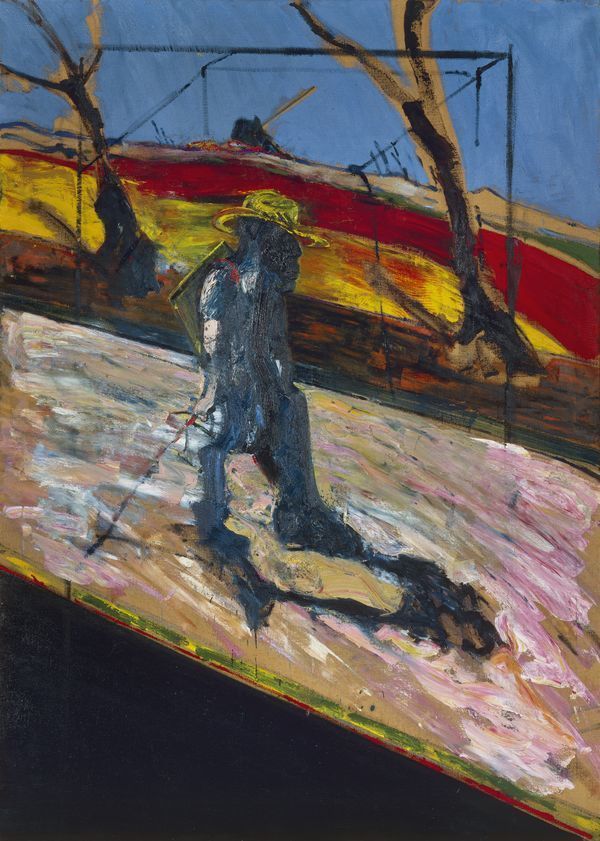
ART GALLERIES By JOHN RUSSELL
A Private Mythology
FIRST place this week must go, on every count, to Mr. Francis Bacon’s new pictures at the Hanover Gallery.
Mr. Bacon’s distinction is this: he is the only living English painter to have
built up in his work the kind of mythology, at once private and universal, which
we recognise at once as urgently related to the world we live in. Not, of
course, that he resorts to the direct and dismal methods of the propagandist; he
moves as a poet moves, and like many dramatic poets, or like Géricault in the
“Radeaude
la Méduse,
The new master-image in Mr. Bacon’s paintings is that of Van Gogh, and at the Hanover there are four large paintings of that master trudging through the countryside. Such pictures can be merely polite reconstructions, like Dyce’s “George Herbert, at Behierton”; but Mr. Bacon’s central figure is identifiably the man of whom Antonin Artaud wrote that he “preferred to become what society calls ‘mad’ rather than forfeit a certain superior Idea of human honour.” In the earliest of the four the face is particularly fine; elsewhere the extreme rapidity with which Mr. Bacon works has led, here and there, to a too-frantic elaboration of the initial imaginative thrust.
AT the Beaux-Arts Gallery Mrs. Anne Said’s drawings are full of a holy quiet which may be welcome to refugees from the Hanover. Mrs. Said has a curiously, and indeed wonderfully, impersonal, manner of ranging at will over even the largest sheets of paper; of the struggle involved in the management of her huge designs no trace remains, and there is instead, a classical lack of emphasis, combined with elements of mischief and affection which make her an artist to be enjoyed, as well as one to be reckoned with. This is her debut in central London, and it deserves to be remarked.
.jpg)
Francis Bacon (centre) and Lucian Freud (right) at last Wednesday’s preview
of Mr. Bacon’s new pictures at the Hanover Gallery. HERBERT K NOLAN
MR. FRANCIS BACON
VAN GOGH TRANSLATED
What, one wonders, would have happened had Mr. Francis Bacon’s latest exhibition of paintings, at the Hanover Gallery, 32A, St. George Street, opened only a few weeks earlier?
The prospective visitor would have squared his shoulders surreptitiously at the entrance to prevent himself flinching as usual at the gruesome nightmares beyond the door, but ounce inside would probably have found that expectation was draining away and a vague disappointment takes its place. Certainly many of the old, familiar faces are still here–the characteristically shadowy remains of them, that is to say–the man in the lounge suit trapped in his glass case, the sphinx, the dog trotting along the gutter; but most of their horrible, fascinating ambiguity is gone, along with the glass which made their secrets so impenetrable. Even those dead, inhuman backgrounds made by staining the reverse side of the canvas are gone: some of these are actually painted on the front.
Both Mr. Bacon’s inspiration and its power over his audience seem to derive from an element of topicality which limits their lease of life. A curtain of forgetfulness, inevitable or self-induced, now shuts off Belsen from our conscious minds: even so recent a reminder of it as the film Nuit et Brouillard was of a horror dreamlike in its remoteness. As the reality of Belsen has faded, the terror of Mr. Bacon’s screaming mouths in claustrophobic vacuums has faded too. The horror of to-day is contained in a different image, shaped like a mushroom cloud, and that is a horror which takes place out of doors and in the broad light of day.
Then, very recently, certainly months after the decision to mount this exhibition, Mr, Bacon suddenly followed up a darker, earlier exploration of the theme with three enormous pictures after Van Gogh which have roused him to an even more brilliant display of painterly virtuosity than did Velázquez’s Pope. It is possible he had seen the current film biography and the camera had again proved the potency it has always held for his imagination?
The pictures show Van Gogh himself trudging to work, painting-kit strapped to his back. But there shines on him not the health-giving sun of his own paintings but, in colours disturbingly similar, a lurid glare of unnatural light, and he himself is a lumbering, charred silhouette who, in No. 13, stops in the road and turns toward us–he, the tormented but ever-loving Vincent–the appalling mask of a radiation victim.
Mr. Bacon once again has us by the throat.
T0 some Mr. Francis Bacon is a highly gifted artist who misuses his talent in deliberate mystification and by his choice of preposterous, horrifying, and often repellent subjects. To others his view of the world as a place of obscure torments and inexplicable alarms is as original and interesting as one of Kafka’s inventions; it maybe impossible to interpret his pictures with precision but each new glimpse of savagery or suffering, though seen only through a veil, has the effect of a disquieting truth.
His new paintings at the Hanover Gallery include four large studies, as he himself calls them, of Van Gogh striding through the country to paint a landscape and here there are few signs of any wilful obscurity. It is true that in all four paintings Van Gogh’s features, as so often in Mr. Bacon’s figures, are blurred and out of focus as if in a photograph taken with a camera which has shifted, but the effect, strangely enough, is to make the image of a doomed and lunatic artist not less but more expressive.
If anyone should have left a ghost behind him it is Van Gogh and it is fitting that in these pictures he should look like a vague and momentary apparition still recapitulating his intense emotional experiences at Arles. It is also noticeable that in these paintings Mr. Bacon has changed his technique; he now uses thick and juicy paint laid on with expressionist vigour, whereas his normal method, to be seen in other paintings in the exhibition, is to paint thinly on absorbent canvas.
Art
Peter Kinley. Gimpel
Massimo Campigli. Mariborough
Bruno Cassinari. Matthiesen
Francis Bacon. Hanover
Julius Rosenbaum. Ben Uri
In four of the recently opened one-man shows,
paintings of single figures or of groups predominate, but the pictures, even
when entitled with proper names, do not draw attention to themselves primarily
as portraits, nor, when the term can literally be applied to them, do they
naturally fall into the category of nudes. Any of these painters could claim,
like a novelist, that each of his characters is, as a whole, imaginary, having
no direct reference to a particular living person. Here the figures are
characters which, being composite, are to that extent fictitious, and the
painters responsible can, in that respect, be considered literary. This use of
fictitious, symbolic characters is more conspicuous in three of the artists
Kinley (Gimpel
In Campigli (Marlborough) the figures
The style of Cassinari (Matthiesen) is more trenchant. The surface has a chiselled look, as though he had been guided in dovetailing the planes by his past experience of the craftmanship of jewelry. But in the paintings the inward glow is supplied by imaginative readiness and certainty, often by that aware-ness (keen but dispassionate) of the texture of the human body which he, like Campigli, seems to have inherited from antiquity.
The fresh aspects of his qualities to be seen
in Bacon
Julian Hall
In Camera
Men
seated alone, wearing the vestments of a pope, or a dark suit and a white collar
and the air of a politician or an executive:
There are some to whom it is happening now, some who will be taken unawares, some who want to be ravished by disaster, some who struggle to push it away, some who wait and dream about their wreck, and some who are obsessed simply with holding themselves together.
Settings
which are luxurious and simple: lush velvet curtains and a gilded armchair. Like
prison-cells for highborn traitors. One sits
awkwardly on a bed as if in a hotel-room where there is nowhere else to sit.
Others are confined in a glass case in the middle of a space as vast as a
cathedral’s. A seated
pope the hem of whose white robe is bespattered with blood
Privacy invaded, and the shadows of invisible observers thrown across the foreground. Somebody seen in a fleeting moment in a world without clocks. Their most usual grimace is a scream, or resembles a scream. Sometimes it seems likelier that they are laughing or shouting or raving or roaring, at other times certain that they are screaming, or trying to scream. It is still not certain whether a sound is actually uttered, and, if it is, whether it can be heard outside.
It is also possible that their mouths are open because they are trying to breathe.
Gestures like those of deaf mutes when they are talking among themselves: sudden, startling gestures which seem peculiarly emphatic, yet leave us wondering what they are about. Gestures, therefore, which confirm the isolation of those who make them. Not least because our instinct is to feel vaguely threatened by them.
When a figure is seen shouting or gesturing like a politician making a speech, we do not feel he is communicating with. attentive multitudes but rather that we have caught him rehearsing, his performance, sometimes under the delusion that it is the performance.
Men behaving as if they thought they were alone. Men behaving as if they thought they were not alone. One of the popes is alone with a tasselled golden cord hanging from the ceiling. His right arm is raised, and bared to the elbow. He seems to have been amusing himself by making the cord swing to and fro like a pendulum.
Then there are those who have given up the pretence. These are discovered without clothes on, bent double like embryos in the performance of gymnastic rites, or pulling aside the curtains in order to get out, or squatting or crawling in jungle grass. They are often on view in this kind of vegetation in a glass case or cage. When, which is rare, there is not one figure but two, the figures are naked and coupled, mounted on a bed, or dissolving in the tangled grass, or upright at a window.
Relevance of the expression, having someone. And of the archaic I die.
A
triptych of heads forming a sort of tragic strip culminates in an image of a
The smearing means disintegration: the face is already "food for worms", the skull seen now "beneath the skin". The smearing means destruction: the face is wounded, shattered. The smearing means obliteration: the face is obscured by the lifted hand, and the hand may be lifted in pain, or to ward off an attack, or to claw at nose and mouth and eyes as if in an effort to wipe them away, to rub out an identity.
The smearing means all this, but what these meanings involve conveys itself before there has been time to become aware of meanings. The meanings, all of them, lie in the paint, and they are in the paint not latenly but in the impact of the paint upon our senses, on our nerves.
Nothing in these paintings is more eloquent than the paint itself.
Paint that brings flesh into being and at the same time dissolves it. Paint whose fluidity conveys the fluidity of all it conveys.
And the vast empty spaces are like the silences of a great actor.
The paint is put on calmly, without violence or frenzy, for all the speed and spontaneity of execution. When Bacon is painting, his most characteristic gesture with the brush is a flick of the wrist made at arm’s length. Clearly he wants to distance himself from what he is painting, not to violate it. He detaches himself from his subject, declines to say where his sympathies lie, to impose his comment on the world he is making, and unmaking.
Violence
threatened, implied, remembered, but never actual violence. Many of the heads
are modelled on the head of the screaming nurse in Potemkin. From this image
Bacon takes the scream
It is the portrait that concerns him, not the event: he does not show what happens, but to whom it happens. The facts of the disaster are withheld.
Plate I.
Plate II. Study after Velasquez. 1951. Destroyed. Photo: Photo Studios, London.
Plate III. Stud2~ for a portrait. 1953-1955. Coll.: Hanover Gallery, London. Photo: Dumage, Paris.
Plate IV. Study for a the human figure. 1954. Coll. : Anthony Denney, Esq., London. Photo: Dumage, Paris.
Cover. Study after the life-mask of Blake (detail). 1955. Coll.: Mr.James Thrall Soby, New Canaan, Conn. Photo: Underwood, London.
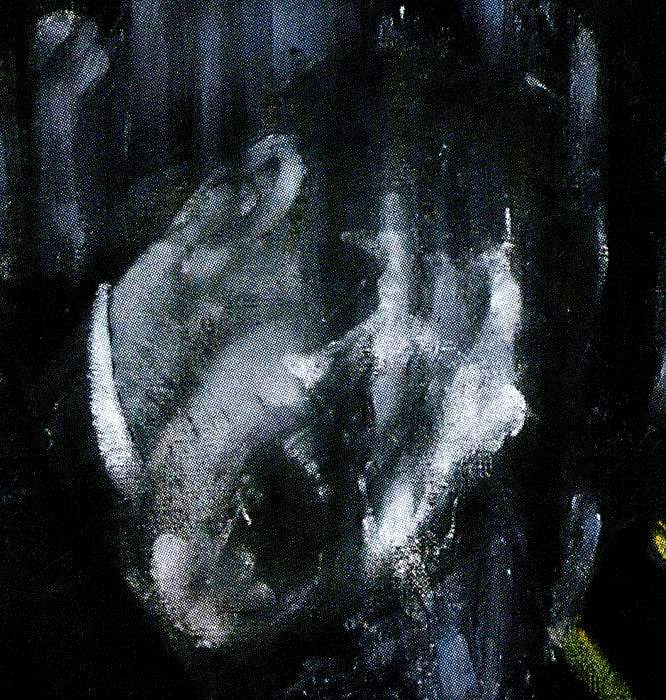
News of Court and Society
On the same evening Mrs. Erika Brausen,
assisted by Mr. Michael Greenwood, gave a party at the Hanover Gallery, of which
she is Director, to celebrate the opening of Mr. Francis Baco
Also seen were Mr. Philip James, head of the Arts Council, Mrs. Lilian Somerville, head of the British Council Arts Department, Mr. Alan Rawsthorne, Mr. Reg Butler, Mr. Lucian Freud, Mr. Robin and Lady Mary Campbell, Mr. John Osborne, Miss Mary Ure and Mr. Anthony Hubbard.
Art
Francis Bacon. Hanover
Mario Seroni. Marlborough
John Armstrong. Leicester
HITHERTO Francis Bacon’s work has seemed to me unique in so far as his figures were, in the literary sense, characters of his own imagining or devising, were extraordinary and challenging, and at the same time presented with the breadth and insight of veritable portraiture. In the first two respects his present show at the Hanover is weaker, but the general impression made by him is as strong as ever. Nothing that was essential to his development has been sacrificed.
In four of the pictures the characters he uses is the borrowed and recognisable one of Van Gogh: Van Gogh starting out for a day’s painting in the fields. Elsewhere in the show, though the characters are again anonymous, they are calmer than their predecessors; their looks do not imply that before or behind them lies some trance-like experience of mind and body, perhaps epilepsy itself. They too are subject to some such experience, humiliating and impossible to control; but it is much less close to them; they are not in immediate dread of it. We are not made to feel that the convulsion is now occurring. The sky has cleared, and life is lifting up its head again. A patient in the consulting-room, a prisoner in a cell: both of these may be suggested by the sitters for the new portraits; but patient and prisoner are not in anguish, are not daunted. Their minds are ticking over; the invisible coils of ticker-tape hanging round them would, if you could see them, be legible enough and accurate. Even Van Gogh, setting out with his easel, can count on a few hours’ work ahead of him before the storm in Nature and in his mind comes back.
With Sironi, now sharing the Marlborough with Campigli — both are old friends from the loan exhibition of contemporary Italians at the Tate last year — the human figure is not used, as in Bacon, to bring before us the dilemma of a particular human being. It appears as a formal element in a design, being used, in conjunction with images of man’s works, to chronicle, as though with hieroglyphs on a scroll, some changes man has made in the conditions of his environment. Here Sironi does more than merely indicate achievements. He records awareness of resistance met with, of time elapsed, of unfulfilled intentions, and of hopes still deferred in the course of their achieving.
At the Leicester, John Armstrong (a younger man than Sironi, an older man than Bacon) makes the gods in his mythological subjects seem like figures we are intimate with, and the familiar household gods in his still-lifes seem on the contrary slightly mysterious, as though belonging to an older civilisation. In both, his classical equanimity and restraint recalls Seroni’s work on the one hand, and on the other Armstrong’s own success, now and in the past, as a painter of murals.
Julian Hall
FRANCIS BACON has previously derived pictures from the Velasquez portrait of Innocent X and from the death mask of William Blake; his present exhibition at the Hanover Gallery includes a sequence of works inspired, apparently, by van Gogh’s picture of himself on the road to Tarascon. This experience has transformed Bacon’s palette, bringing a new brightness, but whereas the colour of the original communicates an intense warmth and gives the impression of a figure happily wrapped by his surroundings, here the pure colour communicates a sense of cold loneliness. The prototype has also provoked a sort of parody of its handling; the very modern turbulence of the handwriting reminds us that van ’Gogh has been the most important source of the rough surfaces which are now so oppressively fashionable. Von Gogh was the very epitome of the autobiographical artist who transforms every experience into the terms of his own developing personality, but his legend is liable to obscure the fact that the force and energy of his work come from his constant preoccupation with pictorial problems, that the pictures do not so much convey the stresses and antagonisms within himself as bring that struggle to a point of resolution and clarity. Bacon looked at the Velasquez as a spectator discovering what only the passage of centuries and historical differences could inspire and left out what is most impressive in this as in all great portraits, the disturbing contact with the imaged presence of a human creature; Velasquez was a great biographer. ,Bacon, like van Gogh, is an autobiographer and like him he paints with a naive immediacy, but whereas the intensity of the latter emerges from a fight to balance feeling, perception and method, Bacon, as the author of the journal of a disturbed man, is simply obsessed by the need to get certain images on to canvas. Some of the pictures here which rehearse earlier subjects have been painted, one feels, too late, others like the van Gogh series too early; they seem to be the expedients through which the experience has been externalised. All of them are obscure and their success with those spectators who can respond to them must be as personal as their secret origins. If one does not respond automatically to their imagery, the pictures are likely to seem a dilution of significant experience rather than an eloquent projection of it.
One reason for this, perhaps, is that these are private pictures built to a public scale. Here and there in the large expanses of canvas are fragments in which the intensity has been snared and kept, surrounded by large areas ineloquently filled in. Intensity of experience—see Cezanne as well as van Gogh—must be matched by an exceptional creative stamina. And so, as always in the past, I have admired those fragments, a loving dog, bodies swathed in grass, where the alliance between feeling, object and paint has been sealed.
The Arts
FRANCIS BACON
By Denys Sutton
DENYS SUTTON | THE ARTS | THE FINANCIAL TIMES | TUESDAY, APRIL 16, 1957
Mr. FRANCIS BACON, who is now in his late forties, has become one of the heroes of the hour. Spirited and temperamental, he has always been a law unto himself, as those who know him will attest; and he has chosen themes that will respond to his needs, irrespective of the conventions, pictorial or otherwise. Moreover, he is one of those artists who have the power of influencing their contemporaries, among others Mr. Sutherland and Mr. Louis La Brocquy.
Mr. Bacon’s impact is largely due to the unusual nature of his themes. His ability to disturb is well maintained in the present fascinating exhibition at the Hanover Gallery which must be certainly examined by anyone eager to plumb the spirit of the day.
*
The curious tinge that colours so much of Mr. Bacon’s subject matter indicates that he belongs to a specific artistic trend. His position in the art of our time is much easier to define once his work is placed in relation to that, say, of the Florentine Mannerists, Fuseli, Böcklin, Rops and Martini. In short, Mr. Bacon is the heir to the Romantic Agony, the ramifications of which during the 19th century were powerfully diagnosed by Professor Mario Praz in a remarkable volume. Once we accept the proposition that the most secret sides of human nature are grist to the mill, then the queerest of Mr. Bacon’s themes can be accepted.
As a true Mannerist, Mr. Bacon favours shocking and “terrible” images. Whether or not they give off the requisite “frisson” largely depends upon the spectator’s own susceptibilities: there are no rules in art, and there are no rules in appreciation. But for those who admire the noble and the harmonious and who shun the nightmare world of private tortures and perplexities, Mr. Bacon has nothing to offer, unless it be the confirmation of their wish to bask in the sun.
Mr. Bacon himself has often been impaled by a nagging dilemma; that of knowing how to say what he feels about life. And one could argue that he was most himself when most imprisoned by the pressures of his imagery: once out in the open, the mystery that lurks in any conundrum necessarily evaporates. His most telling pictures have been those in which the force of his obsessions has found not a clear literary but a tantalising artistic expressionism.
The ambiguity and complexity of his mind has often led him—as it led Gustave Moreau before him—to couch his sentiments in an oblique language. He has used metaphors and analogies, turning to the cinema too for some of his technical devices (as Mr. Sylvester once remarked); and he has taken the findings of one of the most restrained and refined masters of portraiture, Velasquez, as a springboard for his fantasies, as if, “Dadalike,” intending to cock a snoot at tradition.
His involvement in his own myths and emotions and his concern for the immediate impact of his statements, whether direct or oblique, as the case may be, have on the whole induced him to neglect the possibilities of colour—the stuff of painting itself. He has played with muted tones and with combinations of whites and pinks, offset by black backgrounds, funereal in their evocations. Here one weakness is apparent in his work, his failure to impart visual quality to the whole span of canvas used; to peer close at the backgrounds of his pictures is to be met by a wall that does not give off any pleasure to the eyes and which, once dissociated from the image, possesses little meaning.
This reduction of the composition to one focal point of interest may well be intentional; but it certainly lessens the artistic value of the picture. Not that earlier artists have failed to present their images against uniform backgrounds—but with one difference; for the Dutch maters of the 17th century, for Whistler too, an empty space, composed of almost unique colours, became an exercise in tonal values existing in their own right.
*
Mr. Bacon is evidently aware of the limitations that mark many of his pictures; to use an analogy culled from the tables, he has staked so much on the “noir” that the “rouge” has been left to take care of itself; as a result the “rouge” has rarely, if ever, turned up. What is more, the significance of the “noir” (the image) has been lessened through familiarity; once the initial impact is digested one begins to question and even challenge, the means with which it has been secured.
His decision, therefore, to alter his approach and to espouse colour is comprehensible. In the series of studies for the Portrait of Van Gogh, the emphasis is placed on a lavish squeezing of colours—red, blues, yellows—on to the canvas in order to endow the results with an effect reminiscent of Van Gogh, Soutine and the Expressionists. Yet does Mr. Bacon command the skill necessary to carry off his venture? It may be felt that the one quality which he did not possess, subtlety, has now departed. Again, his wisdom is presenting canvases that are “drafts” for a work in progress is debatable: the finished product would seem to require that degree of mediation which is surely absent from the studies.
Mr. Bacon’s present style is a reflection of the problem facing many artists when one vein has been exploited to the full. In effect, his problem is to discover a means by which the shrill linearism of his early canvases can develop into full-blooded colourism—a test that demands an exact eye. The final result when and if it comes may well disappoint those of his admirers to whom he has always seemed the poet, rather than the painter, of Anxiety. But his attempt to evolve will arouse the sympathy of those who, while respecting his usual themes, his evident feeling, his imagination even, have not been entirely convinced of his ability to handle paint itself—the sure means of translating a cerebral image into a picturE.
Good taste
. . . REMEMBER that wives, good-taste girls nowadays, have more than a smattering of contemporary culture-names at the tips of their well-groomed fingers. Currently you can scare yourself out of your wits with Francis Bacon’s paintings at the Hanover Gallery, and find out about Tachisme and Metavisual Art (and even, perhaps, succeed in distinguishing between them) at the Redfern. Nor need you feel obliged to limit yourself to a marshmallow diet of musicals and Agatha Christie. The Reluctant Debutante herself was seen at the second night of Mr. John Osborne’s The Entertainer.
POST-WAR PAINTINGS OF THE NUDE
GALLERY ONE EXHIBITION
Firmly dismissing from the mind all thought of Botticelli, Titian, or Rembrandt, one may find lively interest in the diverse methods of treatment and attitudes of mind shown by the 16 postwar paintings and drawings which form the current exhibition. “The Contemporary Nude,” at Gallery One. They might, however, have been selected to illustrate how far the human figure has lost its old importance for the modern artist and show what a problem of uncertain solution it has become.
In a number of these works the nude appears in a tentative and shadowy fashion as a half-recalled element of painting’s past intruding on other and “non-figurative” aims. Mr. Louis Le Brocquoy, for instance, in “Woman No. 31,” presents what might well be taken simply as an essay in paint quality, and it is not without difficulty that one discerns a faint suggestion of head and spine.
In other works the figure is a much tortured object, reduced to a primitive puppet-symbol. The “nudes” of Jean Dubuffet and Enrice Baj, while they have a gay or demoniac vividness of their own, might just as well be clothed as unclothed for all one can tell to the contrary. What is fascinating in two compositions representing Mr. Sidney Nolan and Mr. Francis Bacon is rather their mystery of décor than the physical aspect of the figures which appear in them.
Somewhat apart from the other exhibits, Mr. Jack Smith’s “Nude” is a large-scale exercise directly inspired by the figure and with a single-minded and serious approach.
PORTRAIT GALLERY
In the last ten years the name of Francis Bacon has come to stand for the most disquieting of living English artists. The Royal Academy has not yet asked him to be one of its number; if it should ever do so, there might well be white faces at the private view, for Francis Bacon has invented in his painting a demonology more appropriate to “The Revenger’s Tragedy” than to the “Essays” of his first-Elizabethan namesake.
He was born in Dublin 47 years ago, but has no Irish blood. (His father, an Englishman, happened to breed horses there.) No art-schooling, and indeed no schooling at all, to speak of, though his questing, imperious and unprejudiced intelligence would do honour to the most ancient Foundation.
Since 1927 he has lived all over the place—in Berlin, where he first tasted that ferocious metropolitan life which has provided him with so much of his imagery; Monte Carlo, where the drama of the landscape accords with his predilection for the gambling room; and in London, where he has a small flat in Battersea and leads an impulsive, open-handed, noctambular existence.
. . .
NIETZSCHE has always fired his imagination, and there is much in him of the energy that crackles through the brief unsettling maxims of “The Will to Power.” Energy speaks in the acrobat’s walk the downward pounce upon all that takes his fancy, and the gasp (for years he suffered grievously from asthma) that interrupts the tumultuous coherent sentence.
In his thirties he painted off and on, self-taught, “to see if he could do it,” and in 1946 three “Studies for a Crucifixion” were put up, unannounced, in the Lefevre Gallery. Since then his every picture has made a stir, and his personages—the after-Velasquez Cardinals, the faceless Thing in the undergrowth, the demented man of business and the mongrel dog in the gutter—have become a part of modem legend.
. . .
THIS success he meets with an aristocratic disdain: “If I have another ten years,” he says, “I might get to be good.” Nine-tenths of his production he destroys; and those who have sat to him for his idiosyncratic portraits report (and our photograph bears out) that the studio floor is deep in ephemeral printed matter; the enormous pictures, face to the wall, bear witness to the rage for work with which he completes a six-foot-square canvas at one session, and the ancient curtains are livid and crusty from his habit of wiping his paint-filled hands upon them.
This week he leaves England to spend the summer in Tangier. His object? Nothing less than to paint, in his own terms, “the history of the last thirty years.”

OFF BEAT
Invitation to The Sink . . .
IT IS ONE of those off-beat drinking clubs in Soho — a small red-painted room on the first floor, reached by a flight of musty-smelling, shabby brown-linoed stairs.
It Is known as
“The
Sink,”
although the lettering over the hallway spells
Just who is meant by
The guest list was impressive — almost a Who’s Who of poets, painters, and various other high-born dabblers in art and literature. Graham Sutherland, Lucien Freud, Francis Bacon, Rodrigo Moynihan, the well-known painters.
Stephen Spender, Christopher Isherwood, Cyril Connolly, the longer-haired writers. The Marquess of Bath, Lord Grantley, Lord May, Colin Tennant, the artistos with artistic leanings.
Miss Belcher, on the other hand, was not so impressed by her clientele.
Miss Belcher, who comes from Birmingham, is, you will gather, what is known as a character, a card, or a caution.
Miss Belcher didn’t care whose line it was originally. From now on it was going
to be hers.
She tried it out for style on Lucien Freud and Francis Bacon, who were standing nearby. They hadn’t heard it before, either.
Obviously, the habitués of
I eavesdrop on a couple of conversations in the nearer vicinity. Two suede-jacketed types were discussing Racine’s Phèdre.
Said one:
A brainy-looking girl carrying a copy of Beowulf was
explaining :
Politely I declined, adding that such talk was way beyond my limited understanding.
MINTON PAINTING FOR THE TATE
A MODIGLIANI WORK ALSO ACQUIRED
The Tate Gallery has recently acquired several examples of twentieth-century
painting, drawing, and sculpture. The painting “Portuguese Cannon, Mazagan,
Morocco” by the late John Minton has been presented in his memory by the Royal
College of Art, and the executors of Michael David Agnew Evans have given a
portrait by Sargent of
Drawings presented to the gallery include the well-known pen sketch of Diaghilev by Larionov, presented by the artist; John Bratby’s large chalk drawing of “Susan Bellam," presented anonymously; and a chalk drawing and a watercolour by Gwen John, “Girl’s Head (Arabella)” and “Cat,” presented by Miss Mary Constance Lloyd. “Caryatid” by Modigliani has been accepted as a gift from the Contemporary Art Society. Another work by Bratby, the large oil “Windows, Self Portrait, Jean and Hands,” painted earlier this year, has been purchased by the trustees. Matisse’s bronze “Nu de Dos III” has been purchased with the aid of donations from the public: the Tate GallerY now owns the complete series of four reliefs.
LOANS TO GALLERY
In addition to these acquisitions, three contemporary paintings have been lent to the gallery for about two years. Two, lent by Lady Caroline Freud, are by Francis Bacon, “Head of William Blake” and one of the “Cardinal” series. The third, which has been lent anonymously, is “Les Indes Galantes” by Nicolas de Stael.
The gallery’s representation of seventeenth-century portraiture has been augmented by the loan of a double-Portrait by Gerard Soest, the property of Lord Waldegrave. This painting, which has never previously been exhibited, was at one time attributed to Jacob Huysmans, and it is only since cleaning that it has been recognized as one of Soest’s most striking works.
* Picture on page 20.
Bacon’s subject
CECIL
BEATON, the royal photographer, is having his portrait painted. The artist he
has chosen is Francis Bacon, the extremist modern painter whose works have, at
various times, been described as
Says
Bacon:
TWENTIETH-CENTURY PAINTING
The Moderns and their World
Introduction by Sir John Rothenstein. Phoenix House. 30s.
“Interest
in modern painting grows apace,”
the publishers announce on the dust-jacket of this volume which proclaims itself
a companion to The Impressionists and their World issued four years ago. Now
these two volumes have been conceived with the express purpose pose of giving a
conspectus of the best modern art for a non-specialist public and are boosted as
being of remarkable value. The present volume is described for example, as
Had these claims been substantiated as they well might have been
then the book under review would have fulfilled a long-felt need. Unfortunately
however there is no connexion between the reality and the claims made for it. To
begin with, the publishers
—
since Sir John carefully lays at their door the responsibility for having
selected all the plates
Many artists, therefore, who have made genuinely significant
contributions to the development of twentieth century century painting or who
can validly claim to be considered as the most representative exponents of
characteristic modern tendencies have been omitted, for example Henri Rousseau,
Marcel Duchamp, Balthus, de Stael, Guttuso and Buffet. And the irony of this
becomes the more bitter when one discovers that a place has been found for
others such as Modersohn-Becker, Pechstein, Campigli and Wyndham Lewis, whose
lack of creative talent has always militated against their being accorded a
place in the front rank. The present reviewer at any rate must confess to having
failed in his attempt to determine mine some principle other than opportunism or
chance which has governed the choice both of artists and of their works for
inclusion here. For example, there is neither a fauve painting by Matisse
the originator of the style and leader of the movement nor yet one of his major
compositions positions: there is no satirical work by Rouault of the great early
period on which his reputation is based, but only two
bondietiseries of the 1930s; there is no painting of the
great period of Cubism by either Braque or Picasso; indeed, the only Cubist work
included (since Gleizes, Metzinger, Marcoussis and de la Fresnaye are excluded)
is Juan Gris’s
It is thus no exaggeration to say that whole chapters of contemporary
art history
—
and
those the most important
—
have
been left out for one reason or another. To which criticism may be added
another, namely, that a high proportion of the paintings reproduced cannot
possibly be described as
Naturally, the uninitiated will turn eagerly to Sir John’s introduction for enlightenment on the meaning of it all. They will be disappointed. For this lengthy text meanders politely but without reference to the plates from an encouraging opening statement that
modern art is something whose modernity contemporaries have been aware of in a manner perhaps unparalleled paralleled in history
to the despairing and erroneous conclusion that
there is no organic development of modern painting according to some immanent logic and dynamism; there are the works of a succession of highly gifted and original painters.
Sir John admits that when confronted fronted with
BATH FESTIVAL AGAIN
EFFORT TO MEET ALL TASTES
This year’s Bath Festival, which is to be held from May 29 to June 7, will be sponsored by the Orchestral Concerts Society Ltd., in association with the Bath Fund Committee and the Arts Council of Great Britain.
The festival will be opened in the grounds of the Abbey at midday on May 29 by Sir Mortimer Wheeler, and there will follow later a service in the Abbey. Three concerts will be given in the Abbey, at the first of which Mr. Yehudi Menuhin will play the Beethoven Violin Concerto. The Choristers of the Abbey will also participate in this concert.
The other two concerts will consist of a recital by Miss Hephzibah Menuhin and her brother, and a performance of Bach’s B Minor Mass with the City of Bath Bach Choir. Eight concerts and recitals will be given in the Guildhall and the Pavilion, and the soloists will include Miss Ingrid Haebler, Mr. Isaac Stern, Mr. Shura Cherkassky, Miss Rosalyn Tureck, Miss Elizabeth Schwarzkopf, Miss Hephzibah Menuhin, Miss Jacqueline Delman, and Mr. Gerald Moore.
Orchestras participating will be the London Philharmonic Orchestra, the London
Symphony Orchestra, the London Mozart Players, the Goldsborough Orchestra, and
the Raymond Leppard Orchestra, Inge Sand and a group from the Royal Danish
Ballet will give eight performances in the Theatre Royal and Sir John Gielgud
will present
In addition there will be a Festival of Jazz consisting of a series of promenade concerts and lectures with illustrations, during the course of which the bands appearing will be those of Ken Colyer, Humphrey Lyttleton, Chris Barber, Mick Mulligan and Johnny Dankworth. Victor Silvester and his Orchestra will play at a masquerade ball to be held on June 6.
There will be several non-musical events including an Art Treasures Exhibition, arranged by the British Antique Dealers Association, an exhibition entitled “Three Modem Masters” – Matthew Smith, Victor Pasmore and Francis Bacon, at the Victoria Art Gallery, and at the Holbume of Menstrie Museum there will be shown “French Impressionist Paintings,” lent by Lord Radcliffe.
JAZZ FESTIVAL WILL
SHAKE BATH’S DIGNITY
POST REPORTER
By far the larger is the Festival of Jazz which will run alongside the classical concerts in the second week. The other is the exhibition of the work of three modern British painters at the Victoria Art Gallery.
After a conference in London yesterday, Mr. Ian Hunter, the impresario, told a Bristol Evening Post London office reporter: “The whole idea of the festival is to make the city en fete. We want people to feel there is something going on in the city and that there is something for everybody.”
Mr. Jack Higgins, who is organising the jazz festival for the Regency Ballroom, where it will be held, explained that it will tell the whole story of jazz, and this will be the first time it has been attempted in this way in either this country or America.
The exhibition of three modern British masters
A collection of ten paintings destined for an exhibition which is due to open at Liverpool to-day are held up in Turin by the Customs. The paintings are by Francis Bacon and are worth about £5,300.
A spokesman at the New Shakespeare Theatre, where the exhibition is being held, said the delay was accounted for by the careful scrutiny made in Italy “to prevent old masters being smuggled through by subterfuge.”
Those who feel that the waywardness of the world is sinister enough to accept psychopathic morbidity about it as wholesomely symptomatic rather than unnaturally perverse, will long ago have accepted Francis Bacon’s painting lock, stock and linear box. To them the little gathering of locked-up figures at present inhabiting the New Shakespeare Art Gallery, Liverpool, will be not more or less horrific but simply better or worse Bacon.
It would be nice to achieve completely disinterested judgement, but this painting is too disturbingly human, too terrifyingly actual, for this. We feel how frighteningly closely his creatures might, but for the grace of God, be us, and it gives the painter a tremendous fount of power. But how much of this is delusion?
One of the paintings is an acknowledged self-portrait; what of the other men on trial in their half-realised, unfightable boxed docks, men of the half-mad laugh, unconvincing bravado, unutterably final defeat? Are these not Bacon too? Of course they are, and with relief we can say: there but for the grace of God goes Bacon, and he does not like us, or himself, very much. In doing so we get things the right way round.
In the same gallery are five small bronzes, including one of the intriguing “Helmet Heads” and a recent tiny, timeless creation, “Animal Head” which, with three sheets of drawings, make up Henry Moore’s part of the show.
Decadent Portraits
FRANKNESS at the Roland, Browse and Delbanco Gallery in Cork Street labels the exhibition which opens today “The Dying Art.” It shows about 40 examples of 20th century portraiture.
Among our native painters Francis Bacon, his hand to his head, has a powerful, even alarming self-portrait. Sir Matthew Smith’s Augustus John, in which the ruling tone is red, is easily outdone in redness by Philip Sutton’s “Portrait of a Man.”
Anthony Whishaw, still in his twenties, has a colossal and able portrait of Mr. Kingsley Martin in monochrome. Another monochrome of an intellectual is Graham Sutherland’s Mr. Edward Sackville West.
Compared with any of these, Sickert’s Maurice Asselin, painted in 1914, is positively serene.
Inset is one of the portraits in sculpture, the work of the fashionable Italian Umberto Mastroianni. Many of the portraits have photographs of their subject beside them. The camera, which cannot lie, makes them look happier than they do in paint.
THE NEW ART OF PORTRAITURE
Only flattery allowed
The invasion of the realm of portraiture by experimental painters may provide sensation and perhaps amusement; but it may threaten the bread and butter of the invaders.
Portraits which do their job of showing what people are like have been firmly established for at least 1000 years. Art students may lark about with the features of models, provided at public expense, but the person who pays good money for a portrait of himself, his wife, or his children expects it to resemble them.
The more profitable field of
presentation portraiture, dominated by public corporations and institutions,
insists on recognisable features. The painter entering this field is under an
obligation which he betrays at his peril. To him, female portraiture
particularly will be dynamite. The one respect in which licence some is
allowed-a of probably expected-is touch flattery. Two exhibitions within 200
yards of each other illustrate these points.
The first of these, by Terence at the Royal Water Colour Society’s rooms, is comprised of portraits and pageant pieces to commemorate events or people. They are painted with an astonishing degree of skill and. occasionally, something more. Viscount Allendale and his Coronation page, George Andrew Beaumont, constitute one of the pendants to a historical event. Both have a sense of the occasion and could be readily identified. They are colourful and pleasing.
At Roland Browse and approach to the whole problem is startling. The show is called “The Dying Art: Portraiture in the 20th century.” I discussed this apparently suicidal statement with Miss Browse, one of the directors of the gallery. “How do you find that people regard the question of sheer likeness? Do they like the more contemporary approach?”
She was frankness itself. “They ask for someone who paints in a contemporary style: but, when they get it, they generally do not like it.” Ironically enough, the gallery has asked from sitters or artists (often the same person) copies of photographs to show alongside the portraits. The result is amusing. Most of the sitters favour the photograph which shows them as good-looking creatures.
The vigorous portrait of Horace Brodsky is a case in point. The salient modelling of this remarkable face and the strong, revealing lines of innate pride make a striking interpretation of a man well known in art circles since Gaudier Brzeska painted him in 1913. The artist left France to escape National Service, returned there when war broke out, was instantly arrested, escaped to Britain, returned legitimately to France again and was almost immediately killed in the First World War.
Vitality
His work seems an epitome of his
active life. He saw the salient planes and important directions.
Oscar Wilde seems to be recreated
in the “Self portrait with a Flower” of the Australian Sidney Nolan
Graham Sutherland, in restrained
The gallery has not made out its
case that portraiture is a dying art. but has produced a very varied and
provocative show, giving strong evidence that most people like a portrait of
themselves to be just a little more attractive than they really
G. S. S.

Is the art of portraits dying out?
THE head of Mr. Kingsley Martin, twice as
large as life, leans oppressively from a 6 ft.-high painting dominating the
exhibition called “Portraiture, the Dying Art,” which is open until July 19 at
Roland Browse & Delbanco’s Gallery, 19, Cork Street, London, W.1. Anthony
Whishaw, the 28-year-old artist who painted it specially for the show, obviously
doesn
Is it true that..?
Is the art of portrait-painting really dying as fast as the exhibition makes out? Eight of the 18 paintings in the main gallery are by artists already dead; 11 were painted over 30 years ago.
Under this title the implication is that nothing new could be found that was worth showing.
The first three pictures in the show, recent works by Sidney Nolan and Francis Bacon of themselves, and Z. Ruskowski of the sculptor Henry Moore, demonstrate that portraits are literally disappearing into the background.
Nolan, the Australian painter now living in London, peeps from behind a curtain of streaky paint: Bacon floats in his own invention of vague, dark hints: and the head of Moore is set in complicated surroundings.
But these, at any rate, show that the twentieth century has produced one new kind of portrait.
Recent conventional portraits are represented most notably by the seated figure of the Hon. Edward Sackville-West painted by Graham Sutherland in 1955, a head of the young sculptress Elizabeth Frink by Robert Medley, and a small portrait of a man by Henry Inlander.
it is true
It is true that some of the most interesting portraits have been by artists who, like all those represented here, are not whole-time portrait painters. This is particularly noticeable at the present time; but an exhibition with this title would surely have been more to the point if most of the pictures had been painted recently.
WHY THIS CRITIC’S CHOICE?
Trying to find the reasons
The writers on art who have, on previous occasions, selected for Arthur Tooth and Sons the pictures that have formed the series of exhibitions called “Critic’s Choice” all supplied interesting essays explaining their grounds for choosing as they did. For some reason David Sylvester, the most recent critic to assemble an exhibition at Tooth’s Gallery, has not done this. It is a great pity, for his choice is, in some ways, a very curious one, and it would be exceedingly interesting to know the reason for it.
Frank Auerbach, for instance; what can Mr Sylvester see in Frank Auerbach? This artist makes a mud-coloured slurry with sand in it and stirs it feebly about with a stick. Sometimes he becomes “figurative” and produces weak little profile heads in a sort of rough-cast “barbola” work. I, for one, have no idea why he was included in this exhibition. Mr Sylvester, who knows the answer, should have told us.
The case of Francis Bacon is a little different. It is not “why Francis Bacon?” but “why these pictures?” This artist has produced some striking images of studied ambiguity and horror. The best of them have been widely accepted as remarkable symbols of the anxiety of our time. But the pictures in this exhibition are the weakest echoes of the powerful inventions of a few years ago and, unfortunately, show how scanty are the resources Francis Bacon can fall back on when the springs of horror run dry.
William Coldstream is a very sensitive and accurate draughtsman, academic in the best sense of the word. Mr Sylvester must have such a passion for sensitive and accurate academic draughtsmanship that he is willing to forgo most of the other elements of picture-making for its sake. These are very serious, very sensitive oddly empty canvases.
The other artists are Rodrigo Moynihan (in his latest, tachiste, phase); Victor Pasmore, the constructivist, with one attractive little canvas (hung inconspicuously on the stairs) that reminds one of Pasmore the painter; Alan Davie with a female totem-image and an unusually incoherent piece of visceral romanticism; Paolozzi and Armitage, the sculptors, with characteristic works; and Roger Hilton, whose paintings, abstract but with a feeling of living movement, escape from the curious atmosphere, meagre, tired, and cold, that seem to hang over most of this exhibition.
A Critic’s Choice of Pictures
THE ARTS
“Arranging exhibitions,” writes Mr. David Sylvester about his anthology of painting and sculpture, the fourth in the “Critic’s Choice” series, at Messrs. Tooth’s, 31, Bruton Street, “is a much more satisfactory form of art criticism, it seems to me, than writing about them.” Good as his word, he refrains from making an apologia in the catalogue, and, having stated succinctly what his two rooms stand for, he throws the ball to us.
The effect is disconcerting insofar as Mr. Sylvester’s chosen artists seem, in more than one instance, to be unworthily represented. Neither Mr. Francis Bacon nor Mr. Alan Davie is shown in his best form. Mr. Roger Hilton’s excursions into a new range of shapes and colours appear, at least in this context, to have lost the robustness that was evident at the I.C.A. a few months ago, and Mr. Kenneth Armitage’s “Figure lying on its side” is one of those occasions when a quaintness in the conception over-shadows this sculptor’s more serious and interesting pretensions.
But more to the point than such incidental disappointments is the critical attitude reflected in the exhibition as a whole. Here a central predicament seems to communicate itself in an uneasy grouping. The predicament is that of the critic bound by the terms of the exhibition to show living British artists who is yet anxious to set standards of reference which are international.
For whether we like it or not, the fact can scarcely be denied that the “mainstream,” as Mr. Sylvester calls it, of artistic endeavour runs to-day through abstraction and expressionism-not necessarily, though usually, in conjunction. Nor can it easily be denied, as Mr. Sylvester again implies, that British artists do not readily belong to the “mainstream.”
Abstraction and expressionism therefore set the tone of the selection, particularly in the second room. But in thus endeavouring to lay the old ghost of British provincialism in these matters, Mr. Sylvester almost seems unwittingly to have reinvoked it.
For compared in imagination with a selection along the same lines of French or American artists, the room which contains the work of Mr. Hilton, Mr. Moynihan, Mr. Davie, and Mr. Auerbach lacks, most notably, the fluent professionalism and ease of expression which would distinguish the other, and has replaced these qualities with a sort of stumbling sincerity which can encompass a fine aesthetic sensibility but rarely the entire conviction that it speaks in native and not adopted accents.
It is, therefore, perhaps on the grounds that intentions rather than achievements are being honoured that one must understand the inclusion—otherwise almost inexplicable—of the dotted brown paintings of Mr. Frank Auerbach.
That the field of selection is in any case narrow is indicated by the reappearance both of Mr. Davie and Mr. Victor Pasmore, who figured in Sir Herbert Read’s anthology two years ago when the accent was again on abstract art.
Mr. Moynihan has been re-recruited to the cause since then, and his delicate manipulations of colour could be expected to earn a place. But the most wholly successful single item in this part of the exhibition is surely the richly encrusted, monstrously alive sculpture by Mr. Eduardo Paolozzi.
The four paintings of nudes by Professor Coldstream, though illustrative, along with the work of Mr. Pasmore and Mr. Bacon, of Mr. Sylvester’s recognition of an “individualistic, idiosyncratic” vein that is “peculiarly English,” in fact stand aloof from all their neighbours. As in many another work of strictly classical aims, the discipline and effect of these Paintings, traceable in the undisguised marks of measurement about the figures, conceal beneath a first impression of cold, academic pedantry a feeling for the monumental no less weighty for being delicately precise, and an awareness of the quick, living flesh no less sensual for being controlled.
MODERN BRITISH PAINTING
Diversity of style
Many Arts Council exhibitions are good, not because they seem to have a special kind of carte blanche into private collections but because there is enthusiastic purpose at the outset and shrewd choice in the final selection of the things they put up for us to see. The present show of paintings by Matthew Smith, Francis Bacon and Victor Pasmore, at the City Art Gallery, Manchester, for four weeks, is no exception: its aim is not simply to show us three of the best-established British painters, but to show us how they arrived and something of what they did on the way. Whether there is deeper intended purpose in the show’s arrangement is not clear. One visits Matthew Smith, then Pasmore, then Bacon, a progression not only from senior to junior but also, as it were, from symphony through lieder to a scream. It seems likely that any suggestion of direction in British painting that this gives is both entirely accidental and entirely false. It does, on the other hand, show quite dramatically the diversity of style at the top, and tacitly gives us the key to an understanding of the present vitality of painting in the West.
Perhaps it is not really surprising that of the three groups of paintings that of Mathew Smith should seem by far the choicest. To be kind one might say that the others have farther to go, but they possess nothing of Smith’s single-minded concentration on one approach to the problem, or the same fluent and wonderful gift for making colour work at its maximum intensity. The kinship between early paintings like “Dulcie” (1915) and recent portraits like that of “Diana Marsh” (1954) is quite extraordinary; the differences only those which lie between very near and absolute completion. But between them, too, lies a lifetime of painting, and here one can see carefully chosen pieces which are individually milestones of chromatic genius.
Beside them Victor Pasmore seems pale; his gifts, tending always toward calligraphy, seem wilfully stunted, his achievements those of a remarkably talented rolling stone, who will only spring to full stature when and if his round of experiments are completed. At the moment there is no sign of this happening, but the works here show graphically his transition from romantic, impressionist naturalism, to rectilinear pattern, spiral motif and releif structure. In each case a painting of transition is shown and many will regret the stylistic logic of “The Toilette” (1947), the point of departure from his first style.
Francis Bacon, of course, has shifted less. His movement from loud to very loud and large assaults upon our sensibility is well demonstrated, and those who like it will be pleased. The most recent work shown, a portrait of Van Gogh, links both with his pre-war style and with a few recent rich landscapes, which are unfortunately not represented. But there is evidence that he is on the verge of painting, instead of shouting, and to most of us that would seem to be a good thing. But quite surely everybody who sees this show, whether they like Bacon or not, will agree that it is one of the best Manchester has seen for quite a long time.
P.A.T.
“The Art Game” On Television
VIEWERS in Reading and Berkshire have reported favourably on the direct reception of Southern Television which began on Saturday. The pictures, in the main, have been comparable with those from London, and there is every indication that in the not too distant future many in this part of the country will regard Southern Television Centre as their principal station.
Associated-Rediffusion are introducing a most interesting programme on modern painting and sculpture — subjects which many of us find difficult to understand — and from advanced information the presentation should be entertaining. “The Art Game,” which is described by director Rollo Gamble as “The Adventures of an Innocent in the jungle of the art world” is offered to us on September 9th.
Says Rollo: “To the layman or the average man in the street, modern art is bewildering. One feels that the gap between the painter and the public is wider than it has ever been before. Painters seem to be painting for other painters — in the programme we are going to find out if this is really so.”
Among the people to whom interviewer Dan Farson speaks is Francis Bacon, one of the most radical of modern artists. Bacon started painting after visiting an art exhibition Paris and admits that he paints “entirely to amuse myself.” Others who will appear in the programme are art critic David Sylvester, portrait painter Cowan Dobson, and the proprietor of a Soho restaurant where artists forgather.
Some examples of modern painting and sculpture have been filmed for “The Art Game” at Gimpel Fils, the art gallery in South Molton Street, London, and at the Institute of Contemporary Art.
The Establishment is the name given to a body of people who are alleged to have real power in this country. Such people as the Archbishop of Canterbury, the editor of “The Times,” the Warden of All Souls’ College, Oxford, and senior members of the Civil Service, who are bound together by a well-meaning desire to see that England is run of the right lines.
Teleview
I doubt if many viewers believed him. By then we had been shown a man clad in
knight
We had heard one of the self-styled
We had also listened to an expert declare, after heavy deliberation, that a
chimpanzee is perfectly capable of painting a picture that would be
Why, Mr. Farson wanted to know, did so many people feel hoaxed when they visited
exhibitions of modern art? Francis Bacon was ready with an answer.
I thought the artists came out of this skilfully conducted programme rather well. But they offered small encouragement to potential newcomers to the Art Game.

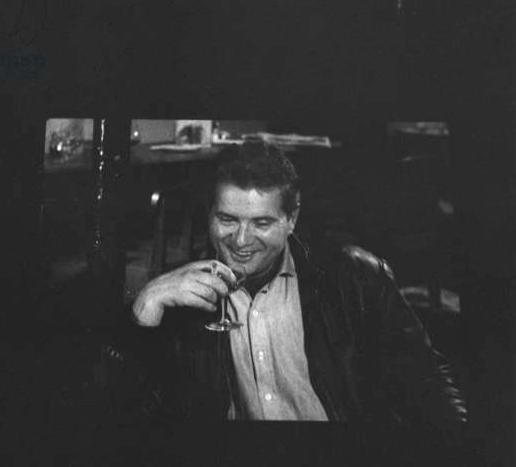
The exhibition Three Masters of British Art — Sir Matthew Smith, Victor Passmore and Francis Bacon — opened at Cheltenham Art Gallery on Saturday and will remain until October 18 as part of the Cheltenham Festival of Art and Literature.
This is the last opportunity that the public will have of seeing the exhibition, arranged by the Arts Council, for it will then end its provincial tour and the pictures will be restored to their owners.
Sir Matthew Smith is represented by 18 pictures covering the period from 1915. They range from a nude painted in 1925 to Cornish landscapes and still life. Francis Bacon is represented by 14 works. Among them are two of his Cardinal paintings and a study for a portrait of Van Gogh.
The Victor Passmore contribution might well have been the work of two artists. The first are those painted between 1936 and 1947, which include The Hanging Gardens of Hammer-smith and Wounded Bird; the second are those produced since 1947, and included are some of which the artist might give explanations when he speaks on The Artist’s Workshop during the second week of the festival.
‘MODERN’ HITS BACK AT P.R.A
TEACH YOURSELF THE NEW WAY
From Our Special Correspondent
CHELTENHAM, Tuesday.
Sir Charles Wheeler’s denunciation of
Mr. Pasmore was introducing a series of four Art and Literature Festival talks
called
“An
Artist’s Workshop To-day.
Replying to the President of the Royal Academy, he said:
CHARLATANS IN ART
There always have been charlatans in art. It is nothing unusual to see a lot of rubbishy pictures. In the junk shops there must be five done in the traditional style for every rubbishy modern picture produced.
To express those ideas, the modern painter had to use materials like sand, ordinary household paint and cheap brushes, Swedish cement, glass fibre, plaster and trowels. There was no drawing technique teachable to-day.
SLIDES UPSIDE DOWN
Mr.
Harry Thubron, head of the School of Painting at Leeds College of Art, in pale
blue jeans and sweater, demonstrated his own approach with the aid of lantern
slides.
Some
of the slides had to be tried several ways round before the abstract pictures
could be seen the right way up. When one appeared wrongly on the screen a fifth
time, Mr. Thubron’s comment was:
FROM the Arts Council of Great Britain, C.E.M.A. has brought to Belfast a memorable exhibition entitled "Three Masters of British Painting," which may be seen until November 29 at the City Art Gallery, Stranmillis.
The three painters represented are Matthew Smith, Francis Bacon and Victor Pasmore, and their contrasting styles pointedly compliment one another.
Sir
Perhaps the most formative influence on Smith’s art, however, was his acquaintance in Paris with the great French master, Matisse, for Smith’s use of line the sweep of contour, the fluent movement of boundary between colours is similar. But his line is restless, more energetic, his colour more passionate, his work altogether more sensuous and opulent.
Victor Pasmore has always been more calculating than Smith, more detached, concerned with sensitive nuances of mood and almost ascetic delicacies of colour and shape. Here we can follow his development over 20 years, from poetic landscape to abstract relief constructions in wood.
The spiral motif in "Subjective Landscape" (1951) recalls for me studies of energy and motion in the drawings of moving water, by Leonardo da Vinci. But after this date Pasmore has pursued a progressively more abstract style, culminating in the two relief constructions.
Deeply satisfying to contemplate, these austere rectangles of black and white exist simply as a perfectly poised arrangement. I leave it to the reader to debate whether an art must forge some closer association with human experience.
Born in Dublin in 1910, Francis Bacon is the least well represented. In spite of this his pictures make the most powerful impact upon me.
I do not know whether I like them; I do not think one does like Bacon’s work any more than one can like the horrifying imagines with which Goya castigated his contemporaries for the futile brutality of war. But their disturbing force is undeniable; one cannot escape it.
The comment here is perhaps on universal anxiety, not the immediate fear of physical violence as in the Goyas, but an almost hysterical apprehension of some impending violence one cannot anticipate, from which, caged in by circumstances, one cannot escape; "violence threatened, implied, remembered, but never actual violence."
The
suspense, the apprehension, is perhaps itself the violence, the force which
makes these decayed, disintegrating images
LAST NIGHT’S TV
DAN FARSON, who has made a name for himself as an astute investigator for such ITV series as “People in Trouble” and “Keeping in Step,” last night took a look at “The Art Game”.
This programme claimed to try to find out what lies behind the current boom in the world of art.
I was disappointed. It was as full of mumbo-jumbo as some of the paintings that its camera alighted on.
An
interview with an
The
programme ended with a long discussion with a man in a back leather windcheater
named Francis Bacon, whom Farson introduced as
However he admitted that Bacon was unknown to the vast majority.
‘Usually Comic’
The most coherent contribution came from a society portrait artist Cowen Dobson the man famous for his paintings of beautiful women.
Dobson’s
view of most modern art:

FRANCIS BACON, 48-year old British painter with the ghoulish brush, is being sued by a West End art gallery for breech of contract.
He has signed an agreement with a rival London gallery which will exhibit and sell his increasingly popular spine-chilling pictures.
Miss Erica Brauen, a director of the Hanover Gallery, said last night: “I’ve looked after Mr. Bacon’s interests for more than 10 years. I bought his first picture.
“Now he leaves a message with my secretary saying that he is taking his business elsewhere. I intend to sue him.
“Admittedly there has been only a verbal contract between us. But I have organised exhibitions for him in Paris and Milan.”
All that Mr. Bacon would say—on the telephone; he is known for his dislike of publicity and being photographed—was: “I can’t possibly discuss the matter because it’s all been taken out of my hands.”
Mr. Harry Fischer, director of the Marlborough Gallery, in Argyll-street, Westminster, said: In all good faith I have signed an agreement with Mr. Bacon. The whole affair is now in the hands of our solicitors.
Ten years ago Francis Bacon was unknown. Today his paintings fetch as much as £1,000, and he has 10 hanging in the Tate Gallery.
GREAT CHANGES IN
TASTE AND VALUES
Problems for Galleries
Although the trustees of the National Gallery are probably delighted at the prospect of the Treasury handing over an increased grant for the purchase of paintings, the individual members must tremble at their responsibility, if they have ever read the history of the gallery. In his Handbook for London, published in 1849, Peter Cunningham, one of the sons of the Scottish poet Allan Cunningham, gives a few notes which will make responsible men of today gnash their teeth with thwarted acquisitiveness.
The gallery originated in the purchase by the Government in 1824 of the Angerstein collection of 38 pictures for £57.000. Sir George Beaumont (friend of Wordsworth) made a gift of 16 pictures valued at 7500 guineas. Even allowing for the change in money values, these were throwaway prices. In 1847, Robert Vernon, Esq., presented to the nation 162 pictures, “many very fine.”
Of course, values and taste have changed a lot since those days; many of the works then regarded as “very fine” would not now be given house room. Altered circumstances, in any case, would send many to the Tate Gallery where they might be taken indoors across the dead body of Sir John Rothenstein. To-day, however, there are very few collections likely to come into the market which would be acceptable to either of our national galleries.
Prices have changed, too. Mr Angerstein paid 138 guineas for Hogarth’s series of six paintings “Marriage à la Mode.” David Wilkie’s “Blind Fiddler” (“very fine”) was painted for Beaumont for 50 guineas. Here, a glance at the vagaries of art fame might be noticed. When Cunningham’s book was written the statue of Wilkie, by S. Joseph, was in the hall of the National Gallery. Thereafter it went to the Tate, was later relegated to the cellar, recently lent to the Royal Academy, and is now given a place of honour and hopeful security next to the accounts department.
Recent years have certainly produced many changes in the interpretation of the human figure. At the Leicester Galleries, Edward Burra, for example, who recently gained an important prize, challenges established tastes. His gory outlook is so horrific that it is difficult to imagine that such subjects as “Judith and Holofernes” and “Judgment Day” would be acceptable as here interpreted, however much trustees might rightly admire these large and impressive water-colours as works of art Ruskin Spear is easier on the eye with his nude, but Francis Bacon gives us the creeps with his “Crouching Figure in Jungle Grass.”
If trustees
rush to the exhibition of Old Dutch and Flemish Masters at the Alfred Brod
Gallery in Sackville Street, they will show their wisdom. The experts in such
galleries are for ever scouring private collections
Most attractive to me is the Diptych by Ambrosius Benson presenting a superb Donor and his Wife, at their orisons, with illuminated books in their hands and the Crucifixion in the background. Holbein is suggested by the quality of this magnificent work, which is already earmarked by an inquirer, probably for a public gallery.
JEANNERAT challenges SUTHERLAND
THIS IS NOT THE
SAME OLD VENICE
By PIERRE JEANNERAT
t ls sad to see a fine artist go downhill and sad to record it. But automatic praise once fame has come his way is the artist’s worst opium. The critic must be careful not to distribute it, I feel that Graham Sutherland, most renowned abroad of all English painters, should not be lulled into complacency.
Views of Venice, done last year and shown today at the Davies-street London, gallery of his friend (and host in Venice) Arthur Jeffress, do not hold a candle to the Venice views of similar scale and compositional simplicity done by another Briton, Sickert, 40 years before. Where Sickert’s drawing was broad, Sutherland is perfunctory; where Sickert’s colour was dramatic, Sutherland’s is theatrically ham.
Inspiration
The rot seems to have set ln when Sutherland based his controversial portrait of Sir Winston Churchill on photographs, and fell under the hypnotic spell of the haunting pictures of the nightmare specialist Francis Bacon.
I rather think it would do him a lot of good if he shook photographs and Bacon right out of his ego. In his younger days Sutherland as it appears to me, drew his inspiration from the lyrical qualities of the English landscape and England’s lush vegetation. The 30’s and 40’s of our century, however, were harsh and it was natural for a poet to react to the harshness of the times.
Admiration
Hence Sutherland in a series of very moving works emphasised biting aspects of nature. He concentrated on such things as thorns, on the barbs of plants and created a vision of his own with sharp accentuations of form, largely abstract, upheld by sonorous colour.
This phase deservedly won him the widespread admiration of connoisseurs, which grew as he interpreted bombed and blasted sites during the war. Afterwards there appeared one or two highly imaginative portraits, especially the likeness of Somerset Maugham, haughty and fierce in its intellectual authority.
Then came the Churchill portrait. The colour had almost gone, the effort at photographic persuasiveness in the grim phase came dangerously close to the grotesque.
Reaction
His last few years, of course, have been devoted to a major effort on a colossal scale. I mean the design for the gigantic tapestry which is now on the loom and will eventually cover the entire east-wall, over 70ft high, of the new Coventry Cathedral.
Has the undertaking tired Sutherland? Are the Venice views which I find disappointing a natural reaction and nothing more? Are Sutherland’s present-day duller colours and what appear to me insignificant forms a passing phase?
I hope so. But the poorly drawn dome of the Salute Church and the ugly red drapery in the central door look to me ineffectual.
ARTS AND ENTERTAINMENT
GRAHAM SUTHERLAND
Graham Sutherland is one of the most puzzling and even paradoxical painters of the modern English school. Ever an individualist, the changes that have come over his art in recent years have disconcerted some of his warmest admirers; and they are inclined to feel that in forsaking the snug enclosure of the local scene he has taken the wrong route.
His position has been made more complicated owing to the fact that he spends a large part of his time abroad, in the South of France or in Venice, and this, in effect, means that he is now cut off from the rough and tumble of committee work which is the self-imposed lot of so many practising artists in this country.
Mr. Sutherland is certainly right to follow his own desires and to avoid the temptation offered by an official status. He is no sentimentalist and has refused to rest contented with past successes and to repeat one style, however popular. Ever forward is his aim and he has attacked numerous problems from portrait painting to view painting, from tapestry designing to landscape.
A Non-Conformist
His very variety and diversity, however, means that his work can no longer be enclosed in a compartment; it is. for instance. unacceptable to maintain that he is exclusively a romantic painter; he has rung the changes on too many stiles to be awarded a category. It is just this non-conformity which is so fascinating about his work. The present exhibition at Arthur Jeffress Gallery presents him in a new vein-as a painter of Venice. Inevitably his pictures have been compared to Sickert’s and not entirely to Sutherland’s advantage. It is doubtful, indeed, if such a juxtaposition is really legitimate; their aims are so different.
Although Sickert was an imaginative painter—as some of his “fancy” pictures indicate-he was essentially taken by the demands of tonal painting and his Venetian pictures (other than his figure compositions) are not concerned with the attempt to plumb the inner nature of the city. But this is just what intrigues Mr. Sutherland.
Their respective palettes may present certain resemblances but Mr. Sutherland is not set on presenting tonal values. For him the Salute or Sin Marco are spurs to the imagination and what has held him, what has made him paint the was he does. is the hallucinatory and even morbid quality that Venice yields-especially in the dog-days. For Venice has the power to show different faces to different men.
She can be considered, quite simply, as the city beloved by the tourists who feel that in perambulating the Piazza San Marco and guzzling ices at Florian’s, they are in touch with Life. But there is another, more tantalising side to Venice: murky, dangerous, decadent. In this shadowy view, each gondola, as it cuts through the water, seems to take one away to some deserted Casiha for a rendezvous with the adorable M.M., the plaything of Bernis and’ Casanova.
This is a city where the mask can be lowered and where the isolation, implied by the geographical position, can play upon the senses, so that every unusual act seems logical enough and where every moment seems larger than life, intense, dramatic, neurotic even. And it is this vision of Venice that can be sensed in Mr. Sutherland’s pictures. Thus the Salute, lurid, imposing, quivering, has not been interpreted as a literal building but as a symbol, a symbol of a particular civilisation; hence, the colours have been composed so as to render a specific series of effects. How responsive to mood he can prove, is shown also by the magical study of the Lagoon.
No Decline
In general. his recent works reveal no decline. They show that he has enlarged his scope; the sketch of the Princess Gourielli is a reminder that he is one of the most serious portrait painters of the day. The fact that in such pictures he endeavours to gauge human nature, to peer behind the face, stresses, if anything. the complexity of his own mind and his interest. compassionate yet icy, in the dilemmas of others.
This sensitivity, this awareness of the transitory and of the bizarre, has allied him to a fin de siècle painter like Mr. Bacon. Yet the subtleties of their relationship have often been glossed over; Mr. Bacon’s influence may certainly be detected but its imposition on Mr. Sutherland arises not from his failure to be independent but rather from his realisation that he has found a colleague in his exploration of a borderland of nuances and disturbances. The differences in their interpretation, however, are striking.
Mi. Sutherland has a power of renewal: that is surely evident. He is ever
adjusting himself to a fresh set of circumstances and. at an age when many
artists are content to relapse into complacency, he is eager to throw down the
gauntlet. His cosmopolitanism has its dangers
PRESENTATIONS AND OTHER ITEMS.
THE ILLUSTRATED LONDON NEWS

ONE OF THE WORKS RECENTLY ACQUIRED BY THE TATE GALLERY. IT WAS PAINTED IN 1957.
BRITISH ARTISTS’ SUCCESS AT CARNEGIE EXHIBITION
Twenty-three works by British artists have been sold at the 1958-59 Carnegie Prize Exhibition, Pittsburgh, which closed recently, out of a total of 37 British works on view.
Of about 500 paintings and sculpture from over 30 countries, 165 works were sold in all for more than S196,000, breaking all records for Carnegie Prize Exhibitions in previous years. The British sales were only exceeded in numbers by those of United States artists, of whom a far greater number were represented.
Mr. Henry Moore’s bronze “Reclining Figure 1957,” which won an award of $1,500,
was purchased by the well-known Pittsburgh collector Mr. G. David Thompson and
presented to the Carnegie Institute. It is the first major original sculpture to
take its place in the Department of Fine Arts of the Carnegie Institute. Three
other British works were also presented to the Carnegie Institute: Reg Butler’s
sculpture
The other British artists whose works were sold, all to American public or private collections, were Norman Adams, Robert Adams, Kenneth Armitage, Frank Auerbach, Francis Bacon, John Bratby, Hubert Dalwood, Alan Davie, Gerard Dillon, Sir Jacob Epstein, Terry Frost, Ivon Hitchens, Bernard Meadows, Edward Middleditc, Eduardo Paolozzi, William Scott, Jack Smith, Alexander Weatherson and Frank Avray Wilson.
The Carnegie Prize Exhibition is the largest and oldest single art event in the United States. First held in 1896, and now taking place every three years, it is North America’s only international exhibition of contemporary art. The 1958-59 exhibition, in which sculpture was included for the first lime, opened on December 5, and proved the most successful ever held. As well as record sales, attendances were exceptionally high, with a large number of visitors from Europe and also from Japan, as well as from distant parts as the United States.
CONTEMPORARY ART SOCIETY
SHOWS PROVOCATIVE WORKS
By TERENCE MULLALY
The exhibition of Recent Acquisitions by the Contemporary Art Society, now at the Arts Council Gallery, St. James’s Square draws attention to the valuable work done by this organisation. All the 100 paintings, prints and pieces of sculpture on view have in the last few years been bought or donated and they will be distributed to the 92 public galleries in this country, and in the Dominions, who subscribe to the society.
An interesting aspect of the exhibition is that it does not reflect the views of a panel, but the taste of individuals. For the C.A.S. adopts the admirable practice of appointing individual members of the committee to select their purchases.
UNESTABLISHED ARTISTS
The things on view include examples of such established artists and sculptors as Francis Bacon, Ivon Hitchens, Graham Sutherland, Henry Moore and Reg Butler. Yet at the same time there are provocative examples of younger artists, whose reputations remain in doubt.
This provides the discerning museum man with an opportunity to exercise his
critical acumen. A certain proportion of the exhibits, such at the Bacons and
the Reg Butler are obviously desirable; also, he will not go far wrong, if his
collection aims at being anything like representative, if he acquires the Keith
Vaughan drawing, or Sydney Nolan’s “Death of a Poet.
But what of some of the other pictures? Should he opt for a Peter Kinlev or the
Sandra Blow? I for one admire Derek Hill’s “The Season of Thaw,
Clubwomen
PATRICIA LEWIS
THE club world has always l struck me as a most difficult one for a woman to operate in. Bricktop told me it was easy, but then she has such a flamboyant personality that she would stagger the strongest of men. In search of an average reaction I spoke to three London ladies who run clubs of various types.
Hélène Cordet, who has
an elegant luncheon and supper club in Park-lane, told me: “It’s an asset being
a woman where the staff are concerned. If they feel you are relying on them
they’ll
do anything to help you. The hard thing is
always to look happy and
gay and as if you haven’t a trouble in the
world when actually you
Muriel Belcher
has a tiny drinking club in Soho, patronised by a tight little set including
Lucien Freud, Lord May, Dan Farson, and Francis Bacon. She told me: “I
Val Hoolahan
runs a business man
In other words, a very rare bird indeed.
A GALLERY
of names that mean
Photographed by Ida Kar and
described by David Wolfers
Among those who benefit from the increasing interest in art since the war are the commercial galleries. They attract more visitors than ever before and most of them are doing well financially. A few of them have made very considerable sums. Degas said: “An artist is like a racehorse; other people make the money.” But a successful dealer requires a special blend of artistic judgment and shrewdness.
If he believes in a young artist he must be prepared to show his work for years before he can expect it to become profitable indeed it usually takes an artist half his working life to establish a reputation that can be turned into money. Most of the money in modern art is still made on artists with established international reputations, like Picasso and Matisse among the older generation and Giacometti and Buffet among the younger. It is only recently that a few English artists, such as Moore, Sutherland, and Bacon, have begun to enter the international market.
Usually the successful dealer adopts the Continental method of buying works from artists he believes in and storing them away in the hope that their value will appreciate. By contrast the English practice has been to take one-third commission on sales and not to speculate.
In London the gallery centre is the Bond Street area. There overheads are high but it is established as the main tramping ground of collectors. Most of the contemporary galleries are there, and London’s total is now about 20. This is still small compared with New York, though. There the number is nearly 200.
Arthur Jeffress, seen (right) against his portrait by Graham Sutherland, runs the gallery which bears his name in Davies Street largely for his personal satisfaction. Being well off, he can indulge his personal taste completely. The profit motive is not a factor, though he would like to feel that he is “breaking even.”
His pictures are low in price as an encouragement to private collectors. Jeffress is against abstraction. He says: “I would like to regard this gallery as an oasis of sanity in a world of Tachiste and Action painting.” He is particularly drawn to the decorative and the fantastic. As a friend of Sutherland’s he recently held a most successful exhibition of his work. One reason he likes being a dealer is that it gives him an opportunity to enlarge his private collection. He also goes in for showing primitives or naives such as E. Box and James Lloyd (a Yorkshire farm hand). Arthur Jeffress is that unusual figure, a man who has gone into dealing through collecting.
Mrs. Lessore at the Beaux Arts, Bruton Place, is closely identified with her artists in this case John Bratby, one of whose paintings forms a background. She is a tremendous idealist, will only take on artists she believes in, does not hoard away their pictures but encourages them to work for exhibitions.
During the seven years she has been in charge
the gallery has established a good reputation, but there is no denying that
dealing purely in young contemporaries is a long-term gamble; Mrs. Lessore hopes
and believes that her artists will in time be considered the greatest in the
country in that case their prices would rise and her commission would follow
suit. Besides Bratby she shows paintings by Middleditch, Michael Andrews, Frank
Auerbach and Sheila Fell
Erica Brausen’s success at the Hanover in St. George’s Street, is largely based on foreign artists, many of whom have in turn been re-sold to American buyers. Miss Brausen goes in for the French method of buying all an artist’s work and re-selling it — keeping a stock so that it can appreciate in value. Continental sculpture has been an important feature — Marini, Manzu, Giacometti, Germaine Richier, Cesar; British representatives are Reg Butler, McWilliam and Clatworthy. She has been a pioneer in making money out of sculpture and getting people to buy it for their homes. Among English painters she has shown are Francis Bacon, Lucien Freud, Graham Sutherland and William Scott.
Miss Brausen says: “Painting and sculpture are good investments. In 1954 a Marini cost £1,000 and is now worth £2,500, while a Giacometti painting costing £75 in 1948 now sells for £1,000.” Like other dealers she regrets the small output of English artists and points to the enormous volume of Picasso.

Fantasy in art: Bacon, Wols, and Felix Kelly
BY ERIC NEWTON
The Hanover Gallery in St George Street, London, shows ten paintings by Francis Bacon from the Bomford collection, dating back to the late forties and early fifties. Their themes are by this time familiar — Popes and Cardinals, seated in the same chair that was occupied by Pope Innocent X, when Velazquez painted him. In Bacon’s variations on the well-known theme they are either somnolent and sulky or they howl, with open mouths, at the innocent spectator, emerging like photographic nightmares from dark caverns but enclosed in what seem to be glass cages. Bacon has presumably abandoned his obsession of five years ago by this time, but these pictures still retain their impact. They are still sinister in their simple assertion that a scream in the night is is more memorable than a serious remark at midday.
At the same gallery a set of small, delicately coloured drawings by Wols pursue the art of fantasy on a more concentrated level and without any dreamlike obsessions. Like Klee, he is a miniaturist, and like Klee he packs these little products of his imagined world with a set of “meanings” that cannot find an equivalent in words and therefore baffle the critic who tries to interpret them. All one can usefully say is that Wols is a minor master in the art of fishing in the deep pools of his own subconscious mind, and of knowing just what to do with the catch when he has hauled it up to the surface of his consciousness.
This is the fantasy of intuition. Felix Kelly, born in New Zealand, exhibits at the Arthur Jeffress Gallery in Davies Street, another and a more easily interpretable kind of fantasy based on the formula of the eighteenth-century Capriccio. The formula is simple, but never fails in its effect. It consists in painting with photographic verisimilitude a well-known building — Boodles Club for example, or St Paul’s Cathedral — and transporting it to an impossible environment. St Mary le Strand finds itself on the edge of a Venetian canal, the Brighton Pavilion rises out of a mist on the edge of a Norwegian fiord which has been redesigned on the lines of the landscape behind Leonardo’s Mona Lisa. The Houses of Parliament stand crazily on the edge of a precipitous gorge spanned by the Clifton suspension bridge.
The formula presents a problem. What is the relationship, on this level, between fantasy and reality? If Boodles Club were in fact on the quayside with a paddle steamer waiting to take its members home after lunch, would Mr Kelly’s picture still be a work of art worthy of an explanatory foreword by Sir Herbert Read, or would it be merely another example of topographical landscape in Canaletto manner? One picture, a “straight” painting of Langton House, Kent, supplies the answer. I offer no monetary prize for a correct solution.
Michael Ayrton’s paintings at the Redfern Gallery in Cork Street pose no such problems. They are serious landscapes and figure paintings with no surrealist trickery, no dream overtones and a minimum of added drama. Most of them are of Greek subjects, carefully designed, unemphatically painted. They admirably catch the sunburned, dry surfaces of Greek islands or the statuesque poses of boys dancing. And they accurately record the cod but golden sunlight that pervades the almost treeless countryside.
Francis Bacon’s Paintings
THE ARTS
Creative energy in some artists, perhaps the majority, can be measured expansively in terms of volume of output or appetite for work. With the two artists being shown at the Hanover Gallery, 32A, St. George Street, Mr. Francis Bacon and the German-born Parisian painter Wols, it is to be measured, in the first case, by an output which is excessively rare, in the second by a minuteness of scale and an intensity generated wholly by the degree to which it is turned in upon itself.
The rareness of the intervals at which Mr. Bacon’s paintings appear is clearly conditioned by an art dealing in situations too extreme to be anything but rarely imagined or experienced. Those now being shown are a retrospective group from the collection of Mr. and Mrs. James Bomford, and include two superlative versions from the series of popes ensnared soundlessly screaming in glass cages which push raw emotion to the limits of endurance. The habit of no longer showing these paintings behind glass robs them of some of their terrifying intangibility, but it reveals how inferior and mechanical a variation like the “Seated Cardinal” (No. 7) can become when the fearful vision is not produced at white heat. Also included is a brilliantly ambiguous double-image, “Figure and Monkey” of 1949, and an ominous picture of an overcoat slouched over a chair belonging to the period of the “Crucifixion” paintings.
The paintings by Wols are improvisations in pen and watercolour which look sometimes like little furry diagrams of nerve- endings or microscopic cultures. Superficially, in their size, sweetness of colour and extraordinarily exquisite workmanship, they seem derived from Klee, but, unlike most of Klee, they are truly introverted processes which are at their best when the delicate self-elaboration of hair-lines evolves a sort of coagulated organism in the centre of the page.
MR. JAMES TAYLOR
We are told that Mr. James Taylor, who like another English artist, Mr. John Napper, is Parisian by affiliation and works with the circle of painters grouped around Rebeyrolle, has never failed to sell all the pictures in his exhibitions. The ingredients for such remarkable success, which appears already to be running to form at the Lefevre Gallery, 30, Bruton Street. include a highly seductive use of paint, clever drawing, and a knack for composing urban views which are at once austerely grave in tone and enriched with the most felicitous detail. The manner is one which curiously suggests the mid-nineteenth century at times not only in the romantic treatment of chimney- studded skylines and crumbling tenements but in a fondness for skilful but factitious accents in a subdued palette such as one associates with French painters like Manet’s master, Couture.
The summer selection at the Beaux Arts Gallery slips a few new names in among those which have grown familiar at Bruton Place. Miss Else Meidner, though achieving rather indeterminate results in a half- length portrait, shows a small “Interior” which quivers in an ecstasy of light, and Mr. Peter Schmidt has a self-portrait and a landscape thoughtfully if still too conscientiously indebted to Cezanne. Miss Rozanne Palmer again reveals a delicate appreciation of interval and silhouette in “Nude and Mirror-Stand”; Miss Margaret Evans handles violently expressionist colour with some assurance in a self- portrait; a sketchily atmospheric painting, “Children near Olympia, Evening,” by Mr. Anthony Eyton and Mr. Frank Auerbach’s weightily realized “Seated Man” of 1950 stand out in the company of several fervent early Bratbys and paintings by Mr. John Dodgson, Mr. Leon Kossoff, Mr. Heinz Koppel, and Mr. Cyril Reason.
SERIOUS STUDENTS IN
SEARCH FOR FORM
Royal College show
LONDON ART
The exhibition at the Royal College of Art
must be one of the best displays of students’ work ever put on. Three or four
years ago the college students seemed to be looking for “gimmicks”
—
There is nothing foppish about the students now. They are grave in mood and serious in their search for form. You can see all sorts of painting, from some which are perfectly “representational” to others which are holes torn in cardboard and patched with sacking and paint. The difference between one objective painter and another is remarkable, and makes nonsense of the talk about objective painting having no hope of development.
Clean colour
The colour is clean (though generally sombre); the attack, the courage with which the paint is put on, is decisive; the power of making a design which fills the shape of the canvas is varied and without recourse to eccentric cutting. Three or four studios are hung with paintings. By each group of work there is a table, on which are the students’ sketchbooks, and life drawings. Upon these tables is the best drawing now being done at any school of art, not only, I suspect, in England.
The figure and head drawings are in the great European tradition. This is not the drawing the college students have learnt at the schools they were at before (though a foundation must have been laid there), since that is generally more modish and more tame. It is evident that there is somebody at the Royal College teaching drawing very well indeed. The mastery of the single figure (which seems the most absorbing image at the moment) will support these students if they move on to paint groups of people.
Everybody who has anything to do with an art
school is asked “What happens to the students when they leave?” Sickert wrote of
the matter ma in one of his most brilliant and sardonic essays. It is tempting
to try to imitate Sickert, or shall we say it would be tempting if we did
So let us answer, in all humility, that when
students leave art school, they become teachers.
Hard answer
An answer to the trouble is hard to see, but
not the causes. One of them is that the patron’s place has been taken by the
dealer. Instead of having to give his patron a picture to spread the knowledge
of the Church
Mr Francis Bacon, for instance, paints
pictures for exhibition at the Hanover Gallery, which sells them to public
galleries and rich persons. It does not sound like the soil
—
Soundless scream
Mr Bacon doesn’t cry “Wolf”; there was a time when he cried “Dog”; and now he cries “Pope.” Mr Bacon’s Popes sit under glass cases and, as many a critic has pointed out, they scream soundlessly; which rouses expectation for the portrait which will really make a noise when it screams and not be ashamed of it. There was a time when Mr Bacon used to be compared to Velasquez, on the evidence of some early painting which had the sort of skill more often associated with illustration.
His admirers, who claim for him a high place in contemporary art, have said that by allowing the spectator to see himself reflected in the glass, Mr Bacon redoubled the terror of his pictures. In the present show at the Hanover, the pictures are unglazed. The paint is seen to be thinly applied to an unprimed canvas, often in strips of mauve paint.
Sotheby’s view
At Sotheby’s the Rubens altarpiece has been on view, as well as other pictures of the Duke of Westminster’s, including a lovely Guardi and a fine little Hals. The Rubens, said to be all by his own hand, is a spiral design with a horizontal row of heads keeping it steady. It is easier to see a development from this grand and strenuous composition to the single heroic figures of the college students, than in Mr Bacon’s work, because they aim at some sort of complete laborious realisation of the thing seen.
P. G.
WOODSTOCK GALLERY
FROM OUR ART CRITIC
THE ARTS
That human flesh reduced rather to the consistency of chewing gum can, in fact, yield images of rare pathos and horror has been amply demonstrated by Mr. Francis Bacon.
But it is not a trick that can be played twice, and Mr. E. Wolfram
Mr. Wolfram is one of a team of four artists in different media
TO THE EDITOR: Too bad Jack Gould isn
Robert P. Grier, New York.

Wearing a red shirt, blond artist Francis Bacon, stood in the dock at Bow Street on Thursday, and pleased guilty to a charge of being drunk in Shaftsbury Avenue.
Bacon, who was arrested by P.C. John Wood at 1 a.m. on Thursday, is 50 years old, and lives at Overstrand Mansions, Prince of Wales Drive, Battersea.
He was fined 5s.

Francis Bacon in his studio at Overtstrand Mansions, Battersea, 1960
FIFTY YEARS OF ART PATRONAGE
To mark its fiftieth anniversary the Contemporary Art Society is to hold an
exhibition at the Tate Gallery from April I to May 8 of some of the 2,000 works
which the society has given to pub- lic galleries since it was formed in 1910.
The exhibition will be called
The exhibition will consist of British and foreign works given by the society to the Tate Gallery, the British Museum, the Victoria and Albert Museum, and to some 40 provincial galleries all over Britain. There will be oils, watercolours, drawings, and sculptures.
Among the English artists represented will be Mr. Francis Bacon, Mr. John Bratby, Epstein. Mr. Augustus John, Gwen John, Mr. Henry Moore, Paul Nah, Mr. Ben Nicholson, Mr. Victor Pasmore, Mr. John Piper, Sickert, Stanley Spenzer, Matthew Smith, Wilson Steer, and Mr. Graham Sutherland. Foreign artists will include Bonnard, Degas. Gauguin. Giacometti, Klee, Picasso, Riopelle, Rouault, Segonzac, and Vuillard.
—first it’s sherry,
then champagne
The festive hours for many last night were devoted in honour of the ubiquitous Mr. Francis Bacon.
It all stared just after six o’clock at the Marlborough Galleries, Mayfair, where a private view of Mr, Bacon’s paintings flared like a lighted sparkler.
Later, events rumbled across London to Kensington, where painter Hussein Shariffe, son of a former Sudanese Minister of Communications, gave a party in Mr. Bacon’s honour. For a new Bacon show is always exciting.
There was dry and medium sherry at the Marlborough; champagne at Mr. Shariffe’s.
Dark glasses
Mr. Bacon, whose work is represented in many important collections, including the Tate and National Galleries and the Museum of Modern Art in New York, regarded the spring flush of London life through dark glasses.
The preface in the catalogue, by Mr. Robert Melville, said:
This
Writer Frank Norman said surprisingly:
This was still the Marlborough.
A crisp group revealed Miss Judy Montagu, Mr. Cecil Beaton, Lady Jane Willoughby, Mrs. Antonia Fraser, Lady Westmorland, Stephen Spender, painter Lucian Freud.
Later, taxis throbbed out to South Edwardes Square for Mr. Shariffe’s party. Pianist Mike Mackenzie thumped the ivories in a studio groaning with frames. Floorboards creaked ominously, but champagne corks popped encouragingly.
Mr. Bacon went home. But his friends kept going.
It was, after all, only three o’clock in the morning.
he most obvious thing about the thirty paintings by Francis Bacon at the Marlborough Gallery is that they create a modern world of modern people. Bacon portrays symbolic figures revealed at moments when they are not looking at all like their own idea of themselves, or even like our idea of them (or of ourselves). These paintings remind us disturbingly that our own secret self-portrait, a kindly but censored and sparing view, which to some extent we project conspiratorially on to other members of the species, is highly selective. Bacon is the “third who always walks beside us” and sees what we do not admit we see, but have to recognise.
The impact of these figures is so immediate, so devastating, in the light-flooded underground tank of the Marlborough Gallery, that to say that these pictures tell us something about the modern world, seems almost an evasion. One can deduce social satire from them perhaps, but in their screaming way, each has his separate individual vitality, which denies the spectator the solace of identifying them with social problems.
They are seen in the complicated lighting, the unintimate revelation of intimacies, of an urban world. We do not just look at faces. We are not set watchers looking at set poses. We catch ourselves catching them (us?) out, reflected in the plate-glass of a shop window, exposed to the rows of lights of an underground train, caught relaxed in the attentive, expectant atmosphere of the office, being borne up storeys under the lighting of a lift: one is stretched out on a leathern divan eight inches above the carpet, grinning while tugging at the crease of a trouser leg; another caught naked on a bed with one upraised leg leaning by a toe against the wall; a nude woman looks like an immense skate poured out on to a marble slab which is her divan; the carpet below is the colour of the canal into which she might ultimately slither.
A good many people will find in these paintings nothing but nausea, loathing and disgust for the world. Perhaps these are present, but I think that to see only them is to miss something else — the quality of the immensely tragic joke, the pleasure in the absurdity of the truths which surround us but which everyone avoids.
THERE is beauty of the kind which is present in all art of amazing vitality. In the El Greco-like “Head of a Man” it is a beauty touching almost on pathos. “Figure in Movement” — perhaps the best picture in the exhibition — has a dancing gaiety. There is a sense of tragic sex in “Two Figures in a Room”, and of our day of concentration camps in the two heads of a woman, one of which is reproduced here.
In all these recent paintings, there is a predominance of sickle-like curved brush strokes, to surround an eye-socket or define a cheek or jawbone. The back- and fore-grounds, in violent colours laid on flat — sometimes monotonous, sometimes streaked — give the impression of having soaked into the canvas, and the very thick passages which form the texture of flesh have a dry caked quality.
Bacon’s painting revives the almost lost aim of art to be not only contemporary in style but also, in some disturbing and vital way, to be an intolerably exposed, piteously beautiful projection of the modern world as our lodging. This recalls the early T. S. Eliot of Preludes. Distressing as the symbolically realistic truth may be, it also shows us that our world is a scene of terrifying beauty. I believe that the visitor to this exhibition will go away with the sense that his life, revealed as shocking, is enhanced.
By BASIL TAYLOR
I SERIOUSLY suggest that anyone intending to visit the Young Contemporaries exhibition this week—it closes on April 2—should carry with them a sheet of card with a rectangular hole in it through which any painting may be viewed in isolation. This is not just an intimation that the walls are crowded to suffocation but that a large majority of the works, whether figurative or non-figurative, shout their presence in a variety of expressionist voices.
On this occasion, as in no other year I can recall, those contributors whose work does not follow the orthodoxies controlling the show have every Reason to feel deprived. The exhibition is like the Hyde Park speakers’ corner where one goes for the sight and sound perhaps of the basic nature of human being and behaviour, but will discover little guide at all to human potentialities.
The dominating things in two of the four rooms are large pictures deriving from abstract expressionism and often very literally transcribed from Gottlieb and Alan Davie, for instance. Let it be admitted that most of the best painters in the past have started thus, by being derivative from the prevailing pictorial orthodoxies. But that does not give a sufficient answer to the obstinate question, is this a good starting point now for the fifty years of painting which most of. these artists must expect and intend?
THE pictures of this kind here do not in themselves suggest that it is, if only because what they lack is any sign of a true pictorial exploration. They convey hardly any sense of an excited, let alone a concentrated concern with the elements of pictorial expression; that is why, with their premature and false finality, they are so brutally boring.
To put the point more concretely, Jackson Pollock started from Thomas Hart Benton and a Benton in its kind is a better starting-point than a late Pollock. In their impatience to arrive, apparently at an over-crowded destination only a few feet from where they now stand, these particular young contemporaries have hardly managed to depart. There are other things at Suffolk Street which are not so profoundly depressing as these and are worth the search but they are extremely difficult to see. Unless some means can be found of making this exhibition more effective as an expression of its avowed purposes, then it will certainly become what it almost is now, an ante-room to Bond Street for the vociferous few.
AMONG exhibitions which have recently opened, I would particularly recommend the show of works by Mintchine at the Tunnard Gallery and some at least of the twelve Greek artists at the Redfern. I shall return next week to the two most important shows which have opened during the past few days, the Francis Bacon exhibition at the Marlborough Gallery and the group of tribal sculpture, formerly belonging to the late Sir Jacob Epstein, which is being shown at the Arts Council. This provides an opportunity for the many to see an unrivalled private collection to which only a few have had access.

Francis Bacon, whose exhibition at the Marlborough Gallery opened last week, is seen (above) in his London studio. The room, in contrast to the studios
of other successful painters, is no larger than twelve-feet square, but the controversial Mr. Bacon says he has no theories about clutter or working space.
MR. BACON’S COMMENT ON HUMANITY
There is no English painter to-day, and few abroad, to rival Mr. Francis Bacon in his ability to carry controversy straight past discussion of his technical means and involve it passionately in his comment on humanity.
This is partly because the extraordinary evocativeness of his paint serves the purposes of his image with such economy and such immediate effect; partly because in making the projection of the image his sole concern he has invested it with such appalling significance. He has, clung, almost alone in his time, to the study of the human persona, and so has put himself, by implication, in the mainstream of the European humanist tradition, only to savage it, mock it, and turn it against. itself until it rings hollow and comfortless. As with no other artist, therefore, the (for him) unusually large collection of new paintings at the Marlborough Gallery, 17-18, Old Bond Street, raises first the questions, what has he done this time to his suffering beings; and is there general truth beyond the revealing shock of this particular vision.
What he has most significantly done is, as it were, to switch on the light in those enclosed rooms in which his creatures sat imprisoned. The infinity and terror of the night has been replaced by clear forms and flat regal colours. The bodies which seemed engaged in a horrible, ghostly struggle against disintegration are revealed naked and ashamed and rather pitifully ugly by day. There is a mocking sense of exposure about them as they sit or loll on modern divans which has not only physically banished their remoteness and mystery but stripped them of such qualities spiritually along with the solemnity of their former roles as crucifixions. Velazquez’s Pope, Van Gogh, or lounge-suited executives.
Three “popes” and two “executives” do, it is true, remain, but they are comparatively weak in inspiration, and survive the new order largely as startling caricatures. The real brilliance of the exhibition is concentrated in a large proportion of what appear to be portrait heads. In these Mr. Bacon seems to be concerned not with what is unstable about human individuality but with what is most resistant to distortion. Whereas the bodies in some of his paintings crumple into forlorn bags of flesh, the faces, however brutalized, remain alive, and in the portraits they retain character with a sort of rubbery indestructibility, like the faces of airmen subjected to velocity tests.
And yet just how deep in general experience or relevant to it is Mr. Bacon’s comment on the human condition it seems peculiarly difficult to say. Obviously it touches closely on the modern conception of man’s spiritual isolation and terror, and also on his humiliating, because ludicrous, incarceration in an unlovely flesh. It precisely locates an exposed nerve in the modern sensibility, even to the timing with which the shock of horror has shifted in this exhibition to the shock of the grotesque. There is a sense in which it seems limited by the very acuteness of its modernity.
BACON—THE ART OF SUCCESS
By DAVID CARRITT
The Xiest Show in Town: this title must be awarded to the exhibition of new paintings by Francis Bacon at the Marlborough Gallery in Bond Street.
A character in one of Saki’s short stories says that the art of success lies in knowing where to draw the line and drawing it that much further.
The red stars on Bacon’s pictures prove how right Saki was. Buy Bacon—it’s chic to be sick.
He has long been the Fat Boy of British art, wanting to make our flesh creep, and doing so with pictures which to me look like slightly out-of-focus stills from documentaries on road accidents, businessmen’s neuroses, the physical effects of atomic radiation, and the secret life of Pope Innocent III.
Found a market
All these were sinister enough to be welcomed as symbols of our time, and found an immediate market among the richer admirers of Goldfinger.
“How much can you take,” they challenged. “The lot,” replied Bacon’s admirers. “Then you will have to take a bloody sight more,” said Bacon, and set about painting the pictures now on view at the Marlborough Galleries.
His businessmen shriek louder than ever. Their faces putrify and run like sores. They strip off their pinstripes and reveal bodies like leprous embryos. Poor dears, they are dreadfully sick.
I have no doubt that the challenge will be taken up more eagerly than ever, particularly in New York, where all the best jokes are about leukemia, infanticide, incest and insanity.
His artistry . . .
As for Bacon’s artistry, he certainly paints well in a style which owes as much to the blurred photograph as to any contemporary painter.
At the private view I heard him compared to Goya and Daumier. This is nonsense.
Bacon’s sources are central European and his present paintings little more than the masochistic expressionism of Soutine carried to its miserably illogical conclusion.
FOOTNOTE: Soutine (1894—1943), a Lithuanian artist who spent many years in Paris and who was obsessed by the desire to portray tragedy in his work.

THE EPSTEIN COLLECTION
By Denys Sutton
Ever since the 16th century when Vasari built up his impressive cabinet of drawings with the aim of illustrating the development of Italian painting, artists have frequently shown themselves to be knowledgeable and avid collectors of works of art. The large and important collection of sculpture (mainly African and exotic) formed by the late Sir Jacob Epstein and now on view at the Arts Council’s St. James’s Square galleries reveals that he belonged to a great tradition. It is one which in this country has included men like Reynolds, Lawrence, Ricketts and Shannon.
Epstein, who was clearly a shrewd and alert buyer, was able to secure his trophies at a time when African sculpture, though, appreciated by a few, could be found without too much difficulty and at a moderate price. Moreover, he had an instinctive eye for quality. His taste for such works coincided with that reaction against the classical tradition which in the 1900’s found adherents like Picasso and the German expressionists.
Influence of African Art
The purely formal influence of African or Oceanic art upon that of the West is now well known; Cubism, for instance, owed not a little to such works. Also, certain i of the silhouetted forms adopted by o Modigliani in his sculpture betray a study of African art. And the African mask has clearly meant much for the Surrealists.
It is no less evident that Epstein himself, who loved the dramatic and the sensual in art as in nature, responded to the dynamism of African sculpture: and the relationship between such work and his own would form the theme for a special study. Nevertheless, it ought to be remembered that he was by no means narrow in his approach; he owned a wonderful Indian sculpture, some delicious Egyptian and Greek pieces and two splendid and extremely rare Sumerian items.
African art. of course, must be judged on its own merits and in e connection with the culture that produced it. In general, it is an art which does not rely on subtleties of conception or treatment. It is direct, passionate and stark. All the same, its origins were often magical. One may, in fact, prefer the deeper spiritual content of classical art or the sophistication and elegance of the Egyptian. Yet , the role of African art with its a vigour and novelty in acting as ;i shot in the arm al a crucial moment is not to be denied. However, now that its impact is digested, is it still so telling? One begins to realise that its appreciation was partly conditioned by the demands of a particular generation. Now perhaps there is a tendency to look towards the classical and the ideal in art.
Francis Bacon
In any event, the riches of the Epstein collection form an appropriate introduction to the exhibition of Francis Bacon’s painting which has just opened at the Marlborough Galleries and which is accompanied by a notice that Mr. Soby, a trustee of the Museum of Modern Art, is engaged on a volume on this artist.
This is certainly a provocative and fascinating show which deserves to be seen by all interested in the vagaries of modern art and in the position of the contemporary English school. It may well shock the tender-hearted. For Mr. Bacon has the gift of lifting the lid off certain aspects of life which, if shown at all, are generally idealised. He had the same penchant for the brittle world of the neurotic favoured by Mr. Angus Wilson in his novels and stories.
Mr. Bacon’s artistic origins are intriguing. He must surely be considered as a descendant of that current of the “Gothic Horrific.” as it has been called, which flourished in the late 18th and early 19th centuries. Fuseli for one might well have appreciated his content and his technique. To this extent, therefore, he may be seen as a traditional artist; however, unlike Fuseli, who was obsessed by a certain love-hatred of classicism, he is not concerned with the antique.
An Obsession
As a painter, Mr. Bacon is a very complex character. He is fascinated by Velasquez’s Portrait of Innocent X in the Doria Gallery at Rome – obsessed one, perhaps, should say. and, like a boxer with a punchball. he returns again and again to the attack. Or is it that he is haunted by a sense of inferiority when faced with a work of art which is supreme by reason of its very distance. Does he wish to defile what he loves, as might a character from Huysmans?
The keynote of his
style is a reliance upon an effective image. This he projects against a
dull-toned background, following a method used by Velasquez and Whistler. He
does not hide what he is after: he is never squeamish. The recent series of
heads
His ventures into a more colourful style have been abandoned in favour of a return to a discreeter palette. He is at his best when he places pale shades against blacks – those mysterious echoing blacks that he loves so much.
A Sense of Tragedy
The present show reveals a new development in his art; it is more controlled and thus deeper. True mannerist that he is, he can conjure up an image of magical and illusionistic space as in the remarkable Figure in Movement. Presumably, one may interpret this contorted dancer as a symbolical representation of the artist’s own dilemmas. It is a picture touched with that jagged sense of tragedy which is usually apparent in his work.
Francis Bacon is an artist who makes us grasp the sadness of relationships that cannot by their special nature yield; he forces us to realise the loneliness of the outsider. It is an art of grimace, of shrill anger and of despair. But we do not despair after having seen it; on the contrary, his demand that we should realise these particular aspects of life, enables us to grasp all the more its appalling variety and savagery and, at the same time, its rewards.
THE VENEER IS STRIPPED AWAY
“SLEEPING FIGURE”
There can be no doubt at all that Francis Bacon has artistic gifts of a high order. He can design with assurance in a large scale and his figures have breadth, firmness in their construction, and on occasion a remarkable vitality. But the use he makes of these gifts has almost always been equivocal and capricious. There is no telling, or if there is he certainly does not tell, why he should have chosen to paint such things as figures screaming behind a veil that distorts like a misused camera or a defective television screen, alarming travesties of Velasquez’s portrait of Pope, or, in his present exhibition at the Marlborough Gallery, nudes of the most painful indignity.
There are grounds for suspecting frivolity; it is hard to think of any serious reason why one of his recent Popes should have a piece of raw meat placed on a metal frame in front of him, and certain arbitrary markings which appeared in some of his past canvases were, it is said, suggested by the way a television set behaves when a motor-car goes by. But there is also some possibility that in the dream-like images he creates there is some important though extremely obscure message, something about modern civilization, it may be, or a stirring of the unconscious mind expressed in some symbol which may validity for others as well as for the individual who conceived it.
This obscurity has no doubt helped Bacon towards the international reputation he is now beginning to gain. For an artist to succeed in the rather mad world of Biennales where speculators and mystagogues walk hand in hand, it is absolutely essential to avoid anything like a universal, direct, or readily comprehensible appeal. Unless the talent is hidden under a bushel, it cannot, the speculators seems to argue, be worth the finding; for so, since Cézanne, it has always been in the past. Bacon’s talent is of a kind that might enable him to create a humane and rational art but fortunately for his reputation there is a great cloud of morbidity and mystification hanging about his work. As Robert Melville put it, in the preface he wrote for a British Council exhibition of Bacon’s paintings, he ’might be said to have covered the lampshades of his predecessors with human skin’. Just what is wanted for the export trade.
In this new and important exhibition of thirty-two paintings at the Marlborough Gallery, Bacon is certainly not so difficult, though often quite as unpleasant, as he has been in the past. Only one figure, the first in the catalogue and perhaps the earliest to be painted, is seen through one of the familiar veils, a sort of transparent curtain. The rest are now fully exposed, clearly defined and firmly modelled; it is as if the freaks were now horrible enough to be shown without adventitious trappings to enhance the spectator’s fears and revulsions. The new figures, more especially the nudes but also some of the grotesque heads, seem to be an exposure of the deformity of the human animal in a state of civilization, in some ways a good deal more disquieting than all the hints of cruelty and beastliness which the artist has let slip in the past. But at the same time this unveiling, this more straightforward approach, has led to a great artistic gain; the powerful modelling, sometimes rather like that of Daumier, is extremely impressive now that is clearly revealed. Here and there one even has the impression, in some of the less cruelly observed heads, the ’Head of a Man No.2’, for example, or the ’Head of a Woman’ (No. 21 in the catalogue), that Bacon has forgotten all about his sinister imagination and has painted, extremely well, as if he really found painting much more interesting than getting ideas for horror films.
Bacon’s Progress,
Epstein’s Past
HOW easy it would be to build a sermon around the coincidence of the new paintings by Francis Bacon at the Marlborough Gallery with the tribal sculpture from Epstein’s collection now on view at the Arts Council, a sermon on painting as magic and on opportunism versus premeditation.
Bacon, like Stanley Spencer — and he is the same kind of English eccentric — either possesses you or he does not. If he does serve as a wholly convincing Kafka of painting, then his pictorial shortcomings do not matter; it is like living in a rickety house with a marvellous view, an enjoyable prospect of your anxieties. If he does not, then you worry about the structure and the plumbing.
In this exhibition he returns to some of his earlier attachments, to the Velasquez portrait of the Pope in particular and to those transparent boxes. Relatively new are the paintings of nudes coiled, sprawled and flung upon sofas, and of figures in various stages of entry to a room. They have a remarkably close resemblance, in form and spirit, to the most individual works of Henry Fuseli and this set me wondering not only whether the connection was accidental, but why I had never previously realised that Bacon is nearer to Fuseli than to any other painter.
* * *
THIS is also the largest exhibition — there are thirty-two pictures — of an artist whose self-criticism in the past has let out his works so sparingly. There is every sign of a forced over-production which has magnified his weaknesses and above all his inability to give pictorial force to those areas of a picture which are not the subject of an immediate and intense obsession. He once wrote in relation to Matthew Smith that “painting today is pure intuition and luck and taking advantage of what happens when you splash the stuff down.” In many of the works here the gods who were generally on Smith’s side in this respect have not been on Bacon’s. One painting of an earlier date does show that power to create a shadowy, ambiguous, profoundly atmospheric environment for his figures which has been one of his achievements and an explanation of his respect for Velasquez.
* * *
THE tribal sculptures in the Epstein collection were occasioned by beliefs and rites no less irrational than Bacon’s imagery, but they have the force given by the most concentrated spiritual and technical deliberation. Paradoxically the force and directness which has made such works so significant in modern taste derives from artistic procedures which could hardly be more remote from those of our time.
They were conformist, self-denying, premeditated, collective in their origin and effect. The kind of twentieth century art modelled most immediately upon them and which made them accessible to the modern spectator cannot match them in expression or presence.
This superb collection enhances one’s respect for Epstein’s artistic personality, for it is a sign of his strength of purpose that he should both have possessed them and their magnetism and have used their qualities so sensibly.
POST WAR ART
Exhibition Opened by Former Lord Provost
An exhibition of 48 paintings loaned from the contemporary collection of the Arts Council was opened in Arbroath Art Gallery on Saturday by Dr James Welsh, a former Lord Provost of Glasgow and a former chairman of the Scottish Committee of the Arts Council. Dr Welsh deputised at short notice for Mr Ian Fleming, principal of Gray’s College of Art, Aberdeen, and at one time warden of Hospitalfield Art College, who was indisposed. The exhibition sponsored by Arbroath Art Society.
Dr Welsh said: “This is a lively exhibition of post-war paintings purchased by the Arts Council. If there has been any criticism of the works on view it is that the Arts Council have gone a little in front of the average taste of the public. I think this is their duty. On the whole, their purchases can be justified.
Perhaps the best way one can assist artists to build up their reputation and develop themselves is by purchasing some of their productions. I have to congratulate Arbroath Art Society in its work, and hope that this exhibition will lead to a greater interest in the world of art as we see it to-day.”
Younger Artists
Mrs E. Kemp, exhibitions officer of the Arts Council, said that the emphasis is on the works of the younger artists in the exhibition on view. There would be ten Arts Council exhibitions in Scotland this month.
Mrs John Matthew, proposing a vote of thanks, said that Arbroath Art Society was in its fifteenth year. One of the reasons for its survival was the exhibitions of the Arts Council. Another reason for the healthy state of the Society had been the support it had had from local artists. The Society also had had very loyal office-bearers and secretaries. Mrs Matthew added: “We must try to understand the works of our young artists. The more we look the more they become part of our national life.” Mr W. L. Reid, president of Arbroath Art Society, presided.
New Realists
The exhibition, which continues until April
23, shows the work of painters who have matured since the last war
Victor Pasmore, whose impressionist painting had been becoming more formal during the late forties and who turned to figurative painting in 1948, has two works on view. Francis Bacon, who has two paintings in this exhibition, is noted as an artist who is extremely sensitive to the possibilities of chance in painting. After exhibiting for many years with the surrealists Bacon emerged some years ago with an unprecedented note of illusionism.
Dr. No’s Bacon
For a decade Robert Melville’s criticism of Francis Bacon has set the tone and the direction for a reading of Bacon’s paintings. In 1949 he nominated him as the hottest thing since Un Chien Andalou and relished, in one of the paintings, “the fact that the curtain is sucking away the substance of the head” (an anticipation of Melville’s description of the sky-licking activity of Butler’s Watchers). In 1951 he compared A Fragment of a Crucifixion by Bacon to “those perverted animals in The Temptation of St. Anthony’’ (which Melville used to meditate on, faun-wise, in the 1940s). Bacon left “a rich taste of mortality in the mouth” of Melville. The flesh that Bacon painted was “obscenely immortal in renewal” whatever that means, but the steaming morbidity is unmistakeable. Melville describes Bacon, too, as the painter of “a privacy that is quite illusory”. Melville’s 1959 piece on Bacon (reprinted in the Marlborough catalogue) goes on in the same way. “Bacon might be said to have covered the lampshades of his immediate predecessors with human skin” and “he discovers in the act of painting the felicities of the death warrant”. The bibliography in the Marlborough catalogue leaves out all items about Bacon except those by Melville and David Sylvester (and this is not complete even). Not only does this mean that the best-ever article on Bacon, by Sam Hunter, is omitted, it means there is no opposition recorded to Melville’s creepy reading. Sylvester, though in a position to do so, never got around to writing about a Bacon who was not a bogey-man. “The smearing means destruction: the face is wounded, shattered” and “privacy invaded”, to quote Sylvester’s latest words on Bacon, are variants of the Melvillean canon.
Melville’s criticism of Bacon is like the conversation of Dr. No, Ian Fleming’s fairly sophisticated descendant of Dr. Fu Manchu. At dinner, with James Bond, his guest and victim, the arch-criminal discourses in ornate and shapely sentences on pain and endurance. He is dedicated to a kind of inverted ergonomics, the point of which is how much agony and humiliation a man can take. The luxurious table, the fastidious and sadistic recital of torments, is strictly the world of Melville’s art criticism. So steeped is Melville in all this sinister stuff that he cannot even say straight that he thinks Bacon is influential; no, Bacon must be “satanically influential”. (In fact, he is hardly influential at all now, except in Milan.) In terms of dull old art history Melville has less to say: in his earlier articles he described the spatial ambiguities of Bacon’s pictures as a baroque version of cubist form. Now he suggests Bacon’s image is a going beyond tachism. It seems clear from these compressed and perfunctory enigmas that this is not where Melville’s interest lies. He is concerned with Bacon as a muscle-man who puts into visual form the tortures Dr. No, the Brain, conceives. The question, “Is Robert Melville Francis Bacon?” can, perhaps, begin to be answered in the negative. I don’t want to suggest Bacon is really Sunny Jim: on the other hand, it would be a change to see Bacon in his own oddity, rather than in Melville’s.
Much of Bacon’s imagery, with or without Melville, is beginning to look corny now. It was nourished on the popular existentialism of the 1940s to which the American novel, surrealist values, and the experiences of World War II, contributed. As Stephen Spender observed in 1953: “His vision seems to start off with a complete acceptance of concentration camps”. A Sartre-type spectrum of feeling from disquiet through paradox to atrocity characterised much of the 40s. In Melville’s hands this complex acquires overtones of diabolism and wickedness (like Eartha Kitt’s “I want to be evil”). Comment on Bacon’s popular sources (screaming woman from The Battleship Potemkin, tyrants haranguing) tends to stress the violence of the material at the expense of another function. It needs to be related to Bacon’s use of Velasquez’s Pope Innocent X and Van Gogh’s The Painter on the Road to Tarascon. To Melville, Bacon’s paraphrase of the Velasquez is “a peculiarly exhilarating image of moral collapse”. (People get their kicks in different ways, I suppose: some people at a football match, others at moral collapse.) Another recorded but probable stimulus to Bacon’s men and curtains pictures is a portrait, attributed to Titian of Cardinal Filippo Archinto (Johnson Collection, Philadelphia) in which a transparent curtain hangs in front of the seated Cardinal, leaving only part of an eye and his ear clearly in view. Bacon’s references to popular and fine art can be related also to his reliance on the format and tonality of Grand Manner painting, and his technique is, in some respects, an abbreviated version of “Venetian” painterliness. Bacon has a built-in taste for the slice-of-art similar to Sickert’s “echoes” in which he took off-beat images and pulled them into easel painting leaving their origins awkwardly, frankly visible. This play of conventions, a Malrauxesque intrigue between artists, seems as useful a way into this aspect of Bacon as through Melville’s dining-room over the torture chamber.
Motion is another fundamental concern of Bacon’s and it has not yet been examined much beyond stock references to Muybridge. Some Bacon pictures seem planned as successive episodes in one action. But apart from the comic strip or flip book implication it is the motion effects within single canvases that are interesting. In early Bacon, motion was blurring and transparency, constantly fraying, volumes dissolving. Seated Figure (undated in the Marlborough catalogue, but I have seen it around for years) shows this approach. The trembling mobility of the figures (linking to Giacometti, something which Sylvester could have discussed and was expected to do) retained a basically intact human proportion. Bits might be missing or transparent but the distribution was as we know it, as far as it went. In the new paintings, however developing out of the Studies of William Blake’s Life-Mask, the body, though solid and continuous, is often crumpled and folded. Centripetal rather than successive forms result from movement. This can be seen in the new heads which are not the best paintings in the show but the best Bacon has done lately. Here his creaking melodrama seems to work in a more intimate relation to painting problems than it has for years. The interplay of living flesh and meat, the suggestion of a skull under the flesh, which also looks like an X-ray photograph of a painted head by Honoré Daumier, shows Bacon combining his two gifts of painter and image-maker. When these separate it has usually been the painting that suffers; as the paint drains away a provocative but gaunt image is left in the bath. Bacon’s problem in the unification of his gifts is to keep his paint rich, so that we are not left with the bare spectacle of his fast-dating Grand Guignol and the muscle eroticism of his nudes. In the Van Gogh series the paint got out of control as it flooded the surface which previously it had only grazed, like an outburst from a gipsy violin after messages in morse code. In the portraits however, the complex, provocative imagery and the deposit of paint are united. And when this happens one needs less a Melvillean refinement than a capacity to experience a form in motion as it becomes an image in time. Time is both the running together of features as the model moves and the skull which the twisting planes of the head conjure up. To recognise this paradox of time as living motion and time as death is not, I hope, to join Dr. No’s dinner-table talk.
PIECES FOR COLLECTORS
WHILE Muscovites will be gazing at 141 British oil-paintings this summer, Londoners will have the chance to see 250 pictures by Picasso in the largest one-man show of works by a living artist ever held at the Tate Gallery. The Moscow exhibition of British art is in return for the Russian pictures seen at the R.A. the winter before last.
Sadly, there will be no water-colours, since many owners refuse to exhibit them during the summer months because of the danger of fading. This is reasonable, but it is doubtful if the greatness of British painting can be adequately shown when one of Britain’s greatest contributions to the arts is left out.
One might as well write a book about church music and not mention plain-song. No such restrictions seem to apply to the Picasso exhibition. The paintings come from all over the world, and the insurance alone may reach £10,000,000. The earliest pictures were painted when he was fourteen; the latest this year, at the age of seventy-eight: sixty-four working years-a remarkable feat.
The Leonard Koetser Gallery maintains its customary high standard in a spring exhibition of Old Masters. The earliest work is a fine Bernardo Daddi; others include a beautiful Matsys, a delightful, intimate Bosschaert, a Hobbema, a Lépine and a Canaletto.
Two very different exhibitions have recently been held at Marlborough Fine Art
and Tooth’s. At the former, Francis Bacon was shown to have shifted from grim
horror to chilling satire. At Tooth’s, a romantic tachiste,
Paul Jenkins, evoked all the perfumes of Arabia by his caressing titles alone:
“Moon
of the Falling Fish,”
“Lion
Orchid,
CURRENT AND FORTHCOMING EXHIBITIONS
London
The April exhibition at the Marlborough Gallery was ‘Paintings 1959—60’ by Francis Bacon, a painter who has certainly deserved the international reputation accorded to him. The latest horrifying paintings present a sharp departure from the artist’s earlier work. He now subjects his figures to violent contrasts of greens, oranges and purples, colours suggesting death, the devil and annihilation. Their effect is instantaneous, and one’s first reaction is to escape from a world populated by people silently suffering the intense heat of a nuclear metamorphosis. This is the world of insanity, and its place is the lunatic asylum.
Looking back on his earlier work, one can now discern in it a certain, almost classical solemnity. In the latest paintings, the artist reduces the area of his curves to a ghastly starkness. The figures, in such paintings a Sleeping Figure (see fig. 43), are painted in sweeping strokes and are thrown against backgrounds of large regular expanses of colour. Bacon’s purpose has always been to force the spectator to accept the horrifying realities of the modern world, and the painter himself has described his pictures as looking ‘as if a human being had passed between them like a snail, leaving a trail of the human presence . . ., as the snail leaves its slime’.
MIXED EXHIBITION AT
REDFERN GALLERY
SOULAGES AND ESTEVE
The mixed summer exhibition at the Redfern Gallery, 20, Cork Street, which lasts, with changes, until September, has most of the distinguished names in the catalogue and (what does not always follow) a good proportion of paintings of distinction on the walls.
Of those currently on view, an admirable group of small drawings and paintings by Ernst deserves mention, together with a big Soulages, one of the more furtive heads from Francis Bacon’s recent exhibition, a figure in landscape by Keith Vaughan and a vigorous abstract in red, white and blue by Maurice Estève; worth noting too are some experiments in framing, such as the heavy silver mount which brings out much of the enamellcd and icon-like quality in a Manessier design of purples and greens, or the less happy idea of a thin railing round a large abstract by Jean Le Moal.
WITH the help of a grant-in-aid from the Victorian and Albert Museum, the Leicester Museum and Art Gallery has recently bought a picture, Lying Figure, by the Irish painter Francis Bacon.
This large canvas (measuring 78in. x 55¼in.) was shown in the comprehensive exhibition of Bacon’s work on view at the Marlborough Fine Art Galleries in London during April.
It also formed part of the International Contemporary Art Exhibition held in Cassel last year.
At the age of 50, Francis Bacon claims an important position among present-day British painters and has already achieved an international reputation, writes The Evening Mail Art Critic.
He was one of three artists chosen to represent Great Britain at the 27th Venice Biennale in 1954 by a retrospective exhibition, which was followed by another at the Institute of Contemporary Arts in London in 1955.
Many collections
His work, now represented in many collections, including the Tate Gallery, London, and the Museum of Modern Art, New York, has always revealed a constant preoccupation with human beings and their emotions.
The beautifully controlled spacious composition of Lying Figure, emphasised by the colouring in broad areas of predominantly green and brown, helps to set off, by its calm, the taut agonised body which is the focus of the picture.
There is no doubt that in acquiring it the Leicester Art Gallery has gained an impressive addition to its collection of figurative painting.
No Comparison
My visit to the Picasso exhibition made me wonder whether any English artists could command comparable prices. The answer is a firm no.
The exhibition of Ben Nicholson paintings at Gimpel Fils in South Molton Street is the only possible competitor. The Nichol sons range from £700 to £5,000; and no other English artist can command such a figure at the moment. Now aged 65, Nicholson’s value has risen slowly during his life-time to its present peak.
A handful of established artists can expect to earn more than £1,000 for a picture. The current price for a Graham Sutherland at the Marlborough Galleries is £1,500. Francis Bacon, Victor Pasmore and William Scott might also fetch £1,000, for these are artists who have achieved a reputation outside this country. Probably just short of these in price is the 67-year-old Ivon Hitchens, while a John Piper might fetch £700.
Of the younger painters, few have broken through the £500 barrier, for it requires international, and particularly Parisian, fame to do so. Alan Davie, Sidney Nolan and perhaps Keith Vaughan are in the barrier position.
But no English painter is able to charge anything like the £10,000 asked for a Dubuffet, the Frenchman who has just exhibited in London, to say nothing of a Picasso.
THE most expensive and most discussed painting among those for sale at this years Irish Exhibition of Living Art at the Belfast Museum and Art Gallery, Stranmillis, is priced at £1,380.
The work of Dublin-born Francis Bacon, who now lives and works in London, the painting has aroused considerable comment from viewers at the exhibition.
“Grotesque,” “Pathetic,” “A monstrosity,” “I wouldn’t give it house room,” are just a few of the remarks overheard on a recent visit to the gallery.
The speakers were pupils of the senior year art class at Methodist
College, Belfast, a group of earnest young boys and girls who arrived at the
museum, notebooks and pencils in hand, to
The reason for their visit?
organised exhibitions for him in Paris and Milan.”
“We have to write an essay on our impression of the exhibition for our
art class,
“We
The groups feelings about Francis Bacon’s
“Seated Figure No.2” were unanimous
The price astounded them. “Who would pay so much for a picture like that?”
“I wouldn
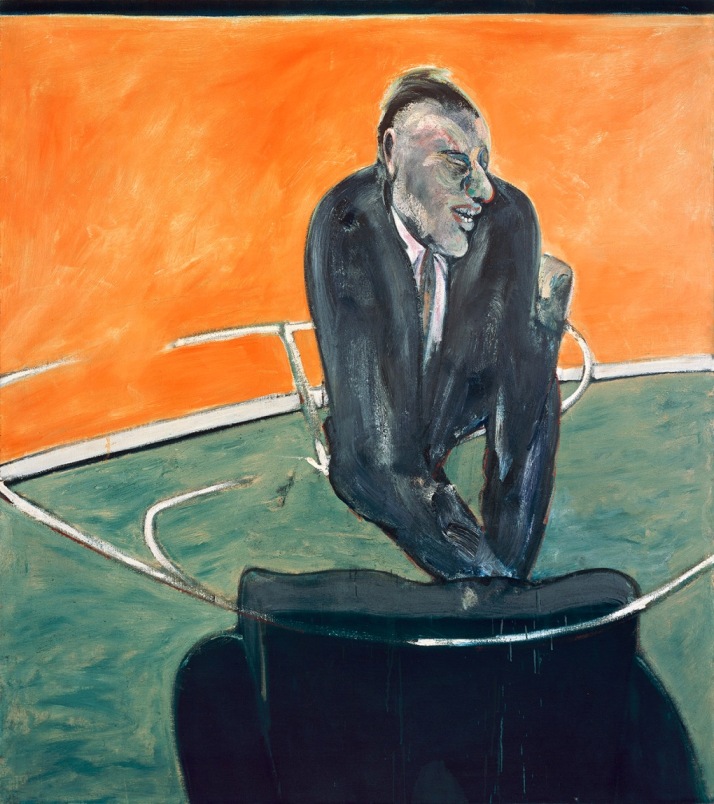
Diverse Sampling of This Style on View at Martha Jackson
NOW that action painting has become deliberate, popular style, we need no longer look at it as a manifestation of the unconscious mind, as was the fashion a decade ago. It has come to be as consciously adopted as any other historical style. The question is, just how good at it is this or that artist?
Some of the best international contemporary artists of this persuasion are showing work at the Martha Jackson Gallery, 32 East Sixty-ninth Street.
Strong individualists all, these men do not paint alike. Whereas the Englishman, William Scott, is slow and deliberate; the Frenchman, Georges Mathieu, effervescent; the Spaniard, Antoni Tàpies, austere and withdrawn, the American, Larry Rivers, rests on the laurels of a confident vigor of attack, in his pictures here, on imagery with strong erotic suggestiveness.
.
There remains the most interesting and brilliantly painted picture here, Francis Bacon’s “Red Cardinal”, the latest in a series by this Vibert of our neurotic era. This is less alarming than earlier characterizations. The pose is almost coquettish; the Jimmy Durante-like nose glistens with red and green highlights, and the subject wears his soutane as if it were a Spanish shawl. However, Mr. Bacon carries the whole thing off with astonishing verve.
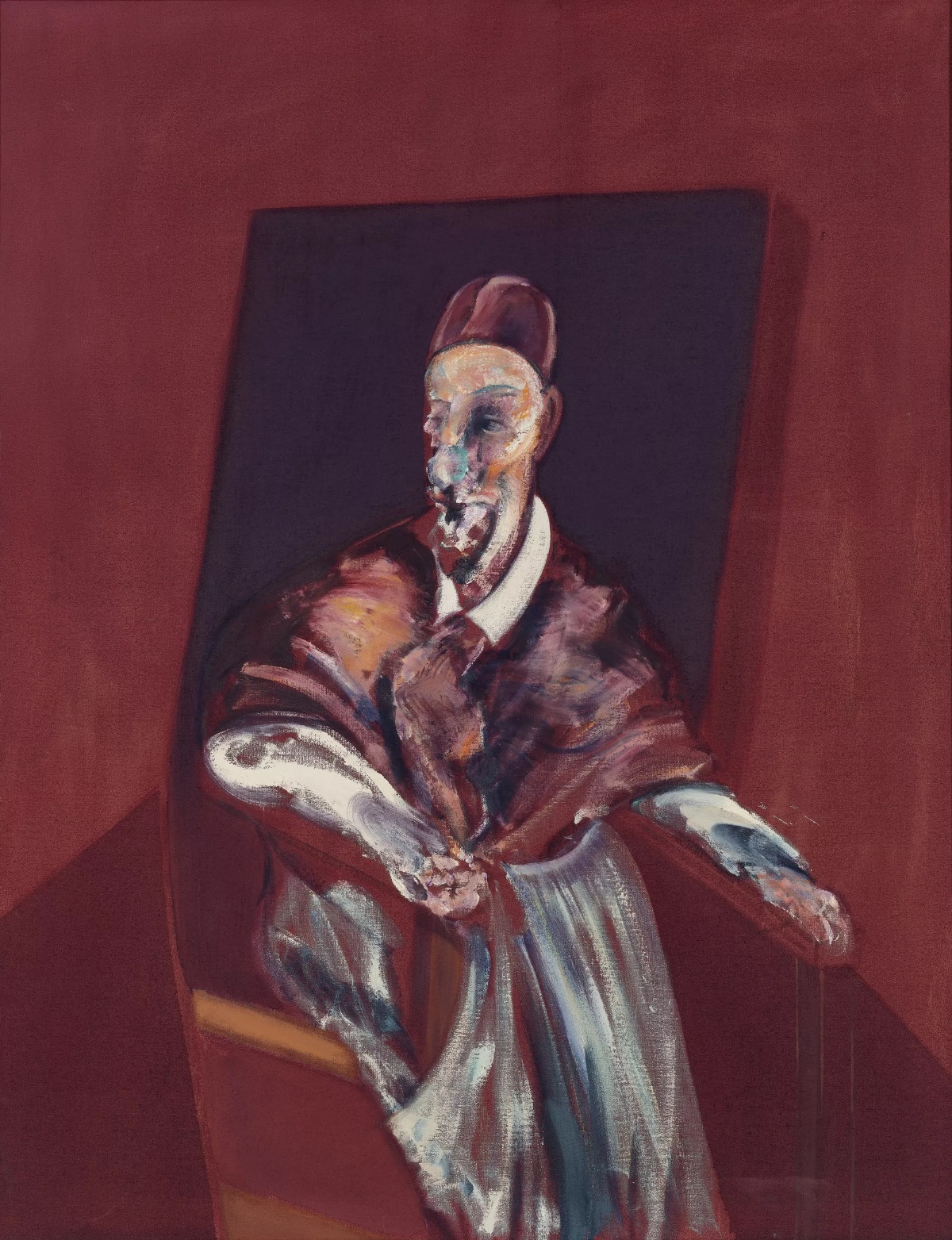
“Red Cardinal,” by Francis Bacon, at the Martha Jackson
THE retrospective show of the work of Francis Bacon at the Nottingham University Art Gallery is one of the most rewarding of several outstanding exhibitions now in the provinces. It continues until March 12.
Francis Bacon is an artist who has evolved slowly but with what, in retrospect, appears to be inexorable logic. His sincerity has never been in doubt, and even his failures, and he has had many, have enlisted our respect.
Much of his painting has an obsessive, nightmarish quality. In addition, as I have said before, there is something disconcertingly negative about many of his more recent pictures.
He expresses the uncertainties of our age and the waning influence of long cherished values much more effectively than do the pretentious young abstract painters and sculptors now exhibiting in the “Young Contemporaries” exhibition.
OLD PROBLEMS
This in itself is no negligible achievement, but it is by no means all he has done. The more I see of his work the more considerable it appears to me: in pictures such as “Two Figures in a Room,” painted last year, there is a challenging attempt to resolve old problems in a novel way.
Bacon tells us much of human emotions and human flesh of one kind. If he were also to convey to us an intimation of human dignity he might, I believe, achieve as much as any artist alive.
paintings by Francis Bacon at Nottingham University
A MAN sits, grey and grinning, his face soft and distorted, one eye higher than the other as if crushed by some terrible injury. He sits locked between lines, light against dark, in space which is defined and yet limitless. His feet are linear indications: he can walk and yet if he walks we we know he will stagger uncontrollably. His hands are useless splodges awkwardly clasped as if in shame. He is a man but his shape is foetal; we can follow his form backwards, away from the toe of solid white which somehow defines the plane of the canvas. Nearest, behind the toe, the nose: behind the nose, the eyes: behind the eyes, where there should be a mind, there is hopeless, inane, despair. This man is trapped and doomed, a symbol of impotence and futility seen through a grey mist of unutterable depression. It is a self-portrait of Francis Bacon, painted three years ago.
He is now 50, an artist who has painted alone for more than twenty-five years, showing mainly in London and New York. While one stream of fashionable painting has moved from dialectics to emotive dribble and disintegration, he has moved steadily closer to humanity caught at a moment of inhumanity, caught at a time of discontinuity, of appalling, invidious, silent horror. Perhaps, if he makes us sick he has succeeded: we get the artists we deserve.
And in the retrospective exhibition of his work gathered in the Fine Art Department of Nottingham University, we can see what we have apparently deserved from him since 1931. The early indications of the Crucifixion, continuous yet in vain. The sudden shift to symbolic portraits made with a limited palette of black, white, and purple, terrifying in their actuality and their unspoken context of taut yet near hysterical horror. Mankind in a locked paranoid box, suffering, useless, mouthing its despair voicelessly in an unheeding silence. The series of purple Cardinals, grotesquely dignified, almost faceless, locked-up behind golden bars. And now suddenly, within the last two or three years, paintings without linear boxes, but with simple areas of colour, and flesh not death-grey but suffused with the warmth of blood. It is as if a light has been switched on to reveal not a cage but a silent padded cell.
The violent portraits, the triple-head which ends in facial obliteration, have no place here. The barrier of despair has been passed, and in the clam beyond, all that was frustrated action has become passive submission, all that was violence has become composed contemplation.
But the foetal shapes are still there and the faces, boneless now and distorted as if of melting wax, are still inane and without hope. As symbols they are more moving because there is no hysteria to distract us: as paintings they are more complete than anything of the artist’s former work; as one man’s reaction to the human situation they are devoid of love, devoid of compassion, almost obscene, but still by their complete honesty entirely valid. The important thing is the way in which we accept their validity.
There is, in the exhibition, one pointer, a sketch for a portrait quickly made against a striped background. It is in black, white, grey, and purple, and fairly clearly defined. What matters are its eyes, for behind one can sense a steady mind, another individual. Beside it hangs the finished portrait made from the sketch: its eyes are void, its personality stunted. It is a negation of humanity, no longer portraiture but much more accurately self-portraiture. If we accept it as important and visionary we must accept Bacon as a kind of inverted twentieth century Goya, whittling everything down to one sick size. If we accept it simply as one man’s attempt to solve his personal problems, then we seem somehow to be nearer its true stature.
For, in the end, the morbidity, the total absorption of despair, the uncompromising absence of love, are artificial abnormalities whose importance lies in the increased stature they impart to their opposite values. Perhaps this is Francis Bacon’s importance too. But you cannot say, as you leave his work behind: “There but for the Grace of God . . .” You leave it feeling haunted, slightly guilty, measurably reduced. If Francis Bacon is not a prophet, he is an enemy.
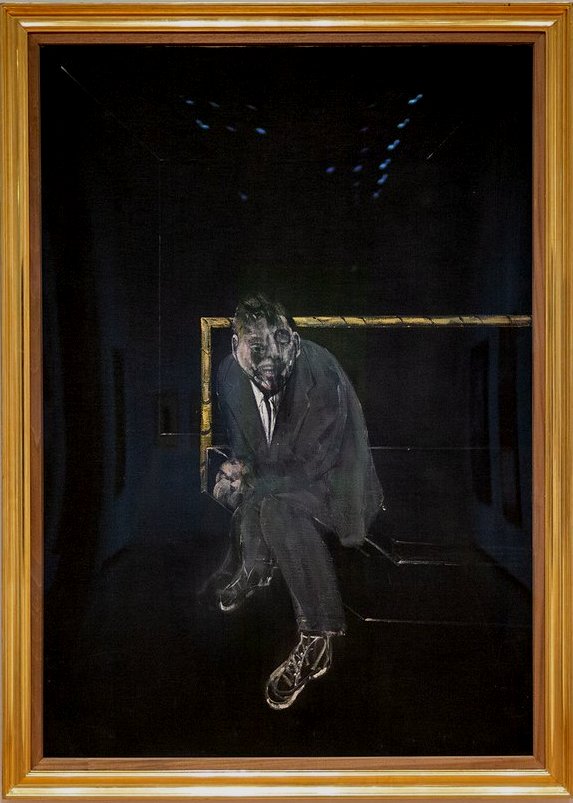
THE RETROSPECTIVE EXHIBITION of thirty-four paintings by Francis Bacon, shown in the spacious and well-lit gallery at the Nottingham University Department of Fine Art*, has too few early, and too many late, paintings to give a balanced view of his development. But the pictures, coming mostly from the collections of Mrs. James Bomford and Mr. Robert Sainsbury, are striking examples; and, away from the controversial atmosphere of London, it is possible to consider this exciting painter almost calmly.
Precautions have to be taken in estimating the work of artists who shock: and undoubtedly Bacon does this. When we are shocked, we are likely to feel that the artist exaggerates, and to react to this by exaggerating also and regarding him as more isolated than he really is. Many paintings which seemed ugly when they were painted, perhaps because the artist depicted the ugliest aspects of modern life, today, when those circumstances are past history, seem to us beautiful. Toulouse-Lautrec’s paintings of whores, which his contemporaries thought repulsive, are like this. On the other hand some statements about life go on shocking us with their brutal exposure of the human condition: for example, Goya’s studies of the disasters of war.
To judge calmly one has to consider how the painting is done, and what it is about. Each of Bacon’s paintings, though painted rapidly, is an extremely calculated campaign by a masterly strategist who knows exactly how to deploy his forces and organize them. His victories are those pictures in which he succeeds in focusing, and leaving out of focus, different parts of an image, to express the conflict between forces of integration and disintegration. Working on his unprimed canvas, the largest areas of his paintings consist nearly always of thin paint of a colour that seems as garish as neon lighting, and which has the effect often of dye soaked into sacking. The ’worked on’ part of the picture occupies a comparatively small area, which, by contrast with the merely coloured-in areas, seems far more thickly painted than is really the case, very opaque, and with a quality almost of plaster of Paris. By the bold decisive handling of these dry surfaces, Bacon creates an image set like a medallion against the flat, undifferentiated, crudely dramatised background.
One result of this treatment is that the technical means which he deploys, though highly individual, seem curiously depersonalized, deliberately and mockingly mechanical. The grass in ‘Study for a Portrait of Van Gogh No. 1’ consist simply of repeated hook-shaped strokes of emerald green. There is extraordinary observation in Bacon’s paintings, but it is as sparing as his other devices, concentrated, pin-pointed, directed for dramatic effect, to make the kind of comment which is conveyed by the glint on a man’s spectacles, the gleam of false teeth. Again the observation is often indirect, seen as it were at second-hand, and, finally, filtered through ironic self-mockery. The dog in ‘Study of a Dog’ is vividly canine — but we are not sure whether it is an animal we are seeing, or the artist’s vision of a dog as an object ‘caught’ in the 1/500th-of-a-second shot of a high-speed lens. Van Gogh interpreted Millet as seen by Van Gogh: but Francis Bacon makes a picture of how the contemporaries he portrays, staring from behind their spectacles and snarling through their teeth, would see Van Gogh.
To call him ‘traditional’ because, in his merciless idiom, he paraphrases the Cardinals of Velasquez, whom he admires, seems to me misleading. For tradition consists of continuity. For a contemporary to interpret a past work entirely in the terms of his own contemporary way of seeing things, depriving it of its penumbrum of pastness, emphatically indicates that continuity is impossible, that everything from the past, to be understood, has to be totally transmuted into the present, made part of the contemporary scene. Francis Bacon is not, of course, free of ‘influences’; but in his attitude to Velasquez and Van Gogh he seems to be more influencing or interpreting our vision of the masters he admires than he is influenced by them.
His extraordinary convincingness is that he paints us not as we would like to see ourselves, but as organisms distorted in our physiognomy and behaviour by the visual world of machinery in which we are trapped. He paints the business tycoon as we might expect his desk or his telephone to see him; a patient as he might appear from the point of view of the psycho-analyst’s couch. And this is how we really are. After visiting a Bacon exhibition, one observes one’s fellow passengers in tube-train or lift with opened eyes: and then catches a glimpse of oneself, one of them, reflected in a window or fogged and lipstick-smeared looking-glass.
Bacon depicts man the result of man-made inhuman circumstances, therefore self-dehumanized. His figures are the ultimate contemporaries: cut off from the past, or only able to see it through their distorting lenses of the present, incapable of hope for the future. Instantaneous exposure becomes the way of seeing life insulated within the moment, an aesthetic of anti-aestheticism, a Weltanschauung.
The risk that Francis Bacon runs is, inevitably, of his pictures proving as inescapably imprisoned in their moment as are his men and women. But two early pictures, ‘Crucifixion’ (1931) and ‘Golgotha’ (1932), crude as they are, point to a theme which unites all his work and gives it force which is beyond the contemporary. The theme is the crucifixion. Taking a hint perhaps from the crucifixion itself, Bacon paints not Christ but Barabbas crucified; and not just Barabbas, but the high priest crucified, Pontius Pilate crucified, the artist crucified.
There is certainly much hatred and disgust in these anti-sentimental, anti-aesthetic, anti-painting pictures. But there is also religious feeling. What is in doubt is whether there is love. Fifty years from now people will be able to decide this more assuredly than we can now. But meanwhile we ought to give this agonizingly honest portrayer of himself and ourselves the benefit of the doubt. For, at the very least, there is a great deal about ourselves and our world that we may learn from his art.
‘Case-history painting’
by Howard Griffin
BACON IS AN ARTIST who works slowly and whose self-criticism forces him to
destroy much. He produced perhaps eight or ten canvases per year. From the early
horror pictures, that had the texture of painting on velvet, he passed on to a
series of dog studies, done in 1951-52. One example—a
very curious production—can
be seen at the Tate. With thick application the dog is represented, sketchily
and crudely, below a blue barely indicated horizon-line. The eye focuses on him,
the natural centre of the composition, a point clearly made by the green circle
on which he is spotted. He stands—or
crouches—white
short-haired beast in the midst of a polygon. The little black cars speeding in
the background seem toy cars. The brown canvas has been shiningly brushed0over,
as if with specks of silver-gilt. One sees the lean vulpine dog in the act of
swerving, as if to avert a blow. A tropical tree can be made out in one corner.
With its almost diagrammatic quality, this painting might be said to be a dog’s
eye view of a landscape.
Without formal art training, Bacon did not begin to paint till he was thirty.
His inspiration lies in the things of the world: cheap post cards of Monte Carlo, the banner headline, photographs of Goering and Goebbels, and the photography of Muybridge. A Bacon painting is eloquent of the terror of real life; it is unglamorous, very real, very heartless. From his images one might infer such things as concentration camps, the sadism of the police-state, the films Hitler had made for him of 600 men guillotined or strangled by piano wire suspended from meat hooks. It might almost be said that his paintings have a case-history quality.
Not only has he been influenced by newspaper photographs, particularly if violent, but also by films and by visual images of the old masters. Certain images, he believes, have a power to oppress with their power and to hypnotize with their presence: Cimabue’s Crucifixion, for instance, certain works by Velasquez an Rubens and the late self-portraits by Rembrandt.
Whoever lives in the metropolis is bombarded by newspaper pictures of sensational impact—photographs of death, suicide and what are called in America ‘thrill-killings’. Thrill-killings are usually perpetrated by juvenile delinquents or young psychopaths of various persuasions. The tabloid newspapers take delight in trying to freeze, to catch ‘tableaux morts’ of these and many other incidents. I remember particularly the case of a hoodlum who, it appeared, coshed a fisherman with an iron pipe, robbed and tied him in his tackle and dumped him in the water where, or course, he drowned. In the Daily News this boy was photographed at the scene of violence. Squatting down, he pointed with one handcuffed hand to a large dark irregular stain on the earth, which the caption told us was blood. Behind him stood the detective, his arm around the young man’s shoulder. If looked at objectively, the latter in his white tee-shirt, became a godlike killer, cleancut and ruthless, didactically pointing at the blood. Somehow the photograph became universal and ceremonial. It is as a many-faceted visual seed that Bacon is interested in and has, doubtless, employed the photograph of this sort, all the time knowing how to transcend it and endow it with ambiguity. ‘What stops his work from becoming “literary” ’, David Sylvester has said, ‘is that nothing in his paintings is more eloquent than the paint itself. Paint and a marvellous sense of scale’.
When Bacon’s paintings began to appear in the 40s, the adjective most commonly used to describe them was disquieting. He had, at first, a cold reception and many critics wrote hostile or frivolous reviews. One school of opinion (of which Patrick Heron is an example) expressed the belief that Bacon represented what might be called a surrealist hangover, at the same time claiming—oddly—that he seemed a weak imitator of Manet. By such critics Bacon was censured for his ‘modishness’, and his painting was referred to as ‘pastiche painting’.
Although very different in aim and temper, Bacon has recently become, in terms of reputation, a kind of English Boldini. At the present time, he is as fashionable and his paintings as sought-after as were the Italian’s in the early years of this century. There are also other points in common: a swiftness, nervousness and certainty of execution. A tendency toward a centripetence in the portraits, that is, the deliberate concentration on the face, allowing the body to be shadowed-out in large sweeping strokes that seem to place the figure not only in space but in movement. Boldini’s La Passeggiata admirably illustrates this almost vertiginous technique. Furthermore, in their work both unhesitatingly lent centrality to the human figure and in both cases the personality of the painter conquers and submerges that of the sitter. We see this perfectly in Bacon’s Portrait of Robert Sainsbury as well as his full full-length of Lucien Freud. There are, first and foremost, individual products of Bacon’s mind.
Who is this sombre shifty-eyed person who looks at us from the canvas? He is, perhaps, that nameless and suburban man we saw coming towards us, his head cut off by the plane of the open umbrella. And yet this commonness in itself is made by Bacon’s magic to appear highly-charged, threatening. Even the blue lounge suit and the white collar cannot quite reassure us. As for the dark venetian blinds in the background they have an air of high-level conspiracy in connection with something odd that is about to be said or done.
Yes, Bacon’s visual symbol of this period is a disturbing person. He might be said to be Auden’s ‘smile with a knife’. Or that inconspicuous man in Gare du Midi who ‘clutching a little case, walks out briskly’ though the snow ‘to infect the city’. He is the ordinary man whom we learned to our sorrow in the 40s is capable of cruelty and self-aggrandizement. That little man, waiting with other hundreds on the out-of-town station platform for the 7.45, who, when given a situation of power, becomes ruthless and capable of feats of anonymous sadism.
But in writing about the paintings of this subtle artist we must try not to become too explicit—a fault of which Bacon is never guilty. Until 1951, it seems to us, he is still groping, still reaching out. During this period his work culminates in the moving Fragment from a Crucifixion, 1950, a horrifying painting executed in soft idyllic pinks and greys. Bacon finished off, in 1945, several versions of the Magdalen at the foot of the cross. In one of these she is crouching half-nude in a herringbone tweed, holding an open umbrella instead of the traditional skull. To the right stands a palm-tree. In another paraphrase she is not only enveloped in the overcoat, which seems to be crushing her with the weight of the ages, but is wearing a tyrolean hat. A broad orange area, flatly painted, forms the background. Making the reformed courtesan faceless, archetypal, Bacon employs in visual terms what Proust referred to as travestissement.
In 1953 Bacon started his series of paintings based on Velasquez’s Pope Innocent X. In these paintings—he does not know the number of them—he used a face-smear technique. One would be inclined to say the face had been meticulously painted, then partly rubbed out by great strokes of a gigantic eraser, in order to confound the eye. What are the hyena-cardinals doing—delivering hysterical sermons or diabolically quizzing an unseen prisoner? We cannot say. These shattered pillars of the church are seen variously. The Seated Cardinal, for instance, wears a punkish-blue cape and vestment, painted in sick dirty colours.
Irresistibly the strangeness of Bacon’s vision imposes itself on you. One of his ecclesiastics or mandrill baboons looks out at you and makes you think certain thoughts, feel certain emotions! There are things Simon Weil writes, ‘which cause no suffering by themselves but make us suffer as signs. Thus the defeat, and the sight of a German soldier in uniform. Thus the identity card at Renault’s. Pain born of the link (from sign to things signified) between two things not painful when outside this link. And this pain is felt by the body.’*
The New York policeman with his gun and club is a sign of woe to me. In a given day he may cause me no direct suffering but he makes me suffer as a sign. There are many such signs: the newspaper headlines, the newspaper photograph. We must accept and interpret many of Bacon’s paintings as things which cause no suffering by themselves but make us suffer as signs.: this man who seems to be turning into a monkey; that landscape with the sphinx and the shadow of a gangster; the stealthy prelate swivelling on his throne (could his image be a distorted reflection of the photographs of Cardinal Segura in Time?) These cardinals have the sly inductive hawk-like look of detectives. One sits in front of a rust-gold curtain; another against a soaring stretch of cathedral space, but in both cases the shapes are intimidating and the gaping mouth snaggled with teeth.
The motif of the teeth appears and reappears; it always emphasises an idea of impending evil or danger. Within the world of language the same association obtains, as we see in such phrases as: the prosecution began to show its teeth or avoir une dent contre. And into elements he thought inimical, primitive man inserted teeth—into the wind, the storm—as well as a part of the female anatomy that could be construed as occasionally hostile. Physiognomically and metaphorically, The Teeth (hard and superficial) are set against The Heart (profound and sensitive). Thus, when someone is a friend ‘from the teeth outwards’ he’s no friend. In fact, almost all of Bacon’s figures of the early 50s are ‘friends’ in this way.
Bacon, it is clear, has learned certain things from Daumier, El Greco and perhaps de Chirico.
Within 1960 Bacon struck out on a new tangent. Starkly honest, these new paintings are difficult to describe. They undoubtedly represent a development from the series of male nudes (1949-50) where the figure, though ponderous and neanderthal, was subtly softened and even ‘poetic’. In the recent work all trace of this grey semi-opaque mystery has gone.
The paintings have become enormous emblems. First of all, one is attacked by the colours-dull reds, harsh greens and blues, the nude flesh usually pinkish-blue. Here a man with a mutilated face has his legs, slightly parted, up the side of a wall. There a man with long narrow almost pin head faces a looming armchair, whether occupied or not we cannot see. Curled up in a foetal position a man is lying on a divan moderne, facing a brown-green overstuffed chair, the large arm of which resembles a cannon. Another nude man is stranded on a black foam-rubber divan, and, again, the body is rough and pseudo-podic in outline. The obsession with the claustral atmosphere is all too clear. A great point is made of the complete bareness of the rooms in which these figures are found or find themselves. Among these new paintings Head of a Man makes on think of Blake’s line: ‘The Human Face, A Furnace Sealed’.
One must make clear, it seems to me, that Bacon is trying to discover equivalents for moods not always considered visually proper: apathy, self-disgust, surfeit, shrinking and extreme danger associated with sensuality.
*The Notebooks, Vol. 1, page 1.
IN THE SUMMER of 1958, in an attempt to give the public outside London the opportunity of seeing retrospective surveys of the work of some leading British painters, the Arts Council arranged an exhibition devoted to the work of three modern masters which visited, among other galleries, the festival centres of Bath, Carlisle, Cheltenham, and Coventry. The three masters were Sir Matthew Smith, Victor Pasmore and Francis Bacon.
Now, repeating the experiment three years later, the Arts Council has again compiled an anthology which brings together, in order of seniority, the work of the late Stanley Spencer, of Ivon Hitchens, and of Graham Sutherland.
Midway on its provincial tour — it has already visited Plymouth and Sheffield, and goes later to Manchester and Cheltenham — the show is now in Leeds, not, as advertised in the Arts Council broadsheet, at Temple Newsam, six miles out of town, but at the City Art Gallery at Headrow.
In introducing his team, and discounting this as a deliberate and wilful essay in counterpoint, J. Wood Palmer goes out of his way to stress their individuality and to point out what little they have in common. Perhaps in view of this it is as well to emphasise their similarities. First, all three have been the subject of illustrated monographs in the Penguin Modern Painter series; both Sutherland, in 1952, and Hitchens in 1956, have been represented by retrospective exhibitions at the Venice Biennale; Spencer and Sutherland have had one-man shows at the Tate; and with a CBE, a knighthood and an Order of Merit between them they have not been without honours in their own country. Hitchens, from the Royal Academy Schools, Spencer at the Slade, and Sutherland at Goldsmiths, all have experienced the rigours of formal art training, and yet, most important of all in the similarity of their differences, although each is highly individual, almost a solitary painter, none, with the possible exception of Sutherland, has given rise to a school of imitators.
Of the three, Hitchens, with a room at Leeds to himself, comes off best, and though there is only one of his highly exotic reclining nudes, the late broadly painted landscapes from the Warnford series, allowing the virgin canvas its maximum effect, show the immediate connection and ready appeal which Hirchens’s work has had for Patrick Heron. None the less there are few works which measure up in quality to the smaller, tighter landscapes in the Howard Bliss collection, which has also made a recent tour of the provinces.
Sutherland and Spencer share a room whose monumental proportions seem to intimidate anything but the most powerful; and of the two, Sutherland’s development, from his early geological interest in the Gorgonzola-like strata of the Cornish tin mines, well brought out by the dappled cork mounting and framing of Quarry (from the collection of Hiram Winterbotham), is admirably seen. The metamorphosis of Tree Vines is seen in its true perspective as a limbering up for the Crucifixion series, although the inclusion of the British Council’s “Study for the Crucifixion” (1947), without the strength of either “The Deposition” (1946) or “Christ Carrying His Crosse” (1953), tend to give the impression that this not so much a serious milestone in Sutherland’s as only a passing interest.
Of the three, Spencer, though seen in greater depth, from 1914 to 1956, is possibly even less well served. In spite of the presence of the Imperial War Museum’s “Travoys” (1916), which is given a central place of honour, the insistence on too many somewhat pedestrian Cookham backcloths without their biblical prototypes undermines his intensity.
The inclusion of nothing more than the “Bride and Bridegroom” from “The Marriage
at Cana” (Glyn Vivian Art Gallery) and
Letters to the Editor
Cleaning Old Masters
LETTERS TO THE EDITOR
Sir,—Sir Philip Hendy, in his broadcast talk ‘On Cleaning an Old Master’ (The Listener, August 31), made the following statement: ‘The question whether a picture has or has not been damaged by cleaning is one of visual fact’.
We, the undersigned, having viewed Titian’s ‘Madonna and Child’ many times before cleaning, and having compared the partially cleaned picture with the photograph of the painting taken before cleaning, are prepared to state that we believe that many passages, notably the beautiful hand of the child, have been damaged by the restorers of the National Gallery.
Why was a painting which was admitted by the Gallery authorities to be ‘in unusually good condition’, tampered with in the first place? Have we now to look forward to the National Gallery restorers’ interpretation of ‘Bacchus and Ariadne’?
Art dealer found dead
RICH MAYFAIR GALLERY OWNER
LOCKED IN PARIS HOTEL ROOM
By BERNARD JORDAN
BERNARD JORDAN
WEALTHY art connoisseur Mr. Arthur Jeffress, owner of a Mayfair gallery and close friend of artist Graham Sutherland, has been found dead in a Paris hotel room. By his side was a note to the manager apologising “for all the trouble I am causing you.”
Another letter was addressed to the British Consul.
Staff at the Hotel France et Choiseul tried for 12 hours to get a reply from his two-room suite. He was found dead by a valet who scaled a fire escape.
French police said last night that a preliminary medical report shows that 55-year-old Mr. Jeffress died after taking a heavy dose of poison or barbiturates.
Cheerful
The death of the man who had a villa and private gondola 16 Venice and a home in Belgravia came as a shock to his friends.
Painter Mr. John Piper said at his Henley-on-Thames home last night: “He was a very happy man. He seemed to have everything he wanted ... money, good friends, and a wonderful collection of paintings.”
Mr. Jeffress, an American citizen who had lived in London, Venice, and Greece for many years, was due back in London this week. Paris was his last stop on his return from Middle East holiday.
Said the hotel manager: “We always had a suite ready for him. He seemed very cheerful and friendly on this visit. His death was a great shock.”
The Jeffress Gallery in Davies-street, Mayfair, specialises in exhibiting Victorian and modern paintings.
Prized
The gallery secretary, Mr. Robert Melville, “I can think of nothing that could lead Mr. Jeffress to such an end.”
Mr. Graham Sutherland and his wife often stayed at Mr. Jeffress’s Venice villa. The artist painted a full-length portrait of his host there after completing his painting of Sir Winston Churchill.
In Mr. Jeffress’s home in Eaton-square is his most prized possession—an early Toulouse-Lautrec painting, estimated to be worth more than £50,000.
MR. ARTHUR JEFFRESS
A LOSS TO THE LONDON ART WORLD
OBITUARY
Mr. Arthur Jeffress, who has been found dead in a Paris hotel, according to Reuter, is a loss to the London art world in which he had gained a special niche of his own. His gallery in Davies Street reflected his interest in art with an imaginative appeal and the exhibitions he held included many entertaining explorations of its more fanciful forms and by-paths, past and present
One of his most successful shows was on view this year; entitled “At the Seaside” (and televised) it provided an attractive selection of works by known and little-known Victorian painters.
An American citizen, Jeffress came of a Virginian family, but was bound to England by close ties and was educated at Harrow and Cambridge. He was attached to the American Field Ambulance Service during the last war. Of independent means and a collector of pictures, he started the Arthur Jeffress Gallery in 1953 after being for a while director of the Hanover Gallery.
A man of personal charm and a friendly nature appreciated by those who knew and worked with him, he had also (though not immune from periods of depression) a keen sense of humour. He loved travelling and especially his visits to Venice, though London was the city of his preference.
ART COLLECTOR FOUND
IN ROAD STABBED
MR. DOUGLAS COOPER IN HOSPITAL
From Our Own Correspondent,
PARIS, Oct. 25
Mr. Douglas Cooper, the British art collector and critic, was attacked and stabbed three times in the stomach by an unknown assailant outside Nimes in southern France last night. He was found by soldiers, who had heard his cries for help, at the roadside not far from his parked car. He was taken to the city medical centre where, after a surgical operation, his condition was stated tonight to be grave.
Mr. Cooper, aged 50, has lived for some time in the Chateau de Castille near Uzes, not far from Nimes. He owns an important collection of modem art, including paintings by Braque, Cézanne, Picasso, and Van Dongen.
NIMEs, Oct. 25. – Mr. Cooper was Slade Professor of Fine Art at Oxford University from 1957 to 1958 and had been a lecturer at the Courtauld Institute of Art in London. He has published a number of books, including Paul Klee, Ddgas Pastels, Van Gogh Water Colours, and one last year on Graham Sutherland. He worked for a time as the deputy director of the monuments and fine arts branch of the Control Commission for Germany after the war.
Recognized as an authority on twentieth-century art, he started collecting when he inherited a fortune at the age of 21. A few years ago his collection was valued at more than £350,000.
Mr. Cooper recently opposed the showing of valuable Impressionist paintings at the National Gallery in London because of the Goya theft. He had earlier advocated the suspension of all loan art exhibitions for two or three years because of the danger of theft. –Reuter.
STABBED ART MAN IN COMA
FRENCH POLICE SEEK SOLDIER
From HAROLD SIEVE
Daily Telegraph Special Correspondent
NIMES, Wednesday.
STORMY FIGURE
£355,000 Collection
Two recent oils by
Francis Bacon are among the Tate Gallery
Other gifts include a
brass by Eduardo Paolozzi,
The trustees have also
purchased Martin Froy
Art dealer who left £246,000 forgot gallery
By Daily Mail Reporter
TWO British charities and A the Tate Gallery benefit under the will of wealthy art dealer Mr. Arthur Jeffress, who died from a drug overdose in Paris two months ago.
But the future of his art gallery—the Jeffress Gallery in Davies-street, Piccadilly—stays a mystery.
For the 55-year-old Englishborn bachelor made no mention of it in his £246,000 will.
A gallery official said yesterday: “We have exhibitions booked until the end of next year. But we don’t know if or for how long the gallery will stay open.”
Furniture
The question will be considered at a meeting tomorrow of Mr. Jeffress’s lawyer and his executors.
Mr. Jeffress, after many bequests. divided the rest of his estate, estimated at £100,000, between the Institute of Cancer Research and the King George’s Fund for Sailors.
He left a picture by Toulouse-Lautrec, Portrait of Emile Bernard, to the Tate Gallery, together with Les Funerailles d’Alexandre, by Andre Beauchant. Other legacies Include a piece of furniture for artist Graham Sutherland.
EXPONENT OF THE ROMANTIC HORRIFIC
Graham Sutherland has aroused controversy, and not only for artistic reasons. He has courted neglect because at a relatively early age he virtually elected to withdraw from this country; at any rate, to pass a large part of the time at Menton or Venice. Moreover, he has been prepared pared to shock the avant garde by turning to portrait painting, choosing not down-at-heel sitters but 4he rich and successful, even members of cafe society.
Some argue that by adopting these two courses he has cut himself off from the sources that fertilized his art and from the significant movement of modern painting. Naturally this is rather a simplified view of his development. For one thing it misses the point that his career has been profoundly affected by his decision to resign from the board of the Tate Gallery’s trustees. This action showed him to be a brave man who stuck to his principles. In a cautious, even paradoxical, way this decision was salutary and important for a special reason. It underlined the dangers that almost automatically arise when a creative artist is tempted to team up with the Establishment — any establishment, one ought to say. For so courtly a character as Mr. Sutherland this decision to leave the board must have proved a grave one; he is a man who likes to please but not, happily, at the expense of his ideals.
For Mr. Cooper, a more resolute expatriate, Mr. Sutherland’s departure from the Tate and his subsequent residence abroad are all-important. In his view his withdrawal spurred Sutherland on to shun public life arid concentrate on being a painter first and foremost. And this in turn has led to his style becoming less English and more European.
He considers him as an important link between English and Continental painting, and less fortunately, he uses his achievement as a stick to belabour some of his English predecessors. Thus, with a mighty flourish, Mr. Cooper maintains that the pictures of the Camden Town painters, Duncan Grant, Nevinson, Wyndham Lewis, Matthew Smith and Paul Nash, were “mannered genteel inelegant elegant hybrids”.
Possibly Mr. Cooper is right and Mr Sutherland does stand well above such men
But he does not offer any concrete evidence on this point. For instance, he
declares that
A
central weakness of Mr. Cooper’s volume is that he has tried to force the pace.
The assumption that a sort of absolute European viewpoint point exists of which
he, apparently, is the mouthpiece vitiates his special pleading Thus, for him,
Although Mr. Cooper with his usual diligence has unearthed the facts, his narrow, even doctrinaire, interpretation of them makes his study less interesting than it could have been and, curiously, it seems to shrink Mr. Sutherland’s own impressive contribution.
It is, to take one instance, all very well to patronize Paul Nash and his flirtation with Surrealism. Yet how vital his work was for Mr. Sutherland in the early years is made quite dear by the artist’s own words and the poster of 1937 reproduced on page 15 From the historical point of view it would have been rewarding to have examined the connexions between the two men the fact that both have written so well about the countryside, its sparseness and mystery, is relevant.
What is needed in a book on Mr. Sutherland is not only the propagation of the thesis that he has become a European but a serious account of his national affiliations Mr Cooper has emphasized that his love of portrait trait painting and landscape makes him a typical English painter but he has not really placed him in the English context. It might have been valuable to have seen his portrait painting in relation to that of Mr. Buhler or Mr. Moynihan and the academic tradition. And on this subject are any common features to,be found between his portraits and those in the Neue Sacbiichkcit style or the work of Oskar Kokoschka? Moreover, in what way is his portrait painting specifically European in handling? Again, it is perfectly true that Mr. Sutherland has been taken by religious themes, but he is by no means the only artist in our era of whom this can be said: Stanley Spencer and Mr. de Maistre come to mjnd in this country, while, abroad M. de Castro has recently executed an impressive stained-glass work in Caen.
For those accustomed to Mr. Cooper’s critical acumen it comes as something of a disappointment to find that he has proved rattier shy about dealing with one of the most relevant fascinating and delicate problems connected with Mr. Sutherland’s evolution in the late 1940s: the connexion with Mr. Francis Bacon, Mr. Cooper writes:
Though it might be an exaggeration to suggest that Bacon has exerted an overt influence on Sutherland, it is at any rate probable that Sutherland was receptive to some of his ideas and allowed him to open his eyes to various technical possibilities and refinements.
One of Mr. Bacon’s pictures is discussed in connexion with Mr. Sutherland, but no real analysis of the question is provided; this seems unduly guarded in view of the fact that the author has enjoyed the chance of conversations with Mr. Sutherland. And what of Mr. Sutherland’s influence on Mr. Bacon?
Mr Cooper’s task has not been an easy one. He observes that
While in paintings such as Swinging Form and Monkey (1953) Swinging Form (1954), Hanging Form over Water (1957) and Hanging Form (1959), the movement of the mechanistic element is surrounded by mystery because the motivating force is never visible
do seem a trifle thin. In spite of such qualifications Mr. Cooper’s book is valuable, above all as it provides a workmanlike account of Mr Sutherland’s development; also it contains numerous quotations from the artist’s statements. Moreover, Mr Cooper brings out the romantic content in Mr. Sutherland’s work; his art, he emphasizes, is one of feeling and mystery. And in another way the book should be commended; the colour plates show a considerable advance on previous English standards. It will be interesting to see if other home-produced art books can keep this up.
The Work of Graham Sutherland. Text by Douglas Cooper. 97pp. 189 plates. Lund Humphries £4 4s
THE ARTS
EXPERIMENTAL PHASE
MISS ANNE DUNN’S
NEW PAINTINGS
Miss Anne Dunn’s great natural gift as an artist — her fugitive, flickering touch, full of painterly sensibility, delicate without loss of breadth — gives a unity to her new exhibition at the Leicester Galleries of what looks like a transitional phase of her art. Stylistically it falls into three groups, two of which show her, apparently, looking hard at other artists to help her strengthen her manner in two opposite directions.
In one she turns to Sam Francis in order to paint abstracts of ringing, deep blue mantling an under-layer of dark, translucent green-a sea-image, like much else in this exhibition (“West Wind”, No. 3, reflects another aspect of Francis). In the second there is an element of Bacon without the horror, in which faces, figures and rooms grow out of and dissolve back into the act of painting. “Sitting Figure”. No. 15, is a richly imaginative mysterious example, closely appro4ched by the painting of a baby reaching up to a table (“Interior, winter”, No. 4). The third group, allusive evocations of landscape and coastline, is thinner and more diffuse in manner except for two distinctively personal pictures, “October, yellow” (No. I) and “Late September” (No. 5). There is obviously no risk of Miss Dunn’s losing herself in the identity of others, and when she has worked her way through the experiments this exhibition represents, she is likely to look very good indeed.
Also at the Leicester Galleries are new paintings by Mr. Anthony Gross and watercolours by Mr. Timothy Gibbs. Mr. Gross in this exhibition is forcing himself to get something new out of his tearaway perspective vistas, and ends up fussing and wobbling uneasily. He has introduced a theme of maize to give a foreground curtain of verticals to the horizontal patterns of receding plain, but his natural taut linear idiom-splendidly shown in the black and white wash drawing (No. 18) which is the one wholly successful work in the exhibition-becomes extraordinarily confused in the effort to endow it with painterly and colouristc qualities. Mr. Gibbs’s landscapes are less ambitious, but beautifully exact and assured in their command of a technique which rapidly conveys the essentials of a scene and not a detail or accent more than is precisely necessary.
Impressionists Had Eye Disease
COVENTRY EVENING TELEGRAPH | TUESDAY, APRIL 17, 1962
In an after-dinner speech at the University of Toronto, he showed a slide of a brown landscape by Constable and suggested the artist was partially red-green blind.
He said it was found in 1933 that the famous modern painter, Leger, had red-green colour blindness. Most impressionists suffered from some ailment which may have caused them to believe ardently in the truth of their indefinite landscapes, he said.
Francis Bacon, the contemporary English painter, destroyed several early works after he found he had a marked horizontal astigmatism.
He corrected the defect with glasses and continued to paint.
THERE IS HELL ON EARTH AT THE TATE
STRONG meat at the Tate Gallery today.
If you are squeamish and dread nightmares, keep out at the huge retrospective exhibition of pictures by Francis Bacon, aged 52, the most widely influential British painter now alive — alive, be it said, in a private hell of shrieking pontiffs, white-collared ghosts, of wrestling nudes and caged baboons mostly surrounded by inky blackness.
Bacon once told Sir John Rothenstein, director of the Tate, that be does not believe in survival after death, but believes in hell; that hell exists here and now.
If you have strong nerves you should not miss this show, an apotheosis of horror, a lavish unburdening of the conscious and subconscious fears of a generation under the threat of the H-bomb, the Hell Bomb.
Unnumbered young artists in many countries and older ones of the stature of Graham Sutherland have come under the spell of Bacon’s tortured vision.
Terrifying distortions, the spread of huge splattered carcases on the latest canvases, three huge Studies for a Crucifixion, done this year, may fascinate and hypnotise people battered by the grim possibilities of our age.
Few contemporary painters can provide an exhibition of 90, mainly large, paintings with their reputations untarnished. Francis Bacon does more than survive. He emerges not only as the creator of haunting images, but also as a master of his craft.
What no one should imagine is that he is the kind of craftsman who brings easy pleasure by creating an illusion of the everyday world. Bacon is not concerned with illusions. He is concerned with reality, not the comforting reality of familiar appearances, but the harsh facts of an age living in fear.
Bacon’s work shocks. As we move from one obsessive image to another we find no comfort, only a chilling reminder of mankind adrift. It is this that makes his work so profoundly disquieting.
He is concerned not so much with the shadow of physical destruction and the erosion of institutions, as with the chill in the heart of men. His theme is the emptiness that always haunts man. It is this that gives his work a relevance beyond concrete fears of the moment.
Whether he is painting a series of pictures with a Pope, or a figure in a hotel bedroom, as the ostensible theme, he is concerned, on the one hand with the universal fears and, on the other, with the purely sensuous impact he can achieve with oil paint. The one somehow enhances the effect of the other.
The suspicion that if he wanted to, Bacon could bestow simple delights, makes the impact of his work the ore devastating. The haunted figure of Van Gogh and the twisted, misshapen creatures cowering before their own fear, shame our pleasure in colour and the manipulation of paint.
Bacon has produced many failures, although I know of no painter whose failures interest me as much. His latest works are statements horrifyingly complete in themselves.
I do not know if his three large studies for a Crucifixion can move men in a positive sense. I think they can, for they are one of the most complete statements, unrelieved by sentiment or any kind of concession, of the horror that so often paralyses man of our time.
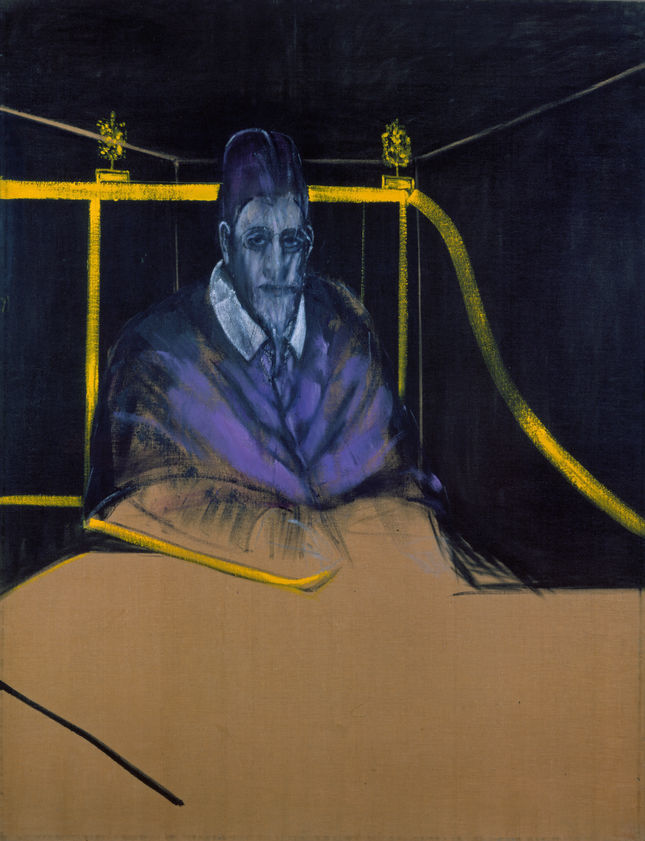
The Tate salutes Mr. Bacon
Bacon: the painter who evokes horror
BY DAVID CARRITT
“THERE is no excellent beauty that hath not some strangeness in its proportion.” Those words, written by Francis Bacon, the Elizabethan statesman and essayist, could well have been written in defence of his namesake’s exhibition which opens today at the Tate Gallery.
The strangeness is indisputable. Of figurative artists working today none is spookier, grislier or more unsettling than Francis Bacon. There is not one painting in the whole enormous show which does not in some way disturb, menace or nauseate the spectator.
Beauty
THE beauty is more doubtful. Bacon’s use of paint is skilful, but nothing like so fascinating or, for its time, so original as that of the artists whom he admires. Goya, Van Gogh, Velasquez, Daumier and Rembrandt. His use of colour is fastidious, but at its richest it is too evocative of bloodshed and putrefaction to be attractive in itself. His sense of composition is elegant but acutely mannered. In short, he is more of an illustrator, like Blake or Fuseli than any other of the artists who have brought about a real revolution in vision.
Nevertheless, Bacon is the most arresting of figurative artists working in England today, and one of the few under 60 anywhere in the world who still has something serious and interesting to say about humanity.
No one can create more forceful images of the horror, brutality and squalor of our time. Cruelty and ugliness are inseparable from mankind and have occasionally engendered masterpieces of art — certain of Shakespeare’s histories and tragedies, for instance, and Goya’s representations of the Peninsular War. Where Bacon excels is in finding symbols which are exactly appropriate to contemporary horror, without ever depicting a precisely identifiable incident or personality. (Even his portraits and his interpretations of Blake, Van Gogh and Pope Innocent X transform the subjects so radically that they take on a totally new, Baconian identity.)
If I had to name the strongest influences upon Bacon they would be the cinema, the camera and possibly television. As the catalogue points out, the screaming mouth in the earliest of Bacon’s paintings of popes derives from the close-up of of the nurse in Eisenstein’s epic The Battleship Potemkin. But it is unnecessary to quote particular borrowings. Even where the subject is entirely his own version, one finds the smudged outlines, the unexpected, unlikely but dreadfully real gesture which so often stamp the documentary photograph.
Many great artists have been inspired by photography (among them Degas, Cezanne and Sickert) but so far as I know Bacon is the first to exploit the emotional rather than the purely visual significance of the camera. It is, after all, through photography that the sheltered citizen is today made more acutely aware of the incessant threats to his security, from war or gangsterdom or disease. What is perhaps the most horrific single exhibit in this exhibition, a triptych called Three Studies for a Crucifixion, looks as if it was inspired partly by photographs of war atrocities, partly by photographs of flesh transmuted and disfigured by atom-blast.
What makes me doubt that Bacon is as important as his admirers insist is his inability to express more than one particular nightmare mood. Apparently he adores Van Gogh but his Homages to that artist reduce him to a simian leper animated by God knows what nameless neuroses. And his three studies after the life mask of William Blake might be taken for malicious likenesses of Somerset Maugham.
The only psychological insight which his paintings afford is into his own troubled, obsession-ridden mind.
Disgust
DISGUST and horror have their places in art, but I can think of no great imagination so exclusively dominated by them, not even Dean Swift’s. For me, Bacon’s limitations, which amount almost to mania, place him among the exotics.
At his best, I would rank him with Fuseli, the Swiss romantic, whose “moments of terror” were the delight of Regency connoisseurs, and at his worst with the Belgian Wierts, whose Hunger, Madness, Death, depicting a starved mother eating her babies, was a MUST for Victorian visitors to Brussels.
Daniel Farson is fined 10s.
Daniel Farson (35), described as an actor, of Narrow-street, Poplar, London E., pleaded guilty at Bow-street today to being drunk and was fined 10s.
Replying to Mr. K. J. P. Barraclough, the magistrate, Farson said he was a television commentator. He was told to pay three guineas costs.
Like many others, I expect, who have lately seen the paintings of Mr. Francis Bacon in the collected exhibition of his work at the Tate Gallery and been fascinated or repelled or both by their strange power and effect on the emotions, I have been wondering about the place of the horrific in art and to what level it really belongs. If you consider the highest aim of the artist to be the creation of an aesthetic beauty without any disturbing or abnormal element of subject matter, then it seems necessary to conclude that the horrific has an inferior status. The phrase “aesthetic beauty”, it may be admitted, brings another question of definition with it, but one could reasonably represent it by the quality of French painting and find a particularly striking instance in the Impressionist art we value so much, in the whole course of which there is absolutely nothing to “excite repugnance or dread” but on the contrary the most agreeable sensations that colour and light can evoke.
What use for horror has a Chardin, a Corot, a Braque? Is not the “petit frisson”, the “little sensation” Cézanne spoke of as a recognition of pure and essential qualities of colour and form, very different from the assault on the nerves effected by the representation of some sinister scene, of deformity and physical decay ? On the other hand, have not the visual arts as much right to explore the tragic and the terrible as literature? Artists have never accepted any limitation in this respect and reference to the past suggests that we should judge by individual quality rather than by generalizations about a genre. Long considered the greatest work of antiquity was not the placid image of god or goddess, but the representation of the priest of Apollo and his offspring, vainly struggling in the toils of serpents. In the Laocoon there is both physical and mental agony-one might even see this sculpture as a symbol of the human mind and its torturing entanglements.
A natural proclivity in some countries, of which Germany and Spain furnish examples, towards images of mortality and dissolution has often enough produced works of art as great as they are sombre — one thinks of Grünewald. The horrors of war have constantly goaded artists into the production of masterpieces. Certainly one cannot relegate to a minor place Breughel’s “The Triumph of Death”; the etchings of the miseries of Lorraine in the Thirty Years War in which Callot’s exquisiteness of line does not disguise savagery of incident; still less the prints in which Goya depicted the disasters of the Peninsula.
Hell, the supreme example of horror, of which it was necessary for old masters to give their conception, has inspired paintings by artists, among the greatest in which we can take a positive pleasure. It is not, for instance, incumbent to believe in the material existence of such an inferno as Jerome Bosch summons into being in his Prado triptych. It is a fantasy — to study it is to delight in the fertility of his invention. No repugnance or dread is aroused by its beaked and strangely snouted demons; curious speculation only by its weird hybrids, such as the hollow half-man, half-tree; one may even feel heartened by its lurid fires as by a sublimely dramatic spectacle.
Yet a distinction of some importance seems called for between this final sublimation of medieval fancies and the hell in which one senses reality — a reality in which the emotional perception and individuality of the artist are more deeply involved. It is Grünewald, I should say, who first makes it palpable, who is “engaged” with his subject to the extent that the frightful wounds on the martyred body he paints seem imbued with a personal sense of anguish. The trend of expression which begins with the Romantic era, when artists were throwing off the calm objectivity of the old painter-craftsman, gives further striking example — the catharsis, for instance, of the frightful visions of cruelty and stupidity which Goya painted for his villa in his old age. It is not the presence of the Devil in the shape of a he-goat which may disturb one in his “The Witches’ Sabbath” but that of a gibbering humanity which in its distortions of feature is terrifyingly credible. Two aspects of truth contribute to the shock these later works of Goya administer — the truth of feeling that arose from the depths of his despondency and a truth with which he observed certain aspects of the human being when taken unawares.
In the psychological depth, I think, one finds the essence of the matter rather than in the imaginative gruesomeness of some artists. The puppets and skeletons of James Ensor are fanciful creations of a high order but one accepts them, perhaps, with equanimity, as inventions. Fuseli’s “The Nightmare” conveys the oppressive sensation of a dream, but is there not more of mysterious horror in those strange pictured boudoirs which seemed to come more directly from his sub-conscious? The terrible agony of Edvard Munch’s “The Cry” can only be the deeply felt comment of the artist himself on the human condition. There is a modern equivalent of its agony in Mr. Bacon’s reconstitution of Velázquez’s portrait of Pope Innocent X. Is an art of this kind to be classed beneath the abstract art to which the present time is so much conditioned. in which there is neither tragedy nor comedy, nothing so human as horror, but only painting? I scarcely think any such comparison is useful. Mr. Bacon’s art, as a whole, is a criticism of life, close enough to its realities to have taken imagery from the screen and the documentary photograph, though using them with remarkable originality. The criticism of life has its own value even if, to borrow a phrase from Baudelaire on Delacroix, it “bears witness to the eternal and incorrigible barbarity of man”. A whole series of European works of art suggests that even in un- comfortable truth beauty of a kind may be found.
It is generally considered that Francis Bacon is one of the most fascinating, original and extraordinary members of the British school. His startling and aggressive pictures and his unusual personality, with its touch of despairing Bohemianism, exert a tremendous appeal on the younger generation.
He is a painter who does not pull his punches—this is abundantly clear in the large-scale exhibition of his work at the Tate Gallery. He is a painter who loves to shock and, just as Bruant used to taunt the visitors to his cabaret in the 1890’s, so Bacon teases us by his presentation of life in the raw—of human personality in its tense and anguished moments. At the time when many claim that the Wall is on the way down, he seeks to confirm our view; his is the statement of a man haunted by the death wish.
The clue to Bacon’s character as a painter lies in his early years. As a young man, after leaving home, he wandered across Europe of the 1920’s, putting in a spell in Berlin of the day: corrupt, frenetic, dancing toward doom. This is the atmosphere, so well depicted in Christopher Isherwood’s novels, which has shaped his art. In a sense, he can be linked up with the German school and with the neurotic art of Munch.
Little is known about Bacon’s early period, the bulk of which he destroyed. But the few pictures from the ’thirties on view, reveal that he elements which compose his later style were already evident: a delight in dark background and ghostly effects and the Crucifixion.
Bacon is a complex artist and typical of the feelings of love-hate which activate him is his attitude to the Old Masters, and in particularly to Velázquez. Thus he has frequently painted interpretations of Velázquez’s Pope Innocent X in the Doria Gallery, Rome. Incidentally, he has never seen the picture. There is perhaps a certain Dadaistic anti-art sentiment in the way he continually comes back to this picture; does it appear to him as a symbol of the tradition to which he would like to belong?
Yet, in a way, he is a most traditional artist. He is a typical exponent of the Gothic Horrific, which held sway in this country at the close of the 18th century. Fuseli, in fact, comes to mind and certain of his pictorial effects recall this master’s tricks. With Bacon, the suppressed elements in society have also burst out. And to see this exhibition is to be irresistibly reminded of The Romantic Agony—that volume in which Mario Praz took the lid off the tortures of the fin de siècle. Cruelty, ambiguous sex, a penchant for the perverse—all these occur in his art, as well as that characteristic love of the last century: the Sphinx. He takes us back into the world of Moreau, Rops and Sar Péladan. How Jean Lorrain would have enjoyed writing a prose portrait of him!
His approach is a typical manifestation of the world weariness which intervenes at certain moments in history. Thus he both gloats over the unusual and derives stimulus from the decadence he paints. Yet his message is a trifle banal. Surely, by now, we are all aware that the world is brutal, that we are coarse, corrupt, depraved. It was the business of the 19th century naturalistic novelist to make that clear; and he did so. And Bacon does no more than reaffirm this sad truth. But does he accomplish this in a way which makes us grasp the tragedy of our situation? Does he do so with the means available to the painter—the properties of pant? He is exceedingly able in the way he utilises photographs and gives an impression that s figure or a scene are caught at one moment of time. Just as Sickert in his final period achieved this immediacy of impression, so does Bacon. However, the actual surface does not survive on its own, without the image which is presented. The paint does not live in his work independently as it does with Titian.
What catches us is the image: the image of the horrific. But his image does not purge us as does true tragedy; we are brought down, not elevated. Goya, for instance, in those terrifying black-and-grey pictures in the Prado reveals despair and terror, but in the end, we are convinced by the pictorial means employed; somehow we are given the courage to continue, a courage which stems from the recognition that here is a an who has triumphed over the demons in terms of his art.
Mr. Bacon may be saluted for his drive, for his dexterity, for his courage. But his painting, once seen, does not live in the mind; it is too temporary, too dependent on external circumstance, too hampered by the hate of passion. In short, his protest is too shrill to hold us for long.

The Horrific Vision of
Mr. Francis Bacon
In the heat of the moment—and perhaps there is no other valid way of discussing Mr. Francis Bacon’s painting: it belongs absolutely to the moment—one can think of no experience quite comparable to the Tate Gallery’s retrospective exhibition of this artist (opening there today, admission free) except possibly one’s first encounter with the late paintings of Goya in the Prado.
The emotional shock is extraordinary, because it is so instantaneous and at the same time complex and contradictory. This is the black night of twentieth century soul, images of man which are terrifying, violent and at times bestial. Yet they are royal, and proud, and silent. No other painter of our day—and for once the phrase can be left as it stands, without worrying about the word “British”—could make these five large galleries look so nearly like an exhibition by an old master, yet leave one in no doubt that here, flashed on the canvas like one of the startling news-photos or cinematic images from which the paintings so often derive, is the cry of agony of our own age, an age which has lost its faith.
Hence, presumably, the recurrent obsession with images of the Crucifixion and of the head of the Roman Church, the leader of the faithful—both mercilessly mocked and tortured and made to scream as though being challenged to yield some answer to the spirit (as the Sphinx will never do) which can resist, or not be reduced to, the pain and the ignominy of the flesh. Bacon’s figures are essentially flesh (the quality of his paint and brushstrokes render it with something of the same morbid sensitivity as Soutine’s). And sometimes, shockingly, the flesh is merely beef, carcases which hang behind the Pope himself, appear in the left-hand panel of the recently finished scarlet and orange triptych and turn back into mangled, bloody flesh in its terrifying central panel, which looks as though it has been ripped down the middle by a machine-gun. This violence of despair, this pitiable ludicrousness of the body, does not belong to Kafka’s world, with which Bacon has been compared. But it is very near the cruel ruthlessness of Sartre’s blackest Existentialist writings, and of Camus’s conception of the absurd (Bacon’s occasional references to a North African landscape in his paintings of the Sphinx and a dog are like the Algerian setting to Camus’s novels).
MEANING LEFT VAGUE
The general relevance of such imagery to the postwar world (and Bacon, cosmopolitan and a traveller by nature could never be comfortably insular in his outlook) can hardly be questioned. Its precise interpretation must necessarily be left vague, and is perhaps impossible: the artist himself has always studiously evaded questions about it. There is, nevertheless, more factual information both about him and the paintings in Sir John Rothenstein’s and Mr. Ronald Alley’s contributions to the catalogue of this exhibition than has ever been available before (including the correct date of his birth). And the exhibition itself, while hardly making the images any less equivocal, helps to relate the ostensible changes of subject to one another within a ruthlessly consistent and obsessive vision, and to relate the vision to the brilliant qualities of the painter pure and simple. The one aberration that seems to stand out at the Tate is—apart from the first variation, slightly earlier than the rest—the Van Gogh series, which shows uncharacteristic marks of strain and even coarseness.
Nearly all the prewar paintings appear to have been destroyed, including the geometric abstracts of the 1930s of which some record survives in photographs. The real achievement is wholly postwar, surveyed here in some 90 pictures, starting to all intents and purposes with the Tate’s own “Three Studies for a Crucifixion” and ending with the extraordinary, large triptych which bears, bafflingly enough in view of the apparent implications of the imagery, the same title. Apart from the recurrence or elaboration of familiar motifs—the glass cage, the diaphanous curtain, the gold rails, the tasselled blinds—and the progression of subjects—ghostly nudes, the dog, the Popes, the heads of Blake, the “business executives”, the recent portraits and figures on divans—the most striking development is one of visualization: from mystery to clarity, impenetrable midnight-blues to heraldic colours, blurred images to strange, distorted silhouettes of an almost Munch-like character.
The technical bravura with which this is effected, and the utter originality of the results, not only provide a surer guarantee than has sometimes appeared probable that the effectiveness of the imagery will retain its power: they also, quite simply, make this the most stunning exhibition by a living British painter there has been since the war.
MORTAL CONFLICT
It
would be both unwise and unjust to write briefly about the retrospective
exhibition of work by Francis Bacon at the Tate Gallery. It contains 90
paintings (nearly half of his surviving works: but by no means half of what he
has painted during the past 30 years, for he is a ruthless destroyer of his own
pictures). Of course one thought one knew what to expect, and after a few
minutes spent hastily surveying the five speciously hung rooms, ones
expectations were confirmed. The impact is immediately shattering and becomes
more so as one follows the roughly chronological sequence from 1944 (when, after
a hiatus of seven years, he resumed painting) to the present day. The usual
adjectives
—
"nightmarish," "melodramatic," "cruel," "haunting,"
—
are not inappropriate but they are only superficially true and as descriptions
of the cumulative effect of the exhibition. After the first few minutes has been
expanded to half an hour, they become inadequate. Buried under the surface
levels of these often horrific and sometimes repellent images are deeper levels,
equally disturbing but more worth analysing, and not until one can come to grips
with them does the exhibition become serious and cease to be merely sensational.
Clearly Bacon has obsessions and clearly he has discovered a set of effective means (one could almost call them "tricks") for making them visually effective. The image of a pope’s head borrowed from a famous portrait by Velasquez, spotlighted against an impenetrable black void: the tendency of this august figure to open its mouth in a Grand Guinol scream: the frequency with which that same figure finds itself cut off from the world of normality by seeming to be encased in a transparent glass cage which has the odd effect of making the scream more agonising because inaudible. These nightmarish devises are now familiar enough. Bacon’s later paintings show that he has grown out of them and in any case the effect of the spectator of such shock-tactics diminishes with familiarity. The scream in the dark loses its terror with repetition.
But what one eventually discovers is that even though Bacon is not averse to melodramatic tricks they do not contain his essence.
That essence is an uninhibited fearlessness, an unquestioning acceptance of the imagery offered to him by the deepest recesses of his unconscious mind. Most of us are apt to recoil from such images, having been taught that they are secrets not to be shared with the would and hardly to be admitted to ourselves. But in Bacon himself there is obviously no such recoil. His conscious process (and they are, after all, the tools without which he could not be a painter at all) do not exercise any censorship on what comes up from the depths. There has probably never been an artist so utterly unafraid of himself. And that fearlessness we must learn to accept and share before we can make sense of what could easily be mistaken for a chamber of horrors.
Bacon is a self-taught painter but that does not prevent him from being a masterly painter. He is even a masterly illusionist. The texture of flesh is something that is no more difficult for him to render than it was for Courbet or Rubens. And that is his ultimate secret, for no sooner has he presented us with the convincingly painted illusion, so that we believe in it, optically, then he defaces it, as though he were mocking our belief. The flesh becomes ambiguous and ghostly; it becomes ectoplasm as we watch it. Bones become jelly, bodies become alarmingly vulnerable, belief gives way to doubt.
Partly again, this is the result of another trick. Bacon delights in accepting the camera’s account of an undignified moment in time when a face is distorted because it happens to be chewing a sandwich, or limbs become ungraceful because they are collapsing on to a chair. The snapshot often presents us with these momentary absurdities and we accepts them just because they are momentary. But remove them from their context in time and make them permanent, as Bacon invariably does, and they become grotesque. They take on new meanings. A queer misalliance takes place between the seen fact and the subconscious symbol.
This, as far as I know, has never happened in art before. Occasionally a misericord seat in a Gothic Choir stall hints at it, but always as a secret assertion that the grotesque is also a part of life. For Bacon, one might think, it is almost the whole of life. Once we have lost the shame that turns a fact into a secret, the no holds are barred. Beauty, to put it bluntly, has been killed by truth.
Yet beauty is there throughout. A casual, distant glance into any of the five rooms in which these pictures hang, reveals shapes that are noble in themselves and are nobly placed on the canvas, and colour schemes that are, in themselves, enchanting. It is only when we begin to examine them for subject matter, as though they were the products of the mid-nineteenth century, that one begins to experience the frisson that is Bacon’s special gift.
The Private Obsessions
of Francis Bacon
AT last we have an opportunity in assessing the art of Francis Bacon. Until July 1 the Tate Gallery presents the first major retrospective exhibition of Bacons paintings: these 100 canvases represent almost half of his surviving works. No living British painter has had more influence on his fellows or has aroused more controversy among the critics. As Sir John Rothenstein reminds us in his introduction to the catalogue, some regard Bacon as the most important painter Britain has produced for some generations, while others see him as a flashy sensationalist, exploiting horrific iconography and indulging in wild extravagance of style.
The world of Bacon pictures is a nightmare void, where within hermetically-sealed glass cages, monsters materialise by infernal magic. A screaming prelate or an obscene nude, a slobbering dog or a snarling ape, or simply a disembodied mouth with bared fangs: all are painted in congealed ectoplasm.
Emphatic horror
Alone, the emphatic horror of these subjects is no reason for dismissing Bacon
Points add up
The points against Bacon add up. His interest in suggested movement results in
the ludicrous comic-strip effect of the life-size series of a Pope in which he
first stares at us, then shouts, and finally screams. Then there is the spurious
appeal to our conventional image of an old master: all plate-glass reflection
through which we dimly discern the luminous patch of rich impasto. Certainly it
is far easier to continue the indictment than formulate a defence for Bacon. Yet
I think there should be a defence. Certain pictures
—
Batley
Uncertain identity
In the first major works made after 1949 Bacon brilliantly convinces us of the reality of his creatures by showing us as little of them as possible. Yet we know that the head in “Head VI” (1949) is not merely an ape but a gorilla, though the canvas is hardly more than smeared with paint. Again, we may be very uncertain of the identity of these monsters. The masses are blurred, but the dense pigment, mixed perhaps with sand or even cotton wool, convinces us of the palpable presence of something.
Until 1957 Bacon manipulates images in which ambiguous forms suddenly become focussed in details of unpleasant clarity. Recently he has almost reversed this principle. Now the figures are not vaguely luminous in a nightmare darkness. They are starkly outlined in brilliantly lit, gaudily coloured interior.
Uncertain shape
The figures which earlier had had a very uncertain shape, are now given an apparently quite precise deformity. Their distorted bodies with vestigial limbs are like sculptures pawed clumsily from plasticine and sand. But this clear definition is illusory. Within the simple outlines the bodies dissolve in a flux of protoplasm and the simple interiors have impossible spatial ambiguities.
The problem of Bacon’s art is not easily solved. I think, either on a technical or a moral plane. I believe that eventually we shall be called to judge, neither the guignol, nor its technical presentation, but whether these images are an exorcism of a real devil or bogeyman toyed within an ivory tower.

Francis Bacon: from the painting by Lucian Freud in the Tate Gallery.
By JOHN RUSSELL
WHEN imagery, as such, is everywhere degraded there is something enormously
grand and consequential about the achievement of a painter who can pursue the
image into the far depths of its degradation and come back with pictures that
have a timeless, Old Masterly look and the impact of a hammer on the anvil.
This is what Francis Bacon has done, at the Tate, in one of the most extraordinary exhibitions ever held there. Pictures that, individually, were called “melodramatic,” “nightmarish,” “abnormal,” “Grand Guignolesque,” here form up into a coherent Pantheon, in which Tussaud is crossed with Titian. People still use those four adjectives—above all, of this year’s “Three Studies for a Crucifixion,”—rather than face the fact that there are human beings who would go and gloat at the base of a crucifixion; but to me Bacon’s figures represent that sort of person with just that poetic distortion which brings home his (or her) full obscenity.
FOR Bacon’s is not fundamentally an art of exaggeration: it is the exaggerations in ourselves, or in our neighbours, which we dread to recognise. Bacon’s art reveals to us, often for the first time, and with the impact of prophecy, the true nature of the world we live in. Nature has now caught up with that art, but already in the early 1950s Bacon was showing us Salan at the microphone and Eichmann in his glassed-in bullet-proof box. It seemed, then, an art of inquisitiveness, for which nothing was private, nothing taboo: but who are we to complain of that, who have since demanded that a man be photographed for our distraction as he risked his life in an astronaut’s capsule?
It was in defence of themselves that people unified the effect of Bacon’s pictures. His characters remain ambiguous; as to which is victim and which inquisitor, argument continues; and when they have their mouths open it was decided that they must be screaming—or that, at the least, what they are saying is the terrible and meaningful nonsense that Beckett wrote for the slave’s outburst in “Waiting for Godot.”
This maybe a mis-reading. With time, these figures, once so sinister-seeming and so cryptic, have become the affable familiars of the company report, the election meeting, the public relations party and the television commercial. These once inscrutable monsters are our governors, providers, elucidators, favourites, friends. We and they are interchangeable: he would be rash who counted on exemption.
And are the events which Bacon sets before us more dreadful than those of which we read every day in the newspapers? Ask the little girl who was blinded in Paris by the O.A.S. In 1950 it seemed “brutal” and “exaggerated” to suggest that men will drive on in their big new motors while a man hangs dying in slow agony and a dog stands poised to sniff the living meat. Today we know better.
BUT of course Bacon could have had these prophetic intimations and not been an important painter. What saves him from sensationalism is the paradoxical dignity of the image, the instinct of grandeur which makes these pictures “tell” at twenty yards, the candour which has rightly been called “royal.” Half-close your eyes in any of these rooms, and you might think yourself in today’s variant of the Waterloo Chamber at Windsor. But Bacon is beyond compounding with the present, even if his audience is not. He could wrap it up; but he has seen, read, travelled and above all felt too much and too clearly. He never touts for our approval.
Of the background to all this, and above all of Bacon’s use of Muybridge’s eighty-year-old “Human Figures in Motion,” much can be learnt from the excellent catalogue for which John Rothenstein and Ronald Alley are responsible. Entrance is free, as it should be, and the show is open till July 1.
Dramas in Paint
By W. G. ARCHER
W. G. ARCHER
FRANCIS BACON is one of our most important artists. Some might even say he is the most important British painter living today. Where does his importance lie?
The large retrospective of his work, until July 1, at the Tate, helps us to resolve this. It is only a fraction of his output, for Bacon has often destroyed his work.
A first consideration must be of style. In his early period, two influences are apparent—Picasso and Surrealism.
Picasso, with his cruel tormented shapes, expressed the anguish of an unquiet mind. Surrealism proved the need to go beyond the realistic, the everyday, the supposedly normal to men and women as they often are—harried by anxious fears and niggling dismay, unable to reconcile habits and desires, compelled to recognise the battle in one person of two or three conflicting selves.
It brought romantic agony and frenzied dread into modern painting and showed how irresistible was the thrill of unexpected encounters.
Bacon absorbed these influences. He eschewed art-schools. He looked at pictures. He learnt painting by doing it. Then, by some jump of genius, he formed a new style.
His use of lurid colour, eerie background and livid darkness, his way of hunching, pinioning and lacerating forms, his mesmerised attachment to bloated distortions, his use of paint to glue a figure to its setting, to bring a situation grimly to life as part of that figure’s own dire state—these were things which no one else had quite done before.
Not Style Alone
Yet style alone does not account for his importance. Bacon is significant for two reasons—how he paints and what he paints. We can go further; for what he paints has made him paint as he does.
His pictures are no mere gambols, febrile drippings, horrific gestures. Like tragic dramas, they show strong men conquered by adversity—men who were strong once but have lost their grip, men who would like to be strong but whose powers have slipped, men who found things too much and are now paralysed with dread.
Their state is due, in part, to modern life before and after the War. Bacon lived for some time in Germany and his world resembles that of Christopher Isherwood’s “Goodbye to Berlin” or the London of Connolly’s “The Unquiet Grave.”
But the fault is also in themselves. The figures whom he paints could often be interpreted as the same person and their situation, at bottom, almost and always the same. Whether on a cross, skulking at its foot, screaming out their guilt, seated on a chair, a couch, at a desk, cramped in a cell, a dock or on a rostrum, they possess an air of secret exposure, of being agonisingly alone. Their morale has crumpled and it is only a matter of time before a “hidden assassin” like an unwelcome visitor or an advancing shadow—the “scissor man” of W. H. Auden’s poem—accomplishes his purpose.
The woods have come up and are standing round,
In deadly crescent.
And the bolt is sliding in its groove.
Outside the window is the black remover’s van
And now with sudden swift emergence
Come the women with dark glasses, the hump-backed surgeons
And the scissors man.
In certain pictures, the faces of his people are swollen or their flesh is dissolving. Sometimes they are constricted by an empty frame, a set of rickety wire struts, as if they were denizens of a “glass menagerie” or hapless inmates of a concentration camp.
Sometimes they are penned in by curtains, railings or even by a banister, as if that also were an instrument of torture.
Yet the crux of their plight is that they are not captive but free. There are no warders, no witnesses, no judges, no one to stop them. They could break out if they dared. They could get up, bound over the banister or brush aside their flimsy pens. Only some inner check holds them. They are the living victims of the “age of anxiety.”
Such pictures have a searing honesty, a stark integrity. Like Grunewald, Goya, Daumier and Picasso—that line of great precursors—Bacon has neither shrunk from nor exulted in the grim, gruesome or ugly. He has refused to look away. He has found hell here and now.
If at times he reveals an “accelerated grimace,” a vulturish glee, more often he is moved by tender pity or angry compassion.
If we ask why these pictures are great art, the reply might be in I. A. Richards’ words of T. S. Eliot and his poem, “The Waste Land”: “Some readers find in his poetry not only a clearer, fuller realisation of their plight, the plight of a whole generation, than they find elsewhere, but also through the very energies set free in that realisation a return of the saving passion.”
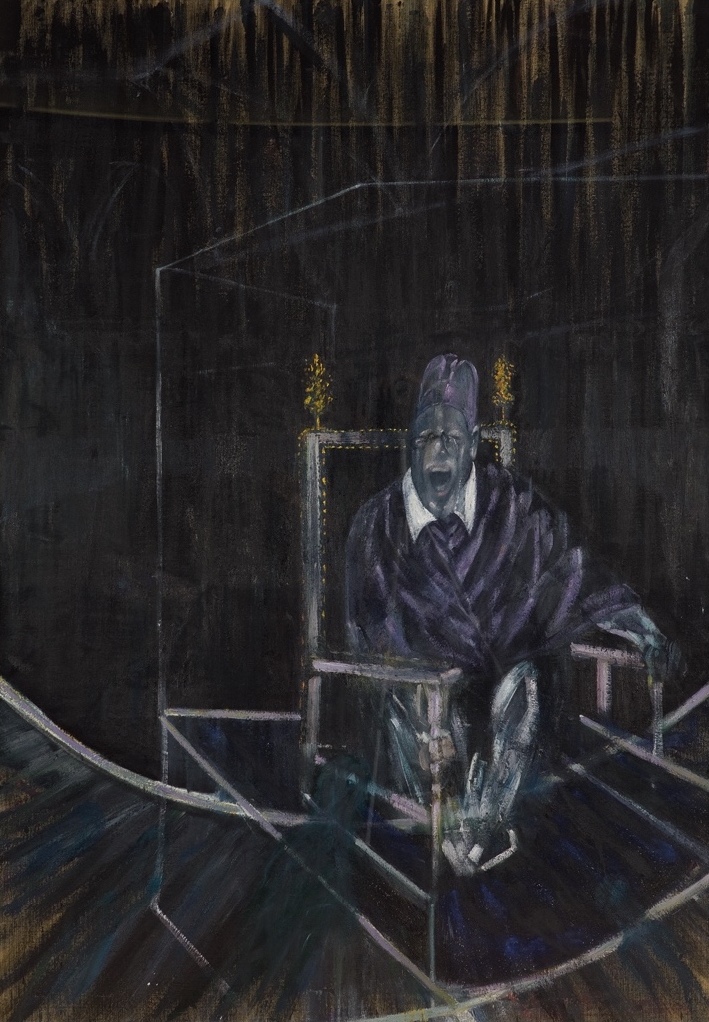
From the large retrospective exhibition of his painting now on view at the Tate Gallery.
THE OBSERVER PROFILE
In a back-street behind Piccadilly, a man may sometimes be encountered wearing a
huge pair of sun-glasses, grey flannel coat, tight trousers, grey flannel shirt,
and black tie. He walks rapidly into the darkness. He has cropped hair, a round
puffy face and looks about 35. He is in fact in his early fifties—his
conquest of age at once gives him a slightly spooky, Dorian Gray quality—and
he is the painter, Francis Bacon.
For the next five weeks, the Tate Gallery is paying Bacon the tribute of a big retrospective exhibition of his work. Bacon may remain in London for the occasion, or not. He is a man of whom, most people, his friends included, catch only occasional glimpses.
In the past few years, there has been a Bacon boom. His pictures have changed hands for £3,000. In this country he is about the only English painter who excites art students. Abroad, there is more interest in Bacon than in any other British artist.
Soundless scream
His paintings, even when they are simply lampoons, are unlike those of anyone else alive. He is, indeed, a freak. He uses the back of the canvas; he is wholly untaught. His best-known series—the outcome of an obsession with Velasquez—features a richly dressed prelate whose mouth is opened in a soundless scream.
Bacon once said he was trying to paint the track left by human beings—like the slime left by a snail. The shapes appear transient and out of focus, like the figures in a dream remembered at the moment of awakening.
The human beings in Bacon pictures seem half-animal, or half reptilian. Sometimes they have the whiteness of death; sometimes they are white and red, like joints of meat. Some see to be dying, or liquefying. Almost all of them display people at moments of extreme stress, whether of passion, isolation, or despair. One senses Bacon’s fascinated interest in corruption.
During the last Bacon show one visitor remarked that he had never felt so close to the presence of evil . Evil or not, few people will visit the Tate without being stunned by Bacon’s tremendous power to convey the underworld of tension and suffering—humanity with the lid off.
Bacon paints without any reference to current convention and he lives as he paints. He dresses anyhow and lives anywhere. He has largely dodged all the usual Institutions—school, marriage, community, family, armed forces, job. He has no interest in money, except for gambling and champagne.
Yet if he does not fit into ordinary society he is by no means a rebel. He finds the world of criminals more interesting than the world of normal people—but nevertheless, on his best behaviour, he would give no hostess anxiety about his performance at her dinner table. His manner is unformidable, gentle and unaffected. He is a good talker, bubbling, funny, friendly, gesticulating elegantly with strong, plump forearms.
One of Bacon’s strong points, arising from his isolation, is that he could never be corrupted by success. The Tate exhibition will leave him cold. If he were rich, he says, he would not only never show his pictures, he would very rarely even bother to finish them. As it is, using a razor, he often destroys them.
Grin without cat
Bacon is an articulate, sophisticated highbrow character, but he does not think there is much point in talking about his work on the principal enunciated by Pavlova that “if I knew why I danced I wouldn’t dance.” He says, however, that his starting point is always his own nervous system: “I always want to record a face or a body, and I want to do it as near my own feelings as possible. It’s the exact opposite of abstract painting.”
There are two central things he is trying to do. First, he is trying to catch the grin without the cat—to catch the sensation of a human presence and its flavour, whether menacing or desperate, without having to create the full physical density of the body. Secondly, he wants to show people in extreme situations. He would say that day-to-day behaviour is of no importance; the real test is what happens in situations of crisis.
English Arab
These two ideas are pure Bacon. His other aims are more usual. He wants to make the animal come through the human being; and he wants the paint itself to carry its own implications (in the same way that a poem can produce meanings that the poet did not expect).
“Oil painting is incredibly strange and difficult,” he says. “There’s an enormous element of chance about just the turn of the brush. In the actual process of painting, the thing you really want to do slips through.”
In the seedier Mediterranean countries, Bacon has noticed how Arab children, left to fend for themselves without any rules imposed from above, become miraculously uninhibited and adept at getting by. Bacon is an English Arab.
His father, when Francis was born in 1909, had retired from the army and gone to Ireland to train racehorses on his wife’s money. A bad asthmatic as a child, Francis was allergic to horses. His father was allergic to education. Francis, so far as he can recall, had only one year’s formal education in his life—at Dean Close, Cheltenham, where his father, having abandoned Ireland, was enjoying his second retirement.
At 16, with his family’s consent, and on a minute allowance, Bacon left home and moved to London. He spent the next years travelling and getting by with a string of odd jobs. He worked in a Lyons restaurant, as a valet and as an interior decorator. He started to paint occasionally and, with the coming of the war, regularly. Whereas most people found the war reasonably occupying, Bacon had more time on his hands than ever before. He was unfit for the Army, so he joined Civil Defence. But living in dormitories did not suit his asthma and he eventually left.
So he painted. He met Graham Sutherland, who generously helped and encouraged him, and by the end of the war he had acquired a small following. Since then, his reputation has steadily expanded.
In middle-age, neither fame nor money has caused Bacon to change his unsettled way of life. He moves constantly, often in the direction of the Mediterranean, where he especially likes the cities by the sea, and especially those with facilities for gambling.
Taste for gambling
Other painters gamble, but none so serious as Francis Bacon. The two activities are not so separate as one might think. Both (for Bacon) are matters of chance and both stretch his nervous system to the limit. At Monte Carlo not long ago he had some big wins, then lost everything. Afterwards he said the same thing sometimes happened with his painting—greed caused him to take a risk beyond his powers.
The spasmodic disarray of Bacon’s way of life is reflected in his studios. One of his longest stays recently was in a Battersea flat. The Bacon workshop there was what the architect had intended as a smallish front bedroom. The place looked as though a dustman has stacked a lorry with oddments—canvases, easels, bunches of old paintbrushes, broken crockery, an abandoned chest of drawers, a heap of books, torn newspapers and a pile of old copies of Paris-Match—and dumped the lot into the room through the roof. Bacon uses saucers to mix his paints, and wipes his hands on the curtains.
Images of man
Most of his pictures are big, and he often does not see them properly until someone else hangs them up in a much larger room. By that time he has long since lost interest.
One might say even that Francis Bacon is not fundamentally interested in art at all, though he greatly admires some of the old masters, such as Velasquez and Rembrandt. He prefers life to art—especially, he once said, the life of the gutter. Yet he sees life itself, now that his religion is dead, as nothing but a brief, empty interval between life and death. So for Bacon the only thing that has any permanent value at all, the only thing that can last, are the marks made by the artist. In his painting, Bacon is trying to catch and hold for a moment the image of man, because that is the only way he can conceive of reflecting and preserving the terrible reality of life.
The Tate exhibition: Page 27
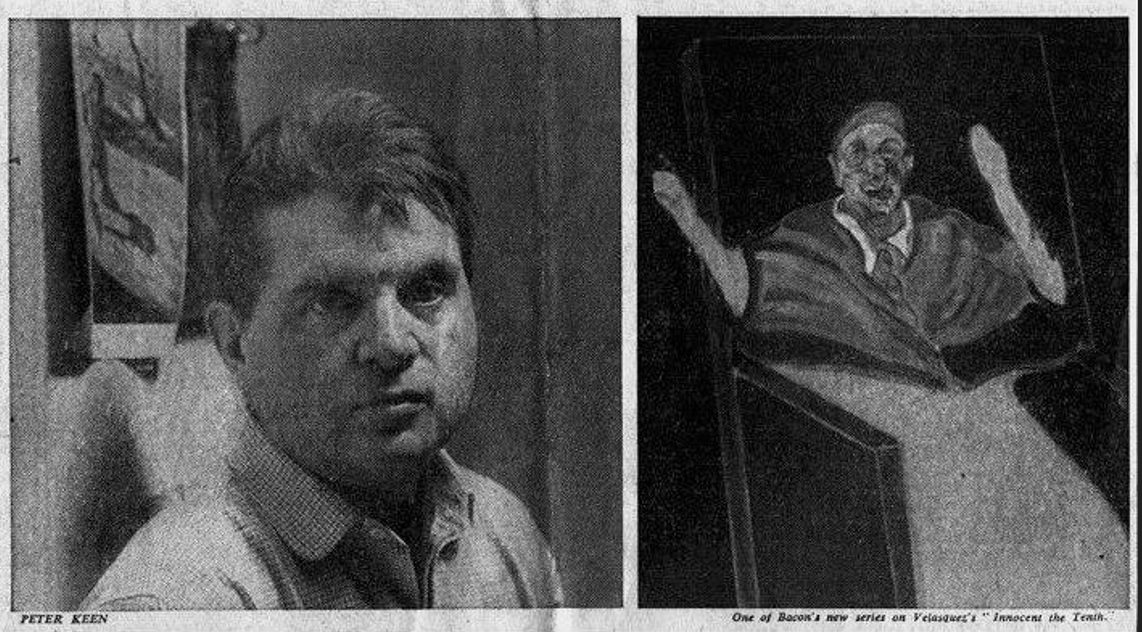
REPORT FROM THE UNDERWORLD
WHATEVER rating Francis Bacon may eventually deserve on the g00d-bad scale (and nobody makes the critical balance wobble more wildly) the retrospective show of his paintings at the Tate reveal him as, of all the living painters I know, the most interesting at this moment.
The work of the great explorers of the last generation—men like Picasso or Braque or Ernst—has receded enough in time for us to be able to accept and digest it. But Bacon’s discoveries are still so new that they sit on the stomach like lumps of uncooked meat. We feel we have swallowed something of importance: but it is hard to work it—as all art must be worked—into our bloodstream.
Most painters offer the newcomer some way into their secrets by the use of a half-familiar technique, or idiom, or way of looking at things. Bacon makes us start completely at scratch: his raw material is, in fact, usually ready-made—photographs, films, or other people’s paintings—but he treats it so weirdly that it becomes like a friend who has suffered some terrible disease, more alien than a stranger.
Knowledgeable visitors will recognise the usual Bacon sources—the figures from Muybridege’s photographic studies, the Velázquez painting of Pope Innocent X (which he has never seen), the van Goghs, the newspaper snap shots—and the recurring these of panicky isolation. The hole which Bacon has been excavating is not a wide one; but is goes down deep.
It goes down, in fact, into that region where everything becomes liquid and amorphous. Classical art is concerned with the creation of order out of chaos: disorder is Bacon’s subject. (In this he may be said to be in the nordic-romantic line which runs through expressionism and existentialism.) He examines it unflinchingly and reports it accurately. For the quality which is new in Bacon and which is so alarming to most people, is the objective, unemotional way in which he depicts the horror he finds. He is not approving or indignant or pitying or mocking. He paints like a reporter, a reporter of chaos.
Sado-masochism
Like all reporters he reveals streaks in his own character in the long run, in this case a vein of sado-masochism, well revealed in a non-religious obsession with the Crucifixion. More than usual the art reveals the man. Bacon seems not concerned, like Cézanne was, for instance, to grasp the essence of what he sees: in fact he almost never paints from life. What he is tracking down is his own response to an experience, so that at every moment we are driven back to the painter himself. And we seem to taste on our own tongue the bitter but somehow intoxicating flavour of a world tuned to ashes. It is a symptom of our time that what the ancient world would have considered "unseemly," to be shrouded in holy mystery, is precisely the area most favoured these days for public exhibition. It is our public feelings we now keep private.
In a sense Bacon is a Renaissance artist turned upside down. All his paintings (except for one scrappy landscape) are of men, or men thinly disguised as animals: to Bacon man is the centre of the universe. But what he finds at this centre is no more than a spongy ill-defined lump of matter and emotion. It is not an evil vision, but it is a frightening one, a glimpse of mankind without either divine grace or human dignity.
Bacon is a true original. He not only has no art-school academism to live down, he has contrived to forget all previous canons of painting. He has painfully evolved a language of his own to express his new thoughts. Like the grunts of some of the new inarticulate drama it is often primeval: but it says something which could not be said any other way. All the apparatus of normal attractiveness is avoided. If the texture is rubbery, if the outline has the slimy art-nouveau contour of a film cartoon, one may be sure this deliberately. It is interesting, for instance, to compare the crisply muscled wrestling athletes in Muybridge’s photographs with the hairless jelly-bellies, like something squeezed out of a huge toothpaste tube, into which Bacon transforms them—corpulent executives struggling erotically together on a crumpled bed. (We are reminded of the early sex-obsessed Cézanne.)
Visual feeling
The transformation is done with a virtuoso’s skill—the brush slithering over the canvas like the caress of a pudgy palm to convey the sensation of something which is neither quite solid nor quite melting. Like everything else in Bacon’s pictures each element contributes not towards the creation of beauty, but to achieve the most vivid possible communication of a sensation. “An attempt to make a certain type of feeling visual,” he has called his art.
In doing so he has inadvertently made discoveries of composition, texture and the use of imagery which will pass into the vernacular of painting. We had better all go and expose ourselves to Bacon’s utterances if we are to understand many of the pictures of the future.
Two important elements seem to me to be missing in many of the works. One (which seem to be emerging in the exciting new paintings which crown this splendidly chosen and displayed exhibition) is what makes a picture last long after the first impact of what says has worn off—the quality of the painting as a thing in itself. The other is, to put it crudely, the absence of love. Bacon does not seem to love either what he is painting, or what he has painted. His frequent destruction of his own work is not only a sign of high critical standards.
Echoes of Berlin
Sir John Rothenstein’s interesting introduction to the catalogue gives a small clue to a possible source of the despair and bitterness in Bacon’s art. At an early and impressionable age he spent some time in Isherwood’s Berlin. Something of the Kurfurstendamm flickers out of the paintings and it is tempting to identify here and there the nude figure of Mr. Norris.
Whatever their complicated origins may be, the paintings contain an electrifying actuality. They are snap shots of an age. What they show is not a pretty picture, but it is our own, stamped as indelibly on these canvases as the charred shadows on the walls of Hiroshima.
THINGS SEEN
The Horrific Theme in Visual Art
Like many others, I expect, who have lately seen the paintings of Mr. Francis
Bacon in the collected exhibition of his work at the Tate Gallery and been
fascinated or repelled or both by their strange power and effect on the
emotions, I have been wondering about the place of the horrific in art and to
what level it really belongs. If you consider the highest aim of the artist to
be the creation of an aesthetic beauty without any disturbing or abnormal
element of subject matter, then it seems necessary to conclude that the horrific
has an inferior status. The phrase
“aesthetic
beauty”,
it may be admitted, brings another question of definition with it, but one could
reasonably represent it by the quality of French painting and find a
particularly striking instance in the Impressionist art we value so much, in the
whole course of which there is absolutely nothing to
What use for horror has a Chardin, a Corot, a Braque? Is not the
“petit
frisson”,
the
“little
sensation
A natural proclivity in some countries, of which Germany and Spain furnish examples, towards images of mortality and dissolution has often enough produced works of art as great as they are sombre – one thinks of Grinewald. The horrors of war have constantly goaded artists into the production of masterpieces. Certainly one cannot relegate to a minor place Breughel’s “The Triumph of Death”; the etchings of the miseries of Lorraine in the Thirty Years War in which Callot’s exquisiteness of line does not disguise savagery of incident; still less the prints in which Goya depicted the disasters of the Peninsula.
Hell, the supreme example of horror, of which it was necessary for old masters
to give their conception, has inspired paintings by artists, among the greatest
in which we can take a positive pleasure. It is not, for instance, incumbent to
believe in the material existence of such an inferno as Jerome Bosch summons
into being in his Prado triptych. It is a fantasy
–
to
study it is to delight in the fertility of his invention. No repugnance or dread
is aroused by its beaked and strangely snouted demons; curious speculation only
by its weird hybrids, such as the hollow half-man, half-tree; one may even feel
heartened by its lurid fires as by a sublimely dramatic spectacle.
Yet a distinction of some importance seems called for between this final
sublimation of medieval fancies and the hell in which one senses reality
It is Grunewald, I should say, who first makes it
palpable, who is
“engaged”
with his subject to the extent that the frightful wounds on the martyred body he
paints seem imbued with a personal sense of anguish. The trend of expression
which begins with the Romantic era, when artists were throwing off the calm
objectivity of the old painter-craftsman, gives further striking example
In the psychological depth, I think, one finds the essence of the matter rather than in the imaginative gruesomeness of some artists. The puppets and skeletons of James Ensor are fanciful creations of a high order but one accepts them, perhaps, with equanimity, as inventions. Fuseli’s “The Nightmare” conveys the oppressive sensation of a dream, but is there not more of mysterious horror in those strange pictured boudoirs which seemed to come more directly from his sub-conscious? The terrible agony of Edvard Munch’s “The Cry” can only be the deeply felt comment of the artist himself on the human condition. There is a modern equivalent of its agony in Mr. Bacon’s reconstitution of Velasquez’s portrait of Pope Innocent X.
Is an art of this kind to be classed beneath the abstract art to which the
present time is so much conditioned. in which there is neither tragedy nor
comedy, nothing so human as horror, but only painting? I scarcely think any such
comparison is useful. Mr. Bacon’s art, as a whole, is a criticism of life, close
enough to its realities to have taken imagery from the screen and the
documentary photograph, though using them with remarkable originality. The
criticism of life has its own value even if, to borrow a phrase from Baudelaire
on Delacroix, it
“bears
witness to the eternal and incorrigible barbarity of man
JOHN LONDON
EDWARD LUCIE-SMITH on the paintings of Francis Bacon
EDWARD LUCIE-SMITH
AS EVERYONE HAS been saying, the retrospective exhibition now on at the Tate Gallery reveals that Francis Bacon is the most impressive and original British painter alive. Yet this compliment is, to my mind, less enormous than it sounds. Bacon towers over a national school which has been going through one of its less distinguished phases. And there are distinctly retrograde aspects to his work, as well as new and fruitless ones.
I think that we are, perhaps, a little too gingerly in our approach to Bacon’s work. He is a difficult artist, but neither as hermetic nor as unique as people have made him out to be. The otherwise excellent introduction to the exhibition catalogue, written by Sir John Rothenstein, displays this gingerliness of an almost exaggerated extent. Sir John makes great play with the sources of Bacon’s imagery: his admiration for Grunewald, Rembrandt and Velasquez, the use he makes of the photographs of animals and human beings in motion taken by Eadweard Muybridge at the end of the nineteenth century. What he does not say is the kind of artist that he thinks Bacon is.
Yet I think some of the clues are to be found very near at hand, in the Tate Gallery itself. Anyone who goes from the Bacon exhibition to the galleries in which the Tate’s stupendous collection of Turners is displayed, will at once recognise certain similarities between the two artists. Turner’s ‘Sunrise with a Sea Monster’, his ‘Skeleton Falling from a Horse’, even the apparently more conventional ‘The Letter’, have unmistakable likenesses to Bacon’s work. The first two, with their use of an ambiguous, vaporous technique to conjure up an image of horror, are very close to what we find in Bacon’s earlier pictures. And ‘The Letter’, though more tranquil in mood than anything by Bacon, has something of his method of drawing: the truncations, distortions, and above all the ambiguities. Bacon has mentioned Turner approvingly as an artist who ‘attempted to make idea and technique inseparable’, and ’The Letter’ does indeed show something of Bacon’s use of accident.
There is also another artist, a contemporary of Turner’s, of whom Bacon reminds me strongly in another way, and that is Géricault. The terrible image in the centre panel of Bacon’s Three Studies for a Crucifixion 1961—what seems to be a ravaged, devastated and still-bleeding corpse huddled on a narrow bed—suggests to me nothing so much as the famous picture by Géricault of a pile of severed limbs which is now in the Musée Fabre, Montpellier. These comparisons are important because they help us to place Bacon as essentially a Romantic artist, the last heir to the great rhetorical painters of the early nineteenth century. In some respects, it is extraordinary how far the similarities can be traced. There is, for example, the question of the strong sado-masochistic element in Bacon’s work. This links him immediately not only to Géricault but (as one of my colleagues has already pointed out) to Fuseli.
Bacon shares with the great Romantics both their qualities and their defects, but often rather more of their defects. He has their violent recalcitrance and individualism; he shares with them the desire to expose his true self, and not some created self or aspect of self which might seem more pleasing or creditable. He also has an immediate and unfettered access to the subconscious which strikes me as positively pre-Freudian in its absence of embarrassment. But his lack of inhibition can sometimes make him seem a little ludicrous, just as his concentration on his own individuality can seem strident. This point is well demonstrated in the pictures devoted to the theme of Van Gogh, where Van Gogh’s originals express psychic stress much more effectively than the variations which Bacon makes of them.
He shares with painters like Géricault and Fuseli, and also with Caravaggio a particular attitude to the audience. As with them, the presence of the audience and its reaction are very much part of the work of art. In fact, he attacks us; and without our shock the picture is nothing. There are two kinds of shock: the kind which wears off, and the kind that doesn’t. Fuseli, for example, is an artist who induced a terror which was once called ‘delicious’, but where delight has turned rather too readily to patronizing amusement. With Géricault, on the other hand, there are pictures which shock and terrify every time we look at them. Set against Géricault, Bacon does not benefit by the comparison.
It is not that I want to insist on a true-blue (or true-red) Marxist interpretation of Géricault’s gift, such as was attempted by Mr John Berger at the time of the Romantic exhibition. But it is true to say that Géricault is an artist who appears greater because he at once mirrors, interprets, and transcends his own age. The disturbance within himself somehow became linked to, and enabled him to harness for purposes of art, the great historical disturbances of the Napoleonic wars and the Industrial Revolution. Does Bacon do the same for our own epoch? His soundlessly screaming popes, his flabby wrestlers grappling erotically on a bed, his cowering nudes pitilessly exposed on their couches, present powerful images of cruelty, terror, obscenity, and loneliness. But there is a way in which these images, borrowed from painting or photography, fail to be of broad application. Because his range of imagery is so restricted, but even more because it is presented to us as imagery only, as metaphor not the ’thing-in-itself’, we find ourselves regarding Bacon’s work as something which touches reality at certain points, but is not part of it. It is not part of twentieth-century truth as Géricault’s is part of nineteenth-century truth; it does not interpenetrate with our own times as Grunewald’s Isenheim Altarpiece interpenetrates with the reality of the late Middle Ages. I choose this last comparison, both because of Bacon’s professed admiration for Grunewald, and also because of his own attraction to the theme of the Crucifixion. The purposes for which he uses it, however, seem to me as private and special as Grunewald’s were public and universal. Bacon, like certain contemporary writers (Gunn and Genet come to mind) uses his imagery of cruelty partly as a means of making guilt into art. But the guilt is always somebody else’s; it does not become one’s own.
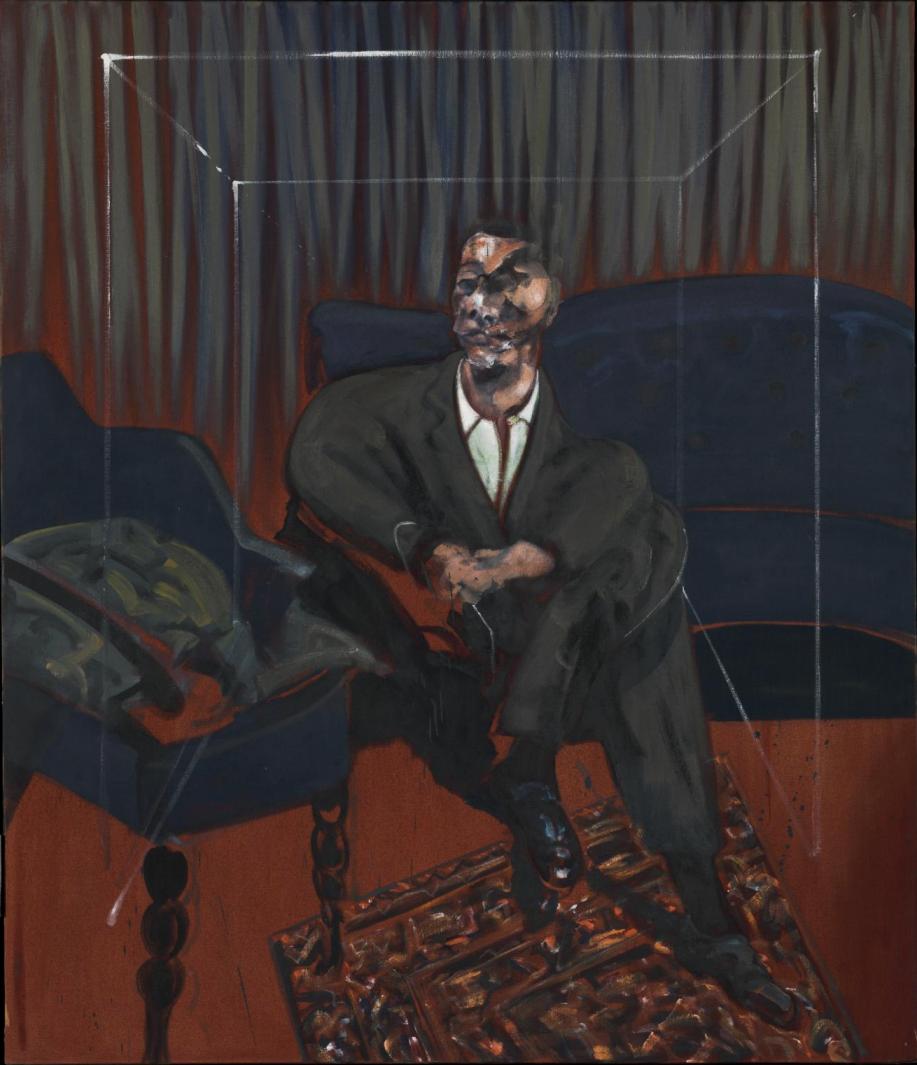
‘Man Seated with Turkey rug’, by Francis Bacon: from the exhibition of his work at the Tate Gallery, London
‘Distort into Reality’
“I’m trying to paint the track left by human beings—like the slime left by snails.” Francis Bacon says this evenly, not trying to shock, but not joking either. His canvases seem to many to be ghastly views into torment, half-decomposed portraits of things better left unpictured. But no one denies their power: put up last week in a big show at the Tate Gallery, they hit London like a slap in the face with a hunk of raw meat.
The man who was once dismissed as a refugee from the Grand Guignol is now widely considered to be Britain’s most exciting painter. At 52, Bacon deserves his success, for he has resisted every trend and fashion in art to hack out a path all his own. Though shaped by such old masters as Rembrandt, Daumier and Velasquez (“He haunts me so much I can’t let him go”), he has been as much influenced by the here and now of the photograph as by anything else. War, terrorism, gory accidents—these fleeting instants of agony fascinate Bacon. His torn and dislocated figures often seem about to vanish or disintegrate. In a Bacon painting, the body is temporary; only the torment remains.
Into the Dustbin. In real life, Bacon is as mysterious as he is on canvas. Keeping one step ahead of the landlord, he has moved about so much that the London art world is never quite sure where he can be found. A compulsive perfectionist, he has always destroyed more of his paintings than he has finished. A few years ago, he would merely dump them into the dustbin, but when he found that light-fingered admirers were rescuing and even selling them (one recently brought $2,800), he began slashing them with a razor. “I usually like a canvas when I finish it,” he says. “But the more I look at it, the more dissatisfied I become. If somebody doesn’t take it away from me within a few days, I will probably destroy it.”
The 90 paintings at the Tate—about half of Bacon’s undestroyed output—range from his famous screaming Popes and moldering businessmen to lumpish, bloated creatures that may huddle in the corner of a room, sprawl across a couch, or simply stare dumbly out of some indeterminate space. They are often close to being monsters, and sometimes they become great mounds of viscera. Bacon admits to being obsessed by death. “I look at a chop on a plate, and it means death to me,” he says.
Beauty Is Violence. But the subject of his paintings is really life in a world in which beauty and violence are synonymous. He often places his figures in boxlike cages, but this is only to “isolate these figures so you can see them more clearly.” The whole purpose is “to distort into reality. I distort to bring the reality of the object violently forward.”
Though Bacon uses many of the instinctual techniques of the action painters, he does not like abstract art. “Man gets tired of decoration. Man is obsessed with himself.” Few artists have more powerfully expressed on canvas the basic fact about man: that physically, at least, he is always dying, and that this is the great drama of his life. “I would like some day,” says Bacon, “to trap a moment of life in its full violence, its full beauty. That would be the ultimate painting.”
Mirror of his age
Clearly
we have come a long way from the time when a work of art was expected by art
critics to be beautiful. But there remains a vast majority of people to whom, as
Sir Herbert Read has pointed out,
If we
accept the Read definition, there can be no doubt that Bacon is an artist. And
if an artist’s stature is in direct proportion to the degree of feeling
(irrespective of its nature) that he arouses, then Bacon is a great artist. But
is he? And, if so, how great? Is he, for instance, the equal of Grünwald? Or is
he of no more lasting importance than the director of the latest
Trying
to answer these questions I am continually confused by the conflict existing
between extravagant claims made for him by his more fervent admirers and the
So for
me, at the moment, the truth about Bacon lies midway between the accusations of
Grand Guignol and creaking melodrama made against him years ago and Sir John’s
belief that
But although these pictures could have been painted only in this age of the concentration camp, it is altogether to sanguine to believe that they may act in some measure as a deterrent to further atrocities. In fact it is certain that psychologists could argue just as logically that they are likely to incite men to acts of sadism.
It would be comforting to think that the artist’s mind was filled with humanitarian ideas when he painted these pictures and that these ideas or feelings will be conveyed to the majority of people see them, but it would be false comfort. According to Sir John in his introduction to the catalogue:
To think
constantly of one’s own death, however, is not tragedy but morbidity, and here I
think we have the key to Bacon’s art. It is an art in which (I quote critic
David Carritt)
If he is successful in expressing it, an artist’s obsessive concern with is own Id is bound to produce original and probably unique art. A genuinely unique artist, Bacon cannot fail to stand out above the great mass of his contemporaries who, at a time when uniqueness is prized above all other qualities, strive after it desperately but produce only trivial innovations.
When you enter the retrospective exhibition of Francis Bacon at the Tate Gallery, London, on one side of the room you step straight into the land of the Jabberwock, the Bandersnatch and the Yongy-Bongy-Bo and on the the other into a gallery of Old Master. Here the illusion abruptly ends for, whatever the artist has to say, he is certainly not addressing his audience through the dream-like qualities of the Victorian child entertainer or even the stern discipline of academic portraiture. His art is sophisticated, harsh and utterly ruthless. Yet after the full impact of his work has worn off there remains in the mind a sense of mystery and a remarkable illusion of spontaneity.
What lies behind this imagery of horror with human beings contorted or apparently part-formed, their faces smudged out or having no faces at all, only screaming mouths? Yet the painter is not out to shock for the sake of shocking, only violently to disturb the mind – a subtle difference. In reporting what he sees and feels he is too isolated, too objective, for mere sensationalism.
Francis Bacon was born in Dublin in 1909, his father being a horse-trainer. In the late twenties and early thirties he began to paint without any tuition at all. What he produced during those early years he has himself destroyed and it is only from shortly before the 1939-45 War that any of his pictures survive.
He has been influenced by several great painters: Velasquez, Van Gogh, Picasso and some of the Surrealists. But what seems to have fascinated him most are Muybridge’s volumes The Human Figure in Motion and Animals in Motion. These have given him an insight of how the camera can catch a person or animal in rapid movement, greatly distorting the body or face.
Bacon has stated that his pictures are not intended to have any precise meaning only “an attempt to make a certain type of feeling visual.” He does not accept Christian faith or dogma, yet he appears obsessed with the Crucifixion and has made many studies of it, the latest version of which breaks away from every bond of tradition.
Bacon, who believes in no after-life, only hell on earth, is crying out to a world now desperately fearful of the consequences of uncontrolled physical power; he is pitting human intelligence against the frailty of human flesh. Here surely is iconoclasm of a new order in art, as yet imperfectly understood.
W.A.S.
Where, today, can you buy a FORTUNE for a song?
London
ANITA BROOKNER | THE
BURLINGTON MAGAZINE
Despite its superficial ugliness, the great attraction of Francis Bacon’s work lies in the intimation, all too rare these days, that it contains a human drama which involves the spectator as much as it does the artist. It is like the last communication of a man forgotten at the bottom of a lift shaft, and slowly degenerating from fear, hunger, and inertia. As such, it is of supreme fascination, to the present writer, at least. The knowledge that Francis Bacon is up and well does not invalidate his message. If he has not in fact suffered this particular accident, he has recorded all the emotions that go with it. Whereas in the past, artists painted flowers, portraits, landscapes, etc., Bacon does something only possible after the first generation of Freudians: he paints traumas.
Critics are quick to link his slimy, slithering, purblind images with Hiroshima, Eichmann, General Salan, and various other modish causes for despair. In doing so, they are performing precisely that operation of emotional adjustment to unpleasant truths that Bacon so splendidly ignores. The sensation of sheer panic induced by a Bacon portrait should be immediately understood by anyone puzzled at inconsistencies in his own behaviour as a civilized and rational being, by anyone, say, who has fled in terror from a sickroom or experienced the motionless turmoil of Sunday solitude. Such painful weaknesses, breeding greater disgust on each recollection, are here captured in visual rather than literary form. I do not think that this has been done before. On purely quantitative grounds, therefore, Francis Bacon is a unique artist.
His world is consistent but not impenetrable. In fact, as in Hogarth’s Bedlam, certain archetypes emerge. The best known is that Pope, a derivation from Velazquez’s portrait of Innocent X in the Doria Gallery (which the artist has carefully avoided examining). Bacon’s Pope sits in a glass cage, a slab-like chair, or a hospital bed, yawns, screams, raises his arms, or swivels away across the room (89). More sinister still is the oblong-headed character in the business suit who appears to be facing some unnameable torture; he looks like an organization man whose plans have gone wrong and who hears the door of the detention block clang shut behind him. Uneasily he smiles, preparing for some endless third degree in a room containing only a bed rail and a shutter (24). With the third type of figure we are in the disturbed ward: embryonic creatures crouch or splay on pieces of furniture from which the dangerous or detachable parts seem to have been removed (see Fig.44). These subhuman beings exist in a clearly defined and even luxurious space, as in Sartre’s Huis Clos, and though their heads may shade off into nothing and their limbs fail to connect, they have well-developed and well-filled mouths which remind one of Hitler or Goebbels in full cry.
Mr Bacon claims to be self-taught and comparatively uneducated. Certainly his
vision has never been corrupted by an art school training or too great an
acquaintance with the works of other masters. He himself acknowledges as his
sources repro- ductions after Velazquez, Rembrandt, and Van Gogh, Eadweard
Muybridge’s album of the history of photographic techniques, the close-up of the
nurse’s shattered face in Eisenstein’s film Battleship Potemkin, and many
pictures torn out of magazines and illustrating the more violent or illogical
aspects of human life. But he cannot get away as easily as this. He has
destroyed the greater part of his early work, so we shall never know how or what
he started to paint. But on the basis of this exhibition alone, we can plot him
quite comfortably in the history of European art. Whether he likes it or not, he
is the legatee of the nineteenth-century expressionists — Van Gogh, Munch,
Ensor, Soutine, Kokoschka — and he must take credit for bringing the tradition
of expressionism up to date. We are, moreover, given certain unmistakable
glimpses of his antecendents. The distortions of Head of a Man (78) are in
direct line of descent from Van Gogh’s Portrait of an Actor in the
Kr611er-Muiller Museum. His enormous triptych of Studies for a
Crucifixion (90) is in bright Art Nouveau colours of red and
orange (but the central figure is a mess of torn flesh on a mattress). Head
of a Woman (77) is pure Ensor. Certain rippling areas of green bounded by a
black line (see again Fig.44) are a straight lift from Munch, just as the hotly
coloured pictures of Van Gogh going off to work (Fig.46) are linked with
Kokoschka. There are even references to Toulouse-Lautrec, as for example, in the
creature (or creatures) on a bed (38,
Of Bacon’s importance there can surely be little doubt, although cautious voices have been heard to dismiss him as ‘fashionable’. (He is fashionable only in the sense that in certain moods we shall find his pictures irrelevant and repulsive.) Here at last is a contemporary painter of true stature, whose endless communion with the realm beyond our understanding marks a definite breach in the polite tyranny of formal conventions. Bacon is committed to his nervous system just as Van Gogh was once committed to his desire to love all men. The emotional range has shrunk: the relevance for the rest of us is the same. We are not called upon to admire or applaud these works, and we are certainly not meant to enjoy them. But if we can acknowledge the fact that painting can still be a mirror to certain states of being, we may find that the standards we apply to the greater part of contemporary art have undergone a radical shift.
To go from Bacon to Sutherland (New London) is to exchange the compulsive confession for the overwrought murmur. Here we are back in the world of ‘forms’, all of them beautifully described and expertly situated on their bright grounds. I am unworthy to review this exhibition because I have always considered Sutherland a minor talent, of the sort which England breeds in great number, a Romantic puritan with a taste for spiky Gothic shapes and acid colours — pinks, reds, greens, yellows, purples — applied with deliberation but without enjoyment. Certain of the sketches for the Coventry tapestry even have the air of nineteenth-century brass rubbings or oddments copied by Cotman from a parish church in the Pennines. One’s quarrel with these pic- tures (which, to be perfectly fair, give evidence of remarkable fertility) is that they have insufficient
PARTY AT PARTRIDGES
Mr. John Partridge received the guests at a
very gay evening party given by the Directors of Frank Partridge’s Gallery in
Bond Street after the Sotheby
Many of the guests came straight on from the
sale, and the chief topic of the evening was whether the pictures would have
made more than the £464,000 if the Wall Street Stock Market had not fallen so
violently two weeks before the sale. Sir Alexander Korda
Others present: Baron and Baronne Eugène de Rothschild, who have rented a house in Surrey for the summer, Mr. Evelyn de Rothschild, Viscount and Viscountess Astor, Sir John Rothenstein, Mr. Francis Bacon, Mrs. Audrey Pleydell-Bouverie, the Earl and Countess of Wilton, the Hon. Mrs. Partridge, her father Lord Brownlow with Lady Brownlow, the Hon. Anthony and the Hon. Mrs. Berry receiving congratulations on his nomination as a Conservative candidate, Mr. and Mrs. Rudolph de Trafford, the Earl and Countess of Westmorland, Viscount Hambleden, Mr. Michael and the Hon. Mrs. Brand, Lord and Lady Rotherwick, Mr. Mark and Lady Annabel Birley, Mr. and Mrs. Billy Abel-Smith, Mr. and Mrs. Denis Mountain, Miss Patricia Rawlings, Mr. Leslie Dawson, who is a director of Part-ridge's, Sir Alfred and Lady Beit, Lady Marks, Mr. and Mrs. Charles Mills, Mr. Peter Laycock, Lord and Lady Norrie, he bid earlier for one of the bronzes, the Hon. Henry and Mrs. Lumley-Savile, Mrs. Claud Partridge, the Duke and Duchess of Bedford, Mrs. Cazalet Keir, Mr. Charles Harding, Lady Vereker, Lady Edith Foxwell, Mrs. Christopher Mackintosh, Mrs. Alan Butler, Mr. and Mrs. Dudley Tooth, Princess Djordjadze, Mr. Ted Basset, Ann Lady Orr-Lewis, the Maharanee of Baroda, a very keen and knowledgeable collector, Mr. and Mrs. Alfred Chester Beatty and Mr. and Mrs. Jon Bannenburg, he did the decor for the party.
Image and Meaning in Recent Painting
By BERNARD SMITH
BERNARD SMITH
THERE is a new interest in figurative painting today. Anyone who visits the London galleries will notice it. The enthusiastic reception given by critics and art students to the Francis Bacon retrospective exhibition at the Tate Gallery is only one instance of this. When I was last in London between 1948 and 1950 the situation was different. True, figurative painting was then the rule rather than the exception in the west-end galleries, but it was based for the most part on neoromantic imagery drawing its inspiration largely from Blake, Turner, and the English countryside; and the young artists and art students were looking elsewhere, for example to Victor Pasmore’s dramatic renunciation of figurative painting in favour of objective abstract art which had happened in 1947.
In 1948 the paintings of Jackson Pollock and Mark Rothko first appeared at the Biennale, and abstract expressionism began its triumphal diffusion through the art centres of the western world. I did not see Pollock’s work until two years later, but I still recall vividly conversations with Alan Davie during the winter of 1949 at the Abbey Art Centre, Barnet, where we were both living at the time. Davie, one of the first artists in this country to be profoundly influenced by the new modes of abstraction then emerging, upon the need to destroy all traces of the figurative image in- one’s own work in order to make possible the creation of a new pictorial language of pure form. By the middle nineteen-fifties the swing was almost complete.
Today the situation has changed. Although abstract paintings still predominate in the avant-garde galleries, the centre of discussion and of pictorial experiment has shifted more towards the role of the image in painting. Some artists and critics are inclined to interpret this revived interest in the image as retrogressive, a kind of failure of nerve. Others think that the new interest in figuration arises directly from the achievements of abstract expressionism. The young American painter Larry Rivers, who, in his own work, moves with wit and fluency between the figurative and non-figurative modes, expressed this view graphically at a recent discussion at the Institute of Contemporary Arts. Talking about the indebtedness of young artists today to the pioneers of abstract expressionism, he said: ‘Why, without them they would not be able to raise their brush to their boards’. Artists, it seems, are no longer being asked to break with the past now that the past includes abstract expressionism.
Neither of these views, it seems to me, is entirely sound. Figurative painters are at work today who are advancing the frontiers of painting itself, and they do not stem directly from abstract expressionism though they certainly do owe not a little to it. I shall come back to that. But first I want to stress that abstract art has always been more concerned with what the plastic arts possess in common than with what distinguishes one art from another. In its preoccupation with form, abstract art has tended to push the aesthetics of painting too close to the aesthetics of architecture and music, the two arts which rely most upon the organization of form and least upon figurative imagery.
It need not surprise one, therefore, to find that the most inventive and consistent abstract painters find it difficult to contain their investigations within the limitations of painting. Their work tends to move into high relief, to three-dimensional construction, or to composing with materials of differing texture, to move, in other words, away from the primary act of painting—the stroke of a brush upon a surface. Action painting is an important exception to this: but, for the most part, abstract art possesses a tendency to break through the limitations of painting in order to create new forms of visual experience that are only tenuously connected with the experience of painting.
I do not doubt the value of this. But it seems to me that the art of painting has been most advanced by those who have worked within its limitations. The twentieth-century drag of painting towards architecture and music is, doubtless, a salutary corrective to that nineteenth-century drag of painting towards poetry and drama. But painting at its best is an art of formed images; deny it either form or image and in the long run you impoverish it: the figurative image, after all, is as native to painting as is abstract form. The palaeolithic hunters knew that. It is true that during the present century advances in the art of painting have arisen mainly from a concern with form in space. But now, after fifty years, we may be witnessing a similar advance by those who are prepared to investigate the image-making processes of painting just as fearlessly.
It is becoming increasingly clear today that some painters who persisted with figuration during the nineteen-fifties, when it was least in favour, were not engaged upon a purely conservative activity but were discovering for themselves ways in which they could break down the close connection between figurative images and visual stereotypes, by which I mean images that wear the clear brand of other men’s minds.
I want to discuss four processes which are helping to bring this about. And though I must discuss them separately it will be realized that they operate in extremely close conjunction during the act of painting. I shall illustrate the processes from the work of three figurative painters who have recently shown in London: Francis Bacon, Sidney Nolan, and Arthur Boyd.
The first process I want to discuss may be called deliberate ambiguity. I do not mean those ambiguities (of perception and perspective) about which Professor Gombrich has written so tellingly in Art and Illusion; I mean the deliberate way artists use images with double and multiple meanings— one of the most common features of recent figurative painting. In one of his sets for Kenneth MacMillan’s new production of Stravinsky’s Rite of Spring, Sidney Nolan used a great golden circle on a golden stalk against a blue ground. Anyone who saw it must surely have asked himself: ‘What is the shape the dancers worship?’ The rising sun, the tree of knowledge and death, or a great Bacchic phallus arrogantly asserting the rights of man? Is it the atomic cloud that dominates the dance or that wandering moon which for an earlier generation of romantics was such a symbol of hope and constancy in a changing world? As the dance develops it does indeed take on many such meanings and more. But the meanings pass and the shape remains.
Or consider those images of Francis Bacon in which flesh stretched against a wall may mean a crucifixion or the flayed carcass of a pig. This use of ambiguity is not to be dismissed as a kind of visual trick. It proceeds from a profound awareness of the nature of painting: an art of marks and shapes that must learn to swim in a world of meaning. Few things are of more importance for modern painting than the spatial ambiguity that arose from Cézanne’s desire to organize his forms simultaneously in depth and upon the surface of his canvas.
Ambiguity applied to the figurative image provides a way to avoid the visual stereotype. The non-figurative painter avoids stereotypes by means of marks and shapes, the interpretation of which is arbitrary, since the truly non-figurative is infinitely ambiguous. But a painter of figurative ambiguous images may control the area of meaning which his shapes may evoke. By doing so he frees his forms from over-simple identifications. Meaning arises from the forms, plays about them, and disappears back into them; becomes a kind of presence, an aspect of the mood and temper of the work. Ambiguity frees the artist from rhetoric and moralizing. Bacon, for example, with images that oscillate between crucifixes and carcasses, is not seeking to denounce the church or the Butchers’ Company but seeking, as he has said, to ‘make a certain type of feeling visual’. And it is precisely because we cannot say exactly what his paintings mean that he has freed his imagery by the use of ambiguity from literary and visual stereotypes. Of course ambiguity when poorly used will result in a muddle of chaotic suggestions: at its best it is always controlled by the artist’s expressive intentions. In the work of Patrick Hughes and the ‘pop’ artists, ambiguity is used as a vehicle of wit and comment. At times ambiguity emerges not from the formal construction of the imagery itself but from the way the imagery is related to the spatial construction of the painting. In his first Ned Kelly series, for example, Nolan uses a kind of cardboard cut-out figure and an empty masque for Kelly but makes him act out his story in clearly-defined three-dimensional space. It is consequently by no means easy to decide whether Nolan intends Kelly to be read as a hero or clown, and the ambiguity is well pointed, because Australians in general have never made up their minds either; he is an ambiguous figure in the national imagination as in Nolan’s art.
The second process is conflation. By conflation I mean an artist’s use of images drawn from his own earlier paintings and impressed upon new images in new settings. Nolan made brilliant use of conflation in his second series of Kelly paintings, by uniting images used in his earlier, explorer, drought, and convict paintings with the imagery of his first Kelly series. The image of Kelly thus became at once more personal and more generic, both the continuing symbol of the wanderings of Nolan’s own imagination and the symbol of a desert-prophet at once loved, feared, and rejected by his people. In his fine painting ‘Kelly in Spring’, in the collection of the Arts Council, we may see this synthesis of motifs from varied sources in the artist’s earlier work. Kelly becomes a kind of vegetation god, a man of sorrows with a drought-,g withered skin whose old rifle blossoms like Aaron’s rod. Bacon conflates the screaming mouth of a nurse from Eisenstein’s Battleship Potemkin with the heads of popes, magdalens, and baboons. By the use of conflation the artist brings images from his earlier paintings into play upon new situations and finds new significances for them. By means of- conflation he opens up an organic connection with the art of his own past.
Then there is transformation. Images in the same painting will appear to transform themselves or dissolve into quite different images. It is a process which has always been characteristic of Arthur Boyd’s work. In many of his early paintings the earth heaves and brings forth crowds of small half-formed creatures, part-plant, part-animal, and part-human, who gesture with abandon and despair. In other paintings women turn into windmills, into seed-pods, tropical fire-flies, or snails carrying their houses upon their backs. There is turbulence, violence, and unceasing change in Boyd’s heavily figured landscapes. The bush is a dark, primordial wood cluttered with the dwarfs and demons that populated the medieval imagination, a St Anthony’s wilderness full of strange devils. They sprout up from the earth, ride upon monstrous animals, copulate, or crouch in loneliness and grief. It is a vision of life heightened to a pitch of agonizing intensity in which generations pass like generations of flies, and one thing, under the pressure of life, is always becoming another. Nolan and Bacon also make use of transformation. In Nolan’s ‘Catani Gardens’, painted in 1945, and recently shown at the Institute of Contemporary Arts, a group of young lovers dissolve into amorous ecstasies to become more and more like the bright garden lights from which they hide. In one of Bacon’s paintings a man’s head dissolves into that of a baboon; in another, a nude melts into raw meat.
Finally, there is the use of chance or accident. In their use of chance in the act of painting figurative painters today undoubtedly owe much to abstract expressionism, but they make use of chance not to avoid imagery but to discover it. The unit of painting is the brush-stroke, and the brush works towards the definition of images that emerge partly from what happens in the artist’s mind and partly from what happens upon the canvas. From unexpected configurations of paint new images and new departures may begin.
Ambiguity, conflation, transformation, and accident: by such processes of the pictorial imagination—and by others, doubtless, of which I am not aware—figurative painters today are successfully avoiding any equation of image and stereotype. Painters are becoming more than ever aware that it is the nature of form to bear imagery as certainly as that mythical field of Mars which once bore armed men. It seems to me that we have here a genuinely new approach to painting. If I were asked to give it a name I should call it iconomorphic painting because image and form are more closely interlocked in it than in traditional figurative painting. It is a kind of painting that would separate image and concept, and accept the image as one of the painterly functions of form.
It is true that many of the processes characteristic of this iconomorphic painting are to be found in traditional art and in the art of the recent past. The use of deliberate ambiguity, for example, in the late Turner, in Salvador Dali’s paranoic heads, and in much of the work of Paul Klee; conflation in Blake’s recurrent use of personal motifs with new significations in new settings; transformation in the fantastic auricular shapes of mannerist and baroque graphic design and in the zoomorphic forms of Max Ernst; the manipulation of accident in the blot landscapes of Alexander Cozens, to mention but a few characteristic examples.
I have already said that many of the best figurative painters today owe much to abstract expressionism, but it seems to me they owe far more to the early surrealists. Their interest in the psychology of dreams enabled the surrealists to make discoveries about the interrelation of figuration and form which have never been completely explored. Painters like Bacon, Nolan, and Boyd were all profoundly influenced by surrealism when they first began to paint, and during the past twenty years have been perfecting a way of painting implicit in the surrealist programme but never fully realized in pictorial achievement. —Third Programme
Mr Smith is an Australian art historian and critic. His publications include ‘Place, Taste and Tradition: a Study of Art in Australia since 1788’ and ‘European Vision and the South Pacific’
Place of Irish painters
THE ROAMER
Sir John Rothenstein’s “British Art since 1900,” published this year and
described as “the first Illustrated survey of British painting and sculpture of
the twentieth century,” includes the Irish artist, Jack B. Yeats
Sir
William Orpen, born at Stillorgan, Co. Dublin, is another artist with Irish
connections, and the sculptor, F. E. Mc William, of Princess Macha fame, has a
place in the book. He was born at Banbridge in 1909, and in the same year the
artist Francis Bacon, who is included, was born in Dublin. Bacon has produced
some strange pictures which would be just as controversial to some people as Mc
Williams sculpture
Yeats has been described as Ireland
Ambassador Extraordinary
LONDON WEEK BY WEEK | THE SUNDAY TELEGRAPH
FRANCIS BACON will be enhancing his already considerable reputation overseas this winter. Works from his recent exhibition at the Tate are being shown in Mannheim, Turin, Zurich and Amsterdam.
The culmination of this tour will be an enlarged exhibition at the Guggenheim Museum, New York, opening next April. One-man shows are a rarity there, and Bacon will be the first English artist to have one.
Designed by Frank Lloyd Wright, the Guggenheim is a spiral of stone and glass, exciting even by the high standards of modem architecture in New York.
THE ART MASTERS
An appraisal of international reputations among British painters and
sculptors conducted by Robert Wraight with pictures by Ida Kar
ROBERT
WRAIGHT
THE PROPENSITY OF THE BRITISH FOR HIDING their lights under bushels is said to cost us millions a year in exports and an inestimable amount in prestige. We like to think it stems from a native modesty of which, paradoxically, we are secretly and often openly proud. In fact it is more likely the result of complacency and laziness. Whatever the cause, it is true that while other countries are shouting their achievements round the world we are content to mumble ours to each other, whether in the fields of technology or athletics, medicine or art.
In art it may be simply that we were for so long without any lights worth
showing that even now, when we have many artists whose reputations stand high
abroad, we continue from habit to behave as if we had none. Our art critics have
been hypnotized for so long by the ascendancy of Paris and stunned so recently
by the sensational rise of New York that the remarkable phenomenon in our midst
“You
Can
Even without Moore we are particularly strong in sculptors, a fact which, if we may judge from the amount of work exported by Chadwick, Paolozzi, Armitage and Hepworth, is more readily recognized abroad than at home. International appreciation of our leading painters is also expressed in hard cash of many different currencies. Even apart from Ben Nicholson, whose reputation abroad was already firmly established in the 1930s, we have a number of men whose names (and work) ring bells in New York and Tokyo, Paris and São Paulo.
That this is so is obviously largely due to the tremendous advances made in
world communications since the War and to the increase in the number of major
inter-national art exhibitions during the same period. (It will be noted that
nearly all the artists photographed here have had their work presented at the
Venice Biennale, the world’s best art-shop window. The importance of this may be
assessed from the report, given to me by an artist friend just returned from
Yugoslavia, that the only British artist known to young Yugoslav artists with
whom he talked was Ceri Richards
In this respect, the French critic
All these statements, it will be noted, imply that the one essential characteristic sought in painting emanating from England was “Englishness.” The French did not want English painting that imitated French painting or, for that matter, any other sort of “national" painting. And this is undoubtedly still true today, not only of Frenchmen but also of Americans, Italians, Argentinians, Japanese or what have you.
In recent years the vastly increased exchange of ideas between artists of dif-ferent countries has given rise to a lot of talk about an “international style” of painting, but no such style exists, nor is it likely to exist in the foreseeable future, because deeply rooted national and racial characteristics persist in the work of the genuine artist however much he may absorb “foreign” influences. The true artist cannot escape his ancestry. It will show, however subtly, in his work, whether he takes his inspiration from Cubism, Surrealism, Action Painting, Byzantine mosaics or Chinese scroll painting.
This is not to say that to earn an “international reputation” a British artist must be insular. (Many examples could be cited to show that the opposite is true.) But while sharing common ground with artists of many other nations, he will still have such instinctive ties with his own country as will imbue his work with an element of strangeness, mystery or just “differentness” for people of other nations.
Two (oversimplified) examples of this are the element of purity (sometimes
called “chastity" and “Puritanism”) in the “cubism” of Ben Nicholson, and that
of Celtic imagery that dominates all the exotic influences to be found in the
American-sized, Picasso-precise paintings of Alan Davie. These, and comparable
elements in the work of such painters as Sutherland and William Scott and such
sculptors as Hepworth and Butler, will endure as long as the artists
FRANCIS BACON, 52, was recently described by Sir John Rothenstein as “one of the most formidable painters to have emerged anywhere since the War.” And “formidable” is the right word for his staggeringly horrific art. Bacon had only one year’s formal education in his life. As an artist he is self-taught, though encouraged and influenced by Graham Sutherland in the 1930s. He exhibited in the UNESCO exhibition, Paris, 1946, and later represented Britain at Venice Biennale, 1964. Bacon is said to be the only British painter who influences British art students, and to arouse more interest abroad than any other. He lives in London.

EXHIBITION OF MODERN PAINTINGS
An important exhibition of British paintings executed between 1950 and 1957 will open at the Borough Art Gallery to-day (Saturday). The exhibition is arranged by the Arts Council of Great Britain. Soon after its incorporation in 1946, the Arts Council decided to form its own collection of contemporary British art.
Not only was this a modest example of state support and patronage of living
artists; it was also something of material advantage to the Council
The following artists are represented: Frank Auerbach, Francis Bacon, John Bratby, Prunella Clough, Harold Cohen, Peter Coker, Alan Davie, Paul Feiler, Terry Frost, Anthony Fry, Derrick Greaves, D. Hamilton-Fraser, Adrian Heath, Roger Hilton, Peter Kinley, Heinz Koppel, Peter Lanyon, Kenneth Martin, Robert Medley, Edward Middleditch, Ben Nicholson, Sidney Nolan, Victor Pasmore, John Piper, Alan Reynolds. Ceri Richards, William Scott, Jack Smith, Keith Vaughan, Victor Willing and Michael Wishart.
Riot warning
F. N. SOUZA GALLERY ONE
ROBERT
WRAIGHT
FROM A NOTE IN THE CATALOGUE OF FRANCIS Souza’s last exhibition I see that I once wrote an article about him that appeared under the title “Man Who Paints Pink Elephants.” That was many years ago and I cannot remember a word of the article or even if there were any paintings of pink elephants in his studio at that time. There was certainly nothing so playful there when I called on him last week to talk about his latest exhibition, opening today at Gallery One in Mayfair. He was working on the latest of a series of paintings, called The Human Predicament, that is likely, if and when it is shown in its entirety, to cause a riot
Conditioned as we are (largely, I suppose, through the work of Picasso) to horror-painting, there are few artists in the world today who have the power to shock us deeply. Of this few Britain has, in Francis Bacon and Francis Souza, more than her fair share and, evidently (in view of the fact that Souza has so far been denied the honour of inclusion in the Tate’s permanent collection), a bigger share than authority feels is good for her.
Writing about Bacon’s one-man show at the Tate recently I argued that his work was too subjective and that its essence was not tragedy but morbidity. Sir John Rothenstein has reported that Bacon “cannot recall a day when he did not think of his own death.” Souza told me that he, too, is always thinking of death-but not necessarily of his own death. He is not worried about his own skin but about the skin of the whole human race. This difference will, I believe, one day establish him as a more important artist than Bacon.
For Souza life is a tragedy wrapped up in a
mystery but he likes to think of himself as a detached observer. “To a great
extent I am an ivory tower painter,” he says, surprisingly. “I am not trying to
solve any sickness of my own. I
“Renaissance painters painted men and women making them look like angels. I paint for angels to show them what men and women are really like,” he says. The violence and the sex-obsession are not his but ours. “I am not my work. My work is a completely separate thing. My pictures are merely particles of matter flying about, organized by me as I, in turn, am organized by some other power.”
As he talks, he illustrates his points with quotations from Hegel and the Bible, Rimbaud and the Upanishads, T. S. Eliot and the Kamasutra. He is small and his voice is soft and deep down in him is a strong religious feeling that refuses to be crushed by the hideous monsters that he creates.
He was born in Goa 38 years ago and brought up as a Roman Catholic. He was baptised Newton Victor but when he was five he had smallpox and his mother vowed that, if he survived, she would call him Francis, after St. Francis Xavier, patron saint of Goa. He survived. At 13 he went to high school in Bombay and was expelled two years later. At 16 he went to the Sir J. J. (for Jamshedji Jigibuohy!) Art School, Bombay, and was expelled five years later. Up to 1947 his pictures were rejected by the Bombay Art Society, but in that year they were accepted and won him a prize.
London first heard of him in 1948 when he was represented in the exhibition of Indian art at Burlington House. In 1949 he came to London and for the next five years lived here on the borderline of starvation. But since 1955, when he was given the first of his six one-man shows at Gallery One, he has not looked back and is now among the most bought painters in this country.
To those who say that he “goes too far,” that his work is too cruel and harsh, that he overstates his case and offends those in art’s high places, he retorts: “I’ll never compromise. I’d rather starve-again.”
DANIEL FARSON FINED £1
COVER
ARRESTED on a warrant, Daniel Farson, 36, the TV personality, of Pelham Place, South Kensington, was fined £1 at Bow Street, London, today after pleading guilty of being drunk in St. Martin’s Lane, Westminster, on September 21. He was also ordered to forfeit a recognisance of £1.
Mr. J. E. Previte, Farson’s counsel, said Farson was bailed to appear the next day, but he was ill and he sent a doctor’s certificate stating that he was unable to attend.
‘Pop Art’ since 1949
By LAWRENCE ALLOWAY
LAWRENCE ALLOWAY
THE term
Pop art begins in London about 1949 with work by Francis Bacon. He used, in screaming heads that he painted at this time, a still from an old movie, The Battleship Potemkin. This image, of the nurse wounded in the eye in the Odessa steps sequence, though mixed with other elements, was central to the meaning of the work. About 1951 Bacon extended his use of these sources to include Eduard Muybridge’s photographs, whose motion-studies of people and animals, made in the eighteen-nineties, provided Bacon with motives. The difference between Bacon’s use of quotations from the mass media and other, earlier uses, is this: recognition of the photographic origin of a part of his image is central to his intention. In fact, his painting has often depended on being stretched between the style of the grand manner and topical, pop-art derived, incidents of violence.
Pop art, after Bacon, got linked with technology, and this was the first phase of pop. It was at this time that I became involved in it. Influential in London about ten years ago were three books which were certainly known to the artists who were to use pop sources. Ozenfant’s Foundations of Modern Art, Siegfried Giedion’s Mechanization Takes Command, and Moholy-Nagy’s Vision in Motion. What I liked in those books (and I know it rang a bell with other people then in their twenties) was their acceptance of science and the city. Science fiction, because it was protechnology, but highly fantastic, was popular at this time. I remember that science fiction magazines and paper books used to be handed around and swapped a great deal. The three books I mentioned were also being read by the British constructivists, but the artists I am speaking of valued the illustrations more than the texts which we thought perpetuated a good many clichés. You know die kind of thing: they called for a ‘modern spirit’, ‘Pin-up’, by Richard Hamilton (oil and collage) Arthur Jeffress Gallery, ‘the integration of the arts’, and so on. It was the visual abundance of these books which was influential, the choice of illustrations that ranged freely across the borders of art and non-art. The visual explosion of the twentieth century, with its wealth of vivid imagery, became a direct source of art.
There were two exhibitions which reflected this situation and indeed furthered its understanding in London, in 1953 and 1955. Both were held at the Institute of Contemporary Arts, which has been a centre for the investigation of the relations between fine and pop art. First was ‘Parallel of Life and Art’ arranged by Eduardo Paolozzi, Peter Smithson (the architect), and Nigel Henderson (the photographer). A hundred blown-up photographs of motion studies, ethnographical material, child art, micro-photographs, blended technology, and fantasy in wild profusion. Then in ‘Man, Machine and Motion’, Richard Hamilton explored the intimate contact of men and machines and the extensions of speed and reach which resulted. He used photographs which were valued not solely as documentary records, though they were that, but also as imaginative fantasy. In this way properties usually reserved for the fine arts were associated with photographs. Hamilton, later in the ’fifties, used pop art elements in his own paintings which look like versions of Marcel Duchamp’s glass ordered by Maidenform Bra or General Electric as part of a very soft sell campaign. Hamilton has stated, and it is important to get this clear about the use of pop art sources in general, that his paintings are not ‘a sardonic comment on our society ... I would like to think of my purpose as a search for what is epic in everyday objects and everyday attitudes’.
Typical of this first phase of pop art in England is the work of Eduardo
Paolozzi, whose bronze sculptures of the ’fifties carry allusions to obsolescent
robots as well as to the Frankenstein monster. As a boy Paolozzi had seen
Karloff monster movies, and retained the massive, lumbering contours in his
memory until it returned in his sculptures of the human image. Paolozzi and I
used to go to the London Pavilion, which was the first-run house for monster
movies in the ’fifties. And our feeling was never that we were slumming, or
getting away from it all, or not being serious. It was our assumption that what
we felt at, say, Tarantula, was as serious and
interesting and worthwhile as our other aesthetic feelings. What happened was
that these emotionally charged images from the mass media dramatically reduced
aesthetic distance. In place of Roger Fry’s
An appeal to common experience was central to the first phase of pop art. It lasted, strongly, from about 1951 to 1958. All the art of this phase was figurative, with references to pop art which could be demonstrated. John McHale, for example, made collages in 1955 out of the then-fresh post-war colour-printed American magazines. These bright printed fragments were assembled into squat human figures consisting of signs of all the goods and services we consume. They were, in effect, portraits of consumers. First phase pop art had its casualties and perils: McHale, for instance, became so engrossed by the non-art material that he failed to forge it into traditionally defined art.
The second phase of pop art, which overlaps the first, is abstract and begins
about 1957. The effort, now, was to align abstract painting with pop art. The
problem was to preserve, however elliptically, the basis in common experience
that both Bacon and Paolozzi had demonstrated, but without specifying their
sources so legibly. The
Richard Smith, one of the artists who linked abstract to pop art, wrote three
years ago:
So the painters of the first phase used, objectively, popular material that modified the image of man with which they were all concerned. But the artists of phase two (most of whom were friendly with their immediate predecessors) shifted the emphasis to the man-made environment. The basic assumption was that our idea of nature has changed because of the bombardment of our sense by the signs, colours, and lights of the mass media. Hence it was supposed to be possible to create an analogue of the man-made environment that we all participate in, by means of a non-verbal but highly topical imagery. In Life magazine, once, a solemn red Rothko was compared to a colour photograph of a sunset. This certainly has nothing to do with Rothko, but it demonstrates the kind of relation sought for between abstract painters and the environment. It was not the sunset the abstract painters wanted, but the flow of neon, the dazzle of high-style fashion, the envelopment of big screen cinema, realized not by one-to-one references but by colour and scale.
The second phase of pop-based abstract art has not continued as a strong force. Other aspects of the tradition of abstract art have resumed the role played briefly by pop art references. It was in 1961 that the third wave of pop art appeared, in the ’ Young Contemporaries’ exhibition. That marked the beginning of the situation in which we now find ourselves. Pop art is now figurative again but drawing not on a single source, such as movies or science fiction, but on a medley of popular techniques. Peter Phillips uses symbols of the pin-table, the leather jacket set, and playing-card eroticism. Derek Boshier mingles images from cereal packets, weather maps, and transfers; and David Hockney mingles graffiti and child art. Pop art is, perhaps, part of a general revival of interest in iconography, in figurative imagery as a means of expression. Iconography, the study of visual meanings in art, has been very influential through the ’fifties until now. It was a favourite word of Paolozzi’s, and I used to use iconographical methods in my art criticism as a way of writing about art while getting away from over-refined formal analysis. By means of iconography, too, one could discover shared themes between advertisements and art, movies and sculpture, science fiction and constructivism.
In England, the paintings of American-born R. B. Kitaj continue the iconographical theme. His paintings include pop references, but only as one of a number of sources, which also include, for example, ancient cosmogonies. The Journals of the Smithsonian and the Warburg Institutes are among the sources that he coaxes, with his remarkably acute pictorial sense, into diagrammatic, yet painterly, displays. He has been a decisive influence on recent uses of pop art, but his followers have all neglected the essential breadth of his work.
Paolozzi, in a lecture given at the Institute of Contemporary Arts in 1958,
observed:
This power to connect diverse sources into a unified pictorial structure is missing from most of the third-phase painters. Derek Boshier and David Hockney, for instance, seem unable to translate their awkward arrays of different kinds of signs into one coherent format. A reason for this, I suspect, is the fact that they take their standards from graphic art rather than from painting. In graphic art anything goes, measured only by an unchecked and mobile standard of vividness and charm. Hence the flips in scale in their imagery, and the loose chains of form that zig-zag episodically over the field of the painting. American painters of the same age-groups who use this kind of imagery, have a stronger painting tradition to measure their performance by. They have not abandoned the high standards of the older American abstract painters, though they have moved decisively away from abstraction as such. Thus, there is a continuity between recent and current work, which confers a certain formal strength on what is new. England, not supplying any standard of comparable rigour, has, in a way, let these artists down.
One who has solved the problem of painterly coherence, Peter Phillips, has
another difficulty. Gifted painter though he is, he lacks Kitaj’s or Paolozzi’s
sense of pop art as the latest resonance of long iconographical traditions. He
seems to use pop art literally, believing in it as teenagers believe in the
Hockney wrote recently:
We tend, because of the simplicity everybody likes to impose on our lives and culture, to think of post-war art as overwhelmingly abstract. However, parallel with the abundance and high quality of abstract art is a great deal of what one may call iconographical art. Let me remind you of a few names: Bacon, Balthus, Giacometti, Dubuffet, Asger Jorn, de Kooning. The real condition of modern art is diversity, and theories or arguments that nominate one tendency over the others impoverish our culture. In historical terms, pop art is part of this iconographical line which runs alongside, coexists with, abstract art. One piece of evidence to support this is the contribution of Dubuffet to artists of the first and third phases in England. Dubuffet influenced Paolozzi, in his human figures, and his influence is implicit, also in the textures and graffiti of David Hockney. My point is that pop art is an episode, a thread, in a general tradition of iconographical art which has exploded since the late nineteenth century, when the riches of visual material, in many styles, were first recognized.
Pop artists of the third and current phase deny this historical setting by the
use they make of pop art elements. The effect of the first and second phases of
pop was (and this was badly needed in the ’fifties) to reduce the idealism and
snobbery of English aesthetics and art criticism. Now, however, happy in the
playground of the opened-out situation, pop artists lack a grasp of the history
their art belongs to, as well as a sense of the internal rigour necessary to
art. Instead of contributing to the expanded communications system, which is
nineteenth- and twentieth-century art, they are coasting along and relaxing. Pop
art in England has become a game for those who want to tell themselves that they
—Third Programme
Mr Alloway is Curator of the Guggenheim Museum, New York, and the author of ‘Nine Abstract Artists’
1962
REVIEW OF THE YEAR | THE SUNDAY TIMES COLOUR SECTION
‘Even in the most affluent society we are surely to be allowed to turn occasionally to things of beauty and do our best to keep them’
HAROLD MACMILLAN
THE PRIME MINISTER called the I Leonardo cartoon (left) “one of the most beautiful things in the world.” Once the British public learned first that it existed, and second that the Royal Academy proposed to sell it, they flocked to see it; between April and September an unprecedented 1,006,719 visitors to the National Gallery dropped an average of 5½d. each into the collecting buckets. In the end, ordinary people found £450,000 to keep the Leonardo in Britain — £20,000 from readers of The Sunday Times for colour reproductions—and the Government paid the balance of the £800,000 price. In a way, it was a bargain; on the open market the cartoon would have fetched double.
Once again it was a record year for saleroom prices; the Somerset Maugham pictures alone brought in £523,000. At the Tate, 53-year-old Francis Bacon, Dubliner by birth, gambler by inclination, painter by choice, resolved the controversy that has raged round his disquieting work for a decade. His retrospective show — it included the triptych Three Studies for a Crucifixion of which one panel is shown (bottom left) — was acclaimed. And in Paris an entire exhibition was devoted to variations by Picasso (one is below) on a single masterpiece: Manet’s Déjeuner sur l’herbe.
THE ARTS
Looking back at the art exhibitions of the past year I am struck by the recurrence of styles of expression which date back some considerable time but seem to have been able to take on a new lease of life. The newest in aspect certainly is that in which younger painters have begun to convey an interest in the image of the period, as reflected in advertisements and their popular symbolism, oddities of lettering, the garish colours of amusement halls and their machinery, the fetish likeness of film star, pin-up girl, and space-man; all treated with a kind of satirical or unsolemn freedom.
What has been saddled with the unlikable title of “pop art” can, however, scarcely be described as the invention of students of the Royal College of Art in 1961, though the “Towards Art” exhibition at the college’s new premises in November and December last gave prominence to their lively contribution. Its prototype may be found in the Dadaism of c, 1918 and its nihilist, “anti-art” attitude. Recently it had a first renascence in the “second wave” of New York School painting with Larry Rivers. Such pictorial jeux d’esprit as his painting of Napoleon from a French banknote and a whole herd of camels suggested by a cigarette pack, shown in a Gimpel Fils exhibition last May, could be related in tendency with Peter Phillips’s “Motorpsycho/Club Tiger” in Tooth’s exhibition of “British Painting and Sculpture Today and Yesterday” or David Hockney’s “Swiss Souvenir” at the Grabowski Gallery’s “Image in Progress”.
The trend towards lightly illustrative comment (distinct. in one respect, from Dadaism in its absence of revolutionary bitterness) is a relief from undistinguished abstraction, though the temptation it presents towards facetiousness and mere whimsicality are also apparent. Still, it has brought into view several young artists of decided élan whose development it will be interesting to watch in the coming year.
The self-sufficient geometrical form, conceived solely in terms of construction, constitutes another distinct trend. It was represented at an early date by Ben Nicholson and Barbara Hepworth, though after the brief pre-war stimulus given to others by the temporary immigration of Continental architects and designers it was little practised in England. Yet it has started up again with renewed energy in recent years, and the paintings of John Hoyland, John Plumb, and Peter Stroud gave a notable exposition at the New London Gallery in 1962 of pure and isolated refinements of geometric line and proportion. This cultivation of the simple form has also been a trend in sculpture, for instance in that of William Turnbull and Robert Adams, the later one of the representatives of British sculpture at the Venice Biennale of 1962. On the whole, however, the sculptors still seem to benefit by the liberating, even if now distant influence. of Surrealism, delighting, that is, in the adventure, strangeness and surprise of shapes freely evolved. Hubert Dalwood’s aluminium reliefs and objects (also shown at Venice last year) give striking example.
How far this freedom of expression can “communicate”, either in painting or sculpture, with the spectator is still something of a question. The impression seems to gain ground that the painting which is abstract in the sense of being only “splash and trickle” is losing its capacity to excite. Without outside stimulus or purpose it can be very dull. It is often assumed that the resources of the subconscious are unlimited in art, but does experience show this really to be so? — 1962 provided its quota of abstract expressionist works in which the absolute freedom claimed resulted in a stylistic convention. A British trend which avoids the expressionist extreme by keeping nature in view has long had such an exponent of abstract landscape as Ivon Hitchens. “Nature in abstraction” in another form was effectively illustrated by the paintings Peter Kinley exhibited last year.
Apart from the relationships in various artists’ work which serve to map out a general survey it is obviously desirable to look also at the direction taken by individuals-that is, what personal trend their work shows over a period. Henry Moore and Graham Sutherland added to their output, though not perhaps after a fashion which excelled or materially differed from their earlier achievements. (Sutherland’s completed tapestry for Coventry was a special case.) Francis Bacon’s exhibition at the Tate Gallery, however, revealed an evolution still in progress. It could hardly have filled the large space as impressively as it did if it had been no more than the “Grand Guignol” on which, in the past, some critics have remarked unfavourably. This element was present, but the exhibition showed the artist to be moving away from the invented macabre towards a view of reality even more powerfully horrific. The strangeness he has extracted from the photographic image opens up unexpected possibilities in realism and representational art. Some say the human figure has ceased to mean much to artists, but again this depends on the artist. The part it plays in the work of Keith Vaughan was fully brought out in the retrospective exhibition of 1962 at the Whitechapel Art Gallery which enabled the visitor to appreciate a classic sense of form and composition steadily advancing in richness of quality.
The coexistence of different trends, in which influences as separate as those of Surrealism and Constructivism are still operative, was indeed a marked feature of 1962, but the effect on the whole was one of active fresh building on well-established foundations.
Art in ’62
BY
ERIC NEWTON
LOOKING back over the last twelve months what stands out, in the visual arts, as having captured the imagination of the public is not an artist or an exhibition but a building. Just as Picasso dominated 1960, Coventry Cathedral set its seal on 1962. It may have aroused controversy among critics (so did the Picasso exhibition) but the crowds that have assembled both to see it and to use it since the pageantry of its dedication last April are proof enough of its power over the minds and the eyes of the whole country. It is hardly surprising that it has earned the distinction of the Order of Merit for Sir Basil Spence, its architect, and the designer of the great tapestry on its east wall, Graham Sutherland. What Sir Basil will be remembered for is his intelligence in picking a team of artist-craftsmen — sculptors and stained-glass designers in particular — letting them have their heads as artists but never losing control of their individual contributions to the unity of the final architectural effect.
The Tate Gallery’s exhibitions, partly under the auspices of the Arts Council and partly organised by the Tate Gallery itself, have been both large in scale and impressive in quality. The largest and most impressive was the Oskar Kokoschka show (Arts Council) held last September, in which an artist with an immense reputation as Europe’s most influential Expressionist painter was given his first full-scale exhibition in this country. The cumulative power of the whole was undeniable and, to many English visitors, surprising. Luminosity and exuberance and a certain reckless courage both in the handling of paint and the use of colour were the keynotes of the exhibition.
In May a big one-man show at the Tate of painting by Francis Bacon, was more recognisably English, more sinister and more alarming in its sustained intensity. Like Kokoschka, Bacon gains by the cumulative weight of a one-man show. The impact of the whole was, to most eyes, shattering. Nightmare vision is not comfortable to remember but art that is not easily forgotten must, in the end, be recognised as having its own uneasy greatness. It was a necessary exhibition and Bacon’s stature has been increased by it. In comparison, the third major Tate Gallery exhibition, Arp, in November, seemed both circumscribed and gentle. Arp was certainly a pioneer, an experimenter who has done much to enlarge the vocabulary of modern art but he was one of the least dynamic figures in the history of contemporary art.
A good deal of popular interest was aroused by the opening, last July, of the Queen’s Gallery in Buckingham Palace itself. Possibly the public, enchanted by the notion of penetrating into the forbidden privacy of a royal palace, rose to the unfamiliar bait and long lines of visitors assembled on the opening day to visit what turned out to be the skimmed cream of the Royal Collection.
THE WORLD OF ART
Painters of the sixties
BY MICHAEL LEVEY
MICHAEL LEVY
DOMINATING the newly opened “British Painting in the Sixties” exhibition at the Tate, Francis Bacon’s three tall stridently orange panels, “Studies for a Crucifixion,” assert the triumph of the image in British art today. They were like a ringing cry amid other artists’ muted arrangements in fawn and pale blue; and the echoes were clearly to be heard at Whitechapel, where the younger painters’ work is exhibited in the second part of this important, large-scale show organised by the Contemporary Art Society.
For it sixty-seven painters have each submitted two or three works executed since 1960, and what might well have turned into British chaos has been wisely divided and neatly displayed. At the Tate the older painters in general exude their own atmosphere, mostly solemn and rather unexciting. Not for the first time, art is gayer at Whitechapel, high-spirited, witty, topical — recognisably the product of people alive today.
But, above all, Bacon’s work vibrates in the memory for the originality, the sheer shock power, of his images, and for the superb accomplishment through which these are conveyed. A mangled blood-stained thing on .a bed in a windowless room becomes living through the eternal paradox of art takes on vitality, even as blood drips from its body, and springs at the spectator as he suddenly encounters it. Other painters have provided two or three of their pictures. Bacon’s contribution is in effect one picture, a single assault on the eye and the emotions. Impossible to ignore; difficult to forget.
And it is better that Bacon’s work should be loathed than that it should be calmly assimilated by average English gentility, which thus quietly consigns so much art to oblivion. His art can no more be overlooked than can a dent in a shiny top hat. Bacon, one might say, has kicked England’s top hat over the roofs. At Whitechapel younger artists have gleefully got hold of the hat, covered it with paint, stuck it all over with shocking images, and presented it to the nation as a waste-paper basket (We have yet to hear whether it will be accepted.)
THE TATE portion of this exhibition of course contains other less assertive manifestations of English ability, some perhaps closer to our traditional romantic feelings. The three pictures by Ceri Richards, one of the older artists shown, are among his very latest — one indeed dated in April of this year. They too are a triumph of personal vision, expressed in marvellously sensuous colour, more chromatic than the Debussy theme “Poissons d’Or” which inspired the two most brilliant.
In one of these, two forms of turquoise flecked with scarlet — like lumps of some rare spar — almost seem to be revolving their facets on the ochre-red back-ground, across which runs an inspired arpeggio-like twist of clear blue paint. From this - one turns to contemplate Richards’s simply named “Painting,” austere, almost monotonal, like a pale eau-de-nil-washed wall, incised with firm hieroglyphics, almost literally keys in their shapes and unlocking the door to a whole range of perceptions. Music might well provide analogies for the sensuous effects of Patrick Heron’s pictures where notes of colour were rigorously controlled and made all the more effective for the control: a sudden wheel of orange perfectly placed to circle against a tall shape of chocolate brown, or cut blocks of differing blues stacked with a subtle sense of interval in a cave of deep indigo.
RICHARDS and Heron are artists who would be looked for among the familiar and the famous. It is pointless to list the other expected personalities who naturally are represented, though impossible not to salute in passing the sheer accomplishment of Sutherland (perhaps at present under an unfair cloud) and the magical glimmering world of Arthur Boyd. Some less familiar names at the Tate are worth seeking out. like the two impressive but rather hidden-away pictures by Henry Inlander and those by Peter Kinley, including the toughly constructed, subtly — coloured “Interior With Figure,” a pinkish-grev clothes peg positively holding together the converging planes of dark colour where it stands. Finally, picked from one’s own personal anthology, “Tambour” by Henry Mundy stated originally but without any assertiveness the artist’s pursuit of his private vision; and the picture was impressive for its sense of integrity.
At Whitechapel extreme variety is to be found, including evidence that some young painters contentedly go on dispensing with subject matter. The varied effects are comparable to what can be seen in the Tube on any wall of posters, plus graffiti and one or two white-tiled spaces. But there is an infectious air of A Nous la Liberié which sharpens the atmosphere at Whitechapel and encourages the crisp blossoming of our young image-makers’ inventions, their jokes, and their very brilliant talents.
If Kitaj did not quite make the expected impact, this was probably because two of his three pictures shown had been seen very recently before. The wit, invention and audacious ability of David Hockney, Peter Blake and Joe Tilson — to name only three — positively blaze from the walls. Nobody can fail to get the message that British art has at last got something to say and has at last learnt to say it in a Picasso tongue-in-the-cheek (positively cheeky) way. It might almost be: “We must depict one another or die.”
The painters and their works—in the Colour Magazine today.
BRITISH PAINTING NOW
British Painting in the Sixties, a two-part exhibition organised by the Contemporary Art Society, opened yesterday;
older artists can be seen at the Tate, the younger generation at the Whitechapel.
It makes possible a comprehensive reappraisal of the work of British painters today:
their achievement and promise are discussed by DAVID SYLVESTER
DAVID SYLVESTER
RITISH PAINTING always inclines to have a somewhat forced, unnatural air, like ladies’ cricket or hip clergymen. It’s obviously the product of a nation that prefers dreaming, reflecting, moralising, story-telling to the act of looking. It doesn’t rejoice in an easy animal spontaneity, and on the other hand doesn’t attain a high perfection of style. It can be very elegant, it can be very poetic, but there’s virtually always something incomplete about it, something tentative, something unfulfilled.
Last year, two of our leading painters, Francis Bacon and William Coldstream (I’d say our two leading painters), had important retrospective shows. There were 91 items in Bacon’s; these, said the catalogue, amounted to nearly half his surviving works. The Coldstream exhibition included 56 paintings, and these comprised about three-quarters of his life’s output. Now, Bacon was born in 1909 and the earliest picture in his show was dated 1930, Coldstream in 1908 and his earliest exhibit was dated 1928. So until last year an average of about six paintings a year left Bacon’s studio and about 2.5 had left Coldstream’s.
Going not by their present-day prices but by those current when each painting was done, the total earnings from the sale of these pictures, less the cost of studio rental and materials over a 30 year period, might have kept them alive on tea and potatoes.
I should point out in passing that both of them showed exceptional gifts from early on. Consider Coldstream’s The Studio, now in the Tate, or Bacon’s Crucifixion in Sir Colin Anderson’s collection—each painted when the artist was 24. Today we make heroes of painters still at art school, but there’s only one post-war painter in this country, Frank Auerbach, who in my view has gone as far as Bacon and Coldstream before reaching 25.
What is more, their gifts were readily recognised: any discouragement they received came from themselves. At the age of 26 Coldstream stopped painting and went into documentary films (with John Grierson). Bacon went on painting, and during the next ten years preserved one canvas.
Their affinities end there. Coldstream is a painfully slow worker who has had, moreover, two or three long spells of hardly painting at all, so that he has actually painted very few pictures (like Vermeer). Bacon works fast, produces a lot, preserves a minimal proportion. He still says he might preserve nothing did he not need to sell, and there’s no doubt that he is one man who makes such a statement without affectation.
Nor does he work as if he was reconciled to selling. His way of painting leaves no room for calculation as to what the canvas he is working on would bring (the romantically-minded may believe that this is true of most authentic artists: but it’s not). Ironically enough, the pictures that leave the studio are not necessarily the best ones he does. The more interested he is in the painting he is working on, the more likely he is to go on and on with it rather than stop because it ‘looks good.’ He risks what he has won to win more, and this will often mean losing all. On the other hand, the moment arrives when he can no longer put off keeping a promise to deliver a picture, and the picture he releases may be inferior to the last six he has destroyed.
This in a way is more deeply indicative of an amateur rather than a professional attitude to being a painter than the wholesale destruction of his work which went on at the time he had no need to sell. I mean that it signifies a complete dissociation between production and distribution—between the artist’s private activity in painting and his public role as a maker of objects collectors and museums can buy.
A critic once said about Bacon that if only, instead of painting those ghastly screaming faces, he would apply his skill to painting a rose the writer would do him the honour of buying the picture. The remark is less fatuous than it sounds, in that it emphasises that Bacon is a real painter and not simply a perpetrator of horrible imaginings. And Bacon has very occasionally done a more or less ‘straight’ painting of landscape.
But, by and large, his skill in handling paint comes out of his need to give substance to particular obsessive images, and not exactly pleasant images like roses. He could never stand the boredom of painting in order to turn out well-made pictures. He isn’t a pro, ready to have a go at what is asked of him, but a Gentleman, playing the game to divert or torment himself.
Profitably Obsessed
THE title of a small exhibition running at the Robert Fraser Gallery (until July 20), “Obsession and Fantasy,” stimulates some reflections about these qualities and their place in art.
The classical meaning of obsession in the days before Freud was very definite. To be obsessed was to be attacked by an evil spirit from outside—in contrast to stage two, being possessed, when the evil spirit had got inside you and taken over.
In these days, it’s all a bit relative. Obsessions are still not quite nice, but whereas classical artists weren’t expected to flaunt them around, modern artists seem to find them profitable: they fulfil the same function in art as grit in the oyster, a constant irritation which may eventually ease itself into a pearl.
A single aspect of the world, deeply felt, stimulates the artist; the empty life of some of the rich irritated Fellini, and produced “La Dolce Vita”; the empty life of some of the poor irritated Picasso in his blue period.
Another artist of considerable talent represented in this exhibition, who has seen the dark side of human nature and expressed it in paintings like howls of agony, is Francis Bacon: his obsession or theme, the death of the spirit, has directed his attention and ours to the hells of life without love, power without morals, and other dark truths: if he were to paint a “happy” painting, would it be so telling? The painting on show in this exhibition is like a blurred, badly-printed photograph, showing some presumably influential executive, caught off guard for a moment, his private nature revealed behind his public face: is it a smile or a snarl on his lips? A memorable work, for its deep, if limited truth.
The other painters in this exhibition are obsessed more lightly, and by things more directly to do with painting and themselves than with society; Peter Blake by the vulgar vitality of popular art—crudely effective fairground lettering, badly-made, gaudy toys. advertisements painted with care but without skill: Dubuffet by drawings on walls, private images in public places: Lindner by some of the decadent, erotic imagery of prewar Germany. And others like Bellmer, Bettencourt and Dado, respond to some inner urge by fantasy, a departure from exterior reality, in materials, details or execution. This exhibition gives food for thought, reminding us how differently, and often how narrowly, we each of us see the same world.
MICHAEL SHEPHERD.
THE Marlborough New London Gallery at 17-18 Old Bond Street has surly achieved the ultimate in unmixables by surrounding recent sculpture by Henry Moore with recent paintings by Francis Bacon. There is, of course, a common factor — power, and unforgettable power at that, but the mixture is not one of tangible things like oil and water or chalk and cheese or kippers and jam. It is a mixture of moods and of one’s physical response to them. Henry Moore inspires one with awe, Francis Bacon with a kind of nausea that is all the more uncomfortable because it has been produced with such marvellous competence and such diabolical skill.
Both artists seem inexhaustible in their inventiveness, each within his chosen field. Bacon’s imagery explores more profoundly, with each year of his development, the possibilities of making horrific effects with what looks like pink bubblegum anthropomorphically charged with intolerable meanings. Creatures who seem to have been involved in street accidents that have left them physically mauled and mentally distorted glare at one balefully from the walls; but since Bacon handles his paint with such controlled subtlety, nausea is mingled with admiration. Anger recollected in tranquillity is what it amounts to, but anger that remains vitriolic even after it has cooled is all the more expressive.
Henry Moore’s recent explorations of the possibilities of pure form make one wonder whether, for him, there is any limit to the sheer power of his sculptural imagination. To say that these recent sculptures, whether they are smaller enough to hold in the palm of one’s hand, or big enough to suggest the immensity of a range of mountains, fill one with awe is no exaggeration. One of the larger ones is, in fact, a sculptor’s translation of a slab of Dolomitic rock, subtitled “Background for Sculpture,” that would make an impressive environment for one of his reassessments of the human figure. Others rise, still human in essence, from the earth like cliffs worn into hollows and caves by the sea. Others are pure abstractions, but fashioned with such an acute sense of the modulation of smooth surface and the counterpoint between knife-edges and the curvature of polished rock that they have an organic life of their own. The experiments in “three piece” reclining figures continue and new relationships appear between the slowly heaving head and torso and the rock-like pelvises and knees.
But throughout they have a nobility like some prehistoric dinosaur that has just realised that it has been endowed with a soul and that its heaving movements are actuated from within by a new set of aspirations.
It is remarkable that an artist who has made so many creative discoveries and added so much to the sum total of sculptural rhythms in our own century, should be able to continue on his voyages of discovery without seeming to repeat his past successes or enlarge on his own inventions.
The concurrence of recent work by Mr. Henry Moore and Mr. Francis Bacon in one and the same gallery premised to be quite a formidable occasion, and so it proves. The entrance alone to the New London Gallery, 17-17, Old Bond Street, which takes one past two giant Moore bronzes, one an arch shaped like pelvic bone, the other resembling the sort of towering rock-face in which prehisoric cliff-dwellings are found, supplies as unnerving a demonstration of sculptural power as one wants to experience in any confined space.
Moore has never looked grander, more inventive, more the absolute master of his means of expression Bone-shapes are now almost the whole source o his formal vocabulary, but they are no longer as literally transcribed (they are, that is to say, no longer a baldly bony) as when he started on them a couple of years ago, but serve whatever mood characteristic weight of allusion he wants them to carry. As a more than worthy successor to his famous “two piece” reclining figures, he now shows one in three sections based on the shapes of vertebrae. Whereas the two piece figures suggested sea-caves and marine headlands, the pieces wrested apart as by a convulsion of the elements. the new figure is more like to tumbled, and eroded boulders of some desert range of hills brooded over by a head like a watching vulture’s.
This majestic, superbly articulated invention contrasts with two others which are purely abstract and in which Moore, smoothing and polishing the surface of his bronze as he has not done for a long time, seems to recall something of his finest carvings in polished stone of the 1930s. One, “Locking piece”, does what it says, turning on itself in a marvellous sequence of entwined planes. The other, “Knife-edge two pieces”, is remarkable not only in its flow of surface and contour but in the exceptional beauty of its patina. Anyone, incidentally, interested in the workings of the creative mined will be enthralled by a little collection of pebbles, bones, shells, and cay models from the sculptors workshop which is also on show.
From the boniness of Moore’s sculpture, one moves through to the bonelessness of Bacon’s figures. Their convulsive deformations may still at times seem horrifying, the models occasionally victims of dire catastrophe But Bacon paints hem now in a tempestuously virtuoso style, fragmenting them and reassembling the fragment in a more involved organic whole, like some sort of cubism which which instead of angles and ’lanes uses scooped, circling, spiralling brushstrokes loaded with fleshy pigment. The rolling curves both in the figure and even more in the distorted perspective of their settings produce produced a curious sensation of instability and mal-de-mer, but it is an effect induced less by the imagery itself than by a new assertion of style in the composition.
In these paintings Bacon isolates and encloses his standing, turning, or seated figures as much as he ever did in glass gages, but he tends to put them now in an area like that of a completely circular room. There are some new colours—shrill violet, strong blues, and white—but in the way they create a more specific kind of picture space, however ambiguous, a disturbing jump in style between setting and figure is sometimes involved. Even if the intention is to contrast something static with something that moves, the effect is of an uneasy transition between slightly exploratory and wholly confident styles of performance. But if some paintings in this exhibition seem not wholly resolved, there are several—notably the “Turning Figure No. 3”, “Study of portrait of P.L.”, the extraordinary “Landscape near Malabaa, Tangier”, and some small portrait heads that once or twice have the look of a Daumier—in which Bacon’s uncanny power and skill manifest themselves to the full.
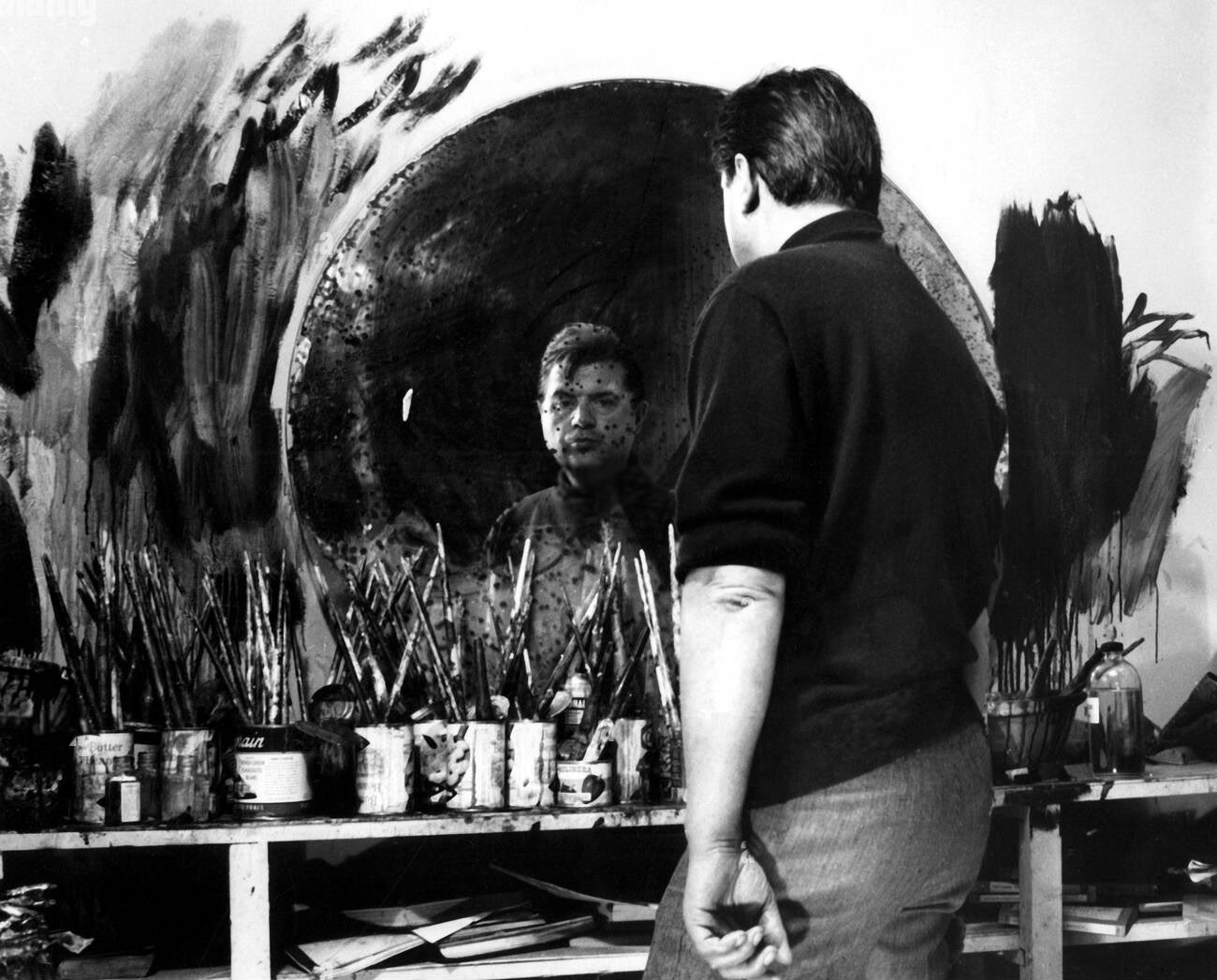
THE ART OF THE IMPOSSIBLE
Last week an exhibition of new paintings by FRANCIS BACON, most enigmatic of modern painters, opened in London. The harrowing subjects he chooses, his fierce self-criticism which makes him destroy most of his prolific output; his perennial youth so that, at 53, he still looks in his thirties; his predilection for champagne and Monte Carlo gambling; all these have brought about a Bacon legend. But his own pronouncements about his work have been rare and cryptic. This conversation with DAVID SYLVESTER is the first to appear in print.
Bacon: One thing that has never been really worked out is how photography has completely altered figurative painting. I think Velásquez believed that he was recording the court at that time and certain people at that time. But a really good artist today would be forced to make a game of the same situation. He knows that particular thing could be recorded on film; so this side of his activity has been taken over by something else.
Also, man now realizes that he is an accident, that he is a completely futile being, that he has to play out the game without reason. I think that even when Velásquez was painting, even when Rembrandt was painting, they were still, whatever their attitude to life, slightly conditioned by certain types of religious possibilities, which man now, you could say, has had cancelled out for him. Man now can only attempt to beguile himself, for a time, by prolonging his life--by buying a kind of immortality through the doctors. You see, painting has become, all art has become a game by which man distracts himself. And you may say it has always been like that, but now it’s entirely a game. What is fascinating is that it’s going to become much more difficult for the artist, because he musts really deepen the game to be any good at all, that he can make life a bit more exciting.
Sylvester: Why was that recent triptych called The Crucifixion?
Because I thought of it as a mood of a Crucifixion. Without all the paintings that have been done in the past of the Crucifixion I would not have been able to do it.
Did you have the three canvases set up simultaneously?
I worked on them separately. Gradually as I finished them, I worked on the three across the room together.
Is there any sort of rational explanation of the iconography of those figures on the left? People have tried to find explanations.
No.
In fact, did it change a lot during the course of doing it? Was there always the reclining figure in the middle, and that figure twisted over on the right, and two men on the left?
It didn’t. It was a picture that I did in about a fortnight, when I was in a bad mood of drinking, and I did it under tremendous hangovers and drink; I sometimes hardly knew what I was doing. It’s one of the only pictures that I’ve been able to do under drink. I think perhaps the drink helped me to be a bit freer.
In ones that you’ve done since, have you been able to do the same?
I haven’t. But I think with great effort I’m making myself freer. I mean, you either have to do it through drugs or drink.
Or extreme tiredness?
Possibly. Or will.
The will to lose one’s will?
Absolutely, yes. The will to make oneself completely free. Will is the wrong word, because in the end you could call it despair. Because it really comes out of an absolute feeling of it’s impossible to do these things, so I might as well just do anything. And out of this anything, one sees what happens.
How much does the image tend to formulate itself before you begin on the canvas? In the case of the so-called Crucifixion triptych, did you see the various forms in place before you started painting?
I did, but they did change continuously. The figure on the right is something I have wanted to do for a long time. You know the great Cimabue Crucifixion? I always think of that as an image – as a worm crawling down the cross. I did try to make something of the feeling which I’ve sometimes had from that picture of this image just moving, undulating down the cross.
You often find, don
Vey often. The breed other images for me. What about movies? Eisenstein for you
isn
One the whole, you seem to like austere images.
One always loves the story and the sensation to be cut down to its most
elemental state. That
The transformations of these existing images which happen by the time
the paintings are completed
You know in the case of all my painting – and the older I get, the more it becomes so – is accident. So I foresee it in my mind, I foresee it, and yet I hardly ever carry it out as I foresee it. It transforms itself by the actual paint. I don’t in fact know very often what the paint will do, and it does many things which are very much better than I could make it do. Is that an accident? Perhaps one could say it’s not an accident, because it becomes a selective process which part of this accident one chooses to preserve.
You were talking about this painting you were doing the other day, and said you tried to take it further and lost it. Is this often the reason why you have to destroy your paintings, most of which I believe you do destroy?
Very often so.
Do you tend to destroy the paintings early on, or later, precisely when they’ve
been good and you
I think I tend to destroy the better painting, or those that have been better to a certain extent. I try and take them further, and they lose all their qualities, they lose everything.
Can you never get it back once it’s gone over the top?
Not now, and less and less.
Can you explain why?
The way I work, now, is accidental, and becomes more and more accidental. How can I re-create an accident?
But you might get another accident on the same canvas.
But it would never be quite the same. This is the thing that can only probably happen in oil paint, because it is so subtle that one tone, one piece of paint, that moves one thing into another completely changes the implications of the image.
If you were to go on, you wouldn’t get get back what you lost, but you might get something else.
Now why do you tend to destroy rather than to work on? Why do you prefer to begin on another canvas than to work on?
Because sometimes then it disappears completely and the canvas becomes clogged, there’s just too much paint on it; just a technical thing and one can’t go on. Is it because of the particular texture of your paint?
I work between thick and thin paint. Parts of it are very thin, and parts of it are very thick. And it just becomes clogged, and then you start to put on illustrational paint.
What do you mean by that?
Can you analyse the difference, in fact, between paint which conveys directly, and paint which conveys through illustration? It’s a very close and difficult thing to know why some paint comes across directly on to the nervous system and other paint tells you the story in a long diatribe through the brain.
Most of your paintings have been of single figures or single heads. But in the new Crucifixion triptych you did a complicated composition of several figures. Would you like to do that more often?
I find it so difficult to do one; that that generally seems enough. And, of course, I’ve got an obsession with doing the one perfect image.
Which would have to be a single figure?
In the complicated stage in which painting is now, the moment there are several figures on the same canvas the story begins to be elaborated. And the moment the story is elaborated, the boredom sets in. The story talks louder than the paint. This is because we are actually in very primitive times once again, and we haven’t been able to cancel out this story-telling between one image and another.
But I think you avoided it in the Crucifixion triptych.
But don’t forget they’re painted on three different canvases, which already helps to avoid it.
And, of course, people have, I gather, been trying to explain it, to make the picture tell a story, haven’t they?
I think so. Of course, so many of the greatest paintings have been done with a number of figures on a canvas, and every painter longs to do that; but as the thing’s in such a terribly complicated stage now, the story that is already being told between one figure and another begins to cancel out the possibilities of what can be done with the paint on its own. This is a very great difficulty, but of course at any moment somebody will come along and be able to put a number of figures on a canvas. But it’s so difficult to do one figure now.
You don’t want a story. When you did that triptych, you started with the idea of getting a mood that corresponded to the Crucifixion?
It’s very difficult to say. I’ve always been very moved by photographs
But you do, in fact, paint other pictures which are connected with religion because, apart from The Crucifixion, there are the Popes. Do you know why you paint pictures which constantly touch on religion in this way?
In the Popes it doesn’t come from anything to do with religion, it comes from an obsession with the photographs that I know of Velazquez’s Popes, of his Innocent X.
But why was it you chose the Pope?
Because I think it is to me one of the greatest portraits ever made. It’s a picture I’ve always been haunted buy. I buy book after book with this illustration in it, of the Velasquez Pope, and it opens up all sorts of feelings and areas of imagination.
But there are equally great portraits by Velasquez which you might have become obsessed by. Are you sure there’s nothing for you in the fact of its being a Pope?
I think it’s the magnificent colour. Of course the Pope is unique, he’s put in a
unique position by being the Pope, and therefore, as in certain great tragedies,
he’s as though raised on to a dais, in which the grandeur of the image can be
displayed
And there’s the same uniqueness in the figure of Christ?
Yes.
So it really comes down to the idea of the uniqueness and the special social
situation of the tragic hero
Well, I’ve never thought of it in that way, but when you suggest it to me, I think it may be so.
Several things you’ve said suggest that in beginning a painting, or a series of paintings, you have an idea of the kind of mood that you want to get over?
Oh yes, I do. I see rooms of paintings, they just fall in like slides. I can dream all day long and see rooms full of painting. But whether I ever make them really like what drops into my mind I don’t know, because of course they fade away.
Why do you like to glass your paintings?
There are two reasons. By glass you cut them away from their surroundings. And another thing is, I work on the reverse side of the canvas and a great deal of the canvas is only stained and it’s impossible to give it a texture with varnish or anything, which might bring up the life of it. By glazing them, I feel that it gives an added depth and texture to the quality of the paint that I use. I couldn’t do the particular kind of thing I’m trying to do, which is to make a chaos in an isolated area, with other types of paint. I need this absolutely thin stained background, against which I can do this image that I’m trying to do and have never really achieved.
Is it because you want to get a chaos in an isolated area that you often use this rectangular frame around the figure?
I use a rectangular frame to see the image. For no other reason. I know it’s been interpreted as being many other things.
As a glass box, for example?
I never think of it as such. Perhaps I should.
Do you remember people said, when Eichmann was in his glass box, that you’d prophesised in paintings of yours? You didn’t really mean any such image?
No. I cut down the scale of the canvas by drawing in these rectangles which concentrate the image down.
But it is has never had any sort of illustrative intention?
No. It was just to be able to see the mage more clearly. I don’t think it’s a satisfactory device especially I try to use it as little as possible. But sometimes it seems necessary.
Do you think that in this recent triptych the three canvases with the lines coming down between them have the same sort of purpose?
Yes, I do. They isolate one from the other; they cut the story between one and the other.
You paint a lot in series, don’t you?
Yes. Partly because I see every image all the time in a shifting way, and almost in shifting sequences.
To what extent is the series a whole for you? Is it a series for you merely in working, or do you feel that the pictures remain a series after they’re finished?
Ideally I’d like to paint rooms of pictures.
Do you do the pictures in a series one after the other? Or concurrently?
No, one after the other. One suggests the other.
Can you turn a painting face to the wall, and resume working on it a week or a few months later?
I can’t. It has a hypnotic effect upon me, and I can’t leave it alone, so I’m
always very glad
You say that, when you do these series, the last one starts the next. When you’ve done the last one, do you turn it to the wall and star afresh or do you sometimes look at the last one when you’re starting the next?
Oh I do. I’m very conscious of the one that’s gone before.
So that it’s almost as if you were painting the same picture, but on a different canvas for the sort of technical reasons that you talked about before?
Of course, what in a curious way one’s always hoping to do is to paint the one picture which will annihilate all the other ones and concentrate everything into one painting.
THE PRIVATE HELLS
OF FRANCIS BACON ...
FRANCIS BACON and Henry Moore: outside this country these two names are British Art. Thanks to them British art is now taken seriously abroad – the first time in over a 100 years. And yet for all their innate Englishness, no two artists could be more different. This contrast is what makes their excellently arranged show at the New London Gallery so stimulating.
Let’s take Bacon first. His blood-chilling pictures of alcoholics and madmen, sadists and perverts epitomize all the sickness of our sick period. In the present show Bacon exploits his kinky themes in a characteristically kinky way. Each of the figures in his pictures in habits a private hell. A naked man has a hypodermic in his arm; another looks as if he is in the throes of shock treatment; yet another is a victim of alcoholism.
Especially moving are the posthumous portraits of P. L., Bacon’s close friend, who died the day his last exhibition opened. But most haunting of all are the self-portraits in which the artist lays bare his own malaise.
After the triumph of last year
A master
With a few broad, arabesque-like brush strokes, Bacon pins down a naked figure squirming on his bed, or whirling on its axis like a dervish. Likewise Bacon’s frighteningly expressive heads: a thick smear of pigment, the colour and texture of pancake make-up creates a forehead or cheek, or overblown, melting nose. What a master Bacon is at counterfeiting flesh!
Few artists have developed a style which so exactly mirrors their subject matter. Bacon’s next venture, he tells me, will be three-dimensional: lifesize figures cast in bronze. If they are anything like his paintings, these will be some of the most disturbing sculptures ever made.
By contrast with Bacon – a black Romantic if ever there was one – Henry Moore
appears to be a very normal, earthy, John Bullish figure. Moore’s main concern
is with basic natural forms, and his new sculpture more than ever resembles
bones, pebbles, and dolmens. As Moore himself confesses,
A case in point is the huge – almost 10 foot long – sculpture in the present exhibition. This is a reclining figure made up of three rugged chunks of bronze – bust, pelvis and legs. Separately these chunks are like huge pebbles or bones; together they add up to an articulated nude, a kind of Stonehenge woman, as timeless as a rock.
Bland
This reclining figure is one of Moore’s most impressive works, but I personally prefer his abstract pieces, like the Knife Edge Twp Piece in which all reference to nature has been whittled away. When he reduces everything to a single organic form, Moore gets nearest to the secrets of art in nature.
The only trouble with these sculptures is that, for all their great qualities, they tend to be a bit bland. Like the stones which they resemble, they don’t say very much, at least to me. How unlike the Bacons which some people – not I – accuse of protesting too much!
John Richardson
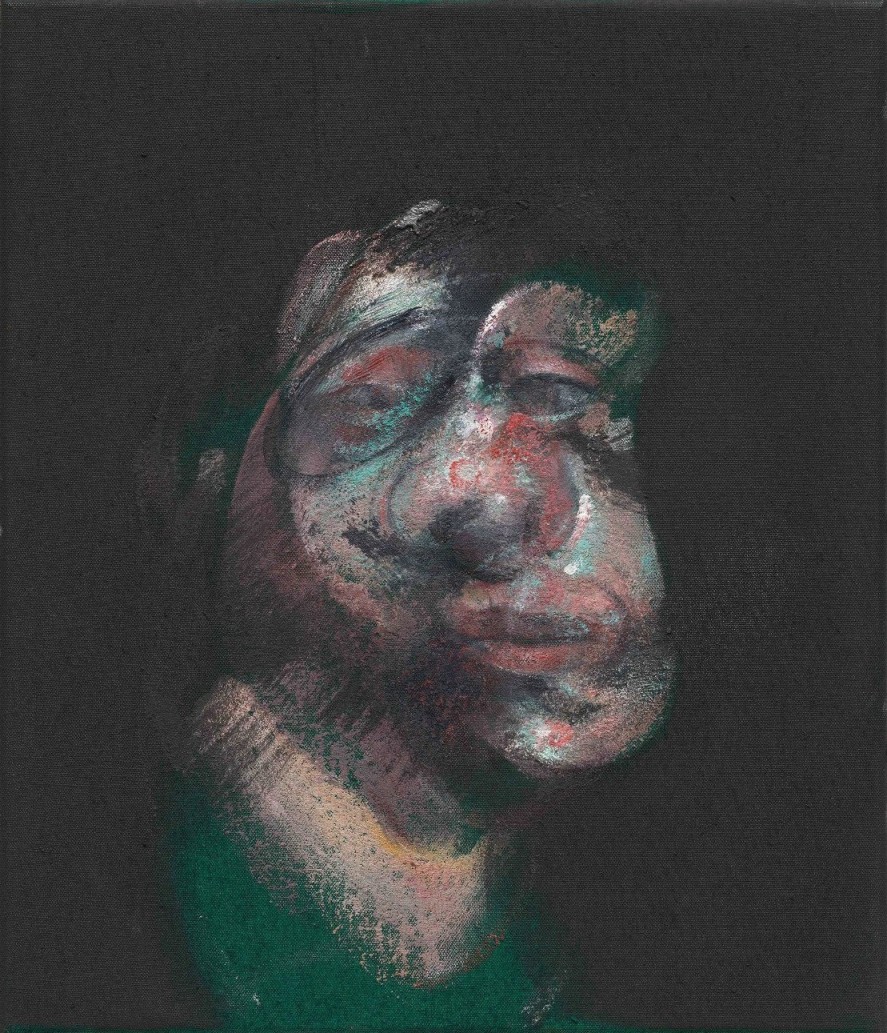
Most
AGE MIRRORED
IN BACON’S ART
By TERENCE MULLALY
FRANCIS BACON’S latest exhibition makes it clear why, to his fellow artists, he is one of the most influential painters at work to-day. It continues at the New London Gallery, Old Bond Street, until the end of August.
Bacon, more than any other British painter, offers an escape from the dilemma posed by abstract art. “Escape” is, though, hardly a word that can appropriately be used in connection with his work.
FRIGHTENING RELEVANCE
It has a frightening relevance for our times. Should art be thought of only as something to ennoble, or provide prettiness, then Bacon must be dismissed.
If, on the other hand, art is valued as a mirror of an age and of the crisis of our human situation, then Bacon is unquestionably one of the major figures of the ’sixties. That this is indeed so there cannot really be any serious doubt.
There is nothing in the least attractive about his painting. Rather, distortion, arresting design, and shocking colour are used to create an impression of almost maniac tension. The body is misshapen, the face distorted into a sinister mask.
TORMENTED FIGURE
A tormented figure with a hypodermic syringe in its arm writhes upon a couch, a twisting genii-like creature seems on the verge of disintegration, and always there is the ungainly pose, the suggestion of agony, both physical and mental.
His figures exist in stark settings devoid of the comforting impedimenta of everyday life. Colour, too, including an ominous purple, is used to build up an almost unbearable sense of tension.
All this is done with painterly skill. Indeed, in certain passages, Bacon’s brushwork has a living, voluptuous quality.
We’re all so terribly respectful after underestimating
him—but have we gone too far the other way?
*

Francis Bacon’s study for a head, oil on canvas, 1962:
now on view at the Marlborough Fine Art’s exhibition.
THE WORLD OF ART: BY JOHN RUSSELL
ART is a matter, initially, of accepted signs. For generations certain marks on
the canvas said
“Sea”
to everyone who had seen a picture before. But when J. M. W. Turner came along,
his way of saying
If I put this in nursery-terms, it is because new art raises problems which are
basically, the problems of growing up. Growing up means coming to terms with
circumstances which are unfamiliar and seem disagreeable: not to run away in the
face of them is the first part of education. In the presence of new art our
first instinct is for the mind to snap shut.
“That
isn’t a human being: Bacon’s crazy”
is what people said when Francis Bacon’s " Three Studies of Figures for the Base
of a Crucifixion,
But today, when those figures have been for years in the Tate, and external events have enlarged our notion of human enormity, we see that Bacon’s figures give an exact and still startling idea of the sort of people who hurry to the scene of human disaster. And in the late forties and fifties he went on to create, one after another, other figures which turned out to stand for a good deal more than one man’s dismay. In a real sense, Bacon created the world we live in, and once we have got the point of his work we can’t open a newspaper or look at a television screen without having him somewhere at the back of our minds. This is why his is a name to boast about in parts of the world where people had always laughed off the idea of an English art.
Bacon’s new pictures always take time to settle down in their relation both to
ourselves and to his earlier work. During this period they and he are exposed to
the
Bacon is, in fact, strongest, to my eye, when his points of reference are least explicit. (The van Gogh series was a partial failure, surely, because we have a real van Gogh, one of the noblest of known human beings, to set beside Bacon’s appropriation of some of his characteristics.) The “Turning Figure” (actually based on a news photograph from Oran) haunts us because we don’t know what has caused this man to spin like a top, any more than we know what disasters have caused the rubbish to lie uncollected in the gutter. And if the portrait-heads seem distorted beyond reconciliation with normal experience, we have only to sit tight: already we can see that they go hardly further than some of Rodin’s sketches for the Balzac monument, and in a year or two they may well look like Clouet.
THAT Bacon should be thought
Francis Bacon now enjoys a considerable reputation both in this country and abroad. He is certainly a painter of considerable gifts. Nevertheless, despite the undeniable power and imaginative qualities of his pictures, they lack an emotional intensity and a depth which would give them a lasting appeal.
His present exhibition at the New London Gallery, like all his shows, is a striking affair. We are at once led into a world of jagged nerves and psychological disturbance and the illusion of living in a sort of Dr. Caligari’s cabinet is heightened by the claustrophobic atmosphere of a downstairs gallery. The painter and his setting are in accord. It is, in fact, a very different vision from the harmless and neat conception of nature presented, for instance, by Ivon Hitchens, whose work is now on view at the Tate Gallery.
Yet Bacon is just as English. He can be fitted into the tradition and his pictures recall those of Fuseli and the exponents of the “Gothic Horrific” who flourished at the close of the 18th century. Here is a similar exploration of a terrible subject matter and the same assault on the nerves. Moreover, Bacon quotes from Velázquez or the film stills of Eisenstein’s Battleship Potemkin, just as Fuseli quoted from Michelangelo or Shakespeare.
There is no denying that Bacon holds the mirror up to life, to the seamier sides of life, and the relevance of his comments at the present time, is undeniable. Not, of course, that he takes a moralistic line.
The point is sometimes made that a failure to award Bacon the high status claimed for him arises from a disapproval of new media or vision. This is the accusation which is used to bring the critic (and the public) to order. Out of fear of not being in the movement, it is tempting to fall in.
It may well be that the trouble partly arises from the over-simplification which attends contemporary judgements on works of art. We are haunted by that charge of being “old hat.” Thus criticism tends to be a question of “either or”; one must, so it seems, be completely in favour of a man and the use of qualifications is taken as an immediate dismissal of his contribution.
This attitude is patently absurd. Just as in life, values and hierarchy exist in art. One would not deny the historical and artistic interest of Fuseli, only his greatness. So it is with Bacon. But this also means that one can appreciate his vigour and determination.
What emerges more strongly than ever in the present exhibition is the decorative nature of his talents. The images of horror he paints are increasingly placed against backgrounds of pleasing shades. Thereby the impact is softened.
In this respect, his approach is quite different from Goya’s. In the great Spanish painter, the effects of terror and of horror are carried by the whole composition; the general tonality accords with the central image and strengthens its relevance. One does not feel, as one does with Bacon, that the image has been prettified.
This inability to make the backcloth for the scene meaningful, well shown in the Lying Figure With hypodermic syringe, where the purple is too sweet, attests Bacon’s taste but not his vitality. It reveals his relationship with the aestheticism of the 1890’s. The silken touch of his colour and the “daring” of his imagery reminded me of Conder’s Mlle Maupin, based on Théophile Gauthier, which, by chance, I saw last week at the Leicester Galleries.
Doubtless for the man of this era Mlle Maupin’s black tights (especially when we think of her Sapphic connections) seemed shocking enough, and so, for our era, does the equivocal nature of some of Bacon’s themes. Yet may we not wonder if in half a century his pictures will be found as decorative and as “period” as Conder’s.
Francis Bacon suffers from his adherence to one key. Writing about the German expressionists in his recent brilliant book Art and Anarchy, Professor Wind maintained that “There is nothing wrong with an illusion of intensity, provided the illusion is sustained.” But Bacon does not succeed in sustaining the intensity. He has pulled out the same sort of stop too often. The consequence is that the initial terribilità has to be bolstered up by picture-making. It could well be, as Professor Wind has also argued, that the very benevolence of reception which attends a successful artist in our time debilitates him. This could well be so with Bacon.
High-Level Conversations
WHEN Mr. Roy Thomson met Mr. Khrushchev, both confessed to a dislike of modern art. But Mr. Thomson is willing to give the subject a break in his Sunday Times. In the Colour Magazine Francis Bacon, “most enigmatic of modern painters,” was interviewed by David Sylvester. The enigmatic painter speaks:
“. . . I think with great effort I’m making myself freer. I mean, you either have to do it through drugs or drink.
“Or extreme tiredness?
“Possibly. Or will.
“The will to lose one’s will?
“Absolutely, yes. The will to make oneself completely free. Will is the wrong word, because in the end you could call it despair ...”
It goes on like that. Some will find it excitingly profound, some will prefer the philosophy of the other Francis Bacon, a good many will suspect it is all a load of codswollop and heaven knows what Mr. Khrushchev would think. But is dialogue really the right form for apocalyptic utterances like these?
Is that how the two of them really talked? See how the interviewer, cued by the word “will,” knowingly throws in “The will to lose one’s will?” (and how much more pregnant it looks in italics). What a meeting of well-tuned, or wellrehearsed, minds. And what a pity the word “will” turns out to mean nothing, after all.
In another section of the same Sunday Times Henry Brandon had a conversation about New York with Jonathan Miller. This contained much that was stimulating, but again one asks: Is dialogue the right form? Mention of Harlem inspires Miller to a rush of literary images: “... Harlem has become a metaphysical annexe of the New York mind . . . It’s like a psychic kidney, really, through which white people can conveniently excrete their own worst selves.” Brandon feeds a few lines and off goes Miller with things like “Literature surely is much more concerned with those subtle abrasions which escape the generalising function of scientific inquiry.”
Is this a “conversation which we doubt was ever conversed” or does Miller really talk like that? If so, what a man.
BACON’S recent paintings at the New London Gallery show as clearly as ever that he is projecting an image of death from which all positive life or hope is rigorously excluded. That is the point of his work and its fatal restriction. He is not making a tragic image. Instead, he is playing out a morbid—not tragic—obsession which has meaning within the terms of psychopathology, but can never attain the universality of genuine tragedy, for this needs an alternative ingredient to offset its negation and provide the real catharsis that we find in Mantegna, Rembrandt, and Goya. The horror of absolute corruption, brought almost to the edge of death, is hermetically sealed in Bacon’s work and clings on, sick and fearful, in a self-absorbed trance. The painting itself is bold and energetic but undermined by the weakness of expressionist rapportage intent upon registering feeling in terms of paint without any constructive thought to push the paint further. And so the formal quality of his figures and backgrounds are rarely successful, and even then only at an elementary level. The compression chamber, the intangible prison cell, so familiar from literature, has lost its meaning and turns into a sentimental device.
There is still much to admire. The drips of paint, used as a perspective device to pinpoint space, which still carry an emotional weight. The tightrope tension between specific, readable reality, and camouflaged, out of focus areas of activity—objects on the edge of the arena, or the visceral black splayed across parts of the figures. The insistence on vertical figures—consistent for many years—even when foreshortened and recumbent, to produce an active, bristling immediacy of contact with the spectator, who is almost trapped as a protagonist. (The standing figure in the street was originally a reclining figure.) The equally consistent alienation effect achieved by the scale of figure to space or furniture; the cut-out figure from one canvas superimposed on another; or the two figures in ’Man and Child’ in which the child’s legs are separated from her body by placing the figure against the diagonal, disrupting intersection of wall and floor while the man’s head and shoulders are isolated from his body by being set against a window frame. The familiar preoccupation with furniture as an active participant, changing according to the formal tensions of the figures. The obvious approach to sculpture, for many of these bunched up, convulsive figures might almost stem from the early sculptures of Matisse when he was trying to bring a baroque amplitude into the severities of cubism, or the sculpture of Duchamp-Villion. And the sensuous resolution of individual passages in the painting—this can be beautiful, as in the drifting debris in the street scene. There is much else to be absorbed by and to admire, but the severe limitations rob these works of complete authority. Disparities in scale between figure and context may occasionally have a point as psychological impact, but too often are clearly the result of weak design, as in the feeble ’Figure with Hypodermic Syringe’. There is also the disagreeable feeling that something repellent is being gilded, prettified, in a chic sense—a chunk of raw, putrefying meat in a smart, bright décor. The colour itself remains arbitrary, and the lighter tones lack an earlier resonance. Design has expanded slightly and comments on certain aspects of abstract art, but they are only used, coldly, they are not explored. In this sense, and in others, Bacon’s work belongs to the academy, and relies more and more on sentimental sensationalism.
We are left with the personal myth and the performance as an artist. Both are fascinating and in different ways command respect. The myth has absolute validity, based as it is on courage, independence, and a high degree of professional energy shot through by ambiguities of technique and formal irresolutions. Bacon’s shortcomings are those of any artist crippled by an excessively self-indulgent obsessive vision. Outside that, out in the world, only a handful of people can truthfully respond, though they can stare through lurid shock. For his work has not made a world with real meaning for any possible society, but only a morbid aspect of what is anti-life, a painful travesty ritual on the razor’s edge of death. Trapped there, it is incapable of growth, only an occasional increase in confidence at a fixed level.
The new sculpture of Henry Moore confirms a feeling that after marking time for a while in the nineteen-fifties he has moved through to an intensity of feeling and constructive energy which has demanded and found a considerable extension of sculptural language. The knife-edge forms, the three-piece reclining figure, the large torso (and arch), the wall (a background for sculpture which is so strong in character in itself that nothing is needed to add to its life), the locking piece and the knife-edge two-piece confrontation are all brilliant and forceful inventions. The essence of Moore’s work is always to be found in the grimmest or most ferocious sculpture; his matronly figures and other sweeter preoccupations lack the conviction and the formal power of his darker side. There was once a danger that a consciousness of art might stifle his development and his ability to be true to himself. He has passed that hurdle. This new work has added to the greatest sculpture of the twentieth century—and has also radically enriched the expression of this particular moment.
THE excitement aroused by the New London Gallery’s double exhibition of the recent works of Henry Moore and Francis Bacon is a sign that Moore’s phenomenal reputation, which ebbed for a while in the Fifties, is again undisputed. After his death a reaction may set in, but when the comings and goings of his inspiration can at length be considered dispassionately, I believe Moore’s early mesmeric stone carvings of the figure with the suppressed energy of coiled springs and his massive reclining bronzes of late years, cleft and separated like headland rocks, may be judged his grandest endeavours where the stylisation has been used less for invention’s sake than as a vehicle of serious and powerful emotion.
Immediately confronting one in the gallery is a great arch shaped like a pelvic bone, fretted as if by friction. This structure, at once bony and geological, gives place to the pitted and castellated cliff of The Wall of bronze implying the scale of an escarpment fortress, and bolding more mystery than the most secretive of Reg Butler’s bastilles. Both these bronze creations are in some sort anticipated in the growth of Moore’s personal style; yet, as so often, their sheer magnetism takes one by surprise. In the same way, the giant’s causeway of a recumbent figure in three boulders—wary headpiece, central vertebra, extremity arched as cavernously as Monet’s offshore rock—kindles the imagination though it logically follows the even more powerful two-piece bronze of 1960 in the Tate.
Such formations relating ageless humanity to the elemental forces of nature would appear far more exacting, intellectually and imaginatively, than a conceit like the Locking Piece which only calls into play the sculptor’s peculiar facility in abstract formal variations. At the same time, Moore’s remote grandeur becomes .distinguish- able from a caprice as highly mannered as his seated effigy with blade head, an exercise far removed from the aura of the Mexican archetype. But the peculiar nature of Moore’s talents, with the ceaseless demands on his fertility, make- any conclusions at the present time extremely difficult to reach.
Held by Francis Bacon’s paintings beyond, the expectant, motionless knots of spectators appear to await a miracle, as if Bacon’s sprawling, naked creature stabbed with a hypodermic might presently take up its bed and walk. His is an art of pure sensation: the sensation of a racked and ambiguous torture made flesh, and isolated with clinical clarity on a couch in a rounded confinement no longer obscure but brightly patterned. Each figure is as fully plastic as Daumier’s. But it is as if Daumier in a fever had gone on to knead, twist and bespatter his creature, giving the swirling, pulpy head the strained look of a man under pressure test, or blurred in a distorting mirror.
These obsessions, surfacing in his unpredictable act of painting, have for the artist no conscious message other than the power of clotted or thinly brushed pigment, as he handles it, to play directly on the nervous system. The effect, nevertheless, is to expose the torment, loneliness—in one grotesque head, even the tender pathos—of Bacon’s conceptual images which give their own irrational complexion to certain French nineteenth-century discoveries. But most significant now is the full sinuous amplitude of the forms which makes Bacon’s next step to sculpture seem inevitable.
To say that Ivon Hitchens’s large retrospective is at the Tate will be enough to conjure up for his following the sensuous distillations of the pools and glades of Sussex, interspersed with summary nudes and the occasional over- complicated mural decoration. The core of Mr. Hitchens’s achievement is landscape, and the variety of impulses which has quickened his refined, often lyrical evocations of woodland space saves most of his sequences from any sense of déjà vu. His is a precious, if limited talent which may be as fresh as the rural Gainsborough’s, only becoming vexed and incoherent when it has been strained beyond its resources.
NEW LONDON GALLERY
IT IS PERHAPS TOO SOON TO SAY ANYTHING NEW about the paintings of Francis Bacon, whose latest canvases fill half of the New London Gallery. Having scarcely recovered from the violent impact of his great retrospective show at the Tate a year ago, I found the shock effect of these new pictures less disturbing than I had anticipated. This had the advantage of making it possible, for once, to look at Bacon in a reasonably objective way instead of in a state of emotional disturbance.
His painting has a compelling repugnance. Unlike the artist himself—whose attitude to a picture, once he has finished it, is summed up in his question to Sir John Rothenstein, “How can I take an interest in my work when I don’t like it!” —I have, so far, always been interested in it because I disliked it.
I disliked it as I dislike nightmares. But now, in the same way that I am able to look back on a nightmare in the light of day and wonder why I was frightened, I can look into the most horrific of Bacon’s paintings without even a shudder. The explanation maybe that for me Mr. Bacon has cried “Wolf!” too often. That does not matter. What matters is that he is like a magician who has lost his hold over me but is now revealing the secret of his magic, a thing more fascinating than the magic itself.
Most commercial galleries hold exhibitions. Marlborough’s, ever shrewd and with a hot line to almost every British artist of consequence, are in a position to stage Events. Their latest coup at the New London Gallery is a joint showing of recent work by Francis Bacon and Henry Moore. The New London maintains a very high standard of display but they have been virtually defeated by some of Moore’s larger pieces, which need space, and perhaps even open air if their full effect is to be appreciated. To display Moore properly in such a restricted space is about as easy as trying to show off Bernini’s St Theresa in a telephone booth.
The centre-piece of the new Moore show, which is made up of bronzes, is a reclining three-piece figure, a further development from the marvellous figure in two pieces that came as the climax to the Whitechapel exhibition. The new piece is a shade disappointing. The tension has snapped. The group is without the sculptor’s interplay of human and natural associations whereby weathered rocks seem to take on the form of human limbs just as the human limbs, crushable and frail, suddenly acquire superhuman, natural strength. What we have left are three artful pieces of bronze that might well pass as boulders in a bad light. This is a form of illusionism in reverse. Instead of the old ’speaking likeness’ we now have the dissembling objet trouvé. And judged purely as shapes, the new group is not as interesting as usual. More successful is the Seated Woman, a further experiment in knife-edge form, with the attributes of the human torso on the front of a thin shield from which rises the small, prehistoric head.
Moore is one of those rare artists who is more interesting the larger the scale on which he works, and some of the maquettes in the present show, all religiously produced in editions of nine, are of no great merit. Locking Piece and Knife-edge two piece are more important, middle-size works, ingenious, self-perpetuating studies in pure form, curving and swelling, surprising with a sudden, sharp edge, at one moment dense, to become, as one moves and glimpses space through an open centre, light and airy. But the only real disappointment in the exhibition is the very large, bronze object called The Wall (Background for Sculpture). This resembles an arbitrary section from the mud wall of an Arab fortress and in Bond Street, at least, looks very odd indeed.
The
Francis Bacon show is a stunning success. There is, it is true, no real
stylistic development in these dozen large canvases. Bacon is still where we
left him with the big triptych at the Tate. He is still preoccupied with the
single figure, Thurber’s
Technically, Bacon is as brilliant as ever. The handling has grown less juicy
and now hovers about halfway between the dry idiom of the cardinal period and
the perhaps excessively oily style of 1960 and I96I. His colour is, if anything,
subtler and more interesting. The cold
KEITH ROBERTS
A PAGE FOR COLLECTORS.
By FRANK DAVIS
FROM HELL TO HEAVEN.
IT was fairly clear from the very extensive exhibition of the work of Francis
Bacon at the Tate Gallery a year ago that the painter found mankind and its
silly face thoroughly nauseating. I went to the New London Gallery recently to
see whether he had in any way altered his opinion and was unable to discover
which he disliked the more
I know I ought not to be hilarious about this naive statement but I’m not
hilarious about the painter
A whole exhibition of nothing but portraits can be as boring as a series of
silly nightmares; in my then mood I felt I had been released from a
claustrophobic hell to climb up to the Golden Gates
I suppose most of us think of Delacroix first of all as the rebellious romantic who abandoned the tradition of French classical painting and gave the world enormous canvases like “The Massacre of Scio” and “The Death of Sardanapalus”; but these monster works scarcely touch our hearts, fine though they are; nor do his vast ceiling paintings scattered around public buildings. Where he is really himself is when he is working on a smaller scale, painting animals for instance (his friendship with Géricault, perhaps had something to do with this aspect of his immense output), or, better still, when he is painting his friends. His portrait of Chopin, for instance, in the Louvre, lingers long in the memory—so subtle, so understanding—and so, as far as I am concerned, does this small girl. In its solidity, its fully realised plastic values-I apologise for the jargon, I merely mean one can walk all round the figure which stands out from its background—and in its lack of sentimentality, it surely anticipates Degas.
A little further along the wall is an oil study for the figure of Phidias in “The Apotheosis of Homer” by Delacroix’ chief rival Ingres. No love was lost between the two; Ingres was appalled by any rebels, whether their names were Delacroix or Dupont, while Delacroix in his turn could retaliate with a rapier thrust—“The art of M. Ingres is the complete expression of an incomplete intelligence.” I ask myself how Delacroix would sum up Francis Bacon and his hangovers. However, enough of that. I turn back down the centuries to the smiling, confident, rather hard-faced young woman, aged 29 in the year 1557 (Fig. 2) attributed, to Hans Eworth, the same Hans Eworth who certainly painted the double portrait of Young Darnley and his brother Charles, Earl of Lennox, which belongs to Her Majesty at Windsor, and the portrait of Mary I, signed and dated 1554, owned by the Society of Antiquaries, and probably the entertaining example of court flattery, Queen Elizabeth and the Three Goddesses, at Hampton Court, illustrated on this page last week, with its interesting background of Windsor Castle.
The portrait is said to be of Queen Elizabeth I—to which I reply (1) Elizabeth was born in 1533 and consequently was not 29 in 1557 and (2) I can detect no resemblance between this woman and any of the known portraits of Elizabeth. I daresay by the time these words appear someone may have identified the sitter, possibly by means of the intriguing motto:
Vivre pour mourir
Mourir pour vivre.
In any case, a first-class work of its day and age, if not so sensitive as a neighbouring Florentine portrait of about the same date—the head of a young man by Salviati. There were two paintings by Greuze-one of them the conventional sweet, young thing, the other a portrait of a man in which this frequently slickly sentimental artist shows himself capable of serious work.
Among several nice pictures by minor French 18th-century masters—about whom most of us are as ignorant as our opposite numbers across the channel are about the multitude of English little men-was an attractive, handsome, intelligent man by Louis Tocque—(1696-1772) said to be a portrait of the future George III, who was born in 1738, and came to the throne in 1760. I must admit, as in the case of the Eworth portrait, that the sitter did not look in the least like any portrait of George known to me—well-shaped pointed nose for one thing and far too intelligent a face for that not overbright monarch. A distinguished portrait none the less, but surely a Frenchman by a Frenchman, and a man of considerable force of character as well.
A
very small scrap of a painting by Goya
NO ONE who looks at pictures doubts that the paintings which Francis Bacon is showing at the New London Gallery make the most important English exhibition for years. But, to judge from what one reads about them, it is not certain that we are making much progress with seeing what these pictures are really about.
The customary attitudes to Bacon were established 10 years or so ago (one is thankful for any familiar stance from which to view a frequently uncomfortable prospect) and most of the critical clichés seem to have been fixed around 1950. We have lately had them all over again, the agonies of the times, the human predicament and so on, much as usual. They are doubtless justified, in a general way. But if words are not to come between us and the pictures, I would propose a truce in general interpretations of Bacon, and a look at what he is in fact now doing.
Flesh and paint
The first point of painting is nearly always the way in which the image materialises (or does not materialise) on canvas. To gather any of the other meanings, we have first to follow a partial and precarious incarnation that makes metaphoric flesh out of paint before our eyes, each time in a unique, unparallel fashion. To get anything from Velazquez, for instance, we must first gather the imaginative substance through which a mans temple turns at a specific point to hair. It is this elemental stuff of painting that nearly all of Bacon’s few published words have been about.
The general paraphernalia of the new pictures is familiar. The mise en scenè, the actions and the accessories are those which have become customary, and we have been told enough about the painter’s working habits to realise that to miss out the drinks, the syringes and divan beds would be positively unrealistic. Realism, it may be thought, is hardly in question. Yet doesn’t most of the meaning of all painting lie in its reflection of a real situation—an internal situation or an external one, or both—the respect, in fact, in which it may be called in some sense realistic? The milieu is Bacon’s own and one can hardly imagine him outside it. We can take it for granted, rather as we take Chardin’s kitchen. The pictures, the paint, seem now to be much more concerned with the bare fact that human beings exist.
The concentration has always been terrific. What is remarkable about the pictures of the lat year or so is that Bacon seems to have been concentrating more and more on the intrinsic quality of the figurative event. We are shown, suspended in their eerily functional settings, a series of ingle-minded experiments in the unparalleled unrepeatable ways that paint may with luck and love happen to become a man.
There is no style, none of the kind of systematic method that all other figurative painters one can think of have provided themselves with (to protect themselves from just this extremity). Instead Bacon has just abandoned himself to the catastrophic hazards of the paint, seeking in them the possible kinds of likeness, possible orders of existence, possible presences, that any image from art or life that he can lay his hands on can suggest. But now the prototypes mean less, or nothing, and the risks that are courted are new ones. The images are evidently seen, and both his purpose and the accidents that befall it are rather different than before.
Look, for example, at almost any head at the New London, or the wonderful “Three Heads”. The accidents of pigment couple and multiply. A nose is seen double, making two noses; a cheek and eye (playing cup and ball) propose successive facets round a head; a mouth repeats insistently until the almost full-face view is also a near profile at the same time. Then look at the “Figure turning (with glass)”; the title tells us that the several formulations of thigh and knee are to be read not as alternatives but as a sequence, a movement (just as they would be in Futurism, but now they are seen). The seated figures are evidently not moving; they are sitting for their portraits (sitting perhaps in the past, in memory, recalled across the months; the effort of recapturing and the rapture show).
The several superimposed formulations there are simultaneous: the movement is the movement inherent in seeing. The uncertainty and the chancy double image are in the nature of vision, the fact that we see with two eyes.
Binocular realism
These pictures (and some of their predecessors, like the “Turkey Carpet” portrait in the Tate) are surely about, first of all, the senses in which seeing is, and is not, believing; the fact that two-eyed vision has, whenever its object is close, a vertical grain and a horizontal vibration; the fact that our very measure of the existence of a man and his presence in the room with us is derived from scanning this disparate double image. Conceivably Bacon in this mood (the fullest and steadiest, the least distraught, the most beautiful perhaps in his painting so far) is the primitive of binocular realism, the feeling realism in which we can believe, which seems of all possible future styles the likeliest to be born.
In this connection, as in a good many others, almost the only painter worth comparing with Bacon is Picasso. Looking at those portraits of Picasso’s whose paradoxes are so convincing that it is meaningless to speak of distortion (just as it is meaningless with Bacon), one remembers that their is one circumstance in which a girl’s two eyes may naturally appear one above the other on the same side of her nose—when each is seen in extreme close-up by one nearly opposite eye of her companion’s inclined head. It seems clear (unless one embraces only in the dark) that these Picassos are the directly observed answers of a passionate, two-eyed realism to riddles posed in the first place (like most other things in his art) by love.
When the time comes for a general interpretation of these latest pictures of Bacon’s, they too may conceivably be found to contain more of love than anything else. In the meantime it is fairly clear that Bacon is the first English man to deal radically and originally enough with figure-painting to lean an indelible mark on the art; let us enjoy the pictures at the New London before some of the best of them leave the country. Painting (I write as a critic)—it’s wonderful!)—Criticism—it’s useless.
* Lawrence Gowing is principal of the Chelsea School of Art
Apart from providing critics with a rare opportunity to show how well they can use rhetoric, the Francis Bacon retrospective at the Guggenheim Museum, opening to the public tomorrow, is a major event in a number of ways.
It brings 65 more or less shocking canvases by the most influential of figure-painters (if what he paints can be called figures) to this country for the first time. It will mark the complete acceptance of Bacon over here as a “modern master” with prices to match. It will provide a source of endless discussion as to what he is saying in pictures that have an air of occult degradation. And it is an event in the history of painting in that Bacon’s art is the first major expression on paint of a sensibility that has filled the by-ways of far-out literature with many little and a few major masterpieces.
What Bacon is saying, in the 65 canvases strung around the ramp of the Guggenheim in arcs of powerfully designed pictures that carry across the well of space like a sonic boom, is not capable of exact formulation. He is a state of mind, or a state of nerves, confronting violence and perversion, with results that resemble a state half-way between a catatonic stupor and hysterical mysticism. The sensibility brings one to Genet, and the purification of vice through ceremony. Many are due for shocks at the Guggenheim as this great Outside is swallowed (fashion and Bacon’s great talents it) by the Insiders coming to take their medicine.
The exhibition will be at the Guggenheim Museum through Jan. 12. From there it moves to the Art Institute of Chicago (Jan. 24-Feb. 23).
Enter Bacon, With The Bacon Scream
Britain’s most influential—and disturbing—painter
is seen in his first major American exhibition.
By DAVID SYLVESTER | THE NEW YORK TIMES | SUNDAY, OCTOBER 20, 1963
LONDON. THE Francis Bacon retrospective now showing at the Guggenheim Museum is the biggest one-man exhibition of a 20th-century British painter ever held in the United States. Bacon’s fame, nonetheless, is of fairly recent date. Thus, 10 tears ago when an advertisement in The Times of London announced a lecture on Francis Bacon at the Institute of Contemporary Arts, the incoming mail brought an interested letter from the Francis Bacon Society, publishers of Baconiana!
The present Francis Bacon, who, incidentally, is a collateral descendent of the Elizabethan, had his first one-man show in 1949, when he was 39. It was probably the most controversial one-man show London has had since the war. Some saw Bacon as a major artist, others as a sensationalist, others as an interesting eccentric. In subsequent shows, Bacon continued to divide critical opinion, and displayed his power — which has now become rather rare - to disconcert and puzzle those are hardened to avant-garde art. I suspect that one of the things which causes uneasiness is his combining a feeling of terror with a feeling of luxury. We are accustomed to contemplation of the suffering poor. But Bacon appears to be painting the suffering rich. His screaming figures have an air of authority and wealth.
Perhaps the most ambitious thing of all about Bacon’s art is its implicit insistence that painting is not worth bothering to do if its subject matter is not on a tragic scale. It is not enough, he seems too feel, to paint the human head or figure - as if merely to do this in a new way were not already difficult enough today. He must paint the human head or figure as seen in an extreme situation. For it is not only Bacon’s screaming figures who seem to us to be faced with disaster; every Bacon figure has an air of desperation. I take it that this preoccupation is provoked by the fact that only in such extreme situations — when our self-possession is lost — our reassuring poses broken down - do we reveal ourselves as we really are.
At any rate, if the index of a painter’s standing is how other painters rate him, Francis Bacon has been established as Britain’s leading painter for 10 years or more. The younger artists here look up to him with a unanimity which is remarkable, and it is astonishing how admiration for him cuts across opposing schools of thought. Bacon’s contemporaries and seniors could scarely be expected, human nature being what it is, to feel quite the same enthusiasm, but most of them do look upon him with that special kind of admiring, slightly grudging regard which artists reserve for one of their number who is completely unafraid to be himself. As to painters from abroad, I have found that they — Americans especially — have been more interested in Bacon, probably, than in all the rest of our painters put together.
In market value, it is only in the last couple of years that Bacon has up alongside Ben Nicholson as the most expensive to buy of living British painters. Canvases of his usual size — in the region of 80 inches by 60 — are now in demand at around $14,000. But six years ago an acquaintance of mine who needed to sell a Bacon he owned — a large and fine one — was prepared to accept £600 for it.
Both public and private collections here were much slower in getting on to Bacon than they were with such artists as Nicholson, Sutherland and Moore. Until two years ago, by which time Bacon was 51, the Tate Gallery had actually purchased just one painting of his, although the collection did include three further works which had been donated. In comparison, the number of Sutherlands in the collection then amounted to 16. Belatedly, the Tate has taken to buy Bacons (now that they cost real money).
Yet this gallery, the only important public gallery of contemporary art in Britain, is still without one of the many versions of that famous Bacon image of a seated figure, his mouth open in a scream, which dominated figurative painting of the nineteen-fifties in Britain as clearly as de Kooning’s woman image dominated it in America.
The scream, of course, had a good deal to do with the reluctance of the Establishment to come to terms with Bacon. The scream wasn’t artistically respectable; it seemed a bit far-fetched. Bacon was thought to be too intent on making our flesh creep. At a public discussion in 1951, critic Herbert Read complained that Bacon’s work just was not painting. Although official opinion softened with time and conceded that Bacon was a brilliant as well as highly original painter, he was, all the same, at best too much of a maverick, and at worst, a purveyor of gratuitous melodrama. Critic Raymond Mortimer wrote that if only Bacon would turn his talents to doing a picture of a rose, the result would be something he would wish to possess.
As to the subjects Bacon did paint, "Grand Guignol” was a comparison that tended to recur. As a matter of fact, it was a rather inept comparison. Bacon is no a painter of scenes of bloodletting, torture and violent death (his overt themes are tame by contrast with the scourgings and skinnings of medieval and Renaissance images of martyrdoms). The source for the ubiquitous screaming mouth was the close-up from Eisenstein’s Russian film classic "Battleship Potemkin" of the bespectacled old lady shot in the eye, and it is significant that, while Bacon’s adaptations of this image often include the spectacles as well as the shriek, they never show the glasses as shattered or the blood running down the face. Bacon almost goes out of his way not to illustrate horror.
In a number of his paintings, the figures are based upon the Velázquez portrait of Pope Innocent X in the Palazzo Doria, Rome. This reference to the Pope, indeed, has proved to be a main source of confusion about Bacon, along with the fact that Bacon has done several paintings relating to the Crucifixion, including one picture of Christ crucified in which something that appears to be a dead dog is hung over the horizontal of the Cross. People have asked whether Bacon is preaching bizarre distortion of Christianity, whether he is satirizing the Church or what. They seem to feel some guidance is needed on how to approach such subject matter, that some explaining is required. There is no easy explanation, however.
In an interview recently, Bacon said that his paintings of the Crucifixion had no religious significance for him; that as “a nonbeliever," the Crucifixion to him is “just an act of man’s behaviour, a way of behaviour to another.” He mentioned that he had long been obsessed by, and wanted to base something on, a Crucifixion scene by Cimabue: “I always think of that as a worm crawling down the Cross ... moving, undulating down the Cross.” He also said that for him the theme of the Crucifixion has a relationship to the slaughterhouse, and that he had been very moved by certain photographs of animals about to be slaughtered and obviously scenting death.
Asked about his constant reference to the portrait of Innocent X, Bacon at first declared that his interest in it had nothing to do with its being the portrait of a Pope, but was prompted entirely by its being one of the greatest of the portraits of Velázquez, who is his preferred painter, and by “the magnificent colour.” (Actually, the Bacon versions show the Pope robed in purple, whereas in the Velázquez he wears red). When pressed, he conceded: "Of course the Pope is unique; he’s put in a unique position by being the Pope, and therefore, as in certain great tragedies, he’s as though raised on to a dais, in which the grandeur of the image can be displayed.”
So it would seem that Bacon sees the figure of the Pope as material for a tragic image — tragedy being about the death of kings — but that there is no conscious concern with the church, either sympathetic or hostile, in his treatment of the subject. Bacon’s capacity to disconcert also arises, I believe, from his personality and rumored personal habits as much as from his actual work. Though of English stock, Bacon was born in Dublin in 1910, the son of a race-horse trainer. He left school early, traveled across France and Germany and lived for a time in Berlin.
By 1930 he was back in London doing free-lance work as a furnish designer and interior decorator. His commissions included doing the furnishings for the dining room of the house belonging to R. A. Butler, the present Deputy Prime Minister, which were later acquired by novelist Patrick White.
Bacon, however, was more interested in trying to paint. He went ahead without any formal training, and very quickly began to win recognition — in 1933 a picture of his was reproduced in Herbert Read’s “Art Now.” But Bacon was not concerned with furthering his growing reputation. He exhibited vey little, and destroyed virtually everything he did. During the war, in which he served full-time in civil defense, there was little opportunity to paint. Most of his surviving work dates from the postwar years.
As for his personal habits, Bacon — or his legend — does not fit into any of the stereotypes of the avant-garde artist. He is known, for example, to drink a lot of champagne, whereas artists are supposed to drink whisky or beer or black coffee or red wine or absinthe; champagne seems symbolic of a different way of life. Again, he is believed to be addicted to gambling, especially roulette.
Still, interest in his gambling is not mere gossip, because his liking for it does have relevance to the way he works. “I think that painting today,” he once wrote, “is pure intuition and luck, and taking advantage of what happens when you splash the bits down.” This does not mean that Bacon thinks painting is just having loads of fun; a remark he made during an interview with the writer shows what he meant.
Bacon was talking about “the will to make oneself completely free,” and he went on: “Will is the wrong word, because in the end you could call it despair. Because it really comes out of an absolute feeling of: ‘It’s impossible to do these things, so I may as well do anything.’ And out of this ‘anything,’ one sees what happens.”
Later he said: “You know in my case all painting — and the older I get, the more it becomes so — is an accident. So I foresee the image in my mind, I foresee it and yet I hardly ever carry it out as I foresee it. It transforms itself by the actual paint. I don’t in fact know very often what the paint will do, and it does many things which are very much better than I could make it do. Perhaps one could say it’s not an accident, because it becomes a selective process which part of the accident one chooses to preserve.”
There are, of course, painters who preserve the first happy accident that comes along; Bacon, however, is always trying to push the thing further. The more successful he feels a painting to be, the more unable he is to leave it alone. He destroys more canvases than he allows to leave his studio, and the significant thing is that the destruction is rarely a matter of discarding an unpromising painting at an early stage. “I think I tend to destroy the better paintings, or those that have been better to a certain extent. I try and take them further and they lose all their qualities, they lose everything.”
I asked him: “If you were to go on, you wouldn’t get back what you’d lost, but you might get something else. Why do you tend to destroy rather than work on? Why do you prefer to begin again on another canvas rather than go on with the same one?”
“Because sometimes then it disappears completely and the canvas becomes clogged; there is too much paint on it.”
Bacon would rather be left with the ruin of something that had once been really “near” than stop short of an approximation.
If there is any one moral quality manifested in the way a painter works that painters today value above all others, that quality is a readiness to take risks. And it seems to me that Bacon has been prepared to take risks more freely and grandly than any artist since Picasso — and that this is his greatest strength. In terms of achievement there may several finer painters among his generation that include Giacometti, de Staël, Dubuffet, de Kooning, Rothko, Pollock, Gorky — but I do not think that any member of it plays for such high stakes as Bacon.
Ii is not only his way of working. It is also that the kind of painting he is trying to achieve is the most difficult to do now. He is trying to paint the human head and human figure not, like Dubuffet or the New Realists, by using a conventionalized sign language, but in a way that traps the fluidity of his sensations of reality. And he is trying to reconcile this submission to the dictates of the external world with a freedom in handling paint hardly less extreme than that of recent abstract painting.
Furthermore, while he is using paint and distorting form with that especial degree of freedom won by the 20th century, he is trying to compete with the masterpieces of the past on their own terms: the layout, the space, and often the tonality of his pictures are not those of "modern” pictures but of the portraits by Rembrandt, Titian, Velázquez and Goya.
There is something peculiarly British about this sort of reconciliation between contemporary characteristics and an old-matserish look. British painters seem to have a compulsive nostalgia for the past which leads them to attempt syntheses between, say, Matisse and the Venetians, attempts which are vitiated by an air of compromise, of being afraid to go the whole hog.
On the other hand, one of the most mysterious qualities of Britain’s greatest painter, Turner, is the way in which he seems to begin with a landscape by Claude Lorrain and then assault it with light so that it partially dissolves. Bacon seems to cherish and attack a Velázquez portrait in much the same fashion, and like Turner, arrives at the same sort of combination between disintegration and renewal of a hallowed prot0type.
I think that unifying factor in Bacon’s art — the factor common to his way of working , to his aesthetic conception and to his content — is his insistence that it must be all or nothing. He chooses to attempt the same sot of painting, roughly speaking, as Rembrandt and Velázquez did — though not in a traditional way or out of any mere reverence for tradition — rather than settle for one of the narrower, more specialized, more peripheral concepts to which many great modern painters, especially nonobjective painters, have been prepared to limit themselves.
Bacon feels dogmatically that abstract art is too arbitrary in form, therefore mere decoration. The modern painters he most admires are Bonnard, above all, Picasso, Matisse, Soutine, Giacometti. All these painters can use commonplace subjects of no immense, inherent emotional import; Bacon’s final and greatest demand upon himself is the risky portentousness of his subject matter.
Obviously, this all-or-nothing outlook is a matter of temperament rather than decision. At the same time, Bacon has his rationalization for his attitude to painting. He points out that the painter today is in a special situation. Representational painting is no longer needed as a means to record actuality, since there is now the camera to do this. And painting no longer has the didactic purpose it once served.
“Man now realizes that he is an accident, that he is a completely futile being, that he has to play out the game without reason. Painting has now become, all art has now become, a game by which man distracts himself. And you may say that it has always been like that, but now it’s entirely a game. I think that that is the way things have changed, and now what is fascinating actually is that it’s going to become much more difficult for the artist, because he must really deepen the game to be any good at all.”
DAVID SYLVESTER is a British critic and lecturer who contributes to several journals and appears regularly on the B.B.C.
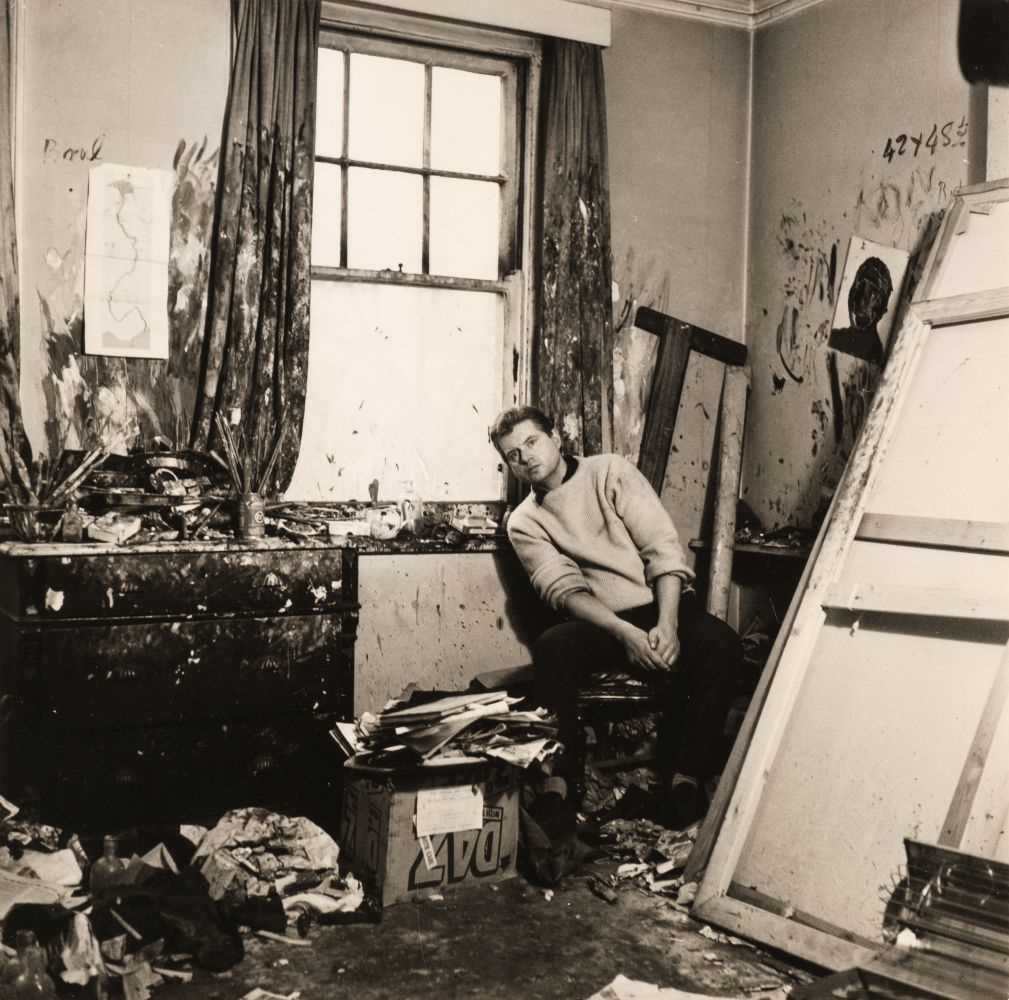
British artist Francis Bacon — “He does not fit into any of the stereotypes of the avant-garde painter.”
ON THE STRANGE CASE OF FRANCIS BACON
FRANCIS BACON’S retrospective at the Guggenheim Museum demonstrates how to be a great psychological figure painter in a time that makes it impossible. Behind the devastating success, each painting is a cunning subversion of the time through a limited but brilliant strategy.
The odds against this operation being successful are considerable. Bacon’s surgery is so radical that it is perilous. His subject matter (atrocity, anguish, perversion) has been devalued to cliché. He is not a natural painter and a case could be made as to how badly he often paints. Finally, he seems doubtful of the value of painting, which is at best “a game.”
Yet he has produced images that corrupt the imagination and ennoble it, that attack life and preserve it, cutting us between these opposites like a scissors so that, like the artist, we become both patient and surgeon, victim and assassin.
This paradox of Bacon’s art is of vital importance for all of us. Our particular time has forced on us a consciousness of bestiality and the darkest possibilities of human action without providing a way to cope with these revelations. Bacon’s art does.
It adds the perverted and the atrocious to human nature, where they belong, and does so totally without moral judgement. Whoever smartly rejects Bacon’s art as a profound expression of aspects of this particular time—as some are beginning to do—just hasn’t seen the things the 20th century keeps under the chromium-plated counter: a body in vivisection, a cancer split open, a mind carefully mutilated.
What Bacon does to the human figure is quite clear in a literal way. The figure is filleted to a jellylike blob that can bulge and ripple into any protoplasmic travesty. His people show a curious interaction between structure and movement—ambiguities of movement are suggested by ambiguities of structure and occasionally vice versa. The norm of the human figure that we all carry in our heads is displaced by a number of possibilities as if we were watching some game of embryological Russian roulette. (The embryological image can be a useful one in discussing Bacon, some of whose work looks like the contents of the dermoid cyst that sidetracks a human being into a hairy pouch of loose teeth and slime.) Similarly, his emphasis on the perverted seems related to some implied norm of behavior.
The effect is the old one of holding a mirror up to nature to reflect a creature we can examine with some sensual repugnancy before it dawns on us we are looking at ourselves—or some image of our isolation, our sentient brutishness, the unadorned and perilous fact of our existence. Thus the immense concentration of his images, a power frequently inexplicable when one examines the rather obvious structure of his pictures and the fundamental pessimism of his statements.
Mr. Bacon is on record as saying that “man now realizes that he is an accident, that he is completely futile being, that he has to play out the game without reason.” The pitiful creature he presents in metamorphosis is an image of the futile anti-hero changing shape, like a slug, to accommodate different stimuli. Pinned against their bright, clinical backgrounds, Mr. Bacon’s hulks are trapped by their necessity to continue living, as he in turn is trapped by his necessity to paint them. And since he seems to think that they and the business of painting them are meaningless, painting becomes a sort of grudging existential act.
Perhaps the most fundamental puzzle about Bacon is how he achieves his perverse nobility and a sort of high art from such a negative basis. Basically, his work is bestiality formalized into a mystique that makes degradation metaphysical, a private Black Mass. Thus the huge “Painting” 1963 becomes a sort of meaty cathedral, the baroque draperies made of flesh, the anguish stabilized into a ceremonial hysteria.
His people are usually raised on a dais, a throne, a chair, a divan, frequently surrounded by an electric diagram of space (like the skeleton of a cube), isolated against lurid backgrounds of solid color over which black windowshades are occasionally pulled down. These charged spatial environments make anguish bearable in much the same way that ritual does and they seem located halfway between the theater and the operating room. Within this environment it is eerie to watch snail-like trails of paint crawl and drag across the figures like metaphors for flesh. The sense of ceremony is inescapable.
To put Bacon into historical perspective one need not turn to painting at all. His is the first major expression in paint of a sensibility that runs from de Sade through Rimbaud to Genet, and includes such a modern semi-masterpiece as John Osborne’s “Under Plain Cover" with its netherworld of diaphragms and syringes. The best comparison is with Genet. Like him, Bacon is attached to a style of ceremonious presentation that allows him to extend the definition of life to include the underworld of rape, suicide and murder. Again as in Genet, these are not the objects of disgust but of a spiritual passion, that passion of which Baudelaire is the purest example.
His connection with the history of art he makes clear enough. He got his images from art, photographs and film, ravaging the past for the image he can subject to crisis—Velázquez’s “Innocent X,” Blake’s “Ancient of Days,” the screaming woman from Eisenstein’s “Potemkin”. Those pioneers of creative anguish and creative spiritualism, Van Gogh and William Blake, naturally attract him. Metaphysical devices are borrowed from Giacometti, the vibrating background colour from some abstractionists.
Having found his critical moment he makes it a semi-blurred ectoplasmic instant of becoming, which introduces the crucial dimension of time into his art, bringing one to his obvious interest in serial dissolves in film, and the serial exposures of Eadweard Muybridge’s studies of motion. The motion in Bacon’s art is unique. He catches the spirit gawking out between moments of physical metamorphosis. The results can be spectacular. Each head in his “Study for Three Heads” is speeded up with multiple viewpoints like a Picasso of the thirties humanized by Hugo Van der Goes.
Bacon seems to have accepted the meaninglessness of life as a point of constructive departure, again something that has precedence in literature rather than art. Despair accepted is as good a basis as any for art, and painting can become an existential proof of freedom beyond responsibility. Tellingly, he has referred to painting as a game, so one is free to replace the rules according to one’s will. As a performer on this disconsolate existential bridgehead, he is a compelling and compulsive artist, who has built up an astonishing oeuvre through the collision of raw life with style and ceremony. He is a sort of existential expressionist, no moralist at all, and if he feels pity, it is overcome by an implacable curiosity.
The implication behind the ceremony, the perverse nobility, the despair cancelled by acute sensation against bare nerve endings, is bleak. For life, no treatment is possible, but we all have the cure at hand. In a desperate inverted act of affirmation, his art is like one gigantic suicide to prove the value of life.
FRANCIS BACON
A GREAT, SHOCKING, ECCENTRIC PAINTER
BY LAWRENCE ALLOWAY | VOGUE
Some years ago, in London, I sat for my portrait. The artist was a slow worker,
so I spent days looking at the back of the canvas on his easel. Since he was a
friend of Francis Bacon’s, I had something to look at during our sessions He was
painting on the reverse side of an abandoned work of Bacon’s. There was, I
remember, the shadowy outline of a figure, dark against a whipped-up background
of blue and other colours. It looked like a mad scientist in a greenhouse.
Bacon appeared in London, after World War II, with a few turbulent and anguished paintings. The impact of these paintings were terrific, but rumour was persistent that the works shown were merely the tip of the iceberg. For every painting that he let out of the studio, there were said to be rows of discarded or slashed masterpieces. The canvas on which my portrait was being done was one of these works. A double drama became associated with Bacon There was the struggle of a desperate man who destroyed most of his own work; and, there was, too, the violence of the imagery in the paintings that did survive—meat decomposing or people screaming.
For years Bacon was inseparable from rumour and legend. His nonchalance towards the preservation of his work, his pleasure in gambling, his visits to an André Gidean North Africa, were all threads in the story. (One anecdote I remember had a n English art student sketching on a beach in North Africa An Arab came up to him and opened the conversation: “Do you know Francis Bacon?”) It is a characteristic of the successful twentieth-century artist to live in a goldfish bowl. Once an artist has been awarded a goldfish bowl of his own his whole life becomes information that he shares with the world. The world troops through the studio today. Bacon, though the object of great curiosity, has managed to live in the goldfish bowl and preserve a great deal of privacy. In fact, the violence associated with his name has acted as a screen behind which he could live and work as he wanted.
Bacon is in his early fifties, but does not look it. It is neither the regularity of his work habits nor the circumspection of his life that has given him his remarkable youthfulness. On the contrary, he has never spared himself, never been a man to take it easy. Bacon does not like abstract art and dismisses it casually as mere decoration—an opinion revealing the indifference with which Bacon protects himself from subjects that are of no interest to him. Nevertheless, he is the only painter of his age who continues to the interest younger artists in England, many of whom are abstract painters. No other painter of Bacon’s generation in England (a mild lot) has displayed the particular qualities of nerve and obsession that seem to characterize the best modern painters in other countries.
An exhibit of more than sixty paintings by Bacon has opened at the Solomon R. Guggenheim Museum. Surrounded as one is at the Museum, by an abundance of large spectacular works, it is hard to remember that Bacon achieved fame first as a painter almost without paintings. Gradually, he has separated himself from the web of rumours and party talk that surrounded him, and, in the last few years, has become a very much more productive painter. At least he has allowed much more of his productivity to remain. At the Guggenheim, for example, though the show is retrospective, and goes back to 1946, at least twenty percent of the works were painted within the last three years. Bacon has made the transition from cult figure to major painter with his later work fully displayed, not shielded by being held back or destroyed. (American collectors, incidentally, were on to Bacon early, and the present exhibition draws on American, as well as European, sources.)
It used to be thought that abstract painting was difficult to appreciate and that figurative art was easy because it appealed directly to common experience. This argument was O.K. for the early twentieth century, but is no longer convincing in the changed situation of mid-century art. Good art and bad, difficult art and easy, are no longer identifiable with set styles, but only with the uses artists make of them. The work of Francis Bacon is among the reasons that this easy antithesis has to be abandoned. There is, for instance, little agreements as to what the subject matter of his paintings really is. There are nudes, but what are they doing? There are men in spaces that look like hotel rooms; or they may just be corners of Bacon’s studios. The scenes are clearly displayed and yet not decipherable into verbal explanations. Bacon is fully prepared for this situation, or at least used to it, because he says: “Everybody has his own interpretation of a painting he sees. I don’t mind if they have different interpretations of what I have painted.” Certainly his critics have made full use of this freedom (which is, perhaps, rather insolently bestowed—like Apollo granting Midas imprudent wish for gold). His figures of Popes have been explained as anti-clerical and as Freudian father-symbols; they have also been explained away as appealing to Bacon as a theme simply because the Pope wears such handsome colours.
Then there is the problem of his quotations from other artists. He has often paraphrased Velázquez famous portrait of Pope Innocent X, but this quotation is not like the respectful evocation of a classical model because the artist feels he can not improve on it. On the contrary, one image begets another in Bacon’s art and it is quite possible for him to continue, in the same picture, from the Pope to a reference to Einstein’s film, The Battleship Potemkin. A screaming head, famous from the Odessa steps sequence in that movie, began to appear in his paintings in 1949. Thus, a famous painting is combined with a photographed image, so that the old and the new, the traditional and the modern are disconcertingly fused. Both art lovers and movie fans have disconcerted.
Incidentally, the movie quotation, though from a silent film, makes Bacon a precursor of today’s pop artists, with their references to images of mass communications. Bacon has persistently used original and unexpected sources for his art. Many of his figures and animals derive from such books as Eadweard Muybridge’s The Human Figure in Motion and Marius Maxwell’s Stalking Big Game With a Camera in Equatorial Africa. One was published in the 1890’s, the other in the twenties, and undoubtedly Bacon relished the period-flavour of the photographs, as well as their status as records of fact. He shows that no visual material, no human records, exist that can not be valid, if interpreted meaningfully.
Bacon’s art has a way of connecting, knowingly but obliquely, with problems which have to be faced, at some time or another, by everybody interested in art. First, what is the role of the masterpiece? There was a time when nobody doubted its value. It was the great work which summed up all that an artist had been trying to say and it was undoubtedly destined for immortality. In one way, Bacon seems o aim at producing masterpieces, in the grandeur and ambition that his works display, but at the same time he seems to be destroying the ground for a masterpiece. By painting pictures in series, as he does, or as variations on a theme, he seems to be saying that no single painting i sufficient to make his point. Thus, instead of destroying masterpieces, as his friends say he used to do, he repeats possible masterpieces in endless series and variations. The result is that his pictures need to be seen in groups, and, when they are, they look like successive stages from a film or or a picture magazine (like, say, records of a suicide jumping off a building or a girl having a completely new hair do).
A second problem which Bacon’s art consistently raises has to do with the influence of photography on art. Of course, this is not a new theme, and in the nineteenth century Delacroix, Corot, Daumier, and (the suddenly revived) Aphonse Mucha, were among those painters who were interested in the new medium. What Bacon has done is to bring his painting into relation with the mass of photographic images which fill the world today. And this means that his paintings, in this respect, share a common ground with ourselves. Today none of us escapes the influence of the visual explosion. In fact, it is through photography that we get much of our information about politicians, fashion, outserspace, and Christine Keeler. Our image of reality is substantially shaped by photography. Bacon transfers the visual appearance of photographs into his art, and never more so than when he is painting freely. He has an evocative way of dabbling a dry brush, or twisting a wet one, so that, like heavily screened newsprint or out-of-focus photography, physical reality is evoked, but in a rather oblique form. In fact, Bacon told David Sylvester in a recent interview on the British Broadcast Company that to him “forms change continuously.” He improvises as he works so that a painting, even though planned out in advance to some extent, may not have a predictable outcome. It is not the least of Francis Bacon’s paradoxes that however much he improvises in paint, he never loses contact with that blurred, gritty, yet persistently factual presence that photography creates.
Bacon’s paintings are as stately as the portraits of ancestors in English country houses, even though the forms are evasive and hard to pin down. The composition of his paintings prepares us for an image in the Grand Manner, but when we look closely, its forms and composition seem to stretch, as in a distorting mirror, or dissolve out of focus. The result is that everything in Bacon tends to produce uncertainty, often of an ominous or breathtaking kind.
In a new painting of Bacon’s Landscape near Malabata, Tangier his dazzling colour range, and emotive power of his imagery, can be seen. The landscape is sucked into a kind of vortex, and surrounded by a screen, like the canvas windbreaks they put up on Côte d’Azur beaches, or, perhaps, like the pens in which, three hundred years ago, royal bore hunts took place. The forms within this arena are blurred by wind or movement, including the evocative human-looking smear in the foreground.
Why does Bacon paint sinister and harrowing subjects? This is a question that, often asked, needs to be answered, although one is tempted to say, why not? After all, nobody demands “why bottles?” when faced with Giorgio Morandi’s still calm lifes. One answer takes the whole affair out of painting and into the area of moralizing editorial writers. This arguing sees Bacon as a mirror held up to the human condition, faithful recorder of a bad time.
However, there is another way to look at Bacon’s subjects and that is to see them as the personal expression of a view of life—and death. To quote Bacon’s own words: “Man now can only attempt to beguile himself, for a time, by buying a kind of immortality through the doctors.” And, in his paintings Bacon represents life, its vulnerability and man’s impermanence. Thus, one can say, it i the speed of change that is, in a way, his subject. Just as fashion styles are always on the move, visibly changing every few years how woman look and, more slowly, how men look, so Bacon depicts man as subject to change, unstoppably. The human body is represented as if it were as topical and as expendable as clothes. This is not, by any means, a negative view of his life, but simply recognition of the facts of life.
FRANCIS BACON, who is now having an extraordinary exhibition at New York’s
Guggenheim Museum, arranged by its curator, Lawrence Alloway, is an original, a
discoverer of new ways with a memory of the old. (In the photograph here, taken
in Bacon’s studio, there is at his left a Rembrandt self-portrait reproduction.)
To some people he is a shocker as a painter, to some he is only an eccentric
with a known compulsion towards gambling. To some he is bats. To others,
however, he is but far the greatest painter in Britain. An isolated man,
sometimes extremely attractive, sometimes curiously aloof, who wants to record
the faces he sees, he is frequently surprised that certain spectators think of
is paintings as screams of rage, for there is little of the rebel about him. He
lives his unsettled life comfortably in disorder. With great candour he knows
that he horrifies. Before the Guggenheim, the Tate Gallery in London gave him,
several years ago, a show, oddly violent in reaction since his paintings are so
quite, mirages often of multiple images, of sliding, melting faces that make
some spectators feel their are eyes out of focus.
BACON’S "Landscape near Malabatta," painted at Tangier in May this year, is one of his few landscapes. About it, Lawrence Alloway wrote: "The landscape is sucked into a kind of vortex, and surrounded by a screen, like the canvas windbreaks they put up on Cote d’Azur beaches, or, perhaps, like the pens in which, three hundred years ago, royal bore hunts too place. The forms within this arena blurred by wind or movement, including the evocative human-looking smear in the foreground." (It is published through the kindness of Marlborough Fine Art Limited, London).
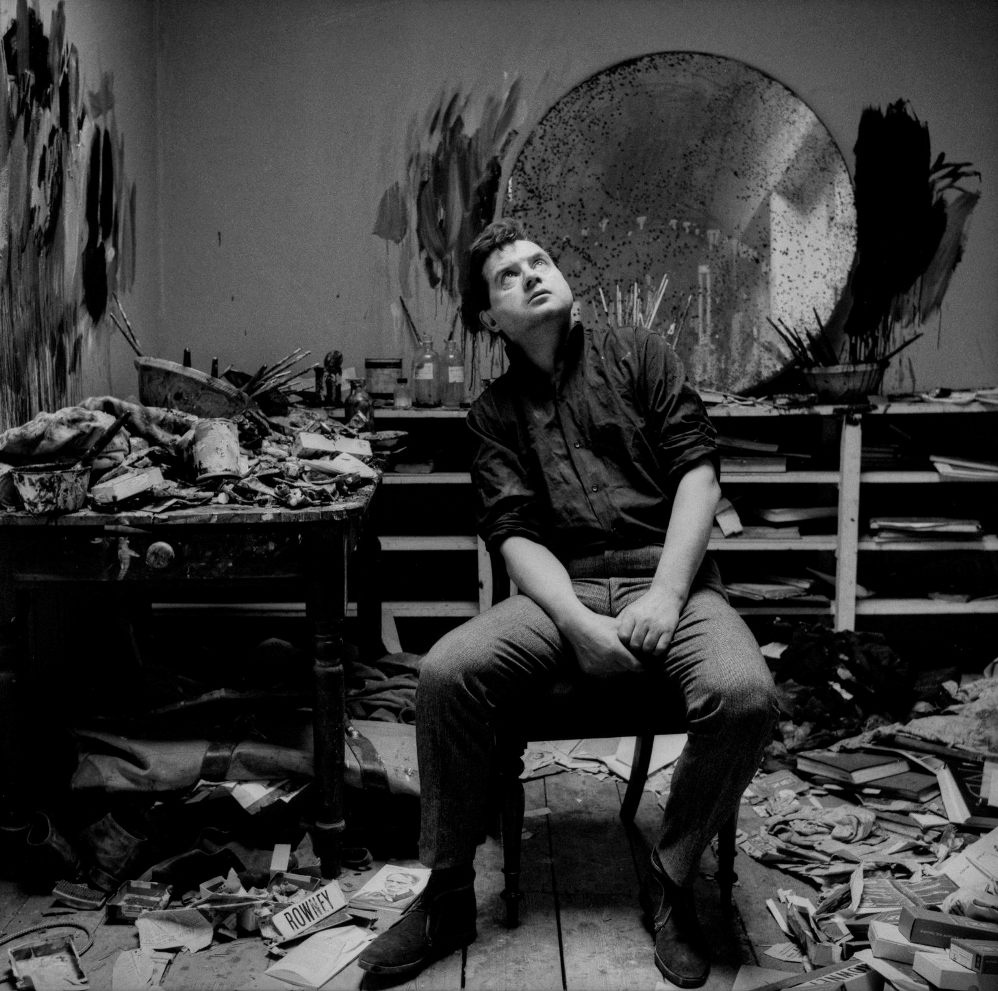
“If I sit and daydream, the images rush by like a succession of coloured slides,” says Francis Bacon. Every once in a while, he stops one and puts it down on canvas. Full of atrocity and anguish, they are the most consistently disturbing images in modern art today.
Bacon paints tragedy, and his works are both noble and enervating. Since he does not believe in life after death, he cherishes existence as a singular event: he is a fatalist taking arms against despair. “Life itself is a tragic thing,” he says. “We watch ourselves from the cradle, performing into decay. Man now realizes that he is an accident, a completely futile being, that he has to play out the game without reason.”
Professional Nomad. Collateral descendant of his courtly Elizabethan namesake, Bacon is a ruddy, puffy Pan whose brown hair is ungreyed at 54. He is a self-taught artist and a loner among modern artists. He lives like a loner—staying barely long enough in any one London flat to litter it and leave. Last week, having just ended a four-month toot, Bacon was back at his easel in a South Kensington mews flat that has been home for a scant fortnight. At the same time, 65 of his oils went on exhibit in Manhattan’s Guggenheim Museum. It was the largest one-man show in the U.S. for a living British painter within the century.
Bacon’s success is sudden. Not until the age of 40 did he have his first one-man show. Today he is Britain’s foremost painter. He hearkens back to the English portrait tradition—the grand manner. This phrase was used by Sir Joshua Reynolds to define the ideal High Renaissance portrayal of the human figure in elevated themes. The theme of Bacon’s grand manner is man’s eventual, often brutal descent into the grave-but it is nevertheless a way of dealing with the lofty idea of man against tragic destiny, sometimes in austere agony, sometimes in embarrassing abandon.
His subjects are uneasily seated atop a dais, sprawled in frank nakedness on a couch, wrestling through homosexual positions on a podium. In last year’s Three Studies for a Crucifixion, a motif he has been studying since 1931, Bacon painted a triptych more than 14 ft. wide with enigmatic figures and bony carcasses looming in red oval rooms. The central panel contains a kneaded corpse lying in bed amidst a welter of congealed gore. There is no more overt Christian symbolism than that every man can find himself martyred meaninglessly. And the source of Bacon’s idea is no mystery: two widely publicized sex murders took place in London shortly before he painted it.
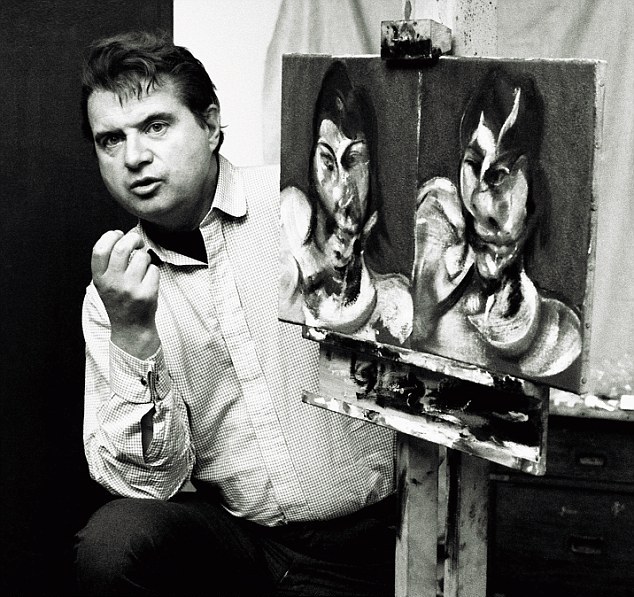
PAINTER BACON & HIS IMAGES OF MAN
Man taking arms against his tragic destiny.
Pretzel Poses.
Bacon
studies man through the man-made images of photography. Barricaded in his flat
with blankets across the windows, he uses reproductions from art books and
sensational photos from newspapers as his models. He painted a series of
gnarled, garishly coloured portraits of his predecessor in agony, Vincent Van
Gogh, after reproductions of the Dutch artist’s long-lost The Artist on the
Road to Tarascon. Most famous of his serial portraits are those of screaming
pontiffs modeled after a papal commission by Velásquez (see opposite page).
Though he has been through Rome, where Pope Innocent X’s portrait hangs in the
Palazzo Doria-Pamphili, Bacon has never gone to see it. The gum-baring shriek
that gapes out of so many of his portraits is copied from a still from Sergei
Eisenstein’s film of 1925, The
Battleship Potemkin, in which a horrified nurse is shot point-blank through
her pince-nez. Why these subjects?
The
images that haunt Bacon haunt his viewers even more. Great bisected sides of
beef are constant and chilly recurring still lifes in his works.
In one of his most recent works, Landscape near Malabata, reminiscent of the outskirts of Tangier where he used to vacation, Bacon dissolves trees, grass and ghostly beasts into a ghastly gallop around the center of his canvas. Faster and faster they seem to run, until the shadows no longer keep up with what is casting them. One brushstroke more could throw it out of step, and Bacon knows it. He destroys more canvases than most artists paint.
He is reaching for one perfect final portrait of man, and his avaricious eye is
often bigger than his brush.
THE SOLOMON R. GUGGENHEIM MUSEUM, NEW YORK
IN COLLABORATION WITH
THE ART INSTITUTE OF CHICAGO
October,
1963
The Solomon R. Guggenheim Museum is honored to present the first American Museum retrospective exhibition by the distinguished British painter Francis Bacon. The Museum, thereby implements its stated policy to exhibit modern art of exceptional quality and significance regardless of national origins or stylistic categories.
That we should be joined in this endeavor by one of the great museums in this country. The Art Institute of Chicago, is a source of particular gratification and sets a fruitful precedent for similar collaborative ventures in the future.
Harry F. Guggenheim. President, The Solomon R. Guggenheim Foundation
Francis Bacon, through his imagery, refers to the Gospel and to Van Gogh; to
Popes and to businessmen; to male and female nudes; to dogs and apes. The
underlying, ever-recurring theme, is the figure (saintly, human or animal, with
a degree of interchangeability) shown in an environment that is natural or
man-made. Bacon thus is intelligible and his scene, blurred and veiled though it
may be, remains recognizable. His painting — figurative in the ordinary sense of
this term — is nevertheless unlikely to satisfy those who yearn for a return to
old-time art, to a back-swing of the pendulum from abstraction to a naturalistic
mode.
Why should this be so? Chiefly, we believe, because Francis Bacon is so
demanding and so incapable of fulfilling the hope for a comfortable art. With
him, there is no release from tension, no lessening of the viewer’s commitment.
He is quite unable to afford such simple pleasures as constitute to many
beholders the obvious function of art. Instead Bacon strains our viewing
capacity to the utmost. Recognizability notwithstanding, he is more difficult to
"understand" than many abstract painters.
To approach the essence of Bacon’s work, we must come to terms, intellectually
or intuitively, with any number of complex thoughts of which a few may be
summarized as follows:
The relation of Bacon’s images to his formal pursuits. This involves the subtle
interplay between the artist’s seemingly haphazard choice of subject matter and
of the stylistic means through which he brings it to life.
A
consideration of Bacon’s probing disposition which instinctively reaches for
images and for analogous pictorial means that touch upon essentials. He thereby
forces us into questioning confrontations with basic attitudes, prejudices, and
taboos and by so doing necessarily hurts us before affording such relief as
comes from widened understanding.
An understanding of the meaning of ugliness in art and the realization that
horror can be sublimated through formal perfection into the most satisfying of
harmonies.
A consideration of pictorial space and its relation to our prevailing world
view. For Bacon gives us a graphic extension of known reality, thereby leading
us to rethink our placement as individuals in the world of our understanding.
These and other issues are forced upon us by Bacon’s relentless art. Since, once
confronted, we cannot turn away, his propositions are most uncomfortable. The
great reward held out to us is that through the comprehension of Francis Bacon’s
blurred vision, we shall see ourselves with greater clarity.
The Francis Bacon exhibition and the accompanying catalogue
were
prepared by Mr. Lawrence Alloway, Curator of this Museum, for presentation at
The Solomon R. Guggenheim
Museum in New York and The Art Institute of Chicago.
Thomas M. Messer, Director, The Solomon R. Guggenheim Museum
I
am grateful to Ronald Alley for his abundant contribution to the bibliography,
to David Sylvester for making available documentary material, to James Thrall
Soby and Sam Hunter for the kind loan of photographs, and to Richard Tooke of
The Museum of Modem Art and Donna Topazia Alliata for assistance in obtaining
photographs.
I leant to thank the following members of the Museum’s staff: Carol Fuerstein,
editor of the catalogue and, with Maurice Tuchman, compiler of the bibliography;
Alice Hildreth who worked closely on the exhibition since its inception.
The Marlborough Fine Art Ltd. kindly obtained loans from European collections
and, in particular, Mr. H. R. Fischer was resourceful and helpful.
My thanks are due to the following for the contribution of color plates to the
catalogue: Ted Weiner, Fort Worth: The Joseph H. Hirshhorn Foundation, New York;
The Art Institute of Chicago; Marlborough Fine Art Ltd., London; and for the
loan of existing color plates, Museo Civico di Torino and the Marlborough Fine
Art Ltd., London.
Lawrence Alloway, Curator, The Solomon R. Guggenheim Museum
INTRODUCTION
A great deal of Bacon criticism has been devoted to a single aspect of his imagery. Because there are Popes that scream or solitary figures in hotel bedrooms, they have been identified as allegorical personifications of Melancholy or Dejection. The paintings have been treated as cultural symptoms, mirrors held up to an age in pieces, generalized moral lessons, rather than as individual expressions. The result is that Bacon, as an artist, has been dissolved, or inflated, into a cultural barometer. The writers who are responsible for this all see the present time in negative terms, so that Bacon becomes the laureate of Buchenwald, the Goya of the Early Space Age. Criticism of this kind makes for rather lively reading — far more exciting and emotional than art critics can usually manage to be. Metaphors of nightmare, breakdown, and crisis abound. Literary parallels are constantly invoked, such as Kafka, Beckett, Joyce (the sermon in A Portrait of the Artist as a young Man), and George Orwell (1984). Such writing derives from the original historical dramas of cultural historians who use works of art to embody moments of crisis, paths of decline, or crossroads of transition in culture. In their hands, the method is, at least, based on a thorough historical knowledge: time provides a perspective for their judgments. To write about a contemporary artist in this way, however, assumes a comprehensive grasp of our culture, which, while we live in it, as participants, we may not have. The meaning of our culture is incomplete until the future confers it. Thus, the reading of Bacon as the drama of a culture in crisis tends to be inconclusive as well as indulgent. There is, also, the awkward fact that if works of art are treated as signals of the state of culture, all art is significant in this way, and not simply the work of violent artists. Chardin, Vuillard, and Morandi must also be significant, and not only Goya, Picasso, and Bacon.
Though one objects to reading Bacon’s art in terms of a melodrama of the human condition, this does not mean he should be considered a detached and aesthetic artist. On the contrary, he is an inveterate enemy of the idea of the dehumanization of art. to use Ortega’s phrase for a widely held approach to art in the 19th and 20th centuries. A concise statement of this position is Cocteau’s witticism in the dedication of Orphee: ’’A painter may throw himself from the fifth storey, and the art-lover would only say: ’That makes a pretty splash’."1 The assumption is that human meaning is of negligible value compared to strictly held formal values. Bacon, however, has always put conspicuous human meanings in the foreground. In fact, it has been his strategy to conceal his formal concerns behind the spectacle of human action. When he blurs a face, it could be a wound, as well as a painterly decision; when he compresses a form, it is as much like an injury as an exercise in foreshortening. He makes formal meanings resemble painful human experiences. The marks of painting, including conspicuous signs of improvisation, become images of the movements of his figures or of their suffering.
It is, perhaps, time to try to write about Bacon as a painter, rather than as an allegorist of Angst, and about his works as paintings, rather than as documents of a 20th century problem, predicament, crisis, or what have you. Central to Bacons art is a dual time-sense. He has. it is true, an acute sense of topical images, rendered with immediacy, but he is also persistently aware of the past and its models. He has, for instance, paraphrased repeatedly Velasquez’s Portrait of Pope Innocent X (Doria Gallery). In the Van Gogh series he not only alluded to Van Gogh’s The Road to Tarascon, but also, in the first Study for Portrait of Van Gogh, to Manet’s Execution of the Emperor Maximilian (Boston Museum of Fine Arts).2 Hence, a buried, and thoroughly unexpected, connection is established between an image of Van Gogh, surely linked with our idea of a victim, and the figure of the sergeant of the firing squad on the right-hand side of Manet’s sketch. In the fifth Study for Portrait of Van Gogh, the painter appears in a strong Art Nouveau style, as if painted by Munch. In the recent Three Studies for a Crucifixion, the corpse in the central panel is reminiscent of the bullet-pierced flesh of the corpses in Goya’s Execution of May 3, 1808. There is, of course, a link between Goya’s and Manet’s firing-squad paintings. Persistent, though buried, connections of this kind are contained in Bacon’s art linking it with the tradition of painting, though on his own terms.
Bacon’s concern with tradition should not be translated immediately into the received picture of an individual in agreement with his inheritance. Tradition for him is not a snowball which he slightly enlarges by rolling it a little further on an established track. The past to Bacon is not a gallery of coherent prototypes which he modifies but whose dominance he does not question (the approach to tradition recommended by early 20th centaury classicists and conservatives). Tradition to Bacon seems to be a shifting bundle of models and influences in a problematic relationship with recent experiences. The records of the past are available in underground and personal ways: consider the irony and paradox involved in the Manet quotation or in the stylistic reference to, as it were, an unpainted portrait by Munch.
Bacon’s allusions to Velasquez’s Pope Innocent X are well-known. There is, however, another work which could only be known to Bacon in the form of a reproduction, a remarkable painting by Titian in the John G. Johnson Collection, Philadelphia. It represents a sitter, Cardinal Filippo Archinto, in a pose that anticipates the Velasquez, but with a transparent curtain hanging over half the painting. The face fades, the right eye is divided, and the hands are smeared through the material. This bizarre work seems to be one of the formative factors in Bacon’s Study After Velasquez, 1953, in which the face is partially obscured by vertical folds of material. It is the history of art, as it contains curiosities and puzzles, as well as masterpieces, as a record of human action, rather than as a pure fountain head, which absorbs Bacon.
Of greater consequence, probably, than the presence of individual quotations from other artists, is the general reminiscence, in his work, of the Grand Manner. By Grand Manner, I mean the central tradition of European figure painting as it developed in the Renaissance and as it dominated all subsequent figure painting until the 20th century. Bacon’s paintings preserve numerous allusions to the Grand Manner. The size of the canvas, the placing of the figures within it, the gestures and poses of the figures depicted — all reveal an underlying structure of the Grand Manner format that has been thoroughly assimilated into a direct and natural way of working. These echoes of the past are not academic simulacra of past models; on the other hand, their persistence in Bacon’s art differentiates him from abstract painters. In fact, even as the past is evoked by the structure of the paintings, it is questioned and undermined. A grand compositional display becomes a keyhole to intimacy. Within the format of the Grand Manner, human, spatial, and painterly cues are charged with fresh meanings. Within an heroic contour, for instance, a figure will be painted in an elliptical or perfunctory manner. Instead of the spatial coherence of the Grand Manner, figures fade against a black void, or are pressed forward by a flat color plane.
To Bacon, the Grand Manner is indispensable, as a frame against which to work, eroding and subverting it, but not removing it. He needs both the symbol of order, of which the Grand Manner provides an ample and long-lived example, and its opposite, intimate and unanticipated images. The two elements interlock, one giving body, one giving mystery, to the other. In this respect. Bacon can be compared to both Giacometti and de Kooning, but not to Dubuffet (whose human figures are flat and primitivistic). Giacometti’s sitters are withered paraphrases of Baroque portraiture, with the tall grey studio behind them as the surrogate of column and curtain. De Kooning’s Women preserved, through all the sweat and fruitiness of their paint, a basic seated pose, seen early in his 1938 Queen of Hearts, which derives from Renaissance originals. The interplay of flesh and dilapidation in de Kooning rests on a Grand Manner infra-structure. The point is that all three painters, unlike Dubuffet, are post-Raphaelite painters, with no desire to simplify, to strip off history and sophistication: they only want to make their own uses of it.
This act of preserving, knowingly, a form, while transforming it partially, produces an art which is highly ambiguous, to use a word that is continually employed in 20th century criticism. Surrealist images, which conflate different objects or classes of objects, are so-called, although, in fact, the effect is of a puzzle rather than of ambiguity. In the works of Bacon, Giacometti, and de Kooning (the Women, not the abstract paintings), it is the structure of the work itself which is ambiguous. It is partly the continuation of a past tradition in a confident and still viable form. It is, also, the reduction of the forms of this tradition to act as a container for an unexpected content, sometimes a disreputable one. The Grand Manner becomes, at times. Grand Guignol. Instead of being the paradigm of order, the format of the Grand Manner becomes merely a corral for wild beasts, freshly trapped. It is essential for Bacon to preserve a given and canonical form, against which he can work. His paint creates the form but, simultaneously, withholds its complete definition. The traditional composition and its heroic occupants are both raised and perpetuated, but, at the same time, they are parodied and damaged.
The use of orderly form, without confidence in its absoluteness, and the insertion of disturbing subjects into a pre-existing form, has analogies with Baudelaire. The regular stanzas and the classic structure of the line in his poetry divulged subjects and emotions foreign to the decorum usually associated with his structure. Similarly in Bacon, the apparatus of the Grand Manner supports a drastically changed iconography. In two early paintings by Bacon, for example, an umbrella is used; in both, the umbrella shields a figure, whose head appears to have been sheared through, cutting the top of the skull off. The incongruity of the umbrella, in scenes of such violence, should not block our memory of the fact that umbrellas were used, with fair frequency, in Baroque art, to protect the sitters of, for instance, Van Dyck and Le Brun. A covert and bizarre art historical reminiscence is set up, adding resonance to the shocking image. Bacon’s nudes, often derived from motion studies of late 19th century males by Eadweard Muybridge, evoke the Grand Manner unmistakably. As the muscles rise, memories of Michelangelo and his followers are strong. Bacon’s figures, of men exercising singly or in pairs, link with the modern tendency to take nudity in art literally. Looking at the 16th century’s heroic nudes it is hard for us to separate the painted or carved figures from human anatomy. A potential of human reality within the ideal figures has been released, often at the expense of the symbolism originally identified with Mars or Vulcan or athletes (their physical well-being a code for virtue). Separated from iconography, Michelangelo’s nudes are swung into a new context; his athletes take on the attributes of muscle-eroticism rather than Neo-Platonism. The tradition of Michelangelo’s homosexuality is related, now, to the Sistine vault, which appears to us as though covered by gymnasts. Similarly, the males that Bacon paints imply a homosexual content. It is not a matter of recovering, after bourgeois suppression, the socially-sanctioned and culturally normal homosexuality of, say, a Greek poet. On the contrary, Bacon asserts the presence of latent homosexual meanings within the tableaux of the Grand Manner. As in Baudelaire the traditional theme changes within the known form, like fruit rotting in a bowl without outward change, or like a house adapted internally for different generations of inhabitants, but preserving an ancient façade.
One of the ways in which Bacon relates to the Grand Manner involves a special definition of man and space. In the Renaissance, the human body was defined as a solid, subject to physical laws, set in measurable space. The movements of the body in this space were highly adaptive and competent; able to fight, build, and love, good at selective tasks. Bacon is sensitive to this definition of space as the area that an individual can move in or reach. He abandons the objective ground plane of the Renaissance and organizes space around his human figures, outwards from the active agent. Bacon has used thrones, couches, cages, beds, canopies, booths, and the Cross to define the area of human movement. The recurring image is of a human being pinned to an intimate area of use. Our experience of what is close is different from our experience of what is distant, and Bacon (despite occasional landscapes) is basically a painter of near forms. His human image is persistently conceived in relation to intimate, touchable, reached areas of the world. The cradle within which the child is set, the bed on which we spend so much of our lives ; the table at which I am writing, or a telephone booth; a chair, or a Cross to which One has been nailed. The space beyond these islands of man’s use is amorphous or inaccessible.
The spectator’s relation to Bacon’s pictorial space is highly participative. The figures, on or in their residual Renaissance structures, seem to be trespassed upon, rather than cooperatively posing for the artist. Or the artist himself (who becomes subjectively identified with the spectator) seems engaged in the acts of his figures. Curtains drop, heads loom in close-up, bodies are cut off by the frame, so that we feel a constant sense of privacy invaded and of personal involvement. Erwin Panofsky has pointed out that typical Renaissance treatises on perspective "devote much time and space to the construction of regular and semi-regular solids, of architectural features and of scenery," whereas it was difficult "to cope with the human body because of its utter irregularity. " 3 This is the point at which Bacon’s interest in the human body starts. To quote Panofsky again: the "variety of human movements" was rarely depicted as "the result of a continuous transition from one state to another." In fact, Bacon has made this theme his own, with his studies of transitional human movements flickering through the wrecked Grand Manner.
The use of elaborate presentational devices by Bacon is not immune to our special self-consciousness in the 20th century. We have become sceptically aware of the process of communication itself, recognizing the rhetorical functions of dress and gesture, and of the technical means themselves. The events of present history may be staged, because the participants know that they occupy a goldfish bowl. Thus, Bacon often turns the painting, self-consciously, into a tableau, a demonstration, a display. The fact of his frankness about the mechanics involved does not stop them from working. On the contrary, his knowledge links with the visual sophistication of the 20th century audience. In fact, the theme of death, which is constant in his work, occurs within the prepared scene. Some of his images of mortality recall the verisimilitude of death and decay presented in natural history museums in Europe. For instance, in the Zoologiske Museum, Oslo, there is "a group of African scavenger birds feasting upon the head of a dead zebra, with matter oozing out of eyes, nose, and mouth, and maggots competing with the birds. "5 This compound of an artificial presentation with a shocking image of corruption is Baconian.
It is important to determine the function of photographs in Bacon’s art. He used a still of the injured nurse in The Battleship Potemkin in 1949 and subsequently around 1950 he began using motifs from the motion studies of Muybridge. Also in the early 50s he used Marius Maxwell’s Stalking Big Game With a Camera in Equatorial Africa, though, as a rule, indirectly. The Popes of 1951 quote not only from Velasquez’s Innocent X but, also, from a photograph of Pope Pius Xll carried on a sedia gestatoria through a room in the Vatican. This group of paintings is, incidentally, the first series showing successive, though mysterious, episodes. Here Bacon is producing some of his most fully realized works, as if he were aiming at a masterpiece, but at the same time, repeating the image with small changes, like a series of photographs or a comic strip.
What is the historical relation of photography to art? Obviously the belief that it would kill, or that it had killed, figurative painting satisfied only a few early 20th century polemicists. What photography did was to enlarge the scope of figurative painting by carrying the human image out of classical idealism. Delacroix recognized this clearly: "After having examined . . . photographs of nude models, some of them poorly built, overdeveloped in places and producing a rather disagreeable effect, I displayed some engravings bv Marcantonio. We had a feeling of repulsion, almost of disgust, at their incorrectness, their mannerism, and their lack of naturalness: and we felt these things despite the virtue of style."6
Bacon’s use of photographs is fully in line with this reading of photographs as non-hierarchic and un-planned fragments of real life. Thus, in his work, blurred forms and mysterious gestures, derived to some extent from photographs, occur within the context of the Grand Manner. A processional image becomes a scene of assault, like an assassination; wrestlers become lovers: figures in a room look like celebrities whose names and faces we can no longer keep together. Bacon simulates the grainy quality of photographs, especially when processed for reproduction, thus, depositing, as it were, bits of the world in his imposing pictures. Both texture and gesture derive, in Bacon’s work, from photographic sources. The evasive nature of his imagery, which is shocking but obscure, like accident or atrocity photographs, is arrived at by using photography’s huge repertory of visual images for all objects and events,7 which permits connections between widely scattered phenomena (a human head and an ape’s, for instance).
Human actions, when arrested in time, frozen at a brief moment, have a potential for mystery, inasmuch as the purpose and context of the action may be missing. Uncaptioned news photographs, for instance, often appear as momentous and extraordinary, though deeply human and anonymous. In his earlier work Bacon used this property of photographs to subvert the clarity of pose of figures in traditional painting. In place of the convention of explicit gestures in art, he developed a style of unpremeditated gesture, of the inadvertently and obscurely revealing, based on the expressions and movements that we all share and manifest unknowingly.
So important is the theme of motion that Bacon’s development can be, perhaps, discussed in terms of a change in his approach to the problem. From 1949 to 1956 the movement of figures is indicated mainly by blurring the edges and opening the planes of forms. Forms are evoked by partial glimpses, diffused by atmospheric chiaroscuro, though the whole form is never questioned. There is plenty of space for the implied movement to take place. The effect is of spatial fullness and of the free occupancy of space by mobile and fugitive figures. In 1956, though Bacon’s interest in motion did not change, his way of handling it did. There is a new sharpness of contour and solidity (or, at least, continuity) of planes. Previously the whole figure was seen in motion, with each form retaining, however blurred or transparent, its integrity. The limbs might be hazy, but they were intact and in place. Later, however, motion is expressed by the compression of bounded and continuous forms. Thus, a turning head is indicated not by being smeary and blurred, but by being twisted; bodies, instead of fraying as they moved in time, are corkscrewed or dilated by successive movements, each phase of which is partially visible. It is possible that some reference to Futurism may be contained in the later figures. In the sliding and squeezing of anatomies there is a reminiscence of Umberto Boccioni’s bronze sculpture Unique Forms of Continuity in Space (1913). What Bacon gives us, perhaps, is Boccioni’s "ideal reconstruction of continuity" without the reference to machinery which geometrizes Boccioni’s work. Instead of metallic surfaces, the figures are pulpy and vulnerable, as in the Three Studies for a Crucifixion, 1962.
A change in Bacon’s color-range and paint-handling is related to this development. His earlier paintings are monochromatic, based on black and a restricted number of colors, clearly revealing a sympathy with Manet. The link with Manet is not casual, but a consistent parallel with an artist who preserved the Grand Manner format while painting improvisationally (and, to his critics, casually) within it. Bacon’s paintings from 1945 to 1949 reveal, on the whole, a progressive move from a dense, stickily-textured surface, which hesitates between painterly and sculpturesque form, to a consistent painterly style. With the 50s comes an increasing lightness in the paint, which tends to be dry and dabbed on, so that forms are grazed and flicked into being. In 1952 this manner of painting became sparser, a kind of parched morse-code over dry canvas. Variations of this way of painting are consistent until 1956 when richer color and more unified planes appear. By 1959 an unprecedented clarity of color puts, as it were, the formerly shadowy figures of Bacon into the light of day; and the light, combined with Bacon’s use of literal effects of foreshortening, shows that the figures resemble cripples.
Although Bacon’s work reveals change when viewed chronologically, he is not one of those artists whose work needs to be seen in sequential order for its full realization. He wall hit on an image, with apparent suddenness, and then use it repeatedly, in variations which are not necessarily resolvable into a logical procedure. References back and forth between different versions of the basic images, create a denser layer of meaning than any of the works singly. For instance, the various paintings of the Crucifixion add to one another, but without revealing an ideological change between the 1950 and 1962 versions. His work is, perhaps, best viewed as a cluster of images, which he has invented and elaborated, returning to them over and over again.
Lessing has discussed the problem of the scream in art: "The simple opening of the mouth, apart from the violent and repulsive contortions it causes in the other parts of the face, is a blot on a painting and a cavity in a statue productive of the worst possible effect."9 "Imagine Laocoon’s mouth open, and judge. Let him scream, and see. It was, before, a figure to inspire compassion in its beauty and suffering. Now it is ugly, abhorrent, and we gladly avert our eyes from a painful spectacle."10 It is clear that Bacon’s human image continually violates the canon of Lessing. The scream is a recurring theme of Bacon’s art; sometimes an early painting seems to be little more than a mouth, "a blot." It is imagery of this kind which called forth the criticism mentioned earlier. My point is not that Bacon is not a painter of grotesque and gruesome effects, but that these effects occur within the context of art. and not merely as reflexes to an historical moment.
If one characterizes Bacon as a painter of the grotesque it must be with certain reservations. He is not a painter of fantasy that transcends earthly reality or makes jokes out of it. He neither projects "the dreams of painters," in free-wheeling imagination, nor does he pursue compounds of human and other forms in a metamorphic game. He is not, for instance, much like Fuseli who, though he invented a personal iconography of terror and nocturnal effects, treated his figures and objects in a stylized and disembodied manner. Bacon always presupposes, and aims to convince us of, a substantial core to his paintings, human and solid. One function of his use of photographs is interference with the Grand Manner, but we read the interference as evidence of life and the human presence in the painting. In fact. Bacon is in line with that branch of the theory of the grotesque’ which stresses the preservation of a basis in visual, observable fact. Although the monstrousness of the subject may be brought out, it is continually checked by correspondence to its model.
The technical means by which Bacon represents motion in time, within the spatial art of painting, are closely linked to his content. The way he manipulates the paint is inseparable from the impression of flesh and mortality with which he is preoccupied. Just as he preserves the Grand Manner as a normative framework, which he stretches but does not abandon, so he keeps the human contour legible through all deformations. The imagery of forms in motion becomes metaphoric of the way time, in longer periods, destroys bodies. Bacon’s figures are represented in action, but, also, as subject to accelerations of time’s process. Through motion studies. Bacon arrives at an imagery of death. In the small paintings of heads, his free handling identifies the paint with human flesh, which seems to be separating from the head and admitting sight of the skull. Death is, for Bacon, the point of reality which gives meaning to everything else; his grotesque imagery, therefore, leads directly to his sense of the factual. Erich Auerbach has pointed out that "in the 19th century the work ’realism’ was associated chiefly with the crass representation of ugly, sordid and horrifying aspects of life."12 Bacon, who has certainly inherited this association, can be, simultaneously, grotesque and realistic.
Lawrence Alloway
NOTES
1.
Jean Cocteau. Five Plays, New York, 1961, p. 8.
2. Pointed out by Mark Roskill in his "’Bacon as a Mannerist," which he kindly
allowed me to read in manuscript.
3. Erwin Panofsky. The Codex Huygens and Leonardo da Vinci’s Art Theory,
London. Warburg Institute, 1940.
4. Ibid.
5. A. E. Paar. "Realism and Romanticism in Museum Exhibits," Curator, New
York, vol. 6, no. 2, 1963, p. 174.
6. Eugene Delacroix. Entry, Saturday, May 21. 1853, The Journal of Eugene
Delacroix, Translated by Walter Pach, New York,
Crown, 1948, p. 314.
7. Examples of the kind of photograph that Bacon has used are found in Amedee
Ozenfant’s Foundations oj Modern Art
(new edition. New York, Dover, 1952), a possible source book. These are: a
blurry photograph of a chimpanzee (p. 5), closer t:i
Bacon’s chimpanzee paintings of 1953 and 1955 than anything in Marius Maxwell;
"Sir Austin Chamberlain as seen in a
Distorting Mirror" (p. 59) ; and a man carrying a monkey (p. 174). T. B. Hess
has reported de Kooning’s observation that
"a glance at a newspaper photograph or television report shows an incident in a
city street that also might be happening in an
open field or Hollywood bowl" ( Willem de Kooning, New York, Braziller,
1959). Thus the photographic media can give a
sense of immediacy while denying our sense of location.
8. Ronald Alley suggested, in his excellent notes to the catalogue of the
Francis Bacon exhibition. Tate Gallery, 1962,
that the Albright-Knox Art Gallery’s Man with Dog, 1953, referred to Balla’s
Leash in Motion, seen in London in 1952.
9. Gotthold Ephraim Lessing. Laocoon. An Essay Upon the Limits of Painting and
Poetry, New York, Noonday. 1961. p. 14.
10. Ibid, p. 13.
11. Wolfgang Kayser. The Grotesque: Art and Literature, Indiana,
University of Indiana Press, 1963.
12. Erich Auerbach. "The Aesthetic Dignity of the ’Fleurs de Mai’," Scenes
from the Drama of European Literature, New York,
Meridian, 1959.
THE SOLOMON R. GUGGENHEIM MUSEUM 1071 FIFTH AVENUE, NEW YORK 28, N. Y.
Exhibition October, 1963~January, 1964
3000 copies of this catalogue, designed by Herbert Matter, have been produced by
Fred M. Kleeberg Associates in
October 1963 for the Trustees of The Solomon R. Guggenheim Foundation on the occasion of this exhibition of Francis Bacon
The Guggenheim Foundation in New York will announce. on January 16, an award of $10,000 (£3,500) and five $2,500 (£900) prizes for paintings chosen from 82 selected from 24 countries for consideration by an international jury. The jury consists of a senior painter of world-wide reputation, a museum director and an historian of modern art.
The selection of paintings was made by Lawrence Alloway, the Guggenheim museum curator, during two years of travel in the Far East, Latin America, Europe, Canada and the United States. To be eligible, all works have to be executed within the past three years, and not more than five are to be chosen from any one country.
British artists represented are Francis Bacon — who has, however, asked that his work be reserved from consideration for the awards — R. B. Kitaj, Henry Mundy, Peter Stroud and William Turnbull.
The World of Arthur Jeffress
by MARIO AMAYA
The late Arthur Jeffress’ gift of a hundred pictures to the Southampton Art Gallery, currently on show, demonstrates how much this modest museum has been enriched: it not only has gained an unusual collection of paintings and drawings that would enhance any gallery of its size, but contains a fine memorial to a unique personality in the post-war London art world.
Arthur Jeffress was without a doubt one of the most individual collector-dealers of his generation, and although his taste in art was despised by some while hotly defended by others, his instinct for discovering off-beat or forgotten artists was never in question. His death last summer was a great loss.
Under the rules of Mr. Jeffress’ will. Southampton has had the pick of his pictures, after certain special bequests. The museum has chosen some of the most important. works both from his Venice home and from his London flat. as well as some petits-naitres with which he. had close associations.
Foremost among the bequest are the superb Delvaux, The Siren, particularly well suited to Southampton; a Vuillard of figures scuttling across a thinly varnished board; and a painterly Bonnard of two black puppies playing on a field of green.
The most important group of pictures consists of Mr. Jeffress’ personal collection of works by his close friend Graham Sutherland, including his own portrait which ranks as one of this artist’s most powerful works. There is ’also a notable selection of Venetian views by John Piper, as well as a Sicken of. San Marco under an apricot sky; a pensive clown by Tchelitchev, a witty portrait of the Countess of Rocksavage by Sir John Laverv and an amusing study of a bejewelled dowager stepping from her gondola, by Kees Van Dongen.
Mr. Jeffress—American by birth, English by upbringing and international by temperament-began his dealing career soon after the war with Miss Erica Brausen of the Hanover Gallery. However, two such different views on art were bound to part company and in 1953 he started another gallery assisted by art critic Robert Melville. He was impervious to fashion and keen to promote figurative art which might be neither, important nor great, but which had its own curious charm and fascination. At a time when there seemed no other art but the abstract and the non-objective, he clung defiantly to representation, attempting to show in repeated exhibitions how intriguing imagist art could be, particularly when it expressed surrealism, fantasy, nostalgia or the “innocent” eye.
Thus his Davies Street gallery, which resembled a drawing room more than a picture mart, held the first exhibition of Atkinson Grimshaw and Paul-César Hélleu, both of whom have since gained considerable reputation. He showed Victorian genre well ahead of the present craze, he presented a group of unknown Archimbaldesque painters and was not afraid to exhibit such items as 19th-century music covers, Tissot etchings or Jules David fashion plates.
Some of his most important stock was in, naif painters such as Bauchant, Vivin, Lefranc and particularly his friend E. Box, whom he discovered and promoted. He was a faithful supporter of Tristram Hillier’s townscapes, Martin Battersby’s trompe-L’oeil and the architectural capriccios of Felix Kelly.
But there was an ironic twist to Mr. Jeffress’s taste as there was to his approach to life: when he presented an exhibition one Christmas called Louis Chatorze of cats in 18th-century costume, or when he eave an exhibition of some society lady’s flower pieces, one could never tell exactly-just how ironical he was being. Part of the game was trying to guess.
If at times Mr. Jeffress displayed in his dealing the colourful flair of an Eastern merchant, at home he was nothing but a Persian prince, perhaps in deference to a popular legend concerning his ancestry. His lavish flat in Eaton Square had the fascination of an Arabian Nights tent with its luxurious assortment of golden boxes, precious porcelain, opaline vases and blond Charles X furniture. It was only when one’s eye had grown accustomed to the dazzle of richly coloured wallpapers and riotous Paisley patterns that one could sense a deeper reflection of his personality: the unhappy, puzzled Tchelitchev clown; the fantastic fruit and vegetable people by Archimboldo; the abstracted realism of Monet’s waterlilies; most of all, the frank pleasure in juxtaposing Sickert with Bonnard, Piper with Delacroix, Sutherland with Toulouse-Lautrec.
When Southampton has weeded out some of the less interesting works and has arranged the bequest in one room, one hopes the gallery will observe the same ironic juxtapositions of style. period and taste which so delighted its benefactor.
THE WORLD OF ART: BY JOHN RUSSELL
Domesticating the Furies
THE FURIES are inescapable. Even the gentlest among us has to come to terms with the violence which is in himself, and in all human nature. Art offers one way of doing this: or, as Roland Penrose puts it in his introduction to the I.C.A.’s new exhibition, “By presenting the untamed forces of violence to the imagination, art prepares us for their unpredictable appearances in life. In a well-integrated life, art holds the balance between violence and tranquillity.”
By way of demonstration, the I.C.A. has. brought together nearly 300 instances of “Violence in Contemporary Art.” The terrain is vast: economy and greater freedom of movement have been served by the use, in most cases, of photographs and colour-reproductions. The show’s aims and uses are educational, as much as aesthetic, and the selection includes a great many famous works, though unfamiliar pieces by Redon, Hausmann, Picabia, Balthus and others raise the choice well above the level of routine.
Before you decide that photographs on screens are not enough to coax you up off the pavements of Dover Street I must go on to say that the show also includes a section of original paintings, and that among these are some of the grandest works of art that have been created in the last 100 years on the theme of violence.
Cézanne’s “The Murder,” for example, has been lent by Messrs Wildenstein, and it shows how Cézanne coped with his particular Furies before he learned to keep them down out of sight. There are masterpieces, which familiarity cannot stale, from an English private collection: Picasso’s “Weeping Woman” of 1937, and Max Ernst’s “Dejeuner sur l’Hcrbe” and “The Horde.” There is a Céret landscape by Soutine, a Bacon portrait, one of Ceri Richards’s variants on a Delacroix lionhunt, a Paul Nash of 1918 from the War Museum and, at a far remove from that evocation of the front line, an instance of delicate suggestion in Dorothea Tanning’s “Eine Kleine Nachtmusik,” Asger Jorn and Richard Hamilton carry the subject a stage further.
All this forms an enclave within the exhibition; and it gives us an idea, vivid if entirely incoherent, of the extent to which creative energy can be identified with violence (and vice versa) in the case of the superior artist. More difficult to disentangle is the distinction between violence as a department of private hallucination and violence sought out of set purpose and in order to make a point about public events past, present, or shortly to come. Looking at Grosz or at Matta, for instance, we see them as honest witnesses to their time and their beliefs. But it took a brave man, not a genius, to speak out against militarism in Germany in 1918, or about the torturing of Algerian women in 1963. More mysterious is the creation without any fuss whatever of a world in which everything starts again from scratch.
An instance of this is the group of plates from Max Ernst’s “Une Semaine de Bonté” (1934). These have none of the apparatus of conventional violence which bursts out all over the rest of the show. They operate at an altogether deeper level: something is here that could not be said in words, whereas the overt expression of violence tends eventually towards pamphleteering. Under-emphasis is the secret of strong effect, in this context.
Fine art has a way of asserting itself, however hard the artist tries to outlaw it, and even the most radical and ferocious of the historical items in this show are now on the way to getting themselves a museum-label. So it was a good idea to get Kenneth Coutts-Smith to make the amusing and pertinent collage-screens which have been set up in the I.C.A. library. Made up of debased images from newspapers, “magazines,” advertising and the world of entertainment, these make plain the extent to which the poetic imagination has been raided for inferior purposes. Altogether this is a show which should send people back with fresh minds to the bookshop, the cinema, the printed page, the street-scene and the analyst’s couch.
A genuinely witty exhibition is rare enough for me to give a cordial recommendation to the collages of Adolf Hoffmeister at the Arthur Jeffress Gallery. These are the work of a thoroughly clever and literate European who, without being an original genius, has something amusing to say on a wide variety of topics and just once or twice (see his “Machine for Turning Hot Air into Water” and the haunting “Franz Kafka in Prague”) brings off something that-goes deeper than a joke.
Around the Art Galleries
From April 22 the Tate Gallery is holding the largest and most comprehensive exhibition of modern art ever staged in Britain: 54/64 Painting and Sculpture of a Decade. This exhibition, which has been sponsored by the Calouste Gulbenkian Foundation, has been arranged by Alan Bowness, Lawrence Gowing and Philip James; it will remain open until June 28. Over 150 artists from many different countries are represented in the exhibition, which includes more than 250 paintings and 60 pieces of sculpture.
Among the artists showing in the exhibition are the painters Appel, Francis Bacon, Burri, Alan Davie, Dubuffet, Giacometti, Hartung, Asger Jorn, Kline, de Kooning, Ben Nicholson, Pasmore, Pollock, Robert Rauschenberg, Rothko, William Scott, Soulages, de Stael. Tapies. Tobey and Vasarely; and the sculptors Armitage, Arp, Butler, Calder, Cesar. Chadwick, Hepworth, Henry Moore, Paolozzi, Germaine Richier and David Smith. There will also be important works by older artists such as Picasso, Braque, Léger and Matisse; certain outstanding younger artists from Europe and America will also be represented – the American “pop” painters, Jasper Johns, Jim Dine, and Roy Lichtenstein; the Californian figurative painters Diehenkorn and Bischoff; the German “Zero” group, and the French Groupe de Recherche d’Art Visuel.
The Tate Gallery trustees announce that Sir John Rothenstein, director of the gallery, has notified them of his intention to retire from the directorship before the end of the year.
The Prime Minister will appoint a successor after the post had been advertised and an open competition has been held, the trustees add.
On leaving the Tate, where he has been for 26 years. Sir John intends to combine writing with the part-time position of art adviser to Knowledge Publications.
Two books by him, in collaboration with colleagues at the Tate, are shortly to
be published
GALLERY TRANSFORMED
Sir John’s retirement will end a term of office during which he has trans-
formed the nature and arrangement of the gallery
He went to the Tate in 1938, well-equipped for the task, especially through his work as director of the city art galleries at Sheffield from 1933 to 1938, where he organized a new gallery. Virtually, this was the problem created at Millbank by the war years when the Tate was cleared of works of art, damaged by bombing and depleted of staff. This was an opportunity for preplanning which Sir John used fully.
The preplanning has had many aspects
APPEAL TO YOUTH
Other forward moves of note are the establishment of the
A continued increase in attendance, and especially the enthusiasm of young people, indicate public appreciation of the freshness and vitality the gallery has acquired.
SIR, — I see from a recent issue that Mr John Richardson has discovered that the painter Francis Bacon is ‘surely as British as Blake’. There can be no doubt about it. Mr Bacon strives, as Blake did, to induce in the spectator of his pictures a shudder of horror, a squirming of disgust, a petrifying sense of fear. But Mr Bacon’s paintings, like those of Blake, are inept, flabby and therefore ineffectual. No wonder Mr Richardson describes English painting as being by nature amateurish and dim.
Chateau de Castille
Argilliers
Gard
France
Seeking the Storms
NEVILE WALLIS
I CAN imagine that the idea of his
Study for an Exhibition of Violence in Contemporary Art
has been simmering in Roland
The earliest painting here, from Cézanne
In this anthology, some pre-war Surrealism is rightly given an airing. Magritte’s notorious Rape of 1934, representing a female torso en wreathed with tresses like some obscene face, has an erotic force the more chilling for the conventional finish of the painting. Here the violence lies purely in the mental affront to decency or to rational experience. In their Freudian fantasies the Surrealists rarely carried aggression into the actual handling of materials, their diligent productions unnerving one partly through the nerveless style. It has been given to recent expressionists to identify the gestural mark with brutishness, frequently embodied in slabs and streaks of pigment in which the figure is wholly absorbed into the impulsive act of painting.
But our responses are becoming shock-proof. The eye accepts the abnormalities of
defiant licence without surprise, simply because there is no strong
counterbalancing movement in art which stands for order and harmony. Academic
art is exhausted. Hard-edge geometry and construction, making minor deflections
in the shuffling of basic forms, offers a sanctuary of retreat—certainly no real
crusade against the prevailing excesses of violence. It follows that only some
widespread classical revival (not inconceivable) inspired by such stable and
logical virtues as can place, say, L
NEVILE WALLIS
THE WORLD OF ART BY JOHN RUSSELL
Getting down to scale
JOHN RUSSELL
A CHARACTERISTIC of much great art is the effort to concentrate the image: to get it down to a scale on which one man in a small room can confront an object the size of his own head and shoulders. People who excelled on this scale include Dürer, Giorgione, Vermeer, Chardin, Corot, Picasso and Braque between 1910 and 1914, and Klee throughout his life.
But a panoramic art has also its great adherents; for in every age, in every
artist, and in every observer of art, two possibilities dispute for attention:
oratory and the holy silence of the single page. As to this, much in the current
issue of
“With Nietzsche,” Francis Bacon says, “I believe that man must remake himself.” And Bacon himself has proved that the remaking of man is certainly a prime source of the concentrated image. (The subject turns up, in a very different form, in Rauschenberg’s Dante drawings, now at the United States Embassy in Grosvenor Square.) But most artists today go all out for the remaking of art and hope that somehow or other they and ourselves will be remade in the process.
The error of this is evident at the Redfern Gallery. Much as I admire the total involvement with which Mr Nan Kivell likes to give new ideas a free run, very few of the electric toys which creak, hum, heave, tinkle and quietly moan to themselves at the Redfern seem to me to justify the effort involved in their installation. Significantly it is one of the simplest of them, the little Tinguely, which dominates the whole snow and brings to Cork Street something of the frantic animation of the Damascene bazaar.
Visitors to the “Arts of Thailand” show at the Victoria and Albert Museum will get a notion, though a sketchy one, of what happens when (as in the Siamese shadow-play ) a moving image is used in the service of a coherent idea. There is a lesson of simplicity, too, in the 7th-century “Wheel of the Doctrine, with Crouching Deer,” which opens the Thai show. Here it is the concentrated image which imposes itself: at the Hanover Gallery we are back in 1964 with Hervé Télémaque, a Haitian now resident in Paris, who re-tells the story of Jack the Ripper, and Klaus Geissler, whose sculptures are like gigantic windowed punch-balls in the interior of which are secreted all manner of disquieting images. As at the Redfern, the final result is puny in relation to the apparatus involved.
The landscape-paintings of Strindberg the dramatist were one of the revelations of the “Sources of the Twentieth Century” in Paris a year or two ago; and whether or not Keith Grant (at the New Art Centre) has seen them they come to mind irresistibly as he makes his way. from first notes in water-colour to the large and heavily-worked northern landscapes which form the bulk of his new exhibition. These are an object-lesson in the extent to which an intelligent young painter can keep a balance between the majesty of observed nature and the majesty of autonomous paint.
On Wednesday next the London Group opens its 50th anniversary exhibition at the F.B.A. Galleries in Suffolk Street Exhibitions which deserve more extended notice than they can get here include those of Mrs Bratby at the Leicester, Mr Robyn Denny (a welcome return) at the Kasmin; John Perceval at the Zwemmer, and M. Honegger at Gimpel Fils. While we are waiting for Max Bill and Richard Lohse to reach London, the extreme delicacy of M. Honegger’s procedures make a capital introduction to modern Swiss art.
JOHN RUSSELL
ROTHENSTEIN TO QUIT THE TATE AFTER 26 YEARS
Sır John Rothenstein intends to retire from the directorship of the Tate Gallery, to which he was appointed in 1938. His retirement will take effect before the end of the present year.
On leaving the Tate, he will take up the post of part-time adviser to Knowledge Publications, which will allow him more time to write. Although he has been a director of art galleries since 1932, writing has been dominant activity ever since he came down from Oxford in 1923.
In fact, writing at weekends and through vacations, he has so far produced more than two dozen books, of which the latest two, collaboration with colleagues at the Tate, are due this Spring: A book on Francis Bacon (with Ronald Alley) and the other (with Martin Butlin) on Turner.
Sir John is 62 and the elder son of the late Sir William Rothenstein, the painter and principal of the Royal College of Art. When Mr Neville Chamberlain, the then Prime Minister appointed him to the Tate in 1938, he was the first director of a provincial gallery ever to be made head of one of the great national collections. At 36 he was by many years the youngest director in the history of the Tate.
His directorship of the Tate Gallery has been
marked by developments that have resulted in the gallery
The early years of his directorship
The intervening centuries have been strengthened, and in particular a large group of the later and most admired Turners, virtually or entirely unknown in 1938, have been restored and put on view.
The Prime Minister will appoint a successor to Sir John after the post has been advertised and an open competition has been held, the Tate Gallery said in a statement issued to-day.
SIR JOHN ROTHENSTEIN AND FRANCIS BACON.
MODERN ART EXHIBITION
ONE of the biggest exhibitions of modern painting and sculpture opened at the Tate Gallery, London, yesterday.
It is organised by the Gulbenkian Foundation and consists of 359 works by 170 of the leading modern artists. For the past two years. Professor Lawrence Gowing, Mr Philip James and Mr Alan Bowness have collected the finest examples of modern art.
In order to accommodate the exhibition many of the rooms at the Tate have been reconstructed and it is the most comprehensive collection ever put on show. There are works by Picasso, Braque and Leger.
In face of foreign competition the British painters are well represented: Ben Nicholson, Victor Pasmore, Alan Davie, Francis Bacon, Graham Sutherland, Ceri Richards and Roger Hilton are all featured.
The works of Henry Moore occupy almost a whole
room. The American artists also make a strong impact. Italy
Twenty rooms are set aside for the exhibition, which will be open until June 28. And according to the critics anyone interested in modern painting who misses it will bitterly regret it later.
‘Tremendous’
YOUNG ARTISTS’ GALLERY IS CLOSING
FINANCIAL HELP NEEDED
The Beaux Arts Gallery, one of London’s most courageous commercial galleries, in Bruton Place, W.1, is closing down next March.
Mrs. Helen Lessore, who has run the gallery since her husband’s death in 1951, said yesterday she could not carry on any longer without financial backing.
“I am so exhausted by the whole thins”, she added. “i really have run it for the
artists. I cannot find anyone to back it. I have tried everything I can think
of.
The Beaux Arts Gellery was started in 1922 by Mrs. Lessore’s husband. While he was alive it was run on more orthodox commercial lines, but since 1951 Mrs. Lassore has directed her energies towards building up young artists whose work appealed to her. One of her maxims is that she will not show work which she does not like.
Among artists attached to the gallery are Mr. Frank Auerbach, Mr. Michael Andrews, Miss Sheila Fell, and Mr. Leon Kossoff, whose latest exhibition opened there last night.
“IF ANYONE OFFERED-”
Mr. Gabriel White, art director of the Arts Council, said of the news yesterday:
Mrs. Lessore hopes that the artists, now their reputations are established, will find other galleries. But when they heard of Mrs. Lessore’s decision some of them were still determined to find a saviour for the Beaux Arts.
The Art of a Decade
By NEVILE WALLIS
No use, the notes can be pocketed. After all, the essential matter is not, the detailed scrutiny of 350 works with necessarily fortuitous and debatable elements—a single inadequate Pollock, or the misleading insistence on de Kooning’s most abstract paintings. No, the central question Posed here is just what, if anything, current experiment means to us. Haw far is an international stylist hedged about with restrictions, and at the mercy of commercial, tyranny? What rapport exists between far-out artist and layman today?
Such misgivings inevitably surface when one considers who buys, and for what reason, a pair of monstrous composite figures with outsize genitals standing implacably astride their bicycles. A stuffed goat encased with a real tyre, a real washbasin casting a painted shadow on its wall, are other New York products which spring with sophisticated defiance out of the mocking ‘non-art’ of 1920 Dadaism. That such things are acquired from modish art galleries as culture symbols, or as profitable investments snapped up by telephone on the strength of a reputation, is an ultimate irony undreamt of by the original Zurich nihilists. The artists themselves, of course, are not deceived. On the contrary, advanced artists in various centres of this contracted world are all intensely concerned to re-examine the relationship of art and life today, pursuing paths indicated by Kandinsky, Duchamp, Schwitters, or other signposts of this century’s earlier years.
This may involve, as we see here, tantalising games of actual object and image, the uses of common signs and comic strips, the coordinated effects of colour, movement, even sound, and equivocal allusions to automation and scientific phenomena such as make the endeavour of the past decade akin to some great sounding-board of sensations of our expanding environment unequalled in art history. ‘Yet every work is still the creation of a fallible individual working alone in his studio. Today he is dwarfed by an uncontrollable apparatus. The falsification of values entirely results from the international system which has replaced criticism with laudatory hand-outs, raised a legion of mercenary middlemen, and appointed committees for whom individual creations are so many prestige counters. If the new patron is guided by a Guggenheim or Tate cachet, the artist is not to blame. One can only deplore the kind of purblind clientele into which the Biennales have called him.
Any honest confrontation of this mammoth display is, in fact, reassuring by its
very diversity. Artists. of more or less like sympathies, usually grouped
together irrespective of nationality, almost invariably declare their identity,
even their origin. Here and there native correspondences are pointed, as in the
pairing of aqueous landscape summaries by Hitchens and Lanyon. Less fortunate is
the association of Bacon’s tortured creatures sprawling in a room with the
bronze chess-piece fantasies of Germaine Richier, as if their lacerated images
had any true connection. Naturally most memorable are such isolated effects as
could be contrived in this restricting maze. Nicolas Schaffer’s transparent
construction whirring and coruscating in coloured light like some revolving
palace of the future has all the space it requires. Distantly flanked by
Tinguely
Every recent development in sculpture, whether of mobility or of structures incorporating colour or alien matter, has represented a conquest and posed a dilemma. Herbert Read has frankly declared his doubts about new symbols of speed. ‘It is this preoccupation,’ he believes, ‘that endangers what I have called the traditional virtue of the art—its three-dimensional monumentality. From The Charioteer of Delphi to Rodin’s Age of Bronze, the sculptor always implied movement by the disposition of mass; to represent it by the elongation of plane surfaces would have seemed a superficial solution.’ To my mind, however, Calder’s fluttering wire mobile preparing the way for Schaffer’s structure vivante opens an inescapable avenue, but closes no door on the persistence of the humanist element in sculptural mass which for Moore is of fundamental importance. Its persistence and vitality are celebrated grandly here in Marini’s plunging bronze horse and rider, one of the outstanding sculptures in the Gulbenkian exhibition which invites everyone to take stock of recent international achievement mounted on a scale without precedent in Britain.
We are the tortured men
FRANCIS BACON, by Ronald Alley, introduced by
Sir John Rothenstein (Thames and Hudson, £7 7s).
IT has been clear for a decade that Francis Bacon is among the most important of contemporary British – and probably European – painters, and yet he has existed for most people as a kind of legend almost as part-faced as his paintings of vapourising politicians. Certainly it is time for a definitive account of his work, and also time for a definitive account of his work, and also time to sift the facts from the fantasies about the man behind the horror.
This has been done in a most scholarly and thorough monograph with an introduction by Sir John Rothenstein and a documented catalogue raisonné by Ronald Alley. It is very much, and very properly, a Tate affair, which reproduces all Bacon’s existing works plus some of significance which have been destroyed. The amount of work the artist destroys has, from the outset, been a measure of his self-criticism, and he has tended to obliterate his own tracks in the process. Some of the tracks, particularly the early ones, are restored here, but the early work – that is the work before 1944 – has very little to do with the painter of stature whom we recognise today. Its inclusion here is a gesture to scholarship and fact, but has little bearing on understanding.
Bacon has many roots (Velasquez, Rembrandt, Daumier, Picasso, Giacometti) and many sources – the significant, sinister, and often horrifying ephemera of newspaper pictures, television, and cinema; the appalling fringes of twentieth-century history and the isolation of mind from mind. But he has only one obsession, the blindness of mankind as it savages itself.
In his work crucifixion is eternal and self-inflicted. We are the tortured men, faces dissolving as the wire pulls taut on the punctured ear, locked in transparent boxes that smother the sound, not the sight, of agony. But this is not just the stuff of Auschwitz and of the destructive fanatic. The box can be your world or mine where we smother and distort under pressures which we pretend not to feel. Bacon’s work spans the fanatic, the fantasy, and the fact. Its appalling power springs from the imaginative bonding of the ideas to images which are common currency in Western society. Its technical triumph lies in the way the tensions of the image are screwed up until the paint itself screams.
In the introduction to the book, which is economical, sensitive, and gentle, John Rothenstein makes one curious mistake. In talking of the way in which the images seem to dissolve, to “vapourise,” he says that we know that flesh cannot do this. It seems almost as though the interpreter suffers from the psychological blockage which Bacon is attacking. Flesh can vapourise all right, in fact, or fantasy.
And there is no fantasy about the Bomb.
EDWARD LUCIE-SMITH
THE APPEARANCE of this handsome book marks the final stage in the canonization of Francis Bacon. In his introduction, Sir John Rothenstein says the expected things gracefully enough, without casting much new light on the subject–we see him bestowing that paradoxical blessing which the Establishment sometimes reserves for those who have most defied it. Ronald Alley’s catalogue raisonné seems to be a model of its kind concise, yet full and accurate. We are left to confront as best we may the extraordinary phenomenon presented by the painter himself, and by his public reputation. As one turns the pages, it is interesting to speculate how highly future generations will value these pictures–the shifting, ectoplasmic images which Bacon uses so obsessively: the Popes, the dogs, the baboons, the cowering nudes. I cannot myself think of any painter whose future impact is so much in doubt. It must be in doubt, because Bacon strikes such a contemporary chord. He has more than once been compared to Fuseli, not altogether justly. Bacon’s vein of horror runs deeper and truer than Fuseli’s histrionic exploitation of violence and nightmare. And his fame is now more widespread than any which Fuseli managed to enjoy.
But one does detect at least one similarity. Fuseli’s admirers revelled in his most extreme qualities, just as Bacon’s do. The note of hysteria, then and now, was regarded as a complete justification of what the painter was up to. Posterity has made Fuseli pay for this by turning him into a sort of comic turn. ‘The Nightmare’ is a work which we enjoy though our consciousness of its absurdities; we find a sort of innocence in its use of symbolism which makes us feel superior; we like its energy but stand aside from its mood. Of course, the usual excuse we make for this change of heart is that Fuseli is pre-Freudian, and therefore, in our terms, unsophisticated. With Bacon, the post-Freudian hysteric, we start level–we must identify ourselves with what is going on in the picture, and cannot view it with detachment. History seems to show that this sort of total identification with the work of art does not bode well for its future reputation.
Yet, at the same time, it is possible to feel that the whole trend of modern art has been one of hostility to the idea of the permanent, and that this makes irrelevant the considerations I have outlined above. Art is now something to be used and thrown away, like so many other things in our culture. Yet in this case our approach to Bacon should be radically different from the one which we usually adopt. Bacon is often discussed in terms of content, and the fact that this marks him as a literary painter. One looks for parallels to Bacon’s celebrated amoralism not in other painters but in the work of a writer like Genet. And Bacon’s work has had eloquent advocates among writer; the reason being that, like so much other literary painting, it offers a good springboard for philosophical reflection. Even professional art critics find it almost impossible not to treat Bacon’s work as allegory. Mr Alley quotes Robert Melville’s remark that the figure in the now-destroyed painting ‘Man at Curtain’ is ‘going through the motions of a privacy that is quite illusory’. But how can one be sure that this is what the figure is really doing? It is at this point that discussion of Bacon’s technique begins to be the same thing, or almost the same thing, as the discussion of the moral content of his pictures. For the outstanding characteristic of Bacon the technician has always been the search for ambiguity. This, indeed, is the thing which makes him a pioneer figure, instead of a merely contemporary one; ahead, not just in step. Bacon’s work if fifteen years ago already predicts the look of recent work by a painter like Robert Rauschenberg. Bacon borrows his imagery, and to some extent the texture, of his work from photographs, but still courts the effects of accident. A picture like ‘Study from the Human Body’, painted by Bacon as long ago as 1949, is really not much different in technique from a recent Rauschenberg, such as ‘Barge’.
Bacon, however, cannot resist hinting at some sort of permanent, traditional value, at a numinousness which has nothing to do with the spontaneity of his actual handling. In this way his work loses validity, even for the present moment.
It is said that Gainsborough owed his success with his contemporaries chiefly to his skill in catching likeness. Yet if we look at Gainsborough’s portraits, we see that those parts of them which most establish resemblance–the corners of he mouth, the modelling of the eye-sockets–are deliberately left ambiguous. Gainsborough’s sitters and their friends, when they looked at his work, always found enough latitude there; they could create for themselves whatever likeness they wanted to find. Bacon invites us to project into his work our own fantasies, our own moral attitudes. In place of the impassivity implied by adherence to the momentary, he courts his audience a great deal, flatters it by hints of blood, violence, and sex which are carefully left undefined. Repeated study of the reproductions in this book suggests to me that at the heart of many of the pictures lies, not a genuine uprush of spontaneous imagery, but a perfectly cool, and rather shallow and unpleasing, manipulation of the feelings of the spectator. The artist stands apart. The viewer who hopes to be assaulted is merely duped. Bacon is still the most important painter working in England. But is his talent as weighty as this massive tome implies?
EDWARD LUCIE-SMITH
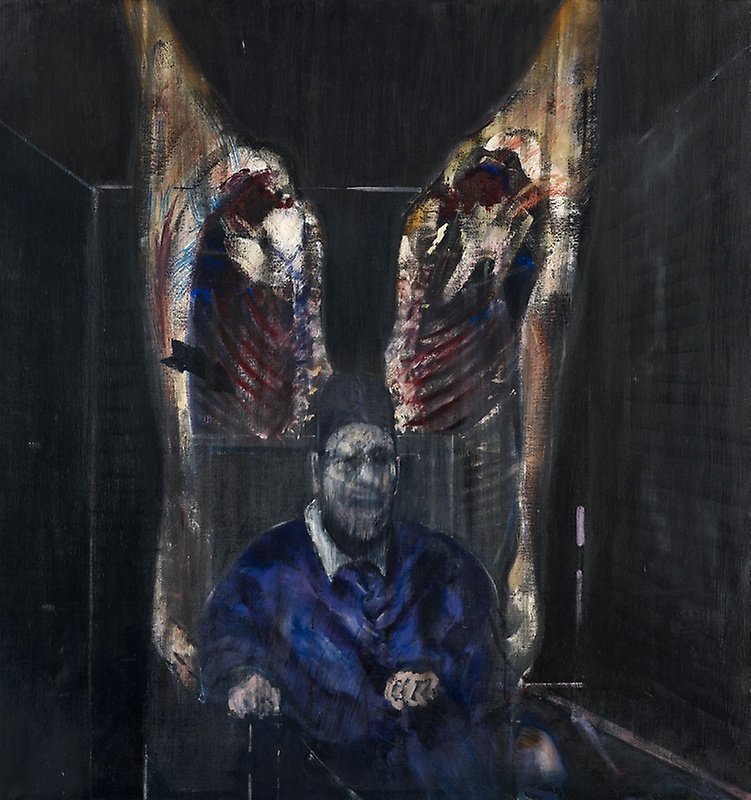
‘Figure with meat’, 1954: from Francis Bacon
Hotly tipped for posterity
ELIZABETH SMART
One of the most fascinating characters, on canvas and in the flesh, of our time; a man, and painter, whom I would put all my money on (that is if I had any, and if he needed it) — Francis Bacon (right). Francis Bacon, a big fat book of pictures, has just been published, with an introduction by John Rothenstein and ‘catalogue raisonné and documentation’ by Ronald Alley (Thames and Hudson, 7 gns).
I know a lot about art, but I don’t know what I like; all the same, I think that whatever you like, you won’t be sorry if you get this sumptuous volume (with its painstaking data) and keep looking and looking at these mysterious pertinent paintings.

PAINTING OF THE MONTH 1964
Figures in a Landscape
Speaker: David Piper
DAVID PIPER
Francis Bacon’s Figures in a Landscape was painted in 1956, and presented to the Birmingham City Museum and Art Gallery by the Contemporary Art Society in 1959.
Francis Bacon (a collateral descendant of the famous Elizabethan statesman and philosopher) was born in Dublin in 1909; his father was a trainer of horses. Largely self-educated (‘I had no up-brining at all’), he travelled in Germany and France before settling in London in the late ’twenties, where he did some work as interior decorator and designer of furniture. His earliest known paintings date from about then, and as a painter he was entirely self-taught; almost all the early work was destroyed by the painter himself, and he has said that nothing he did before 1944 had any value (during the war, he was engaged full-time on Civil Defence).
From 1945 he began to exhibit in London in mixed exhibitions, and then from 1949 began a long series of one-man shows, also on the Continent and in America. Through the nineteen-fifties, while his work was the subject of considerable controversy, its stature became more and more imposing. By 1962, when a big retrospective exhibition of his work was arranged at the Tate Gallery in London, he had become, perhaps even more so internationally than nationally, one of the major living forces in modern painting. Other living British artists, such as Graham Sutherland and Ben Nicholson, may be perhaps more widely known to the general public, but it is Bacon’s exhibitions that excite the most urgent and troubled response.
It is indeed in an European context rather than an English one that the temper of his art can best be grasped; his spiritual forebears are painters like Grünwald, Daumier, Van Gogh, Munch. Avoiding the interview, and, compared with many contemporary artists, happily taciturn about his work, he has nevertheless said that his paintings are ‘an attempt to make a certain type of feeling visual’. The image that this feeling projects in Bacon’s work has seemed to many to embody consummately and almost definitively the spiritual, claustrophobic conflict of individual modern man in the post-concentration-camp, post-war, post-atomic bomb, age. His sources or inspirations are varied: from Velasquez and the late Rembrandt, to stills from films or photographs by the pioneer action-in-motion photographer, Eadweard Muybridge. The images, however, which he has welded in his imagination from these and other sources are profoundly his own.
BOOK LIST
SPENDER,S. ‘Francis Bacon’ in Quadrum, vol. XI, December 1961.
TATE GALLERY. Francis Bacon, catalogue of an exhibition Tate Gallery, 1962. With an introduction by Sir John Rothenstein.
BACON,F and SYLVESTER, D. ‘The art of the impossible’ Sunday Times, Colour Supplement, July 14th, 1963
Painting of the Month
‘Figures in a Landscape’
DAVID PIPER
AT WHITSUN I lay under the apple-tree in the dappled sun and
projected this picture, that I was committed to say something about, as I could
remember it, on to the blank brick wall of the cottage beyond the apple-tree, as
though it were a lantern slide. I remembered it, bluish green and yellowish
green, an upright rectangle, the foreground rather blurry as if unfocused in the
foreground of a photograph; the background beyond at the top of the picture
closed with definition by darker blue-green verticals striped as if it were a
fence of palings, or perhaps the still folds of a curtain drawn, or perhaps, if
grass could grow as dark green-blue like broccoli, a hedge of tall stalks along
the edge of a field. Between these two areas the whole middle distance of the
picture is taken up by the depression of a yellowish-green arena; you look down
on it from a little above, and in it, quite close, is a fleshy mass, sallowish
flesh, a naked figure, stooped or hunched or crouched: stooped in strain over
something, a face hidden from you, dropped behind the shoulder, and behind the
arm that reaches down, is involved, grappled with something that seems, you have
the impression, to be lying on its back, its feet toward you, its kneed up. It
is only the contraction of the knees that you see this second figure, for the
knees obscure the rest of it, and the hand of the first figure reaching down
into it. But what is going on is not explicit; even the anatomies are not
explicit; the figures seem to be human, and male, anyway the crouching one, but
if he had fur he could be an ape. But whatever the figures are, the relationship
between them is close, intimate, and also violent; it could, as half-revealed to
you, be of the violence of a kind of love, it could equally well be of murder
On a holiday afternoon in the placid countryside, I had no wish
either to intrude upon horror or to be intruded upon by horror, so I switched
off this memory. Through the branches was the sky, oceans of blue air. Almost
never can you glimpse the sky in a Bacon picture. Positively not Bacon weather.
But when (next morning) I opened the paper I saw that I was quite wrong and that
at any time and in all weathers it is Bacon weather. On the front page was a
photograph. It was a good photograph
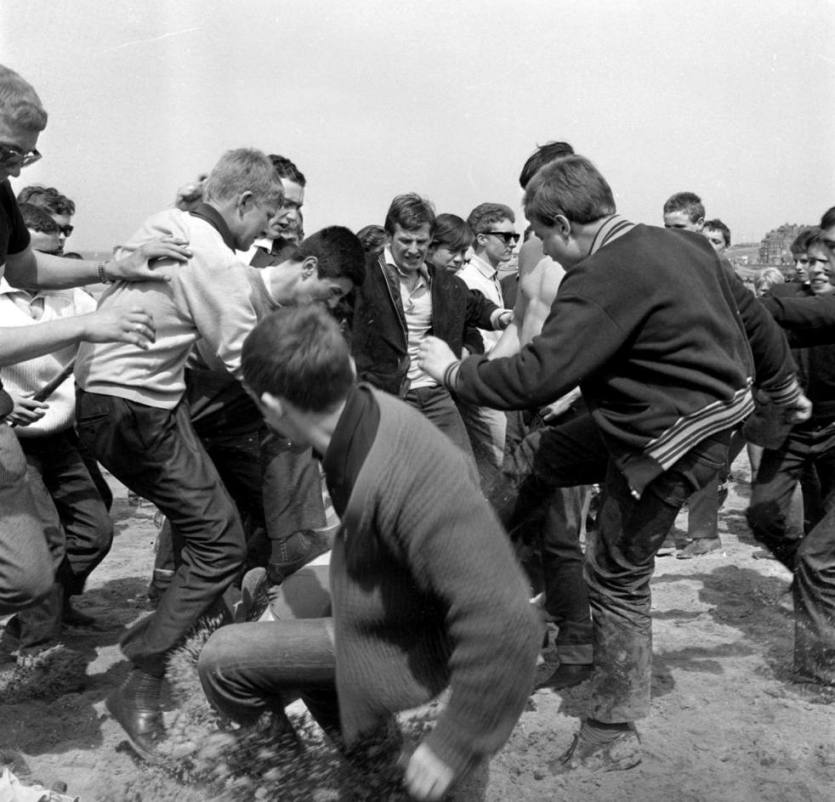
ut you will have guessed
For a little I looked hard at the photograph. Sickening, I said–yet if I were clearly dispassionate enough to be able to sort out my immediate instinctive reactions to it they would probably prove to be very mixed : outrage, of course, of the decent citizen when decency is disturbed, but compounded wit this a fascination, an acknowledgement of the magnetism that drew and held the spectator crowds at Margate to watch the young men fight, looking and not looking ; and also some sense of identification perhaps both with victim and attackers. Not thoughts to flatter one’s self-esteem, so pretty soon I did as I guess most readers of the newspaper that morning did–tried to banish the whole thing by turning the paper over to see how the cricket scores stood. But I think even before I did this I was aware that part of my indignation was against the sheer inadequacy of the photograph, for until I had read the caption the image had conveyed nothing of the essential brutality of the scene.
But perhaps it was not the camera that was inadequate, so much as the human body itself ; the range of expression of the human face and limbs is in the end limited and often ineloquent about the emotion they contain and the springs behind their action. It is not in fact enough ; a man in the extreme of violent emotion feels that it must break the instrument of his body; yet though he confront it, open his mouth, scream, scrunch up his face, it is not enough, and if you take a photograph of him doing this the result shown to someone who does not know the context can even be funny. This brought me back to the painting of Francis Bacon who is never very funny–at least I have never heard the ghost of a laugh in front of his pictures–and whose business is to paint the human body in ideal terms, as if it could register in its flesh, and express, the living tragedy of the human situation. His paintings, he himself has said, are ‘an attempt to make a certain type of feeling visual’.
But I have still to get to the actual painting itself. It is a
biggish painting, five feet high, so that its central figures, though less than
life-scale, still loom large. It is not framed behind glass, though Bacon rather
likes his paintings to be glazed, partly for technical reasons
This is his usual formula: in a smaller picture, isolating the
main feature, the chaos that is a human head, by floating it on a dark neutral
background, unprimed canvas stained rather than painted; in more elaborate
compositions the shock of chaos may be enhanced by a setting in the most normal,
if often rather chic, furniture, clearly and boldly painted, beds, chairs. Or
again, narrowing down on his central subject, he can isolate it further by what
may seem an arbitrary structure, a cage with rods or tubes, or often
The forms that this mental torment make flesh take on under this bush are fascinating and baffling. Every week H-films invent some new image of horror, but the image is always too obviously invented, contrived, for a lasing impact. It is the virtue of Bacon’s creatures that they seem indisputably to be of our flesh and blood, and many critics have noted in themselves a compulsive identification with them; as if in some extreme of private agony you were to look in a mirror and see your agony stand there mutating your body. His men and women organic and in movement, as we are organic and for ever in restless movement. And they are in the mid-twentieth century extremely topical; we see them in a frame of reference provided by the concentration camps, the gas-chambers, the H-bomb, in our knowledge of horror unavoidably welded into consciousness by newspapers, films, and television as never before; by the literature of claustrophobia, from Kafka to Sartre and Orwell, a mood still relevant as in parts of some of William Golding’s novels. But Bacon is the first to have succeeded in painting a portrait of this, our knowledge in action in human life. Not all critics admit he has succeeded, and find that in the last resort he fails to transmute his material into art. In the long run they may be proved right, when the frames of reference in which future generations will see the paintings has shifted, but for the moment Bacon’s power to touch the onlooker’s nerves transcends frontiers, and he has for a painter a huge audience.
But how can chaos be presented in an organised picture? The idea seems self-contradictory. Looking at the ‘Figures in a Landscape’, doing whatever they are doing, you can decipher something of Bacon’s characteristic ambiguousness of presentation. The chief figure, the crouching one, is in part fairly naturalistically rendered; the arm, for example, has the gesture and shape of muscle of an arm. The body is more puzzling, bruised anyway, bashed and then humped as if malformed–yet acceptable (my eye at least does accept it) as a convincing transcription of a heavily built torso heaving in an awkward position. It is convincing perhaps partly because the painter has studied closely photographs of the body in action, both human and animal bodies, and there seems here to be some sort of fusion of human and simian energy.
It is then, while very broadly and freely painted, convincing as an equivalent in paint of a squatting and heavy body. Yet as you look you can see the painter had drawn across its lower part, in that grey-greeny blue, in one swirl an equivalent of a thigh folded on calf. It is a good swirl, but it may seem, read close to, as if in a different language from the general massing of the body. And then, across the top of the torso, in the same colour again, a rough zigzag scrawl of the brush, and the part this plays in the painting may be hard to integrate; it is rather as if the painter had chosen to finish the picture, deface it almost, with a swear-word. ‘Oh Lord forgive us for we know what we do’. And then perhaps, still close to, uncertain if this does all add up, your eye may catch the most illusionistic everyday passage in the painting of the bodies: the head is hunched deep in the shoulders, the face hidden, but the ear is there, indicated by a swift gesture of whitish paint, its centre marked by a great blob in high relief of reddish white paint; and above the ear drawn back across the low cranium there is a sleek of grey hair, combed, barbered almost–coiffured–lying true and flat and trim almost as if quoted from a hair-cream advertisement.
As medley, all this close to is disconcerting, but step back and in my eye it adds up all right. Bacon we know relies a great deal on chance and accident in painting; never more so perhaps than at the time this was painted in 1956, when I guess he was influenced to some extent by American example. He tends to see an image, to start painting, and then to find it transformed by the paint itself. Yet accident, just as the exploitation of accident, are both created by the painter’s hand and body, and, when harnessed successfully, work together in one rhythm. Writing of Matthew Smith’s work, which he admires, Bacon noted the tendency towards ‘a complete interlocking of image and paint, so that the paint is the image and vice versa. Here the brush-stroke creates the form and does not merely fill it in’. And this applies equally to the best of Bacon’s work, welding apparently quite disparate matters into one significance of paint and image.
I fear I may seem not to have begun to answer the questions that may be foremost in the minds of some, particularly perhaps of those who look rarely or reluctantly at contemporary painting. Questions like ’Why do you like it?’ ‘What’s it about anyway?’ or ‘What’s it for?’
The first is easy. I don’t like it, and in excellent company with he painter himself, though for not the same reasons. Bacon has said that he has no interest in his work once done. ‘How can I?’ he said, ’ . . . when I don’t like it’. In fact, ‘Do you like it?’ in such a case is irrelevant. ‘Like’ is not a word one would use seriously of, for example, King Lear, and Bacon’s paintings are of that class if not quite of that order. But the old phrase ’as pretty as a picture’ dies hard, and I find many people still assess paintings by standards they would never dream of applying to literature or any other art.
About the question ‘What’s it about?’ I have been fencing all through this talk. The subject-matter of this painting is close to that of the Whit Monday photograph: an image of creatures in the grip of irrational and probably vicious violence. But the content of the final painting is, unlike the photograph, far more than the sum of the component parts of the subject-matter; the content involves a very general statement on the tragic nature of human life, upon what man does to man and what man does to himself in the ineluctable passage of blind time. Bacon is always concerned with time, and so with movement. The content involves not only action–but also the apparently impalpables of action: the ambiguous tensions between executioner and victim, between participants and onlookers and between onlookers and onlookers of onlookers.
In the hedge of verticals that shuts the top of the picture, just over the two figures there is a suggestion of a reflection of the curve of the crouching figure’s back–like a fragment, a ripple, of the concentric waves of force, or expanding halo, that a stone thrown sets up in a pond. The implications well out, obscure but potent, from the vibrant central image, but they are not implications that one can nail down in words–if they had been, Bacon would have written them. The content of the picture is the paint that is the image, a feeling made visible.
And ’What’s it for?’ For the artist a stage in his compulsive need to realize an ever-shifting evasive image. But for us–not a picture to hand on one’s wall, to live with; too disturbing, not comfortable; even though it has things that can charm–there is a glow of violet for example, in the shadow cast by the crouching figure among the slashed greens and yellows and ochres, as though the eye had struck a jewel open in a bed of crude ore. But for me, no, not to live with, even though many do live with Bacon paintings. It is not a domestic matter; the connections are with the soul and with fate. Pictures of such import used to be hung in churches, but now we hang them in art galleries, as this one at Birmingham.
Some critics have objected that Bacon fails in terms of tragic catharsis, but I am never happy about the application of that term in paintings, the act of participation is so different. For me Bacon’s paintings are not wilfully destructive, not merely morbid, and rarely in the bad sense sensational. They seem rather to supply a visual identity for certain phases of consciousness, and once a thing is identified, one’s hope of perhaps not exorcising it, but of exercising it, of coping with it, is enhanced, and with that the scope of life is enhanced. Bacon, though perhaps willy-nilly as far as he is concerned, is one of the major prophets in paint of our time, as richly eloquent in his imagery as any prophet of the Old Testament.–Third Network
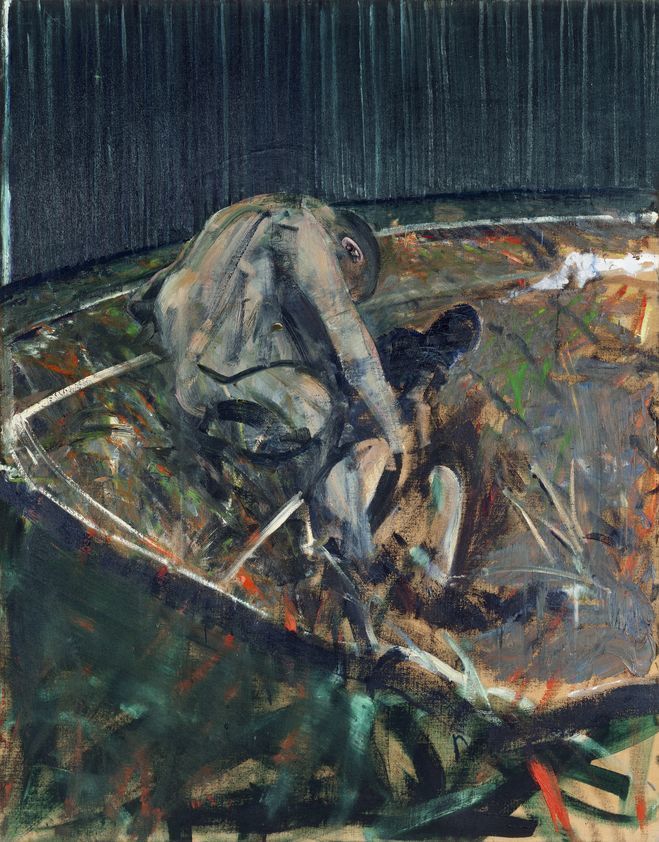
‘Figures in a Landscape’
LETTERS TO THE EDITOR
Sir,—Having been scientifically trained and being sadly lacking in appreciation of visual art, I read such talks as Mr David Piper’s assessment of Francis Bacon’s ‘Figures in a Landscape’ (The Listener, June 11), with some anticipation of being enlightened to the intangible vagaries used by such critics. No such luck. All scientific dissertations delivered to a lay audience are expected to be self-consistent with all technical words and meanings explained in context. The use of a dictionary is not expected. Is it too much to expect this of art critics? I do not feel grossly ignorant because I do not understand the artistic criterion of ‘tragic catharsis’, or what is meant by ‘fusion of simian energy’, yet such terms are not explained. Perhaps the whimsical writings of such critics are intended to be as obscure as some of the things they choose to comment on.
As a more specific criticism of Mr David Piper’s assessment I am interested to know on what grounds he can compare the meaning of a highly obscure, anatomically inaccurate picture of about one third of a naked being (presumably human) of which we cannot even see the facial expression and have no conception or clue as to the actions of this being, with a group of modernly dressed youths of known barbaric intentions whose faces we can clearly see. Surely only Bacon had some idea of the meaning in this painting, and further discussion other than a broad description is quite pointless, as the sum total of this assessment indicates, since without the fine adjectives used I can detect no tangible statement anywhere.—Yours, etc.,
R. J. Head, Harrow
Robert Melville has a look at a book about
ROBERT MELVILLE
If the history of public interest in 20th-century painting could be written in detail, the response to Francis Bacon’s retrospective exhibition held at the Tate Gallery in the summer of 1962 would probably turn out to have been England’s ‘finest hour’. Whenever I was at the exhibition, I met people who had reacted to his previous shows with vague suspicion or downright animosity, and others who were there for a bit of shiver or had drifted in for want of something better to do, and I recall very vividly how they began to tread quietly and talk in low tones. Suddenly they were overawed by the grandeur of the work, and whatever it was that opened their eyes to the magic of it, they became for a while the solemn witnesses of an enveloping and wonderfully sustained vision of human dignity.
The entries in the catalogue of the exhibition were compiled by Ronald Alley, and they were so fascinating and so evidently the result of intensive research that he was invited to attempt a catalogue raisonne of Bacon’s paintings. The outcome is the most thoroughly documented monograph* on the English painter that has ever been published during the artist’s lifetime.
Even the details of provenance afford food for speculation. Some of the pictures have already passed through several collections, shuttling to and fro across the Channel or the Atlantic, as if in some way the restlessness of the images were keeping them on the move, and the fact that in a number of cases the last-named owner is a dealer in London, New York, Milan or Paris implies that their wanderings are not yet over. In the list of ‘abandoned pictures’ the details of ownership sometimes start with initials which mask the identities of two young painters who were given the canvases to use for paintings of their own, but who would seem to have allowed them to slip into the market.
Some of the pictures have been known by various titles in the past: one of them now catalogued as Study for Innocent X has been entitled Red Pope, Red Pope on Dais and Red Figure on a Throne, although it was only painted in 1962. All the pictures listed in the catalogue will now be known once and for all by the titles given them by Alley, but he must have had some difficulty in coming to a decision in many cases. I notice for instance, that some paintings are simply entitled Pope, but I don’t think Bacon himself has ever given one of his pictures such a title. He has not been altogether averse to a title like Study after Velázquez’s Portrait of Innocent X, but has more often preferred something less communicative. He named every one of a series of eight paintings of a pope Study for Portrait, and when I was working with Erica Brausen at the Hanover Gallery we used to call them ’cardinals’ rather than ’popes’ in the presence of visitors, to make sure that no one was offended.
Every known painting up to the summer of 1963 is reproduced in the book and whilst they disclose some remarkable changes and developments, particularly in the treatment of the head and the nude, they also convey very powerfully the constancy of vision. This is quite dramatically evident in the correspondence between two famous triptychs, eighteen years apart, which are reproduced in colour. In a recent conversation with the Editor of Cambridge Opinion, Bacon spoke of a certain kind of organic form as an alternative to the creation of the human image which ‘could open up all sorts of possibilities, probably of a secondary intensity’, and actually his first triptych, the Three Studies for Figures at the base of the Crucifixion, executed in 1944, was a contribution to this kind of organic invention.
The form bears a relation to the human figure but are placed outside the human pale by extreme distortion and the sense they convey of existing in a state of total and perpetual rage. Alley records that Bacon has referred to them in a letter as sketches for the Eumenides. (The word means ‘gracious ones’ and is a propitiary name for the Furies who exist for the purpose of avenging crimes against the ties of blood.) These figures seem to me to establish a curious and subtle link with the pieces of meat in the left-hand panel of the later triptych called Three Studies for a Crucifixion painted in 1962.
In Alley’s note on the recent work he states that the pieces of meat were included because Bacon ‘has always been moved by photographs of slaughterhouses and meat, which have about them the smell of death, which he associates with the crucifixion’. Sides of beef have appeared in a number of his paintings as a kind of affront to the the living flesh, but in the triptych they are on the verge of becoming ‘personages’–organic inventions. They lean towards one another as if in whispered conference and bring meat and the Eumenides into collusion. They could be called the natural enemies of ‘hollow traditions and reassuring myths’. I understand such forms to be of ‘secondary intensity’ because they serve a more restricted purpose than Bacon’s human images. They set the limit within which man has being and becoming, and set them firmly in the finite world. They are noticeably less involved than the human figures in the process which is Bacon’s chief preoccupation and which he calls ’the complete interlocking of image and paint’. They could in fact be formed by linear means; but the nervous tissue and infinite restlessness of his human images are unthinkable in linear terms.
The introductory essay by Sir John Rothenstein is even more closely associated with the Tate exhibition than Alley’s fine job of documentation, for it is a very slightly amended version of the essay which appeared in the catalogue. It is gracefully done. It includes some valuable information and illuminating fragments of conversations with the artist, but Sir John’s attempt to steer a middle course between Bacon’s detractors and his ‘most ardent advocates’, his attempt, in other words, to take a calm judicious, moderate view of Bacon’s inordinate contribution to contemporary painting, supported by a less than careful scrutiny of the paintings themselves, presents a distorted view.
When Sir John refers to ‘the element of sheer horror’ in Bacon’s work, he tries to avoid discussing it by saying that it is ‘too conspicuous to call for emphasis’, whilst taking Alloway to task for describing it as ‘fast-dating Grand Guignol’ and ‘creaking melodrama’. Yet it is clear that he half accepts Alloway’s contemptuous assessment of it, for he lamely adds that ‘the element of Grand Guignol plays in any case a diminishing part in Bacon’s work’, and supports his claim by remarking that the ’stage properties by which he means the transparent boxes, the railings, the curtains and even the ‘illimitable darkness’–have now been discarded and replaced by ‘full daylight’ and ’commonplace pieces of furniture’ Quite apart from the difficulty I have in associating the light to which some of Bacon’s later figures are exposed with the light of day, and in squaring Sir John’s remarks about the furniture with his surprising admission in the next sentence that it assumes unexpected shapes ‘nearly as expressive as the figures themselves’, I feel obliged to point out that what he calls the stage properties have not been discarded. In Study for Portrait on Folding Bed, painted in the Spring of 1963, which is in the Tate collection and must be well-known to Sir John, the bed is enclosed by a transparent box and a swirl of railing.
In fairness to Alloway, I think it should be said that the article from which Sir John quotes and which has so evidently influenced his attitude to Bacon’s imaginative spatial devices, includes a valuable account of his use of paint to convey the sense of movement. The destructive side of the article was aimed more at my kind of advocacy of Bacon than at Bacon himself, and in trying to ridicule my insistence on the importance of the extreme situations in his work he was more or less compelled to ridicule the paintings in which they occur. At the time, he himself was publicizing action painting, another kind of extreme situation, rather less relevant to the human situation: he has since mounted a notable retrospective exhibition of Bacon’s work in New York.
Sir John mentions Nietzsche as one of the writers Bacon constantly re-reads, and something he wrote in The Genealogy of Morals has a bearing on a recent remark of Bacon’s: ‘I have deliberately tried to twist myself but I have not gone far enough.’ Nietzsche wrote that it is the self-tyranny and delight of the artist to ‘give form to himself as a piece of difficult, refractory and suffering material’. Bacon sets no limits to his self tyranny. What more can be done he will do.
* Francis Bacon. Introduction by John Rothenstein. Catalogue raisonne and documentation by Ronald Alley. With 27 colour plates and 260 monochrome plates. (London: Thames and Hudson). 7 guineas.
By NEVILE WALLIS
Lytton
Strachey has a vivid image of the impossibility of probing to the depths of
The flames shot out on every side, scorching and brilliant; but in the midst there was a darkness.
Incongruous as the two figures are, the painter Francis Bacon
poses his own riddle of a brilliant imaginative flame leaping out of an
impenetrable darkness which has led many explorers to its gulf. Il terribile
Bacon, An Acute Sense of Impasse, Un Peintre hallucine—under such titles
have writers skirted the psychological stresses which have surfaced in Bacon’s
act of painting his single figures lolling on bedsteads, shrieking behind a
glass cabinet, or struggling together in an unsavoury stew. Such torment
strongly suggesting a masochistic undercurrent, allied to Bacon’s imaginative
power, finds expression in images often of universal significance. Again and
again the spectator will discover vague apprehensions of his own made palpable,
and imaginatively share the endurance of humanity at breaking-point under
relentless gruelling, or subjected to high-pressure tests. Whether shown in
London, Paris or New York, this achievement still draws the expectant,
motionless knots of spectators appearing to await a miracle. Yet it is hardly
surprising that the disorder of the painter’s impulsive, noctambular existence,
together with the problems of tracing his pictures (many of them destroyed),
have so far discouraged a properly documented study of Bacon’s life and work. It
is fortunate that now, at fifty-four, our most ’influential painter can benefit
from so scrupulous and admirably illustrated a catalogue raisonné as Mr.
Alley’s, prefaced with a perceptive critical essay by the director of the Tate.
A collateral descendant of his Elizabethan namesake, Francis Bacon happened to be born in Dublin because his father, retired from the Army, had gone there to train horses. A bad asthmatic as a child, Francis was allergic to horses. His father was allergic to education. Francis had only one year’s formal education in his life—at Dean Close, Cheltenham, where his father was enjoying his second retirement. At sixteen Bacon moved to London, and spent the next years getting by with a string of odd jobs in France and Germany. His first impressions of the corrupt life of Berlin in the Twenties were to work on his consciousness of situations of crisis. It was not yet, however, as a painter of humankind in extreme situations, but as an advanced interior decorator and designer of furniture and rugs that Bacon began his fitful London practice in the late Twenties. One of his commissions was furnishings for the Smith Square house of Mr. R. A. Butler, an alert patron already aware of the conspicuous intelligence of Roy de Maistre, the painter from whom Bacon was picking up ideas in their Queensberry Mews studio. A discovery is the re-productions of the stylish studio of these hidden years, showing Bacon’s hand in the stylised functionalism of his writing desk with his earliest Surrealist art inspired by Picasso on the wall, signalling the dernier cri of interior design in 1930. Unimaginable experience has intervened between this and a 1957 photograph of the artist brooding over the disarray of Battersea studio.
Towards the end of the last war (when he was, for a time, in Civil Defence) his
obsessive imagery emerged most formidably. The preface does not mention Graham
Sutherland’s help and encouragement to his friend at this crucial stage, with
the return benefit of enigmatic devices which have served Sutherland’s disturbi
The catalysts of Bacon’s art are to be seen in the accumulation of newspaper and magazine clippings with reproductions of Velázquez, Rembrandt, Grünewald, which festoon his studio. Such sources as a close-up of the screaming nurse from the film The Battleship Potemkin, Muybridge’s photograph of naked wrestlers, people rushing for shelter in the Russian Revolution, have fed Bacon’s blurred, irrational images in which his intelligence and violent undertow have worked together with the chanciness of painting. ‘Real painting,’ he has said himself, ‘is a mysterious and continuous struggle with chance—mysterious because the very substance of the paint, when used in this way, can make such a direct assault upon the nervous system; continuous because the medium is so fluid and subtle that every change that is made loses what is already there in the hope of making a fresh gain.’
Independent of any contemporary example, Bacon’s art unfolds here in numerous reproductions, including a number destroyed in a frenzy of self-criticism—sometimes on the eve of an exhibition, entailing hasty improvisation. His painting (like his gambling) stretches his nervous system to the limit, but his inexorable daemon drives him still. ‘What modern man wants is the grin without the cat,’ is his expression concerning this art of pure sensation. John Rothenstein is right, however, to insist on the painter’s consuming interest in humankind.
How posterity will regard him could depend on his
reservoir yet untapped. He appears, indeed, to be on the brink of a period of
consummating activity. Hitherto he has appealed generally to judges who have
been drawn to painting by way of literature. Painter-critics tend to deny
Bacon’s aesthetic sensibility. Supping the other evening with Patrick Heron in
his moorland eyrie at Zennor, I found him sceptical of a painter apparently so
woolly in his ideas, so trusting to providence when be splashes the bits on. No
doubt Bacon is unprofessional beside one as versed as Heron in the values of the
pure painter. Yet this almost psychic power cannot be shrugged off as muddling
through. To be fai
In his most recent canvases at the Tate, very subdued in colour, like Bacon, the much thicker paint, the silvery greys and dead olives still do not vibrate—as Bacon’s vibrate—with the resonance, depth and harmony of good colour. What they do contain, however, are imagined, sculpturesque forms of poetic horror and surrealist phantasy. Graham Sutherland is unquestionably a man of extraordinary imagination. But the question is: what kind of imagination is this? I believe Sutherland’s phantasy is essentially illustrational, poetic, non-plastic.
The passage almost exactly applies to the more influential painter, the difference being that Francis Bacon’s forms are now as fully plastic as Daumier’s, but kneaded and twisted as in- a distorting mirror.
Closing this massive investigation, one is conscious that the hypersensitive, yet so gentle, friendly creature elegantly gesticulating, escapes his trappers still. His Motivation in his abhorred interval of existence is as elusive as his countenance of a fallen cherub flitting between Wheeler’s and Tangier. Accompanying him recently round a Jackson Pollock exhibition we paused before a titillating abstract arabesque. ‘But you know,’ he reflected aloud, ‘the human image still has the greatest power to move the hearts and minds of men.’ So, in any international company, does Bacon’s imagery, scorching and brilliant. But in the midst of his crater there is a darkness.
* FRANCIS BACON. By John Rothenstein and Ronald Alley, (Thames and Hudson, £7 7s.)
Marlborough Fine Art’s two galleries at 17-18 and 39 Old Bond Street, W.1, provide a collection of modern painting and sculpture, comprised under the title “Aspects of Twentieth Century Art”, which could be called remarkable if only for the works it presents by Mr. Francis Bacon. Mr. Henry Moore and Mr. Graham Sutherland.
Mr. Bacon’s studies for a portrait of Lucien Freud, taking the form of a large triptych and also a series of heads, painted this year, convey a feeling of life with powerful intensity. The triptych gains this effect by its contrast of a flat, black background, in which a naked electric light bulb is a single hypnotic point of concentration in two of the panels, and the plastic modelling of features and figure. Arbitrary and shapeless as the application of paint at first appears, the artist’s peculiar gift of indicating a human presence within it is brilliantly displayed.
Mr. Sutherland is at his best in “La Fontaine” (1964), a splendidly assured work which combines a vibrant colour scheme of deep blue and green with much resource of form, giving a magical sense of actuality in its stream of running water and the rippling system of curves in which it is contained. A room devoted to works by Mr. Henry Moore shows varied examples of his mastery on a small or less than monumental scale. The “knife-edge” sculpture of 1962 and the “Head” of 1963 with its inner complexities of design are impressive recent works.
Continental paintings at 39 Old Bond Street include some good examples of the German and Expressionist painting to which the gallery has previously paid special attention—two compositions of nude figures by Max Pechstein and Ernst Ludwig Kirchner calling for remark. Painting, English and American, and sculpture, English and Continental, at 17-18 Old Bond Street represent a diversity of trends. Mr. Larry Rivers pursues, perhaps a little tediously now, his anatomy lessons with lettered description. A collage of 1933 by Mr. Ben Nicholson and an incandescence of mauve and orange by Mr. Mark Rothko stand out.
If offering no major new excitement the sculpture includes some interesting and characteristic works by contemporaries. Mr. Fritz Wotruba’s “Reclining Figure” (1962) may be cited as an original approach to the theme.
by T. G. ROSENTHAL
T. G. ROSENTHAL
THIS PARTICULAR PERIOD has long been known as the Silly Season.
Certainly this is not usually the time to see much in the way of painting and
sculpture, yet, even without visiting the permanent collections, the visitor to
London could have a marvellous time. Galleries like the Marlborough and the
Grosvenor are putting their stockrooms on the walls, and it is worth a trip to
the wilds of S.W.3 to see the Crane Kalman
The Marlborough New London mixed show is also not to be missed, since it contains a large Nolan ‘Gallipoli’ painting, a very good Malevich, and, in the ‘Reclining Figure’ of 1931, one of the really great Moore bronzes. The three studies for a portrait of Lucian Freud by Francis Bacon, hung as a triptych, inevitably dominate one of the rooms. Looking like three different figures seated on an apparently endless bench, the usual Baconian man becomes even more nightmarish than ever, partly because he seems more than usually in limbo and partly, of course, because one knows that this is a real person. We all know now how powerful a painter Bacon is, and we all know how sinister power misused can be. Bacon’s power, exemplified perfectly even in these relatively personal paintings, seems totally sinister because it is totally nihilistic, so that in the end one turns, almost for comfort, to the humanism of Moore and Kokoschka.
At
the Robert Fraser Gallery there are recent works by Peter Blake, Derek Boshier,
Patrick Caulfield, Harold Cohen, Eduardo Paolozzi, and Bridget Riley. The
enormous sculpture by Paolozzi is called
Daniel Farson On Club Charge
Daniel Farson, aged 37, the TV personality, of Georgeham, Braunton, North Devon, pleaded not guilty at Bow-street to-day when he was accused of being found drunk on licensed premises at the Toucan Club, Gerrard-street, Soho.
Police said they wanted to be legally represented and Farson was remanded on £2 bail until October 7. Mr. David Jacobs, for Farson, said witnesses would be called in defence.
Daniel Farson — £3 fine in drink case
TELEVISION personality Daniel Farson (37), twice tried to get a drink while police were in a club, Mr. Roy Marsh, prosecuting, said at Bow-st., London, today.
Farson, of the Grey House, Georgeham, Braunton,
North Devon, who pleaded guilty to being drunk
Mr. Marsh said that at 11.40 pm on August 12, police went to the Toucan Club, Garrard-st., London, with a warrant on suspicion that a liquor offence had been committed. Farson was sitting on a bar stool and Supt. Reginald Doake saw him slap the bar and ask the barman for a drink. He had a glass of gin in front of him.
Farson’s speech was sllurred and his eyes were bloodshot and he adopted a pugnacious attitude when
Supt. Doake spoke to him. Farson said: “Who are you? Why are you persecuting
this club?” A police doctor later found Farson was not drunk and Farson
Mr. David Jacobs, defending, said Farson had been taking the tablets and with the alcohol they had had an effect upon him. Farson had been to a celebration dinner and had been taken to the club afterwards where hospitality was pressed upon him.
TV Man’s Drinks In Soho Club
WHILE police were in the Toucan Club in Garrard-sttreet, Soho, TV personality Daniel Farson, aged 37, twice tried to get a drink, said Mr. Roy Marsh, prosecuting, said at Bow-street to-day. Farson, of the Grey House, Georgeham, Braunton, North Devon, who pleaded guilty to being drunk on licensed premises, was fined £3, with eight guineas costs.
Mr. Marsh said that at 11.40 pm on August 12, police went to the Toucan Club, Garrard-st., London, with a warrant on suspicion that a liquor offence had been committed. Farson was sitting on a bar stool and Supt. Reginald Doake saw him slap the bar and ask the barman for a drink.
His speech was slurred and his eyes were bloodshot and he adopted a pugnacious attitude when Supt. Doake spoke to him. A police doctor later found Farson was not drunk and Farson’s own doctor found he had been taking tablets to reduce his weight. Mr. David Jacobs, defending, said Farson had been taking the tablets and with the alcohol they had had an effect upon him.
THE END OF AN ERA
SHE stands dressed all in black in a converted 18th-century coach-house just off Bond-street. Black dress, black stockings, black shoes — worn with a sad, resigned air.
Mrs. Helen Lessore, who runs the Beaux Arts Gallery — a leading promoter of younger painters — has something to be sad and resigned about. Her gallery is coming to an end in March.
“I am afraid I Just haven’t been able to make it pay,
Among those she has discovered and sponsored since their early days are names like John Bratby, Michael Andrews, Timothy Behrrens and Sheila Fells. She has also pushed the thick paint-laden anguished works of Frank Auerbach and Leon Kossoff.
Francis Bacon
The use of paint as a medium for representation involves a basic ambiguity. The artist works with whatever pattern he has abstracted from reality, but he also works with brush and pigments. This has always been so—and the very nature of representation dictates that these two aspects should always be bourne in mind. But, since the time of a Delacroix and the Nabis, the ambiguity has become much more than an incidental factor. Sir Kenneth Clark has written in a discussion of Velasquez’ ‘Les Meninas’ (I quote from Professor Gombrich’s ‘Art and Illusion’) that ‘ . . . he wanted to observe what went on when the brush strokes and dabs of pigment on the canvas transformed themselves into a vision of transfigured reality as he stepped back. But try as he might, stepping backward and forward, he could never hold both visions at the same time, and therefore the answer to his problem of how it was done always seemed to elude him.’ This impossibility of uniting the illusion and the material may apply to traditional painting. But is does not seem to me to be true today. The best of modern figurative painting has more than an incidental ambiguity, upon which the spectator can exercise his power of perception. To change the term slightly but significantly, it is ambivalent—it forces upon the spectator the conflicting realms of image and material, without allowing his to seize hold upon either.
Two historical developments seem to me to clarify this position. In the course of his long career, Delacroix reintroduced the notion of the brush stroke not merely as an adjunct to satisfactory representation, but as a direct sign of the artist’s agency. Later, the Nabis began to view the surface of the picture not simply as a vehicle of personal energy, but as a rectangle decorated and diversified with pigments. Delacroix, in bringing a subjective tinge to his brushwork, was resuming contact with Titian, Tintoretto and Rembrandt. In his portraits of Chopin and Paganini he demonstrates that the great painter can make us feel passionate use of paint not merely as an indication of his personality, but also as an evocation of the subjective energy in another. Where Delacroix is concerned with energy of this type the Nabis demonstrated a combination of atmosphere and material, the urge to fit their subtle carpets of colour to the very edges of the pictorial surface.
All this serves to introduce the work of Francis Bacon. First of all, Bacon exemplifies precisely the ambivalence which I originally referred to. He has said in conversation with David Sylvester that he is unable to differentiate in his works between the paint which has a purely expressive function and that which ‘represents’ human features. It is not simply a case, as with Sir Kenneth Clark, of a painting which changes from transfigured reality to dabs of pigments as the spectator approaches. With Bacon the transitions take place not in relation to the movement of the spectator, but across the surface of the work—and although we isolate some passages as ‘pure dabs’ and some as ‘pure reality,’ the work as a whole continues to suggest two modes of activity simultaneously. Bacon’s figures do not become transformed at closer inspection into anodyne patterns of coloured pigment. There is no way of cutting out the human, figurative element. On the contrary, this poignant element is intensified by the sonorous presence of the pigment, brining to mind a remark by Rembrandt: ‘Don’t poke your nose into my pictures, the smell of paint will poison you.’
Bacon uses not only the signs of physical involvement which evoke human presence in a picture, but also the cohesion of surface which I have associated with the Nabis. He forms a skin of rich pigment—sometimes lush, sometimes chalky—and picks up with it the material of chairs, walls, tables and carpets. In this respect he shows himself to be more painterly than another great figurative artist, Giacometti. For Giacometti aims to create an illusion of space, within which he situates of a ‘dureté infracassable.’ He uses the picture to reproduce the mysterious self-sufficiency which is naturally associated with sculptural form. Here we touch on a criticism that has been levelled at Bacon’s work. Reg Gadney in a previous number of this magazine, referred to a need for the modern painter to recover something of the nobility of Michelangelo. But this is surely the nobility of sculptural presence—even in Michelangelo’s paintings the forms are moulded as if in volume. The inherent nobility of painting has always been different. It has involved acceptance of the infinitely manipulable, vegetable nature of pigment. Once again, this century has accentuated the fact. Bomberg’s last self-portrait, in which the shaded face seems to be invaded by a searing slash of paint bears witness to the fact that even a painter who is passionately attached to the old masters must obtain his tragic impact through a partial concession to the anarchic tendency of the material. Bacon’s attachment to a specifically painterly method—to a use of paint which is positive throughout the whole surface of the picture—has involved adjustments in the overall planning of his works. Much has been written of the so-called ‘Grand Guignol’ element in them. Sir John Rothenstein, in his introduction to the recent book on Bacon, suggested that it has declined to a minimum. But it seems to me that the scenic apparatus to Bacon’s pictures has never been entirely, or even primarily designed to shock. In his interview with David Sylvester, Bacon spoke of his ‘glass boxes’ as being designed to concentrate attention on the figure. All his obvious devices can be explained in this light. They serve not to overlay the figure with specious ornaments, but to focus attention—to lead us directly into the theatre of events. Giacometti uses a parallel method when he fills the areas around his portrait figures with a smudged grey atmosphere—sometimes with a lined frame—and thereby makes more vivid the central presence. But where Giacometti’s surrounding surfaces are negative—tending to evoke a spatial setting—Bacon leaves his surfaces definite and material. Therefore, in order to gain a central figure with intensity similar to that of Giacometti, he must make adjustments throughout the picture which override these surfaces. The development of his art can be traced to a great extent in terms of a movement from pictures in which these intermediate signs—cubes, tassels, etc.—are dominant to those in which they scarcely obtrude. In Triptych, for example, the problem is brilliantly managed. The left hand picture, in which the figure turns away and draws his knees towards him, contains three correctives to this stance the hanging bulb, the dash of paint across the face and the two white blobs towards the bottom of the picture. The first supplies a vertical element to balance the relentless horizontal of the bench, the second in some measure cancels the indirect glance of the figure, the third emphasises the receding floor. In the middle picture, none of these are necessary. The figure provides a strong vertical in the middle of the picture, faces towards us and has his feet on the floor—no props are used. In the right-hand picture the bulb recurs to counterweight the posture of the figure.
If we grant that Bacon uses these devices primarily to focus our attention on his figures—to direct our reactions to the human element even if posture and situation prevent it from occupying the centre of the picture—we must still settle the basic question. What is the reason for this direct presentation? What is the state of the figures at which Bacon sedulously levels our attention? This I can most clearly answer by means of an analogy from Delacroix. His ‘Massacre of Chivs’ uses a device close to that of Bacon. The foreground has a scrambled, hasty appearance that recedes dramatically to the main characters, like the rough purple foreground in Bacon’s three studies. What we see in the ‘Massacre of Chivs’ is a state of arrested action—the presentation of a dramatic conflict—in which rearing horse and supine patriot are juxtaposed. There is not a hint of moral pronouncement, as could be found in Delacroix’ predecessor David. The impression is of a painter who is fascinated by action, and the possibilities of moral choice, but who finds himself unable to present anything but an accentuated scene of dramatic conflict.
It is this quality that seems to me central to Bacon’s work. But where Delacroix represents dramatic conflict—a sudden suspension of action, in which victim and persecutor are poised beside one another—Bacon represents a fixed state of the individual. The restless, disturbing quality of his work results not form a mere manipulation of our emotions but from the fact that it presents the possibility of action, which by the very nature of pictorial representation is stifled. This seems to be the significance of Bacon’s fascination for photography. The single photograph surely attracts his attention not because of its literary quality, but precisely because of its incredibility —its absurd isolation in the flux of events. Bacon’s pictures deal with this same impossible moment between past and future. Helen Lessore is right in claiming that ‘Arabs Walking’ (1957) and the succeeding Van Gogh series mark a great step forward. This is true in the most literal sense, since they are not concerned with the seated figures—substantial only in head and hands—of his earlier works, but with wilful, purposeful movement. Since these pictures, Bacon has returned to supine, embryonic or sprawling forms. Now, and especially in this Triptych, he moves again into the realm of expectancy. The two flanking figures may confront an unknown menace. The central figure is nonetheless orientated towards action and discovery.
The question of subject matter is integral to the understanding of Bacon’s work. Even though it is always possible to record the search of an artist for self-discovery in the course of his works, it is quite a different matter for an artist to choose the direction of his work with virtually no distraction. Instead of working through a diversity of genres, Bacon now gives all his energies towards portraiture, and, as he has stressed, aims always for a single perfect picture that will subsume all his attempts. The position of a figurative artist who insulates himself completely from social requirements, and, like Bacon, is able to create a submissive market rather than working to please a demanding public, is one almost without parallel in contemporary art. Bacon appears to work in a vacuum, with no gravitational pulls from the society which exists around him. It is significant than an increasing number of his recent portraits been concerned with two artists—Lucian Freud and Frank Auerbach—both of whom share his passionate devotion to figurative painting. An image of Bacon the artist has been built up which represents his work almost solely in terms of creative and destructive will—in terms of whole series of pictures being attempted at the same time, and those which fail to show a certain quality being destroyed relentlessly. Like his Renaissance popes, Bacon proclaims his search for unity of expression—for a single work that will exemplify finally a single principal—in the midst of chaotic diversity. He exemplifies as much as any other European artist what Dora Ashton calls ‘irony’—an element of dissemblance present in the public personalities of European as opposed to American artists. Even Rembrandt and Velazquez, he maintains, were actually recording events. Now, however, ‘. . . a really good artist . . . would be forced to make a game of the same situation.’ Bacon’s public statements tend to give the impression of a disembodied will, gratuitously absorbed in an elaborate ‘game,’ for the sake of sensory excitement. He quotes with approval Valéry’s remark: ‘What we want nowadays is the sensation without the boredom of its conveyance.’ He claims that the artist must really deepen the game to be any good at all, so that he can make life a bit more exciting.’ Yet this concern with the elaboration of the game, and with the excitation of the senses, does not lead him away from the traditional subjects of artists who worked to ‘record’. ‘Man is haunted by the mystery of his own existence,’ he said in ‘Cambridge Opinion,’ and is therefore much more obsessed with the remaking and recording of his own image in his world than with the beautiful fun of even the best abstract art.’ Although Bacon continually explains his adherence to the human image in terms of obsession and ‘assault upon the nervous system,’ this concern is ultimately inexplicable except in relation to the values which underlie human action.
In a recent note on the Italian painter, Morandi, Andrew Forge suggested that so apparently reactionary a painter was perceptably modern in the sense that his work reflected an age in which the direct portrayal of objects involved a defiance of conventional standards of painting. In a similar way, Bacon’s work becomes comprehensible only in the context of an age in which the function of the painter is being radically altered. To quote Bacon once again: ‘Photography has covered so much: in a painting that’s even worth looking at the image must be twisted . . . if it is to make a renewed assault upon the nervous system . . . and that is the peculiar difficulty of figurative painting today.’ The availability of new materials and the existence of a tradition of non-figurative art have freed the artist from the scale of reference within which Bacon works—or made it possible for him to be free. The crucial question—one which will decide Bacon’s importance to us—is whether this crisis is merely one of technique and representation, or whether the deepest values of humanity are inextricably bound up with the recording of man’s own image in his world.
Francis Bacon
IT HAS OFTEN been noted that writers never seem to live up to their pre-Nobel Prize performances, and that the Academy Award is usually the kiss of death to an actor’s career. One can only hope that Francis Bacon can survive this strange tribute of a catalogue raisonné of what one hopes will only be a fraction of his output. The book surveys and documents Bacon’s entire career, from his early abstract works (we have come to that) to the summer of 1963. An excellent selection of color plates is backed up by over 250 black and white reproductions, over 200 works are precisely catalogued, there is a chronology of the artist’s life, a list of one-man exhibitions, a bibliography, and three appendices: one on “abandoned pictures,” one on “destroyed pictures,” and one given over to problems in dating.
When Bacon is right, an image is set into the consciousness of the viewer that is ineradicable. Such were the series of screaming, glass-caged figures of the early fifties and, most recently, “Lying Figure with Hypodermic Syringe.” No criticism seems to have been able to penetrate down to the depths of the hell out of which these images emerge, and Rothenstein’s introductory essay doesn’t even seem to know it exists. “... there is something reassuring about, for instance, his vapourizing heads, for we know that heads do not vapourize ...” Don’t they? One longs for a condition of innocence so pure that the art of Francis Bacon can be “reassuring.”
A disconcerting British painter
METHUEN’S excellent “Art in Progress” series of handbooks on living painters and sculptors reaches a dozen with the addition of Francis Bacon (8s 6d). It deals with the most disputed and most disconcerting British painter.
His work began to figure in the “Thirties”, and by the “Forties” his name was portentous. The 27 edge-to-edge illustrations in this book run from 1944 to 1963, and, though only two are in colour, give a fair impression of his art. The bright colour he sometimes employs only aggravates the morbidity of his canvases.
John Russell writes a reasoned and perceptive essay; a page of the artist’s own observations is included, and the book is equipped with a bibliography, an exhibition list, and the names of British and Commonwealth, continental and American galleries possessing works by him.
The second illustration is the lugubrious cryptic “head” — numbered “VI” here, but “II” in the Tate Catalogue 1962 — in the Ulster Museum. It is characteristic of Bacon that his humans have bestial or imbecile qualities while his animals, dog or chimpanzee, seem racked by human angst.
The cover portrait by Beaton shows the artist to have a hard, almost aggressive, look; and certainly he never shrinks from his purpose of exploring and exposing the human situation ... “But bears it out even to the edge of doom.”
No one admires the horrific canvases of Francis Bacon more than I do—but how to explain them?
John Russell in his study Francis Bacon (Methuen 8s. 6d.) deliberately, and perhaps rightly, evades this problem altogether. He does, however, provide a highly intelligent and stimulating commentary.
The reproductions do the rest. “Art,” said Bacon in some notes he once made for a catalogue, “is a method of opening up areas of feeling rather than merely an illustration of an object.”
If he is right, how good he himself is at doing what an artist should aim.
SHORT LIST
Francis Bacon by John Russell (Methuen 8s 6d). Here is another addition to a useful series, Art in Progress, dealing with living British painters and sculptors . Mr Russell’s study of Bacon strips away some of the myth and fiction that so inevitably surround an artist of such individuality. Bacon, after all, broke completely with English painting tradition, and far from being a commentator, as many see him, he is ahead of our times.
Tragedian
Francis Bacon
Viking, 330 pp., $25.00
JOHN RICHARDSON
Francis Bacon is the first modern painter of international caliber that the British have produced. Before him British painters formed the rearguard of the modern movement. Their reaction to Impressionism was tepid, to post-Impressionism coy. Despite the sermons of Roger Fry and Clive Bell, they never learned the lesson of Cézanne, and only profited from the example of the Cubists when it was too late. By 1939 notions of artistic propriety and good taste tainted the work of one and all. Artiness, amateurishness, and pastiche had become the hallmarks of British painting.
True, a few of the more meretricious artists—Augustus John, for instance—cultivated a certain braggadocio of style, but this only emphasized the innate hollowness and gentility of their work. True again, a few honorable exceptions were open to revolutionary ideas, but even the most emancipated ones followed trends rather than set them. Matthew Smith, for instance, latched on to Fauvism and Wyndham Lewis to Futurism. Among living artists, Ben Nicholson turned to Mondrian, Henry Moore to Arp, and Pasmore to the Constructivists, while Graham Sutherland brought a “Picturesque” view of nature back into fashion. In their very different ways these men aspired to be international artists, but by 1939 none of them had entirely succeeded in transcending his Englishness, except perhaps Moore. And even Moore reverted to Englishness, when war broke out and he and his colleagues were conscripted as war artists.
One might have thought that the drama and isolation of life in wartime England would have been a challenge to native painters. But no. Either as a result of personal disinclination or governmental policy, none of the so-called “war artists” ever came to grips with their appointed subject. The less imaginative ones churned out documentary records; others tried a more inspirational approach and depicted brawny heroes doing their bit. Even the best of them—Nash, Sutherland, and Moore—tended to avoid the main issue and concentrate on marginal or picturesque aspects; the eerie beauty of an airplane graveyard, of bombed or burning buildings, of shrouded tiers of air-raid shelterers.
The war did not change much: artistically London seemed only a whit less dismal in 1944 than it had in 1939. The neo-Romantics returned to their studios more neo-Romantic than ever. The young were baffled or egg-bound. Apart from the emergence of some promising sculptors, almost the only change was in Graham Sutherland—fugleman of postwar British painting—whose performance had a new zest and edge to it. Sutherland, it emerged, had come under the spell of a virtually unknown painter: Francis Bacon. Although Sutherland subsequently allowed the mantle of Laszlo to fall on his shoulders, his work still occasionally strikes a Baconian note. Alas, Sir John Rothenstein, who introduces the present volume, follows precedent and makes no allusion to this fact, or to the influence which Bacon exerted on other British artists. I do not mean to suggest that they imitated his stylistic quirks or subjects; rather they took new heart from his un-English seriousness about art, his assumption that painting is a matter of life or death.
Bacon disdained picturesque subjects, anecdotal details, and other winning little tricks. And while his work of the period made no specific references to the war or its aftermath, they are some of the only paintings of their time to take account of the public brutality and private despair which had become familiar ingredients of life. For the first time in the twentieth century, England had produced a painter with a powerful and original vision and something new and apposite to say about the plight of human beings, a painter who did not moon on about nature but faced up to the charnel-house—not, I hasten to add, for its own sensational sake. Bacon is not a sensation-monger: he is a tragedian.”
Correctly situated in the context of modern British art, Bacon towers over the scene. A pity, then, that Sir John Rothenstein side-steps the issue of placing him. Doubtless his reticence is due to tact, for Sir John was still Director of the Tate Gallery when he wrote the text of this book. Had he accorded Bacon his rightful placement, he might well have found himself treading on the corns of the Establishment. I have another reservation about the Introduction: Sir John confesses that he is foxed by Bacon’s “ambiguous art.” “At times it seems to me that I have it in focus,” he says, “then suddenly the collective image fades and I have to begin again.” His modesty does him more credit than it inspires confidence in the reader. Surely Bacon’s “collective image,” whether one likes it or not, is too fast to run or fade. And in any case, compared with so much modern art, Bacon’s work is self-explanatory (the artist prefers the word “straightforward”), at times embarrassingly so. Understanding it is largely a matter of being able to take the implications of some perverse and lurid subject matter—Bacon’s private hells. It is no good holding your nose, peeping between your fingers, and then pretending he does not mean all those nasty things.
Maybe we should make allowances for Sir John’s Catholic bias. Bacon’s out-and-out rejection of Christianity sticks in his throat, as witness this explanation of the artist’s “obsession” with the Crucifixion: “[Bacon] himself cannot (or will not) account for this obsession, but perhaps an obsession with the most significant and dramatic event of human history, the great exemplar of human suffering, needs no accounting for.” As it happens, Bacon has accounted for it in a statement about the great grisly “Crucifixion” triptych—probably his masterpiece—of 1962. No question of an obsession or religious preoccupation, Bacon says. He was going through a bad period of drinking; he wanted to do a painting about “the way men behave to one another”—what better metaphor than the Crucifixion? Granted, the figure—part side of beef, part worm, part human—which writhes down the right-hand panel was inspired by Cimabue’s Crucifixion (“I always think of that as a worm crawling down a cross,” says Bacon). But the central panel of some human debris on a blood-soaked mattress can hardly be said to have a sacred provenance, inspired as it is by a nude photograph of an American poet on a folding bed.
We should, however, be grateful to Sir John for providing a useful account of the artist’s career and to Mr. Ronald Alley for compiling a catalogue raisonnée of unusual accuracy and good sense. We learn that Bacon was a late starter; he did not become a full-time painter until 1944, when he was thirty-nine. Before this he had spent a feckless childhood on his father’s farm near Dublin (Bacon is not Irish: “he is a collateral descendant of his illustrious Elizabethan name-sake”). Then, at the age of seventeen, he took off—here his life parallels Rimbaud’s—and wandered over France and Germany in search of adventure and le dérèglement de tous les sens, an abundance of which he found in Berlin. When that palled, he came to London and set up as a designer of modernistic furniture and rugs. He also worked at various odd jobs and even painted sporadically in an eclectic School of Paris idiom. Significantly he never went near an art school.
Although his urge to paint was strong, Bacon evidently had a block about doing it. This, I suspect, accounts for his Dostoyevskyan bouts of gambling in the Thirties and Forties and the fact that he still sometimes disappears to Monte Carlo to play roulette for exceedingly high stakes. Sir John does not examine the obvious link between Bacon’s gambling and painting, but I think it is worth noting that the artist’s approach to both activities is based on what Bacon calls “premonitions” rather than systems. Thanks to some chance “premonition,” Bacon will throw everything on a single number in the same way that he will stake the success of a picture on one last reckless brush-stroke. More often than not he loses; that is why “I have to destroy all my better paintings.” As Bacon says, “the artist must really deepen the game to be any good at all, so that he can make life more exciting and return the onlooker to life more violently.”
What really turned Bacon into a mature painter was the war. The war enabled him to harness the obsessively violent side of his nature and distill its emanations into art. The first proofs of Bacon’s powers are three sketches for the Eumenides (also intended as figures at the base of a Crucifixion) which he painted during the bombing of London. Although they owe something to Picasso’s metamorphic work and Grünewald’s Mocking of Christ, these phallic busts of grayish flesh, perched on stands in some orange Golgotha, struck an explosive new note in British art. Their eye-splitting, pictorial screams won Bacon instant notoriety, but his output was so small—twelve pictures in five years—that he remained a legend to the public, who did not get a second look at his work until 1949. Even then it was only with some difficulty that a dealer managed to assemble six paintings for Bacon’s first proper show. Small though it was, this was a key exhibition: it established Bacon as the one man capable of rehabilitating British painting and also gave the artist’s confidence a helpful boost. At last he began to bring off more compositions than he jettisoned.
In the early days of his success Bacon suffered from one major shortcoming, which is passed over in the text of this book though implicit in the plates: the gap between the unnerving power of his conception and the uneven performance of his technique. Being an autodidact is all very well—an artist benefits to the extent that he is not saddled with out-of-date formulae and idées reçues—but there are disadvantages: in Bacon’s case the fact that he wanted to achieve subtle yet complicated effects with the utmost economy and spontaneity of means. “What modern man wants,” he once said, quoting Valéry, “is the grin without the cat—the sensation without the boredom of its conveyance.” Bacon, who is more self-critical and wise to the art of the past than most painters, realized that he would need the accomplishment of a Velasquez or a Manet if he were ever going to pin down the grin. Accordingly he embarked on a series (1949 onwards) of variations after Velasquez’s Portrait of Pope Innocent X, in the course of which he evolved a wonderfully expressive, yet apparently spontaneous way of applying paint to unprimed canvas. In the best of these the paint looks as if it has been breathed on to the black-stained nap of the surface.
This new and highly personal technique stands in the same ambiguous relationship to Velasquez’s technique as Bacon’s popes do to Velasquez’s pope. Velasquez gives us an astonishing characterization of a human being; at the same time he invests this prince of the church with a convincing air of divine and temporal power. Bacon’s popes, on the other hand, hold their monkey hands together in a travesty of prayer, scream with laughter, pick their noses, pontificate (but only to themselves), sneer, snarl and howl in agony, like the woman in the Odessa steps sequence from Potemkin (a recurrent reference in Bacon’s work). How are we to interpret them? Sir John Rothenstein claims that “the image of the Vicar of Christ continues to obsess [Bacon] as personifying the opposite of everything which he himself stands for; authority as against independence; stability as against flux and uncertainty; the public interest as distinct from the private.” Yet surely the point about Bacon’s popes is that they have no authority, let alone infallibility. If anything, they are anti-popes. Bacon himself claims that they are “tragic heroes raised on a dais.” This makes sense to the extent that his pontiffs have been elected to play a God-like role for which they are tragically miscast. But are they really heroes? I see them as human beings with human failings—businessmen caught up in some nightmare charade. Under purple robes well-pressed striped trousers break correctly over well-shod clay feet.
Bacon does not only derive his images from masterpieces of the past. As Sir John emphasizes, he also uses photographs—blurred ones from newspapers, stills from movies, illustrations from animal books (the authors fail to mention that V. J. Stanek’s Introducing Monkeys has provided the artist with numerous subjects), and above all plates from Eadweard Muybridge’s. The Human Figure in Motion and Animals in Motion. Indeed, Muybridge’s clinical studies of the bodies of man and beast in every conceivable pose have inspired some of Bacon’s most disquieting works:
The artist barely alters the pose of Muybridge’s prosaic models [the present reviewer once wrote]; he will simply take one of them out of context and set him in a kind of cage, a contraption that one can only imagine in a science fiction brothel. This gives the subject a haunting menace, all the nastier for sexual overtones. At moments like these Bacon’s world seems very close to William Burroughs’s. Some of these pictures anticipate—could even be illustrations for—The Naked Lunch.
I quote this, because I would like to correct a possible misconception. I do not want to imply that Bacon is an illustrative artist. As he himself has said, “I aim at paint which comes across directly on to the nervous system, not paint which tells you the story in a long diatribe through the brain.”
As his technical and imaginative control has grown more assured and inventive, Bacon has come to depend less on outside sources—that is to say the art of the past or photographs—for his subjects. Instead he has drawn increasingly on his own experience of humanity, and his work seems correspondingly more deeply felt. Bacon’s message is not a cheering one. Life, he implies, amounts to solitary confinement in a cell of our own contrivance. This applies not just to the alcoholics, drug-addicts, and mad people, in whom Bacon has summed up so much of the mal du siècle, but also to the old bags whom he sets spinning on their own axes—like rats in a revolving cage—to his implacable lovers waiting for the next victim, indeed to all of us. The same pessimism is projected in the desperate contortions of Bacon’s latest portraits and self-portraits—pictures in which the features spin and squash into one another as if subjected to an excess of gravitational pull. Here at last is the grin without the cat.
|
“Francis Bacon is the most influential living English painter, perhaps the most influential English painter for a hundred years. He rarely makes public statements about the art he practices but 12 years ago he wrote these words; ’I think that painting today is pure intuition and luck and taking advantage of what happens when you splash the bits down; and he wrote about the same contemporary painter these words: ‘The brush stroke creates the form and does not merely fill it in’. Francis, you wrote that about twelve years ago about a painter, contemporary whom you greatly admired, Matthew Smith...”
|
BACON EXHIBITION IN
MUNICIPAL GALLERY
WHETHER or not Francis Bacon is the greatest English painter of his generation — and a great many would argue that he is — he is certainly the most magnetic, the most controversial, the best-known outside of his own confines. Amid the hereditary diffidence of English art, he blazons himself forth with shrill, intense drama.
Expressionist violence is alien to England, where Nolde is found repellent and where people are happier with the refined composure of an artist like Ben Nicholson. However, there can be no doubt that Bacon has conquered, for the moment at any rate, Even his friend Sutherland, who, a decade or less ago, occupied a similar position, has surrendered it to the younger man and now pays him the tribute of of direct imitation. Bacon, with his stark aggressive style and his anguished contortions, is a potent influence, even here, where several of the younger men show his fingerprints — notably Brian Bourke, Barrie Cooke, Jack Donovan.
The show at the Municipal Gallery of Modern Art is a big event and a courageous idea; more power to those behind it. Most of the works chosen are relatively late ones, which is wise, for Bacon’s early period is already ceasing to have much interest. We are all pretty tired, I should imagine, of the pale passive anguish of the Lucian Freud school, which had its decuples here, but now seems rather a period piece. It was very literary painting really, academic in its drawing and deadly dull in its colour. (The old “Freud-Bacon” is a crack that used to be very much brandied around.) Bacon, the real Bacon, appears in the distorted, decaying heads of Popes and cardinals done in the late ’forties and early ’fifties (for which he is said to have worked from photographs and reproductions of Old Masters). These are sometimes horrific, sometimes tense and ghostly, sometimes merely melodramatic.
TERRIFIED SCREAM
In these works you can see him gathering his forces and compressing everything into one terrified scream. These are shock tactics., an onslaught on the viewer’s nerves, and not always backed up by any great painterly subtlety or finish. Real plastic interest sometimes seems lacking in fact, for all their undoubted power. But gradually Bacon eliminates and grows formally more subtle. Probably it was the American school which taught him how to make the image stand on its own, without the time-honoured props to fill in his huge canvases. In the earlier work he uses again and again spectral-lookin rectangular outlines around his figures, to create a sense of space and aloneness; the result is highly effective but occasionally monotonous and almost abstract. The result is that characteristic feeling of the figure being forced forward at you in a sudden, dramatic focus, like a face squeezed against glass.
SINUOUS BRUSHSTROKES
Bacon plainly has learned from the action painters, and it may not be too fanciful to see De Kooning’s great sinuous brushstrokes in his present style. But he is very much his own man, and a Bacon is unmistakably, a Bacon even at a hundred yards. His huddled, lumpy distortions of the human figure are purely his own, so is the extraordinary sense of corruption with which he can imbue certain colours — those strange purple-blacks, for instance. So also is his ability to make paint convey putrescence, flesh in liquid decay. He wallows in screaming nerves and sexual anguish; Van Gogh as Bacon sees him becomes a haunted wraith, encountered suddenly as though he had loomed out of darkness, or flitting across a lurid expressionist landscape like a phantom witch on a broomstick The latter picture we saw in the British Council show a few years ago: it alone would put him among the modern masters of expressionism.
RIVETING ARTIST
A remarkable riveting artist without a doubt, very much a child of his time in his heady neuroticism. Bacon is not exclusively an anguished painter, of course: his landscapes can be very fine and one wishes he would paint more “straight” portraits. But at times you can feel he has reduced an entire orchestra to one note — a high, lurid scream, For all his power, he is more horrific than truly tragic. He has an apparent obsession with Van Gogh but Van Gogh’s anguish was the world’s, while Bacon’s too often seems a purely private, personal hysteria. His world is intense, certainly, but in a claustrophobic way, clogged with cloacal and sexual obsessions. Even in this, to be sure, he is of his time, and we hardly have the right to shy away from him because he represents our age so truly. Physician, heal thyself!
B.P.F.
We have lost so many opportunities to improve the side of life which the Arts Council was formed to foster that it would be a pity if the enterprise which led to the Francis Bacon exhibition in the Municipal Gallery went unrecorded. Whether one likes it or not — and the first reaction of the average person is likely to be a startled one — Bacon’s work has put him out on his own as the most influential and original artist produced in Britain since Henry Moore burst upon the world. Listening to Father O’Sullivan’s perspicacious introduction to the painter’s work, it was tempting to reflect on the changes that have taken place in Ireland and, more particularly, in the Municipal Gallery, in the last decade. Here was a Jesuit Father recommending to the public the paintings of a man who stands in his art for everything that — Father O’Sullivan will forgive us for saying — his Church has resisted. We say resisted and produce as evidence the accepted level of Irish church art. But in this, the Church has only reflected the public taste, and one must not forget that Maynooth gave house room to the Rouault which the Dublin Corporation Art Advisory Committee rejected. Not long before that, it had refused a Stanley Spencer painting presented by Lord Moyne, and now in Belfast. Then there was hell to pay over the Henry Moore figure bought for £400 by the Friends of the National Collections, and now (if money matters) worth ten times the sum. We have travelled rapidly since then, and the Corporation has more sense and be it said, modesty now. For what is it but arrogance to pronounce with such assurance on a topic on which one is wholly uninformed?
Father O’Sullivan was particularly anxious to stress that the Bacon exhibition should not be visited for the wrong reasons. He pointed out that it would be a tragedy if it was a scandalous success. Nothing there is titillating to even the most susceptible temperament. Bacon is very grim. The one painting that is full of light and heat, based on the influence of Van Gogh, seems almost out of place among its life-rejecting companions. Father O’Sullivan mentioned Samuel Beckett as a literary parallel. The idea is a stimulating one. Both, by the way, were born in Dublin. Whether Bacon is related to the greatest Lord Chancellor of England or Beckett to the saint of the same name is a task for genealogists. Their Dublin origin is undisputed. Both record despair at the human condition. But in Bacon’s case, the despair is expressed with more violence. “To be a human being is,” one suspects he is saying, “a rather loathsome fate. But as we are involved in it, pity us.” One hopes that the Bacon of the next generation will see some hope and a nobler destiny for mankind. The modern horror of or contempt for the body is in strange contrast to the worship of the human form that ignited the genius of Michelangelo and inspired the greatest paintings of Titian, Rubens and Renoir. If this change in topic is only incidental to the litchen sink and other obsessions, it seems indisputable that until we return to glory in nature — of which the human form can be one of the happiest exhibits — we are destined to be sad dogs. Everyone should go to the Municipal Gallery and reflect upon the work of a most representative artist of our time, if unique in the character of his work.
FRANCIS BACON used to destroy nearly all of his own work. But when after the war he became well know, his exhibitions multiplied, and private and public collectors rescued his paintings by purchasing more and more of them. From 1945 he created a famous body of work. That was the year when we learnt that solid flesh could melt, thaw, and resolve itself into a dew, and it has seemed since that Bacon’s paint spoke with the voice of authentic anguish. If ever he has experienced self-doubt, the public has dashed the poisonous chalice from his lips.
There have been shows of Bacon’s work all over the world, but this is the first time that Dublin, city of his birth, held a major retrospective (sponsored by the Arts Council of Ireland, and the Municipal Gallery of Modern Art until next month). Coming so soon after the large volume on Bacon by Sir John Rothenstein and Ronald Alley, it gives us a chance to resolve any doubts there may be one way or the other.
Now is the time to admit that I may be rationalising doubts that are more emotional than empirical. I find that the qualities for which Bacon’s work is applauded leave me with a feeling of distaste: the bruised flesh, the putrefaction, the monstrous distortions; one eye open wide, the other closed, and in between the two the picture decomposed. It all seems such a basic attitude to humanity that I find, not pity, but a life-denial, an aversion to flesh and sex. Looking at he pictures is like having someone insistently telling you about details of his private life that are not only sordid but also boring.
Bacon can paint, certainly—and he has a string of artist admirers prepared to vouch for that—but a close examination of his surfaces usually reveals nothing more remarkable technically than a thorough-going pedestrianism; he can draw with superb expressiveness, but the emotional sty in his eye makes some of his distortions lugubrious: look, for instance, at the Walt Disney lavatory (or stove?) that the figure is sitting on in the left-hand section of the huge triptych “Three Figures in a Room.”
But the failings in composition lead to the really serious objections. Bacon himself disowns the kind of criticism that interprets the linear box shapes he often paints around his figures as some kind of airless glass case of the sort in which Eichmann sat hunched during his trial. In fact they are devised to pull in the edges of the canvas closer to the figures. As such they succeed in a rudimentary way, but they cannot conceal the lack of interest, the sheer dullness that afflicts his painting once the brush has moved from the central incident.
Not that even the main image is always so successful—few enough of his figures have the power of the great resigned Caliban in “Study for Portrait of P.L. No.2” Until 1957, Bacon’s best paintings were those in which you could see everything that is happening. The tense, slavering “Dog” of 1952 for instance, is a vivid picture of fear. On the other hand, “Figure Study 2” of 1945-46 has a tweed coat draped over a grotesque nude body; the head is a horse’s neck-length away from the body, but whatever extraordinary distortion has caused this is hidden from us by shadow. Bacon has imposed his own terms but fallen short of them. The same can be said for so much of what passes for his “dissolving” flesh: the fact is that one is unconvinced that there has ever been anything to dissolve. Look at details like ears, for instance, and too often they will not bear scrutiny because they have been skimpily painted.
Then in 1957 Bacon painted a series of studies of Van Gogh going to work (two are included in the exhibition). Under the influence of Van Gogh’s treatment of the same subject, his touch loosened and he painted thorough-going compositions. He came away from these studies and adopted the idea of painting a vivid line around the figures; the line works in the same way as the “space frames”—it draws in the edges of the canvas and makes the central image more dominating. But now the figure refuses to be pinned down on the canvas and the spectator feels that the picture ought to be viewed through coloured 3D spectacles.
Occasionally there is a complete success. “Head of a Woman”(1960), for instance, has great affinities with Munch, and in this case the outline is successful because it is more important than the modelling of the figure it describes, so that the line becomes expressive in its own right as in drawing or a woodcut.
Bacon’s eclecticism is well known, and it is his strength that all his material utterly succumbs to his influence. But though his imagery has left its mark on the popular imagination in a way not given to many painters, it does not mean that he has always improved on his source. Thus it seems quite possible that the brainwashing sequence in the film of “The Ipcress File” completed the circuit begun when Bacon adopted for his own use the screaming woman on the Odessa Steps in “The Battleship Potemkin”; if the soundless scream of agony by the Ipcress agent Harry Palmer is a weaker image than Bacon’s, it is possible to feel that Bacon in turn has weakened the original Potemkin image.
Nobody can doubt Bacon’s integrity. He is not interested in public acclaim and would not allow his paintings to be seen if it were not for the necessity to sell them. He still destroys many of his canvases. So it is paradoxical that two things let him down; he seems to fail to discipline himself to finish his pictures; and in all but a few cases his distortions are so violent that they seem more wilful and personal than expressions of logic or style.
That Francis Bacon once occupied Millais’s old
studio in Cromwell Place is only one among many of the comic facts put forward,
sometime involuntary, in this majestic volume. There is something irresistibly
hilarious, after all, in the application to Mr. Bacons work (and to his working
habits) of the staid apparatus of traditional scholarship. The hilarity resides
in the contrast between that apparatus and the outlook of a major artist who
takes a delight in keeping the earnest student at a good deal more than an arm
The difficulties are enormous, therefore, and the publication of so comprehensive, and in many respects so authoritative, a study is a matter for out gratitude. The book is more valuable to the student of Bacon in that so many of his paintings have gone abroad. Unlike certain other much-touted English painters, Bacon has genuinely impressed himself upon both public and private collectors in many parts of the world; and without this book it would be difficult to look back on whole groups of paintings, now widely scattered, what mark phase after phase of great importance in his career. The book proves what memory had vividly suggested: that 1959, for instance, was a high point in Bacons career, and that isolated images like the “Man with Head” of 1955 are the more telling, when seen again, for their very isolation. The problem of Bacon’s use of space is one of many which become very much clearer when his career can be surveyed in detail; and much could be said, too, about the artist’s consistent pursuit of an ever greater degree of telling ambiguity. An especially useful section is that devoted at the end of the book to photographs of paintings disowned or destroyed by the artist; the Tate Gallery’s “Three Studies for Figures at the Base of a Crucifixion” appear, for instance, in a new light when we know that two at least of them derive from paintings begun either well before or immediately after the outbreak of the war. Other photographs annexed to the main body of the catalogue bear out the rumour that among the paintings which Bacon has destroyed are many which embodied ideas of particular audacity and brilliance.
In its layout, and in the quality of its reproductions, the book is a model of its kind; and although some very peculiar scraps of information have been fed into the computer of Mr. Alley’s conscientious catalogue, the result does add a great deal of hard fact to a record hitherto vague and incomplete. To the artist, this might well appear as a defeat, if it were not that the scraps of information remain so scrappy as to signalize in the end the triumph of the free-ranging image over the cataloguer. “How can I take am interest in my work”, Mr. Bacon asked Sir John Rothenstein, “when I don’t like it?” Whether of not Sir John Rothenstein likes it is a question not entirely answered by his introduction; someone more openly committed might have taken more risks in an attempt, vain as it may be, to pull aside the curtain which Bacon has always let fall, at the last moment, upon the sources and intentions of his art. The proportions of his book could hardly be grander, but for the present Bacon is still where he wants to be: well ahead of the pack.
ART EDWIN MULLINS
TOO MANY COOKS
EDWIN MULLINS
VENICE and Edinburgh have festivals, so why not Harlow New Town? That seems to have been the blindingly simple logic behind the Harlow Arts Festival.
The local council, the Gulbenkian Foundation and a few other donors produced the money. A string quartet was commissioned from Alan Rawsthorne, and another work from a younger composer, Nicholas Maw. Both are to be played by the Alberni String Quartet which, Harlow proudly claims, is the only professional quartet resident in an English town.
Besides orchestral and chamber music the festival programme includes ballet, opera and jazz—and, in my own field, a formidable menu of 21 art exhibitions incorporating 84 artists from 19 countries.
Here their eyes have clearly been too big for their stomachs. Harlow’s cup runneth over and over. Enterprising though this venture is, it demonstrates how easily a festival can become a cheerful jamboree once enthusiastic amateurism gets the better of a firm policv.
It is just such a policy which Harlow lacks. The visual side of any festival requires a coherent theme. It is even more vital in a case like this, where no one seems at all clear for whose benefit these exhibitions have been organised.
If the aim has been to feed the entire contemporary art scene to the unsuspecting inhabitants of Harlow, then it is rather arrogant. If the purpose is to lure art enthusiasts from far and wide, then it has no business to be an amorphous free-for-all. One suspects that the real motive has been to benefit the 84 artists themselves.
At the core of the festival are some good exhibitions: two interesting sculptors in Peter Startup and Israel’s Menashe Kadishman: prints by Paolozzi: the Imago group which centres round a retrospective exhibition of André Verlon: and several talented young painters who haven’t had much chance to show in London, among them Graham Metson who himself lives and teaches in Harlow.
Add to these exhibitions the Piper mosaic in the church, and the many outdoor sculptures (Rodin, Moore, Hepworth, Frink, etc.) purchased by the Harlow Art Trust and dotted around the town, and there are plenty of things to see in Harlow. But next time there is a festival it is hoped that the visual arts organisers treat it as a festival and not a bandwaggon.
Blood and Iron
ABSTRACT expressionism —as it is laboriously termed—has taught me at any rate one thing: to be acutely sensitive to all that is most impulsive and least intellectual in art.
Last week, for example, I was looking at Turner’s great painting
No one today possesses more technical mastery of how to use the brushstroke as this kind of impulsive gesture than Francis Bacon, whose new paintings are at the NEW LONDON GALLERY (until September) in the company of recent bronzes by Henry Moore. There is a terrifying eloquence in those smears of the brush by which Bacon can transform a human face into a rubber mask, and a torso into a carcass spattered with blood and gunshot. I am sure that this sheer virtuosity has contributed more to his huge success than the agonising subjects he portrays.
His allegories of the Crucifixion, in triptych form, are neither particularly subtle, original nor convincing. But they are superb stagecraft, and that is the point. Bacon’s vocabulary of Sadism has few words, so that as always he is at his best with single portraits and studies of heads. In general the mixture is much as before, but this is a staggering exhibition.
*
With Bacon, gestures of the brush are used to murder what we recognise. With the Spanish sculptor, Eduardo Chillida (McROBERTS AND TUNNARD until July 24) gestures play the more romantic role of reinterpreting, in iron or lead, the movements and rhythms of nature. A useful key to his ideas are the early drawings of human hands, their fingers feeling out into space and retreating again like blind sea-anemones.
It is a rich month that can give us. besides these, a major exhibition of that unloved and earthy French master, Fernand Léger at GIMPEL FILS (until Aug. 14), and another of the Surrealist magician, Max Ernst, at the HANOVER GALLERY (until Aug. 27).
The 24 paintings and drawings by Léger span the least-known period of his work—between the wars. A crude, literal painter, Léger possessed a marvellous gift for simplifying and shuffling what he saw. Unlike the other Cubists his imagination was fired by factories, trains and bridges rather than by the nostalgic brica-brac of cafe life.
Leger’s art never lets one forget three facts from his early life: he was of peasant stock, he trained as an architectural draughtsman, and he fought with the engineer corps in World War One. He remains the only successful interpreter of our modern industrial society.
On bearable terms with the worst
JOHN RUSSELL | ART | THE SUNDAY TIMES | SUNDAY 11 JULY 1965
“DON’T MAKE a thing of it,” said the hostess, “but you’re sitting between Einstein and Proust. Freud and Trotsky are across the table, Albert Schweitzer’s coming for coffee, and Winston will drop by when the House rises.”
It didn’t happen, of course, even when it might have, any more than “Ulysses” and “The Wasteland” were issued in one volume or “Pelléas” and “Petrouchka” were set up as a double bill. Big men need space around them. Did Hardy say “Put my poems in with Yeat’s—it’ll look less presumptuous”? But that is, in effect, the attitude behind the show of new works by Henry Moore and Francis Bacon which is now on, for the third summer running, at the Marlborough New London Gallery.
The idea is still a most monumental tease, but this time it does have certain constructive results. A year ago, for instance, Bacon was said to be turning to sculpture. Today, seeing his “Three Figures in a Room” triptych, we realise that he doesn’t need to: the sculpture is there already, in the paintings. In many fine earlier Bacons the forms are pulpy and opalescent, like faces seen by moonlight: what haunts us is the movement of light across overlapping skins of paint that continually defy us to identify what we are looking at. Bacon made the point himself when he said that painting, for him, was an accident which “transforms itself by the actual paint.” In his famous van Gogh series of 1957 the human body is something that could hang on a towel-rail; but in the new figures and the new heads the forms might have been hacked from marble: what matters most is not the inimitable Bacon-skin of the paint, but the three-dimensional forms that break through that skin as a broken pelvis breaks through the classic amphora-outline of the lower torso.
The show reminds us, also, that the dynamic behind Moore and the dynamic behind Bacon have this in common: that the re-invention of the human body is common to both. Moore has been cross-blending the human body with landscape since Bacon was a boy adrift in Berlin, thirty-five and more years ago; but in the “Bridge-Prop Three-Piece” of 1963 he cross-blends it with architecture, or more exactly with engineering, and to quite new effect. In the two “Three-Way Pieces” of 1964 the derivation is animal, as much as human, but the store of meaningful analogy is as inexhaustible as ever.
All this could be discussed for weeks, but here for now is one final point. Both Moore and Bacon have always known to evoke, obliquely or directly, the blind and irrational forces which are at work in the world. This year they have localised their comments to an unusual degree: Bacon by putting swastikas on the upper arms of two figures in his “Crucifixion Triptych,” Moore by basing his “Atom Piece 1964” on the mushroom cloud of an atomic explosion. Whether the effect of the Bacon is intensified, or merely limited, by the Nazi insignia is a matter, probably, of private reaction: the Moore fulfils one of the prime functions of art—that of allowing us to get on to bearable terms with the worst that the world has to offer.
That function was fulfilled over and over again by Max Ernst in the 1920s and 30s. Poet and seer in one, he consistently took subjects that people could not have borne to face in terms of human accountancy and found for them a poetic equivalent. Sometimes this was an old-style “major painting,” sometimes it was a drawing rubbed rather than drawn, or a strange conflation of out-of-date narrative engravings. Either way, it pressed on nerves normally left inert; and when Europe was was on the skids, after 1933, it was Max Ernst who produced an allegory more potent than any direct political reference: that of Europe as an overgrown rainforest, luxuriating in its own passivity and wide open to predatory animals, formidable in beak and bill.
Sculptor pays one of his rare calls
AMONG admirers of the paintings by Francis Bacon and sculpture by Henry Moore on show at the Marlborough New London Gallery in Bond Street this week has been Alberto Giacometti, the Swiss sculptor.
It is rare for Giacometti to leave his Paris studio. Bus next week is a big occasion. His retrospective show opens at the Tate Gallery in London.
Both Bacon and Moore are friends of the gaunt, greying 64-year-old artist. Said Giacometti: “I have known Henry Moore for 35 years. I think his work work is marvellous. And I am a great admirer of my friend Francis Bacon.”
I dare say both will be at his show next week. They have something more than mutual admiration in common. Baron and Moore have also had one-man shows at the Tate.
DAVID THOMPSON
Repeating the high-powered combination it tried out last year, the New London Gallery has got sculpture by Henry Moore in one half of the gallery and paintings by Francis Bacon in the other. Much of Moore’s half is taken up with a kind of miniature retrospective going back to 1950. But the main works suggest developments along two lines of thought which were originally announced in the 1962 “Locking Piece”: the sculpture which is omni-directional (or at least has three or four “faces” all of equal importance) and the sculpture in which separate parts are structurally tied together.
Moore has used in these pieces forms with less
specific associations than those he was employing a short time ago. The new
reclining figure, for instance, is neither bone nor boulder. It
An immediate impression from the new Bacons is one of textural richness (sand in the paint, among other things). The show seems to take each of the favourite subjects in turn — a brilliant Pope, sardonic, not screaming, and set in a cavern of red velvet; figures from Muybridge; head studies; seated figures; a horrific second version of the already horrific “Crucifixion” triptych of 1962 — and brings to each a magnificent new fullness of tone and colour.
The demonic brushwork, too, is, if anything,
more daring than ever: Bacon models a face or a figure as if tugging the pulpy
substance of it from its sides into its centre, compounding and condensing it
with ruthless ferocity. This is exactly, of course, where his images are
sometimes in danger of short-circuiting their own violence. The shock of the
But never mind that. The Pope, the portrait-heads, the Muybridge figures are as brilliant and harrowing as anything Bacon has done.
Two of the strongest personalities in contemporary art again exert their force in a joint exhibition. The sculptures by Mr. Henry Moore and the paintings by Mr. Francis Bacon, now being shown at the New London Gallery, 17 Old Bond Street, W.1, are likely to make a powerful impression on any visitor, perhaps even more so than on previous occasions when their works have been shown together. The capacity of both artists for adding creatively to their achievement without deviating from the course they have already set is exemplified in some remarkable recent productions. At the same time the contrast between them is so marked that the juxtaposition in the same gallery is dramatic in itself.
The art of Mr. Moore continues in its pace of unhurried majesty, that of Mr. Bacon intensely renews the impact on the emotions it has made in the past. In the “Reclining Figure” of 1963, Mr. Moore displays his seemingly inexhaustible capacity for creating fresh variations on a theme. The construction has a new rhythm, though as ever the massive forms are securely anchored to the idea of the human body. It may not be the ultimate masterpiece among the great array of his reclining figures, but it takes its place among them with an individual magnificence.
His “Atom Piece” of 1964 is another work that stands out. It seems to have a complex significance. It would be possible to appreciate it from a purely abstract standpoint by reference to its hollows and convexities, the calculated difference between a polished smoothness and a rough texture of surface. Yet if one looks on it as incited by the thought of atomic explosion, its swelling dome as an equivalent of mushroom cloud, one may feel it a sign of the artist’s optimism that an image of stabilized power appears rather than of sinister disintegration. Sculptural form, however, can be so varied in suggestion that it might become translated to the spectator’s vision into the likeness of one of Mr. Moore’s nobly helmeted heads. What emerges finally is at all events the effect of grandeur.
One can scarcely view Mr. Bacon’s recent paintings in purely aesthetic or abstract terms, though one may admire the impressive fashion in which he sets the stage for an agonizing scene with large areas of flat colour, the overlays of modelling in which the features of one of the subjects of his portraiture vividly take shape. But to look at the “Crucifixion” diptych of 1965 with an eye for colour and line which does not take in the overwhelming effect of horror would be as incongruous as the attitude of the two spectators Mr. Bacon introduces into the painting, whose nonchalance seems to make it all the more macabre. It presents a spectacle of repulsive cruelty and grim dissolution pointed in its application to modern times by the swastika armband on a sadistic figure.
The picture may repel, but it is certainly a “purge of the emotions”. Mr. Moore has said, as the catalogue of the present exhibition recalls, that “it’s only a great humanist, an artist like Giovanni Pisano or Masaccio or Rembrandt or Cézanne, who can express the tremendous power for goodness that exists somewhere in human nature”. Is the artist any the less a humanist who expresses its tremendous power for evil? If Mr. Moore is akin to these artists in the serenity of his aims, Mr. Bacon has the precedent of Goya and Grünewald. Opposite as are their ways of expression they have in the fashion of opposites an inevitable relation. This is an exhibition which gives much food for thought. It remains on view during July and August.
Magicians of art still surprise
By TERENCE MULLALY
TERENCE MULLALY
ARTS AND ENTERTAINMENT
Growth and Decay
by PAUL GRINKE
PAUL GRINKE | THE FINANCIAL TIMES
Of the older generation of British artists who have won an international reputation Henry More and Francis Bacon stand out. Their current show at the Marlborough New London Gallery, a miniature retrospective in a small two-ring circus, is the sort of all-star spectacle which turns up with astonishing regularity every year We are allowed a peep at the mighty as they manoeuvre on a cosmic scale, but whether all this free-wheeling in space is pure virtuosity or leading anywhere is a source of niggling doubt.
Henry Moore is, as always massive and dependable, beautifully rounded curves which always escape being florid, solid rocks of ages occasionally cleft in a satisfying way. Peep inside his helmet heads and you will find a small bronze brain like a succulent pea in a husky pod. Walk round his great earthbound masses and see them adopt different attitudes and shapes. All this is sturdy open air stuff which looks elephantine in the Marlborough’s soft boudoir. Quite different from the attenuated spindly figures of the rod and wire school of sculptors like Lynn Chadwick and Reg Butler. These sculptors are relatively unconcerned with masses and organic growth but explore the linear possibilities of structure and movement. The result is never quite as tactile, as sensual as Moore’s pieces; the bloom has gone from the metal. Moore is perhaps one of the last sculptors to concern himself with arrested growth, the fossilisation of natural forms rather than the representation of movement. He prefers to catch the dinosaur before it becomes extinct and turn it to stone with a wave of the wand.
Moore’s seated women, mostly dating from the 1950s, have a delightful simplicity, like primitive Cycladic carvings, pin heads and broad flat bodies in placid, dependable repose. Of his late interests seem to have turned toards less formal more abtract images yet always with a hint of natural forms as he has never adopted the linear starkness of the Constructivists, the school of Naum Gabo.
In The Archer (1964) the sturdy calf muscle of the back leg, the taut curved bow and the elbow bent back as a counterpoise are all reduced and simplified in large masses. All the unreleased energy of the exercise is contained in this mammoth poised figure petrified at the moment of greatest tension yet with rock-like steadiness. His huge reclining figures look like Gulliver pinned down by gravity, supine monolithic slabs subtly linked to form a composite image of man contemplating the landscape. The imposing Atom Piece (1964) is a smooth casque with eye pieces and long ridged nose piece similar, from a frontal view, to those helmets Hollywood would have us believe were worn by Gladiators. This is a strange production full of strength and an element of nuclear portentousness in its mushroom top, without ever quite revealing its mystery. The element of revelation is always held back so like the Traveller we can admire Ozymandias’s vast and trunkless legs of stone but we are not allowed to know what went on in his head.
If Henry Moore, like all good gardeners, knows how things grow Francis Bacon likes to watch them decay. He records the moment when a man wakened from generations of artificial sleep melts into a corrupt puddle on the floor, like the Doctor in Battleship Potemkin he examines flyblown meat with a magnifying glass. But this reduction of humanity to a smear on a glass slide is not new in itself. Dali’s paintings were a catalogue of aberrations, a series of coloured postcards of misshapen, post nuclear monstrosities, the stuff of a particularly nasty camembert dream. The difference is that Bacon shows human beings, ordinary people in their nastier moments, their faces twisted with greed, lechery or frustration. He is not concerned with dreams but with reality. He has set himself up as the chronicler of post war uncertainty and despair, and like all good medieval chroniclers he lays on the horror with a thick brush.
Bacon’s most important canvases are evidently the series of Popes, sometimes screaming, sometimes inquisitional and always intimidating. They are a mockery of pomp and a revelation of weakness on the top rung of the ladder. All figureheads tend to have woodworm; Richelieu we are told on good authority was a pain-racked suppurating mass under his elaborate robs and Marat rarely emerged from the bath. There is only one Pope in this show and it looks as if Bacon has exhausted this particular theme and can return to more rewarding themes.
The oblong triptychs of studies for portraits are the most interesting works as they show the extraordinary way in which he builds up a face, adding and subtracting layers of paint, distorting an expression into a rubbery mask which seems to express the germ of personality. A definite character finds its way through the taut dead skin and prognathous expression. Bacon’s portrait technique is analogous to that of Lucian Freud but less explicit, as if he found the essence of personality too elusive to be captured on a single canvas or in one layer of paint.
Unlike the work of Grunewald, Goya or Rouault, who were all concerned with corruption in one form or another, Bacon seems to lack that necessary element of compassion which gives point to any depiction of human misery. Like Henry Moore, he works round the same problems again and again, worrying at them and resolving them with subtle changes of palette and form.
Bacon is probably the most important figurative painter working to-day, but this inward spiral of concentrated attention on technique precludes any real development. It would be hard to claim that either Henry Moore or Francis Bacon have broken new ground since their last double bill at the Marlborough.
A Crucifixion of our times
IRIS CONLAY
WHAT does Francis Bacon mean by his Crucifixion Triptych now hanging in the New
London Gallery? Mr. Bacon preserves an absolute silence. Since Grunewald’s
Christ, whose hands claw emptily at the skies and whose body is pitted with
supporating sores, there has never been a more terrifying interpretation.
Grunewald painted his picture for the inmates of a hospital for diseases of the skin. No doubt he wanted the patients to realise that whatever they suffered Christ took their sufferings upon himself and suffered even more. Can we find a parallel in Bacon’s work?
Bacon’s Christ has been physically torn apart. His arms, pulled over his head, are tightly bound and dragged across the ground, his hands reduced to stumps, fingerless and bloody. The rest of the body, shapeless, distorted, is plastered to the upright of the Cross; its organs are exposed, it hangs like a carcase in a butcher’s shop.
The words of the prophet have been taken literally.
In the wings of the triptych the thieves lie, rather than hang, each so mangled that they are scarcely identifiable as human beings. One wears the swastika on an armband. the other a red, white and blue rosette and his cross is a bed. In the background, as at a bar, two impassive and hatted figures sit callously indifferent to the scene they witness.
Is this not a reflection of the callousness of our times’? The Christ figure has taken on the tortures, physical and psychological, the reality of which we have been only too often informed. May we not he those unseeing men at the bar?
DANGER-CHARGED
There are dangers, however, in being too specific in interpreting Bacon’s work. The unwary too easily fall into the trap of treating its naturalism as a sign that the picture is the illustration of a story. Find the literary key and the whole thing is instantly clear.
This is just not so. Indeed if the pictures could be analysed so simply their power would be corroded by the words. Stories tend to talk louder than paintings.
Everything Bacon attempts is charged with danger—how easily he could fall into horror-storytelling — but the measure of his greatness is that he never allows himself second-hand vision. Like the great masters he creates an image which has no need of a literary crutch. There is a difference, Bacon has said between paint ’which comes across directly on the nervous system’ and paint which ’tells you the story in a long diatribe through the brain’.
With this Crucifixion, especially, it is tempting, because it is more naturalistic than the earlier ones to think of it in a limited way. Notice that the catalogue label reads ’Crucifixion’—not ’The’ Crucifixion.
The artist has done this deliberately because he intended not merely to portray a past event in time but to link us to it in guilt. By the cruelties perpetrated on our neighbour we are continuously repeating the act of crucifixion
Among contemporary British artists possibly no work has a greater chance of survival than Bacon’s. His integrity — he risks himself for truth, ’If I didn’t have to live I’d never let any of it out’— his technical ability and his profound vision (although somewhat too often tied to the horror of cruelty and the repulsive face of evil) are rare qualities.
As well he has a unique power of relentlessly drilling on our every nerve.
What made Bacon the kind of artist he has become? Nothing discernible in his background. He is the most anonymous of men, generous with everything, especially with himself. To look at, younger than his years. He was horn in Dublin, one of five children. in 1909. His father was an English horse trainer.
Reality abandoned
by Norbert Lynton
NORBERT LYNTON
WORKS by Henry Moore and Francis Bacon have been brought together for the summer exhibition at the Marlborough New London Gallery (17-18 Old Bond Street, LondonW1). Exactly the same thing was done two years ago; in fact there are so many similarities between the two exhibitions, both in the general effect and in individual works, that time seemed to have ground to a halt and reality been left in the street outside.
This may partly be due to the essential character of Bacon’s art. There are those who loathe his pictures for the horribleness of their subjects. I don’t share that feeling. Too many representations of, say, a man nailed to a wooden cross have conditioned me to such things, not to mention cinema and television. Nor would it be fair to say that the violence in Bacon’s work is meaningless; we can easily guess at the private and public terrors that inhabit his spirit. My complaint about it is that it does not move us enough—that he achieves not terribilità but Grand Guignol.
There are reasons for this, and most of them add up to an extraordinary absolute aversion from living reality. Bacon paints from photographs even when he is doing the portrait of a close friend. Even then, his images on his canvas are finally derealised by a Parthian battering with the brush. Bacon further distances himself and us from his subjects by means of a number of compositional devices that make a stage for them. Rather than create a truly pictorial image of nightmare visions, he insists on competing with the side-show world of the horror movie and Madame Tussaud’s.
Technically, painters will tell you, he is probably the greatest living wielder of the brush. In this respect he is as good as ever; what is more, he has widened he technical range by exploiting new textural effects. The only noticeable change in his subject matter is that, in one picture, a swastika armband may be meant to make specific what would otherwise have been an anonymous orgy of violence.
Henry Moore is a totally different man and artist. He speaks of “the tremendous power for goodness that exists somewhere in human nature,” admires humanist artists who can express this power, and has almost always produced sculpture that is closely related to the human image as an object of love and respect. In 1965 as in 1963 his pièce de résistance is a three-part reclining figure, yet another development of what has been his favourite theme for close on 40 years. When, very rarely, Moore has tried to bring a disquieting note into his work, the result has always been self-conscious and forced. There is a sad example of that in the present exhibition: “Sculpture; Atom Piece,” a prosaic image inflated beyond its formal capacity and then burdened with a title that stresses its vague similarity to a mushroom cloud. By far the best Moores in this exhibition are six maquettes from 1954-60— personal works showing not only the hand but also the imagination of the artist we have so long admired.
For, on the whole, Moore has been a victim of world-wide renown. His stature in the history of modern art is certain. It is a great achievement to have synthesised aspects of radical modernism with traditional elements and to have used the resulting idiom to communicate a straightforward and warm nature to vast numbers of people not normally receptive to sculpture. But, partly on account of his great success, Moore has detached himself from the life-giving roots of his art: from the act of carving and the creative dialogue in which it involved him with his material. The character of the wood or stone under his chisel very substantially guided his search for form. Now that he works in plaster for carving in bronze, Moore has to find his ideas elsewhere. Bones, flints, pebbles, and occasionally photographs have to provide the stimulus that once lay in the act itself. A world avid for work signed with a famous name, and less than discriminating where the individual work is concerned, has to be satisfied and is satisfied only too easily.
Quite the worst things in the show are eight recent collages. It is difficult to find words to express their awfulness and it is symbolic that they were made for producing as lithographs.
Norbert Lynton, who succeeds the late Eric Newton as art critic of the “Guardian,” is head of the School of Art History and General Studies at Chelsea School of Art
For their summer exhibition, at the New London Gallery, Marlborough’s are showing recent works by Henry Moore and Francis Bacon The juxtaposition is interesting and striking — especially so in such cramped quarters — but it is fundamentally irrelevant In what matters most, in attitude and temper, and in the impression that their art creates, the artists are totally dissimilar. Even certain formal analogies, such as the blurring and distortion of the human frame, turn out to be misleading on closer inspection In Moore’s ting figures, as much as in the larger pieces — which include the Atom Piece and the three-piece reclining figure recently shown at the Tate in the British Sculpture exhibition — each detail, however fragmentary in form, has an air of premeditation. Whereas Bacon’s forms have a swift spontaneity of touch that could only have come from constant adjustments made in the process of painting.
Of greater importance are the differences of spirit. The new works by Moore are in themselves as emotionally non-committed as ever. They have the formal restraint, the dignity and — in the best sense of the word — the emptiness of Greek art. There could be no greater contrast between these figures, with their detachment and innocence, and Mr Bacon’s two recent triptychs in the adjacent rooms. The format and deign are of the by now familiar kind. To each panel the artist allots a figure (occasionally two, with the second given a subordinate role), which he places in an oppressively empty room. With their suggestions of blood and torment and sexual aberration, the triptychs, the series of distorted heads (actually ’portrait studies’) and the picture, after Muybridge, of a woman emptying a bowl of water and a paralytic child on all fours, create an impression of nameless horror, from which one instinctively recoils. And so one would if the artist were not so great a master of his craft, if his colourings were not so brilliant, or his powers of design so telling. The quality remains as high as ever. One may dislike Mr Bacon’s work because one cannot dismiss it, but one cannot dismiss it because one does not like it.
Unlike Henry Moore, he is an expressionist. And where as the sculptor’s work (especially the small seated figures in the exhibition) harks back to the simple, natural condition of things, Mr Bacon’s paintings constantly suggest a sophisticated, decadent, urban environment. There is a satanic quality, which Baudelaire would have appreciated, in his imagery, in the ape-like man squatting on the lavatory, and in the sense of pain which the blurred, spattered and contorted figures so powerfully evoke.
Heaven and Hell
After only a few minutes in the Marlborough New London Gallery, which at present (and throughout August) houses exhibitions by Henry Moore and Francis Bacon, I had this article all figured out. It was to be about heaven and hell. Heaven was, of course, the Moore exhibition, which starts on the ground floor and continues down the staircase (an inverted Jacob’s ladder?) and into the first half of the basement gallery. Hell (again, of course) was the Bacon show, which is confined to the rear part of the gallery and can be reached only by passing through the Moore-ish heaven (a reversal of the normal procedure calculated, perhaps, to give Bacon-lovers the sense of being fallen angels).
The Moore section includes several major recent bronzes whose seductive curves
and highly polished surfaces make a complete contrast with the rugged shapes and
surfaces of some of the earlier works on show. But each sort of his work seems
to be loaded with a latent power, not the kind of power that is bursting to be
released but the kind that lies locked up in a mountain, the kind of contained
power that makes us speak of the serenity of Nature. Nature may have other,
uglier sides but Moore plumps for this good, reassuring side and equates it with
“the
tremendous power for goodness that exists somewhere in human nature.”
He gives you the
feeling that all
Bacon soon puts a stop to that. Before you have advanced two paces into his
territory you are metaphorically battered about the face, stretched on the rack,
broken on the wheel and disembowelled like those poor wretches in medieval
engravings of Hell and Damnation. If you are squeamish you may turn and run
Only by some such process of rationalization can a picture like the huge
Crucifixion Triptych in this exhibition be made tolerable. Only by
resolutely setting out not to be taken in by this witch doctor with a magic
brush is it possible to stomach much of what he does. This is why the critics
tend now to avoid writing about the content of his pictures and write instead
about
THE two exhibitions at the Marlborough New London Gallery should not be missed. Bacon is showing a group of entirely recent work: Moore’s sculpture covers the period 1950-64 and provides as centre-pieces six major bronzes. In the catalogue Moore refers to Giovanni Pisano; you can really see what a great sculptor and human being he was. His figures are static and dynamic at the same time, and they make you see that the pelvis can move in an opposite direction from the thorax, and that the neck is not just an extension of the body, and so on. These comments apply to Bacon: his figures are static and dynamic in the way that movement, momentary distortion, the sensation of an after-image, or the vertiginous swirl of an elliptically curved room is accentuated by the flow of movement coursing through its three isolated occupants. All this is dynamic, but the use of colour and the varied manipulation of paint exist so strongly and independently in their own right that movement is checked by the sheer force of their presence. They clamour for separate attention like a firework display and make the comparative obscurity of certain details seem irrelevant.
Similarly the ring and spatial structure in the painting of two figures after Muybridge is three-dimensional: but space is at once implied and disrupted in the face of the absolute flatness of colour which contradicts these allusions to perspective. Again, if the colour is flat on one plane, it works tonally in sonic strange way, for the black-and-white illustrations in the catalogue tell you a great deal about what is happening in each painting after you have seen it: an unusually telling reduction to mono-chrome tonality. With the brilliantly decorative and ceremonial colour removed it is easier to concentrate on structure, expression, movement, and definition of form. This implies no weakness of organisation, it is simply that somewhere along the line the synthesis between colour, brush-stroke and form is carefully allowed to fly off the handle: two distinct pageants unfold simultaneously, one human, the other aesthetic. The form is convulsive and convincing: some facial disintegrations seem a shade voulu. Perhaps the banal handling of paint describing a hypodermic syringe in his last show was deliberate: if Callas can make an ugly sound for solid dramatic reasons Bacon can do the equivalent with pigment.
This is arguably Bacon’s most impressive exhibition. The painting itself is resourceful and varied without ever descending to flashiness or mere bravura display. Tightly disciplined, it thrusts incessantly into a separate celebration: harsh, abrasive, squelchy or glittering, despite its essential interdependence with the form. Bacon’s impeccable theatrical flair is unfailing: visiting the exhibition is like walking into a night club in which scenes from Belsen are enacted as cabaret turns by crazed participants, dispensable presumably since they could not possibly survive the performance. Individual portraits of People with pulverised faces and limbs do little to slacken the pace. The light in the paintings is harsh, strong, sometimes hot sometimes cool, and totally revealing: Bacon’s world emerged from the darkness long ago. The curtain is up.
And this is where I cut out for the bar. The swastika bands objectify events for a second, but all possible invocations of de Sade, sado-masochism, Nazi Germany, fascism, Genet, Sartre, Artaud, Swinburne, Mario Praz et al. cannot bring me to accept this rasping, bloody, superbly authentic presentation as anything but a highly specialised aspect of the human condition. (Hard, with such explicit events, to see it only as painting.) Everything reveals humanity, of course, but these despairing victims and their tyrants are set in what appear to be smart interiors with rather expensive-looking chairs. Copiously illustrated NSPCC pamphlets seem much more horrific (smashing a five-year-old child practically to death and pushing white-hot irons in its face, etc.) The thought of old age pensioners dying alone without money for the amenities up-sets me, too. But Albee’s great play Tiny Alice equates, in passing, religious experience with sexual urge. Perhaps the saints enjoyed their Martyrdom. Bacon’s spectacles make Caligula look like Rebecca of Sunnybrook Farm, but they also have the impact of high church ritual. He is doing something entirely valid with authority and increasing power. I object only to his interpreters’ imposition of that licence over the entire human race. We are capable of devising an infinitely wider range of shocks and suffering. Bacon’s angle of vision is an integral part of Northern art: the Isenheim altar-piece of Grünewald is a lodestar over terrain to which in England, from Gillray to Burra and Sutherland, we have made decisive contributions.
WILLIAM HICKEY

THE Belgians may have had all those unspeakable Kings Leopold, not to mention that terrible beer; but there are compensations. And a delightful one, of which I have just heard, is the annual Breughel the Elder Festival they hold.
A Festival for a painter may seem odd. After all, in a Shakespeare Festival you can perform his plays, in a Mozart Festival his operas, but you cannot perform an artist’s paintings. But to conclude thus too hastily would be to reckon without the good folk of Wingene, near the ancient Flemish town of Bruges, a notable Breughel centre; for they do indeed quite literally perform his paintings.
They dress in appropriate costumes and enact scenes from his pictures. Not just tableaux, apparently; but little playlets depicting what happened before and after the moment that the artist caught for ever on canvas. Few artists would lend themselves more readily to this treatment, for few have ever worked through so wide a part of the spectrum of humanity.
The genre paintings of the peasants among whom he moved; the stately pictures of the high and mighty at their important. business; the religious pictures, full of piety and strength; Breughel trapped the life and vitality in them all, and this Festival every year, for a moment, liberates that life and sets it moving again.
And, of course, as you would expect of so unprofitably ingenious a fellow as myself, I have been set to thinking of other painters with whom you could do the same thing, and the possibly unintended effects that might flow from doing it.
Imagine a Munnings Festival, for instance, with all those dreadful horses and dreadful people sitting on them, and nobody ever being quite sure which is which; just think of that crew coming to life.
Or a Francis Bacon Festival, full of screaming Popes and butchered bodies and men trapped, agonised, in glass cubes. Fancy a Modigliani Festival, with the world being combed for those swan-necked figures to take part. And a Picasso Festival, with—no, that’s too easy, or at any rate too difficult.
A Franz Hals Festival, in which one might actually find out what the Laughing Cavalier is laughing at; a Leonardo Festival, whereby one might discover what the Mona Lisa is thinking; a Rembrandt Festival, in which some sad-faced genius of an actor would go through the entire gamut of all the self-portraits; a Hieronymus Bosch Festival, which would be the greatest orgy of all time.
No doubt you can see by now where all this is leading. It is leading to a request for a front-row seat in Siegen, Westphalia, at the Peter Paul Rubens Festival, when the Act III curtain rises on those acres of warm and incomparable flesh in The Rape of the Sabine Women.
‘PRIVATE VIEW’ OF LONDON’S
INTRICATE ART WORLD
The lid off the London art cauldron: that is what a new seven-guinea book, which took nearly three years to prepare, is about.
The title la “Private View,” Publishers are Thomas Nelson Sons Ltd., and the contributors to this mammoth undertaking: Lord Snowdon. photographer extraordinary: Bryan Robertson, director of the Whitechapel Art Gallery; John Russell, art historian and critic.
Several hours
There may be reviewers of this book who will have read It from cover to cover. I congratulate them on their retirement. This writer can only claim that he has spent several hours looking through it, read-ing spasmodically. Illustrations in full colour number 101: in black and white, 267.
So this is London. The Irish Exhibition of Living Art is mild in comparison And any dealer who wants to get on must expect to do practically everything for his artists “except brush their teeth and do up their shoes.”
We are so far behind here that we hardly know a thing about the System, which is almost essential. It is made up of a secretary, a filing cabinet, boxes of transparencies, an accountant, and a carefully timed television appearance.
Inner politics
Showing the painters and sculptors in their studios and homes (not all have the System). “Private View” claims to cover the inner politics and machinery of the art world, the schools and teachers, the galleries and dealers, the critics and the trend setters.
Here and there appears a name, and in
some cases a lengthy text of a sculptor, painter or dealer with Irish
connections. Here are a few: William Orpen “Rare today is the artist who like
William Orpen with his famous Blade School prise painting.
Place of his own
William Scott “At 52, William Scott has a place all his own in the time-scheme of British painting. The last painter of consequence to have been liberated by the experience of living in France, he is also the first to have been liberated all over again by personal contact with the first generation of the New York School,” Leslie Waddington “One of the most dedicated and articulate of the younger dealers, and co-partner with his father in the Waddington Gallery, Specialises in the younger artist.”
Poetry and fantasy
Francis Bacon — “a maximum of meaningful distortion to re-invent a given face, that is to say, while allowing it to retain (or perhaps to divulge for the first time) the quintessential something which marks it out from all other faces.”
F. E. MeWilliam
—
Remarkably
true to a Celtic love for poetry and fantasy. The poems of the Ulster writer W.
R. Rodgers, with their strong mythological content, have affected him Shares the
avant-garde platform with Moore and Hepworth.
The authors have I think, wisely pointed out that the amount of text devoted to any given artist is not necessarily an index to his importance. Anyhow, within a decade the book would have to be rewritten and reillustrated. That industrious trio could well say: “Count us out.”
“Private View” is out tomorrow. Pre-publication price is six guineas, a saving to-day of one guinea.

Francis Bacon, born in Dublin, who “appears” in “Private View.”
Francis Bacon, cruellest judge of his own great talent
TODAY’S VALUE: £5,000 . . .
FRANCIS BACON, the British painter whose works are coveted all over the world, has just given a portrait as a present to the man who runs one of his favourite restaurants. The painting, worth perhaps £5,000, has been given to Mr. Bernard Walsh, proprietor of the Wheelers group of restaurants and owner of several racehorses.
Mr. Bacon promised to give a painting to Mr. Walsh many years ago
—
before he became
famous and when one of his canvases would have fetched very little. It is Mr.
Walsh’s
good luck that it has taken 55-tear-old Bacon a long time to fulfil his promise.
The value of his works has multiplied. His exhibition last summer brought him
about £66,000. The painting he has given to Mr. Walsh is a life-size head of
Lucien Freud, the painter, a friend of Bacon
“You have to look at it three ways to see it is Lucien, but it is recognisable,” said Mr. Walsh cheerfully yesterday. “I will hang it in my London home.” Freud is a grandson of Sigmund Freud the psychologist. A portrait by him of Fancies Bacon was brought by the Tate Gallery.
In the Art World
FORTIES PAINTINGS
AN Arts Council exhibition dealing with British painting from 1940 to 1949 opened at the Towner last Saturday. Twenty-eight artists are represented in this show which includes portraits, landscapes, still life and abstracts. Six of the artists have works in the gallery’s permanent collection.
Perhaps the most striking painting is one by Francis Bacon entitled “Head VI,” showing a heavy jowled, open-mouthed man in a purple robe. Joseph Herman is represented by a portrait, “The Welsh Miner,” painted in 1948. One of the panel of judge judges for the “Invasion Artistique,” Carel Weight, head of the Fine Arts Department, Royal College of Art, has a landscape, “Dans Le Vieux Parc,” on show.
Other artists include David Bomberg, Sir William Colstream, Lawrence Gowing, L. S. Lowry, Victor Passmore and Graham Sutherland. Mr Galer said that the exhibition features a number of artists whose works he would like to add to the gallery’s permanent collection.
The exhibition closes on May 21.
Venice Biennale: choosing the artists
BY CHARLES S. SPENCER | STUDIO INTERNATIONAL | VOLUME 171 | NUMBER 878 | JUNE 1966
Although among artists the Venice Biennale tends to be dismissed as a dealers’ market—which to a considerable extent it undoubtedly is—the British Council is convinced of its importance as an international shop-window, certainly since 1948 when the exhibitions were resumed. For one reason the size of the art audience and its standard of tolerance has risen sharply, particularly in the United States; for another, the pre-war stranglehold of Paris has been broken. As a result other countries make a greater effort to attract international art, and in the process collectors (largely American) and, perhaps equally important, buyers for the many Museums which collect modern work. The Venice Biennale has taken on a new function as an international market and distributive centre, and commercially the prizes are the most important possible boost to the careers of artists and their dealers. Before the war the results were predictable; it was almost certain that each year the French would sweep the board.
There can be no doubt that all kinds of dubious deals were made (bribery is still not to be discounted), but in fact most of the finest artists were French, or resident in France and thus regarded by the French as their own—a liberal attitude which Britain might well imitate. The British can claim to have broken the spell in 1948, when Henry Moore walked off with the major Sculpture Prize, much to the surprise of the French, who had already reserved it for Laurens (who in turn, it was rumoured, purchased a car on the promised proceeds). This first post-war Biennale was hastily convened. With little time to make its choice the British Council diverted an already-assembled Turner exhibition and sent a number of Moore sculptures it owned, with a supplementary group from the artist. Together they constituted a formidable double-act, confounding those who expected Britain to produce neither an old master nor a living genius. Hoping to repeat this success, in 1950 we sent Constable with Barbara Hepworth and Matthew Smith; but with Zadkine in the field the British sculptress was outplaced. Much has been said or whispered about the jury system at Venice. It has greatly improved since before the war, when the Commissarios of all national pavilions were entitled to sit on the Committee. The final choice was largely a matter of bargaining, if not actual bribery, with the French holding a trump card in the form of a promised Paris exhibition—then an irresistible bait, but now more like a deterrent. Nowadays the Jury is appointed by the Biennale authorities and usually numbers seven, two always being Italians. The rest are distinguished gallery directors or critics, and while some may well have human failings the majority can be expected to be above influence. There is, however, a tendency to think ‘chronologically’. Thus in 1964 it was assumed to be America’s ‘turn’, with Rauschenberg bound to win. America’s previous major winner was Tobey in 1958, with Calder in 1952, so the intervals were reasonably spread out. The French, incidentally, still gain a high percentage of the top awards—in 1954, 1956, 1960, and 1962.
From 1948 until today the only major British prize winner has been Chadwick (in 1956), a somewhat surprising choice from today’s vantage, especially when one realizes that Giacometti was a rival. But the French made the mistake of imagining they could take the prize by showing a few plasters and had to wait until a fuller display in 1962 won the honour for Giacometti and themselves.
There are, of course, many other prizes, awarded by the Italian State or the Municipality of Venice, Italian business houses, American collectors, Unesco, etc. In these the British have had a fair, if not spectacular, showing. Sutherland won the 1952 Sao Paulo Acquisition Prize; two years later Ben Nicolson won the Ulisse Prize; David Bright Awards went to Armitage in 1958, Paolozzi two years later, and Dalwood in 1962. (In 1958 Hayter was involved in a farcical incident when an Italian religious order gave him the first prize for a religious work. The short-sighted priest first selected a work entitled Maculate Conception, an understandable error which was quickly corrected.) In 1962 Ceri Richards won the Premio Einaudi and in 1964 Roger Hilton the Unesco Reproduction Prize.
Mrs Lilian Somerville, head of the Fine Arts Department of the British Council, considers that after the Moore prize in 1948, the next ‘break-through’ year for British art was 1952 when, in addition to Sutherland and Wadsworth, Britain presented a group of young sculptors—Adams, Armitage, Butler, Chadwick, Clark, Meadows, Paolozzi, and Turnbull. This clever and courageous move contrasted with the general rule of showing mature, recognized artists, and these young men, with their new vitality and assurance, largely the outcome of Moore’s example and success, made a strong impression.
Two years later this impetus was maintained with Nicholson, Francis Bacon, and Freud, although in the case of Bacon it may have been a case of premature exposure. But thereafter there has been a steady decline. Although Chadwick won a prize in 1956, the so-called ‘Kitchen-Sink’ school—Bratby, Greaves, Middleditch, and Jack Smith—was a great disappointment. Before registering surprise at their choice, however, it must be recalled that they had been hailed by leading critics as a new and vital movement in British art.
In 1958 William Scott had to compete with Tobey; in 1960 Victor Pasmore, partnered by Paolozzi and the graphic work of Geoffrey Clark, Henry Cliffe, and Merlyn Evans, did not make the expected impact. Like Bacon, he is an artist who would probably score at a second showing, while Bacon himself would be a good subject for one of the exhibitions organized by the Biennale authorities themselves, in the Central Pavilion, a privilege not yet accorded to any British artist. Although Dalwood attracted attention in 1962, Ceri Richards and Robert Adams added little to their stature, while at the 1964 Biennale Hilton, Tilson, Gwyther Irwin, and Meadows made a relatively weak group.
How were these artists chosen? The system remains basically the same as before the war, when a major task of the British Council’s Fine Arts Committee was to choose for Venice. Now, of course, it is responsible for selecting many more exhibitions, including Sao Paulo, Paris, and Tokyo, as well as organizing touring shows throughout the world. The last report for 1964–5 lists over forty exhibitions, ranging from the important London: The New Scene which toured North America, to Blake’s Illustrations to the Book of Job which visited Nigeria.
This vast undertaking is directed by a Committee headed by Sir Philip Hendy and a staff led by Lilian Somerville. The Committee includes well-known officials, Norman Reid and Gabriel White, distinguished critics such as Sir Herbert Read and J. M. Richards, and younger blood in the form of Alan Bowness, Norbert Lynton, and David Thompson. But no artists and no dealers—a rule strictly adhered to.
The Committee has changed very little over the years—partly because at first members were appointed without time-limit, so that old members rarely resign, they simply fade away. Since 1960 new members are appointed for three years in the first place, though their appointments have so far been renewed. A membership which includes the Directors of the National Gallery, the Victoria & Albert Museum, the Tate, the National Gallery of Scotland, the Keeper of Art at the National Museum of Wales, and the Director of Art of the Arts Council, with Mrs Somerville as Secretary, leaving only a dozen nonofficial members, might be thought too heavily biased towards the establishment. I am not suggesting that this represents either an undemocratic method or a bad one; it is certainly preferable to a system whereby incoming governments have the right to appoint. But there ought to be a way of avoiding long-term membership and of ensuring regular changes in taste and opinion.
When it comes to choosing for the Venice Biennale, a special sub-committee is appointed. Their decision is final; they report to the main Committee but it is recognized from the outset that they have been asked to choose, not recommend. Mrs Somerville is always a member of this sub-committee, and as with the Government and the Civil Service, or a Board of Directors and its executives, she and her staff exercise some influence. Sir Philip Hendy, Sir Herbert Read, David Thompson, and Alan Bowness were asked to choose this year’s entry. The fact that four of the five artists turned out to be from one gallery was considered irrelevant. The British Council does not think its job is to be ‘fair’—only ‘to enhance the prestige of Great Britain through the arts’. In many other countries age and service are determining factors. The British Council does not consider any such precedence, but since the inauguration of the Paris Biennale for artists under thirty-five, there is a tendency to reserve younger artists for first presentation at that exhibition.
Finally, a word about the pitfalls of ‘pot-hunting’. Prizes are regarded as evidence of success, valuable for impressing and persuading politicians and laymen. The prizes prove that we have good artists, and that the British Council’s expertise is confirmed by foreign authorities. This can lead to the promotion of the fashionable at the expense of more lasting talents. Thus in Venice dead artists no matter how important are never likely to be shown since they would not be valid candidates for prizes; nor, one feels sure, would a major neglected figure such as Bomberg or Wyndham Lewis unless the Committee had a hunch that he might catch the international jury’s attention. And with the cult of youth and the need to give evidence of a ‘with-it’ experimental culture, living veterans or even middle-generation artists not yet seen at Venice inevitably have the dice heavily loaded against them. Studying the list since 1948 it is clear that the average age of the British representation has dropped steadily.
IN THE SALE ROOMS
Seventy-nine twentieth-century paintings, drawings and sculpture presented to the Institute of Contemporary Arts for sale on behalf of the Carlton House Terrace project were dispersed late yesterday evening at Sotheby’s for £119,600, a substantial sum towards the total of £500,000, which the president, Sir Herbert Read, informs us is the minimum required.
A major gift this evening was the splendid Bracque, La Mandore, painted in the winter of 1909-10, when cubism was in its youthful prime, presented by Lady Penrose, for which Beyeler of Zurich gave £34,000.
Three studies of Henrietta Moraes 1966, presented by the artist, Francis Bacon, went for £6,000, a Picasso drawing of Shakespeare for £1,250, another for £1,200, while a third executed in 1936 went to Brazil at £2,600. A William Scott still life made £580, a Victor Pasmore relief construction £300, Sidney Nolan’s Leda and the Swan the same sum, a Ben Nicholson design £1,200.
A Henry Moore drawing was bought for £1,200; a bronze, Upright Interior Form, one of an edition of six 1951 and presented by the artist made £7,000 and a small bronze by Lipitch £2,400 (Marlborough Gallery), a Miro composition £6,700 (Perles Gallery, New York), the Bicycle Race by Joseph Lacasse £2,500 (Sir Edward Francis).
A bronze, Sphere with Interior Form, by Barbara Hepworth was bought by Colnaghi for £3,600 and a Max Ernst painting, The Moon was Full, for £4,000 (Hanover Gallery).
Continental furniture, which realized £46,274 at Christie’s yesterday, included a Louis XV bombé commode veneered with parquetry and floral marquetry from the estate of the late Princes Royal, for which an anonymous purchaser gave 2,600gns. Also bought anonymously was an early Louis XVI fall-front secretaire by Pierre Roussell, covered in marquetry of buildings, classical ruins, and figures, which went for 1,100gns.
Two Louis XV ormolu wall brackets formed as two winged female tritons went for 1,300gns., a Louis XVI lapis-lazuli and ormolu mantle clock with a rotating dial for 1.100gns., and a Louis XV cartel clock by J. B. du Tertre for 650gns. Cox gave the same sum for a small sixteenth-century Flemish bronze, a flayed horse, Institute gifts bring £119,600.
£34,000 paid for Braque painting
A PICTURE entitled “La Mandore” painted by Braque in 1909-10 was bought by Beyeler, a Swiss dealer, for £34,000 at Sotheby’s last night.
It was the highest price in an auction of 20th-century work presented by artists, collectors and dealers to the Institute of Contemporary Arts for sale on behalf of the Carlton House Terrace project. The total realised for the 80 paintings, drawings and sculptures was £119,630, and further items are to be sold in July. Closed circuit television relayed proceedings to people outside the main gallery.
The first lot, a bronze. “Linked Figures.” 39in. high, by Kenneth Armitage, fetched £1,000. “Three studies of Henrietta Moraes,” painted by Francis Bacon this year, were bought by the Martha Jackson Gallery, New York, for £6,000. The Tate Gallery acquired two works in tempera. One by Mark Tobey, realised £2,500, and the other, by Vasarely went for £1,600.
Among pieces by British sculptors were a bronze of 1951 by Henry Moore, which was bought by Marlborough Fine Art for £7,000, and a bronze of 1963 by Barbara Hepworth which obtained £3,600 (Colnaghi) 2,600gns.
IN THE SALEROOMS
SOTHEBY’S EVENING FOR THE ICA
The Institute of Contemporary Arts moved one step nearer to taking possession of
their promised land
More than a quarter of the sum was raised by a single picture, the Cubist Braque given by the American journalist Lee Miller, wife of the Honorary Director of the ICA, Sir Roland Penrose. While the high price of the Braque was predictable, Sotheby’s chairman, Peter Wilson, was visibly pleased at selling a recent painting by Francis Bacon for £6,000.
This was the general level reached by the more expensive works. A Henry Moore made £7,000, a Dubuffet £6,800, a Mir6 £6,700, and a new painting by the veteran Max Ernst £4,000.
The Director of the Tate bought gouaches by Tobey and Vasarely for his gallery, paying £2,500 and £1,600. A snip at the bottom end of the scale was the Schwitters Composition which went for £220.
The sale carries the ICA a quarter of the way towards their target of £500,000, which the President, Sir Herbert Read, has announced is the minimum sum necessary to cover conversion of the new building and the establishment of an endowmrent fund.
Already the Institute, operating from small premises in Dover Street which they have occupied on a temporary basis since 1949, has played a larger part in launching young artists on their careers than any other similar body. Painters and sculptors have in many cases been taken up by dealers after a first showing at the ICA.
The present plan is for a magnificent exhibition gallery along the front of the terrace’s neo-classical facade, a lecture theatre seating 300 adjacent to it, and vastly improved club facilities. The building is to be shared with four other bodies concerned with design and industry—a profitable new alliance.

Bacon’s Three Studies of Henrietta Moraes was sent in with the paint still wet. It fetched £6,000.
The study of a standing female nude by Francis Bacon in the Marlborough Fine Art show of 19th and 20th-century masters is not usually considered to be one of his outstanding works. There’s a routine look about the calculated strangeness of the setting and the colour has been brushed onto floor and walls with an unpleasant streakiness. The woman herself is not a pretty sight. Her belly sags and her arms are so simian in length that she can clasp her hands down by her knees without bending forward. She’s as grotesquely lumpish in her way as the Willendorf Venus.
The picture was painted in 1961 and seems to have been in the gallery’s stock ever since. From time to time it’s sent to exhibitions abroad, but it always comes back, and whenever I see it again I’m glad that I once described Bacon, without a ‘perhaps’ or even a ‘probably’, as the greatest painter of flesh since Renoir.
He doesn’t attempt to simulate flesh: it’s as if the paint with which he forms a human figure is itself of flesh — a substance that bruises easily and grows scabs over its wounds and is scarcely out of the tube before it has been mottled and distorted by half a lifetime of misery and pleasure. The woman on exhibition stands in the middle of what appears to be a well-lighted cell, and by leaving her, exposed and humiliated, to the tender mercies of the spectator he turns everyone who clasps eyes on her into a compulsive interrogator.
What brought you to this? A hint of gracefulness in her stance and of graciousness in her face are like dim recollections of lost attributes, and the paint is so involved with the subject that we don’t know whether we are trying to evaluate a painting or passing judgement on our confused response to a woman.
ALTHOUGH HE WAS making water colours while still in his early teens, Bacon’s involvement with painting before the war was sporadic. In the late twenties he travelled, spending time in both Paris and Berlin; this was the Berlin of Spender and Isherwood, George Grosz and DIE NEUE SACHLICHTKEIT, the ,metropolitan fleshpot where Mr. Norris changed his train and Bacon first encountered a tawdry nightlife which was to become his regular environment. It was not until the early thirties, however, after he had already attracted considerable attention as an interior decorator, that painting really became his major preoccupation.
Little of Bacon’s pre-war work remains and with one or two notable
exceptions such as the crucifixion of 1933, that which does, is of an uneven
nature, assimilating Picasso and Surrealism as well as the current trends of the
time. For the purposes of a critical chronology of his mature work we can agree
with the painter himself, who has emphatically stated more than once, that
nothing he did before 1944 is of any value whatsoever.
Much of the writing around the painting of Francis Bacon has been vivid
to say the least. Robert Melville, one of his earliest advocates, has always
reacted with a verbal muscularity only matched in its tenacity by certain
aspects of Bacon’s own imagery. As early as the turn of the forties Melville’s
enthusiasm led him to conclude that Bacon’s descriptive painting of flesh was
At the same time less torrid commentators like Patrick Heron found
Bacon’s work really first came under the public gaze in the early post-war years when the impact of the second world war was still very much a part of the general consciousness and the far reaching consequences of nuclear power, of Hiroshima and Nagasaki, were as yet hardly realised. In sociological terms it is understandable and quite valid that Bacon’s paintings should call forth such lurid prose and alliterations as those of Robert Melville. Even the outcry against Bacon’s work expressed the post-war hysteria. Whether one accepted them or rejected them, his paintings acted as a signpost for the time. As social documentation, Bacon was the painter who best illustrated man’s capacity for animal brutality; and the clinical panache of his painterly technique could well be read as expressing man’s newfound efficiency and the ominous consequences of it. Bacon has repeatedly denied any such illustrative intentions, yet there can be little doubt that the earliest attentions afforded him were gauged to these sort of literary considerations.
In the light of the varied reactions that Bacon’s imagery has induced in such informed commentators as Melville, Heron and Berger, there do seem to be some massive contradictions in their in their points of view if not in Bacon’s imagery. When confronted with one of Bacon’s spectral images the problem has always been to what degree its impact relies upon its sociological relevance and the subliminal responses of the spectator, as against the significance of any formal revelation that his images might contain—a question of subject matter or significant form. Whether Bacon’s paintings are overtures for obscenity, whether or not he murders sleep, whether or not they are morbid or less disquieting than a Braque teapot, seems to me to be matters of personal conjecture. Beauty or any substitute could be said to lie in the eye of the beholder; even more accurately, in the beholder’s prehistory of experience. However much one quarrels about the quality or quantity of the psychological loading that a Bacon painting may or may now have, it seems clear that his images are not easily dismissed. Whether one approves of them or not, there is little room for disagreement with the general consensus of opinion, that his images are the most hypnotic and arresting made by any post-war British painter.
With the 1962 Tate Retrospective exhibition Bacon consolidated the eminence of his position among British painters. Since then the mood of aesthetic discernment has changed considerably and in an attempt to arrive at a level-headed assessment of his achievements it is worthwhile asking whether the impact of Bacon’s imagery in the sixties amounts to the same thing as it did in the late forties and fifties.
The acceleration of recent technological advances, the wide deployment of computer systems and satellite communications and the advent of admass has led to a great deal of re-thinking about the whole business of communication and consequently, how visual art can function today. Discoveries in the fields of cybernetics and bio-chemistry run riot with earlier ideas about psychological conditioning. In art terms it means the final dissolution of traditional formal concretes in favour of phenomenological reference. Painting today functions directly as a conceptual activity in philosophical terms and the art object acts only as a cypher reference to tangible reality. The tendency which still exists to regard Bacon’s paintings as the work of some kind f satanic hedonist, if not ludicrous, is simply quaint. Social and moralist taboos around human relationships and physical indulgences are no longer shrouded by the decrepit cant of 19th century humanism. To regard Bacon’s work as significant on such bankrupt ethical reference, is to read into them as much provocative eastern promise as you would find in a Bunny Club; it misses the point and does him an injustice.
It strikes me as unfortunate, that whether sympathetic or hostile, this lack of assertion in the majority of critical opinion always revolves around the visceral aspects of Bacon’s imagery. Of course Bacon is a painter of obsessional images, but then in the private terms of every artist’s need for self-expression, so was Mondrian; so are Ellsworth Kelly and Ad Reinhardt. It is worth a few seconds’ thought over whose work is more of a psychiatrist’s ink-blot, Reinhardt or Bacon? We now all know about Freud and the auto-biographical significance invested in any visual mark; the principal can work equally well for Mondrian and Pollock as well as Bacon.
Today there is really little significance in classifying various areas of art as either figurative or abstract. Communication study signifies that it is only a question of time before any figment of painterly marks can be ascribed with specific tangible meaning. It is questionable in such current terms whether Bacon is any more a painter of horror than say, Otto Piene or Roy Lichtenstein. Violence as an outlet for the irrational is common usage in all of our day-to-day experiences. We are pretty indifferent to Alabama or Vietnam and we are not particularly shocked by the Austin Texas Tower murder. Our arteries of sensory experience in the sixties are considerably more hardened and shock-proof than in preceding decades.
It is now pointless to equivocate about Francis Bacon’s paintings with reference
to their horrific impact. Surely Bacon is not just an oddity; a contemporary
Lutheran conscience-raker or a diabolical pimp. It is just possible that Bacon
is an innocent. He pursues the possibility of an image with the directness and
honesty that might well align him with Rousseau. His ability to do so, I
believe, is intrinsically indebted to essentially plastic preoccupations; in
describing an image that coincides with the basic naivety of his technical
armoury. His earlier days as a designer are proof of an initial involvement with
plastic and formal ideas; yet as a painter he was never exposed to the
pre-conditioning of academic training. Therefore, to make an image for Bacon,
has always involved a considerable strain of his painterly resources; and
possessing none of the visually rhetorical emptiness invested in an academic
background, he has not been slow to muster the visual aids that modern
technology has to offer. Long before the Pop-heretics appeared on the scene he
had already spurned the holy sanctity of fine art by defrocking Velázquez’s
Pope; nor has he ever hesitated to make wide use of photographic reference
whether Muybridge, Einstein or news-press. Unlike Rousseau, however, Bacon
compensates for the naivety of his means, not with dreams but with a concept of
ethical resolve which transcends the nondescript vestiges of his environment.
And so he has survived the varied swings of modish art-thinking through the
omnipotent and anarchic rule of the gesture and the democratisation advocated by
the Pop-party. Today Bacon recognises the poisonous threat of the technocratic
serpent; it fails to mesmerise him and he renders it innocuous. I suspect that
Bacon masquerades as a Robin to Nietzsche’s Batman;
EDDIE WOLFRAM
An exhibition of new paintings by Francis Bacon will be on show at Galerie Maeght, Paris, during November.
TONIGHT’S programme is a self-portrait of the English painter, Francis Bacon. An international jury of art experts recently voted him number five in the world’s top ten of living artists. No other British painter has been so highly regarded for decades. Yet many people find pictures like his repulsive and incomprehensible.
I believe much of this antagonism comes from misunderstanding of what Bacon is about. In fact, far more than most modern artists, Bacon is directly concerned with the basic human situation.
His view of man is as harsh and uncompromising as a candid camera shot of a celebrity or the latest film clip from a disaster area. ’I’ve always hoped to put over things as directly and rawly as I possibly can,’ he says.
His honesty, his contemporary relevance, and his ability to convey, as if in a single perceptive flash, the essence of an extreme mood or emotion make him a compelling subject for a film director. Film also deals in immediate images, and I’ve tried in my treatment of tonight’s programme to reflect the atmosphere of his paintings.
Now fifty-seven, Bacon has rarely spoken about his aims, believing that his paintings should answer for themselves. But tonight, for the first time on BBC-tv, he talks at length, simply and frankly, about his work and views on art and life.
Michael Gill

WEEKEND TELEVISION PREVIEW
Francis Bacon is widely held to be
one of the world
Bacon was born in Dublin in 1910. His paintings have been exhibited in London, Paris, Milan and Rome while his first one-man show in America was in New York in 1953. His works have been acquired by the Tate Gallery, by the Arts Council of Great Britain and the Contemporary Arts Society. His paintings are also in the Museum of Modern Art, New York, in Chicago, and in the National Gallery of Victoria, Melbourne. Narration is by Alan Dobie and the original music composed and conducted by Edwin Astley.
The weekend programmes again relied largely on re-runs, which in another fortnight will be making way for the bright, new ideas of the winter season. Even General Eisenhower, interviewed by A.B.C. Television, gave me the impression of being at one of his White House press conferences, though we little knew then that nuclear weapons might have been used in Korea.
There is good reason, of course, to repeat anything as outstanding as Cedric Messina’s production of Orwell’s Coming up for Air, shown again last night by B.B.C.2. Some viewers might have missed it the first time; those who did not could only relish the finer points of Colin Blakely’s interpretation of George Bowling, and the wry cynicism with which Orwell viewed the passing scene.
A re-run of this standard was vastly more satisfying than Batrett Keller — His Mark, produced by A.B.C. Television for Armchair Theatre. These sordid little scenes in the Portobello junk market, written by Gerald Vaughan- Hughes, never looked like coming off; personally, I could not see why they should be on. As an example of life in the raw there may have been some satirical intent in portraying a group of young shysters who set out to fake the work of a dead painter, since became fashionable, but only Shelagh Foster, as the American antique dealer gave the play any point or interest.
Painting in real life was the subject of a B.B.C. 1 interview, the first of two
with Francis Bacon, hailed by some as the greatest British painter since Turner.
He spoke quietly and modestly with David Sylvester about a long obsession with
the movement of the mouth and shape of the teeth.
THE PROGRAMME on Francis Bacon last night on BBC1 was a considerable achievement. In spite of the fame of his paintings, Bacon remains a mysterious figure. He does not appear to seek publicity, and this is a very rare attitude nowadays.
This
long interview with David Sylvester, the first time Bacon had ever appeared
on BBC television, was extraordinarily full and interesting. It was
certainly better with just the one person questioning and commenting than if
there had been the more usual formula, with several critics and opinions.
Bacon, with his intensely bright and steady eyes, talked freely and
exquisitely to Sylvester, always making his methods and his aims in his work
perfectly clear and precise. An interesting face
Later we saw the floor covered with all the tattered piles of photographs, old pictures, pages torn from books, from which he often works, preferring the photograph to the live model. The sitter inhibits Bacon, especially if he likes the subject, because he does not want to practise in his model’s presence the injury he is going to do. It is an injury because most people feel distortion to be an injury to themselves. The number of paintings shown, the range of the discussion, the music by Edwin Astley and the writing and direction by Eric Gill altogether made a programme of rare quality.
· This article was amended on Tuesday September 18 2007. Michael Gill, rather than Eric Gill, directed a 1966 television interview with Francis Bacon. We made the mistake when transcribing a review of the programme, which appeared in The Guardian at the time and was reprinted in the Francis Bacon booklet distributed as part of the Great interviews of the 20th century series. This has been corrected.
Portrait of a painter whose images are tortured
By SEAN DAY-LEWIS
THERE was a line in Michael Gill’s truly shattering portrait of Francis Bacon, the painter, on BBC-1 last night about bystanders gathering round a road accident. But it was not merely when inspecting the tortured images which Bacon commits to canvas that I felt the fascination which makes one want at the same time to turn away and to look more closely.
The painter’s own personality, as it emerged from some penetrating questioning by David Sylvester, also looked to be distorted, intelligence in some way twisted by hurt.
Bacon’s liking for the gaping mouth, for instance, was apparently influenced most by a single brutal shot from Eisenstein’s film “Battleship Potemkin” and a “beautifully produced” book on diseases of the mouth found while a student in Paris. Yet he wants to “paint a mouth as Monet paints a sunset.”
At one point the programme did go a little off the rails with an irrelevant South Kensington sequence and some words in the commentary about how “people with time on their hands mirror the restlessness of the modern city.”
But the main effect was to show how honestly Bacon communicates his agonistic vision of man as a mortal beast.
FRANCIS BACON, the painter, insisted last night in “Fragments of a Portrait”, on BBC, that we were nothing, quite futile, just pieces of suffering meat, but made this outlook thrilling to hear.
Painters make good television; Francis Bacon is so curios and determined to be honest, about the people he sees and the way he feels, that he makes one think that our lives are infinitely richer than we believe, in spite of his dismal message. Every opinion was so fresh that one could see how he had reached it and one didn’t feel the need to question his motives.
He didn’t try to be dramatic or project some specially-contrived image, because he is so aware of the nakedness of our personalities. Perhaps it was surprising to see him relaxed and quiet, but this control proved how powerful he must be as a painter. He is obviously sensitive to the temperature of our age because he has no inhibition which might deny the illness of our hands access to his heart. He may have an obsession with mouths, teeth and contorted flesh, but these are essentially outside him.
They do not reflect his strivings, as he seems at peace with himself, but the strivings of others. He sees the movement of our bodies as a manifestation of our state of mind, and his accurate portrayal of them may be devastating but is probably salutary to those who are surprised that he dares to tell such awful truth.
He finds he cannot paint a smile, and perhaps the reason for this is that he cannot find a genuine one. He is fascinated by the Crucifixion and finds that to paint Christ on the cross is nearer to painting a self portrait than a portrait of somebody else. He sees in him the symbol of all human suffering. Furthermore, he finds man a futile being who must play out the game of life without reason. All of these attitudes tend to lead a man to belief rather than to disbelief. It is generally those who are prepared to admit that they are nothing who accept Christianity.
London Diary
PAUL
The BBC’s programme on Francis Bacon sent me trudging angrily upstairs before my proper bedtime. Bacon is a most gifted and friendly soul — but a major artist? He told us in the programme that his work had been greatly influenced by an illustrated book on diseases of the mouth, and one sees what he means. But the book, presumably, was produced to help cure disease. What does Bacon think he is up to? Horror has a natural and important place in art, but it must surely be justified by a purpose.
When Bosch and Breughel painted their visions of hell, they knew exactly what they were doing and why; and so did those who commissioned them. Goya’s ‘Horrors of War’ leave no doubt in anyone’s mind what he was protesting about. But Bacon’s horrors seem to me motiveless, because they lack a context. They linger on deformity and decay without arousing in me pity or solace or outrage or purgation — just disgust. I suppose they have a place in a world where mass cruelty, as in Vietnam, is inflicted for no discernible reason. But I’m damned if I’m going to admire them.
LINDA DYSON LOOKS AT THE BURNING
ISSUES OF THIS DECADE AND THE LAST
By LINDA DYSON
Just one television programme of the right calibre and what has previously been the barely recognisable face of a man of incomprehensible talent, suddenly becomes alive and meaningful. That was how was with Francis Bacon, Fragments of a Portrait (BBC 1, Sunday).
For the uninitiated viewer, who has seen Bacon’s blurred, distorted paintings only in passing, this was an excellent programme, compiled by David Sylvester. The ugly distortions of his portraits were not meant to be horrific as people apparently believe. They were in fact composites of two or three views of a person. I found the suggestion of horror came not from the portraits themselves but from the violent background music.
How often are we misled, made tense or relaxed, forced to overlooked subtleties of a script by this over-emphasised, exaggerated use of music? Or awakened from a good sleepy programme?
The Arts
Independent criticism of BBC television
The Sunday-night Francis Bacon film (Fragments of a Portrait, BBC-1, September 18) was suitably titled: fragments are as much as one may expect of any television assessment of a person, whether or not a complex intelligence like Bacon’s is involved. During the last few weeks, fragments in fact have been to the fore: apart from Francis Bacon, such figures as II. G. Wells, Eric Gill, and Isadora Duncan have come in for notable treatment.
The Bacon programme seemed to me to be almost perfect It was simple; it didn’t ramble; it didn’t attempt to pump too much into forty-five minutes. Bacon’s art was displayed as well as such pictures can be on television, and in many cases they came over with considerable effect. For those who wish on these occasions to discover more about the man behind the work, there was an answer too: the right one and, I believe, the only one. The autobiography is in the work itself, as Bacon stressed when he said: ‘. . . You are painting not only the subject, you’re painting yourself as well . . . When I look at a Rembrandt portrait I feel I know much more about Rembrandt than I do about the sitter’. And later he made it clear that painting a Crucifixion was for him something almost like a self-portrait, in the sense that the work reflects ‘sensations and private feelings about behaviour and the way life is’.
David Sylvester introduced and commented on the pictures, and asked all the questions. In fact he didn’t ask a weak one, and he in no way attempted to present Bacon as a myth. He was more anxious to prise out responses like the one that Bacon gave in answer to a query about his reluctance to work from models: ‘I don’t want to practise the injury that I do to them in my work before them. I would rather practise the injury in private . . .’.
Mr Sylvester wanted to know in what sense he conceived it as an injury, and Bacon went on: ‘People nearly always believe that the distortions are an injury to them, no matter how much they feel for—or like—you’. Bacon distorts violently, as though striking a blow; but in fact to be seen and represented by any imaginative eye at once creates a state of uneasiness in which one can only believe that the result is a distortion to a greater or lesser degree. Which returns us to Bacon’s own statement about the artist being as much part of the portrait as the sitter.
Mainly because Mr Sylvester was so well in tune with his subject and was able to guide the conversations in a direction that seemed accurately to reflect the direction of the paintings themselves, a flavour of their sinister, hysterical world began to seep through this programme at an early stage. The slaughter-house scenes, though particularly unpleasant, made their point efficiently, capturing the precise measure of violence that Bacon sees, for instance, in the notion of a man crucified. There is an animality in his painting: ‘a feeling’, as it was put in the programme, ‘that man is not to be sharply distinguished from the beasts’ in many of his actions. But sharply or not, Bacon does make his own kind of distinction. ‘Bacon seems to me’, said David Sylvester, ‘to be the religious painter of an atheistic age. Bacon works for the greater glory of man as he is when, as Strindberg said, God has withdrawn himself’. These remarks brought to an end one of the best programmes about a painter I have ever seen on television.
Ken Russell’s film Isadora (BBC-1, September 22) was grim and eccentric, farcical, fantastic, and sad; as light as the champagne that oiled the girl’s life, as elegant as her poets. What Mr Russell showed so attractively and deftly was that the farce and the fantasy were the reality of Isadora Duncan’s life and that her Dance, seeming silly to us now, was in its time a very real expression of freedom. I found this the most successful of Mr Russell’s recent films, and one of the reasons may have been that the director was in no way hamstrung by the art of his subject. A film about Debussy demands above all the music of Debussy, just as a film about Rousseau demands the paintings; but a film about Isadora Duncan, dancer though she was, demands the woman first. She said it herself : ‘As a dancer, I’m really a great orator’.
Vivian Pickles as Isadora was moving and bizarre. There was a brashness and a naivety about the figure she presented, and even in her merriest moments there was the suggestion that a fog of disaster was creeping up behind her. Sewell Stokes’s occasional narration was subdued and light, complementing perfectly the visual fireworks of this brilliant film.
PAUL
Sir, When reading, in London Diary, Paul Johnson’s remarks on Francis Bacon’s work, I am afraid I couldn’t help thinking of a rather rude expression we sometimes use in Belgium: Il a perdu une excellente occasion de fermer sa gueule. Mr Johnson, obviously, hasn’t a clue of what painting is about. Quite a number of very intelligent and talented people will never get it. They judge painting from a literary point of view — which of course has nothing to do with it. Bacon’s distorted faces are not supposed to rouse pity or solace, etc. They are passages of paint which are intergraded in their plastic context (composition, colour, light, handling of paint, etc.) in such a way as to make a whole that will give aesthetic pleasure through visual contact. Bacon’s distortions give powerful humanity to his subjects; but, again, in a plastic sense.
J. KERVYN DE MEERENDRE
6 Meadow Studios, Bushey
Sir, Paul Johnson underestimates the necessity of ‘horror’ painting. Many of us suffer, in varying degrees, fear and insecurity. When this emotion is too strong we try to suppress it, but it is then likely that our everyday behaviour will be influenced and we suffer depressions or unwittingly seek unhappy situations. ‘Horror’ paintings can enable us to be aware of our fear, and so prevent it undermining our everyday life.
P. R. J. STANTON
TELEVISION
On second thoughts, it might also have interested the subject of BBC l’s Francis Bacon: Fragments of a Portrait, who is, of course, known for his claustrophobic portraits of people frozen in mid-scream. I approached the programme warily: Monitor used to give us this kind of thing, although the painters were of less repute in the contemporary art world. I used to dodge the pots of paint hurled in my direction: it was the psychiatry textbook that always hit me between the eyes.
My fears were groundless because it was a comparatively straightforward programme. When David Sylvester elicited from Bacon the information that the artist’s preoccupation with the mouth stemmed from a single still from an Eisenstein film he did make an attempt to dig into the painter’s subconscious but sensibly refrained from pressing the investigation when Bacon politely refused to follow it up. Photographs of some of his subjects compared with the paintings were neatly chosen to show that, despite the distortions, he achieved unexpected likenesses. The artist’s personal life was scarcely touched upon: the title suggested that this would be the case. All we really knew of his background in the end was that he was an atheist and something of a gambler.
Recent acquisitions by the trustees of the Tate Gallery range from a pair of Lelys painted in the 1640s to a portrait painted this year by Francis Bacon. The Lelys, early works, presented by the National Art-Collections Fund, are “Man Playing on a Pipe” and “Boy Playing a Jew’s Harp”, two from a group of five paintings of musical subjects which anticipate Lely’s long-standing preoccupation with music.
“The Return of Ulysses,” 1913, a small but strong and dramatic watercolour by William Roberts, augments the gallery’s Vorticist representation. The close links of British surrealism with the movement’s Continental mainstream are shown in “The Symposium” 1936, by Julian Trevelyan, presented by the Friends of the Tate. This is partially an assemblage, in which innumerable elegant and almost playful details make up a delicate all-over composition. A powerfully disconcerting small Magritte, “Maternity,” also of the 1930s, has been presented by Mr. Ivor Montagu.
A recent painted wood assemblage by Michael Rothenstein, “In Between”, presented by an anonymous donor, is an example of an independent art work originating in the technical requirements of a work in a different medium (print-making). John Hoyland’s “28.5.66” an expansive and resonant painting of large proportions and formal economy, is a strong example of the exploration in progress among younger British artists into the potentialities of colour at high intensity.
The Bacon, “Portrait of Isobel Rawsthorne”, 1966, is the gallery’s first close-up portrait by this important artist, and shows his continued power to fuse idea with paint quality in images of great penetration.
talking about pain
WASPS AND ASPS and stinging nettles all remind us that pain is an essential part of the natural order. A burned thumb from grabbing a hot casserole reminds us that pain is part of our early warning system. Yet stomach ache, headache, backache, guts ache, heartache, outrage our sense of what is reasonable and proper and we spend millions of pounds a year on drugs trying to escape from pain. It is as if we believed that given enough money medical science could abolish not only disease but pain as well.
Nonsense, isn’t it? Whatever protective and preventive medicine discover our
flesh will still bleed and bruise and blister, our bones break, our lungs choke.
There will still be hurricanes, floods, fires, landslides, earthquakes, which we
don’t begin to understand how to prevent. There will still be the hazards of the
forces we have only partly got under control like electricity and nuclear
energy. The possibilities of physical pain are enormously greater than they were
in the days of pestilence, famine and civil war
Many people found a recent television programme on the artist Francis Bacon quite unbearable because of his obsession with pain. Paul Johnson wrote in the “New Statesman” that he stamped off to bed in a rage. It distressed me, too, to the point of having to switch off, and the thought of anyone choosing to live with a Francis Bacon painting of the agonised scream was intolerable.
But then I began to wonder is Francis Bacon perhaps trying to say that since the Cross became stylised, an exercise in Design, instead of a literal representation of the extreme social suffering, we have been shutting our eyes to the reality of pain and taking refuge in squeamishness? Is he trying to remind us that we have stopped asking WHY pain?
WHY pain? Primitive peoples find their answer in the work of evil spirits who must be propitiated or enemies who must be slaughtered. Primitive religions explain pain as punishment for disobedience to a jealous and revengeful god. Christians through many centuries believed that pain was a just punishment for sin, and at the same time that it was a means of grace, a passport to bliss in the afterlife; even that, as under the Inquisition, pain to the extent of torture to death at the stake might save the sinner from everlasting torment in hell.
WE HAD better admit that there are survivals of such attitudes into our own
time. In “What I Believe” John Wren Lewis reveals that his mother died (just
before Dunkirk)
It was the idea that pain and suffering were retribution for wrongdoing even in
children that the Victorian rationalist could not stomach. As Bertrand Russell:
Yet still there are people who think that it is a just punishment for fornication that an unmarried mother and her child should suffer; even more who believe that flogging is reformative; more still who accept that the sins of the Vietcong should be visited on their children by blasting them with napalm bombs.
In a remarkably penetrating essay on a newly published book,
IT IS NOT for me to discuss how present-day Christians interpret the Cross, or the Atonement – the suffering of the One on behalf of the many – because it seems to me that a man should bear his own pain and not off-load it on Another. But Christians do have the Cross as a point of reference when they think about the meaning of pain.
Where can the rest of us look for answers? Has pain a meaning, a purpose, in the universe? Can it be used? Is there any line of research to be followed in the experience of some mothers who, following natural childbirth methods, use the birthpangs and are even exhilarated by them? Is there any theologian, philosopher, or scientist who can suggest an answer to my question? WHY pain?
REFERENCES:
“What I Believe” A symposium published by George Allen and Unwin.
“The World of Children” (An illustrated symposium published by Paul Hamlyn at 4gn).
In an era when painting mostly runs to stale geometries, pop playthings and optical gimmickry, an artist who tackles the image of man with originality is a rare figure. Such a man is Britain’s Francis Bacon, but it is unlikely that his portraits will ever hang in any corporation board room. His paintings attack conventional concepts of beauty, plow the flesh and reap a contorted yet keen vision of mortality.
It is a mark of courage for anyone to consent to a Bacon portrait. In fact, the painter rarely has his subject present, prefers to work from photographs strewn about his London studio. Says he: “Sitters inhibit me; if I like them, I don’t want to practice before them the injury that I do to them in my work. In private, I can record the fact of them more clearly.”
Bloody Beef.
Man is a grisly fact to Bacon’s eye. With surrealistic swiftness, he slaughters the human form; yet the smithereens seem to scream for recognition. Despite the mayhem he commits with his brushes and his stylistic isolation, he is today considered Britain’s greatest living painter. In a recent poll by France’s Connaissance des Arts, he ranked fifth among the world’s ten favourite living artists. His works are selling for prices up to $17,000.
Bacon achieved this popularity despite his blatantly repellent subject matter: slabs of bloody beef, shrieking popes, and men performing vague erotic gymnastics. In his recent paintings, he has focused on portraiture. In a frenzy since the beginning of the year, he has painted 30, half of which go on view in Paris’ Galerie Maeght this week. The rest the artist cut to bits too small to reach the open market via his trash basket.
Excitement & Horror.
Bacon does not accept commissions, and his subjects are quite naturally his closest friends. Frequently he paints Isobel Rawsthorne, wife of Composer Alan Rawsthorne (see opposite page); or the painter Lucian Freud, the grandson of Sigmund. He does not try to provide insights into their specific characters. Says he, “I am really trying to create formal traps which will suddenly close at the right moment recording this fact of man as accurately as I can.”
What fascinates Bacon is the perfect portrait of human tragedy. He resurrects the image of man halfway between life and death like some mad coroner who frames the clotted residue of life. “We exist this short moment between birth and death,” he says. “You are more conscious of sunlight when you see the darkness of the shadows. There is life and there is death, like sunlight and shadow. This must heighten the excitement of life. And then it heightens the horror of it.”
Through a One-Way Window.
Some critics have said Bacon only paints his own despair. "I’m a drifter," admits Bacon, who confesses to living in a hazy homosexual underworld. But, he continues, "I have seen the despair of so many people, whether they are young or old, and it doesn’t appear to be much different whether they are homosexual or heterosexual. It’s possible that loneliness haunts homosexual people more, especially toward old age." If so, Bacon, now 57, bends his despair to the manner of his art.
In Bacon’s paintings, the real world is a torture chamber. His figures writhe like angry putty, as if viewed in a psychiatric ward through a one-way window. They tumble and melt into a glue without regard for skeletal formality. Yet a humanism exists in Bacon’s work. He may see man as an accident but, as he says, "Somewhere you have to drive the nail home into fact." The pathology of his vision still affirms life. Says he: "I believe that anything that exists is a violent thing. The existence of a rose is a violence." For Bacon, man reveals his existence through his agony. In the portraits, the faces are suddenly seized by some tic douloureux, convulsed into a telltale grimace. To trap that instant is the aim of his swirling brush.

COVER Francis Bacon photographed by Ian Berry
EXPORTING BACON
LONDONER’S DIARY
FRANCIS BACON’S
paintings, perhaps because they are the antithesis of the comparatively
bloodless Ecole de Paris style, have never received the critical acclaim in
France which they usually excite in this country or indeed in Italy: so an
exhibition of his recent work which has opened at the Galerie Maegnt in Paris
"If the French like my work," Bacon has said, "then I shall feel that I have, to some extent, succeeded."
The reception, by all accounts, has been even warmer than he hoped. "His work," said one critic, "carries the mark of his life rather like a person whose flesh has retained the scars of an accident."
BRITISH ART IN THE WAR YEARS OF ISOLATION
THE 1940s saw the values of Western civilisation cast into the melting pot. The whole tempo of life was changed. Religious ideas and social values were increasingly subject to sceptical analysis and often abandoned. English art, which so often seemed capable of renewing itself without recourse to European traditions, finally surrendered to the pressures of the Continent,“British Painting 40-49,” an Arts Council exhibition which is on display at the City Art Gallery, Hanley, provides, in a finely selected series of pictures, a splendid cross section of British art, many by leading British exponents. We should note course that the of term British covers artists of great talent who were born in Warsaw, or Silesia, or South Africa as well as in the British Isles.
European art
During the 1940s British artists were largely cut off from the Continent. Perhaps this is one of the reasons that paintings produced in this period reflect so many of the current idioms of European art. In isolation the artist had the opportunity to study and assess the values of Purism, Fauvism and Surrealism, and to evaluate their relation to the traditions of painting inherited from the 18th century and the revolutionary styles of Blake, Constable and Turner, Here are fine pictures in various manners which should afford pleasure to many people.
The strength of the British tradition is
revealed in the pictures of Rodrigo Moynihan, Victor Passmore and Sir William
Coldstream, all of which should appeal to any who are sensitive to values of
tone and colour. Lawrence Gowing’s “Miss Baker” (No. 10) shows how effectively
Cezanne
Bold colour
In the far corner of the a lovely gallery
there is wedge of colour. The pictures which contribute to this effect are by
very different painters: Patrick Heron, Ivon Hitchens, Roy le Maistre, Robert
Medley and John Minton. Outstanding, however, is Robert MacBryde’s “Table in a
Red Room” (No. 15)
Martin Bloch is represented by a curiously low-toned picture “Down from the Welsh Quarries” (No. 3) which was painted six years before his death. Judging by the splendid black chalk nude in my own possession his manner was of painting totally different from his bold simplified way of drawing.
Another European printer who found asylum in Wales and there painted many of his most interesting pictures is Josef Herman, whose “Welsh Miner” (No. 11) seems rather brutal beside Gowing’s sensitive portrait.
Terror images
Two masters of images of terror, Francis Bacon and Graham Sutherland, are represented by notable pictures, the former by “Head VI” (No. 1) and the latter by a picture taken from a series of “monuments and presences” which he started in 1949. Other fine things are Ceri Richards’ “Blue Interior with Dice” (No 24) and John Tunnard’s mildly surrealist “Cornwall” (No. 28).
Altogether this is one of the finest exhibitions held in the City Art Gallery for many moons. For those who love modern painting this is an opportunity not to be missed.
R. G. HAGGAR
NIGEL GOSLING
FRANCIS BACON
Most of Francis Bacon’s paintings are never seen: he destroys them with a razor. So those in his exhibition which opens at the Marlborough Gallery, London, on Wednesday—almost all of them on view for the first time in Britain—are the survivors of an energetic output combined with relentless self-criticism. Several of them are reproduced in The Observer Magazine’s survey this week of Bacon’s work. The tragic view of life underlying his obsession with sex, death and corruption is analysed by art critic Nigel Gosling, who shows why Bacon is likely to be regarded as the great British painter of his age. Although he is now influencing art throughout the world, Bacon is impervious to fame. He lives in a modest mews house in Kensington, with the number chalked on the door, works in a small studio crowded with junk, uses the curtains for wiping his brushes. He did not take up painting until his thirties, and then only ‘to see if I could do it’. Rubens is one of his chief inspirations, and the International Rubens Prize of Siegen (the master’s birthplace) will be presented to him in June. Bacon’s is an impulsive, nocturnal life; his enthusiasms apart from painting are Nietzsche, champagne, gambling.
by Nigel Gosling, The Observer’s art critic
‘There isn’t a country in the world where young artists aren’t turning out Bacons. Francis Bacon is certainly the artist who has cast the strongest spell over a whole generation.’ This was not written by a British Council public relations man, but French critic on the occasion of the Paris showing of the exhibition which opens this week in London. No British painter has earned such a compliment since the young Delacroix repainted one of his pictures after seeing the Constables in the Salon in Paris in 1824.
However briefly (the search-light of student curiosity is always on the move), Bacon is the man of the moment. But will his reputation last? The impact of his painting is unforgettable—coming on one of his huge, horrific canvases is like being hit in the crotch—but it is not the kind of sensation that normally reverberates down the centuries.
Yet it seems more and more likely that Bacon will be the big British painter of our age. Few painters share his power to conjure up a shape without literally describing it, to create images which are intangible but at the same time vividly arresting, to create a world of his own in each picture so that you seem to be peering into it through a mental keyhole.
His imagination and his technique are undeniable. It is the grotesque element which has baffled many people. But now even this is becoming acceptable, as we are getting used to its reflection in other painters’ work. Of course it does not look grotesque to Bacon, and we are starting to realise that it is hardly more distorted than the agonies of a saint on a Gothic cathedral.
Even the way his career has gone suggests that he is a stayer. He is no sudden meteor. Bacon is 57 unforgettable—a late age at which to win acclaim, which makes it all the more convincing. He was about 30 before he developed his own idiom, and his reputation—always high among a small circle—has grown and widened slowly, culminating in the big retrospective exhibition at the Tate in 1962, which fixed him squarely in the centre of the British art map. Now, with the tidal waves from the post-war New York pictorial explosion dwindling to mere ripples on the international waters, he is left like a disturbing rock dominating the world scene.
His popularity at this particular moment throws light on ourselves. For, although Bacon’s paintings are exceptionally personal, our reaction to them is a social symptom. Now that other media, like photography, can outdo painting in simple description or didacticism, much art takes the form of play—a guilt-free, childlike enjoyment of the way things can be explored and made to work. Bacon accepts this view, but with tragic overtones. ‘Man now realises that he is an accident, a completely futile being,’ he has said. He sees life as a pointless exercise, and sees his own efforts as an attempt to ‘deepen the game’.
He has certainly succeeded. The fact that the young find a sympathetic echo in them shows that beneath the prosperity and fun-loving, cures-for-cancer optimism of modern life the old pit of fear yawns as wide and deep as ever. Bacon paints like a man who has looked into it, not calmly and bravely, but with passionate despair. His paintings seem to have been squeezed out of him by a convulsion of the spiritual bowels, relieving him of some pressure too painful to retain.
Bacon is a slightly fey-looking, soft-moving, soft-speaking man, civilised and intelligent, with that elusive anonymity which creates a stronger personality than hairy-chested forcefulness. He slips effortlessly through any kind of labelling. English, but born and bred (by a horse-training father) near Dublin. Class: upper-middle. Education: a single term at an English prep-school. Art training: nil. Domicile: Kensington with lengthy periods in Morocco or Monaco. Family: unmarried. Friends: from respectable relations to the seamy underworld. Hobbies: intellectual reading, gambling, drinking. He is generous, charming, fanatically sincere and uncorruptible by any temptation yet invented.
His studio is apt to look like a pile of junk with himself at the centre (in his pictures he reverses the process; he has described them as ‘chaos in an isolated area’) but when he steps out, as he likes to do, to a posh restaurant he will be wearing a stylish suit and expensive shoes. He is totally non-political. His engagement with his own private world is so total that for him public issues hardly exist.
Whatever does excite him inside his own world becomes an obsession. He will go on and on compulsively probing an image, like a child exploring the site of an extracted tooth. From the moment he found his own style (in the late thirties, after a slow start as a furniture designer and formalist painter) two themes in particular have run through his work—the love-suffering equation which is sex and the vacuum of loneliness which is death.
He explains that he is ‘trying to create formal traps which will close suddenly at the right moment, recording this fact of a man as accurately as I can’. The right moment chosen by this psychological impressionist is the one which reveals ‘this fact of man’ exposed to these two forces.
The sense of duality and tension between contradictory forces is always strong. (It is his feeling that abstract art loses it by rejecting the element of content or subject in favour of mere aesthetic beauty which makes him uninterested in it.) His own work is always rich in opposing associations. His macabre, grotesque imagination is Gothic but expressed in full, rhythmic Renaissance forms. A dog slipping across the corner of the retina is pinned down into permanence. A figure turning as it crosses the room is transformed, like a Lot’s wife, into a pillar of paint. The random flailing of copulation is composed into a single complex.
The slash of paint with which he transforms the features of a friend is a gesture of love so fierce that it makes a revolting wound. ‘Each man kills the thing he loves,’ quotes Bacon from Oscar Wilde—and he adds, typically, ‘Is that true? I don’t know.’
Tension breeds violence, and violence is everywhere in Bacon’s work. You feel the presence of a sensibility so delicate that the gentlest stimulus is an assault. ‘I believe that that anything that exists is a violent thing. The existence of a rose is a violence.’
He himself has created images of pulpy, smashed-up flesh which makes people feel squeamish. Usually he relates them to the Crucifixion—to him (he is a non-believer) a classic symbol of cruelty, of ‘an act of man’s behaviour’. He has associated it with butchers’ shops and pictures of animals waiting to be slaughtered. With characteristic nightmare originality he saw the elongated Cimabue Crucifixion (the one damaged in the Florence floods) as ‘a worm crawling down the Cross’, a vision he has explored in his own versions of the subject.
His new show will certainly confirm his reputation—more than 20 paintings, of which only one has been seen before. The subjects are the same as usual. Portrait heads, singly or in series (‘I see every image al the time in a shifting way’); figures on chairs or couches in bare cells. clothed or unclothed. Everything is pushed around by the paint in an effort to liberate the the deeper, more significant image which Bacon feels inside appearance. There is not a trace in them of caricature, of the exaggeration of normal vision. He has a horror of merely ‘illustrative’ painting, which is one reason why he usually avoids groups, when some kind of narrative relationship is almost unavoidable.
Painting experts will notice the increasing confidence of his handling. Next to Picasso—whom in some ways he so much resembles, in his obsessions, his personal privacy, the expressionist verve with which he pursues things to the limit—this totally untaught artist has a unique gift for making the pigment speak for itself (he never makes preliminary drawings). They will admire the boldness of his colour. Originally related to Graham Sutherland’s shrill discords, it still moves in the range described by a French writer as ‘English old ladies’ tints’—violet, green or rose. It is chance that they are currently the fashion and design favourites!
As usual the big unclothed figures dominate the show. In spite of their careful, balanced placing—sometimes inside a kind of containing frame—Bacon’s subjects always retain a voyeurist element They are not nude but naked, caught in a moment of unaware privacy like some secret snapshot taken for evidence at the final judgement.
They are deeply sensual. Their curves swell passionately or split under the attack of devouring intimacy. The cell, the grass, the carpet become an arena for a combat stained with homosexual eroticism. The figure which sprawls on its back, one leg up, on the ugly modern couch seems to be waiting with an abandon which has nothing admirable or enviable about it for another helping of what has already flattened it—pleasure or pain, vision or debasement. It all seems one.
When Bacon paints a dressed figure, the clothes take on their own personality as they do when they are taken off and thrown over a chair. He is particularly with shoes and feet, those unloved, awkwardly-angled climaxes of the human figure.
Unless you separate the spacious composing and rich colours of these paintings from their content—which would be to rob them of the very tensions to which they owe their birth—you will not get any simple joy from the, The pleasure they give is of a typically dubious Baconian character. The fact that truth is often painful is exactly what makes it preferable, and on a deep level actually more pleasurable, than rose-tinted fiction.
Bacon has dredged deeply and agonisingly into the spring of existence. What he brings up is murky, rich, even rank, but it is certainly one aspect of truth. I believe that future generations will continue to be moved by it, and even, which might alarm Bacon, find it totally beautiful.

’I LIKE DISORDER
By TERRENCE MULLALY

“
Francis Bacon at the height of his powers
Heroic pessimism on a bicycle
NIGEL GOSLING | ART
FRANCIS BACON is in the same dilemma as Albert Camus was. Camus once defined the modern problem as aspiring to be a saint without God: Bacon describes an ugly situation in terms of beauty. It’s this heroic pessimism which gives his pictures such an edge over those of his colleagues who are merely tackling problems of space in a spatial language or creating pleasing objects with images equally pleasing.
In the past Bacon hasn’t always won his battle (that is to say, by imposing a draw). There have been many rejected canvases, and many others where you felt that he had withdrawn from the flight in certain areas. In his new show at the Marlborough (discussed in the Colour Magazine last week) a new sense of confidence emerges. This is much the best show he has had. There is not a weak patch anywhere (well, perhaps the right-hand panel of his ’Three studies for a self-portrait’ is not completely resolved) and there are a dozen paintings of stunning achievement.
My own favourites are the richly complex ‘George Dyer staring at a Blindcord’; the ‘Henrietta Moraes’; a great sensuous nude in the Titian tradition; and ‘George Dyer Crouching,’ in which humanity in extremis seems poised over the abyss—which is no more than a great pan of brown plush sofa at the bottom of which lies, excreta like, an egg.
The incredibly sure and strong delicacy of the colour and handling, which produces textures as seductive as an old fresco, is given full rein in the most recent work, which contains a new, almost elegant, subject—the bicycle. This is an almost purely pleasing painting. Perhaps Bacon’s demon is beginning to take time off. At all events this is certainly the show of the season.
JOHN RUSSELL
ALL PAINTING is, in the end, an attempt to answer the question “What does it mean to be a human being?” And there were periods when the answers offered by painting were indispensable and could be got by no other means. This is the position to which Francis Bacon aims, against all the odds, to return. Because of the audacity o the intention — and because also of the awesome quality of the result — his work has an altogether exceptional hold upon our imaginations. It follows, beyond argument, that his show at the Marlborough New London Gallery is the event of the season.
To understand what Bacon is doing for painting we must number, one by one, the doors which are now closed to it. Painting as documentation has been done down by the news-magazine, and painting as drama has been done down by the cinema. Painting as comment has petered out because painters either have nothing to say or say it elsewhere. Painting as myth made visible has lost its purpose: the old myths are no longer current and the new ones are better served by advertising.
Faced with all this, painting has staked out for itself a parallel world, where it exists in and for itself, has no referential allegiances, and goes on offering an experience which can be had nowhere else. Bacon rejects absolutely this parallel world. His object is the object of late Rembrandt: to give as much factual information as possible, but to give it in such a way that we are admitted to areas of sensation that we did not know existed.
In an everyday sense, Bacon’s paintings are among the strangest ever put on exhibition. But the point of Bacon is that this immediate strangeness is an ordeal of astonishment through which we have to pass. In 1945 the Tate’s “Three Figures” gave a new dimension to human enormity. In 1953-54 Bacon took the stuffing out of that sacred post-war figure, the man in the business suit. In 1959 he took the nude out of the schoolroom and put it back where it belongs: in those arenas where all secrets are made known. And now, in the mid-Sixties, he is dealing in an even more radical manner with the human head.
The problem for Bacon, when painting the head, is how to ally the strongest possible dose of verifiable reality to the strongest dose of inspired risk. He has to know what answers are already on the file, but he also knows that he cannot reuse them. “The moment you know what to do,” Bacon once said, “you’re making just another form of illustration.” The painter has to tread with one foot on the ground that is common to all of us, and with the other on ground that no one has essayed before. Without the one, the picture could not be read; without the other, it would be at best a meritorious re-make.
The results work on many levels. Somewhere within the half-lengths, for instance, are familiar stances of baroque portraiture. We know just where we are with the grand swirling double neckline of the portrait of Isabel Rawsthorne which the Tate has just bought. But, among the many portraits of this sitter, no two are in the least alike, though the same identifiable human presence can be felt in all of them. The illustrative image is destroyed over and over again in the interests of new insights into human dignity.
Dignity may seem the last word to use of paintings in which Bacon wrenches, reverses, abbreviates, jellifies and generally re-invents the human image. And it may seem odder still when the pictures catches a complete human figure, naked more often than not, in a situation remote from the tidied formulas of old-style subject-painting. Take, for instance, the hallucinatory image of a man about to dive into a shallow and empty bath. It could be simply a metaphor for mis-directed concentration; but what is “less than human,” on an everyday reading, turns out to be more than human for those who survive the ordeal of astonishment. For, in this complex and immensely powerful image, painting of an important sort is born again.
Birth is a desperate business, and re-birth even more so. The paint-structure in Bacon’s new paintings is by turns rude and sumptuous, lyrical and abrupt, pulpy and marmoreal. Swerving, pouncing, heaped and spread flat, it produces a multiple imagery which is quite new in Western painting. It is not the multiple faceting of the Cubists, which Bacon regards as merely a decorative annexe to Cézanne, and it is not the schematised imitation of movement with which the Futurists were concerned. It is about the risks which we take, and take gladly, every time we approach another human being; in the bizarre conjunctions of impulse for which Bacon has devised a visual equivalent, those risks now have their monument. Bacon’s paintings are often thought of as pessimistic, and Bacon in life is characterised by a lucid stoicism which admits the likelihood that all adventures will end badly. But his is not, for all that, a disparaging art. What he has to say is that even in the ludicrous postures to which social custom condemns us, or which we ourselves seek out at moments of alienation, something can still remain of the master-qualities which Nietzsche tried to rescue for those who came after him. Tenacity, endurance, concentration, and the will to break through to a new kind of eloquence: all figure abundantly in the new pictures. Above all, in Bacon’s own example, man emerges as a choosing animal: and one who can choose, among other things, not to repeat himself.
Very little in recent figure-painting can stand up to Bacon: but an exception is the self-portrait of 1956-57 in the Bomberg retrospective at the Tate. This exemplifies Bacon’s belief that “the mystery of fact” can be conveyed by an image made up of “non-rational marks.” For there is nothing descriptive or illustrative about the Bomberg, and yet the known features are there, as vividly as they were in life. Yet late Bomberg is often overshadowed by the brilliance and power of the work done before 1914.
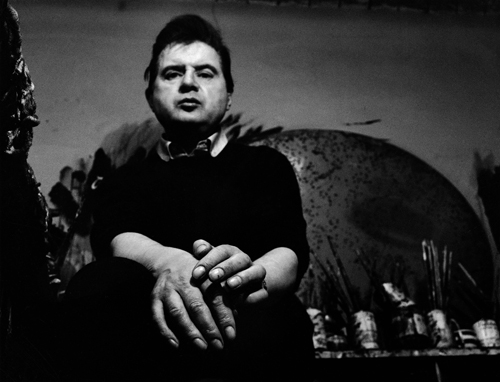
Magnificent Gift
EDWIN MULLINS

By Guy Brett
Art Critic
GUY BRETT
Francis Bacon the master has gradually taken the place of Bacon the “underground
Though the faces in these recent paintings of Bacon’s are more distorted than ever before, far less convulsion and frenzy grips the painting as a whole. The twisting figure of George Dyer or of Lucien Freud occupies its maroon dais in a calm sea of floral carpet and unconstricted sweep of pastel-coloured wall. Even the face, though it may be pushed wildly out of its limits to allow gaps and openings in the paint, is fastidiously done, with minute attention to colour and texture. This is a virtuoso exhibition, but the paintings seem much less intense in feeling than those of three or more years ago.
Where Bacon’s early images of Popes and executives were fleeting and psychic, barely materialized, we are now more conscious of Bacon displaying his skill and persuasiveness in handling paint. In the “Lying Figure” of last year the bare mattress, bare walls and liquefying figure are treated in a frankly aesthetic way, and apparently with little psychological tension.
In the painting of the last few years Bacon has been relying quite heavily on “loaded” subject-matter; in one he used a hypodermic syringe, in another a Nazi armband, and in the left-hand panel of the 1964 triptych in this exhibition, a man sitting on the lavatory. Earlier he had not seemed to need these external props to communicate his emotions.
In the recent paintings he has dropped the reliance on this subject-matter (except in the painting of a man on a bicycle) and turned to portraits of his friends. But again these contrast with earlier paintings in being less images of a general human condition than of particular men.
Bacon has often described his aims in painting as being to “make a direct assault on the nervous system”. In an interview with David Sylvester printed in the Marlborough catalogue he quotes Paul Valery’s remark about wanting to give the sensation without the boredom of its conveyance. There must be innumerable ways of attempting to do this, but to lift the sensation out of its customary vehicle, to evade the nervous system’s protective padding, Bacon has employed his own famous method of working, ruthlessly destroying banal work and hoping in the process and by accident to discover a hidden intuitive direction.
His direct assault on the nervous system was made by discovering a balance between a familiar recorded image (like a photograph) and an unstable, disoriented way of painting. The image acquired presence on the point of slipping away or being destroyed. These new paintings are an impressive display of Bacon’s special technical refinements, but they are dumb in a way his paintings have not been before because one is not taken past the methods of conveyance.
Round the art galleries
Two views of atrocities
by PAUL OVERY
His earlier work, technically les accomplished, rougher, coarser in execution, left a way open—one felt one could break out of the paint. But now the handling is so skilful, svelte, that all other possibilities are closed. Life is brutal and lonely, but to believe that it is only that, that there is no tenderness, no compassion, however transitory or selfish, is as false to believe the opposite. Either view is a sentimental one, in the sense that T. S. Eliot defined sentimentality as ‘emotion in excess of the facts’.
Bacon’s portraits all look much the same; there is no feeling of individuality. This is Lucien Freud, that is Muriel Belcher, but the smashed face are interchangeable. Bacon’s figures are like unrecognizable corpses after some mass disaster, identifiable only by their rings and watches. The individual life they may once have had is battered by Bacon’s paint into a mushed pulp of mouths, noses, teeth. Visiting the New London now is, one imagines, rather like going into an American funeral parlour—the deep-pile carpets, the discreet lighting, the low glimmer of gilt. Bacon’s portraits are like the work of a crazed cosmetician who instead of beautifying the loved ones has even more hideously disfigured them than death. It is a bravura, fiendish trick, but it is no ore than that. Inevitably the performance, repeated again and again, becomes routine, banal, boring. One become indifferent, like a man who works in a morgue. Bacon has been compared to Hieronymus Bosch. Bosch had a sense of humour. Bacon has none.
At the Indica Gallery there is a kinetic exhibition by Liliane Lijn and David Madalla. Liliane Lijn is American and uses clear Perspex, water, and light—all transparent media—for her works. Medalla comes from the Philippines and with Paul Keeler ran the Signals Gallery which pioneered kinetic art in Britain. For several years Medalla has been working on bubble machines which he calls ‘Cloud canyons’. The latest versions are tall white wooden towers with concealed pumps which slowly exude white foam. The result is rather like a constantly changing sculpture. There are a great number of forms that the foam can take as it oozes down the towers, but they are not infinite and are to a large extent governed by the design of the machine.
Downstairs Liliane Lijn has several circular turntables of Perspex. These are hollow and contain a little water which condenses in small droplets on the Perspex, forming tiny natural lenses. On the turntables ride one or more Perspex globes. On one, for instance, there are two globes of equal size. When these collide they tend to sheer away from each other across the turntable unsociably. A small but powerful spotlight shines on each turntable, and the transparent effects of light and movement and the shadows cast on the walls by the globes and the turntables are hypnotically compelling.
These kinetic works never directly concern themselves with human problems and emotions. Instead they work by analogy—in many ways a more effective and subtle method. The kinetic works of Medalla and Liliane Lijn represent the most recent development in the central tradition of twentieth century art which stems through the Russian constructivists and suprematists, the de Stijl group and the Bauhaus; an affirmative and optimistic style that suggests that it is possible to make life better.
To see this as the central tradition is not to deny the relevance of
other work which falls outside this tradition, work which explores the heart of
darkness rather than the heart of light. Yet is one compares Francis
Some spectators who were hitherto repelled by the mixed emotions aroused in them by the imagery find no difficulty in considering the recent pictures exhibited in Paris and London as brilliant configurations of paint, addressed exclusively to the aesthetic sense. With the aplomb of those Victorian ladies who learnt the trick of looking at Renaissance paintings of the Virgin and Child without seeing the child’s penis, we shall soon be able to ignore the imagery altogether. These paint strokes, more active than anything in action painting, are marvellously certain of themselves as the paint-strokes with which Rembrandt investigated in his old ageing face, and are summary flourishes at the edges of some of the portraits—such as the heavily blue swirls on the jacket in the portrait of Isabel Rawsthorne purchased for the Tate collection—which demonstrate a virtuosity as dazzling as John Singer Sargent’s used to be. Any dislocation of the features in these portraits must be attributed to the artist’s realization that the malleability of flesh is Nature’s supreme gift to human pleasure. It will be seen that under the activity of the brush-strokes the faces retain the impassivity of the posing model, and ensure the slaps and slashes and the expert bruising with all the submissiveness of a multitude of Christs at the mercy of a single tormentor. As well they might. The circle of friends who pose for him and are identified in his titles are assured of a kind of immortality.
It cannot be doubted that the exhibition at MARLBOROUGH FINE ART* marks a crucial stage in his career and that it will have far-reaching effects upon the critical assessment of his work and his international standing. He is being rapidly transformed into an Establishment figure, and it seems likely that gallery directors who have so far been prevented from acquiring a Bacon, by committees which have not encountered the pictures in which the paint presents a strong counter-attraction to the imagery will now be given the green light. With so much beautiful paint to be admired, it will be taken for granted that responsible critics will not in future refer to what they think the paintings may be about. It is evident that reliance on subjective evaluations are becoming increasingly unsatisfactory. (The last sentence is copied from an article on scent which deplores the unscientific and rather vulgar practice of sniffing the stuff to find out if it has a good commercial smell). Critics will have to learn not to be voyeurs. Whatever it is that sets an artist to work, whether it be a jug or a male nude with one leg up the wall, is entirely the artist’s own affair, and I can foresee the time when a critic who has forgetfully described the painting of a nude sitting on the lavatory pan as a nude sitting on the lavatory pan will be hauled before the Press Council for invading the artist’s privacy.
People sometimes tend to forget that it is a sign that one’s in the presence of a masterpiece if a painting still looks absolutely right when it’s upside down; but one has only to think of a Mondrian, or better still one of Ad Reinhardt’s all-black panels, to realise that it’s the surest of tests. It is to be hoped that it will not be necessary for gallery directors in difficult areas to hang their Bacons upsidedown to prove that they are masterpieces, but it’s quite certain that they would survive the test and probably reveal unsuspected felicities. This certainly seemed to be the case when I looked the wrong way up at a colour reproduction of the nude sitting on a lavatory pan. Released from its utalitarian situation under the bottom of the nude, the lavatory pan became scarcely less mysterious than the urinal which hung from a string in Duchamp’s exhibition at the TATE GALLERY. The grey shape which, when the picture is right way up, appears to be either a shadow cast by the figure or a spreading pool of liquid from a leak in the pan, became the phantom of an unknown creature, and the pan itself took on something of the appearance of a floppy blue and white beret, and one could appreciate it more acutely by its excremental associations.
I do not
know whether the artist himself is aware of the change in his status but the
extracts from interviews recorded by David Sylvester which appears in the
Marlborough catalogue seem to register a change in his verbal reflections which
would be consistent with such an awareness. He is smilingly dismissive of a
number of the earlier works on which some of us expended unlimited praise. But I
for one make no apologies if I hailed him as a great painter before he actually
became one. I have never pretended that my praise was judicious. His work
represented an attitude to painting and to life which I found wholly admirable.
It claimed my allegiance. He now likens his many paraphrases of Pope Innocent X
by Velásquez to a schoolboys crush on his housemaster.
I think
it might be true to say that after time he went on painting them almost as if it
had become a habit difficult to break, and the last one, painted in 1965, was
probably his worst, totally out of touch with the spirit in which the earlier
versions were conceived. At the time it was exhibited I mentioned that it had
gone dead and looked like something stuffed. The critics who never had a good
word to say about any of them will be congratulating themselves on having been
right all along, but it never occurred to me that he might be attempting to
emulate
Since
then, the emotional and intellectual climate in which he works seems to have
assumed a weird peacefulness. Some of the paintings in his present exhibition
would look at home beside the
Two Examples of British Art at Expo ’67
Visitors to the British pavilion at the international exhibition Expo ’67, which opens in Montreal on April 28 and continues until October 27, will see two examples of the art of the British film maker that will provide much food for thought. Designed to appeal to an international audience both productions wisely leave the visuals and music to tell the story and dispense with a spoken commentary.
Opus (colour; 29 minutes) produced by the Central Office of Information is an offbeat film that sets out to depict the upsurge of creative talent in the arts in this country during the 1960s. The opening sequence reveals the sculptor, Eduard Paolozi, at work in a light engineering factory at Ipswich assembling a piece of sculpture before final welding. This is followed by a visit to the studio of Alan Davie, the painter, where we see him at work.
We next examine some examples of modem British architecture beginning with
Centre Point at St. Giles’ Circus and ending up in the home of one architect
We eavesdrop on Peter Brook directing a scene from his film of the Royal Shakespeare Company’s production of Marat/Sade. The film ends with examples of the work of Henry Moore photographed in his own garden. An adventurous musical score is composed of original music by Tristram Cary together with extracts from the works of Benjamin Britten and Michael Tippett, as well as the Beatles and Dudley Moore.
Here is no superficial production. One feels that the film makers have really got to know and are in tune with the people who have a place in the picture. Opus was made by James Archibald and Associates, was produced by James Archibald and directed by Don Levy; it has already been nominated as Britain’s short film entry in the 1967 Cannes International Film Festival.
The scene in the galleries just now provides me with a theme touching on current problems of figuration as opposed to complete abstraction, and on the new cult of things, in which both forces share an interest. On our left, sculpture by Turnbull (Waddington) and Tucker (Kasmin); to the right, Bacon (New London), Berg (Tooth) and French (Commonwealth Institute). Hurry up for Bacon and French, in their final week. This is Bacon’s most resplendent and least alarming show: his absorption with objects has always meant chairs and couches, invested with extra-real physical properties (and he designed some pieces of furniture years ago).
Leonard French is an Australian whose quest for an extra-territorial subject has led him to ancient Christian symbols and arcane ritual. The symbols of the ritual are deployed emblematically in a series of ritual-like devices. For French, an essentially figurative painter like Bacon, the device also assumes an object- like independence of its own, much as it does for many abstract artists today. All this is true of Adrian Berg, whose poetic-scientific figurative subjects would delight Bronowski and who also uses abstract device as a separate ’thing’ in its own right. More of this artist and the others mentioned above next week. A reculer pour mieux sauter discourse is, in the meantime, necessary to understand something important that is very much in the air today
A glance at amateur art on display in a local town hall or wherever, or a stroll through any art summer show, will reveal much of interest to the sociologist, but most of all that, in realist art, fashions do not change so much as become obliterated by the pressure of an incessantly evolving Zeitgeist. In forcing consciousness of new aspects of reality and their fresh treatment, the Zeitgeist pushes traditional subject-matter into dead currency. Even a confirmed reactionary might quail at the sight of all those sylvan glades, views of the Thames estuary at sunset, or yet another public dignitary whose posture suggests a teapot. If not finally dead, these conventions have become debased; their evidence can only mean innocently retarded development or the deliberate exploitation, with manufacture, of an ignorant section of the public
Traditional rendering of an orthodox landscape or still life, still more the limbs and features of a person, has become impossible for the artist because photography has made the pursuit obsolescent. A figurative painter has to provide us with something more telling than an image in a colour supplement or a single shot in a movie sequence. Granted that neither has paint quality, or permanence on a wall; but no artist wants to duplicate the work of a Courbet or a Velazquez, even if he could—and at least four later levels of awareness (Impressionism, Turner, Cubism, Surrealism) would act as a disruptive barrier to the task
Anyone who has seen Un Homtne et one femme or Grand Prix would agree that both films in their composition of frames, focusing and unfocusing, colour mixes and so on produce a series of images, static or in movement, so startling as to make the figurative artist’s task hopeless. There was a time, not long ago, when images made for their own sake in the privacy of a studio would ultimately determine the nature of commercial art and design and so, in popularised form, become the common property of society. The increased speeds of commercial art and developed movie techniques now outstrip the artists, who are borrowing back images and devices which they once, at distant remove, formulated.
THE FARE IN NOTHING if not varied. So This is God’s Country? (Prince Charles) is an Italian view of the multifariousness of life today in the United States of America. Opus (made by our Central Office of Information, and to be shown at Cannes and Montreal this spring and summer) is a documentary survey of the fine arts in Great Britain this last year or two. Intimate Lighting (Paris-Pullman) is one of those naturalistic and domestic comedies in which Czechoslovakia has lately proved itself so fresh and adept. Lost Sex (Jacey, Charing Cross Road) is a morbid and mordant film from Japan that begins in the key of farce and ends in the key of tragedy. And Beware Automobile (Friday, April 14, only) is a light comedy about a Russian Robin Hood who steals rich men’s cars in order to benefit poor men with the proceeds. He is also, for good measure, an enthusiastic amateur actor.
This comes at the end of a week of Russian films at the Baker Street Classic which began with the now famous Kosintsev version of Hamlet. The new comedy is chiefly remarkable for having as hero the Hamlet himself, Innokenty Smoktunovsky, who when he is not stealing cars plays Hamlet’s last scene deliberately badly in an amateur performance that concludes the film. We knew him already as an actor of great skill and charm; we see now he has a sense of fun as well.
The Italian view of America (directed by Luigi Vanzi with a commentary in English by Italo Calvino) in trying to give us everything, gives us practically nothing. There are visits to an oil-town in Texas, to a Californian desert that is being transformed into a playground, to a drug orgy in Chicago, and so on-but they are all too fleeting and superficial, and no general message or impression comes over. The visitors would have been well-advised to concentrate on a single state at a time. Anyhow we are made to feel like Italians outside, and trying to see inside, a colossal building. Some glimpses we obtain of the Amish Sect are at least interesting, the more especially as this religious community of ancient foundation dislikes and disapproves of the art and practice of photography in any shape or form. Oddly enough, the film ignores the fine arts, which are surely in as healthy and flourishing state in America as they are, for example, in England.
The half-hour British film called Opus is, on the other hand, solely and declaredly concerned with the fine arts—or, at least, the best that we can put on show. We see our own latest Hamlet, David Warner, turning the poetry of Shakespeare into the bleakest of prose (which is the way the very young seem to like it these days). We see the Royal Ballet in a recent offering called Monotones, a title which is its own criticism. We hear some fair music by Britten and Tippett, and we behold The Beatles. We see some of that arbitrary slashing of paint on canvas which is called “action painting,” and which I had hoped was “out” by this time. And we see some of the sinister studio-work of the painter Francis Bacon, whose canvases used to give me a rather enjoyable macabre shudder-until the other day, when an ultra-modern art critic wrote an appreciation of Bacon in a high-class Sunday paper containing the sentence: “His paintings seem to have been squeezed out of him by a convulsion of the spiritual bowels, relieving him of some pressure too painful to retain.” The fine arts with us, in short, appear to be in a bad way, and the fine art of art-criticism seems to be in a way that is even worse.
In the Czechoslovakian film a successful ’cellist from Prague is invited by his little provincial home-town to play the Dvorak concerto with the local orchestra. We see this orchestra being rehearsed at the very start and know that their accompaniment will be disastrous. The ’cellist arrives with his smart new wife and is put up by his old school friend who has acquired a fat spouse, grotesque and crude in-laws, and noisy children, whom he keeps in a scruffy house where nothing but eating, quarrelling, sleeping, and snoring seem to go on. The two old friends sit up all night discussing old times over a bottle of vodka.
So far, so funny. But we are deprived of any glimpse or sound of the actual concert, of the assassination of Dvorak, ten minutes of which would have made a hilarious ending to the film. And it seems more than a little odd of the professional ’cellist that instead of rehearsing his concerto with the scratch orchestra he spends his single day trying to get a square meal and playing Mozart in a scratch string quartet. But the frank and intense naturalism of the bucolic sketches of low comedy (director, Ivan Passer) are extremely well done and will give particular pleasure to all who enjoy Mr Arnold Wesker’s similar excursions into rural Norfolk.
The Japanese film is much less easy to place. We are just settling down to enjoy the farce of a prematurely aged little man bewailing his sexual impotence and gazing avidly at his youngish widow of a housekeeper bending over the kitchen sink. Then suddenly he tells us that he owes his condition to Hiroshima-and we immediately stop grinning. The housekeeper, a common-sensible woman, suggests a rather desperate solution to her master’s troubles. He should arrange to be visited by the Yobai, which appear to be similar in purpose and intent to the medieval werewolves of European lore. She even pays three young local rapscallions to pretend to be Yobai and howl like nocturnal cats, and the result is that our ageing hero turns into one of the Yobai himself. He visits the housekeeper, who pretends to be asleep and in due course she dies after presenting him with a son.
The whole thing (devised and directed by Kaneto Shindo) is the oddest and most indefinable mixture of sex, scenic beauty, pathos, ludicrousness, grotesquerie, genuinely poetic symbolism — and sex. I came away repeating to myself what that shrewd and witty Miss Marghanita Laski recently wrote at the tail-end of a review of some book about pornography — a sentence which I have committed to memory for quotation on all such occasions: “In one sense or another most of us today are sick of sex — except in private and between consenting adults.”
‘Picasso and Co’
Sir,—Alan Bold (The Listener, April 27) reproaches me with producing an exclusive list (April 20) of artists that I consider ‘of at least equal importance, and of greater integrity’ than Picasso (Matisse, Mondrian, Malevich, and Kandinsky), and produces an exclusive list of his own: Beckmann, Munch, Kokoschka, and Leger. I would agree with Mr Bold about Beckmann, Munch, and Leger, although decidedly not Kokoschka, who seems to me a minor, mannered artist, vastly overrated in this country (to the detriment of the far superior Beckmann—typical that the British should prefer prettified baroque to the bitter force of true expressionism).
I was not, however, trying to produce an ‘exclusive list’ but to define where
the central tradition in twentieth-century painting lay. As I pointed out in my
review of the Francis Bacon exhibition (March 30), there is an ‘alternative
tradition
Mr Bold quotes Professor Gombrich, ‘if anybody needs a champion today it is the artist who shuns rebellious gestures’. This is nonsense. It is equally silly to champion an artist just because he ‘shuns’ rebellious gestures as to champion an artist just because he makes them. What is needed are critics who will distinguish between good, mediocre, and bad in abstract, as in representational painting, pointing out that some pictures are better than others (many seem hardly aware of this!). Evaluation, not championship, is what we need.—Yours, etc.,
Paul Overy
London, E.C.1
LIFE ON THE OTHER SIDE OF THE LENS
THE WORLD on the other side of the lens is not all “Smile please”, “Say cheese”, and shutters clicking on family groups.
For the serious it means hard work. To some it
means art
Polish-born Mr. Lewinski is part-time managing director of a textile firm, and a semi-professional photographer.
But the complex lure of the camera has won him over and he will turn professional photographer in September.
Already he has photographed most of this country’s leading celebrities. His work is included in an exhibition, opened on Monday, at the Royal Water Colour Gallery, London, and offering examples of the work of leading photographers.
Mr. Lewenski’s photographs are of well known artists, among them Marcel Duchamp, Francis Bacon, and sculptor Henry Moore.
PERSONALITIES
His photographs reflect the model
The San Francisco Museum of Art has an exhibition of Lewenski photographs of British artists and the Victoria and Albert Museum has recently bought 80 photographs. Rather shy and very modest about his success with the camera, Mr. Lewenski is married and has two young sons.
“My
wife, Emily, complains that I do not take enough photographs of the children,
but I hope to when I have the time,
CAN BE ART
“I am trying to show, that photography can be experimented with, that it can be an art,” he said.
Mr. Lewenski hopes to build a huge file on all writers, artists, politicians and other well known people,” so that if a newspaper wants a photograph quickly, I will be able to provide one from my file.” He already takes photographs for a quality Sunday newspaper.
“You know, women always want to look nice before the camera, and often spend hours putting on their make-up, whereas men do not worry about their appearance,” he said.
“I photographed Katherine Whitehorn, and when I took the photographs around, she admired their design, and then said 'but you have given me a double chin’.”
Before he photographs anyone, Mr. Lewenski spends hours reading about them and studying the type of work they do.
“Then I can find plenty to talk to them about. They begin to feel at ease, and it is easier for me to photograph them. I usually find the nicer the per son, the better the photograph of them turns out to be.
“I photograph only people. I love meeting them. The people are the reason why I photograph, not the camera.

CAREFUL BALANCE IN FESTIVAL
EXHIBITIONS AT NORWICH
IT is generally agreed that the 41st Norfolk and Norwich Triennial Festival (May 31-June 10) will be the best-ever as far as the visual arts are concerned. A careful balance is being preserved between the traditional, as represented by the exhibition of drawings and prints by Gericault, and the contemporary, as illustrated by the Exhibition of English Paintings, 1953 to 1967.
Francis Bacon, one of the leading painters of our time will be represented in the 1953 to 1967 exhibition, and there will also be an exhibition devoted solely to his work.
PAINTINGS
The Exhibition of English Paintings, 1953-67, June 1 to July 2, also at the Castle Museum is to be a collection of some 25 recent English paintings drawn entirely from private collectors or from the artists them-selves and has been specially assembled for the Festival, Paintings by Francis Bacon, Lucien Freud, Frank Auerbach and the Norwich-born painter, Michael Andrews, makes this a powerful and original exhibition. Many of the paintings have never been seen before in a public exhibition.
The Exhibition of Paintings by Francis Bacon, from June 1 at the Castle Museum is being arranged by the Norfolk Contemporary Art Society, in association with the Marlborough Fine Art Gallery, London.
Paintings go Down Under
A collection of paintings and sculptures by leading British artists will be exhibited for sale in Sydney, Adelaide and Melbourne soon.
The works, valued at about £75,000, are by Francis Bacon, Henry Moore, Victor Pasmore, Graham Sutherland, Joe Tilson, Ben Nicholson, Oscar Kokoschka, Barbara Hepworth and Ceri Richards.
NORWICH FESTIVAL OPENS
From Our Correspondent
NORWICH, MAY 30
The forty-first Norfolk and Norwich triennial festival of music and the arts,
which the organizers claim to be “more ambitious than ever”, opened today with
the emphasis on youth. The opening concert tonight given by the Royal
Philharmonic Orchestra is sponsored by a group of young music enthusiasts who
operate under the name of the Ad-Hocs. This group, which is playing a bigger
role than ever in the festival, was originally formed to provide a level on
which the
Youth will provide another highlight on June 5 for the first performance of
Anthony Hopkins’s “A time for growing
For the first time the festival is split equally between music and art. During the festival works by Francis Bacon will be on show at the Norwich Castle Museum, and there will be an exhibition of drawing and prints by Géricault, and one of English paintings, 1953-1957.
The artists included have been chosen primarily because of their historical importance — the effect their work has had on other artists. Given the difficulties of making a limited selection, this has meant leaving out artists of considerable stature who have not been very influential. The painting or sculpture chosen to represent each artist is an example of his work at about the time his individual personality crystallised. The order in which the artists are presented is that of the dates of the works illustrated. The quotations chosen are some indication of each artist’s way of thinking.
FRANCIS BACON, (b.1909)—Painter. Born in Dublin of English parents. 1926-211 lived mainly Berlin not Paris. Settled London 1928-9. Painted intermittently till 1946; influenced mainly by Picasso’s Surrealist pictures. Usually works in series, mainly single heads or figures, and sometimes nodes. Works extensively from photographs. From 1957 thicker paint, twisted rather than blurred forma. Has lived mainly London with periods in Monte Carlo and Tangier.
“Every movement of the brush on the canvas alters the shape and implications of the image. That is why real painting is a mysterious and continuous struggle with chance — mysterious because the very substance of the paint, when used in this way, can make such a direct assault upon the nervous system; continuous because the medium is so fluid and subtle that every change that is made loses what is already there in the hope of making a fresh gain. I think that painting today is pure intuition and luck and taking advantage of what happens when you splash the bits down.”
FINE ARTS
By Jonathan Fisher
FRANCIS BACON is, by the accident of birth, an Irish artist. He was born in Dublin in 1909, and lived and worked during his early years on his father’s farm near the city. His father was employed as a trainer of horses, and the family is descended from the Elizabethan writer and statesman.
There is, as far as the painter is aware, no Irish blood in the family. In this way, perhaps, he escapes too avid a claim by this country on his nationalist loyalties. At the same time his birth and early years here may have a significance greater than has so far been suggested.
Bacon is a painter with many ambiguities and contradictions in his make-up. He is obsessed in his work with crucifixions and popes, and yet he has rejected Christianity as a belief. He paints frequently from odd photographs and magazine illustrations, using modern communication media as inspiration but seeming to move backwards to a point where the smooth and original material has been fractured and distorted beyond recognition. Some of his most famous paintings — notably those of his popes — derive from Velázquez’ “Innocent X” in Rome, and yet Bacon in 1962, when a series of these pictures was on exhibition, admitted that he had never seen the original. He had worked for the most part remembered book illustrations. He had even been to Rome, but had felt at the time reluctant to go and look at this highly significant inspiration for some of his most important paintings.
NO FORMAL TRAINING
Bacon had no formal training in art, and has virtually ignored drawing as an artistic discipline; and yet he is almost obsessional about line, composition and structure in his paintings. And without this formal training Bacon has still been able to apprehended the fundamentals, as these comments on Matthew Smith — probably the only formal statement he has ever made about his craft — reveal: “He seems to me to be one of the very few English painters since Constable and Turner to be concerned with painting—that is, with attempting to make idea and technique inseparable Painting in this sense tends towards a complete interlocking of image and paint ...
“Here the brush stroke creates the form and does not merely fill it in. Consequently, every movement of the brush on the canvas alters the shape and implications of the image. That is why real painting is a mysterious and continuous because the medium is so fluid and subtle that every change that is made loses what is already there in the hope of making a fresh gain. I think that painting today is pure intuition and luck and taking advantage of what happens when you splash the bits down ....”
One is inclined, perhaps, to look askance at those last words, about splashing the bits down. Yet it is the inspired accident that is referred to here, and if ever a painter set a precedent for it, it was the great master of English landscape art, J. W. M. Turner himself, some of whose finest watercolours broke all the rules as he ‘splashed the bits down’ in Venice, Switzerland or at Petworth.
A fine painting by Francis Bacon comes up for sale at Sotheby’s on Wednesday, in an auction of British paintings, drawings and sculpture. It is his ‘Seated Figure,’ painted in 1960, and first exhibited in his Marlborough exhibition of that year. It is being sold by Lucian Freud, for many years a friend of the artist.
The sale also includes a fine early Jack Yeats oil painting, ‘The Fencers,’ a group of excellent Augustus John drawings and oil paintings, a delightful and relatively innocent Aubrey Beardley pen and indian ink study of ‘A Child at its Mother’s Bed,’ some Henry Moore and Jacob Epstein sculpture, including the latter’s bust of Churchill, and some early drawings by Wyndham Lewis and Henry Gaudier-Brzeska.
Aspects of the human face at Whitechapel gallery
ART GALLERIES
Sculptors, painters and photographers have contributed to an exhibition, The face of man, which opens to-morrow at London children’s own art gallery, the Upper Gallery, Whitechapel.
Artists whose work will be on show include Henry Moore, Epstein, Michael Ayrton, Ivor Robert Jones, John Mills, Arnold Van Praag, Francis Bacon, Anthony Gunn, Gerald Scarfe, Alan Richards, J. Lewinski and Malcolm Aird.
All the works have been lent freely by the contributors
In The face of man the artists are all seen expressing – say the organisers, Eileen Graham and James Corless – their personal visions of the human face. For one it is absurdity, for another the window on the soul: for all it is an absorbing and inexhaustible subject.
The Upper Gallery, part of Whitechapel Art Gallery, is maintained by the Inner London Education Authority as a centre for teachers and pupils in its schools and colleges. A fresh exhibition is mounted each term, and school parties are given a conducted lecture tour designed to encourage them to look intelligently and inquiringly.
A studio is provided for use on Saturdays and in school holidays by local secondary school children. The exhibition continues until December 13.
THE ARTS
British artists are among the prize winners in the Pittsburgh International Exhibition 1967, at the Carnegie Institute, Pittsburgh, which opens today and continues until January 7.
Francis Bacon has won one of the four $2,000 awards for painting; Eduardo Paolozzi one of the two $2,000 prizes for sculpture; and Richard Lin, the William Frew Memorial Purchase prize of $1,000.
The awards were made by a jury of three, Mr. Norman Reid, director of the Tate Gallery, Dr. Umbrio Appollonio, secretary-general of the Venice Biennale, and the American sculptor Mrs. Louise Nevelson.
The Pride of Helen Lessore
THERE are a few dealers and a few galleries which, in the 19th and 20th centuries, have played a key role in the development of art. Helen Lessore and the Beaux Arts Gallery are such a combination.
The great age of private patronage is over. No longer can Titian haughtily disdain, and keep waiting, the rulers of Europe.
Today, by contrast, few patrons deal direct with artists, and hardly any with munificence. Foundations and councils, with all the dangers compromises that are weak but, at least, do not frustrate factions, and the ever-increasing pressures to produce prestigious results, have usurped the role of the Courageous private patron.
Courage is indeed the operative word. Two factors have made it more difficult than ever before for the individual to exercise taste with courage. The first, and most obvious, is the high prices now paid for contemporary art. They provide insidious incentives to collect the work of the fashionable. Yet for many even more persuasive is the temptation to support the fashionable for reasons of prestige.
For these reasons the dealer has obtained a position of eminence new m art. It is he who seeks our the artist, decides whose work will be shown and. with all those who control the complex machinery of promotion that the 20th century has evolved, ensures the success of the artist. The profession of art dealer is an ancient one—there were dealers in Classical Rome—and in the 18th century they flourished. Their golden age was, however, in the past century, when men like Durand-Ruel were dedicated to the artists they fostered.
Today the dealer is faced with pressures more insistent and corrupting than ever before. To business acumen he must add the ability to anticipate, and in a measure control, the vagaries of the follow one another with alarming rapidity. Action Painting and Pop Art, Kinetic Art and Hard Edge, the styles are here today and gone tomorrow. Who will win the prizes that matter at this year’s Venice Biennale, and emerge a financial asset? What will the Guggenheim and Tate buy?
Modern Mystique
Each new movement is promoted with the formidable apparatus our age has evolved to sell its products. Then, where art is concerned, there is a further problem. This is the mystique that surrounds so much of modern art. Oid questions, the vital questions, about how art can touch man. inspire and support him, are asked less and less frequently. Ruskin. the greatest of critics, who so passionately cared about the moral role of art, appears an increasingly lonely figure. Against this background a few dealers stand out. Such a dealer was Helen Lessore, and, although her Beaux Arts Gallery has now been closed since January, 1965, it remains in the mind as a vital force in the art of our time.
Now Marlborough Fine Art, probably the most successful firm of dealers in the art of the 19th and 20th centuries, are holding an exhibition devoted to Helen Lessore and the Beaux Arts Gallery. The exhibition consists of paintings and sculpture by most of the best artists she promoted. It provides a heartwarming tribute to courage and honesty in a field where vulgarity, the purely commercial, and the acclaim of the moment have made it desperately difficult to hold to what really matters.
Helen Lessore became an art dealer of necessity: she was careless of those commercial niceties that ensure material success, in many respects exasperating, dictatorial, impractical. What she cared about was art. Her memorial is that she gave the first showing to. and encouraged, artists whose work will live. She believed in a kind of tough realism. It misses the point to talk about the role the Beaux Arts Gallery played in the language, so popular today, of a seminar at an American college. Where there is no room for doubt is that Helen Lessore had a rare eye for recognising talent.
The list of her artists is a proud one—Francis Bacon and Sheila Fell and Auerbach and Michael Andrews and Lundquist and Middleditch and others—one climbed up the stairs to the Beaux Arts to see their work.
Now that the Beaux Arts has gone it lingers in the memory as a stronghold of lonely honesty. It was the most idiosyncratic of galleries, and nostalgia is mingled with gratitude.

The upper gallery at the Beaux Arts
On Matters of Taste
“MORE than anything else it was like a studio, an atelier de peintre spruced up for visitors and it was this—that the gallery itself seemed nearer to the painting end of pictures than to the merchandising end—that gave it its inimitable, irreplaceable quality.”
So most aptly writes Andrew Forge about the now-defunct Beaux Arts Gallery, whose contribution to British post-war art is honoured by an exhibition at MARLBOROUGH FINE ART (until March 2).
It seems somehow longer than three years since I last had vertigo on that spiral staircase mounting to the beamed hare attic above Bruton Place where the sallow presence of Mrs. Helen Lessore was invariably to be found among the soulful paintings, still steaming with the exertions of their birth, which she loved and which had inevitably acquired the label “social realist” or more unkindly “kitchen sink.”
It
seems longer because Mrs. Lessore’s decade of championing what she believed,
regardless of commercial outcome, is already a grain of history: and because the
frenzy of critical chauvinism which “social realism
The present gesture of appreciation is a thoroughly timely one, since without the Beaux Arts the Marlborough might not now have the services of its leading painter Francis Bacon (a pity he is not represented here by a work from his Beaux Arts show of 1953), or of several of its talented younger artists, among them Auerbach, Kossoff, Jack Smith and Michael Andrews. Dealer with business-sense has paid rare tribute to dealer with eyes.
Not that Mrs. Lessore’s eyes were unerring. A few protégés have been well omitted. Even a number of those included seem conspicuously limited and parochial in the manner of those well-forgotten novels of 10 years ago nestling in the warmth of “Lucky jim” and “Room at the Top.”
Yet how little “house style” there really was at the Beaux Arts! Kossoff and Auerbach were searching for their souls in a bath of paint: there was Bacon and his slurred images of violence; there was Bratby’s stark prose about mournful day-dreaming faces: Uglow’s clinical dissections of the figure; Andrews’s halting attempts at monumental compositions; Aitchison’s tender sentimentalities: and the specimen-collector’s eye of Middleditch. Very little in common.
Apart from a shared interest in the theme of the human figure, all that really united the Beaux Arts painters was a refusal to hoist formal considerations in front of emotional ones. They were artists who tried to see deep into the heart of things. In some cases this resulted in a grubby and self-pitying narcissism, in others a mood of tragedy altogether inappropriate to the banality of the theme, and in others a hopeless acceptance of the half-finished or approximate statement.
But at least there was never room in the spectator’s mind for the cool or ambivalent response. When you entered the Beaux Arts you knew what to expect, and if you didn’t like it you could slam the door behind you as you left, and Mrs. Lessore wouldn’t care because as far as she was concerned it was her taste and your blindness. That is a quality I miss.
The Marlborough Gallery last week enshrined a little corner of English painting and paid simultaneous homage to its dedicated bearleader, Helen Lessore. The exhibition, entitled ‘Helen Lessore and the Beaux Arts Gallery,’ is part pourboire from rich uncle to country cousin, part acceptance of the responsibility for filling in the historical gaps which the Tate and the Arts Council haven’t got round to, and incidentally a useful plug for the five Beaux Arts artists now sheltered in the Marlborough stable. Most small gallery owners have to be prepared to act, at least in theory, as wife, mistress and provident nanny to their charges.
Helen Lessore, a painter turned dealer by necessity, was unusually in tune with her artists and her approach to the distasteful business of selling their work was at once novel and thoroughly singleminded. She never enjoyed the commercial cut and thrust and her gallery boasted no elegant siblings to murmur encouraging words in the client's ear, no soft lights or softer carpets. It looked, in fact, exactly like the kind of dusty attic where marvellous paintings are proverbially unearthed, and anyone who saw Francis Bacon’s work there in 1953 could indeed congratulate them- selves on making a genuine find.
Helen Lessore showed only painters she believed in and their work tended to follow a discernible pattern. Her own taste, the gallery’s policy and her artists’ work all marched hand in hand for a decade, and if it wasn’t to your taste no one was going to attempt your conversion. The paintings were almost entirely figurative and unusually sombre in both tone and message. The more dogmatic social realists among the exhibitors were snidely dubbed the ‘kitchen sink school,’ but they found an outspoken and influential voice in John Berger. Most of the participants have since drifted a long way from their original standpoint and would prefer to bury the axe, but at the time the issues seemed both clear- cut and important.
All their troubles and aspirations, the partisan role foisted on them by critics and the apparent urgency of the almost insoluble divi- sion between abstraction and figuration, typified by Pasmore’s revolt in the late ’forties, were part of the postwar struggle for a national identity in painting. The appearance of Middleditch, Smith, Bratby and Greaves, all Beaux Arts artists, at the 1956 Biennale, marked the end of the epoch. What looked like a major engagement at the time now appears little more than a local skirmish. Developments in America, virtually unknown over here, dwarfed the English painters’ civil war. But they were evidently stirring times and some- thing of the spirit of total war is captured in the uncompromising nature of these paintings.
The impetus for this aggressive new figurative painting came from David Bomberg and from William Coldstream at the Slade. Romberg, still a puzzling factor in English painting, was almost unknown outside a small circle of enthusiasts and Coldstream has always been a discreet academic influence. Later, reinforcement came in the person of the Swedish artist Evert Lundquist. The house style rapidly took shape. Looking back, much of the painting seems consciously laboured and ponderous; the constant reworking of niggling fragments of autobiography. Some of the works are hideous to the point of exclusion and best forgotten, others hark back to the craftiness of the Omega workshop, or a vague pastoral dream which was thoroughly explored long ago. Jack Smith is surprisingly unrepresented and so is Derrick Greaves. Perhaps their volte-face to abstraction still rankles in certain quarters. But there are good things, and all too infrequently seen, by Michael Andrews, Helen Lessore herself, Frank Auerbach, Timothy Behrens and Edward Middleditch. Altogether a salutary reminder of some unjustly forgotten combatants and a very Worth-while tribute to a unique gallery.
More in tune with the tempo of the times is a complete portrait gallery in watercolour, including some of the more notably exuberant figures on the London scene, by Patrick Procktor at the Redfern Gallery. There seems to be an enormous vogue for the public exchange of portraits at present, dominated by Messrs Procktor and Hockney, who take evident delight in portraying each other. This collection adroitly mixes celebrities cheek by jowl with friends of the artist and on the whole the cheeks predominate. Apart from the vicarious interest attached to the subjects, surely the drawback of all contemporary portraits, these must be the deftest and most accomplished things Procktor has ever done in watercolour. Anyone absolutely convinced of the necessity for boardroom portraits should take immediate note.
At the Robert Fraser Gallery some exquisite constructions in chrome and nickel plate by Clive Barker are both captivating and thoroughly disquieting. The shiny impersonal texture gives added sharpness to the irony and there is none of the heady animism of Oldenburg’s soft creations. The two buckets with a dripping and gushing tap are the most immaculate expressions of the totally banal that I have seen in a long time. Duchamp would have loved them.
Talk on art to Soroptimists
Wolverhampton Soroptimists met for dinner in the Rendezvous Restaurant, Berry-street, last night. The guest speaker was Mr. Robin Plummer, principal of Wolverhampton College of Art.
He illustrated his talk on aspects of contemporary art with coloured slides showing the work of Nicholas Schoffer, Francis Bacon and Bridget Riley.
The president, Mrs. E. L. Bouwmeester, presided.
PAINTERS OVERTAKEN BY FASHION
The magnitude of Britain’s recent artistic revolution can best be gauged by looking
back on the work of some of our painters who were well known in the 50’s.
Much, no doubt, has been gained. Something, certainly, has been lost.
THE TITLE OF THE PRESENT EXHIBITION at Marlborough Fine Art is “Helen Lessore and the Beaux Arts Gallery.” Its purpose is to show the kind of painting that Mrs Lessore showed in what used to be one of the best known London galleries. What strikes one most forcibly now is how much older this kind of painting looks than it really is. Not only has the art scene in London changed more in the last decade than perhaps in any other period of ten years, but it has become fragmented Xnd, in the literal sense, incoherent. With reservation one can say that there is some stylistic unity in the pictures at the Beaux Art Gallery. The paintings are almost all figurative in some degree, most of them display richness of paint surface, and on the whole the colours tend to be reserved, inclining to browns and greys.
Sickert’s painting, The Servant of Abraham (1929), faces one as one enters the first room. Sickert was married to Mrs Lessore’s sister-in-law, and the artist had a long association with the Beaux Arts. This painting of 1929, with its darkish colours and strong accents of light, is in some ways the picture from which the style of the exhibition is derived. Yet as one studies each artist more closely one comes to see the dangers of generalizing. Though Sickert’s colours come up again and again in other artist’s work, the power of the brushwork reminds one more of Bomberg, who is often considered the outstanding painter of the fifties in Britain, but died before he could be shown at the Beaux Arts.
From the point of view of their colour two painters stand apart from the rest.
One is Francis Bacon, whose work is altogether of a different ilk. If one
compares his self-portrait with that of Timothy Behrens one sees in Bacon a
conciseness, which is almost strident, a strength of line that is absent from
the Behrens, an approach that takes and synthesizes aspects of natural
appearance but never slavishly follows them. There is a great richness in Bacon
Aitchison
The sensuous qualities of the paint in Bacon’s picture are not found in many of the other pictures, even those where the paint is thick. An exception is Auerbach’s Head of E.O.W. in which the rich strokes of light olive green, resting on darker colours, have not only a visual impact, but actually make one want to touch the painting.
Possibly the best painting in the exhibition is the Family in the Garden by Michael Andrews. This is easily the largest picture in the exhibition, and one is amazed how the figures manage to occupy such a large space without leaving any sense of emptiness. Andrews in fact is both a draughtsman who can instil a considerable intensity of expression into a face, and at the same time he is a master of composition; for example, note how he leads one into the picture through the figure of the man in the foreground.
One feels that the closure of the Beaux Arts Gallery for lack of support in 1965 is a symptom of the current art situation and a justifiable reason for finding the situation rather displeasing. An impression is abroad that, because new ideas lead to new kinds of painting, former idioms are somehow less important and less valuable than they were before. It is no dismissal of contemporary art to say that this is nonsense. What is perhaps more worrying is that, despite the fragmentation of art into so many different styles, it seems to be if anything harder than ever today for the lone talent to pursue an individual course.
What one notices in this exhibition is that within the limitations of her own taste Mrs Lessore obviously allowed her artists absolute independence, and didn’t try, as some dealers do, to influence their development with a view to sales.
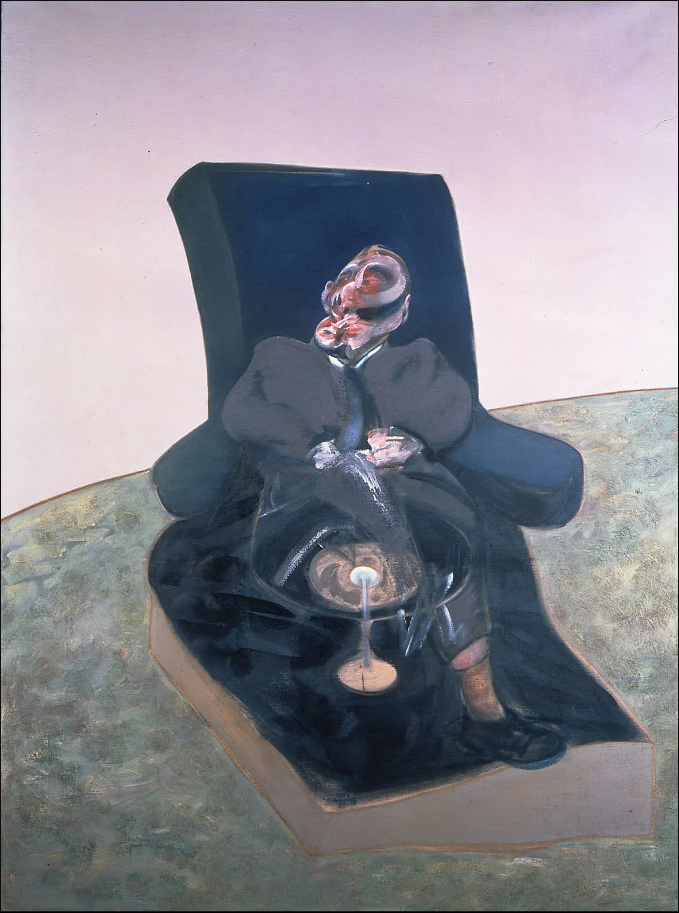
Things Seen
Helen Lessore and the Beaux Arts
By T. G. RosenthaI
“Reading the letters of Van Gogh, or the novels of Zola, one might think that the behaviour of art dealers, and of official bodies, has not changed much; and yet it has — not only the pace has quickened, but the idea of fashion has become more powerful — the whole art world has become like a maison de haute couture, it has become more grossly commercial than it used to be even 30 years ago — even 15 years ago — more superficial, more vulgar, more greedy....
“I cannot stand up and tell the students what they must do to be ‘successful’;
nor have I the heart . . . stand there and exhort these hopeful young things to
take the martyr’s road.” These are the words of Mrs. Helen Lessore in which she
declined an invitation to lecture on being a gallery owner to the students at an
art school, and they are quoted by Andrew Forge in his catalogue introduction to
a fascinating exhibition entitled
I still remember the sense of loss that I felt when one day a few years ago I
went into the Beaux Arts Gallery in Bruton Place and heaved my considerable and
somewhat clumsy weight up that terrifyingly, impermanent
—
seeming staircase to the upper floor where Mrs. Lessore held court, not
pompously but surely regally, over her austerely beautiful exhibition rooms. I
had gone to speak to her on behalf of a painter friend whose talent languished,
as I thought, in a provincial town and who was too modest and shy to face that
depressing, portfolio-laden trudge from dealer to dealer until one of them would
give him a show. He was, and is, a painter with a genuine feeling for natural
forms such as fallen trees, a splendid gift for conveying the strength of the
wilder landscapes of the north and an almost sensual ability to make paint glow
with light and colour. His is an unshowy and purely painterly talent which made
him, in my opinion, a perfect
This, to anyone who cared about the visual arts in England, was a grim blow. It was as if, say, John Calder were to stop publishing or the curtain never rise again at the Royal Court Theatre. The London art scene, replete as it was with many of the less attractive aspects of haute couture was not going to be the same. From the end of 1951, when she took over the gallery, to the beginning of 1965, then she closed it, Mrs. Lessore ran one of those less-than-a-handful of art galleries which had a distinctive “house-style” and where the essential atmosphere was not of wall-to-wall carpeting and hand-rubbing salesmanship, so readily available elsewhere, but a quiet integrity and an almost obsessional dedication to the virtues of good painting. Because it would have been unthinkable for the Beaux Arts to show the work of a painter who was merely one out of whom some easy money could be made, one always had the feeling that one had to make a mental effort when looking at the pictures at least the equal of the physical effort of negotiating that staircase. (The best pictures were nearly always upstairs!)
If one can at all define the
To read the list of artists who have shown at the Beaux Arts, and to see the show of their work at the Marlborough, is like looking at a whole chapter in the history of English art. There are painters such as Bacon and Bratby who had their first major one-man shows there before going elsewhere, and others like Fell and Middleditch who stayed with Helen Lessore all the time she was running the gallery. Yet. whether they stayed for a brief or a long period, one sees in their work the same kind of consistency that one saw in Mrs. Lessore as a dealer and which one can now see again in this exhibition in her own work as a painter.
Exacting standards
Her self-portraits and her portraits of other people show that same dedication
that she found. inspired and maintained in her best artists, and there are the
same qualities of consistency in the relationship between her early painting
And yet, just as there is an infinite sadness in some of her self-portraits, so there is great sadness in the realization that this show is, in fact, a memorial exhibition. The question remains: why should a gallery as distinguished as the Beaux Arts, which, during the fifties and early sixties, probably did as much for modern British painters as any other and a great deal more than most, now be defunct, and but for the Marlborough’s gracious gesture well on the way to being forgotten? For all the self-congratulatory pats on the back about London being the art capital of the world, might this not, perhaps, indicate that all is not quite as well as it might be?
THE OBSESSIVE IMAGE
The new I.C.A. in the Mall and its first exhibition open together on April 10. Called “The Obsessive Image 1960-1968”, the first show is concerned with images of man in recent art, combining work by an older generation of artists like Picasso, Moore, Bacon, Ernst, Magritte and Mliro with such younger artists as Robert Rauschenburg, David Hockney, Allen Jones, Yves Klein, and Martial Raysse. Films by Bruce Conner and Andy Warhol’s six-hour film, Sleep, will also be shown.
On May 3 the I.C.A.’s new cinema opens with the first showing of Don Levy’s film Herostratus. A bio exhibition is projected for July dealing with the role of cybernetic techniques in recent art, featuring compositions produced with computers as well as the use of remote control and feedback systems by artists in their work.
I FOUND myself last week in the Colony Room, the last outpost of the old literary and revolutionary Soho in an age of strip club and dirty-book shops, and one of the few London bars regularly used by writers and artists — like Colin McInnes, Frank Norman, George Melly and Francis Bacon.
For 20 years it’s been run by Muriel Belcher, who sits sipping vodka and soda
water out of a green glass goblet and talks ceaselessly.
The bar is dominated by a statue of a larger-than-life naked cherub, wearing
gold boots and a string of sovereigns.
A drink at Muriel’s led me to a quick check up on the other Soho pubs where Dylan Thomas, Roy Campbell and John Minton could almost always be found, and where the surrealist painter John Banting used to buy separate drinks for himself and his false teeth. They are now unrecognisable.
I suppose that, having become more affluent, the more gregarious writers are no longer on view; they are safely at home in Regent’s Park living on carafino wine and Provençal cooking and advances from the movies. Once, after all the clubs closed, many of them went to the basement of an unbelievably filthy café near Charlotte Street, where an Alsatian lay on a billiard table chewing the ivory balls, and a very old model who had her portrait in the Tate was occasionally sick in her handbag.
‘Whatever happened,’ I asked Muriel, ‘to the Coffee Maria?
ART EDWARD LUCIE-SMITH
Sutherland’s animal creation
EVERY art-dealer knows, that birds and beasts go straight to the-heart of the toughest tycoon. In our secular but still sectarian age, they make perhaps the most “neutral” of all subjects for the figurative artist. It therefore comes as no real surprise to find Graham Sutherland following Sidney Nolan along the footpaths of the zoo.
Marlborough. Fine Art are currently showing a series of lithographs under the title A Bestiary, and also the large coloured drawings which were the preparatory studies for the prints. It makes an almost perfect “dealer’s” show. Nothing is too big, nothing is too gloomy. If you have an aversion to bats, take a look at the lion or the monkey, or the owl.
But I must be careful not to be unfair. This is in fact one of Sutherland’s most interesting and most convincing exhibitions for some time, and it contains, many things of high quality, and illustrates his strengths, as much as his weaknesses.
In a recent BBC 2 television programme about his work, Sutherland said that he had been careful, when designing the tapestry for Coventry Cathedral to leave the beasts, who are the symbols of the Evangelists, in their relatively unstylised appearance; because the way they looked was the thing which most perfectly expressed their nature, and to stylise too much was to lose the impact of this. He has not changed his mind, as one can see from the fine head of a lion in the Marlborough show, which has something of the romantic power of a Delacroix drawing.
The show, however, also tends to illustrate Sutherland’s susceptibility, to the influence of other artists. No painter embarking on an enterprise of this kind could wholly ignore the existence of Picasso’s illustrations to Buffon’s “Histoire Naturelle,” but when Sutherland- depicts a toad he takes over Picasso’s manner almost without transforming it.
The same might be said of the drawing and the print of an owl — a bird which Picasso has made very much his. own in recent years , notably in his sculpture and in the pottery he made at Vallauris. Another and very visible influence is that of Francis Bacon: Sutherland’s monkeys are much like Bacon’s men, but sentimentalised. In fact, there seems to be an element of unconscious parody at work.
What I am saying is really an approach to the kind of difficulty which seems to confront many figurative artists today, arid especially those with Sutherland’s urbane, and civilised temperament. It has been the custom to knock his portraits. I think this very mistaken. Sutherland is still sufficiently in contact with the past to know what a portrait should be about, and he has produced a number of very striking ones.
Essentially an artist who observes, rather than one who creates from deep within himself, the complexity of human personality gives his gift something to bite on. His animals are not really quite complex enough to stretch his powers. On the one hand, he succumbs to the temptation, as with the monkeys, to read humanity into them. The “sadness of the creatures” which W. H. Auden speaks of in a famous poem is hereby diminished and softened.
On the other hand, he begins to mannerise. There are a number of brilliantly ingenious compositional ideas to be found in “A Bestiary.” The armadillo, for example, is shown to us half-curled, so that it looks like a Henry Moore sketch for a helmeted head. The resemblance is surely not coincidental. The bat I’ve mentioned stands upright, reflected in this oval of a mirror, which in turn is seen against the blackness of a window, so that two spaces interpenetrate.
An attempt to vary the series with imaginary or metamorphic animals leads to what seem to me the most conspicuous failures. The ingredients refuse to jell, and the result is a collection of spare parts, not anew addition to God’s creation.
Despite these reservations, the show, at the Marlborough is one to be seen; it adds to Sutherland’s reputation rather than detracting from it.
OBITUARY
SIR HERBERT READ
Poet, critic and interpreter of modern art
Sir Herbert Read, D.S.O., M.C., died yesterday at the age of 74.
By the nature of his ideas rather than by personal choice Herbert Read was predestined to succeed Roger Fry as the interpreter in England of specifically modern art. The mental differences between them corresponded to their succession in time. Fry, a painter, stopped short with the Post-Impressionists; Read, who was not a painter, was tied less to a particular aesthetic and technical standpoint. He found no difficulty in carrying on the defence and exposition of modern art, through all its later divergencies, from Cubism to Surrealism and thence to the various abstract forms of present day painting and sculpture.
Like Apollinaire, he was a poet, who valued what was new as the product of the creative mind and always supported those who, in Apollinaire’s phrase, “fight on the frontiers” of culture. If he was ever too credulous about certain manifestations of modern art, the consistency with which he pursued the conception of a new age as revealed by art gave a special force to all his writings and raised him to a position of philosophic authority.
People who met him for the first time, struck by his delicate and sensitive appearance and shy manner, were likely to be surprised on looking him up in a book of reference to find his name followed by the letters, “D.S.O., M.C.”. The anomaly however was a matter of looks and manner only, for a brief acquaintance with Read’s work was enough to show that one of his most pronounced characteristics was the cold courage of the “resolute soldier”, as a reviewer once described him, which more often than spectacular gallantry is recognized in the military distinctions named.
Read, who was the eldest of the three sons of a Yorkshire farmer, Herbert Read of Muscoates Grange, Kirbymoorside, was born on December 4, 1893. In The Innocent Eye, published in 1933, and again in Annals of Innocence and Experience, 1940, he gives vivid glimpses of his childhood and youth, to the general effect that he was happy on the farm but broken-hearted when he went to school — “No wild animal from the pampas imprisoned in a cage could have felt so hopelessly thwarted.” Left an orphan at an early age, he was educated at Crossley’s School, Halifax, where he preferred books to games and soon discovered a taste for writing. At 16 he was a clerk in the Leeds Savings Bank but he did not mean to stop there and by way of evening schools and the public library he prepared himself for Leeds University. It was while reading for matriculation that he awoke to poetry and began to write verses. Tennyson was his first inspiration and then came Blake “like an apocalypse” to be followed by Nietzsche, who for some years dominated his philosophical thinking.
The permanent effect of Read’s childhood on a farm are suggested by a passage in Poetry and Anarchism, published in 1938. “In spite of my intellectual pretensions, I am by birth and tradition a peasant. I remain essentially a peasant. I despise the whole industrial epoch — not only the plutocracy — which it has raised to power but also the industrial proletariat which it has drained from the land. The only class in the community for which f feel any real sympathy is the agricultural class including the genuine remnants of a landed aristocracy.”
It is not perhaps altogether easy to discern the peasant in this intellectual personality but the passage is interesting for more than one reason. It gives the exact turn of Read’s “leftward” inclination in politics, towards Tolstoy rather than Marx: It may also help to explain why Read, though he wrote about art and industry, did not seem to be very enthusiastic about the artistic possibilities of the machine.
From Leeds University Read entered the Armv, holding a commission in The Yorkshire Regiment (Green Howards) and rising to the rank of captain. He served in France and Belgium from 1915 to 1918, winning the Mt.C. in 1917 and the D.S.O. in 1918 and being mentioned in dispatches. His war experiences, including the death of one of his brothers in France as recorded in the collection of sketches, Ambush, published in 1930, saddened him but did not warp his judgment, his view being well expressed in the remark that it was possible to be a pacifist in theory but not in practice; and such a poem as “The End of a War” (which Yeats included in the Oxford Book of Modern Verse) had its note of optimism.
Read left the Army to become an assistant in the Department of Ceramics at the Victoria and Albert Museum. His books, it may be noted, include technical works on “English Stained Glass”, “Staffordshire pottery Figures”. and “English Pottery”, the last with Bernard Rackham. In 1931 he was appointed professor of fine art at Edinburgh University. He was Sydney Jones Lecturer in Art at the University of Liverpool, 1935-36, and for several years edited the Burlington Magazine, relinquishing the post on his appointment as director of a proposed Museum of Modern Art, which the outbreak of war prevented. In the same year he joined the board of directors of the publishing house of Rutledge and Kegan Paul, his first task being to edit a series of monographs on “English Master Painters”.
Subsequently he held a number of educational appointments in England and the United States, being Leon Fellow in the University of London, 1940-42, Charles Eliot Norton Professor of Poetry at Harvard, 1953-54, and A. W. Mellon Lecturer in the Fine Arts, Washington, 1954.
From 1931 onwards he produced many books — there are at least 30 titles to his name — comprising poetry (his Collected Poems appeared, in 1946), fiction, literary criticism. art criticism and exposition, autobiography and studies in the value of art in education. As a poet he ranged himself rather deliberately with the moderns. subordinating the sensuous element to the intellectual appeal of imagery. It might be going too far to say that his powers were critical rather than creative but the remark of a reviewer that he was a poet by “taking thought” is broadly true. But he had real imagination and his philosophical romance, The Green Child. published in 1935 was a work of extreme delicacy with the streak of crystalline hardness which seemed to be a spiritual characteristic of his.
As a critic of literature Read ranked with the best of his time. From Reason to Romanticism (1926) to Collected Essays in Literary Criticism (1938) (several of which had appeared in The Times Literary Supplement, all his critical %7itings excited controversy; but the qualities of mind evident in them-keen sensibility, steadiness in thinking, complete integrity and unflinching honesty in following an argument-were universally recognized. Read’s prose style, unornamented and a trifle stiff in movement, gave pleasure by the closeness with which it followed the lines of thought.
Arguably it was in literary criticism that Read reached his highest level; but the accident that the subject was more “in the news” made him more widely known as a writer on modern art and the champion of its most extreme and controversial forms. his criterion of modernity being that of Klee “the intention not to reflect the visible but to make visible”.
He was sometimes accused of being an erudite theorist without sensuous response to aesthetic values, but in introducing his “Critic’s Choice” of paintings at Messrs. Tooth’s Gallery in 1956 (all tending towards “abstraction”) he stated with emphasis that “I like this kind of art — it gives me a directly sensuous and profound enjoyment”.
It was, however, in a clear and systematic analysis and exposition of aims and trends that he excelled in his writings.
In this respect his Art Now, An Introduction to the Theory of Modern Painting and Sculpture, first published by Faber and Faber in 1933 and now a standard work and his Concise History of Modern Painting, published by Thames and Hudson in 1959, are works that could hardly be bettered.
Other notable studies were his account of Mr. Henry Moore’s sculpture and The Art of Sculpture, 1956. Read exerted influence also as President of the Institute of Contemporary Arts, which in association with Mr. Roland Penrose, he launched in 1947. When introducing the inaugural exhibition of “Forty Years of Modern Art” at the Academy Hall in London he said that the I.C.A. was intended to create “not another museum, another bleak exhibition gallery . . . but an adult play-centre . . . a source of vitality and daring experiment.” He became a leading supporter of the “Ban the Bomb” movement and sat down in Trafalgar Square.
He published Henry Moore: A Stuidy of his Life and Work in 1965; and Art and Alienation last year.
Read was knighted in 1953. A lanky man of few but solemn words and an apparent timidity which once caused him to be compared to “an amiable tortoise”, he was far from being timid, as his war record shows, and for all his solemnity he had a keen sense of fun. When his eyes narrowed with inward laughter the “tortoise” became very much more like a faun. His personal qualities were of value both to the British and to the international art world. During the 1930s, ior instance, when lie lived in Hampstead, within easy calling distance of Henry Moore, Ben Nicholson, and Barbara Hepworth, he was constantly on hand during one of the crucial episodes in the history of modern British art. It was at that time that his stature as a pioneer interpreted of new ventures in art was first fully revealed. (He was, moreover, one of the few people who managed to remain on good terms with both the surrealist group and the pure-abstraction group.
After the war he was much in demand as an elder statesman of art, and on many occasions he represented Great Britain abroad: on juries and committees of all kinds his meaningful silences and occasional brief bursts of eloquence turned (but to be immensely effective. His foreign colleagues came, in fact, to ascribe an almost Delphic importance to his interventions: “When Read does at last open his mouth”, one of them once remarked, “you know there’s nothing more to be said”.
Read was liked and respected by a great many artists, important and unimportant. and his seventieth birthday was marked in private by tributes unusual in their wholehearted acknowledgement of all that he had done on their behalf. He was twice married. first in 1919 to Evelyn, daughter of Arthur Roff, by whom he had a son and in 1936 to Margaret, daughter of Charles Ludwig, of Aberdeen, by whom he had three sons and a daughter.
Obituary
Sir Herbert Read, poet and critic
$IR HERBERT READ, who has died, aged 74, was the provocative, yet persuasive spokesman for the avante garde painters, sculptors, artists and writers of the 1930s.
Educated at Crossley’s School, Halifax, and the University of Leeds, he fought in France and Belgium with the Green Howards in the 1914-18 war, when he won the DSO, the MC and mention in despatches.
His undergraduate career at Leeds was cut short by the war and he did not take his degree. In consequence, as Professor of Fine Art at Edinburgh, he held a University chair without an academic honour.
When he received the honorary degree of Doctor of Literature at Leeds
University, Prof. Hamilton Thompson said:
Art understanding
In a plea for Surrealism in 1938 Sir Herbert said the prevalent misunderstanding of modern art was due not so much to a lack of sympathy or ignorance but to the preconceptions and and prejudices imposed by environment and education.
His knighthood, in 1953, was “for services to literature.”
During
“the
Battle of Trafalgar Square”
on Sept. 17th, 1961, Sir Herbert was among those arrested following a
“ban
the bomb
But he broke from the Committee of 100 after the attempt to invade Wethersfield air base. His comments on men and affairs were sometimes scathing but he yet inspired an affection that found expression on his 70th birthday, when gifts valued at £10,000 were piled on a table at the Arts Club. These included original works by Henry Moore, Ben Nicholson, Barbara Hepworth, Joan Miro and Maxwell Fry. Poems and manuscripts were sent by T. S. Eliot and Stephen Spender.
Books on art
Sir Herbert’s publications, in addition to his poems and essays, included books on ceramics and stained glass, and many books on modern art which conditioned the thinking of a generation. They included “Art and Society " and “Art and Industry.”
He was assistant keeper of the Victoria and Albert Museum from 1922 until 1931. Leon Fellow at London University from 1940 to 1942, he had earlier edited the Burlington Magazine for six years from 1933. He was Senior Fellow of the Royal School of Art in 1962. and since 1965 had been a trustee of the Tate Gallery. President of the Society for Education through Art, he was also President of the British Society of Aesthetics and a Fellow of the Centre for Advanced Studies at the Wesleyan University, Connecticut, United States, in 1964.
He was twice married—first to Evelyn Roff, and secondly to Margaret Ludwig. He had four sons and a daughter.
The gentle anarchist
SIR HERBERT READ art critic, writer and poet, died last Wednesday aged 74.
HENRY MOORE remembers him as a artist, critic, and loyal friend
I KNEW Herbert Read intimately for forty years. He was one of my closest and very dearest friends. I have never met anyone who was more loyal to the things and the people that he believed in, or more generous with his time, or more self-sacrificing in the way that he would put aside his own concerns to help others.
I remember that just after he had his first operation he read an article in which Shelley was attacked as a poor poet and a bad man. Herbert got off a terrific letter in reply and when it was published and I congratulated him he said “Yes, I wrote that with four radium needles in my tongue.” In those conditions I should only have been concerned with myself, and here was Herbert provoked into writing by his love for what he believed in.
In a more general way I think that his “Education in Art” was one of the really influential books. It changed the whole art situation in this country—and in other countries, too—by insisting on the part that art should play in education, and particularly in elementary and primary school. In his and my youth, “art” in schools meant half an hour on Friday afternoon. But “Education Through Art” helped to change all that, and I believe that if we have an exceptionally large number of gifted young artists today it is partly thanks to Herbert’s. having prepared the ground.
He had an almost German thoroughness in everything that he did, and he was aware of what was being written and done in other countries at a time when many people in the English art world were narrow-minded and provincial. He kept up with his English-friends—with T S Eliot, for instance, whom he had been seeing every other week since Imagist days—but he also kept up with a wide international circle. He was not at all gushing or effusive—in fact he was un commonly silent—but when he and I were at some party abroad, as we often were, I would look round the room and find him in a corner with people who had got on to his quiet sociability and recognised ham as a really remarkable man.
In the 1930s he was invaluable to us all in the way that he could see both sides of :any situation and act as a link between all the different things that were going on. I think that fundamentally he was a romantic, and nearer to poetic or surrealist painting than to abstraction or constructivism, but he never wrote from prejudice of any kind. In politics he was an anarchist, but the gentlest anarchist one will ever know and the best explanation of what the anarchist philosophy really is, as against the popular idea of it. If anyone wanted to prove that an anarchist was not a bomb-throwing destroyer, Herbert was the man to do it.
He was an artist himself, in his poems and in “The Green Child” and the autobiographical fragment called “The Innocent Eye,” and he knew what artists were all about. I remember in “Art Now” a quotation he’d taken from Lenin, about how artists were a special sort of person and easily damaged and that the State should leave them alone. The Russians haven’t lived up to it, but that was how Herbert thought it should be.
He got through a fantastic amount of work, as a critic and historian, as a publisher, and as a selfless committee-man, but the part of him that will live for ever is his own creative writing . He loved Yorkshire, and the moors, and the beautiful house he bought towards the end of his life, and he was always a Yorkshireman in his speech. He was proud of the connection but, more than that, he just loved it and I couldn’t imagine him going abroad rand living there for any reason whatsoever. This was one of the things, but only one of them, that made him a wonderful friend and a beautiful human being.
Art on the high seas
Cunard’s new Queen Elizabeth 2 will be the first ocean liner to have permanent art gallery, Lord Nancroft, deputy chairman of Cunard Line, said at Southampton last night.
For the first few months, the gallery will be run by Marlborough Gallery Fine
Art Ltd., of Old Bond Street. They have arranged to put on sale new works by
distinguished British artists, including Henry
Lord Mancroft, who was speaking at the annual dinner of Southampton Chamber of
Commerce, said that prominent among the liner
Vain search for Britannia
Most of the cabins and have state rooms would prints and lithographs by important young British artists. Some of these would be on sale. John Aldridge had been commissioned to do a landscape for the principal suite.
Lord Mancroft said that Cunard had sought in vain for an old figurehead of
Britannia for the Britannia Restaurant.
“A
West Country gentle-men offered us a figurehead of a certain young woman who
eventually proved to be a well known lady of the town in the forties, in
Falmouth. “He
felt that if Cunard slapped a bit of paint on her and kept quiet about it,
nobody would notice the difference.
“We
had our doubts. however, and fortunately Lloyd’s have been kind enough to
commission Mr Charles Moore to make a Britannia figurehead specially for us.

Bacon in New York
THE TIMES DIARY
FRANCIS BACON, for my money our best living painter, is off shortly to the
United States for, surprisingly, the first time: an exhibition of his latest
paintings opens on November 11 at the Marlborough-Gerson Gallery in New York
(which, the Bacon market being brisk, means they are unlikely to be seen here
again). Bacon had had plenty of shows in America—the most recent being a
retrospective at the Guggenheim in 1963—but this is the first time he has felt
moved to make the trip; and even now he regards the prospect with rather mixed
feelings.
The New York show amounts to 20 paintings, all portraits or figures, most of them large and two of them triptychs—representing about a year of hard labour: “suddenly I was able to do a lot”, he says. He will be staying at the Algonquin hotel, which everyone said was very nice until yesterday, when someone said it wasn’t; for how long he is not sure, perhaps 10 days or so.
Bacon has recently returned from several weeks in South Africa, where his mother (who remarried there after the death of his father, and after going out to see his sister, who married a South African) has been ill. It was one of his few breaks in the last 15 months.
On January 7, Bacon will join Moussorgsky’s friend Victor Hartman, who painted the Pictures from an Exhibition, among those few artists who have inspired musicians (the reverse is more common); his friend Gerard Schürmann, former conductor of the Dutch radio orchestra, is in the throes of writing a work called Seven Studies of Francis Bacon, which will receive its first performance at the Dublin Festival of Twentieth Century Music on that day: a suitable venue, as Bacon was born and lived for his first 16 years in Ireland.
Schürmann, a close friend of Alan Rawsthorne (whose wife Isabel formerly married to the late Constant Lambert, has in turn been the subject of several Bacon portraits, including two in the New York show), says the work may also be performed at the Holland Festival next summer, when it is hope there may be a Bacon exhibition.

Francis Bacon paints both objects and figures in much the same way. One result is that it is sometimes difficult to determine exactly where one stops and the other begins. In Portrait of George in a Mirror, one of the new paintings at Marlborough-Gerson, the figure, furnishing and mirror not only co-exist but overlap as well. They all seem to exist as a single identity—thus identification of the individual elements themselves (in this case figure and objects) is in crises. In another new painting, Man Getting up From a Chair both the man and the chair appear stuck together, as if they are, more or less, one. The man actually appears to be trying to separate himself from the chair. Thus Francis Bacon illustrates the modern problem of man, in solitude and without firm identification attempting to renew his acquaintance with the changing environment. This problem, articulated in Existential philosophy, was first illustrated in painting by the Surrealists. Bacon contributes the Expressionist sensibility, thus rounding out the predicament and becoming, should a label prove necessary, a Surreal-Expressionist.
However, as the Surrealists predecessors of Existentialist art knew, the problem is deeper than one of simple identification. The Minimalists have reminded us that it is, ultimately, the enclosure of the environment that has the last word. The inevitable, architectural enclosure of the modern environmental space is, of course, the walls, ceiling and floor, and everything that goes with them. This enclosure not only goes a long way in determining the relationship between the objects (figures) that are enclosed therein (much like the "frame" of the picture surface) but, since it is necessarily part of the complete environment, it commands recognition of itself.
We needn’t be confined to the field of art in order to find examples of this contemporary phenomenon. In ordinary, everyday situations, we often find our intimate environments enclosed by walls. Modern man paints the walls white. By doing so, he emphasises his relationships with his objects, and attempts to reduce the awesome authority of the enclosure itself. (One might point out that the ultimate way of reducing the authority of the enclosure, or in this case the walls, would be to simply utilize floor to ceiling glass. That would be too drastic a step, however. Man does not want to totally eliminate authority—only to subdue it). While modern man cannot tolerate the authoritarianism of the essential enclosure, he nevertheless seeks out the security that the enclosure provides. Notice what has happened on the modern dance or discotheque floor. The security of a clinging partner and clearly marked off dance floor has been replaced by the new acknowledgement of the whole group. We observe that the space for dancing is now determined by the lights, noise level, and shape of the enclosure itself. Similarly, in painting, the heavy frame has been replaced by a tacit acknowledgement by the painter of the surface edge. Today, we prefer a few large rooms to lots of little ones. Why does modern man love his car so much, and hate to leave it—even when it becomes an obstacle to efficient, economical transportation?
Let’s look, for a moment, at the enclosures Bacon allows his spaces. Frequently, they are ambiguous. In his superb triptych, Two Figures Lying on a Bed With Attendants Bacon surrounds his spacial property with an articulate but weak "wall." It has been left blank. The only painted areas refer to doors and windows. How different was the view of the painter of the early Renaissance who insisted on substantial walls. The only escape from his precisely defined space—from his enclosure—was through a partially open window or unlatched door. Repeatedly Bacon illustrates a vague and "open" backdrop. In Portrait of Isabel Rawsthorne Standing is a Street in Soho the artist has painted a sort of frame around the standing figure. The spaces between the frame are open. A fragment of the figure leaks through the enclosure. The background of the picture—a street scene—is equally awesome, as it refuses to lend security or definition to the condition of poor Isabel Rawsthorne. A similar non-confining enclosure exposes the mushy piles of lumps of the right hand panel of Triptych 1967.
It is true that in several of the new paintings, the artist has painted in a background that is recognizable and complete. However, it should be pointed out that in all these paintings Man Getting up From a Chair and Portrait of George Dyer and Lucian Freud for example the background consists entirely f a curtain. Therefore nothing really substantial is offered. The curtain could be be merely a temporary marking delineating space for convenience, sake, as in a photography studio, or "set" for television programming. Indeed, nothing in the pictures suggests that the background is anything but a temporary theatrical marking.
Thus it would appear that the subject of Bacon’s paintings is man, and his contemporary psychological, sociological and metaphysical condition. While his manner of illustrating this subject maybe unique, the subject itself is certainly not. Indeed, this is the very subject of all serious and worthwhile contemporary art, whether it be the haunting "strips" of Barnett Newman, so open to Existentialist interpellation, or the "drips" of Jackson Pollock with their origin traced to the Post-Freudian need to experience the fact of the subconscious. It is the same subject we find in the paintings of Ellsworth Kelly and the sculptures of Robert Morris—both artists profoundly committed to the contemporary condition of man and his speculations concerning his surroundings. How then do the paintings of Bacon differ from the primarily abstract pronouncements by the above mentioned artists?
Firstly, Bacon comes to us through a primarily Surrealist heritage. Yet he is not a Pop artist in the school of George Segal or Tom Wesselmann, for example. Nor is Bacon a realist in the style of Ernest Trova or Enrique Castro-Cid. And Bacon’s figures, while macabre, cannot be categorized along with the entombed and encased images of Paul Thek, or the figurative juxtapositions of Joseph Raphaele. A comparison between Two Figures Lying on a Bed With Attendants and the State Hospital of Kienholz is a tempting one, but ultimately cannot be satisfactory—if only because one work is a painting and the other, sculpture.
My point is, that despite the catholicity and vitality of his subject, Bacon remains a remarkably individual painter. His well known, easily identifiable style is more traditional than avant garde. The modern glittering material culture, together with the superficial amenities that it offers, are rejected by this iconoclastic artist.
Bacon’s universal room
ART JOHN RUSSELL IN NEW YORK
JOHN RUSSELL
UNTIL last Monday evening Francis Bacon had never had a major show of new work in New York. Nor had he himself ever crossed the Atlantic. The combination of twenty new paintings, some of them very large indeed, and the news that the artist was in town drew a crowd of hardly manageable proportions to the Marlborough-Gerson Gallery.
In terms of pure-minded dedication I would not have backed them pound for pound to beat Winckelmann, but they did at least get the point that something quite exceptional was going forward and there were also several major painters who do not normally go to fancy openings and had turned up out of respect and admiration for someone who is indisputably painting better and better at a time of life when many an established artist settles for a dignified marking time.
There are still people who think of Bacon primarily in terms of sensational subject-matter. Those of them who were around on Monday evening could pick on a hypodermic syringe here, a putative murder there and in a third place a group of acrobats, one of them crippled, in limbo.
But what commanded the respect of Bacon’s colleagues here was not the subject matter; it was the climate of feeling to begin with, and secondly the fastidious but quite ruthless intelligence with which ideas were being pushed farther than anyone could have expected them to go.
Bacon’s is, of course, a profoundly European art but something about the purity and intensity of the feeling in his work relates to a Europe both older and younger than our own: a Europe in which feeling could gush forth without being monitored by UNESCO and twittered about on television.
That particular quality of feeling turns up in the best American art and it also turns up in the un-upholstered character of life which the best American artists have devised for themselves: Bacon, for instance, has always admired the life-style marked out in the text of Claes Oldenburg’s “Store Days.” Oldenburg in turn understands the particular quality of the inhabited room as Bacon has developed it; no mean room-maker himself, he is perhaps closer to the heart of this matter than the European aesthete whose idea of a painting of a room with people in it is still hung up on Bonnard and Vuillard.
So it turns out more and more that Bacon who was once thought to speak only for himself is in reality one of those rare figures in art who reinterpret a great tradition in terms acceptable to a later and a different culture.
There is, in the new show, a triptych inspired by Eliot’s “Sweeney Agonistes.” In this, the central panel is set in that scene of undying magic for Bacon’s generation: a sleeping-car heading for the Mediterranean. The window is open, the blind half-drawn, the equipment of the little pleasure-box most lovingly detailed. But the compartment is empty, the pillow thick with blood, the luggage in chaos. Someone has gone out of the window: pushed we cannot doubt by an assassin.
It is a sensational episode, a genuine headliner of the Twenties, more authentic than anything in “Bonnie and Clyde” and it is flanked by two others no less expressive of the demonic energy implicit in Eliot’s elliptic little drama. But it is also the last farewell of the open window theme which Matisse once brought to perfection: and at the same time the sequence of severe rectangles of colour which make up the blind, the window itself and the view on to the night also bespeak Bacon’s close acquaintance with those more recent forms of painting in which rectangles of colour are the full and only justification of the picture. One could write for ever about paintings such as these.
By a curious coincidence, Bacon’s expression of a lifelong admiration for Eliot was put on view only a day or two after the New York public library had opened its showing of items from the John Quinn Memorial collection. The masterpiece in this collection is of course the rediscovered manuscript of “The Waste Land” with Ezra Pound’s annotations and a final and decisive account of how far Eliot was influenced by Pound when he prepared the poem for the printer.
As to that the enthusiast will do better to read the Times Literary Supplement for November 7 than to take the great double staircase of the library three steps at a time. The manuscript when on show at all and not “temporarily removed” is opened at two of its least pregnant pages. But the show itself has an irresistible fascination.
Quinn was one of the great characters of the New York Bar, a corporation lawyer who prided himself on not having a single law book (“and above all, not Blackstone”) among the fifteen thousand volumes in his library, and a patron whose beneficiaries included not only Eliot but Yeats, Conrad, James Joyce, Marcel Duchamp and Gwen and Augustus John, Epstein, Brancusi and Rouault.
Quinn bought more great paintings of his own day than almost any other private individual. Without him “Ulysses” might never have been published. Duchamp would not have been free to work as he wished during his vital early years in America, and Eliot would not have been able to finish “The Waste Land” in conditions of reasonable security.
Never did a man live more fully by his own maxim that “we have had, in art as in law, too much government of the living by the dead”; and if the library show cannot put before us the great paintings from Quinn’s collection which are now in the Louvre and elsewhere it does spell out for us most movingly the nature of Quinn’s involvement with those whom he recognised as the great spirits of his day. And that involvement was mutual: in all the commotion of “The Waste Land” it should not be forgotten than when Eliot mailed the manuscript from Clarence Gate Gardens in October, 1922, the fat little packet came to Quinn on Eliot’s insistence as an outright gift.

“A third place a group of acrobats, one of them crippled, in limbo” a detail of one of the twenty paintings in Francis Bacon’s
New York discussed by John Russell. Called “Three Studies from the Human Body” and dated 1967 it measures six and a half
feet by four feet ten inches and the flesh-coloured figures are on a plain background
The Problem of Francis Bacon
By HILTON KRAMER
Few contemporary painters give the impression of enjoying all—or even most—of the expressive prerogatives that once belonged to the art they practiced. Distinction is nowadays achieved by narrowing, not enlarging, one’s focus. Painting has become a highly restricted enterprise. Certain resources—particularly what is known as the "literary" element in painting—are rigorously eschewed. Others—all that is meant by the decorative and the abstract—are carried to the most astonishing extremes.
The English painter Francis Bacon seems to be the great exception. He is, to be sure, one of the most dazzling pictorial technicians on the current scene. The new paintings he is showing at the Marlborough-Gerson Gallery, 41 East 57th Street, are virtuoso performances of a kind that are rare even in an age of extraordinary technique. They deliberately court comparison with the masters. Their sheer authority is—at first glance anyway—overwhelming.
That this authority derives in large measure from the painter’s unashamed reliance on illustration is not, in this case, particularly damaging. This alone would make Mr. Bacon an unusual artist. Illustration is, for most of our painters, an original sin which they labor strenuously to be absolved of. Mr. Bacon is a master of this despised esthetic atavism, and does not hesitate to flaunt this mastery. He gets away with it, too. For he is also in possession of an unerring pictorial intelligence. He is one of those painters who appears to achieve exactly what he sets out to achieve.
Clearly he has a lot more on his mind than exercises in technical excellence, however. He is a visionary of a particular sort—a specialist in the grotesqueries of modern life. He is a connoisseur of extreme emotions, with a taste for the macabre and a gift for transmuting the psychopathology of everyday life into a compelling and very personal pictorial imagery. There is nothing of the commonplace in his work. Everything is pitches to the intensity of a scream. The pressure is unremitting, a little brutal, and more than a little calculated. Yet, despite the calculation, it has the force of an involuntary avowal.
Why, then, does it strike me as being clever rather than profound—brilliant rather than authentic? I know of few contemporary paintings that make as strong an impact on first viewing as Mr. Bacon’s, yet it is not an impact that lasts. The scream fills one’s ears, but then—unexpectedly—one discerns in it a curious musical resonance. It is not a cry of pain, after all, but a well composed aria. What seemed, at first, like raw emotion turns out to be a form of artifice. The emotional temperature drops rather suddenly. A world of exacerbated feeling and desperate appetites, which only a moment ago seemed seemed to press so hard on our consciousness, dissolves, and we are once again on the familiar terrain of the contemporary artist—back in the studio, where the decisions are cool, technical and deliberate.
This, for me, is the problem perhaps I should say the obstacle—which Mr. Bacon’s painting invariably presents. An inevitable depiction seems built into its style. His portraits and portrait studies, of which there are many in the current show, promise much in the way of psychological definition. But there is, alas, no individuation in them. The psychology turns out to be uniform—an intense neurasthenia which easily resolves itself into esthetic composure.
One’s interest in Mr. Bacon’s painting shifts straightaway from the particularity of the subject to the distortions the artist indulges in the rendering. These distortions—the mouth endowed with a blurred animal madness, the limbs strained in some desperate but not quite readable gesture, entire bodies contorted in miserable missions of passion make a large purchase on our attention, but then disappoint us. We are left, not with a penetrating insight into the agony of the species, but with a mannered and deftly turned style. It is only then that one grows a little queasy, finding that one admires the expertise—the incomparable cleverness and facility—of the way a nose or a forehead pr behind has been so handsomely modelled with a heavily loaded brush when a moment earlier it seemed as if one were going to be the unwilling witness to some unspeakable act.
Which is to say Mr. Bacon is not above titillating our expectation of the violent and even the obscene. He is not, I hasten to add, an obscene painter—far from it. But he does have a way of placing his audience in the position of disappointed voyeurs. His preoccupation with private acts of sexual violence turns out to be amazingly sociable. His depiction of male nudes mat aspire to a condition of existential candor, but it concludes in a kind of perverse parody of Rubenesque hedonism. Everything the artist touches—all these themes of anguish, all these evocation of the forbidden—turn to art, one is tempted to say "mere" art. In the end, one feels a kind of fraud has been perpetrated.
But mine is, apparently, a minority view of this peculiar achievement. Read Professor Lawrence Gowing’s heated essay in the catalogue of the current exhibition, and you will have a better idea of the established judgement—established, at least, in London—of Mr. Bacon’s work. This is the opening paragraph of Professor Gowing’s text:
In London this year I have felt a distracting reverberation in the air. It is generated by the knowledge that a mile down the street, too close for comfort, Francis Bacon is in tremendous form, painting continuously and surely disturbing something that one would sooner leave settled . . . Waiting for a new group of pictures I tremble a little, lose track of my thoughts, wake in the night. Every time that the image that emerges can be counted on to strike directly at a vital and vulnerable sense. One has no way of preparing or protecting oneself. There is an uncommon kind of painting, which, when it really penetrates, alters everything. For some unknown reason, one’s private view of oneself is at stake.
One would be hard-pressed to find a painter in the entire history of art who answered to this description—even Bosch somehow falls short. But that is not the point, I suppose. Professor Gowing expresses very eloquently what one assumes to be the "correct" response to Mr. Bacon’s art. Later on he talks a good deal about "paint," and that, too, is part of the correct attitude. Yet, oddly enough, all these paintings—"an uncommon kind of painting which . . . alters everything"—somehow manage to get themselves sold and somehow manage to hang in both public and private salons without changing anything. For myself, I trust these collectors more than I trust Mr. Gowing’s text. They recognize exactly how safe an artist Mr. Bacon really is.
Bacon’s show may prove to be the most popular of the season; in the first week, all 19 oils have been either sold or reserved for prices ranging upward from $35,000 for the smallest multiple-image portraits. For nearly 20 years, he has been renowned in inner circles as Britain’s finest figurative painter; his works have hung in U.S. museums since the early 1950s. His commercial success is a telling comment on just how open-minded the general public has become, for Bacon’s material is, to put it simply, sick.
Most of the canvases he paints depict pulpy male nudes who couple lewdly on beds or sit like withdrawn junkies in cell-like boxes. The current show also includes many grotesquely distorted portraits of his friends, among them George Dyer, his studio assistant, Isabel Rawsthorne, wife of Composer Alan Rawsthorne, and Painter Lucian Freud, Sigmund’s grandson. On one canvas, a hypodermic syringe rises from what looks like a well-beaten body, while in a corner of another a bird that has been plucked stark naked screeches desperately on his perch.
Foetus Crouch. Bacon, of course, makes no bones about the fact that the obsessive subject of his paintings is homosexual despair. He argues, however, that the despair he has observed among heterosexuals amounts to more or less the same thing. Certainly the horror and fascination with which some viewers respond to his works seem to support his contention.
To capture the feverish, nightmare quality of the experiences Bacon depicts, he has developed what is essentially a surrealist dream style to near perfection. Every brush stroke bears the mark of absolute conviction, from the fields of poison green and fetid lilac that deck his backdrops to the calculated white ejaculatory splats that he lashes across the legs of his subjects. There is hatred and hostility in Bacon’s vision, but of late it seems to be mellowing. Nothing in his current show comes near to matching the insane intensity of his screaming popes of 1949-53. A study of three male bodies, to be sure, shows one crouched like a foetus and another with his leg in a splint, but the third, who dangles apelike from a pole, has an amiable if freakish mien. A woman lounging in a deck chair turns a face wreathed in a hideous grimace—yet, on second glance, it is obviously nothing more than the grin of a well-fed Cheshire cat.
THE Colony Club Room, that traditional Soho meeting place of Bohemians where artist Francis Bacon once worked for £10 a week, is celebrating its 20th anniversary this weekend.
Muriel Belcher, the proprietor, says that guests — including Lord Christopher Thynne, the Marquis of Hartford and Lord and Lady Grantley — are expected to cram the tiny upstairs room in Dean Street.
“I’m just hoping they don’t all come at the same time,” she says.
QUEEN Elizabeth 2 will carry on her maiden voyage the first permanent floating picture gallery and many of the works will be on view for the first time.
The paintinss and sculpture selected for the first exhibition, entitled “20th-century British Art,” will represent, among others, Henry Moore, Graham Sutherland, Francis Bacon, John Piper, Barbara Hepworth, Ben Nicholson and Ceri Richards. Our image seems to be in safe hands.
On each voyage the new Cunarder will have on display in the boat deck gallery 100 items, with plenty more in reserve, and prints in one of the corridors.
I illustrate a detail from a Piper gouache, “St. Simon de Pellouailles.
Francis Bacon
MARLBOROUGH | MIDTOWN
BY ROBERT PINCUS-WITTEN | REVIEWS |
Today, there are very few—if indeed any—great representational Expressionist painters. If, in fact, there are, then perhaps FRANCIS BACON is the single greatest exponent of the mode. This being so, then he is a very great painter indeed, and the following carping may be read from the outset as nothing more than the murmurings of preconception set up against a painting which, while breaking rules, somehow manages to succeed. But I begin to wonder whether in violating canons of good painting Bacon really succeeds in establishing new desiderata. I think not.
My caveat is concerned with the kind of painterly performance in which Bacon indulges. Above all else Bacon is a figure painter for whom little really matters except getting out some portion of the anatomy in terms of his famous scar tissue simultaneities. His most interesting painting occurs in those passages of swiftly turning head and body painted in the bristly chiaroscuro of mutilated eye sockets and thickened brushy patches of spatial skin grafts. To achieve these remarkable and unforgettable pinturas negras of tormented humanity, Bacon employs the short, terse, arching stroke (from the wrist) of a wide stiff brush. In realizing these forms part of their horror is vitiated by Bacon’s rhythmical, neutralizing balance of stroke and brushwork, light and dark and the flying closed forms he projects. He then sets to creating the environment in which these terrifying and elegant humanoid fragments live. For this act of placement, Bacon relies on a too pat set of self-imitating motifs and a method of spatial division which, if nothing else, is rather easy.
Bacon employs the cliché of the ambiguous space diagram or cage, a cliché which he himself invented for the supreme paintings of the late forties and early fifties. This method of spatial projection was adopted enthusiastically by a wide front of Bacon’s English imitators from Reg Butler to Roland Piché—and it has finally come to Broadway in the guise of Donald Pleasance in The Man in the Glass Box. What is, in fact, this cliché? It generally takes the form of shall we say, a cubic soap bubble—if you see what I mean—inside of which, or against the margins of which, the protagonists move, depending on the necessities of the picture. Such ambiguous diagrams are particularly effective in Bacon’s work because they become symbolic of the cages—neurotic, political, sexual, what have you—which the individual sets up around himself or which society imposes like so many Skinner Boxes in behavioural rat studies. The emotions become associative and, therefore, easily fall into sentimentality.
Much more disturbing than this motif is Bacon’s substitution of a different brushwork for the environment from the one he uses to develop the anatomical forms. Here the arching stroke moves out from the wrist and is taken over by the arm. Try as he may to simplify the spatial set-up either into broad horizontals or ambiguous space boxes, this arched division creates environmental contours that veer dangerously toward the gratifyingly decorative. The many excellent portraits of Isabel Rawsthorne are only a stone’s throw from van Gogh’s L’Arlèsienne. The reason, perhaps, that Rawsthorne will never be Mme. Ginoux is that van Gogh’s arching environmental subdivisions are painted of a piece with the head, while Bacon’s are not.
The vast environments often spreading into triptychal solemnities, like later Beckmanns, are painted flat and almost without surface interruption. When, in fact, a surface interruption occurs it takes on the appearance less of a “thing” than a stunningly capricious brushstroke, such as his flinging of a thick raised white ribbon of paint across the ankle of a portrait of Lucian Freud. That Bacon is very aware of the evenness and wall-like flatness of his broad surfaces is more than amply shown by his requirement that these huge pictures be covered in glass. As preface to Lawrence Gowing’s precious and copyrighted essay, Bacon’s note on the necessity of covering the pictures with glass is reproduced: “To give a unified texture to the painting without having to alter the abruptness of the technique in the painting also to preserve the surface [sic].”
The glass is the clue to my present suspicions. “To give a unified texture” indicates that Bacon is himself too conscious of the fact that his figures and their environment are painted not of a kind, but represent distinct surface variations. The solution, of course, would be to observe that one kind of surface sets the other off, but Bacon is hardly a sophomoric casuist, nor are we to be the dupes of such casuistry. As to the broad and equal surfaces of the environments, “to preserve the surface” seems a phrase better suited to a picture, say, by Ad Reinhardt or the conversation of a museum curator. That posterity has in fact been called into collusion is amply attested to in the enormous gilt molding frames which solemnify the occasion even more than its already strained dignity can bear.
—Robert Pincus-Witten
Irish airs and graces
FELIX APRAHAMIAN
A MODEST, but model, six-day Festival of Twentieth Century Music—cosy, peaceful, well performed and admirably organised—has just been held in the elegant Examination Hall of Trinity College, Dublin. Its title has been fulfilled literally, for two daily events have offered neither exclusively avant-garde experiments nor conventional programmes cautiously spiced with novelty. Instead, the new has very happily shared a platform with the not-quite-so-new.
Three modern classics set a high standard at the opening concert. If the
Gabrieli Ensemble, the visiting mainstay of the Festival, gave the initial
rhythms of the Verbunkos of Bartok’s
“Contrasts
To a Londoner, the Festival’s chief interest was the light it shed on modern
Irish music. Radio Telefis Eireann forces introduced a gratefully written and
essentially romantic first string quartet, already more than twenty years old,
by Brian Boydell, and, under Hans WaIdemar. Rosen, Gerard Victory’s powerful,
almost visually descriptive
Another Irishman, Seoirse Bodley, assuaged the doubts cast by a tiresome string
quartet, as frustrating as nickering traffic-lights in its 35 minute-long go
stop, go-stop fragmentation, by an earlier Symphony for chamber orchestra which
clearly showed his ability to think in longer musical periods. His facility also
extended to controlling the metrical intricacies of a lively concert performance
of Stravinsky’s
“The
Soldier’s Tale.
The one symphony concert at St. Francis Xavier Hall included Seven Studies of Francis Bacon in which Gerard Schürmann has produced a striking musical counterpart to the painter’s work: his shapes, high-lighted colours, swift movement, violence and strange calm—all seem echoed in a remarkable score which should travel.
That splendid pianist Charles Lynch repeated James Wilson’s
“Thermagistris,
FELIX APRAHAMIAN
BINGO! AND THE GREAT ART LOTTERY GOES ON THE SHELF
THE INSIDE PAGE
THE British public, pools — racing — roulette intoxicated, is now so mercenary that it would not be interested in a lottery with prizes like Picasso originals.
This, it appears, is the main objection to the idea of reviving the Arts Union lotteries of the nineteenth century, which raised money to support arts organisations by offering original works of art as prizes.
COUNCIL
One organisation which would certainly benefit from a lottery transfusion is the Institute of Contemporary Arts. It needs £30,000 a year over and above the £25,000 в year it already receives from the Arts Council.
The
Institute’s chairman, Sir Boland Penrose, told Inside Page yesterday: “We have
considered the possibility of organising a new Arts Union lottery.
The difficulty
is that we cannot be sure that enough people would be interested in original
works of art as prize to justify the cost and effort of launching the scheme.
Penrose said he felt sure that artists of the calibre of Picasso, Graham Sutherland, Francis Bacon and Henry Moore would be willing to co-operate in the scheme. The idea of reviving the 19th century Arts Union lotteries, which enjoyed the support of worthies like Dickens, Ruskin and Landseer, was put to the Institute by the indefatigable Elkan Allan.
His memorandum established that no new legislation would be necessary to launch the scheme since the Arts Union Act, 1846, has not been rescinded.
“We have not completely decided against doing something about this,” Penrose added. “But we have shelved the idea for the time being.”
The chairman of the Arts Council, Lord Goodman, took a slightly more robust view. “Any move to raise money for the arts is immensely acceptable to us,” he said. Perhaps he recalled that the top price paid for a brace of Picasso canvases in 1967 was £812,500. A sum beyond the dreams of Bingo winners.
Brief glimpse of the vital fifties mood
BY EMILIO COIA
The last selection of paintings in the series of three made up from the English Arts Council’s permanent collection and now to be seen at the Scottish Arts Council’s Gallery in Glasgow gives some brief indication of the mood of the vital 50s, as that period is now entitled to be described.
Good though it is as a mixed exhibition, it does not adequately reflect the resurgence of interest that occurred at that time in abstract qualities in painting, nor the trend-setting activities of a number of painters based in London and St Ives who felt strongly the influence of American artists and who, in turn, affected in no small degree the subsequent direction of European art.
Represented, of course, are such influential figures as Ben Nicholson, Victor Pasmore, Francis Bacon, Ceri Richards, William Scott, Alan Davie and Roger Hilton, all of whom must demand respect for their contributions to the mainstream of modern art, even when specific, and not necessarily infrequent, examples of their work fail to measure up to their own high standards of achievement.
VARIATION
The well-known Bacon painting of 1957
Painting 1950-57 at the Scottish Arts Council Gallery, 5 Blythswood Square, Glasgow.
Q.E. 2’s art treasures
IN BRIEF
More than 100 paintings and sculptures worth over £100,000 were taken on board the liner Queen Elizabeth 2 in Southampton yesterday to decorate the Cunard-Marlborough London gallery on the vessel’s boat deck. They were provided by Marlborough Fine Arts, of Bond Street, W.
Francis Bacon — Recent Paintings
By JOSEPH T. BUTLER
THE Francis Bacon Exhibition which was held recently at the Marlborough-Gerson Gallery in New York City is the first of Bacon’s work since the extensive Exhibition at the Solomon R. Guggenheim Museum in 1963. The show consisted of approximately thirty paintings completed since 1966, including three triptychs.
Francis Bacon is certainly one of the most admired and most important of the contemporary British School and one of the best known living painters in the world. His enigmatic style often bordering on surrealism, inspires feelings of dread and horror. Especially inspiring in the present exhibition were the triptychs.
GOSSIP BY VIGILANT
EXPRESS & STAR
“ART FILMS — English Artists,” tonight’s lecture at the Civic Hall Arts Society, Wolverhampton, covers three phases of art during the last 150 years: J. M. W. Turner (1775-1851), the pre-Raphaelite revolt (1848) and Francis Bacon (born 1909). The meeting is designed to involve local art circles and stimulate comment by professionals and interested amateurs.
Art on the ocean wave
BY GUY BRETT
Above decks the Queen Elizabeth 2 is essentially and honestly a very big ship, with broad wooden decks slightly convex to let the water run off, railings, derricks and life boats. But below decks it is a kind of compressed replica of what the “leisure seeker” looks for in a capital city or smart resort, a labyrinth of heavily padded bars, restaurants, shops, discotheque, cinema, pinball alley, library — and an art gallery. Marlborough Fine Art in collaboration with Cunard have opened the first permanent art gallery on an ocean liner, and it was given a press showing last week as the QE2 rested motionless in the calm water of Southampton Dock.
The show is a selection of the work of the Marlborough’s English artists, from Hepworth, Sutherland, Nicholson and Bacon to the collage prints of Kitaj and Tilson. Last week, a recent bronze of Henry Moore’s, like all other surfaces on the ship which invite touch (door-knobs, banisters), crackled with static electricity set up by the miles of deep-pile carpet. The gallery is a long narrow room lit by oblong windows, and the exhibitions are going to remain selections rather than one-man shows. G. B
FAIR WIND FOR ART SALES
Frederick Laws discusses an experiment in selling works of art at sea.
The works are displayed as the artist would wish them to be seen –
in ideal conditions, and with no distractions from their neighbours.
FREDERICK LAWS
A joint venture by Cunard and Marlborough Fine Art, the London Gallery, on the boat deck of the QE2 is no small shop. Indeed it commands more space than Marlborough’s own New London Gallery in Old Bond Street.
The showing area is 130ft. by 17ft. One long wall consists of show cases for displaying graphics and small sculpture. Variable partitions can transform a corridor shape into a maze of rooms in which each artist can have a one-man show of six to 10 pieces. The acreage of modem painting has been taken into account. and it should be possible to give fair presentation to major works, even of artists who paint big.
The gallery has been designed by Stefan Buzas, an architect who is a friend of painters and familiar with their perennial problems in getting their work seen as they want it to be seen. Under three bulkheads it has concealed strip lighting and a considerable provision of spotlights. Lighting and partitions can be varied from one exhibition to the next. This fluidity is one of the few unquestionably good recent developments in the design of art galleries and museums. It means that, with skilled hanging, it should be possible to see a painting from the necessary distance without being distracted by the colour, illumination or content of its neighbours.
The first shows over the next few months will be of British and Australian artists, for whom the Marlborough Gallery are agents. Their list is long and includes names of permanent distinction as well as of immediate success. In this first floating London Gallery there will, in fact, be important works by major artists. Everything shown is to be recent work, and some artists, knowing the space available, have been planning as they would for a small one-man show.
Among the British artists represented is Francis Bacon whose view of broken form and torn flesh in the human body has achieved international reputation. Victor Pasmore’s latest abstracts take another room, competing with others devoted to Ceri Richards, John Piper and Ben Nicholson. No single style or school is likely to dominate this gallery. Graham Sutherland, Keith Vaughan, Lucian Freud and Frank Auerbach are to be seen there, and so is Oskar Kokoschka.
Sculpture must generally be less than monumental in size. but the sculptors to be represented by the minimum of six works are of stature-including Henry Moore, Barbara Hepworth, Kenneth Armitage, Roland Piché and Lynn Chadwidk. Australians in this flag-showing exercise will include Sidney Nolan and Brett Whiteley.
It must be emphasized that the main contents of this gallery will consist of original works of art recently produced, and not of multiples or reproductions, but there will also be “graphics”- which usually mean silk screen prints. signed and numbered and Limited in their editions. This kind of picture can, of course, be an excellent thing in itself and a possible small investment if that is what you want.
The price range of originals in the London Gallery will run from around £35 to £20,000. Graphics by known names could go for between £13 and £30. The sale price of small sculpture is less easily foreseeable than that of paintings. Some good things could be obtained for £100, others at around £2,000. An average price might be about £400.
Anthony Reichardt. who has been planning this gallery and its opening exhibitions, has no doubt that the demand for painting and sculpture by living British artists of established reputation is steady, and likely to remain so. The boom in British art might hold as long as the appeal of the school of Paris. To begin with, the ship’s gallery will carry only British and Australian art. Later the international holdings of the Marlborough Gallery, and the American and Italian artists dealt with by its related organizations in New York and in Rome, are also likely to come on to the boat deck.
At the moment the position for the more celebrated artists concerned is that there are buyers for their work as soon as they are willing to let it go, and how or where it is sold will affect them little. Newer reputations might profit from a new outlet.
This saleroom is to be found on a deck of the ship which also houses a theatre, a night club, a jukebox place and shops. Essentially it is also a shop. What advantage is there in having such a shop near where you go to look at the lifeboats? From the selling point of view you have a semi-captive audience if they choose to use your corrid6r, though they can get away very easily. Some of the fairly rich who would never deliberately go into an art dealer’s web may find themselves seduced and never look back. It could well be to their advantage.
Others who do not think the buying of art eccentric will have five days to look at a possible purchase, before and after meals. in sickness and in health, with and without the encouragement of salesmen. The London Gallery has been planned to carry a big exhibition, or at least an exhibition of important work, and ships are better than hotels. At the worst, American buyers will have British paintings freely delivered to their own docks.

Southampton: A Portrait of PL by Francis Bacon, being carried aboard the Queen Elizabeth II at Southampton today.
The portrait, is to be shown in an exhibition in the world s first floating art gallery aboard Queen Elizabeth II. 1/1/1969
CONCERTO FOR CULTURE AND HARD CASH
GEORGE THAW
In 1966, the last year for which the Board of Trade have figures, the total we earned from “artistic” sources was £15,700,000.
IN PAINTING, Francis Bacon sold out his New York exhibition in a few days and the twenty pictures brought in a million dollars. Lowry and Graham Sutherland are selling in the £10,000 bracket and upwards. Others like David Hockney, John Piper and Ceri Richards are finding increasing demand and prices for their work.
IN MUSIC, the London Philharmonic and the Royal Philharmonic orchestras are regular visitors to America and each visit brings back welcome dollars and, incidentally, increases the sales of their records. Solo artists like Daniel Barenboim, John Ogden, Jacqueline du Pre and Yehudi Menuhin play to audiences all over the world.
When tourists come to Britain they are prepared to spend money to see British art or listen to British opera or watch British plays and ballets.Tourists spent £375,000,000 in Britain in 1968. Their money was laid out not on postcards but on the cultural kick.
All aboard for the canvas cruise
BY JAN GILLIES
JAN GILLIES
IF the passengers on board the QE2 get bored with their round of parties arid luxurious meals, they can take time off and visit a picture gallery. Cunard’s believe this to be unique. The people in charge of the gallery are Marlborough Fine Arts, of Bond Street, London, where they have two showrooms.
They also have a tie-up with a famous New York Gallery which is called the Marlborough Gerson.
The other day I went to Bond Street where I met James Kirkman, one of the directors of Marlborough. He was busy hanging a new exhibition of paintings and drawings by Kirchner. I asked him about the showroom on the QE2. ’We are very pleased so far. At the moment we are not selling any major works there, we have mainly prints by the younger artists and a few things by such people as Bacon, Moore or Hepworth.
‘In the Marlborough Gerson we aim mainly to give exhibitions of the classics of modern American art, such as Jackson Pollock. Last year we had a very successful show by Francis Bacon and later this year we are hoping to give a show of Frank Anerbach.
‘In London after Kirohner the next exhibition will be by Nolde and Munch. The importance of exhibitions such as these which often only have about three or four oil paintings for sale is the prestige value which they bring to the gallery.
‘This causes many of the world’s best collectors and men from museums to come and see us. Also. there is always a chance that one of the owners who has lent us a picture may decide to sell if he is offered the right price. We also occasionally buy collections complete such as the Moltzau collection. He was a Norwegian ship-owner and we sold 39 of his impressionist paintings for about £1 million to the Stuttgart Museum.
‘My advice is always that people should buy the best pictures they can afford. Also they should look for the works as typical of the particular artists as possible. Of our younger English painters I personally am always happy when people buy either a Craigie Aitchison or a Frank Anerbach. This is a purely personal taste.’
Then I went to the Kasmin Gallery, also in Bond Street. This is probably the most successful of the ‘younger’ London art dealers. There I talked to Kasmin himself who was supervising the opening of an exhibition by Robyn Denny.
I asked him whether many of his clients were British. ‘No. Only about 25 p.c. of our sales are to British people. Our largest market is undoubtedly America and after that Belgium. More people in England are becoming interested in other artists now that their prices are rising. I think this is partly because they are afraid that they might be backing a loser and the higher the price, they feel, the less likely it is that they are doing so.’

Southampton: A Portrait of PL by Francis Bacon, being carried aboard the Queen Elizabeth II at Southampton today.
The portrait, is to be shown in an exhibition in the world s first floating art gallery aboard Queen Elizabeth II. 1/1/1969
In place of screaming
ANTHONY DAY | ART
IT is surprising how many Francis Bacon faces
can be encountered after a visit to an exhibition of his paintings
— faces
not necessarily harassed by time, trouble, or self-indulgence, but simply
preoccupied and unanimated, as Bacon's usually are since he stopped them
screaming. Having seen an exhibition of Giacometti’s drawings, his faces too,
can be seen everywhere, and when the two artists are featured together, as they
are at present
The artists are, of course, quite distinct in spirit. But the format of an isolated figure in a bare setting is shared, and Bacon’s worried technique in his four paintings on viewings on view has much in common with Giacometti’s scratched, but particular style in his, 21 drawings. Bacon’s faces are altered anatomically in a moment by his broad, scumbling technique as they might be through a long period of time or, as he might be saying, more quickly through some self-induced sickness or other misfortune. The act of painting encompasses a life as if the artist has forged an art out of the myth of Dorian Gray.
One painting, nof inappropriately, is like a Modigliani with-out the elegance. The suppressed animalism of another figure is trapped typically in its plushy prison. Their pathos draws close to a self-indulgence, and the humour that makes a comparable Beckett play work is quite shut out. Bacon narrows it down to a single mirror and his clichés have been apparent for some time.
One of them is the central, isolated figure, which is used also by Giacometti for different purposes, but sufficiently unite the exhibits uncannily. Bacon deals with phobias — claustrophobia in particular. Giacometti’s dwarfed figures may be vulnerable, but they are elatedly free in their expanse of space and light and are all kinds of people within the apparently restricted format. They are distinct personalities in their attitudes and the profile and frontal portraits of “David,” while free of linking detail, are unmistakably and almost magically the same person.
Before the attenuated figures monopolised his work he could select with equal certainty in conventional terms, as is shown by the superb self-portrait of 1935. The self-portrait of 1948 flanks and links up so remarkably with Bacon’s larger “Portrait of Lisa.” The works are on loan from the collection of Sir Robert and Lady Sainsbury and can be seen in the Graham Robertson room until mid-October.
By GERALDINE KEEN
This was the message of Sotheby’s most successful sale yesterday, which confirmed the high prices recorded at Christie’s last week. This is a break with tradition: English pictures have always been an English taste, and for this reason even modern paintings have until recently been decidedly underpriced compared to the French and American schools.
A fine painting of a dog by Francis Bacon was sold yesterday for £18,500 to the Milanese Galleria Internazionale, a record auction price for the artist. Two small drawings of London Tube shelter life by Henry Moore went to a Californian private collector. Leslie Bricusse, who also bought a painting of Queen’s Dock, Glasgow, by Lowry, at £3,500. Another Tube shelter drawing by Moore, dating from 1940, went for £4,700 (Marlborough).
The top price was £25,000, paid by Christopher Wade for a very fine racehorse picture by Munnings; the previous auction record for this artist was £17,000. This was a painting of a French bay mare, “Mackwiller”, ridden by Jennings at Chantilly; Munnings in “The Second Burst” devoted several pages to the history of this picture, which was clearly painted with great enthusiasm.
A portrait of Field Marshal Lord Montgomery of Alamein by General Eisenhower was bought by Mr. Annenberg, the United States Ambassador, and is to be presented to the British Government to hang in the embassy in Washington.
The sale brought £204,198, a very high total for modern British pictures.
QE2 picture gallery wins dollars at sea
By ROBERT ADAM
THE only permanent seagoing gallery in the world, aboard the Cunard liner Q E 2, has proved such a success that each time the ship docks, new pictures have to be rushed aboard.
The gallery, operated by Marlborough Fine Art, had its inaugural exhibition ready for the liner’s first ever fare-paying passengers earlier this year.
Now after six months of selling pictures at sea, it has been noticed that
people’s taste does not go overboard when the ship casts off. In fact, it has
been found that the
Each time the liner has made its way across the Atlantic the sea-going gallery staff has kept a careful record of the type of pictures and prints that people are interested in most.
Leisure to study
After this artistic poll of public taste in art on the High Seas, the gallery owners have restocked the exhibition, with a high concentration of important British modern artists. It has also been found that people are much more prepared to study pictures when they have the leisure to do so.
Passengers, before buying. will pay a number of visits to the art gallery on the ship’s boat deck, and it becomes part of their shipboard way of life. As well as offering the best of British modern painting, the gallery also stocks a number of prints, by such artists as Graham Sutherland and John Piper.
The latest exhibition is a general one. and the print-selling venture has been so successful that members of the crew have also bought prints. Many of the bigger purchases are made in dollars, another example of how ingenuity and expertise can earn us foreign currency — even at sea.
MURIEL is one of those Soho characters. She keeps the Colony Room in Dean-street and yesterday (bless her cantankerous old soul) she celebrated the twenty-first anniversary of her being there.
After all, some days (and nights) the following cast can be found in Muriel Belcher’s 27ft. x 14ft clubroom: Tom Driberg, MP, Mick Tobin, stage carpenter, Len Deighton, writer fellow, Francis Bacon, painter, Michael Nelson, novelist and telly person, the Marquess of Hertford, posh chap, and Marty Feldman, funny man. To name only a few.
The Colony is listed in the Millionaires’ Guide (seven guineas) alongside pillar of Establishment clubs like Boodle’s and White’s.
Strangers to Muriel’s should not be surprised to hear her greet an aristocratic member as “you silly old tart.”
EDWARD GAGE
In the fith of his series of articles “Scotland’s Art Treasures”
EDWARD GAGE
ART, like the life from which it stems, is never roses, roses all the way. Picture, if you dare, the shape of mad despair, the colour of utter negation, the tones of an unendurable angst; or try to imagine the configuration of indefinable fears and anxieties. Although never by our own choice, all our lives are inevitably darkened to some extent by such feelings of terror. In the past, these nether regions of horror have not remained neglected by artists such as Goya or Munch, and this century has produced a painter in Britain who pictures them now.
Few of us, I imagine, would pleasurably choose to live with one of Francis Bacon’s paintings for more than an hour or two, but it is equally unlikely that any of us can ever forget the powerful and sickening blow of recognition that his pictures deliver, simultaneously, to our minds and bodies.
He is inimitable, he is unique and, although he has no followers, his influence is widespread and admiration for his work is, significantly, universal. In an age that has made figurative painting (outside the simplified areas of pop art) and traditional methods unfashionable, the human figure remains the vehicle of his themes.
Born
in Dublin in 1909, Francis Bacon had no formal art training and began his
professional career as a furniture designer and interior decorator. His first
paintings date from the period 1929-30, and for a while, he was a pupil of
Graham Sutherland
Many of the underlying ideas and attitudes in these works came from his interest in the philosophy of existentialism, and many of their images arise from his study of photographs especially the experiments in recording movement made by the nineteenth-century pioneer, Eadweard Muybridge. His paintings are protestations of defiance that continually threatens us with total annihilation. The “
It is more than six feet in height and is painted drily on a black ground. Dragged white paint describes the highlights on the figure, the box that imprisons it and the architectural space behind. Colour is extremely limited - the cloak is purple, the nearside of the rostrum is ochre, there is a viridian stain at the left rear leg of the throne and the dipping arc of the curtain rail beneath the figure are chrome yellow, and the curtain itself is dark crimson.
The head, which is the focal point and on the right-hand vertical of a golden section, is extremely sinister. Uncannily elongated, it slithers into its own neck while gazing at us, through distorted spectacles, in a manner that is thoroughly disconcerting. The Pope’s hands and legs disappear in a flurry of white movements which seem to imply that the throne might really an invalid chair.
An even greater physical and psychical disturbance seems energetically present in the taut spring of the curtain rail which seems insidiously bent on flinging the figure upwards into space, in the crazily out-flung folds of the curtain attached to it and, to a lesser extent, in the side of the rostrum, which is deliberately drawn out of perspective.
There are forces out of control here that threaten our logical expectations, and one feels it would come as no surprise if this creature were to open his mouth in a scream of blind terror.
Like Kafka, Francis Bacon knows that things are seldom what they seem, and he feels compelled to reveal the awful reality behind the appearances by which we live. That he succeeds so devastatingly to this end is due partly to his expressive brushwork and the dramatic conviction with which he can suggest space, but mostly to the penetrating psychological insight he has developed, which is of an order and magnitude that can find few equals in the history of western art.
JOHN RUSSELL
That Francis Bacon should no be sixty years old is one of the most brutish tricks that chronology has lately played us—a real coup de Jarnac, a low blow struck when and where we least expect it. Bacon ha a look, a face, a walk and an outlook on life to which no age can be ascribed. He is at home with al ages and in all societies. Not for a moment would one associate him with a time of a life at which people begin to take things easily. He has a colossal reserve of energy and a constitution which is proof against all excesses. Like Socrates in the “Symposium,” he can talk all night and go off to work in the morning as if nothing had happened. He can also run, and survive, risks which were not in the Socratic canon: less than a year ago he broke his nose twice in the space of fours weeks—once to put it out of joint, as he said later, and once again to put it back into shape—without taking a day off from the studio.
But there it is: he was born on October 27, 1909, and is therefore now sixty. Not to “be one’s age,” and above all not to look it, can be the sign as Henry James once said of Zola, of “someone with arrears of personal history to make ip." An unmarked face and a rudderless eclecticism are not good auguries for an artist. Bacon’s tastes are strong, narrow and consistent, while his face is recognizably a battlefield, though one which the shell holes and tank tracks heal quickly. At home he spends much of his time day-dreaming , like a big cat in a cage. With his shirtsleeves pulled up to his elbows he sits of half-lies, most often with one leg drawn up beneath him and held firmly with a large hand that is particularly full and broad in the palm. When he gets up and crosses the room it is with a characteristic stamping spring-healed tread and a quick glance to left and right, as if the walls were transparent as those of a cage and something, somewhere outside, was about to come within reach of the big cat’s claws.
His room is not so much untidy as beyond any notion of tidiness or untidiness an equinoctial tide of printed matter, much of it illustrated, washes against the walls. There are two jumbo sofas, both covered in spinach-green velvet, a bed in the shape of an elephant’s foot, a large Boulle chest of drawers that might have come from a French provincial town-house, a mirror cracked in several places and a plain wooden table that would suit for a dinner party of eight or ten. The books are there for use, not for looks, and the electric light hangs unshaded from the ceiling. The telephone functions only in an outgoing direction, for Bacon inclines toward Degas’s definition of the telephone as a tyrant that would have us droop everything and come running. As far as humanly possible he has disembarrassed himself of possessions and of everything else that could inhibit the drives of instinct He uses money as an instrument of liberty, not as as an instrument of power—and by “liberty" he means the freedom to go or not to go anywhere, at any time, in any company.
The “freedom not to go” is a commonplace among New York artists, and is in fact fundamental to a highly energized art scene in which it is taken for granted that the artist leads a life that cuts all the bourgeois concerns. In London, the art scene, insofar as there is one, is relatively soft-grained and unexacting, and it is rare for an artist to retain into late middle age anything like the absolute independence of convention that comes naturally to people in their early twenties. Official committees, the Honours List, a comfortably house in the country—all these are seducers and betrayers. But the most insidious of all is the tendency to go easy with oneself. Bacon has never yielded to this. He has, in fact, got progressively harder on himself over the last decade, forswearing more and more the sudden disappearance to Paris or Monte Carlo and maintaining a working routine that goes on day in day out for months together.
The consequences of that routine have been curiously untouched by criticism. Bacon himself rarely reads what people now have to say about his work—“If I did, I’d stop working altogether”—but others may well be struck by the fact that much of it could have been written the late 1940s. It is common ground with a great many critics that Bacon’s work has to do with a particularized revulsion before the conditions of human life, and that his feelings on this subject are set down in a hectic, virtuosic way that has elements of Gothic horror. Some speak of “safe taste”—meaning presumably that in their view the revulsion has become stylized and unmeaningful—and there are younger people who see only archaic self-indulgence and personality-mongering in the attempt to conjugate, at this stage of the game, an idea of human identity with an idea of European figure-painting in the grand manner. But for the most part all articles on Bacon are reflections of the disquiet and astonishment with which his first major independent statement were received in the late 1940s.
This is of course a tribute to the staying power of pictures like the Three Studies in the Tate Gallery in London and the very large painting which which Alfred Barr bought early on for the Museum of Modern Art. But it also shows a peculiar dull-wittedness toward an oeuvre which has gone on developing and is arguably more remarkable now than at any previous time. Two possible contributory factors could be addressed; first that Bacon is in many ways a solitary figure, not at all easy to pin down, and second that critics tend to fall back, not unnaturally, on remarks that he is reported to have made on one occasion or another. Some of these remarks have in fact been taken out of context so often that they function almost as holy relics—St. Christopher medals, destined to prevent the traveler from coming to too much harm. For this reason it seems worthwhile to offer a new general account of Bacon’s position.
The first thing to be said is that, although Bacon has a profound understanding of many aspects of modern life, he is himself a product of a society now dead and gone: that of the Anglo-Irish gentry of shortly before 1914. These were people who behaved with an easy freedom, a spontaneous open-handedness and a seemingly total immunity from social conscience. Bacon has inherited many of these traits, though in point of fact few people are capable of greater delicacy and loyalty in personal relations, and one may also trace to childhood influences his ready acceptance of others’ frailties. He would like his friends to behave well, and to do well; but, if they don’t, he is not the man to give them a lecture. In such matters he is the master of lucid pessimism: Lady Macbeth’s “All may yet be well” would draw from him a full-toned “But it’s much more likely that it won’t.” (“Troilus and Cressida” impressed him enormously when he saw it done by the Royal Shakespeare Company in London last season; it’s mingling of love and war, slander and betrayal, is one that lies close to his own experience.)
These underlying factors apart, Bacon has had since childhood a strong and lasting idea of what happens to human beings when their instincts are satisfied fully, single-mindedly and without regret. He saw this in his own family, he saw it among their neighbors both in Ireland and elsewhere, and he saw it among the servants. Servants were “off limits” for good little boys at that time, but Bacon was not a good little boy and soon found that the company of his father’s grooms was a great deal more rewarding than that available downstairs. His father practiced intermittently the profession of racehorse trainer, and this brought Bacon into touch with another element in his life: the propensity to gamble.
Bacon enjoys gambling very much and at one time could have been described as a professional gambler. He also enjoys the company of other gambles: the nightlong sessions at the table, the dizzying reversals of fortune and the whole milieu in which the standards of bourgeois life—thrift, sobriety, the long slow haul toward prosperity—Stare by implication ridiculed. His childhood and youth were spent in largely nomadic circumstances, moving from one house to another, from one environment to another; and gambling is a form of financial nomadism, a pitching of the monetary tent on ground that may turn out either to be floored with gold or to lead straight to a sewer.
All this relates more closely to the work than might be supposed. The role of gambling in the work has often been stressed by Bacon himself; he sees the act of painting in terms of a trap that may or may not be sprung, and his intention has always been to raise the stakes from one canvas to the next. His early experience was of people lived with complete insouciance and cared nothing whatever for bourgeois hesitations: one glass too many, an unthinkable throw of a card, an imprudent faith is a horse or its rider, and they were ruined. In such people the heart is also often a nomad; bizarre passions spring up, are quickly slacked and fade away without a trace. Promises turn out to be written in water, and what looks like a stable, unified, consistent human being shows up in its true light as fugitive and polyvalent. That was the kind of experience that was fed into Bacon’s imagination when he was young.
The next central fact about Bacon is his Europeanness. He responds undividedly only to an area bounded by Dublin to the northwest and the Nile Valley to the southeast. (Egyptian art should on day be ransacked by art historians in search of Bacon’s affinities.) In literature his allegiances are to the great European writers who in the last analysis take a stoical view of human affairs: Aeschylus, Shakespeare, Joyce and Yeats, with the Eliot of “The Waste Land” and “Sweeney Agonistes” as their lawful successor. What sets him apart from many younger people is his acceptance of the idea that there are certain fatal, built-in, irrevocable flaws in human nature, that these call the odds in our terrestrial life and that that is all we have. It is this, and not any factitious “horror,” which is the basis of Bacon’s art.
It is implicit in many criticisms of his work that he exaggerates the darker side of life, or blackens it gratuitously in the interests of a frisson too cheaply bought. His own feeling in that respect is, I think, that such an opinion could only be held by someone who has never read a newspaper, never looked at news on television, and above all never participated at first hand in life as it has actually been lived over the last fifty or sixty years. What people call “exaggerated" seems to him, if anything, understated. The facts of life are such that we all, of course, practice one form or another of defensive rigidity; we stiffen, hold tight and look another way. We do this in the present, and we also do it about the past. There are millions of people now living who know what it is to kill another man , to beat and be beaten, to run for one’s life and to cower at a knock on the door. If these people dislike looking at art which relates to those experiences, no one can blame them; but that does not make it any the less ludicrous to say of a painting like Bacon’s Fragment of a Crucifixion (1950) that it represents a warped or partial view of life.
Crime is to ill-nature what gambling is to precariousness and ephemerality of human existence: a specialized, localized, concentrated subspecies. Crime is ill-nature brought to a high pitch of intensity and focused on a single defined object; Bacon knows a great deal about evil doers, old and new, whether they come from the House of Atreus or crime reports in the London Times. He knows them in literature—one recent triptych was prompted by the wonderfully adroit and and casual presentation of murder in Eliot’s “Sweeney Agonistes”—and he knows them in life. The demonology of European crime finds in him one of the liveliest word-of-mouth historians; but in the way of personal acquaintance he prefers people who turn to crime primarily as a way of changing their circumstances quickly and with the least possible effort: up dated versions of Till Eulenspiegel, in short, who are as much from mischievous high spirits, or from esprit de corps as from any satanic motive “Criminals are a bore,” he has been heard to say, “but they do have tremendous vitality.”
Anyone can see that many of Bacon’s paintings have to do with violence, or with the state of hypertension that leads to it. What is not quite so obvious, or so easy to write about, is the element of private affection that underlies many of his finest paintings over the last ten years. Bacon paints the same few people, over and over again; they are people whom he knows very well indeed. “If they weren’t such close friends,” he says, “I couldn’t do such things to them.” They have in common certain qualities that are sympathetic to Bacon: wit, resilience, energy, extravagance and an absolute intention to do what they want to do, no matter what society says. They are people who waste no time putting up a social front and keeping it in careful repair. What reads like “virtuosity” to some critics, in these recent portraits, seems to me more like the extreme agility needed to catch an exceptionally vivid character unaware.
This brings me to another aspect of Bacon’s Europeanness: his identification with the European tradition of the formal portrait, on the one hand, and the Interior with Figures on the other. The task of the painter who wishes to continue that tradition is now difficult to the point of impossibility. “I only go on painting,” Bacon said last year, “because of the illogicality of the way in which appearances can be rendered.” Bacon’s object in painting appearances is to be exact in a new way and not, as many people suppose, to put on a bravura performance. What kind of mark will convey the facts as they have never been conveyed before? That is the question. Ideally, Bacon would like to preserve the element of risk without any loss of monumentality. This is what “raising the stakes” means, in terms of his painting. It means keeping the exploratory character of Seurat’s oil-sketches while going on to paint on the scale of the Grande Jatte. “When Seurat painted the oil-sketches, and the same mark could stand for the leaf on on the tree and the ear of the monkey, it was tremendously exciting,” he once said. “But when those marks got enlarged, and the affinity was formalized, we were left with a boring ’modern art’ image.”
Bacon is a connoisseur of real-life photographic images in which distortion turns out to render fact a service by presenting it more completely and truthfully. His age counts, in this; he was a young man when what was then called "the candid camera" took over from the disinfected and respectful images of an earlier day. Something of the immediacy, the salutary shock, of those photographs of the 1920s and early ’30s is an important factor in Bacon’s art. It was the candid camera which first emphasized the odd and obsessional character of the way people behave in rooms. In old-style portraiture everybody behaves perfectly; no one picks his nose, no one wanders about half-dressed, no one abdicates his public persona—all fantasises are repressed. This is not how people really behave, either when they are alone or when they have an accomplice with whom to live out their fantasies. Bacon’s pictures are about this unacknowledged side of life.
A true but not literal portrait: that is what he is after, whether the thing portrayed is an individual human being or a group situation. He would like to contribute a new chapter to the history of recorded appearances. Everything that history can teach him he knows by now; the rest is instinct: “I see my pictures.” he said just lately, “as an exteriorization of my instincts One’s instincts cover a much wider area than one’s actual experience. I love gambling, as everyone always says, and I do think of painting as very like gambling. But it’s not quite so chancy The drive involved is too strong for it to be a matter of simple chance. It’s not ‘lucky chance’ that counts, but chance as luck—luck that would help me to bring over to myself the images I want to record. These have to do with the body, and with appearance, and above all with behavior. The image has behaviorist implications, and I can’t unlatch the one from the other.”
When Bacon first shows a new painting there is usually a period during which attention is fixed primarily on the way it has been done: the extent, in other words, to which he has avoided producing “a boring ‘modern art’ image.” History then takes over and the picture becomes, often rapidly, part of the continuum of European painting. The Portrait of Isabel Rawsthorne Standing in a Street in Soho looked, for instance, perfectly at home among the earlier paintings when the new National Gallery was opened last year in Berlin. It was quite difficult to remember that Bacon had taken a great many risks in this picture and had incorporated layer upon layer of identifiable fact about a blowy afternoon in Soho, with the blue awnings on the rampage, an automobile of ancient cut parked by the curb, and Isabel Rawsthorne herself (an unmistakable figure in that part of London) seen as circumstantially as if she were in a street scene that was done by Degas and Bonnard.
Bacon did not go to Berlin, but the painting is one of the few he can bear to discuss, and he was quite pleased to hear of the effect it had created. “I’m always terribly surprised if anyone likes my paintings," he said, "because really I just do them for myself.”
Beautiful and intelligent
JOHN LONDON
A PORTRAIT, part nude, of Jean Shrimpton will be in the exhibition of painting by R. B. Kitaj at the Marlborough New London Gallery from Friday.
Until now he has usually counted more
intellectual figures among his sitters
Why Jean Shrimpton then? “I wanted to paint a
beautiful woman,” says the artist. There haven’t been many good pictures of
beautiful women recently. She’s also a very intelligent girl.
Kitaj’s paintings are recognisably figurative:
his combination of apparently disconnected elements has made some people,
mistakenly, call him a pop artist. But he is not concerned, as the pop-artists
are, with painting miscellaneous objects from the “popular arts”
He was, in fact, founder of a new figurative
art in this country. “I have a great faith and devotion to figure art
ART EXHIBITION OPENED BY MRS WILSON
FINAL
The Prime Minister’s wife yesterday opened an art exhibition at the Royal Exchange in London, in aid of Shelter—the campaign for the homeless.
Mrs Wilson said that Shelter, in raising funds for housing, had become part of the Establishment itself “although I know Des Wilson, Shelter’s organiser, will be annoyed if I say so. I know I am always annoyed, if someone says that about me.”
The exhibition, arranged by the Central London group of Shelter, continues until May 8, and includes work by some of Britain’s finest artists and sculptors, including John Piper, Francis Bacon and Henry Moore.
Art for homes’ sake
LONDON DAY BY DAY
SURROUNDED by people in the Royal Exchange wearing badges saying “Shelter involves me” or “I’m a Shelter helper.” Mrs Wilson yesterday opened the first art exhibition organised by Shelter, the national campaign for the homeless. The galleries’ commission on sales will go to the charity.
Disappointed at the absence of works by Henry Moore, Francis Bacon and David Hockney—which Shelter had been promised—uncharitable visitors were heard to remark that some of the galleries must have agreed to this arrangement because they thought the works unsaleable. John Piper, though, is represented.
Prices are from 600gns to 6gns for “Roses’’ by Freda Nathan, who works in the bus-hiring department of London Transport. She will he glad she kept her prices down. “Roses’’ was bought by Mrs Wilson.
PETERBOROUGH
Too big for their palettes?
BOOKS
This “Study for Self Portrait by Francis Bacon” is reproduced in “Adventuv in Art” (Abrams, $40, 224 pages), a volume which displays in colour many of the works which have been acquired under the patronage of the Peter Stuyvesant Foundation throughout the world for their group of companies.
These include a Rodin collection, Italian Sculpture, French tapestry, art of the space age, and recent British painting. Many of the paintings and sculptures are exhibited in the factories and offices of the group. The volume contains separate introductions to each of the collections and a general foreword by Lord Robbins.
Highest honour
LONDONER’S DIARY
I CAN reveal that Francis Bacon, one of England’s greatest living painters, will soon be accorded the highest honour France can bestow on an artist.
The newly-decorated Grand Palais in Paris—at present housing a huge retrospective exhibition of Matisse’s work—will set the seal on Bacon’s international reputation with a show of no fewer than 100 paintings.
The exhibition, which will run from October 1971 until January of the following year, is being organised by M. Blaise Gautier, Director of the Centre National d’Art Contemporain, in Paris.
The exhibition is being backed by the personal interest and enthusiasm of President Pompidou, who paid a special visit to M. Gautier’s Centre last October to see a large triptych by Bacon which France has just acquired.
EXHIBITION OF BACON’S ART FOR PARIS
BY OUR ARTS REPORTER
LOOK!
Edited by Allan Hall
Muriel, in kaftan at last
IN the Millionaire’s Diary, a seven-guinea tome which tells the unimaginative rich where to find superior pleasures, there is listed, among London clubs like White’s and Boodle’s, the Colony Room.
It is certainly distinguished, though probably has never had a bowler hat through its portals and—so exclusive is it—doesn’t want one. It’s not so much a Colony as an Empire, ruled with unbending will and some regal abuse by Miss Muriel Belcher, Queen, by conquest, of Soho.
She commands adoration from several hundred distinguished subjects, most of whom are artists and writers and that sort of thing rather than gentlemen, although in a few bizarre cases the two conditions coincide. To the banished, who amount to one or two, she is a dreadful woman given to indelicate phraseology when it comes to telling one to kindly leave; but when you’ve been ruling from that same throne at the end of the bar for 21 years, you have the confidence not to bother with protocol.
She has a magnificent head with a look of deep intelligence. It must be absolutely packed with brains, done in vodka.
Both her life and that of Ian Board, her sole heir you might say, are devoted lo the Colony Room, morning till night. There isn’t any outside interest, except “an occasional jolly at the fish shop,” meaning Wheeler’s.
They take a month off every year and go to stay with one of many friends round the world wanting to have them. Sometimes Jamaica, sometimes the States, last year Greece—“We’re quite good at the poncing stakes,” says Ian Board.
Francis Bacon, perhaps her most loyal courtier, thinks she’s lovely because he’s painted her twice.
And so does Molly Parkin who persuaded her to model the clothes for us with Ian Board.
Muriel isn’t much of a dresser; can’t be bothered really; Ian on the other hand has “quite a lot of clobber.” We got Muriel to wear a silk kaftan from Mr Fish. It was given to her by Robert Carrier, who must be very admiring indeed to part with 90 guineas. It was the first time she’d had it on: it mostly hangs up with a splendid silk outfit that Thea Porter gave her; and she’s forgotten when she last wore the fox furs she has in cold storage.
The fancy garments on Ian Board are from Thea Porter: silk chiffon printed with a peacock design, worn with a choker.
Muriel loves Robert Carrier and his present (for her 60th birthday) but actually prefers to wear a simple dress. This one in black is something that Gerald McCann ran up specially for her. The obliging Mr McCann also gave Ian Board the white crepe shirt with full pleated sleeves and the black waistcoat. Really rather quiet for Ian, apart from that embrace he’s wearing for a belt: two brass hands clasped round his navel.
Selection of kaftans at Mr Fish. 17 Clifford Street, London Wl. Silk from 75 gns, voile or cotton from 40 gns. Silk, chiffon printed shirts for men or women from Thea Porter 8 Greek Street, London WI, £23.
Chokers between £5 and £25. Gerald McCanft’s miidi dresses in wool crepe, gaberdine and hand-made lace from Fifth Avenue shops.
Just Looking, 88 King’s Road, SW3, and Miss Selfridge, 12 gns to 30 gns. Snakeskin belt in colours with brass hands: 26 qns from Piero de Monzt, 70 Fulham Road, SW3
If unisex footwear
Should start to be worn,
Will we see the re-birth
Of the unicorn?
LONDON NEWS
ARTIST Francis Bacon, 60, was arrested today at his Chelsea home and later charged with possessing cannabis. He was taken to Chelsea police station and is due to appear in court at Marlborough Street tomorrow.
A team of detectives under Det-Inspector Peter Grigg called at the artist’s home in Reece Mews, Chelsea. They took possession of certain substances and later Mr. Bacon accompanied them to the police station. The artist was back at his home later in the day.
Richard Cork writes:
Francis Bacon is one of England’s leading contemporary painters. Ever since he first began to make a name for himself in the early ’50s, his vision of a humanity twisted and distorted by nervous tension has been acknowledged throughout the Western world as one of the most original and disturbing of our time.
No one now thinks anything of paying more than £20,000 for one of his canvases; in fact, there is always a waiting-list of buyers ready to snap up his pictures as they come out of his studio.
Francis
Bacon, aged 60, the Dublin-born artist, of
FRANCIS BACON ARRESTED ON DRUG CHARGE
By Our Crime Staff
Francis Bacon, 60, the artist, was arrested yesterday at his home in Reece Mews, South Kensington, and charged at Chelsea Police Station with possessing cannabis.
He will appear at Marlborough Street Court today.
A descendant of the Elizabethan philosopher and essayist of the same names, his particularly personal form of art has made him one of Britain’s leading painters.
Often it deals with the predicament of a solitary human in a nightmarish situation.
One of his works was sold for £18,500 at auction in 1969.
Artist charged
Francis Bacon (60), the artist, was charged at Chelsea police station yesterday with possessing cannabis.
He is to appear in court at Marlborough Street today.
Bacon, Dublin-born, lives in Reece Mews, South Kensington, London.
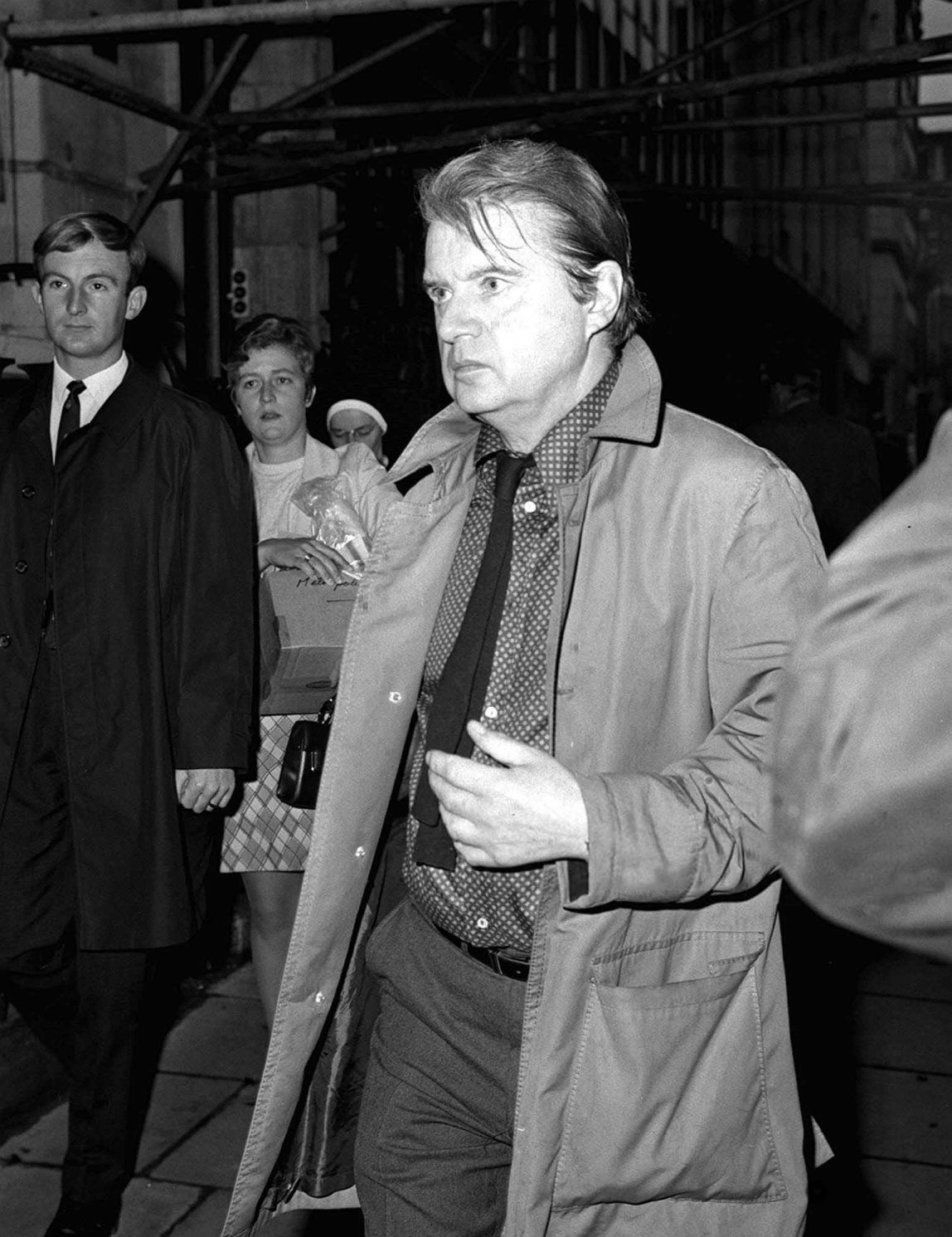
Francis Bacon leaving the Marlborough Street Magistrates
Artist remanded on drugs charge
FRANCIS BACON, 60, the artist, going to his car after being remanded on £100 bail until Sept. 30 at Marlborough Street yesterday, charged with being in unauthorised possession of a quantity of cannabis resin at his fiat in Reece, Mews, South Kensington.
His counsel, Mr Basil Wigoder, Q C, told the court: “Mr Bacon has no knowledge of a package alleged to have been found in his home. He is not a person who indulges in cannabis smoking.”

ARTIST Francis Bacon, aged 60, was at Marlborough Street Court remanded on bail in his own recognizance in £100 until September 30 accused of unauthorised possession of cannabis resin at his flat in Reece Mews, Chelsea.
Mr. Basil Wigoder, Q.C., who appeared with Mr. M. Hill, for the defence, told the magistrate, Mr. Edward Robey, “He does not indulge in cannabis or any other prohibited drug. He has no knowledge whatsoever of the package alleged to have been found on his premises.”
LONDON NEWS
ARTIST Francis Bacon was remanded on bail at Marlborough Street today charged with possessing cannabis at his mews flat.
Committal proceedings against Mr. Bacon, 60, of Reece Mews, South Kensington, were opened but adjourned until November 10 because a number of witnesses were not present.
Mr. Bacon was wearing a short raincoat, check shirt and dark tie.

THE NEWS
ARTIST Francis Bacon, aged 60, elected trial by jury when he appeared at Marlborough Street accused of unauthorised possession of cannabis at his address in Reece Mews, Chelsea.
Defendant who elected trial at Inner London Sessions through his counsel, Mr. Basil Wigoder, QC, was further remanded on bail in his own recognisance in the sum of £100 until November 10, so that the analysist could be called to give evidence.
Francis Bacon and Henry Moore are the only British artists with an international following which assures them prices on a par with work emanating from Paris or New York. A Henry Moore sculpture has been sold at auction for more than £60,000 and Francis Bacon’s work has probably achieved prices well above that paid yesterday in private sales.
Bacon’s work is seldom seen at auction; his current work is managed by the Marlborough. A year ago a painting of a dog (1952) broke auction records for the artist at £18,500. Yesterday’s painting was the last in a series of eight portrait studies of a pope, dating from 1953, and probably linked to the study after Velasquez’s portrait of Pope Innocent X which Bacon painted from the inspiration of a postcard earlier that year.
This series of studies apparently started as portraits of David Sylvester but rapidly turned into papal form. The series started in calm and peaceful mood but became steadily more violent until they reached a state of “convulsive hysteria”; this was the last of the series.
A hearth rug designed by Francis Bacon reached £120 in spite of a good layer of dirt. The devotees of Henry Moore carried a drawing of reclining figures, dated 1944, to £3,800 (Thomas Gibson Fine Art). Another page of drawings inspired by Greek mythology did not evoke so much enthusiasm, failing to sell at £2,000. However, a small bronze reclining figure of a semi-abstract nature, 12in. long, made £3,200 (Piccadilly Gallery).
There were high prices for drawings and paintings by Jack B. Yeats. the Irish romantic. A colourful oil painting of an Amiens street with a carthorse and driver reached the top price at £3,100 (Victor Waddington); but even pen-and-ink drawings seldom dropped below £300.
The sale included a number of old favourites, notably Munnings and Lowry, but neither vas represented by his finest works. A white pony in a gravel pit by Munnings made £5,000 (Edmnunds) while a watercolour of the Devon and Somerset staghounds reached £1,200. Lowry’s “Street in Clitheroe” made £4,000 (T. Glaser). There was a lovely pen drawing of “Dorelia in a straw hat” by Augustus John, at £600 (Baring); and there were several attractive minor paintings and drawings about the £100 mark — even a Sickert. The sale totalled £119,482.
World record price for a painting by a British artist — £26,000 — was paid at Sotheby’s for a Francis Bacon portrait of a Pope.
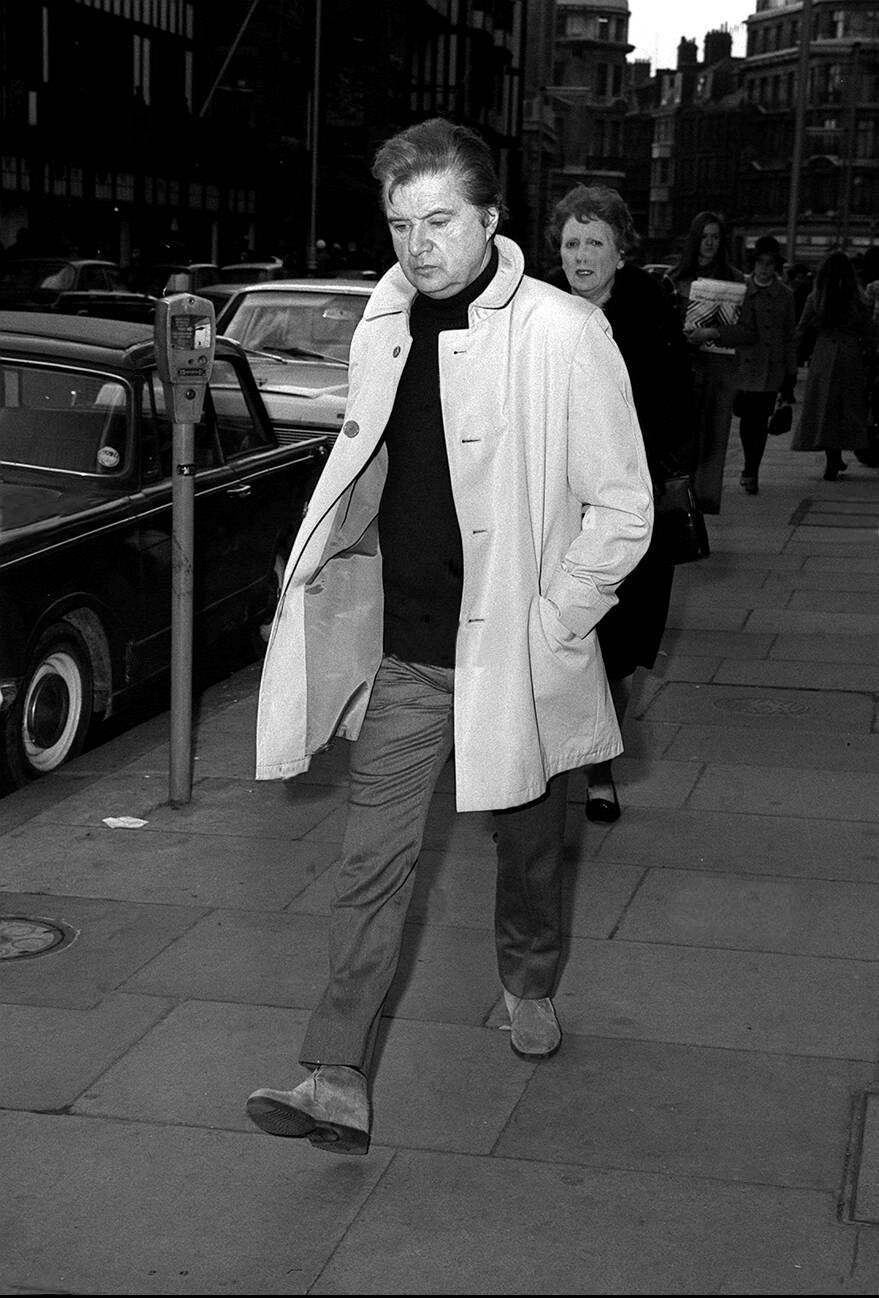
Francis Bacon striding along Great Marlborough Street in London on the 21st of December 1970
THE INFORMER
BY SUN REPORTER | NEWS | THE SUN | WEDNESDAY, JUNE 3, 1971
THE artist Francis Bacon was cleared on a drugs possession charge yesterday. Later he talked about an employee who had reported him to the police. Mr Bacon said: “I don’t blame him, he is a sick man.”
The man, George Dyer, was an alcoholic and was now in an institution.“Whenever he was under the influence of drink, he felt I did not pay him enough for the work he did for me as a model,” said the artist.
Dyer had given information to the police. When they searched Mr Bacon’s Chelsea flat, they found cannabis. Mr Bacon told the police: “It’s not mine. I do not smoke cannabis. I am asthmatic”.
TRAINED police dogs helped to “sniff out” quantities of cannabis in the Chelsea studio of one of Britain’s leading artists, Francis Bacon. But when he was charged by police he denied that he knew the drugs were there and said: “I don’t smoke cannabis because I am asthmatic,” a London Sessions jury was told today.
Bacon, 61, of Reece Mews, denied two charges of possessing dangerous drugs ... 2.1 grammes of cannabis resin on September 2 last, and a quantity of cannabis found on or before that date. His counsel, Mr Basil Wigoder, told the court that he was regarded as one of the greatest painters Britain had ever produced, and would not be challenging the police story of finding drugs in his very untidy studio.
In evidence, Bacon told of an employee named George Dyer with a grudge against him who gave some information to the police a week before his flat was raided. He described him as an alcoholic who, when under the influence of drink, accused him of not paying him enough. Questions about Dyer were dropped when the prosecution asked if he would be called as a witness and the defence said. “No”.
The jury was asked by the defence to treat Dyer as a “curious man in the background.” It would be unfair to suggest that Dyer with his imaginary grievance had actually put the cannabis in the house or got someone else to do so, but the possibility was there.
Miss Ann Curnow, prosecuting, told the jury that they would have to decide whether the artist knew of the presence of the drugs before they could convict him. During his evidence Bacon said that he had tried to smoke cannabis in Tangier in 1956 but had such a violent attack of asthma that he had never touched it since. His studio was visited by many people, though he would not knowingly allow them to smoke drugs there.
The story of the police-dog search was told by Miss Curnow who explained that several Chelsea police officers visited Bacon’s London home on September 2 with a search warrant. He asked them to wait until he could contact his solicitor, Lord Goodman, but they insisted on searching the premises there and then. In his studio were a vast number of canvases.
Two of the police officers had dogs trained to smell out drugs, and in the living room one of them found a pipe stem in a chest of drawers which contained a brown substance later proved to be cannabis. Another dog handler found a tiny piece of cannabis resin wrapped in sliver paper under a pile of old clothing in the artist’s studio.
When Bacon was asked about the pipe stem he said: “Look, I have various people up here. It has probably been there for ages and must belong to them. It is not mine.” He maintained throughout that the pipe stem was not his and when he was asked about the cannabis resin in silver paper he preferred to say nothing until he had seen a solicitor which he was properly entitled to.
Miss Curnow claimed the pipe stem had clearly been used for smoking cannabis although there were only traces of the drug by the time police found it. The jury would have to be satisfied that Bacon knew about the cannabis resin before they could find him guilty. Woman Det Sgt Carol Bristow, who had led the search, agreed in cross-examination by Mr. Wigoder that the police had received “some information” on August 27, some days before the raid, from a man named George Dyer.
Mr. Wigoder showed the jury photographs of the studio, and Judge Leslie commentated: “I think everyone will agree it was in a pretty untidy state.” When Bacon went into the box, he said that he had paintings in the Tate Gallery, the Museum of Modern Art in New York, and in other galleries.
About 15 years ago, during his travels round the world, he twice tried to smoke cannabis in Tangiers but each time had a violent attack of asthma and had never smoked it since. Asked if he had any feelings one way or the other about people who smoked cannabis, he replied: “As a layman it is impossible for me to say.”
His defence council asked if he allowed people to smoke drugs on his premises. He told the jury: “I would not if I knew what they were smoking it, knowing how the law stands.” Referring to George Dyer he explained that the man has worked for him for about eight years.
On occasions, Bacon said, he gave Dyer “ready cash to keep him alive,” because his regular wage was sometimes insufficient for his drinking habits. On the morning of August 26 last year Bacon said he gave Dyer £4 but when Dyer telephoned him again early next day he refused him more money.
“I said I was working and gave
him some yesterday,” he said. On the 28th
Mr. Wigoder ceased his questioning about Dyer after the prosecution asked if Mr. Dyer would be called as a witness and was told “No”.

Francis Bacon and Valerie Beston stride along Great Marlborough Street in London on the 4th of January 1971
NEWS | GUARDIAN JOURNAl | NOTTINGHAM | THURSDAY, JUNE 3, 1971
FRANCIS BACON, the 61-year-old artist, was cleared of two drug charges yesterday. Mr. Bacon, described in court as “a painter of international fame,” told the court he could not have smoked cannabis found in his house because he was asthmatic.
He had tried it in Tangier on a visit in 1956. “I made two efforts. Each time I was violently upset, and I have never done so since.” An application for the defence costs of the hearing at the Inner London Sessions was postponed by Judge Leslie.
Miss Ann Curnow, prosecuting, said detectives and a dog trained to search for drugs had found a pipe stem and the cannabis at the artist’s home. Mr. Bacon pleased Not guilty to having 2.1 grams of cannabis on September 2, and also denied a similar offence on or before that date.
No bowl
Miss Curnow said he invited the officers into his home at Reece Mews, Chelsea. When he was shown the pipe stem he said: “I have various people coming here. It has been here for ages, and I suppose it must belong to them.”
A police officer told him it was for smoking opium or cannabis and pointed to a brown substance in it. Bacon said he had no idea what it was, and was alleged to have added: “I have told you it’s not mine. I never smoke cannabis as I am asthmatic.”
Miss Curnow said the search also revealed a box containing a brown substance wrapped in paper. No bowl for the pipe was found.
Francis Bacon, aged 61, the artist, was cleared of two drug charges at Inner London Sessions yesterday. Mr. Bacon, described in court as a painter of international fame, told the court he could not have smoked cannabis found in his house at Reece Mews, Chelsea, London, because he was asthmatic.
He had tried it in Tangier on a visit
in 1956. He added:
An application for the defence costs of the hearing was postponed by Judge Leslie.
Miss Ann Curnow, prosecuting, said
that when police showed him a pipe stem found during their search, he said:
OF DRUG CHARGES
ARTIST Francis Bacon, 61, was cleared of two drug charges yesterday.
Mr. Bacon, described in court as “a painter of international fame,” told the Inner London Sessions that he wouldn’t have smoked cannabis found in his flat because he suffered from asthma. He had tried it, though, on a visit to Tangier in 1956.
Detective Sergeant Carol Bristow told the court that after a tip-off she and other officers went to Mr. Bacon’s flat in Reece-mews, Kensington, last September.
Specially trained dogs uncovered 2.1 grammes of cannabis resin underneath a pile of clothes in the studio, she said.
Mr. Basil Wigoder, QC, one of the three defending counsel, said that the studio was so untidy it would be possible to hide a baby elephant there. It was not surprising Mr. Bacon was unaware of the cannabis hidden there, he said.
Mr. Bacon pleased not guilty to two charges of having cannabis.
Artist cleared on drug charges
THE 61-year old artist Francis Bacon was cleared of two drug charges yesterday.
Bacon described in court as a “painter of international fame” told the Inner London Sessions he could not have smoked cannabis found in his house because he was asthmatic.
He had tried it in Tangier on a visit in 1956. “I made two efforts. Each time I was violently upset, and I have never done so since.”
Miss Ann Curnow, prosecuting, said detectives and a dog trained to search for drugs had found a pipe stem and cannabis at the artist’s home in Chelsea.
Bacon pleaded not guilty to having 2.1 grams of cannabis on September 2 and also denied a similar offence on or before that date.
When he was shown the pipe stem he said: “I have various people coming here. It has been here for ages and I suppose it must belong to them.”
Miss Curnow said the search also revealed a box containing a brown substance wrapped in paper. No bowl for the pipe was found.
Artist is cleared
Francis Bacon (61), the artist, was cleared of two drug charges yesterday.
Bacon, described in court as a “painter of international fame,” told the court that he could not have smoked cannabis found in his house because he is asthmatic.
An application for the defence costs of the hearing at the Inner London Sessions, was postponed by Judge Leslie. Miss Ann Curnow, prosecuting, said that detectives and a dog trained to search for drugs, had found a pipe stem and cannabis at the artist’s home.
Bacon pleased not guilty to having 2.1 grams of cannabis on September 2, and also denied a similar offense on or before that date.
Miss Curnow said he invited the police into his home at Reece Mews, Chelsea.
When he was shown the pipe stem he said: “I have various people coming here. It has been here for ages, and I suppose it must belong to them.”
FRANCIS BACON
CLEARED OF
DRUG CHARGES
DETECTIVES with two dogs trained to smell out drugs raided the studio home of Francis Bacon, the artist, after a tip-off from a man he employed as a model and handyman.
But at Inner London Session yesterday, Bacon, 61, of Reece Mews, Chelsea, whose works hung in the Tate Gallery and throughout the world, was found not guilty on two charges of possessing cannabis.
The jury heard that the police found a 12-inch pipe stem among underclothing in a chest of drawers.
And in the studio under a pile of clothes, a police dog, “Colonel,” sniffed out 2.1 grammes of cannabis wrapped in sliver paper in the bottom of a paintbox.
The police tip-off had come from Mr George Dyer, who had been employed by Bacon as a model and general handyman for eight years.
Miss Ann Curnow, prosecuting, said police led by Woman Det Sgt Carol Bristow raided Bacon’s studio at 8.25 a.m.
Sgt Bristow said that Bacon answered the door and when shown a search warrant, said: “May I ring Lord Goodman?”
Miss Curnow asked: “Who is he?”
Sgt Bristow: “I understand he is a solicitor.”
She continued that when shown the pipe stem Bacon said: “Look, I have various people here and it must belong to them. It must have been here for years. It is not mine. What is it used for?”
When the cannabis was found in his studio Bacon said: “I do not smoke cannabis. I do not smoke at all. I am an asthmatic.”
Answering Mr Basil Wigoder, QC, for Bacon, Sgt Bristow agreed that she had to seek information from George Dyer about drugs on Aug. 27. She accepted that the studio was disorderly, untidy and chaotic.
Bacon in evidence, said he did not smoke because of his asthmatic condition. In 1956 in Tangier he made two attempts to smoke cannabis but suffered from violent asthmatic attacks and had never smoked it since.
He added: “I would not allow people to smoke it in my premises if I knew what they were smoking, with the law as it stands.”
Writers, artists, students and people of the art world were frequent callers at his studio.
He said he had employed Dyer for eight years. Dyer, ill through alcoholism, often made allegations against him when drunk. Dyer had told him he had been to Borstal and jail.
Twice, Dyer had attempted suicide.
Bacon continued: “When he is drunk he feels I don’t pay him enough. Sometimes he has broken down my front door and broken into my flat.
“I pay him a regular wage but that doesn’t suffice because of his drinking and he comes and asks for more. Sometimes I give him some, sometimes I don’t.”
On Aug. 27 last he declined to give Dyer any more money and he learned later that he had gone to the police.
Found after visit
Bacon said the pipe stem belonged to a man who had visited his flat five years ago and was now living abroad. He found the stem on the floor after the visit and put it away and forgot all about it.
He said he had no idea where the cannabis in his studio had come from.
Bacon had pleaded not guilty of unlawfully possessing 2.1 grammes of cannabis resin on Sept. 2 last; and having unlawful possession of an unknown quantity of the drug on or before that date.
After his discharge Bacon said: “I bear no animosity towards Mr Dyer.
“He is a very sick man. I still employ him and I have kept contact with him while he was in hospital.
“I shall continue to employ him. Naturally I am relieved this whole business has cleared my name. It has been a great strain.”
ARTIST Francis Bacon, 61, was cleared of two drug charges at Inner London sessions yesterday.
He
denied having 2.1 grams of cannabis
No costs for acquitted artist
Artist Francis Bacon failed today in his application for defense costs at the Inner London Sessions, after being found not guilty last Wednesday of two charges of possessing cannabis in his Reece Mews, Chelsea, flat.
During the trial, Mr. Bacon said that a pipe stem found by detectives who searched his home on September 2 was probably left there by one of the numerous visitors to the studio.
He had no knowledge of cannabis contained in a paint box there.
Francis Bacon’s plea for costs rejected
Francis Bacon, the artist, failed yesterday in his application for defence costs at Inner London Sessions. He was found not guilty last Wednesday of two charges of possessing cannabis in his flat in Reece Mews, Chelsea.
Judge Leslie said: “I have considered the circumstances of the case and decided it would not be appropriate to make such an order.”
During the trial Mr. Bacon said that a pipe stem found by detectives who searched his home on September 2 was probably left there by one of the numerous visitors to his studio. He had no knowledge of cannabis contained in a paint box there.
Francis Bacon, 61, the artist, failed yesterday in his application for defence costs at Inner London Sessions after being acquitted last Wednesday of two charges of possessing cannabis in his flat at Reece Mews, Chelsea.
Judge Leslie said: “I have considered the circumstances of the case and decided it would not be appropriate to make such an order.”
During the trial, Mr Bacon said that a pipe stem found by detectives who searched his home on Sept. 2 was probably left there by a visitor.
FRANCIS BACON CLEARED
OF CANNABIS CHARGES
CHELSEA ARTIST Francis Bacon who was said in court to enjoy a world-wide reputation for his paintings, was acquitted on two charges of being in possession of cannabis by a jury at the Inner London Sessions last week.
Mr Bacon, 61, whose home is at Reece Mews, had denied both charges.
Det.-sgt. Carol Bristow, in charge of the raid, knocked at the door of the studio ay 8.25 a.m. and it was opened by Bacon, who asked if he could telephone his solicitor when shown a search warrant.
Miss Ann Curnow, prosecuting, said that after a tip-off, police with dogs trained to detect cannabis went to Mr. Bacon’s studio home.
After a search, in which the dogs took part, the police found a pipe stem and under pile of clothes some cannabis wrapped in silver paper in a paintbox.
Shown the articles, Mr. Bacon said: “Look, I have various people here and it must belong to them. It must have been here for years. It is not mine. What is it used or?”
He added that he did not smoke cannabis and suffered from asthma.
Questioned by Mr. Basil Wigoder, QC, defending Mr. Bacon, the detective agreed that the studio was in a “chaotic” condition and was generally untidy and disorderly.
She agreed that the information about the presence of the drugs had come in the first instance from a man named George Dyer, who had been employed by Mr. Bacon as a model and handyman.
The artist told the court he had suffered from asthma for years, and when in Tangier in 1956 he had heard that cannabis was good for asthma. He tried the drug twice, but as a result had two violent attacks of asthma and he had not smoked either cannabis or tobacco since.
If he knew a visitor to his studio had cannabis and was smoking it, he would not allow it, because he knew that in England it was illegal.
He had visits from all types of people in the art world, and there were also writers and students; any of them could have left the pipe stem and cannabis, which certainly did not belong to him. Dyer, he said, had worked for him for eight years as a model and handyman.
When Dyer was drunk, said Mr. Bacon, he riled him and said he did not pay him sufficiently. Although he received a regular wage, Dyer was frequently without money because of what he spent on drink.
On these occasions, he asked for more money, and sometimes he acquiesced and sometimes he refused.
It was after he had refused to give Dyer more money that he learned later that the handyman had gone to the police.
He believed the pipe stem belonged to a man who left it in his studio about five years ago and was now living abroad.
He was unable to say who had left the small quantity of cannibals—2.1 grammes—in one of his paintboxes.

Sublime repetition
DISCUSSING the sublime, Longinus defined a great work as one which bears a repeated examination, and which is difficult or rather impossible to withstand and the memory of which is strong and hard to efface.
One might argue with the ultimate validity of this definition; for instance, after Van Gogh we can hardly see a cypress tree except in the memory of his vision of it as an irresistible green flame of vital energy springing, sprinting, from the earth; but does that lead us to the essence of cypress and life, or really put some masterly imposition, some ultimate limitation, on it? But this definition does provide a practical aid to sharpening our appreciation of art; I’ve been reflecting on it this week and found various exhibitions with a number of works which bear repeated examination and still have untapped reserves of power.
Marlborough Fine Art have opened their spacious, airy and bright new premises at 6, Albemarle Street, with a show of modern masters; though, alas, some plums of the show were borne off during the earlier New York showing, the wall where side by side hang one of Arp’s merriest mustachioed reliefs, a classically simple Morandi as good as anything in the recent retrospective, one of the most charming of Magrittes and a Klee of entrancing good humour and wit, bears, to put it mildly, “repeated examination” — as does the grand Francis Bacon from his remarkable 1957 Van Gogh series; the whole quotation from Longinus, in fact, applies to this work.
When the copying had to stop . . .
RICHARD CORK | ART NEWS | EVENING STANDARD | THURSDAY SEPTEMBER 16 1971
THE PROGRESS of modern art has been pitched so stubbornly against the idea of a continuous tradition that it seems almost amazing, now, to realise how avidly artists of the past fed on their predecessors achievements.
Most of the great pioneers of the beginning of this century were concerned above all with rejecting old standards, turning their backs on everything which had previously been hallowed in order to forge themselves a completely fresh alternative. The legacy handed down to them by Western art became a positive threat, an intolerable burden which must be jettisoned if true creative vitality was to be rediscovered. And so verbal exhortations to “flood the cellars of the museums” ran hand in hand with visual innovation, as if the imply that it was no longer relevant to measure oneself against bygone masterpieces.
Such subversive impatience was, at heart, necessary.
A BLIND ALLEY
Nineteenth century art had driven itself deep into a blind alley of academic realisms and nothing short of a brutal insurrection was required to re-establish the artist’s inalienable right to organise the visible world according to the dictates of his private imagination.
But this philosophy of independent renewal was, at the same time, an over-simplification.
Those who screamed most loudly for the scalps of mostly old masters often leaned surprisingly heavily on precedents of their own: African sculpture, Persian miniatures or Japanese prints. And not only distant prototypes, either.
The Cubists freely acknowledged their debt to Cézanne, who had controverted all their professedly revolutionary aims by declaring that he wanted to make his art “solid and enduring, like the art of the Museums.”
And the Futurists, who were loudest of all in their dismissal of every conceivable heritage, owed more to the discoveries of Impressionism than they would have cared to admit.
Despite the undeniable disruption that art underwent around the turn of the century, the links binding present and past were never severed as abruptly as the avant-garde liked to believe.
There was a dialogue between the generation in the act of rebellion itself: for without an acute knowledge and awareness of tradition, no artist would have felt the need to protest so strongly, to break away with such iconclastic vigour. And there was, too, a sense of continuity in the very need for dramatic change.
Ever since Masaccio proved, once and for all, on the walls of the Carmine chapel that Byzantine ideals were an anachronism, European art had proceeded by a series of revolts and counter-revolts — Renaissance flouted by Mannerism, Baroque undermined in turn by Neo-Classicism.
The birth of modernism was unique in the extremity of its demands, not in its basic cry for renewal; and only now, when the full implications of Dada are being explored by a whole new cross-section of dissatisfied experimenters, are the fundamental premises upon which art rests questioned with ruthlessness.
AN INTEGRAL PART
It is toddy’s young artist, actually refusing to comply with the old idea of an art object, who will feel most acutely at odds with the dialogue laid bare in the Art Into Art exhibition now staged at Sotheby’s by The Burlington Magazine. For here, charted with exemplary precision by by Keith Roberts, the full extent of one master’s dependence on his forbearers is revealed blow by specific blow. A lot of the most striking parallels, of course, are found in the business of student copying, a discipline as automatic then as it is neglected now. No painter, how ever overbearing and idiosyncratic his personality may have been, regarded the transcription of another man’s work as in any way beneath his dignity.
On the contrary; it was considered an integral part of an artist’s education, scrutinising the accumulated knowledge, expertise and inspiration of former ties in order to furnish himself with a comprehensive armoury of pictorial weapons.
Where nowadays extensive copying would be interpreted as a sign of a limited and dangerously passive imagination, then it was seen as an enrichment.
And a man like Rubens — whose pictures are all stamped with the instantly recognisable imprint of a single-minded intelligence — willingly sketched the celebrated Laocoon group form unusual angles to ensure that he grasped every lesson which classical art could teach him.
Once this act of homage had been performed, he felt able to draw on the experience in some of his most personalised paintings. The figure of Christ in his Descent from the Cross could not possibly have been created by anyone else, and yet it springs directly from an intensive study of Laocoon’s central protagonist.
ROBUST AMALGAM
The contemporary connoisseur would be delighted when he spotted the allusion, but Rubens did not borrow this august prototype merely to parade his learning. Rather did he use the Laocoon as an underlying framework upon which to construct his own vision and demonstrate — by such a vivid confrontation of old and new — just how much originality he was capable of commanding.
When, therefore, the Burlington exhibition traces the response of successive artists to the challenge of a statue like the Farnese Hercules, it manages to define their separate individualities with fascinating clarity.
The statute itself, a heavy muscled tour-de-force which survives only as a copy after a lost Greek original, becomes little more than an anatomical showpiece in the hands of the pedantic Goltzius.
But Michelangelo charges it with unforgettable energy and unease in his his Last Judgement fresco; Rubens joins both the Hercules and Michelangelo variation in a robust amalgam of his very own ordering; and Ingres, 200 years later, invests it with his unique linear stringency.
All four artists are ostensibly are engaged in inventing at second-hand; and yet, because of their ability to metamorphose someone else’s work into an individual statement, the idea of borrowing loses its deprecatory overtones.
Instead, it becomes a marvellous leit-motif, running like a connecting thread through the paintings and sculpture produced by otherwise diverse and contradictory temperaments, and emphasising unity even in the thick of immense variety.
Before the practice of copying deteriorated into an inflexible ritual, artists felt free to play around with their sources in any number of delightful ways. Caravaggio turns a monumental Michelangelo athlete into a homosexual pin-up, Copley pushes the Borgliese Gladiator over on his back to make him a drowning swimmer, and Manet twists a Raphael goddess so cunningly that she becomes a symbol of anti-bourgeois liberation in Le Dejeuner sur l’Herbe.
But eventually, with the rise of the academies, this wonderful freedom was debased, and classical casts became a tyranny rather than a springboard for fresh invention.
The nocturnal claustrophobia in Wright of Derby’s student group clustered reverently around an antique marble foreshadows the narrow feeling of duty with which the 19th century approached tradition: and helps to explain the vehemence of modernism’s reaction to the entire activity.
Copying rapidly became a dirty word, and it is surely significant that the one living artist who still insists on interpreting the old masters — Picasso has also been a eclectic throughout his life.
His endless embroidering on Velasquez, Manet and Delacroix are more like admissions of his aged descent into self-parody than true variations in the old sense of the world. And even Francis Bacon, who made Velasquez’s Pope Innocent X a cornerstone of his work for several years, could only resort to a shocking mixture of violence and fear when he employed this hallowed image.
His desecrated Pontiff represents, perhaps, a last desperate attempt to come to terms with our heritage, and its wild distortion is a measure of the chasm which now separates us from the continuity enjoyed by other generations, so many years ago.
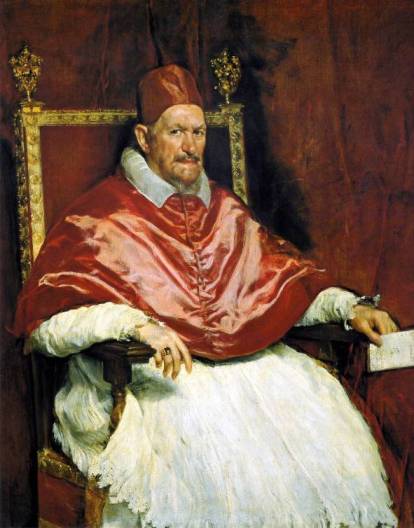
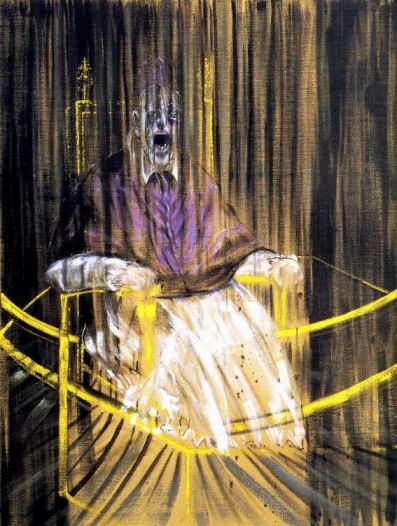
Pope Innocent X by Velazquez . . . and by Francis Bacon
A rare, revealing interview with the English painter to whom
France is about to pay signal honour
WHEN Francis Bacon’s retrospective exhibition of 134 paintings opens at the
Grand Palais in Paris on October 27, it will mark the highest honour France has
ever paid to a British artist; but Bacon himself doesn’t relish the prospect.
“I won’t enjoy seeing the Paris show,” he told me “beyond being curious to see what the hell all those pictures look like. It was the same with my Tate Gallery show some years ago — I was extremely drunk when I saw it and I simply thought: have I really done all this stuff?”
With most artists, such a detached attitude towards worldly reputation could look suspect, even insincere; with Bacon, however, the unconcern seems entirely commensurate with his whole outlook on life. His personal circumstances, for one thing, are extraordinarily modest.
Like a ship . . .
The man whose paintings can now fetch as much as £40,000 each lives in a ramshackle Kensington mews, and as soon as you try ringing at the front door it becomes quite obvious that the bell doesn’t work. “I do hope you haven’t been waiting outside for ages,” he says apologetically, opening the door in response to your knocking. “I don’t actually want the bell to work, because if I did I’d have to see all sorts of terrible people I don’t want to see at all.”
And once inside, the surroundings are hardly less makeshift. A steep flight of wooden steps — “rather like a ship isn’t it?” — leads up to a surprisingly small, shabby studio, its walls covered in a flurry of random brushstrokes. Canvases are stacked up everywhere, confining the potential working space even more drastically, and the windows are blocked out, leaving what little light there is to filter in through the skylight alone.
How can those large triptychs possibly be executed in such a cramped environment? “Well, I know it seems strange,” Bacon admits, puzzling almost at the perversity of his own requirements, “but I’ve tried painting in a larger studio and it just doesn’t work.”
Across the passage, likewise, the scene is one of disorder rather than luxury. A huge mirror leans against one wall, its glass severed by a dramatic crack; William Blake’s death-mask sits paley on a desk top; and an accumulated debris of art books lies scattered over every available surface The whole flat could only be inhabited by a man whose inner, imaginative life was so absorbing that external details scarcely mattered.
And this impression was confirmed immediately I started interviewing Bacon, for it became apparent at once that the usual social props attendant upon any first meeting — small talk, the banter that establishes a preliminary rapport — simply were not needed. So central are the problems of making art to Bacon’s existence that he was ready to discuss them without any prompting on my part.
While he is talking, one is aware the whole time of the physical passion behind Bacon’s words. When he says he wants to make things as raw as possible, his arms shoot out in front of him so that both hands can stretch up and clutch the meaning he is attempting to convey. Sometimes, the bodily gestures are a substitute for verbal coherence, as he becomes overwhelmed by the complexity of his theme and lapses into silence.
But more often than not the fists are clenched at he exact moment when he says that he wants “to paint a nose with all the violence of a real nose,” and the combination of speech and movement immediately gives a vivid insight into the motivation behind all those exclamatory pictures.
You realise, all of a sudden, that Bacon is not being fanciful when he disclaims the elements of anger that most spectators see in his work. To him, disturbing and distorted forms are no more than the inevitable outcome of his own peculiarly intense and dramatic vision of life.
It is a complicated, highly ambivalent vision, which enables him on the one hand to say with complete conviction that “I’m essentially optimistic, always grateful when I wake up each morning and discover I’m still alive;” and on the other hand to declare, without a hint of morbidity, that “even when one is in a strong sun, casting a black shadow, death is always with you.”
Putting it another way, Bacon claims that although he doesn’t “consciously look for violence,” he does suspect that he hasn’t got “as many veils as most people have screening them off from life. Every time I enter a butcher’s shop I am made aware of the violence which custom protects us from.”
He is at pains to reject the accusations of Grand Guignol which such a remark often elicits, and writes off the celebrated series of screaming Popes as an outright failure. “I know they never came off,” he admits, calmly and without regret. “Making them scream was melodramatic, I can see that now, even though at the time I wanted above all to paint a mouth with the beauty of a Monet.”
The statement highlights the gap separating Bacon’s own intentions from the response accorded to his paintings by the public — a gap perhaps aggravated by the fact that “I start off with a very definite idea of what I’m going to do on the canvas, but it always finishes up very differently in the end.”
The unpredictable nature of his working methods means that Bacon is playing with fire when he paints, invariably ending up with a picture which disappoints him so greatly that it ha to be destroyed. “Painting touches on the nervous system in a way that other media cannot do,” he insists. “It traps life in a tangible, physical fashion.”
But when the pictorial electricity he reeks runs out of control, then the misunderstandings begin. Bacon is the first to admit the high failure rate in his work, and it is this that helps to account for the rough handling he has usually received from the critics. Despite his immense international stature, greater now than ever before, he remembers recently “looking through all the reviews I’ve had from my Marlborough shows over the years and realising that all of them, virtually without exception, were bad.”
He told me this without the slightest trace of concern, for Bacon must by now be used to his position as a lonely outsider, running completely against the mainstream development of modern art. Where other artists dispense with representation, and along with it the entire convention of easel painting, he stubbornly clings to the great tradition of past European art. Velasquez and Rembrandt feature more largely in his conversation than any contemporary figure — he seems enormously knowledgeable about the whole history of art — and he is extremely critical of most current developments.
“Young artists today think that choosing a new medium is the answer,” he says. “but it usually turns out to be a substitute for creation rather than the thing itself. Everyone wants something new, including me, but of course it won’t be new unless you have the compost of the past as well. The past nourishes you, and denying that source of nourishment is like cutting off one arm to make the other better. I’ve never felt the need to reject the past, I feel I relate to tradition very strongly.
“But I won’t ever know whether I’m really any good because it takes such a long time for things to fall into place. And there’s no point in worrying about what you feel you ought to be doing in terms of the historical evolution of art, either. You can only do what your impulses demand, and that doesn’t mean I see myself as the last of a line. The possibilities of oil painting are only just beginning to be exploited: the potential is enormous.”
Velasquez
For Bacon, the future seems to lie in an even more intense examination of his own inner emotions. “Painting is like telling the story of your life,” he says. “When you look at a Velasquez portrait you don’t think about Philip IV — you think about the painter’s own thoughts and feelings, and this is what concerns me more and more.”
So much so, in fact, that Bacon is at present planning the most sustained and ambitious project of his entire career. “After the Paris show I’m going to deliberately set about painting an autobiography,” he said. “Someone offered me a lot of money once to write the story of my life, and I refused; what’s the point, unless you are Proust.
“But painting is quite another matter, and I can remember the progression of my life very clearly from a very young age.”
How would such a scheme fit in with the kind of pictures that are associated with Bacon? He gave the answer himself when he told me about his memory as a four-year-old of “walking up and down a pathway lined with cypresses at my Irish home dressed in a bicycling cape which I used to borrow from my brother.” The image makes sense instantly: it could have come straight out of a Bacon painting, and it probably will if he manages to fulfil his scheme.
“I hope to crystallise time through this series in the way that Proust did with his novels,” he said. “It’s the most rewarding thing I could possibly do, and it’ll probably absorb my energies right up until the end. The autobiography will only end when I myself die.”
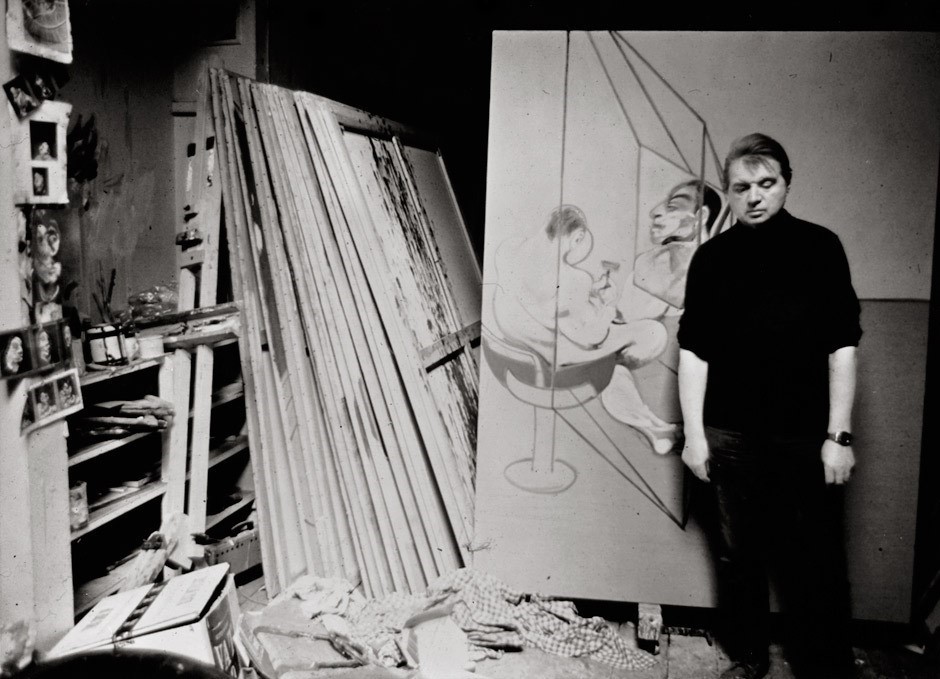
Francis Bacon in his Kensington studio: memories a a four-year-old Michael Pergolani
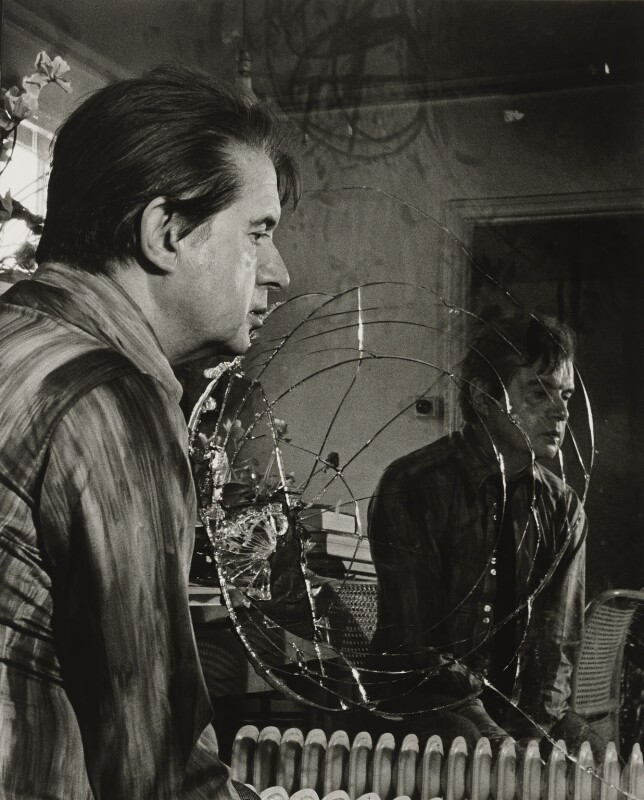
A NIGHT
NIGHT (ONE) “How are ya, ducks? what’ll it be Francis? Champagne? What? Three bottles? Oh, Mary, he’s treating us all. What’s your friend’s name? Well, isn’t that nice. A journalist, is he? You a queer or a straight journalist, ducks? The queerer the better, I always say. Francis has been coming around for twenty years, haven’t you? Painted me, too, and more than once he has. In the early days, Francis waited behind this bar, for drinks, didn’t he, now it’s his second home, you might almost say, g’wan, open another bottle and this ones on the house!”
Muriel Belcher, a proprietress to reckon with. She sits regally on the first bar stall of her tiny club—the Colony Club, on Dean Street, Soho, London. Muriel is famous. She’s been written up in all the papers—her place is littered with blow-ups of them and, invariably, the name Francis Bacon appears among the list of her famous and infamous habitués.
Wandering off, I look them over and find this quote from Bacon: “She dissolves the sexes so that they come together in a relaxed way to live out their fantasy. Her language has become very exaggerated and that vaporises the atmosphere for a start ... There’s something there that comes from an ancient world—perhaps the Babylonian world. She made me understand how to attempt, at least, to enchant.”
Francis Bacon, undoubtedly Britain’s greatest painter, has brought me to Muriel’s in answer to a question I asked him earlier that day. I had wanted to know how he lived. And he was showing me—standing here, chatting animatedly with Muriel in her rather sad little Club where the atmosphere is exhilaratingly permissive, where the crowd of men (and perhaps three women) can be seen reflected in dust mirrors, where their talk is washed over by the sound of a piano at which a handsome man sings the gay and sentimental American songs of the Forties and Fifties. “Play Lover Man,” someone shouts. Three young men of indeterminate background, profession and apparel surround him, put their arms around Francis Bacon and speak to him in Cockney that is as fast as it is unintelligible. There is an intensely familial air about this group crowding around him. He seems to know all their secrets, and seems to share in their concern. One of them, a handsome, red-headed fellow, brings him back to Muriel’s bar-stool, and the three drink and gossip and laugh and make time stop.
I look at Bacon. He is a slight man. Standing in this semi-darkness, smoking and drinking and a bit shaky on his feet, he presents the image of an awkward teenager—aged sixty-two. This duality in him—the stance, mannerisms and appearance of youth, and the reality of his age, combine to give his gestures a curious sense of timelessness, as though he had never quite experienced the process of growth, nor had ever laid claim to the calamities or ecstasies of young manhood. A time-vacuum seems to encircle him—very akin to those strange and fragile glass enclosures that frame certain figures in his paintings. But this is merely an outward image.
By now, Bacon has had a great deal to drink. His mind, however, is lucid. He leans close to me and says, “This is how I live. It doesn’t look very violent, but somewhere it is quite violent. At least, under the surface. You see, comfort is an unnatural state for me. The point is, life is violent and most people turn away from that side of it in an attempt to live a life which is screened. But I think they are merely fooling themselves. I mean, the act of birth is a violent thing, and the act of death is a violent thing. And, as you surely have observed, the very act of living is violent. But I feel very strongly that an artist must learn to be nourished by his passions and by his despairs. These things alter an artist whether for good or the better or the worse. They must alter him. The feelings of desperation and unhappiness are more useful to an artist than the feeling of contentment, because desperation and unhappiness stretch your whole sensibility. And so, come ... let’s have more to drink. Another round Muriel. Open another bottle.”
We move to The Londoner, more elegant than Muriel’s but Mike McKenzie, the pianist, who only minutes earlier had sung his heart out at Muriel’s is presently doing the same here. And the songs are all the ones we’d just been hearing. Once more Bacon orders several bottles of champagne.
“I never think bout happiness,” he says out of nowhere. “I never think bout happiness or unhappiness. Of course, there are times when a relationship with someone or with one’s work gives one happier moments. But it would be stupid, at my age, to think of happiness. Actually, I think about the most banal things, but they some how all link up. As for people, I never hang out with artists, or writers. They generally bore me. I like people who run clubs and gambling places. I remember living in Tangier once—it used o be the playground of English villains—and I knew a great number of them. They had a kind of life and vitality about them.
“I’ve learned, as life progresses, to become more cunning. I know where I’d automatically go wrong, which I wouldn’t have known when I was younger. Anyway, I’ve become more cunning both in my work and in my relationships. When I say cunning, perhaps it’s the wrong word. I think knowledgeable is a better word because, in fact, I don’t like cunning people.”
“Of course I suffer. Who doesn’t? But I don’t feel I’ve become a better artist because of my suffering but because of my willpower and the way I worked on myself. In a sense I could say that I painted my own life ... but only in a sense. Very few people have a natural feeling for painting, and so they naturally think that it is an expression of the artist’s mood. But often he may be in greatest despair and painting his happiest paintings.”
DAY: I had been warned. An English acquaintance couldn’t have been clearer: “Don’t, for God’s sake, talk to Francis Bacon. He’s an awful man, always pissed—God knows how he ever gets any work done. He’s sinister, hangs out with the dregs of the world—crooks and perverts and jail-birds and thieves, probably, child-molesters.”
But on a sunny afternoon Francis Bacon appears at my door, wearing a suit and tie, looking oddly handsome, with is hair combed, his face clean-shaven, his finger-nails in good repair—about as sinister-looking as an English choir boy. He smiles, accepts a Scotch, sits down on the sofa and lights a cigarette. There is, to be sure, a certain diffidence—a certain sense of oblique alertness, perhaps even suspicion. He is clearly not one for small-talk and I sense the effort of his amenities. But his voice is gentle, his words are clearly and intelligently articulated. While he later confessed that he had braced himself with several drinks before our meeting, he appears far from drunk or tense or anxious.
And yet, anxiety, terror and turmoil attend his every work; writhing figures on dirty, crumpled beds; snarling dogs; screaming, contorted faces; scenes of physical agony, misery and despair, spill with blood-curdling accuracy and intensity upon his canvases. But these chilling dramas unfold with a miraculous economy of colour and composition. The dynamics of a Bacon painting are formulated by means of an unerring instinct for the right pictorial thrust and gesture. The uniqueness of his style is based on a vision that concerns itself with precise yet never photographic observation. It is a deeper form of reality, as actually felt as it is observed. The terror it may engender is merely a by-product of a clarity filtered through intuitions that unwittingly unmask the cores of fear—exposed nerve-endings residing just beneath the skin. The results are invariably disquieting.
“These qualities of terror and anxiety that people so often talk about are the last things I’ve actually ever attempted to convey,” he tells me. “I have attempted to be as realistic as I possibly can. If you really think about life, about realism, about a lump of meat on your plate, that, in itself, if you think about it, is a very frightening thing. And so, I’ve really been rather curious as to why people find my work ridden with anxiety. It is certainly not how I think about it. I’ve tried to make images that would unlock the valves of feeling on different levels. For me, to be realistic has meant extreme deformations.
“For example, I’m very interested in trying to do portraits, which now is almost an impossible thing to do, because you either make an illustration or a charged and meaningful appearance. It’s a continuous hazard, chance, or accident. I start, in a sense, almost like an abstract painter, although I hate abstract painting. I hate it because I think it can only end in decoration. But this dilemma ... how are you going to make a nose and not illustrate it? What stroke will make this nose a strong nose? Well, it’s chance. It is when for a moment chance has given you something which you can seize on and begin to build on. All the way through on anything of mine that works at all, it is like an accident that has slid into the right position.
“I’ve done one or two nudes with a hypodermic syringe in the arm, it’s true, but I’ve very used the syringe like a rivet of reality—to rivet the body, to make one more aware of the body—and give it a heightened sense of reality. Or the triptych I once painted in which one of the figures has a red swastika band around his arm ... well, I happened to be looking at some Nazi photographs, and I thought that the armband would have a meaning for me only in the sense of making the figure hold together more roundly. I’m sure I shouldn’t have added the swastika, but there you have it. The point it is that I never try to ‘say’ anything. I’m only suggesting to myself, ‘How can I touch on ways of making this more immediate and more real?’
“Actually, I always know what I want to do but I never know how to do it. I plan, I think, I lay down all sorts of plans for myself about how it will be, or how it will look, but as I’m so reliant upon accident, it takes a long time for the accident to happen—for the sensation I want to come about, for my plans to fall into the form of reality that will satisfy me. I don’t begin by drawing on the canvas. I make marks and then I use all sorts of things to work with —old brooms, old sweaters, and all kinds of peculiar tools and materials. I know my paintings don’t look like that, but they start out like that because, you see, otherwise I should be making only illustrations.
“So that is the dilemma—perhaps the dilemma of all art today. Because if you know how to do something, it’s going to be just an illustration of an idea—and that’s not at all what I’m after. To tell you the truth, I can’t explain my art, or even my working methods. It’s like the person who asked Pavlova: ‘What does the Dying Swan signify?’ She said ‘If I knew, I wouldn’t dance it’.”
Francis Bacon accepts another drink. He shifts restlessly in his seat. I ask him why so many of his faces or portraits suggest a frightening and terrifying scream. “That has absolutely to do with two things,” he answers. When I first started to paint I bought a little book in Paris which had rather beautiful colour illustrations of diseases of the mouth, and it affected me very much; and then, of course, I was very much influenced by the screaming nurse in Eisenstein’s film Potemkin. And so those screaming heads have really nothing to do with the expressionist ideas. What I was after was the marvellous glitter of the mouth—you know, the saliva, the teeth, the colour of the inside of the mouth—nothing more.
“You see, when one is right inside the work, when the form and image is coming up to some kind of reality, then its very stimulating, because that’s when you bring things nearer to the nervous system. I don’t paint for anybody except myself. I’m always very surprised that someone wants to have a picture of mine. I paint to excite myself, and make something for myself. I can’t tell you how amazed I was when my work started selling!”
NIGHT (TWO) After Muriel’s Colony Club, and after The Londoner, and after nine bottles of champagne drunk by a quantity of people—but mainly by ourselves—Francis Bacon suggests another club a small club without a name. It is past 2 am. The streets are empty. London sleeps—but not this dark club—a very large and very sinister place. It is filled to capacity—and stifling. Its occupants seem comprised of London’s murky underworld. A giant of a man cautiously lets us in. Again, Bacon is welcomed at once.
In a moment, a short, fat, squat man—perhaps the proprietor—comes to greet us. His features have a quirky, somnambulistic look—a look reminiscent of Mongoloid heads with their blank, unfocused, sleepy eyes. But he is incredibly verbal, spewing forth Cockney verbiage too fast and too thick for me to comprehend. Bacon listens intently. The red-headed man finds a group of friends who come to join us. In the haze and heat of the place they seem eerie, furtive, tainted creatures, men bearing the looks of criminals. Amidst them Francis Bacon assumes their characteristics—some disturbing and potent element intensifies and curdles his appearance. He has become a Francis Bacon painting.
We all stand in an ill-lit corner of the vast room. Drinks are brought by a blonde, forlorn-looking waitress. Bacon begins to sway, but his mind is still lucid. Suddenly he turns to me and says: “Did you know that my father trained horses in Ireland? My family wasn’t the least bit interested in art. I was born in Dublin but I’m not Irish. I lived in Ireland until I was 16, when I left home. I never got on with either my mother or my father. Then, in 1928, I went to Berlin. Christopher Isherwood’s books on Berlin are really very gentle and gentlemanly versions of what Berlin was like then—because even at the moment I was there, it was not in its full, splendid decadence. It was already feeling the beginning of the Nazi movement. But nevertheless it was the most extraordinary place. Anyway, I then went to Paris and I drifted around and did odd jobs, and suddenly one day I thought, ‘Well, I’ll try and paint.’ I’d already reached the age of 30.
“I’ve had the luck of never having gone to art school. It’s sad to see the young people studying at art schools today, feeling that something will be unlocked in them. But there is nothing. They must find everything for themselves. There is no way of helping them.”
Bacon’s eyes are red with drink and fatigue. He empties another glass. “Look around you,” he says. “This is where I live, this is where I feel at home. You can bet I’ll never be offered a knighthood with the sort of life I lead. God knows, I’d run a mile from it. I wouldn’t want anything that awful to happen to me. You know, a publisher once said to me I’ll give you any amount of money if you would write a story of your life. Well, I couldn’t do it. Firstly, you’d have to be a Proust. You see, just anybody putting down things—relationships they’ve had, and so forth, is really very boring. It would only amount to a bit of gossip—do you know what I mean?
“I’ve had a funny kind of life. What I’ve learned is that we each have a unique way of feeing. It’s like everyone’s face being, finally, different. But I’ll tell you one thing. I think I could easily become a drunk. But as I want to work I don’t allow that to happen.
“And life is more violent along the gutters, and more meaningful and more richly to be experienced. But, as I say, I drink and I gamble too much. You might say that I lead a kind of gilded gutter life. I drift from bar to bar, from gambling place to gambling place ... and when I don’t do these things, I go home and paint.”
From October 27 to January 10, Francis Bacon is the subject of a retrospective at the Grand Palais in Paris, an accolade only before accorded to one living painter — Picasso. 134 canvases will be exhibited, with 30 new, unseen, paintings, including Two Men in a Field, left. From Paris the exhibition moves to Düsseldorf’s Kunstalle (March 7 to May 7) and the recent work may be shown at the Metropolitan Museum of Art, New York.
THE
ARTS
FRANCIS BACON, whose tense and powerful images have made him a universally acknowledged spokesman for our times, has been accorded the unique distinction, for a British artist, of a retrospective exhibition at the Grand Palais in Paris; opening next Wednesday, it will contain 134 paintings.
Bacon’s work, and a new study of him by John Russell, shortly to be published by Thames & Hudson, will be discussed in The Sunday Times by Pierre Schneider, art critic of L’Express.
EXHIBITIONS EMPHASISE
BRITISH PRESTIGE
Two leading British figures in the arts, Henry Moore and Francis Bacon, are having major exhibitions abroad. Both exhibitions underline the way British prestige in the arts is higher than ever before.
Particularly remarkable is the Bacon exhibition in Paris.
It is a far cry from the image of the philistine English, in the past in no small measure fostered by the French, that the Grand Palais should be giving a major retrospective exhibition to Francis Bacon.
Consisting of 134 paintings, ranging in date from 1944 to this year, it opens to the public tomorrow. The closing date is Jan. 10.
The exhibition will then, from March 7 until May 7, be in Dusseldorf at the Kunsthalle. Bacon has in fact been working for this exhibition for more than two and a half years.
*
It will include 24 major works not exhibited previously. Among those lending paintings are the Tate, the Guggenheim, in New York, the Berlin Nationalgalerie, and other public collections ranging from Helsinki to Berkeley, California.
Private collectors all over the world have also contributed. Paintings have come from collections as far away as Cape Town and Pretoria.
The Henry Moore exhibition, at the Staatsgalerie Moderner Kunst in Munich, is also remarkable. It continues until Nov. 21.
On view are works ranging from 1922 to this year. The central core of the exhibition consists of 42 pieces of sculpture, all executed during the last 10 years. Many are very large.
Then there are drawings going right bark to 1922. Included are some of Moore’s most famous drawings, among them several of the finest of his wartime shelter drawings. Also on view is the full range of prints from his recent “Elephant Skull” series.
Both the Moore and Bacon exhibitions are accompanied by carefully documented and extensively illustrated catalogues. The Bacon catalogue in fact reproduces every work in the exhibition, and includes 76 colour plates.
f
Looming above the trees near the Champs-Élysées, the Grand Palais in Paris is one of the most grandiose products of the Age of Exhibitions. Today its interior is mostly converted into modern, brightly-lit exhibition rooms so numerous you have no idea where you are in the building once you have passed through the huge portals. The Grand Palais has become associated with gigantic, exhaustive exhibitions of Parisian painters. In the last few years those of Picasso and Matisse have been the grandest; with their blanket press coverage and state openings these shows seem to be put on a different plane from all others. This autumn there is another in the same line and on the same scale, of Fernand Leger. But beside it in the same building there is a break in the pattern, a full-scale exhibition of an English painter, Francis Bacon. It is open from today until January.
Bacon is the first English painter ever to be given a large exhibition in a
public gallery in Paris. People will be curious to now if he is especially
appreciated there, if there is something in his work that particularly appeals
to the French. The magazine Connaissance des Arts
The emotional atmosphere of Bacon’s paintings is familiar to people here. It is particularly subjective, and attempts to describe it too often lead to the same distancing words: anxiety, violence, alienation and so on. Looking at all the work in the Paris exhibition (something like 130 paintings, including four large recent triptychs never shown before) you keep coming back to two specific qualities which seem to create this atmosphere. One is the space that contains the figures. This stage-setting is almost always on the same model, almost always a bending of perspective to produce the impression of an enclosing room. This room, though one can’t see beyond it, gives the curious sensation of being in motion, like a train-compartment roaring through the darkness, or even the earth rolling through space.
The schematic painting of the background and furniture leads to the emotional painting of the figures which in turn leads to their faces, where the most is always “going on”. It is his technical imagination in the painting of the flesh which really marks Bacon apart. It is not just that the texture of the paint comes so close to the texture of flesh as a particular substance, but the whole feeling of being a vulnerable creature of flesh and blood is so well conveyed. In the earlier painting of animals and single heads, the soft blur of the lips and the semi-circle of hard white teeth are raced with disconcerting finesse amid the general blackness of the background. Since, Bacon has acquired other subtle resources—the bruised colours, white swathes of paint and transparent gauzes, the occasional black spots which seem to mark sources of pain.
With its special researches into texture, Bacon’s painting has something in common with the art brut of Dubuffet or the matter painting of Tapies. But he has never made it a question of theories or sophistries, and so his work is both more raw and more subtle than theirs. When Bacon had his last sizable exhibition in London, in 1967, I felt he was indulging his painterly skills in ever more aesthetic presentation of brutalized flesh. But seeing 25 years work brought together in Paris the preoccupations remain serious and constant throughout, and the occasional tendency of the backgrounds to look like swish decor and the figures just mindlessly distorted is more or less absorbed.
For me, Bacon’s human beings are more real in the paintings of single figures, especially of those of around 1960, than the thematic triptychs. It is not difficult to admire the power and intricacy of his painting, especially compared with the blandness of so much abstract painting. But beyond this it is a question of feeling allied to his vision, of seeing the world in his way. Bacon and Leger together in a museum is a strange coincidence because it is hard to imagine two more dissimilar spirits. Leger’s work expands, Bacon’s fearfully contracts. Bacon’s world seems to contract inwards from the walls of the room into the crushed faces. His desperate imagery is combined with a complete respect for the traditional limits of European painting. The subject of Bacon’s painting has been described as “the History of Europe in My Lifetime”. He has made of it a cramped, violent stage, which reflects Europe’s obsession with itself and refusal to look outside.
Guy Brett
Male model is found dead
Francis Bacon talks on his violent art
By SYLVIA CLAYTON
FRANCIS BACON, surrounded by his paintings of screaming popes and ravaged flesh, talked last night in Review (BBC-2) about the violence of his images and the places where he finds beauty.
A large-scale retrospective exhibition of his work is currently being held in Paris and he is one of the very few British painters to be so honoured.
Unlike Picasso, he is in no way a newsreel figure. Indeed, his tortured self-portraits are so much more familiar than his photographs that it came as quite a shock to see him as a young-looking man in his sixties in a vivid blue shirt.
A wound can he as beautiful as a Monet landscape, he said, and dilated on the richness of colour he found inside the mouth and in pus or saliva.
He declined to explain his paintings, saying that they came from the unconscious which could not be explained, but he made clear his preoccupation with movement and passion and the respect that he, a self-taught painter, has for the artists of the past, especially Velazquez. Seurat and Cézanne.
This was a much more revealing programme than last week’s tribute to Picasso, but the camera still moved too fast across too many pictures.
NIGEL GOSLING | ART | THE OBSERVER REVIEW | 31 OCTOBER 1971
THE gilded mantle of cultural domination still hangs over Paris. The creative spark is a bit dimmed today, but the old pomp and plush persists. The Louvre, the Opera House and the Grand Palais heave their ample bosoms out out of the trees, establishing values of ostentatious glory which seem wildly remote from today. But in fact the tradition which they represent still lingers on, as several current shows prove.
The most notable is the brilliantly simple and moving Homage to Picasso at the Louvre. A group of his paintings hung in the Long Gallery (dislodging even the ‘Mona Lisa’) puts him in the most natural of ways among the immortals. The obvious ‘classics’ have been avoided, most of the pictures look entirely at home. It was particularly clever to hand his ‘Harlequin’ of 1925 within sight of Watteau’s ’Gilles’.
A much more unexpected proof is the Francis Bacon retrospective at the Grand Palais. To exhibit here is no joke. Whatever the current standards may be around the city—and there is still a sense of elegant after-the-ball tatter a la Bérard—big men have trodden these rooms. The last time I climbed the marble steps was to recapture Picasso, and even today Fernand Léger majestically commands half the building. How does a London painter look here?
In a word, magnificent: and this for several reasons. To begin with, the paintings are handsomely and intelligently displayed, on three generous floors planned to accommodate both the largest triptychs and the smallest portrait studies. The order is nearly chronological, and every picture is illustrated in the catalogue.
This is the background—traditional and posh. That it fits Bacon so well tells us something new about his painting, a facet which Michel Leiris hints at in his perceptive catalogue introduction. We can see that while Bacon manifestly twists a contemporary nerve, he does so in a grand manner. In this setting he is revealed as the latest (it would be rash to say the last) in a line which goes back through Goya and Rubens and Rembrandt to the Renaissance, a line of confidence in the importance of both man and painting.
In a recent interview Bacon used, to describe his Bohemian way of life, the words ‘a gilded gutter,’ and the same odd dichotomy rules in his work. The image may be man as a lonely polyp, but the language is always ample and sensuous, passionate, painterly and personal. Bacon is basically an aristocrat of the brush, a quality which separates him sharply from the anonymous and classless vernacular of American school. A picture like ‘Two Figure’ of 1953 may show a pair of stout men embracing, but it is none the less a great study of the nude in the old style. It is this combination of the basic and the splendid (the figures take on the sumptuous curves of a Percheron) which make his paintings so disturbing, though their origins (wonderfully well explored in John Russell’s new monograph, ‘Francis Bacon,’ published by Thames and Hudson at £4.95) are far from sentimental.
Besides the large gesture, an ebullient productivity is needed to sustain such lavish exposure, and this is splendidly in evidence. There are well over a hundred paintings here, of which all but a few have the stature of major statements. It is especially good to see that the last years have been among the most fertile. They show noticeable developments in substance and style. Bacon has always maintained that his distortions and eccentric accessories were merely devices to screw up his vision of reality to its highest intensity and then to pin it down. If this is so, the effort appears to have become less painful.
To quote an obvious example, a recent version of his 1946 vision of a man under an umbrella is cleaner, simpler, broader and cooler. His new colour range is striking—pale, clear, luminous backgrounds of lilac or blue or beige against which the figures stand out in solid outlines which sometimes recall Arp. Where before everything was close and confined (the room-to-room confrontation is lost in some works here) we are now alone in space—a new but equally disconcerting sensation.
Firmly though Bacon is lodged in the European community, he seems to have benefited from American discoveries. Through them he has arrived at a cool and decisive handling and a strong structure which could be called classical.
This means lose in one direction: the traces of a struggle are always exciting. But the gains are immense. A painting like his ‘Self-Portrait’ of this year could hang in the Long Gallery at the Louvre without causing the least disruption. Time seems no longer arrested in a blinding flash, but brought to a decisive conclusion. It is just this kind of painting which looks best in monumental surroundings. What is more important is that they make a springboard for further development.
For the Frenchman-in-the-street the big name at the Grand Palais is not Francis Bacon but Léger, who is now (incredibly late in the day) enjoying his first Paris retrospective. British audiences hardly need reminding of the 1970 show at the Tate which revealed him as a major modern master. What is interesting is that here he looks much more ’modern’ in some ways than Bacon. The pictures are less well presented—too many, not all first class, and strung out like postage-stamps under rather dingy lighting—but the best are tremendous.
Starting with a touching little Impressionist ‘Jardin de Ma Mère,’ we see him passing through the Cubist revolution and gradually refining his language. In the way he composed his paintings from separate parts he remained purely European. But the deliberately in-elegant, anonymous and ’tasteless’ style which he developed points straight at the ruling idiom today. In Paris last week it was he, the Frenchman among the three painters I have mentioned, who seemed to belong to the opposition.
THE fortunate traveller who arrives in Paris these crisp, sunny autumn days,
will find her in domestic, relaxed mood, despite the traffic.
He will probably arrive at the air terminal at Les Invalides, and if he walks the few yards to the Seine and looks across to the Champs-Elysées he will see in front of him, amid the falling leaves, the vast glass roofs of the Grand Palais and the Petit Palais on either side of the Avenue Winston Churchill.
Part of the vast Palace has been finely modernised to provide a ramification of enormous galleries large enough to show off a lifetime’s work by the greatest painters; until January 10, this place if honour is filled by a revealing retrospective of Léger’s struggles and achievements.
A second major suite of three long and spacious salons one above the other is devoted — also until January 10 — to a retrospective of Francis Bacon; an unprecedented honour for a Britain which has not been notably enthusiastic about his vision. And like all great retrospectives — which this is — it looks long overdue.
In fact, Bacon, long out of fashion artistically, stands to be invested in critical circles with the unenviable mantle of The World’s Most Important Painter. This show gives every evidence that the verdict, in so far as it means anything, is just. Bacon has long believed that the ultimate test of painting is for it to be seen in Paris, and in a Paris where admittedly much current French work looks tired, thin or overblown but which has not lost its nose for importance, Bacon’s paintings look full of importance, past, present and future.
Why so important? In the past sense, because he has done the apparently impossible, picked up analytical Cubism, which Picasso fragmented and made graphic and diagrammatic, and returned it to material painting; because he has done the same with the time-successive images of Futurism and film; because he has returned surrealism to the search for reality instead of fantasy (he was rejected for the 1936 British surrealist show for not being surrealist enough). Because, too, he has shown that painting must, and can, absorb the field of photography and go beyond and above it — not simply working from photos, but rather, including all its revelations about the inner man. He is important in the present because his images hit hard, have great authority, considerable command of the medium, substantial content; they find and present truth, inform our vision of the world, are relevant to our time, and are concerned with everything that we characterise as “the human situation.”
He is important to the future in that he declares, and demonstrates, that the history of the oil-painted image within a frame is not, as most believe, already ended, but just beginning. He shows that it can still do and communicate anything human, and that it may still be framed, not merely to make it a portable purchasable property, but to use an illusion to probe and dispel another illusion, like the thorn used to remove a thorn. In a materialist age, Bacon shows the fallacy of the material view. He is exemplary in method — he prepares thoroughly (he is self-taught but works hard to prepare for the actual moment of painting, when he becomes a passive instrument and allows chance); he takes every image to the brink; his ruthless self-criticism rejects and destroys the major part of his work. The result is to be seen here — three great rooms with 134 big canvases like fists, thumping blows to head, chest and solar plexus.
Retrospectives set the record straight (as des John Russell’s illuminating monograph, to be published by Thames and Hudson at £4.95 on November 8); this show should finally expunge the general public’s view of Bacon as a “thorror merchant” of guilt and degradation. While it is true that he knows all about horror, disgust, degradation, despair, isolation, and loneliness, an ageless Tiresias who has foresuffered all, the imaging of all this is clearly presented as a claustrophobic, limited stage under the ruthless floodlight of observation and consciousness.
The divine face which Leonardo found behind every human face may not be there, but Bacon’s portraits of his friends — often revealingly in triptych form presenting them thinking, responding and at rest — are, behind the scoops, licks and whorls of paint, positive statements of human value and stature.
Like all great painters, Bacon has captured a vast new area of hitherto unrevealed truth in paint, much of it to do with the demonic desires that slip out from behind the public mask in unguarded moments. But this exhibition confirms that he stands for much more than this — a witness of the powers of mind not only to chain but to unlock the unconquerable spirit from its 20th-century prison of flesh and bone, and from mankind’s grisly record of brute inhumanity.
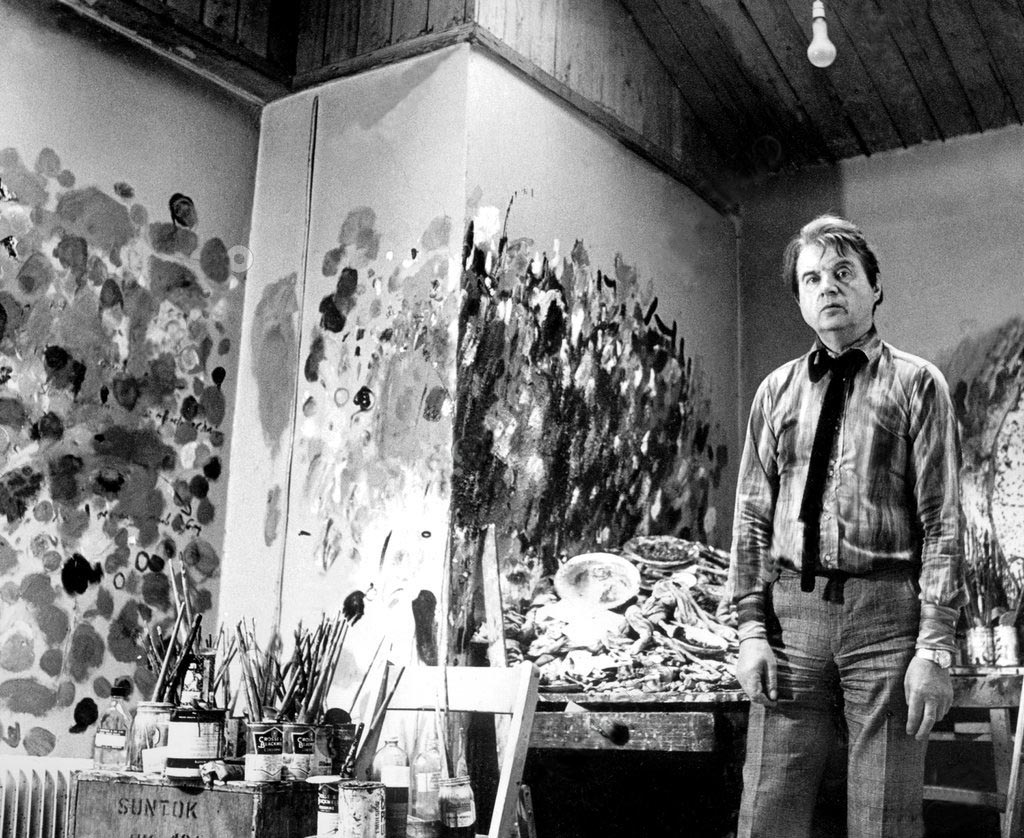
A slight disorder . . . Francis Bacon in his studio: he is now showing in Paris.
By Our Own Correspondent
THE DAILY TELEGRAPH
Léger and Bacon
THREE
noteworthy exhibitions have just opened their doors in Paris. At the Grand
Palais there is a major display of works by
Also at the
Grand Palais is a retrospective of the British painter Francis Bacon, whose
pictures are seldom seen in Paris. He has been described by Paris critics as
The third exhibition to open a few days ago is of 100 choice drawings from the Darmstadt Museum, collected originally for Ludwig 1, Duke of Hesse. The main emphasis of the exhibition is on French works.
WHEN I think about modern painting in general, I quite often find that I forget about Bacon. And when I think about Bacon, I find that I forget about the rest of modern painting. The only other painters with whom I have this experience—which is not a private one, because I have often hear other people say the same—are painters who are quite obviously eccentric, naive or odd, and who have worked in isolation out of ignorance or innocence. And when I think of them, I find it quite difficult to think of other painters at all, whereas when I think of Bacon, I think of certain old masters.
Francis Bacon is special. So is any artist who is any good. But Bacon’s inimitability does not, it appears, exclude the distinctiveness of others. The very fabric which makes up one’s sense of modern art is woven out of opposites, polarities—Mondrian and Arp, say, or de Kooning and Reinhart. But to whom would one oppose Bacon and make sense? To the whole of modern painting, perhaps. And yet to describe him as a man out of touch, not ‘of his time’, would be absurd. If this account is acceptable, it points to an odd state of affairs, where the ‘specialness’ of this particular artist applies not only to the special features of his work but also to his relationship to the rest of art. This would mean that the kind of criteria we bring to his work would need to be special too: for simply to say this is to acknowledge the way in which we tend continually to concentrate and gather together criteria that we use, and to sacrifice breadth and richness for something neater and more compact, measuring art by art’s local calibrations.
Few artists who have been written about as much as Bacon has can have had so much notice given to their ‘world’ in proportion to the work itself. Most Bacon criticism consists of an elaboration of the scenario of his pictures. Often he is described in terms that are hardly distinguishable from writing about a director or a novelist. He has been his own best commentator in this regards, and his rare statements provide an essential text. It is as though the scenario, unfamiliar and disturbing back in the Forties when hose curtains first parted, but now an institution, were all that is needed in order to evaluate the pictures; or as though the pictures themselves were a form of heroic illustration and even the paint that they are made out of were no more than another item or prop.
Bacon gives the lead to this: ‘I’ve always been more interested in what is called “behaviour” and “life” than in art. If my pictures come off, it is because of a chance conjunction between actual living and art. Painting makes me more aware of behaviour, and it is easier for me to say what I want to say about behaviour with the methods of art than it is for me to say them in conversation.’ This remark is quoted by John Russell, whose new book* makes a well-timed appearance at the moment at which Bacon is being shown on a vast scale at the Grand Palais in Paris, the first living British artist to be treated in this way. Russell has been an attentive witness of what has happened in London since Bacon’s reappearance as a painter after the war, and his book is a vivid account of this as seen through Bacon’s paintings.
There is a great deal of personal background in the book. Also of association with the themes of the pictures. The Bacon world is more richly populates as a result. Of the women sitters, and of a painting of Isabel Rawsthorne in particular, Russell says: ’If that painting were to be transformed in masculine terms, that proud, watchful, experienced figure could be a great captain on leave: a lifelong, single-handed adventurer stepping out from a blue-awninged restaurant after an unusually good luncheon, with a rakish open roadster of antique design drawn up at the kerb and a searching unembarrassed glance at the people who have stopped to see him/her get in and drive off.’ This seems to me marvellous storytelling, accurately matched both to the subject of the picture and to Bacon’s response to her, with touches (‘luncheon’, ‘open roadster’, ‘people who have stopped’) that set up a whole world. I guess that whenever I see that picture again, this vignette of Russell’s will be one of the factors around. There are many others like it to embellish the expectations with which one will go to meet him. The only reservation that I have is the thought that perhaps one does not need more. Does a sense of Bacon’s world, however elaborated, bring me closer to what is happening in this or that particular picture?
Baudelaire’s ’The Painter of Modern Life’ was a hundred times more interesting than the artist who was its subject, Constantin Guys. The poet is now the centre, and by a cruel alchemy of time Guys is the illustrator of his essay rather than its subject. Sometimes one has the feeling that Bacon is no more than the illustrator of Bacon’s world, the features of which his early work and subsequent reputation have long since outlined. And one of the factors which strengthens this feeling is his absolute consistency, his unmistakability and the single, forceful line of his attack.
Undoubtedly there is monotony: not only a sameness of mood but of scale and disposition. The heads in all his pictures tend to be the same size—about three-quarters life-size—whether they are close up portraits or full figures. The figures in rooms tend always to displace about the same area of canvas, so that even if the furniture, walls, dados, space-frames, blinds, doors etc may be arranged in all sorts of ways, the figures end up at the same distance from us and evoke the same relationship in space. Furthermore, although the ways in which he has constructed the head have evolved continually, becoming more daring and inventive with each batch of pictures, the basic technical premises have remained the same, the form being founded on the building up and breaking down of light masses on a dark base.
This monotony is a strange feature in an artist whose whole aesthetic derives from risk and a reckless indifference to anything habitual or comfortable or decorative. Yet it has to be taken into account. It is of a piece with his obsessive subject-matter, the unmistakability of his poetic world. I think that this obsessive quality obstructs one’s entry into his pictures, even for those who love them.
Bacon is about life in a way that no other artist alive is about life. Yet his work throws up a kind of shield which deflects attention, turning it towards an area that might be called What we know of Francis Bacon, when at once it loses energy, becomes second-hand. It is a circuit that is incredibly difficult to break. Every impulse is to stay within the well-worn track, to invoke his name rather than to experience at first hand what the pictures offer. When Eichmann appeared in his glass box and everybody said ‘Francis Bacon’, it was like an authentication of what he had been saying—but it was also a deflection from the point of his pictures and an insult both to him and to Eichmann. There is a passage in Ronald Laing’s Bird of Paradise where he describes a terrible dream. He is caught in a traffic jam caused by a ‘magnificent dog wandering in aimless circles’. As it gets near, he sees that its head is a ‘bashed in, bloody, formless mess on which its eye lies somehow intact, looking at one, with his socket, just by itself, detached.’ Crowds gather. ‘Can I be that dog and these angry motorists and these giggly shop girls?’ This is a first-hand experience. It and the whole passage from which it comes is of white-hot relevance to Francis Bacon. But here, in this context, in this review, it is no more than one more than one more literary parallel, one more accretion to the Bacon world.
Does the phrase ‘Bacon is about life’ mean simply that his pictures have resonances everywhere—that life throws up sights and situations that remind us of him? My experience is that the work up to about 1959 did no more than this. We ’see’ situations through these paintings as we see situations through Kafka or a film like Goddard’s Aalphaville. We use the patterns of his imagination to help us to get around. But since 1959, since perhaps the head of Muriel Belcher, when a quite new and more specific idea of portraits enters, it seems to me that ‘about life’ takes on an infinitely more direct meaning.
The Bacon world has to be broached. These pictures have to be taken on their own account. They must be allowed as perceptions, as ways of seeing, as ways of convincing the eye. Soon after spending hours with these pictures I found myself sitting opposite somebody in a narrow room, with a distance of about four feet between hour knees. There was a fairly bright light over. He was animated. Legs crossed and uncrossed, calves bulged, bits of white leg showed, shoes danced up and down, showed their soles. His head twisted as he spoke, and a word would start with his nose breaking the contour of his face on the right and would end up pointing double-barrelled at my eyes. Eyes skewed, narrowed, their hollows yawning and closing up as the axis of his head shifted in relation to the light. As he leant forward to stub out a cigarette, a dark shadow at the side of his neck ran forward and engulfed his face. When he looked up, pausing on a word, his mouth was a cavern, ringed with glistening serrations.
What is it in Bacon’s work that allows one to experience with such intensity other people’s behaviour, as though some membrane had been stripped off, or as though the cine-camera of one’s mind were running at double-speed? Not, certainly, the overall view of things, but rather its opposite—a particular experience of hunting a particular semblance with paint. His hunt is lived out in time on the canvas, and it is this which one lives out in one’s own present time in front of the canvas too. With him, each addition or scrubbed cancellation alters the face that is looking back at him, brining it closer, or not, to his bated attention—and so it is too on our side. The distortions of his heads, which at first look like ghastly wounds, have to be gathered up, pieced together, until the heads look right, intact. The price is the stability of one’s viewpoint, one’s distance. A kind of closeness has to be risked: not a physical closeness to the picture concerned, but a psychic closeness to the ‘head’. Finally, the complete head, the whole, that person neither monster nor freak, has to be achieved and held over against the terrible glaring meat, so that they inhabit each other. All this comes over in the paint and in one’s joined effort with the paint, to read it and to read his scanning: to pick up the clues he leapt at, or the sudden reverses with which he risked one more hiatus.
When 20 years ago Bacon was talking about the power that paint had to bear directly onto the nervous system, I was never sure of what he meant. Even that phrase seemed to join up too pat with the Bacon world, with screams and literary situations. Now I see it as a challenge—to enter each picture as closely as I am able to bring myself to do.
The baggage that helps one on the journey is not the baggage from contemporary art, so much as from the old masters, plus one’s own ability to see.

THE SAVAGE GOD
A French view of Francis Bacon by Pierre Schneider, who
also discusses John Russell’s new study of Bacon’s work
PIERRE SCHNEIDER |
SPEAKING ABOUT that wide-open mouth which is one of his trademarks and since antiquity has served as the mask of horror, Francis Bacon says: “I wanted to make the inside of the mouth as beautiful as a Claude Monet.” From mouth to Monet might stand as a summary of the twenty-seven-year trajectory illustrated by the 110 pictures now at the Grand Palais.
There can be little doubt that Bacon wished the exhibition to be read this way. Retrospectives in an artist’s lifetime are usually self-interpretations; the emphasis on recent work underscores Bacon’s current concerns. And this concern explains his eagerness to be seen in Paris, the city where Bacon’s central problem was posed for the first time a little over a century ago: the fatal rift between paint and reality.
This is not to be found in the earliest pictures on view, in “Head II,” for instance, or in “Figure Study II.” The atrocity of the subject-matter is more evident than at any later time, yet it is embedded in a texture of such muted sumptuousness that one sees wounds and mutilation but feels a healing abundance; earth sliced open by plough. The indissoluble association of destruction and construction which makes these pictures masterpieces is due to "a chance conjunction between actual living and art," as Bacon says (I quote from John Russell’s new monograph, about which more later).
In the Forties, chance fell his way practically all the time. Had one not known about the previous decade of experiment, of which practically no testimony remains, one might ascribe Bacon’s early achievement to beginner’s luck. Or again to (if the word may be used in such a connection) paradise not yet lost. Paradise, for the modern painter, is not knowing that there is no paradise: that paint and reality are incompatible. This awareness differentiates Manet from Courbet, and Bacon’s work of the Forties from that of the following years.
For now the incompatibility will out. The canvases of the Fifties are marked by the dropping away (as of some Atlantis) of the middle ground on which painting has built since the Renaissance: the postulate that pictorial signs can signify reality. They display a painful divorce between literal image and the subtle curtain of paint. Velazquez’s Pope and Eisenstein’s nurse have in common that they are taken over wholly; paint does not change, but veils them. But now an unbridgeable gap has opened between subject and paint. The most important thing about pictures like “Man Kneeling in Grass” (1952) are the intrusion of this unspeakable void and Bacon’s desperate attempt to qualify it.
Asked why he put a hypodermic needle into one of his figures, Bacon replied (and the answer sheds light on one of his favourite themes, the Crucifixion): “It was to nail the painting to reality.” Of course, aggressivity is a useful prerequisite for any would-be realist, but the violence in question here no longer belongs to the artist and to the subject represented: it is the violence of representation. Modern paint is the ghoul, not Bacon.
“There is no torture in my paintings,” Bacon claims. Rightly: since the Sixties, the painting is the torture. The scale is often epic, but portraiture is always at the centre, because it states, in its most radical terms, the contradiction between the autonomy of paint and the identity of the subject, corralled, attack from several sides at once. The light is switched on suddenly, to catch reality by surprise. It tolerates no protective shadows; it is relentless, uniform, lidless—the light of cross-examination. The curious affinity of certain recent triptychs with Toulouse-Lautrec (and, through him, with Japanese screens) stems from Bacon’s increasing reliance on the sharpshooter’s passionate precision. Nothing in the setting is left to chance.
This, however, is because the essential—“the conjunction between actual living and art”—is more than ever left to it. Despite all precautions, reality slips through paint’s fingers; it must be grappled with, pinned down again and again. The contortion characteristic of Bacon’s forms is a hanging on to a quarry that tries frantically to escape. There ensues a seesaw struggle in which writhing pigment achieves a succession of brief and partial triumphs: those moments when we forget it because it has suddenly become, with a kind of savage presence, a foot, an ashtray, a cheekbone, a knee clasped in that inimitable British way. And at once the image dissolves into brushstrokes. Thus painting can be said, in Bacon’s words, “to be and not to be.”
The remark is one of the most revealing to be found in John Russell’s book, Francis Bacon (Thames & Hudson £4.95 pp. 242), as illuminating an essay on a living artist as one could wish to encounter. It relates Bacon to his time and to the history of art with unfailing pertinence. In the process, Mr Russell gives us insights into an enormous variety of subjects, from the invasion of Europe by the Nazi to the invasion of privacy by Degas.
I see two potential dangers in this abondance de biens. The network of relations spun by Mr Russell is so dense that the reader is sometimes inclined to forget the disruption which is the very sign of any original oeuvre, especially in a case like Bacon’s. But perhaps it is the critic’s task to tie the Gordian Knots so that the artist may cut them. More dangerous would have been the temptation to dissolve the work into its contexts; but Mr Russell is immunised against that by his unfaltering attention to what goes on in the studio (and one understands why the painter lets him in). He has written, about being and not being in painting, some pages which are as crucial as they are rare in writing on art.
For they deal with art’s most constantly suppressed truth: paint and reality cannot mix. This is the real predicament, and it is so unbearable that only a few artists—and only within the Western tradition—have built on it. From certain Fayum portraits, through a lace-collar by Velazquez and a beach by Constable, to an asparagus by Manet, they constitute, it seems to me, Bacon’s real lineage. Others have seen the rift and opted for one side or the other: abstract paint or literal reality. What makes Bacon frightening is not his subject-matter but the fact that, in his practice, he shows art and actual living to be “unmixable and inseparable.” The Council of Chalcedon, in AD 458, thus defined the nature of Christ: I can think of no more apt definition for Bacon’s painting.
Indeed, his fascination with the Crucifixion may well be attributed to the fact that Christianity’s central mystery provides the pattern for the mystery of painting: reality must allow itself to be put to death by paint in order to be resurrected as image. Hence perhaps Bacon’s jubilation at the disappearance of painting in our time: it proves that “painting is just beginning.” The image will have reality only as long as we do not mistake it for reality; and when we do (when we want to touch it), the image relapses into paint. And so on indefinitely, within each picture. Or rather, in that small section of the picture where the identification is attempted. The rest is frozen in expectancy, waiting for the “chance conjunction” to occur.
Tertullian called this period (those glacial three days before the Resurrection), “refrigerium interim.” No artist has given us a grander vision of this ghastly moment of suspension, which is the Christian legacy to our post- Christian age. The great areas of colour, stilled by nocturnal brilliance, should clash, but do not. They are petrified while the dice are rolling.
M Schneider is Art Critic of L’Express and organiser of the Matisse Centenary Exhibition, also at the Grand Palais.
Richard Cork
NOBODY EVER enjoys changing his mind about an artist he once admired and elevated to the status of a hero.
The realisation that an idol has fallen is bound to prove painful to the estranged worshipper, staring down at the fragments of his former passion and wondering why he could ever had been so deluded.
But such is the case with Francis Bacon, the one senior British painter of whom I used to be unreservedly proud.
He alone seemed at one time to possess those qualities I found lacking in the accepted pantheon of his contemporaries: a willingness to take risks, to push himself further into an exploration of that uniquely vital tension which his paint appeared capable of conveying.
For years I remained convinced that Bacon was extending the range of figurative art, justifying its life-span by arriving at a new and daring synthesis of description and abstraction, observed fact and subjective emotion. The bravura brushstrokes transformed his motif — a Muybridge photograph, a Velázquez Pope or the image of a friend into a whirlpool of feeling which engulfed the spectator.
And I was swept up in this emotional tide, happily submitting to its power without pausing to analyse the mechanics behind the maelstrom. It was, easy, then to ignore Bacon’s fondness for Grand Guignol symbolism and glory instead in the substance of the paint itself, following its turbulent progress across a face or a body.
The bitter-sweet amalgam of tenderness and brutality it conveyed, gliding from an area of sensuous splendour into a mass of brutalised slashes, erased any lingering doubts. Bacon had managed to express the extreme ambivalence of his response to humanity with violent immediacy and that seemed to be achievement enough.
But for how long? Would this headlong approach to the act of picture-making, teetering so dangerously on a knife-edge between histrionics and bathos, stand up to the test of a full-scale retrospective exhibition?
The Grand Palais, in Paris, has now assembled the means with which to answer that question, and it confirms my gradual disenchantment with Bacon’s hectic abandon. I noticed, to begin with, how intensely artificial his work looked when viewed en masse. The contorted figures inhabiting his world are placed in a setting that positively creaks of theatricality.
SPOTLIGHT GLAMOUR
Like a ham actor who can only perform in the centre of a deserted stage, and insists at the same time on hogging the full glamour of a spotlight, Bacon invests his scenes with an exaggerated sense of drama. His protagonists are invariably surrounded by an extravagant amount of empty space, and the props which are permitted to stray inside this arena reinforce the aura of melodrama.
Geometrical boxes implying claustrophobia, modish tubular furniture, swish curtains and raised podiums: these are the ostentatious devices he employs to heighten the significance of his tableaux. And as if their accumulated presence was not sufficiently portentous, Bacon cannot resist loading his canvases with even more emotive symbols.
Carcases of raw meat are strung up behind the sitter to ensure that no-one misses the overtones of death; crucifixes are erected so that the violence can be turned into a quasi-religious allegory; swastikas and hypodermic needles are thrown in occasionally to provide an extra thrill of horror; and once, in a moment of supreme gratuitousness, a male nude is seen seated on a carefully described toilet.
The sheer indulgence of all this undermines our response immediately; Bacon protests altogether too loudly in his determination to pitch the tenor of his statements as high as he possibly can.
The result is a fatal recoiling on the part of the spectator, who feels that he is expected to be stirred and so withholds a wholehearted reaction. How could it be otherwise, when Bacon insists on confronting you with outright sensationalism like the centre panel of the Sweeney Agnostics picture, where a blood-stained pile of clothing celebrates a particularly gory murder? Nobody will agree to be bullied by such gestures for very long, and they are legion in the Paris exhibition.
Closely allied to this feeling of inflation is Bacon’s love of the triptych format, which encourages him to spread his sententious rhetoric over a monumental scale.
Mirrors and cameras are brought in, too, in order to stress the sense of a sinister event; and even more hollow props, like a leaping flamingo or a head balanced on a glass plinth, are hauled on-stage to fill out the already cumbersome mise en scène.
When Bacon approved Valèry’s remark that people today want from art “the sensation, without the boredom of its conveyance,” he ought to have applied the sentiments to his own paintings and wheeled all these pantomime dragons back into the wings where they belong.
Damaging as these shortcomings are, however, they could be redeemed if the much-vaunted quality of his paint really did present a new vision of man. It is at this point that Bacon’s admirers, claiming for him a place on unrivalled eminence among those artists who still regard marks on canvas as the highest form of creative expression.
SAVAGE ATTACK
But here again, their lofty assurances are not borne out in the pictures themselves. There is, for one thing, a serious disparity between the convoluted handling of Bacon’s figures and the flat banality so evident in the painting of their surroundings.
How can we fully enter into the spirit of the wildly distorted humans when their backdrops are rendered as slick areas of flat colour? And how can Bacon expect us to believe in the liberties he takes with his sitters’ faces when the abnormalities disappear further down the body and a straightforward descriptive idiom takes their place?
In thee 1968-9 triptych of Lucien Freud, for instance, our please in the absence of the usual allegorical clutter is negated when we examine the construction of the figures themselves. For Freud’s legs, socks and feet are rendered in a limp, naturalistic idiom utterly at odds with the painterly orgy inflicted on his head.
And an even more disconcerting fault is revealed in the treatment of his chair, which is little more than a crude diagram outlining external facts. Bacon cannot get away with such prosaism and expect us at the same time to see his savage attack on faces as a profound metamorphosis.
Armed with the suspicions which these surrounding areas of crude representation arouse, we cannot be blamed for seeing his distortions as a gloss, applied with great panache to hide the unexceptional nature of his vision. Viewed in this light, the swooping energy of Bacon’s brushstrokes and the startling malformations they cause in their reckless passage across a set of features are nothing more than a panic measure.
Their violence, which so often produces a boorish caricature of a portrait, seems intended to cover up the fact that Bacon knows no other way to avoid the kind of mundane illustration he employs elsewhere in his canvases.
The genuine power created in some of the earlier works like the Ulster Head of 1949, depends upon their relatively sober and controlled handling. And the increasingly baroque treatment of later paintings marks a decline into decorative mannerism.
Instead of launching a direct attack on the nervous system, therefore, the turbulent surface of Bacon’s paintings is a direct reflection of his own despair. And we end up pitying the spectacle of a painter who twists himself round in such paroxysms of frenzy, enraged at his inability to turn unruly ambition into the discipline of great art.
TWO days before Britain voted for Europe Francis Bacon’s great exhibition opened at the Grand Palais in Paris. One knew his work was esteemed in Germany, and also in the States, but to see him given this exceptional honour by the French art establishment is a double surprise. I think the only other living foreign painter to receive it was Picasso, in 1967. (I see they have escalated him to the Louvre now). Moreover, Bacon’s art is so riven with problems and paradoxes that it is strange to see it clasped to the Cartesian breast.
It lends itself to journalism. Those live carcases, lumps of ready meat still pointlessly active, those silent faces that wipe themselves over the canvas and across our vision, as though to disorientate our self-regard, they are all, are they not, twentieth-century things, the products of Auschwitz and Hiroshima. Inescapably, reviews have been titled “Age mirrored in Bacon’s Art” and “Images of our Time.” Yet Bacon says he is not interested in freaks. John Russell quotes him: “I’m not a preacher. I’ve nothing to say about ‘the human situation.’ ” The swastika arm band on a figure, he says, if there for visual effect and not as a specific signal.
Certainly we should be hard put to it to trace definable messages in his work. Yet Bacon has an urge, according to Russell, to fashion somehow “a History of Europe in my Lifetime.” This is confusing enough, this continental rehearsal of catastrophe, but why the measured exquisiteness?
Bacon paints superbly. No dabber hand wields a paint brush today. Thick and thin, stained through from the back, swept on, shot on from the front like spittle or semen, as large, glowing fields of one colour or (Russell’s phrase) as the jewelled slime of paint — perhaps he will have been the last great user of oil paint.
But are not nihilism and art opposites? Bacon has spoken to Sylvester of art as a game. Russell writes of him as a gambler, and between the two words we glimpse the answer. Bacon is not a portraitist of an age neither compelled nor choosing to reflect a monstrous age. Neither is he an artist of Wyndham Lewis out to give the world the edge of his tongue and pencil. The artist chooses his ground and his strategy; and the way to understand Bacon — the way to forgive him his affronteries — is to realise how little the outer world determines his work.
He is wrestling not with the human condition but with the problems of how to make an ikon now that religious art is dead, how to compose a portrait now that composure belongs to the academics, how to bid for significance as a figurative painter when the past holds all the best cards, and how to go on doing so when fame has removed the stimulus.
John Russell’s book is an extensive essay, not a treaties, not at all a monograph. It includes lots of halftone and colour plates, including fold outs for the triptychs, and it matters less than usual that these are bunched hap haphazardly between chunks of text. This outlines Bacon’s background and early years, and fascinating they are, but if effectively starts (like the Paris exhibition) with 1945 when Bacon was 34, more or less ignores his earlier work, and is ruminative on what followed rather than didactic or critical. It offers many good thoughts and may provoke others, and I sensed in it more passion than Russell usually permits himself.
FRANCIS BACON by John Russell (Thames & Hudson, £4.99).
Grand Palais
Bacon in Paris
by DENYS SUTTON, Editor of Apollo
DENYS SUTTON | GRAND PALAIS | THE FINANCIAL TIMES | TUESDAY NOVEMBER 16 1971
The tradition of British artists exhibiting in Paris is rather longer than might be supposed and Sir Thomas Lawrence and John Constable are two who did so with considerable success. Later in the nineteenth century, the Pre-Raphaelites were admired across the Channel and nearer our own day, Sickert exhibited at Durand-Ruel and Bernheim-Jeune. The contact has been maintained, and not so long ago, Graham Sutherland had a one-man show at the Musée Art Moderne. Now it is the turn of Francis Bacon.
Mr. Bacon’s painting, which is on view at the Grand Palais, has made a considerable impression in many circles in Paris. This is understandable, for his pictures reflect a fashionable disgust with humanity; they are “literary” and thus in the national tradition. What is also important to secure admiration in a country, where painting is still appreciated, is that Mr. Bacon uses brushes and oils.
The exhibition is well displayed and the paintings may be seen with plenty of space around them. No less than three floors are given to Bacon’s work so that the show forms a retrospective of his contribution since 1944. Yet as is so often the case with such mammoth affairs, it is hard for a painter honoured in such a lavish fashion quite to live up to the treatment.
Francis Bacon is one of the most interesting men now working, if only for the fact that he has reacted against the aestheticism of abstraction and is not afraid of subject-painting. He is considered by many of his admirers to present a fresh vision of reality and to have revitalised painting. He is placed in very grand company by Mr. Michel Leiris in his preface to the catalogue, for this writer declares that the vigour and subtlety of Bacon’s palette recall Rembrandt and Constable.
John Russell explains in his lively and intuitive book about Bacon (Thames and Hudson, £4.95) that the artist came late to painting after spending some years in Berlin and Paris. He is careful to point out that Bacon’s visit to Berlin took place before the era, the final phase of the Weimar Republic, that forms the background to Christopher Isherwood’s well-known novels. Mr. Russell has a deft touch and most attractively evokes the period, just after the last War, when Bacon’s pictures were seen in London.
One of the most remarkable early works is Painting, 1946, which, with its Surrealist undertone and brooding mystery, has force and a hermetic quality. It retains its power, although its colour is rather sweeter in tone than it seemed at the time when first shown in London. This unusual picture struck a new note owing to its imaginative character and intensity. The question that has to be asked is whether or not Bacon’s later pictures implement the promise shown in this one, It is fascinating to find that he has painted a second version; this work, dating from 1971, is much looser in handling, more fluent to be sure, but without, perhaps, the brooding and haunted quality of the earlier version.
This large exhibition certainly shows Bacon’s dexterity as a designer; he sketches his themes with rapid touches and his effects are striking. He is in no way embarrassed by the most private themes. There is no reason why a painter, if he wishes, should not choose to depict someone on the lavatory or amatory encounters; contemporary permissiveness has made us open to any experience. The canon of judgement can only be whether or not our experience of life is broadened by the artistic treatment given to such themes.
Mr. Russell has ably analysed the sources which Bacon has tapped for his pictures. He has drawn particular attention to the painter’s recourse to what Mr Russell calls the Parallel Art: “the art of illustrated papers of the mail-order catalogue, of the billboard, of the ephemeridae of advertising.” He has directed attention to the influence on Bacon of the photographs taken by Muybridge which also appealed to Degas, and his findings are buttressed by his conversations with the artist. These contain many rewarding pieces of information. Photography has clearly played an important role in furnishing Bacon with the sort of effect he desires. So has the poster. It may be claimed, in fact, that Bacon’s manner of paintings is in descent from Toulouse-Lautrec’s. The aim of the poster is to present an image is such a way that its impact is immediately registered, and with this objective, not too much attention is paid to nuances of colour.
Now what serves admirably for a poster does not necessarily serve for a painting. Take for instance the backgrounds in Bacon’s paintings. Except for the period when he painted contre-jour effects, reminiscent of the sort of effect sought by Sickert, he has gone in for large areas of bright colour designed to place in relief the action of the figure or figures. Such backgrounds are more than accessories, as it were, that play a minor role in a composition; their prominence in the picture demands that they receive attention from both painter and spectator. They must exist in their own right as passages of painting. Unfortunately contemplation of these areas reveals no visual secrets; the transposition of paint into a magical substance does not occur.
Mr. Bacon seeks in many of his pictures to counterfeit an illusion of claustrophobic space which is essential to his objective of showing man hemmed in by his problems. His intention is not substantiated by his pictures, for there is an absence of tension between the figure or figures and the background. The illusion of imprisonment vital to his imagery does not occur.
It is central to Bacon’s view of the world that its inhabitants are deformed, for why otherwise should they nearly always be represented as if contorted parrots? If his aim is to show pity and to express tragic feelings then a connexion must exist between the image and the colours but in the case of his paintings, these are too decorative. The Boldinesque flourishes of pigment—for instance, the creamy whites that never nourish the eye—have a superficial touch. His paintings suggest a shrill disgust about humanity; we are left on the outside, not moved emotionally by paint and content, as we are with Rembrandt or Goya.
Mr. Bacon may be placed in a national tradition. The origins of his attitude may be found in the blood and thunder of Jacobean drama, one that became watered down into the stock melodrama of the Victorian age. This is his world—an illusion of tragedy without true tragic content. He is also, one may feel, a painter who would have won the centre of the stage in the Victorian era, as the printer of the picture of the year. In the last analysis, he presents us with a vision of emptiness, not because if his themes, but because the paint is not warmed with a love of the substance; and if this is his intension, then he has succeeded.
Francis Bacon exhibition
G. REICHARDT | LETTERS TO THE EDITOR | THE FINANCIAL TIMES | THURSDAY NOVEMBER 18 1971
Sir,— I would like to make a brief comment on Denys Sutton’s on the whole very judicious notice of Francis Bacon’s current Paris exhibition (November 16, page 3). The reason he goes down well with the cognoscenti is, in Mr. Sutton’s words, because his pictures reflect a fashionable disgust with humanity.
OK! If Bacon in paint (and his confessed mentor Samuel Beckett in print) likes to portray us as apes with festering faces and thus represent homo sapiens, the heir of centuries of painful evolution, as no more than dustbin fodder, why on earth should we, who after all sat for the portrait, applaud?
As self respecting patrons of art we should say: we prefer to he depicted as we actually are, not as ugly conundrums. The facile indulgence of bile is more a clinical than an artistic phenomenon.
G. Reichardt
12a, Mount Pleasant Road,
Poole
Book of the Day
NATIVE BORN
BRIAN FALLON | ARTS & STUDIES | THE IRISH TIMES | TUESDAY, NOVEMBER 23, 1971
IT SEEMS reasonably certain that if No. 63 Lower Baggot street, Dublin, is left standing much longer (which, of course, in itself, is not at all certain) a plaque will eventually announce that it was the birth-place of Francis Bacon. But we can scarcely claim that the painter was Irish, even though he has family links here; he went back to England at the age of five, though he often visited Ireland later. John Russell in the early autobiographical sections of his book, claims that the feckless, stylish life of the county houses in which Bacon spent long stretches of his youth have left their permanent mark upon him; “though himself not Irish, he absorbed Ireland from his earliest conscious moments”. Apparently he is still, to this day, haunted by the memory of the Midland bogs and by the sound of cavalry galloping at night on the Curragh.
Dublin first saw his work in bulk at the Municipal Gallery in the middle sixties. Predictably, Irish painters caught his style like a contagion and for close on two years Bacon imitations haunted almost every Dublin gallery and exhibition. The sixties, indeed, were the peak of Bacon’s notoriety, if not of his reputation; he became the cynosure of TV and the colour supplements, his pudgy, alert face and feline presence suddenly as familiar as Picasso’s half-Buddhist, half-simian physiognomy.
A
flood of comment and interpretation was let loose on his work which still
obscures it in many eyes. He was linked with Existentialism, with the then
fashionable Black Humour, with Beckett; he was even supposed to be the painter
of an inverted religious sense of
BACON HIMSELF denies that he has anything to say about the human condition and is continually shaking himself free of those who think they can define his essence. He seems to have been very much his own man since his father, a horse-breeder and trainer, through him out of his house at sixteen for wearing his mother’s underwear. A man of genuine “European” intelligence and culture, who knew both the Berlin of the ’twenties and Paris in its great days, he leads by choice a reckless life, “living dangerously” in the Nietzschean sense. His craze for gambling and champagne are notorious, like his taste for low life.
Before the war he was better known as a decorator and designer than a painter, and did not really find himself until 1945 or 1946. The works of the ’fifties, the famous “screaming” popes and cardinals, still seem to many of us to be his apex, though that may be only because we have got used to them. Bacon does not, it seems, think of his pictures as spooky or horrific, and feels that if they convey no more than this, he has failed. He had enormous respect for the Grand Style of figure painting and portraiture and always aims high, sometimes failing calamitously — “I may not manage to produce that ‘very great work,’ but I intend to go on trying to do something different, even if I never succeed and nobody else wants it.”
His portraits, of friends such as Isabel Rawsthorne and the painter Lucien Freud, are not painted in their presence but from memory. He says: “I terribly don’t want to make freaks” and maintains he would like to show people as attractive as they really are — an ambiguous remark, possibly. Contrary to what is often said, he works very little from photographs, though he does make use of the studies by Muybridge, the nineteenth-century American photographer, who did pioneering work into people and animals in motion.
* * *
BACON is unique, an original; his best work has the majesty and presence of the great tradition of European painting he so much admires. But his impetuosity and urge to play always for high stakes — not to speak of the pressure of demand for his work, and the grind of producing for big exhibitions — have made him terribly hit-and-miss since he became famous. There is also, in what he has produced over the last seven or eight years, a disturbing note of autobiographical hysteria, as though for all his integrity and high intelligence, he had begun to fall for his own myth and live it.
Mr. Russell’s book is sometimes rambling or tendentious, but he obviously knows
both the man and the work thoroughly. He has also resisted firmly the temptation
to gossip about Bacon’s private life. There is a fine selection of colour
plates, though I could have done with less of the late triptychs (incidentally,
why the pointless and rather silly reference to Beckmann’s great and haunting
triptychs for their “heavy-breathing sententiousness
FRANCIS BACON by John Russell. Thames and Hudson. £4.95.
Dissection by Francis Bacon
ANTHONY EVERITT
SPEAKING ABOUT that wide-open mouth which is one of his trademarks and since antiquity has served as the mask of horror, Francis Bacon says: “I wanted to make the inside of the mouth as beautiful as a Claude Monet.” From mouth to Monet might stand as a summary of the twenty-seven-year trajectory illustrated by the 110 pictures now at the Grand Palais.
In other
words, it is a space for brief encounters and rapid assignations
This is the room which Bacon, Britain’s most celebrated painted, depicts again and again in his pictures. Visitors to his current retrospective at the Grand Palais in Paris or readers of John Russell’s lavishly illustrated Francis Bacon (Thames and Hudson, £4.95) are given a guided tour of this anonymous Grand Hotel of the imagination.
But what goes on inside? Two blurred, nude figures grapple on linen sheets; a Pope dressed in the regalia of office screams from a darkness that is only defined by a grid-like box of thin lines; a woman sits on a chair and crosses her legs. In one example, the room is transformed into a walled screen without spectators where a man fights a bull.
When Bacon is asked what his pictures are “about,” he sometimes replies: “The history of Europe in my own time.” And certainly it is easy to find parallels between the public events of the last fifty years and the private desolations and estrangements evoked in his art.
But
however powerful these connections with the real world may be, Bacon, like many
of the great novelists and play-wrights, has created an
“alternative universe”
which works according to rules of its own. Like Alice when she climbs through
the looking glass, we are faced with a completely convincing environment which
is very similar to our own everyday one
The Baconian universe depends on a reversal of the old, kindly, civilised truths which most of us take for granted, without actually asking whether life is really like that. Here, love is seen in terms of one-night stands, loyalty in terms of betrayal, sex in terms of violence.
Bacon is
fond of quoting Mme. du Deffand who said:
“There is only one misfortune in life,
that of being born.” But his reaction to this remark is not to plunge into
self-pity. The people who occupy his canvases may be pessimists
From
what I have written so far, it might appear that I believe Bacon merely to be a
narrative painter. It is true that he has never taken up abstraction. In his
early days, he was tempted by extreme subjects, and as late as 1967 the central
feature of his Triptych (inspired by T. S. Eliot’s Sweeney Agonistes) was a wagon-lit compartment with a blood-stained pillow on
the bed
But he is first and foremost a painter rather than a story-teller, and the real violence in his work comes from the was he handles the pigment. For Bacon, paint is an acid that corrodes the fleshy appearances of his courageous sitters. Their faces and bodies are made to look like decomposing chunks of meat that have been soaked in vitriol.
He is not, in fact, interested in photographic accuracy but in the fact which lies behind appearances, and he attempts to discover it like an anatomist dissecting a corpse.
Bacon comes at the end of a long tradition. He is the last of the great easel painters, and the rooms which he so often depicts, together with their lonely occupants, are, perhaps, are extensions of the painter communing with himself in his empty studio. He is unaware that artists of a younger generation are trying to unlock the prison door and emerge from their long period of solitary confinement.
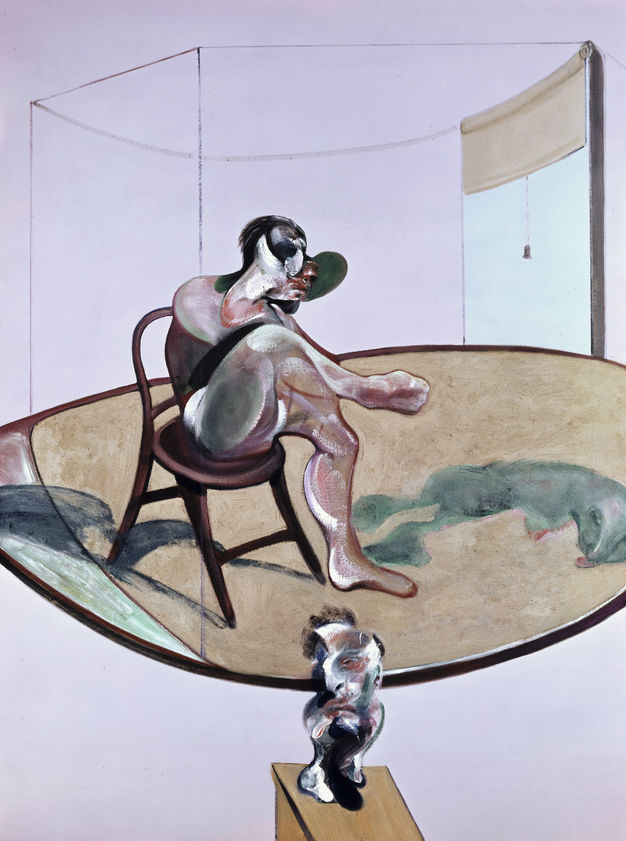
SAM VERSUS SOCIETY
Doreen Tanner meets Sam Walsh whose
latest exhibition is now at the Neptune
DOREEN TANNER
“I HATE the way things are going. turning people into plastic projections of their surroundings, the way we’re having to push people around, the impossibility of a free society anywhere.”
Sam Walsh, Irishman turned Liverpudlian, now recognised as one of the most talented of local painters, is a self-confessed pessimist, a widely-read, serious man, an individualist, As an artist he values his own late-won ability to paint the way he wants, regardless, of other people. It’s a brand of individualism that goes naturally with a loathing of the mass-produced consumer society and all the bureaucratic and other pressures that limit people’s freedom.
Thinking
Sam Walsh has this malaise in an acute form, talks about society as much as about painting, and is strongly in favour of the committed artist, the man with a message.
After talking along these lines for some time, he stopped and murmured in alarm that the conversation was getting rather serious. Well, I asked, was there a lighter side. to his work, a humorous element?
“I don’t suppose there is a lighter side.” He seemed horrified at his, added more cheerfully: “Oh yes, there is one painting called Happy Outing. which is the side of a double decker bus with people on it and they are all laughing. I did that because I see all these miserable people on buses going home, and I thought it would be nice if they were going to have fun. But then that is sociological as well, I suppose.”
Fortunately there is a contradiction between the thinking man and the painter. On one hand he says, “Artists should be committed; you can’t work in a vacuum any more, and the best people never did”; on the other, that the impulse that makes him paint “has nothing to do with all these social things.”
“In the last instance, I am only concerned with the way I think about things in term of paint, of their visual content.”
Pop Art
This is evident from his work. His feelings
for the quality of objects
In fact, the prompting that turned Sam Walsh from a dilettante into a serious painter didn’t come from sociology, politics, or even planning. It came from painting. Trained at art school in Dublin (“and a fat lot of good that did me”), he’d lived in London (“I liked the arty scene, but never did anything serious”) and came to Liverpool because at that time “It was easy for an artist to live here.”
He shared with Adrian Henri a small exhibition of their work in London; while there he saw a retrospective exhibition of Francis Bacon at the Tate. “I came out shaking. I’d been working for years in this British School, pop art, kitchen sink vein, and there was this guy just going on his own way.
“Looking
at Bacon’s stuff got me seeing things in perspective. I was a bit lost at that
time. I didn
In fact, it was the portrait head of Francis Bacon that Walsh showed at the 1963 John Moores exhibition that really marked the start of his career, though his own style has passed through several changes since then.
“I still do a head of Francis Bacon about once a year, and I still keep meaning to send him one of them, but I never get round to it.”

Out of the Black Hole
ROBERT HUGHES
Two naked figures, faces obscenely eroded by
electric-blue shadows, sprawl on a bed. A man huddles like a baboon on the edge
of what might be a swing, a coffee table or a hangman’s drop. A Pope howls
silently behind glass. There is little need to say who painted them. At 62,
Francis Bacon is one of the most immediately recognizable painters in the world.
For the past 25 years, critics have predicted the collapse of his reputation.
Yet by now it seems that Bacon is one of the very few living artists whose work
can (but does not always) exhibit the mysterious denseness of meaning, the grip
on experience, which are the conditions of a masterpiece. “Who ever heard,” he
once sarcastically asked,
Out of Decay.
Up to a point, Bacon’s art, in all its hazard
and abiding strangeness, grows out of the terms of his life. Born in Ireland in
1909, a descendant of the great Elizabethan Sir Francis Bacon, he spent a
childhood whose ambience was decayed status, country eccentricity and the
violence of Irish civil war. When Francis was 17, his father caught him trying
on his mother’s underwear, and banished him from the house. With no special
qualifications or ambition, Bacon drifted his way round Europe—to Berlin and
afterward to Paris—and worked as an interior decorator in England in the ’30s.
Of these formative years, English Critic John Russell, in a new book on Bacon
(New York Graphic Society; $16.50), remarks,
Horror Movie.
Bacon’s work is the kind that invites stereotyped reactions. He is seen as a master of crisis, directing a horror movie. The adjective most often given to his work, nightmarish, is not quite true to Bacon’s intentions; it does not go far enough. For nightmares, like movies, end. Bacon’s images, on the other hand, are thrust at us as the enduring substance of reality. They are not fantasies, but observation slits into a Black Hole of Calcutta, in which man thrashes about, stifled by claustrophobia and frustration, stabbing with penis or knife at the nearest body. This, Bacon insists, is the real world; it defines the suppressed condition of actual life.
Bacon’s work is not pessimistic (or
optimistic, for that matter), for it lives outside these parentheses on a
terrain of amoral candor about the most extreme situations. “The road of excess
leads to the palace of wisdom
Bacon’s figures, in their blurred, spastic postures, relate to the work of early still photographers like Eadweard Muybridge, or art reproductions, movie stills, news flashes. Personality, existence itself, glints like a fish in dark water and is gone. Bacon is a singular draftsman, but his drawing has practically no descriptive function—it serves, instead, to tally a sum of distortions.
“One of the problems is to paint like Velasquez, but with the texture of hippopotamus skin,” he once remarked. And he does. Structure emerges from the tracks of the looping brush as though naturalism were being reinvented. The result is that Bacon’s distortions have a unique kind of anatomical conviction. Collectively, they amount to nothing less than a group portrait in which Baconian man—lecherous, wary, perversely heroic—carries on his flesh the cumulative imprint of self-destruction.
archive49lll.JPG)
FRANCIS BACON Photo: Alan Clifton
Through nightmare to discovery.
Meat and poison
Richard Boston on the Paris exhibitions of Leger and Bacon
RICHARD BOSTON
LARGE EXHIBITIONS of the work of Francis Bacon and Fernand Léger currently showing at the Grand Palais in Paris (both until January 10). The visions of these two artists are as dissimilar — indeed opposed — as to be very nearly mutually exclusive. If you greatly admire one, then you probably won’t much like the other, and if it is hard for the same person to be appreciative of them both, it is even harder to do so on the same day.
The Léger is a knock-out, the most satisfying and enjoyable exhibition I have seen for a long time. The 353 drawings, paintings and ceramics from all periods of his life contain an unexpected variety. There are Mondrian-like compositions, still lifes that remind one sometimes of Braque and sometimes of Matisse, and groups of figures in landscapes that show an affinity with the Douanier Rousseau: but even in these paintings he never ceases to be recognisably Léger.
The exhibition brings out the development of his art very clearly. Born in November in 1881, the son of a stockbreeder, he came to Paris at the age of 17. He subsequently destroyed most of his early work, but a 1905 painting of his mother’s garden shows the impressionist style which he was quickly to abandon. The Cézanne retrospective of two years later was the great influence on him. After this he soon found the very individual and recognisable style which he was to develop through the rest of his career.
In the cubist years he followed a course parallel to that of Picasso and Braque, showing more interest in colour than they did, and preferring cylindrical forms to their box-like ones — tubist rather than cubist. In the townscapes painted before the First World War he already shows his clear preference for man-made objects: it is bridges, boats and houses that interest him, whereas clouds and even trees are handled perfunctorily and are made to appear like the clouds of smoke that come from the factory chimneys.
Léger’s social and Socialist beliefs became fully explicit in “Les mains” painted in 1951 in memory of Mayakovsky, and anticipating in an extraordinary way the posters of the 1968 May events. It consists of drawings of hands, heavy hands deformed by their work, interspersed with graffiti-like writing, a rough translation of which might read in part: Their hands are like their tools ... Their hands have worked hard, carried, torn down, built up, very high, very low, under water, in the air .... Their hands are not like those of their bosses or the priest ... The time is coming when the machine will work for them, and and they will have hands like the bosses, and they too will wear gloves Why not? “His machine, his factory, that’s what’s on its way. His life begins today.”
Francis Bacon, needless to say, has no such truck with ideas of the heroism of man or the dignity of work. His figures are degraded, and work, in Two men working in a field painted this year, consists of two lumpish featureless beings (presumably human) bent over a patch of mud at which they are scratching with rakes. Léger’s and Bacon’s opposed views of work are both partial. Manual labour can be heroic and it can be degrading, so that one might argue that Léger and Bacon distort the truth equally by showing only one side. But Léger, as Les mains shows, is abundantly aware that work can deform, whereas Bacon allows no hint of the possibility that work might be other than degrading. Léger’s vision is not only more generous, more positive than Bacon’s: it simply includes more. And this is one reason why Léger’s life-enhancing work (to use use Dr Leavis’s terminology) is that of a great artist, while Bacon’s, which does dirt on life, is that of a brilliant but minor one.
In France the Bacon exhibition has caused him to be hailed as a genius, which seems to be the currently fashionable assessment in this country also. I can only voice my dissent. Clearly there are some very impressive paintings (particularly some of the recent portraits), but — if only because his work has been so wildly over-praised of late — I am going to stress here what I dislike about it.
The Tate exhibition of 1962 made a big impression on me, but seeing the same pictures again, and the ones painted since, I have found the impact diminished Certainly there are some powerful images of violence, often made specially disturbing by the tensions between the horrific subject matter and the sensuous pleasure of the paint: just when one is most repelled one notices a passage of really beautiful drawing, of thrilling colour or texture. There is no doubt about the brilliance with which Bacon can handle his medium.
But this tension between subject and form is a trick which is worked an indefinite number of times at the cost of considerable monotony. What is surprising about seeing Bacon’s work in quantity is how limited are his imagination and visual vocabulary. There is a deadening receptiveness about the way the same old twisted figures writhe about over and over again, plonked down in the middle of the picture with hardly any variation in their placing or proportion to the total picture area.
Some of these twisting figures strike me as not horrific but comic, strongly resembling a cartoonist’s parody of someone writing with embarrassment or because of an urgent need to urinate. Perhaps it is the wish to prevent such ludicrous images that drives Bacon into his frenzy of manic activity, splattering his figures with blood and bulletholes and splashes of paint, distorting them more and more. But the distortions are mostly as arbitrary and meaningless as those of the curved mirrors in a fun fair.
It seems to me that repeatedly Bacon actually diminishes the emotional force of his subject matter. Eisenstein’s original picture of the nurse in “Battleship Potemkin,” with her smashed glasses, bleeding face and mouth opened in its terrible silent cry, has far more impact than anything Bacon has subsequently done with the image. As Bacon piles on the agony, sitting his figures on lavatories, sticking nails or hypodermic syringes into them, splashing them with blood and paint and viscera and excrement, one can’t help feeling that he protests too much. It is the horror of Grand Guignol or Hammer Films.
There is nothing tragic about Bacon. What he shows us is melodrama or catastrophe. The difference between tragedy and catastrophe is the difference between “King Lear” and a newspaper headline about a plane crash. Whereas Léger’s figures have the heroic stature out of which tragedy can be made, Bacon’s are so dehumanised that it is hard to accept these lumps of flesh as human beings at all.
Two artists with power in common
By
BY TERENCE MULLALY
NO DOUBT about the position of two artists in the art of our time is left by major retrospective exhibitions now in Paris.
Both these exhibitions, in the wav they make definitive statements possible, underline the unrivalled facilities Paris offers for mounting major temporary shows.
They also prove something be yond this. There could be no clearer demonstration of the special flare the French have in these matters.
The exhibitions devoted to
The contrast they provide is striking. It would seem difficult to pick two artists with less in common.
Yet — and this is a vita! point — both exhibitions, in their vastly effective fashion, make it clear that such a judgment is superficial.
*
Underlying the work of both artists, and providing their prime claim to fame, is their ability to produce designs which have a powerful intellectual impact and, more subtly, exert a potent, if not necessarily clearly rationalised. emotional effect.
With both Léger and Bacon, subject appears crucial. The former is concerned with man in an industrialised world, while Bacon appears to be pre occupied with images of horror. What these exhibitions make clear is that underlying the subjects thev present is a sense of design that in the case of both Bacon and Léger is austere, closely controlled and, indeed, in the best sense of the word, classic.
Léger by almost casual earthiness, Bacon by passionate exaggeration, find equivalents in paint for their own sensations. It is their achievements to demonstrate the abiding relevance of the solutions they have found to the universal dilemma of the artist.
DR. PETER CANNON-BROOKES
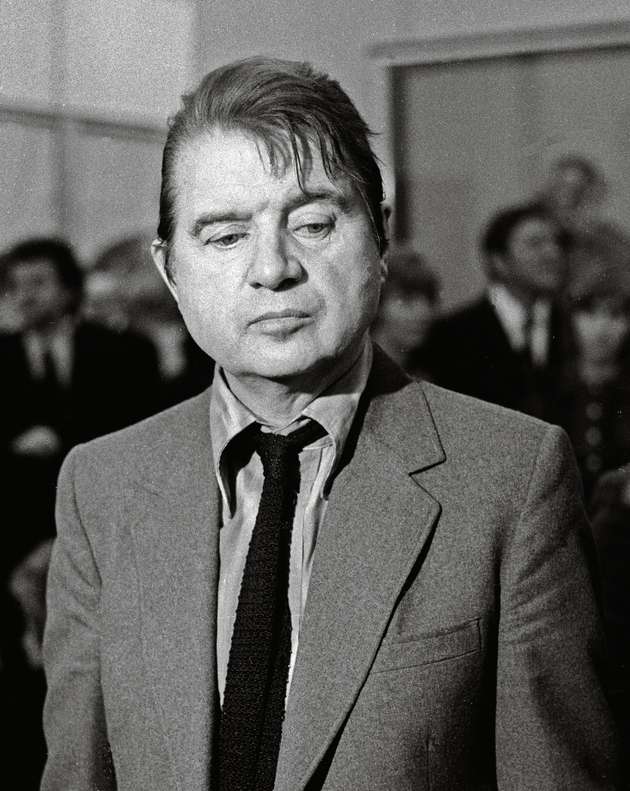
Francis Bacon at the Grand Palais,
Paris, 26 October 1971.
Forever France
ART: By Terence Mullaly in Paris
TERENCE MULLALY
Two events pregnant with possibilities for the future of the arts are taking place in Paris. Where much is open—at best to doubt, at worst to something approaching panic—they provide fixed points.
One of these events, the Francis Bacon Exhibition is, in the fullest sense, official—indeed part of its value as a pointer to the future lies in the fact that a major retrospective exhibition of the work of a foreign artist has been sponsored officially here in Paris; while the other, the opening of new premises for the Galerie Heim, 15, Avenue Matignon, concerns the art market.
Two apparently diametrically opposed, but in tact not contradictory, convictions have in the immediate past taken root where the arts are concerned. One has to do with a crisis of confidence, the other with assurance, amounting to something close to over-confidence.
There is honest uncertainty in the art schools. Even the noisy people who name new movements have for a while been silent. Most indicative of all, the brash discovery of talents which made New York, and then for a moment the West Coast of America, look like the new Mecca of the modern movement, has now come to an end.
Miscalculations
If the lack of a movement in the contemporary arts carrying with it any general acclaim can be regarded, as salutary, a corresponding element of uncertainty on the art market has been near to disastrous. The halcyon days of a few years ago now seem very distant. Too much confidence led to dangerous miscalculations.
For a while it seemed easy. A very 20th-century gold rush was on, and almost every day there was a new saleroom record to report. Several things happened at once. The word went round that art was a good investment. Sotheby’s with a great lunge forward brought glamour and the television cameras into the saleroom, and all the apparatus of public relations was harnessed to promoting the arts. Even more to the point, it became evident that the right kind of collection could buy membership of a new international elite. It looked as if one could acquire almost any work of art and the price would go on spiralling up. For a heady moment the art market seemed more attractive than the stock markets of the world.
Then reality got its revenge. A shortage of really first-class things began to tell. Several things happened with a rapidity that made weaker spirits lose their nerve. Certain traders, particularly those dealing in silver, found they had grossly overstocked. The greedy discovered they could not buy an object, put it back in the salerooms a year or two later and collect a handsome profit. Prices for most categories of objects except the superlative levelled. The mediocre is. unless caught up in some fashionable spiral, hard to sell, and the great middle range of objects on the art market moves slowly.
International
Paris fared particularly badly. With the development soon after the war of avant gard movements that were genuinely international, Paris ceased to be the magnet for all artists. At the same time crippling laws of taxation ensured that the Paris auction houses bad no hope of rivalling Christie’s and Sotheby’s.
Paris still has acute problems. Many of the smaller antique dealers, particularly on the Left Bank, daily look more like junk shops and are in grave financial difficulties. And, now that artists almost everywhere who read the signs of the times might have tasted the headv stuff of success, Paris will never be quite the same again.
Yet the old magic remains. There are little bistros in which a superb meal can still be had, elegance and sophistication go hand in hand with a sense of scale no other city has rivalled, and, above all, French realism has again united with confidence.
Elegance
Paris has much more to do for the arts. It goes far beyond the beauty, making London’s decorations look tawdry, of the trees lining the Champs Elysees sparkling golden with Christmas decorations. The vast Francis Bacon Exhibition, continuing at the Grand Palais until Jan. 10, has brought his work into perspective as only Paris could. Splendidly displayed, Bacon’s paintings are seen to command elements of classic design that transcend their subject matter. Paris has made patent the essential element of the work of one of the very few major artists of our time.
A different achievement is represented by the new Galerie Heim. One of the most spacious and elegant dealer’s establishments anywhere in the world, it has for its opening an impressive exhibition of Venetian drawings of the 18th century selected from Italian collections, including major museums. The assertion of quality could not be clearer. At the same time the spirit of commercial enterprise involved should make London and other centres of the art market look to their laurels.
From Patrick Brogan
PATRICK BROGAN
The Francis Bacon exhibition closed in Paris today. It has been on for 10 weeks at the Grand Palins and has had an astonishing success. French critics and the French public were as disturbed and amazed as most people by Mr Bacon’s work and now admit freely that he is one of his generations great painters.
Long articles on him appeared in every newspaper with any artistic pretentions. A film about his work appeared on television which decided at least some sensitive souls to stay away. And there has been a steady throng of people to the exhibition. Its organizers decline to say how many.
French critics were struck by Mr Bacon’s apparent brutality and offered many a learned and psychological analysis to explain it. Painters, however, admired his colours and his technique.
Art is as international today as it has ever been, but there is no doubt that the success of an individual artist such as Mr Bacon reflects credit on his mother country. French intellectuals are therefore likely to think rather better of Britain after a disturbing visit to the Grand Palais, than they did before.
In this particular case the exhibition was a French idea although its organization necessarily involved the British authorises. French artists and critics were consulted about which contemporary British painter they were most interested in and whom they would most like to see exhibited in Paris. The answer to both questions, almost unanimously, was: Francis Bacon.
Meanwhile the British Council has been preparing one of the biggest exhibitions of British art ever assembled. It opens here on January 28 under the name "English Romantic Painting". The French seldom distinguish between the English and the British. It is in fact a comprehensive exhibition of British painting between about 1760 and 1860, from Stubbs, Gainsborough and Reynolds to the pre-Raphaelites, by way of Lawrence, Constable and Tuner. The paintings come from the museums, from the Queen’s collection and from private collections. Some have come from America, Germany and Switzerland and some from France. Turner is badly represented in French galleries and other British painter are represented hardly at all.
All in all, this is a good time for exhibitions in Paris. There are huge queues each day for the Van Gogh exhibition, Fernand Leger continues to draw visitors and the Picassos from Russia are still on show. Whatever else is happening here, this city remains the world’s capital for painters, dead or living, who have made their name.
JANET HOBHOUSE
Francis Bacon’s retrospective exhibition at the Grand Palais in Paris has been interpreted by some as a diplomatic gesture to Great Britain on the eve of her entry into the Common Market. If so, it is curios that the first major retrospective ever offered by France to a British painter should be given to one who has no disciples and no recent artistic ancestry, to one who in no way acts as a representative of English art. So I felt before seeing what is a very impressive show indeed, and one which places Bacon firmly above his simple reputation as an English eccentric with a disdain for Art History, and as a man of post-war conscience with all the right reactions to the brutalities and humiliations of modern life. Bacon is more complicated and a lot better than that, as this exhibition (his first retrospective since the one held at the Tate in 1962) clearly shows. He has moved firmly away from the sometime sensationalism of his earlier paintings, from manipulative gimmicks (the use of streaming, frenzied lines through portraits, which characterized much of his work in the fifties, for example), and gradually away from what was at times fairly crude symbolism towards less illustrative and more complexly-suggestive subject matter. His painting has developed too, towards a use of cleaner lines and more powerful colors, towards an easiness with vast, abstract backgrounds and looser definitions of space than was evident before.
There is clear enough indication of the development in Bacon’s painting over the last twenty-five years if one compares Painting, 1946 with Second Version of Painting, 1946, done in 1971 (both works are now owned by the Museum of Modern Art in New York). The basic structure, formed by the beef carcass hung head downwards, the split halves moving outwards (the first use of the basic crucifixion form), and under which the shadowed Mussolini-like smiling figure sits, his legs encircled by a steel construction, in the two paintings remain the same. In the first version, however, this basic frame is cluttered by objects which have disappeared in Bacon’s later reworking. Early versions of the owls (used later in the Pope studies) which perch on the steel enclosure, the extra garlanding and patterned carpet which fill the spaces at the top and bottom of the painting, and the miscellaneous lines and arrows all pulling away from the central form, indicate an uneasiness with empty space and a need to disperse the strength of the image in extrinsic clutter. In the second version, not only are these superfluous images gone, leaving greater space and allowing the compact form to test its strength unaided, but that space itself becomes part of the force of the painting. The earlier carpet pattern is exchanged for a solid color, the blurred patchy pink of the first background for a single brilliant yellow which moves with the lines of the beef outside the canvas. Equally, the steel enclosure is now open-ended and there is potential movement where there was earlier only the dark and tight confinement. Lastly, the subject himself alters in a way which indicates, I think, Bacon’s movement away from the image of man as a symbol of oppression or suffering, to that of man as he less symbolically is, potentially good as well as evil, even innocuous, in any case not easily known. In the second version the all-dominating grin is a closed-mouth smile, the eyes are visible and almost easy, the posture is relaxed. The authority figure has yielded to the individual portrait, unthreatening, and good-naturedly drawn. Bacon seems in repainting him thus to have renounced his earlier desire to direct our reaction, to offer judgment, however many misdirections and modifications he might have added to complicate that judgment.
This is certainly the direction in which Bacon’s painting has progressed in the last ten years. He abandoned his Pope series as unsuccessful and his crucifixions as potentially too specific to serve the universal purposes he intended. In their place are individual portraits and triptychs with the more neutral title of Three Studies of the Human Form. But always Bacon’s intention was characteristically to keep away from crude illustration of specific human traits, to preserve as much of the ambiguity of his figures, as their depiction would bare. His work has never deserved the reaction it received from those who saw his paintings as mere tales of horror and suffering, and from the start his work has been sustained by a strong ambivalence to what he depicted. The distorted nudes by the sides of butcher’s carcasses, or lying with hypodermic syringes have, nonetheless, a certain serenity of pose and grace of line that cannot be accidental. Nor is the care of the painting or the delicacy of the color in such pictures to be read, I feel, as a bit of conscious irony or provider of some thrill of incongruity. Rather, I think, Bacon has throughout treated his subjects with the same half-admiration, half-horror that that he later shows in the portraits of his friends.
Head II, 1949, for example, is a very powerful painting, certainly one of Bacon’s best, which uses a horrific subject matter in such a way as to hold the viewer’s attention, while at the same time manipulating a reaction which has little to do with the grim features of the grinning, half-agonized head. It seems to me that this painting is concerned (and typically concerned) with a grapple with the paint, an analysis of texture, shadow, and the sculptural qualities of paint. There is little variation of colour in this gray painting, and almost no clear lines—the position and grin of the head have to be read with effort. Bacon seems to use those minute but clearer objects, an arrow, a safety pin, as foci for for the composition of the painting; they act as limits for the movement of the eye more than does the grinning head. Delineation seems rather concentrated on the paint itself which is thickly applied, cracked and encrusted, evoking far more of the sense of claustrophobia and decay than than the subject presented. It is an early example of the technique Bacon aimed at and achieved in the later portrait heads, “to paint like Velazquez but with the texture of the hippopotamus skin.”
Even when his concerns are less with the paint itself, Bacon’s ability to stands away and admire the image at the same time that h is drawn by horror o paint it. is what, to my mid, saves his paintings from simple conclusions. The studies of lovers, for example, can be read as scenes of rape or murder, or as mere figures in movement, neutrally depicted, as they are in the original sources—Muybridge’s famous photographs published in 1879 as Main in Motion and the first such studies ever made. Other paintings from this source share the the near-clinical interest of the photographer. In one, two figures balance on a ring, the similar figure crawling, both against a simple, brilliant abstract background, making a pleasant, harmonious scene but for the title, After Muybridge—Woman emptying a bowl of water, and Paralytic Child on all fours. Bacon’s occasional indifference to the import of such objects in his paintings as bandages, crutches, syringes, has led him to make one or two amazing oversights, as, for example, the Nazi arm-band of the 1965 Crucifixion, which binds that painting to its specific reference and gives the horror depicted a fairly specific name. Bacon, taking the idea of the swastika from a photo, claims no such motive for use. “You will tell me it’s absurd ... but I needed the armband to break the continuity of the arm, and I wanted a bit of red around the arm.... It was purely a formal intention.” It is not often, however, that Bacon’s ambivalence to his images leads him so far astray.
Along with this developing interest in the formal aspect of the image, Bacon’s paintings show a new lessening of tension which is apparent as much in the structural as in the use of less symbolic subject-matter. The cage-like constructions which were consistently used in his early work have gradually changed in meaning, becoming looser, larger, until they act as arenas or eventually balancing bars in paintings such as the later Studies of the Human Body. The claustrophobia of the early works is exchanged, first for a sense of precariousness, as in Portrait of George Dyer on a Bicycle eventually for a sense of perfect balance as in the enormous 1970 Triptych, where three people sit serenely in an enormous space, supported by one strong narrow bar. The background color of Bacon’s painting also lightens allowing a new airiness in his work, very different from those tense dark studies with which he became famous.
Equally, though his subjects sit isolated in these later works, the new suggestion of performance hints at a potential audience which will admire their skills. If one remembers the studies of the fifties and early sixties, with their trapped humans capable of little but destruction, indifference or pain, the new paintings reveal a remarkable optimism.
I like this new Bacon better. Technically, his painting is surer, his lines cleaner and stronger, and his colors freer than earlier. His portraits are far more commanding in their originality than were those brooding early studies. Equally, the scale of his paintings has increased and with that has come a new freedom of movement and a power which no longer depends upon manipulated emotions. Bacon is as capable as ever of creating anxiety or horror, as he does in probably the best of his triptychs, the 1970 panels inspired by Sweeney Agonistes, but he is capable too, of a great fund of admiration for the human being. This, I think, gives him a far greater power as a painter, to move in a free style, to explore a greater range of emotions, and consequently to elicit a far more complex reaction than was earlier possible.
Concurrently with the Grand Palais exhibition New York Graphic has published the first major book on the artist John Russell, Francis Bacon, 87 bl. and wh. and 74 color plates.
Francis Bacon’s European retrospective
The present retrospective exhibition of paintings by Francis Bacon, which is shortly to move from the Grand Palais in Paris to the Kunsthalle in Dusseldorf, marks one of the rare successes of British painters in capturing the attention of a European public. Three floors of the Grand Palais were given over to the works by Bacon since 1944 borrowed from collections in Europe and the United States. A slight emphasis in the selection towards paintings done in the nine years since Bacon’s retrospective at the Tate in 1962 shows that much of the artist’s best work is recent, and in particular that he has greatly extended his scope as a colourist.
Bacon is now 63; the way he continues to probe the possibilities of his chosen subject matter and produce fresh results conveys the feeling of a man still very much tied up with his work, for whom the original suppositions connected with his dominant theme of people in rooms has become neither meaningless nor just a convention.
Bacon was originally an interior designer, a successful exponent of the modernist mode of around 1930. The furniture in some of his later paintings has occasionally seemed to refer back to his first work, but there is no serious connexion between his design work and his painting apart from the fact of his technical expertise as a painter. This is more than just a knowledge of the way colours work; it extends, for instance, in Dog of 1952, to his building up the image of the dog from a mixture of sand and paint, so the animal stands out as a palpable thing against the rest of canvas on which the paint is drily and sparingly used.
Bacon’s earliest painting, reminiscent of Picasso and lesser Surrealist painters like Lurgat, has mostly been destroyed, and what remains has not been included in the exhibition. The earliest pictures in the show are the Tate’s Three studies for figures at the base of a Crucifixion, strident images of three greatly distorted females, connected by Bacon with the Furies. He has frequently returned to the theme of the Crucifixion, referring to it either obliquely, as here, through attendant figures, or, painting it in modern dress, as in the magnificent Three Studies for a Crucifixion of 1962, in which the right hand study is directly based on the representation of the Crucifixion by the Sienese painter Cimabue, but in Bacon’s case is only just recognizable as a figure at all. Bacon is not a Christian, but is interested in the Crucifixion as a symbol of suffering, and in particular, one suspects, in the idea of atonement or suffering on behalf of others. It is difficult to be specific. During the 1950 s Bacon did a large number of paintings of men confined within cage-like structures. Some were Popes, derived from a reproduction of Velazquez’s portrait of Innocent X, some were friends, and others were anonymous business executives. Some are tormented, others seem quite pleased with themselves. The sense is there that the bars are restrictive, but the internees are perhaps not always aware of it. Suffering in Bacon’s painting is real only on the broadest level, it is almost synonymous with living.
It is easier now than it was at the time of the 1962 Tate exhibition, before so many of the richly coloured works of the 1960 s had been painted, to understand the limited scope of the 50s portraits. Though Bacon can reasonably be considered a traditionalist in the sense that his painting is about the placing of things in space, a fundamental which it shares with the whole Renaissance tradition of art, the best of his painting works “Two studies for a self-portrait”, oil on canvas, 1970. through colour—open areas of colour carried within brush strokes—and not through line. In the early pictures like the Tate’s Three studies for figures at the base of a Crucifixion the importance of colour is already manifest. The bright orange background against which the figures are seen is abstract and non-realistic in the same way as the gold backgrounds to medieval religious pictures are abstract. It is not a flat pure colour, as it appears at first glance in a reproduction, but richly textured and carefully modulated. The same is true of the even more daring coloured backgrounds of the big triptychs of the 19605. In the recent pictures some completely new colours appear, like the cold blue of Portrait of Isabel Rawsthorne standing in a Soho street. (1967) and the blue of the shadows in Triptych (1970), but they have the same vibrancy as the orange background in 1944.
In the late pictures the network of bars that surrounded the figures in the 1950s become rare (the Isabel Rawsthorne picture is an exception), with the result that figures relate more openly to their surroundings. A consequence of this is that one gets in the recent paintings an increased sense of the direct contrast between the colour areas of the broad, open backgrounds and the intricate detailing of the figure painting, for which Bacon is liable to use complicated mixtures of colours within a single brushstroke. He also highlights the contrast of figure and background, sometimes by strokes of a pure colour round the edge of a form. In these ways the figures and other central images are made to express their fierce internal energy by contrast to the more even colouring of their surroundings. In his Studies of the Human Body (1970), one of the most recent triptychs, and one of the largest pictures in the exhibition, Bacon has confined the energetic figure sections to quite small areas near the middle of each canvas. But the images are so commanding that they still manage to dominate their vast backgrounds of pink.
The Worst is Not Yet
A blood-stained figure on a bed. A carcase with splints on it. A man on a chair smoking. One walks past his paintings as if through some gigantic institution. A man on a chair turning. A man holding a razor. A man shitting. What is the meaning of the events we see? The painted figures are all quite indifferent to one another’s presence or plight. Are we, as we walk past them, the same? A photograph of Bacon with his sleeves rolled up shows that his forearms closely resemble those of many of the men he paints. A woman crawls along a rail like a child. In 1971, according to the magazine Connaissance des Arts, Bacon became the first of the top ten most important living artists. A man sits naked with torn newspaper around his feet. A man stares at a blind cord. A man reclines in a vest on a stained red couch. There are many faces which move, and as they move they give an impression of pain. There has never been painting quite like this. It relates to the world we live in. But how?
To begin with a few facts:
1. Francis Bacon is the only British painter this century to have gained an international influence.
2. His work is remarkably consistent, from the first paintings to the most recent. One is confronted by a fully articulated world-view.
3. Bacon is a painter of extraordinary skill, a master. Nobody who is familiar with the problems of figurative oil-painting can remain unimpressed by his solutions. Such mastery, which is rare, is the result of great dedication and extreme lucidity about the medium.
4. Bacon’s work has been unusually well written about. Writers such as Davis Sylvester, Michel Leiris and Lawrence Gowing have discussed its internal implications with great eloquence. By ‘internal’ I mean the implications of its own propositions within its own terms.
Bacon’s work is centered on the human body. The body is usually distorted, whereas what clothes or surrounds it is relatively undistorted. Compare the coat with the torso, the umbrella with the arm, the cigarette stub with the mouth. According to Bacon himself, the distortions undergone by face or body are the consequence of his searching for a way of making the paint ‘come across directly on to the nervous system.’ Again and again, he refers to the nervous system of painter and spectator. The nervous system for him is independent of the brain. The kind of figurative painting which appeals to the brain, finds illustrational and boring.
‘I’ve always hoped to put over things as directly and rawly as I possibly can, and perhaps if a thing comes across directly, they feel that it is horrific.’
To arrive at this rawness which speaks directly to the nervous system, Bacon relies heavily on what he calls ‘the accident.’ ‘In my case, I feel that anything I’ve ever liked at all has been the result of an accident on which I’ve been able to work.’ The ‘accident’ occurs in his painting when he makes ‘involuntary marks’ upon the canvas. His ‘instinct’ then finds in these marks a way of developing the image.
A developed image is one that is both factual and suggestive to the nervous system.
‘Isn’t it that one wants a thing to be as factual as possible, and yet at the same time as deeply suggestive or deeply unblocking of areas of sensation other than simple illustrating of the object that you set out to do? Isn’t that what art is all about?’
For Bacon, the ‘unlocking’ object is always the human body. Other things in his painting (chairs, shoes, blinds, lamp switches, newspapers) are merely illustrated. ‘What I want to do is to distort the thing far beyond appearance, but in the distortion to bring it back to a recording of the appearance.’ Interpreted as process, we now see that this means the following. The appearance of a body suffers the accident of involuntary marks being made upon it. Its distorted image then comes across directly on to the nervous system of the viewer (or painter), who rediscovers the appearance of the body through or beneath the marks it bears.
Apart from the inflicted marks of the painting-accident, there are also sometimes painted marks on a body or on a mattress. These are, more or less obviously, traces of bodily fluids—blood, semen, perhaps shit. When they occur, the stains on the canvas are like stains on a surface which has actually touched the body.
The double-meaning of the words which Bacon has always used when talking about his painting (accident, rawness, marks), and perhaps even the double meaning of his own name, seem to be part of the vocabulary of an obsession, an experience which probably dates back to the beginning of his self-consciousness. There are no alternatives offered in Bacon’s world, no ways out. Consciousness of time or change does not exist. Bacon often starts working on a painting from an image taken from a photograph. A photograph records for a moment. In the process of painting, Bacon seeks the accident which will turn that moment into all moments. In life, the moment which ousts all preceding and following moments is most commonly a moment of physical pain. And pain may be the ideal to which Bacon’s obsession aspires. Nevertheless, the content of his paints, the content which constitutes their appeal, has little to do with pain. As often, the obsession is a distraction and the real content lies elsewhere.
Bacon’s work is said to be an expression of the anguished loneliness of western man. His figures are isolated in glass cases, in arenas of pure colour, in anonymous rooms, or even within themselves.
Their isolation does not preclude their being watched. (The triptych form, in which each figure is isolated within his own canvas, and yet is visible to the others, is symptomatic.) His figures are alone, but they are utterly without privacy. The marks they bear, their wounds, look self-inflicted. But self-inflicted in a highly special sense. Not by an individual but by the species, Man—because, under conditions of such universal solitude, the distinction between individual and species becomes meaningless.
Bacon is the opposite of an apocalyptic painter who envisages the worst is likely. For Bacon, the worst has already happened. The worst that has happened has nothing to do with the blood, the stains, the viscera. The worst is that man has come to be seen as mindless. The worse has already happened in the Crucifixion of 1944. The bandages and the screams are already in place—as also is the aspiration towards ideal pain. But the necks end in mouths. The top half of the face does not exist. The skull is missing.
Later, the worst is evoked more subtly. The anatomy is left intact, and man’s inability to reflect is suggested by what happens around him and by his expression—or lack of it. The glass cases, which contain friends or a Pope, are reminiscent of those in which animal behaviour-patterns can be studies. The props, the trapeze chairs, the railings, the cords, are like those with which cages are fitted. Man is an unhappy ape. But if he knows it, he isn’t. And so it is necessary to show that man cannot know. Man is an unhappy ape without knowing it. It is not a brain but a perception which separates the two species. This is the axiom on which Bacon’s art is based. During the 1950s, Bacon appeared to be interested in facial expressions. But not, as he admits, for what they expressed.
In fact, I wanted to paint the scream more than the horror. And I think if I had really thought about what causes somebody to scream—the horror that produces the scream—it would have made the screams that I tried to paint more successful. In fact, they were too abstract. They originally started through my always having been moved by movements of the mouth and the shape of the mouth and the teeth. I like, you may say, the glitter and colour that comes from the mouth and I’ve always hoped in a sense to be able to paint the mouth like Monet painted a sunset.
In the portraits of friends like Isabel Rawsthorne, or in some of the new self-portraits, one is confronted with the expression of an eye, sometimes two eyes. But study these expressions; read them. Not one is self-reflective. The eyes look out from their condition, dumbly, on to what surrounds them. They do not know what has happened to them; and their poignancy lies in their ignorance. Yet what has happened to them? The rest of their faces have been contorted with expressions which are not their own—which, indeed, are not expressions at all (because there is nothing behind them to be expressed), but are events created by accident in collusion with the painter. Not altogether by accident, however.
Likeness remains—and in this Bacon is this Bacon uses all his mastery. Normally, likeness defines character, and character in man is inseparable from mind. Hence the reason why some of these portraits, unprecedented in the history of art, although never tragic, are very haunting. We see character as the empty cast of a consciousness that is absent. Once again, the worst has happened. Living man has become his own mindless spectre. In the larger figure-compositions, where there is more than one personage, the lack of expression is matched by the total unreceptivity of the other figures. They are all proving to each other, all the time, that they can have no expression. Only grimaces remain.
Bacon’s view of the absurd has nothing to do with existentialism, or with the work of an artist like Samuel Beckett. Beckett approaches despair as a result of questioning, as a result of trying to unravel the language of conventionally given answers. Bacon questions nothing, unravels nothing. He accepts the worst has happened.
His lack of alternatives, within his view of the human condition, is reflected in the lack of any thematic development in his life’s work. His progress, during 30 years, is a technical one of getting the worst into sharper focus. He succeeds, but at the same time the reiteration makes the worst less credible. That is his paradox. As you walk through room after room it becomes clear that you can live with the worst, that you can go on painting it again and again, that you can turn it onto more and more elegant art, that you can put velvet and gold frames round it, that other people will buy it to hang on the wall of the rooms where they eat. It begins to seem that Bacon may be a charlatan. Yet he is not. And his fidelity to his own obsession ensures that the paradox of his art yields a consistent truth, though it may not be the truth he intends.
Bacon’s art is, in effect, conformist. It is not with Goya or the early Eisenstein that he should be compared, but with Walt Disney. Both men make propositions about the alienated behaviour of our societies; and both, in a different way, persuade the viewer to accept what is. Disney makes alienated behaviour look funny and sentimental and therefore, acceptable. Bacon interprets such behaviour in terms of the worst possible having already happened, and so proposes that both refusal and hope are pointless. The surprising formal similarities of their work—the way limbs are distorted, the overall shapes of bodies, the relation of figures to background and to one another, the use of neat tailor’s clothes, the gesture of hands, the range of colours used—are the result of both men having complementary attitudes to the same crisis.
Disney’s world is also charged with vain violence. The ultimate catastrophe is always in the offing. His creatures have both personality and nervous reactions: what they lack (almost) is mind. If, before a cartoon sequence by Disney, one read and believed the caption, There is nothing else, the fi lm would strike us as horrifically as a painting by Bacon. Bacon’s paintings do not comment, as is often said, on any actual experience of loneliness, anguish or metaphysical doubt; nor do they comment on social relations, bureaucracy, industrial society or the history of the 20th century. To do any of these things they would have to be concerned with consciousness. What they do is to demonstrate how alienation may provoke a longing for its own absolute form—which is mindlessness. This is the consistent truth demonstrated, rather than expressed, in Bacon’s work.
COLIN ANDERSON
Sir, We, the undersigned, wish to place on record our fervent and considered belief that the appeal which has been launched by the Trustees of the National Gallery, to retain Titian’s “Death of Actaeon” deserves the fullest support.
The “Death of Actaeon” is a masterpiece by one of the greatest painters of all time. Without such a painting the nation’s superb historical collection of pictures is incomplete. Great painters already represented there, like Rubens, Rembrandt and Velazquez, all found inspiration in Titian’s work and in his handling of paint. A comparatively late picture such as the “Death of Actaeon” shows this mastery at its most subtle. Yet Titian’s work of this grand and poetical kind is still unrepresented in the National Gallery on the full scale. For this reason alone, quite apart from its magical qualities, the picture would make a magnificent and vital addition to the Gallery.
The amount which the public is asked to subscribe towards the purchase of the “Death of Actaeon” is little more than an eighth part of the price approved by the Reviewing Committee on the Export of Works of Art: £1,763,000. The National Gallery has pledged £1,000,000, mortgaging its future for several years to do so. The National Art-Collections Fund has given £100,009, the Pilgrim Trust £50,000. Such great generosity from these two institutions, the intense concern of all three, the readiness of the Government to match further contributions pound for pound must surely convince your readers of the justice of the Trustees’ appeal to the public for the remainder: £231,500, part of ,which has already been forthcoming.
Out of a population of 55 million less than a quarter of a million persons would have to give £1 each. To those of your readers who have not already contributed, we urgently appeal to give at least that.
The cause is exceptional. The appeal is exceptional. In giving it our enthusiastic support we beg the public to rise to the occasion with generosity on an exceptionally wide front. All donations should be sent to the National Gallery (Titian Appeal).
Yours faithfully,
COLIN
ANDERSON,
FRANCIS BACON,
ANTHONY BLUNT,
TRENCHARD COX,
CRAWFORD and BALCARRES,
GOODMAN,
PHILIP HENDY,
HOLFORD,
ANTONY HORNBY,
BRYAN KNEALE,
OSBERT LANCASTER,
BEN NICHOLSON,
ROSSE,
GRAHAM SUTHERLAND.
January 19.
John Berger, Marxist. Sometimes I think he is a great critic. Sometimes I think he is slick and untrustworthy and the enemy of the very ideas that he stands for. The real puzzle is defining the relationship between his vices and his virtues. I admire unreservedly the way in which he can approach any aspect of the visual world, whether the behaviour of people in a café, a newspaper photograph or a picture in the National Gallery, and bring them with equal vividness and point into his discussion of art. I admire the way that he invariably approaches art from outside its own self-perpetuating institutions, looking for connections in the broadest sense, and the incomparable moments when he gives focus to his broader arguments with close analysis of pictures. Above all, I envy the energy which comes off his pages as much as I detest the energy with which he projects himself on the small screen.
Here, perhaps, is the first clue to the paradox. The deep seriousness which he gives to whatever he writes about is not untouched by a kind of persuasive violence, as if the first person he was trying to convince was himself—but that this is inadmissible to him, so we have to bear the brunt. Sometimes he falls into a kind of Old Testament incantation, often built round assertions about what an artist was feeling or meaning or what ‘we’ were thinking or feeling without any acknowledgement that it was what Berger thought we thought. This was particularly so in his early work, when, like any 19th-century novelist, he thought nothing of climbing into people’s minds, often with hob-nailed boots on. Since the early Sixties (and one would give anything for an account of his private pilgrimage during the last 12 years or so0 his work has extended in range and subtlety to an extraordinary degree. His new essays show him at his very best.
In a recent essay on Francis Bacon in New Society, John Berger had this to say about criticism: a critic isn’t there to define or assess a work of art. ‘The notion of criticism as assessment is an academic one. Properly speaking, criticism can only be concerned with the uses to which a work of art is put’—that is, with the value of the discourse between the work and the public. And he goes on: ‘About the work-for-itself I can say nothing. All that can be said about a work of art within its own terms, it is already saying about itself.’ At a later point he invokes Bacon’s portraits: ‘Study these expressions; read them. Not one is self-reflective. They do not know what has happened to them.’ And the conclusion of the article, as forceful and final as an express pulling into a terminus, is that Bacon’s paintings have no concern with consciousness. ‘What they do is to demonstrate how alienation may provoke a longing for its own absolute form—which is mindlessness.’ The argument linking these sentences is brilliantly worked out. Everything fits. But it seems to be the kind of argument that carries along the traditional country-house detective story, where the solution is decided upon first and then the clues are piled up in front of it. He is not really evaluating the uses to which Bacon’s art is put, nor the discourse between the work and the public, but rather telling the reader what he must notice and what he must think in order to arrive at the correct solution. If this were acknowledged, it wouldn’t matter, but it is not.
We are carried along, as if inside a story, and the illusion encloses us. Looking at the portraits as though they were people, not paintings, is a kind of mystification. How can one say whether a painted head is self-reflective or not? Self-reflection is on the part of the painter, and the quality of Bacon’s self-reflection cannot be dealt with so lightly. But to follow this out would have landed Berger into a discussion of the work-for-itself, which he has renounced. It is here, in the vital zone where the work-for-itself impinges on broader matters, at the interface between the closed world of art and everything that lies outside it, that the real work of criticism has to be done. Berger’s strength is in never allowing himself to be trapped inside art-for-itself. His weakness is that he is reluctant to enter it at all unless on the terms of a stick-up.
In one of his essays devoted to men that he admires (his unfashionable readiness to admire men’s lives is among he reasons why I admire him) he quotes from the critic Walter Benjamin: ‘There is no document of civilisation which is not at the same time a document of barbarism.’ It is a thought that Berger has been forcing upon us in his recent TV series. But a Rubens regarded as a mere token of exploitation is no different from a Rubens regarded as a cultural trophy. Both are loathsome, and from either angle the picture is no more than a stinking rag, better buried. Either usage blocks, obliterates, those living features which, if they can be brought to the surface, in the present, in some way redeem the past.
The Look of Things. By John Berger. Penguin 40p
Eye for a tooth
THOSE familiar with Francis Bacon’s cavalier treatment of the human face may not at once realise that in the new self-portrait I reproduce he has given himself a black eye.
A few weeks ago the artist badly damaged his left eye in a fall. But he was nevertheless determined to begin the picture, so strapped it open with sticking plaster. This surgical detail, however, he has spared his audience.
The finished self-portrait, a tribute as much to his courage as to his brush, can be seen at Tooth’s, in Bruton Street, from Tuesday.
It is part of an exhibition of the work of 25 living artists chosen by Michael Shepherd, the Sunday Telegraph art critic.
Francis Bacon’s European retrospective
The present retrospective exhibition of paintings by Francis Bacon, which is shortly to move from the Grand Palais in Paris to the Kunsthalle in Dusseldorf, marks one of the rare successes of British painters in capturing the attention of a European public. Three floors of the Grand Palais were given over to the works by Bacon since 1944 borrowed from collections in Europe and the United States. A slight emphasis in the selection towards paintings done in the nine years since Bacon’s retrospective at the Tate in 1962 shows that much of the artist’s best work is recent, and in particular that he has greatly extended his scope as a colourist.
Bacon is now 63; the way he continues to probe the possibilities of his chosen subject matter and produce fresh results conveys the feeling of a man still very much tied up with his work, for whom the original suppositions connected with his dominant theme of people in rooms has become neither meaningless nor just a convention.
Bacon was originally an interior designer, a successful exponent of the modernist mode of around 1930. The furniture in some of his later paintings has occasionally seemed to refer back to his first work, but there is no serious connexion between his design work and his painting apart from the fact of his technical expertise as a painter. This is more than just a knowledge of the way colours work; it extends, for instance, in Dog of 1952, to his building up the image of the dog from a mixture of sand and paint, so the animal stands out as a palpable thing against the rest of canvas on which the paint is drily and sparingly used.
Bacon’s earliest painting, reminiscent of Picasso and lesser Surrealist painters like Lurçat, has mostly been destroyed, and what remains has not been included in the exhibition. The earliest pictures in the show are the Tate’s Three studies for figures at the base of a Crucifixion, strident images of three greatly distorted females, connected by Bacon with the Furies. He has frequently returned to the theme of the Crucifixion, referring to it either obliquely, as here, through attendant figures, or, painting it in modern dress, as in the magnificent Three Studies for a Crucifixion of 1962, in which the right hand study is directly based on the representation of the Crucifixion by the Sienese painter Cimabue, but in Bacon’s case is only just re-,cognizable as a figure at all.
Bacon is not a Christian, but is interested in the Crucifixion as a symbol of suffering, and in particular, one suspects, in the idea of atonement or suffering on behalf of others. It is difficult to be specific. During the 1950s Bacon did a large number of paintings of men confined within cage-like structures. Some were Popes, derived from a reproduction of Velazquez’s portrait of Innocent X, some were friends, and others were anonymous business executives. Some are tormented, others seem quite pleased with themselves. The sense is there that the bars are restrictive, but the internees are perhaps not always aware of it. Suffering in Bacon’s painting is real only on the broadest level, it is almost synonymous with living. It is easier now than it was at the time of the 1962 Tate exhibition, before so many of the richly coloured works of the 1960s had been painted, to understand the limited scope of the 50s portraits. Though Bacon can reasonably be considered a traditionalist in the sense that his painting is about the placing of things in space, a fundamental which it shares with the whole Renaissance tradition of art, the best of his painting works, through colour — open areas of colour carried within brush strokes — and not through line.
In the early pictures like the Tate’s Three studies for figures at the base of a Crucifixion the importance of colour is already manifest. The bright orange background against which the figures are seen is abstract and non-realistic in the same way as the gold backgrounds to medieval religious pictures are abstract. It is not a flat pure colour, as it appears at first glance in a reproduction, but richly textured and carefully modulated. The same is true of the even more daring coloured backgrounds of the big triptychs of the 1960s. In the recent pictures some completely new colours appear, like the cold blue of Portrait of Isabel Rawsthorne standing in a Soho street. (1967) and the blue of the shadows in Triptych (1970), but they have the same vibrancy as the orange background in 1944. In the late pictures the network of bars that surrounded the figures in the 1950s become rare (the Isabel Rawsthorne picture is an exception), with the result that figures relate more openly to their surroundings.
A consequence of this is that one gets in the recent paintings an increased sense of the direct contrast between the colour areas of the broad, open backgrounds and the intricate detailing of the figure painting, for which Bacon is liable to use complicated mixtures of colours within a single brushstroke. He also highlights the contrast of figure and background, sometimes by strokes of a pure colour round the edge of a form. In these ways the figures and other central images are made to express their fierce internal energy by contrast to the more even colouring of their surroundings.
In his Studies of the Human Body (1970), one of the most recent triptychs, and one of the largest pictures in the exhibition, Bacon has confined the energetic figure sections to quite small areas near the middle of each canvas. But the images are so commanding that they still manage to dominate their vast backgrounds of pink.
The screaming limit
JOHN RUSSELL:
Francis Bacon
PAUL OVERY | ART AND ARCHITECTURE | THE TIMES LITERARY SUPPLEMENT | MARCH 10 1972
In 1964 John Russell wrote a short book on Francis Bacon for the Methuen “Art in Progress” series. His new book starts from the same point: Bacon’s showing of “Three Studies for Figures at the Base of a Crucifixion” at a mixed exhibition at the Lefcvre Gallery in April, 1945.
Some will find Mr Russell’s discussion of this work in terms of the international situation at the time familiar, and if they turn to Francis Bacon (1964) they will find that in this first chapter whole sentences have been reprinted unchanged.
However, despite such repetitions Francis Bacon (1971 is, generally, a much expanded version of the earlier book which was little more than an essay. Given this, it is difficult to see why Mr Russell should not have up dated the fairly full bibliography of the smaller book in place of the inadequate “Bibliographical Note” used now. What is more, no references are given for the quite numerous quotations, as one might have expected in a work of this size; and the book shows signs of haste and carelessness in both the writing and the proof-correction. (One plate is —rather happily — mistitled “Three Studies for a Crucifixion”.) No doubt this is partly due to the rush to get the book ready in time for Bacons large retrospective exhibition at the Grand Palais in Paris last autumn.
At the end of Francis Bacon (1964) Mr Russell wrote:
The reader will not find here the “short biography” which is customary in book of this kind. lt does not help us to understand Bacon’s work to he told that he was horn in Dublin in 1909 that he was one of five children and that his father was an English horse trainer.
It seems that Mr Russell has now changed his mind for the first section of Francis Bacon (1971), Educated privately, is much concerned with such biographical details:
He was very bright everyone agreed on that . . .
Bacon today is quite exceptionally articulate and can take the heart out of a new book as last as anyone at All Souls.
Bacon had had almost no formal education and he was never to catch up with Middle English or the consequences of the Council of Trent; but in the prime object of education — the understanding, that is to say, of one’s own time — he was ahead of the Prime Minister and ahead of the Foreign Secretary, and ahead of the Editor of The Times.
When Mr Russell comes to discuss the paintings he occasionally hints that some of these may be better than others, although sometimes times with a deferential aside to Bacon’s own opinion of his works:
“The subjects which really did come off in our estimation if not always in his own . . . ”
The following illustrates Mr Russell’s critical technique. He begins by giving Bacon’s own view of his work: “Bacon does not regard any of his heads as nightmare images”; moves on to categorical statement: “There is nothing gratuitous or wilful about the distortions which he imposes upon the sitters features”; and finally appeals to a clique: “Anyone one who knows even one of the sitters will end by agreeing with [Bacon] that . . . ” etc.
When Mr Russell discusses Bacon’s attitudes and approaches to sex and violence (the two seem to be here regarded as almost synonymous his tone becomes blandly vulgar:
Bacon knew a Berlin that was laid out on its back and asked only to be pleasured over and over again.
“Bullfighting Is like boxing”, he once said in a phrase which Mérimée would have applauded —“a marvellous aperitif for sex.”
Mr Russell writes that
Bacon does not disassociate pleasure from pain and can quite well imagine that as a matter of fact people should literally “die of love” — be beaten to death that is lo say in the course of transports that gel out of hand.
But it is one thing to “well imagine” that such things are possible and quite another to take an obvious relish in depicting such occurrences, as Bacon seems to.
The taste for Bacon has generally involved English critics in some curious mental gymnastics whereby the paintings and graphics of the German Expressionists have usually been dismissed as hysterical or exaggerated gerated which they rarely are whereas as the work of Bacon which is almost always hysterical and exaggerated is considered to be a masterly reflection of the “human condition.”
Mr Russell cursorily compares Bacon’s use of the triptych with that of Max Beckmann — a far finer painter who, while working under terrible circumstances, never fell into the hysterical melodramatics and overstatement of Bacon. Mr Russell dismisses Bcckmann’s work, without any attempt to justify the remark, as “heavy breathing sententiousness.”
The rise of Bacon’s reputation is a curious phenomenon. However, if one looks through the useful chronological logical bibliography of articles on Bacon in the catalogue of the Grand Palais exhibition, one notices that certain names have recurred again and again almost every year — notably that of David Sylvester. One of the few voices of dissent in the general chorus of critical approval has been that of John Berger, who wrote in Permanent Red
Conventional sentimentality is immediately recognisable; unconventional sentimentality is not, but when seen for what it is, it is often more perverse — it is healthier to be sentimental about babies than about skeletons. Sentimentality is a way of evading relevant facts. Hollyhock cottages evade no more than Francis Bacon’s screams.
Bacon’s brutal paintings of screaming contorted figures arc a curious combination of hysteria and grand guignol. To see that this is a pernicious form of sentimentality is one of Mr Berger’s most accurate insights which ought to be considered carefully by anyone who writes critically about Bacon. Mr Russell makes no attempt to grapple with this in his book.
Wider horizons
JOHN RUSSELL | ART | THE SUNDAY TIMES | MARCH 12 1972
This year’s “Critic’s Choice” exhibition at Tooth’s has been selected by Michael Shepherd, who stands out among a pretty rough bunch as the Parsifal of our profession. His choice is prompted by the idea that only a naturalistic art can fulfil the painter’s social contract: “to develop vision in society and to create beauty.” Twenty-five painters are included and they range from Bacon, Freud and Sutherland to newcomers whose ceiling of ambition seems to me to be so low as to endanger any fully-grown hamster which might come up the stairs. But the show is at the very least not a jumble of other people’s favourites.
WITH the publication last Thursday of Bruce Laughton’s Philip Wilson Steer
(Oxford, £8) there began a new series (Oxford Studies in the History of Art and
Architecture) which is designed to favour especially the younger scholar with
new researches to put forward. Mr Laughton
JOHN RUSSELL
Andrew Forge, Francis Bacon and Michael Levy talk about Titian
FORGE: The National Gallery’s campaign for the purchase of Titian’s Death of Actaeon is rolling on, and some time this summer we will know whether this great picture will stay in London or go to America. In all the public discussion that has surrounded the issue, little has been said about the merits of the painting itself. I’ve been talking with two people who passionately admire it, and I asked Francis Bacon why he thought it should stay in London.
BACON: First, it’s a late painting by one of the greatest painters that the human race has so far produced, and now that they have both the Death of Actaeon and the Bacchus and Ariadne one can see the extraordinary: the development: the early painting is certainly a magnificent painting, but one sees, in this late painting, the way that the whole psyche has locked into the technique; in the corner where Actaeon has been turned into a stag, with the hounds yelping and setting on him, one sees the extraordinary way Titian has been able to weave these forms, as though he’s used the light to work into the paint, so that the images are never absolutely definite and yet they are the suggestion of a tremendously tragic act; and one sees the more substantial figure of Diana on the left-hand side, which perhaps enhances the ambiguity of this tragic act going on in the corner.
FORGE: Do you think that, in contrast to Bacchus and Ariadne perhaps Titian hadn’t got a very clear idea how the picture was going to look when he first started painting it? Do you think the process of the painting is different?
BACON: I think the process is totally different in all his very late pictures. They’re really painted in a very profound sense, and the early paintings are nearer to illustrational painting. It’s tremendously important that a painting of this quality should be seen beside the very great early paintings. I think that everything possible should be done to keep this painting as completing, with the other Titians, almost the cycle of his life.
FORGE: Do you find that the subject of the picture involves you very much when you’re looking at it?
BACON: Yes, but I’m less conscious, in a sense, of the subject than I am of the extraordinary technical quality by which he has been able to return this very tragic event back into me and unlock the sensation about life in general, which is the way that I always see a painting. In this instance, this is a superb example of Titian’s late work, where he seemed to weave the images out of the air.
FORGE: I’ve always been very puzzled by the difference between the figure of the goddess on left and that of Actaeon and the dogs over on the right. It’s quite extraordinary how huge she is. And there’s a strange difference, too, in the way that the forms are realised, isn’t there?
BACON: If the scale of Actaeon attacked by the hounds had been kept on the same scale as Diana, it couldn’t have had this tragic impact—as though Actaeon is being demolished by the hounds that have been set upon him. He has already been diminished into a stag, and also he is further removed—he is further away from the foreground than the goddess.
FORGE: And she’s completed in a very different way, isn’t she?
BACON: Something torn to bits is what this is about. It’s the tearing of an image, of a human image, to bits. It wouldn’t have worked so well—probably, at any rate—in this painting if it had been more definite. Now one of the reasons that this painting is of deep interest o me concerns the whole problem of painting today. If you think how abstract painting has taken over and how people find it almost impossible to be figurative, you will see, not that this kind of painting could be done today, but that there are all sorts of suggestions by which forms could be used and redeveloped in another way with everyday subjects. When I look at Actaeon being torn to bits by the hounds, I think also of the Eumenides, and it makes me think of how perhaps they could be used. Because we don’t only live our life, as it were, in the material and physical sense: we live it through our whole nervous system, which is, of course, also a physical thing, but it’s a whole kind of long process human images which have been passed down—and yet nobody knows how to go on using them. This painting suggests how forms and images could be remade to carry a meaning as definite as the death of Actaeon.
FORGE: Michael, if this picture is acquired by the National Gallery, how will it fit into the existing holding of paintings by Titian?
LEVEY: I think it will fit in very well indeed, insofar as I do believe that we’ve got a gap for it. It seems to me that the painter himself is someone who is, all the time, changing. I don’t know that I can think off-hand, before Picasso, of any artist who evolves the whole time. The Gallery’s got a whole series of steps up to this picture, but nothing of this scale, of this period, by Titian.
FORGE: What’s the picture about? It’s a strange subject, not, I suppose, terribly available to one when one just looks at the picture casually?
LEVEY: In the Bacchus and Ariadne you have this smiling landscape—and a god is leaping from his chariot to make a woman immortal. I would like people to look at the Bacchus and Ariadne first and then look at this picture: now it’s a goddess and a mortal man, and she is certainly proving his mortality. It is her revenge. It’s not a happy story: it’s a deliberately tragic story of the man who stumbled on a goddess. Actaeon was a famous hunter, and one day in hunting he came by accident upon Diana bathing. She, the goddess, is also, of course, a huntress, and she had retired because of the heat of the day. This is the story that Ovid tells. She’d retried to a kind of grove which was sacred to her, I think, and there she undressed. Actaeon simply rushes on with his dogs. He’d been hunting and saw her naked. A sort of taboo situation was brought into it, and one could draw a lot from that psychologically. Immediately, she had him turned into a stag. And then his own dogs began to savage him. It’s very typical, I think, of the Old Testament as well as of pagan mythology. In this very unsmiling, autumnal wood even the trees look to me rather as if they’d been attacked and torn. This terrible act of revenge is carried out by the goddess and Titian must have thought this out very carefully, because, as far as I know, in none of the stories in the Latin poets is Diana present at the death of Actaeon. The chap in the distance in the picture—it’s a marvellous figure, just a smudge of brown—is a man on horseback flying in horror from the scene. And in fact in Ovid the friend said ’Where’s Actaeon gone? Because here’s a fine stag.’ They didn’t realise it was their friend. Titian has brought this into it. It seems to me very typical of him that he’d got to, if you like, make his subject, and he makes it by inventing the idea that Diana herself urged them on. He goes the whole way in cruelty.
From ‘Arts Commentary’ (Radio 3)

‘The Death of Actaeon’
Present shock
FRANCIS BACON
By John Russell
Thames and Hudson.
242 pages. £4.95
Although visitors to a Bacon exhibition nowadays go prepared, it is still almost certain to cause as much consternation as did the 1945 show at the Lefevre Gallery, which launched Bacon on a shocked world, or the impressive display at the Guggenheim Museum in New York in 1963. The popular belief is that Bacon is trying to degrade man by making freaks and putting them in helpless, nerve-wracked situations. But no, Mr Russell would convince us; Bacon does not regard any of his heads as nightmare images, nor is there anything wilful about the distortions he imposes. He wants people, so he says, to look as attractive as they really are. It is Bacon’s imagination that inspires his painting and some of his most memorable images are not of complete people at all, but of features “calamitised” and “rearranged.”
Repeatedly, Mr Russell brings us back to the fact that Bacon lives very much
between four walls.
A painter obsessed by the vulnerable
BY RANDALL GREEN | REVIEW | THE VILLAGE VOICE | MAY 18 1972
PARIS
There words of Giacometti were spoken in a moment of frustration but express all
the same obsessive quality that has defined visual art since modernist
revolution of the early years of this century. I think they pretty much apply to the
work of another monadic artist, Francis Bacon, who this season enjoyed a
retrospective of his life
I
know of no body of work more disturbing than Bacon
Nowhere is Bacon’s voyeuristic mission more successful than in his 1954
I
don
MEN AND MATTERS
Let battle commence
Since 1948, when two Austrian refugees — Mr. Frank Lloyd, a former oil man, and Mr. Harry Fischer, a book collector — started a business in London to sell their own collections of paintings and rare books, their names, and that of tie Marlborough Gallery which they founded, have been synonymous with success in modern art. Together the two men, who met in the British Pioneer Corps, built Marlborough Fine Art to a turnover thought to be at least £5m. a year, with galleries in London, the U.S., Switzerland and Italy. Many works by names like Moore, Sutherland, Jackson, Pollock, Bacon, Hepworth, Kokoschka and the like have passed through Marlborough’s hands. The pair did more to bring German expressionism to Britain than anyone else.
But to-morrow Fischer sets up on his own, again in London, with Fischer Fine Art Gallery. Its opening exhibition and guest list is aimed, quite candidly, at getting both buyers and painters away from the Marlborough fold. The official break between the two founders came last year. Fischer and his son, Dr. Wolfgang Fischer, resigned, with Lloyd buying out their interest in Marlborough. But signs of a split had been evident for some time before.
Wolfgang Fischer says the argument was about how fast the company should expand. There are only a certain number of high quality art works in the world. If you add square metres, you almost inevitably defeat your purpose by lowering the quality of the work,” he argues. The danger, as Fischer sees it, was that Marlborough would one day become “more like a modern art department store than a gallery.”
The biggest attraction of the opening exhibition and the one which illustrates best just how competitive the two galleries will be, is the Henry Moore elmwood figure, which Fischer recently bought in the U.S. for $260,000 —the highest price ever paid for the work of a living sculptor. Moore, of course, is one of the artists who usually exhibit their work in London with Marlborough.
So, though the Fischers may differ from Lloyd in their commercial approach to art, their opening exhibition uses the sort of technique for which the Marlborough is known: they are flying over 40 foreign buyers for the opening. “We may not want to run a department store,” says Wolfgang Fischer, “but we don’t want to run a museum either.”
INSPIRING JOURNEY
INTO ART UNIVERSE
By TERENCE MULLALY
THERE is hardly a really worthwhile 20th century artist whose work is missing from the inaugural exhibition at Fischer Fine Art, 30, King Street, St James’s, opening today.
Bacon, Bonnard, Ernst, Gris, Kandinsky, Klee, Kokoschka, Magritte, Morandi, Nicholson, Nolde, Picasso. Rouault, de Stael, Sutherland, Utrillo and Vuillard are all represented.
So, too, are the sculptors, Calder and Moore, and the founding fathers, Cezanne, Corot, Courbet, Degas, Van Gogh, Pissarro, Renoir, Sisley, and Toulouse-Lautrec.
It is surprising. Yet it need surprise no one, for Fischer Fine Art is the child of Harry Fischer, and his son, Wolfgang Harry Fischer in his role at Marlborough Fine Art was as much as any individual responsible for the extraordinary role modern art has come to play in the 20th century.
That this brought to London a pre-eminence in art it had never known before is a matter of history. Two names, Kokoschka and Henry Moore, are enough to drive home the point. Harry Fischer has long championed them both.
In 1972 art is big business. That this need not be inhuman is implied in the title of this first Fischer exhibition.
They have called it: “A Journey into the Universe of Art.” In the catalogue they pay tribute not only to the artists, but also to the collectors and museums, many of whom have lent to this exhibition, and the critics.
That it is also not purely a matter of glamorous names is suggested by the presence of by Horst Jannssen and Richard Lindner, and that remarkable Canadian, Alex Colville.
Generations
JOHN RUSSELL | ART
HARRY FISCHER, co-founder in 1946 of Marlborough Fine Art, is now of an age at which I for one hope to settle for Homer in a hammock. His son Wolfgang has established himself as the subtlest of the younger German-language novelists. “Why should they bother to start a new gallery?” I sometimes said to myself as the name of Fischer Fine Art began to be bruited around.
But they did bother, and last Wednesday Fischer Fine Art opened up at 30 King Street, St James’s, just across from Christie’s and Spink’s. It promises to be a very pleasant place to go to. Both Fischers are enthusiasts by nature, and Harry Fischer in particular has steered a great many beautiful things into European museums.
Some of them have been lent back for the firm’s inaugural show, which also includes a recent spectacular purchase: Henry Moore’s elmwood “Reclining Figure” of 1945—46, which had been since 1948 in the Cranbrook Academy in Michigan. Throughout the show, from the little standing nude by Cézanne to the recent Berlin landscape by Alex Colville, there are surprises at every turn. The forward planning looks all right, too.
OBITUARY
MR JOHN DEAKIN
Life through a camera
OBITUARY
E.S. writes: John Deakin, who died in Brighton earlier this month, was a photographer who managed to project his ferocious vision of life through a camera. If you have ever had even a half-glimpse of his portrait of Dylan Thomas, knee-deep in churchyard grass, you will not be likely to forget it.
His photographs of Francis Bacon, Picasso, John Minton, John Huston, Colquhoun and MacBryde, Simone Signoret, Jean-Paul Sartre, Anna Magnani and others, seem to be screaming about the human condition as well as portraying human features. They haunt and disturb. His obsessive series of photographs of black-robed nuns and priests moving through white streets; his tattooed people, his sleeping drunks, derelict old women, circus freaks, bridal veils, tombs, broken trellises; all had a quality in them that compelled you to see what he saw, so that you saw differently from then on, which, I suppose, is what art is about.
Deakin said he became a photographer because somebody left a camera in his Paris flat after a party. The odd chance. But during the war he was with the Army Film Unit and photographed the siege of Malta, and was sent all over East and West Africa. Later in Paris Christian Bérard introduced him to the French Vogue, who introduced him to English Vogue, who commissioned some of his most memorable work.
Although he positively savoured the chic world, outlandish fashion, waspish gossip, smart parties, oysters and champagne (“Francis Bacon says I’m the wittiest man in London”), he retained even at sixty an endearing something of the impudent street urchin, feckless, indomitable. He would come to the country all exquisitely groomed and cosmopolitan, with his little TWA bag and streamlined portable typewriter, and fall in the mill stream on his way home from the pub and miss his important appointment.
He knew many painters, and at one time, since they teased him that “Photography isn’t an art”, he abandoned his camera and took to painting. He even had an exhibition at his friend David Archer’s gallery. But what came out that way vas soft and charming and uncharacteristic. Only the camera seemed to obey his tough commands.
Secret of the stripe
WHEN in 1958-60 the “New American Painting” exhibition toured Europe and made such a great impression on young painters, the dominant revelation was the great gesture of confidence in the primacy of painting—that it mattered as much as ever: hence no canvas was too large to work on. however apparently simple the design. One of the many sensations of that exhibition was Barnett Newman’s group of large paintings in which a single stripe simply soared from bottom to top—though there was no sense in these paintings that top or bottom were “ends” or limits to the held. The boldness of their simplicity staggered painters, and disconcerted others: a new sort of visual experience.
Now the Tate Gallery has (until August 6) a retrospective of Barnett Newman, who died in 1970. It is unlikely that anyone will be able to recapture that first shock which 1959 brought, but as Newman has fended to get nailed down as “the vertical stripe painter” it’s useful to see a full range. Unfortunately the sculpture, which hasn’t been seen over here, is only represented by photographs, so we can’t compare its relative success with the upright theme; but there are enough paintings to show the significance of that stripe—a mystical, religious vertical which passes across the painting asserting its direction, almost irrespective of what is in the field of the painting. There are many subtle variations on the theme, and if it seems a small thing to hang a reputation on, the evidence is here in the way the man worked. Judgment and devotion come across.
Dubuffet has always been fascinated by two aspects—the surface of the earth and mankind’s primitive imagery. He has spent some time designing his families of cut-outs, but the jiggy lines in which his figures are rendered nvakes them look as if they are assembled out of crazy paving. This is no doubt an intentional combination of imagery, but it suggests to me a profound pessimism about the level of human beings in the universe.
Another face which has haunted me this week is that of Van Gogh, from the first hanging at the friendly heavyweight Fischer Fine Art in King Street, St. James’s (near Christie’s)—the offshoot of Marlborough. The radiant, disturbing self-portrait by Van Gogh and a brilliant self-portrait by Francis Bacon are outstanding among many big names.
Meanwhile, the Marlborough has a collection of equally imposing “Masters of the 19th and 20th centuries.” from which the Grosz, the Van Gogh and the Bacons here, too, come back to mind.
Fischer Fine Art
Opening stanza
The directors of Fischer Fine Art, 39, King Street, St. James’s, have exuberantly called their opening exhibition a journey into the universe of art, and the new gallery has indeed opened with a marvellous array of paintings and sculpture by 19thand 20th-century masters. It is an anthology exhibition of high quality that could almost be taken in toto as a small museum, but everything in it, far from being fossilised, is pre-eminently art to be lived with.
One of the indisputable masterpieces on display is Henry Moore’s Reclining Figure (1945-1946), carved in elmwood, life size or more. Moore seems to belong to no “ism” and when be is on form, as it were, he fuses perfectly elements of an exceptionally seductive simplicity into one long flow. From any angle, this is a beautifully carved piece of wood, honey-coloured, silky to the touch, beguilingly curved, eminently satisfying as form and texture, and satisfying too in its suggestion of the essences of human form.
Fischer Fine Art being a gallery which starts at the heights, almost all the modern movements of the past century in European painting are here: from several early small Cezannes, a superb early turning-Cubist still life by Gris, Les Oeufs, Kandinsky at the moment of abstraction, and before, a powerfully impressive group of paintings by the formidable German expressionists. Macke, Heckel, Beckmann, Mueller, Nolde, represented both by several exquisitely spontaneous water colours of flowers, and the fiercely painted Pentecost of 1900.
There is a refined yet blazingly powerful self portrait by Van Gogh, a straightforward look at his own face, by a man tortured by himself and a self-portrait just completed by Francis Bacon, and one of Bacon’s famous variations after van Gogh, a Study for a Portrait of van Gogh I. There are paintings of high quality by such painters as Boudin, Utrillo, Bonnard and Vuillard, Corot and Courbet, not to mention Mondrian, Moholy-Nagy, and a dazzling little group by Klee. A portrait done in muted tones of subtle variation, all elegance and simple grace, is of Hermine Gallia, painted by Klimt in 1904.
The Viennese school is represented too by Schiele, that wickedly virtuoso draughtsman, and Kokoschka, with a marvellously expressive scene of London, Waterloo Bridge (1926). There is Sisley with an exquisitely observed winter scene, and a pastoral landscape with some brilliantly unusual colours; not to mention Camille Pissarro and an early Léger, Femme en bleu (1912-1913), mechanical forms dissolving into suggestions of human form, with a lovely soft blue pointing up the often harsh outlines.
Nearly 100 paintings and sculptures comprise the opening exhibition. The gallery is nicely domestic in feel, with straw coloured walls and a soft rather furry grey floor. Themes suggested for forthcoming exhibitions are for example imaginative homages to the course of abstract art in Britain and a survey of North American realism. M.V.
Snap-shooter
YOU WOULDN’T exactly call It a-good read but there’s an extraordinary little
book but tomorrow published by the firm of Mathews Miller Dunbar. It’s called
“I’d expected that they would all be very nondescript, like snapshots, because there is no control of the camera,” says Hamilton, “but a sort of magic took over. I began to realise that there were differences, that the personality of the person pointing and pressing the camera did affect it in a peculiar way.”
Accordingly, the snap of Hamilton by Francis Bacon looks eerily like a Bacon painting. So does the one by Jasper Johns. The Cartier-Bresson portrait is wholly typical; likewise the one by Man Ray.
Hamilton treats it all as a bit of a joke (and an in-joke at that), but at the same time he’s a notoriously serious joker, like the man he perhaps most admires, the artist Marcel Duchamp. “I feel that the kind of jokes that Duchamp made could be appreciated at the time by only six people in the world, but the audience widens all the time.”
If you want to share Hamilton’s little jest, the book costs £2.50. Or you can wait until October 5 when an exhibition of the original Polariods opens at the Photographers Gallery in London.
A sale of modem British pictures at Sotheby’s yesterday saw a painting by Francis Bacon sold for £17,000, one by Jack Butler Yeats for £9,500, one by William Roberts for £8,000, one by Percy Wyndham Lewis for £4,600 and one by Lucian Freud for £4,400. These prices would have been unthinkable a few years ago. They underline the financial discovery that, even in the twentieth century, the British Isles have fathered painters of real distinction. William Roberts’s “Bank Holiday in the Park” of 1923, sold yesterday for £8,000 (D’Offay). failed to sell in a 1967 Christie’s sale and was bought in at 1,200 gns.
The work of Francis Bacon is probably more sought after than that of any other living English painter, and his international reputation has certainly been enhanced by last year’s retrospective exhibition in Paris. The painting in yesterday’s sale was a small version, 14 inches by 12 inches. of his portraits after the life mask of Wllliam Blake, the fifth and last of the series, executed in 1956.
The 1971 centenary of Yeats’s birth was celebrated with an exhibition in Dublin, Belfast, and Newv York, which has no doubt encouraged interest in the work of this great Irish romantic, brother of the poet. “By Streedagh Strand”, a vividly coloured vision of the Irish coast dating from 1940, was in this exhibition and fetched £9,500 yesterday, a record auction price for the artist. Almost more remarkable was the bidding on two small, early works, 14 inches by 9 inches, both dated from about 1914, exercises In controlled realism compared with the wild colourful impasto of his later works. “The Farmer” reached £3,400 (Speelman) and the “Sea Captains” £3,200.
Interest in the Vorticist movement, Britain’s answer to Cubism, has probably Stimulated interest in both William Roberts and Percy Wyndham Lewis. Their two most expensive pictures in yesterday’s sale both postdated the movement, Wyndham Lewis’s “Red Portrait” of 1937 at £4,600 (Rutland) and William Roberts’s “Bank Holiday” at £8,000.
In his “Self Portrait”, only 11 inches by 8 inches, Lucian Freud sees himself in a rather dubious light; iridescent green waves have attacked his complexion. A highly successful small painting, it set a new auction record for the artist at £4,400. There were many more high prices, including two small Henry Moore bronzes at £5,600 and £4,200 The sale totalled £131,170. A furniture and works of art sale at Sotheby’s Belgravia realized £24,946, At Christie’s a silver sale made £25,887.
Saleroom
AT SOTHEBY’S yesterday a sale of modern British drawings, paintings, and sculpture realised £131,170. Baile paid £17,000 for Study for Portrait V (after the life mask of William Blake) 1956 by Francis Bacon, Johnson £9.500 for By Streedagh Strand, Sligo, 1940 by Jack Butler Yates, a record price for the artist, and D’Offay a record £8.000 for Bank Holiday in the Park, 1923, by Wlliam Roberts.
At Sotheby’s Belgravia a furniture sale realised £24,946. Fayed gave £900 for a pair of French ormolu-mounted wall chronometers and barometers.
On Tuesday, the first day of a two-day print sale at Sotheby’s Parke-Bernet Galleries, totalling 8238,730, a Gauguin monotype drawing, Deux Femmes Tahitiennes, c.1902-03, fetched $17,000, and a Toulouse-Lautrec litho graph La Clownesse Assise, $16,000.
On the first day of a two-day coin sale at Glendinings which totalled £69,986, two Guatemalan pattern 10-pesos and two 5-pesos, of 1894, went for £4,800 to Hearn. A silver sale at Christie’s totalled £25,887. At a £10.710 ceramics sale at Phillip’s. Harris paid £350 for a pair of Dresden Schneeballen vases and covers.
The second day of a sale of treat Britain postage stamps at Robson Lowe totalled £12,459, making £43,281.
Decade 40s
For several years Alan Bowness has been organising exhibitions for the Arts Council which survey British art, neatly divided into decades. The series started in 1965 and this, being held at the Whitechapel Gallery, is the fourth; each has been as comprehensive as possible; even though the organiser has characterised them as starting points for research, and the accompanying handbooks are extremely useful, with intelligent categories. The 1890s, and 1910-30 have been done. Now we be have the 1940s.
This is a very specific decade. Every schoolboy knows 1940, as he knows 1066 and 1815; but to everybody over 40, the war has a quite special, unforgettable flavour. For the British, perhaps the British especially, it was a period of genuine greatness, from the Battle of Britain to the great social reforms like the National Health Service, in which event were so extraordinary that to put the label of that decade on a collection of paintings is to invite echoes and memories which will affect the judgment.
Let us remember then that it was the war followed by Mr. Attlee; it was a period that for obvious reasons saw a diminution in the internationalism that had been in fact (and surprisingly) such a feature of earlier 20th century British art, in spite of the provoking accusations of insularity levelled at it. Surrealism, constructive-abstraction, for instance play only small parts in the exhibition, though here indeed are the names of the British artists who now have international reputations.
The most poignant trip down Memory Lane must be made, here in the blitzed East End, where the Whitechapel itself is virtually the only pre-war building left. It is provided by the war room, off the main gallery; here are the Moore shelter drawings of suffering Londoners, the extraordinary powerful watercolours and paintings of Paul Nash, the memorialist of the Battle of Britain, including Totes Meer, his study of the “Cowley dump” of wrecked German planes, Eric Ravilious’ elegant yet strongly emotive View from the Cockpit of a Moth, and splendid work by Graham Sutherland and John Piper, whose natural romanticism was subdued by the reality of war, and who depicted the shock of new ruins and the industrial drudgery of men at work for war with genuine force.
Romanticism is the English vice. In the war it had a field day, since patriotic sentiment was allowed. It is evident, in the works of Minton, Craxton and Vaughan, who are represented by some marvellous things, though it is most fascinating to see how pastoral their work seems. This is characteristic of various artists whose work from this period we have not seen for a while, such as the rather dashing bravura expressionist landscapes of Bomberg and the complex, orchestrated compositions of Stanley Spencer, with his richly resonant “resurrection” pictures.
There are several studies of heads and figures by Francis Bacon, which show his exhilarating use of paint and his sensitive deployment of whatever motif he was he was then concentrating on. As yet, however, his cruelty was not showing itself. Indeed, the 1940s in painting seems to have been a remarkably quiet period. Perhaps we can see the potentiality for change, the new ideas that came increasingly to dominate British art; Pasmore and Kenneth Martin were turning to a kind of constructivist-abstraction, but it was characterised then by a kind of pastoral delicacy and sensitive use of quiet colour.
But it is surprising that out of this extraordinary decade the single most dominating work in the exhibition should be Edward Burra’s Soldiers at Rye, a huge gouache and watercolour, deploying sinister masked figures; it is a devastating comment on the terrible ritual of war, but hardly a Guernica.
The exhibition is organised in groups and that which offers the quietest of pleasures is the “Euston Road School”, a kind of fine honed version of total painting, still life, portrait and landscape, where the intrusion of war becomes a rearrangement of landscape elements, as Ambassador Annenberg might say.
It was of course the era of the ration book and of Orwell, of the ordinary bloke as hero. The dominate feeling is one of soldiering on, of calm collected observation, except for the isolated shrieks of Burra and Bacon. I don’t know what foreigners would make of it all; unlike the 1914 war there is no sign of artists making profound and revolutionary visual statements about the traumas of the times. It seems a case of the stiff upper lip, laced at times with nostalgia for the pastoral, flavoured with romanticism. I came out longing for a pop art ration book, a Mickey Mouse gas mask, or even a Kienholz reconstruction. But it is, after all, there, in real life, in Stepney, and recalled in the Imperial War Museum.
Daily Mail Diary
Last Tango’s first steps
AS the mandarins of decency pounce on Last Tango In Paris, I discover that that artist Francis Bacon played no small part in its visualisation.
The 31-year-old Italian poet Bertolucci, who is the film’s writer,—director, apparently found his inspiration for it when he visited the artist’s exhibition in Paris nearly two years ago.
Bacon is famous for the effect of his paintings on the imagination, not to say the prophetic quality of his work.
What appealed to Bertolucci was the Freudian background of some paintings—one of which (a portrait of Lucien Freud) recurs throughout the film.
Bertolucci says that when he wanted to explain to Marlon Brando what he had in mind, he showed him the catalogue of Bacon’s exhibition.
The star quickly absorbed what the director meant by self-revelation.
Looking at the Sutherland of today
The fine arts are deeply coloured with the notion of progress. Almost unconsciously, we tend to place a special emphasis on the latest developments in painting and sculpture and pay relatively little attention to the work of the older generation.
Established figures who came on the scene in the 1940s and 1950s have, we feel, had their day. They may be as productive as ever, but because they are no longer in the vanguard, there is an unspoken sense that they are no longer as significant as their young successors.
I recall one art critic for a London daily newspaper complaining bitterly that he had had to go across to Paris last year to review the Francis Bacon retrospective. No doubt, in a cool moment, he would not deny Bacon’s towering pre-eminence over post-war British painting. Nor, for that matter, that he was still delivering the aesthetic goods.
But, in his eyes, none of this mattered greatly. What he wanted was to spend all or most of his time dealing with the experiments of the new avant-garde.
Fair enough, in its way. That is an essential
part of a critic’s function. But Bacon and his contemporaries are still alive
and kicking artistically, and it is no help to the maintenance of critical
standards to under-value (even if unintentionally) their work. However, the
notion of progress
I visited this week an exhibition of recent work by Graham Sutherland at the Marlborough Fine Art Gallery in London. I went without much enthusiasm, expecting to find slick re-statements of old ideas and over-priced canvases, aesthetic importance of which would be out-weighed by their investment value.
And up to a point, my suspicions were confirmed. Sutherland is still fascinated by organic forms, especially tough, spiky plants and mysterious images of nature which suggest, in Douglas Cooper’s words, “hidden traps for the unwary.”
Thorn Structure, painted in 1971, is very much the old familiar Sutherland and includes the cruci-form, Christian symbolism we came to expect from him 20 years ago.
Many paintings are devoted to more recent
themes
Nevertheless, it has to be admit ted that the passionate surgency of Sutherland’s earlier work has given way to polished, slightly over-stated “generality” of impact.
What I had
forgotten, however, was the honesty of the artist’s
vision
He is especially excited by curious or out of
the way objects. As a rule, he will take a few visual notes to preserve the
freshness of the original experience. Then he works on the idea in the studio,
recollecting the emotion in tranquillity, and eventually transforms it “into
something new and different from the first encounter
Sutherland’s mind is not preoccupied by all the theoretical difficulties facing younger painters. He is not worried by the arbitrary shape of his canvases he is perfectly happy to represent objects and is uninterested in new processes and techniques. In a word, he is the very model of the old-fashioned type of artist.
But he carries it all off with consummate skill and truthfulness. Those who are exclusively committed to the new frontiers of art; may find his pictures painfully out-of-date (so for that matter are Raphael’s and Leonardo da Vinci’s). But they are unwise to ignore them, for posterity does not always agree with the partial judgments of the contemporary moment. And, perhaps more to the point, they are depriving themselves of a good deal of straightforward visual pleasure.
Bertolucci and the Baconian theory
Last Tango in Paris (x)
Prince Charles
Two things need to be. said straightaway about Bernardo Bertolucci’s Last Tango in Paris. First, it is almost totally unerotic, and the sex scenes are briefer, less explicit than in many commercial movies nowadays. I found it a good deal less shocking than Bergman’s The Silence 10 years ago, a film which in many ways it resembles. Secondly, the film falls some way short of greatness, though this is due more to the limitations of its vision than to any technical or aesthetic imperfections. Except perhaps for some rather heavy-handed cinéaste’s homages (particularly one to Vigo’s L’Atalante which is maybe intentionally clumsy) and a few crudely observed sequences involving a television film unit, the picture is masterly-as one might expect from the director of Before the Revolution and The Conformist.
Bertolucci establishes the mood and theme by placing beside the credit titles two Francis Bacon portraits of a man and a woman, each isolated and hideously distorted by some unnameable agony. His film might be seen as a commentary on these paintings made through the central character, Paul (Marlon Brando), a desperate middle-aged figure at the end of his tether whose unfaithful wife has just committed suicide in the cheap hotel they ran together
Paul meets a 20-year-old girl, Jeanne (Maiia Schneider), while inspecting an apartment in Passy, where the film opens with a stunningly photographed sequence on the double-level Bir-Hakeim bridge. Their initial encounter- culminates in a violent sexual act, semi-rape, semi mutual seduction, ending with them stretched out on the floor in tormented Baconian postures. Thereafter they meet daily in the half-furnished flat on a no-name basis to engage in what is supposed to be an exclusively carnal relationship, during which they indulge in reminiscence, cruel and playful banter. She makes gestures of tenderness and he subjects her to gross humiliation and degradation.
Meanwhile they go about their lives. She lives with her mother, colonel’s widow, and is the subject of a smart, self-indulgent cinéma-vérité film being made by her boy friend, a TV director played by Jean-Pierre Léaud, a presence invoking the Paris of Godard and Truffaut. Paul slouches around his sordid hotel, arranging his wife’s funeral, coping with his distraught mother-in-law (“You’re not alone. I’m here”, she says with unconscious irony), talking to his wife’s lover (Aiassimo Girotti) who lives at the hotel.
At the very moment that Paul comes to terms with his wife’s death and seeks to re-enter the so-called real world, Jeanne has prepared herself to marry her fiancé. He pursues her through the streets and there is a brilliantly staged and bitterly comic interlude when they intrude upon a highly symbolic tango contest. Then they r each her home where, in a melodramatic anti-climax to which Bertolucci has been building in a variety of subtle ways, she kills him with her father’s service revolver.
As Paul, Brando gives a performance of shattering intensity that draws the whole film together, lifting it above the schematic intellectualized level it might have remained on with a lesser actor (or an actor giving less of himself) in the role. He transforms Last Tango into an emotional experience that leaves one both totally exhausted and yet eager to see it again as soon as possible. Several interpretations of the picture will be obvious from the foregoing account, but this is a work from which everyone will extract his own personal meaning. What we see on the screen is a truthful image of life today, the ways in which we try to make contact with each other and the world around us. It is not the total truth, or everybody’s truth, but like a Beckett play or a Bacon painting it is a sufficiently large and resonant segment of the whole to give us a new perspective on ourselves.
Japanese porcelain figure sets record
Outstanding pieces in yesterday’s sale room auctions were a pair of Boutet pistols presented in 1825 to Simon Bolivar, the liberator of Colombia, by General Lafayette, at £22,000 (Howard Ricketts), and a tiny gold head of a tiger set with precious stones from the throne of Tipu Sultan at £14,700 (Douglas Wrlght).
A price of £10,800 bid at Sotheby’s was the highest for any piece of Japanese porcelain sold at auction in the West. Earlier, in a Paris sale on Saturday, a new auction record had been set for the work of any living British artist when a 1954 painting by Francis Bacon made 270,000 francs (£27,250 including tax).
The Bolivar pistols were In the third sale that Sotheby’s have devoted to arms from the collection of William Goodwin Renwick. The intense competition generated by the first two sales from this great collection had ebbed slightly yesterday and prices were generally somewhat below the previous sessions. The pistols were superb examples of the work of Napoleon’s great gunsmith; the price reflected the value of such fine guns but no premium appeared to be added to account for their special historic Interest.
Another great rarity in this sale was a late-sixteenth-century Saxon wheel-lock carbine, which sold for £21,000 (G. Jenkinson). In almost perfect condition. It is elaborately decorated, with figures playing musical instruments, animals and birds- The electoral arms are heavily chiselled into the metal, perhaps implying that the gun was made for the royal family.
Italian dealers and collectors had come over in strength for the sale but the chief Italian piece, a Florentine flintlock repeating gun by Lorenzoni made for Cosimo 111, Went to an American buyer at £5,200. The sale totalled £133,915.
At Christie’s Tibetan, Nepalese and Indian works of art brought £96,670. The tiger head, 25 inches high, had been acquired after the fall of Seringapatam, Tipu Sultan’s capital, to the British in 1786. His throne was hacked to pieces and this is only a tiny relic of its glory.
The sale also included a fourteenth-century Nepalese gilt copper figure of Gautama, 13 in high, at £11,025 and an early-nineteenth century Indian gold dish, 16 in in diameter and absolutely plain, at £9,660. The price was somewhat astonishing, as the value of the gold was only about £4,000. Some of the more distinguished bronzes failed to sell, bidders appearing unwilling to spend much over £1,000. Minor pieces sold for very high prices.
A pair of Boutet pistols presented to Simon Bolivar in 1825, which made £22,000 in a sale of part of the William Goodwin Renwick collection at Sotheby’s yesterday.
Sotheby’s held their most successful sale of Japanese porcelain. The record £10,800 (London Gallery, Tokyo) was paid for a late seventeenth-century Kakiemon figure of a young woman, standing 39.5 cm high. Her dress is elegantly painted with maple leaves and flowers; in 1968 Sotheby’s sold a pair of similar figures for £3,600. A rare Ko Ao-Kutani dish brought £7,200 (Hugh Moss).
There was highly competitive bidding on Imari wares. In December Japanese dealers left these export wares severely alone; yesterday they bid them to very high prices, two 119 cm vases to £3,600 and a smaller double-gourd vase to £1,700. The sale totalled £72,217.
At Sotheby’s sale of clocks and watches a Joseph Knibb burr. walnut bracket clock made £14,000 (R. A. Lee) and an olivewood and floral mlarquetry long-case clock by the same maker the same price. A book sale made £10,368.
A Loudmer sale at the Palais Galliera on Saturday saw the record-breaking price for Francis Bacon. It should be emphasized that this painting, entitled “L’homme en cage”, of 1954, is one of the abandoned canvases that Bacon gave to an artist friend to work on. It has a picture by the friend on the back and has been wandering around from art dealer to art dealer for many years. Thus the record price has been achieved by a painting which cannot be considered an important work by the artist.
The record has also been partially achieved by the vagaries of exchange rates; another Bacon made 300,000 francs in Paris last summer, equivalent to some £25,500 including tax at the time.

Francis Bacon, “L’homme en cage”, 1954
British art
From Mr Edward Lucie-Smith,
Sir, In view of Bryan Robertson’s intemperate outburst against the British Council’s activities in America, it is interesting to recall the names of the artists shown in what he calls “a big and very bad show in Washington”.
They were: Ben Nicholson, Henry Moore, Barbara Hepworth, Graham Sutherland, Victor Pasmore, Francis Bacon, William Scott, Terry Frost, Peter Lanyon, Alan Davie, Patrick Heron, Richard Hamilton, Anthony Caro, Eduardo Paolozzi, Robyn Denny, Richard Smith, Peter Blake, Bernard Cohen, John Hoyland, Philip King, William Tucker, Patrick Caulfield, Allen Jones, David Hockney, Mark Lancaster and John Walker.
All were represented by extremely characteristic examples of their work. Many, if not all, were exhibited at the Whitechapel Art Gallery during Mr Robertson’s tenure as director. If Mr Robertson tells us the show was bad, what he’s really saying is that there’s little to be said for British post-war art in general. Which can hardly be blamed on the Council.
I am, sir, yours, etc,
EDWARD LUCIE-SMTH,
24 Sydney Streets SW3.
MISS MURIEL BELCHER, the Queen of Soho, owner of that strange mixture of high life and low life the Colony Room Club, is 65 today and says she will celebrate with a few bottles of Krug—“same as yesterday and same as tomorrow.”
Her friends Robert Carrier and Francis Bacon are giving her a luncheon party.
Painted pastiche marks gallery’s art arrangement
Probably the most obvious reflection of curatorial concerns in any museum to either the casual or expert viewer, is the methodology or organizing and displacing the collection—in other words, how and where the paintings are hung and the sculpture positioned. In this article, I shall discuss this methodology as practiced in the Albright-Knox Art Gallery, referring to the visible evidence of the current set-up in the gallery.
Let it be known at the start that I believe there are gross errors of judgement in many display situations. Encumbent upon me now is the burden of proof, which I am prepared to give—in quantity.
In the view of this room illustrated here, one sees two animal sculptures by Anne Arnold, and paintings by Dubuffet, Sutherland, and Francis Bacon. Why is the Francis Bacon there? Simple! It contains the image of a dog, and the curator seems to think that goes just fine next to Anne Arnold’s cat. Although the Albright-Knox’s example of this painter’s work is a weak one, the fact that Bacon’s art is a horrifying view into the tortured open wound of modem’s man’s psyche is never considered. Another artist is insulted.
Editor’s note: This is the first of a series of articles expressing an opinion on various segments of the workings of the Albright-Knox Art Gallery.
The virtues of a bold tongue
MISS MURIEL BELCHER, known in spots all over the world as the Queen of Soho, celebrates this week the 25th anniversary of her reign and I gather there will be a converging from all points on The Colony Room Club on Friday. It was called the Colony Room apparently because it was originally done out in the bamboo considered camp enough at the time; it went, years ago, and the strangely homogeneous collection of artists and aristocrats and layabouts to be found admiring and insulting each other there any day of the week simply now call it Miss Muriel’s.
Ian Board runs the club, for Miss Muriel, but each day for 25 years she herself has been seen making her imperial progress to Dean Street to sit on her throne and be paid court to. I once asked her how she’d managed it all these years and she said: “A bold tongue, dear.” She says nothing’s changed much: “People wanted to come in for a bottle of champagne in the afternoon; they still do.”
ATTICUS is by Allan Hall Pictures by Stanley Devon
John Russell Is Named An Art Critic by Times
John Russell, art critic of The Sunday Times in London since 1950, has been appointed to the staff of The New York Times as an art critic, it was announced yesterday by A. M. Rosenthal, managing editor. Mr. Russell will take up his duties in New York on April 1, joining Hilton Kramer, who was recently appointed chief art critic.
Author of books on Seurat, Vuillard, Matisse, Max Ernst and Henry Moore, Mr. Russell has also organized major exhibitions of Modigliani, Rouault, Balthus and pop art for the Arts Council in London. He has been a contributor to Art News and Art in America for many years, and has written for The New York Times Book Review and The Sunday Magazine and Arts and Leisure sections of The Times.
He recently completed a multivolume series, called “The Meanings of Modern Art,” to be published by the Museum of Modern Art and distributed by the Book of the Month Club.
Mr. Russell attended St. Paul’s School, London, and Magdalen College, Oxford.
Personal view
by John Rothenstein/Macdonald
£3.50 pp 249,
VOL I came out in 1952, and vol in 1956; so, had publication continued regularly, vol III of Rothenstein’s Modern English Painters would have appeared 14 years ago. Instead it arrives now, over-hastily proof-read, with an air of c. 1960—but better late than never. The sixteen painters dealt with in this batch of essays range from the only dimly modern Christopher Wood (d. 1930) to the youngish contemporary Hockney (b. 1937). Some—Bacon, Sutherland, Pasmore—are obvious, almost unavoidable choices. Several, Burra, Freud and Piper, may seem a trifle less likely. Many of the others could come as a surprise to anyone without prior knowledge of some of Sir John’s special likings.
Sensibly enough, he believes in considering artists as individuals. He has, “so far as is reasonable, avoided collective terms, groups, movements and the like.” The more individualist, indeed the more Gulley Jimson the artist, the more he tends to like him. His reverent examinations of the mysticism of Albert Houthuesen and Cecil Collins have a sense of conviction missing from his summaries of better known lives and more commercially successful works.
Throughout he is at pains to set his artists fairly and squarely in a local context. Whenever possible he gives the full Who’s Who rundown on them: parentage, artistic second cousins and all. Cecil Collins’ wife Elizabeth, for instance, is introduced like an accessory character from Pride and Prejudice:
Elizabeth is the eldest daughter of Clifford Ramsden, and his American wife Nellie, born Ward, of Hollins, Luddenden, Yorkshire. The family is well known in the West Riding. Their connection with the local newspaper, The Halifax Courier and Guardian, has extended over four generations.
Every one of these details is unnecessary, but somehow Sir John’s admiration for Collins makes every scrap of fact sacred as far as he is concerned.
Meanwhile he evaluates in housemasterly terms. Riley, B., the only under-fifty here, apart from Hockney, is patted on the back and highly commended, with no doubt unconscious condescension :
Few of her British contemporaries, especially those whose work requires experienced eyes to understand, have at the age of forty won such International acclaim—acclaim which I believe is amply merited.
Mind you, he could hardly say fairer than that, considering Miss Riley is, after all, an abstract painter: not a very good thing to be in Sir John’s book.
From time to time Sir John himself makes a first person appearance, rarely failing to mention that he was the Director of the Tate at the time. Dining with Francis Bacon one night he gets gratuitously bawled out by that fearsome Glaswegian duo, MacBryde and Colquhoun. His reaction, understandable enough, was positively Pooterian: “My response—to my regret—was curt, and I accordingly, never came to know these two remarkable men.” So the Colquhoun chapter was bound to turn out largely second-hand and more or less dull.
Sir John, being the soul of discretion, generally contrives to make all the artists he comes across seem pretty ordinary, nice enough chaps. Even their tribulations eventually seem wholesome and somehow all for the best. His ready-made phrases give everything he says not just an end of term but an obituary sound: circles of admirers, grow steadily, convictions are long-held, criticisms tend to be perceptive. It’s only when he quotes an artist directly—Burra and Hockney are the best examples—that the paragraphs brighten and insights suddenly appear conceivable.
The first two volumes of Modern English Painters, performed a useful service at a time when art publishing was even less venturesome than it is today. In these two swoops Sir John filled many biographical gaps. This he continues to do here. At his best, when writing about Ceri Richards, Edward Burra and Cecil Collins, he shows himself sympathetic, enthusiastic, almost gleefully idiosyncratic. So by all means buy vol. Ill, if you already have the others, to stop up a few latterday chinks and complete your set. However, don’t expect it to provide very much of a picture of painting as it’s practised in England today.
WILLIAM FEAVER
Sight-seer
A COLLEAGUE who dropped into Soho’s most noted drinking club—the Colony Room in Dean Street—asked the sunburnt owner Muriel Belcher if she had enjoyed her annual month’s holiday in Kenya.
“How was Africa?” he asked. “Hot, dear.
“Did you see any lions?”
“If I want to see those," replied Miss Belcher, “I usually take a taxi to Regent’s Park.”
Lefevre goes British
LONDON’S Lefevre Gallery — for ten years the prime British show-case of contemporary French art — has decided to go British. On April 18 they launch their new policy with an exhibition of 15 contemporary British sculptors and painters Including Michael Andrews, Francis Bacon, Edward Burra, Richard Hamilton, R. B. Kitaj, L . S. Lowry, Henry Moore and Graham Sutherland.
It’s a major change of heart which, despite the diplomatic wording of the Lefevre’s announcement, means that in the view of the gallery’s directors — Desmond Corcoran and Martin Summers — the current crop of French painters offer little that’s of interest.
Naturally, they don’t put it quite like that.
All the British artists whose work will be on show at the Lefevre have
attachments to other galleries. “But we talked to the galleries and we talked to
the artists,” says Summers,
In fact, he says, the Lefevre’s decision to boost British artists is a return to their policy of the Fifties. “We showed the work of the most aggressive British contemporaries in those days. Then we had ten years of the French. Now we have decided that British painters are decidedly more interesting.”
Twenty-one works will be on view — many of them painted specially for the exhibition. The show will run until May 18.
The opening at the Vatican, just over a year ago, of a collection of modern art of high interest has passed almost unnoticed in Britain. Its formation amounts to the recovery by high officials of the Catholic Church of a way of looking at the visual arts that had been mislaid by them for some three centuries and a half. Most of the work in the vast collection assembled over the last few centuries has been not only functional but also “religious” in a sense sharply distinguished from secular. The modern collection represents an acceptance of works not religious in that sense and, being uncommissioned, not functional at all.
In a talk to artists delivered in the Sistine Chapel in 1964 Pope Paul proclaimed a change of attitude on the part of the Church towards the arts. He condemned, in terms of the utmost modesty and perception, modern ecclesiastical art, especially the sponsorship of “conventional imitation” it represents: “We have sought”, he said, “for oleographs and works of little artistic or real value, perhaps because we have not had the means of understanding great things, beautiful things. We have walked along crooked paths where art and beauty and the worship of God have been badly served”. “Shall we”, he asked, “make peace again? Here, today? It must be left to you to sing the free and powerful song of which you are capable”.
In opening the collection the Pope again made clear the extent of the innovation it represents. “The paths leading to immediate comprehension”, he said, “are no longer our paths”, yet he defended modern art against its detractors. “The modern artist”, he explained, “seeks within himself the motifs for his work”. For the time being, at least, his words imply, public didactic art is in eclipse. The Pope was thinking of art in relation to the Church, but fine “public” art is rare anywhere. Take, for example, the paintings in the Houses of Parliament. Many are by respected artists, but I can recall none which represents any of them anywhere approaching his best.
This is nobody’s fault: it simply happens to be an age when the best art is generally designed as a means of private, not public communication, if not of sheer introspection. The Vatican’s recognition of this fact has led to the formation of a collection of extreme interest, though it has weaknesses, but remarkably few considering that it is made up entirely of gifts from artists and collectors. It consists of almost 800 paintings, sculptures and graphics, by about 250 artists, occupying 55 rooms.
The visitor enters by way of Raphael’s Stanze and leaves by way of the Sistine Chapel. Before I come to the high points of the collection, let me refer to the weakest. There are — inevitably in a collection comprised of gifts — a number of poor examples of the work of the illustrious. It would, for instance, be difficult to find a more trivial drawing by Moore; Modigliani and Chagall are only slightly better represented. The representation of Italian painting is disproportionately high. A number whose work commands sufficient respect to justify the inclusion of one or two examples, are represented by more. (Boccioni, Sironi, Minguzzi, Marini and others are perceptively represented, and there is a very slight Flowerpiece by Morandi which perfectly expresses his reticent sense of the beauties of colour and tone in small “everyday” objects, in this case a bunch of flowers). There are others whose work could be dispensed with to the collection’s advantage. But the worst — to call it weak would be flattery — is a very large Bernard Buffet of shocking vulgarity, the more shocking because a man not a religious artist has applied himself to a religious theme of which he shows not the remotest understanding.
The almost immeasurable wealth of medieval and renaissance art in Italy has discouraged the assembly of great collections of modern art comparable with those to he found in the United States, Britain, Germany, France and elsewhere in northern and central Europe; The secondary, even slight, examples in the Vatican collection of the work of the modern masters-of which there are a fair number have a special value as indications of their significance, for example Rodin’s Hand of God and Penseur, Rouault’s Ecce Homo and his Miserere prints; Leger’s stained-glass window; Matisse’s four chasubles, crucifix and his Vence aquatints; Redon’s Joan of Arc and Ensor’s Procession of Penitents; Barlach’s Reading Monk and Klee’s Town with a Gothic Cathedral.
The most impressive British painting, though it looks a trifle incongruous in this particular environment, is one of Francis Bacon’s variations of Velázquez’s Innocent X. There are a number of secondary examples of gifted Americans, Ben Shabn, Leonard Baskin and others; indeed from many parts of the world, of works by artists, unrepresented, so far as I am aware, in any other collection in Italy.
The two exhibits that I found most impressive are both by Italians; Emilio Greco and Manzù. There is a wall of works by Greco, bronzes in low relief and prints, details of his great monument to Pope John XXIII in St Peter’s, his Visit to the Prison, and Visit to the Sick and St Ambrose. By Manzù is A Chapel of Peace and Homage to Pope John XXIII, with an altar with all its accessories and furnishings flanked by life-size statues of St Ambrose and St Charles Borromeo — the whole a miraculous fusion of elegance and piety — the work of an agnostic. The achievements of Greco and Manzù deserve far greater recognition in Britain than they have been accorded hitherto.
The assembly, in the space of a very few years, of a collection of such size and variety, comprised entirely of gifts, is no ordinary achievement. It is an open secret that its originator and driving force is Monsignor Pasquale Macchi, the Pope’s secretary. When it becomes more widely known, however, it will pose one very serious problem: it already contains a number of indifferent works, and a very firm hand will be needed if only what is truly worthy of such a setting and so high a purpose be accepted. A New York dealer has recently boasted of the volume of American art he intends should enter the collection.
Has the time not come
for the Director, Mr Michael Levey, to put forward some convincing reason why
the paintings —
LUCIAN FREUD,
FRANCIS BACON,
7 Reece Mews, SW7.
Post-war art fetches £746,688
AT SOTHEBY Parke Bernet, New York, on Thursday the first session of a sale of post-war and contemporary art realised £746,688. Diamond, by Franz Kline, sold for £40,598, Brun et Ochre, by Antonio Tapies, for £19,230, and Abstract Painting, by Ad Reinhardt, for £17,094.
Other high prices included £17,094 for Number 178, by Morris Louis; £16,452 for a mobile by A. M. Calder; £15,811 for La Duquesa de Fontibon by Fernando Botero, and £15,384 for Small Head on black ground Number One, by Francis Bacon.
Also on Thursday at Sotheby Parke Bernet, New York, a sale of modern paintings, drawings and sculpture realised £230,972. Incandescent Mountain, by Matta, realised £12,820, Horse and Rider, by Marino Marini, £12,393, and Machteld, by Karel Appel, £8,119.
The first part of a two-day Sotheby’s sale of furniture and works of art yesterday in Florence realised £40,000. Sotheby’s sale of Continental furniture, tapestries, textiles, rugs and carpets yesterday realised £41,320. F. Cura paid £2,900 for a mid-18th century South German parquetry bureau cabinet, and Zun Zun Egui £1,500 for an early 18th-century Flemish verdure tapestry, 7 feet 2 inches high by 9 feet 11 inches wide.
In Christie’s first major Old Masters sale of the season, a painting attributed to the mid-16th century Flemish artist, L. Gassel, of Christ Tempted in the Wilderness, sold for 7,000 gns, to the Belgian dealer de Heuvel. The sale totalled £190,785.
Christie’s also held a sale in Montreal on Thursday of Canadian pictures, sculpture, Canadiana and rare Indian and Eskimo carvings totalling £156,768.
A sale of silver at Phillips’ totalled £44,360 A George III soup tureen fetched £1,480, and a George III tray £1,050. A set of four George IV second course dishes and covers fetched £2,100. The Ellesmere Vase was bought for £5,200 by Mr. Tudor Griffiths.
Gone missing
THE WEST END of London is without two of its principal characters for Christmas, and it’s not quite the same without them.
I hear that Miss Muriel Belcher, generally acknowledged as the Queen of Soho, is missing from her throne at the Colony Room Club. She was in the London Clinic for a rest, then slipped getting out of bed and broke her hip. It is as convenient a place as any to break a hip, but it means that her sharp tongue will not be heard for a week or two (although I daresay the medical world is learning a few home truths about itself.)
And Bill Ofner is convalescing at home after a spell at St George’s Hospital. If Miss Belcher is the Queen of Soho, Ofner is Prince of the Night Clubs, a permanent establishment figure in a milieu notable for its transience. He even missed the grand re-opening of his famous Stork Room. Since he’s scarcely missed a night there since the war, it was a bitter blow, but that’s show business. Revellers will wish them both well.
. . . art blast from Bacon in New York
A CARGO of Francis Bacon’s brutal, violent and almost priceless paintings crossed the Atlantic last week for an exhibition calculated to detonate an explosion in the American art world. The New York Metropolitan Museum of Art is giving a three-month show of Bacon’s recent work (opening 20 March), the first time it has ever done such a thing for a living European artist.
The last blast of air from Bacon was his Paris exhibition at the Grand Palais in 1971. Partly because private owners feel unwilling to lend their Bacons for any more exhibitions, the New York gallery has persuaded the artist to do new work for its show. Many of his contorted figures beneath naked light bulbs are are more black and sombre than ever, reflecting the death in 1971 of his friend and model, George Dyer.
Bacon, now 65, is going to New York for the opening. He is the son of a racehorse trainer, born near the Curragh race track in Ireland. He lived through the turbulent twenties in Berlin and Paris, doing odd interior decorating jobs, without any formal art school training.
Currently he is hiding away alone in his two-room Kensington mews studio home,
after a bout of flu. He lives in what his friends call
There is a pyramid of old paint tubes, clusters of baked bean tins holding brushes, and an undergrowth of paper and boxes.
He cultivates this life-style with the determination of a man protecting his inspiration, relieving it with visit to Muriel’s drinking club in Soho, convivial meals at Wheeler’s Restaurant nearby and some roulette (‘more satisfyingly impersonal than chemmy’). Unlike his painting, his roulette luck is apparently not improving.
“about being in pain”
BY SUSAN SONTAG
A retrospective can be a cruel event. A painter’s output suddenly looks even bigger—or it shrinks. Thus one main result of the large and loving retrospectives given Modigliani and Magritte was to make them seem overestimated. Having a lifetime of work assembled under one prestigious roof is the highest accolade, but it also invites the most devastating judgment: the work is now understood, understood all too well.
Bacon’s art might seem to be particularly open to the risks of apotheosis. Generally, painters get retrospectives only after a number of works have been tested by familiarity, and the career has been sufficiently celebrated to be secured against sudden critical deflation, brutal reversals of taste. It is then ready to be transformed into a “body of work.” And there is something especially seductive—but even more often, retroactively, obvious-seeming—about work that really is a “body”; about an outpouring of artifacts every one of which is so unmistakably stamped by a single imagination. Bacon is not only one of the best known but one of the most easily identifiable of contemporary painters. After seeing only two or three Bacons, one would have no problem in identifying almost any other painting he did as being by him.
But the obsessional coherence of Bacon’s work does not mean that it is static. On the contrary. He is getting better and better. The period since the big retrospective held in Paris (at the Grand Palais) in the winter of 1971/72 has been one of bold development. Perhaps the most stunning work in the current retrospective in New York (at the Metropolitan Museum) is what Bacon has done since 1971 and the Paris retrospective.
A precocious talent, Bacon now has a long career behind him. Yet he has claimed that he was forty-five before he produced any painting of value. (Bacon was born in 1909, so that would be in 1954.) He has also claimed, in interviews, not to have started painting until the age of thirty. Actually, Bacon was doing drawings and watercolors in 1927 (during a year spent working in Paris) when he was eighteen; and he began to paint in late 1929 and showed his paintings publicly for the first time in 1930 (in his studio in London) at the age of twenty-one. Bacon is supposed to have destroyed all the paintings done before 1944. Bacon’s taste for concealing his early work is not just an example of idle tampering wit his biography. Rather these “falisifications” of the chronological record point to an important psychological and artistic truth: that Bacon was “falsely” precocious and is, in reality, a late developer.
Most
artists cling indefatigably to all the work they have done, ever eager to
justify it. Only exceptions like Ingmar Bergman and Bacon, having made in middle
age, or later, such astonishing leaps into their own being, can afford the
luxury of disavowing their early work. Bergman, for instance, has said that only
when he reached his later thirties did he begin, just begin, to do something of
value in film. (The dismissal is more interesting if one knows that Bergman was
a Wunderkind who, by his late teens, was already a successful writer,
film scenarist, and theatre director; and what he dismisses as worthless now
includes at least his first ten movies.) Most artists, writers, and film
directors do their most original work when they are at the early/middle of their
careers, and then settle down to imitating and systematizing themselves. Bacon,
like Bergman, is one of those rare artists
Although Bacon has already received almost every kind of acclaim that a living
painter can have, it does not seem as dangerous a situation for him to be in as
it usually is. He is sufficiently cultivated, complex, and hidden as a human
being to be able to defend himself. Bacon is one of the least provincial of
important modern painters. It is almost startling to remember that he is English
Despite all the recognition given to Bacon, many lesser talents have more
influence in contemporary painting then he does. Bacon may be the only painter
around who is
The
principal modern way of looking at a painting is to situate it inside the
history of painting, a history which is now more and more identified as the
history of thinking about painting. It
The
painter who felt self-conscious enough in 1971, at the time of his Paris
retrospective, to risk the hyperbole of declaring that
By ANTHONY BAILEY | THE NEW YORK TIMES | SUNDAY, MARCH 16, 1975
LONDON Once,
gambling at Monte Carlo, where he lived for a time, the English painter Francis
Bacon had a winning streak. He was spending days and nights at the roulette
tables and It got to the almost mystical point where he believed he heard the
croupier call out the winning number before the ball fell into the socket. One
afternoon he won nearly $4,000. He rented a villa, stocked it with food, wine
and friends, and had a marvellous 10 days. Nowadays he is less lucky as a
gambler, but his fame as a painter in part makes up for it. On Wednesday the
Metropolitan Museum of Art opens a three month show of his work—paintings mostly
done since his exhibition at the Grand Palais in Paris in 1971, Bacon, however,
remains intensely interested in chance; not only in what makes for a gambling
win or fame, but in the fortune that smiles (or grins a death-head grin) when
his oil paints and his obsessions are embroiled upon a canvas.
Bacon is 65 and looks about 50. He has close-cropped grey hair, a trim physique, and a pear-shaped face that seems assembled of disparate elements: the forehead belonging to an ascetic thinker, the eyes to a tragic actor, the cheeks to a plump cherub. It is a face he himself has painted in numerous self-portraits and his friend Lucien Freud has brilliantly caught in the portrait now in the Tate Gallery.
Bacon is also a remarkably candid and articulate talker — whether about the difficulties of painting or the difficulty of being Francis Bacon: Asthmatic, homosexual, gripped not only by the imagination of disaster but by the despair that springs from the death of people he’s known best — two brothers dying young, suicides of close friends. He was born in Dublin in 1909. His father, ex-British Army, trained race horses. But he didn’t get on with his father, and the proximity of the horses and dogs brought on violent asthma. His education was mostly from tutors at home. He ran away from boarding school after one term. But having come late to reading, he has been deep in books ever since, and one suspects that few living painters could speak with equal understanding about Valéry and Yates, Aeschylus and Pascal. During his childhood Bacon’s family moved back and forth between England and Ireland and he made an early acquaintance with violence: cavalry in the driveway, sandbags around the house. The dislocated childhood soon led to a nomadic life. He left home at 16, his father furious with him for trying on his mother’s underwear. He has lived since then in London, Berlin, Paris and Tangiers, mostly now in one of three homes: a Paris apartment, a riverside flat in London’s dockland, and a mews studio in South Kensington.
He has no art school training and no private income but he has always had the gift, necessary for artists, of “getting-by.” After various odd jobs and a fling at designing (some of his abstract rugs and tubular furniture received good notices”), he became friends With the Australian painter Roy de Maistre, who taught him something of the craft. But his first solo show in 1934 was a complete flop. For the next 10 years he painted little. Then came the war. Turned down by the army, he served as an air-raid warden and perhaps had a chance to boil down the experience of books, art and life he had assimilated. He began to paint in earnest. A 1944 Triptych—three figures art the base of a crucifixion—was exhibited a year later along with works by Henry Moore, Matthew Smith and Graham Sutherland and produced a shock-wave, partly of horror at the creatures in it, partly of admiration for his stunning painterly skill—which his work continues to create to this day.
When living at his studio, in a narrow mews where little garages cosset chic sports cars. Bacon gets up with the light and paints till the early afternoon. Several shabby rooms are reached up a steep staircase, walls and ceiling a basic dirty gray, no floor coverings, a cheap electric fire, clothes hanging in plastic bags. Bacon calls the sky-lit room in which he paints a disaster: the floor shin-deep in a compost of notebooks, paper, newspapers, photographs, books, cardboard, paint tubes, rags, brushes tin jars, and canvases rising out of this, propped against the walls. On the walls, blobs of violent colour, thrown or brushed out, and photographs of some of his paintings.
In London after work he goes out to gamble and drink, to rub elbows with people he knows or doesn’t know in the fancier Soho pubs, living, he says, “a gilded gutter life.”
In the compost heap from which his pictures have emerged, Bacon identifies various things. Photographs are immensely important to him as triggers of ideas. Bacon, no photographer, uses photographs in an attempt to make a better record of reality by distorting it: deepening it, and (his word) “thickening” it. He has countless photographs, clipped from magazines and newspapers; photos of himself taken in automatic booths; many photos of the Velasquez Pope Innocent X. He prefers working from photographs when making portraits of his friends—less inhibiting than the actual presence. He has made great use of the 19th-century photographer Muybridge’s studies of the human figure in motion. The shot, from Eisenstein’s film “Potemkin,” of the child’s nanny screaming, lurks together with a screaming figure from Poussin’s “Massacre of the Innocents” behind the open mouths of many of Bacon’s creatures—whether seated in what might be electric chairs or crouched on the way to a slaughterhouse.
His own feeling about abstract art is that it exists on a single aesthetic level, and though sometimes conveying “very watered down lyrical feeling,” cannot convey feeling of the deepest and grandest kind. He thinks we live in primitive times again, up against futility and the absurd, having to play the game without faith or reason. In these conditions, Bacon’s attempt to “deepen the game” art now seems to be, has meant painting the human figure, generally alone, sometimes isolated in lonely coupling with another, and through this getting down his own nervous feelings about humanity as precisely as possible. The problem for him is how to make a reality which is more than just an illustration of an idea. His solution involves doing violence to the idea—at once strangling it and shaking it loose.
He doesn’t sketch out his pictures first. He paints directly on the canvas, sometimes using frames or rings that concentrate the image for him, sometimes hurling paint at the canvas and manipulating the accidental marks, scrubbing with cloth or brush, attempting to disrupt the part of the painting that comes too easily. He is admired by fellow artists for his skill with oil paints, whose mysteries and fluidity he enjoys—“like the way sometimes pressing a brush an old colour comes from deep in the bristles, just right.” In 1953 he wrote in a tribute to the British painter Matthew Smith, “Painting in this sense tends towards a complete interlocking of image and paint, so that the image is the paint and vice versa. Here the brush stroke creates the form and does not merely fill it in. Consequently, every movement of the brush on the canvas alters the shape and implications of the image. That is why real painting is a mysterious and continuous struggle with chance.”
It is a struggle he doesn’t always win. Sometimes he goes on too far, so that a picture is lost, irrevocably. It tends to be the potentially better pictures that go on and get lost that way. And though he needs to put himself and the picture at risk, so that chance can work for him, the result mustn’t look chance-ridden. His own rigorous judgment is matched by a feeling that most people don’t like his pictures; that, in fact, most critics loathe them. In any event, apart from these pictures lost in the making he has destroyed a good deal of his earlier work. He says, “There are far too many of them left around.” He might have destroyed more if it hadn’t been for the need to make a living, and his feeling that a few of his pictures might help “to thicken life,” as great art does.
At this paint Bacon is tired of the butcher-shop image his work almost inevitably prompts. But in a newly published series of interviews with David Sylvester ho says, “We are meat—we are potential carcasses.” Moreover, “There is great beauty for a painter in the colour of meat.” Although a nonbeliever, he has been drawn to the Crucifixion as an “armature” on which to hang his feelings about the way man can act toward man. He hasn’t tried to be horrific.
“I wanted to paint the scream more than the horror,” he told Sylvester. But he has tried to remake the violence of reality to “clear away the screens so that one can see the violence suggested within the image.” And it is then typical that he wants to put the completed picture behind glass. This is perhaps the most indoor art Europe has produced—the light electric, the air thin; painful, claustrophobic juxtapositions. Late in a long era that has witnessed Annunciations and Virgin births come these solitary confinements.
Bacon regrets not knowing classical Greek. He remains exhilarated by three things: “When a painting, however despairing, seems to come right. When I meet someone I get on well with. And when I have a marvellous win.”
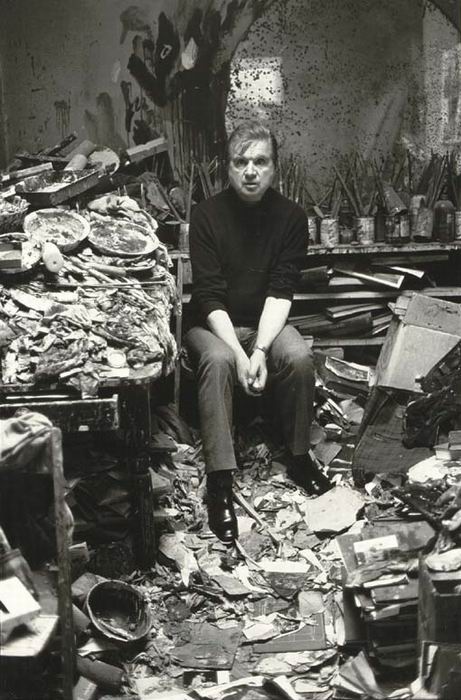
Francis Bacon in the London studio he calls a "disaster"
Very few people know how to grieve. Music can do it for us; and so can art. For centuries the Descent from the Cross did duty for that moment at which we face one of what W. B. Yeats called “the great irremediable things”: the loss of love.
But when we search for a secular equivalent in art we can search and search again. One of the many astonishments of “Francis Bacon: Recent Paintings 1968–1974,” which opened at the Metropolitan Museum and will be there through June 29, is that he has faced the loss of love and come to terms with it.
This is not the kind of ambition that people associate with Bacon. When he was first widely talked about, around 25 years ago, it was most often in terms of his contemporaneity. People grabbed at what they took to be sensational, irrational, “unnatural” subject matter; and they stayed with it.
When looking at Bacon’s work at that time, people cross-referred to the news from Belsen and elsewhere and, more particularly, to the “literature of extreme situation,” which was then much talked about. In this context he was the man who knew the truth about human nature and did not edit or repress it. That was the general idea, and it was perfectly true; much of what he did at that time has become part of the general currency of the imagination.
But when the first major retrospective of Bacon’s paintings was held in London, the most impressive thing about them was not so much their relevance to recent times as an august and distanced quality. What struck home was the beauty and distinction of the utterance—and the absoluteness of the ambition. Only one thing would do for Bacon: that the dead tradition of European figure-painting should be brought back to life.
He did it then; and he is still doing it, in basically the same way. He begins with strange and disquieting subject matter. Now, as then, people in paintings have never looked quite that way or done quite those things. Bacon is still unlocking the valves of feeling in such a way that the whole of our past experience comes up for reclassification.
In this, he is faithful to a maxim of Yeats: that “no mind can engender till divided into two.” “The nobleness of the arts,” Yeats also said, “is in the mingling of contraries”: without such a mingling, the “great irremediable things” would be all powerful.
The greatest and the least remediable of those things is the loss of love. In addressing himself to this, Bacon challenges a taboo that on the one hand has saved us from a lot of bad art and on the other has much impoverished art’s claims upon us. Taboos are there to be challenged; and Bacon has tackled this one both with violence and with an unstressed elegiac poetry, as in the “Portrait of a Man Walking Down Steps” (1972), which may remind us that the artist in this century whom Bacon most admires is Marcel Duchamp.
In Bacon’s new painting there Is a complex mingling of contraries. They include, in order (“We have to battle for order,” he lately said) and disorder; accident and design; science and instinct; dignity and indignity; waking and the dream. Bacon today can do what he likes with paint. He can make the naked human body gleam and glow; he can make a doorknob or an unshaded light bulb into an object of wonder; and he can paint the human eye in such a way that we reconsider the whole relationship of watcher and watched.
He could always fold space, and even knead space, in ways peculiar to himself. But when the “great irremediable things” are faced head-on in the new paintings he settles for a grave ordering of the given space; spare verticals and strict horizontals offset the turbulent poetry of the human images.
That poetry is always rooted in fact. No matter how fragmented the figures or how extreme the distortion, those who have known them will recognize the sudden hunch of the shoulders with which Lucian Freud will pounce upon a new topic; the strange, burrowing, sideway motion with which George Dyer walked; or the way in which Bacon himself will sit sideways on an old cane chair with sleeves rolled up above the elbow and the compass needle of his attention flickering wildly to and fro.
All this comes second, one may say, to the beauty of the paint, which grows more startling year by year. But that beauty is not gratuitous. It is the servant of impulse, not the master; and nothing quite like it has been seen before.
In terms of text, the catalogue at $5.95 has much to offer, but it has to be said that the paintings in reproduction are sadly travestied.
“Me discuss my paintings?” asked Francis Bacon at the Metropolitan Museum the other day. “That reminds me of Pavlova’s remark: ‘If I could talk about The Dying Swan, I wouldn’t have to dance it.’ ”
But then, lured into the galleries where he has received the museum’s rare accolade of a one-man show, the English painter, whose mild manner belies the force of his imagery, came to grips with his reticence. Taking a walk among the 36 pictures, done since 1968, he paused at “Tryptych, May-June 1973” to say that “insofar as my work’s about anything, this refers to a friend’s suicide.”
The painting is not for the squeamish. Its three panels done in somber reds and blacks delineate the subject vomiting into a basin, staggering across a room and collapsing on the toilet. “Yes,” Mr. Bacon agreed. “I suppose one does this partly to purge oneself of memory—but of course, it doesn’t work.”
Rarity among Rarities
Much of his imagery, he explained, was inspired by “accidents,” incurred in the manipulation of pigment. “I work half-consciously; I don’t think about what I’m doing. Often the paint does things that are better than I could consciously make them.” And, pointing out a white streak that skittered across the subject’s back, he said that one of the ways he got paint onto canvas was to throw it. “When you throw paint and it lands well, you’re lucky.”
The challenge for himself, Mr. Bacon said, was “figurative painting, grappling with how to invent a figure in a non-illustrational way. Abstract art inevitably turns into decoration; there’s nothing behind it but an esthetic. Most of the stuff reminds me of wallpaper.”
At 65—an incredibly youthful, not to say boyish, 65—Mr. Bacon today is that rarity among rarities, a major English painter. Since 1945, the compelling images that seem to express our 20th-century angst—screaming faces, spastic figures, butchered sides of beef, bodies coupling in ambiguous sex, portraits with features disturbingly wrenched out of kilter—have brought him increasing recognition. Now acknowledged as one of the “greats” of his generation, his work is a must for any major collection of contemporary art.
His Visual Appetite
Success has freed Mr. Bacon from financial concerns—his paintings sell today for above $200,000—but this has not left him resting on his laurels. He is still hoping to paint “the really great picture, the one perfect image that will sum up all the others.”
“My ambition is insatiable.” he says. “I’ incredibly lucky—I never expected to make money out of something I really wanted to do. I might make myself quite good before I die, if I live a few more years. The ideas crowd in.”
While Mr. Bacon’ ideas can be generated by a lucky twist of his brush, they are also sparked by a rabid visual appetite. “I look at everything and am influenced by everything,” he declares. “I’m rather like a cement machine—things come in and get mixed, then I put them out.”
The artist’s function today is serious, Mr. Bacon feels, even though art is “a game,” its former function of recording having been usurped by photography, and the attendant religious beliefs having been canceled out. “But if it’s only a game,” he says, “then the artist’s function is to deepen it, make it more complicated and profound—unlock the deeper possibilities of sensation.”
A late starter at serious painting himself, Mr. Bacon was born of English parents in Ireland, where his father was a breeder and trainer of horses. He left home at 16, lived in London for a while then went on to Berlin and Pads. A Picasso show, seen in 1927, first inspired him to draw, although his main interest at the time was in designing rugs and furniture. By 1929, he had tried his hand at painting, but his real engagement with it did not come about until 1945 when, as he puts it, he began to develop “a subject.”
Enjoys Gambling
In between, he says, “I enjoyed myself.” A demon gambler, who still frequents the tables at Monte Carlo, he earned a living during leaner years as a croupier. With a friend, he ran a gaming house in London “when it was still illegal. We made quite a lot of money, and when I had enough, I quit to paint full time.”
As for the future. Mr. Bacon noted, he was lucky, “Painting is an old man’s art, one of the few arts where people tend to get better. I’ll never retire; what have I to retire to? I’m looking forward to those yet unpainted masterpieces.”
Armature and alchemy
By Stephen Spender
Interviews with Francis Bacon may well have as great an influence on painting timing the last quarter of the present century as the critical writings of Ezra Pound and T. S. Eliot had on poetry during the 1920s and 1930s Francis Bacon, like Pound and Eliot, seems to have an almost clairvoyant sense of his own situation as an artist in relation to surrounding art. For him, the creation of an is also a challenging act of criticism.
I do not mean by this that lie believes, as promoters of “schools” and “movements” in the arts appear to do, that every artist should share his views and paint like him. But with the publication of these vividly temperamental and critically aware conversations, younger artists will have to relate their own aims to those of Bacon. Unique and isolated genius that he is, he appeals at every point to the critical intelligence, to the essence of living and working in a shared environment.
The virtue of the book is inseparable from the style, which in this case is unmistakably the man. Bacon commands an extremely lucid and expressive spoken prose. Reading these pages I was frequently reminded of Baudelaire’s art criticism, and still more of his quotations from the conversation of Delacroix. Bacon, as the undoubted her0 (or anti-hero) of his own painting, has some of the qualities of a Baudelairean dandy transported into the twentieth century. Who else would describe his own life as “gilded squalor”, indulge in gambling as a kind of lived metaphor for his painting, declare that he is “greedy for life, greedy as an artist”, and that he cannot think of anything more boring than a world where “everything was looked after for your birth to your death”? The answer is Bacon’s friend Lucian, who shares some of his predilections, and who is one his models for the portrait which evoke, in twentieth-century terms, a style that is truly Baudelarean: defiant, tragically gay, and conscious of damnation. In the following passage Bacon makes a twentieth-century statement of a position which which corresponds to Baudelaire’s aim for art in the nineteenth-century:
I hope to be able to do figures arising out of their own flesh with their bowler hats and umbrellas and make them figures as poignant as a Crucifixion.
Modern man is here both damned and heroic.
David Sylvester has not reinvented Bacon’s prose for him, in the manner of Robert Craft’s fabulous Conversations with Stravinsky. He has given an exact transcription of Bacon’s words, with only “minimal modifications to clarify syntax.” He has, however, cut by three-quarters the tapes of conversations taking place over a period of twelve years (and adding up, I am told, to 1,000 pages of typewritten transcripts). The “montage” — as Mr Sylvester calls it — is masterly, and he has been more a Boswell in his approach to Bacon than a journalist-interviewer. He is well acquainted with both the painter and his work; he puts questions which cover the whole range of Bacon’s views about art, the themes of his paintings and relevant aspects of his biography. He also shows considerable courage in risking rebuffs — for Bacon combines eloquent courtesy with the capacity to be deeply scathing. Some examples of his asperity survive in these conversations; they may not have stage directions such as “(laughs)” or “(crushingly)”, but the reader soon learns to interpolate his own.
In his introduction, Mr Sylvester provides a gloss on Bacon’s use of the word “image” by which as he explains Bacon means sometimes a subject he has in front of him and sometimes a complex of forms which has an especially powerful and suggestive resonance linage is indeed the word which is the linchpin of Bacon thinking about art past and present for his imperative is the creation in paint of a new and memorable image.
But “image” is also the centre of an idiosyncratic critical vocabulary used by Bacon which, when grasped, shows his extraordinary power of comprehending his own artistic processes, in which the creative and the critical become a single act. Other key words — like bolts and joints in the architecture — provide adjuncts to the central concept of the image. The words “distortion, “poignant”, “thickened”, “unlocked” and “violence” qualify the image or describe the means by which it is created. “Obsession” clarifies the artist’s choice of subjects for the images; “trapping” or “unlocking” describe the ways in which the image is realized through the transforming effect of cultivated “accidents” of the paint.
“Poignant” is a word, I have noticed, which has also entered the vocabulary of Lucien Freud and Frank Auerbach. The point about such words is that they dramatically identify description with aims. Nothing shows Bacon’s feeling for the words which most powerfully express his aims more than his use of the word “armature”.
This expresses the employment by the artist living today of an ancient myth or belief. The definitions in The Concise Oxford Dictionary throw light on Bacon’s use of this word. One is “defensive covering of animals or plants”; the other, “piece of soft iron placed in contact with poles of magnet increasing its power”. Both definitions are relevant to Bacon’s usage which conveys the sense of the myth as defensive a mask for what the painter is expressing and also as dynamic an electric current between the polarities of past and present
Armature makes irrelevant the idea that a traditional myth in order to be used by a modern artist has to be believed in Bacon rejects altogether the idea that a religious interpretation can be placed on his pictures of the Crucifixion or of the Pope He uses the ancient Greek and the Christian myths in a modern context in which it is impossible to believe in their original message. The Christian mythology in his painting is not a backdoor through which religious belief is allowed to enter He paints u world without religion or God The basic situation of his art is that of the human individual alone in the irremediably secular modern world.
The myth — Greek or Christian — in his paintings is a structure or powerfully organized bundle of images, as the “armature” upon which the artist can hang his vision of the life which he sees around him. It is easier, he says, to do this with the Crucifixion than with ancient Greek mythology, because the legends of the Greeks are “further from us than Christianity”. The Crucifixion is an “armature” for the obsessions of the artist in the modern world in ihat it is an example of human behaviour — and, for that matter, of man’s behaviour to the animals. It also provides a symbol connecting modern with traditional art.
In his use of scientific or mechanistic metaphors to inscribe both the painter’s relations to the past tradition and his experiencing (through his “nervous system”) the imagery which he reinvents in his art, Bacon seems very close to Eliot in his early criticism. Eliot too was deeply concerned with the functioning mechanism of the artist creating his art, and looked to scientific models to describe it, while before his conversion, or reversion version, to Christianity he also insisted that an artist could employ a religion or a myth without necessarily accepting the beliefs on which it was based. He thought that Dante, for instance, could have written The Divine Comedy without believing in the doctrines of Thomas Aquinas. Bacon expresses a very similar view in the following interchange change:
DS There is of course one great traditional mythological and tragic subject you’ve painted very often which is the Crucifixion.
FB Well there have been so very many great pictures in European art of the Crucifixion that it’s a magnificent armature on which you can hang all types of feeling and sensation. You may say it’s a curious thing for a non-religious person to take the Crucifixion but I don’t think that has anything to do with it. The great Crucifixions that one knows of one doesn’t know whether they were painted by men who had religious beliefs.
It might seem that Bacon is putting ting forward a mechanistic view ot the image as the reflection or expression of the scientific age like Wyndham Lewis’s Vorticism Art is viewed as a game played with comparative ease by the masters of the past who Jived in times when myths believed in or not were accepted as expressions of the living culture. The game has become ever more difficult in modern circumstances where the artist is isolated from society and new rules have to be invented new ways of playing it discovered covered.
However, the idea of art as conforming to a scientific theory of games is undermined (or “cancelled”, to use a more Baconian word) by his insistence on the irrational. The game remains a form of gambling, like the roulette to which Bacon is addicted But it is played by a very disciplined, precise and accurate gambler who recognizes chance as an element in a game governed by strict rules. It is set up according to rules of consciousness, in order that when the lucky accident or stroke of fortune occurs it may contribute to the aim of realizing the image. But the accident also fits in with the concept of the artist in a post-Nietzschean world without belief. The accident is in fact the truth about man. “I think that man now realizes that he is an accident, that he is a completely futile being that he has to play out the game without reason.” The game when it concerns art has to be “deepened”, “thickened”, made more complex.
However, Bacon is no more a surrealist who believes in allowing the forces of unconsciousness to manipulate the artist unchecked than he is a vorticist, an expressionist or a tachiste. He recognizes, one might say, the appeal of these movements, but he regards the artist’s individual consciousness having a responsibility opposed to any theory which reduces art to one simple aim. To cite once more the example of a poet his attitude K close to Yeats’s idea of opposites antinomies which have to be in unceasing conflict within the mind of the artist for there in be life in the artifact. His comments on abstract art are revealing in this context:
Why, after the great artists do people ever try to do anything again? Only because, from generation to generation, through what the great artists have done, the instincts change. And, as the instincts change, so there comes a renewa of the feeling of how can I remake this thing once again more clearly, more exactly, more violently. You see, I believe that art is recording: I think it’s reporting. And I think in abstract art, as there’s no report, there’s nothing other than the aesthetic of the painter and his few sensations. There’s never any tension in it.
DS You don’t think it can convey feelings?
FB I think it can convey very watered-down lyrical feelings, because I think any shapes can. But I don’t think it can really convey feeling in the grand sense.
But when he talks of art as recording he means, as he makes clear, recording in a world the artistic record is in competition with cameras and documentaries and technical reproductions. It is for this reason that the recording made by art has to be of the image that acts upon the nervous system, that distorts and achieves a greater truth than the purely mechanical recording as the result of the visual and psychological shock of distortion.
Bacon’s recording medium is paint, and in these conversations he brings us constantly back to the operations of consciousness and unconsciousness consciousness skill and chance upon paint. Chance can mean the marks which he makes at random on the canvas or when he throws a lump of paint across the room at it. It could also mean, at one time, painting when he was intoxicated or drugged. The point about chance in this sense, however, is that it does not imply the surrender of the artist’s critical and conscious responsibility to the accident. It is rather that the accident opens up possibilities which the consciousness could not have planned. The unconscious “unlocks” a possibility which the conscious mind can then trap and turn to its purpose, which is to create the image. It demonstrates the alchemy of paint to which the eye of the painter can become converted Bacon’s use of randomness with pigment corresponds to James Joyce’s with language in his Scribble Books, where he wrote down passages of free association which opened up new insights, later to be incorporated into Finnegan’s Wake.
Like Joyce Bacon is obsessed both with fact and with the irrational which lies beyond fact and which can sometimes be released by the alchemy of the medium words or paint. The manipulator of pigment can become manipulated by it though perhaps when this happens the artist has to be in a state of mental vacuity resulting from despair pair about his capacity to work:
Something happens out of your frustration and despair. . . . Out of despair you may find yourself making the image in a more radical way by taking greater risks. . . . With oil paint being so fluid, the image is changing all the time while you’re working. One thing either builds on another or destroys the other. You see, I don’t think that generally people really understand how mysterious, in a way, the actual manipulation of oil paint is.
The importance of the accident is also connected with the idea that the actual paint on the canvas us should not imitate the image. The image should emerge from it, and the more magically if the marks on the canvas do not follow the shapes of colour or light or shadow on the subject. This is to be “anti-illustrational”. “I think that the mystery of fact is conveyed by an image being made out of non-rational marks.”
The images which have formed the subjects of Bacon’s paintings and which he discuses here are by Velázquez, Rembrandt, Michelangelo (in his drawings) and Monet, together with the photographs of Eadweard Muybridge in his book The Human Figure in Motion (1887) and those by John Deakin of Lucian Freud, Henrietta Moares and others. All these — and the automat photographs of Bacon himself — are examples of material which he has seen as images waiting to be fully realized by the alchemy of paint.
The question which arises in the minds of most people who see a Bacon exhibition is: What is the subject behind the subjects? The answer, which they usually provide themselves is that the sum of Bacon’s paintings constitutes a document bearing witness to the horrifying nature of reality in the world in which we live. Yet in a way such a question is not a legitimate one, since the paintings are not really concerned with anything beyond the transformed image s which they contained; and, while Bacon can be generously communicative about the subject behind the subjects, it is a question which he partially repudiates.
The repudiation consists of his pointing out that the lines which at some coloured photographs of Nazi leaders wearing swastika armbands bands when he painted it. A similar explanation is offered for the presence of a hypodermic syringe sticking into the arm of another figure. These explanations are like those given by Eliot when critics suggested that The Waste Land was a poem about the breakdown of Western civilization. In the face of such comments the artist is justified in pointing out that the subject-matter is there for the sake of the work of art, not the work of art for the sake of the subject-matter.
Bacon talks about his childhood very revealingly, and in a way that relates to the “subject behind the subjects”. He was born in Ireland in 1909, the son of a racehorse horse trainer, and brought to London during the First World War. Soon after the war he was sent back to Ireland, at the time of the Sinn Fein campaign. Much of his childhood was therefore spent in an atmosphere of violence. At the age of seventeen he went to Berlin, which, in 1927 was “very, very violent”, violent emotionally, in a way which corresponded perhaps to the physical violence of those childhood days in Ireland.
He insists, though, on the disconnection, the break, between the violence in his life and the violence of his painting. “The violence of paint has nothing to do with the violence of war. It’s to do with an attempt to remake the violence of reality itself. . . . It’s the violence I of the suggestions within the image itself which can only be attained through paint.”
Bacon puts the matter very well when Mr Sylvester suggests that “it’s not altogether stupid to attribute an obsession with horror to an artist who has done so many paintings of the human scream”. Bacon’s answer is that he wanted to paint the scream more than the horror “If I had really thought about what causes somebody to scream it would have made the scream that I tried to paint more successful.” At the same time he is candid about the unease of the painter — “neurotic and almost hysterical” — which may have come across in the pictures. Eliot came to admit almost the same thing about the state of mind of the man “with a grouse against the world” who wrote The Waste Land.
I am always brought back to Yeats, Pound, Joyce and Eliot by these conversations because, like them, Bacon makes metaphors that 1 visualize the situation of the great artist, conscious of himself at the end of the line of the tradition and j trying to create art “of grand feeling” in the twentieth century. Like them he is concerned with translating the traditional image — Homer’s Odyssey, Velazquez’s portrait of Innocent X — into modern imagery which is terrifyingly new and which confronts with its strength the violence of forces operating in the world today. The element of the “horrific” has of course claimed victims in even greater numbers now than in the first quarter of the century, and consequently Bacon has “thickened” and “deepened” the “distortion” that enters into the contemporary image staring at itself in the mirror of his “recording” art.
In these conversations he displays very effective verbal images embedded bedded
in his rich and often pungently humorous rhetoric of

This week a major Francis Bacon exhibition opens at the Metropolitan Museum of Art, New York: the first time a living British artist has been on show there.
Here Bacon discusses his attitudes with David Sylvester in an extract from Interviews with Francis Bacon, published tomorrow by Thames & Hudson.
On page 30 David Sylvester explores the relationship between what Bacon says and what he does
“After all, as existence in a way is so banal, you may as well try and make a kind of grandeur of it rather than be nursed to oblivion.” Bacon’s reason for despising our concern with security is that it is “the opposite of the despair about life”. And he judges a society by the art it creates, clearly because art is one activity that may make “a kind of grandeur” out of existence. The one faith he seems to own is an unfashionable faith in the power of art, in art’s capacity to justify—one might even say, to redeem—human existence and the pain of its brevity.
Such a commitment to art, so strongly and widely held a century ago, has increasingly lost ground through attacks from two positions. It has been attacked from the standpoint of social egalitarianism—not least by Tolstoy—in a puritanical response to the uncomfortable fact that high art is not easily enjoyable by everybody. And it has been attacked from anti-art standpoints within the artistic avant garde—from the Dadaists to the Conceptualists—in a puritanical response to the uncomfortable fact that art gets dirtied by being used as a means of showing off—by practitioners to show off their virtuosity and/or good taste, by consumers to show off their privileges and/or good taste.
And Bacon’s faith in art, because it is that of a deeply sophisticated man who is very much a man of his time, is radically qualified by anti-art feelings. He may constantly talk in praise of Rembrandt, Velasquez and Michelangelo, but he also does so of Marcel Duchamp, the great prophet of anti-art.
One of the lines of inquiry pursued by Duchamp in his search to create art that was not respectable was to encourage chance to operate in the formation of a work. And with Bacon the role of chance becomes absolutely central. This emerges from the interview (made in 1974) partly reproduced above, and the theme of chance is the theme that is most reiterated throughout Interview with Francis Bacon. When he says in one of them, “I want a very ordered image but I want it to come about by chance,” he is summing up the dialectic that is possibly the mainspring of his work. It is summed up again, perhaps unwittingly, when, in the middle of describing himself as an essentially traditional painter, unconcerned with creating new techniques, he suddenly says that his ideal “would really be just to pick up a handful of paint and throw it at the canvas and hope that the portrait was there”.
Dependence on chance is Bacon’s particular way, a way suited to a gambler’s temperament, of trying to deal with the most exciting and exacting problem that painting offers, and one that most contemporary painters avoid. “To me, the mystery of painting today is how can appearance be made. I know it can be illustrated, I know it can be photographed. But how can this thing be made so that you can catch the mystery of appearance within the mystery of the making?”
“I know it can be photographed.” There’s the rub. Bacon says he has “always been haunted” by photographs in the sense that he is fascinated by looking at them and working from them “99 per cent of the time” finds them “very much more interesting than either abstract or figurative painting”. But he is also haunted by photography in that its very existence has profoundly altered the purpose of painting and made it more difficult.
“I think it is more difficult because painters had a double role before. I think that they thought that they were recording, and then they did something very much more than recording.” But now, he goes on, mechanical methods of recording have cancelled out that side of the painter’s role. “And I think that abstract painters, realising this, have thought: why not throw out all illustration and all forms of recording and just give the effects of form and colour? And logically this is quite right. But it hasn’t worked out ...” The failure, he says, has been that abstract art only works on one level, an aesthetic level, that the only feelings it manages to convey are “very watered-down lyrical feelings” which lack the tension and discipline that can result from the artist’s struggle to deal simultaneously with feelings and fact. So abstraction is insufficient and more-or-less literal representation is redundant and the only kind of painting that is really worth attempting is something very “extreme” which violently distorts reality as we think of it in forming an image beyond reason which acts inexplicably upon the nervous system to create a heightened sense of reality.
It is a kind of painting which operates on the age of the absurd (as ambitious art often does, in one way or another). The head in one of the most powerful and beautiful of the recent paintings, the Sleeping Figure, reproduced on page 24, is decidedly reminiscent of the head of a Lying Figure of 1959, reproduced in colour in page 121 of the monograph by Rothenstein and Alley: un the one, that head seems profoundly poignant and real, in the other, a grotesque caricature. And the difference between the triumph and the disaster is hardly evident in a comparison of reproductions, since it all lies in the way the paint functions, in the one case imbuing the image with life and mystery so that the deformations go unquestioned, seem right—because, if the image seems alive, it inevitably seems real—and in the other case not giving the vibrancy or density to the image, which therefore seems arbitrary and pointlessly ugly.
That 1959 painting belongs to the key transitional period in Bacon’s development. It was a time when, as I put it in the interview above, he “got rid of the curtains”. For ten years he had been painting images with rather soft edges, often against a muffled background of curtains, using a limited range of colours dominated by flesh-tones, greys and deep dark blues. They are paintings which look like beaten-up Old Masters, rich in romantic atmosphere and shadowy suggestions of momentous forms (“adumbrations” was a word often used when critics described them). But then, about 1957, he started to broaden and lighten his palette and to delineate the forms more precisely, while at the same time tending to scramble and mangle them more than ever within that clearer outline. About 1959-60 he proceeded to heighten this blatant contradiction by starting to make the backgrounds perfectly flat and hard and often harshly bright in colour. In the interview above I said that in doing this he had “confronted an immense and extraordinary kind of difficulty” which no other paint had “tried to resolve”. Had I not been concerned to be polite, I might have said it was an enterprise like designing a Gothic spire to put on the Parthenon.
At Bacon’s big retrospective in Paris in 1971, it seemed to me that the dark paintings of the early and middle ’Fifties were far more consistent in quality than the later works. These seemed wildly uneven, but the best of them had an intensity and resonance which made the earlier works seem hints and guesses. And their strengths may well have derived precisely from the way in which their inner contradictions had come to be, incredibly, resolved. In the interview, Bacon gives this reason for the contradictions: “I would like the intimacy of the image against a very stark background. I want to isolate the image and take it away form the interior and the home.” It is one of those statements of an artist’s aims which unwittingly reveal the essence of the man. In being that, it is a demonstration of the way in which the extremes to to which Bacon pushes himself are dictated by a supremely precise awareness of his inner needs and a superb courage in following his instincts wherever they lead him. By the same token, he has grown into greatness as a painter largely through being unwilling to settle for less.
Bacon’s show a-sizzling
NEWS
A giant orange flag flies outside New York’s Metropolitan Museum of Art proclaiming the name Francis Bacon. It is a message to New Yorkers that a major exhibition by the prominent British artist, who says he paints everything he has ever seen but seems to end up with dissolving faces and solitary screams of pain, is now in progress.
The exhibition is of his latest works, 36 paintings from 1968 to 1974, including eight large triptychs and many self-portraits. Three of the works have been seen before in the United States and 18 are shown for the first time anywhere. For those in the art world who regards the asthmatic 65-year-old artist, who says he can find beauty in the placement of victims in a car crash, as a major art figure, the current exhibition is a confirmation of his power.
Mr
Bacon said:
John Russell reports on New York’s reaction to the Francis Bacon exhibition
THE exceptional American has been aware of Francis Bacon since the late 1940s when Alfred Barr—as on so many occasions —was way ahead of the pack in acquiring Bacon’s monumental “Painting 1946” for the Museum of Modern Art. But the exceptional American is by definition rare: and to most of those Americans who go to see English plays and English actors on Broadway four nights out of five, England in the context of painting is what Czechoslovakia was to Neville Chamberlain: “That far away country of which we know so little.”
For the expatriate a more than ordinary interest attached therefore to the opening on the evening of March 19 of the show of recent paintings by Bacon al the Metropolitan Museum. The scale was ideal, the honour without precedent — and given wholehearted support by the Met’s much-contested director Thomas Hoving. It consists very largely of paintings done since Bacon’s show at the Grand Palais in Paris in 1971.
More than one of them had already an underground reputation, and when Bacon himself came into town there was a flurry of attention from people who wanted to know, fast, what he was all about. There was something quite comical in the insistence with which the news got about that he was by no means the monosyllabic spook whom one and all had apparently dreaded to meet.
That Bacon can use the English language as pirate captains used the cutlass will not be news in London. But in New York, where he was glimpsed day after day as a man outstanding for his direct and convivial nature, few people paused to consider that the particular density and concision which make Bacon one of the best talkers of the age are derived as much from long spells of solitary reading and reflection as from exchanges over the best available food and wine.
Given the difficulty which certain central figures in the New York art world experience in framing even the simplest declarative statement it was not surprising that Bacon’s easy and mercurial way with words was much talked of during the run-up to the show.
As to the work itself and what was thought of it no reliable poll can be taken. But every opening has its particular tone; and that tone is set above all by the fellow-artists. In Bacon’s case the turnout was exemplary. From Willem de Kooning to Kelly and from Helen Frankenthaler to James Rosenquist, American artists manifested the kind of solidarity which is not often met with in London.
The evening, though dazzling, was still about the art. And the art was about what Yeats called “the great irremediable things.” The greatest and least remediable of these is the loss of love. It is not a subject that many painters today would tackle so directly. But Bacon, in his improbable sixties, has the log-jam of ideas and the greatly enhanced technical resource which make it possible for him to tackle feeling at a new level of directness and intensity.
He springs one surprise after another. But these are never gratuitous; and the final concern is not with his own hurts and distresses, but with the continued existence of painting as potentially the highest mode of human expression.
That it should get through to every visitor on quite that level would be too much to expect. But no thinking or feeling person came out of it quite the same as he went in; and what was on the walls bore out what Bacon had said a day or two before to my colleague Grace Glueck — that “painting is an old man’s art, one of the few arts where people get better.”
“Interviews with Francis Bacon,” a new book by David Sylvester, has just been published by Thames & Hudson at £2.50.
Signs Of A New Conservatism In Taste
The Bacon exhibit at the Met “is a significant symptom of a shift in esthetic
loyaltie
The work of Francis Bacon has never loomed very large on the horizons of the American art world. Until the other day, I had never heard an American artist speak of it, even in passing, and the big retrospective mounted by the Guggenheim Museum in 1963 certainly left no discernible trace on American painting. The work has been much written about in American journals (often by Mr. Bacon’s British compatriots), and it has been eagerly acquired by American collectors at high prices but it has remained curiously outside the interests of the artists themselves.
Elsewhere, of course, the situation has been very different. At the last Venice Biennale, in 1972, one could see the spell that Mr. Bacon had cast on younger painters from countries as unlike (in other respects) as Argentina and Yugoslavia. Indeed, so ubiquitous was Mr. Bacon’s influence on painters from what might be called the international provinces that someone facetiously suggested that he be given a special prize as the artist most universally “represented” at the Biennale. Abroad, Mr. Bacon is a figure widely emulated and admired—quite apart from his special status in Britain, where he is a cultural celebrity in the Henry Mo0re class.
Now the Metropolitan Museum of Art, which is not exactly renowned for its one-man shows of living artists, has organized an exhibition of Mr. Bacon’s recent work, and one naturally wonders what it signifies. Why an exhibition of Francis Bacon, who, though scarcely an unknown quantity, is not, I believe, even represented in the Met’s burgeoning collection of 20th-century art? Does the choice signal a change in the esthetic climate.
. . .
I suspect it does. American painting in the next few years—and perhaps more than a few—is likely to be far more conservative than at any time in recent memory. It is already more conservative than it was five or 10 or 20 years ago, and certain shifts of opinion suggest the trend will accelerate. The time may indeed be ripe for Mr. Bacon’s triumphal entry into the consciousness of American art, for he is undeniably one of the classiest conservative painters on the world scene.
One of the shifts I have in mind can be seen in Tom Wolfe’s free-wheeling attack, in the current issue of Harper’s Magazine, on the principal pieties that have governed the discussion of modernist art in this country for a quarter of a century. Mr. Wolfe is not my idea of a judicious critic, and he brings no special authority to the subject of contemporary art. But he has, alas, a very keen nose for the news of our cultural life, for sudden shifts in loyalty and opinion, and a ruthless grasp of the latent chic. What this lengthy excerpt from his forthcoming book tells us, quite simply, is that it is no longer “in” to be agog over what claims to be avant-garde.
As if to confirm this reading of the cultural weather, we now have the estimable Henry Geldzahler, the Met’s curator of 20th-century art, suddenly setting up as a Champion of “figuration.” It will be recalled that Mr. Geldzahler first acquired a certain celebrity as the Diaghilev—or was it as the Barnum?—of Pop art. He then transferred his allegiance to the Greenberg line of color abstraction. Always alert to the winds of change, he now offers us the following defense of Mr. Bacon’s stylish horror.
“It is impossible to be convinced by criticism that dismisses a body of work as esthetically compelling as Bacon’s. Figuration may have been out of style during the fifties and sixties when his unforgettable images took hold of so many imaginations, but that inventive and memorable figuration was still possible is made clear by the work of such diverse artists as Giacometti, Balthus, Picasso and Magritte.” (One notes with interest the absence of a single American name on this list. Apparently Mr. de Kooning will have to wait for the next turn of the screw.)
. . .
And what is it that Mr. Geldzahler so much admires in this newly discovered master of figuration? “One factor,” he writes in the catalogue of the current exhibition, “is Bacon’s consistent presentation of compelling subject matter in formats and settings that provide exactly the right amounts of space, color and air for the subject to capture the viewer’s imagination.... The grotesque, even sadistic, content of Bacon’s art, realized through the masterly application of paint, lies at the heart of his esthetic achievement. It is possible to feel excitement at the traditional bravura of the paint handling, and horror at the rawness of the subject. It is just this tension between new content and traditional means of portrayal that makes Bacon’s work fresh and masterful.
Or, as we used to say, new wine in old bottles. I confess that I cannot take Mr. Bacon’s elegant grotesques entirely seriously. The famous style—“the traditional bravura of the paint handling”—strikes me as egregiously ersatz, an attempt at instant old master effects that ends in being little more than a form of theatrical illustration. The painter he most reminds me of is Boldini, who once achieved a comparable celebrity by combining surface pyrotechnics with a basically academic sense of form. The differences between Boldini and Bacon lie entirely in the ethos of their respective periods. Whereas Boldini, in the late 19th century, was obliged to flatter the conceit of his comfortable bourgeois patrons, Mr. Bacon is obliged to offer his bourgeois patrons a succession of “shocks.” Hence the introduction of so-called “taboo” subjects—macabre homosexual couplings, bizarre bathroom agonies and other “forbidden” revelations of the artist’s personal history.
. . .
But do we really experience any genuine “horror at the rawness of the subject,” as Mr. Geldzahler claims, or are we simply titilated—and rather pleased—to see the materials of a hundred popular movies and plays and novels and poems and autobiographical confessions resplendently transferred to canvas and expensively framed in gold? Are we not, indeed, titilated by a body of work that not only gives emphatic priority to subject matter but to this particular subject matter? And is the subject matter really so daring—or is it only “daring”? Let’s face it: in the world where Mr. Bacon’s paintings are seen and bought and judged and talked about, to be avowedly homosexual, to traffic in images of sexual violence and personal sadism, is a good deal less shocking than, say, to be avowedly Methodist. Mr. Geldzahler is being disingenuous in pretending otherwise
If Mr. Bacon’s paintings cannot be taken entirely seriously as an artistic
event, their presence at the Met is nonetheless a significant symptom of a shift
in esthetic loyalties, and it will be interesting to see what further
recantations await us.
The ugliest of the 36 intentionally ugly paintings by the English artist Francis
Bacon at the Metropolitan Museum of Art in New York depicts a nude man
sitting–in three panels–in his bathroom. In the last panel he retches violently
into the basin, producing a garish stream of of black and blood-red oil paint.
But laced across his head and shoulders is a thin swipe of white paint, like a
delicate and incongruously abstract mark. Not long ago, Bacon commented
revealingly on this tiny white smear:
“I
did that at the very last minute,
This admission–backed up by the evidence in nearly all of these new paintings, which are filled with cranky smears of paint–makes it difficult to continue celebrating Bacon, now 65, as the last great traditional figure painter, as he has come to be known. Born in Dublin, the son of an English horse trainer, Bacon rocketed from relative obscurity in middle age to become the most famous British painter of his time. Four years ago, in a global poll of the world’s curators and museum directors, he was selected as the world’s finest living artist. He is regularly celebrated in magazines as the only modern artist able to deal with the great timeless themes of despair, decay and death. The Metropolitan exhibition alone is a signal honor–since the museum rarely offers its space to living painters.
Moreover, the Metropolitan–through Henry Geldzahler, its curator of 20th century-art–has chosen to focus upon the work of Bacon since 1968, not the valid early works that captured the world’s imagination. There were searing replays of images and motifs locked into past art, particularly a grotesque, screaming Pope in the manner of Velázquez, a favorite of Bacon’s.
But in his new works, Bacon is operating almost completely in the present tense,
with a decided loss of power. He is clearly taken not only with the
free-wheeling methods associated with abstract expressionism and surrealism
(Bacon regularly throws packed packed balls of pigment on the canvas) but with
the repetition and distortion of imagery that occurs in news photography–the
Metropolitan exhibition includes many
“diptychs”
and
Parade: Seen in isolation, these images can momentarily grip and even shock the eye. Seen together–and in company with other endlessly elaborated and triptyched themes–Bacon’s art loses its celebrated vulgarity. It becomes instead a parade of predictable images, mottled and distorted in predictable ways. His studio in London is filled, he tells us, with piles of old photographs and clippings. This appears to be the real influence on Bacon now, not the great painters of the past: in his obsession with repetition he is closer to Eadweard Muybridg, the inventor of serial-action photography, than to Velázquez.
“I’m just trying to make images off my nervous system,” he once said. In his new art, Bacon has let the deep recesses of terror and anguish for the pleasures of pure painting–the very sin he has often attributed to abstract art. The best part of the Met exhibition is the sure painterly hand at work, seen in the marvelous multi-hued swatches of pigment that swipe across the faces of Bacon’s subjects, the radiant orange backgrounds, the clean, formal compositions. His subjects are as ugly as ever; his means are not. The guardian of the past has deserted to the delights of painting in the twentieth century.
By HUGH M. DAVIES
Despite his many one-man shows, widely spaced in time but altogether memorable, and an impressive retrospective exhibition at the Guggenheim Museum in 1963, Francis Bacon—recognized by many as the most powerfully original artist of his generation in Europe—is surprisingly not as well known or appreciated in the U.S. as he deserves to be. However, this situation may be corrected when an exhibition of Bacon’s work of the last six years opens this month at New York’s Metropolitan Museum. In the meantime, relative ignorance of recent developments in his work only deepens the mystery and attraction of the man and artist who electrified New York’s avant-garde audience in the early 1950s with his nightmarish repertory of images of screaming popes rendered in a sumptuous and accompanied style that consciously rivaled the old masters. The myths about Bacon have multiplied with his inaccessibility to all but a small circle of London friends. Rumors of lavish expenditures on futile gambling expeditions to casinos on the Riviera and most recently the appearance of his paintings during the credits to the movie Last Tango in Paris have fueled thee myths.
Between August 1972 and June 1973, Bacon painted three great triptychs, which have come to be known as the "black" triptychs. (It was during this period that I was able to see the artist repeatedly in London.)
It is not hard to guess that Bacon is a complicated man. Yet I was surprised, upon first acquaintance, to be introduced to a charming Englishman with a wry wit and Shakespearian delivery. Looking far younger than his 65 years, Bacon has a lively open manner and a captivating, expressive face. He paints almost every day in his London studio from ten or earlier in the morning until daylight fades and then usually takes a taxi to Soho for the evening. Descending from the cab at Dean Street, with the sleeves of his leather trenchcoat rolled up over his elbows, he scales the stairs to Miss Muriel Belcher’s Colony Club with the alacrity of a soldier on five-hour furlough. Upon entering, he pays affectionate respect to his old friend and portrait subject Miss Belcher, while Dan Boardman opens the first of several bottles of champagne to be shared with fellow club members. During the course of such a typical evening, Bacon would probably invite whomever happened to be talking with to join him for dinner at Wheeler’s around the corner and from there continue to carouse from club to club until the early hours of the morning.
Although he exercises a highly refined taste for the best in wine and food, Bacon’s formal wardrobe is limited to a pair of well-made gray suits, and he lives very simply in an unpretentious three-room apartment above a garage in a narrow mews in South Kensington. At the head of the steep entrance staircase is a primitive kitchen housing a sink and a bathtub. Upon entering the rugless bed-sitting room to the right of the kitchen-bathroom, one is confronted by a large floor-to-ceiling mirror reminiscent in its network of cracks of Duchamp’s Large Glass. (Bacon explains that the delicately traceried damage resulted from a belligerently hurled ashtray that narrowly missed his head.) No paintings hang on the walls, but a Sickert lies on a couch, and several framed photographs and a life mask of William Blake sit on a shelf, while a Richard Hamilton print rests on a bureau surrounded by piles of photographs and books. His living quarters have the comfortably disorganised, lived-in look of a residence for which the owner has never had the energy or inclination to acquire carpets or proper bookshelves. The bare lightbulbs hanging next to pull-string switches, the heavy dark-green draperies, the simple bentwood chairs and his round-cornered bed all appear in certain of Bacon’s paintings of the last 20 years. As he says, "I use things around me."
The studio, which runs parallel to the bed-sitting room on the opposite side of the entrance staircase, is a small windowless space cluttered by an accumulation of discarded paint tubes, brushes, magazines and rages. The only sources of light are a tapering shaft leading to a square skylight and two naked lightbulbs hanging from the ceiling. A multitude of utensils, from Brillo pads to cashmere sweaters, which have been employed to push paint around, rests among the debris. Bacon frequently uses paint-tube caps to make circles for nipples, and I was amused to learn that a garbage-can lid recently served as the pattern for three large circles surrounding reclining figures. Stretched canvases of two sizes, 14 by 12 inches and 78 by 58 inches, are staked against the studio walls; they are stretched with their unprimed sides outward—Bacon prefers to paint on this more absorbent surface. His medium is essentially oil; yet at times, to achieve a desired effect or colour, he has used both acrylics and pastel, sometimes in combination with oils. The smaller canvases are reserved for portrait heads, isolated studies of friends floated on monochrome-stained backgrounds. The size of these heads corresponds to the heads of the full-length figures in the large panels; no adjustment in scale occurs between the two pictorial formats. The large panels are used singly and also in diptych and triptych combinations, each panel always framed separately.
By nature as well as avocation Bacon is a gambler. His ability to take a risk and win his wager, whether it be with life or art history, is part of his genius. John Russell (in his book Francis Bacon) has characterized his approach to painting as shooting for "the National Gallery or the dust-bin." The risk he takes in his large triptychs is dictated by the goal he sets himself: to achieve the freshness, the instinctive spontaneity of a small sketch without sacrificing any of the formal grandeur inherent in a well-composed large painting. To do this, he works directly on the full-size canvas, without benefit of preliminary drawings. In bypassing the step of adjusting scale, he eliminates the laboured planning and cautious execution that result in diminished vitality in many large paintings. Once a background has been summarily blocked in, the figure or figures are fully painted in a rash of semi-controlled marks. If the result is worth preserving, more background is then added around the finished figure. When unsuccessful, the canvas is destroyed in the way other painters tear up their sketches.
"I often daydream, and images drop in hundreds at a time; some link up with another. I like the triptych format—it breaks the series up and prevents it having a story. That’s why the three panels are always framed separately." The triptychs are basically of two kinds. There are, first, portraits, such as Three Studies of Lucian Freud, 1969, in which Bacon represents the artist, a close friend, in three characteristic seated poses. The second type, for lack of a more specific term, might be referred to as "idea" triptychs. These, for which Triptych—Studies of the Human Body, 1970, may be taken as an example, relate to Bacon’s "daydreaming" and are the conjugation of several ideas, both literary and visual, that obsessed the artist at the time of painting.
In Triptych—Studies of the Human Body, the central panel represents two men wrestling on a round elevated platform or bed. This image, which has recurred in Bacon’s oeuvre ever since his 1953 painting of two men on a bed titled Two Figures, is based on a well-known photograph by Eadwaed Muybridge, the 19th-century inventor of motion photography. Muybridge’s (supposedly) detached, scientific study of two wrestlers is given an emotional, pyschosexual dimension by Bacon, who transfers the action from a wrestling mat to a bed. Moving to the triptych’s side panels bracketing the central embracing couple, we see on the right a figure in a doorway who bears a marked resemblance to Bacon and operates an antique, aggressive-looking movie camera. This thinly veiled allusion to Bacon’s conception of his role as artist/objective recorder/voyeur, a modern Muybridge of motion and emotion, is a 20th-century equivalent of Velázquez’ self-portrait in a similar role in La Meninas. In the left panel a second man observes the central struggle from a similar doorway. (John Russell points out this man’s likeness to George Dyer, Bacon’s dead friend). The two doorways do not, as one might expect, open onto three-dimensional space; rather, they appear they appear to be pairs of hinged mirrors that, when open, reflect figures standing beyond the picture plane in the spectator’s space.
The triptych is further complicated by the remaining elements in the side panels—a vaguely figurative brown blur that overlaps a newspaper in the right panel, and an ambiguous figure or figures on the left. Bacon particularly lies this undefined grouping in the left panel; he feels it is a "fortunate accident"—a product of chance rather than a contrived image. In attempting to account for its origin, he explained to me that the short arms above the central leg came from a photograph of a bird of prey, talons outstretched at the moment before striking its victim. But here ambiguity supplanted rationality and their explanation broke down: "... it could be two people embracing—I don’t know why it was necessary to pin down the shadow below them" (here pointing to a white impasto spike-shape at the lower left of the panel). "It takes me back to things that come out of Aeschylus and things like that, a sort of tragic form. I don’t know why, but I like it."
Some knowledge of Bacon’s earlier life helps in attempting to understand the raw nature of his art. He was born in Dublin before the first world war, and his early memories are of cavalry-troop maneuvres in the woods around his parents’ house. Following on the heels of the war, the Irish Civil War and Sinn Fein brought organized violence to his doorstop. As he was of English parentage, Bacon was vey much aware, as a child, that to the Irish he as the enemy.
Having unsuccessfully attended the boarding school at Dean Close, Cheltenham, England, for less than a year, Bacon left home to work in London at the age of 16. The following year, 1926, he traveled to Germany and lived for several months in savage postwar Berlin. "My whole life," Bacon says, "had been lived through a time of stress and then World War II. Anyone who lived through the world wars was affected by them, they affected one’s whole psyche to that extent, to live continuously under an atmosphere of tension and threat." This lifelong firsthand experience of what post-World War II Existentialist writers were to label an "extreme situation" is a prime ingredient in Bacon’s art, an art that is essentially autobiographical: "The everyday wash of life flows into one’s whole imagery, and that mingled with instinct and chance brings up images. I use the whole of my experience and I know this all goes into the work, not consciously, but it goes into all the imagery."
Bacon’s paintings of the last 20 years are exclusively figurative and over the past five years have been predominantly portraits. His intention has never been to make pejorative statements about the human condition; he considers that he restricts himself to recording and documentation. Yet his art is not the cold visual record of the detached observer but the vivid presentation of the involved voyeur. It is with these qualities in mind that Bacon calls his work realism and allies himself with artists of the 17th century. Velázquez, whose portrait of Pope Innocent X serves as the model for Bacon’s Papal variations of the 50s, he still regards as the greatest painter. Bacon now considers his own versions of the Pope to be "cheap imitations" and thinks Las Meninas is Velázquez’s finest painting. Considering that Velázquez, is almost universally considered a quintessential realist, it is curious that Bacon sees the power of Las Meninas as the result of distortion: "I think Velázquez was very extraordinary because if you analyze the heads of his subjects you will see these are profound distortions, but they are distortions which distort themselves into fact."
Bacon brings to his own portraits a 20th-century complexity. The pre-Freudian concept of the monolithic personality is supplanted by an intimate, candid-camera glimpse behind the well-ordered exterior. The spontaneity of the snapshot is wedded to the self-scrutinizing insight of the late Rembrandt self-portraits, where, in Bacon’s words, "he changes himself from day to day, and instinct is working strongly with the desire for appearance." This is the same kind of realist motivation (portraiture of the unrehearsed face) that characterized Bacon’s Papal variations but without the theatrical excesses and art-historical allusions that now seem to weigh so heavily in those works.
Bacon never paints directly from the model. He portrays only friends whom he has known for a long time so that he is very well acquainted with their physiognomy and personality. These friends, as he presents them, , might be considered latter-day souls in torment, femmes damnées et hommes fatales. Yet like their Baudelarian counterparts, they differ from the rest of us only in being conscious of their damned condition. Bacon uses photographs of these subjects like cue cards, to trigger his memory in attempting to trap the fact of their appearance within the context of his dramatically distorted images. This distortion takes the form of individually abstract passages of daubed, smeared and blurred pigment. In attempting to explain its function, Bacon quotes van Gogh: 2I want to lie, but to lie in such a way that it is more truthful ... " Yet in his own comments about Les Meninas are more specific: "I think if you want to convey fact, this can only ever be done through a form of distortion You must distort to transform what is called appearance into image."
In light of his espoused preference for the instinctual, undomesticated image on a grand scale, one might expect Bacon to be drawn toward Abstract Expressionism, yet nothing could be further from his taste: "I don’t believe in abstract art because you must have a starting point in reality, otherwise you just get free fantasy, so-called freewheeling of beauty. You need some subject. "Bacon thinks Jackson Pollock’s paintings now "look like old lace" and that "it had all been done in German Expressionism before." He sets himself what he sees as a more demanding task: "Starting from an image, I want to be formal and vivid, and yet to be vivid they have to be by chance. If I throw a lump of paint on the floor, it has vitality but no control. Pollock is not formal enough for me."
This formal side of Bacon’s artistic personality is further revealed in a decided penchant for the well-made and a preference for polished presentation. He likes, for example, the immaculately finished sculptures of Arp and Brancusi. His own paintings invariably arrive at the Marlborough Gallery in heavy gilt frames and covered by plate glass. At a time when museums are tending to remove the glass from all but the most valuable paintings and when artists are shying away from notions of fine art and precious objects, it is rare to find a painter who wants his work to be presented in so formal and even sumptuous a manner. Bacon explains that the glass is to "remove the images further. I don’t think art is available; it’s rare and curious and should be completely isolated. One is more aware of its image the more it’s isolated."
The dualistic nature of Bacon’s art—the ability to maintain a balance between the "vivid" and the "formal," to achieve the integration of small-sketch sensibility and large canvas grandeur, to exploit the tension between figurative resemblance and the abstract accidentalism of technique—accounts for his success in eluding categorization. The two labels most commonly invoked to pigeonhole Bacon’s work, "Surrealism2"and "Expressionism," although inadequate, do touch on salient aspects of his oeuvre, such as the role of the unconscious and the use of distortion.
Bacon defines his work as realism since it is his world view that is imprinted as directly as possible from his nervous system onto the canvas, having nothing to o with the "conscious mystery" of Surrealism. He also resents attempts to identify his work with Expressionism, since the distorted forms of Expressionism usually have a programmatic, even propagandistic intent that is equally alien to his work: "Thy call me an Expressionist but I’m not in the way they were ... I have no statement to make about life, I just try too be instinctive. I have nothing to express about the human condition, but everyone reacts to their times; it’s impossible to work in an ivory tower."
The three "black" triptychs, Triptych—August 1972, Three Portraits—Triptych 1973 and Triptych May-June 1972, represent the culmination of Bacon’s style to date. They are at the same time both "idea" and portrait triptychs. Conceptually and chronologically, these triptychs form a series. They are far from being uniformly black, and, strictly speaking, only the first and third are even dominated by black. Figuratively speaking, however, they are very black indeed. The major unifying element is the image of George Dyer in all of them. Their theme was summed up by Bacon in the following remark: "The hardest thing about aging is losing your friends. My life is almost over and all the people I’ve loved are dead." Dyer, his closest friend, died suddenly on the eve of the opening of Bacon’s retrospective in Paris in October 1971.
The anonymous setting of a background wall running parallel to the picture plane and broken centrally in each panel by an open doorway provides a unifying structure within each triptych and acts as a compositional link among the three triptychs. The severely limited, steep foreground space common to all three acts like apron stage thrusting the subjects forward and forcing an immediate confrontation with the viewer. This manner of treating space first appeared in Bacon’s Crucifixion triptych, 1965 [Munich], but did not appear again until this series.
The rectilinear settings and monochrome doorways of the "black" triptychs function formally in counterpoint to the biomorphic foreground shapes of bodies and shadows. None of these shadows is rendered literally; they are extensions rather than projections of the figures and anchor the compositions by connecting the figures with the surrounding floor and frame. The spare, anonymous character of the rooms also serves as a foil to intensify the highly personal and expressive nature of the portraits.
In the first of the three, Triptych—August 1972, the familiar Muybridge-derived wrestling image appears in the center panel. The homosexual connotations of entangled bodies in earlier versions of this theme yield here to a life-and-death struggle as engrossed combatants wrestle perilously close to a darkened doorway invested with all the threat of a limitless void. The half-naked men seated before similar black doorways in the left and right panels witness the combat. The triptych may be read as a metaphor for internal conflict (the figure in the left panel is modeled after George Dyer).
The figure in the right panel—voyeur, attendant, surrogate combatant—is unique in the context of Bacon’s triptychs in that he faces away from the central scene and his fellow attendant. (Is he modeled on Bacon?) The upper right-hand side of his body is sculpturally well-modeled, while the left has only the faint gray suggestion of a shoulder. Life seems to visibly drain out of the figure in the form of a bright pink-and gray shadow, The left-hand figure faces the wrestlers with an expression of serenity, eyes closed. A thin white line across his chest reinforces the portrait-bust associations evoked by this tragic head.
The second work, Three Portraits—1973 completed in early February of that year, may be regarded as a calm interlude of reflection before the cathartic climax of the series. Here a posthumous portrait of George Dyer in the left panel, a self-portrait in the center and a portrait of Lucian Freud on the right. The two close friends face and bracket Bacon. All three figures inhabit a relatively comfortable-looking, space setting with delicate, rather pale colors, illuminated by cream and yellow light emanating from bare bulbs in each doorway. The foreground floor is filled by a sumptuously painterly, quasi-abstract rendition of a French 18th-century Aubusson carpet (the rigid pattern dissolves in a way reminiscent of Monet’s water lilies).
The portrait of Dyer is remarkably similar to the correspondingly posed and attired attendant on the left of the first triptych. However, the serene aspect of the latter is superseded by a stern-looking, primitive, masklike head which has a totemic quality. In the center Bacon is as scrupulously factual in creating his introspective self-image as he is in portraying his friends. His face, not as distorted as in many previous self-portraits, conveys a profound sense of sadness. A blue-gray bubble and a blurred hand bracket the head and act as blinkers to ward of the stares of the flanking friends (they also funnel the viewer’s attention).
Lucian Freud, on the right, appears agitated. (This particular panel is a second version; when the first version was not progressing satisfactorily, Bacon came back to his apartment at three in the morning, quite drunk, and tried to improve the figure. The painting became worse, and he destroyed it the following morning.) Here, Freud’s features are distorted in a manner reminiscent of Bacon’s work the previous year. The thin line ending in a small arrow which follows the contour of Freud’s left shoulder centralizes the triptych and animates the figure, suggesting that his head or entire body are turning r will turn toward Bacon in the center.
A black-and-white photo of Bacon is shown pinned to the wall in the left-hand panel, and a photograph of Dyer appears behind Freud. These painted photographs not only serve as a compositional purpose, but also "domesticate" the otherwise anonymous settings and bring into play a variety of possible references concerning the interaction between painting and photography—and also the interrelationships among the three men. On one level there is Bacon’s possible acknowledgement of photography for its memory-triggering role in his wok. His opinion of photography’s limitations may also be implied by the juxtaposition of static photographic versus flexible painted image. On an iconographic level, multiple layers of reality are suggested by the painting of a photo of a dead man. Questions also arise as to why a photo of Bacon appears behind Dyer, and one of Dyer behind Freud.
This year-long trilogy is completed by Triptych—August 1973, the final "black" one. Presented once again is the triple doorway format/setting, but now the subject—who is the one who dies—has crossed the threshold and appears in the black voids of all three panels. While in the first two triptychs all the doorways are objectively rectilinear, here those of the flanking panels are 9subjectively) awry. Rectilinear stability is further threatened as the floorlines in front of each doorway are obscured, almost as though dissolved, by black shadows seeping forward.
The tripartite structure of the other two works could be read either as a panoramic view of a room with three doors spaced evenly a long a continuous wall, or as three separate images of figures viewed from slightly different angles before the same doorway. In Triptych May-June 1973, however, the three panels operate somewhat differently, showing sequential views of a single subject performing sequential actions, like still shots from a film. But it’s not a simple sequentiality, either; Bacon has reversed the conventional left-right progression and eschewed consistency of viewpoint. The space occupied by the subject is a bathroom with two doorways situated on opposite walls. In the left-hand panel our vantage point is through one doorway, while in the center and the right panels we look through the second, facing doorway. Very simply stated, the three panels—reading from right to left—depict a naked man vomiting into the bathroom sink, then crossing the room, then dying on the toilet.
The imagery itself is a strong counterpoint of this highly charged content: in the right-hand panel the sinuous, agonized curve of the arm and shoulder is continued by the curve of the sink drainpipe; a thick, white impasto blob of paint flung on the canvas as a final intuitive gesture tapers along the line of the back, further emphasizing this unity of form and feeling. The white arrow is the foreground, on the other hand, like its counterpart in thee left-hand panel, was added at a late stage of the painting and was intended to counteract the extravagantly sensational character of the subject matter by lending a note of clinical objectivity not unlike that found in medical textbooks. (In fact, Bacon claims he adopted the device from a book on golfing instruction, where arrows indicated the direction of a drive.)
In contrast to the staccato, serialized motion in Duchamp’s Nude Descending a Staircase or the frenetic overlay technique evolved by the Italian Futurists, Bacon creates in the centre panel an image of man-in-motion with bold, sweeping semi-circle strokes that blend and overlap smoothly, to stretch and blur a single images. While Duchamp’s dissection of motion was partly influenced by Etienn-Jules Marey’s documentary stop action photographs, Bacon has drawn on the blurred photographic images which result from slow shutter speeds. The illogical bat-shaped shadow which flows onto the foreground floor of the centre panel suggests a more traditional precedent for distortion—the correspondingly situated, extremely horizontally extended skull that functions as a memento mort in Holbein’s Ambassadors in the National Gallery, London. (The shadow in Bacon’s painting, however, is not an anamorphosis.)
The crouching pose in the left-hand panel (like the wrestlers) has appeared frequently in Bacon’s work since Study for a Crouching Nude, 1952, which was based on Muybridge photographs such as Standing High Jump. Bacon has also already portrayed a figure seated on a toilet in Triptych—Three Figures in a Room, 1964. There his intention—to duplicate the camera’s ability to insinuate the viewer unobserved into a solitary, private situation paralleled that of Degas in his studies of women bathing. In fact, Bacon may have adopted the composition of Degas’ The Tub for dies Portrait of George Dyer Crouching, 1966. In this most recent variant of the crouching pose the pathetic, almost fetally positioned figure has, despite its awkwardness, a closed composure easier to bear than the distended agony represented in the adjacent panels.
Viewed chronologically, the individual triptychs represent progressively more direct pictorial confrontations with the theme of the series, the death of George Dyer. In the first triptych, Bacon approaches the theme obliquely and attempts to elevate his friend’s internal struggle to the level of a universally tragic image by adopting the metaphor of the two wrestlers locked in mortal combat. In this almost shockingly vivid and almost literal representation of life draining from the figures in the form of melting flesh, Bacon appears to have turned to Shakespeare (one of the writers he admires most) for inspiration in creating this visual soliloquy.
While the second triptych, Bacon addresses the theme in terms of assessing his personal loss, by juxtaposing a self-portrait with images of his two closest friends and most frequent portrait subjects, one of which in this instance is a posthumous portrait.
The final triptych is the most direct confrontation with the theme as Bacon records the specific facts of his friend’s death in a stop-action documentary account. As if through the unflinching lens of the camera—almost as if the artist had removed himself by this device—we witness a coming to terms with the internal struggle presented in the first triptych.
The "black" triptychs will be displayed publicly for the first time in the Metropolitan Museum’s exhibition, "Francis Bacon: Recent Paintings." organized by Henry Geldzahler (Mar. 19—June 1). The exhibition consists of 36 paintings completed between 1968 and June 1974 (eight large triptychs, 17 large single panels and a group of small works). Thirty-three off he paintings have never been shown in the U.S., and 18 are being exhibited for the first time anywhere.

EDWARD LUCIE-SMITH
Three years after his exhibition at the Grand Palais in Paris, Francis Bacon is being given a show at the Metropolitan Museum of Art in New York. It is the first time that a living European artist has been given an exhibition there, and the museum authorities say that they “expect it to arouse great interest”. This is perhaps a euphemism for saying that they expect it to be controversial. Ii is not a full retrospective, but consists only of work done since 1968, so the element of contemporaneity is heavily emphasized.
Bacon’s work has bee a storm-centre, for critics and for the general public alike, ever since his Three Studies for the Base of a Crucifixion was exhibited at the Lefevre Gallery in 1945. In his book on the artist, John Russell gives an eloquent description of the impression which these paintings made upon those who first saw them:
"They caused a total consternation. We had no name for them, and no name for what we felt about them. They were regarded as freaks, monsters irrelevant to the concerns of the day, and the product of an imagination so eccentric as not to count in any possible permanent way. They were spectres at what we all hoped as going to be a feast, and most people hoped that they would just quietly be put away.”
Today, the Three Studies do not look as wholly original as they once did. It is possible to see in them, for example, certain echoes of the work of the Cuban Surrealist Wilfredo Lam, which Bacon must have seen during his period of residence in Paris before the Second World War. Yet Bacon has undoubtedly retained his gift for making the audience feel uncomfortable, and it seems mildly surprising that he is now established as one of the three or four most important living painters—some people would say he was the most important.
Though his work has naturally excited a great deal of discussion, certain aspects of it have never been fully thrashed out. Perhaps the most crucial of these is Bacon’s attraction towards what I can only call the unacceptable. An early example is the painting called Two Figures (1953), sometimes known, more scriptively, as Two Men on a Bed. The source material for this was a photograph of two men wrestling by the nineteenth-century photographer Eadweard Muybridge, but Bacon has transposed it into what is undoubtedly a homosexual scene. At the time when it was painted the subject-matter was almost undiscussable, and I remember the contortions which writers on art went through when they described it.
Yet the unacceptability lies not merely in the subject-matter but in the very texture and surface of the paint. One can grasp this point by looking at another early work, Painting 1950, which shows two men in a bath, and then comparing it to the painting showing two men in a shower which David Hockeny produced rather more than ten years. The Hockney, which is similar in composition, is all charm and insolent wit, while the Bacon is full of heavy seriousness.
Bacon’s current work is much harsher and fiercer than anything which he produced in the 50s. Eviscerated corpses on blood-splattered mattresses are a commonplace. Mote than this, we tend to feel that the figures Bacon shows us are deliberately humiliated, that the settings he provides for them—rooms with distorted furniture and harsh, glaring lights—are the torture-chambers and interrogation rooms of contemporary history. It is easy to feel that much of what he does is gratuitous, an unwarranted assault on the sensibility of the spectator.
Bacon himself is obviously aware of this criticism, and a partial reply to it can be found in an interview in the New York catalogue: “Can you call the famous Isenheimer alter a horror piece? It’s one of the greatest paintings of the Crucifixion, with the body studded with thorns like nails, but oddly enough the form is so grand that it takes away from the horror. But that is grand horror in the sense that it is so vitalising, isn’t it: isn’t that how people came out of the great tragedies of Greece, the Agamemnon. People came out as though purged into happiness, into a fuller reality of existence.”
Bacon’s seriousness is not merely instinctive, it is considered. He is perfectly willing to set himself as a rival to the Old Masters, to try and produce sensations as complex as those which we get when we look at a painting by Rubens or Titian. Equally, and perhaps more to the point, he is not afraid of sustaining a comparison with Courbet or Degas. The late Degas nudes, now generally considered to be among his greatest works, do in fact exhibit distortions analogous to those found in Bacon’s treatment of the female body.
The desire to challenge the past does, however, bring with it concomitant disadvantages. One of these is obvious: our reverence for the talent of men such as those I have mentioned, reverence of a kind which we are reluctant to accord to a contemporary, however gifted. Another is less striking, but perhaps even more important. When Bacon discusses the “horror” of the Isenheimer alterpiece, he does not add that this horrors exists within a context, which is that of late medieval Christian belief about sin and redemption. Can we relate Bacon’s sensational images to a similar complex of ideas?
Attempts have certainly been made to do so. The Nazi concentration camps, the alienation of the individual in twentieth-century society, the atrocities we read about everyday in the newspapers—all of these have been pressed into service. On the whole one tends to resist these post hoc justifications; and so, I believe, does the artist himself.
For him even gratuitous horror has a strange beauty intermingled with it. He says: “In all the motor accidents I’ve seen, people strewn across the road, the first thing you think of is the strange beauty—the vision of it, before you think of trying to do anything. It’s to do with the unusualness of it.”
I believe that Bacon is in fact not very interested in the purgative function of tragedy, though on occasion he may suggest that he is. The territory he has marked out for himself is the territory of the unforeseen, of the way in which we find something beautiful when all the surrounding circumstances tell us it should be horrible. The unacceptable, and also the fascinating, thing about his work, when one gets down to bedrock, is that he does not reject the horrors of our century, but embraces them and accepts them totally.
March was a good month for books on modern art, ranging from a potted history covering 15 years to bulkier volumes documenting the work of individual artists.
In the second category was a selection of David Sylvester’s Interviews with Francis Bacon (Thames and Hudson, £2.50). The interviews span the period from 1962 to 1974, the first two taken from BBC programmes and the book is an illuminating and very readable primer on Bacon’s art.
The conventional view of Bacon is that he is a major painter, and arguably the most important to work in Britain since the war. This is remarkable when one considers his isolation from, and indifference to, the main developments in post-war art. The isolation is apparent from the interviews; it is clear throughout, that Bacon is speaking only for himself, and for parallels he turns to Velazquez or Monet rather than his contemporaries.
TAPED talks set up uneasy vibrations these Watergate days, particularly when they have been edited. In a characteristically clear and honest preface David Sylvester explains how he has scrambled and recomposed these recorded conversations and even invented questions to fit the artist’s answers. He does not say so, but his aim seems to have been to parallel Bacon’s methods in his paintings—to ‘trap’ the real subject by manipulation and avoid the misleading banalities of direct documentation.
As a method it is decidedly risky, but in this case the gamble has paid off; the balance between nonchalant informality of expression and deeply considered thought—loosely corresponding to Bacon’s love of blending chance and control—is held precisely. The result is an opening-up of the whole process of painting far more revealing than most analyses, both readable and memorable.
All credit to Sylvester—but of course he had it easy. Bacon is both subtly intelligent and vividly articulate and what is more he works in a figurative idiom which gives a writer what he might call an ‘armature’ of easily understood images and techniques to discuss. In the long gamut of painting language which stretches from pure abstraction to simple illustration Bacon lies well on the conventional flank. He places himself consistently in the grand tradition, though attempting to renew and redefine it in accordance with his radically fresh sensibility.
With an artistic approach pinned so close to human nature it is not surprising that these talks (they stretch back to 1962 and some have been used elsewhere) throw up almost as many revelations about people as about painting. ‘After all to be an artist is a form of vanity.’ ‘You can be optimistic and totally without hope.’ ‘I think old shy people are ridiculous.’ ‘People are less vain about their personalities than they are about their work.’ Remarks like these, splintering off from a discussion of the use of pigment and photographs, drink and memory in composing his weirdly compelling pictures, give a gritty texture to the kind of discussion which can easily dissolve into pale aesthetics.
When it comes to illuminating the work of the artist—who is currently enjoying the unique honour of a one-man show at New York’s Metropolitan Museum—this short, nourishing book is hard to beat. Sylvester asks commonsense questions related to works illustrated in the text and Bacon answers simply and seriously; you can almost see the furrowed brow and the round, candid blue eyes. We circle again and again around his search for ‘ambiguous precision,’ for a way to convey ‘the mystery of appearance within the mystery of making,’ to ‘catch the fact at its most living point,’ through a fusion of chance and manipulation.
His aim is perhaps no different from that of any genuine artist—to reach a state in which will and instinct are totally indentified. The mystical marriage of thought and feeling, attack and surrender, has been described many times by poets and musicians, dancers, writers and athletes—even cooks (Sylvester shies away from the sexual connotations). But Bacon gives it to us again in terms rich in specific reference and general overtones; this is a pas-de-deux of rare quality.
Francis Bacon’s, at 65, bears witness to the preservative effect of doing what you feel like, no matter how extreme, when you feel like it, no matter how late the hour. "I don’t really care about my life," says Bacon. "I’ve led a very hypnotic and curious one — being homosexual I have lived with the most marvelously disastrous people. Of course one suffers. You like somebody and you suffer from it. But that’s how life is." Born the son of a horse trainer in Ireland, raised in a thick atmosphere of decayed gentility and Sinn Fein violence, flung out of home at 16 for making love to the grooms, drifting into Berlin and the tackiest pits of Weimar decadence, changing addresses almost as often as shirts, surviving in an utterly provisional manner as unsuccessful interior decorator in Germany, as professional gambler in England, Bacon is a very English figure — in some ways a modern (and untitled) type of the Restoration libertine and wit, Lord Rochester.
"There are two sides to me," Bacon explains in a recently published interview with English Art Critic David Sylvester. "I like very perfect things, for instance. I like perfection on a very grand scale. In a way I would like to live in a very grand place. But as in painting you make such a mess, I prefer to live in the mess with the memories and the damage." In photographs of the artist in his studio, we see the most famous English painter of his generation lurking in his lair. The camera flattens the owl-like eyes and avian nose into the mask of a pudgy child surrounded by a volcanic sludge of rubbish: the walls daubed with paint, the tables and floor buried under a dune of exhausted tubes, boxes, crumpled photographs, muck. These, so to speak, are the lineaments of gratified desire. "I never believed one should have any security and never expect to keep any," says Bacon. "After all, as existence in a way is so banal, you may as well try to make a kind of grandeur of it rather than be nursed to oblivion."
The Metropolitan Museum’s current show, Francis Bacon: Recent Paintings 1968-1974, testifies to his success in that haughty project. When Bacon was first talked of in England 25 years ago, his images of ectoplastic businessmen and screaming Popes, based on such then unlikely-sounding sources as pioneer Cameraman Eadweard Muybridge’s serial photographs of human and animal motion, a textbook on radiology, stills from Russian Director Sergei Eisenstein’s movies, and an exquisitely coloured handbook on diseases of the mouth, were seen as a Guignol of existential dread. Indeed, the scariness of Bacon prevented many people from experiencing his work aesthetically: the scream on the Pope, like the smile on the Cheshire cat, remained while the rest of the picture evaporated. And yet, explains Bacon, "when I made the Pope screaming, I didn’t want to do it the way that I did it — I wanted to make the mouth, with the beauty of its color and everything, look like one of the sunsets of Monet."
Oval Loops. In the past two decades, Bacon’s work has gained immeasurably in its scope of colour and plasticity of drawing. With the recent triptychs and other paintings, his ambition to reinstate the human figure as a primary subject of art has been to some degree fulfilled. No other living artist can paint flesh at this pitch of intensity, in this extremity of rage, loss and voluptuousness, or with this command over pigment. His typical setting is familiar: an anonymous oval room. It has tubular furniture, somewhere between a Corbusier couch and an operating table. Sometimes a bare bulb hangs down on its cord from the ceiling. It looks both sadistic and as ideal (almost) as Piero della Francesca’s suspended egg. The people in the room are also familiar. Sometimes they are anonymous figures, writhing and grappling. The rest are portraits of himself and his friends: George Dyer, Isabel Rawsthorne, the artist Lucian Freud. "Who," Bacon once half-jokingly asked, "can I tear to pieces if not my friends?" Triptych, May-June 1973, with its deliquescent knot of white flesh hunched on a toilet, spewing into a basin and casting a melodramatic bat’s shadow on the floor, is an elegy for George Dyer, who committed suicide in a Paris hotel room in 1971.
Paint, in Bacon’s hands, acquires a strict and intimidating richness. Working in fast oval loops of the brush, he can give the skin of his nudes a kind of granular density, a thickness of imagined substance, that is quite old-masterly. The flesh is loose, but it is all structure too; and when the form beneath it slides away, obliterated by a wipe of the rag, Bacon can instantly tighten the image back with one detail — an eye, a patch of spiky hair like hedgehog quills. To a degree few other painters can rival, Bacon convinces you that every stroke and drip counts, that they carry a weight of ethical decision, so that representation is not a matter of filling-in but rather a continual reinvention of the motif. "I use everything from the brushes that sweep the floor to rags. I use everything to remake the images. I am not trying at all to illustrate life." Bacon wants — and generally manages to put — the drama in the paint, not in the narrative. In fact, the best triptychs are not narratives in any decipherable sense. "I don’t want to avoid telling a story," Bacon remarked to Sylvester, "but I want very, very much ... to give the sensation without the boredom of its conveyance. And the moment the story enters, the boredom comes upon you."
What is happening in a work like Triptych, May-June 1974? What relation does the center panel, with its interior space — a platform with one figure crawling round the rim and another sit ting in a pool of violet shadow at the back — have to the two beach scenes on either side? Whose are the two heads in old-fashioned collars that rise, like oppressive icons of paternal authority, be hind the platform? Unanswerable questions. What remains, nevertheless, is an extraordinary density and layering of sensation — the Grand Manner returned to figurative art, but scraped raw.
The missing butterfly
All a matter of taste
Clive Barnes/New York Notebook
One of the strangest aspects of parallel but separate cultures is the manner in which different culture figures are assessed. With Britain and the United States similarity of taste rather than disparity is the normal order of the day sometimes even surprisingly. Who would have imagined that Monty Python’s Flying Circus would have become a kind of under-ground cult in America, more popular even than Upstairs, Downstairs. Looking at Python’s immortal coils it is sometimes difficult to see how American audiences can possibly understand the various references to British subculture, but the show appears to offer no difficulty. And yet it was less than 30 years ago that Rank Films were dismissed in America because they were impenetrably difficult to understand!
There are some differences. Francis Bacon has just been awarded the rare distinction for a modern artist, of an exhibition at the Metropolitan M4useum. This has been most enthusiastically received, and Bacon has been given accolades, called on all sides a “great” artist. But what is curious is that a number of American critics have taken the opportunity to point to the paucity of great British artists. One writer — and this was not atypical — went so far as to suggest that apart from Bacon the only previous British artists to have achieved greatness were Turner and Constable. Well even remembering that Whistler is American School here, such dismissal does seem a little harsh to, say, Hogarth, Gainsborough, Blake or even a few more recent figures. Yet America does not have a very high regard for British painting.
From now until the end of June, the Metropolitan Museum of New York will be
showing 36 works, eight of them large-size triptychs, by Francis Bacon. They
represent the years from 1968 to 1974; and while the first half of them were
included in the 1971-72 retrospective of Bacon’s painting at the Grand Palais in
Paris, all the others are being exhibited for the first time.
These last seven years’ work—which I saw in London before it left for New York—tends above all towards a concentration of the artist’s most obsessive theme. Whereas, in the past, Bacon occasionally left the human figures for an animal or landscape study, here the figure is the undisputed centre of every canvas. Similarly, where a figure was once from time to time portrayed in the open, here (with the spectacular exception of a beach in Triptych May-June, 1974) there are only interiors; for even the two Bullfight studies of 1969 give the distinct impression of being walled in.
If one had to define the dominant impulse behind the development of these recent works, it would surely be a desire to state certain essential facts of life—brief, uncertain existence, copulation, and death—as forcefully as possible. It is an impulse, quite discernable from the beginning of Bacon’s art, to show man as the “poor, bare, forked animal” he has never ceased to be.
This naked reality seems to come across from Bacon’s works in a series of flashes. The images they transmit are both instantaneous and in-depth, as though they combined the visions of a high-speed and X-ray photography. Momentary appearance and fundamental structure have been compressed in the turmoil of their frames. In these long instants, time and space are joined at a highly acute, human point.
If the space of Bacon’s paintings is also the characteristic, bright, windowless room, the time is rarely other than a panic present, a palpably split second in which a scream is formed but not yet heard. It is a scream of horror and rage; and yet, if it seems so penetrating, it is perhaps because it is far more present than is generally acknowledged in everyday life.
Even in the comparatively straightforward portraits—of himself, or of one of a small number of friends—Bacon’s subjects are presented at a point of emotional extremity. The scream that so often half-obliterates their faces has also been at work on their bodies. Their limbs are contorted or excised with a kind of brutal plastic lust. What remains, however, is of a thick, muscular pink: the substance, one might say, of what Eluard called the “dur désir de durer.”
These recent figures are frequently accompanied by reflections of themselves—in mirrors, or in portraits within portraits, nailed into the painted wall; or by a number of disquieting apparitions (a bear rug that has apparently got up to walk, or a creature of manifest doom leaping into a room where a figure sits with averted head). Occasionally their images are recaptured in a quite different way: photographers and cameramen steal in on them with their machines at the ready; and in one triptych, we ourselves, the spectators, are directly scrutinised by a larval slip of a figure with magnified eyes. Sight is shown as living off sight in a richly coloured, modernly furnished vacuum.
There is nothing here that is not aimed at returning attention to the human figure—be it a mirror, a white arrow, or a tubular frame. Even a wristwatch, in the atmosphere of Bacon’s painting, comes to underline not just its wearer’s presence, but his mortality. It hangs hangs on the wrist like a wound through which lifetime is ticking.
Death is more present than ever in these works. It is woven in black and green into the figures’ ruddy flesh and it seeps out of them in their shadows. In one instance (Triptych May-June 1973) it literally appears, slipping with black wings over a figure with closed eyes. Elsewhere, Bacon’s men and women habitually have the look of survivors of some near encounter with their end. It is this, and their resilience to it, that gives them a grandeur, momentarily beyond further assault, and created without aid of myth or belief.
The Artist Speaks?
BY KEITH ROBERTS
SHORTER NOTICES | THE BURLINGTON MAGAZINE
READING and re-reading Rembrandt’s seven rather unenlightening and meagre letters, picking over the scraps of information about this or that master from the past, one looks with envy at the abundance of sources for the study of twentieth-century art. Oh for a transcript of an interview with Leonardo da Vinci. But until that intriguing document is unearthed in the archives we must possess our souls in patience, and perhaps while away the time by considering the latest additions to the dossier on modern painting, A Bigger Splash and Interviews with Francis Bacon.*
A Bigger Splash, which opened in London on I6th March, and which is almost certainly still playing, is a feature-length film, directed by Jack Hazan, about David Hockney. It covers a three-year span and concentrates on the effect that the break with a lover, Peter Schlesinger, had on Hockney and his circle of close friends. The title is the name of the painting featured on the cover of the 1970 Whitechapel exhibition catalogue.
Admirably photographed in low-key colour (Hazan was also Director of Photography), and brilliantly edited by David Mingay, A Bigger Splash is beautiful to look at; and no doubt its style was largely responsible for its prize-winning success at the Cannes, Locarno and Chicago Film Festivals. The music is less happy. Close your eyes and time and time again and you might be sitting through the climactic moments of one of Visconti’s more far-fetched dynastic sagas; open them, and you find someone making a cup of tea.
The performances present rather a problem. Although there is a script by Hazan and Mingay, all the characters play themselves; ‘starring David Hockney’ is how the credit title reads. What might be described as a fictionalized form of cinéma vérité, stemming from Andy Warhol, but with sleeker intimations of Antonioni, is the form adopted for the film. The scenes are loosely constructed and often have the air of charades that have turned into truth games, combining the artificiality of the first with the embarrassment common to the second. At an hour and forty-five minutes — and that is after the British Censor had got his scissors on it — A Bigger Splash is smug, self-absorbed and woefully over length. Other people’s broken love affairs grow monotonous, even in 35mm Eastmancolour.
As an insight into Hockney’s art, the film offers both more than one expected and less than one would have liked. At a basic level, it shows the artist working from postcards and photographs, using an enlarger (with assistance) and painting very meticulously, area by area. It makes clear that he prefers to work from particular models or sitters. Rather more about him as a painter, and what he thinks about art, would have been welcome. And Hockney’s vision would have come across even more strongly had the makers not fallen into the classic art film trap of trying to make the appear[1]ance of A Bigger Splash itself rather like a Hockney painting. This reduces the artist to the level of a commonplace naturalist who merely copies what the film suggests is the reality that surrounds him.
The film also strengthens the by now familiar image of David Hockney as a confident and commercially successful artist (the dealer Kasmin: ‘a hell of a lot of people are waiting for pictures’), a social trend setter, a symbol of a youth-orientated Pop culture where a Rolls-Royce by no means precludes beads and jeans. Hockney also emerges as a loyal, generous, impulsive man, sometimes restless, prone to occasional bouts of laziness in the studio. But something else comes over that one had frankly not expected: a very clear insight into another kind of person, who is also David Hockney.
The film makes one think of Noel Coward. Hockney, like Coward, gives an impression of being somehow self-created. With his dyed blond hair and heavy rimmed glasses and im[1]probable but no doubt carefully chosen clothes, he is like a well[1]known character out of fiction who has contrived to become a human being. He goes through the film with the aura of a an advertisement for a commodity that has suddenly become fashionable. And as with Coward, there is just a hint that ‘Hockney’ is simultaneously what is being sold and the seller too. Hence the ambiguity of the man, eager to share his personality and opinions about this or that, willing to be outrageous and allow the camera into his bed, and yet oddly reserved, as if selfprogrammed. Hockney gives off a glow, but he’s wary. Even when he takes all his clothes off he gives nothing away. He holds the film together because he is an excellent performer, shrewd, entirely unselfconscious and as confident as Old Nick. Yet you never get to know him in A Bigger Splash because he is only forthcoming, really, about a persona that conceals a great deal more than it reveals. Hockney has kept his Bradford accent but he is rootless, as Noel Coward was. You see him where the smart action is, the action that makes the glossy magazines and Sunday supplements, at trendy fashion shows and at the kind of parties that lay on transvestite beauty contests as a matter of course, like potato chips. No really smart party is complete without Hockney, it seems. But where the film is really clever is in its suggestion that David Hockney is not quite complete, not DAVID HOCKNEY, without a smart party.
Much of this would be by the way, especially in these venerable columns, were it not for the light this revised view of Hockney throws on his paintings. Suddenly you see them in a new way, as dreamscapes, images of sun-drenched swimming pools and nude bodies that have the brittle potency of advertisements for a fantasy life. David Hockney was born in the Midlands; but you would never know it from his work, which is centred on his dreams and his friends. The vision is enclosed and hermetic, cheeky, playful and masked.
Although there happen to be odd formal similarities between the work of Hockney and Francis Bacon — the concentration on the male nude figure isolated against a clear cut background, for example — Bacon is a very different kind of artist and evidently a very different kind of man. Hockney’s nudes often have the quality of a pin-up. Bacon’s figures suggest some kind of inner torment, they reek of death. ‘But then,’ as Bacon says, ‘perhaps, I have a feeling of mortality all the time... I’m always surprised when I wake up in the morning.’
The text of this fascinating series of interviews represents a considerably shortened and slightly tidied-up version of six conversations that range in date between October, 1962, and September, 1974. Sylvester’s questions are intelligent and he has a knack of taking up a point quickly and probing a particular part of it. And what makes Bacon’s remarks so interesting is that they are free of any kind of self-consciousness or posing. He tries to be truthful and precise in his replies and some of his com[1]ments carry awful warnings for the conventionally-minded art historian. Sylvester: ‘Can you remember what made you start using strong colour again?’ Bacon: ‘I suppose I was just getting bored.’ (Strange how, in the literature, a Titian or a Donatello is never allowed to be bored.) Sylvester: ‘Is there any explanation of the relationship between the figures [in the Crucifixion triptych]?’ Bacon: ‘No.’
The strongest theme running through all the interviews is Bacon’s insistence on the role of chance in the creation of his images, even to the point of throwing paint at the canvas. He is not interested in abstract art, which he believes can never be more than decorative, nor in reportage in painting because it is better done by the camera. What Bacon wants is an image with the claims of human association but without the ties of conventional representation.
But although Bacon reveals a very perceptive and unexpectedly subtle mind, the trend of Sylvester’s questioning, though neither obsequious nor patronizing, somehow misses a central area of feeling in the work. One learns quite a lot about Bacon’s methods of work and preoccupations (he shares Beckett’s interest in the mouth: ‘I’ve always hoped in a sense to be able to paint the mouth like Monet painted a sunset’), and even about his sources (‘it would be very difficult for me to disentangle the influence of Muybridge and the influence of Michelangelo.’). But neither Sylvester nor Bacon seem to want to face up to the meaning and power of the seminal imagery in the pictures. Bacon claims that he can’t explain his painting, beyond saying that ‘it’s concerned with my kind of psyche, it’s concerned with my kind of . . . exhilarated despair.’ But this does not, to my way of thinking at least, quite ring true. The vision has been so consistent over the past thirty years that the painter can hardly have failed to notice the same kind of forms and ideas rising to the surface of the imagination. But this, perhaps the crucial point, is not examined. However, these ‘Interviews’ are fascinating all the same — and highly readable.
* Interviews with Francis Bacon, by David Sylvester. 128 pp. + 94 ills. (Thames & Hudson), £2.50 (paperback).
Aesthetics of Mutilation
BY HAROLD ROSENBERG | THE ART GALLERIES
AT the New York Cultural Center a retrospective of the paintings of Leon Golub has just closed, and at the Metropolitan Museum Francis Bacon is showing work done since 1968. Widely apart in style and fame (Bacon is described in the Metropolitan press release as “considered by many to be the most important and original artist of postwar Europe”), these artists have in common a highly dramatized use of the human figure. Golub is a founder of the Chicago “monster” school, and Bacon is generally regarded as a “horror” artist. In their dedication to the figure and its implications regarding the human condition, both painters have been holdouts from Abstract Expressionism, alongside which they developed in the years following the war—Golub’s exhibition reaches back to 1947; Bacon’s first important work appeared in 1945, and he had a retrospective at the Guggenheim in 1963.
The aim of both artists is “to re-port” to use a favorite phrase of Bacon’s—on the postwar world in its physically menacing and psychologically deranging aspects. For a theme of such scope and profundity it was necessary, in their view, to restore the human figure to its traditional place at the top of the hierarchy of artistic subjects. Golub’s motifs include limbless mutations, dogs with human heads, “burnt men,” giants, assassins with machine guns, cowering women and children. Bacon’s subjects are more difficult to line up in the gallery of contemporary victimization, but his biographer, John Russell, assures us that Bacon “always has at the back of his mind ‘The History of Europe in My Lifetime.’ “ This history has presented itself to Bacon in images of misshapen animal organisms, detached heads, mouths open in shrieks, smudged and contorted torsos on isolated cots, bodies locked into cages, bloodied splashes, nude males mounting each other, arrested metamorphoses, partly invisible and tumorously distended physiognomies. In sum, Golub’s dissolution by napalm is complemented by Bacon’s psychophysical disfigurement.
In their rejection of abstract art, both painters raise fundamental issues about the power of painting to deal with the essential experiences of the times. Their case against abstraction rests on its in-capacity to pin down the violent and destructive forces by which modern man is threatened and which have be-come part of him. Lacking connection with the data of any actual situation, Bacon argues, an abstract painting “is only really interested in the beauty of its patterns or its shapes.” Its severance from reality deprives it of tension, so it cannot “convey feeling in the grand sense.” Similarly, Golub has criticized Abstract Expressionist art for avoiding reference to specific objects and events, which thus brings about a diffusion of responses in the spectator. In combatting the detachment of art since the fifties from the life of the era, Golub and Bacon reject art for art’s sake as well as art that is mere self-expression. Their challenge lies in affirming what most art-world opinion has continued to overlook; namely, that what makes a work of art important is its imaginative content, not its conformity to formal standards, on the one hand, or its eccentricity, on the other. Henry Geldzahler, the curator of the Metropolitan who directed the Bacon exhibition, looks back with a kind of fatherly complaint at the errors of recent art criticism, including his own. “It is impossible,” he asserts in the exhibition catalogue, “to be convinced by criticism that dismisses a body of work as aesthetically compelling as Bacon’s.” Apparently, Geldzahler has become unconvinced about the monopoly of abstraction in art, though his present acceptance of Bacon’s work still rests on finding it “aesthetically compelling.” In contrast, Bacon himself, in his just-published interview with David Sylvester (Pantheon), approves of Duchamp’s proposition that in the creative act the artist cannot be “fully self-conscious, at least on the aesthetic plane,” and, in Bacon’s opinion, his rejection of Abstract Expressionist painting relates to its being “an entirely aesthetic thing.” As for Golub, he is an aesthete in reverse: in his opinion “the more debased [a style] the better, because in a way the more debased it looks the closer you get to earth, the closer to natural man.”
Though for Golub and Bacon the significance of a painting depends on an extra-aesthetic element, both repudiate the mere reproduction of visual data, no matter how representative of the times. Contemporary forces and events cannot be captured on canvas by techniques for copying things, such as those developed by the Photo-Realists, or the silk-screen news photographs of plane crashes, public figures, and electric chairs of Rauschenberg and Warhol. In the compositions of Golub and Bacon there is an intimation of subject matter rather than a picturing of it, as in a portrait by Goya or a haystack by Monet. Bacon has found that “facts themselves are ambiguous.” For Golub, to tell the tale of the epoch is “to record certain things about power and stress,” and he is content to have the figures evoke manifold associa-tions—”giants, human beings, humanoid monsters, call them what you will, Greek athletes if you want.” Whatever these invented creatures are, in their condition and their conflicts they are typical of the world today.
NARRATIVE hovers over the compositions of these artists, yet both deliberately refrain from relating their paintings to particular events. In his “Assassins” paintings, Golub comes closest to an intelligible scenario, but these pictures of machine-gunners aiming at women and children lack location in place, time, and history; they could represent My Lai or atrocities of the Wehrmacht in Poland. Holding back from storytelling is a major principle with Bacon; indeed, it is the axis of his pictorial strategy. In his opinion, a painting that suggests a narrative to the spectator is diminished as a painting because in it “the story talks louder than the paint.” Since the presence of several figures in a single canvas implies the unfolding of a narrative, Bacon tends to avoid including more than one. The glass boxes or cages and the foreground curtains of vertical bars in his early paintings were intended as internal frames by which to isolate his figures; so, too, is his frequent employment of the triptych, the divisions of which act as a brake on storytelling by separating the figures from one another. For Bacon, his characteristic devices, which to spectators have adumbrated dramas of extreme emotions, have the purely formal function of realizing “what can be done with the paint on its own.”
In their effort to lift their subjects above mere narrative associations, Go-lub and Bacon resort to.a curiously self-contradictory aesthetic. They report contemporary facts by converting them into metaphors of art. Golub’s figures are versions of classical sculpture and even details of architecture. That the stone statues of antiquity tend to be mutilated allows them to serve as equivalents of the damaged men of our time. Speaking of Golub’s armless “Orestes,” Lawrence Alloway observes that “the painting is somewhere between a study of a sculpture as an object and an image of the suffering Orestes himself.” And Orestes is a victim of unspecified twentieth-century wars and disasters. For Golub, the texture of his paintings represents a human condition—a “burnt man” has a “roughed-up” surface. His most successful canvases are those in which he meets Bacon’s demands to see “what can be done with the paint on its own” (”Horseman II,” “Colossal Heads I”). Following this principle of inducing his materials to speak, he cuts and tears the canvases of his huge “Assassins” paintings to evoke the effect of human wounds. No doubt a neat image of mayhem has something objectionable about it. Yet to link torn canvas in an art gallery with bodies torn by bullets cannot avoid a touch of preciosity.
In his paintings of the forties and fifties,
Bacon, like Golub, relied on references to works of the past to translate modern
fact into metaphor. His re-creations of Velazquez’s “Pope Innocent X,” van
Gogh’s self-portraits, Degas’s “After the Bath,” Muybridge’s nineteenth-century
action photographs jammed together different styles and historical periods into
single works. This doubling of the time frame, by which facts of today are
reflected as analogies while retaining their character as facts, is the supreme
technical achievement of modernist historical consciousness in art and
literature; it reappears in avant-garde masterworks, from Manet’s “Le Dejeuner
sur l’Herbe” and Picasso’s “Las Meninas” to Mil-6’s Dutch interiors. In
literature, its prime example is Joyce’s “Ulysses.” By taking shelter in the
shadow of an aesthetic artifact embedded for centuries in the common
consciousness, the new work absorbs something of the depth and universality of
its original. It is an oddity of advanced taste, but with a familiar aura.
Conversely, by altering the image of its model, it uproots this model from its
solid time setting and estranges it as a novelty of the present day. The
reflexive work is essentially a parody, and it pays for its gain in scope by a
proportionate loss in seriousness. With Bacon, the echoing of famous images—the
openmouthed Innocent X behind his partly transparent curtain, and the other
screaming and twisted-faced popes—provided an effect of sensationalism which
accelerated the artist’s rise to fame. Injected into these effigies of
masterpieces, Bacon’s violence was muffled to a degree that allowed it to
accommodate itself easily to the emotional pitch of museum art.
Since the sixties, Bacon has abandoned making paintings based on famous paintings, though he continues to prefer photographs to live models in his portrait studies. Yet the paintings currently on display at the Metropolitan show an increase in self-conscious aestheticism; perhaps this is what Geldzahler has in mind when he writes that the pictures since 1968 “seem more carefully executed, more thoughtfully worked out, thus diminishing their crude power.” The earlier paintings were messier, the figures often shaded off into vagueness, and their motifs tended to fill more of the canvas. Though occasionally they, like the later works, made unfortunate use of free-form Art Nouveau platforms on which to pose their figures, their form was less predictable. In Bacon’s present paintings, the loosely brushed figures, whose major contortions occur in the center of the face (feet, legs, and torsos are more realistically rendered), are set in oval or circular shapes against hard, flat rectangular backgrounds in bright colors; rhythm is emphasized in the figurative passages by thick contours and swipes of the brush, and ovals and circles are superimposed at will on faces and bodies, presumably to add design elements. If, as Geldzahler contends, the show presents its “subject matter in formats and settings that provide exactly the right amounts of space, color, and air,” it is equally true that the paintings seem excessively manipulated and the exhibition suffers from a high degree of monotony.
THE human experiences on which Golub and Bacon rely to arouse graver responses than those evoked by abstract art prove, on closer inspection, to have been remolded into figures of speech that can mean almost anything the spectator wishes to read into them. Golub downgrades de Kooning’s “Woman” paintings of the fifties because they express “a kind of hysteria reflected in paint, the teeth, the big breasts, the wild eyes,” but the battling men of his own “Combat I” gesticulate without touching each other, and might be figures in a ballet. If this is war to the death, we shall have to take the artist’s word for it, just as we take the word of Gorky for the meaning of “Agony.” Much of Bacon’s conversation with Sylvester is devoted to repudiating the emotional misreadings of features of his paintings which he says he conceives as solutions to formal problems. The glass cages of the early paintings provided an element of geometrical order, and by reducing the inner scale of the canvas they sharpened the focus on the figure; they were not a forecast of the glass cage that housed Eichmann in the Jerusalem courtroom. What are taken to be paintings of mangled heads of people are actually images mangled by the activity of the paint in the process of arriving at the truth of the model’s appearance. “I terribly don’t want to make freaks,” Bacon is quoted by Russell as saying, and to another interviewer he has protested, “I’ve never known why my paintings are thought of as horrible.” When he put a red swastika armband on a figure in one of his “Crucifixion” triptychs, he did so, he claims, not to associate the painting with the Nazis but “to break the continuity of the arm and to add the color of this red;” that is, to make the picture “work” in the formal sense. Not all of his open mouths represent a scream, and, unlike Munch, creator of the original “The Scream,” he is not commenting on the nature of man. “I’m not really saying anything, because I’m probably much more concerned with the aesthetic qualities of a work than, perhaps, Munch was.” In an interview reproduced in the Metropolitan catalogue, Bacon carries aesthetic detachment to the level of Marinetti’s vision of a battlefield as theatre: “If you see somebody lying on the pavement in the sunlight, with the blood streaming from him, that is in itself—the color of the blood against the pavement—very invigorating . . . exhilarating. . . . In all the motor accidents I’ve seen, people strewn across the road, the first thing you think of is the strange beauty.”
The presence of highly charged subject matter, and even the hint of a story, do not eliminate ambiguity of emotional response or dispense with the need for explanations which is commonly regarded as the weakness of abstract art. With Bacon, as we have seen, misinterpretations appear to be inevitable. Sylvester sums up the problem as follows: “People seem to feel in looking at your figures that they are seen in moments of crisis, moments of acute awareness of their mortality, moments of acute awareness of their animal nature—moments of recognition of what might be called elemental truths about themselves.” Yet for Bacon these are by no means distinctive features of his art. As for Golub, his paintings speak plainly of incendiarism and massacres. The spectator can accept his use of texture as a tactile metaphor (”Burnt Man,” “Napalm”), but in other respects is left with many questions as to why these works are painted the way they are. Why are his over-sized combatants wooden, hollow-looking, comic-strip outlines of men without volume, without the anatomical modelling (though Golub has committed himself against “flat” painting) they need to lend realistic credibility to the anguish on their faces? Why are his “Assassins” lattices of chalky-white lines? Also, how can it fail to matter if his giants are heroes or monsters? Are giants, like dwarfs, men mutilated by their size?
There is in Golub an atmosphere of politics and history, as there is in Bacon an atmosphere of tabloid violence and the clinic. In the last analysis, however, their statements are no less personal and art-oriented than those of Pollock, Kline, and Hans Hofmann; they are, perhaps, more so. Their paintings are not a “reporting” of objective reality but the search for an individual reality recognized by the sensation of rightness when it occurs in the course of the act of painting. Bacon’s ultimate method for transcending the commonly accepted appearance of things is to rely on chance: his compositions, he contends, develop out of the unforeseen behavior of his pigments. Apparently unperturbed by self-contradictions, he declares, “I want a very ordered image but I want it to come about by chance.” His ideal is “just to pick up a handful of paint and throw it at the canvas and hope that the portrait was there”—an ideal that conforms to the popular notion of what Pollock did, though he, of course, was not expecting a portrait. In practice, accident in Bacon’s “carefully executed” pictures seems largely confined to the central portions of the face; in the present show it is dominant in the fourteen-by-twelve-inch portraits. In the larger compositions, Bacon’s ambition to reach beyond appearances to a reality accredited by his nervous system frequently leads him into unintended incongruities. Portentous triptychs sanctify personal details of daily life; his manikins shave, crouch on the toilet, copulate, puke in the washbasin, slouch on cots and kitchen chairs as if they were celebrants of a ritual, but his Art Deco bullfights look as if they were taking place in a hotel lobby. Similarly, Golub’s generalized vision of savagery and heroism is accompanied by an embarrassing consciousness that it is an overstatement: “There are no heroes today, certainly. I know this as well as anybody else.” On the cover of his catalogue, the artist in paint-spattered pants glances sidewise and upward with the expression of a mischievous Mickey Mouse at his painted giants towering above him.
An art of objective reality untainted by parody would seem attainable only in styles shared by society as a whole. The essential obstacle to an art of “feeling in the grand sense” is the social and psychological fragmentation reflected in the advanced art of the past hundred years, and this obstacle cannot be overcome by an intellectual act of force. Paul Klee, though he, too, dreamed of a work vast in scope, accepted that it was the destiny of his age to create only “parts,” since “there is no culture to sustain us.” The modern artist has the choice between painting “freaks” (that is, personal images) and painting commonplaces (academic formal paintings and Photo-Realism). The works of Golub and Bacon are equivalents in painting of a kind of “psychohistory” or “new journalism,” combining autobiography with snatches of events. Their reporting has not surpassed the insights of Abstract Expressionism, though it does point to a different issue on which art today can test its limitations. ♦
William Feaver
All flesh is meat
WILLIAM FEAVER | BOOKS
Today’s Boswells have cassette recorders. Johnsonian and Socratic dialogue is thus no more: memorable observations are never as neat in transcript as in recollection. On tape, the unedited interview starts with settling-in remarks, reassurances that the machine is working properly. There are coughs and gulpings, pauses, fumblings for names and dates, trial attempts at fine phrases. The filled spool is only valuable as raw material, a contribution towards the finished interview, the formalised conversation, except when, as in Andy Warhol’s Interview (the periodical which makes virtue of socio-longwindedness), the transcripts are left more or less intact, the waywardness of the talk becomes an end in itself: cassette-verité. However guileful the interviewer, the sessions are unlikely to provide anything more than fleeting impressions of insight. This is enough as far as professional personalities are concerned; but for anyone using conversation as a means of defining his thinking, the transcript can serve only as a first draft. His interrogating editor is there to help shape his thoughts.
The Bacon-Sylvester tapes were made at intervals between 1962 and 1974. The passing of the years is more detectable in the accompanying illustrations than in the words themselves. Early on, there is a good deal of talk about the role of accident in picture-making. Though this persists, it is accepted as more matter of course in the chancy Seventies.
Bacon’s obsessions remain much the same throughout, as is only to be expected. The conversations veer back to accident, photography, the need for extremism, the need to work as though in a séance (‘all art surely is instinct’ ). Phrases—‘the mystery of appearance’ , ‘gilded squalor’, ‘a nailing of the flesh onto the bed’—loom among the remarks like sudden captions. And Bacon’s isolated stance, his fruitful despair, (‘I think that man now realises he is an accident, that he is a completely futile being, that he has to play out the game without reason’), his idea of the Crucifixion as a form of self-portrait (‘to be an artist at all is a form of vanity’) and of all flesh as meat, are presented as though on identity parade, each attribute a gesture.
Mr. Sylvester’s role throughout is far from subservient. True, he stooges a little, worries away at one or two questions, follows up remarks with an air of fellow-feeling. But he is, one senses, keeping the whole thing going like a tutor with a brilliant pupil, acting persistent, provocative, soothing, where necessary, keeping his end up and supervising the performances, yet all the time aware that, however good the tutorial, in these circumstances he is only the sparring partner; even though, after the event, at the editorial stage, when everything is sorted, cut, and reassembled, his responsibility alters. He becomes the impresario and director, controlling the flow-pattern, presenting his star at his best.
The interviews read well. The illustrations are more than apt, the whole thing is lively and revealing. But the very success of the talks, their value as source material in what are bound to be classified, before long, as ‘Bacon Studies’, is somewhat undermining. The words tend to overtake many of the paintings; most of all recently.
Bacon himself repeatedly insists that the enduring quality of his work is something which must remain to be seen. ‘Time is the only great critic’. He also says, at one point ‘I’ve become more technically wily about those sorts of bogs that I used to fall into.’ Where his early surviving works often look belaboured, exhausted battle-trophies, those done in the past ten years or so have little of this fraught, agonised-over air. The figures are as isolated as ever, eddies of paintwork stuck in the middle of areas of calm. The effects are more summary, or wily. The battles are wages, not in gristle, teeth and bone, as of old, but in broad, rasping swoops. Fighting the flab. The drama is as eye-catching as ever, and people still find it shocking (though, as usual, for reasons which are quite beside the point).
But there is also an underlying ease which, in Bacon’s terms, is to be deployed: a literalness that he usually aims to disrupt, since he finds it ‘uninteresting’. The distinction between ‘the inevitable’ (i.e., a true image), and work that equally comes ‘straight out of what we choose to call the unconscious with the foam of the unconscious locked around it’ but which emerges masterfully slick, is slight. Bacon, of all artists, knows that the most marvellous images are those that, seen in a different and perhaps more glaring light, become clichés. Though he denies any taste for Russian Roulette, there is something trigger-happy about his most recent, quick-off-the-draw, triptychs. In the book, the illustrations stop well before the end of the text.

Bacon: fighting the flab
Living with Bacon
EMILIO COIA | ART
AFTER A brief no-nonsense preamble David Sylvester gets down to the challenging task of trying to encapsulate, in just about 86 pages of text, the flavour and substance of one of the most impressive and elusive personalities currently gracing the artistic sphere: Francis Bacon. Considered by many to be Britain’s greatest living painter. Bacon is in process of paralleling in paint the universality acclaimed achievement of old master Moore who soldiers on regardless of fuss, fashion and furore. Moore and Bacon are both artists dedicated to the human image, both creating in a highly personal way their own kind of timeless poetry. And both are exceptionally lucid expositors of their art.
Almost exactly 30 years ago in 1945 and just a week or two before the end of the war in Europe, Francis Bacon first startled a totally unprepared and war-fatigued British public by exhibiting his “Three Studies for Figures at the Base of a Crucifixion” at the Lefevre Gallery, which was then situated on a first floor in New Bond Street. He was certainly known to a few intellectuals un the arts who had even before the thirties appreciated his conspicuous talent (Herbert Read included a reproduction of Bacon’s 1933 “Crucifixion” in his authoritative “Art Now,” published the same year) and remarked his potentiality, but the art fraternity — as I can personally attest — and the general public were taken unawares by him and left the Gallery appalled by the “Three Studies.” But that is history.
We have learned to live with Bacon; but don’t
have to like
him. Not to admire him, however, is to deny the importance of an original
painter and powerful idiosyncratic image-maker. From taped conversations
(interviews is the precise term) with Bacon which began in October 1962 and
ended in September 1974, David Sylvester has produced this practically faultless
condensation after subtracting
It is not difficult to relate Francis Bacon to Michelangelo, who
Images of horror and hallucination have always been with us and always will be
so long as the artist feels the need to probe his subconscious. In the modern
world we only have to think of such as Bosch, Arcimboldi, Durer and Bruegel
—
creators of
iconography still enlisting the attention of scholars —
to appreciate
that the distance between them and the surrealists of this century is minimal.
Sub-titled Fantasy and the Surreal in Graphic Art from 1450-1900,
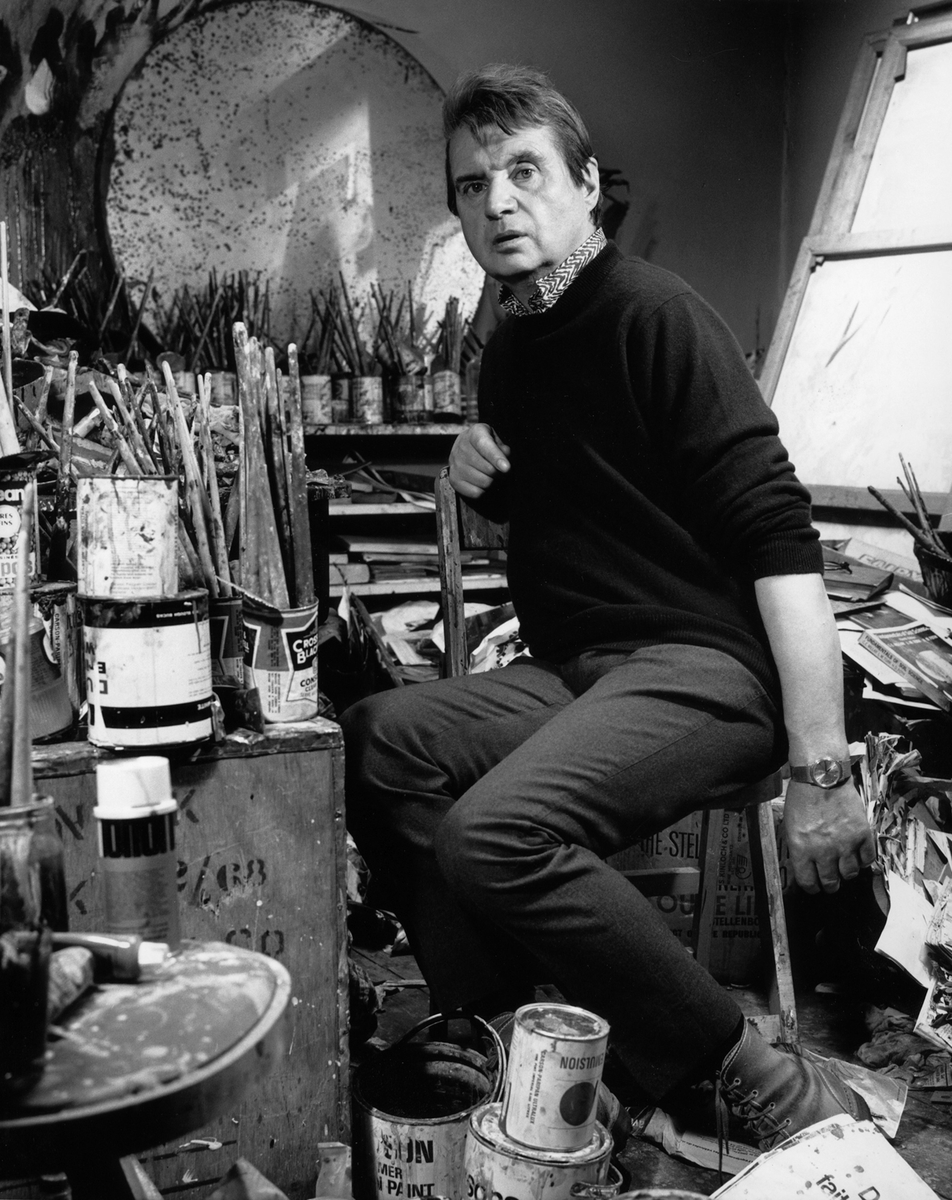
Francis Bacon at the Metropolitan Museum
NORMAN W. CANEDY
Francis Bacon, the first contemporary British artist, painter or otherwise, to be accorded a one-man exhibition at the Metropolitan Museum, has thirty-five recent paintings (rather than thirty-six as stated even in the catalogue, since No. 7 never made it into the exhibition) on view there (March 2oth-June).
Why the mantle has fallen to Francis Bacon’s work is largely explained by Henry Geldzahler’s dedication of the exhibition and catalogue: the late curator of European painting, Theodore Rousseau, had an enormous enthusiasm for Francis Bacon’s exhibition at the Grand Palais, Paris, in 1971, and the present exhibition is in memory of Mr Rousseau. As to the reason for the limits of 1968 to I974 imposed on the selection of the works, Mr Geldzahler offers several. Not the least of these is that a substantial number of the pieces are being shown for the first time anywhere. But his final determinant seems the most significant: ’Finally, I choose to see Francis Bacon as an artist in midcareer whose new paintings form a body of work that deserves to be seen whole and fresh.’
Thus fortified with the knowledge that a circumscribed period within the artist’s career has been assembled within these galleries, the viewer is oriented in a special way toward the paintings. With the view-point of a period in mind, he will not only expect to discover the constants of which that sense of wholeness, of which Mr Geldzahler speaks, is created; he will, as well, anticipate discerning the expected transformations and culmination of the character of the period at the end of the exhibition. In fact one finds this to be almost precisely the case, and insofar as the primary aim of the exhibition was such, it is both a highly satisfactory and satisfying exhibition.
In the first of the three spacious galleries set aside for these works in the twentieth-century exhibition area, that sense of homogeneity which is now anticipated becomes evident in unexpected ways. With the single exception of Self-Portrait, 1970, which is somewhat shorter, there are either uniformly man-high canvases or shoulder to crown-of-head portraits. (Moreover, the entire exhibition becomes even more overtly an entity through the use, on the larger canvases, of identical, strongly-moulded gold frames with glass.)
Ways of presenting the subjects also remain more or less constant. The small portraits, arranged in series of threes, create a monotonous isocephalic effect which, when one steps nearer, is countered by the drama of the evolving grotesque head which becomes fixed in the close-up view. In the large single canvases, on the other hand, the lone full-length figure is placed at a discreet distance in space, usually at the centre of a miniature arena. Consequently, while there is immediate focus on the centralized, closed figure in both the physical and psychical sense, the surrounding space obviously competes for attention.
The special nature of the renowned Bacon triptych – the three pars related through the ground colours and the characteristic continuous horizon line, yet disrupted and compartmentalized with the heavy frame and the 5-inch spacing between panels, specified by the painter – provides the opportunity for enlarged and complex relationships among the painting’s components which remain essentially those of the small portrait and the single canvas. In the two earliest here, Three Studies of the Male Back, 1970, and Three Studies from the Human Body, I970, the magnified portrait head appears, while at the centre of the tripartite composition are found compact figural forms in which energy seems especially intensified, quite reminiscent of the taut figures of the single canvas.
Among the other constants to be ob- served here are the figural forms with undulating contours extended with directional shadows and set against broad, geometrically-approximated shapes; and triptych wings composed to direct attention to the central panel where a figural form or forms (the Muybridge-derived Wrestlers remain a favourite motif until the latest works) rivets attention on the evocation of a stopped moment of contorting energy before discharge. The resultant tensions which have been created in these various ways are further strengthened by the increasing tendency to place malerisch forms against uninflected background.
These, then, are the basic qualities which one comes to recognize in the later works of the remaining two galleries, no matter how their thematic content may vary. Nevertheless, in the climactic final gallery of the exhibition one is not pre- pared for the impact of the triptychs, an impact, one soon realizes, that depends initially on the palette. Whatever one ultimately comes to feel about the works to which the viewer is introduced first in the exhibition, the initial impression of highly-sophisticated, decorator-coloured surfaces remains. The works in the last gallery, however, are realized with a palette seemingly comprised of black, white, red, and yellow, the four-colour system, it is worth noting, of Apelles and his contemporaries, according to Pliny. The resultant effect is one of dramatic gravity, so at odds with the gaily-painted settings of the pieces which introduced the period.
Equally striking is the new sense of presence evinced by the individual figural form. In part this effect depends on a new amplitude of form accompanied by its heightened articulation; but often, and particularly in the two triptychs May-June, 1973 and March, 1974 which con- front one another across the room, the images appear to operate on a level beyond that of appearances. They seem to be directed to one’s experience of memorable figural formulations within Western culture. Can it be simply fortuitous that one comes to be so forcibly struck by the resemblances between the concept of the centre panel figure in May-June, r973 (Fig. 1 57) and Dürer’s Melancholia, with her head sunk on upraised hand, and the bat form (to say nothing of the light radiance) hovering over the composition? Or is it merely chance that the nude heroic action figure in the centre of March, 1974 (Fig. 158) evokes nothing so much as Myron’s Discobolus? Each, it is fair to say, has become the archetypal exemplum of what it conveys: the Melancholia monumentalizing a state of despair, a new concept in the Renaissance; the Discobolus embodying physical activity crowded within a pregnant moment so vividly that despite bodily distortions evident to nearly everyone beginning with Quintillian, it became the epitome of stopped motion in art.
In this regard it is of more than routine interest to read Bacon’s remarks in the other publication issued to accompany the exhibition (a booklet, Francis Bacon Interviewed by David Sylvester, New York: Pantheon Books, I975). There, especially in those statements corresponding in time with these late works, we learn of his heightened admiration for classical sculpture; that, indeed, these constitute for him the greatest images man has made. We need not, however, presuppose an antique or a Renaissance image in each instance (evidently not in the case of the Photographer or the Butcher (?) in March, 1974) to justify the feeling that precepts similar to those which generated those earlier forms underlie the kind of classical clarification and sculptural-like force of concept evident in the late paintings. With some such combination of means these late works have elevated the basic, later-twentieth-century substance of Bacon’s art, without at all sacrificing its personal, elemental force, to a more universal level of expression, which is probably why they actually appear to belong in the kind of ambiance in which they may now be evaluated for the first time — in a kunsthistorisches museum of significant figurative art.
The Metropolitan Museum of Art’s exhibit of recent paintings by Francis Bacon
has been a great public success. At least, a lot of people have gone to see it,
drawn in part by the publicity that has been given to Bacon’s visit here. He
makes, as they say, good copy. Interview after interview has provided details of
his life and samplings of his high conversational style. He offers a speaking
likeness to the Bohemian Artist Himself, an image with which the general public
remains familiar. The critical response has been favorable, too. In some cases,
it has been literally ecstatic. It’s clear from both popular and professional
responses that Bacon and his paintings fulfill a need
Perhaps it would be best to go directly to the paintings. The earliest are from 1968, the latest from 1974. They are all portraits, either of the artist or of his close friends. Many of them portray George Dyer. One triptych shows three moments in Dyer’s suicidal death. Another triptych shows Bacon in one panel, Dyer in another, and the painter Lucian Freud in the other. Behind Dyer is a painting of a photograph of Bacon; behind Freud is a painting of a photograph of Dyer. These "portrayals" of photographs are slightly distorted, but of course not nearly so much so as Bacon’s portrayals of himself and others in the flesh. This juxtaposition of two mediums (within painting, always the dominant medium), gives a measure of Bacon’s expressive distortions an an indication of the directions they take.
Photographs, with their reduction of color to tones of gray and their necessity
of stopping short at the surfaces of things, are accurate. Paintings, or painted
images, are inaccurate about the same surfaces
Since the invention of photography, at any rate, most representation transcends to a great extent the physical mean by which painted images are produced. To be specific, representationalists have for over a century all been imitating the camera’s detachment to some extent. Bacon often uses photographs as sources, but his final images show a deliberate rejection of a fundamental condition of photography: literal distance, or the absence of actual contact with the subject. He acknowledges photography, he makes use of it, but finally one must say+ that he paints as if the camera ha never been invented. One could say that he looks at photographs with a deliberate naïveté, as if their images were things in the world just as physical objects are.
The
super-charged meaning he gives to the contact of brush and canvas makes him
nearly unique among painters since Courbet, and it gives him a right to his
much-praised old-master touch. The images of the "old masters" of course
transcend the physical means of painting, but modernist formalism has obscured
the way in which this is true: the "old masters" transcendent meanings can never
be separated from the value their audiences placed on paintings as finely
articulated, skillfully manufactured luxury objects. Value of this kind is
granted to Bacon’s paintings. (As for modern abstrationists who present
"paint-as-paint"
The
importance of actual contact of a pre-modern kind in Bacon’s painting helps to
explain his popularity. At a time when so much art is foundering in
self-generated difficulties, Bacon offers painting which are, self-confidently,
paintings. This, I think, is more important to his audience than his updatings
of Fuselian or Goyaesque anxieties. Bacon paints as if we could all be sure what
painting really is
THE ARTS | THE TIMES | FRIDAY JUNE 20 1975
Works of 83 British artists, including Henry Moore, Francis Bacon, Ben Nicholson, Graham. Sutherland, David Hockney, Barbara Hepworth, Lucian Freud and Bridget Riley, are being shown on the centre display at the 6th International Art Fair in Basle until June 23.
The display is sponsored by the British Overseas Trade Board in collaboration with the Fine Arts and Antique Export Committee.
RETURNING to New York after several years, it is comforting to find that
It
is the tail-end of the season in the commercial galleries and conclusions are
unreliable, but there does seem to be some lowering of creative pressure all
round, as in Europe. Galleries still multiply; there are now more than 30 in
Soho (south of Houston Street) and rumours of news ones in Noho (north of
Houston Street), besides the 180 or so uptown. But news artists are mentioned
hesitatingly, and the latest trends
In this stocktaking atmosphere a flailing attack on the whole modern-art phenomenon by a popular but maverick cultural commentator, Tom Wolfe, seems to have left an unexpectedly deep mark. His contention that much in recent American art came into being only to illustrate the theories of a few critics has an uncomfortable grain of truth in it, and though the art establishment has torn holes in his evidence, his thesis survives. It may or may not be connected with stories that lately art investors have been turning to precious stones rather than paintings.
But
the solid hump of quality and quantity is too large here to be much affected by
such an evaporation of confidence. Standards of presentation remain unbelievably
high, and one of the beneficiaries of this is the British sculptor Anthony Caro,
who currently has a retrospective at the Museum of Modern Art
In the New York context the differences between Caro and the American David Smith emerge as clearly as the resemblances. The big, cool spaces allow Caro’s sculptures to stretch their rigorously machine-made joints across the floor and to mark out their rhythms like subtly accented lines of poetry in space. They have never looked better and the British Council, which sponsored them, should be feeling happy.
In a
All of them are shown under glass—a practice to which Bacon has recently reverted—and they continue the diary of his dark journey into the night in a series of tortured self-portraits and renderings of flayed and twisted figures trapped in brilliantly lit prison-cells of paint. Some of these spaces are tidier and more austere than before, but they still hold an electric charge of fear. Now and then the colour crawls dangerously near to over-emphatic decorativeness; but Bacon holds his own in paint as confidently as Caro does in steel.
The competition in the Metropolitan is strong. Apart from the normal array of treasures there are three rival attractions. One of these is a huge new wing built especially to house the magnificent collection of Robert Lehman, who died in 1969. It is over-architected, like many American buildings, and does not always come off. Its vast domed hall dwarfs the paintings in it, while the re-creations of some of the rooms in the late owner’s Edwardian premises in 54th Street cramp them. But the sheer ambition of the enterprise makes a European gasp.
Meanwhile, upstairs, there is a superbly arranged display of one of the world’s
great hoards
FRANCIS BACON could now live his chosen life of “gilded squalor” on the sale of two of his paintings a year. He has long remained an elusive, remote man content to let his sensational works speak — or scream — for themselves and these works carry an immense formal authority.
David Sylvester is, I believe, the only man to have shown Bacon to the world through a TV camera. He has also conducted a series of interviews with him over the last 12 years and has now arranged these in a book form (Interviews with Francis Bacon, Thames and Hudson, £2.50).
He has trodden warily and Bacon is often stifling in his evasive and humourless replies, denying with some relish a lot that his analytical admirers infer from his art.
With this book, as with his paintings, the possibility of revelation leads one on, but the wary Sylvester is invariably halted by the restrained rebuffs and the laboured modesty. Bacon’s portraits acquire a simian pathos through their cancelled-out representation, and the painter’s honesty shines through his disdain for complex interpretations.
By JAMES M. SASLOW
Everybody talks about Francis Bacon as if he were the Bela Lugosi of easel-painting. The 65-year-old Englishman’s renderings of bleeding, tortured bodies, of nude male couples grappling in violent postures, and the lonely figures in bleak toilets, have provided the straight critics with several decades of fodder for grandiose pronouncements on “our century’s existential anguish” and other high-flown irrelevancies.
Well, somebody gay from the New York Times ought to take a second look, and have the courage to tell what they really see in his grotesque haunting images. Bacon is as close as we’ve yet seen to an artistic spokesperson for the hitherto hush-hush world of violent and compulsive erotic fantasies, especially between two men. Yes folks, step right up and see the World’s First Up-Front Sado-Masochistic Big-Time Faggot Painter.
Unfortunately, my excitement at finding such audacity hanging from the walls of New York’s Metropolitan Museum (“Francis Bacon: Recent Paintings 1968-1974” through June 29) was weakened by the fact that he doesn’t quite achieve the wonderful fantasy-trip he seems headed for in this series. And that’s too bad, because so far no one else has tried to express the same themes. So the show is disappointing; but in that disappointment lies a few lessons for all of us in the workings of the esthetic and psychological closet.
Bacon’s paintings deal with a limited set of images recapitulated over and over again (the way one might refine a favorite sexual fantasy through repetition). His preferred subjects seem to involve a single man, nude or in rumpled clothes; a pair of men, always in the same violent/erotic pose (taken from a 19th-century photograph of two wrestlers). Most often, the single man is George Dyer, a crudely handsome man euphemistically described in the catalogue as “Bacon’s close friend and model.” When a phrase like that is allowed to be applied to his lover of many years, one can guess that other aspects of his paintings might suffer camouflage.
All of which is wonderful, and I wish I could report that he conveys the essence of such experiences. But in the last analysis, there’s something missing in these paintings. It’s a difficult quality to define, but it has to do with the same mental clamps that keep gay people from relishing and expressing vital parts of themselves. Quite simply, despite the inner, potentially “revolutionary” content, the form of Bacon’s work is outwardly very closety — that is, he seems embarrassed by the “kinkiness” which others attribute to his vision, and thus he becomes too ready to submit to others’ ideas of what constitutes an “acceptable” art product.
For one thing, his paintings now borrow more and more from the “grand tradition” of modern art: the palette and flat patterns of early Matisse, the zoning circles and arrows of Paul Klee. Bacon wants very much to be known as a Great Master, and these new pieces are a sad retreat from the boldly disgusted slabs of flesh he did 25 years ago, into a realm of safe, “cool,” almost abstract compositions. He’s entitled to such a personal choice, of course, but it is lamentable on two levels — personal and communal. Too bad for him that he feels his own dramatic life and loves (he was enamoured of a long series of stableboys some years back, a la Walt Whitman) aren’t relevant to the creation of High Art — that’s just the sort of schizoid values that lead so many gays to straight-marriage-with-sneaky-trips-to-the-baths syndrome. And too bad for all of us, because we so desperately need artists with the courage to show their deepest feelings and desires in a way that doesn’t kowtow to traditional ideas of “acceptability,” even as little as Bacon does.
Suggested bibliography: these books offer splendid texts and Suggested bibliography: these books offer splendid texts and reproductions!
John Russell. Francis Bacon. New York Graphic Society, Ltd. 1971. David Sylvester. Francis Bacon (interviews). Pantheon Books. 1975
FRANCIS BACON: THE AUTHORITY OF FLESH
I. Introduction: The Problem Of Realism
And the way I try to bring appearance about makes one question all the time what appearance is at all. The longer you work, the more the mystery deepens of what appearance is, or how can what is called appearance be made in another medium. And it needs a sort of moment of magic to coagulate colour and form so that it gets the equivalent of appearance, the appearance that you see at any moment, because so-called appearance is only riveted for one moment as that appearance. In a second you may blink your eyes or turn your head slightly, and you look again and the appearance has changed. I mean, appearance is like a continuously floating thing.
(Francis Bacon, Interview with David Sylvester, September 1974.)
Bacon’s show at the Metropolitan consists of 36 paintings, largely portraits and self-portraits, all of which have been executed since 1968. The Newsweek critic Douglas Davis mentions, in the same breath and deliberately, this show and Bruce Marden’s concurrent Guggenheim exhibition, expressing discomfort with the former and comfort with the latter. Bacon is judged unfavorably when compared with modernist abstraction, triumphing anew in Marden. Bacon, himself, would have none of this because he repudiates the "willed , ’modern’ image," i.e., the pure abstraction which claims transcendental pretensions but communicates histrionic decoration. Bacon remarks:
One of the reasons I don’t like abstract painting .... is that I think painting is a duality, and that abstract painting is an entirely aesthetic thing. It always remains on one level. It is only really interested in the beauty of its patterns or its shapes. We know that most people, especially artists, have large areas of undisciplined emotion, and I think that abstract artists believe that in these marks that they’re making they are catching all these sorts of emotions.
Again:
I believe that art is recording; I think it’s reporting. And I think that in abstract art, as there’s no report, there’s nothing other than the aesthetic of the painter and his few sensations. There’s never any tension in it.... I think it can convey very watered-down lyrical feelings, because I think any shapes can. But I don’t think it can really convey feeling in the grand sense.
Bacon’s abhorrence of abstraction, together with his determination to convey "feeling in grand sense" yet as part of the process of recording-reporting — "what gives the feeling is that it is more factual" — recalls the efforts of another realist, Caravaggio, to charge fact with feeling. As with Bacon,
most art critics and academicians condemned the vulgarity of Caravaggio’s paintings, at times even with moral indignation.... Being themselves committed to a standard of ideal beauty, they found his work no more than a base "imitation of nature" and charged him with having destroyed "good taste." (Walter Friedlander, Caravaggio Studies.)
Bacon’s "imitation of nature" is in a sense even more "base" — more vulgar. i.e., more popular in origin — than Caravaggio’s, for it begins with the base, unsatisfactory illusion of nature which the photograph is. What Plato thought about art art in general is also true of Bacon’s images, which are imitations of an illusion and so have nothing of the truth about them. They seem to be imbued with idiosyncratic committed to the reporting of fact. Moreover, they show overeager ambition to express inchoate , in articulate feelings. Bacon’s pictures have about them an arbitrariness which defies any lasting intelligibility, however much they offer half-recognizable realities. It seems they use the photograph to move further away from rather than closer to "nature." They use it as a form of intensified sensation trailing in its wake inexplicable feelings that relate to the object photographed. The image created by Bacon’s fluid, painterly stroke stands to the clarity of the photographic image the way, to use his own comparison, the image in a distorting mirror stands to the image in a normal mirror, recalling yet ruining it, focusing it yet making it incalculable. Bacon’s transformation of photograph into painted image increases the distance from nature, however much it boomerangs back to the reality of feeling.
Thus, he can in no way be accused of creating ideal beauty, but rather, he destroys the shallow realism of the photograph with his fleshy, seemingly manic strokes. Instead, he abuses appearances by destroying them. They testify to a disturbance, in itself sufficient to communicate feeling, to convey a sense of what Bacon calls "undisciplined emotions" and elsewhere "instinct." This instinct comes up against the photograph, the image of reality which is its discipline, as an obstacle to be overcome. The obscuring of the photograph underneath the seemingly vicious fluidity of Bacon’s stroke both symbolically destroys the "discipline" of reality and releases emotion.
This release is never complete because it is masturbatory homage to reality. Bacon’s art is about the vulgarity, the bad taste, of releasing feeling, and simultaneously the sense of restraint on that release. It treats the conflict between the undisciplined release of instinct and reality’s restraints on and repression of instinct. Bacon’s pictures deal with paranoia, which takes a form of self-enforced solitude accompanying release of passion. Bacon’s solitary is no dreamer because he is too alert to the tension of the conflict with him. He takes to solitude to control the ambiguity generated in him by the conflict between passion and inhibition, between the authority of his instincts and that of reality.
For Bacon, realism is, ultimately, not simply a matter of charging fact with feeling, but confronting fact with the fundamental feelings — the instinctive response. The very process of reporting reality becomes in effect the act of releasing emotion, and the more spontaneous — or as Bacon calls it, accidental — the report, whatever its precisions, the more instinctive and undisciplined the emotion released, i.e., the more horrific the expression of fact. Thus, the core of his problem of realism is expressionistic. It is the difficulty of eliciting feeling from a world whose surfaces are opaque.
Bacon’s painterliness is a way of getting under the skin of things, of destroying their matter-of-fact surface appearance and revealing the flesh of feeling they are made of. Similarly, it can be argued that he puts his figures in solitary to take them out of the world’s action, to make them passive so that the process of stripping their skin can begin. In a sense, solitude chloroforms them into stillness so that Bacon can begin operating on them.
The unlocking of the feeling in form, as Bacon calls it, does violence to the image. For Bacon, this violence is a way of forcefully referencing reality, as well as an emphatic statement of his assumption that reality in general is violent. John Russell connects Bacon’s violence with the European experience of World War II, but the fact that it is sustained far beyond that experience indicates that it has deeper sources. As note, it had to do with the character of instinct when it feels blocked by reality and the way, as a result, it experience reality.
In a sense, Bacon is the perfect modern realist, for as the world has become more anonymous, feeling has had to become more acute to encompass it and find release within and through it. Bacon alludes to this anonymity through the ever-present photograph and newspaper, but overcomes it by the intensity of his feeling. (Both become increasingly abstract; solitude is a state of abstraction from the world, as are feelings which do not have the world as their object.) In sum, Bacon discovers the expressive potential in anonymous subject matter.
II. The Solitary Insomniac
Religion is what the individual does with its own solitariness.
(Alfred North Whitehead, Religion in the Making.)
Avaunt from sacred shrines,
Nor bring pollution by your touch on all
That nears you. Hence! and roam unshepherded —
No god there is to tend such herd as you.
(Aeschylus, The Eumenides, Lines 197-200)
Bacon’s figures are both insular and intimate, i.e., have the solitary alertness of self-aware subjects who choose silence. Yet they are subject to our witnessing glances, and at times, as in one of the Three Studies from the Human Body, 1970, and in one wing of Triptych, March 1974, to the more durably public witness of the camera eye. Thus, Bacon’s images of himself and his friends are exposed to the anonymous glance of strangers and machines — are exposed indifferently on the rack of public appearance, although enclosed in the privacy of their own consciousness, symbolized by the privacy of the rooms they are in. One could regard these works as extensions of Degas’s keyhole visions — images of anonymous figures performing intimate bodily acts under the assumption that they are unobserved — but for the fact that Bacon’s figures are not anonymous but rather portraits.
Half-undressed, they are self-conscious in their privacy because they are haunted by their potential presence of the other as their witness, always sooner or later to appear on their private scene. So that the scene, self-contradictory, is never truly private, but always potentially under view by some anonymous other. In fact, what Bacon calls the "armature" in which his figures are encased can be understood as a frame isolating the targeted figure.
Moreover, one comes to realize that the solitariness of Bacon’s figures is entirely independent of their setting, as indicated by the Portrait of a Man Walking Down Steps, 1972, where the figure is outdoors, as is also the case in the beach scenes of Triptych, May-June 1974. Bacon’s figure carries his solitariness with him wherever he goes. It is a habit of mind, an attitude of fixated self-awareness, a form of self-hypnotic narcissism. What Russell remarks as the sense of the presence of an eavesdropper in Bacon’s pictures is as much the result of the figure’s attempt to tune into his inner feelings as it is of his awareness of the unseen other. In general, Bacon’s figures seem truculently self-absorbed, with his face usually turned aside so that his eyes do not meet those of the spectator, or, if face forward, with his eyes evading an encounter with the spectator’s glance.
The eyes of Bacon’s figure are often closed, as in Three Studies for Self-Portrait, 1974. And when not closed, then glazed, as in the the self-portraits of 1971, 1972, and 1974. And when not glazed, then blurred — bleary-eyed as in Three Studies for Self-Portrait, 1972, 1973. And finally, when blurred, then glassily caught between defiance and indifference, as in Three Portraits — Triptych, 1973. It is as if he is acknowledging his vulnerability or helplessness before an alien gaze.
Bacon’s figure sits, then, as if in detention, or as if, because he is often undressed, in a doctor’s consulting room. Both these scenes will be dominated by a menacing figure. Yet he acts as if it will always exist, and can never be violated. This ambiguity symbolizes the simultaneity of the subject’s solipsistic narcissism, its self-containment and closure to others; and its being haunted by the other, its involuntary openness to the other through the other’s glance. The body’s openness to the strange glance in part explains why Bacon acts so intensely on the body’s flesh with his painterly stroke. This stroke is the equivalent to a harsh glance, violently caressing or raping. The body is manhandled, with no power to resist, by the other’s objecting consciousness, which twists it into sensate bits. All of Bacon’s figures, with the exception of the 1973 self-portrait Lucian Freud in Three Portraits— Triptych, 1973, sit crosslegged, sometimes jauntily so, as in the 1970 self-portrait. This conveys an ambiguous attitude: seemingly seated offguard, the figure is full of potential movement. He can spring to his feet in a moment, ready to act in relation to the other.
The solitude of these figures suggests paranoia. It involves fear of being taken by surprise. (One recalls Freud’s theory of paranoia as fear of being buggered — taken from behind, a situation in which one always experiences incomplete awareness.) I should like to talk now about this paranoid consciousness. For it conditions the obscene handling of the flesh, creating its ob-scene appearance. (The flesh’s obscenity in effect shows it being taken from behind, which puts it in a position to be turned inside out. This is done not simply to show, as has been usually said, its being subject to death and so to putrescence, but also to indicate the completeness of its exposure to and possession by the absent but imagined other.)
The paranoid consciousness of Bacon’s figure can be understood in three ways: (1) iconographically, as an expression of loneliness, with loneliness being a symptom of a "screened" attitude toward the world; (2) psychologically, as am expression of insanity, i.e., unreason — for Bacon the release of undisciplined emotion or instinct in the face of the world; and (3) sociologically, as an expression of decadence, where solitariness is the acknowledgement of nihilism. Loneliness implies the loss of interpersonal values; insanity means the collapse of wholeness of being, and decadence implies the discovery of inertia as the major force and mode of being.
(1) Jedlicka observes that "The portraits and self-portraits of the twentieth
century are in general manifestations of the solitary" (Max Beckmann in seinen
selbstbildnissen," Blick auf Beckmann). There is, then, at first glance,
nothing unusual about Bacon’s portraits and self-portraits. Typical of their
times, they show the isolated, monadic creatures we are all to become — the
unchosen independence we are all to achieve — in our anomic society. However, in
examining the solitariness of Bacon’s figure more closely, one discovers the
atypical motivation behind it. Jedlicka argues that in Munch’s portraits and
self-portraits, solitariness exists with respect to nature, while in those of
Beckmann it exists vis-à-vis society. For Fedlicka, Munch and Beckmann are
linked as opposites, a polarization which continues in their handling of space:
open, indefinite, and seemingly limitless in Munch, symbolizing the cosmic
expansiveness of nature; and closed and cramped in Beckmann, symbolizing social
constraint. Bacon’s space is of an altogether different kind, and symbolizes an
altogether different psychic state. It is a linear cage of self-control
emanating from the solitary himself — as can be seen in the Study for
Self-Portrait, November 1964, one of ts most powerful manifestations
— rather than an independent, surrounding space (whether infinite or finite)
which conditions his solitude. It is a space self-created by the solitary, in
line with the fact that his solitude has become so absolute givenness of the
subject to himself, and so of radical subjectivity. The formal space with which
he surrounds himself is simply the public announcement of his supposedly sui
generic subjectivity.
The space cage is a kind of halo around the figure’s solitariness, showing it to be sanctified by his self-awareness, as well as indicating that it is chosen. In a sense, it is the solitary’s self-consciousness objectified, made "practical," i.e., become a world, however small, for him to inhabit. In other words, the space cage Bacon’s figure inhabits is not a microcosm of the macrocosm of nature or society, but a private little cosmos with its own sanctity and laws v of feeling — if lack of "higher" purpose. Bacon remarks that "we nearly always live through screens — a screened existence."
It is this screened state — a psychic state — that is the physically manifested in the space cage. It is simultaneously transparent, to permit a view out, yet limiting establishing the space of an inner world. It is also the stage on which the solitary’s obscene flesh of feeling can be shown, the magic circle in which the solitary feels secure and "normal" while displaying himself. But the space cage is much more; its simplicity and order are meant to hide — in the sense of throwing off the scent — the asocial release of undisciplined emotion, the masturbatory relaxation of instinct. The space cage is social, as all space is, and a defense masking an asocial if not antisocial act. Bacon gives us the whole scene: the private place where feeling is expressed; the outer world (symbolized by the doorway present in many of the works), in which the observing other exists (sometimes he appears in the doorway on the threshold of the inner world); and the screen between the two, a pathetic — by reason of its transparency — creation of the solitary, mediating the relationship between the two worlds. It seems at times to exist more for his mental comfort than to perform satisfactorily the purpose for which it was made. It is as irrational and self-deceiving as the feeling it is meant to serve.
(2) The solitariness or asociality of Bacon’s figure is a sign of insanity. The face is the particular bodily place where this insanity is most clearly revealed, and again the method of revelation is Bacon’s "malerisch" technique. Bacon’s fluid handling of the face’s flesh desocializes it, i.e., makes it no longer manageable as social mask. The technique in effect unmasks and undermines the face by making it too vibrant, too expressive, and resonant — too much a quivering piece of flesh to serve as a public mask. Becoming flesh — the part of the body one least expects this to happen to — the face loses almost all form. It is the case in point of the loss of self-control of Bacon’s figure, which becomes too "sensational" to conform to conventions of social decorum (another reason it must be screened, or hidden away in a room like the portrait of Dorian Grey). It is too indecorous to belong to any reasonable order of things, too subjective and disorderly with its own instinctive energy to be brought under rational control. Foucault writes that
In the psychology of madness, the old idea of truth as "the conformity of thought to things" is transposed in the metaphor of a resonance, a kind of musical fidelity of the fibres to the sensations which make them vibrate. (Madness and Civilization.)
The flesh of Bacon’s figure shows the mad music of uncontrolled or undisciplined sensation rebelling against any conformity to the outer order of things — symbolized by the mask of the face — and becoming a kind of idea in itself.
It is especially in the triptychs and couplings — wherever an attempt is made to bring the figures together or wherever more than one figure exists in the same space — that the intensity of Bacon’s isolated figure becomes evident. For no reciprocity — whether by sexual means or through conversation — is ever established between the figures. In the triptychs they exist side by side, unspeaking, in private cells. In the couplings there is an eternal return of the same ambiguously sexual act — the same mixture of bitter struggle and sweet embrace. There is not the slightest sense of sociability, let along friendliness — of any reasonable relationship — in the participants of the triptychs or couplings. On the contrary, there are signs, as in Two Figures with a Monkey, 1973, that they unite only for purpose of vice (the monkey is its traditional symbol), and so only momentarily. There is no sense of any abiding, continuous relationship between them, only a half-lustful, half-aggressive attempt to possess each other, and that only in the least, however superficially fundamental way — through and in the the form of flesh. In the couplings they wrestle each other, attempting to over overpower one another, rather than harmoniously meet.
There is no harmonious togetherness in Bacon’s world, only conflict and self-conflict, self-torture and torture of the other. Perhaps this is why the couplings never do depict anal intercourse, but only the inconclusiveness of their struggle. The one figure cannot really take the other from behind, nor do they confront one another. Their union is, literally, a stalemate and dead-lock.
In the triptychs this lack of reciprocity — sexuality only proposes its possibility — is even more obvious, for the untouching contiguity of the figures suggests parallel rather than interpenetrating lives the friends lead. They are more intimate with each other’s photograph than each other’s person. The triptych form originally brought together a central image with subordinate — often in form as well as content — side images. But for Bacon each image has the same individuality and validity, even when the artist himself is the central image, as in Three Portraits—1970. There is neither structural nor psychological necessity for the figures to be taken together. They neither constitute a rational unity nor even imply a system of irrational relations. They are essentially a sum rather than a whole Togetherness, which requires reason to come into being, does not exist in Bacon’s pictures; it is abortive in the couplings, or made a mockery of in the triptychs. How can, as Bacon calls them, futile, accidental beings come together for a purpose, or even take togetherness as purposive. Each has to play out, "by himself," the "game without reason" life is. For Bacon, togetherness is barely a hypothesis of experience. Even the couplings are images of private release of passion, each member an occasion for that release. Relationships in Bacon’s art are so completely irrational they might as well not exist. In general, Bacon uses the triptych format, a in the May-June 1974 triptych, to create a series of staggered images, which interrelate as oblique duplicates. Each figure is in effect a Doppelgänger for the other — the death which the other is for the self. Or else, as in the May-June 1973 triptych, Bacon uses the format to trace the "progress" of a single figure in this case — George Dyer’s movement toward death. (The image of Dyer on the toilet seat also occurs, incidentally, in the same left-hand panel of Three Figures in a Room, 1964.)
(3) In The Will to Power Nietzsche equates decadence with nihilism, and sees its appearance in physiological decline and the rise of pessimism and skepticism. It is interesting that, in commenting on his respect for Baudelaire, Bacon claims that he particularly admires Baudelaire’s poem "Les Petites Vieilles." This poem describes Baudelaire’s "spying on odd, decrepit charming creatures," "broken-down monsters, hunch-backed or bent double," whom he asks us to love "for they are still human souls."
This sense of the decrepit and derelict, the misshapen and fallen — psychically — pervades Bacon’s pictures, and can be regarded as the source of what has been called their charnel house atmosphere. Bacon’s handling of the flesh is in effect a symptom of this psychic decadence the decay of the mind into skepticism and pessimism and the correlate inertia, quasi-deadness or decline of the body, which seems as though it has begun to putrify.
Nietzsche does not regard decadence as limited to any particular period in the growth of a civilization but rather as a general accompaniment of "any increase and advance in life." In Bacon, the painterly handling of the living flesh can be interpreted as indicating a perverse — pessimistic and skeptical — attitude to life, an ironical accompaniment to the development of radical individuality.
Bacon’s perverse painterly handling is essentially arbitrary, i.e., nihilistic in intention, because there is no clear reason for it in the depicted scene. Bacon’s painterly interpretation of the flesh confirms the self-destructiveness of his solitary figures, premised on the meaninglessness of their existence, i.e., its lack of raison d’être, and its consequent solitariness. Perversely animated in their private void, they have only their instincts to fall back on. They are in effect lepers — the deathlike blackness invading their bodies seems to testify to this — who keep to themselves because they see no strong reason for doing anything in particular. They are sick with death — not necessarily literal death, but rather the feeling of being nothing — and so diseased with the leprosy of loneliness, which fuses their individuality and instincts, indirectly alluding to this blackness, Bacon says that he is haunted by a feeling of mortality all the time. Because, if life excites you, its opposite, like a shadow, death, must excite you. Perhaps not excite you, but you are aware of it in the same way as you are aware of life....
The sense of death-in-life is pervasive in many of the exhibition’s so-called black paintings. But the point is that sustained, compulsive attention to the inevitability of death is a symptom of decadence, for eventually it leads to skepticism about — the deprecation and detriment of — life. Bacon, who has been called an existentialist — in our sense the most decadent contemporary philosophy — is simultaneously a decadent, in the sense of cultivating a nihilistic perception of and attitude to life. While he carries this cultivation to eloquent heights, making it the stance of a dandy, its nihilistic core remains articulate as a more than a positive. There are moments in the current show when it seems theatrical, but they are lost in the general sense of oblivion Bacon communicates.
III. Self-Fulfilling Flesh
All my life I have seen narrow-shouldered man, without exception, perform innumerable stupid actions, brutalize his fellows and poison minds by every conceivable means. The motivation of such behaviour he calls, "Glory." Seeing these things I have desired to laugh with others, but that strange imitation was impossible for me. I have taken a pocket-knife and severed the flesh at the spot where the lips come together. For a moment I thought to have accomplished my end. I looked into the mirror and inspected the mouth I had deliberately butchered. It was a mistake! The blood falling copiously from the two wounds made it impossible to distinguish whether this really was the laughter of other men. But after several minutes I could see clearly that my smile in no way resembled human laughter: in other words, I was not laughing. Lautréamont, Maldoror, Canto 1, Stanza 5.)
I’ve always wanted and never succeeded in painting the smile. (Francis Bacon, Interviews with Francis Bacon, May 1966.)
I did hope one day to make the best painting of the human cry. (Francis Bacon, Interviews with Francis Bacon, May 1966.)
Bacon has long been famous for his image of human flesh, which Russell sees as simultaneously marmoreal and pulpy, and which has been connected with Bacon’s sense of the voluptuousness of male flesh — of meat on Michelangelesque backs. Bacon’s treatment of flesh has also been understood as suggesting the figurative, accidental nature of human existence, which, because it is essentially a gamble — a blind search for significance — has no fixed form, and is charged with violent, i.e., uncontrollable, energy and emotion. Bacon himself has said that he wants images which "would rise from a river of flesh," "pools of flesh" out of which beings arose, pictures of "figures arising out of their own flesh." He experiences such figures as particularly poignant — the only quality he wants his works to convey — because they convey "the shadow of life passing all the time," and bring the factual-figurative element in the painting" onto the nervous system more violently and poignantly." In a sense Bacon’s "poignant" treatment of flesh epitomizes his ideal of an image as "a kind of tightrope walk between what is called figurative painting and abstraction," an image which "goes right out from abstraction but will really have nothing to do with it." Bacon’s flesh is such a poignant image, simultaneously factual and abstract, visceral and formal, illustrative and full of "glitter and colour" like that which "comes from the mouth." He "always hoped ... to be able to paint the mouth like Monet painted a sunset," and one might add that he has the same ambiguous ambition with respect to the flesh in general, whether of the face or torso.
In general Bacon’s handling of flesh can be understood as the climactic act of his attempt to fuse fact and feeling, the conscious and unconscious, the critically controlled and accidentally instinctive, the illustrative and imaginative, the photo-slick technically reproducible and the singular texture of particular sensation. All the dichotomies come together in the flesh, which is simultaneously commonplace, and charged with rare personal feeling. The union of these dichotomies occurs particularly in Bacon’s treatment of the mouth. As flesh, the mouth, for Bacon is an exemplary part of the body, because it summarizes flesh’s openness and closedness. I want also to show the significance of the overall burgeoning of flesh in Bacon’s figures. In a sense, Bacon distorts flesh in the name of greater particularity or specificity of being, i.e., as a way of making anonymous being individual. But in another sense, touched flesh is simply the most obvious source of feeling. Feeling, particularly feeling which is instinctive in origin — for Bacon all feeling ultimately calls the instinctive into play — is inseparable from flesh, as such expressions as the "bowels of compassion" convey. In antiquity, feeling was located in a particular inner body organ, usually the liver or heart. In a sense, all Bacon’s treatment of the flesh does is expose such inner organs, the sites of feeling.
The mouth, perhaps unexpectedly — for it is not altogether inner — is one such site, for it is the hole of flesh through which the feelings of the entirely inner organs escape, after writing their way through the body. The mouth is thus emblematic of the body as a whole and of feeling in general, and in the smile and the cry or scream we have the antipodes of its modes of expression, the range of possibility of visceral feeling. Bacon is forever shut out of the smile; it is impossible for the solitary subject to smile, even to himself, for such a smile is a mediation on what is not the self, and thus breaks the fast of solitude. In general, the smile is an invitation to the other, a form of sociality, , the potential establishment of reciprocity. Through the screaming mouth the body vomits its painful feelings like a volcano pours lava; smiling, the mouth is only partially open — the face is at peace with, or at least accepts, the other, and the body has no need to exercise its feelings in a cry. A smile is an exchange; a cry is an autistic event, the announcement of the subject in distress, opening wide to the outside, but with the traffic through it only one way, from within outward. The cry is open but one-directional; the smile is half-closed but two-way. In the cry Bacon shows the solitary vomiting his solitude into the world, making it an object for others. The portraits and self-portraits establish painful autonomy; the cry hurls it into the world. The cry is an attempt to conceive the world as completely subjective, i.e., as charged with private feeling, which forces its way into the open. The cry is eschatological, a last thing of subjectivity, an ultimate assertion of the inner life of the self in the face of all otherness.
The mouth is the most mobile or least fixed facial feature, and is thus able to convey its expressiveness — its openness or closedness — all at once. Bacon notes that "you could draw ... right across the face as though it was almost like the opening of the whole head, and yet it could be like the mouth. "The mouth is "almost like the opening of the whole head" because it is capable of articulating any aspect of the face’s entire range of expression. The cry — the Lamentation — is a traditional subject matter of religious art, but Bacon presents it not as a mourning response to a horrific outer event — the Crucifixion — but rather as the expression of the self-crucifixion by solitariness of the isolated figure. In a sense, Bacon’s Popes scream because they know that, underneath their authority and power, they are solitary men made even more solitary by this authority and power, which makes them other than themselves — with visceral feelings that must express themselves. Their worldly position has so repressed them that their feelings have lost all shape, and can issue only in the form of an instinctive agonized outcry.
The cry in Bacon’s pictures is the interior monologue of his solitary figure turned inside out and become an exterior dialogue with his self-image. In a sense, the cry is the ultimate self-contemplation, in which the solipsist’s power power of creation brings his own being into painful birth in the world. The power of authority or "superego" lies in its ability to repress, in in and of itself generating a feeling of perversity or abnormality, which finally articulates itself in a cry. In sum, the cry is the narcissistic, solipsistic, solitary subject’s spontaneous way of escaping the claustrophobia of being himself by getting into the world, if in a highly indeterminate way. At the same time, the cry is the violent release of instinct which has been repressed by internalized social, rational authority. Instinct has come to feel strange to itself, and so must objectify itself to see itself for what it really is, viz., bodily feeling.
Bacon’s great achievement with the screaming mouth is to turn it from being an abstract, formal device — an emblem of suffering — accompanying tragic scenes, as in Poussin’s Massacre of the Innocents (which Bacon professes to admire), to a highly charged concrete space involuntarily ejaculating feeling into the world. Poussin’s relatively standard scream stands no chance of carrying the emotion conveyed by Bacon’s scream. Bacon’s compulsive emotion would break Poussin’s precious porcelain mouth to pieces. Bacon is more truly interested in the wounded nurse’s scream in Eisenstein’s Battleship Potemkin, a scream in which feeling dominates fact, in which almost all formal control is released, and in which the sense of appropriate relationship between the cause of the scream and its effect is stretched to breaking point. In the history of Western art there is only one screaming mouth that comes close to Bacon’s in expressive power, viz., that of Caravaggio’s Medusa, said to be a self-portrait. In a sense, the mouth is the major field on which the battle — between fact and feeling — of realism is fought out. For of all the bodily parts, the mouth alone has the potential for spontaneously converting from a matter-of-fact local feature to a general area where the feeling of the whole body can be expressed.
In a sense, Bacon’s interest in the mouth, as the most expressive body site, links up with his treatment of sexuality. Because the mouth easily opens into a scream, it becomes the only place where the body attains full erotic release. In other words, the cry is sexual in connotation, confirmed by the fact that in Bacon the white teeth not the fleshy tongue are articulate in it. What Freud in The Interpretation of Dreams calls the "dental stimulus" is a typical dream symbol of masturbation. (Bacon’s solitary figures are dream images, their distortion easily understood as typical dream distortion.) Masturbation, the solitary release of instinctive energy, is for Freud simultaneously a symbolic form of self-castration — in a sense, finalizing solitariness — and a confirmation of social isolation. The homosexual couplings Bacon depicts are not as satisfactory, from the point of view of achieving release of instinctive energy, as solitary masturbation is.
This sense that masturbatory release or onanistic self-creation id the key to whatever sexuality there is in Bacon’s works, is confirmed by the presence in a number of pictures, of what Bacon himself calls a "whip of white paint." This whip of white paint, falling to the picture ground like Onan’s seed fell to earth, can be interpreted in a number of ways, which, taken together, summarize Bacon’s Weltanschauung. It is the body’s outcry, sign of its desperate release of instinct in the paranoid situation of its privacy. It is also symbol of the life-force of the man condemned to death, in a sense equivalent to the flaring loincloth on the dead body of the crucified Christ. It is the hanged man’s last ejaculation of his instinctive energy, indistinguishable from his death throes — the involuntary fleeing of instinctive life from his body. The whip of white paint often exists in antithesis to the often black pictures ground, as well as in contrast to the paler manufactured light, with its noninstinctive even flow, of the lightbulb. It is the ghost that Bacon says fact leaves, the Holy Ghost of feeling that emerges from dead facts. It is also a kind of token of painterly technique, and, in its isolation in the picture, epitomizes the figure’s solitariness. It is, as it were, the figure making a sign of itself to itself, so that it will know it is alive. Masturbation is the solitary’s way of pinching himself to prove to himself that he is still alive — to wake up his feelings. It is a way of snapping out of the feelingless state that unstructured, undirected solitude induces, and is the psychic equivalent of death. Masturbation is also the supreme narcissistic satisfaction, the solipsist’s way of proving that others do not exist. A neo-Cartesian, Bacon’s solitary asserts "I masturbate, therefore I am." Masturbation is the perfect creation ex nihilo, for the masturbator’s fantasy is that he gives birth to himself parthenogenetically out of his own seed.
But in the final analysis Bacon’s tumultuous, painterly flesh, epitomized by its own ejaculation of a whip of white paint, is not sexual in significance, nor a symbol of will power, but indicative of a deliberate choice of solitariness. In Being and Nothingness, Sartre writes that
human reality, far from being capable of being described as libido or will to power, is a choice of being, either directly or through appropriation of the world. And we have seen ... that each thing is chosen in the last analysis, not for its sexual potential but for the mode in which it renders being, depending on the manner in which being burgeons from its surface.
Bacon’s handling of flesh is the burgeoning of solitariness from the surface of his figure, a sign of the figure’s refusal to choose any other being than itself, and so chooses its body. To be itself is to be nothing but its flesh to possess its surfaces exclusively for itself. Masturbation is simply confirmation of this privilege. Solitariness is the condition for the burgeoning of the body’s surfaces, and at the same time this burgeoning is proof of a kind of response to — solitariness. The burgeoning of the surface of the solitary’s being is his self-reflexivity in action: his own flesh becomes a burning bush, showing himself to himself as divine, and completing the solipsistic enterprise of self-creation.
Bacon’s flesh, understood as the burgeoning surface of the subject’s being, as the subject’s call to and answer to itself, exists in sharp contrast to the nonburgeoning, neutar planar surface to the rooms in which he puts his figures. This contrast can be explicated through Bachelard’s contrast between "exaggeration" and "reduction." Bacon’s painterly handling of flesh is his way of "prolonging exaggeration," or trying "to avoid the habits of reduction." Why do so? In The Poetics of Space Bachelard writes that "The philosophies of anguish want principals that are less simplified," and insofar as Bacon offers us a philosophy of anguish he refuses the simple surface created by reduction and exaggerates the surface of his subject, in search of a more complicated and less conventional principal of subjective existence. Walls, however much they face us, have a side turned to the world. They are blank, feelingless surfaces, and Bacon profiles his exaggerated internalized figures against them. Bacon’s flesh goes full circle, from the subject’s exclusive possession to the other’s possible possession. Flesh becomes self-flagellating at the approach, if only in the subject’s fantasy, of the other. The anguish of Bacon’s flesh — its exaggeration into uncommunicative tongues — is simultaneously a speaking to the self and for the other. Anguish is the emotion that compels the self and the other to intercept in an orgiastic moment of imagined unity. However prolonged, it cannot last, for the self collapses back upon itself, becoming dense and opaque; and the other becomes an anonymous stranger again.
IV. The Aphoristic Image
The symbolic reference leads to a transference of emotion, purpose, and belief, which cannot be justified by an intellectual comparison of the direct information derived from the two schemes and their elements of intersection. (Alfred North Whitehead, Symbolism, Its Meaning and Effect.)
I would like to characterize Bacon’s pictures as aphoristic images, approximated by what Russell calls Bacon’s pursuit of the single picture. By this I mean images concentrated into the sententiousness of the symbol, but which, because they can never be finally specified in meaning, effect a transformation of undisciplined emotion between themselves and the spectator. Moreover, I would like to claim that the homosexual aspect of Bacon’s art and his attitude toward traditional old master art and modern photography constitute the aphoristic character of his images. Three homosexual traits in particular, a articulated by Sartre, seems to be responsible for his attitude to the traditional masterpiece and the modern photograph, and to suggest the rationale behind his transformation of them into aphoristic images.
(1) The homosexual fake submission seems epitomized by Bacon’s treatment of
Velasquez’s Innocent X. Bacon’s destroy the image, and shows the Pope in an
excruciating if not entire specifiable subjective experience. Hence the
modernization of the image, under the guise of rendering it more powerful and
pointed. Fake submission also appears, in the passivity of Bacon’s solitary
figure, a passivity which is that of a caged animal, ready to become violent if
given the chance. The figure’s sense of pent-up motion and emotion also creates
a symbolic charge.
(2) Actively extending this fake submission, of which I have given a few details, is the homosexual’s estheticism. In Saint Genet, Actor and Martyr, Sartre asserts:
In the movement of heterosexual ecstasy, desire is projected outward, the male forgets himself, he is only the delicate light which envelops the silk of a foreign flesh and makes it glow. Genet, on the other hand, returns to himself, he loses himself in order to find himself. The recognized gesture sends him back to the world and the world back to himself; he remains “frightened at possessing the world and at knowing I possessed it.” That is, he shelves the world: if he does “possess” the universe, it is not in the manner of emperors and captains of industry who boast of leaving their mark on it, but in that of a contemplative who discovers that “the world is its representation.” And in this great body of things perceived, a gesture stands out, object of an aesthetic intuition, which reflects to Genet only what Genet has put into it: it is the appearance to which the Thief has assigned the function of delivering to him the totality of appearances.
Old masterworks are, from the perspective of the present, so many shelved worlds. They offer particular appearances — "gestures" — which suggest a world they cannot deliver, but which nonetheless conditions their appearance. Thus, the old masterpiece no longer represents anything real. Its only value is as a symbol: it is charged with the feeling, a residue of the purposes and beliefs, of a lost world. Its existence is purely esthetic, and its value depends on the absence of any reference to reality. It is in effect a pure appearance charged with an abstract emotion.
Now Bacon finds purely esthetic-symbolic value in photographs as well as old masterpieces. They too hold emotion in suspension, so that it seems unconditioned and unconditional, and are no longer used for their reference to a particular world. Photographs and masterpieces become sources of symbolic reference for Bacon, and he uses them operatically, to create a highly charged atmosphere, in which the emotional effect is out of all proportion to the event that triggers it. In general, Bacon is not so much influenced by masterpieces and photographs — "influence" is a mnemonic device, and assumes continuity of of context and meaning — as exploitive of their emotional possibilities. He finds in them not things he wants to remember, but gestures in what Sartre calls "the choreographic figuration of human transcendency," which for Bacon is nothing but the superiority of feeling to fact. Taking masterpieces and photographs as only incidentally referencing reality, he finds in them unique emotional opportunities. They become the armature on which he can hang pure feeling.
The sense of oblivion of being in Bacon’s pictures is due to the fact that they are meant to be nothing but appearances abstractly charged with emotion, rather than images of any reality — images with any kind of objectivity, which occurs in them only accidently. What is normally accidental or momentary, the release of pure — undisciplined — emotion, is made absolute by Bacon, and what is normally all important to realism, the reference to reality, becomes casual and incidental.
One might note that influence takes place only within a tradition and within a world of uniform purpose and constant belief. Bacon, who believes that every artist today is "outside a tradition," asserts that all that is left for the artist is "to record one’s own feelings about certain situations as closely to one’s own nervous system as one possibly can." Because today there is no "valid myth where there was the distance between grandeur and its fall of the tragedies of Aeschylus and Shakespeare," all that remains is the emotional charge caused by such a fall without the framing myth to give it general significance or validity for others. This renders it seemingly unreal and exaggeratedly subjective, with purely esthetic and personal significance. Because of this, Bacon’s emotional intensity makes us uncomfortable, since our emotions are aroused by real events. When his works do seem, whether retrospectively or immediately, to refer to real events, as his Study for Portrait, 1949, seems to allude to Eichmann on trial in his glass booth, and as the figure with the swastika armband in Crucifixion, 1965, alludes to the Nazis, our response is thrown off. We do not know whether to take the images for their world-historical implications or for their purely emotional implications. We are not helped by Bacon’s perverse assertion that that for him the swastika is simply an interesting shape in a red field. He regularly and maliciously insists on purely esthetic significance, e.g., in the case of the mouth, as if to throw the viewer off the scent of the worldly meaning of the work, to free him to respond to it purely emotionally. He wants the work to impress itself directly on the viewer’s nervous system, rather than become something he associates with everyday reality and/or makes a moral judgement on. What is interesting is that we never think that the two — worldly meaning and emotional impact — can be present at the same time in Bacon’s works, and the same is true for any other kind of public meaning, such as the religious. Thus, Bacon regards the crucifixion as today having purely esthetic and emotional significance. It is simply "a magnificent armature on which you can hang all types of feeling and sensation," and he doubts that even "the great Crucifixions... were painted by men who had religious beliefs." A religious belief is a proposed view of reality. On Bacon’s terms, for an artist to have a religious belief about reality — about the facts — would be for him to become concerned to get the meaning straight, which would interfere with an instinctive response to appearances. The appearance of meaning is sufficient for Bacon, not its exact statement: the artist’s meaning emerges from how convincingly he can charge his appearances. Bacon believes that, unlike himself, Velasquez and Rembrandt
were still, whatever their attitude to life, slightly conditioned by certain types of religious possibilities (salvation), which man now, you could say, has had completely cancelled out for him.... You see, all art has now become completely a game by which man distracts himself; and you may say it has always been like that, but now it’s entirely a game.
Bacon’s great achievement with the screaming mouth is to turn it from being an abstract, formal device — an emblem of suffering — accompanying tragic scenes, as in Poussin’s Massacre of the Innocents (which Bacon professes to admire), to a highly charged concrete space involuntarily ejaculating feeling into the world. Poussin’s relatively standard scream stands no chance of carrying the emotion conveyed by Bacon’s scream. Bacon’s compulsive emotion would break Poussin’s precious porcelain mouth to pieces. Bacon is more truly interested in the wounded nurse’s scream in Eisenstein’s Battleship Potemkin, a scream in which feeling dominates fact, in which almost all formal control is released, and in which the sense of appropriate relationship between the cause of the scream and its effect is stretched to breaking point. In the history of Western art there is only one screaming mouth that comes close to Bacon’s in expressive power, viz., that of Caravaggio’s Medusa, said to be a self-portrait. In a sense, the mouth is the major field on which the battle — between fact and feeling — of realism is fought out. For of all the bodily parts, the mouth alone has the potential for spontaneously converting from a matter-of-fact local feature to a general area where the feeling of the whole body can be expressed.
For Bacon, art is a game of emotionally charging appearance rather than a question of presenting clear meanings, of whatever kind, and certainly not the political and religious, which are usually taken literally. In general, art exists for Bacon not to convince us of the truth about anything, to nail down reality by imitating it, but rather to use some of its appearances in a purely esthetic way and thereby to generate a radically subjective feeling. In a sense, art is proof that appearances transcend reality and that feelings transcend facts. By proper choreography, real facts can be made into strongly felt fictions. Masterpieces and photographs are storehouses of chorographical gestures which can be appropriated for purposes of conveying new kinds of feeling. Past art has the advantage of not being clearly connected with and firsthand experienced reality, and photographs, especially, for Bacon, when they are old and tattered from use, give us a secondhand reality, which with time seems a fantasy, and so can be emotionally exploited. The point, for Bacon, is to get distance from reality, so as to keep feeling pure and alert, charged with abstract power. This holds true for the reality of his own works, from which he tries to make the spectator keep his distance by framing them in gold and glass.
(3) Such framing is the major example of the homosexual’s artificialism, which finalizes his estheticism. The way Bacon takes an appearance as "real" while knowing it is false is similar to Sartre’s example of Genet’s artificialism: the treatment of cut glass as a precious gem while knowing it is cut glass. Talking oneself into belief is crucial, to sustain the esthetic sensibility which is the foundation of emotional responsiveness in art. Bacon wants his framing method — as though a precious setting would make us think the art precious, i.e., believe in it — to create "distance between what has been done and the onlooker" and serve to "shut (the work) away from the spectator." It is better that it remain a mysterious symbol than indicate a familiar reality, or itself become one. The full import of the glass framing is that it creates a quasi-old-master look, doubly removing the work, in space as well as concept. This removal — the added distance — filters the feeling through with greater purity and power, as well as emphasizes that it is impossible for art to refer to anything beyond itself, i.e., that is not an appearance. Unwittingly, Bacon links up with modernism’s self-reflexivity, but in terms of feeling rather than form. On the level of feeling as well as form art is sui generic.
In general, Bacon’s art, to use Sartre’s words, is "a compound of ceremonious politeness and aggressiveness." These qualities are the vital ones of the aphorism, with its symbolic overtones and peculiar way of turning what is seen or known into an emblem of what is felt, i.e., into an esthetic intuition. Walter Kaufmann writes that "aphorisms reflect the experimentalist’s determination to remain unprejudiced by any system," i.e., by any final, fixed view of reality. The artist’s insistence on appearance for appearance’s sake, in Bacon’s case correlated with an insistence on feeling for feeling’s sake — a kind of final fling of romanticism — works through an aphoristic image which is a kind of experimentation for experimentation’s sake.
Ironically, the sense of aphoristic image as a mode of experimentation with intuitions serves the purposes of realism admirably. For in trying, at all costs — even those that lead to the distortions of expressionism — to avoid becoming bound by any fact or ideology realism must become open-minded experimentation with appearances. It can never be satisfied that it has the final, certain, truthful appearance of reality. An experiment exists on the borderline between truth and falsehood. It is undertaken either to demonstrate some known truth or to test some suggested truth; in general, to confirm or disprove something doubtful. When sustained for itself, thereby becoming a mode of presentation in itself, the experiment — or aphoristic image — creates ambiguity about what is or is not the case and valid. Aphoristic experimentation thus becomes a way of penetrating reality without committing oneself to it. It is a way of charging appearances — apparent reality — without specifying the full import of the charge.
The aphoristic image thus has a highly irrational tone to it, regardless of the kind of emotion it does or does not express. Bacon’s images are irrational not because they represent irrational emotions, but because in and of themselves, as experiments with appearance, they can say nothing substantial about reality yet they are intensely saying something. They are thus unfinished psychologically as well as perceptually. We cannot believe in them, although they communicate a sense of purpose to us. We can feel them, but we cannot say that what we feel is real. And that, ironically, is the state in which we exist in reality, testing and retesting our intuitions, but never finally certifying them as unconditionally objective, as definitely the case. Reality is never definitively what it seems to be, and for a realist to make this clear, as Bacon does, is a supreme achievement. Too much realistic imagery has tired to be definitive of reality, which has only caused it to dwindle into into a document, i.e., another datum, rather than become an indication of the possible subject-object truth about reality.
Bacon’s aphoristic approach shoes us that reality is always in the process of being made into a symbol by the subject who perceives it. The subject persists in this process in order to release himself from reality’s hold, and thereby uncover, in the abstract form of intuitions, the feelings it generates in him. This process of symbolization links up decisively with the homosexual aspect of Bacon’s art: neither homosexual nor aphoristic penetration achieves ultimate possession of the object. Its reality is always discovered to be tuned away from one, and wherever one has entered it, one finds that one is facing a behind. One always has an obscene, exaggerated, yet radically incomplete and inconclusive relationship with it, and one finds it degenerating into an appearance which cannot reference anything but itself. One finds one’s relationship with it degenerating into an artificial game. One remains intact relating to it, but frustrated, because one has established no reciprocity with it, and so gotten nothing from it. One has only released oneself toward it, in its direction; a release which, because it has not found its mark, seems undisciplined.
Bacon’s portraits, in the end, communicate no sense of character — of the basic reality of the other, the represented person. And they can never do so, because they are simply fantasy appearances of the other. I disagree with Russell’s reading of the portraits of Isabel Rawsthorne as "an acknowledgement of all that is staunchest and most generous in human nature," which are much too determinate character traits to get out of a Bacon portrait. Russell is probably speaking from his own acquaintance with her. Basically, I disagree just for the reason Russell himself believes contemporary portraiture is difficult, and finally incapable of communicating any self-same self, any "owned" self:
We disbelieve in the monolithic view of human nature; we are not awed — quite the contrary — by the trappings of power; we see human beings as flawed, variable, self-contradictory, subject to the fugitive and the contingent.
When Bacon does try to convey inner character — to satisfy the ideals of traditional portraiture — as in Study for Portrait III (After the Life-Mask of William Blake), 1955, he becomes pompous and dull, affected and melodramatic. Generally, he offers us no sense of firm being in these portraits. He shows them as stereotypically frenzied, almost manic and raw beings.
Bacon, if anything, achieves his realism in the portraits by destroying the identity of his subjects. He blurs it until it seems insecure, leaving vestiges of its familiar daily appearance in the details of a few features, which seem typical only because they are repeated as we move from image to image of the same subject. But these features are no more than exterior appearances, and say nothing decisive whatsoever about the characters of the selves depicted. Instead, what Bacon does is create, through his painterly technique, a sense of involvement with and within them — a generalized kind of momentum in them which we share perceptually. Within this context of fluid, generalized surface, possible identities emerge but are not confirmed, are asserted but do not last — are purely momentary illusions or possibilities of appearance. All have more or less the same mood. In sum, Bacon’s painterly technique is the core of the aphoristic intuition of subjectivity he offers, for it makes the figural image abstract. Out of this abstraction, identities emerge as experimental possibilities, but none is finally true or factually clear, although all are symbolically valid, i.e., valid as emotionally charged appearances, undisciplined releases of instinct, and dissipations of the raw possibility of being alive.
Sir, The present rumpus about the wealth tax and works of art has been conducted largely between the Minister for the Arts and art dealers, galleries, owners of grand houses, and owners of works of art. We should be grateful if the voice of the living artist might now be heard on this subject.
We object to this tax for a number of reasons, but principally because:
1 It will discourage discriminating patrons from purchasing the works of any artist if an enhancement in their value—even if the purchaser has no intention of selling the work—involves taxation. Survival of an artist is difficult enough without the creation of new difficulties and problems by the very Minister who should regard himself as charged with the duty of aiding and not impeding their careers.
2 There is a threat of almost unbelievable imbecility—if it materializes. That the living artist will be liable for tax on his “stock” of unsold works. This can only encourage him either to emigrate or to cease working.
3 The object of the Minister and his Department should be to encourage an interest in the arts and in the assembly of works of art. We hope that the Minister will think again before he introduces this singularly inappropriate and destructive measure.
4 The Minister has made a point that the works of young artists are not purchased by people of wealth. It is happily the case that quite a number of people of limited wealth do buy the works of young artists and have always done so. It is also the case that wealth by no means destroys taste or discrimination and a number of people of considerable wealth continue to support young artists. Artistic discrimination is not a matter of money or speculation.
Yours faithfully,
ROBERT ADAMS HOWARD HODGKIN
SHEEN AGAR JOHN HOYLAND
KENNETH ARMITAGE JOHN HUBBARD
FRANCIS BACON SANDRA BLOW
REG BUTLER MALCOLM HUGHES
ALLEN JONES BERNARD MEADOWS
PATRICK CAULFIELD HENRY MOORE
BERNARD COHEN BEN NICHOLSON
HUBERT DALWOOD VICTOR PASMORE
JAMES FITTON ROLAND PENROSE
PATRICK GEORGE JOHN PIPER
JOHN GOLDING WILLIAM SCOTT
FREDERICK GORE JACK SMITH
RICKARD HAMILTON RUSKIN SPEAR
PATRICK HERON JOE TILSON
IVON HITCHENS FELIKS TOPOLSKI
CAREL WEIGHT September 4.
WEALTH IN THE ART STUDIO
SIR—Once upon a time, in the & good old days, a painter worked fn his studio, with his Muse leaning over his shoulder, and thought of Art and Aesthetics and Painting, and like Rembrandt and Van Gogh and the legions of painters before today, he created Art, and it accumulated around his studio.
But now Mr Hugh Jenkins calls these piles of paintings “trading stock” (see paragraph 52 Green Paper on Wealth Tax) and says they are subject to Wealth Tax.
What will a painter in Ms studio be thinking of now? Of the Wealth Tax as he looks at his work around him, wondering if it amounts to £100,000? Of whether he should paint another if it nudges the total value over that sum? Of whether there will be a knock on his studio door by the Value Added Tax man or the Wealth Tax official to check his books or his “stock”?
And, absurdity upon absurdity, an artist will be forced to declare for Wealth Tax purposes the value of not only the contents of his studio that he has painted, but of the unfinished painting on his easel. Take the example of Mr Henry Moore. Already income taxed to the hilt, Mr Moore will now be wealth taxed on the sculptures he created which he owns. They will be worth millions, and every year his Wealth Tax bill will be a fortune.
Hard work used to be considered to be a virtue worthy of reward. In this Socialist State of ours there are often cruel penalties imposed for personal industry.
Imagine, if you will, Mr Francis Bacon suddenly looking at the work of 12 months, painted for a coming show which will be held in 12 months’ time, piled against the walls of his studio; accumulated work which will pricewise total a few £100,000s, he realising that that work makes him liable to a considerable annual Wealth Tax as long as it stays waiting in his studio unsold.
When it is sold at the prospective exhibition he pays more tax still in the form of income tax on the profits from sales. Who will expect Mr Francis Bacon, and others like him, to stay in England when Mr Jenkins turns Ms proposals into law and that law is applied?
Valuation for Wealth Tax of an artist’s unsold work will be a great problem. Most people think such a valuation to be an impossibility. Shall the work be valued according to its price in an exhibition, or according to its auction-room value, whatever that might be?
The revenue to the State from applying the Wealth Tax in this direction will surely be small. It will be an incredibly philistine act that will ever be to the discredit of Mr Jenkins and of the Labour party. It will be an insult to artists. And it will be unworkable because of the valuation difficulties that will arise. It is a destructive and thoughtless intention.
JOHN BRATBY
London, S.E.3.
FRANCIS BACON is the painter of the human animal. His canvases confront us with naked figures splayed out on beds or in the throes of violent love-making, figures crucified or crouching in contorted postures, figures sitting alone in hushed interiors on chairs or lavatories, figures vomiting into basins or peering round door jambs with film cameras at the ready, figures staring ferociously out of gloomy rooms or whose mouths gape open in silent screams. The beings who act out these dramas are nearly always identifiable: as Popes or politicians or striped-suited tycoons, as Bacon’s friends or the artist himself.
The basic subject matter of the paintings has not changed since Bacon began painting in the Forties. He is now, at 66, the most famous British painter of our age. He is also the most controversial. In this weekend’s Aquarius interview, Bacon insists that his images are not excessively violent but that they are simply true to life.
The edited conversation in the book contained the sort of stuff an arts programme should concern itself with, connecting the artists thoughts about sex, death, religion, friendship, money, to the work itself. So, ever hopeful, Aquarius made contact with Sylvester, who has long been a close friend of the artist and has in fact been the subject of several Bacon paintings. From what he had heard about Aquarius, and after our discussions with him, Sylvester felt confident in suggesting to Bacon that he do it. Bacon accepted, on condition that Sylvester be the interviewer.
At the appointed date, Francis Bacon arrived at London Weekend Television’s studios. It had been difficult to persuade him to appear, and on the day he was not feeling too well. No longer a young man, the prospect of spending some ours sandwiched in this condition between a barrage of TV lights and a camera cant have been that enticing. But he turned up on the dot, refused offers of food, had a stiff drink, and visibly pulled himself together to keep a promise that he’d not especially wanted to make. Even before idea became reality, we had wanted the final programme to be uncluttered with props, and to focus firmly on the artist and the paintings which in this case could hardly be more gripping. Clearly, this was a major factor in Bacon’s decision to do the programme.
TV arts programme are plunging zooms and snazzy cutting and a fixation with detail at the expense of the whole, larded with big-band backings of soaring symphonics. And painters are more vulnerable than any other brand of artist. For actors and musicians at least keep control of their art, in whatever situation; they make it happen at the time, on the spot. They are inseparable from it. A painter’s ideas, by contrast, take the form of objects that exist independently of their maker, to be exploited by a greedy market — at one point in the talk Bacon remarks that “no one today buys a picture because they like it: it’s just a form of stocks and shares” — or to be gobbled up by the media.
It is a problem. The easy equation that paintings equal visuals, while a TV screen equals ditto, just isn’t substantiated. Paintings inevitably lose out in the transition from the real thing to a shrunken image that has gone through miracles of complicated electronic technology finally to pop up when you turn on and tune in. But souping it up isn’t the answer either.
With our Bacons, we have tried to
find a way of retaining their original vitality, immediacy, horror and beauty
and to do it with the firm conviction that this man and this work speak for
themselves. The programme features
ROY SHEPHARD’S PREVIEW
TV
PREVIEW
For the first time in four years
leading painter Francis Bacon gives British TV interview when a he talks with
eminent art critic and friend David
Bacon’s most recent works, which were a sensation at the Metropolitan Museum in New York this summer, will be seen on the programme, the first time they have been viewed this side of the Atlantic.
MIRROR TV GUIDE
By Clifford Davis
“What’s that?” he cries . . . “Oh, a lamp’s gone . . . I thought it was the IRA.”

FRANCIS BACON (ITV, times vary)
Watching Francis Bacon, one of the most controversial painters of our time, was a strange but salutary experience (Aquarius, ATV).
I had not intended to consider this programme; it was already there when I switched on and it held me to the end.
I cannot imagine anyone wanting one of Bacon’s pictures in the house. Like Paul Klee’s “A Girl Possessed” or Edvard Munch’s “The Scream,” they belong to big private or public collections where one may or may not wish to look at them.
They remind me of a butcher’s back-shop filled with sexually charged offal: they are repulsive and yet compelling, and one had wondered about the mind behind their creation.
As examples of his portraiture rolled by, I was struck by the number of almost terrifying self-portraits, undeniable but twisted likenesses of the artist. He painted himself, he said, for want of other models, but now two new ones have appeared on the horizon, both handsome, so no doubt there will be a change of face — less tortured, it is to be hoped.
Bacon’s is a strange face which sets one wondering; the uneven, filmy eyes, the slightly distorted mouth. But after a while it is the essential gentleness that prevails.
He spoke of the time spent thinking out subjects. “I’m not so much a painter as a person for whom chance and accident work,” he said. “I might make a film of all the images that have crowded into my brain — and which I haven’t used.”
There was a dramatic moment when a studio lamp exploded, convulsively shocking this sensitive, Irish-born Protestant. “I thought it was the IRA,” he said.
£65,000 PAINTING BY BACON
By Our Art Sales Correspondent
FRANCIS BACON’S “Study For A Pope”, painted in 1954, was bought anonymously for the exceptionally high price of £65,000 at Sotheby’s yesterday.
The auction record for the artist’s work is £70,291 given at a Sotheby’s sale in Rome in 1973. In recent years, Francis Bacon, who is known for the horrific qualities of his work, has become one of the most celebrated of British artists. Among exhibitions all over the world he has had the rare honour of a large one-man show at Grand Palais in Paris.
The knockdown total for yesterday’s sale of 100 lots of contemporary art was £360,150 of which 71.2 per cent. was for works sold. Acquavella, of New York, paid £15,000 for “Changing Of The Square” of 1965 by Mark Tobey. This is an auction record, the previous highest price for the artist being US$16,500 (about £8,200) paid in October last year.
Other prices in the sale were £18,000 given anonymously for David Hockney’s “The Sprinkler” of 1967 and £15,500 (A. Ukman) for a Kenneth Nolan.
Bacon hit
FRANCIS Bacon’s
“Study for a Pope” was bought anonymously for £65,000 at
Sotheby’s in London yesterday.
The picture was painted in 1954.
The British Theatre of the Deaf was on 2nd House (BBC2). The Balinese delicacy of the illustrative handsignals was sufficient to hold the eye, but in time the mind began to moan with thirst. It screamed with anguish at an Aquarius (LWT) featuring Francis Bacon giving an interview—a rare occurrence, and on this showing not rare enough. David Sylvester was his interlocutor. There was a good deal uttered about Death, but the level of speculation was considerably below anything that occurs in the average novel by Thomas Love Peacock, and indeed we might have been listening to Scythrop and Flosky at Nightmare Abbey, except that there were no laughs.
I remember being bowled over by the Bacon retrospective exhibition at the Tate in 1962, and I suppose one should keep faith with one’s early enthusiasms, but really it was remarkable, in my case, how admiration for Bacon’s variations on Velasquez was undermined by subsequent acquaintance with Velasquez—who did, after all, see a good deal of Death on his own account, but was able to maintain an interest in Life as well. Extremism is a restriction of range rather than an extension of it.
Hell (LW) was a Godslot extravaganza which lent weight to the case that religious broadcasting ought to be wound up. Illustrated by ponderously juxtaposed visuals of fasting and feasting, it mounted a cascade of sonorous fatuities about the consequences of Man ‘rejecting a real relationship with his fellow man and with Creation,’ as if such a thing could be posited, let along rejected. We were warned of the dangers attendant on losing ‘the ground of our being’ and informed that wars occur ‘because people have been arrogant or greedy.’
Plainly the conclusion to draw was that if everybody in the world ceased to be arrogant or greedy and reinforced the ground of his being by establishing a real relationship with his fellow man and with Creation, evil would cease. However unlikely, this would be a desirable event, since Hell would promptly freeze over, thereby removing at least one pretext for silly programmes.
Portrait of an artist as a tycoon..
THE fortune left by Dame Barbara surprised even close friends and raised eyebrows in the British art world. An art dealer in London said: “Even for a major artist like Dame Barbara this is a tremendous sum.
How much do other top British artists earn?
Painter David Hockney is said to get £50.000 for each painting, Graham Sutherland gets £20,000 for a large picture and Francis Bacon commands huge sums for his weird, dream-like pictures.
Paintings by the retired L. S. Lowry, famous for his scenes of industrial Lancashire, average £10,000 each. He has reached a top price of £30,000 for one painting.
Donated
The eccentric John Bratby is said to earn more
than £20,000 a year. But far and away the biggest earner in the British art
world is 77-year-old Henry Moore who gets £500,000 a year for his work. He
recently donated to a museum 300 pieces of his work said to be worth
On the “comfortable” end of the scale is portrait painter David Poole who is 44, runs a couple of cars and lives with his family in a beautiful Spanish-style house in West Horsley, Surrey.
“LOYALTY is not one of my virtues. I care more for art than I do for people.” It’s a tart epigraph for a woman of 68 to tack on her life, but Helen Lessore hasn’t a sweet tooth in her head.
All the same she’s telling only half the tale. The other half belongs to the dozen or so painters she steered, wheedled and drove to maturity throughout the 1950s when she made the Beaux Arts Gallery in London one of the most individual and influential nurseries of talent in the country .
She doubts whether she’ll ever write about it: “There are too many histories of art already.” Instead, she’s started to paint what amounts to an autobiography. There on canvas are the artists she exhibited: Francis Bacon, Michael Andrews, Frank Auerbach, Leon KossoE. Lucien Freud’s there too (“Simply as a friend. I never showed his pictures”) with Craigie Aitchison and Euan Uglow. She could add the faces of Edward Middleditch, Derek Greaves, Tim Behrens and Sheila Fell—all familiar names in the art world of today.
Whether she’ll eventually get round to painting them all Helen Lessore doesn’t
know. Reputation isn’t her criterion: “Success in one’s life-time means
absolutely nothing.
Apart from the quality of the work itself (Helen Lessore was a student at the Slade along with William Coldstream and Koderigo Moynihan) what’s important about her painting is that it provides a gloss to a decade, a unique footnote to a period when names were being made, myths invented. I admit to a personal interest. Twenty-three years ago it was Helen Lessore who sold me my first real picture. But it was Helen Lessore who first opened my eyes ’as she did for many others to painting as something necessary and available.
She took over the Beaux Arts Gallery when her husband died in 1951. “I always had the feeling that I shouldn’t run it simply for bread and butter. I wanted it to be associated with the very best pictures I could find. I couldn’t afford established artists so I went after young talent. I never meant to be a dealer; nor did my husband. And I never made it pay. The gallery closed in 1965 and, looking back, it’s amazing that it survived as long as it did. Costs went up so much and I couldn’t raise the price of the pictures in the same proportion. When the money ran out I tried to find backers but it was impossible to find anyone who did not want a say in how things were run. That was impossible. I would only show pictures that I liked, that I believed in.”
Ironically, it was the commercial success of several of the painters launched by Helen Lessore which helped to kill the Beaux Arts. They were wooed by bigger galleries. Sales of pictures by the remaining artists declined. “I never, thought of painters existing to serve the gallery; rather the other way round. Everyone was sad when we closed, but I think we had served our purpose. Every artist who was good enough had the confidence to go on. No one can stay in the nursery for ever.”
When the shutters finally went up Helen Lessore was left with a stock of unsold pictures. Now they’re stacked in her home, occupying space he craves, for her own work. “You see, I never stopped thinking of myself as a painter. But the gallery took most of the time, most of the energy. When I had paid all the bills—and all of them were paid—I went Back to It.
Between then and now she has amassed enough for an exhibition. “And really, I’d like the pictures to be seen, if only to persuade the people I want to sit for me that I’m good enough, that I am worthy of their time.”
What’s heartening is that, as a painter, she has not only retained her skill, she has also kept her nerve. “I’ve often wondered about talent. As Frank Auerbach once asked : “If your promise falters can you ever climb back on to the tightrope ?”
She has her doubts, but not many.
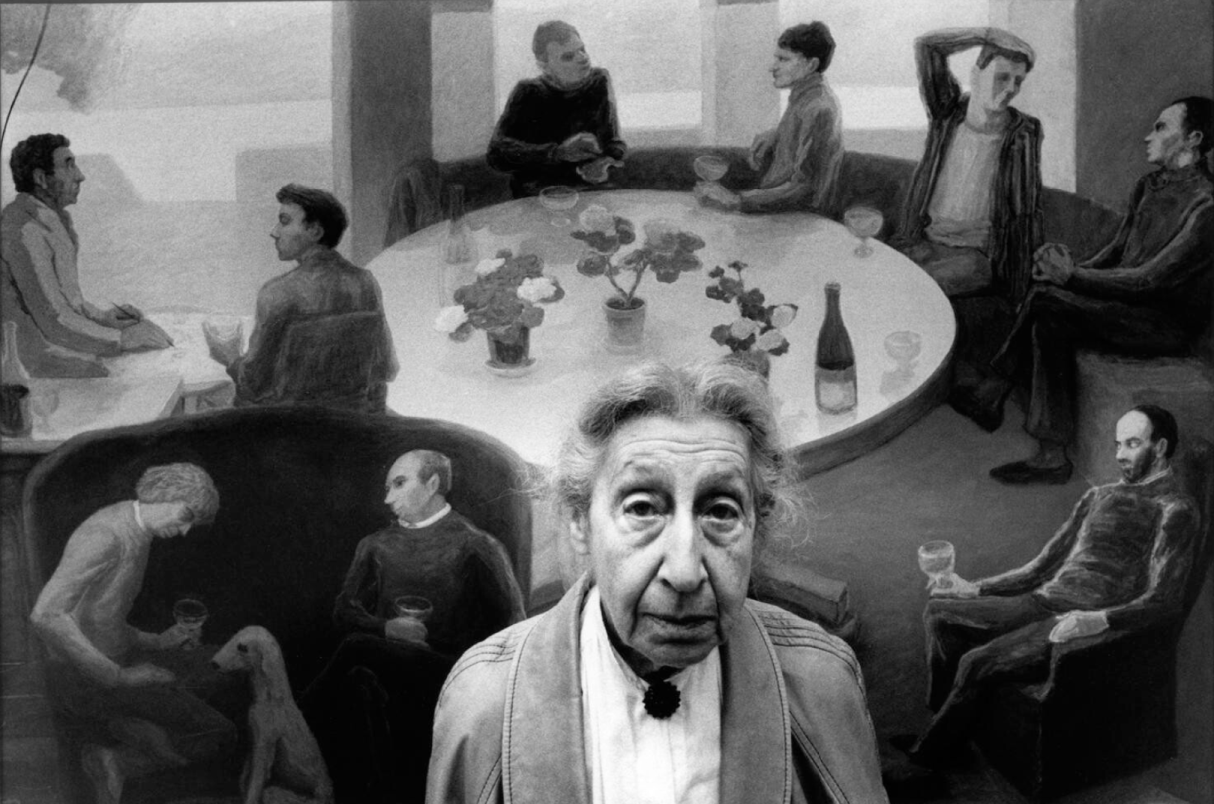
Helen Lessore with artists in her life. Clockwise from top centre: Francis Bacon, Lucien Freud, Michael Andrews, Frank Auerbach, Leon KossofT,
Euan Uglow, Craigie Aitchison, Myles Murphy, Raymond Mason, John Lessore.
THE painter Francis Bacon, always something of a nomad, has bought himself a £6,000 freehold house at Wivenhoe in Essex, I hear, and intends using it as a studio.
Much of his working life has been spent in studios in London and Paris. But he recently sold another property near the Thames in the East End of London.
He is not particularly impressed, it seems, by the aesthetic qualities of his new buy. But he will be near friends.
The area already has a miniature artists’ colony including the painter Denis Wirth-Miller and the writer and illustrator Richard Chopping.
BY FRANK DAVIS
I HAVE tried for a very long time to exorcise
a prejudice against Francis Bacon and all his works, brilliant though they are
The Study for a Pope of the illustration (Fig 1) is to me an impudent burlesque of a Velazquez, damnably cleaver and damnably unpleasant because Velazquez deserves more sympathetic treatment. Whether Bacon hates himself more than he hates the rest of the world will probably never be known. He will, I fear, remain fairly high up in the list of my dislikes, not far below Calvin, John Knox, Philip II of Spain and St Augustine. The painting is well known and was recently sold for £65,000 at Sotheby’s. I do not envy its new owner so can never be numbered among the elect. After writing this unflattering note I have treated myself to a half hour of a Bach concerto which has put me once more on an even keel. I have also brushed my teeth and am once more fit to face the world. All of this is a tribute to the haunting power of Bacon’s macabre imagery. I wish so great a talent could have been put to a more life-enhancing use.

1
“His macabre imagery has a haunting power”
The game without rules
It happened in 1934, at the very latest; so the intellectual teenagers—be they seven- teen or seventy—who, the day before yesterday, conferred advanced status upon games theories, thus rendering them trendy, are naïvely out of date, though not yet outmoded: to be outmoded, to revert back to something preceding a current fashion, you have to be jolly old-fashioned indeed, because fashions themselves are, inevitably, old-fashioned. When they were newly fashioned, they weren’t fashions yet, not yet vulgarised and generalised and de-intellectualised, but individual discoveries (in science) and individual inventions (in art).
The individual achievement in 1934 was George Herbert Mead’s, in Mind, Self and Society: From the Standpoint of a Social Behaviourist: human behaviour was modelled on the game. We’ve never heard the end of it—or rather, we have, over and over again. The end is clearly definable: everything is a game. The logical still escapes the enthusiasts: if everything is a game, the game as a concept, like Jung’s libido, loses any significance worth operating with; its connotation becomes poverty- stricken, just because its denotation is all-consuming. One sometimes feels that a course in conventional logic wouldn’t do fashionable thinkers any harm. Perhaps the teaching of logic should be considered as important for the job of coping with life as the teaching of mathematics
Two of the saddest moments in the history of the epidemic known as game theory
were reached in 1961 and 1975, when two of the most outstanding minds of our age
refused to avail themselves of the intellectual antibiotics available to them
and became joyful and, it seems, lasting victims of the disease. In 1961, Thomas
Szasz, whom I regard as the most independent
In 1975, David Sylvester published his Interviews with Francis Bacon, in which the artist indulged in this piece of implied self-degradation: ’I think that Velázquez believed that he was recording the court at that time and recording certain people at that time; but a really good artist today would be forced to make a game of the same situation. He knows that the recording can be done by film, so that that side of his activity has been taken over by something else, and that all he is involved with is making the sensibility open up through the image ... You see, all art has now become completely a game by which man distracts himself; and you may say it has always been like that, but now it’s entirely a game. And I think that that is the way things have changed, and what is fascinating now is that it’s going to become much more difficult for the artist, because he must really deepen the game to be any good at all’.
The demotion of life itself, and of art within it, is the rationalisation of a chronic depression, the last-ditch defence of a culture that has lost its centre and not found a new one, apart from political and humanitarian and therapeutic pseudo-centres: they are bogus because while they suggest that life is about making people or groups or nations happy, usually by overpowering other people or groups or nations, they don’t tell us what to do about life once the battle has been won, happiness achieved. What, at best, is a means, i.e. well-being, is turned into an end, whereas what used to be an end within a culture with a hard centre of values is turned into a means towards vitality or victory.
In the West, to be sure, we are too sophisticated openly to enunciate any such reversal, but Chairman Mao, gratefully accepting a Western pseudo-centre and reinterpreting it within his own culture, turns the concept of culture itself into a means, the very concept that used to be the never-ending end—increased truth-finding, religious or artistic or scientific: ’An army without culture is a dull-witted army, and a dull-witted army cannot defeat the enemy’.
So, once the enemy has been defeated, what do we do with our culture or, for that matter, without it? Play out the game without reason ? Try to retain culture, once more as a means, as a game by which man distracts himself? Francis Bacon and Chairman Mao would shudder to find themselves bedfellows, but that would be their problem, even though they are ours.
Bacon rightly diagnoses the consequences, or one possible set of consequences, of the loss of religion—all-pervasive scepticism and cynicism. But behind the self-abasement needed for declaring man futile lies supreme intellectual arrogance—an eminently modern psychosis whose discovery I herewith submit to the public, complete with a name attached to it: micromania, distinguishable from megalomania only by the size of what it is about. It has a long past, from Darwin via Freud, the two major shocks to man’s narcissism, but qua insanity, delusional, uncontrollable and certifiable (by me), it erupted only recently, as a result of our culture’s multiple contradictory divisions. Diagnosis is not difficult. The patient invariably reasons as follows: ’Since I don’t know what my life is about, nobody knows what his life is about, whatever they may say. And since nobody knows what his life is about, life is about nothing’. Now, since a game, prototypically, is about nothing, the inevitable, concomitant delusion is that life is a game. The reason why I’m keen on certifying the lot is that if we committed them all to one gigantic mental hospital, they would have a marvellous time there, sharing and complementing their delusions.
Mind you, Francis Bacon, right at the end, gives his secret—his underlying mental health—away, which is no more than one would expect from an artist whom the contemporary world has driven to simulating psychosis: the artist, he says, ’must really deepen the game to be any good at all’. Every reader knows one game or another, has played it. Has he ever deepened it, or seen anybody else deepen it? The concept of a deepened game, whichever way you wish to take the metaphor, is absolutely meaningless: all you do by deepening a game is show that it isn’t a game after all. Where the game theories had led art ad absurdum, you lead it back ad animum—Per aspera ad astra.
About Francis Bacon’s art I cannot speak with authority; about music I do. If, however, I prove to him that meaningful music is not a game, he is bound in honour 10 think and speak again: we once had a long discussion about music, in which it was he who suggested that its laws (on which I had held forth from the standpoint of my theory of music) were relevant to his art; in the course of this conversation, he moreover showed an astonishing degree of instinctive insight into my art.
By the laws of musical thought I don’t mean the rules of the game, nor do I mean that these don’t exist: they’re there all right, in the schoolroom. Any traditional book on harmony or counterpoint will show them to you; any student, whether he wishes to Pass the LRAM exam or actually wants to become a composer, will be asked to follow them, to show evidence that he can play the music. The result, however, though it may get ninety-nine out of a hundred marks, will not be music, but sub-music, pre-music craft as distinct from art, the meeting of requirements rather than the communication of something new, which is the condition sine qua non of art. Thus, the only music that is a game is meaningless music, about nothing—including sentimental music, since sentimentality itself is feeling about nothing, and expresses itself musically by rule-following, by a complete absence of my contradiction of rule-determined, instinctive expectation: musical children instinctively absorb the rules of the musical game at any given historical stage. The laws of musical thought, on the other hand, govern that meaningful contradiction of the game which produces music, creates sounds that say something new, and say it clearly. I suspect that, mutatis mutandis, this is what Francis Bacon, without having thought it out, means by deepening the game. How the laws are thus made to serve the communication of truths which are inexpressible by any other means is not at all difficult to describe. What happens is that the rules of the game (which my theory calls the background) are contradicted by thoughts which are related as closely as Possible to what the rules cause you to expect, but which, at the same time, form the strongest possible contrast with these unfulfilled expectations: the sum total of such contrasts I call the foreground.
A generally comprehensible paradigm is ready to hand—the so-called ’interrupted cadence’, in which the expected tonic chord is replaced by the chord on the sixth degree of the scale, the submediant: A-C-E in C Major. At one stage in the development of composition, this was an individual thought, and the law governing it demanded close relation: two of the three notes of the A minor triad are two of the three notes of the suppressed C major triad. But the law also demanded maximal contrast with the Perfect cadence, which would have followed the rules of the game: the unexpected root (A) of the chord violently changes its face. Individual inventions, once they are imitated, repeated, become part of the rules of the game—move from the foreground into the background, duly to be contradicted by new individual thoughts. The break-up of our general musical language has, of course, resulted in many games where there was one, but the laws of musical thought, of conveying new meaning, remain the same. Admittedly, more people get away nowadays with just playing the— a— game, but they still don’t say anything unless they proceed logically to contradict its rules. It follows that mediocre music is like a good game (rule-following), while good music is like a bad game (consistent rule-breaking). As I write, Malcolm Muggeridge pronounces on television that ’the game of civilisation is up’.
Our moralist-in-chief rightly suspects the civilisation game; for a game it has become ever since it lost its cultural centre. But truth-seeking, whether in or outside art, will never be explicable in terms of game-playing. That the truth seekers and truth-finders, of all people, feel the need to delude themselves into thinking that they are doing no more than playing a game shows that the fundamental value which is truth is in danger itself—that the game, far from being up, is our time’s major threat to the recognition of reality.
How Italian artists make a fortune faking Bacon
by BARRIE PENROSE
SCOTLAND YARD is investigating the British end of an international art racket based in Italy, where fake Francis Bacon paintings are being sold to raise money for left-wing party funds. Art students are producing work in the style of Bacon and other well-known artists and contributing money from their sale to political causes.
Many of the fakers justify themselves by claiming that the forgeries are a blow against the bourgeois art market, where paintings and sculpture are often sold like stocks and shares.
The Italian forged Bacon industry was disclosed during an interview with Francis Bacon filmed for BBC television’s ‘Arena’ programme to be shown next Wednesday evening.
Tony Reichardt, a director of the Marlborough Gallery, which has branches in London, Rome, New York and several other capital cities, is trying to track down fakes of Bacon and other Marlborough artists which have already reached the international market.
Canvases in the idiosyncratic Bacon style from Italy, some with false documents, have already appeared on the London art market. Marlborough Fine Art have collected some examples of the Italian forgeries. ‘We try to get any fakes destroyed, and inform the police and Interpol,’ said Mr Reichard.
Francis Bacon told me last week: ‘Most of these Italian pictures in my style are extremely bad.’ But some fakes have been sufficiently convincing to deceive some dealers. Two fake portraits which are believed by the Marlborough to have come from Italy are variations of a remarkable series of portraits of Isabel Rawsthorne which Bacon painted ten years ago. These paintings (one was bought by the Tate Galley in 1966) are thought by Ronald Alley, Keeper of Modern Art at the Tate, and Bacon’s biographer, to be among his finest.
The first fake Isabel Rawsthorne to be launched on the London art market passed from one dealer’s hands to another, rising the price and acquiring a pedigree of apparent respectability.
One certificate of authenticity, known as its ‘provenance’ in the dealing world, came from Robin Greer, a Chelsea bookseller and a member of the Antiquarian Booksellers’ Association. His letter — headed provenance reads: ‘The oil painting by Francis Bacon which is now in the possession of Mr Laurence Baldwyn was acquired by me in 1966. This was then sold to Mr Baldwyn in 1969, to whom the legal title now belongs.’
Last week Mr Greer told me frankly: ‘Actually this portrait was only in my possession for about a week. Acting on commission, I sold it for a price into the early four figures. I can’t remember exactly how much.
‘The portrait came to me, I think I ought not to mention from whom, on the “gay” network of dealers. Looking back, one might say it was a Francis Bacon in inverted commas, in the the Francis Bacon style.
‘Perhaps in my letter I did commit myself more than I should. But it was a strong Bacon and it did speak so well. In fact, I had it by my desk. And if it’s a fake it’s a remarkably competent one. An Italian is hiding remarkable talent somewhere.
Robin Greer claims he sold the portrait to another London art dealer, Laurence Baldwyn, the man mentioned in the provenance. A second provenance, signed by Mr Baldwyn states: ‘Francis Bacon. Portrait of a Woman. Oil on canvas. To the best of my knowledge and belief, the above mentioned picture is an authentic and original executed circa 1962-1965. I acquired this painting from Mr Robin Greer in 1969.’ The provenance bears the letter-heading, ‘Laurie Baldwyn Art Dealer Nineteenth and Twentieth Century drawings and watercolours.’ (In fact, Bacon did not begin painting this cycle of portraits until 1966.)
Speaking from the London Musical Club in West London, where he has a studio, Mr Baldwyn agreed that he acquired the portrait from Mr Greer, but denied that he bought it in his own right. He said: ‘I tried to sell this work in 1971. In my provenance I did say it was painted circa 1962-1965, although I didn’t buy it for myself. In fact, in the dealing world “acquired” does not mean or imply ownership, as it might do to ordinary people.
‘A client I found who wanted to buy the portrait showed it to Francis Bacon who said it was a fake. And the client mentioned that Bacon fakes were being produced in Italy. I thought if the living authority, the artist himself, challenges a work, he must have the final word. I don’t know who the original owner was or where the portrait is now.’
The Italian forgers sometimes arm their paintings with false documents of authenticity. A portrait which reached the American market, and which was shown by a dealer to the Marlborough Gallery, was accompanied by a certificate with the printed letterheading Gracefield Art Centre, London. It includes the forged signature of John Russell, former art critic of the Sunday Times, who has written extensively about Francis Bacon, and is another biographer of the artist. The certificate reads: I can attest absolute authenticity of the oil painting on canvas “ALASTAIR” work of undisputed artistic value belonging to the cycle of portraits by FRANCIS BACON painted in 1967.
The Gracefield Art Centre does not exist, and John Russell spells his surname with two ls and not one, as in the false document. From his home in New York, Mr Russell told me: ‘How extraordinary! This is the first time I’ve know my name being used in such a way. I’ve never heard of the Gracefield Art Centre in London. My biography of Bacon was published in Europe, which suggests the Italians do their homework on whose name to put on a false document.’
Francis Bacon now spends most of his time at his Paris studio. He claims his work is very unfashionable and disliked by critics, but says his best portraits can sell for more than £100,000.
‘I do take steps to get these false canvases off the market,’ he said. ‘I have even signed the backs of photographs of fakes “This is a fake and not by me”,’ he said. But forgers have then cut out the genuine signature to accompany one of their latest fakes.
‘Nowadays I even cut paintings I have discarded to stop them reaching the art market. Recently a discarded painting I’d left in a coal cellar went for £71,000 at Sotheby’s. Before the sale, Sotheby’s, on my behalf, made it clear that it was discarded, but it still sold. I can’t tell you why people are fools.’
In Italy the police recently caught one art gang specialising in faked works of leading artists including Bacon, Graham Sutherland, Picasso and Henry Moore. After a complaint by American art dealer Roberta Lee Boxer, who had been swindled by a fake Max Ernst which she bought in Milan the police uncovered a well-organised ring dealing in forgeries.
Catching the men who paint the fakes is more difficult. In Italy, as in as in Britain, if an artist signs another painter’s name on a picture and then sells, he has committed fraud. With Bacon, however, who very rarely signs his work, there is no need to add a false signature and the risk of prosecution is reduced.
A fake Bacon was once owned by Marcello Mastroianni, the Italian film actor. It was called ‘Figura,’ and dated 1953. Mastroianni bought it from a reputable Rome gallery, which no longer exists, and in 1974 sold it to another gallery for 60 million lire (336,940). The second gallery intended to put it up for auction in Rome but before doing so asked to have it authenticated. Bacon put crosses in green ink on the photographs sent him and declared it to be a fake. The matter is now before the courts.
Recently a portrait of a man in the style of Bacon which turned up in London was found to bear on the back of the canvas the label of the Italian Gelleria Pogliani, and the purported signature of Sergio Pogliani, a painter who formerly owned the gallery.
I spoke to Pogliani in Turin and mentioned Francis Bacon. Asked about the fake Bacon, ‘Head of a Man,’ and the Galleria Pogliani label on the back, Signor Pogliani replied: ‘There’s a forger in Rome who unfortunately uses my labels, although my gallery closed nine years ago.’
Signor Pogliani, however, told me about artists who can paint Bacons. ‘The centre is in Milan. There are three or four painters who regard Bacon as their master. Sometimes their work is mistaken for genuine Bacon paintings.’ Ironically the Italian fakes which have been exposed have one basic flaw: they are all painted on the front of the canvas. Francis Bacon prefers to paint on the unprimed back.
LONDON
Scotland Yard is investigating an international art racket said to involve fake Francis Bacon paintings produced by left-wing students in Italy and sold to unsuspecting collectors here.
A spokesperson at police headquarters said last night that an allegation that these forgeries were circulating in London was being investigated. In a BBC television interview last night the Irish-born artist, whose paintings fetch as much as £100,000 (K150,000) said the fakes had come to light when they were offered to the Marlborough Gallery, which handles his work here.
Bacon said he had seen some, but added: “They are extremely bad fakes”.
A spokesman for Marlborough Gallery, which also has branches in Rome and other capital cities, said: “Generally I believe there is a link between young left-wing students who wish to makes money for the Communist Party — or their own party — and at the same time to attack the establishment and established artists.”
The spokesman said: “We try as hard as we can to get any fakes destroyed as soon as we hear about them and inform the police and so forth. It is very much against the artists’ interests and our own that fakes are on the market at any time.”
Informed art sources here said Bacon paintings are popular in Italy and on the London, Paris and New York art markets. The sources said that left-wing art students in Italy were producing works in the style of Bacon and other well known artists to raise funds for extreme left-wing groups there.
False documents were printed in Italy and often accompanied the fakes, bought by dishonest art dealers from the students and put on the international market, the sources added.
The art of making money . . .
HENRY MOORE, the great sculptor, is rarely heard to talk about the money side of
art but he goes into it tonight in
Barrie Penrose takes a hard look at how galleries operate. When it comes to new painters they have to make up their own prices and see how it goes.
Moore disapproves of copies being made of his sculptures because, he thinks, they detract from the original.
Painter Francis Bacon tails about the business side. He has lately had the distinction of having pictures forged in his style and sold for high prices to raise money for Left-wing party funds in Italy.
Barrie Penrose investigates a multi-national art empire and the
artists and methods that created it, and talks
Executive Producer: David Cheshire Producer: Mark Kidel Director: Rosemary Bowen-Jones