


























References
Baudrillard, Jean, and Jean Nouvel. The
Singular Objects of Architecture,
University of Minnesota Press, 2002.
Coulter, Gerry. “Overcoming the
Epistemological Break: Francis Bacon
and Jean Baudrillard and the
Intersections of Art and Theory,” Euro
Art Magazine, No. 5, Winter
2007.
Campbell-Johnson, Rachel. “Francis
Bacon at Tate Britain,” The Times
of London, 9.9.2008.
Darwent, Charles. “Francis Bacon,
Tate Britain,” The Independent,
14.9.2008.
Deleuze, Gilles. The Logic of
Sensation (1981), University of
Minnesota Press, 2003
Esplund, Lance. “A Histrionic Horror
Show,” The Wall Street Journal,
5.7.2009.
Halle, Howard. “Francis Bacon: A
Centenary Retrospective,” Time
Out New York, 2009.
Hughes, Robert. “Horrible!,” The
Guardian, 30.8.2008.
Lubbock, Tom. “All hail a vulgar
entertainer: Francis Bacon
retrospective”. The Independent,
10.9.2008.
McAuliffe, John. “Francis Bacon –
Tate Britain,” The Manchester
Review, 21.11.2008.
Molyneux, John. “Francis Bacon at
Tate Britain”. Socialist Review,
2008.
Nochlin, Linda, et al., “Francis
Bacon,” Tate Etc. (Online),
Issue 14, 2008.
Perl, Jed. “Slaughterhouse – Francis
Bacon: A Centenary Retrospective,” The
New Republic, 17.6.2009.
Perl, Jed. “St. Gerhard of the
Sorrows of Painting,” The New
Republic, August 2002 (no longer
available online).
Saltz, Jerry. “Francis Bacon at the
MET”. New York Magazine,
25.4.2009.
Smith, Roberta. “If paintings had
voices Francis Bacon’s would shriek:
Francis Bacon, A Centenary
Retrospective”. The New York
Times, 2008.
Tinterow, Gary. Interview with
Charlie Rose, 2009.
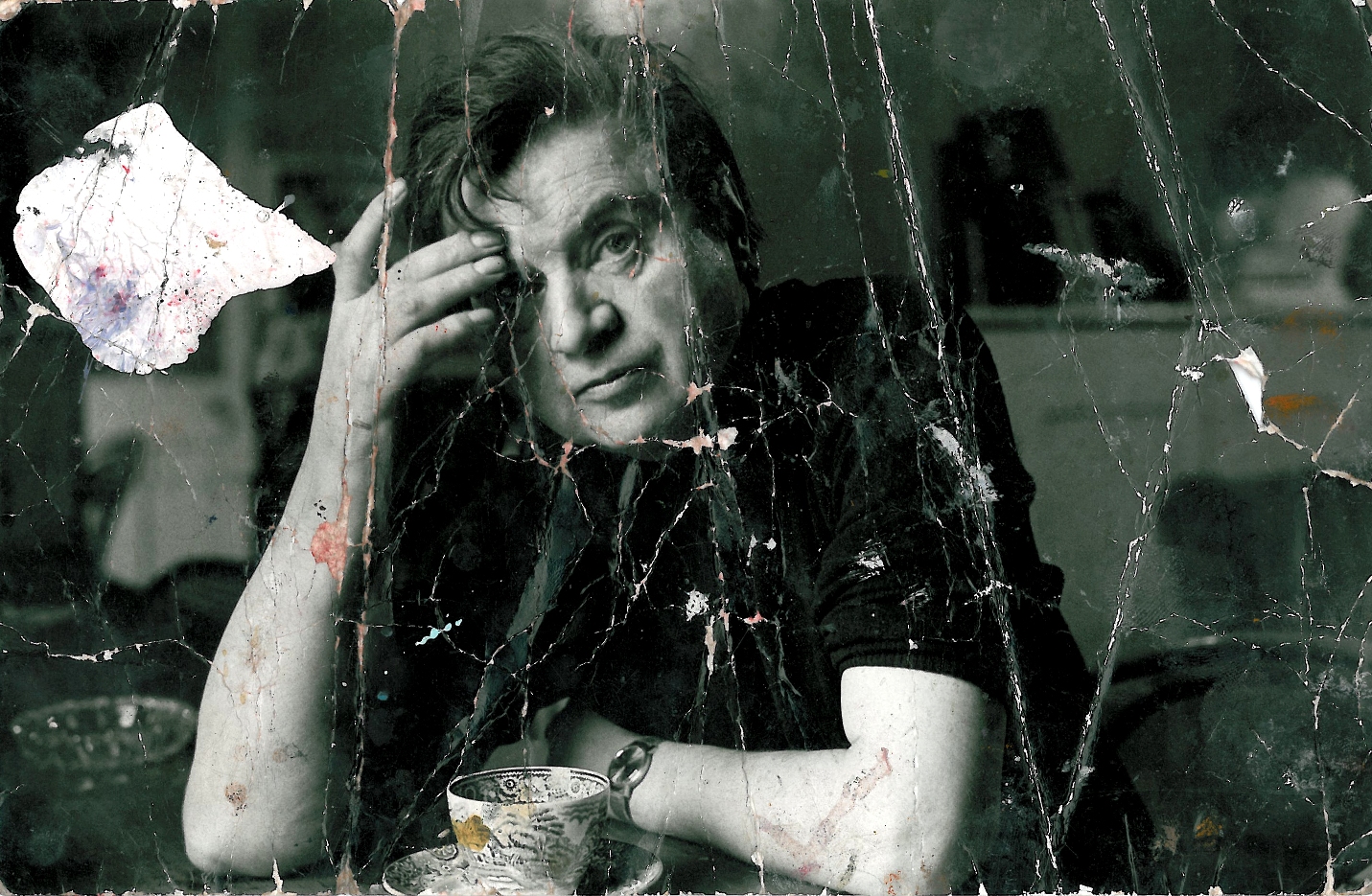
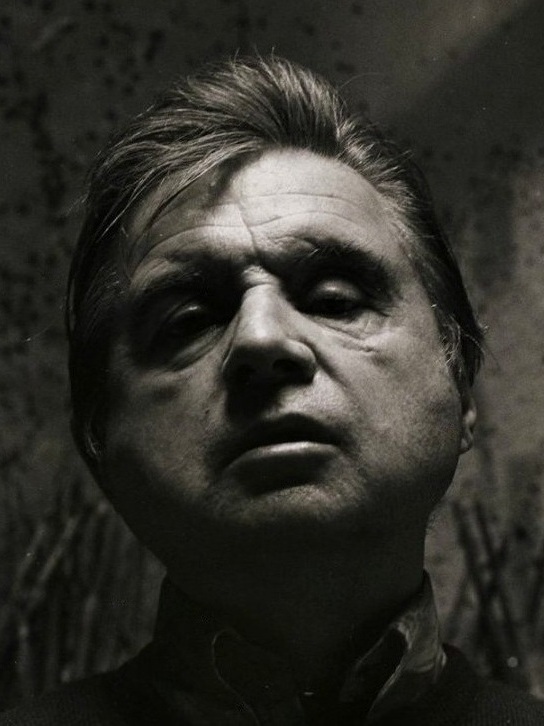
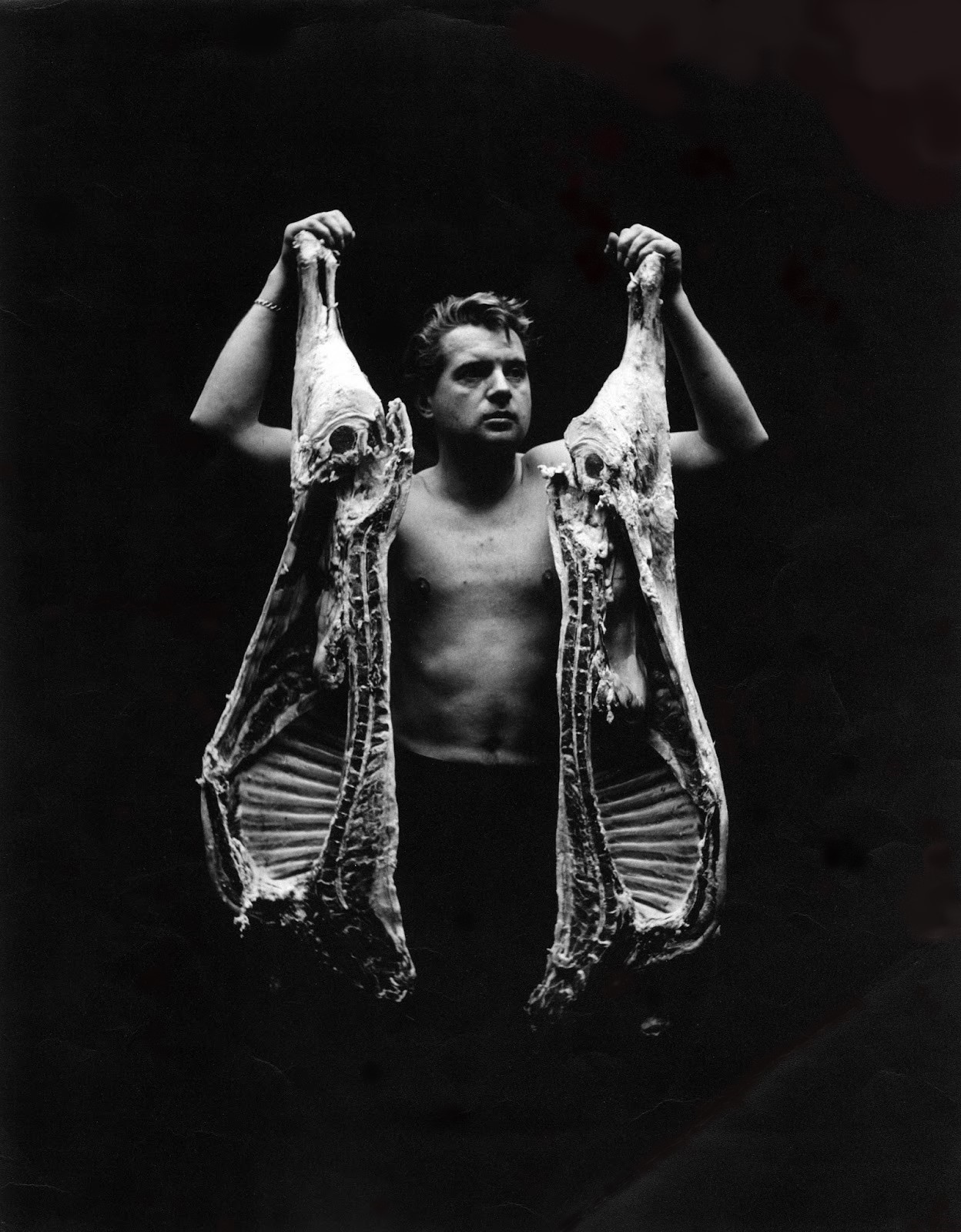
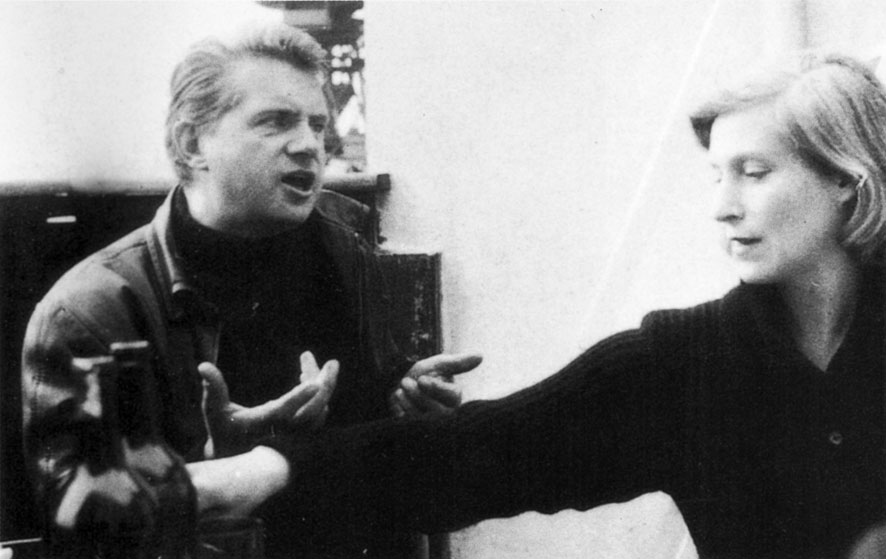
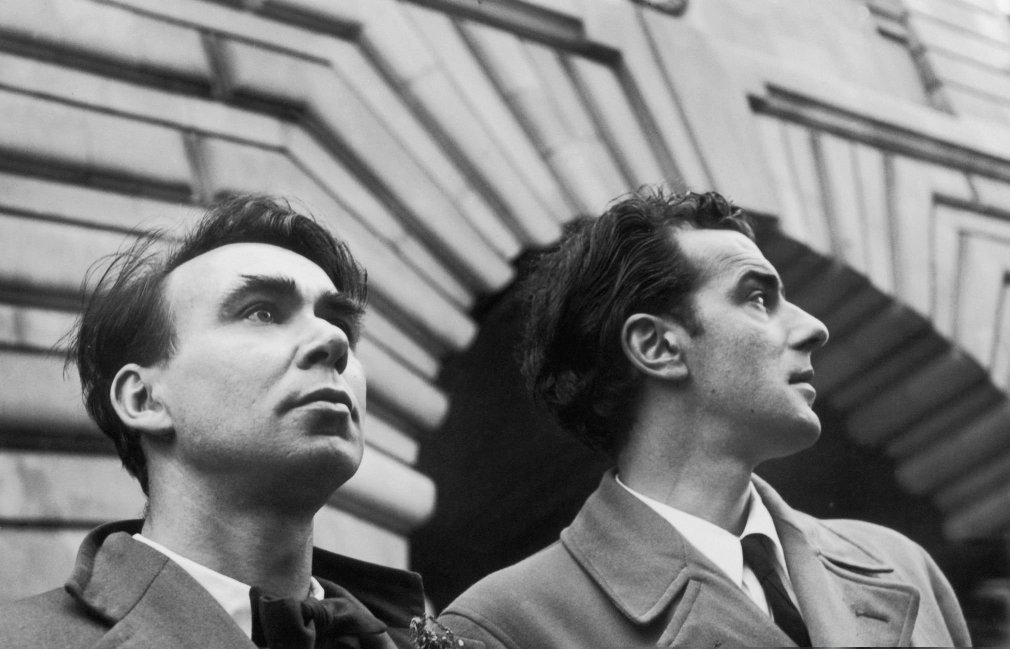
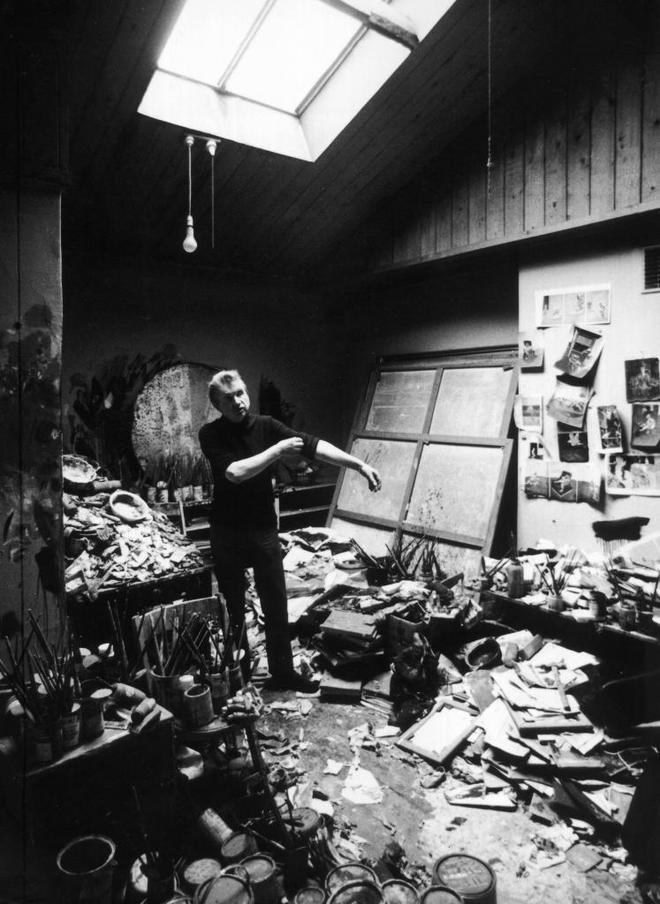
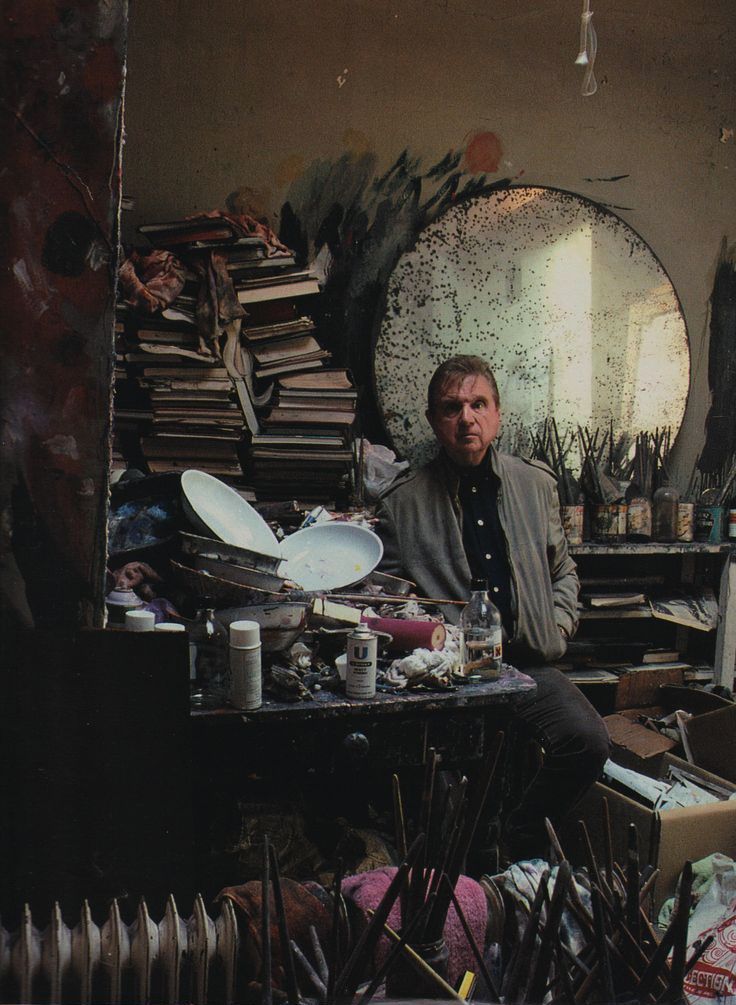
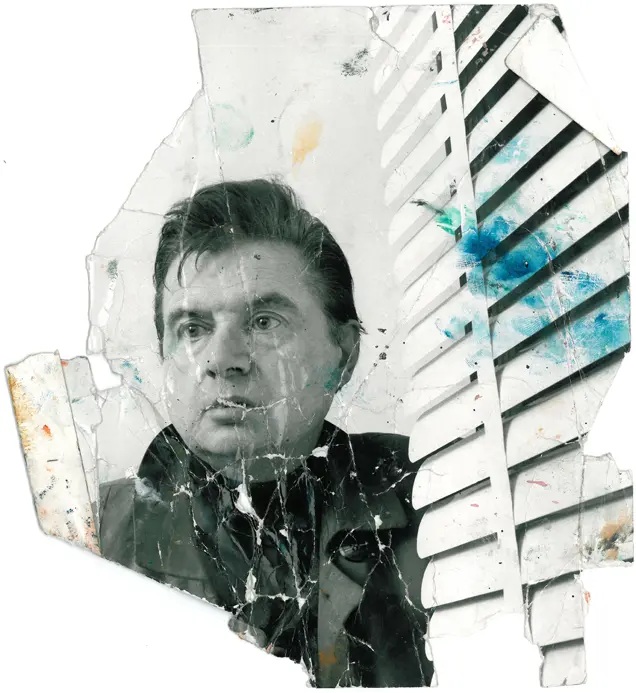
Francis Bacon, photographed by Cartier Bresson
Francis Bacon and the practice of painting
MIKE JARVIS | JOURNAL OF VISUAL ART PRACTICE | VOLUME 8 | NUMBER 3 | SEPTEMBER 2009
What makes painting such a determined survivor and insistent practice in our contemporary world and culture? What causes such a handmade practice to be still relevant? Why does it persist in so many guises, especially given the multiplicity of media available to the contemporary artist. It is, perhaps difficult for us to appreciate the extent to which painting practice was a key focal point of contestation in the nineteenth century. Indeed Clark argues that,
For a while, in the mid-nineteenth century, the state, the public and the critics agreed that art had a political sense and intention. And painting was encouraged, repressed, hated and feared on that assumption. (Clark:1982:249)
In addition to the broader cultural and political importance of painting in the nineteenth century it is also necessary to look carefully at the very means and materials of painting in order to ascertain why it has continued to persist as a vital practice. As painting was perhaps the significant artistic practice of the early nineteenth century, then any attempts to subvert it were viewed with distinct suspicion. In 1840 for example, the painter Paul Delaroche had announced that with the new and revolutionary appearance of the photographic image, ‘from today painting is dead.’ (Crimp:2002:96) Such anxieties were understandable as the new photographic technology and the photographed image with its smooth surface and texture, was perceived as capable of supplanting the similarly smooth, almost featureless brushwork of academic painters like Delaroche and his peers, and could be executed much more quickly.
However, painters like Courbet can be seen to actively challenge such misgivings because of their recognition that a painting could still achieve and aspire to a vision of the world that was not as readily accessible in a photograph. In a way, Courbet’s painting can be viewed as an affirmative statement made about the efficacy of ‘painting’ over and beyond any questions of social and political context. For example, if Courbet’s arrangement of figures in the ‘Burial of Ornans’ of 1849-50 had been photographed (provided that the technical means were sufficiently capable to depict such a large group) then the same arguments about the importance of the social context and its depiction of the different classes as intermingling would still prevail. Wherein lies the continuing significance of painting practice?
The answer to this can be found in a number of key factors, one of which is the utilisation of the material stuff of paint and the other being the persistence of the handmade and bodily origin of painting as opposed to the more mechanical technologies coming into prominence. The specific practice of Francis Bacon and the way he embodied the material of paint into his images can allow us to address the continuing persistence and significance of painting. James Elkins sees the process of painting as one of alchemy and as a transforming of base materials into something transcendent, that although a substance like earth pigments mixed with oils is a lowly and basic material, that it can also ‘be unnatural and divine.’(Elkins:2000:188)
Elkins argues that,
what matters in painting is pushing the mundane towards the instant of transcendence. The effect is sublimation, or distillation: just as water heats up and then suddenly disappears, so paint gathers itself together and then suddenly becomes something else – an apparition hovering in the fictive space beyond the picture plane. (Elkins:2000:188) It is this quality of transformation that gives the practice its alchemical character. How does paint act upon us in this way? A key aspect of the physical and often revelatory power of painting lies in its capacity to bypass and short circuit our normal cognitive perceptual mechanisms, to enact itself directly upon us and our bodies, instantaneously overriding all the ‘clearing house’ mechanisms of intellect and reasoning. As Francis Bacon remarked, the peculiar resonance of a painting lies in the attempt to bring it ‘up onto the nervous system more violently and more poignantly.’ (Sylvester:2002:12)
Even for the most experienced practitioner it is a process fraught with difficulty and a practice constantly eluding one’s control and mastery. Bacon talks repeatedly about the processes of painting and it must seem astonishing to non-painters that so much of what he is describing can be ascribed to accidental discoveries more than systematic analysis. As, he expresses it, You know in my case all painting – and the older I get, the more it becomes so – is accident. So I foresee it in my mind, I foresee it, and yet I hardly ever carry it out as I foresee it. It transforms itself by the actual paint. I use very large brushes, and in the way I work I don’t in fact know very often what the paint will do, and it does many things which are very much better than I could make it do. (Sylvester:2002:16)
It is as if the paint has an independent life and can conjure up all kinds of effects unintended by the painter. As Bacon points out, much of the process is accidental and the artistry then can come down to a question of what one leaves out, destroys or includes. It is little wonder that Stephen Newton contends that, ‘the early, primitive stages of a painting can provoke intolerable feelings of persecutory anxiety and guilt in the painter,’ (Newton:1998:16) or that the over anxious painter, ‘who is unable to tolerate the raw and fragmented nature of the early creative stages, might be too constrained to make even the most rudimentary of marks.’ (Newton:1998:16)
This quality of accident is key to Bacon’s practice and, from the experience of looking at other painters is more important than is normally recognised. This is because it becomes a habitual part of the discerning painter’s armoury. The skill, knowledge comes not so much from knowing how to paint some thing, a head, skull or hill etc. but from one’s discernment in accepting (or rejecting) what one has done with an open mind and little regret, so that something can genuinely surprise you. This tacit mastery comes from an instinctual perception of how to utilise and somehow ‘cash in’ upon something found, perhaps some unruly aspect or behaviour of the pigment, which is accidentally revealed during the process.
As Susan Rothenberg admits, I’m not a clear thinker, but I find things out by stumbling upon them.’ (Whitfield: 2003:3) Similarly, Bacon discussed his early Painting of 1946, that ‘I had no intention to do this picture; I never thought of it in that way. It was like one continuous accident mounting on top of another.’ (Sylvester: 2002:11) He talks about the difficulties of painting because ‘it is really a complete accident…. Because I don’t know how the form can be made.’ (Sylvester: 2002:12)
In a significant passage he describes painting a head in which
the sockets of the eyes, the nose, the mouth were, when you analysed them, just forms which had nothing to do with eyes, nose or mouth; but the paint moving from one contour into another made a likeness of this person I was trying to paint. (Sylvester:2002:12)
It is as if the visual impression of someone or some thing can only be realised or brought into being, by means of configurations of paint moving from one contour to another. Bacon then talks about his feelings in front of the painting, I thought for a moment I’d got something much nearer to what I want. Then the next day I tried to take it further and tried to make it more poignant, more near and I lost the image completely. (Sylvester:2002 :12)
In his attempt to bring the image into being (Bacon’s frequent use of the word ‘poignant’ registers a more emotional engagement with his subject than the blandness of ‘real’) the image was lost. Bacon describes the process as being like ‘a tightrope walk between what is called figurative painting and abstraction.’ (Sylvester:2002:12) The process of trying to depict something in paint which acts as an equivalent or something closely resemblant to what is seen, touched or felt, is an experience commonly felt by most painters.
When Bacon talks about ‘abstraction’ he is, I would argue, referring to the general abstractness and indifferent structure of the brushstroke and collection of brushstrokes which create the factural presence of the painting and which, as an ensemble goes to constituting the required subject matter. What is significant for Bacon is the ‘attempt to bring the figurative thing up onto the nervous system more violently and more poignantly.’ (Sylvester: 2002:12) When he talks about the ‘figurative thing’ he is referring to the pre-existing subject of head, body or object being rendered by the ‘abstract’ materials of paint and its inherent factural qualities of thickness so closely to that pre-existing ‘image,’ that it resonates with a jolt of recognition which reverberates throughout the whole bodily system.
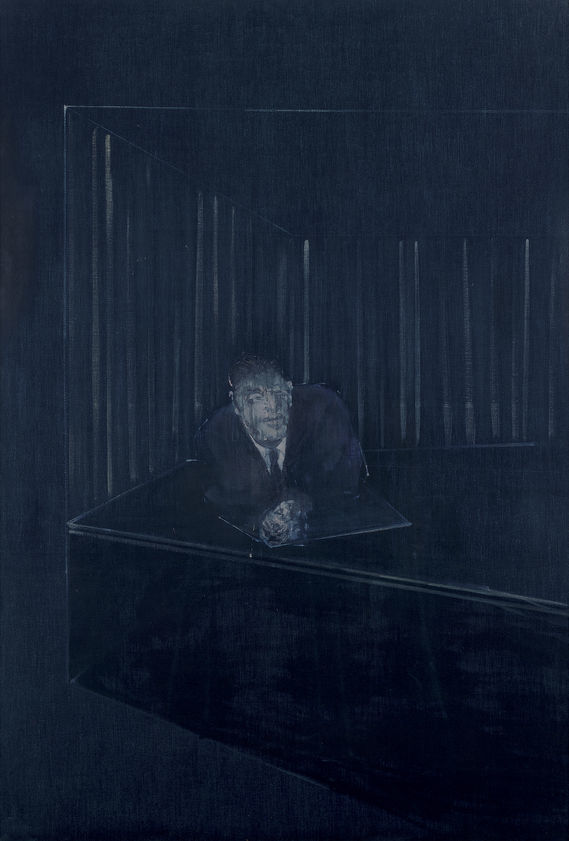
In Bacon’s Seated Woman (Portrait of Muriel Belcher) (Fig 1) of 1961 the composition is closely related to a sketch of a seated woman with the right hand side of the body almost in profile, with the head turned to her left and attached to a longer left leg and foot which twists and turns towards the other leg. (Fig 2) In the painting, however, there are two conjoined profiles constituting the head. The basic composition is similar with the shapes of body and legs roughly the same. The woman is seated upon a long sofa with three cushions projecting obliquely. Her feet ‘rest’ on the surface of a green floor. The body of the woman seemingly ‘crouches’ before us. The shapes of left leg and thin right arm echo one another and contribute to the overall awkwardness of the pose. There is space around the figure. Behind the furniture is a flat background lilac colour. The oblique angles of cushions and horizontal lines of the sofa are unruly accents undermining the stability of the figure and accentuating the feeling of incipient movement, emotion and energy.
A close up of the head and body sections reveal a key aspect of Bacon’s technique. There are rich and complex textures across the painting. The arms and legs contain mechanical imprints of a cloth or perhaps, scrubbing brush which has been covered in paint and ‘printed’ onto the surface. The head contains marks tracing the course of a loaded and large paintbrush being dragged across the surface in quick, rapid movements. This dragging of, in places, ‘dry’ paint across different passages of under painting accentuates the rapidity of a movement of a head or body arrested in its own corporeal movement.
It is the transformative power of paint in the construction of such typical images that continues to make painting so valuable and resonant. Bacon describes the difficulty of this because as any painter knows, it is sometimes problematic to reason out why some passages of painting ‘work’ or are more effective than other passages. Often it is a matter of instinctive feeling rather than a process of logical reasoning. Bacon talks about this being the difference between what he terms as ‘paint which conveys directly (ie onto the nervous system) and paint which conveys through illustration (ie which is prosaic, dull and meaning-less),’ (Sylvester:2002:18) and that
it is something to do with instinct. It’s a very, very close and difficult thing to know why some paint comes across directly onto the nervous system and other paint tells you the story in a long diatribe through the brain. (Sylvester:2002:18)
Here, the acknowledgement of the importance of ‘feel’ for paint and of the instinctive knowledge which derives from familiarity with the material, is seen to take precedent over and above any kind of logical reasoning thought process. The sensory responses for the painter and for the viewer must be activated immediately or else it will not be effective. If one has to rationalise the process or to somehow explain the procedure or ‘story’ to oneself, then the painting has basically failed.
Martin Hammer states that this
impulse towards technical experiment, in the pursuit of conveying feeling without the mediation of the intellect, continued to be a pressing concern. (Hammer:2006:17)
An example of such an impulse is the literal ‘throwing’ of paint onto the canvas that is described by Bacon as almost a last resort when an image resists more conventional means. (Sylvester:2002:160) Now clearly, Bacon’s particular impulse will not be necessarily shared by every painter, especially in a postmodern context when the medium of paint is part of a whole repertoire of effects and techniques available to any artist. However, I would contend that Bacon’s idea about conveying emotion through the material of paint is fundamental to how painting as a practice continues to be of crucial importance and is a philosophy shared by a whole lineage of painters going back to Giotto and beyond, even to icon painters. For example, Stephen Newton refers to the analogy made by Didi-Huberman between the painted panels of the early Renaissance and abstract expressionism, that,
in effect the altar is a portable work of abstract expressionism for personal spiritual usage. To the early religious painter, the abstract, wildly painted panel, which might be juxtaposed alongside, or incorporated within figurative narratives and iconography, embodied the psychic experiences which were then symbolised in the figurative parables of the Passion. (Newton:1998:20)
There is a belief here that to be successful, painting must touch the nerve of the body, must engage with the body and that this can only be manifested through the material itself. The notion of embodiment itself would suggest that the material becomes the body itself, in a process akin to transubstantiation. In order for this to occur in practice there needs to be a conjunction of technical awareness and imagination with the feelings towards things and objects of the world which are not only ‘seen’ but ‘felt’ bodily, and so strongly that it can bypass the intellectual, rational side of thinking altogether. In an interesting criticism of some paintings by Balthus, Bacon laments what he sees as a failure of this conjunction between a technical awareness and the feeling world of the painter.
they are no good. He is trying to get the tenderness which we would all love to get for a change, but it can’t be done that way, it can only come as a technical thing and not as illustration or at least I feel that. I feel more and more that nothing matters or will happen until someone makes a new technical synthesis that can carry over from the sensation to our nervous system. (Hammer:2006:17)
A good comparison can be made here with Merleau-Ponty’s analysis of Cezanne’s working procedures when he demonstrates how an interpretation should not be distinct from the act of seeing, but rather how the actual technical means should create the act of seeing. He quotes Cezanne’s as saying about a portrait,
If I paint all the little blues and all the little browns, I capture and convey his glance. Who gives a damn if they have any idea how one can sadden a mouth or make a cheek smile by wedding a shaded green to a red. (Merleau-Ponty:1993:66)
Merleau-Ponty argues that Cezanne is making a point not only about how one perceives something in the world but how, in painting that act of seeing is bound up with the technical mechanisms for seeing and recording it, that One’s personality is seen and grasped in one’s glance, which is, however, no more than a combination of colours….Cezanne returns to just that primordial experience from which these notions are derived and in which they are inseparable. (Merleau-Ponty:1993:66
Bacon’s quest for painting might appear to be an existential one, a lament and nostalgia for the passing of time with the realisation that, for the painter, the possibility of cheating time and death with the material certainties of pigment is, at least temporarily, a possibility. Bacon’s thoughts about painting continue to have relevance as he is referring to the way we humanly perceive the world. His painting might, like Cezanne’s be defined as ‘phenomenological’ in that it goes beyond a superficial description of appearance, to a description of the way the things and objects of the world are ‘originally given.’ (Wentworth:2004:xiii) Robert Sokolowski defines phenomenology as an all embracing process, ‘which recognizes the reality and truth of phenomena, the things that appear.’ (Sokolowski:2000:14) He contrasts this with the traditional Cartesian approach whereby things and objects of the world are perceived only with the mind.
It is not the case, as the Cartesian tradition would have us believe, that ‘being a picture’ or being a perceived object’ or being a symbol’ is only in the mind. (Sokolowski:2000:14)
He argues that their ‘being’ encompasses more than the intellect and must embrace that of bodily perception and orientation as well
They are ways in which things can be. The way things appear is part of the being of things; things appear as they are, and they are as they appear. Things do not just exist; they also manifest themselves as what they are. (Sokolowski:2000:14)
Through such a perceptual schema, ‘when we make judgements we articulate the presentation of parts of the world; we do not just arrange ideas or concepts in our mind.’ (Sokolowski:2000:14) Brendan Prendeville notes that ‘Phenomenology has special relevance for visual art, which more expressly than the other arts addresses us in corporeal terms.’ (Prendeville:2004:41) Painting is an activity that articulates itself from within the body, an act whose physical manifestation of the ‘painting’ is a visualisation of a fundamentally bodily and ‘felt’ apprehension of the world. Merleau-Ponty talks about how ‘we cannot imagine how a mind could paint’ (Merleau-Ponty:1993:123) and that,
it is by lending his body to the world that the artist changes the world into paintings. To understand these transubstantiations we must go back to the working, actual body – not the body as a chunk of space or a bundle of functions but that body which is an intertwining of vision and movement. (Merleau-Ponty:1993:123-4)
Frederique Desbuissons underlines the connections that can be made between the bodily experience of the artists and the visual products of his labour. He argues that, in speaking about the ‘figure’ of the artist, such a discourse must encompass a wider frame of references than that of the reception and visual analysis of particular works. He states that, ‘if the artist personifies the art which he produces his body becomes the most eloquent allegory of this.’ (Desbuissons:2008:258) Although Desbuissons is focussing upon the ways in which contemporary criticism associated Courbet’s art and its production ( for example, his use of the palette knife as a predominant tool for painting) with the actual uncouth persona and personal habits of the man, the overriding connection between a painter’s everyday practice and his or her holistic bodily engagement with the materials of that practice, is of significance.
Wentworth, for example sees that our ‘perceptual experience is primordially of ourselves as a body situated in the world, one that extends all around us, and through which we move.’ (Wentworth:2004:xiv) It is as if our capacity for reasoning and organizing our perceptions comes after this initial ‘primordial’ perceptive experience of the world. Therefore, with phenomenology the key lies in
the nature of our experience as it is originally given prior to reflection – what can be called pre-reflective experience, (and) is thus quite different from the nature of our experience once we start to reflect upon it. (Wentworth:2004:xiv
It is this quality of pre-reflective experience which, I believe Bacon continually struggled to achieve in his painting. For him, once the mind too literally took over the process (as he felt with Balthus) and began to tell a story, then this sense of original perception was lost and with it the potential of the paint to ‘embody’ the authentic perception.
Merleau-Ponty’s description of a body being ‘leant’ to the world tends to indicate that the painter’s activity is somehow involuntary and not willed, but rather an act whereby one’s apprehension of the world is somehow heightened by the act of painting, that it is an act of sensitive appreciation rather than a self conscious willing of something into existence.
It is interesting that Cezanne wass so much the focus of Merleau-Ponty’s writing about art because, ironically, his was a deliberately logical and determined quest to render the things of the world according to how these objects were apprehended. Basically there was nothing ‘involuntary’ about his practice but contrarily it was a painting practice demanding an extreme discipline and self will to be articulated. Similarly, Bacon’s practice demanded a discipline about what could and could not be accepted during the painting process, and maintained a tenuous balance between success and failure. He mentions modestly that in his perception of how the ‘accident’ can be used, ‘one becomes more alive to what the accident has proposed for one.’ (Sylvester:2002:53) That is, his experience of painting allowed him a greater sensitivity to how critical moments and passages can be exploited and he was attempting in painting, ‘to set a trap with which one would be able to catch the fact at its most living point.’ (Sylvester:2002:54)
A discussion about how paint operates and behaves is extremely important in locating reasons for its continuing relevance, and for that reason, Bacon’s analyses, during his interviews with David Sylvester remain pertinent. Although Bacon eschews abstraction and is at pains to discuss his figurative intentions he is, at the same time acutely aware of the visceral effect which a material like paint can potentially arouse, and how it can become a potent vehicle for expressing emotion. Through his own appreciation of how emotive the material of paint can be ‘in itself’, Sylvester maintains that,
the thing that’s difficult to understand is how it is that marks of the brush and the movement of paint on canvas can speak so directly to us (Sylvester:2002:58)
Bacon rejects abstraction on the grounds that ‘it always remains on one level,’ (Sylvester:2002:59) and that it ‘is an entirely aesthetic thing’ (Sylvester:2002:58) which does not emanate from a scrutiny of the lived, corporeal world. Bacon’s view of painting is that it should have a duality and that the aesthetic qualities of paint and facture should serve an end of expressing something felt and seen, of what is perceived as the ‘facts’ of the world and its objects. When he says that, ‘I think that the mystery of fact is conveyed by an image being made out of non-rational marks,’ (Sylvester:2002:58) he is coming near to explaining this odd duality which resides in the irony that one’s success in achieving a more ‘real’ or visceral image, one which impacts directly upon one’s nervous system, might be dependent upon the psychological impact of the way in which the material of paint is placed and transformed upon the surface of the painting, and that what is most ‘real’ can be activated by a material substance that is, in itself wholly without meaning.
In discussing technical issues so much, Bacon might be seen to be focussing his attention very much on the artist as ‘author’ because it is the painter’s sensibility which is continually ‘on a tight rope’ and, in his case, always on the watch for the ‘trap’ which he describes.
However, if painting is able to be derived from one’s primordial and pre-reflective responses to the world then it is reasonable to assume that the viewer’s responses can be engaged as well, and that the painting can somehow become part of the viewer’s whole lived and embodied response to the world in turn. This idea is developed further by Parveen Adams when she opens out the discourse between the painting as made object and the painting as received by the viewer. In her psychoanalytical reading she starts from ‘Lacan’s insistence on the fact that perception is not just an issue of vision but an issue of desire.’ (Adams:1993:53) The bringing forth of a painting into the world must necessarily elicit a reciprocal process of vision for the potential viewer and,
the question of perception must take up the problem of what I want to see, and the way in which it structures the gaze which captures me. Instead of thinking of perception as just a visual field, it must be thought of as the field that is structured by the relations and forces of objects and desires. (Adams:1993:53)
Barbara Bolt also opens out the discussion about the larger field of perception. She argues that what Bacon describes as ‘fact, or rather, ‘matters of fact’, emerges out of the thickness or fuzziness of the practice.’ (Bolt:2004:144) She maintains that, ‘the work of art exceeds its own structures in a radical performativity,’ (Bolt:2004:190) and that ‘in the heat of practice, the body has the potential to become language and the work may take on a life of its own.’ (Bolt:2004:190) She locates the potential reciprocity of such a process, between artist and object, artwork and viewer, artist and viewer and so on, to the ways in which the artwork can create its own signifying field. ‘Through process, the outside world enters the work and the work casts its effects back into the world.’ (Bolt:2004:190)
It is the painting that constitutes this ‘field’ of relationships.
So what relevance has Bacon’s comments for painting now? I would argue that, with the ending of abstraction as the primary Modernist idiom for painting in the nineteen-sixties, that the potential for all kinds of painting were released and enhanced. Bacon’s comments about abstraction and figuration and the ‘accident’, if only at the level of helping to detach painting techniques from their Modernist connotations, can be seen as instrumental in enabling contemporary painters (like Fiona Rae for example) to joyously embrace the myriad technical possibilities that painting can now legitimately offer.
As I have indicated above, a number of writers have drawn attention to Bacon’s ideas about painting as the locus of different claims that can be made about the practice. Gilles Deleuze makes perhaps the most complex analysis where he discusses different aspects of Bacon’s art, themes of athleticism, body, meat and spirit, painting and sensation, and the diagram, among others. (Deleuze:2004) A recurrent motif and one which makes a discussion of Bacon so relevant to our contemporary world, is the problem for the painter of how to handle the plethora of images already in the world, especially the ubiquity of the photography, both in terms of its own history and stock of images, and the way in which the photograph as an entity both mediates our perception of the world but also our perceptions about art. As Deleuze puts it,
not only has there been a multiplication of images of every kind, around us and in our heads, but even the reactions against clichés are creating clichés. Even abstract painting has not been the last to produce its own clichés. (Deleuze:2004:89)
The recent history of painting can bear this last point out as we have seen a succession of painters like Richter and Tuymans, Peyton, Carnegie and Raedecker using photographs as source material for their work and virtually presenting the ‘photograph as painting’ as a philosophical proposition, while many others, like Jason Martin, Bernard Frize and Ian Davenport utilise the traditional tropes and gestures of modernist abstract painting as a starting point for their own compositions without the need to insert any mark or ostensible features of individual authorship which would make their work engage ‘in’ painting as opposed to ‘with’ painting as a practice.
One can detect in Bacon’s attitude towards photography something of the same feeling he has towards abstraction, that fundamentally, although photographs have an aspiration towards the aesthetic, they cannot compete with painting
because he thinks the photograph tends to reduce sensation to a single level, and is unable to include within the sensation the difference between constitutive levels. (Deleuze:2004:91)
It is as if the viability of painting must lay elsewhere, and that, in the avoidance of cliché and of falling into the trap of mere ‘illustration’ the painter must go beyond, or at least supercede the total reliance on another image.
Bacon’s comments are critical in that they refer to the practice of painting as a continuing discourse. In discussing the primacy of the painter’s awareness of his or her technical means and how the very ‘accidents’ as well as ‘deliberateness’ can be exploited, he focusses upon how this technical awareness and sensitivity can be brought to bear in the expression of something which is almost intangible and eludes their mere description in words. In his case it is something to do with emotion and feeling, an awareness that the material of paint can express the deepest feelings which makes painting potentially such an important practice and tradition.
A close scrutiny of painting practice reaching back to the pre-Renaissance and the subsequent Western tradition of painters like Titian, Rembrandt, Goya, Courbet, Manet, Guston and Baselitz reveals a connected lineage of fascination with and utilisation of the material substance of paint. With all of these painters the viewer must come to terms with the signature qualities and array of markings and factural characteristic which animate the surface of different paintings and which ultimately allows the subject matter to be expressed. In looking at these painters of this long Modernist tradition we scrutinise carefully how the materials of paint, brushstroke, and rendered surface correspond or co-operate with the specific subject being depicted, be it figure, object, landscape or abstraction. It is perhaps the extent of the correspondence, or the duality mentioned above, between content and material, that enables us to judge whether a painting is finally a success or failure.
In a postmodern climate, however it could be argued that painters are freer to explore to the limit the entire formal (and informal) repertoires of painting, to make painting about painting, to juxtapose various stylistic characteristics altogether or to use painting to describe their own confessional and frankly autobiographical positions in the world. It is not even necessary for there to be a conjunction between content and material as was the case before. As such, we can see that Bacon’s two essential areas of exposition, the technical and the emotional, affective aspects of painting are both available for painters to develop and exploit to their limits. What is perhaps at stake however, is the extent to which painters feel compelled to express their ideas and emotions in paint or whether, in fact, paint is the only vehicle through which, and by which, such emotion can be supplied.
Works cited
Adams, Parveen. (1993) ‘ The Violence of Paint’, in Journal of Philosophy and the Visual Arts: The Body, Special issue, pp53-59
Bolt, Barbara. (2004) ‘Shedding Light for the Matter’, in Art beyond Representation – The Performative Power of the Image London and New York: I.B. Tauris and Co. Ltd.
Clark, Timothy J. (1982) ‘On the Social History of Art,’ in (eds) Frascina, Francis and Harrison, Charles Modern Art and Modernism: A critical Anthology London: Open University and Paul Chapman publishing Ltd. pp249-258
Crimp, Douglas. (2002) ‘The End of Painting,’ in (ed) Colpitt, Frances Abstract Art in the Late Twentieth Century Cambridge: Cambridge University press, pp89-104
Deleuze, Gilles.(2004) Francis Bacon: The Logic of Sensation, London and New York: Continuum Desbuissons, Frederique. (2008) ‘Courbet’s Materialism’, in Oxford Art Journal Volume 31 No 2, pp251-260
Elkins, James. (2000) What Painting Is New York and London: Routledge Hammer,Martin. (2006) ‘Clearing Away the Screens’, catalogue essay, Francis Bacon Portraits and Heads (National Galleries of Scotland, in association with the British Council,) pp15-27
Merleau-Ponty, Maurice. (1993) ‘Cezanne’s Doubt’, in eds. Galen A Johnson, and Michael Smith, The Merleau-Ponty Aesthetics reader: Philosophy and Painting, (Evanston, Illinois: Northwestern University Press) pp59-75
Merleau-Ponty, Maurice. (1993) ‘Eye and Mind’, in eds. Galen A Johnson, and Michael Smith, The Merleau-Ponty Aesthetics reader: Philosophy and Painting, (Evanston, Illinois: Northwestern University Press) pp121-149
Newton, Stephen J.(1998) ‘Guilt in Painting’, in Art Criticism, Volume 13 No. 2 pp16-24
Prendeville, Brendan. (2004) ‘Varying the Self: Bacon’s Versions of van Gogh’, in Oxford Art Journal Volume 27 No 1, pp25-42
Sokolowski, Robert.(2000) ‘What is Intentionality and Why is it Important’ in Introduction to Phenomenology, (Cambridge University Press: Cambridge,) pp8-16
Sylvester, David. (2002) Interviews with Francis Bacon London: Thames and Hudson Ltd
Wentworth, Nigel. (2004) The Phenomenology of Painting Cambridge: Cambridge University Press.
Whitfield, Sarah. (2003) ‘The Roaming Eye’ in Susan Rothenberg exhibition catalogue London: Waddington Galleries, pp 3-9
Gaping Mouths and Bulging Bodies:
Beckett and Francis Bacon
PETER FIFIELD |
JOURNAL OF BECKETT STUDIES
| VOLUME 8, NUMBER 1-2 |
SEPTEMBER 2009
Embodiment and abstraction are a potentially problematic mix. Beckett’s statement that ‘Perhaps like the composer Schoenberg or the painter Kandinsky, I have developed an abstract language’ (Gruen, 210), sits uncomfortably with, say, the important contrast in the builds of Vladimir and Estragon or the audible mass of Mrs Rooney’s 200lbs of fat. With Beckett’s taste for abstraction and embodiment in mind we might consider an oeuvre of contemporary painting that acts as a guide with which to consider Beckett’s rendition of the body, particularly as it is performed in the television version of Not I, first broadcast by the BBC in 1977. Rather than consulting Kandinsky, however, we would do much better to examine the resolutely fleshly example of Francis Bacon, the proximity of whose papal images after Velàzquez’s Pope Innocent X to Beckett’s Hamm are briefly noted in the Faber/Grove Companion to Samuel Beckett (Ackerley and Gontarski, 36). When asked if he ever considered painting abstract pictures, Bacon admitted only of an interest in those Picassos, which, he says, use an ‘organic form that relates to the human image but is a complete distortion of it’ (Sylvester, 8). On the more conventional model of abstraction, when asked his opinion of the Rothko paintings in the Tate, he said, ‘I think they’re the dullest paintings in the world’ and complained that the American had not used brighter colours (South Bank Show, 1985). As such, it is in the OED’s sense of abstraction as ‘drawn, derived, extracted,’ or ‘distilled to its essence’ that we might call Bacon an abstract painter. He confirms this when he tells Melvyn Bragg that he seeks to make ‘not [an] illustration of reality but to create images which are a concentration of reality and a shorthand of sensation’ (South Bank Show, 1985). The methods of that concentration, which include contortion, mutilation and containment, bring the corporeality of Bacon’s distorted bodies to the forefront of his paintings. On show, then, is an abstraction based not on an abandonment of the subject but on an adherence to a central property of its being – that of its embodiment. If we are to take seriously Beckett’s claims for the abstract we must also give account of his irrepressible attachment to the human form. The space occupied by Bacon’s work stands to bequeath to us not an archaeology of imagery, but a painterly model that speaks eloquently to Beckett’s sarcoid figures.
It is a notably organic plasticity that fleshes out the figures of Beckett’s writing and Bacon’s painting. Rather than use the sort of geometric fragmentation of analytical cubism, which can only depict the sinuous curve of, say, a violin’s sound-hole by not dissecting it – by forsaking its very method – in Bacon and Beckett the human form is given through emphasis and exaggeration of the curved, the swollen and the bulbous. It is this attention to the arc that gives to the subject its fleshy roundedness; related to the masculine voluptuousness that Bacon so admired in Michelangelo’s drawings (Peppiatt, 225). We might recall the narrator of The Unnamable who, despite being unsure of the precise nature of his embodiment, stresses its tendency towards a featureless sphere. At one point he proclaims of his head, ‘no, no beard, no hair either, it is a great smooth ball I carry on my shoulders, featureless, but for the eyes, of which only the sockets remain’ (Beckett, 1994, 307). Later, in a sort of attendance register of physiological truancy the narrator says, ‘I don’t feel a mouth on me, nor a head, do I feel an ear, frankly now, do I feel an ear, well frankly now I don’t, so much the worse, I don’t feel an ear either, this is awful’ (Beckett, 1994, 386). Removing all that seems excessive or merely incidental in physicality, it is the spherical form that cannot be discarded. So, while embodiment is compulsively placed in doubt, if it does prove to be the case, its apparent form will be curved. Clearly, it is not the case that all the subjects painted or written by Bacon and Beckett are on the tubby side, or indeed are large cranial spheres; rather there is something about embodiment – any embodiment – that seems to elicit from both artist and author an account of voluminous roundedness, rather than flat, if precise, line. This is surely related to the fact that embodiment is what makes three-dimensionality into an experiential condition, that brings sense and sensation to the idea of spatiality. It is our bulging into 3-D – even of the slimmest figures – that is evoked with Bacon’s scoops and smears of paint and the unnamable’s gravitation towards roundness.
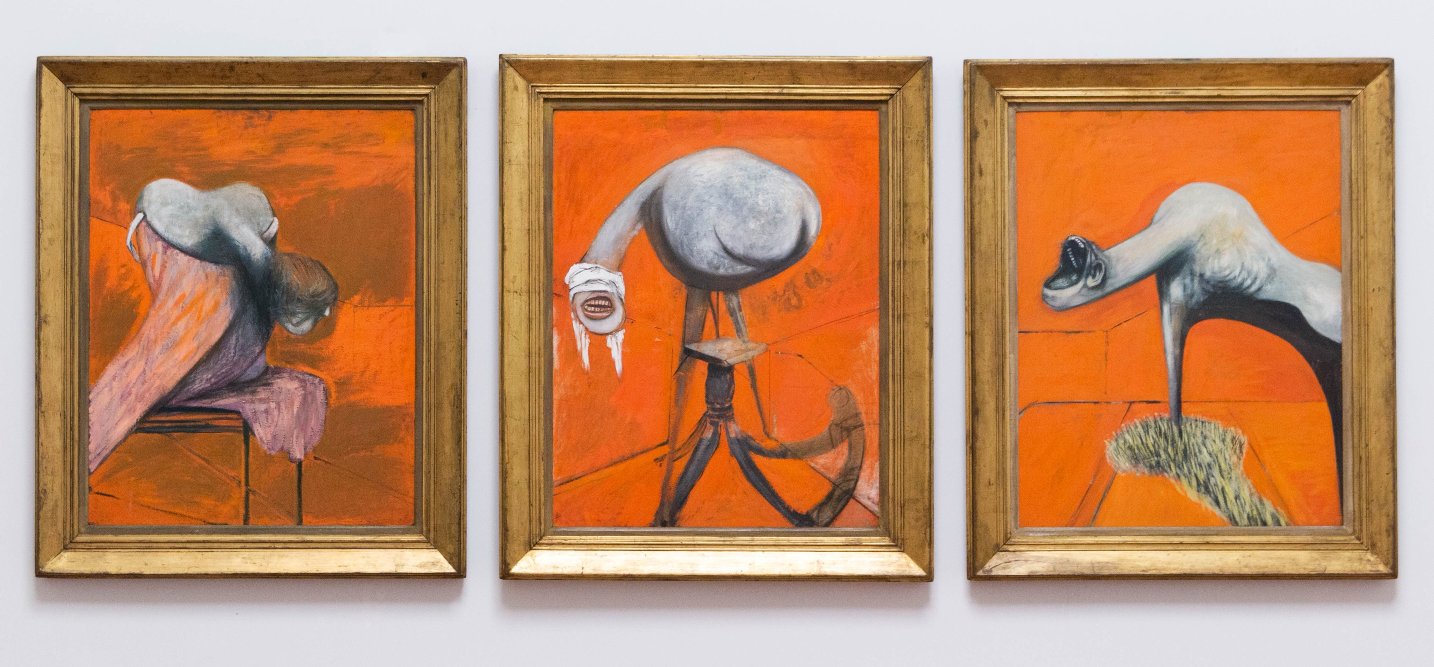
Moreover, the most basic form of the head and its necessary curvature, are repeated for the rest the body. Beckett writes, ‘For of the great traveller I had been, on my hands and knees in the later stages, then crawling on my belly or rolling on the ground, only the trunk remains (in sorry trim), surmounted by the head with which we are already familiar’ (Beckett, 1994, 329). Removing limbs with abandon, the condition of becoming a mere torso is specifically referred to as the trunk, evocative of a tree as well as a body. Consequently, it is given the characteristic motion of roundedness: it rolls. Whilst all of these profess a lack, there is, precisely because of this distorting focus, a gross emphasis on the fact of three-dimensional embodiment, like the bulbous view through a fish-eye lens. Indeed, it is the loss of limbs that uncovers and foregrounds the natural curvature of the body’s trunk. Like many of Bacon’s distortions of the human form, drawn from vivid photographs of invalids or bent and pinned photographs, the embodied form in Beckett’s work is thus pushed to the extremities of the humanoid. When we look at the Eumenides of Bacon’s 1944 Three Studies for Figures at the Base of a Crucifixion, we see a grossly distorted human embodiment, rounded and limbless but not dissimilar to The Unnamable’s humanoid monster. In both, then, there is an emphasis not on the fixed form of the whole as constituted by its individual parts – limbs, hands, feet and so on – but on its underlying fleshliness; the essential meat of the matter.
Bacon draws particular attention to the practice of embodying a figure by distorting – by breaking – its body. He said to an interviewer, ‘You must know the beautiful Degas pastel in the National Gallery of a woman sponging her back. And you will find at the very top of the spine that the spine almost comes out of the skin altogether [. . . ] He breaks it so that this thing seems to protrude from the flesh. Now, whether Degas did this purposely or not, it makes it a much greater picture, because you’re suddenly conscious of the spine as well as the flesh, which he usually just painted covering the bones’ (Sylvester, 46–47). For Bacon the broken body is a striking, multi-textured body, the artist stating, ‘I’m always hoping to deform people into appearance’ (Sylvester, 146). The shiver one has at the sight of a vivid mutilation is surely an extension of that ‘shorthand of sensation’ sought by Bacon in his paintings. Without the blood and gore so characteristic of the artworks, Beckett’s figures are, of course, notably distorted by injury and bodily malfunction as well as the sort of strange embodiment seen in The Unnamable. In Beckett et le psychanalyste – which the artist himself read on the comparison (Archimbaud, 119) – Didier Anzieu aligns Beckett’s broken bodies with those of Bacon: ‘Bacon peint des portraits où les yeux, l’ouïe, la bouche, le nez, la marche, la peau, la posture sont dévastés’ (Anzieu, 151). Several characters, such as Watt and Clov, have the stiff-legged gait of an ataxic, as if malady had lent them their very substance. Molloy finds himself crawling through the woods, Hamm cannot stand, Nagg and Nell are again trunks, in cylindrical containers. The posture of May in Footfalls, over which Beckett laboured for so long with Whitelaw (Haynes, 43), is as contorted as many of Bacon’s figures. This brief list of pathological specimens recalls us to what James Knowlson calls Beckett’s ‘long-standing curiosity about medical matters [. . . whereby] Anything abnormal or macabre fascinated him’ (Knowlson, 668). This preoccupation with oddity is shared by Bacon, who also repeatedly turned to the clinically strange to establish the common, and so ‘at one time haunted medical bookshops in search of an ever greater precision in the portrayal of extreme states’ (Russell, 56). Michael Peppiatt confirms that the artist ‘loved to talk to scientists and doctors [. . . and] at one point he was a regular reader of The Lancet’ (Peppiatt, 221), whilst Russell records Bacon’s possession of the unpromising-sounding sourcebook Positioning in Radiography, which illustrated the advised poses for successful medical x-rays (Russell, 113). For both Beckett and Bacon the medical exception often provides the physiological exemplar; the distortion stresses the everyday condition of being clothed in tissue. In conversation with Michel Archimbaud between October 1991 and April 1992, Bacon responds at length to a comparison between his own works and those of Beckett. Betraying an extensive knowledge of Beckett’s work, he nevertheless denies any affinity, claiming, ‘I’ve always been amazed at this comparison between Beckett and myself’ (Archimbaud, 116). He admits to having ‘seen Waiting for Godot which I didn’t by the way find interesting, and some of his shorter plays which were, in my opinion, much better’ (Archimbaud, 117). Unable – or unwilling – to recognise the common attachment to renditions of embodiment and affect, he speculates of Beckett: ‘the idea may have been a good one but I wonder if, in his case, the cerebral didn’t take too much precedence over the rest [. . . ] there’s something too systematic and too intelligent about him, which is perhaps what’s always made me uncomfortable’ (Archimbaud, 118). He goes on to recall that,
There was a very good actress here in London who performed in them. Beckett often used to write for her. Unfortunately, I no longer remember her name. They were very short pieces, not more than half an hour long, barely twenty minutes, and they weren’t bad at all. (Archimbaud, 117).
While the name eludes the ailing Bacon, whose death was to cut short this series of conversations, he is clearly referring to Billie Whitelaw. The short works that Bacon may have seen in London thus include Play, Footfalls, Rockaby and, of course, Not I. It seems rather alarming that this artist for whom the mouth means so much would damn the singular vision of Not I with the faint praise of ‘not bad at all’, couched amidst copious denials of any similarity. But examination of other evidence shows this to be at least consistent with a contrary streak that often revealed itself around questions of comparison and influence. Indeed, this might be illustrated by the conflict in opinion given in two of Bacon’s biographies. Andrew Sinclair writes of the painter that ‘Beckett was one of the writers he particularly admired along with Pinter’ Sinclair, 302), which suggests not only general approval but a special fondness. Pulling in the other direction, however, Peppiatt claims that the artist ‘rejected any comparison between Beckett’s work (“all those ghastly dustbins”) and his own’ (Peppiatt, 341 n1), which indicates not merely indifference but outright hostility. It cannot be disputed that the dustbins of Endgame – another play that Bacon apparently saw – lack the violent sexual charge that characterises many of Bacon’s numerous forays into the seedy and the insalubrious. Even so, it seems likely Peppiatt touches a sore spot in his question, and that the painter’s objection is not to Beckett’s work per se but to assertions of its proximity to his own. Alternatively, Beckett’s may be simply one of the many oeuvres that could elicit from Bacon coos of approval or scornful calls according to his mood. Certainly, Peppiatt recalls the disdain heaped upon respectable targets who would otherwise have been lauded: ‘sweeping statements sometimes turned into venomous outbursts of pique, with Bacon insisting (about Matisse, for instance, whose sculpture he nevertheless admired): “I really hate those squalid little forms of his”, or again (about many people): “So you think he’s good, do you? Then just tell me this: what’s he ever invented? Nothing, you see”‘ (Peppiatt, 301). Just as with Matisse’s ‘squalid little forms’, Beckett’s ‘ghastly dustbins’ may well be the victims of a theatrical tirade, no more than bluff and bluster.
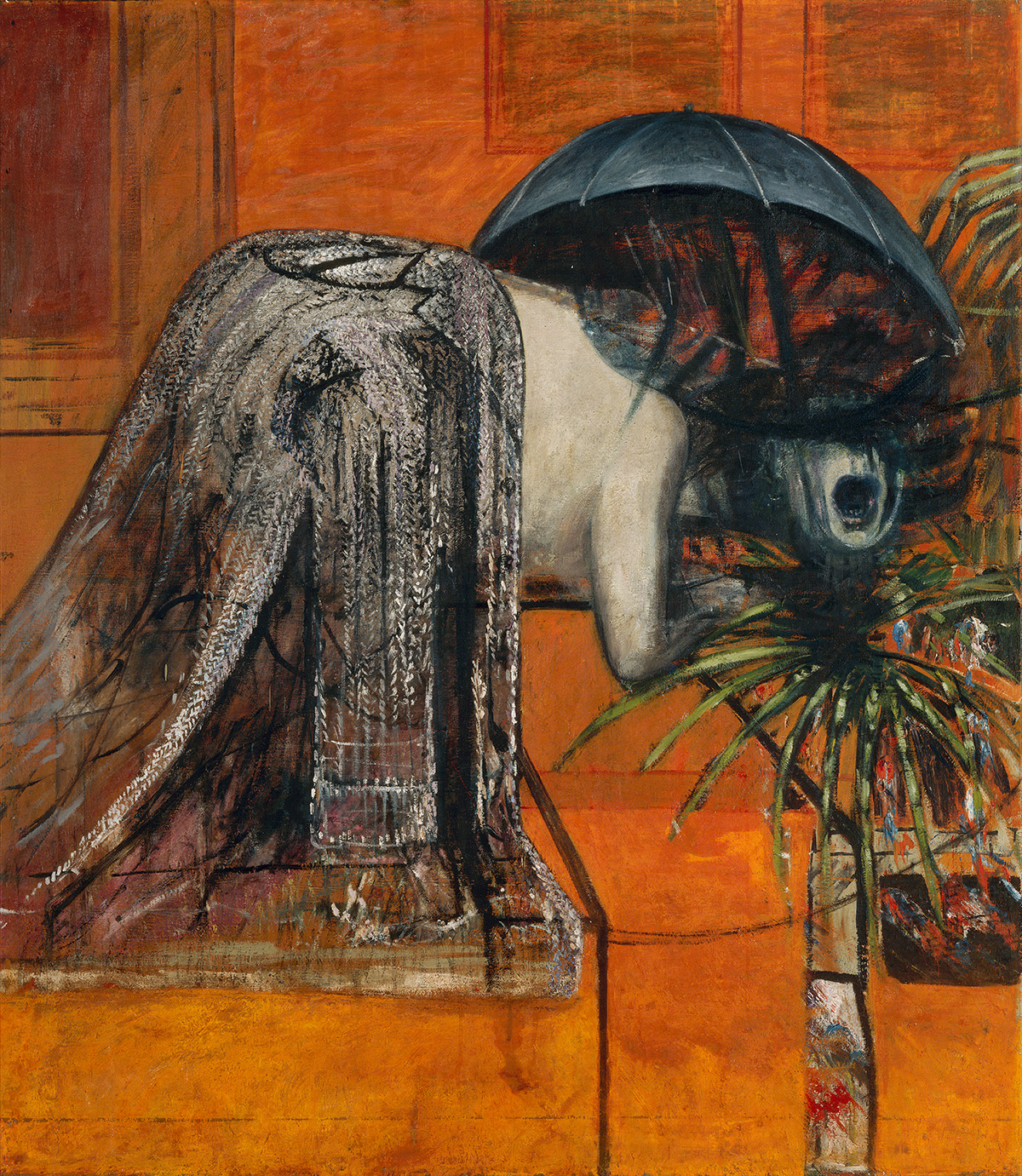
Analysis of Beckett’s awareness of Bacon is altogether more speculative. Indeed, I can establish by inference only one occasion that Beckett would have seen a painting by Bacon. The Museum of Modern Art in New York was among the earliest purchasers of Bacon’s work, buying the striking Painting 1946 two years after its composition (Peppiatt, 118). Beckett visited the museum with Sidney Meyers, the editor of Film, in 1964 (Knowlson, 525) where he would have seen in Bacon’s painting what resembles a sinister re-imagining of Winnie from Happy Days, here turned into the upper body of an umbrella-shaded dictator. Submerged in shadow rather than sand, the figure has an altogether more explicit relationship to death, surrounded not by domestic flotsam but by the fragments of one or many carcasses. Apart from this likely encounter we are restricted to the examination of Bacon’s Parisian profile and the run of exhibitions that Beckett may have attended.
To be sure, though, neither of these are inconsequential. In a poll conducted by the Parisian magazine Connaissance des Arts in the late 1960s, with Beckett also nearing the peak of his renown, Bacon was voted the most important living artist in the world (Peppiatt, 233). This trend in public opinion was confirmed by Bacon’s full retrospective at Paris’s prestigious Grand Palais in 1971, only the second living artist, after Picasso, to be accorded such an honour (Peppiatt, 232). Furthermore, this was only the most prominent of numerous acclaimed Paris exhibitions held during Beckett’s lifetime. These include shows at Galerie Rive Droite (1957), Galerie Maeght (1966–67) – which owned a significant number of Bram van Veldes (Knowlson, 452) – Galerie Claude Bernard (1977), Galerie Maeght Lelong (1984) and Galerie Lelong (1987). One might also consider the possibility that Beckett encountered Bacon’s paintings in London or in any of many German exhibitions. Although we have no record of Beckett’s attendance at any or all of these exhibitions, the extensive profile of Bacon in Paris could not have escaped Beckett’s notice. Nevertheless, the image, if not the fact, of influence is present in the many shrieking mouths and contorted bodies shown to such widespread acclaim in Paris only the year before Not I was begun.
The mouth is undoubtedly the most prominent fixation shared by both artists, whether it is the jabbering panic of Not I or the screaming gape of Bacon’s numerous popes. The television adaptation of Beckett’s play, starring Billie Whitelaw, was produced by Tristram Powell in February 1975 for the BBC (Knowlson, 1996, 620), who screened it as the third part of Shades – alongside Ghost Trio and . . . but the clouds. . . – on BBC 2 on 17 April 1977. It has a particularly obsessive focus, the omission of the shrugging figure of the auditor leaving only the mouth, whose slick sogginess, lubricating its own mechanism as it runs, is relished by the camera. The effect was so significant, Whitelaw recalls, that it elicited Beckett’s only comment on her work in her entire career. After watching the film, ‘out of the darkness, came one word, spoken with an Irish accent a whisper that just managed to float across to me: “Miraculous”‘ (Whitelaw, 132). Enlarged to fill the screen, the mesmerising motion of the lips as they manage the words, draws the eyes with the suggestive swell of an obscenity. Indeed, the transition to television quite literally bloats the mouth to new proportions, creating a spectacle of magnification that cuts against the manifest smallness of the isolated, spot-lit mouth on stage. Combined with this enlargement, the rhythmic thrusting and opening captures well what Bacon described in portraiture as ‘All the pulsations of a person’ (Peppiatt, 208). Indeed, that combination of pushing itself out towards its observers, and drawing inwards with that dark central cave is, as Billie Whitelaw notes, ‘strangely sexual and glutinous, slimy and weird, like a crazed, over-sexed-jellyfish’ (Whitelaw, 132). That mixture of protuberance and pull is reinforced by the adaptation for television, which has a valuable serendipity to its manufacture of the mouth’s volume. Although we are likely to forget it in an era of oversised, flattened plasma sets, the play was filmed for a screen that would not only be much smaller than is now normal – albeit larger than life – but curved. Maintaining that tendency towards the bulge found in both of the corpora, the very medium thus thrusts the image into one’s living room, holding the gaze with its own ocular curve. Indeed, the play’s titular pun thus gains an additional twist in its second format, for now the play makes the television’s dilated image return our stare: our gaze is held by that mesmeric tube whose detractors have bestowed the nickname the ‘devil’s eye’.
The sexual overtones of the orifice in Not I are also very much present in Bacon’s many mouths. Many of the rounded mouths in particular, whilst recognisably screaming, are sexually inflected ambiguous holes, both inviting and forbidding penetration. As Michael Peppiatt writes, ‘There can be little doubt that Bacon’s interest in the open mouth was due in large part to its sexual suggestiveness’ (Peppiatt, 142). Quite apart from the multiple functions of any bodily orifice, both Beckett and Bacon were influenced by the same psychologically and physiologically ambiguous oddity. Amidst his readings in psychology in 1935 (Knowlson, 178) Beckett encountered the folklore notion of the vagina dentata. Otto Rank’s The Trauma of Birth mentions the figure of the toothed vagina in reference to the neurotic male’s fear of intercourse (Rank, 49), a notion that Beckett added to his psychology notes (Beckett, 1930s). Embodying the dread of castration during – indeed by – the very act of coitus, it is the ambiguous orifice par excellence, at once mouth and genitals, site of pleasure and pain, desire and fear. This fundamentally enigmatic figure is also one of Bacon’s key sources. Rather than a psychoanalytic origin, however, Bacon’s source was already transmuted into painting. The vagina dentata emerges time and again in Picasso’s biomorphic paintings, where the head of the victim/subject is morphed into a ferocious, consuming sex. The Blessed Virgin Mary in Picasso’s 1930 Crucifixion (Richardson, 399) is an early and spectacular example of these cross-bred body parts, which the artist associated with his lover Olga as their relationship soured. They were painted in the middle of that period of Picasso’s work most favoured by Bacon (Archimbaud, 34–35).
Whilst this oddity is undoubtedly one root in the genesis of Beckett and Bacon’s mouths, one must also recognise the specifically oral fixation shown by both. Certainly, Not I makes clear the relish for the peculiarly wide-ranging types of corporeality of this particular orifice, with its combination of wet saliva, hard teeth, fleshy and flexible lips, muscular tongue and non-present hole. This is to say, there is a care not only for ambiguity and curiosity but for specificity and normality; a real captivation with what constitutes the mouth in particular. The fascination with this unique combination of forms – living and not-living, there and not – is also found in Bacon, as if it signifies a property of embodiment that no other feature can. Prominent among Bacon’s sources are photographs featuring, amongst others, the particularly active maw of Joseph Goebbels in full rabid rant; the various shapes, shifts and substances on show as if the extremity and diversity shown cut to the core of the mouth’s essential nature. As in Beckett, the contrast between the part of the mouth is significant, particularly between the flesh and what John Russell refers to in Bacon as ‘the magnificence and purity of the teeth’ (Russell, 56). And, although painting cannot reproduce that significant motion of Beckett’s Not I, it does seek to capture something of the quintessential mobility of the mouth, following Bacon’s statement that ‘I’ve always been very moved by the movements of the mouth and the teeth’ (Sylvester, 1987, 50). Most significant are a couple of distinctly oral mouths captured in artworks seen by both Beckett and Bacon.
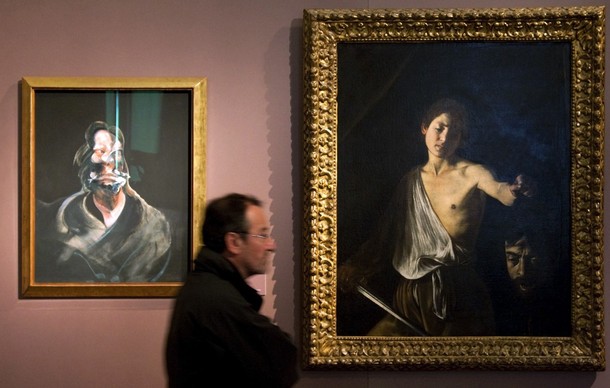
The first is Poussin’s Massacre of the Innocents, held in the Château de Chantilly, which Bacon thought no less than ‘the best human cry in painting’ (Sylvester, 34). He saw it in 1927 when living near tothe gallery with a family whose matriarch had first been fascinated by the flamboyant seventeen-year-old Bacon when in Paris, and who had then proceeded to befriend, house, and instruct him in French (Peppiatt, 32). Beckett also admired Poussin immensely, and spent a good deal of time looking at The Entombment in Dublin’s National Gallery (Knowlson, 58). On the 17 June 1934 he visited the Louvre with his brother to look at the extensive collection of Poussins and various Dutch works, and the following day had an outing to Chantilly, where he would have seen The Massacre of the Innocents (Knowlson, 195). The second prominent source for Bacon was the screaming nurse shot on the steps of Odessa harbour in the 1925 film The Battleship Potemkin, which he saw first either in Berlin in 1926 or the following year in Paris (Peppiatt, 30). A decade later the film’s groundbreaking director Sergei Eisenstein would have received an application from a rather optimistic Beckett asking to become his assistant (Knowlson, 226), an eagerness that indicates a similar enthusiasm. The esteem in which Beckett held both Poussin and Potemkin places some particularly striking mouths in the author’s extensive mental repository of images, either or both of which may have fed into the central image of Not I alongside the acknowledged Caravaggio canvas, The Decollation of St John the Baptist, which Beckett saw in the cathedral at Valetta whilst holidaying in Malta in 1971 (Haynes, 55; Knowlson, 588). Indeed, Beckett’s note to James Knowlson in 1973 perhaps implies sources other than Caravaggio: ‘Image of Not I in part suggested by Caravaggio’s Decollation of St John the Baptist’ (Knowlson, 588).
Moving on from questions of influence and origin, the better part of comparison lies in a notable agreement in method. In both oeuvres a curved emptiness, undoubtedly related to the cavernous mouth’s curious combination of fleshliness and non-embodiment, becomes a strange sort of non-present prosthetic, stressing the three-dimensionality of the bodies not by extending them, but by containing, restraining and framing them in space. In his book on Bacon, Gilles Deleuze draws attention to the similar settings used by both artists. He writes, ‘Beckett’s Characters and Bacon’s Figures share a common setting, the same Ireland: the round area, the isolator, le dépeupleur’ (Deleuze, 35–6). Evoking both the ‘flattened cylinder’ of The Lost Ones and the notion of a space that strips its occupants of company, the description also points to the curved walls of many of Bacon’s painted rooms, to which one might add the round bed that features so often in the canvases. Indeed, this figure of curved isolation is rarely repeated to better effect than in MoMA’s Painting 1946, which, as Beckett would have seen, contains – and thus gives volume to – its central figure by the use of multiple curved forms. The head is partially obscured by an open umbrella, the foreground is occupied by what look like circular rails, while the figure’s upper body is almost fitted entirely within the cavern of a butchered carcass, opened into a kind of cruciform backdrop. The repetition of such containing forms might even demonstrate a spatial sense to Beckett’s desire to ‘find a form to accommodate the mess’ (Graver and Federman, 219), just as for Bacon, the containers on the canvas contribute to the ‘very, very ordered chaos’ (Kaleidoscope, 1991) he preferred.
Deleuze’s reference, made in 1981, to a specifically Irish space appears to anticipate a comment made by Bacon to David Sylvester in 1986 – and again to Michel Archimbaud in 1992 (Archimbaud, 154) – recalling a particularly handsome house his father had bought from his grandmother. Bacon recalls that ‘Farmleigh was a beautiful house where the rooms at the back were all curved: I suppose one never knows about those things, but perhaps this may be one of the reasons why I have often used curved backgrounds in triptychs’ (Sylvester, 184). We might also note that the large Irish house of Beckett’s youth, Cooldrinagh, had curved windows both upstairs and down. One of these upstairs bays may have provided the infant Beckett’s very first light: emerging from his own fleshly confinement into a room illuminated by the arc of an oriel window. To suggest that these glazed curvatures influenced Beckett’s own curved spaces is perhaps to go too far – although of course not as far back as the author’s memories were said to stretch – but his predilection for containing figures in such bowed spaces is repeatedly put to work to figure and figure out his fictional bodies. Nagg and Nell in Endgame are contained in those ‘ghastly’ cylindrical bins, Winnie in Happy Days is trapped in a cone-like mound, Krapp in Krapp’s Last Tape is shown in an illuminated circle given by the overhead light, the three figures in Play are in shapely, almost human-esque urns, and The Unnamable’s narrator tries to pass off its embodiment for a while by maintaining that it is propped up in an urn outside a restaurant. To consider the medium of television in this way, the multi-dimensional curvature of the screen – a distinct protuberance with curved edges – might be said to hold and frame the curves of the mouth in Not I, giving an actual volume to the image of the mouth on screen. (The television screen is also, of course, yet another curved window that appears to illuminate the dark confines of its interior.) In a similar vein, the visual persecution of the title character of Eh Joe is as much a product of containment as enlargement, the organic shape of the screen giving substance to both the character and, importantly, the harassment itself. The stronger Joe’s persecution grows, the more uncomfortably he is squeezed into and confined within the television’s box, gaining an increasing fleshliness as his face comes to occupy ever more screen space. Although cubes are present in the corpus, as they are in Bacon’s, it is the organic and swollen arc to which both particularly gravitate. To take an example of where curve and line meet, we might consider how in Imagination Dead Imagine each body lies within its own warped semi-sphere; that is, in a semi-circle on the horizontal plane and a semi-ovoid on the vertical. The position of these pleated creatures is described in the form of vectors, given in relation to the geometry of the rotundas they are placed in. This arrangement suggests strongly that they are embodied by their containment. Thus, after the mapping of one folded frame in the space ACB we are told there is ‘the white body of a woman finally’ (Beckett, 1995, 184), that ‘finally’ suggesting that the efforts of narrating the coordinates within the dome conjures the inhabitant herself. Like cowering or imprisoned versions of Da Vinci’s Vetruvian Man, the characters are given substance by their location within the geometry of the circle, albeit by an arrangement consisting of straight lines. This is also an important alteration of the unnamable’s bulbous hypothetical embodiment, as the later human frames are given substance by their points of contact with the curved lines of their circular habitat. So, while they become less curved themselves, turned into a series of vectors – head to arse, arse to feet – they are conjured, indeed fleshed out, by mapping this geometry within a curved space.
As a model for abstraction this is almost certainly not what Beckett had in mind when he compared his work to that of Kandinsky. But there is, even in Bacon’s resistance to analysis, a curious compulsion to place his work alongside Beckett’s, as Jane Hale has argued (Hale, 96). Thus it is with a resistance to classification and explication that the painter’s biographer records an inadvertent Beckettian echo, ‘Bacon reiterated throughout his life that his painting “meant” nothing, “said” nothing, and that he himself had nothing to “say.” “I’m not an Expressionist, you see, as some people say,” he would insist, sometimes adding as a last flourish: “After all, I have nothing to express”‘ (Peppiatt, 98). But the preponderance of bodies within both oeuvres demands an account of what, with their curious shapes and settings, they are doing here, in a space that, both have argued, has abandoned the task of expression. Beckett and Bacon share a process of modelling the body that includes reference to a broken or distorted model, and a predilection for swooping shapes in both the figure itself and its quasi-prosthetic containment. The repetition of these mutual acts of mutilation and distortion stresses (and distresses) the physical at the expense of conventional bodies and settings, forging a meaty mimesis of the atypical subject. Indeed, it is one of the paradoxes of the television Not I that the use of a medium that, unlike theatre, does not present embodiment itself creates such a striking rendition of substantial embodiment. The enlarged and isolated image displays the meat of corporeality down to the spit and dribble that theatrical scale would dissemble. The very insubstantiality of the medium – constituted of no more than dots of coloured light – becomes the means by which physicality is so strongly and viscerally created. There is, in Beckett’s increased use of television, surely a technological descendent of his call for visible artifice in Waiting for Godot, where acting ‘has got to be done artificially, balletically, Otherwise everything becomes an imitation, an imitation of reality’ (Haynes, 108). In this taste too, his tactics are also common to Bacon, whose portrayal of the subject is rendered by the overt, artificial distortion of illustrative forms: ‘I would like to make my pictures more and more artificial [. . . ] The more artificial you can make it, the greater chance you’ve got of its looking real’ (Sylvester, 146 and 148). The achievement of an art that is effective not despite its artifice but because of it is the talent and taste of both figures.
If Beckett’s creatures can be thought of as abstract, then, it is certainly not in the sense of being opposed to the concrete. On the contrary, abstraction here seems to mean the condensation of physicality; the obsessive, distorting focus not only on appearance but on the sensations of being clothed in flesh, and of bulging into three dimensions. It is to the notion of sensation, then, that we must finally appeal in this juxtaposition. In a letter to Alan Schneider – and repeated elsewhere – Beckett wrote that Not I is ‘Addressed less to the understanding than to the nerves of the audience which should in a sense share her bewilderment’ (Harmon, 283). Likewise, Bacon repeatedly described his images of faces in neural terms, as ‘an attempt to bring the figurative thing up onto the nervous system more violently and more poignantly’ (Sylvester, 12). As both artists make explicit, then, their depictions of bodies signify not through reference to a bloodless or theoretical notion of physicality but through the observer’s own physical participation. Their aesthetic bodies work not because they resemble a particular person or even present an actual body, but because they depict the condition of embodiment itself, and because they excite through the sparking of our own synapses.
WORKS CITED
Ackerley, C. J., and S. E. Gontarski (eds) (2006), The Faber Companion to Samuel Beckett, London: Faber.
Anzieu, Didier (1992), Beckett et le psychanalyste, Paris: Archimbaud, Menthe.
Archimbaud, Michel (1993), Francis Bacon: In Conversation with Michel Archimbaud, London: Phaidon Press.
Beckett, Samuel (1930s), ‘Psychology Notes’, Trinity College Dublin, TCD MS 10971/8.
Beckett, Samuel (1986), Complete Dramatic Works, London: Faber.
Beckett, Samuel [1959] (1994), Molloy, Malone Dies, The Unnamable, London: Calder Publications.
Beckett, Samuel (1995), Complete Short Prose: 1929–1989, ed. S. E. Gontarski, New York: Grove Press.
Deleuze, Gilles [1981] (2003), Francis Bacon: The Logic of Sensation, trans. Daniel W. Smith, London: Continuum.
Graver, Lawrence and Raymond Federman, eds. (1979), Samuel Beckett: The Critical Heritage, London: Routledge & Kegan Paul.
Gruen, John (1969), ‘Samuel Beckett talks about Beckett’, Vogue, 154:10, pp. 210–11.
Hale, Jane (1993), ‘Framing the Unframable: Samuel Beckett and Francis Bacon’, Beckett in the 1990s: 2nd International Beckett symposium: Selected Papers, Amsterdam: Rodopi, pp. 95–102.
Harmon, Maurice (ed.) (1998), No Author Better Served: The Correspondence of Samuel Beckett & Alan Schneider, Cambridge, MA: Harvard University Press.
Haynes, John, and James Knowlson (2003), Images of Beckett, Cambridge: Cambridge University Press.
Kaleidoscope: Francis Bacon. ‘I’ll go on until I drop’; Francis Bacon’s Last Interview, radio programme. London: BBC, first broadcast on BBC Radio 4 on 17 August 1991.
Knowlson, James (1996), Damned to Fame: The Life of Samuel Beckett, London: Bloomsbury.
Peppiatt, Michael (1996), Francis Bacon: Anatomy of an Enigma, London: Phoenix.
Rank, Otto [1929] (1973), The Trauma of Birth, New York: Harper & Row.
Richardson, John (2007), A Life of Picasso: The Triumphant Years 1917–1932, London: Jonathan Cape.
Russell, John (1993), Francis Bacon, London: Thames & Hudson. The South Bank Show, featuring Francis Bacon, television programme. London: LWT, 1985.
Sinclair, Andrew (1993), Francis Bacon: His Life and Violent Times, London: Sinclair-Stevenson.
Sylvester, David (1987), Interviews with Francis Bacon, London: Thames & Hudson.
Whitelaw, Billie (1995), Billie Whitelaw . . . Who He? An Autobiography, London: Sceptre
The Human Cry:
An Appreciation of Francis Bacon
BY DAVID REMFRY | CONTRIBUTOR | IRISH AMERICA MAGAZINE | AUGUST/SEPTEMBER 2009
If, in 1964, you were to have asked me which two things excited me most, aside of course from ‘The Siren Call of Sex’ as the poet Philip Larkin put it, I would have answered, the Ronettes and the paintings of Francis Bacon. Oh, and the fact that I was leaving Hull College of Art intent on a life of painting, so three things.
The first Francis Bacon paintings I saw were in reproduction, around 50 years ago. They had a great effect on me even in this diminished form. I recall my painting tutor, James Neill, being scornful of Bacon’s work. Telling me that Bacon was passé. The years leading to the current exhibition at the Metropolitan Museum of Art in New York show how wrong he was. The works reverberate with the energy of the painting and the violent intensity of the imagery they contain.
Bacon said that one reason for the violent component of his paintings might have to do with his upbringing in Ireland. He was born in 1909, a century ago in Dublin, the son of a racehorse trainer. They lived quite near the Curragh where the British Cavalry Regiment was stationed. He remembered them using the drive to their house for practice manoeuvres, galloping up and down the drive. This was just before the 1914 war. The family moved to London in that period because his father was in the War Office and Francis was instilled with the possibility of impending danger. After the war he returned to Ireland and was raised during the period of the Sinn Féin Movement, living with his grandmother who was at that time the wife of the Commissioner of Police for Kildare. He remembered living in a sandbagged house, and some roads crossed with ditches dug, said Bacon, to trap the unwary car or horse and cart for the waiting snipers.
When he was 17 he moved to Berlin. He said the Berlin of 1927 was violent, not in the military sense that Ireland was, but in the emotional sense. One thinks of Christopher Isherwood who lived in Berlin around the same time and later wrote Good-bye to Berlin, which was made into the musical Cabaret. One thinks of the latent violence too soon to become a reality that Bacon spoke of. For a young gay man it must have been very exciting, and later very dangerous. He went on to live in Paris during “all those disturbed years,” as he put it until 1939 when the war started.
What Bacon said about the violence of his life, the violence he has lived amongst, is that it is different from the violence in painting, “that to speak about the violence of paint, it has nothing to do with the violence of war, it’s to do with an attempt to remake the violence of reality itself.”
Bacon himself was obsessed with mortality and said that “If life excites you then its opposite, like a shadow, death, must excite you,” that one is aware of it like the flip of a coin between life and death. In an interview with the writer and art critic David Sylvester, Bacon said he was always surprised when he woke up in the morning. Sylvester asked if that didn’t belie Bacon’s view that he was an essentially optimistic person, and Bacon replied, “Ah well, you can be optimistic and totally without hope.” That seems pleasingly Beckett-like to me.
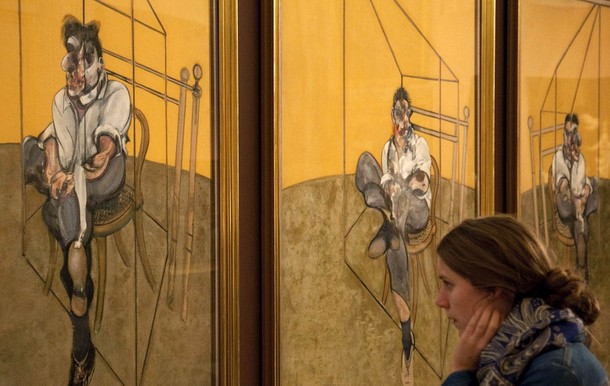
The visitor to this magnificent exhibition, if not already familiar with Bacon’s work, may be surprised, perhaps even a little shocked if that is still possible today, at the visceral quality of the painting. Near the beginning of the exhibit is a triptych “Three Studies for Figures at the Base of a Crucifixion,” painted in 1944. The phallic figures are against a stark orange background; one looks down while the other two with snarling and gaping mouths evoke menace or pain. Bacon said that he was influenced by Picasso’s paintings of organic forms relating to the human figure but distortions of it. But the mouths, full of teeth in the Bacons, make his work altogether more sinister.
Bacon said he did hope one day to make the best painting of the human cry, but that he was not able to do it. He thought the best depiction of the cry was in the still from Eisenstein’s great film Battleship Potemkin of the screaming nanny. In painting, he felt the best human cry was probably in the “Massacre of the Innocents” by Poussin of around 1630.
Again and again one can see the importance of the mouth as an expressive vehicle in Bacon’s works. When young in Paris he bought a second-hand book with hand-colored plates of diseases of the mouth. He tried to combine the Potemkin image with the images from the book, but it never worked out.
A friend once gave me a textbook of reconstructive surgery of victims of traumatic injury (there is always someone wanting to cheer you up). One photograph showed a face with the flesh almost entirely lifted from one side revealing the teeth, jaw and skull. I always associated the image with Bacon – though Bacon’s paintings are neither horrific nor literal. Yet it is as if he reminds us of the skull beneath the flesh, reminds us of our mortality
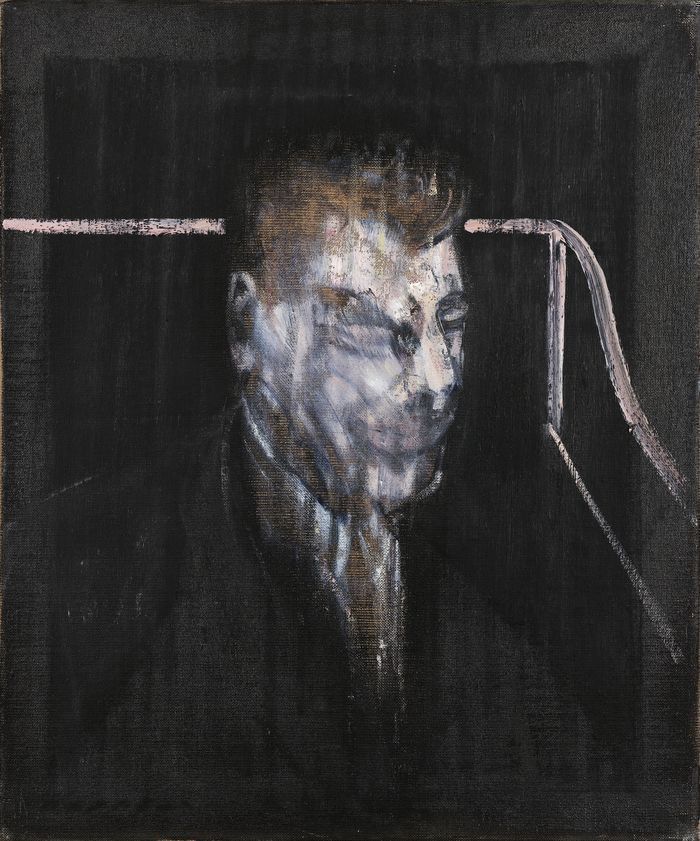
‘The mouth’ paintings evolved during the 1940’s. The work entitled “Painting 1946” has a dark figure whose jaw and mouth emerge from the adumbration of an umbrella. A flayed carcass is behind, its limbs spread as if crucified. This, the first work by Bacon to be acquired by a museum, was purchased by the Museum of Modern Art, New York, in 1949 and it seems to point the way to the ensuing works sometimes referred to as ‘Scream Paintings’ of heads, figures and Popes, in the 1950’s.
“Study for Innocent X,” 1962, seems a culmination of these, being derived from a reproduction of the Velazquez portrait (widely regarded as one of the finest portraits ever painted) . Interestingly, Bacon, though he spent two months in Rome, never visited the Galleria Doria-Pamphili to see the Velazquez painting. He said he probably feared seeing the original after he had tampered with it. He needed only the reproduced image for his purposes. Bacon certainly preferred to work from photographs as a starting point, rather than with models, partly as he said because he thought that models would be upset by what he did to them
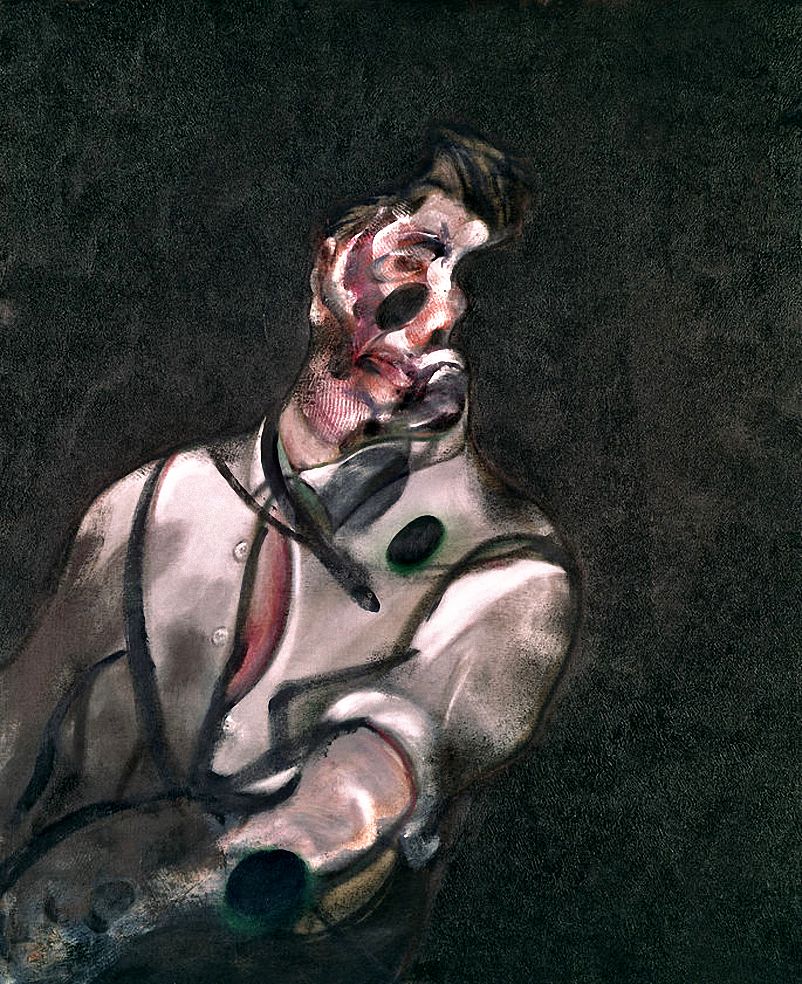
There is a delicious painting called “Portrait of George Dyer riding a Bicycle,” 1966. Dyer’s face is turned to the viewer whilst surrounding it, a larger shadowy profile with a faint smile rides obliviously on. Dyer was Bacon’s lover, but their relationship was always tempestuous and in 1971 on the opening night of Bacon’s big retrospective at the Grand Palais in Paris, Dyer committed suicide in his hotel room.
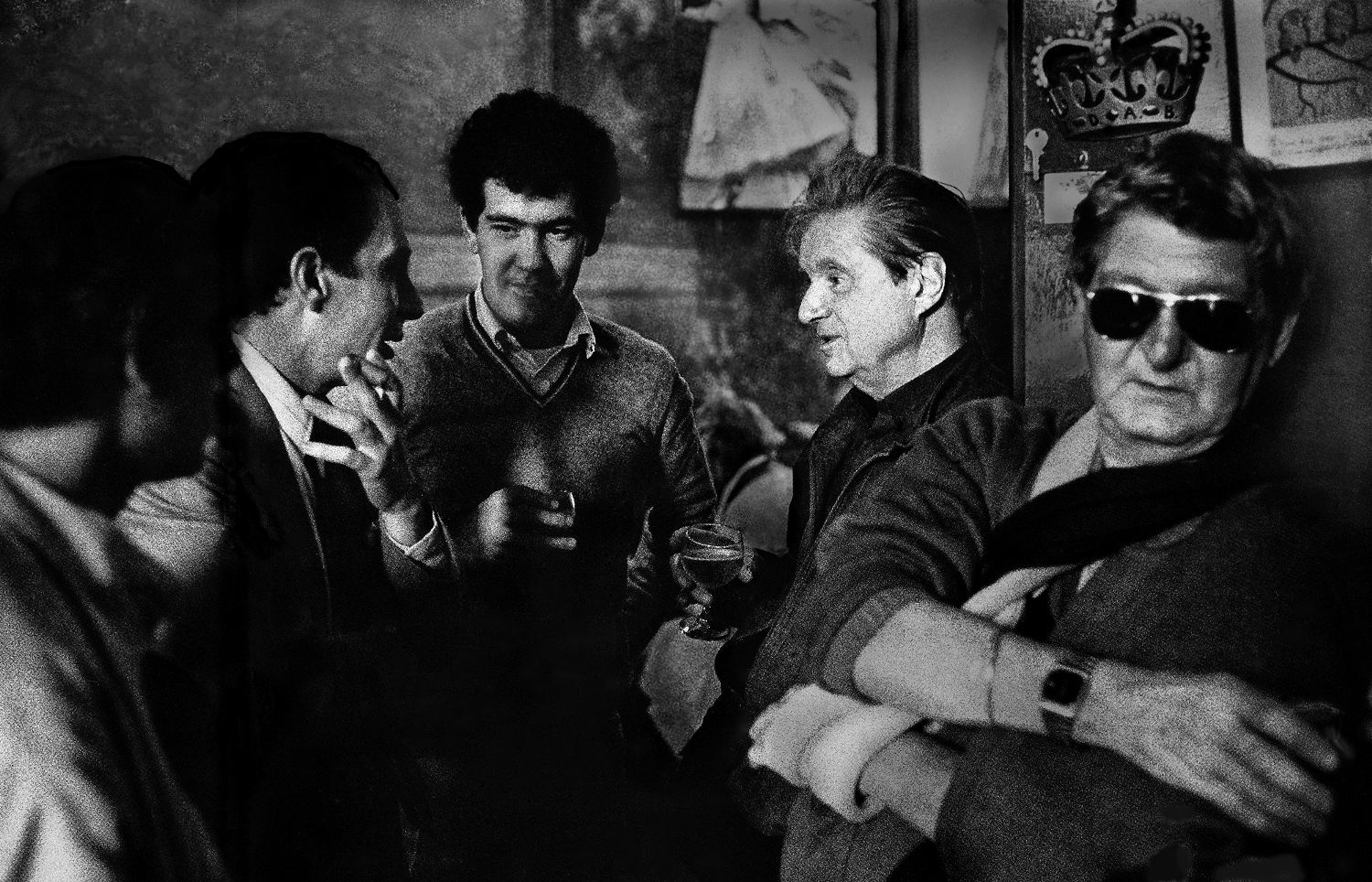
I met Francis Bacon at the Chelsea Arts Club, London, which he occasionally came to in the late 1970’s, and in the 1980’s I’d occasionally see him walking in Kensington where I lived. He would nod but we never spoke. That was good enough for me. I met Ronnie Spector of the Ronettes too, but that is, as they say, another story.
David Remfry’s artistic career spans more than 30 years. A figurative painter born and trained in England, he is now living in New York City.
Francis Bacon’s Poetics
of the Grotesque
SCOTTS JACKSON |
REVIEW | GHOST ISLAND |
FRIDAY 21 AUGUST 2009
Though Bacon seems to recycle the same sort of grotesque in his oeuvre to an extent that becomes exhausting there is something still powerful in his poetics of the grotesque. He reminds us of bygone times before the age of the laboratory and medicalization of illness when the temple was a site of ritual killings and sacrifice. As Yve Alain Bois remarks in his essay, “Base Materialism,” on Bataille and the photographer Eli Lotar: We live in an age where the slaughterhouse, just like the madman, is quarantined from everyday life.
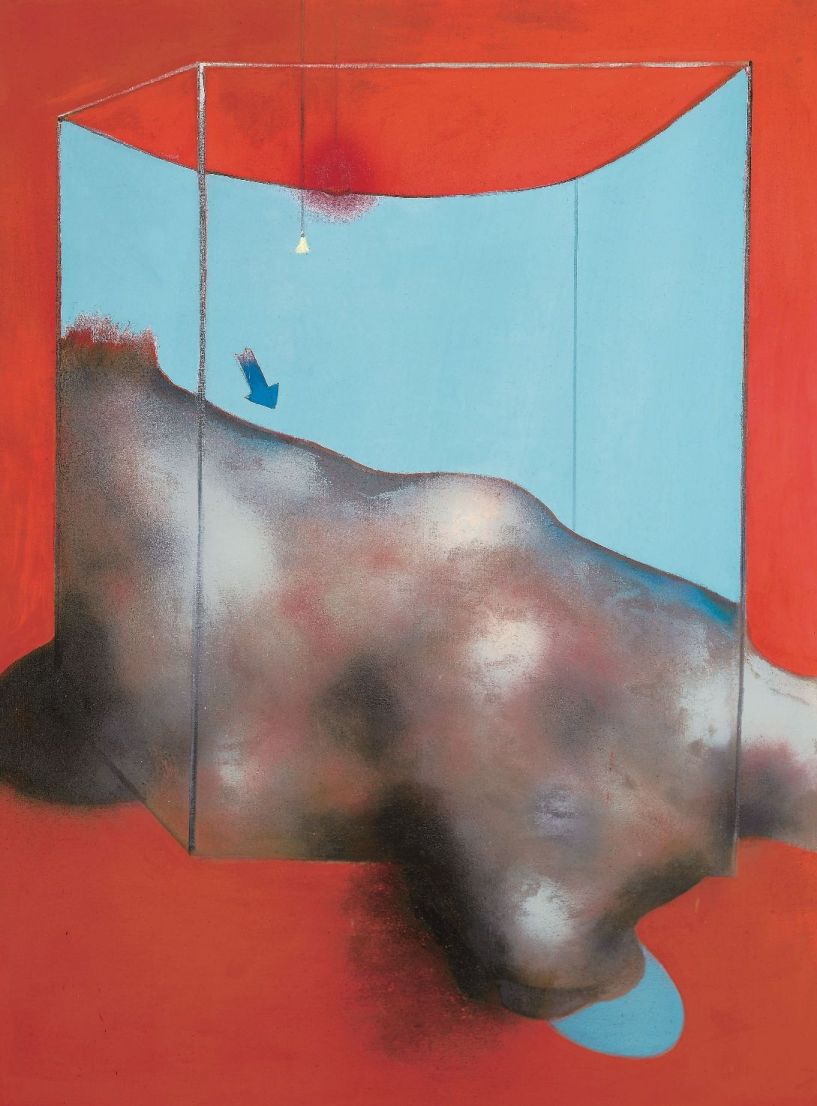
In his triptych series titled after the T. S. Eliot poem Sweeney Agonistes, Bacon depicts enigmatic fragmented lumps of life matter. The extreme upward tilt of the paintings draws the viewer into the painting, while having the contradictory effect of flattening the picture plane. In portraying such liminal figures that hover between life and death and inserting them between flat and deep space, one confronts the return of the repressed. That which is repressed and sublimated inevitably intrudes as the signified momentarily catches up to and disrupts the signifier. The horror in these works is in their representing the repression of violence. As Bois argues: “To show violence purely and simply would be a way of incorporating it; it is more effective to underscore how it is evacuated.”
The retrospective for the twentieth century figurative painter Francis Bacon on view at the Metropolitan Museum of Art shows Bacon’s belaboring exploration of the grotesque. He is fixated on both religious iconography such as in his paintings inspired by Velázquez, and malformed depictions of enigmatic carcasses.
Blood on Pavement similarly hovers between deep and flat space. The obscure blood stain is a trace of a violence and trauma that remains absent. The horror of Bacon’s imagery lies not in its portrayal of violence, but rather in its undefinability that places the viewer between the sublimation and intrusion of the trauma. It is a horror that remains truly other and resists incorporation and resolution in the quotidian. He reminds us that the comforting sanctity of our daily latte and other objects of commercial consumption is continually haunted by wars, sweatshops, and environmental devastation. Bacon does not naively revel in the violence of the status quo, but rather exposes the ways in which we sublimate and expunge the traces of violence in presenting objects which remain liminal and resist foreclosure.
Francis Bacon
at the Met
Francis Bacon’s virtual
reality
ROBERT ZALLER
| ART | BROAD STREET
REVIEW | SATURDAY 15
AUGUST 2009
Francis Bacon, who died at
the age of 82 in 1992, was
the greatest British painter
of the 20th Century, and by
all odds the most notorious.
His famous paintings of
Baroque-era popes,
distortedly rendering Diego
Velazquez’s portrait of
Innocent X as a succession
of screaming funhouse faces,
scandalized respectable
opinion, while his treatment
of gay life made him one of
the first artists to
unapologetically depict the
gritty subculture of
homosexual London.
On a political level,
Bacon’s postwar work seemed
to decry violence, while on
a personal one he appeared
to embrace it. The result
was an art that seemed both
aesthetically disturbing and
morally ambivalent.
Bacon’s iconography is now
familiar to us, and his
bad-boy postures, after
Robert Mapplethorpe and
Peter Greenaway, seem a bit
old hat, not to say
sentimental. We are really
left, in the centenary
exhibit of his work recently
at the Metropolitan Museum
of Art, with the art itself.
There’s a cool, classical
ironist behind the Romantic
figure painter, and the
tension between the two—the
eye of a clinician observing
a particularly messy
operation—is what engages us
now.
Yet there’s a deeper issue
in Bacon’s work, the issue
that besets modern art in
general: how to represent
the world in an age of
photographic reproduction.
Fine art’s dirty little
secrets
Before photography, the
artist looked directly at
the world and depicted it
through hand and eye.
Afterwards, anyone with a
camera could reproduce that
same world with a click of
the shutter. This easy
appropriation included the
world of art itself, as the
digital camera flashes that
have added a new level to
the visual pollution of our
galleries and museums
attest.
At the Met, guards were
diligently shooing would-be
picture takers away from the
Bacons, but I think Bacon
himself would have been
highly amused. That painters
had themselves often worked
from photographs was one of
fine art’s dirty little
secrets, but Francis Bacon
may have been the first to
work only from photographs,
film stills and other forms
of reproduction.
Even when painting his
friends and lovers, he would
never pose them, but have
photographer friends such as
John Deakin give him
snapshots to work from. To
have museum souvenir-hunters
turn his paintings back into
photographs might well have
seemed a fitting completion
of his work to him, or at
any rate a reduction back to
first principles.
A gambit taken to extremes
What were those principles?
I don’t think Bacon was
merely quirky in insisting
on having a prefabricated
image to work from (a
Velazquez painting might
serve too, but only itself
in reproduction—Bacon
claimed never to have seen
the original). He was making
a programmatic or, if you
will, a philosophic
statement— namely, that the
modern world could be seen
only in mediated form, never
directly.
This is a very classic
modernist gambit, of course.
But Bacon took it to the
extreme. Photography had, as
it were, usurped the natural
world, and banished it to
Kantian exile. The
photograph was the primary
datum of experience now, and
art could only work off it,
compete with it and, if
successful, in some sense
displace it. This
displacement was the actual
artistic gesture, the
triumph of art itself.
This conviction, I think,
was at the core of Bacon’s
rejection of the dominant
aesthetic of his generation,
Abstract Expressionism. In
photography, the image of a
thing replaced the thing
itself, but the Abstract
Expressionists, by ignoring
both, had retreated into
what Bacon regarded as a
sterile manipulation of form
and color.
Like tennis without a net
The Expressionists might say
that, in rejecting the
image, they freed themselves
from the tyranny of
representation in order to
project emotions onto canvas
directly. But to Bacon (not
to mention Picasso and
Matisse, among others), that
was playing tennis without a
net. The real issue was
whether art could exist in
what Walter Benjamin had
called the age of mechanical
reproduction, and any art
that failed to engage the
question— to grapple with
the image, particularly the
human image—was simply
irrelevant.
The matter was not nearly so
simple, of course. Picasso
himself had broken up the
conventional visual field
with Cubism, and it was this
gesture that made Abstract
Expressionism possible, even
if Picasso himself had
chosen not to follow it.
From this point of view,
modern art was not about the
image—temporality—but about
space, reconfigured and
reconceived. Photography had
little to say about this
issue, being in that sense
an actually retrograde
method for interrogating the
world.
Bacon, too, despite his mock
obeisance to the photograph,
recognized this. The primary
question in depicting the
human image was, for him,
not its color, outline or
expression, but its
placement in space.
Baboons and the pope
I think the gaping or
grimacing features that
recur so regularly in his
work attest to this spatial
instability; they’re like
the distortions caused by
exposure to compressed air
or a destructive wind. On a
psychological level, one
might say, Bacon’s gaping
mouths are meant to reveal
our animal kinship to other
primates; thus, in the room
that exhibits most of the
papal images, figure studies
of a chimpanzee and a baboon
are included, as well as
studies of dogs.
But all the figures, human
and animal, seem unlocated.
The popes sit on their
thrones, and there is no
image more apparently
grounded than a throne; but
Bacon encloses them in the
cage patterns characteristic
of his early postwar work,
thus making them appear
suspended in a menacing
void—menacing to them and to
us.
Or sometimes his figures are
seen through drizzling
screens of paint, like
curtains that leave us
uncertain whether the
figures stand in front of or
behind them (or are rather
bombarded by them, like
cosmic particles). Rain is
spatially disorienting,
especially when it appears
without signpost or
background; and Bacon’s
existential rain—coming from
no apparent source and
proceeding to no apparent
ground—is particularly
riddling.
The spoor of the human
In his later work, these
devices are replaced by
large slabs of unbroken
color, which, even when they
suggest a pictorial referent
(a bare room, for example),
give us no real purchase.
Bacon’s figures are as
isolated, as ungrounded, as
they can be, and the twists
and gaps in the figures
themselves leave them, too,
at the margins of
substantiality. It is as if
Bacon (who adapts many of
the devices of Expressionist
space) wants to take the
image as close to dubiety
and unintelligibility as he
can, while still leaving an
inexpugnable trace, the
spoor of the human.
This is a new kind of
reality, but one that we can
recognize about us
everywhere today, and which
Bacon was prescient in
anticipating, particularly
in his sensitivity to
photographic processes—the
chemical trace that leaves,
mysteriously, a simulacrum
of the object world. We
live, increasingly, in this
virtual reality, whose reach
has been enormously extended
by the computer and the
world of video games and
simulations that it has
generated. Without noticing
it, we have largely
disappeared into this
virtual reality, organized
for us by unseen hands,
which is now replacing the
messy, unframed, chaotic
natural world that, in our
animal fear of it and our
distrust of the instincts
that once permitted us to
navigate it, we are in the
process of abandoning.
Paint itself as a victim
There is no reason why we
ourselves should not some
day be absorbed into this
looking-glass, and that is
the mirror Francis Bacon’s
art holds up to us. Its
ambiguity—and perhaps its
violence, too—is born of
the frisson we
experience as we confront
this brave new world, which
fascinated Bacon himself as
its prophet.
One of the things we will
lose in it, as he was well
aware, is paint itself. A
painter friend of mine,
recently returned from
Venice, remarked to me about
how few paintings the
Biennale contained, as
opposed to videos and
installations. What, look at
a cloth canvas daubed with
vegetable dyes and hung,
immovably, on a wall? Titian
is as far from us now as a
cave dweller.
The one reality we can’t
escape
Bacon, though, insisted upon
paint, as he did upon the
material core of humanity,
distant and difficult though
it had become to our
perception (the difficulty
was precisely his subject).
Two paintings from the Met
show may illustrate this for
us. In one, his lover,
George Dyer, is shown, nude
and from the back, sitting
on a toilet. He is
surrounded by white space
except for the piping that
conducts Dyer’s waste away
from him and toward us: a
man, in effect, shitting in
our faces.
In another, Blood on a
Pavement, a smear of
blood is all that is left of
the absent figure, and the
background itself is
rendered as three
Rothko-like panels (another
appropriation from the
Expressionists, despite
Bacon’s expressed disdain
for Rothko).
The Dyer portrait is, among
other things, the ultimate
send-up of the papal
thrones; here, Bacon
suggests, is where we all sit.
We don’t see Dyer’s waste,
but the image makes us
inescapably conscious of it:
shit is the one natural
reality we can’t escape,
however politely removed by
modern plumbing, and however
antiseptically white our
bathroom walls and
fixtures.
Similarly, blood is also our
trace: the one testimony to
our existence when the
murdered corpse has been
removed from the scene of
the crime. We live, and
therefore shit; we die, and
therefore bleed: however
virtual our reality may
become in between, these
signatures reveal us.
Francis Bacon shutters at
the Met
JAMES HORNER
| MANHATTAN FINE ARTS
EXAMINER | THURSDAY 13
AUGUST 2009
Filleted carcases, ghostly dogs, screaming popes, and wrestling men, all conjure up Francis Bacon: A Centenary which will close at the Metropolitan Museum of Art on Sunday August 16. If you have not seen it yet, you should before it leaves. The Bacon retrospective is an amazing collection of his work and includes a curious display of photos and artifacts from his Chelsea studio. As you walk amongst his paintings, you become part of them — just as he wanted. Bacon requested that his paintings be presented behind glass so that his audience could be part of his twisted world.
Walking though the horror show, it’s hard to decide which works are more disturbing. The paintings that use shuttering, where the image fades in and out, or the works with minimal backgrounds. The simple ones take the cake. Although the canvases with shuttering were darker in appearance and more dramatic, the brighter and lusher colours of the minimal backgrounds put the terror into the everyday realm. Pain and suffering isn’t hiding in his cluttered studio in Chelsea, but out on the streets and in the landscape of the living.
Bacon painted a number of wrestling men, possibly to work out his “affliction” as he called it or homosexuality. Homosexuality was a no, no back in his day, punishable by law. The black-widow Bacon painted his lovers, two of whom committed suicide on his watch. Most of his lovers were thieves or transients, and he met one of them while being robbed in his home. Leaving the Bacon show you’ll be exhilarated with his take on the grotesque figure. He twist and turns them inside and out with smears and kicks to the guts, pulling you inside and out and sometimes leaving you a little weary and sick.
Love is the Devil
JD BELTRAN | SFGATE | SAN FRANCISCO CHRONICLE | TUESDAY AUGUST 11 2009
Two weekends ago, I was in New York, where I’d gone specifically to view the Francis Bacon exhibition, a centenary retrospective of his work put on jointly by the Tate Britain in London, the Prado Museum in Madrid, and the Metropolitan Museum of Art in New York (through this weekend, August 16). Bacon’s paintings are few and far between – most appear to be in private collections – so it was a particular joy for me whenever I’d come upon one in a museum or gallery, since he is one of my favourite painters. I couldn’t miss something like this, an exhibition representing his entire life’s (which was organized to commemorate 100 years since his birth on October 28, 1909). And I am still thinking about it. Bacon continued to paint astonishingly powerful works even into his eighties, and died at 82 of a heart attack in Madrid.
As I wandered through the galleries, I was trying to figure out just why I’m so drawn to Bacon’s work. It’s probably partly because he represents my quintessential ideal of an artist -- one who clearly listened to his own, very unique (and sometimes controversial) drumbeat. And he was an absolute master of paint. Self-taught, he possessed the ability to render fantastic imagery within his works with just a couple of well-placed strokes of his brush – he clearly was someone who spent hundreds, thousands of hours learning his craft.
But he also was one who was not afraid to express his own vulnerability and sometimes horrific reality, and in doing so, highlight the strengths and vulnerabilities of our own lives. As French anthropologist and writer Michel Leiris remarked, "[Bacon’s paintings] help us, most powerfully, to feel the sheer fact of existence as it is sensed by a man without illusions."
I’ve been haunted by one particular work I saw at the show, Self-Portrait, 1973. In it, a desolate figure leans on a sink painted in mid-air. In 1971, two days before the opening of a major exhibition of Bacon’s work at the Grand Palais in Paris, Bacon’s friend and sometime lover George Dyer (who Bacon had brought to Paris for the occasion) died in their hotel bathroom of an overdose. Although Bacon appeared nonplussed at the opening, he revealed the trauma caused by this death in the dark triptychs he painted during the subsequent two years.
Maybe it was because I also was suffering through the July anniversary of my own father’s death nine years ago. Or thinking about the recent news that the sister of a friend had just died of breast cancer, leaving behind her husband and young children, or hearing just yesterday that another friend’s father had just died of brain cancer. Whatever the case, there was something about that painting that was so poignant and powerful in evoking enormous loss, that it reached out to me, and became indelible.
[P]eople say you forget about death, but you don’t. After all, I’ve had a very unfortunate life, because all the people I’ve been really fond of have died. And you don’t stop thinking about them; time doesn’t heal. But you concentrate on something which was an obsession, and what you would have put into your obsession with the physical act you put into your work. Because one of the terrible things about so-called love, certainly for an artist, I think, is the destruction.
Francis Bacon, from a December 1971 interview with David Sylvester
I’ve been thinking a lot about why people go to museums and sit and stare at paintings that are hundreds of years old, and are about narratives and times that seem to have little or no relationship to the present. But still, we go, and we sit and stare. I think it’s because in those lifetimes, although there was papyrus instead of I-phones, in the end, I guess the stories of our lives aren’t that much different. As Bacon once remarked:
In a way, it becomes more difficult [to paint]. You’re more conscious of the fact that nine-tenths of everything is inessential. What is called reality becomes more acute. The few things that matter become so much more concentrated and can be summed up with so much less.
And, there are some things that painting can do that nothing else can.
Love is the Devil is a 1998 film of Francis Bacon’s life directed by John Maybury and produced by the BBC, with Derek Jacobi as Francis Bacon, Daniel Craig (yes, 007) as George Dyer, and Tilda Swinton as Bacon’s close friend Muriel Belcher. You can check out the trailer here. Adam Low also created a detailed documentary on the painter in Bacon’s Arena.
Chaos theory: Francis Bacon’s creative
process
is revealed in a new book
Incunabula
“Honor
the error as a hidden
intention.”
in•cu•nab•u•la:[in-kyoo-nab-yuh-luh]
– plural noun, singular [-luh
m]
1. extant
copies of books produced in
the earliest stages (before
1501) of printing
2. the
earliest stages or first
traces of anything
BY SHARON
ANDERSON |
ARTS & ENTERTAINMENT | NORTHSIDE
SAN FRANCISCO | AUGUST 09
2009
–
from Oblique Strategies
(set
of published cards created
by Brian Eno and Peter
Schmidt)
from movable type.
During the life of the painter Francis Bacon, journalists became fond of photographing his studio that was famous for its unique disarray. Piles of photographs, books and newspaper clippings were strewn, torn and spattered with paint, creating a veritable archaeological dig of source material for Bacon’s work.
Francis Bacon didn’t work from life. Rather, he used imagery to inform his paintings by surrounding himself with a living collage of reference material. The authors of Incunabula describe the deliberate means in which Bacon’s studio was recently disassembled and scrutinized to achieve a glimpse of the artist in process.
Bacon’s paintings are a subconscious, dreamlike view into floating interiors featuring twisted, flesh-like appendages sometimes resembling people or hanging slabs of meat in a slaughterhouse. The figures often appear pushed into strangely angled corners or trapped in undefined violence, yet the compositions are rendered with an air of serenity.
The evolution of Bacon’s paintings is revealed in random selections of source material. For example, the books that cluttered Bacon’s studio were deliberately shelved with the spines facing away from his sight. A book would be selected at random, pages torn, and imagery folded into the shape of a cone designed to stand beside Bacon’s easel without falling down. The abstraction created by the folds often translated into the final painted image – another degree of separation from the props that aided in creating the dreamlike quality of his canvases
In Incunabula, source materials sit on the pages side by side with the paintings that developed from them. On one page, a torn newspaper photo showing an opera singer in profile with outstretched arms is transformed into a sphinx, the head further transformed to resemble a second photograph of one of the artist’s friends. Thus, a portrait is created. A photograph with sharp diagonal folds becomes a self-portrait of the artist with similarly distorted features as in the photo.
On another page, a clipping of hanging birds stripped of their feathers becomes a painting of a red cubist interior featuring a trompe l’oeil bird hanging in space. Here the authors take a biographical aside and explore Bacon’s interest in meat imagery: Was Francis Bacon fascinated with hanging carcasses, (which became the trademark image in his paintings), because his namesake, Sir Francis Bacon, died of pneumonia after stuffing dead birds with snow in an attempt to find a new way to preserve meat?
During his life, the painter Francis Bacon made no secret about the reason his studio was kept in what might at first glance appear to be only cluttered wreckage. The environment gave him the impulse to create order out of chaos. Paintings were the result. His studio could be regarded as his final work of art, a work that will remain a gloriously unfinished testament to an artist’s creative process
Francis Bacon: Incunabula, by Rebecca Daniels and Martin Harrison (Thames & Hudson, $75).
Sharon Anderson is a Los Angeles-based writer and painter, and a frequent contributor to Northside San Francisco. She also often appears in Art in America.
Francis Bacon: A Centenary Retrospective
Metropolitan Museum of Art,
until August 16
HUNTLEY DENT | THE BERKSHIRE REVIEW OF THE ARTS | SATURDAY 8 AUGUST 2009
Sod off. To escape the lingering odour given off by the career of Francis Bacon, you’d have to be hanging from a refrigerator hook in an abattoir. Not an unlikely place to meet the artist, actually. His paintings of anguish and horror make many avert their faces, not so much from offensive art as from an offensive smell. Goya’s blunt, black sketches of rotting corpses hanging from trees in the aftermath of the Napoleonic invasion strike the same note of crossing sensory boundaries.
Bacon joins Jonathan Swift as obsessed with socially aberrant smells, in Swift’s case the smell of a lady farting, in Bacon’s the sweat of a man having sex with another man. But he is quite willing to throw in the rank odour of bloody meat and dog shit on the sidewalk (Bacon once spotted the latter and proclaimed, “Now there’s what life really is.”) The artist’s renegade sex life has been vividly portrayed in a film titled Love Is the Devil, which summarizes his rough-trade view on the subject of love. Such is the sainted renown of Bacon at home — he passes for the English Jean Genet but without a hagiographer on the order of Sartre — that every drunken careen through the low dives of Soho could be a station of the Cross.
Yet there are a host of critics who aren’t buying any of it. Before I attended the current large exhibit of over sixty Bacon canvases at the Met, I read New York squibs that labelled him a cartoonist, if not himself a cartoon, a shabby shocker, a Johnny One Note of screaming popes and butcher-shop variety meats. In addition he was a blowhard who never met an interviewer he didn’t want to talk to, and a tireless careerist stage-managing his own fame. Why did so many articles proclaim that Bacon was at once great but not credible? A painter famous for telling society to bugger off was being handed the same in return.
Yet even if every accusation were true, and there’s a viable argument for each, Bacon’s work jumps off the canvas and aims a dart into the soul as obviously (one should think) as Rembrandt’s or Turner’s. If the greatest achievement of art is to communicate the consciousness of the artist, how can anyone deny Bacon’s power? When you visit the Tate Britain in London, whose walls are lined with honourable accomplishment, the two painters capable of flaying the heart (in a good way) are Turner and Bacon. They are supreme expression of a culture that managed to produce heroes no culture can contain.
I think ordinary viewers grasp this instinctively. Bacon, like Van Gogh, is critic-proof. The Met’s gallery is all but silent (as an unscripted theatrical effect, an infant was screaming a siren wail on the day I visited), and people stare at images from a modern Hieronymus Bosch, cataloguing a hell of the interior as convincing to contemporary non-believers as Bosch’s was to post-medieval Christians. An appalled shiver unites the crowds, which are thick and constant at this exhibit. In addition to the paintings themselves, the Met has devoted one dimmed side room to a display of flotsam and jetsam from Bacon’s famously chaotic studio (now transferred in toto to Dublin), where layer upon layer of compositing photos, news clips, magazine articles, and artistic shards formed a sedimentary deposit. Bacon left the studio in that condition, he said, because he was inspired by chaos, and he liked to await the arrival of happy accidents, a chance glance at a scrap or image underfoot that caused his mind to take flight.
Bacon never took a lesson and never painted from life. He rose almost fully formed after an early start at interior decorating and street hustling, with a small grey Crucifixion in 1933 that resembles an x-ray of the Shroud of Turin, should it happen that the enshrouded figure was a splayed cow. Within months the picture appeared in a book on modern painting opposite a Picasso, the master whom Bacon adored above all others. I imagine there was a certain shyness he felt before the living. A prowler of public toilets, gambling dens, sordid bars, and cruising spots wouldn’t exactly frolic in the normal, and when all is said and done, a model posing in a studio is decidedly normal.
Among all the detritus that satisfied his nesting instinct, I was struck by two images from Bacon’s studio. One was a page torn from the studies of bodies in motion taken by the nineteenth-century photographer, Eadward Muybridge. These became famous as the first stop-action portrayals of men running, leaping, wrestling, and the like. Muybridge married science and art. His images supplied painters with thousands upon thousands of new poses, all in real-time motion, never dreamed of in anatomy classes. At the same time, they removed any hint of idealism, since not every gesture made by the human form is beautiful.
Bacon used Muybridge as a major inspiration; in this case, he saved a page showing two nude men wrestling, amounting to over a hundred postage-stamp sized shots in sequence. It’s not only that he transmuted them into men having sex (never explicitly portrayed – they could be men fighting or even merging like melting jelly or pooled liquid flesh). The startling part is how literal Bacon could be in lifting Muybridge’s poses while simultaneously making them so disturbing, as if his own desire-repellence was a transmuting force all its own, capable of damning-celebrating, looking-not looking, touching-cringing at the same time.
The other scrap that caught my eye was of one of Bacon’s young, usually thuggish, moody lovers, George Dyer. After Dyer’s suicide by overdose in 1971, a grief-stricken Bacon began to paint him even more obsessively than he had in life. According to the painter, the two met in 1964 when Dyer was attempting to burgle Bacon’s apartment, a likely story given that Dyer later planted some marijuana in the apartment, which he now shared with Bacon, and then called the police to come and seize it, arresting Bacon in the bargain. Rough, handsome, and no doubt adept at various tinges of sado-masochism, Dyer happened to have a classic Roman nose in profile. But in this particular photo he sits grinning in a chair facing us. It’s an ordinary snapshot. What makes it striking is that Bacon has trampled and folded it many times, adding streaks of colour such as a red slash here and there. This deliberate manhandling – forget the psychological overtones – gave Bacon access to visual distortions that leapt on to the canvas as distortions of face, figure, character, and mood.
Similar mangling can be seen in much outsider art, the kind produced by schizophrenics who obsessively carry out hallucinatory visions. Bacon was certainly an outsider, and yet he calls from beyond sanity with screams that make more sense of life than one would imagine possible. Psychosis is ultimately sterile when trying to dig deeper into life. It’s too repetitive, self-involved, and private, a maze luxuriant with growth but devoid of fruit. Bacon returns to the same themes with similar compulsiveness – the Met show includes six of his Screaming Popes, luridly purplish takes on a painting he thought the greatest ever done, Velasquez’s famous portrait of Pope Innocent X. But when he stretches the Pope’s head into an elongated melon, pries his mouth open like a doctor looking for a festering wound (Bacon kept a Victorian volume on mouther. I must admit that seeing them in person doesn’t necessarily add as much as seeing Rembrandt or Titian in person. The pictures have gained some impact of scale, since all but a few are large and at times larger than life. Each is framed, per Bacon’s instructions, in heavy gold frames fronted with glass (he wanted the viewer’s reflection to become part of the painting – it doesn’t really work). But Bacon’s existential surrealism hits with brute force no matter what the scale, and his habit of putting single figures on bright grounds of green and pink make it impossible not to focus on them. diseases close at hand), cages him in a rectangle of gold bars like a papal menagerie, and furrows the grey space all around into curtains of dripping sorrow, the final effect isn’t remotely psychotic. It’s despairingly religious, as seen by someone who called himself an optimist in a special sense: an optimist of nothing.
In an age of Google images, you can gaze at Bacon’s iconic paintings with the flick of a finger. I must admit that seeing them in person doesn’t necessarily add as much as seeing Rembrandt or Titian in person. The pictures have gained some impact of scale, since all but a few are large and at times larger than life. Each is framed, per Bacon’s instructions, in heavy gold frames fronted with glass (he wanted the viewer’s reflection to become part of the painting – it doesn’t really work). But Bacon’s existential surrealism hits with brute force no matter what the scale, and his habit of putting single figures on bright grounds of green and pink make it impossible not to focus on them.
Still, this is the first major Bacon show in New York in two decades, which makes it unmissable. A final point. In the audio guide and a projection at the end of the show, there’s quite a bit of Bacon talking about himself in his upper-crust drone that’s peculiarly at odds with his tomcat-crawling-the-alley habits. He tends to carry on, almost like an Alec Guinness parody of Francis Bacon. More to the point, he’s constantly evading the pain and honesty of his canvases. Despite some cogent remarks, Bacon was a celebrity poseur as flaccid as Andy Warhol but without the mesmerizing looks. Bacon flouted a quotation he lifted from Aeschylus: “The reek of human blood smiles out at me.” He actually meant it, which is horrifying, but how can such an appetite ever be put into words.
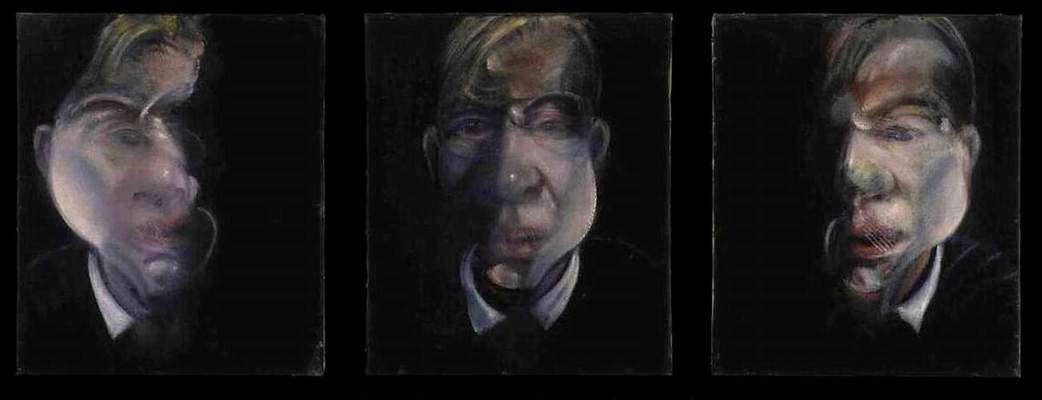
Three Studies for a Self-Portrait 1979 – 1980 Francis Bacon
Religious Musings on Francis
Bacon:
A Review of the Francis
Bacon Retrospective
Exhibition
at Tate Britain from
September 11, 2008–January
4, 2009
RINA ARYA | REVIEW |
IMPLICIT RELIGION | VOLUME
12 | NUMBER 1 | FRIDAY
AUGUST 7 2009
Francis Bacon is arguably
the most well-known British
artist after J.M.W Turner,
and his forthcoming
centenary in 2009 has been
well documented in both the
art world and the mass
media. !e BBC archive
contains a comprehensive
range of interviews and
footage with the artist. To
commemorate the centenary,
the Tate has put together
the third retrospective on
Bacon (the previous ones
were in 1962 and 1985 and
were also held at the Tate),
which has brought together
some of his best works from
different periods of his
life. This extensive
exhibition will then move to
the Prado (Madrid) from 3
February–19 April 2009, and
then on to the Metropolitan
Museum in New York from 18
May–6 August 2009
On entry to the exhibition
the viewer is faced with
the Second Version of
Triptych 1944 (1988).1 This
immediately sets us on
guard. Three menacing
beasts, one in each panel,
either turn their back to
the viewer (as in the left
panel) or snarl and snap. !e
notable absence of eyes in these
figures means that the
viewer cannot challenge the
positions that we are being
placed in because we cannot
confront these figures, but
are instead confronted by
them as they grimace and
growl at us. Fixed on
podiums, and against a
blood-red background, these
creatures foretell doom. The
monumentality of these
figures, each featured on a
panel measuring 198 x 147.5
cm and together spread
across the entire wall,
engulfs the viewer. Even
before stepping into the
room this painting is
visible from the open niche
and gives us a foretaste of
the show. The conspicuous
placement of this triptych
is deliberate and gives an
indication to the viewer who
is perhaps not so familiar
with Bacon’s work of the
preoccupations of his
subject matter and also the
alarming effect that his
paintings have on viewers.
As the title of this review
suggests, I want to
demonstrate the
preoccupation that Bacon has
with themes that are
addressed in religion: the
relationship between life
and death, the role of evil
in society, the position of
the human being in a world
that is bereft of God and of
ultimate meaning or purpose.
In a world without God, the
human is drawn closer to the
beast, and this is an
ongoing theme in Bacon’s
work (which is given a
particular focus in Room 1:
Animal).
Bacon employs religious
symbols, namely the
crucifixion (which is the
subject of Room 4:
Crucifixion) and the figure
of the pope (of which there
are innumerable examples in
the exhibition, from Head
VI, 1949, to the papal
portraits such as Study
after Velázquez, 1950,
and Study after
Velázquez’s Portrait of
Innocent X, 1953). In
statements about his work he
claimed to be resolutely
atheistic. Why then was he
relentlessly drawn to these
two popular iconographical
reference points of the
Christian tradition? I
suggest that he did not use
these symbols to support the
Christian narrative or any
other theological tradition,
but that he used these
symbols to explore questions
about the meaning of life
and existence. He explores
the human nature of
mortality and the plight of
being thrown into a Godless
world. The alienation of the
individual and the
realization of one’s fate
are questions relating to
what Tillich would describe
as being of ultimate
concern.
Rooms 1 to 4
The exhibition consists of
ten rooms, which the viewer
weaves his/her way through,
and the paintings are
largely arranged
chronologically (Room 4:
Crucifixion is an
exception). Each room is
given a name that
corresponds to the subjects
of the works. Room 1: Animal
examines the significance of
our animal instincts, which
are usually latent, and
demonstrates what happens
when they come to the
forefront of human
expression. In these
instances we experience the
brutal, ravening capacities
that exist beneath the
veneer of civilization. For
those unfamiliar with
Bacon’s art, this room,
rather in the manner of Second
Version of Triptych 1944,
presents a startling and
immediate connection to the
central issues of Bacon’s
concerns: his expression of
the proximity between the
human and the animal, and
the inevitable mortality
that encapsulates the
universal condition. !e
sense of universality is
conveyed by the absence of
distinctive features in the
works. In Figure in a
Landscape (1945) and Figure
Study I (1945–1946) the
presence of a body is
suggested, but the faces are
hidden from view. More
information is given in Figure
Study II (1945–1946)
and Painting (1946),
where we witness the face
that breaks out into a
scream. More concentrated
studies of the scream are
conveyed in Head I (1947–1948)
and Head II (1949).
In the crossover from the
human to the animal, and the
generalized sense of despair
articulated in these
examples, Bacon is conveying
the existential predicament
of the human in post-war
life.
Room 2: Zone focuses
attention on another
characteristic of Bacon’s
work, the pictorial frame.
In his works of the early
1950s Bacon was thinking
about the presentation of
form and he devised the
three-dimensional
space-frames that operate as
powerful devices in his
work. They serve to draw
attention to the
three-dimensional figure
within the “pictures’
fictive space” (Gale 2008,
107). Study for a
Crouching Nude (1952)
and Study after
Velázquez’ Portrait of Pope
Innocent X (1953)
conveys the effects of this
device. In both these
examples the striated
vertical veil of
brushstrokes breaks up the
surface of the painting and
draws the eye to the focal
point of the scream. In the
former example it draws
attention to the taut
musculature, of the body and
in the latter example we are
led to the point of
disintegration, symbolized
by the screaming mouth.
The literal darkness of the
palette and metaphorical
darkness of the sensibility
pervades Room 3:
Apprehension. The paintings
in this room concentrate on
a single anonymous male
figure in a dark suit. These
include Study for a
Portrait (1953), Study
for a Figure II (1953–1954)
and Study for a Portrait (1953), Man
in Blue V (1954) and Man
in Blue (1954). Other
paintings in the room focus
on the animalistic
tendencies in the human to
mate—Two Figures in the
Grass (1954) and cry—Chimpanzee (1955).
The black backgrounds
overwhelm and engulf the
viewer, bringing with it a
sense of doubt, despair and
apprehension, which
characterizes the atmosphere
of the room. This
apprehension is translated
into real fear in Room 4:
Crucifixion. If Room 3 can
be described as
encapsulating the
anticipation and limbo-state
of modern man, then the
fears are actualized in Room
4. !e fear and aggression
evidenced in the screams and
cries of so many of the
earlier figures are now
taken a step further in the
crucifixions, as we see the
mechanisms of torture: from
the figures who are tortured
to the torturers themselves.
The crucifixions
In his interviews and
written statements Bacon
denied using the symbol of
the crucifixion in a
Christian way to support a
particular faith. Among his
many explanations he
suggested that the
crucifixion operated as an
armature, which enabled him
to explore human
relationships and the
behaviour of one human to
another (Sylvester 1993,
44). The crucifixion
revealed the cruelty and
violence of human
interaction. In three of the
four crucifixion images that
feature here, Crucifixion (1933), Three
Studies for a Crucifixion (1962)
and Crucifixion (1965),
at least one figure looks as
if it is being crucified.
Comparisons are made between
Christ on the Cross, which
is well represented in the
history of art, and the
figure on a cross in a
generic crucifixion. In Three
Studies for a Crucifixion Bacon
makes the connection,
between the figure in the
right hand panel and
Cimabue’s Crucifixion 1272–1274,
explicit. He states, of the
representation of the Christ
figure in Cimabue: “I always
think of that as an image—as
a worm crawling down the
cross. I did try to make
something of the feeling
which I’ve sometimes had
from that picture of this
image just moving,
undulating down the cross”
(Sylvester 1993, 14). The
interplay of brutality in
Bacon’s crucifixions, as
seen by the bloodshed of the
figures on the cross, or the
perpetrators of the act,
such as in Second Version
of Triptych 1944, and Three
Studies for Figures at the
Base of a Crucifixion (1944)
reinforces the sacrificial
dimensions of the sacrifice
of Christ on the Cross, and
the concomitant religious
feelings that this act
symbolizes. The viewer is
indirectly made aware of the
ramifications of this act,
even if they do not
subscribe to the faith. The
symbol of the crucifixion,
which has been banalized and
sanitized, now takes on a
renewed sense of aesthetic
and spiritual focus. The
irony is that Bacon may be
vehemently atheistic, but by
continually referring to the
crucifixion he is drawing
attention to the very
tradition he denies. His
atheistic stance is
dependent on the affirmation
of theism in the first
place. In the Godless world
of Bacon’s generation, the
propensity for violence and
brutality is given a sharper
focus and these sentiments
are expressed in Three
Studies for Figures at the
Base of a Crucifixion (1944).
This painting is comprised
of three strange figures
separated into three panels
with each figure on a podium
and placed against a burnt
orange background. It has
already been referred to in Second
Version of Triptych 1944,
which as the title suggests
was clearly influenced by
this earlier triptych. Three
Studies was painted in
1944 and exhibited for the
first time at the Lefevre
Gallery in 1945. This is now
regarded as a seminal
painting because it
established Bacon into the
art world. The art critic
John Russell described this
work as causing “a total
consternation” (Russell
1993, 10–11). In contrast to
the other exhibits in the
1945 show, Bacon’s
contribution was regarded
warily and offered a vision
that many would have
preferred to put behind
them. Instead of deflecting
or distracting the focus
from post-war malaise, Bacon
fixed the focus entirely on
suffering, pain and despair,
which these three figures
articulate. These Tiresian
figures are prophets of
eternal doom. They cannot
see and we are placed in
this space to see what is in
front of us. These figures,
like the figures in the Second
Version forty years
later, are incomprehensible
forms that defy easy
classification. They have
qualities that are
unmistakably human and also
animal/bird-like. In the
earlier example, it becomes
apparent that the reference
to the crucifixion
in the title is not
reflected in the image
itself—the crucifixion is
absent. Furthermore,
contrary to one’s immediate
reflection on the title, we
are not looking at the, but
at a, crucifixion (Russell
1993, 11). The use of the
indefinite article alters
the potential meaning of the
work, and may provide
explanations for his
repeated use of the symbol.
Bacon is discussing the
crucifixion in a more
generic sense. Given the
political context of
post-war Europe, it is
plausible that this is a
statement on the violence of
wartime, but also more
banally in day-to-day
living. In his interviews
with Sylvester Bacon spoke
of the pervasive sense of
violence that he felt he
lived with (Sylvester 1993,
81–82). His background and
early childhood were
certainly tumultuous. His
early memories were of
upheaval due to the First
World World. He also
experienced the Blitz of the
Second World War and the
Irish Civil War (growing up
as a Protestant in Catholic
Ireland).
The presence of Second
Version of Triptych 1944 on
the way into Room 1 is a
reminder of the monumental
effects that the earlier
“version,” Three Studies
for Figures at the Base of a
Crucifixion, had on its
viewers and singles this
motif out as being amongst
the most powerful in
Bacon’s oeuvre. If
the 1944 example established
Bacon in the art world, then
this second version
undoubtedly consolidated his
reputation. One possible
attribution of the figures
in the 1944 example is that
of the Furies who seek
eternal justice and hunt
down wrongdoers. These
Furies stalk us on our
journey through the
exhibition from room to room
and appear in different
guises.
The main themes reflected in
the exhibition are Bacon’s
preconception with the human
form and the ontological
questions about the status
and place of the human being
in the late twentieth
century. In all his
depictions, whether of
anonymous and generic
figures who epitomise the
human condition, or in more
specific studies of his
friends in the portraits
(the subject of Room 7),
Bacon examines the mortality
of the flesh and the
proximity between life and
death. These concerns are
revisited in the final room,
Room 10: Late. In these
later works, which Bacon
painted when he was in his
seventies, he is seen facing
up to his mortality. The
disintegration or
dissolution of figures’
heads and the palpability of
the shadows (of death) in Triptych (1983)
reveal the workings of
death.
Religious musings
Interpretations of the
religious content and
sensibility of Bacon’s work
are often thwarted in Bacon
scholarship. Many defer to
the endless statements that
he made about his virulent
atheistic stance. They
interpret his use of the
religious images as formal
devices, which allowed him
to explore aspects of human
nature, but they do not
concede a religious
explanation of behaviour. I
argue that his attitude to
religion was problematic,
but we can speak of the
implicit religion in his
work. His images do not
support a theological
tradition and hence cannot
be described as explicit,
but they do engage in
theological debates and
speak of existence in a
Godless world. God is
featured as a palpably
absent presence: the grimace
of a biomorphic form, a
shadow that overspills a
body, the numerous dark,
black abyssal backgrounds.
Bacon dealt with the primary
themes about the meaning and
purpose of existence by
examining the mortality of
the flesh and the
intricacies of human
behaviour. In the absence of
any of the religious
structures of the afterlife,
his figures are left
contemplating the void. The
reflecting surfaces of the
glass, coupled with the
spatial inclusion of the
triptych devices pulls the
viewer in. We see our
reflections in the glass and
are variously positioned in
a cage, at the base of a
crucifixion and in a
background where we find no
familiarity and hence no
solace. The Godless world is
not a myth that is narrated
to us but something that we
are confronted with in the
very fabric of the work.
I walked around the rooms
sometimes following the
rooms in sequence and at
other times backtracking.
The gravitas of the
first image preyed on my
mind and became weighted
down by other similar images
of distortion and
degeneration. Bacon is
inescapably imparting a
message about the human
condition that is
pessimistic insofar as it
makes us engage with our
mortality and transient
position in the world but it
is also uplifting because it
is energizing and has an
urgency and immediacy that
makes us rethink our place
in the world. I walked away
feeling that I had
experienced a narrative of
the evolution of the human
which turns back in on
itself thus revealing the
animal in the human. Somehow
this did not feel
stultifying but progressive
and paradoxical. !rough his
sophisticated pictorial
technique Bacon takes the
viewer back to the natural
body, which is undone of all
its cultural fetters, and we
experience it in all its
spasmodic ways.
Critical appraisal
The arrangement of the
paintings enabled the
amateur to make sense of the
broad themes of Bacon’s
oeuvre, and, for the more
accomplished viewer, to
trace the development of
Bacon’s style and technique.
Whilst the division into
named rooms is interesting,
it might have been valuable
to make more thematic
comparisons. Bacon was a
painter who emphasised the
importance of process and
the influence that chance
exerted in his work.
However, this was not
adequately conveyed in the
selection of images. The
curators deliberately chose
his masterpieces but it
might have been an
interesting contrast to see
lesser works, whether in
development or technique, in
order to make the
adjustment. The array of
works was at times simply
too much to take in, and
certainly so for one visit,
but when I considered the
volume of work against the
purpose of the show—a
retrospective and a
commemoration of his
centenary—then I began to
revise my opinion. The
earliest wall text states
that philosophical notions
run through the exhibition
like a spine, but there was
a dearth of philosophical
commentary to bolster the
images, or rather the wall
texts did not provide
adequate information. !is
could be construed
positively, to make the case
that the power of Bacon’s
paintings is such that they
can speak for themselves and
do not require texts to
impart meaning.
Another apparent mismatch
between intention and
delivery was the presence of
Room 6: Archive. In 1998,
John Edwards (Bacon’s former
lover) gave the contents of
Bacon’s studio and living
space at 7 Reece Mews (in
South Kensington) to the
Hugh Lane Gallery, Dublin.
An incredible amount of
source material, preparatory
sketches, photographs etc
was unearthed in the
reconstruction and
transplantation from the
first to the second site.
Room 6 chronicled the
posthumous investigation of
Bacon’s studio. This body of
sources was revelatory
because it gave us important
information about Bacon’s
working processes and modus
operandi. In his
statements and articulations
of the brush on canvas it
would appear that Bacon
utilized the role of chance
in his work, the accidental
mark. The virtuosity of his
brushwork in the examples of
images from Room 1 to 5
certainly indicated this.
The archival material
presented here revealed the
mismatch between Bacon’s
statements and his actual
practice, as it was revealed
from photographic and other
sources that he did preparatory
paintings. The evidence here
to a greater or lesser
extent undermines his
professions of spontaneity,
the role he awarded to
chance and intuition.
Whilst I understand the
significance of this archive
material both in
authenticating Bacon’s
method of working and also
as contributing to Bacon
scholarship, I feel that it
was poorly placed here. It
was deeply idiosyncratic and
strange to go from Room 5:
Crisis, to the orderliness
of the archive. It
interrupted the flow of
being absorbed in the depth
of his visions to having
suddenly to retract from
those recesses to a stark
room filled with a
proliferation of images and
sanitized glass cases
containing source material.
!e wealth of material was
tremendous and had been
classified with astonishing
precision. But it would have
been well placed in an
adjunct room, or at the
beginning or end of the
journey. !e experience of
the subsequent rooms
represented a deviation from
Rooms 1 to 5 and invoked a
more critical perspective on
Bacon’s intentions. Bacon
left an indelible mark on my
imagination when I first
discovered his work in 1998
and this exhibition bears
testimony to this great
artist. In spite of the
familiarity of individual
pieces of his work, which
fetch millions at auction
houses, and the growing
trend of contemporary
artists to explore
distortion and the
grotesque, Bacon’s art still
has the power to wound and
strike the nervous
sensibilities of the viewer.
In his engagement with the
pain and suffering of the
mortal condition, his
portrayal of the evil in
humankind, of the reality of
the death of God and the
subsequent redundancy of the
symbol of the Pope in the
contemporary age, Bacon can
be said to be working out
problems that are resolutely
religious. He was a militant
atheist who was haunted by
the presence that the
absent-God exerted in the
world.
Note
1.
In the catalogue
accompanying the exhibition Second
Version of Triptych 1944,
1988 is featured as the tail
end of Room 10: Late.
However, we actually see the
painting before we enter
Room 1.
References
Gale, M. 2008. “Zone.” In Francis
Bacon, edited by M. Gale
and C. Stephens, xx-xx.
London: Tate Publishing.
Russell, J. 1993. Francis
Bacon. London: Thames
and Hudson.
Sylvester, D. 1993. The
Brutality of Fact:
Interviews with Francis
Bacon. London: Thames
and Hudson.
CBS 2 At The Met:
Francis Bacon
DANA TYLER
| REPORTING | CBS 2 NEWS
| SUNDAY AUGUST 2 2009
NEW YORK (CBS) ― Brace
yourself for artist Francis
Bacon. Passionate about
painting, the Dublin-born
Bacon, who never went to art
school, is considered one of
the most influential
European painters of the
20th century.
In this exhibition,
celebrating the 100th
anniversary of Bacon’s
birth, the artist’s twisted,
tortured human figures, and
dramatic interpretations of
screeching religious icons,
demand your attention.
Surrounded by 65 dark, and
dramatic works, at the met,
you might think bacon was a
tormented soul. But Curator
Gary Tinterow tells CBS2’s
Dana Tyler, "Actually he was
a very cheerful person. He
talked about not believing
in God, being a confirmed
atheist. But he said there
is no meaning to life, there
is only meaning one gives it
through daily work, through
what we achieve on a daily
basis. There’s no
predetermination he would
say, but he would say I’m an
optimist, an optimist about
nothing. In other words,
there’s not grand scheme but
he took pleasure in his
daily life."
World War II is the subject
in Three Studies For
Figures at the base of the
Crucifixion from 1944.
For Curator Gary Tinterow,
it’s the most remarkable
painting in the exhibition.
He said, "This is a work
that Bacon showed in London
in April 1944. The month
when Mussolini was hung.
Hitler committed suicide in
his bunker in Berlin, and
FDR died in the United
States. So it was a earth
changing, shattering,
momentous moment. And he
releases this painting that
he had been working on for
about a year showing these
strange, nightmarish
creatures that look like an
amoeba. We recognize that we
want to anthropomorphize
them and we want to see
human aspects right in the
mouth and the eye. But
they’re horrific."
Tyler says, "Of course my
eye is drawn here?" Tinterow
responds, "Yeah, and the
mouth is so fascinating with
Bacon. Bacon said many times
that I’m fascinated by
mouth. He had books on
diseases of the mouth and
radiology."
Bacon was fascinated by Nazi
imagery. A 1946 work,
called Painting, shows
Adolph Hitler’s reception
room in his chancellory in
Berlin.
Tinterow: "The architecture
of power and that’s the
statement that he wanted to
make with his pictures. He
wanted to explore our
fascination with power. Our
complicity and holding
people up who in fact are
just empty hallow men. And
the colors are meant to be
shocking and vibrant and
harsh and to go against
conventions of good taste.
He wanted to, he said,
unlock the valves of
feeling, in other words he
wanted to grab you by your
guts."
Bacon’s personal life plays
out on canvas, in his 1971
triptych In Memory of
George Dyer. Tinterow
explains, "This is one of
the most moving pictures in
the exhibition because it
was painted after his
companion, long time lover,
and his muse George Dyer,
who is seen there on the
right, committed suicide in
their Paris hotel room the
night before his big opening
of a retrospective at the
grand palace. Bacon went on
to the opening and pretended
nothing had happened but it
was tremendously devastating
for him."
An artist who never lost his
edge, Francis Bacon died in
Madrid in 1992. He was 82
years old. Francis Bacon:
A Centenary Retrospective,
on display until August
16th.
BACON, HALF-BAKED
BEN DAVIS
| REVIEW | ARTNET
MAGAZINE | TUESDAY 28 JULY
2009
The large Francis Bacon show
currently drawing multitudes
at the Metropolitan Museum
of Art really speaks for
itself. You don’t need any
theory to love it. The hits
are all there — the wailing
Popes, the naked wrestlers,
the melted portraits of the
British artist’s colleagues
and lovers. All of these are
crowd-pleasers, exuding an
atmosphere of fertile angst
that is immediately
accessible. (The first thing
you see as you enter, in
fact, is Bacon’s triptych of
serpentine, phallic
monsters, inspiration for
the chest-bursting creature
of Alien fame, a curatorial
decision that hammers home
the populist appeal of
Bacon.)
As I passed through the
galleries one Tuesday
morning with the crowds,
however, I recalled that
despite the horror-movie
vibe of it all, there is a
particular reference that
gives Bacon’s work a sheen
of intellectual mystique for
me: Gilles Deleuze’s small
book, Francis Bacon: The
Logic of Sensation, first
published in 1981. The
much-cited postmodern
philosopher, part of the
canon in any college theory
class, was a Bacon fan. That
fact by itself has always
made Bacon’s work seem
somehow important in a way
it might not otherwise have.
I know I’m not the only one
who feels this way. I know
because the Met show quotes
Deleuze in its wall text
about one of the iconic Pope
paintings: “Bacon’s scream
is the operation through
which the entire body
escapes through the
mouth.” Every single writer
in the Met catalogue feels
bound to reference Deleuze’s
book (though Martin Harrison
does acknowledge that
Deleuze is wrong to ascribe
to Bacon a fundamentally
anti-narrative agenda; more
on this in a sec.) Even
Bacon’s biographer, Michael
Peppiatt, whose Francis
Bacon: Anatomy of an Enigma was
recently republished to
coincide with this show,
tells us that Deleuze’s
treatise “put discussion of
Bacon’s painting on a new
plane of pure, often playful
and always inventive
intellectual
conjecture” — though he
doesn’t say that much more
about it (Bacon and Deleuze
apparently did meet, once,
in the early ‘80s; as
Peppiatt puts it, “no
friendship evolved”.
A few years ago, University
of Minnesota Press sent me a
copy of a new edition of The
Logic of Sensation when
it was reissued in a new
translation. After seeing
the show at the Met, I
decided to pick it up and
see if its insights still
held today.
I’ll spare a build up and
say that I don’t think The
Logic of Sensation does
hold up to scrutiny (though
any book that contains a
sentence as crazy as “The
head-meat is a
becoming-animal of
man” can’t be all bad
either). Before I get into
the details of why, however,
I will note that Deleuze’s
sibylline manner, which I
think connotes a sense of
timeless intellectual
mystery for his admirers,
today strikes me as a dated,
period style. Overcomplex
and bombastic, it’s a bit
like the philosophical
equivalent of prog rock. The
Logic of Sensation was
published the same year Rush
released Tom
Sawyer — coincidence?
(Deleuze himself would
probably prefer a comparison
to Talking Heads; he
quotes Crosseyed and
Painless somewhere in this
book.)
What, in essence, is
Deleuze’s argument about
Francis Bacon? The
Logic of Sensation amounts
to 17 tangentially connected
essays, each one a different
formal/philosophical
analysis of one aspect of
Bacon’s practice. Deleuze
considers, to pick a few
random examples, the fact
that Bacon tends to isolate
figures in a round area at
the center of the frame; the
recurrence of animal imagery
in his paintings; his
recourse to the triptych
format; and his use of
colors. He postulates a
common “logic” that
underlies all these various
choices. In essence, Deleuze
sees in Bacon’s liquescent
brand of Expressionism an
illustration of his own
philosophical thesis that
what is most real about
bodies is their virtuality,
their irreducibility to any
one fixed form or identity.
Thus, for Deleuze, the
isolation of Bacon’s figures
at the center of the frame
is a way of cutting them out
of any narrative relation
that would ascribe to them a
fixed meaning; the animal
imagery reflects the
blurring of the self and
other; the triptych is a way
of showing different aspects
of a single form without
reducing it to a common
essence; and Bacon’s use of
colour is a way of escaping
the hypostatizing effect of
linear representation,
instead rendering spaces and
bodies as flows of mercurial
energy (“Each dominant
colour and each broken tone
indicates the immediate
exercise of a force on the
corresponding zone of the
body or head; it immediately
renders force visible.”
And what’s wrong with all of
this? Nothing — unless you
actually take it seriously.
I’ll proceed through four
counts, from the most
inconsequential to the most
compromised aspect of
Deleuze’s adoption of Bacon.
First of all, Deleuze’s
adventure into art is
thrilling — but when he
actually tries to talk about
art history, he plays so
fast and loose with
references that it is
distorting. One of Deleuze’s
least helpful contributions
to understanding Bacon, for
instance, is his
pronouncement that “Bacon
first of all seems to be an
Egyptian.” This is fine as a
superficial bit of
colour — there’s nothing
outrageous about the
observation that Bacon’s
squashed spaces might
resemble the absolute space
of Egyptian art a little.
But this is not a flourish
for Deleuze; he repeats it
multiple times, and actually
seems to think that Bacon’s
Egyptian-ness is a matter of
world-historical import.
When he asks the reader what
accounts for
the difference between
Bacon’s painting and
Egyptian art, Deleuze
actually replies by stating
the following: “What is at
stake here is no longer just
Bacon, but undoubtedly the
entire history of Western
painting” (Gotta love how
art theorists who reject all
historical “meta-narratives” can
let a statement like that
slide). But then it turns
out what is important
about “Egyptian art" for
Deleuze is just one
thing — bas-relief, an art
form which (so he says)
collapses the opposition
between visual and haptic
space, a quality that
Deleuze also values in
Bacon’s painting. Never mind
that bas-relief is not
really particular to Egypt,
or that there is really a
lot more to Egyptian art
than bas-relief. . . I
suppose if I defined an
apple as any sweet round
fruit, then an orange would
also be an apple.
Second, while the power
of The Logic of Sensation is
due largely to what
translator Daniel W. Smith
calls
Deleuze’s “extraordinarily
specific and detailed
analyses of individual
paintings,” in fact the
account has a yawning blind
spot when it comes to the
actual work of Francis
Bacon. If you had to
describe the characteristic
tone of Bacon’s imagery,
you’d probably think of
claustrophobia, of dread, of
a sense of visceral
repulsion. And yet, Gilles
Deleuze’s entire argument is
based on bracketing this
aspect of the work out as
insignificant. From
Deleuze’s own introduction
to his book: “Bacon, to be
sure, often traffics in the
violence of a depicted
scene: spectacles of horror,
Crucifixions, prostheses and
mutilations, monsters. But
these are overtly facile
detours. . . What directly
interests him is a violence
that is involved only with
colour and line: the
violence of a sensation (and
not of a
representation).” Later, he
tells us that “Bacon’s
deformations are rarely
constrained or forced, they
are not tortures, despite
appearances,” and still
later, he asserts that
Bacon “is not a painter who
‘believes’ in death. His is
indeed a
figurative misérabilisme,
but one that serves an
increasingly powerful Figure
of life.”
But no, wrong — Bacon’s
paintings are inescapably
about crucifixions,
monsters, torture, death,
albeit of a surreal variety.
That is part of
their “logic." A work like Paralytic
Child Walking on All Fours (1961),
on view at the Met, is
pregnant with all sorts of
meanings — but it does
invoke the image of a
disabled child, and owes
some of its impact to the
fact that this referent is
explicit (we can be certain,
because it is citing a frame
from an Eadweard Muybridge
serial photo). Deleuze,
admittedly, is interested in
championing the concept of
the “diagram,” a manner of
representing bodies that, he
tells us, doesn’t try to
replicate an original
referent, but instead
strives toward “a creation
of original relations that
are substituted for the
form.” Apparently, such an
operation renders subject
matter indifferent; or,
better said, it seems that
technique is the only real
subject matter for Deleuze.
In effect, what Deleuze is
doing is saying that Bacon
is not “really” interested
in what he is clearly most
interested in, then
rhapsodizing over how well
his own edited version of
the work fits his own thesis
Now, of course, one can
argue that some secret
life-affirming force is at
work underneath Bacon’s
imagery of horror and
loneliness — but in that
case, you still have to
account for how the explicit
and buried contents
interact. If Bacon’s
painting is fundamentally
about unleashing powerful
flows of desire, why do
these primarily manifest
themselves through horrific
imagery? It is not as if
sometimes he paints blood
and ghouls, and sometimes he
paints rainbows and
frolicking puppies; he’s not
indifferent to content.
Similarly, it is no good to
state that what is most
fundamental about Bacon is a
bracketing out of all
narrative suggestion, when
this is clearly not the
case — at the Met, a work
like Study for a
Portrait of Van Gogh VI (1957),
a depiction of the shadowy
Dutchman slouching across a
yellow field weighed down by
painting instruments, as if
in a funk, proves that Bacon
is interested in plugging
his paintings into
recognizable figures and
stories, however
fragmentary. (As a matter of
fact, you can even say he
had a taste for
stories — Peppiatt notes
that the van Gogh series was
inspired by the Kirk Douglas
film Lust for
Life!)
Deleuze fans will say that
the philosopher is not
interested
in “interpreting” paintings,
but in generating new ideas
about them. However, if such
a method is not going to
operate just as a license
to make shit up, it must be
based on a reading of the
actual material at hand. In
his famous readings of
philosophers, Deleuze prided
himself on a method of
overreading, using their own
words to create something
new and “monstrous” by
pushing their internal logic
to its limit — “the author
had to say, in effect,
everything I made him
say.” This is not the method
he follows in the much more
openly “monstrous” case of
Bacon’s art. Here he is
simply superimposing his own
affirmative philosophy onto
his object.
Both of these problems with
Deleuze’s reading of
Bacon — his haphazard use of
history, his tone-deafness
when it comes to the
paintings themselves — are
symptoms of a more
fundamental issue of
approach. For, despite his
attentiveness to specific
artworks, it is not really
art that interests Deleuze.
He is only interested in art
as it relates to a specific
problem in philosophy, which
is the representation of
being. Thus, the history of
art and the quirks of
Bacon’s particular oeuvre
both get reduced to
responses to the dilemmas of
representation — the space
of “classical” painting, for
Deleuze, is reducible to a
manner of establishing
an “objective” space which
separates out the subject
from the object, while he
defines the achievement of
Bacon as having to do with
the way his work undoes this
separation, collapsing
visual space and returning
the subject to its vital
co-dependence with its
environment.
There is some truth to this
reading (though I will take
David Harvey’s account of
the Renaissance production
of “objective” perspectival
space as a function of a
nascent mercantile
capitalism’s needs for
objective cartography and
scientific knowledge over
Deleuze’s placeless,
causeless account any day).
The real problem lies in the
way that The
Logic of Sensation reads
artworks as nothing more
than responses to
intellectual problems,
turning philosophical
pertinence into a device for
evaluating artistic quality.
Despite the protestations of
both his translator and Tom
Conley, who writes an
afterward for the most
recent edition of the book, The
Logic of Sensation does
in fact amount to a
philosophical aesthetics. It
is full of casual
generalizations about the
ontology of art that are
used as evaluative tools.
Take the following: “[T]here
is a special relation
between painting and
hysteria. . . Painting
directly attempts to release
the presences beneath
representation, beyond
representation.” Deleuze
then goes on to judge the
success of various styles of
painting against this
definition of painting’s
essence.
The paradoxical result,
given this thinker’s
reputation as a champion of
difference, is that various
artworks are conceived of as
offering right or wrong
answers, thereby strictly
limiting the modes of
appreciating art: “There are
two ways in which the
[modern] painting can
fail,” Deleuze pronounces
confidently, “once
visually” — that would be
abstraction of the
Mondrian/Kandinsky variety,
deemed to be too wrapped up
in a quest for ideal
Forms — “and once
manually.” The latter case
is that of Pollock-style
abstraction, which Deleuze
finds not merely
distasteful, but
demonstrably false. “By
liberating a space that is
(wrongly) claimed to be
purely optical, the abstract
expressionists in fact did
nothing other than to make
visible an exclusively
manual space.” Marcel
Duchamp, likewise, comes
under fire for being too
random, and therefore still
implicitly posing a
difference between human
agency and impersonal
chance. In the end, it seems
Deleuze’s theory is only
flexible enough to
accommodate Cézanne,
Michelangelo, Rembrandt and
Bacon.
Which brings me to my final
point, which is about the
self-undermining nature of
Deleuzian “logic” in
general. Even philosophical
rivals like Alain Badiou
will admit that Deleuze
constructed a system that is
formidably suggestive.
However, it must be admitted
that any attempt to
actually do anything with
his thought has mainly added
up to nothing, or worse. The
most successful attempt to
put Deleuze’s insights into
political form, for
instance, is Michael Hardt
and Antonio Negri’s tome Empire,
a work that essentially
amounts to proposing not
having a plan as a strategy
for the anti-globalization
movement (This is not a
surprise, really — Deleuze’s
frequent role-model was
French philosopher Henri
Bergson, whose reflections
on the "élan vital" famously
became reactionary when
taken up as a political
philosophy; the Bergsonian
tendency to leave politics
to "the irrational, to
chance" is a subject of
critique in Gramsci’s Prison
Notebooks).
Who was Gilles Deleuze? He
was a French leftist
philosopher who wrote all
his major works in the ’60s
and ’70s, most of them in
the wake of the uprising of
May 1968. As such, his work
partakes of the sense of
radical intellectual
experimentation of that
period, but also of the New
Left’s disillusionment with
material and historical
explanations for reality
(somewhat understandable,
given the Stalinized nature
of the French Communist
Party’s politics, and the
major role it played in
French intellectual life).
The philosophy Deleuze
offers, in his book on
Francis Bacon and elsewhere,
gets much of its appeal
because it still resounds
with liberatory rhetoric. We
live in a world that
brutally instrumentalizes
bodies, tries to sell people
unrealistic Platonic ideals
of what they can be — so
Deleuze’s anti-Platonist
philosophy that bodies
cannot be confined to any
one definition, that they
are indisociably part of a
constantly surging flux of
self-differentiating energy,
has a potent social content.
(It’s always worth
remembering that Deleuze,
like his colleague Michel
Foucault, had a famous — if
equivocal — association with
the gay liberation
movement.)
Nevertheless, the problem
with Deleuze’s attempt to
write difference into
ontology is that in reality
what is “different” is
determined in relation to
actual, historical events,
not in some abstract,
free-flowing psychic space.
Without anchoring concepts
in relation to a real
context, there is no way to
stop one’s prescriptions
from becoming ahistorical
formulae, no matter how many
times you state that they
can’t be. In some
contradictory way, I think
that it is precisely this
formalistic character which
explains the continued
appeal of Deleuze in art
circles today: He allows his
followers to insist that
they are committed to
liberating desire from all
pre-established structures,
while in fact confining
themselves to a pretty
narrow, predictable
structure (Badiou rightly
declares Deleuze’s oeuvre to
be
conceptually “monotonous” underneath
its superficial complexity).
In What is
Philosophy?,
Deleuze and collaborator
Felix Guattari tell us that
philosophy is not about
establishing fixed axioms
and rules, but about
creating new concepts, new
trajectories of thought. It
should therefore be deeply
embarrassing that 99 percent
of all writing on Deleuze is
simply slavish blow-by-blow
recapitulation, and that the
Met show pays homage to him
as a kind of
aphorism-spouting sage.
In the final analysis,
Francis Bacon’s oeuvre
itself provides a tremendous
example of the necessity of
a historical approach. Read
Jerry Saltz’s recent
biographical sketch of
Bacon’s career [see Sacred
Monster, May 27, 2009].
Whereas in The Logic of
Sensation, it often seems
that Bacon’s career
trajectory is nothing but a
circling ever closer to
Deleuze’s own position,
Saltz shows how Bacon’s
style, at one point an
expression of a potent and
unique worldview, eventually
became a gimmick, a defense
mechanism. The very same
formal tics that had been an
expression of an original
thought became a way of
resisting confronting
further original
thought. “What’s especially
poignant about Bacon is that
he knew he’d built his own
prison. As early as 1963, he
referred to ‘my rigidness.’
He talked about the
‘drawback’ of his style and
how he used painterly tics
as a ‘device.’ ”
My sense is that these days the gleam is off the postmodern apple. But intellectual life moves slowly, weighed down by the structures of tenure, inherited prestige, institutional inertia and so on. There will always be room for difficult-to-understand figures, simply so that curators and scholars who need to establish some kind of objective authority in the profoundly subjective field of art can invoke something that goes over the head of the average person. But it seems to me that these days the recourse to Deleuze’s flawed Bacon book is its own kind of rigid “reflex,” its own kind of inert intellectual “device.” In invoking its authority, it’s worth wondering whether we aren’t building a prison around Bacon, rather than seeing him well.
BEN DAVIS is associate editor of Artnet Magazine.
Night in the Museum
John Haber in New York City
Francis Bacon
JOHN HABER | REVIEW | HABER ARTS | WEDNESDAY, 22 JULY, 2009
In Three Studies for a Crucifixion by Francis Bacon, no one and everyone is on the cross. Each panel, as the title suggests, may show the same room. Its oval and red walls hint at decorative luxury. Its vomit-yellow carpeting terminates in the dark yellow wainscoting of period England. Repeated across three panels, the room could easily mark an estate.
It could also mark a museum. Museums used to affect these lavish tastes, before Modernism’s white cubes, and still may today in much of England. Those black rectangles in place of doors and windows could be the paintings. The towering side of meat at right could be sculpture. The grisly, contorted nude on a couch at center could have come right off the wall. Two men in the middle ground at left, cautiously edging their way toward the center panel, could be trapped in the museum at night.
That pretty much describes, too, the experience of a Bacon retrospective. It also describes the experience of art for Bacon. He had no sympathy for Modernism, but he felt cut off from the past. He could not or would not train academically, in a country that clung to academic standards, but he could not help judging himself accordingly. He paints revulsion—against fine art, against the flesh, and against himself. As in Three Studies for a Crucifixion, even the dead are dying.
Biography of a slow death
They can take their time doing so. Critics vilified his early work, from the 1930s. And in his usual mix of loathing and self-loathing he burned it all—except for a single Crucifixion. By his death in 1992, at age ninety-two, he had become England’s modernist old master, with two Tate retrospectives in his lifetime. A reactionary like Robert Hughes can champion him, while expressing Hughes’s own revulsion at the work. Most people will know Bacon’s Pope Innocent X better than its source, a portrait by Diego Velázquez.
In that early Crucifixion, he sketches Jesus in quick, white curves like a stick figure. Yet he gives it a solid cross with a traditional footrest, like a sculptural base. In 1944, with Three Studies for Figures at the Base of a Crucifixion, he already aspires to a triptych. What Bacon gives to art history, he takes away and then gives back again. He often lives much the same way, on a mix of art and petty theft. He drifts to and from Europe, barely getting by.
In his next work, he sticks to heads rather like cows and to half figures in a dark, shallow space. It is again the space of inexplicable torment, and it is again the museum. Hints of a box enclose the figures. It could stand for a jail or a witness stand. A homosexual then faced criminal charges. It could also stand for the glass case for sculpture in older museums.
He has discovered Pablo Picasso. Naturally he interprets Cubism as distortion, and naturally he loves it. He has also discovered his most famous subject, the Velázquez portrait in Rome’s Galleria Doria Pamphili. Bacon depicts the pope screaming over and over, to the point of self-parody. Sometimes the picture plane forms vertical stripes or a kind a veil across and through the figure. It, too, is a kind of dismemberment and confinement.
Bacon has a new lover in the 1950s and early 1960s—and his most intense work. It includes Three Studies for a Crucifixion, from 1962. It includes a sudden burst of colour into drawing, in an imitation after Vincent van Gogh, whose free charcoal strokes also influence a painting of a baboon. This lover dies of various forms of self-abuse. The artist starts over, while he returns to the same compositions. In the late 1960s, again with a new lover, Bacon finds a larger scale, calmer colours, and a kind of openness.
His subject, however, remains harsh. When this lover dies of an overdose, the artist finishes his career with an extended memorial. It may signal a final repose, a well-earned simplicity, or more glib repetition. A shadow or a bloodstain may interrupt an open expanse. A repeated head may seem to melt. And it, too, is likely to form a triptych—displayed, as always with Bacon, behind museum glass.
Tiptoeing around Modernism
None of this may mean much to Americans. It can seem like internecine warfare in a country that never quite got it. Margaret Thatcher still considered Bacon’s art immoral. By her time, too, it had become modern. Even now, one can see critics straining to be fair—and to tiptoe around his relationship to Modernism. I am doing the same thing.
A magazine profile evokes the psychic drama of Bacon’s homosexuality. It also describes the art as "cartoonish" and the late work as worthless. A newspaper review seems to defend it, but the reviewer repeats several times that she must withhold judgment. "You may love or hate his work," but she has a job to do in describing it. Another critic says at the start that he will stick up for American art. Then he qualifies his account to the point that neither nation is a winner.
The Met and the Tate, which together originated the show, strain in order to boast. Gary Tinterow, the Met’s curator, compares Bacon’s flat colours to Mark Rothko. Bacon did much the same thing, although without mentioning Rothko. In his Heads from the 1940s, he said that he was exploring every shade of an open mouth. In practice, they all look slate grey, and the edges of the canvas look emptier still. Colour interrupts at last, all at once, in the rich purple of the papal cloak. Even then, it enters as symbolism rather than as formalism.
The Irish-born artist truly belongs to England—along with what Jed Perl, ever the angry conservative, calls his "literary sensationalism." It echoes his lifelong status as an outsider. If he had a breakthrough, most would name Painting of 1946. That work gives flayed flesh the outstretched arms of a Crucifixion. In front of it, the misshapen man carries an umbrella. René Magritte would recognize him as a Londoner.
Modern art did not have to fuss so much over the past, or did it? It could break with art history, as with the Futurist manifesto, without looking back. It could appropriate the past tenderly and mournfully, as with Joseph Cornell. It could parody the past joyfully, as with Dada. It could claim its inheritance from the Louvre and Nicolas Poussin,with confidence, through Paul Cézanne. It could also descend into violence, especially in performance.
By the same token, Bacon has an ironic heritage today, now that the struggles are past. As Roberta Smith notes, the Young British Artists are incomprehensible without him. For Tracy Emin, her whole life is about sex in the meat market. The late Picasso, too, struggles with Velázquez. And then Martin Kippenberger ends his short career with self-portraits after Picasso. Where Picasso looks quizzical, weary, or jaunty, Kippenberger looks simply in ruins—like a head by Bacon.
A revulsion at art
Bacon has managed to become both postmodern and quaint. On the postmodern side, he is tailor-made for Julia Kristeva and her Powers of Horror. Kristeva, a philosopher and psychoanalyst, could have captured his revulsion, with what she calls abjection. She describes it as a condition of the marginalized, outside the "symbolic order" and before words. She also considers it central to art, much as for Antonin Artaud’s "theatre of cruelty." Early on, Bacon in fact devoured an ancestor of her canon, Nietzsche, and he liked to say that he painted meat because it is beautiful.
One might, I hope, refuse to accept revulsion—or Bacon’s life—as a given for homosexuality. He may have hated himself, but he knew what he was doing. In a photograph of 1951 by Cecil Beaton, he shrinks back against a wall of framed art. He looks like a figure out of Magic Realism or a slightly puffy William F. Buckley. A notoriously charming bully, he is going along with the game and creating the illusion. And yet he means it, too.
He paints Velázquez from postcards, many of them. Even when he is in Rome, he avoids seeing it in person. He never paints from life, and the Met supplements its sixty-six paintings with a packed room of photographs. As usual, the loathing cuts both ways. Is he refusing academic tradition, or is he unable to deal with the flesh? Art history is dead, and nothing else will replace it.
It is clearly a place of confinement. In Three Studies for a Crucifixion, its shape and colours press in. The right panel has no windows all—just an extra partition and, behind it, a circle of bones on the floor. Alternatively, that partition could represent another sculptural display case and another enclosure. Sides of meat or perhaps fighting dogs, flatly painted, press against the picture plane at left. Another shadow laps up from the bottom of the picture plane at right.
The scene is also the place of art. Despite the title, one can see the three panels as a single drama, like a Renaissance triptych. The figures at left face toward the center, like disciples at the foot of the cross. Even so, they follow ambivalently. They may sneak about, and they refuse to swoon. Bacon has also displaced the closest parallel to a Crucifixion to the right panel.
The two men at left could stand for him and a lover. Bacon is furtive and trapped, but also desperate to enter the main action. The man behind him hangs back, his arms thrust out. Is he impatient, defiant, or just a thug? He does not notice that this brings him in closer parallel to the meat. Bacon is drawn to both and in revulsion at both, and no one can appreciate his revulsion but himself.
Francis Bacon: A Centenary Retrospective ran at The Metropolitan Museum of Art through August 16, 2009.
Francis Bacon’s Strange Sizzle
BY MARIO NAVES | ARTS | THE NEW YORK OBSERVER | SUNDAY 19 JULY 2009
“Francis Bacon”, a retrospective timed to the centenary anniversary of the artist’s birth (he died in 1992 at the age of 83) is on display at the Metropolitan Museum of Art, his toothy monsters, humping, anonymous men and slabs of meat installed directly off the European wing, a stone’s throw from Rembrandt, Goya and Velazquez.
Bacon would have been pleased by the proximity. Though his contorted figures owe a significant debt to Picasso—their roiling distortions being an almost sculptural equivalent of Cubism’s pictorial fracturing—Bacon’s charnel-house dioramas are, in pivotal ways, unmodern. (Given Bacon’s distaste for abstraction, the pictures could be considered anti-modern.) The ready-made gravitas and epic nature inherent in the tradition of Western painting suited Bacon’s flashy ambitions—hence, the bald reliance on Velazquez’s Portrait of Pope Innocent X, Grunewald’s Isenheim Altarpiece and the heaving musculature of Michelangelo’s nudes.
But Bacon was, if not a strict Modernist, then certainly a creature of the modern age. A niggling strain of Surrealism infiltrates the work, as does the collage aesthetic: His compositions are piecemeal affairs, with their uninflected planes of flat color, malleable forms and decal-like figures. His philosophical mien, a lean variant of Nietzschean atheism, is reflective of a more-jaded-than-thou postwar intellectualism. “I haven’t got any morals to preach,” Bacon stated. “I just work as closely to my nerves as I can.” A miserable narcissism permeates the work.
Then there’s the almost Warholian poaching of mass media. Bacon mimicked to startling effect the filmed image—his gauzy slurs of oil paint take on a ghostly, cinematic allure. His sources ranged from Eisenstein’s Battlship Potemkin and Eadweard Muybridge’s The Human Figure in Motion to beefcake magazines like MANifique and Man-O-Rama, newspaper clippings of Himmler and Goebbels and photo-booth self-portraits. You can see actual examples of Bacon’s image stockpile at the Met, much of it grubby with paint. It’s a devastating testament to Bacon’s paintings that the reference materials are sometimes more diverting than what he made of them.
The Met show is fairly selective, but it’s endless all the same. How much designer Grand Guignol does one person need? Bacon’s vaunted embrace of chance incident—that would be the ejaculatory blurts of paint flung directly from the tube—are no less false than the late triptychs, wherein we see an artist who’s become a sheepish victim to his own style. It’s the overweening calculation of Bacon’s art, its soulless theatricality, that marks him not as a descendant of the Old Masters but as a progenitor of corporate nihilists like Damian Hirst, Jake and Dinos Chapman and Jenny Saville. Like them, Bacon makes a provocative first impression, but then leaves us with little more than a cold rush of artifice.
Francis Bacon: A Centenary Retrospective at the Metropolitan Museum of Art, 1000 Fifth Avenue, until August 16th
Bacon and the Old Masters
RICHARD LACAYO | REVIEW | TIME | WEDNESDAY 15 JULY 2009
I was at the Metropolitan Museum today for another look at the terrific Francis Bacon retrospective that I’ve written about a few times. What struck me this time is how being surrounded by galleries of Old Masters at the Met brought forward aspects of Bacon’s work that didn’t come to mind so readily when I first saw the show last year at Tate Modern in London.
At the Tate you could go from the Bacon show to the Tate’s permanent collection, which is strictly 20th century, and your thoughts were turned to how Bacon stood in relation to other postwar artists, to the anxiety in Giacometti or the Year Zero distortions of form in Dubuffet. Which is another way of saying it was the desolate quality of the Bacons that got reinforced in the other galleries.
But at the Met you’re decanted from the last Bacon gallery straight into a room of 16th and 17th century Italian painting, including a couple of Caravaggios, and you find yourself thinking about Bacon’s affinities with a more distant past. You realize that his stutter stop way of applying paint reminds you of Tintoretto and that his big backgrounds of monochrome color have sources in Velázquez as well as Ellsworth Kelly. Not that Bacon would ever have acknowledged a debt to Kelly.
We know of course that Bacon was infatuated with one particular Velázquez, the Portrait of Pope Innocent X, which he used as the jumping off point for his long series of screaming Popes. And it’s perfectly obvious that he quotes liberally in his work from Michelangelo, classical sculpture and whatever other sources he needs.
But what struck me this time wasn’t simply that Bacon quotes from the past but that he works in the line of a particular type of painterly virtuosity that stretches back to Velázquez and Tintoretto, to name just two. He was exploiting — insisting upon, glorying in — the sensual power of paint, its power to impart pleasure, even while he was using it to make scenes of utter dejection. It had never occurred to me before how much of the fascination of his work rests on the tension between Bacon the existential desperado and Bacon the voluptuary. What other word can you use?
A Histrionic Horror Show
BY LANCE ESPLUND | ARTS & ENTERTAINMENT | THE WALL STREET JOURNAL | JULY 8, 2009
You do not have to be squeamish to dislike the paintings of Francis Bacon (1909-1992), the Irish-born British artist who painted crucified sides of beef; screaming popes and apes with gaping mouths; headless bodies, bodiless heads; and contorted, copulating figures who resemble balls of flayed and knotted flesh. Your aversion to Bacon’s work may lie in how, not what, he painted. Perhaps you, like me, favour formal coherence over stilted melodrama. The French painter Balthus, who considered Bacon a great friend, never cared for his work. Aligning Bacon’s grotesqueries with those of Lucian Freud, Balthus said in a 1994 interview, "The idea of craft is taken away. And what has been given is that strange taste for horror. And who can explain to me from where that comes? That shrinking back from beauty . . . ?"
Bacon’s "strange taste for horror" and "shrinking back from beauty" are on display at the Metropolitan Museum of Art, where the artist is being honored with a centenary retrospective of some 65 paintings and an equal number of archival items. The exhibition, which originated at the Tate Britain and was organized in New York by Gary Tinterow, has transformed one of the Met's most prestigious suites of galleries into something closer to an amusement-park funhouse. Bacon worked almost exclusively from photographs, and along with the gory and sexually overt scenes he painted is a densely installed gallery devoted to the artist’s sources: mostly magazine clippings and photos — including scenes of eroticism, violence and athleticism — as well as some sketches and Eadweard Muybridge's photographic studies of humans and animals in motion.
Bacon is considered by many art-world aficionados to be one of the most significant and influential artists of the 20th century. Since his death, museums and collectors have pushed the auction prices for his works ever-higher. Influential Bacon most certainly is. But his significance seems largely due to the "prescience" with which many critics and historians credit him. Bacon is a standard bearer for current art world tendencies — tendencies that include the slick, photo-realistic smudges of Gerhard Richter, the sensationalist videos of Bill Viola, and Jenny Saville’s monstrosities of flesh. Perhaps instead of being lauded for being prophetic, Bacon should be singled out for influencing artists to take the path of least resistance.
In the early 1940s, Bacon made his name as an angst-ridden, self-taught figurative painter in Blitz-bludgeoned London. A Surrealist as much as an Expressionist, Bacon shunned abstraction and, after World War II, believed that the world needed nothing less than a viciously honest figurative art that mirrored man’s brutality. His macabre, psychosexual paintings merge blurred, cinematic effects (after the Futurists) and rites of torture (after the martyrdom of saints). They are the disfigured, film-age offspring of the carnage of war and the animalism of sex. Unfortunately, Bacon was first and foremost a calculated illustrator prone to mannerisms, hyperbole and histrionics. His art skims the surface of the human condition, never getting to the real business of psychological portraiture.
The show opens with Crucifixion (1933) and Three Studies for Figures at the Base of a Crucifixion (c. 1944), the painting that launched Bacon on the London scene. Crucifixion, possibly influenced by Rembrandt’s and Soutine's sides of beef or Chardin’s Ray, is a black-and-white painting of a crucified, surrealistic shape — a white form that resembles a ghostly skeleton or an X-ray. Three Studies is a triptych (a common format of Bacon’s). Each of its three panels contains a monstrous phallic form, baring teeth, that occupies the center of an orange ground.
Many of Bacon’s paintings isolate the action or figure, as if on a stage or in a circus arena, within a single-coloured void — a technique later seen by some as a harbinger of Pop art. The large, bold, flat planes of colour — red, orange, yellow, black, grey, pink or mint-green — are Bacon at his best. These are the colours of pills and waiting rooms; and Bacon can give medicinal, almost bodily fluid weight to these hues. Here Bacon comes closest to some of the religious art he emulates, that of the Byzantine era, in which fully formed Madonnas, for instance, are held in tension within the flat, gold leaf ground. But Bacon's forms — all of those snarling mouths, human stains, swirling phalluses and torrents of paint — remain caricatures that have no volume, weight or tension in the plane. Bacon’s paintings of figures — floating or squirming in expanses of emptiness — rather than explore an idea about isolation, tend merely to leave the paintings feeling empty.
The show, organized in loosely chronological order, continues through Bacon’s homosexual lovers, wrestlers, murderers, self-portraits and portraits. His paintings very loosely inspired by van Gogh and those made after Velázquez demonstrate virtually no understanding of what these masters were doing.
Despite variations in subject or approach, Bacon’s work tends to follow the same strident path from 1933 through 1991. Often, while walking through the exhibit, I felt that the single greatest problem was that Bacon abandoned his figures too soon — that he could not nail them, or his own feelings about them, down. I believe that this ambivalence, fuelled by his misunderstanding of the artists he looked up to, forced him to rely on artifice and theatrics. In the end, Bacon’s forms are formless, aborted — stillborn — as if the artist had left them out in the cold. Their sense of isolation and abandonment feels not like an exploration of the frailty of the human condition but, rather, like a shortcoming of the artist himself.
We’re All Screaming Popes
LAURIE FENDRICH | THE CHRONICLE REVIEW | THE CHRONICLE OF HIGHER EDUCATION | JULY 8, 2009
Broadly speaking, the Irish-born painter Francis Bacon was an expressionist, although that hardly begins to describe his often violent and always difficult paintings. The subject of a large exhibition at the Met (running through August 16). Bacon, who died in 1992, lived an anguished life. Looking at his paintings evokes pain and even fear — probably not nearly the pain and fear he himself experienced as an artist — and some people literally can’t look at them.
Years ago, for example, I was with my sister, who had always struggled with mental illness. We were spending the afternoon doing the galleries in New York and strolled into a show of Bacon’s work at the Marlborough Gallery. She took one look at the paintings and said, “I can’t take this. I’ll wait outside.” (She stepped outside and immediately lit a cigarette.) I’d be the first one to admit that you don’t have to have mental-illness problems to empathize with my sister’s reaction.
With 65 paintings concentrating on his work from the 40s through the 60s, as well as a true-to-life photograph of the artist’s famously messy London studio, this exhibition is the perfect opportunity for an artist like me — who’s spirit is by nature the very opposite of Bacon’s — to ponder his work. Artists and critics I know are evenly split on their opinion of him. There are those who think he’s dreadful — hardly a painter at all, merely an illustrator using designy colors and an affected line. Then there are those for whom he’s one of the greats.
I don’t know about great, but to me, Bacon — taken in a small dose (the Met exhibition is a huge dose, probably too huge) — is a healthy antidote to the bourgeois insistence (which I, for one, appreciate no end) to plaster a cheerful veneer across existence itself. It’s understandable. We need our illusions in order to avoid dwelling on the thought that lurking inside each of us is nothing but gurgling, roiling, rotting mucky stuff.
Bacon’s paintings — most of which are portraits of one kind or another — reflect the way this man always drifted over to this terrible fact. For him, forgetting was impossible. His is a dark and existential vision, the painterly equivalent of the saddest and most despair-filled lines of poetry in T.S. Eliot. His famous “screaming pope” paintings (which had been the cause of my sister having to leave the gallery) are violent riffs on Velásquez’s famous portrait of Pope Innocent X. Bacon strips the pope of the authoritative, commanding and deeply wary personality revealed by Velásquez to expose instead a terrified and terrifying monster.
Bacon’s other pictures — of mad spinning dogs, silently screaming baboons, and alienated, open-mouthed businessmen alone in hotel rooms — are equally terrifying. For Bacon, the mouth, in particular — whether part of an animal or a man — is a riveting orifice. It’s ugly. He likes to portray it wide open, or screaming, or collapsing, or mangled. Bodies and faces are horrible as well, torn into pieces and then mangled into bloody blobs that can resemble hunks of meat. His art is often homoerotic, but not always. Sometimes it’s merely the stuff of misery. Always it’s dark, sad and lonesome.
So why subject yourself to this stuff, you might ask? Well, first off, don’t if you don’t want to. (This should hardly be necessary to say, but when artists are honored at a place like the Met, visitors often think they’re “supposed” to like them.) Some people want their art to always come up sweet, and for those I can only say look out — there’s a lot of art that doesn’t do that. Second, if you suffer from chronic depression or mental illness of any kind, definitely don’t look at Bacon. Art is always potentially disrupting, since it stirs up repressed desires that would otherwise remain dormant.
Bacon is hardly the only artist who’s full of horror. Picasso’s Desmoiselles d’Avignon, Goya’s series on the disasters of war, Grünewald’s Isenheim altar — all are terrible, horrifying images. Bacon’s are no worse. If you want a dose of the bleak to keep you honest, this show is for you.
The power of the ugly and the brutal
BY RENE Q. BAS | ENTHUSIASMS & FOREBODINGS | THE MANILA TIMES | WEDNESDAY 24 JUNE 2009
My aim is to make you appreciate the art of Francis Bacon and of the late National Artist Ang Kiukok, whose work has a spiritual bond to Bacon’s.
The paintings of Francis Bacon (b. October 28, 1909 in Dublin, d. April 28, 1992 while vacationing in Spain) disgusts some and edifies others. Dame Mar-garet Thatcher referred to him as “that man who paints those dreadful pictures.”
He was a great-great grandnephew of his namesake Lord Francis Bacon, the Elizabethan statesman, philosopher (Utopia) and essayist. But he preferred to eschew talk of his blueblooded forebears and instead thought of himself as a nonconformist who boldly designed his own destiny.
New York’s Metropolitan Museum of Art has a centenary exhibition of his work, which will go on until August 16.
The current issue of First Things (“a journal of religion, culture and public life” whose founding editor was the late Fr. Richard John Neuhaus, 1990–2009), has an article by its features editor R. R. Reno. As usual with those found in First Things, Reno’s article—an assessment of the MOMA exhibition as well as the worth of Francis Bacon as an artist—is fair, deep and guided by wisdom. It is titled A Master of Horror.
Reno opens with Aristotle. “In his Poetics, Aristotle observed that some works of art have a paradoxical effect. They represent things that make us cringe and recoil: Orestes kills Clytemnestra; Medea murders her children. Yet, even as we shrink from the brutality and avert our eyes in horror, we are nonetheless strangely attracted to and sometimes ravished by the scenes. What is ugly and brutal can exercise an aesthetic power as great as—perhaps even greater than—beauty itself.”
Reno tells us the MOMA exhibition “offers an ideal occasion to experience the strange aesthetic appeal of deformity, pain, and the darkness of life. Bacon famously filled his studio with images of disease from medical books and murder scenes from tabloids. The paintings that resulted are not ugly. On the contrary, many have alluring colour and form. But there can be no doubt about Bacon’s genius. It was energized by the grotesque.”
Reno gives a glimpse of Bacon’s life and career. “By the late 1930s, Bacon had produced a small body of work. In the early 1940s, however, he repudiated his early efforts, and he destroyed the canvases still in his possession.”
Reno continues: “The centenary retrospective adheres to Bacon’s stricture that his early work should be excluded from his canon. The show begins with a triptych of agony filled paintings: Three Studies for Figures at the Base of a Crucifixion [1944], the uncharacteristically busy and overdone ‘Painting’ [1946], and a series of portrait studies culminating in his famous evocation of the portrait of Pope Innocent X by Velazquez [1949].”
“The continuity between these early paintings and his later work shows that Bacon was not an experimental artist who bounced form theme to theme or style to style in order to keep up with the latest movements. His paintings from the 1940s serve as an effective overture to the exhibition as whole . . .”
Reno teaches us, proves it by pointing out details, that Bacon’s paintings were not as the respected critics Jed Perl and Robert Hughes said they were.
Jed Perl had written in the New Republic Slaughterhouse, his review of the MOMA centenary exhibition. Reno says, “Jed Perl reads Bacon’s paintings as tedious expressions of modern artistic posturing. Instead of genuine art, Perl writes, Bacon produced ‘noirist graffiti: angst for dummies.’ The images amount to ‘modernist melodramas,’ ‘visual claptrap,’ and ‘bad dreams with fashionable upholstery.’ The Bacon exhibition, he concludes, offers nothing but ‘a nihilistic blood sport, the hideous spectacle of an artist in the process of eviscerating the art of painting.’ ”
Reno calls these “Strong words, but misguided.” He teaches us what Jed Perl missed: That Bacon also tried to paint pictures of “chimpanzees with open-mouthed expressions of primal horror.” But “It’s not very interesting to imagine Edvard Munch at the zoo. The same holds for other pictures without human forms. Blood on Pavement [1988] and A Piece of Wasteland [1982] have a tired, didactic feel—just the sort of thing that fills Chelsea galleries these days.”
Then Reno explains that “The relative failure of these paintings indicates, I think, Bacon’s almost complete artistic alienation from the natural world. The exhibition presents no landscapes, no flowers in bloom, no apples lovingly arranged. Bacon seems to have been entirely focused on the human condition. Indeed, within the human condition his concerns were narrower still: Crucifixion, yes, but no Madonna and Child, no Annunciation, and certainly no Resurrection. Yet, in this domain Bacon certainly succeeded in doing a great deal more than give painterly form to the existentialist and nihilist clichés of our age. His work suggests lived reality—pain, of course, but also endurance.”
Critic Robert Hughes, Reno writes, “cheerfully describes Bacon as ‘the complete atheist, anti-metaphysical, anti-transcendent. Birth, copulation, death, end of story.’ Hughes knew Bacon, and perhaps his description is accurate. Yet the paintings suggest otherwise, for they are not as flat as the dime-store nihilism would suggest. The centenary exhibition shows that Bacon’s work involves more than howls of horror and exaggerated, distorted physical forms. The fundamental role of the grotesque endured to the end for Bacon as the source of aesthetic power. As many other artists have recognized, in a world without transcendent truth, horror and suffering can provide a dark universal to energize the imagination.
“Bacon, however, differs from the usual weekend patrons of the grotesque whom Perl finds so tedious. As Bacon’s work evolved and his commitment to realism deepened, he added layers of tender regard for the fragility of our humanity to his fascination with pain and suffering. Human life—even human life devoid of any religious or transcendent faith—does not end quickly and simply. It’s not just birth, copulation, death, end of story. We must actually live our lives, and do so in the vulnerability of our flesh. This Bacon saw and portrayed, which is no mean artistic achievement.”
Now look whimsically at the ugliness and brutality of the Philippine condition. And see it the way Bacon—and Kiukok—painted. Do you agree that the fanciful outlook offers a view of our being Filipinos in our time as a less painful, less seemingly purposeless and, happily, more meaningful experience?
Writer Peppiatt revisits Francis Bacon
KENNETH BAKER | CHRONICLE ART CRITIC | ART | SAN FRANCISCO CHRONICLE | JUNE 21 2009
British writer Michael Peppiatt first published his widely appreciated biography of painter Francis Bacon in 1997. Since then, he has kept abreast of everything he could find, published and unpublished, concerning his notorious subject, who died at 82 in 1992.
Beginning in the 1930s, the largely self-taught Bacon made a reputation
— underground at first, then increasingly public — as a gay sexual adventurer, in times and cities that then still treated homosexuality as a crime. What he saw on the down-low, and many other sources, informed the grotesque vision of his art.Apprised well in advance of the internationally touring Bacon retrospective currently at New York’s Metropolitan Museum of Art, Peppiatt produced an even more absorbing revised version of his book, Francis Bacon: Anatomy of an Enigma (Skyehorse; 456 pages; $16.95).
He discussed it with me by phone from his home in London.
Q: Was it an advantage or a disadvantage to have known Bacon while you were writing about him?
A: For me, it was essential. I’m not a biographer as such. ... It came out of my fascination with the man and it was done partly to explain that fascination to myself. ... I’ve met lots and lots of interesting people but never anyone as compelling as Bacon. ... It was a terrific stroke of luck to meet somebody like that when I was 19. I come from a kind of conventional background and I’d never met someone so free and daring and outrageous and inventive. I was at Cambridge studying art history at the time... He sort of excited me about life in way I had never been before. He did all kinds of things I had never done and had no interest in doing but he impressed me by the way he lived and the way he painted.
Q: How did the book originate?
A: I’d met a literary agent, and when Bacon died, she was on the phone with me immediately. ... He’d told me all these things over the years and I’d noted them down. I did do a sort of ghastly literary portrait early on
— never published, thank God — and I showed him bits of that and he thought then that it was too indiscreet. But I had that whole manuscript to draw on.Q: Should readers expect to recognize the new material for what it is?
A: Well, there’s a new introduction and a postscript which takes the story up to now in the Bacon world. But all the way through I’ve threaded in things that I’ve thought of since, or that have come to the surface, some very minor, some very important. I’ve sort of unstitched and restitched the whole thing.
I went through and introduced many things, such as his relationship with and debt to Picasso’s work, because I’ve gotten more interested in Picasso recently.
Also, a lot of people who were in Bacon’s world are now dead, and I couldn’t speak freely about them before
— Valerie Beston, for example, who looked after his business affairs and really managed his whole personal life for years, and (critic) David Sylvester.There were people who were a bit tongue-tied before Bacon’s death who became looser after. I talked to his doctor quite a bit, something I didn’t feel I could do while he was alive. ... Dr. Brass said some very interesting things about Bacon.
Also, I’m no longer in awe of Bacon, and he’s no longer here to keep me in awe.
Q: Did Bacon and Picasso ever meet?
A: No, though they sort of knew each other through their common friendship with Michel Leiris.
Bacon met Giacometti, though, and they struck up quite a lively friendship.
Q: Some years ago, Bacon’s London studio was dismantled and reconstructed in Dublin. Did you learn anything through that process?
A: That made no sense to me, just because he happened to be born there. His home is in London or Paris, not Dublin. ... But I consulted on it a bit and was able to see some of the excavated material
— notes to himself, descriptions of dreams, photographs.Q: Was the Bacon enigma in any sense a failure of self-knowledge on his part?
A: I did a show a couple of years ago called Bacon in the 1950s
— before he knew he was Bacon, you might say. They’re the roughest, clumsiest pictures but there is the extraordinary feeling in them of someone not knowing what he’s doing ... as though he was tapping into something he didn’t understand himself. ... So in a sense lack of self-knowledge was an advantage at that point.The content of the painting, the pain and suffering of it, remain an enigma for me. Bacon was a very robust, energetic, life-loving person. He could have black moods, usually brought on by a sort of waterfall of drink. But I find going through the current exhibition that the sense of pain and loneliness is so strong. He used to say, "I’m optimistic, but about nothing."
Q:Have you made any discoveries since the book went to print?
A: There’s always something bubbling up. In Venice last week somebody presented me an invitation to a show of supposed Bacon drawings. ... I walked for a long, long time and couldn’t find it. But I know if I had, that I would have had serious misgivings about what I saw.
I know that there are letters that will one day surface and give more information.
We need a good film about him. ... There is a fascinating attempt called Love Is the Devil. The actors were brilliant, but it just didn’t capture the feel of the man.
Q: Would you consider taking part in such a project?
A: Oh yes, it’s one of the most fascinating lives of the 20th century.
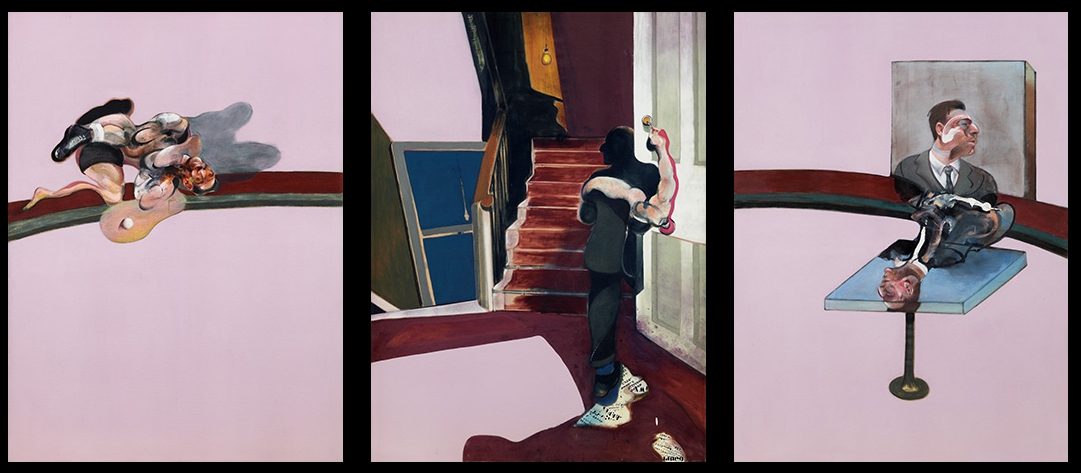
Slaughterhouse
Francis Bacon: A Centenary Retrospective
Metropolitan Museum of Art
BY JED PERL | REVIEW | THE NEW REPUBLIC | WEDNESDAY JUNE 17 2009
Is there such a thing as a wrongheaded tradition? I believe there is. And the most enduring one is surely the tradition of the artist as a romantic outlaw, which in the last half-century has been pretty much owned by Francis Bacon. His canvases, modernist melodramas with just the right crowd-friendly dash of old-fashioned grandiloquence, are the subject of a retrospective at the Metropolitan Museum of Art. Bacon, who died in 1992 at the age of eighty-two, may well be the greatest exemplar of a wrongheaded tradition that we have ever seen. He had a knack for adapting all the wrong elements from all the right artists. He zeroed in on those moments when Van Gogh and Picasso were pushing their glorious anarchic energy to the brink of incoherence. This would have been fine, except that Bacon willfully ignored their ordering intelligence, preferring to sacrifice pictorial sensibility to literary sensationalism. What Bacon produced are not paintings, at least not satisfying ones. They are little more than rectangles of canvas inscribed with noirish graffiti: angst for dummies. Bacon turned his clever little quotations from the masters, old or modern, into the twentieth century’s most august visual claptrap.
There is nothing surprising about an artist feeling like a romantic outlaw, and Bacon and his supporters can cite a long tradition of more-or-less alienated creators, winding back to Caravaggio, who actually killed somebody. The trouble with Bacon is that he has not attached himself to a tradition of picture-making but to a tradition of attitudinizing. In this wrongheaded tradition, Caravaggio is admired not because he was a good painter but because he was a bad boy — which is a pretty accurate characterization of the career of Francis Bacon, too. This is not to say that artists are under any obligation to be conventionally respectable members of society. The fact is that an artist’s outward behavior has no fixed relationship to the development or the value of his or her work. But to accept this fact, which really ought to be self-evident, one must accept also the freestanding value of art, an idea that today is devalued when it is not entirely rejected. The Bacon mystique is not grounded in his paintings so much as in a glamorous list of extenuating circumstances. (The exhibition, which has already been seen at the Tate in London and the Prado in Madrid, was organized by Gary Tinterow of the Metropolitan together with Chris Stephens and Matthew Gale of the Tate.)
Francis Bacon’s paintings arrive in New York at a moment when wrongheaded traditions are the only ones that are widely esteemed, and the freestanding value of art has more or less been stood on its head, leaving us with the freestanding value of anti-art. So it is no wonder that Bacon is receiving a warm welcome among some of the newer painters who have been praised for turning the grand manner on its head, producing impersonations of traditional painting and campy send-ups of the masters. Before the Bacon retrospective opened, Vogue asked a number of artists to comment. "What’s profound about his work is that it’s not settled," declared Lisa Yuskavage, who paints bimbos with floppy hair. "It’s too big. It’s like a bomb dropping." George Condo, our thrift-shop Picasso, observed that "each one of his paintings is like a very elegant, bad hangover." And John Currin, who has made misogyny safe for high-end collectors, believes that "the feeling you get from Bacon is something akin to a stately mansion that you can’t pay the taxes on, and you can’t afford to heat. And yet, with his poverty of means — simple, unsophisticated techniques — he’s able to do grand painting, completely."
Yuskavage, Condo, and Currin know, like Bacon, how to make mawkishness look cool. The trick of managing to be simultaneously empty and canny is something else that they share with the Englishman. Here is part of what Bacon had to say in the catalogue of a 1955 Museum of Modern Art exhibition, "The New Decade: 22 European Painters and Sculptors": "I would like my pictures to look as if a human being had passed between them, like a snail, leaving a trail of the human presence and memory trace of past events, as the snail leaves its slime." The Guggenheim or the New Museum ought to organize a survey of painting from Francis Bacon to Lisa Yuskavage and call it "Snail Slime."
In any event, Bacon knew exactly what he was doing when he said that. He was giving mid-century intellectuals and jet-setters just the kick in the pants that would persuade them that he was the leader of their very own avant-garde. Bacon wants to have things every which way, and this makes him a perfect pied piper for our have-your-cake-and-eat-it-too art world. His work is old-fashioned and newfangled, a carefully calculated mixture of literalism and obscurantism. Sometimes he transcribes his own face or the face of a lover more or less directly from a photograph, so that a painting becomes a bulletin board on which to pin a few images. At other times he savagely distorts a photograph, treating the head of his friend Isabel Rawsthorne as if it were made of silly putty, twisting it into a crenulated grotesque. Or he will reconstruct a scene from the life of somebody close to him. When he visualizes his ex-lover, George Dyer, slumped on a toilet in a Paris hotel, dying of an overdose of alcohol and pills, he gives his work a tabloid frisson. Bacon likes body fragments, partly erased figures, and heads that have been reduced to pulp. He takes autobiographical material and plays with it, running signs and symbols through the shredder, producing puzzles and enigmas, flotsam and jetsam floating in a chic void. He is especially fond of paintings that come in threes, so that the composite compositions take on a sort of religious or dramatic implication, the tangled plot line of a hellish holy trinity.
Alienation no longer has the hipster appeal that it had a generation ago, so that Bacon’s version of the man-all-alone-in-an-unfriendly-world routine takes on a retro appeal. I would not be surprised if there are visitors to the Metropolitan who are knowingly mumbling, "Oh, that again." They may be remembering Sartre, or just Last Tanog in Paris, which begins with some paintings by Bacon. Confronted with a prestigious retrospective at the Metropolitan, museumgoers are reluctant to gainsay the authenticity of the artist’s feelings — but they may also find themselves a little weary when confronted with yet another exercise in high modern angst.
There is something rather cool about even Bacon’s most violent images, and this emotional dissonance fits right in with a postmodern taste for muddleheaded irony. The early paintings, especially the shrieking Popes based on Velazquez’s portrait of Innocent X, have a howling 1950s look, and visitors who know their cultural history will find themselves thinking of a traumatized postwar Europe and the dive-glamour of London’s Soho, which has gained a special historical aura in recent years, as England is again hailed as a literary and artistic hotspot. By the 1970s, Bacon’s surfaces are smoother, at times looking almost airbrushed. The stretches of flatly applied paint in tan, gray, pink, and orange suggest the streamlined chic of the 1970s, when furnishings and clothes were done up in Ultrasuede. These paintings are high-style bummers, bad dreams with fashionable upholstery.
Going through the Bacon retrospective, I find that everything changes and everything remains the same. For his admirers, this may be the point. There is always that tormented figure, represented by a face, an entire body, or just some body parts. Bacon likes to paint people in cages or boxes, which are indicated with a few perfunctory lines. Sometimes he drops a bed into one of his nowhere spaces, and then drops a person or maybe two people on the bed. If it is one person, then the theme is loneliness. If it is two people, then the themes are sex, love, and loneliness, with elements of aggression mixed in for good measure. Around the figures the stage is bare or nearly bare, with the line between wall and floor suggested, if you are lucky, and the emptiness done up in red or tan or gray, depending on Bacon’s mood. The message is that we are all prisoners, we are all locked in place, we cannot get up from the chair, we cannot walk through the door. In order to underline their inability to flee the isolation cells that Bacon has contrived for his allegedly archetypal figures, the artist sometimes gives one of these freakish victims an appendage that looks like a club foot, or scrambles the head so badly that you wonder if a man could even see his way through the door. What Bacon’s work brings to mind are the shock tactics of the most literal Surrealists, the photographs of disfigured dolls by Bellmer, and Dali’s Technicolor porno dreams.
Earlier this season, in what amounted to a curtain raiser for the Bacon retrospective, the Gagosian Gallery mounted a show pairing work by Bacon and Giacometti. There could not have been a better demonstration of the poverty of Bacon’s method. There is a coarse methodical belligerence about Bacon’s work, and when the paintings are gathered together a museumgoer may be put in something like a trance state. Perhaps visitors come to accept the muffled horrors, repeated in nearly endless variations, as the sum total of artistic possibilities in the modern world. But when Bacon’s paintings are juxtaposed with those of Giacometti, who was also working in the postwar years and was equally susceptible to the dark shadows that World War II cast, you can see how limited Bacon’s range really is. The Gagosian show, titled "Isabel and Other Intimate Strangers," saluted their admiration for Isabel Rawsthorne, a figure in artistic and literary circles in London and Paris with whom Giacometti was for a time passionately involved. Giacometti and Bacon liked each other, but according to James Lord, in his biography of Giacometti, "concerning aesthetic objectives, the two artists did not see eye to eye. In private, Alberto expressed dislike of the chance effects and crafty sleights of technique so beloved by Francis."
In his paintings Giacometti draws on many themes that we also encounter in Bacon’s work. Giacometti is interested in feelings of unease, in our sense of the unknowableness of our own bodies and the trouble we sometimes have in finding our place in the world. But when Giacometti paints, using the brush with a graphic precision, articulating the nose, the eyes, the mouth, the cheekbones, he is at once disassembling the face, insisting like Bacon that we see things from some fresh perspective, and putting the pieces of the puzzle back together, creating a head that is as inviolably whole as a statue in an Egyptian tomb, something of which Bacon is incapable. While there is vehemence about the frontality of Giacometti’s portrait subjects, there is also tenderness, and a changeableness that registers in the surprising qualities of light and air, the infinite variety that he discovers in his Parisian grays. Giacometti does not prejudge experience in the way that Bacon does. When Giacometti suggests that a man or a woman is caged or imprisoned, he also insists that they are capable of movement, of struggle--that they still have a chance of controlling their own destiny. Freedom is a possibility in Giacometti’s universe, and this can pose a daunting challenge, especially for museumgoers who expect to be told what to feel.
Bacon wants the gravitas of the old masters, but he refuses to understand that the authority of Rembrandt or Goya is grounded in their avid engagement with everyday experience. Bacon never really had any interest in working directly from life. He did not do any drawings to speak of, which is especially strange for an artist who aims to reconceive the human figure. And I think that photography, which played a useful role in the paintings of Vuillard and Bonnard and other artists, is a big, baleful problem in Bacon’s work. His blurred or distorted faces and bodies are nothing more than photographs seen in a funhouse mirror. He depends far too much on the fixity of photographs, which he uses to give his paintings a creepy freeze-frame fascination. The photographic image serves as a source of cheap sensation, a defense mechanism, a way of shutting down any feelings that might arise directly from experience. The result is Pop Art seen through a glass darkly, Warhol’s Electric Chair paintings without the silkscreen technique. And when Bacon chooses to blur these photo-derived figures, the results are as calculatingly sentimental as anything in Gerhard Richter. The organic nature of painting, the end-to-end logic that characterizes all painting, whether in Rembrandt or in Mondrian, is rejected in favor of a modernist re-staging of a fin-de-siecle freakshow.
If the Bacon retrospective is a hit with the public, it will be because visitors are convinced that there are demons pursuing this artist. His art is presented as a high form of black magic, a way of vanquishing the forces of evil in our times. The wall labels make a point of reminding visitors of Bacon’s gambling, his tough-guy lovers, his whiskey-soaked nights in Soho. And near the end of the show the curators leave biography behind and plunge straight into hagiography, devoting an entire gallery to photographs and other assorted talismans that Bacon kept around his studio. Here, along with movie stills, newspaper clippings, and photo-booth self-portraits, we are shown the photographs of friends and lovers on which Bacon based many of his paintings.
This dimly lit gallery, one wall of which is plastered with a photomural of Bacon’s famously messy Reece Mews studio, is the show’s sanctum sanctorum, the place where visitors can peer at all the rumpled mementoes and imagine that they are witnessing the black magic taking place. After galleries full of lifeless paintings, the curators have had the bright idea of introducing some bits and pieces of the artist’s life — which turns out to consist of a heap of photographic images. This is what museumgoing is coming to in the age of reality TV.
We live in a world where the actual matter of art — the artisanal concerns, the structural assumptions — are all too often seen as reactionary and academic, something for pedants and conservatives to bother about. Why go the Giacometti route? Why bother to construct a face in detail, developing expressive distortions that are based on a painstaking study, hour by hour, day by day, of an actual person? Why go to all that trouble when you can simply take a photograph and fancy it up with some distortions that amount to little more than third-hand Picasso? It’s not just that it is difficult — actually, it is nearly impossible — to do what Giacometti did. The resistance goes even deeper. There is a revulsion here against the sincerity of painting — an unwillingness to see that what is truly disturbing or challenging in painting comes out of that sincerity.
Bacon, with his prefab contortions, is the real academic — a pasticheur and parodist of avant-garde attitudes. Like all modern poseurs, he believes that biography is the ultimate trump card, that the art is more or less a reflection of the life, and in this he is again on the frontlines of a wrongheaded tradition — the tradition that values the artist above the art. In the literature about Bacon, too much is made of the terrible story of the opening of his retrospective at the Grand Palais in 1971, on the eve of which Dyer died of an overdose of drugs and alcohol. It is perfectly understandable that this terrifying event became the subject of some of Bacon’s compositions. The paintings, however, are so bloodless that all they can possibly do is send you back to the story itself. There is nothing in the paintings themselves to hold you there. In Bacon’s work, content trumps form every time. The emotion is as formulaic and pre-digested as in any Victorian picture of a dying child.
As the subject of a big retrospective, Bacon’s life certainly has a narrative power. And without anything by Giacometti or Picasso to remind us of the poetic power that can be discovered in the anti-naturalistic figure, Bacon’s brutalist paintings are going to strike many observers as the only representational alternative available to an artist in our terrible times. The lack of delicacy or sensitivity — the lack of imagination in the handling of color or line — becomes not the artist’s weakness but ours, a reflection of the troubles of the age. Bacon’s work is a blunt instrument, and museumgoers who begin to feel threatened or manipulated may well conclude that this is what Bacon intended. They may not be wrong. The Bacon retrospective reminds me of the Bruce Nauman show that toured the country a decade ago. Bacon is another specialist in sensory deprivation. There is a Stockholm Syndrome quality about these exhibitions. They give us so little, and what we are meant to discover is that we could not possibly be satisfied with anything more.
To the writer Michael Peppiatt, who over the years has produced a substantial literature devoted to Bacon, the artist observed near the beginning of their acquaintance, "You remember that steak we ate just now? Well, that’s how it is. We live off one another. The shadow of dead meat is cast as soon as we are born. I can never look at a chop without thinking of death — that probably sounds very pompous." Well, yes it does; but then Bacon’s modus operandi always involved being simultaneously pompous and profane. Early in the retrospective there is a painting in which a figure is flanked by beef carcasses. And in 1962 Vogue ran a photograph of a bare-chested Francis Bacon posed in front of two carcasses. By the end of the show, museumgoers may feel as if they are in a slaughterhouse, with each painting presented like a carcass hanging on a hook. The Bacon retrospective is the most fashionable slaughterhouse in the world. What we are witnessing is a nihilist blood sport, the hideous spectacle of an artist in the process of eviscerating the art of painting.
Jed Perl is the art critic at The New Republic.
Francis Bacon joins the Colony Room Club, Soho, December 1948
BY ROB CROSSAN | DEFINING MOMENTS | THE FINANCIAL TIMES | SATURDAY, JUNE 13, 2009
On December 15 1948, Muriel Belcher, a notoriously acid-tongued bar owner whom jazz singer George Melly described as “a benevolent witch... who loved money” opened a tiny room at the top of a staircase on Dean Street in Soho.
Decorating the bar in dark green paint and bamboo, she called it the Colony Room Club, partly in tribute to her female Jamaican lover. One of the first people to climb the stairs was a penniless, 39-year-old, Dublin-born artist called Francis Bacon.
The two bonded instantly. They reached a deal whereby Belcher would give Bacon £10 and free drinks in return for the artist persuading his wealthier friends to come and spend money in what quickly became regarded as the most intimidating members bar in London. That reputation was down entirely to Belcher’s personality, which careered between generous affection and tirades of abuse towards her customers.
Despite this, Bacon once remarked that Belcher had “a tremendous ability to create an atmosphere of ease”. In Michael Andrews’ The Colony Room I, 1962, reproduced above, Belcher sits in the centre wearing a blue dress, while Bacon is on the right, his back to the artist.
Belcher’s arrangement with Bacon gave him the relative stability to paint – at that time his work was barely known outside a few small London galleries. Nine years later, a shocked art world saw his pained, distorted and unremittingly bleak studies of Van Gogh for the first time. Fame and controversy followed him for the rest of his life.
Bacon remained a regular patron of the Colony Room until his death in 1992, and the venue was used for his wake. Belcher had died in 1979. On the club’s 60th birthday, in December 2008, the Colony Room closed for the last time, supposedly to be turned into a private apartment.

Muriel Belcher and Francis Bacon, 1975 © Peter Stark
Den Mother to the Louche and Famous
BY GEOFFREY WHEATCROFT | ART | ART & DESIGN | THE NEW YORK TIMES | FRIDAY 5 JUNE, 2009
LONDON
A VISITOR to the magnificent Francis Bacon exhibition at the Metropolitan Museum of Art might easily pass by an alcove filled with photographs of Bacon’s friends. Among them is a tiny, yellowing snapshot of a striking woman gazing at the camera, taken around 1965. But then few Americans would even recognize the name of Muriel Belcher, or know about the part she played in Bacon’s life, as his den mother of sorts, and about the club she ran as his refuge.
She was the greatest of Soho hostesses, from 1948, when she opened the Colony Room Club on Dean Street here, until her death in 1979. The place we all called Muriel’s was a drinking club, a salon, a little community of its own (and one about which this reporter is regrettably well qualified to write, having spent too much of his early life there). What makes the story more poignant today is that not only have most of the players departed, but also the stage itself is dark. Muriel and Francis are no more, and neither is the Colony.
So we’re left with memories, of the kind novelists convey better: “It is an old timetable now, disintegrating at its folds, and headed ‘This schedule in effect July 5, 1922.’ But I can still read the gray names, and they will give you a better impression than my generalities of those who accepted Gatsby’s hospitality.” On another old timetable I can still read the names of those who drank at Muriel’s in July 1972.
Among them were writers, hustlers, shady politicians, decayed aristocrats and petty criminals, maybe more Anthony Powell than F. Scott Fitzgerald. But you could also find some of the most famous painters of the age, and Muriel’s deserves at least a small footnote in the history of art.
In those days Soho was full of clubs, though very different from the haughty gentlemen’s establishments of St. James’s Street and Pall Mall. They existed partly to refresh thirsty “afternoon men” at a time when the pubs were obliged to shut from 3 to 5:30 p.m., but each had its own character. Gerry’s on Shaftesbury Avenue was for actors (more likely “resting” than working). The Kismet, a k a the Iron Lung, on Cranbourn Street, also in a basement, had two bars for two clienteles. Back in the ’60s, in the more bohemian bar on the left, I briefly met “the Roberts,” the inseparable painters Robert Colquhoun and Robert MacBryde, while in the other bar somber men in raincoats and hats stood drinking and talking quietly: this was the London underworld and the plainclothes police meeting on equal terms.
But Muriel’s was sui generis. You passed through a door beside an Italian restaurant, climbed stairs smelling of damp or worse, and entered a dark green room with a bar to the left. The walls were covered with pictures, from a cartoon of Muriel by the jazz musician Wally Fawkes (a k a Trog) to a conversation piece set in the Colony by the painter Michael Andrews.
Nothing was more striking than the hostess herself, perched birdlike on her stool, drink in one hand and cigarette in the other, with one eye on the door to block unwelcome visitors and the other on customers to make sure they were spending enough. And all the while she kept up her machine-gun chatter: sarcastic, witty, scabrously obscene.
Her family was Birmingham Jewish, or so I believe. She had made her way to London and the demimonde, and during the war opened her first club, the Music Box, whose core membership seems to have been the better sort of homosexual officer in the Brigade of Guards (not as small a constituency as you might think).
Then she moved to that upstairs room on Dean Street. Although Bacon was already making his name, he needed pocket money, and Muriel paid him to bring in rich patrons. If the word isn’t too far-fetched, she became his muse, while he became one of Muriel’s “daughters.” Most men were “she” to Muriel; it could be disconcerting when some elderly major was introduced with the words, “She was a very gallant little lady on the Somme.”
Before long most of what would later be known as the School of London congregated there, including Frank Auerbach and Lucian Freud as well as Bacon and Andrews. That painting by Andrews showed the names on the schedule in effect in the mid-1960s. Clustered around Muriel are her companion Carmel; Jeffrey Bernard (dropout, boozer, wit and later Spectator columnist); Henrietta Moraes (also much painted by Bacon); Lady Rose McClaren (the déclassé sister of the Marquess of Anglesey); and John Deakin, who took the photograph of Muriel, as well as several others in the Bacon exhibition at the Met.
Also Bacon and Mr. Freud, whose friendship had been commemorated years before in another painting, Mr. Freud’s haunting small portrait of Bacon. They could often be seen talking together in the corner, a study in contrasts: Mr. Freud reserved, ironic, abstemious (and conspicuously heterosexual — Muriel’s was very camp, not to say lewd, but far from merely what was then called a “queer club”); Bacon more expansive, especially while the drink flowed.
As it did when he was around. “Champagne for your real friends and real pain for your sham friends” was his favorite Irish toast, and he meant it, both ways. He said superfluously that Muriel’s was “a place where we came to dissolve our inhibitions,” and his were very solvent.
Even after a long drinking session Bacon might still be genial. Though he did once tear open my shirt front, that wasn’t anger, or lust, but simply because he couldn’t quite stand upright and was trying to break his fall.
But obstreperous on occasion veered toward obnoxious. Late one evening he was so truculent that Ian Board, Muriel’s barman asked me to get him out of the Colony, which I did by taking him down the road to a casino where, since he could scarcely tell rouge from noir by then, he lost an enormous sum.
If Bacon was by turns affable and abusive, Muriel herself was “a benevolent witch,” in the words of the writer and musician George Melly. Her humor was certainly distinctive. A friend once surprised us all by getting married and begetting a son. We lunched to celebrate, before climbing the stairs for a postprandial drink and to tell Muriel about this happy event. Her own slightly deflating mode of congratulation was to say, “It’s amazing what a poof can do when she tries.”
Writers and moviemakers as well as painters have portrayed Muriel. Rodney Ackland’s play “The Pink Room” opened in London in 1952, but not for long, since critics were shocked by the frank picture of inebriation and sexual variety in a club very much like the Colony. But the play was revived and televised many years later as “Absolute Hell,” with Judi Dench as the formidable hostess, and very good she was, if too ladylike for Muriel.
In the 1998 biopic “Love Is the Devil,” Bacon is played by Derek Jacobi, his companion George Dyer by Daniel Craig (whose fans can see more of him anatomically here than in his later James Bond films), and our hostess by Tilda Swinton. Although she doesn’t sound anything like Muriel, she looks curiously like her, and the tricksy-arty cinematography through a fisheye lens captures the atmosphere of the Colony rather well.
Not everyone loved Muriel and her club. I once took my friend Shiva Naipaul — younger brother of V. S. Naipaul and a brilliant writer himself, who died suddenly in 1985 at 40 — up to the Colony for a digestif. After a few minutes he said: “Can we please leave? I find this place infinitely depressing.”
But many others were captivated by that room, and not just the people you might expect. The Labor member of Parliament Tom Driberg might be found talking to one of the journalists who liked to look in at Muriel’s, like Peter Jenkins, the liberal columnist, and, more surprisingly, the radical turned conservative Paul Johnson.
Now we can look in no more. Muriel died barely into her 70s, and by the time Bacon died in 1992 he and Mr. Freud had fallen out, quite why I never knew. To make it sadder, that beautiful portrait by Mr. Freud was stolen from an exhibition in Berlin and has never been seen since.
After Muriel died, the Colony was kept going by Mr. Board, and after his death in 1994 by Michael Wojas. But he closed the club some months ago, and sold the contents. Great efforts were made to save the Colony, which had acquired a newer membership, some of them well-known younger artists, and a fund-raiser was held before Christmas, but to no avail. This is not the place to describe the acrimonious and litigious upshot, and although there are some plans to reopen the Colony, almost certainly in some other location, it will not be the same.
Many years ago Jenkins gestured round him, and said fervently he hoped places like this would never vanish. But Muriel’s has, and for some of us Soho today is a place of ghosts, gray names from a green room.

A portrait of Ms. of Muriel Belcher by John Deakin
SAY AHHHHHHHH!
People feel duped by Francis Bacon; such is our prejudice toward the scream.
BY MORGAN MEIS | IDLE CHATTER | THE SMART SET | FRIDAY 5 JUNE 2009
Francis Bacon is a scream. He will always be a scream. Just think of the roar from that fleshy maw under the umbrella in Painting from 1946. Bacon didn’t just paint screams. There are “religious” triptychs, portraits, angry animals, and the ongoing presence of raw meat. But Bacon would not be Bacon without the screams. How you feel about the screams is, I think, the essence of how you’ll feel about every Bacon work.
And the man — whose most influential paintings now date back more than half a century — can still stir things up. The current exhibition at the Metropolitan Museum of Art, “Francis Bacon: A Centenary Retrospective,” has inspired the full gamut of critical response. People are falling over themselves just to disagree. Jerry Saltz, of New York Magazine, likes the early work and the screaming but thinks Bacon became a parody of himself over time. Saltz writes, “But in the end, he seems less a modern painter than the last of a breed of Romantics — one who, in his final interview, plaintively stated, ‘I painted to be loved’. ”
Roberta Smith over at The New York Times takes the opposite view. Smith dismisses the early work, focusing on the greater emotional complexity of the later paintings. “[T]he Met’s exhibition disputes the notion that Bacon’s art declined, indicating that it often improved as his colors brightened, his paint handling gained muscularity,” she writes. “It was equally important that he began to focus on people he knew and cared about, giving them faces that seem simultaneously masked, gouged out of wet clay and recognizably individual.”
At The New Yorker, Peter Schjeldahl gives Bacon grudging respect for being a major artist of the 20th century, but admits that he can’t stand the work on any personal level. “Francis Bacon has long been my least favorite great painter of the 20th century. My notes from a visit to the new Bacon retrospective, which is very handsomely installed at the Metropolitan Museum, seethe with indignation, which I will now try to get over.”
I focus here on the critical disparity and unease for one simple reason: It shows the deep distrust of Bacon among those who think and write about art. This distrust, I pose, can be traced back to the scream. Critics tend not to believe in the scream. They think they’re being manipulated and they don’t like it. Nobody likes to be a sucker, critics least of all. The more the critics witness the public’s adoration of Bacon’s work, the more they smell a rat.
Arthur Danto, writing on Bacon for The Nation back in 1990, summed up the feelings with his typical intellectual incisiveness
So … these depicted screams seem to entitle us to some inference that they at least express an attitude of despair or outrage or condemnation, and that in the medium of extreme gesture the artist is registering a moral view toward the conditions that account for scream upon scream upon scream. How profoundly disillusioning it is then to read the artist saying, in a famous interview he gave to David Sylvester for The Brutality of Fact: Interviews with Francis Bacon, “I’ve always hoped in a sense to be able to paint the mouth like Monet painted a sunset.” … It is like a rack maker who listens to the screams of the racked only as evidence that he has done a fine job…. We are accordingly victims ourselves, manipulated in our moral being by an art that has no such being. It is for this reason that I hate Bacon’s art.
There is nothing worse, in Danto’s eyes, than a scream that means nothing. It amounts to the destruction of the moral realm in the name of aesthetics. The key scream painting in Bacon’s oeuvre is probably Study after Velázquez (1950). Bacon takes Velazquez’ famous Portrait of Pope Innocent X (1650), in which the Pope is a study in cynicism and power and transforms it into one of his blurred, terrifying, screaming heads. The impulse is always to explain this, and other screams through personal history or politics. Bacon was reacting to the horror of his times. Bacon was reacting to the horror of his family life and his later relationships (with their sometimes violent and destructive characteristics). Bacon was reacting to the repressive atmosphere in England regarding his homosexuality. Danto, I think, is correct in rejecting this kind of reductionism. So was Bacon. When asked about his interest in Velasquez’ famous Pope painting, Bacon replied, “I think it’s the magnificent color of it.” He also stated flatly that, “I have never tried to be horrific.” Danto can never forgive Bacon for this sleight of hand.
But Danto, and by extension many other critics, miss a key distinction when they focus on the meaninglessness of the screams. Bacon retreated to the language of pure painting and aestheticism in order to resist the specific meanings often attributed to his works. None of his paintings were explicitly about the wars and genocides of the 20th century. His Pope paintings are not a criticism of the Catholic Church. His more abstract screams are not an expression of Existentialist philosophy.
In fact, Bacon constantly decontextualized his screams (and other portrayals of violence and terror) in order to cut the causal links and to make the screams more general. He was interested in the form and structure of a scream. He wanted to figure out what makes a scream a scream. Painting the scream onto Pope Innocent X heightens that sense of disjunction. It doesn’t make sense that the Pope is screaming. But that makes the scream all the more pure, all the more screamy in its screaminess.
In the aforementioned
interview with David
Sylvester, Sylvester asks
Bacon about the prevalence
of violence in his work.
Bacon responds with a
disturbing account of the
ways that, since a small
child, he had been
constantly surrounded by
violence and war. He ends by
observing, rather
laconically, “So I could
say, perhaps, I have been
accustomed to always living
through forms of violence.”
The way he calls it “forms
of violence” jumps out at
me. The artist in Bacon
responded to the specific
experience of violence by
stepping back and exploring
the forms of violence as
such. In its structure, this
is not unlike many of the
abstract painters who were
his contemporaries. They
stepped back from specific
acts of representation in
order to study the form of
visual perception itself.
It is still possible to accuse Bacon of being blithe and cynical in exploring the forms of violence on one hand while tweaking our ingrained emotional response to images of violence and terror on the other. He is having his cake and eating it, too. That’s the essence of Danto’s critique. Bacon hits us with these incredibly powerful and moving images and then claims, la di da, that he was only interested in the color orange all along.
But why shouldn’t artists get to explore the forms of violence just as they explore all other forms? With all due respect to Edvard Munch, I can’t think of another artist who so perfectly expressed the Platonic purity of the scream, the scream as scream. There are plenty of artists who exploit our specific attraction to beautiful bodies or landscapes in order to explore more general aesthetic questions about shape, or color, or beauty itself.
Something about Bacon’s exploitation of horror arouses an indignation not usually expressed in these other cases. Perhaps we resent that Bacon makes us take pleasure in our more troubling emotions, in our fascination with violence. I don’t know if Peter Schjeldahl “seethes with indignation” because he deplores the amorality of Bacon’s imagery of violence or because he deplores the pleasure he finds himself taking in such amoral imagery of violence. It could be a mixture of both.
I always take very seriously the way that teenagers look at Bacon. They see the purity of that scream and they respond to it immediately. They know that it is right, that Bacon got that scream absolutely right because he formalized the subject matter and not because it points to any outside meaning. They stand before those paintings in an open display of their own essential desire, revulsion, lust, anger, fear. There it is. Scream.
• 5 June 2009
“Francis Bacon: A Centenary Retrospective’’
The original British bad boy of art takes over the Met.
BY HOWARD HALLE | ART | TIME OUT | NEW YORK | WEDNESDAY JUNE 3 2009
There are many adjectives—dark, brutal, homoerotic—one could use to describe the paintings of Francis Bacon (1909—1992), though popular wouldn’t seem to be among them. His work can be hard to take, and sometimes, given the histrionic tenor of his canvases, hard to take seriously. Yet on a recent Friday, visitors could be seen thronging through this survey (edited from the one that originated at London’s Tate Gallery) marking the 100th anniversary of the English-Irish artist’s birth.
From all appearances, people were raptly taking in Bacon’s iconographic panoply of screaming popes, slabs of beef and male nudes grappling in heated contortions of love, hate and personal destruction. Perhaps years of exposure to Jason and Freddy Krueger have conditioned viewers to accept Bacon as some sort of high-toned master of horror whose greatest monster was his own bad self.
Certainly Bacon’s backstory fits the mold of the classic reprobate: The second of five children born to a wealthy British family in Dublin, Bacon, who was gay, was kicked out of the house at age 17 after his father discovered him wearing his mother’s clothes. He spent the 1920s and ’30s idling around London, Paris and Munich, supporting himself as a gentleman’s gentleman (under the name Francis Lightfoot) before finding some success as an interior designer. But his destiny lay in painting; indeed, though his career really didn’t take off until after the war, he first exhibited in 1933.
One of his compositions of the time was purchased by an important collector and was even featured in the book Art Now by the influential British critic Herbert Read. Still, Bacon was dissatisfied by the critical reception to his works and wound up destroying many of them. He produced little during the war years, spending most of his time in pubs and betting parlors. He was famous for his drinking, and was a founding member of the Colony Room, a private bar for artists in London’s Soho district.
Bacon wasn’t wise when it came to matters of the heart, either. Both of the major loves of his life, Peter Lacy and George Dyer, were drug addicts prone to violence, whether physical or emotional. Although their relationship had ended, Dyer accompanied Bacon to Paris in 1971 for the painter’s triumphant survey at the Grand Palais; the former wound up ODing in the bathroom of their hotel on the eve of Bacon’s opening. Talk about drama queens.
Like his life then, Bacon’s canvases are kind of a mess, an amalgam of abstraction and figuration, postwar angst and recondite old-master references. Self-taught, Bacon betrayed little interest in the conventions of avant-garde art at the time. Propelled by an autodidact’s restless curiosity, he borrowed freely from a wide range of source material, including photography and cinema. He mixed together references to Velázquez, Russian director Sergei Eisenstein and Eadweard Muybridge’s stop-motion studies, a strange thing to do in the late 1940s, though quite normal now. I
It’s been argued that Bacon’s import lies in being the first openly queer artist, but it’s also the case that he was one of the first to foreground the photograph as a subject matter for painting. Bacon drew the parallel between the photographic blur and the painterly stroke well before Gerhard Richter did the same, though his penchant for portentousness also gave license to the bombast of contemporary artists like Damien Hirst.
The output that first gained
him notoriety in the
aftermath of the war has
been described as “religious
painting for atheists,” and
there’s undoubtedly some
truth to this, given the
surfeit of shrieking
pontiffs—notably Head VI (1949), Study
After Velázquez (1950)
and Study After
Velázquez’s Portrait of Pope
Innocent X (1953)—and
allusions to crucifixion.
Taken together, these
canvases create a metaphor
for Europe’s experience of
the conflict as a collective
Passion that disproved the
existence of God. But these
works also suggest that
Bacon, as frank as he was
about his homosexuality, may
have found his sexual
orientation a cross to bear.
In any case, by the late 1960s, Bacon increasingly turned to portraying himself and his circle of friends and lovers. Expanses of bright color became a hallmark of his work, and if these vivid hues signal the return of the decorator’s eye, Bacon’s subjects could still be indecorous, albeit heartfelt. Triptych, May—June 1973 depicts Dyer’s ignoble death on the toilet, flanked by walls painted a vermilion rich enough for a monarch’s robes. Individually, paintings like this are hard to beat, but seen en masse, they are somewhat oppressive. In art as at breakfast, a little Bacon goes a long way.
“The best exhibition I have ever seen, anywhere, in my life”
– Francis Bacon at the Met.
Robert Ayers in New York
ROBERT AYERS | A SKY FILLED WITH SHOOTING STARS | NEW YORK | WEDNESDAY JUNE 3 2009
I know it’s beyond a joke now, but having experienced Francis Bacon: A Centenary Retrospective at the Met yesterday I now formally reinstate it as New York’s museum show of 2009. I admit I was thrilled by the Guggenheim’s “The Third Mind”, and because I enjoyed such a breadth of the work that it included, I hailed it as Exhibition of the Year in one of my first posts here on A Sky filled with Shooting Stars. But the Bacon show really is something else altogether, and at least partly because it’s not about breadth at all: everything here is the product of one artistic personality.
So I go back to what I originally wrote for ARTINFO back in December:
“It’s as simple as this: Francis Bacon (1909-1992) was one of the twentieth century’s most innovative, dramatic, and controversial painters; his personal life was at least as romantically chaotic as the best of his pictures; his work still manages to split opinion right down the middle; his long shadow still falls on much of contemporary art making; and this is a huge, all-encompassing museum study of his career, boasting new technical and interpretive insights. With more than 150 works in total, and the organizing and intellectual weight of the Met, the Tate, and the Prado behind it, this hundredth birthday tribute is New York’s show of the year.”
In fact now I’d say more than that, because despite that near-eulogistic enthusiasm I now find myself reflecting that I had actually always misunderstood and underestimated Francis Bacon’s art.
Growing up and getting most of my formal art education in England, Bacon’s painting was always there in the background. In the Tate (which was only one oh-so-familiar museum in those days) and in every published or exhibited survey of British art, he was always there. I am ashamed to admit that I got so that I couldn’t even see him any more. I took his work for granted. I certainly didn’t appreciate its intensity or comprehend its difficult, tragic, and utterly human subject matter.
Why this realization is so
beguiling is because it
makes me register how much
of my misunderstanding of
Bacon was symptomatic of
misunderstanding much of
modern art in general. The
first picture of Bacon’s
that you see full-frontal in
the Met’s show
is Painting from 1946. It’s
a terrifying image, all
hanging carcasses and
screaming, but what struck
me most about it in the
context of this show is the
odd little enclosure that
appears here so early in
Bacon’s work, and really
stays there in one way or
another throughout his
career. In this picture it’s
described by the circular
rail in the lower quarter of
the picture – it reminds me
of the dock in a British
court room or of a display
in some fancy Fortnum &
Mason sort of emporium – and
by the set of drawn roller
blinds at the top. In other
paintings it’s delimited by
the walls of rooms, by
geometrical forms sketched
out in fine white lines, or
by yellow ochre suggestions
of church furniture in the
early fifties portraits
after the Velasquez Pope
Innocent X. There’s even a
whole gallery at the Met
that’s given the title
“Caged”. At least part of
the claustrophobic power of
Francis Bacon’s art derives
from this really rather
simple device of conjuring
an enclosed space
immediately behind or just
inside of the surface of his
pictures. It’s like a
chamber prepared for a
ritual, or a ring in which
wrestling or bare knuckle
fighting might happen, or an
arena.
That word “arena” made me think of this statement of Harold Rosenberg’s from The American Action Painters, which is quite understandably one of the most celebrated passages in the whole of modern art criticism, “At a certain moment the canvas began to appear to one American painter after another as an arena in which to act – rather than a space in which to reproduce, redesign, analyze or ‘express’ an object, actual or imagined. What was to go on the canvas was not a picture but an event.” Now anyone who knows me will be aware that the last thing I’m going to indulge in here is some sort of jingoistic tub-thumping for British art’s superiority over American – it was my besottedness with American art that brought me to New York City in the first place – but just think about this: in Francis Bacon (to borrow Rosenberg’s language) we are confronted with an artist for whom the canvas was an arena in which to act, as well as a space in which to redesign, analyze and ‘express’ objects – and more particularly human beings – actual and imagined. What was to go on the canvas was both a picture and an event.”
The Three Studies for a Crucifixion of March 1962 is still, even nearly half a century after it was painted, a ghastly, genuinely upsetting piece, each panel recording some different moment of horror, but what gripped me here (though not only here) is the nature of transubstantiation in Bacon’s art. In the right hand panel, he drags dry-ish white-ish paint over the mud color of his bare canvas to evoke with the slightest of means that horrible floating enclosure of stripped bones; in what the Met’s label rather quaintly calls the “sordid scene” of the center panel he squirts white paint directly from the tube to suggest ejaculated semen. Alright, he makes paint look like something else, that’s what painters have done for centuries. But representation is only half of the story for Francis Bacon. In the forms of the two unsettling characters in the left hand panel – in what we might otherwise have to read as one figure’s ballooning hunchback and the other’s jellyfish arms and extravagantly brushed club foot – it as though he is melting representation back into the fluid of paint again. Something similar is happening in the “shadow” in the foreground of the right hand panel. In fact, once you become conscious of it, you find it happening everywhere, nowhere more beguilingly or beautifully than in the right hand panel of Triptych in Memory of George Dyer (1971) where the squirted-paint-as-squirted-semen trick is extended lasciviously by then being made to represent the slick highlight on Dyer’s greasy cheekbone.
There’s a grey dimly-lit room in the middle of this exhibition, which would in truth have made a small but perfectly fascinating exhibition in itself. It’s labelled an “Archival Gallery Overview”, and one wall is filled with a more than life-sized slice out of the famous photograph of Bacon’s studio at 7 Reece Mews.
In a weird way that picture
transforms the room into an
echo of the studio itself,
and that is entirely
appropriate, for it contains
Bacon’s source materials:
pages torn from books and
magazines, photo booth
pictures and specially
commissioned photographs of
Bacon and his friends and
his lovers, and most
harrowingly, pictures of
George Dyer, the bruiser who
was the love of Bacon’s
life, sitting in his baggy
underpants in the very same
studio that the little
gallery has become.
Everything is torn, or crumpled, or glued back together, or smeared with paint. The response of Met visitors to this whole exhibition is fascinating. Tourists in their summer vacation clothes who happily romp their way through pretty much the whole of rest of the museum are stunned into abject silence by the sheer overbearing power of Bacon’s art. (“Let’s get out of here!” I heard one unsettled young woman whisper to her boyfriend.) But in this room they become particularly hushed and reverent, as though visiting a shrine. Look again at that studio photograph, with its every surface strewn with paints, brushes, books, and the very newspaper clippings and photographs that we have here in front of us, and the walls peppered with little gory circles and smears of paint. The place looks like the scene of an explosion, or a crime, or a passion.
There has in the past been a
tendency to romanticize
Francis Bacon’s life and
art. I’ve been guilty of it
myself. But seeing this show
makes me realize that there
is nothing romantic about
him or his work at all (and
in passing makes also
reassures me that I was
right about Love is the
Devil – what an utterly
absurd movie that is.) Why
Bacon’s tragedy is real
tragedy (or why that
routinely devalued word is
for once appropriate) is
because it has absolutely no
romance to it, and – other
than the art that it spawned
– not a single elevating
aspect.
There’s a painting here
called Self Portrait (from
1973) that I’d never really
looked at before. In it
Bacon leans on his elbow on
the corner of a bare sink.
His legs are twisted around
one another in some paroxism
of boredom, and he paws at
his forehead above a screwed
up jowly face that is once
again doing that
turning-back-into-paint
thing. Bacon’s only
companions are that sink,
his bentwood chair, his own
reflection, and a bare bulb
that hangs above him. His
watch reads 10 past 5. It is
a truly harrowing picture.
There are no hanging
carcasses, no mysterious
intruders, no fights or
embraces, no bloodstains.
Just Bacon enduring his own
company at the end of an
English afternoon, and
finding it empty, boring,
and loathsome. And in those
days even the pubs didn’t
open until 5.30.
This picture also tells us something about the peculiar role of resemblance in Bacon’s art. He famously hated to paint his subjects from life – he just couldn’t stand their proximity, apparently – and thus resorted so often to photographs. It’s interesting to ponder whether he hated other people’s appearance as much as his Three Studies for a Self Portrait (1979-80) – with its grotesque exaggerations of his nose and the bags around his eyes – makes it obvious that he despised his own. But what is undeniably the case is that the strange transubstantiation that occurs in Bacon – from paint to appearance and at least some of the way back again – is fundamental to his ability to evoke human presence. Look at that photograph of George Dyer again. Look at how like and unlike him Bacon’s various portraits look, and you begin to see that Bacon shows up portraiture that relies on resemblance as trite and lightweight and distracting. And only a stab in the dark at the sad mystery that is human existence.
Mystery runs through Bacon’s art like its spirit, for as well as portraits of real people that look little more like their subjects than they look like elaborate smearing of paint, there are all those portraits that look scarily like people they cannot possibly represent. There’s a whole room full of these so-called "Men in Blue” at the Met. Perhaps it tells us more about some unresolved oedipal problem of mine that I find these pictures of big framed middle aged men in business suits so frightening, but I still want to know how – decades before their emergence as adversaries on the world stage – Francis Bacon could come up with such convincing representations of (here) Ronald Reagan, and – in another painting with the same title – of Leonid Brezhnev.
Francis Bacon: A Centenary Retrospective is not merely the real exhibition of the year, I genuinely think it may be the best exhibition I have ever seen, anywhere, in my life. “Best” in the sense that it has made me totally reconsider not only the status of its subject, but also my comprehension of his relation to his predecessors (the late Picassos down at Gagosian suddenly look terribly unsubstantial by comparison) and to his contemporaries (rethinking Rosenberg’s The American Action Painters is really going to force me to think again about de Kooning, and particularly about Pollock). It’s also left me with all kinds of problems around my understanding of words like “tragedy”, “representation”, and “portraiture” and, though I haven’t mentioned them here, like “existentialism” and “beauty” as well. That such questions are wrapped up in a show that utterly renews one’s faith in the power of art to communicate something major about the human condition means that whether or not this is the best exhibition that has ever been seen in the city, it’s going to be a hell of a wait before another one that’s as good comes along.
Rough Stuff
A Francis Bacon retrospective at the Met.
BY PETER SCHJELDAHL | THE ART WORLD | THE NEW YORKER | JUNE 1, 2009
Francis Bacon has long been
my least favourite great
painter of the twentieth
century. My notes from a
visit to the new Bacon
retrospective, which is very
handsomely installed at the
Metropolitan Museum, seethe
with indignation, which I
will now try to get over.
It's unseemly to stay mad at
an artist whose canonical
stature, as graphed by the
fervour of intelligent
admirers, not to mention
market value, has only grown
since his death, in 1992, at
the age of eighty-two. But
first I must file away my
accumulated objections to
the theatrical shock tactics
with which Bacon, in the
nineteen-forties, aimed to
create museum-worthy
European painting that could
stand up to that of his
hero, Picasso. An old
politics of style hovers.
Bacon opposed American
Abstract Expressionism,
scorning Jackson Pollock’s
manner as "old lace" and
Mark Rothko’s
as "rather dismal variations
on colour." I have liked to
believe that, in the
mid-century contest for a
radically new and befitting
Western art, my countrymen
played fair, and Bacon
cheated. They forged
integral styles that
absorbed and transcended
Impressionism and Cubism,
engulfing rather than just
addressing the eye. He
vamped with an eclectic mix
of Expressionist tactics and
decorative longueurs. But I’m
aware that the scorekeeping
applies to a game not won or
lost but called on account
of rain--proliferating
points of view that have
swamped all would-be
authoritative accounts of
art history along with those
of history, period.
In fact, it is Bacon, rather
than the Abstract
Expressionists, who now
looks prophetic about
subsequent developments in
art, starting with Pop and
continuing through the
so-called Pictures
Generation, the worthy
subject of a concurrent
exhibition at the Met. The
key is his pioneering use of
photographs and printed
sources for his subject
matter. To make his
well-known, mordant takeoffs
on Velazquez’s Portrait
of Pope Innocent X (circa
1650), beginning in the
early nineteen-fifties, he
worked from reproductions,
passing up opportunities to
view the original in Rome
during an extended stay
there. Bacon also exerts an
influence on young artists
of today, such as Peter Doig
and other friskily decadent
British-educated painters.
So here goes a rearguard
skirmish, on behalf of
Pollock and Rothko
—
and of Willem de Kooning,
who, like Bacon, was a
self-conscious inheritor of
European tradition, an
Oedipal scion of Picasso,
and lingeringly a figurative
artist, despite his
achievements in abstraction.
Bacon was born in Ireland,
in 1909, the son of a
cutlery heiress and a
military man who raised
horses. As a teen-ager,
Bacon was flamboyantly
effeminate, and his
behaviour enraged his
father, who, according to a
story reported by a friend,
the novelist Caroline
Blackwood, had him
horsewhipped by grooms. By
1926
—
spottily educated, having
run away from boarding
school
—
he was living in London on
an allowance from his
mother, supplemented by
petty theft and, a bit
later, by occasional
largesse from enamoured
older men. Jobs as a valet
and a telephone answerer,
for a dress company, were
brief. Bacon read eagerly
—
Nietzsche, Eliot
—
and knocked around London,
Berlin, and Paris. He was
excited by Russian
Revolutionary and Surrealist
films. A show of works by
Picasso in Paris in 1928
fired an artistic ambition
that would sputter until the
war years. Among the few
early works he did not
destroy is the first in the
Met show: Crucifixion (1933),
a vaguely Picassoesque
figure, also reminiscent of
work by a mentoring friend,
Graham Sutherland, in
ghostly white-on-black. The
religious reference is not
pious. All his life, in the
words of his most devoted
critic, the eloquent David
Sylvester, Bacon was "an
old-fashioned militant
atheist who always seemed to
be looking for pretexts to
issue a reminder that God
was dead and to bang a few
nails into his coffin." He
made a compensatory
sacrament of a penchant for
rugged sex, alcohol, and
gambling.
In 1929, all of twenty years
old, he set up as an
interior designer in London.
He enjoyed immediate
success, recognized in an
issue of a leading magazine
devoted to The 1930 Look
in British Decoration,
but, in a decade of abundant
social and erotic doings, he
stuck with nothing for long.
When war came, in 1939,
asthma got him excused from
the military and then,
tormented by dusty air
during the Blitz, from a
civil-service position. At a
house in South Kensington,
his major work commenced.
Here I glide past immense
quantities of biography,
amounting to an alternately
exalted and gutter
picaresque, which, in
writings about Bacon, make
him seem as much a literary
character as a working
artist. While his work is
routinely celebrated as an
authentic reaction to the
horrors and the dislocations
of the Second World War, it
can come off, in the
telling, as a pageant of
hangovers and refractory
lovers. He remains, in
death, the raffish celebrity
that he was in life; a
meticulous re-creation of
one of his incredibly
cluttered studios, in which
a book of Velazquez lies
near a beefcake magazine,
lures tourists to the
municipal Hugh Lane Gallery,
in Dublin.
In 1943, Bacon
painted Figure Getting
Out of a Car, derived
from a photograph of Hitler.
It centers on a naked,
long-necked lump, whose head
is all toothy maw. This
seminal picture is not at
the Met, but variations of
the figure, on orange
grounds, dominate a
triptych, Three Studies
for Figures at the Base of a
Crucifixion (circa
1944), which announces Bacon’s
vision of an age of
monstrosity. Painting (1946),
from the Museum of Modern
Art, renders a crucified
victim as sides of beef.
Some screaming Popes of the
early fifties are striated
with vertical bands
suggested by Albert Speer's
cathedral of searchlights
for a Nazi rally. Writing in
1948, Sylvester detected in
Bacon’s
style a redolence of the
sixteenth-century painter
Matthias Grunewald's "germanic
temperament of epileptic
delirium." In ways
comparable to but ranging
beyond those of his
existentialist contemporary
Alberto Giacometti, Bacon
mobilized an emotion of
energetic, strangely
energizing despair. He
regularly proclaimed his
allegiance to primal drives
as the only credible
substitute for meaning in a
hostile universe. (But did
he have to be quite so
enthusiastic about it?)
Bacon's striking formal
innovations, in handlings of
pictorial space, include
swiftly limned cubical
enclosures and evocations of
proscenium stages, in which
single figures - or paired
figures interwoven in
paroxysms of sex and/or
death
—
leap to the eye.
Marvellously snarling knots
of brushwork in the figures
are increasingly offset by
flat grounds and, at times,
by overlaid geometrical
ciphers, such as graphic
arrows. The critic Lawrence
Gowing wrote, approvingly,
that Bacon hatched a look
"at once of pastiche and of
iconoclasm." It's on this
point that I rebel in favor
of, particularly, de
Kooning's hardly less
ferocious "Women" paintings,
which observe the
imperative, shared by all
the Abstract Expressionists,
to reconcile figure and
ground. Bacon spoke of "a
complete interlocking of
image and paint, so that the
image is the paint and vice
versa," but he attained that
effect only in isolated
passages, surrounded by dead
space. His paintings,
despite their extraordinary
visual drama, thus lack a de
Kooningesque sense of scale,
which knits visible
brushstrokes to the
proportions of the canvas
and relates the whole to the
viewer’s
body. Big or small, the size
of a Bacon feels arbitrary.
With a few exceptions--such
as some van Gogh-inspired
painterly thunderstorms that
he made in the late
nineteen-fifties, and which
I wish he had built on
—they
are illustrational: tissues
of fiction, or caricature,
that complete themselves in
literary imagination.
Not that there's anything
wrong with illustration.
That's the retroactive mercy
of regarding Bacon in the
light of Pop art and of
later grapplings, by artists
including the Pictures crew,
with the tyranny of
mechanical reproduction in
contemporary culture. The
most crucial tension of
Bacon's style, between life
mediated by received images
and life suffered in the
flesh, can be awfully heady.
In one of his caustic moods,
he pronounced ninety-five
per cent of people "fools
about painting." He
complained, "Hardly anyone
really feels about painting:
they read things into it." I
disagree, except in cases,
like Bacon's, where reading
things in can seem pretty
much the modus operandi.
With a Pollock or a Rothko,
you either feel about
painting or have nothing to
engage you. But I find
myself persuaded that Bacon
did identify with the
visceral sorcery of
paint
—
though he wouldn't
maintain it across any whole
canvas--and that he wanted
us to perceive that fact,
even as he perversely threw
melodramatic scenarios in
the way.
A sense of dilemma leads me
to reconsider a feature of
his art that I have regarded
as finicky and precious: his
insistence that all his
paintings be displayed
behind glass, in gold
frames. The only reason I
could surmise for this was
that Bacon used glass as a
prosthetic gloss to unify
his lurchingly fragmented
surfaces. But having
witnessed, at the Met, the
gleaming parade of his
career, I begin to
understand the policy as a
poignant gesture that weds
decorative chic to fierce
aspiration. Reflecting in
more ways than one, the
framing registers the
viewer's physical presence
and, abstractly, the
hermetic fate of Western
painting, fallen from the
Renaissance into a state of
besiegement by cameras and
printing presses. Bacon's
paintings objectify the
subjective ordeal of
perishing bodies that
harbour immortal longings.
In this, the paintings are
indeed great, standing for a
historical condition even of
people who can't abide them.
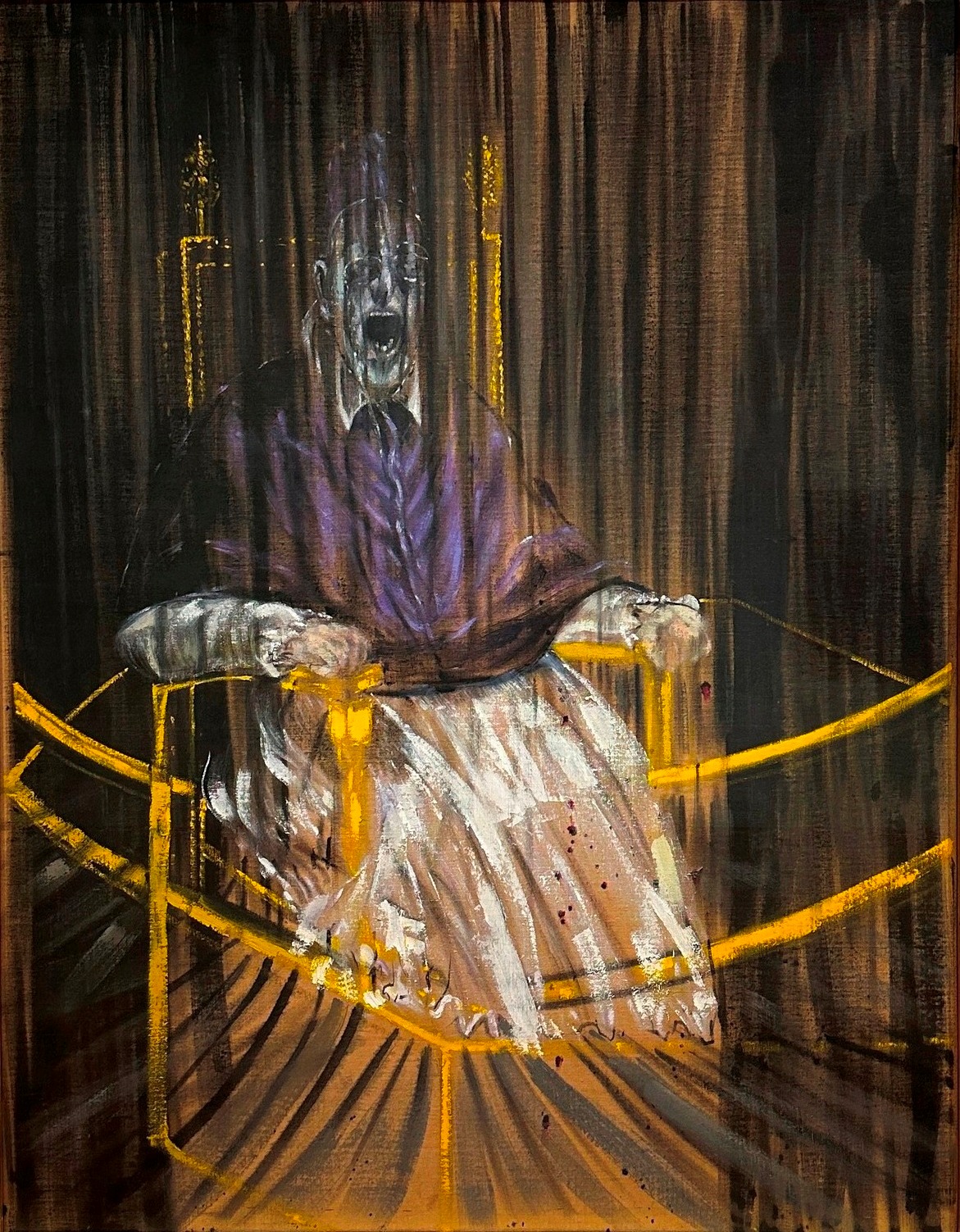
Bacon’s “Study After Velázquez’s Portrait of Pope Innocent X” (1953), one of a series of mordant takeoffs.
London Landscape
Bacon – psychoanalyst for human solitude
FRANCESCO CARELLII | LONDON JOURNAL OF PRIMARY CARE | NUMBER 2 | VOLUME 1 | JUNE 2009
Tate Britain’s exhibition of the work of Francis Bacon (1909–1992) is a major celebration heralding the artist’s centenary in 2009. As the first UK retrospective since 1985, it affords a re-assessment of his work in the light of the new research that has emerged since the revelation of his studio and its contents following the artist’s death.
Comprising around 65 paintings and covering the artist’s career, including 13 large triptychs, the exhibition bring together the most important works from each period of his life. It is the largest display to date to examine Bacon’s sources, processes and thoughts by an artist internationally regarded as Britain’s greatest painter of the last century and the biggest one after Turner.
His paintings of the 1940s bore witness to the shattered psychology of the time and shot him to prominence that hardly diminished over the next 50 years. He captured sexuality, violence and isolation in his unflinching depictions of the anxieties of the modern condition.
The exhibition explores Bacon’s philosophy that man is simply another animal in a godless world, subject to the same natural urges of violence, lust and fear that are physically evident in the body. Bacon’s output was dominated by the human body.
His way of portraying the body was unique in the history of painting, usually in isolation, at moments of extreme tension or even pain, distorted like figures from a fantastical nightmare, indicating the isolation of human life without God just as an animal. So humans are subject to the same natural urges of violence, lust and fear as any other animal.
He reveals the frailty of the human figure and the scream or cry that expresses repressed and violent anxieties. In one painting we see the distorted human figure where we recognise the famous crying nurse on the steps depicted in Eisenstein’s movie ‘Potemkin battleship’ with broken glasses indicating the human shattered vision on a number of levels. Bacon said ‘I like Freud very much because I like his way of explaining things between conscious and unconscious’. Along his works, we see a sense of dread pervading the brutality of everyday life in which he portrays humans as pathetically isolated.
In the final part of his life, dark openings consciously evoke the abyss of confrontation with mortality, the inevitability and constant presence of death, where the poetry of TS Eliot was a particular source of inspiration.
The Raw Vision of Francis Bacon
Francis Bacon at 100.
BY CHRISTOPHER BENFEY| ART | CULTURE | SLATE | WEDNESDAY, MAY 27, 2009
The Met’s reverential celebration of English artist Francis Bacon, who was born 100 years ago and died in 1992, feels more like a coronation than a retrospective. It’s as though after years of painting howling popes and grisly crucifixions, the bad-boy sinner had finally been rewarded with a puff of white smoke from the Holy See. Bacon's impact on younger painters has never been greater; Three Studies for Figures at the Base of a Crucifixion, which stunned viewers in war-ravaged London in 1945, helps us see why. In this grim triptych, more Abu Ghraib than Gethsemane, Bacon preserved the visceral impact of religious painting while emptying it of overt spiritual baggage. Three genetically modified life forms are the eyeless spectators at "a crucifixion," as though such things happen every day. Lampreylike and bandaged against a lethal orange background, they look as though they could survive anything. A lifelong atheist, Bacon once said that he wanted his pictures "to look as if a human being had passed between them, like a snail, leaving a trail of the human presence and memory trace of past events as the snail leaves its slime."
"I kinda like this one," says Jack Nicholson’s nihilistic Joker in Tim Burton’s 1989 film Batman as he mows through an art museum defacing paintings. The painting he spares is one of Bacon’s famous popes, flanked by slabs of flayed meat. Loosely based on Diego Velázquez’s Portrait of Pope Innocent X (1649-50), which Bacon claimed to know only in reproductions, Bacon's open-mouthed popes have elicited many interpretations, from the personal (Bacon was severely asthmatic, and the pope is gasping for air) to the existential ("This is the black night of the 20th-century soul. …"). But it’s doubtful that Bacon had any specific interpretation in mind in creating such images. Intensity was what he was after—and jarring incongruity. Like a chemist in the lab, he combined unstable substances—in this case, a familiar portrait of a pope with a still of a screaming nurse from Sergei Eisenstein's film Battleship Potemkin—to see what explosive compound might emerge. The results can be oddly divergent in their emotional impact. Head VI, the earliest surviving version of the series, may invite an initial sense of horror, but it also looks surprisingly like a triumphant college graduate with a tassel dangling from his mortarboard. Teeth and gums are lovingly painted, a miniature symphony of mauve and white. Bacon once told art critic David Sylvester that he always wanted "to paint the mouth like Monet painted a sunset.
Bacon recombines the meat, the teeth, and the tassel in his monumental Painting, another crucifixion for modern times. With its echoes of Rembrandt and Soutine, masters of the painted carcass, Painting is a "masterpiece" in the old sense of the word: a work that displays what an apprentice has learned in mastering his craft. Bacon had little formal schooling and none in art; he learned what he needed to know from museums and fellow artists. Born in Dublin into a rich Protestant English family that divided its time between Ireland and England, Bacon was kicked out of the house at 16 when his father, a horse trainer and official in the War Office, discovered him wearing his mother's clothes. He drifted among professions (gentleman's valet, interior decorator) and lovers (his first was a Tory politician) before finding in art—especially the paintings of Picasso he saw in Paris on a visit during the 1920s—a staging ground for emotional and sexual intensity. While Bacon's biomorphic forms superficially recall Picasso’s Surrealist period, his working methods, the subject of intense research since his studio was made available to scholars after his death, align him with Warhol. Bacon painted primarily from a horde of photographs, many of which are displayed in the Met exhibition. Painting is based in part on an image of the Nazi minister of propaganda, Joseph Goebbels, behind a bank of microphones.
Bacon based many paintings on Eadweard Muybridge's stop-action studies of animal locomotion from the 1880s. "It would be very difficult for me," he once said, "to disentangle the influence of Muybridge from the influence of Michelangelo." Michelangelo was a great religious painter, while Muybridge was a secular scientist. But for Bacon, both Muybridge and Michelangelo were thesauruses of suggestive physical poses, available for recombination, and trailing old meanings like a snail trailing slime. There is probably some man-as-beast analogy in Bacon's dogs and baboons, but Bacon didn't insist on the metaphors. Sometimes a dog is just a dog.
During the 1950s, Bacon’s toothy popes morphed into toothy businessmen in grey flannel suits, often portrayed in cagelike bedrooms with heavy blinds lowered. These have been interpreted, predictably, as commentaries on Cold War bureaucratic uniformity and sexual repression—"the hollow men, the stuffed men," as Bacon’s favourite poet, T.S. Eliot, might have called them. But these men in blue are weirder than that. In Study for a Portrait, the gaping mouth is based on a book about oral diseases that Bacon had bought in Paris. If Bacon painted gaping mouths like Monet sunsets, here the lush blues and blacks resemble Whistler's nocturnes. As in many of Bacon’s strongest paintings, our emotions and our eyes are pulled in two directions at once: a disturbing image of grinning derangement and a reassuring harmony of blues and greys.
There’s a kindred tension between horror and harmony in Bacon's hallucinatory riff on the life mask of William Blake, originally cast by London phrenologist James Delville in 1813, when Blake was 56. Working, as usual, from a photograph, Bacon reanimated the mask. The seemingly flayed head looms in the darkness like an actor delivering a soliloquy. The spectral image bears an uncanny resemblance to Marlon Brando reciting Eliot’s The Hollow Men in Apocalypse Now. Bacon is also inviting a comparison between his own visionary work and that of an outsider artist like Blake. The painted planes of the face are hauntingly beautiful, a jagged map of human presence at the border of life and death.
Bacon's work slackened during the 1960s, and there are too many flamboyant triptychs of theatrical and sexual goings-on, hurriedly (and reportedly drunkenly) painted. Smaller portraits, often in sequences like strips from a photo booth, retain their intensity. Bacon liked to quote Cocteau’s quip, "Each day in the mirror I watch death at work." He claimed not to like self-portraiture: "I loathe my own face." But by the late 1970s, he had lost so many friends—along with his longtime lover, George Dyer, dead of a drug overdose (and commemorated in many, many paintings)—that "I’ve nobody left to paint but myself!" Across the mouth, Bacon applied paint with ribbed fabrics, giving a strangely striated texture, like Eliot’s Sweeney (the subject of a late Bacon triptych) with "zebra stripes along his jaw."
The bleak paintings of Bacon’s lonely last years have titles like A Piece of Waste Land (Eliot again) and Blood on Pavement. This picture may, as the wall-text claims, be based on "a night when the artist encountered evidence of a brutal act in the street while walking home." And yet there’s nothing brutal about the painting, with its calm, Rothko-like swaths of colour. "You have to abbreviate into intensity," Bacon believed, and this picture takes abbreviation to the edge of abstraction. Like the related Jet of Water, with its white paint splashed across the canvas, Blood on Pavement seems to be about the act of painting, the mysterious process by which seemingly arbitrary marks assume emotional power.
Lovingly preserved in a Dublin gallery, Bacon's studio is now a site of pilgrimage as well as a live archeological dig. When American art historian Sam Hunter visited Bacon during the early 1950s, the creative clutter already threatened to engulf the studio. "At one end stand his paintings, unique and extremely personal inventions," Hunter wrote. "At the other are tables littered with newspaper photographs and clippings, crime sheets. … Violence is the common denominator of photographs showing Goebbels waggling a finger on the public platform, the human carnage of a highway accident, every sort of war atrocity." During Bacon’s lifetime, critics often noted the eerie ways in which his paintings seemed to predict public events. His slaughterhouse motifs were displayed as the first shocking images from the Nazi concentration camps emerged. Eichmann on trial in his glass cell recalled Bacon’s popes in their kindred cages. In our own era of enhanced interrogation techniques, it feels as though Bacon, whose life spanned the century of total war, has dreamed it all before us. "I’m an optimist," Bacon liked to say, "an optimist about nothing."
He made despair glamorous, but was
Francis Bacon truly great?
SEBASTIAN SMEE | THE BOSTON GLOBE | SUNDAY, MAY 24, 2009
NEW YORK — Embarrassed by our former selves, we often recoil from the art we loved as adolescents. Artists we ardently fall for in our teens are frequently — and sometimes savagely — "dropped" later in life as our tastes become more sophisticated (or so we think).
In literature, such writers as J.D. Salinger, Ernest Hemingway, and Raymond Carver routinely suffer such a fate, while in art, Edvard Munch, Egon Schiele, and Vincent Van Gogh are perhaps the classic cases.
Francis Bacon, too, belongs in this category. For those who succumbed early to an infatuation with his violent and glamorous work, as I did, the question of whether he is really any good can be as much a test of respect for our former selves, and the special receptiveness of youth, as it is of Bacon himself.
Widely regarded as a — if not the — leading figure in postwar British art, Bacon, who died in 1992, is the subject of a major retrospective here at the Metropolitan Museum of Art.
Over the years, he has been received in America with am bivalence. His first work to enter a public collection was bought by New York’s Museum of Modern Art in 1948. And the Met made Bacon the first living artist from Britain to be accorded a solo show in 1975.
But many leading US critics, offended, perhaps, by his disdain for abstraction — the idiom that established American ascendancy in art after 1940 — failed to give Bacon the lavish praise he was accorded in Britain and France.
Gary Tinterow, a curator at the Met, suggests another cause. In the catalogue for Francis Bacon: A Centenary Retrospective, he writes that Bacon’s "overt homosexuality was incompatible with the disguised Puritan and overtly macho ethos of many of his American contemporaries . . . at least until the 1980s" when, he says, feminism and queer studies introduced more sympathetic attitudes.
Tinterow’s claim is as ridiculous as it looks (homosexuality was far from unknown in American art between the 1940s and the 1980s). But it is fair to say that Bacon’s psychological complexity, his combination of intense charm, queeny wit, and instinctive perversity, can seem very British (although he was actually born in Ireland) and, to some American observers, perhaps, alienating.
The Met show, which originated at London’s Tate Britain last year, does not make an open-and-shut case for Bacon’s greatness. It includes too much early work, and too much late work. The early paintings, from 1944 to 1962, which made such a big impression on observers at the time, look histrionic and bloated (big canvases with not much going on). The late ones lack tension, depending on arbitrary mannerisms and sensation-craving effects.
But there are two rooms filled with works of devastating force — and that ought to be enough for anyone.
Part of what makes these works, painted between 1962 and 1976, great is Bacon’s introduction of bright, saturated colours to his carefully designed and fastidiously painted backgrounds.
The early works, including the series of screaming popes that Bacon later dismissed, quite rightly, as "very silly," tended to set isolated figures in transparent enclosures against black or gray backgrounds, often with vertical striations, vaguely suggestive of veils, prison bars, or the rows of spotlights used as ghostly extensions of architecture at Nazi rallies.
The contrast between the near-monochrome sobriety of this early work and the sumptuousness of the post-1962 colours is extreme. But nowhere in the lamely dutiful introduction to the catalogue by curators Matthew Gale and Chris Stephens is colour discussed.
Certainly it is strange to think of this supreme painter of human agony and despair as a connoisseur of royal purples, lush spring greens, phallic pinks, perfumed mauves, and commercial oranges. But Bacon was a great colourist who, like Matisse, came to understand the impact that large areas of saturated tints could have.
In paintings like Lying Figure (1969), Triptych—In Memory of George Dyer (1971), and the Matisse-like nude Henrietta Moraes (1966), Bacon set up thrilling tensions between the rectilinear areas of flat, unmodulated colour he used for his backgrounds; the liquid, bulging outlines of his figures, which cast shadows like spilled blood; and the scumbled, layered brushstrokes he used to convey flesh.
The commentary on Bacon focuses always on the flesh. Bacon was, after all, a connoisseur of mortality and an avid student of gruesome medical textbooks, scenes of cinematic violence, and photographs of abattoirs. But in his great period, all these elements are splendidly interwoven.
A gambler, Bacon liked to play up his reliance on chance. But his orchestration of all the various elements in his paintings was so carefully controlled that the operations of chance were surely minimal. He began his creative career as a designer of modernist rugs and furniture in the vein of Marcel Breuer, Le Corbusier, and Eileen Gray, and it’s hard not to see the carefully plotted designs of his later canvases, especially the great triptychs, as vestiges of this period.
The fund of remarkable anecdotes relating to Bacon’s life is almost inexhaustible, and not entirely incidental to the impact of his paintings. One such is told by Picasso’s biographer, John Richardson, in his memoir, The Sorcerer’s Apprentice.
Richardson described seeing Bacon "ensconced in front of a mirror, seemingly making up his face. In fact he was rehearsing those heavily loaded brushstrokes that would give his portraits . . . their sumptuous gyroscopic spin."
Bacon, he continued, would "let his beard grow for a few days" and "then cake pads with different shades of Max Factor’s pancake makeup and apply them, this way and that, across his stubble in great swoops . . . It was as if the surface of his face were the page of a sketchbook."
With this in mind, get up close to one of the smaller portraits in the show, such as the 1966 Portrait of Isabel Rawsthorne or the 1967 Study for Head of George Dyer. You see the attention Bacon lavished on his subjects’ skin — the remarkable feeling for different textures, the sense of volume and motion conveyed by shifting speeds of brushstroke, the embrace of arbitrary colour as a correlative not of atmospheric light, as in the Fauves, but of the arbitrariness of life itself.
For Bacon’s portraiture was not just about degrees of physical likeness. It was an attempt to capture a psychological, an existential condition. The weakness of his art as he got older was that he tended to subordinate a sense of specific presence — a shiver, a spasm, a convulsion of hatred or ecstatic release — to more abstract, generalized notions about the condition of being alive.
I have no doubt that, for Bacon, these ideas were more than just philosophical musings; he clearly experienced them down in the core of his being. But as he got older, he seemed unable to find new ways to communicate their urgency.
In the famous interviews Bacon conducted with the critic David Sylvester (published in the book Interviews with Francis Bacon), which have had an incalculable influence not only on artists but on novelists, playwrights, poets, musicians, and filmmakers around the world, he said: "You see, all art has now become completely a game by which man distracts himself. . . . What is fascinating now is that it’s going to become much more difficult for the artist, because he must really deepen the game to be any good at all."
Regrettably, Bacon, in his last two decades, seemed unable to find ways to deepen the game.
Similarly, he used the word "illustrative" as a powerful pejorative — a quality to be avoided at all costs. A great work, he said, must hit the "nervous system" directly rather than have its emotion conveyed via "a long diatribe in the brain."
But a lot of his work, with its teasing arrows and ashtrays, its syringes and swastikas, seems coyly involved in games of storytelling, and his drawing frequently feels flatly descriptive — exactly like illustration.
Despite all that, I remember well the effect Bacon’s work first had on me, as well as its impact on several friends who have gone on to become artists. His paintings combined abject violence with a kind of immaculate beauty in ways that teenage boys are probably predestined to find alluring. I may be fussier in my mind about what succeeds and what doesn’t now, but I remain in awe of that early union of Bacon’s imagery and my own teenage hunger for maximum impact.
This show is an important retrospective by an artist who could seize you by the throat as almost no other 20th-century artist could. But it fails to settle the case of his greatness.

Study for Portrait I, 1953 Francis Bacon
If Paintings Had Voices, Francis Bacon’s Would Shriek
By ROBERTA SMITH | ART REVIEW | THE NEW YORK TIMES | THURSDAY, MAY 21, 2009
Francis Bacon is an artist for our time. You may love or hate his work, which is still vigorously polarizing after all these years. But more than that of any other artist who emerged at the end of World War II, his work tells us about the strengths and weaknesses of the moment.
For nearly 50 years, until his death in 1992 at 82, Bacon worked the fault lines dividing abstraction and representation and sometimes photography, where many contemporary painters from subsequent generations have staked claims of one kind or another.
His contorted figures and portraits, his screaming popes and apes, his flanks of beef and crime-scene gore, and his wrestling lovers bring to mind any number of video-melodramatists, most quickly Bill Viola, reflecting a taste for hokey humanism, spectacle and sensationalism that often seems pervasive today. His emphasis on loaded narrative over form, which can make his art seem formulaic and repetitive, is now nearly epidemic.
The stately if cursory survey of Bacon’s paintings that opened Wednesday at the Metropolitan Museum of Art suggests a more lasting pertinence: Bacon’s depiction of the love that until a few decades ago dared not say its name, much less demand the right to marry. Bacon convincingly painted men having sex and sometimes making love. Whether this makes him a great painter, it certainly secures him a place in the history of both painting and art. He emphatically turned the male gaze toward males.
Bacon did for men in lust or in love what his hero Picasso had done for men and women in the same spot — or at least for Picasso and women. He turned sex and genuine passion into a pictorial event, using paint on canvas with finesse and no small sense of drama and without getting clinical. He operated, like Picasso, under cover of modernism.
The show, which originated at the Tate Britain last fall, has been slightly reconstituted and installed at the Met by Gary Tinterow, the curator in charge of 19th-century modern and contemporary art. It is freshest where it delves into Bacon’s use of photographs, not only those clipped from magazines and books but also images he had taken of friends and lovers. He often blew up images and used their cut-out forms as templates. (You can see this especially with George Dyer, his handsome, distinctively profiled companion, whom he painted often in the 1960s and ’70s.)
“Francis Bacon: A Centenary Retrospective” begins in full cry. First come the screeching fiends of “Three Studies for Figures at the Base of a Crucifixion,” the triptych with which Bacon announced himself to the London art scene in 1944. Against bright orange grounds that would become something of a signature, gape-mouthed furies — part human, part monster, and one per canvas — foretell postwar deprivation, rage and existential doubt. The dogs of war are not going to be leashed anytime soon; the world itself is on the cross.
These overwrought creatures work better in movies, like “Alien.” Their screams continue in the next gallery, where the open, dentally precise mouths gradually migrate to human heads, mostly from 1949, and the first of Bacon’s famous, often glib screaming popes, after Velázquez, arrives. The Museum of Modern Art’s “Painting” from 1946 is also here, encapsulating much of the Bacon repertory: matching slabs of meat that might be said to couple, a seated male, a half-hidden screaming face and the luxurious surface and color. Even so, his mastery was more than a decade away
Only in the third gallery does this show dial back the hysteria and risk real emotion, in particular the tenderness passing between two men in “Untitled (Two Figures in the Grass),” from around 1952. Pale, soft-fleshed and naked, his back to us, one sits with his legs tucked beneath him, bowing his head over the other, who apparently lies in the grass, his presence indicated mostly as a pair of bent knees that are, ominously, faintly touched with red. Theirs is a sorrowing intimacy stolen amid a gale of blue-black strokes. The faint outlines of a bed and room hint at an imagined interior, a safe, private haven.
Bacon later said that he regretted having wasted so much time while young. Instead of learning his craft, he was often drinking, gambling, sleeping around and having a brutal affair with a violent, alcoholic, drug-addicted sadist named Peter Lacy that sometimes made his friends fear for his life.
This show concurs by bringing on more popes, along with screaming apes, slinking dogs and mute businessmen. Scant of surface and image, with glancing, uneasy brushwork, they imply a divided attention and a reliance on pictorial short cuts and ambiguities to disguise limited skills. Although they are some of Bacon’s best-known works, they barely pass muster as paintings.
Yet the Met’s exhibition disputes the notion that Bacon’s art declined, indicating that it often improved as his colors brightened, his paint handling gained muscularity. It was equally important that he began to focus on people he knew and cared about, giving them faces that seem simultaneously masked, gouged out of wet clay and recognizably individual.
Bacon may have been saved by the physicality of van Gogh’s art, as evidenced by the 1957 “Study for a Portrait of van Gogh VI,” with its thick, troweled paint, raking light and a plowed field that resembles a butterflied slab of meat marbled with red and green. In the same room “Three Studies for a Crucifixion” from 1962 announces Bacon’s maturity: in pulsations of red, orange and black we see two assassins; the bloody pulp of their victim, curled on a striped mattress; and a hanging side of beef — with human teeth — that suggests a saint’s martyrdom
In the show’s second half Bacon paints from his life, his imagination or somewhere in between, uncoiling new, ambiguous narratives that were often enhanced by the expansiveness of the triptych format. These paintings may not always work, but it is rarely for lack of trying. Sex, both violent and not, takes place; crimes are committed; guts are spilled. Colors become electrifying, textures enrich. The curved shelf of space that becomes the norm circles around, implicating us as intimates, voyeurs or unwilling witnesses.
Often we seem to see people posing in the studio, fidgeting, ready to jump out of their skins (even though Bacon didn’t paint from life, only from photographs). In “Two Studies for a Portrait of George Dyer,” the subject sits near a canvas that is pinned with a nude picture of him, which is truer to Bacon’s working method.
An especially fraught 1967 triptych that Bacon allowed to be named for T. S. Eliot’s poem “Sweeney Agonistes” has two scenes of lovers on low platforms raised above grass-green carpet. They flank an interior in which a hideous partial carcass is propped up before a window. One imagines it as the remnants of a man who, from loneliness, has literally howled out his heart to the implacable black sea visible beneath a violet sky. Except that the violet plane is a window shade, a regal color commensurate with the sacrifice. Whatever Bacon’s mangled, solitary or coupled beings meant to him, they starkly remind us that, while we look at the painting, others are dying, seizing up with loneliness or having sex
I’m not sure that this show will do much to alter the polarities of opinion around Bacon; that will take much more curatorial precision and imagination. But it is always bracing to see his work and to realize that part of its energy derives from its refusal to go softly in art history. He reminds us that in the end very little about art is fixed, and that we should always be ready to turn on a dime.
“Francis Bacon: A Centenary
Retrospective” continues
through Aug. 16 at the
Metropolitan Museum of Art
Culture Zohn: Francis Bacon:
The Painter as Pulverising Machine
PATRICIA ZOHN | THE HUFFINGTON POST | THURSDAY, MAY 21, 2009
When they think of Francis Bacon, most people think: torment. Tortured and torqued figures, wailing, screaming, headless, chinless, from world and his personal history, portrayed under attack for being gay (which was actually illegal when he began to emerge as a painter) or being political or just being different. Bacon sampled poetry, power, religion, world events, spiritualism, hypocrisy and homophobia in a mix with liner notes that told of isolation and fear. That sense of discomfort you got from the confrontational work turned you on or off; Bacon referred to himself as a "pulverizing machine into which everything I look at and feel is fed."
Yet, even though I didn’t immediately understand the depth of suffering, I always loved his dynamic, in your face painting, his pushy subjects, his sophisticated colours (oranges – neon to peach to ochre to muddy brown – blues – navy to teal to lavender – and a luscious avocado). Even the backgrounds, at first glance seemingly one-dimensional, are tricky with floor sweepings and bits of collage that give lie to the notion that he is simply a portraitist who cared only about the figure. The Metropolitan Museum of Art is the last stop on a tour of a retrospective of this spectacular painter.
In 1975 when the Metropolitan showed his work (including the triptych that sold at auction last year for $86.3 million), I bought a signed poster, all I could afford, which was relegated to an attic as my stuff could not keep up with my criss-crossing of the country.
When I landed again in NY a few years ago, I quickly retrieved the Bacon and put it next to my bed and in the tiny room you can’t help but think how unlike most bedroom art it is. And yet even with his angst and anger over his lovers, Bacon was immensely moving, spewing fractured fairy tales that depict desire as the thing that drives you crazy even as it is the only thing that keeps you sane.
The retrospective is extremely beautiful. Everyone was talking about how the artist normally known for his ugly portraits could be an astonishing colourist, every bit as complicated as Picasso, Velasquez, Matisse and many photographers (Muybridge) and filmmakers (Eisenstein) whom he took as inspiration. His love affairs almost undid him. Yet he worked every day with a protean single-mindedness; the work is testament to his original and fierce view of the world.
I can’t help but think a whole new generation of artists will come to the Met and claim his audacity and genius for themselves, his inspirational technique and passion ricocheting off the Metropolitan walls.
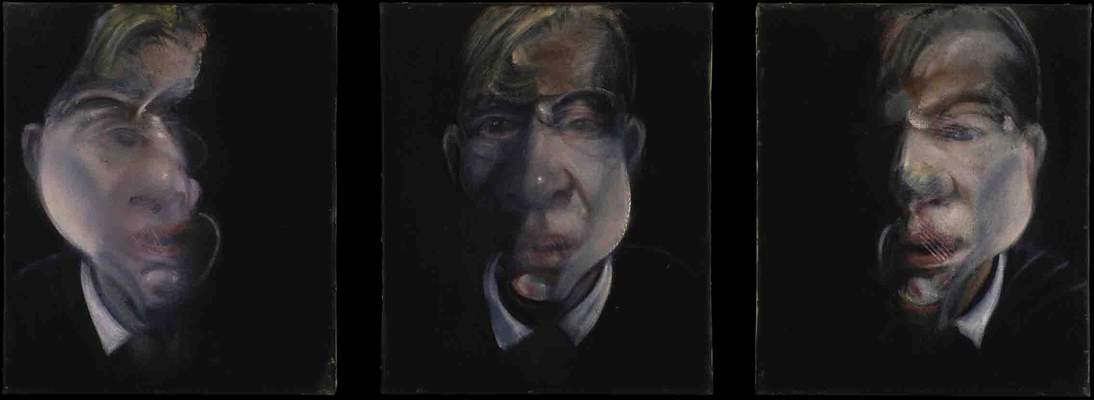
Francis Bacon: Three Studies for a Self-Portrait (1979-80)
Art’s obsessive genius
The Met is celebrating Francis Bacon’s centenary with a grand retrospective.
Paul Laster highlights this controversial artist’s best and most disturbing work.
PAUL LASTER | THE DAILY BEAST | WEDNESDAY, MAY 20, 2009
Francis Bacon’s daring yet disturbing portrayals of friends and lovers and his imaginative interpretations of historical paintings, photographs, and films have long been celebrated. Now the controversial self-taught British artist is the subject of a grand, 100th-year birthday retrospective at New York’s Metropolitan Museum of Art.
The exhibition, which began at Tate Britain last fall and traveled to Madrid’s Museo Nacional del Prado earlier this year, was originally organized around such central themes as animal, crucifixion, and crisis. However, at the Met, curators Gary Tinterow and Anne Strauss stage a chronological viewing for Francis Bacon: A Centenary Retrospective that takes the viewer through the most significant stages of Bacon’s development as an artist—from his early success in the ’40s and portraits of people in the ’60s and ’70s to self-portraits and landscapes in his final decade. The paintings, ephemera, wall texts, and audio tour construct a story of an obsessive, gifted genius who lived for love and art until he took his last breath on April 28, 1992
The show opens with Three Studies for Figures at the Base of a Crucifixion(1944), a triptych of distorted, repellent figures—defiantly perched on tabletops and a patch of grass—that are all mouths and muscle. Of equal importance is Painting (1946), which New York’s Museum of Modern Art acquired two years after it was made. It features a dark, anguished figure surrounded by a lexicon of Bacon’s symbols: butchered meat, silhouetted window shades, black umbrellas, and tubular rails that echo his modernist furniture designs. An accident that developed from a sequence of false starts, Painting is shown in an intimate room with several Head series paintings that were exhibited in Bacon’s first solo show at London’s Hanover Gallery in 1949.
Head VI (1949), which is the cover image of the Met’s catalog, is a horrific portrait of a screaming, robed man that may have been the first work in Bacon’s series of pope paintings, made after Portrait of Pope Innocent X (1650) by the 17th-century Spanish painter Diego Velázquez. Working from a reproduction, Bacon would eventually paint more than 40 versions of the Velázquez masterpiece; although he later said none were as good as the original. Today, however, Bacon’s pope paintings are highly coveted.
The paintings, ephemera, wall texts, and audio tour construct a story of an obsessive, gifted genius who lived for love and art.
Expressive paintings of people and animals in motion, from the ’40s and ’50s, such as Study of a Baboon (1953), a primate that appears to be both in and out of its cage, are featured in the third and fourth galleries, alongside the pope paintings and leading into a room of four of the seven known paintings from the Men in Blue series (1953-55). Study for a Portrait (1953), from the Hamburger Kunsthalle Collection, is the most dynamic, simultaneously depicting a suited man in his bed and at his desk—a figure of authority considered to be a portrayal of Bacon’s tumultuous lover Peter Lacy, an ex-RAF pilot.
The Men in Blue series utilizes Bacon’s favored technique of thick, vertical, curtain-like lines, which he referred to as shuttering, to obscure the figure and ground and veil what might be considered any lack of painterly finesse. Bacon also chose to present all of his works behind glass, in gilded frames, to lend a level of importance to the work. The glass establishes a distance between the painting and the viewer, while disturbingly causing one to see his own reflection in it.
In 1961, after Bacon’s move to 7 Reece Mews in London, a new, spare aesthetic evolved, which placed a lone figure or pair of figures on a painted background of one or two colors. Paralytic Child Walking on All Fours (from Muybridge), from that year, is a fine example of this stylistic shift. Based on a 19th-century Eadweard Muybridge photograph, it focuses on a child walking like an animal in a sparse plane, a vision that expressed Bacon’s existentialist belief that we are the same as animals, living life without a predetermined nature.
The following year, Bacon painted Three Studies for a Crucifixion (1962), the first triptych he had made in 20 years, which put him back on the path to paint many more. The riveting painting—which symbolically captures Hitler and Himmler pushing people into the gas chamber; a contorted, bullet-ridden body on a bed; and Christ as an irreverent slab of beef, sliding down the cross—was made for his 1962 retrospective at the Tate Gallery and offered a powerful response to the American abstract painters, who dominated the international art scene at the time and worked on a similarly grand scale.
The ’60s and ’70s are arguably Bacon’s best years. He enlisted Vogue photographer John Deakin to photograph his coarse, creative group of friends, preferring to paint them from pictures, as he saw fit, in the solitude of his messy studio. Bacon crumpled and folded the photos to get new, distorted perspectives on the models’ faces, perhaps seeing them in their drunken states at the bar.
There are portraits of Henrietta Moraes, Isabel Rawsthorne, and George Dyer in the show. Moraes, a lover of Lucian Freud, is splayed nude on a bed; Rawsthorne, a painter who had also modeled for Giacometti and Picasso, stands in a surreal vision of a Soho street; and Dyer, Bacon’s lover, rides a bike on a suspended rail. He was the inspiration for some of Bacon’s best paintings of the ’60s, including Two Studies for a Portrait of George Dyer (1968), which places two views of the dapper dude—one twistingly evil and the other vacuous—hovering around an ashtray, overflowing with cigarette butt.
Bacon rivals Picasso in the way he represents the body, particularly the face. He defines the model’s nature, which is most often dark, through a combination of elegant marks. Everything is in motion, and the triptych panels often construct a narrative, like the frames of a film do. In the ’70s he made even more triptychs of Dyer, but now to memorialize his suicidal overdose, which came on the eve of Bacon’s retrospective at the Grand Palais in Paris. Triptych— In Memory of George Dyer (1971) dramatically mixes Dyer’s death in a Paris hotel with a passage from T.S. Eliot’s poem The Waste Land, while Triptych— August 1972(1972) shows his former companion dissolving into pools of pink fluid.
The remainder of the paintings in the show focus on Bacon’s small but powerful portraits; a few landscapes, in particular Blood on Pavement (1988), which throws stark reality into a painting that mocks a Mark Rothko; a Portrait of John Edwards (1988), Bacon’s lover since 1976, seated on a chair in a position that’s reminiscent of Dyer’s portraits; and a final self-portrait, Triptych (1991), which juxtaposes two coupling figures, based on a Muybridge photograph, surrounded by two truncated bodies, one with the head of a Brazilian race-car driver and the other with the head of Bacon.
Beyond his lifetime of work, Bacon left a studio full of ephemera: pictures of wrestlers, boxers, and baseball players, torn from books and magazines; Deakin’s photographs, smudged with Bacon’s paint-stained fingerprints; fragments of medical journals; and sketches and handwritten notes on scraps. As enchanting as the art that fills the surrounding galleries, it gives the viewer insight into the simple origins of some of the most psychological paintings ever made.
Paul Laster is the editor of Art Asia Pacific, and a contributing writer at Time Out New York and Art in America
Why Bacon?
SHARON BUTLER | TWO COATS OF PAINT | NEW YORK CITY | MONDAY, MAY 18, 2009
Francis Bacon is one of those painters every beginning painting student adores because Bacon’s work is so much more accessible than the abstract painters who were exploring similar existential themes during the same period. The accessibility of Bacon’s corporeal vision is undoubtedly why his work appeals so strongly to new collectors short on art theory. Not surprisingly, during today’s opening remarks at the press preview for the Bacon exhibition that opens this week at the Met, curator Gary Tinterow cited Bacon’s influence on later artists (primarily Damien Hirst and the YBAs) as one of the primary reasons that this show is so important. The second reason, Tinterow declared, is the fact that Bacon is dead.
Huh? Well, it seems that many of Bacon’s friends and colleagues who were reluctant to dish while the painter was alive, have come forward to give us a more fully formed picture of Bacon’s life and working process than was available during the last Bacon retrospective twenty years ago. Additionally, after Bacon died, the source material in his notoriously cluttered London studio was sorted and catalogued, and 65 pieces from the archive are included in the exhibition. The dog-eared magazine images, crumpled photographs, and torn book pages, many painted over or altered by the artist, are my favorite part of the show. Bacon’s sketches and notes reveal that he was, to use Jung’s categories, a thinker who struggled to reconcile his need to explain and tell with his desire to make the viewer feel.
The exhibition, arranged chronologically, shows a self-taught artist earnestly learning how to paint in the early years. According to Tinterow, one of the reasons that Bacon framed his paintings under glass was so that the reflections and sheen would camouflage his technical shortcomings. The later work shows a mastery of materials and a much richer understanding of color, but the early immediacy and agitation have been replaced by a more placid, decorative approach, not unlike DeKooning’s path from edgy action painter to lyrical abstractionist.
Bacon’s paintings
aren’t all that influential
among young artists today,
but perhaps, thanks to this
show, we can look forward to
some screaming, yelping
angst emerging from grad
school studios in the near
future, instead of the
text-heavy theoretical
constructs we’ve become
accustomed to
The exhibition is
accompanied by a fully
illustrated catalogue
published by Tate
Publishing, with essays by
Martin Harrison, David
Mellor, Simon Ofield, Rachel
Tant, Gary Tinterow, and
Victoria Walsh.
Francis Bacon: A Centenary
Retrospective, curated
by Gary Tinterow, Matthew
Gale, and Chris Stephens.
Organized by Gary Tinterow,
Anne L. Strauss, and Ian
Alteveer. The Metropolitan
Museum, New York, NY. May 20
–August 16. Exhibited at
Tate Britain and the Museo
Nacional del Prado, Madrid
before its presentation at
the Metropolitan Museum.
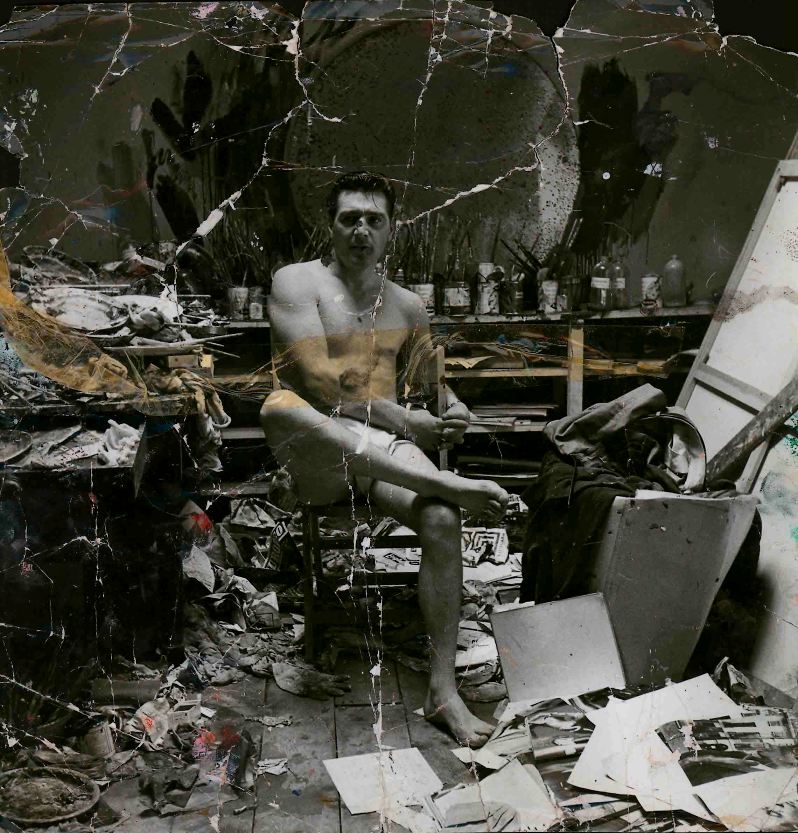
George Dyer in the Reece Mews Studio, ca. 1964.
Sacred Monster
On the eve of the Met’s giant retrospective, a critic asks:
Was Francis Bacon really the greatest painter of the twentieth
century, or just a fascinating mess?
By JERRY SALTZ | ART | NEW YORK MAGAZINE | SUNDAY, MAY 17, 2009
Francis Bacon, whose centenary is being marked by a Metropolitan Museum of Art retrospective opening this week, is the Irish-born English artist whom the English consider their Achilles: a truculent hero rising from the turbulence, an outlaw god. Indeed, the first word of Homer’s Iliad comes to mind when thinking about his paintings and tumultuous life: “Rage..”
Those who knew the artist—some of them his friends—described him variously as “devil,” “whore,” “one of the world’s leading alcoholics,” “bilious ogre,” “sacred monster,” and “a drunken, faded sodomite swaying nocturnally through the lowest dives and gambling dens of Soho.” Bacon was no kinder: He called himself a “grinding machine” and “rotten to the core.” This hasn’t stopped admirers and critics alike from proclaiming him “the greatest painter in the world,” “the best … since Turner.” Never one to spare hyperbole, Robert Hughes wrote, “This painter of buggery, sadism, dread, and death-vomit has emerged as the toughest, the most implacable, lyric artist in late-twentieth-century England, perhaps in all the world.”
For me, Bacon—who may be the only artist sharing a name with one of his main subjects, meat—has always been more of a cartoonist. He’s an illustrator of exaggerated, ultimately empty angst. His early accomplishments are undeniable, and the Met’s survey of 66 paintings and a cache of never-before-seen source material is peppered with high points, especially the signature paintings of the forties and fifties: Canvases with twisted masses of faceless flesh and otherworldly homunculi, creatures of the id posed in living-room wastelands and Stygian prisons. The best of this work shrouds you in a sulfuric gloom where strange powers transform human souls into delirious monsters. These paintings make audiences stare as if they were looking at animals in a zoo, trying to come to terms with these merciless inhuman presences. You’ll see this at the Met: people blankly gaping in wonder. To understand Bacon’s impact, look no further than the young Brits emulating him.
Jake and Dinos Chapman place tortured figures in glass cases; Jenny Saville’s contorted Gargantuas are direct descendants of Bacon’s golems; Tracey Emin works with blood and guts; Sarah Lucas gives us spooks and deformities. Damien Hirst not only makes vitrines straight out of Bacon—he puts meat and carcasses in them. Like Dalí and Munch, Bacon is an artist we love when young. Tantalized by the urgency, angst, weirdness, blood, sex, and bodies, we think, That’s me! That’s how I feel!
You might have reconsidered feeling like Bacon if you’d lived in his skin. His love life is a study in emotional privation and degradation. “We are meat,” he often remarked—understandable, given his adolescence. Bacon, who was given morphine as a child for his asthma (the ailment that contributed to his death in 1992), always knew which way his erotic compass pointed, which is not to say that he approved of its inclination: He called his homosexuality “a defect” and a “limp.” And no wonder. When Bacon was 16, his father—the artist derisively called him “a failed horse-trainer”—caught the boy wearing his mother’s underwear. (“Fishnet stockings were an essential part of the artist’s wardrobe for most of his life,” one biographer notes.) As punishment, the father had him horsewhipped by the stable hands, whom, Bacon later claimed, he then had affairs with. Bacon Sr. asked a family friend to “straighten the boy out” by taking him to Berlin. The man complied—and subsequently bedded the younger Bacon, then abandoned him in the city that W. H. Auden called “a bugger’s daydream.”
Endless liaisons with rent boys and society types followed, until Bacon’s predator-prey notion of love and his “desire to suffer” reached new heights, in 1952. At the age of 43, he met a former RAF pilot, Peter Lacy, in London’s Soho. They spent a lot of time in Tangier, a refuge for gay men looking for freedom. “I’d never really fallen in love with anyone until then,” Bacon said. “Of course, it was the most total disaster from the start.” Bacon couldn’t live with or without him: “Being in love in that extreme way,” he said, “being totally obsessed by someone, is like having some dreadful disease. I wouldn’t wish it on my worst enemy.” They experimented with the far reaches of S&M. The end was horrid, too. On the day before his first Tate retrospective opened, in May 1962, Bacon learned Lacy had been found dead, almost surely from drinking.
Less than two years later, Bacon met George Dyer—reportedly when Dyer broke into his studio to rob him. For the next seven years the relationship rocketed up and down, then history repeated itself. On October 25, 1971, the day before Bacon’s retrospective at the Grand Palais in Paris opened, Dyer overdosed and died in their Paris hotel room. Bacon, then 61, was again devastated. No wonder he talked about “the destruction” of love.
All this manifested itself in his art, which rattled the cage of English painting like nothing before it. Compared with the prevailing emphasis on the literary and the anecdotal (the sappy Victorian painter George Frederic Watts is considered “England’s Michelangelo”), Bacon came out of nowhere. His unfinished surfaces, saturated color, and nonstories make him a near anomaly in the history of his country’s painting. He never attended art school—he was entirely self-taught—but he devoured art history, and you can easily spot his influences: Cubism, Romanticism, Expressionism, Surrealism, Chaim Soutine, Goya’s late paintings, and the figures of Michelangelo.
In 1927, a year after he was banished from home, Bacon went to Paris, where he saw a survey of over 100 Picasso drawings. The show tattooed itself on his brain and left him thinking that Picasso had come closer than anyone in the century to “the core of what feeling is about.” He became “the reason I paint,” Bacon said, “the father figure.” Tellingly, the show consisted mainly of Picasso’s classical drawings; there were no Cubist works on hand. Thus Bacon’s rendezvous with modernism was fairly un-modern. Like Balthus, another insider-outsider type, he’s an artist who never went abstract or painted in the visual idiom of his time.
In 1929, back in London, he set himself up creating furniture and rugs based on modern French design. He tentatively showed a few paintings in his own home, but it wasn’t until April 1933, when he was 24, that Bacon exhibited his first painting, at the Mayor Gallery in London’s West End. Interest was immediate and word spread. Within months, a painting of his was reproduced opposite a recent Picasso in art historian Herbert Read’s book Art Now.
That work, Crucifixion (1933), which vibrates off the walls at the Met, Bacon claimed to have finished “in about a fortnight when I was in a bad mood of drinking.” It’s a haunted little thing, with no sense of devotion to anything except painting—an ectoplasmic alien shape with phosphorescent wings and outstretched arms standing in a murky monochromatic ground demarcated by lines forming invisible planes. The macabre work was influenced by the almost unknown Catholic Australian painter Roy de Maistre (Bacon’s mentor and lover) and owes much to Soutine and archaic altarpiece painting. Yet it also epitomized Bacon’s astonishing description of what a painting should be: “a snail leaving a trail of the human presence.” Crucifixion radiates what Deleuze called “cosmic dissipation.”
But just as it appeared that he would take the English art world by storm, Bacon’s trail dissipated. He exhibited works the following year, to little attention and bad reviews. Stung, he destroyed every painting from the show. By the late thirties, he had quit painting. He “abandoned himself with a vengeance to drifting, from bar to bar, from person to person … setting up a series of private—and totally illegal—gambling clubs,” says his biographer Michael Peppiatt.
Then came the “night of the world”: the Second World War. In April 1945—a month of simultaneous relief and unimagined horror—Mussolini was hanged upside-down, Hitler committed suicide, Roosevelt died, and the nightmares at Buchenwald and Bergen-Belsen were revealed. And Bacon, then 35, exhibited a painting that still induces shudders. Three Studies for Figures at the Base of a Crucifixion is a triptych depicting howling, deformed, harpylike goblins. There are intimations of real space, but these raving underworld visitants mostly exist in a universe of animal instinct. A lamentation for the dead and living, a retaliation for his personal traumas, the painting exudes venomous visionary force. Reviewers were shocked and awed: “Images so unrelievedly awful that the mind snaps shut,” wrote John Russell after first seeing Three Studies. “We had no name for them, no name for what we felt about them.” (Years later, in 1953, the Tate had to be persuaded to accept the painting as a gift.)
Bacon had broached a new door, and to his enormous credit, he kept doing that for fifteen years. Painting, from 1946 (bought by the Museum of Modern Art in 1948 for £280), was an even bigger breakthrough. In this coagulated masterpiece, a grinning or grimacing man—only the bottom of whose face is seen—is jammed between splayed cow carcasses and what looks like a witness stand. An umbrella is over his head. Here, Bacon hits on many of the themes, techniques, and formal concerns that occupied him for the rest of his life: Man, animal, and meat merge. There is no narrative, just a conjuration of some malevolent force. As with countless subsequent figures, Bacon isolates this one within an enclosure in the middle of the canvas. The space feels hallucinatory, menacing, sullen, shallow. Best of all, the paint is physical and visceral—clotted, smeared, wiped off, applied with rags and fingers and brushes or straight from the tubes. Intense lilacs, pinks, and magentas multiply the effect. Within a few years, Bacon was applying great unbroken fields of orange, apricot, and red. Some of this color is so intense and modern it keeps even the worst of his oeuvre alive.
By the fifties, Bacon had hit his stride, painting what he called “figures … [in] moments of crisis … [with] acute awareness of their mortality … of their animal nature”—truths hauntingly self-evident in his large pictures of naked beefy men crouching in transparent cases, making love with or attacking one another; dogs cowering on dark streets; sphinxes; businessmen; and howling monkeys. Adding to this symphony of hatred, longing, and pain are his many portraits of popes.
This period of Bacon’s paintings was revolutionary for two reasons, both hard to see now. First, an openly gay man was painting gay subjects at a time when homosexuality was a punishable crime in Great Britain. (Sodomy laws remained in effect there until 1967, and sentencing could involve hard labor.) Introducing overtly queer subject matter into grand painting without dressing it up in classicism or coy kitsch was as unheard-of as it was dangerous, and not just in England. One of Bacon’s first solo exhibitions in New York in the fifties included a painting of two naked men grappling on a bed. It had to be installed out of the way, on the gallery’s upper floor, in case of a police raid.
1957, while going though one of his tumults with Peter Lacy and with the pressure of an imminent solo show building, Bacon, who in his own words was in a “bad way mentally and physically” and was trying to avoid a crackdown on homosexuality in Tangier, tried to make a move in his work. This, for all practical purposes, was the last time he’d attempt to break from predictability. He painted a series “at high speed,” based on Van Gogh’s The Painter on the Road to Tarascon, experimenting with more viscous surfaces and strident light. The color is flamboyant and brassy; space is flatter, less reliant on perspective; subjects are outdoors. In the one Van Gogh painting at the Met—a stunner—you can see him giving up his tricks, breaking out of his style to fantastic effect. But when the series first appeared, some of his most ardent supporters turned away. Russell called them “clamorous,” “hectic,” “perhaps the weakest” he ever did; Lawrence Alloway dismissed the series as “an outburst from a gypsy violin.”
I believe the Van Gogh series marks the beginning of the end for Bacon. It’s true that he painted for another 35 years, and that in the sixties and seventies he produced arresting triptychs of bloody figures—in fact, it’s doubtful that Bacon would be nearly as famous without them. Bernardo Bertolucci based scenes in Last Tango in Paris on them. A so-so 1976 example sold in 2008 for $86.3 million, setting an auction record.
But the Metropolitan’s retrospective, like most Bacon shows, makes it clear that he kept working his theme until it became a gimmick. The calculated pictorial repetitiousness and lack of formal development wear thin. Except for a number of fabulous portrait heads and the astounding Jet of Water—made in 1988, just four years before his death, featuring an enormous streak of blue paint across an interior—Bacon’s formula had grown stagnant by 1965.
Once you’re aware of this point, it becomes all you see. He has no idea what to do with the edges of his paintings. Everything that happens in Bacon’s work happens in the middle of the canvas; at times you don’t have to look anywhere else. The bottoms of his paintings are always the same, too—a receding plane curves up at the sides, like you’re looking through a fish-eye lens or from inside someone’s eye sockets. He neutralized his paintings further by insisting they be framed behind glass. (“I even like Rembrandts under glass,” he once said.
Last fall, when I saw this Bacon retrospective at the Tate, it ran concurrently with a Mark Rothko show. Rothko and Bacon were virtually the same age; both worked away from Paris and took “anguish” as their subject. Yet compared with Rothko’s glowing blank Buddhist television sets, Bacon’s work seems mannered, conservative, simplistic. Bacon said that “only by going too far can you go far enough,” yet in giving up all the conventions of painting, Rothko went further. When I saw the Bacon show again at the Prado this past winter—near the galleries full of Velázquez masterpieces—Bacon’s work seemed dead and canned. His supporters often refer to the rousing chaos of his studio (Cecil Beaton noted its “discarded paintings, rags, newspapers, and every sort of rubbish”). If only his late work had some of that anarchy.
What’s especially poignant about Bacon is that he knew he’d built his own prison. As early as 1963, he referred to “my rigidness.” He talked about the “drawback” of his style and how he used painterly tics as a “device.” In 1970, drama turned to tragicomedy when Dyer falsely accused Bacon of marijuana possession. A police raid was followed by arrest, public humiliation, and trial and acquittal. By then Bacon and his work were becoming parodies of themselves. You can see this at the Met; the bright chalky color in his work is vibrantly alive, but everything else is flat. And he seems to have recognized that. He’d sealed himself off from the art of his time. “I stay here in my cage,” he said. Bacon disliked abstract art, saying it was “too weak to convey anything, and had “nothing to do with the avant-garde.”
When you watch the 1985 BBC film of Bacon being interviewed in that grubby studio and hear him spout bromides he’d repeated for decades (he was “an optimist about nothing,” he said again and again), one of his self-assessments seems apt: “I am the most artificial person you’ll ever meet.” The more one looks at his long career—especially the last 25 years of it—the more Bacon strikes you not as an artist unafraid of the darkest within himself but as an artist who didn’t go to that source enough. Bacon wanted to “remake the violence of reality itself,” and for a time he succeeded. But in the end, he seems less a modern painter than the last of a breed of Romantics—one who, in his final interview, plaintively stated, “I painted to be loved.”
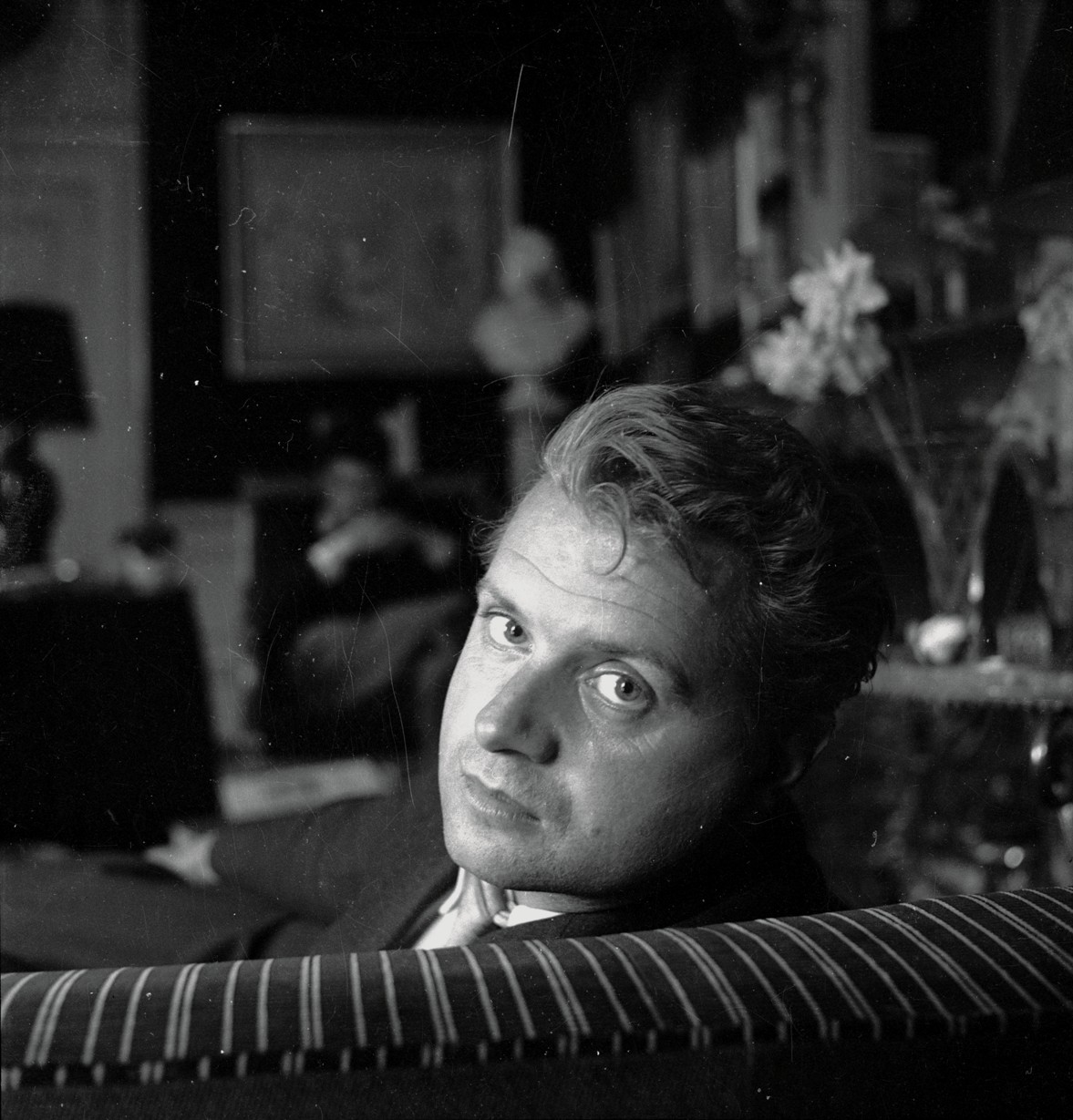
Francis Bacon in 1951 by Cecil Beaton
The ‘degenerate’ road to totalitarianism
The wonder and appeal of art is its mutability
GARY CLEMENT | NATIONAL POST | CANADA | THURSDAY, MAY 14, 2009
On July 19, 1937, a singular, notorious art show made its premiere in Munich. Entitled the Entartete Kunst or Degenerate Art exhibit, it featured over 650 drawings, paintings, sculptures, prints and books collected by the Nazis from German artists and museums that had been confiscated on the grounds that the works, and by extension the artists that created them, represented un-German — or worse, Jewish — forms of expression and ideology.
The show featured such well known degenerates as Paul Klee, Max Ernst, Max Beckman and Marc Chagall, to name but a few. The works themselves were derided for being insulting to German women and farmers, revealing the Jewish racial soul and just generally presenting the view of sick minds. The exhibit has since become a major reference point for anyone requiring a handy example of institutional intolerance at its most absurd ... and most dangerous.
Barbara Kay argues that the work of artists like Francis Bacon finds its "aesthetic inspiration in humiliation, filth, disease, deformity and sadism." She further states that this "so-called art is degenerate" and that "the so-called cultural elites’ fascination with it [is] indecent." Ms. Kay, naturally, has every right to dislike whatever she wishes — far be it from me to dictate taste. I do believe, however, that the ice starts getting pretty thin when one begins labelling art one doesn’t approve of as "degenerate."
The wonder and appeal of art — the reason for its durability as a form of human expression — is its mutability; its ability to satisfy an enormous amount of demands and to be reinvented by each new generation of artists. We turn to art for pleasure, for intellectual challenge, for stories, for mystery, for provocation. Sometimes we even get it all in a single piece of work.
There are those who prefer to look at art that will be pleasing to the eye and nothing more and, hey, there’s nothing wrong with that. There are of course others who want to see work that will, to borrow a phrase form my parents, grab us by the kishkas — in other words, deeply affect us. I’m talking about the kind of work that will inspire thought, debate, emotional outbursts and, heck, maybe even outrage. Work like Francis Bacon’s, for example.
Historically, when institutions, governments — the authorities in general — have tried to mandate what we should and shouldn’t be looking at in the way of paintings, books, theatre, etc., based on, for example, moral grounds, the skid toward totalitarianism is pretty easy to discern. There were not, as I recall, too many gallery openings in Kabul under the Taliban.
Francis Bacon has long since moved on from outraging audiences to delighting them by the hordes. The show that Barbara Kay speaks of was at the Prado in Madrid when I was there recently and I can assure her that it was doing brisk business indeed. And I don’t believe I saw a single degenerate in the crowd.
— Gary Clement is the editorial cartoonist for the National Post.
Barbara Kay, Note to kneejerk liberal art critics:
Nazis and homophobics don’t own the word “degenerate”
BARBRA KAY | NATIONAL POST | CANADA | THURSDAY, MAY 14, 2009
The surge of reaction, some very angry, to the column I wrote May 13 about artist Francis Bacon and others of the "abject" or "disgust" school of art, surprised me. I often get feedback that disagrees with my opinion, but when I get hate mail suggesting I should be banned from writing in newspapers and that it is "obscene" for me to query the words of an expert art critic (this person is known to me — a good liberal except for his totalitarian views on those who disagree with his liberal views), I realized I have been, sob, misunderstood.
There were three strands of criticism that emerged from my personal mail and the letters to the editor.
One assumed that I thought Bacon’s artwork should be banned or not shown in public because I consider adulation of shock artists "indecent." Well I do consider it indecent, but I consider a lot of things in life indecent. Indecency is a choice and I’m all about choice and free speech — unlike certain liberals I could name.
The second misunderstanding was that I seemed in some people’s eyes to be suggesting that Bacon was untalented. I didn’t say that either. I said his art was degenerate and reflected a degenerate mind. He’s obviously very gifted, but talent in the service of prurience is no defence of what emerges.
Because of its history, the real problem was the word "degenerate." Some people saw the word and immediately assumed I was importing a lot of historical baggage I had no intention of referencing. A slew of writers to me personally, and in particular, Gary Clement in today’s Post, accused me of doing to Bacon what the Nazis did to Jews in the thirties. More than a few accused me of homophobia, simply because Bacon happens to be gay. This is illogical and unfair. As I wrote back to one such critic, I don’t care whether Bacon and other disgust artists are gay, straight, trannies or polygamists from Utah: It isn’t them I hate, it’s their work, because their work is degenerate in its focus.
The Nazis took the exact opposite view from mine. They assigned the word degenerate to beauty because it came from the hands of a despised group, and they banished it. I don’t hate these artists and I don’t want their work banned. So it is both irrational and polemically irresponsible to align me with evils I am quite as appalled by as they are. (I can’t help noting in an ironic aside that if anyone’s association with the Nazi era is suspect, you have to wonder why Bacon had iconic pictures of Himmler and Goebbels in his studio. Inspiration? Well, he was a sado-masochist, so who knows?)
Finally some critics triumphantly pointed to the popularity of Bacon’s art as an apparently knockout rhetorical blow. Gary Clement argues that Francis Bacon’s work delights the public. That is no argument against its degeneracy. Plenty of great artists went unloved and unseen in their creative years, so surely who is going to exhibits to see whom is a very weak argument for its morality. The public is notorious for flocking to exhibitions that feature shock art. Body World, which I cited in my column, has drawn over 20 million viewers to see its plastinated cadavers. That doesn’t make it moral or any the less a violation of human dignity. In ancient Rome, stadiums were full of crowds watching people being torn to pieces by wild animals. Fascination with the dark side of our nature is no argument for its morality, which is what troubled me the most. Why can’t critics be honest and simply admit it: Hey, it’s disgusting and self-loathing, and we are attracted to it. If you like it, go see it, but don’t gussy up your impulse in moral finery. There’s nothing moral in mocking the symbols of Christianity (we get it already, you artists don’t like religion, but how come we never see any screaming imams in cages, only screaming popes?) going on in these paintings.
Furthermore, to answer another criticism that misunderstood my argumentation, I was not suggesting all art must be about sweetness and light. There are all kinds of artistic ways to show despair without dipping crucifixes in urine, smearing blood and faeces on artefacts and in general highlighting the loathsome aspects of material life. The artist Andrew Wyeth, a near-contemporary to Bacon, illuminated despair as well as any artist I know of, and did it with respect for the dignity of his subjects.
It is fine and good that artists should experiment with new forms and materials and perspectives in their struggle to comprehend the world and translate it to the canvas. It is a narcissistic indulgence to look at skin disease manuals for inspiration and call it a moral impulse.
A perversion of art
BARBRA KAY | NATIONAL POST | CANADA | WEDNESDAY, MAY 13, 2009
An old New Yorker cartoon has four men contemplating an abstract painting in a gallery. Two of them, Runyonesque philistines, are rolling on the floor laughing. The snooty-aired dandies standing behind them look disdainful, but a bit wistful, too. One says to the other something like: "We miss out on a lot of fun by understanding art."
Would that philistines today still reacted to contemporary art with merriment, and how very innocent the once-sophisticated term "abstract" now seems. Rather than laughing in galleries nowadays, ordinary folks are more inclined to head for the vomitorium.
The Metropolitan Museum in New York is mounting a Francis Bacon show next week. Bacon, who died in 1992, was a very disturbed man, a sadomasochist, in fact. Amongst his recurrent motifs were screaming popes in glass cages and copulating male bodies. His favourite quote was Aeschylus’s "the reek of human blood is laughter to my heart."
It’s a curious paradox: In the real world we are increasingly obsessed with seamless, poreless, ever-youthful Botoxed beauty, while the art world seems to vie for who can represent the human body in its most degraded, damaged and repulsive form.
It doesn’t seem so long ago that Lawren Harris of the Group of Seven was painting landscapes because he found in lakes and mountains "a power and a majesty and a wealth of experience at nature’s summit." Today his "artist" great-granddaughter Kyla Harris, paralyzed in an accident from the neck down, employs herself as a photographic model for wheelchair erotica.
Another Canadian artist, Terence Koh, is enjoying enormous commercial success in New York for his controversial works featuring eclectic cultural icons like Jesus, Michelangelo’s David and Mickey Mouse in a state of sexual arousal. Sometimes he smears his work with his own blood or semen.
Then there’s the touring exhibit, Body World, visited by more than 20 million people. Body World goes beyond disgust in the degradation of the living to delight in the violation of the dead. Creator Gunther von Hagen’s Crayolabright plastinated cadavers, articulated into jocular poses, treat the human corpse as a kind of stylized meta-human: death imitating art imitating life.
Several of the cadavers used are alleged to have been executed in China. Von Hagen once did a live autopsy on London television and laughed when bodily fluids shot out of the corpse.
The way acknowledged artists treat the human body reflects a culture’s attitude to itself. When artists take their inspiration from skin disease manuals (as Bacon did) rather than Olympian or godly ideals, that doesn’t say much for our cultural confidence. It’s no coincidence that the race to the aesthetic bottom coincides with our acceptance of the body’s functions and continual decay as all that’s left after the banishment of any linkage of corporal humanity with sanctity or a higher purpose.
Art critic John Richardson feebly attempts to exculpate Francis Bacon: "By holding a mirror up to our degenerate times, Bacon proves himself to be one of the most moral artists of the day."
What nonsense. For if it is moral to find aesthetic inspiration in humiliation, filth, disease, deformity and sadism, what, pray tell, would be immoral in the topsy-turvy world of today’s art world elites? Lakes, mountains and the Mona Lisa? No, Francis Bacon and his ilk are holding up a mirror to their own perverted selves.
Bacon’s painting of an abattoir with trailing entrails and blood went for $86-million, and a Qatar sheik paid £26-million for one of his screaming popes. I don’t know the price for the painting of his boyfriend sitting on the toilet.
This so-called art is degenerate; the so-called cultural elites’ fascination with it is indecent. Degeneracy and indecency are, of course, quaintly archaic concepts, still understood by philistines, that have coprophilic artists and their enablers rolling on the floor laughing.
Ianthe Knott
LIVES REMEMBERED | OBITUARIES | THE DAILY TELEGRAPH | THURSDAY, APRIL 30, 2009
Ianthe Knott Aged 90. Sister of artist Francis Bacon, and reportedly his favourite sibling. Moved to Rhodesia in 1931, subsequently married a South African farmer and raised a family on a large farm on the Limpopo, not far from Zimbabwe’s border with South Africa.
Last September travelled to London to attend the opening of the Bacon retrospective exhibition at Tate Britain which marked the beginning of the artist’s centennial celebrations. It was believed to be only the second time she had returned to England after emigrating.

FRANCIS BACON’S HORROR SHOW
Francis Bacon believed there was beauty in the colour of meat, and it was possible
“to be optimistic and totally without hope.” This year, the centennial of his birth,
is a fine time to revisit his insights on art, writes Megan Buskey ...
Special to MORE INTELLIGENT LIFE
MEGAN BUSKEY | INTELLIGENT LIFE QUARTERLY MAGAZINE | THE ECONOMIST | SPRING 2009
If you were in London in the 1960s and wanted to chat up Francis Bacon, all you had to do was head to the Colony Room, a junky club on Dean Street in Soho, where he routinely held court. He was such a fixture there that the Colony’s owner and den-mother, a crass woman named Muriel Belcher, called him “daughter”. As Bacon’s critical reputation grew, so did his financial means, and he was known for covering the tab for his friends and leaving lavish tips. What he valued more than money was conversation, and he was as comfortable telling a dirty joke as he was discussing Aeschylus.
In 1962 David Sylvester, an art critic and friend, decided to bring Bacon’s pontifications to a wider audience. These long-form recorded interviews proved popular, largely owing to Bacon’s insight, and in 1975 they were compiled as a book. The Brutality of Fact: Interviews with Francis Bacon shed welcome light on Bacon’s work, which many found inscrutable, if not disturbing.
Bacon is now enjoying a lot of attention, particularly since a few of his paintings sold for record-breaking prices in 2007. To celebrate the centennial of his birth this year, a grand retrospective of his work opened at the Metropolitan Museum in New York on May 20th (travelling from the Tate Britain via the Prado in Madrid). As a new generation struggles to come to terms with his dramatic, searing paintings, Bacon’s conversations with Sylvester are freshly relevant.
Interviews is rare for the way it addresses big questions about the purpose and process of artistic creation. Which art is more true? Work that proceeds from a preconceived idea or work that comes from impulse? Is abstraction more powerful than figurative representation? What causes artists to fixate on certain subjects? Artists and writers regularly praise these interviews for Bacon’s candid, plain-spoken perceptions of so tricky a subject. "I read and re-read the interviews and have carried on devouring them, like a bible to a believer," Damien Hirst has written. "[I]t was the way into art for me."
The answers “didn’t always come on the spur of the moment,” Sylvester wrote in Looking Back on Francis Bacon, a critical study he published after Bacon’s death in 1992. “Right up to the end of his life I would get a telephone call at eight in the morning trying out some formulation of a thought.” It’s true that Bacon sometimes struggled to express himself—he didn’t have much in the way of formal education. But his earnestness and self-awareness made up for his deficits in eloquence. Bacon attributed the origins of his successful work to “accident[s]” born of impulse:
When I was trying in despair the other day to paint that head of a specific person, I used a very big brush and a great deal of paint, and I put it on very, very freely, and I simply didn’t know in the end what I was doing, and suddenly this thing clicked, and became exactly like this image I was trying to record. But not out of any conscious will, nor was it anything to do with illustrational painting.
Just how an artist made certain choices beguiled him, though he recognised that talent and dedication had influence. Bacon held that it was through “profound sensibility” that a master like Rembrandt decided to “hold onto one irrational mark rather than onto another.” Balancing impulse with more deliberate aims was a challenge; Bacon thought it was easier to create when under the influence of drugs, alcohol, exhaustion or, in his case, “despair.”
The central question for Bacon was “how do I feel I can make this image more immediately real to myself?” Forms still had their purpose, but he arranged them in a way that courted an emotional response. Observe the mangled figures in Bacon’s paintings, with their misplaced arms, ears, legs and elbows. Blank backdrops, on the other hand, provided “a very clear background against which the image can articulate itself”. He used certain colours until he grew bored with them and moved on. The idea was to make work that “brought the figurative thing up onto the nervous system violently and poignantly.”
Bacon searched widely for inspiration. His chaotic studio on Reece Mews was carpeted with heaps of paint-splattered images culled from random sources. (He once had nicer digs in Roland Gardens, but he felt “absolutely castrated in the place” and summarily moved.) When he was painting a portrait of Sylvester, he constantly consulted photographs of wild animals. “One image can be deeply suggestive of the other,” Bacon said. “Rhinoceros skin would help me to think of the texture of human skin.” He credited Sigmund Freud for inspiring his careful play between reality and eerie dreamscapes. “I don’t think I’m gifted," he reflected. "I just think I’m receptive."
Recurring motifs in Bacon’s work, such as animal carcasses, black umbrellas and the detritus of drug use and illness, convey self-destruction. Bernardo Bertolucci described his portraits as “faces eaten up by something that comes from within”, and sent Marlon Brando to a Bacon exhibition at the Grand Palais during the filming of Last Tango in Paris.
But Bacon resisted the idea that his work was principally about inspiring horror. Horror was part of life, but not its sole constituent. “You must not forget the beauty of the colour of a piece of meat,” Bacon said. He acknowledged that his early life in Ireland and his adolescent forays into Berlin’s harsh homosexual underworld made him “accustomed to always living through violence.” Yet he claimed his art was not a reaction to these fraught experiences.
He did concede that his subjects appeared “doomed” and “in moments of crisis,” as Sylvester put it. Yet Bacon preferred to think of them as exhibiting their “mortality”, the inescapable condition that he could never stop thinking about. “If life excites you, its shadow, death, must also excite you," he said. "You can be optimistic and totally without hope.”
Sylvester was sceptical: “It’s not altogether stupid to attribute an obsession with horror to an artist who has done so many paintings of the human scream.” But Bacon maintained that his paintings of screams reflected his obsession with the aesthetic of the human mouth. The screams he most admired were in Poussin’s Massacre of the Innocents and Eisenstein’s Battleship Potemkin. I’ve always wanted and never succeeded in painting the smile.”
If that sounds glib, it’s on account of the risk that comes with Bacon using language to explain what he believed could only be conveyed through art. Yet his efforts to express himself in Interviews are nothing short of profound. “I remember looking at a dog-shit on the pavement when I was 17 and I suddenly realised, there it is–this is what life is like,” Bacon told Sylvester. “It tormented me for months. I think of life as meaningless; but we give it meaning during our own existence. We give this purposeless existence a meaning by our drives. [Art] really comes from a feeling [that] it’s impossible to do these things, so I might as well just do anything. And out of this anything, one sees what happens.”
Francis Bacon: The Show Goes On
By RICHARD LACAVO | TIME | TUESDAY, MAY 5, 2009
The most powerful museum show I saw last year — or, for that matter, for decades — was the Francis Bacon retrospective at Tate Britain in London. From there it traveled to the Prado and now it’s finally coming to the U.S. On May 20 it makes its third and final stop at the Metropolitan Museum in New York.
Bacon was one of the favourites of the art market that just collapsed. One of his triptychs sold last year for $86 million and so on. But unlike the hundreds of overvalued players in that extended low comic episode, he will always be a name to be reckoned with. Money has nothing to do with his value.
Some artists simply validate art itself. Bacon was one of those. He demonstrated the continuing authority and ingenuity of paint as a way of reaching to places where no other medium — not books, not movies, not music — can go. He didn’t make it easy.
What he was good at were emblems of loathing and despair, wretched creatures in abject moments, seen in the full light of day and without sentiment. This isn’t the only way to make great art — it’s certainly not the road Matisse went down, or, most of the time, Picasso — but as we sort out the 20th century it’s becoming more and more obvious that Bacon is one of the greats.
Tragic Hero
By RICHARD LACAVO | TIME | THURSDAY, APRIL 5, 2009
Francis Bacon did for despair what Michelangelo did for faith. He made it majestic. That’s the conclusion you can’t help taking away from the Bacon retrospective that will open on May 20 at the Metropolitan Museum of Art in New York City. I caught the show last year at its first venue, London’s Tate Britain, and left it convinced that it was one of the most powerful exhibitions I’d seen in more than 40 years of museumgoing.
This has nothing to do with Bacon as the phenomenon of last year’s hot auction market, now extinguished, where one of his triptychs sold for $86 million. By bringing together almost five decades of his work into a collective cry, this show makes you realize how rare it is to see contemporary art that attempts, much less achieves, what used to be called a tragic dimension. Irony you can find in any gallery these days, as well as low comedy, puerile cool and enigma. But in a time that has its share of suffering, where is the art that tries to strike an equivalent note? What we have almost no language for anymore, at least not in painting, is acute pain. Except in room after room of this magnificent show.
The exhibition, which runs through Aug. 16, marks the centenary of Bacon’s birth in 1909 in Dublin. His father, a truculent British army officer turned horse trainer, shuttled the family for years between Ireland and England. But by the age of 16, Bacon was in London, and living on his own with a small allowance from his mother and the assistance of various older men. Eventually he drifted into a career as an interior decorator while trying to find his way as a painter. But it wasn’t until the 1940s that he arrived at the vocabulary of tortured forms against a flat backdrop that he would develop for the rest of his life.
Along with Giacometti, Dubuffet and a few others, Bacon would emerge as one of the artists who found a way, after the butchery of World War II, to make the painted human figure plausible again by subjecting it to extreme pressure. The soft tissue of Bacon’s men and women is wrenched and smeared by their own drives and desires and by whatever it is they do to one another. Their heads are split, their torsos are boneless. Their limbs, stretched and exploded, truly deserve to be called extremities--because with Bacon the body is always in extremis.
So in a triptych like Three Studies for a Crucifixion from 1962, with its invertebrate lovers grappling in the center panel and its butchered carcass in the right, the body is the visible sign of the eternal devils of human nature, the dog beneath the skin that bares its fangs in war and in bed. What the eyes represent for most painters, the mouth was for Bacon, the locus of human identity. The mouth is what bites, suckles, and howls at the moon. By contrast, the eyes are likely to be missing entirely or smeared shut or obscured by a milky scrim, as in his portrait of the writer Michel Leiris. With Bacon, the windows of the soul--not that he believed in the soul--always have the curtains drawn.
To piece together his wretched figures, Bacon spent a lifetime ransacking art history. From Poussin he took the mouth of a screaming mother in The Massacre of the Innocents and from Degas the arched back of a woman bathing herself in a tub. Eadweard Muybridge’s sequential photos of wrestlers gave him a perennial motif — sex as sexual combat. He also drew from sources far outside art. One of his favorites was an illustrated medical text about illnesses of the mouth. He worked from reproductions, movie stills and photographs of all kinds pinned to the walls of his studio and scattered on the floor in a sedimentary muck of paper, rags, used brushes and broken furniture that he would dive into for ideas.
But it was Picasso who first showed him the way. In the central panel of one of Bacon’s works from the 1970s, Triptych - In Memory of George Dyer, a shadowy man stands near the landing of a darkened stairwell, turning a tiny key in a lock. That key is borrowed from an odd creature doing the same in several of Picasso’s seaside pictures from the late 1920s, when he was flirting with Surrealism. Those elastic Picassos, with their biomorphic figures that are part human, part dirigible, part swollen breast or phallus, turned a key in Bacon. They showed him the way to his own nightmare distortions of anatomy.
Oddly, the steel-tube furnishings that Bacon favoured as an interior designer in the ’30s also found their way years later - in ghostly outline, stripped of any associations with fashion or taste - into the stark spaces and barred enclosures of his pictures. You detect them for the first time in his series of paintings from the 1950s that were drawn from the great Velázquez portrait of Pope Innocent X. Flickering white perimeters form a cage for the Pontiff’s impotent fury. Why a Pope? With Bacon there’s never one answer. His great gift was for visual and psychological conflation, for compressing multiple possibilities into a single sliding form. Trapped in a kind of isolation booth, where a thunderstorm of granular black strokes rains down on him, the screaming Pope in Head VI suggests the baying, baboon madness of authority. (One source for the image was a photo of Joseph Goebbels in full harangue.) Yet at the same time he’s the face of the powerlessness of absolute power.
That picture of the Holy Father might also bear traces of Bacon’s anguished dealings with his own father, who had rejected his girlish son. But it’s a mistake to read Bacon’s work too quickly by way of his life. That’s true even of the ferocious triptychs he made after the suicide of his lover George Dyer, a onetime London hood who killed himself in their hotel room on the eve of Bacon’s first big retrospective, in Paris in 1971. In those pictures Bacon didn’t simply unload his grief. He used it to find his way to the even bleaker abbreviations of a pitiless world he produced in the 1970s. Dyer’s grotesque end — he was found dead on the toilet from a drug overdose — stands behind these paintings, but they speak to you about more universal miseries. This is the thing so compelling about Bacon, the sense he produces that the suffering is ferocious but the sufferer is dry-eyed.
Not everything he did is a triumph. In the mid-1950s, when he was spending a lot of time in Tangiers in a miserable love affair, he was inspired by Van Gogh and by the keen Moroccan sunlight to experiment with brighter colours and looser brushwork. The result was a series of congested Expressionist canvases that are the weakest in the show. But the high-key palette of those pictures also pointed him to the orange, lilac and beige backgrounds that make his great work of the ’60s and ’70s so unnerving, precisely because the figures struggle in such bright spaces.
By his last decade — he died in 1992 — Bacon was almost too fluent in his own bleak idioms. There are cluttered, overdetermined pictures in the last galleries, where you watch him wondering how to make it new. But there are also great ones, like the 1991 Triptych. In all three panels, a large black square is placed like a window within a flat beige background. In the center, a barely human form flows over the lower edge of the black square. In each side panel, Bacon appears as a painted photograph of his own head pinned to the space above a pair of disembodied legs. Each of these has one foot stepping into the blackness. It’s a portrait of the artist bowing out, dying as fearlessly as he lived. And when you see it without sentiment, even death can be majestic.
Secrets Of The Flesh
DODIE KAZANJIAN | PREVIEW | VOGUE | WEDNESDAY, 1 APRIL, 2009
As a major Francis Bacon
retrospective comes to New
York, six contemporary
artists reflect on the
creative impact and enduring
legacy of the 20th-century
painter.
Francis Bacon, who died in
1992, is the great chthonic
dragon of modern art. His
images of human anguish and
dislocation have never lost
their power to shock and
frighten us, and to
influence the generations of
artists who still grapple
with figurative painting,
which not so long ago was
considered obsolete.
Next month, Francis Bacon: A Centenary Retrospective opens at the Metropolitan Museum of Art, where it is certain to set off new and surprising reverberations. The show, the first major New York exhibition of Bacon’s work in 20 years, has drawn huge audiences in its previous appearances, at the Tate Britain in London and at the Prado in Madrid. It includes paintings from all phases of the artist’s career, plus a rich trove of source materials rescued from his famously cluttered studio.
Bacon often worked from
pictures he found in
magazines, and many of these
are on view, torn and
folded, scribbled on and
manipulated in his search
for the toughest, most
poignant, most concentrated
image. "Bacon’s under-lying
goal is to knock you off
your feet," says Gary
Tinterow, the Met’s chairman
of nineteenth-century,
modern, and contemporary
art, who organized the show
here. "He wants to knock you
out of your complacency,
make you see the world
differently, and expose the
underlying violence in human
nature. He really is the
Picasso of our time, in
terms of artists who are
fighting against, or coming
to grips with, the horrible
ogre-father figure who has
to be destroyed so that
their art can go forward."
Bacon’s reputation has
fluctuated in recent years.
During his 19711972
retrospective at the Grand
Palais in Paris, a poll of
critics named him the
greatest living artist when
Picasso was still alive!
"He’s been up, and then he
went down," Tinterow says.
"Now that a lot of younger
artists are interested in
figurative painting, he
obviously has something to
teach them."
With this in mind, I asked a number of artists to talk about Bacon what his work has meant and still means to them, and how his influence persists.
cecily brown
I met him just once, with
David [Sylvester, the art
historian and Brown’s
father]. The three of us
went to an exhibition of
Italian art at the Royal
Academy. I was just getting
into art school, and I was
so starstruck, I could
barely speak. All my early
art school paintings were
cringe-inducingly Baconesque.
If you wanted to paint the
figure in London during the
late eighties, he was the
obvious person to look at
especially if you liked a
bit of angst with your
flesh. He was the only
person whose work stood up
to much older painting.
I love the way he painted
men: tender and erotic. His
treatment of the sex act is
without compare. People talk
about the violence, but the
way he painted George Dyer’s
back, or the back of a man’s
head, you could see that his
touch was very loving, and
ambiguous. Obviously there’s
brutality to it, but there’s
a caress and a gentleness. .
. . One feels the lover’s
gaze and the desire. This is
at the heart of what I’ve
always tried to do, to steal
from him the tenderness
without sentimentality. He’s
a bigger influence than
anyone, in terms of how you
want your paint to react
straight into the viewer’s
nervous system.
The early work is so
muscular and raw, but always
poetic. You feel he’s
struggling to articulate
something that can only be
said in paint; he’s
inventing a language. You
see traces of Picasso, but
you also feel dreary
England, with the decadence
and everything one knows
about his life. He manages
to condense it into a
five-by-four-foot space.
His descendants? I don’t
think he has any. It annoys
me the way some artists try
to claim Bacon. It’s vanity
to put yourself in the same
sentence with him.
lisa yuskavage
When I was in art school I
started to look at Bacon. I
thought, That’s the party I
want to be at. It’s not
anemic art by a long shot.
It’s full-on, full-force,
the humanity, the depth, the
power.
There really is nothing that
ever looked like a Bacon,
nor should there ever be.
What’s profound about his
work is that it’s not
settled. It’s too big. It’s
like a bomb dropping. You
can’t take his paintings and
move them forward. They’re
endgames in themselves. You
can take lessons from the
power of them and from what
the artist asked of himself.
But the look of them and the
technique, one should avoid
at all cost. It’s like the
Sirens: You will crash. Stay
away.
I’ve just finished some new
paintings of very
exposed-looking young women
who have been pie-eda pie
thrown in the face. What I
like about this is that it’s
very painterly but at the
same time totally
inappropriate for painting.
It’s like slapstick/high
art/pornography. It’s
important when you’re doing
something new to be not sure
that what you’re doing is
even art. Overstepping is
the only way to change the
game. What you have to do is
make a leap, and don’t ask
if it’s OK. You have to
proceed without permission.
That’s what Bacon did.
george condo
I’ve always wanted to do the
same thing to Francis Bacon
that he did to Velázquez.
I’ve done it by starting
with the lower echelon in
the religious order, with
screaming priests rather
than the pope. There are
certain artists in history
who are obsessed with
insane, crazy faces, from
Goya to Picasso to Bacon to
Basquiat.
Two of the funniest painters
I know are Goya and Bacon.
What’s funny is the way they
work against expectation.
Comedy has always been a
necessary diffuser of
horror. I can’t help but
think that when Bacon was
working, during and after
the Second World War, his
paintings reflected not only
the horrors of the time but
also the comedy of
destruction, which is
somehow in line with his
acid humour. The irony of
comedy is it takes root in
self-torture, and this is
what Bacon is all about. He
inflicts torture upon his
figures. He tortured
Velazquez’s painting of Pope
Innocent numerous times.
Fear is another subject of
comedy. Bacon’s paintings
produce an acute state of
fear, which in turn creates
fear in the viewer. That is
his edge. Bacon was
fascinated with that
close-up in Eisenstein’s
film The Battleship Potemkin
of the insane woman with the
shattered glasses. All of it
comes down to the
extremities of human nature.
I love Bacon’s hard look at
reality. Each one of his
paintings is like a very
elegant, bad hangover.
walton ford
Like a twentieth-century
version of Goya, Bacon tried
to make visible invisible
anxieties and states of mind
that are very dark. He
exposes himself in a way
that’s deeply disturbing,
and I want to have that kind
of courage. The work I do
appears to be a comment on
natural history, but it’s
also an exploration of
darker parts of your psyche,
and for me, animals work as
wonderful metaphors for that
kind of thing. There’s
nothing more human in all
Bacon’s work than his
painting of that isolated
dog. And Goya, too, with his
little dog howling. These
animal pictures can be the
most revealing and emotional
things those guys made.
The best Bacons, like the
best natural-history art,
have a tension between the
figurative image and pure
abstract design. The sum
total of Bacon’s work is
greater than any individual
picture. You think of
screaming popes, and sides
of beef, and dogs, and
wrestlers, and lovers dying
on the toilet, and all those
strange portraits, and you
feel like you inhabit that
entire world. Bacon had a
lot of pain inside, and the
work was an amazing effort
to do something constructive
with that. Look at his pope,
screaming. That’s the way
you get it out. It’s a
tantrum in paint. I’m all
for artistic tantrums.
dana schutz
People often say to me, "You
must like Bacon a lot." I am
interested in the way he
constructs spaces in his
paintings, the
theatricality, the
stage-like set-ups, the way
he puts people in them. It’s
like a stage presence, as
though the subject is just
there for the picture.
That’s what I’ve really
gotten from Bacon, but he
was never a big figure for
me the way Edvard Munch or
Philip Guston was.
I guess it’s possible to be influenced by something and never really love it.
john currin
Bacon was the first real
artist I ripped off. I got
obsessed with him and wanted
to be like him. I made
crummy pastel versions of
his paintings and
self-portraits. A lot of his
work has a kind of
adolescent appeal, similar
to heavy-metal rock music.
It’s gothic and frightening.
The joke is that only
teenage boys like Bacon, for
the same reason they like
Black Sabbath. The demonic
appeals to them. But it also
appealed to Goya and
Velázquez and Manet. It’s a
big part of painting that
was kind of banished from
twentieth-century art. For
such an evil time, there’s
remarkably little of it.
Bacon’s paintings are
old-fashioned, in a funny
way. There’s no real
modernist aspect to them. I
admire his approach to the
grand manner from the
perspective of an
impoverished inheritance.
The feeling you get from
Bacon is something akin to a
stately mansion that you
can’t pay the taxes on, and
you can’t afford to heat.
And yet, with his poverty of
means simple,
unsophisticated technique
she’s able to do grand
painting, completely. Maybe
it took a British person to
be able to paint in the
grand European manner.
I expected to outgrow Bacon
because it felt as if he
wasn’t cool. But no, he’s
insanely good. The farther
you get from him, the more
he seems an expression of
his time, rather than a
weirdo.
Remaking the Body:
The Cultural Dimensions of Francis Bacon
Rina Arya
RINA AYRA | JOURNAL FOR CULTURAL RESEARCH | VOLUME 13 | NUMBER 2 | APRIL 2009
Introduction
In 2008 the Tate Gallery hosted a retrospective of Francis Bacon to commemorate his centenary. This occasion was one of the motivations for presenting this reflection on Bacon and his legacy 16 years after his death. The exhibition demonstrated Bacon’s technical ability to capture the nuances of flesh in a remarkably visceral way and consolidated his position as one of the greatest painters of the human body. In this article I want to concentrate on the cultural dimensions of Bacon’s Weltanschauung. I argue that it is not a misrepresentation to discuss Bacon as a social and cultural commentator but rather a way of intensifying his aestheticism. This was the source of the curators’ motivations for the 2008 retrospective at the Tate. They believed that “Bacon was not only one of the great painters of the human form but one of the great articulators of the human condition” (Gale & Stephens 2008, p. 27).
I propose that the sustained interest in Bacon by the critics and public alike can partially be attributed to the epistemological questions that his paintings posed to an audience that had lived through the horrors of the Second World War and the Holocaust. Bacon was keen to emphasize his contemporaneity in both his sensibility and outlook. At times he made contradictory remarks about the purpose and role attributed to painting. For example, he remarked on a number of occasions that he painted for himself and did not have a message to impart. This rather insular outlook was at other times counteracted by a greater awareness of the power of painting to move and shape cultural perspectives. In this second outlook Bacon showed a strong awareness of the cultural currents of thought within politics and other domains. He was influenced by a number of different media — by painting, photography, film, literature and poetry — and eagerly assimilated these influences. The influence of the films of Eisenstein, the photographs of Muybridge, the narratives of Greek mythology, and modernist literary works can all be seen in his work.
I am inclined to describe Bacon as being an exceptional social commentator who recorded human behaviour, articulating it in his own idiosyncratic style. He once described himself as a “pulverizing machine” (Russell 1993, p. 71) and this is an apt metaphor for his predilection to strip the human being down to its bare essentials of flesh and blood. When we examine his work, we are then led to his view of the world, which is simultaneously exhilarating and also despairing.
Bacon invested art with the power to communicate truths about the age that one lives in. He asked: “Why, after the great artists, do people ever try to do anything again? Only because, from generation to generation, through what the great artists have done, the instincts change” (Sylvester 1993, p. 59). In an interview with Davies, Bacon observes that “great art is always a way of concen[1]trating, reinventing what is called fact, what we know of our existence — a reconcentration … tearing away the veils” (Davies & Yard 1986, p. 110). Art then becomes a process of updating perspectives that resonate with the people of the time. Bacon’s subsequent updating of Velázquez’s painting of Pope Innocent X (1650) is seen in his papal series but most notably pinpointed in the Study after Velázquez’s Portrait of Innocent X (1953). Although Bacon’s version has clearly been derived from Velázquez’s representation, the rendition of the Pope and the tone of the piece could not be more different. Velázquez painted the Pope at the height of the Counter-Reformation when papal power was at its greatest and the Pope was treated with reverence. His poised, authoritative and inscrutable gaze conveys his role ex cathedra. In sharp contrast is Bacon’s inarticulate wretch of a Pope who evokes fallibility and fear. These two alternative viewpoints are pertinent in their respective contexts. In his depiction of papal glory Velázquez was adhering to convention. However, in Bacon’s experience of living through the Irish Civil War (where as a Protestant he represented the minority) the Pope represented conflict and stood as the figure of opposition. In Bacon’s depiction the Pope’s power is undermined by the scream, which shatters any claim to authority. The scream of the Pope then subsequently invalidates the accompanying symbols of authority within the painting, such as the papal robes and other articles. Davies stresses the tragicomic aspects of the painting: the papal robes that have a powerful symbolic significance are transformed in the Bacon painting to become “some form of ludicrous fancy dress in a Genet play” (Davies 1978, 100). Zweite argues that rather than viewing Bacon’s study as a negation of Velázquez’s representation of the Pope, it was “an intensification and historical relocation” (Zweite 2006a, p. 72). I think that rather than focusing on how Bacon’s Pope differs from Velázquez’s, it is better to evaluate Bacon’s motivations more broadly. By referencing the strong tradition of papal painting within the history of art and then presenting an interpretation, which at the outset looks like a defacement of centuries of the Grand Style, Bacon’s depiction is iconoclastic.
Another claim that Bacon held was that we live a screened or veiled existence, and that one of the purposes of art should be about removing these screens and veils with a view to uncover the truth about existence (what Bacon referred to as the brutality of fact).2 The truth about existence concerns certain facts about existence that are normally suppressed in aesthetic representation. The facts that Bacon delineates in his oeuvre are the role of the human in a Godless world and the doubt this places on questions of purpose and identity. Bacon aimed for rawness and directness (Sylvester 1993, p. 48). In the process of painting Bacon describes the struggle between keeping the form open and trapping the fact, and the moment that truth emerges through the interlocking of paint and idea. This moment corresponds to the direct realism that Bacon wished to emulate. I argue that the uniqueness of Bacon’s art lies in his depiction of the human body. He strips away the layers of the body until we get to the flesh and blood reality. He seeks what is universal to all human beings and eliminates any extraneous material. “Whatever the setting (an anonymous empty space, a stage or circus arena, a staircase, a broom cupboard), Bacon’s figures are seen sub specie aeternitatis” (Schmied 2006, p. 96). In this process of reconstructing the body, Bacon poses interesting cross-disciplinary questions, which engage with sociology, anthropology, and theology amongst other disciplines.
Bacon remakes the body in a strategic way. He exposes the limitations of the representation of the static body and of mere appearance (which is defined as likeness) and then embarks on a practice of distortion, whereby the body is disfigured. In the process of distorting the body Bacon takes the viewer beyond the appearance and into the realms that Leiris defines as “a heightened sensa[1]tion of presence” (Leiris 1983, p. 27). In this trajectory Bacon enacts a shift from the depiction of a body that is frozen in appearance and fixed in time to a representation that captures temporality and change, what I describe as the natural body. He depicts the natural body with recourse to smudged contours and blurred boundaries — the body is in a state of liquefaction. Every twist and turn of the body is rendered in line and tone, which is reflected in the misshapen form and bruised colouration. These factors create the impression that his figures are in the throes of mental and physical anguish. They are not in repose and are preoccupied with their mortality. According to Bacon, death is not a state that exists after life but is inherent within its very condition (Sylvester 1993, p. 78). The pained appearances of the contorted bodies and facial expressions (which include in their range grimaces, cries and screams) articulate a sense of the bodily. We do not simply see the body but experience sensations that evoke a sense of embodiment. We move from inner to outer. This move coheres with Bacon’s desire to depict a natural body. In Bacon’s Godless world pain and suffering are not teleological and the shadow of death exists in every turn of the body. Visually, this is seen in the palpable shadows of the body that often have greater opacity than the body itself, and the abyssal black spaces into which the figure dissolves. In his remaking of the body Bacon reframes the dialogue between hitherto polarized states, such as life and death, wholeness and fragmentation, and the sacred and the profane.
Remaking the Body: The Art of Distortion
Bacon’s main subject matter is the human body. This subject is subdivided into categories, such as portraits of friends and lovers, portraits of anonymous figures in interiors, portraits of popes, and general studies of the human body (which include his depictions of crucifixions). All these depictions have in common the insistence on the corporeality of the body where the figure(s) displays an awareness of the inevitability of death. Bacon criticizes the tradition within representational painting that depicts the body in stasis, such as is found in the history of portrait painting. Hunter observes Bacon’s “Bergsonian horror of the static” and his desire to move painting closer to the “optical and psychological sources of movement and action in life” (Tinterow 2008, p. 32). According to Bacon the lived body is in a continual state of motion, where motion can be conceived of as voluntary (such as walking) or involuntary (such as in spasmodic reflexes as sneezing or internal physiological processes, like the heartbeat). Bacon is not explicit about the particularities of these processes. In The Logic of Sensation, Deleuze describes the bodily processes that occur in Bacon’s bodies in terms of disequilibrium, where the hiccup or the act of vomiting can be seen as ways in which the body wishes to escape itself through the orifice of the mouth (Deleuze 2003, p. 15).3 The constant sense of motion means that the inner functions and outer surface are in a state of perpetual disruption.
Bacon discusses the motion of the body with reference to pulsations or emana[1]tions — the energy that a person gives off. He discusses how his idea of a person transcends the physical description of what the person looks like, that is, their appearance, and is instead tied up with a whole host of non-material aspects that are inextricably linked to the “living quality” (Sylvester 1993, p. 174). And it is this appearance plus “living quality” that he aspires to convey in his painting. He states how:
There is the appearance and there is the energy within the appearance. And that is an extremely difficult thing to trap. Of course, a person’s appearance is closely linked with their energy. So that, when you are in the street and in the distance you see somebody you know, you can tell who they are just by the way they walk and by the way they move. But I don’t know whether it would be possible to do a portrait of somebody just by making a gesture of them. So far it seems that if you are doing a portrait you have to record the face. But with their face you have to try and trap the energy that emanates from them. (Sylvester 1993, p. 175)
From the above commentary it can be inferred that appearance can be equated with the static representation, whilst the living quality is appearance plus the non-material aspects of energy that resist stasis. In his explorations of the “natural” body Bacon deformed the single viewpoint, which is seen in the distortions of the body. He often smeared and smudged lines to achieve this, such as evidenced in Portrait of Isabel Rawsthorne (1966) and Study for Three Heads (1962). In his attempt to present naturalism he went beyond verisimilitude, the appearance of being true or real to the actual truth of the living person as a corporeal entity and not as a two-dimensional representation.4 Aesthetically, he was able to implement this in his experimental technique, which in his own words was a tightrope walk between figuration and abstraction (Sylvester 1993, p. 12). Bone and flesh are in a continual state of tension and every turn (motion) of the flesh results in distortion, which appears to be a relationship of tension or torsion between the bone structure and the flesh. The brutal fact that I spoke of earlier is the ability to be able to render the person as they really look in life and not simply a photographic and static representation.
The Western tradition of the history of art is predicated on the Judaeo-Christian legacy. One fundamental tenet is the Imago dei (in God’s image). This refers to the belief that the human was made in the image of God, where God represents the ground of being. Paintings such as Velázquez’s Pope Innocent X and Titian’s Portrait of Pope Paul III (1543) reflect the importance of this ideology. These depictions are rendered with the intention of memorializing and eternalizing the Popes. The Pope as the divine representative of Christ on Earth is sacrosanct. This is reflected in the representations that sought to capture the holiness and reverence of the Pope. God’s representation was taken to be problematic. From early Christian and Byzantine art right through to the nineteenth century, all religious art echoed this ground of being. This tradition extended to non-religious but very important subjects, such as royalty. The visual representations of these figures were mimetic, and strove to imitate the ultimate representation.
In the Byzantine era religious figures (icons) were regarded as a focus for devotion. The death of God was heralded in the nineteenth century and by the twentieth century was widely held amongst progressive thinkers. The death of God removed this absolute ground of being. If God signifies absolute values of truth, beauty, and goodness, then the death of God removes teleological justifications of suffering and theological conceits of life after death. Bacon’s depiction of the natural body, which defies stasis and fixity, is viewed from within this context. Bacon’s remaking of the body is a simultaneous deconstruction of an established tradition of aesthetic representation. Bacon transcends the depiction of the appearance of the human body to articulate the experience of embodiment, which invariably means an experience of death.
Levels of Violence
Bacon’s figures often look as if they have been embroiled in a violent struggle and have undergone horrific torture. Bacon lived through violent times and his early years were turbulent. He grew up during the Irish Civil War and the Second World War. As a young child Bacon experienced the effects of violence, which he reported to his interviewers and biographers. These incidents remained vivid in his psyche but should not be regarded as literally present in his work. Bacon himself made a distinction between the violence in his life, the violence that he lived amidst and the violence in painting (Sylvester 1993, p. 81). He states how, “when talking about the violence of paint, it’s nothing to do with the violence of war” (Sylvester 1993, p. 81). Ades develops this distinction by describing the literal violence as “mirrored” violence, which stands apart from the violence that arose from the suggestion in his paint. The violence he is talking about does not have anything to do with the violent application of paint, with “expressionist” violence (Ades 1985, p. 8). It is not about the outpouring of emotion or the psychological suggestion of pain as was the case with the German Expressionist painters of the 1920s. Nor is it about the outpouring of sensation akin to the work of the Abstract Expressionists of the 1940s. Bacon’s violence comes out of an ability to transform the multitude of sensations surrounding an image into paint. Deleuze qualifies this: “Bacon, to be sure, often traffics in the violence of a depicted scene: spectacles of horror, crucifixions, prostheses and mutilations, monsters. But these are overly facile detours, detours that the artist judges severely and condemns in his work” (Deleuze 2003, p. x). The violence in Bacon is not issued from an external source but rather occurs from within: “these are invisible forces that deform the flesh” (Deleuze 2003, p. x). These invisible forces include any spasmodic activity which causes disequilibrium within the body, such as the “violence of a hiccup” (Deleuze 2003, p. x) or a sneeze. What is crucial is that there is no external source of horror that causes the deformation of flesh. In Study after Velásquez’s Portrait of Innocent X the deformation takes the form of the scream on the face of the Pope. However, Deleuze asserts that the Pope is not screaming at anything and there is no object that causes the scream.
I want to add the violence of viewing to this typology. This is the starting point of Van Alphen’s study of Bacon in Francis Bacon and the Loss of Self (1992). He describes the effect of viewing Bacon:
Seeing a work by Francis Bacon hurts. It causes pain. The first time I saw a painting by Bacon, I was literally left speechless. I was touched so profoundly because the experience was one of total engagement, of being dragged along by the work. (Van Alphen 1992, p. 9)
This wounding experience causes “a silence about that feeling of paralysis” (Van Alphen 1992, p. 9). The corporeal turbulence of Bacon’s figures is mirrored and transferred to viewers so that we experience a sense of wounding. His art affects the viewer on both a visceral and an intellectual level, in that order. The work grips the viewer’s senses and this feeling is then processed intellectually. One of the reasons why his depictions instill such feelings of trepidation and violence in the viewer is because of the anti-narrative strategies that he implements which inhibit cursory reflection. Bacon did not want his figures to be viewed within narrative confines because he felt that narratives deflect the focus from the figure and onto the story itself, which in turn reduces its impact. And so he disrupts our sense of familiarity by not seeking recourse to anecdote or narrative structures. Many of his backdrops are stark and neutral, and can be compared to the anonymity of hotel rooms. He also employs the use of architectonic space-frames to focus our gaze.
The violence of viewing is demonstrated in Three Studies for Figures at the Base of a Crucifixion (1944), for example. A cursory glance at the title might lead one to believe that Bacon is depicting the three mourners or figures of sorrow at the foot of Bacon’s Cross. However, the actual title reads, at the base of a and not the Crucifixion. The use of the indefinite article, as Russell observes (1993, p. 11), transforms the meaning and intentions of the painting. This is not the Crucifixion and so we cannot sanction the brutality with reference to the Christian narrative. Furthermore, the absence of the Cross raises a question of focus: if we can’t reflect on the physical cross, then where, and to what, do we draw our attention? One possibility is that the visual and narrative focal point is deflected onto the viewer. Bacon places the three figures at the eye level of the viewer because he is offering the viewer a reflection of him/herself. This is what we have become. Our natural reaction is to recoil from these menacing beasts and this sensation of recoil is heightened, if they are indeed us. By deflecting the focal point onto us Bacon is intimating that, in order to make sense of these creatures, we have to place ourselves at the centre of the interpretation of them. In his essay “The Real Presence of Evil: Francis Bacon’s Three Studies for Figures at the Base of a Crucifixion” Yates suggests that these figures represent “the ones who crucify or who embody the emotions that feed the vengeance and cruelty of the act of crucifixion” (Yates 1996, p. 24). Pursuing this point, Spender comments on how:
These appalling dehumanized faces, which epitomize cruelty and mockery are those of the crucifiers rather than the crucified … His figures are those who participate in the crucifixion of humanity which includes themselves. If they are not always the people who actually hammer in the nails, they are those among the crowd which shares in the guilt of cruelty to the qualities that are — or were — beneficently human, and which here seem to have banished forever. (Yates 1996, p. 24)
We become the crucifiers. We cannot see the crucifixion because we are ensconced in the brutality of the action that goes into the act of putting to death. Therefore, in the context of Bacon’s image, the crucifixion is no longer a spectacle in the sense of something that we stand back and think about either contemplatively and/or sadistically. We are actually implicit in the making and complicit in the act itself. Viewing becomes performative. The only way to make sense of Bacon’s images is to enter into the narrative with them because there is no other narrative that occurs across the picture plane. And in this viewing we are torn apart and wounded. There is no salving, no making whole as happens in the Crucifixion of Christ, where the bodily fragments are rebound in the Resurrection. There is no resolution in Bacon, only the deepest confrontation of the horror of being.
Bacon employs the symbol of the crucifixion anthropologically, as “the behaviour between one man and another”;5 and sociologically, as indicative of the prevalence of violence in society. Bacon is not literally depicting the actual violence that he encountered in his early years but he is applying his understand[1]ing of the ubiquity of violence in his figures. Violence reduces the human to the animal as we resort to instinctual responses. Ades discusses the interchangeability that occurs between the human and the animal in Bacon’s work as “a zone of non-discrimination” (Ades 1985, p. 14). By taking on the characteristics of an animal the human is able to release his/her pain more primally — to scream louder and with a greater sense of abandonment. This animal element is a necessary part of the human psyche: “without it he is restricted or ‘constipated’” (Ades 1985, p. 15). This visual cross-over of the human and the animal is evidenced in a number of examples of Bacon’s figures, such as the three figures in Three Studies for Figures at the Base of a Crucifixion (1944), Figure Study II (1945–6), Head VI (1949), and Second Version of Triptych 1944 (1988). Three Studies for Figures at the Base of a Crucifixion was first exhibited at the Lefevre Gallery, London months before the end of the Second World War. When it was first put on public show the impact that it had was so monumental that the work of what were then better-known artists, such as Matthew Smith, Graham Sutherland, and Henry Moore was eclipsed by Bacon’s contribution. Critics unanimously agreed on the shock value this painting had on the British public (Alley 1993, p. 20). John Russell conveys the impact the painting had:
Common to all three figures was a mindless voracity, an automatic unregulated gluttony, a ravening undifferentiated capacity for hatred. Each was as if cornered, and only waiting for the chance to drag the observer down to its own level.
They caused a [sic] total consternation. We had no name for them, and no name for what we felt about them. They were regarded as freaks, monsters irrelevant to the concerns of the day, and the product of an imagination so eccentric as not to count in any possible permanent way. They were spectres at what we all hoped was going to be a feast, and most people hoped that they would just be quietly put away. (Russell 1993, pp. 10–11)
The unequivocal message that the painting conveyed was that “nothing will ever be the same” (Russell 1993, p. 11) and Bacon was launched into the art world. The impact the painting had was also related to its timeliness (or untimeliness, as many of his contemporaries may have viewed it). Unlike Moore or Sutherland, Bacon did not share the mood of war consolation and hence was unconcerned to direct his art at boosting public morale at the end of the Second World War. However, given the climate of spiritual malaise and general uncertainty that permeated aspects of British life, why did he feel inclined to produce such a horrific image?
The mood in April 1945 in London was doleful. The bombing had ceased but its effects were widespread. Faced with blackouts and food rationing, many focused on the nostalgia of the great English past; a world which, Russell observed, no longer existed (Russell 1993, p. 9). Waugh’s Brideshead Revisited and Eliot’s Four Quartets were two popular texts, which in their different ways paid homage to the past. Another perspective focused on trying to instil a sense of peace and calm whilst looking to the future. Bacon’s art contravened both approaches. He remained firmly fixed on recent events and the atrocities and bloodshed. Three Studies for Figures at the Base of a Crucifixion can be regarded as a corrective of the romanticised outlook that many adopted.
With Three Studies for Figures at the Base of a Crucifixion Bacon removed all the veils that people live behind and confronted viewers with the brutality of existence. The three grotesque figures ravening and aggressive, snarling, and snapping refused to give any respite to the viewer. In this image we are confronted with hell. They were the embodiment of carnage and evil, figures so distorted, so dispossessed. In his attempt to uncover the veils Bacon exposes the violence that lies at the heart of humanity in the guise of the three figures. Yates describes these forms as grotesque, where the grotesque refers to something that both is and is not of this world. The grotesque forms of Bacon are: Forms rooted in our common world, enough so that we can see in them that which they distort, while in their otherness they suggest a different world altogether. They are part of our “familiar world” — though transformed in images difficult to decipher, images that are foreign. (Yates 1997, p. 40) The three forms push us beneath the surface reality to a deeper level, which Bacon strove to capture in his articulation of humanity. Davies and Yard note “Bacon’s tendencies to confront the grimmest realities of ‘human existence’ in his crucifixions. They offer no hope or transcendence or image of meaningful suffering”. (Yates 1997, p. 170) Although allusions to the post-war climate have been made, the interpretation of the painting should be viewed more extensively to encompass not simply human behaviour during the war but the violence that lies at the heart of humanity. Bacon is alerting humanity to its own nature and disallows attempts to sanitize and banalize violence.
Existentialism in Bacon
Another theme that Bacon engaged with which started in the 1940s and contin[1]ued throughout his life is the notion of identity and purpose. Given what some might regard as his misanthropic statement of humanity in Three Studies for Figures at the Base of a Crucifixion, in the aftermath of the war Bacon develops this idea to its logical conclusion. Typically, in the Heads series of the 1940s and the Popes and the Men in Blue series‘ of the 1950s, Bacon explores these questions. In these works man6 is left alone to ponder his existence. Featured in small interiors Bacon subjected all to this treatment: “Rulers, top managers, demagogues on the one hand; prisoners, victims, the downtrodden on the other” (Zweite 2006, p. 87). In their respective isolation booths these individu[1]als are trapped in existential crisis, where their public images collapse and they experience psychological torture as they lose a sense of self. Bacon’s Self-Portrait (1973) conveys the individualism of the existentialist predicament. Resting on a sink, with only a lit light bulb above him, Bacon contemplates his fate. Contemporaneous with the production of these images were works of literary existentialism, such as Koestler’s Darkness at Noon (1940), Camus’s L’Étranger (1942), and Sartre’s Huis Clos (1944). All these writers employ the metaphor of a claustrophobic, windowless space as indicative of the human predicament.
Bacon’s isolated figures in windowless spaces are unprecedented in the history of portraiture. Traditionally in portraiture the sitter (the subject) displays awareness that they are being observed. This is portrayed in the self-conscious fashioning of the poses and postures. Even in more naturalized poses there is an implicit understanding that there are two presences in the painting, that of the sitter and that of the artist. Bacon’s candid-camera approach displays the sitter in the privacy of his/her own thoughts, oblivious to any external reference
Russell describes how Bacon is able to depict a psychological profile by portraying the sitter entirely on his own where they are able to explore the limits of selfhood without inhibition or restraint. The result is the collapse of self: “we may feel that we are by turns all teeth, all eye, all ear, all nose” (Russell 1993, p. 38). All the trappings of civilization and culture are stripped away and the human is shown in their natural state of vulnerability, in the proximity to the animal. These grotesque figures have been likened to Untermensch (Russell 1993, p. 38). Gale and Stephens summarize the existential predicament of the human: “In a world without God, humans are no different to any other animal, subject to the same innate urges; transient and alone” (Gale & Stephens 2008, p. 27). In his interviews and statements about his outlook Bacon was indisputably existentialist: “I think of life as meaningless; but we give it meaning during our own existence. We create certain attitudes which give it a meaning while we exist, though they in themselves are meaningless, really” (Sylvester 1993, p. 133). However, many do not have the resolution or depth to be able to contend with the lack of prescribed meaning and hence they fall into despair.
Refiguring the Polarities of Thought
In his remaking of the human body Bacon reconfigures states that are often conceived of as polar opposites: life and death, the sacred and the profane, wholeness and fragmentation, and form and formlessness. And in rethinking these putative binaries Bacon reworks them so that they are no longer binaries but are proximate. Death is then not conceived of as a state after life, but as a condition inherent within the living body. Bacon was particularly enamoured by Jean Cocteau’s dictum, “each day in the mirror I watch death at work” (Sylvester 1993, p. 133). Life and death are inextricably interwoven so that the “condition in which life is at its richest is also the moment of extreme dissolution” (Zweite 2006b, p. 24). Gale and Stephens interpret Bacon’s desire to represent the body in motion as laden with (Barthesian) pathos because it draws our attention to the transience and fragility of human life (Gale & Stephens 2008, p. 20). This underpins Bacon’s representations and reframes how the viewer responds to mass distortion and fragmentation. The deformed bodies that are spilling out of their boundaries and that twist and turn about themselves (as in Figure in Movement 1978) demonstrate an intensified vitality. Deleuze’s phrase “ambulating flesh” (Deleuze 1993, p. 24) astutely conveys this and also reconfigures the relationship between fragmentation and wholeness. The Baconian body does not adhere to conventions about bodily boundaries nor the concept that fragments make up the whole. It typically overflows into its surroundings and contains bodily boundaries that are permeable. However, each fragment of the Baconian body articulates such a strong sense of vitality and palpable presence (such as in Painting 1978) that it overrides any notion of incompleteness.
Another duality that Bacon explores is the relationship between the sacred and the profane. Bacon takes religious symbols, such as the Pope and the Crucifixion, and profanizes them. With reference to Bacon’s screaming popes Zweite argues that the Holy Father opening his mouth in a scream is a degrading act which for all the aesthetic analysis still causes considerable disquiet (Zweite 2006a, p. 100). Similarly, he profanes the sacrality of the Crucifixion by conflating it with the butcher’s shop, which Sylvester observes: “one very personal recurrent configuration in your [Bacon] work is the interlocking of Crucifixion imagery with that of the butcher’s shop. The connexion with meat must mean a great deal to you” (Sylvester 1993, p. 46).
The paradox is that by desecrating the purity of the sacred Bacon was actually adhering to the meaning of the sacred in its etymological sense. In its etymological sense the sacred and the profane cannot be conceived of in a simple dualism. The Latin sacer has two possible translations — “sacred” and “accursed”. Similarly, the Greek hieros can be translated as “sacred” and also “to qualify instruments of violence and warfare” (Girard 1979, p. 262–263). Major scholars of the sacred such as Robertson Smith, Mauss, and Durkheim, and lesser-known ones such as Hertz, explore the ambivalence of the sacred and the notion that the impure nature of the sacred aligns it with the profane in many respects. Bacon’s interpretation of the sacred is therefore atavistic. And also by desecrating and deconstructing the symbol Bacon was making the viewer aware of the special status of these symbols, which have been made commonplace over time.
A consequence of reframing these erstwhile binaries is that Bacon is rethinking the conventions of representation and offering a fresh approach to the viewer about how to think about the relationship between inner and outer body and the condition of the bodily. Ofield suggests “that his paintings are about the deformation, dissolution, disintegration, decomposition and deconstruction of subjectivity, each insisting that the pictures question mastery and undermine traditional forms of rationality and order” (Ofield 2006, p. 38).
Bacon — the Nihilist?
It is not surprising to see why some may regard Bacon’s work as nihilistic. With the abundance of tortured bodies, slumped in their chairs or trapped in confined spaces and the recurring scream or cry, “his gaze is pitiless” (Schmied 2006, p. 7). On the contrary, his work could be viewed as the products of a misanthrope, who dismissed the spiritual dimensions of life and was compelled by the propensity for violence and death. Russell notes that even in the posthumous (memorial) paintings of George Dyer7 there was not a tinge of conventional pathos (Russell 1993, p. 165). Given the tragic circumstances of Dyer’s demise, it is peculiar that Bacon did not inject any feeling into his portrayals. He abhorred sentimentality and stood against the neo-romanticism that was popularized in the 1930s and 1940s. Collectively, the subject matter, palette, and tone of his human forms are more grotesque than uplifting and point to a particular attitude, which is described as nihilistic. Bacon was also prone to make ostensibly nihilistic pronouncements, such as “you can be optimistic and totally without hope” (Sylvester 1993, p. 80).
Bacon’s work causes profound introspection. We are provided with innumerable studies of the human body articulating bold stances (such as the proximity of the human and the animal) but no solutions. The Baconian landscape is bleak: we are meat, we are potential carcasses and once we are dead there is nothing. For many, this absolute denial of an afterlife is dispiriting and pessimistic. Bacon aligned himself with Nietzschean nihilism and agreed with the assertion that pessimism could be overcome by art. Nietzsche’s attitude towards art varied in his texts. In certain periods, such as when he wrote The Birth of Tragedy (published in 1872) and then in his final prolific year of 1888, when he wrote Twilight of the Idols, Nietzsche displays optimism and expresses the life-affirming characteristics of art. Correspondingly, Bacon believed that art had the propensity to encapsulate the human condition of suffering and despair. A common focus shared by Nietzsche and Bacon is the cathartic dimensions of tragedy. In The Birth of Tragedy Nietzsche articulates the regenerative powers that tragedy has, to stimulate, purify and discharge the whole life of the people.
Likewise Bacon frequently alluded to Greek tragedy in his work, whether by reference through source material (Oedipus and the Eumenides are two such examples) or more explicitly, such as in statements in interviews. In an interview with Peter Beard, Bacon pays homage to the aesthetic grandeur of Grünewald’s Isenheim Altarpiece (in Colmar, c. 1515–1516):
[The] body studded with thorns like nails, but oddly enough, the form is so grand it takes away from the horror. But that is grand horror in the sense that it is so vitalizing, isn’t it; isn’t that how people come out of the great tragedies of Greece, the Agamemnon ... People came out as though purged into happiness into a fuller reality of existence. (Geldzahler 1975, p. 14–15)
Nietzsche’s response to nihilism was to quash the metaphysical systems which brought about this situation, that of religion and morality, and to create his own mythology. Bacon’s response is different. He does not construct an alternative but remains resolute and stoical in the face of the human condition. His attempt to clear away the screens that people live behind and capture the brutality of fact is not nihilistic but realistic and hence revitalizing. His art unlocks the valves of sensation that return the onlooker to life more violently (Sylvester 1993, p. 17). In the post-war climate of the twentieth century Bacon employed the transformative power of art.
In his depictions Bacon resists the sanitization of violence that he felt that people had become accustomed to. And he distorted the symbol so that we can see behind it and look at the bloodiness and horror beneath it. In Three Studies for Figures at the Base of a Crucifixion he emphasizes the horror of the Cross a a weapon of torture. In his figures of human forms he thwarts our attempts to hide behind a public persona, and leaves us only with our existential predicament of aloneness. The public outcry at the Three Figures can be attributed to the fact that “nobody wanted to believe that there was in human nature an element that was irreducibly evil” (Russell 1993, p. 10). People wanted respite and comfort in whatever aesthetic form that took. Bacon was not being unduly negative but was merely commenting that in the light of recent atrocities evil does exist and rather than marginalizing this fact, it should be made central in human existence.
Conclusion
In his interrogation of the human body Bacon articulates different ways of perceiving and representing the body in aesthetics. His paintings are provocative and encourage people to think about ideas concerning culture and society. He addresses the following questions: What does it mean to feel, to be in a body and to be alive in the twentieth century? The predicament the viewer finds him/ herself in the modern world with the bombardment of the visual (through advertising and mass media) is that corporeality has become sanitized and marginalized. Sobchack makes an incisive distinction between the viewing of the body and the feeling in the body (my italics):
To say we’ve lost touch with our bodies is not to say we’ve lost sight of them. Indeed, there seems to be an inverse ratio between seeing our bodies and feeling them: the more aware we are of ourselves as the “cultural artifacts”, “symbolic fragments” and “made things” that are images, the less we seem to sense the intentional complexity and richness of the corporeal existence that substantiates them. (Sobchack, cited in Warr & Jones 2000, p. 41
In an interview with Beard, Bacon argues that: “we’ve evolved over millions of years into the state of unnaturalness that we are now in. Humans are totally unnatural. And they vary from race to race in their degrees of unnaturalness …” (Geldzahler 1975, p. 16).
Bacon set out to naturalize the human by defamiliarizing the body. He does this by disfiguring and distorting our perception of what the body looks like. He strips away the public persona of the individual, and all the other veils that we hide behind and places us on the same level as the animal. On a psychological level he takes us back to the existential moment where our identity is in crisis and we are left questioning our purpose.
Bacon’s images make the viewer recoil in disgust. Their distortions are unsightly, pained and the viewer does not want to be associated with them. They look like grotesque deformations of bodies. These seemingly alien interpretations are actually us. Bacon is presenting us with a snapshot of the human condition. Culture has denaturalised us to the extent of estranging us from our condition, which is that of mere flesh. We look at his portrayals and think that they are grotesque and this is because we are so estranged from our natural condition. Bacon takes us back to “nature” and into the slaughterhouse. He told Sylvester: “We are meat, we are potential carcasses. If I go into a butcher’s shop I always think it’s surprising that I wasn’t there instead of the animal” (Sylvester 1993, p. 46).
The lack of narrative clues means that we cannot deflect the focus of the painting onto the figures and interpret their story but are forced to place ourselves at the centre on the interpretation. The figures are stand-ins for the viewer. In their stripped-down and universalised condition Bacon is making a generic statement about humanity. The images do not simply affect us visually but also haptically. They are prehensile and wound the viewer. In his desire to “clear away the veils that we live behind” Bacon succeeded in updating the position of the human being in the twentieth century for a contemporary audience in a consistent and developed manner. He paved the way for generations of artists after him, most notably the Young British Artists.8
The “Sensation” exhibition of 1997 at the Royal Academy can be viewed as an extension of Bacon’s aspiration that “art should unlock the valves of sensation and return the viewer onto life more violently” (Sylvester 1993, p.17). In their presentation of a number of themes ranging from love, sex, violence, crime, disease and death, the YBAs aimed to cause a sensation — to confront the audience with a series of dislocations that “jolt us out of our complacency” (Rosenthal et al. 1997, p. 11). Headed by Damien Hirst and Tracey Emin, many of the artists in this grouping articulated their responses to mass consumerism, globalization and other contemporary issues. And instead of moving away from the bodily as had been encouraged in these post-human sensibilities, they returned to it in all its sensations and viscerality. In their explorations of bodily fluids and death (which is a recurring theme in Hirst’s dead animals in formaldehyde, such as in The Physical Impossibility of Death in the Mind of Someone Living, 1991) these artists draw on the everyday and the banal (Emin’s Everyone I Have Slept With 1963–1995, 1995, being a case in point) with recourse to the scatalogical and the grotesque. But the YBAs part company with Bacon because of their sensationalism. The representation of the body is often present in their work, but it is often sidelined or tangential, and the focus is on the sensation and the spectacular. In Bacon’s art, however, sensations cannot be extrapolated from the body. The body is of critical importance and is the locus of sensation and perception. Another crucial difference relates to lineage. The YBAs are thoroughly postmodern in their assimilation of sources and ideas whilst Bacon’s work, although deeply idiosyncratic, is rooted in an art historical tradition, beginning from Bosch and extended to other key influences such as Rembrandt, Goya and Soutine, for example.
In spite of these divergences Bacon remains an heir to the YBAs and other contemporary artists because of the crucial questions that he interrogates in his work. He refers to universal issues regarding the body, the role of evil in society, and the fragmentation of identity.
References
Ades, D. (1985) ‘Web of Images’, in Ades, D. & Forge, A. (eds), Francis Bacon, The Trustees of the Tate Gallery and Thames & Hudson, London.
Alley, R. (1993) ‘Francis Bacon’s Place in Twentieth Century Art’, in Chiappini, R. (ed.), Francis Bacon, Electra, Milan.
Davies, H. M. (1978) Francis Bacon: The Early and Middle Years, 1928–1958, Garland, New York and London.
Davies, H. & Yard, S. (1986) Francis Bacon, Abbeville Press, New York.
Deleuze, G. (2003) Francis Bacon: the logic of sensation, trans. Hurley, R., Continuum, London and New York.
Gale, M. & Stephens, C. (2008) ‘On the Margin of the Impossible’, in Gale, M. & Stephens, C. (eds), Francis Bacon, Tate Publishing, London.
Geldzahler, H. (1975) Francis Bacon. Recent Paintings 1968–1974. March 20–June 29, 1975, The Metropolitan Museum of Art, New York.
Girard, R. (1979) Violence and the Sacred, trans. Gregory, P., The John Hopkins University Press, Baltimore.
Harrison, M. (2008) Bacon’s Paintings’, in Gale, M. & Stephens, C. (eds), Francis Bacon, Tate Publishing, London.
Leiris, M. (1983) Francis Bacon: Full Face and in Profile, trans. Weightman, J., Phaidon, Oxford.
Rosenthal, N., Shone, R., Maloney, M., Adams, B. & Jardine, L. (1997) Young British Artists from the Saatchi Collection: Sensation, Thames & Hudson, London.
Russell, J. (1993) Francis Bacon, Thames and Hudson, London.
Schmied, W. (2006) Francis Bacon. Commitment and Conflict, Prestel, Verlag, Munich.
Sylvester, D. (1993) Interviews with David Sylvester, Thames and Hudson, London.
Tinterow, G. (assisted by I. Alteveer) (2008) ‘Bacon and his Critics’, in Gale, M. & Stephens, C. (eds), Francis Bacon, Tate Publishing, London.
Van Alphen, E. (1992) Francis Bacon and the Loss of Self, Reaktion Books, London.
Warr, T. & Jones, A. (eds) (2000) The Artists’ Body, Phaidon Press, London.
Yates, W. (1996) ‘The Real Presence of Evil: Francis Bacon’s Three Studies for Figures at the Base of a Crucifixion’, Arts, vol. 8, no. 3, pp. 20–26.
Zweite, A. (2006a) ‘Bacon’s Scream: Observations on Some of the Artist’s Paintings’, in Zweite, A. (ed., in collaboration with M. Muller), Francis Bacon: The Violence of the Real, Thames & Hudson, London, pp. 69–104.
Zweite, A. (2006b) ‘Introduction’, in Zweite, A. (ed., in collaboration with M. Muller), Francis Bacon: The Violence of the Real, Thames and Hudson, London, pp. 17–28.
Francis Bacon and Walter Sickert:
‘images which unlock other images’
REBECCA DANIELS | THE BURLINGTON MAGAZINE | VOLUME 151 | NUMBER 1273 | APRIL 2009
‘I’VE MET TWO geniuses’, Helen Lessore of the Beaux Arts Gallery, London, told Daniel Farson, ‘Walter Sickert and Francis Bacon’.1 Although separated by a generation, both artists were devoted to figurative art and recognised the need to modernise the genre. One of the ways in which they did this was by openly publicising the sources of their figuration, albeit in a highly selective manner.2 Before being photographed for the Sketch in 1938, Sickert refused to clear up his studio, preferring to be captured in the real environment of his creative space. The photograph (Fig.27) anticipates the standard images of Bacon in his studio (Fig.28), where the painter posed repeatedly for press and art photographers. Both artists appear in front of mirrors among the seeming chaos of newspapers and magazines strewn across the floor. In fact a close examination of both studios reveals that these controversial sources were not randomly amassed but key aids in the genesis of their work.3
During the summer of 1950, some twelve years after the photograph of Sickert had been published, Francis Bacon allowed the photographer and historian Sam Hunter into his Cromwell Place studio in London to photograph particular items of his source material. Hunter put together various images which he recalled were daily newspapers, magazines and such crime sheets as News of the Week in London and Crapouillot in Paris, all of which readily provided for his [Bacon’s] practiced eye a fertile image bank of the most notorious happenings and unsavoury personalities of the period.4 Two years, later Hunter identifies Sickert as an influence on Bacon.5 David Mellor has noted the curious coincidence that Sickert was said to have ‘remembered death all the time’ while Bacon confessed ‘I think about death every day’6. While this may have conveyed sensitivity to human mortality, it is just as likely to have been encouraged by their reading newspapers filled with the horrors of crime stories guaranteed to generate sales. Sickert was a passionate reader of newspapers and was fascinated by crime, while Bacon’s studio contained numerous magazine articles and photographs of murders, assassinations and terrorist acts sourced mainly from the British, American and French press.7
Bacon was famously interested in reproductions: he claimed never to have seen the original of Velasquez’s Pope Innocent X yet he owned several different reproductions of it. In the background of photographs of Reece Mews studio-flat one can se pinned-up reproductions of paintings, including his own, that seem to have triggered his imagination. Surprisingly, none is a reproduction of a work by Sickert. Bacon’s experience of Sickert’s art came from looking at original works. Despite his well-publicised reliance on reproductions, he was a voracious visitor to exhibitions, art galleries and archaeological sites: he told Hugh Davies that he looked at everything from ‘cave art to contemporary art’ and was ‘influenced by it all’.8 He also admitted visiting exhibitions for inspiration9 and this included seeing Sickert’s paintings. This suggests that Bacon may have been influenced by the way Sickert applied paint, the tonality of which makes it extremely difficult to photograph accurately. For Bacon, poor reproductions of Sickert’s paintings would not have been of use. His description of his own art as ‘a kind of tightrope walk between what is called figurative painting and abstraction’ could equally be applied to Sickert’s paintings. For example, in La Hollandaise (c. 1906; Tate, London), the sudden movement of the woman’s upper body has caused a blurred effect (possibly also derived from photography) and this is heightened by the use of jagged brushstrokes to capture the strong light that that abstracts her features.10 This fascination with distortions of the body in movement was of pivotal concern to Bacon.
In September 1950, shortly after Hunter’s visit, Bacon temporarily replaced John Minton in his teaching role at the Royal College of Art in London. Minton was travelling to the West Indies and gave Bacon his salary while he was away ‘for the winter at least’.11 It is a revealing insight into Bacon’s reputation in 1950, so early in his career, that he was allowed to replace Minton but was relieved of any teaching duties.12 Carel Weight commented that he did not add much to the College but there was a lot of ’hero worship’ and Albert Herbert confessed he went to see Bacon’s paintings ’during his [Bacon’s] very long lunches.13
While Bacon was at the Royal College he undoubtedly saw a newly acquired drawing by Walter Sickert, Conversation (c. 1909; Fig. 30). Rodrigo Moynihan, then Professor of Painting at the College, a great admirer of Sickert, had seen the drawing at an exhibition at the Leicester Galleries, London, in January 1950 and recommended that Sir Robin Darwin, then Rector and Vice-Provost, purchase it for fifty guineas from that exhibition. Darwin did so and presented it to the College.14 Bacon may have known Moynihan before taking up the post at the Royal College of Art, but, if he did not, the two must have developed a rapid rapport as Moynihan lent Bacon his studio sometime during the term.15 In any case, Conversation was in the College’ s collection during Bacon’s tenure there.
Painting (1950; Fig.29) is a rare example of a work by Bacon which can now be seen as having been inspired by an original drawing rather than a reproduction or photograph, for Bacon has clearly borrowed the standing figure and the *disquieting and unrelated shadow’16 from Conversation. The drawing itself is an early preliminary study for the first of Sickert’s Camden Town Murder series, L’Affaire de Camden Town (c.1909; Fig. 3 1), which was titled after the murder of a young prostitute in September 1907. Sickert’s use of subject-matter drawn from press reports of a notorious murder would have appealed to Bacon, whose studio, as Hunter revealed, contained many similar newspaper articles from the following decades.
Bacon’s encounter with Sickert’s drawing introduced two important motifs that recur throughout his œuvre: the shadow emerging directly from a body and the androgynous figure.17 Sickert’s drawing involves complex gendering of the figures; two women are talking, but the standing woman is accompanied by a strong shadow on the wall beside her. Despite the seemingly relaxed atmosphere, it is clear that Conversation relates to L’Affaire de Camden Town because the position of the shadow is imbued with sexual tension and impending violence, suggesting that Sickert had the final composition in mind. This is heightened by the reclining woman’s foot tensely pushing against the bed end, a gesture reiterated by the pentimenti on the iron rail of the bed. It seems likely that Sickert began his studies for the painting using two female life models for convenience, one of whom he later replaced with a man.
Martin Harrison identifies Painting (1950) as the work that ‘marks the inception of Bacon’s ambiguous gendering’ and the inspiration for this seems to have been taken directly from Sickert’s Conversation.18 The naked figure in Bacon’s painting appears to be androgynous with masculine musculature on the thighs, buttocks and biceps but the back of the head, visible beneath the cupped hand, suggests that even the bun from the woman’s hair in the Sickert drawing has been appropriated. David Sylvester noted this duality in Bacon himself: ‘The two sexes met in Francis Bacon, more than in any other human being I have encountered. At moments he was one of the most feminine of men, at others one of the most masculine. He would switch between these roles as suddenly and as unpredictably as the switching of a light’.19 Harrison identifies this male/female duality as reappearing in various works through-out each decade of Bacon’s career, culminating in Study of a man and woman walking, which dates to as late as c. 1988/89 (private collection) and which he considers to be a ‘reinvention of the theme of Painting (1950)’.20
Bacon has converted the end of Sickert’s bedstead into the steel rail that cuts across the naked figure in Painting (1950), further emphasising the shadow’s intrusive and, as it were, voyeuristic presence in the scene. Here Bacon’s shadow possibly comes close to echoing the ambiguous narrative and sense of foreboding that are visible in Sickert’s Camden Town Murder works. The motif of the figure and its shadow preoccupied Bacon in the following years and he acknowledged that ‘in the Study for Crouching Nude of 1952, I tried to make the shadows as much there as the image. In a funny way, and though I hate the word, our shadows are our ghosts’.21
In L’Affaire de Camden Town Sickert appeared undecided about the narrative implications of the placement and size of the shadow. Preliminary drawings are extant and the shadow appears in different positions and in varying degrees of shading. Sickert had not finalised the role of the shadow even when he began the oil painting because pentimenti are visible where the shadow was originally placed, leaning down over the reclining woman. He must have decided at a late stage to paint it out and replace it with wallpaper, eventually retaining the realistic shadow of the standing man. This alteration diminishes the threat of physical violence and increases the ambiguity of the scene, an ambiguity Sickert continued to use in the subsequent two works in this series. Coincidently, Bacon may have seen L’Affaire de Camden Town at the Roland, Browse and Delbanco gallery, London, where it was exhibited during 1950.22 One of the later works in the series, The Camden Town Murder, was also exhibited during the same year at the Leicester Galleries.23 Bacon also seems to have struggled with the position of the shadow in Painting. Blue pentimenti suggest that the shadow was originally leaning further out of the naked figure at a lower level but that Bacon changed his mind and aligned it more closely to the Sickert drawing.24 Sylvester noted that there was a change of mind.25 This may have been because Bacon was frantically trying to finish the painting for inclusion in his exhibition Francis Bacon: Recent Paintings which opened at the Hanover Gallery on 14th September 1950. According to Harrison, the painting was ‘delivered late, missing inclusion in both the catalogue and the opening reviews’.26
Bacon habitually left the painting of works for an upcoming exhibition until the very last moment (or even later).27 John Minton sailed for the West Indies on 9th September 1950 and since Bacon probably only saw Sickert’s Conversation and had access to his Royal College of Art studio from that date, Painting is likely to have been conceived around 9th September. The Hanover Gallery archive lists the painting as having been in the exhibition, ex-catalogue, and this gives a terminus date of 21st October. In the archive the painting is recorded as ‘Painting 1950 “Man with shadow” ’, a subtitle that seems to have been dropped by December that year when it was exhibited in Fifteen Contemporary British Painters held at the Leeds City Art Gallery from December 1950 to January 1951.28 It was subsequently purchased, with its present title Painting (1950), by the Leeds Art Collections Fund in 1951 and presented to Temple Newsam, making it the first painting by Bacon to be acquired by a British public gallery.29
Bacon may have experimented with a single figure and a shadow as a way of discouraging narrative interpretation. He accepted that when there were two or more figures in painting it was difficult to ‘cancel out the story-telling’.30 However, he repeatedly denied that his paintings contained any narrative content, stating that he wanted to ’make the paint speak louder than the story ’.31 It is curious that by adopting the figure and shadow from the Sickert drawing, he unwittingly pinpointed Sickert’s dilemma over narrative content. The Camden Town Murder series is part of an attempt by Sickert to update Victorian anecdotal painting by introducing ambiguous narratives that have no clear moral outcome.32
Sickert rejects narrative progression and instead incorporates a number of episodic Scenes, whereby the three paintings that comprise the murder series raise the same question regardless of their time frame and two of them in fact show the same episode.33 Here Sickert came close to what Bacon was trying to achieve in being ‘able to cancel out the story-telling between one image and another’.34 This has direct parallels with Bacon’s rejection of narrative content in his triptychs, in which the format of multiple panels traditionally encourages a progressive narrative reading.35 For Bacon the frames ‘isolate’ the panels and ‘cut off the story between one and the other’.36 Sickert wished to combine an updated narrative with a modernist facture and thereby introduce a methodology akin to modernist literature. (As he told Virginia Woolf, ‘I have always been a literary painter, thank goodness, like all the decent painters’.)37 His task became more urgent when Roger Fry mounted Manet and the Post Impressionists at the Grafton Galleries, London, from November 1910 to January 1911. Sickert exhibited the Camden Town Murder series number 1 and 2 in June 1911 (Kirkcaldy Museum and Art Gallery and private collection, respectively), partly, perhaps, Fry’s exhibition generated. Sickert realised that the new focus on formalism was going to render his draughtsmanship and passion for the Victorians redundant. Fry’s victory was to establish the supremacy of formalism throughout the first half of the twentieth century and cause narrative content in art to become unfashionable.
Despite Bacon’s repeated
denial of narrative content
in his art he openly
discussed his passion for
literature. Aeschylus and
T.S. Eliot were among his
favourite writers and
imagery from these sources
appears frequently and
overtly in his work.38 There
is a strong literary element
in Bacon’s art that demands
narrative inquiry. His
dismissal of narrative
arose, paradoxically,
because of his struggle to
establish an international
reputation
as a figurative artist in
England at a time when
Abstract Expressionism in
America was dominant.39 He
must have felt that to
defend figurative art was
going to be extremely
difficult and, in order to
avoid any inevitable
accusations that his work
descended into narrative, it
may have been simpler to
deny its presence.
The number of sources for Painting (1950) exposes the extent to which Bacon had to ‘crystallize all these phantoms that drop into your mind’ in order to create an original composition.40 Sickert’s drawing Conversation is a crucial source but is by no means the only one. Bacon remained faithful to the shadow in Sickert’s drawing but stood the naked woman up, only loosely retaining the pose of her hand raised to her head with her arm placed across her body. Bacon then fused aspects of Degas’s After the bath, women drying herself (1890-95; National Gallery, London) in order to suggest that the naked figure is bathing. Painting was also important as Bacon’s first work to incorporate a photograph by Eadweard Muybridge, Walking and carrying a 75-Ib stone on head, hands raised, as the source for the lower torso.41
In the previous year Bacon had discovered the original plates of Muybridge’s Animal locomotion at the Victoria and Albert Museum, London.42 Muybridge and Michelangelo, Bacon said, ’are mixed up in my mind together, and so I perhaps could learn about positions from Muybridge and learn about the ampleness, the grandeur of form from Michelangelo’.43 Painting (1950) seems to be a literal example of Bacon’ s statement. Sickert’s King George V and Queen Mary (1935; Fig.34)44 may also have been a source for the mysterious black frame/curtain running vertically down Painting (1950) and Sickert’s palette in that work may account for Bacon’s sudden departure from tonal painting to primary colours.45 He is likely to have seen Sickert’s painting at the house of his patron at that time, Sir Colin Anderson.46
Bacon’ s insistence that his paintings came about by ‘chance’, ‘accident’ or as a result of his ‘nervous system’ (no doubt said partly to downplay any narrative intention) conceals his careful preparation.47 The extraordinary number of sources Bacon seems to have used in Painting required detailed planning.48 The clear use of Sickert’s Conversation as the principal preparatory aid raises the question of the role of drawing in Bacon’s art — particularly since he rarely drew on paper. In effect, he made his preliminary drawings with paint on canvas. Traditionally it is during the process of drawing that ‘accident’ and ‘chance’ can be played out, working up the idea until it is ready to be executed in oil. Bacon adopts this method when he first applies the paint and this element of chance is increased by painting directly onto the raw side of the canvas, thereby increasing the risk of failure. Hugh Davies commented that Bacon destroys unsuccessful paintings in the way other painters tear up sketches.49 This could explain why Bacon often genuinely did not seem to know immediately whether something was successful or not and so he adopted titles used in drawing such as ‘study from’ or ‘study of’ for many of his works. This acknowledged their transitional state even after they appeared finished. He frequently requested that paintings be returned to him after he had sent them to his gallery and these were often destroyed or repainted.50 Painting may have been titled Painting to indicate that it was considered complete and perhaps was a rare work in which Bacon was immediately pleased with the outcome.
While a student at the Royal College of Art, the painter Albert Herbert observed that Bacon ‘drew on the canvas with chalk and pastel — working out compositional lines in a traditional way. These lines were of course eliminated when he painted over them. He was not quite so spontaneous as he later said’.51 These compositional lines appear on his final, unfinished painting Untitled (self-portrait) (1992; Dublin City Gallery, the Hugh Lane) showing that his methods remained unaltered throughout his career. Eddy Batache, a friend of Bacon and one of the only people to have watched him paint, confirmed this when he noted that Bacon attached ‘enormous importance to the details he so lovingly polishes and re-polishes, even though he knows that nobody but himself would perceive the subtle transformations he has wrought in them’.52 To Batache, it is the fusion of the ‘soul of a miniaturist’, with the daring of a gambler, ‘who could also throw a pellet of white paint at the picture’, that made Bacon a master.53
While Bacon did not publicly acknowledge the influence of Sickert — he tended to cite the great old masters — in private he was more forthcoming. He was certainly aware of Sickert’s art from an early stage and evidence suggests he maintained an active interest in it throughout his life. Sylvester told Richard Shone that Bacon had seen Sickert’s The miner (1935-36; Birmingham Museums and Art Gallery) at an exhibition from stock at the Lefevre Gallery, London, in 1944 and that Bacon had found the work ‘intriguing’.54 Sylvester notes that the palette with similar flecks of red, the creases in the sleeve, and ’the black void with a similar whitish form traversing it’ all appear in Bacon’s Figure in a landscape (1945; Tate, London) shown at the Lefevre Gallery in 1945.55 Valerie Beston, Bacon’s dealer at Marlborough Fine Art, recorded in her diary that on Friday 22nd January 1982 Bacon and Sylvester visited the exhibition of late paintings by Sickert held at the Hayward Gallery, London (partly instigated by Bacon’s old friend Frank Auerbach), before going on to dinner at Claridges.56
Pichard Morphet recognised
the connection between
Sickert and Bacon when he
observed that ‘if Sickert
depicts two figures in a
room he establishes a
psychological tension
between them that is
extended in Bacon’s
claustrophobic interior
scenes’.57 Sickert
joked that he considered
himself the ‘painter of
wallpaper’ and this
decorative feature plays a
crucial role in establishing
the ‘suffocating
atmosphere’ of the room in L’Affaire
de
Camden Town.58 Bacon
used curtains (often
emphasising the folds of
thick drapery) to the same
effect, coming closest to
Sickert’s wallpaper in Painting (1950).
Having had a successful
career as an interior
designer in the early 1930s,
Bacon became newsworthy for
hanging white surgical
rubber curtains in his
studio, a Madge Garland,
editor of Vogue,
copied in her own flat.59 David
Mellor observed that Bacon
seemed to follow Sickert’s
nudes in ‘perverse
spaces’ where ‘bodies were
foreshortened and compressed
into a set of anatomies
impacted together’.60 Bacon
also knew Sickert’s Old
Bedford Music Hall
paintings, in which the
claustrophobic interior
space is distorted by
mirrors to enhance its size
and shape.61 Sickert
depicts the music hall in an
extremely complex manner in
order to visually confuse
the interior space and
dismantle the traditional
relationship between viewer,
audience and performer.62 This
sense of distorted space is
also explored in his
domestic interiors. In his
series of nudes on beds, the
iron bed acts as a device to
frame and enclose the naked
woman in the same way that
Bacon uses his space frames
to trap his popes and
screaming men.
The sudden introduction by Bacon, in Two figures (1953; Fig-33) of a bed in the middle ground with ruffled sheets could have come from seeing Sickert’s paintings of the Mornington Crescent period (c. 1906).63 From September to October 1953 the Beaux Arts Gallery held an exhibition of Sickert’s paintings, which included two unidentified but dated ‘nude on bed’ subjects. The position of the bed in the middle ground in Two figures, with an emphasis on the light-soaked crumpled sheets defined by thick brushstrokes, bears close similarities to Sickert’s Mornington Crescent nude, contre-jour (c. 1907; Fig. 32).64 An exhibition of Bacon’s work opened at the Beaux Arts Gallery immediately after the Sickert show (November to December 1953) and it seems likely that Bacon would have visited the gallery during the Sickert exhibition to organise his own show.
If that was the case, it seems that Bacon was engaged in looking at a wide range of Sickert’s work during the 1940s to the early 1950s. This could have come about through the large number of his works that were exhibited then, but it was also undoubtedly due to the fascination they held for Bacon‘s friends Lucian Freud and Frank Auerbach.
Despite Bacon’s appetite for art he owned only four original works of art in his lifetime that are documented. One of them was Sickert’s Granby Street (c.1912-13; Fig.35).65 The appeal of the painting to Bacon may have been its emotional rawness and dissolving brushwork. The faces of the sitters are almost totally abstract being obscured by strong light streaming in through the French windows. Bacon bought the painting from the D’Offay Couper Gallery, London, in 1971 for £3,5oo.66 Hugh Davies commented that the Sickert painting was the only original artwork hanging in Reece Mews when he interviewed Bacon in March 1973 and he photographed the painting there in June that year.67 In the period 1971 to 1973, Bacon was painting his Black Triptychs, and Davies suggests that the technique adopted by Sickert for the father’s leg in Granby Street may have influenced the manner in which Bacon depicted George Dyer’s leg dissolving away in the memorial Triptych—August 1972 (1972; Tate, London) — ‘the life flowing out of him’, as Bacon told a friend.68 The strong lighting on the father in Granby Street has resulted in a contre-jour effect on the figure’s right shoulder, arm and chest, which appear as an undefined area of black paint. It is possible that this was the inspiration for Bacon’s extraordinary depiction of Dyer’s body in the left and right panels of the triptych where parts of the figure have evaporated.
Painting is a highly important work in Bacon’s œuvre since multiple sources can be identified within it, revealing the extent of planning that went into its preliminary stages. The use of Sickert’s drawing Conversation suggests that Bacon’s influences were wider than he acknowledged and extended beyond reproductions. Painting represents the beginning of a continuing dialogue with Sickert’s art that was to last Bacon’s lifetime: ‘images which unlock other images’.69
I dedicate this article to my father, Roger Daniels (1937-2008). I would like to thank Martin Harrison for encouraging me to explore the interrelationship between Sickert and Bacon and to thank for their help and advice Kate Austin, Wendy Baron, Hugh Davies, Adrian Glew, Louisa John-Krol, Richard Shone, Juliet Thorp and Nigel Walsh.
1 D.
Farson: The Gilded Gutter
Life of Francis Bacon,
London 1993, p. 96.
2 M. Harrison and R. Daniels: Francis Bacon: Incunabula, London 2008, p. 7.
3 Richard
Morphet first discussed the
similarities between Sickert,
Bacon and Warhol in his
pioneering article
‘The
Modernity of late Sickert’, Studio
International 190
(July-August 1975), pp. 3
5-3 8. Morphet’s article was
the first to illustrate
Sickert’s and Bacon’s
studios together, but
thirty-four years have
elapsed since it was written
and it seems relevant to
juxtapose these two artists
again.
4 S.
Hunter: ’Francis Bacon: The
Anatomy of Horror’, Magazine
of Art (January 1952),
pp.n-15.
5 Ibid.
6 D. Mellor: ’Francis Bacon: Affinities, Contexts and the British Visual Tradition’, in A. Bonito Oliva, ed.: exh. cat. Figurabile. Omaggio a Francis Bacon, Venice (Museo Correr) 1993, p.98.
7 R. Daniels: ’Walter Sickert and urban realism. Ordinary life and tragedy in Camden Town’, The British Art Journal 3/2 (2001), pp.58- 69. The present author has been through the extensive archive of Bacon’s studio housed at the Dublin City Gallery, the Hugh Lane.
8 H. Davies and S. Yard: Bacon, New York 1986, p.i 14.
9 Bacon told Michel Archimbaud that he had recently visited the Pop art exhibition at the Royal Academy of Arts, London (1991), and thought there ‘might be something that can help me. I will get something out of it, or perhaps it’ll give me a shock’; M. Archimbaud: Francis Bacon: In Conversation, London and New York 2004, p. 45.
10 D . Sylvester: Interviews with Francis Bacon, London 2004, p. 12.
11 F. Spalding: Dance till the Stars Come Down. A biography of John Minton, London 1991, p. 1 53. Juliet Thorp, archivist at the Royal College of Art, confirmed that the College records show that Bacon filled in for Minton for a term from 1950 to 1951.
12 Ibid.
13 Carel
Weight interviewed for the
British Library Sound
Archive; A. Herbert:
’Francis Bacon at the Royal
College of Art 1951-1952’,
in M. Peppiatt: Francis
Bacon in the 1950s, New
Haven and London 2006, p.
64.
14 Letter
from Robin Darwin, 21st
October 1971, courtesy of
the Royal College ofArt; J.
Moynihan: Restless Lives:
the Bohemian world of
Rodrigo and Elinor Moynihan,
Bristol 2002, p. 28.
15 Richard Shone recalls that Moynihan told him that he had been a guest at Anne Dunn’s and Michael Wishart’s legendary wedding party held at Bacon’s Cromwell Place studio in 1950.
16 J. Russell: Francis Bacon, London 1993^.75.
17 In Study for portrait (1949; Museum of Contemporary Art, Chicago) a man appears in a space frame. There is an unconnected, yet voyeuristic, shadow in the lower section of the composition.
18 M. Harrison: ‘Francis Bacon: Extreme Points of Realism’, in A. Zweite, ed.: Francis Bacon. The Violence of the Real, London 2006, p.42.
19 D. Sylvester: Francis Bacon: The Human Body, California and London 1998, p. 38.
20 Harrison, op. cit. (note 18), p. 41.
21 Russell, op. cit. (note 16), p.92.
22 W. Baron: Sickert Paintings and Drawings, New Haven and London 2006, p. 3 72; the artist Fred Uhlman purchased it from that exhibition.
23 Ibid., p.364.
24 I would like to thank Nigel Walsh for confirming the presence of the pentimenti.
25 D.
Sylvester: Looking back
at Francis Bacon, London
2000, p. 56.
26 M.
Harrison: In Camera.
Francis Bacon. Photography,
Film and the Practice of
Painting, London 2005,
p. 98.
27 Similarly for his first exhibition at the Hanover Gallery, London, the previous year, Bacon did not have his works ready until the very last minute.
28 R. Alley and J. Rothenstein: Francis Bacon, London 1964, p.48.
29 Ibid.; information from Nigel Walsh.
30 Sylvester, op. cit. (note 10), p. 22.
31 A. Sinclair: Francis Bacon: His life and violent times, London 1993,
32 R. Daniels: ’Sickert, the Music Hall and the Camden Town Murder’, Oxford, Bodleian Library, MS.M.Litt c.1035, 1993; and idem, op. at. (note 7), p. 65.
33 These two paintings, see Baron, op. cit. (note 22), seem to have been intended as a related pair and were almost certainly exhibited together at the first Camden Town Group exhibition in June 1911.
34 Sylvester, op. cit. (note 10), p.22.
35 He did acknowledge that his triptychs of George Dyer came close to illustration and narrative; see J. Withers: ’Carcasses and crucifixes’, The
38 See Harrison, op. cit. (note 18), pp.3 8-39.
39 Ibid., p.37.
40 Bacon in an interview with Michael Peppiatt, in ‘Provoking Accident — Prompting Chance’, Art International 8 (Autumn 1989), p. 32.
41 Alley and Rothenstein, op. cit. (note 28), p. 48; and H. Davies: Francis Bacon: The Early and Middle Years, 1928-1958, New York and London 1978, p. 130.
42 Harrison, op. cit. (note 26), pp.97-98.
43 Sylvester, op. cit. (note 10), p. 114; for further sources for Painting (1950), see Harrison, op. cit. (note 26), pp.98- 102.
44 This itself was based on a newspaper photograph which has recently been discovered; see R. Daniels: Tress Art: The Late Ouvre of Walter Richard Sickert’, Apollo 156 (October 2002), pp. 30-3 5.
45 A. Brighton: Francis Bacon, London 2001, p.33, discusses Bacon’s tonal painting up to the mid-1950s. Martin Hammer has suggested the cathedral of light from the Nuremberg Rally in 1937 as an alternative source (lecture given at the Architectural Association, London, September 2008).
46 A group of letters from Bacon to Anderson, in which Bacon sends his love to Anderson’s wife and children, suggests he had visited them at home. The letters, held in a private collection, are dated from the mid-1940s to 1952.
47 Harrison, op. at. (note 18), p.51.
48 Instead of drawing, Bacon often wrote lists of ideas for compositions on the inside cover of books in his studio. He also appears to have worked directly from reproductions and those of great importance to him would be preserved by affixing them to a board.
49 Davies and Yard, op. cit. (note 8), p. 113.
50 Marlborough Fine Art Archive. Valerie Beston’s diary also contains frequent mention of this practice. It often resulted from Bacon looking at his work hanging in the gallery at Marlborough Fine Art.
51 Peppiatt, op. cit. (note 13), p. 64.
52 E. Batache: ‘Francis Bacon and the last convulsions of Humanism’, Art and Australia 23/2 (Summer 1985), p. 223.
53 Ibid.
54 Conversation
with Richard Shone, 20th
October 2008. Shone recalled
going around the Bacon
exhibition held at the
Centre Georges Pompidou,
Paris (November 1996 to
January 1997), with
Sylvester and discussing The
miner in great detail.
Adrian Glew of the Tate
Archive, London, confirmed
the painting was shown at
the Lefevre Gallery in 1944.
55 Sylvester, op. cit. (note 25), p.25.
56 Bacon kept the catalogue to that exhibition; see Dublin City Gallery, the Hugh Lane, RM98F244:3. My thanks to Patrick Casey for this information.
57 Morphet, op. cit. (note 3), p. 36.
58 See Shone, op. cit. (note 37), p.
59 ’The windows [. . .] are curtained with white rubber sheeting, that hangs in sculptural folds’; no author cited but probably M. Garland: ‘The 1930 Look in British Decoration’, Studio 100/449 (1930), p. 141.
60 Mellor, op. cit. (note 6), p.101.
61 Ibid., p. 102; Helen Lessore in a letter to David Mellor.
62 Daniels 1993, op. cit. (note 32).
63 Richard Shone discusses the influence of the Mornington Crescent Nude paintings on successive generations of British painters, including Bacon, in ‘Walter Sickert: The Dispassionate Observer’, in W. Baron and R. Shone, eds.: exh. cat. Sickert Paintings, London (Royal Academy of Arts) 1992, p.6.
64 It is not known if Bacon could have seen this painting as it was in the collection of Hugh Hammersley. But Hammersley was certainly in the circle of Bacon’s early patrons and, like many of them, such as Sir Colin Anderson, also lived in Hampstead.
65 The other works were a Henri Michaux, a Juan Genovés and Frank Auerbach’s Head of E.O. W. IV (1961). My thanks to Kate Austin, archivist at Marlborough Fine Art, and to Patrick Elliott.
66 Marlborough Fine Art Archive. Not long afterwards, the painting was owned by Lucian Freud.
67 Hugh Davies, in correspondence with the present writer, 29th January 2009.
68 Sylvester: ’Bacon’s Course’, in idem, op. cit. (note 10), p. 68.
69 The quotation from Bacon here and in the title of this article is from Davies and Yard, op. cit. (note 8), p. 110.
Walter Richard Sickert La Hollandaise c. 1906
MARKET NEWS
COLIN GLEADELL | ART SALES | THE DAILY TELEGRAPH | TUESDAY, MARCH 31, 2009
Whatever happened to the early Francis Bacon rugs that were discovered by Netherhampton salerooms near Salisbury among a large number of goods consigned for sale by an Iranian carpet dealer?
Following a blaze of publicity, they were due to be sold earlier this month, with a very vague, five-figure estimate. But, sadly for Netherhampton, they were withdrawn by the owner at the last minute and are now expected to resurface, probably at a major London saleroom with a far less appealing estimate — probably now in six figures according to experts in the Bacon market.
But who is to say they would not have made just as much in the provinces?
PAINTING THE POPE: AN ANALYSIS OF FRANCIS BACON’S
STUDY AFTER VELÁZQUEZ’S PORTRAIT OF INNOCENT X
RINA AYRA | LITERATURE & THEOLOGY | VOLUME 23, NUMBER 1 | THURSDAY 26 MARCH 2009
IN MANY discussions of his work, Francis Bacon is disparaging about religion, and more specifically, Christianity. In his various denigrations he employs the term ‘anodyne’1to refer to the effects that the Christian religion has on people—it alleviates suffering by making it purposeful. Elsewhere he remarks how ‘faith is a fantasy’, ‘religion is a way of disciplining people’, and ‘governments use religion to control the people’.2 And yet, in spite of his unequivocal stance, throughout his oeuvre he was relentlessly drawn towards the symbols of the Christian tradition, especially the motif of the Crucifixion and the Pope.
In this article I want to account for his obsession with the papal image by specifically focusing on Study after Velázquez’s Portrait of Innocent X (1953). This study, his famous depiction of a screaming Pope, encapsulated many of the central themes in Bacon’s work. Here he can be seen critiquing, among other things, the tradition of papal portraits, which immortalised and eternalised the sanctified figure of the Pope. Bacon’s interpretation is diametrically opposed to such sanctification; it is, rather, located within the context of death. In his oeuvre Bacon discussed the omnipresence of death in life, where he stated that death was not to be conceived of as a state that occurs after life, but as interpenetrable with life, as part of the human condition. His lack of religious belief dispensed with the promise of an afterlife, and he approached the body as a purely physical entity, which disintegrates over time. This is seen in his rendition of the papal figure. The Pope is not exempt from death, and, in his interpretation, we witness the death of the symbol of the Pope who screams as his public persona falls apart and his corporeality is revealed.
The symbol of the scream is multilayered—it denotes not only the death of the papal symbol, but the death of an art historical tradition, the ‘death of God’ and the death of the self. The screaming Pope encapsulates the existentialist predicament in the absent presence of God, and the Pope’s scream mirrors the scream of the viewer, who screams at the void.
In Bacon’s oeuvre the papal paintings have as their origin the Heads, which are, as the classification indicates, the study of the head (and often shoulders) of an individual3 depicted within an enclosed frame/space. In these images Bacon aimed to explore the theme of psychological collapse.
European portraiture includes a great number of portraits of individuals in rooms where the viewer gets a sense of not only the presence of the sitter but also that of the painter. By removing the presence of the painter the sitter would experience what it felt like to be truly alone in a room, and this is what Bacon explored in his Heads. Russell comments on Bacon’s innovations:
Not merely is the subject not alone in a portrait by Titian or Ingres, but he is notalone [sic] in the highest possible degree: he is under inspection ... The sitter is busy: busy posing ... What painting had never shown before is the disintegration of the social being which takes place when one is alone in a room which has no looking-glass. We may well feel at such times that the accepted hierarchy of our features is collapsing, and that we are by turns all teeth, all eye, all ear, all nose.4
The Heads preoccupied Bacon in the late forties (1948–49) and were supplanted by the Popes in the 1950s. From the first study of Velázquez’s painting, Study after Velázquez, dated at 1950,5 and for the next twenty years Bacon painted more than forty-five paintings of the Pope. He would finally abandon the subject matter in 1962.6
I want to open up a dialogue between Velazquez’s painting of Pope Innocent X (1650) and Bacon’s Study after Velázquez’s Portrait of Innocent X in order to explore reasons for his obsession with the image of the Pope. This will be done by evaluating Bacon’s attitudes towards religion, authority and societal norms. And secondly, I will explain his motives for painting the Pope emitting a scream.
The tradition of papal painting, and more specifically the enthroned Pope, was inaugurated by Raphael and inherited by Titian. Steffen documents the shift of portrayal from the Renaissance idealisation of the symbol of the Pope to the more majestic and formal state portraits of the seventeenth and eighteen centuries, where the Pope was active in state affairs, and was, as Zweite describes, ‘worldly–looking’.7 It was specifically Velázquez’s Pope Innocent X which served as Bacon’s starting point—he was said to be transfixed by Velázquez’s painting, calling it ‘one of the greatest portraits ever’.8 In spite of his fascination with the image, during his visit to Rome in 1954, where he spent some weeks, he declined seeing the Velázquez original, which was in the Galleria Doria Pamphili, and knew it only in reproduction.9 Peppiatt remarks how ‘Bacon kept various reproductions of the painting to hand and pinned one in pride of place on his studio wall’;10 the series of photographs which Sam Hunter took in Bacon’s studio in 1950, and published two years later, bears testimony to the latter’s obsession with the Velázquez image.11
I. THE SYMBOL OF THE POPE
The symbol of the Pope may have been localised in the Velázquez image within Bacon’s aesthetic, but given the socio-political context of Bacon’s life, the symbol can be said to resonate on a number of different levels. On an ecclesiastical level, Bacon would have been aware of the religious and social significance of the figure of the Pope. Born in Ireland (Dublin) to English parents, religion was an unavoidable part of the English experience within Irish society because of the tensions between Protestants and Catholics. Bacon was brought up during the Sinn Fein movement and once the Irish Republican Army was formed in 1919 guerrilla warfare broke out. During his boyhood Bacon’s understanding of religion was marked by social and religious tension and isolation—being both English and Protestant he represented the minority. Religion also contributed to his sense of physical danger.
He lived for a time with his grandmother who married the Commissioner of Police for Kildare, and recalls how ‘we lived in a sandbagged house and, as I went out, these ditches were dug across the road for a cart or horse-and-cart or anything like that to fall into, and there would be snipers on the edges’.12 These formative experiences led to a conflation between violence and religion, and by extension, the Pope, as the incarnation of the Catholic Church, would have been viewed within this context of opposition and conflict.
The figure of the Pope can also be interpreted from the perspective of psychoanalysis. The etymological root of the word ‘Pope’—papa 13—associates it with the figure of the Father. Bacon had a turbulent relationship with his own father, who had high esteem for traditional masculinity and the values it espoused. His father was vehemently opposed to two aspects of his son’s identity—his homosexuality and his desire to be a painter. When the sixteen year-old Francis was found dressed up in his mother’s underwear he was expelled from the family home.14
Two years later Bacon’s father made one last attempt to straighten out his wayward son by placing him in the hands of a family friend, who was to accompany him to Berlin. This was to prove disastrous since the friend encouraged and even shared Bacon’s sexual predilections. The son’s relationship with his father was complicated by erotic fascination, which Bacon claimed his father had awakened in him. Bacon recalls that he scarcely understood his feelings of sexual attraction towards his father at the time, and recognised the truth only after he had been ‘broken in’ by his father’s grooms and stable lads15 on his father’s instruction. This instruction demonstrates the brutally sadistic side of the father–son relationship. Arguably, Bacon worked through his troubled relationship with his father in his paintings of the Pope: he enhanced the significance of the Pope by echoing Velázquez’s grand depiction of Innocent X, whilst simultaneously subverting him through vitriolic treatment.
From a Freudian perspective Bacon’s perpetual obsession with the papal image alludes to an inverted Oedipal Complex, where it is not the mother but the father who is revered in all the fear that he evokes. Bacon’s homoerotic turn to the figure of the Pope might here represent a therapeutic means for him to reverse the roles within the sadomasochistic paternal relationship, so that instead of his father inflicting pain, Bacon reclaims his autonomy. This autonomy had been suppressed in Bacon’s youth when his father frustrated Bacon’s artistic and homosexual leanings. Bacon exercised his new-found power by representing his father as a figure that is positively haunted, trapped and confined within the claustrophobic and airless pictorial space, akin to a decompression chamber. Ironically, Bacon used the very medium that his father had denied him—paint—as the instrument with which to torture him. The Pope’s utterance of a scream could be viewed from a Lacanian perspective as a reversal of the transition from the ‘imaginary’ stage of pre-language to the ‘symbolic’ state of language, which, considering his role as religious spokesman, is deeply ironic. Even after his father’s death Bacon clearly remained haunted by him; his father exerted a forceful presence in his absence—in psychoanalytical terms, the ‘return of the repressed’. Peppiatt observes how, around 1950, although Bacon’s father had been dead for ten years, ‘his presence extended well beyond the grave, but the son had to some extent freed himself from its shadow by bringing out a succession of Heads howling their rage and pain’.16 The Heads emboldened him aesthetically and emotionally over the next few years to confront the image of paternal authority par excellence, the Pope, and execute a magnificent series of paraphrases—or parodies—of Velázquez’s portrait of Innocent X; rarely can a father figure have been pilloried and rejected with such ferocity.17
The stance of homophobia as symbolised by Catholicism was another reason for Bacon’s anathema towards the papal figure. Bacon obstreperously resisted being controlled by such a figure and the vitriolic treatment of the papal image can even go so far as being an attempt to kill the Father. Bryson elucidates this idea:
The regime of masculinity is revealed as, in the end, a murderous violence ... The figure of the Father (everyone’s father, yours, mine—not the real father, but the image or force behind him) is contemplated in the form of a supreme power that is vanquished by the son in a drastic coup d’etat. 18
II. VELÁZQUEZ’S POPE INNOCENT X
The portrait is painted in the vigorous manner of Titian. Davies traces the roots of Velázquez’s Pope Innocent X back to Titian and draws parallels between the pose of Titian’s Portrait of Filippo Archinto (circa 1551–62) and Velázquez’s portrait of the Pope, observing how the pose of the Pope, especially the position of the left arm and the ringed left-hand of the sitter, anticipated the Velázquez portrait.19 Majestically seated on the gilded papal throne, the Pope is depicted in traditional papal robes—wearing a white cassock covered with a red velvet mozzetta and a camauro. He also wears the traditional Fisherman’s Ring and ‘his coat of arms showed the dove of peace carrying an olive branch in its beak’.20 The Pope is featured in all his glory, which is enhanced by the sumptuous rendering of the fabrics of the clothing and other paraphernalia, such as the velvet curtain and the ornate throne, which adheres to the fashion of the Baroque. These robes of office, which link him to St Peter, both simultaneously acknowledge this human being and dehumanise him in the sense that it is what he is and not who he is that grants him authority. The Pope ‘must relinquish all sense of self-identity (including his family name).
21 and exists only as a public persona. Steffen argues that although in one sense Velázquez’s portrayal is conventional, as it depicts the Pope in line with the dictates of official representation, it is also able to impart a sense of the individual characteristics of the Pope.22 And so incisive is the characterisation that Innocent X was said himself to declare that he felt that it was ‘troppo vero’ (too truthful).23 And it is this fine balance of conventional codes of acceptability, whilst being able to add the nuances of individuality, which distinguishes Velázquez from other Court Painters.24 The Pope is oriented to the right side of the picture and is gazing to his left. This placement, of being at an angle to the viewer, makes him occupy a larger portion of the viewers’ visual field than if he was confronting the viewers face on. This extended amount of space grants him a commanding presence and his gaze to the side of the viewer conveys his detached and aloof stance; he is not deferring to the viewer but expects us to defer to him. There are two other factors that increase the sense of detachment. Schmied observes how the gilded back of the throne in the painting operates as a frame: ‘it focuses attention on the head by demarcating it from the background, and this suggests a picture within a picture’.25 The doubling up of throne-as-frame is an effective device and accentuates the formality of the representation. Furthermore he looks out with a stern authoritative expression that is unnerving for the viewer because the eyes do not innocently stare out at the viewer; they scrutinise. The sternness of his facial expression is balanced by his composed seated gesture. Collectively, his expression and the array of symbols in the painting convey Innocent’s temporal and spiritual rule. Bryson argues that the power of Velázquez’s Pope is conveyed by much more than the articles of his status, by something far more deep-rooted. Bryson claims that ‘power does not lie on the surface, it shapes flesh and bone’, and similarly, ‘power is always incarnate and never abstract’26. The emphasis on the naturalisation of power and status in Innocent X was particularly apt for the year in which the painting was executed, 1650, which marked the height of the Counter-Reformation when papal power was at its greatest, and which also was the Jubilee year, when Rome was host to hordes of pilgrims, painters and sculptors from all over Europe.27 Velázquez as Court Painter was in a privileged position as he was able to document the Pope at his height (before the papacy lost its political power).
III. STUDY AFTER VELÁZQUEZ’ S PORTRAIT OF POPE INNOCENT X
Bacon described great art as being a way of keeping abreast of cultural shifts and responding to the contemporary in one’s own age—‘you see, I believe that art is recording: I think it’s reporting’.28
His Study after Velázquez’s Portrait of Pope Innocent X was his interpretation, or what Bryson describes as his ‘revision’,29 after Velázquez’s Pope Innocent X. At a cursory glance Bacon’s image contains all the articles of the Pope—the papal throne and his vestments. It also contains echoes of the Grand Manner, namely in, as Alloway points to, ‘the size of the canvas, the placing of the figures depicted’.30 However, from a formal and thematic perspective there is also major difference. This is embodied in the defining feature—the scream, which has the effect of polarising the two paintings. In the Bacon example the Pope emits a scream which shatters the surface of the painting and divests the papal image of its power and authority.
There are a number of reasons that may account for the scream of the Pope. Extending the earlier statement about Bacon’s view of the role of art in society, the screaming Pope could be reacting to postwar existential angst, which was exemplified in Nietzsche’s declaration of the ‘death of God’. If God is dead, then the Pope is exposed as an empty symbol. By drawing on Velázquez’s image, which, to reiterate, glorifies the Pope at the pinnacle of his religious power, Bacon is instead charting the redundancy of the symbol. In her essay ‘Web of Images’, Ades examines the role of the mouth as the mouth vis-à-vis Bataille’s entry on ‘La Bouche’ (in the Critical Dictionary) and focuses on the fact that it is through the mouth that ‘our most concentrated experiences of agony or ecstasy are physiologically expressed, and also that in this expression the human draws particularly close to the animal’.31 Ades offers the following explanation of Bacon’s rendition of the scream, which incidentally she refers to as a cry32: Perhaps his idea was to test one of the greatest portraits ever painted, of a man set highest above his fellow men (the archetypal father, verging on the divine) in the grip of a feeling so intense that the only expression of it brought him close to the beasts.33
Bacon’s humiliation of the Pope was two-fold. He wanted to debase the exalted status of the Pope by paralleling him with the beast. He may also have been exploiting the sexual implications of the mouth, which Freud identified as the first organ to emerge as an erotogenic and libidinal zone. In his Three Studies for Figures at the Base of a Crucifixion (1944) Bacon explores this sexual theme in the transposition of the genital to the buccal region. Bacon reprimands the Pope for condemning homosexuality by depicting him as being oppressed by carnal desires. The scream connotes the trapped sexuality that the Pope endures. From a biographical perspective Bacon could be seen as enacting his own torture on the father, who screams in pain as his image collapses. Another interpretation is to read the scream as issuing from the mouth of Bacon himself. It is plausible that the scream was an articulation of Bacon’s rage at the authority of the Catholic Church, in particular its position on the issue of homosexuality. Another possibility is that in the wide-opened gesture of the scream, Bacon was commenting on his lifelong battle with asthma and encapsulating this in the image of one gasping for air. Harrison remarked that although asthma wasn’t an obvious focal point in his work, partly because of Bacon’s own attitude— ‘he bore it with a habitual stoicism’—Bacon nevertheless was fully aware of the perpetuity of this condition, and stated, ‘it’s been with me longer than painting has and it’s a daily experience’.34
IV. FROM VELÁZQUEZ TO BACON: A COMPARATIVE ANALYSIS
Davies consolidates the differences between the two images in the following phrase: ‘while Velázquez portrayed the Pope ex cathedra, Bacon captured him in camera’.35 It was customary for bishops to preach from the cathedra (the bishop’s throne) and the expression ‘ex cathedra’ conveys an infallible authority of the pronouncement.36 3
Velázquez’s portrayal of the Pope ex cathedra means that he was depicted in all his uncompromising authority, in his public role as spiritual leader. This contrasts with Bacon’s portrayal in camera, which translates as ‘in the chamber’.37 In legal terms ‘it refers to private sittings to cases heard, not in open court, but in closed court or a judge’s private room’.38 By placing him thus Bacon is removing the legitimacy of the (ex cathedra) dictate and is placing the Pope under his own scrutiny. Velázquez is dehumanising the Pope (the Pope known for what he represents and not for who he is as a person, the Pope first and foremost as a symbol) and Bacon is then re-humanising him by depicting him as a man in a state of psychological collapse as his public guise falls apart. Bacon bifurcates the Pope into ‘Pope’ and ‘Pope as-man’. The viewer is privy to this incompatibility of identities, which is reflected in the image of the screaming Pope. This image can be described as Surrealist, where Surrealism involves the juxtaposition of two incompatible realities on the same visual plane—in this case, the scream of a Pope.
Steffen compares the two interpretations of the Pope and suggests that Bacon’s Pope takes Velázquez’s Pope a step further by making ‘Velázquez’s introverted but dangerously restrained Pope positively explode. He brought into the open everything that was hidden and suppressed in the figure’.39 Bryson’s interpretations are similar, with the exception that he downplays the tension in Velázquez’s image. Bryson refers to ‘Bacon’s surgical operation of the ‘‘neutralness’’ of Velázquez’ and discusses how ‘Bacon dismantles Velázquez’s ascesis’.40 What both Steffen and Bryson fail to see is that Velázquez portrays the Pope at the height of his papacy whilst Bacon is more intent on capturing the moment at which the papacy collapses and the Pope is exposed. I suggest that Bacon’s Pope is the negative inverse of the Velázquez example; we are faced with what appears to be a photographic negative. In the Velázquez example the Pope fulfils all the criteria of his office; from his attire to his facial expressions, the viewer is facing the archetypal image of the Pope. This is deconstructed in the Bacon example, where the Pope is satirised, from his appearance to his articulation. Velázquez’s Pope poses in role, that is, ex cathedra imparting a sense of confidence and authority. He is formal and yet relaxed in his role. The Pope in Bacon, however, is vulnerable and under judgement. Sitting bolt upright with ‘balled fists’41 he awaits his doomed fate. The shift of perspective also contributes to their varying interpretations. Velázquez’s Pope is depicted according to the rules of Renaissance perspective which were based on a fixed central viewpoint. This fixes the sitter at a comfortable distance from the viewer. In the Bacon image, space does not conform to this model. Schmied describes Bacon’s version of pictorial space as a ‘nexus of interlocking spatial systems that are in continued conflict but also have a mutually reinforcing effect’.42 These spatial systems are created by the architectonic frames (space-frames), which are continuous with the papal throne and create the sensation of incarceration and isolation.
Another significant difference between the two paintings is in the treatment of the trappings of papal power. In Velázquez’s image the robes are highly symbolic; the velvety-rich red cape symbolises the colour of the martyrs and is coupled with the more lightweight but voluminous white cassock, which refers to Christ at the Transfiguration. The splendour of the materials and colours convey the authority and magnificence of the sitter. And what he is sitting on, the throne, is the supreme symbol of papal power. All the features convey his position as set apart, as holy.
In the Bacon image the viewer is faced with a reversal of the Velázquez image. Instead of endowing weight and substance to the Pope the translucent garments disfigure the presence of the Pope. This is further enhanced by the device of vertical striations (which Bacon refers to as ‘shuttering’), which run from the top to the end of the lower body and the cassock. Other striations flare out at the bottom43 of the painting and run from two sides towards the figure and the centre of the painting. The striations stretch and cut through the figure, exacerbating his claustrophobia. They also create a veil-like effect, which masks and distorts his identity, whilst also paradoxically making it very immediate. In the process of viewing, Bacon is removing/ stripping away this veil to reveal the disintegration of the Pope. The viewer does not witness the Pope in power but in his symbolic demise. The striations of the veil therefore can be interpreted as attempts to rupture the identity of the Pope. 43
The use of colour is plausibly one of the greatest differences between the two paintings. The Velázquez painting is painted in soft muted tones, which convey the lustre of the paraphernalia and the status it represents. The colours in the Bacon image are remarkably stark and lack warmth. The red cape from the Velázquez is transformed into a garish bluish-purple cape in the Bacon. This transformation can be viewed as an attempt to satirise the resonance of the symbol and the specificity of the colour. He turns a venerable symbol into what Davies refers to as ‘some form of ludicrous fancy dress in a Genet play’.44 The starkness of the complementary colours (with the purple against the yellow throne) adds to the sense of discomfort that the Pope experiences. The white cassock in the Bacon example is endowed with a luminosity, which makes it seem almost ghostlike. It also appears to be blood-spattered, which adds to the drama of the scene. In addition, the gilded and stately throne in the Velázquez image is transformed into a translucent bright yellow chair, which is cold, clinical and literally unsupportive of the weight of the Pope. The juxtaposition of the dark colours and ‘glaring highlights’45 which flicker incandescently is unsettling and visually disruptive.
Another visually incongruous
feature is the facial
expressions and general
demeanour of the two Popes.
The face of the Pope in the
Velázquez image and his
relaxed confident hand
gestures impart the
impression of authority,
integrity and wisdom. In
contrast, the ghostly white
face of the screaming Pope
is elongated and differs
from the strong angularity
and fleshiness of the
Velázquez face. Bacon’s Pope
does not possess the
strength and power of the
Velázquez Pope. Instead we
have the petrified soundless
scream emerging from the
blackness of the mouth. The
hands are fearfully bolted
to the chair, which has been
likened to an electric
chair,46 and
the Pope looks as if he has
seen a ghost, or some
horrific sight that has
induced temporary paralysis.
V. CRITICAL INTERPRETATIONS : RESPONSES TO THE VOID
Earlier I outlined a number of different possibilities which account for why the Pope is screaming. All the reasons stated can be framed within a relationship of cause and effect. For example, the Pope as representative of Bacon’s biological father screams because of the torture chamber that he has now been placed in by the murderous son. Or, the Pope’s scream is the effect of his trapped sexuality—he is oppressed by the frailties of the flesh. In Logic of Sensation (2003 [1981]) Deleuze promulgates a very different analysis of the scream, emphasising that the Pope is not screaming at anything and there is no object which causes the scream. He is screaming at ‘nothing’; he is screaming at the void. Rather like Kurtz in the Heart of Darkness, the exclamation of ‘the horror! the horror!’47 has no referent. A similar charge can be levelled at Munch’s The Scream (1895), where there is no external source that is causing the central figure to scream. However, the use of pathetic fallacy here prevents (the background of) nature from being conceived of as a void. The scream of the figure is absorbed by the organic swirls, which constitute the sky and surrounding landscape. In this example nature operates as a buffer, and the angst of the figure is transported and communicated through the expressive lines of the road and landscape. The scream may be emitted from the individual figure but it reverberates throughout nature, causing the effect of expansion and unity. In contrast, the scream in Bacon’s Study after Velázquez’s Portrait of Pope Innocent X cannot be communicated to its surroundings and instead echoes in ‘the vortex of contracting space’.48 This ‘vortex of contracting space’ is the void left by the realisation of the ‘death of God’. The Pope is screaming in response to the belief that the theological concept of God is dead.
A. The ‘Death of God’ and Existentialism
Davies draws a direct parallel between a passage from Nietzsche’s Thus Spoke Zarathustra (1883–1885) and Bacon’s papal images. He states how:
Bacon’s papal images support the Nietzschean declaration and may be viewed as visual equivalents of the pathetic figure of ‘‘the last pope’’ featured in the section entitled ‘‘Retired’’ in Nietzsche’s Thus Spoke Zarathustra. 49
In ‘Retired from Service’ (in Part Four of ‘Zarathustra’s Discourses’ in Thus Spoke Zarathustra) the Pope approaches Zarathustra, and when he learns of the ‘death of God’, he declares: ‘I am retired from service, without master, and yet I am not free, neither am I merry even for an hour, except in memories ... . I am the last pope!’50 The Pope needs (the belief in) God to validate his identity as Pope and, in the absence of God, seeks another master, which leads him to Zarathustra. The tragedy of Bacon’s papal images is that the individual has ‘relinquished himself completely to a stifling system of beliefs’51 and one which following the ‘death of God’ has revealed itself to be untenable. The Pope screams in realisation of his fate. As Peppiatt observes, ‘the scream was the moment of truth, the moment at which all pretence and false seeming fall away’.52
Bacon is staging the announcement of the ‘death of God’ rather in the manner that Nietzsche undertook through the guise of ‘the madman’, in The Gay Science (1882—Book 3, Section 125), where the madman runs into the market place in the early hours of the morning, and announces the demise of God. The effects of the ‘kinetic flickering’53 on the figure of the Pope combined with his isolated placement on the throne gives the impression to the viewer that what we are bearing witness to is a spectacle, a great event, a possible re-enactment of the story of the madman.54
The consequences of the ‘death of God’ and subsequent ramifications on the identity of the Pope have encouraged parallels to be drawn between the papal (or other ecclesiastical) figures and existentialist thinking,54 which were popular during the 1940s and 50s. This has further been enhanced by the configurations of isolated figures in windowless spaces, which predominate in Bacon’s work, and recall literary equivalents such as Camus’ L’E´tranger (1942) and Sartre’s Huis Clos (1944). I proposed vis-à-vis Russell the innovations of Bacon’s portraiture which depicted the disintegration of the social being and exposed the individual as entirely on their own, faced to contemplate the dissolution of the self. This existentialist predicament can be applied to many of Bacon’s solitary figures, who are isolated in claustrophobic interiors. However, if the given condition of existentialism is the focus on the self then an existentialist reading is denied in Study after Velázquez’s Portrait of Pope Innocent X, because the Pope cannot be conceived of in terms of a self. The existential possibilities of liberation and the construction of meaning through existence are not feasible here, and the only option remains to acknowledge the abandonment of meaning and sense. The Pope’s scream is abyssal—it is the void itself. Although Study after Velázquez’s Portrait of Pope Innocent X cannot be described as an example of existentialism, Bacon was, undoubtedly, working within a cultural climate of existentialist thought. Yet if he employs some of the metaphors of existentialist thought they are for radically different ends.
B. A Deleuzian Reading
Bacon makes a distinction between the violence in his life (‘actual’ violence) and the violence in painting.55 In Logic of Sensation Deleuze develops this distinction. He describes the violence of war as ‘the violence of representation (the sensational, the cliché)’ which is to be contrasted with ‘the violence of sensation’56, which is the violence which emerges through the paint. Deleuze states that what interests Bacon directly is, ‘a violence that is involved with line and colour: the violence of a sensation ...a static or potential violence, a violence of reaction and expression’.57 The violence is caused through movement, where the movement is not external but comes from within, such as the spasm of a sneeze or the ‘violence of a hiccup’.58 He describes the violence that he is attempting to convey in the following terms:
In the end, the maximum violence will be found in the seated or crouching Figures, which are subjected to neither torture nor brutality, to which nothing visible happens, and yet which manifest the power of the paint all the more.59
The key phrase in the above description is ‘nothing visible happens’. Deleuze notes that there is nothing that might cause horror. The Pope screams before the invisible. 60 The transparent striated curtain reinforces the fact that there is nothing in front of the Pope that is causing him to scream. And since the scream is object-less, so to speak, it has the effect of heightening the level of horror. ‘[T]he horror is multiplied because it is inferred from the scream, and not the reverse’.61 Bacon always stated that he wanted to be able to paint the scream more than the horror62 and this example fulfils his aspirations because the horror is experienced through the scream. We are not distracted by the horror but it is incremental to the power of the scream. It is a similar image to that of the screaming nurse from Sergei Eisenstein’s film The Battleship Potempkin of 1925, which Bacon claimed was an important source in his work. The nurse’s mouth was a vivid example of the kind of deformation under stress that Bacon was aiming to parallel in paint: the great soundless O of the mouth.63 In the context of Study after Velázquez’s Portrait of Innocent X, the contortion of the mouth into a scream has the effect of distorting the stability of the body. The restraint embodied through the poise and grandeur in the Velázquez image is subverted entirely in the Bacon example, where all we are left with is the scream. Deleuze describes the relationship between the two painters, and places Velázquez in the role of documentarian:
Velázquez was undoubtedly the wisest of the classical painters, possessing an immense wisdom: he created his extraordinary audacities by holding firmly to the coordinates of representation ...64
And he subsequently places Bacon as responsible for ‘hysterizing’65 all the elements of Velázquez’s painting. Bacon distorts the reserve that Velázquez’s Pope holds into a mania that is conveyed by the scream and articulates the fear of the internal violence of the body. Deleuze describes the dynamic between the internal forces (the spasms) and the outer body as being in continual tension. The spasms can be interpreted literally, as deformations of the flesh, but are, as Deleuze discusses, also interpreted metaphorically as desperate attempts to escape the body. In Study after Velázquez’s Portrait of Innocent X the turbulence of the body resolves itself through the insistence of the scream which survives the effacement of the body.66 What we as viewers are bearing witness to is ‘an extreme point of cosmic dissipation, in a closed but unlimited cosmos’.67 The framing down of the image of the Pope in the space-frame accentuates the sensation of disintegration because it has the effect of focusing the viewers’ attention to what is happening within the confines of the frame. Russell describes the systematic disintegration of the Pope: ‘... we may feel at such times that the accepted hierarchy of our features is collapsing, and that we are by turns all teeth, all eye, all ear, all nose’.
68 This sense of disintegration conveys one of the central themes within Bacon’s work, which is the transience of representation. In what can be described as Derridean, representation cannot halt the workings of time but can only expose the workings of death.69 This claim is enforced by the cultural awareness of the ‘death of God’, which eliminates the possibility of an ultimate guarantor. According to Bacon, life and death are inextricably entwined and the experience of dying or death is conveyed when the body is at the point of its greatest vitality. Bacon’s Pope is expressed at this peak moment of intensity where life and death coincide in the scream. Deleuze refers to Kafka to describe this notion of impending doom:
It was Kafka who spoke of detecting the diabolical powers of the future knocking at the door. Every scream contains them potentially. Innocent X screams, but he screams behind the curtain, not only as someone who can no longer see, who has nothing left to see, whose only remaining function is to render visible these invisible forces that are making him scream, these powers of the future. That is what is expressed in the phrase ‘‘to scream at’’ – not to scream before or about, but to scream at death – which suggests this coupling of forces, the perceptible force of the scream and the imperceptible force that makes one scream.70
Although Bacon’s painting clearly uses Velázquez’s painting as a reference point, in terms of the paraphernalia and layout, the qualifier ‘study after’ in the title is revealing and indicative of Bacon’s intentions. The final outcome of Bacon’s ‘study after’ Velázquez’s image of Pope Innocent X is the complete antithesis of the Velázquez Pope. In terms of visual semiotics, Velázquez’s painting is a naturalistic rendition of Innocent X. In contrast, in the Bacon image, the viewer is faced with a symbolic index of pain, the scream.
VI. CONCLUSION
Bacon’s Study after Velázquez’s Portrait of Innocent X is a reworking of the Velázquez painting which Bacon updated so that it would have pertinence for its age, in the same way that Velázquez went to Rome, determined to vie with the state portraits of Titian and remake them in his own time.71 Bacon pastiches the strong artistic heritage of papal painting by idiosyncratically combining the monumentality of the papal image with that of a photographic image, in order to give it contemporary resonance. He aimed to replicate the ‘blurred, out-of-focus appearance and monochromatic tone of a newsprint photograph’72 which was popular in his day.
The Velázquez painting conveyed both the spiritual leadership and political power of Pope Innocent X whilst Bacon’s version is counter-cultural: the Pope becomes an anti-Pope. Thus, everything is seen in reverse—the papal throne becomes the electric chair, the papal attire becomes gaudy dress and the organ of speech becomes the aperture of a scream. In short, the confident, authoritative and holy Pope in the Velázquez painting becomes an inarticulate screaming wretch, who is placed on the same level as the beasts.
Bacon was interested in the papal figure for a variety of different reasons, which stemmed from the conflation of his own father with the divine Father. His subsequent attack on the papal figure was viewed as a way of avenging his bitterness on this combined enemy, who opposed his sexuality and therefore his identity. It also conveyed his disgust at the institutions of religion, particularly Catholicism, which features as a negative force in his life. Bacon communicates his rage through the emission of the deadly scream, which is a stark reminder of the Nietzschean announcement of the ‘death of God’. Deleuze magnifies the potency of the scream by suggesting that the Pope is not screaming at anything; there is no object in his field of vision that is causing him to emit the scream. The scream of the Pope is located within the context of death and in the painting we experience the death of the symbol. The Pope screams as his public persona disintegrates, which in turn signifies his own demise. And through the process of viewing, the viewer becomes the Pope, who experiences the void and the apocalyptic moment of ‘the horror! the horror!’ where the self disappears.73
REFERENCES
1 D. Sylvester, The Brutality of Fact: Interviews with Francis Bacon (London: Thames and Hudson, 1987), p. 200.
2 D. Farson, The Gilded Gutter Life of Francis Bacon (London: Vintage, 1994), p. 134.
3 The vestments of Head VI (1949) are indisputably papal.
4 J. Russell, Francis Bacon (London: Thames and Hudson, 1993), p. 38.
5 Which, incidentally, was destroyed. In Alley and Rothstein’s catalogue raisonne there are two paintings entitled, Study after Velázquez, both dated 1950 in appendix B of ‘Destroyed Paintings’. They are coded as D6 and D7. Bacon planned to paint a series of three variations on the Velázquez portrait of Pope Innocent X for his exhibition at the Hanover Gallery in September–October 1950. D6 and D7 are shown here but he never executed the third and decided at the last minute to withhold the series. Quoted in, R. Alley and J. Rothstein, Francis Bacon (London: Thames and Hudson, 1964) catalogue raisonne´, D6 and D7.
6 W. Schmied, Francis Bacon. Commitment and Conflict (Munich: Prestel, Verlag, 2006), p. 13.
7 A. Zweite, ‘Bacon’s Scream’, in A. Zweite (ed.) Francis Bacon. The Violence of the Real (London: Thames and Hudson, 2006), p. 69.
8 Sylvester, The Brutality of Fact, p. 24.
9 D. Sylvester, ‘The Supreme Pontiff’, quoted in, T. Shafrazi, Francis Bacon. Important Paintings from the Estate (New York: Tony Shafrazi Gallery. On occasion of the first exhibition of paintings from the Estate of Francis Bacon, 1998), p. 24. Bacon remarked that he was reluctant to look at it. Quoted in, R. Alley and J. Rothstein, Francis Bacon (London: Thames and Hudson, 1964), p. 13. See also, Sylvester, The Brutality of Fact, p. 38.
10 M. Peppiatt, Francis Bacon. Anatomy of an Enigma (London: Phoenix, 1997), p. 139.
11 A. Zweite, ‘Bacon’s Scream’, quoted in, A. Zweite (ed.), 2006, p. 69.
12 Sylvester, The Brutality of Fact, p. 81.
13 Ibid., p. 71.
14 Farson, The Gilded Gutter Life of Francis Bacon, pp. 17–18.
15 Ibid., p. 16.
16 Peppiatt, Francis Bacon. Anatomy of an Enigma, p. 133.
17 Ibid.
18 N. Bryson, ‘Bacon’s Dialogues with the Past’, quoted in, W. Seipel, B. Steffen and C. Vitali (eds) Francis Bacon and the Tradition of Art (Milan: Skira, 2003), p. 47.
19 H. M. Davies, ‘The Screaming Pope: Past Art and Present Reality’, quoted in, R. Chiappini (ed.) Francis Bacon (Milan: Electra. Museo d’Arte Moderna Citta` di Lugano, 1993), p. 52.
20 D. Brown (and ed.) The World of Velázquez 1599-1660 (The Netherlands: Time Life International, 1972), p. 146.
21 J. G. Hatch, ‘Fatum as Theme and Method in the Work of Francis Bacon’, Artibus et Historiae 19(37), (1998) 163–75, p. 171.
22 B. Steffen, ‘The Representation of the Body: Velázquez—Bacon’, quoted in, W. Seipel, B. Steffen and C. Vitali (eds.) 2003, p. 206.
23 I. Chilvers, H. Osborne and D. Farr (eds), The Oxford Dictionary of Art (Oxford: Oxford University Press, 1994), p. 515.
24 The other obvious exception is Goya, who transformed his portraits through caricature.
25 Schmied, Francis Bacon. Commitment and Conflict, p. 20.
26 Bryson, ‘Bacon’s Dialogues with the Past’, pp. 45–6.
27 Brown (and ed.), The World of Velázquez 1599-1660, p. 159.
28 Sylvester, The Brutality of Fact, pp. 59–60.
29 Bryson, ‘Bacon’s Dialogues with the Past’, p. 44.
30 Davies, ‘The Screaming Pope: Past Art and Present Reality’, p. 58.
31 D. Ades, ‘Web of Images’, in, D. Ades and A. Forge, Francis Bacon (London: The Trustees of the Tate Gallery and Thames and Hudson Ltd., 1985), p. 13.
32 Ades does not localise this interpretation to Study after Velázquez’s Portrait of Innocent X but applies it to other papal images, such as, Pope I and Pope II (1951).
33 Ades, Francis Bacon, p. 15.
34 M. Harrison, In Camera: Francis Bacon. Photography, Film and the Practice of Painting (London: Thames and Hudson, 2005), p. 208.
35 H. M. Davies, Francis Bacon: The Early and Middle Years, 1928-1958 (New York and London: Garland Publishing Inc., 1978), p. 98.
36 P. Murray and L. Murray, Oxford Dictionary of Christian Art (New York: Oxford University Press, 2004), p. 102. 37 E. Martin (ed.), A Dictionary of Law (Oxford: Oxford University Press, 1994), p. 195. 38 L. B. Curzon, Dictionary of Law (London: Pitman Publishing, 1994), p. 187.
39 B. Steffen, ‘The Papal Portraits’, p. 117.
40 N. Bryson, ‘Bacon’s Dialogues with the Past’, p. 46. 41 H. Davies and S. Yard, Francis Bacon (New York: Abbeville Press, 1986), p. 26.
42 Schmied, Francis Bacon. Commitment and Conflict, p. 20.
43 Sylvester traces the fold in the curtain back to late Degas pastels. Bacon had been developing this device, which essentially consisted of the use of sets of close parallel lines that seemed to be passing through a semi-transparent body. Bacon’s use of this technique, which he called ‘shuttering’, created folds or striations in the background, which had the effect of breaking up the solidity of the figure. D. Sylvester, ‘The Supreme Pontiff’, quoted in, T. Shafrazi, Francis Bacon. Important paintings from the Estate, p. 26. Sylvester, The Brutality of Fact, pp. 46–7.
44 Davies, Francis Bacon: The Early and Middle Years, 1928-1958, p. 100.
45 Zweite, ‘Bacon’s Scream’, p. 72.
46 H. M. Davies, The Papal Portraits of "æ (San Diego: Museum of Contemporary Arts in association with Lund Humphries, 1999), p. 12.
47 J. Conrad, Heart of Darkness (New York: Dover Publications, Inc., 1990), p. 71.
48 B. Steffen, ‘Veils and Striations as Motifs of Isolation’, p. 133.
49 Davies, Francis Bacon: The Early and Middle Years, 1928-1958, p. 276.
50 F. Nietzsche in R. J. Hollingdale (tr.) Thus Spoke Zarathustra (London: Penguin Books, 1969), pp. 271–2. 51 Hatch, ‘Fatum as Theme and Method in the Work of Francis Bacon’, p. 171. 52 M. Peppiatt, Francis Bacon in the "æs (New Haven and London: Yale University Press, 2006), p. 26.
53 ‘Kinetic flickering’ is the phrase that Harrison uses to refer to the effects of the striations of Study after Vela´zquez (1950) but I feel that it has a wider application which extends to Study after Vela´zquez’s Portrait of Pope Innocent X. Harrison, In Camera: Francis Bacon. Photography, Film and the Practice of Painting, p. 200.
54 Although it seems almost imperative to read the existentialism within Bacon there is also much about his work and life that is antithetical to the almost stoic optimism of existentialism. Ades discusses this further in ‘Web of Images’, p. 11. 55 Sylvester, The Brutality of Fact, p. 81. 56 G. Deleuze, in D. Smith (tr.) Francis Bacon: The Logic of Sensation, (London and New York: Continuum, 2003), p. 39.
57 Deleuze, Francis Bacon: The Logic of Sensation, x. 58 Ibid. 59 Ibid., pp. 38–9. 60 Ibid., p. 38. 61 Ibid.
62 Bacon states how, ‘I want to paint the scream more than the horror’. Quoted in Sylvester, The Brutality of Fact, p. 48. In his interviews with Sylvester, Bacon mentioned his fascination with the scream and the mouth. Bacon explained to Sylvester that his obsession with the mouth stemmed from his fascination ‘that comes from the mouth and states how, ‘‘I’ve always hoped in a sense to be able to paint the mouth like Monet painted a sunset’’ ’. Quoted in, Sylvester, The Brutality of Fact, p. 50. See also, Sylvester, ‘The Supreme Pontiff’, in, Shafrazi, p. 48. Amongst the visual sources which Bacon assimilated which contained images of the buccal cavity was a second-hand book which Bacon bought in his younger days which had beautiful hand-coloured plates of diseases of the mouth from a bookshop in Paris. He also expressed the influence that Poussin’s painting of The Massacre of the Innocents (1630–1), which he saw whilst in Paris and noted how he felt that it was ‘probably the best human cry in painting’. The Brutality of Fact, p. 35.
63 Russell, Francis Bacon, 1993, p. 56.
64 Deleuze is quoting from Sylvester’s interviews (1987, pp. 28 in my edition), in Deleuze, Francis Bacon: The Logic of Sensation, p. 53.
65 Ibid. 66 In the context in which Deleuze is describing this he suggests that beyond the scream is the smile, which is the terminus of abjection and establishes the disappearance of the body. Quoted in, Deleuze, Francis Bacon: The Logic of Sensation, p. 28. I want to suggest that within the context of Study after Velázquez’s Portrait of Innocent X, the scream fulfils the same function.
67 Deleuze, Francis Bacon: The Logic of Sensation, p. 29.
68 Russell, Francis Bacon, p. 38.
69 E. v. Alphen, Francis Bacon and the Loss of Self (London: Reaktion Books Ltd., 1992), p. 14.
70 Deleuze, Francis Bacon: The Logic of Sensation, p. 61.
71 Davies, Francis Bacon: The Early and Middle Years, 1928-1958, p. 98.
72 Davies, ‘The Screaming Pope: Past Art and Present Reality’, p. 46.
73 M. Kundera’s ‘Introduction’, in F. Borel, Bacon: Portraits and Self-Portraits, (New York: Thames and Hudson, 1996), p. 12.
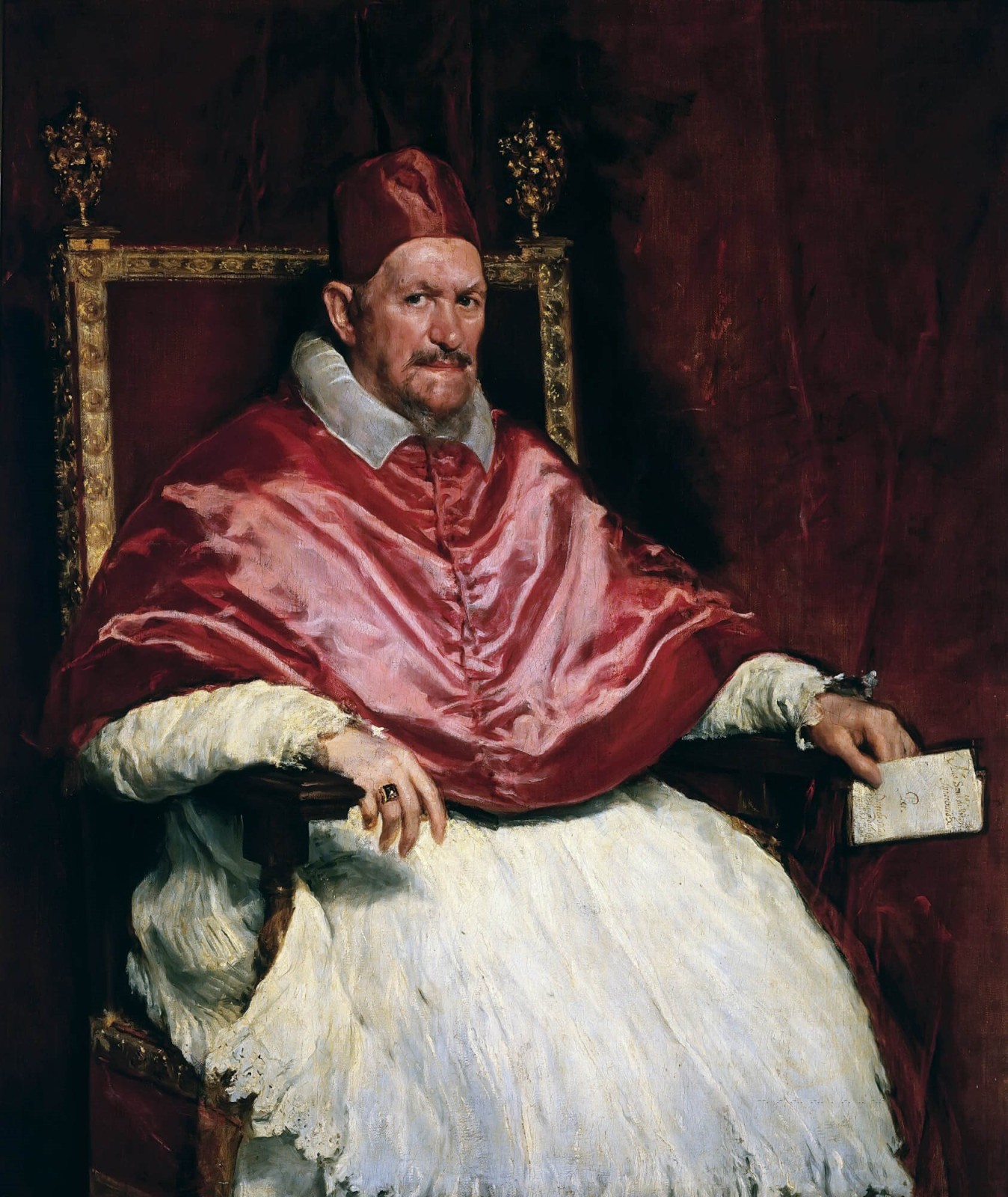
Diego Velázquez, Pope Innocent X, 1650 Galleria Doria Pamphili, Rome
Christie’s Is Sued After Francis Bacon Painting Fails to Sell
ART SALES | THE NEW YORK TIMES | FRIDAY, MARCH 20, 2009
Christie’s is being sued by a family trust led by the Connecticut collector George A. Weiss, who says the auction house reneged on a $40 million guarantee when it tried but failed to sell a 1964 painting by Francis Bacon in November.
The lawsuit, filed in the United States Southern District Court on Friday, claims that Christie’s, in competition with archrival Sotheby’s, agreed to give the trust, Weiss Family Art, a guarantee — a sum promised to the seller regardless of the sale’s outcome — of $40 million for the painting. In order to win the consignment from Sotheby’s, Christie’s sweetened its deal and won the business.
An agreement was struck in late July, but by September, after the auction house already had the painting, Christie’s said it would no longer honour the guarantee because of the faltering global economy.
Christie’s was not able to sell the painting. Now the trust is suing for the $40 million it says it was promised, plus interest. The president of Christie’s was traveling on Friday and could not be reached for comment.
Christie’s Auction House Sued Over Francis Bacon Guarantee
BY ERIK LARSON | BLOOMBERG | FRIDAY, MARCH 20, 2009
March 20 (Bloomberg) – Christie’s International’s New York unit was sued by a Florida art collector over claims the auction house failed to sell as promised a self-portrait by Irish painter Francis Bacon for at least $40 million.
Christie’s, based in London, owes the minimum guarantee to collector George Weiss after his 1964 Study for Self Portrait by Bacon failed to find a buyer at the auctioneer’s November 2008 Post War and Contemporary Art sale, according to a breach-of-contract complaint filed today in federal court in New York.
Christie’s and rival Sotheby’s in July 2008 made competing offers to Weiss to include the painting in their respective auctions, according to the complaint. In September, after Weiss chose Christie’s, the auction house said it wouldn’t follow through on the minimum-bid guarantee, citing “the changed climate of the art market,” according to the complaint.
“For years, the major auction houses, including Christie’s and Sotheby’s, have offered guaranteed price arrangements for select works in order to bring major pieces to market,” Weiss said in the complaint. “Christie’s reneged upon the minimum price guarantee.”
Toby Usnik, a Christie’s spokesman, declined to comment, citing company policy.
The case is Weiss Family Art (Bacon) LLC v. Christie’s Inc., 09-cv-2598, U.S. District Court, Southern District of New York (Manhattan).
Dirty genius
Venice–everyone goes there, everyone makes pictures of it. Past shows have explored the city’s impact on Turner, Monet and Sargent; now it’s Sickert’s turn. Some artists have triumphed there, but is it really, wonders Craig Raine, a graveyard for painters?
BY CRAIG RAINE | ART | CULTURE | THE GUARDIAN | SATURDAY, 7 MARCH, 2009
In 1995, I talked with Philip Rylands, then the deputy director of the Guggenheim Collection in Venice, about Jackson Pollock. It didn’t matter that I was unpersuaded by Pollock’s painting, he calmly explained, because his place in art history was assured by, among other things, his anecdotal value. You might call this the Vasari effect. Which is another way of saying we like gossip, recently dignified as life writing. Do we read Diogenes Laërtius’s Lives of the Philosophers for a measured exposition of these ancient thinkers' tenets? I think not. We read them, as we read Aubrey’s Brief Lives, for the scandal, the fresh scurrilities, Robert Lowell’s “everlasting dross”, dirt with the bloom still unblemished. Think of the fart that inadvertently escaped Edward de Vere, the Earl of Oxford, as he bowed low to Elizabeth I – a fart recorded by Aubrey, who also noted the monarch’s response when de Vere returned to court after seven years of self-imposed exile. “My Lord, I had forgott the Fart.” Think of Diogenes’s account of his namesake, masturbating in public: “When behaving indecently in the marketplace, he wished it were as easy to relieve hunger by rubbing an empty stomach.”
Were Rylands correct, Walter Sickert (or Richard Walter Sickert, as he later preferred to be known) would have an assured place in the history of art. He has anecdotal value. Marjorie Lilly’s Sickert: The Painter and His Circle is a mine of anecdote: when Sickert’s first wife was angry, “she went very pink ... a sort of carnation ... charming. I had to fetch my palette and state the tone." Maddening, perhaps charming. Unruffled or uncaring? Ellen Cobden Sickert had every reason to be cross with her husband. The couple separated in 1895 because of his numerous infidelities – with Ada Leverson, a friend of Oscar Wilde and grandmother of Francis Wyndham; with, among others, Aggie, the sister of Max Beerbohm. Sickert refused either to apologise or to adapt his behaviour. Ellen Cobden Sickert set down her former husband's misbehaviour in her 1902 novel Wistons (published under the pseudonym Miles Amber). Sickert thoroughly approved.
On 3 June 1911, he was jilted at the registry office by his fiancée, a former pupil at the Westminster Technical Institute. He did not repine. On 29 July, he married instead Christine Drummond Angus, a woman 12 years his junior, who died in 1920. When asked if he missed her, he said: “It’s not that. My grief is, that she no longer exists.” Not then, perhaps, the egotist he often seemed. Nor simply the immoralist he often seemed. When Arthur Clifton, his dealer, left his wife for Madeline Knox, Sickert terminated his contract with the gallery. On the other hand, Madeline had been a partner at Sickert’s etching school. The connotations of “partner” may be relevant here. Morality? Or jealousy?
Early in his career, Sickert, painting in Venice, living on the Zattere, wrote to Philip Wilson Steer, a friend and fellow painter: “nearly sat on a scorpion in the wc. Thought of you at once: of what you would say.” This may account for Sickert’s alterations to his Islington house in 1927, where he lived with his third wife, the painter Thérèse Lessore: he had the builders rip out all the conventional lavatory bowls and replace them with French stand-up floor-pans. (It was said, to enjoy the reaction of his discommoded female guests, but perhaps that scorpion played its part.)
Throughout his life, he grew and shaved his beard – beginning lean as Gregory Peck and ending with an ebullient beard like Brian Blessed. Periodically, he shaved off all his hair. He couldn't decide about his Christian name. And he changed his style all the time. For example, he began by denouncing the use of photographs: "in proportion as a painter or a draughtsman works from photographs, so he is sapping his powers of observation and expression. It is much as if a swimmer practised in a cork jacket [a life jacket], or a pianist by turning a barrel organ.” By the end of his life, he was using photographs as much as Francis Bacon used them.
And Bacon is an interesting point de repère in any discussion of Sickert. There is a direct line that runs from Degas, through Sickert, to Bacon. Degas’s Le Viol (1874) is a bedroom scene showing a man, fully dressed with his hands in his pockets, leaning against the door, and a woman with a torn chemise. Obviously, Sickert’s Camden Town Murder series – of naked women and fully clothed men – derives from his beloved (and much quoted) Degas. Sickert’s La Hollandaise (c 1906), with its iron bedstead, sunken, perfunctory mattress and meaty nude, is benefactor to Bacon’s Henrietta Moraes (1966). Each model’s face is an anonymous smudge, the face of a woman who has been systematically fucked over. The difference between Bacon and Sickert is that Bacon can be a brilliant and vibrant colourist, whereas Sickert’s palette was consistently limited to the dun end of the spectrum. (Which made it difficult when he gave lessons to Winston Churchill, always an energetic colourist.) Nevertheless, there are Bacons that owe everything to Sickert’s continent drabs. Compare, for example, the brushwork and the browns of Sickert’s Self-Portrait (1896) with Bacon’s Study from the Human Body (1947).
Sickert is important to Bacon, no question. He makes a top-hatted, bespectacled appearance – perhaps based on the well-known 1923 photograph taken when Sickert lectured in Edinburgh – in the left-hand panel of Bacon’s Triptych (1987). And the panama-hatted drinkers in the right-hand panel of Bacon’s Crucifixion (1965) owe everything to Sickert’s Vernet’s, Dieppe (1920), where the central male drinker wears an identical hat (and hatband!) and is also in profile.
As well as these (arguable) visual details and parallels, Sickert and Bacon share a temperament. Don’t be fooled by the dark, occluded passages in some Sickert paintings, or the smudges and “accidental” drips and spills in Bacon. Neither painter takes his eye off the object. They are realists, classicists, bent on the unpretty truth. This is why Sickert is so unfair to his first mentor, Whistler, who made ravishingly beautiful paintings. In Whistler, there is a transaction between truth and beauty, an assimilation that is incomparable. Sickert, like Bacon, was fascinated by crude, uncompromising truth and therefore accused Whistler of too much taste. No surprise, then, that Sickert defended his beloved impressionists against charges of vagueness: for him, impressionism was a “severe and pure reaction in art”, not a “cult of the vague or a refuge of the negligent”.
Like TS Eliot, another classicist in favour of unblinking emotional precision, Sickert was committed to impersonality in art: “Banish your own person, your life and that means you and your affections and yourself from your theatre ...” Little wonder, perhaps, that Sickert, who began as an actor, should have used Mr Nemo (no one) as his stage name. Eliot's range went well beyond the obvious “poetic” subjects – for example, his prose poem “Hysteria”. Sickert’s brush addressed the subject of Ennuie – the dead taste in the mouth, the sticky glass. Both men were profoundly swayed by French cultural life, both men loved the music halls. Both men were realists rather than beauticians.
The always enterprising Dulwich Picture Gallery is showing Sickert's Venice paintings. In March 2007, I saw the Sargent and Venice exhibition at the Museo Correr in Venice. Sargent is a very good painter, but Venice is the graveyard of painters. I have nine pages of notes in my notebook. They end on a note of exasperation. About, note, repetition: “Too many pictures with cropped prow of gondola in foreground. 10!” Up to then, my comments are appreciative. For example, I admire the way the “represented ripples bleed into the steps” in Zattere, Spirito Santo and Scuola (c 1902-04). But the only great painting, among many good pictures, was called Side Canal (1880-81), a watercolour that showed the viewer its dirty walls, with the one gondola banished under a bridge and practically invisible. To paint a dirty wall, to think a dirty wall a worthwhile subject – that is genius, that is Vermeer.
Venice is full of fallen plaster, broken brickwork, dirty walls, dowdy poetry – all unpainted, all neglected in favour of the tourist centres of Piazza San Marco, the Palazzo Ducale, San Salute, the Basilica San Marco, the Rialto, the Grand Canal. Who hasn’t been photographed in Piazza San Marco? Schoenberg. Monet. Leonid Pasternak. Wagner. Stravinsky. Everyone who is anyone. And then the nobodies. Piazza San Marco is a site both dulled forever and shiny with constant contact – as meaningless as a politician’s handshake. Everyone goes there. Everyone paints it. Imagine it was compulsory to paint the Eiffel tower and you get the scale of the disaster. It is just this oppression, this tourist tyranny, that Claes Oldenburg addressed in his 1999 exhibition at the Museo Correr, where he sent up the winged Venetian lion and twisted its tail. The tail became a yellow chain of interlocking builder’s buckets dangling from the side of the building, its frayed end mimicking a spout of builder’s detritus.
Some painters have triumphed in Venice. Whistler, for example – because he sought out the unofficial, the back passages rather than the front entrances. In Turner Whistler Monet at Tate Britain in 2005, those self-important sites were shrunk to a pretext for the subtlest colours in combination. They were self-evidently secondary to Whistler’s rust-gold pastels, restrained blues and greys, on brown or beige paper, that materialised miraculously out of the background like spectral textiles, frail faery fragments from Fortuny’s factory: Red and Gold: Salute Sunset (1880); Salute: Sundown (1880); Sunset, Venice (1880), all of them better than the Turners from which they derive.
By comparison, Sickert hardly survives. You feel the economic imperative. At this time, as Sickert remembered in 1935, his dealers “bought my canvases in roped up (and unseen) batches of 10 at £40 the batch, with one batch thrown in as a make-weight”. It’s hardly surprising he painted the subjects that would sell. The three best, genuinely exceptional paintings are oil on panel – one, surprisingly enough, of Piazza San Marco, which normally hangs in the Fitzwilliam Museum in Cambridge. Somehow the official nature of the site is subverted by the way the undisguised grain of the wood is frankly visible through the paint at points. The two masterworks, however, are The Ghetto, Venice (1897-98) and Santa Maria della Salute (1901). The ghetto pell-mell architectural crowding is a waffle of windows, a dun Mondrian avant la lettre, a kind of fretwork that uses the wood on which it is painted. Perhaps it resembles an Andreas Gursky more than a Mondrian: it is at once intensely patterned and idiosyncratic in its detail.
Santa Maria della Salute is tonally red, and still squared up in red, a grid that transforms the familiar church, making of it a mirage, something seen through a veil. “A rose red city – half as old as time.” Actually, Sickert's red reads as the red of gold – it confers value and splendour as well as unfamiliarity. We see the thing again, thank goodness. It isn’t so different now, while Santa Maria della Salute is being restored and is surrounded by scaffolding. My notebook records that, in the morning mist, the dome of Salute is a fuzzy corduroy cactus. This is what Martin Amis called the war against cliché. Go to Dulwich Picture Gallery for these three paintings that break the adamantine spell of hypnotic holiday Venice. That will have to suffice until the best living landscape painter, Richard van den Dool, can be persuaded to go to Venice and do it justice.
Sickert in Venice is at Dulwich Picture Gallery, London SE21, until 31 May. Details: 020 8693 525

Sickert’s La Hollandaise (c 1906), with its iron bedstead, sunken, perfunctory mattress and meaty nude, is benefactor to Bacon’s Henrietta Moraes (1966).
Francis Bacon, Man in Blue VI, 1954 (est £4m-£6m), unsold
FRANCIS BACON | AUCTIONS | ART MARKET | THE ART NEWSPAPER | SUNDAY, 1 MARCH, 2009
The spectacular failure of Study for a Self-Portrait, 1964, which New York collector George Weiss had dispatched to Christie’s New York on 12 November 2008, but which had failed to attract a single bid (and is now the subject of a dispute over a $40m guarantee which was offered and subsequently withdrawn), had dented the reputation of an apparently resilient market for the artist’s pictures.
Bacon traders were hoping that normal business would be resumed with this canvas (lot 11), which had been consigned by Norwich Union and was expected to be the most expensive work of art to be offered in the various contemporary art sessions.
The canvas belongs to a series of seven “Man in Blue” compositions, six of which were included in Bacon’s first exhibition at Erika Brausen’s Hanover Gallery in 1954, and several of which were displayed to critical acclaim in the recent Tate Britain survey of the artist’s work.
Nevertheless, the series is regarded as a stark and subtle project omitting the theatrical drama of the artist’s most distinctive and popular work. Christie’s appeared to have addressed this issue with a reasonable valuation for a picture which, according to several Bacon market makers, would have been worth $12m, and even as much as $18m, just a year ago.
However, there were no bids for the picture, which becomes the most expensive casualty of the week and brings further disruption to one of the market’s most reliable and profitable centres of trading activity.
Francis Bacon
TATE BRITAIN, LONDON
DAVID GLEESON | REVIEWS | CANADIAN ART | ONTARIO | SPRING ISSUE | 1 MARCH 2009
For the past half century, Francis Bacon has been the malevolent colossus of British painting: a maverick who never attended art school, yet created pictures that continue to both enchant and horrify viewers with their singular vision of a bleak humanity framed by violence, sexuality and isolation. Every British art generation has its Bacon, and now the Tate has presented the first major study of work since the wave of critical reassessments following his death in 1992.
Aiming to explore “Bacon’s philosophy that man is simply another animal in this godless world,” the Tate assembled what the gallery claimed was the largest display of his work so far to also examine his sources and work processes. The main proof of this came in a room entirely devoted to archived material: photographs taken by friends or clipped from magazines, excavated largely from the chaos of his studio along with brief preparatory drawings that Bacon himself always denied making. The rapid metamorphoses from found or contrived images to, say, a grand work like Portrait of Isabel Rawsthorne (1966) or from small photo-booth snapshots to Three Studies of a Portrait of George Dyer, 1963 could be clearly traced.
Roughy half the show dealt with Bacon’s earlier mature work, which dated from the 1940s until about 1960. By this time he had produced chilling images of screaming popes, crucifixions, writhing figures and head with hideously deformed mouths that had earned him a reputation as the chronicler of human degradation. But it is in the flowering of his later work that a subtle and elegiac beauty appears. Everyone is familiar with Bacon’s work, and wandering around the 10 rooms served as a sharp reminder of how spectacular a colourist he was, and how his deftly choreographed compositions produced some of the most haunting painted imagery of the last century. His thinly sketched, almost cartoon-like draftsmanship animates the figures in his work while lending them an elegance at odds with their visceral distortions.
In one room dedicated to Bacon’s lover, George Dyer, the curators, Chris Stephens and Matthew Gale, assembled three of the artist’s large-scale memorial triptychs and the 1963 portrait studies already mentioned. The large paintings were all produced within two years of Dyer’s suicide in 1971 and, when displayed together, presented a tableau of desire and loss, with the subject, at once familiar and mysterious, melting into the jewel-like colours of each canvas. Each triptych is an sumptuous evocation of the dead companion: putting all these together was almost overwhelming. The effect spoke eloquently about Bacon and his feelings toward the late Dyer, who still remains the quiet cipher he has always been, albeit now with a dignified, if belated, recognition.
DAVID GLEESON

Francis Bacon, Study
for Portrait of George Dyer,
1963
Golf Grips and Swastikas
William Feaver
Francis Bacon: Incunabula edited by Martin Harrison and Rebecca Daniels
Thames & Hudson, 224 pp, £39.95, September 2008, ISBN 978 0 500 09344 3
WILLIAM FEAVER | LONDON REVIEW OF BOOKS | VOL. 31, NO. 4 | THURSDAY 26 FEBRUARY 2009
Francis Bacon liked to rail against illustration. ‘If you know how to record it you illustrate it,’ he’d cry. As for ‘illustrational paint’, ughh – the thought of that would set the jowls shuddering. ‘Illustration’ wasn’t just to be despised on its own account, it was a word to be smeared across whatever he chose to disparage, not least the work of former friends and rival contemporaries. When David Sylvester once asked what precisely was so deplorable about it (a ‘kind of caution’ perhaps?), Bacon’s response was studiedly offhand. ‘Well,’ he drawled, clearing his throat. ‘Well . . . Illustration surely means just illustrating the image before you, not inventing it.’
Martin Harrison, the editor of the Bacon catalogue raisonné currently in preparation, has produced a scrapbook of illustrational materials from Bacon’s studio floor, among them dog-eared pages torn from magazines, newspaper cuttings with rusty paper clips still attached, images from Duchamp and Velázquez, images of dodgy seances, beefcake bikers, cricketers a-swipe, scrapping street urchins, teeth ’n’ smiles from medical textbooks, golf grips and swastikas and doors kicked in. Many of these items – admirably reproduced – will be familiar to those who know Bacon’s work. Eadweard Muybridge’s jumpers and divers, body parts of Henrietta Moraes and so on, are laid out as evidence that ‘inventing it’ was never as classy an activity as Bacon maintained, given that these were the images – illustrations really – that served him so famously well. Graphic images, photographs especially, were a godsend for someone requiring ready astonishment and ready-sorted tones.
No wonder Bacon banged on about ‘just illustrating’. Ankle-deep in apposite litter, he trampled the stuff that he depended on. No wonder too that he took against the dummy of a book on his work and his sources put together in the late 1980s by Bruce Bernard, the layouts for which paired paintings to photographs. Not that those involved in the project (least of all Bruce Bernard, a dedicated admirer) intended to downgrade the artist; it was just that, heady with the pleasures of mix-and-match, they failed to appreciate that the pictures were bound to appear more diminished in reproduction than the related photographs and that this might be seen as a giveaway. Bacon put a stop to publication because he understood that, knowingly or not, it stitched him up.
Being a non-drawer (except for the odd scribble) and almost never a painter from life or from the cul de sac of the imagination, Bacon obliged himself to rely for imagery on secondary sources. Not Velázquez’s Portrait of Pope Innocent X itself, but scaled down and debased reproductions of it, ideal for his purposes in that they screened out the subtleties. Similarly, he used not actual bared necks but memories of a certain neck reinforced or clarified by suitable reference material. Why bother to draw when he was up to his eyes in printed matter salvaged from the outside world, imagery drifted and layered like alluvial deposits? Why not let the marvellously impure serve superior ends?
Bacon argued that, given the need to believe that images endure, painting remains the ideal medium for expressing motivations that matter. He talked of ‘complete accident’, by which he meant those moments when the senses take leave of themselves and invention happens. His was the philosophy of cut to the chase. No exposition, no establishing shot, no dalliance: just ‘the sensation without the boredom of its conveyance’. A flick of the cloth, a crack of the whip, and suddenly the thing’s there, wrenched from the dark interior of the showman’s hat, raw and gawping, that strangled rabbit.
Transposing duty and impulse, making every effort to defy expectations, Bacon peeled back the imagery to disclose looks passed off as tactility, sham upon sham, horror splitting its sides with high-pitched hilarity. He stressed the bafflement that comes of keeping on trying to reinvent and the numbness brought on by becoming well versed in distinctive traits. As someone who liked to betray, he made liberal use of dismissiveness, preferring swipe to caress, or confusing the two.
Francis Bacon: Incunabula promotes confusions. Spillover that it is from that regrettable installation piece, the Bacon studio translated entire from London to Dublin, the book is a seeker’s guide to whatever came in handy, or whatever could have come in handy, or whatever caught Bacon’s eye or didn’t get thrown out before being buried underfoot, or whatever. Seekers after insight into what prompted what will enjoy spotting obvious congruences. But that’s not all. The state of each distressed item is discussed. ‘Condition poor’ is the best that ephemera dealers could say of most of them, but that only encourages Harrison in his search for meanings and purposes in every archival blemish.
When Bacon daubed a little, as one might try out a lipstick, or test-squirted a spray can, he left traces on what is now paper booty. Sometimes he did slightly more, altering images, even accentuating them, but this was hardly an artistic procedure. In their notes at the back of the book Harrison and Rebecca Daniels make what they can of such largely haphazard markings, their function or status in this iconographical ‘image-bank’. We are shown a photo from a 1961 Paris Match of Jeanne Moreau baring her teeth at Pierre Cardin in a starry sort of way: an image that never made it into the painting repertoire, though two curly brushstrokes besmirch the actress’s hair like livid topknots. It could be supposed that this was an idle brush wipe, or it could be interpreted as Bacon reassigning Audrey Hepburn’s Holly Golightly role to Moreau. Wisely, the compilers refrain from Colony Room speculation. Yet they feel obliged to say something. So here goes: ‘The meaning of Bacon’s paintmarks, which encircle Moreau’s face, is unclear.’
Harrison observes that many of these now cherished pieces of paper have been folded. Some are creased quite elaborately, like napkins or paper darts: this was a neat way to isolate the faces or figures that stood a chance of becoming pictorially usable or, as Harrison puts it, ‘critically transformed’. But then what to make of the plate on page 69, ‘Fragment of leaf torn from the Sunday Times Magazine, 20 May 1973 (p.81)’? I mention it not so much in a nit-picking spirit (in fact it was p.74) as out of direct personal interest in a page so grievously tattered that the headline reads: ‘artime ances a trend flourished’
Originally (though Harrison and Daniels do not say so) this read: ‘WARTIME ROMANCES: William Feaver recalls a trend in English painting that flourished in the 1940s’. Bruce Bernard, then the Sunday Times picture editor, and I had spent weeks picking the images for an article on the neo-romantic insularity of such artists as Graham Sutherland, John Piper, Leslie Hurry and Keith Vaughan, committed at that time to fervid inkiness and illustrational hypertension. The article went down well. (Cyril Connolly was nice about it in the Sunday Times lift). Bacon will have found that he went unmentioned (not a neo-romantic) and that the reproduction of Lucian Freud’s 1952 portrait of a luminously doleful John Minton made page 74 the one page worth saving. For Bacon, seeing it in 1973, 16 years after Minton’s suicide, this was a painting wreathed in despair. To him John Minton had been the epitome of the illustrator-artist. ‘Fragment of leaf’: so eloquent a scrap.
Chance to own a Francis Bacon
(from his tufted period)
JACK MALVERN | UK NEWS | THE TIMES | WEDNESDAY FEBRUARY 25 2009
Roman Abramovich spent £43 million on one. Tate Britain has one hanging on its wall. Now it is possible to buy an original Francis Bacon for as little as a thousandth of the price of his most impressive works. The only catch: this one has been trampled on for years.
Bacon’s early life as a rugmaker is almost forgotten, and his output so small that an example held by the Victoria and Albert Museum was thought to be one of only three to exist. His rug oeuvre has suddenly increased, however, after an Iranian carpet dealer cleaned out one of her storerooms and took a pile of rugs to an auction house in Wiltshire
Ian Bennett, a textile specialist at Netherhampton Salerooms, near Salisbury, was astonished to discover a pair of rugs that are believed to be the only surviving works from Bacon’s first exhibition of his own designs in 1929.
“This particular batch of rugs contained the usual mix of good, bad and indifferent, but there were a lot of them and initially they had to be gone through fairly quickly,” he told The Times. “All of a sudden, in the middle of a pile of Persian tribal weavings in varying stages of disintegration, there appeared two obviously European Modernist rugs, which I threw aside with an instant semi-automatic valuation of a few hundred pounds
“Just as they were about to be covered up by other rugs, I vaguely noted the presence of writing at the bottom of each piece and suddenly what I had only half seen came into sharp focus. I said, ‘Hang on a minute!’. In large capital letters was the name Francis Bacon.”
Mr Bennett contacted the Authentication Committee of Francis Bacon, which responded that the rugs were not only authentic, but also possibly the only works from the artist’s 1929 exhibition that had not been destroyed by the artist or discarded.
Bacon had such a reputation for destroying his work that his gallery would pick up finished paintings while the paint was still wet. Rebecca Daniels, who is helping to compile the catalogue raisonn? for Bacon, said that the design and ground colour of the Netherhampton rugs were unique.
Bacon was a teenager when he designed the rugs at his flat in West London. He had recently been thrown out of his family home by his father after he was found in front of a mirror posing in his mother’s underwear.
No records survive of the 1929 exhibition, but it was successful enough for Bacon to follow it up with a second one in 1930. A year or two later he gave up design to concentrate on painting.
Mr Bennett said that it was almost impossible to put a value on the rugs because none had been on the market in recent years. “I hope that each one will fetch a five-figure sum, but I haven’t the foggiest idea. There is no precedent. You never know. Roman Abramovich might want one.” The rugs will be auctioned on March 12.
Francis Bacon, Seduced by Madrid
BY VICTORIA BURNETT | CULTURED TRAVELLER | THE NEW YORK TIMES | THURSDAY 19 FEBRUARY 2009
ON the afternoon of April
30, 1992, a plain coffin
bearing the body of the
Dublin-born painter Francis
Bacon arrived at the brick
and white-stone chapel of
the vast Almudena Cemetery
in Madrid. The artist then
made the quiet exit he had
sought. He was cremated with
minimal ceremony, with no
mourners present; his ashes
were sent to England.
Bacon had spent his final six days in a Madrid clinic, wheezing oxygen from a bottle and nursed by nuns. He charmed them with his basic Spanish, but he asked for no visitors and reportedly received none. After he died of a heart attack on April 28, his London dealer sent a Spanish colleague to collect Bacon’s brown suitcase and his leather jacket.
Bacon’s solitary death at 82 in Madrid seems a desolate, slightly random, parting for a London dweller whose foreign playgrounds, over the years, included Berlin, Paris and Tangier. In fact, the Spanish capital became something of a haunt for the artist in his final years, which he spent entwined in an on-and-off relationship with a handsome, young art-loving Spaniard.
So the retrospective of Bacon’s work that opened at the Prado Museum in Madrid this month is something of a homecoming for the painter. The show, which drew hordes to the Tate Gallery in London over the past few months, runs in Madrid until April 19 and then moves to the Metropolitan Museum of Art.
“Madrid was quite a late discovery for Bacon,” says Michael Peppiatt, an art critic and biographer of Bacon. “It was very seductive: there was the Prado, which was a summit on his horizon, and, into the mix, a very good-looking Spanish friend who he was completely in love with.”
Bacon’s discreet trips to see his lover rounded off a long-standing interest in the home of the bullfight and of the two painters who, arguably, most influenced him: Picasso and Velázquez. He was charmed by the city, with its late rhythm, its bars that emptied at dawn, its dry, baking heat and narrow, seamy streets.
“He loved the heat, he loved the food, he loved the pictures, he loved the look of it,” said Janetta Parladé, a friend whom Bacon visited in southern Spain.
In the evenings, he and his Spanish friend would stop in for a dry martini — or three — or a bottle of Champagne at Bar Cock, a rather baronial-style bar frequented by actors and artists on a downtown street, then derelict and lined with heroin addicts. From there, a favorite destination was La Trainera, a landmark seafood restaurant whose beamed dining room is decked with nautical gear.
Patricia Ferrer, an owner of Bar Cock, remembers Bacon, immaculately dressed, having a drink just days before his death. “Here he was, a perfect dandy, sitting with his back beautifully straight,” she said. “He certainly died with his boots on.”
Bacon was fascinated by the bullfight, or corrida, a motif that recurs in his work in the form of circling bulls, ringed spaces, thrusting horns, gored legs. He described the corrida as “death in the sunlight” and “a marvelous aperitif of sex” and probably went to see fights in Madrid at Las Ventas bullring.
“He was captivated by the torero — the sexuality, the elegance, the outfit, the ballet of it,” said José Capa Eiriz, who, as director of exhibitions at the Juan March Foundation in Madrid, put on the first show of Bacon’s work in Spain in 1978.
For Bacon, the artistic high point of Madrid was, naturally, the Prado itself, home to a large collection of works by Goya and by Velázquez, whose 1650 “Portrait of Pope Innocent X” Bacon revered and transformed — some would say deformed — in his paintings of agonized, screaming popes. (Velázquez’s pope is at the Doria Pamphilj Gallery in Rome.)
Manuela Mena, the Prado’s curator of 18th-century painting and Goya — and of the Madrid retrospective — remembers Bacon asking to visit the museum on a Monday, when it was closed to the public. He would stand for long stretches before a work by Velázquez or Goya, peering up close, “thrusting himself right into the painting,” she said. “He wanted to see the brush strokes, the texture, the canvas.”
The retrospective offers a rare opportunity to see Bacon’s work in conjunction with some of the Spanish paintings that influenced him, according to Ms. Mena, who said she found echoes of, and allusions to, many of the Prado’s works in Bacon’s paintings.
In the “Portrait of Isabel Rawsthorne Standing in a Street in Soho,” Ms. Mena sees the self-assuredness of Velázquez’s black-clad “Pablo de Valladolid.” The stairs in the central panel of “Triptych — In Memory of George Dyer” (1971) are a reference to the Paris hotel where Dyer, Bacon’s lover, committed suicide, but they are also an allusion, Ms. Mena said, to the stairs leading to a half-open door in “Las Meninas” by Velázquez.
The purplish blood that soaks the clothes in the middle panel of Bacon’s “Triptych Inspired by T. S. Eliot’s ‘Sweeney Agonistes’ ”; the rusty, mottled patch in “Blood on Pavement” — these surely owe a debt to the sticky crimson smear on the dead man’s face and the blood mingling with the earth in Goya’s “Third of May 1808,” Ms. Mena said.
Friends and associates of Bacon speculated that he would be excited to see his paintings hanging in the museum that houses some of the painters he admired most. One person who seemed moved by the painter’s return to Madrid was Sister Mercedes, a nun of the Order of Servants of Mary who nursed the sick artist at the Ruber Clinic. She had no idea who Bacon was until the press descended on the hospital after he died.
Standing before the “Study After Velázquez’s Portrait of Pope Innocent X” in a crowd of Madrid glitterati, Sister Mercedes looked a little pensive.
“He painted what he felt,” she said, nodding her head. “I could tell he was a tormented soul.”
UNHOLY POPES
The Francis Bacon retrospective runs until April 19 at the Prado Museum, Paseo del Prado; (34-91) 330-2800.
Admission, 8 euros ($10.56 at $1.32 to the euro), includes permanent collection; open 9 a.m. to 8 p.m. Tuesday through Sunday.
Francis Bacon portrait fails to sell at auction
A rare portrait by Francis Bacon which was expected to fetch up to £6 million
has failed to sell at auction amid fears that the recession is hitting collectors.
By MURRAY WARDROP | ARTS SALES | THE TELEGRAPH | THURSDAY 12 February 2009
The painter’s Man in Blue VI was one of a series of seven paintings he completed in the spring of 1954.It had been estimated to fetch a price of between £4m and £6m when it went under the hammer at Christie’s auction house in London on Wednesday night.
However, bidders failed to reach the asking price and the painting was returned to the vendor. The work reveals a smartly dressed man whose features seem obscured, seated at the centre of a cavernous dark canvas.
The painting is unusual in that the artist appears to have painted the sitter from life as opposed to using a photograph, which was Bacon’s typical method. The sitter is an unknown man who Bacon is thought to have met at the Imperial Hotel in Henley-upon-Thames, where the painter was living at the time.
Despite the disappointment of the Bacon picture failing to sell, Christie’s reported that 79 per cent of the other pieces on offer in its Post-War and Contemporary art sale had been sold. The auction house blamed the style of the painting itself rather than its price tag in the economic gloom for disinterest in the sale.
Christie’s spokesman said: "I don’t think we can blame the credit crunch for the Bacon picture not selling. It was quite an academic piece.
"Collectors still have that liquidity in the market. There was a lot of interest in the painting in the run up to the sale and there has been immediately after."
He said it was possible that the painting may now be subject to a private sale.
Rare Bacon is set to fetch £6m
BY LOUISE JURY | NEWS | EVENING STANDARD | THURSDAY 5 FEBRUARY 2009
A Francis Bacon painting bought for £31,500 nearly 40 years ago has gone on public show before an auction where it is expected to fetch up to £6 million. The work Man in Blue VI is the highlight of next week’s post-war and contemporary auction at Christie’s.
It was painted in the spring of 1954 which was a period of intense creativity for Bacon. He was in the middle of a tempestuous romance with Peter Lacy, a veteran Spitfire pilot. The artist said at the time: “Being in love in that extreme way — being totally, physically obsessed by someone — is like having some dreadful disease. I wouldn’t wish it on my worst enemy.”
The difficult relationship had prompted Bacon to move out of the cottage that he shared with his lover to stay at the Imperial Hotel in nearby Henley-upon-Thames. It is thought the sitter was an unknown man Bacon met in the hotel.
The work seems to have been painted from life, even though the artist usually worked from photographs. The finest of seven major paintings Bacon produced at this time, the estimate for next Wednesday’s sale is £4 million to £6 million.
The current owner bought the painting in 1971. The portrait is one of a number not seen at auction for many years. It is on show at Christie’s, 85 Old Brompton Road, before auction at its King Street headquarters. Pilas Ordovás, international director of Christie’s Europe, said their sale of post-war and contemporary art included a “carefully curated selection of works by a number of the most established artists of the last 60 years”.
Auction houses are putting the emphasis on the quality of the works on offer in this month’s sales. Nerves were frazzled last November when an important Bacon failed to sell — just months after a triptych by the same artist set a world record price of $86.2 million (£43 million).
Sotheby’s is holding its first big Contemporary Art sale tonight since Damien Hirst’s £111 million bonanza last September and the market catastrophe in New York.
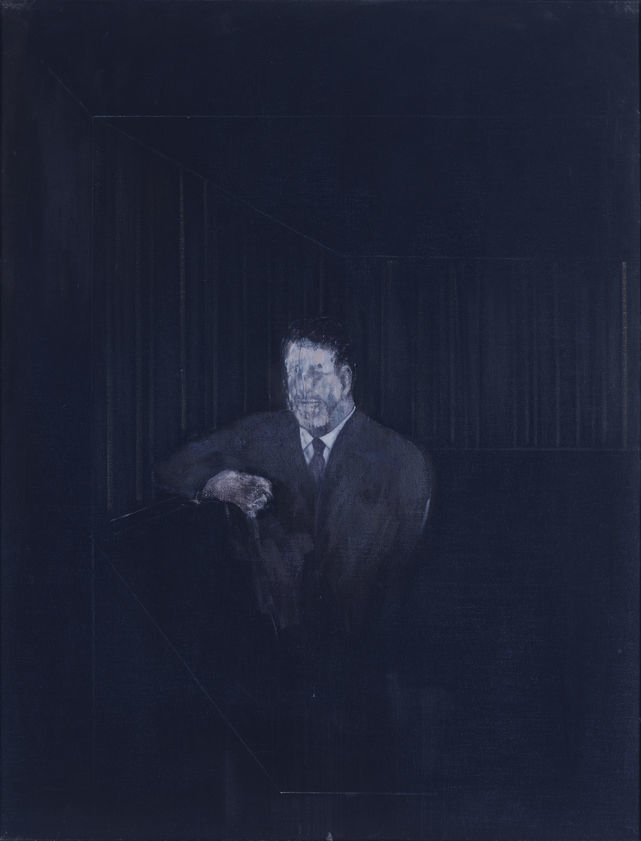
Blue period: Francis Bacon’s Man in Blue VI, which is the portrait of
an unknown man he met in a hotel, is on showat Christie’s next week
“Dear Ronnie”: letter from Bacon in Kray sale
The auction took pace on 26th January
MARTIN BAILEY | AUCTIONS | THE ART NEWSPAPER | SUNDAY 1 FEBRUARY 2009
A letter from Francis Bacon to Ronnie Kray, one of the notorious Kray twins, was put up for auction on 26 January. The identical twins had been involved in armed robberies, violent assaults and murder in London’s East End, and were sentenced to life in 1969. Ronnie remained in Broadmoor until his death in 1995.
Bacon’s letter of 27 September 1989 thanked Ronnie for a drawing (he took up art in Broadmoor), saying “I have been ill for some” (Bacon had kidney problems). Bacon was almost 80 at the time of the letter, and he had known the twins in the 1960s. He once remarked: “They were dreadful, of course, just killing people off and so on, but at least they were really different from everybody else.”
Chiswick Auctions is selling off 144 lots of the twins’ personal effects, consigned by a family friend.
The Accelerated Grimace
In time for the Francis Bacon exhibition at Tate Britain, Grey Gowrie publishes
his introduction for the 1988 Moscow exhibition in English for the first time
BY GREY GOWRIE | THE ALLIGATOR | FRIDAY 16 JANUARY 2009
In September 1988, in the dying days of the Soviet Union, the British Council organised an exhibition of the work of Francis Bacon in Moscow. Bacon (1909-1992) planned to attend the opening but decided at the last minute not to. Grey Gowrie, a Minister for the Arts in Margaret Thatcher’s administration and by this time European chairman of Sotheby’s, was a friend of the painter and represented him. Lord Gowrie also provided the introductory essay to the catalogue of the exhibition which was translated into Russian. It is republished here in English for the first time to coincide with the Francis Bacon exhibition at Tate Britain. Famished for unofficial art, and no doubt bored by Soviet programming, more than 100 million people tuned into the Moscow exhibition on television.
The 20th century has been called the age of anxiety. Certainly it is an age of extremes. Life lived against the edge, the extremity of the human experience is, even vicariously, electric with nervous stress. Scientific progress is double-edged. In the industrialised world people live longer, are better nourished, entertain ideas, at least, of developing their creative potential. Through film and television and the pervasive influence of photography they are bombarded with images of what life can or should be. At the same time they are made aware that this civilisation of cars and central heating and pain killing drugs has entertained more horrors than any since the dark ages. Visual technology transmits the parts of the globe which have been left out of the development race or, worse still, allows people to view skyscrapers and bars and hospitals beside open-drained hovels only a few metres away. Throughout the advanced societies, the great central images which once governed people’s lives have cracked or broken down: the religious icons which reminded them, however briefly, of matters richer than their own concerns. We live in an age of political and scientific materialism which is nevertheless uncomfortably aware of the psychological limits of materialism. We are aware of the physical limits as well, of an earth threatened by tools of peace as well as weapons of war. No wonder that we are an anxious species, or that artists, who hold up mirrors to our condition, are nervous themselves of attempting those images of an idealised experience which art used to provide.
Since the death of Picasso, Francis Bacon has more than any other painter provided the age with an image, in Ezra Pound’s phrase, of its accelerated grimace. The key to his work is its ambition. He has taken on the great masters of the past without their mythological resources or their requirement to record events. At the same time he has turned his back on the abstract artist’s indulgence in decorative introspection: the painting whose principal subject is itself and the fact that someone painted it. Although his subject matter, the visual impulse which triggers his attempts to fashion an image on canvas, derives from his own sensibility and is to that extent egoistic, Bacon is the least narcissistic of artists. He uses some recollection or preoccupation which is at hand, so to speak, as a prompt for an act of painting. But it is the paint alone, and what happens as a result of its being pushed around on the canvas, which can provide an image of great externality and force, influencing the viewer with a life of its own and doing this independently of the artist. Bacon is in some respects closer to being a sculptor than a painter. The background to his paintings, which are applied at the end, act as a kind of plinth for the images poised upon them. It is sad that Bacon’s eminence occasions, as is often the case with major artists, so much photographic reproduction of his work. The physical grandeur, the sensual texture of his paint outweighs the often horrifying imagery it encapsulates. In reproduction it is the imagery that tells.
“He has taken on the great masters of the past without their mythological resources or their requirement to record events”
Bacon is descended from his
great Elizabethan namesake,
Shakespeare’s contemporary
and an ancestor of the
English scientific
enlightenment. In his late
70’s now, though looking and
talking like a man fifteen
years younger, he lives
alone in two rooms in
central London. He works
continually at present, sees
a few close friends, eats
and drinks very well,
gambles with less
Doskovieskian intensity than
before. He is a man of great
but narrow erudition, narrow
because he is impatient of
anything less than
masterpieces and impatient
also of masterpieces which
he cannot harness to his own
art. He is an asthmatic who
dislikes the countryside: an
urban, noctambular spirit.
His bleak view of human life
does not stop him enjoying
it; indeed he has said in an
interview that the aim of
art – however violent or sad
or grim
– is to produce joy.
He is good company and
generous with money in the
way of one who has had to
hustle for a living in youth
and now has more than he
needs. Politically, he is an
old-fashioned aristocratic
liberal with a low threshold
of boredom. He has said that
in recent years he has
supported the Conservatives,
because they are marginally
less interfering of
individual liberty than
political groups on the
Left; he is savage about the
way modern states interfere
with citizens’ lives for
their own good. He has
refused to be honoured. The
British admire his eminence
but do not know quite what
to make of him: an elegant,
wealthy, rather conservative
gentleman who paints such
scary pictures.
“His bleak view of human life does not stop him enjoying it; indeed he has said in an interview that the aim of art is to produce joy”
Nevertheless he is the greatest living painter and the most important Britain has produced since Turner. This is a large claim but it is shared by a remarkable number of people round the world, many of them painters, rather few of them British. To us natives, it is still difficult to recognise how distinct Bacon and the sculptor Henry Moore have made us in the visual arts. Our cultural establishment is musical and literary in outlook; we take our theatrical tradition, and Shakespeare, for granted; since the Beatles we can command a world stage in popular music. Seeing and touching, by contrast, belong to the slightly seditious universe of pure sensation and both our puritan and idealistic strands of thought make us suspect appearances. Happily, these two great men have encouraged more than one generation of artists now to build on their achievements and make international names.
Of the two, Bacon is the more surprising. Henry Moore’s work is permeated with the English love of nature. He gives simple and powerful signals about the correspondence between landscapes and female figures. He reinforces life’s primal effects, as if the poet Wordsworth were working in stone. Francis Bacon is not a romantic artist in this way, although he shares the aristocratic intuitiveness of later romantics like Baudelaire. He has the nihilism and gaiety of certain 18th century minds. Nature, when it appears at all in his work, is both threatening and monotonous: purposeless matter unrelieved by the flicker of civilisation’s match. One of his greatest paintings, Landscape near Malabata, Tangier (1963), is a picture of a tree. It demonstrates the way colour, not drawing, is movement in painting, and how a tree’s sinews suggest muscular movement. But try to people this landscape and you are in the world of Beckett’s Godot or King Lear. A more recent work, Sand Dune (1981), is a picture of sand encroaching a building by the sea. The sand is all movement, dynamic; the building is being eaten and that will be the end of it because nature is in the business of demolition. To fly in the face of nature you need luck and the peculiar courage to stare her down. To adapt a line of the poet Thom Gunn, a few friends and a few with historical names have had the courage. A number of artists – Cimabue, Velasquez, Rembrandt, Degas, Picasso – have looked without blinking. Otherwise, existence is the same as nature: food, drink, territory, sex and status. Bacon is an artist of endgame. His work is a lifespan distant from Moore’s family groups or mothers-with-child.
Classical and romantic are hoary old terms but they provide us with a shorthand, yet to be superseded, for a profound and permanent divide, a creative conflict, within our sensibility. The classical approach represents tradition and training. Its focus is on the human clay and on proportions suitable for the configuration of the body. ‘The lengthened shadow of a man/Is history, said Emerson,’ wrote T. S. Eliot, the great classical poet of our century and one who has always haunted Bacon, in his poem Sweeney Erect. The fascination of the classical artist is the way he bends tradition and training to his own purpose, be that subjective and self-realising, or objective in the sense of realising or trying to imitate a world beyond the self. The permanent things in nature are birth, copulation and death; the ruins of time, man’s time, are what interest the classicist and provide him with his forms. The romantic says, with the 19th century poet Hopkins, that the sensibility soars above its terrestrial confines: ‘O the mind, mind has mountains; cliffs of fall/, Frightful, sheer, no-man fathomed.’
“Nature is in the business of demolition. To fly in the face of nature you need luck and the peculiar courage to stare her down”
This being the case, the classical artist is preoccupied with realism. Bacon is passionate for realism, only he would argue that now photography has made reportage redundant you need realism of another kind: the ability to capture the emotional energy thrown off by any living presence. Added to this is the energy which works of art generate themselves. In a recent interview he said:
‘I have just finished three portraits of a friend and the problem, as usual, was how to make an image and keep the likeness. To combine the two is what creates tension and excitement.’
The Study for Portrait of John Edwards (1988) is as ‘like’ as a photograph but with so much density of form that it has an object-life of its own. Because of the force of his painting, some commentators have confused Bacon with the Expressionists. They attribute to him an unsettling, northern sensibility. Bacon insists this is wrong. He is adamant that he is not an expressionist, believing in truthfulness rather than effects. The disturbing quality of his work comes partly from what Michel Leiris, quoting Bacon himself, has called his ‘exhilarated despair…the painful yet lyrical disturbance felt by all those who, living in these times of horror spangled with enchantment, can contemplate them with lucidity.’ It also comes, more prosaically, from what Bacon would see as his failure to win the fight between the raw material of oil paint and the mind’s eye. When Bacon does win, as in the Edwards portrait, his paintings are both awesome and tender, moving in the highest and most humane way. Yet even in the most violent pictures, the distortions of his figures are implicit in their own flesh. This is where he comes closest to Picasso.
To an existential artist like Bacon, chance is very important, both as a rubric for the universe (his hobby is roulette) and for what it brings about on the canvas. Lying Figure (1969) is one of a number of works painted in the 1960’s in which a naked, usually female figure lies on a bed, the head south to the viewer, limbs akimbo, bed and body seemingly about to slide down a great escarpment of carpet. Facial features are blurred as if they and the pigment from which they are formed had been pummelled into the final image. (This is often literally the case, since Bacon paints with rags and his hands as well as with brush). Stripped of their associations, not least the threat to civilised values and human dignity suggested by hypodermic digging into vein, these paintings have the vibrance – the beauty even – of colour which early in his career Bacon found in a medical textbook about diseases of the mouth. Bacon’s surgeon’s aesthetics and sang-froid take some getting used to. They are worth it because they are bound up with his special lucidity of purpose. Look how close oil paint comes to the stuff of life, he seems to say. You are used to this happening with clouds and hills in landscape painting. Why not discover it with the body as well? If the painter is lucky, impulses of memory and desire may allow him to manipulate the stuff so as to trap elusive and temporal personalities, and our feelings about them. Bacon does not paint from life. His subjects are a few friends and himself, painted over and over, in some cases after they have died, from snapshots and memory. Bacon himself looks very like a Francis Bacon. In this respect he is close to his admired contemporary, the painter and sculptor Giacometti. And as John Russell wrote in his book Francis Bacon (1971), ‘Bacon when he wishes is one of the great painters of human flesh and can give it a kind of creamy resonance, a fulfilled soft firmness, for which both Ingres and Courbet had also been searching.’
Ambition, in art, requires not only high seriousness but sufficient personal confidence and aplomb to take on the masters at their own game. Bacon’s belief in un-accommodated man, his identification during the two decades after the war with London’s low life, his gambling, his generosity with money and caustic wit, his frightening ability to drink a great deal and remain at the height of his powers, his age-cheating appearance – all play their part in his anti-heroic legend. By contrast, his career has been altogether steadfast and determined. He was a late starter. He was born and spent much of his childhood in Ireland, where his father trained racehorses. There is a lot of Ireland in Bacon but it is reasonable to think of Bacon as Irish only in the way of thinking of Camus as Algerian. He was educated haphazardly and travelled about Europe in the late 1920s. Berlin and Paris held his imagination and Paris remains the city which most admires his work.
He made his historical debut about 1930 as an interior decorator and furniture designer; he worked in what is today called the Art Deco style, a popularisation of cubism and geometric abstraction. He studied the art of Picasso, at that time involved in attenuated semi-geometrical figure paintings which were beginning to look haunted and surreal. Inspired, he taught himself to paint. His early work, nearly all of which he subsequently destroyed, gave abstracted hominoid shapes a similarly heightened air – sometimes by little references to the Western religious tradition. His work was not well received and he was turned down for the International Surrealist Exhibition in 1936. He himself dates his career from the 1944 triptych Three Figures at the Base of a Crucifixion in the Tate Gallery.
“Bacon’s belief in un-accommodated man, his identification during the two decades after the war with London’s low life, his gambling, his generosity with money and caustic wit, his frightening ability to drink a great deal and remain at the height of his powers, his age-cheating appearance – all play their part in his anti-heroic legend”
At first glance, this work still owes much to Picasso. It is a study, like the paintings and sketches of the Guernica period, of how to assault the nervous system of an onlooker with formal equivalents for pain, mental stress, distortions not of art merely but of daily living and his own hold upon it. Closer acquaintance suggest that here is someone who has looked hard and imaginatively at the Baroque tradition of wrenching the figure until it is, literally, dragged towards that self-extension known as the sublime. Although the triptych is a very strong, even a terrifying picture, one is at least as much aware of the scepticism and control underlying the element of shock. It is as if the artist were playing ‘touch’ with theatrical excess and learning to paint on the dangerous Baroque margin between going very far and going too far.
Bacon then dropped the linear, attenuated style of the triptych in favour of something much more solid. He was discovering oil paint’s correspondence with the density of the observed world: the Bourbet road to nature. Key paintings were Figure Study I and Figure Study II (both 1945-6), the latter also known as the Magdalene. These paintings seem to have inaugurated the interest in clothes (no other 20th century painter has rendered them so attentively) which reflected Bacon’s preoccupation with Velasquez’s portrait of Pope Innocent X and led to his own robed and enthroned popes, Head VI (1949) for example. A strong formal understanding of the kind of space clothes are designed to occupy draws shocking, and effective, attention to the absence ofany owner – or the presence, in the case of Figure Study II, of the wrong owner. “’What modern man wants,`” Bacon has said, quoting Valéry, “´is the grin without the cat`: the sensation without the boredom of its conveyance.” Throughout his career, he has attempted to combine psychological immediacy – his chamber of horrors side – with whatever formal mechanics are most likely to allow the viewer to retain the pained image until it moves into memory and becomes a way of looking at the world. In the years following the war this search led Bacon to solidity at all cost. The Magdalene has the poise of a Giotto figure, so much presence that the umbrella half-concealing her becomes a convincing frame and not the gratuitous surreal emblem for which it is sometimes mistaken. Thirty years later we see it again, in the left panel of Triptych (1974-77): quarry for Bacon iconographers, along with light bulbs, blinds, plumbing, cricket pads and newspapers.
In the following decade, Bacon juxtaposed violent historical signs of our era with the gravities, hollow maybe, but socially and spiritually well anchored, of earlier epochs of painting. His habit of working from photographs and news clippings is everywhere apparent. Himmler and Goebbels, silent or in oratorical flood; Nadar’s captivating photograph of Baudelaire’s sidelong look; people rushing for shelter during street fighting in Petrograd in 1917; Marius Maxwell’s photographs of animals in equatorial Africa; the screaming nurse from Eisenstein’s film Potemkin; a postcard of the Promenade des Anglais in Nice – all appear and reappear as if they were slabs from some lost fresco of devastating formality and scale. There is the same feeling of a civilisation undergoing nervous breakdown that we find in Eliot’s poem The Waste Land (‘These fragments I have shored against my ruin.’) although the prevailing mood is relish rather than disgust. Bacon would bring technical devices out into the open and reinstate them as images. The famous boxes which circumscribe his male nudes, popes, business executives and monkeys start life as methods of containing space and end it as prisons out of Kafka or, prophetically, scenes from the trial of Eichmann. His brush strokes become rapid at this time (he does no preliminary drawing) and blur into one another. So originates the suggestion of the flesh poised, like that of M. Valdemar in Poe’s horrifying tale, on the edge of putrefaction.
“There is the same feeling
of a civilisation undergoing
nervous breakdown that we
find in Eliot’s poem The
Waste Land”
In recent years the work has in the main turned from public to private scenes, although the image of President Wilson in Triptych (1986-87) must be one of Bacon’s greatest paintings. Bacon’s originality is on as firm ground here, and slightly less susceptible to the aesthetics of shock. It can be said against him, however, that his paintings of men defecating or vomiting lack the grace which Degas found in women’s exercise of natural functions. They look as if their purpose were epater le bourgeois and they do. Memory traces of friends, nudes and the urban interiors which provide a natural setting for all but our least superficial human encounters are recreated, hit and miss, in the large body of work which made his international name. Bacon is unique in this century in his ability to render the indoor, overfed, alcohol-and-tobacco-lined flesh of the average urban male. His painting is how most of us look. Bacon paints beds, platforms, chairs and sofas with the attention Courbet gave to rocks. The effect is a suffocating enclosure: the landscape of hell done as hell’s hotel bedroom; the non-world of Sartre’s Huis Clos and Beckett’s Endgame. The implied theatricality seems to be deliberate. Compositional layout is very much like a stage set; at any moment another figure, bearing hypodermic or ashtray, may enter left or right. Sofas and tables have, like flesh, puffed out and turned flabby, their Art Deco youthfulness long gone. Not surprisingly, the great Triptych Inspired by the Oresteia of Aeschylus (1981) discovers a theatricality appropriate to its purpose. The Oresteia plays are an abiding inspiration for Bacon, as they are the most powerful image in literature of mankind trapped by its history and its own sensibility. But in general all these interiors reveal a truism of art impossible to over-emphasize. The function of any artistic medium is to make the recipient work: to offer interchange, metamorphosis, the telescopic sliding-together of our perceptions until they are gathered back to their solitary neural source, there to be stored, reprocessed and used.
Like Eliot’s early poetry, Bacon’s paintings are documentaries of nervous stress. Given the era in which we find ourselves living, this comes as no surprise. What is surprising is the attempt to endow our diminished psychological circumstances with painting which can achieve the formal grandeur and beauty of texture of the very greatest old masters. These characteristics remain, in his best paintings, long after the initial assault on the system has worn off. When things work, therefore, the quality achieved is joy, which is, as Bacon said it should be, the purpose of art.
The Alligator is extremely grateful to Tate Britain for permission to use its images. The Francis Bacon exhibition is on until 4th January and the Alligator strongly recommends going to see it.
Bacon’s Man in Blue expected to fetch £6m
LONDON | NEWS | THE TIMES | THURSDAY JANUARY 15 2009
A portrait by Francis Bacon could fetch up to £6 million at auction, 38 years after selling for £31,500, Man in Blue VI is one of seven major paintings that Bacon produced in the spring of 1954 and has been held by the same owner since November 1971.
It was painted while the artist was in the middle of a violent relationship with Peter Lacy, a former Spitfire pilot. Bacon left the cottage they shared and checked into a hotel, where he painted the Man in Blue series. It is thought that they were done from life, with the sitter-being an unknown man whom Bacon had met at the hotel.
Man in Blue VI has been exhibited internationally and was included in the artist’s retrospective at the Tate Gallery in 1962. It will be sold at the Post-War and Contemporary Art auction at Christie’s in London on February 11.
BETWEEN THE RITZ AND THE GUTTER:
FRANCIS BACON’S LIFE IN LONDON
I decided when I was very young that I would have an extraordinary life going
everywhere and meeting everyone. But of course I used everybody along the way
–Francis Bacon
AMABEL BARRACLOUGH | ART | FEATURES | FANZINE | FRIDAY, 2 JANUARY, 2009
For Francis Bacon, London was an endless labyrinth of possibilities. He first arrived to live in the city when he was nineteen, having been expelled from his Irish home by his tyrannical father three years prior (he was caught trying on his mother’s underwear); he then spent two years in Paris and Berlin. If the Irish countryside had been a prison in his youth, his coming of age in Weimar Germany had opened his eyes to new possibilities of experience and expression. During his time there he had witnessed the thin line between extravagant luxury and dire need, between the Ritz and the gutter as he described it. He adored the company of those who lived by their instincts, whether they were the super rich, to whom every possibility was available, or the amoral rent boys and petty criminals who he would pick up in East End drinking dens and bring across the tracks for his own amusement. He would disappear for days on end, and in the vast confines of the metropolis he could delve into every underground bolt-hole and dark alley his inquisitive senses drew him to.
By 1929 he had created some stability in his life. Roy de Maistre was the first in a series of father figures who were both lovers and patrons who supported Bacon and encouraged and guided his talents. The connection continued but the attraction soon waned. In 1931 an extraordinary domestic arrangement had come into being in the Queensbury Mews studio. Living with him now was Jessie Lightfoot, his nanny since birth, an aging Irish spinster devoted to her surrogate son who slept on the kitchen table. Completing the household was Bacon’s lover of this era, Eric Alden. Still living a hairs breadth from abject poverty, Bacon continued to rely on the rough trade that had kept him warm when he first arrived in London, but he now followed the ironically conventional and lucrative route of advertising himself in The Times as a gentleman’s escort; Nanny Lightfoot would help him pick out suitable offers.
It is sometimes overlooked that Bacon was first and foremost a post-war artist; in describing his close friend and fellow painter Graham Sutherland he also defines an aspect of himself as ‘An Englishman who saw a great darkness gathering.’ In ‘Figure Getting out of a Car’ c.1943, a biomorphic figure with Mussolini or Hitler’s head bends down on a monstrously extended neck to the microphones, teeth bared in a foul grin. The war exposed what lay beneath the gloss of civilization; the primitive animal rage undiminished within us all – the bestiality of man. Bacon saw not only the horror but also the eroticism of violence and political power. The siege like mentality of London during the blitz broke down the social barriers and boundaries of normal life. Bacon’s nature and sexuality was stimulated by risk and the war years were a period of intense germination.
In 1943 the makeshift family moved to 7 Cromwell Place in South Kensington, the address was known as ‘Millais House’ after the eminent Pre-Raphaelite painter who had lived and worked there. It was a grand ground floor studio which perfectly accommodated Bacon’s latest ruse––the creation of a clandestine gambling den which became part of the evening’s round for some of London’s most salubrious characters. The street outside would fill up with Rolls Royces and Daimlers; it was an escape from the dreariness of the war to an atmosphere of faded Edwardian grandeur and bohemian freedom of spirit. Bacon was happy among the ghostly transient clientele of a casino, while Nanny Lightfoot played the hostess. It became part of the round after The Gargoyle club, peopled by wayward aristocrats, drunkard society beauties, artists and intellectuals; Jean Paul Sartre and Simone de Beauvoir once visited. Originally designed by Matisse it was decked with gilt mirrors and a gold and silver staircase swept down into the main room. Bacon loved the uninhibited behavior and the lack of social boundaries or moral constraints.
7 Cromwell Place proved to be an auspicious studio. ‘Three studies for figures at the base of a crucifixion’ was made there towards the end of the war, along with the ‘Head’ series and ‘Painting 1946’. Three studies fulfilled the traditional requirements of a masterpiece; the apprentice absorbs the style of a master whilst establishing a style unmistakably his own. By 1952 the establishment critics, including David Sylvester who was to become a lifelong friend and his most famous interviewer, began writing regular reviews of his work. Bacon’s mythic status had begun to take root.
Around this time his intense sadomasochistic love affair with Peter Lacy began. They met in the now infamous Colony Room. The club also came to be known as ‘Muriel’s’ after its legendary owner Muriel Belcher, a woman of stature and terrifying epithets: ‘You must remember me sucking cocks in rented rooms’ would be her pronouncement to break the ice for new arrivals. Bacon was a founding member of the CR. He had walked in off the street the day after the club had opened in 1948, and was given ten bob a week and free drinks for bringing in as many spending punters as he could. This lasted until he was a millionaire, and there was a waiting list the length of Dean Street to be a member. It was a place where people who did not feel at home anywhere else could lose all inhibitions; a court of witticism and drunkenness, a dingy claustrophobic fish bowl of bitchy remarks and back chat. ‘Champagne for my real friends and real pain for my sham friends’ Bacon would announce as yet another round of drinks was issued.
A handful of key habitués made the Colony Room their home away from home, among them was the young Lucian Freud, who is said to have had a hero worshipping crush on Bacon. Ideologically Freud was his closest companion; they had an affinity as deeply committed figurative painters at a time when abstraction was being hailed as the only inventive mode of painting. Freud also shared Bacon’s obsessive gambling habit and an endless curiosity in the human comedy; they could be as serious and as frivolous as each other. Freud once went round and dealt Peter Lacy retribution after he had found his friend and mentor beaten to a pulp, a favor which received not thanks but an impetuous cold shoulder from Bacon who adored and thrived on his lover’s cruelty. One of Bacon’s closest allies in this circle was Isabel Rawsthorne––a magnetic, lively and resolute individual, she had been, in the Paris art world of the 1930’s, both a muse to writer Georges Bataille and a model for Picasso. Several of Bacon’s most successful portraits were of her. Another less trustworthy but equally invaluable friend was John Deakin, who took some of the most striking photographs of the period.
The Colony Room, this ‘member’s club for outsiders’, the drinking den favoured by every lowlife and genius to ever roam the streets of London, is on the verge of extinction, about to be shut down over legal disputes. With its demise ends a way of life in Soho that was created by Bacon and his circle. The mix of desolation and libertine decadence that characterized their post-war existence has thrived for decades within the tiny confines of this unique establishment. Hirst, Emin and the Brit art crowd followed in Bacon’s footsteps as members and punters.
Soho has always accommodated the flotsam and jetsam of the city. In the 40’s and 50’s it was an escape from the drab post-war austerity enveloping London. Bacon’s other favorite haunts were The Golden Lion on Dean Street and the French pub run by the mustachioed Gaston Berlemont, another gathering place for artists and intellectuals. At his favorite restaurant, Wheeler’s on Old Compton Street, he ran up huge credit, even borrowing money, but he brought in so much business and always settled up in the end that he was always welcomed with open arms. He held court there; endless rounds of seafood and excellent wine, and occasionally the East End toughs he brought in would start a ruckus, to the delight of his other friends.
In the autumn of 1961 Bacon moved to 7 Reece mews, a stone’s throw from Cromwell Place, which he was to keep as his London home for the rest of his life. This was also his most famous and well documented studio. A poky, stark and awkward space; he had wished despite his success to retain an ascetic bubble in which to work. He wanted to be rich enough to live like a poor person, without any of the constraints usually implicit in either level of life. In 1962, Bacon took his place in the firmament with a Retrospective at the Tate, organized by his close friend John Rothenstein. From the brilliant outsider to a revered artist of international stature, Bacon’s changed position in London society little affected his sundry tastes for pleasures and amusements. He refused an order of merit from the queen, better than a knighthood, and dressed in Saville row suits, leather jackets and fish net stockings underneath his trousers; he came to know the Kray twins. He was capable of being many things to many people.
Bacon believed that nothing was a coincidence. Both life and painting were made up of fortuitous chance; it all came down to luck, having the gods on your side. ‘It was chance, the slip of a paintbrush the dribble of paint…that gave the image its necessary injection of the unforeseen’, he said of his art. Considering the tragic end to his life, it might be said that George Dyer’s luck ran out the day he offered to buy Bacon a drink in The French Pub in Soho in 1964. Dyer had been bought up in an East End family steeped in petty crime, a career he was not naturally suited to. Isabel Rawsthorne observed that he was too sweet and gentle to be a criminal. For Bacon he was his greatest muse – dark and physically powerful, he was obsessively immaculate in his appearance, characteristic in part of his Teddy boy background. Bacon saw in him an animal rawness and beauty but also an innocence. In the midst of the Colony room crowd he was a lamb among wolves, unable to keep up with their sharp tongues and intellectual wit. His suicide on the eve of Bacon’s greatest exhibition, at the Grand Palais in Paris cruelly reflected the death of Bacon’s other great love, Peter Lacy.
In his current retrospective at Tate Britain, some of the most powerful images are those of the people he knew and loved; the London faces such as Muriel Belcher and Isabel Rawsthorne. None are more affecting however, than the images of George Dyer.
For Bacon, London became malleable to his every whim, he was as at home in the Ritz as he was in the gutter and he always had to have both within reach. He had reached a pre-eminent status among the establishment art world, but he still felt compelled to have in his life the Soho back alley; he needed the tortured expressions of lust and pain to be found in the places of least restraint. This city allowed him to be an enigma, to live out the extreme contradictions in his nature that created the violent dynamism so integral to his work.
References:
Interviews with Francis Bacon: The Brutality of Fact by David Sylvester. London – Thames and Hudson 1987.
The Gilded Gutter Life of Francis Bacon: The Authorized Biography by Daniel Farson. London – Pantheon Books 1994.
Anatomy of an Enigma by Michael Peppiatt. London – Constable 2008.
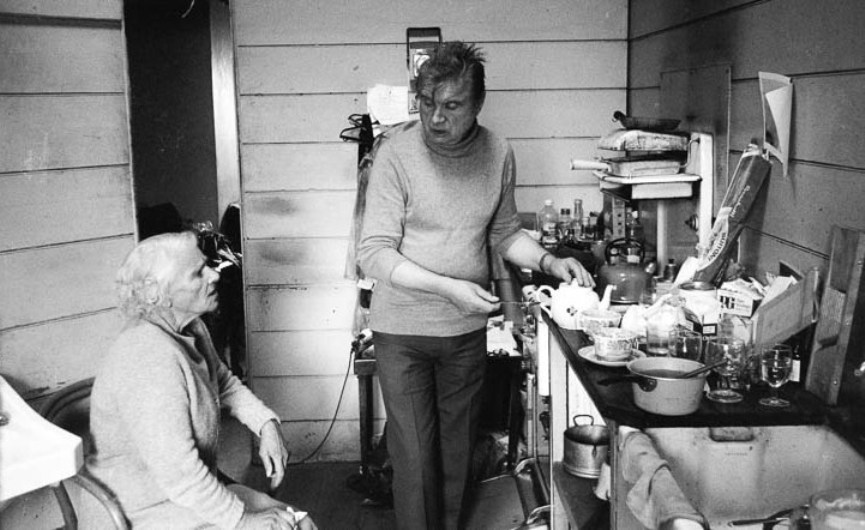
Francis Bacon at his kitchen with his cleaning lady Jean Ward. London 1979 Photo: Edward Quinn
Disturbed Ground:
Francis Bacon, Traumatic Memory
and the Gothic1
FIONNA BARBER
FIONNA BARBER | CONTEMPORARY ART | THE IRISH REVIEW | VOLUME 39 | WINTER 2008
Francis Bacon's relationship with definitions of Irishness has always been somewhat problematic. His Anglo-Irish origins, homosexuality and a reputation for challenging paintings have all in different ways contributed to degrees of difficulty in situating his work within the discourses of Irish art history. However, approaching the centenary of his birth, this is a relationship that needs to be re-examined. Bacon, like other Irish mod? ernist artists such as Louis le Brocquy, William Scott or EE. McWillliam, spent his working life outside Ireland. In Bacon's case this was mostly in London with occasional forays to the Mediterranean and once, memorably, to the artists' colony at St Ives in Cornwall.2 Yet in comparison with any of these other artists Bacon's work sits uneasily with its Irish identifications. One reason is that, like Samuel Beckett, his work avoids any degree of explicit Irish reference. Or rather, the traces that remain are deeply embedded, suppressed narratives whose signs emerge within the staging of Bacon’s paintings where they figure as uncanny echoes of an almost forgotten past. Francis Bacon’s figurative paintings of the late 1940s and early 1950s, the terrifying visions of screaming popes and other similarly disturbing figure studies, have already been pulled into numerous interpretative contexts. Critical readings of these images have repeatedly focused on such varying issues as Cold War anxieties, a pathological fascination with violence, or engagement with art-historical precedents such as Velazquez or Munch. All of these are certainly relevant; Bacon’s uncomfortable, challenging paintings were perceived as a figurative counterpart to the so-called ‘Geometry of Fear’ dominating British art in the post-war years. On another level the conflation of pleasure and pain remained a feature of his approach to the human body throughout his life. Through his handling, the painted male body became a figure of both terror and desire, a counterpart to the sadomasochistic sex that featured so consistently in his personal life.
Bacon had a continual love of artifice in both life and painting; even into old age he prepared for a night on the town by putting on pan-stick make? up and colouring his hair with boot polish. A similar staging of scenarios within his paintings to produce disturbing emotional resonances begins to suggest a set of concerns that can be identified as Gothic. As a cultural mode — literary, cinematic or painterly — the Gothic also involves dizzying temporal juxtapositions of archaic and modern, registering in perverse and uncanny terms the superseding of one order by another. This also has a relevance for readings of Bacon, and not just in his fascination with the image of the Pope. Paintings such as Pope I (1951) were, after all, produced in a predominantly Anglican post-war British culture, where the depiction of the head of the Catholic Church was increasingly anachronistic. Yet to read these paintings in relation to the Gothic can also open onto a further cultural formation in decline during Bacon’s youth in Ireland. The Gothic mise en scene requires the construction of an antiquated, outmoded space, within which the irrational is staged and the hidden is revealed.3 In the pictorial spaces of Bacon’s paintings of this period the decaying milieu of Anglo-Irishness leaves recurrent traces, returning not as reverie but as nightmare.
Bacon’s biographers — mainly Michael Peppiatt but also Andrew Sinclair — have paid careful attention to his Irish origins.4 The artist’s early life also figures in another key source for information about his preoccupations, the series of interviews with the art critic David Sylvester, who championed Bacon throughout his career. Despite their appearance of a coherent auto? biographical seamlessness, these are in fact a discursive collage of transcripts from conversations on different occasions, in some cases taking place over a number of years.5 Through these sources and others the main features of his early years in Ireland emerge. Francis Bacon was born in 1909 in Dublin, in a nursing home in Lower Baggott Street, to a mother from a wealthy family in the north of England and a father who was a retired army captain. After leaving the army, Eddy Bacon set up a business breeding racehorses near the Curragh of Kildare, a location known as much for its stud farms as for the military garrison. After the First World War, which the Bacons spent in London, they returned to Ireland, where the young Francis Bacon spent his time either in the family home at Farmleigh, in Kildare, or the nearby Straffan Lodge, where his grandmother lived. Yet this was a very different Ireland, dominated by the threat of violence during the War of Independence both towards his class and more specifically his family — Bacon’s maternal grandmother was married at this time to the district inspector of police for Kildare. He later identified the period of his early life in Ireland as ‘violent in the military sense’,6 and would recall terrifying incidents from that time that had a direct effect on his family. This all came to an end at the age of sixteen, however, when Eddy Bacon discovered his son’s homosexuality and expelled him from the family home; he never returned to Ireland.
Within these biographical accounts, detailed and informative as they are, Bacon’s Anglo-Irish background is relegated in comparison to the difficult relationship with his father as a source of the violence of both his later life and work, and becomes a kind of supporting chorus for the unresolved Oedipal scenario played out within the paintings of the late 1940s and early 1950s. The ‘fact’ of Bacon’s Irishness, in other words, is subordinate to the universal drama enacted before our eyes, and which was itself the cause of his growing reputation as a major British artist. He was also, right from the outset, perceived as an artist who could be readily incorporated into trends of European modernism; in 1949 the critic Robert Melville placed Bacon in a pantheon that included such figures as Eisenstein, Dostoevsky, Kafka and Picasso.7
On the other hand, Bacon’s incorporation into canons of Irish art has been far from straightforward. Inadmissible during his lifetime due to his overt homosexuality and the difficult nature of his paintings, Bacon’s death in 1992 began a process of gradual acceptance that was finally validated by the acquisition of his relics and their public display in the Dublin City Gallery: The Hugh Lane from 2001 onwards. Although he never revisited Ireland in person, the artist made a different kind of return with the uncanny reconstruction of his final London studio in the spaces of an Irish art museum. This was 7 Reece Mews, where he lived and worked for the last thirty years of his life; transposed to Dublin it becomes both shrine and simulacrum of the artist’s presence.8 The reconstruction promises a degree of authenticity through its tantalising glimpses of a space that claims, impossibly, to be the same as that which Bacon once inhabited and painted. Yet the conditions surrounding Bacon’s reappearance in Dublin also have Gothic affinities, transforming him into the exiled revenant come to claim his birthright. The reconstructed studio now sits within a building steeped in connotations of a lost Anglo-Irishness. Commissioned from the leading neoclassical architect William Chambers in 1763 by the first Earl of Charlemont, the residence was adapted in 1929 to house the collection bequeathed on somewhat controversial terms to the nation by Hugh Lane.9 As the nephew of Augusta Gregory, Lane’s intention was to assemble a collection of both European and Irish art that would play a significant role in Ireland’s cultural revival. Bacon’s studio is now located in relation to a collection that on one hand evokes a prelapsarian past: the Manets and Orpens, although daring for Dublin in the early twentieth century, were also examples of fairly conservative British Edwardian taste that had little time for the contemporary avant-gardism of Picasso or Matisse. On the other hand, the subsequent acquisitions of the gallery ? works by Henry, Keating and le Brocquy among them — represent a somewhat uneasy narrative of Irish art over a period of decolonisation. The situation of the studio in spatial proximity to this collection posits a relationship that is far from secure; rather than ratifying Bacon’s status with regard to Irish art it can also be seen as raising troublesome questions about canons and cultural identity.
Recognising the significance of Francis Bacon in relation to Irish cultural contexts is important, but it should be accompanied by an awareness of the danger of reinstating another insidiously regressive trope of privilege ? the heroic male Irish artist. The position from which we can now interrogate categories of the subject in Irish art is in no small part a product of the feminist landmining of the canon in the 1980s. The drive to discursively produce new and interesting masculinities, therefore, should by no means be taken as a licence to overlook continuing feminist interrogations of both history and art practice. The aim, then, is to prise Francis Bacon out of more familiar British and European frames of reference, and into another range of associations that are predominantly concerned with Irishness as an already problematised category. The Gothic, in this reading, becomes a dark and perverse filter through which the paintings begin to suggest a destabilisation of tropes of Irishness that include both the nostalgic fetishisation of the past and the predominance of a heteronormative masculinity.
Pictorial space and the staging of terror
But first we need to look at the paintings. In the late 1940s and early 1950s Francis Bacon produced a cluster of works focused around the screaming figure. Although these are images of male subjects, their sources include two other representations of terrified women: the mortally wounded nurse in Eisenstein’s Battleship Potemkin, and the mother desperately trying to protect her child in Poussin’s painting The Massacre of the Innocents (1630? 31) that Bacon saw in Chantilly at an early stage of his career.10 The screaming figures were the paintings that made his reputation, albeit as a difficult and challenging artist. Yet they were also produced during a period of emotional and domestic stability, when Bacon lived in an unconventional ménage in Cromwell Place with his older lover, Eric Hall, and his former nanny, Jessie Lightfoot.
Not all of Bacon's male figures from this period are screaming. Some have facial expressions of unease rather than overt abjection — such as Head III, 1949, or Pope I, which was part of the major series engaging with Velazquez' Portrait of Pope Innocent X (1650) begun in the late 1940s. In the first painting, a seemingly elderly man peers out of a murky background over his left shoulder; the figure only barely emerges from the greyish green wash covering the picture surface. The pince-nez glasses through which his eyes gaze at the viewer suggest him to be a bureaucrat, a representative of some nameless authority, although this power is also under? mined through the reference to the savagery of the nurse's fate in Battleship Potemkin. Made vulnerable through his apparent nakedness, this is an unclothed version of the men in suits Bacon painted throughout his career, such as Study for a Portrait (1953) or the later Study for a Portrait (1991). The suggestion of civility undercut by the threat of violence here is also a taste of the full-blown confrontation with the cataclysmic destruction of authority that was to come The same anticipatory gaze also appears on the face of the figure of Pope I, although there have been a number of key shifts that affect the meaning of the work. All in all, this is a more complex image than the earlier figure study, not only through the delineation of the papal throne that ties the image back to Velazquez but the sketching out of the architectural framework that surrounds the figure. This contains elements familiar from other Bacon paintings ? the box that focuses and encloses, the indications of an interior, here classicised but also as suggestive and as insubstantial as a stage set, and the curved armature that sweeps across the painting, separating the viewer from whatever emotional drama is being played out behind it. In its sequel, Pope II (Fig. 1 [see colour section, p. 157]), further shifts in pose occur ? and then there is the introduction of the scream. Imagined sound seems to reverberate throughout its pictorial space, both contained and amplified by the edges of the painting. This remarkable image has also been identified as the first clear articulation in Bacons work of the full-throated, terrified scream, depicted in all its psychological intensity.11
Why the Pope? David Sylvester suggested to Bacon that the Pope (‘il Papa’) symbolised his father, as the basis for his obsession with Velazquez’ portrait.12 Both the Pope and Velazquez represented figures of authority, a father to be rebelled against. David Mellor has developed these issues further in an essay that convincingly locates Bacon’s concerns in a history of twentieth-century British painting. Mellor identifies the importance of both Velazquez and Spain for earlier British painters; for avant-garde artists such as Wyndham Lewis and Edward Burra, Spain became ‘a paradigm of the primitive-modern, one based around stark violence, blackness and complexity’ .13 As he also observes, the addition of Eisenstein’s pince-nez to Bacon’s versions of Velazquez, ‘turn the face of the seventeenth century Pope into the then current Pope of nineteen-fifty [Pius XII]’.14 But there are other aspects of Bacon that repeatedly escape this framing within a British cultural context. What the Pope may have meant for Bacon would have also been determined at some level by his early life as an Anglo-Irish Protestant, whose dominating and distant father conformed also by being a staunch Anglican. The visualisation of the terrifying yet terrified Papa thus becomes the restaging of a relationship with another equally threatening patriarch. Already weighted with a deep emotional ambivalence, the abjection of temporal and spiritual power becomes even more significant.
In Pope II, the Holy Father’s grasp on authority and temporal power are in turn savagely blasted away by a scream so elemental it seems to come from some place before and outside of language. Looking at this work, it is tempting at this point to let go of the frame, to allow yourself to tumble headlong into that pit of emotion. But this Gothic disintegration of boundaries is a staged effect, one that is manoeuvred through pictorial strategy ? the uneasy relationship between figure and ground or the murky, purplish-blue coloration. There is also a temporal oscillation characteristic of Gothic modes. It only takes a few brush strokes for the figure to emerge out of the gloom, slipping through the safety net of art historical reference to a seventeenth-century papal portrait, and pitched into a whole different set of connotations more recognisable as the traumas of modernity. Some years after its first appearance in Bacon’s work of the mid-1940s, for example, the box containing the figure in the related Study for a Portrait (1949) was also being compared to that surrounding Adolf Eichmann at his trial in Jerusalem, as representative of a similar architecture of containment.15
Yet this is a repeated scenario within which particular representational strategies generate an emotional effect — one of pain, unease, anxiety. We need to be careful not to suggest intuitive homologies between what the viewer experiences and what the painter feels. As J.R.R. Christie and Fred Orton have warned, with reference to Wittgenstein: ‘inner experience only enters consciousness when it finds a language; whereof we can not speak, thereof we must remain silent’.16 This is a useful proviso for engagements with expression in modernist painting, particularly with regard to the construction of artistic subjectivities that privilege categories of emotional suffering. It is not just a case of identifying some kind of primary core of experience that then inevitably emanates through the painted surface. Causality, particularly in the case of Francis Bacon, is a much more complex matter, not helped by the artist’s repeated insistence on the denial of narrative in favour of a direct impact of his paintings on the viewer. When asked by David Sylvester about the violence of his paintings in relation to the violence he had experienced in his life, Bacon was at pains to deny any direct connection:
But this violence of my life, the violence which I’ve lived amongst, I think it’s very different to the violence in painting. When talking about the violence of paint, it’s nothing to do with the violence of war. It’s to do with an attempt to remake the violence of reality itself. And the violence of reality is not only the simple violence meant when you say a rose or something is violent, but it’s the violence also of the suggestions with? in the image itself which can only be conveyed through paint.17
However, as Julian Bell has suggested, Bacon’s claims of ‘transcendent immediacy’ are also reminiscent of ‘handsome modernist reverie, at odds with equally strong countervailing instincts’.18 There are always levels of meaning beyond those that artists themselves suggest and attempt to curate. The viewer’s engagement with these dark and disturbing interiors takes place at a level of sensation experienced within a continuous present, yet it is also predicated upon the suggestion of a past where terrible things may have happened.
Terrible, but not unspeakable, for that would deny not just the possibility but the necessity of their representation. Both the Gothic and psychoanalysis involve a recognition of an underlying terror that becomes articulated through irrational means.19 Drawing on Freud’s arguments in Beyond the Pleasure Principle, Cathy Caruth has written of trauma as ‘always the story of a wound that cries out, that addresses us in the attempt to tell us of a reality or truth that is not otherwise available’.20 Theories of trauma suggest that there are some events whose emotional effect on individuals is so extensive, so devastating, that they defy representation at the time that they are experienced. Representation comes only at the end of a period of latency, of silence, when the extent of the damage can no longer be denied. It is the act of representation, the moment of its utterance, that gives form to the initial pain in a way that was previously repressed. For Bacon, violence ‘can only be conveyed through paint’, through the means of its representation. Even there, whatever it is that generates this terror sits right on the edge of the representable, on the threshold of abjection; ‘the black cavern’ was how he described the screaming mouth.21 Yet the work of memory, including its traumatic form, is also a mode of representation, so in attempting to situate Francis Bacon’s work in relation to aspects of the past we are dealing with something that is always already mediated even before it enters into his paintings. In this case what is significant is the particular set of inflections of modernity that characterised the last days of the Anglo-Irish, and within which the artist grew up.
Anglo-Irishness and its discontents
According to Andrew Sinclair, in old age Francis Bacon was still very much the ‘Anglo-Irish gentleman’.22 The rule of the Protestant Ascendancy, relatively secure since Cromwell’s campaigns, was coming to an end with the struggle for Ireland’s independence in the early years of the twentieth century. Like any colonial presence, their grip on this status had been somewhat shaky, resulting in the building of Big Houses that surveyed and dominated their territory, and whose walls could keep at bay the con taminatory effects of the native Irish rabble. To be Anglo-Irish was a position marked by its instability in more ways than one. Declan Kiberd, for example, notes that Elizabeth Bowen, like one of her heroines, was only truly comfortable when in the middle of the Irish Sea, somewhere between Holyhead and Dublin.23 Consequently, to discuss Bacon as Anglo-Irish is not quite the same as reclaiming him as an ‘Irish’ painter; his work consistently resisted any kind of incorporation into the cultural politics of nationalism. Unlike other émigré artists from Ireland in London in the 1950s, such as the sculptor F.E. McWilliam or the painter Gerard Dillon — neither of whom came from similar backgrounds to Bacon — none of his work at any point engaged with issues of Irishness, at least on an overt level. And in any case his spectacularly flamboyant homosexuality would have been somewhat difficult to recuperate within the contemporary nationalist discourses of heroic masculinity that, within painting, showed themselves in the polarised gender roles of the west of Ireland peasantry.24
The Big House also had an ambivalent status in Bacon’s recollections, one that goes far beyond the external threat of danger from political forces. The bow windows at the rear of Farmleigh gave out onto an arc of space beyond, which Bacon later described as a possible source for the curved backgrounds of his triptychs.25 Yet Farmleigh, initially inhabited by his grandmother and her second husband Walter Loraine Bell, also became a site of terror; Bell was renowned for his sadism to both humans and animals. In other ways, too, Anglo-Irishness as it was lived in this environment was also potentially lethal to the young Francis Bacon. An asthma sufferer, his early years were spent in houses obsessed with hunting and dogs. The contact with animals produced an allergic reaction so severe that he was thought unlikely to survive; the future painter of such anguished, open-mouthed screams spent his childhood struggling against asphyxiation. It was also within this perilous domain that Bacon’s early sexual identity was formulated, firstly through an infatuation with the distant and authoritarian figure of his father, and subsequently through a series of sexual encounters with the grooms who worked in his father’s stables. One story often told of Bacon’s youth is that it was these grooms who, on occasions, allegedly horsewhipped the young boy on his father’s orders.26 Whether or not this was the case, the tale further helps to construct a reading of what Laura Mulvey has described as the ‘terrible violence and irrationality of the father /villain ... at the heart of the Gothic genre’.27
As any reader of Somerville and Ross’ Adventures of an Irish R.M. (1899) and its sequel will be aware, horses and the rituals of the hunt were deeply woven into the fabric of rural Anglo-Irish society. Hunting played a central role in maintaining social cohesion through ensuring a regular contact between families and hence distinguishing the Ascendancy from the ever present Irish other. To wilfully refuse to participate, as the young Bacon did, was to undermine the already threatened values of Anglo-Irishness from within. Not to hunt, but to have sex with the grooms and stable boys, only compounds the issue further. Yet there are further implications for the relationship between sexuality and ethnicity. In the nineteenth century Ernest Renan and Matthew Arnold had both produced a typology of ethnicity that distinguished between the emotionally unstable ‘feminine’ Celt and the authoritative ‘masculine’ force of the Teuton or Saxon. In her discussion of the fiction of Somerville and Ross, Roz Cowman has noted a further area of ambivalence in the constructions of their Anglo-Irish subjects, who can be ‘androgynous amongst themselves, or male in opposition to the native Irish as female’.28 Although the Irish R.M. books were written at the turn of the century, they are set in an idyllic golden age by compari? son with the situation of the Anglo-Irish in the 1920s. In the Teutonic brutality of Eddy Bacon, the masculine politics of the garrison had further retrenched into a kind of survivalism; this was possibly not the best time for him to discover his son dressed up in his mother’s clothes. Infatuated with the violent and authoritarian father who rejected him, it is not hard to see the prototype for the sadomasochistic fascinations that characterised Francis Bacon’s relationships throughout his life ? given shape within the contained and suppressed passions of the Big House and worked through in the male bodies depicted in the paintings.
The Convulsion of Domesticity
The construction and regulation of domestic space clearly had some kind of fascination for Bacon, whose first appearance on the British cultural scene was not as a painter but a designer. However, in the streamlined sur? faces of his art deco interior photographed for The Studio in 1930 there is little sense of the profound anxiety erupting within the walls of his later pictorial spaces. As Christopher Reed has suggested, domesticity represse the meanings of modernism, in that the nostalgic evocation of the past suggests the temporality that modernism moves to deny.29 Yet the domestic can also be the site of unspoken trauma that eats away at modernism’s utopianism. In 1929 the Surrealist artist Max Ernst produced La Femme 100 Têtes, the first of his three collage novels, in which a visual narrative emerges through a sequence of images edited into chapters. The images themselves are derived from nineteenth-century illustrations from a variety of sources including trade catalogues, popular melodramas and scientific publications. Intermittently, the novel contains scenes of late-nineteenth century bourgeois interiors, which Hal Foster argues are ‘reworked to suggest traumatic tableaux constitutive of subjectivity (e.g. primal scenes and castration fantasies)’.30 Scenarios of sexual desire and its repression are thus staged within a convulsive undoing of bourgeois domesticity. Although the mise en scene of Bacon’s paintings is different, there are some analogies. It is not too demanding to recognise the domestic sphere as the site of an Oedipal drama in Bacon’s early life, the theatre of his initial encounters with sexual desire and its brutal repression by his father. However, Foster also suggests that rather than being just examples of enactments of a psychic trauma, Ernst’s collages have a wider historical dimension as ‘spatial allegories of a temporal crossing or historical change’.31 They evoke an outmoded moment in the formation of capitalism, when the late-nineteenth-century domestic interior attempted to serve as a refuge from the rampant industrialisation outside. Something of this can also be applied to Bacon’s uncanny spaces. Their fundamental unease can, perhaps, also be read as restaging an earlier historical moment: the last throes of the Anglo-Irish Ascendancy, also the period of Bacon’s youth.
These images of screaming popes in murky interiors were painted in the studio at Cromwell Place, where Bacon lived with Eric Hall and Nanny Lightfoot in a parodie reconstruction of the family he had once lost. In his youth, the impoverished gentility of the Bacon household was maintained through solidly Anglo-Irish pursuits such as horse breeding. Although financial support also came from Erica Brausen, Bacon’s dealer at the Hanover Gallery from 1946 onwards, the Cromwell Place ménage managed a relative degree of stability through its criminality. Not only was homosexuality still illegal, but the household’s income came largely from running an illicit gambling den with the addition of Nanny Lightfoot’s occasional shoplifting. Michael Peppiatt has observed that until middle age Bacon’s sexual and emotional life was marked by a preoccupation with father figures, as if, after his banishment, ‘he felt impelled to restore the original relationship, however traumatic, with another man’.32 As with Bacon’s earlier lover, the Australian artist Roy le Maistre who taught him the rudiments of painting, Hall provided a crucial level of support; it was within this context that Bacon was able to give form to the image of the terrifying patriarch. All of this, however, came to an end with Jessie Lightfoot’s death in 1951, followed by Bacon’s sudden ending of the relationship with Eric Hall and his leaving Cromwell Place, to be followed by years of instability. In the crisis caused by the destruction of yet another family there is the compulsion to repeat, re-enacting the trauma of earlier exile.
In eighteenth— and nineteenth—century Gothic literature, there is a preoccupation with both home and homelessness as those who are expelled from this domain incessantly wander the earth. The home itself becomes a place of danger and terror rather than its more normative associations of peace and security. As Kate Ferguson Ellis points out, the Gothic novel registers the ‘violence, danger and breakdown of community’ that were continual challenges to a sense of bourgeois superiority, even during its formation within eighteenth-century capitalism.33 Similar conditions ? although with very different causes ? also accompanied the birth of the modern Irish state in the early years of the twentieth century. The Anglo-Irish presence, embodied by the Big House, served to maintain a self-consciousness as a class under siege, within a space separated from the lower orders of the Irish, who would only penetrate it as servants, or indeed, as grooms. As the wider territory became reclaimed and renamed within the public discourse of the emergent state, so too was the destruction enacted of the private domain of the Big House, where the power relations of domination and subordination of aristocratic or bourgeois Anglo-Irishness were themselves replicated. As Ellis argues, ‘the Gothic novel of the eighteenth century foregrounded the house as fortress, while at the same time exposing its contradictions’.34These are tensions that in true dialectical fashion must burst apart and expel the hero, compelled to wander, like Melmoth, or indeed the young Francis Bacon. Cast out by his wrathful father after the shameful discovery of the ‘truth’ of his sexuality, he drifts through London, Berlin or France, but not Ireland, to which he never returns.
The fluid and transgressive tendencies of the Gothic are particularly applicable to reading of Bacon’s work. The paintings also contain elements of visual Gothicism, in their cavernous spaces reminiscent of Piranesi’s cavernous dungeons. Their articulation of terror deploys the language of the Burkean sublime: despite David Mellor’s claim for the situation of Bacon’s work in relation to a revival of interest in the sublime within British post? war culture, this further level of significance in relation to Irish cultural formations should not be overlooked.35 These visual associations work in conjunction with the prevalent literary associations of the Gothic in Irish culture. As Luke Gibbons has noted, early-eighteenth-century Gothic modes position Catholicism as the spectral entity that returns to haunt the present. In Ireland, as distinct from the England of Walpole, Catholicism was already laden with associations of savagery and licence.36 For the besieged ex-colony of the Anglo-Irish in the 1920s these were associations that were still current.
The antithetical conflation of the screaming Pope, the head of the Catholic Church, with the terrifying and vengeful Protestant father thus acquires a further level of significance. Through its active restaging within the paintings, individual psychic trauma begins to acquire a dialectical relationship with a wider historical crisis, whose traces are also embedded within Bacon’s pictorial spaces. One part at least of the emotive power of these pictures is their conflation of terror from both within and without the house’s walls. On one hand, the threat of annihilation by the rabble, while on the other, the punishment for the fantasy of incest, the taboo that can undo the foundations of civilisation. Once again the end-game of the Anglo-Irish is played out, haunting the viewer with the spectral return of a culture whose moment is long past.
Notes and References
1 Versions of this essay were given as papers in the session ‘Irish Studies and History of Art: Impossible Dialogues?’ organised by Lucy Cotter for Contestations, the Association of Art Historians thirty-third annual conference, University of Ulster, Belfast, 12-14 in April 2007, and at Irish Eyes: Visions and Revisions, Canadian Association of Irish Studies annual conference, University of Toronto, May 2008. This revised and expanded version has benefited from the valuable comments and observations of Aidan Arrowsmith, David Brett, Lucy Cotter and Eoin Flannery.
2 Bacon rented a studio in St Ives from September 1959 to January 1960.
3 See, for example, the discussion of formative characteristics of the Gothic in Jerrold E. Hogle, ‘Introduction: the Gothic in Western Culture’ in Hogle (ed.), The Cambridge Companion to Gothic Fiction (Cambridge: Cambridge University Press, 2002), pp. 1-20.
4 Michael Peppiatt, Francis Bacon: Anatomy of an Enigma (London: Orion Books, 1997); Andrew Sinclair, Francis Bacon: His Life and Violent Times (London: Sinclair-Stevenson, 1993).
5 David Sylvester, Interviews with Francis Bacon (London: Thames and Hudson, 2002).
6 Ibid., p. 81.
7 Robert Melville, ‘Francis Bacon’, Horizon, 20: 120/121 (1949/1950), pp. 419-23.
8 See Barbara Dawson and Margarita Cappock, Francis Bacons Studio at the Hugh Lane (Dublin: Hugh Lane Municipal Gallery of Modern Art, 2001) for an account of the studio’s reconstruction and a description of its contents.
9 For an account of the original design of Charlemont House, see Sean O’Reilly, ‘Charlemont House - A Critical History’ in Elizabeth Mayes and Paula Murphy (eds.), Images and Insights (Dublin: Hugh Lane Municipal Gallery of Modern Art, 1993), pp. 2?54.
10 Michael Peppiatt, Francis Bacon in the 1950s (New Haven and London: Yale University Press in association with Sainsbury Centre for the Visual Arts, 2006), p. 35
11 This is suggested by Wieland Schmied in his penetrating study of these works by Bacon, Francis Bacon. Vier Studien zu einem Portrait (Berlin: Frolich and Kaufmann, 1985), discussed in Armin Zweite, ‘Bacon’s Scream: Observations on Some of the Artist’s Paintings’ in Zweite (ed.), Francis Bacon: The Violence of the Real (London: Thames and Hudson, 2006), p. 76.
12 Sylvester, Interviews, p. 71.
13 David Mellor, ‘Francis Bacon: Affinities, Contexts and the British Visual Tradition’ in Achille Bonito Oliva (ed.), Figurabile: Francis Bacon (London: Electra, 1993), p. 96.
14 Ibid., p. 96.
15 Frank Lauk?tter and Maria M?ller, ‘Paintings 1945-1991’ in Zweite, Francis Bacon, p. 115.
16 J.R.R. Christie and Fred Orton, ‘Writing on a Text of the Life’ in Fred Orton and Griselda Pollock (eds.), Avant-Gardes and Partisans Reviewed (Manchester: Manchester University Press, 1996), p. 301.
17 Sylvester, Interviews, pp. 81-82.
18 Julian Bell, ‘The Cunning of Francis Bacon’, New York Review of Books, 54: 8 (10 May 2007), 8.
19 See, for example, Michelle A. Masse, ‘Psychoanalysis and the Gothic’ in David Punter (ed.), A Companion to the Gothic (Oxford: Blackwell, 2000), pp. 229-41.
20 Cathy Caruth, Unclaimed Experience: Trauma, Narrative and History (Baltimore: Johns Hopkins University Press, 1996), p. 4.
21 Sylvester, Interviews, p. 72.
22 Sinclair, Francis Bacon, p. 3.
23 Declan Kiberd, Inventing Ireland: The Literature of the Modern Nation (London: Vintage, 1996), p. 367.
24 Some of the work of Gerard Dillon is an exception to this, suggesting a range of frequently submerged homoerotic narratives. This issue is discussed by Riann Coulter, ‘Nationalism, Homosexuality and the Modern Artist: Suppressed Narratives in Gerard Dillon’s Images of Connemara’, paper given in the session ‘Irish Studies and History of Art: Impossible Dialogues?’, organised by Lucy Cotter for Contestations, the Association of Art Historians thirty-third annual conference, University of Ulster, Belfast 12-14 April 2007. Also Fionna Barber, ‘Farset, Gomorrah and Kilburn: Reading Diasporic Queer Identities and Irish Painting in 1950s London’, International Association for the Study of Irish Literature annual conference, University of New South Wales, Sydney, 20-23 July 2006.
25 Sylvester, Interviews, p. 184.
26 This story was initially told by Caroline Blackwood, who was married to the painter Lucian Freud in the 1950s. A member of the Guinness family, she was familiar within the milieu of Bacon’s Anglo-Irish background. Peppiatt casts doubts on the veracity of this story, noting that Blackwood reported it as not coming from Bacon himself; Peppiatt, Francis Bacon in the 1950s, p. 66n.
27 Laura Mulvey ‘The Pre-Oedipal Father: The Gothicism of Blue Velvet’ in Victor Sage and Allan Lloyd Smith (eds.), Modern Gothic: A Reader (Manchester: Manchester University Press, 1996), p. 46.
28 Roz Cowman,‘Lost Time: The Smell and Taste of Castle T’ in Eibhear Walsh (ed.), Sex, Nation and Dissent in Irish Writing (New York: St Martin’s, 1997), p. 97.
29 Christopher Reed, Not Home: The Suppression of Domesticity in Modern Art and Architecture (London: Thames and Hudson, 1996).
30 Hal Foster, Compulsive Beauty (Massachusetts: MIT Press, 1993), p. 176.
31 Miriam Hansen quoted in Foster, Compulsive Beauty, p. 158.
32 Peppiatt, Francis Bacon in the 1950s, p. 38.
33 Kate Ferguson Ellis, The Contested Castle: Gothic Novels and the Subversion of Domesticity (Chicago: University of Illinois Press, 1989), p. x.
34 Ibid.,p.xi.
35 Mellor, ‘Francis Bacon’, p. 97.
36 Luke Gibbons, Gaelic Gothic: Race, Colonization and Irish Culture (Galway: Arlen House, 2004), p. 13.
FRANCIS BACON
By DOROTA KOZINSKA | FEATURES | VIE DES ARTS | VOLUME 52 | NUMBER 213 | SUPPLEMENT | WINTER 2008–2009
This vast retrospective of the work of one of Britain’s greatest contemporary artists, Francis Bacon (1909 – 1992) is a major celebration heralding the centenary of his birth, and a comprehensive and exhaustive document of his prolific career.
Born in Dublin of English parents, Bacon first worked as an interior designer. He started painting around 1928, but destroyed most of his early work. He revealed his talent as a major artist in 1945 with an instantly unforgettable and shocking work titled Three Studies for Figures at the Base of a Crucifixion.
This was the start of one of the most controversial and disturbing careers in the history of modern art. Bacon’s demoralizing philosophy that man is simply another animal in a godless world, subject to the same natural urges towards violence, lust and fear, was at times in contrast with his paintings infused as much with unbearable emotional anguish, as with love. They are often extremely beautiful despite their gut-wrenching subject matter.
This, the first UK retrospective of Bacon’s work since 1985, is a form of re-assessment of his oeuvre, afforded by new research that has emerged since the revelation of his studio and its contents following the artist’s death. One of the rooms in the exhibition, Archive, offers a glance into the inner sanctum of the artist, revealing to what extent he relied on photography, and how he manipulated photographic imagery. The imagery itself, like Bacon’s paintings for that matter is often brutal, on the theme of violence and conflict, but also focused on works of art, including stills from old film.
Bacon’s preoccupation with the human body and its suffering, is the central theme of all of his works. He developed a unique way of depicting the physical and emotional torment racking the body, by twisting and deforming it, reducing it to a fleshy mass emitting a silent scream of pain. His flamboyant homosexuality and personal transgressions only added to his mythical stature, and are an intrinsic element of his work.
The Tate retrospective brings together many famous paintings and triptychs including Study after Velazquez’s Portrait of Pope Innocent X (1953), In Memory of George Dyer (1971), and Two Figures in the Grass (1954).
This, however, is but the tip of the iceberg. The exhibition is chock full of recognizable paintings, but that is perhaps due to Bacon’s unmistakeable style.
It is divided into ten sections, or rooms, starting with Animal, showing works done in the 1940s and reflecting the artist’s original theory of man as an animal in a world without redemption. The bestial depiction of the human form is at times combined with specific references to the horrors of the Second World War. It is in this room that we are first introduced to one of the early variations on the theme of the Velazquez painting, which became an obsession with the painter, Head VI (1949). All it really is, is a screaming face, featureless except for the gaping mouth.
Room 2, Zone, focuses on Bacon’s experiments with pictorial space, and the interaction between subject and setting. In most of his works, the figure is solitary, isolated, yet placed centrally, almost on a stage, therefore exposed to public scrutiny in all its vulnerability. This visual formula weaves throughout his career, and is symbolic of the artist’s sense of being alone in his suffering.
Room 3 is under the heading Apprehension, and the sense of dread permeating the works in this section is of a very unusual kind. The Man in Blue reigns in this hall, a haunting, looming figure behind an enormous desk, a sinister, shadowy presence exuding a particularly personal menace. This series refers to the continued illegality of homosexuality, and on a personal level, to Bacon’s sometimes violent affair with Peter Lacy. This room also holds the Chimpanzee (1955), a terrifying depiction of confinement and cruelty.
Through Crucifixion, Crisis, and Portrait, to Epic, Memorial and Late, each section is a world onto itself, a mini exhibition within the framework of a large one.
Portraits is like a burst of colour in the otherwise sombre palette that predominates in Bacon’s oeuvre. Gone is the cage-like grid holding the figure, the space is infused with light, ochres and greens. His lover and most frequent model, George Dyer, is seen in many of the works, like Three Figures in a Room (1964), in which he is represented with a mixture of pathos and affection section is a world onto itself, a mini exhibition within the framework of a large one.
But it is in the room titled Memorial that one finds perhaps the most accomplished, and the most painful of Bacon’s works. The room is entirely dedicated to Dyer, who was the artist’s closest companion as of 1963, and who committed suicide in 1971, two days before Bacon’s major exhibition at the Grand Palais in Paris. Racked by loss and pain, Bacon created a series of works in the memory of Dyer, that speaks a subtly different visual language. The fines are cleaner, the imagery less raw, the setting staged, as if the horror of the event was too much to bear and had to be presented in a theatrical, detached manner.
The figure, as always, is placed centre stage, exposed in all its physical degradation and beauty, terribly human in its vulnerability and helplessness.
Presented in triptychs – Bacon’s way of fulfilling his longing for cinematic expression – it shows Dyer slumped on a toilet seat, dying, a giant black shadow spilling from the central image like a great pool of blood
Bacon was legendary for his resigned defiance in the face of mortality, but the death of his friend was devastating. "Death is the only absolute certainty," he told a friend. "Artists know that they can’t defeat it, but I think that most artists are very aware of their annihilation – it follows them around like their shadow."
For someone wrestling with such overwhelming forces, Bacon exhibited an impressive discipline at work, pouring his torment onto the canvas with an unconscious, or perhaps very deliberate, sense of it being his only salvation.
In the last room of this magnificent exhibition, we come face to face with the artist so to speak. A series of wonderful self-portraits reveal the man behind the easel; a profound, deeply thinking, complex personality. In Three Studies for a Self-Portrait (1979-80), the face is a twisting, undulating patchwork of colour against a dark background. The features are typically contorted, but what draws the attention are the eyes that see, and look back at us.
What strikes one when contemplating the expanse of Bacon’s prolific production, is how very consistent he was in his style and subject matter, and yet at the same time how endlessly, surprisingly fresh each of his painting is to this day. Despite the scatological, eviscerating nature of his work, the viewer is instantly immersed in its story, often unaware of, oblivious to the fabulous calibre of the art. The two go hand in hand in Bacon’s paintings, the horror and the beauty, life and art, united by the indomitable creative spirit that helped him survive and fed his talent.
EXHIBITION FRANCIS BACON TATE BRITAIN Upper Galleries London, UK 11 September 2008 – 4 January 2009
Francis Bacon
Tate Britain, London.
11 September 2008–4 January
2009.
Museo Nacional del Prado,
Madrid
3 February–19 April 2009
The Metropolitan Museum of
Art, New York
18 May–16 August 2009
JANET MCKENZIE | STUDIO INTERNATIONAL | TUESDAY 30 DECEMBER 2008
Francis Bacon (1909-1992) at Tate Britain heralds the artist’s centenary in 2009. It is the first retrospective since 1985, enabling a re-assessment of his work, although the exhibitions in Edinburgh, Francis Bacon: Portraits and Heads (2005) and Norwich, Francis Bacon in the 1950s (2006) at the Sainsbury Centre have been significant. The present exhibition is informed by the revelation, following Bacon’s death in 1992, of the contents of his studio. His working methods were revealed, especially his reliance on photographs.
In interviews, Francis Bacon insisted that he never drew, and that his compositions were intuitive. These claims were refuted by the posthumous revelation of figure studies from the 1950s. Bacon usually commenced painting a figure on to the blank canvas. In 1962 he claimed that the genesis of his paintings came whilst daydreaming. In fact his methods were often more orthodox. The works on paper and lists that came to light after his death indicate that he collected a wide range of material to use as points of reference. The present exhibition, which makes a powerful impact on the viewer, comprises 65 paintings and 13 major triptychs. It is the most comprehensive exhibition to date, which examines the artist’s sources, processes and thoughts. It is accompanied by an excellent, scholarly catalogue; edited by Matthew Gale and Chris Stephens; with essays by Martin Harrison, David Alan Mellor, Simon Ofield, Gary Tinterow and Victoria Walsh.1
Widely regarded as one of the greatest artists of the twentieth century, Francis Bacon can also be seen as one of the most powerful and searing commentators of the human condition in Britain since the Second World War, expressing unflinching images of sexuality, violence and isolation. The exhibition is profound, haunting and iconic. Bacon’s philosophy as an atheist is explored: man in a godless world is presented as simply another animal, subject to the same natural urges of violence, lust and fear. In this Bacon personified the age. The loss of faith in humanity in the late 1940s was such that the human image in art became increasingly difficult to portray. The existential despair expressed by Jean-Paul Sartre in Nausea (1938), found a visual counterpart in the images of despair and alienation of Francis Bacon, the expressionism of Oskar Kokoschka and the apocalyptic visions of Arthur Boyd. For the most part, abstraction in the visual arts dominated because, after the horrors of Auschwitz, Hiroshima and Nagasaki, artists found images of humanity impossible to create.
John Berger, formerly a harsh critic of Bacon, recently wrote:
“He repeatedly painted the human body, in discomfort or agony or want. Sometimes the pain involved looks as if it has been inflicted; more often it seems to originate from within, from the guts of the body itself, from the misfortune of being physical”.2 In spite of the hellish drama expressed, Bacon’s work is inspiring in the very dedication to the craft of painting, and the intellectual dialogue created. This is a profound exhibition, at once challenging and awesome. In spite of the bewilderment that can so often be experienced in confrontation with his painting, there is an unexpected affirmation in the choice of formal language and the precision and care applied to the act of painting: the placement of each head, each brush stroke, every subtle hue, the manner in which the figure inhabits the space, the form within the picture plane. A quiet authority is established by the artist amid the shrieking pain, due in large part to the dialogue he has with art from the past.
Bacon’s sources have been divided by various commentators now, to include ‘high art’ sources and ‘low art’ sources. Bacon chose only the most remarkable artists to aspire to: Michelangelo, Rembrandt, Velasquez and Picasso. He also chose inspiration from the modern world: men in suits, modern furniture, dangling light bulbs, gay comic books. He depicted a low-life from gangster boyfriends, heavy drinking and sexually dissipated Colony Room artists and intellectuals, a collision of high and low culture, survival and destruction. Chance played an important role in Bacon’s work – spontaneity was of key importance in a Post-Surrealist context. Although he retained the human figure in his work, he embraced the Abstract Expressionists’ love of chance in art as in life. A primordial energy is central to many works, the Bullfight paintings in 1969 being perfect examples of how Bacon infused the image on canvas with a reckless, fatal movement. Describing the collision of illustration of facts and an expression of the very deepest feelings, Bacon noted: “one wants a thing to be as factual as possible and at the same time as deeply suggestive or deeply unlocking of areas of sensation other than simple illustration of the object that you set out to do. Isn’t that what it’s all about?”3 Bacon had the highest ambition from a young age, claiming that his work should either be in the National Gallery or the dustbin, with nothing in between. His ambition as a painter was to define his existential, atheistic stance in a post-photography world. Bacon was a habitual destroyer of paintings; in 1962 he remarked that over-working was a form of destruction, of clogging. Spontaneity was a vital quality, which Bacon sought to capture.
Francis Bacon was born in Dublin, in 1909. He spent most of his life in London, working as a self-taught painter from the 1930s. The human figure was central to his work throughout his long and productive career. He died suddenly in Madrid in 1992. Time has played an important part in the appraisal of Bacon’s work; his unflinching approach to violence and the human condition is more poignant than ever. In 1973 he attributed his preoccupation with violence and war to the times in which he grew up, interwar Germany and the rise of Sinn Fein in Ireland:
I grew up in an atmosphere of threat for a long time…And then I was in Berlin at the beginning of the Nazi thing, my whole life had been lived through a time of stress, and then World War Two, anyone who lived through the European wars was affected by them, they affected one’s whole psyche to that extent, to live continuously under an atmosphere of tension and threat.4
The exhibition is accompanied by a catalogue, in which the most scholarly essays, explore the lasting significance of his work for the present day. Images of the abyss, of loneliness and the inescapable suffering of human existence dominate the exhibition.
Francis Bacon at Tate Britain is broadly chronological. Room One, Animal, examines Bacon’s early work from the 1940s where his attitude to humanity is already evident. His bestial depiction of the human figure combined personal feelings of anxiety with broader references to the Second World War. He used reproductions from books, catalogues and magazines. The male figure is used repeatedly in Bacon’s long career; he often includes a scream or shout to reveal the internal repressed and violent anxieties. The open mouth represents the tension that exists between the individual and the broader context of time and place.
Room Two, Zone, examines Bacon’s work of the 1950s where he carried out complex experiments with pictorial space. He described the processes, in 1952, as ‘an attempt to lift the image outside of its natural environment’. This work established his easily recognisable images with boxed figures in cage-like structures. Hexagonal ground planes establish tense psychological zones; the use of shuttering, the vertical lines of paint merge the foreground and background. This is the period in which Bacon came of age as a painter. Yet his personal circumstances were extremely difficult: homeless, in debt and in a tempestuous relationship with Peter Lacy. During this time he searched for and found appropriate subject -matter with which to express his deepest anxiety. In the 1950s Bacon used the painting by Velazquez’s Portrait of Pope Innocent X, (c.1650), as his starting point to explore the insecurities of the powerful. For Bacon, the choice of the portrait of a Pope had nothing to do with religion; as a non-believer he was concerned with the way man behaves to each other. For Bacon the portrait by Velazquez was one of the greatest portraits ever painted for it opened up feelings and prompted the imagination, beyond any real individual or other art work. The colour is magnificent, prompting Bacon to give his own images a sense of tragic grandeur, a sense of authority in painterly terms. The Pope as a unique figure in the world suited Bacon’s ambition to create a powerful image in which power is stripped of its essence.
Room Three, Apprehension, explores the pervading anxiety in all of Bacon’s work. The Cold War anxiety that limited movement and personal freedom was combined in Bacon’s case with the illegality at the time of homosexuality. His sometimes, violent relationship, with Peter Lacy, is captured in the Man in Blue series, which concentrates on a single anonymous figure in a dark suit. Although inspired by the greatest artists from history, Bacon powerful images are achieved by combining the authority of the history of art, with contemporary life. The figure is portrayed in isolation, sitting at a table or at a bar. Like many artists in the twentieth century, including the Italian Futurists, who worked with the figure, Bacon drew from the photographic work of Edweard Muybridge’s, The Human Figure in Motion, (1887) sequential photographs of animals and humans, which Bacon described as ‘a dictionary’ of the body in motion.
Room Four at Tate Britain is devoted to one of Bacon’s most famous and iconic series, of the Crucifixion. He made works throughout his career at pivotal moments. As an atheist Bacon saw the Crucifixion as a particularly poignant act of man’s violence. Brutality and fear are developed in a particularly cruel evocation of the famous religious scene. The ritual of sacrifice is given a new dimension, the brutality emphasised with extreme abandon. Meat carcasses are used by Bacon to diminish the human notion of superiority in the wider scheme of life according to Christianity. In an early interview Bacon describes how existing images breed others. He chose the Crucifixion by Cimabue as a starting point, but readily admits that without all the paintings that have been done on the subject, his could not have produced his own. Often under the influence of alcohol, and prone to drug abuse, and frequently suffering acute exhaustion, Bacon would create Crucifixion images of profound despair. He also juxtaposes fragments of films, such as those of Eisenstein, and isolated stills allowing accident to play a major part in the creative process. Three Studies for Figures at the Base of a Crucifixion, (c.1944) is a key work and one that paved the way for his use of the triptych format, and numerous later themes and compositions. The bestial depiction of the human figure was central to Bacon’s oeuvre. Displacing the traditional saints in Crucifixion paintings, Bacon later referred to them as Furies from Greek mythology.
In interview with David Sylvester in 1966, he was asked about the use of meat carcasses in these and other works. He stated, “Well, of course, we are meat, we are potential carcasses”.5 Being human in Bacon’s world was utterly debased. Bacon took works from the history of art that were created within a spiritual context and slashed them to bits. In this he felt completely justified, for the Vatican never openly condemned Nazism. This was Bacon’s vendetta for the hypocrisy played out in the name of God. Where artists such as Hieronymous Bosch created devastating images of humanity in works such as his Judgement Day paintings, Bacon chose the traditionally edifying form of portraiture, which entails a degree of trust between painter and sitter, and destroyed it. His disturbing papal images are like the burning of an effigy, leaving the viewer with a sense of physical revulsion.
Room Five Crisis, focuses on the period 1956-1961. Bacon travelled widely in Monaco, France and Africa, mostly with Peter Lacy. He used new methods of painting, choosing thicker paint, strong colour, often violently applied. Using a self-portrait, The Painter on the Road to Tarascon (1888) by Vincent Van Gogh, as his source and inspiration, Bacon painted works that were criticised for their ‘reckless energy’. With hindsight the energy and drama in these works was necessary in introducing chance into the painting process itself.
Room Six is the Archive in the Tate’s exhibition, based on the revelations made by scholars after Bacon’s death. The source material found in Bacon’s studio revealed his reliance on photography and other sources that had not been fully examined during Bacon’s lifetime. There were photographs of athletes, film stills and reproductions of works of art. Further, his practice of commissioning photographs of his friends by John Deakin was fully realised, and formed an important component of the exhibition in Edinburgh, Francis Bacon: Portraits and Heads, (2005). Bacon also took many photographs himself, preferring to draw from photographs, for they were already two-dimensional images. In his studio there were also lists of potential subjects and preparatory drawings, which Bacon had denied making, preferring to emphasise the spontaneous nature of the act of painting directly onto canvas.
Room Seven Portrait, is important given the findings in Bacon’s studio. In descriptions in interviews, most famously those with David Sylvester, Bacon describes his intention to reinvent portraiture. He drew upon the works he admired of Velazquez and Van Gogh. His abiding concern was how a painter should create portraits in an age dominated by photography. He distorted the sitter’s appearance in order to extract a greater, more complete likeness, informed by internal issues of personality and mood. George Dyer his lover is depicted with a mixture of affection and contempt. Three Figures in Room, (1964) expresses a range of human characteristics including absurdity, pathos, and isolation.
Room Eight Memorial, is dedicated to George Dyer, Bacon’s closest companion and model from the autumn of 1963. Two days before the opening of Bacon’s exhibition at the Grand Palais in Paris in 1971, Dyer committed suicide. The void created by Dyer’s death, under such tragic circumstances prompted Bacon to produce a number of works in his memory. The large-scale triptych suited the grand nature of Bacon’s statements, enabling him to isolate and juxtapose simultaneously. The energy in these works is overwhelming. The depths of despair experienced in the loss of his lover, are expressed with consummate skill and heartfelt anguish. Bacon told Sylvester shortly after Dyer’s death: “You don’t stop thinking about them; time doesn’t heal” He referred to his repeated depiction of homosexual copulation as a form of exorcism. Although he regretted its ‘sensational nature’, he was compelled to paint, Triptych, May-June, 1973, “to get it out of his system”. As well as repeated posthumous images of Dyer, he also made numerous self-portraits.6
Room Nine, Epic, examines the work Bacon produced in response to poetry and literature, particularly the work of T.S Eliot. Bacon was emphatic in wanting to make works that evoked the meaning and mood of the written word. They were not illustrations.
For me realism is an attempt to capture the appearance with the cluster of sensations that the appearance arouses in me. As for my latest triptych and a few other canvases painted after I read Aeschylus. I tried to create images of the episodes created inside me. I could not paint Agamemnon. Clytemnestra or Cassandra, as that would have been merely another kind of historical painting when all is said and done. Therefore, I tried to create an image of the effect that was produced inside me. Perhaps realism is always subjective when it is most profoundly expressed.7
Bacon felt a great affinity for poetry, perhaps more so than contemporary art. He appreciated a wide range of poetry ranging from the work of Aeschylus, W.B Yeats, Federico Garcia Lorca, Ezra Pound, William Shakespeare and especially T.S. Eliot. From Aeschylus’ Oresteia Bacon found an evocative image: “the reek of human blood smiles out at me”.8 In turn Bacon admired T.S. Eliot’s recasting of Greek tragedy, seeing in it an appropriate model for modern society. Bacon appreciated Eliot’s preoccupation with, ‘mortality, the pathetic futility and solitude of life’, and the manner in which he located ‘those existential conditions within a specific set of modern circumstances’.9
Bacon’s description of the tightrope between abstraction and figuration can also be used for poetry. “You have to abbreviate into intensity”, he remarked, also an apt description for Eliot’s poetry. Bacon chose painting to assuage the futility of life as he saw it. “I think that man now realises that he is an accident, that he is a completely futile being, that he has to play out the game within reason... You can be optimistic and totally without hope”. Later, he said, “I think of life as meaningless; but we give it meaning during our existence”.10 By contrast, Eliot had a Christian faith and belief in an afterlife.
The use of triptych, Bacon insisted was its resistance to narrative: “it breaks the series up and prevents it having a story, that’s why the three panels are always framed separately”. Yet the sequence created by three canvases side by side could equally create a story through the interrelatedness of the three images and specific references within each. Specific intended meaning is always speculative in Bacon’s work. The triptych emphasises Bacon’s fascination with theatrical devices to observe the human condition. Likewise Eliot’s Wasteland, ‘describes specific scenes and events but does not tie them to a single story’.11
Room Ten Late, examines the last decade of Bacon’s life. The confrontation with mortality was an abiding theme in his work, having lost key figures in his life already. In 1993 he stated: “Life and death go hand in hand …Death is like the shadow of life. When you’re dead, you’re dead, but while you’re alive, the idea of death pursues you”.12 The very black paintings made in the 1970s which confronted the death of George Dyer, gave way to more contemplative works, with a palpable restraint and composure. In several paintings he draws on his admiration for the work of the nineteenth-century French painter Jean-Auguste-Dominique Ingres. Numerous reproductions of Ingres’ work were found in his studio, which he combined with incongruous images from sporting figures. Bacon also employed a controlled element of chance by throwing paint at the canvas. The aftermath of violence, blood gushing from a victim onto the pavement, for example, Bacon found exhilarating. Blood on Pavement, (c1988) is presented with the artist’s extraordinary detachment. “Things are not shocking if they haven’t been put into a memorable form. Otherwise, it’s just blood splattered against a wall.”13
The theme of detachment from violence and suffering is achieved throughout Bacon’s oeuvre, from an early Wound for a Crucifixion (c.1934) to the Bullfight works in the 1960s to Oedipus and the Sphinx after Ingres, (1983). The last paintings are the antithesis of Bacon’s early frenzied works, and have been criticised for being formulaic and lacking in tension. They have a monumentality and order, yet returning to the same themes that had occupied him for forty years. His last triptych of 1991 returns to the issue of sexual struggle, which permeates much of his life’s work. His most private feelings are laid bare, and to which he referred in 1971/3, “I’m just trying to make images as accurately off my nervous system as I can. I don’t even know what half of them mean. I’m not trying to say anything”.14
1. Matthew Gale and Chris
Stephens, Francis Bacon,
Tate Publishing, London,
2008.
2. John Berger, Prophet
in a pitiless world, The
Guardian, 29 May 2004.
3. Gale and Stephens, On
the Margin of the Impossible,
op.cit., p.26.
4. Quoted by Stephens, Epic,
op.cit., p.218.
5. Quoted by Matthew Gale, Crucifixion,
ibid, p.137.
6. Chris Stephens, Epic,
ibid, p.214.
7. Ibid, p.216.
8. Gale and Stephens,
op.cit., p.26.
9. Ibid, p.26.
10. Ibid, p.26.
11. Epic, op.cit., p.
213.
12. Rachel Tant, Late,
p.233.
13. Ibid, p.233.
14. Ibid, p.237.
Francis Bacon
Tate Britain. London SWl
JACKIE WULLSCHLAGER | CRITICS’ CHOICE
| VISUAL ARTS | FINANCIAL TIMES | DECEMBER 27/ DECEMBER 28, 2008
The greatest postwar figurative artist receives an unforgettable retrospective to mark the centenary of his birth in 1909; don’t miss the final week before the show moves to the Prado and New York's Metropolitan Museum.
Bacon was a gambler: he wanted his pictures to end up in “either the National Gallery or the dustbin, with nothing in between”. Post photography, post-Holocaust, he knew that the stakes for an art of human figuration were high; while other artists fled to abstraction or pop art,
Bacon subsumed the blur and all-over texture of photography and film into his work while painting like an Old Master. His yelling, caged popes have the silk-and-velvet grandeur of their inspiration. Velásquez’s “Pope Innocent X", combined with the instant, rushing horror of a modern urban nightmare as expressed in their other source, the shrieking nurse in Eisenstein’s Battleship Potemkin.
A highlight here is Frankfurt's grimly expressive “Study for the Nurse from Battleship Potemkin”. the,naked, curled figure set in a sumptuous deep green ground whose painterliness rivals the purple and gold harmonies of the pontiffs. In them all, formal splendour lends weight to the ugly panic that makes Bacon, with Giacometti. the towering visual exponent of existentialism. What is a man? This show presents almost a zoo — “Study of a Baboon”, “Chimpanzee”, “Man with Dog” — of screaming, squatting beasts. underlining the infantile desperation and animal violence of Bacon's human figures.
It was as a symbol of humanity’s reversion to barbarism — as well as for its art-historical resonance — that Bacon turned to the crucifixion; several versions are here, including one paraphrasing the sinuous body in Cimabue’s rendering, which reminded Bacon of a worm crawling down the cross. This is a show whose vision of humanity without redemption makes you shudder, yet. in bravura impasto passages depicting flesh as meat, thrills you by the conviction with which that vision is painted.
+44 (0)20 7887 8888. to January 4
Desperately seeking Daddy
Lewis Jones is fascinated and appalled by details of the
demons that drove Francis Bacon
LEWIS JONES | BOOKS | THE DAILY TELEGRAPH | SATURDAY, DECEMBER 20, 2008
Michael Peppiatt knew Francis Bacon for nearly 30 years, and in 1997 published an authoritative biography, Anatomy of an Enigma. The 14 essays and interviews collected in Studies for a Portrait necessarily cover much of the same ground, but offer fresh perspectives.
In Bacon’s Eyes, for example, he publishes extracts from a discarded memoir he wrote as a Cambridge undergraduate, when he drank with Bacon in the bars and clubs of Soho. This is brave of him, as the passages selected are embarrassingly self-conscious and derivative – his publisher remarked that they would sound better in French. Still, they catch something of the artist: “Gargoyle face jutting out on nightairs, with a bone structure from a butcher’s. Under barlight, pinkchopped, the smooth skin glistening over the powerful mandibles.”
Bacon was all of a piece, and his talk – recorded here in interviews laid out in the reverential French style – could be as brilliantly perverse as his paintings. “I always think of friendship,” he said, “as where two people can really tear each other to bits.” Such friendships are a staple of his work.
In the essays, Peppiatt writes perceptively about Bacon’s endlessly contradictory nature, his generosity and cruelty, his violence and tenderness, his dandyism and love of squalor, his spectacular dissipation and iron self-discipline, and what he called his “exhilarated despair”. There is a contradiction, too, in the biographer’s approach to his subject. On the one hand, he accepts the artist’s assertion that his paintings are inexplicable, signifying nothing, while on the other he naturally does his best to explain their significance. He is excellent on Bacon’s literary influences, particularly Aeschylus and TS Eliot, and quotes some lines from The Family Reunion (where the two meet) which perfectly describe the paintings:
In and out, in an endless drift
Of shrieking forms in a circular desert
Weaving with contagion of putrescent
embraces
On dissolving bone.
His main source of explanation, though, is the painter’s life, particularly his tortured adolescence. Bacon’s sexual feelings were first aroused by his father, a brutal military man turned unsuccessful horse trainer, who may have had his asthmatic son horsewhipped by the stud farm grooms – a possible inspiration for all the primal screams of the paintings (“the moment of truth, where all pretence and deceit fall away”). In 1927, when Francis was 16, Captain Bacon expelled him from home when he discovered him trying on his mother’s underwear. The boy was entrusted to a suitably manly uncle, who took him from the wilds of County Kildare to Berlin and to his bed, then left him to fend for himself on the streets.
Peppiatt argues persuasively that Bacon spent the rest of his life in search of a “cruel father”, a quest dramatised in his obsessive depiction of demented authority figures, whether subfusc businessmen or empurpled popes (“the ultimate Papa”).
He recreated his Berlin experiences in London, amid the depravity of post-war Soho, where he helped create the Colony Room, a seedy drinking club (still standing, just) whose bilious green décor provides the background for some of his paintings. In his novel England, Half English, Colin MacInnes captures the atmosphere in the club, which he calls Mabel’s: “To sit in Mabel’s, with the curtains drawn at 4pm on a sunny afternoon, sipping expensive poison and gossiping one’s life away, has the futile fascination of forbidden fruit: the heady intoxication of a bogus Baudelairian evil.”
It was there that Bacon met Peter Lacy, his perfect “cruel father”, a former Spitfire pilot who drank three bottles of spirits a day and had an extensive collection of rhino whips, with which he belaboured the painter and his paintings. The couple spent time in Tangiers, where Bacon was repeatedly found wandering the streets at night in an appalling state. A concerned British consul alerted the chief of police, who reported, “Pardon, mais il n’y a rien à faire. Monsieur Bacon aime ça.”
Bacon painted his voluptuous abattoir visions – screaming monkey men, snarling cripples, twisted, hacked and smeared – with the exquisite skill that Van Gogh brought to his sunflowers. A few are lavishly reproduced in Studies for a Portrait. Most of his masterpieces are to be found in full coffee-table format in Peppiatt’s Francis Bacon in the 1950s, first published two years ago as the catalogue for an exhibition of the same name at the Sainsbury Centre at the University of East Anglia.
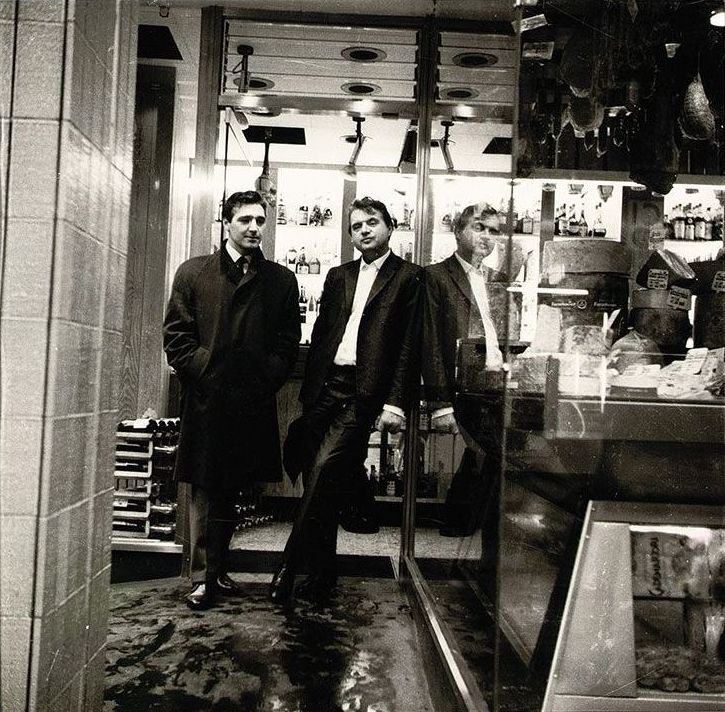
In search of a cruel father: Francis Bacon
Soho’s bohemian Colony Room Club faces extinction
The Colony Room Club, London’s fabled drinking den beloved of artists from Francis Bacon
to Tracey Emin and Damien Hirst, is set to close in Soho.
BY NEIL TWEEDIE | CULTURE | NEWS | THE DAILY TELEGRAPH | MONDAY 15 DECEMBER 2008
THE denizens of the Colony Room Club should have been gathering last night for a joyous, or at least well lubricated, occasion. London’s fabled drinking den celebrated its diamond jubilee yesterday – 60 years of uninterrupted, heroic carousing.
If one place still captures the seedy glamour of post-war Soho it is the Colony, hidden up a dark flight of stairs on Soho’s Dean Street. The peep shows may have been overtaken by trendy, overpriced bars, but the one-room dive remains, a bohemian reproach to modern, money-driven conformity. That, at least, is how its membership – once a roll call of the great and the bad in British art and which still includes the likes of Emin and Hirst (who once served naked behind the bar) – like to see it.
Vodkas all around, then. Except that this week could be the last in the club’s history. The Colony is facing extinction at the hands of the man into whose care it was entrusted.
Such is the uncertainty over the club’s future that it was unclear last night if any celebration would be permitted. Its fate has for months now been the subject of mistrust and rancour. Will the Colony survive? And should it be missed?
A brief history: it was in December 1948 that Muriel Belcher, a combative, foul-mouthed but enterprising lesbian, opened the Soho establishment as an intended meeting place for writers, painters and amusing hard drinkers. The room – it is a small place – was initially decorated in ‘colonial’ bamboo and leopard skin, in deference to Muriel’s Jamaican squeeze, Carmel.
Thus began six decades of bad behaviour, involving some of the best names in the business. Dylan Thomas threw up there, Tom Driberg propositioned there and Jeffrey Bernard advanced towards literal leglessness in its smoky confines, decorated in industrial green from the Fifties onwards.
Painters in particular liked it, including Bacon (a lifelong regular who as a young man was paid by Muriel to bring in interesting types), Freud and the doomed John Milton. Bacon described it as: "A place to go where one feels free and easy."
Under the stewardship of Belcher and that of her protégé Ian Board (equally foul-mouthed and possessed of an enormous nose swollen and purpled by brandy), the Colony grew into and remained an institution. Its eclectic membership was bonded by a supposed capacity for dazzling wit and a definite capacity for enormous amounts of alcohol. Customers at its little bar wallowed in the agreeable air of seediness, their imbibing overlooked by sometimes fine works of art donated by the insolvent artists in settlement of bar bills.
Muriel, who liked to call her members "cunty", was mistress of the put-down, while Board punished the unwary with sudden, violent eruptions of invective. All forms of human frailty were indulged in the Colony, except one: dullness.
Following Board’s death in 1994, the club was taken over by Michael Wojas, who had worked under Board. Things continued as before, but the club inevitably lost some of its lustre as its greatest characters drank themselves one by one to death.
The problems started a few years ago when the club’s finances began to fall into disrepair. Accounts were not properly prepared and tax and rent went unpaid. The club is housed on the first floor of a Georgian house and its lease was secure, so long as the rent was paid. With a membership of 200-plus paying annual fees of £150 and expensive bar prices, the club should have been able to pay the £12,500 rent easily. But earlier this year, Wojas, citing financial pressures, announced he would not be renewing the lease and the club would have to close. He auctioned off some of the better artworks, which he claimed were his by virtue of Board’s will. The sale raised £40,000.
His announcement sparked a rebellion among members who claimed he had no right to close a club which belonged not to him but to them. They succeeded in freezing the proceeds of the auction and securing a High Court ruling in favour of a formal meeting. Last week, a new governing committee was elected amid acrimonious exchanges between the pro and anti Wojas factions. The new body believes it can renegotiate the lease, secure a listing for the club from English Heritage and ensure its future. Wojas, though, still holds the keys to the bar.
Speaking yesterday, Michael Beckett, chairman of the committee, said: "It still is a great place; all the members love it.
"It’s the last bit of old Soho. I always meet interesting people when I go in there. Everyone speaks to each other – it’s not some dull pub. It’s homely – it’s a front room rather than a bar."
There will be those who argue that, like empires, clubs rise and fall. That, over time, what was once fresh and genuine becomes hackneyed and artificial, the hollow replaying of bygone glories.
Critics of the Colony would argue that nowadays there are rather more art students than great artists among its members; more aspiring bohemians and hell-raisers than real ones. But its members love it and that should be reason enough for its survival.
What would the formidable Muriel says about it all? There would be a few colourful phrases in there, for certain.

Muriel Belcher with Francis Bacon
True-Crime Temptresses, Bacon’s Rubbish Fill Holiday Art Books
MARTIN GAYFORD | REVIEW | BLOOMBERG | THURSDAY 11 DECEMBER 2008
Dec. 11 (Bloomberg) – Ripped photographs and newspaper clippings spattered with paint: This isn’t what you expect in one of the year’s most intriguing art books.
Francis Bacon: Incunabula by Martin Harrison and Rebecca Daniels (Thames & Hudson, 224 pages, $75, 39.95 pounds) is devoted to sweepings from the floor of the world’s most expensive contemporary artist at auction.
Bacon often remarked that he drew his inspiration from an atmosphere of chaos. After his death in 1992, his London studio and its contents were moved to Hugh Lane Gallery in Dublin, where they were sifted and studied like the detritus of an Egyptian tomb. This book presents some of the results.
Though these photos, clips and book illustrations were the raw material of Bacon’s art, you can’t help wondering how accidental those markings really are. Perhaps some of these altered images count as artworks themselves.
The first dark image of Bacon’s death
NICK MATHIASON & VANESSA THORPE | CULTURE | THE OBSERVER | SUNDAY DECEMBER 7 2008
It was a suitably macabre request from one of Britain’s greatest and darkest 20th-century painters. 'When I’m dead, put me in a plastic bag and throw me in the gutter,' Francis Bacon told the barman at the infamous Soho drinking club, the Colony Room Club.
Sixteen years after the colourful artist’s death, one of Bacon’s circle of friends has gone a long way to try to make his wish come true. A photograph taken in a Spanish morgue hours after his death and never seen before in public reveals that the artist had been placed in a transparent body bag. The shocking image now forms the centrepiece of a new work of art created by Bacon’s friend, the photographer Catherine Shakespeare Lane.
The photograph is mounted on a background of offal and framed by two images of Salvador Dalí standing by a crucifix. The bleakly humorous tribute to Bacon and to the Spanish surrealist Dalí will go on display for the first time this week at the famous London watering hole in London’s Dean Street, which is under threat of closing down.
Lane believes her triptych is an appropriate homage to her late friend. Bacon, she points out, once famously said: 'We are potential carcasses. If I go into a butcher’s shop I always think it’s surprising that I wasn’t there instead of the animal.'
A lifetime honorary member of the club, Lane hopes the hanging of the image will serve as a fitting farewell to both the great painter and to a venue which, since the Sixties, has been the haunt of many of the leading creative names in the country, including Lucien Freud, Dylan Thomas, the actors Peter O’Toole and John Hurt and the writer Jeffrey Barnard.
'I’m very sad that if the club closes at the end of the month,' said Lane. 'I sincerely hope it does not die and can survive.'
A last minute High Court order obtained by the so-called Shadow Committee of club members preventing its closure before an annual general meeting could yet save the day.
In recent years controversial leading artists such as Damien Hirst, Tracey Emin and Sarah Lucas and Sam Taylor Wood have all been habitues of the club, with the model Kate Moss even tending the bar one evening. The singer Lisa Stansfield and the film distributor Hamish McAlpine are also regulars and have both tried to save the club by paying off some of its debts.
Lane defends the treatment of Bacon’s dead body as in keeping with the way that the artist saw the world. 'People always think of Francis as gloomy and tortured because that is what they see in his work,' said Lane. 'But he got all that out in his painting and when he was out with us it was not like that. He was out to play.'
Human meat
ALAN JENKINS | ART | THE TIMES LITERARY SUPPLEMENT | FRIDAY DECEMBER 5 2008
When Francis Bacon said “The only really interesting thing is what happens between two people in a room”, he did not mean what happens between an artist and his model – or if so, only indirectly. Bacon’s portraits of himself, his friends and (male) lovers are among the most enthusiastically acclaimed of all his pictures, but they were done almost without exception from photographs and memory, not from life. From a handful of paintings, early and late, it is clear that for Bacon some of the most interesting things happened before, during or after copulation – “or buggery, however you want to put it”, as he himself put it in the late 1960s, with an insouciance that could have been dangerous at any time before then.
Yet, as John Russell pointed out nearly thirty years ago, “perhaps the most persistent of Bacon’s preoccupations is the problem of what a man is to do when he is alone in a room”, and with only a very few exceptions, his pictures until the later 1960s more often than not featured single figures: human males, animals, especially apes, heads or heads-and-shoulders, isolated in indeterminate spaces, framed or confined in a kind of geometric canopy or glass box, seen through strips of (shower?) curtain, paint cascading down the interiors or, in the few landscapes, deft strokes rendering wild grasses with Oriental precision. True, it is not always clear from its posture and mass whether the pictured form is human or ape; nor if in fact there is more than one of them pictured. Bacon would sometimes, to achieve the desired “thickness”, model his single figure on a sequence of photographs from Eadweard Muybridge’s The Human Body in Motion that showed two men wrestling – though at a glance, they could be having sex. (“I very often think of people’s bodies that I’ve known, the contours of those bodies that have particularly affected me, but then they’re grafted on to Muybridge bodies”, Bacon explained.) Then, once he had begun to show two or more people, the coupling – as in those earlier exceptions – becomes explicit.
And, in his later vision, coupling is murder. In panel after panel of the large-scale triptychs which were Bacon’s preferred format from the 1960s on, the human carcass – mangled, butchered and bloodied, studded with entry- and exit-wounds, spilling muscle tissue and entrails, or intact but warped into terrible knots of tension, straining in climax or death agony – is pinioned on carpets or sprawled on stained mattress-ticking, like a police photograph at the scene of a sex crime. And indeed other panels actually show spectators or recorders – one holds a cinecamera – of the main event, be it coupling or crucifixion, which has left its protagonist eviscerated.
Bacon disavowed any moral or philosophical intention behind these images of human suffering and detachment, and still more emphatically denied trying to make a historical point – notwithstanding his brief flirtation with the idea of publishing a pictorial “History of Europe in [his] lifetime” (he was born in 1909). One of the most articulate of painters, with a strong sense both for drama and self-presentation, from the moment he became a succès de scandale Bacon was a tireless subject of interviews (with Russell and David Sylvester, preeminently): occasions he seized to rehearse a repertoire of anecdotes and apophthegms, some haughty and whimsical, some purposefully discomfiting in their frankness, but almost all prompted by the contradictory urges to elevate his calling to a higher mystery or deflate its pretensions with a rude reminder of fleshly limitation.
In this he was both disingenuous and provocative, refusing, for example, to allow in his own crucifixions the significance granted to the image by the entire Western tradition – it was an example of human behaviour, no more and no less. Behaviour, furthermore, that aroused in Bacon a sense of his own wounded or tortured nature: a crucifixion, he said, was almost a self-portrait. Almost from the beginning – in “Painting, 1946”, now too fragile to have made the trip from MoMA to the current exhibition at Tate Britain – the painter evinced a fascination with sides of meat, a motif that recurs in his later crucifixions and couplings. When asked about its preponderance in his imagination he was ready with a dual response. “Every time I go into a butcher’s”, he said, “I’m surprised that it’s not me hanging there”; yet the meat was simultaneously a purely aesthetic stimulus, its colours “absolutely beautiful”. Questioned about his more Grand Guignol scenes he would shrug, affect complete ignorance of their import, personal or otherwise, and insist on his overriding desire to make “beautiful paintings”.
From the very small number of canvases that survived Bacon’s apprentice years it is far from obvious that this was his ambition when he started (if it was, his idea of beauty was as convulsive as any Surrealist’s). The big, bold canvases in the grand manner of his gilded middle age, exposing lavish, ritualistic cruelties, are indeed very beautiful, and only a handful of pictures on show here, from the later 1950s, seem unsure in technique or faltering in composition. In the room titled “Crucifixion” (the Tate’s hang is a compromise between a chronological and a thematic arrangement), the body, whatever else it is being subjected to, mostly retains recognizable limbs and a torso. Not so in the first room, “Animal”, where a distended eye, mouth, teeth and phallic appendages dominate: to these organs of appetite and aggression, in some of Bacon’s early works, the human and the nightmarishly non-human alike are reduced. Assisted by Bacon himself, commentators have established an impeccably modern pedigree for these seemingly sui generis images: in Picasso’s “biomorphic” beach scenes, 1930s photojournalism and the films of Sergei Eisenstein and Luis Buñuel. (Lessons in form and handling were learnt from Graham Sutherland and the Australian Roy de Maistre, too, though Bacon was less prompt to acknowledge them in later years.) In her catalogue essay Victoria Walsh cites Foundations of Modern Art by Amédée Ozenfant (1931) as having perhaps fertilized the insatiably curious young painter’s imagination in ways that would lie dormant for years: “The search for intensity dominates the whole of modern painting. There can be no intensity without simplification, and to some degree, no intensity without distortion . . . of what is seen naturally”.
In 1931, Bacon was twenty-two, had made his way as, more or less, a rent boy in Weimar Berlin, had learnt French living in Chantilly and was working in London as an interior decorator and designer of Bauhaus-derived furniture for clients who included the editor of Vogue and the novelist Patrick White. But almost as soon as he began to paint in earnest (in oil on canvas, from which he rarely deviated for forty-odd years), the beauty was there as well, and was there till the end, in paintings that proclaim him one of the great colourists of the last century: from the startling orange ground against which the first three Studies for Figures at the Base of a Crucifixion (1944) writhe and shriek, to the sumptuous deep reds of its grander, more imposing and artistically pointless second version (1988). Orange flames out at us again from the Figure Studies, 1945–6, while Figure Study II is the work in which another of Bacon’s motifs – or obsessions – unequivocally makes an entrance: the gaping mouth, open in a scream of terror, a snarl of hatred or a howl of impotent rage. Indelibly fixed in Bacon’s imaginary by Picture Post shots of Goebbels and Mussolini haranguing the crowds, Poussin’s “Massacre of the Innocents” and the nurse’s silent scream in The Battleship Potemkin, in Figure Study II, where it is appended to a crouched or kneeling half-clothed form, the mouth powerfully subverts those reliable signifiers of bourgeois respectability, umbrella, herringbone tweed and potted plants.
In the late 1940s (with a series of “Head”s) and the early 50s (Study for Nude, 1951; “Study of a Figure in a Landscape” and “Study for Crouching Nude”, both 1952) Bacon’s pictures posit an extra-historical continuity between the human at its noblest, as in Michelangelo’s drawings and sculpture, and the simian – almost to the point of conflating them. “Head VI” (1949), though, returns us, whatever Bacon thought or said, to the human in historical time, combining the motifs of toothed, gaping mouth and wildly staring eye with the vestments of a little brief authority: the highest authority on earth, indeed, for many, though in Bacon the vestments are imperial purple rather than rich pontifical red, as in his master-image, the “Portrait of Pope Innocent X” by Velázquez. Bacon’s remarkable travesty inaugurated a new series of studies “after” the great original, though his fixation was inspired, in fact, by a reproduction. (Even when he visited Rome, Bacon avoided seeing the Velázquez in the Doria Pamphilj, a diffidence in which embarrassment perhaps played a part. Much later he dismissed most of his repeated assaults on it as “silly”, and it is hard to disagree, despite or because of the presence in the current Tate show of two of his strongest and least familiar Popes, as well as “Head VI”: one, once thought lost, from 1950, the other from 1965 – this last looking as if he has been shot in the head at close range, or as if the rage or terror that animated his predecessors had finally exploded his face from within.)
That so many of Bacon’s motifs derived, in complex, vigilant ways from photography and film is entirely consistent with his acute awareness that these new art forms had rendered representation in painting obsolete, and with his horror of mere “illustration”. This was not to say that painting should not deal in “fact”: just that fact comprehended more than what is “seen naturally”. “One wants a thing to be as factual as possible and at the same time as deeply suggestive or deeply unlocking of areas of sensation other than simple illustration of the object”, as Bacon put it to David Sylvester. He was also one of the most literary of painters, an admirer of Ulysses, an avid reader of poetry and drama who saw that the Oresteia and T. S. Eliot’s Sweeney Agonistes were blood relations, who liked to quote lines from both yet who repeatedly and sometimes fiercely repudiated attempts to read “a story” into his own work.
But he insisted too much. At one level, his habit of working in triptychs, and at a deeper one the suggestiveness he often in fact achieved, not just in triptychs but in single paintings, militates against that very insistence. It is hard to look at such works as the Crucifixions of 1962 and 65, Lying Figure (1969), Triptych, Studies from the Human Body (1970) or Triptych March 1974 without a sense of prelude, climax and aftermath – though not necessarily in that order. Some such adumbrated narrative, an intimate human drama about to be embarked on, concluded or aborted also haunts the restrained and very beautiful portrait studies of a suited “Man in Blue”, his face and hands bright-lit on a deep blue ground, that are at once the most “readable” of all Bacon’s male figures, and the most ambiguous.
What is common to all these images, early, late and middle, is the overwhelming presence or threat (or promise) of violence. Bacon’s obsession with the figure drove him repeatedly to disfigure it – to all but dismantle the heads and bodies he painted on his canvases, and destroy the canvases themselves, when he judged them to be failures. Working from photographs, so the artist said, enabled him to do the necessary violence to his subjects – the better to “distort them into appearance”; and that could not happen if the subject was actually present. (This showed an untypical délicatesse. Bacon’s definition of friendship was two people “pulling each other apart”, and in sex his pursuit of the roughest of rough trade bordered on the suicidal.) But he also spoke repeatedly of his desire to make paintings that would “return [the viewer] more violently to life”, by which he meant, as I understand it, shock that viewer out of habitual or self-protective ignorance and into awareness of his own physical reality. “An attempt to bring the figurative thing up onto the nervous system more violently and poignantly” was how he described his own work. “There is an area of the nervous system”, Bacon believed, “to which the texture of [oil] paint communicates more violently than anything else.”
Paintings (some paintings anyway) could mysteriously “unlock the valves of sensation” or of “intuition and perception about the human situation”; could, by seemingly subliminal means, evoke a memory trace of raw, unmediated existence. Somewhere behind this lay Baudelaire and Proust, with their different ideas of involuntary memory. But for Bacon (who also liked to cite Paul Valéry: “modern man wants the sensation without the boredom of its conveyance”), to unlock the valves of his own subconscious was to bring up onto the canvas and “onto the [viewer’s] nervous system” an apprehension of life or “being-aliveness” as violent, primordial struggle, redeemed only by an instinctive grace, or a stroke of luck.
For Bacon, a chronic asthmatic, the struggle began early: it was the struggle for breath itself. The second son of a bad-tempered military man-turned-horse breeder and the heiress to a Sheffield steel fortune, he was brought up in Ireland and England in a succession of big houses where the omnipresence of dogs and horses was a perpetual challenge to his well-documented will to live. Bacon senior made no secret of his disappointment in his sickly, sensitive son, whose party piece was to appear at family gatherings in full drag. Michael Peppiatt is one among many writers on Bacon to make the connection, in his absorbing biography Francis Bacon: Anatomy of an enigma (1995, now revised, updated and reissued by Constable in paperback), between the father’s screaming rages, the child’s gasping for air and the importance of the gaping mouth in the work of the mature artist. The killings and house-burnings of the Irish uprising and Civil War (“Violence upon the roads; violence of horses”, in Yeats’s words) formed the backdrop to Bacon’s childhood, further enlivened by the attentions of the grooms who were encouraged to take horsewhips to the young master to punish him for the attentions he was over-fond of paying them.
Three of his four siblings died premature deaths, but Francis would enjoy long life, vigorous appetites and legendary resilience, physical and psychological. Ejected from the family at sixteen, he soon discovered the resourcefulness and the hunger for risk that would sustain him both as a homosexual adventurer and a painter, along with his preferred modus vivendi: to lurch between opulence and squalor, between a punishing creative routine and an equally punitive, if delighted (and delightful), dissipation. In later life the prices commanded by his paintings made him rich, but he had established his careless mastery over money much earlier, in the casinos of Berlin and Monte Carlo. The centrality to both gambling and painting of chance, risk, instinct – in painting Bacon subsumed these under what he called “accident”, the way one mark might suggest another, or perhaps an entirely new image, without the apparent intervention of the will or conscious direction – made them more than analogous: they were two sides of the same life force, the same compulsion to live at the maximum pitch of intensity, for the same high stakes and correspondingly high rewards.
In some sense all Bacon’s paintings represent another throw of the dice, a record not of how he “saw the world” but of the only way he, human meat and a carcass-in-waiting as he was, could yet feel himself to be truly alive. Peppiatt, Sylvester and other witnesses have made clear that this life-and-death struggle issued as often as not in despair and self-disgust; but of course for the artist there was no choice. The paradox – and it strikes with greater force in the final two large rooms of the Tate exhibition, showing works from the last fifteen years of Bacon’s very productive life – is that intensity itself could become a habit; that so many of these later works look as mannered and fussy, in their beautiful, wearyingly nasty way, as anything from the Academic schools of the nineteenth century, in theirs.
The great exceptions are the paintings shown here in a room titled “Memorial”. Bacon’s companion, George Dyer, committed suicide in their hotel room on the eve of the artist’s retrospective at the Grand Palais in Paris in 1971; three extraordinary triptychs from 1971–3 recall Dyer’s living presence, and imagine his last hours, with monumental and moving factuality. Bacon often remarked on the “awfulness” of his personal life – another of his lovers, Peter Lacy, had steadily drunk himself to death in the 1950s – and while no one would wish he had known more unhappiness of this kind, we can regret that he did not always achieve, or desire, the direct appeal to human emotion these pictures make, while surrendering nothing of painterly value: they have a stunning aura in which grandeur, indignity and grief are all present, and inseparable.
As with Eliot in poetry, Bacon’s art sinks deep roots into the whole psycho-physical life and attempts a reinvention of tradition (“the figurative thing”), rather than the Freud-sponsored violation of the natural order to which Surrealism aspired. To that extent, the confusion of the Times reviewer, faced with Bacon’s very first solo show in 1934, was understandable: “The difficulty . . . is to know how far his paintings and drawings . . . may be regarded as artistic expression and how far as the mere unloading on canvas and paper of what used to be called the subconscious mind”. (Cited in “Bacon and his Critics”, by Gary Tinterow, in the Tate catalogue.) Mere! We like to think we have come a long way since then, but Bacon and the best of his commentators are part of the long way we have come. The catalogue contains a useful chronology, but none of its seven essayists adds substantially to what has already been written by Russell, Lawrence Gowing, Michel Leiris and Gilles Deleuze. Michael Peppiatt’s new book, Francis Bacon: Studies for a portrait, contains interviews with and recollections of the artist from the 1960s almost until his death: that is, either the raw materials of Peppiatt’s biography or bits of the biography distilled into essays and articles. For completists only, it does include the full, fascinating text of Bacon’s answers when he was interviewed for the first time by his future biographer, in 1963, before celebrity began to overtake some of his responses.
Much recent scholarly interest in Bacon has focused on the “drawings” controversy: whether the many preparatory sketches and studies found in the artist’s studio and elsewhere after his death – studies which, while he was alive, he insisted he never produced – could be genuine. (It seems pretty obvious that some are, and some aren’t.) A room at the Tate (“Archive”) is devoted to some genuine-looking sketches, over-painted photographs and “doctored” images, while Francis Bacon: Incunabula by Martin Harrison and Rebecca Daniels is a spellbinding pictorial record of the most significant of Bacon’s visual sources. The entire fantastic compost of rags, paints, brushes, magazines, torn-out pages and tattered reproductions laid down over decades in Bacon’s South Kensington mews has been reconstructed entire at the Dublin City Gallery, the Hugh Lane. While the artist’s living space was almost monastic in its austerity, his workroom was a materialization of the rich, sedimented strangeness of his inner world. To him, both discipline and chaos seem to have been indispensable.
FRANCIS BACON
(Tate Britain, until January
4, 2009)
Matthew Gale and Chris
Stephens, editors
FRANCIS BACON
288pp. Tate Publishing.
£24.99.
978 1 85437 738 8
Michael Peppiatt
FRANCIS BACON
Studies for a portrait
272pp. Yale University
Press. £18.99 (US $35).
978 0 300 14255 6
Martin Harrison and Rebecca
Daniels
FRANCIS BACON
Incunabula
256pp. Thames and Hudson.
£39.95 (US $75).
978 0 500 09343 3
Alan Jenkins is Deputy
Editor of the TLS. Drunken
Boats, his translation of
Arthur Rimbaud’s Le
Bateau ivre, was
published last year.
Bacon’s theatre of the absurd
On Francis Bacon at the Tate Britain, London.
BY DAVID YEZZI | REVIEW | FEATURES | THE NEW CRITERION | DECEMBER 2008
High-priced meat-under-glass has been a staple of British art for the better part of a century, long before Damien Hirst’s fashionable sharks and calves appeared on the scene. Witness the current career retrospective of paintings by Francis Bacon (surely the ultimate nom de charcuterie), timed in accordance with the artist’s centenary in 2009. [1] Bacon’s take on the human condition was simple: “We are meat,” he liked to say. His paintings of sixty years, from Crucifixion (1933) to Triptych (1991) in the Tate show, rarely stray off message, recapitulating his dark matter in image after traumatic image. (From the mid-1960s on, Bacon displayed most of his sanguinary subjects behind glass, placed in gilded frames.) It is worth noting that the exhibition originates at Tate Britain, not at Tate Modern, as I initially assumed—a far better venue for staking Bacon’s claim as the greatest British painter since Turner (and, in the eyes of many, as one Tate press release has it, Britain’s greatest painter period!). But Bacon’s ubiquity and collectability, abetted by his famously theatrical subjects and bravura technique, mainly confirm his star status, not his mastery.
Certainly, anyone possessed of a glancing acquaintance with modern art knows what a Bacon looks like: arrays of distended viscera, steaming sides of beef, screaming Popes in “space-frames,” crucifixions, menacing dogs, swirled faces, contorted nudes decomposing on divans, Muybridge-esque figures recast in blurs of paint. Brutal, bloody stuff. It’s also attention-grabbing stuff, both pictorially and commercially. Even those who couldn’t give a fig for art will have noticed Bacon’s recent record-breaking outing in the marketplace: Triptych (1976) sold in May at Sotheby’s for over $86 million, the highest price ever paid at auction for a contemporary art work. Last month, Study for Self-Portrait (1964), estimated at $40 million, sat on the block at Christie’s without a bid, but one assumes this was due more to our economy’s recent resemblance to a Bacon painting than to any decline in Bacon’s blue-chip stock.
Only Bacon’s friend Lucian Freud, among the London School painters, comes close to rivaling his celebrity and mystique. Bacon worried that his biography would over-weight viewers’ interpretations of his work, and not without reason; his was a colorful life tinged with tragedy. One needn’t scratch the surface very deeply before biographical details emerge, particularly in the portraits and late paintings. Bacon’s reputed drinking, gambling, and masochism (he fled one severe beating clothed only in fishnet stockings) fueled his image as a peintre maudit. His greatest subject was ultimately Francis Bacon.
A darling of the bohemian intelligentsia, Bacon spent his bad-boy early years in London commuting “between the gutter and the Ritz” (as he put it): dodging rents, committing petty crimes, and living off of patrons and friends. He took pride in the fact that he never received formal training as a painter. Born in Ireland to English parents, he fled a violent homelife in which his horse-trainer father oversaw regular whippings of his son by the grooms. In 1927, Bacon traveled to Germany with Cecil Harcourt-Smith, a family friend (with whom he wound up in bed). He found Berlin in the Twenties much as Auden described it at that time—“a bugger’s daydream.” It was seeing Picasso’s work in Paris, where he traveled after Berlin, that set him on the road to becoming a painter.
Bacon’s earliest painting in the Tate exhibition is his spindly, Picasso-inflected Crucifixion (1933). Crucifixions became a signature motif for the artist. Among his most well-known images are Three Studies for Figures at the Base of a Crucifixion (1944), his first major triptych, and Painting (1946), a splayed cow carcass and bloody-mouthed figure arranged as an abattoir-altarpiece, which Alfred Barr acquired for the Museum of Modern Art. Bacon followed these with a series of Popes, beginning with Head VI (1949) and culminating in the streaked and gilded bombast of Study after Velázquez’s Portrait of Pope Innocent X (1953). The Popes were one of a number of motifs Bacon would come back to later in his career with diminishing returns. (Bacon was extremely self-critical and destroyed a great deal of work, but by the time he came to repent the Popes presumably it was too late to get his hands on them.)
Bacon often equivocated when asked questions about his influences and the significance of his work, but certain things were repeated often enough to be believed: 1) that he was an Nietzschean atheist, 2) that Picasso had meant a great deal to him, 3) that he intended no religious meaning with his crosses and Popes, and 4) that his greatest guiding principle as a painter was the Surrealist notion of chance. According to Michael Peppiatt in his recently updated biography, [2] what Bacon most wanted was to “excite” himself, to stir emotion ruthlessly, to “remove veils” from experience, to provide direct access to the valves of feeling. His means: bloody mouths, bones, flesh, screaming heads. Peppiatt once claimed, in the September 1984 issue of Connoisseur, that “even his detractors would agree that there is nothing of the easy chair about the work of Francis Bacon. Far from ease, it offers extreme disquiet.” I can’t say that I’m convinced. A kind of bathos dogs Bacon’s work, arising from the fact that his disquiet is, so to speak, always in an “easy chair,” swathed in gorgeous magenta and crimson and served up with a Sargent-like facility of the brush.
Bacon’s seductive paint handling is the first thing that viewers notice after the carnage. His methods of applying paint were as idiosyncratic as they were versatile. Hugh Davies and Sally Yard describe his everything-but-the-kitchen-sink approach, in which his materials ranged from
Brillo pads to cashmere sweaters, as brushes are joined by rags, cotton wool, sponges, scrub brushes, garbage-can lids, paint-tube caps, the artist’s hands, and whatever else he can find in the studio for the application and shaping of painterly passages… . Thick impasto coexists with thinned washes of pigment and raw canvas, sand and dust are occasionally used to give texture to the paint. A few works of the 1980s are veiled in the haze produced by applying paint with an aerosol spray.
Reviewing Bacon’s show at the Malborough-Gerson gallery in 1968, Hilton Kramer found him “one of the most dazzling pictorial technicians on the current scene.” Why, then, he asks, does the work “strike me as being clever rather than profound—brilliant rather than authentic?” Kramer ends with a recognition of “exactly how safe an artist Mr. Bacon really is.”
Safe and also stagey. Bacon’s characteristic space is theatrical, suggesting operating theaters, thrust stages, wrestling rings, circus rings, bull rings, throne rooms, closets, altars—all playing areas in Bacon’s theater of the absurd. Beckett is a name that tends to come up when considering Bacon’s vision, but it’s closer to Genet (whose plays he recommended to friends). Think of the bishop in Le Balcon, who is in fact a man in costume acting out a ritualistic sexual fantasy in a brothel that the madame calls a “house of illusions.” In the critic Martin Esslin’s description, absurdist theater portrays “a world that functions mysteriously outside our conscious control… . It no longer has religious or historical purpose; it has ceased to make sense.” This is Bacon’s world, in which the artist rejects both narrative and didactic purpose and attempts to confront, in Esslin’s phrase, “the spectator with the harsh facts of a cruel world and his own isolation.”
This sense of chance and of confrontation is a key element of Bacon’s most touted images, such as Painting (1946), with its absurdist illogic and raw imagery. Yet the “safety” that Kramer perceived in the late Sixties already exists here in the picture’s pink and mauve symmetrical background. Bacon’s paint handling is so delicious, it’s like a mountain of crème Chantilly—far from horrified by it, you want to eat it with a spoon. Bacon is continually betrayed by his beginnings as an interior designer, no where more so in Three Studies for Figures at the Base of a Crucifixion. As Peppiatt notes of the background colour of Studies, “It is worth recalling that cadmium orange, which had become the fashionable colour in avant-garde interior design in the 1930s, remained Bacon’s favourite colour.” Bacon’s fashion colours and mod furniture come off as frivolously elegant.
Frivolity is, of course, the last thing most people associate with Bacon’s work. As Bacon’s Soho crony and (unauthorized) biographer Daniel Farson writes: “To appreciate Bacon’s work, it helps to see him as a deeply moral artist.” This strikes me as exactly what Bacon is not, so much so that I wonder if Farson could really believe it himself. Elsewhere he says that Bacon repeatedly told him that he believed in “nothing.” John Richardson, the biographer of Picasso, repeats the error: “By holding a mirror up to our degenerate times Bacon proves himself to be one of the most moral artists of the day. Far from titillating us, he castigates us.” But Bacon does no such thing. Firstly, he is not concerned with our “times” in any historical sense, except in so far as he personally embodies them. For Bacon, images from news photographs and films—the screaming nurse on the Odessa steps in Potemkin or a Nazi armband, for example—have little to say about “our degenerate times” and volumes to say about Bacon’s roiling inner life. When a television commentator suggested that Bacon’s work was a condemnation of man’s inhumanity to man, Bacon retorted: “That’s the last thing I think of.”
It is not Bacon’s stark subject matter that disqualifies him as a “moral artist”; it is his aestheticization of the horror depicted. As the critic Yvor Winters explains, the moral artist does not shy from exploring the extremes of human experience, but he portrays evil as evil and makes us know it as evil. This is not the case with Bacon, either in his professed world view or in his practice:
In all the motor accidents I’ve seen, people strewn across the road, the first thing you think of is the strange beauty—the vision of it, before you think of trying to do anything… .
There’s no one more unnatural than myself, and, after all, I’ve worked on myself to be as unnatural as I can. I can’t really talk about painting because I only work for myself and just by chance it happens that for some reason I’ve been lucky enough to be able to live by something that obsesses me, but I haven’t got any morals to preach… . I just work as closely to my nerves as I can.
One leaves the Bacon show at the Tate feeling beaten up by images of the dying George Dyer (Bacon’s tragic lover) vomiting into a sink, the gaping wounds, the twisted flesh. Bacon sought to transmit emotion as immediately as possible, which in a sense he did, but it’s not emotion he transmits so much as sensation. Shock lends Bacon’s work its edge, but it diminishes it as well. The paintings register like a trauma on the spinal column, without ever reaching the more complex centers of the brain. Later in Bacon’s career, when shock gave way to chic, the game was lost. Second Version of Triptych 1944, his reworking of Three Studies for Figures at the Base of a Crucifixion, replaces the brushy energy of the earlier work with a spray-painted softness that makes Bacon’s phallic Furies look like tchotchkas in a Madison Avenue boutique. His Innocent X of 1965 replaces the pontiff’s rictus with the taffy-pull features of the later portraits. Bacon became convinced that he could have done the Popes better than he had, but this is no proof. Nor is the reworking of Painting from the 1960s (not included in the Tate show), which dresses the macabre scene up with a sunny yellow background and what look like paper garlands—a travesty of Gauguin’s Yellow Christ (1889). Bacon detested illustration, but in the end he failed to escape it, and the portraits moved him even further in this direction.
The Peppiatt book contains a revealing quotation: “When I was young, I needed extreme subject matter for my paintings… . Then as I grew older I began to find my subject matter in my own life. During the 1960s the Furies, the dictators and screaming Popes, the anonymous figures trapped in darkened rooms gave way to portraits of living identified beings.” And here is the disconnect: Bacon reviled abstraction because for him it was all design, empty aesthetics. Bacon relied on his figures to ground his work in reality, to lend his paintings the force and horror of the real world. But the triptychs and portraits of the Sixties and later marinate in the very aesthetic stew he had hoped to avoid. Bacon’s contortions of angst become so pretty, so tasteful. The large squares of pink and orange (orange is the new pink, or is it the other way around?), the natty black suits, the distinctive chaises and tables make the lot seem very “safe” indeed.
The selection of works for the exhibition is judicious, suggesting more variety in the work than is really there. After the monotony of the Bacon treatment—floating central figures against disconnected flat colors—sets in, the decline is steady: the final paintings are his least interesting. As David Sylvester prophesied in 1955, “many of the things that make [Bacon] exciting today may render him laughable for future generations.” The colored arrows pointing to newspapers and wounds and bodies on toilets; the globs of thrown white paint; the increased staginess—all seem like precious, empty gestures. The Tate retrospective carefully elucidates Bacon’s photographic sources; it includes BBC footage of Bacon in conversation with David Sylvester that highlights his considerable charm, but the work itself seems no different that it did at the MOMA retrospective in 1990—except that it has grown a little more tired with the passage of time.
Bacon’s paintings, ostensibly transmitting high-pitched emotion, are cut off from emotion. He never flinched from working on a grand scale, from putting his feet up against the masters—Grünewald, Titian, Vélazquez—but in the end his almost mechanical serialism and cool shocks bring him closer to Warhol, whose films Bacon admired even as he turned his nose up at the paintings. Rather than being the greatest British painter since Turner, Bacon may better be seen as the great precursor to the soullessness of Damien Hirst, whose shark is currently on view at the Met. When Francis Bacon arrives in New York next summer, viewers will have a chance to consider the two artists under one roof.
Notes
1. Francis Bacon opened at Tate Britain, London, on September 11, 2008 and remains on view through January 4, 2009. The exhibition will travel to the Museo National del Prado, Madrid (February 3–April 19, 2009) and the Metropolitan Museum of Art, New York (May 18–August 19, 2009). A catalogue edited by Matthew Gale and Chris Stephens, with essays by Martin Harrison, David Alan Mellor, Simon Ofield, Gary Tinterow, and Victoria Walsh, has been printed by Tate Publishing (288 pages, £24.99 paper).
2. Francis Bacon: Anatomy of an Enigma, by Michael Peppiatt; Constable, 456 pages, £12.99 paper.
David Yezzi is the Executive Editor of The New Criterion
London
By DEXTER DALWOOD | EXHIBITION
REVIEWS | THE
BURLINGTON MAGAZINE |
VOLUME 150 | NUMBER 1269 |
DECEMBER 2008
AS FRANCIS BACON’s third
retrospective at Tate
Britain (to 4th
January) 1 has been timed to
coincide with the centenary
of his birth in 2009, it
seems appropriate that it
should attempt a
recanonisation of the
painter’s achievements.
Bacon, always a sacred cow
and regarded as a titan of
painting since his death in
1992, has been awarded a
coveted status accorded to
only a few artists in every
generation. Cy Twombly is
perhaps the most recent to
achieve this, and he has
done so by disengaging his
work from its origins in
Arte Povera and washing
himself of contemporary
allegiances. In Bacon’s
case, enough time has passed
since the last major
exhibition in London (1985;
Tate Britain) to permit the
viewing of his work in a
very different context. Back
then, painting, which since
the 1970s had been
marginalised in favour of
new art forms, was the
subject of a renewed
interest, specifically
figurative painting. This
interest was identified
closely with the Royal
Academy’s 1981 exhibition A
New Spirit in Painting,
which spawned a surge of
market-friendly
Neo-Expressionism. This was
followed in 1984 by the more
parochial The Hard-Won
Image at the Tate Gallery,
which embraced figuration in
a cadaver-pumping bid to
bring painting back in from
the cold. The subsequent
1985 Bacon retrospective
provided the much needed
impetus for a debate about
the relevance of painting,
and satisfied the
intellectual requirements of
people who liked art but
still did not really approve
of painting. Gerhard Richter
went on to make this role of
the intellectual painter his
own, and brought about a
renewal that Bacon’s work
always rooted in much older
concerns, could never
effect. Studying at St
Martin’s School of Art in
the early 1980s and poring
over well-thumbed,
paint-splattered monographs
the early 1980s and poring
over well-thumbed,
paint-splattered monographs
on Bacon’s work (long before
Gilles Deleuzes’s The
Logic of Sensation was
translate into English), it
seemed to me that his
concerns were those of an
earlier generation.
The current exhibition aims
both to reinforce Bacon’s
reputation as Britain’s
greatest modern painter, but
also to question how Bacon
propagandised his own work
and, further, how it might
now be reinterpreted. The
juxtaposition of works
enables the viewer to test
new lines of approach.
However, the new groupings
that emerge from the
interpretation-led
presentation at the Tate do,
however, result in some
misleadingly themed rooms:
‘Crisis’, ‘Apprehension’ and
‘Zone’ for example, manage
to be simultaneously vague
and over-prescriptive. It is
also perhaps misleading to
lay such emphasis, as the
centrepiece of the show, on
a display of documentary and
source material. This is the
result of a long history of
obsessive archiving of the
ephemera from Bacon’s Reece
Mews studio and, although it
includes some interesting
photographs, is diluted by
some unremarkable works on
paper. Since the early 1990s
this material has been the
main focus for Bacon
scholars and should have
enhanced the exhibition, but
here the effect is more
anecdotal than one of
powerful elucidation. The
one exception is that
Bacon’s notebooks,
containing lists of
potential paintings,
revealingly highlight the
degree of premeditation and
planning of the images, and
in doing so support the case
for Bacon as a highly
methodical, strategic
painter.
One of the most successful
rooms is filled with the
early 1950s dark inky-blue
portraits of businessmen in
suits, spatially flattened
in airless niches – surely
these have never looked
better. But this room seems
restrained in comparison
with the histrionically
titled ‘Crisis’ room. Here
Bacon veers off course with
the slashed-on, painterly
Bomberg/Soutine mash-ups
done in 1956–57 such as Figures
in a landscape (1956–57;Birmingham
Museums and Art Gallery)
and Figure in a mountain
landscape (1956;
Kunsthaus, Zürich) but
returning to some sort of
form with the Study for
portrait of Van Gogh VI (1957;
Arts Council Collection).
These days it is becoming
harder to stomach the
critically reiterated idea
that the horrors of the
early twentieth century,
apparently depicted in these
paintings, underpin Bacon’s
pre-eminence as a painter of
the human condition. One of
the successes of the current
exhibition is to show that
Bacon’s paintings may have
less to do with ‘real’
violence than with imagined
violence. Such violence is
conjured up as an antithesis
of boredom, fantasised to
enrich the artist’s daily
life, in the manner of
Patrick Bateman, the
protagonist of Bret Easton
Ellis’s novel America
Psycho (1991). The Three
studies for figures at the
base of a Crucifixion (c.1944;
Tate), Bacon’s ‘year zero’
painting, here tightly
grouped in a small room with
two other large-scale
triptych Crucifixions from
1962 and 1965, rebuff the
pundits’ view that they
somehow represent the more
grotesque atrocities of the
Second World War without
actually illustrating them.
Indeed, even Bacon’s own
claim that ‘paint should
come across directly onto
the nervous system’ wears
thin when pitched against
such subject-matter.
Martin Harrison’s catalogue
essay goes some way towards
exploring this dilemma,
which is, in short, how to
consider Bacon’s statements
about his own work in the
context both of research
into previously unavailable
material and of the simple
experience of looking at the
paintings. For example, it
is interesting to question
how much Bacon’s often
repeated statement ‘I do not
know what accident will
occur’ actually played in
his work process.2
It seems obvious now that
the paintings made after the
late 1950s are very
formulaic in
their construction – and
this is not necessarily a
bad thing. This
interpretation liberates
the viewer from considering
Bacon’s work only in a
traditional expressionist
context, following the credo
that every brushstroke can
be considered to have been
torn from the artist’s soul.
It is appropriate that the
1956 film Lust for Life (the
biopic of Van Gogh starring
Kirk Douglas) is mentioned
in the catalogue essay by
David Alan Mellor as
the inspiration for the Study
for portrait of Van Gogh series
that Bacon knocked out a
few days after seeing the
film.
To simply accept Bacon’s
version of how images
floated into his head and
then appeared on the canvas
is to detract from his great
skill as a painter which is
in the composition and
execution of the works. What
makes him such an
interesting artist for other
painters has as much to do
with what he leaves out of
his paintings as it does
with what he puts in, and
his continual
short-circuiting of
traditional figurative
mannerisms. In order to
rupture traditional readings
Bacon developed a series of
devices, which can be seen,
for example, in the grouping
entitled ‘Portrait’ in the
current exhibition. The
paintings Landscape near
Malabata, Tangier (1963;
Fig.34), Three figures in
a room (1964; Centre
Georges Pompidou, Paris) and Study
of George Dyer in a mirror (1968;
Museo Thysse Bornemisza,
Madrid) all adopt either
the chevron shape or the
curved ellipse – which first
emerged in the Pope
paintings – as a device
which operates in the bottom
half of the painting as an
effective way of
breaking the
foreground/middleground/background convention
of figurative painting. Two studies
for a portrait of George
Dyer (1968; Fig.35) is
a good example of the
potential for failure
of this device. Bacon allows
the ground to drop off the
bottom of the canvas and
hence the space of the
painting becomes recessive
and even conventional – just
a portrait of a
sitter. Viewed in this
light, it is as if the
ejaculation of paint over
the figure’s legs functions
solely to prevent the
painting from
becoming nothing more than a
portrait of a man in a room
with a distorted
face. Bacon’s depiction of
space only really works when
the spatial arena is a
believable distortion so
that he makes it his own.
It is also tempting to align
Bacon’s work with that of
Graham Sutherland, but the
latter’s surrealistic and
symbolic images have not
stood the test of time as
well as has Bacon’s work. Is
it the Miró-esque
landscape or the insipid
Englishness of
Sutherland’s paintings which
deadens them, in the same
way that Paul Nash’s dumping
of mangled pieces of
modernity into English
fields has dated? It is true
to say that Bacon was
operating in the same
socio-political context as
Sutherland and Nash, but by
setting everything he did
within a hermetic personal
arena (haunted by the ghost
of Duchamp’s Large glass and
furnished with tubular
chrome and G-plan
furniture), Bacon was able
to create a unique
contemporary modernism which
has not dated in the same
way.
What is not suppressed in
the current exhibition,
although hardly emphasised
in the catalogue, is the
older ideal of cruelty that
presides over Bacon’s
imagery: the dark
end-of-the-pier humour of
Punch and Judy, the nasty
after-taste of
nineteenth-century British
Colonialism unveiled and
exposed as ‘the bible, the
bottle, and the lash’. Bacon
deliberately and very
effectively steered his work
away from pictorial
convention and flaunted
controversy, for example, by
disingenuously palming off
the motif of a hypodermic
needle away from pictorial
convention and flaunted
controversy, for example, by
disingenuously palming off
the motif of a hypodermic
needle sticking into the
veins of one of his subjects
as a formalist device.
Bacon’s shock tactics were
as calculated as those of
Turner, who enjoyed the
drama of pulling back the
curtain to his blacked-out
studio to an audience full
of nervous expectation.
It is also tempting to align
Bacon’s work with that of
Graham Sutherland, but the
latter’s surrealistic and
symbolic images have not
stood the test of time as
well as has Bacon’s work. Is
it the Miró-esque
landscape or the insipid
Englishness of
Sutherland’s paintings which
deadens them, in the same
way that Paul Nash’s dumping
of mangled pieces of
modernity into English
fields has dated? It is true
to say that Bacon was
operating in the same
socio-political context as
Sutherland and Nash, but by
setting everything he did
within a hermetic personal
arena (haunted by the ghost
of Duchamp’s Large glass and
furnished with tubular
chrome and G-plan
furniture), Bacon was able
to create a unique
contemporary modernism which
has not dated in the same
way.
What is not suppressed in
the current exhibition,
although hardly emphasised
in the catalogue, is the
older ideal of cruelty that
presides over Bacon’s
imagery: the dark
end-of-the-pier humour of
Punch and Judy, the nasty
after-taste of
nineteenth-century British
Colonialism unveiled and
exposed as ‘the bible, the
bottle, and the lash’. Bacon
deliberately and very
effectively steered his work
away from pictorial
convention and flaunted
controversy, for example, by
disingenuously palming off
the motif of a hypodermic
needle away from pictorial
convention and flaunted
controversy, for example, by
disingenuously palming off
the motif of a hypodermic
needle sticking into the
veins of one of his subjects
as a formalist device.
Bacon’s shock tactics were
as calculated as those of
Turner, who enjoyed the
drama of pulling back the
curtain to his blacked-out
studio to an audience full
of nervous expectation.
Of
course, by the time of the
1985 exhibition such tactics
were no longer so effective.
Bacon’s later paintings of
dwarf-like figures in
cricket pads, inspired by
his lust for the cricketing
legend Ian Botham, or his
triptych of Mick Jagger,
seemed like an ill-judged
over-indulgence. In the
Tate’s current show these
works are mostly omitted in
favour of the post-1985
work. This includes Jet
of water (1988; Fig.36)
an image without the
presence of a figure which
promised a new departure and
which, confusingly, was
painted in the same year as
the Second version of
Triptych 1944 (1988;
Tate), which has the feeling
of a disastrous come-back
gig and is wisely relegated
to the vestibule outside the
exhibition. Incredibly, and
in perverse defiance of the
spontaneous nature of the
subject, the 1988 Jet of
water is in fact a
fairly identical version to
a first Jet of water painted
in 1979. A display of these
two works together
might have instigated the
kind of revisionism
that Bacon’s work now needs.
R.B. Kitaj reportedly took
to his bed for a couple of
days after seeing Bacon’s
1985 Tate exhibition,
overwhelmed and unnerved by
the achievement of his
contemporary. But the
current exhibition avoids
any homage to the
aggrandising exhibition
layouts typical of David
Sylvester’s hangs, seen to
particularly impressive
effect in his posthumous
homage to Bacon, The Human
Body, mounted at the Hayward
Gallery in in 1998. Although
there are no great surprises
in the loans to the show,
and despite misleading
interpretative categories,
Bacon’s work is allowed to
unravel. The catalogue
essays are for the most part
illuminating but fail to
capitalise on this
opportunity to challenge the
hagiography. It will be
interesting to see if this
tangible difference is
maintained when the
exhibition tours to the
Prado, and whether the
themed rooms are retained at
the subsequent and final
showing at the Metropolitan
Museum of Art. By the end of
this exhibition tour we
might hope that some more of
the myth surrounding Francis
Bacon will have been
debunked, in favour of the
view that these are simply
the most original inventive
figurative paintings of
their time.
1 The
exhibition travels to the
Museo National del Prado,
Madrid (3rd February to 19th
April) and to the
Metropolitan Museum of Art,
New York (18th May to 16th
August). Catalogue: Francis
Bacon. Edited by Matthew
Gale and Chris Stephens,
with contributions by Martin
Harrison, David Alan Mellor,
Simon Ofield, Gary Tinterow
and Victoria Walsh. 288 pp.
ncl. 151 col. + 56 b. & w.
ills. (Tate Publishing,
London, 2008), £24.99. ISBN
978–1–85437–738–8. The
exhibits are not numbered in
the checklist; the
bibliography is selective.
2 ‘Francis
Bacon: Letters to Michel
Leiris 1966-89’, in exh.
cat. Supplement to Francis
Bacon, London (Gagosian
Gallery) 2006, p.23.
Francis Bacon

Landscape near Malabata, Tangier, by Francis Bacon. 1963. Canvas, 198 by 147.5 cm.
CHRISTMAS BOOKS
Bacon with trimmings
Charles Darwent recommends spending Boxing Day with Kandinsky’s
colours or on Francis’s studio floor
CHARLES DARWENT | ARTS & BOOKS | THE INDEPENDENT ON SUNDAY | 30 NOVEMBER 2008
Prestel’s monolithic Kandinsky (£99) weighs a stone, has a handsome slip-cover and includes a good facsimile portfolio of Kandinsky’s Kleine Welten prints, originals of which fetch £150,000 apiece. All of which might lead you to think of this less as a coffee-table book than as a coffee table, in which you would be wrong. Prestel editions are as weighty in learning as they are in kilos. This one is edited by a pair of the world’s foremost Kandinsky scholars, Helmut Friedel and Annegret Hoberg, and its unpublished archive material alone makes it a must-have for anyone with a yen for the father of abstraction.
Kandinsky fans with lighter pockets need not despair, thanks to Andrew Spira’s The Avant-Garde Icon (Lund Humphries £40). Spira’s compelling study unpicks the place of Orthodox iconography in Russian (and later, Soviet) modernism, arguing that the anti-illusionist tendencies of icon painting fed seamlessly into the experiments of painters such as Malevich, Larionov and, of course, Kandinsky. Kandinskyites can also track their hero through John E Bowlt’s excellent Moscow and St Petersburg in Russia’s Silver Age (Thames & Hudson £24.95), an A-Z of tsarism’s last, magnificent flowering of the arts. Even as Russia teetered on the abyss, Proust was cataloguing the parallel slide of France’s Old Regime. In Search of Lost Time is Kandinskyesque in its eliding of the senses, most memorably in the case of literature and patisserie but also of writing and painting. Pictures are everywhere in Proust, from comparisons of a Veronese sunset to strawberry mousse, to Odette de Crecy’s resemblance to a Botticelli. In Paintings in Proust (Thames & Hudson £25), Eric Karpeles ferrets out all the passages where the author mentions artists and artworks, and then illustrates them with colour plates. Even hardened Proustians maybe surprised by the outcome, which reveals In Search of Lost Time to be the Gesamtkunstwerk it always was.
A century after Kandinsky and Proust, it is China that calls the cultural shots. For most of us, though, contemporary Chinese artists remain as hard to understand as they are to pronounce. Richard Vine gives a clearheaded account of what is going on in New China, New Art (Prestel £30), tracing the dual art histories, traditional and modernist, that do battle in the Chinese breast, while guiding us gently through the latest movements and schools in Beijing and elsewhere. It is a measure of the need for Vine’s book that Art Now Volume 3 (£24.99) — Taschen’s annual, self-styled "cutting-edge selection of today’s most exciting artists" — includes precisely six Chinese names among the 140 or so whose work it looks at. Still, ANV3 is pretty well compulsory reading for anyone who hopes to keep up with all that is newest and grooviest in the contemporary art world. Also, its texts are in English, French and German, so you can be pretentious in three languages as you walk around Tate Modern.
Heavier in all senses of the word is Phaidon’s Art & Today (£45), although it, too, devotes oddly few of its 440 large-format to things Chinese. Edited Eleanor Hartney, this tome to rewrite not so much art history as art historiography. Ever since MoMA’s founder, Alfred H Barr, doodled flow-chart in which Art Nouveau became Surrealism became Abstraction became Minimalism, modern art has been seen as a linear chain of cause and effect. By contrast, this book treats it as a series of broadly interconnecting episodes, which is easier to believe in if harder to remember.
An equally heterodox, if wackier, view of the current state of things comes from Formulas for Now (Thames & Hudson £12.95), edited by über-curator Hans Ulrich Obrist. Obrist asked Yoko Ono (pictured inset), Richard Dawkins, Gilbert & George, etc, to come up with equations whose solution is "today". If you add a pair of dice, you could probably turn the book into a Boxing Day parlour game.
One unexpected twist in the history of now is the return to favour of figurai iii A bllf h,tion in painting. notable example of this is Elizabeth Peyton, a New Yorker whose washy oil portraits of friends, rock stars and princes William and Harry make her the mooted Warhol of our day. Phaidon’s monograph, Elizabeth Peyton: Live Forever (£35), peppered with unidentified photographs, is as enigmatic as the artist herself.
Richard Calvocoressi and Sebastian Smee’s handsome Lucian Freud on Paper (Cape £50) considers the work of the sulphurous Old Man of British Art via his drawings. By his own estimation, Freud reckons to produce 200 of these for every painting he does, which makes his sketchbook a vastly important resource. The drawings are also often tender, which may come as a shock to those attuned to the abattoir realism of his painting.
Freud’s friend and nemesis, Francis Bacon, slyly affected never to draw, although this was a lie. Bacon, incredibly, would have been 100 next October, which explains the sudden outbreak of Baconia in art publishing. Among the best of the resultant books is Francis Bacon: Studies for a Portrait (Yale £18.99) by the late artist’s friend and chronicler, Michael Peppiatt, a collection of essays and interviews that offer a uniquely intimate glimpse into the life of a notoriously unintimate artist.
Martin Harrison can’t match Pepiatt in the Boswell stakes, but his encyclopaedic knowledge of Bacon minutiae and connections to the artist’s estate make him a pretty good runner-up. His earlier In Camera explored Bacon’s debt to photography. Now, Francis Bacon: Incunabula (Thames & Hudson £39.95) picks through the sweepings on Bacon’s studio floor. Scraps torn from medical books, reproductions of Velazquez portraits, Muybridge stills, over-worked shots of massacres from newspapers — all were grist to Bacon’s satanic mill. Harrison presents this trove without intervening text, as though we were truffling through the detritus on the floor at 7 Reece Mews ourselves. It’s a good way of approaching Bacon; also of whiling away a wet Christmas afternoon.

Colony Room closing time?
Studio International, Wednesday, 26 November 2008
A glorious hub for artists, dilettantes and drunks for the past 60 years, the Colony Room in Soho now faces imminent closure. Brawls and protests have inevitably ensued, parties have been planned to pay for legal fees and some members have been banned for fighting closure. Amid all of this, the magnificent art collection — which hangs modestly and cramped over the green walls of the tiny club — is the subject of much conversation and speculation as to where it will go if or when the party ends.
Fondly regarded as a ‘‘home for those who don’t have a home’’, the Colony Room has long been a meeting point for the most nomadic of the art world, its vagabonds, poets, drunks — and their muses, friends and hangers-on — in search of ‘‘a place to dissolve our inhibitions’’, as Francis Bacon would say. Muriel Belcher founded the infamous club 60 years ago, and paid the young Francis Bacon a ‘salary’ of free drinks to bring in his crowd.
And so Frank Auerbach, Lucien Freud, Patrick Caulfield and others became regulars at the emerald dive, donating a picture here and there, and piece by little masterpiece built the collection that decorates the bar today, with additions from Damien Hirst, Sebastian Horsley, Sarah Lucas et al. Tracey Emin, the late Angus Fairhurst, Jay Jopling and Sam Taylor-Wood have all served the club’s current owner, Michael Wojas, behind the bar.
Past the grimy buzzer, tucked into 41 Dean Street, through a door and at the top of some narrow stairs, the Colony Room has an almost mystical feel, damp with spilled gin (not beer), the odd tear and a general air of easy grimy debauchery: this is the downtime that follows the high art and the revelry to distract from the absurdity. But it’s not a pretentious place, and for all the mythology and wonder, it’s a cosy, grounded sort of place, all warm, vaguely stuffy, nicely scruffy, with swear words scrawled next to paintings and paintings scrawled in swear words. It is something akin to a gypsy caravan that decided to park. And yet now the vagabonds are being evicted. Where shall they go now? Damien Hirst’s new B&B? That would be a little too bourgeois, surely, for Soho’s surly rebels.
’Soho is dying!’ moans Sebastian Horsley, ‘‘I have always said I will commit suicide when the Colony closes. Not that one needs an incentive.’’ Clearly, shutting down the Colony Room will have an affect on Soho similar to the effect of Prohibition on New York in the Twenties. But where Gatsby found a way to steer around the law then, so Soho’s residents will presumably find some moonshine of sorts as well, rather than an out and out Depression. One would hope so, anyway.
The rebellion continues, and legal action is being taken over the art and over the club. A party to raise funds for consequential expenditure will be thrown in December, and the resistance goes on. But is it too late? ‘‘The ship is sinking. Man the lifeboats. Women and children first. Fuck the women and children. Is there time?’’ wonders Horsley.
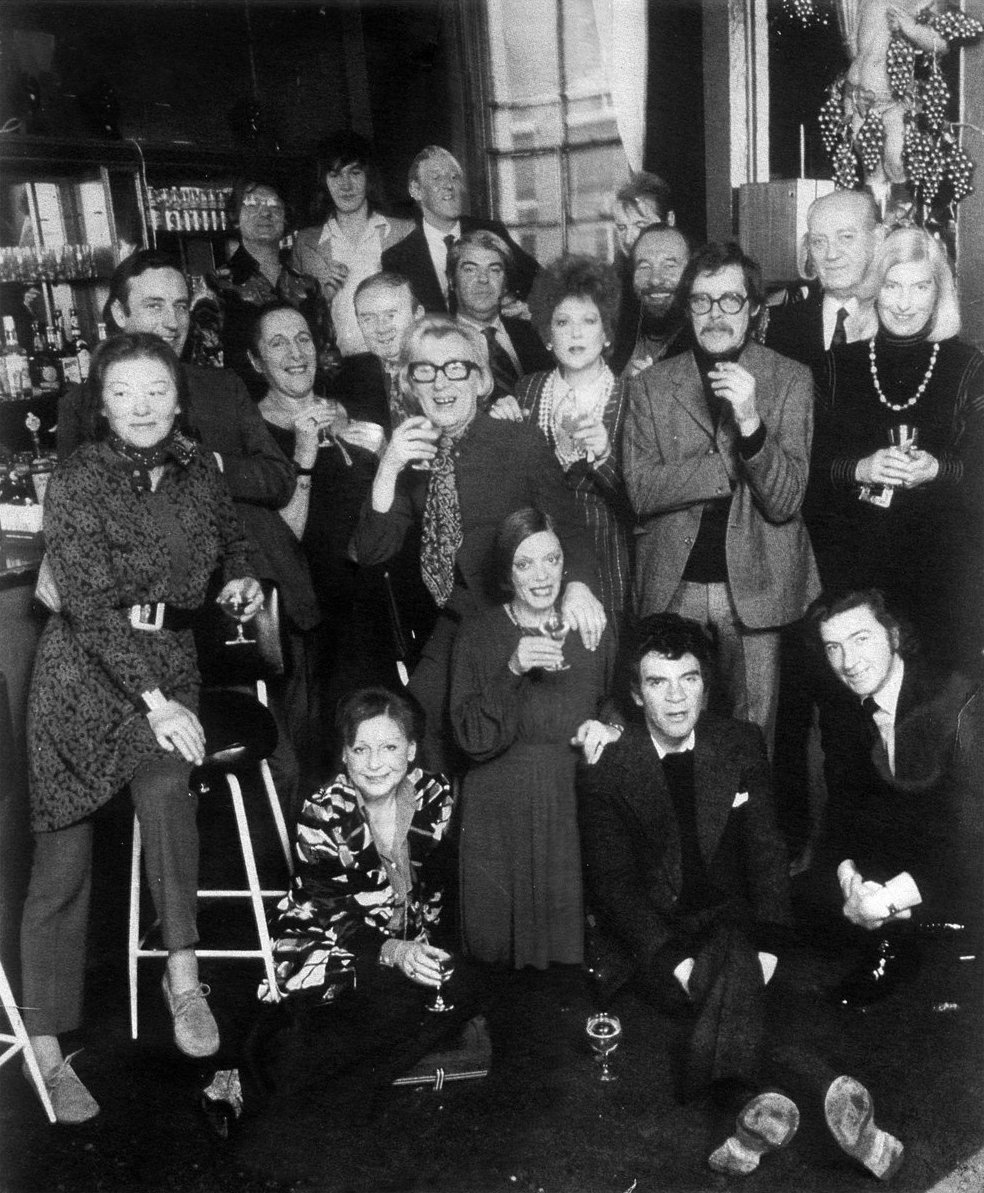
Rare works of Bacon defy art auction gloom
ABC News Australia, Tuesday, 25 November 2008
Two paintings of Francis Bacon, by an Australian artist believed to have been his lover, were sold for well over their pre-auction price last night.
The works by Roy de Maistre — Francis Bacon’s Studio and Portrait Of Francis Bacon — were sold for $180,000 and $96,000 respectively at Sotheby’s sale of modern Australian art in Melbourne.
The two paintings, among a collection of six de Maistre works, had not been seen by the public for nearly 50 years.
“I think both works illustrate very well that even in the present climate, works of exceptional provenance which carry conservative estimates are strongly competed for by enthusiastic collectors,” Georgina Pemberton, head of Sotheby’s Australian paintings, told Reuters.
“All of de Maistre’s paintings sold tonight.”
The de Maistre star lots, which depict one of Bacon’s many studios and a portrait of the young artist with carefully drawn eyebrows and bright red lips, had been estimated by Sotheby’s at between $37,600-$50,000 and $5,000-$7,500.
Sotheby’s paintings specialist David Hansen said they had been painted in the 1930s, when the two artists were “associating.”
“They were certainly closely associated both personally and professionally. Close, but exactly how close is not known,” Mr Hansen said of the two artists. De Maistre, who died in 1968, was considered a leading exponent of early modernism in Australia.
Bacon, who died in 1992, is believed to have made de Maistre’s acquaintance when he was about 20-years-old, possibly in France or London.
Rare
works about Francis Bacon
defy art auction gloom
Reuters, Monday November 24,
2008
MELBOURNE (Reuters
Life!) — Two
rare artworks by Australian
painter Roy de Maistre,
which feature artist Francis
Bacon who was believed to be
his lover, will be auctioned
by Sotheby’s
on Monday among a collection
of Australian modern art.
Of the
six de Maistre paintings,
the two works — Francis
Bacon’s Studio and Portrait
of Francis Bacon — have
not been seen by the public
for nearly 50 years.
"All
six of the de Maistre’s
works on offer were painted
in London in the 1930s when
the two artists were
associating," David Hansen,
senior researcher and
paintings’ specialist
at Sotheby’s,
told Reuters.
Francis Bacon’s
Studio, with a pre-sale
estimate of between
A$60,000-A$80,000
($37,600-$50,000), depicts
one of Bacon’s
many studios while Portrait
of Francis Bacon, with a
pre-sale estimate of between
A$8,000-A$12,000
($5,000-$7,500), shows a
young Bacon, with carefully
drawn eyebrows and bright
red lips.
"The
young Bacon was well known
amongst members of London’s
gay subculture for his
cosmetic display," Hansen
said.
"They
were certainly closely
associated both personally
and professionally — close
but exactly how close is not
known," he said of the two
artists. "It was often said
that de Maistre taught Bacon
how to paint, though both
artists denied it."
Sotheby’s said the auction,
which also includes works by
Australian artists John
Perceval and Brett Whiteley,
had generated substantial
interest with potential
buyers from Britain and
Australia.
The
works on offer have a
collective pre-sale estimate
of A$3.3 million-A$4.4
million ($2.1 million-$2.75
million).
De
Maistre, who died in 1968,
was considered a leading
exponent of early Modernism
in Australia. Bacon, who
died in 1992, is believed to
have made de Maistre’s
acquaintance when he was
about 20 years old, possibly
in France or London.
(Reporting by Pauline Askin,
Editing by Miral Fahmy)
Francis Bacon: Space and
Surface, symposium organised
by Brian Hatton
Symposium 22/11/08 -
10.00 Architectural
Association, 36 Bedford
Square, London WC1B 3ES
To complement the Francis Bacon exhibition at Tate Britain, this symposium considers spatial and architectural aspects in Bacon’s art. Bacon composed his pictures by risking spontaneous acts and chance effects of painting within carefully designed and projected spatial frameworks, often deploying traces of his early work in furniture and interior decoration.
This double aspect of
Bacon’s work has interested
not only painters but also
architects and filmmakers.
Presentations will be made
by: Andrew Brighton, James
Cahill, Nigel Coates, Mark
Cousins, Martin Hammer,
Brian Hatton and John
Maybury. The symposium will
conclude with a roundtable
discussion.
All welcome
No advance booking required
Please note: The AA Bar (1st
Floor) will be open between
11.00 and 6.00 providing
regular bar services.

RICHARD EDEN |
MANDRAKE |
THE DAILY TELEGRAPH | SATURDAY
15 NOVEMBER 2008
Joel Cadbury seeks a
Colony
It is the drinking den whose
patrons have included such
artists as Francis Bacon and
Tracey Emin,
but the Colony Room in Soho
may be about to have a
surprising new owner.
Mandrake can disclose that Joel Cadbury, whose chocolate-producing ancestors were abstemious Quakers, is lining up a bid for the louche private members’ club. “Joel has been approached about taking it over and is seriously considering it,” says a friend of the 36-year-old son of Peter “the Cad” Cadbury.
Joel, who is married to Divia Lalvani, the daughter of an Indian electronics tycoon, is a non-executive director the Groucho Club, the haunt of media and theatre professionals, which is next door to the Colony Room.
Last year, Cadbury sold his Soho health and fitness club, The Third Space, to a management buyout team backed by private equity for £22 million. The deal came just over a year after he sold the Groucho to the same private-equity group, Graphite Capital, for £20 million.
The Colony Room was established 60 years ago to provide a refuge for members when the pubs closed. Earlier this year, Michael Wojas, the club secretary and chief barman, said he would close it when he retires in March because of the impact of the smoking ban, an expiring lease and a general downturn.
Art boom over as auctions fail to bring home Bacon
BEN HOYLE | ARTS REPORTER | ART MARKET | NEWS | THE TIMES | FRIDAY, NOVEMBER 14, 2008
When a Francis Bacon triptych became the most expensive contemporary artwork sold at auction earlier this year it fuelled hopes that the art market might be credit-crunch proof.
Six months later the failure of another important Bacon work to attract a single bid at auction in New York has underlined what the leading auction houses have long feared and recently suspected: the art boom is over and it will not be back any time soon.
A sobering fortnight of big sales in New York ends this afternoon with little prospect of transactions totalling $1 billion (£676 million). That might seem like an obscene sum of money to lavish on art in the midst of an economic crisis but it is well short of the auction houses’ own combined minimum estimate for the sales of $1.7 billion.
The fortnight included four star-studded evening sales of Impressionist and Modern and Contemporary and PostWar art, which traditionally set the tone for the art market over the next six months.
This year, despite the presence of John McEnroe, the tennis player, Salma Hayek and Steve Martin, the actors, Valentino, the fashion designer and various billionaire art collectors in the auction rooms, the four sales at Christie’s and Sotheby’s pulled in only $608.5 million, against a low estimate of $1.007 billion.
About a third of the works on offer failed to sell at all, including pieces by Picasso, Rothko, Manet, Monet, Modigliani, Matisse, Van Gogh, Cezanne, Warhol, Lichtenstein and Hirst, while many of those that did went for substantially less than the asking price.
Some records were set, brightening the gloom for the auction houses. Suprematist Composition by Kazimir Malevich, the Russian abstract pioneer, sold for $60 million and there were record prices for works by Munch and Degas among others. Attention, however, was inevitably focused on the failures, notably the Bacon.
In May it was revealed that Roman Abramovich, the billionaire owner of Chelsea Football Club, was the mystery buyer of an $86.2 million Bacon triptych. Days earlier he paid $33.6 million for Benefits Supervisor Sleeping by Bacon’s old friend Lucian Freud.
This double splurge was seized on as evidence that the art market would weather the economic downturn thanks to stupendously wealthy collectors from Russia, China, India and the Middle East. But those buyers were notably absent on Wednesday night when a 1964 self-portrait by Bacon, estimated by Christie’s at $40 million, failed to sell. There were gasps in the hall when it was withdrawn from the sale.
The differing fortunes of the two Bacons reflect the seismic shifts in the global financial markets in the past two months, a connection summed up by the presence in Wednesday’s sale of 16 works, belonging to the family of Richard S. Fuld Jr, a former chief executive of Lehman Brothers, that Christie’s had guaranteed at $20 million. The price estimates for these sales were set before the markets went into meltdown in September and European buyers were handicapped by the strengthening of the dollar.
As a result dealers, sellers, collectors and auctioneers emerged from the New York sales looking for the bottom of the market whereas not long ago they were trying to spot the peak. Ian Peck, chief executive of Art Capital Group, a merchant bank specialising in art world affairs, said: “It’s like the aftermath of a rugby match with everybody limping off the field. It’s a different universe compared to where we were six months ago.”
Marc Porter, president of Christie’s North and South America, said after the Wednesday evening sale: “The market is adjusting down.”
The New York sales followed a pattern set in significant recent auctions in London and Hong Kong.
The auction houses are the most obvious victims of the downturn. Christie’s and Sotheby’s both spent tens of millions buying lots whose prices they had guaranteed but which failed to sell. Sotheby’s share price has collapsed from more than $40 a year ago to just over $8 yesterday. Robert Read, group fine art underwriter for Hiscox, the insurer, said that the auctions could have been much worse. “It’s no longer a champagne market,” he said. “Its more of a modest chablis, but it is still drinkable, still functioning.”
Art sales slump
Bacon self-portrait is withdrawn from auction
BY TOM LEONARD IN NEW YORK | NEWS | THE DAILY TELEGRAPH | FRIDAY, NOVEMBER 14, 2008
Francis Bacon’s Study for Self Portrait failed to sell at auction yesterday as the autumn art sales in New York limped to a close, with many lots selling at cut price.
Study for Self Portrait, painted in 1964, was billed as the highlight of the contemporary art sale with an estimate of $40 million (£27 million).
However, when bidding dried up at $27.4 million, the sale was abruptly halted, prompting gasps of surprise in the auction room.
A Bacon triptych fetched $86 million – a record for the painter – at an auction in New York in May.
But the self portrait was among almost a third of works in the 75-lot sale that failed to find buyers. The auction brought in $113.6 million – half the pre-sale low estimate.
In keeping with other recent sales, the lots that did sell went for less than their estimate.
At Christie’s, a collection of 16 drawings sold by Kathy and Richard Fuld, the controversial former chief executive of Lehman Brothers, brought in $13.5 million after being expected to fetch $20 million.
However, Christie’s had promised the Fulds had an undisclosed sum regardless of the outcome of the sale. Mrs Fuld is a keen collector and the couple have kept most of their works.
The Christie’s sale came a day after a similarly underwhelming New York auction at Sotheby’s. Prices at both sales were set earlier in the year before the financial crisis and are now considered far too high.
Upper East Side: Linger (Quietly) for a While
KAREN ROSENBERG | THE NEW YORK TIMES | THURSDAY, NOVEMBER 13, 2008
Chelsea has been the undisputed center of the art market for the last decade, and the young and the new are concentrated below 14th Street. The Upper East Side will always have Museum Mile, but what do the galleries in this staid enclave have to offer?
Simply put, the Upper East Side is a quieter, more idiosyncratic art neighbourhood. Particularly in the cloistered townhouse galleries off Madison Avenue, you have the sense of walking into someone’s living room. Chelsea can make you feel rushed, herded from one concrete-floored box to the next; uptown the atmosphere is much more conducive to lingering. You will often be the only visitor in the gallery, even on a Saturday.
At the ever-expanding Gagosian, as at Acquavella, the artist-muse relationship inspires an exhibition worthy of the Museum of Modern Art. Isabel and Other Intimate Strangers: Portraits by Alberto Giacometti and Francis Bacon inaugurates the gallery’s new fourth-floor exhibition space. The show was organized by Véronique Wiesinger, the director of the Giacometti Foundation in Paris, and Martin Harrison, who is overseeing Bacon’s catalogue raisonné.
The woman singled out in the title is the model Isabel Rawsthorne, whose chiseled cheekbones inspired several paintings by Bacon and sculptures by Giacometti. Other captivating figures in the exhibition include Lucien Freud, in Bacon’s portraits, and Giacometti’s wife and mistress (in separate, and markedly different, paintings).
ANNE BARROWCLOUGH |
ART MARKET NEWS | THE
TIMES | THURSDAY,
NOVEMBER 13, 2008
A Francis Bacon
self-portrait failed to sell
at auction in New York last
night, in a significant sign
that the global financial
tsunami is beginning to
sweep over the international
art market.
Bacon’s 1964 Study for
Self Portrait — billed
as a highlight of Christie’s
contemporary art auction —
was estimated to take in
around $US40 million (£26.2
million). A Bacon triptych
went under the hammer in New
York last May for $86.2
million (£56.4 million), a
record for the British
painter and it was expected
that the self portrait would
fetch a similarly high
price.
But when bidding reached
$27.4 million (£179.3
million) the auction house
dramatically halted the
proceedings, to a chorus of
gasps from a stunned
audience.
Seventy-five contemporary
works were on sale on
Wednesday. Among the most
important lots was a
Jean-Michel Basquiat painter
of a boxer, owned by
Metallica co-founder and
drummer Lars Ulrich, which
fetched just over $13.5
million but short of the
record $14.6 million for a
Basquiat.
A chill had already
entered the art market last
month, when a rare portrait
of Francis Bacon by Lucien
Freud sold for £1.6 million
less than expected, and the
autumn season of art sales,
which began on November 3,
was being closely watched.
However in the fortnight
since the autumn season
began, there has been a big
drop off of sales of
impressionist, modern and
contemporary works of art.
The number of unsold
works has often exceeded 30
or 40 per cent of lots since
November 3, and barring a
few notable exceptions the
sales prices are lower than
the estimates for the
majority of pieces.
Art sales were still high
in the spring sale season
earlier this year, with
records set at Sotheby’s and
Christies’ for works by
Monet, whose Le Pont du
chemin de fer a Argenteuil went
for a record $41.4 million
(£27.1 million) and Munch,
whose Girls on a Bridge sold
for $30.8 million (£20.2
million), a record for the
artist.
The record sales were
seen as a sign that the art
market was protected from
the deepening economic
gloom.
At the time David Norman,
chairman of Sotheby’s
impressionist and modern
department, said the sales
had displayed the
"underpinnings of a really
strong market that we
believe is going to continue
as long as we keep the
estimates appealing to the
consignors and choose the
right property."
He added: "There is still
so much liquidity and so
many buyers from
everywhere."
Such optimism has
evaporated recently, and
last night’s sale will cast
a further pall over the
international market. Some
experts say the fall in
sales is due to the
disappearance of hedge fund
managers and Russian
oligarchs from auction
rooms.
But some of Francis
Bacon’s work still seem
popular — at least within a
certain market. His
paintings of popes — of
which there are just 40 in
the world — are seen as a
trophy by some collectors,
according to Sarah Thornton,
the author of Seven Days
in the Art World.
"These paintings are of a
very powerful man in
purgatory, in like a
free-fall into Hell," she
told National Public Radio
(NPR) in the US on Tuesday.
"The popes look terrified. I
think, oh my God, that must
be what it’s like to be a
hedge fund manager right
now."
Art market in shock as
Christies calls halt to
Francis Bacon sale
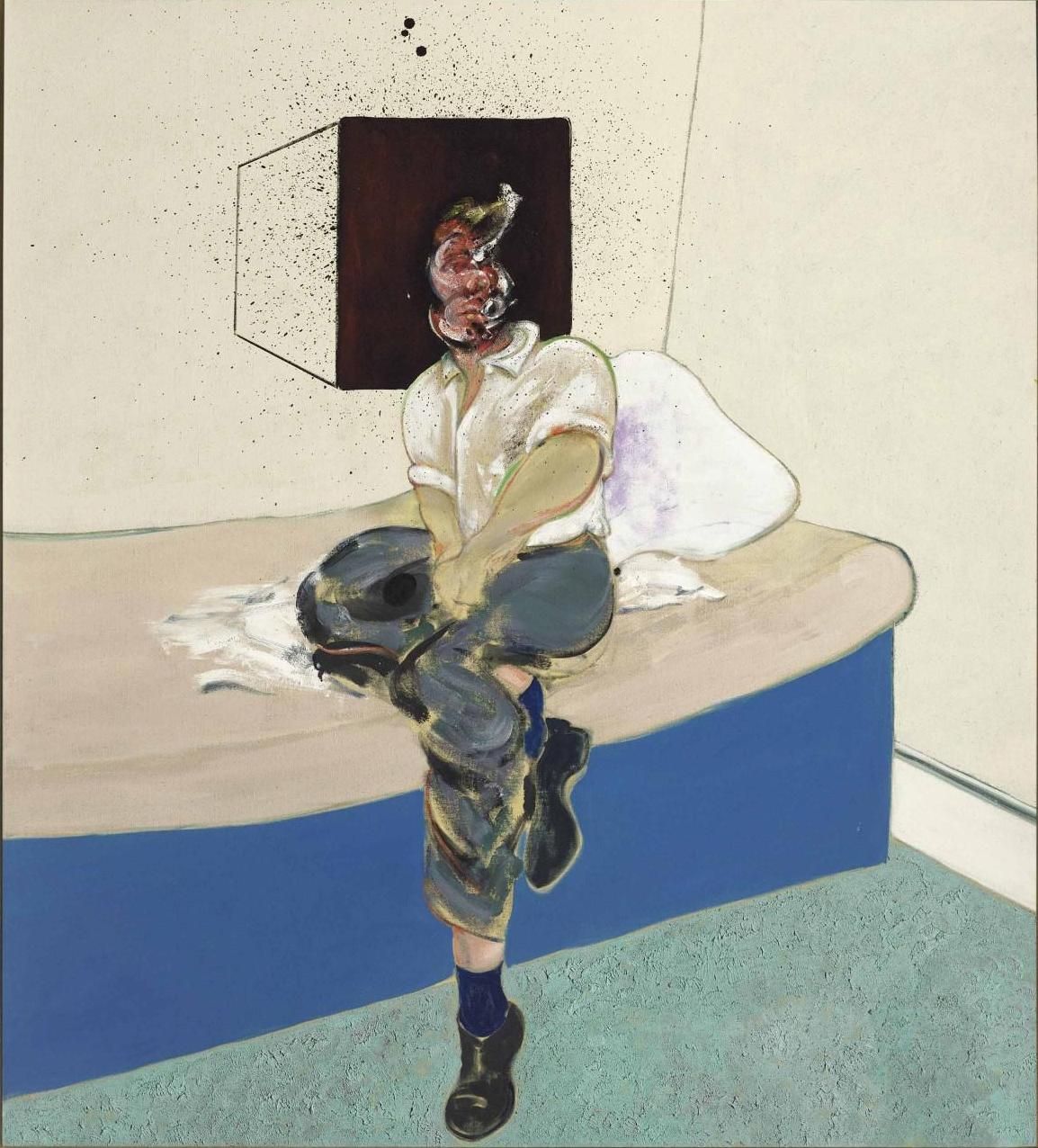
Francis Bacon’s self
portrait failed to sell at a
Christie’s auction last
night
No buyer for a Bacon as New
York art sale ends
By Christopher Michaud, Reuters, Thursday 13 November 2008
NEW YORK, Nov 13 (Reuters) — The fall New York art sales limped to a close on Wednesday, leaving a market bruised and bloodied but still standing. Christie’s post-war and contemporary auction took in $113.6 million, half a low pre-sale estimate of $227 million, with 68 percent of the lots on offer finding buyers.
The spotty sale was consistent with Impressionist, modern and contemporary art auctions at Christie’s and rival over the past two weeks. The result was "about as expected going in," said Amy Cappellazzo, international co-head of contemporary and post-war art at Christie’s, given the turmoil gripping world financial markets for the past two months.
Despite high points including a nearly $15 million Richter, a $13.5 million Basquiat and new records for Joseph Cornell and Yayoi Kusama, the evening’s star lot failed to sell.
Francis Bacon’s Study for Self-Portrait had been estimated to go for $40 million or more, but no bid approached even $30 million. Bacons have seen huge price spikes in recent seasons, including a record $86 million.
"The market is continuing, but clearly at a different price level," Christie’s president Marc Porter said. "There’s no panic in the market, but there is an adjustment," he told Reuters, contrasting that to the volatility gripping other markets such as oil or real estate. "While it had declined, you’ve seen it find a stable level, with a lot of support."
Baird Ryan, managing director of the art-related financial services firm Art Capital Group, agreed with auction officials’ contention that the two weeks of sales, while falling about one-third shy of estimates set before the financial crisis, showed there continues to be demand for fine art.
'A CORRECTION'
But Ryan noted that other markets had seen a fall-off of about 20 to 40 percent, "and that’s what you’re seeing here. There is a correction going on." He said auction houses will have to edit sales to offer "a selected group of works with cautious estimates."
Still it was impressive that "in such a period of remarkable financial stress you can sell over $100 million worth of art in an evening," Ryan added. "People are focused, and active." Art expert and author Sarah Thornton, who chronicled several years spent infiltrating the art world for the book Seven Days in the Art World, said the sales "could have gone much worse."
"Given the state of the financial world, it’s remarkable to see a group of people spending money the way they are," she said. "There are obviously some people who still have a lot of money to spend." (Editing by Mohammad Zargham).
Mixed Results for Contemporary Art Sale at Christie’s
By Carol Vogel, The New York Times, November 12, 2008
In a bumpy sale of contemporary art at Christie’s on Wednesday, some paintings, drawings and sculptures were eagerly sought, but there were also big disappointments as the art market struggled to adjust to today’s financial climate.
What was expected to be the star — a 1964 self-portrait by Francis Baon that was estimated at $40 million — went unsold without so much as a bid. But other works brought prices that surprised even Christie’s executives.
“In the beginning we thought we were witnessing a gravity-defying auction,” Edward Dolman, Christie’s chief executive, said after the sale. “But it was disappointing not to sell the Bacon. There were some good prices, but it’s inconsistent.”
The evening, dominated by American buyers, brought $113.6 million, well below its low estimate of $227 million. Of the 75 works on the block, nearly one-third failed to sell.
Some works that were considered overpriced sold — but for what buyers wanted to pay, not what the house had envisioned.
After the sale, dealers and collectors milled about trying to make sense of the results. “The auction house may not have done well,” said Allan Schwartzman, an art adviser, “but some collectors did.”
It all began with Freud and Bacon...
She’s made a bestselling career examining the mores of suburbia, but as
Shena Mackay admits, her literary life started in the fleshpots of Soho
Rachel Cooke, The Observer, Sunday November 9 2008
Mackay was born in 1944. Her father did a series of jobs, from miner to ship’s purser, and was often away; his marriage to Mackay’s mother was mostly unhappy. She wanted to be a writer early on, a poet preferably. 'It was through reading, and loving words. I could read when I was three.'
Shortly before she left school — the family was living in Blackheath by this time and Mackay was attending Kidbrooke comprehensive, which she hated — she won a Daily Mirror poetry competition, judged by the likes of Kathleen Raine. The prize was £25. 'It was a huge amount of money, but because I was leaving school [she left with two O-levels], I had to buy these boring clothes for my job as an office junior; it had to be squandered on pleated skirts and cardigans.'
The job didn’t work out but, soon after, she got another one, working in an antique shop in Chancery Lane. This turned out to be life-changing, in its way. The shop was owned by the parents of David Sylvester, the art critic, with whom she later had an affair (he was the father of her daughter, Cecily Brown, the artist). The Sylvesters’ son-in-law, playwright Frank Marcus, who is probably best known for The Killing of Sister George, worked there with her. It was Marcus who encouraged her to keep at the novel she had begun writing. 'He found me an agent. He had it typed out for me.'
David Sylvester, meanwhile, introduced her to every painter you care to think of, from Frank Auerbach to Jasper Johns. She would visit the Colony Room Club in Soho with him, for nights out with Francis Bacon and Lucian Freud. 'Yes, I did meet them, but I was a young girl and they were middle-aged.' But she realised how famous they were? 'Oh, yeah. I mean, I met Giacometti. I certainly realised who he was. Sometimes, the impression is given that I used to hang out in the Colony Room. But I didn’t really. They were David’s friends, not mine.
'Francis could be scary. He could either be lovely or spiteful — though he was never spiteful to me. He liked me, so that was all right. It was a great time and I loved it, but at a certain point, that kind of life becomes quite sad. I realised it was much more glamorous actually to have a real life.'
Art world’s after-hours haunt, the Colony Room,
may be saved from closure
November 8, 2008
The impending closure of the Colony Room, the Soho drinking den patronised by louche figures from the art world including Francis Bacon and Tracey Emin, may be averted after an intervention by English Heritage.
The advisory body is rushing through an inspection to determine whether the club, which has witnessed 60 years of booze-soaked misbehaviour by some of Britain’s most creative drunks, merits listed status.
The club is under threat after Michael Wojas, its secretary and chief barman, said that he would close it when he retires in March. He claims that the lease is up, but members who wish to preserve the club are concerned that he may have surrendered the lease without consulting them.
If English Heritage is impressed, it will recommend to the Government that the club be listed as culturally important. The final decision rests with Barbara Follett, the Culture Minister.
Artists who are campaigning to keep the Colony Room open believe that listed status will help them to come to an arrangement with the landlord because it would be harder to redevelop the premises.
The club, a single-room venue founded to provide a refuge for members when the pubs closed, has also received the support of Boris Johnson, the Mayor of London, who wrote an open letter this week to Simon Thurley, the head of English Heritage. “I hope that you would agree that it is important for London to preserve venues and collections that bring inspiration and artistic pleasure to local, national and international visitors,” he wrote.
English Heritage told The Times that the building must have architectural and historical merit on a national scale. “We are aware that there are development pressures on the building,” a spokeswoman said. “The application has been pushed towards the top of the pile to be considered. We are aware of the enthusiasm about the cultural relevance of the building, and the people who are associated with it.”
She said that an inspection would take place within a fortnight.
Rosemarie MacQueen, head of planning for Westminster City Council, said that if listed status were granted it would be an important consideration if the landlord attempted to change the building. “The Colony Room is basically a room with a staircase,” she said. “The real interest is 20th-century culture. If it is listed, that is the thing you’re trying to protect. Any application for change of use would have to take that into consideration.”
The club has been a regular haunt for artists and musicians including Lucian Freud, Peter O’Toole, John Hurt, Sir Peter Blake, George Melly and Damien Hirst.
Mr Wojas did not respond to inquiries yesterday.
Bacon in close focus
Rebecca Daniels praises the curators' discriminating
selection of works in Tate's impressive Bacon exhibition.
REBECCA DANIELS | APOLLO | 1 NOVEMBER 2008
Despite claims that the
Tate's Francis Bacon
exhibition is the biggest
retrospective of him ever
staged, it is, in fact,
substantially smaller than
the gallery's 1985 show.
However, the decision to be
more selective has resulted
in a very high-quality
exhibition. It is really a
celebration of Bacon's
larger paintings and the few
smaller works included, such
as Study for Head of George
Dyer (1967; private
collection), tend to be
over-shadowed. The focus on
large-scale works is
justified given the crowds
likely to flock to this show
and the paintings have been
generously spaced,
maximising the chances for
an unimpaired view of them.
This is particularly
apparent in the opening
room, which is hung with
only seven works,
introducing the paintings
that Bacon completed after
Three Studies for Figures at
the Base of a
Crucifixion (around 1944;
Tate). The absence of that
seminal work from Room 1 (it
is included in a later room
devoted to the Crucifixion)
prevents the viewer from
appreciating it as Bacon
subsequently intended: he
made clear that it was the
painting that launched his
career and anything he
completed prior to it should
be destroyed. Also missing,
undoubtedly due to its
fragile condition,
is Painting 1946 (1946;
Museum of Modern Art, New
York), a work that held a
lifelong importance for
Bacon. These exclusions from
Room I highlight the fact
that this is the first
exhibition held here since
Bacon died and, without the
control he exercised over
the previous Tate show, the
curators have had a new
freedom in the presentation
and reassessment of his art.
There are two principal
thematic detours from what
is a loosely chronological
hang, and these provide the
most dramatic and visually
powerful displays in the
exhibition. The first
features Bacon's recurring
preoccupation with the theme
of the Crucifixion, the
earliest version being the
haunting Crucifixion (1933, Murderme, London), which
Herbert Read illustrated
in Art Now (1933), when
Bacon was unknown. Bacon's
art is often characterised
as violent and brutal but,
with a few exceptions, this
does not hold up under
analysis. However, the
Crucifixion triptychs are
indeed violent, as the
exhibition's curator Chris
Stephens noted in a BBC
interview, and the decision
by him and his co-curator,
Matthew Gale, to hang Three
Studies for a
Crucifixion (1962; Solomon
R. Guggenheim Museum, New
York) and Crucifixion (1965; Pinakothek der Moderne,
Munich; Fig. 2) facing each
other, as if in gladiatorial
combat, is inspired.
A source for the mutilated
bodies that appear in both
the 1962 and the 1965
Crucifixion paintings is
probably, as Martin Harrison
has observed in the
catalogue that accompanies
the exhibition, an
illustration in a book Bacon
owned, The True Aspects of
the Algerian
Revolution (1957). The
prominence of carcasses in
both triptychs was prompted
by a feature on abattoirs
in Paris Match in November
1961 (which was found in
Bacon's studio).
Furthermore, the
controversial inclusion of a
swastika in the
1965 Crucifixion was
influenced by photographs of
Hitler and his entourage.
Therefore, the inspiration
for the motifs in these
important triptychs is
drawn, as in so much of
Bacon's art, from magazines,
newspapers and books. Yet,
despite the importance of
this material, several
reviewers have denounced the
exhibitions inclusion of a
room devoted to archival
material as a distraction
from the paintings. To me,
the archive room enhances
the experience of Bacon's
work, as it adds to an
understanding of Bacon's
preparatory methods in the
same way that Michelangelo's
preliminary studies
(incidentally a major source
of inspiration to Bacon)
enhance an understanding of
his finished frescoes.
The second thematic room,
'Memorial', is devoted to
triptychs of George Dyer,
Bacon's lover and muse. The
three large triptychs were
all completed in the years
following Dyer's death in
October 1971. The
first, Triptych - In memory
of George Dyer (1971; Fondation Beyeler, Riehen/Basel;
Fig. 1) is unusual in
Bacon's oeuvre as it appears
to illustrate episodes in
Dyer's life, while Triptych,
May-June 1973 (1973; private
collection, Switzerland)
recalls events of his lonely
suicide by graphically
showing him vomiting in a
sink in one panel and in
another slumped on a toilet
(where he was found dead).
Despite Bacon's dislike of
narrative interpretation,
these triptychs seem to
encourage a biographical
reading, an approach that
the curators have invited by
collecting these works under
the heading 'Memorial'.
While it is tempting to
analyse these works solely
as a sentimental and
nostalgic pining for lost
love — and
there is undoubtedly an
element of that poignantly
expressed in Bacon's diary
on 24 October 1972 ('George
died a year today') — it
must also be remembered that
shortly before his death
Dyer had planted drugs in
Bacon's studio, leading to
Bacon's arrest and trial
only four months before
Dyer's suicide. It is
perhaps because such complex
personal emotions underlie
these works that Bacon,
unusually, has been unable
to frustrate a narrative
reading of his works.
Bacon's penchant for
painting in themes is well
represented and there is a
good selection of popes,
businessmen, crouching
figures and animal
paintings. The decision to
hang the paintings at an
extremely low level (often
just above the skirting
boards) enables the viewer
to examine the variations in
Bacon's application of
paint. Nowhere is this more
marked than in Head
II (1949; Ulster Museum,
Belfast; Fig. 3), where the
top half of the canvas has
paint so thick that it seems
impenetrable (Bacon was
trying to capture the effect
of rhinoceros skin) but the
lower left is just raw
canvas (revealing also that
Bacon painted on the unprimed side of the
canvas). Subtle nuances in
technique and colour can be
appreciated with the low
hang of the series works,
particularly of the Popes,
where the marked differences
in such compositional
elements as the 'space
frames', curtains or
'shuttering' and the
depiction of the throne are
worthy of close attention.
The one problematic aspect
of the hang is the decision
to break up the series
paintings, particularly the
crouching figures, which are
displayed over several
different rooms and
therefore offer no chance to
view them comparatively.
Nevertheless, in the case of
the businessmen — which
are all hung in one room — interspersing
them with animal paintings
forces one to view them
independently of each other,
and subtle differences
appeared that I had not
noticed before.
The
exhibition also has a
wonderful range of Bacon's
important late works,
particularly a room filled
predominantly with triptychs
from the 1960s to 1980s,
including Triptych (1976;
private collection), which
was recently sold in London
for the highest price ever
paid for a post-war work of
art. The quality and range of
the works on display provide
an opportunity to show Bacon
at his best to a new
generation too young to have
seen the 1985 show. I left
the exhibition feeling, as
one should, visually
exhausted but exhilarated.
Rebecca Daniels is a
researcher on Francis
Bacon: The Catalogue
Raisonne.
Francis Bacon, Tate Britain, London
JOHN McAULIFFE | EXHIBITIONS | REVIEWS | THE MANCHESTER REVIEW | NOVEMBER 2008
Francis Bacon is presented, in his third Tate Britain retrospective, as a straightforwardly thematic painter: the exhibition’s ten chronologically-arranged rooms consistently refer the viewer to the Cold War, World War 2, the illegality of homosexuality, the decline of organised religion. Although Bacon regularly objected to any narrative readings of individual paintings, he becomes here the story of the twentieth century. It is a stultifying narrative and it represses the strangeness of the paintings, replacing them with a story which could be applied to many of his contemporaries.
The most shocking painting in the exhibition, and one which confounds its narrative, is his wild, luridly expressionist study of Van Gogh, who appears as a conventional figure in a landscape in a painting based on Van Gogh’s ‘The Painter on the Road to Tarascon’ (a painting destroyed in the bombing of Dresden). Its meshing of colours, its absence of a contrasted overlaid commentary or of cut-up, delineated spaces make it seem more like the work of a contemporary like Sydney Nolan. It is also the show’s one variation on Bacon’s basic, aggressive and confrontational style.
Elsewhere the exhibition covers familiar ground: the brilliant glaring orange spaces in which his triptychs play out, the way he consistently isolates his ‘sitters’ on a chair or stool or toilet bowl. Lenin wrote that ‘the future of aesthetics will be ethics’, but Bacon refuses this dictum, taking the abstract aesthetic patterns of arcs and circles from Kandinsky and Matisse and plastering them with fleshy wounds: the symmetries remain but Bacon’s flashy colours make it hard to look away from his often grotesque subjects. Sometimes Bacon rubs our noses in his aestheticism, but there is sentiment and even pathos in some of the paintings of George Dyer. In one, he cycles a bike, his face a mask as the wheel wobbles away from its skeletal frame. But Bacon explodes this mildly comical scene by sprouting from his head, in a whirl of pinks, a calm all-seeing eye, granting his subject a vantage point for once.
Bacon’s interest in TS Eliot’s early satires and in Aeschylus’s Furies is documented in the notes to the paintings, but their regular focus on a single orifice may have another, more contemporary literary source. The early work’s insistence on the mouth as its central still and clarifying image responds to WH Auden’s definition of his art as ‘a way of happening, a mouth’. In the later work, the mouth is displaced by meaty, bacony twists of flesh and by the bright red arrows he aimed at his subjects. The most impressive of these familiar paintings are the triptychs for, again, George Dyer whose crude shadows and spilled flesh act as a powerful elegy for Bacon’s partner.
The show has its moments but does not add much, or detract from, Bacon’s reputation. It is also disappointingly silent on Bacon’s artistic context and future. It does include a room devoted to Eadweard Muybridge’s early photographs, but Bacon’s kinetic manipulation and juxtaposition of these sequential frames is a well-known story.
Maybe Bacon’s work is too narrow and limited, but there are signs here that he could be usefully seen in the swim of the art of his time, in relation to the abstract painters whose work he professed to loathe, to David Hockney’s post-photographic work, or to the collage which his Britart successors use to follow his example in shocking their public.
AGONY AND PLEASURE:
FRANCIS BACON’S RETROSPECTIVE AT TATE BRITAIN
(September 2008-January 2009)
By BEATRIZ ACEVEDO | REVIEW | NOTEWORK | NOVEMBER 2008
Francis Bacon has been regarded as one of the most important artists of the Twentieth Century and even now his work does not cease to produce questions, reactions and controversy. The retrospective of his work at Tate Britain provides a unique opportunity to grasp at the power of his oeuvre and to experience the fascination that it exerts on the viewer. Bacon’s experiences were shaped by the whole Twentieth Century: he was born on October 28,1909 in Dublin, and he was brought up in the shadow of the First World War, he also witnessed the horrors of the Second World War. The experiences of these two wars, and the subsequent changes in the world during the century, may explain the most common reactions to his work: the violence, the horror, and the brutal. For many, Bacon’s work conveys all these adjectives; however, his work is more complex than a first sight of his paintings may show.
For the spectator, the sensation of being shocked, marvelled or horrified is part of the fascination exerted by Bacon’s paintings. As the artist stated, his intention was to make an impact on ‘the nervous system more violently and more poignantly’2, and he used the human figure as the main weapon for his mission. Although Bacon did not attend any formal education, his genius developed by following some of the most important trends of the earlier Twentieth Century: the work of Picasso and the Surrealists. His own life is the big canvass of emotions, experiences, pain and enjoyment, and although he would prefer that we separate his paintings from his personal life, it is undeniable that his work conveys the emotions of the modern man: the anxiety and the pleasure, the question of life and the presence of death, and the co-existing forces of Eros and Thanatos.
The exhibition is organised in ten rooms, covering certain historical periods in his work. In doing so, the curators aimed to show some echoes and dialogues amongst his paintings. Since Bacon was a fierce critique of his own work and he is famous for the amount of work that he destroyed when unpleased with it, hence, very few paintings from the earlier period (stemming from the 1930s) are exhibited here. Some of the survival paintings of his earlier period are grouped in the first room, titled Animal. Bacon’s concern with the bestial nature of human beings is largely explored in this first group of paintings painted during the 1940s: the scream, the pain and the convulsions of the flesh. In particular, the series of ‘Heads’ announce the seeds of further developments in Bacon’s work. For example, in Head I, the emphasis is put on the corporeity of the ‘head’, while only the open mouth with the carefully painted teeth suggests the singularity of a deaf scream.
As noted by Chris Stephens, one of the curators of the exhibition, in the Heads (Head I and Head II) ‘these details add a disquieting reminder of the figure’s humanity while the contrast of their stillness with the dynamism of the mouth makes it seem as if the figure is possessed, taken over by this animal force’ (Stephens, 2008: 94). However, it is not very clear if the figure is screaming or gasping for air, and here Bacon in his conversations with David Sylvester revealed his original intentions: “I wanted to paint the scream more than the horror.” The anxiety of the scream, the threshold between the sound and the total deafness of this gesture, and the conveyance of internal forces governing the flesh became common topics in Bacon’s future works. For Deleuze, the scream in Bacon establishes a relationship between the visibility of the scream (the open mouth as a shadowy abyss) and invisible forces, which are nothing other than the forces of the future (2003: 43).
In this group of paintings some of the most important elements in Bacon’s language start to appear. In particular, the Painting 1946, can be considered as the prototype for further developments in Bacon’s work: here a dominant male figure emerges, black tie and coat, yet, only his mouth in the gesture of the scream is carefully revealed. His physical features are crowned by an umbrella – the suggestion of a big bird with black wings – and the Figure is flanked by a couple of fleshy carcasses part bone, part dead meat in brilliant tones. The Figure is sustained by a tubular structure, and it stands out in a bright field of pink colour. It is said that Bacon based his Figure on some pictures of Nazi leaders, and the thick neck suggest the gestures of Mussolini. Nevertheless, Bacon wished to distance himself from the specificity of the Nazi references to something more universal in which the sense of threat and brutality had been distilled (Stephens, 2008: 92).
The image of authoritarian figures and leaders inspired many of Bacon’s paintings. In this room we can appreciate an early interpretation of Velázquez’s painting of the Pope Innocent X, titled Head VI (1949). As noted by Peppiatt: ‘in paraphrasing the Velázquez portrait, Bacon strikes not only at the highest personification of spiritual power, but also at the grandeur of the Western tradition of art’ (1996: 64). His poignant reinterpretation of Velázquez’s Pope can be also understood in relation to the influence of the surrealist spirit in transforming pieces of art, such as Duchamp’s moustache on Leonardo Da Vinci’s Mona Lisa thereby situating Bacon’s screaming Pope. Other explanations can be drawn from his difficult relationship with his father (Pope or Papa-Dad) or his disdain for the catholic religion.
The point here is to appreciate how Bacon’s painting of the Pope explores the depths of authority and leadership. Whereas in Velázquez’s painting the Pope appeared both regal, serene and cruel, Bacon’s explored the isolation conferred by his authority. By confining the Figure within the limits of a chair, and surrounded by a shuttered wall, a curtain, or a white parallelepiped, the Pope is isolated and somehow incarcerated. The Pope’s fists cling recklessly to the chair and this produces a sensation of both frailty and contained anger, while his screaming mouth oscillates between the agony and the fury. As developed by Deleuze: “Innocent X screams, but he screams behind the curtain, not only as someone who can no longer be seen, but as someone who cannot see, who has nothing left to see, whose only remaining function is to render visible these invisible forces that are making him scream, these powers of the future.” (Deleuze, 2003: 42)
In the view of his contemporaries, Bacon’s use of religious symbolism and the exploration of the human figure contradicted the artistic tendency toward abstractionism and conceptual art. While artists around the world were engaged in the exploration of abstract art – in particular the Abstract Expressionism and the playful potentialities of the Pop Art – Bacon followed a different route. He broke with figuration, but at the same time, he used the figure to accomplish his aim. His work “it is not impressionism, not expressionism, not symbolism, not cubism, not abstraction (…) Never (except perhaps in the case of Michelangelo) has anyone broken with figuration by elevating the Figure to such prominence.” (Deleuze, 2003: xiv)
During the 1950s and 1960s, Bacon had completed the basic elements in his work: (1) the Figure, not as narration or illustration, but as a Figure in motion, or transformation; (2) the place in which the Figure is located, normally a chair, a ring or inside a geometrical figure of ice; (3) and the field of colour (Deleuze, 2003). These pictorial elements aim to stretch the Figure toward more sensational (in terms of heightened sensations) effects while avoiding the ‘representation’ or the ‘description’ of an scene or an event. As Bacon remarked: “A picture should be a re-creation of an event rather than an illustration of an object: but there is no tension in the figure unless there is the struggle with the object.”3 The second room in the exhibition is called Zone and a number of examples concerning the creation of fields, places and figures as ‘matters of fact’ (using Deleuze’s words) are presented here.
By the 1950s Bacon’s work developed in amidst his hectic life and sexual explorations around London during the postwar years. The next room in the exhibition refers to this feeling as Apprehension: a number of paintings and studies for Figures, amongst them the series of the “Man in Blue”. These men are dressed as ‘executives’ or ‘business men’ although they look anonymous and innocuous. For example, in the Man in Blue IV the figure seems to sink in the depths of darkness and obscurity. Like the Popes, the businessmen are depicted as figures of authority, yet vulnerable and solitary (Stephens, 2008: 122).
Bacon’s obsession with religion and authority appears intermittently in his paintings. The series of Crucifixions reveal the many ways in which the artist approached this classic theme. He was not attempting to re-create a religious message, nor was he interested in challenging it. For Bacon, the crucifixion can be understood as an act of violence; and it is related to his concern about the bestiality of human beings. He developed his crucifixions by focusing on the fleshy characteristics of the subject. As he asserted, “Well, of course, we are meat, we are potential carcasses. If I go into a butcher’s shop I always think it’s surprising that I wasn’t there instead of the animal’4. For many, the reference to the Crucifixion can be understood within the context of the Second World War and the Holocaust. Notwithstanding, the first painting of the Crucifixion came from the earlier period of the painter and it was this painting which put Bacon in the map of artists in Britain.5.
Almost ten years later, the same topic is depicted in the Triptych format, also exhibited in this retrospective. Here we find the famous: Three Studies for Figures at the Base of a Crucifixion (1944) which is one of the jewels owned by the Tate Gallery (normally exhibited at Tate Modern on the Southbank). It consists of three paintings connected by a bright field painted in orange. On the central panel there is this ambiguous form, like an embryo, from which only an opened mouth appears – savaging and devouring – covered by a blanket (it looks more like a phallic figure – maybe a penis dentata?) in an orange background limited by angles. Because of the date of this painting, the second version of the Crucifixion has been linked to the horrors of the holocaust as an apocalyptic vision of the world although heavily influenced by the political responsibility of the artist illustrated by Picasso’s Guernica (exhibited in London in 1938). Guernica showed how the formal language of modernism could frame a response to contemporary events (Gale, 2008: 139). Bacon’s Three Studies for Figures at the Base of Crucifixion goes beyond the depiction of a single episode by denouncing the ongoing nightmare.
Further versions of the Crucifixion are produced in 1962 and 1965. In Three Studies for A crucifixion (1962), and Crucifixion (1965), the main elements of Bacon’s language reached their maturity: the format of the triptych; the treatment, dissection and isolation of the figure; and the large fields of colour. In Deleuze’s brilliant analysis of Bacon’s work, these are the three fundamental elements in his painting: “the material structure, the round contour and the raised image. If we think in sculptural terms, we would have to say: the armature; the pedestal, which would be mobile; and the Figure, which would move along the armature together with the pedestal.” (Deleuze, 2003: 4).
These paintings became Bacon’s platform as a recognised artist and then his life changed. From living on a sort of roller coaster, hardly making means to meet ends (and yet indulging in drinks, parties and gambling), he found himself with a disposable income. Immersed in the chaotic relationship with his lover Peter Lacy, he travelled around Europe and North Africa engaging in compulsive gambling in cities such as Monte Carlo while trying to paint under different lights either in Tangier or in the South of France. Different experiments marked this period: coupled figures, interpretations of Van Gogh’s paintings and more expressive and colourful paintings are grouped in the exhibition in the room titled Crisis. Although in this new situation he was able to afford bigger premises, he kept the smaller atelier at the Reece Mews (London) as his favourite place for painting. An interesting feature of this exhibition is the ‘archaeology’ of his studio in which many objects, pictures, photographs and books may help to re-construct the creative laboratory of the artist. Amongst the objects shown in the ‘Archive’ room were: magazines with photographs of Nazi leaders; a medical document about mouth diseases; the studies of Muybridge’s The Human Figure in Motion; books with reproductions of his admired Velázquez; plentiful pictures from newspapers, sport magazines; and photos of friends, lovers and models.
Bacon relied on reproductions and pictures as the first step for most of his paintings. For instance, in the portraits of friends he preferred to rely on the picture rather than painting directly from the model. For him, photography has taken over the illustrative and documentary role so that modern painting no longer needs to fulfil this function. The challenge consists of extracting the Figure from the figurative and to overcome the descriptive or illustrative aspects of painting. He insisted on the fact that his paintings were not describing violent acts, neither were they trying to tell a story. Instead, what Bacon aimed was to convey the emotion behind the act, the horror prior to the scream, the convulsion of the body in anticipation of the movement.
To this aim, the combination of the three mentioned elements in Bacon’s paintings make sense: the large fields as a spatializing material structure; the Figure, the Figures and their fact; and the place – that is the round area, the ring, or the contour which is the common limit of the Figure and the field. Within the round area, the Figure is sitting on a chair, lying on the bed and sometimes it evens seems to be waiting for what is about to happen. But what is happening, or is about to happen, or has already happened is not a spectacle or a representation (Deleuze, 2003: 9). By isolating the Figure, Bacon attempted to condense the movement, the impulse and the emotion even before their materialisation. As argued by Deleuze: “the Figure is the sensible form related to a sensation; it acts immediately upon the nervous system, which is of the flesh, whereas abstract form is addressed to the head, and acts through the intermediary of the brain, which is closer to the bone” (p. 10). This complex mechanism may explain why Bacon’s painting impacts directly on our ‘nervous system’ and thus the conflicting sensations of agony and pleasure, anguish and convulsion, coexisting in the experience of seeing his paintings.
In the last rooms of the exhibition the dramatism of Bacon’s pictorial language appears more clearly. In the room called Epic, the format of the triptych reaches exquisite powers since the figures express drama, tragedy, and in some cases, abandon and pleasure. Furthermore, in the series of Portraits, Bacon aimed to reinvent portraiture in the age of the camera; he sought ‘to distort the thing far beyond the appearance, but in the distortion to bring it back to a recording of the appearance’6. The portraits of his friend, Isabelle Rawsthorne, convey the vision of a strong woman with a huge personality and charisma. As explained by Chris Stephens, the idea that an individual might be used by Bacon as the vehicle for certain aspects of the human condition seems especially evident in the paintings of George Dyer. Dyer, who became Bacon’s lover in 1963, had strong masculine features as his attire resembled that of a ‘gangster’ in East End London. In contrast, Bacon’s numerous portraits of Dyer suggest a fragile and sometimes comical individual. In the Portrait of George Dyer Riding a Bicycle (1966), the figure is silhouetted in fair depiction of the model and although the physical features of the face are distorted, the viewer can see the absurdity of his situation: riding in circles, heading for nowhere, chasing a shadow… unfortunately, this painting somehow anticipates Dyer’s tragic end.
By that time, Bacon had reached worldwide fame reinforced by the Retrospective at the Grand Palais of Arts in Paris in 1971. Ten years earlier, the exhibition of his work at Tate Gallery elevated Bacon as one of the most important British artists and this exhibition in Paris expanded his success. This was, however, a year of contrasts: in April his mother died in South Africa and another tragedy was looming over him. The evening before the triumphal exhibition at the Grand Palais while Bacon was busy with preparations – hanging paintings and sorting out the details of the night in which the President of France would open the ceremony – George Dyer committed suicide and his body was found in the room that he and Bacon shared. Not surprisingly, the events impacted Bacon deeply. As a way of grieving, Bacon embarked on a number of triptychs collected in the room Memorial. Amongst them, the Triptych in Memory of George Dyer (1971) brings to mind the scene of Dyer’s death: on the central panel a man opens a door, the key is just being removed from the keyhole, it is late at night as evidenced by a solitary light bulb at the top of the staircase; on the floor the cryptic typos of a newspaper sink into the strong red blood colour of the field. The rest of the canvas is painted in bright colours of lilac and pink which relate to the fields in the other two panels.
On the left panel, the convulsive yet athletic figure of a man lingers alongside a curve, a shadow pending on his existence. Bacon has often said that in the domain of the Figures, the shadow has as much presence as the body; but the shadow acquires this presence only because it escapes from the body. The shadow is the body that has escaped form through some localised point in the contour (Deleuze, 2003: 12). On the right panel, it is the figure of Dyer in a thick mirror, on the reflecting pair, the drop of life spilling carefully on the canvas. The use of mirrors represents another of the pictorial elements in Bacon’s work. As observed by Deleuze: “Bacon’s mirrors can be anything you like – except a reflecting surface. The mirror is an opaque and sometimes black thickness. Bacon does not experience the mirror in the same way as Lewis Carroll. The body enters the mirror and lodges itself inside it, itself and its shadow. Hence the fascination: nothing is behind the mirror, everything is inside. The body seems to elongate, flatten, or stretch itself out in the mirror, just as it contracted itself by going through the hole (Deleuze, 2003: 13).”
In general, the series of triptychs in the Memorial room are both haunting and remarkable. The fields of colours, the void of obscurity, the body in movement (in anticipation of death or pleasure), the shadows and the living flesh produces a long-lasting effect in the viewer. For instance, in Triptych May-June 1973 the treatment of the figure reveals Bacon’s heightened artistic powers. In this triptych, it is possible to imagine the last moments in Dyer’s life: the agonic figure crawling to the bathroom, clinging to the toilet, devoured by the dark void of death. The Figure is moving, yet it is fixed in a point; there is emotion, but there is also agony. The body is the focal point, but as in all his work, brushing or scrubbing deforms the features so the tones are subtle and alive. As argued by Deleuze, Bacon’s Figures represent one of the most marvellous responses in the history of painting to the question: ‘How can one make invisible forces visible? (…) Bodies and heads in Bacon’ paintings can look as deformations but they are not tortures, despite appearances. On the contrary, they are the most natural postures of a body that has been reorganised by the simple force being exerted upon it: the desire to sleep, to vomit, to turnover, to remain seated as long as possible.” (Deleuze, 2003: 42-43)
After almost eight decades of life, Bacon’s late paintings return to the common themes: new interpretations of the crucifixion such as the Second Version of Triptych 1944 (1988), as well as a number of self-portraits. A general refinement of composition and expression is evident in the late paintings (Tant, 2008: 231). Getting to the end of the exhibition, I feel both isolated and stimulated. In fact, this is my third view of Bacon’s work. The first time was in March 2001 in the Netherlands when a small collection of his work was presented at the Gemeentenmuseum in The Hague where I made notes and drawings from this first encounter that I still keep. Whereas in The Hague I was fascinated with the colours and the effects of the skin, the movement and the passion; in London, I have been impressed by the complexity and depth of his work: the subtle qualities of movement, the dramatic scenes, his experience of war and the ambiguous sensations of pleasure and horror.
What is really remarkable about this exhibition is the opportunity to experience the power of Bacon’s imagery and the innovations of his treatment of the Figure. This Retrospective is the opportunity to go beyond appearances and prejudices, to embark into a solitary journey of reflection and sensation: to scream in silence, to agonise in joy, to vibrate in colours whilst touching the void, to live at the brink of a disaster. Although Bacon’s life and work referred to the last century, echoes of his paintings are still relevant today.
As Kenneth Clarke describes, he is ‘the interpreter of our contemporary nightmare’7. Bacon’s reminder of the ubiquitous disaster – evidenced in the latest worldwide financial crisis – of the horrors of human actions in a world without hope but driven by religious fundamentalism are ever-present in the works exhibited in this retrospective and demonstrate the perpetual power and relevance of his paintings. Although this review is a futile attempt to bring all the grandiosity of Bacon’s work together, it provides an invitation to forget everything you read and experience, this wonderful Retrospective.
REFERENCES:
Deleuze, Giles (2003) Francis Bacon. Original Title: Francis Bacon: Logique de la Sensation. Translation by Daniel W. Smith. Continuum: London
Gale, Matthew and Stephens, Chris (Editors) (2008) Francis Bacon. Catalogue Exhibition, Tate Publishing: London
Sylvester, David (1993) Interviews with Francis Bacon. London, 1975. Enlarged 1980, revised as “The Brutality of Fact: Interviews with Francis Bacon” 1990, 4th Ed. As “Interviews with Francis Bacon”, 1993 Thames and Hudson: London
Peppiatt, Michael (1998) Francis Bacon: Anatomy of an Enigma. The Orion Publishing Group: London
Francis Bacon, Urbanist, at Tate Britain
Ken Livingstone, Joseph Rykwert and others discuss art and architecture.
TEXT BY NED BEAUMAN | DAZED DIGITAL | FRIDAY 31 OCTOBER 2008
Would
Francis Bacon prefer the
London of today to the
London he actually grew up
in? That was the question
posed last week at the
second of two Architecture
Foundation panels at Tate
Britain, this time featuring
architects Nigel Coates and
Denise Scott Brown, critics
Joe Kerr and Joseph Rykwert,
and former mayor Ken
Livingstone.
Londoners, argued Coates in
his opening keynote, often
feel a great excitement
about the fact that the city
decays faster than it can be
rebuilt, and Bacon’s
attraction to the “entropic
aspects” of cities comes
through clearly in his
paintings. So does his
attraction to cramped,
crowded places – pubs,
butcher shops, boxing
matches and back alleys –
all of which anticipate the
claustrophobic spaces he put
down on canvas. Also
influential were the
possibility of impending
doom that characterised much
of the 1950s, and a certain
disillusionment about the
concrete sterility of what
was being thrown up to
repair the destruction of
the Blitz.
In the clean, safe,
prosperous modern London, of
course, all that darkness is
mostly gone, but the
sterility is still here,
simply transfigured from
concrete into glass and
steel. Kerr drew a parallel
between the way that, in the
Thatcher era, the city
became predictable and
therefore lost a certain
complex, inscrutable
eroticism, and the way that,
after the passage of the
Wolfenden Act that
liberalised homosexuality,
gay people were no longer
driven into the small, dark,
weird spaces that many of
them came to relish.
But is it dangerous to be nostalgic about a vanished London? Yes, said Rykwert: every generation thinks that London isn’t as good as it was. Ken Livingstone, addressing this issue, described himself as an ‘urban chauvinist’, for whom cities are all that really matter. He argued that the post-war Abercrombie plan to reduce the population of London to five and a half million would have led to a horribly dull capital, and that, although today’s London may have lost some of its looseness, it is at least full of human diversity, which Bacon would have appreciated; and the real challenge for cities like Shanghai and Mumbai is to be open to population change, as well as population growth. Livingstone admitted, however, that there is one aspect of modern London that he’s glad he didn’t grow up with: “None of us had our own flat or our own car, so thank god there was no CCTV in alleys back then or we all would have been 25-year-old virgins.”
Tapped Out?
By CAROL VOGEL | THE NEW YORK TIMES | OCTOBER 29, 2008
A $60 million painting by Kazimir Malevich. A $40 million self-portrait by Francis Bacon. It hardly seems the ideal moment to be selling such pricey art. As Sotheby’s, Christie’s and Phillips de Pury brace for their big fall auctions in New York, starting with a sale of 71 Impressionist and Modern paintings, drawings and sculptures at Sotheby’s on Monday night, anxiety is the dominant mood.
Only 10 days ago, Sotheby’s reported a loss of $15 million in guarantees — the undisclosed amount that the houses promise to sellers regardless of the outcome of a sale — from recent auctions in Hong Kong and London.
Millions of dollars of art went unsold at those September and October sales, with many works going for well below their estimates. Since then auction house officials have been busy trying to get sellers to lower their expectations. Much of the art up for auction this week and next was secured early in the summer, when the world seemed a far different place. Now, with the net worth of so many buyers plummeting, auction houses have been trying to persuade sellers to lower their reserves, that is, the undisclosed minimum price that a bidder must meet for the art to be sold.
“Prices of all assets have fallen — stocks, gold, oil, real estate — and it would be unrealistic to expect works of art to be immune to the market’s pressures,” said Marc Porter, president of Christie’s in America. “We are actively encouraging consignors to set reasonable reserves.”
Minimizing risk is the message of the moment. While Sotheby’s has said that it has provided only half the number of guarantees it did a year ago, the company still has outstanding guarantees of $285.5 million.
Unlike Sotheby’s, Christie’s is not a public company, and is not obligated to release figures, but officials there acknowledge having a similar level of risk. As for buyers, the message is a little trickier. With them, Mr. Porter said, Christie’s is making the argument that the objects they desire “might not reappear on the market next season at an even lower price.”
The big question is who will be buying this expensive art. With hedge-fund traders, Russian oligarchs and wealthy Middle Easterners having taken a hit in the financial markets, the auction houses, whistling in the dark, are hoping for a return of old money.
“Americans who fled when prices began soaring will jump back into the market but at a different price level,” said Tobias Meyer, Sotheby’s head of contemporary art. Among the standouts in the fall lineup at Sotheby’s are paintings like Edvard Munch’s Vampire (1894), priced to bring more than $35 million, and an Yves Klein wall relief estimated at more than $25 million. Christie’s is offering a 1934 portrait of Picasso’s mistress Marie-Thérèse Walter estimated at $18 million to $25 million and a Basquiat painting at $12 million and $16 million. “I still hold the belief that the great works will find buyers,” said Guy Bennett, of Christie’s. But at what price remains to be seen.
No Guarantee for This One
EARLY last summer a New York collector negotiated a hefty guarantee from Christie’s in consigning his 1964 Study for Self-Portrait by Francis Bacon for the fall auctions. In the months it took to hammer out details of the contract, economic turmoil grew so worrisome that Christie’s got cold feet and withdrew the guarantee.
The auction house persuaded the seller to offer the Bacon anyway, and it is one of the highlights of Christie’s Nov. 12 sale. Experts say that the full-length portrait, in which the artist is shown sitting on a bed, his body twisted from head to toe, should sell for around $40 million.
Christie’s is obviously hoping to capitalize on the record prices paid for Bacon’s works recently. A 1976 Bacon triptych went for $86.3 million in May at Sotheby’s in New York, and a 1975 self-portrait brought $34.4 million at Christie’s in London in June. Those were among the highest prices ever paid for the British artist, who is the subject of a current exhibition at the Tate in London that travels to the Metropolitan Museum of Art in New York in May. Still, there is no getting around the fact that “the market has changed,” said Brett Gorvy, co-head of Christie’s postwar and contemporary art department.
Exceptional Work by Francis Bacon Leads Christie’s
New York Post-War & Contemporary Art Sale
Art Daily, The First Art Newspaper on the Net, Sunday, October 26, 2008
NEW YORK, NY.- Christie’s is
pleased to announce the sale
of the Francis Bacon’s Study
for Self Portrait, 1964,
(estimate on request) in the
New York Post-War and
Contemporary Art Evening
Sale on 12 November 2008. A
rare example of a full
length self-portrait, this
work is truly a consummate
representation of the
artist’s complex character,
as well as a tour-de-force
of his indelibly original
style of painting.
According to Christie’s
International Co-Head of
Post-War and Contemporary
Art, Brett Gorvy, “This
crucial work by Francis
Bacon is bound to attract
international interest in
the November Evening Sale. Study
for Self-Portrait, is a
rare and outstanding apogee
in Bacon’s creative output.”
Study for Self Portrait is
triumph of Bacon’s
unapologetic metamorphosing
of the human form. Grasping
his hands while sitting on a
bed, the subject is twisted
from head to toe. The work
affords the viewer a
visceral awareness of the
subjectivity within the
artist, managing to achieve
a sentiment that is both
sensual and unsettling,
lushly painted but
underscored with a sense of
violence. Study for
Self-Portrait draws upon
Rembrandt’s renowned
self-portraits in its
introspective depiction of
Bacon’s inner struggle.
Bacon depicts himself with a
distorted twisting face so
as to illustrate the complex
matrix of perspectives that
lie within, achieving a
haunting effect that not
only presents his physical
person, but in fact reveals
every pulsation existing
within his being.
Bacon executed the present
work in one of the most
significant years of his
career and life,
experiencing the enormous
satisfaction of critical
acclamation in both a
catalogue raisonné and a
monograph by John Russell,
and the unbearable anguish
of the death of his lover,
Peter Lacy. However, it was
in this wake of professional
success and personal tragedy
that Bacon transitioned from
a maverick to a master, a
triumph which is evident
within Study for
Self-Portrait.
Today, Bacon’s self
portraits are widely
regarded as one of his most
important bodies of work,
and unquestionably part of
the canon of great
self-portraits in the
history of art.
This assessment became apparent last spring based on the tremendous demand for such works at Christie’s Post-War and Contemporary Art Evening Sales when the intimate-scaled works Three Studies for Self-Portrait, 1976 realized $28,041,000/£14,380,000/€18,090,968 in New York, and Three Studies for Self-Portrait, 1975 led the June sale in London with £17,289,250/$34,457,475/€21,767,166.
Bacon makes a meal out of tragedy
CULTURE | REVIEW | THE DAILY TELEGRAPH | SATURDAY, 25 OCTOBER 2008
Steadily, since the Thirties, the painter Francis Bacon had established himself as one of the greatest figures of 20th century British art. And, as a heavy-drinking Soho low-lifer with a string of violent boyfriends, he thought he had seen it all.
His first lover, Peter Lacy, an older man, would often tear up the young artist’s paintings or beat him up and leave him on the street half-conscious. But in 1971, he was to suffer a grievous blow.
George Dyer, an East End petty criminal Bacon had lived with since he caught him breaking into his home in 1964, committed suicide on the eve of a major retrospective in Paris.
The artist was devastated and started painting Triptych. An attempt to exorcise Bacon’s pain and guilt, it is a portrait of Dyer before his death and has been called one of his "supreme achievements", more tragic and sensitive than any of his other works.
In 2008, Francis Bacon’s Triptych 1976 became the most expensive work of contemporary art, fetching $86.3m.
Art market boom slows, but Lucian Freud’s Francis Bacon
makes 'astronomical' £5.4m
Only 58% of lots were sold at Sotheby’s, and it’s a similar story at Christie’s
CHARLOTTE HIGGINS | CHIEF ARTS WRITER | THE GUARDIAN | TUESDAY, OCTOBER 21, 2008
The contemporary art-market boom, which has brought wealth to auction houses and some artists over the past five years, is coming gently and quietly to an end.
Observers have been waiting for these few days where auction houses hold their high-profile contemporary art sales to take the temperature of the market. And, if it has not plummeted, then it is, finally, showing a dip.
Yesterday the day sale of contemporary art at Sotheby’s saw only 58.6% of its lots sold. The auction raised £7.1m, well short of its pre-sale estimate of £10.9m to £15.3m. The day sales tend to auction work by younger, less established artists – it is the evening sales where the big guns come out, and the well-groomed clientele, not to mention the staff, are dressed as if for a night at the opera. But even there, while the numbers are big, they are on the slide. Sotheby’s big contemporary and modern art evening sale made £22.8m – well short of its estimate of £30.6m. Fifteen of the 62 lots failed to sell. Two had been withdrawn from the auction before it began. It was a far cry from the feeding frenzy of 2007, when record after record came crashing down in the salerooms.
The auctioneer, the suave, assured Oliver Barker, conducted the sale as if there was nothing wrong: but when the star lot of the evening came up – a set of 10 skull paintings by Andy Warhol – a frisson went through the room as the bidding paused, stagnated and finally stuck altogether at £3.5m.
The final price, once the so-called buyer’s premium was added, was £4.35m; the estimate had been £5m to £7m. The work sold, none the less – Sotheby’s admitted having renegotiated lower reserve prices with the sellers (known as consigners). "We did it on a lot-by-lot basis," said Barker after the sale. "Most people gave us flexibility." He called the bidding on the sale "very rational and very considered".
Christie’s Sunday evening sale told a similar story. The auction made a total of £31.97m, but of the 47 lots only 26 sold. Serious works of art – such as a Francis Bacon portrait of Henrietta Moraes, and Jean-Michel Basquiat’s Desmond – failed to reach their reserves.
The star work of the night was Lucian Freud’s portrait of Francis Bacon. It sold for £5.4m – inside its estimate of £5m to £7m – though "still astronomical money", according to Sarah Thornton, an art market observer.
After the sale the Christie’s bosses put on a brave face. Chief executive Ed Dolman said: "The sale wasn’t as successful as last season’s [2007’s equivalent made a record-breaking £33.9m] and we are perhaps seeing a correction from the past few seasons. But there is significant liquidity and a surprising amount of activity when a lot of people thought there would be no activity at all. The real message is one of cautious optimism. The turbulence hasn’t hit our market as much as it has in other areas. There has been a surprising amount of cash moving round the market in the past few days, especially in terms of Chinese and Middle Eastern art. This gives us a belief that the new buyers who have emerged are here, and here to stay."
The new buyers propping up the market include super-wealthy Russian and Qatari collectors, relatively insulated from the turbulence caused by the banking crisis. "When the sub-prime problems kicked in last summer I noticed fewer bidders at auctions – but the Qataris and people like Roman Abramovich had joined the game," said Thornton, who believes that the art market peaked in the summer of last year. "People were shocked when it was revealed that Abramovich had bought the Bacons [two works, a portrait and a triptych, collectively worth £60m] earlier this year. But I do feel that May 2007 was the last time that eyes were really popping at prices."
Amy Cappellazzo, of Christie’s, was upbeat. "I think this was a staggering result given the other financial markets. It’s pretty amazing that people still want to turn up on a Sunday and kick out a million bucks." The key, she said, was that art gives the investor a tangible object. "If you bought something, you bought something real."
Portrait of Bacon sells for £5.4m but
painting by Bacon fails to sell
AN UNFINISHED portrait of Francis Bacon by Lucian Freud, one of
only two he ever painted of his friend and the only one whose…
CONOR LALLY
|
IRELAND |
THE
IRISH TIMES |
MONDAY,
OCTOBER 20, 2008
AN UNFINISHED portrait of Francis Bacon by Lucian Freud, one of only two he ever painted of his friend and the only one whose whereabouts is known, sold for £5.4 million pounds (€6.96 million) in London yesterday.
However, a Francis Bacon painting which was expected to fetch up €10 million at Christie’s in London was one of a number of works which failed to sell.
The Portrait of Henrietta Moraes had a presale low estimate of £5.5 million (€7.08 million).
Christie’s International failed to sell 45 per cent of works on sale because of the depressed international art market. "Obviously we need to adjust our prices," said Ed Dolman, Christie’s chief executive officer. "There isn’t too much confidence out there."
The unsold Bacon work was bought by Guinness heir Garech Browne for his home at Luggala, Co Wicklow in 1970. At one stage it was the only Bacon painting in Ireland, despite the artist being born in Dublin. Browne, a 69-year-old who founded Claddagh Records, was a friend of Bacon and Moraes. He has long been a patron of the arts. Moraes was a famous 1960s model and socialite who was one of Bacon’s favourite subjects.
The painting is one of his first portraits of her. It is signed on the back by Moraes: "For the first time a vision of me by my friend Francis Bacon, Henrietta Moraes." Mr Browne decided to sell the painting because it was too valuable to insure and keep at his estate.
He lent the painting to the Hugh Lane Municipal Gallery in Dublin. He also secured the Francis Bacon studio for the gallery through his friendship with Bacon’s former lover John Edwards.
Freud’s portrait of Bacon
sold for £5.4m
By ARIFA AKBAR | ARTS CORRESPONDENT | NEWS | THE INDEPENDENT | MONDAY 20 OCTOBER 2008
A RARELY SEEN oil portrait of the artist Francis Bacon, painted by his friend Lucian Freud, has been sold for £5.4m. The work, which offers an intimate glimpse into the collaborative friendship of two giants of post-war art, is one of only two oil portraits of Bacon painted by Freud and the last remaining: the second was stolen from an exhibition in Berlin in 1988.
The portrait, estimated to sell for between £5m to £7m at Christie’s auction house in London, was painted in 1956 and shows the artist with a downward gaze. Bacon, who sat knee-to-knee with Freud while he worked on the painting, is said to have "grumbled but sat consistently" during the first six months of sitting, according to Christie’s. It is thought Bacon left suddenly, most likely to pursue his lover, Peter Lacy, in Tangiers.
Although it remained unfinished, art critics agree it offers a snapshot into the working methods of the younger artist at a critical point of his development; Freud had begun to work in a more expansive way, using thicker brushstrokes, liberating the paint and creating a more worked complexion, more seasoned and full of life. The portrait was part of Christie’s sale of post-war and contemporary art. The auction may come to mark a turning point in the fortunes of the art market, which has until now defied the economic downturn. Of 47 lots, only 26 were sold and the sale made £32m, against pre-auction estimates of £57m to £75m.
By contrast, the record for a painting by Freud was set at Christie’s in May, with his naked, large-scale work, Benefit Supervisor Sleeping, selling for £17.3m. The record for a Bacon work stands at £43m, for Triptych, created in 1976. The Bacon portrait sold yesterday was acquired in 1972 by a private collector from a London gallery and had remained in the same hands since. Graham Sutherland, a mutual friend and artist, introduced Freud to Bacon in 1945, inviting them to his house. They formed a close friendship and saw much of one another in the following years.
Bacon had a great influence on the younger Freud and is often credited with liberating his style and fuelling his desire to depict human life. In the early 1950s, the artists sat for each other; Bacon’s first portrait of Freud came in 1951, and many others followed. Freud painted Bacon just twice.
Glum sales
Even a Freud cannot bring home the Bacon
A LUCIAN FREUD portrait of his friend Francis Bacon has sold for £5.4 million at auction, significantly less than expected. The unfinished work, one of only two oil paintings that Freud ever undertook of Bacon, had been predicted to fetch £7 million when it went under the hammer at Christie’s in London yesterday.
It is the second disappointing price for a major contemporary work in file capital’s auction rooms in recent days, as the financial crisis takes its toll on what had been a booming market.
Skulls, a composite work by Andy Warhol, sold for £4.3 million — £2.7million less than had been expected — at Sotheby’s on Friday night Freud’s painting, Benefits Supervisor Sleeping, depicting an overweight Job Centre worker asleep on a battered sofa, sold for £19.1 million in New York in May, a record for a living artist but there is now concern that prices for major works have passed their peak.
Freud and Bacon, both British painters, first met in 1945 and were friends until the latter’s death in 1992. The portrait which was completed in 1967 and had been owned by a private collector since 1972, was sold for £5,417,250.
The auction was timed to coincide with this weekend’s Frieze Art Fair in Regent’s Park, London.
Matthew Moore
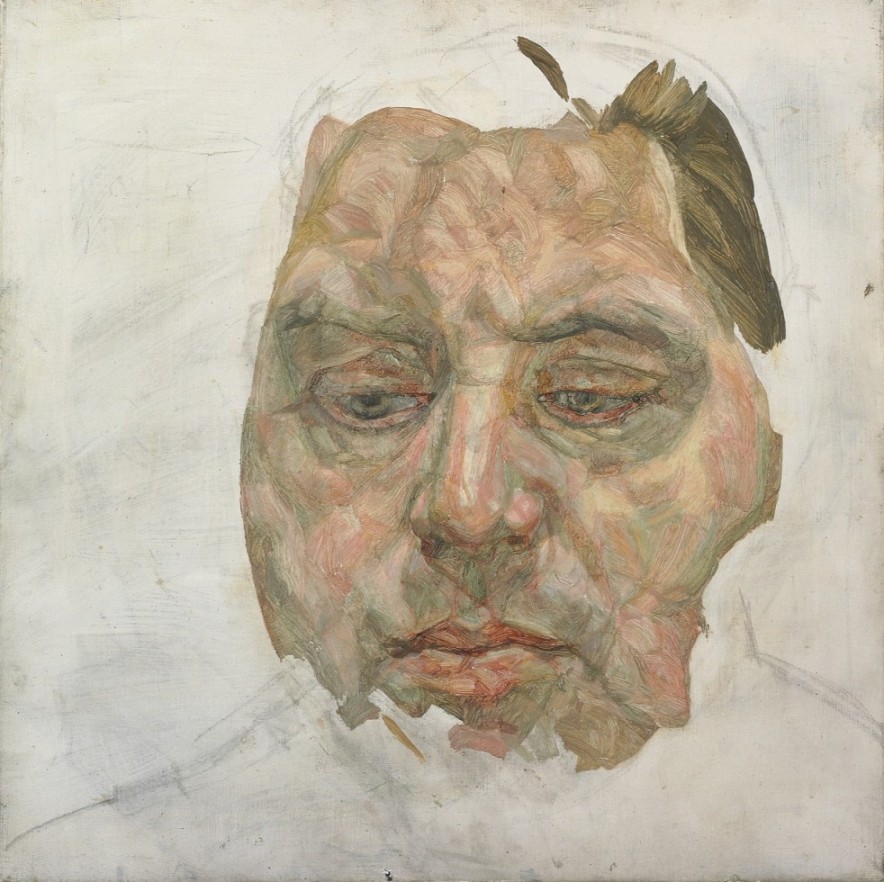
Lucian Freud’s portrait of Francis Bacon, above, had been predicted to fetch £7million at Christie’s
Growing signs of art slump as Freud’s portrait of Bacon makes only £5.4m
Lucien Freud’s portrait of Francis Bacon sells for less than expected
A Lucien Freud portrait of his friend Francis Bacon has sold for £5.4 million at auction,
significantly less than expected.
By MATTHEW MOORE | THE DAILY TELEGRAPH | SUNDAY 19 OCTOBER 2008
The unfinished work, one of only two oil paintings that Freud ever undertook of Bacon, had been predicted to fetch £7 million when it went under the hammer at Christie’s in London. It is the second disappointing price for a major contemporary work in the capital’s auction rooms in recent days, as the financial crisis takes its toll on what had been a booming market.
Freud’s painting of an overweight JobCentre worker asleep on a sofa sold for £19.1 million in New York in May, a record for a living artist, but there is now concern that prices have passed their peak.
Freud and Bacon, both British painters, were friends for many years until the latter’s death in 1992. The portrait, which was completed [sic] in 1967 [sic] and had been owned by a private collector since 1972, was sold for £5,417, 250.
The auction was timed to coincide with this weekend’s Frieze Art Fair in Regent’s Park.
Christie’s Sale Misses Target as Crisis Quells Demand
By SCOTT REYBURN & KATYA KAZAKINA | BLOOMBERG | SUNDAY 19TH OCTOBER 2008
Oct. 19 (Bloomberg) – The contemporary-art market took another beating when Christie’s International failed to sell 45 percent of works at its October auction tonight in London.
Collectors are delaying purchases in the worst financial crisis since the Depression, dealers said. The evening sale, which included works by Francis Bacon, Lucio Fontana and Lucien Freud , followed auctions at Sotheby’s and Phillips de Pury & Co. that also fell below expectations. Christie’s 47-lot auction took 32 million pounds ($55.3 million) with fees, below the presale low estimate of 57 million pounds.
There was an eerie hush in a crowded room as auctioneer Jussi Pylkkanen knocked down the lots in less than an hour.
Three of these failed to sell, including Bacon’s Portrait of Henrietta Moraes (1969). The small yellow canvas flopped against a presale low estimate of 5.5 million pounds. These failed guaranteed lots were expected to fetch at least 7.95 million pounds.
"Things have been overpriced; they need to come down,'' said Glenn Scott-Wright, director at London’s Victoria Miro gallery, who attended the sale. "If Christie's had dropped the reserves by 20 percent, it would have done better.''
Freud's Bacon
London dealer Stephen Ongpin, bidding for a collector, bought the evening's other high-value lot, Freud’s 1956-57 unfinished portrait of Bacon. He paid 5.4 million pounds for the life-size face of the artist, against the presale low estimate of 5 million pounds.
"Obviously we need to adjust our prices,'' said Ed Dolman, Christie's chief executive officer. "There isn't too much confidence out there.''
Why this man terrifies us all
Tonight, Lucian Freud’s portrait of his friend Francis Bacon is to be auctioned.
The art world hopes it will net £7m, but there are signs the market is stalling.
So will the Christie’s sale indicate that the global financial crisis is about to get worse?
By ANDREW JOHNSON | NEWS | THE INDEPENDENT ON SUNDAY | SUNDAY 19 OCTOBER 2008
The face seems to be peering through a tear in the canvas, lips pursed and eyes downcast. To the art world, and the rest of us, this could be the face of doom.
The portrait of Francis Bacon by fellow artist Lucian Freud is the centrepiece of an important sale today. Christie’s auction house hopes it will fetch £7m. If it doesn’t – as now seems likely – dealers in the previously lavish market for contemporary art will know that they face deep financial trouble. It will also indicate that the global financial crisis is affecting even the super-rich.
The Frieze Art Fair last week attracted stars such as Gwyneth Paltrow but sale prices were much lower than expected. The signs are that buyers are holding back until they know what happens to the Freud portrait: it’s seen as the canary in the coalmine that could tell everyone the market is about to blow.
"There is a lot of apprehension in the trade," said Charles Dupplin of the art insurance company Hiscox. Staff at Christie’s are said to be worried about today’s sale.
The first signs of trouble came on Friday when an auction of art at Sotheby’s in London, timed to coincide with Frieze, fell far short of what was expected. The estimated sales total of £30m had been low, but the actual figure was £22m. Even Andy Warhol, one of the most bankable artists of the 20th century, failed to live up to expectations: a series of skulls expected to fetch at least £5m went for £4.3m.
"People won’t be surprised if Frieze is quite muted," said Mr Dupplin. The global market is all but dead already, he said, except for buyers of "trophy art" whose fortunes have previously seemed unassailable. If they stop bidding, prices will plummet.
Among them is the Russian oligarch Roman Abramovich. Earlier this year he paid £17.2m for Benefits Supervisor Sleeping, making Lucian Freud the highest-priced living artist at auction. He also made the late Francis Bacon the most expensive artist ever by spending £43m on Triptych (1976). So it seems reasonable to expect he might bid big for a portrait of one of those painters by the other.
The only other picture of its kind was stolen in 1988 and has never been found. This one was begun in the winter of 1956, but abandoned after Bacon refused to continue with the sittings. If it doesn’t sell well, it will be proof that even the trophy hunters are cutting back. If it does, then a surge in confidence will keep the market going. For now.
Francis Bacon painting may sell for up to €10m
RONAN McGREEVY | NEWS | THE IRISH TIMES | SATURDAY 18 OCTOBER, 2008
FRANCIS Bacon painting which once hung in the drawing room of Luggala in Co Wicklow is to go for auction at Christie’s in London tomorrow and is expected to fetch €7 million to €10 million.
The Portrait of Henrietta Moraesb was bought by Guinness heir Garech Browne for his home at Luggala in 1970 and at one stage was the only Bacon painting in Ireland, even though the artist was born in Dublin. Browne (69), the founder of Claddagh Records and a long-time patron of the arts, was friends with both Bacon and Moraes. He met Bacon through the artist Lucian Freud. Freud was married to Mr Browne’s cousin Caroline Blackwood. Their friendship was strengthened through membership of London’s infamous bohemian Colony Club, which is shortly to close down.
Moraes was a famous 1960s model and socialite who was one of Bacon’s favourite subjects and the painting, to be sold on Sunday, is one of his first portraits of her. She was also regularly painted by Freud. Moraes was an alcoholic and addict, and was jailed at one time. She sobered up in later years and lived for several years as the caretaker of Roundwood House, Co Wicklow.
The painting is signed on the back by Moraes, who writes: “For the first time A vision of me by my friend Francis Bacon with Gareth at Luggala 30-6-767 I love y 2 good heavens Henrietta Moraes.” Mr Browne helped secure the Francis Bacon studio for the Hugh Lane Municipal Gallery of Modern Art in Dublin through his friendship with Bacon’s former lover John Edwards, who inherited the Bacon estate.
Mr Browne also lent the painting to the gallery. “It was the Edwards family who promised me, with the support of the Bacon Foundation, to donate something to Ireland. This was the most extraordinary gift that this State has received recently,” he said. Mr Browne said the painting is too valuable to insure and keep at his estate, but he is hopeful that a buyer will lend it to an Irish institution to go on exhibition.
“To my mind, Francis Bacon is, along with Lucian Freud, the greatest artist of the second half of the 20th century. Contrary to what people think, Bacon did not hate Ireland. This painting means so much to me and to other people and I would like to see it kept in Ireland in some form,” he said. The painting was admired by many of the hundreds of artists who have visited Luggala.
The film director John Boorman said: “For more than 30 years Henrietta Moraes has looked down from her Bacon portrait on the walls of Luggala and witnessed the parade of poets (including after her death, her former husband Dom Moraes), scoundrels and musicians that have enjoyed Garech Browne’s favour. We will miss her.”
The poet Seamus Heaney said: “Garech a Brún has played host to generations of writers, artists and musicians in his home at Luggala, and it was in that magical setting, half way between bohemia and Parnassus, that I met the distinguished Indian poet, Dom Moraes, one of the first contemporary poets I had read.” Interest in Bacon’s work has never been greater among the art-collectors.
A record price for a Bacon of $55.465 million (€41.2 million) was paid by Russian billionaire and Chelsea owner Roman Abramovich in May for the Triptych 1976.
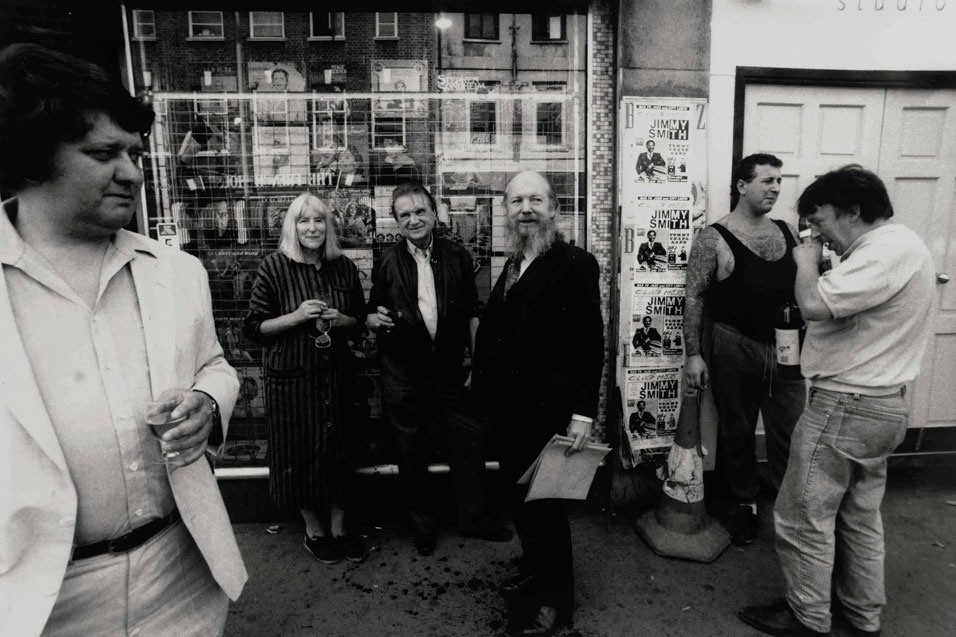
From left to right: Stan Gebler Davies, Gloria MacGowran, Francis Bacon and the Hon. Garech Browne.
Freud’s Bacon Portrait Recalls Bohemian Soho
PREVIEW BY MARTIN GAYFORD | BLOOMBERG | FRIDAY, 17 OCTOBER, 2008
Great British artists, it seems, are like buses. None comes along for ages, then two arrive together. In the early 19th century there were Constable and Turner, then – with the arguable exception of Sickert – no painter of truly international stature until Lucien Freud and Francis Bacon appeared in the 1940s.
On Oct. 19, one of only two painted portraits of Bacon by Freud will go under the hammer at Christie’s International in London, with an estimate range of 5 million pounds ($8.6 million) to 7 million pounds. The other picture of Bacon by Freud was stolen from a Berlin show 20 years ago and has never been recovered. Bacon also painted Freud on numerous occasions, but for reasons that can only be guessed at never with such intensity.
In the past few years those two have come to bestride the contemporary art world like twin colossi. This year, Freud took the title of the world’s most expensive living artist at auction, with the sale of Benefits Supervisor Sleeping (1995) for $33.6 million at Christie’s in New York on May 13.
A mere 24 hours later Bacon, who died in 1992, achieved the title of the most expensive contemporary artist when Triptych (1976) sold for $86.3 million at Sotheby’s in New York. Bacon, born in 1909, was 13 years Freud’s senior, but was only just emerging as a major talent when Freud first encountered him. They met through a common friend, Graham Sutherland.
Best in Britain
One day, Freud told me recently, he asked Sutherland who was the greatest artist at work in Britain. Since Sutherland himself was a celebrated painter, this was a distinctly tactless inquiry. "I was young at the time, though that’s no excuse,'' Freud said.
Sutherland took it well, however, and replied, "It’s someone you’ve never heard of called Francis Bacon.’’ Soon afterwards they were introduced. In the late 1940s and early '50s, Bacon and Freud shared a milieu, centering on certain bars and clubs in London's Soho area.
Another member of their circle was the wild and bohemian Henrietta Moraraes, who had a relationship with Freud. She posed for Girl in a Blanket (1952), one of a number of rarely seen early works by Freud on show in a museum-quality loan exhibition of early Freud works at the Hazlitt Holland-Hibbert Gallery, 38 Bury St. (through Dec. 12).
Nude photographs of Moraes by John Deakin were later the basis for numerous paintings by Bacon in the ’60s. One of these is expected to fetch as much as 7.5 million pounds in the Christie’s Oct. 19 London sale. Freud’s lost portrait of Bacon (1952) was – and one hopes, still is, wherever it is hidden – a masterpiece. "I saw a lot of him at that time,'' Freud told me in 2001, "and we were very friendly, so it was natural for me to paint him.''
Bacon’s Gripes
In comparison with Bacon’s own methods – generally he worked from photographs – Freud’s paintings require an enormous investment of time from his model.
"Bacon complained a lot about sitting, which he always did about everything, but not to me at all," Freud said. "I heard about it, you know, from people in the pub. Really, he was very good about it.'' In an attempt to recover the lost portrait, Freud designed a "wanted'' poster (an example is on show at the Hazlitt Holland-Hibbert Gallery), which was distributed in Germany seven years ago, sadly with no success.
The later portrait of 1956-57 that is going to be auctioned is only the beginning of a picture. Still, because of Freud's unusual technique Bacon's face is almost complete. Freud tends to begin at a point and work outwards. In this case, when Freud had reached the fringe of his hair and the lower edge of his face, Bacon suddenly disappeared, probably on a jaunt to Tangier, leaving the picture a brooding fragment. Even so, it is a powerful record of one of the most intriguing pairings in 20th-century art.
John Russell: an appreciation
John Russell, art critic and author, born January 22, 1919.
Died August 23, 2008
RICHARD CORK | THE TIMES | THURSDAY, OCTOBER 16, 2008
Looking back, I realise that John Russell had a formative and wholly beneficial influence on my growing involvement with art. In 1960, when I was thirteen years old, I wandered into the Wallace Collection and had an unforgettable epiphany. The paintings there by Rubens, Poussin, Velazquez and above all Rembrandt overwhelmed me. From then on, looking at art became my obsession, and every weekend John’s art column in The Sunday Times enriched my mind.
Trapped at a boarding school in Bath, I envied John his ability to roam around London, Paris, Venice and the rest of Europe visiting the best exhibitions on offer. His life struck me as idyllic, and the fact that he also wrote books and curated exhibitions sharply increased my admiration. John’s inspiring example made me realise that art critics need not confine themselves to penning a weekly review. They can also write at length, and in depth, about the art that matters most to them. John, a famously and enviably swift writer, became a prolific author. He also curated a succession of impressive exhibitions, surveying the achievements of Modigliani in 1964, Rouault in 1966 and Balthus in 1968.
Reading his regular criticism, I warmed to a writer whose reviews were always informed by a discerning awareness of history. But I particularly liked John’s growing engagement with the art of his own time. During the 1960s he was quick to champion young artists at the time of their emergence. Painters and sculptors as outstanding as David Hockney, Ron Kitaj, Howard Hodgkin and Anthony Caro all benefited from his enthusiastic response at crucial points in their careers. Hungry for adventurous new art myself, I was fascinated by John’s reviews of these and other artists in the 1960s.
At a time when so many British gallery-goers still waxed vehement in their scornful dismissal of innovative art, John stood out as an enlightened exception. He realised, increasingly, that the 1960s was an extraordinary period for contemporary art in Britain. And he refused to court popularity with his more philistine readers by dismissing the boldest experimenters out of hand. Far from sneering and playing for easy laughs by condemning the most audacious young artists, he preferred to advance understanding and discover how they were enlarging the language of art.
In other words, John provided a tonic and played an important part in countering the knee-jerk hatred of modernism which had poisoned British culture for so long. At a time when plenty of people were ready to sneer at Warhol or Lichtenstein, he organised with Suzi Gablik a defiantly celebratory survey of Pop Art at the Hayward Gallery. And he was no less willing to stand against the antagonism so often aimed at Francis Bacon. When I first met Bacon in 1971, he made clear that he expected nothing but hostility from his fellow-countrymen. Without any self-pity, Bacon told me he had recently looked through “all the reviews I’ve had from my Marlborough shows over the years”, and “all of them, virtually without exception, were bad.” But in that very same year, 1971, John published a book on Bacon which provided a far more positive and insightful analysis.
Bacon’s work brought out the most dynamic, supple and visceral side of John’s critical writing. Just listen to this passage, where he closes with relish on the essence of Bacon’s restless and tormented vision: “Bacon wrenched, reversed, abbreviated, jellified and generally reinvented the human image. The paint-structure was by turns brusque and sumptuous, lyrical and offhand, pulpy and marmoreal. Swerving, pouncing, colliding with itself, taking for granted the most bizarre conjunctions of impulse, it produced a multiple imagery which was quite new in painting.”
I admired John’s open-mindedness, and respected his willingness to fight British philistinism with vigour. Even after he moved to New York, John was more than ready to weigh in on the side of audacious art. When the so-called bricks rumpus exploded on this side of the Atlantic in 1976, tabloid newspapers crowed over the Tate’s acquisition of Carl Andre’s sculpture. The Daily Mirror plastered its front page with the headline “What A Load Of Rubbish”, but John sent a fiercely supportive letter commending the Tate’s willingness to purchase the bricks.
When I started out at as a critic myself, on the Evening Standard, plenty of reactionaries dismissed my championship of conceptual developments. In 1973, when I curated a show of young artists like Richard Long, older critics deplored the exhibition. But John saluted my efforts by referring to D.H.Lawrence, who once declared that he would like his writing to make people “alter, and have more sense.” John claimed that Lawrence had defined “the eventual aim of all art that is worth talking about.” But I believe that Lawrence’s words could equally well be applied to John’s own work. He succeeded, through his energetic, incisive, eloquent and impassioned writings, in making us “alter, and have more sense.” I am delighted to pay tribute to John’s immense and indispensable achievement.
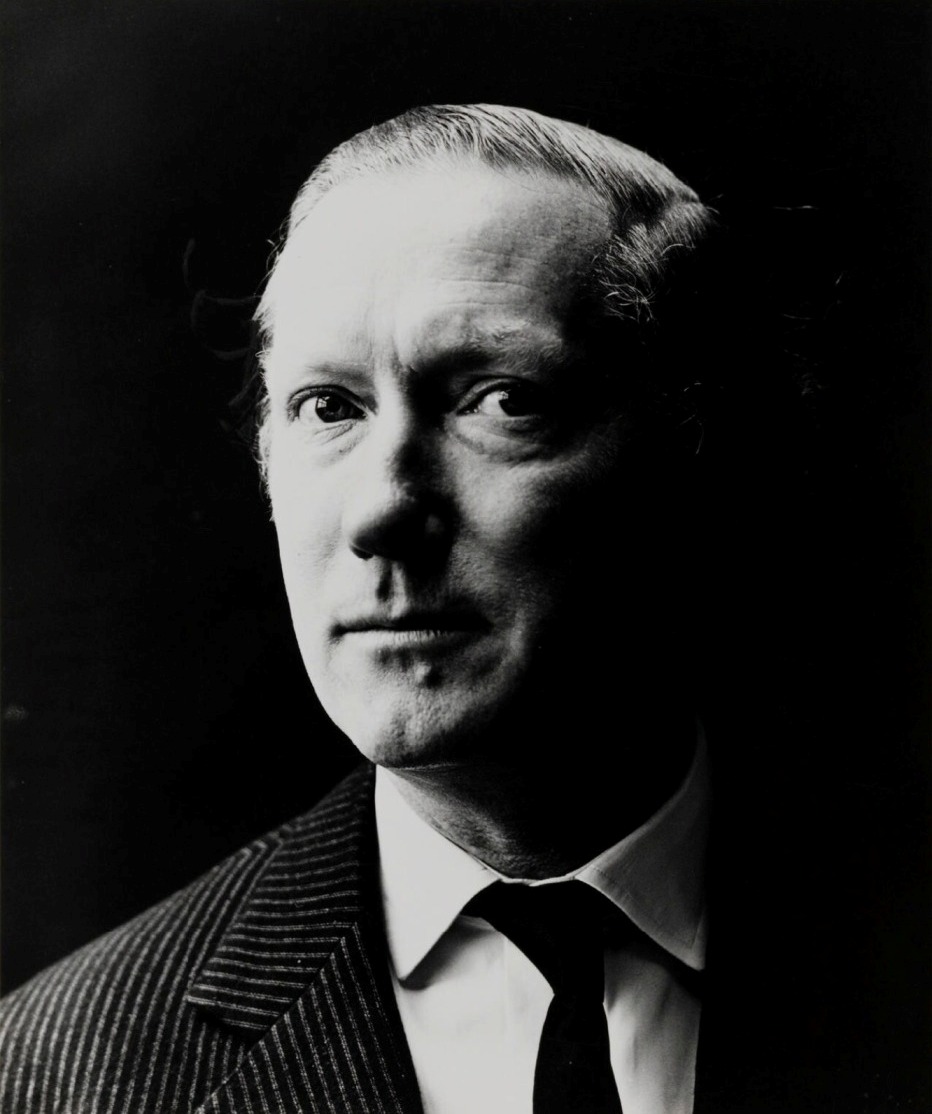
Russell was ever grateful to be allowed to to conduct his education in public
Munch, Bacon and Warhol at Sotheby’s Show
There was little evidence of
the financial crisis inside
the new branch of the Moscow
Museum of Modern Art, at
Gogolevsky Bulvar, where
Sotheby’s preview of its
upcoming November auctions
is exhibited.
"Some of you may have seen
or read that we have
economic trouble in the
world. But I can assure that
we are here to stay. We love
Russia, and we will come
here in good times and not
so good times," said Lord
Mark Poltimore, chairman of
Sotheby’s Russia. "One thing
I can assure you is that
good art correctly priced
will always make good
prices."
Inside are 50 works, most
from the 20th century, from
artists including Francis
Bacon, Andy Warhol and Pablo
Picasso, altogether valued
at $200 to $300 million. The
works will be sold at
auctions in New York in
November.
In the last two years,
Russia’s buyers have helped
Sotheby’s break world
records for art sold at
auction. Earlier this year,
Francis Bacon’s painting Triptych,
1976 was bought by Roman
Abramovich for $86 million.
Sotheby’s is predicting that
Russia’s art market will
continue to blossom. "We are
not just being optimistic,
we are certain of our
success," said Mikhail
Kamensky, the general
director of Sotheby’s in
Russia and the C.I.S.
Norwegian expressionist
Edvard Munch’s painting Love
and Pain is a rare find,
as most of Munch’s works are
already housed in museums in
Scandinavia. The painting of
a pale red-headed woman
leaning over and
passionately clutching a man
on her lap is expected to
sell for $30 to $40 million.
The auction will also offer
documents belonging to the
first cosmonaut, Yury
Gagarin. One of them is the
account of a manned space
flight performed by the
Soviet spaceship Vostok on
April 12, 1961. The
documents were previously
owned by businessman Ross
Perot, but he is selling the
letters and diaries to
support a fund for space
research.
Kamensky said Gagarin’s
words before his space
mission encapsulated the
feeling at Sotheby’s. "I
feel completely ready for
the upcoming flight, my
health is good, and I don’t
doubt the success of this
flight."
Sotheby’s top lots from the
main New York autumn
auctions runs to Sun. at The
State Museum of Modern Art
of Russian Academy of Arts,
located at 10 Gogolevsky
Bulvar, M. Kropotkinskaya.
A PORTRAIT of the painter Francis Bacon by his Mend Lucian Freud is expected to sell for up to £7million at auction this week even though it was never finished. Bacon abandoned the sittings, in 1956 and 1957, before the study was completed.
Despite a decades-long friendship, it is one of only two oil paintings that Freud undertook of Bacon, who died in 1992. The other, painted in 1952, was stolen from the Neue Nationalgalerie in Berlin in 1988 while on loan from the Tate and was never found.
Christie’s will auction the picture on Sunday evening, a highlight of a week which also sees the Frieze Art Fair in Regent’s Park and two major auctions at Sotheby’s.
Both Freud and Bacon have broken auction records this year. Freud’s Benefit Supervisor Sleeping sold for $33.6 million (£19.1 million) in New York in May, a record for a living artist.
A triptych by Bacon went for $86 million (£48.9 million) in the same month, a record for a piece of contemporary art. Stephen Adams
Francis Bacon painting by Lucian Freud expected to
fetch £7m at Christie’s auction
A portrait of the painter Francis Bacon by his friend and colleague Lucian Freud is expected to sell for up to £7 million at auction this week even though it was never finished. Bacon abandoned sitting for Freud before he could complete the study, which was undertaken over three months in 1956-7. Bacon, who died in 1992, is said to have "grumbled but sat consistently".
It is only one of two oil
paintings that Freud ever
undertook of Bacon, despite
a friendship that lasted for
decades. The other, which
Freud painted in 1952, was
stolen from the Neue
Nationalgalerie in Berlin in
1988 while on loan from the
Tate. It has never been
found. Christie’s put the
picture on display on
Tuesday, ahead of its
auction on Sunday evening.
Pilar Ordovas, head of
post-war and contemporary
art at Christie’s London,
said: "This incredibly rare
painting is one of the
highlights of a week in
which the international art
world will turn their
attention to London, and in
which we will offer an
exciting selection of
post-war and contemporary
art at Christie’s." The
Frieze Art Fair starts on
Thursday, while Christie’s
rival Sotheby’s is also
holding two major auctions
over the next week. Works by
both Freud and Bacon, both
British artists, have broken
auction records this year.
Freud’s Benefits
Supervisor Sleeping, of
an overweight JobCentre
worker asleep on a sofa,
sold for $33.6 million
(£19.1 million) in New York
in May, a record for a
living artist.
Chelsea FC owner Roman Abramovich bought a triptych by Bacon the same month for $86 million (£48.9 million), a record for a piece of contemporary art at auction.
The modern Irish master
You don’t have to travel all the way to the Tate Britain in London to see
a unique piece of Francis Bacon’s legacy, says Caroline O’Leary
Trinity News, Ireland’s oldest college newspaper, Monday 13 October, 2008
As a country, Ireland prides itself on its cultural talent, having produced four Nobel Prize winners for literature and many important figures in the areas of acting, theatre, film, poetry and more. Yet few Irish artists have truly succeeded in making their mark on the world canvas and distinguishing themselves outside of their home country. Painter Francis Bacon is a unique exception to this rule, an artist of such talent and innovation that his works are now almost equal in value to those of masters Pablo Picasso and Claude Monet.
Such is Bacon’s success that last year his work Triptych, 1976 sold at Sotheby’s auction house for a post-war record of €56.465 million, making it the twelfth most expensive painting ever sold. In celebration of Bacon and his career, a major retrospective exhibition of his work is now on show at the Tate Britain in London, coinciding with the centenary of the artist’s birth next year. This exhibition, the first since Bacon’s death in 1992, is a cross-section of the artist’s life and works, celebrating his unique talent and inspiring us to examine the life and painting of this enigmatic artist who we seem to so rarely notice.
At first glance, there is something about Bacon’s work that intrigues the viewer. Triptych - August 1972 is a quintessential example of his technique. The flat, stark backgrounds throw the distorted foreground figures into high relief and expose the full extent of twisted limbs, gaping mouths and staring eyes. Curator of the Tate exhibition, Chris Stephens, describes Bacon as “probably the most important painter of the human figure ever.” Yet, as with Bacon’s greatest inspiration, Picasso, it is not the figures themselves that draw the viewer in but rather their unsettling manipulation. Such manipulation ranges from distorted limbs and features to the dissection of certain figures, exposing not only the blood and tissue that is common to man and animal but also the vulnerability they share.
A Francis Bacon painting is difficult to mistake, or, indeed, avoid and the artist was capable of both repulsing and fascinating the viewer – a rare ability possessed only by a few artists, such as master of surrealism, Salvador Dali. Also affecting the viewer is the texture of his works, a result of his preference for painting on the unprimed side of canvas and enhanced by his own deliberate “printing” with materials such as cotton, corduroy and cashmere. Looking at these paintings, you are transported into Bacon’s own garish world.
Bacon’s rather extraordinary life explains somewhat the inspiration behind both the artist’s subjects and his innovative techniques. Born in Dublin to English parents in 1909, his life reads like a bizarre, hedonistic soap opera. At the age of 16, he was banished from his Naas family home after being caught by his father cross-dressing in his mother’s underwear, the final nail in an already strained relationship with his family due to his homosexuality. Bacon then worked his way around London and later Europe, advertising himself as a “gentleman’s companion.”
The cultural influences of Paris and Berlin, specifically exhibitions of artists such as Picasso and Nicolas Poussin, eventually inspired him to return to London and take up painting. Seemingly entirely self-taught, Bacon first began a business as a furniture designer and interior decorator before moving onto oil paintings and rugs with the support of well-connected friends.
His first and most important painting of that time was Three Studies for Figures at the Base of a Crucifixion, 1944, which established his signature style with its burnt orange backgrounds and stone gray monstrous figures. Based on the furies of ancient Greek mythology, the biomorphic quality of these characters are an obvious allusion to Picasso’s own distorted figures. The painting was both acclaimed for its originality and feared for its grotesque and unnerving creatures, the like of which had not been seen in art before.
Bacon’s talent and technique – and, thus, his acclaim – evolved steadily, but his personal life continued to be blighted with misfortune, something identifiable in his work. In particular, the suicide of his partner and muse George Dyer on the eve of his first major retrospective exhibition in 1973 can be seen in pieces such as In Memory of George Dyer and May-June 1973. In the latter, lost, shadowed figures of his former lover are presented in different poses and guises, expressing the figure’s dark, unhappy life and Bacon’s own grief at his loss. Less personal subjects were also dealt with in great detail, as can be seen in some of his most celebrated paintings, such as his series of studies based on Velázquez’s famous Portrait of Pope Innocent X.
After experiencing a difficult childhood in Ireland, Bacon was not a frequent visitor to his birth country. Yet, despite his constant travelling and home-base in London, his former partner John Edwards bequeathed the entire contents of Bacon’s studio to the Hugh Lane Gallery in Dublin after his death. Draft material and papers, originally gifted to friend Barry Joule, were later donated to form the Barry Joule Archive in Dublin. These materials, particularly the studio, delighted critics by offing unprecedented insight into Bacon’s method, techniques and eccentricities.
In his studio, one can find piles of paint cans, pastels, crumpled photographs with creases coloured in and even the paint-stained walls of the room, which he frequently used instead of palettes. The most real part of Bacon, in a sense, then, can be found in Dublin and, while his Tate exhibition will soon leave for Spain and New York, this studio will remain in the city and allow us to enjoy the genius of Ireland’s greatest artist.
On the giants’ causeway
Lucian Freud, Francis Bacon and the agonies of sitting
The Economist, Saturday, October 11th 2008
LUCIAN FREUD and Francis Bacon, the two giants of post-war British painting, met in 1945. Bacon was 36, Mr Freud not even 23. Mr Freud had heard about the mysterious and distinctive Irish-born artist from Graham Sutherland. Shortly afterwards, Sutherland invited them both to spend the weekend at his English country house, and they met at the railway station on the way there. An intense bond quickly developed. “Once I met him I saw him a lot,” Mr Freud would recall later.
Close friends, it was inevitable that sooner or later each would begin to appear in the other’s paintings. Mr Freud was called to the studio for his first portrait by Bacon in 1951. This was unusual, as Bacon usually preferred working from secondary media, such as photographs.
Mr Freud quickly discovered why. When he returned to the studio after his first sitting, he found that in his absence the portrait had metamorphosed into something quite different; it now looked very much like the snapshot of the Prague-born early 20th-century writer, Franz Kafka, that was to be found among the debris littering the floor where Bacon worked.
Bacon’s freewheeling approach to portraiture, so visible in his intimate rendition of another larger-than-life character, Henrietta Moraes (pictured), was something that intrigued Freud deeply.
Throughout his 20s, Mr Freud painted in a meticulous, painstaking way, often using unusually fine sable-hair brushes. He liked to sit while he painted. But in 1954, he began to paint standing at his easel, something he still does today, even at the age of 85. He also began using thicker, hog’s hair brushes and stopped relying on underdrawing. All of these changes encouraged a style of painting that was far more spontaneous and direct.
Mr Freud’s friendship with the ever-moving Bacon was crucial to this. Later Mr Freud would recall that Bacon talked about “packing a lot of things into one single brushstroke, which amused and excited me, and I realised that was a million miles from anything I could ever do.” That did not stop him trying, though.
Mr Freud’s two portraits of Francis Bacon emphasise how much the younger artist was trying to change. The compositions are very similar. But in the 1952 work the influence of drawing has the effect of making the painting more fixed, less free; as in the curling combed hair, the cleft of the lips and the lines under the left eye. Mr Freud took three months to paint that portrait. The two men sat knee to knee, Bacon looking downwards (the same pose that had appeared a year earlier in a drawing Mr Freud made of his friend). Bacon, notoriously restless, “grumbled but sat consistently”.
Four years later Mr Freud began a second painting (pictured above). Although incomplete, there is already a remarkable stillness in the features. Again Bacon is looking down. It could be for a second or even an hour; there is no way of knowing. He looks a little jaded, made worse by the use of greens and yellows. Indeed the whole atmosphere of the face is created out of a rich palette of delicate colour, especially around the eyelids and eyelashes.
“I would wish my portraits to be of the people, not like them,” Mr Freud would say years later. “Not having a look of the sitter, being them. I didn’t want to get just a likeness like a mimic, but to portray them, like an actor. As far as I am concerned the paint is the person. I want it to work for me just as flesh does.”
Mr Freud’s 1952 portrait of Bacon was bought by the Tate Gallery. In 1988, while on loan to an exhibition in Berlin, it was stolen. It has never been recovered. The portrait that Mr Freud began in 1956 remains his only surviving painting of Bacon. The older artist, ever restless, abandoned sitting for this work to pursue his lover, Peter Lacy, to Tangier. It was never finished.
Portrait of Henrietta Moraes by Francis Bacon will be sold at Christie’s on October 19th. The estimate is £5.5m-7.5m ($9.5m-13m). Francis Bacon by Lucian Freud is in the same sale, estimate £5m-7m.
Francis Bacon (1909—1992)
Linda Nochlin, Milan Kundera and others on Francis Bacon
To coincide with the Bacon retrospective at Tate Britain, we bring together a mix of writers,
museum directors, artists, musicians and film-makers — some of whom knew him and some
who came to his work through art books or exhibitions — to pay homage.
TATE etc, Issue 14 / Autumn 2008
“For me, realism is an attempt to capture the appearance with the cluster of sensations that the appearance arouses in me. As for my latest triptych and a few other canvases painted after I re-read Aeschylus, I tried to create images of the sensations that some of the episodes created inside me.
“I could not paint Agamemnon, Clytemnestra or Cassandra, as that would have been merely another kind of historical painting when all is said and done. Therefore, I tried to create an image of the effect that was produced inside me. Perhaps realism is always subjective when it is most profoundly expressed. When I look at grass, sometimes I feel like pulling out a clump and transplanting it inside a frame, but of course that would not 'work', and we are rightly forced to invent methods by which reality can force itself upon our nervous system in a new way, yet without losing sight of the model’s objectivity.”
— Francis Bacon, letter to Michel Leiris, 20 November 1981
Linda Nochlin on Triptych – May–June 1973
Francis Bacon created this ambitious Triptych in May and June of 1973. In the artist’s terms, as scrupulously articulated in the letter to the French critic Michel Leiris cited above, it is certainly a realist work, although it hardly corresponds to less personal definitions of realism. Its iconography refers to a real event, the death of his lover; its mode of expression to the visceral profundity – Bacon’s reality – of the effect produced by this terrible occurrence.
It was in the late 1960s and 1970s that Bacon created his series of triptychs, not all of them completely successful, but many of them powerful and disturbingly original. According to the French theorist Gilles Deleuze in his Francis Bacon: Logique de la sensation (Francis Bacon: the Logic of Sensation, 1981), the triptych form enabled the artist to engage with the human figure without being drawn into the conventional storytelling mode. “It’s not only that the painting is an isolated reality, and not only that the triptych consists of three isolated panels and the fundamental rule that they never be united into a single frame: it’s rather that the Figure itself is isolated in the painting… And Bacon has often told us why: in order to avoid the figurative, illustrative and narrative character that the Figure would necessarily assume if it weren’t in isolation.”
In this work, however, one of the most memorable of the great triptychs of the 1970s, Bacon is less set than usual on staving off the demon narrative. Here, contrary to Deleuze’s assertion that the form serves an isolating function, it seems to me that the images beg to be read as a story, from left to right. And the story, at once personal and melodramatic, is riveting: the suicide, just before the opening of a major retrospective of Bacon’s work in 1971–1972 at the Grand Palais, of George Dyer at the Hôtel des Saint-Pères in Paris. The ignoble furniture of daily recuperation – the toilet, the sink, the starkly singular light bulb – become the instruments of Dyer’s Passion. To the left, he shits; to the right, he vomits; in the centre, he hovers against the black background, which is transmuted into a giant shadow, his shadow.
In the opaque darkness, death itself assumes the form, however inchoate, of a giant bat, a consuming demon, a revenging angel. Sex, death and the throes of creation are at one here, as Jean-Claude Lebensztejn pointed out in a brilliant catalogue essay for the 1996 Bacon retrospective at the Centre Pompidou, an extended analysis of the recurrent squirt of white paint streaking across the surface of many of the artist’s most intense canvases of the period. Figured as a kind of materialised sexual spasm, a jet of sperm, the white spurts up in the final, right-hand image of the triptych, in which Dyer, who has overdosed, spews up his soul into the hotel washbasin.
Why this persistent “fear of narrative”, permeating not only Bacon’s own statements about his work – “ I could not paint Agamemnon, Clytemnestra or Cassandra, as that would have been merely another kind of historical painting when all is said and done” – but most of the critical analyses of his work, both pro and con? Almost everyone who has discussed Bacon – most prominently Deleuze, but David Sylvester as well – hastens to defend the artist from charges of illustrativeness, calling attention to his anti-narrative strategies, strategies in which the format of the triptych, the isolation of the human figure and the patent flatness of the pictorial siting play an important role. Yet if one examines the formal structure of Triptych – May–June 1973, one cannot help but be struck by Bacon’s deliberate effort to create connection among the three images, rather than isolation of the individual elements. The human protagonist at various stages of his dying is bound to his tragic fate by the repeated vertical counterpoint of the architectonic framework of wooden panelling, a motif that plays against the dynamic curvilinear interjections of the human form and its appurtenances, and is bracketed at either end by a realistic light switch and wire, such as might be found in the Hôtel des Saints-Pères and marks the event’s specific time and place. The story is narrated in terms of this structure, its sequential agonies staged against the repeated greyish blankness of the rug at the bottom of each panel. Certainly in terms of Bacon’s definition of realism, it is a realist work, but, to me, it is a realist narrative as well.
Anti-narrative defensiveness is understandable enough in the context of the heady days of Abstract Expressionism (which Bacon ostensibly hated, but which obviously exerted a certain seductive power on his formal language), an era when “illustration”, “decoration” and “narrative” functioned as the signs of artistic failure. Nobody, however, really explains just why illustration and narration are such terrible sins, temptations to be avoided at all costs. After all, British art, from Hogarth to the Pre-Raphaelites and beyond, has had a considerable positive engagement with narration – and often narration in the service of morality at that.
Perhaps that is why Bacon and his supporters have been particularly keen to separate the artist from this tradition, to make sure that he is seen and judged as a player in the game of international modernism, as a painter whose formal inventiveness and up-to-date kinkiness and anguish sever his work completely from all connection with the fuddy-duddy past of British pictorial history. But this would be a shame, especially in the case of the 1973 Triptych and some of the other ambitious works relating to it, such as Triptych – In Memory of George Dyer (1971), or Triptych – August 1972, also three-part pictures, recalling, however dimly, the religious triptychs of Christian art.
Milan Kundera
For a long time, Francis Bacon and Samuel Beckett made up a couple in my imaginary gallery of modern art. Then I read the interview Bacon did with Michel Archimbaud: “I’ve always been amazed by this pairing of Beckett and me,” Bacon said. “I’ve always felt that Shakespeare expressed much better and more precisely and more powerfully what Beckett and Joyce were trying to say.” And then later: “I wonder if Beckett’s ideas about his art haven’t wound up killing off his creation. There’s something at once too systematic and too intelligent in him, that may be what’s always bothered me.” And again: “In painting, we always leave in too much that is habit, we never eliminate enough, but in Beckett I’ve often had the sense that as a result of seeking to eliminate, nothing was left any more, and that nothingness finally sounded hollow.”
When one artist talks about another one, he is always talking (indirectly, in a roundabout way) of himself. In talking about Beckett, what is Bacon telling us about himself? That he is refusing to be categorised. That he wants to protect his work against clichés. Next: that he is resisting the dogmatists of modernism who have erected a barrier between tradition and modern art as if, in the history of art, the latter represented an isolated period with its own incomparable values, with its completely autonomous criteria. Whereas Bacon looks to the history of art in its entirety; the twentieth century does not cancel our debts to Shakespeare.
And further: he is refusing to express his ideas on art in too systematic a fashion, fearing to stifle his creative unconscious; fearing also to allow his art to be turned into a kind of simplistic message. He knows that the danger is all the greater because art is now clogged with a noisy, opaque logorrhoea of theory that prevents a work from coming into direct, media-free contact with its viewer (its reader, its listener). Wherever he can, Bacon therefore blurs his tracks to throw off interpreters who try to reduce his work to an over-facile programme: he bridles at using the word “horror” with regard to his art; he stresses the role of chance in his painting (chance turning up in the course of the work – an accidental spot of paint that abruptly changes the very subject of the picture); he insists on the word “play” when everyone is making much of the seriousness of his paintings. People want to talk about his despair? Very well, but, he specifies immediately, in this case it is a joyous despair.
From the reflection on Beckett quoted, I pull out this remark: “In painting, we always leave in too much that is habit, we never eliminate enough…” Too much that is habit, which is to say: everything in painting that is not the painter’s own discovery, his fresh contribution, his originality; everything that is inherited, routine, filler, elaboration considered to be technical necessity. Almost all great modern artists mean to do away with “filler”, do away with whatever comes from habit, from technical routine, whatever keeps them from getting directly and exclusively at the essential (the essential: the thing the artist himself, and only he, is able to say). So it is with Bacon: the backgrounds of his paintings are hyper-simple, flat-colour; but in the foreground, the bodies are treated with a richness of colours and forms that is all the denser. Now, that (Shakespearian) richness is what matters to him. For without that richness (richness contrasting with the flat-colour background), the beauty would be ascetic, as if “put on a diet”, as if diminished, and for Bacon the issue always and above all is beauty, the explosion of beauty, because even if the word seems nowadays to be hackneyed, out of date, it is what links him to Shakespeare.
Like Bacon, Beckett had no illusions about the future, either of the world or of art. And at that moment in the last days of illusions, both men show the same immensely interesting and significant reaction: wars, revolutions and their setbacks, massacres, the imposture we call democracy – all these subjects are absent from their works. In his Rhinoceros (1959), Ionesco is still interested in the great political questions. Nothing like that in Beckett. Picasso paints Massacre in Korea (1951). An inconceivable subject for Bacon. Living through the end of a civilisation (as Beckett and Bacon were or thought they were), the ultimate brutal confrontation is not with a society, with a state, with a politics, but with the physiological materiality of man. That is why even the great subject of the Crucifixion, which used to concentrate within itself the whole ethics, the whole religion, indeed the whole history of the West, becomes in Bacon’s hands a simple physiological scandal. “I’ve always been very moved by pictures about slaughterhouses and meat, and to me they belong very much to the whole thing of the Crucifixion. There’ve been extraordinary photographs which have been done of animals just being taken up before they were slaughtered; and the smell of death…” To link Jesus nailed to the cross with slaughterhouses and animals’ fear might seem sacrilegious. But Bacon is a non-believer, and the notion of sacrilege has no place in his way of thinking; according to him, “man now realises that he is an accident, that he is a completely futile being, that he has to play out the game without reason”.
Bacon often spied on that workshop of the Creator; it can be seen, for instance, in the pictures called Studies of the Human Body (1970), in which he unmasks the body as a simple “accident”, an accident that could as easily have been fashioned some other way, for instance – I don’t know – with three hands, or with the eyes set in the knees. These are the only pictures of his that fill me with horror. But is “horror” the right word? No. For the sensation that these pictures arouse, there is no right word. What they arouse is not the horror we know, the one in response to the insanities of history, to torture, persecution, war, massacres, suffering. No. This is a different horror: it comes from the accidental nature, suddenly unveiled by the painter, of the human body.
Hugh Davies on Triptych – May–June 1973
Triptych – May–June 1973 is Bacon’s tribute to his friend and lover George Dyer. I saw this painting in his studio over a number of weeks as it was being painted. At the time I was doing my doctoral dissertation on Bacon’s work, so I got to meet and talk with him many times during the course of 1973. The studio was small, so he could do only one panel at a time, and would lean the others against the wall.
This is more or less his record of what happened. In 1971 Dyer committed suicide on the eve of Bacon’s retrospective at the Grand Palais in the Paris hotel in which they were staying. Dyer overdosed from pills and alcohol and, from the evidence in the bathroom, he vomited in the sink. He was found slumped on the toilet. They had two bedrooms with an adjoining bathroom, so Bacon then painted the panels from different perspectives. One is from Dyer’s side and the other is from Bacon's. He was very influenced by film as we know, and using the triptych format was a way of capturing time, but he wanted to avoid the obvious linear narrative, which is why he changed the order of events in the picture so you can’t read it from left to right. Dyer vomits in the right panel, and is dying, or dead, in a foetal position in the first panel.
When I was first writing about the work, Bacon was still alive, so we tended not to write about the fact that Dyer had committed suicide. People who have written subsequently have criticised me for making a literal interpretation of events, as they believed the artist was painting a metaphorical depiction of death. However, the reality is, I believe, that this painting is the most graphic narrative engagement he ever made. When I spoke to Bacon at the time, I might have expected him to be dispassionate about the event, and to talk about the painting in formal terms, but it was clear that he was deeply affected by it. The painting was, for him, a form of catharsis. He had said how extraordinarily unfortunate and sad the incident was, but not in terms of “oh, I wish I’d come back to the room a few hours earlier”. I felt that he thought there was a sort of inevitability about Dyer’s death.
Bacon painted two earlier triptychs that also deal with the subject, which to me are works that lead up to Triptych – May–June 1973. The first is Triptych – In Memory of George Dyer (1971), which is like an honest diaristic memory of him. In the centre panel you see Dyer turning a key in the door – a reference to T S Eliot’s “I’ve heard the key turn in the lock”. But, for me, it’s Bacon envisaging George returning to the hotel room. In the second, Triptych – August 1972, he has painted a grey section roughly in the centre of each of the three canvases. It resembles a wrestling ring, a platform or a theatre stage. The figures sit on the “stage”, projecting out to the viewer, their forms highlighted by the black background. However, in Triptych – May–June 1973 the figures have crossed the threshold and into the darkness, which I think was a very conscious decision on his part to represent Dyer’s passage into death. As for the two arrows that he painted in the bottom section of both the left and right panels, he said that these additions gave the figures a specificity and formality that he likened to police photographs. He wanted to make the paintings seem more clinically distanced. He also told me that the source of these arrows – aside from police photographs – were sports books, and in particular a golfing book by Jack Nicklaus. The illustrations of Jack playing out of various predicaments were embellished with blocky red arrows indicating the direction of the club and intended ball flight.
In a similar fashion, Bacon used the arrows in Triptych – May–June 1973 in an attempt to bring a form of professional objectivity to the painful process of both recording and coming to terms with the death of his partner. I think he managed to depict that loss with great honesty and empathy. It’s a singularly powerful, contemporary and cathartic depiction of the death of a loved one.
John Maybury on Love is the Devil: Study for a Portrait of Francis Bacon (1998)
I used to live in a squat in Queen’s Gate, Kensington, and on my way to art school I would often see Francis Bacon pottering about, as his studio was nearby. When I was researching the making of my film Love is the Devil, I would revisit his work. Actually, it didn’t require that much revisiting because he had been my hero since my student days. If you like Bacon, you tend to obsess about him. He was, and is, a part of my language, and I continue to use his work as a reference.
His paintings dictated the palette of Love is the Devil, the key colours being those of bone, blood and flesh. We couldn’t include either the actual paintings or direct quotes from Bacon in the film, which turned out to be an advantage, as it forced me to use the mechanics of film-making in a Baconesque way. Distorting mirrors – well, mirrors in general – which are such a central part of his work, leant themselves beautifully as a device within the film. It was also exciting that Bacon had such a cinematic approach to his own paintings – from being influenced by Eadweard Muybridge’s photographs of humans and animals in motion to the triptych format which made me think of Cinemascope. I wanted to get across a sense of that fragmentation that would relate both to him and his work.
I made a very deliberate decision to focus on George Dyer, Bacon’s lover, partly because the Dyer paintings were always my favourites and partly because his suicide played into the theme of Bacon as this dark painter. However, despite the darkness, I have always found an incredible beauty and affection in his work – words, I suspect, that he would have hated. Even in something as visceral as the figure of Dyer vomiting in the sink, Bacon manages to put across a poetry that is amazingly moving. In the film I gave one of the characters a line about the sensitivity of the brushstrokes in the Dyer paintings being like the caress of a lover. I do believe there is tenderness towards his friends and lovers in his paintings.
One of the things that came out of all the interviews and conversations that I did at the time was that very few people could tell me anything about Dyer. Few people liked him. They resented him and his closeness to Bacon. I think the same thing translated into John Edwards’s relationship too. So I deliberately portrayed Dyer as a character who was completely outside the whole Colony Room scene. He was an outsider in Bacon’s world on every level, but there was an intimacy between the two of them which nobody could penetrate. I think that’s what Bacon loved about him, and loved about John Edwards. They weren’t intellectuals or people who had much interest in his work.
When I made the film I can’t really say I got to know Bacon (I had met him at the Colony Room in 1980 when I was a young little punk, and found him terrifying). There were still enough of his friends alive to talk about him to give a degree of insight, but he was almost sphinx-like in his ability to mislead and misinform, and he hated people talking about his work. So the mythology around him is thick and dense. There was a kind of dark, sarcastic witticism at large with all those people, and Bacon in particular.
I think he was very much of his time, in that up until 1967 he was carrying out illegal practices and actually making very public statements about it in his painting. For example, the beautiful picture of two men on a mattress, Two Figures (1953), is clearly a homosexual image. But beyond that, he’s certainly not a gay artist. That point was very much top of my agenda in Love is the Devil. I got a lot of criticism from the gay community about this – but I was insistent that this isn’t and wasn’t a gay film, because there was no such thing as “gay” in that sense, and “homosexual” was something else, even, at that time.
Mark-Anthony Turnage
I knew about Bacon’s work from a young age. I voraciously read everything about him, in particular the interviews that he did with David Sylvester. I’ve never marked up a book in the margins as much as that one. I agreed with the ideas about process that Sylvester and Bacon discussed, and it correlated with what I was thinking about in my music at that time.
In 1985 I went to see the Bacon retrospective at Tate and was so knocked out by it that I went back several times. I became obsessed with his paintings. I’m not sure why; it was a strange combination of feelings. Despite the gruesome imagery, I thought his work was beautiful and visceral, and that really stimulated me. As well as the classic triptych Three Studies for Figures at the Base of a Crucifixion (c.1944), I liked the series of paintings of the screaming popes based on Velázquez’s Portrait of Pope Innocent X. In the exhibition they showed three in a row, so they also looked like a triptych. The open screaming mouth in some of them implies something vocal – but, of course, we don’t hear anything. I found that very powerful. I knew that Bacon was obsessed by mouths – he sourced images of diseases of the mouth from medical books, but he had also been influenced by the image of the screaming nurse in Eisenstein’s Battleship Potemkin (1925).
I stored up the title of “screaming popes” in my head, but it would be three years before my thoughts and ideas would turn it into music. I had originally contemplated doing a requiem, and then I thought about writing a piece which distorted a set of Spanish dances, in the same way that Bacon had distorted Velázquez, but in the process of writing it, the dances – a bit like the first layers of paint being put on canvas – became so submerged in the other textures of the music that only a faint trace is visible. I ended up doing something more spontaneous. What I hope that comes across is the coloured intensity and emotional immediacy of his paintings.
I met Bacon twice in 1987,
both times with my teacher
Hans Werner Henze, who had
commissioned me to do an
opera for the Munich
Biennale festival – Greek,
based on Steven Berkoff’s
East End reworking of the
Oedipus myth. I was meant to
ask Bacon to design the set
for Greek, but I just
knew he wouldn’t say yes.
Instead, we got drunk. I was
terrified, and completely in
awe of him. Several years
after that, another one of
his works – a late painting
from 1988 called Blood on
the Pavement – was the
influence for a movement in
my piece Blood on the
Floor. His works have
stayed with me.
Chantal Joffe
The first Bacon picture I saw was Study of a Dog (1952) at what is now Tate Britain as a seventeen-year-old teenager. I tried to paint a version of it, thinking it would be easy, but of course it wasn’t. The composition reminded me of the view out of the bay window in our house. I liked it because he was painting everyday things. Several years later, when I went to art school, I wanted to be Bacon, to be closer to him in some way. He always painted on the unprimed backs of canvases, so as a student I would paint on canvas that had only been sized with rabbit skin glue. It made the paint seem fresher, and I liked the touch of it on the canvas, as you got seepage into the surface that you don’t get with acrylic paints, for example. I also liked the directness of his method. I learned that in the middle of doing one painting, Figure in a Landscape (1945), he picked up dust and fluff from the floor and pressed it into the canvas.
I think Bacon used colour to great effect: black, purple, cobalt blue, egg-yolk yellow. In Lying Figure with Hypodermic Syringe (1963) the figure has been flattened out with pink and yellow colours. When you see one of these paintings from a distance, there is a seductiveness, a creamy beauty about the colours – especially those beautiful tangerines. But then when you see it close up, everything seems more destructive.
Bacon managed to balance his art well. As well as the seemingly spontaneous approach to his painting, he depicted scenes that gave a sense of control – figures in cages and enclosed spaces. I think he reinvented space for an artist. He was able to conjure a specific place or time without using a kind of realistic linear language, placing the viewer above, so it’s almost like looking down into a floodlit operating theatre. Often the spaces appear circular, rather than ones that you might read from left to right. A good example is Portrait of Isabel Rawsthorne Standing in a Street in Soho (1967). Even though it’s based on a real place, he has re-imagined it. When you look at other artists at that time, their sense of space was much more turgid. In one sense, Bacon is a figurative painter without being a realist, but his spaces feel incredibly real. He never strays into the territory of whimsy or mannerism.
Rudolf Stingel
I don’t remember when I first saw Bacon’s work, and honestly, I never really thought that much about it. Obviously, I knew about it, had seen it and respected it. It was only recently, as I started doing my own self-portraits, that I began to run into Bacon, or he began to run into me. It was as if I had found myself in a place similar to where he was. His work became something that I had to deal with somehow; to navigate around or take on. So I decided to take him head-on; to do Bacon as I would do Bacon, to remake him as I would make him, only to amplify and isolate further the same thing in my own language, in the same way musicians do a cover song, to play it air guitar. I don’t really know how to explain the decision I made in remaking his work; I bought all the Bacon books I could find, and found the image that resonated the most. And then I distorted it until it was my own image, until it was no longer in my way. The cliché is to kill the Buddha when you meet him on the road, so I suppose this is just the corpse of that Buddha.
Nigel Cooke on Study for a Portrait of Van Gogh VI (1957) and Van Gogh in a Landscape (1957)
These two paintings are from a larger group of “assaults” on Van Gogh produced in 1957. Bacon works the Dutchman over thoroughly in the riveting series, throwing up a vividness of colour and handling rarely seen elsewhere in his output. There is a magnetic ambivalence to these works that sees Bacon squeezing out his own twisted homage from the contrary need to bury Vincent’s ghost in paint. The man himself is scarcely a shadow, a comical little black spider in a web of expression, which is the trace of Bacon’s drive to compress the space and make it his own. Although we get to see him up close, he is featureless; carbonised under the glare of the sun (Vincent’s own personal obsession), this charred multi-legged thing with his textbook straw hat and wretched easel has been supplanted by the language he himself set in motion 70 years earlier, on his daily pilgrimage to paint out in the fields and streets surrounding his little yellow house.
Pillaging for his own ends, Bacon’s “portrait” despatches Van Gogh to an elsewhere of painterly rivalry, mad brushwork and screaming colour. Picasso went after Velázquez’s Las Meninas (1656) in his way too, squaring up to Velázquez at ground level like a boxer; Bacon is more pitiless, an assassin – we see the painter from an aerial distance as though through a telescopic sight. Bacon’s vulnerable quarry is loaded up with painting gear and dwarfed by a vigorously painted grassy arena. The speed of the painting is all here – in the grass.
Bacon’s journey through painting is a story of manual thought, a narrative at the intersection of action and image. The grassland that threatens to engulf Van Gogh is the paint speaking on its own terms, scrubbing up an amalgamation of both natural space and human energy. This is the forerunner to Bacon’s “clear and precise” abstraction, as David Sylvester called it, the formally defined zone of action that exerted such strange pressures on his bodies in later years. Yet the trapezes and arenas are present in the Van Gogh series in a surprising way. Bacon has imported his London-made, circus-like arena into Van Gogh’s Arles.
A reproduction of the painting Vincent made of himself on the road with painting kit and straw hat in 1888 is the starting point for Bacon’s picture, yet the highway has been warped into a bowl-like mini-stadium. The road to Tarascon, a linear dirt track that took Van Gogh to many of his favourite painting sites from the house he shared for nine weeks with Gauguin, has been bent into an inescapable ring, the flatness of which recalls the interest in oriental art shared by both Van Gogh and Bacon. We get the sense of a Beckett-like habitual routine being ground out, a clockwork daily round on a provincial scale. Bacon has created a feedback loop of this dirt road that amplifies the agony Vincent faced when tackling the impossible project of recording his sensations on canvas. In this florid and critical painting series, the daily slog of Vincent’s painting routine is parodied in an infinite return to the site of disappointment. In this way, Bacon’s Van Gogh paintings represent one of twentieth-century art history’s most passionate, if slightly sadistic, back-handed compliments.
Barnaby Furnas
I went to an arts high school. My painting teacher would bring books of his favourite artists for us to look at for inspiration. Bacon was an instant hit – he is probably the first contemporary artist I felt I could understand. His combination of visceral subject matter and magic painting style – a style so slick as to make accidents appear perfect. For a teenager who has pulled the wings off flies and poked at road kill, Bacon’s horrifying beauty fitted perfectly into my primal scream phase – his screaming popes echoed my screaming hormones. The paintings should be corny – maximum subject matter delivered with maximum skill. The wonder of them, I think, lies in their perfection – they look found, they are so perfect. There is a seeming absence of intentionality in their making, which is why I think they are so hard to copy and why the images startle, as if glimpsed out of the corner of the eye.
In graduate school, while casting about for a way to begin painting again, I came across Jet of Water (1988). The jet of water is not painted in a conventional sense, rather it’s splattered à la Jackson Pollock – it must have been done flat (no?) – which is analogous to the way real water would behave. This suggested to me the possibility of a kind of material realism, found in the employment of paint itself. Making paint a voodoo substance in its own right, devoid of the need to capture an image, which, as Bacon has said, was photography’s job anyway. This is why I think his paintings resonate so terribly, and, of course, we are fascinated by what scares us. This is why pictures of something so horrible can become so ravishing and is a big part of how a spectacle (capital S) works. A spectacle offers a safe glimpse of death, a safe perch. It’s also what a photograph does. Bacon talks a lot about loving photography, but it seems telling to me that he would treat them so harshly in his studio. It is as if he had to kill them to get his paintings to exist.
Peter Doig
I first saw Bacon’s work in reproduction – I was painting and decorating a home in late 1970s Cabbagetown, Toronto, and I leafed through a coffee-table book. I was surprised, shocked and excited by what I saw. There was an immediacy and aggression to the work that was appealing to my adolescent self; paintings that included sinks and toilets, hypodermic syringes, swastikas, blood and flesh. There seemed a cockiness and swagger in his relation to his subjects, and his photographic source material was alarming and daring and sometimes disturbing. Seeing this as a young artist (seventeen years old), he appeared to be looking in very unlikely places for painting material.
The immediacy of his work is partly because he has such a strong sense of design. Not just in the way he frames and glazes his works, but especially in the settings he creates within his paintings – these rooms and spaces where the activity takes place. Bertolucci picked up on this and used this room idea in Last Tango in Paris. The background setting is often very precise and designed, whereas the figures are where all the action and painting takes place. I don’t think Bacon could really draw, but he could really paint, and although there is control, he also seems able to do this by any means necessary when it comes to his figures. Having said this, I think he also has the ability to find the appropriate way to describe whatever he needs to in paint; be it grass or an umbrella, he makes it work without killing it. His painting technique seems wholly evolved out of his own acts of trying; even when he famously makes reference to other artists’ works, his language remains his own – one that he has invented.
Up until the Van Gogh paintings, Bacon seemed to be a tonal painter. In this series he starts really to work with colour. These are some of my favourite works of twentieth-century painting. After this, his colour palette appears to become more distinctive and considered. He is certainly the best ever painter to use orange – although when I first saw the cricket paintings, I found them repulsive. The stumpiness of them. In the end, I think the colour is electrifying, and he uses it in a way to draw you into the picture so that you almost no longer are aware of it being a colour.
‘Francis Bacon’, sponsored by Bank of America and curated by Matthew Gale, head of displays, Tate Modern, and Chris Stephens, head of displays, Tate Britain, Tate Britain, 11 September – 4 January. Tours to Museo Nacional del Prado, Madrid, 3 February – 19 April, and the Metropolitan Museum of Art, New York, 18 May – 16 August. Francis Bacon, with essays by the curators, Martin Harrison, David Alan Mellor, Simon Ofield, Gary Tinterow and Victoria Walsh, is published by Tate Publishing.
Linda Nochlin is a professor at the New York University Institute of Fine Arts. She specialises in the art of the nineteenth and twentieth centuries, and also writes contemporary criticism.
Hugh Marlais Davies is the David C Copley director of the Museum of Contemporary Art, San Diego, and serves on the Francis Bacon authentication committee. His Francis Bacon: The Papal Portraits of 1953 was published in 2001.
John Maybury is a film-maker. He is currently working on a feature film version of Emily Brontë’s WutheringHeights.
Mark-Anthony Turnage is a composer.
Chantal Joffe is a painter who lives and works in London.
Rudolf Stingel is an artist based in New York and Bolzano, Italy.
Nigel Cooke is an artist who lives and works in London and Kent.
Barnaby Furnas is an artist based in New York.
Peter Doig is an artist who lives and works in Trinidad.
Master of forbidden, malevolent territory
No smiles in sight at this exhibition of the works of Francis Bacon,
the greatest painter of the 20th century, writes Gerald Isaaman
WE live in tough,
corrupt, coruscating times.
So perhaps the last place you might want to be is Tate Britain where, appropriately, the bottom galleries are devoted to Francis Bacon. And those touring the rooms look as grim as his distorted, tortured subjects hanging – and that too is appropriate – on the walls.
There’s no smile in sight, just silent sadness, even sickness as Bacon’s big, soulless portraits devour you like animal fodder, leaving you devastated, both by their brutal impact and their ability to expose his victims’ vulnerability. Indeed, the Irish painter, who died in Madrid in 1992, aged 82, and whose works now command millions, once declared: “When I’m dead, put me in a plastic bag and throw me in the gutter.” And he told a journalist: “I would paint your vulnerability.”
This exhibition reviews his gutter life chronologically – much in his beloved Soho, with some 70 major paintings – and shows how photographic images, of the body and of conflict in particular, played an essential role in how he looked on life. His portraits are undoubtedly not as instantaneous as he often suggested, but deeply structured and thought out examples of how he virtually trapped his subject in cage-like frames where they could be torn apart.
Simple lines like prison bars and steel shutters pervade so much of his work, making his subjects powerless in some forbidden, malevolent territory, their passion and beliefs engulfed by Bacon’s own insistence that, without God, humans are subject to the same urges of violence, lust and screaming fear as any other animal.
Worse still, his work is unrelenting – he was, after all, an atheist – as he tackles now well-known subjects like Pope Innocent X, the Crucifixion and paintings inspired by Velazquez and Van Gogh. Even his memorial portraits of his dead lover George Dyer, often his model, fail to show a glimmer of either affection or hope.
Insecurity rules the day. No doubt it did in Bacon’s own life. His wit could be devastating; his insistence on drinking only the best champagne and vintage wine the result of his belief that the finest never created a hangover; and his desire for sex dominating his utterly scornful, devil-may-care attitude to everything around him.
While his studio was in West Kensington, Soho was his haunt and playground, the Colony Room and French House the background for his mischief, which so mesmerised his circle. “When I first knew Soho,” he said, “the prostitutes were all over the streets. The streets were more fun, more amusing. The prostitutes gave a living sense to the streets.”
And he was fatalistic to the end, making his final trip to Madrid in search of “the Spanish boy” despite medical advice not to do so. “We are born and we die and there’s nothing else,” he insisted when interviewed by Melvyn Bragg. “We’re just part of animal life.”
Not true, of course, in the sense that we can control our animal urges and use our talents to reflect life in art, in all its magical beauty, as well as the terrible turbulence Bacon depicts.
That is true difference, Bacon undoubtedly shattering civilised life and reducing us to dread and, maybe, truthful tears.
Certainly Bacon can be considered vulgar, cynical, theatrical too. He had, as well, a touch of the flamboyant showman who wishes to tease and tantalise. So did Turner, who would turn up at the Royal Academy on varnishing day to add an unexpected dash of red paint to a landscape, which his mean critics crushed as rubbish but which endured and ended up an admired masterpiece.
Bacon is considered today’s
Turner, our greatest painter
of the 20th century,
drastically confined in
content though he was
compared to Turner. Do go
and judge for yourself
before meltdown overtakes
us.
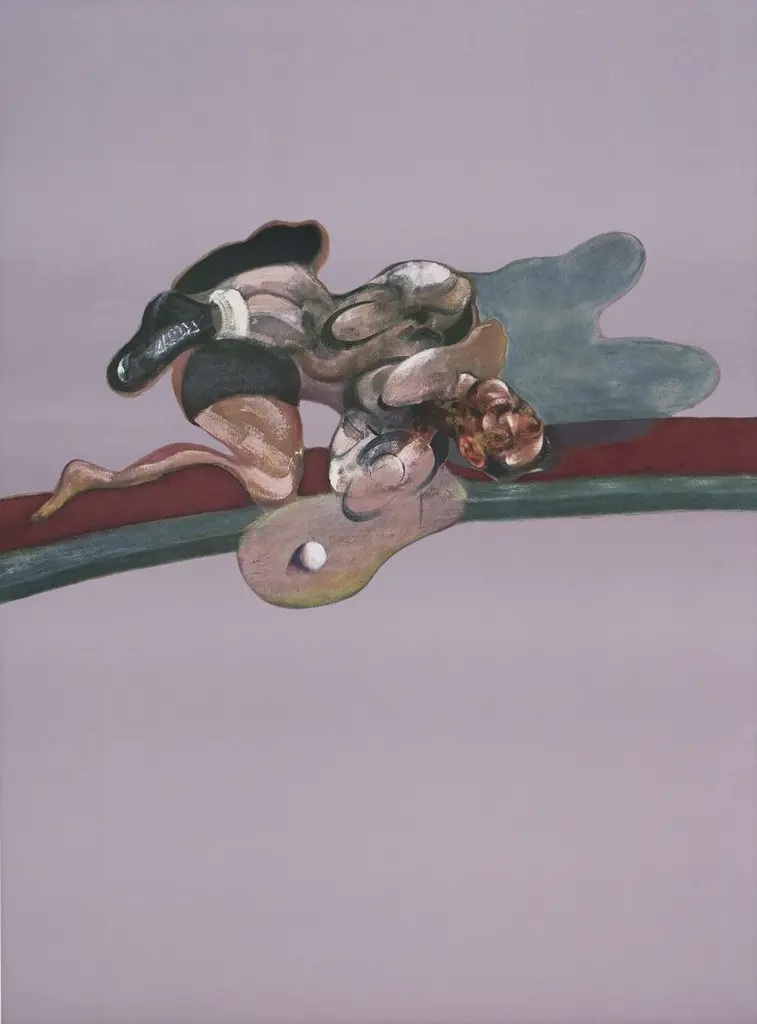
(Detail of ) Triptych – In Memory of George Dyer, 1971
The modern Irish master
You don’t have to travel all the way to the Tate Britain in London to
see a unique piece of Francis Bacon’s legacy, says Caroline O’Leary
Trinity News, Ireland's oldest college newspaper, Monday, 13 October, 2008
As a country, Ireland prides itself on its cultural talent, having produced four Nobel Prize winners for literature and many important figures in the areas of acting, theatre, film, poetry and more. Yet few Irish artists have truly succeeded in making their mark on the world canvas and distinguishing themselves outside of their home country. Painter Francis Bacon is a unique exception to this rule, an artist of such talent and innovation that his works are now almost equal in value to those of masters Pablo Picasso and Claude Monet.
Such is Bacon’s success that last year his work Triptych, 1976 sold at Sotheby’s auction house for a post-war record of €56.465 million, making it the twelfth most expensive painting ever sold. In celebration of Bacon and his career, a major retrospective exhibition of his work is now on show at the Tate Britain in London, coinciding with the centenary of the artist’s birth next year. This exhibition, the first since Bacon’s death in 1992, is a cross-section of the artist’s life and works, celebrating his unique talent and inspiring us to examine the life and painting of this enigmatic artist who we seem to so rarely notice.
At first glance, there is something about Bacon’s work that intrigues the viewer. Triptych August 1972 is a quintessential example of his technique. The flat, stark backgrounds throw the distorted foreground figures into high relief and expose the full extent of twisted limbs, gaping mouths and staring eyes. Curator of the Tate exhibition, Chris Stephens, describes Bacon as “probably the most important painter of the human figure ever.” Yet, as with Bacon’s greatest inspiration, Picasso, it is not the figures themselves that draw the viewer in but rather their unsettling manipulation. Such manipulation ranges from distorted limbs and features to the dissection of certain figures, exposing not only the blood and tissue that is common to man and animal but also the vulnerability they share.
A Francis Bacon painting is difficult to mistake, or, indeed, avoid and the artist was capable of both repulsing and fascinating the viewer – a rare ability possessed only by a few artists, such as master of surrealism, Salvador Dali. Also affecting the viewer is the texture of his works, a result of his preference for painting on the unprimed side of canvas and enhanced by his own deliberate “printing” with materials such as cotton, corduroy and cashmere. Looking at these paintings, you are transported into Bacon’s own garish world.
Bacon’s rather extraordinary life explains somewhat the inspiration behind both the artist’s subjects and his innovative techniques. Born in Dublin to English parents in 1909, his life reads like a bizarre, hedonistic soap opera. At the age of 16, he was banished from his Naas family home after being caught by his father cross-dressing in his mother’s underwear, the final nail in an already strained relationship with his family due to his homosexuality. Bacon then worked his way around London and later Europe, advertising himself as a “gentleman’s companion.”
The cultural influences of Paris and Berlin, specifically exhibitions of artists such as Picasso and Nicolas Poussin, eventually inspired him to return to London and take up painting. Seemingly entirely self-taught, Bacon first began a business as a furniture designer and interior decorator before moving onto oil paintings and rugs with the support of well-connected friends.
His first and most important painting of that time was Three Studies for Figures at the Base of a Crucifixion, 1944, which established his signature style with its burnt orange backgrounds and stone gray monstrous figures. Based on the furies of ancient Greek mythology, the biomorphic quality of these characters are an obvious allusion to Picasso’s own distorted figures. The painting was both acclaimed for its originality and feared for its grotesque and unnerving creatures, the like of which had not been seen in art before.
Bacon’s talent and technique – and, thus, his acclaim – evolved steadily, but his personal life continued to be blighted with misfortune, something identifiable in his work. In particular, the suicide of his partner and muse George Dyer on the eve of his first major retrospective exhibition in 1973 can be seen in pieces such as In Memory of George Dyer and May-June 1973. In the latter, lost, shadowed figures of his former lover are presented in different poses and guises, expressing the figure’s dark, unhappy life and Bacon’s own grief at his loss. Less personal subjects were also dealt with in great detail, as can be seen in some of his most celebrated paintings, such as his series of studies based on Velázquez’s famous Portrait of Pope Innocent X.
After experiencing a difficult childhood in Ireland, Bacon was not a frequent visitor to his birth country. Yet, despite his constant travelling and home-base in London, his former partner John Edwards bequeathed the entire contents of Bacon’s studio to the Hugh Lane Gallery in Dublin after his death. Draft material and papers, originally gifted to friend Barry Joule, were later donated to form the Barry Joule Archive in Dublin.
These materials, particularly the studio, delighted critics by offing unprecedented insight into Bacon’s method, techniques and eccentricities. In his studio, one can find piles of paint cans, pastels, crumpled photographs with creases coloured in and even the paint-stained walls of the room, which he frequently used instead of palettes. The most real part of Bacon, in a sense, then, can be found in Dublin and, while his Tate exhibition will soon leave for Spain and New York, this studio will remain in the city and allow us to enjoy the genius of Ireland’s greatest artist.
Liver: A Fictional Organ With A Surface Anatomy Of
Four Lobes, By Will Self
You'll need a strong stomach for Self's stories
As the literary equivalent of Francis Bacon, Will Self continually challenges readers with biological overload. In Liver he has found an appropriate method of anatomy, via four pieces connected by the body's largest internal organ. Stepping into Self's world is like opening one of the Wellcome Institute's cabinets of medical curiosities.
We start with the portraiture of pickled specimens in "Foie Humain": the inhabitants of a Soho dive called the Plantation Club. The real-life Colony Room on Dean Street is hitting 60 and heading for closure, a watered-down version of its past persona now mainly famous for outliving its competitors, and self-conscious enough to host a trendy website, so it's appropriate that Self should restore some of its lustre with this stagger up its filthy Soho stairs. The characters who populate his drinking den are so closely drawn over their originals that I imagine the only reason they won't sue is that they're either dead or unwell. The Bacon comparison is openly invited; drinkers are described as having "their fleshy convolutions trapped in the gelatinous atmosphere like whelks in aspic".
The story captures this necrotic miniature universe exactly, autopsying the alkies as they submit to the gavage which leads to engorged livers, gin-blossomed features and a blurry reduction of thought that no longer differentiates between male and female, sin and redemption, or even life and death. It covers the demise of the club's Frankenstein-like owner Ian Board, after which the place could never be the same again – but it had collapsed long before, with the loss of the original patrons, so that we watch the decline of something already dead.
As Board's nose pales in death and the reluctant mourners are forced into natural light by the funeral, we gaze upon the denizens "who, even in the brilliance of a summer's day, have the dazed-grey look of ghetto-dwellers about to be relieved of their remaining teeth by Nazis with pliers". To coat these ghastly apparitions with a patina of nostalgia that actually makes their company desirable is a feat which deserves some kind of recognition, although the ending is harder to swallow than Ian's gin. A typescript of the story should perhaps be wedged on the shelf behind the Colony Room's bar, to yellow beside the shoddy accretions of the decades.
The remaining material is tangentially linked. There's a trip to Switzerland for a terminal liver-cancer patient seeking absolution, and a media-life-is-hell tale that doesn't ring true, featuring a copywriter in a Promethean trap. The last story, "Birdy Num Num", roars back to full strength as a gathering of users and abusers in a crepuscular London basement is conflated and contrasted with the antiseptic world inside an old Peter Sellers film, The Party.
What counts most throughout is Self's enthralling, muscular and sometimes even joyous use of language. His writing propels one of the greatest arguments for freedom of speech that I can think of; you may not like his subject matter but his obsidian brilliance is incontrovertible, shocking and humane.
Scraps of Bacon
Radio 4, 11.30am
Chris Campling, Radio Choice, The Times, October 2, 2008
Scraps Of Bacon investigates the rumours suggesting that artist Francis Bacon gave away works of art to settle outstanding debts.
Novelist James Maw turns investigator to uncover the truth about Bacon – a “bon viveur”, gambler and inveterate drinker who ran up enormous bills in the drinking dens of Soho. Maw, who met Bacon in Soho in 1983, tries to track down some of Bacon’s works of art and unravel the stories behind them.
Among those he hears from are the owners of the now defunct Wheeler’s Oyster Bar, where Bacon amassed such huge debts that he painted rare special commissions in lieu of payment. Bacon's electrician was another lucky beneficiary of the artist's largesse.
Padding the streets of Soho, Maw searches for the waiters, drinkers and tradesmen to whom the great painter was drawn. The programme also uncovers sides of Bacon which, until now, have rarely been glimpsed.
A Profoundly Personal Portrait by Francis Bacon
Highlights Christie’s October Auction
AUCTION NEWS | ART DAILY | ESTABLISHED IN 1996 | SUNDAY 28 SEPTEMBER 2008
LONDON. —
Christie’s will offer Francis Bacon’s Portrait of Henrietta Moraes at the Post-War and Contemporary Art Evening Sale on 19 October 2008 in London. An intimate painting which offers a fascinating insight into the characters who shaped the thriving bohemian scene of Soho in the 1960s, the work is expected to realise £5,500,000 to £7,500,000. The painting was acquired by the Hon. Garech Browne in 1970; he was a close, personal friend of Francis Bacon, as well as many of the other leading figures of the time including Lucian Freud, the poet Dom Moraes and the sitter, Henrietta Moraes. Garech Browne’s romantic home in the Wicklow mountains, Luggala, has been a creative centre of Irish culture for the last 50 years, and was described recently by U2’s Bono as ‘our epicentre’ and ‘our inspiration.’Pilar Ordovas, Head of Post-War and Contemporary Art, Christie’s London: ‘This portrait of Henrietta Moraes is a wonderful painting which offers a fascinating insight into life and the characters of 1960s Soho. The painting was bought by Garech Browne in 1970, shortly after it was painted, and has remained in his care since. Garech Browne’s influence on British and Irish culture in the last 50 years, combined with both the artist and the sitter of this work being close friends of his, makes it a wonderfully appealing painting which is sure to attract the interest of international collectors and institutions.’
The Hon. Garech Browne: ‘I remember well my years in Soho even sometimes with my younger brother Tara, who inspired the Beatles song ‘A Day in the Life’. We often went to the Gaston Berlemont’s French pub officially called the York Minster and had lunch with Francis, my first cousin Caroline Blackwood (then Caroline Freud) and Lucian in Wheelers restaurant with my mother. We would then proceed to the Colony Club where the proprietress Muriel Belcher, one of the three known women Bacon ever painted, told me I was the only “member” ever allowed in under the age of 12. Later, Lucian would take me to the Gargoyle Club where Johnny Minton, Francis Bacon and Stephen Spender were often to be found. I would not be allowed in by the bouncers so Lucian would put me under his long overcoat and I walked on his feet to gain entry. It was only the doorman and not the proprietors who felt that I should not be allowed in to meet such “disreputable people” at such a young age. Many of the inmates were to be painted by both Francis and Lucian.’
Henrietta Moraes was an integral character in Soho in the 1950s and 1960s, and she played a major part in making the scene so legendary. She was a great friend and drinking partner of artists, writers, musicians and poets, and she befriended Francis Bacon in the early 1950s before he had found fame. In the 1960s, Bacon turned to painting portraits of the people around him. He would ask John Deakin to take photographs of his proposed subjects, and then paint from the photographs themselves, ensuring that the presence of the sitter could not merge their appearance with the character and emotions which the artist wished to portray in them. The present work was painted in 1969; it is a profoundly personal portrait of one of the artist’s greatest friends, and a searing, universal exploration of the human condition, and of the battle that is life itself.
The portrait was acquired by the Hon. Garech Browne in 1970 in London, and inscribed by the sitter on the reverse of the canvas. The inscription reads: 'For the first time A vision of me by my friend Francis Bacon with Gareth [sic] at Luggala 30-6-76&7 I love y 2 good heavens Henrietta Moraes’. It has been exhibited at the Hugh Lane Municipal Gallery of Modern Art in Dublin in conjunction with the opening of the Bacon studio in its new permanent home; The Scottish National Gallery of Modern Art in Edinburgh; and the Kunsthalle in Hamburg. It will be on public view in London for the first time from 15 to 19 October at Christie’s South Kensington.
Garech Browne was born into the Guinness dynasty, his mother being Oonagh Guinness, the youngest of the three ‘Golden Guinness Girls’. In 1937, Ernest Guinness gave his daughter Oonagh the Luggala Estate as a wedding present and it fast became the gathering place for the Irish intelligentsia, as well as for artists and musicians from around the world. Garech Browne was first introduced to Lucian Freud at the age of 12 and he soon built friendships with many of the artists, musicians and poets of both London and Ireland, as Luggala continued to thrive as a creative centre for Irish culture. Garech Browne founded Claddagh Records and oversaw the founding of Irish group The Chieftains. He recorded traditional Irish music, as well as the works of Seamus Heaney, Ted Hughes and Robert Graves. Lucian Freud has painted his portraits, John Boorman chose Luggala as the setting for the film Excalibur and the house has hosted a diverse range of artistic guests including Mick Jagger, John Hurt, Patrick Kavanagh and Lucian Freud. In an article in Vogue in 2005, U2’s Bono stated that Luggala had ‘become our epicentre’ and was ‘our inspiration’.
Christie’s will present a series of exhibitions and auctions dedicated to Post-War and Contemporary art and 20th century Italian art from 15 to 21 October 2008, during a week when the international art world will gather in London for a showcase of contemporary art exhibitions and events including The Frieze Art Fair. A leading highlight is one of only two oil portraits of Francis Bacon (1909-1992) ever painted by Lucian Freud (b. 1922). The last known remaining oil portrait (the other was stolen from an exhibition in Berlin in 1988), the rarely-seen painting offers a tangible and intimate glimpse into the inspirational friendship of two of the greatest British artists of the 20th century. It will be exhibited to the public for the first time in London from 15 to 19 October at Christie’s, 85 Old Brompton Road, and is expected to realize £5 million to £7 million.
The auctions will take place
at the newly refurbished
salerooms at Christie’s, 8
King Street, St James’s, and
are scheduled as follows:
Sunday 19 October at 4pm:
Post-War and Contemporary
Art Evening Sale
Monday 20 October at 7pm:
The Italian Sale
Tuesday 21 October at 10am
and 2pm: Post-War and
Contemporary Art
The public exhibitions for
the sales will take place as
follows: Post-War and
Contemporary Art: 15 to 19
October 2008 at Christie’s,
85 Old Brompton Road

The Wild Shores of
Buggery
Francis Bacon: Anatomy of an Enigma
By Michael Peppiatt
(Constable 456pp £12.99 pbk)
Francis Bacon: Studies for a Portrait
By Michael Peppiatt
(Yale University Press 272pp £18.99)
JANE RYE | BOOK REVIEW | BIOGRAPHY | LITERARY REVIEW | OCTOBER, 2008
Michael Peppiatt was Francis Bacon’s close friend and self-acknowledged Boswell for thirty years, from the moment in 1963 when he lay in wait for Bacon in the French House hoping to interview the painter for his undergraduate magazine, and, instead of being sent on his way with a crashing snub, was swept off to lunch at Wheeler’s.
To sustain a friendship of thirty years with the seductive but dangerously unpredictable Bacon implies stamina (even close friends like Lucian Freud failed to stay the course), and not the least of the fascinations of Anatomy of an Enigma, his shrewd and fluent biography, is how on earth the author managed to make notes and recall conversations during and after the epic benders on which it was his privilege to accompany his hero.
Four years after Bacon’s death in 1992, Peppiatt wrote what he legitimately describes as ‘the first comprehensive account of the artist’s life and of his work, and the vital interaction of the two’, which is reissued here with ‘confidential’ new material. Studies for a Portrait contains recent essays on Bacon’s friendship with the French writer Michel Leiris, and an expanded account of his dealer and devoted factotum Valerie Beston, together with a good deal of recycled material, both books being published to coincide with the splendid Bacon retrospective at the Tate (11 September–4January) that celebrates the centenary of the artist’s birth.
One of the themes of Peppiatt’s biography is the way in which, although so engagingly revealing of himself and his art in conversation, the artist sought to control his legacy as assiduously as any contemporary politician by the suppression of early paintings and biographical information, and the deliberate creation of his own myth. Also, of course, he strongly resisted biographical interpretation of his work which he insisted ‘says’ nothing and ‘means’ nothing, just as he denied any narrative content. He wanted his paintings to be felt as sensation, not read and understood, and protected their mystery, we are told, ‘with the zeal of a priest preserving the sanctity of his shrine. Enigma was the lifeblood of an image.’ He might as well have saved his breath.
Peppiatt, while faithfully relaying Bacon’s arguments, compares his body of work to a murder mystery demanding solution, and although one may feel that Bacon is essentially right, and know that when the conjuror’s sleight of hand is explained there will be a sense of disappointment, and even loss, still the longing to know is paramount. Scholarship will inevitably try to deconstruct, if it can, all Bacon’s careful and potent mysteries. The dismantling of the artist’s studio with its famous deep litter of more or less artistic detritus, and its removal to Dublin, where every last crumpled snapshot and discarded sock had been recorded and analysed as a source of Bacon’s imagery, has given a great boost to the deconstruction process and uncovered exciting new sources such as Baron von Schrenck-Notzing’s photographs of mediums extruding ectoplasm. At the Tate retrospective, where 100 prime works are displayed chronologically, one room is devoted to this mainly photographic archive together with examples of the painted scrawls that caused such an outcry on their discovery a few years ago by appearing to out Bacon as a closet draughtsman.
Although afternoon drinking sessions in the Colony Room with Muriel Belcher may sound like purest hell, and the wilder shores of buggery are likely to remain unappealing territory for most of us, it is impossible not to be bowled over by Bacon’s vitality and the powers of endurance that made it possible for him to flourish on a regime of all-night eating, drinking and gambling, with perilous trawls after sadomasochistic sexual adventure (often ending in dreadful beatings), and very little sleep, followed by an arduous morning in the studio. Peppiatt reveals with beguiling detail the remarkable inconsistencies and paradoxes of Bacon’s life and character: the fishnet tights beneath the Savile Row trousers; the patrician dandy who dyed his hair with Cherry Blossom boot polish and cleaned his teeth with Vim; the gourmet who frequented dear old Dino’s in South Kensington; who was equally at home with intellectual society hostesses and with East End petty criminals and thugs, and shared his life for many years with a shoplifting nanny who slept on the kitchen table.
Peppiatt shows the open-handed generosity and disinterested acts of kindness that accompanied the undeniable cruelty, ruthlessness and deviousness, and there are frequent references to to Bacon’s tenderness — a quality not so easily discernable among the works at the Tate, but which is surely there, nevertheless, in the form of pity, and without which the horror would lose its impact. It is horrified pity that moves us in front of the creatures at the base of a crucifixion in Bacon’s first masterpiece. Their suffering makes them ferocious and repellent, and their ferocity makes them suffer; even the bellowing Pope, a male bully in petticoats, is both terrifying ogre and impotent victim. With the exception perhaps of the ghostly little ‘Crucifixion’ of 1933, Bacon’s extraordinary energy is apparent in almost every brushstroke, from the brilliant depiction of heavy tweed in ‘Figure Study I’ of 1945 (emulating the Old Masters’ expertise with lace and velvet) to the more frenetic, cartoon-like energy, the syrupy, exaggerated contours and brutalised flesh of later works. What John Rothenstein sedately referred to as ‘an innate capacity for the application of paint’ is as evident in the curdled, clotted paint of ‘Head II’ and the diaphanous washes from ‘Study from the Human Figure’ (both of 1949) as it is in ‘Jet of Water’ right at the end of his career.
Peppiatt’s generous, well-balanced biography is intimate without being self-obtrusive or possessive and it feels, somehow, trustworthy. One may not always subscribe to his interpretations of individual works, and some of the conclusions in this revised edition (for example, that Bacons choosing to be looked after by nuns when he was dying in Spain may indicate a deathbed retreat from his atheism) seem a bit far fetched. However, Anatomy of an Enigma will surely remain a uniquely authoritative and readable account of the man who once confided, it may sound pretentious but you see I have had the most extraordinary life. The life is more extraordinary than the paintings ... it would take a Proust to tell the story of my life, and who thought that round about now, sixty years later, we would be approaching the moment when we could decide whether his work was worthy, as he hoped, to take its place in the great European painting tradition.

Bacon: cleaned his teeth with Vim
Francis Bacon
Tate Britain
By JOHN MOLYNEUX | ART | EXHIBITIONS | SOCIALIST REVIEW | OCTOBER 2008
Reviewing an exhibition is an invitation to comment both on the exhibition as such and on the art presented. Since performing both tasks satisfactorily is impossible in the space available I shall concentrate on questions raised by Francis Bacon’s work and say only this about the exhibition. Bacon is now widely proclaimed the greatest British artist of the 20th century and this show offers a selection of his best paintings from each phase of his career — it contains all the really ‘iconic’ works such as the ‘screaming popes’, the Three Studies for Figures at the Base of a Crucifixion, the Dyer triptychs, the Self Portraits. For anyone interested in modern art this is definitely a show to see.
Regarding Bacon’s overall standing I would say that he is not one of those artists, like Pablo Picasso, Marcel Duchamp, Piet Mondrian or Andy Warhol, who drove modern art forward to new forms of visual representation, and changed it so fundamentally that it became possible to conceive of an athlete sprinting through the Tate Britain as a work of art. He is, however, one of those like Chaim Soutine or Alberto Giacometti, who, while using relatively traditional methods, made images of exceptional emotional power.
The source and nature of this emotional power remain much debated. One can point to a number of influences — Michelangelo, Diego Velazquez, Francisco Goya, Picasso, Giacometti, the photographs by Eadweard Muybridge among others — and to certain repeated techniques and devices. For example, the way he uses cage structures to suggest his subjects are prisoners or creatures on display; the way, often, they are placed on plinths, or beds, with a sense of space around them, so that they appear served up like meat or specimens on a dish; or the way he used cubist forms, in his portraits, to knead the flesh round the bones of the skull. But if these are some of the means by which Bacon achieved his effects they leave the driving force of those effects unidentified.
In other words, why is Bacon’s pope screaming? Alternatively, what or who is he screaming at? I pose this question not just as a means of interrogating Bacon’s best known image but also as a way into discussing the general purport of his work.
We don’t get a clear answer from Bacon himself. Like many artists he preferred to let his paintings speak for themselves, and his response to questions of this nature was to cite the visual sources of his imagery (Velazquez’s Pope Innocent X, the nurse’s scream in Battleship Potemkin) while saying nothing about its emotional sources.
Nevertheless, there is a range of plausible answers on offer. The pope is Bacon himself screaming at the fear and loneliness of being a gay man at a time when homosexuality was still a crime. The pope is the pope and Bacon screaming at the horrors of the world at the end of the war (Auschwitz, Hiroshima). The pope is the pope screaming at the wreckage of his faith in a godless world. The pope is Papa, Bacon’s brutal father, who attempted to beat his homosexuality out of him. This obvious Freudian interpretation was put to Bacon directly by the art critic David Sylvester in one of their famous interviews — Bacon simply deflected it.
The pope’s scream, like the figures at the base of a crucifixion, is Bacon’s visceral response to the human condition as a whole — a world of violence and despair, hopelessness and terror, essentially meaningless, in which we are all simply ‘meat’. There is probably truth in all these answers. Artists often choose images precisely because they carry multiple associations.
However there is no doubt that the final reading is the one favoured by the art establishment and by Tate Britain. This is because it enables them to assimilate Bacon to Michelangelo, Rembrandt and others, as a producer of ‘timeless’ truths about life and because it dovetails with the notion of an unchanging human nature. The bourgeoisie has a place for art that shows the horribleness of life, so long as they can also claim it shows that nothing can be done about it.
For this reason many on the left, including John Berger, have long been suspicious of, even hostile to, Bacon. And it has to be said that much of Bacon’s outlook was reactionary: he was a kind of Nietzschean, adhering to a sort of ‘exhilarated despair’, and a positive supporter of social inequality as part of ‘the texture of life’.
Nevertheless, I do not believe that the left should reject Bacon’s work, as opposed to his views, and I’m pleased that Berger has recently revised his judgment. The horror he so powerfully expressed is in reality a product not of human nature but of alienation, in all its aspects, internal and external, and that can be changed. Moreover those artists such as Franz Kafka, Samuel Beckett and Bacon, who look into the abyss, who take on the horror and stare it down, do, through their work, make a form of resistance, a defiance, from which we can benefit and draw hope, whether they did or not.
The Francis Bacon exhibition
is at the Tate Britain in
London until 4 January 2009
Architecture and Design in the Bacon Era: Texture
Mark Cousins
MARK COUSINS | LECTURE | TATE BRITAIN AUDITORIUM | 1 OCTOBER 2008
I can’t remember now whether it was in the catalogue of the current exhibition of Bacon or whether on it was on one of those panels but at some point there was a quotation from Bacon saying “I suppose in the end we’re just meat” and I wanted to try and start off, as it were, some thoughts about both texture and also materiality by considering some of the problems, what we might call the aesthetic problems, of meat especially in that difficult area that we call ugliness or which other people call ugliness, I want to try and suggest this evening this is not how it’s normally portrayed and if properly handled is an extremely powerful and valuable artistic and architectural instrument.
Let me invite you first to engage in a thought experiment. You look at some ones face as we scan some ones face we look, as it were, for signs of expression, in some sense for the way in which the face is thought to be able to represent emotions or states of mind or whatever. As we do it invariably we have a fantasy that this expression does not simply belong to the surface but it has a depth and we frequently actually experience that as a depth but of course it has this peculiarity because the depth is not remotely localised.
If we say he looked sad we don’t say it looked about two centimetres deep in the sadness of it. Now nowhere I think is it more remarkable than if you add in to this picture of a face which you experience partly through the dimension of the depth of its expression then imagine suddenly in some process, the face suddenly manifests a wound and you suddenly see that underneath the infinitesimally thin layer of skin there’s blood and there’s flesh and there’s bone; normally people have a kind of visceral turning away from this experience. Now if you try to follow through this action of turning away, we might wonder: what is it that we’re turning away from?...
The appearance of the wound indicates suddenly the collapse – a collapse of what; I mean, I’m going to say representation but I don’t mean it in a representational way. It’s as if I can’t continue having a fantasy about the depth of your sadness or the extent of your pleasure; I can’t do it any longer because, as it were, it is disrupted by the appearance of a wound. Essentially unless your medically knowledgeable, what you’re seeing, and I think Bacon was correct to use it in a general sense, is what he calls meat. Let’s kind of make a formula in some sense as saying: what meat is at a kind of level of experience, is almost the collapse of representation or of signification…
This collapse of representation is I think part of what we might call the experience of ugliness, the turning away, at which point we might begin to hypothesise that this is not what I think it is, it is what I think people experience it as; an experience of the ugly in that sense is this: it is without signification it is without being a part of the a space of representation, it is stuff, it is meat… People’s experience of the ugly – again I’m not saying that’s what it is –is a defence against this moment - a moment which is too raw and is too, almost, unnerving; we might say that the popular experience of the ugly is: it’s that which is there but at the same time, is perceived as it shouldn’t be there – or sometimes it’s the same but the other way round: it’s that which is not there but should be.
In Leroux’s novel The Phantom of the Opera there’s a wonderful moment when the scene shifter describes to the girls of the corps de ballet that he has seen the ghost in box five; he describes the ghost to the girls and he says, in a way in which logic itself can’t tolerate, but clearly we know exactly what he means, he says: and the ghost has no nose and that no nose is a horrible thing to look at. It’s something that isn’t there but should be… I want to suggest that one dimension of the achievement of Bacon is in a sense to take this problem on board directly and, in a way that it is very difficult to describe in his achievement, but has the achievement of as it were, bringing back meat into our understanding, bringing back meat into a kind of poetics, that which is always, as it were, normally excluded; I was at the exhibition on Sunday and it’s not just a question obviously of meat, it is those strange puddles of existence which you see so clearly in the three triptychs in homage to George Dyer – it is, indeed, a sublime moment…
Now in a sense all I’ve said is an attempt to say that what people describe as being ugly we should consider it a defence and if you can undo this defence, if, like Bacon, you can propel the spectator into the midst of meat and find it not only human but essentially human, then, as it were, you remove some of the defences which so often kind of disable, I don’t mind putting it bluntly, disable public taste. It is a struggle. Now if something like this is the case, that I’m more than aware that I haven’t said directly anything about architecture and texture, then one of the ways we might consider the issues this evening is to think within the scope of Bacon’s adult career what also happens within architecture to be able to do that: at the level of a certain materiality and at the level of texture, that is to say, to undermine the public defence against the ugly and actually to propel it towards something new and powerful and human not in a humanistic way but human almost in a somewhat unnerving way. Thank you very much.
Bacon painting to fetch €9.4m
A FRANCIS BACON portrait of his friend is expected
to fetch £7.5 million (€9.4m) at auction
IN FOCUS | IRISH EXAMINER | MONDAY, 29 SEPTEMBER 2008
The work has been owned by Garech Browne, a member of the Guinness brewing dynasty, since 1970, a year after it was painted. The portrait is of socialite Henrietta Moraes, who sat for several artists and was one of a small number of women that Bacon painted.
She became a close friend and Soho drinking partner of Bacon in the 1950s, before he found fame, and sat for the artist several times. The model inscribed the reverse of the canvas, which will go under-the-hammer at Christie’s Post-War and Contemporary Art sale in London on October 19.
Pilar Ordovas, head of post-war and contemporary art at Christie’s, said: “This portrait of Henrietta Moraes is a wonderful painting which offers a fascinating insight into life and the characters of 1960s Soho.” Earlier this year, Bacon’s 1967 work Study for Head of George Dyer sold for £13.8 million pounds at Sotheby’s in London.
Moraes, who died in 1998 and battled drink and drug addictions, was also painted by Lucian Freud. Browne, the seller of the painting, went on to become a patron of the arts. Bacon, who died in 1992, is currently the subject of a retrospective at Tate Britain.
Francis Bacon: Tragic Genius
By RICHARD LACAYO | TIME | THURSDAY, SEPTEMBER 25, 2008
Francis Bacon did for despair what Michelangelo did for faith. He made it majestic. The Bacon retrospective that just opened at Tate Britain in London is one of the most powerful shows I've seen in more than 40 years of museum-going. This is Bacon’s fifth retrospective, and by now his screaming Popes, wrestling lovers and tread-marked faces are so famous it’s impossible to make them new. But the Tate show, which runs until Jan. 4, does something better.
It brings almost five decades of Bacons together into a kind of collective cry, one that makes you realize how rare it is to see contemporary art that attempts, much less achieves, a genuine tragic dimension. Irony you can find in any gallery these days, also low comedy, puerile cool and enigma. But in a time that has its share of tragedy, where is the art that tries to strike an equivalent note? What we have no language for anymore, at least not in art, is acute pain. Except in room after room at the Tate, in a show that moves later to Madrid and New York City.
After the butchery of World War II, Bacon was one of the artists, along with Alberto Giacometti, Jean Dubuffet and a few others, who found a way to make the painted human figure plausible again by subjecting it to extreme pressure. The soft tissue of Bacon’s boiling men and women is wrenched, smeared and vaporized by their own drives and desires, and by whatever it is they do to one another. Their heads are fissured, their torsos are invertebrate; their limbs, stretched and exploded, truly deserve to be called extremities — because with Bacon the body is always in extremis.
For Bacon none of this was a statement about his particular life and times, though his life played a part in it, and so did his times. What Bacon was after was something deeper. He wanted to make the body the visible sign of the eternal devils of human nature, the dog beneath the skin that bares its fangs in war and in bed.
To do that he took whatever he needed from art history. From Poussin came the mouth of a screaming mother in The Massacre of the Innocents and from Degas the arched back of a woman bathing herself in a tub. He also drew on sources from far outside art, things like an illustrated medical text about illnesses of the mouth. He worked from reproductions, and from photographs of all kinds pinned to walls and scattered on the floor of his studios in a muck of paper, rags, used brushes and broken furniture that he dived back into for ideas.
But Picasso was the first source. In the central panel of one of Bacon’s great works from the 1970s, Triptych — In Memory of George Dyer, a shadowy man stands near the landing of a darkened stairwell, turning a tiny key in a lock. That key is surely borrowed from an odd creature doing the same in several of Picasso’s seaside pictures from the late 1920s, when he was flirting with Surrealism. Those elastic Picassos, with their biomorphic figures that are part human, part dirigible, part swollen breast or phallus, turned a key in Bacon. They showed him the way to the nightmare distortions of anatomy that he arrived at by the end of World War II, a time when living flesh had been twisted every which way.
One of the first of those images he set loose in public was Three Studies for Figures at the Base of a Crucifixion, a triptych he exhibited in 1945, when he was 35 years old. On three panels of bright reddish orange scuffed with grey, a trio of mutant figures grimace, snarl and bark. In two of them, the most expressive feature is the gaping mouth. What the eyes represent for most painters, the mouth was for Bacon, the locus of human identity. The mouth is what bites, suckles and howls at the moon. By contrast, the eyes in any face painted by him are likely to be missing entirely or smeared shut or obscured by a milky scrim. In Bacon’s pictures, the windows of the soul — not that he believed in the soul — always have the curtains drawn.
By the mid-1940s Bacon had been making art for almost two decades, but he had exhibited very little before the Three Studies. Until the postwar years, he was largely unknown except perhaps to the older men who supported him, his multitude of male pick-ups on the side and whatever clients he attracted for a time as an interior designer in London. Decades later, stripped of any associations with fashion or taste, the ghostly outlines of his Bauhaus-flavored interiors and steel-tube furnishings found their way into the stark spaces and barred enclosures of his paintings. You detect them for the first time in the series of paintings he made from the great Velázquez portrait of Pope Innocent X, in which Bacon’s flickering white perimeters form a cage for the Pontiff’s impotent fury.
Why a Pope? With Bacon there’s never one answer. His great gift was for conflation, visual and psychological, for compressing multiple possibilities into a single sliding form. From a 19th century photograph by Eadweard Muybridge he could take the squatting silhouette of a man and dissolve it within the outlines of a crouching boy attributed to Michelangelo. He could borrow the eyeglasses from a famous shot of a screaming nurse in Sergei Eisenstein’s Battleship Potemkin and perch them on a Pope’s nose. In the same way, the meaning of his screaming Pontiff in Head VI fluctuates. Trapped in a kind of isolation booth, where a thunderstorm of granular black strokes rains down on him, this Pope suggests the baying, baboon madness of authority. (Indeed, one source for the painting was a photo of Joseph Goebbels in full harangue.) Yet at the same time, he’s the face of the powerlessness sometimes even of absolute power.
And the same picture of the Holy Father could also bear traces of Bacon’s anguished dealings with his own father, a truculent English army officer turned horse trainer who moved the family to Ireland, where Bacon was born in 1909. "Eddie" Bacon eventually rejected his girlish son and, if Bacon’s not always reliable stories can be trusted, even had him whipped by stableboys to make a man of him.
But it’s always a mistake to understand Bacon’s work too quickly by way of his life. That’s true even of the ferocious triptychs he made after the suicide of his lover George Dyer, a onetime London hood who killed himself in their hotel room on the eve of Bacon’s 1971 Paris retrospective. With a picture like Triptych — August 1972 Bacon didn’t simply unload his grief. He used it to find his way to an even starker abbreviation of a pitiless world. All through the ’70s Bacon would flatten and simplify the spaces within which he put his liquid people. That made those places even colder and more clinical, and set off more sharply the wide passages of black he used as the threshold of mortality.
Not every Bacon is a triumph, however. As early as the mid-1950s, inspired by Van Gogh and by the keen sunlight of Tangiers, where he was spending much of his time in a miserable love affair, he attempted to work in brighter colors and with looser brushwork. The result was a few congested, conventionally expressionist canvases. But the movement to a high-key palette also opened the way to the orange, lilac and pale beige backgrounds that make his work of the ’60s and ’70s so unnerving, precisely because the agonized figures struggle in such bright spaces.
And by his last decade — he was 82 when he died in 1992 — Bacon was almost too fluent in his own idioms of despair. There are cluttered, over-determined pictures in the last galleries, where you watch him trying to find a way to make it new. But there are also great ones, like the 1991 Triptych. In all three panels, a large black square is placed like a window within a flat, beige background. In the center, a figure barely recognizable as human flows over the lower edge of the black square. On each side panel, Bacon appears as a painted photograph of his own head pinned to the space above a pair of disembodied legs. Each of these has one foot stepping into the blackness. It’s a portrait of the artist bowing out, dying as fearlessly as he lived. And without a trace of sentiment, making death majestic.
Old School Bad Boy’s Messy World
By MICHAEL KIMMELMAN | ABROAD | THE NEW YORK TIMES | WEDNESDAY, SEPTEMBER 24, 2008
LONDON — That the Francis Bacon retrospective here at Tate Britain has been mobbed since opening several days ago should surprise nobody. The show is a landmark, a knockout, and its timing turns out to be nearly perfect. Sixteen years have passed since the Irish-born Bacon died, at 82, during which the art world has radically changed, and the generation of Americans weaned on postwar abstraction and congenitally skeptical of Bacon is being gradually displaced.
The other day there were dozens of young art students, not a few of them sketching, in front of the pictures. I suspect the same will happen when the show, judiciously organized by Matthew Gale and Chris Stephens, lands in Madrid, then New York. Bacon suddenly looks fresh.
How so? Late in life, it’s true, he became, contrary to his sensational art, a sort of old-school gentleman, chivalrous and immensely kind when he wished to be, reticent otherwise, a monument of postwar Britain who, for a curious guest, would rehearse the old lines and visit old haunts like the Colony Room, the run-down drinking club where he paid for bottles of Champagne from a thick wad of cash he kept rolled up, à la Al Capone, in a pocket of his suit. (The ill-fitting suits, long after he could afford Savile Row, came from a neighbourhood tailor to whom, typical of Bacon, he remained loyal.)
In those days he was painting works like a second version of the triptych Three Studies for Figures at the Base of a Crucifixion, the original of which in the mid-1940s had confronted a battered, convalescent nation with what’s commonly called the shock of recognition. Now he was remaking the work, as his friend the painter Lawrence Gowing put it about late Bacon generally, to look more “classically serene.”
“I’m an optimist, but about nothing,” Bacon kept repeating, while lamenting his old age as “a disease, a desert, because all one’s friends die.” He loved to quote Yeats and Proust and T.S. Eliot and remained enmeshed in what Michael Leja, an American art historian, has in a different context called “Modern Man discourse” — a serious hand-me-down passel of existentialism and other philosophy from the 1940s and ’50s, popularized, as David Alan Mellor writes in an essay in the show’s excellent catalogue, by the claustrophobic spaces of film noir. This netherworld of dingy hallways and shuttered rooms had long been the arena of Bacon’s art.
So in various respects, by his late 70s, Bacon had come to seem something of a throwback; it was widely said his best work was behind him. But since then historians have mined the sources from which he cribbed images and opened up the crucial subject of gay sexuality in his work, which was long repressed, and this, along with his bad-boy reputation, which never goes out of fashion, has made him a source of steady fascination, never mind the lurid films and biographies and the admiration of art-world celebrities like Damien Hirst. Most important, with the breathing space of a little time, it’s become obvious how pure a painter he was, not just early on.
His repertory — “brand” would be the word Mr. Hirst might use — of bloody carcasses and monsters; the mutilated, decomposing heads with immaculate teeth; the mangy dogs and screaming popes and salary men, silent and watchful, caged like zoo animals, then enclosed behind the gold frames and reflective glass, in which we too appear like ghosts: it’s all already there in his work by the mid-1950s.
So is the touch. In Figure Study I or Head II, from the ’40s, the surfaces are busy and dense like stucco or tweed, or thick as an elephant’s hide, but with exquisite veils on top — a mix of roughness and fragility, aggression and sensuality that would define the work across the career. Bacon also swiped thin washes of purple, black and white over what looks like raw canvas to paint his first pope, fussing the gaping mouth, creepily. Spectral hints of gold brocade, refined like Chinese calligraphy, glimmer in the ether.
Elsewhere beefy men wrestle and dive into pools of blue-black nothingness. Against high-key fields of red and orange, half-animal, half-human blobs recline like patients on an operating table or they melt and evaporate. Bacon traveled during the late ’50s to Tangier, absorbing local color, allowing his technique to loosen, producing Study for a Portrait of van Gogh VI, a clangorous mass of red and green, improbably successful, and he painted a few messes too, like Figure in a Mountain.
Out of all of that came, by the ’70s and ’80s, we can see in the Tate show, yet more complex architecture, a widened palette, and a calculated willingness to risk failure. Within the narrow terrain he mapped at the start, with its melancholy and blend of private with literary iconography, Bacon didn’t just repeat himself.
Several triptychs and portraits, reflecting on the suicide of his companion George Dyer in 1971, mark a clear experiment in conflicted sentiment; they’re heartbreaking but simultaneously clinical. As a friend of Bacon’s, the editor Nikos Stangos, once put it, Bacon “never expressed moral indignation about anything.” That in a nutshell explains the work’s ruthless elegance.
Some really appalling late pictures, like a large triptych from 1976, which some squillionaire recently paid a fortune to buy, look horribly overstuffed with ugly heads and tired gimmicks, as if Bacon, worried he had exhausted the empty stretches of color he so often painted, didn’t know when to stop filling the canvas up. Whether, during these last decades, he came merely to parody himself, painting too slickly, is the only real subject of debate the exhibition has aroused. The answer is, yes, sometimes he did.
All the same, he made, out of the blue, Jet of Water, a great ejaculation of splashed white pigment, which looks stunning. Despite his blindness to pure abstraction — which, having a tendency toward decorativeness, he feared led only to empty gesture — he devised a Rothko-like picture, sinister and wry, called Blood on Pavement. Even the second version of that early triptych of figures at the base of a crucifixion turns out to have its own eloquence, almost daring a viewer to find it too beautiful.
Cunning and self-conscious, glad to outrage, with the delicacy of those blurry but somehow distinct faces and electric palette, conjuring up Carnaby Street, his work translates quite easily to a new century. So does the sweaty sex and violence, luxuriant but couched in aloofness and girded, always, by grand allusions to old masters and learned texts.
Karl Georg Büchner, the 19th-century German playwright, speaking of which, once asked a question that Bacon must have come across. “How,” Büchner inquired, “can you not hear the terrible screams all around that we call silence?” Through the popes and Willy Lomans and so much else that Bacon painted, they make this exhibition sing.

Figure Study I, a work in the Francis Bacon retrospective through Jan. 4 at Tate Britain
Bringing Home Francis Bacon:
The Tate Britain Retrospective
and The Colony Room
JOHN DORAN | FEATURES | THE QUIETUS | WEDNESDAY, SEPTEMBER 24, 2008
"If you see someone lying on the pavement in the sunlight, with the blood streaming from him,
that is in itself – the colour of the blood against the pavement – is very invigorating . . . exhilarating."
It is perhaps fitting that the most important retrospective of the work of Francis Bacon – the greatest British painter of the 20th Century – opened in the same week as his old watering hole, The Colony Room called last orders for the final time. You probably didn’t have to strain too hard to hear the spectral voice of Muriel Belcher snapping waspishly: "Don’t let the door hit you on the way out, cunty", as the last of the disparate crew of drinkers dispersed into Soho for the last time; descending its creaking wooden stairs past the sign that announced sternly: "This Is Not A Brothel".
The first time I ascended those stairs I nearly got knocked back down again by John Hurt who was being helped on his way by alcohol, gravity and a gentle push from some burly chaps, who shouted after him: "Fuck off!" I was signed in by a journalist friend; even then the membership was on the wrong side of £500 per year. It was a lot of money just to have access to a bar ("Don’t call it a club – they’ll tear your eyes out") not much bigger than the bathroom of your average Wetherspoons dive. The dingy green paint work ("Emerald? EMERALD?! That’s bloody peacock green!") contained a motley bunch of characters; professional ponces, the almost destitute aristocracy, resting poets and actors, artists – all of them entertaining; all of them thirsty.
While waiting for a drink I noticed a slightly nicotine enhanced Damien Hirst spot painting propped up behind the optics, gathering ash and other detritus, money knocked off its six figure value with every shot of whisky poured no doubt. (The urbane manager Michael Wojas told me that if the insurance on the art contained in the little space got any more expensive then he’d have to shut up shop for sure – perhaps this is what happened? One thirsty punter Michael Andrews had his slate cleaned in return for painting a mural for the bar known as Muriel’s. It is estimated this piece will fetch around £30,000 when auctioned this month.) It was, they said, the anti-Cheers. A bar where everyone knew your name but called you cunt all the same.
A good looking woman of indeterminate age spied me and announced: "Darling, there’s something wrong with my tits. Would you give them a squeeze for me please?"
I stuttered for a second before she grabbed my hands and placed them on her chest. "Go on!" she yelled. "Give them a good squeeze." I obliged and she demanded: "Well?"
"They’re fine."
"FINE?!"
"They’re fabulous, I mean."
She brightened, released my hands and said: "Excellent. EXCELLENT! You’d better buy me a gin and tonic then!"
I reeled from punter to punter who in turn reeled me in. I stood at the bar ordering a G&T while some clattered posh guy told me about the ideal shoes to wear for fighting. ("For God’s sake don’t wear sandals or Wellington boots.") What a bunch of freaks. I felt immediately at home.
Later on that evening, the atmosphere of the room changed immediately when the loud and rambunctious crowd became respectful and parted for Francis Bacon’s brother, who had come to visit patrons of the bar.
"In all the motor accidents I’ve seen, people strewn across the road, the first thing you think of is the strange beauty — the vision of it, before you think of trying to do anything. It’s to do with the unusualness of it. I once saw a bad car accident on a large road, and the bodies were strewn about with broken glass from the car, and the blood and various possessions, and it was in fact very beautiful. I think the beauty in it is terribly elusive, but it just happened to be in the disposition of the bodies, the way they lay and the blood, and perhaps it was also because it was not a thing one was used to seeing . . . It was midday, when the sun was very strong and on a white road."
Francis Bacon was The Colony Room’s first ever regular. It opened its doors in 1949 and he had just had his first one man show and painted Head VI the iconic painting of a screaming bishop in a clear box that the Tate have used on their posters for the retrospective. However he was far from established — he also became a tout for Muriel’s that year. He was paid £10 a week and given free drinks, just to hang around in the bar. He at once attracted and repelled the right and wrong sort of people respectively to the afternoon drinking den. The focal point of the painting is the gaping mouth screaming in fear, with the rest of the face obscured by thick, vertical lines of black paint, leaving masses of inverted canvass still bare. It was as if he had taken sandpaper to the vision of the surrealists and the American abstract impressionists who had captured the imagination before the war, scrubbing away at the cinematic visions leaving just bloody and raw reality in place. A religious figure experiencing nihilistic terror predicted a bleak second half of the 20th Century. The paint on the earliest surviving Bacon pieces (exhibited here) was still drying when the Potsdam Agreement was being finalized at the end of World War II but there was no VE Day for the painter. He proceeded immediately from WWII to the cold war as he’d proceeded directly from a strict, middle class Irish Catholic upbringing to a life of brutal masochism in the flesh pots of Soho and Tangiers. From enforced and hypocritical civility to bestial aggression.
The strips of bare canvas acted as a reminder of the reality of what you were looking at. He stripped away at the layers between viewer and painting in other ways as well. Early works showed a fascination with the bared teeth of the baboon, which would scream from the outline of a human bust (Head I 1947). Man’s brutalizing nature had been exposed permanently by the war; it was impossible to disguise the fact any more. This theme would always be with him. His unsettling picture of Peter Lacy (Study For A Portrait 1953), mocks us by thrusting our own mortality in our faces; his rictus, skeleton grin, pokes through the flesh of his face. We were animals, there was no pretending any otherwise.
"Nietzsche forecast our future for us — he was the Cassandra of the nineteenth century — he told us all it’s all so meaningless we might as well be extraordinary."
To Bacon, the body was a cage and he showed it captured and capturing; his subjects were pinned to the canvas as if by a lepidopterist. Arrows, pins, Nazi arm bands, hyperdermic syringes held the wriggling carcasses in place. In the 40s and 50s he favoured implacable vertical stripes of paint that looked like prison bars (it’s widely held that Jonathan Demme based Hannibal Lecter’s perspex cage in Silence Of The Lambs on a Bacon painting). He expanded this further when started portraying subjects inside a 'space frame', thin white lines suggesting a translucent cage restricting movement within the painting itself. Through his screaming bishops (such as Study After Velazquez’s Portrait of Pope Innocent X 1953) he put religion itself on trial as if it were Adolf Eichman 'the architect of the Holocaust' on trial in Israel.
His detractors saw his paintings as an expression of the nihilism and self-loathing of a masochistic and alcoholic homosexual — and such is the power of his vision, some still see him like this. Bacon saw beauty in the horror of our condition though. The sublime pleasure of the here and now replacing supernatural belief and arbitrary morality. While it was true he had a drink problem, he probably wasn’t an alcoholic but rather he liked their company. He spent a lot of his time in places like The Colony it is true but his modus operandi was to buy others drinks, constantly topping up everyone else’s glass and slopping the rest on the floor. He certainly drank less than his lovers, and especially less than George Dyer who was the muse for so many of Bacon’s masterpieces, including the stunning Triptych May—June 1973 painted after the suicide of the subject in Paris. The panels show him shitting, vomiting and dying, no longer trapped by life. And even here Bacon finds a moving beauty in the indignities of life that very few other painters have ever dealt in let alone captured.
Francis Bacon Tate Britain 11 September 2008 – 4 January 2009
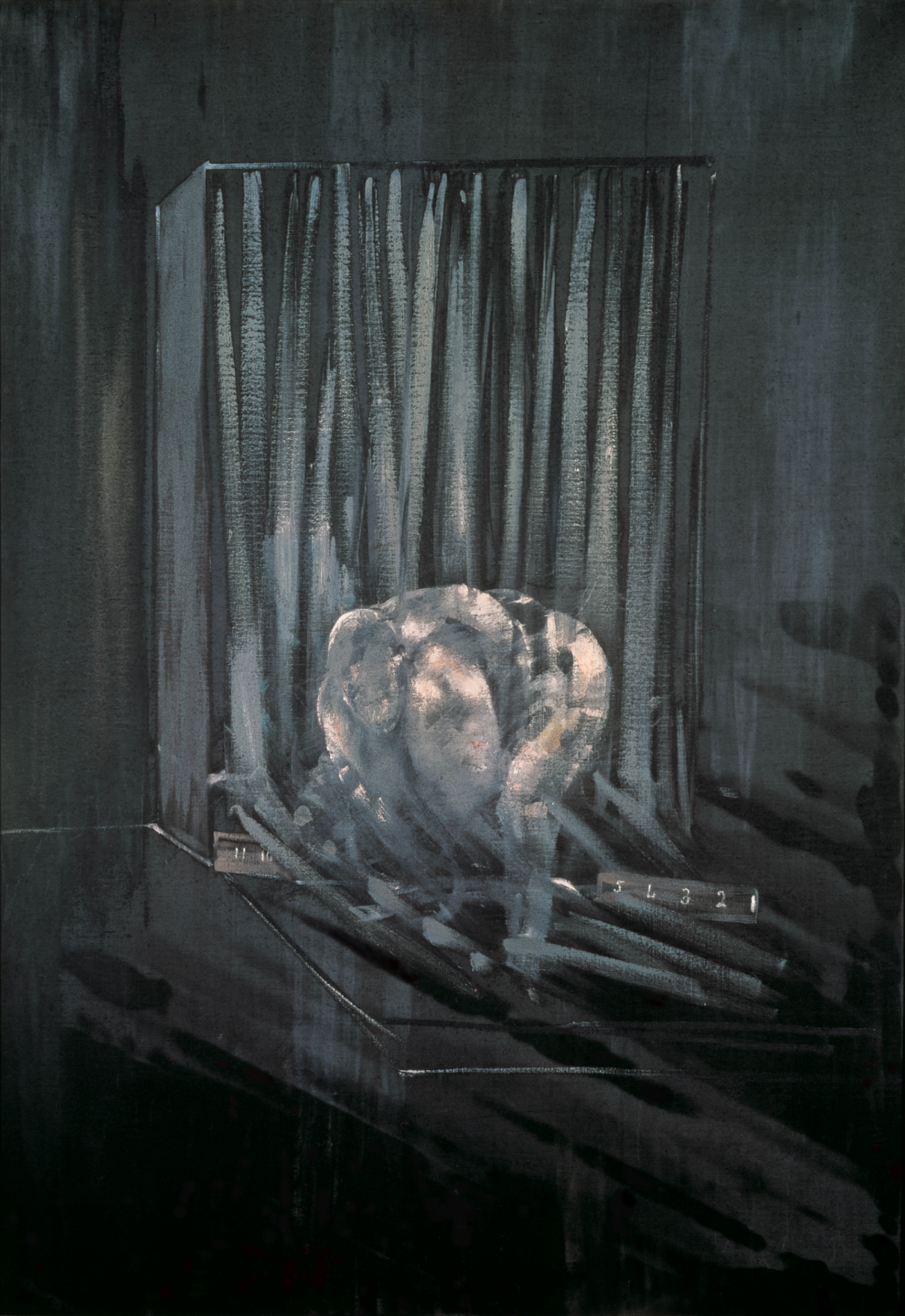
Bacon Portrait of
Model May Fetch 7.5 Million
Pounds in London
BY SCOTT REYBURN | MARKET
NEWS
|
BLOOMBERG | WEDNESDAY,
SEPTEMBER 24, 2008
Sept. 24 (Bloomberg)
– A Francis Bacon painting
of his friend Henrietta
Morase, one of the few women
the artist painted, is
expected to fetch as much as
7.5 million pounds ($13.9
million) when it comes up
for auction in London.
The 14-inch-high
(36-centimeter)
head-and-shoulders portrait,
showing the sitter turning
to her left against a plain
yellow background, will be
included in Christie’s
International’s Oct. 19 sale
of contemporary art, the
auction house said in an e-
mailed statement. The sale
takes place on the
concluding Sunday of the
Frieze Art Fair.
Moraes, a model, was a close
friend of Bacon’s during the
1950s and 1960s, spending
evenings drinking with him,
Lucien Freud and other Soho
bohemians at the Colony Room
Club. Bacon included Moraes
in a number of his paintings
using photos taken of her by
John Deakin.
Dating from 1969, Portrait
of Henrietta Moraes has
been put up for sale by
fellow Colony Room regular
Garech Browne, a member of
the Guinness family, who
bought the work in 1970. The
painting is inscribed by
Moraes on the back of the
canvas.
"I remember well my years in
Soho,'' Browne said in the
e-mailed release. He met
Freud at the age of 12.
"Lucian would take me to the
Gargoyle Club where Johnny
Minton, Francis Bacon and
Stephen Spender were often
to be found. I would not be
allowed in by the bouncers
so Lucian would put me under
his long overcoat and I
walked on his feet to gain
entry.''
Browne went on to found
Claddagh Records and oversee
the formation of the Irish
folk group the Chieftains,
said Christie’s. In July at
Sotheby’s, in London a
similar-sized 1967 Study
for Head of George Dyer by
Bacon sold for 13.8 million
pounds with fees, said the
saleroom result tracker
Artnet.
Bacon is the subject of a
retrospective exhibition at
Tate Britain that runs
through Jan. 4, 2009. Moraes
battled drink and drug
addictions, had many lovers,
once shared a flat with
singer Marieanne Faithful
and was sent to prison after
an unsuccessful attempt to
become a cat burglar.
BY VALERIE
GLADSTONE | NEW YORK SUN
| WEDNESDAY, SEPTEMBER 24,
2008
LONDON — Art lovers will
soon be able to take a
picturesque boat ride on the
Thames River between two of
the most important museum
exhibitions of the year.
Tate Britain is celebrating
the centenary of Francis
Bacon, widely regarded as
Britain’s greatest painter,
by bringing together 70
works never before shown in
one exhibition and
representing every period of
his life. Later this month,
the museum’s provocative
young sibling, the Tate
Modern, will feature the
first major exhibition
dedicated to the late works
of Mark Rothko (1903-70),
the American painter who
created a new and
impassioned form of abstract
painting. The show includes
more than 50 paintings and
works on paper from between
1958 and 1970. For the first
time, 15 of Rothko’s
monumental Seagram murals
will be shown alongside more
than 30 other landmark
paintings. Coincidentally,
sales of Bacon’s and
Rothko’s paintings broke
records for sales of postwar
art at Sotheby’s last May, a
work by Bacon fetching $52.7
million and one by Rothko,
$72.8 million.
"What’s particularly
interesting about this Bacon
show," a Tate Modern
curator, Matthew Gale, said,
"is that it looks back on
his career in light of new
research that emerged with
the opening up of his studio
and its contents since his
death. Altogether new
aspects of the man have been
revealed that shed enormous
light on his visual
lexicon."
Bacon was born in Dublin to
English parents. His studio
was recently dismantled and
then reconstructed within
the Dublin City Gallery. As
a result, scholars have been
able to evaluate more than
7,500 objects related to the
artist. These include
illustrated publications,
photographs, press cuttings,
notes, drawings, medical
textbooks, books on psychic
phenomena, artists’
materials — among them
several pairs of corduroy
trousers used to apply paint
— and slashed canvases.
Through them, scholars now
better understand Bacon’s
working methods and sources
of inspiration. Some objects
will be exhibited in an
archival room adjacent to
the paintings’ galleries.
Mr. Gale co-curated the
exhibition with Chris
Stephens, head of displays
at Tate Britain.
"We learned that he took far
longer to paint his works
than he admitted to," Mr.
Gale said. "And that he
extensively used photographs
and other illustrative
material. He drew
inspiration from things as
disparate as the works of
Michelangelo and Eliot’s
'The Wasteland.' We now
better understand the
incredible processing that
he went through to make his
art."
To demonstrate the relevance
of Bacon’s sources, such as
clinical representations of
animals and emotional
landscapes, these objects
will be displayed next to
his representations of the
body. In Three Studies
for Figures at the Base of
Crucifixion (1945),
which features writhing
half-human, half-animal
forms, he overthrew artistic
conventions by using the
triptych format of
Renaissance altarpieces to
show the evils of man,
rather than the virtues of
Christ. While this work has
long been at the Tate, in
this exhibition it will be
shown for the first time
with other related,
celebrated paintings and
triptychs including Study
after Velazquez’s Portrait
of the Pope Innocent X (1953), Crucifixion (1965),
and In Memory of George
Dyer (1971).
"What I find amazing," Mr.
Gale said, "is that even
after all the preparation
for this exhibition, looking
at Bacon’s paintings still
makes my spine tingle. I
never stop being
overwhelmed."
The curator of Modern and
Contemporary art at Tate
Modern, Achim Borchardt-Hume,
who organized the Rothko
exhibition, is equally
passionate about his
subject. "The key to this
period," he said, "is the 30
monumental Seagram murals
that Rothko made between
1958 and 1959 for the Four
Seasons Restaurant [within
New York’s Seagram
building]. He never gave
them to the restaurant
because he eventually felt
they wouldn’t be appropriate
there, and toward the end of
his life donated nine of
them to the Tate because of
his love of our Turners."
Rothko wanted the works to
be shown together, and so
the museum created the
Rothko Room. Other important
Rothko murals were borrowed
from Japan’s Kawamura
Memorial Museum and
Washington’s National
Gallery for this exhibit.
"It is a huge coup for the
Tate to have the loan from
the Kawamura, which never
lent works to an
international exhibition
before," Mr. Borchardt-Hume
said. Shown with Rothko’s Black-Form and Black
on Gray paintings and
his Brown on Gray works
on paper, the result is a
very different impression of
the artist.
Maintaining his focus on
formal elements, such as
colour, shape, balance,
depth, composition, and
scale, Rothko began to
darken his palette
dramatically during this
period, turning from bright,
intense colours to deep red,
maroon, brown, and black. He
also turned from closed
forms to open ones that look
like a threshold or
entrance. "I believe he
would have wanted viewers to
see these together," Mr.
Borchardt-Hume said. "Like
his chapel in Houston, they
create a meditative
experience. They need time
to be appreciated. Only as
you look carefully do your
eyes begin to adjust. It’s a
curious dynamic, almost like
listening to music."
After London, the Bacon
exhibition will travel to
the Prado Museum in Madrid
from February 3 to April 19,
and then to the Metropolitan
Museum of Art from May 18 to
August 16. The Rothko show
will travel to the Kawamura
Memorial Museum of Art in
spring 2009.
Francis Bacon,
until January 4 at the Tate
Britain Mark Rothko,
September 26 to February 1
at the Tate Modern
Bacon and Rothko in
London
Painting
that packs a punch
He may be the newly crowned darling of the auction world, but
Francis Bacon’s work can still raise the hairs on your neck
ELIZABETH RENZETTI | GLOBE & MAIL | TUESDAY, SEPTEMBER 23, 2008
LONDON — News arrived recently that it will soon be last call at the Colony Room, that dank thimble of iniquity above the streets of Soho. During the 1950s and 1960s, the club’s proprietor, Muriel Belcher, presided like a foul-mouthed mother hen, referring to male patrons as "she" (and worse) and railing against the actions of "that nasty Mrs. Hitler." Dylan Thomas once graced the floor with his evening’s alcohol intake. Artists and tradesmen were indistinguishable under cover of booze and profanity.
On most days, Francis Bacon could be found at the bar. At last orders, he would be bounced out with the other patrons, celebrated or not — the Colony did not discriminate — to begin a nocturnal adventure than might include gambling, rough sex and almost certainly more drinking. Whatever the evening had brought, the morning would find him at his Chelsea studio, painting.
As Tate Britain launches its new Bacon retrospective (a highlight, along with the Mark Rothko exhibition at Tate Modern, of London’s gallery season), it’s odd to think how the life of the painter, who was so secretive and so resistant to biographical interpretations of his work, has come to the forefront of the public imagination. "I have had the most extraordinary life," he told his friend and biographer Michael Peppiatt. "The life is more extraordinary than the paintings."The paintings, however, will long outlive Bacon, who died at the age of 82 in 1992. What a strange journey it has been: The man whose life was so outré, whose art was once so shocking that it was the subject of obscenity complaints, who viewed human flesh as meat (meat to be beautifully rendered on canvas, but still), is now the darling of the corporate world and the auction house.
Bank of America is sponsoring the show, which is the Tate’s third Bacon retrospective; this year, he became the world’s bestselling artist, with his work fetching $190-million in one year alone. (One painting, Triptych, 1976, sold for $89-million in New York this spring.)
In the 6½ decades since Bacon’s first major shows, we have had pickled sharks and sacred religious figures modelled in excreta, so what are the chances of a neck-prickling experience with mere painting, especially ones so familiar from reproductions? But Head VI, in the first room of the eight rooms of the exhibition, is still as jarring as a shriek in a quiet room. Painted in 1949, it’s the first of the "screaming pope" pictures (responding to Velazquez’s Portrait of Pope Innocent X), the figure’s gaping mouth intended by Bacon to be "like a Monet sunset."As a young man living in London — he had been expelled from the family home in Ireland at the age of 16, possibly for wearing his mother’s underpants — Bacon would visit the food hall at Harrods to study slabs of raw meat. He was deeply influenced by Sergei Eisenstein’s Battleship Potemkin, and the film’s screaming nurse was a likely source for the gaping mouth-wounds that recur in his work.
"Is the snarling mouth aggression or pain? It’s not clear," says the exhibition’s co-curator, Chris Stephens, standing in front of the Man in Blue series from the mid-1950s. Anyone who doubts Bacon’s relevance to the contemporary world should check out these paintings, which could be titled Mad Men, This is Your Life. In each, the figure is dressed in a sharp suit and narrow tie, spectral face obscured but for the grimacing mouth, shoulders hunched and hands clenched, hemmed in by a claustrophobic blue background. If the point isn’t clear enough, Bacon’s painting of a shrieking baboon hangs in the same room: The only thing that separates us from the monkeys is that we learned to weave cloth and lie.
Stephens and his co-curator, Matthew Gale, have gathered 65 of the major works, with a couple of aims in mind: The first, says Stephens, to demonstrate Bacon’s "passionate embrace of a Nietzschean atheism, that man exists in a godless state." One room has been set aside for Bacon’s three major crucifixion triptychs, with their howling, tormented figures set against livid orange backgrounds.
The first, 1944’s Three Studies for Figures at the Base of a Crucifixion, brought Bacon shuddering into the public consciousness, as it was shown in the same month that the Allies liberated the death camps. In the other crucifixions, painted 20 years later, each panel is filled with senseless meat where in previous centuries the viewer would have found the glowing symbolism of afterworldly reward. Indeed, the curators have done such a good job in these eight relentless rooms that they perhaps should have set aside a stall at the end of the show for the distribution of Valium and nooses.
Maybe Bacon couldn’t escape a brutal world view, given his early life — though he would surely have hurled abuse at such easy psychobiography. Born in 1909 to English parents in Ireland, Bacon was weedy and asthmatic and a constant disappointment to his overbearing father, who had the boy whipped by the family grooms for any transgressions (this, according to the Bacon myth, is what gave him his taste for sadomasochism.) He was chucked out at 16, and wandered through the decadence of Berlin and the richness of Paris before settling in London. He taught himself to paint, but he was a bitter self-critic and after early ambivalence from the art world gave up for 10 years, and destroyed most of what he painted in the 1930s and early 1940s.
A giant photograph of Bacon’s studio dominates one of the rooms in the exhibition, although it looks less like a studio than a paint shop ransacked by a pack of Tasmanian devils. The floor is ankle deep in paper; hundreds of brushes are jammed into pots; stacks of books teeter in every corner (with a giant volume about Velazquez on top). Bacon was a compulsive collector of images — from medical books, newspapers, films, anywhere. A radiology textbook was as valuable as a newspaper clipping of a dying matador. His celebrated male nudes — it’s unclear whether they’re scrapping or loving, or possibly both at the same time — were inspired by Eadweard Muybridge’s photos of Victorian wrestlers.
This is the other thread the curators drew upon — Bacon as the link between painting and photography, the artist most forcefully concerned with how to truthfully express the human figure in the age of the photograph.
"He could only paint people he knew," Stephens says, "and only in their absence." To that end, Bacon got his friend John Deakin to take pictures of the people central to his life: Muriel Belcher and artist Isabel Rawsthorne, his lovers Peter Lacy and George Dyer. The original photos are here, crumpled and torn and paint-spattered, a reminder of the roughness Bacon often showed to the people who loved him.
Dyer killed himself in a Paris hotel room the day before Bacon’s major retrospective opened at the Grand Palais in 1971. He had already been a subject of several portraits, many of them at the Tate, in which he often looks ill at ease, his body twisted as he looks in a mirror or awkwardly rides a bicycle. Immediately after his death, Bacon began work a new triptych to memorialize his former lover; in it, he’s fleshy, muscular, even a touch heroic.
For Stephens, the portraits of this period are "some of the great achievements of postwar painting." The subject matter may, unfairly, overshadow the technique, and so viewers are encouraged to get up close to the canvases, to see how Bacon layered and endlessly worked the paint — often using trousers or old shirts he had lying around the studio.
If Bacon resisted attributing any kind of meaning or narrative to his paintings, equally he was looking for that spark, the alchemy that happens when image and paint, foreground and background come together to deliver the equivalent of a roundhouse punch. How uncanny that someone often considered the greatest postwar painter, whose works are the centrepieces of auctions around the world, taught himself to paint.
Francis Bacon runs at Tate Britain in London to Jan. 4.
Francis Bacon: Anatomy of an enigma
Revised and updated edition
PREVIEW | THE TIMES | MONDAY 22 SEPTEMBER 2008
Published in 1996, Francis Bacon: Anatomy of an Enigma was the first in-depth study of the artist’s life. It has not been superseded. In this substantially revised, updated edition — to coincide with the artist’s centenary, which will be celebrated from autumn 2008 through summer 2009 — Peppiatt will incorporate confidential material Bacon gave him, which he did not include in the first edition.
This valuable, first-hand information comes from the hundreds of conversations Bacon had with Peppiatt, often late into the night, over thirty years, particularly during the periods Bacon spent living and working in Paris. It includes insights into Bacon’s intimate relationships, his artistic convictions and his general view of life, as well as his acerbic comments on his contemporaries.
Peppiatt will draw on some of the fascinating information that has become available in the fifteen years since the artist died. Once jealously guarded by the artist himself, the contents of Bacon’s studio can now be freely consulted; Peppiatt has had privileged access to these archives, and he will show how a number of recent discoveries — including wholly unexpected source material — have radically changed the way we look at Bacon’s work.
Similarly, his recent research into the artist’s background — his tortured affair with the sadistic Peter Lacy in Tangier, for instance, and the baffling circumstances of his death in Madrid — will shed light on unexplored areas of Bacon’s life and work. Peppiatt will also unveil new information from several people who knew Bacon intimately and who have never gone on record previously.
Francis Bacon
|
ALEX LARMAN | BOOKS | REVIEW | ART & DESIGN | THE OBSERVER | 21 SEPTEMBER 2008
Republished to coincide with the Tate’s major retrospective of Bacon’s art, Michael Peppiatt’s biography has long been viewed by Bacon scholars as the definitive life of a fascinatingly flawed figure. The ‘revised and updated’ label is less exciting than it might appear, mainly consisting of extra gossip about people who have died since the book was first published in 1996, but there is no denying the often disturbing cumulative force with which Bacon — the man, the artist and, towards the end of his life, the commercial wonder — is presented. As an examination of his life and art, Anatomy of an Enigma is superb, but arguably it’s even better as a portrait of the Soho demimonde in which Bacon thrived, vividly capturing the grubby ennui of postwar Britain that suited his grim sensibilities so well.
Saving the Bacon
By Emiliya Mychasuk and Emiko Terazono
WEEKEND PEOPLE | FINANCIAL TIMES WEEKEND | SEPTEMBER 20/SEPTEMBER 21 2008
The hedge fund managers being demonised by regulators can’t be all bad — some of them are making a contribution as patrons of the arts, judging by the works shown at the Francis Bacon exhibition sponsored by Bank of America at the Tate.
Among the artworks featured are those owned by J Tomilson Hill , the one-time head of investment banking at Lehman Brothers, now at Blackstone as the chief executive of the fund of hedge funds.
Hedge fund legend Samuel Heyman and his wife Ronnie have loaned the gorilla-like Study for Nude, painted in 1951. A 1980s corporate raider using debt provided by Drexel Burnham Lambert, he was prominent last year in the LSE/Nasdaq battle.
Another hedge fund titan with a Bacon at the Tate is the founder of SAC Capital Advisors, Steven Cohen and wife Alexandra.
They own the surreal Study after Velázquez’s Portrait of Pope Innocent X, in the “screaming popes” series.
Francis Bacon: Old Master
BY RICHARD LACAYO | LOOKING AROUND | TIME | FRIDAY, SEPTEMBER 19, 2008
I’ve been making repeat visits to the phenomenal Francis Bacon retrospective at Tate Britain. To get right to the point, it’s one of the most powerful shows I’ve seen in more than 40 years of museum going. This is Bacon’s fifth retrospective, and no show can hope to make his work new. His screaming popes and wrestling lovers and smeared portrait heads are too familiar for that. But this show, which was beautifully curated by Matthew Gale of Tate Modern and Chris Stephens of Tate Britain, organizes the work intelligently — by useful and roughly chronological themes, like Animal, Crucifixion and Memorial — chooses well, introduces the galleries with intelligent texts and then just stands back and lets this majestic work hit you.
The only important canvas that didn’t make it to London is Painting 1946, which belongs to the Museum of Modern Art in New York because Alfred Barr, MoMA’s first director, was prescient enough to buy it when he saw it two years later. (Will MoMA lend it to the Metropolitan Museum when the show travels to New York next spring after passing through the Prado? I’ll ask.)
I’ll have a lot to say about this show on and off in days to come, but here’s one impression I came away with repeatedly. To see this many Bacons gathered together reminded me again how rare it is to see new art that attempts, much less achieves, a genuine tragic dimension. Irony you can find in any gallery these days, also low comedy, puerile cool and industrial strength enigma. But in a time that has its share of tragedy — have you noticed? — where is the art that even tries to strike an equivalent note? What we have almost no language for anymore, at least not in art, is acute pain.
Yes, I can think of exceptions. Some older artists like Magdalena Abakanovich, Christian Boltanski and of course Anselm Kiefer. (And let me add that little video I saw at the Venice Biennale last year that Sophie Calle made of her mother’s last moments.) And there’s a lot of great work by photojournalists — James Nachtwey is the obvious example but there are many, many more — that in a way has taken up where art has left off. But grief without irony, anguish without a punchline? It’s hard to do. And it’s hard to find.
The horror of the ordinary
Ireland’s Hugh Lane gallery can take credit for some of the insights into Francis Bacon’s
methods that are a feature of Tate Britain’s outstanding exhibition of the painter’s work,
writes Aidan Dunne
AIDAN DUNNE | CULTURE | THE IRISH TIMES | FRIDAY SEPTEMBER 19 2008
A YEAR IN advance of the centenary of Francis Bacon’s birth, Tate Britain has stolen a march on the opposition and put together an outstandingly good retrospective of his work. While the Tate has the budget and the clout to bring in paintings on loan from far and wide in a way that is beyond the reach of any Irish gallery, the Hugh Lane gallery can afford to feel quietly pleased that the exhibition draws substantially on the research into the Francis Bacon Studio done here in Dublin, and incorporates some material from the studio. While other archival documents are also in evidence, the contents of the studio, which were excavated and researched in a meticulous, archaeological fashion, have proved to be enormously revealing of Bacon’s working methods.
He has been periodically acclaimed as one of the most important figurative painters of the 20th century, and the greatest British artist since Turner, though there are doubters and detractors. There’s always the risk that, subjected to the intense scrutiny afforded by a substantial retrospective, even the most established reputation will crumble. In this case, however, the Tate exhibition should confirm his reputation as a major artist, if not quite as brilliant a star as his most enthusiastic advocates would claim. He is not without artistic failings, including a progressive inclination towards self-parody and a certain carelessness that could work both for and against him, so that the paintings, even in a show as well selected as this one, are uneven. But, without question, the better ones, in their bravura audacity and inventiveness, are tremendously exciting to encounter.
Bacon, who died in 1992, was born in Dublin in 1909. Throughout his adult years Bacon retained a dislike of Ireland, largely because, while still in his teens, he was summarily banished by his father for, reputedly, dressing up in his mother’s underwear and/or being caught in flagrante with a groom. He found himself alone in London, subsisting on an allowance from his mother, and drifted for several years, eventually spending time in Berlin and Paris and working as an interior decorator before seriously applying himself to being a painter.
The Tate’s show is arranged thematically, rather than chronologically and, though a broad chronology does emerge, we get a welcome chance to see Bacon’s work as a unity.
It is immediately apparent that he was brave enough to take real chances and, while he was not at all a technically adept painter, unlike say the astonishing Velásquez, of whose Portrait of Pope Innocent X he made several versions, he was frequently an inspired one, willing to make technical leaps in search of startling effects. In a way he had to take leaps, because his art is not academic, not built-up cumulatively on a solid armature of drawing and tone, volumes and spaces. It is something fleeting and glimpsed in the corner of the eye, blurred and ambiguous, and often its power derives from what we can’t actually see in the work but what we think we might be seeing, something forbidden or dark or disturbing.
Bacon’s descriptions of his own work, as trying to capture "the brutality of fact", or as going straight to the nervous system, are a clear statement of what he’s after. Coming out of the second World War, and entering the age of uncertainty that ensued, he addressed an awareness of the human capacity for cruelty and atrocity, and a more personal, existential anxiety. An atheist, he drew extensively on religious iconography and the classical altar-piece format of the triptych. But, disconcertingly, his imagery modulated from such generalised symbols of human suffering to the domestically prosaic.
The Tate’s own Three Studies for Figures at the Base of a Crucifixion (1944) is quintessential Bacon. The weirdly hybridised bodies, conflations of internal and external anatomies, with predatory jaws, influenced by Surrealism and inspired by the Furies in The Oresteia of Aeschylus, anticipate the monstrous baby in David Lynch’s film, Eraserhead, and, in subsequent incarnations, the toothy title creature in Ridley Scott’s and HR Giger’s Alien. Bacon’s high art does recurrently veer close to the lowbrow thrills of pop-gothic sci-fi.
He returned to the Base of the Crucifixion several times and, despite the over-ripeness of some of his imagery, the paintings are quite powerful, with distinctly Pinteresque notes. But then many of Bacon’s most powerful paintings from the 1950s, the studies of individual animals, of businessmen in suits, of popes and nude figures, could also be described as Pinteresque – except that they comfortably pre-date Pinter’s emergence as a dramatist late in the decade.
RIGHT FROM THE first, Bacon tended to ratchet up the melodrama. Although influenced by cinematic imagery and montage (most famously the screaming nurse in Eisenstein’s Battleship Potemkin), he was an explicitly theatrical painter, placing his actors centre-stage against plain backdrops, augmenting the action with a few strategic props: light bulb, chair, bed, toilet bowl, washbasin. But the heads and bodies are often violently disassembled, their flesh hideously contorted. Painted equivalents of bodily fluids – blood, spittle, semen, vomit – swirl about the canvases.
Much of the time, the distortions relate to ordinary states of being, dramatically reconfigured, but Bacon also inclined towards graphic, visceral imagery, drawing on such sources as medical textbooks and photographs of the aftermath of atrocities. Bodies are torn apart and Snow’s "secret", as revealed to Yossarian in Catch-22, is reiterated again and again: Man is meat.
While the figures and props in a great deal of Bacon’s work, particularly in the 1950s, emerge like shimmering apparitions from velvety dark grounds, he became fond of using brighter, bolder colours as backdrops. These flat, often extensive expanses are thinly painted in contrast with the heaped, turbulent pigment that describes the figures. The effect can be starkly effective, though as time went by the backgrounds could come across as being just cursory or even misjudged.
Several critics have observed that the intense emotional pitch of the work is at variance with the mundane facts of Bacon’s life when he made it. The critic Peter Schjeldahl, for example, has commented on his "histrionically miserable homosexuality". And there is an apparent mismatch between his relatively comfortable life – painting, usually with a hangover, from 7am, leisurely lunches at Wheeler’s in Soho, afternoons drinking and conversing in the Colony Room just along the road, late-night drinking, and gambling at such places as Charlie Chester’s Casino – and the tales of terror told in the paintings. But then the work can certainly be interpreted as being about the horror of the ordinary.
By all accounts, as well, Bacon was profoundly miserable at some level. Smart and acerbic, he was certainly difficult to live with. His romantic relationships were bristly, fraught, and tragic. One companion, Peter Lacy, died on the day a Bacon retrospective opened at the Tate Gallery in 1962. Nine years later, Bacon’s companion, George Dyer, committed suicide by taking an overdose two days before the opening of another major retrospective, in Paris. The physically imposing but psychologically vulnerable Dyer was the inspiration and subject of some of Bacon’s finest paintings, in life and death, works full of helpless, edgy tenderness.
Several accounts attest to the fact that Bacon was also a generous, loyal and affectionate friend. He courted the company of East End geezers, knew the Krays, and liked there to be a certain level of menace in the atmosphere. Several sources claim that he had a masochistic streak that could, and occasionally did, get him into real trouble. In his work, the union of two male figures, the subject of several of his most compelling paintings, is always an occasion of ambiguously violent grappling. Photographs of wrestlers served as a visual source. He was famously dismissive of most other art and artists, but then artists, intensely committed to their own vision, often are, and there was something defensive about Bacon’s aggression, because he did doubt himself.
An avid and witty conversationalist, he was fortunate in finding a Boswell to record his thoughts. David Sylvester’s Interviews with Francis Bacon, originally published in 1975 (though they’d been friends for a long time), is a classic of contemporary art writing.
For many years, virtually every art student prized it and read it out of interest rather than duty, identifying with Bacon’s breezily offhand bohemian attitude and his frankness about the business of being a painter. It is still popular, though more recent research suggests that Bacon wasn’t entirely frank, and some self-mythologising was involved. The association between Bacon and Sylvester strengthened and became a major factor in the perception of his work. Pretty much every major exhibition was overseen by the guiding spirit of Sylvester up to the time of his death in 2001.
THE QUESTION OF whether, and to what extent, Bacon made and used drawings, preparatory or otherwise, is oddly contentious and still partly open. He told Sylvester flatly that he did not make preparatory drawings. Perhaps, having made that assertion, he didn’t want to contradict it, but it’s hard to see why he should want to conceal the perfectly legitimate use of drawings when he was absolutely candid about using photographs as direct sources, and even central points of inspiration, something that was frowned upon in certain fine art circles at the time.
In any case, several accounts and examples of his drawings have emerged since his death. Even Sylvester owned up to seeing some casual sketches. Bacon certainly did make notes and thumbnail sketches, though not consistently. At least one person who was close to him during his lifetime claims to possess a group of more finished drawings. And his neighbour and occasional handyman, Barry Joule, controversially produced a trove of material, some of which resides in Dublin and some of which was acquired by the Tate. Whatever its status, this work is rudimentary in nature and never intended for exhibition.
Later on, one feels that Bacon would have reinvented himself but just didn’t know how to go about it. The labyrinthine forms and empty backdrops became increasingly forced and mannerised. Uncertainties are apparent even in some work from the 1960s. In the Tate show we get to see a big 1976 triptych, apparently the painting for which Roman Abramovich set a new auction record earlier this year, and it’s hard not to think, uh-uh, that’s a second-rate Bacon, nowhere near the edgy uncertainty of the first-rank works. There’s no invention or discovery; instead, the artist riffled anxiously through a collection of stock motifs, packing more and more of them in for added value. When working, he referred constantly to reproductions of his own paintings, and spoke of his frustration at not being able to recapture the spirit of paintings he’d made years earlier.
Yet he was still capable of bold strokes: Blood on Pavement, from 1988, is almost abstract, apart from a mess of blood and tissue smeared into the ground. It’s an example of a route Bacon might have followed, one in which figure and ground are perfectly fused in an image of subtle menace.
Francis Bacon is at Tate Britain, Millbank, London, until Jan 4.
A dark prophet
The impact of Francis Bacon’s disturbing paintings has not diminished one jot
SUE HUBBARD | ARTS & CULTURE | NEW STATESMAN | THURSDAY 18 SEPTEMBER 2008
With his pimento-shaped face, reminiscent of an overstuffed hamster, Francis Bacon appears in photos taken by his contemporaries and in a famous portrait by his friend Lucian Freud — stolen in 1988 never to be seen again — as one of the most recognisable artists of the 20th century. Doyen of Soho drinking clubs, he led a reprobate life that has been well documented, from an Anglo-Irish childhood, with a repressive father who threw him out for showing an overdeveloped penchant for stable grooms and for his mother’s underwear, to his sadomasochistic love affairs with numerous men of the demi-monde.
The new Bacon retrospective at Tate Britain, the first since 1985, allows for a reassessment of his work in an age when shock and violence are common fare, in the art world and in daily life. An avowed nihilist and atheist, he was fraught with contradictions. "You can," he claimed, "be optimistic and totally without hope . . . I think of life as meaningless; [but] we create attitudes that give it meaning while we exist." Painting, alcohol and sex were the ways he sought that meaning.
Bacon, widely regarded as Britain’s greatest painter of the figure, aimed to inherit a place in the pantheon beside Michelangelo, Velázquez and Rembrandt. He insisted that his pictures "were to deserve either the National Gallery or the dustbin, with nothing in between" – and undoubtedly won that gamble. Yet despite his extraordinary innovation and recasting of the human form, he cannot be seen as a true modernist. He was, for most of his career, sidelined by the American critics, who saw him as too figurative, too narrative, and too concerned with European art history and Christian iconography. Neither did he share their boundless optimism nor care much for the abstract expressionism promoted by the American critic Clement Greenberg. As he said: "I do not believe in abstract art because you must have a starting point in reality."
Today, as one looks back, more than a decade after his death in 1992, Bacon’s sensibility seems supremely European. His postwar angst springs from the same ground as that of Giacometti and Jean Dubuffet, Jean-Paul Sartre, Albert Camus and Jean Cocteau, whose bleak dictum "If you see your whole life in a mirror, you will see death at work" Bacon admired. His 1955 painting based on the life mask of William Blake, that great outsider of British literature, nails his colours to the mast of iconoclasm and individuality. He lived by his own rules, both in his art and in his relish for the bohemian lowlife (homosexuality was still illegal) of Soho and the Colony Room. T S Eliot was a huge influence. The poet juggled with religious imagery for a secular age, whilst Bacon was a committed atheist, but both caught something of the existential isolation and abjection that defined postwar Europe.
Yet Bacon strongly denied a narrative message. He wanted his paintings to address the viewer’s "nervous system directly" and to "unlock the valves of feeling" with his distorted forms, derived through chance, accident and appropriation. His paintings, he claimed, were a form of "exhilarated despair", and mankind "nothing but meat". He rejected the idea that his screaming popes, based on Velázquez’s Portrait of Innocent X, shut in their claustrophobic glass cases, had anything to do with the image of the Nazi war criminal Adolf Eichmann, standing in a glass witness box during his trial in Jerusalem, or that his mauled, contorted bodies were born out of the horrors of the Second World War. Yet the famed detritus of his studio, posthumously saved by his heir John Edwards, reveals not only Bacon’s passion for photography and film, but that his paintings were informed by images as diverse as illustrations from medical textbooks on diseases of the mouth, or the nanny’s blood-spattered face from Battleship Potemkin. They were not, in other words, totally intuitive. It has long been acknowledged that Eadweard Muybridge’s early photographs of movement were fundamental to Bacon’s work.
So where should we place him now? To stand in front of his Three Studies for Figures at the Base of a Crucifixion, painted in the 1940s, is still a deeply visceral and gut-wrenching experience. Bacon had come to know Aeschylus’s Oresteia through Eliot’s 1939 play The Family Reunion. The artist’s three writhing Eumenides are barely recognisable as human figures. They have no eyes, only silently screaming mouths, bespeaking the fascination of that first generation of post-Freudians with the id and "the hidden presence of animal trends in the unconscious". Bacon’s screaming baboons, sniffing dogs and bulls all blur the line between culture and abject nature.
There is also something prescient about both the popes and Bacon’s men in suits. Study for Figure II (1953-55) shows a solitary man with blank eyes and gaping mouth, in a jaundice-yellow suit, isolated on some sort of platform against an empty, black space. This figure, which bears an uncanny resemblance to George W Bush, is one of Eliot’s hollow men, heads stuffed with straw, whose "dried voices, when/We whisper together/Are quiet and meaningless". There is nothing, Bacon seems to be saying, so isolating and dehumanising as power. His impact has not diminished one jot.
Francis Bacon is at Tate Britain, London SW1, until 4 January 2009.
An object lesson in bringing home the Bacon
The life of the painter Francis Bacon was laid before us
with exemplary clarity and some great stories
CHRIS CAMPLING | THE TIMES | TUESDAY, SEPTEMBER 16, 2008
Louisa Buck’s Sunday Feature, Broken Images (Radio 4) accomplished a little miracle – it explained to the ignorant listener what it was that made up Francis Bacon, both the man and the painter, in 45 minutes of intelligent, informed and above all clear narrative and interviews. The discussion of modern visual art is notorious for encouraging, even relying on, waffle, buzzwords and opaque jargon – Buck’s programme was an object lesson in how to do it right.
Of course, Bacon could be one of those artists whose character and influences spread themselves in front of the idly curious like an A-Z. But if not, and Bacon’s worth can be obscured just as easily by the skilled arty show-off as any conceptualist, then Buck’s achievement is all the greater, for not taking the easy route.
It helped that Bacon’s life was fascinating. He spent the first 16 years of his life as the misfit son of a wealthy English Protestant family in an Ireland going through a revolution. His family were avid hunters and he, an asthmatic, couldn’t go near horses or dogs. He was gay, was sexually attracted to his father and was banished from home when he was caught wearing his mother’s knickers. He could have turned out a serial killer. Thank God he could draw.
He was a product of his background and his time. He was a child during one world war and a man during the other. He was influenced by film, by literature, by poetry, by sex, by everything. He embraced the chaos of the 20th century and participated in it as much as he reflected it.
There were some great stories told, too. Here’s one – he was painting a picture of a gorilla in a cornfield. It wasn’t working. So he did what he usually did and added a few more strokes to see what happened. Could it be a bird? More paint – and it became a painting of an eviscerated crucified man, with a figure in front of him holding an umbrella. Wonderful. They should stick this programme on the tape guide to the Bacon retrospective at the Tate. But they won’t.
Best of Bacon
ISABEL ANDREWS | APOLLO MAGAZINE | TUESDAY, 16 SEPTEMBER 2008
The press view at Tate Britain for its latest retrospective of Francis Bacon (the first was in 1960, the second in 1985) buzzed with a level of anticipation I’ve not often encountered. A self-taught painter, Bacon mutilated most of the work he produced between 1933-45 at the time, but once his work became known his popularity was quickly established, lasting throughout his life, and is, it seems, growing by the day.
Tate’s current retrospective is very much a ‘best of Bacon’, taking a chronological approach through a selection of 71 works, broken only by two thematic rooms that group his Crucifixion works (a theme the artist drew on throughout his career) and selected archival material taken from Bacon’s studio that, after his death, was painstakingly uplifted and moved in its entirety to public display in his birthplace of Dublin.
I was more than slightly interested to see this show, principally because I’ve never really been able to make up my mind about Francis Bacon’s work. I first came across Bacon’s name as a teenager under the spell of Lucian Freud’s drawings – in particular Freud’s 1951 portrait of Bacon – but never quite felt the impact that Bacon intended in his works so that the ‘paint comes across directly onto the nervous system’ – but I wanted to. Granted, the colour, scale (from the 1960s onwards Bacon rarely deviated from the 2-metre high by 1.5 metre wide format; three for the triptychs) and compositions are both arresting and impressive. But the paintings’ essence of human vulnerability, of man existing as just another animal or mound of flesh in a godless void (Bacon in a butcher’s shop apparently wondered why he himself wasn’t one of the carcasses), didn’t for me deliver the haunting psychological darkness and brutal isolation evident in the harrowed lines and down-turned eyes of some of Freud’s etched sitters. And walking through the Tate galleries, it still doesn’t. Put simply, it’s a big idea, boldly done, to the same effect each time. But it’s also an idea that’s been given more depth of treatment elsewhere, for my money in words more than paint. It’s not for nothing that Bacon references the poetry of T.S. Eliot and Aeschylus in his paintings from 1967-84. I wonder what he made of Beckett.
It may be that some of the impact of Bacon’s paintings has diminished with familiarity and time. The same is not true of the artist’s persona. Only recently did I discover Freud’s opinion that his portrait of Bacon, stolen in 1988 while on show at Berlin’s Neue Nationalgalerie, was probably lifted by a fan of Bacon rather than one of his own. Bacon’s reputation for mutilating paintings, frequenting Soho drinking dens, having intense and abusive relationships in a time when homosexuality was illegal, and as the figurehead of London bohemians in a period now revered for its creativity, has secured his iconic status.
And the sort of material emerging from the detritus of his studio will do nothing to harm this image. It includes photography by John Deakin of Bacon’s close friends only (Isabel Rawsthorne, Freud, his lover George Dyer) commissioned by the artist who then painted them in isolation, using the image as reference. In addition, scraps of magazine and newspaper cuttings with photography of sportsmen and wrestlers or drawings by Michelangelo have been resurrected from the litter of Bacon’s studio and smartly framed and hung on the wall. I can’t help feelings it’s slightly voyeuristic to riffle so fastidiously through this material – particularly when these sources were often and openly acknowledged by Bacon during his lifetime. Tate curators have brought to our attention the lists of potential subjects they have found in the studio – lists Bacon denied making, instead asserting the spontaneity of his approach. There’s also a wall of so-called drawings – another process that Bacon denied – but these are simple outlines of position rather than the finished drawings being produced by Bacon’s contemporaries. No doubt interesting discoveries will be made about Bacon’s process and technique, but the real essence of Bacon is, ultimately, in his scream alone.
Francis Bacon: ‘The man’s a bloody genius’
Jonathan Jones on art
BY JONATHAN JONES | ART & DESIGN | THE GUARDIAN | MONDAY 15 SEPTEMBER 2008
Have you had a chance to see Tate Britain's Francis Bacon retrospective yet? If not, get tickets, now. Get several. Join the Tate. Do anything to see it as much as possible. Follow it to the Prado and the Metropolitan.
This is one of the most moving exhibitions I’ve ever seen. While recording a podcast tour, I nearly started to cry. Why? It was just the thought that such a giant among painters was alive and working so recently, here, in the city where I live. It thrills me to have been a baby when Picasso was alive, to have breathed the same air, and it thrills me in the same way to have shared the Earth with Bacon
He’s not as good as Picasso – you can see that for yourself in a room at Tate Modern that puts their works side by side – nor is he as good as Matisse. But nobody else in the 20th century painted better than him.
That’s putting it modestly. Bacon invited direct comparison with the old masters and stands up to the challenge he set himself. The supreme thrill of this show will come when it reaches the Prado and he encounters his hero Velázquez directly. I hope I get a chance to see it there – although I found the Tate showing superlative.
Francis Bacon
Until Jan 4 2009 Tate Britain
BY OSSIAN WARD | TIME OUT | TUESDAY, SEPTEMBER 15, 2008
Despite the post-war gloom
into which Francis Bacon’s
early hunchback characters
shambled, the world wasn’t,
and thankfully still isn’t,
anywhere near as dark as he
made out. At art school they
teach you that there’s no
such thing as total black,
that even the darkest
anthracite coal or most
pitch-matte surface still
reflects neighbouring
colours. But Bacon never
went to art college. Indeed,
walking around Tate’s
magnificently murky
retrospective of the
Irish-born Londoner, one
might think he arrived fully
formed as a fearsome talent
in 1945, without ever having
picked up a brush before.
This is part of the myth of
Bacon as self-taught,
closeted Nietzschean genius
who wore his mother’s
dresses and advertised his
escort services as ‘Francis
Lightfoot’ to make ends
meet.
Personally, I can’t stand
the seedy biographical
emphasis put upon Bacon, and
while he’d be delighted that
it wasn’t still illegal,
he’d surely hate the
constant harping on about
his homosexuality. Get all
that out of your head,
ignore the tittle-tattle
about his racy lifestyle and
the show’s pointless
‘Archive’ room of source
materials and Soho-scenester
photos, and look closely at
his pictures – especially at
their blackness. Bacon
seemed intent on being the
greatest painter of black
and white since his idol
Velázquez, by concealing
overcoated or besuited men
and mangy monkeys in seas of
inky infinity and by only
flicking on the lights when
absolutely necessary, either
to hint at a wretched form
or to provide outright
shock.
Organised by theme, this
exhibition whisks you
through the ‘Crucifixion’,
‘Crisis’ and ‘Apprehension’
in his work but then
downshifts into
disappointing sections on
‘Portrait’, ‘Memorial’ and
‘Late’ periods. Even the
first gallery, dedicated to
depictions of the ‘Animal’,
suffers by not including the
dogs, chimps and bulls that
crop up in subsequent rooms.
The topics could have been
much gorier, too: screaming
heads, gnashing Popes,
discombobulated torsos and
ugly sex are just some of
the treats in store for the
kids.
Oh, and there’s lots of meat
– as in Rembrandt, Hogarth
or Soutine – there are limbs
here that are nothing more
than joints of beef, chests
that are racks of ribs, as
well as bloody loins, hocks
and shanks. Bacon the
Butcher has a better ring to
it than that of his chosen
profession, Bacon the
Interior Decorator. The
gruesome reaches camp
crescendo in the cawing
ravens and overflowing cups
of blood in later, more
melodramatic pictures, but
you can’t help but admire
his continuing lust for
paint.
Like in life, so too in art,
Bacon was better when not
prevaricating, because his
constant overworking could
turn paintings into brass
rubbings, whereas the thin
washes on unprimed surfaces
(or as ‘legend’ has it, on
the rough backs of canvases)
disappear deliciously into
the backgrounds. These
backdrops are almost the
most fascinating elements in
Bacon – odd spaces that are
part boxing ring, part zoo
enclosure and which eerily
prefigure the see-through
boxes that would imprison
Nazi war criminal Adolf
Eichmann and also Anthony
Hopkins’s Hannibal Lecter
in Silence of the Lambs.
Pummelled and melting faces
suggest that he struggled
with portraiture, but
there’s no disputing Bacon’s
mastery over the body. Most
of the paintings here
(thankfully not the usual
suspects from easily
accessible collections) are
well over six-foot tall,
meaning that we are both
physically challenged by his
figures and psychologically
confronted by his malformed
vision of humanity – that
much discussed existential
dimension of his work. The
preponderance of triptychs
also makes this display a
must-see, with each panel
like an increasingly
contorted snapshot of a
tri-partite metamorphosis –
typically going from a
standing, then splayed and
disembowelled torso, perhaps
on a chaise longue, to the
final, upended hanging
carcass.
The hype that puts him above
all other painters of the
twentieth century isn’t
justified, but what he
lacked in beauty and
sensitivity he made up for
in originality and honesty.
What new do we learn of
Bacon? That he worked on a
bigger scale than generally
imagined, that he could use
colour if the subject
demanded it and that, alas,
the cult of personality will
never let him rest in peace.
He may even be happier
merrily turning in his
grave.
Bacon’s lost his sizzle
Francis Bacon
Tate Britain, London
BY PHILIP HENSHER | ART | SECTION 2 | THE MAIL ON SUNDAY | SUNDAY 14 SEPTEMBER 2008
Surprisingly, this is the first exhibition of Francis Bacon in Britain since his death in 1992. So, 16 years later, how do his paintings look?
Do the repetitions now appear less like a powerful personal mythology and more like the routine appearances of a small body of useful props?
I don’t think its quite as easy to be overwhelmed by his art as it was 25 years ago at the Tate’s last Bacon exhibition. Bacon starts to look grotesque rather than tragic, mannered rather than intense. Not that there isn’t a high place in art for the grotesque and the mannered. If fashion is moving away from Bacon towards the more richly humane possibilities of his contemporary, Lucian Freud, fashion, I think, will return.
Bacon’s art emerged from the last days of the Second World War with an unforgettable triptych, Three Studies For Figures At The Base Of A Crucifixion. The figures are all teeth and neck – they reach for their prey as if waiting for gobbets of flesh to fall. Forty-four years later, Bacon repainted it.
The first version is raw, ferocious and painfully awkward in both its orange ground and its savage, and unsophisticated gestures of the brush. The later version has a luxurious feel, the effects produced against a backdrop of theatrical purple. It is somehow a very moneyed, Eighties triptych. What changed?
A critic once said that Francis Bacon was an example of ‘inspired safe taste’. That’s an unexpected thing to say. Bacon’s art is full of faces screaming in pain or figures writhing bonelessly, suffering in obscene and unspecified ways.The thin texture of his paint, looking more like something poured or melting rather than anything applied with a brush, gives the art the appearance of something tender. You feel that the surface of the art itself has a sore quality. It certainly corresponds, in the best of Bacon, to an emotional rawness. For me, the most powerful moment in Bacon’s art comes in the work he made to commemorate the death of his lover George Dyer.
Dyer cropped up before, as a distinctive profile, interacting with a bicycle in a heroically futurist manner. After his death, he flitted in and out of triptychs, being consumed by shadow, hunched over, his face turned away, disappearing casually up a staircase. He is the man on the stairs in the rhyme, who ‘wasn’t there again today/I wish to God he’d go away’. Memory summons him, incompletely and traumatically, and the painting records only what memory can achieve.
After that moment, the sneer about Bacons inspired safe taste grows more plausible as he revisits the old scenes of torment without real engagement, rather like a lottery winner driving past the tenements of his childhood.
Most of his late art looks expensive, expert and very slightly knowing. It can be shocking but never surprising. Perhaps that is what he really wanted – the vulgar insistence on his art being always framed in heavy gold and placed behind glass certainly suggests so.In the end, he is going to seem like a painter capable of great intensity whose attempts to broaden his range all fell pretty flat. If Bacon is quite new to you, this show will make you fall in love with him, He doesn’t, however, now seem like the grand and universal genius he did in his lifetime.

A wayward genius and his chambers of horror
The visceral punch of a Francis Bacon painting is beyond dispute.
But at Tate Britain’s world-class exhibition — which brings together 100 of his works and
reconstructs the photo-plasteredwalls of this London studio — we come face to face with
the existential agony at the heart of his anarchic vision
LAURA CUMMING | THE OBSERVER | SUNDAY SEPTEMBER 14 2008
There are exhibitions – rare, superbly curated – that redefine an artist for a generation. The presentation of 100 works by Francis Bacon at Tate Britain until January, then at the Prado and the Metropolitan Museum in New York, is just such a world-class event. Everyone knows what a Bacon looks like, and since his death in 1992 there have been other shows to remind us, but none has revealed quite as clearly as this one just how mysterious and anarchic his art remains.
Take the content of the paintings. What exactly is going on here? Clearly there are the simple auction-house categories: screaming popes and writhing figures, suicides and crucifixions, grand triptychs of agony and violence bought for record sums by Russian oligarchs.
And perhaps it seems that violence must therefore be Bacon’s theme: bodies splayed and disembowelled, heads twisted and split as in some motorway pile-up. The naked bulb dangles over an amputee (or so it seems). Tobacco bursts from the stubbed fag like the innards of a corpse and the suicide retches his last breath. Even the beds on which lovers grapple are more like mortuary slabs.
It is certainly true that Bacon did not paint flowers – although there is in fact an amazingly eerie image of hydrangeas in the opening room – and that his popes and martyrs are consummate horror shows. Ectoplasm, gore, mucus, all sorts of nameless substances are evoked and even imitated by the paint itself, and his stated ambition was to make the pictures look ’as if a human being had passed between them, leaving a trail of the human presence as a snail leaves its slime'.
But Bacon was a gregarious Soho bohemian. His people are almost always portraits of lovers and friends. What might look like botched surgery – and like is the operative word since one is always searching for analogies to make sense of his art – is performed on images of drinking companions. Nor could anyone fail to notice just how gorgeous and balletic his pictures are, with their jewel-rich colours and precise choreography; or that his draughtsmanship is so buoyant and deft, even cartoon-like.
John Berger long ago compared Bacon to Walt Disney and, before reeling at the supposed heresy, ask yourself whether these paintings don't have a similar sort of fiendish exuberance in their leaping lines and curves. Tom the cat runs smack into the frying pan, his face flattens, but he bounces back. What is shocking is that Bacon’s figures stay stuck in their extreme distortions.
The truth is that time passes and Bacon no longer comes across as the master of the bloody chamber, of images of torture and degradation the like of which had never before been seen in British art. This is partly because he is practically an old master by now, sanctified in museums the world over, his newness erased by familiarity, his revelations superseded by the pictures of real-life horror that flood into our living rooms. But it is also because what he made of his subject matter now seems so much more important – and this is the true action of the paintings: Bacon’s obsessive reinvention and restatement of those isolated figures in their cages and cells.
A very early work from 1945, for instance, shows a howling woman bent over naked, a man’s overcoat slung across her hindquarters. It is a subject fit for any number of 20th-century artists. But what makes it so devastating here is some sort of nerve-wracking tension between the ravishing orange backdrop and the disembodied mouth with its animal teeth, between the beautifully described tweed of the coat and the outlandish body forms, anticipating David Lynch’s Eraserhead by 30 years. And all capped by a funereal umbrella: once seen, never forgotten.
It is a tremendous piece of image-coining and there are so many others in this show, the screaming popes immured in their thrones, the stripped child lolloping on all fours, the dog straining at its chain in the drowning darkness. And put like this, the irresistible comparison ought to be Goya. But the stylishness, the sheer operatic charge of these works has nothing to do with the Spaniard, no matter that Bacon studied the old masters from first to last, harking back to them in his heavy gold frames.
Often, Bacon’s showmanship is deliberately apparent. The way he uses the rough reverse of the canvas, the colour seeping into the hessian like blood – burnt orange, royal purple, midnight blue, crimson – or congealing stickily on the surface. The way he keeps every flailing figure in check with a precise geometry of glass boxes, elliptical arenas, the vertical striations of those dividing curtains at the back that suggest that this is just the ante-chamber to something worse.
Look at a particularly camp pope in a monocle – one revelation here is of Bacon’s humour – wedged to the waist in his chair like Winnie in Happy Days (Bacon, incidentally, precedes Beckett) and you see that what appears to be an accidental black spatter has been primped up with red so that it looks as if the painting itself spurts blood.
But it is what Bacon does to the figures themselves that resists analysis. The curators of this show have reconstructed the photo-plastered walls of his London studio, about which so much nonsense has been written as if Bacon simply transcribed Eisenstein, Eadweard Muybridge, photos of Nuremberg, textbook shots of mouth diseases or patients positioned for X-rays. This proves crucial. It shows that Bacon never paints an exact moment of violence, nor its aftermath, nor anything captured in a photograph; he invents some split-second transition – his characteristic stop-start mutation.
And where do those wildly aberrant faces come from? They might recall Henry Tonks’s studies of First World War soldiers, but Bacon is not recording actual injuries; and this is not just some new variant of modernism either. The eyes want to straighten them out, these heads, put them back together. But the mind cannot.
One of the greatest works here is also the smallest, a portrait of Bacon’s lover George Dyer. A nearby photograph shows the same handsome profile, the curved nose echoed by the gleaming black quiff. But the painting, with its swerves and swipes, despite being instantly recognisable, is another thing altogether. Photo-real yet caricatural, molten but graphic, muscular and yet diaphanous, it moves seamlessly through its transitions.
Whatever Dyer once was before his suicide, he has become a force-field of deathless matter. No stories, only images: that was Bacon’s claim for his art and even though the late works seem to imply a narrative with their props and locations – the hotel, the telephone, a door flung open, a man hunched over a mirror – they never resolve into simple conclusions. His images are indelible, irrational and beyond summary, and his modest ambition for them – that they should be as vividly realised as possible – has surely turned out to be true.
Francis Bacon
Tate Britain, London SW1,
until 4 Jan
ANDREW GRAHAM-DIXON
| REVIEWS | THE SUNDAY
TELEGRAPH | 14 SEPTEMBER
2008
“I have a feeling of
mortality all the time,”
Francis Bacon once told the
art critic, David Sylvester.
“Because, if life excites
you, its opposite, like a
shadow, death, must excite
you.
Perhaps not excite you,
but you are aware of it in
the same way as you are
aware of life, you’re aware
of it like the turn of a
coin between life and death. And I’m very aware of that
about people, and about
myself too, after all. I’m
always surprised when I wake
up in the morning.”
The skull beneath the skin;
the mortified flesh; the
crucified figure hung upside
down, “like a worm crawling
down the cross”; the
screaming mouth, twisted
into a rictus of horror –
such intimations of
mortality are everywhere in
Tate Britain’s darkly
magnificent survey of
Bacon’s art. There have been
a number of retrospectives
of the painter’s work in
recent memory – notably in
Moscow, Paris and Venice –
but this is the first such
show to have been staged in
Britain for a generation.
Considerably smaller than
the last Tate exhibition,
held in 1985, it consists of
only around 70 works. Its
tight focus is the source of
its great strength. Bacon
was an uneven painter, but
here, thanks to an admirably
fastidious selection of
pictures – borrowed from all
four corners of the globe –
he is shown at his vibrant
and disconcerting best.
The son of a racehorse
trainer, he was born near
the Curragh, in Ireland, in
1909. He was conspicuously
slow out of the stalls for
someone destined to become
one of the great painters of
his century. Having moved
away from Ireland following
the discovery of his
homosexuality, which led his
father to disown him, he
knew that he wanted to be an
artist. But he was no
prodigy, remaining so
dissatisfied with his own
work that he destroyed
almost everything that he
painted until the mid-1940s.
By that time, he had lived
in Paris and Berlin,
“through all those disturbed
years” of the inter-war
period, and then through the
Second World War itself (he
was exempted from military
service due to chronic
asthma). By the end of the
war, he was in his
mid-thirties and more than
ready to give vent to his
decidedly bleak view of the
human condition.
Figure in a Landscape,
of 1945,shows a mutilated
and headless figure, manning
a machine gun in a landscape
spiked by wiry scribble. Figure
Study I, of 1945-6, is
the literal depiction of a
hollow man, hat and overcoat
discarded in a lurid
interior. Figure Study II is
inhabited by a screaming
maenad on a bright red dais.
The mouth gapes, but the
eyes are blind. Painting,
1946, owned by the Museum of
Modern Art in New York,
brings Bacon’s early theatre
of the absurd to a Grand
Guignol denouement. This
time the screaming figure
occupies a stage-set of
livid pinks and mauves, in
the middle of which is a
circular construction of
tubular steel on which sides
of beef have been skewered.
Behind hangs an entire
carcass, resembling the
flayed ox famously painted
by Rembrandt. Pink blinds
with tassels have been half
pulled down, while the
ceiling is festooned with
what look like coils of
bluish-purple intestine.
Bacon specialised in such
haunting incongruities, the
legacy perhaps of his
formative years in Paris,
when the studios of most
avant-garde artists –
including Picasso – were
infused with the ideas of
the Dadaists and
Surrealists. But the works
of his early career give a
particular, British twist to
international Surrealism.
What makes these pictures so
distinctive is not just the
manifestly strange and
sinister mises-en-scenes
that they conjure up, but
the teasingly genteel
accessories included as
set-dressing and costume.
Bacon’s headless
machine-gunner is clothed in
the ragged remnants of the
kind of double-breasted suit
that Bertie Wooster might
have worn. There are blue
begonias and potted ferns
in Figure Study I and II,
while the figures themselves
are kitted out in heavy
tweed coats. Umbrellas are
often included. The
surprising richness of
palette and handling in
these pictures recall a
certain kind of Edwardian
painting, exemplified by the
opulent still lifes and
portraits of William
Nicholson. An element of
pastiche may well have been
intended. Bacon’s early
works carry the suggestion
of a comfortable, padded
world that has gone mad. It
is as if Edwardian gents
with brollies have suddenly
become embroiled in Bacchic
rites, baring their teeth
and tearing wild animals to
pieces.
Bacon had an inherently
satirical imagination,
uneasily allied with the
ambition to paint like an
Old Master. His art is
satirical in the sense that
its fundamental purpose is
always to strip back and to
lay bare, to expose the
frailties that lie beneath
the facade most people
present to the world. He
insists, unwaveringly, that
whatever else human beings
might aspire to become, we
are all, essentially, just
animals. Head I and Head
II, both painted at the
end of the 1940s, are
witheringly nihilistic
pictures of man devolving
back into monkey. The images
emerge from slurries of
paint, a kind of dragged
screed of grey
half-obscuring a misshapen,
snarling simian head. Study
of a Dog, of 1952, is a
painting with one foot
firmly in the world of the
cartoon or comic-strip. A
blurred dog, caught in the
circle of its own obsessive
motion, endlessly scratches
at its ear. In the
background, a series of
beautifully drawn saloon
cars trundle along what
looks like a schematic
version of the sea front at
Nice. The rutting,
scratching dog is Bacon’s
truth. Notions of progress
and civilisation are mere
diagrams.
The satirist turns Old
Masterly by degrees. One
tactic is to appropriate and
transform actual
compositions from the art of
the past. Velazquez’s
celebrated and sinister
portrait of Pope Innocent
X is the first to get
the treatment. Bacon
subjects the authority
figure to multiple
indignities, giving him a
mouth that screams and
snarls and putting him in a
glass box seemingly intended
to evoke the Nazis under
interrogation at the
Nuremberg war trials.
Cimabue’s Crucifixion in
the museum of Santa Croce,
Florence, is subjected to an
equally violent
transformation. Turned
upside down, painted to look
like dead meat rather than
human flesh, the image
becomes a source of mild
entertainment and diversion
for assorted spectators,
including several bored
Americans in trilbies and at
least one card-carrying,
swastika-armbanded Nazi.
Bacon paints not only his
sense of history as
atrocity, but his sense of
how soon atrocities are
forgotten – how quickly they
become mere stories that
people tell themselves.
Many of the most powerful
pictures in the show are
portraits of Bacon’s friends
and lovers – Isabel
Rawsthorne, Lucian Freud,
Henrietta Moraes, John
Edwards and George Dyer, who
committed suicide on the eve
of the artist’s
retrospective at the Grand
Palais in Paris in 1972.
Bacon’s portraits of Dyer,
in particular, are among his
grandest and most inventive
works. He paints him before
and after his death, but
always as a sad, fractured,
individual, whether blurred
in motion on a bicycle or
staring glumly at his own,
broken reflection in some
strange, empty limbo of a
hotel room. Inventing a form
of molten Cubism, Bacon the
portrait painter found a way
of painting a human being as
a malleable, immensely
vulnerable creature – full
of pathos and, despite the
implication of his bleakest
work, full of the capacity
for affection.
Bacon lost his edge in his
later years. He continued to
paint on the grand scale,
the triptych his favoured
form, but the energy that
had once whipped paint into
forms like rivers of flesh
had abandoned him. The
result was a curious
blandness verging on
blankness, in a series of
pictures that begin to
resemble emptily tasteful
self-parodies. This is
implicitly acknowledged in
Tate Britain’s exhibition,
which squeezes most of the
last two decades of the
painter’s life into a single
gallery – the briefest of
codas. But the work of the
mid-1940s, through to that
of the mid-1970s, looks
stronger than ever.
Like his contemporary,
Samuel Beckett – another
cosmopolitan Irish emigre
gripped by dark and
obsessive morbidity – Bacon
gave a theatrical twist to
post-war pessimism. But the
differences between the two
are as revealing, perhaps,
as the similarities.
Beckett’s theatre was spare,
his humour dry, his sense of
the absurd allied to an
aesthetic of utter
austerity. Bacon, by
contrast, was a
carnivalesque dramatist of
despair with an almost
Baroque sense of colour and
composition. His pictures
might be fundamentally
gloomy, but there is an
exuberance about them too, a
decadence and hilarity
bordering on outright
hysteria. As he himself put
it, “It’s concerned with my
kind of psyche, it’s
concerned with my kind of –
I’m putting it in a very
pleasant way – exhilarated
despair”.
The kiss of death
Magnificent, exuberant
despair
Francis Bacon at
Tate Britain
TIM WALKER | THE DAILY TELEGRAPH | SUNDAY, 14 SEPTEMBER 2008
If David Hockney believed that Francis Bacon was a friend and admirer of his, it appears he was mistaken.
In his updated biography of the late artist to coincide with the new exhibition at Tate Britain, Michael Peppiatt retails an entertaining vignette that casts new light on the relationship between the two.
“The two painters greeted each other cordially whenever they met, but Bacon always remained on his guard,” writes Peppiatt.
“At one meeting Hockney kissed Bacon on the cheek. As soon as he was out of earshot, Bacon said: ‘I wonder why he did that? I suppose he must have some ghastly disease.’ ”

A career in three slices
The Tate’s blockbuster show reveals Francis Bacon’s fierce genius
— and limited range, says Waldemar Januszczak
WALDEMAR JANUSZCZAK | THE CRITICS: ART | CULTURE | THE SUNDAY TIMES | SUNDAY, SEPTEMBER 14, 2008
It is the perfect time for a Francis Bacon retrospective. History has had a good tinker with the circumstances and arranged for everything to be just so. In May, the auction record for a post-war artist was smashed like an empty vodka glass by Roman Abramovich, who paid £43m for a Bacon triptych, pushing him into art’s super-duper-league, alongside Picasso and Van Gogh. Among scholars, meanwhile, the opening of Bacon’s re-created studio in Dublin has triggered a frenzied exploration of his sources and meanings.
And to cap it all, next year is the centenary of his birth. It all adds up to one of those stellar moments when the planets are in exactly the right alignment for a really good reassessment. The Bacon retrospective that has opened at Tate Britain is actually the third such show. The first was in 1962 and the second in 1985.
I was too young for the 1960s exhibition, but I remember the next one. It was disappointing. Bacon was still alive — he died in 1992 — and his wilful tinkering with the trajectory of the display ensured that it offered no revelations at the beginning, then dragged on at the end, with too many late paintings. In particular, his superficial interest in cricket resulted in a long and flippant finale devoted to images of Ian Botham in action. Whither the dark angel of the 20th century?
So, although this is technically the third such retrospective, it actually counts as the first objective assessment mounted without the controlling presence of the artist. One thing I was certainly expecting from it was fresh insight into his origins as a painter. Bacon was notoriously coy about his beginnings. A mixture of fierce determination to control his image and what appears to have been some unnecessary shame about his late development resulted in a remarkable lack of information about his early art.
We know he was self-taught and that, according to his own version of his story, he found his true voice only in 1944, when he painted the three screaming blobs that direct so much noisy anxiety at us in the Tate’s savage masterpiece Three Studies for Figures at the Base of a Crucifixion. By 1944, however, Bacon was already 35. What on earth had he been up to before that?
Alas, this is not the show that tells us. Either they could not get hold of the material or it simply isn’t out there any more. Bacon was a habitual destroyer of his own art, and when it came to his early work, he succeeded in getting rid of enough of it to preserve the illusion that he was a mighty artist from the off. The show’s first paintings, dating from 1945 and after, are already dark, twisted, overwrought. But the spiteful monkeys that snarl at you as you enter are only fully convincing in the few square inches occupied by their mouths, which Bacon has turned into a terrifying portcullis of twisted fangs, barring the way to a bottomless abyss. The rest of the paintwork is an unconvincing blur of pessimistic generalisations.
Thank heavens these early pictures appear to represent so vividly the seepage of wartime terrors and angsts into the post-war era, because without that excuse their ugliness might be inexcusable. At least the angry monkeys make obvious the most important ambition in Bacon’s early art, which is to insist, in picture after picture, on the interchangeability of animals and humans. Neither of us has been put on earth for a decent reason.
The popes who fill the show’s superb second room are as nihilistic as the monkeys, but much more compelling. Based on Velazquez’s great portrait of Innocent X, of which Bacon was to produce no fewer than 50 versions, they are usually understood as some sort of complicated reaction to authority. Bacon’s father was a domineering presence, and the popes are seen as stand-ins for him. On this evidence, however, I favour a less sophisticated reading: the popes are as hopelessly trapped as the apes. The bars and cages that inevitably surround them make it explicit. Their life is no more sacred or meaningful than the life of an earthworm or a baboon. There is no hope. There is no God. There is no plan. Not even for a pope.
Although the show is basically chronological, it pauses in a couple of interesting places for a thematic sidestep. The first presents us with a clutch of gory crucifixions, including the Tate’s aforementioned screaming blobs from 1944. Although Bacon’s art is often accused of depicting oodles of violence, it does not. The crucifixions are almost the only displays of blood and gore on offer here. A proselytising atheist, brought up in papist Ireland, Bacon is using every Catholic trick in the book to point out that Christ, too, is just a sack of meat.
The 1950s, with the isolated black figures and pared-down colour schemes, is presented here as Bacon’s greatest decade. But I would argue otherwise. The show really sparks into life in the 1960s. A marvellous transitional room sees Bacon trying out various styles and manners as he seeks to move on from the gloomy single figures in a cage that have dominated his art until now
His discovery of colour leads to the show’s most significant gear-change. The startling brightness of Bacon’s version of a Van Gogh painting showing Vincent traipsing through the fields outside Arles arrives out of nowhere and seems to be the result of a deliberate change of tack. It’s as dramatic as television’s switchover from black-and-white to colour — the entire show changes key.
The best rooms are the ones that follow, and particularly the second of the thematic sidesteps, dedicated to Bacon’s pictures of his tormented lover, George Dyer, who committed suicide in a hotel room in Paris in 1971, the night before Bacon was due to open yet another retrospective at the Grand Palais. Dyer’s timing could not have been more hurtful or more desperate. A set of memorial triptychs produced after the suicide, in which Bacon’s love is darkly entangled with his guilt, provide the show with its finest moments. In the most dramatic of the triptychs, Bacon’s burly lover is shown seated on the lavatory in one panel and vomiting into a sink in the other. In the centre, where the crucifixion usually goes, Dyer lurks in a doorway, haunted by his own bat-shaped shadow. In the absence of any gods, even a life as sordid as this is worthy of a lover’s worship.
Much of the recent interest in Bacon has been prompted by discoveries made in the mess of photographs and books that were found in his studio after his death, and a small documentary section deals with some of these pictorial sources and issues with merciful brevity. The show is also excellently concise in its treatment of the late work. Bacon became a slick pedlar of elegant angst in his last decade, and it is sensible to hurry through his repetitions. How astute, for instance, to include only one of the cricket pictures.
So, what does it all add up to? How great was Bacon? Not as great as we currently make him out to be, would be my answer. The show is impeccably paced and makes excellent decisions about where to dwell and where to rush. Yet Bacon himself lacked the range that we might fairly expect of a £43m painter. His beginnings were clunky. His thinking was deceptively basic. For a couple of decades, between 1955 and 1975, he was absolutely at the top of his game, a fierce and exciting taker of big pictorial risks. But then he petered out and even grew ghastly. Did he alter the course of global aesthetics, as Picasso and Van Gogh did? Does he really deserve to share a price bracket with them? I don’t think so.
Francis Bacon, Tate Britain, SW1, until Jan 4, 2009
Not to be missed
Three Studies for Figures at the Base of a Crucifixion (1944) Bacon’s first acknowledged masterpiece shudders with unbearable despair.
Study After Velazquez’s Portrait of Pope Innocent X (1953) The greatest of the “screaming popes” is a remarkably delicate bit of painting.
Triptych, May-June 1973 Bacon at his best, remembering George Dyer, his dead lover.
The paradox of Francis Bacon
Bacon was both cruel and incredibly kind, says biographer Michael Peppiatt
| THE CRITICS: ART | CULTURE | THE SUNDAY TIMES | SUNDAY, SEPTEMBER 14, 2008
How marvellous he’s taking you everywhere and telling you everything,” John Deakin, Soho wit and Francis Bacon’s favourite photographer, said to me in 1963. I had come to London some weeks before in the hope of interviewing Bacon for a student magazine, and Deakin had introduced me to him with muttered misgivings at the bar of the French House. Deakin was visibly delighted we’d hit it off. “Now make sure you get it all down, my dear,” he admonished in high camp tones. “It could be very important one day!”
I did get it down, one way or the other. While weaving my way woozily back to a friend’s sofa late at night, or to my digs in Cambridge, I copied out all kinds of half-understood phrases — “shorthand of despair” and “unlocking the valves of sensation” and “homosexual love is both more tragic and more banal”. But I hardly needed to. Having been absorbed with vast quantities of champagne, Bacon’s definitions continued to bubble up in my mind, and I could reel them off, staggering round the room with exaggerated imitations of the Bacon voice and the Bacon gestures. “Well, that’s all there is,” I would repeat with a glistening smile to alarmed friends. “We are born and we die, and in the interval we attempt to give life a meaning through our drives.”
I didn’t realise it at the time, but I was not merely grappling with Bacon’s pronouncements on art, love and death, I was attempting, above all, to get a measure of the man. It’s rare to meet a genius at any point in one’s life. But to meet one when you’re 20 and know nobody even remotely comparable — in brilliance, compassion and devilry — marks you for ever. I’ve been lucky enough to meet a few remarkable people since, but I am still coming to terms with that initial resounding impact on my life, which began in the bars and clubs of Soho, then continued to crescendo, in London, Tangiers and Paris, for some 30 years until Bacon’s death.
What was Bacon really like — behind the myth that grows almost daily about him? I’ve often tried to put it into a nutshell, only to realise that whatever formula I come up with is at best half true. “Whenever he came into a room, any room,” one of my quick answers runs, “you could feel the temperature go up. Suddenly there’d be a new vitality, with people outdoing themselves in talk and laughter and drink and general carrying on.” Bacon put you, and anybody else drawn to him, on their mettle. When you were with him, you were subtly but inexorably obliged to think more penetratingly and express yourself more clearly.
You became unusually self-aware, often painfully and disturbingly so. “You’ve ruined my life by making me think about myself!” Bacon’s lover Peter Lacy once shouted, suddenly rounding on him and no doubt meting out the violent punishment Bacon craved. In the end, Lacy could not take that heightened self-awareness, and he drank himself deliberately to death — his end coinciding, as we now know so well, with the opening of Bacon’s first retrospective at the Tate in 1962. Similarly, poor George Dyer, more vulnerable by far and the other great love of Bacon’s life, killed himself with drink and drugs on the eve of the artist’s great triumph as the Grand Palais retrospective of his work opened in Paris in 1971.
What Bacon was like really was a man strung perpetually between the extremes of his temperament. He could, literally, be one thing and its opposite. Thus, the painter of doom and gloom would regularly emerge from a drunken gambling spree with thugs in Soho to take tea with upright and uptight collectors, charming them into buying another of his terrifying (and already terrifyingly expensive) pictures. Or he would demolish another painter’s reputation with a few waspish asides, then worry that his guests hadn’t had enough caviar and Louis Roederer Cristal, and hurriedly order more. Or, again, he might abandon himself to the further reaches of a sadomasochistic orgy before hurrying to the bedside of a sick friend with the most delicate and thoughtful of gifts.
During our long, involved friendship, I was rarely the recipient of his nastiness. Once, emboldened by a mindless quantity of fine bordeaux, I challenged his interminable put-downs of David Hockney’s work, and he rounded on me like an animal at bay, the hair bristling at the back of his neck. On another occasion, during a dinner with some young artists at La Coupole, in Paris, I dared to differ from one of his repetitive diktats on Van Gogh and received the rough edge of his tongue for my pains. More interestingly, and for me at least incomprehensibly (since he had accepted my marriage without demur), Bacon grew white with fury when I told him, during a dinner at Bibendum, in London, not long before his death, that my first child was about to be born.
On the other hand, I was constantly the recipient of his attentiveness and generosity. It was not merely a question of being invited to countless banquets at the best restaurants and grandest hotels — or, on a few memorable occasions, being backed (with sums I myself could not possibly have afforded) to try my luck at roulette and, when I won, being commanded sternly to keep the winnings. Bacon’s largesse permeated our relationship in much more subtle and telling ways. When a close friend of mine had a bad fall and broke her back, the first person to call, offering advice and funds, was Bacon. Having taken on an art magazine that I was trying to relaunch from Paris with little money and less business sense, I was considerably helped by Bacon’s enthusiasm and practical support, which included introducing me to potential backers for the project.
Bacon could also be a tower of strength when things went wrong in very personal areas of one’s life. After my father died in the mid-1980s, my whole existence in Paris fell apart. Bacon picked up instinctively on the crisis I was going through and, when we next met, took me on a trip through London that I will never forget. After dinner in the art-deco splendour of Claridge’s, we went gambling and I — as happy in gaming as I’d recently been unhappy in love — had a considerable win. We then swung round to Annabel’s for more champagne and a midnight supper, accompanied by sublime claret. At this point, buoyed up by Bacon’s wit and vitality, my spirits began to revive. But Bacon, who had staged all this to pull me through my despair (as he might have described it), did not stop there. “There are all these girls — why don’t you ask them to dance?” he kept saying to me, until I overcame my shyness and pranced about dementedly on the spangled floor until dawn. No therapy could have worked better. The next day, I woke up giggling (for the first time in months) at the extravagances of the night.
However satanic Bacon might look, trussed up in his Nazi-style black leather greatcoat, however venomous his drunken tirades waxed, this instinctive compassion never left him. It was one of his many paradoxes, just as he seemed at times the most feminine of men, intuitive and yielding, and at others the toughest, most daring and dominantly masculine. Similarly, he would interrupt a mammoth drinking bout taking him from pub to club across London to consult his doctor, or top up on some bizarre health food (he took garlic pills addictively) after having consumed the richest dishes on every fancy menu in town.
The man who thundered against God and the universe would allow himself to be taken meekly in hand by Valerie, his diminutive minder and nanny figure (“Valerie at the gallery,” as Bacon called her), who told him which appointments he needed to keep — from art-world bigwigs to the electrician. The high roller who squandered fortunes on roulette could also be found going home on the Tube.
These contradictions stretched Bacon’s sensibility and kept him in a state of tension that was as palpable in the man as it is in his pictures, radiating waves of intensity. But the greatest paradox he kept to the last. Whoever could have imagined that Bacon — the virulent, lifelong atheist, the painter of screaming popes and bestial couplings — would choose to be cared for by an order of nuns when he became ill? He had gone on record in an interview saying he could conceive of nothing worse than dying among nuns. Yet on his last trip to Madrid, when he knew he was at death’s door, he returned to the Servants of Mary, dying under a crucifix and being cremated to the sounds of Gregorian chants. Of all the enigmas that hover over Bacon’s tumultuous life, this is surely the most hauntingly mysterious.
A revised and updated version of Michael Peppiatt’s Francis Bacon: Anatomy of an Enigma is published by Constable at £12.99