"His
subject matter is still man in the horror of his
isolation – naked
and obscene on a studio couch, or grinning baboon-like
from behind a desk ... But after the initial shock, one
begins to feel on almost friendly terms with the
creatures in his zoo. It may be an ugly, obscene and
terrifying world, but it is also a deeply human one."
It is
hard to read the American poet John Ashbery’s review of
Francis Bacon’s 1963 Tate retrospective today without
thinking of the menagerie being fed and watered in the
forensically over-illuminated, bread-and-circuses Big
Brother house. Conversely, it is impossible to watch
Lea, the sex-hungry, cartoonishly enhanced single mum
from the Midlands; Pete, who has Tourette’s syndrome and
is forever rabbit-punching himself in the throat,
involuntarily ejaculating the word "wanker"; or Nikki,
the prating Essex diva – and
not be reminded of the grotesques in a typical Bacon
painting, their faces bloated with laughter or twisted
into a scream.
The
correspondences from time to time have been eerie.
"Devil woman" Grace flinging a glass of water in the
face of "golden girl" Susie as she was evicted was an
almost literal transcription of Bacon’s 1965 painting
After Muybridge – Woman
emptying bowl of water and Paralytic child on all fours:
the ribbon of glittering water in each carries the same
sting of surprise. Lea in extremis – teeth
bared, nostrils flared, war-paint smeared – bears
a strong resemblance to one of Bacon’s (and Lucian
Freud’s) favourite models, Henrietta Moraes. (From
different backgrounds and eras, the two women have more
in common than just physical appearance. Moraes once
came across the photographer John Deakin selling the
gynaecologically explicit pictures he had taken of her
as an aide memoir for Francis Bacon to sailors in a Soho
pub. Lurid pictures taken of Lea Walker before she went
into the Big Brother house were recently published in
the Sunday Sport.)
The
simultaneously claustrophobic and voyeuristically
transparent spaces of the Channel 4 house are suggestive
of the modern, vaguely threatening, cell-like rooms in
which Bacon habitually isolates his figures, "putting
them before us", as a critic once noted, "as the
lepidopterist puts a new specimen on a pin".
The
Diary Room, where Big Brother contestants are encouraged
to drop their game-faces and give vent to whatever
extremes of rage, elation or vindictiveness the
producers can coax from them, shares the mean dimensions
of the cages or boxes – David
Sylvester referred to them as the "spaceframes" – which
hold the screaming popes and cardinals that Bacon
famously painted during the 1950s. The only furniture in
the Diary Room this time round is a ludicrously ornate,
button-backed gold leather chair, which (resist it or
not) invites comparison with the thrones in which the
snarling, primate-popes of Bacon (Study after
Velazquez, 1950 and Portrait
of Pope, 1957-58, in the current show) are trapped.
The
drawing of parallels between the participants in a
reality TV show and the subjects in the paintings of an
artist who has been credited with "reinventing the human
head" and who, during his lifetime, prompted major works
by the French structuralist thinkers Roland Barthes,
Gilles Deleuze and Michel Leiris, among others, is less
facetious than it might at first appear.
Bacon’s
overriding preoccupation was with what he liked to call
"the brutality of fact". "I would like my pictures to
look as if a human being had passed between them, like a
snail," he once said, "leaving a trail of the human
presence and memory trace of past events, as the snail
leaves its slime."
Throughout his life, he liked to remember that Sigmund
Freud kept in his possession a set of particularly
horrendous photographs from the Viennese police
archives; Bacon himself was welcomed as a visitor to the
Black Museum at Scotland Yard on more than one occasion.
His fascination with diseases of the mouth ("I like the
glitter and colour that comes from the mouth, and I’ve
always hoped in a sense to be able to paint the mouth
like Monet painted a sunset") and with medical plates
showing the body being positioned for x-ray are part of
the foundation myth. His ambition, he said, was "to make
the animal thing come through the human". And he did
this in any number of pictures of men seated in
interiors wearing City suits, as Sylvester once
remarked.
It is
still a source of excitement to art students that Bacon
was a keen collector of photographic images that most
people would turn away from, showing the inevitable
course of decay and death. That violence of subject
matter was fundamental to his own art.
He
spent his life tearing pictures out of newspapers and
magazines – he
was particularly drawn to images of predatory wildlife
and sportsmen, especially boxers – and
then discarding them on the studio floor where, over the
decades, they turned into a sort of involuntary visual
resource; a kind of painterly mulch. "Bacon values the
photograph as a source of significant falsehood, and he
values it as a source of exact information about
incidents to which he has not had direct access," his
friend, the former New
York Times art
critic John Russell, once wrote. "But above all, he
values it as a way of breaking back into reality; or,
equally, of taking reality by surprise."
This,
of course, was one of the earliest uses to which
photography had been put: the camera was seen as a way
of creeping up on truth, catching the naked shaking
animal unawares and off-guard; it was seized on as a way
of making statements about the fugitive nature of human
beings. Fox Talbot’s wife called the first cameras
"mousetraps" – little
wooden boxes set down to capture flattened objects and
stilled lives.
According to Russell in his 1971 book on the artist,
Bacon had to wait until he turned 60 to fulfil an
ambition of several years’ standing by putting a camera
into a painting and characterising it as vividly as any
of its human co-participants. Triptych – Studies
from the Human Body (1970)
is one of a dozen triptychs in the unprecedentedly
blue-chip show just opened at the Gagosian Gallery in
London. (Before it went up, there was as much excitement
about how much it had cost to bring these paintings to
London – they
have been insured for about £400m, it is rumoured – and
the motives behind Larry Gagosian mounting what is, on
paper at least, a non-selling show, as there was about
the opportunity of seeing the most substantial body of
Bacon’s work since the Hayward Gallery retrospective in
1998.)
The
camera in the 1970 triptych is an old-fashioned one
standing on three timber legs, with goggle-like lenses
that approximate the uglified, gouged-out faces so
characteristic of the people in Bacon’s paintings. It
has been suggested that the camera here has a symbolic
role: that it stands for the faculty, much prized by
Bacon, of impartial observation – it
sees all, and comments on nothing. But it seems to me
possible that its inclusion was intended as a rejoinder
to John Berger, who, the previous year, had published an
essay linking the decline of the painted portrait with
the rise of photography, and in which he baldly stated
that "it seems to me unlikely that any important
portraits will ever be painted again".
"The
talent once involved in portrait painting can be used in
some other way to serve a more urgent, modern function,"
Berger wrote. "[In all painted portraits] the sitter,
somewhat like an arranged still life, becomes
subservient to the painter. Finally, it is not his
personality or his role which impress us but the
artist’s vision." Bacon, as Berger would certainly have
been aware, preferred to work from photographs of
friends or models rather than have the person come to
the studio to sit for him. "They inhibit me," he once
admitted. "If I like them, I don’t want to practise
before them the injury that I do to them in my work. I
would rather practise the injury in private by which I
think I can record the fact of them more clearly."
The
Gagosian show contains at least one authentically
"important" painting: Triptych
May-June 1973 records
in an austere, unflinching way the death, alone in his
hotel room, of Bacon’s lover and companion, George Dyer.
This "document about pain", as it has been described – the
protagonist’s pain, the artist’s pain – is
a work whose details are local and personal; it is an
expression of felt, rather than operatic, grief.
However, just as the Big Brother contestants’ tearful,
disfiguring reactions are usually out of all proportion
to what has caused them – Richard
has eaten all the cornflakes, Lea has been bitching
about Nikki behind her back
–
so the passages of existential angst in Bacon’s painting
too often can seem excessive and embarrassingly worked
up, at best formulaic, at worst merely camp.
In many
ways, he was a victim as well as a beneficiary of his
historical moment. He had his first solo show at the
Hanover Gallery in London in 1949, the year that Cyril
Connolly, in the last-ever issue of Horizon, declared
that "it is closing time in the gardens of the west and
from now on an artist will be judged only by the
resonance of his solitude or the quality of his
despair".
Throughout his life, Bacon refused the interpretations
of his work, which imputed to it a "message" about the
cold-war atmosphere of postwar Europe, full of menace,
guilt, disquiet, doubt, a sense of nearness to death. He
insisted that what stirred him was the private realm,
"the vulnerability of the human situation": "I’m just
trying to make images as accurately of my nervous system
as I can. I don’t even know what half of them mean. I’m
not 'saying' anything . . . I’ve always been more
interested in what is called 'behaviour' and 'life' than
in art." Nevertheless, the label of chief interpreter of
the morally and spiritually bankrupt, post-atrocity
universe is the one he was stuck with.
At the
same time, the flamboyant figure he cut in the
drinking-clubs of Soho and the gambling-rooms of the
West End, his refusal to disguise or apologise for his
homosexuality, and a commitment to living, according to
the Picasso formula, like a poor man with a lot of
money, gave Bacon a personal glamour, and a media
presence, that no other British artist had ever had.
Plus he talked a good painting. The Conversations he
recorded with David Sylvester between 1962 and 1986 are
one of the great documents of 20th-century art.
Some
years ago, the New Yorker writer Adam Gopnik
credited Bacon with a tendency in young international
art to which he gave the name the "High Morbid Manner" – "a
detached, distanced, oddly smiling presentation of
violence ... the macabre fragment, the tortured videos,
the cryptic neon signs ... that new kind of ghostly,
frozen, remote look at death and suffering".
The Conversations are
probably more greedily poured over by art students today
than Bacon’s work, which, far from being affectless or
frozen, presently (post-Nauman, post-Hirst, post-Chapmans)
seems overcooked, shouty, despairing and fetishising of
death in a dated way.
·
Francis Bacon: Triptychs are at the Gagosian Gallery,
London WC1R. Details: 020-7841 9960
Francis Bacon’s Studio
Reviewed by MICHAEL PEPPIATT
MICHAEL
PEPPIATT | BOOK REVIEWS | THE BURLINGTON
MAGAZINE | N0. 1240 | VOL. 148 | JULY
2006
FRANCIS BACON’S STUDIO was a magical place because it
contained such vivid traces of a life time spent
ransacking art, photography and literature in search of
hauntingly powerful new images. The floor of this
otherwise non descript room tucked away in a South
Kensington mews lay ankle-deep in a mass of the artist’s
materials — books ripped apart, crumpled photographs,
discarded tins and sponges — all held under a net of
dripped and dried paint. As Bacon paced to and fro in
it, kicking up war scenes and forgotten faces, the whole
thing bristled with a life of its own, like the back of
some huge animal. Bacon referred to it in less exalted
fashion, calling it his ‘compost
heap’. And this was how he used it, splicing and
breeding his pictures from its extraordinary visual mix.
During Bacon’s lifetime, the studio and everything it
contained remained extremely private. Very occasionally,
Bacon would invite friends into this spectacularly
chaotic lair to see a picture he had just finished, or
even to help him find something (a document, a book, a
wad of gambling money) that had become swallowed up in
the compost heap. But most of the time, although the
door might remain tantalisingly ajar, the studio was a
no-go area, an inner sanctum whose aura was heightened
by the sense that human identity and appearance were
being taken apart and recast in it. Over the thirty
years that Bacon worked there, the studio came to be
seen as a kind of alchemist’s cell filled with clues as
to how his enigmatic images had been made and what they
meant.
After Bacon’s death, the studio was removed from London,
where the artist spent his entire career, and
painstakingly reassembled in Dublin, where he was born
but where he never actually lived. Since every stray bit
of paper and last splash of paint was examined and
catalogued in the process, the mysteries shrouding
Bacon’s artistic practice were to some extent
diminished. It transpired, not altogether surprisingly,
that while Bacon had talked in memorable detail about
certain of the influences on his art, there were others
that he had never so much as mentioned — including
his deep interest in such unlikely phenomena as
photographs of spiritualist séances (notably those
master-minded by the evocatively named Baron von
Schrenck Notzing). Some of the countless photographs
littering the studio floor turned out to have been used
in a much more literal way than the artist himself had
admitted. Equally revealing was the discovery that
Bacon, who repeatedly insisted that he did not (indeed,
could not) draw, had left behind numerous drawings, some
of them of remarkable fluency. A ‘project
manager’ for the reconstruction of Bacon’s studio at the
Hugh Lane Gallery in Dublin, Margarita Cappock was
clearly well placed to provide an overview of its
contents, if not necessarily of their significance. With
nearly four hundred illustrations, Francis Bacon’s
Studio is primarily a ‘picture
book’, abundantly illustrating every aspect of the
artist’s famous working-space, from its paint-caked
walls and doors to the odd handwritten notes the artist
made for himself to list and flesh out ideas for future
paintings.1The
text is comparatively short, running like an extended
caption to the surprising variety of visual material. To
cover the different facets of her subject, Cappock has
divided her commentary into a number of sections,
namely: Photographs, Illustrated Publications, Drawings,
Handwritten Notes, Artist’s Materials and Destroyed
Canvases. (Surprisingly, there is nothing on Literature,
even though Bacon kept to hand all his favourite
writers, from Aeschylus to Eliot, and emphasised how
deeply they had influenced him.) With no a priori
assumptions or underlying thesis, but with a good grasp
of detail, Cappock sets out to analyse the studio’s most
significant contents, first by defining how Bacon
absorbed and manipulated them, and then, where relevant,
by illustrating how a specific studio item impacted on a
particular painting.
In as far as it goes, this method works well. Having
carefully sifted through the vast number of items found
in the studio (some 7,500, it appears), Cappock passes
on interesting insights into the way Bacon worked,
showing how he borrowed quite literally from some photo
graphs while incorporating others in a more mediated or
oblique manner. The longest sections in her commentary
are necessarily devoted to photographs and illustrated
books, but there are interesting facts to be gleaned
from all the other entries in this perceptive inventory.
Cappock has refrained, wisely enough, from using her
findings to suggest some sweeping new interpretation of
Bacon’s paintings; and by sticking to the results of her
perceptive research she has produced a useful and lucid
addition to the existing literature.
1 Some of these findings were published in M. Cap pock:
‘Works on paper by Francis Bacon in the Hugh Lane
Gallery, Dublin’, THE BURLINGTON MAGAZINE 145 (2003),
pp.73-81.
Francis Bacon’s Studio. By Margarita Cappock. 240 pp.
inch 350 col. pls. + 400 b. & w. ills. (Merrell
Publishers, London and New York, 2005), £35. ISBN
1-85894-276-4.
Ham, pigs,
tongues, sides of beef seen in the butcher’s window,
all that death, I find it very beautiful. And it’s
all for sale – how unbelievably surrealistic!”
Francis Bacon used to say that whenever he went into
a butcher’s shop he was surprised that he himself
was not hanging there as a carcass. In his 80s, he
was intrigued by the carcasses of the young Damien
Hirst – A
Thousand Years, for example: a claustrophobic
glass box where maggots hatch, turn into flies, feed
on a bloody cow’s head and then either meet a
violent end in an Insect-o-cutor or survive to
continue the life cycle.
Now
the greatest British painter of the 20th century is
hanging alongside the 41-year-old king of BritArt
conceptualism in one of the most visually stunning
double shows of the summer. The venue is London’s
Gagosian Gallery and this exhibition announces more
clearly than any so far that, as art becomes more
diverse, global and surreally expensive, the role of
the public museum is diminishing and heavyweight
commercial galleries are assuming a new
significance. That has been visible in London in the
past few years, as the world’s two biggest dealers,
Larry Gagosian and Iwan Wirth, have each launched
two massive new spaces, sometimes taking on the
city’s museums on their own turf – as Wirth’s
Kippenberger show, following hot on the heels of
Tate Modern’s recent retrospective, currently does.
In
this context, Gagosian’s Francis
Bacon Triptychs is
the sort of noblesse oblige non-selling show one
wholeheartedly applauds. Not only is it the first
exhibition ever dedicated to the triptychs, which
Bacon always considered his best works; it is also
scholarly, popular, accessible, and elegantly and
dramatically redresses the mess Tate Modern has made
of Bacon in its rehang. Tate split up Bacon’s work,
disastrously crammed some of it into a confusing
assemblage with Louise Bourgeois, and banished a
masterpiece, Triptych
– August 1972, to the storeroom. Gagosian has
rescued this great lamentation, made after the
suicide of Bacon’s lover George Dyer, and the
picture holds the large, bright central room in its
main gallery. On one side is the blurred, naked,
vulnerable figure of Dyer, on the other Bacon; in
the middle the couple copulate furiously, their
bodies melted into a single yet still wrestling
mass. In each panel, desire meets death, writhing
flesh is framed by a towering lush black rectangle:
isolating, minimal, voluptuous, austere. This is
Bacon at his greatest, utterly unlike anyone else
yet reminiscent all at once of influences from
Velazquez to Matisse – the solitary half-abstract
figures set in long panels recall “Bathers by a
River”, which Bacon specially liked – to Robert
Motherwell’s abstract “Elegy” paintings.
How
seductively Gagosian shows off its half-dozen giant
triptychs and a well-spaced crowd of screaming caged
popes and mangled, smudged portraits – the small
three-panel heads, seen in profile and as full-face
mug shots, imitating police records, of Henrietta
Moraes, Isabelle Rawsthorne, Peter Beard. Here Bacon
has the monumental space to bring out what David
Sylvester called his “commanding grandeur and order
and stillness” as well as the horror of twisting,
inside-out bodies. The triptych “In Memory of George
Dyer”, particularly, with its film noir set of
blood-red staircase and single light bulb, and its
huddled figure trapped in distorted space at the
door, compels as a hushed work – as claustrophobic
as the enclosed, enthroned popes but deathly silent
rather than screeching in pain. For all their
subversion of the Renaissance altarpiece format,
their rage at God, their dramas of man’s evils
rather than Christ’s goodness, these triptychs of
agonised lone figures overwhelmed by emptiness here
have the gravitas and tragic density of Old Masters
in a cathedral.
Except that Gagosian is a 21st- century, commercial
cathedral, which brings its own agenda. Up the road,
it has just inaugurated its new Davies Street
gallery with Pablo
Picasso: La Minotauromachie, triumphantly
presenting the only complete set in existence of all
eight states of this famous etching depicting
Picasso’s charged figure of the Minotaur, half-man,
half-beast. Meanwhile, medicine cabinets, vitrines
stuffed with animals live, rotting and dead, and a
few paintings line up in Damien
Hirst: “A Thousand Years” and Triptychs.
Caveat emptor: this is a blatant attempt to sell
Hirst – top-priced Gagosian artist – as Bacon’s
successor, just as Bacon is perceived as Picasso’s
heir. All three share what Bacon called Picasso’s
“brutality of fact”, humanity as meat and flesh;
Gagosian drools that “it is as if Bacon, a painter
with no direct heir in that medium, was handing the
baton on to a new generation”. Nonsense: Hirst looks
one-dimensional, as parasitic as his
carcass-gobbling flies and already slightly dated
when juxtaposed with Bacon. Fourteen years after his
death, on the other hand, Bacon still looks raw,
shocking, contemporary.
This is partly because, for all the debt to Picasso,
no great painter has been more shaped by the camera
that is today our constant companion. Bacon’s blur,
immediacy, transience, his abandonment of fixed
viewpoint, his fragmentation and dissolution
reflecting the broken, relativist, traumatised 20th
century: all this derives from cinema and
photography. Bacon knew that every modernist painter
of the human form had to confront the challenge of
the camera: in Triptych
– Studies from the Human Body, he depicts
himself operating photographic equipment as figures
flail against a flat orange ground – he is both
voyeur and victim. His Pope pictures meld an image
from Velazquez’s stately portrait Innocent
X with
the face of the screaming nurse in Eisenstein’s Battleship
Potemkin. “I see every image all the time in a
shifting way and almost in shifting sequences,”
Bacon said. The focus here on the triptychs
emphasises his images in series, and the cinematic
nature of all his work.
Triptych May-June 1973 reads
as a film sequence in reverse. We look through one
doorway in the left panel, another in the centre and
right; reading right to left, we see George Dyer
vomiting in the bathroom sink, staggering across the
room, a huge black shadow pouring out of his body
towards us, and then dying on the toilet. The curve
of his arm and shoulder is echoed in the curve of
the sink’s drainpipe: “what I’ve always wanted to do
is to make things that are very formal yet coming to
bits”, Bacon said. Britart’s conceptual carcasses (Hirst)
or toilets (Sarah Lucas) are trinkets by comparison
with the hysterical reality and primal terror of
this canvas.
‘Francis Bacon: Triptychs’ and ‘Damien Hirst: “A
Thousand Years” and Triptychs’, Gagosian Gallery,
London WC1, tel +44
020 7841 9960;
‘Pablo
Picasso: La Minotauromachie’, Gagosian Gallery,
London W1, tel +44
020 7493 3020; all to August 4

The primal terror of the body: Francis
Bacon’s ‘Triptych
May-June 1973’ depicts
the suicide if his lover George Dyer
Hirst
transforms his mutton into Bacon
Our
correspondent is stunned, appalled and exhilarated by
Damien
Hirst’s homage to his great inspiration, Francis Bacon
DAMIEN HIRST: A THOUSAND YEARS & TRIPTYCHS
Gagosian Gallery, WC1
RACHEL CAMPBELL-JOHNSTON | THE
TIMES | WEDNESDAY
28 JUNE 2006
There is no great secret to Francis Bacon’s
success. He was, quite simply, the most
extraordinary, powerful and compelling painter
that Britain has seen in the postwar era. No
wonder Damien Hirst was obsessed. No wonder
that, just as in his day Bacon was inspired by
Picasso — “Picasso is the reason why I paint”,
he said — Hirst in his turn is excited by Bacon.
He is inspired by his images, by his passions
and philosophies. And perhaps this explains why
there is no great secret to Hirst’s success
either. At his most powerful, he translates
Bacon into 3-D.
He acknowledges his debt. In In-A-Gadda-Da-Vida —
a 2004 Tate Britain show curated by Hirst and a
couple of fellow Brit-artists — he paid homage
to his mentor by recreating one of his images in
a sculpture involving a carcass and tropical
fish.
Now, in a new show at the Gagosian Gallery,
the connections and echoes are further
emphasised. As the gallery presents a
long-planned and extremely impressive exhibition
that takes five Bacon triptychs as its focus, it
stages at the same time in an adjoining gallery
a show of Hirst’s work, including a new piece, The
Tranquility of Solitude, created in direct
response to one of Bacon’s most famous images.
The Bacon paintings are spectacular. Take
this rare opportunity to see some of the
masterpieces from private collections alongside
more familiar ones on loan from the Tate. Flesh
wrestles with fate in lonely arenas of lilac and
orange. Popes scream from their cages. Faces are
twisted into a mess of bruised hues. Bacon
aimed, as the poet Paul Valéry might have put
it, “to give the sensation without the boredom
of conveyance”, to present, as he said, the
stark “ brutality of fact”. These are paintings
that short-circuit the spectator’s normal mental
processes. They hit straight on the nervous
system. They hijack the soul.
I have to confess that before seeing the show
I had heard about Hirst’s homage: his take on
the great Bacon triptych commemorating the
suicide of his lover George Dyer, alone in a
hotel bedroom, throwing up in a basin, hunched
over the lavatory while the black shadows creep.
Hirst’s response, I was told, was a triptych of
vitrines containing pickled sheep. One was
perched on a lavatory pan with a hypodermic
syringe in its leg. And, to be frank, it sounded
utterly ludicrous — as if the artist, bankrupt
of ideas (though certainly not of cash — one of
his pieces made a sale-room record of £1.8
million last month), had merely souped up an old
formula to more sensationalist levels.
But I was completely wrong. Hirst has
succeeded again. The Tranquility of Solitude has
a harrowing power. Yes, there is an element of
ridiculousness — but this is the ridiculousness
of the human condition, the self-conscious
awkwardness of life at its most exposed.
Stripped and achingly vulnerable, the flayed
sheep scream silent pain (like Bacon popes)
across their flat tongues. The violence is stark
and brutal and blatant. The horror feels
claustrophobic. But an eerie beauty hangs in the
stillness, in this almost tender evocation of
our sad, hermetic little lives. I stared:
fascinated, stunned, appalled — and
exhilarated.
Hirst’s work at its best — and, in this
triptych, he is at his best — strikes straight
for the instincts. You can’t explain how it’s
done. Maybe you step closer to try to find out.
But just as Bacon’s images up close dissolve
into a broken mess of paintwork, so the
formaldehyde in Hirst’s vitrines blears the
eyes. You step back again and see the full
grandeur of the vision: glazed and gilt-framed
in Bacon’s case; in Hirst’s, enclosed by a
beautifully constructed box.
If only Hirst would take a further lesson
from Bacon. If only he would destroy a bit more
of his work. This small show contains a
selection of his earlier pieces. His A
Thousand Years from 1990, in which maggots
hatch into flies, buzz about and feed on a
bloody cow’s head before being sizzled by an
Insect-O-Cutor to expire struggling weakly on
the floor, still has an unbearable strength.
The spectator can still feel the visceral
horror that Hirst himself described when he had
first completed it: when he stood back appalled
and wondered, “What have I done?” But you can
forget his medicine cabinets and fly-plastered
canvases and bin them along with his spot and
spin paintings — merely commercial spin-offs of
his success. And perhaps it is this that speaks
most clearly of the differences between the two
artists. Where Bacon’s life, work and philosophy
seemed almost one, Hirst appears to capitulate
to the tawdry demands of commerce and celebrity.
Maybe that shouldn’t matter, given the force
of his images. But the grandeur of his vision
seems somehow flawed.
Damien Hirst: A Thousand Years & Triptychs,
Gagosian Gallery, London WC1 (020-7841 9960),
until August 4
Bacon’s 'Self-Portrait'
Sells for $6.2 Million at London Sale
BY LINDA
SANDLER | BLOOMBERG
| THURSDAY,
22 JUNE, 2006
June 22
(Bloomberg) - A Francis Bacon triptych titled Three
Studies for a Self-Portrait went for 3.4 million
pounds ($6.2 million) at a Christie’s International
auction in London tonight.
The
buyer was a telephone bidder. The seller, an unnamed
collector, bought the work in 1982 from Bacon. The
artist, best known for his screaming pope, died in 1992.
Christie’s had valued the 1980 'Three Studies' at as
much as 5.5 million pounds, on a bet that it would set a
record for the U.K.’s most-expensive contemporary
artist. Bacon’s 'Study for a Pope I' fetched $10.1
million at Christie’s New York in 2005.
The
sale, which is still going on, came on the fourth night
of a London auction week that may raise as much as 320.4
million pounds, doubling last year’s total in the No. 2
art market.
Dublin-born Bacon, who grew up during World War I and
worked as an interior designer in 1920s Berlin and
Paris, is one of a line of artists including Pablo
Picasso who distorted their images of human figures. He
started painting in London in 1929, and destroyed most
of his work in 1943. The crucifixions and twisted bodies
that made him famous came after that.
Christie’s catalogue links Bacon’s style to his
sexuality. "Homosexuals are always more ruthless and
more precise about appearance,'' Bacon is cited as
saying.
A dead sheep sits on a toilet with a
hypodermic needle stuck in its leg.
Has Damien Hirst gone too far this time?
BY
CHARLOTTE GILL | NEWS
| DAILY
MAIL | THURSDAY,
JUNE 22, 2006
FOR more than a decade, Damien Hirst has been pickling
dead animals in the name of art.. And with private
collectors snapping up each piece for vast sums, he
apparently has little reason to look elsewhere for
inspiration. All of which might explain why his latest
work seems so familiar — and,
depending on your view of what constitutes art, reaches
fresh heights of creativity or plumbs new depths of
crudity.
In his new exhibition, he is displaying a shorn sheep
enclosed in a tank of blue formaldehyde. It is sitting
on a lavatory with a hypodermic syringe stuck in its leg
and its mouth open in what looks like a scream of agony.
In another similar tank, a sheep hangs over a sink and
in a third, the animal appears to be vomiting into a
toilet bowl.
The exhibition also features an installation called A
Thousand Years, in which maggots hatch and turn into
flies and feed on a cow’s head. The works — unveiled
on Tuesday night at a private showing at the Gagosian
Gallery in London — were
yesterday dismissed by some art critics as ‘just another
publicity stunt’ and ‘utterly insignificant’. Hirst made
a brief appearance at the gallery before leaving to
watch England’s game against Sweden.
The sheep with the syringe — called
The Tranquillity Of Solitude (For George Dyer) — is
inspired by paintings by artist Francis Bacon of his
lover George Dyer after he found him dead on a toilet.
Dyer had taken a lethal overdose and died in his own
vomit.
David Lee, editor of art magazine The Jackdaw, said of
the work: ‘There’s nothing profound about it. In terms
of art, it is utterly insignificant.
‘His
exhibitions get panned virtually every time they open,
taut who cares what art critics think? He’s famous and
he’s a celebrity. I don’t believe he’s done this for any
artistic reason. He doesn’t make these things himself — he’s
got 75 assistants.
‘But
he’s made a lot of money out of it and good luck to him.
In the history of art, he will be seen as a careerist
and opportunist.
‘I
interviewed him once about his sheep installation and
asked him, “What’s the story on this?”. He said, “It’s
about life and death and all that stuff.”
‘All that stuff? That just sums it all up. What he says
is drivel most of the time, but he’s a very nice
fellow.’
Robin Simon, Daily Mail art critic and editor of the
British Art Journal, said: ‘It doesn’t shock me. I find
him incredibly boring. It’s a another cheap shot. His
works are just publicity stunts. He doesn’t even make
them himself. ‘He’s a clever entrepreneur rather than an
artist.’
Hirst had his first solo exhibition at the Woodstock
Street Gallery in 1991, entitled In And Out of Love. He
filled the place with hundreds of live tropical
butterflies, some of which were hatched from the
monochrome canvases that hung the walls.
In 1992, he was part of the Young British Artists
exhibition at the Saatchi Gallery, where he exhibited
The Physical Impossibility Of Death In The Mind Of
Someone Living — an
18ft tiger shark pickled in formaldehyde and enclosed in
a glass case. Hirst, now 41, became the most famous of
the YBAs after he pickled a lamb in a tank in 1994.
In 1995, he won the Turner Prize with Mother And Child
Divided — a
bisected cow and calf presented in a glass case.
His new show at the Gagosian, which opened to the public
yesterday, is running alongside works by Francis Bacon.
Cecil Beaton: Designs on Francis Bacon
SIMON OFIELD-KERR | VISUAL
CULTURE IN BRITAIN | VOLUME 7 |
ISSUE 1 |
SUMMER 2006
Abstract
This essay circles around a prolonged encounter between
Francis Bacon and Cecil Beaton to explore the complex
connections between sexual and artistic practices and
pleasures in Britain following the Second World War.
Alongside critical accounts and evaluations of their
work a series of novels, including Mary Renault’s The
Charioteer and Michael Nelson’s A Room in
Chelsea Square, are used to reveal what criticism
only suggests. Through an investigation and critique of
established understandings of both Beaton’s and Bacon’s
work and sexual personas, the essay proposes that the
unstable relationships between modern art, design and
decoration, on the one hand, and different forms of
homosexuality, on the other, were closely imbricated
through the 1950s and 60s.
In 1960, Francis Bacon destroyed his portrait of Cecil
Beaton only a few hours after it had been completed and
in his diary Beaton revealed the distress he felt on
first viewing the painting. (1) The
events leading up to this moment had been drawn out over
a number of years, and it seems fair to suggest that
Beaton had pursued Bacon for some time, persistent in
his request for a portrait. This prolonged encounter
between Bacon, Britain’s most internationally
established artist, and the photographer-designer Bacon
is useful for what it reveals of the imbrication of
sexual and artistic practices and pleasures in Britain
following the Second World War. This essay explores the
relationship between the sexual and artistic practices
of men at this time through a selection of critical and
fictional texts of the period, foregrounding the
fictional, as they seem to reveal what criticism only
suggests. We were trying to describe the sunset,’ said
Bernard, sighing. ‘Come on Derek, we all know about your
artistic sensibilities!’ ‘Unkind!’ said Lil, pouting
slightly. ‘That’s the other ones, Bernard! When will you
learn? The ones that go round saying ‘Look
at Shakespeare, Wilde, Gide’. All we have is dress
sense, a passion for trivialities and an infallible
memory for gossip.’ (2)
In Stuart Lander’s 1962 novel Winger’s
Landing,
‘Diamond’ Lil’s separation of homosexuals into two types
follows a formula available in Britain from the end of
the nineteenth century that became unavoidable after the
Second World War. In the 1950s, a responsible homosexual
subject was instituted to support the legalization of
some sexual practices between men. (3) In
the legal, political and cultural processes that
promoted this form of homosexuality, men like Lil were
both required and rejected as a necessary contrast.
According to Lil, who is sometimes known as Derek, there
are serious homosexuals and there are others committed
to everyday trivia, fashion and gossip. During the
1950s this formula not only provided a way
of understanding homosexuals, it also resonated in the
processes that sorted serious and popular artists,
perhaps because the word ‘artist’ and the word
‘homosexual’ had the potential, sustained by the work of
educationalists and sociologists like Havelock Ellis and
Kenneth Walker, to rely upon and replace one another. (4)
The differences between responsible and reckless
homosexuals circulated in and around popular,
sociological and medical texts, and the differences
between art and decoration, art and illustration, and
art and fashion were discussed in articles, essays and
books about modern art and culture. It was therefore
quite possible for Francis Bacon to be identified using
a formula similar to Diamond Lil’s. For a modern artist
in the early 1950s who really wanted to be taken
seriously, and whose life and work signalled a
commitment to social and sexual practices and pleasures
with men, there were some obvious dangers. (5) By
the beginning of the 1950s Bacon liked to be taken
seriously as an artist, but around this time doubts were
expressed as to whether his paintings were sincere works
of modern art. Whilst today Bacon is almost universally
established as having been a serious modern painter, it
is more difficult to take him seriously as a homosexual
according to Diamond Lil’s formulation. This formula
became widely available at the beginning of the 1950s,
promoted through the publication of the Report of the
Committee on Homosexual Offences and Prostitution (known
as the Wolfenden Committee) in 1957, and subsequently
sustained by the Homosexual Law Reform Society up to and
beyond the partial legalization of sexual acts between
men in 1967. Bacon’s social and sexual practices,
pleasures and persona did not conform to the proprieties
of the coherent and ethical homosexual identity ordered
by the Wolfenden Report, and this may be the point from
which to explore doubts about the seriousness of his
paintings and the difficulty of attaching them to some
definitions of modern art. Andrew Sinclair has provided
an account of Bacon painting Cecil Beaton’s portrait,
using ‘Oscar Wilde’ and The Picture of Dorian Gray to
make sense of the encounter. (6)
Throughout his biography, Sinclair uses a formula
similar to Diamond Lil’s and repeatedly deploys ‘Oscar
Wilde’ to maintain his representation of Bacon as a
serious artist and a serious homosexual in some way
attached to the processes of homosexual law reform and
gay liberation. Since the Second World War ‘Oscar Wilde’
has performed this kind of function and has been
successively the representative of reform, gay
liberation and the core of gay studies and queer theory.
But in using Wilde’s The Picture of Dorian Gray to order
the encounter between Bacon and Cecil Beaton, Sinclair
adopts a dangerous strategy that threatens to disturb
the serious artistic sensibilities’ of the rehabilitated
‘Oscar Wilde’, to undermine Bacon’s homosexual identity
and question his standing as a serious modern artist. In
his account, Sinclair characterizes Cecil Beaton as a
vain producer of ‘flattering photographic portraits’ and
Bacon as an artist able to see through superficial
surfaces to find the ‘the essence within’: ‘He took out
of Cecil Beaton what he saw in him, and set that on
canvas. Cecil Beaton was the last man to see the flaws
in his own nature, the vanity that denied growing aged,
the greed and commercial instinct that he hid beneath
his urbane wit, and the skull that certainly lay under
the last of his hair.’ (7) Sinclair uses Basil
Hallward’s eventually hideous portrait of Dorian as a
model and writes of Bacon’s portraits in general:
‘He saw his models in their inner turmoil, already
attacked by stress and decay, somewhat as in the process
of the magic portrait of Dorian Gray in Oscar Wilde’s
tale, where the flesh remained perfect and the portrait
of the real man showed the ravages of time.’ (8)
Whilst this use of Wilde’s novel can be traced to the
French writer Michel Leiris, (9) Sinclair’s
assigning of the role of Dorian Gray to Beaton depends
upon the popular identification risked by all ageing
homosexuals who take interest in their appearance. In
his 1962 book The Homosexual Society Richard Hauser
wrote: The picture of Dorian Gray brings home the
futility of the homosexual’s desire to stay eternally
young. Nevertheless, the preoccupation with physical
attractiveness persists. Homosexuals are obsessed with
their bodies and are usually dapper and fastidious.
Argument is usually most spirited when it concerns the
cut and style of clothes and it is a matter of general
observation that they are usually better dressed than
the average heterosexual. (10) Consequently,
turning Beaton into Dorian Gray is straightforward.
However, turning Bacon into the serious artist whose
ethical commitments separate him from Dorian Gray and
Lord Henry Wooton is less easy to sustain; therefore
Sinclair seeks to establish a number of other
oppositions between Bacon and Beaton. Bacon becomes ‘the
younger artist’, though just seven years separates them;
(11) the
‘beautiful decorations’ of Beaton’s home are compared to
the ‘shambles’ of Bacon’s studio. Beaton’s shock when
shown the finished portrait is used to confirm his
vanity and Bacon’s destruction of the painting to
demonstrate that he ‘did not mind wasting his time’,
contrasting Beaton’s interest in the portrait’s value
with Bacon’s indifference. According to Sinclair, the
encounter is an illustration of Bacon’s ‘flirtation’
with and ‘contempt’ for the ‘beau monde’ and a meeting
of opposites ordered by the narrative of Wilde’s novel.
However, in choosing to set up Beaton in this way,
Sinclair unavoidably evokes another ‘Oscar Wilde’, also
important for those men with a passion for trivia, who
may have considered themselves aesthetes rather than
artists. The connection between Beaton and Wilde is a
matter of both historical record and popular mythology,
and during the years he spent at Cambridge in the 1920s
Beaton was a member of the aesthetic set for whom Wilde
was a formative influence. (12) Beaton
was one of a number of men popularly established as
inheritors of Wilde’s legacy. (13) The
danger for Sinclair, as Neil Bartlett has pointed out,
is that ‘Oscar Wilde’ is an equivocal signifier easy to
place on either side of formulations that look to be
straightforward. (14) By
ordering the encounter between Bacon and Beaton as a
choice between two ‘Oscar Wildes’, Sinclair risks his
representation of Bacon. The risk can only be worthwhile
if it is necessary to clarify the difference between
Bacon and those artists like Beaton, and sometimes like
Wilde, who must not be taken seriously. The surprising
implication of this train of thought is that there may
be some residual problem in taking Bacon seriously as an
artist, and that the difference between him and those
men with a ‘passion for trivialities’ may not be as
clear as Sinclair suggests.
Turning to reviews and criticisms of their work, there
appear to be few problems in keeping Bacon and Beaton
apart and it is easy to assign them opposing places in
Diamond Lil’s formula. Bacon’s paintings are often
understood to be about the horrors of the real world,
whereas Beaton’s photographs, drawings and designs are
usually considered as illustrations or decorations that
avoid reality and deal in romantic appearances,
fantastic surfaces and theatrical illusions. Even when
Beaton’s subject was serious, it is Simon often stressed
that he was only interested in superficial forms. Of his
war photographs Emmanuel Cooper has written: ‘The debris
of war, of wrecked tanks, abandoned equipment and the
remains of aircraft carefully silhouetted against bright
skies or stretches of desert conjure up the acceptable
face of the destruction of war. There is little evidence
of injury, of messy wounds or smashed bodies in his
photographs and in their unreality they continue his
reluctance to ‘engage’ with the pain and anguish of
life’. (15) Just over thirty pages later, Cooper wrote
of Bacon’s paintings: ‘The violence of the emotions and
the violence of our times (the violence of reality) has
rarely been expressed so forcibly and so powerfully, as
through his distorted forms and swift brush strokes in
the series of paintings produced in 1972–3.’
(16) Cooper’s understanding of both Beaton and Bacon is
typical. (17)
In On
Photography Susan
Sontag wrote of Beaton’s ‘Surrealist influenced’
photographs in a similar vein: ‘By setting his subjects
– see the photographs he took of Edith Sitwell in 1927,
of Cocteau in 1936 – in fanciful, luxurious decors,
Beaton turns them into over explicit, unconvincing
effigies.’ (18) Clearly
Beaton is not an artist to be taken seriously here and
more recent critical opinion of Bacon is almost as
airtight. He has received much more critical and
theoretical attention and there seems little doubt today
that his paintings are serious examples of modern art.
David Sylvester’s Interviews
with Francis Bacon has
become the place to begin any serious look at the figure
and figurations of this artist and his work. (19) In
these talks, the artist often mentioned the disruption
of order by accident, the rational by the irrational,
narrative by sensation and illustration by a use of
paint that directly affects the ‘nervous system’ and
repeatedly insists that this is the point of his
paintings
The insistence that his sensational paintings are not
about narration or illustration is firmly established as
a prerequisite for any engaged critical or theoretical
attention, and his works are repeatedly understood as
rational forms disordered and disturbed by irrational
and non-referential shapes or marks, often brought about
by chance or devised accidents. The sometimes haphazard
use of paint, alongside the perhaps random use of a
diverse range of source materials, the sustained
questioning of the coherency of bodily forms and the
repeated inclusion of devices such as non-reflecting or
distorting mirrors, all help to explain why the
encounters between Bacon’s paintings and the protocols
of post-structuralist theory have become so familiar.
Andrew Benjamin, Parveen Adams and Ernst van Alphen have
all taken Bacon at his word and proposed that his
paintings are about the deformation, dissolution,
disintegration, decomposition and deconstruction of
subjectivity, each insisting that the pictures question
mastery and undermine traditional forms of rationality
and order. (20) Each
of these theoretical interpretations combines protocols
that can be characterized as post-structuralist with
Bacon’s own account of his work, taken from Sylvester’s
book. Dana Polan has pointed out how Gilles Deleuze also
relied on this particular source. (21) This
agreement between authorial intention and powerful
theoretical protocols is difficult to resist and is
remarkably similar to how Bacon’s paintings were
understood by critics in the 1940s and 50s. In 1952
Herbert Read described: ‘these screaming faces, these
headless bodies, these curtains drawn over some sinister
scene, these animals in eternal pursuit of their own
tails, this prelate in a crystal cage – all these
symbols of a disintegrating world, of a paranoiac
consciousness. It is a world in which the artist can
find no status, no point of stability, no essential
purpose’. (22)
Bacon often suggested that his paintings were part of a
shared experiment with new forms and new styles ‘that
would render contemporary disorder’ (23) and
sometimes made a direct connection to the work of T. S.
Eliot. Anxiety over order and disorder was particularly
animated in Britain in the 1950s, when tension between
the stabilities of the past and the instabilities of a
modern future was palpable across a broad range of
institutions and cultural products. During these years
it was easy to attach Bacon’s paintings to anxieties of
this kind and to understand them as representative of
the modern world. Doubts about the seriousness of
Bacon’s paintings are more interesting than the
established consensus: more interesting because they
suggest a closer connection between his paintings and
the kinds of art and forms of social- sexual practice
that were rejected in the 1950s. In Stephen Spender’s The
Struggle of the Modern in
1963 we catch a glimpse of why Bacon’s paintings may not
have been considered such serious examples of modern
art. Spender based his discussion of modern literature
and the visual arts on conversations he had with Bacon
and Henry Moore: ‘The painting simply exists, it is not
an expression of anything except the event of the
painter doing something with material in his hand on it.
(If the metaphor sounds onanistic, perhaps it is meant
to do so. One is put in mind of a sexual act which
produces a stain but does not result in a birth.)’ (24)
Bacon whose paintings, in addition to having their
technical qualities which are entirely modern, are
literary in the sense of providing criticism of their
contemporary subjects and in using distortion, in the
treatment of human figures, to suggest a
cruelly compressed terrifying narrative. (25) The
place from which to doubt the seriousness of Bacon’s
paintings is between these two quotations. The danger is
that Bacon’s paintings, perhaps all modern paintings,
cannot be taken seriously because they do not represent,
produce, reproduce or express ‘anything’, but ‘simply
exist’ as surfaces on which the painter applies paint to
please himself. This anxiety over the unproductive
pleasures of modern art cannot but evoke the homosexual
revenant. Spender redeemed Bacon’s paintings from this
understanding of modern art as unproductive; though his
‘technical qualities’ were ‘entirely modern’ his
paintings were also productively critical. (26)
In 1952 John Berger was not entirely convinced about the
ethical productivity of Bacon’s paintings, and during a
panel discussion at the ICA he is reported to have
expressed some concern about an absence of ‘moral
indignation’. (27) Twenty
years later Berger had changed his opinion somewhat, but
still he believed that: ‘Bacon questions nothing,
unravels nothing. He accepts that the worst has happened
… it becomes clear that you can live with the worst,
that you can go on painting it again and again, that you
can turn it into more and more elegant art, that you can
put velvet and gold frames around it, that other people
will buy it to hang on the walls of the rooms where they
eat. Bacon’s art is essentially conformist’. (28) Most
intriguingly, Colin MacInnes, also a participant in the
ICA panel discussion, made the connections between
doubting the ethical purpose of Bacon’s paintings and a
particular kind of social and sexual persona reminiscent
of Beaton. To MacInnes, Bacon was ‘the Norman Hartnell
of the horror movement’. (29)
Perhaps more than any other criticism, this
identification of Bacon’s paintings with the Queen’s
couturier demonstrates how vulnerable they were in the
1950s to imputations of superficiality. Sylvester was
also aware of how precariously balanced they could
appear: Bacon can, I think, be called a tragic painter
because his figures – in his later works, at any rate –
are not merely the victims of their anguished situation.
They have an air of defiance in the face of destiny that
is not only the product of the rather Edwardian sense of
luxury with which he surrounds them, but because of the
breadth and grandeur with which they are realized. (30) Berger’s
reference to ‘elegant art’, MacInnes’ introduction of
Normal Hartnell and Sylvester’s suggestion of a ‘rather
Edwardian sense of luxury’ (Cecil Beaton’s acknowledged
area of expertise) provide some idea as to why Bacon in
the fifties and sixties was so concerned that his
paintings should be perceived as more than illustrations
and decorations. In the 1950s being ‘modern’, in a
certain kind of way, and being the kind of artist and
the kind of homosexual with a ‘passion for trivialities’
could be synonymous. Writing about homosexuality in
The Sunday Chronicle in
1955 Barbara Cartland exclaimed, ‘It is topical! It is
smart! It is modern!’. (31)
A number of fictional texts published around the
beginning of the decade deployed homosexual figures as
representatives of social change and disturbance. (32) In The
Echoing Grove,
Rosamond Lehmann powerfully established the connections
between homosexuals and anxieties about the modern
world, with an intimation of how they may be attached to
modern art and its risk of superficiality: They
got their rotting teeth in him. They’ve got the belts
and ties and rings and bracelet watches. And all the
words. Avant garde passwords. And the freedom of the
hunting grounds. All the happy hunting grounds mapped
out, combed over. Barracks, pubs, ports, tube stations,
public lavatories. How could he possibly be missed! The
classiest piece of goods on the market. Bought and paid
for. A whizzing beauty! Really but really a knock-out.
And really but really amoral and uncorrupted and out of
the bottom drawer! A natural gangster, a natural
innocent. A natural. An enemy of society. Done time! –
actually done time – for housebreaking! Actually
actively anti-bourgeois. (33)
Lehmann’s shift from the (perhaps vulgar) products of
male consumption – ‘belts and ties and rings and
bracelet watches’ – to ‘avant garde passwords’ is highly
suggestive in this staccato account of the social and
physical geography of some men’s everyday pleasures and
practices, a geography that was a potent source of
anxiety at the beginning of the 1950s and just about to
be used as the necessary contrast for the promotion of
an ethical form of homosexual subjectivity. The risks
for modern art, only just suggested in this quotation,
are explored in Michael Nelson’s A
Room in Chelsea Square,
a novel that returns us to a social world in which both
Beaton and Bacon played their part. This novel, first
published anonymously in 1958, helps to clarify the
anxieties that touched Bacon and his paintings at the
beginning of the 1950s, and to explain why he worked so
hard to establish what they were and were not about. A
Room in Chelsea Square is
a thinly disguised fiction about the establishment of
the British journal Horizon.
The four main characters are Nicholas Milestone,
Patrick, Ronnie Gras and Christopher Lyre; their
real-life equivalents are the book’s author Michael
Nelson, the modern-art collector Peter Watson, the
writer Cyril Connolly and the poet Stephen Spender.
Peter Watson was the financial backer of Horizon and
the man Beaton loved and pursued through the 1930s. (34) According
to Philip Core: one of the funniest of the
novel’s roman-à-clef aspects is the metamorphosis of
writers into the appropriate kinds of painters. Thus it
is not Spender’s homosexual feelings Nelson satirises,
but their particularly late-thirties intensity and
gloom: not Connolly’s heterosexuality, but its
particular kind of flamboyant selfishness. To
characterize these two attributes as those of a
Sutherland/Freud/Keith Vaughan sort of painter and a Bérard/Dior/ Beaton sort
of fashion personality was a stroke of genius. (35)
A Room in Chelsea
Square proposed
that the commitment of modern art to form over content
risks its seriousness, and that a painting may be just
another commodity circulating within the economy of some
men’s social and sexual delights and diversions. Just
like a small gold cigarette case, an example of modern
art can be used to impress and hopefully to seduce a
young man. Patrick sends Nicholas Milestone an early
etching by Pablo Picasso of ‘three young men, probably
dancers, changing their clothes’. Nicholas hangs the
etching ‘for twenty-four hours against the
mauve-flowered paper’ of his boarding-house room, but
then places it in a trunk under his bed. Hidden there it
becomes one of the many, almost indecent, pictures that
had to be kept out of sight in the 1950s. Like so many
hidden pictures, this etching could become evidence of a
homosexual offence, not simply because it depicts three
young male dancers changing their clothes, but because
it is modern – an interest in modern art may have been
reason enough to arouse sexual suspicion at this time. (36) But,
more importantly, this etching is no longer in
its proper place. Shifted from the economy of modern art
it becomes part of the economy of pleasures between men;
its meaning as modern art fuses with a meaning forged by
its use in a sexual exchange between two men of
different ages and classes. Modern art’s commitment to
form and surface drives a transference of meaning in
which even an etching by Pablo Picasso, the most serious
of modern artists, is not safe from
appropriation. Patrick is the embodiment of these risks
of appropriation and of the association between art and
pleasures that are both sexual and aesthetic. Throughout
the novel Patrick is out to ‘buy’ Nicholas, the latter
being the kind of young man who caused members of the
Wolfenden Committee so much anxiety: not a committed or
identifiable homosexual but not adverse to the pleasures
that Patrick can provide. Importantly, Patrick makes no
distinction between collecting modern art and collecting
young men: ‘It was no good pretending that he was still
young. Age was an inevitability that had to be faced. He
didn’t expect young men to be attracted by his looks
anymore. But there was no reason why they shouldn’t be
nice to him for his money. That’s to say, if they were
going to reap the benefit of it. Nicholas didn’t seem to
have understood the position. He might be under the
delusion that he was indispensable. Perhaps he didn’t
know that young men were like pictures you wanted to
buy. You determined your top price. Beyond that you were
not prepared to bid. Quite often you bought them well
below your price’. (37)
For Patrick, young men and modern art are decorative
distractions and entertaining commodities: ‘I never know
what I like. I’m always buying pictures which I’m sure
I’m going to be able to go on looking at forever. Then
one sad morning I wake up to find they bore me. I don’t
expect we’ll find anything this afternoon. Which is a
pity. I do so desperately need something for the
bathroom.’ (38) Both
Patrick and Ronnie Gras have, in the words of Diamond
Lil, ‘dress sense, a passion for trivialities and an
infallible memory for gossip’; they also understand, and
are committed to, the connections between modern art and
interior design: Nicholas followed Ronnie into the hall
in the centre of which hung one of the largest crystal
chandeliers that he had ever seen. Beneath it, standing
on an ebony base, was the life-size statue of a man.
‘How wonderful!’ he exclaimed. Ronnie did not know
whether Nicholas was referring to the chandelier or the
statue. But he was delighted by the unconcealed
admiration in Nicholas’s voice. (39) For
Ronnie, there is no difference between a classical
sculpture and a chandelier. He is, like Patrick,
resolutely and unashamedly modern; both are committed to
surfaces and appearances and understand that the most
important value in the modern work is financial. (40)
They both represent the risks and consuming pleasures of
modernity that became such a source of anxiety in
Britain in the 1950s. Moreover, A
Room in Chelsea Square followed
a similar ethical trajectory to Wilde’s novel, and it
should be no surprise that it is Stephen Spender, in the
guise of Christopher Lyre, who once again redeems modern
art from the ignominy of decoration and design.
Christopher is clearly a serious painter: The
mantelpiece was thick with dust. The fireplace was
filled with rolled up pieces of paper and old cigarette
packets. The bare boards were blotched with smears of
paint. Stacks of canvases were piled against the walls.
‘I suppose it is artistic,’ he said. ‘Not squalid enough
though for a really great artist and hardly luxurious
enough for a successful one.’ (41) Like
Basil Hallward from The
Picture of Dorian Gray,
Christopher paints the portrait of a very beautiful and
modern young man, initially as an excuse to be in his
company, but after his death, in a suicidal plane crash,
the painting needs to be taken seriously: ‘I finished it
last night when I got back,’ said Christopher. ‘It is a
different picture now. But it is true. Not many people
are going to like it.’ ‘It is wonderful. Just what I
thought of him,’ said Nicholas. (42)
Christopher realizes the painting will not be liked,
though it may be appreciated because it is no longer a
decoration but a ‘true’ work of modern art, with a
meaning beyond its superficial surface. In the novel the
anxiety about the seriousness of Bacon’s paintings can
be located somewhere in the space between Patrick and
Christopher. Clearly Bacon understood that one way of
being taken seriously as an artist was to have, like
Christopher Lyre, a ‘squalid’ studio and to produce
paintings that were evidently and unavoidably serious.
Perhaps the fact that Bacon had once been a designer
of furniture and interiors explains his own sensitivity
to the difference between art and decoration and his
sensitivity to surfaces. The very real risk that modern
art may be just decoration – thought of or used as a
purely decorative commodity – was long-standing by the
beginning of the 1950s. According to Christopher Reed,
the Bloomsbury Group made sense of the connections
between modern art, decoration and aestheticism, and
combined them with a commitment to unorthodox social and
sexual practices. (43)
However, when Wyndham Lewis broke with the Omega
Workshop in 1913, these connections were framed in such
a way as to question Bloomsbury’s seriousness by
insisting upon a difference between aestheticism and the
rough masculinity of ‘modern talent’. (44) Debates over
the difference between art and decoration were
repeatedly engaged in relation to the work of Paul
Cézanne, Henri Matisse, Pablo Picasso, Georges Braque
and Cubism in general throughout the first half of the
twentieth century. For Beaton, the connections between
modern art, decoration and aestheticism provided some of
the co-ordinates for his photography and designs in the
1920s and 30s. These associations, imprinted with the
influence of Wilde, could intimately connect an interest
in modern art to an aesthetic and modern way of life
that included social and sexual practices and pleasures
between men. However, it was not only Beaton’s
commitment to aestheticism and decoration that prevented
him from being taken seriously as a modern artist, but
also the commercial use he made of modern art forms.
Like Patrick and Ronnie in Nelson’s novel, Beaton
certainly felt no need to differentiate between art and
commerce, and made money by producing fashion
illustrations, taking royal, society and fashion
photographs, designing for the stage and film, and
turning his personal interests into commercial ventures
and his scrapbooks into successful publications. (45)
In 1948 Herbert Read made the dangers of decoration and
commerce for serious modern art very clear: ‘A more
insidious danger is a tendency towards a merely
decorative function, and this type of cubism has,
indeed, been exploited by industry, and “cubist”
wall-papers, “cubist” linoleum, “cubist” lamp-shades and
“cubist” electric fittings became a bourgeois fashion
some twenty years ago.’ (46) Read
compared this form of ‘vulgarisation’ with a
‘progressive front’ of artists who avoid ‘any temptation
to be satisfied with a purely decorative function’ and
‘go far beyond any decorative arrangement of shapes and
colours’. These were the temptations Beaton found most
difficult to resist and, according to those who doubt
the seriousness of his paintings, these are also
temptations that attracted Bacon. In 1940, Horizon published
Clement Greenberg’s article Art
and Kitsch:
‘Kitsch is mechanical and operates by formulas. Kitsch
is vicarious experience and faked sensations. Kitsch
changes according to style, but remains always the same.
Kitsch is the epitome of all that is spurious in the
life of our times. Kitsch pretends to demand
nothing of its customers except their money – not even
their time’. (47)
As my quotation from Lehmann’s The
Echoing Grove suggested,
and as Mary Renault’s The
Charioteer will
make apparent, the difference between decoration and
art, or art and kitsch, was used in the 1950s to order
men’s sexual and aesthetic pleasures and practices, and
to make sense of modern dangers and delights.
The Charioteer,
first published in 1953, promoted an ethical form of
homosexuality whose pretext is Plato’s Phaedrus,
that is sustained by the spectacle of an alternative,
abject and decidedly modern form. The story is located
within a series of very particular interiors that help
to suggest that doubts about Bacon’s paintings may be
associated with the reformulation of homosexuality in
the 1950s: ‘The All Clear went up just as they reached
the pub. It was a large one, nastily modernised at vast
expense. The chromium stools, the plastic leather, the
sham parquet floor, and the fluorescent
lighting which made everyone look jaundiced, caused him
to expect that the beer too would turn out to be a
chemical synthetic.’ (48) Renault
used the vulgarly modern interior – we could call it
kitsch – of this ‘fringe’ pub as the ideal location for
the kind of effeminate and camp queer required as a
contrast for her presentation of a form of homosexuality
that is erected on a public-school reading of Ancient
Greek texts. The room where a ‘queer’ party takes place
is not such a coherent sign: Returning, Laurie began to
take in the room. It contained a big white-painted
cupboard (the toy cupboard, he thought at once) and an
old-fashioned nanny’s rocking chair. There were also two
divans covered with hessian and strewn with bright
cotton cushions; a couple of modern Swedish chairs; one
or two charming little pieces in old walnut; various
poufs; a wooden black boy holding an ashtray; and a
crayon drawing, literal and earnestly dull, of a
sailor’s head. Across the lower half of the big windows,
rusty but still thick and strong, the nursery bars
remained protectively fixed. (49)
In its incoherencies and eclecticism, this room is not
unlike a Bacon painting, for example Two
Figures of
1953. (50) Unlike the pub, this room does not make just
one kind of sense, and the reader of The
Charioteer may
at first be a little unsure as to what is meant by
bringing these forms together. Making the room a former
nursery fits with popular and professional
understandings of homosexual immaturity and provides a
contrast for the maturity of the novel’s two leading
figures, Laurie and Ralph. But what to make of the two
hessian-covered divans with bright-coloured cushions and
the Swedish chairs, modern but not vulgar? The drawing
of the sailor is ‘earnestly dull’, chosen for reasons
other than quality and the only items to meet Laurie’s
approval are two charming little pieces in old walnut’.
Alex and Sandy share the room and their difference has
determined this eclecticism. Alex is ‘nice’, according
to Laurie, but Sandy is a camp hysteric whose attempted
suicide brings the party to an end. The grotesque
incongruities of the suicide scene bring to mind Bacon’s
biography, particularly the suicide of George Dyer, and
any number of his paintings: the naked light from the
open door of the bathroom seared the eyes … Laurie
arriving last found them both kneeling over Sandy, who
was lying on the bath mat with a dressing-gown thrown
over his naked body. He was groaning, and showing the
whites of his eyes. Round his left wrist was a
tourniquet made of a folded handkerchief, a toothbrush,
and a strip torn from a towel. The bath was half full of
crimson water. Suddenly he realized Ralph had taken off
his glove … Not only the two last fingers were missing
and half the second, but the outermost bone of the hand
had gone too, taking with it the margin of the palm and
narrowing it by an inch. (51)
But this scene is not like the paintings Bacon produced
at the beginning of the 1950s; it is really the modern
interior that links the queer locations of The
Charioteer to
Bacon’s paintings. This becomes clear when Ralph’s rooms
are compared to the flat of his friend Bunny: It was
hard to believe one was in the same building. The room
had been, one could say, interior-decorated. There was a
single picture, which was vorticist of a kind and had
patently been chosen to match the colour scheme. A large
number of glossy magazines were strewn about; but such
books as could be seen looked as if people had left them behind
and never missed them. The furniture was very low, with
that overstated lounginess which rarely turns out to be
physically comfortable. It was all very bright and
sleek, and had the look of being kept under dustsheets
except when open to the public. (52) This
room is determined by the post-war domestication and
popularization of modern design, which for Laurie
‘yielded so many awful little superfluities’. (53)
This understanding is not unlike interpretations of
Bacon’s paintings that express doubts about their
seriousness – too many decorative details, too designed
and too much attention to formal harmonies. Whilst
Bunny’s flat, or the queer pub, or the party room do not
match a Bacon painting, they share in the modern, and
in Two
Figures the
somewhat decorative head- and foot- boards of the bed
serve to highlight the sparse modern lines of the
interior that recall Bacon’s past as a designer of
furniture and interiors influenced by the Bauhaus. At a
moment when commercial and kitsch forms of modern art
could be allied to wretched representations of male
homosexuality, it should be no surprise that Beaton too
had anxieties similar to those attached to Bacon’s
paintings, finding it increasingly difficult to take
himself seriously. In the same year that Bacon painted Two
Figures,
Beaton enrolled for two days a week as a painting
student at the Slade. The year 1953 is also when Bacon
is first mentioned in Beaton’s published diaries. Beaton
wrote that he went to the ballet, then met Bacon with
Lucian Freud at Wheeler’s and from there they all went
to a party given by Anne Fleming for Cyril Connolly’s
fiftieth birthday. This diary entry is important as it
demonstrates that Beaton and Bacon were sometimes in the
same place, with the same people, at the same time and
that Bacon was associated with the social world of A
Room in Chelsea Square.
But Beaton was made painfully aware of a distinction
between himself and Bacon during a conversation with a
young man at the Slade: Suddenly a young man of
twenty-three (whom I am beginning to think of as a
contemporary) said to me: ‘You don’t know what you mean
to our generation. You stand for all the gaiety and
exuberance’ (these not his words – I forget his) ‘of a
period that seems so utterly remote to us: the
personification of a life we all admire.’ (54)
For the young man, Beaton is part of an aesthetic past
and in 1953 the difference between the past and the
future was especially marked. The Coronation, at which
Beaton was official photographer, is often understood as
the end of post-war austerity and the beginning of a new
era. Having been placed firmly in the past, Beaton asked
the young man his views ‘on contemporary artists such as
Lucian Freud and Bacon’ and asked about Bacon’s
‘influence on the younger generation’. The young man
answered: ‘They’ve had aesthetics, sensitivity, but
never before a breaking down of all the rules and
associations, a revolution in accepted creeds and
standards of painting.’ (55) The
young man’s references to ‘aesthetics’, ‘sensitivity’
and the breaking down of the rules’ could be understood
as referring to both sex and art. If we speculate that
he may have seen Bacon’s Two
Figures at
the Hanover Gallery earlier in the year, it could be the
case that modern art and modern homosexuality fused with
one another on viewing the painting. If, when he went to
look at Two
Figures,
he had a copy of The
Charioteer with
him the painting may have looked like a most appropriate
illustration, filling the gap when, towards the end of
the book, Laurie and Ralph are in bed together, and
Ralph demonstrates his enthusiasm and ‘considerable
skill and experience’. (56)
The rooms do not quite match one another, Laurie and
Ralph wrestle in the bedroom of Laurie’s family home,
but the modern room in the painting is a contemporary
touch. It is true that the wrestling in the painting is
rather vigorous, as is the use of paint, but this is all
quite exciting in a modern kind of way. But perhaps just
as everything looked as though it was fitting together,
the young man recalled Sandy and Bunny, and the modern
rooms where they found their social and sexual
diversions. After recalling Sandy and Bunny, he may have
felt that the painting did not quite make sense, and
perhaps whilst considering the painting’s surface the
head- and foot-boards caught his eye and he began to
wonder why Bacon placed this somewhat decorative bed in
this modern room. And then, before he could stop
himself, he may have begun to look at the painting with
an interior designer’s eye.The young man may have had
more doubts about the painting if he had known that in
the 1930s Beaton and Peter Watson had often wrestled
with one another, once on a particularly decorative bed
at Ashcombe, Beaton’s home. (57) He
may not have known about Bacon’s friendship with Beaton,
or that before the war Bacon was a designer of modern
furniture and interiors. All of this might have made it
difficult for him to take the painting quite so
seriously. However, he was an art student, and so
probably knew that he was looking at a modern painting,
and understood that Bacon included the rather elegant
curves on each side for purely formal reasons, to
balance and order the picture, to make sense of the
surface. He also knew that Bacon was a serious modern
artist so the potential meanings of these marks are
epiphenomenal, and not the real point of the picture,
which is the ‘breaking down of all the rules and
associations, a revolution in accepted creeds and
standards of painting’. Clearly he knew what to look at
and what to ignore, and did not share the doubts others
have expressed about Bacon’s work.
A few years after this encounter at the Slade, Beaton
decided he would like to have his portrait painted by
his ‘good friend’ Francis Bacon: ‘It would be pointless
to sit to the usual portrait painter. But I did like the
idea of Bacon trying his hand at me.’ (58) Beaton
considered that his portrait by the artist and designer
Bebé (Christian) Bérard was his ‘definitive likeness’:
‘It is as I would like always to be. Alas, twenty years
have passed since then.’ (59) In
1957, at Beaton’s request, Bacon began a portrait, but
after the first sitting Bacon sent a telegram to cancel
further appointments. Sittings began again in 1960 but,
according to Beaton, ‘for anyone less tenacious than
myself, there would never have been another’. During the
years when Beaton was in pursuit of Bacon, David
Sylvester expressed serious doubts about Bacon’s
paintings and in 1958 he considered his work ‘shockingly
bad’ and felt ‘totally disillusioned’: ‘Of course it was
childish to let that disillusion spread to everything he
had done before, but at that moment and for nearly four
years afterwards I felt his work to be incomprehensible
and alienating: it seems to me that it had become
illustrational, caricatural, monstrous.’ (60)
It is possible that Beaton pursued Bacon because he
wanted to be taken seriously at a certain moment in his
career and he believed that a portrait by a serious
modern artist could help. Beaton imagined his portrait
‘as a sort of Sainsbury floating in stygian gloom’, and
was just a little alarmed when Bacon told him that the
background was to be emerald green, to match the
other paintings in his next exhibition. Like Bacon,
Beaton liked a good match, and worried ‘what an emerald
green picture would look like’ in any of his rooms. (61)
But, according to Beaton, the sittings were a success
and they enjoyed spending time together. It seems Beaton
wanted to identify with, or be identified by Bacon. In
1959 Beaton took some photographs of Bacon in his
‘squalid’ Battersea studio, and clearly regarded him as
a serious artist, perhaps seeking the same recognition
in return (see Figure 1). Bacon seems to have been happy
with these photographs. So what, if anything, went wrong
when he came to paint Beaton? And why did Beaton react
in the way he did? In front of me was an enormous,
coloured strip-cartoon of a completely bald, dreadfully
aged – nay senile businessman. The face was hardly
recognisable as a face for it was disintegrating before
your eyes, suffering from a severe case of
elephantiasis: a swollen mass of raw meat and fatty
tissues. The nose spread in many directions like a polyp
but sagged finally over one cheek. The mouth looked like
a painful boil about to burst. He wore a very sketchily
dabbed-in suit of lavender blue. The hands were clasped
and consisted of emerald green scratches that resembled
claws. The dry painting of the body and hands was
completely different from that of the wet, soggy head.
The white background was thickly painted with a house
painter’s brush. It was dragged round the outer surface
without any intention of cleaning up the shapes. The
head and shoulders were outlined in a streaky wet slime.
(62) For
Beaton the painting quite literally did not make sense:
‘The brushwork, the textures, the draughtsmanship were
against all the known rules’, and he was more than
disappointed: ‘I came away crushed, staggered, and
feeling quite a great sense of loss. The sittings had
been harmonious; we had seemed to see eye to eye.’ (63)
Clearly a place for the portrait would not be found on
the walls of any of his beautiful rooms. However, the
explanation I find most compelling is not that the
portrait looked the way it did because Bacon and Beaton
were so different, but because they were so similar. I
feel led to conclude that Bacon could not have produced
the portrait Beaton wanted because to do so would have
involved taking the designer, decorator and aesthete
seriously. According to David Sylvester, Bacon’s
position as a modern artist at the end of the 1950s was
not as secure as it had been, or as it would later
become. As we have seen, doubts about the seriousness of
his paintings were regularly allayed by the
interpretative insistence that they were more than
illustrations and decorations. Perhaps it was necessary
to produce a public portrait that made it clear that
Bacon could in no way be associated with Beaton’s
‘passion for trivialities’ and, consequently, something
pretty vicious needed to be produced.
Bacon rang Beaton and explained that he did not want him
to have a painting he did not like. Beaton wrote in his
diary that evening that he was sorry the canvas was
‘destroyed and that there is no visible result from all
those delightful, interesting and rare mornings’. But
clearly Bacon recognized that his painting was of no use
to Beaton, and so its destruction may be understood as
an act of courtesy and of understanding between two men.
Another possibility is that the portrait was not really
very good. Due to his haphazard processes of production,
Bacon often produced paintings that he did not care
about and often destroyed. Beaton’s response to his
portrait may also be read as a concise and accurate
critical reaction to the pictorial excesses in which
Bacon sometimes indulged. Perhaps the real reason Beaton
wanted a Bacon painting was that he recognized that they
are often very decorative and, as John Berger has
pointed out, easy to live with. If so, it was even more
important that Bacon should disappoint Beaton if he
wanted to continue to be taken seriously as a modern
artist rather than a producer of decorative paintings
that could become an integral part of the interior
design of Beaton’s home. None of these reasons for the
portrait’s destruction seems any more likely than the
others, and that is how it should be; it would be wrong
to redeem
the painting with a serious and profound conclusion.
Perhaps it was destroyed simply because the two men
realized that it did not make enough sense for either of
them. If the meeting between Bacon and Beaton had been a
sexual encounter, it would have been a vigorous pursuit
followed by a somewhat disappointing outcome, which both
would have recognized as not quite what they needed at
the time.
Notes
1 Richard
Buckle, ed., Self
Portrait with Friends,
London: Pimlico, 1991, p.326. Cecil Beaton (1902–80) was
official photographer at the Coronation in 1953, set
designer for the stage production of My
Fair Lady in
1956 and production designer of the film in 1964.
2 Stuart
Lauder, Winger’s Landfall, London: Eyre & Spottiswoode,
1962, p.106. For a sustained consideration of how this
novel has informed my research see ‘Cruising
the Archive’, Journal
of Visual Culture,
December 2005. For an insightful account of the
geography of sexual pleasure and practice in post-war
London see Matt Houlbrook, Queer
London: Perils and Pleasures in the Sexual Metropolis
1918–57,
Chicago: University of Chicago Press, 2005.
3 In
1954 the Home Office established the Committee on
Homosexual Offences and Prostitution under the
chairmanship of Sir John Wolfenden. For a detailed
account of the effects of its Report and its reforms see
Les Moran, The
Homosexual(ity) of Law,
London: Routledge, 1996.
4 Henry
Havelock Ellis wrote Studies
in the Psychology of Sex,
six volumes of which were published between 1897 and
1910. Other books included The
New Spirit (1890), Man
and Woman (1894), Sexual
Inversion (1897)
and The
Erotic Rights of Women (1918).
He died in 1939 and his autobiography, My Life, was
published posthumously in 1940. The surgeon, sexologist,
and psychiatrist Kenneth Walker became the first chair
of the executive committee of the Homosexual Law Reform
Society, founded in 1958. Walker wrote The
Physiology of Sex (1940;
revised edition 1954) and, with Peter Fletcher, Sex
& Society (1955;
revised edition 1964).
5 Perhaps
for Francis Bacon these dangers were exemplified by the
figure and figurations of the Neo-Romantic artist John
Minton, who rivalled him as the doyen of Soho’s art set
in the early 1950s, but whose work was increasingly
derided as illustrative. Minton committed suicide in
1957.
6 Andrew
Sinclair, Francis
Bacon: his Life and Violent Times,
London: Sinclair-Stephenson, 1994.
7 Ibid.,
p.159.
8 Ibid.,
p.178.
9 Michel
Leiris, Francis
Bacon: Full Face and in Profile,
Oxford: Phaidon, 1983, p.26.
10 Richard
Hauser, The
Homosexual Society,
London: The Bodley Head, 1962, p.103.
11 Francis
Bacon was born in 1909 and Cecil Beaton in 1902.
12 For
an account of Cecil Beaton’s early years see his
published diaries and his authorized biography by Hugo
Vickers, Cecil
Beaton,
London: Weidenfeld & Nicolson, 1985.
13 For
an acute understanding of the figure and figurations of
Cecil Beaton see Philip Core, Camp:
the Lie That Tells The Truth,
London: Plexus Publishing Ltd, 1984, pp.29–32.
14 Neil
Bartlett, Who
Was That Man? A Present for Mr Oscar Wilde,
London: Serpent’s Tail, 1988. Here Bartlett explores but
does not resolve ‘the figure of Oscar Wilde’.
15 Emmanuel
Cooper, The
Sexual Perspective,
London: Routledge & Kegan Paul, 1986, p.192.
16 Ibid.,
p.231.
17 The
British painter Patrick Procktor agrees with Cooper’s
assessment of his friend Beaton, and writes that he had
‘great talent’ for ‘copying superficial things’. See
Patrick Procktor, Self
Portrait,
London: Weidenfeld & Nicolson, 1991, p.121. 8 Susan
Sontag, On
Photography,
Harmondsworth: Penguin Books, 1979, p.58.
19 David
Sylvester published his Interviews
with Francis Bacon in
1975 (Thames & Hudson), which was enlarged and published
as Brutality
of Fact: Interviews with Francis Bacon in
1987 (Thames & Hudson).
20 Andrew
Benjamin, Art,
Mimesis and the Avant Garde,
London: Routledge, 1991, pp.32–6; Parveen Adams, ‘The
Violence of Paint’, in The Body: Journal of Philosophy
and the Visual Arts,
1993, pp.52–60; Ernst van Alphen, Francis
Bacon and the Loss of Self,
London: Reaktion Books, 1992.
21 Dana
Polan, ‘Francis
Bacon: the Logic of Sensation’,
in Constantin V. Boundas and Dorothea Olkowski, Gilles
Deleuze and the Theatre of Philosophy,
London: Routledge, 1994, pp.229–54. Gilles Deleuze’s Logique
de la Sensation (Paris:
Minuit, 1969) is a key text in effectively establishing
Bacon’s utility for post-structuralist theory.
22 Herbert
Read, The
Philosophy of Modern Art,
London; Faber & Faber, 1952, p.72.
23 Francis
Bacon,
cited in S. Ofield, ‘An
Investigation of the Resources Available for
Interpreting Visual Cultural Production related to Male
Homosexuality in Britain: 1940 to the Present’, unpublished
PhD thesis, University of Leeds, 1998, p.111.
24 Stephen
Spender, The
Struggle of the Modern,
London: Hamish Hamilton, 1963, p.203.
25 Ibid.,
p.206.
26 For
a discussion of the connections between production,
reproduction, waste and homosexuality see John
Champagne, The
Ethics of Marginality,
London: University of Minnesota Press, 1995.
27 John
Berger, quoted in Ofield,
‘An Investigation’,
p.115.
28 John
Berger, ‘The
Worst is Not Yet Come (Francis Bacon)’,
in Paul Barker, ed., Arts
in Society,
London: Fontana, 1977, pp.66–72.
29 Colin
MacInnes, quoted in Ofield, ‘An
Investigation’,
p.115.
30 David
Sylvester, About
Modern Art,
London: Pimlico, 1997, p.58.
31 Barbara
Cartland, quoted in Ofield,
‘An Investigation’,
p.116.
32 For
a consideration of the homosexual figure in literature
after the Second World War see Alan Sinfield, Literature,
Politics and Culture in Post War Britain,
Oxford: Basil Blackwell, 1989.
33 Rosamond
Lehmann, The
Echoing Grove [1953],
London: Flamingo, 1996, p.179.
34 For
further information on Peter Watson see Cecil Beaton’s
published diaries (Weidenfeld & Nicolson, 2002) and his
biography by Hugo Vickers (see note 12, above). Also see
Malcolm Yorke, The
Spirit of Place,
London: Tauris, 2001.
35 Philip
Core’s introduction to Michael Nelson’s A
Room in Chelsea Square,
London: GMP, 1986, pp.iv–v. The novel was first
published in 1958 by Jonathan Cape.
36 See
Sinfield, Literature,
Politics and Culture,
p. 65.
37 Nelson, A
Room in Chelsea Square,
p.89.
38 Ibid.,
p.49.
39 Ibid.,
p.92.
40 Henning
Bech,
When Men Meet,
Cambridge: Polity Press, 1997.
41 Nelson, A
Room in Chelsea Square,
pp.62–3.
42 Ibid.,
p.176.
43 Christopher
Reed, ‘A
Room of One’s Own: the Bloomsbury Group’s Creation of a
Modernist Domesticity’,
in Christopher Reed, ed., Not at Home: the Suppression
of Domesticity in Modern
Art and Architecture,
London: Thames and Hudson, 1996. See also Christopher
Reed, ‘Making
History: the Bloomsbury Group’s Construction of
Aesthetic and Sexual Identity’, Journal of Homosexuality,
vol.27, no.1/2, 1994.
44 Lisa
Tickner,
‘Men’s Work? Masculinity and Modernism’, Differences,
Fall 1992, pp.1–37.
45 For
details and interior pictures of Cecil Beaton’s home see
his book, Ashcombe:
the Story of a Fifteen Year Lease, London:
Batsford, 1949.
46 Herbert
Read, ‘The
Situation of Art in Europe at the End of the Second
World War’,
in Read, The
Philosophy of Modern Art,
p.50.
47 Clement
Greenberg, ‘Avant-Garde
and Kitsch’,
[1939], in his Art and Culture, Boston: Beacon
Press, 1961, pp. 9–10.
48 Mary
Renault, The
Charioteer [1953],
London: Sceptre, 1986, p.110.
49 Ibid.,
pp.114–15.
50 For
a more extensive consideration of this painting see
Simon Ofield ‘Wrestling
with Francis Bacon’, Oxford
Art Journal,
vol.24, no.1, 2001, pp.113–30. *
51 Renault, The
Charioteer,
pp.142–3. 36 Page 36
52 Ibid.,
pp.192–3.
53 Ibid.,
p. 192.
54 In
Buckle, ed., Self
Portrait with Friends,
p.276.
55 Ibid.
56 Renault, The
Charioteer,
p.292.
57 See
Vickers, Cecil
Beaton,
p. 210.
58 See
Buckle, ed., Self
Portrait with Friends,
p.321.
59 Ibid.
60 Sylvester, About
Modern Art,
pp.18–19.
61 In
Buckle, ed., Self
Portrait with Friends,
p.276.
62 Ibid.,
p.326.
63 Ibid.

Francis
Bacon and Cecil Beaton at the Marlborough Gallery in
1960
Love is the Devil
THE REAL FRANCIS BACON
A chance encounter between 19-year-old Michael Peppiatt
and the painter
Francis Bacon started a friendship that lasted over
three decades.
After being asked to curate a new exhibition of his
paintings from the 50s,
Peppiatt, now 64, remembers his old friend and
tells GT why thatdecade
was of such importance to the artist. Words by Joe
Heaney
JOE HEANEY | REVIEW | GAY TIMES | SEPTEMBER 2006
Most of us have dreamed of finding ourselves thrust into
the middle of an exciting world of glamorous celebrities
and invitations to all the best parties, but that’s
exactly what happened to Michael Peppiatt at the tender
age of 19, when his student life collided dramatically
with Francis Bacon, who was at the time a fast-rising
star in the art world, already with his first Tate
retrospective behind him, and a regular at Soho’s more
charismatic drinking holes.
"It was 1963. I was a student and writing for a student
magazine called Cambridge Opinion. I decided to do a
piece on modern art in Britain and someone said to me,
'Oh, you should meet Francis Bacon'. I’d never heard of
him but I got to know John Deakin, the photographer,
who was a close friend of Bacon’s. I came up from
Cambridge and hung around the French House pub in Dean
Street. It’s still there, although I think it’s been
tarted up beyond recognition now. By sheer luck, I met
John Deakin. I asked him, 'Is there any chance I could
meet Francis Bacon?' He was very camp and he
said [adopts a fruity accent]. 'I don’t know, my dear,
now that she’s become sooofamous, whether she’d bother
to meet a student!' Suddenly, a man at the bar turned
around and said, 'What’s the old fool saying? I adore
students! Now — what are you having to drink?' So we
were off!
"I was entranced. I’d never met anyone like him. He
swept me off for lunch and we had a marvellous time — I
drank far too much white wine, ate oysters, grilled sole
and all kinds of other marvellous things. In a way, I
just got so attracted to him as a person I forgot the
original purpose why I was there."
Although Peppiatt couldn’t have known it at the time,
Bacon went on to have a formative impact on the
writer-curator’s life. "I was a little bit in search of
a father, having not got on very well with my own, and
Bacon was around 30 years older than me. I just felt
that he was an extraordinarily magnetic person, and we
had such a great time.
"He took me to all sorts of clubs and bars, and that was
much more interesting than reading up for my English
exam at Cambridge, so I kept coming up to London. I met
lots of people like Lucien Freud, Frank Auerbach and all
the others who were in his circle."
Over the next two decades the pair stayed in touch, even
when Peppiatt moved to Paris in 1966 to take up a new
job at the magazine Réalité.
"I found him a place to work in Paris. He used to call
me when he came over and I would call him when I came to
London. I’m sure it meant much more to me than it meant
for him, but it was close relationship fro about 28
years. We travelled together sometimes."
Becoming such firm friends gave Peppiatt first-hand
experience of Bacon as a person — perhaps the most
misreported aspect of the artist. Ask him if Bacon
looked after his friends, and Peppiatt is quick to
respond. "Oh yes! Certainly. That’s why I was annoyed
with that film Love is the Devil because although Derek
Jacobi is a wonderful actor, and looked uncannily like
Bacon, the film didn’t capture his geniality and his
love of fun. He was very funny and had a penetrating
sense of humour — an electric kind of presence. The best
way I can describe it is that he could go into a dull
restaurant, and suddenly there’d be a current of life.
He’d joke with the waiter and give him an enormous tip
and order a ridiculously expensive bottle of wine. I
mean, he just sent the temperature up.
"He was also very attentive to his friends. If there was
an emergency he was the first to offer help. For
instance, I had a girl friend who fell down and broke
her back. He was immediately there on the phone, saying,
'If you need any money for the hospital, let me know and
I’ll wire it over straight away'.
"He was somebody who received and gave a lot of
friendship. He had a large capacity for it — a bit like
his capacity for drink and life in general. He was a
very, very vital person because he slept very little,
you know, I mean, even though he had all that drink
inside him, he just had a few hours sleep and then he’d
be back in the studio working again."
However, being Bacon’s friend wasn’t always plain
sailing. "Of course there was the other side. If he
turned, he could be pretty terrifying. It happened to me
once or twice. I remember he was very scathing of other
painters, and I think one time I maintained some rather
pathetic defence of Hockney that really got to him. He
really laid into me: 'Well, with your lack of taste
you would like those nothing paintings!' — you know,
quite violent and nasty. "He was very vital but he could
also be very destructive. You had to be fairly resilient
to stay the course. I was fascinated with him, so he
became a very central part of my life."
During their friendship, Bacon occasionally confided
some of the most intimate details of his sexuality to
Peppiatt, including his feelings towards his late
father, Eddy Bacon, a retired Hussars Captain and
thoroughbred racehorse trainer who had been notorious
for his highly-strung, argumentative nature.
"He said he had that he had this curious thing where he
disliked his father but was sexually attracted to him,
and his mother was just an airhead — just thinking about
her own fun — but I suspect it was more complex than
that, and he didn’t go into it." Despite appearing
apparently at ease with his sexuality and making no
attempt either to curb his flamboyant behaviour or erase
its erotic influence on his art, Peppiatt remembers
that, privately, Bacon wasn’t so comfortable.
"He used to say things like; it’s a defect. It’s like
being born with a limp'. But on the other hand he
assumed it fully. He was a very direct person and he
liked other people to be direct with him and between
themselves. He didn’t have to get them drunk and find
out who they were. There were a lot of people who got
left by the wayside in his life."
Following Bacon’s death in 1992, Michael Peppiatt’s
interest in his late friend and artwork inspired him to
complete the biography Francis Bacon: Anatomy of an
Enigma (Weidenfeld & Nicolson), into which he
poured a great deal of his own personal memories (it was
published in 1996). Peppiatt quotes his favourite period
of Bacon’s life as being the 1950s, and this decade
forms the basis of the exhibition he has curated at The
Sainsbury Centre, Francis Bacon: Paintings from the
50s.
It includes around 50 paintings, most of which
have not been exhibited publically before and are
borrowed from private collections as far afield as
Taiwan and Seattle in the US.
"I’ve always been fascinated by the 50s because it seems
to me Bacon was at his most fierce. He was very footlose.
he seemed to explore a wide variety of themes, from
landscapes to animals — he even did some painting of
children. He hadn’t become fixed in one vision. All
those great series come in the 50s — the Pope, the Van
Gogh series, the William Blake series, some of
crucifixions, all those animal paintings. It was a very
inventive decade." But it wasn’t Bacon’s artwork that
marks, for Peppiatt, the 50s as a significant period.
"He was in a very tortured relationship with Peter Lacy,
and that overshadowed the whole decade.
"They met in 1950 but Lacy was already dead by the time
I’d met Bacon in 1962. Famously, Bacon got a telegramme
announcing his death during the opening of his first
Tate retrospective in 1962. But he was still very
present in Bacon’s psyche when I met him, and I think he
considered it a disastrous love affair that could have
never have worked.
"He was obsessed by Lacy. He said to me once; 'It’s
like that song, "I can’t live with him and I can’t live
without him" '. They had a very tumultuous relationship
where Lacy would beat him up, tear up his paintings,
leave him on the street half conscious. It was very
violent, and somehow Bacon was able to deal with that
and, actually, was excited by it and enjoyed it. He
enjoyed being badly treated."
Ask Peppiatt whether this found its way into Bacon’s
paintings and he nods in agreement. "If you look at
them, they’re full of sturm und drang, full of violent,
passionate emotion, particularly the Van Gogh series.
He was pushed to his absolute limits by this affair.
"He
was extremely tough, Bacon, even though he could look
effeminate and acquiescent. He could take a lot of
punishment. At the doctors, they could take out stitches
without anaesthetic. He had a high threshold for pain.
But he said Lacy was tougher than he was, and I think
that was part of the admiration. He felt that Lacy had
lost that kind of toughness later, perhaps through
drink, perhaps with the Arab boys — something went soft
in him. But to begin with I think there was this
admiration for Lacy’s toughness, and the fact he could
easily keep up with Bacon’s drinking and carrying on. In
the end it got to him, though. I think that’s what he
died of — extreme alcoholism."
Unfortunately, by the early 1990s Bacon himself had
passed away, but not before he’d been become crowned as
the "greatest living artist" — and been through yet
another difficult and violent relationship with east End
petty criminal George Dyer, followed by a rather more
successful one with Jon Edwards, to whom he later
bequeathed his £11m fortune.
"I think he knew he was exceptional," says Peppiatt,
"but he was also full of self-doubt. he had his eye on
Picasso as basically the only other artist who mattered
to him in the 20th century. So later, when they talked
about Bacon as the 'greatest living painter', I remember
him saying to me as a cynical aside; "Well, there’s not
much competition, is there!' "
Francis Bacon:
Paintings From The 50s is
at the Sainsbury Centre for Visual Arts, Norwich (01603
593 100) from Sept 26th-Dec 10th
Self-portraits of the artist as a mortal man
BY LOUISE JURY | ARTS CORRESPONDENT
| HOME
| THE
INDEPENDENT |
SATURDAY 17 JUNE 2006
A late Francis Bacon self-portrait triptych from a
period when the artist was becoming increasingly anxious
about his own mortality has gone on display in Britain
for the first time since it was painted a quarter of a
century ago. The work was bought directly from the
artist by a friend two years after it was painted and
had never been seen in public until the unnamed owner
finally decided to sell.
After display in New York and Hong Kong, it was finally
unveiled in London yesterday prior to its auction by
Christie’s next Thursday when it could even set a world
record price for a Bacon.
It is estimated at between £3.5m and £5.5m while the
world auction record was set at £5.8m ($10m) in New York
last November. A European record of £5.1m was
established in London in February. Pilar
Ordovas, Christie’s director of post-war and
contemporary art, said the work, entitled Three
Studies for a Self-Portrait (1980), was “very
exciting”.
Although the experts were aware of the triptych, it has
never been loaned to an exhibition and has not been seen
for 26 years since it was paintedIt was also one of only
two works that the artist sold himself instead of
through his gallery, Marlborough. As he hung onto it for
two years before selling, however, it suggests it meant
something special to the artist himself. “It was quite
rare for Bacon to keep a picture for two years. Normally
there was a huge pressure – the gallery would want to
show them and sell them,” said Ms Ordovas.
Both Bacon and Lucian Freud, two of Britain’s greatest
artists, had produced self-portraits and were famed for
them, starting, in Bacon’s case, with his first in 1956
when he was 47. But
by 1980, when Bacon was 71, he claimed that he had to
paint himself as his friends and models were all
dying – or, as the artist himself expressed it,
“dropping like flies”.
“He became more and more obsessed with painting himself
because he didn’t have anyone else to paint,” said Ms
Ordovas.
The three distorted faces from different perspectives
showed the influence of Cubism, she added. The triptych
is the highlight of Christie’s post-war and contemporary
sale on Thursday. After display in New York and Hong
Kong, it was finally unveiled in London yesterday prior
to its auction by Christie’s next Thursday when it could
even set a world record price for a Bacon.
But there are other works by the likes of Yves Klein,
Martin Kippenberger and Jean-Michel Basquiat which are
conservatively estimated to make £21m in total.
Christie's Impressionist and modern art sale a day
earlier has a minimum estimate of more than £70m and
includes no fewer than a dozen Picassos.
Jussi Pylkkanen, president of Christie's Europe, said
the auction house had actively sought out collectors
with Picassos to sell because the demand was so strong.
“He was a genius and a visionary,” said Mr Pylkkanen. “But
a great many people are very comfortable with him
because there's a modernity and immediate appeal in the
art. He's not outmoded, but absolutely of the moment.”
Visual
arts: destination-worthy
BY BRUCE ADAMS | VISUAL
ARTS | BUFFALO SPREE MAGAZINE |
JUNE, 2006
The Albright-Knox mixes it up. After
a series of cutting-edge contemporary exhibitions, the
venerable institution is stirring a couple of celebrated
names into the exhibition stew this season.
On view until October 22 are the self-portraits of
renowned portrait artist and perennial crowd pleaser,
Chuck Close. Spanning from 1967 to 2005, these works
document the artist’s changing appearance, and more
significantly reveal the mindset within the artist’s
blankly staring countenance.
Close focuses exclusively on the human face to
systematically explore an array of technical processes.
Aside from such expected media as oil, acrylic,
charcoal, and graphite, Close employs large scale
Polaroids, paper pulp, ink, holography, ink jet prints,
conte crayon, and silk tapestry among others. Close’s
likeness provides a constant departure point from which
the artist conducts these methodological experiments.
Many of the works in the show are based on the grid
process of converting photographic images into other
media. Early on, the result was dramatic sixties-style
photo-realist works in which facial idiosyncrasies were
blown up to monumental, sometimes frightening,
proportions.
The iconic Big
Self-Portrait is
one such work. In later years, a spinal cord injury
necessitated that Close develop another approach. Still
employing the grid, the artist substituted colorful
loops and daubs for faithful exactitude. These latter
works often border on total abstraction, particularly
when seen up close, an effect roughly akin to viewing a
face through a shower door. Though the results are often
emotionally remote, even academic, Close’s process-based
approach and often-monumental scale frequently prompt
awed responses from appreciative audiences.
Then, beginning May 4, comes Francis
Bacon: Paintings from the 1950s,
featuring works by the widely admired enigmatic artist
known for his often grotesque or disturbing
expressionistic paintings: screaming heads, snarling
chimpanzees, popes; things like that.
This intriguing little Nightmare on Elmwood will focus
on Bacon’s formative early works, considered by many to
be the most powerful and fascinating of the artist’s
career.
Though lacking some of Bacon’s later technical prowess,
they compensate with rawness and urgency. The forty-one
paintings and related documentary materials constitute
the first exhibition of Bacon’s early work to circulate
in the United States.
Whatever you think about Bacon, this exhibition merits
attention.
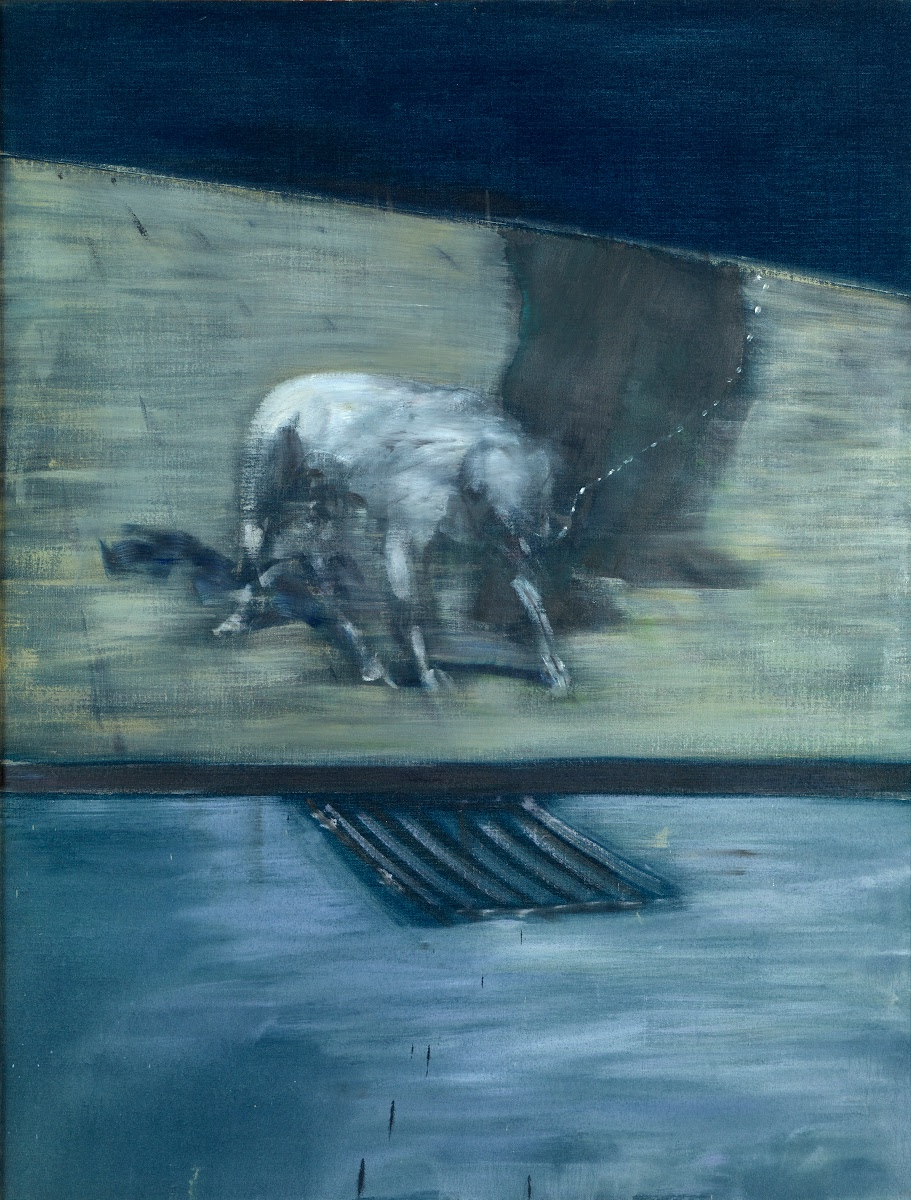
Francis Bacon, Man With Dog,
part of the Bacon show upcoming at the Albright-Knox
‘I had nobody else to paint’
By Rachel
Campbell-Johnston, Chief Art Critic, The Times, May 26,
2006
“I
LOATHE my own face,” Francis Bacon famously said. “But
I’ve done several self-portraits because I had nobody
else to do.”
This wilfully disingenuous explanation masks the
profound sensibility of a painter whose self-portraits
are as honest, unsparing and psychologically acute as
those of that great master of introspection, Rembrandt.
The triptych which now comes up for sale at Christies is
a powerfully — almost painfully — intimate piece of
work. Bacon thought of a portrait as an almost
impossible task. And yet again and again he gazed
unflinchingly into the mirror. He attacked and
brutalised his image, slurring his pulped features
across the canvas in a smear of bruised hues as he
sought to escape mere illustration and evoke instead
what he famously described as “the brutality of fact”.
His portraits are images of mortality. And yet as Bacon
paints this work his vision has grown softer, less
violent, more meditative. His images take on an almost
evanescent quality. Where his earlier works confront
savage passions with impetuous energy, this later
triptych seems less about ferocity and more about
fragility. Its mood is poignant. Life seems to leak from
inside his features like air from a slowly deflating
balloon. It seeps back into the black.
This was clearly an important work to the most important
British postwar painter. He destroyed any canvases he
didn’t like — sometimes, it is said, getting them back
from collectors under false pretences so that he could
burn them.
Bacon’s
'Self-Portrait' Is Priced at a Record $10.3 Million
By Linda
Sandler, Bloomberg,
May 26, 2006
May 26
(Bloomberg) - Francis Bacon’s studies for a self-
portrait, hidden in a private collection for more than
two decades, will go on sale for as much as 5.5 million
pounds ($10.3 million) in London on June 22.
Christie’s International is betting that the 1980
triptych painting, Three
Studies for a Self-Portrait, will set a record for
Dublin-born Bacon, who is the U.K.’s most-expensive
contemporary artist. The seller is an unnamed collector
who bought the work from Bacon in 1982, London-based
Christie’s said in a statement. The artist died in 1992.
Auction
houses are driving valuations higher, after taking in
$900 million at their New York sales this month - the
combined total for Sotheby’s, Christie’s International
and Phillips de Pury & Co. On May 9, an Andy Warhol
painting of a soup can went for 20 percent less than
Christie’s top estimate, indicating collectors may be
resisting the run-up.
The
discounted soup can was bought by the billionaire
collector Eli Broad.
Christie’s and Sotheby’s Holdings Inc. are preparing to
put on view art for their London June sales, which last
year took in 160 million pounds. Christie’s contemporary
auction this year may raise about 21 million pounds, the
auction house said.
Bacon’s Study
for a Pope I set
a record of $10.1 million at Christie’s New York in
2005, including commission, according to sale tracker
Artnet AG.
Francis
Bacon and a vision of perfection
A triptych
of self-portraits hidden from public view for 26 years
is to be auctioned,
reports
Jack Malvern
NEWS
| THE
TIMES | FRIDAY
MAY 26 2006
FRANCIS BACON’S attempt to paint the perfect portrait is
revealed in today’s Times in three previously unseen
paintings.
The triptych of self-portraits is considered the closest
the artist came to his belief that he was within reach
of creating the ultimate likeness. The portraits have
come to light only now — 26 years after they were
painted and 14 years after Bacon’s death — because he
sold them directly to a friend rather than through his
gallery.
The buyer, who has never put them on public display or
published photographs of them, is selling them at
auction for an estimated £5.5 million. The anonymous
collector is believed to have paid about £100,000 for
the triptych, entitled Three
Studies, in 1982.
The triptych is exceptional not least because it
survived two years in Bacon’s studio — something of a
feat, as he was so destructive that his gallery would
take his paintings away as soon as they knew they were
finished. Valerie Beston, his personal assistant,
regularly came to his studio to remove works while the
paint was still drying.
Michael Peppiatt, Bacon’s biographer, believes that the
artist held the triptych in the highest regard. “In his
later years, Bacon became convinced that he was within
reach of the one perfect portrait — the portrait that
would sum up and surpass all his other portraits,” he
said. “If there had been one ultimate image, it would
have to have been heads of himself, such as these Three
Studies, which, unusually, he kept and consulted in his
studio for a couple of years after painting them.”
Bacon, who was 71 when he created the work, had become
preoccupied with his own mortality. He remarked that he
was driven to do self-portraits because his friends were
“dying like flies”. In particular, George Dyer, his
long-term lover, had committed suicide eight years
earlier.
Pilar Ordovas, head of evening sales for postwar and
contemporary art at Christie’s, said that Bacon almost
never sold his work outside his gallery. “There are only
two occasions that we know when this happened. The other
one he sold to the same person,” she added.
“He must have had some special connection with these
paintings — he kept them much longer than usual. Works
were usually sold immediately because they were in such
high demand. He was the greatest living British artist.”
In his later years Bacon constantly examined himself in
the mirror. He also had a collection of photographs of
himself, taken by his friend John Deakin, which he kept
scattered in his chaotic studio.
His idea of the perfect portrait was not a
photorealistic painting, but a picture that captured
someone’s personality. “One day people will see how
natural my distortions are,” he said. “Very often a
person’s appearance belies their qualities, but
generally speaking I think that you can, to a great
extent, analyse their character from their appearance.”
The triptych also shows his willingness to distort his
features. Although Bacon worried about committing an
“injury” when he manipulated his friends’ faces, he had
no qualms about rearranging his own “old pudding face”.
Three Studies could
break the $10 million (£5.8 million) record for a Bacon,
set by Study
for a Pope (1961)
in November. The paintings will go on show at Christie’s
in London, on June 16 before the postwar and
contemporary art sale on June 22.
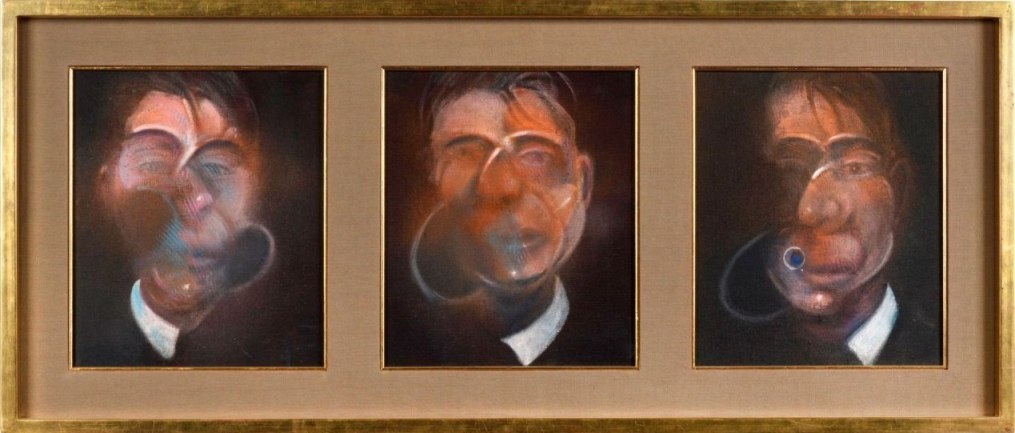
|
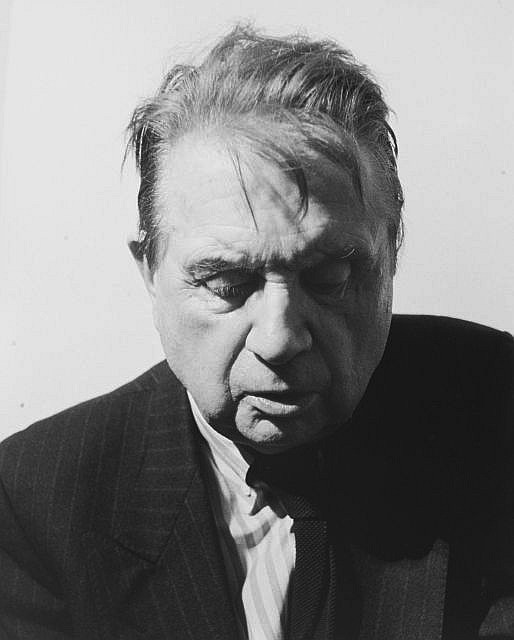
.png)


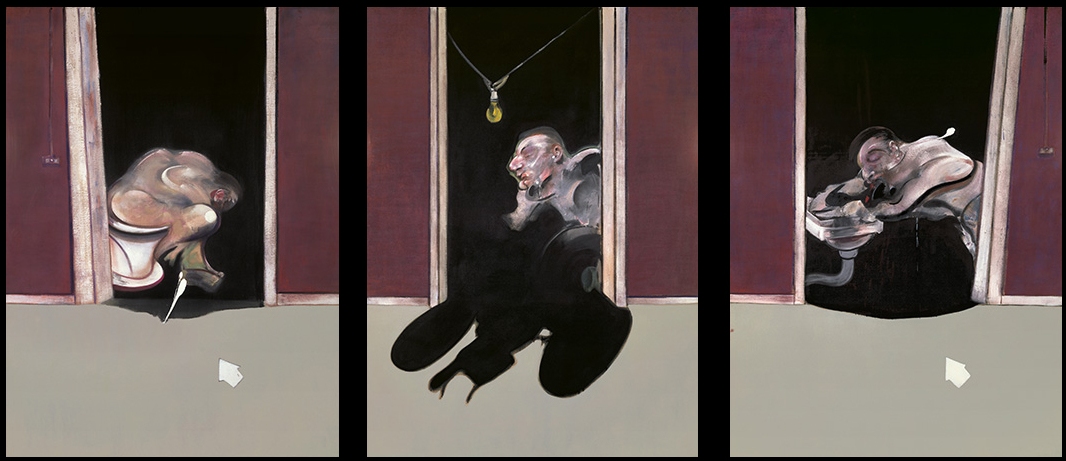
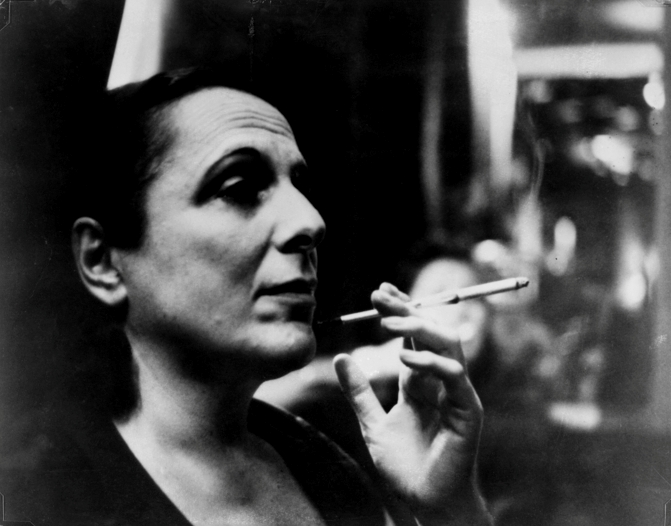


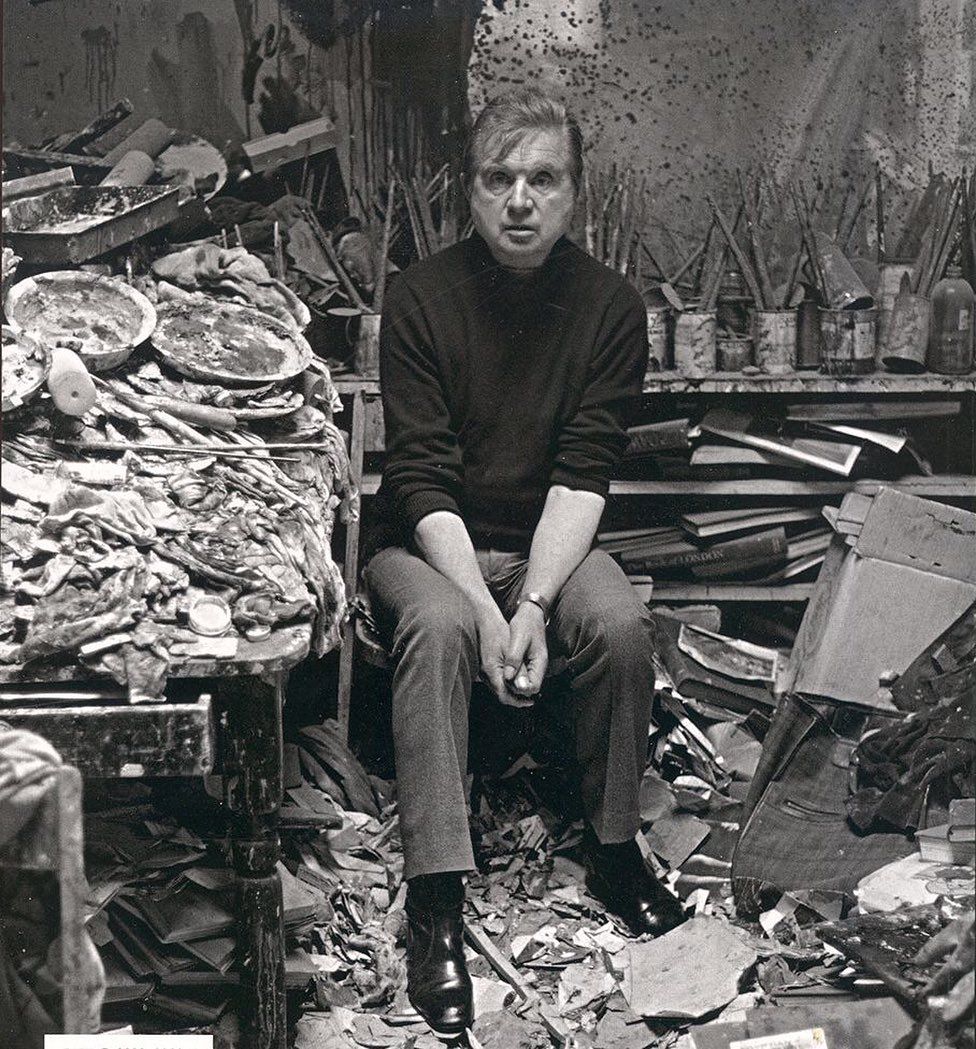

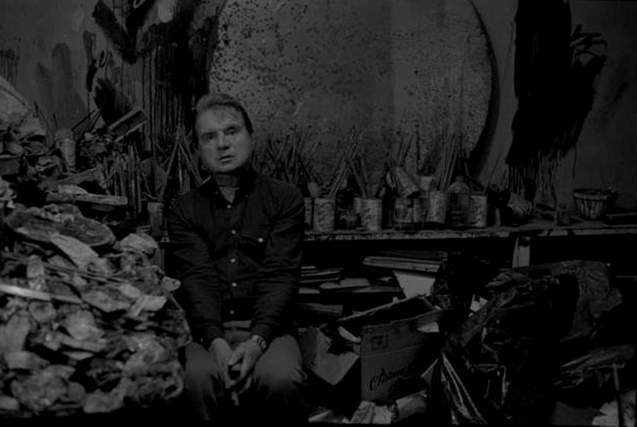
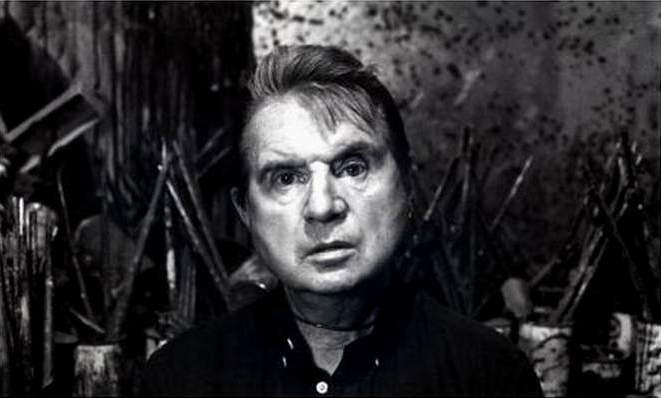
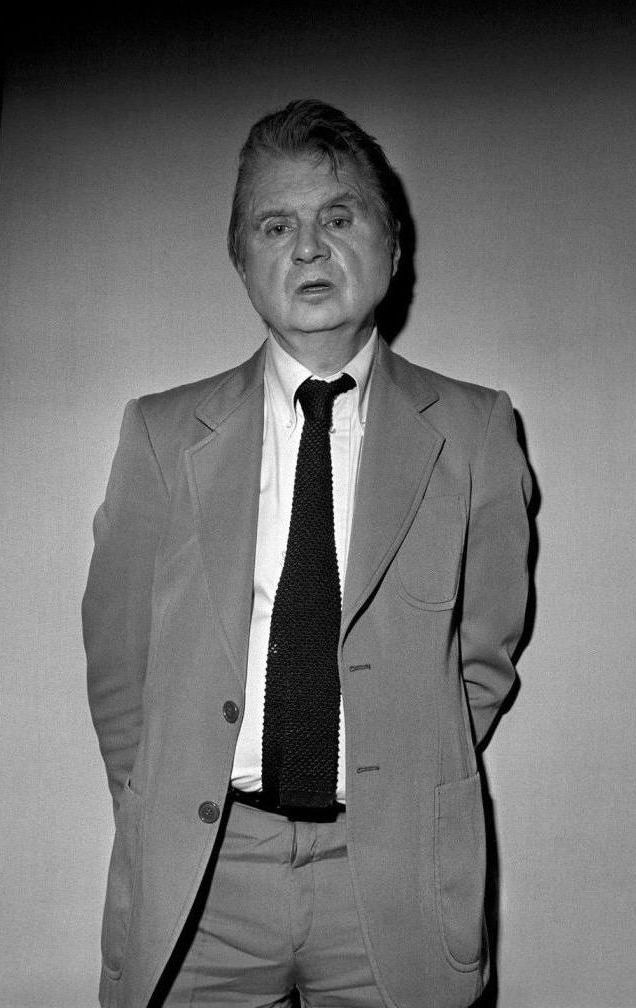

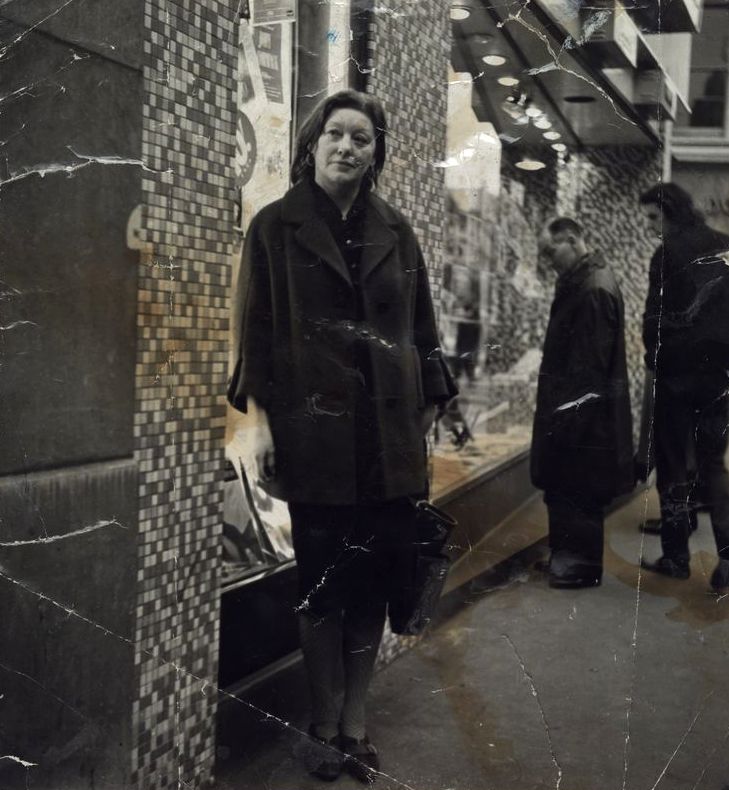

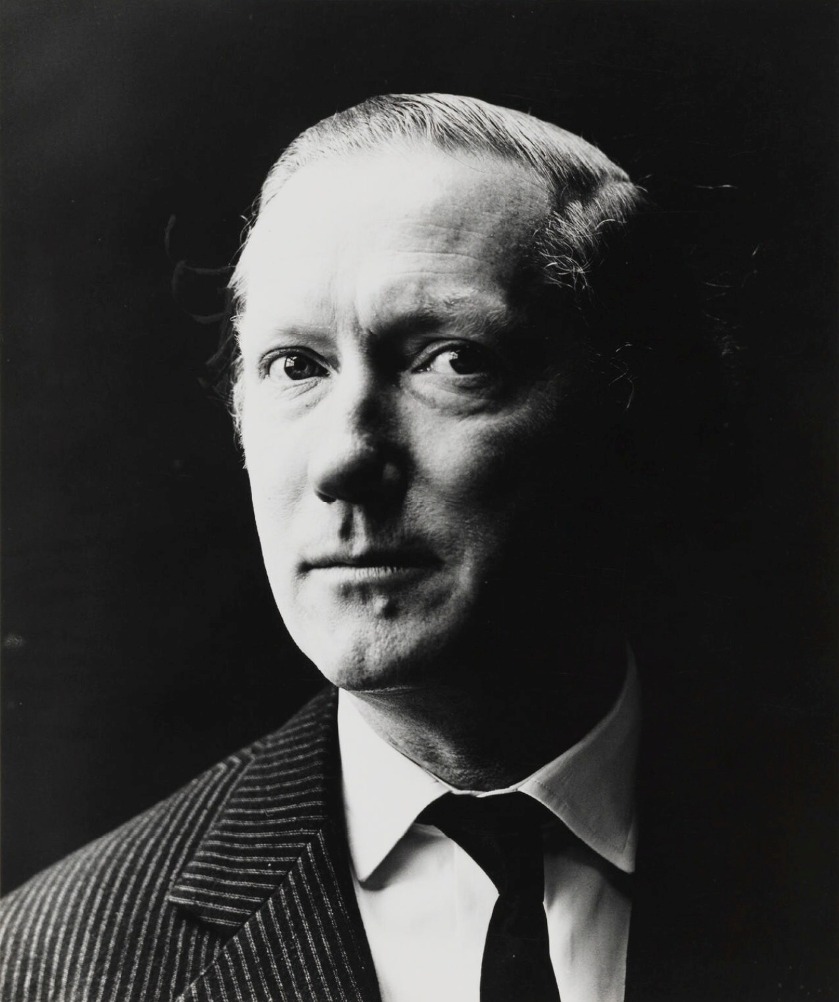


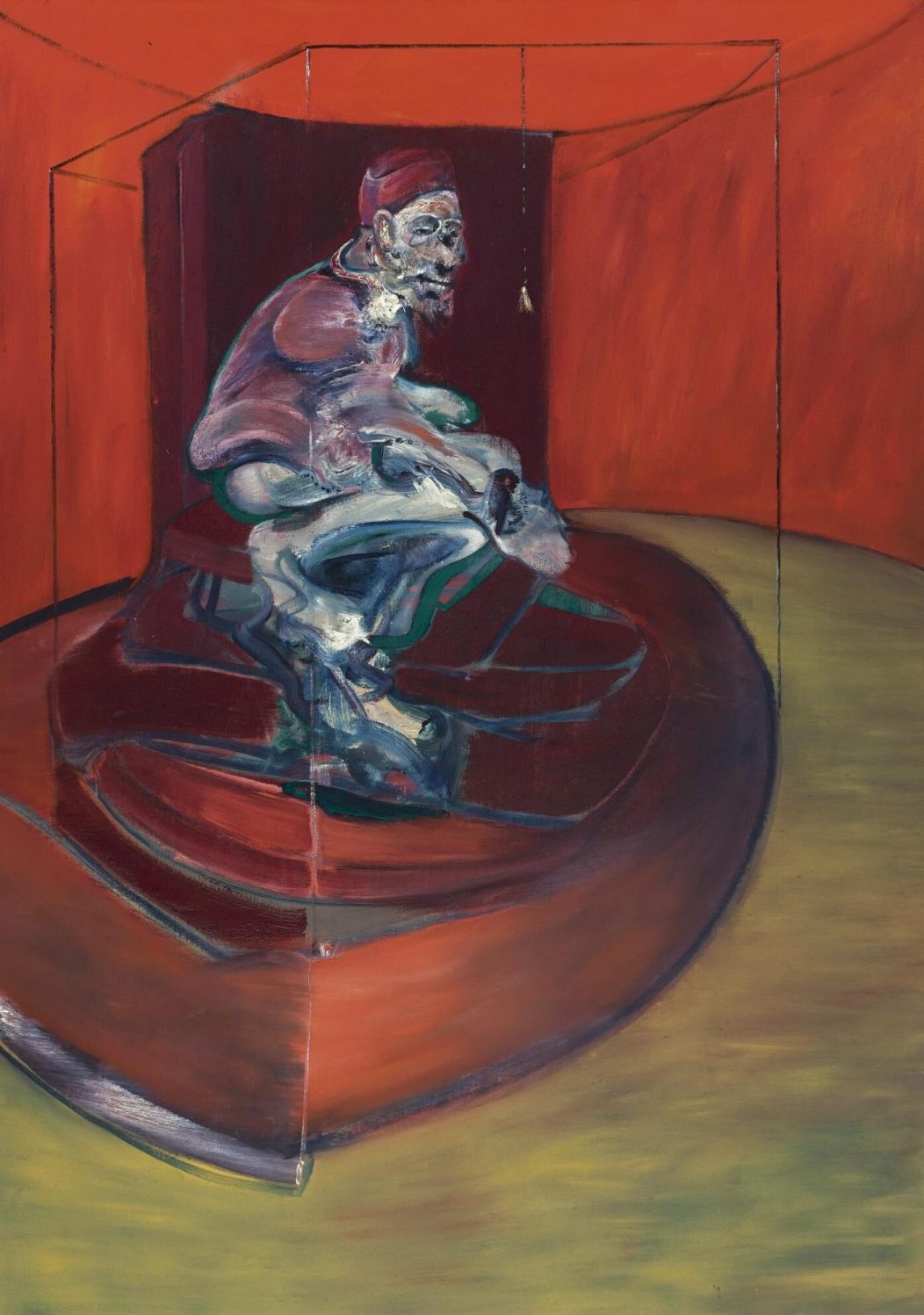
FFF.jpg)
%20(1)TT.jpg)
%20(2)NNN.jpg)
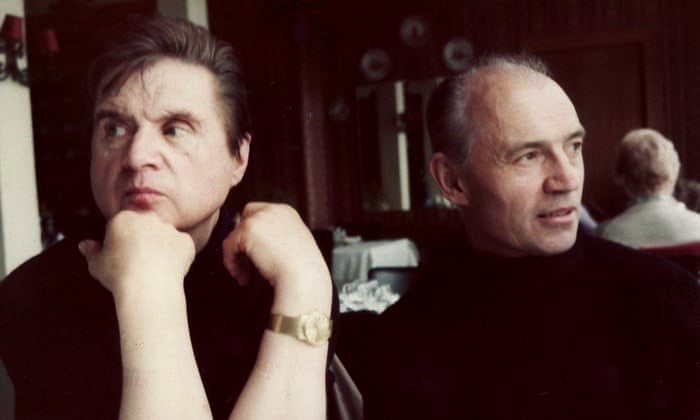
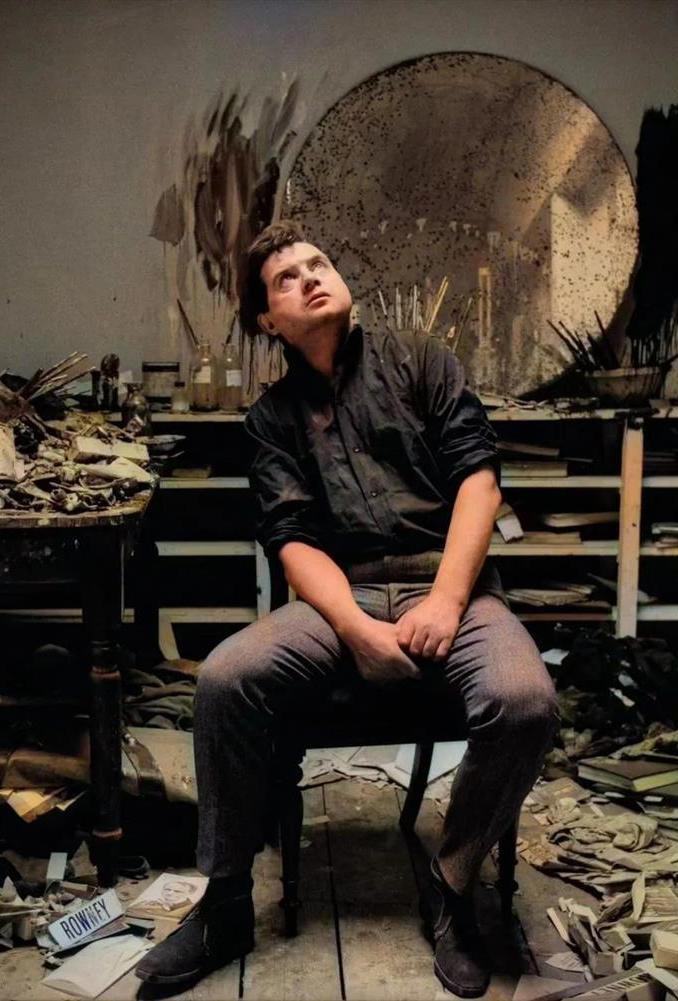


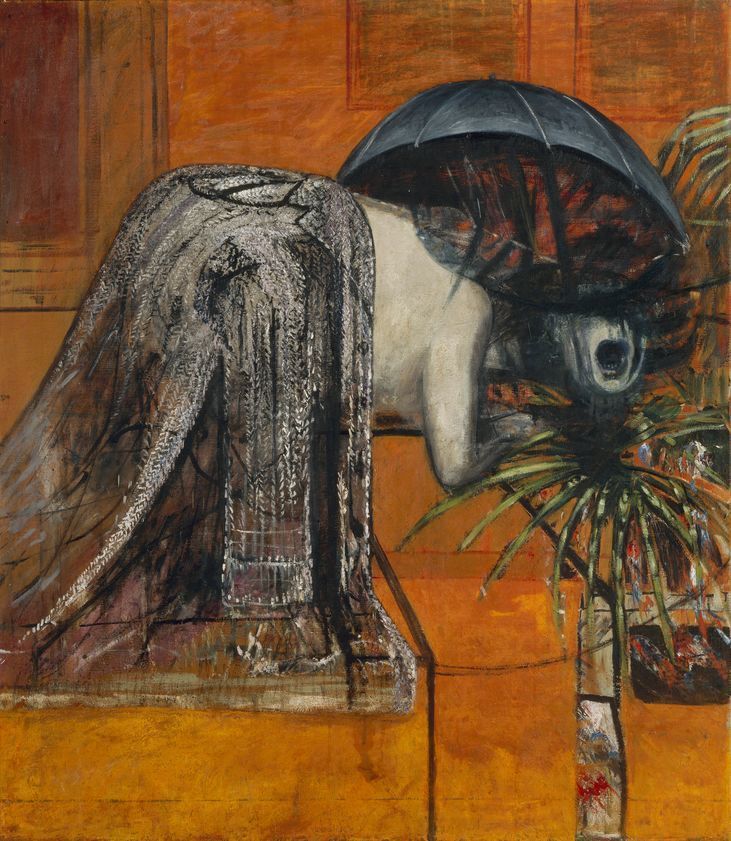

EEE.jpg)
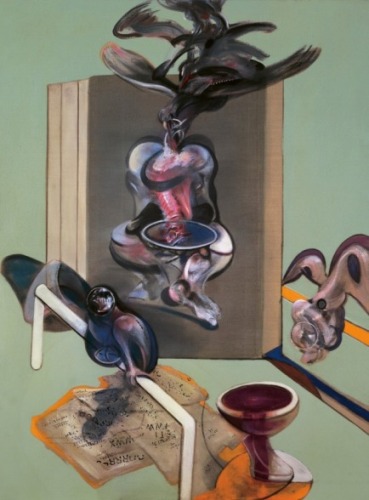
U.jpg)

.jpg)
.jpg)

.jpg)
.jpg)


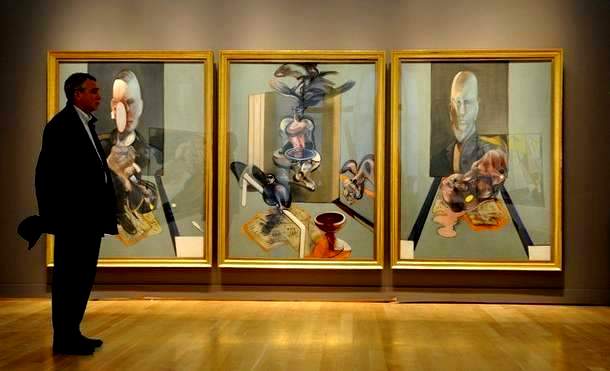


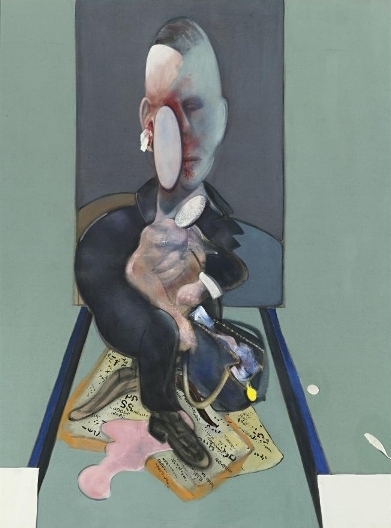

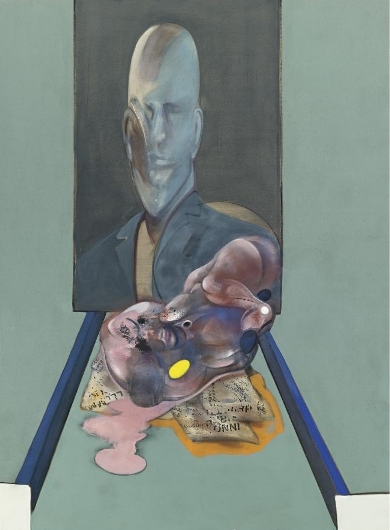
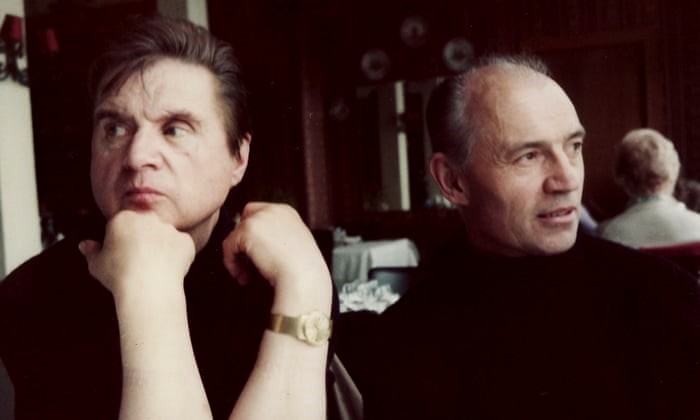
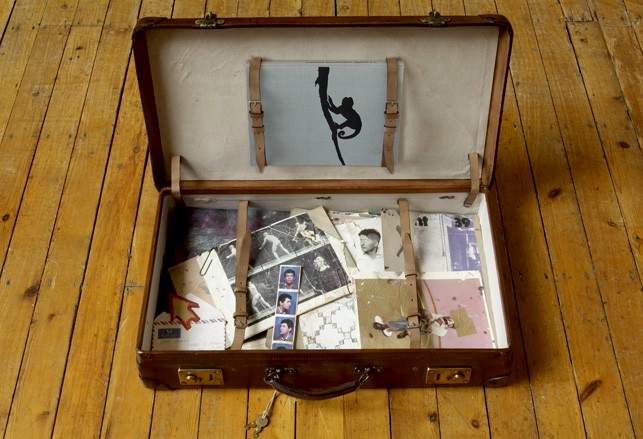

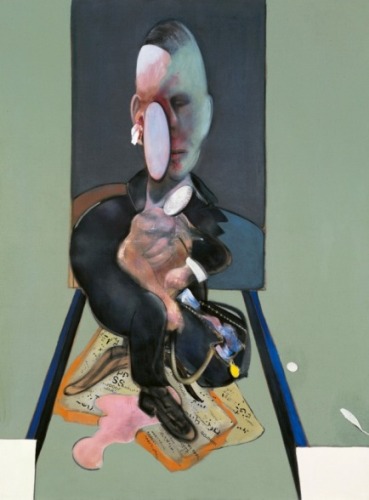
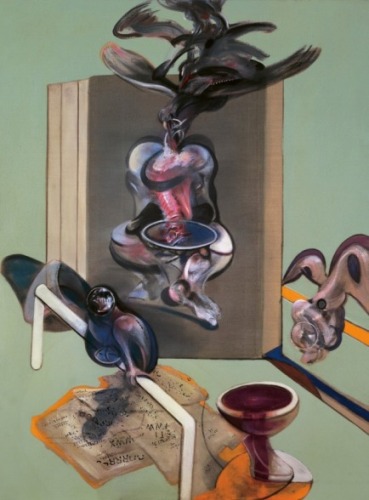
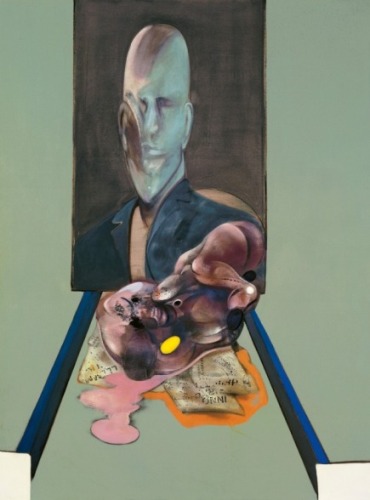
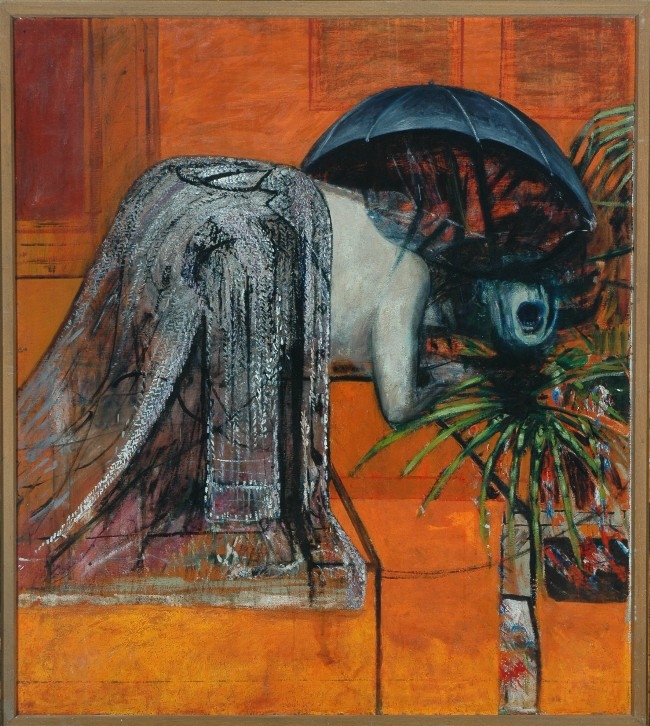
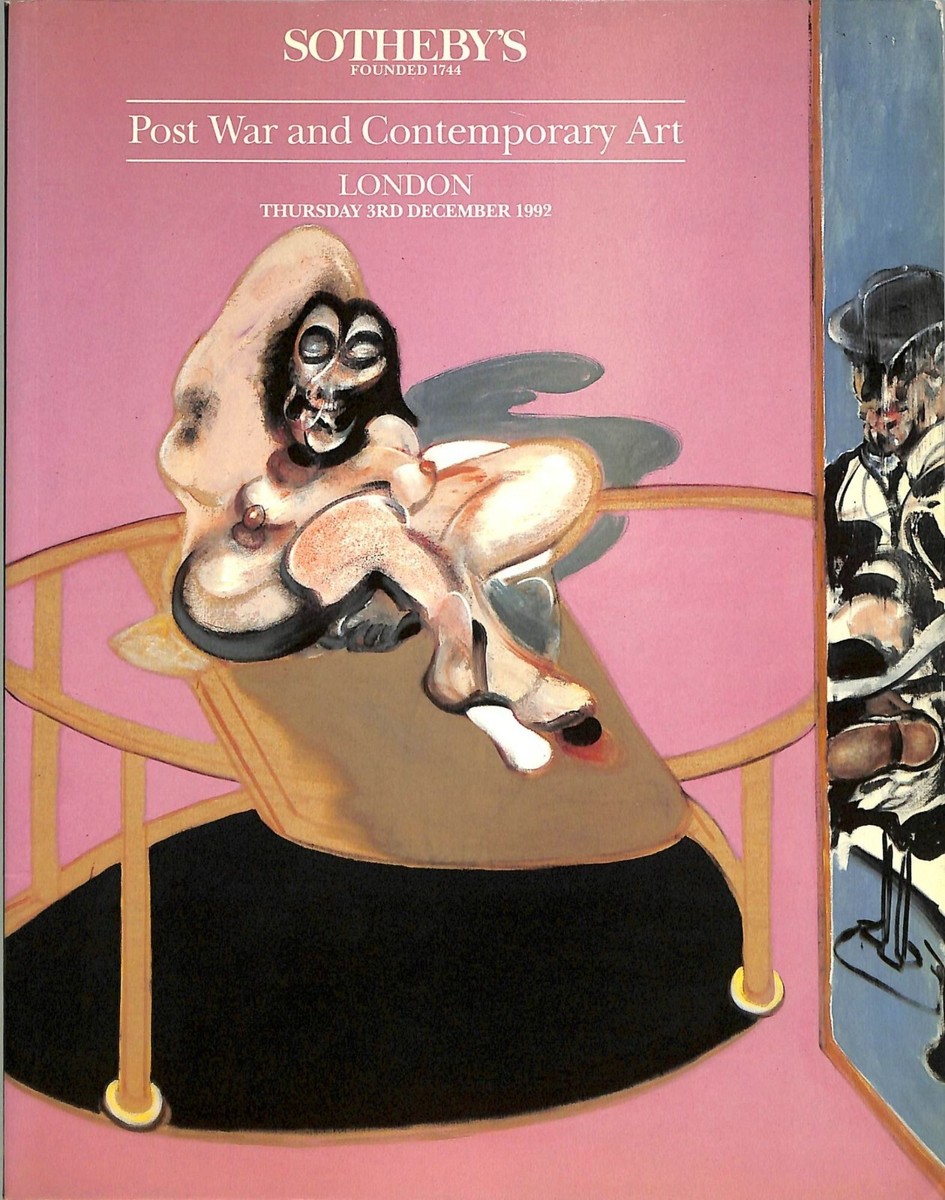

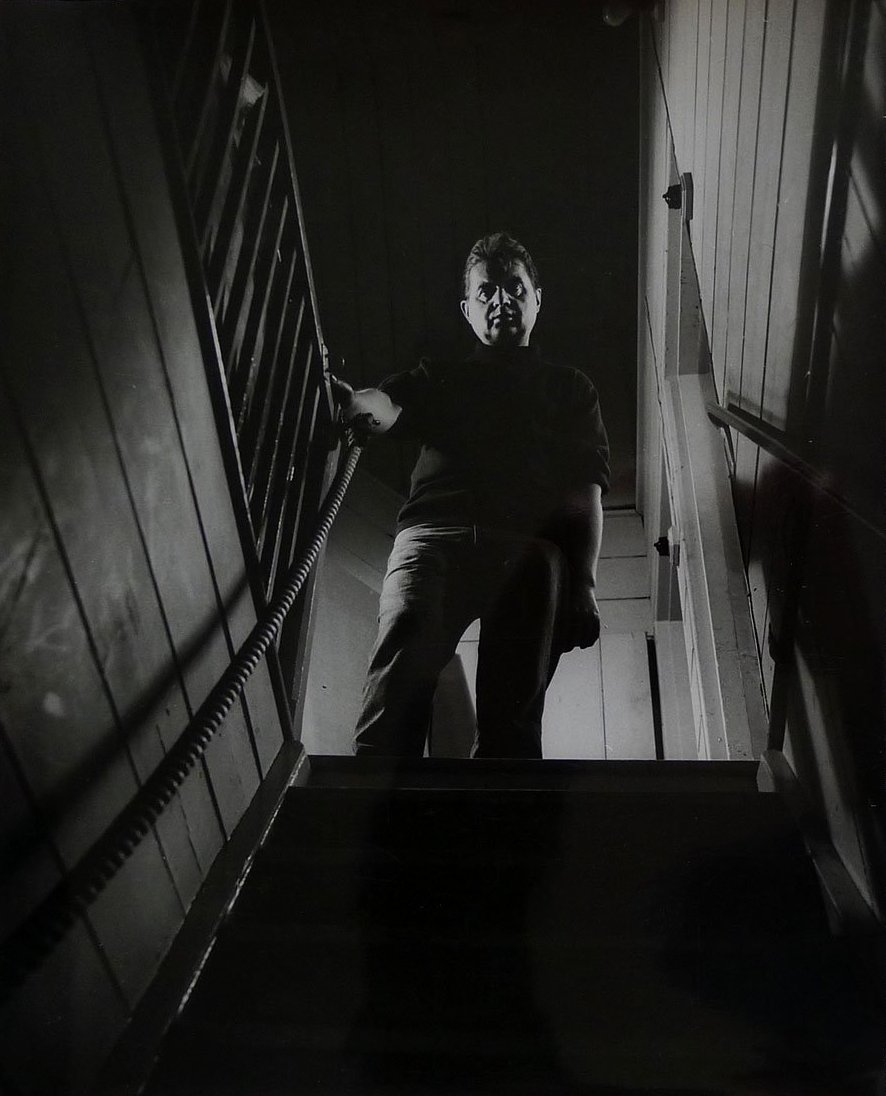


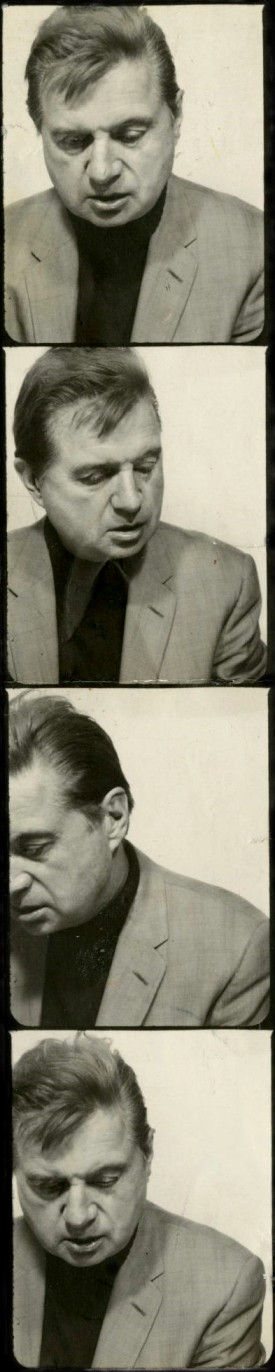
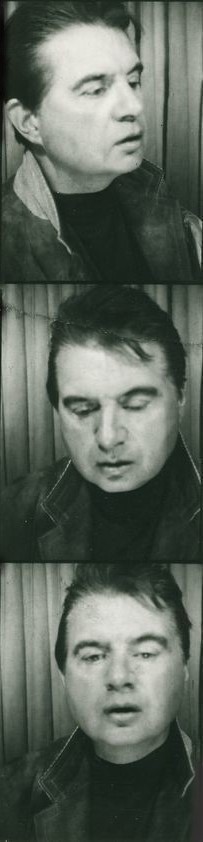

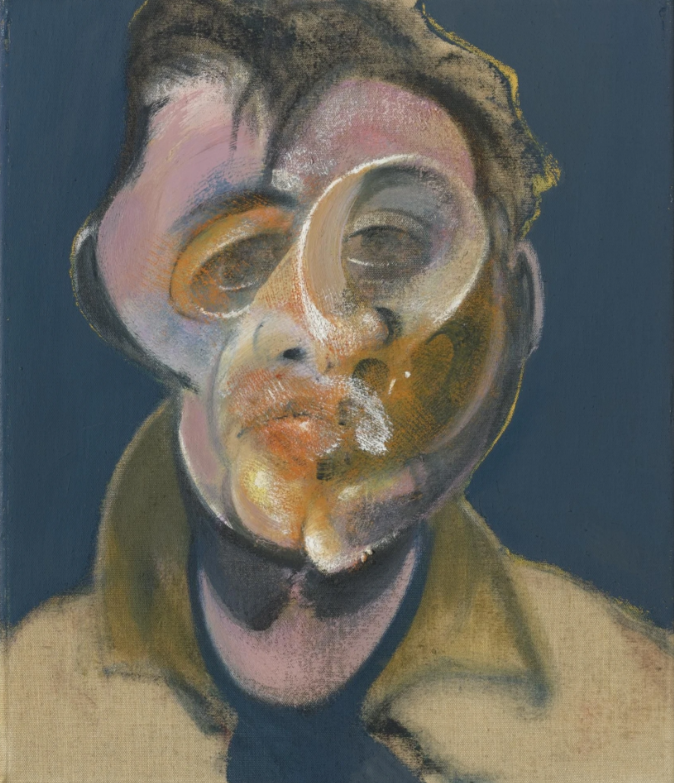
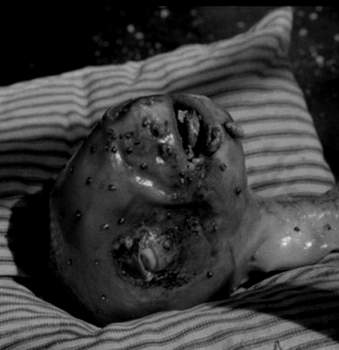
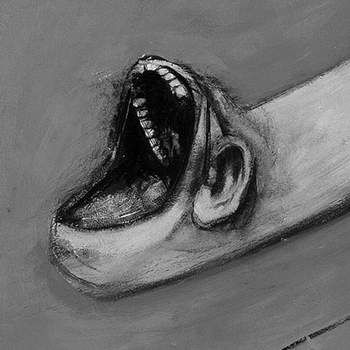

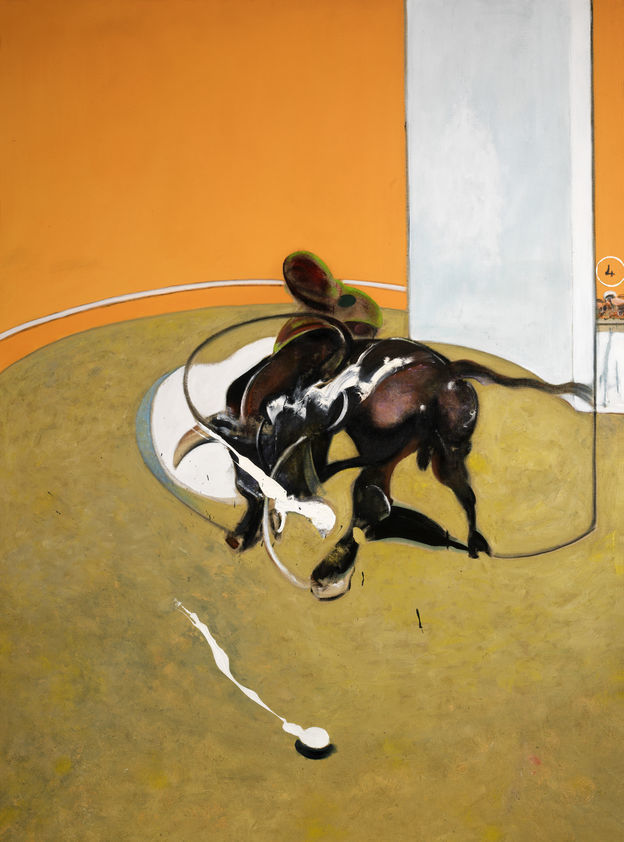
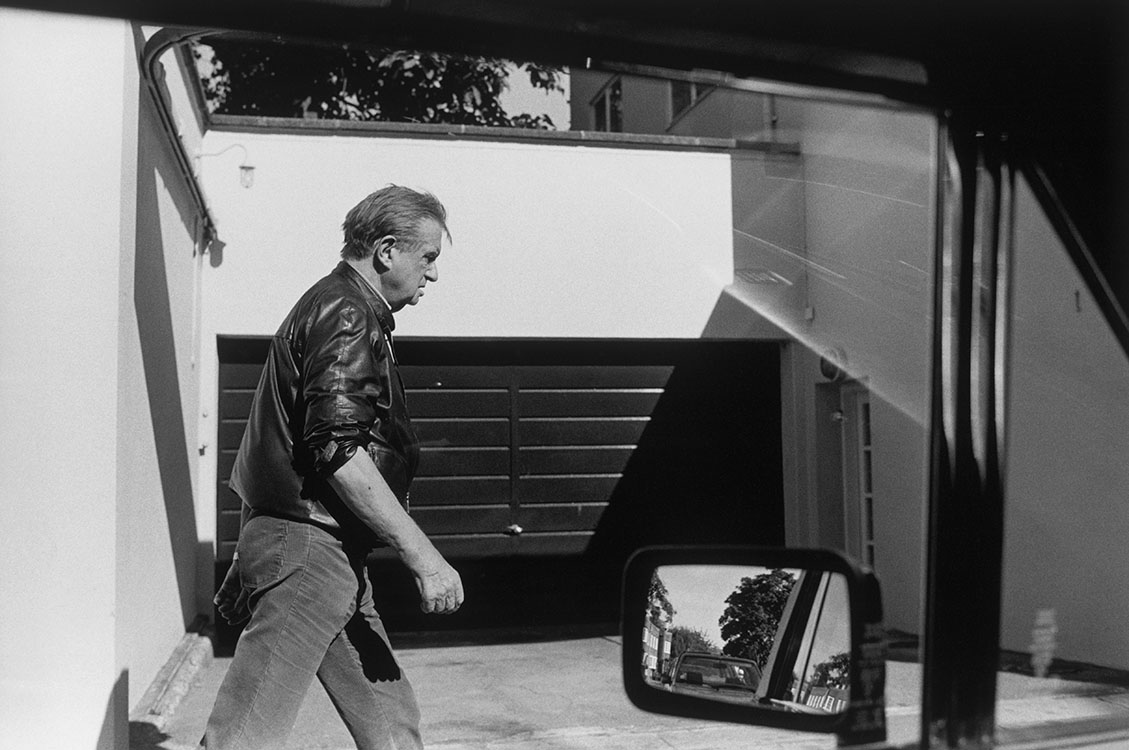
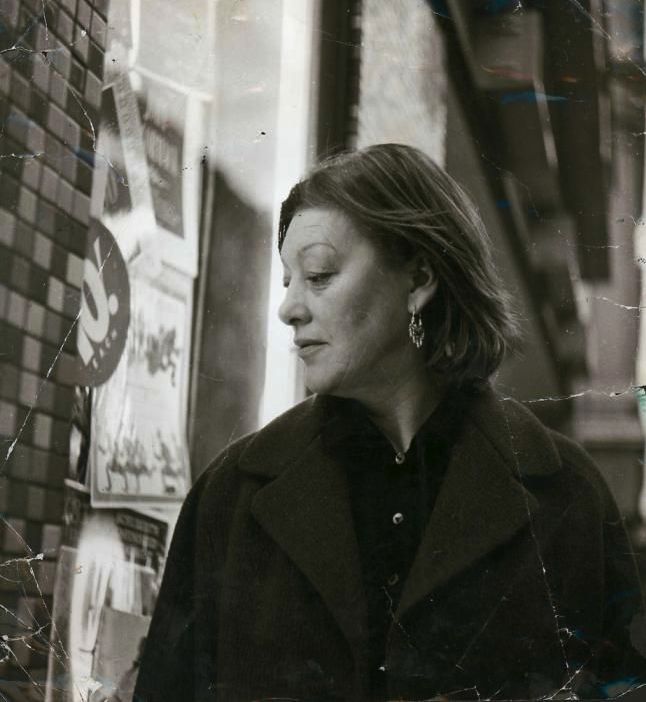
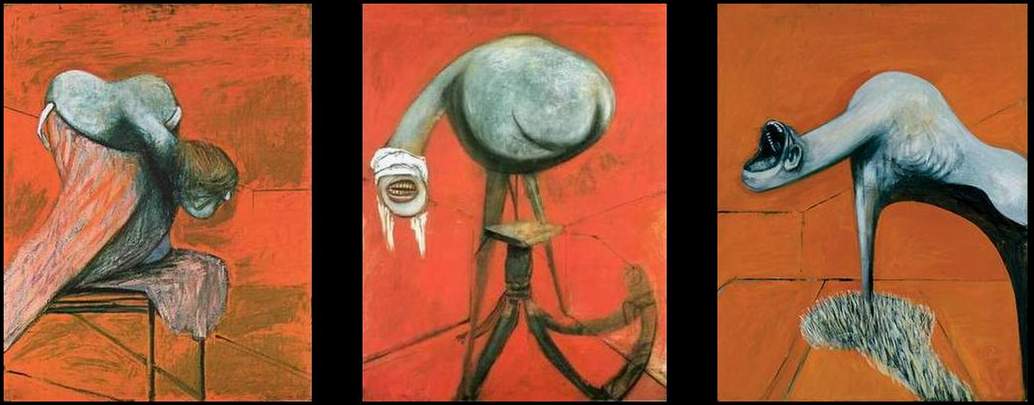
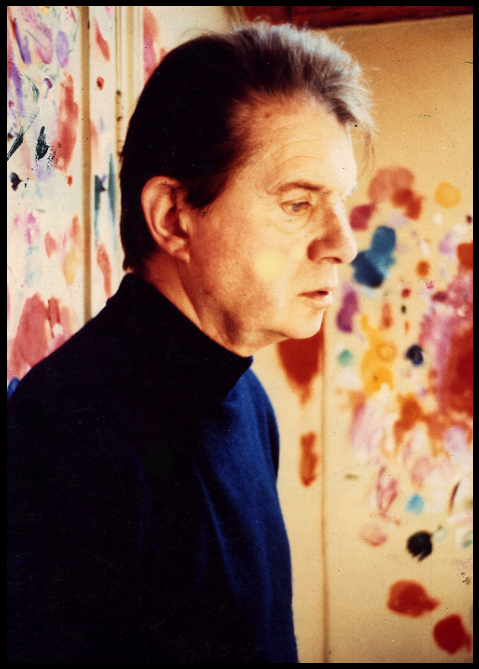
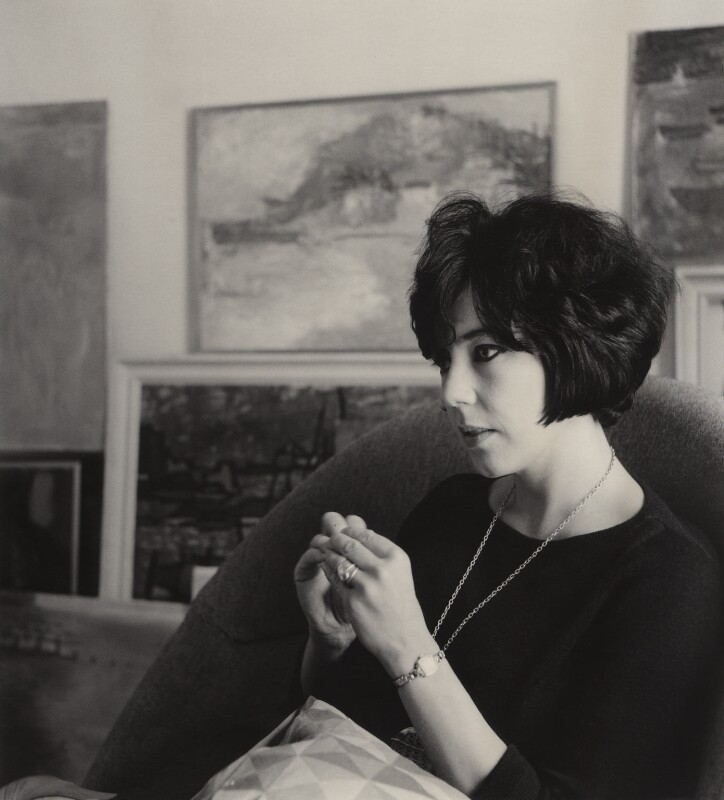

.jpg)
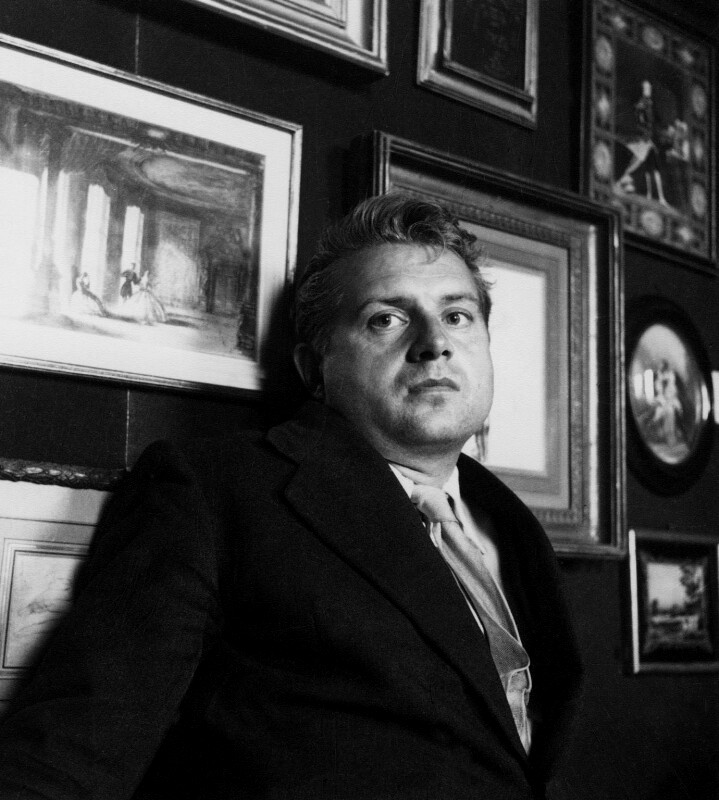




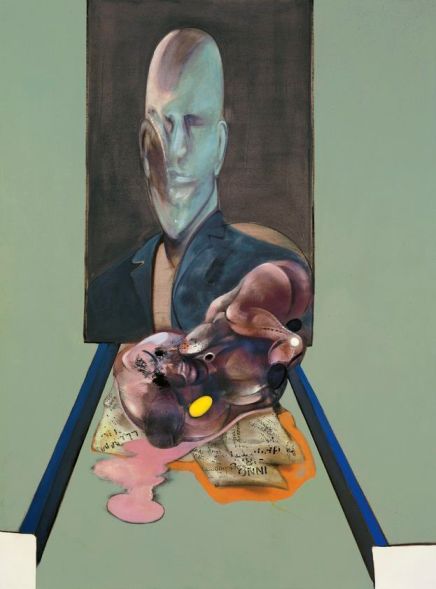

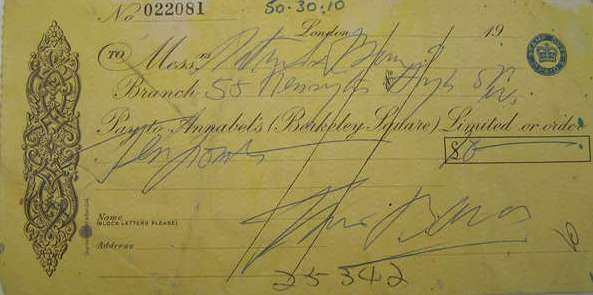
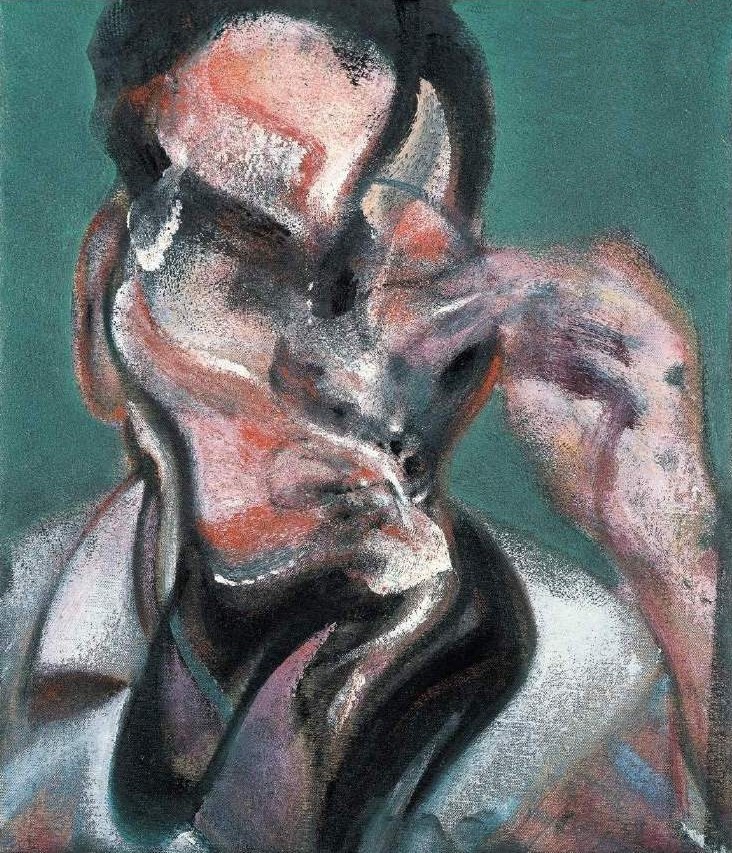
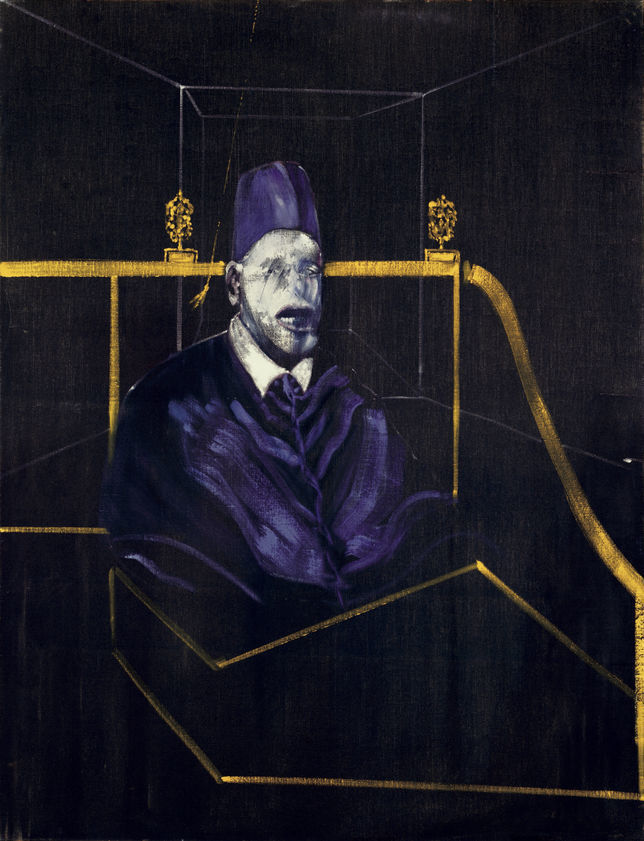
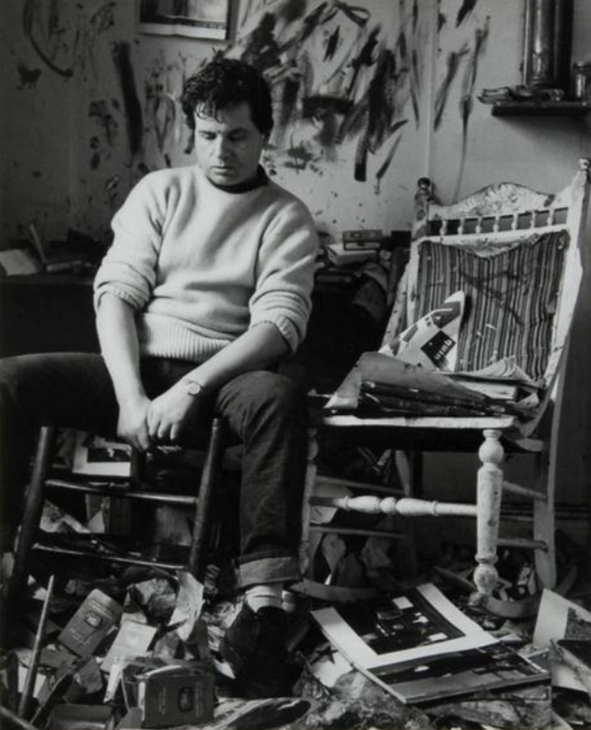
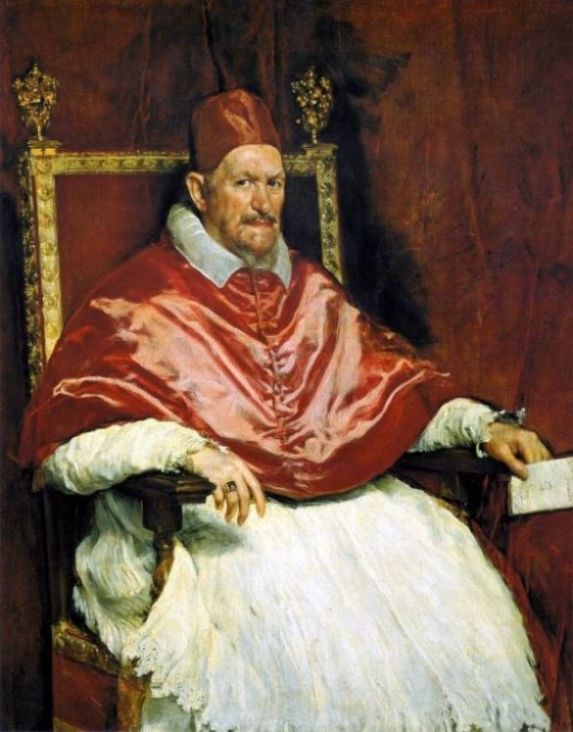
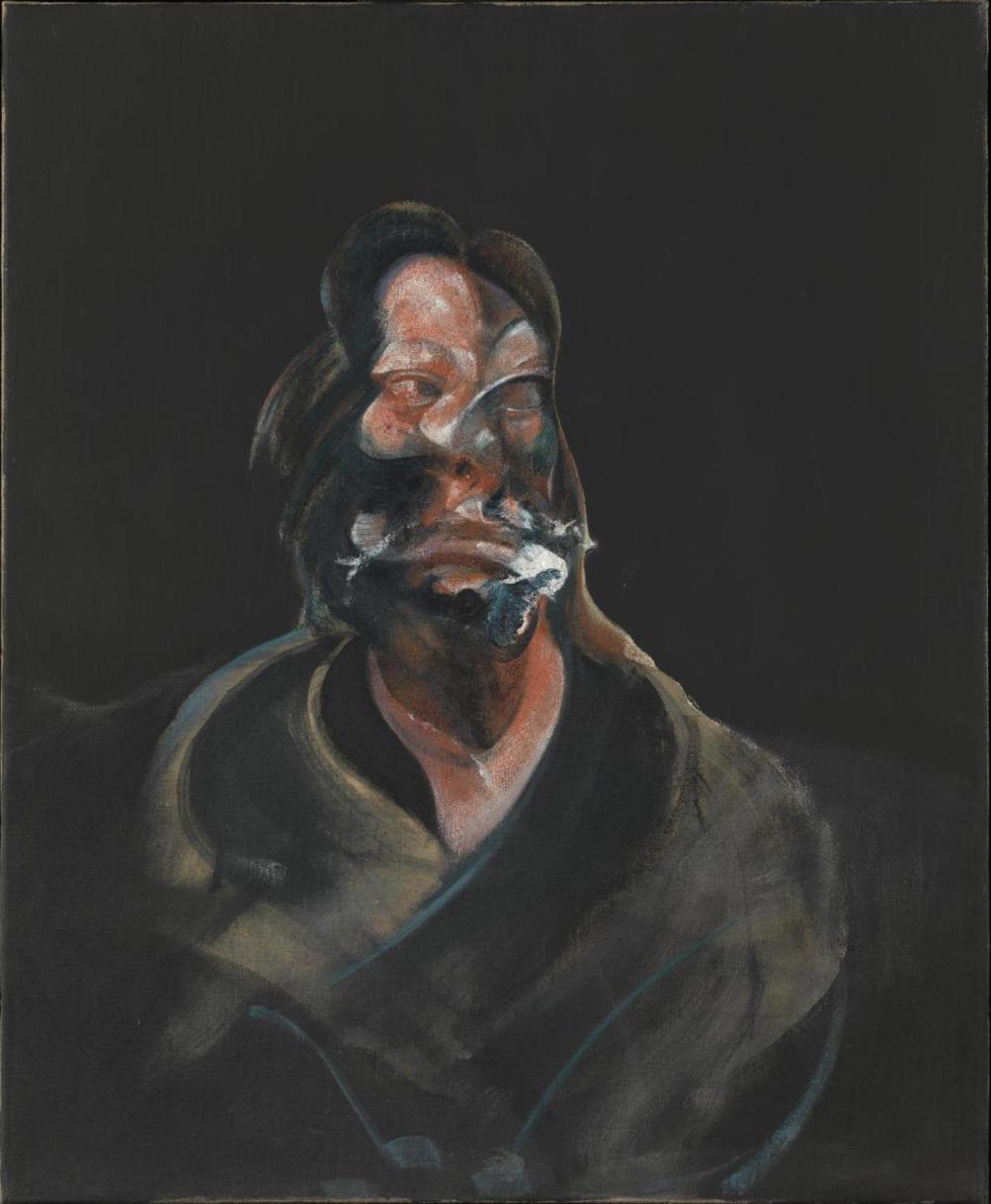
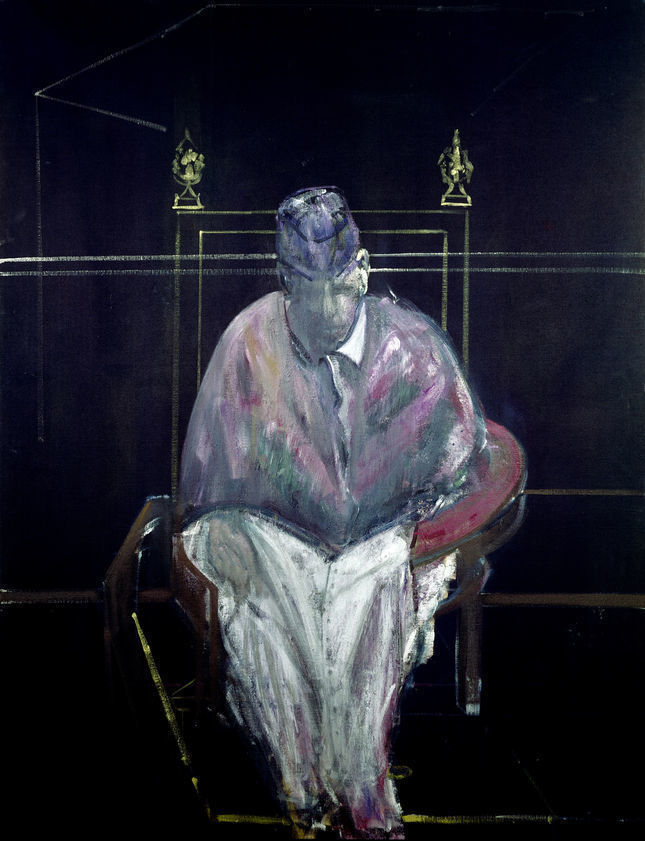
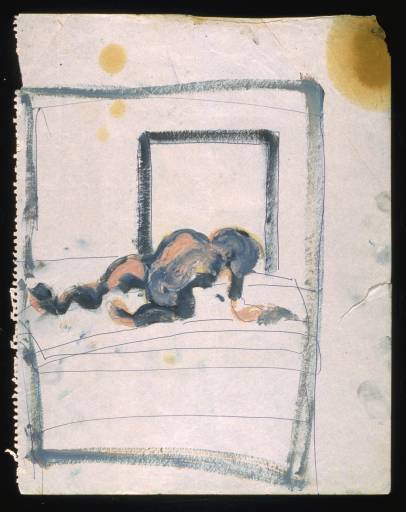

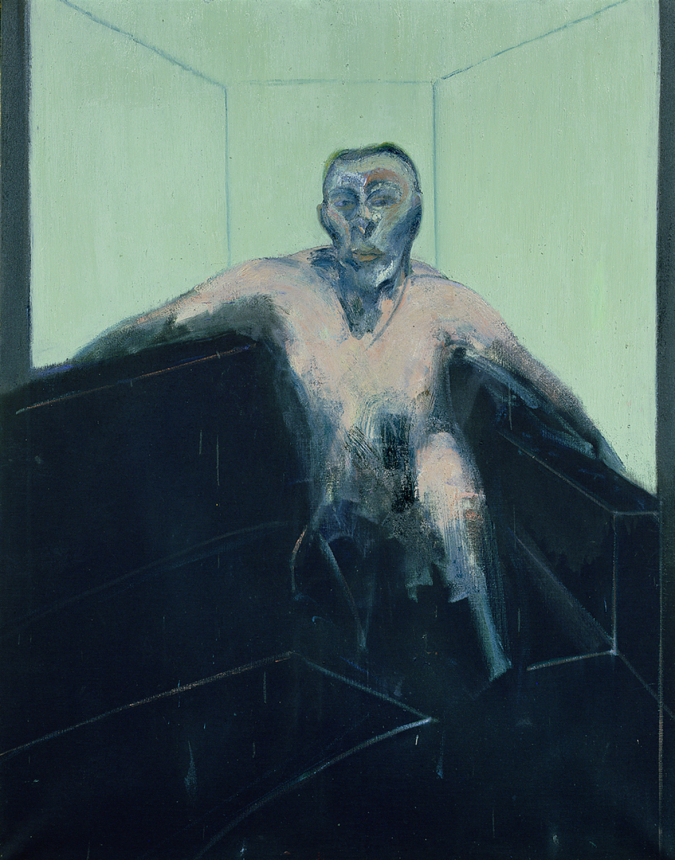


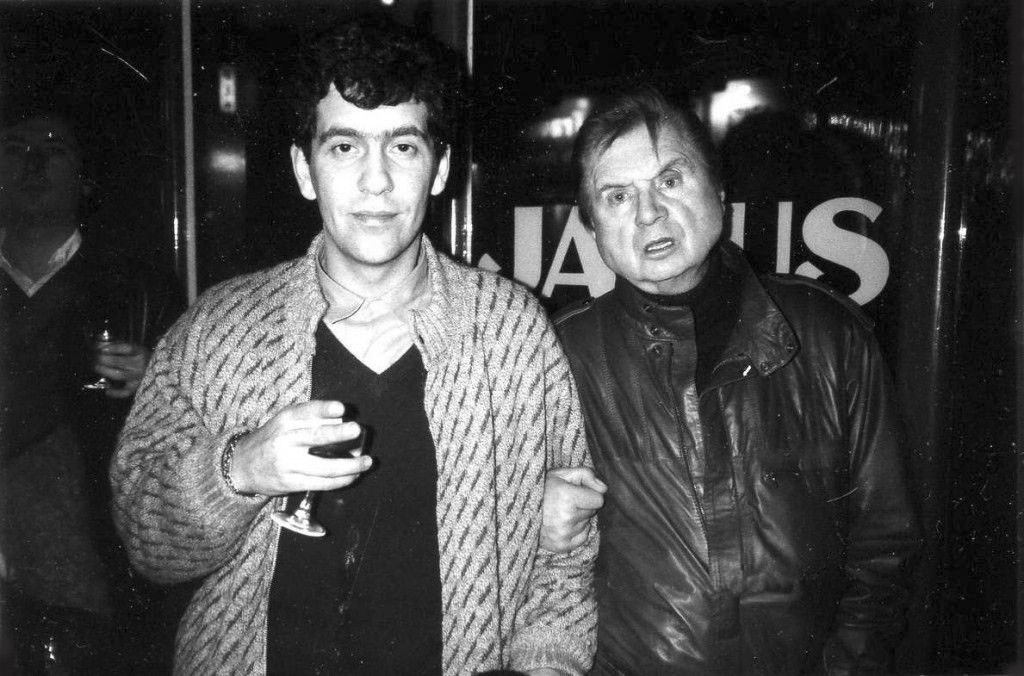
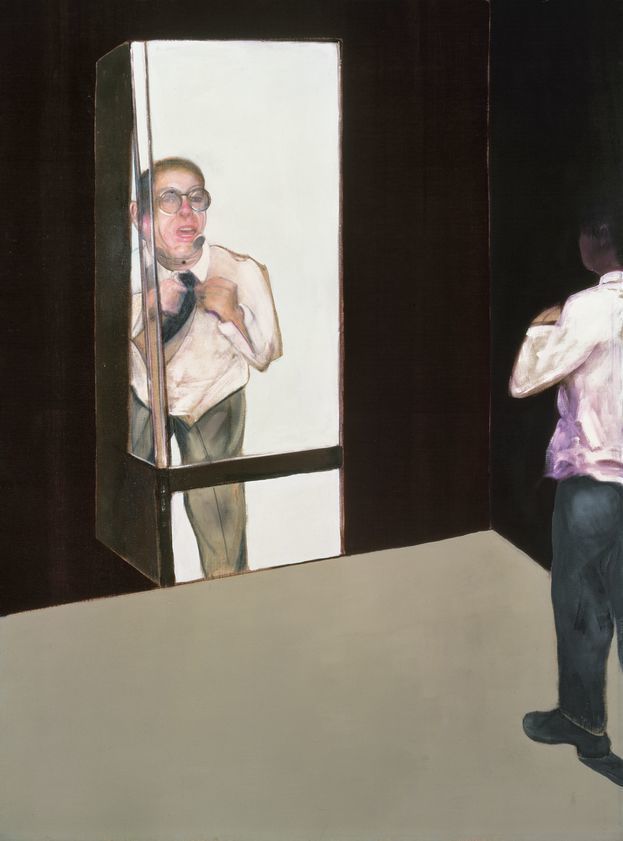
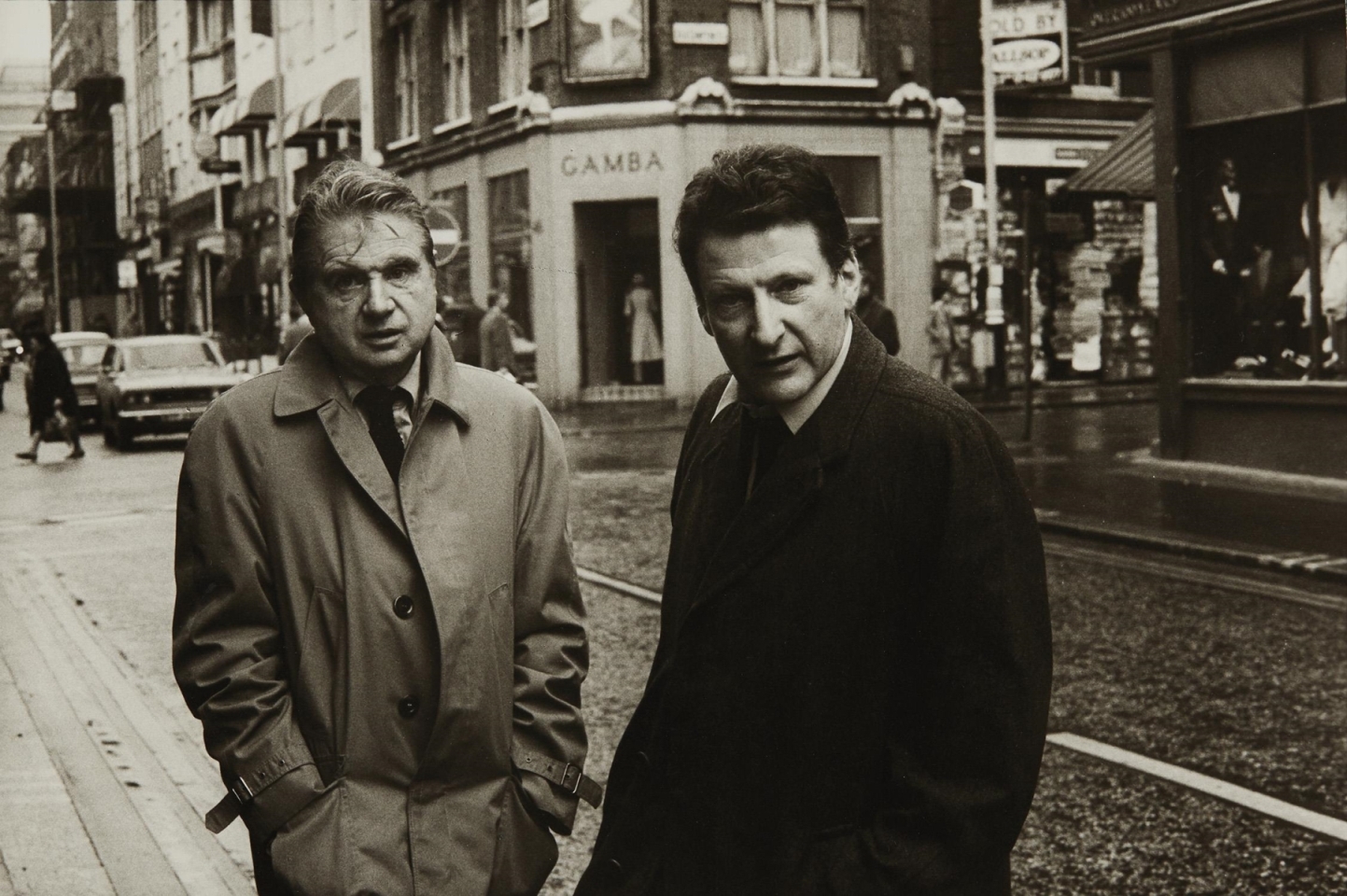
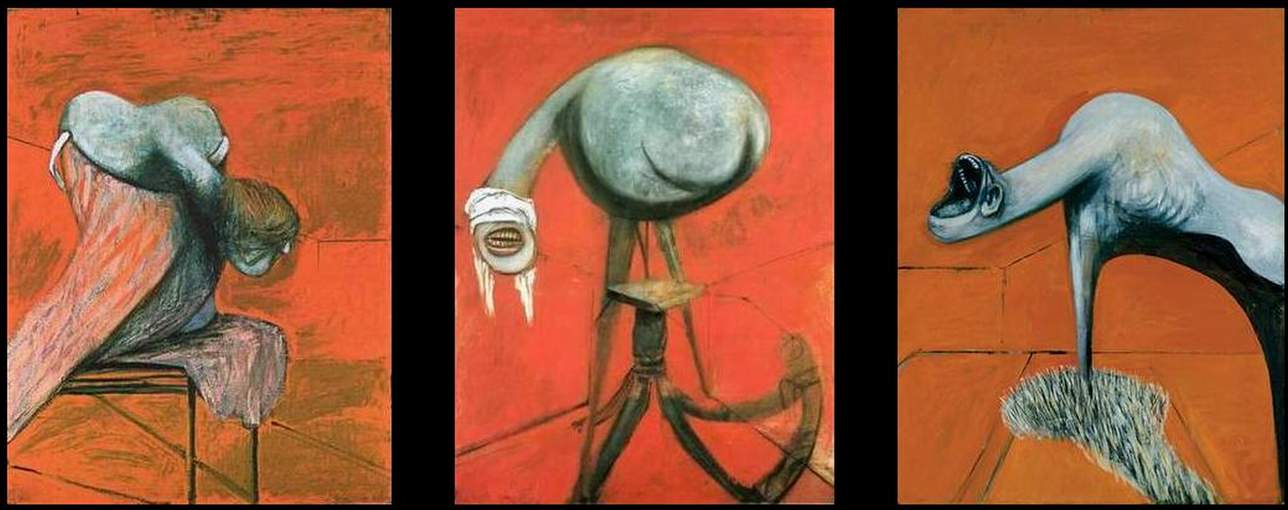
.jpg)

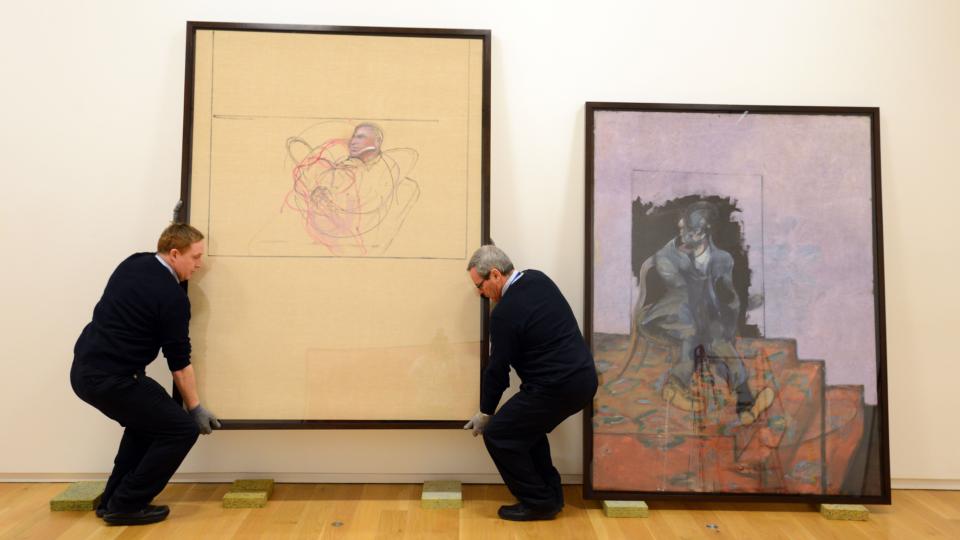


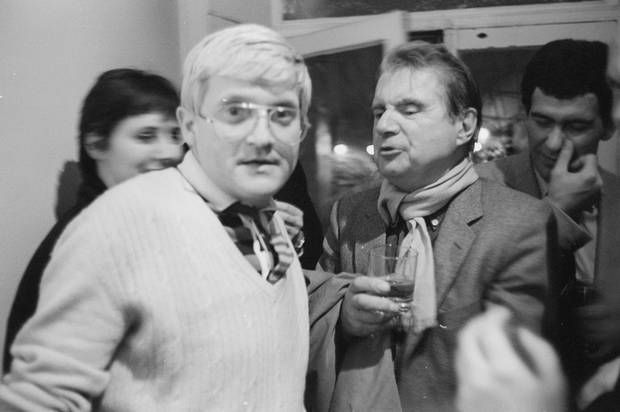
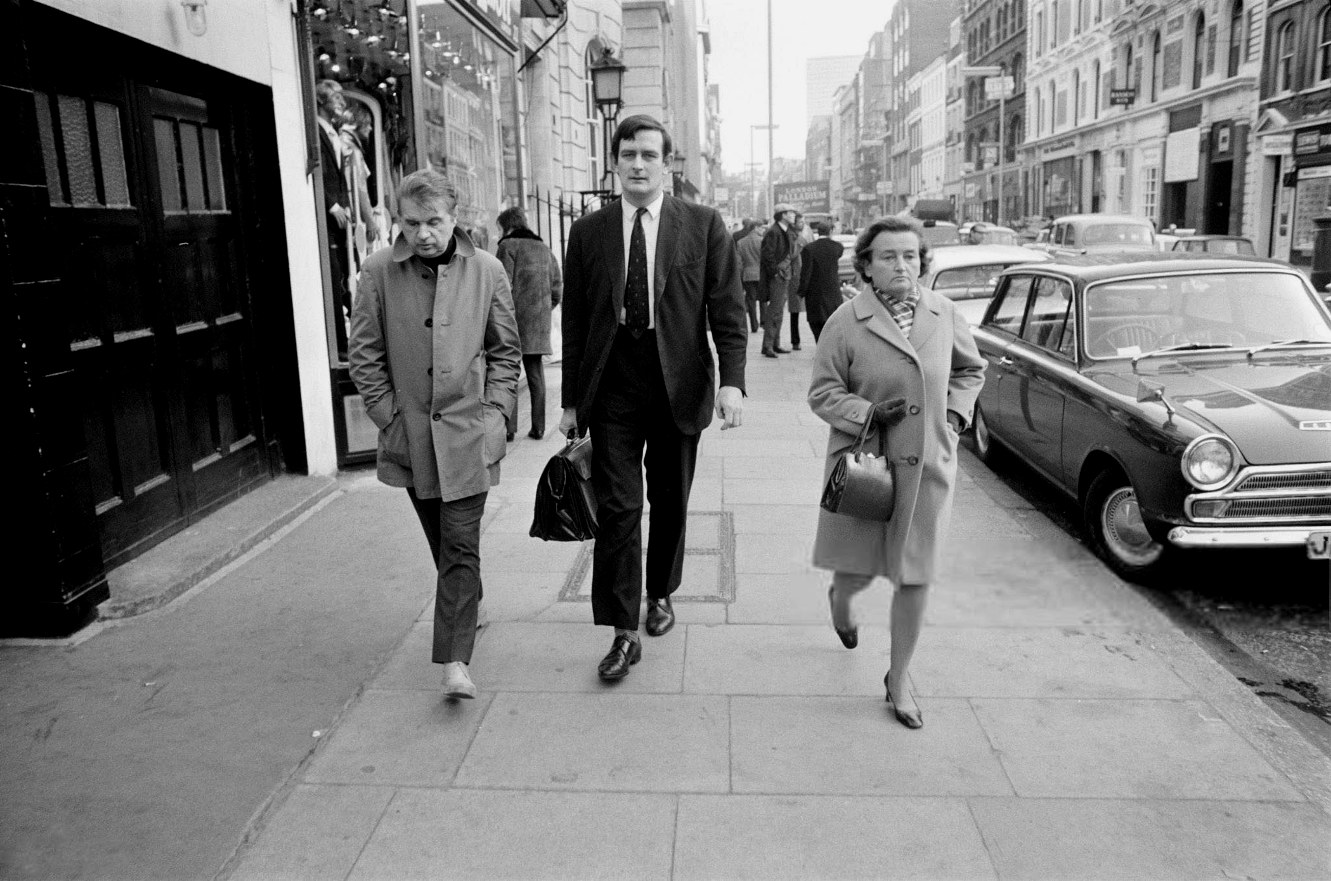

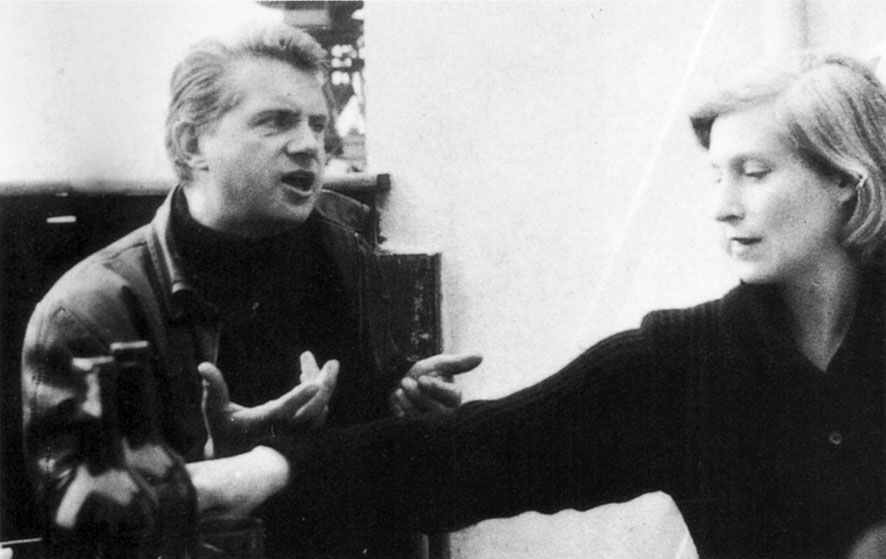
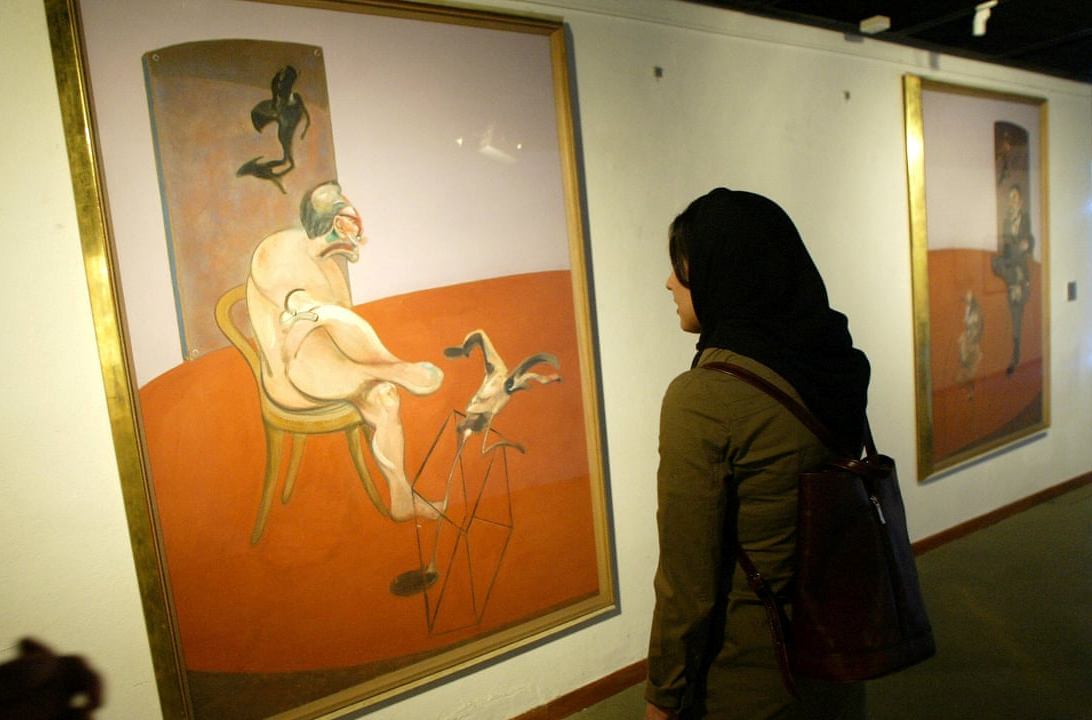

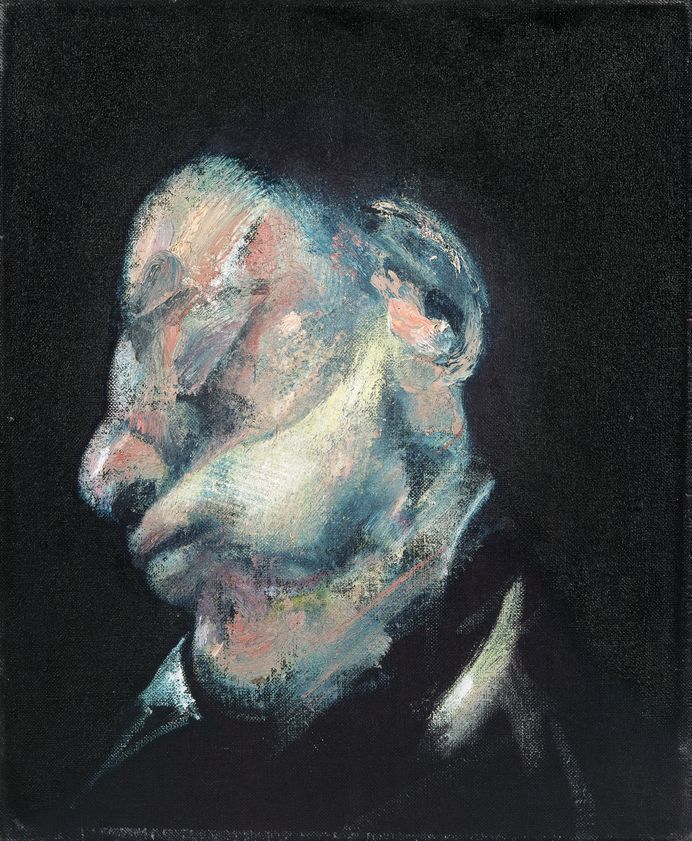

.png)