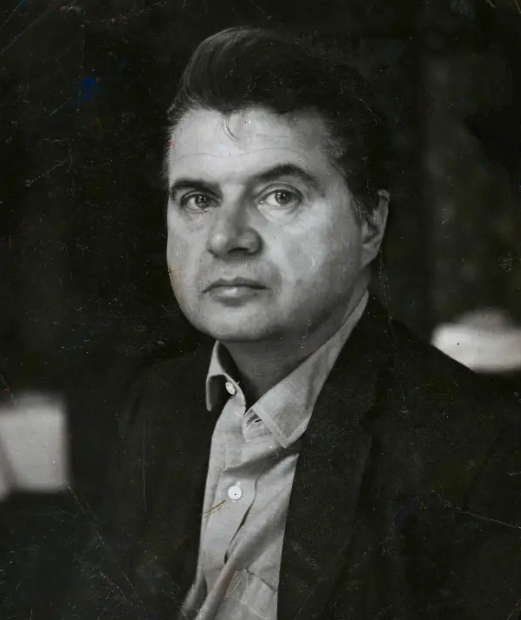
Writers fight for a slice of Bacon
IN HIS tumultuous life, Francis Bacon was hailed as the greatest British painter since Turner. A year after his death, an unseemly squabble has erupted as six rival biographers labour fractiously to produce the most authentic version of modern art’s illustrious icon.
The pent-up wave of memorabilia, accompanied by flying insults, is partly the fault of Bacon himself, who died after a hear attack in Madrid last April, aged 82. The painter, who made no secret of his homosexuality, rebuffed biographers’ approaches. He cared little for the opinions of critics or the public, yet dissuaded friends from revealing personal details about him during his lifetime.
“I don’t blame him, because he led such a turbulent life,” said the writer Daniel Farson, who leads the field with The Gilded Gutter Life of Francis Bacon, to be published this month.
“Farson’s book will be first, but not in quality,” intoned Andrew Sinclair, whose own offering is due to appear in September. “Mine will be the first serious biography. I am a trained social historian and biographer. Francis had many facades. What he presented to his drinking friends like Dan was quite different to that presented to his friends in France.”
“Oh, that’s lovely!” Farson commented. “How different from Sinclair’s previous books, which are all scissors and paste. How is it that he’s not interviewed a single person except perhaps ex-stable boys in Ireland? I know, because I have interviewed everyone.”
Sinclair also looks askance at the title of Farson’s oeuvre. “If you call a book The Gilded Gutter Life ... well, I have no comment,” he said.
Farson’s rejoinder was cutting: “Sinclair rides a very high horse, but then he can afford to: he’s very rich. I knew Francis for more than 40 years, and introduced him to Sinclair. Francis took a violent dislike to him. He couldn’t stand him, but he was impressed by money.”
Even in mutual adversity, Farson and Sinclair were united in voicing doubts over a third contender, Paul Bailey, who is writing Francis Bacon: A Life, for publication in 1996. “Bailey never met Bacon,” Farson said. Sinclair added: “He’s rather an odd person too choose. I hope he doesn’t take the Farson approach.” Bailey, whose biography of Cynthia Payne, Madam Sin, inspired the film Personal Services, claims to be a “totally disinterested” chronicler by virtue of not knowing Bacon. He prematurely flourished his trump card — permission by the art critic David Sylvester, one of Bacon’s closest friends and an acclaimed authority, to quote from his published interviews.
This was news to Sylvester. “I have told Bailey I may be able to help him, but I haven’t promised him anything, partly because I haven’t met him,” he said.
Enter biographer number four, Michael Peppiatt, who edits Art International in Paris, where he supplied Bacon with a studio during the 1970s and 1980s. He said he would be drawing on notes and conversations he had recorded since 1962, when he first interviewed the artist.
Peppiatt’s claim that he had the co-operation of the executors of the Bacon estate drew an expression of disbelief from Bailey. Any such assertion was “one big whopper”.
Peppiatt said the executors were “old friends” who had co-operated by allowing him access to their Bacon archives. The biographers’ desire not to offend Bacon’s executor, Marlborough Fine Art, the gallery which handled his work, is explained by the gallery’s refusal to permit Bruce Bernard to publish About Francis Bacon, a book on the artist’s work which has remained frozen for three years.
Bernard, a visual arts writer, said: “It was a most beautiful picture book. Francis had gone along with it and then changed his mind. It hurt me tremendously. I had been friendly with him for more than 30 years.”
None of the contenders was familiar with the sixth man, Barry Joule, a Canadian. “He goes around in what looks like a blondish wig,” declared one. “One imagines a whole gaggle of North Americans will be writing,” another sniffed. Joule, a charity events producer living in Ireland, revealed last week that he had half completed a book based on his 15-year friendship with the artist.
The book, for which he is still seeking a publisher, would feature taped interviews and his own photographs. With no obligations to Bacon’s estate, he promised “a more candid biography”.
With few letters and slender documentary material, the Bacon slicers will be working overtime. “I wonder if any of the books will get any of it right,” Sylvester, said.
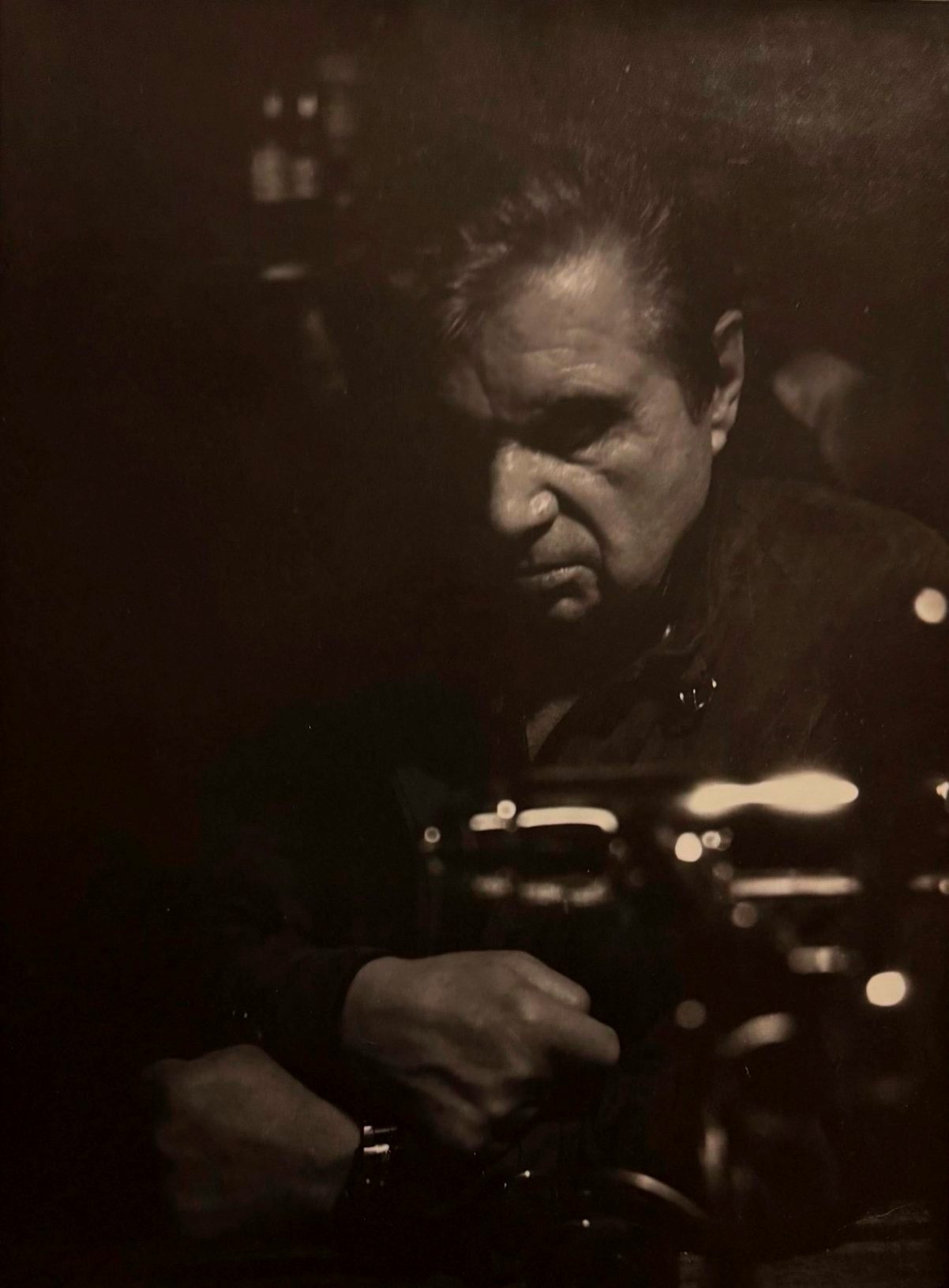
Portrait of the artist: Francis Bacon cared little for the opinion of the public, and rebuffed biographers’ approaches
Bacon’s meal ticket goes on sale
THE artistic tradition is long and honourable. Toulouse-Lautrec and Whistler were masters at it. Now, it has been discovered, the late Francis Bacon was among the roll-call of the struggling, the starving and the broke who paid their restaurant bills by knocking out a painting.
A work traded by the hopeful but still-unrecognised Bacon in return for a good many square meals is expected to make up to £300,000 when it comes up for auction at Sotheby’s on June 24. The portrait, a powerful study of Lucian Freud, Bacon’s friend and fellow-painter, was given to the late Bernard Walsh, founder of Wheeler’s in Old Compton Street, central London, almost 30 years ago. The proprietor of the seafood restaurant had been particularly indulgent towards the artist when Bacon was financially embarrassed.
Bacon, who died last April aged 82, had a prodigious appetite for the good life which, in the early days of his career, was not always matched by an ability to pay his way. According to Daniel Farson, his biographer, Bacon “could be found in the gutter or the Ritz and was at home in both”. When he came to London from Ireland, he found work as a gentleman’s gentleman, but was fired when his master found him dining at the next table at the Ritz.
Even in later years, when he was recognised as England’s finest painter since Turner and his work was selling at auction in New York for nearly £4 million, Bacon still preferred to travel by bus and live in the same scruffy mews cottage that looked as if it was waiting for the furniture to arrive, according to Farson.
The Walsh family no longer owns the painting. Mr Walsh sold it to buy a horse in 1978, after seeking the artist’s permission. The family still owns a painting by Lucian Freud, which they believe may have been acquired by similar means.
by Daniel Fason (Century £17.99)
“When I’m dead, he once told Board, put me in a plastic bag and throw me in the gutter. Frason’s biography indeed puts Bacon where he wanted to be. He rests in the gutter but, as he prescribed, it is brightly gilded.
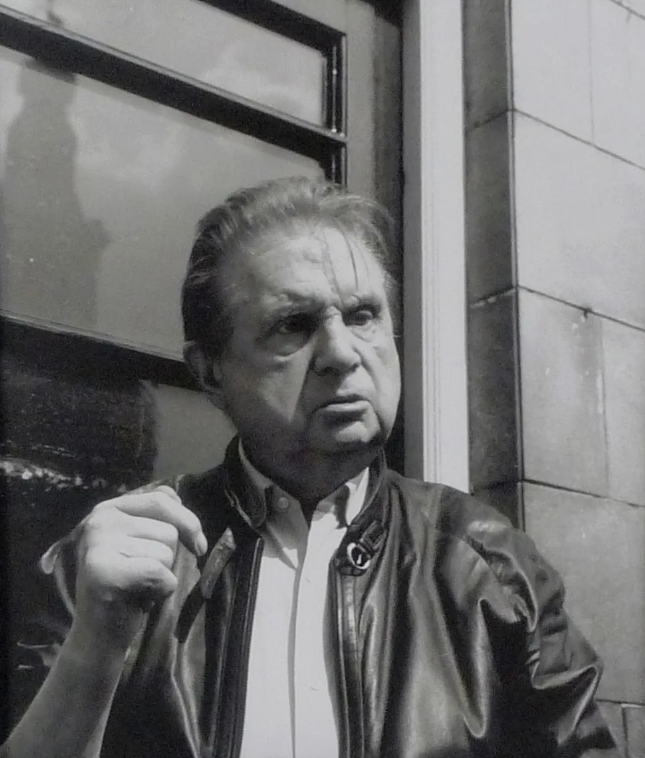
Sizzling row over Bacon books
THE squabble continues for literary possession of the life of Francis Bacon, who died last year aged 82. Six rival biographers are preparing to exhume the artist in print.
Two of them, Old Etonian, Andrew Sinclair, and claret-gilled Soho chronicler
Daniel Farson, have been lashing each other with handbags (Sinclair:
Yesterday Sinclair claimed a victory (of sorts) when Farson
This may not satisfy Bacon
Just the kind of situation that sent Bacon off on his legendary benders.
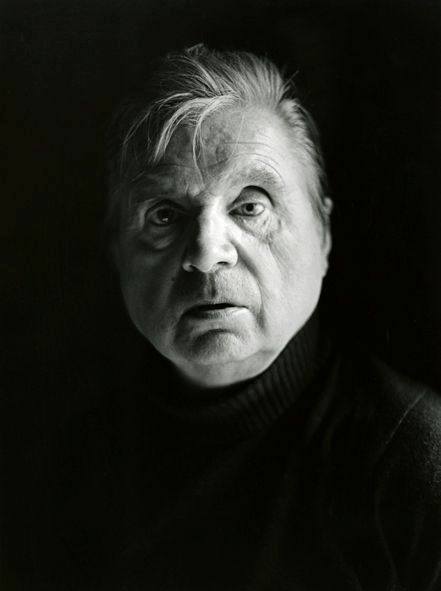
In the sewers of despair
David Mellor enjoys a hard-hitting but affectionate portrait of a great artist
DAVID MELLOR | BOOKS | WEEKEND TELEGRAPH | SATURDAY, APRIL 17, 1993
I PICKED up this book with misgivings. It is a year this month since Francis Bacon died. Now we are threatened with a tidal wave of Bacon books. This is the first book of at least six. An unholy row is going on between the motley crew of authors and publishers about which volume holds the key. Oh dear! As if that were not enough, what about the title: The Gilded Gutter Life of Francis Bacon? What can this mean? Kiss-and-tell stuff by an old mate trying to cash in on a dead chum’s celebrity? How cynical and world-weary I am becoming. And, thankfully, wrong as well. Because Daniel Farson’s book is a treat.
More of a memoir than a biography. And as much a memoir of his own life and times as of Bacon’s. A roistering romp through the watering-holes of Soho. A hard-hitting, sometimes cruel, but ultimate portrait of a drunken, dissolute sabre-toothed old monster who happened to be, if contemporary opinion stands the test of time, perhaps the greatest artist of the century.
It is a book full of good fun. Bacon, when the cash started to roll in, refusing his accountant’s advice to go and live in Switzerland: “All those fucking views.” Or being approached, at the end of his life, by Lord Rothhernere. Rothermere: “And what do you do?” Bacon: “I am an old poof.”
And indeed he was. This book not only floats upon an ocean of drink, but stumbles up to its neck through a slough of sexual excess. Bacon seduced grooms at his father’s stables near Dublin when barely into his teens; he was on an ill-advised visit to his last lover, a young Spaniard, when he died in Madrid at the age of 82.
Bacon was a man of fantastic creative energy. A high sex drive is normal for such as him. As he told Richard Cork just before he died, both he and Picasso “were compelled by the erotic impulse”. What will surprise some is not so much the fact of it, but the way it manifested itself. Not only long and intense love affairs, but night after night of rough trade, including notorious East End villains. Not just sex, but violent, masochistic sex. The art critic Giles Auty visited Bacon in St Ives, where Bacon was living with Ron, from Battersea. Auty and Bacon were chatting when “the discussion was interrupted by the return of Ron, who fingered his belt and enquired: ‘Are you ready for a thrashin’ yet, Francis?’ I made polite excuses to leave.”
All this is interesting, if true, and there seems no reason to doubt it. But it would be worthless and merely gratuitous if it were simply pointless gossip. I think it is more than that. The extraordinary excess of Bacon’s sex life was not an optional extra. It was at the heart of his existence. It was his window on the word. It was, Farson contends, the very foundation of his art: “Homosexuality dominated his life. The savagery of his work related directly to those around him in the gilded gutter, a milieu which he preferred.”
Another point emerges clearly from these pages. Bacon was intensely self-aware, and had few illusions about himself. You could say he was into self-hatred. Certainly he was deeply aware of the futility of most of life. The phrase “Gilded Gutter Life” was his own, in a telegram to Farson suggesting only slightly in jest a title for a biography. This intense self-awareness, even despair, was the engine that drove Bacon to create some of the most violent and searing canvases ever produced in the history of art. Without the kind of life he led, could we have had the pictures? I doubt it.
Here, too, Farson des not let us down. There are many pages of interesting analysis. He discuses a range of critical opinion about the nature of Bacon’s art and its significance. There is Mrs Thatcher: “Not that dreadful man who paints those horrible pictures!v; and Grey Gowrie: “Bacon is unique in this century in his ability to render the indoor, overfed, alcohol-and-tobacco-lined flesh of the average urban male. His painting is how most of us look.” Then there is the French critic Michel Leiris, a friend of Bacon’s and the subject of a number of his late portraits.
Leiris’s views on the artist get especially close to the hear of the matter. Defending Bacon’s ability to shock, he wrote: “What, after all, is the point of a painting devoid of this ability to obsess . . . ? The only works which truly exist and achieve full reality are those which establish a persistent hold over us . . .” Summing up Bacon’s art, Leiris claims that the paintings “express the human condition as it truly and peculiarly is today: man dispossessed of any durable paradise.”
But the real joy of this book is Bacon himself. Waspish and unkind one moment, funny and generous the next, he emerges as real flesh and blood, like his paintings. Bacon had no time for the pretensions of some critics. Told that a critic had said one of his pictures represented the artist’s condemnation of man’s inhumanity to man, he expressed surprise: “Well, he would say that, wouldn’t he? That’s the last thing I think of.” Or, about his art: "I have never had any love in the whole of my life — and what’s more I don’t want any. All I do is cast my rod into the sewers of despair and see what I come up with this time.”
This book is rich both in character and characters. The Soho low life is positively Runyonesque. Even the Krays put in an appearance. Much is made, for example, of a mean-spirited and drunken photographer, John Deakin, whose visit to Barbara Hutton’s Tangier palace is lovingly detailed.
Hutton was taking a group of sycophants around the place, and unwisely permitted an already intoxicated Deakin to join in. The sycophants “oohed” and “aahed” in all the right places, including her bedroom, where rumour had it that Miss Hutton, though of a certain age, was still quite active. The bed was pointed out. Deakin was unimpressed: “The sort of bed movie actresses are strangled in.” More follows, culminating in Hutton’s 23-year-old lover being encouraged by her to sing, accompanying himself on the guitar:
When he finished there was loud applause, followed by one of those disconcerting lulls which fall on any party inexplicably. It was shattered by a deafening cry behind the arras which ran down the far side of the room: “When that second-rate strummer has finished,” came an infuriated yell, “I’d like a drink!”
This book will shock some people a lot and almost everybody a bit. It deals, I suspect, with people and incidents far removed from the common experience of most of those who will read it — a fact that few, as they stagger through all the drink, all the gay sex, and some of the bloody and violent deaths, will regret.
But it is a good book: well written; entertaining; above all, thought-provoking. It is, after all, about a man who could say that his ambition was to end up with “the Nietzsche of the football team” while his work persuaded the rest of us that he was the greatest living artist. If human existence is a paradox, the life of Francis Bacon is about as paradoxical as you can get.

Bacon: the extraordinary excess of his sex life was his window on the world
DANIEL FARSON met Francis Bacon in 1951 when he, Farson, was a young and pretty photographer and Bacon was just beginning to be known. Farson was, he admits, 'a celebrity snob' and a very willing recipient of Bacon’s unquenchable generosity. Thereafter they whiled away many happy hours in Soho, and it is this slice of Bacon that Farson so brilliantly captures – the champagne lunches at Wheeler’s (Bacon always paid), the drunken afternoons at Muriel’s, the rent-boy pick-ups, the squabbles in the French pub, the outrageous scenes at parties, the drinking rituals and Bacon’s quaint Edwardian benediction: 'Real pain for your sham friends, champagne for your real friends.'
Although their friendship deteriorated in later years – Bacon may have feared, with some justice, that Farson was exploiting him – they remained in touch and Farson writes movingly and gratefully of Bacon’s many kindnesses, not least the ready cheques that helped him through lean times. In fact, he says, the greatest mistake he ever made was paying one of these cheques back and confiding to Bacon’s lover, John Edwards, that he had done it from the advance on this book: Bacon didn’t like to be paid back anyway, and he dreaded biographies - once or twice, in his cups, he gave Farson permission, but always withdrew it later.
Still, I think he has been well served by this book. It will certainly be the first of many biographies, and perhaps the slightest, but it preserves precisely the aspects of Bacon that will be hardest for scholarly researchers to capture. And although Farson rightly concentrates on what he knew at first hand – Bacon’s Soho social life — he casts some interesting sidelights on the work, especially the revelation that in the late 1930s, when Bacon always claimed to be doing nothing, he was actually turning out dozens of drawings a day and painting, according to a lodger who shared his house, leafy Post-Impressionist landscapes – extraordinary if true. Farson knew many of Bacon’s models – Muriel Belcher, of course, George Dyer, Isabel Rawsthorne and John Edwards (who became his heir) – and describes them in memorable vignettes. He traces the rise and fall of his relationships with fellow artists Graham Sutherland and Lucian Freud, and his lasting admiration for Giacometti.
Farson is good on Bacon’s sex life, too. Knowing many of Bacon’s boyfriends, he recognised his taste in pick-ups – 'masculine in suits' – and understood the intrinsic dilemma of being a masochist shopping for sadists. He says, interestingly, that paying for sex was Bacon’s way of alleviating his guilt about being homosexual. He records Bacon’s reply when asked what he would like to have been if not an artist – 'a mother' – and makes a conscientious stab at trying to illuminate his childhood: the loveless parents, the choleric and drunken father, the doting nanny, the asthma attacks, the sense of gloom and violence that pervaded their various Irish homes. Bacon told Farson that he had enjoyed frequent orgies with his father’s grooms; he told another friend that his father encouraged the grooms to horsewhip him.
How reliable any of this might be remains to be seen, and there is obviously an awful lot of work for a serious biographer to do. Yet perhaps no one can convey better than Farson the fun of Bacon’s company and the louche adventures of the Soho underworld. There are some truly joyous yarns in this book – Bacon appearing in full maquillage at Farson’s village pub in Devon, a drunken visit to Barbara Hutton’s house in Tangier, Princess Margaret insisting on singing at a party and Bacon booing, Bacon clearing a restaurant by saying loudly that he wanted to be fucked by Colonel Gaddafi — and wonderful quotes like Bacon’s response when being sent endless deliveries of flowers for his eightieth birthday: 'I’m not the sort of person who has vases.' All in all, a book that is a joy in itself and a goldmine for biographers to come.
Louche life of a great painter
George Melly praises Daniel Farson’s heartfelt tribute to his friend Francis Bacon
GEORGE MELLY | BOOKS | THE SUNDAY TELEGRAPH | SUNDAY APRIL 18 1993
Rather than offer the conventional “life and work” approach, Farson appears to have taken his friend’s genius as read for most of the time. Nor, I suspect, is he much of a researcher in the academic sense; he is more of the inspired gumshoe who always manages to interview just the right witness.
He has written, in fact, a personal book, an act of beady-eyes homage and, while Bacon’s traumatic Anglo-Irish childhood and his louche youth in Berlin, Munich, Paris and London are convincingly enough covered, five-sixths of the text centres on Soho where, in 1951, the 23-year-old Farson, still wet behind the ears, met up with the almost unknown Francis Bacon who, by then in his late forties, had clearly seen it all. It was the start of a long, long friendship.
Bacon in later year sometimes maintains that Soho was not all that important to him. But in fact the French Pub, Wheelers restaurant and the Colony Room were very much his gregarious escape from the solitary hazard of the studio in Kensington mews. Muriel Belcher, the witty, foul-mouthed proprietor of the Colony, was probably the person he loved best in the world.
Farson’s stratagem therefore is to map out the district as it was, re-animate the large cast, and then identify Francis as the brightest star in that seductively seedy firmament.
The book is fascinating, too, in the chapters in which we watch Francis Bacon rise from obscurity to international fame; a process which, uniquely in my experience, had no effects on him whatsoever.
I must here nevertheless register a minor carp. In bringing the Soho of the 1950s and 1960s to life, Farson sometimes repeats stories which he has already written elsewhere. There is also at times a danger that John Deakin, a scrofulous and malicious little photographer, has taken over the book. Luckily, he dies before he can achieve this end and, grotesquely enough, it was Bacon who was forced to identify his body because Deakin, in order to cause the maximum trouble, had named him next of kin. “There she was,” Bacon told Farson later, “with her trap shut for the first time in her life.”
“Writing this book”, concludes Farson, “has given me the pleasure of getting to know Francis better. I had not fully appreciated just how extraordinary and many-faceted he was with his spasmodic saintliness tempered by the swaggering panache of Cyrano and the rampageousness of Mt Hyde.” And then later, “He was a sweeter man than I had realised, but this didn’t diminish his capacity to hurt.”
Nor indeed to be hurt. Bacon was pursued by the same Harpies which haunt his work. They really had it in for him too. In 1962 the news of the death of the love of his life, the war hero and piano player Peter Lacy, coincided with Bacon’s first triumphant retrospective at the Tate. Ten years later, the day before the painter’s conquest of Paris at the Grand Palais, his difficult, drunken companion and model, George Dyer, expired on the lavatory.
All this confirmed Bacon’s tragic nihilism; yet he himself never gave in. After a lifetime of heavy drinking, acute asthma, and operating on one kidney, Bacon still managed to live to be 82, and continue to be loved and in love.
When he did die, David Sylvester, the art critic, wrote a letter of commiseration to Daniel Farson. “You played”, it read, “a terribly important role in his life. I can think of few people who were so enviably close to him ...” This was true and a privilege. In writing this fine book Farson has paid his dues.

OF Francis Bacon in his twenties, the novelist Patrick White wrote that he lived within a stones throw of the Mozart-Sackville brothel. “He had an old nanny who used to go shop-lifting when they were hard up, and as a lover there was an alderman.” Bacon’s life — his homosexuality blatant even when it was a criminal offence, his masochism, his gambling, his drinking, his savage dismissal of all but a fist full of contemporises, his generosity to old people and his well of bitchery and springs of sweetness — all combined with a ruthless view about his own life and life itself to produce a man as unique as his paintings.
He is in my view rightly thought of as one of the greatest painters of the century, and what gives the paintings their strength is that vision. Bacon’s twisted limbs, his screaming Popes, the black mouths, imprisoned near-mutilated bodies, racked meats of pain, show us what we are and what we’ve done to each other in this century more bleakly and directly than almost any other artist.
It is a cold, pitiless and unrelenting vision with no light at all at the end of the tunnel and alas it seems to speak for us now. Yet the man who did these paintings, as Daniel Farson attempts to show in his chatty biography The Gilded Gutter Life of Francis Bacon (Century, £17.99) was full of laughter, often full of champagne, with whiplash one-liners and wild launches at the roulette wheel, or other chance encounters — always of the male variety.
Drinking
In the morning he painted in oils like a labourer, self-imprisoned in a tiny flat, whose walls are crusty thick with layer on layer of mixed paint. In the afternoon he came out on the prowl for expensive drinking, and the old gay gang in The Colony Club, in and around Soho. The morning after, as often as not, he had little memory of the night before.
He came out of Ireland, a rather grand horsey background, with eccentric aunts, a vile father and stable lads who “broke him in” early. From his teen age he drifted, now a butler, now a sexual valet, a born ligger, slowly working out his life without the benefit — or perhaps it would have been an obstacle in his case — of any formal education at all.
He read good authors and remembered what he read. He was taken up by a genial clique of homosexual artists. He made up his mind what he would do and very soon he arrived, fully grown as an artist and already as a legend. Always extravagant, even when broke, he lived a life which many dream of as the bohemian ideal, and he lived it flat out until his death at the age of 82.
Lovers
He had several close lovers, one of whom, John Edwards, inherited his considerable estate. He also had a welter of friends and acquaintances from the aristocracy to the gutter, useful and serious rivals in his work, and of course he attracted spongers and bores. He moved among them lightly, the cat who walked alone. In my own experience he was always a pure joy to be with. Daniel Farson has known Francis Bacon for most of his adult life and this tribute in enjoyable enough to be going on with. Some readers will think there is rather too much of Farson, but he makes no great claims for the book.
Some of the stories are fresh and funny, the lineaments of the man and his art are toughed on. For those that want to know what the other side of the artist’s moon was like in London in this century, it is a useful introduction. To relish and understand the full impact of the man and his work, of the devil inside the life and the art, we will have to wait for a fuller and deeper account. But this is good enough to be going on with.
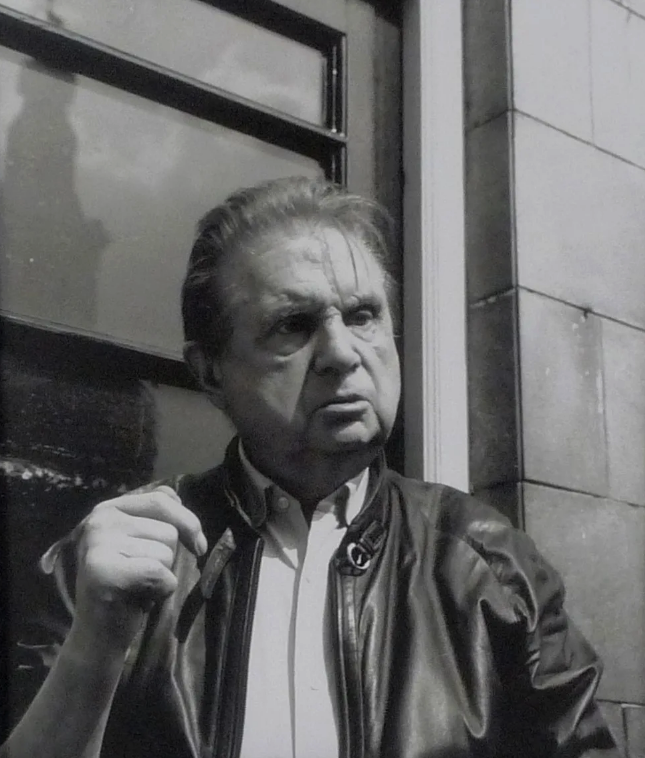
BOHEMIAN: Bacon spent afternoons on the prowl
FRANCES SPALDING | BOOKS | THE SUNDAY TIMES | APRIL 18 1993
Francis Bacon died in Madrid on April 28,1992. In the race to publish the facts of his infamous life this book is a winner, arriving even before the anniversary of its subject’s death. Any suggestion of unseemly haste would be inapposite. Seemliness had no role in Bacon’s life or philosophy. His purpose in life and art was to rip through protective sentiment. “I have always thought of friendship,” he once said, “as where two people tear each other apart. That way you learn something from each other.”
As was the case with Picasso, Bacon s creativity seemed fuelled by destruction. He could annihilate with one sentence or even a word. When an aspiring artist pestered him to visit his studio and comment on his work, Bacon replied he had no need as he had seen the young man’s tie. Another anecdote tells of a ball given by Lady Rothermere at which Princess Margaret seized the microphone, began crooning Cole Porter and, in a dress that forbade it, tried to gyrate while the other guests respectfully watched, Bacon began the loud hissing and booing that brought this painful performance to an end. His ruthless, fastidious intellect would accept no compromise.
He was nowhere more merciless than in his art. After the war, while a strange silence covered the Holocaust , he portrayed, in image after image, a disintegrating world full of chaos and despair. The ghoulish creatures in Three Studies For Fig - ures At The Base Of A Crucifixion, first exhibited in 1945, are a horrific reminder of human bestiality. His destructiveness continued to counter Frances Spalding’s biography of Bacon’s associate John Minton, Dance Till The Stars Come Down, is published by John Curtis Hodder, the sentimentality of our age. Both, in their different ways, are brutal and perhaps merely two sides of the same coin.
He was born in Dublin in 1909, and grew up in County Kildare. According to Daniel Farson, Bacon’s education was painful and minimal: a few months schooling were added to a handful of tutorials with a parish priest. He was sexually "broken in" by his father’s grooms and stable lads who, so Bacon told a friend, also systematically whipped him at his father’s instructions.
,.. Francis became as allergic to horses as his father was to his son. When one day he found his son trying on his mother’s underwear, all attempts at co-habitation ceased: Bacon, still in his teens, went to live in London on a weekly allowance of £3, paid by his mother. He afterwards said little about his background, referring rather bitterly to his father as “a failed horse-trainer”.
Loyalty was given to his nanny, who remained a part of his London life and obligingly went shop-lifting in the afternoons when funds were low. A fervent advocate of capital punishment, she slept during the day on the kitchen table and regarded Edward Mil, after his abdication, as an utter disgrace. Said to be halfblind, she could tell the difference between a ten-shilling and pound note instantly. And when Bacon held illegal gambling sessions, she made a small killing as cloakroom attendant.
As a young man he never went near an art school, but instead, in 1927, visited Berlin. There, in the company of a so-called uncle, he experienced a sexual freedom that deepened his scorn for convention. He came home via Paris and was so taken with it that he returned soon after to live with a family at Chantilly and learn French. In the local museum, he saw Poussin’s Massacre Of The Innocents, which appears to have begun his fascination with the human cry. Back in Paris, he bought a second-hand book on diseases of the mouth and saw an exhibition of Picasso drawings.
These and other experiences were crucial in forming him as an artist. Farson acknowledges them, but lacks diligence in his pursuit of facts and dates. His text, like a good pub conversation , excels at anecdotes, has only a nonchalant regard for chronology and can be repetitious. This is, after all, not an authorised biography but a personal memoir. Some of the material is recycled, for Farson has an established reputation as a historian of Soho and its sacred monsters. He writes memorably about the photographer John Deakin and makes vivid the wonderfully abusive Muriel Belcher who ran the Colony Room which attracted a gallery of famous names. (When asked how she did it, she replied: “I think it’s my charm, deah.”)
It will require a skilled biographer to deal adequately with Bacon’s complex nature. In the mean time Farson alerts us to the experience of rejection, the commingling of sex and violence, Bacon’s respect for chance, his awareness of vulnerability and the central importance of his homosexuality. As one of his friends remarked, “If he’d been straight he would not have been so daring.”
Bacon’s masochistic relationship with George Dyer ended with a suicide timed to coincide with the opening of Bacon’s retrospective at the Grand Palais in Paris. “I have never had any love in the whole of my life,” Bacon is reported to have said, “and what’s more, I don’t want any. All I do is cast my rod in the sewers of despair and see what I come up with...”
In 1989, he gave me lunch when I was writing my biography of his
contemporary, John Minton. Everything was in keeping with his reputation:
champagne in the French pub in Soho, oysters at Wheelers, his opening remark,
unpredictable and perverse:
Curiously, this painter, whose name is so often linked with despair, had enormous reserves of optimism. He could be found standing with others at a bar watching the racing, jubilantly ordering another bottle of champagne at the finish, regardless of which horse won; it was the race that exulted him.
Farson jumbles fact with legend, misspells names, offers initiating résumés on how he obtained his material. Yet he has caught Bacon’s viciousness and generosity, his extreme behaviour and hatred of insincerity. Many hours spent drinking in Bacon’s company have given Farson a first-hand account which subsequent biographers will add to and correct, but cannot ignore.
The Gilded Gutter Life Of Francis Bacon by Daniel Farson Century £17.99 pp279

Bacon: a ruthless, fastidious intellect which would accept no compromise
Sample an enticing slice of Bacon
BY COMPTON MILLER | EXPRESSIONS BOOKS | DAILY EXPRESS | THURSDAY 22 APRIL 1993
IT IS ironic that Britain’s highest-priced artist painted such god-awful pictures. Francis Bacon’s blurred, contorted portraits of screaming Popes and nude males crouching on loos could easily give children nightmares.
Now, following this remarkably spry Irishman’s death in Madrid last year aged 82, Daniel Farson has beaten five other authors to produce the first biography, The Gilded Gutter Life Of Francis Bacon (Century, £17.99).
Farson keeps crowing about his long, sometimes bitter friendship with the artist and his direct quotes seem to have come from dimply-remembered marathon drinking sessions which the two of them once enjoyed at Soho’s seedy Colony Club and French pub.
Bacon loathed talking about himself and wrote few letters so that interviews with Melvyn Bragg on his South Bank Show and art critic David Sylvester have taken on almost a gospel significance. Farson applauds Bacon for not going to art school, as otherwise he would have lost that “imperious solitude which stamped his greatness.”
While writing irritatingly too much about himself and their shared homosexual milieu, the author-broadcaster has nonetheless compiled a thorough, engagingly anecdotal, and often poignant memoir.
In 1955, the then unknown Bacon rang him saying that he urgently needed £150. Would one of his latest papal daubs be a sufficient exchange? To his everlasting regret, Farson introduced him to his flat-mate who handed over the cash. The same painting was recently sold for $5.7 million.
Bacon’s manners were often as quirky and cruel as his work. When he was pestered to view some paintings by a fellow artist, he said crushingly, “I don’t want to come to your studio because I’ve seen your tie.”
He refused a knighthood and the prestigious Order of Merit and once booed Princess Margaret when she suddenly decided to sing Cole Porter songs during a society ball. And when, at a party, the publishing magnate Lord Rothermere asked Bacon what he did, the painter replied: “I’m an old poof.”

ARTISTIC LICENCE: Francis Bacon
FRANCIS
Soho was full of drinkers and artists, but there was only one
Francis Bacon. Here, four days before the first anniversary
of
his death, his old friend Daniel Farson recalls him
He was a loner, though he relished company. His work is seen as pessimistic, yet he had an innate optimism which helped him to survive. He was the best company, the funniest and most humorous. He could be kind and generous, as I knew from experience, yet capable of sudden anger, even petulance. He betrayed many of his close friends, especially if they were rival artists, and some did not forgive him. He was totally amoral.
He was born in 1909 in Dublin, of English parents, and was brought up in considerable luxury and style. His father had been a major in the British Army who moved to Ireland. Later he moved to train horses in Co Kildare, to a comfortable house with outbuildings and stables, ideal for a child who was fond of horses and hunting. Francis liked neither and he detested the countryside for the rest of his life.
The only attempt his parents made to give him a formal education was to send him to Dean Close School in Cheltenham but he stayed there for just a few months. Partly because of his asthma, his education amounted to little more than private tutorials with the parish priest. 'I had no upbringing at all,' he once said. 'I used simply to work on my father’s farm.' His closest companion was his nanny.
How Irish was he? Lord Gowrie, the former arts minister, understood his background – they shared the same roots. Gowrie told me that Francis was not an 'Irish painter', although he was in many respects Irish and his memories of Ireland had a traumatic effect upon him. Bacon himself said in an interview: 'I grew up at a time when the Sinn Fein was going around. All the houses in our neighbourhood were being attacked. I’ll always remember my father saying: 'If they come tonight, say nothing.' ' He has said: 'I was made aware of danger at a very young age.'
Lady Caroline Blackwood, who was married to Lucian Freud and is a member of the Guinness family, was very conscious of his horror for Ireland: 'He had the intellectual Irishman’s traditional dislike of Catholicism. The popes that he painted were all screaming and distorted. Some of them were sitting on the lavatory. Although he stubbornly denied that he had been influenced by his Irish upbringing, the desolation of his vision was very similar to that of Beckett.'
Homosexuality was his nature and he had the strength not to wish it otherwise. When he was 18, his father made a final attempt to 'make a man' of his son by placing him in the custody of a friend of his: a tough, no-nonsense-seeming horse trainer, but he turned out not to be what he seemed. He was a man with a taste for decadence. 'We settled in Berlin for a time,' said Francis, 'it must have been 1926 and by way of education I found myself in the atmosphere of the Blue Angel.'
They stayed at the Adlon Hotel, where Francis enjoyed the luxury of breakfast in their double bed, served by an unperturbed German waiter. When he returned to London in the late Twenties, after a brief sojourn in Paris, he embarked on furniture design, but in 1933 he abandoned that to concentrate on painting. His picture Crucifixion was that year included in Art Now by Herbert Read. This was a sensational start, considering he was untrained and no more than 23 or 24.
Francis had a deplorable war. When he received his call-up papers, he hired an alsatian dog from Harrods and slept beside it in order to aggravate his asthma. When he reported for his medical the next morning, he was granted an immediate exemption and the unfortunate animal was returned to Harrods — or so one hopes.
Instead of fighting, he stalked the 'sexual gymnasium of the city', as he described the streets of London. No one gave a damn as to who did what to whom, and the darkness of the blackout provided convenient cover as you went in search of trade. Asked later if he liked rough trade, Francis said: 'Yes, and married men, too.'
The writer and painter Michael Wishart gave this account of seeing him make up one evening in those years: 'He applied the basic foundation with lightning dexterity borne of long practice. He was more careful, even sparing, with the rouge. For his hair he had a selection of Kiwi boot polishes in various browns. He blended them on the back of his hand, selecting a tone appropriate for the particular evening, and brushed them into his abundant hair with a shoe brush. He polished his teeth with Vim.'
Throughout the war, when he refused to exhibit – although it is doubtful if many opportunities arose – he survived by gambling.
The Colony Room was a smallish room with a faded air at the top of some shabby stairs in Dean Street in Soho, central London. It was a place where you could drink in the afternoons after the pubs had closed. Owned by a remarkable woman called Muriel Belcher, it was also known as Muriel’s. Bacon came to love her and the place and was a habitue for more or less the last 40 years of his life. 'It is a place,' he told me, 'where you can lose your inhibitions. It's different from anywhere else.' Actually, he had no inhibitions to lose.
Though she enjoyed her members’ success, Muriel had not the slightest interest in art. This was all to the good. Generally the last thing artists wish to talk about is art, and at Muriel’s they gossiped about the things that really mattered
— sex, drink, scandal and daydreams. Though Francis was unknown to the public 40 years ago, he was revered by his contemporaries, especially the small group that met at the Colony Room and became known as the 'School of London' or, better still, 'Muriel’s Boys'. They included Lucian Freud, Michael Andrews, Frank Auerbach and Tim Behrens.
At Muriel’s, as at Wheeler’s, his favourite restaurant, Francis always signed the bill. He would wave his bottle of champagne, slopping it into the glasses of those around him, spilling much of it on the floor, with the Edwardian toast: 'Real pain for your sham friends, champagne from your real friends', a habit he had acquired from his father.
But Francis was never wholly relaxed, even at Muriel’s. It was a long time before I realised that, when he wandered off to the lavatory with his glass in his hand as if he could not bear to part with it, he threw the contents away; he drank less while filling the glasses of those around him.
He could be very nasty. An artist – I think he came from Trinidad – came into the Colony one afternoon to present the club with his latest painting, which was still wet. This generous gesture was accepted politely until Francis made his entrance. He shook his bottle of champagne, aiming it at the picture, whose colours dissolved into an even more frightful mess than it was in the first place.
But he could also be very gracious. One afternoon an art student navely showed him a leaflet he had produced. Francis asked if he could buy a copy, adding that he would be grateful if the young man would sign it for him. Francis made his day, as he had destroyed the Trinidadian’s.
FRANCIS’S discipline was extraordinary. In the early Fifties he worked from 6am with fierce concentration. He told me that drink and the after-effects forced him to concentrate on his painting and at times it gave him 'a sort of freedom'. It was hard to imagine him asleep, indeed he could not have slept much. I have seen him on mornings when he was grey and nearly sightless from fatigue after drinking and gambling through the night, but a few hours later he would reappear totally refreshed.
His output was consistent. The years 1951 to 1962, when he was raging around Soho, were also the period of his artistic ascendancy. If we compare his Three Studies for the Base of a Crucifixion, the painting with which he burst on to the scene in 1945, with the masterpieces of his Soho period (that is to say the popes, the remarkable painting Man with Dog, his series on Van Gogh, the astonishing Two Figures, also called 'The Wrestlers' and 'The Buggers', Miss Muriel Belcher, the Paralytic Child Walking on All Fours, and the blood-spattered Three Studies for a Crucifixion of 1962, completed while he was drunk), they confirm his formidable development in a comparatively short time.
In 1974 he met John Edwards and formed a friendship that would go on for
the rest of his life and be a happy contrast to an emotional life which had been
often turbulent and punctuated with untimely deaths. They met through John’s
elder brother David, the licensee of The Swan in Stratford East, who was a
frequent visitor to the Colony and good friends with Muriel. 'My brother used to
say Francis Bacon would be coming to The Swan with Muriel. She would tell us to
get champagne every week
One day John was taken to the Colony and when he was introduced to Bacon he said: 'Why don’t you turn up when you are supposed to for all this fucking champagne?'
Francis was amused and invited him to Wheeler’s. From that day they were friends. Ian Board ran the Colony with Muriel and eventually took it over. He remembers: 'John was hypnotised. Francis told him: 'You don’t want an old boiler like me', but Francis was a great seducer and, to him, John appeared to be a tough East Ender.'
'To my amazement,' says John, 'when I walked into his studio about two months later, there was a picture he had painted of me. I never sat for him. He was marvellous company, good fun and a great drinking companion. I saw him every day.'
For an East End boy who could neither read nor write, it was an extraordinary transition. Yet he had such self-assurance that Francis didn’t have to explain him to anyone. David Edwards says Francis liked John because he told him exactly what he thought. Most people just bowed down to Francis; John stood up to him.
Ian Board remembers asking Francis: 'Are you in love with him?'
'Oh no, dear, fond of him.'
'Then it became 'very fond of him'. Actually, he was riddled with love.'
It had nothing to do with sex. John told me that they shared a bed once after Francis passed out from drink and that was as far as it had gone. What was important was that John was lively, young and streetwise, and of a happy disposition, a welcome change for Francis.
By the time he reached 80, Bacon had been one of the world’s most famous artists for two decades, but he had time for some of the people who had need of him. When Sonia Orwell (George's widow) was dying of cancer, he went to the trouble of renting an attractive room for her in a hotel near the hospital, and every evening when she returned from treatment she found champagne and flowers waiting for her. He was also scrupulous in remembering people who might have been forgotten, such as his childhood nurse. 'He remained strangely loyal,' says Ian Board, 'it was one of his surprising characteristics. I’d meet him and it was either 'I’ve just been to see the old girl', or 'I’m just going to visit her'.'
His stamina and powers of recovery were remarkable. Illness and accidents were ignored. He was so pissed one afternoon that, going upstairs to the Colony, he slipped and one of the metal strips hit the right side of his eye and put it half out. He just pushed it back in again. After an exhausting day’s filming for The South Bank Show, Francis got Melvyn Bragg drunk in Mario’s restaurant. And, when they continued filming in the Colony next morning, Michael Wojas, the barman, says he can’t forget the look on Bragg’s face when he saw Francis already sparkling at 11am, having been there for an hour already. Bragg sent out for black coffee; Francis continued on champagne.
'Francis saw him coming,' says Ian Board.
'Did he get Bragg drunk deliberately?' I asked.
'Oh yes. He made a particular point of topping up the drink.'
'To get the edge?' said Michael.
'To show what idiots they are,' said Ian, with a snort.
With a final flourish and sleight of hand, Francis Bacon died on the morning of 28 April 1992 in Madrid. He was 82. This was what he had hoped for: no fuss, no discovery of his body in an empty room a day or two later, not even a funeral. It was not so much a death as a disappearance.
In his way he was triumphant to the end. He treated death just as he had treated
life. His whole estate went to John Edwards: £11,370,244.
His friends were shocked by the news of his death, though at the age of 82 death was hardly a cause for surprise. In Soho there was almost revelry. Members climbed the dingy stairs to the Colony Room. 'It’s been electrifying,' Ian Board told me. 'The worms crawled out of their holes – I thought many of them were dead – but the extraordinary thing is that the younger generation came in full fucking bloom.'
My own sense of loss overwhelmed me for a few days but one letter I received gave me particular pleasure, for it came from David Sylvester, Britain’s most distinguished art critic and one of Bacon’s closest friends: 'Since he died, I've not thought about him as a painter. I’ve only thought about the qualities that have long made me feel he was probably the greatest man I’ve ever known, and certainly the grandest. His honesty with himself and about himself; his constant sense of the tragic and the comic; his appetite for pleasure; his fastidiousness; his generosity, not only with money – that was easy – but with his time; above all, I think, his courage. He had faults which could be maddening, such as being waspish and bigoted and fairly disloyal, as well as indiscreet. But he was also kind and forgiving and unspoilt by success and never rude unintentionally.'
The Gilded Gutter Life of Francis Bacon by Daniel Farson is published by Century at £17.99.

Francis Bacon and friends at the Colony in 1983. Photograph Mary Dunkin
The face behind the distortion
Distraction was the name of Bacon’s game, not shock,
says Anthony Curtis
IN ONE of his Interviews with Francis Bacon (new edition 1979) David Sylvester asked him about the recurring image of the Crucifixion in his painting. The painter said that the Cross was only a convenient “armature” for different forms, and denied that it had any religious significance in his work although the outline treatment, he agreed, was derived from Cimabue. Bacon saw the whole subject as “just an act of man's behaviour, a way of behaviour to another”.
This reply led Sylvester to probe further: why, if that was so, did an aura of religion hang over several other paintings, such as the famous series of popes with their origin in the portrait by Velasquez of Innocent X. This prompted Bacon to make a distinction between being a painter in a period when the Christian faith was a part of the culture out of which the work came and being a painter now, when it was not.
“You see [Bacon continued], all art has now become completely a game by which man distracts himself; and you may say it has always been like that, but now it’s entirely a game. And I think that that is the way things have changed, and what is fascinating now is that it’s going to become much more difficult for the artist, because he must really deepen the game to be any good at all”.
What is so shocking in Bacon’s work to the spectator — the distortions of the human face into the blurred grotesquerie of his portraits, the ripping open of the human body where the innards are repulsively exposed, and the gestureq,.of suffering. transmitted in screaming countenances — is that all of these were for Bacon, simply various ways of “deepening the game”.
The artist remains neutral, dispassionate, unaffected by these horrors. If anything he sees an aesthetic beauty in them, just as he loves the tonal beauty of the reds of the slaughtered carcasses hanging in a butcher’s shop. And now in the recollections of Daniel Farson who, as a drinking pal and fellow-roisterer over 30 years, knew Bacon well, a similar attitude — of deepening the game while standing aloof from it — emerges throughout Bacon’s life.
This book of Farson’s is not any kind of formal biography, rather an extended piece of anecdotage, placing Bacon firmly in his natural habitat, the world of the Soho pubs. It is slight but readable, some of it re-cycled from Farson’s Soho in the Fifties; but the same story told many times is an endemic feature of Soho society, and the book certainly gives a revealing and lively view of Bacon as he appeared to his barstool chums.
He gravitated to Fitzrovia early on, when he arrived here from Ireland where he had been brought up by his father, a horse-breeder, or rather by the latter’s groom and stable-lads who indoctrinated him into homosexual sex. In the frenetic days before the second world world in London, Bacon was a struggling, penniless, obscure, gay young artist, working briefly in the rag-trade. What is remarkable is how loyal Bacon remained for the rest of his long life not to any particular individual (he was ruthless about ditch ing ex-friends and ex-dealers) but to the Soho pubs-and-clubs milieu.
Most artists leave their youthful haunts behind them when they become rich and famous, but not Bacon. He was still to be found at Muriel Belcher’s The Colony Room (“little more than a small and shabby room with a lavatory and a telephone at the back”) or the York Minster (“the French pub” after its proprietor, Gaston Berlemont) even when his paintings were on sale for telephone number sums at the Marlborough Gallery, many of them to be snapped up by the Tate or the Museum of Modern Art in New York. A sprightly octogenarian, he died just over a year ago, leaving his entire estate worth around £10m to his long-standing boyfriend.
It was, Farson tells us, the custom for him to say at the end of a heavy Soho drinking-session, “let’s go” — at which point four or five of them would repair across the road to Wheeler’s fish restaurant in Old Compton Street where they would tuck into plates of oysters washed down with champagne., all paid for by Bacon (eventually). The book contains an interesting photograph from the 1950s of Bacon at his regular table there, surrounded by fellow-painters including Lucian Freud and Frank Auerbach, but the company was not usually quite as distinguished as that.
Bacon’s well-known passion for gambling — he was an habitué of casinos in the South of France — appears as an offshoot of this same uninhibited attitude to money. Farson follows him abroad to the green baize pastpres, enumerating some of his very large wins and equally large losses. It was all part of trying to get the maximum kicks from each lifelong minute with no thought of the consequences.
I once met
him and can vouch for the captivatingly ebullient, fearlessly spontaneous manner
of which Farson gives many examples. Farson says that Bacon rarely talked about
Ireland and his background but strangely enough on this occasion did. He tried
to define the Irish attitude to sex, which he described as being in a large
measure “the immorality of the mouth” by which I understood him to mean talking
about it rather than actually doing it. That, one gathers from Farson, was not
something of which Bacon himself was guilty.
THE GILDED GUTTER LIFE OF FRANCIS BACON by Daniel Farson Century £17.99. 273 pages
A Soho soul made of wild brushstrokes
Daniel Parson was 23 when he met Francis Bacon. He tells Janet Watts
аbоиt their 40-уear friendship of love and horror.
DANIEL PARSON loved Francis Bacon. Though their friendship had its horrors, it lasted 40 years. ‘I don’t think one was conscious of love at the time,’ he reflects. ‘But one is in retrospect. When the heat and the fury have died down, you remember the good times.’
We sit in his kitchen in Appledore over a bottle of pink champagne. It is 11 in the morning. Around us hang Francis Bacon’s terrible images of distorted men and Beryl Cook’s jolly ones of brightly dressed women. The seagulls wail outside the window. Beyond it the Atlantic looks cold and grey.
I am here to ask Daniel Parson about Francis Bacon. Are the Bacons on the wall originals? I inquire. Parson guffaws. ‘If they were, this would be the Mediterranean.’ To his deep regret, he sold his only one years ago. Bacon did sign these prints. But ‘rather annoyingly, he did it in invisible ink.’
Farson is a writer, broadcaster, photographer and drinker. He looks rather well on it. His round, rosy face seems to smile even in repose. His blue eyes are clear and shrewd. When he suddenly gets up from the table, rummages in a cupboard and extracts two golden cans, I think they must be Special Brew. But they are crab bisque soup. Farson heats it up, adding a slurp from another bottle. Then he serves poached salmon. ‘This is a marvellous moment for making a successful career in television to see if he could live by writing. ‘I was broke before the year was out.’ Since then he has published 25 books.
This one pulls no punches. ‘The portrait is, I hope, a loving one. But if you’re going to write about Francis Bacon it’s no good hiding behind a façade of discretion. Which is why I came fairly clean about myself, too. It would be too shabby not to. Whenever our two lives interconnected I had to be equally merciless about myself.’
Parson met Bacon in Soho in 1951 when Bacon was fortysomething and in rapid ascendancy as an artist. Farson was 23 and ‘my naivety was almost obscene’. He blames his over-worldly upbringing. He had travelled around Europe in the wake of his beloved father, Negley Parson, a legendary foreign correspondent of the Chicago Daily News, whose addiction to drink ‘is one of the few traits I have inherited’.
Another was a tendency to journalism. At 17 Daniel became the youngest-ever lobby correspondent in the House of Commons. After Cambridge he landed a job as a staff photographer on Picture Post, which was when he met Bacon. ‘At this time I knew almost nothing about art,’ reveals Parson, who now writes on it for The Mail on Sunday. ‘So I didn’t bore him by talking about it, which artists absolutely hate.’
They had an ‘instant rapport’ which still puzzles him. Maybe it was
because at this time, ‘very surprisingly, Bacon could be bored with his own
company. He very much needed company. Even mine.’ He (Farson) had ‘a certain
freshness, I suppose; a certain youthfulness’. They became tremendously close.
At one point we saw each other almost every day and drank together every
afternoon. What bonded us, I suppose, was terrific laughter
Both were homosexual: did they fall in love? He looks amazed and amused
at the idea. Absolutely not. Not at all.
They also shared a love of Soho as ‘the place where go to lose your inhibitions. Though he was the one person who didn’t have any.’ Bacon would apply make-up to his face as exuberantly as paint to canvas, brush his hair with boot polish, shine his teeth with Vim.
‘There was a very different atmosphere then,’ recalls Farson.
‘Everything was infinitely more relaxed before Wolfenden. There was virtually no
discrimination, unless one happened to be arrested, unless No feeling of being a
cause in need of persecution, like today. Bacon detested gay militancy. “I can’t
stand gays’ he
‘What was a big deal was the person was a bore. If person was tiresome they got it between the eyes with both barrels. Francis was tough. I can’t think of any time he was disconcerted. I suppose he was pretty invulnerable, unlike the rest of us. I never saw him cry.’ Parson himself was ‘constantly in tears’. With Bacon? ‘No, no! Just in Soho.’
Farson’s
book shows Bacon as capable of generosity, kindness, sweetness, even ‘spasmodic
saintliness’. But also as a monster. ‘He was a gigantic figure. If you’re a man
of that stature, your virtues and faults are on a grand scale. If you
This sounds true, and fair. But one senses a perplexity in Farson — a
continuing perplexity·
Mentally and verbally, he reveals him as a sadist. Physically and
sexually, as a masochist. Farson notes Bacon
This mixture of misery and farce continued through his life. Parson
reveals it in glimpses, one-liners. Bacon’s lover, Ron, fingering his belt as he
came into a room where Bacon was discussing Bonnard with a friend: ‘Are you
ready for a thrashin’ yet, Francis?’ The embarrassed police chief of Tangier, to
whom the British consul had complained that a famous visiting painter kept
getting beaten up:
The anecdotes relieve but cannot dispel the darkness in this life. A lover’s death shadowed two key moments of triumph in Bacon’s artistic career. First in 1962: on the day that his first major retrospective opened at the Tate, his lover Peter Lacy died. Bacon had known he was desperately ill in Paris. But he hadn’t managed to visit him. ‘The exhibition came first.’
Then, in 1972, at the triumphant opening of his exhibition at the Grand Palais, Bacon was told that George Dyer was dead. He had been found on the lavatory, blood pouring from every orifice. Bacon painted Dyer’s suicide in his Triptych, 1973: images of Dyer slumped double on the lavatory; vomiting blood into a basin; a naked, bloated head and torso disintegrating under a naked light bulb.
Dyer had been a minor East End villain when Bacon met him. ‘He was a handful, George,’ recalls Parson benignly. ‘But he was very sweet. I was very fond of him, though he was fiendish. was the problem — Francis liked him because he was fiend. But then he became to much of a problem.’
Many times, people asked Bacon to explain his paintings of human isolation and mangled flesh and blood. He never did.
He said once that in any road accident he’d seen, what impressed him was its beauty — ‘the vision of it, the bodies strewn about with broken glass from the car, the blood and various possessions. . .’ He had photographs of Himmler and Goebbels pinned up in his studio: Parson isn’t sure why. ‘He didn’t care about evil. He was fascinated by the image.’
In conversation with Parson over many years, Bacon insisted that he
believed in
His friend Parson survives. He considers himself lucky to have known
Francis Bacon. He writes on, alone in Appledore. ‘That is the way the dice have
fallen, and I think I prefer it,’ he says, caressing his glass.
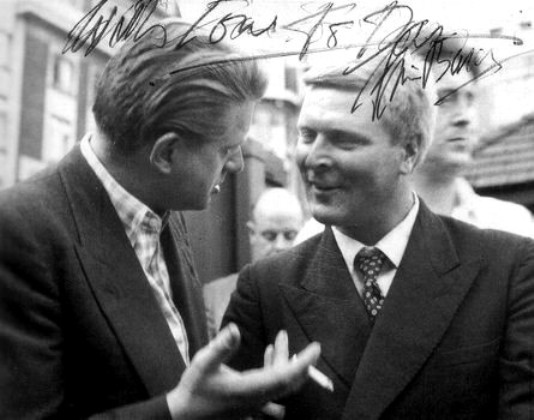
Early days in Soho: Bacon and Farson enjoyed ‘instant rapport’
by Daniel Farson (Century, £17.99)
Francis Bacon died a year ago at the age of 82 during a visit to his Spanish boy friend in Madrid. In this, the first biography of the artist, Daniel Farson, long time friend and drinking companion, vividly captures the complexities and contradictions of this mercurial and often horrifying figure. An habitué with Bacon of bohemian Soho in the late ’40s and ’50s when artists, writers and hangers-on gathered at private clubs like the Colony to drink all day, Farson paints a warts and all picture of life which seems as desperate as it was entertaining.
More personal memoir than scholarly biography, Farson’s book is readable, unpedantic and at times enthralling, brilliant at capturing the cutting anecdote, the bon mot which sums up — or more often puts down — the famous and pompous. Bacon’s generosity to his friends was legendary — whether producing crisp $100 bills or writing cheques for ailing friends — but so was his cruel wit and bad temper. Farson gives many examples without seeking to conceal his own complicity, in the process revealing as much about the writer as the painter.
Farson is at his most insightful when detailing the more personal aspects of Bacon’s life, such as his taste for being beaten, or describing his lovers like the Second World War air pilot Peter Lacy, and his tempestuous relationship with George Dyer, the man who took his own life just before Bacon’s Paris retrospective. The image we get is of a petulant Peter Pan figure who despite the hard drinking and late night gambling, looked 20 years younger. His great gift was to be able to paint dark, anguished often violent and disturbing pictures which seemed to sum up the dilemmas of modern life.
Clearly there is much more to tell. Many of the people involved are still alive, and some friends, following Bacon’s own refusal, are still reluctant to cooperate with a biographer. Bacon remains an enigma. While his art, confrontational and informed by an acute understanding of his own homosexuality, is acknowledged internationally, its attraction remains elusive. Farson’s account, if not resolving all the questions, is engaging, and affectionate.
Emmanuel Cooper
Art collection will benefit boys’ clubs
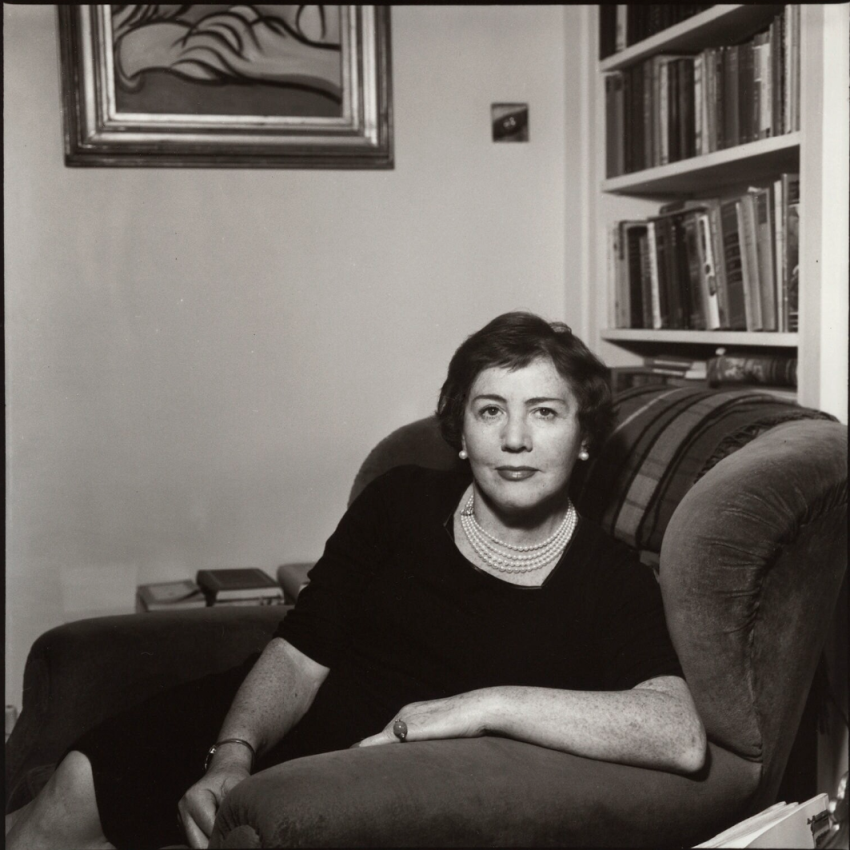
Illa Knina (Mrs Kodicek)
She bought art works from The Hanover Gallery, The Lefevre Gallery, Marlborough Fine Art
Artist on the town
Daniel Farson
THE GILDED GUTTER LIFE
OF FRANCIS BACON
The first thing to say about this entertaining book is that it is rather more the autobiography of Daniel Farson than the definitive biography of Francis Bacon, an artist for whom extravagant claims continue to be made. These claims include that be is “the greatest English painter since Turner”, a phrase which has recently been applied, equally thoughtlessly, to Sickert and even Bridget Riley. Bacon’s entitlement to this adaptable accolade is not really discussed by Farson who sees his subject’s stature as self-evidently that of one of the all-time greats Many who saw Bacon’s 1988 exhibition at Marlborough Fine Art found disturbing signs of an inherent weakness in Bacon’s work a weakness which time had exaggerated rather than modified. Farson does mention some of the adverse criticism of Bacon, but his heart is not in a battle which he feels does not have to be fought; the strengths of this book, and it has many, lie elsewhere.
The Gilded Gutter Life of Francis Bacon is an intensely personal account of Farson’s friendship with the painter. In preparing it, Farson attempted some good-natured if perhaps not very taxing “research”, such as a visit to Tangier to track down memories of one of Bacon’s longer-lasting if characteristically violent homosexual affairs. By far the greater part however is made up of first-hand reminiscences of Soho life from the 1950s to the present its handful of genuinely talented stars — Bacon, Lucian Freud, Michael Andrews, R B Kitaj — and its vast supporting cast of grisly bit-players, usually drunk, generally camp, a mess of the aspiring, the has-been and the never-were Through all this we are led by — and led to identify with — the curiously embarrassing persona of Farson himself. He has the essential gifts of the autobiographer or diarist an absence of shame and the occasional will to show himself in the worst possible light. He quotes Bacon being offensive — as he was very capable of being — to himself: “It’s too bad that we should have to pay for drinks for your friend and now have to submit to the boredom of your conversation.” Farson then goes to some lengths to assert that this Lady Bracknellism “confirmed our friendship”.
Farson emerges from these pages as a sensitive individual, mainly in the sense of being thinskinned skinned. Unusually, this trait is accompanied by a capacity to imagine how other people might similarly suffer, and he displays considerable insight into the feelings of his many subjects. Anecdote piles upon incident, hearsay jostles with dialogue revealing an existence by turns outlandish hilarious and pathetic. Weaving through it is the irrepressible, Bacon bubbling with bubbly, convivial droll, generous, jealous and bitchy. His private life in the sense of sexual activity was conducted largely in public yet his relentless hard work and dedication to his art was fiercely concealed from even his closest associates.
Farson’s first sight of him was in a Soho pub:
He walked with the cautious tread of a first-class passenger venturing out on deck in a high sea or that of a man who suspects there might be a small earthquake at any moment. This was my first sight of Francis Bacon; he was laughing already.
Farson’s account of Bacon getting ready for an evening on the town is similarly memorable — painting his face pink and nibbing boot-polish into his hair to colour it. Thus armed against the world he would effortlessly dominate any circle he found himself in. Farson is excellent on how this was done, providing telling physical details and large helpings of direct speech, including many of Bacon’s tersest and most typical throw-,throwaway away lines: on Switzerland, “All those fucking views . . . ”; in answer to Lord Rothermere’s party enquiry in 1990, “And what do you do?”, “I’m an ok poof.” And he recounts how the charm could be suddenly replaced by cruelty especially in reaction to other artists For example, when he told Graham Sutherland that his portraits were comparable to Time magazine covers; or when he sprayed the paint off a young artist’s still wet canvas with champagne, in front of the artist; or when R B Kitaj whom he previously supported became successful Bacon suddenly asserted that his pictures were “just the worst thing ever painted”.
There are hints, and more, of Farson’s personal anguish in this book, and in a sense it is an apologia pro vita sua. As such, it is performed with grace and is often startlingly revealing. It is well known that Bacon had problems with his father, but Farson seems to have had a hardly less fraught relationship with his. Much of The Gilded Gutter Life is recycled from Farson’s earlier Soho in the Fifties (now reissued in paperback by Pimlico; 174pp. £8. 07126 5724 X), but in it he has found a distinctive voice. The tone is surer the retold stories deftly juggled. We must hope that his avowed autobiography will duly follow. Let us also hope that it will be better edited than The Gilded Gutter Life, although, amid the welter of only loosely related pronouns the occasional use of “she” when referring to Francis Bacon is in the context, rather endearing,
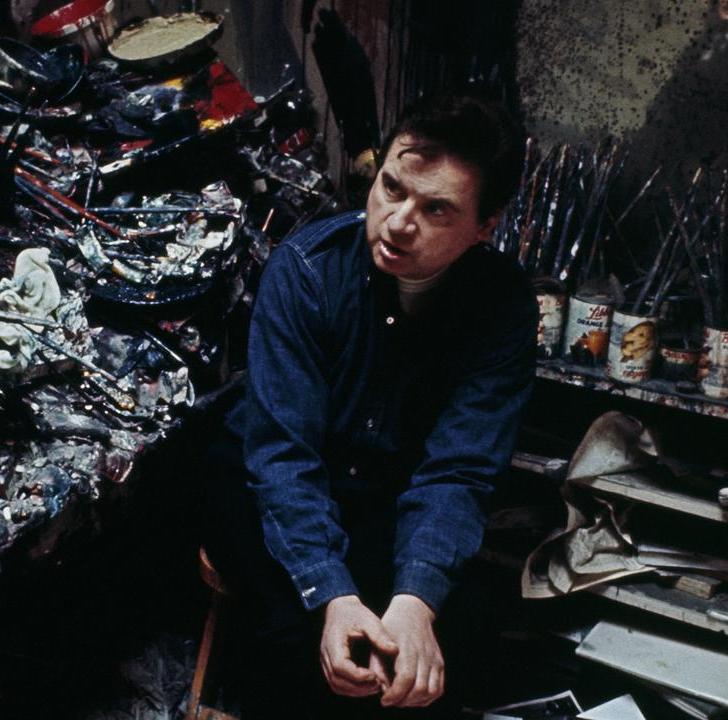
Francis Bacon by Ian Berry 1967 from Heroes and And Heroes Magnum images (1991).
Bacon, the zestful pessimist
The Gilded Gutter Life of Francis Bacon by Daniel Farson
A gumpowder plot in Soho
STAN GEBLER DAVIES | THE INDEPENDENT | SATURDAY 8 MAY 1993
I HAVE been reading the reviews of Daniel Farson’s biography of Francis Bacon with interest, searching for mention of anecdotes known to me, as he was. I met him on several occasions, usually in the Colony Room Club, but once in the nearby Golden Lion in Dean Street, Soho, which was at the time, unbeknown to us, the preferred hunting ground of Dennis Nilsen, the mass-murderer. John Edwards, the friend to whom he left his £11m, objected to my presence, mistaking, I think, my motive, but Ian Board, kindly proprietor of the Colony Room, was able to set him straight on the score of my sexuality. 'He’s not interested in old tarts like us, dear,' he said. 'He spends all his time chasing . . .' I leave you to fill in the missing word.
I encounter this week in Dublin Liam Carson, who runs the Groucho Club, also in Dean Street. We swap Francis stories. In those days before Francis had parlayed his fame into vast (for an artist) riches, he and John were entertained to luncheon by Lionel Bart, who was very much in the money. Francis, upon whom little was lost, noticed Bart frequently disappearing below the table, to emerge subsequently with some white, powdery substance adhering to his upper lip. When Bart left, he abandoned, inadvertently, a bag of this white substance. Francis seized upon it. 'This will get us into any nightclub in London,' said he.
So it did. They presented it to the doorman of some hell-hole whence, normally, they were not granted admission, and immediately were shown to a fashionable table, where they were fed champagne. Alas, they had little time to enjoy it, for they were rudely ejected by the same, now incensed doorman, whose face, similarly, was covered in white powder and whose nostrils, apparently, were glued together. What they had given him, in all innocence, was Mr Bart’s dental fixative, for he had had some operation on his mouth that morning.
PEREGRINE WORSTHORNE’S WEEK
Colonial ease rather than sleaze
Gossip of a gay genius
THE GILDED GUTTER LIFE OF FRANCIS BACON
By Daniel Farson
Century £17.99
John Russell Taylor on an intimate life of the late Francis Bacon
JOHN RUSSELL TAYLOR | BOOKS | THE TIMES | MONDAY MAY 10 1993
There are books, and there are documents. What the world will eventually need on Francis Bacon is a book – measured, considered, carefully researched, neither spiteful nor grovelling. But not, perhaps, quite yet.
Meanwhile, a document will do very nicely. And Daniel Farson’s is nothing if not a document. Thrown together from what looks like a very quick rummage through the press cuttings, and constantly maddening in its inconsistencies of date and spelling, its tendency to repeat things almost word-for-word a few pages on, it yet has the inestimable advantage of being written by a real intimate who has flung down his recollections in a white heat, if not of inspiration, then at least of eagerness to get there first.
For this immediacy it can be forgiven a lot – especially if one can regard it as a personal memoir which others later, at a more critical distance, will quarry. Too much discretion, too many second thoughts, can be a dangerous thing. And in any case, Farson seems to be remarkably without malice towards almost anybody, so that his tales of Bacon and his associates have the tone of good-natured gossip in a bar over a few drinks. Very much the circumstances in which Bacon himself was seen at best conversational advantage, indeed, through his nearest and dearest could hardly claim that his alcohol-fueled talk was always good natured.
Bacon, though oddly unwilling to discuss Ireland in any shape or form, seems to have been at times quite expansive about his Irish experiences, notably his relations with his father. According to his accounts, his father would seem to have been a sadist who thought that the best way to make a man of his cissified 'artistic' son was to let the stable staff thrash him within an inch of his life and (with some tacit consent, presumably) exact whatever sexual favours they wanted from him.
At least this makes a convenient explanation of the link between sex and violence in his life. Not that diagnoses of this kind mean very much. Bacon was, as Farson points out, “the embodiment of all that was advantageous in being homosexual”, full of nerve and completely without nerves. When Lord Rothermere proved in 1990 to have forgotten who Bacon was (as well he might, after a traumatic earlier gathering under his aegis in which Bacon was the only one present to dare boo Princess Margaret’s off-key rendition of “Let’s Do It”), he asked the artist hopefully: “And what do you do?” Bacon blandly answered: “I’m an old poof.” He had by that time turned down all possible honours up to an OM.
Naturally, everyone wants to read this tittle-tattle, while deploring the fact that anyone thinks it worth publishing. But in Bacon’s case, it is, because the homosexuality, the bravado, the drink and the discipline are all central to the art of someone who was widely considered the greatest living painter after the death of Picasso.
The book also contains other, rather more alarming revelations. For instance, the tragedy hitherto tactfully glossed over, of Graham Sutherland’s early married life, at just the time he was closest and most helpful to Bacon, was the birth of a child so agonisingly malformed that when it inevitably died the Sutherlands were forbidden by doctors from having another child, for fear that their clashing genes would assert themselves again the same way. Bacon was intensely sympathetic. But we are told that the child was “so deformed that there was little more than a stump and a heart, no arms or legs”.
Sounds curiously familiar in the imagery of Bacon’s mature work? If there is any truth in the story, it was hardly kind of Bacon to revert, even unconsciously, to something so painful in the history of a close friend.
But then, maybe he thought art was more important. Maybe, in this case, it was.
Bacon pickle
FRANCIS BACON would almost certainly have approved of the excellent 1990 vintage of Chateau Mouton Rothschild, which has just been released but there is one thing that would have disappointed the artist: the label.
Bacon was terribly dismissive of the canvas he produced for Baroness Phillippine de Rothschild, as the baroness, a great fan of his work, explained this week at the label’s “launch”. The baroness said she had pursued Bacon for a considerable time before he accepted her commission. His consent however reluctant ensured that he would follow in the footsteps of Picasso, Chagall and Andy Warhol, who all produced paintings for Rothschild wine labels.
Eventually the painting was finished, and Bacon agreed to deliver it to Baroness Phillipine at her hotel near Harrods, using the excuse that he “wanted to buy some socks”.
Bacon arrived at the hotel, defying doctor’s orders, at the end of 1991, with his painting in a carrier bag. “He did not like it at all. He didn’t think it was good enough and wanted to do it again. He thought it was awful but said we could have it if we wanted it,” says the baroness. “Of course, I wanted it, and said there was no question of him doing it again.”
Indeed not—the label that now graces the 1990 premier cru turned out to be one of Bacon’s very last works.
Letters to the Editor
Sir, — Robin Simon, in his review of Daniel Farson’s book The Gilded Gutter Life of Francis Bacon, quotes a story concerning myself, stating that I met Francis Bacon at a party in 1990 and asked him what he did and he replied “I’m an old poof”.
I never met Francis Bacon in 1990 although I do have a recollection of having met him in a pub in Soho in 1944 with Dylan Thomas.
I have always been well aware of Francis Bacon’s great talent as an artist, and I am at a loss to understand how this extraordinary and untrue story originated.
ROTHERMERE
Daily Mail and General Trust plc,
Northcliffe House,
2 Derry Street London W8.
Tracing Francis Bacon and his lost Bohemia
Farson’s biography of the tortured artist is a pub crawl around Fifties Soho
Daniel Farson arrived in Soho in 1951, fresh from Cambridge, with a short-lived job on Picture Post as a photographer. His subsequent career as an art journalist and TV interviewer and presenter is well-known in Britain. His book on Bacon, The Gilded Gutter Life of Francis Bacon, is lively and entertaining, like his earlier study, Soho in the Fifties, now revised as a Pimlico paperback.
In fact, Farson’s account of Francis Bacon’s talk, attitudes and occasional antics in this book rarely leaves Soho and, although it provide some telling vignettes of Bacon and his friends at Muriel Belcher’s Colony Room in Dean Street and a few other venues, including some forays to Paris, Tangiers and St Ives, it should ideally be seen as a continuation of Soho in the Fifties.
Farson is a generous-minded enthusiast for his selected milieu
Both Soho in the Fifties and The Gilded Gutter Life could use a little revision, let alone editing, and I wish Farson would now give himself proper time in which to take hold of both texts and bring in enough fresh material from his own earlier and later years to make a unified autobiographical memoir. As it is, a good many descriptions and anecdotes concerning Soho characters and situations to be found in Farson’s earlier book are repeated in the new study of Bacon, often slightly but rather confusingly changed in the telling. But there is still enough fresh material to make a compulsively readable book. Farson is not David Sylvester, whose brilliant recorded conversations with Bacon are crucial source material, and he is not John Russell, whose scholarly short monograph is tightly focused on the paintings and more able to relate Bacon’s work to broader issues and to cultural and social history.
But Farson is a writer with a bright mind and perceptive eye and his
book should not be dismissed. It covers people and terrain that are not even
touched upon elsewhere
That’s our Francis. But I should still like to know which books he
bothered to read, whether he liked to listen to music or went to the movies
sometimes or the theatre; and how did he get on with his dealers, here and in
Paris
The Gilded Gutter Life of Francis Bacon by Daniel Farson (Century, London, 1993) 279 pp, 39 b/w ills., £17.99
That famous light on Bacon: Museo Correr
shows major retrospective
David Sylvester curates an exhibition of the artist’s finest works in Napoleonic rooms
ROGER BEVAN | PREVIEW | THE ART NEWSPAPER | TUESDAY 1 JUNE 1993
Sylvester seized the opportunity with eagerness. For more than forty years he had been musing about an exhibition of Bacon’s work in exactly those rooms of the Museo Correr which he will now be using, an enfilade of ten small chambers illuminated by bright Italian light streaming through side windows from the Piazza di San Marco and incorporating the museum’s ballroom in which he is hanging three of the artist’s most important triptychs, “Triptych inspired by the Oresteia of Aeschylus” (1981), “Study for Self-Portrait Triptych” (1985-86), and “Second Version of Triptych 1944” (1988) which Bacon presented to the Tate Gallery shortly before his death in 1992.
In that sense, it will be a rather different occasion to the recent exhibition
in Lugano (see
The Art Newspaper,
No. 26, March 1993, p.10) which concentrated on curiosities and less familiar
works.
All washed up!
ROSS BENSON | THE DIARY | DAILY EXPRESS | TUESDAY JUNE 8 1993
OVER the years such illustrious artists as David Hockney, Patrick Procktor and Francis Bacon patronised Langan’s, the Mayfair restaurant founded by the late wild imbiber and brilliant restaurateur, Peter Langan.
They invariably left their mark
The tablecloths, he decided, should be framed and hung on the walls. It
is not to be. As a distraught
William Packer finds the Venice Biennale an ill-assorted mess
WILLIAM PACKER | ARTS | FINANCIAL TIMES | TUESDAY JUNE 15 1993
But Aperto is irredeemably delinquent and unbiddable, devoid of talent or interest, merely thrashing around in the playpen of late 20th-century academic modernism, without even the possibility of some personal development that the average playschool would offer up in modest justification. And increasingly the Aperto seems to set the tone of successive Biennales, the tail that wags the dog.
Achille Bonito Oliva, the new director of the Biennale, gives us
In any such jamboree, of course, there are bound to be beautiful and interesting things and I shall return to the matter and substance of the Biennale at the weekend. But of all the several features of the Biennale as it developed over recent years, one seems more and more to be positive, useful and redeeming. The Omaggio, a tribute paid by the Biennale to a senior and distinguished artist, is given this time to Francis Bacon, who died little over a year ago. David Sylvester, who himself has been given a Golden Lion at this Biennale for his life’s work as a critic and curator — a unique award in that he is not an artist — was asked to select the work, and worked with the British Council on its presentation.
Thank goodness for small mercies. The result is quite simply the outstanding exhibition of this Biennale, as indeed it would have been at a Biennale far better than this. It is by no means large, a mere 32 works in all, but it carries an enormous punch. For Sylvester managed to obtain the greater part of his desired selection and has included a significant number of large triptychs. It is beautifully presented in the Museo Correr, in the Pizza Saint Marco, quite rightly centre stage. As a celebration of the achievements of a particular artist it holds its own not just in the context of the Biennale but in this, the city of the greatest painting.
More to the point, it is a show that effectively modifies, or rather, shifts one’s view of Bacon and his work. I had always felt that his — standing as one of the truly great painters of the later 20th century rested upon his work of the first 20 years or so of his career, from the first small triptych of 1944, of figures at the base of a crucifixion, to the first Tate retrospective of 1964, of which Sylvester again was the curator. What followed was impressive and consistent enough to sustain his reputation, but did not exactly take it further. It was as though the range of his attention had narrowed — no more animals, popes, Van Goghs — the colour become more predictable, even decorative, the space curiously conventional and repetitive, the handling and description of his distorted and rising figures oddly safe, and unadventurous. In short, the work had become formulaic to a certain degree.
This show has made me think again, not so much to revise that view altogether but at least to recognise that in certain aspects of the later work the qualities of those first two great decades, the simple dark strength of the organisation of the pictorial space, and in particular its severe and essentially frontal presentation remained. And there are still to be found the simple authority of the imagery, and the raw energy of the painted self in its handling across the surface of the canvas. “Much has changed”, as it were, “but much remains”, the work still charged and developing under the hand of manifestly the same creative sensibility.
However, nothing has changed the extraordinary authority or the power to shock of those early works, represented here in remarkable force by a clutch — I use the word advisedly — of gaping, disembodied mouths, teeth bared and rearing all but physically out of the very stuff of the paint itself. There has surely been no painting since Soutine in which the image and the fabric of the work are so bound in to each other — Van Gogh, Goya, Rembrandt, Titian: it is a long and great tradition.
Bacon did not declare himself as a great artist until he was 35. He was in his pomp thereafter for nearly 50 years more, and was 83 when he died. He stood supreme in our time, yet curiously isolated as the last true surrealist, expressionist and, In his own peculiar way, romantic. There could be no better summary of his achievements than this exhibition.
Francis Bacon. Museo Correr, Piazza San Marco, until October 10: sponsored by Seat Automobile. The 45th Venice Biennale throughout the city also until October 10
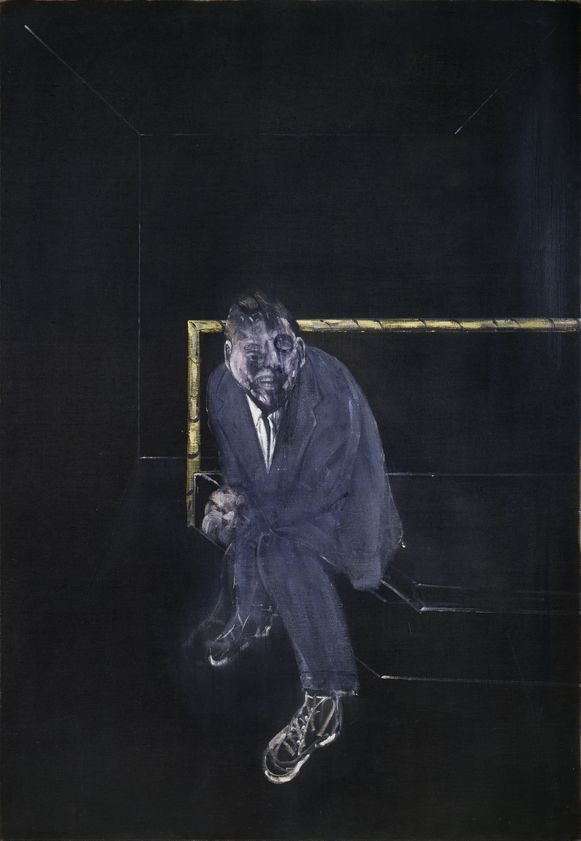
Today sees the opening of the 45th Venice Biennale – the Olympic Games of art.
The Biennale’s principal prize to an artist, the Golden Lion, this year has also been
awarded, for the first time, to a critic, David Sylvester. The award coincides with his
curating of a memorial exhibition there of Francis Bacon.
Overleaf he tells story of how it was gradually put together
DAVID SYLVESTER
MY LAST involvement with the Biennale led me to vow that I would never get involved with it again. It was two Biennales back, when I served as a member of the jury.
According to the rules, the top prize for an artist was to be awarded for sheer distinction, and then there was to be a prize for the best artist under 40. The first went to Jasper Johns, despite a prudish sentiment in some members that awarding it to an artist who had lately been fetching huge prices in the saleroom was tantamount to giving it to Van Gogh. There was an equally obvious candidate for the under-40 prize. Practically everyone going around the pavilions during the press and private views had been enthusing quite wildly about the sculpture of Tony Cragg, so it seemed a foregone conclusion that he would win.
The winner was an American, Barbara Bloom, an artist whose work was pleasant and plausible enough, but essentially modish, shallow and meretricious. Cragg was eliminated through an exercise in the art of moving the goalposts which probably deserved a sort of prize itself: it was decreed that the prize intended to be given to the best artist under 40 was not going to be awarded to the best artist but to an artist of promise.
This effectively ruled out Cragg, as he was taken to be an artist of considerable achievement, He was kicked upstairs with a Special Mention, And it was decided that he be joined on this transcendent plane by a contemporary of his who could not possibly have beaten him for the prize, an Italian. My frustration had nothing to do with patriotism, I long for England to win at football and cricket, cry when they do and cry when they don’t, but I don’t view the arts in that way, I had not been seeing myself as Britain’s representative on the jury when I sat there ineffectually willing Cragg to win; I had seen myself as a representative of everyone in Venice at the time who had any feeling for contemporary art.
This sounded tremendously glamorous. But I wondered if and how the paintings could actually be hung on the magnifi? cent walls of the palace’s rooms. When I asked Carandente whether he would be getting permission to do this, he answered that the paintings would have to be shown on easels standing in the rooms. I said I suspected that Bacon would not want to go along with that, that he would want his paintings to be seen against surfaces, not spaces, especially the big triptychs, which in their frames measure about 17ft by 17ft and would look rather ridiculous standing in the open. So I warned Carandente that Bacon would probably refuse - which it turned out he did
In April last year Bacon died, and in early September I suddenly got a call from Henry Meync Hughes, the visual arts director of the British Council, asking me whether I’d like to curate a Bacon retrospective for this year’s Biennale. He had been approached by the new director. Achille Bonita Oliva, who had suggested a venue such as the Ca Pesaro, the city’s museum of modern art. I said that I’d love to accept, provided a suitable gallery could be found (Venice is remarkably short of spaces for substantial temporary exhibitions) and that my own choice would be the Museo Correr.
Nearly 40 years back I had seen an exhibition at the Correr of Edvard Munch, an exhibition illumined by the daylight coming in through the half-open shutters of French windows. In that Venetian light this ultra-northern painter had excited me as he never had before. I had come away with a feeling that Francis Bacon was another northern painter whose work would glow at the Correr, and had been nursing that feeling ever since.
Meyric Hughes asked me to dinner the following evening with himself and ABO, and Nick Serota, wearing his hat of chairman of the Council’s advisory committee on visual arts. ABO turned out to be a Napoleonic figure. We eyed each other cautiously, like a couple of dogs, myself an ageing overweight basset hound, he an alert middle-aged fox terrier. I thought he looked as if he needed mollifying: this was irrational, after he’d already paid me the very friendly compliment of his invitation, but I always have a neurotic feeling that Italians require to be impressed anew. So when a waiter arrived I suggested that we should drink champagne in honour of Bacon’s habit, This went down well. Over dinner there was general agreement in principle about almost everything. The exhibition should be relatively small and should focus on big canvases, showing 50 to 60 of them; about half of them should be in the form of triptychs; to give unity we should not include examples of Bacon’s landscapes without figures.
The only major question was whether the Museo Correr would be available, since it has a mind of its own. It is a civic museum, originally opened to the public in 1836, and since 1922 housed in a palace
I was particularly anxious to get the right triptychs. I have a conviction
Among the single large canvases I was especially keen to have those two inspired works painted in 1945 and 1946, the Figure in a Landscape of 1945 in the Tate, and the untitled butcher’s-shop picture of 1946 in the New York Museum of Modern Art, but I knew there was no point in asking for the latter, which is too fragile to travel. And then I especially wanted the first two paintings Bacon made of men having sex, one done in 1953, in which they are on a bed, the other done in 1954, in which they are in the grass.
I faxed off my list in the morning. A week later I sent a few emendations, saying I had come to the conclusion that it would be perverse to exclude landscapes: the later landscapes represented much of what was really new in the work of Bacon’s last 10 or 12 years; when it came to the hang, some landscapes could make a valuable contrast with the claustrophobia of the figures in interiors.
Soon a message came through that ABO had been successful in putting us in the Correr. I was impatient to go and see the rooms we had been given, but couldn’t go immediately because I had to go into hospital for an operation. One of the British Council’s exhibition officers went to Venice and came back with a gloomy report: the Correr normally assigns temporary exhibitions to the ballroom and/or a suite of about 10 small rooms; she was afraid we were not going to get the ballroom. By her reckoning this meant that we would be able to show only 30-odd large canvases. We hadn’t been wanting a big exhibition, but this would be no exhibition at all. The Council sent off a passionate request to be given the ballroom as well.
The surgery brought complications, and I had to delay travelling to Venice. The wait was very tiresome. I now had plans before me of the rooms, promised and unpromised; I had the cherished memory of that distant exhibition of Munch; I had the more recent memory of visits to the permanent collection, during which I had been looking at pictures without taking much account of their settings. Everything was confused: beside the uncertainty as to what spaces we were going to get was my own uncertainty about what the spaces were like anyway.
IN MID-NOVEMBER I went off to Venice with Meync Hughes (who in the meantime had been appointed director of the Hayward Gallery, and was about to give up his job at the Council). ABO introduced me to the architect I was going to have to work with, Daniela Ferretti. I had not been looking forward to this moment. Good exhibition architects, good museum architects, are terribly scarce: the problem is the attitude of architects as a species towards art; consciously or unconsciously, they do tend to hate it so. And I was especially troubled here by the thought of having to work with someone whose talents might resemble those of her countrywoman, Gae Aulenti, whose conversion of the Gare d’Orsay in Paris into a fashionable museum had consummately massacred the French Impressionists. However, on meeting Daniela I quickly realised that my partner in this arranged marriage of minds was the partner I would have chosen.
I also quickly realised that I was going to need all the help I could get from her in dealing with the directorate of the Museo Correr. Yes, we were to have the ballroom, but ... It became clear that the hesitations had been due to the fact that the ballroom had only lately been fully restored to its former glory
Yes, we were to have the ballroom, but also some of the Canovas. Yes, some of the Canovas could be put under wraps, but mostly they still had to stay there in the room. The consolation was that all along one wall were those marvellous windows. I felt that this must have been the place where I had seen the exhibition of Munch, but no doubt in a shell constructed within the lofty space, a shell that excluded not only the ornamental ceiling but all the Corinthian columns and pilasters. What we were now being offered was hardly worth having, yet we needed the space, we absolutely needed the space.
The rooms upstairs, though, were extremely encouraging. They were three-sided rooms opening off a corridor running along a wall full of windows. They varied usefully in size: the smallest, two of them, were 10ft wide by 17 deep, the biggest was 18ft wide by 32 deep, and they were all around 10ft high. I was reminded of the narrow spaces of the best Bacon exhibition I ever saw, at the Oalerie Claude Bernard in Paris in 1977, and also of private visits to Marlborough Fine Art, Bacon’s gallery in London, to be shown a couple of the latest large triptychs in small low rooms that could hardly contain them, Such experiences had induced me to believe that Bacon’s paintings looked their best in confined spaces and with not too many of them visible at a time. And here this advantage was going to be combined with Venetian daylight.
One problem marred this blissful prospect, Bacon had always insisted that his paintings be glazed: I think he was right, I think they look better that way, despite the reflections In the glass, or maybe because of them, But Daniela and I had to make sure that the reflections would not overwhelm the paintings, We therefore decided that so far as possible we would hang the majority of the paintings on the walls at right angles to the windows, We could, of course, have introduced muslin curtains to diminish the reflection but we didn’t want to lose the sense of the world outside.
Once those decisions were made, it was obvious how many canvases could be exhibited. It was clear, for example, that the two rooms measuring 10ft x 17ft could only house a single canvas each. One room, however, which was 17ft wide by 13ft deep, presented a puzzle, and we realised that the only way to handle it was to use it to show some of Bacon’s small paintings of heads, six or seven of them.
The heads I now particularly wanted to get
But what the hell were we going to do with the ballroom, with all its Corinthian columns and Canovas? It seemed to me that there were three late triptychs which could work effectively against the pomposity of the setting
All this left me with a clearer plan for the precise hang of a show than I had ever had before at such an early stage
Back in London I modified the list for loan requests in the light of what I’d discovered. The works I wanted most had already been asked for and, amazingly, only two of those mentioned above had been refused, the two men on a bed, and one of the four triptychs in memory of George Dyer. In completing the lilt, I tried on one hand to ensure that a more or less chronological hang would make sense in the given spaces and, on the other, to invest each space with a character of its own. For example, I thought the shape of the first room upstairs, a room with no daylight, would be very suitable for four grey Images of screaming faces in claustrophobic settings, painted in 1948-49.
I got on with writing an essay for the catalogue, and found that the effort of thinking hard about Bacon made me feel his absence as a friend a good deal less acutely than I had been doing since his death. At the same time, there was the usual protracted torment of awaiting replies to the loan requests.
Early in May, Daniela sent over samples of possible colours for the walls which she had had mixed. Nick Serota is a much better judge of background colours than I am, and I sought his advice. We tried out the cards next to Bacons hanging in the Tate and chose two colours which we liked so much that we thought that both must be used
A few days later I went back to Venice. Daniela wanted to finalise decisions on the spot about details of the architecture and of any electric lighting needed as reinforcement at dusk and on dull days. I only hope that, when the show is running and we’re not there, some official won’t switch on the electric lights perpetually because the daylight is not light enough for their corrupted taste. Nowadays there’s a misbegotten thirst for excessively bright light in museums, which is distinctly like the thirst the young have for excessively loud music.
Walking into the ballroom after that six-month gap, I felt immediately that this part of the exhibition was doomed, and I learned that Daniela had been worrying about it. The Canovas were one worry. As a means of getting rid of most of them, she had been thinking of making the constructed walls so thick that the life-size sculptures could be hidden away inside them, but this solution had obvious snags. And then the walls down the middle of the room were going to have to be very wide to accommodate the triptychs, and if they were centred this left uncomfortably narrow passages on either side, yet the symmetry of the room would make it look odd if they weren’t.
All in all, we were trying to hang the pictures in an environment that was both hostile and intrusive. I felt that the pictures would get by but that the whole thing would be a mish-mash and look messy and improvised, whatever Daniela’s skills, like a bazaar in a church hall.
We left to go to the Giardini, the public gardens where most of the Biennale is sited. The French had already almost finished building a complex installation in tiles by Jean-Pierre Raynaud filling their entire pavilion. We were allowed in to see it unfinished and found it very beautiful and compelling. It had been immaculately realised, and this made me feel more depressed than ever about the mess we were setting up.
In the vaporetto going back to St Mark’s, I said I almost had a mind not to use the ballroom at all and to leave some of the pictures out of the exhibition. This outbreak of hysteria deepened our gloom. Suddenly I said that maybe the trouble was that we were trying to show the three triptychs as separate spectacles within that setting, and that maybe we should put them together in some way. Daniela said we should repeat the pattern we had upstairs, by having a single passage next to the windows and building a three-walled room facing the windows. I said we should put the self-portrait triptych on the back wall of this room with Furies flanking it on either side. We both said: what about the reflections in the self-portraits? I said I’d telephone Marlborough, the owners, in the morning and ask if they’d kindly remove the glass.
Suddenly we realised that we now didn’t have to hide all the Canovas away. Some
could remain m the ballroom, outside our room-within-a-room. The visitor would
enter the ballroom and see marbles by Canova against a background of a high,
pink-coloured wall almost traversing the room and bearing the legend
It was too late by now to get back into the Correr. In the morning we made careful measurements, They showed that the boundaries of our constructed room failed to tally in places with the existing architecture, and we realised that this was an advantage, in emphasising that the Bacons were enclosed in a space that was in the ballroom, not part of it, I telephoned Marlborough and was told that Bacon’s wishes must be respected: the glass had to remain, Daniela and I thought about how to counter any reflections and decided to try to deal with the problem in some way when the pictures were actually there. We also decided to postpone till then the settling of our one disagreement, I want the room-within-a-room to have a velarium (a muslin canopy) over It, so as to make it more dramatically enclosed; she wants to leave it open at the top.
GOING BACK at the beginning of June to install the show, I got off the plane about 2pm and found Venice as I think I like it best: the sky grey; some rain, Alas, that light, perfect for Venetian domes, wouldn’t be so good iniide the exhibition, On the motorboat which met me, I was given a hair-raising account of the latest menacing behaviour of certain museum officials, domestic and foreign, At the Correr I discovered that Daniela’s grey behaves, when on the wall, as magically as her dark pink
Almost all the pictures were still in their wooden cases. Four hours later they were virtually all in their provisional places. Most had had to be carried, heavy with glass, up two long, steep flights of stairs, This and everything else that happened then and after made my head buzz with platitudes about the splendour of Venetian artisans
The next two days were like those incredible afternoons at the racecourse when, if you don’t back the next winner through previous hard work with the form book or through noticing something in the paddock, you bump into an old acquaintance who tells you that he’s just seen the trainer of a runner in the next and that the horse is fit and the jockey’s been told to try. and you believe him and have a large successful wager at odds of about 8-1. Various changes suggested themselves and most of them worked. For example, a corridor which had appeared too narrow for a picture to be hung in it and for which I’d planned to use a blown-up photograph of the artist at one end, suddenly seemed able to accommodate a full-length self-portrait to one side, and the way the visitor would come upon this would make him feel as if he’d just walked into Bacon in a bar. And so forth. Also, progress from room to room provided good changes of pace
– on the outward and the return journey – for this has to be an exhibition where visitors have to retrace their steps. And the light was doing everything I’d hoped it would.
During all this I left an appropriate space for a triptych which was
arriving late. The next day it was put in place and the room was falling apart.
I moved the new piece around, found a place where it looked perfect but
everything else looked terrible, and finally re-hung two rooms. I think they
are, as my Venetian colleagues say, “
I embarked on writing this report in the expectation
– and, as a journalist, the hope – that it wouldn’t have a happy ending. Still, we did have a bomb scare yesterday. And at the private view, a good-looking Italian woman was walking round, accompanied by her dog. When told that dogs aren’t allowed in muse? ums, she coolly showed her invitation card for two.The Bacon show and the Venice Biennale runs until 10 October
Bacon’s Course
David Sylvester has been awarded this years Lion d’Or: he is the first art critic to
receive the Venice Biennale’s foremost prize.
Modern Painters publishes his important new article on Francis Bacon which marks
the first major exhibition of Bacon’s work since the painter’s death last year.
BY DAVID SYLVESTER | FEATURES | MODERN PAINTERS | NUMBER 2 | VOLUME 6 | SUMMER 1993
Painting did not become Bacon’s central activity until he was in his mid-thirties.
I seem to have been a late starter in everything. I think I was kind of delayed, and I think that there are those people who are delayed... I think the analytic side of my brain didn’t develop till comparatively late – till I was about twenty-seven or twenty-eight. When I was very young, you see, I was incredibly shy, and later I thought it was ridiculous to be shy, so I tried deliberately to get over this because I think old shy people are ridiculous. And when I was thirty or so I gradually began to be able to open myself out. But most people do it at a much younger age. So I always feel I wasted so many years of my life.
The ‘wasted’ years were spent in one metropolis after another – Berlin, Paris, London – after a childhood in the Irish countryside, where Bacon enjoyed his sexual initiation by the grooms employed at the stables: his father was a trainer of racehorses, a gentleman’s occupation. During these ‘wasted’ years he ‘drifted’, to use a word he loved to use, a word implying a relaxed immersion in pleasure, a taste for uncertainty, a life that has neither an anchor nor a direction, a need to live by one’s wits.
But that is only one side of the story, the darker side, doubtless the more interesting side. The brighter side is that during those ‘wasted’ years Bacon was already producing remarkable works of art and design. Before he was twenty he was designing furniture and rugs which were winning him an immediate reputation and which, looked at retrospectively, seem still better than they were thought to be. He himself in looking back made light of this work: ‘It was just taken from other people, most of it. It was awfully influenced by French design of that time. I don’t think anything was very original’. That is the modesty of someone who knows he can afford to ask a good deal of himself.
And he was already at the time to ask of himself something more than this exercise of precocious mastery – acquired completely without formal training – of the decorative style of the age. He was ready to ask of himself that he should prceed to master the sharpest fine-art style of the age, the style of Picasso’s current work. By the time he was twenty-three he had produced figure-compositions in that style some of which were acquired by England’s leading collector of contemporary art. And one of them, a Crucifixion of 1933, was reproduced in the book, Herbert Read’s Art Now, which served as the main introduction to contemporary art for two or three generations in England (including my own, so that this was how in 1941 I became aware that there was another Francis Bacon beside the Elizabethan I had learned about at school).
In this picture Bacon – contrary to his own view that he had been a late starter – was already mature enough to combine a language taken over from the most relevant artist of the day with something altogether personal: luminous grey paint creating an effect rather like that of ectoplasm. Nevertheless, during the next ten years Bacon did relatively little painting. He preferred to enjoy himself and develop a serious taste for champagne, caviar, roulette and repartee. Suddenly in 1944, his thirty-fifth year, he completed a work which clearly announced the arrival of of a major artist. Perhaps the War provided the necessary catalyst. Suffering as he did from chronic asthma, Bacon was no candidate for the armed forces; he joined the Civil Defence rescue service in London, but even that was too much for his health: this left him in a kind of vacuum, and he started painting with a certain urgency. Now Bacon was someone who lived always lived, as he said, with ‘a feeling of mortality all the time’, and 1944 was the year of the V1s and the V2s, when being in London meant hearing at all hours of the day and night thesound of isolated explosions each of which meant that a number of people not far away had suddenly been blown up – a phenomenon Bacon knew something about, with the experience he had lately had of recovering bodies from bombed buildings. Under this pressure all of us lived with a feeling of mortality all the time. This was the year in which Bacon gathered his forces to bring to a conclusion a masterpiece which had been germinating for a while, the Three Studies for Figures at the Base of a Crucifixion.
This triptych was palpably inspired by Picasso’s biomorphic figures on beaches which Bacon had seen in the late 1920s, but the eroticism and the comedy of those figures was displaced here by terror. The grisaille sculptural forms, painfully taut, stark on an orange ground, the long stretched-out necks culminating blindly in open mouths, created a sense of menace and of hysterical anguish which had a deeply shocking effect upon those who saw them – a differently shocking effect but hardly less intense than that which the Demoiselles d’Avignon had exercised about 40 years earlier. Bacon was starting to show his own Picasso-esque capacity to put the spectator on trial; the master himself had never produced anything quite so searing as that orange ground. The force of that orange was a reflection of the real subject of this triptych, which is not revealed in the title. These figures ‘at the base of a crucifixion’ owe something to the traditional iconography of the Crucifixion of Christ, but they are actually – according to Bacon – a vision of the Furies in the Oresteia of Aeschylus. Bacon’s obsession with Aeschylus had been fuelled by a short book by an Irish scholar, W.B. Stanford, Aeschylus in Style: A Study in Language and Personality, published in 1942, which included some exceptionally penetrating translations of passages from the plays, and Bacon, when speaking of the Furies, often quoted ne of these translations: ‘The reek of human blood smiles out at me’. That line could be the real subject of the 1944 triptych.
It was during the next two years that Bacon altogether found himself – in two large pictures, the Figure in a Landscape of 1945 and the Painting of 1946. Near the end of his life Bacon was to say:
I always think of myself not so much as a painter but as a medium for accident and chance... I don’t think I’m gifted. I just think I’m receptive... I think that I have this peculiar kind of sensibility as a painter, where things are handed to me and I just use them.
Those two pictures of 1945 and 1946 are perhaps the most telling examples in his entire work of this miraculous experience of pictures happening to him rather than his making them happen.
Figure in a Landscape was based upon a snapshot of the artist’s lover Eric Hall dozing on a chair in Hyde Park. The smudgy semi-abstract screen which stands for a landscape setting in a newspaper reproduction of a photograph is translated into an equivocal but vigorous shorthand notation. The jacket is represented with the help of dust gathered up in the studio.
Actually there is no paint at all on the suit apart from a very thin grey wash on which I put dust from the floor... I thought: well, how can I make that slightly furry quality of a flannel suit? And then I suddenly thought: well, I’ll get some dust. And you can see how near it is to a decent grey flannel suit.
It seems that the head and part of the chest have become a black void. To the right a machine gun is blazing away, more or less at us, being fired, presumably, by the seated man. One doesn’t actually explain the image to oneself as literally as that. One accepts the image as it is, as a deeply disturbing fact. One does not see it as telling a story, with all the boredom, as Bacon would have said, of a story.
Painting, too, presents a frontal, isolated figure, but a part of a more complex composition in an indoor setting. Originally this setting was another landscape, first in an image of a chimpanzee in long grass, next in an image of a large bird of prey alighting a field. ‘Suddenly the lines that I’d drawn suggested something totally different, and out of this suggestion arose this picture.’ The scene is a butcher’s shop: looming up in the background is a carcass which is also a headless crucifixion; in front of this, under an umbrella is a figure which seem s to be that of a politician 9or even a Pope0 addressing a battery of microphones; in the foreground is an arrangement of sides of meat. The insistence of symmetry, the intimation of superior powers, the atmosphere of enactment of a ritual, combine to give the work the look of an altarpiece. It is one of the work’s many overlapping echoes of the history of art, past history and recent history: there is Surrealism and Expressionism and English eccentric-fantastic art and the long line of European painterly painting stretching back to Rembrandt and Velázquez and Titian.
This last was what counted most of all, with its investigation and celebration of the life of paint itself – the crucial obsession in Bacon’s future work. That is to say, the crucial aesthetic obsession. His obsession with re-making the human head and figure seemed to him to be of even more account: he believed consistently that ‘the greatest art always returns you to the vulnerability of the human situation’. And so: ‘Really, I think of myself as a maker of images. The image matters more than the beauty of the paint’. But in the dialectic between sensations of reality and the making of a picture, what mattered most in the picture was paint, the inherent eloquence of paint, paint handled so that it ‘comes across directly on to the nervous system’.
Manipulation of paint became an inexhaustible gamble, involving all sorts of exploration of accident and chance. Often this included the use of additives such as dust in Figure in a Landscape and sand, cotton wool, sprayed automobile pain, Letraset and, above all, the pastel used freely in the background of Painting and in many subsequent works. Unfortunately, in 1946 Bacon did not yet know, what he later learned by chance, that, if you are to use pastel along with oil paint, it is likelier not to fall off the surface if you work on the reverse side of a primed canvas. Because he did not know this when he realised Painting, it is now too fragile to leave the Museum of Modern Art. There’s a saying that it’s the prerogative of critics to conduct their education in public. Bacon was a painter who conducted his education in public.
Sometimes an artist gets out ahead of himself and needs to catch up: for ten years after painting those two masterpieces Bacon tended to deal with fragmentary subject-matter, and, whatever the subject, he used a language – used it to tremendous effect – which narrowed the formal problems to be dealt with. The fragmentary subjects were mainly busts or half-lengths in which the heads have wide-open mouths and nothing where their upper halves should be: among others, Head I, 1948, Head II, 1949, Head V1, 1949, Study for Portrait, 1949, Fragment of a Crucifixion, 1950. The open mouths were inspired by two images of shrieking women which Bacon had first seen in the 1920s – that of a nanny in Eisenstein’s The Battleship Potemkin and that of the mother in the foreground of Poussin’s early Massacre of the Innocents, which he saw several times in Chantilly.
One of those busts, Head VI, was Bacon’s first painting of a Pope and his first to paraphrase the habitual model for his Popes, the Velázquez portrait of Innocent X. Bacon never gave an altogether convincing explanation why, in making variations on a work by his preferred painter, he always returned to this particular portrait. It maybe that the subject had an unconscious symbolic meaning for him. The Pope is a father-figure; Papa. And Bacon had extremely strong feelings about his father.
I disliked him, but I was sexually attracted to him when I was young. When I first sensed it, I hardly knew it was sexual. It was only later, through the grooms and the people in the stables I had affairs with, that I realized that it was a sexual thing towards my father.
Painting those Popes in their isolation could well have been, among other things, a way of bringing back his father, of demolishing him, of spying on him. Bacon believed or said simply that the Velázquez Pope was ‘one of the greatest portraits that have ever been made’ and that he was obsessed by it because of ‘the magnificent colour of it’. It was not until the 1960s, though, that he was able to bring himself to match that scarlet, as in the Study from Portrait of Pope Innocent X of 1965, one of the versions which he liked best in later life (when he generally regretted having done the Popes and thought they were ‘very silly’). In the ’40s and ’50s the scarlet was toned down to a muted purple, a purple which in Head VI was not much more than a heightening of the overall grisaille.
That grisaille palette, bringing back the palette of the 1933 Crucifixion in pace of the high colour of the 1944 Crucifixion triptych and the 1946 Painting, was the most obvious aspect o the reduction which Bacon made in the formal problems to be coped with. And this recourse to grisaille in Analytical Cubism, for they were dealing with highly intricate problems of form; Bacon’s form was no more complex at this stage than his colour. He was creating flimsy, smudged bodies like wraiths, adumbrations rather than realisations. This was a reflection of the effects engendered by certain types of photographic images on which he was leaning heavily, photographs reproduced on newsprint and X-ray photographs; that other source, Muybridge’s sequential photographs of human and animal locomotion, had a more substantial feel.
For years Bacon experimented with different ways of working. The 1951 figure bent double called Study for Nude was based upon a sketch which was in fact a photograph in a book on which he used a brush to draw a few lines to suggest curtains: it is the only Bacon sketch known to have survived. Wanting to paint a less anonymous figure at around that time, Bacon asked his friend Lucian Freud to pose for a portrait. When Freud arrived at the stdio he found an almost finished painting which had been based on memory and on a snapshot of Franz Kafka reproduced in a book. For the next three or four years, Bacon was getting various friends to sit for him, but while working from the model was often looking at photographs of quite other subjects. There was a constant interplay between reality and existing images – for example, a portrait for which I myself sat four times in 1953 ended as a Velázquez Pope. For what was probably the finest large portrait Bacon painted in that fruitful year, Study for a Portrait, he did not use a model, nor is there any particular photograph on which it seems to have been based.
That year he also painted the first of his triptychs of heads, Three Studies of the Human Head. This marvellous work came about rather fortuitously, since the left-hand and central canvases were only realised after the right-hand canvas had been offered for sale unsuccessfully. The right-hand canvas is clearly an invented composition; the left-hand canvas is almost certainly a portrait of Bacon’s lover Peter Lacy; the central canvas was based on a photograph of a politician published lately in Time magazine.
A new strategy appeared early in 1955 when Bacon painted a number of small portraits based on a life mask of William Blake; but in the event he mainly worked from photographs of the mask. He seems to have found it generally unrewarding to to work from models in the round. For example, he did not pose in a mirror but did it out of his head, possibly with help of snapshots. This reluctance to work from a model in the round underlay his choice of the method he finally came to use consistently, which was to have numerous photographs taken of the friends he wanted to paint and to work from those photographs.
But of course it was never a question of working from one thing. It was essential to the paintings that they scrambled together a variety of sources, tangible and intangible.
Michelangelo and Muybridge are mixed up in my mind together, and so I perhaps could learn about positions from Muybridge and learn about the ampleness, the grandeur of form from Michelangelo, and it would be very difficult for me to disentangle the influence of Muybridge and the influence of Michelangelo... But I don’t only look at Muybridge photographs of the figure, I look all the time at photographs in magazines of footballers and boxers and all that kind of thing – especially boxers. And I also look at animal photographs all the time. Because animal movement and human movement are continually linked in my imagery of human movement... I very often think of people’s bodies that I’ve known, I think of the contours of those bodies that have particularly affected me, but then they’re grafted very often on to Muybridge’s bodies. I manipulate the Muybridge bodies into the form of the bodies I have known. But, of course, in my case, with this disruption all the time of the image – or distortion, or whatever you like to call it – it’s an elliptical way of coming to the appearance of that particular body. And the way I try to bring appearance about what makes one question all the time what appearance is at all.
The perfect instance of combining Muybridge’s bodies with bodies Bacon had known was the first painting he did – it was in that annus mirabilis, 1953 – of two men having sex on a bed. It is no mere matter of supposition that the bodies were bodies he had known, because the faces are easily identifiable as those of Peter Lacy and himself. Nevertheless, the composition is very precisely based upon a Muybridge photograph of wrestlers. From this conflation of autobiography and photography Bacon produced a painting that recalls the Venetians in its sumptuousness and voluptuousness. The following year he painted a variation on the theme, Two Figures in the Grass, which did not at all attempt to reiterate the presence and grandeur of the coupled figures, but through a brilliantly free use of brushmarks brought out the merging of the figures with each other and with the grass. The theme was one which Bacon considered ‘an endless subject ... you need never have any other subject, really’. But after the first two paintings of 1953 and 1954 there was a gap of more than ten years before he did the next of the many he later realised, most of them still echoing the Muybridge wrestlers. The problem was that of censorship, which still weighed heavily at that time. While the 1854 painting, the subject of which is not u not blatant, was shown several times in the course of the 1950s, the 1953 painting remained hidden for years until it was exhibited at the Tate Gallery, which lent it official support. It seems that Bacon did not want to paint pictures that he was unable to exhibit.
In the course of the decade between Painting, 1946, and the 1955 heads of Blake, Bacon produced a body of work which functioned beautifully within its own terms and has left us many seductive and disquieting canvases, but it left him out on a limb In settling for a tonal language of smudged forms and and extremely limited colour, with its soft-focused bodies in the foreground and soft furnishings in the background, he had been turning his back on the mainstream of modern painting and failing to carry on from where he had left off in the Painting of 1946. In 1956 signs began to appear in his work that he was getting tired of tonal painting. This could well have been due in part to the act that in that year he started to spend part of his time in Tangier: North Africa is famous for the effect it has had on the palette of visiting European painters. In 1957 his work took a new departure which involved discarding the glamour and poetry of those muted, greyish presences and which must almost certainly have related to a search for a more coherent pictorial structure. He started to use vivid colour, to outline his forms with sinuous Art Nouveau arabesques that assert their presence as shapes, to divide the canvas into a pattern of coloured areas; he began, in short, to treat the canvas as a surface, not as a tank.
Those last two sentences were written in 1962, in a review of a major Bacon retrospective at the Tate in which I went on to express an opinion that this new departure had thrown his work into a state of confusion – marked, for example, by distortions of form which had a forced, gratuitous quality that had never been there in the preceding years, so that colour and form were gruesomely embattled – but that, after five years of this, the struggle had suddenly found a resolution in a work that had just been completed, Three Studies for a Crucifixion, and that this large triptych was no less than Bacon’s most remarkable achievement to date. In its combination of stark colour, firm drawing and free painterly handling, it was moving on from where he had left things in 1946.
It may well be significant that this crucial piece took the form of a triptych, at that time only the third triptych he had completed, because after this, for the remaining 30 years of his life, not only was Bacon constantly using the triptych form, but most of his greatest works were among those which used this form (incidentally, his use of it had a very early precedent, a decorative screen with three panels which he painted in a post-cubist manner around 1929). Here again, as with his use of grisaille, and as with his indebtedness to Picassos of the late 1920s, and as with the quasi-gymnastic apparatus that frequently appears in his later paintings repeating shapes made in tubular steel in his furniture, and as with his obsession with Poussin’s cry and Eisenstein’s, enduring elements in his work go back to a period in his life when he seemed to himself, retrospectively, to have been backward.
And so it was in a triptych, Three Figures in a Room of 1964, that the next major breakthrough came about. Here unadorned studies of an isolated male figure, posed, seated or semi-recumbent, in three different ways, generate an electricity as powerful as that of the Crucifixion triptych. The strength lies above al, perhaps, in how solidity of realisation of the bodies is reconciled with an insistent flatness of design.
This was the first major work to portray, as it does in all three panels, Bacon’s new lover, George Dyer, when he had met a few months before and had so far recorded in two small triptychs of heads. The stylistic development which coincided with Dyer’s entry on the scene provokes the same chicken-and-egg question as those changes of style in Picasso which accompany the arrival of a new partner/model: was it the appearance of the new model that demanded the change of style, or was the model unwittingly chosen to fit in with a new dream of style?
What seems certain is that the paintings of Dyer which were done on the next ten or twelve years include most of the works in which Bacon’s art attained its most intense charge, its maximum intimation of concentrated energy emanating from a figure. In 1973, at a time when Bacon was painting triptychs inspired by Dyer’s untimely death, he said:
When I look at you across the table, I don’t see you but I see a whole emanation which has to do with personality and everything else. And to put that over in a painting, as I would like to be able to in a portrait, means that it would appear violent in paint. We nearly always live through screens — a screened existence. And I sometimes think, when people say my work looks violent, that perhaps I have from time to time been able to clear away one or two of the veils or screens.
Those images of Dyer in which Bacon succeeded most in conveying ‘all
the pulsations of a person’ – to
quote a phrase he used some years later – are
often images accompanied by some sort of reflection, at times a simple
reflection of the head in a small mirror, at times something more complex and
mysterious, as in Two Studies for a Portrait of George Dyer, 1968. It
is as if the pent-up energy in the figure were explosive enough to have to
project itself in more than one place on the canvas. In 1971, two days before
the opening of a big Bacon retrospective at the rand Palais, Dyer, full of drink
and sleeping pills, died as he sat on the lavatory in a Paris hotel. In the wake
of his death, Bacon made images of Dyer whose making was a conscious act of
exorcism
although one’s never exorcised, because people say you forget about death, but you don’t ... time doesn’t heal. But you concentrate on something which was an obsession, and what you would have to put into your obsession with the physical act you put into your work.
The outcome of that was a series of triptychs which are perhaps the most moving things Bacon ever did. The first of them, executed in 1971, is entitled In Memory of George Dyer. The centre panel shows a man unlocking a door at the foot of a flight of a romantically lit stairs: it is the nearest Bacon ever came to story-telling. What neutralises the risk is the severity of the outer panels, one of them an addition to the images of Dyer with a reflection, the other an utterly convulsed figure, a tremendous semi-abstract reconstruction of a human body paroxysmal in sex or death.
There is a similar brilliance of formal invention in the highly abstracted treatment of the coupled figures in the centre panel of the next triptych palpably commemorating Dyer, Triptych August 1972. The outer panels each depict Dyer seated naked on a chair, ‘the life flowing out of them’, as Bacon told a friend. Compared with its predecessor, this triptych is much more architectural and more symmetrical. Compositionally, the seated figures present a pair of tall isosceles triangles to flank the low isosceles triangle of the coupled group in the centre. The geometry is much accentuated by black backgrounds.
The symmetry and the blackness are repeated in the next triptych in the series, Triptych May–June 1973. The profile f Dyer doubled up on a lavatory to the left is balanced on the right by the profile of Dyer vomiting into a washbasin; I cannot think of another case in painting where a heroic image is made of the sight of a man being sick. The centre panel shows a profile of Dyer sandwiched between the blackness of the background and a great black biomorphic-abstract silhouette like the cast shadow of a large bird of prey or perhaps, indeed, of a Fury. It is a work replete with pity and terror and maybe Bacon’s greatest painting.
The final Triptych commemorating Dyer was painted in 1974; only one of the panels shows his face, but Dyer’s back has become as recognisable as his face. In its original state this triptych had a reclining figure in the foreground of the central panel which was painted out in 1977. Here the setting is outdoors, spacious, luminous: the canvas is largely covered by blue skies and yellow sands. This triptych surely contains Bacon’s most complex homage to an artist he talked about constantly: Degas. The two male backs are among several in his work which are clearly influenced by a Degas pastel of a woman sponging her back in the National Gallery, of which he said:
You will find at the very top of the spine that the spine almost comes out of the skin altogether. And this gives it such a grip and a twist that you’re more conscious of the vulnerability of the rest of the body than if he had drawn the spine naturally up to the neck.
The twin horses with riders recall, as others have said, Degas horses on the sands. But the whole atmosphere of this beach must be indebted (as Sarah Whitfield has pointed out to me) to a further Degas in the National Gallery, the Beach Scene – the panorama of sands and sea and sky, the contrast between figures near and far, the umbrellas, the way that shadows and various pieces of fabric are made to make dark silhouettes against the yellow sands. And then it is a work endowed with a very particular mystery by the strange luminosity and transparence of the forms, a transparence found in a number of the outstanding works of this period, such as Study for a Portrait, 1971 – a seated figure Dyer – Sleeping Figure, 1974 – a self-portrait on a hospital bed – and Figure in Movement, 1976. There is a sense of suspended life in all these works – in the last of them, with its convulsive action, as much in the first two, which are images of repose – that probably derives from how the figures are related to emphatically rectilinear settings more or less evocative of glass cases.
I believe that the five years following Dyer’s death were Bacon’s peak years as a painter. Their triumphs included what seems to me to be quite incomparably the finest portrait head on a small canvas he ever painted – the 1976 Portrait of Michel Leiris. It is at once a remarkable likeness – in the simple sense of capturing the appearance of a specific individual – and a piece of highly inventive reconstruction of the architecture of the human head, a reconstruction as surprising, as apparently inevitable and as hypnotically compelling as can be found in a great African mask.
During Bacon’s remaining years the work showed at times, it seems to me, signs of tiredness, and inspired pieces came less frequently. But they came, foremost among them a s series of profoundly original, deeply metaphorical, investigations of landscape. Bacon always had been an exciting painter of landscape, in particular, a marvellous painter of grass. The 1954 painting of the lovers in the grass shows that and also shows how his obsession with the figure compelled him for most of his life to resist any temptation he might have had to paint landscape without figures.
From 1978 he painted several such pictures, though these landscapes often have the feel of a living creature or part of one. There are some, such as A Piece of Waste Land, 1982, which frame, encase, a space, a bit of earth, as if caging a living animal There are some on the theme of the Sand Dune, thee first of them painted in 1981, in which the undulating mounds and globes of sand look as if they were parts of unidentifiable giant bodies slowly moving in their sleep. There are some, such as Jet of Water, 1988, showing water in violent movement and readable as metaphors for ejaculation – but also, perhaps, as memories of consequences of bombing.
This interest in metaphorical and metamorphic imagery also underlay the return at this time of the theme of the Furies. There had been glimpses of them in certain pictures in the ’70s, such as Figure in Movement of 1976 and perhaps, as I have suggested, Triptych May–June 1973. In Triptych Inspired by the Oresteia of Aeschylus, 1981, the flanking panels show Furies, the central panel a human figure who must be Agamemnon. He is seen against a background of a crimson carpet, a reminder that tragedy is about the death of kings as well as a reminder that it is about the spilling of blood. The same sort of palatial crimson carpet was used again as a crucial prop when in 1988 Bacon painted his final triptych of the Furies in making a Second Version of Triptych 1944, larger than the first by a factor of four, and crimson was also used as the background colour of the outer panels. The introduction of crimson into both these new Aeschylean triptychs, where that of 1944 had had orange, meant the replacement of a colour which had been a metaphor for violence by one which was literally the colour of blood. At the same time it served in the creation of an atmosphere new in Bacon, the atmosphere of Grand Opera.
In enlarging the 1944 triptych, Bacon used the extra to increase the the space around the figures, and in adding to the space placed the figures in the outer panels well towards their outside edges, while emphatically centralisin the figure in the central panel. He thereby gave this triptych the sort of layout which he chose for a majority of his large triptychs an instantly symmetrical layout in which the outer panels are more or less paired and the central panel markedly different and markedly central. In a few cases, such as Three Studies for a Crucifixion of 1962 and In Memory of George Dyer, 1971, any symmetry is much less emphatic. And sometimes there is a layout in which all three canvases have virtually the same composition. This kind was used for seated portraits, whether three portraits of the same person or portraits of three different subjects. It was used, for example, in the Study for Self Portrait – Triptych of 1985–6, a work which in my view is the greatest of all his many self-portraits.
This is one of a number of works of the 1980s, some of them portraits, some of them nudes, such as Study for a Portrait of John Edwards, 1986, which present a total contrast with the landscapes and the mythological subjects in that they are rigorously opposed to the poetic and the ambiguous. They insist on a stark, harsh, down-to-earth realism. The self-portrait triptych is nevertheless painted with a lightness of touch which allows it to incorporate a background that could have been borrowed from Barnett Newman. But essentially it is an exemplification of an aesthetic ideal which three years earlier Bacon had formulated in the phrase ‘the brutality of fact’. It is in the line of those self-portraits by old artists which are merciless acts of self-recognition. And it has a grandeur which recalls the unaffected, easygoing grandeur that Bacon had as a man.
*
This article was originally commissioned by the British Council for the catalogue for the exhibition.
‘Francis Bacon: Figurabile’, 13 June – 10 Ocotober, Museo Correr, Venice. Organised by the Comune de Venezia and the British Council.
Francis Bacon was one of the greatest post-war artists,
and also one of the loneliest.
TIM HILTON| ART & EXHIBITIONS | THE INDEPENDENT | SUNDAY 20 JUNE 1993
But Bacon’s triptychs are not like this. Obviously they are non-Christian or
hostile to the Christian, so they have the flavour that comes with desecration.
Equally obviously they allow Bacon, never confident with more than one figure in
a painting, to compose with some of the grandeur to which he aspired. It’s more
important that Bacon denies the possibility of narrative suggested by the
three-painting format. You feel that he relished extreme situations but hated
change. Here is the reason for his inveterate, perhaps compulsive recourse to
photography. Snapshots were not to help him fix an image or elaborate a
composition. He liked them because they froze time.
Three paintings by Francis Bacon fetch £1.3 million
Some remarkable prices were reached yesterday at the biggest-ever sale of toy soldiers held by Christie’s South Kensington.
The top lot so far in the sale, which continues today, was a group of 19 horses with jockeys, made by the renowned English manufacturer Britains Ltd, formerly of Walthamstow, which fetched £715.
A Musical Ride of House-hold Cavalry sold for £495 and a model of an RAF mobile searchlight, made in 1939 and in its original box, went for £524. A rare set of British band of the line, in khaki, sold for £572.
IN THE 1940s it took six years to persuade a British museum to accept a painting
by Francis Bacon as a gift; in the 1950s collectors were prepared to pay about
£300 for one. Yesterday, a year after the death of arguably Britain’s greatest
20th-century artist at the age of 82, three paintings achieved six-figure sums
in sales at both Christie’s and Sotheby’s.
Bacon’s record is £3.53m, but that was set in 1989. That such high prices can be fetched today in recessionary times said more about Bacon’s standing in art history than the art market. He remains one of the few British painters with an international following among collectors. Each of the works sold yesterday reflects the artist’s obsession with the human cry, the despair, the pain and the bleakness of human existence.
One of Sotheby’s two examples, Study for a Portrait, dating from the early 1950s, sold for £562,500 (against an estimated £300,000 to £400,000) to a European private collector. In the same sale, the 1965 portrait of Lucian Freud, a fellow modern master, made pounds 221,500 (estimate, £250,000 to £300,000)
Christie’s sold Bacon’s 1962 painting, Figure Turning, a powerful image of a man in twisted, contorted position against a bleak, black background, for £529,500, just over its low estimate
In 1991, Bacon told the Independent that among the younger generation, 'there is no real talent around at the moment'. He did, however, mention Miguel Barcelo as an artist to watch. Moules et Gants Rouges by this Spanish artist, born in 1957, was sold at Christie’s for £36,700.
Although one leading dealer dismissed both sales as 'the weakest contemporary auctions I’ve seen for some time', buyers at Sotheby’s clearly thought otherwise: only 28 out of 117 works failed to sell, achieving the highest total for a London contemporary art sale since June 1991. Christie’s fared less well this time, with half the items remaining unsold.
Bacon tops art sale
JOHN SHAW | HOME NEWS | THE TIMES | FRIDAY JUNE 25 1993
A Francis Bacon made the top price in a contemporary art sale at Sotheby’s in
London yesterday. Study for a Portrait, an early work dating from 1952,
made £562,500 (estimate £300,000-£400,00), and his portrait of the artist Lucian
Freud made £221,500. At Christie’s in London Bacon’s Figure Turning went
for £529,500
A portrait of poverty brings home the bacon
NEWS | WESTMINSTER & PIMLICO NEWS | THURSDAY, 1 JULY, 1993
THE tradition of the poor struggling artist exchanging one of his masterpieces for a square meal may be a cliché but it proved a lucrative investment for one Soho restaurateur.
A portrait traded for food by the young and still unrecognised Sir Francis Bacon sold for £221,000 at a Sotheby’s auction last week.
The starving artist painted the study of his friend and fellow artist Lucien Freud.
He gave it to the late Bernard Walsh of Wheeler’s in Old Compton Street to cover an unpaid restaurant bill.
Family
The Wash family also owns a painting by Lucien Freud which, it believes, may have been acquired in similar fashion.
But the Bacon painting, part of a £4.9 million contemporary art sale at the auction house, fell short of the £300,000 expected.
Long time friend and fellow imbiber Jeffrey Bernard said: “Francis had a very good attitude to his art. He was very generous with his work. There are probably people all over London sitting on fortunes if they only knew it.”
AFTER THE FALL
BY GEORGE MELLY
GEORGE MELLY | BOOKS | THE SUNDAY TIMES | SUNDAY 4 JULY 1993
He could be maddening, chauvinistic, tunnel-visioned and frequently repetitive, and yet, Peter Fuller’s death in 1990 in a car crash at only 43 found even his most convinced adversaries acknowledging that his disappearance was a grave setback to any serious debate on the meaning and purpose of art in a godless world at a desperate time.
Peter Fuller’s Modern Painters: Reflections On British Art (Methuen £25), a posthumous collection of lectures, essays and catalogue forewords — some of them cobbled together from different sources, others never before published, but all helping to define where Fuller stood between the middle ages and the time of his death — are rigorously edited and introduced by an enthusiastic but beady-eyed Australian critic, John McDonald. How Fuller arrived at his late conclusions, his personal pilgrim’s progress, has already been well covered, because he was, among other things, convinced that his intellectual odyssey was of considerable importance to the art world in general. However, for the benefit of “new readers”, McDonald has reprinted an explanatory prologue, The Journey: A Personal Memoir. It was commissioned as an introduction to an exhibition of “spiritually inclined” modern art to be held in Lincoln cathedral, and Fuller, armed only with a list of the work to be shown, briskly rejected most of it as irrelevant.
In compensation, he filled the space available with his own critical credentials justifying this divergence from his, brief by quoting from Oscar Wilde the notion that “higher criticism” is “the record of one’s own soul”. Having dismissed his early Marxism and his guru John Berger, and modified his once exclusive obsession with psychoanalysis which had replaced it, he faces up to what he sees as the great obstacle facing contemporary art. How, in an age when God is dead, do you create art which goes beyond mere formal or aesthetic significance? How do you challenge the deliberate anti-humanist and commercial values of the international art world by re-animating the transcendental and the transhistorical? It’s a pertinent question, certainly.
So what, does Fuller, as an atheist and a materialist, propose? His antidote is a return to pantheism, and to this end he takes aboard the complete works of Ruskin and, at times, attempts to imitate his sonorous high-Victorian diction. Ruskin’s early Christian faith died on him, as did Fuller’s belief in Marxism. Ruskin replaced it by deifying that nature which he had once believed to be the proof of God’s existence. Fuller has followed in Ruskin’s footsteps.
Indeed, the book proper begins with a lecture on his hero, followed by a paean to British romantic landscape painting, a fairly mild bash at modernism and its most perceptive defender, Clement Greenberg (whom, for a time, Fuller had much admired and still respected), and then a full-scale attack on postmodernism: Warhol, minimalism, et al. That there might be an admittedly small baby thrown out with a lot of bath-water never seems to have occurred to him. The rest of the book applies his rigorous if idiosyncratic standards to the distant past (Stubbs, Reynolds, Holman Hunt), the more recent past (Munnings, Sutherland, Bomberg etc) and finally his contemporaries . Despite many examples of insight and imagination in both his assessment of art now and yesterday, Fuller seems to me not so much eccentric as at times seriously deluded.
Much of this is no doubt the effect of his advocacy of the unfashionable and his reinstatement of ideas long confined to the critical attic. If, however, he is proved right or even partly right — if Moore, Sutherland and Piper are once again revered as the glorious triumvirate of British 20th-century art — he will seem to be not so much dotty as prophetic. Frequently, to me at any rate, he does manifest ideas which appear both original and relevant; that the early Pre-Raphaelites were not simply a dead-end, for example; and, in his advocacy of Bomberg and his heirs Auerbach and Kossoff, he is surely confirming rather than initiating a widely held belief. Indeed, much of what he suggested should happen is beginning to happen — the reassessment of Alan Davie for one thing — and some of the artists, such as Maggi Hambling, whom he supported, are starting to win a wider appreciative public. Yet there still hovers over his writing as a whole an aura of eccentricity and systematic delusion.
After some thought, I reached the conclusion that there are two interlocking reasons for this impression. First, as in his Marxist days, once he acquired a faith he expelled all doubts and rejected all exceptions. The other serious fault is his unquestioning belief that he is always right. He is just about prepared to admit that in the past he may have been misled (but even here, he qualifies and explains why this should have been the case), but when he is writing he appears to believe that in his case no element of subjectivity is involved. If at times this makes him seem as isolated and irritating as a button-holing religious nut, it also allows him to attack without any wavering or self-doubt. In his role as St George rescuing art from the lair of the postmodernist dragon, any questioning of his own virtue would have sapped his confidence.
On the other hand, his chauvinism is over the top. Admittedly, this book is about British paintings but to find only four mentions of Picasso is, even so, quite an achievement. Furthermore, two of these mentions relate to Sir Alfred Munnings’s famous outburst, the third, Picasso’s on the young John Piper and the fourth? Well, the fourth is worth quoting: “Major British artists — not only Piper, but also Moore and Sutherland — came to see that in Picasso, there was a new and original idea of transformations of natural forms which could act as a trigger or inspiration for the invigoration of an indigenous romantic tradition.” So, Pablo Picasso, you didn’t live and work in vain. You invigorated the work of John Piper. You triggered off Graham Sutherland.
This kind of patriotic drum-beating is one of Fuller’s most irritating traits. It’s true that today, British art, much of it by artists of foreign origin, is on a high and, if it is of any interest to think of art as a kind of horse-race, probably leading the field, but Fuller backdates it, suggests this was always so. He even claims that Greenberg and other American critics and artists more or less stole the concepts and practices of the St Ives painter Patrick Heron, and kept deliberately quiet about it. Perhaps there is something in this notion, but it only helps to reinforce the suspicion that Fuller, for all his erudition, is a patriot on about the same level as The Sun.
He is also something of a prude, a defect which comes across especially in his awkward ruminations on the subject of Francis Bacon, who, after all, fulfils many of Fuller’s criteria. He paints, he addresses the human dilemma, he is entirely sincere, and yet at the same time he was a masochistic homosexual, without hope, and a believer only in sensation. Fuller solves, or rather fails to solve, his problem, by categorising Bacon as an evil genius. He is uneasy over Freud, too, taking refuge here in his old psychoanalytical closet. And yet, and yet, despite his obvious limitations his enjoyment in provoking for its own sake, his vanity and over-production , Fuller’s death represents a real loss.
He recognised the truth of Auden’s depressing metaphor — “Smartness in furs/and Beauty. scratching miserably for food” — and, what’s more, Peter Fuller tried to do something about it.
George Melly is the author of Paris And The Surrealists
Outrageous Bacon
Stephen Dodd read a revealing new biography of
the violent life of Francis Bacon
STEPHEN DODD | SUNDAY INDEPENDENT | DUBLIN
| SUNDAY AUGUST 29 1993
To many he was one of the greatest painters of the 20th century; to Margaret Thatcher called him "that dreadful man who paints those horrible pictures". Francis Bacon’s work, like his life, seemed calculated to inspire both awe and repugnance in equal measures.
Bacon himself, while taking paths to deny any degree of contrivance, in either his image or his art, clearly treated life as an extended opportunity for combat and shock. His gambling debts were legendary – he once lost £40,000 on the roulette tables in a single night – and he took great delight in outrage.
There is a story that he once flaunted his homosexuality to scandalise American diners in a London restaurant, declaiming in fortissimo camp that his most heartfelt desire was to be sodomised by Colonel Gaddafi, the pin-up of his dreams.
The novelist and social historian Andrew Sinclair, latest in a distinguished line of Bacon’s biographers, has chosen to present the painter’s life and art as works of violence. In Francis Bacon – His Life and Violent Times, Sinclair pursues his designated theme with tenacity, drawing parallels between Bacon’s unhappy youth in Ireland and the astonishing, raw ferocity of his paintings.
Conjectural probability favours his argument. Francis Bacon was born in Dublin’s Baggot Street in 1909, into the inescapable violence that an Anglo-Irish upbringing would bring in the years which followed. The troubled times necessitated that he was kept isolated from others of his age, and Francis was never a confident child, hamstrung by his crippling asthma and the dictates of his martinet father, Major Edward Bacon.
Francis’ behaviour can scarcely have brought joy to the dictatorial Major Bacon. He was caught dressing in his mother’s clothes, and elected to attend fancy dress parties dressed as a girl.
In the equestrian-fixated world of the Co Kildare ascendency, Bacon learned early to associate horses with hatred. He was systematically and viciously horsewhipped by the grooms while his father watched. A few years later, those same grooms initiated him into the physical side of his homosexuality.
His prettiness and smallness and love of dress and quaint ways made him an easy mark of desire to the Irish grooms, writes Sinclair, who who took him as easily and brutally as a stallion might a mare. There is a rampant sexuality in a horse-breeding establishment: all is stamp and rut and whinny.
When he was 19, Francis escaped to London and Berlin, where he encountered, for the first time, an official tolerance of his sexual preferences. It was in the French capital that his interest in art was awakened, when he visited a Picasso exhibition, but his own early works attracted little critical interest. In the years to come he was to destroy many of them with a knife.
Back in London, Bacon lived the life of a vagrant, skipping from his lodgings to avoid paying overdue rent, stealing or sponging from friends. He chose respectable, middle-aged men as his lovers, appearing to enjoy the company of the strait-laced. He made little attempt to hide his sexual orientation, but never sought to join the growing protests to legalise homosexuality.
Instead, he appears to have enjoyed the illicit seediness which repression forced on gay men. On a trip to South Africa with a wealthy friend, Bacon chose to eschew luxury and travel in the steerage class.
"For more fun," he later commented,"among the stokers."
AFTER the war Bacon’s fame and fortune grew as his paintings became more direct and personal. Far from being repelled by his images of inner pain and torment, the critics loved them. There were exceptions, of course; when society photographer Cecil Beaton commissioned Bacon to paint his portrait he was shocked by the result.
The face was hardly recognizable as a face for it was disintegrating before your eyes, suffering from a severe case of elephantiasis: a swollen mass of raw meat and fatty tissues. The nose spread in many directions like a polyp but sagged finally over one cheek. The mouth looked like a painful boil about to burst.
Beaton, who had envisaged a charmingly quirky addition to the refined elegance of his drawing room, was horrified.
In the late 50s Bacon lived in Tangier, joining an emigre colony of gay artists, writers and poets. Allen Ginsberg was there with William Burroughs. Paul Bowles would would become the eventual scribe of the libertine city. Truman Capote wrote of Tangier: "Virtually every Tangerine is ensconced there for at least one, if not all, of four reasons: the easy availability of drugs, lustful adolescent prostitutes, tax loopholes, or because he is so undesirable no place north of Port Said would let him out of the airport or off the ship."
"The poet Allen Ginsgberg recalls meeting Bacon, who told him he had "once been offered a gambling stake for allowing himself to be whipped, with a bonus for every stroke tat drew blood." The painter was now drinking heavily, a habit he would cheerfully retain until his death last year, but avoided the endemic drug culture of the Morocco set.
In 1963 Peter Lacey, Bacon’s most enduring lover, died. The painter, grief stricken, threw himself into his work with a new urgency – he had painted little in Tangier, claiming the stark African light affected his inner vision – and turned to casual sex to fill the emotional vacuum of his loss.
Bacon’s reputation grew. His paintings began to command high prices, and he was honoured with retrospective exhibitions. He moved to east London, into a warehouse studio in the pre-development docklands. His camp, easy-going generosity made him a favourite among the indigenous eastenders. The gangster Kray brothers were honoured to count the country’s greatest living artist as a close friend.
Bacon evidently enjoyed his vicarious frottage with criminality, and it led to a more lasting link with the underworld. His next long-term lover, George Dyer a frequent model in his paintings entered Bacon’s life as a burglar.
"Tale all your cloths off, " he said to the burglar, "and get into bed with me. Then you can have all you want."
Dyer found it difficult to reconcile his background with the life he now lived with Bacon and finally, feeling taunted and shunned by the artist’s celebrated friends, took his own life at the third attempt. Bacon was shocked, but continued his studiously wayward existence. He took another youthful lover, an eastend barman, when he was 70.
Bacon’s approach to sex and love, argues Sinclair, was similar to his techniques at the easel. He would approach both relationships and painting with care, but never excluded the influence of chance. Some of his lovers were inevitably hurt and left feeling used and scorned.
"When I sleep with him I emerge parched, barren and dizzy from his clutches," recorded one man in his diary. "This is not love, not truth, but rotting physicality."
When Bacon died in Madrid from a heart attack after months of recurring illness, his estate was valued at more than £10m. He had lived his life at the extremes; of poverty and riches, stability and depression. His own comments to a reporter shortly before his death act now as a fitting epitaph.
"My life has been divided by the gutter and the Ritz," he joked . "I have lived on a diet of oysters and despair."
Francis Bacon – His Life and Violent Times, by Andrew Sinclair; published by Sinclair-Stevenson, price £20
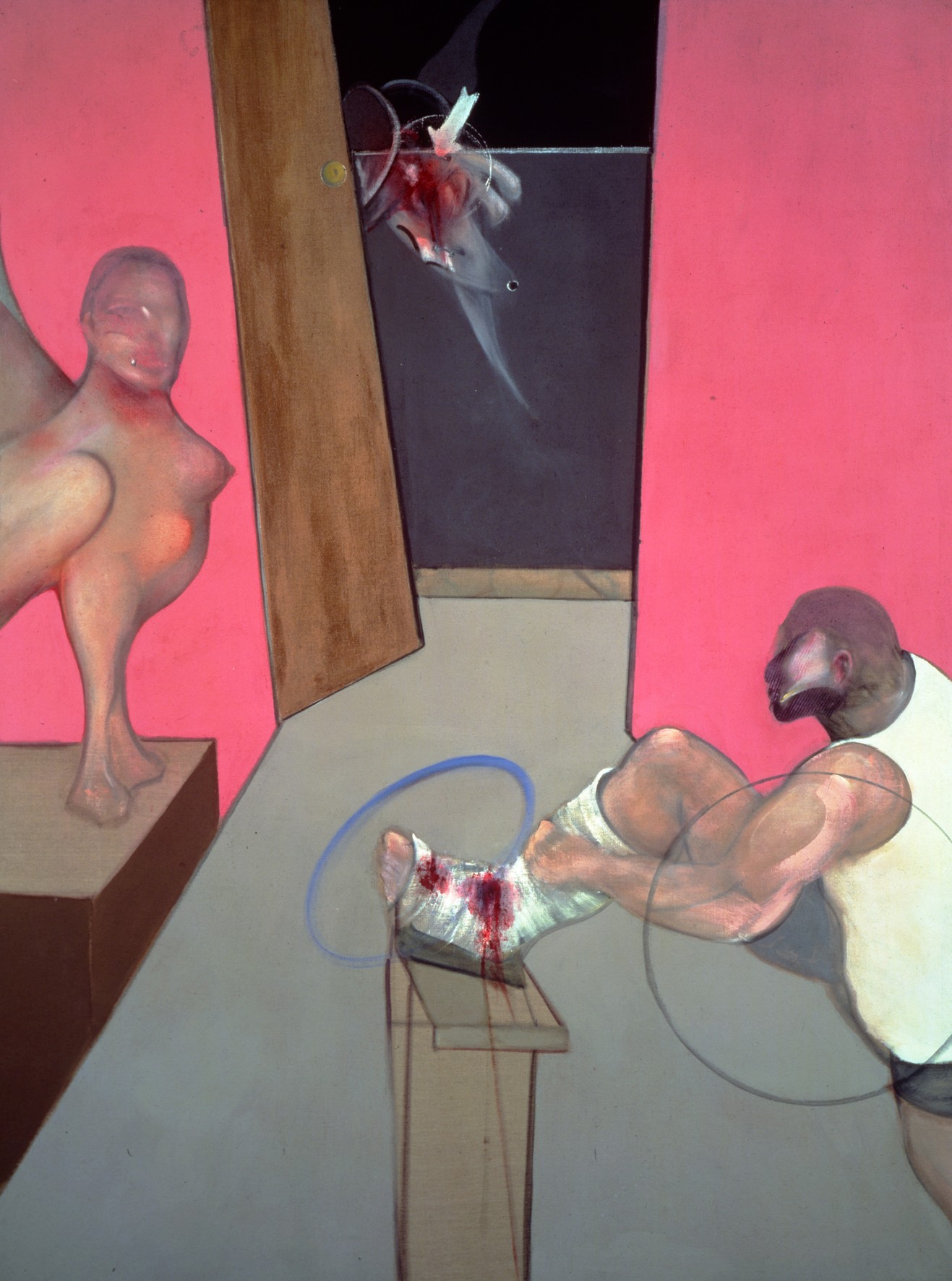
Oedipus and the Sphinx after Ingres, 1983, above, (oil on canvas) Bacon’s almost brutish comparison with (left) Ingres’ 1808 treatment of the same theme. Ingres has Oedipus listening intently to the Sphinx, almost touching, and in the right bottom corner a witness to the encounter is fearful and ready to flee. Bacon’s ‘bruiser in singlet and shorts’ seems more concerned with his bandaged right leg, with left foot, plonked squarely on a table. The Sphinx here seems out of time, his veiled, suggestively handsome, face staring at Oedipus, while the ‘witness’ looks like a piece of dried offal, but still vividly alive, a white arrow points to its bloodiness, behind a slide frame. Similar devices enclose his torso and halo his broken foot. Pictures courtesy of The Tate Gallery production on Francis Bacon.
Well-drawn picture of an extraordinary career
AS A social historian and novelist, Andrew Sinclair proves to be well placed to examine the life and art of Britain’s greatest 20th-century painter, Francis Bacon. He brings a dispassion-ate analysis to the facts of an extraordinary life, sets it in the context of the events of the age and relates both to the art with perception and sensitivity. Bacon’s brutal introduction to his homosexuality as a youth is set against the atmosphere of unpredictable violence in Ireland before the First World War.
Images of destruction and unseen terror from that war and his subsequent experience of the last days of the Weimar in Berlin and louche life in Twenties and Thirties Paris all informed his later paintings as much as any of his subsequent emotional experiences or physical relationships.
Throughout the narrative, as well as providing a lucid chronology of Bacon’s important loves and influences, Sinclair controls all the strands of the artistic and social climate and physical circumstances in which the artist worked. He conjures up the sordid and the generous, the horrifying and the humane aspects of the life and character of a painter who gave us images of our times that are terrible in their violence.
Bacon’s gambling, drinking, Soho, Colony Club, bohemian life and rough trade picked up in the East End are well known but Sinclair adds his personal knowledge of, and contact with, many of the participants to flesh out both Bacon's attitudes to his life and the imagery that he produced.
He also co-ordinates the influences of film (Eisenstein), photography (Muybridge), newsreels and literature (Blake to Nietzsche) into his commentary on the paintings. By quoting extensively from his own conversations with the artist and some of the best critical writing on Bacon's art, Sinclair adds to the authority and veracity of the book.
Here is Brian Sewell:
“He deals with Renaissance themes of religious and temporal power, authority,
corruption, conflict and lust, and has compiled his own pantheon of superhuman
images with which to demonstrate them. Titian turned to the great texts of
classical mythology, the New Testament and to portraiture to express the human
predicaments of an age riven by Reformation, counter-Reformation and political
struggles.
The greatness of Bacon’s art lies in its conjunction of the autobiographical and universal. Sinclair writes: “The nerve he caught in his pictures still twists in mankind, and in depicting his own sensations he brought to light our hidden desires and our griefs along with his own.”
Francis Bacon: His Life and Violent Times Andrew Sinclair (Sinclair-Stevenson, £20).
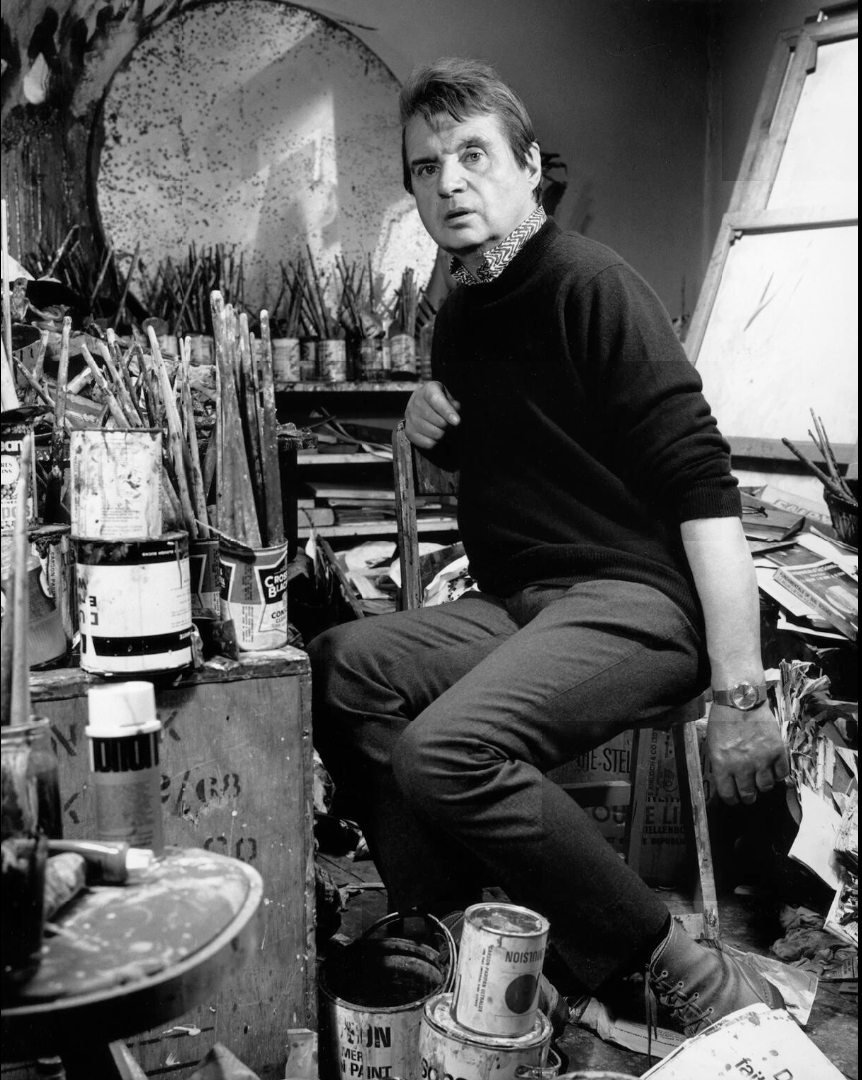
Francis Bacon at work in his studio in the early Seventies: “In depicting his own sensations
he brought to light our hidden desires and our griefs along with his own.”
Francis Bacon—His Life & Violent Times
WHEN Francis Bacon
Their grotesque violence, twisted human forms, mouths that look
like wounds, and homosexual themes are indeed often horrible.
It reveals Bacon as a dreadful old soak (
Soon after the war, unable to face Labour
He loved the masochistic thrill of gambling.
Bacon was born in Dublin of Anglo-Irish gentry. His sadistic soldier father was
furious that he disliked hunting (his allergy to horses gave him asthma)
and would watch him whipped by the Irish grooms. Francis took to wearing his
mother
Even his messy private
life provided inspiration. When his ex-Borstal lover George Dyer committed
suicide, Bacon made a painting of it which sold for nearly £4 million.
When Bacon died last year, aged 82, most of his £10 million estate went to his
last love, East End docker

ARTIST’S VIEW: Of Francis Bacon
Pictures from an Irish exhibitionist
whose life was spent remaking the world in his own image
FRANCIS BACON
By Andrew Sinclair
It was once observed of Francis Bacon that he was “a man without illusions”. He said much the same thing himself when he declared: “The only way you can possibly survive is to regard everything as being totally unimportant.” He did not always manage to live up to his own maxim — in his last years he became noticeably preoccupied with his reputation — and it seems to contradict another remark of his that he was essentially an optimist. But there is a great truth embedded here in his apparently conflicting statements: he was optimistic about nothing except the pure energy of life itself.
He was born in Dublin, in 1909, as part of the Anglo-Irish establishment; his grandfather was a sadistic bully, while his father was an army officer from the Boer war characterised by “discipline and bigotry”. There was supposedly a genealogical association with the Francis Bacon of more remote fame, out of which Andrew Sinclair weaves an interesting subtext, but the real influences are closer to home. We do not necessarily have to believe the painter's stories of sexual relations with his father's grooms {he was sometimes inclined to fantasise) to realise that his particular vision of the world might have been nourished by this strange family of the Ascendancy.
In some ways he remained true to type — a gambler, a drinker, a charming wastrel just like a hundred feckless sons from the seedy grandeur of decaying country houses—but he was also possessed by genius. Genius here simply means the ability to recreate the world in his own image.
But first he had to open his eyes. He began that process in London and Berlin, having been informally renounced by his family and given a small allowance. He was one of, hose people who need to live in cities — not simply because he was sexually promiscuous, but because he had that energetic and observant nature which is continually being re-charged by crowds, by streets, and by chance encounters.
It was also in cities that he became aware of a peculiarly 20th-century art; the films of Eisenstein and Bunuel were of particular interest to him, as was the art of Picasso and the Surrealists. But there were less obvious fascinations. The bookstalls along the quais of Paris have furnished many imaginations; it was here that Wilkie Collins found the plot for The Woman in White, and it was here that Bacon found a medical textbook on diseases of the mouth.
But then, when, he, returned to he became an interior designer. In the thirties he began a tentative career as a painter and, although he always denied being inspired by a religious awareness of any kind, he did specialise in scenes of the Crucifixion. But he was not a success, and was forced to live off his copious wits. He was an occasional thief, and was once caught shoplifting in Harrods. He took odd jobs — some of them very odd — and for a while became a “gentleman’s gentleman” until his employer discovered him lunching in the Ritz with his male lover. He dyed his hair with Kiwi boot polish, painted his face and brushed his teeth with Vim. For a while he ran an informal gambling den with his old Irish nanny.
That was his great strength: he always managed to do the unexpected , and to perform the most extraordinary acts as if they were quite natural. He was an individualist in the manner of that other Irishman, Wilde, and in that sense moved through life innocently because he was never touched by its compromises or betrayals. That is also why he managed to remain an artist in a country which does not love artists — he remained beyond the reach of its criticism. He was a visionary in a society that refused to see visions, and so he preferred to speak of other things. He never explained; he never complained; he never felt any need to justify himself.
He first acquired his reputation after his first solo show at the Hanover Gallery in 1949, but really enjoyed financial security only after joining Marlborough Fine Art in 1958. The first public triumph, of many, came when he was given a retrospective at the Tate four years later. He painted from early morning until lunchtime — after which, as Sinclair notes, anything might happen and frequently did. It was often a source of surprise that such a great artist could also be a great drunk, but in fact both activities were an inalienable part of his energetic and obsessive temperament. He was a prolific painter, and a prodigious drinker; he could not be one without the other.
Sinclair is very good at conveying the violence of Bacon’s work, and recovering those autobiographical impulses which career across the canvas like some half-remembered dream of anxiety or terror. It is in this context, too, that he examines Bacon’s homosexuality — about which he is neither sensationalist nor lubricious. In fact, he often emphasises the comic side of it, which Bacon would probably have preferred, and there are times when the painter resembles a particularly evil pantomime dame. Having identified the body of a dead friend, he remarked that “his trap was shut for the first time in his life”. On being introduced to the nephew of Jackson Pollock, he greeted him with “So you’re the old lacemaker’s niece, are you?”
Throughout his life he saw only what he wanted to see or, perhaps, had to see. He once declared that “Michelangelo and Muybridge [the early photographer] are mixed up in my mind together” — which perhaps explains his exuberant conflation of the heroic and the instantaneous, the voluptuous and the clinical. His own life had its full share of death and violence and horror, but in a sense he chose the existence which would be most suitable for the creation of his art. Once in a pub; he was simply introduced as a painter. A stranger at the bar, assuming he was a workman, asked him if he would paint his house. Bacon was perfectly polite: he explained that, at the moment, he was too busy. After reading this absorbing biography, one knows exactly what he meant.
Chamber of horrors from an amoral artist
Francis Bacon — His Life And Violent Times
by Andrew Sinclair (Sinclair-Stevenson £20)
BY PETER LEWIS | WORLD OF BOOKS: 2 | DAILY MAIL | THURSDAY, SEPTEMBER 2, 1993
THE first thing you notice about this first ‘full’ biography of the painter who died last year is that the portrait on the cover — pale, serene and brooding — is by Lucien Freud. Why not by Bacon, since there are plenty of self-portraits to choose from?
My guess is that the publishers calculated that any of those — contorted, bruised, and wrenched into deformity with self-loathing — would only put people off the book.
For a painter’s biography, it is wretchedly illustrated. With Bacon, the visual shock is all. Without experiencing it afresh it is hard to bear in mind what a chamber of horrors Bacon inflicted on the canvas and the spectator.
His vision of humanity was was so much meat, seen in the violent and loveless coupling of homosexuals, in the black holes, the confining cages, the slimy exuded shadows, the bleeding carcases which pass for paintings of the human figure.
Andrew Sinclair is not an art historian, which makes his book blessedly free of their peculiar jargon, but he quotes and accepts the eulogies of Bacon’s most admiring critics.
WE ARE told Bacon was the greatest British painter since Turner, or the most important artist after Picasso in the second half of the century.
Who says? Bacon’s place in art may well turn out to be minor, that of an obsessively repetitive figure painter of very narrow range. Hardly in the Picasso class.
Sinclair’s purpose is to relate the sense of horror in the paintings to the horrors of the 20th century — the Irish Troubles, the two world wars, the Holocaust and nuclear bombs.
As Bacon seems to have escaped any first-hand experience of these, he falls back on the argument that we are all conditioned by the horror photographs and newsreels we see. Maybe. But Bacon’s inspiration was more likely to have been a private one.
The violence in his work was was the violence of the struggle to represent what he saw and his feelings about it. Looking at the triptych (not shown here) that commemorates the death from drugs of his lover, the ex-burglar George Dyer, vomiting in a washbasin and doubled up on a lavatory, one can only say he succeeded all too well.
Bacon’s method of dealing with this and similar tragedies that overt
Bacon seemed to live a life without morality, without guilt and without a hangover, until he dropped dead at 82 visiting a new lover in Madrid. He left nearly £11 million. What is was all worth artistically and humanely speaking awaits a more rigorous appraisal than it gets here.

Francis Bacon: ‘Champagne for real friends, and real pain for sham friends’
Slice of Bacon’s Champagne life
DANIEL FARSON | BOOKS | THE MAIL ON SUNDAY | SUNDAY, SEPTEMBER 5, 1993
ANDREW Sinclair opens his biography as the legendary artist arrives for lunch at the Groucho Club, where they consume four bottles of Champagne.
‘He was nearly 80, but his round face with taut skin and imperious green gaze was that of a young commander.’
Sinclair avoids the Soho chit-chat revolving around the sharp-tongued Muriel Belcher in the Colony Room, where Bacon, Auerbach, Freud and Andrews met to talk of sex, drink and daydreams, though rarely about art.
Critic
Instead, he approaches Bacon on the intellectual level Sinclair believes the artist deserves: ‘He has always treated me as the social historian I am, and not the art critic I am not. He has acknowledged my trade and its due place in his work.’
I cannot make such a claim, but I can point out that some of the splendid incidents and snatches of conversation are familiar — to me at least — since they first appeared in my recent biography of Bacon, The Gilded Gutter Life. Still, I am flattered that Sinclair acknowledges passages from my book Limehouse Days, an account of the riverside houses in which the three of us lived at different times and where I introduced Sinclair to Bacon.
The real value of this biography is the revelations: Bacon’s Irish genealogy, diligently researched; giving £5,000 to a Canadian to spend on food and drink in a single week; hiring a train to take some friends to the South of France with the blinds drawn as they drank Champagne, playing roulette all the way.
I knew Bacon was generous, but not so wilfully extravagant.
Sinclair’s leading eye-witness is Bacon’s cousin, Pamela Firth, who remembered him as a boy dressed as a flapper, with a beaded dress and long cigarette holder.
‘Even as a child of ten, Pamela thought he cousin Francis was enjoying the role a little too much.’
She makes a further appearance when Sinclair discusses Bacon’s friendship with John Edwards, referring unfairly to ‘the boy on the make depending on the generosity of the older man’.
Public
Sinclair seems to me to underestimate the strength and mutual advantage of their relationship.
The Edwards family were devoted to Bacon in his final years, as he was to them, making John his sole beneficiary. Pamela saw her cousin for the last time when she opened her Suffolk home to the public, and the Rolls and Bentley ‘disgorged the Edwards brothers and the artist.
‘She found him paralytic with drink and incapable of speech . . . “Drive him home.” ’
Sinclair calls this her ‘extreme mortification’. But surely, as Dora Maar said of Picasso, ‘genius does not need to apologise.’
Bacon was a man of extremes, serious yet comic, a swashbuckling hero yet a sacred monster too. Of course I am prejudiced, having known him so well for so many years.
But all the same it is valuable to have this different, more critical point of view
FRANCIS BACON, HIS LIFE AND VIOLENT TIMES by Andrew Sinclair (Sinclair-Stevenson, £20)
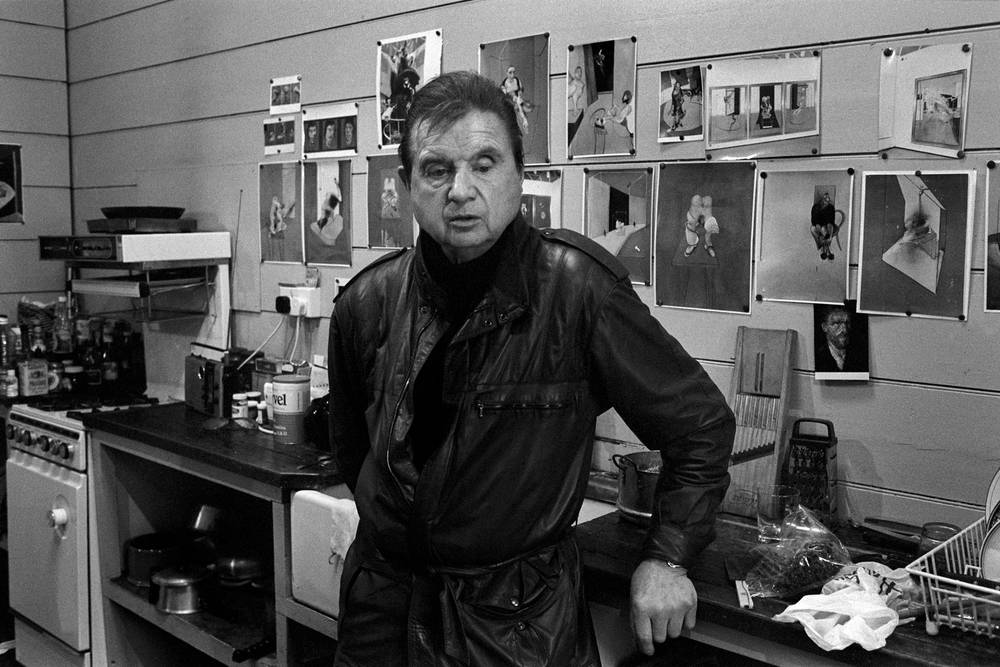
YOUTHFUL EXTRAVAGANCE: Francis Bacon at 77 Picture: John Minihan
Another slice of Francis Bacon
Martin Gayford on the latest contribution to the
burgeoning Bacon industry
MARTIN GAYFORD | BOOKS | THE SUNDAY TELEGRAPH | SEPTEMBER 5 1993
STARTERS are off in the Francis Bacon biography stakes — a sporting event to which it is safe to say the subject would have been either indifferent or downright hostile. For one thing, though a compulsive gambler, he did not like the races — preferring the pure randomness of roulette. For another, he was opposed to anyone writing his life — even himself (“What’s the point, unless you’re Proust?”). During his lifetime, he did his best to discourage would-be Boswells. And when reminded of the grim inevitability of biography, he took comfort in the thought that when it came, “I shall be dead and I shan’t have helped and I shan’t care.”
Now he is dead, and the Bacon industry is under way, with several books apparently in the pipeline. We have already had Daniel Farson’s Gilded Gutter Life — essentially a personal memoir by a close friend, which has the merits of being highly readable, and making one aspect of Bacon — the Soho character — zing vividly off the page.
Andrew Sinclair, by his own account, did not know Bacon well. Nor is he an art critic, but, as he protests from time to time, a social historian. A social history of Francis Bacon — the most unrepresentative and outre’ of individualists? It’s certainly an odd idea.
In practice, the result is a pretty unrewarding read. A good deal of space is devoted to background information — which most readers will already have — about Berlin in the 1920s, London in the Blitz etc. Later on there are interminable précis of what Uncle Tom Cobbley and all had to say about Bacon. Almost a whole chapter is devoted to a summary of the views of a French thinker, which, in this form, are virtually incomprehensible. The overall effect is often of a lengthy and not very well digested browse through the cuttings file. Neither the man nor the work come into proper focus.
It would be difficult to write an entirely dull book about a man as witty and undull as Bacon, so there are insights and striking pieces of information along the way. But most of the anecdotes have been better told elsewhere. Here one often gets a feeling that the point is being missed. To take a characteristic example, we read again of Bacon’s famous inquiry to Jeffrey Bernard, “Now that you’ve lost your looks, Jeffrey, what are you going to do?" But can it really be true that in making this feline remark, Bacon was showing “concern for his younger friend” as “age came upon them both”?
We still await a really heavyweight account of Bacon the man — if such a thing is possible in the case of someone who spent his life either working, or talking brilliantly over endless bottles of champagne. Meanwhile, let’s hope the painter was right in his belief that “We’re born and we die and that’s it”, because otherwise somewhere an outraged ghost will be snorting over this.
Francis Bacon: His Life and Violent Times by Andrew Sinclair Sinclair-Stevenson, £20
Candid canvas
MUCH HAS been made of Francis Bacon’s last encounter with his biographer Andrew Sinclair, when the duo consumed four bottles of champagne in London’s Groucho Club before the painter paid and left, seemingly unaffected. Sinclair was not, however, the only one succumb to Bacon’s formidable enthusiasm for alcohol.
At the Redfern Gallery's launch party this week for Francis Bacon: His Life & Violent Times, Sir Stephen Spender, the poet, said that he too regularly drank with Bacon, a lifelong friend. “We would meet and have dinner and get horribly drunk. It was a kind of sacred thing getting drunk with Francis.
“I do not drink very much but I knew that if I went out with him we would be up ranting until three in the morning,” says Spender. “He would be very good until about three, and then he would proceed to tell you what he really thought about you.”
His face well suited to be on a Toby-jug
JEFFREY BERNARD
JEFFREY BERNARD | BOOKS III | WEEKEND TELEGRAPH | SATURDAY SEPTEMBER 11 1993
FIRST there was Dan Farson’s biography, The Gilded Gutter Life of Francis Bacon, and now Andrew Sinclair has stuck his oar in. This is only the beginning, the first two drops of what could become a flood. It occurs to me that Bacon’s face was well suited to be on a Toby-jug and if some bright spark marketed them they would sell in every souvenir shop in the land.
Two biographies of the man may not yet be a flood, but they constitute a basinful for me. I do, in fact, have eight biographies of a historical hero, but then I never met him. When I read a biography I want to know what the subject was really like. There is plenty in Francis Bacon about his childhood, but not many childhoods are of much interest, although many readers would like to know that Bacon enjoyed dressing up in his mother’s clothes and that he had a large number of sexual flings with stable lads.
Bacon’s father, the naive man, thought life in a racing yard might toughen the boy up. Bacon was always tough enough, though, and at times sufficiently hard to survive the way he did. But what he must have done and seen in the Berlin of the 1920s, and in Paris, almost makes me shudder; yet it is the paintings that most affect the squeamish and faint-hearted.
There is too much about the details of his paintings here. There are plenty of glossy, coffee-table books with reproductions of his work; catalogues I have of past exhibitions are as good and better. Apart from the rather heavy laying-on of that aspect of Bacon, there is a turgid, boring section on his awful-sounding intellectual French friends. They speak in double Dutch to me.
Sinclair is at his best when he writes about Bacon’s English friends and lovers and his Soho boozing companions. Peter Lacey, one of Bacon’s great lovers and models, an elegant ex-fighter pilot and a dab hand at the cocktail piano as well as being an alcoholic, was arguably one of the nicest men I ever met in Soho.
Sinclair is particularly strong on that other great love and model, George Dyer. But he is a little fuzzy on their visit to New York in 1968. I was there too. I bumped into them accidently one day and from then on it was taken for granted that I should go round to the Algonquin every morning for what Bacon called breakfast. I needed a breakfast too in what was the coldest weather I have ever experience, but every day we sat down to a bottle of Dom Perignon. Bacon made up for my suffering snow and champagne by buying me an overcoat.
But George did not threaten to jump out of their 25th-fllor window. (I do not think you can open them anyway.) He took an overdose and when the staff told Bacon that George was still alive in spite of it, Bacon told them to send for the doctor, again telling him to bring more pills as George had not taken enough. He was a likeable mess and did finally die quite horribly much later when he went to Paris with Bacon. After another suicide attempt he had a haemorrhage while sitting on a lavatory. Does that ring any visual bells for you?
Bacon was shattered by George’s death as he had been years ago by Peter Lacy’s. He never showed it much, however, except on canvas. He was a good actor and sometimes a marvellous clown. Sinclair talks a lot about Bacon’s wit and he was indeed witty, but after a few glasses of champagne not a lot he said was to be taken too seriously and Sinclair takes too seriously Bacon’s large stock of one-liners. He liked playing to the Colony Room gallery and then Bacon was ham.
I am slightly irritated by Sinclair referring to me as having been an elegant scrounger. I never asked Bacon for money. He gave of it freely. And I am surprised to read that I was ever elegant. Francis Bacon was one of the most elegant men I have ever known. As Joe Gargery would say: “What larks.”
Francis Bacon: His Life and Violent Times by Andrew Sinclair Sinclair-Stevenson, £20
Invalidity benefits
JEFFREY BERNARD | LOW LIFE | THE SPECTATOR | SATURDAY 11 SEPTEMBER 1993
I don’t have a lot to tell you today. I have been in bed or lying on my sofa for a week and all I have observed is the ceiling, the walls, my palm tree, the bust of Nelson on my windowsill and some appalling television. I have to conclude that the English will laugh at almost anything and that very nearly the entire population of the world must lead even duller lives than that of an invalid to enjoy soap operas.
The only stab of pain I have had to endure was that of writing a review of Andrew Sinclair’s biography of Francis Bacon. Harder than you might think. It certainly wasn’t made easier by the fact that Bacon and I were friends. I found myself wanting to knock him a bit since biographers lean overboard the other way. A genius maybe, but a clown in champagne with phrases like, ‘Life is but a short interval between birth and death,’ uttered at five-minute intervals on occasions.
Of course, one of the first things I looked at in Sinclair’s book was the index. I get three mentions and one of them refers to me as having been an ‘elegant scrounger’. Oh, he shoved the odd £50 note in my pocket at times but I never asked for it and I don’t know where he got the idea from that I was elegant. What is missed and will be again and again by future biographers is the fact that Francis liked very few people indeed. And why should he have done? Most of us are arseholes. Which reminds me, the only visitor of much interest to this cell last week was the lovely sister Sally, who looked after me a year ago when I had the horrendous operation on my broken hip.
She told me about a man she came across when she worked in casualty some time ago who had a golf ball jammed up his anus. More to the point, she turned up with a bottle of vodka saying that she had read in this column that I was getting fed up with dispensing the stuff to every visitor. She is a noble nurse and if Florence Nightingale had done her rounds with vodka and not a lamp then Scutari would have been a happier place. There must have been a lot of it at hand. My other visitor was my brother, Oliver, who kindly cooked me supper and left the oven on so that I woke up to a beautifully warm prison. And now Vera has got a new cure for my muscle-wasting ills. Breakfast. I lie in bed like a chick in the nest with my beak wide open and she pops a bacon sandwich with a touch of brown sauce into it, accompanied by a pot of tea and a reminder to take my insulin. That might not have been Elizabeth David’s idea of a breakfast but the bacon sandwich is one of the great unsung dishes of the world.
Sometimes Vera makes me an egg sandwich and that is not to be sneezed at either. Eating when reclining makes a marvellous mess. The plaster cast on my leg has no daft autographs on it but it does have egg yolk, gravy and sauce bolognese trickling down it.
The awful thing is going to be sawn off tomorrow, thank the Lord, and for all I care they can take the leg with it. I shall not be needing it again and it will give my friends the opportunity to make facetious jokes about my not being able to have the leg over. And now that the ulcer on the other leg is not healing quickly I suppose that they will eventually call me quite truly legless.
All of this may be too much for others to bear. Not for me, though. I must send Vera out to buy me a thinner than usual visitors
’ book. Put not your trust in duchesses or ex-lovers. Only Vera and assorted nurses lighten this place now and a plumber would be welcome, as would a cook. Vera kindly prepares meals for me, but cooking on one leg is exhausting and a little tricky. I suppose I shall have to go the whole hog and buy a parrot.
Daniel Farson vs Andrew Sinclair
ROBERT LEEDHAM | FEUDS CORNER | THE SUNDAY TIMES | 12 SEPTEMBER 1993
Rather like two kids squabbling over an absent friend in the playground, the biographers, Daniel Farson and Andrew Sinclair, are engaged in a petty war of words. “I’m his best friend!” yells one, “No, you’re not. I am!” screams the other. Common enough behaviour among London’s literati, except that the third party being fought over, the painter, Francis Bacon, has been quite clearly dead for over a year.
The two men are authors of rival biographies of the artist. But more importantly, both are busy deriding each other’s efforts.
Farson is cast as Bacon’s bohemian drinking buddy. Sinclair’s book, he says, is a “scissors and paste” job. “How is it,” Farson asks, “that he’s not interviewed a single person, except perhaps ex-stable boys in Ireland?”
Sinclair has the role of egghead Establishment figure. Farson’s book, he says, “is gutter memories”.
Both biographies were on the cards long before Bacon’s death. So, inevitably, both books include passages that might be considered pre-emptive strikes against the claims to authenticity of their opponent.
In Farson’s book, Sinclair is deemed to merit just one disparaging reference. When I left Limehouse in 1964,” Farson writes, “the scene had changed and the working river was dead. Prices soared as smart people moved in to convert the little houses into elegant waterfront residences. This was everything Francis and I dreaded, especially after a brief meeting with the writer, Andrew Sinclair, when he rented the house next door.”
Sinclair’s Limehouse reminiscences are a little more specific. Part of the area’s attraction, he writes, was its privacy. “By their trade and lack of alternative choice at sea, sailors were used to homosexuality and to providing favours to gentlemen when they ran out of money on their leaves.”
And the biographers’ “brief meeting”? Farson invited Sinclair to a party. “There were only men there ... Rather shy and heterosexual, I was embarrassed, but pleased to talk to Bacon.”
After listing some of the celebrities — William Burroughs, Jacques Tati, Grouch Marx, Shirley Bassey and Clint Eastwood — that Farson ferried to his pub on the Isle of Dogs, Sinclair notes: “In a way, Farson was like [David] Owen, destroying the culture which he loved by introducing it to the glamour and power of other parts of the city.” Poison pens
It’s a persuasive argument, but if I were Sinclair, I’d attack his nemesis at his other, more obvious, weak point: on page 60 of Farson’s book, it is written that the author of The Deer Park — The Executioner’s Song, and The Naked and The Dead — is not Norman Mailer, but “Normal Mailer”. Would you trust this man with your biography?
Robert Leedham
BIOGRAPHY
On the outside looking in
Francis Bacon
His Life and Violent Times
by Andrew Sinclair
Sinclair-Stevenson, £20, pp. 354
WALDEMAR JANUSZCZAK | BOOKS | THE SUNDAY TIMES | 12 SEPTEMBER 1993
There are not many cliques as keen to repel borders as the art world, but the over-sixties branch of the London homosexual community is one of them. So is that weird set of boozy Soho raconteurs who refuel throughout the afternoon at the Colony Room. Some of these colonists also belong to the most impenetrable set of all — the friends of Francis Bacon. Andrew Sinclair’s chief problem as Bacon’s biography is that he is not a member of any of these clubs, while his subject was a guiding force in all of them. Thus Sinclair spends the entire length of his ambitious biography cum history of the 20th century with his hot little face pressed to the glass. But the glass is frosted. And the real action is clearly a long way away.
A club that is altogether easier to walk into is The Groucho, and it was in this celebrated media drinking-den that Sinclair once met Bacon to drink champagne and talk for four hours. These are the credentials Sinclair holds up rather desperately at the outset of his long march around the perimeter fence. If those are the only qualifications you need to write a life of Francis Bacon then we must expect hundreds, perhaps thousand more. Indeed, I could write tow or three of them myself.
Bacon will always attract barflies and biographers. He led an extraordinary life, his personal magnetism was famous, his paintings are considered by some to be the most telling of the century — most pertinently of all, perhaps, in these unprincipled times that he helped usher in — he did not want his biography written. By decreeing his life to be out of bounds he probably suspected that he was encouraging a queue of trespassers to form. After all, he himself had gulped down enough varieties of forbidden fruit in his time to feed an army of Adams. But his friends are glued closely together by loyalty, shared guilts, and a sense of ownership, and they have mainly chosen not to speak to poor Sinclair. Which is a shame, because he has two of the qualities a biographer of Bacon needs: he writes well and he is learned on the subject of the 20th century.
What he lacks is everything else: cunning; the ability to respond to art viscerally rather than thoughtfully; a passport to the undergrounds of Berlin, Paris, Tangiers; an insider’s knowledge of homosexual London; and a Baconesque mistrust of guiding principles. Sinclair has far too many of the latter and the resulting match-up in which he tries to position Bacon grandly in the 20th-century scheme of things is thoroughly unconvincing, more headmaster and naughty pupil than necromancer and corpse. None of Bacon’s lovers can be heard speaking, presumably because they did not want to be spoken to. John Edwards, with whom Bacon spent the last decade of his life, is ignored almost entirely, a footnote hidden in the body of his text.
Curiously enough, the other recent biography of Bacon, Daniel Farson’s, was an altogether more penetrative document precisely because it was full of tittle-tattle and juicy anecdotes and not much else. Farson’s was an insider’s book. The bitchy, scampering Bacon who emerges from it has the gift of life, whereas the shadowy and important figure who who bestrides our times in Sinclair’s tome like a queer Statue of Liberty, is a monument to death. Sinclair’s principal argument is that this gift of death is the century’s principal gift to humanity, and that Bacon was the supreme painter of that gift. This biography is entitled Francis Bacon: His Life And Violent Times. But the closing phrase of the subtitle is an admission of defeat masquerading as an agenda.
If Sinclair had been allowed closer to the real Bacon by Bacon’s friends, he might perhaps have realised that there are no windows in the Colony Room that open out on to a view of Hiroshima. Bacon always insisted that he had no ambition or desire to capture the human condition. He painted what he liked and what was there. This has proved an extraordinary difficult truth for others to accept. We have found it difficult to believe that when he said he found the meat in a butcher’s shop beautiful he meant only that, and that it was beautiful. Or that the books he collected full of illustrations of awful skin diseases and medical deformities gave him deep aesthetic pleasure. Bacon did not avert his eyes as most of us would have done, not because he was conscious of staring deep into the soul of the century but because he had kinky tastes.
The single most extraordinary thing about his life was its insouciance. He did, said, and painted terrible things, but, apart from one small court case for possession of cannabis, he not only got away with it but ended up as the darling of the Establishment, shipped off around the world in important British Council exhibitions, and a multi-millionaire to boot. He produced a suite of paintings which we have tended to overrate precisely because they seem to accord so closely with out image of the century. When our own pessimism, has been re-examined, so I suspect will be the reputation of Francis Bacon.
He was born in Dublin in 1909 and this has tempted various biographers to view him as a kind of honorary Irish man. The first half of this tome is full of recurring comparisons between Bacon and Oscar Wilde. In fact, he was a true blue product of the country set, and much of his cruelty and confidence can surely be explained by his horsey, gentlemanly, English origins. This is the man who visited South Africa to bugger black men. Who loudly supported the war in Vietnam. This is the cruel emotional retard who identified his friend, the photographer John Deakin, on a slab in the mortuary and reported gleefully back to Lucian Freud that Deakin’s “trap was shut for the first time in his life”. This is the man whose lover committed suicide on the eve of an important Parisian opening — but who went through with the opening anyway.
Sinclair records these incidents but is too intent upon hero-worship (“I have never spent a more illuminating four hours in my life,” he writes of the champagne-fuelled Groucho Club meeting with Bacon) to draw any helpful conclusions from them. The question — how can someone who paints the Human Condition be so uninterested in the condition of his fellow humans? — is begged but not answered. The answer, of course, is that Bacon never tried or wanted to try to paint the human condition. And that only from behind the frosted glass can Bacon’s violent times be mistaken for our own.
Waldemar Januszczak is the art critic of The Sunday Times
On a diet of oysters and despair
BY JAN DALLEY | BOOKS | THE INDEPENDENT ON SUNDAY | 12 SEPTEMBER 1993
FRANCIS BACON was terrified of biographies, as any sensible person would be, and he had better reason than most. His life, as he well knew, was pure grand guignol. There was the rackety Irish childhood with a sadistic father and a bevy of eccentric relatives in their crumbling big houses; the early day of scraping a louche living; Berlin, Paris, Tangier; the drinking, the gambling, the low-life high-jinks, the whole Soho legend. There were intense passions, a lover’s suicide, pain and tragedy. Above all, there was the shattering beauty of the work, of images “so unrelievedly awful that the mind shut snap at the sight of them”, in the words of Bacon’s friend and critic John Russell. And towards the end, there were the million-pound price-tags. If this were a novel, it would be considered preposterous.
Still, Bacon seems to have enjoyed his personal mythology. His ambition was “the National Gallery or the dustbin”, and nothing in between: moderation was anathema to him. Anecdote and exploit were the very currency of the Soho clubs he favoured, and Bacon supplied plenty of both. As his fame grew, it amused him to toss one-liners to journalists, like throwing fish to sea-lions; he described his life as split between “the gutter and the Ritz”, his existence as “a diet of oysters ad despair”.
This was all very well while he was alive — and especially while his reputation (the only worldly attribute he valued) rested in the careful hands of some fine critics and devoted friends. They were always there to remind us that, even if one of the twin poles between which his life was stretched was hedonism, the other was an austere dedication to some of the most original work of the century. But after his death, the anecdotes, the oysters and despair, are there for the taking, while the work remains massive and difficult. There is only one valid reason to write the biography of an artist: to investigate the life in such a way as to deepen our understanding of the work. Anything else is just gossip, more or less expensively packaged. Bacon was right to be worried.
Since he died on 28 April 1992, there have been two books about him. The first, published just a year later, was The Gilded Gutter Life of Francis Bacon, by Daniel Farson, who was for many years Bacon’s Soho drinking crony. At least this book is honest about what it is: the title (a phrase of Bacon’s own) makes it clear that these are bad-boy reminiscences: the sessions at Muriel’s, the pick-ups, the baiting of the bourgeoisie. Farson claims to have loved his famous friend, despite a falling-out, but it is hard to avoid the feeling that he is simply cashing in the chips.
The second book is Andrew Sinclair’s. This is an example of how an extended reworking of a cuttings file and a few library shelves can be elevated to the status of a critical biography. For Sinclair has gobbled down all the extensive work on Bacon, especially the brilliant series of interviews carried out over many years by David Sylvester. For a man who distrusted words (“if you can say it, you don’t need to paint it”) Bacon was highly articulate, and work by John Rothenstein, John Russell and a host of critics around the world gave Sinclair plenty to chew. He has also ingested the biographies and memoirs of contemporaries, read the newspapers and swallowed the anecdotes whole. The resulting mash, rendered in prose of the deepest purple, he packs tightly around the vacuum at the heart of his book, the empty space where his subject should be.
For Bacon has given him the slip. This is only partly because Sinclair’s contact with Bacon appears to have been very limited (he refers to a prolonged conversation during 1988, but surely he would not have needed so many secondary sources if he had any primary ones of real substance). It is certainly possible to write a good critical biography without knowing the subject — although it would be a very odd thing even to attempt within 18 months of his death — but for that the writer has to have a considered intellectual position, and something, preferably something original, to say. Andrew Sinclair has nothing to say about Francis Bacon, beyond the retailing of endless canards, and the contradictions, repetitions, digressions and irrelevancies he employs to disguise the fact are a shabby tribute to his subject.
He tells us most things at least twice. When he does produce a piece of information, like a comment on “Bacon’s rigorous pattern of work from six to twelve in the morning”, he adds, with magisterial irrelevance, “rather like that of Graham Greene”. Throughout, he evokes another famous name if he possibly can (it makes the index impressive), usually coupled to a piece of negative evidence (ie, telling us what Bacon did not do, or see, or like). So there is a disquisition on Richard Hamilton (because Bacon had nothing to do with Pop Art). When recounting the sad suicide of Bacon’s lover George Dyer, Sinclair makes a long digression into the case of Joe Orton and Kenneth Halliwell. Is he implying that Bacon narrowly avoided being murdered by Dyer? That all gay relationships are violent and destructive? No, he is probably just filling space. Bacon’s brief visit to Berlin in 1928, where he stayed with a wealthy relation in a smart hotel, occasions a description of the grimy districts frequented by Auden and Isherwood, where Bacon did not go, and the gay cafés he did not visit. Sinclair’s quest for spurious shockers leads him as far as Auden’s rectal fissure, “dug out of his backside in the homosexual trenches of Berlin”. What did Auden ever do to deserve this?
On Bacon’s emotional life, Sinclair appears content to repeat extraordinary statements — such as that Francis had a strong sexual attraction to his father — without justification or comment. When he does have a smidgin of evidence, as when he says that Michael Wishart says that Bacon said that his (Bacon’s) old nanny, whom he brought over from Ireland, was the most important person in his life, Sinclair examines this no further, beyond repeating Farson’s stories about her sleeping on the kitchen table and going out shoplifting for them both. Sinclair, apparently, could not even be bothered to find out the name of this “most important person”.
FRANCIS BACON: His Life and Violent Times by Andrew Sinclair, Sinclair-Stevenson £20
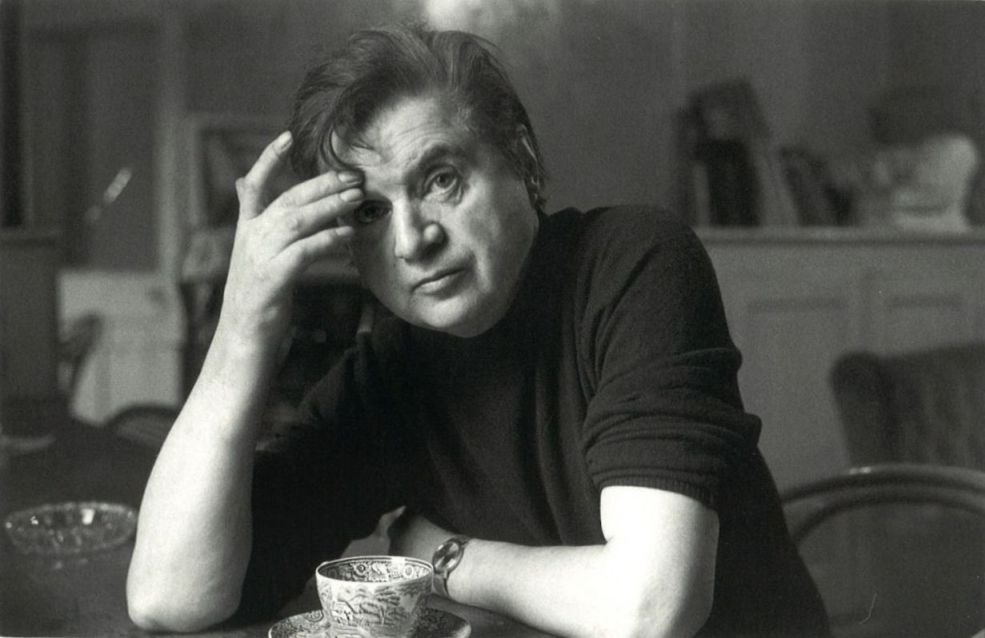
Francis Bacon, who distrusted words, not least the words of biographers: ‘If you can say it, you don’t need to paint it’
All is seared with rough trade;
bleared, smeared with toil
FRANCIS BACON: HIS LIFE AND VIOLENT TIMES
by Andrew Sinclair
Sinclair-
Alen Ginsberg, writing to Jack Kerouac and quoted by Andrew Sinclair, described Francis Bacon as having
the aspect of an English schoolboy and the soul of a satyr. He wears sneakers and tight dungarees and black silk shirts and always looks like going to tennis ... and paints mad gorillas in grey hotel rooms dressed in evening dress with deathly black umbrellas — said he would paint big pornographic picture of me.
It is unlikely that the picture ever got painted or, if it did, that it was recognisable. Distortion was more in Bacon’s line than pornographic realism. ‘I can only paint to excite myself,’ Bacon once observed, and Ginsberg was scarcely his type. ‘What would really excite me,’ he said to John Richardson, ‘is a middle-aged Belgian commercial traveller with hairy wrists and a marquesite watch embedded in that hair.’
These two biographies, though totally different in manner and atmosphere, are nevertheless recognisably about the same man. Dan Farson was a close friend and his gossipy portrait convincingly hits off Bacon in a variety of guises. Farson’s interests seem largely confined to Soho, and the art produced by the clients of the French pub and the Colony. Sharing many tastes with Bacon, not least for champagne, he was in on his life — until the usual rift occurred — in a way that no other biographer could hope to be. Indeed, Farson’s book so reeks of champagne that it gives the impression of having been printed in it. It is often careless in style, certain pages reading like Harper’s and Queen:
I was able to talk to old friends like George Melly, whose smile equalled that of Francis in lifting the spirits. In the gents I spoke to Patrick Leigh Fermor, who beat a hasty retreat saying that his wife had been taken ill. ‘Do you think he’s queer?’ Francis asked. ‘I’ve always thought so myself, even though he’s got the reputation of a ladies’ man. The women adore him.’
Farson comments: ‘Francis suspected the most unlikely people.’
It is nearly always party time in Farson’s book, but though he gives rather too many irrelevant pages to himself he will be a reliable source to those who follow him as biographers, several of whom are already in training. He develops from groupie to real friend and has observed at close hand Bacon’s lovers, fellow artists, critics and acquaintances both in days of favour and disgrace: John Minton, Lucian Freud, John Deakin, George Dyer, Roy de Maistre, Graham Sutherland, David Sylvester. As a result, Farson’s book is as much about Bacon’s haunts and circle as it is about Bacon as a painter. Bacon hardly ever allowed anyone to see him paint, though he was more articulate about painting than any of his contemporaries. Farson interviewed Bacon formally on several occasions and from these talks much that was crucial to Bacon’s art emerged. Farson referred to Bacon’s work often being regarded as sensational, evil, horrifying:
I think it is that sometimes I have used subject matter which people think is sensational because one of the things I have wanted to do was to record the human cry ... the whole coagulation of pain, despair.
Andrew Sinclair, who encouraged Bacon to regard him as a social historian rather than an art critic, has necessarily written a less intimate book but one rather fuller in background: from Bacon’s upbringing in his father’s racehorse training establishment where the Irish grooms ‘took him as easily and brutally as a stallion might a mare,’ and ‘all is stamp and rut and whinny’, to Berlin and the German Expressionism of the time. Apart from the period, which must have been comical, when Bacon worked as a gentleman’s gentleman, he was usually paid for by a wealthy, middle-aged keeper. He soon tired of menial work, though when he resigned from one job he heard his employer remark, ‘I can’t understand why he’s leaving because he doesn’t do anything.’
Bacon, according to Sinclair, lost his religious faith while reading Nietzsche and contemplating some dogshit on the pavement. The dogshit and Nietzsche cannot have done a very good job, for though Bacon denied any specific religious leaning, much of his work was painted with a sense of grandeur, regardless of subject, that is not of the here and now.
Everyone who ever knew him fell for Bacon’s charm. He could be malicious and bitter, especially about any of his contemporaries who were doing well, but he was wonderfully generous and good company. He was devoid of pretension and a gambler who believed in the artist making his own luck. He was a masochist who enjoyed being beaten up and was devoted to his old nanny. He destroyed many of his own pictures and once when David Sylvester was patiently sitting for him for his series of poses he ignored his sitter and worked on the head of a rhinoceros from a photograph.
The student of Bacon as painter, man-about-town, drinker and talker, will get education and entertainment from both of these books. They are not without slips of one kind or another. Farson twice calls Peter Watson, the founder of Horizon, an American, which he wasn’t, and rather surprising Sinclair refers to ‘Lady’ Ann Fleming, which she wasn’t either.
Expressions of universal grief
FRANCES SPALDING
A n d r e w S i n c l a i r
FRANCIS BACON
His life and violent times
It is not hard to understand why, since Francis Bacon’s death in the spring of 1992, two biographies have appeared and at least one other is in preparation. The man himself was as much his own creation as his work: fearless in his defiance of the social system, refusing to live on any terms but his own, audacious and original. The biographical approach allows us to see the corresponding stringency and independence in his life and art, as well as the linking despair which he contrived to work to a pitch of exhilaration Self-confessed autobiographical content in his art further licenses biographical inquiry Bacon could almost have said, as his mentor Picasso did —“ My work is like a diary To understand it you have to see how it mirrors my life.”
Bacon’s first biographer, Daniel Farson, drew on his credentials as a former denizen and historian of Soho as well as the many hours he spent drinking in the painter’s company. Though his largely anecdotal account (TLS, April 30 1993 can be relished for the vivid portraits of the various characters in Bacon’s coterie it really just provides snapshots and little more Andrew Sinclair’s portrait is more compelling It draws the reader much further into the peculiarly vicious world which Bacon inhabited and is, as it should be, disturbing. He deepens awareness of the complexities in his subject’s nature, the combination of dignity and depravity, brutality and grace, mercurial wit and a bullying desire to shock Like Farson, Sinclair has shared some of Bacon’s territory living for a while as his neighbour in the East End and as the author of War Like a Wasp, having a specialist knowledge of the cultural life in Britain in the 1940s.
Bacon, it seems, could risk anything except normality. He dreamed of having an enormous room fined with distorting mirrors from floor to ceiling He brought to his portrayal of twisted, convulsed or screaming figures ideas culled from sources that betray his fascination with malaise and disorder: a medical book on diseases of the mouth, another on positioning in radiography, images of violence and passion in the films of Bunuel or Eisenstein as well as illustrations of syphilitic sores and other wounds and tumours.
One of Sinclair’s concerns is to trace the origin of this obsession with violence He locates it in Bacon’s childhood experience of London, dark and fearful during the First World War and after his family returned to Ireland, to his familiarity with the Sinn Fein movement and what amounted to civil war. When visiting his grandmother, who married to the Chief of Police in County Kildare, lived behind sandbagged windows he was told to watch out for snipers. “I grew up in an atmosphere of threat for a long time”, he recalled.
Stories about Bacon’s father having Francis horse-whipped by his grooms and finding his son dressed in his wife’s underclothes have been told before. But Sinclair is the first to discover the significance of his father’s death: only after 1940, when he died, did Bacon, after many years of indolence and false starts as an interior decorator and painter of religious subjects, find sufficient release to begin making images that were received as expressions of universal grief. Still unnamed, however, is the person whom Michael Wishart thought the most important in Bacon’s life: his nanny, who featured in his illegal gambling sessions, fed him right-wing views and left him inconsolable at her death.
Sinclair’s prose can be histrionic (“He read the entrails of his half century pulverized them and vomited his three Eumenides in paint”), but then Bacon too reached for the garish and melodramatic dramaticm I doubt he would have accepted the remark collected from an anonymous source that during the “forties he got rid of his inhibitions under the wing of John Minton”; temperamental and artistic differences between these two artists created more friction than fun Sinclair’s descriptions of pictures can also seem over-precise, replacing ambiguity with signification: he detects semen in a splurge of paint where others may see Bacon’s love of “what can be done with paint on its own.”
Yet this is a rich account. Sinclair’s familiarity with post-war London gives him an easy grasp of wide-ranging material He has also culled his sources with a sharp eye and presents a fascinating kaleidoscope of opinion on Bacon’s achievement. He writes as interestingly on the influence of Picasso as on Bacon’s homosexuality, noting his liking when young for an “illicit stuffiness” — middle-class gentlemen in pin-stripe suits with a perverse streak. With success he became as Bruce Bernard notes,“ ruthlessly upwardly and downwardly socially mobile”. The story that his lover, George Dyer, first entered his house as a burglar may well be true. One has the feeling, whatever subsequent biographers may uncover verify or disprove, that the best stories have now all been told.
IMAGINABLE FURIES
Paul Bailey celebrates
the humanity of
PAUL BAILEY | FEATURES | MODERN PAINTERS | NUMBER 3 | VOLUME 6 | AUTUMN 1993
The incomparable exhibition on honour of Francis Bacon at the Museo Correr Venice is entitled Figurabile. The word has two meanings: the first, and obvious, is ‘figurable, that may be represented’; the second is ‘imaginable’. Both definitions seem appropriate to the works on display.
David Sylvester, the curator, has chosen 32 paintings from almost every period of Bacon’s creative life — from the 1940s to the 1980s — and his choices make it possible for the curious and disinterested visitor to get a measure of the artist’s achievement. This show, which has been subtly designed by Daniela Ferretti, demonstrates what a retrospective ought to be — a considered selection, not a jumble, as is so often the case. The eye is respected here, not offered distraction, because Sylvester has hung each painting with great forethought. He has done his old friend proud.
I went to Figurabile three times in a single weekend and can only set down the feelings it inspired in me. I was struck, principally, by the autobiographical nature of Bacon’s art, by what it reveals of the man. I am not simply referring to the self-portraits — the agonized, hunched-up figure in the Self-Portrait of 1956; the painter in various stages of contortion on a swivel chair in the extraordinary Study for Self-Portrait—Triptych of 1985-6 — but rather to the presence I encountered in room after room, in paintings as dissimilar as the famous Figure in a Landscape from 1945, with its machine-gun blazing off into the unknown, and the studies from the life-mask of William Blake, which were painted a decade later. They are al informed by the same peculiar intelligence, an intelligence so deep and profound that it can afford to lose itself in the process of composition. Bacon trusted his instinct to lead him towards an image, as he reveals in the published conversations with David Sylvester, yet it is difficult to accept that his intellect was in complete abeyance when ever he approached a canvas. In the finest work of a major artist, there is no distinction between the creative mind and the creative heart (for want of a more accurate term), since the one is in consort with the other. If Bacon’s sensibility were not refined, his pictures would lack their power to play on the spectator’s nerves. But they do have that power, for reasons as much to do with artistry as with subject-matter.
Francis Bacon loathed the merely decorative, and consigned abstract art to that category. His best paintings are properly called ‘dramatic’, just as his least successful ones merit the description ‘theatrical’. I was moved on this occasion by the actual beauty of so many of them, by the generous use of colour in the works of his mature years. I find the magnificent Triptych May-June 1973 beautiful, for all that it depicts the squalid last agonies of his lover George Dyer, who committed suicide with the aid of drink and barbiturates in a hotel in Paris on the eve of Bacon’s first major exhibition there. In the left-hand panel, he is slumped on the lavatory; in the centre, he is writhing in pain beneath a light bulb, his twisted mouth registering his distress, while in the third he is spewing blood into a wash-basin. The black shadows thrown on to the pale green carpet in the central section suggests a terrible, imminent death. If one had no knowledge of George Dyer’s circumstances, one would still find this triptych alarming and affecting. Others have died in this manner, and their number is uncountable. ‘Find the human world enough’, wrote the young W.H. Auden, in the days before he sought the protection of the Anglican Almighty. Bacon certainly found it enough. His several and various triptychs are iconic of a godless universe, in which man stands ultimately alone. The isolated anguish he captures in paint offers no consolation beyond the memorable recognition of its existence, and that absence of solace — of God, if you like — disturbs his critics. Bacon never editorialises, never assumes a moral stance. Those who dismiss his art as repellent are ignoring the humanness of it, a humanity he tried to give voice to in the silent scream that is his most potent image. To argue that he has no nowhere to go is not to see what he saw clearly, from an early age — that none of us has anywhere to go, except the grave. That nowhere — that awareness of a finite life, to be lived but once — is Baron’s somewhere, the place his paintings happen in.
· I was conscious, in Venice, of Bacon’s gift as a recorder of human suffering. He records, he catches the moment — and that’s it. There is no surplus of compassion, just the numbing fact. Human complexity is recorded also, in the two Blake studies (he painted four altogether) which celebrate the physiognomy of the visionary poet, who said ‘He who pretends to be either painter or engraver without being a master of drawing is an impostor’ (a view echoed by Bacon’s detractors, who seize on his declared inability to draw as evidence of his essential failure as a painter) and the 1976 Portrait of Michel Leiris, the very distortions of which are indicative of the thinking man behind the features. In the marvellous Two Figures in the Grass of 1954, two me are shown making love in a field — only a fraction of the man underneath is visible — and the onlooker witnesses joy unconfined, until he or she takes in the confining wall of a room beyond the exquisitely painted grass. Bacon has been both praised and condemned for addressing the cruelty and violence of the twentieth century. With the gruesome example of the gas chambers in mind, the writers who praise him are supposing that this is the worst of all centuries thus revealing themselves to be ignorant of history. Bacon knew better, through his reading of classical literature. The late Triptych inspired by the Orestia of Aeschylus, 1981, makes plain his belief that the Furies never really go away. The baying animals inside us cannot be silenced for long. And besides, he isn’t painting anything as vague and as abstract as a century. He is content with the human body, unadorned.
· Bacon’s art, confronting as it does the bleakest — not to say, ugliest — aspects of particular lives, is especially susceptible to a certain type of disapprobation. The moralists are out in force right now: they are still gnawing at the remains of Philip Larkin, whose privately expressed racism and harmless taste for tit-and-bum magazines has put the clean-living, clean-thinking literary critics of Britain in a priggish tizzy. Bacon, who was absolutely honest and straightforward about his penchant for rough trade, cocked a snook in his lifetime at the pronouncements of the morally outraged. He will go on being chastised for not providing spiritual uplift, for his refusal to console and charm. He will continue to be dismissed as a pessimist, when he was no such simplistic thing. He was, and is, a realist, who despises judgements and easy solutions to the insoluble. He gambled and drank heavily, as everyone knows, but he worked hard as well, and constantly. A career lasting nearly half a century ought to be sufficient proof of his essential optimism.
· In an essay on Bacon, Peter Fuller described him as an ‘evil’ genius. I like to think that Bacon would have found the combination of words amusing. He was aware of his talent, of course, but sceptical of any future fame. As he remarked to David Sylvester, ‘No artist knows in his lifetime whether what he does will be the slightest good, because I think it takes at least 75 to 100 years before the thing beings to sort itself out...’ And ‘evil’, surely, is pretty extreme. ‘Demonic’ makes better sense, with what it implies of obsession and of fiendish activity.
· Venice is the city, above all other cities, that most encourages thoughts of the transience of human life. Francis Bacon gave death a formidable amount of consideration, as his friends will testify. In painting after painting, he seems to be keeping boredom — the living dead — at bay by personifying it, by taking it to its limits that Sickert, whom he admired, had marked out in the work of his Camden period. These studies of ennui belong in the stately setting of the Correr because they are grand conceptions, grandly conceived. The brio that informs them is in ironic counterpoint to the dismal condition of the men or women in his sights.
· ‘Ennui has made more gamblers than avarice, more drunkards than thirst, and perhaps as many suicides as despair’, wrote the now forgotten Charles Caleb Colton, who deserves some kind of immortality for the wisdom of that observation. Francis Bacon recognised and acknowledged those symptoms, but despair did not lead him to suicide. It exhilarated him, rather; it helped him forge his peculiar, grand style.
· ‘Francis Bacon: Figurabile’, until 10 October, Museo Correr, Venice. Organised by the Comune di Venezia and the British Council.
ALL THE PULSATIONS OF A PERSON
Francis Bacon’s small portraits are on show in London. The exhibition forms a gallery of
his lovers and friends, notably Lucian Freud. David Sylvester, another subject, looks at
the paintings and the web of relationships behind them
AN EXHIBITION of heads by Francis Bacon inevitably presents a portrait gallery of his friends, since the heads in his paintings are almost always heads of people he knew. He refused all but three of the many commissions he was offered to do a portrait of someone unknown to him (one exception was a triptych of heads of Mick Jagger). He chose to paint people whose features, attitudes, movements, expressions were familiar.
He did portraits of painter friends, such as Frank Auerbach and Lucian Freud. and of writer friends, such as Michel Leiris and Jacques Dupin. He did portraits of women who were intimate friends, such as Isabel Rawsthorne and Muriel Belcher, owner of the Colony Room, his favourite drinking room. He did portraits of his lovers, such as Peter Lacy, who was to die in 1962 on the eve of his first major retrospective in London, and George Dyer, who was to die in 1972 on the eve of his first retrospective in Paris and who inspired posthumous images which are probably the most moving things Bacon painted. He did portraits of John Edwards, the young East Ender who in later years plated the ole in his life of a surrogate son and was named his sole heir.
There is no kind of portrait more interesting than portraits of artists by artists, above all when they’re reciprocal. Bacon painted dozens of heads and full-lengths of Lucian Freud, which are the clearest possible demonstration of what he meant when he said that in painting a portrait he wanted to "give over all the pulsations of a person". Freud for his part painted a head of Bacon in the early 1950s which remains the definitive image of his pear-shaped face despite all the brilliant photographs that were taken of it. He painted no others, although he, like Bacon, tends to paint interesting subjects again and again.
The reason was merely practical. Freud makes great demands on his subjects by getting them to sit for him hour after hour, week after week, for each portrait. Bacon only rarely worked from a sitter, preferring to work from memory and photographs; the subject could get on with his life.
The highly rewarding exchange of portraits between the two of them can be seen as symbolic of what was surely the most intellectually rewarding friendship Francis ever had. His relationship with Michel Leiris was not so much a friendship – with the usual brutal skirmishes of friendship – as a deeply affectionate mutual admiration. Moreover, he could never have had with Michel, whatever his esteem for him as a writer, the same free intellectual interchange as he could have with Lucian, for there was a certain ambivalence in Francis’s relationships with most French intellectuals. On the other hand, he had a gut feeling that Paris was the cultural capital of the word, so it was always the place where he most liked exhibiting his work. On the other hand, he was affronted by the intellectual rigidity of the French. For example, as a Conservative politically, he despised the automatic leftism of the French intellectuals of his generation of whom Leiris was typical.
There was a different kind of ambivalence in his relationship with Lucian. In the early 1950s, at a time when they were almost inseparable, he would often say to me: "I’m not really fond of Lucian, you know, the way I am of Rodrigo [Moynihan] and Bobby [Buhler]. It’s just hat he rings me up all the time. (But any ringing up had to be done by Lucian, as he made a point of not being on the telephone). At the same time, Francis always said that Lucian was the most entertaining and stimulating person he knew. And whatever his ambivalence, h made no pretence that he very much minded the gap in his life when in later years Lucian stopped ringing up.
In those early days Lucian clearly had a crush on Francis, as I did. (We both copied his uniform of a plain, dark grey, worsted double-breasted Savile Row suit, plain shirt, plain dark tie, brown suede shoes.) The crush was more interesting in Lucian’s case, because he was normally so much in control of every situation. When he was with Francis he gave the impression that he was twirling around him in his anxiety to please. Again, he was normally the most discrete of men but he couldn’t resist confiding in Francis, which meant, as Francis was the most indiscrete of men, that Lucian no longer had any secrets. But, if his adoration was admirably intemperate, it was also characteristically intelligent. We had both met Francis at about the same time and used to talk about him to each other like a pair of groupies. One day, when I had been going on about what an unexpectedly moral person Francis was, Lucian amended my gushings by saying that what Francis was really like was Nietzsche’s Ubermensch. He said it with embarrassment because it was such an extravagant thing to say, but he was, I think, absolutely right.
TALKING about Lucian’s painting, Francis was usually pretty bitchy: I suppose some of this got reported back to Lucian, because people behave like that. But then, of course, Francis was hyper-critical about about everyone’s painting. Including his own. And including that of his heroes, Rembrandt, Velasquez and Picasso, for he always reserved his enthusiasm for a small proportion of their works.
Not only with art but with inanimate things generally, Francis was difficult to please. He was much more lenient about human beings. He was capable of the most devastating, because the most accurate and penetrating, analyses of the characters of his friends; he has no illusions about them. But he forgave them. On the other had, he could be suddenly intolerant.
Francis had read and enormously admired a book by an eminent academic. He was aware that I knew him, and said that he would be very grateful if I could arrange a lunch for the three of us. This was easily done, and we sat down together at Wilton’s in an atmosphere of the greatest cordiality. When Francis asked his guest of honour what he would like to drink and was told he didn’t drink, Francis, for all his social skills, could not disguise his disappointment and the occasion never quote took off.
But his exigency was more generally applied to objects. He was very fastidious about his clothes; if an expensive raincoat he had bought rustled in a way he disliked, it had to go. He was very exacting about food – it had to be perfect in itself and plainly cooked, not tarted up – and very decided in his tastes. Anyone who believed Fortnum’s was as good a grocer as Harrods was beyond the pale. In restaurants he did not contain his irritation if the poached turbot was served with a drop of water on the plate or if a waiter put gravy on the grouse before he could be stopped. He always had me order the wine and, so that it wouldn’t cost him hundreds, I tended to order a second-growth claret of a good year rather than a first-growth of that year. This invariably led to him insisting the next bottle should be a first-growth. But I’m told that behind my back he poke of my expensive tastes, which had to be satisfied.
Certainly, his dandyism stopped him from treating great wines with due respect. He didn’t like to have them decanted, so they could breathe: that would have been officious. He preferred to leave them casually in the bottle, which sometimes meant that the lees got into his glass. He would drink them with relish. I once made up am epitaph for him: "He loved the lees of great wines." I think this is an improvement on his own remarks about living a life of gilded squalor or a gilded gutter life. He had too much style to put it the right way round. Upstarts have gilded lives; his life was tarnished gold.
He was difficult about art, then, but not at al offhand, once he thought an artist had something of his own. And, whatever his reservations about Lucian’s work, he took it very seriously. Thus he deplored the fact that Lucian had not had a major retrospective when much lesser contemporaries had. Knowing that I served on various committees, he frequently said I should try and put that right. I did try, and after a surprisingly uphill fight, got a retrospective on to the programme of the Hayward Gallery in 1974. The exhibition was a great success and Lucian later became the only artist to have a second retrospective at the Hayward.
Francis cared very much about his friends, and was deeply generous by instinct. Not only with money but with his time. If a friend was ill, he was not content to pay their bills: he would visit them regularly. His old nanny lived with him until she died. For many years after he would visit a friend of hers every Saturday bearing gifts. He didn’t like his sister Winifred at all – unlike his sister Ianthe – but when she was permanently hospitalised he visited her twice a week.
He firmly chose to be the one who gave. And he was doing so long before was richer than the people with whom he spent his time. He didn’t like to be given things; he felt uncomfortable about having to be grateful. Quite late in his life he went to dinner one night at the White Tower with two acquaintances thinking that he was the host. They ate and drank well and then somebody else picked up the tab, Francis immediately took them off to Annabel’s where he ordered quantities of caviar and champagne that nobody wanted.
No doubt he insisted on paying because that way he felt freer. But if he wanted to be the one in the chair it was not simply out of a need to be dominant. He believed that he had to buy his way through life. Although he was expert in using his charm to manipulate, he didn’t realise how much he was treasured by the people he knew, how much they loved having him around, just as he failed to realise how tremendously his work was admired by fellow-artists, including artists whose own work was utterly different from his own.
HE ALSO underestimated the admiration of the tastemakers. When he heard that Alan Bowness had been appointed director of the Tate, he told me: "Well, U can’t expect anything of him. He only likes Ben Nicholson." The first thing Bowness did on taking over was to find which of Francis’s available big triptychs was the one that he liked best and to buy it for a huge sum (though a fraction of its present value). And Bowness was to describe him in print as "surely the greatest living painter.
But Francis always imagined that he was going to be frustrated or let down. He could be quite confused if people were utterly nice to him, asking for nothing in return. He expected people to behave badly and was rather relieved when it happened.
On the spur of the moment, though, he could revolt against being put upon. In his relationship with John Edwards he was truly parental, rather than maternal, worried about his welfare, very protective of him and of his family as well as materially prodigal. Like parent he not merely accepted but enjoyed the fact that there was much more give than take in his role. And John is the sort of person who commands helpfulness, being handsome, laid-back, never seeking to impress, never trying to call attention to himself, never apologising for himself, always relaxing, lapping up kindnesses.
But he overstepped the mark one day when four or five of us turned up at Holy Trinity, Brompton, to be with Francis at the funeral of his cousin and friend, Miss Diana Watson. As we stood in the churchyard afterwards Francis passionately reiterated his wish, well known to us all, to be incinerated without any ceremony and if possible with no one there. He had often expressed quite serious anxieties that no crematorium would dispose of his corpse without the imposition of invocations, however half-hearted, of the Deity. One day I had therefore telephoned the West London Crematorium to find out whether it was possible to be cremated there without any ceremony whatever, had been assured that it was, and had passed the good news straight on to Francis. He went on not quite believing it, and in the churchyard I reminded him of what I’d been told. That satisfied him for the moment.
"But you wouldn’t mind our having a party for you, would you Francis?" said John.
"No, I wouldn’t mind that at all."
"Maybe you’d better leave some money for it, Francis," said John.
"Well, I’d have thought you’d had quite enough of that already."
A good deal in Francis’s handling of money suggests that his generosity was also a way of keeping people at a distance. And a disinclination for sustained intimacy could have played a part in his method of painting portraits. Posing for an artist – quite apart from any question of a sexual relationship – is one of the best of ways for two people to get to know each other. Not wanting any of that may have been a part of Francis’s resolute practice of not working from a sitter but from photographs of the sitter. In doing so he was also, since he always painted people he knew, working from memory of what they looked like when moving about and not just from theses fixed images. In an interview in 1966 he explained that he found it inhibiting to have the subject sitting there in front of him. "They in inhibit me because, if like them, I don’t want to practice before them injury in private by which I think I can record the fact of them more clearly."
Published reminiscences of Francis tend to give the impression that his life was extremely gregarious. In fact he needed solitude, to dream up images, look out of the window, read, walk in the streets, take the Underground, think, do nothing. And he preferred to be alone when painting. He was telling the truth when he said he liked to paint in private; I don’t how serious he was being when he talked about doing injuries to the model.
What he could have said seriously was that he found it much easier to paint pictures from photographs – or from paintings by other people, such as Velasquez or Van Gogh, or from his own previous paintings – than from life, that for him it was a great advantage to be working from images on the flat rather than from real figures in space. Throughout his career he used photographs from books and periodicals – some of them famous photographs, such as Muybridge’s studies of human and animal locomotion, some of them found casually, such as pictures in the papers of politicians or prize-fights or an illustrated book of David Gower in action, In using photographs, of course, he was continuing a tradition that included Degas and Sickert and Bonnard and Vuillard.
In the early 1950s, however, he decided to try to work from a model. Lucian and I were among his sitters. When Lucian arrived at the studio to pose to Francis’s first portrait of him, he found that the picture had already been nearly painted from a photograph of Franz Kafka. When I was sitting for him in 1953, part of the time he as looking at me, part of the time at a photograph of a rhino in long grass: he said that he found this photograph suggested ways of rendering certain textures in paint. It has been supposed by one or two writers that the model was idiotically sitting there wasting his time while the artist was depicting the head of a rhino. In fact, he was producing a head of the model, one which is fairly recognisable.
However, the following day, working without a model, he dressed up the likeness as one of his Popes after Velasquez. During the next two weeks he painted seven further Popes. Some of their faces resemble that of the Velasquez Pope; none of them resembled mine. The picture I had sat for, and which triggered off a series, was thus a compound of several elements – a sitter, a wild-life photograph, an Old Master painting, plus a colour, violet, for the Pope’s robes which is quite different from their colour in the Old Master painting. This is how a painter like Bacon works, not by reason but by instinct. And in life as well as art Francis put his faith in instinct: the word had an almost magical force for him.
In the course of doing those portraits from life of Lucian and myself, and also many of many of Robert and Lisa Sainsbury, Francis realised that he might as well work from images and stop confusing himself with live models. At all events, from the mid-1950s on he did all his portraits from photographs which he commissioned for he purpose. In one way and another he was haunted by photography. He often said that his triptychs of heads were inspired by police mugshots.
Those triptychs began quite spontaneously. In the summer of 1953 he had dome a very remarkable small painting of a head resting on a pillow, a head in which the form was so broken up by the marks of the brush as to create a poignant image of disintegration. After several unsuccessful attempts to sell it had been made on his behalf, it went back to the studio, and he did two further paintings of heads to go with it, putting them together as a triptych. The initial work was on the right, at the end of the sequence; the head on the left was Peter Lacy; the head in the middle of a man orating was based on a photograph of a politician lately published in Time.
The middleman who had tried in vain to sell the initial canvas to various Bond Street Galleries for the sum of £60 or even £50 did find a buyer for the triptych. The middleman was I. I had started occasionally selling pictures for Francis the year before. It grew naturally out of the fact that we were meeting almost everyday – in his current borrowed studio; at the senior common room at the Royal College of Art; in Soho, at Wheelers, the Colony Room and the Gargoyle. We also went greyhound racing together at Stamford Bridge or Wembley. Though we both backed horses and often discussed and duplicated our bets, he never came with me to the races.
The sales I made of his work were made behind the back of his dealer, Erica Brausen of the Hanover Gallery. It was immoral of me to be part of the conspiracy because I owed a lot to Erica, firstly because she had wisely ordered me in 1942 to give up trying to be painter, secondly because she had lately been giving me encouragement and patronage as a writer by commissioning catalogue prefaces for exhibitions. Of course, there was less to be earned from these than by trading on Francis’s behalf. He paid me a very generous commission: 20 per cent of the selling price, the price to a dealer being £150 for a large painting, £60 for a small one – the dealers would sell them for double that or rather less. It’s possible that the financial incentive meant less to me than endearing myself to Francis.
He really had no alternative to cheating. Erica would give him advances against paintings to be delivered but, thanks to the stinginess and obtuseness of her backers, the advances were too small. Francis was always in need of funds and it was an irresistible temptation to sell unofficially for ready cash rather than deliver something already paid for. I went on acting as his agent in these arrangements until 1955, by which time the trade price for a big picture was £200.
ONE MORNING in 1953 three large paintings for sale arrived at my flat in Chelsea from Henley, where Francis was working: a man in a city suit; two figures embracing in a window; two figures on a bed having sex. The first was an averagely good example; the second was pleasant and the subject made a change, but it wasn’t a strong painting; the third was a masterpiece, and one with a subject matter that was new, amazing, inevitable and, for many, objectionable.
It was clearly one of the finest things Francis had done and without exception his finest tribute to the Italian Renaissance, with a largeness and a sensuousness that recall Titian. At the same time it also recalled the faces of Peter Lacy and Francis Bacon. The composition was based faithfully upon a photograph by Muybridge of wrestlers. This was a perfect instance of something Francis said in an interview years later – that memories of Muybridge and Michelangelo and of bodies he had known became inextricably intermingled in his paintings.
In 1953 it was not going to be an easy picture to sell; it certainly couldn’t be exhibited. Three or four months later Francis was to paint an almost equally beautiful picture of figures having sex in long grass, less brazen in its treatment of the subject. It was delivered to Erica Brausen and nearly 40 years later Francis was still giving a fierce impersonation, with an exaggeratedly foreign accent, of her saying: "Vy do you have to paint these feelthy pictures that I can’t sell?" She did sell it, and it was shown at the ICA in 1955, but Francis left the subject alone for 10 years, when the climate had changed, thanks partly to the Lady Chatterley case. In the meantime, when the picture which had arrived that morning was finally shown, nearly 10 years later, it was at the Tate, which lent it respectability. The Tate was circumspect to enough to exhibit the Muybridge photograph of the wrestlers nearby. Actually, it looked much more pornographic than the painting.
I got on the telephone and made an appointment with Pat Philips of the Leicester Galleries to come at 11 and another with Freddie Mayor to come in the afternoon. Pat bought the suited man without hesitation for the asking price of £150 in cash, but showed no commercial interest in the others. I sat wondering whether Freddie would be more daring. I hardly knew him but greatly like and admired him. His father had been a good painter and since the early 1930s he had been England’s most distinguished dealer in difficult modern art; indeed in 1933 he had exhibited Francis. He was also a great gent and totally unpompous, given to abandoning his gallery to go racing in the afternoon.
He responded positively to the two paintings. "But it’ll be very difficult to sell that one. I certainly shan’t be able to show it in the gallery."
"I’m sure you won’t, but there must be certain collectors for whom that will make it all the more enticing."
"I don’t think I could get the normal price."
"Are you sure that if you can sell at all it won’t be for well above the normal price?"
"Well, you’re asking £3oo for the two. I’ll give you 200 – 140 for the figures in the window and 60 for the other." I was shaken, morally. I said I’d accepts 250 (150 for the figures on the bed and 100 for the other). Freddie stuck at 200.
We walked slowly down the long corridor to the front door. "Freddie, I’ll tell you what. I’ll accept your offer on condition that Francis has the right if he can raise the money within seven days to buy the £60 picture back for £100."
That evening I handed Francis an envelope containing £350 less my £70 commission. He thus received £48 for a painting which would now fetch more millions than any other single canvas he ever painted. I felt ashamed, and determined that Freddie should not keep the picture at such a price. If it couldn’t be sold for a proper price it had to stay in the family. There was no chance that Francis could find the money: he needed all he had to buy champagne and oysters for his friends. And I wouldn’t be able to buy the picture myself: the £70 was needed for arrears in rent, and in any case I had already bought one marvellous large painting. I therefore told Lucian that if he could raise £100 in cash within a week he would become the owner of a superlative Bacon. Meanwhile the paintings went off in a van. After five days Lucian telephoned to say he had the money (it was provided, she later told me, by Caroline Blackwood, his future wife). I rang Freddie and said that Francis had managed to raise the money and would like the picture back; he wanted to give it to Lucian Freud. Freddie said that this was very sad for him because he had a client for the picture. I said I was terribly sorry and I was, but I had no qualms: he hadn’t been wanting to keep the picture and he had almost doubled his money in a week.
Lucian proved to be a devoted owner. Though he was to sell other Bacons he had bought or been given, he resisted every temptation to sell this one, whatever the pressure of his spectacular gambling debts. He did pawn it several times but always managed to redeem it. Francis was extremely disappointed that he refused to lend it to the 1985 retrospective at the Tate and, as a curator of the 1993 memorial exhibition in Venice, I was extremely disappointed that he refused to lend it there. As to my own Bacon, in 1955 I sold it to a friend for £350 to get ammunition to go racing with.
Quotations extracted from ’Interviews with Francis Bacon’ by David Sylvester (Thames & Hudson). The author is currently working on a critical study of Bacon.
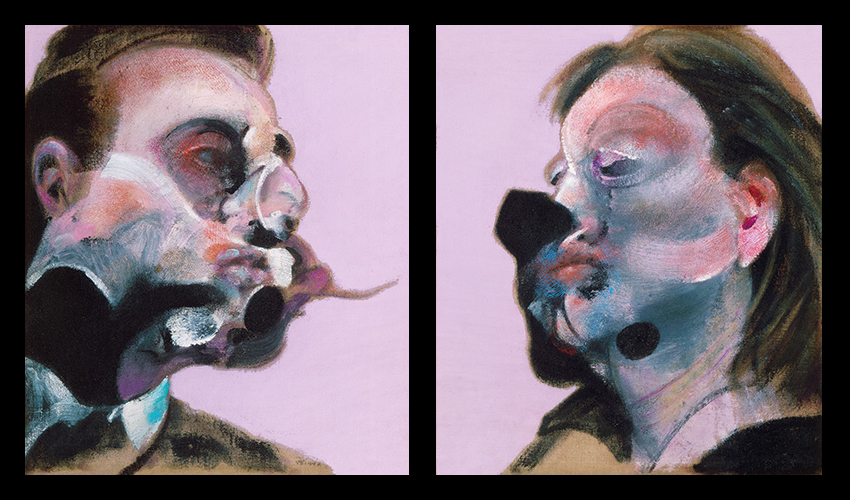
The diptych is a form Bacon used rarely. ‘Studies of George Dyer and Isabel Rawsthorne’ (1970)
From icon to Bacon
Holy Russian and unholy British art: Andrew Graham-Dixon compares
an anonymous painter from Pskov to Francis Bacon
ANDREW GRAHAM-DIXON | THE INDEPENDENT | TUESDAY, 26 OCTOBER, 1993
A thousand years ago, Prince Vladimir of Kiev decided to put a stop to pagan
practices in the newly founded state of Rus. He sent his ambassadors to many
lands (so the story goes) to choose an appropriately potent religion for the
nation that would become Russia, and they eventually wrote back to him from the
Hagia Sophia in Constantinople. ''We knew not whether we were in heaven or on
earth. For on earth there is no such splendour or such beauty, and we are at a
loss to describe it. We only know that God dwells there among men . . . we
cannot forget such beauty.'' The persuasive capacities of art should not be
underestimated. Vladimir, weighing up his options, adopted the Orthodox religion
of the Byzantine empire rather than Western Catholicism.
''The Art of Holy Russia'', at the Victoria and Albert Museum, is dedicated to Russian art’s attempts, over a span of several centuries, to re-create the beauty that haunted Prince Vladimir’s ambassadors. But Russian devotional art is liable to seem forbiddingly alien to modern eyes. To look at an icon such as the St Demetrios of Thessalonike, painted by an anonymous artist for the Church of St Barbara in Pskov in the early 15th century, is to see a painting that allows virtually no room for the forms of response that the average modern viewer, of averagely weak religious convictions, tends to bring to religious art of the past. There is no anecdotal light relief, no hint of narrative, none of those sudden shafts of reality — a dog drinking from a stream, say, or a bright landscape background — that may be admired in the devotional art of the Catholic middle ages and after. The only hint of reality here is the reality of a human face, although it is a face evidently transfigured by artistic convention and by an ideal of holiness.
What you see is, simply, a saint with his attributes (cross, sword and shield) staring out at you with impassive solemnity from a gold ground. History, it is true, can furnish a sense of the world which produced such an image can explain (in this instance) that the much venerated Byzantine saint Demetrios, an early Christian martyr renowned for his defence of the city of Thessalonike against the Roman armies of Diocletian and Maximian, may have been a natural choice of patron saint for the people of Pskov who were themselves constantly under threat from Livonian mercenaries and from the marauding armies of Poland and Lithuania. But the icon itself is mute about the real, historical world, because that world is so remote from its concerns.
The icon cannot be made to fit the evolutionary rhetoric in which so many modern Western accounts of the history of art have been couched. This rhetoric tends to see aesthetic convention as something to be deviated from, something to be escaped in the name of progress. The painter of icons might be said to aspire to absolute conventionality. Yet this ambition for conformity is nevertheless charged with tremendous spiritual intensity. When the anonymous painter from Pskov painted his St Demetrios according to type, when he painted him at once like a real man and yet also profoundly unlike a real man, he reaffirmed a very particular conception of holiness that lies at the heart of Byzantine theology.
The holiness of which the icon speaks is a holiness of the real transfigured, a holiness whose ultimate type is the Incarnation of Christ. The conventions of icon painting might be described as the inevitable visual cor-relatives of the Byzantine religious obsession with that single great mystery, of how the divine and the mundane once briefly coexisted. Icons are painted equivalents of that collision between the material and the im-material world, an intersection between the visible and the invisible, symbolised by the Incarnation. Byzantine holiness is emphatically paradoxical, rooted in a sense of being of this world while not being of it. This starts to explain the tension between near-realism and total abstraction in all icon painting, the icon painter’s practice of combining an art that quite frequently approaches portraiture with an art that tends to pure abstraction. This is an art that lives in the collision between two very specific conventions — and an art, therefore, which cannot afford to change too much, since to do so would be to traduce the theology that lies behind it. Repetitiveness can be a form of necessity.
The late Francis Bacon might not appear to have very much in common with an anonymous 15th-century painter of devotional art from Pskov but his ''Small Portrait Studies'' at the Marlborough Gallery share a lot of the characteristics of holy Russian icons. Bacon’s pictures live in the tension between portraiture and abstraction, between a sense of human reality and its distortion by the pressures of a convention. They are fantastically repetitive. And their repetitiveness has an air of inevitability about it as well as an aura of high seriousness that makes them seem charged with a form of spiritual intent.
David Sylvester recently described Bacon’s desire to be cremated without ceremony and ''without the imposition of invocations, however half-hearted, of the Deity''. Bacon painted people, perhaps, to make them look as unblessed and as unholy as he felt himself to be — or it might be more accurate to say that he painted people whose predicament it is to live in a world where holiness itself has been terminally discredited, where it is not possible to be touched by sacredness.
If the icon-painter’s conventional treatment of the human face makes the saint seem like a being suspended between this world and the next, real yet also holy, Bacon’s self-created figurative conventions tend in the opposite direction. Rendering people as restive blurs of swiped paint, he makes of them an odd blend of the human and the animal. Bacon’s portraits, like icons, use the transfiguring capacities of painting to talk about the capacity to be transfigured that is inherent within all people — but the difference is that, whereas the icon speaks of an upward transfiguration, an ascent to holiness, Bacon’s paintings see only the possibility of people becoming still less than they are. For the abstract gold ground of the icon, symbol of holiness, Bacon substitutes lurid grounds of dark red, green, pink or yellow: his people exist not in a sacred void but simply in a void.
But these paintings are less despairing than they are often made out to be. At their best (up until the late 1960s), Bacon’s small portraits have a kind of savage, joyous vigour and carnality which communicates not existential gloom but a weird form of celebration — something like the manic exuberance of someone who knows he does not have long to live but has decided (what the hell) to enjoy being alive while he can. These pictures find a kind of spiritual strength in the denial of spirituality.
Caught by the artist’s snapshot
William Packer on an intimate showing of Francis Bacon works
INTIMATE is hardly the word most would use to describe Francis Bacon’s art. Yet he was in some ways the most intimate of painters. The remarkable exhibition now at the Marlborough in London which includes many loans from private collections, brings out two aspects of his work often overlooked.
First, it shows that for all the larger scale and formulaic presentation that Bacon came to adopt in his later work, his first and lasting reputation, in all its strength and expressionist authority, was founded on mages of moderate size. Some of the strangest works are, in comparative terms, almost shockingly small. No matter how generalised the final resolution of the figure might seem to be, it was always based directly upon his response to a particular human presence. The physical immediacy and conviction of the result was never compromised by fact that he often used secondary and photographic sources as working references.
The show is of small studies for portraits of the sort he made consistently through the last 30 years of his life, the earliest dating from 1961. He had painted heads before, notably the screaming Popes after Velazquez, and the death-mask images of William Blake, but it was only than that this particular format was set. He had always responded to the visual stimulus of the image caught on the wing, the film-still, the snap-shot and newspaper photograph, and now was clearly fascinated by the serial image of the photo-booth and mugshot, with its curious compound of arbitrary directness, informality and self-consciousness.
The head is cropped, constricted, close up, the subject a specimen beneath the microscope or victim strapped into the dentist’s chair. Here is nothing of the quality we find in the work of Lucian Freud, for example, or, in its different way, of Frank Auerbach — of the artist confronting and scrutinising the model over an extended period, sharing a common space and temporal experience. Rather it is a matter of the moment, of the fleeting expression, the half smile, the fatuous grin, the turn of the head, the trick of the mouth.
The development of the image, too, is a serial affair, coming less from the particular and objective scrutiny even of the photographic image over a given and limited period, than from an extended familiarity with the subject in personal,term. For Bacon worked from few sitters, but tended to return to them repeatedly — Muriel Belcher, the formidable patronne of the Colony Room; Isabel Rawsthorne; Henrietta Moraes; Lucian Freud; George Dyer, his long-time companion; John Edwards, his heir. But, more than any of them, he painted himself, and while as single spies the self-portraits are no secret, thus brought together, it is not just their number but their insistent, cumulative quality that comes as a considerable surprise.
Many of the images are single shots, but the diptych and triptych follow naturally from the photo-trip, and suddenly we remember that it was by virtue of that first triptych, the studies for figures at the foot of a Crucifixion of 1944, that Bacon woke up Byron-like to find himself famous. He continued to use the device in his larger, more public work throughout his career. Yet here again, with these small, intimate and private paintings, we are brought up short, for among them we find particular twos and threes brought together to make up some of the most powerful and properly monumental works of the entire oeuvre.
One in particular, a triptych of 1977, of one self-portrait set with two still-life panels, makes one wish only that there might be a body of similarly intimate still-lifes to match the portraits. And, curiously, these characteristically pulled, twisted, distorted, truly manhandled heads and faces come together as a cumulative whole in celebration, not of some bleak and dreadful vision of a depraved humanity, but of something altogether more cheerful. The images are vital and alive, the paint laid on with a sensual and positive enjoyment, the drawing vigorous and positive. The likeness lies with a presence not closely described but known and sensed, as it blinked and, shifted, alive in every broad sweep of the brush across the surface of the canvas. Oh dear, we say, as we press the shutter, you must have moved.
Francis Bacon — small portrait studies: Marlborough Fine Art, 6 Arlbemarle Street, London W1, until December 3
Figure in a landscape
Peter Burton investigates the recent spate
of studies of the painter FRANCIS BACON
PETER BURTON | BOOKS | GAY TIMES | NOVEMBER 1993
BY INSISTING that no biography be written of them, the likes of W Somerset Maugham, W H Auden and Francis Bacon convinced posterity they had something to hide (they did), thus encouraging biographers to ferret like detectives through the forensic evidence of their lives.
In the wake of Ted Morgan and Robert Calder, Bryan Connon is currently engaged on an exhaustive examination of the entire Maugham family, most especially W Somerset and Robin; following in the footsteps of Charles Osborne and Humphrey Carpenter, Richard Davenport-Hines is redoing Auden; Andrew Sinclair and Daniel Parson are but the founding directors of a burgeoning Francis Bacon industry.
But are all these biographies justified? Is all this repetition necessary? Other than myself, no one has yet written about how Robin Maugham and W Somerset Maugham’s most recent biographers were both heterosexual and quite unable to see, let alone comprehend, the nuances of his life and work in the way, hopefully, Connon will. With regard to Auden, as with virtually any biographical subject from the past one hundred years, new evidence is still coming to light (a stout volume of previously unpublished work is to appear next year). So far as Francis Bacon is concerned, it is perfectly clear that the most important British painter since Turner war¬ rants a good biography.
And that’s something he hasn’t got from Andrew Sinclair, whose biography is begrimed by haste and sloppy writing. What are ‘male lavatories’? Vast porcelain edifices with evident and gleaming male genitalia? And the end- less litter of errors of fact betoken little or no editing. Surely a quotation so well known ‘Yet each man kills think he loves... ’ could have been correctly rendered? However, to the point, Sinclair is woefully all over the place on the subject of homosexuality — central to Bacon’s life, central to his art. At an party thrown by Bacon when he and Sinclair were neighbours in the East End of London, Sinclair enjoyed his first meeting with the painter but on a second approach from another man, I ran away.’ (The emphasis is mine.) So far as Sinclair is concerned, homosexuality is a condition that can only lead to disaster. He compares Bacon to Wilde (arrest, disgrace, imprisonment) and to no particular effect regurgitates the story of Joe Orton and Kenneth Halliwell (jealousy, madness, murder, suicide). Even a frightened heterosexual should have been able to discover that Keith Lichtenstein was the owner of a restaurant (not café) called the Casserole and of a club called the Gigolo (which late in life became London’s most notorious sex bar). But until heterosexuals loose their fascination homosexuality, we will continue get interlopers attempting to write biographies of a species really beyond their comprehension.
Because Bacon didn’t want a biography, most of the surviving friends have been unwilling speak to Sinclair and as his acquaintance with the painter seems to have been slight, he doesn’t have much real biographical material with which to work, Thus the ‘Life’ of the sub-title rather consumed by the ‘Violent times’ and as Francis Bacon becomes a figure set against the twentieth century landscape, the reader is treated to rather dreary dissertations on such subjects as Sinn Fein, World War I, Berlin during the Weimar (leaning heavily on Christopher Isherwood’s Christopher and His Kind), World War II and the extensive memoirs which have been written about Soho in the fifties and sixties, including those by Daniel Farson.
Farson hasn’t attempted to write a biography. The Gilded Gutter Life of Francis Bacon is a deliciously gossipy memoir by an observant writer of a man whom he loved and admired. Farson knew Bacon for forty years and because he was there he has a wealth of detail which will cause this book to be pillaged by all future writers on Bacon and an honest sense of scepticism about some of Bacon’s more outré stories (his father having him brutally flogged by the grooms at the stables he unsuccessfully ran, for example).
A fellow homosexual and a fellow drinker, Daniel Farson has affinities with Bacon which enable him to write with rare understanding of this Promethean figure — an understanding quite beyond the limited range of Andrew Sinclair.
First published in 1971, revised and reissued in 1979 and now revised to take into account Bacon’s death last year, John Russell’s monograph Francis Bacon, based on conversations with the painter, remains and invaluable model of excellence.
THE ART WORLD
BACON’S INSTINCT
The late Francis Bacon, called the greatest British painter since Turner, denied that the monsters mutilations
of his canvases were a lament on the human predicament and claimed that we were nothing but meat.
But Bacon did put his passion in his work, as the author finds in retracing his friendship with the artist.
By DAVID PLANTE | THE ART WORLD | THE NEW YORKER | MONDAY, NOVEMBER 1, 1993
WHEN the painter Francis Bacon died, last year, I recalled his having said, in a conversation of some ten years before, that he was frightened of death, very frightened. This had struck me, because he had so often stated that death was simply the starkest fact of life, a fact that reduced us all to meat, and had stated it with it with a hardness that made me think he would find any emotional response to death, such as fear, meaninglessly personal and sentimental. Bacon’s most common reaction to saying, as he often did, that he would die soon was a shrug and a dry laugh. Perhaps he had been trying to shrug off what was too personal for him to admit, or even to bear.
In London, I heard of his death over the radio, BBC World Service. This unexpected news startled me, and, his sudden death death all at once shifting my perceptions of him, I was left feeling confused about his painting and his life. To try to sort out my confusion, I looked at reproductions of his paintings in catalogues of his great shows in Europe and America. It occurred to me for the first time that in the same way he had denied, over and over, that death had any personal meaning to him he had denied that there was in his paintings the meaning that made him one of the most highly acclaimed living artists in the world, and he had denied this meaning in favor of what he called, over and over, the brutality of fact.
What he most strongly denied, in conversations, in interviews, and, I think, even to himself, was that his paintings portrayed the horrors of the postwar world. He denied, that is, the validity of what of what most people went to his paintings for: to see, in the screaming popes, the violently mauled bodies, the figures isolated in vast spaces, images of the age in which they lived. To portray the horror of the world was to him to be illustrational, and he insisted that his work was not illustrational.
Perhaps he denied the illustrational element in his work repeatedly because he was so often criticized for it, especially by Americans. Reactions to his last major retrospective in America–at the Hirshhorn, in 1989, and then at the Los Angeles County Museum of Art and the Museum of Modern Art, in 1990–were mixed. As the art historian Linda Nochlin has said to me, there were as many who found the work too confessional, too narrative as there were those who, like her, impressed by it.
Again and again, in the now classic interviews done by his friend and illuminator the art critic David Sylvester, published by Thames and Hudson in several editions, from 1975 to 1993, Bacon denied anything illustrational in his work. When, in a passage of the interviews often cited by Bacon’s critics, David Sylvester asked Bacon why he put a red armband with a swastika on the arm of a violently mutilated figure in his 1965 “Crucifixion,” Bacon replied that he merely wanted the break the continuity of the arm and add the color red for formal reasons–an insistence on form over content which is surely among the most disingenuous such claims ever made.
He wanted, instead of the illustrational, the brutal fact. What was that? Whatever it was, it was something close to what Picasso had done. Bacon didn’t like the work of any living painter (including himself) except Picasso. Contrasting Picasso with Matisse, he said to Sylvester, “There is very little realism in Matisse. I think its the reason I have always been so much more interested in Picasso because Matisse never had the–what can one say?–the brutality of fact which Picasso had.”
Looking at paintings after his death and seeing in them the contradiction I’d been only half aware of when he was alive, I realized that in the twenty-five years I knew him, I had always seen him as if he was standing before one of his paintings. From the time I was first introduced to him, I saw him primarily as a famous artist, so there was, I began to understand after he died, something illustrational in my view of him. I saw in him the same impulse toward the brutality of fact that I saw in his work a brutality of fact that was for Bacon very different from what is was for Picasso. For Bacon, the fact at its most brutal was that we are nothing but meat, and he repeated this often. It was as if he were trying to make this belief into an everyday matter; and, when angry, he could intimidate one into agreeing with him. But, angry as he might become in the profession of this belief, his anger was roused not only by what he saw as ones stupidity at not accepting the obvious but, I think, by Bacons frustration at being reduced to insisting so passionately on the obvious: Of course were nothing but meat. It is a wonder the obviousness didn’t flatten him out totally. At times, it almost did. But it didn’t. He had the moral strength–inspired, perhaps, by his horror of the obviousness of what he saw as the human condition to work on it and make something of it, as if this most blatant obviousness that we are utterly meaningless were his canvas.
In the years since his death, the more I have seen Bacon’s paintings as a personal struggle the less illustrational they have become. In a recently published biography of Bacon, there is a sentence that gets right to the center of the issue of illustration in his work The biography is “The Gilded Gutter Life of Francis Bacon”, by the British writer Daniel Farson; it was published by Century in England earlier this year, and will be published in the United States in March by Pantheon. Though the sentence is not elaborated upon, it says a lot: Francis told me how much he disliked the wiled brutalism of Kieefer–meaning the German artist Anselm Kiefer. This implies that brutalism, to be genuine, must not be willed The problem of Bacon’s work is all in his wanting to convey the brutality of fact without the conveyance appearing to be willed.
Bacon said to Sylvester: “You see, you don’t know how the hopelessness in one’s working will make one just take paint and just do almost anything to to get out of the formula of making a kind of illustrative image–I mean, I just wipe it all over with a rag or use a brush or rub it with something or anything or throw turpentine and paint and everything else onto the thing to try to break the willed articulation of the image, so the image will grow, as it were, spontaneously and within its own structure. Afterwards, your sense of what you want comes into pay, so that you begin to work on the hazard that has been left to you on the canvas. And out of all that, possibly, a more organic image arises than if it were a willed image.”
Perhaps Bacon’s success was that he could will something into being in his paintings that went deeper than will, to convey brutality. Perhaps his genius as a painter lies in his power to to will his work to be will-less.
Trying to get me perspective clear on Bacon clear after his death, I talked to or wrote letters to friends who knew him to ask them what they thought. The artist R. B. Kitaj wrote back: Balthus and Bacon have been my two favorite postwar painters. We all have bees in our bonnet and one of Bacon’s most boring phobias was was this business about illustration.... God knows I’ve got my own obsessions but I always found Bacon amazingly bland and formalist and orthodox on this question of illustration. The great Immoralist himself, perhaps the apotheosis of unorthodox, nihilist surrealism in painting–I never expected to be bored by him.... One expected to get maligned by him (as all London painters who new him well attest), but not bored. Sicker (to whom Bacon owed a few debts) said that all art was illustration and only illustration. And I like that saying because it’s funny and original and because it’s sort of true. Even a splash of paint illustrates something about the painter-splasher, something about his mind and spirit, and is a little less accidental than Bacon pretended.... A painting is an autonomous thing and it sure as hell isn’t, any more than a person is unencumbered. No man is an island and neither is a/his painting, so, of course you’re right David, about Bacon’s swastika armband, etc....
For me, Bacon was not a great painter like Matisse and Picasso. His was a narrower talent, and he seems to have refused to draw, but from my perspective he was the best, most original and engaging painter around by the time he died.... I cherish unusual paintings and, boy oh boy, are they rare and hard to achieve! Bacon kept doing them ... Of course it’s all a matter of taste, so I don’t wish to argue Bacon with those who are turned off by him, including brilliant friends of mine.... But I do think he sang the song of himself. His pictures are every bit as elegant as the high American abstraction, but he engaged his urbane nihilism to one’s own neurotic unease and achieved a psychological bloody pitch which almost always held my attention.
A little later, at a dinner party in London, I heard David Sylvester say, borrowing a notion from Jasper Johns, that he wondered if Yeats, great a poet as he was, failed to be among the greatest because he lacked “helplessness”. The Greek poet Nikos Stangos, who was present, suggested that Yates was limited because he was, however subtle, rhetorical his poetry was constrained by its complicated intentions. It occurred to me that the same might be said of the work of Francis Bacon, but with an essential difference: he himself, aware of the constraint of illustration and wanting eschew it, tried, with even more than will, with driving passion, to go beyond it and give his work helplessness.
And therefore, on the personal level, his gambling. And therefore his being drawn to helplessly alcoholic people, especially women, such as his friend and model Isabel Rawsthorne, the widow of the composers Constant Lambert and Alan Rawsthorne; and his friend Sonia Orwell, the widow of George Orwell.
And therefore, since he was impelled to what was most helpless, his being drawn most of all to tragedy. There was a need in Bacon for what he called “real tragedy”. Tragedy, as vast as the vastest night falling, occurs beyond one’s controlling it and makes one entirely helpless. Tragedy would give the greatest authenticity to his work. Although he denied that he had any intention of trying to create a tragic art, the obviousness of his intention belies his denial. He sometimes, when drunk, shouted out that he wanted “real tragedy,” and some time he even seemed to be trying to will tragedy on himself.
Another friend of Bacon’s I talked to about him was the British poet Stephen Spender, who had known Bacon well, and who had also been thinking a lot about him since his death. He said he thought Bacon imagined tragedy to be sensation, the greatest possible sensation. And tragedy’s fulfilment is death. Bacon insisted that his lover, George Dyer, had committed suicide, and he insisted in this as the great tragedy of his life, but it is nit at all certain that Gorge Dyer did commit suicide. However many brandies and sleeping pills he took before his death, he most likely died in the same way hopeless alcoholics and drug addicts do, ultimately. When Dyer demanded to go to the great 1971 exhibition of Bacon’s work at the Grand Palais, n Paris, Bacon, concerned, assigned a guardian to him to mind him, but Dyer found himself alone, wandering from bar to bar all day, drinking brandies and taking pills, and in his hotel room took just enough more in alcohol and sleeping pills to die. With the exhibition and the ceremonies set up, Bacon attended, and “not for an instant did he let on that this was not the happiest day of his life”–so John Russell wrote in the added chapter of the 1993 edition of his 1971 monograph, “Francis Bacon.”
To see the artist’s work in personal terms must surely be one of the objects of a biography of the artist, and Daniel Farson’s is only the first of many biographies of Bacon that have already appeared or will appear soon. Though David Sylvester is preparing what will be, essentially, a book of criticism, it will include important personal accounts of Bacon in relation to his work. Andrew Sinclair’s “Francis Bacon, His Life and Violent Times” has been published by Sinclair-Stevenson in England and will be published by Crown this fall in the United States. Michael Peppiatt, who wrote an extensive entry in the catalogue of a Bacon retrospective early this year in Lugano Switzerland, is also working on a biography, as is the British novelist Paul Bailey. And it was recently announced that Bacon’s friend and model Henrietta Moraes is writing a memoir in part about him. In England, newspaper articles seem to appear every week announcing yet another biography.
Bacon talked so openly about himself that anyone who knew him could put together a version of his life as an artist simply by remembering what he said. Though the two are not separate entities, I’ll leave his private life for later–for Bacon to reveal, himself, in conversations that I was part of over many years and that I recorded in my journals–and stick for now to his artistic development, and the luck, as he called it, that made him a painter.
HE had to be lucky to become a painter, because he had no formal schooling to be one, and therefore had to make his way without the support system usually available to students at an art school. Because he was a weak boy suffering from asthma (which finally killed him), and because his parents continually moved their family back and forth between England and Ireland, he had almost no formal schooling at all. He never got on with his father, a horse trainer, or his mother, who had inherited some money from her industrial family, and he left home at sixteen.
What decided him to be a painter was seeing, as a teen-ager in Paris in 1927, an exhibition of Picasso’s works at the Galerie Paul Rosenberg. He started doing drawings and watercolors, and lived in Paris for over a year, earning money partly as an interior decorator and furniture designer. When he moved to London to love, he set up a studio in which he exhibited his furniture, rugs, and watercolors. Presently, he met the Australian painter Roy de Maistre, fifteen years older and a Catholic convert, one of whose paintings was what Farson calls a “sado-masochistic” Crucifixion (it is now owned by the Leicestershire Museum, in England), and de Maistre became Bacon’s lover and mentor. Bacon started his first oil paintings. In 1930, he and de Maistre held an exhibition of their works in Bacon’s studio, a converted garage in South Kensington, and they were then asked by a new dealer, Freddie Mayor, to exhibit in a group show in his gallery. In 1933, the influential art critic Herbert Read reproduced own “Crucifixion” (beside a Picasso “Bather” in his book “Art Now,” and the painting was bought by a well-known collector of contemporary art, Sir Michael Sadler. Bacon and de Maistre also appeared in a second group show at the Mayor Gallery one that included paintings by Picasso, Masson, Ernst, Arp and Klee, and carvings by Henry Moore.
After what seemed a promising start, Bacon held in 1934 an exhibition of his own work in the basement of a friend’s house, which he called the Transition Gallery, but this was not a success, and Bacon destroyed most of his work,. Though he and de Maistre remained friends, they grew apart. Bacon went through a period of doing little work, of gambling, petty theft, and living off other people. One of the people who supported him financially was an Englishman, Eric Hall. Rich and interested in his work, Eric Hall had as early as 1929 bought a rug from Bacon and had been following his career since then. In 1937, he invited Bacon to exhibit in a show of young British artists that he’d organised at Thomas Agnew and Sons, a London gallery. That show included several of Bacon’s paintings, along with works by de Maistre, Graham Sutherland, Victor Pasmore, Robert Medley, Ivon Hitchens, Ceri Richards, Julian Trevelyan, and John Piper–a whole generation of British artists.
Eric Hall became Bacon’s lover, and he bought Bacon’s first great work, “Three Studies for Figures at the Base of a Crucifixion,” completed in 1944 and shown at the Lefevre Gallery, in London, just a month before the end of the war in Europe. Bacon was thirty-five. The painting shocked: a triptych of three monstrous gray figures with long necks, the right-hand one without eyes but with a large mouth wide open and with its one peg leg stuck into what looks like a bed of nails; the middle-one, apparently perched on the broken tripod base of a pedestal table, with a white rag hanging over a gaping mouth; the left-hand one, with tiny, flipper-like arms, wrapped, it appears, in a trailing blanket and positioned on a metal frame–all three occupying violently orange space. Eric Hall gave the painting to the Tate Gallery, in London. By 1948, Bacon’s standing was high enough for Alfred Barr to buy a work, “Painting 1946,” for the Museum of Modern Art, in New York. In 1954, Bacon with Lucian Freud and Ben Nicholson represented Great Britain at the Venice Biennale. One-man exhibitions in Paris, Turin, Milan, and Rome followed over the next four years, and in 1958 he signed a contract with Marlborough Fine Art, London. In 1962, the Tate Gallery put on his first major retrospective, and almost every year after that there was an important exhibition in a world cultural capital. Bacon was considered one the greatest postwar painters–equal to, if very different from, Balthus, Dubuffet, Giacometti, and (though some American critics would dispute the claim) de Kooning and Newman.
In light of Bacon’s stature as an artist, it is not surprising that there are so many biographies being written about him, or that Farson’s “The Gilded Gutter Life of Francis Bacon” made the London Sunday Times best-seller list. Written from a personal point of view–Farson was a friend of Bacon’s for forty years–the book is not altogether accurate about the facts of Bacon’s life, and some of those inaccuracies can, I suppose, lead to a misreading of Bacon as a person, if not as an artist. But, finally, mistakes about Bacon in this biography do not seem to matter, nor does the workmanlike, journalistic writing, if the object of the book is to be a lively homage, made convincing by the consistency with which Farson tries to see Bacon honestly and in the round.
On the other hand, Andrew Sinclair’s “Francis Bacon, His Life and Violent Times” has nothing of the character of Bacon in it. Sinclair, who met Bacon but did not know him, was not writing a memoir, as Farson was in part, but a biography based on disinterested research, and as it is evident that few of the people closest to Bacon spoke to him, his information must have been gathered largely from secondary sources. The accounts of the Boer War, in which Bacon’s father participated as a captain; of life in Berlin in the twenties, when Bacon was there for a while; of London during the Seconds World War, when Bacon worked in the Civil Defence rescue service–all these harden about the center and do not allow any real life in. Attempts to give a sense of the artist’s persona life lead Sinclair to such uninspired passages as this description of Bacon’s reaction to the death of Dyer: “Although Bacon lived on for twenty years, the wound from this self-murder never healed. It bled inside him; it could not be staunched.”
It is a very strange experience to read a biography–good or bad or in between–of someone you’ve known. It makes you wonder if you really had a friendship, and, if so, what it consisted of. My personal reaction to the Farson and Sinclair books was a renewal of the confusion about Francis Bacon which I felt upon his death. I spoke again to Stephen Spender about this confusion. It was, in fact, Spender who, in the autumn of 1966, when we were travelling together by train from London to Paris, had introduced me to Bacon and Dyer, sitting right across the aisle from us. And in speaking to Spender I found that whatever critical thinking about Bacon’s work had preoccupied me gave way to thoughts about him as a friend and what I remembered of him as a friend.
I MET Stephen Spender in London, where I had gone from Boston, to live. He asked me, a few months after I arrived, if I’d go to the South of France with him to help plant trees in the garden of his and his wife Natasha’s house was there. We had precise instructions from Natasha about where and how the row of cypresses should be planted Stephen thought we could spend a couple of day s in Paris on the way. One the train, we ran into Francis and George, who were going to Paris for the opening of a show of Francis’s paintings at the Galerie Maeght, and Francis invited us to the show.
At the opening, standing about Bacon and George Dyer, Isabel Rawsthorne–who, laughing a wide, red laugh, was tearing open congratulatory telegrams and reading them and then letting them drop to the floor–and Sonia Orwell, all of them very drunk. Steepen and I joined them, excited, but did not get drunk.
George took my hand and led me around the exhibition to tell me, in nasal Cockney, which pictures were of him, and to ask if I recognized him. One was of him, very mutilated, sitting on a toilet. He put his arm around me and was affectionate. He wore a suit, and a tie knotted so tightly that that his sharp-edged collar cut into his neck, and his face and carefully combed-back hair seemed to form a wedge. He had a large, square jaw and a large nose and thin lips.
Stephen and I had lunch in a restaurant with Francis and George and Sonia the next day. As we were leaving the restaurant, Stephen suddenly asked Francis and George if they’d like to come to the South of France, too. Immediately, they said they would. On the way back to the hotel, Stephen said, “Francis and George are always fighting. Maybe it was a bad idea to invite them to the South of France.”
He and I left the next day, after seeing the great Picasso show in the Grand Palais. In the Spenders’ garden, I dug many holes, according to Natasha’s plan, and planted the trees. And a day or two later Francis and George arrived. They did not stay with us in the Spender house but in a hotel in the village of Maussane. We met them there in the evening for dinner, in a wooden-panelled dining room that was chilly, so the steam from the tureen of potage we had ordered rose up in a dense cloud when it was brought in. Francis talked about the Picasso show, which he had also seen. He said I cant admire the man enough. I said, You couldn’t have painted your pictures without him, could you? He looked at me as if amazed, and pressed his lower lip against his upper so his chin wrinkled, and his eyes went a little out of focus, and it occurred to me that I had stated something so obvious that Francis’s only possible reaction to it was amazement. Every other living artist he denigrated: Henry Moore’s drawings were knitting, Graham Sutherland’s portraits were no more than Time magazine covers.
The next day, Stephen drove Francis and George and me to Aix-en-Provence, to see, in a museum, a small self-portrait thought, then, to be by Rembrandt, which Francis particularly liked, because of what he described as the almost self-conscious use of paint to create the features, so that the use of the paint was as important as what it was used to portray. During that conversation, I began trying to see Francis’s paintings in what he said–it was, I thought, a little insight though him to into his work. Then, on the way back to Maussane, we came upon the site of an accident in which a van had smashed into a tree, and all about the road, fallen from the van, were dead, bloody pigs. Francis asked Stephen to stop the car so he could look, and I imagined I had another insight to go with the first, for I saw the bloody pigs on the wide gray road in terms of thick paint.
At dinner that night, in the dining room of the hotel where Francis and George were staying, they both got very drunk. George simply looked around. Francis focused with a frown on what Stephen and I were saying, as if waiting for a reason to be angry. As far as I knew, he and George hadn’t fought while they were in Maussane. I cant recall who started talking about Christianity perhaps it was Francis, when he said, repeatedly, that “Macbeth” showed that Shakespeare was not Christian. When Stephen said, “Well, I think I’m Christian, at least in believing we must help one another,” it was as though he had become responsible for all the worst aspects of Christianity. Francis leaned in closer and asked, What, practically, do you do to help others? Stephen said he did very little–nothing, really–and he certainly wouldn’t give everything he had to the poor, but felt he should. Francis said, aggressively, that this was rubbish, rubbish, and he got very angry, more angry than the circumstances in any way justified, repeating again and again, “Rubbish.” Stephen went silent, as did I, and I thought I saw behind Francis the depth of his hard darkness.
When we got back to St. Jerome, the Spender house, Stephen, sensing in my silence that I’d been upset by Francis, said, “You must consider the darkness of Francis just part of life, in the same way the Vietnam War and all forms of viciousness are just a part of life, and not the whole. There is a side to Francis which obviously makes him love to see trees and landscapes and have friendships, and, too, to love, as he loves George. You’ve seen this about him here in Provence.”
*
Back in London, I saw Sonia Orwell. She said Francis and George were fighting a lot. They’d been together since 1964, not a very long time. George didn’t live with Francis they couldn’t possibly live together. George had a flat of his own, across the Thames in Battersea.
Nikos Stangos and I were then living in Battersea, too, in a block of flats called Overstrand Mansions, where, Francis told us when he first came to dinner, some months after I’d seen him in France, he himself had lived some years before. He came back regularly after, and that is how I really began to know him. But he never brought George.
Then, in September, 1970, the newspapers were filled with the story that cannabis had been discovered in Francis’s flat by the police. Francis, who declared he didn’t smoke, because of the asthma that he’d suffered from all his life and that had kept him out of the military during the Second World War, accused George of planting it and alerting the police. There was a court case, in which the police had to admit that information about the presence of the drug had come from George. Francis was acquitted.
Shortly after, I was on the bus one afternoon crossing the Chelsea Bridge in the rain, and I saw, from the upper-deck window, George, out in the rain, walking along the pedestrian way of the bridge. The Thames was dark gray beyond him. His hands were in the pockets of a raincoat, but his head was bare, and water was running off it. That was the last I saw him.
His death, in Paris, came in October of 1971, barely thirty-six hours before Francis’s exhibition opened at the Grand Palais.
That December, Nikos and I were invited to a Boxing Day party in the evening. Sonia and Francis were there. Francis left early, but Sonia stayed on and got very drunk, so I thought I should take her home. In the taxi she babbled, in a strident, accusing way, about how violently unhappy Francis was, with George dead only six weeks. “You don’t understand–none of you understand–what depression is. You wont help. You don’t know how to help. I could kill, kill, kill, kill you all for your lack of sensitivity. Francis is suffering. Do any of you care? Do any of you ring him up? Fuck all if you do.”
The next time I saw him, I mentioned George’s death to Francis, and, laughing a little bit from the side of his mouth, he shrugged one shoulder.
Nikos had become poetry and artbook editor at Penguin Books in 1967, and as a consequence had got to know a lot of artists. Among them were young artists our age, such as Michael Craig-Martin and Jan Hashey One Sunday at tea at Michael and Jan’s, Michael showed us his latest work: little “stories,” as he called them, written on file cards, one sentence to a card, and all the stories had to do with the different ways he saw himself and how he thought others saw him. The work was about self-consciousness.
Michael said he worried a great deal about art, what art meant. After tea, Nikos and I went to Sonia’s. She had invited us to a birthday party for Francis. I sat next to Francis, and on his other side was David Sylvester. I asked Francis if he ever worried about art, in the way Michael did “No,” he said, and laughed. “I just paint. I paint out of instinct. That’s all.” “Then you’re very lucky others like your work,” David said. “That’s it,” Francis said. “I’m very lucky. People, for some reason, buy my work. If they didn’t, I suppose I’d have to make my living in another way.” I said I’m sure people buy or, if they cant buy it, are drawn to your work because you do paint out of instinct. Perhaps it’s just fashionable for them to be drawn now,” Francis said. I said, “No, that not true, And you know it isn’t true.” He said, “You’re right. I do know. Of course I know. If I stop to wonder why I paint, I say I paint out of instinct.”
David looked very thoughtful. He sat away from the table, his large body a little slumped forward, his hands n his knees. Slightly wall-eyed, he stared at the table as he thought, and he finally asked Francis, very slowly, “How does luck come into your work?”
Francis said “If anything works for me in my paintings, I feel it is nothing I’ve made myself but something luck has given me.”
David asked, “Is there any way of preparing for that luck before you start working?”
“It comes by chance,” Francis said. “It wouldn’t come by will power. Bit it’s impossible to talk about this.”
This excited me, and I immediately asked, Because its a mystery?”
Francis jerked around to me, his eyes wide. He said flatly, “I don’t think one can explain it.”
I knew that I was trying to push Francis into saying something that I wanted him to say but which I also knew he disdained, as he disdained all sorts of mysticism.
Nikos said to me, “Do you know what you’re saying?”
I took the risk and asked Francis, “Do you ever think that if one knew enough one might be able to explain the mystery? And if one could explain would the mystery go and the work be destroyed?”
Francis pursed his lips. He could sometimes appear to be parodying the expression of deep thought. He said, “Are you asking me if I ever think I could destroy my work by knowing too much about what makes it?”
“More than that: I wonder, have you ever wanted to explain what makes a painting work even though you knew the explanation would destroy it?”
Francis said, “I can’t want that, because I know I never would be able to explain.” He laughed.
Nikos and I continued to have dinner with Francis from time to time, in our small flat in Battersea or, more often, out in a restaurant where he always paid the bill. At some of these dinners in restaurants were as many as ten or twelve people, and I met at them a few of Francis’s closest friends, including Dickie Chopping and Denis Wirth-Miller, both artists. Francis was always as attentive to the waiters as to the people at the table, and whenever a waiter put another bottle of wine on the table Francis handed him a pound note. I once saw him put a pound note in a bread basket that was being passed around by people at the table. Nikos and I would drive Francis home, to his studio flat in Reece Mews, in South Kensington, and wait for him to open his narrow door among the wide doors of the garages in the mews and climb his steep flight of stairs, often stumbling and falling to his knees as he went up.
And we saw him at parties. At one party, after being introduced to Lee Penrose, the American photographer who turned from fashion to photographing the horrors of concentration camps before giving up her career, he came to where Nikos and I were standing with Stephen and Natasha Spender and said, laughing dryly, “You mean, that’s the Lee Miller whose photograph was taken by Man Ray? I would have thought her beauty would remain, but nothing of it has, has it?” We also laughed, too intimidated by Francis to stand up to him.
He had arrived drunk, and he was almost incomprehensible when he spoke. After Nikos had left our group, Francis said–in reference to what, I didn’t know, but I wondered if he was thinking of George–“In every relationship there’s always a cherished and a cherisher. Always a cherished and a cherisher. I said, “I wonder if that’s true. In my case–or, rather, Nikos and my case–I don’t know.” “Oh, yes,” Francis said. “Oh, yes. And don’t deny being cherished. Don’t deny it. Take it. Let yourself be cherished. You’re the cherished one. And don’t deny yourself being cherished.” Natasha said, “But you don’t understand. David is the cherisher.” Francis lurched away with a jerk of his whole body, a if someone had suddenly called him. Then he left us and staggered from person to person.
Natasha left Stephen and me to talk to others, and Francis staggered back to us. Stephen asked him if he was working on something new, and Francis, loosely nodding his head, said, “Yes, I’m doing paintings of two bodies locked together.” He lost his balance whenever he paused in his talk, but each time he regained it he repeated, “Locked together, two bodies.” I said, “Then they’ll be love paintings. He leaned toward me and almost fell onto me, his wine splashing from his glass “Yes,” he said, “yes”. Then he stumbled backward, his head up, and there suddenly came to his face a look of such terror that I laughed. I then realized he was about to fall backward, but before I could reach out to grab him he regained his balance and turned toward the wall with his back against it. He mistook a door for the wall, however, and when he leaned against the slightly open door it gave way. Again, he righted himself just as I rushed over to him to stop him from falling. He said, leaning against the solid wall, “I want tragedy.”
Francis would accept invitations to parties–drinks or dinner parties–and then appear or not. As Suzi Gablik, the American writer on contemporary art, said, expecting nothing from him was a condition of ones friendship with Francis. In the second half of the seventies, Suzi, living in London, gave a lot of parties and always invited Francis, and he almost always showed up. At one party, I found him standing by himself, and I went to speak with him. He was wearing tight gray trousers, a black turtleneck pullover, and another turtleneck pullover on top this, but white. I imagined his body as having very thin legs and a round bulging belly The sleeves of both pullovers were pushed up, showing his powerful forearms and red hands.
I knew it was risky, but I tried to start a conversation by saying that the writer Jean Rhys had told me she had flashes of religion. “Does she, now?” Francis asked. Drunk myself, I asked him if he ever did. He laughed. Never. Never never never never never never. I wanted to know what he was vulnerable to, and I asked him if he had any addiction. He didn’t have any, he said. I said mine was sleep. “Sleep?” he said. “Really?” “How much do you sleep?” I asked. He said, “I get up every morning at seven o’clock.” “I wish I could do that,” I said. He asked me, “But don’t you like consciousness, David? I love conscious life. I love being conscious.” He slurred his words, but he didn’t laugh.
Most people left the party, and Francis said to me, “Lets go to dinner you, Nikos, Suzi, me, well go to dinner.”
At the restaurant, Nikos said, reading the menu, “They have grilled gray mullet. That’s what I’ll have.” Francis said, “That’s what I’ll have, too. Grilled grey mullet. I love that. I’m a simple person. Aren’t I a simple person? Arn’t I, Suzi?” Suzi smiled and reached across the table and squeezed one of his hands. Nikos asked him, “What do you mean by simple?” He answered, “I’m direct and I’m obvious. I’ve had an appalling life. I’ve had a very unhappy life. I don’t think about it. There it is. That’s simple.”
Suzi asked, “You’ve never been happy?”
“Once or twice,” he said. “When I was young, in moments of ecstasy. Now I’m too old I don’t think about it, about happiness. There are many things I don’t think about. I’ve done horrible things in my life, horrible. There they are. I don’t think about them. I’m too old.”
His dyed hair, with, it appeared, a hair cream to make it smooth and keep it starkly in place, was combed against his head, with some stiff strands carefully arranged down over his forehead. He said, “I’ve had a horrible life, a tragic life.” He picked up a small pickle from a white plate and ate it, picked up another one, a larger one, ate it, picked up another and put this in his mouth, and, as if the taste had only now occurred to him, he said, “These pickles are horribly sour.” He didn’t laugh, but everyone else did. He said, “I’m a very simple person who’s had an appalling and tragic life.”
Nikos asked, “Whats been so appalling? You’ve never been seriously ill, you’ve never had to worry about money.”
Francis said, “You’re right. I was pretty when I was young. Old men liked me. One old man, an old Greek–I even remember his name–fell in love with me, gave me some money, and I used it to paint. I lived off old men. I always had a clear idea of what I wanted to do. I wanted to be exceptional. I wanted to do exceptional work. I just took money. I was an old whore. I still am. An older whore. A lucky old whore.”
A strange sensation passed through me. I sat back, and tears came to my eyes.
The waiter put a gray mullet in front of Francis, and he asked, “Whats this?” “Your grilled gray mullet,” Nikos said. “I hate this,” Francis said, “I can’t it eat. I couldn’t get a forkful down my throat.” Nikos asked Francis, “What makes your life tragic, then?”
“Ive been in love, and love is tragic.”
“Love can make you happy,” Nikos asserted.
Francis said, “I was in love with someone who killed himself. That made our love tragic.”
For a while, Francis seemed not to drink at all. When again at Suzi’s–this time at a dinner party given by her for Sonia, Francis, Nikos and me Francis, who didn’t say much all evening, kept putting his hand over his glass when Suzi was about to pour wine into it. He looked sad, I thought–that is, polite and attentive but making efforts to be so.
We talked about people becoming dependent on others, and Francis said, “George became dependent on me. If he hadn’t, he’d probably be alive now. He was a thief, an inept thief, always getting caught, when I met him. He’d probably be in jail and alive now if he hadn’t met me. But he did, he drank himself into a mad state and, because of me, killed himself.”
Sonia said, aggressively, “He didn’t ill himself. I read you the medical report, in English. He didn’t kill himself.”
“He did,” Francis said. “He killed himself.”
Nikos became an editorial director at the publisher Thames and Hudson, and one of the first projects he worked on was the Bacon interview by David Sylvester. We saw a lot of Francis, and got to know something of Francis’s world, the center of which was a drinking club, the Colony Room, which he called Muriel’s, because it was run by Muriel Belcher, a close friend. Up a flight of old stairs, the walls painted dark green where the plaster hadn’t fallen off, we went into a small room with a filthy gray carpet, dirty pale-green walls, empty bottles under the chairs, and on the floor a large tin tub filled with ice and bottles. The first time we went there, a mirrored door at the other end of the room opened, and in came a man with loosely curled hair, spectacles, and a black-and-gold scarf about his neck. He was supporting an old woman in a lank gray dress. The man helped the woman to a stool at the end of the bar, near the entrance, and Francis introduced Nikos and me to her, Muriel and the man, Ian Board. Muriel’s hair was thin and pulled tight over her skull so her scalp showed. Her face was long, wrinkled, slack; her mouth was always open, and her teeth made me think of her skull. Her gums were bleeding, and she held a handkerchief to her mouth. She didn’t look at us so much as tilt her head up and throw an approximate glance at us. Francis said, “Isn’t she beautiful?” We said yes. He ordered champagne from the barman, whom he introduced to us. His name was David. Then Francis introduced us to the pianist, a young, handsome man named Felicity; Francis ordered a brandy-and-soda for Felicity from David. Francis, Muriel, Ian, Nikos, and I talked about sex. Francis said “I hate sex in the morning.” “ When do you like it?” I asked. He said, “Between three and four in the afternoon, with sunlight blazing through the windows.” I said “I like it any time.” Muriel tapped me across the cheek with the back of her twisted hand and said “You old cunt.” Ian said to me, “You should come in often, darling.”
When we asked Francis to our flat for a meal, we also asked Stephen Spender. As if he had all the time in the world, Francis always arrived before Stephen. In the living room, I would ask him to sit, but he would say, “No, I’ll stand. I like being uncomfortable.”
One night. at our small, oval dining table, in a bedroom, Stephen asked Francis, How old are you? Francis said, “I was born October 28, 1909, so I’m sixty-eight.” “And I was born February 28, 1909,” Stephen said. “So I’m six months older than you,” Francis said. “Six months younger,” Stephen said. Francis looked puzzled. “Oh, yes,” he said. “And you were in Berlin when I was there. I wonder why we didn’t meet.” “You probably went to different places,” Francis said. “I used to be in the clubs all the time.” “So was I,” Stephen said. “Then we were probably in the same club at the same time,” Francis said.
“How did you get to Berlin?” I asked Francis.
Francis seemed to like being asked questions about himself. “Oh,” he said, “my father found me wearing my mother’s underclothes, and to put me right he sent me to a friend like him, a horse trainer. This was in Ireland. I left home to go with my fathers friend, who took me to Berlin. He was very rich and we stayed in a grand hotel. That was the first time I had sex with anyone. From there, I went to Paris. My mother sent me three pounds a week. I never really went back to Ireland.
When Francis invited Nikos and me out, it was usually with Stephen. Sometime in the late seventies, he invited us to meet his new friend, Bill. We hadn’t known he’d had a friend since George. Bill was an electrician. Sonia said a telephone engineer. He was a broad, very masculine man who wanted to become a policeman in New York and who was intelligent enough to know that he really only wanted to satisfy a fantasy he has about New York cops. His life, it seemed, was devoted to satisfying his sexual fantasies. He’d been all over the United States and Canada, too, and he could tell you where the best bars were, where the men liked one thing or another. He said that, because of the way he looked, every time he went into a queer bar in America the bouncer would say to him, “You do realise, sir, that this is a club for homosexuals?” He loved asking policemen on the street for the way to bars and clubs that, he said, smiling, they of course knew were queer. Bills smile was wide and clean and very bright white.
After dinner at Langan’s Brasserie, for which Francis insisted on paying, we all got into a taxi to go to a club in Leicester Square called Adam’s. The taxi stopped and started, stopped and started in the Friday late-night traffic in the West End. Stephen was frowning. Once we got to Leicester Square, Stephen said he though he’d go home–it was still early enough to catch the tube.
Adam’s was a large, crowded club with golden chandeliers and gold-framed mirrors, and it was very dark and so smoky you could hardly see, Francis, Bill, Nikos, and I stood by the bar. Francis kept giving Bill twenty-pound notes to buy bottles of champagne. We talked a lot about sex. Bill said he liked to be fucked, fist-fucked, and he also liked, from time to time, G.B.H. Nikos asked, “Whats that?” “Grievous bodily harm,” Bill said, and smiled his smile. “And you’ve had it?” Francis asked him. “Only a couple of times,” Bill said. “Real welts and weals?” Francis asked. “Oh, yes,” Bill answered. “I enjoy it, but it has to be done by someone you like. And there’s always the danger that they wont be able to stop when you want them to.” “Well,” Francis said, “I like a bit of G.B.H. now and then. I had a friend–he finally killed himself–who had a collection of whips he kept at my place A while ago, I took someone there who said he was interested in whips, and I showed him the collection.” Francis laughed. “Well, I undressed and got on my fish-net stockings–” “Black?” Nikos asked. “Of course black, stupid,” Francis said. “And he started to beat me. But he got carried away. He wouldn’t stop. I’m a total coward. In nothing but my black fish-net stockings, I ran out into Reece Mews.” He laughed loudly.
A tall, blond young man came up to us and asked, “Who are you all? You all look so interesting, so glum.” Not even Francis spoke to him He asked Nikos and me, “Do you two live together?” “Why do you think that?” I asked. “I can tell,” he said. A friend behind him said, “Come on, lets go, they look creepy.”
We were in the club until three-thirty. Nikos and I went only when Francis said he’d go. Bill remained with a fellow who looked like a Greek priest.
Outside Francis said, “Bill and I spent four days together and discovered we were incompatible, because we both like the same thing. But we’ve remained friends.”
I ran around the square trying to get a taxi, but none would stop for me, though their lights were lit. Francis, who hadn’t moved, put out his hand, and a limousine, not a taxi, stopped in front of him. A young man rolled down the window and said, “You look like three cold gentlemen. Ill drive you wherever you want to go.” Francis got in beside him, Nikos and I in the back. “Now, what have you been doing up at this hour when all honest people are in bed?” the driver asked. Francis said, with that short, shrugging laugh he had, “Not being honest.” He asked the driver his name. “George,” the driver said. “And what’s your name?” “Francis.” “Is that Mr. Francis?” “Mr., Mrs., Miss–however you like it,” Francis said. The driver left Nikos and me off first.
Just a year or so later, Francis said he had a new friend he wanted us to meet. His name was John, and he ran a pub in the East End of London. On a Sunday morning, Nikos and I drove Francis there. John Edwards had black curly hair and wore a smart gray-flannel suit. Nikos and I were in jeans. We had drinks in the saloon, where young men were playing pool. John’s boyfriend was among them. A pretty, blond young man with pimples along his jaw, he couldn’t go more than a mile from the pub, John said, as he’d been convicted of a crime and was awaiting sentencing. After some drinks, we all went off to another pub, which closed while we were there, but we stayed on behind the locked doors, and met a number of middle-aged Cockney queens and their boyfriends. They and John and his boyfriend and Francis and Nikos and I, about twelve of us, went out for a late lunch in a Chinese restaurant. One bleached-blond queen said to Francis, “So you paint pictures do you, Francis? Excuse my ignorance, but what kind of pictures do you paint?” This was all in East End Cockney. Francis said, “Well, it’s difficult to say.” “Like, do you paint landscapes or people?” “Sometimes landscapes, sometimes people.” “Do you paint pictures of dogs, Francis?” someone else asked. “I like pictures of dogs myself.” “I used to paint dogs years ago. I don’t anymore.” “What do you do with your paintings, then? Do you show them along the fence in the park in Bayswater? I seen paintings, on a Sunday, all along the railings.” Francis, laughing, said, “I haven’t come to that yet. I might soon.” John said, “His paintings are fucking awful. He can’t even draw as good as that Piss-casso, and fucking awful he was, too.” “Right,” Francis said. “I can’t.”
In the car, riding back through the West End, Francis said, “I feel an idiot among them. I feel they know so much more than I do.”
“What?” Nikos asked. “I don’t know,” Francis said.
*
Shortly after Sonia Orwell’s death, in 1980, Francis invited me to lunch, to talk about her. He asked me to his mews flat for noon. I’d never been in it before. He showed me his studio, with a narrow path through banks of rags and rubbish, and a number of small, blank canvases, which, he said, the Marlborough Gallery had sent him. “You see,” he said, “small paintings sell better than big ones.”
We drank two or three of what I believe he called Dead Dogs, sitting at a bare table at the end of the long narrow-bed sitting room. Bare bulbs hung from the ceiling on long wires. Though an electric fire was on, there was a chill. I asked, “Do you think, as I do, that Sonia was a totally pessimistic person?”
Francis said, “Totally, totally pessimistic. You see, I am at least optimistic in the moment.”
And, I said, “optimistic in your creating, because to create is to be optimistic. But Sonia did not believe she could create anything. At least, that’s what I imagine.”
He put his large, red hand to his chin and said, “As much as one can be right in anything one imagines, I think you’re right.”
Everytime thereafter when Stephen, Nikos, and I went out to dinner with Francis, John was with him. Francis’s relationship with John appeared to be the most lasting of his life. And they seemed never to fight. One evening, as Stephen, Nikos, and I crossed the cobblestones of Reece Mews to Francis’s flat, Francis leaned out the window above the garage and waved at us, and he was waiting for us, smiling, at the top of the steep stairs. He seemed very happy. Then he sais John was supposed to come but was drunk, and Francis laughed at this, the laughter implying that of course John was drunk. In the bedroom end of his flat was an oval bed covered with a multicolored spread, and next to the bed was a bookcase piled with books.
After three bottles of champagne, we all went to a nearby Italian restaurant in a cellar for dinner. Stephen mentioned that he had been going to the doctor for tests, though he was in perfect health, really. Blinking a lot, he said “Somehow I’m not frightened of death. I think I was brought up to be frightened of it but to consider it as something that would inevitably come and that must not be made a fuss over. I suppose I don’t think myself important enough to make a fuss about dying.”
This is when I heard Francis say, “I’m frightened of death. I’m very frightened of it.” He laughed. “Of course, I may die tomorrow.”
I asked Francis, “Why are you frightened of dying?”
“Because I love life,” he answered. “I love it.”
“So do I,” Stephen said.
“David doesn’t,” Nikos said.
Francis said to me, “Life’s all we’ve got, and we can’t want to lose it.”
A waiter came to Francis and whispered in his ear, then left. “It’s John,” Francis said to us. “He’s out in the street, drunk. I’d better go get him.” He left, and in a little while came back with John, who did not appear to be very drunk.
With John, the talk changed. We talked about how sorry we were that he didn’t get the fancier pub he’d been negotiating for. He didn’t seem to mind, and said, “It don’t matter.” Then he took out a photograph of himself and his boyfriend, who had been allowed out of prison on a three-day pass. John wanted to give the photograph to Francis, and asked Nikos, sitting next to him, if Nikos could spell out the dedication, so that he, John, could write it, as he couldn’t spell words but he could write letters. Using Stephen’s pen, John wrote “FOR MY FRANCIS WITH MY LOVE JOHN. ”
After John gave Francis the photograph he leaned across the table and said, “I want to tell you something,” and Francis leaned forward so John could whisper in his ear Suddenly, Francis sat back and said in a loud and angry voice, “That’s ridiculous, I’m not going to listen to it. That you want to kill yourself is ridiculous. I’m not going to listen.” John smiled. He held a hand over the table, and Francis clasped it. John said, “I love you.” Francis said, “And I love you, and because I do I’m not going to hear you talk such nonsense.” Still holding Francis’s hand, John turned to us and said, “I love Francis. I love my friend in prison, and I love Francis, though, you now, my love for Francis is non-sexual, and maybe that means I love him even more than my friend in prison.”
*
Francis had never attacked me, but one evening, when he and John and Stephen were having dinner at Nikos’s and my flat, I felt he objected to everything I said and was about to attack me. This made me say some stupid things. John seemed completely unaware that Francis was aggressive toward me, and, was, himself, loving, in the gentle way he had. Perhaps it was only because of John that Francis didn’t let got at me.
Instead, Francis got angry at Nikos, when Nikos said he was against experiments on animals. Francis, who obviously thought this sentimental, said, “Of course they’re going to experiment on animals. Of course.” “It’s just as horrible as if they were experimenting on babies,” Nikos said. Francis answered, “Well, yes, of course it is, and of course there’s no reason why they shouldn’t experiment on babies instead of animals, but they won’t.”
*
A month or so later, Francis invited Nikos and me, this time without Stephen, to a restaurant. We waited an hour for him and he didn’t appear. I wondered if that was a signal from him that our friendship was suddenly over.
But in 1985 we received invitations to the opening of the grand retrospective of Francis’s work at the Tate Gallery. There were long tables covered with white cloths, and waiters standing behind the tables serving champagne, and cooks serving from whole salmons. Going from room to room to look at the paintings, I as taken especially by the strange work done in the seventies and early eighties of sand dunes and jets of water in empty rooms, which were, I told myself, the least illustrational of his paintings. Returning to where the party was cantered, I saw John. He was as excited as if the party were being given for him. He was wearing a beautiful suit. He told me he was very angry. One of Francis’s old cronies from the Colony Room had, on this most important occasion, asked Francis for fifty pounds. John had insisted Francis not give the money. John said to me, “I was having a nice time until that happened. Francis has given him hundreds of pounds, more than hundreds, and he never pays it back. If you borrow, you pay back. Fuck it.”
Francis’s friend Dickie Chopping came up to us and said, “Francis is going around to look at his pictures. Why don’t you join us?” We followed Francis from picture to picture–“Study for Portrait of Van Gogh II,” “Lying Figure with Hypodermic Syringe,” “Crucifixion 1965”–and, standing for a moment before each one, he would laugh and say, “Isn’t it loathsome? I loathe it. I really loathe it.”
He was very gracious to everyone.
I left the group to look at the paintings again, by myself, wondering what Francis meant when he said he loathed them. I stopped before the great Triptych May-June 1973, the one depicting the death of George Dyer in the hotel in Paris. In the left-hand panel, George is doubled up on the toilet; in the right one, he is vomiting into a washbasin; and in the central one he is half dissolved in blackness that pours out through an open doorway. The triptych was, from a certain point of view, as graphic an illustration as anyone might have wanted of a vision of an age of horror which Francis denied his work was about. I could understand someone wondering if it mattered which people Francis painted, as his vision so overwhelmed the face that the face belonged more to Francis’s vision than to the sitter, though the sitters were, as far as I knew, always close friend. Perhaps “instinct” had become for Francis another form of illustration. But, then, as I studied the triptych of George, what struck me, and what I would never have thought of, because such an idea would have seemed as irrelevant to Francis’s works as to, say Henry Moore’s, was how deeply, how essentially, how personally, how heartbreakingly this triptych had to do with Francis himself, Francis reacting to the death of someone he loved.
And to go from this triptych to the 1973 “Self Portrait”–which has Francis almost hugging the kind of washbasin over which George, vomiting, died, and one of Francis’s hands reaching into the basin and the other hand placed on his head, and the feature of his face contorted in grief–was a shock. I realized for the first time that what Francis put into his paintings at their best–and the triptych was, I knew, a masterpiece–was, as the most brutal fact, simply himself. And to go from the portraits of George, with whom he had a tortured sexual relationship, to thee almost sentimental portraits of John, with whom, as David Sylvester has said, he had a strange but calm father-son relationship, was to see just how deeply personal Francis was in his work.
No doubt I am now, after his death, interpolating somewhat this reaction to his paintings of George and John back into a time when Francis was very much alive. But I know I did have the reaction I described while I stood before the paintings. This, however, became flat and faded out when I returned to Francis, and I realized that it was he himself who made it impossible for me to see his paintings in the personal way I now see them, as if Id felt that Francis would have loathed, and just by his overwhelming presence have stopped, my seeing in them his own, exposed heart.
Francis’s death did not, for me, depersonalize his work but made it more personal. And this, I think, is happening for others who knew him only in his work. Linda Nochlin has told me that one of the most interesting reactions to the Bacon retrospective at the Museum of Modern Art in 1990 was among the younger, postmodernist critics: they were drawn to the paintings not in spite of their being confessional but because but because they were confessional because of what the work aid about sex and history and belief from Bacon’s particular point of view. However good or bad the biographies written by Daniel Farson and Andrew Sinclair, they both sent me back to the paintings, to look at them with–what can I say?–tenderness.
*
When, after the show, Francis invited Nikos and me to dinner at the White Tower, a Greek restaurant, I wondered if he’d show up, and was reluctant to go. But he did come, with John. He didn’t drink much–one glass of wine, which he didn’t finish–and was sober when he condemned painters he knew, calling the painters, all men, “she”. John’s reaction was simply to smile a little, completely without irony, and change the subject, as if he didn’t understand and weren’t interested in what Francis was condemning. But then Francis, Nikos, and I got onto those big subjects that Francis seemed to love to talk about. We talked about what he called “the great sea” that is in everyone and that most people are unaware of. When I asked him if he believed there was any way one could make oneself aware of it, his eyes went out of focus, and Nikos said quickly, “I think Francis would say being aware of it is a matter of luck,” and Francis said, “Yes, luck.” John sat back and patiently let us talk. I realized I would never have a friendship with Francis that would go deeper than such rather depersonalized talk.
After a pause in our conversation, John told us he had a new house, a big house in the country, with outbuildings and two acres of farmland, where he now lived with his boyfriend. They’d been together, John said, for fourteen years, and they had made love every day, sometimes twice a day, except when his friend was in prison. “I’m real horny,” John said. He said he’d decided to live in the country because if they continued to live in London they’d end up killing themselves with drink or get some terrible sexually transmitted disease. About the house, he said, “Of course, Francis helped me.” Then he said he had had one of the outbuildings done up into a cottage for Francis to stay in when he visited. Francis raised his shoulders and let them drop and laughed and said, “I loathe the country.” John said, “The cottage has got a nice view.” “I loathe views,” Francis said. They both laughed, John very amused by Francis. Before we separated, John invited Nikos and me to his house in the country for Easter Sunday lunch.
*
The house was in Suffolk. It was a brick house, and its outbuildings were behind a brick wall, in very flat green countryside over which the wind blew hard. There were about twenty cars parked in a field outside the brick wall. Within the gate we saw no one, and the place looked deserted It was only when we approached the house that I saw, through a window, Francis smiling at a table, talking to someone and smiling.
About sixty people were in the house, most of them John’s family and friends from the East End, and some of them queens. I met Johns mother and father, a retired publican, and the rest of the family. They were all friendly and talkative, and called me Dave. “Whenever you want to come to my house in Portugal, Dave, you let me know,” one of John’s brothers said. I said I’d like that.
I wandered about the house, which was furnished with oversized Victorian-Italian-Renaissance pieces. The mantels of the fireplaces in the downstairs pubic rooms were elaborate. On the walls were many framed reproductions of Francis’s paintings, among them paintings of John. In one room, Johns boyfriend, sunk in an armchair he seemed never to get out of, was smoking pot.
In yet another room, I found Nikos listening to Ian, the man who ran the Colony Room, shouting at Denis Wirth-Miller, “You’re a fake. A total fake. You’re a terrible painter. The only person who would ever buy one of your paintings is the Queen Mother.” Denis, who, at around seventy, looked like a withered boy, just smiled. His friend Dickie Chopping was standing in the room, too, but turned away. I stood by Nikos and listened. And Ian continued to shout at Denis, Francis, wavering as he walked, his lips pressed together and his eyes staring, came into the room, and he, too, stood and listened, with his head lowered, looking like a priest listening to a confession. When Ian paused he raised his head and said calmly, “It’s absolutely true, Denis is a fake. That’s what he is, a genuine fake.” Denis went on smiling, his teeth showing. I left.
I went to look at the outbuildings, one of them the cottage done up for Francis. The interior of another, long outbuilding had been converted into a snooker room with a huge snooker table and a fringed, green lamp hanging low over it. At one end of the room were floor-to-ceiling mirrors and a bar, and over a beam of what must have once been a barn roof dangled a pair of boxing gloves. Some men were playing snooker.
Going back to the main house to find Nikos, I met him coming out. He said, “You shouldn’t have left. In a strange way, those men were showing affection for one another.”
By the time we got back to the snooker room, Francis was there. He came to me, when Nikos left to watch the snooker players, as if he had had, for a long while, something he wanted to tell me, and he’d decided to tell me now. I thought I saw anger in his eyes. I was standing against a wall, and he was in front of me, leaning toward me. Then the door opened and in came a group of East End friends of John’s, and Francis jerked around to look at them and said, “I loathe parties. I simply loathe them.” John was there, among his friends, and came to us. Francis, holding out both his hands to him, said, with a wide smile, “What a lovely party, John. Such a lovely party.” Eventually Mikos and I had to leave. When we said goodbye to John and Francis, Francis said he’d walk us out to the car. Outside the brick wall, in a field, we stood in the wind talking about John.
Nikos said, “He’s very special.”
“He’s very special,” Francis said.
“He is,” I said.
“He can’t read or write,” Francis said, “but, you know, there really is something very special about him. You see, John is an innocent.”
At the car, Nikos and I turned back to wave to Francis, still standing in the field. He was wearing a suit and tie. His thin dyed hair was blown by the wind. He smiled and waved. The green field behind him was flat and gave way to equally flat green-gray countryside.

Bacon (right) with is lover George Dyer in 1965.
When Dyer died, Bacon insisted that he had committed suicide and that this was the greatest tragedy in his life.
Review: Francis Bacon. Venice
JEREMY LEWISON | THE BURLINGTON MAGAZINE | VOLUME 135, NUMBER 1088 | NOVEMBER, 1993
Francis Bacon’s death in 1992 has provoked a number of publications and exhibitions of varying merit. The most impressive was David Sylvester’s exhibition at the Musco Correr in Venice (closed 10th October), mounted as part of this year’s Biennale. It was small but choice, and Sylvester, with his characteristically spare hanging – one work per wall – amply demonstrated that Bacon is an artist of classical roots, his triptychs the equal of any renaissance altar-piece in terms of their poise and equilibrium, their remoteness and elevation, their scale and their finish and not least there thematic grandeur.
The exhibition opened back to front with three triptychs of the late years vying for attention with a black and white marble floor, an ornately carved frieze and a cluster of chandeliers. If there was a weak point in the exhibition it was this opening sequence. The richness of Bacon’s paintings and frames appeared excessive in this opulent but colourless setting, and problems of reflection in the glass, evident throughout the show, here proved insurmountable. These late triptychs are eloquent statements of Bacon’s continuing energy in later life, but they appear rather rhetorical alongside the triptychs of the early 70s. The primal energy and rawness of the earlier works has been replaced by a certain ironic distance, a cleanliness and a clinicalness which diffuse their impact. They are grandes machines.
From this hall, with its embarrassing richesse, the visitor mounted to the upper floor where the rest of the exhibition was housed. Resisting the temptation to include more than one papal scream, Sylvester hung the first room with works of a domestic scale, mostly in black or grisaille and depicting heads or fragments of them, which showed clear debts to Picasso, particularly to the screaming and weeping figures of the Guernica period. (Bacon’s debt to Picasso was tellingly communicated by Herbert Read as early as 1933 in Art Now when he reproduced Bacon’s Crucifixion of 1933, alongside Picasso’s Bathers of 1929). A number of these paintings also showed an affinity with artists such as Jean Fautrier, as David Mellor points out in his excellent essay in the confusingly designed catalogue, and even to Jean Dubuffet. Fautrier’s Large tragic head, its features obliterated to express pain and despair, and Dubuffet’s strident portraits of friends and women of the late 40s and early 50s convey alternative expressions of anguish and horror, while in America Willem de Kooning’s series of women evoke a similar sense of violence and violation. Such community of themes in the post-war period merits further investigation for, as Mellor points out, Bacon’s reputation as a unique artist of singular vision, without influences or peers, can no longer be maintained. Far from his reputation suffering at the hands of historians such as Mellor, who have begun to look into the influences on Bacon’s work, it will be enhanced by our understanding of how he was able to appropriate, assimilate and transform the images of other twentieth-century artists to achieve his own powerful ends.
Among the artists whom Mellor discusses as having had a bearing on Bacon’s work are Hogarth, G.F. Watts, W.R. Sickert, James Pryde, Roy de Maistre, Graham Sutherland and Naum Gabo. Velázquez is, of course, another, but one artist appears to be especially pertinent to an understanding of Bacon and that is Ingres. This is particularly evident in Bacon’s use of compressed and confined spaces — one thinks for example of the 1863 portrait of Mme Moitessier with its fattening mirror; his taste for luxuriant colour — paralleled in, for example, Odalisque and slave or even the earlier portrait of Mme Moitesserie with its rich, red background; his love of contoured postures and distorted anatomies — of which Ingres’s Turkish bath is a paradigm; his evident enjoyment in painting flesh; his emphasis on simple, unitary compositions — here one might recall the three paintings of the Riviere family and compare them with, say, Triptych August 1972; and finally, but not least important, his desire to paint subjects relating to the Classics. Ingres’s Oedipus and the Sphinx, to which Bacon paid homage in his own painting of 1983 (not in the exhibition), must surely have made an impact on Bacon at an earlier period, not only for its conjunction of a nude with a being half-human half-beast, but for the seemingly distanced and dispassionate atmosphere evoked by the painting. What comes across clearly in this exhibition is that however 'hot' the subject of a painting by Bacon, and however expressive the paint surface, his pared down environments and his insistence on hiding the canvas behind a sheet of glass reduces the temperature, smoothes out the impasto and distances the viewer from an active participation in the events before him. Thus the death of George Dyer is perceived as no more horrific than a portrait, and although a sense of grief is evoked it is without sentiment. Through the simplicity of his compositions, the concentration of forms, the sometimes restricted range of tones and the physical barrier of the glass, Bacon prohibits the viewer from entering the drama and renders the action remote and enobled. Horror and violence are are aggrandised and exalted to an heroic level, beyond the worldly, in the manner of a history painting, and although Bacon’s violence has been much commented on, it is, however, mitigated by the sensuousness of the paint handling, the contrast between between thick impasto, suggesting viscera, and smooth sweeping brushstrokes of thinned paint, representing a fleshy perfection. The poses of some of Bacon’s protagonists — for example the reclining nude in the centre panel of Three Studies for a Crucifixion (1962) recall Ingres’s odalisques while others others suggest variations on academic nudes, although rudely exposed, can be as seductive as many a nineteenth-century painting. Bacon is a painter of the grand manner.
Throughout the exhibition, less obvious affinities with a number of twentieth-century artists came to mind. The solitary nature of many of Bacon’s figures recalls the isolation of Edward Hopper’s characters; the background of the left and right panels of Triptych 1974 called to mind the Ocean Park paintings of Richard Diebenkorn, while the right panel of Three studies of a crucifixion (1962) suggested a possible link to Marcel Duchamp’s Nude descending a staircase and related paintings. The curious combination of David Hockney, Paul Nash and Giorgio de Chirico was summoned up by Sand dune (1981) and Jet of water (1988; Fig.56) in the last room, while Mark Rothko was invoked not only by the nineteenth-century sense of elevated heroism found in many of Bacon’s works but also by the use of sombre colours of extraordinary depth in paintings such as Triptych May June 1973 and even Second version of Triptych 1944 (1988). It is no coincidence that both Bacon and Rothko painted 'mythological' images during the Second World War. While Bacon continued to develop a figurative idiom, Rothko pursued 'tragic and timeless' subject matter in an abstract manner. Essentially, however, they were both painters of the human condition.
In general the exhibition was hung chronologically, the occasional painting surfacing out of order sometimes to telling effect, as with the Portrait of Michel Leiris (1976; Fig.57) juxtaposed with two two versions of Study for portrait (1955) and Three studies of the human head (1953), where the portrait of Leiris acts as a marker for Bacon’s later development and refinement and, rather extraordinary, evokes the special contortions and volumes of some of the sculptures of Naum Gabo. Indeed the excavation of the body and and the sculptural rendering of its interior in, for example, the middle panel of the Triptych inspired by the Oresteia of Aeschylus (1981), suggests that Gabo may have been more than passing interest. Considering Bacon’s interest in modernist design in the 30s this may not be altogether surprising. While Picasso is often cited as the origin of Bacon’s contorted faces, Gabo’s interest in space needs to be taken into account. There is a great deal of work to be done on the overlap between the figurative work of Bacon and contemporary abstract painting and sculpture.
A less successful chronological interruption was the inclusion of Figure in a landscape (1945) among paintings from the fifties. Although its surface texture has some similarities to works of this decade its subject is more diffuse and its tone considerably brighter. Sylvester indicates in the catalogue that the source for this picture was a snapshot of Bacon’s lover, Eric Hall, dozing on a chair in Hyde Park, but the conjunction of an arm with what appears to be a chair back or railing, the dark area immediately beside the figure - not to mention the machine gun (for which, possibly substitute umbrella) — suggests Manet’s Balcony as a further source.
The hanging of this exhibition allowed for concentration on individual works and close comparisons between no more than three works at a time. In his division of the long gallery into chapels, Sylvester recreated the sense of containment found within Bacon’s painting, allowing for an intensification of experience. The concision of the show unequivocally demonstrated Bacon’s status as one of the great British artists of this century, an artist capable of working grand themes on a grand scale. A larger show might have dissipated this impression for it cannot be denied that Bacon’s work is uneven in quality. A glance at the catalogue for the exhibition held earlier this year at Lugano proves the point. Bacon found a successful formula but he was at his greatest when he rose above the formulaic.
Bacon’s first major exposure outside Britain was at the 1954 Venice Biennale when he shared the British Pavilion with Ben Nicholson and Lucian Freud. Nicholson was granted senior status and given the greatest number of rooms, but Bacon was allocated the large first room, much to Nicholson’s annoyance, because the British Council felt that Bacon’s work, seen first, would make a greater impact. Although neither Bacon nor Freud had the success of Nicholson that year, in 1993 Bacon has stolen the show.
Francis Bacon: His Life and Violent Times
Andrew Sinclair (Sinclair—Stevenson, £20)
GIVEN that Andrew Sinclair admits that Francis Bacon’s paintings mean less to him than the man himself, with his “reckless pursuit of the life of the artiste damne”, he must have had moments of frustration — even desperation — while researching this book. It appears just 16 months after Bacon’s death, the first stab at a full life, but without the benefit of much exciting new primary source material. For Bacon did not want a biography; some of his intimates have have respected that; while others are presumably reserving information for their own use.
Sinclair had known Bacon slightly since the Sixties, and in 1988 had a four-hour talk with him at the Groucho Club — over four bottles of champagne — for his War like a Wasp: The Last Decade of the Forties (1989). “I have never spent a more illuminating four hours in my life.” Bacon’s incisive intelligence and charm were legendary, and to Sinclair he was the outsider hero par excellence, combining “hard work and hedonism” in dizzying, enviable, quantities, while having complete disregard for the effect of either on conventional society.
He gives a fuller account than hitherto available of Bacon’s unsettled Anglo-Irish background, including a childhood spell in London during the Zeppelin raids, and of the floating, unfocused years before Bacon realised that paint, and his own implacable experience of life, could fuse into a vision. “We are born and we die,” he told David Sylvester, “but in between we give this purposeless existence a meaning by our drives.” His drives were gambling, homosexuality, painting, alcohol, friendship and a continual awareness of death; he allowed them all full throttle. Sinclair cannot fully convey what it was like to be Bacon, or temporarily to share his life, but he provides a map.
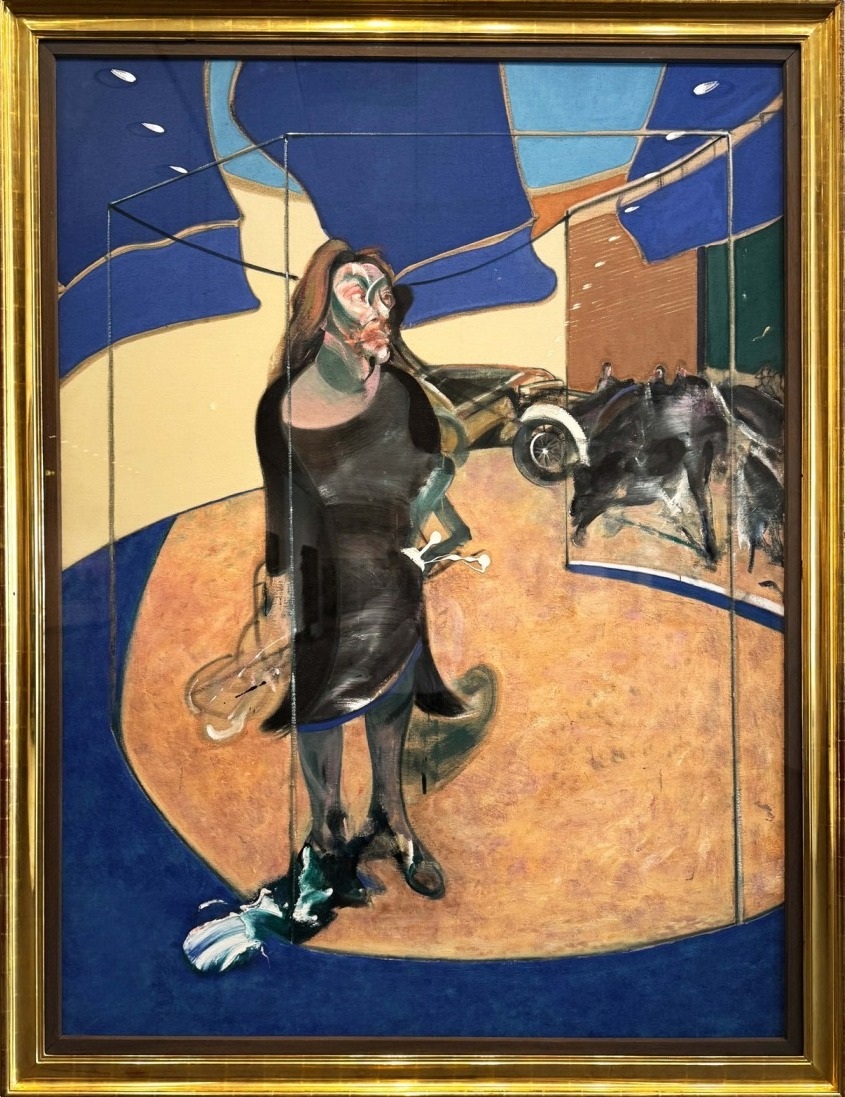
Isabel Rawsthorne Standing in a Street in Soho, 1967, by Francis Bacon
Three rashers of Bacon and a Freud egg
Usually, when an artist dies his reputation and his prices plummet. This is not the case with Francis Bacon, who is regarded with increasing awe, partly due to the brilliant staging of the important exhibition in Venice by David Sylvester, and also through the skilful promotion of the Marlborough Gallery. We are used to Bacon on a grand scale, but this reveals him as the master of the smaller canvas which requires a fiercer concentration.
Entering the gallery, I had the uncanny though pleasant sensation of joining a party filled with friends, most of whom are dead. The first head made me start, for it was instantly recognisable as Peter Lacy, a former Battle of Britain pilot who ended up playing the piano in Dean's Bar in Tangier and died on the night of Bacon’s first exhibition at The Tate, as if the Fates were punishing the artist for his triumph.
Then there is Muriel Belcher, who ran the Colony Room Club, birthplace of the so-called School of London, though the Colony Room Mob would be more apt; George Dyer, Bacon’s companion, who committed suicide on the eve of the historic exhibition in Paris; and Henrietta Moraes, who is still alive and kicking. Cunningly, the Marlborough includes a display case of photographs by John Deakin, whom Bacon commissioned, with the explanation that he was unable to work from live models because most people were shocked by the results.
Moraes remembers how Deakin posed her nude in such erotic positions that she was surprised, though agreeable if that was what Bacon wanted. ‘Throw yourself back and abandon yourself,’ Deakin told her. But when Bacon saw the results, he said they were useless and told Deakin to start again. A few days later, in a seedy afternoon drinking club, Moraes was aghast to find Deakin flogging the first erotic prints to sailors for ten shillings each. ‘I was really furious. Then I thought it so funny. But, I ask you, only ten bob!’ Though Deakin’s photographs are considerable in their own right, and extremely moving in their tattered condition, Bacon used them merely as a ‘kick- start’ for his memory, which was phenomenal even when hung over.
The main sitter in this powerful show — which is attracting many young people, despite the fact that students are alleged to find Bacon old-fashioned — is Lucian Freud. Freud was once Bacon’s closest friend and before they fell out, Bacon painted 25 portraits of Freud, who returned the compliment with a small masterpiece on copper which was stolen in Berlin a few years ago and never recovered.
I mention Freud in order to urge you to visit his exhibition at the Whitechapel Gallery before it closes this evening and moves on to New York. It is the upstairs room which is so shattering that people leave in a happy state of shock: the fine portrait of his mother — even Freud shows a twinge of tenderness here — and the larger-than-life bulk of the egg-shaped performance artist Leigh Bowery, whose naked backside seems to edge out of the frame. This is Freud’s fulfilment at the age of 70, painting with a new audacity as if he is fighting against time.
Francis Bacon, Lucian Freud; what of the third musketeer and former friend, Graham Sutherland? Once he was considered the finest painter of them all, but when he died Lord Goodman had the foresight to sense that the painter’s market value would collapse and urged his widow, Kathy, to sell all she had immediately.
Grief-stricken, she was glad to do so, and was able to spend the rest of her life in the luxury of the Connaught Hotel, from where she sent me a heartbreaking postcard: ‘All was only possible with G S, and I did have a good innings, but sick of everything now and don’t care if I live or die.’
What went wrong for an artist whose brilliant etchings in the tradition of Samuel Palmer were so admired; whose Pembrokeshire landscapes haunt the memory; and whose portraits of Somerset Maugham and the vandalised Churchill portrait were known to the entire nation?
The answer is tragically simple: he went out of fashion, eclipsed by the grandeur of Bacon, who gained the international acclaim denied to Sutherland except in Italy. Now, Bernard Jacobson makes amends with his new show which covers the range of Sutherland’s life from the magnificent etching Pastoral, 1930, to his final oils in the late Seventies, when he returned to the Welsh landscape and found himself again.
His early work, such as Welsh Landscape, 1936, was rarely surpassed, but the exhibition’s importance is in the chance to re-assess the work in between, such as La Fontaine, 1964, and realise how good it is. Sutherland excelled in colour and shapes, and his relationship with nature was the opposite to Bacon’s, to whom the only appealing landscape was the desert. Yet I learned recently it was Bacon who talked about painting thorns and was irritated when Sutherland did so first, making tree trunks and gorse on a sea-wall his trademarks.
The two men were close, yet opposed: Bacon, an atheist and homosexual who rejected the Order of Merit which Sutherland treasured, with the excuse, ‘Such honours cordon one off, and they’re so ageing!"
The Sutherlands were two of the most charming people I have known, and I arranged a reconciliation with Bacon in Jules Bar, in Jermyn Street, for they refused to meet him on his own stamping ground of Soho. After a moment’s embarrassment, they fell on each other like dogs united with a long lost master, and when Bacon invited them to dinner at his favourite restaurant, Wheelers, Kathy looked apprehensive, but Graham did not hesitate.
As they sat down, I sensed that Bacon’s mood had changed, and flinched when Sutherland leant forward with a smile- ‘I’ve been doing some portraits recently. I wonder what you think of them?’
‘Very nice,’ said Bacon. ‘If you like the covers of Time magazine.’
The Sutherlands got up and left, and Graham never saw ‘the monster’ again, but Kathy did meet him by chance in the hall of the Connaught and whispered, ‘G always said you were the best,’ or so Bacon told me. Afterwards, appalled by her betrayal, she asked to be escorted to the lift whenever she saw Bacon, in case he spoke to her.
Was Bacon the better? Art should not be turned into a horse race, and the artists are so different that the comparison is absurd; yet it must be admitted that Sutherland painted too much, while Bacon destroyed everything that failed and limited his range to his own advantage. Conversely, Sutherland was a fine draughtsman, and Bacon could not draw at all.
Above all, Sutherland possessed a romantic quality that Bacon and Freud could not and would not attempt. This approach remains unfashionable, but the tide may turn. This new exhibition gives him a recognition which is long overdue, with all the pictures for sale, ranging from £2,500 for a print to £200,000 for an oil, evidence that the old master is back in demand once more.
Francis Bacon, Small Portrait Studies, Marlborough Fine Art, Albemarle Street, London W1. Open Monday-Friday 10am-5.30pm, Saturday 10am-12.30pm. Until December 3. Admission free Lucian Freud, Whitechapel Art Gallery, Whitechapel High Street, London E1. Closes today, 11am-5pm. Admission £3.50.
Graham Sutherland, Bernard Jacobson Gallery, Clifford Street, London W1. Open Monday-Friday 10am-6pm, Saturday 10am-4pm. Until December 9. Admission free

ALTERED IMAGES: Three Studies Of Henrietta Moraes, by Francis Bacon, 1969
FRAMING THE UNFRAMABLE:
Samuel Beckett and Francis Bacon
JANE HALE
Bacon and Beckett, born in Ireland within three years of each other (1909 and 1906 respectively), both first lived in Paris in 1928, establishing life-long connections with the French culture and art world that have made them bilingual artists in every sense of the term. Neither of them claims affiliation with any "school," either formal or informal. They are undeniable originals who, though steeped in the artistic heritage of their past, and admired by both their contemporaries and younger artists, claim neither masters nor disciples. In spite of their willingly isolated aesthetics, however, Bacon and Beckett are very much men of their era who render vivid, accurate portraits of contemporary humanity with paintbrush and pen. They share similar attitudes towards the work of the modern artist; a common concern with attempting to render the stark reality of the human presence in a world where no transcendent values are available to endow that presence with stability, meaning, or even form; and a surprising number of analogous stylistic techniques and images.
Although beloved (if often misunderstood) by intellectuals, both Bacon and Beckett view artistic creation as primarily an irrational process, an outpouring of the artist’s emotion into paint and words. Bacon claims to rely upon chance discoveries that emerge from within him in the execution of his paintings:
I’m sure chance comes about for each person in different ways. I know in my own case, suddenly I’ll be painting something and I’ll think, 'Oh, God, this is awful,' and I just use the brush in any way, thinking about nothing, and then suddenly it may or may not reverse and an image emerges from which I can get hold.1
Similarly, in his early essay on Proust, Beckett wrote that "the work of art (...) [is] neither created nor chosen, but discovered, uncovered, excavated, pre-existing within the artist, a law of his nature."2 Neither artist, however, allows his faith in spontaneity of emotion and the dictation of the irrational to dominate his expression so completely that it becomes little more than a surrealistic exercise in automatism. Both mould their unorganized raw materials into carefully controlled and compelling structures.
Bacon, who regards most abstract art as mere interior decoration,3 has revived a tradition of human figuration in painting that was widely believed to have been exhausted, dead, and buried when he seriously began his career as a painter in the mid-1940s. (See fig. 1.) He rejects, however, any anecdotal, or what he calls "illustrational," aims for his painting, pointing out that the development of photography has relieved painters of their former function as reporters or recorders of external reality.4 The invention of cinema has been said to have had a similar liberating effect upon the aesthetics of theater, and Beckett is one of the few dramatists to have understood thoroughly the implications of this development and to attempt to create a totally new dramatic form freed from the constraints of traditional 'realistic,' or reportorial, representation. Both artists are 'realistic' on another level, however, in their attempts to go beyond surface appearances and traditionally accepted imagery and forms to express the essence of how it feels to be a human being in Western Europe in the twentieth century. Bacon’s close friend, Michel Leiris, defines Bacon’s realism in words that could apply equally well to Beckett’s artistic goals:
his ultimate aim seems to be to express life (the life we live and feel, the being in flux that each one of us is) and to produce work endowed with that presence which is its own peculiar life, directly perceived without any intervening haze of mental distance? an authentic realist but an enemy of the anecdotal which, even when serious, never penetrates below the surface foam of reality.5
While Beckett was well known for his refusal to comment upon his works, maintaining that they speak for themselves and that he had said in them everything that (and more than) he had to say, Bacon seems to have been a willing and tireless interviewee. Bacon’s statements about his work, however, when not limited to explanations of his methods of painting, usually consist of Beckett-like protestations that he has indeed nothing to say:
I don’t know what I mean (...) I never could explain any of my work. I leave that for others.
I can’t really talk about my painting (...) I haven’t got any morals to preach (...) I just work as closely to my nerves as I can, and as I’m bound up closely in my world today, perhaps it does reflect savage tensions and vacuous spaces.6 (...) I’ve nothing to say about 'the human situation.'7
Bacon’s and Beckett’s works are expressions of immediate perceptions, valid only in and of themselves, with no other justification than the fact of their existence, or, as Beckett once defined the only possible remaining goal for artists in our time, in words that will be familiar to most, if not all, of you: "The expression that there is nothing to express, nothing with which to express, nothing from which to express, no power to express, no desire to express, together with the obligation to express."8
The obligation to express felt by both Bacon and Beckett comes into constant conflict with the lack of certainty about what can be left to express in a world subject in every domain to Heisenberg’s principle of uncertainty, or indeterminacy. In writing of Bacon’s importance as a painter, Leiris defines the "ultimate function" of art: "to save us from disaster by creating, alongside the everyday world, another realm, fashioned according to the requirements of the human spirit and in keeping with an inner order which, by its very nature, is in sharp contrast to the unbelievable muddle of the reality around us."9 In one of his rare interviews, Beckett spoke of this same tension between "the mess," or the "buzzing confusion," around us and the formal demands of art, concluding: "To find a form that accommodates the mess, that is the task of the artist now."10
The struggle to express a nonexistent content, to create order where none is possible, leads inevitably to an acceptance of the ultimate failure of artists, of the hopelessness of their task. Bacon calls painting an activity "where you play to lose,"11 and admits that he was attracted to portraiture because of its very impossibility: "You simply can’t bring off a portrait today."12 This reasoning is very similar to Beckett’s Unnamable’s desperate compulsion to write himself, to tell himself, to name himself, which "ends" with these words: "where I am, I don’t know, I’ll never know, in the silence you don’t know, you must go on, I can’t go on, I’ll go on."13
Both Bacon and Beckett have chosen a remarkably similar subject matter for their 'impossible' works, as if they were convinced that none other is possible for today’s artist: that of the living reality of human beings, unadorned portraits of the human presence. More often than not, these figures are presented alone, and they are frequently situated in a room. Most of them do not seem to be undergoing any specific, identifiable crisis, yet in their stark solitude they all seem beset by what Henry Geldzahler has identified (in Bacon’s work) as "a haunting series of circumstances, dire and non-specific."14 (See fig. 2.)
These figures seem to be reaching out to us from the canvas, from the stage, from the pages of a book, for help in defining their existence, their reality, their identity, but even as they do so they, and we, are painfully aware of the inexorable effects of time upon their disintegrating bodies, of their inability to ground themselves in space in a manner that would permit them to be perceived by us, by the artist, or even by themselves. They are often located off-center on the canvas or stage, often presented as mere fragments of human bodies, often seem to be inextricably connected to the space in which they exist, and are almost always shown caught up in a movement that robs them of any clear image of themselves or of their place in the world around them. Bacon and Beckett know that it is no longer possible to reproduce the stable, rationally organized images and stories of earlier eras. As Bacon admits, "The great images of the past are precise in ways that are no longer either possible or 'actual.'"15 And Beckett, speaking of classical art, states, "This is clear. This does not allow the mystery to invade us. With classical art, all is settled (...), but for us who are neither Greek nor Jansenist there is not such clarity."16
Just as contemporary physicists admit the impossibility of simultaneously measuring both the position and the speed of a particle, Bacon and Beckett realize that in today’s world it is impossible to represent both a being’s position in space and the movement, flux, and change to which every being in space is subject. And both seem to have opted for the latter: they attempt to depict the passage of time and its effects upon beings who can never know stability or rest. But paradoxically, both Bacon and Beckett must, and do, accept the constraints of the static, fixed forms they have chosen for such expression: paint dries on canvas, words are printed once and for all on pages, and even in the theater, where mobility is somewhat more possible, Beckett developed a dramatic esthetic that relied more and more on either stationary visual images or highly controlled movement. The result of this conflict between content (the flux) and form (the fixity) is not only a great tension in the works of both men, but also a remarkably powerful rendition of the instability and even invisibility of the contemporary human being in highly visible works of art. For, as Beckett once wrote, "the object that becomes invisible before your eyes is, so to speak, the brightest and best."17
In a 1966 interview with David Sylvester, Bacon characterized the challenge of portrait painting as "the most taxing of all forms of painting" at the present time, due to the fact that "we no longer accept the unitary and unambiguous and closely structured view of human personality which portrait-painting traditionally involves (...); we see human beings as flawed, self-contradictory, subject to the fugitive and the contingent."18 In his portraits, Bacon depicts the fragmentation of human beings by isolating heads (as in the series of six heads, 1948-49), painting headless, and/or legless, torsos (e.g. "Study of the Human Body," 1982; "Study of the Human Body from a Drawing by Ingres," 1982), or simply leaving empty black spaces where one would normally expect to see painted flesh (e.g. "Triptych," August, 1972). Beckett, too, often fragments his characters. He isolates the human head, for example, in Play? where three heads protrude from urns, and in That Time? where an old white face floats above a darkened stage. Not I presents merely a faintly-lit mouth on an otherwise dark stage. Beckett buries Winnie up to her neck in Act Two of Happy Days. (The legless woman with the umbrella in the center panel of Bacon’s 1970 "Studies of the Human Body" calls to mind the image of Winnie raising her umbrella in Beckett’s play.)
Bacon portrays an accelerated time as it acts upon the human body to decompose and destroy it. His bodies are not only fragmented, but also often seem to be dissolving into powdery streaks of pigment (e.g. "Portrait of Michel Leiris," 1976; "Self-Portrait," 1973) or liquefying into pools of paint that spill out onto the canvas (e.g. "Triptych," "March," 1974; "Triptych," 1976). Sometimes they are reduced to bloody carcasses of meat (e.g. "Three Studies for a Crucifixion," 1962; "Crucifixion," 1965). As Bacon once said, "death is the shadow of life, and (...) the more one is obsessed by life, the more one is obsessed by death."19 Bacon’s figures, from the very moment of their creation, seem overcome by the inevitable process of decay inherent in life itself and, like Beckett’s characters, lack the certainty of being that would permit them to appear whole. Vladimir characterizes the predicament of life in Waiting for Godot as "Astride of a grave and a difficult birth. Down in the hole, lingeringly, the grave-digger puts on the forceps."20
While both Bacon and Beckett express doubts in their art as to the possibility of separating life from the disintegration and death attendant upon it, Bacon, unlike Beckett, views death as a finality: "Death is the only absolute that we know in this life. Death is the one absolute certainty. Artists know they can’t defeat it (...) There’s no life in death ? (...) when you’re dead, you’re dead. It’s only the consciousness of death in life, that gives it power."21 Beckett was not so sure of this finality, and would have been more likely to recast Bacon’s words as "it’s only the (possible) lack of consciousness of self in death that robs it of its appeal." As his character Victor, in his early play, Eleutheria, says: "If I were dead I would not know that I am dead. That’s the only thing I have against death. That is freedom: to see oneself dead."22
If Bacon and Beckett strip away human flesh, limbs, features, and attributes as a way of portraying the workings of death-in-life, they do so also in an attempt to pare down the human creature to its bare essentials, to try to reach the ultimate, if unattainable, core of what a human being actually is. These two goals are not as contradictory as they might at first appear. One of the great preoccupations not only of contemporary physicians, philosophers, and scientists, but also of the "person-in-the-street," is the definition of life: When is a person dead? How many, and which, of a human being’s organs and life functions can be destroyed before he or she ceases to be alive? What happens to the integrity of the individual when the body becomes the repository of blood and organs that once belonged to others? Or when one is kept alive only by machines? And, to approach the same question from the other end of the spectrum, when does life begin? With the unfertilized egg? At the moment of conception? When the fetus is viable? And what exactly does "viable" mean? Bacon’s and Beckett’s stark, fragmented, dismembered, partial portraits of an undefinable, yet unmistakably real, and present, humanity might well be read as artistic explorations of these critical, and thus far insoluble, contemporary dilemmas.
NOTES
1. "Remarks from an Interview with Peter Beard," ed. Henry Geldzahler, in Francis Bacon: Recent Paintings 1968-74 (New York: Metropolitan Museum of Art, 1975), pp. 16-17.
2. Proust (New York: Grove, 1957), p. 64.
3. "Remarks from an Interview with Peter Beard," p. 18.
4. Michel Leiris, Francis Bacon: Full Face and in Profile, trans. John Weightman (New York: Rizzoli, 1983), p. 25.
5. Ibidem, p. 41.
6. "Remarks from an Interview with Peter Beard," p. 16.
7. As quoted in Henry Geldzahler, p. 11.
8. "Three Dialogues," in Disjecta: Miscellaneous Writings and a Dramatic Fragment (London: John Calder), 1983, p. 139.
9. Ibidem, p. 13.
10. Interview by Tom Driver, "Beckett by the Madeleine," in Columbia University Forum, 4 (Summer 1961), 21, 23.
11. John Russell, Francis Bacon (New York: OUP, 1979), p. 39; this is my translation of the French "on joue perdant."
12. As quoted in Russell, p. 105.
13. The Unnamable in Three Novels: Molloy, Malone Dies, The Unnamable (New York: Grove, 1965), p. 414.
14. Ibidem, p. 6.
15. As quoted in Russell, p. 23.
16. Driver, p. 23.
17. "Dream of Fair to Middling Women," in Disjecta, p. 414.
18. As quoted in Russell, p. 80; Russell is paraphrasing Bacon here.
19. As quoted in Lorenza Trucchi, "Dix paragraphes pour Francis Bacon," L’Arc, 73 (n.d.), 11, my translation.
20. Samuel Beckett, Waiting for Godot (New York: Grove, 1954), p. 58.
21. "Remarks from an Interview with Peter Beard," p. 15.
22. Unpublished manuscript, ca. 1947, p. 116, my translation.
Francis Bacon, His Life and Violent Times
by Andrew Sinclair (Sinclair-Stevenson, £20)
MANSEL STIMPSON
THE DUBLIN-born painter, Francis Bacon, died in 1992 after a long life during which this self-taught artist had become internationally recognized as supreme in his field. In this biography, Andrew Sinclair describes him as a lightning rod struck by two World Wars, and Bacon’s fame stems from his unique ability to capture in searing images the violence of man in the 20th century. He might well have endorsed the view of another artist, Roy de Maistre, who was his mentor and lover and who declared: “it is often necessary to give the spectator an ugly left uppercut.”
Even so, to sub-title the hook “His Life and Violent Times” is less than wholly apt. For, while Sinclair is forthright about Bacon’s gay and bohemian lifestyle, there is a detailed emphasis on the painting not hinted at in the subtitle. Although Sinclair’s analysis here is sometimes repetitive, this area is, of course, vitally important in its own right.
But it also reflects Bacon’s life. For, if the paintings which first established him brought out the impact on him of 20th century history (“the age of Auschwitz with, Stalin, Hiroshima, Bangladesh” as John Rothenstein defined it when acclaiming Bacon’s insights into society), his work subsequently placed emphasis on gay sex and on the men in his life, including George Dyer and John Edwards who became his modes as well as his lovers.
Since Sinclair attributes Clouzot’s film Le Mystère Rivassa to Chabrol, he is not always to be relied on. Yet ne does provide a fascinating chronicle of a remarkable life, and one which reveals the extent to which Bacon chose to exist in gay circles, be it in Fitzrovia, Soho or Tangier. Although Sinclair was for a while a neighbour of Bacon’s, the impression is of a distant view of a complex man, one as notable for his generosity as for his need to dominate. The evidence is that lie could be wonderful company, but one is not left with the feeling that he was likeable.
Given the anguish expressed in his work, the book’s tone is inevitably sombre. But that’s balanced by much amusing detail, such as the lesbian proprietor’s dosing time to the gay customers in her drinking club (“Back to your lovely cottages”). Even more memorable is the story of how Bacon first encountered his lover-to-be. George Dyer. The latter entered Bacon’s bedroom as a burglar and was immediately challenged by Bacon in these terms: “Take all your clothes off and get into bed with me. Then you can have all you want.” Is this story apocryphal? Who knows? Who cares?
By MICHIKO KAKUTANI
The images created by Francis Bacon are shocking ones, visceral, contorted, often horrific: Human beings metamorphosing into demonic birds and dogs, their bodies twisted unmercifully into grimaces of pain. Shrieking popes imprisoned in golden cages, unleashing primal screams upon a world incapable of hearing. Copulating men writhing on a bed, their fat, pink limbs melting together in a desperate, meaty embrace. Ragged, butchered carcasses dangling from a ceiling, leaking blood onto a ghoulish man in a suit.
In such images can be read the horrors of our century: the devastation of two world wars, the crimes of Hitler and Stalin, the terrors of the atom bomb, the dislocations of a world shorn of its illusions. As Bacon once observed, his ambition was to paint "the History of Europe in my lifetime." "I think of myself," he said, "as a kind of pulverizing machine into which everything I look at and feel is fed."
In Francis Bacon: His Life and Violent Times, the writer and social historian Andrew Sinclair attempts both to chronicle the painter’s life and to situate his work within a historical context. Though the volume relies heavily at times on earlier books (including David Sylvester’s fascinating Interviews With Francis Bacon and John Russell’s Francis Bacon), it also draws upon the author’s own talks with the painter, and it succeeds in giving the reader a vivid sense of both Bacon’s maturation as a painter and the ways in which his work was shaped by his times.
Although Bacon was born to a wealthy Irish family — he was a collateral descendant of his namesake, the famous Elizabethan philosopher - his childhood was rootless and fearful, indelibly shaped by the Zeppelin bombings of London in World War I and the countryside atrocities of the Irish civil war. Mr. Sinclair argues that the blackouts, which shrouded daily life in ominous, murky shadows, informed Bacon’s portraits in which "distorted figures would emerge from a fearful night, as sudden and grotesque as the strangers glimpsed in the dim streets" of wartime London. Similar parallels can be drawn between the lynched bodies the young Bacon saw during the Irish rebellion and his later preoccupation with the idea of crucifixion, and the image of butchered meat.
Bacon’s willful flouting of authority — mirrored in his fierce deconstructionist portraits of popes, dictators and businessmen — also had roots in his childhood. According to Mr. Sinclair, it was a reaction to the religious authorities, both Protestant and Catholic, who seemed to have condemned Ireland to bloodshed, and to Bacon’s censorious father, who regarded him as a weak, asthmatic sissy and who banished him from the house at the age of 16. With an allowance of £3 a week, the young Bacon began a peripatetic life in London, moving from one rented room to another, until a distant relative took him on a trip to Berlin.
There, in the waning days of the Weimar Republic, Bacon was introduced to a sexually licentious life style, and to the work of artists who would indelibly shape his own vision. From Edvard Munch and the German Expressionists, Mr. Sinclair notes, Bacon would learn about the iconography of emotional violence; from Otto Dix, Christian Schad and other practitioners of New Objectivity, he would learn the value of precision and detachment.
Paris, the next stop on Bacon’s youthful odyssey, provided another set of influences: Picasso and his Cubist reassemblings of the human body, and the Surrealists, with their emphasis on instinct and the unconscious. It was also in Paris that Bacon came to appreciate the cinematic genius of Eisenstein and Bunuel, and to value the art of photography (he would base many of his later paintings on Eadweard Muybridge’s action shots of animals and people in motion).
Although Bacon began painting in London in the early 1930’s under the mentorship of Roy de Maistre, who was also his lover, he did not come into his own until the death of his father in 1940. Liberated from the inhibiting memory of his harsh, judgmental progenitor and galvanized by the bloody events of World War II, Bacon embarked on the ferocious paintings — including Three Studies for Figures at the Base of a Crucifixion, Painting 1946 and a series of frightening Heads — that would begin to earn him a reputation as one of Britain’s foremost painters.
Throughout this book, Mr. Sinclair doggedly traces the autobiographical impulse in Bacon’s work. He does a nimble job of explicating the many influences on his work, from Goya and Velazquez to Aeschylus and T. S. Eliot, and he also provides an ample supply of colourful anecdotes illustrating the painter’s raucous, bohemian life. We are told about Bacon’s taste for raffish, lower-class lovers, his penchant for gambling and his almost complete disregard for money.
Along the way, a lot of adjectives are offered up to describe Bacon: generous, chameleon-like, waspish, passionate and reckless. We’re also told that he was a dandy, an existentialist and a nihilist. None of these words, however, really conjures up a full picture of the man; as far as this volume is concerned, Bacon, who died in 1992 at the age of 82, remains a slippery, mercurial figure, eluding capture in the biographer’s cage. It is in evoking Bacon’s tumultuous times and tracing the conjunctions between the painter’s work and world that Mr. Sinclair is most convincing. Indeed, he makes a powerful case in these pages for regarding Bacon as a representative artist of the violent and disordered modern age.
Francis Bacon His Life and Violent Times by Andrew Sinclair. Illustrated. 354 pages. Crown Publishers.
Grocer’s daughter on side of Bacon
QUENTIN LETTS
ONE of the most controversial attacks attributed to Lady Thatcher may never have been made by the then Prime Minister. It now transpires that her supposed denunciation of Francis Bacon was probably invented by the painter to gain notoriety. Her apparent disdain for modern art excited a terrible rumpus, and Mrs Thatcher was branded as a Philistine thereafter.
Visiting the Tate in the early 1980s she is said to have asked the directors who they considered our greatest living artist. In line with received opinion, they said Bacon. Mrs T is supposed to have retorted: “Not that dreadful man who paints those horrible pictures.”
The reputed remark, recorded for the first time in a 1985 Spectator article by art critic Daniel Farson, was never corroborated. Farson only heard the remark from Bacon himself, so decided to check it for next month's publication of the paperback of his life of Bacon, The Gilded Gutter. He saw the former PM at this summer’s Spectator party so, feeling bold, introduced himself and cross-examined her. “I have absolutely no recollection whatsoever of ever making such a remark,”
Lady T told him. “I am a great admirer of his work, but as with any artist there will always be some works which are preferable to others.” Lady Thatcher proceeded to treat Farson to a dissertation on modern art: “When they showed it to me, I couldn’t see anything in it at all. The next time, I began to understand.” Farson says her approach to appreciating art appeared to be: “See, see, see. Learn, learn, learn.”
Some, though, suggest that Lady T is being revisionist. Sir Alan Bowness, Tate director at the time, admits he does not recall the Bacon attack, but says: “It has a ring of truth. I wouldn’t be surprised if she had said something similar.”
DEEP INTO THAT DARKNESS PEERING
BY
PETER PARKER
At the time of his death in April 1992, Francis Bacon was widely considered the greatest British painter of the century. He was a grand master in the style of Rembrandt and Velazquez, with a style and subject matter entirely his own. He declared that he painted for himself and that it was the act of painting, not what happened to the canvases thereafter, that drove him on. What happened to many canvases was that they were sold for large amounts of money, but Bacon (who had known real poverty in his time) remained uncorrupted by wealth, for he was one of the last Bohemians.
A familiar figure in the pubs, drinking clubs and restaurants of London’s Soho and Fitzrovia, he was an importunate host who almost always insisted upon paying for everyone, peeling off banknotes from the fat rolls of them he customarily carried in his pockets. He drank vast amounts of champagne and was a profligate gambler. Flamboyantly homosexual, with a taste for rough trade, he would tell people that his lover and model George Dyer had entered his life through a bedroom window, intent upon burglary.
In spite of the appalling images he produced in his paintings — figures, often mutilated, eviscerated or deformed, portrayed in bleak, mute isolation, or raging against the world and what it had done to them — Bacon proclaimed that he was an "optimist." At one moment he would say that he was painting "the history of Europe in my lifetime," at another furiously deny that his work was in any way illustrational. Any biography of Bacon needs to explore these contradictions and the apparent gulf between the man who was such amusing company and the artist who produced the bleakest and most disturbing paintings of our age.
Novelist and social historian Andrew Sinclair, as he freely admits, is no art critic; neither, unfortunately, is he much of a biographer. He defines his job as "to explain the interaction between an individual and his times," but all too often he is so busy colouring in the background that Bacon simply disappears from view. Much of the social history he provides is irrelevant and seems little more than padding: the overall impression left by this book is of someone diligently leafing through files of newspaper clippings and the indexes of biographies of the period in search of Bacon, Francis. In spite of such endeavours, Sinclair’s actual quarry seems to elude him, except in the brief Endpiece, which provides a summary more succinct and valuable than anything that has gone before.
Bacon had said that he did not want a biography written about him while he was still alive. Consequently, as soon as he died, the race was on, with several writers, who had been circling impatiently at the starting line, galloping off into the distance. In England, Sinclair passed the finishing post almost neck and neck with Daniel Farson, whose The Gilded Gutter Life of Francis Bacon, an unashamedly personal memoir, provides an altogether livelier and more evocative account of its subject.
Sinclair’s biography shows every sign of haste, both in the writing and editing, with the frequent repetition of information and numerous inelegancies of style. For example, of Bacon’s famous Three Studies for Figures at the Base of a Crucifixion, first exhibited in April 1945, Sinclair writes: "It seemed to howl against the massacre of the twenty million dead and more in the conflict, just as the nation was about to celebrate a victory that seemed to be justice." Strenuous attempts at fine writing frequently go awry, as in the nonsensical assertion that: "There was more wit on one hair of Bacon’s paintbrush than in all the saliva on {Brian} Howard’s loose tongue." Occasionally one realizes that Sinclair cannot really mean what he has written. "So radical, disruptive, seminal and real were Bacon’s paintings," he states at one point, "that he would achieve what the Auden Communist group of the ’thirties dreamed of: an exhibition of pictures in Moscow, seen there as revolutionary protests against religious authority and the destruction of humankind." Just what sort of pictures Auden and his friends dreamed of exhibiting in Moscow is not explained: their own?
Many chapters bear portentous or simply meaningless titles. Chapter 8, The Blood of an Englishman, is prefaced by a quote from King Lear and opens: "Like the wise Edgar pretending to play the Fool — Fie, Foh, and Fum — Bacon was to smell the blood of two of his beloved British men within ten years of their deaths." Is Sinclair suggesting that Edgar prophecies the deaths of his father and Lear — the words he uses, after all, are those of a ravening, cannibalistic giant — and, if so, how does this relate to Bacon? If Sinclair means that Bacon in some way predicted the deaths of Dyer and his predecessor Peter Lacy, he does not say so. If he does not mean this, then what is the burden of this sentence? As with rather too much of his overwritten book, the answer would appear to be: sound and fury, signifying nothing.
FRANCIS BACON
His Life and Violent Times
ANDREW SINCLAIR
SINCLAIR-STEVENSON £20
354 PP, 62 ILLUS. ISBN 1-856 19310-1
FRANCIS BACON
In Conversation
MICHEL ARCHIMBAUD
PHAIDON £9.95
192 PP, 33 ILLUS. IS6N 0-7148-2983-8
ERIC SHANES |
FRANCIS BACON did not want his life to be explored biographically, and although he opened himself up to numerous interviewers, he never gave anyone the kind of coherent account of his span — especially his early years — that would allow a biographer to fashion a fully-rounded portrait of him. Nor was his mature life that remarkable, for a dully repetitive round of boozing and failed relationships does not make for particularly interesting reading, and it points up once again the discrepancy between art and life, the fact that, say, a great painter can fashion masterpieces while enjoying (or suffering) a rather dreary and uninspiring existence.
Sadly, Andrew Sinclair’s book is a very ignorant, silly and badly-written affair. Because of the paucity of factual information the first third of the biography is almost entirely given over to contextual Polyfilla, and when the author does have more facts to deal with he marshals them with little sense of coherence or artistic insight; on more than one occasion he reminds us that he is a writer and not a painter, but this should not have prevented him from exercising some basic art-historical skills. As a result, the grasp of Bacon’s artistic context is amateurish, the projection of the painter’s creative growth is non-existent — Sinclair seems unable to apprehend the various stylistic phases in Bacon’s work — and too often his gushing over the artist’s supposed historical status works against his need to argue for that position, and thus convince us of it. So we still await an adequate Bacon biography, although this book points up the enormous fact-gathering pitfalls that await anyone who bravely tackles that task.
Michel Archimbaud’s transcription of various conversations with Bacon usefully and intelligently complements David Sylvester’s earlier series of interviews with the painter; as such it is self-recommending.
ERIC SHANES
Painter of the nervous sensation
STEPHEN SAUNDERS |
THE ANGLO-IRISH painter Francis Bacon’s contorted figures and their sinister, howling teeth are 20th-century icons. He died last year aged 82. The “violent times” continue, from Bosnia to Somalia to Angola, as the century winds down. It would take an impossibly talented biographer to do him justice so soon after his death. In the meantime, Sinclair docs fair credit to his subject and himself.
Bacon’s soldier father was born in Adelaide, of all places. He is dismissed as a militaristic twerp. We are told not much more about Bacon’s mother than that she had an affectionate relationship with Francis. He lost a younger brother who died aged four. Much later he acquired two younger sisters. The father’s World War I service took the family to London. The Zeppelin bomb raids gave young Francis an introduction to the century’s favoured pastime of war.
There was never much chance the thoughtful son would take up arms. Only the father’s love of gambling stuck. Sinclair notes several times that he is a social historian rather than art critic. On average he is more critically reflective on Bacon's personal life than he is on his art.
Several self-deprecating quotes from Bacon are meant to suggest that he was hardly raised or educated and that initially art meant little to him. By 1930 Bacon had seen the work of the German expressionists and soaked up painters as diverse as Poussin and Picasso. Australian painter Roy de Maistre was an early mentor to Bacon and to our own Patrick White. Further on, Sinclair has Bacon rather than Nolan as the model for White’s The Vivisector. There’s not much doubt which of the two practised vivisection on canvas.
Sinclair is matter-of-fact about Bacon’s homosexuality, as was the painter himself. In the 1930s he affected a taste for middle-class gentlemen such as his patron Eric Hall. Sarcastically he told a friend, “What would really excite me is a middle-aged Belgian commercial traveller with hairy wrists.” His sexual activities were prosecutable in Britain until quite late in his life.
Women there were in Bacon’s life — mother, sisters, nanny, and protective dealers — but they are passed over quickly. One of 10 picture plates is the 1967 portrait of acquaintance Isabel Rawsthorne, which Sinclair counts as a masterpiece.
The whimsical Australian connections continued. White and Australian “sheep dip” millionaire Douglas Cooper collected Bacon’s early works. He had a long fallow period, but the productivity which began in the 1940s would last the rest of his life. At the end of the war he coined his first great triptych, the form he would use later to immortalise his doomed lover George Dyer.
Bacon was rejected by the surrealists and never favoured the later American abstractionists. He could say that Jackson Pollock “is not formal enough for me”. Sinclair’s most strenuous effort to explain Bacon’s art is lifted with acknowledgement from a 1985 book by French writer Gilles Deleuze. While Bacon supposedly characterised himself as a painter of the nervous sensation, of images having “a concentration of reality and a shorthand of sensation”, Deleuze tried with mixed success to impose a structure on what he was doing.
By the swinging sixties Bacon was becoming seriously rich and famous. A summer 1965 London exhibition got £60,000. Baconlived to see his canvasses fetching six and seven figures in US dollars. The cliché (faint praise?) of his later years was “The greatest British painter since Turner.” It is used unabashedly as the first sentence of this book’s jacket notes. In Sinclair’s treatment, Bacon’s “disadvantages” of sexual preference and Bohemian lifestyle are more than offset by his brilliance and dedication. He destroyed the lesser part of his output. The greater part which survives commands a respectful place for Bacon among great 20th-century artists, realising as it does much of what he had within him.
FRANCIS BACON
His Life and Violent Times by
Andrew Sinclair.
Sinclair-Stevenson
Fancy a nice slice of Bacon?
FRIDAY LIVE | LIVERPOOL ECHO | FRIDAY, FEBRUARY 4, 1994
* FRANCIS Bacon’s portrait of Vincent Van Gogh, “one of my great heroes,” goes on special showing this weekend at Southport’s Atkinson Gallery, where is can be seen until March 19.
* Bacon (above), who died of a heart attack in 1992, was widely acknowledged as the greatest British artist of the century.
* Meanwhile, good news for the Atkinson, which has now been registered as a gallery of national standing.

Raw slice of artist Bacon’s life
GERARD O’REGAN | BOOKENDS
|
IRISH INDEPENDENT WEEKENDER | SATURDAY,
FEBRUARY 5, 1994
FRANCIS Bacon, the Dublin-born artist of genius, died in Madrid in April, 1992, and almost exactly a year later came a biography which aroused much controversy, mainly because it was written by one of his close friends. Not that friendship, as such, ever rated very high on Bacon’s list of priorities.
“I’ve always thought of friendship as where two people tear each other apart — that way you learn something from each other,” he once wrote.
The book, The Gilded Gutter Life of Francis Bacon, by Daniel Farson, is now out in paperback (Vintage £6.99). While not pretending to be the definitive “life”, it nevertheless makes for compulsive reading. It was back in 1951 when a 23-year-old Farson first met Bacon in Soho. The artist was by then in his late 40s — but it was the beginning of a long-running friendship.
Bacon’s early life in Co Kildare, where his father owned a stud farm, is sketched in detail. After London he drifted to Berlin, indulging in a sexual freedom which fortified his instinct to flout convention of practically any hue. Farson’s incidental and anecdotal style makes the book more of a personal memoir than an autobiography in the strict sense of the term. But it is also an approach which makes for high readability.
The author suggests that Bacon’s unabashed homosexuality was a crucible in his artistic make-up. “If he’s been straight, he would not have been so daring,” commented one of his friends. Yet Bacon’s savage sense of nihilism was at times almost frightening “I have never had any love in the whole of my life, and what’s more I don’t want any. Al I do is cast my rod in the sewers of despair and see what I come up with,” he once wrote.
Tragedy and a sense of indulgent despair haunted much of Bacon’s life, as well as his work, and to the end he indulged what might be termed “low life” to a near manic degree. Former British Arts Minister David Mellor provided one of the best reviews of a book which describes the life and turbulent times of a man widely regarded as one of the century’s greatest artists.
He wrote: “This book will shock some people a lot and almost everybody a bit. It deals, I suspect, with people and events far removed from the common experience of most of those who will read it” — a fact that few, as they will stagger through all the drink, all the gay sex, and some of the bloody and violent deaths, will regret.

Francis Bacon — never thought highly of friendship
Artists of despair
‘The smell of death’ has dominated the creative outlook
of our tormented age
WILLIAM REES-M
Why is The Scream so powerful an image? It has a prophetic quality; with the embryonic figure and the red sky. Edvard Munch foresaw the horror of the 20th century. He painted several versions of the picture; the version stolen from the National Art Museum in Oslo last Saturday was painted in 1893. Munch said of it “I sensed a scream passing through nature.” A hundred years later, it is natural to read into Munch’s work a prophecy of the wars, famines, revolutions, genocides and nuclear weapons, which have made our century a hell on earth for billions of people.
This sense of horror runs through 20th-century culture. The most powerful of British painters of the century has probably been Francis Bacon. In 1985, Global Asset Management sponsored the great retrospective exhibition of his work at the Tate Gallery. Our family copy of the catalogue is inscribed, in a way that may intrigue future bibliophiles, “For Annundata, with love Francis Bacon”. Our youngest daughter, Annundata, was six years old at the time. It is remarkable how often the image of a scream appears in Bacon’s work, going back to some of his earliest major paintings.
Among other instances, the scream appears in two of Bacon’s three studies of Figures at the Base of a Crucifixion, of 1944, in most of the Heads, painted in 1949, in several of the Studies after Velázquez’s Portrait of Pope Innocent X, which were painted in the early 1950s, and in his terrifying image of a Chimpanzee, 1955. In her introduction to the catalogue. Dawn Ades quotes Francis Bacon as saying: “There’ve been extraordinary photographs which have been done of animals just being taken up before they were slaughtered; and the smell of death. We don’t know, of course, but it appears by these photographs that they’re so aware of what is going to happen to them, they do everything to attempt to escape.”
In many of Bacon’s paintings, the possibility of escape is ruled out The Pope is usually contained in a type of rectangular box reminiscent of the security glass box in which Eichmann was held during his trial in Israel although these paintings are a decade earlier than that trial. The chimpanzee is portrayed in a cage, but also in one of these defining boxes.
The awareness of the horror that is going to happen gives the work of both Edvard Munch and Francis Bacon its emotional impact.
The dominant 20th-century artist of the world was Pablo Picasso. His work from the early years of die century is characterised by melancholy but his later work is full of pain, anger and haired. If one thinks of great 19th-century paintings. the most memorable images, from Constable to the Impressionists, are of the beauty of nature; they are essentially joyful and peaceful, if one thinks of our century, or of Munch’s work, which foreshadowed it, die dominant images are those of “the smell of death”.
There is something terrible about all the great cultural heroes of this century. In the earlier ages of human history, most of the strongest cultural influences have been positive. They have held out hope and reinforced the idea of human virtue, at least as a potential of our nature. Of course the conquerors were different, and have always been fearsome.
Four men might be regarded as the outstanding world geniuses of our century. One can define a world genius as someone who alters the culture of the world as a whole, a philosopher like Aristotle, a poet like Shakespeare, an evangelist like St Paul, a scientist like Newton. The four strongest claimants to this rank in our century have been Lenin, Freud, Picasso and Einstein. I am not trying to play the game of making a list these four stand out because they could not possibly be a world history of our century.
The four divide naturally into groups of three and one: Lenin, Freud and Picasso display their negative qualities quite openly. Whatever their genius, they would all have been regarded by earlier centuries as dark and sinister forces; there is destruction in them. Einstein was by the same standards a man of tight, open to love and the spirit, a scientist a scholar, a man who loved peace. Yet it was Einstein and the physicists who left mankind the most dangerous potentiality of all, the nuclear power which at least theoretically permits the human race to commit suicide. Later science has developed other possible methods of species suicide.
Each of the other three left a powerful negative legacy. Lenin’s doctrine was that the pursuit of total political power overruled any considerations of personal morality. Admit that principle, adopt the Leninist party system, and you admit the crimes of Stalin and Mao, and also those of Hitler. Political power becomes inhuman if it is not controlled by civil and moral law. Lenin dehumanised the politics of the 20th century.
Freud dehumanised the concept of human nature. It has gradually become apparent that Freud, for all his powers as a mythmaker was a charlatan as a scientist a quack as a doctor, an ignoramus as a philosopher, a bully as a colleague—a humbug of genius, but a humbug all the same. His negative legacy was the belief that the primary driving energy of human psychology is sexual libido.
This implies that every human achievement from Moses to Mozart has been a pale diversion of energy intended for genital activity. What is interesting about this myth is not whether it is true, but how so absurd a theory came to be so widely accepted. Of course, loyal Freudians will say that the master never taught this, but when one reads his correspondence with Jung it seems clear that he did; the two men broke their association on the issue of whether all psychic energy belongs to the sexual libido. Jung thought not.
Picasso also had a negative message. Kenneth Clark once said something to the effect that Picasso was unquestionably the greatest painter of the century, but that he doubled whether enduring art could be based on hatred. This recognised that Clark’s concept of civilisation — the long history’ of human beings creating beauty and order, was the polar opposite of Picasso’s destruction of the image and search for disorder. Yet Picasso, like Francis Bacon, is a mirror of our times. Disorder, fear, the smell of death have been central 20th-century experiences. One does not even have to go to artists of the modern school to find that The most enduring classical English novelist of the century may prove to be Evelyn Waugh. His horror of contemporary life is as strong as Francis Bacon’s. Their ideologies and their techniques are quite different, but their view of the world is substantially the same.
The culture in which we live is still that shaped by the early 20th century. The people who created it are dead and their message was framed a long time ago. Francis Bacon’s particular vision developed in the immediate aftermath of the Second World War. Lenin, Freud, Picasso and Einstein had all made their most powerful original contributions before the end of-the First World War in 1918; that is now more than 75 years ago. The characteristic ideologies of our age, Marxism Leninism, Freudian psychoanalysis and modernism are dying. Even modem science, though all-powerful in creating technologies and changing lives, has no dominant genius, no Einstein, no Newton.
In the 1990s, there is indeed no world genius. There are good and serious writers, artists and composers; there are excellent scientists; there are even good politicians, although they may be hard to find; there are inspiring holy men and women, like the Dalai Lama and Mother Teresa. But the voice of the world genius is not to be heard, not even that of dark genius, like those which dominated the imagination of the early 20th century. It is the twilight of the prophets.
Perhaps somewhere there is an embryonic voice which foretells the 21st century, as in the early 1890s The Scream foretold the ours. We should listen for it. An ideology which is now so old as to be virtually pre-scientific, a culture which contains so much that is dark and antihuman, and a modernism invented by our great-grandparents when they were young provide a weird backdrop for the approach of a new millennium. Perhaps the 20th century has cauterised the human imagination. As it has unfolded, our century has re-echoed Munch’s “scream passing through nature” and silenced many voices of peace and hope.
Unleashing a ‘Human Cry’
FRANCIS BACON: His Life and Violent Times,
By Andrew Sinclair (Crown $30; 354 pp)
THE GILDED GUTTER LIFE OF FRANCIS BACON,
By Daniel Farson (Pantheon $25; 293 pp)
After dinner in private houses, Princess Margaret likes to sing Cole Porter. As sister of the most powerful monarch in the world, she can generally hold guests captive to her lack of ability. One night, though, at a fancy ball given by Ann, Lady Rothermere (later Mrs. Ian Fleming), the princess began the familiar lyrics of "Let’s Do It," when the cheering of Queen Elizabeth’s subjects was drowned out by the sound of booing rumbling like thunder from the back of the ballroom. Unaccustomed to criticism, the princess abandoned the microphone, the band stopped playing, and Lady Rothermere’s guests asked what happened.
"It was that dreadful Francis Bacon," a man said to Lady Caroline Lowell. "He calls himself a painter but he does the most frightful paintings. I just don’t understand how a creature like him was allowed to get in here."
Inarguably the most original 20th-Century British artist, a creature like Francis Bacon gave a new twist to horror. His work has been equated with the pain and suffering of the 20th Century. These are paintings of writhing, corpulent wrestlers, blood-soaked Crucifixions and caged, screaming popes: "slimy, slithering, pure blind images," in the words of novelist and art historian Anita Brookner. As recently as 1989, one of the artist’s paintings brought a bid of $6.2 million dollars at Sotheby’s in New York, and they are found in great collections worldwide.
But Bacon’s real fascination judging from two books that have appeared since he died at the age of 82 in 1992, is in the accumulation of Jacobean antics that colored the artist’s life. Bacon was openly gay — part gnome, part mischief-maker - "taking no part in society’s rituals, observing none of the canons or taboos," according to Andrew Sinclair, a British novelist and social historian, in "Francis Bacon His Life and Violent Times," the first complete biography. This has been augmented by "The Gilded Gutter Life of Francis Bacon," a thoroughly entertaining memoir by Daniel Farson, a British art critic and friend of the subject.
He was born in 1909 in Dublin to Edward Bacon, a major in the British army who was a collateral relation of the Elizabeth philosopher, his namesake, and Christine Winifred Firth, whose family owned one of the largest Georgian houses in the center of the Irish capital. Shunted between relatives during outbreaks of the Irish Civil War, an asthmatic who turned purple the first time he rode with the hunt, his disruptive upbringing consisted of private tutorials with a priest and a truncated year of boarding school. A gambler and alcoholic who unsuccessfully operated a racing stable outside of Dublin, Edward Bacon was, "a complete bastard," according to his famous son, a sissy who was encouraged by his mother to dress up in her clothes. Francis was introduced to sex by stable grooms who worked for his father. In turn, as punishment he was routinely horsewhipped by the same stable grooms in front of his father. At 16, he was finally expelled from this twisted setting when caught dressed only in his mother’s underwear, but he never forgot the pain of his childhood. "Surely there’s nothing worse," he said, according to Sinclair, "than a dusty saddle appearing in the hall."
When Bacon arrived in London in 1925, as Sullivan observed, his "violent upbringing curiously prepared him for life in the jungles of large cities." Relying on published material and one interview with the subject, Sullivan’s many observations attempt to integrate the "homosexual milieu" with the subject. Slightly more than 25 years after Oscar Wilde was convicted on charges of gross indecency, homosexuality was still a punishable criminal act in Great Britain, and open gays, by virtue of their lawlessness, often lived alongside criminals. Entering this Faustian world, the young artist supplemented an allowance of 3 pounds per week from his mother with proceeds from theft, gambling and prostitution. "One is always helped when one is young," he said airily, according to Sinclair, "I was what you call pretty. I had no trouble getting around and getting money."
In 1933, Bacon exhibited a startling painting of a bloody Crucifixion at a gallery in London. It was an immediate success, illustrated in Art Now, an influential journal. With no formal training, his art was nurtured in the great museums and galleries of Berlin and Paris on a junket to Europe with a "sporting uncle." Like many artists at this time, his first influence was Pablo Picasso, but a viewing of Nicolas Poussin’s "The Massacre of Innocence," led the artist to realize he too could capture "the human cry" in paint. Although his avowed influences were also Francisco Goya and Diego de Velazquez, it was the Expressionism of Edvard Munch and Vincent van Gogh that gave his early work its raw power.
Bacon’s patrons were inducted into a mysterious world of decadence. Farson knew this world as a firsthand participant, and he brings refreshing immediacy to the subject. The artist lived with his elderly nanny, an eccentric Victorian who slept on the kitchen table during the day. She startled visitors by calling out for capital punishment for the Duchess of Windsor. For the crime of stealing the King of England she wanted to see her drawn and quartered in a public gibbet in Marble Arch. At night, "Nan" doubled as a hat check girl in an illegal gambling den in the artist’s paint-spattered studio under a pair of enormous crystal chandeliers. Dressed in black leather jacket and boots, the artist appeared to his gaming guests with liquid make-up caked to his beard and Kiwi boot black in his hair, sometimes only in a set of elaborate garters supporting black fishnet stockings. "I am looking for a cruel father," he admitted matter-of-factly, according to Sinclair.
Both authors make the connection between the release of new power in his art and the death of his father in 1940. This was first seen in a 1945 exhibition at the Lefevre Gallery, of "Three Studies for Figures at the Base of a Crucifixion." With the horrors of Nagasaki and Dachau resting uneasily on people’s minds, according to art critic John Russell, people looking at the painting were "brought up short by images so unbelievably awful that the mind shut with a snap at the sight of them."
The Expressionism of his youth was eventually supplanted by a more sophisticated neo-mannerism during the 1950s. Using Velazquez’s portraits of Pope Innocent X as a springboard, Bacon turned out exquisitely styled paintings of purple screaming popes trapped in golden cages. Though he had been taught by Catholic priests, the artist refused to have his work linked to anti-religious sentiment, and resisted other obvious interpretations. They were personal, he said, as were his images of twisted wrestlers, which it was interesting to learn came directly from a 19th-Century photograph by Eadweard Muybridge he discovered in the Victoria & Albert Museum. Of the wrestlers, Sinclair presents a flimsy argument that Bacon, "saw images of aggressive homosexuality and used them to produced paintings that mocked the moral code and subverted the criminal law of the time."
Bacon saw himself as a grand artiste, a divinely inspired purist with links to the Renaissance, reacting to forces beyond the petty concerns of day-to-day living. Trying to force him into a mold as a moral guardian for a gay movement, as Sinclair does, is irritating and wrong-headed. Far better it would seem to merely take Farson’s unjudgmental position, and join in the celebration of the high-spirited mischief-maker always thumbing his nose at convention, whose searing honesty and standards of perfection were sometimes painful for the recipient to bear.
"Someone had to stop her," the artist explained candidly to Lady Lowell after he took the unheard of step of booing a member of the royal family in a private home and stopped Princess Margaret cold. "Her singing was really too awful. If you are going to do something, you shouldn’t do it as badly as that."
Papal scream for £2m
This dramatic painting by British artist Francis Bacon of a screaming Pope is expected to fetch about £2 million at auction. Bacon’s Study from Portrait of Pope Innocent X by Velazquez is one of the artist’s most famous works, and one of the few likely to appear at auction.
Bacon transforms the Pope from magisterial Pontiff into an image of violent, screaming rage. The work, painted in 1959, was the culmination of a series of reinterpretations of Velazquez’s original. Lauded as the greatest British artist since Turner, Bacon was born in 1909 and claimed he had no artistic upbringing. The work is to be auctioned at Christie’s on June 30.
Bacon’s screaming pope for sale
DALYA ALBERGE
ONE OF the most famous works by Francis Bacon, widely considered the greatest British master since Turner, is to be sold by Christie’s this summer for an estimated pounds 2m. It is one of the few important Bacons likely to appear at auction. Study from Portrait of Pope Innocent X by Velazquez, his violent image of a screaming pope, was painted in 1959. It was the culmination of a series of reinterpretations of Velazquez’s original, which Bacon described as 'one of the greatest paintings in the world'; it was an image that 'haunted and obsessed (him) . . . by its perfection'.
His sources also included a contemporary photograph of Pope Pius XII, a blurred photograph of a baboon, and the wounded face of the nurse from the 1925 film Battleship Potemkin. Bacon’s distorted imagery in the Popes series reflects his obsession with the pain and bleakness of existence.
Bacon, who died in 1992, was not a prolific artist, and only a handful of works come on to the market each year. He is one of the few British painters bought by international collectors. In the Fifties, his works could be acquired for just pounds 300. In 1990, a Bacon sold for pounds 3.75m in New York. He was unsentimental about his paintings and cared little about the millions they made. In 1991, Bacon told the Independent that if he could have his way, his figurative work would not have any titles. He said: 'I don’t think it’s a way into a painting.' By prefixing a description with the words 'study for', he intended to imply that the composition was not a final statement.
Christie’s auction takes place on 30 June.
Papal study in madness
GODFREY BARKER
LAST WEEK, Christie’s raised the curtain on Francis Bacon’s 1959 Study: Pope Innocent X by Velazquez, which it is asking £1.8/2-5m — and hoping to nudge the upper end of this estimate — on June 30 at a Contemporary Art sale in London.
The price may prove conservative for a number of reasons. Bacon’s Popes — screaming, grimacing, shaken with spasms, constipated, “sick with death” — are the image on which his highest fame is based.
Few artists now sell for what they made at the height of the boom of 1987-90; but as worldwide recession has made the art market think harder about how it spends its money. Bacon (1910-92) has emerged as a painter whose Kafkaesque distortions of the human face seem to speak more loudly about the 20th century, and its violence and nihilism, than most of his contemporaries.
Before 1987 Bacon had never achieved more than £1 m at sale. Now his record stands at over £3-75m — achieved for another Study for a Pope, 1955, at Christie’s New York in November 1989. Some contemporary artists have seen their prices fall on their death: the market tends to push up prices before the bad news, and a posthumous large-scale dispersal from the estate can drive values down. This is not the case with Bacon; he left very little, and prices for his work have been unaffected by his death.
Bacon’s Popes are based on the classic Velazquez portrait of Innocent X — the enfeebled 1644-55 Pope who was overwhelmed by Habsburgs, Jansenists, his sister-in-law and the 30 Years War, and who denounced the Treaty of Westphalia in 1648, then found that nobody took any notice of him.
Four hundred years later, Innocent’s frustration, anger, impotence, snarls, rage, madness and helplessness live on. Under Bacon’s brush he sits rigid in his chair, his hands — transformed into smudgy stumps — gripping the armrests as though strapped in an electric chair. His mouth has become the most famous since Munch’s Scream, variously contorted, erotic, sad and drooping and ridden with agony and ecstasy.
This Pope, painted in blood pink and grey, sits outside the main series of 1953 and 1956. He rises from a vivid green background, rather than the inky blue ground seen in the earlier compositions. Masks are peeled off Velazquez’s portrait, one by one. What Bacon leaves for public inspection in this forceful work is the torment of a sick individual which, rightly or wrongly, is now pursued by art collectors as one of the icons of our time.
GODFREY BARKER
OBITUARIES
Helen Lessore
RICHARD
MORPHET
HELEN LESSORE was a painter of quiet but lasting distinction, the central years of whose career were dominated by her direction of the Beaux Arts Gallery, in Bruton Place, which she made one of the most important London dealer’s galleries of the post-war period. She was also a notable writer; in prose of characteristic directness and clarity she identified the lasting values in art in which she believed and for which she fought, often against the tide.
She was born Helen Brook, in London, of Jewish parents, her father having settled there from Lithuania and her mother being British-born ofa German family of Spanish extraction. Assisted by art prizes won in public competitions while still at school, she entered the Slade School in 1924, where she won further awards and was com? mended by Henry Tonks, the Slade Professor. Tonks’s insistence on the visual truth of the observed world was a formative influence, while from the art historian Tancred Borenius she derived an enduring concern with the central importance of composition. Of her early experience, in the National Gallery, of the art of the Italian Renaissance she later observed that it left her feeling she had been put in touch with whatever it is that lies at the very centre of creation. The quest to discover where this quality might be found in the superficially very different art of the modern era and of her own day made her, even before her arrival at the Slade, a person of exceptional seriousness and determination, which she would always be.
In 1931 she became secretary at the Beaux Arts Gallery, which was directed by the sculptor Frederick Lessore. He was 28 years her senior and the larger of the gallery’s spaces bad originally been his studio. They married in 1934. In 1932 she had published the first of her articles on one of the gallery’s principal artists, W. R. Sickert, who was the husband of Frederick Lessore’s painter sister, Therese. From Sickert, Helen Lessore learnt to prefer the vitality of swift and direct drawing from observation over the painstaking precision Tonks had urged in preparation for painting. She shared both artists’ belief in the importance of painting the world one knows, but was concerned to fuse the insights of observation with those of the imagination, so as to produce paintings true to her emotions and embodying the recollection of more than a single moment.
Curtailed by parenthood and by the war, Helen Lessore’s work as a painter was further interrupted when, on her husband’s death in 1951, she was obliged to assume the directorship of the Beaux Arts Gallery. She could not afford the work of the established artists she admired, but realised that this gave her the opportunity of fostering new work of promise. To her artists, she was at once encouraging and critical. The gallery under her direction has been described by Philip Oakes as “one of the most individual and influential nurseries of talent in the country”. As Helen Lessore remarked, the fact that she was an artist “put me on the side of the artist, rather than of anyone else”.
The artist and critic Andrew Forge has well described the very particular atmosphere of the Beaux Arts in these years:
You came off the street up a dark staircase and straight into the upstairs gallery. It was like entering an attic. The first things you saw were floor? boards and a floor-level view of the pictures. The floor-boards creaked and the place always smelt of the paraffin stoves that were standing around....Through the top gallery you came to a balcony hanging out over the large gallery below, just as it might over the squash court which the lower space resembled. On the balcony to the right was Helen Lessore’s desk and she was almost always there, pale, beaked, a melancholy bird. To your left, a precipitous iron staircase took you down into the large gallery. A door opened straight on to the pavement of Bruton Place. Mrs Lessore’s shoes would watch you go. More than anything else it was like a studio, an atelier de peintre spruced up for visitors, and it was this ? that the gallery itself seemed nearer to the painting of pictures than to the merchandising end ? that gave it its inimitable, irreplaceable quality.
Contrary to frequent assumptions, Helen Lessore did not favour a single kind of art; her 86 principal exhibitions at the Beaux Arts even included two or three of abstract art, while on the dominant figurative side of its programme the preoccupation was not with realism-but with the artist’s concern at once with the world as personally experienced and with the material reality of the resulting image. This gave scope for a wide variety of expression.
In the 1950s, the tendency with which the press most strongly associated the gallery was that which David Sylvester christened Kitchen Sink: John Bratby, Derrick Greaves, Edward Middleditch and Jack Smith all showed there in the years before their great success at the 1956 Venice Biennale. Helen Lessore felt closest, however, to the work of a number of artists in whose paintings she identified a specially effective fusion of observation of the world in their own day with response to the central traditions of Western art. Among the artists, she celebrated when painting an imaginary retrospective view of her gallery — “Symposium I” 1974-77, which is in the Tate Gallery collection — were Aitchison, Andrews, Auerbach, Bacon, Kossoff, Raymond Mason and Uglow, to all of whom she had given exhibitions. She later described Bacon as “great among the great of all times and places”. Other artists she showed included Martin Bloch, Jeffery Camp, John Dodgson, Sheila Fell, Heinz Koppel, Evert Lundquist and Marie-Louise von Motesiczky. If the spirit of one artist other than Helen Lessore herself could be identified as continuing to preside over the Beaux Arts Gallery, it would be that of Sickert, whose work was almost always to be seen there. The gallery’s final exhibition was of John Lessore, Helen Lessore’s younger son, whom she’ted herself taught before he followed her to the Slade; one of her greatest sources of gratification was his subsequent development into one of the leading British figurative painters of his generation.
Financial considerations compelled the closure of the Beaux Arts Gallery in 1965, by which date its atmosphere and ethos were in increasingly sharp contrast to the developing London scene. The time thus gained made possible a return by Helen Lessore to more continuous painting, as did her move, shortly before the closure, to a house in Camberwell which afforded greater space, light and closeness to nature. Many of her subsequent paintings would be set in its interiors and its at times almost paradisal garden, dominated by her husband’s sculpture of Pan. Her art merged the inspiration of appearance with her vision of human relations and of the passage of time. Typically, a painting was the long-considered image of a single moment, enriched by suggestions of past and future, her pictures often resembling stages and she the detached observer. Many works depicted her extensive family and others gatherings of friends — principally artists, a group who, using the term in its widest sense, she described as “the salt of the earth, the leaven of society, the only hope for civilisation". Her achievement as a painter was recognised by a retrospective at the Fine Art Society in 1987, and by her election as a Senior RA in the same year.
In the years after she closed her gallery, Helen Lessore was disturbed by the concern in art with innovation for its own sake and by the corresponding weakening, in art education, of the belief that the route to in? dividuality of expression must lie through substantial experience of the disciplines of drawing and composition. In particular, she felt that to ignore the great tradition that lay behind them was impoverishing for visual artists. In her book A Partial Testament (1986), her passionate engagement with the greatest art of the past was combined with her teaching instinct. Though intended above all for students, the book is of relevance to all concerned with art. It distinguishes the character of the Northern and the Mediterranean strands in the Great Tradition of European Art and the vitality of the second Renaissance, which Helen Lessore saw as occurring in late-19thcentury France, above all in the art of Cézanne. Concerned to demonstrate the ways in which the central tradition can continue in the art of our own era, it examines in individual chapters the art of Giacometti, Aitchison, Andrews, Auerbach, Bacon, Balthus, Freud, Kossoff, Lundquist, Mason and Uglow. Opposing the cult of the fragment, it advocates a humanist art of formal strength, material fullness and affirmative spirit. The book ends with an appeal for “an art — a new movement — which should acknowledge the dignity, the beauty, the mystery, of ‘ordinary’ life, or ‘ordinary’ people — an art... considered and monumental, both in painting and sculpture.”
Confirming fhe instincts of a lifetime, this conclusion was composed after a ftrst,visit to Egypt made in the period, her late seventies, when she also embarked on the study of ancient Greek, with a view to understanding the classic authors in the original. At each of her different ages Helen Lessore’s appearance was ofa grave beauty. In the art community, her presence had a certain severity that was allied to her stringency of judgement, but these traits went hand in hand with a lively curiosity and no? table warmth. In her writing and her art the complementary sides of her personality are combined to lasting effect.
Richard Morphet
Helen Brook, painter, vmter, art dealer: born London 31 October 1907; Secretary, Beaux Arts Gallery, London 1931-51, Director 1951-65; OBE 1958; RA 1987; married 1934 Frederick Lessore (died 1951; two sons); died London 6 May 1994.

‘On the side of the artist’: Lessore photographed by Snowdon at the Beaux Arts Gallery, Bruton Place, London, in 1964; she
directed the gallery from 1951 to 1965. From Private View (1965), by Bryan Robertson, John Russell and Lord Snowdon
HELEN LESSORE
OBITUARIES
ALTHOUGH she returned to painting and was acknowledged by a retrospective exhibition at the Fine Art Gallery in her later years, it is perhaps for her inspired direction of the Beaux Arts Gallery for 13 years that Helen Lessore will best be remembered. Her life was as much about the work of other artists as it was about her own art, admired though that was by many. In the 1950s and early 1960s her independence, integrity and loyalty to art of quality — regardless of prevailing fashion — won for her the respect and affection of many British painters. A selection of the names who emerged from her period at the Beaux Arts: Francis Bacon, Leon Kossoff, Frank Auerbach and Craigie Aitchison suggests the catholicity of her tastes and reads like a chapter in the history of English art.
She had never intended to become a dealer and it was only on the death of her husband, Frederick Lessore, in November 1951, that she took over the proprietorship of the gallery. Lessore came from a family of artists. His father, Jules Lessore, was an accomplished watercolourist. His grandfather had been a designer at Wedgwood’s. His sister Therese, a talented painter in her own right, married Walter Sickert as his third wife. Frederick Lessore was himself a portrait sculptor before founding the Beaux Arts Gallery in an old coach-house and stables at Bruton Place, London, in 1923.
During the late 1920s, the gallery had shown work by the 7 & 5 Society and gave John Skeaping, Barbara Hepworth, and Christopher Wood their first solo shows, but after the war it had sunk almost into obscurity. Helen Brook (as she then was), after studying at the Slade School from 1924 to 1928, became secretary at the Beaux Arts in 1931, and in 1934 married Frederick Lessore. Their two sons were born in 1937 and 1939, but Helen Lessore continued her own career as a professional painter.
She was born in Highbury, London, of Jewish parents. Her father was Lithuanian and had settled in England only a few years earlier as a refugee from the Russian pogroms. Her mother was born in England but came from mixed Spanish and German descent. Helen had decided at the age of three that she wanted to be a painter, and she was a Slade student during the rigorous regime of Henry Tonks.
Her own painting is in the figurative tradition, and she shows a typically Slade-bred concern with drawing and painterly technique, though this was balanced by what she also learnt from Sickert. There is, too, an expressionist element in some of her work which explains her sympathetic encouragement of artists such as Auerbach and Kossoff during her reign at the Beaux Arts Gallery. To both of them she gave their first exhibitions in 1956 and 1957. Others whom she showed include Francis Bacon (1953), Michael Andrews (1958), Sheila Fell (1955), Lucien Freud, Craigie Aitchison and Euan Uglow (1961) as well as three other “Kitchen Sink School” artists, Edward Middleditch, Derrick Greaves (1953) and Jack Smith,(1953). Then there were Denis Wirth-Miller, Evert Lundquist and the sculptors Ivor Roberts-Jones and Michael Werner.
Such a recital is an eloquent testimony to her eye for quality. It reflected, too, her commitment not only to what she considered the best young talents but also to those older painters who had yet to win wider recognition. That she cared passionately for art, and that the intricate scheming necessary for successful art dealing were, for her, incompatible, was a prime cause of her inability to withstand the economic pressures from wealthier galleries who lured away those same artists whom she had nurtured.
She also wanted more time to paint again. Thus in January 1965 the shutters came down, and no longer could one climb the steep narrow stairs to the big studio-like exhibition gallery, with its balcony overlooking a second, vaster barn of a room; all permeated with that unmistakable odour of turpentine mingled with the paraffin oil stoves used to heat them .
For nearly fourteen years they had been presided over by a gaunt-featured, sparely-built woman, whose air of quiet melancholy masked a character of great authority and inner strength. Her niche in the history of British painting of the 1950s and early 1960s, first as the foster-mother of the neo-realist Kitchen Sink School, then of Bomberg’s gifted pupils of the Borough Group, Auerbach and Kossoff, and a host of others, is assured.
She also made a contribution of another kind to art history. Her book, A Partial Testament, which appeared in 1986, traced the continuing tradition of European art from the Renaissance to the present century and sought to explain to what extent many of the painters she had nurtured were heirs to it in their methods and preoccupations.
She herself exhibited with Marlborough Fine Arts, at the Beaux Arts and at the Duke Street Gallery. A retrospective at the Fine Arts Society in 1987 acknowledged her contribution to British painting. Appropriately, it included two of her studies of those artists who had featured at her Beaux Arts gallery, depicted relaxing round a table with food and wine. She was elected a Royal Academician in the same year, having been already appointed OBE in 1956. Her two sons survive her.
Helen Lessore, OBE, painter and director of the Beaux Arts Gallery, 1952-65 , died on May 6 aged 86. She was born in London on October 31, 1907

Helen Lessore
OBITUARIES
HELEN LESSORE, who has died aged 86, was an accomplished painter, but made her most important contribution to British art as director of the Beaux Arts Gallery in Bruton Place from 1951 to 1965.
In the early 1950s she became well-known, even notorious, for her support of the Kitchen Sink School (as David Sylvester christened it). John Bratby, Jack Smith, Edward Middleditch and Derrick Greaves all showed at her gallery before achieving international recognition at the 1956 Venice Biennale.
Yet Lessore perhaps felt more affinity for a slightly later and more loosely knit group of artists including Francis Bacon, Michael Andrews, Frank Auerbach and Leon Kossoff; they later became known as the School of London. Other names associated with the gallery were Craigie Aitchison, Raymond Mason, Euan Uglow, Sheila Fell, Jeffrey Camp and John Dodgson.
She mounted 86 major exhibitions, and established a reputation unmatched by any other London gallery of the time. She liked to show artists whose response to the contemporary world was infused with a strong respect for the traditions of Western art.
This attitude derived partly from her training in painting at the Slade, under Prof Henry Tonks, and partly from the knowledge of art history she gained from Prof Tancred Borenius at University College.
In particular the Italian Renaissance paintings she saw at the National Gallery became the touchstone for her judgment of contemporary work.
Lessore cast herself uncompromisingly, in her own words, “on the side of the artist rather than anyone else”. For their part artists found her a marvellously responsive gallery director, whose authority made her criticism as valuable as her support.
The artist and writer Andrew Forge has evocatively described the Beaux Arts in Helen Lessore’s time. “You came off the street up a dark staircase and straight into the upstairs gallery. It was like entering an attic.
“The first things you saw were floorboards and a floor-level view of the pictures. The floorboards creaked and the place always smelt of the paraffin stoves that were standing around . . . She [Helen Lessore] was almost always there, pale, beaked, a melancholy bird.
“To your left a precipitous iron staircase took you down into the large gallery. A door opened straight on to the pavement of Bruton Place. Mrs Lessore’s shoes would watch you go.
“More than anything else it was like a studio, an atelier de peintre spruced up for visitors and it was this — that the gallery itself seemed nearer to the painting of pictures than to the merchandising end — that gave its inimitable, irreplaceable quality.”
She was born Helen Brook in London on Oct 31 1907 into a Jewish family; her father came from Lithuania and her mother, though born in Britain, was from a German family of Spanish origins.
Young Helen showed herself a talented artist while still at school, and won a number of public competitions before going to the Slade in 1924. In 1931 she took a job as a secretary at the Beaux Arts Gallery, then managed by the sculptor Frederick Lessore.
Three years later — though he was 28 years older — they were married. The match put her very much in the mainstream of British art. W R Sickert, married to Frederick’s sister Thérèse, was one of the gallery’s principal artists, and became a considerable influence on her.
Motherhood and the exigencies of the Second World War had made it difficult for Lessore to keep up her own painting; her husband’s death in 1951 rendered it almost impossible.
Rather against her will she was forced to take on the directorship of the Beaux Arts. Lack of funds prevented her showing well-known artists and so, turning necessity into a virtue, she concentrated on the work of younger painters whom she admired. Despite the general impression that she was on interested in realism, she showed several abstract painters.
In 1965 financial competition forced the gallery to close. With the London a world rapidly becoming more commercial, and with the emergence of artists who resolutely rejected any association with tradition, Helen Lessore’s gallery had become something of dinosaur.
At least, though, she now had time for her own painting. She had moved to a spacious house in Camberwell with a beautiful garden, an this setting became the basis for complex compositions depicting gatherings of family and artist friends.
The paintings, which combine a sense of immediacy with an air of timelessness have an evocative, almost theatrical quality. They won her many admirers, and a retrospective at the Fine A Society in 1987, the year she was elected a Senior Royal Academician.
Lessore also wrote about art in her later years, notably in A Partial Testament (1986), which expressed her concern about the cult of the new and the pursuit of originality simply for its own sake.
These tendencies, she felt, were undermining the essential disciplines of drawing and composition, the mastery of which she regarded as the essential prerequisite for the true expression of individuality.
Francis Bacon was her contemporary hero, “great among the great of all time and places”, but Alberto Giacometti, Balthus, Lucian Freud are all given separate chapters. At the end she calls for “a new movement which should acknowledge the dignity, the beauty, the mystery of ‘ordinary’ life, ‘ordinary’ people’ ... an art considered and monumental both in painting and sculpture”.
Helen Lessore was appointed OBE in 1958.
She had two sons, one of whom, John Lessore, is a much admired figurative artist, and the last painter to be exhibited at the Beaux Arts Gallery.

Symposium I, by Helen Lessore, exhibited at the Fine Art Society in 1987
Ian Board
OBITUARIES
IAN BOARD, who has died aged 64, was the proprietor of the Colony Room, a Soho drinking club favoured by bohemians, artists, homosexuals and assorted loafers.
He inherited the club in 1979 from his patroness, the legendary Muriel Belcher, on whose birthday he died.
Perched on a stool by the door, clad in tasteless leisurewear, his eyes protected by sunglasses, “Ida” (as he was known to his closest friends) would trade coarse badinage with his regulars. He had a kind side, though, and could be extremely courteous to vesting mothers, whom he immediately enlisted as allies against everyone else. Board was an heroic smoker and drinker — until recently he would breakfast on brandy, and he once consumed of crème de menthe at a sitting — and if his drinking destroyed his youthful good looks it also shaped and nourished his magnificent nose.
A labourer’s son, Ian David Archibald Board was born in Devon on Dec 16, 1929. His mother died when hw was four, and he was brought up by a woman who, as he recalled, had been bunged in the pudding club by his father. “Boards are very randy,” he declared, “They all have strings of children. I think I’m the only poof in the family.” There were seven full Boards and one half Board.
Young Ian ran away to London at 16 and returned to Devon only twice in later life. He managed to avoid National Service because he was a bed-wetter (“an hereditary affliction,” he explained, “which runs in cycles of seven years”), as well as a conscientious objector and a homosexual. He became a commis-waiter at Le Jardin des Gourmets in Dean Street, and it was there that he met Muriel Belcher, who had run away with he mother from Birmingham at 16, after being slapped by her father for wearing lipstick.
Muriel fulfilled the role of “a queens’ moll” at Le Jardin, which was frequented by the lies of Noel Coward. She took a liking to Ian, calling him “gel” from the start, and when she opened the Colony Room Club — so called because her life-long companion Carmel came from the colonies — he joined her as barman.
At first the Colony clientele were stockbrokers and City types, mostly “rich queens”, but Muriel disapproved of any hanky-panky. Couples of either sex holding hands were told to “save it for the bedroom, dear.”
One day Francis Bacon arrived, and he and Muriel immediately became fiends. Bacon was on his uppers, and she gave him £10 per week to act as a “hostess”, bringing people into the club. By the 1950s the Colony had become the haunt of artists, writers and actors. The only unforgivable sin was to be boring. Some, such as Dylan Thomas and Brendan Behan, failed the test.
Tom Driberg, Johnny Minton, Terrence Rattigan, the Hermiones Baddeley and Gingold, Frank Norman, James Robertson Justice, Lucian Feud, Joan Littlewood, George Melly and Craigie Aitchinson were among the regulars. In August Muriel, Bacon and Board used to holiday in the casino towns of the South of France. Bacon shunned the sun because it made his hair dye run. In the evenings, Ian and Muriel would watch him play roulette. It was in the days of currency restrictions, and they found themselves stranded.
They decided to rob a rich acquaintance who was staying nearby. Board stood look-out while Bacon shinned up a lamppost. They then went to the casino where Bacon gambled the loot. He began to win at the tables, but as he did so his face slowly turned a frightening black (he had run out of hair-dye and had used boot polish instead). Having won their fares and more besides, Bacon shinned up the lamppost and replaced the stolen money Beneath its tough exterior the Colony had a heart of gold, and every year the club gave a party for disabled children. Now that Board has fallen off his perch by the door, regulars must look to its next occupant, Michael Wojas. As Board noted, “People say Soho isn’t what it was. But Soho never was what it was.”
Obituary: Ian Board
CHRISTOPHER
HOWSE
IAN BOARD, the successor to Muriel Belcher as the proprietor of the Colony Room Club, in Soho, was distinguished as much by the peculiarities of his appearance as by the pungency of his speech.
Muriel Belcher, who founded the Colony Room, in Dean Street, in 1948, was famous for the foul-mouthed greeting she gave to visitors to her afternoon drinking club. Board’s line in talk was no less obscene, but tended towards a sustained stream of enraged invective, usually directed towards a stranger or someone who exhibited signs of weakness, such as drunkenness. 'Look at you, you great lump,' he would shout at some unsuspecting woman. 'Just take a look at yourself. You’re a sad and pathetic sight. For fuck’s sake pull yourself together . . .' — and so on, in great sweeping periods of abuse.
By his mid-fifties Board’s nose had swollen under the influence of brandy to a great red pitted ball, like a giant strawberry. He would dress in a bright green floppy cap and green tracksuit, and outside would often carry a stick, since he had hurt a leg and his back in falls.
The club is housed in a small, dark upstairs room, painted racing green, and heavily hung with pictures, photographs and mirrors, a survival from the Fifties. Until the change in the licensing laws in 1988, 'Muriel’s' was particularly popular between 3pm and 5.30pm, with Thursday afternoon the busiest time before the grander members left for the country the succeeding day. Board would perch on the high stool at one corner of the bar, on the customers’ side, where Muriel had always sat. Her capacious handbag hung from the ceiling near one window, and on her birthday he would buy drinks in her memory.
Ian David Archibald Board, whom only his closest associates dared call by his nickname 'Ida', came from a poor family in Exeter. His mother died before he was five. He cared neither for his father nor for his stepmother. Escaping to London as a teenager, he went straight to Speakers’ Corner and picked up a man, with whom he lived for some weeks. After a time he became a commis waiter at a restaurant in Greek Street, Soho. He retained something of his Devon accent, and in the style of his region put the letter 'l' at the end of words ending in a vowel: tomorrowl, dildol.
For all his crude talk, Board could sometimes display, and certainly appreciated, verbal wit. Woe betide anyone who tried to tell a formal joke. 'I can’t stand jokes]' he would yell. 'Shut your cakehole, you boring dreary fart.'
Board’s continued survival under the assaults of drink was a source of wonder. He would go without food for days, then eat a cold tin of ravioli in the small hours of the morning. In his 60th year he gave up drinking brandy for breakfast. He drank vodka in the morning at home and from noon to 11pm more vodka and brandy at the club.
Board treasured the patronage of famous artists — Francis Bacon, Lucian Freud, Michael Andrews, Barry Flanagan — though in truth their visits became rarer or stopped. One night he bundled Francis Bacon, then nearly 80, out of the door, shouting, 'Get out] Call yourself a painter. You can’t fucking paint. Take your boring friends with you and don’t bother coming back.' But he did.
Board was attracted by success. He was delighted to find that the girl who had taken to drinking in the Colony on her visits to London was the singer Lisa Stansfield, and went to visit her in her home in Rochdale. The return train journey was enlivened by a mother with a baby that kept on crying. Board, infuriated by the noise, and by the strong drink he had taken that morning, asked the woman why she did not chuck the 'thing' out of the window. A policeman was on the platform to meet him on his arrival in London.
In 1991 the Colony’s existence was threatened by a planning application from its landlord to turn it into offices. Hundreds of objections were sent to Westminster Council, largely through the organisational efforts of Michael Wojas, Board’s loyal barman. The planning meeting was swamped by dozens of Colony Room Club members looking strangely pale in the unaccustomed daylight. The application was refused.
It is odd that despite Board’s personal unattractiveness the club inspired such widespread affection. But it was certainly a backwater of a disappearing Soho, where men and women from all social backgrounds (there were a couple of dukes and a couple of stagehands who turned up regularly) could talk and drink and laugh. With the death of Ian Board that world has shrunk a little more.
Ian David Archibald Board, club owner: born 16 December 1929; proprietor, Colony Room Club 1981-94; died London 26 June 1994.

Francis Bacon and Ian Board at the Colony Room Club on Friday, 14 September, 1983. Photographed by Angus Forbes
Strong talk in the Colony
Ian Board
GEORGE MELLY
WHEN Muriel Belcher died at the end of the 1970s, she left her club, the Colony Room, to her barman, Ian Board. To be honest few of us members thought Ian, who has died aged 64, could make a go of it. Muriel was such a warm, beady, foul-mouthed, witty legend that her final departure from her famous stool suggested that she was irreplaceable and there would be no point in climbing those squalid stairs and pushing open the steel door into that dark room where drink habitually seduced conscience and time had thrown in the towel. Ian, as I recalled, had been an amiable, good-looking young man, ready at an instant to translate Muriel’s demands for the opening of a rich man’s “handbag” into the pop of a cork, but as a proprietor? It seemed difficult to imagine.
He was to surprise us all. As he came out from behind the bar and aimed for the stall, his voice grew loud and rasping and his neat features began to spread and grow. It was some time and many vodkas before the famous nose, compared with which W C Field’s was retroussé, achieved its formidable size and texture, but the gamble he took, to prevent the colony becoming a shrine to St Muriel, and the way he claimed it as his own, paid off. He didn’t attempt to exorcise her spirit; there was no re-decoration and she was often the theme of nostalgic recollections, but she was no longer in charge. He was.
Ian was not, but then who was, as witty as his benefactress In consequence his swearing, in which he was certainly her equal if not indeed her superior, seemed more like a bludgeon than a rapier. Then again when Muriel was rude, it was usually for a reason; because someone was boring everybody, or trying to gain entry; whereas Ian’s insults were frequently gratuitous, without any point except frustration fuelled by alcohol. As a result he drove off some members, usually middle aged, who failed or preferred not to recognise that behind the bombast was a toughing and vulnerable figure, kind too when it mattered.
Ian’s early history is a closed book for me — he was no Proust — and it is only though Daniel Farson’s fine book, Soho In The Fifties, that I know how he met up with Muriel. She had come across him when he was a young waiter at the Jardin des Gourmets in Greek Street and she was a punter. It was love at first sight, and not long after she invited him to join her at the club she was about to open. The rest is legend.
Ian’s death, after a lifetime dedicated to drinking and smoking can hardly come as a surprise, but is nonetheless sad. It is difficult not to imagine his somewhat piratical figure greeting you in language that would momentarily startle a Glaswegian stoker, but then at the time it was equally impossible to imagine the Colony Room without Miss Belcher. Ian loved that room and made it his own.
Ian Board, born December 16, 1929; died June 26, 1994

Ian Board at the Colony Room in Dean Street, Soho
A ‘£2mBacon’ fails to raise bid at auction
GODFREY BARKER
FRANCIS Bacon’s study of Pope Innocent X by Velasquez — a picture from his most celebrated series — failed to raise a single bid at Christie’s yesterday, after the auction house hoped to make more than £2 million.
Mr Hugues Joffre, a Christie’s expert, said: “This failure does not reflect at all on the picture. It reflects on the value we put on it.”
Bacon collectors were simply missing from the saleroom, for financial reasons, following the fall on the world stockmarkets. Mr Joffre said: “Perhaps the reserve we agreed with the owner last March was just far too high for the market in June.” He maintained later that Bacon was “still one of the great 20th century masters” and “there is no argument that he is seen as absolutely in the top league”.
A simple explanation for failure came from Mr David Nahmad, the world’s wealthiest art dealer. He shrugged and said: “Cest trap cher.” the record for a Bacon Pope was £3-61 million at Christie’s, New York, in 1980. The most recent one for sale cost £1-98 million in 1991.
The non-sale of the Bacon marred a reviving week for European Contemporary artists. British artists bar Bacon did quite well. Sotheby’s sold David Hockney’s Cruel Elephant at twice the estimate or £221,500 and Lucian Freud’s Painter’s Room of 1943 for a high £507,500 to a telephone bidder understood to be William Acquavella, the New York dealer.
Sotheby’s £5-11 million sale was 25 per cent unsold, Christie’s £3-3 million sale 43 per cent unsold by value — half of that accounted for by the Bacon.
Bar counsel
MANDRAKE
IAN BOARD, the foul-mouthed proprietor of the Colony Room Club in Soho, who died last week, was not well known as a moral tutor. But a young lawyer, whose blushes I shall spare, remembers that one drunken Saturday afternoon he was sitting in the drinking club on a high stool next to Board and toppled over backwards, overcome by alcohol, taking Board with him.
The noise of Board’s skull cracking against the corner of the piano rang through the room. Perhaps he had breathed his last. But after a few seconds he opened one eye and croaked at the lawyer: “Don’t be a cunt all your life.” Sound advice indeed.
Obituary: Ian Board
MALCOLM
WILLIAMSON
AS PIANIST in Muriel Belcher’s Colony Room from 1958 to 1960, I had daily contact with Ian Board, writes Malcolm Williamson [further to the obituary by Christopher Howse, 28 June]. While I dispensed Gershwin, Cole Porter and Richard Rodgers, he ran the bar.
Ian was then notably abstemious and efficient. Muriel was no stranger to brandy at that time but she was certainly not foul-mouthed; and she was fortunate at the time of later reversals in her personal life that Ian Board was a loyal friend to, and beyond, her passing.
It was not a romantic friendship, but it was something deep and infrangible, reflecting credit on both. I feel that in the Soho of those days when the club drew countless people in the arts into an extended family, by no means all heavy drinkers, Ian’s faithful, moderating and unswerving affection for Muriel and her now vanished world deserves a salute.
Francis Bacon, Part Pixie, Part Painter,
Part Unconventional Guttersnipe
The Gilded Gutter Life of Francis Bacon
by Daniel Farson
Pantheon Books, $25
By Geno
BOOK
REVIEWS
In 1962, the normally staid Tate Museum in London staged a retrospective showing of the paintings of Francis Bacon, and a Welsh friend with the BBC persuaded me that I just had to experience this exhibition.
I was horrified at what I saw upon entering the vast space given over to Bacon’s huge canvases. At every turn, I was faced with misshapen, bloated, supposedly human figures with cruel, ape-like features; there were dissected torsos and heads, hunks of raw meat as well as screaming popes and baboons. Most of the figures seemed to ooze away into small puddles.
Bacon, as I was told, was expressing his view of the human predicament, the agony of modern man and the dire despair of our times. I was not convinced. I saw little technical ability in the smeared paints and I was not impressed to hear that Bacon’s paintings were fetching prices in the millions of pounds in the art market.
Afterwards, I had to take a stroll through the Tate’s magnificent collection of paintings by Turner to quiet my jangled nerves.
So just what was this Francis Bacon like?
He died in 1992 at the age of 82, and Daniel Farson who knew him for a period of over 40 years, has written this intimate biography of his friend.
He shows Bacon to have been the kind of chap who would go up to perfect strangers and introduce himself as, “I’m an old pouf!”
This delineator of dark despair lived a jolly, raffish sort of life, much of it spent in Soho clubs and bars putting away bottle after bottle of champagne, his drink of choice. He mingled with rent boys, whores and criminals, as well as the dissolute British aristocracy, than which none can be more decadent.
Depending on his mood, Bacon could be a cheerful, gregarious pixie or an insulting bastard who love to embarrass others. He was self-taught and disparaged his painting, calling his study of two male wrestlers “The Buggers,” for example.
He was generous with the money that continued to flow in and kept several male lovers, men of the lower classes, some illiterate. He was not interested in boys. His special kink was to be whipped and on occasion, would display the welts on his back. Altogether a man of many contradictions.
Farson has detailed a wild, unconventional life in a book full of wonderful gossip, full of humor and salacious stories much more entertaining to read than much of today’s so-called fiction.
Last blooming of the bohemians
GOOD COMPANY
Diaries 1967-1970
By Frances Partridge
HarperCollins, £18
PAUL LEVY
The general British reverence for the very old is odd. Frances Partridge, however, has experienced everything interesting this century in the arts, and in science and politics, from the making and dropping of the bomb to the landing of men oh the Moon. She witnessed the revolutions in philosophy from Moore and Russell (just before her own time as an undergraduate at Cambridge), to those of Wittgenstein and Oxford analytic philosophy; the change in linguistics wrought by Chomsky; and the transformation of psychology by Freud (she made the index for the Standard Edition).
Not just because she is as old as the century, but because she is thoughtful and curious, her reflections upon the movements and events that have impinged upon her life have their interest for other people. Because she was lucky in her birth, moreover, she was part of one of the fascinating social and artistic currents of the century: Mrs Partridge is the last survivor of the inner-core of the Bloomsbury group. She has always kept a diary, and since 1978 (in A Pacifist’s War) has published, portions of it.
Her diaries would be riveting reading even if the story of her personal life had not been so absorbing and dramatic, and even if she were not the gifted writer (and, perhaps as importantly, astute editor) that she is. In the current volume, though those most celebrated Bloomsbury names — Virginia, Vanessa, Lytton, Carrington, Roger — are long dead, there are still characters whose movements academics will wish to trace and whose doings will amuse, entrance or infuriate the reader.
"Bunny” Garnett falls in love at 70, and drives to Italy at an alarming pace to prove he is still man enough to do it; while Julia Strachey, swallowing an ever-increasing dose of purple hearts, drives everybody crazy to prove to herself that she is still alive. Of course, it is the concrete observation of the everyday and the particular that makes diaries so valuable to the historian, and also so pleasurable to read. But in 1968, Mrs Partridge makes a striking generalisation: “What is left of Bloomsbury tends to treat the practical side of life in two ways — Bunny, Angelica [Ganett], probably Duncan [Grant], Gerald [Brenan], all have a curious liking for dirt and cold, coupled with rich, home-produced satisfaction of sensuous appetites (excellent food, drink, conversation, books, music); whereas the homosexual element ... insist on their comforts and convenience but cannot lift a finger for themselves” and were still dependent — in 1968! — on “good servants”.
Admittedly, many of the entries in Good Company have to do with the children of her celebrated friends, but we have the reward of Frances Partridge’s record of—and the advantage of her perspective on — flower power, hippies and drugs. As a grandmother she was conventionally concerned; but as a Bloomsbury she could not help but admire the streak of bohemianism that in the late 1960s led her small grand-daughter to live in “a big tent, with five horses and a cart”, her mother, four young men, a goat and a dog.
Though she is approaching her century, and though she has had the pain and grief of outliving both her husband and her only child, Frances Partridge has never lived in the past. The pressures on her to do so began with the publication of Michael Holroyd’s life of Lytton Strachey in 1967 and continued through the terrifying prospect of Ken Russell making the film of the book. Now, less frighteningly, Christopher Hampton is doing just that.
Her husband, Ralph, has never had a good press. Gerald Brenan seems to have been responsible for the portrayal of him as wimpish and dim, a view perpetuated in Holroyd’s book (probably for narrative reasons — the love story of Lytton and Carrington requires a dramatic foil). As Good Company makes clear, it is cruel that part of your own life should be a literary property; but the years have made Frances Partridge brave and good-humoured, if not tough . A fine translator, a great diarist, a prolific reviewer (for The Spectator), recently a fashion model (for Issy Miyake), she is a national treasure ; and to her friends (of whom I am lucky to be one), an affectionate companion and a great conversationalist — the best company there is.
Paul Levy

Partridge: the best company
Far too brave to be kept down
Jeffrey Bernard thinks well of a head-turner
JEFFREY BERNARD
HENRIETTA Moraes is one of the most courageous women I have ever come across. She had a pretty awful childhood — why do all auto-biographers seem to have awful childhoods? — and it is a miracle that she has remained sane in spite of the rich, but often miserable, mix of her life.
It is always easy to read about other people’s troubles, but Henrietta is a particular pleasure because it is well written. My only disappointment is that there is not enough about the Henrietta I first met and knew in the 1950s in Soho, where she reigned over the Colony Room and the York Minster for about 20 years.
She had been brought up by a sadistic grandmother and her father had disappeared when she was tiny, so she did not really have any “good old days” to write about. But they were good days, and she is too dismissive of them in the poacher-turned-gamekeeper manner that drunks and junkies frequently assume.
She was one of the most attractive women I have ever met; she turned every man’s head, this one’s included. She gives me short shrift and why shouldn’t she? After she left her first husband, the dashingly handsome film director, Michael Law, she says that she went off with Norman Bowler who was to become her second husband, deciding “to go and see Jeff Bernard, who was living in a little cottage in a field in Suffolk”:
“It was unbelievably cold in Jeff’s cottage. He had red rashes on his face and the nearest pub was two miles away; I got cystitis.” Little did she know it was even worse for me, as I was besotted with her and was kept awake all night by the sound of their lovemaking.
Anyway, when John Minton died in the late Fifties, he left her his house in Apollo Place in Chelsea — more, I have always thought, to spite Norman Bowler than from a desire to make her the heiress to his property. It was at about this time that she added amphetamines to her diet of booze. She also took up cat burglary as a hobby, but it was the drugs that brought her down.
When she decided to go on the road, she did it properly in a gypsy caravan pulled by a horse called Rizla, named after the cigarette papers that she rolled her joints in. It took her two years to get to Wales and it was not the kind of jolly adventure that George Borrow would have written about 150 years ago. It is here that she reveals a deep and sentimental love for horses and dogs, which I think is so overdone by so many English people.
She settled for a while in Ireland where she had an appalling accident, falling off a horse and breaking her collarbone in two places, her shoulder, her arm and her leg. However, there were good times as well, thanks to Desmond Guinness’s involvement with the Irish Georgian Society, who set her up in a lovely house, Roundwood.
She made a few local friends, but all was ruined by the suicide of her then best friend, an unhappy homosexual who was, as it were the manager of the house. Later, back in England, she was diagnosed as having cirrhosis. And the shock of that was also dreadfully depressing, particularly as she loathed going for the first few months to AA meetings, which I know can be so full of evangelical bores.
Now on the wagon, subdued and living in a room in Chelsea with yet another dog, Max, she must often think of the Soho days, drinking in the French pub with the likes of Francis Bacon and Lucian Freud, nights in the Gargoyle Club and all those very very merry lunches in Wheeler’s.
We went racing as well, and I have vague memories of us being fairly outrageous from time to time. She was very special and quite unforgettable, beautiful and a good friend.
She still reminds me of our lowest ebb together: “Do you remember that morning in the French, Jeff, when we were drinking a half of bitter each and you said: ‘Do you think we’ll ever drink whisky again?’ ” Well, we did, and if only the drink had not hurt such a good woman so badly, this autobiography would have had a happier ending; although, as I say, she is far too brave to be kept down for long.
Henrietta by Henrietta Moraes. Hamish Hamilton, £16-99

Unforgettable: Henrietta in a Deakin photograph
Naked and unashamed
George Melly admires a sober memoir of a rackety life
by Henrietta Moraes
Hamish Hamilton, £16-99
GEORGE MELLY | BOOKS | REVIEW | THE SUNDAY TELEGRAPH | 30 OCTOBER 1994
LUCIAN FREUD’s painting of her is on the cover. It shows her nude and serious. Francis Bacon, too, painted her many times: most memorably naked, splayed on a mattress with a hypodermic needle stuck in her arm. These images demonstrate how, like Virginia Woolf’s Orlando, Henrietta Moraes goes in for metamorphosis.
This book reveals how the whisky-swigging Soho layabout of the 1950s becomes, for a time, a high-powered advertising executive; the beneficiary of the painter John Minton’s will (those years in the huge Chelsea studio were perhaps the only truly happy period in her life) degenerates into the hard-drugging manipulator and ingrate of the 1960s.
Then, after an heroic self-administered cold turkey cure for methedrine addiction (a scarifyingly brilliant passage) she drops her south London criminal mates to join the posh Upper-Crusties — “young and beautiful, worldly but innocent” is her rather more flattering description of them — and plays raggle-taggle gypsy until circumstances leave her stranded as the lonely chatelaine of a Georgian house in Ireland. Her return to London, following the suicide of a much-loved friend, leads, again, to an escalation in her drinking and a total collapse of her liver.
This remarkable book is the result, therefore, of an enforced sobriety. It is not only an illuminating social history of the bohemian world since the war, but a mostly honest account of over 40 years of committed alcoholism reinforced, and at times replaced, by whatever drugs were in fashion — multi addiction recollected in sobriety.
One of the many virtues of the book is Henrietta’s refusal to breast-beat. She never denies that many aspects of her consistently bad behaviour were great fun (at any rate for her) but neither does she pretend that her excesses weren’t directly responsible for her seasons in hell.
What she appears not to understand is that it was her mood-swings and relentless demands which alienated, whether temporarily or permanently, those who loved her. For instance: “After a couple of days Penny had to go to England. She said ’Hen, Desmond likes a bit of time to himself when I’m away so you can’t stay here. But you can go to Roundwood if you like...”
In fact, she gets moved on rather a lot, but at least people care about her enough to try and find her somewhere else to go. Nor does she equate the fact that she is mostly without a penny and always on the take with people’s eventual impatience. She never whinges though.
Although she was married three times (once to the poet Dom Moraes), sex in this book is very much in the margin. I feel that in her case saying “yes” was largely a question of good manners or favourable circumstances. Certainly of the three people she really loved, two were gay and both committed suicide. At one point Ms Moraes claims to be non-visual. This is nonsense. I’ve known most of her cast of characters and frequented many of the same places, and her descriptive writing is wonderful.
Not a happy life, of course, but hardly a boring one. With her arresting hawk-like eyes and her horse-like snort of mischievous laughter, she was always as fascinating as she was a pain in the arse. She seems not too unhappy living in a single room in Chelsea and going out very little except to attend AA meetings or exercise her dachshund in Brompton Cemetery.
To have been painted by both Bacon and Freud is a far from negligible achievement. To be alive against the odds and to have written this fine book is even better. The final sentence, while not entirely free from anthropomorphic bias is not that of an angry or frustrated woman. “My grandchildren and my dog have never seen me drunk, and I trust and pray they never will.”

Not a happy life but hardly a boring one: ‘Three studies of Henrietta Moraes’ painted by Francis Bacon in 1969
A model bohemian life
She was once the favourite subject of Bacon and Freud.
Here, Henrietta Moraes tells her side of the story at last
TIM HILTON | ART | ARTS | THE INDEPENDENT ON SUNDAY | 30 OCTOBER 1994
“I LOVE you, Henrietta, ” I said. “What would you like for pudding and why does everyone else love you too?”
Henrietta Moraes doesn’t understand why she has always been popular but she is clear about the sweets of the world. “I want two puddings.” So first she had a baked toffee pie and then a big dish of ice-cream spiced with ginger. She gave up her extravagant reliance on drink and drugs five years ago, only to find that her cleansed-out body was diabetic. “That wasn’t fair.” So once a week she has a tiny binge on sugary things, evidence of a personal? ity that has never liked half-measures.
Life has perhaps not been fair to Henrietta but she has also had luck. She could have died in the gutter or been killed by a dealer. She could have spent a lot more time in Holloway but served only three months. Obviously she owes a lot to the kind, stern doctor who got her off the booze and pills just in time. And were it not for this rescue Henrietta Moraes would not have discovered that she is a natural writer. Like many such guileless authors, she instinctively knows that it’s best to leave out things that are hard to explain. So Henrietta, her autobiography, is lucid, comic, full of gaps, doesn’t ramble and has a kind of innocence.
She was born Audrey Wendy Abbott in India 63 years ago. Her father went off some? where and she was cared for, after a fashion, by relatives in Britain. A grandmother beat her while her mother and aunt looked on. “It was my birthday.” There was a succession of girls’ schools. She learnt to ride and found out that she was clever. Then she went to Paris, drank a lot and started to dominate parties. “I didn’t know how people behaved, so I just did as I wished, probably the best thing to do anyway.”
She became part of bohemian London around 1950, via jazz clubs and work as a model at Camberwell and Chelsea art schools. At the age of 19 she moved in with a small-time film director who gave her the name Henrietta. They lived in Soho, and made a routine of visits to the Caf6 Torino, the French Pub and the Gargoyle Club. Suddenly she met “everyone” — Cyril Connolly, Francis Wyndham, Brian Howard, Philip Toynbee, Humphrey Slater, “Johnny Minton and 20 sailors” — and became especially friendly with a couple of artists who were to paint her many times. They were Lucian Freud and Francis Bacon.
The best models bewitch artists through personality as much as looks. Obviously Bacon and Freud found her fascinating, clothes on or off. It’s not simply that she’s unconventional, funny, a good talker. Bacon didn’t really need models and painted Henrietta via dirty photographs taken by John Deakin. Freud, a more visual artist, could not take his eyes off her. He was far and away the most interesting man she ever met, Henrietta recalls, and this caused a bit of trouble with her film-director husband.
Henrietta talks about her marriages as though they were moderately amusing escapades of little interest to anyone else. The actor Norman Bowler (of Emmerdale Farm) is the father of her two children. She has her present surname from the Indian poet Dom Moraes, whom she met at David Archer’s bookshop in Greek Street. He was an Oxford undergraduate, but successful, winning the Hawthornden Prize for A Beginning. Does she have any contact with Moraes, now living in Bombay? “None.” But "we became lovers and remained lovers for 10 years.”
Those were the days before hippiedom. Many bohemian memoirs hardly stray from Soho. Henrietta’s book tells how she became part of the drug scene and went on the long treks, beloved by hippies, to the Celtic lands of the West Country, Wales and Ireland. When it describes such things the book becomes rueful and frightening. Henrietta was very deep into drugs. She wouldn’t touch heroin because she had lived with the jazzman Phil Seamon and had seen what it did to him. Her preferences were for “lots of amphetamines, darling, washed down with bottles of wine during the day. Hashish I still miss, but it’s such an evening drug”. (Heads turn in the restaurant.)
Though she didn’t know it, Henrietta was suffering from acute amphetamine psychosis. “Burglary became my obsession, cat burglary.” It helped her drug habit to steal but she recalls that the thrill of breaking into people’s houses — “tiptoeing through an occupied bedroom, and making off with a couple of bathroom towels” was its own reward, so to speak. She wasn’t very competent, hence the spell in Holloway. And then came the injections of Methedrine and the almost final descent.
Today she lives in a little room in Edith Grove, Chelsea, with her dog Max. She goes to AA meetings four nights a week and, in another little room lent by a friend, writes two hours a day. Doing the autobiography enabled her to see how she could form short stories. So maybe she should have been writing all her life. What fun it would be if she became a literary figure rather than being renowned as a model. Everyone would have to buy her puddings!
'Henrietta' is published on Thursday by Hamish Hamilton (?16.99, hardback).
Tim Hilton


Muse flash: Francis Bacon’s ‘Three Studies of Henrietta Moraes’ (1969) was based on dirty photograph. ‘I didn't know how people behaved so I just did as I wished’
Tales from the Colony Room
In a dingy room in Dean Street, the spirit of old Soho lives. Outside,
the brothels are being turned into offices, but inside, Russell Davies
finds Bohemia thriving
RUSSELL DAVIES | THE SPIRIT OF SOHO | TELEGRAPH MAGAZINE | 5 NOVEMBER 1994
HOW Charles Dickens, the great chronicler of London’s eccentricities, would have loved the story of Ian Board’s nose. It happened only months ago, yet in its macabre hilarity, it seems to belong within the Sketches by Boz. Indeed, the nose itself took a good deal of sketching. The walls of the Colony Room in Soho, where Board ruled until June this year, are lavishly hung with attempts, many quite distinguished, to capture the organ in its full and giant bloom. Latterly it was less of a nose than a kind of fungal splurge, huge and puffy and red, and sprinkled with craters as a strawberry is with seeds. It was one of the sights of Soho, just as Board’s voice, squeezing out the impressive streams of abuse which he employed to keep the Colony as free as possible from fainthearts and bores, was one of its unmistakable sounds.
In the late spring of this year, Ian Board fell suddenly ill with the lung cancer his raucous smoking had invited for decades, and he quickly declined. Towards the end, he was able to sit up with some friends to toast the memory of his mentor, Muriel Belcher, founder of the Colony, on what Board thought was her birthday. But no, it was pointed out, Muriel’s birthday was the next day. Sod it, said Board, or words very much to that effect, and the vodka bottle went round anyway. The next day his energies were gone.
Among the friends at his bedside to hear his last breath was Michael Wojas, the Colony barman, who had effectively run the club for years, while Board dispensed lordly and corrosive judgements on the members and their guests. Board himself had performed the same loyal service for Muriel, until her death in 1979. Now, at last, he himself died, whereupon, Wojas says, the most remarkable thing happened to his nose. Deprived of the blood pressure that had sustained it, it wilted. Before the eyes of the sorrowing company, the nose visibly declined, deflated, sank. ‘I wouldn’t say it quite went back to a normal shape,’ says Wojas, ‘but it was much more Uke a nose than what we had been looking at before.’ There are those in Soho who say this undoubtedly symbolic event marked the end of an era; but then eras in Soho are starting and ending all the time. Safer to say it was the end of a nose.
The post-nasal Colony Room will continue almost as before. You reach it — provided you are in the company of a member, or have some fantastically good excuse — up a cramped little wooden staircase, just a couple of doors away from the Groucho Qub, in Dean Street. It’s like tumbling upwards through a sludgegreen companionway on a submarine. You almost fall into the room, to discover that a room is all there is. Michael Wojas could be heard asking for a quote on a new carpet the other day, and the measurement he specified was a mere 23ft by 12. The carpet he’s already got is so heavily pock-marked with fag burns that it resembles an aerial photograph of a battlefield in the First World War. But it’s to the walls that the eyes are naturally drawn, and to the fantastical encrustation of portraiture, photographs, aged press articles and randomly donated artefacts that covers the place. The odd yellowing item — perhaps one of the bills clamped in the huge clothes-peg marked ‘Unpaid’ — may even date back to the Colony’s founding, in 1948.
Images of Muriel certainly abound, her sleek, sealion head looking as if it had just emerged from a swimming-pool (highly unlikely). There are several photographic tableaux, taken for magazines, of prominent members lurking together in situ: George Melly, Tom Baker the actor, Jeffrey and Bruce Bernard, Francis Bacon. Posing in a gangsterish group, they tend to look simultaneously defiant and cowed, as if they had either just performed the St Valentine’s Day Massacre, or were about to become its victims, and weren’t sure which.
Ian Board’s hooter is photographed and painted in many stages of development: riding atop a beard, glowering under a Breton cap, clashing loudly with Board’s famously camp ‘leisurewear’. Some of these funny oid icons are fixtures, but most are not. They tend, over time, to migrate around the room. Just by the window furthest from the bar, there is a corner cupboard towards which portraits of members are mysteriously drawn as their subjects drift out of favour. At the moment, a picture of Molly Parkin is hovering at the cupboard’s edge. ‘She’s in imminent danger,’ says Wojas. ‘Well, she never comes in now, not since she went on the wagon and found God and all that.’ Soon the corner cupboard will open and swallow Molly up.
Why people go to the Colony at all takes a little more explaining than it used to. In the bad old days of restriaed opening hours, the place was particularly useful in maintaining the continuity of a carouse. Soho drinkers who found themselves on the streets at the afternoon closing time of 3.10pm would ritually put up the cry of ‘Let’s go to Muriel’s!’. It was in these circumstances that I first entered the Room, back in Muriel’s own time. Some sort of warning must have been passed on to me, because I remember being apprehensive over the likelihood of getting sarcastically challenged either by Muriel and/or her long-term favourites like Bacon, or both, though in the event nothing humiliating occurred. I like to pretend now that 1 was disappointed by this, but of course I was profoundly relieved at the time.
It is characteristic of Soho drinking that pretty well anything is tolerated in private places up to the point where the imbiber begins to be perceived as boring. There are no permanent rules about what is boring but it is safe to say that repetitiveness, intolerant attitudes (unless entertainingly expressed), and an obviously deteriorating connection between brain and mouth will put anyone in danger of being deemed a bore. Thanks to the traditions established by Muriel Belcher and Ian Board, the Colony Room still leads the way in defining the parameters of boredom. The last time I was there, Michael Wojas and a couple of cronies were giving an impressive verbal drubbing to an author from Oxfordshire (not present) who had severely transgressed in the earbending department just a couple of days before. Likewise chastised in his absence was a member codenamed ‘Lucan’ (reportedly no relation) who had been on a bender since before the previous weekend and had just slept part of the afternoon away on one of the Colony’s wall-seats. There is no question that this was a boring thing to do, since it did not contribute — not even to the bar takings. But this sort of behaviour does not get a member barred. Indeed, I am inclined to think that in some unspoken way it is encouraged. After all, if there were no bores or frauds or lunatics at all, the Colony’s habitues would have nothing on which to sharpen the sense of scorn 1 that unites them.
So the Colony works today as a sort of exclusive pub, whose hours are surprisingly short (open at three, goodnight at eleven) but from which, in theory, the kind of people who don’t know what to do in the company of artists are excluded. As for post-nasal Soho, the world down the green companionway — it changes and it doesn’t change.
The excellent Peter Boizot, chairman of the Pizza Express group, and of the Soho Restaurateurs’ Association, a Colony member of long standing and an old friend, kindly agreed to pilot me around the parish for the afternoon. When you are in the company of someone who really knows the neighbourhood, Soho begins to reveal itself as soon as you set foot on the street. The first person we spot on emerging from Kettner’s Restaurant, Boizot’s HQ, is the legendary Norman Balon, landlord of the Coach & Horses, who is just back from his holiday and has come out to peer nostalgically at sun. His reputation is ogreish, but today he is all sweetness, the only cloud his horizon being the necessity to go out and buy an effin’ plastic ice-bucket. ‘First time in my life I’ve had to buy effin’ ice-bucket. The reps used to z ’em away. Not any more. That’s all S changed.’ He’s expecting the Private Eye boys I any minute, it’s the day for their lunch. They may need an effin’ ice-bucket. Probably the actor Struan Rodger will be along later for a game of chess. ‘One thing maybe has changed,’ Norman says in parting, ‘and that's the number of residents. Soho residents. I don’t think there are so many nowadays.' How many? Maybe 3,500 says the Rev Fred Stevens, the local rector, passing by.
We toddle past Marks's cigar store (closed for lunch), and the Andrew Uoyd-Webber-owned Marquee Cafe (‘we never see ’im’); on past Swish Publications (don’t ask), and the Pillars of Hercules, a great pub for poetspotting once upon a time, to Milroy’s magnificent little whisky shop. Jack Milroy, a hefty Scot who runs the place with his brother Wallace, pours us a generous tot of a malt called Glenfarclas, which retails, the shelves disclose, at more than £27 a bottle. We are grateful. High on a nearby shelf rests a bottle of very old Macallan with a price tag of £5,000. ‘Ever sold one?’ Boizot enquires. ‘Sold one last year,’ says Jack. ‘Japanese lady came in, said she wanted the most expensive bottle in the shop, for her daughter’s wedding. Paid with a gold card.’ We all chuckle and swig. Onward to Soho Square: a disappointment today, since the French Protestant church is locked up and Paul McCartney is absent from his office, but a few turns later, in,
Great Chapel St, a mighty lunch trade is being done at the Star Cafe, one of the oldest Italian family businesses in Soho — founded in 1933 by the father of the dapper present owner, Mario Forte. Every table is taken. ‘Mike Leigh, the playwright/director, he’s here all the time, he’s just gone out,’ says Mario. Soho is proud of its regulars, and their various kinds of fame. Some are famous only in Soho, for doing Soho-type things, but that’s enough.
On Berwick Street Market, only the range of fruits has changed (what’s a chow-chow anyway?). At Camisa’s Italian grocery we are given a splendid postcard-photo of the original 1929 ‘Parma Provision Store’ of the Frateili Camisa before the different branches of the family went into competition. Boizot buys a huge block of parmesan, a slab of focaccia and a bottle of artichoke hearts, all of which he will later sample at a table in Kettner’s, somewhat to the mystification of afternoon diners. We progress through Walker’s Court, one of the few remaining concentrations of Soho premises dedicated fiercely to so-called ‘adult interests’, but Paul Raymond, the prominent local landowner, is not at home in his Revuebar (‘he’s ahta the country’).
It was less of a nose than a kind of fungal splurge,laii Board, top left, redoutaWe doyen of the Colony, witli Mkhael Wojas. Centre, the view from the till, crowded with memorabilia Right, Marie! Belcher, the Colony’s terrifying founder,day an the tod on ou an give change.
In Brewer Street, where Randall & Aubin maintain their wonderfully old-fashioned Boucherie and Charcuterie, festooned with worn-out butchery tools, people fear the fax machine and E-mail: they foresee suburban avenues humming with communications technology, and an empty West End. Could be right. Albert Fredericks, Soho-born, and until his retirement, a bespoke trouser-maker in Brewer Street, is manning the Soho Society information centre inside St Anne’s church. From the old copies of the Society’s free paper it is clear that the ‘old Soho’ is forever passing away. The Autumn 1985 issue laments the passing of the Oxford Express Dairy, run by the Welsh-speaking Pughs (‘What other shops could give the vicar a complete run-down on who was in or out of hospital? Why is it that shops belonging to national companies insist on remaining so aloof from the environment we all share?’).
One very late lunch and Italian-grocery-tasting later, our tour is supposed to conclude with a visit to the Colony. We pay the visit, Boizot signing me in most correctly, and find a subtle change: Michael Wojas has moved into the seat by the door, from which Belcher and Board used to issue their crushing edicts. Already the proprietor, he is preparing for the obligatory role of the despot. Has his voice already acquired a touch of satirical sinusitis, reminiscent of the Nose? Will the need to put down interlopers and bores eventually swamp Wojas’s evident good nature? It will take years to find out. Down the companionway again, and out into the dusk.
And it is here that a very characteristic Soho thing happens: we are taken over by revellers more purposeful than ourselves. The writer Noel Botham, who keeps the French Pub with his new wife Lesley, is standing in the middle of the road with the novelist and reviewer Patrick Skene Catling and another companion who later turns out to be a policeman. The beefy Noel insists we all accompany him to the private back bar of a nearby restaurant. Here the beginning of the end ensues.
Next comes a session at Gerry’s, the subterranean bar for actors, and another at the French House itself, where a distinctly camp gentleman asks me if I am married, something that hasn’t happened for years. Probably he is sending me up, which is one of the available pastimes at the French. In this, the talkingest pub in the area, they don’t sell pints, only halves, which by this stage is something to be grateful for.
The evening really closes early the following day, at the Pizza Express in Dean Street, where Scott Hamilton, the American tenor-saxist, is fronting the equally unmissable British trio of Brian Lemon, piano, Dave Green, bass, and drummer Allan Ganley, who, incredibly, was already a Soho ‘face’ by 1950. At midnight or so, Peter Boizot sensibly retires, and I am left sharing the company of a Colony member, who shall be nameless here, on account of his deteriorating mood. About the Colony Room itself he is particularly scathing. ‘An imitation of an imitation of an imitation. Pathetic!’ he spits. I am half-inclined to take his word for it until, proving awake enough to spot the approach of the bar bill, he suddenly makes a rush for the staircase and disappears upwards into the night. At this point I decide he was a bore after all.
These things happen in Soho. All human nature is there, almost none of it beyond salvation. Even the liver regenerates itself, I’m told. But not the nose. D

Right, Marie! Belcher, the Colony’s terrifying founder
Conscience of the art world
Helen Lessore not only ran a gallery that helped establish the names of some of
our best-known post-war artists, she was also a fine painter in her own right,
believes Martin Gayford
EXHIBITIONS | GALLERIES | ARTS
| THE DAILY TELEGRAPH | WEDNESDAY, NOVEMBER 16, 1994
ART dealing is a profession almost as much maligned as journalism, politics and estate agency. But undeservedly so — in some cases. A good commercial gallery is the main intermediary between the artist and the wider world — the one who initially discovers and foster talent. For certain eras, particular dealers are crucial, as Kahnweiler and Vollard were to Picasso and Cézanne, and as Helen Lessore was to the figurative arts in Britain during the 1950s and'60s.
Lessore, who died earlier this year at the age of 87, not only directed an art gallery, but was also a painter herself. As a young woman she studied at the Slade under the great Professor Tonks, a mentor of generations of artists, including Paul Nash, Stanley Spencer and Augustus John. She later got a job at the Beaux Arts Gallery, and eventually married the boss — Frederick Lessore, whose sister Therese was in turn the wife of Walter Sickert. Through her brother-in-law Sickert — whom she revered — the links go back to Degas and Whistler.
After the death of her husband, Helen Lessore ran the Beaux Arts Gallery — from 1951 to 1965. And during those years she presented an amazing succession of exhibitions, many by unknown young artists who went on to become key figures in the art of our day. Consequently, the exhibition Helen Lessore: Artist & Art Dealer is among other things a splendid, museum-standard array of postwar figurative art. Francis Bacon, Frank Auerbach, Leon Kossoff, Michael Andrews. Euan Uglow — of the so-called School of London, Lucian Freud is the main absentee. And in his case, she remembered, “a show had been agreed upon, but he was fortunate in receiving an offer from a more business-like gallery”.
Business-like she was not. In fact the word “dealer” — which she disliked — scarcely fits. As the critic Andrew Forge recalled, “For 12 years she showed only what she herself believed in. Not once in that time did she put on a show to pay the rent.” From the financial point of view, such a way of proceeding was “amateurish in the extreme”, but artistically it was triumphant.
Rather than a conventional entrepreneur, she functioned as a sort of keeper of the artistic conscience. Her judgments could be severe, and from time to time there were “ructions”. Her son John Lessore remembers that she was the only person ever to reject a picture by Francis Bacon. This was not a hostile act, of course, merely an application of high critical standards — Bacon was a good friend and an artist of whom she had the highest opinion. She had only met two geniuses, she once said — Sickert and Bacon.
One of the revelations of the show is how good she was as a painter herself. Her work is not very well known, but the best of what is on show has a combination of clear Florentine line and intense colour that is individual and very satisfying. Another highpoint is the moving series of portraits — melancholy, gentle, reflective — by John Lessore of his mother in old age.
It is tempting to conclude that the School of London — whose common factor has proved so mysterious — was in fact the School of the Beaux Arts Gallery. Tempting, but mistaken. In fact, Helen Lessore’s taste was wider than that would suggest. It embraced the “Kitchen Sink” painters — Bratby, Coker, Greaves, Middleditch and Smith. And another complementary show across Cork Street at the Mayor Gallery demonstrates the link between those artists and the Beaux Arts in the mid-Fifties. Lessore also championed the Swede Evert Lundquist, and the marvellous, still very underrated Austrian painter Marie-Louise von Motesiczky.
The great tradition of Western art from ancient Greece to Cézanne had been broken, she believed. But with enough courage and persistence it was still possible to bridge the gap. In different, highly personal ways, her artists had succeeded in doing that — that was the only connection between them. “The life blood of the Great Tradition has flowed into their work and propelled it forward,” she wrote. In other words, in order to make progress, you have to have a deep understanding of where you are coming from. Even in these decadent days, that remains true.
‘Helen Lessore: Artist & Art Dealer’ is at Theo Waddington Fine Art, 5a Cork St Wl (071 494 1584), until Dec 20.
‘The Kitchen Sink and the Beaux Arts Gallery’ is at the Mayor Gallery, 22a Cork St, Wl (071-734 3558), until Dec 23.

Dealer: Helen Lessore
Francis Bacon and the Loss of Self
The Gilded Gutter Life of Francis Bacon
Francis Bacon: His Life and Violent Times
Francis Bacon: In Conversation with Michel Archimbaud
Bacon Book Reviews by Faye Hirsch
FAYE HIRSCH
"One’s basic nature is totally without hope, and yet one’s nervous system is made out of optimistic stuff," Francis Bacon told David Sylvester in the early ’70s.[1] Bacon died of asthma in spring 1992 at the age of 82, after a life so prodigal that only a high degree of optimism — and no doubt some sturdy genes — could account for his longevity. The artist also worked assiduously, starting at six or seven o’clock most mornings, he asserted, in spite of the hangovers that were the aftermath of his late-night carousals with the luminaries and drifters of his milieu. "What is called inspiration," said Bacon, "only comes from regular work."[2] This combination of profligacy and hard work provides a tough precedent dent for artists whose nervous systems aren’t quite up to snuff. And it certainly makes one curious about the man. The Sylvester interviews — surely among the best we have with a 20th-century artist — and Bacon’s several appearances on film have given us a taste of what he was like — his wit, his cynicism. "When he entered a room," writes Daniel Farson, "it was an occasion." Bacon refused to sanction a biography during his lifetime, but since his death two — Farson’s The Gilded Gutter Life of Francis Bacon and Andrew Sinclair’s Francis Bacon: His Life and Violent Times — have already appeared, and more are promised.[3]
The challenge for any artist’s biographer is to formulate some meaningful nexus between the available data about the artist’s life and his or her work. There is always a temptation to read the contours of a life into the visual imagery, and with Bacon that temptation is especially strong. Despite his repeated disavowal of the "illustrational" in his paintings, he frequently painted his friends and lovers — Isabel Rawsthorne, Lucian Freud, George Dyer, John Edwards, Sylvester, et al. He also led an eventful and, at times, violent existence that seems to have its correlative in his violent iconography. But, no matter how allusive the imagery seems, one must be wary of drawing too literal a connection. The Farson and Sinclair biographies of Bacon and Ernst van Alphen’s Francis Bacon and the Loss of Self, a study of Bacon’s paintings, raise the question of whether there is some middle ground between an approach that sees the artist’s work as an illustration of his life and times, and one that entirely eliminates biographical material from consideration of the work. Genet wrote of Rembrandt, "a hopeless complicity linked his eye to the world."[4] But deducing the nature of that complicity can be a tricky matter.
Sinclair’s biography is written with the apparent conviction that the subject, his times, and his work are discernibly linked. The author says he had only sporadic direct conversations with Bacon, one in depth in 1988; a fresh tone, then, is not the chief virtue of this biography. Still, though he may not have had an ongoing relationship with Bacon — as opposed to Farson, whose work is engaging precisely because of his 40-year friendship with the artist — Sinclair consulted numerous friends and relations and did thorough research, fleshing out his account with the type of second-hand material that is missing from Farson’s account. The same basics are presented by both biographers: Bacon’s childhood among the lower aristocracy in Ireland, where he was the son of a Protestant military officer in service to England, and later a horse trainer; his youthful adventures in Weimar Germany; his bohemian escapades in London’s Soho and in Tangier.
Bacon’s education was sporadic, his antipathy to academies unwavering. He returned to Ireland only rarely after leaving home as a teenager, when he was banished by his father for dressing up in women’s clothing. He remembered being horse whipped by his father’s grooms at his father’s behest; some connect this experience, justifiably or not, to his later sadomasochist bent (Bacon himself confessed that there was a sexual dimension to his paternal attachment).(5) After drifting about in London, he was sent to Berlin under the "protection" of one of his father’s friends, a "sporting uncle," as Bacon called him, with whom he plunged into the seediest aspects of Weimar nightlife. When he returned to England, by way of Paris, where he was awed by the work of Picasso, Bacon came under the protection of the Australian painter Roy de Maistre. By the late ’20s he was designing furniture, but he had also begun to paint, and a reproduction of an early crucifixion by him was included in Herbert Read’s Art Now of 1993. Success was not to come steadily until after April 1945, when his Three Studies for Figures as the Base of a Crucifixion appeared in a group show at Lefevre Gallery in London along with works by other British artists, including Henry Moore and Graham Sutherland (the latter was one of the many friends with whom he would subsequently fall out).
Bacon did, of course, live through dramatic times, and Sinclair often crams any gaps in biographical information with verbose descriptions of events of the period and the artist’s surroundings. His long excursuses provide backdrops, but little recommends these descriptions over any other of, say, London during the Blitz or Ireland during the Sinn Fein rebellion. Often such events are used to explain, none too subtly, Bacon’s artistic sensibility or to prefigure the appearance of specific details in his paintings. About a 1950 sea voyage the artist made to visit his sister in South Africa, Sinclair writes: "On his voyage, the white iron railings of the old liners with their polished wooden tops would have given, with their oblong definitions, a restraint and a cage to the violence of the living sea and the chaotic wake" — laboured way to describe a simple ship railing, but this railing was contemplated by Bacon, who tended to include railings as frames within his paintings. All of Bacon’s world, as seen through Sinclair’s eyes, is made of such details, as if the paintings are somehow a distillation of that world. And working in reverse as well, Sinclair discerns in Bacon’s paintings innumerable metaphors for contemporary existence: "The umbrella represented the dark halo of the modem age, the poison cloud of the nuclear threat from the air, its ribs spread like the black lines of sound in Munch’s The Cry." Sinclair, a self-proclaimed "social historian," thus transforms art into a mirror of history.
Farson, by contrast, neither fantasizes about Bacon’s subjective experiences, nor attempts to write art history. His is an anecdotal, sometimes self-promoting but always appealing account of the man. Farson knows first-hand the underworld Bacon frequented, and was eyewitness to numerous astonishing encounters. He skillfully recalls dialogue and minute gestures: Bacon tugging on his collar as he delivers a stinging bon mot, the unique impression Bacon made on others:
It was nearly one o’clock when [John] Deakin gave a stage whisper: "I think, kiddo, this is going to be one of the good days. Look who’s just come in." Opening his mouth in that grimace of a well-meant smile, he nodded to a man on the far side of the bar who now came over to join us. He walked with the cautious tread of a first-class passenger venturing out on deck in a high sea, or that of a man who suspects there might be a small earthquake at any moment. This was my first sight of Francis Bacon; he was laughing already.
Farson does not disguise his adulation of the man ("I doubt if he was the greatest man I have known, but he was the most extraordinary"). Although objectivity may not be Farson’s strong point, he does vividly recount instances of the cruelty of Bacon, who could be ruthless to friends, artists and critics, not to mention anyone with unattractive pretenses. (Farson describes Bacon’s rude jeering at Princess Margaret when she gave an extemporaneous recital of Cole Porter songs at a party they were both attending. "Someone had to stop her," Bacon said afterwards.) Farson’s picture is not always pretty — one dark chapter begins with vignettes of alcohol-sodden deaths (Bacon’s was a quintessentially pickled circle and another, about Bacon’s relationship with the pianist Peter Lacy, includes accounts of Lacy’s having slashed Bacon’s canvases and inflicted weals on the artist’s back. Although Farson might to some degree be accused of sensationalism, Bacon did lead a sensational life. ("Seduire c’est tout," said Bacon to Farson.)
Admittedly, Farson’s enterprise is less ambitious than Sinclair’s, and his genre as much memoir as biography. The memoir, unlike biography, can risk seeming tainted by vanity, since the memorialist claims a privileged relationship with the deceased. And, indeed, Parson does not entirely avoid this pitfall. He includes, for instance, an abridged transcript of a television interview he did in 1958 with Bacon for a program called The Art Game. Since the film of this interview was subsequently lost, one wonders if Farson’s intention here is not primarily to claim precedence over Sylvester’s (and others’) later interviews. Drawing on the film’s "continuity sheets" for dialogue, he shows himself eliciting remarks on several of Bacon’s most famous themes some years before Sylvester did, For example, in 1962, Bacon told Sylvester that his painting was "an attempt to bring the figurative thing up onto the nervous system more violently and more poignantly." But four years earlier, according to Farson, Bacon had rhetorically asked, "How can I . . . present what is called the living sensation more nearly on the nervous system and more violently?" And although, in 1966, Bacon said to Sylvester, "I did hope one day to make the best painting of the human cry," eight years before he had already told Farson that "one of the things I wanted to do was to record the human cry, and that in itself is something sensational." There are similar expressions, as well, of Bacon’s views of happiness and love, of optimism as the reverse side of "the shadow" — that is, mortality, and of his opinion of abstract art, particularly action painting, as mere "decoration."
Thus, Farson’s belated transcription of his interview is nearly superfluous. Furthermore, much of the incidental dialogue elsewhere in Farson’s book is so wonderfully recalled that many parts of it feel like very richly embellished interviews, in which characters and props have been added for emphasis. Even Farson’s digressions into his own life or those of others in the Soho circles — photographer John Deakin’s, for instance - nicely work to make the milieu come to life. This vitality is precisely what Sinclair’s text lacks; in spite of his book’s title, Bacon’s fife and times in Sinclair’s version seem too remote, too abstract to be of compelling interest.
By the time Michel Archimbaud interviewed Bacon in French in 1991-92, there were few new revelations. Francis Bacon: In Conversation with Michel Archimbaud, recently published in translation by Phaidon in an attractive paperback, is little more than an addendum to the incomparable Sylvester interviews, which are still in print. But Archimbaud’s are the final formal interviews, with some insights to offer. The artist repeats his views on Eisenstein’s Potemkin, on Velazquez, and on the subject of chance; but he also makes quite specific remarks about a wide range of artists from Degas and van Gogh to Warhol and Klee. And, because of Archimbaud’s interest in music, Bacon reveals as well his tastes in a field he has spoken little of before. Had Archimbaud been able to carry his interviews through as planned, who knows what other tidbits he might have recorded? But the artist died before the last of the scheduled interviews could be conducted.
As an alternative to biographies and memoirs, a major new study by Ernst van Alphen, Francis Bacon and the Loss of Self, scrupulously avoids the life in pursuit of a theoretical analysis of the work. "The first time I saw a painting by Bacon, I was literally left speechless," writes the author in his introduction. "I was perplexed about the level on which these paintings touched me: I could not even formulate what the paintings were about, still less what aspect of them hurt me so deeply." In thinking over his "incapacitation," van Alphen, a professor of comparative literature at the University of Leiden, turned to other works of art and literature that had a similar effect on him, in order to try to get at the expressive mechanisms that provoke a "momentary loss of self." His study of Bacon is a close analysis that draws on a wide range of literature and criticism to demonstrate "how Bacon’s works hit the nervous system, not only of the viewer, but also of Western culture and its artistic traditions."
Van Alphen begins by examining the ways that Bacon’s paintings "stimulate" but then cancel out, narrative readings. Through formal discontinuities that undermine temporal and spatial coherence, Bacon creates, particularly in the triptychs, "another kind of narrative: narrative that is contiguous with the reader [sic], that touches the reader by its focus on the performative ’affect’ of narrative." Van Alphen characterizes Bacon’s "narrativity" as one in which the modernist gaze is destabilized even as it is seduced by an apparent readability. Bacon’s subject matter is frequently concerned with perception and its tools - cameras, mirrors, lights - and the figure of the voyeur makes repeated appearances. Van Alphen sees Bacon as eroding the distance between the viewing subject and the painted object; Bacon’s "procreative narrative," he says, "does not allow for a safe distance between viewer and a unified image, but . . . implicates the viewer, in almost a bodily way, in the act of production." What the viewer sees, according to van Alphen, is a shattered image with no potential for a heroic reconstruction of self. Such devices as the multiplication of interior frames or a displacement of corporeal forms onto landscape serve only to confuse inside and outside, subjectivity and the world. Finally, van Alphen claims that Bacon’s representation of masculinity in bodies which "show no signs of stability, control, action, or production" "re-subjectifies" the body, establishing a new self through resistance to received notions of identity.
This is a sketchy summary of a dense argument that ranges through the hot spots of contemporary theory - narrative, perception, mortality, the body, gender. Van Alphen draws upon a battery of literary critics and philosophers ranging from William James to Roland Barthes to Leo Bersani. His own observations on Bacon can be quite insightful, but the constant sampling of secondary sources is sometimes wearying.[6] There are inspired analogies — van Alphen characterizes Bacon’s portraits as "mystery portraits," comparing them to Willem Brakman’s De Vadermoorders (The Fatherkillers), a crime novel in which the murderer is never unveiled. According to van Alphen, "Bacon ... shows that representation, seen as an act of detection, does not unmask the figure; it forms, or better, it deforms, decomposes, and kills the figure."
More surprising is van Alphen’s choice of Djuna Barnes’s Nightwood to shed fight on the splitting and replicating figures in Bacon’s paintings. Clearly, homosexuality has something to do with it; van Alphen sees Barnes’s book as apposite because in it lesbian love is presented as "the ideal representation of loss of self." But why choose Nightwood’s lesbianism rather than, say, the male homosexuality of Genet’s Querelle, where "twinning" and split subjectivity are also of great importance and, I might argue, in which the subcultures portrayed are closer to those that Bacon frequented? The answer, I believe, lies in van Alphen’s desire to eliminate the person of the artist from his consideration of the paintings. But Bacon was, after all, a gay man, although he assiduously denied the importance of that fact for the interpretation of his paintings. No doubt van Alphen knows Bacon’s position. Perhaps he has inadvertently succumbed to the artist’s desire to control the critical interpretation of his work; or perhaps he is simply pursuing his own critical project, which seems to take the idea of "death of the author" to literal extremes. Van Alphen’s last chapter, on masculinity, perhaps the best in his book, never once mentions homosexuality in a 26 page discussion of Bacon’s deconstruction of masculine identity.
Van Alphen’s fragmentary use of passages from criticism and philosophy sometimes results in distortions of the argument of his source. For example, in support of his assertion that there is a masochistic subtext to Bacon’s depiction of "loss of self" van Alphen cites Leo Bersani’s article, Is the Rectum a Grave? which appeared in an issue of October devoted to AIDS.[7] There Bersani argues that before gay men can truly see the mechanism of their own oppression, they must acknowledge their masochistic fascination with the phallocentric order. "The logic of homosexual desire includes the potential for a loving identification with the gay man’s enemies," writes Bersani, but gay male sexuality frightens those in power, who transfer their terror, more or less unconsciously, into a hysterical reaction to the public health crisis of AIDS. Neglecting the important political implications of this article and Bersani’s predominant emphasis on gay male sexuality, van Alphen focuses exclusively on the Freudian argumentation of the piece and stresses its universal aspects. Wouldn’t it perhaps have been more relevant to use Bersani’s argument to support a reading of Bacon’s attack on pictorial conventions — that is, to see his radical perversions of the representational order as a species of specifically gay male homoeroticism? Instead, van Alphen moves on to discuss Bacon’s work in the context of Nightwood, with its references to a specifically lesbian "gay body."
Van Alphen demonstrates only a minimal interest in the enormous Bacon bibliography, and his comparative visual material is relatively scant (in contrast to his many literary allusions). Clearly, he is no art historian — though that should not, of course, preclude his making a study of 20th-century art. Nevertheless, some of his statements — e.g., "The conventions of chiaroscuro culminated in the work of Rembrandt, whose paintings are commonly seen as the major achievement of visual art" — seem rather naive. Likewise, his comparison of Bacon’s use of the triptych format with the traditional, use of it appear uninformed. He generalizes that the triptych "traditionally displays temporal continuity spatially. . . . This type of triptych is a plain representation of a story." In fact, a more knowing eye trained on the vast history of devotional triptychs would surely reveal narrative discontinuities just as disorienting, although obviously for different purposes, as anything found in Bacon. Temporal sequence is often beside the point in devotional triptychs, and the narratives of these works are so familiar (as van Alphen himself acknowledges) that to read them as "plain stories" win get the viewer nowhere.[8] Is there really a closer narrative connection, as van Alphen seems to believe, between the central crucifixion and the saints in the wings of Grunewald’s Isenheim Altarpiece than there is between the two lateral images of Lucian Freud and the central image of the same artist in Bacon’s Three Studies of Lucian Freud (1969)?
The facts of Bacon’s life are so seductive that they often encourage reckless interpretations of the paintings. On the other hand, some discussions of Bacon’s works have intentionally concealed relevant biographical information — which is what van Alphen accuses Hugh Davies of doing in his 1975 commentary on Triptych May-June 1973.[9] Davies describes the three panels as depicting "a naked man vomiting into the bathroom sink, then crossing the room, then dying on the toilet." It is generally agreed that this painting depicts the death of Bacon’s lover, George Dyer, from an overdose of drugs and alcohol on the night of the opening of Bacon’s 1971-72 retrospective at the Grand Palais. But Davies omits some of this information and, according to van Alphen, thereby "turns the story into a burlesque tragedy." For van Alphen, however, Davies’s real mistake is even to attempt to see the work as a sequence of narrative events. "How relevant," he asks, "is Bacon’s biography to the reading of his paintings? . . . Davies’s reading - and any narrative reading of this kind — rests on the assumption that the painting illustrates. . . . But the work does nothing to encourage this assumption."
Bacon himself might have disagreed. Talking about the painting to Melvyn Bragg, he described it as "the nearest I’ve ever done to a story." He also said: "That is how he was found."[10] But Bacon referred to this triptych as the exception rather than the rule; he was — rightfully, as Sinclair proves — leery of biographical interpretations of his work. And perhaps he would have respected the intentions of van Alphen’s book, which offers valuable new readings of the work independent of distracting biographical detail.
Yet for this reader, van Alphen’s tendency to step too warily around the details of Bacon’s life is a weakness of his study. Rather than limiting the possibilities for a sound theoretical analysis of the artist’s work, a judicious use of the biographical facts might well have helped van Alphen expand his interpretation in a manner fully complementary to his own admirable purposes.
Notes
[1.] David Sylvester, Interviews with Francis Bacon, London, Thames & Hudson, 1975 & 1980; reprinted 1985, p. 80.
[2.] In Melvyn Bragg’s program on the artist for The South Bank Show, June 9, 1985.
[3.] David Plante, in his own excellent memoir of Bacon, Bacon’s Instinct, in the New Yorker (Nov. 1, 1993, pp. 98-99) mentions two additional biographies in the works (by Michael Peppiatt and Henrietta Moraes) as well as a number of memoirs.
[4.] Jean Genet, Rembrandt’s Secret What Remains of a Rembrandt Torn into Four Equal Pieces and Flushed Down the Toilet, trans. Randolph Hough, Madras A New York, Hanuman Books,1988, p. 77.
[5.] Sylvester, pp. 71-72.
[6.] And his own observations are never so alluringly radical as, say, those of Gilles Deleuze, who described Bacon’s "marks or features of animality" as "spirits that haunt the wiped-off parts, deforming, individualizing and describing the head without a face. Deleuze, Logique de la Sensation, Paris, Editions de la Difference, 1981, chapter IV (Le corps, la viande et l’esprit, le devenir-animal), partly translated as A New Power of Laughter for the Living, in Art International (Autumn, 1989), p. 34.
[7.] Leo Bersani, Is the Rectum a Grave? October 43 (Winter, 1987), pp. 197-222.
[8.] On the sacred in Bacon, see Michel Leiris, Francis Bacon: Full Face and In Profile, trans. John Weightman, New York, Rizzoli, 1983, pp. 40-41. It should be mentioned that John Russell has added a chapter to his 1971 study of Bacon in a 1993 edition from Thames & Hudson.
[9.] Hugh M. Davies, Bacon’s Black Triptychs, Art in America, Mar.-Apr., 1975, pp. 62-68. [10.] Bragg, op. cit.
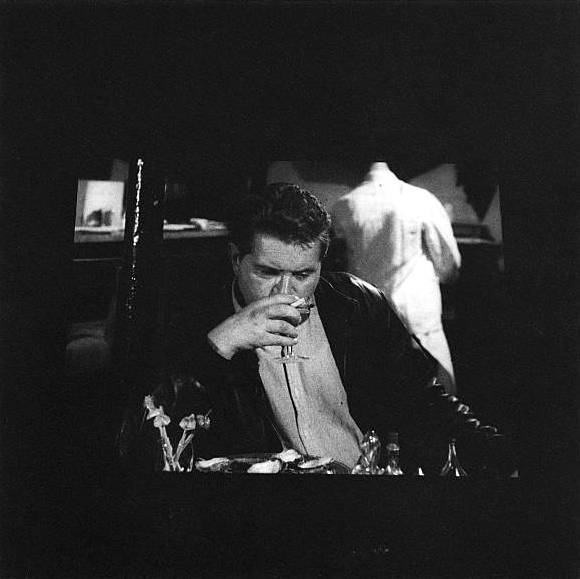
Francis Bacon, The Art Game, London 27th August 1958
Painters of despair driven to distortion
The juxtaposition of Francis Bacon and Picasso in the Tate’s rehang should jolt us into
recognising deeper truths about both artists, argues FRANK WHITFORD
FRANK WHITFORD | ART | THE SUNDAY TIMES | SUNDAY 8 JANUARY 1995
In May 1962, only days after the opening of a Francis Bacon retrospective at the Tate Gallery, Peter Lacy, one of the artist’s lovers, died of drink in Tangier. Soon after, Bacon had dinner with the poet Stephen Spender, who, noticing how gloomy he seemed, asked him why he had never expressed his feelings for Lacy in any of his paintings.
“He said that certain friends were too beautiful to distort—and he had always distorted. I said Picasso had painted pictures of Dora Maar ... He said: ‘The paintings of Dora Maar are distorted.’ I said: “That’s what I mean. You can also distort to do a beautiful painting.’ ”
Perhaps Stephen Spender’s journals are required reading at the Tate. For, as part of the gallery’s rehang (an annual feature of its programme since 1990), Bacon’s first masterpiece, Three Studies For Figures At The Base Of A Crucifixion (1944), has been hung next to Picasso’s equally celebrated Weeping Woman (1937), the splintered and distorted portrait of Dora Maar that Spender obviously had in mind.
These paintings form part of a display called Art At Mid-Century: Existence And Expression, which also includes works by Kokoschka, Giacometti, Sutherland and Paolozzi , all of them supposedly expressive of the anxiety, cruelty and despair of what has already come to seem like a distant period.
Stephen Spender thought the Weeping Woman beautiful. In fact, it is anything but. Picasso cruelly caricatured the grave, handsome features of his mistress, took them apart and reconstructed them to create a lurid image of grief. The crude black outlines, stark simplifications and acidly garish colours assault and irritate the eye. The mood of the painting is also ambiguous. Neither loving nor tender, devoid of any evidence of sympathy, the accumulated graphic hyperbole hints at mockery in the midst of pain. The festive little hat seems especially ridiculous, inviting a covert snigger at the way misery has contorted a usually pretty face. It was driven to distortion, not the first time Picasso had done violence to the image of a wife or mistress at a moment of emotional crisis.
Picasso was one of only three contemporary artists Francis Bacon had any time for. (The others were Giacometti and Duchamp.) His debt to Picasso was considerable, and in Three Studies it can be sensed in the bloated bodies of the terrifying creatures writhing and snapping against the bright vermilion background. These, as Bacon admitted, were partly derived from the strange, savage and beached beings that Picasso drew and painted in the early 1930s.
No matter how transformed, distorted or rearranged, however, Picasso’s figures always remain recognisably human. In Bacon’s Three Studies, on the other hand, the anatomical details — the ear, the lips, the teeth — heighten the inhuman characteristics and nightmarish appearance of the creatures.
The expressive force of the Weeping Woman derives from a sharply fractured geometry. Bacon’s deformations never destroy the sense of an organic whole. Neither rearrangements nor exaggerations of the familiar, they are revolting miscegenations, monstrous hybrids of eel, fowl and reptile. The Weeping Woman’s face is twisted by her emotions. The bodies and mouths of Bacon’s monsters are hatefully contorted by blind instinct. It is customary to relate both the Weeping Woman and Three Studies to their historical backgrounds. The Picasso belongs to the period dominated by the Spanish Civil War, the Bacon to the last year of the second world war. The, woman therefore weeps for Spain, while Bacon’s monsters are the tormentors of Auschwitz and Treblinka. But Bacon always denied that his work had such contemporary relevance, and Picasso’s imagery, too, is usually as private and personal as Bacon’s.
The Weeping Woman was one of a series of similar paintings made in the same year as Guernica, Picasso’s huge composition that was provoked by the devastation of a Basque town. However, usual though it is to see Guernica as a cry of grief .and outrage at the fate of Picasso’s homeland, it is, like the Weeping Woman, decidedly ambiguous. Shorn of its title, Guernica’s meaning is vague. It has as much to do with Picasso’s personal and artistic turmoil as with the barbarity of war.
During the 1930s, Picasso’s life was certainly in turmoil. The sudden switch from voluptuousness to violence that occurred in his work at. the time clearly reflects complications in his personal circumstances: His estranged and vengeful wife, Olga, was suing him for half his property; his young mistress Marie-Thérèse Walter had given birth to a daughter; and he had fallen in love with the photographer Dora Maar.
Cosmopolitan, intelligent, well-educated, earnest, politically committed and irascible, Dora Maar was, according to Picasso, one of the few women he could talk to. She was quite unlike the placid and pliant Marie-Thérèse. Studies for Guernica that Picasso made while visiting Marie-Thérèse are gentler than the others made in his studio while Dora was talking politics and photographing the work in progress. The atmosphere frequently crackled with emotional electricity. As Picasso’s biographer John Richardson wrote: “Even in the earliest portraits of Dora one senses that a struggle to the death has broken out between this highly strung intellectual beauty and her demonic lover. Once again Picasso’s manipulation of his mistress’s life parallels his manipulation and redistribution of her features.”
Bacon’s Three Studies is also mistakenly thought to reflect its godless and brutaiised times: First exhibited in April 1945, the triptych had a powerful effect on all who saw it. It repelled and fascinated in equal measure. John Russell, later art critic for The Sunday Times, recalled that “visitors were brought up short by images so unrelievedly awful that the mind shut up with a snap at the sight of them”. Bacon’s figures reminded Russell of the “creatures who gather as ghouls round any scene of human degradation: April 1945 was to see a whole parade of them before the body of Mussolini as it hung from a butcher’s hook in the suburbs of Milan. Hitler’s bunker had its share, of them in May, and with the liberation of Belsen and Dachau in June they were revealed as what they really; are — not ‘monsters’ in the old fancydress sense, but uniformed respecters of the law, champions of order and due form, servants of Power, and Interest, and Things As They Are.”
At the time, such parallels must have leaped irresistibly to mind, and they have recurred in every discussion of Bacon’s art ever since. Yet knowledge of the artist’s life and attitudes raises suspicions, that current events were the last thing on his mind. What is conventionally seen in Bacon’s imagery as the expression of nothing less than the human condition was, in fact, usually prompted by his sexual fantasies. For him, the war (which he had contrived to avoid by aggravating his congenital asthma) was less about the struggle between Fascism and democracy than a welcome opportunity to cruise the blacked-out streets of London in search of potentially fatal escapades in what he described as “the sexual gymnasium of the city”. For Bacon, war daily and thrillingly confirmed the truth of his only real conviction: that the natural condition of the world is mindless and aimless; that we are futile beings, nothing more than “meat, potential carcasses”. War worked on the rampantly promiscuous homosexual masochist to create a state of “exhilarated despair”.
Somebody will eventually interpret Bacon’s imagery fully in terms of his psychosexual biography. It is already clear that Muybridge’s timelapse photographs of naked male wrestlers, the full-colour close-ups of diseases of the mouth, and the photographs of Himmler, Goebbels and Adolf Eichmann that Bacon pinned to his studio wall were used as sources for his imagery not because of their aesthetic charge, but because they were sexually arousing. Bacon’s bleak and brutal view of human existence was inseparable, then, from his sexual preferences. He found the horrific beautiful, despair and revulsion exhilarating. His favourite line of poetry was from the Oresteia of Aeschylus: “The reek of human blood is laughter to my heart.”
It is disconcerting to discover that so many people see universality in Bacon’s feverish fantasies. Perhaps the events of this century have indeed justified the fear that the scarcely imaginable, abnormal and amoral have established themselves as the norm.
The Weeping Woman and Three Studies are separated by only eight years. Both sprang-directly from die emotional lives of their makers. But they inhabit different worlds. The Picasso belongs to a period in which art’s effectiveness as the embodiment of ideas and the vehicle of universal feelings was unquestioned. It is the work of an artist who believed he had the power to transform the world and did so in every painting. The Bacon, on the other hand, was the product of hopelessness, the creation of a man who saw himself as no more than the sum of his drives and urges. When he talked to Stephen Spender, Bacon was being disingenuous. All his work was inspired by what he perversely considered beautiful. His distortions were not distortions at all but terrifying, thrilling reality.
New Displays at the Tate Gallery, sponsored by British Petroleum, opens on January 31
THE DIARY ROSS BENSON
Bacon is back, larger than life
ROSS BENSON | ASIDE LINES | DAILY EXPRESS | FRIDAY JANUARY 20 1995
VISITORS to the Tate Gallery who peer at Francis Bacon’s Three Studies For Figures At The Base Of A Crucifixion will soon be able to listen to the champagne-swilling artist’s explanation of how he created the disturbing work.
Remarkable, considering he has been dead for nearly three years. But boffins at the Tate have doctored an old interview with him. Art lovers can call up on a mobile phone and listen to the Bohemian genius chat away as they examine his work. This is an improvement. In life hardly a word could be winkled out of him as he propped up the bar of Soho’s French House.
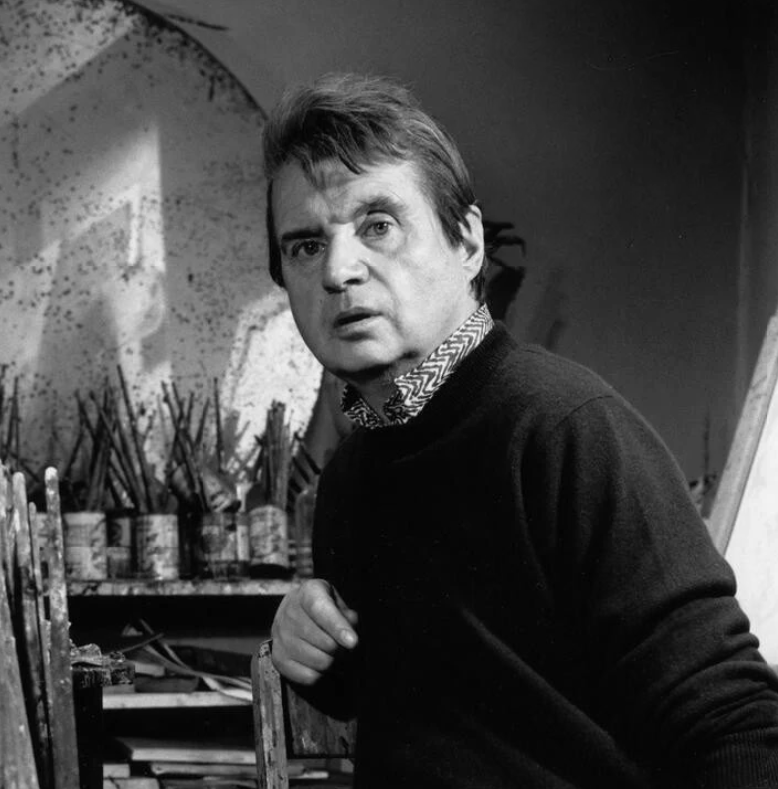
Francis Bacon
Top artist’s work goes on show at Rozelle
WEEKENDER PLUS | THE AYRSHIRE POST | SCOTLAND | FRIDAY, JANUARY 27, 1995
AYR art lovers will have an opportunity to see a major work of an artist acknowledged by many as the greatest British artist of the 20th century next month.
Francis Bacon’s arresting 1957 painting of Vincent Van Gogh is the latest in a series of Spotlights, which focus on key works from works from the Arts Council Collection.
Spotlight on Francis Bacon forms the part of the BT supported National Touring Exhibitions programme.
It opens in Ayr’s Rozelle Gallery on Saturday week (Feb 4). Bacon, who died in 1992, has since been the subject of many major exhibitions and several books and films.
He was fascinated by Van Gogh. His Study for the Portrait of Van Gogh VI is the last in a series of six paintings completed for an exhibition in the Hanover Gallery in 1957.
This will be the major piece in the exhibition. The show studies the artist's approach and working methods in relation to this particular work. It will close to the public on March 18.
FRANCIS BACON: SELF-PORTRAIT, 1972
BY MARIANNE WIGGINS | THE ART NEWSPAPER | VOLUME 33 | NUMBER 7 | MARCH 1995
Asked what I could look at, never tiring, for as long as I am blessed with sight, I might, without reflecting, answer, The night sky above the Sinai desert—but on second thought I’d have to say, The face of one I love.
The human face is my favourite landscape. If you know the face you’re watching, know it well, it cannot not show you the unseen, cannot not display devotion, pain, anxiety, its trust. Where else, on what other fabric, can you behold the shape of love, the shade of fear, the colour of despair that’s not your own? What does love look like? Love looks like the face of the beloved. What does pain look like? It looks like someone in pain. The seen landscape of emotion draws on the human body and, most poignantly, because of parts achieving their expressiveness in combinations, on the face. A stranger can communicate the story of his life while sitting on a bus across from you, speaking not a word.
I first saw Francis Bacon’s Self-Portrait—one of his many—at the Marlborough Gallery in Albemarle Street in London, the year after he died. I hadn’t seen a Bacon exhibition since his one-man show at the Tate in 1985, which was my first introduction to the breadth and scope of his work. Then, one afternoon nine years later, my daughter and I came across a retrospective of his small portrait studies at the Marlborough Gallery. My daughter remarked that she’d always found him violent, and I knew I had to take her inside so she could see what he could do, and always did, with torment and with pathos. And there it was, this little gem, 14 by 12 inches, bearing sweetness through the paint. The round, almost neonatal head seemed to have been delivered into life before being entirely formed, the eyes like golems’ eyes, the lip, perhaps, still tasting of the womb.
My daughter Lara and I stood before it, speechless. How and when and where one has these encounters—personal encounters, that is—with works of art are as much a part of the experience, and of the memory of it, as the art itself is. Bacon had only recently died, and in the weeks after his death British television had been awash with every prerecorded documentary on him they could rewind. He was, after all, the greatest painter England had squeezed from her green and drab since Turner. Bacon wasn’t just the best float in the parade, he was the parade. And the route he took was plotted over minefields, into walls, wherever he spotted a sign that warned NO TRESPASSING, or PRIVATE PROPERTY.
He was, I think, the most un-English English painter (he was born in Dublin), although Turner shoulders with him for ferocity. The English swallow Turner whole—but they don’t quite know how to slice their Bacon. He was a homosexual and an alcoholic, and, unlike David Hockney, he did not decamp to better light—he lived in digs in South Ken for most his painting life. Unlike Hockney, he attacked the institutions that are the four cornerstones of English life—class, connubial pretense, conformity, and Christ. His face was never pretty, nor was his talk. He had a pugilistic jowlishness that seemed to brag that it could go ten rounds, and had. His conversation veered away from anything that sounded show-offy or chatty. He looked like someone who had trucked with rough trade, truculently; someone who had recognized genius as a scar that never heals; someone marked at birth to live away, somewhat, from others, even those he loved.
Yet when it came to using his own hand to paint the face that he knew best—his own—he was capable, in this one instance, of painting what he’d lost, of painting who he’d been before he ever painted. That’s what this portrait is, not of a man but of a boy, not of wisdom gained but of innocence traduced, not of rage but of a sorrow that is ageless.
Kray burial an East End affair
London’s crime world will pay its respects writes Tim Miles
TIM MILES
RONNIE Kray, the convicted gangland killer, is expected to be buried in the same cemetery as his mother Violet and his father Charles — and his funeral is likely to bring a large area of East London to a halt.
Kray, 61, a paranoid schizophrenic, with a history of heart problems, died in Wexham Park Hospital, Slough, Berkshire, on Friday after suffering a heart attack, brought on by cigarette smoking.
The Prison Service said Ronnie’s twin Reggie, who is in Maidstone jail in Kent, had been told of the death. The funeral may give Reggie a brief taste of freedom. The twins were allowed out of jail to pay their last respects 13 years ago when their mother was buried. But permission was denied the following year when their father died.
The cemetery in Chingford, East London, is likely to see the biggest concentration of London’s underworld, many of them now in their dotage, since last year’s funeral of train robber Buster Edwards. Kray collapsed three days ago in top security hospital Broadmoor, where he was held with some of Britain’s most dangerous men including Yorkshire Ripper Peter Sutcliffe.
A post mortem examination conducted by Dr Mufeed Ali, pathologist at Wexham Park and Heatherwood Trust Hospitals, gave cause of death as natural causes, police said. Dr Ali said: “The heart attack was due to smoking.” There were reports that Kray smoked up to 140 roll-ups a day. “There was damage done to his coronary arteries. He must have died instantly but he must have been in some pain,” said Dr Ali.
The Kray twins ran a brutal gang in London’s East End during the late 1950s and 1960s which netted them a fortune and allowed them to live a life of luxury. They were local celebrities — liked by some, feared by many.
They particularly relished being pictured with national and international celebrities, often being photographed with them at nightclubs. They included Hollywood showbiz legends such as Judy Garland, Diana Dors, politicians like Tom Driberg, later Lord Bradwell, and world heavy weight boxing champions Joe Louis and Sonny Liston.
The brother’s power and liking for sharp foreign suits earned them a place in the portfolio of photographer David Bailey.
His menacing portrait of the icons of designer violence has possibly become the most famous picture of the pair. The late Francis Bacon, painter of screaming, tortured faces, who gambled at the Krays’ club in London’s Knightsbridge, said Ronnie Kray’s face was the most frightening he had ever seen. He meant it as a compliment.
Ronnie, the elder of the twins by 45 minutes, was convicted at the Old Bailey for the murder of George Cornell. Kray, a homosexual, shot him in the Blind Beggar pub in the Whitechapel Road, east London, after Cornell called him a “fat poof”. Reggie Kray was convicted for the murder of Jack “The Hat” McVitie. Ronnie, who was present, was also convicted of McVitie’s murder.
Additional reporting Teilo Colley and Tim Moynihan
Bacon portrait settles £680,000 tax demand
BY JOHN SHAW
A PAINTING by Francis Bacon has been given to the nation in settlement of £680,000 inheritance Tax on his estate, it was announced yesterday. Study for a Portrait, an oil on pastel, was painted a year before the artist died in 1992. Christie’s, which negotiated tile deal, said the 78in by 58in painting of a man with a camera-tripod showed the British artist at the height of his artistic powers in his later years".
Bacon is widely represented in public collections and since his death his work has been the subject of several retrospectives. The auction record for Bacon was set by a triptych which made £3.7 million at Sotheby’s in 1990. A portrait sold for £3.6 million at Christie’s in 1989.
The portrait is one of 27 works of an accepted in lieu of tax totalling £6 million in 1994-95, compared with 18 works the previous year. The acceptance in lieu procedure has saved many items from going abroad. It is administered by the Museums and Galleries Commission on behalf of the Government Peter Longman director of die commission, said: “This has been a year of considerable progress for the scheme, which we have been running for ten years. We are delighted with the number of items that have been accepted. with the wide range of objects involved and the wide variety of institutions which have benefited."
Under the procedure, Chagall’s L’Artiste dans son Atelier and Magritte’s La Condition Humaine go to the Castle Museum, Norwich. They settle tax of £665,000 on the estate of Lady Adeane, a notable benefactor of the arts in East Anglia. The studio of F. E. McWilliam and its contents have been given to the local authority at his birth place, Banbridge, Co Down, where they will form the nucleus of a sculpture centre.
Six studies by Naum Gabo will be presented to the Tate Gallery in settlement of £979,616 tax. Chattels at Nymans House at Handcross, West Sussex, have been accepted in lieu of £177,500 tax and will enable large portions of the house to be opened to the public. The property, best known for its garden, is owned by the National Trust. A silver gilt wine fountain, in settlement of £770,000 tax, stays in situ at Calke Abbey, Derbyshire, another National Trust property. A rare silver kettle with stand has been given to the National Museum of Wales.
Also taken in lieu of tax were paintings and drawings by Turner, Klee and Picasso, two archives of historical papers, a library of books on Islamic pottery, and the contents of country houses in Grampian and Derbyshire.
BY
CAROL VOGEL
The usual suspects packed Sotheby’s salesroom last night for the first important art auction of the spring. While the audience looked the same as it always does, the crowd of dealers and collectors, art experts and auction-house groupies who came to watch and to bid on contemporary art didn’t act the same. Hadn’t they taken their vitamins? Bidding was cautious, if not anaemic. But the auction still managed to total a respectable $13 million, not far below Sotheby’s estimate of $15.7 million to $22 million. Of the 46 works offered for sale, 36 found buyers.
Still, caution seemed contagious last night. For the most part, works tended to sell for around Sotheby’s estimates. Francis Bacon’s Portrait of Henrietta Moraes on White Ground (1964), depicting one of the artist’s favourite models reclining on a bed, went to an unidentified American buyer in the front row for nearly $1.4 million, right in the middle of Sotheby’s estimate of $1.2 million to $1.8 million. The price must have been right. In London last June, Christie’s tried to sell a Bacon with an estimate of $3.1 million, but the painting, Study of a Portrait of Pope Innocent X by Velazquez (1959), didn’t elicit a bid.

Portrait of Henrietta Moraes on White Ground (1964)
Wanted! Your war memories
THIS WEEK
Sewerby Hall is currently playing host to a massive masterpiece by artist Francis Bacon.
The 6ft by 4ft work of Van Gogh has been brought to Bridlington as part of a national tour to highlight the Arts Council Collection.
When he died in 1992 Francis Bacon was acknowledged as the greatest British artist this century and his work will be on display at Sewerby Hall until June 15.
Mr Adams said: “People will be shocked by it. It s a major coup that I have brought it here.”
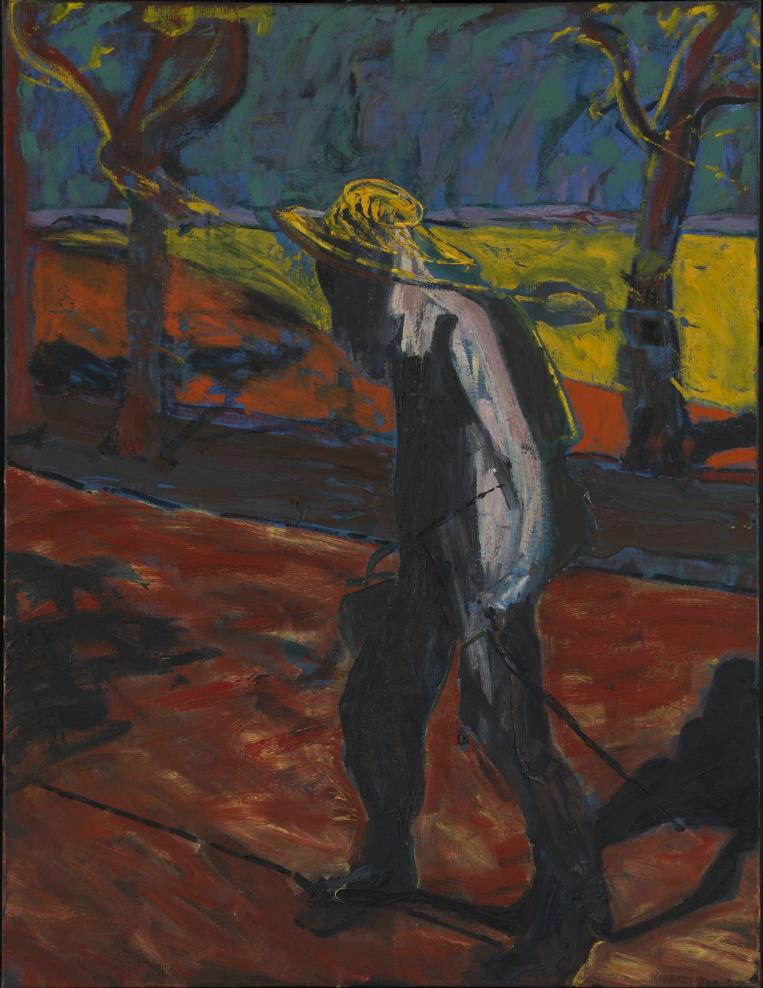
After your memories — Museums officer Nial Adams in front of the work by Francis Bacon.
A strong British presence in Venice
William Packer reports from the Biennale, which
celebrates its centenary this year
WILLIAM PACKER
With this its 46th multinational jamboree of visual art, the Venice Biennale celebrates the centenary of its inception in 1895. The British have been heavily involved from the very first, only in 1920 failing to take part in peace time. It was not until 1930, however, that the British government took this major exercise in its official wing. In 1938 the then newly-formed British Council took over the direct responsibility which it has continued to administer with remarkable distinction ever since.
In the years before 1914, participating nations began putting up their own pavilions in the gardens in which the Biennale is held to house their individual national contributions. The British presence has always been considerably enhanced by the pavilion we acquired from the Municipality of Venice in 1909. With its flight of steps leading up to its colonnaded terrace, this charming neo-classical building sits happily on the highest point of ground in Venice and commands one of the principal avenues in the gardens. Lately restored and extended by the British Council, it is now as well set up as any of the pavilions.
In this, of all years, it was particularly important that the council should get its choice of artists to fill this, its flagship, absolutely right, and I have to confess that when I heard it was to be Leon Kossoff I had my doubts as to the quality of the work. He is one of the best painters now working in England. But it seemed to me that at nearly 70, he might reasonably have been shown at Venice long ago, and that in the hurly-burly of this particular Biennale, with all its high-tech and multi-media installation, and self-conscious engagement with the experimental and avant-garde, such deeply wrought and personal work, as Kossoff’s unquestionably is, might simply disappear.
I am happy to say that I could not have been more wrong. By standing back from the Biennale with its transient values, Kossoff strikes a real blow for something more permanent. For here there is no reliance on mere technology, with its easy theatrical frisson and self-important greed for space and material. With Kossoff we are back with the artist working directly with his material making his painting in direct relation and emotional response to the real and visible world. If that is old-fashioned, then I would there were more of it to be found at this, or any Biennale.
It is certainly hard to find any young artist promoted in such a context who is putting paint on canvas at all, let alone with such raw commitment, risk, and adventure. Kossoff has won no prize for that, but his work stands strong and independent within the great tradition of western expressionist painting. More than that, he emerges at last on to the international stage as an artist of true stature and authority, finally free of inevitable comparison with his peers of the so-called London School – Auerbach, Bacon, Freud, Kitaj.
This group, along with Hockney, indeed establishes a strong and central presence in the post-war section of the show curated by Jean Clair at Fiat’s Palazzo Grassi in the city itself, as part of the Biennale. It rejoices in the title of “Identity and Alterity – Figures of the Body 1985 to 1995” and engages with the multifarious ways in which modernism has dealt with the human figure. More of that in a further review, but the good news for the moment is that, though included as an American artist, it is for his contribution within that historic British context that Ronald Kitaj has been awarded the Biennale’s prize for painting. The four full-length portrait figures shown were painted between 1976 and 1984, and are certainly among the very best he has done.
The British Council’s other initiative for this Biennale has been to take over the Scuola di San Pasquale, close beside the church of San Francesco della Vigna, in order to present the young British artist, who otherwise would have been included in the Biennale’s own international Aperto for young artists, which this time was called off. Here there is no painting within the meaning of the act, but lots of multi-media installation and projection, blood and guts, all well enough done and true to what young artists do these days. It goes collectively by the name of “General Release”, and is certainly in accord with the spirit of the Biennale at large. “Great Deeds Against the Dead” by Dinos and Jake Chapman is a gruesome life-size re-working in three dimensions of an image from Goya’s etchings of the horrors of war, and “Sargassum” by Dalziel and Scullion, a large muzzling contrivance, shimmers prettily like a free-standing mass of water in the gloom. Elizabeth Wright has miniaturised the telephone directories of Venice, Milan and Rome and Douglas Gordon plays a video-tape of the treatment of an hysterical woman as it was practised 100 years ago. Most elegant of all is Cerith Wyn Evans’s “Cleave” with bonsai trees back-lit by neon inscriptions – almost illuminating.
The Venice Biennale continues in the Giardini Pubblici and at other locations until October 15.
London label doesn’t stick
John McEwen on ‘From London’
JOHN MCEWEN
THE paintings of Auerbach, Bacon, Freud, Kitaj, Kossoff and Michael Andrews are so frequently exhibited these days that From London at the Scottish National Gallery of Modern Art, Edinburgh (until September 5), which combines them all, hardly makes the pulse race. But if this year’s Festival offering of imported contemporary art could have been more original, it does at least give a Scottish audience the chance to evaluate the most promoted painters in Britain.
This is a British Council touring exhibition destined for the Continent and represents the biggest push yet to establish these artists as an art-historical movement — the “School of London”. The School of London was first mooted 20 years ago by the late Lawrence Gowing. Critics long to invent a catchphrase and, after the “Ecole de Paris” and the “New York School”, why not cash in on the success of Francis Bacon and Lucian Freud by lumping them together with a few of their friends as a London-based true-to-figurative-art group? The American R. B. Kitaj, odd man out of this assortment of European exiles, endorsed the idea to the extent that he is now credited with its invention.
This show reveals what a kite-flying operation the whole thing has been. As a label it just will not stick. The slogan is dreary, the concept false, the result disagreeable. It both undermines the distinction of Bacon and Freud and overvalues the others at the expense of a number of their contemporaries. Nothing unites these artists except social acquaintance and an avoidance of pure abstraction; and the two do not add up to a movement.
The intensity of Bacon and Freud sets them in a class apart. Bacon is inventive and imaginative, his work already an epic metaphor for our troubled time. He tackles a hard subject, the sensation of reality. Freud is also a realist, but more conservative and narrow, though with him, too. an epic symbolism can emerge. He restricts himself largely to studio portraiture. He and Bacon are nevertheless kindred spirits and were once the closest friends.
The rest are mannerists to a man, style always upper-most. This particularly applies to the ever-changing Kitaj and those Angst-ridden builders of surfaces, sentimental Kossoff and his more strident counterpart, Auerbach.
Andrews is the only Englishman, and it shows in his placidity and lack of anguish. A gentle taste for romantic landscape has come to dominate his art. New paintings by him and Freud are the selling point for jaded southern visitors. The elegiac and mysterious Thames Painting: The Estuary is one of Andrews’s best for a long time.
In a class of their own
William Feaver draws the distinctions among
the artists of THE LONDON SCHOOL
WILLIAM FEAVER
The notion — or proposition — of ‘The School of London’ was RB Kitaj’s and the more he thought about it the more he liked it. This is how it went. Pre-War Ecole de Paris (Bonnard, Matisse, etc). Post-War: School of New York (De Kooning, Rauchenberg etc). And now (he was writing in 1978), just think: ‘a substantial School of London in England, in Europe... with potent art lessons for foreigners emerging from odd old, put-upon singular place.’ The spunkiest lesson being that it’s good to paint and especially good to paint people and circumstances. ‘Don’t listen to the fools who say either that pictures of people can be of no consequence or that painting is finished.’
It had been obvious to Kitaj that in London there were painters of unique distinction, half a dozen at least, maybe a dozen. No other city in the world could boast such a bunch. Even if the ‘School’ was a conceit, a coincidence, nonetheless there it was. And there it is. From London, organised by the British Council and Richard Calvocoressi of the Scottish National Gallery of Modern Art, showing first in Edinburgh, then in Luxembourg, Lausanne and Barcelona, includes those most readily identified as School of London: Francis Bacon, Lucian Freud, Leon Kossoff, Michael Andrews, Frank Auerbach and Kitaj himself. The selection does them proud Those who maintain that art has moved beyond the Paint Age may well be shocked at such inventive variety, such a wonderful concentration of painterly intelligence.
Art historians feel obliged to question the validity of ‘School of London’ and are eager to consign it to history. But the exhibition is no more tied to the School concept than it is to a past period. It’s open minded. The paintings done since Bacon’s death in 1992 are some of the finest. And yet the earliest here, Freud’s 1942 picture of an unnervingly rat-like Essex boy sitting in front of a stash of even earlier Freuds, distinctly anticipates Freud’s handling of flesh 50 years later. Another surprise: Bacons go well with Kitajs.
Calvocoressi has arranged the paintings more or less chronologically as a succession of group and one-man shows. This brings out shared attitudes and significant differences. Bacon becomes ever more the practiced chancer, Kitaj the practiced mixer, chancing his arm at a sort of multiplex story-telling. Auerbach and Kossoff, emerging from the jeremiadic influence of Bomberg, rapidly diverge, Kossoff playing the paint close to his chest, Auerbach going in for dramatic conclusive gestures.
Auerbach and Kossoff are often said to be Expressionists but they are no such thing. They are accused of paint abuse, the victimisation of sitters and the battering of Willesden and Camden Town. This is nonsense. Each, in differing ways, works the face, the façade or broader prospect using paint as very much a provisional medium untill allowed to harden.
Kossoff apostrophises the portals of Christchurch Spitlafields. Auerbach, in a balcony seat in the Gaumont Camden Town in 1963, enjoys the teeming brown fug of a capacity audience beneath the electric blue screen. He makes Mornington Crescent in the Sixties as grand as almost as the Place de la Concorde then, in the Eighties, a splendid gulch. Expressionism is always a matter of styling; Auebach and Kossoff don’t style. They describe, passionately.
With Bacon it was always a toss up between archetypes and stereotypes, between striking originality and mere expressionism. He made a fetish of exasperation, brilliantly in Figure Study 1, 1946, where the tweed overcoat laid over a rump is left half unherringboned. Why bother finishing it off?
Incompletion, to Bacon, was almost as good as defacement. A gobsmacked Pope registers disbelief; a befuddled image of the painter is jammed on to a sofa like a cross hot dog. Portrait of a Man Walking Down Steps, 1972, puts a fury of despair into the frame a stumbling and grabbing for balance on stairs reduced to slats.
Freud’s concentration, early on, looks unadventurous compared to Bacon’s panache. Later, it becomes phenomenally powerful and comparisons with Bacon die away. The stunning detailing of Girl with Roses, 1948, is superseded by the palpable flesh of paintings from the Seventies, such as Night Portrait in which the limbs lie in fine abandonment on a puckered quilt. Cut to the view of a patch of wasteground in Paddington, a small desolation of rags and mattresses with the backs of buildings standing round, windows staring.
Where Freud is insistent, Michael Andrews is apt to leave questions in the air. Every painting of his is a deliberation brought to a point where to continue would be a bit much. Hence the masterly sketchiness of John Deakin’s trousers. Andrews brings sublimity to the exhibition. His white balloon with smudges for passengers drifts over a muzzy green landscape and it only gradually becomes apparent that we too are in a balloon basket, peering over the rim. Another painting in his Lights series has us looking down on a pier resting lightly on the calm sea in a heat haze, and people strung along the the tide-line barely more than shadows.
A roomful of new paintings serves as a recap while making it obvious that ‘School of London’ is a term that still applies. Auerbach’s The Studios is concerned with getting there every morning, down the alley under a freshening Camden sky. Head of David Landau is an exemplary Auerbach: so knowledgeable and, after much effort, so suddenly achieved. The most recent Freud (he’s currently working, incidentally, on a head of Kitaj) is Girl Sitting in the Attic Doorway: Nicola perched high above eye level in a corner of the studio. A pose that favours the toes. Besides the warmth of the flesh tones against raw plaster there is the strange-but-true quality common to all the best Freuds. She could have hatched from a cuckoo clock. She could suddenly decide to take a dive.
Michael Andrews’ Thames Painting: The Estuary, completed a few months ago, synthesises with absolute originality all manners of painting. We are once again looking down, this time on stained, silted, encrusted canvas, on foreshore, jetty and clouded waters. Boats are moored, half a dozen men are positioned with fishing rods or just staring out to an unseen horizon, and there is an air of land dissolving, tide creeping, insubstantially finally pinned down.
The great thing in painting, Andrews once remarked to me, is to achieve illusion. There are ghosts present in this marvellous picture. Turner phantoms, Degas characters, Sickert’s old lags. It’s blowing cold, mist muffling the river mouth in this ultimate proof of the existence of the singular ‘School of real London’.
From London to 5 Sept, Scottish National Gallery of Modern Art Edinburgh (0131-332 2266)
Iain Gale on exhibitions
IAIN GALE | EXHIBITIONS | SECTION TWO | THE INDEPENDENT | FRIDAY 21 JULY 1995
What is it about the “school of London” painters – Bacon, Freud, Andrews, Kitaj, Kossoff and Auerbach – that makes them such abiding sources of controversy? Together, in Edinburgh, they make compelling viewing: grand old men forever known by their youthful achievements. Seen apart, though, they continue to provoke. Last year we had Kitaj’s vilification at the Tate; more recently, Kossoff’s Venice Biennale show moved the critics to extremes of adulation and dismissal. Now, Frank Auerbach’s spirited old-Master-inspired exhibition at the National Gallery looks set to elicit similar responses of indignation and eulogy.
It is hard to imagine a better contrast to Auerbach’s long-standing love-affair with paint than the Tate’s new display of recent acquisitions, in which (pace Lisa Milroy) there is hardly a brush-stroke to be seen. But, if you are tempted to adopt the classic “Outraged of Tunbridge Wells” stance, remember that much ofthe budget for contemporary work comes from the pockets of the Patrons of New Art (instigators of the Turner Prize), and so is not “public money” but, as Nick Serota once cheekily reminded Margaret “that’s not art” Thatcher, “a gift”.
With that in mind, it becomes harder to knock the inventiveness of Hirst, Whiteread, Opie and their ilk, whose work, seen in the context of the international “Rites of Passage” show in the next gallery, has much to say for British art today.
'From London: Six British Painters', Scottish National Gallery of Modern Art, Belford Road, Edinburgh (0131556 8921) to 5 Sept.
Lucian Freud, Francis Bacon and Frank Auerbach were all members of the School of London
– but in reality this was little more than a boozing club. By Iain Gale
IAIN GALE | ARTS AND BOOKS | INDEPENDENT WEEKEND | SATURDAY 22 JULY 1995
“Hello, cunty! Christ – you here again?” The words ring out shrilly across the smoke-filled bar. Although only four o’clock on a sunny afternoon, the curtains are drawn, divorcing this room from the outside world; making it, for all its foul, hurtfully acerbic language, a haven whose inhabitants are “members only”. The owner of the voice, and the bar, a severe, elegant, dark-eyed little woman perched on a stool by the door, is Muriel Belcher. Here, at the Colony Room, she presides over a drinking club which, although its decoration might be stained carpets, fake leopard-skin seats and bamboo, it can now, during the Fifties and Sixties, boast as glittering and talented a clientele as any Paris salon of the 1890s. Not least, it is spiritual home to the artists of the future “School of London”.
The painters of the School of London, currently featured in three major exhibitions, were never a school in the art-historical sense, but a group of artists based in London who found in each others’ company solace from the soul-numbing intensity of their art. As a term, it was coined only in 1976 by one of their number, the recently vilified American-born painter RB Kitaj, writing in the catalogue for The Human Clay, his curatorial debut. Kitaj’s selection of artists, united by an interest in the human figure, encompassed others including David Hockney and Howard Hodgkin and it has taken several subsequent exhibitions and curators to reduce his “10 or more people” to the present sublime sextet which with himself comprises Francis Bacon, Lucian Freud, Frank Auerbach, Leon Kossoff and Michael Andrews. Today, the work of these artists, apart perhaps from that of Kossoff and Auerbach (friends since 1948 whose paintings still exhibit a shared debt to the teachings of David Bomberg in the early Fifties), reveals few lines of parallel thought. For a brief moment, though, in the late Fifties and early Sixties, these artists were in a sense united, not, as some would have it, as an art movement, but in a demi-monde centred on two unique venues and the extraordinary women behind them.
Muriel Belcher, a Birmingham-Jewish bi-sexual from a theatrical family, had opened the Colony Room in a first-floor room in Dean Street on 15 December 1948 as an antidote to the absurd licensing laws. Bacon, the 39-year-old painter who had recently shocked the public with Three Studies for Figures at the Base of a Crucifixion, was quick to find his way there. Immediately, Muriel, with an eye for someone who, although he could not afford much himself, might draw good punters, offered him £10 a week and free drink if he could drum up custom among his friends. Bacon, who had expensive tastes in gambling and champagne, warmed to the offer, and the artists and patrons began to arrive. Early visitors included the painters John Minton, Edward Burra and Keith Vaughan and the two Roberts, Colquhoun and Macbryde.
“It’s a place,” said Bacon years later, “where you can lose your inhibitions.” What he and his fellow artists relished most about the Colony was the atmosphere, which the writer Colin Macinnes described so well as “the futile fascination of forbidden fruit; the heady intoxication of a bogus Baudelairian romantic evil”. Another major attraction was that, unlike other private clubs, the Colony was not restricted to artists. Its clientele included aristocrats and MPs, policemen and villains, writers and actors. The only reason you were barred was if you were boring. Belcher was consistently outrageous, addressing middle-aged men as “miss” and almost being sued for it by the writer John Braine. Although when asked later by Dan Farson why the painters should have chosen to meet in her club, she replied, “I think it’s my charm, dear”, the greatest attraction of Muriel was her utter lack of interest in art. It was probably this, broadcast by Bacon, that drew the younger artists — Auerbach, Andrews, Freud and the now largely forgotten Tim Behrens. Muriel enjoyed their company, but their non-stop conversation was never about art. They spoke of sex, local and national gossip, their aspirations, gambling, and mostly, drink. Bacon would fill the glasses to overflowing with champagne while reciting his favourite toast — “real pain for your sham friends, champagne for your real friends”. Art was certainly evident — Michael Andrews painted a mural in 1957 in the style of Bonnard for behind the bar and immortalised the Colony in two canvases five years later. He painted Muriel, as did Bacon, and these works take their place among the frequent portraits this group of artist friends painted for each other. As a rule, though, Muriel’s was for play, not the serious business of art.
In the bar, as in the studio, each artist had a different routine. Freud would leave for home in the early hours of the morning and work until dawn. Bacon would stay to drink. Both could have been at Muriel’s since after lunch, which might have been at Wheeler’s, that other artists’ haunt which functioned almost as an ante-room to the Colony. Here, they ate oysters and dressed crab, washed down with chablis. Bacon would sign for this on his tab, arranging to settle up when he next sold a painting.
Those who fancy they see evidence of an artistic school in this bonhomie also cite the fact that apart from drinking together, the painters exhibited at the same gallery. The Beaux Arts in Burton Street had been taken over by Helene Lessore on the death of her husbands in 1951. Two years later, an impecunious Bacon was introduced to her by the critic David Sylvester. She bought a few paintings and gave him a show three months later. By 1956, she was showing Auerbach, the following year Kossoff and in 1958, Michael Andrews. A painter herself, she knew that when an artist was going through a bad patch, you had to help. She had a big heart and an unerring capacity to spot talent. It was Lessore who, in 1952, showed Bratby and the Kitchen Sink realists; it was Lessore who gave young hopefuls such as Craigie Aitchison and Tim Behrens their first break. She loathed the increasing commercialism of her profession, and when her gallery closed in 1965, she likened the new art world to the fashion industry.
Through all its years, the Beaux Arts Gallery, like the Colony Room, had no set identity. Most certainly, it was by no means the focus of any specific artistic impetus. They showed together and they drank together. That was the extent of the School of London. It is ironic that RB Kitaj, the only painter not to have frequented the Colony or shown at the Beaux Arts, should have been the one to provide the artists with their abiding label. Of course, by 1963, Kitaj had become a close friend of Bacon, Freud, Auerbach, Andrews and Kossoff, all of whom were by then showing at the Marlborough Gallery. Another undeniable link, not least from Kitaj’s much vaunted “Diasporist” viewpoint, is the abiding Jewish consciousness of Freud, Kossoff, Auerbach and Kitaj himself. In all these cases except Kossoff, an East Ender whose parents were from Russia, the artists were first-generation immigrants. Bacon, of course, was an Irishman.
Despite such links, the painters of the School of London are united on canvas only by a desire to express the gamut of human emotion and experience. It is as if to intensify this experience that they withdrew into the collective hermeticism of the Colony Room. Their are was about life, and at Muriel’s, they could see it all. They were, after all, just Muriel’s boys.
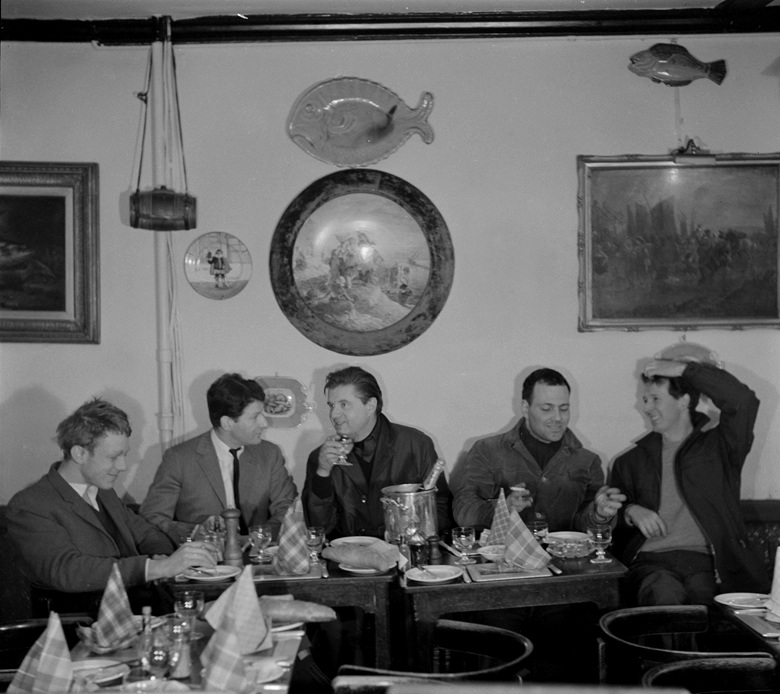
Main picture: Muriel’s boys (I to r), Tim Behrens, Lucian Freud, Francis Bacon,
Frank Auerbach and Michael Andrews at Wheeler’s. Photograph: John Deakin.
EDINBURGH FESTIVAL
Unofficial openings
The city’s galleries have had to go it alone.
By FRANK WHITFORD
FRANK WHITFORD | THE CULTURE | THE SUNDAY TIMES | 20 AUGUST 1995
Only jugglers, fire-eaters, pantomime horses, and an Andean folk group were entertaining the crowds on the Mound in Edinburgh last week. The absent clowns must have been otherwise engaged, justifying the festival’s attitude to the visual arts. It does not have one — other than the extraordinary belief that painting and sculpture have no relevance for this particular cultural jamboree. So, the only support the festival gives to art exhibitions is restricted to a laconically uninformative listing in the official brochure.
For the second year running, then, there is no official festival exhibition, and the visual arts have been relegated to the sidelines. Once again the chance has been missed to stage an important show integrated with the musical and theatrical programmes. More dispiriting still are the signs that the large and small institutions that independently organise exhibitions are no longer guided by a mutually agreed concept or policy. Short of funds, discouraged by their fringe status, they take what they are offered in the way of touring shows and loans.
I must, nevertheless, admit that this year’s offerings are varied enough to have something of interest for everyone. Those with a taste for the desperately contemporary will relish Maria Abramovic’s eccentric installations at the Fruitmarket Gallery (until September 9). Those who prefer the modern to be main-stream will enjoy the work of the five painters shortlisted for the Jerwood Prize (Royal Scottish Academy, until September 3). Admirers of the Scottish allegorical expressionist John Bellany will like his recent work at the university’s Talbot Rice Gallery (until September 10). Those who are intrigued by surveys of the unfamiliar will find From The Golden Age To The Present Day. Two Centuries Of Art And Craft In Denmark (until September 30) engaging , even though it is housed in the City Art Centre whose spaces look like the municipal offices they used to be. And, if you are excited by the exotic, you will make Power And Gold, featuring jewellery from Indonesia, Malaysia and the Philippines, at the Royal Museum of Scotland (until November 12), your first port of call.
The subjects of the exhibitions organised by the National Galleries are as disparate. The main building on the Mound contains three quite different shows. There are examples of Scottish painting lent by the Fleming’s Collection (Hidden Assets, until September 24); French drawings, some of them masterpieces, from the Prat collection (until October 1), and a scholarly display of art and documents relating to Canova’s Three Graces, the pristine and bloodless sculpture rescued from the clutches of the Getty Museum, and recently transported to Edinburgh (until October 8).
Meanwhile, the upper floor of the suffocatingly humid Royal Scottish Academy is filled with historical and contemporary photographs, one of them a tiny calotype by Fox Talbot of Canova’s Three Graces (Light From The Dark Room: A Celebration Of Scottish Photography, until October 15). In Queen Street, another equally trivial Canova connection is revealed. The neo-classical sculptor was a close friend of the Anglo-Italian Regency artist Maria Cosway, whose work, together with that of her better-known husband Richard, is being shown in a fascinating exhibition at the National Portrait Gallery (until October 22).
Each of these exhibitions has its appeal, and some are outstanding, but none creates the sense of occasion which the festival ought to demand. At least the National Gallery of Modern Art has a large number of first-rate paintings by some famous names to offer. The names — Bacon, Freud, Kossoff, Andrews, Auerbach and Kitaj — are associated with what has misleadingly become known as the School Of London. The term, invented by Kitaj. has more to do with public relations than art history or criticism, since the members of the supposed school are linked by little more than a shared (and once unfashionable) interest in figuration and intermittent friendships. Some of them have painted portraits of one or more of the others, but their styles are quite different.
Kitaj’s brighlly coloured and sparingly painted allegories have nothing in common with Kossoff s paint-encrusted portraits, or his restless treatments of the gloomier parts of London. There are no similarities between Auerbach’s blizzards of colour, held together with boldly inscribed lines, and Michael Andrews’s huge, flat landscapes, or between the work of any of these and that of Lucian Freud or Francis Bacon.
Freud and Bacon dominate the exhibition. Bacon’s extraordinary gifts as a colourist and his ability to squeeze a variety of subtle meanings from a single sweeping passage of paint contrasts with Freud’s uncomfortably intense realism. The paintings of both have a kind of terrifyingly desolate grandeur: Bacon’s because of their suggestions of corruption and evil, Freud’s because of their unremitting scrutiny of human beings stripped bare both literally and metaphorically.
Some of the paintings here are familiar. Others have been borrowed from private collections and have rarely been shown in public. Others, still, were so recently painted that they have not been seen before. But the main interest of this exhibition lies in its juxtapositions , in the opportunity it provides, surprisingly for the first time in Britain , to see and judge these important artists side by side. Almost all benefit from the company.
Kitaj, represented only by work done during the last 20 years, seems tougher, less intoxicated by ideas than he once was, while Auerbach’s paintings are more varied and colourful than they used to be. Kossoff s work looks less wilfully messy and more emotionally driven. Only Michael Andrews, who died not long after the exhibition opened, suffers from the comparisons. His portraits, for example that of Bacon’s lover John Deakin (1963), seem conventional and thin, his later landscapes excessively cool, insubstantial, and almost mechanical. Significantly, Andrews’s much smaller, more energetic and heavily impastoed Scottish landscapes are far more convincing, as is the most recent painting, exhibited here, Thames Painting: The Estuary (1994-95 ). This is a hauntingly atmospheric picture of the river in which a risky slew of thin, dirty paint miraculously conjures up the look of an expanse of sandy mud at low tide.
My only criticism of From London is of its hang. Many of the paintings are glazed and, positioned immediately opposite windows , impossible to see properly. The gloomy mock-gothic of the National Portrait Gallery also makes it difficult to hang any exhibition there.
(From London, until September 5)
The London Six go north to Scotland
The group of artists represented here demonstrate that good old paint
on canvas is as relevant as it has ever been, writes William Packer
WILLIAM PACKER | ARTS | FINANCIAL TIMES WEEKEND | AUGUST 26/ AUGUST 27 1995
The School of London was a term coined en passant by Ronald Kitaj in his preface to an exhibition of drawings of the figure, The Human Clay, which he put together for the Arts Council in 1976. Since then it has been taken to mean something more specific than he had perhaps intended, and this impressive show at Edinburgh, which the British Council is to tour through Europe, does nothing if not reinforce that narrower reading.
The pity, or danger, is only that the word “School” is amenable to two contrary readings: the one suggesting a close group and common purpose, the other a more open, even purely local association. Since Kitaj himself is always counted as one of that closer group and is prominent here as one of but six artists in precisely this context, it is worth recalling what he actually wrote those 20 years ago.
“. . . There are artistic personalities in this small island more unique and strong and I think numerous than anywhere in the world outside America’s jolting vigour. There are ten or more people in this town, or not far away, of world class, including my friends of the abstract persuasion. In fact, I think there is a substantial School of London... If some of (them)... were given a fraction of the internationalist attention and encouragement reserved in this barren time for provincial and orthodox vanguardism, a School of London might become even more real than the one I have construed in my head.” And as true now as it was then.
The From London six are Francis Bacon, Lucian Freud, Frank Auerbach, Leon Kossoff, Michael Andrews and Kitaj himself. What an heterogeneous bunch they are, and it is that very heterogeneity that argues for something more generously inclusive. To take only figurative artists, it could surely embrace even a few more who have been working in London with such distinction all these years — Uglow, Weight, Eyton, Blake, Allen Jones, McComb, Bellany, Hambling, Clough, Proctor. To say as much is not to carp at an important show. Rather, it is simply to point the opportunity, even the necessity, which it now lays open.
What makes From London important is its brilliant demonstration that good old paint on canvas, and figurative painting at that, is as vital and, forgive the jargon, relevant now as it has ever been, despite all we have heard to the contrary these 20 years or more — and Kitaj was moved to write his polemic all of 20 years ago. The arrangement is not as a series of solo displays, but loosely chronological, with the different artists coming together as shifting interests and sympathies dictate, with the occasional room to a single artist — Freud and Bacon in the early post-war period, but Freud with Andrews in the early 1960s. And where so often too-glib an association of Kossoff and Auerbach has proposed a close creative affinity, here the distinction between them is properly registered, the one densely embroiled in the surface and stuff of the paint, as though trying to grasp the fact of the image with his bare hands, the other swifter, more cursive and active in the drawing and the painting.
Kitaj, back in the context of his peers, looks himself again. His Tate retrospective last year was badly received, but nothing is immutable, not even the opinion of a critic, and while standing by most of what I said then, some things I now see differently. I did take against his recent work, more loosely drawn and painted, which, shown en masse and apparently undifferentiated, seemed perfunctory and unresolved, as, though a painterly excitement had run away with him. The well-chosen examples here now look strong and interesting. And when sometimes he forgets himself, even in the most resolved and narrative of his works, he shows the lightest of touches. The landscape through the carriage window of “The Jewish Rider” of 1985, though it has within it the grim image of a crematorium chimney, is as fresh a passage of paint as any in the show.
The final room has recent works by Auerbach, two magnificent nudes by Freud, the latest a delightful image of a young woman perched up in an trap-door, and the last work of Michael Andrews, who died last month. He emerges unexpectedly as the star of the show, the Slade expressionism of his 1960s figure painting anticipating that of the later Freud, his own later landscapes, whether of the Scottish hills or the Australian outback, taking the breath away with their scope and ambition. His last work is the elegiac, near abstract “Estuary”, of mudflats at low tide, with only a small boat and shadowy, old-fashioned figures, to give it scale and space. It is a fitting finale to a fine exhibition, and he a great loss.
From London: Scottish National Gallery of Modern Art, Belford Road, Edinburgh, until September 5, then on to Luxembourg. Lausanne and Barcelona. Organised by the British Council in association with the SNGMA.
The School of London, Mordantly Messy as Ever
ALAN RIDING
When the American artist R. B. Kitaj coined the phrase “School of London” in 1976, he conceded that such a school existed largely in his head. There were “10 or more” world-class painters working in London, he said, but
they would need a lot more attention and encouragement if they were to constitute a movement.
Strangely, though, his phrase stuck: the notion of a School of London was born, and its core members were gradually identified as Francis Bacon, Lucian Freud, Leon Kossoff, Frank Auerbach, Michael Andrews and Mr. Kitaj himself. And, while it was none too clear how much they had in common, they at least flew the flag of figurative painting when it was distinctly unfashionable.
Now, with artists again showing interest in the human body, two exhibitions — “From London,” at the Scottish National Gallery of Modern Art in Edinburgh, and Bacon-Freud: Expressions, at the Fondation Maeght in St.-Paul-de-Vence, near Nice — have looked afresh at the links and differences between the London-based artists. If the existence of a School of London is still debated, the timing of the shows could not be better.
As recently as the late 1980’s, skeptics asserted that promotion of a School of London was merely a way of associating the names of lesser-known artists with that of Mr. Bacon, who was already enshrined as one of the great painters of the postwar era. But with Mr. Bacon’s death in 1992, the others have emerged from under his shadow and are flourishing more than ever.
Mr. Freud’s 1993 retrospective at the Metropolitan Museum of Art in New York City was widely acclaimed. Mr. Kossoff represented Britain at this year’s Venice Biennale. Mr. Auerbach just had a show at the National Gallery in London. Mr. Kitaj, whose big 1994 show in London later traveled to New York and Los Angeles, was awarded the top painting prize in Venice this summer. And, before his death in July, some critics felt that Mr. Andrews was doing the most daring work of his career.
Their success as individuals, then, has served to renew interest in them as a group. Their work was first displayed together in A School of London: Six Figurative Painters, an exhibition sponsored by the British Council that traveled in Europe in 1987 and 1988. And now, with the Edinburgh show, which closed on Sept. 5 and will soon go to Luxembourg, Lausanne and Barcelona, they have been seen for the first time as a group in Britain.
In St.-Paul-de-Vence, Jean-Louis Prat, the Fondation Maeght’s longtime director, chose to focus his exhibition, which runs through Oct. 15, on Mr. Bacon and Mr. Freud only. Nonetheless, he identified them as “the prominent actors in an English school and in the School of London, which, albeit little known and invariably badly exhibited, is held together by tenacious individualism.”
His emphasis on their individuality was not accidental. In the 1960’s, the six artists frequently wined and dined together in Soho (although Mr. Bacon fell out with the others well before his death). They also sat for each other, with Mr. Bacon’s portrait of Mr. Freud and Mr. Freud’s painting of Mr. Auerbach now considered significant works. Today the surviving four are all in their 60’s and 70’s.
But their backgrounds were very different. Mr. Kossoff, the only one of the six to be born in London, is of Russian Jewish extraction. Three others are also Jewish: Mr. Kitaj, who was born in Cleveland, as well as Mr. Freud (a grandson of Sigmund Freud) and Mr. Auerbach, both of whom were born in Berlin and brought to London as children. Mr. Bacon was Irish, and Mr. Andrews was born in the English provinces.
Still more important, their styles of painting are different, ranging from the contorted eruptions of flesh presented by Mr. Bacon to Mr. Andrews’s often ethereal landscapes, and from the thick brushstrokes of Mr. Freud’s many nude portraits to the mystical multicolored figures favored by Mr. Kitaj. In the strictest sense, probably only Mr. Auerbach and Mr. Kossoff, with their use of deep layers of paint, could be described as belonging to the same school.
Yet the Fondation Maeght’s show reveals more. “I wanted to do Bacon and Freud together because I felt their language was both close and distant,” Mr. Prat explained. “Once you see Freud, you can better understand Bacon. Once you see Bacon, you accept Freud more easily. They’re tied together like mountain-climbers. You can see Freud’s importance thanks to Bacon.”
With 30 paintings by Mr. Bacon and 40 by Mr. Freud to work with, Mr. Prat decided to display the artists separately, bringing them together only in a final exhibition room. “A chronological approach would have worked to Freud’s disadvantage,” he said, “because his early works were small, while Bacon was already painting large oils.” By viewing them separately, it is also easier to see how Mr. Bacon’s peculiar vision of the fragility of human identity developed — but did not fundamentally change — between the 1950’s and late 1980’s, while Mr. Freud has continually revised his style and, in Mr. Prat’s view, is only now "reaching his summit.”
In the final room, Mr. Prat felt free to set up a confrontation of late works by the two artists. Suddenly the logic of the exhibition becomes apparent in the dialogue between painfully isolated figures in Mr. Bacon’s Study From the Human Body (1987) and Study for Self Portrait triptych (1985-1986) and in Mr. Freud’s three giant portraits of a monstrously fat woman in repose, painted in the 1990’s.
In contrast, Richard Calvocoressi, who organized the Edinburgh show, decided to test the idea of a School of London more directly by having some exhibition rooms dedicated to just one artist and other rooms displaying the works of several artists. He avoided the temptation of uniting Mr. Kossoff and Mr. Auerbach, as if he were eager to show their differences. But monumental figure paintings by Mr. Bacon, Mr. Freud and Mr. Kitaj were hung together.
With 100 paintings on display, the range of styles was enormous, from the screaming face of Head VI, painted by Mr. Bacon in 1949, to a dreamy landscape of the Thames estuary completed by Mr. Andrews weeks before his death. So, while “From London” reinforces the notion of a School of London, it also questions it.
During a heated debate about the exhibition during this summer’s Edinburgh Festival, the British art critic David Sylvester went further, challenging the quality of recent work by Mr. Freud, Mr. Kitaj and Mr. Auerbach and arguing that Mr. Bacon was too different from the other five for the concept of a School of London to work. “For one thing, he, unlike the others did not paint or draw from nature,” Mr. Sylvester explained.
But in Mr. Calvocoressi’s view, what holds the London group together is less its form of expression than its roots in the great tradition of figurative painting. “If there is a single source of inspiration common to all six artists," he wrote in the catalogue, “it is that treatment of the great universal themes of human existence to be found in the paintings of the Old Masters.”
Bacon, Freud and Human Bodies
MICHAEL GIBSON
The exhibition devoted to Francis Bacon and Lucian Freud at the Maeght Foundation is a fascinating confrontation of two artists so close and so contrasted, curiously heightening what is best in each.
The disquieting treatment to which both of them subject the human face and body also raises troubling questions — emotionally and intellectually — just as their decision to continue painting the body, in the postwar years and an age that frowned on such things, brings back the belabored question of "the subject of painting."
Bacon’s paroxystic and baroque depictions of the human figure, his silent screaming cardinals and his more recent boneless, grimly distorted anatomies give pause. They are mythic and tragic.
These terrible events often unfold in a world of pastel decorator tones, incongruously reminiscent of the better hotel rooms, while the pigment representing the bodies themselves is applied in masterful brush strokes often reminiscent of great artists of the past. But why this terror?
Freud, on the other hand, after a period not all that foreign to the Neue Sachlichkeit of the ’20s, opted for a curiously perverse form of naturalism that often stresses the least Grecian traits of the anatomies he paints: implausibly lumpy noses, sagging muscles, superabundant fat, sickly skin and unhealthy green or ocher complexions.
In contrast to the clean environment in which Bacon’s victims sit or crouch, Freud’s people live in a world of extinguished hues and more often than not recline in a state of utter passivity. This preference for the supine position and a striking absence of muscular tone in face and body is just as disquieting, in its own way, as Bacon’s explicit violence.
Critics have sometimes been tempted to ask the artists about what such things may mean. More often than not, they brush the question aside, as Bacon does in a television interview — and rightly so, since this is not his business. His paintings, however, stand on their own, both as painted objects, and as a highly sensitive response to this artist’s peculiar experience of being in the world, nailed to a time and place.
ANTHROPOLOGISTS have discovered the wide variety of representations of man in diverse cultures. In our own societies, these mythic images have suffered in the past hundred years or so, and the distress expressed by both Bacon and Freud might have traits of the anatomies he paints: implausibly lumpy noses, sagging muscles, superabundant fat, sickly skin and unhealthy green or ochre complexions.
In contrast to the clean environment in which Bacon’s victims sit or crouch, Freud’s people live in a world of extinguished hues and more often than not recline in a state of utter passivity. This preference for the supine position and a striking absence of muscular tone in face and body is just as disquieting, in its own way, as Bacon’s explicit violence.
Critics have sometimes been tempted to ask the artists about what such things may mean. More often than not, they brush the question aside, as Bacon does in a television interview — and rightly so, since this is not his business. His paintings, however, stand on their own, both as painted objects, and as a highly sensitive response to this artist’s peculiar experience of being in the world, nailed to a time and place.
ANTHROPOLOGISTS have discovered the wide variety of representations of man in diverse cultures. In our own societies, these mythic images have suffered in the past hundred years or so, and the distress expressed by both Bacon and Freud might have some bearing on this.
They would both be entitled to say this is nonsense — and they would be right, since this is no direct concern of theirs. It is however the concern of the public, which discovers in the pictures a magical mirror of its present condition. As for "the subject of painting" — every artist needs a strategy to approach his own creative depths. The artist, more often than not, declares that the subject does not matter. Yet we have seen so many of them over the past half-century forsaking the human face and body to pursue some underlying pattern of reality.
The dominant idea behind this pursuit, is that the ultimate reality is not man, but the sustaining patterns that surround him.
The French philosopher Michel Foucault shocked even some of the stauncher defenders of such ideas when he declared that "man (as a notion) is in the process of disappearing." He certainly did seem to be doing so in the mirror of art. But now, with the extraordinary paintings of Bacon and Freud, we turn as though to a different mirror, and there, rather to our surprise, man still stands (or lies) — in a terrible metaphysical condition to be sure — still demanding to be recognized. That, I suspect, along with the splendid craft and art of both these formidable English painters, is what makes these terrible paintings so strangely appealing.
— Bacon and Freud, Maeght Foundation, Saint-Paul-de-Vence, to Oct. 15.
John Russell. Francis Bacon. London: Thames and Hudson, 1993. 192 pp.; 37 color ills., 138 b/w. $11.95 paper
Andrew Sinclair. Francis Bacon: His Life and Violent Times.
Ernst van Alphen. Francis Bacon and the Loss of Self. Cambridge: Harvard University Press, 1992. 208 pp.; 15 colour ills., 108 b/w. $39.95
By ANDRES MARIO ZERVIGON | BOOK REVIEWS | ART JOURNAL | VOLUME 54, ISSUE 2 | SUMMER 1995
A large literary corpus has arisen around Francis Bacon reflecting in its size the consistent popularity of the artist as well as the strong impact of his paintings. Despite its size, the literary corpus on Bacon can be broken down into two approaches with one mostly focusing on the form Bacon’s art takes (Russell) and the other focusing on the artist’s biography (Sinclair). A third approach that has arisen recently, however, deploys theoretical concepts new to art history in an effort to understand the art’s content and effect (van Alphen). The three books under review represent these different approaches, as well as a broader evolutionary process in art history that greatly expands the limits of what material is admissible and relevant, especially in terms of sexuality and gender.
The literary corpus on Bacon charts this evolution particularly well. Perhaps the excess seen in his paintings has discouraged commentators from breaking with the reigning critical and art historical orthodoxy. Their writing generally shows a need to establish control in the face of art that seems out of control. Considering the context of Bacon’s initial success, this restraint is quite predictable. In an era dominated by abstraction and formalist criticism, Bacon’s beaten bodies and blood-filled beds introduced a content that few people wished to discuss (as seen in Three Studies for a Crucifixion, fig 1). The result has been writing that analyzes Bacon in formalist terms and politely omits the erotic and violent elements that threaten to overwhelm his art. Only in the realm of biography have these issues arisen, but their connection to his art has been kept carefully vague. This effort to control Bacon’s art, or at least to control its reception, renders the extreme praise for his paintings strangely baseless, but such a control conforms to the restrictions imposed by a once stodgy art history.1 As the discipline has broadened, so has the willingness to discuss the sexuality and violence that in the past appeared too powerful a topic to broach. Now we can admit that the enthusiasm for this art may be related to the sexual violence that reviewers resisted discussing for so long.
In coming to terms with the critical silence that surrounds Bacon’s art, one must confess that his painting is difficult to decipher. Though its figurative realism promises a legibility denied by abstract painting, its lack of clear setting or narrative disrupts the familiarity that the figures might otherwise provide. Furthermore, the violence these figures suffer can be attributed to no agent, while the sterility they occupy robs them of context. The vehicles of meaning that produce such clarity in Leon Golub’s Mercenary series, for example, are rarely present in the work of Bacon. With this in mind, it is interesting to see how reviewers cope with Bacon’s work when its sexual violence is overwhelming and the evidence otherwise assisting interpretation is limited.
John Russell’s book, revised for the third time in 1993, continues to pursue a largely formalist approach to Bacon’s painting, taking as its focus the artist’s handling of paint. The result is a critical assessment of Bacon’s entire oeuvre where works demonstrating less painterly skills are judged to be works of lesser quality. Russell’s formal critique is a restrictive approach to painting in which the content is responsible for much of the overall impact, but his attention to quality offers sobriety to the praise-heavy world of Bacon studies. Perhaps because of this more tempered treatment, his book has been a standard text on Bacon since its first publication in 1971.
Russell’s study is strongly influenced by David Sylvester’s response to the negative criticism that greeted the first ten years of Bacon’s successful output (1944-54).2 A long time advocate of Bacon, Sylvester sought to temper the artist’s negative reception by shifting attention away from issues of content and highlighting instead Bacon’s overlooked painterly skills. By mobilizing the existing critical language on abstraction, he explained that the only significance found in Bacon’s art was its paint, an ambiguous presence that essentially signified nothing.3 Sylvester’s critical approach reduced any discussion of content to purely aesthetic considerations. Accordingly, such motifs as screaming bloody mouths were seen as harmless studies in pink, white, and red. By contrast, Bacon’s negative press in its obsession with sexual violence spoke more clearly about the content and effect of his work than the positive reviews of then and now.
Russell, who has been writing on Bacon since the early sixties, adopts Sylvester’s concern for paint but develops a more complicated analysis. In his hands, the ambiguous paint described by Sylvester becomes a semiabstract blur that threatens to abdicate its place in representation and assert a singular presence as pigment. According to Russell, Bacon’s skill resides in his capacity to position this blur on the boundary between representation and abstraction, allying "the strongest possible dose of verifiable reality to the strongest possible dose of inspired risk" (p. 107). Here, in this narrow border region, Bacon distinguishes his art from straightforward representation; he produces wholly unique and compelling images through a use of abstracting deformities. Although Russell attributes these deformities to Bacon’s technique of chance, he also acknowledges their origin in the artist’s lively subconscious.
Russell’s primary interest, as it turns out, is the photographic source of Bacon’s images. The way in which the artist can scan innumerable photographs and synthesize their disparate features into one painted image fascinates Russell. This synthesis, he feels, produces images with a power quite distinct from their photographic sources, a skill few painters have mastered. Furthermore, Bacon’s technique marries fine art and photography into a union well adapted to the demands that abstraction makes upon representation. It demonstrates that modem painting need not distance itself from representation, and indeed, that a reliance upon photography allows painting to reflect its epoch. Russell writes that Bacon "aims to set up one day against this undifferentiated flux of visual garbage [the overabundance of photographic images] the great single image which will halt the wandering eye and cause us to say, "This makes sense of life" (p. 59).
Bacon’s painted blur marks his synthesis. The more successful paintings are those where the blue and the image work in harmony without one overtaking the other. By Russell’s standard, the more shocking and celebrated paintings from the fifties are not Bacon’s best since they rely too much upon direct quotations (Velazquez’s Pope Innocent X, Eisenstein’s Potempkin nurse) and consequently feature images that overwhelm their paint. The two come together more successfully with the onset of the sixties, when Bacon’s skill at synthesis produces representations defined by, rather than surpassing the blur of paint; when a certain degree of likeness co-exists with a certain amount of abstraction. Miss Muriel Belcher (fig. 2) presents a good example of just such a combination. Through the seventies Bacon’s painting continues to improve as a growing reliance upon personal experience augments his photographic reservoirs, further stimulating his ability to synthesize.4 The result, says Russell, is a greater power and immediacy to Bacon’s painting. Assisting his power is the increasingly convincing space of Bacon’s paintings — the rooms and theaters that contain the blurred figures.
A periodization and a critique of Bacon’s work may seem the basic ingredients of any formalist art historical study, but as far as Bacon is concerned, Russell’s is one of the few. He describes exactly what makes this art successful and where that success is less realized.5 As for interpretation, however, he reproduces the standard argument initially set out by John Rothenstein in 1962. In the catalogue to Bacon’s first retrospective, Rothenstein explained that this painting reflects the violent century out of which it is born. By making human anguish dramatically significant to our generation, he added, Bacon’s work communicates a message that goes beyond the specificity of the scenes depicted.6 This interpretation, also adopted by Russell, dissolves the sexual brutality of Bacon’s images into "universal reflections" of our century’s suffering. Therefore, the shock that viewers feel before one of these paintings surpasses the base titillation of raw sexuality and arrives at a more philosophical, and hence acceptable, reflection on history. Russell’s treatment of Bacon’s biography generally reinforces this interpretation, linking the artist’s experience of war and other grand episodes of violence to the motifs in his paintings. We hear little about the more individual and sexual nature of this violence since portions of Bacon’s biography pertinent to these motifs are quietly left behind.
Only in the last chapter of this book does Russell change course and focus on the intimate nature of Bacon’s iconography. Here he examines how the artist’s relationship with his lover, George Dyer, affected the style and content of the painter’s art. Bacon’s physical familiarity with his lover, for example, is reflected in Three Studies of the Male Back, where "there was an exuberant power that could only have been born of a sense of being completely and gloriously at home with one another" (p. 161). The same familiarity occurs in the paintings following Dyer’s suicide, when Bacon depicts his lover’s death and repeatedly recreates their domesticity. Such obsessive redepiction arises from the loss of a lover rather than the loss of a friend, as Hugh Davies has maintained.7 Russell only fails to explain why these many depictions of Dyer feature a figure so deformed and fragmented. Nonetheless, his last chapter begins to show how Bacon’s sexuality informs the subject and form of his painting. In contrast to the rest of this book, we see that Bacon’s paintings may not be just a "universal reflection" of history, as Russell describes, but a more individual manifestation of the painter’s sexuality as well.
This final chapter represents the only significant addition Russell has made to his study since its original publication in 1971. His 1979 edition also contained an additional final chapter, but in this 1993 version Russell has reworked his earlier addendum into something of an obituary. While this allows him to digest the final twenty years of Bacon’s production and nod in the increasingly biographical direction of Bacon criticism, its brevity is disappointing. Russell’s interest, however, lies not so much in covering Bacon’s life or proposing a comprehensive interpretation of the artist’s painting. Instead, he intends to create a wide art historical space where Bacon may reside with other great modern painters. He argues this case quite convincingly.
While Russell gestures toward the biographical direction of current Bacon scholarship, Andrew Sinclair pursues its extreme. As his book’s title suggests, Sinclair covers Bacon’s life and violent times, using both as a basis for interpreting the paintings. In doing so Sinclair follows on Rothenstein’s older interpretive approach, which saw Bacon and his work as a product of their times. But thirty years on, what is deemed acceptable and relevant in art history has dramatically changed, allowing Sinclair to firmly link Bacon’s painting and historical context through biography. The private significance of Bacon’s iconography now surfaces in greater detail: the artist’s sexual life, his relationship with his parents and friends, and the vibrant subculture in which he thrived; all of these are reflected in his painting, according to Sinclair. Indeed, this study relies heavily upon such personal biographical material because it forms, for Sinclair, the only clear linkage between painting widely perceived as violent and a century commonly accepted as brutal.
The use of this linkage has recently become ever more widespread. Russell, of course, now finds it helpful, as does Daniel Farson in his recent book The Gilded Gutter Life of Francis Bacon. Henrietta Moraes’s upcoming autobiography will likely do the same.8 Sinclair, however, possesses the tools of an accomplished social historian and with these delivers a specificity of facts that lead to startlingly literal interpretations of Bacon’s art. But this specificity forces various factors to compete for a position as the influence or meaning of a given motif. The cages Bacon used so often in his paintings, for example, could be inspired by his radical sexual practices or by the steel boxes set up to protect London from German bombing runs during World War I. They could also hearken back to the transport vehicles in which British troops enclosed themselves during Ireland’s Sinn Fein.9 Although various influences may echo in a single motif, Sinclair’s additive approach to image interpretation lacks an explanation for how these various factors combine or co-exist in the paintings. This problem arises, perhaps, because Sinclair’s search for linkage requires each historical episode of the artist’s violent context to have a visible connection to his painting.10
Otherwise, Sinclair adopts Russell’s study in order to critically assess Bacon’s painting. But this does not mean that Sinclair’s study simply recycles an existing analysis. Rather, he improves upon it. The artist’s skill with paint, for instance, acquires further significance once Sinclair has traced its origin to years of dedication and informal apprenticeship. Similarly, what Russell calls Bacon’s game with chance comes to characterize not only the artist’s technique but his whole life style as well, giving us a sense that the artist’s dedication was infused with impulsiveness. This clarification highlights Bacon’s intuitive approach to painting and generally shows the benefits of a study so heavily focused on the artist’s life." But again, the search for clear links between Bacon’s context and art grows problematic once Sinclair articulates Russell’s ideas concerning the role of photography in Bacon’s art. Now a stress on autobiographical sources of inspiration conflicts with the claim that Bacon’s inspiration lay on his studio floor, in the innumerable photos and medical books collected and used over the course of a career. In those images Bacon found what he could not experience directly, such as the influence of Eadweard Muybridge. The nineteenth-century photographer is clearly part of Two Figures (fig. 3), for example, even if Bacon’s sexual desire exhibits its own powerful presence. This conflict between claims of inspiration would be calmed if Sinclair explained how influences may occur in numbers and make their subtle effect as a network of stimuli. However, his demand for clear links between Bacon’s historical context and artwork strains the contribution of any one influence, especially in lieu of such an explanation.
But the fact that Sinclair discusses Bacon’s sexual desire at all is a vast improvement over other commentators. His study, despite its literalness, often benefits from this attention to "impolite" details, allowing us to see that Bacon’s work begins as a personal expression of desire, even if it is accepted as a general reflection of history. So with Sinclair’s exhaustive research and attention to detail, we see that Bacon’s repeated depiction of love-making men expresses his openly gay identity. As for the cruel condition in which these men and other figures are seemingly depicted, Sinclair tells us of Bacon’s professed interest in sadomasochism.
If we choose to see other factors as contributing rather then competing, then Sinclair’s study can expose nuances of the cruelty visible in these paintings. For example, Bacon’s many crucifixions may retain a direct sexual message while also representing the terrible suffering the artist experienced throughout his life: whipped and sexually abused by his father’s horse grooms, struggling with asthma, kicked out of home at an early age. Sinclair’s search for linkage works well where the details of his study expose the very personal side of Bacon’s work. Indeed, one would expect that links between an artist’s life and his/her art could say more about such personal messages than they could say about the historical context in which the art was made. Sinclair spends much of his time in this more personal realm of Bacon’s biography, exactly where other commentators have feared to tread.
Lastly, Sinclair’s friendship with the artist gives him unique insight into the facts that he so laboriously collects. They reflect well on the personality they are supposed to define. Furthermore, in Sinclair’s hands these many facts take an anecdotal form, giving his study a readability uncharacteristic of art biographies.
Ernst van Alphen pursues an altogether different approach to Bacon’s art, devising an interpretation less reliant upon considerations of form alone or the artist’s biography. Instead, he employs relatively new theoretical conceptions in an effort to understand how these paintings affect their viewers. He proposes that by understanding this effect on viewers, we can see how the paintings communicate and ultimately how they can be interpreted. As evidence of the distinctive type of communication that Bacon’s art initiates, van Alphen points to the silence that echoes throughout the Bacon literature. This is not just the critical silence of commentators unwilling to discuss the artist’s scandalous private life or violent subject matter. Instead, van Alphen sees something typical of passersby before a brutal automobile accident, a silence of viewers left in pain by what they see. He calls this phenomenon the loss of self.
The primary agents of this loss are supposed to be the figures who populate Bacon’s painting. Their disintegrated and fragmented form shocks us, imparting a pain that renders us speechless. Our response, however, is not a straightforward pain of sympathy, but a more complex although no less unsettling pain of isolation. Van Alphen explains that these figures in all their mutilation demonstrate a capacity to form their own sense-perceptions and hence a capacity to form their own self-perception. As we witness their independence from discursively formed perceptions of the self, we are momentarily divested of our identity isolated from the mechanisms that situate us within reality.
Ultimately, the course of this analysis is determined by the French writers on Bacon, namely Gilles Deleuze and Michel Leiris. Their studies examine Bacon’s iconography through the lens of psychoanalytic theory.12 Van Alphen takes up Deleuze’s interest in the role of sensation, but he shifts the French writer’s focus away from overall composition and focuses instead upon figural form. He then deploys a sophisticated theory of the gaze and a discursive theory of subjectivity to explain how Bacon’s figures undermine Western conventions of the role of vision in constituting subjectivity.
Understanding this experience of loss can become rather difficult, but all the reader must truly comprehend is van Alphen’s primary theoretical point: "While others see the subject’s body as object and as whole, the subject has only inner experiences or fragmented outer views of her or his body" (p. 114). Hence, "the subject depends for wholeness on the gaze of the other" (p. 115). We overcome the fragmented outer views of our body by absorbing the whole views of ourselves made by others, through representations composed by subjects who look back at us as objects. Their look back is the gaze of the Other, central to van Alphen’s theorization. Bacon denies the power of the Other’s gaze by displaying figures completely unreliant upon it. They "are all represented as trapped in an entirely inner sensation of self." These figures arrive at their self-perception without the power of the gaze because "only the inner body . . . is given to a human being himself, " as van Alphen quotes Bahktin (p. 115). This capacity to independently generate self-perception constitutes a refusal of the wholeness offered by the Other’s gaze. Bacon’s figures, "can . . . be read, first figuratively, as the confinement of the subject within his inner sensations, and second, more literally, as the demarcation of the subject’s position, always alone on the border of the world" (p. 119). The breakdown of this self/Other relationship leaves the viewer equally isolated and experiencing a similar though temporary loss of self. This phenomenon, then, accounts for the silence we feel before Bacon’s paintings. "The viewer’s subjectivity," van Alphen says, "is forced to engage in a confrontation with figures that block the very possibility of subject construction. But these works are not committed to this negative view for the sake of negativity. Their target is a specific element in subject formation in the Western world. They aim, that is, to respond through their specifically visual discourse to cultural discourses that are central to our culture" (p. 163).
Bacon’s images present the fragmentation that the viewer as subject should recognize as the original inner-sense experience. Their condition is not the result of violence, but conversely, their independence from the violence normally wrought by visual perception. Van Alphan assures us that the only place violence arises as an issue is in the viewer, in whom a temporary loss of self creates pain. Otherwise, Bacon’s images actually uplift the viewer since the artist refuses to allow his figures to be defined by the Other; they have a self-perceptual independence whose benefit we share.
Despite the heavy theoretical stress of his study, van Alphen devotes a large portion of his analysis to a visual interrogation of Bacon’s works. Surprisingly perhaps, he focuses upon Bacon’s use of the painted blur just as Russell does, and for rather similar reasons. That blur, he feels, articulates the fragmented state of the figures presented, and as such, it visually traces their various sense perceptions. In Reclining Woman (fig. 4) for example, the swirling pigment and the figure’s position express the rapture of orgasm. But her cursory representation denies her discursively preformed attributes of physical beauty.13 Instead, she is pure subject whose sense perception, though fragmentary, constitutes her form and allows her a pleasure unavailable to the viewer. Russell aesthetically appreciates the visibility of Bacon’s paint, while van Alphen philosophically lauds it.
While Russell appreciates Bacon’s space for its increasingly convincing quality, however, van Alphen appreciates its ever indeterminate character We can see this indeterminacy in mirrors that don’t reflect but alter, frames of images that don’t contain but release, and shadows that do not project but redefine. The space in Bacon’s work absorbs the figures as they spill from their corporal confines, a process seen most clearly in Two Figures in the Grass, where the figures and space merge into one entity. Van Alphen feels that this lack of figural-spatial boundaries creates a pool into which visible traces of the figure’s sensations can spill and accumulate, enhancing viewer awareness of the figure’s sense perception. The viewer’s enhanced awareness guarantees a loss of self.14
This theoretical articulation, endowing Bacon’s work with the power to deconstruct cultural assumptions of visuality and subjectivity, offers an enticing alternative to heavily biographic and iconographic studies. It accounts for the response that these works generate and then interprets that response as a significant part of the meaning of the image But there remain a number of shortcomings to this approach. One is that Bacon’s agency as an author remains rather vague through the whole of the book. Although van Alphen makes a good case arguing that the figures presented are active and in charge of their own subjectivity, the fact remains that they are still representations produced by the hand of a single individual. Of course, a basic postmodern premise is that reality is articulated by a language beyond our control, a phenomenon that displaces Bacon’s agency as an author. But van Alphen has not theorized the removal of Bacon from his art. He remains present and, thus, responsible for producing what appear to be mutilated figures. One may be able to make a case that these figures are not producing their own stimuli, but rather, they are suffering pain by someone else’s agency.
Another problem is that the features allegedly unique to Bacon’s work that grant it a power to deconstruct might also be found in other art with a different effect. For example, Picasso’s fractured yet sensual bodies, particularly those of women, have been seen by some critics as misogynist and lacking in any redeeming value.15
Van Alphen leaves us with a conclusion we may not be ready to accept; the appeal of Bacon’s art arises from a pleasurable and uplifting refusal to be defined by the Other, a loss of self that resubjectifies the body. While this phenomenon seems to function in theory, could the average viewer consciously or subconsciously be aware of it enough to experience its pleasure? Van Alphen himself offers and then abandons a simpler and more direct explanation for the pleasure of, and silence around, Bacon’s work. He notes early in his study that "no critic [of Bacon’s work] has admitted that the violence [of this art] itself excercises a particular attraction for him or her; yet when one asserts the thematic centrality of violence, while at the same time expressing admiration, such an inference is hard to avoid" (p. 10). Could it be that Bacon’s subject matter is indeed violent as so many attics have asserted, and could it be that the pleasure of viewing, his art is nothing more than the pleasure of masochism? This explanation could account for the strong reaction to and appeal of Bacon’s art while also accounting for the suspicious silence of those who dare not speak the meaning of this art and its appeal.
These problems are minor considering the overall strength of van Alphen’s study He is the first scholar to produce a Convincing interpretation of Bacon’s work free of the heavily biographic and iconographic concerns that have burdened other commentators. More importantly, he is the first to finally address the critical silence that has existed for so long around Bacon’s art. By reading this silence as an important factor in the art’s meaning, he has proposed a wholly new way of understanding what was otherwise inexplicably impenetrable painting. His book shows the degree to which art history’s new openness can expand the understanding of visual representations. By utilizing conceptions new to art history and incorporating the long-ignored viewer into his analysis, van Alphen demonstrates the new possibilities of our field of study.
Notes
(1.) Discussions on the quality of Bacon’s work tend to lack the restraint characterizing the literature on this artist. For a discussion on the extreme praise Bacon’s painting has received, see William Feaver, "The Greatest Living Painter?" Artnews 84 (September 1985):123-25. While many writers have praised Bacon’s work, they have found it difficult to explain exactly why it warrants superlatives. Commentators clearly experience a strong appeal for his painting, yet they somehow find it difficult to articulate this appeal. Substantiations for such claims as, "The greatest British painter since Constable," are hard to find. Russell, at least, strives to demonstrate in clear formal terms why Bacon’s painting is good.
(2.) Anita Brookner was one of the more thoughtful critics reviewing his work negatively, but Alan Clutton-Brock (The Listener) and David Corrupt (Evening Standard) typify the less premeditated reactions against Bacon’s art, up to and even through the early 1960s.
(3.) In 1954 Sylvester wrote that Bacon’s art presents paint "that brings flesh into being and at the same time dissolves it away. Paint that means nothing and something, and the something is never one thing. Paint whose fluidity conveys the fluidity of all it conveys." David Sylvester, Francis Bacon, in La Biennale di Venezia, exh. cat. (Venice: Lombroso Editore, 1954): 317-19; English translation in Rive Droite, February 12-March 10, 1957.
(4.) Russell fails to explain what comprises this personal experience, other than to mention that the artist’s friends appear more frequently in his work.
(5.) Many writers seem so impressed by Bacon’s work that they hesitate to criticize it. Their writing attempts to describe the acceptable contents of his art and/or trace the images that inspired it They mostly laud his painting skill but fail to explain what comprises this skill.
(6.) "Bacon’s contemporaries belong to generators that have seen the destruction of cities by bomb, the flight of whole peoples under the lash of fear, the concentration camps, the death camps and the rest. His power of making human anguish dramatically significant to our generation is due in part to the dignity and the sobriety of his treatment of all his subjects." John Rothenstein, Francis Bacon, exh. cat. (London: Tate Gallery, 1962). Other critics who followed Rothenstein’s lead are Sylvester himself, as well as Hugh Davies, Cecil Beaton, Lawrence Gowing, and Sam Hunter.
(7.) Hugh Davies, Bacon’s Black Tryptichs, Art in America (March/April 1975): 62-68.
(8.) Moraes was a friend and model of the artist.
(9.) Bacon lived through all these, and therefore, such sources of inspiration are relevant.
(10.) As a further example, Sinclair writes about Bacon’s childhood experience during London’s World War I blackouts: "There was only a dull gleam on the pavement on starry nights, and the road was no brighter than a country lane. Bodies of people would loom out of the obscurity and disappear again Throughout the future portraits by Francis Bacon, distorted figures would emerge form a fearful night, as sudden and grotesque as the strangers glimpsed in the dim streets of London in the black-out" (p. 21)
(11.) Bacon always painted without the use of drawings or studies.
(12.) Gilles Deleuze, Francis Bacon, logique de la sensation (Paris Editions de la difference, 1981); Michel Leiris, Francis Bacon: Face et profil (Paris Albin Michel, 1983).
(13.) van Alphen also points out that this figure’s position facing away from the viewer further undermines her role as a source of our viewing pleasure.
(14.) In a parallel analysis van Alphen discusses how Bacon’s blurred paint and ambiguous spaces deconstruct representation’s role as a re-presentation Of realty The painted blur, he says, reaffirms the fact that visual representations nominally hide their means of articulation and hence, "that the subject is [normally] the product rather than the producer of representation, and that paint does not stand in but stands before the figure, not uncovering but hiding it" (p. 13). As for Bacon’s indeterminate space, he asserts that its failure to define the figures it surrounds further undermines the power of representation. An example of this indeterminacy can be seen in the room of Painting 1978. Here a figure reaches from what could be the inside or the outside of a room in an effort to open a door with his foot Similarly ambiguous is Three Studies of Isabel Rawsthorne (1967), where the figure exist; in three places simultaneously.
(15.) For a discussion on this with further references, see Anna Chave, New Encounters with Les Demoiselles D’Avignon, Art Bulletin 75 (December 1994): 596-611.
ANDRES MARIO ZERVIGON is a doctoral candidate in the Fine Arts Department of Harvard University. He is currently researching a dissertation on Otto Dix and the representation of modern identity.
COPYRIGHT 1995 College Art Association
Screaming for the blood of Major Bacon
Martin Gayford unravels the mysterious connection
between Francis Bacon’s father and Pope Innocent X
WHAT is the link between Giovanni Battista Pamphili, later Pope Innocent X, and Major Anthony Edward Mortimer Bacon, of the Durham Light Infantry, keen huntsman and unsuccessful horse breeder? Is it possible that their images coalesced to form some of the most powerfully disturbing works in post-war art, and did so in the mind of the latter’s son, the painter Francis Bacon?
It is, however, entirely comfortable portrayal. The Pope is shown, as had become traditional in papal portraiture, as the possessor of vast, and largely secular authority. The robes, the pose, the setting, the ring all suggest power. So, most of all, does the expression of the Pope himself.
The painter has transmitted something both unwelcoming and unsettling in the
pontifical demeanour (some thought Innocent’s ugliness a disqualification for
the Papacy). Jonathan Brown, an authority on Velazquez, sees "an expectant but
challenging glance
This was the picture that gripped Francis Bacon for several years from the late
1940s to the early ’50s — he
“I
became obsessed with this painting,
In all Bacon produced over 20 paintings from the Velazquez, in which it undergoes an utter transformation. The dignified original, surrounded by the pomp of authority, has become caged, simian and subject to violent mutilation. Terrified and terrifying, he often screams — hence the collective title by which the series is often known, the Screaming Popes. In some pictures the Pope has been semi-decapitated, in some others — the most memorable — his image has been merged with that of the famous shot of the screaming nurse — face bloodied, glasses broken — from Eisenstein’s Battleship Potemkin.
It is a bizarre conflation, though a highly effective one, and never fully explained. Bacon himself did not understand the roots of this obsession and nobody else has been able to clear the matter up. Some commentators have seen the paintings as emblems of existential man trapped in the torture chamber of the 20th century. Others have linked them with Bacon’s own rebellion against convention and authority — symbolised by the battered Pope. David Sylvester, a friend and his most perceptive critic, has often suggested a connection with Bacon’s revolt against his father.
Such an explanation has considerable psychological plausibility. Francis Bacon’s
relationship with his father was hostile, tormented and — to judge from his own
statements — formative. Major Bacon was, according to his son, an angry man, and
a chilly, unaffectionate parent. “He
just fought with people,
Edward Bacon was probably both frustrated and embittered by life. According to his son, “he was an intelligent man who never developed his intellect at all.” Edward Bacon left the army with the rank of Captain — later he became an honorary Major — and married a Northumberland heiress. They moved restlessly between rented country houses in Ireland, where Major Bacon took an interest in hunting and horseflesh.
“My
father was a horse trainer,” Bacon
told Lady Caroline Blackwood, who, knew him in the early 1950s — the Pope
period. “A
failed horse trainer,” he
added, stressing the word
AND to his father’s loves, dogs and horses, young Francis Bacon developed a
physical aversion. Forced into the hunting field, he choked with asthma. The two
Bacons — the one horsy and irascible, the other girlish, artistic and rebellious
with it — were on an almost slapstick collision-course. Notoriously, the final
break came when his father discovered Francis clad only in his mother’s
underwear. “He
threw me out of the house.
But there was more to it than simple antagonism. Bacon later realised that he also felt sexually attracted to, his father. Also, apparently, he told a friend that his father had had him horsewhipped by grooms in front of him. This sounds a little fantastic, but at any rate suggests that Bacon’s later masochism was bound up with his feelings for his father. Loathing and incestuous homosexuality — an explosive psychological cocktail. No wonder, perhaps, that Bacon developed a violent physical reaction not only to horses and dogs, but even to Ireland itself. Caroline Blackwood told the writer Daniel Farson that when she mentioned that country, he became extremely agitated. “He would tug at the collar of his shirt as if he were trying to loosen some kind of noose,” Whenever he attempted to return to Ireland, Bacon developed terrible asthma.
But when Sylvester put it to him that there was a connection between the Pope
pictures and his tangled feelings about his father. Bacon did, not agree.
But there are in fact strong reasons that Sylvester did not mention. A photograph of Major Bacon printed in Andrew Sinclair’s book on the artist reveals that he and the Pope actually looked surprisingly similar — similar nose, receding hair, straggly moustache, and as far as can be told from an ancient snap. same nasty look in the eye. It is not hard to imagine that Major Bacon looked somewhat like Innocent X as he confronted his strange son over the breakfast table — nor hard to believe that the painter might not have realised the root of his obsession.
Was Bacon unconsciously producing — among others things — an image of his hated and hungered-for father, dressed in robes that look like drag, and subject to all the aggressive filial love/ hate that was not expressed in life? The idea is tempting.
Later, Bacon was uneasy about these paintings. He declared them failures — which
is not so strange, since he was highly self-critical. Odder, though, was that,
when he finally visited Rome, he didn’t inspect the original. He was. he told
Sylvester, very upset at the time. But "another thing was a fear of seeing the
Masterpieces from the Doria Pamphili Gallery, Rome, at the National Gallery from Feb 22

In art as in life – Francis Bacon was obsessed by Velázquez’s portrait of Innocent X
The secret Bacon
BY ROBIN STRINGER | EVENING STANDARD | THURSDAY, 1 FEBRUARY, 1996
IT IS A picture the public has never seen before. The art world did not know it existed. It is a self-portrait by Francis Bacon painted in 1930 when he was 21 – and its discovery is already causing huge excitement, prompting a major reassessment of one of the greatest painters of this century.
Bacon, who was his own severest critic, was thought to have destroyed almost all his early work. Until now. The small oil painting, measuring 15½in by 11in, was traced by art writer Angus Stewart, who is also curator of the Francis Bacon and Henry Moore Exhibition at next month’s Fine Art and Antiques Fair at Olympia.
He found it during his researches for the exhibition where it will go on show to the public for a week beginning 27 February. “It is a dazzling work,” says a delighted Mr Stewart.
“I have adjudicated at competitions for young artists for 20 years, but I have never seen anything like this. The thought that someone just 21 years old could paint such a picture is staggering.”
Evening Standard art critic Brian Sewell is equally impressed.
“We did not know it existed,” he said, and it is marvellous to have a spotlight thrown on an aspect of Bacon’s work of which we knew absolutely nothing.” Its value is difficult to estimate. Bacon self-portraits painted in the Seventies and Eighties go for around £250,000, but the early portrait might well fetch more if only because of its rarity.
Mr Stewart’s first clue to the painting’s existence came in papers of an artist-friend of Bacon, Jean Shepeard, on her death in 1990. They revealed that Bacon, who died in 1992 aged 82, held an exhibition at his London studio in 1930. In the list of exhibits was a portrait of Bacon by his artist friend and lover Roy de Maistre and a self-portrait.
“We think that is what we got,” says Mr. Stewart. “Francis had no reputation at that time but he still charged 45 guineas for it, five guineas more than the portrait by the more established de Maistre. Cheeky sod. But it shows chutzpah.”
The discovery, announced yesterday, of an early self-portrait by Francis Bacon, who died in 1992, is undoubtedly a major event. The artist made sure that few of the pictures he painted before 1944, when he was 35, have survived. In that decisive year, Bacon completed his first triptych – the enormously disturbing Three Studies for Figures at the Base of a Crucifixion now in the Tate.
Much of the work he produced before then was destroyed by the artist. Indeed,
only 14 of the pictures Bacon painted prior to the triptych are reproduced in
Ronald Alley’s
How does this discovery tally with the early Bacons that we already know? Some are Cubist studies of Painted Screens, showing the kind of elegant, decorative work produced by Bacon when he launched himself around 1930 as an interior decorator and furniture designer. The Studio, an influential art magazine reproduced several photographs of his Queensberry Mews studio in London. Here, against cool white walls, the 21 year old Bacon displayed Cubist wall-hangings, abstract rugs and gleaming metal tables and chairs.
That is what makes this new discovery so valuable. The painting is probably identifiable as the self-portrait Bacon exhibited in his studio, with a substantial 45-guinea price-tag, in November 1930. Painted on a canvas board with pin-holes in the corners, it is a small work; but surprisingly powerful.
Viewed in near-silhouette against a pale, freely brushed background, Bacon’s
purplish face looks like a boxer’s after a bruising fight. His nose seems
flattened. Both eyes appear narrowed to the point of closure, reduced to little
more than slits. His cheeks look raw, and his lower lip strangely swollen
But the pummelled state of his flesh, possibly painted in part with his fingers, does not mean that the portrait lakes vitality. Oh the contrary: the eyebrows rise tip in broad strokes, giving his face the exclamatory vigour of a clown in full make-up. Anarchic humour always played a vital role in Bacon’s outlook, and the centre-parted hair springs out to left and right with irreverent dynamism. Crude it may be compared with his technical sophistication. But the energy is there in awesome abundance, and so is the readiness to twist a human face like rubber.
They all proclaimed his allegiance with the modern movement, and testified to his precocious talents as a designer. And indeed, for a while, Bacon prospered in that trade: R. A. Butler commissioned him to design furnishings for his dining room.
But even at this stage, Bacon’s real ambition was to succeed as a painter. Entirely self-taught, he always claimed that art school would have destroyed his individuality. In these early years though Bacon’s lack of professional training made him feel curiously uncertain about his ability.
We will never know how many pictures he produced during the 1930s; but one in particular stands out: a Crucifixion, painted in 1933 for the leading collector Sir Michael Sadler. After buying an earlier picture from Bacon, Sadler had sent him an X-ray photograph of his skull from which to paint his portrait. Bacon placed the skull next to a figure of Christ hanging from an invisible cross, one half of his body painted in searing scarlet
No such colour envenoms the newly discovered self-portrait. Nevertheless it does show that Bacon was already prepared, even at this early stage, to take astonishing and even alarming liberties with anatomy. The wonder is that he took so long to develop fully the uncompromising vision announced here with such raw, embryonic strength.
It was only through perseverance that the art writer Angus Stewart found Bacon
“I knew there was a possibility of its existence, but Bacon hacked so much of
his work to pieces you could never be sure that anything existed.” says
Stewart, who knew the artist over a period of 50 years.
The painting had been given by the artist to its present owner — a dose friend
of Bacon’s — in the early Eighties. According to Stewart it had been in Bacon’s
possession for the previous 50 years, although the artist was obviously not keen
for the world to know of its existence. “When he was co-operating with Ronald
Alley on the catalogue he edited In 1964 of Bacon
Twenty years later Bacon thought well enough of the self-portrait to give it
away. “People who own a Bacon painting have a very deep relationship with it.
Certainly in this particular case the owner was a friend of Bacon’s; it was a
gift which was very personal to him and he didn’t broadcast the fact of his
ownership. “In the end he volunteered and brought the painting back into this
country and said ‘if you want it you can exhibit it’. It was an amazing kindness
cm iris part. When I actually saw the painting, I was banged. It was an amazing
thing to see, a remarkable work.
The small self-portrait, measuring 15in by 11in. will go on show to the public for six days From February 27 at the Olympia fair. After that it will be returned to its owner, who, adds Stewart, has no intention of selling it.
Bacon’s secret face revealed for show
Dan Conaghan reports on a ‘missing’ work that has come to light
A SELF-PORTRAIT by Francis Bacon, one of the artist’s earliest works, has been unearthed from a private collection and is to be exhibited for the first time this month. The painting, completed in 1930, is one of the most important “missing” works by Bacon to have come to light since his death in 1992 at the age of 82.
The discovery will reignite rumours long circulated in the art market about important Bacon canvasses hidden in private collections of friends. It has been suggested that several disappeared from Bacon’s studio in Reece Mews, South Kensington, shortly after his death. The self-portrait was traced by Angus Stewart, curator of the forthcoming exhibition of Bacon’s work at the Fine Art and Antiques Fair, Olympia, who persuaded its owner to part with it temporarily after several months of negotiation.
He first heard about the painting after seeing it referred to in a catalogue among papers belonging to a friend of Bacon’s, Jean Shepeard, who died in 1990. Shepeard was an actress and artist who contributed drawings to an exhibition in Bacon’s studio in 1930. Bacon included the self-portrait and several other paintings in the exhibition but it received scant attention. Nevertheless, the catalogue’s discovery five years ago started Mr Stewart’s search for the “missing” portrait.
“Nobody seemed to know about it and it was months before someone finally said ‘I’ve got something’,” he said. “It was a tense six weeks while we waited for the painting to be brought to England. It hadn’t been photographed and we had no idea what to expect.”
Mr Stewart was not disappointed. "It is an amazing painting, made all the more so by the fact Bacon was just 21 when he did it,” he said. “Untrained and virtually unheard of, he suddenly produced this extraordinary work.” Although Bacon destroyed most of his early work, the self-portrait became one of his favourites and he kept it in his studio for 50 years before giving it to the present owner in 1982.
The owner remains anonymous but lives abroad. Ronald Alley, author of the Bacon classified catalogue, said: “Although an exercise in cubism and influenced by Picasso and also perhaps by his friend [the painter] Roy de Maistre, this self-portrait clearly relates to Bacon’s later works.
“He is pulling the features first one way and then another, which is what he was to do again much later in his more characteristic works.” Mr Stewart has secured two other works not exhibited since they were painted — Figures 1933 and Crouching Figure 1959 — which are also likely to excite Bacon enthusiasts.
They may also help to reinvigorate the market in his work. Though his paintings commanded up to £250,000 in auctions in the 1980s, prices have slipped in recent years.
Did they bring home a Bacon?
As the ‘lost’ work of a great artist is unveiled,
his biographer has doubts
DANIEL FARSON
D
Pope on the ropes
Glowering and suspicious, Velázquez’s portrait of Pope Innocent X
strikes fear into the heart of the beholder.
Just look what it did to Francis Bacon. By Adrian Searle
CURRENTLY on loan to the National Gallery are a number of works from the Doria Pamphilj Gallery in Rome, one of Italy’s oldest and most important private collections, housed in the Dori Pamphilj Palace, is a guide-book must. At the National Gallery, hung in a single room, is a small and somewhat disappointing selection of highlights from the collection.
That said, there is a fine early Titian, Judith With The Head Of Holofernes, a somewhat battered looking and troublesome double portrait by Raphael, Caravaggio’s Rest During The Flight Into Egypt and Guercino’s gruesome painting of the wounded martyr Tancred. Alficionados of gore and suppurating wounds should not miss this last work.
So far, so good. But it is Innocent X’s own portrait, painted by Diego Velázquez during the artist’s second visit to Rome in 1650, that forms the centrepiece of the temporary loan. Francis Bacon called it one of the greatest portraits in the world. It is a unique and terrifying image.
There he sits, glowering and superstitious on his throne, dressed in his crimson cape and crimson cap, the full papal rig-out, a voluminous white apron frothing out from under his cape, his arms in their soft white sleeves resting on his chair, his hands poised, drooping slightly, relaxed but claw-like. White light catches rivulets and puddles across the folds of his cape. The man in red and white seated against the darker plush of his throne, and the sombre red — darker still — of the curtain behind the throne. His face reflects the redness that surrounds him, and perhaps also reflects his spleen — a contemporary writer, Giacinto Gigli, said that Innocent X’s face revealed his severity and harshness while another contemporary said he had the expression of a cunning lawyer.
So there he sits, in Diego Velázquez’s 1650 portrait, in his red robes on a red chair against a red background on the red wall of the National Gallery. To either side of him, framing him again, stand portrait busts, one in whitish marble, the other a darker stone, by Bernini and Alessandro Algardi; they depict the same man, the same head, the same opaque mentality. Velázquez’s Pope, for all the pomp and despite his position in the centre of the biggest wall in the room, is somewhat diminished by all the framing devices. The painting, too, seems smaller than expected, a bit dowdy and in somewhat poor condition. Is this the painting that so excited and obsessed Bacon, who painted so many homages to it?
Bacon never actually saw Velázquez’s masterpiece. Talking of his visit to Rome, he claimed illness and emotional fatigue for never having visited the gallery where the painting usually hangs, in a small side-room, and where one’s encounter with Pope Innocent is uncomfortably close. Bacon only ever knew the painting from postcards and art book reproductions. “I think it is one of the greatest portraits that has ever been made, and I became obsessed by it. I buy book after book with this illustration in it ... because it just haunts me,” he told the art historian David Sylvester, in one of their remarkable interviews. Although it is hard to imagine Bacon being intimidated by anything, this painting actually frightened him. Bacon expressed “a fear of seeing the reality of the Velázquez after my tampering with it, seeing this marvellous painting and thinking of the stupid things one had done with it”.
Bacon painted his first version of Innocent X in 1949, a close-up of the head and shoulders, enclosed in a kind of booth or tank, his mouth opened in a scream. A tassel, a banal little object on a string, which might belong to a curtain or a bell-pull, dangles in front of his nose. The upper part of the Pope’s head is missing — lost in a vortex of vertical brush-strokes that graze the surface of the raw linen with a gravelly blackness. In 1965, Bacon painted his final version of the seated Pope: a Dalek, a Dr Strangelove, his face a gnarl of painted swerves and spatters, his body inseparable from the chair on which he sits.
Bacon’s most concentrated reworkings of Velázquez, though, were completed between 1950 and 1955. In many respects they are often closely observed transcriptions, made all the more scandalous by their progressive revisions, their deformations of the original. Sometimes their faces resemble more closely a modern Pope, Pius XII, in his round-rimmed glasses, and his face in turn echoes another of Bacon’s favourite images, the screaming nurse in Eisenstein’s Battleship Potemkin, but Velázquez’s model is the father of them all. Even the posture of the arms of Velázquez’s Pope, in their puffy, swaddling sleeves, resting along the arms of his chair, turns up again as the forelegs and feet of Bacon’s sphynx, and these again are transmuted into the arms of Bacon’s androgynous, bare-breasted portrait of Muriel Belcher, painted as late as 1979. The Pope is there, too, in Bacon’s paintings of besuited businessmen, also completed during the early 1950s. Innocent X was a presence in Bacon’s work that refused to go way.
And the original, indeed, does refuse to go away. At the National Gallery, surrounded by works by Titian, Raphael, Caravaggio and Guercino, it is Innocent’s presence that commands the room. Self-possessed, and possessing everything around him with his gaze, his unappeasable expression of mistrust sets him apart and sucks us in. This is a painting that looks at us more than we look at it. It is, of course, the manner in which Velázquez painted his Pope that gives him his gravitas. Nothing else in the room matches the authority with which the work is painted and the authority of the subject. In Velázquez depiction, in the breadth of the treatment of the figure and in the nauseating precision and control of its tonality and its severely limited chromatic range, there is a great deal of quiet violence. But it is the Pope’s look that surely fascinated Bacon, and fascinates us. It is a judging, terrifying look.
Bacon’s versions — and particularly his 1953 Study After Velázquez — attempt to deal with this. The vertical sweeps of the brush that run right through the image, splaying out under the sitter’s feet, cancel as much as they create. They create a kind of barrier between us and the image of the screaming Pope. Bacon seems to be actually painting the difficulty of meeting the subject’s gaze.
He is painting — as did Gerhard Richter in his great paintings of the Baader Meinhhof gang — the taboo against looking. He is painting a kind of prohibition, a kind of blurred vision which seems to emanate more from the spectator than from the ostensible subject of the painting. “I tried,” said Bacon, “to recreate it, but I didn’t think that it worked.” Re-creating it, of course, is impossible. What Bacon did was approach the unapproachable, and paint his apprehension.
Works from the Doria Pamphilij Galley are at the National Gallery, till May 19. For more information call 0107-747 2885

An innocent man? Pope Innocent X, portrayed by Velázquez in 1650
Masterpieces from the Doria Pamphilj collection reach London
Before Francis Bacon made him scream in the early 1950s, Pope Innocent X must
have seemed a formidable and magnificent figure. When Velázquez painted him 300
years earlier, the sumptuous and incisive result swiftly came to be regarded as
a landmark among 17th-century portraits. According to one of Innocent’s
contemporaries, his face “was the most deformed ever born among men
All the same, Bacon
Ever since it was painted, Velázquez
Although a youthful work, it already snows his audacity to the full. Breaking free from the subjects previous depictions, he places in the very centre of his complex design the lissom figure of an angel a strong afternoon light lands forcibly on his flesh, enhancing the body’s voluptuous appeal. Neither his wings nor the swirling linen drapery detracts from the angel’s provocative sensuality. He is a radiant intruder, but his violin playing brings comfort to the exhausted Holy Family.
To the left, Joseph gazes in awe at the divine music-maker and holds up the score of a motet written in honour of the Madonna. Just above the angel’s slanting bow, the donkey trains a doting eye on the violinist as well. But Joseph and his animal inhabit a far more shadowy region, where broken stones lie scattered on the ground. It contrasts with the other side of the picture, where plants spring from the earth while the Virgin leans her head on the Christ child and holds him close. Warmed by the same light that bathes the angel, they form the most tender grouping to be found in Caravaggio’s work. The autumnal countryside beyond, where burnished trees blaze softly above a river, suggests that Caravaggio could easily have won renown as a consummate landscape painter. He chose instead to concentrate on a far more shadowy world, where the chiaroscuro eventually becomes so all-enveloping that it obliterates everything except the drama between figures.
Happily, though, the Doria Pamphilj collection also contains Annibale Carracci’s
interpretation of the flight into Egypt theme. Painted around 1604, only a few
years after Caravaggio’s version, this utterly harmonious scene subordinates the
fleeing figures to the landscape around them. Restfulness is the keynote of this
measured setting, which had an incalculable influence on the development of
ideal landscape painting during the 17th centaury. But its innovatory importance
is now hard to appreciate, whereas Caravaggio
All the most outstanding images on view here concentrate on the figure. Raphael’s double portrait, possibly of his friends Andrea Navagero and Agostino Beaziana, is a powerful, enigmatic work. Perhaps some of its mystery is caused by dirt obscuring die green background and weakening the solidity of both sitters’ bodies. But Raphael never painted a more brooding face than the heavily bearded man on the left, staring out at us over his shoulder. He seems reluctant to submit himself to our inspection, and maybe resentful that the privacy of conversation with his friend has been invaded. There is a latent anger in his guarded expression, whereas his companion turns towards us with a far more open attitude.
Clean-shaven and equable, the latter face is less shadowy. He seems willing to be interrupted, and the patience in his lean features makes the other man look still more defensive and quick-tempered. If Raphael turns his trenchantly contrasted friends into a dark and conspiratorial drama. Titian treats his violent theme as the springboard for a graceful sensuous masterpiece. Usually entitled Salome, it is now put forward as Judith with the Head of Holofemes. But Titian ensures that there is nothing bloodthirsty about the woman holding the decapitated head on a dish. She turns her head away from the bearded trophy, as if wanting to dissociate herself from the butchery.
Whether Judith or Salome, this auburn-tressed beauty is one of Titian
Above all, though, I found myself returning again and again to Velazquez
Armed with our knowledge of Bacon
Innocent was halfway through his papacy when Velázquez painted him, and he looks like a man embroiled in intrigues. No hint of relaxation can be detected in his features. Wariness prevails, and behind his armchair Velázquez has freely brushed in a tall shadow spreading like a stain across the curtain. It heightens the theatricality inherent in his opulent scene, and at the same time increases the feeling of disquiet. For the shadow lurks beside the pontiff as an unexplained spectre, waiting to ambush him and snuff out ail his pomp and sheen. Innocent lived for another five years after Velázquez painted him, but death already seems imminent in this deceptively lustrous effigy.
RICHARD CORK
• Masterpieces from the Doria Pamphilj Gallery at the National Gallery, London WC2 (0171-839 3321) until May 19
Bacon not artist of his ‘self-portrait’?
From Mr. Richard Shone
Sir, Wide publicity has been given recently to the “discovery” of a so-called self-portrait by Francis Bacon dated to c1930 when the artist was 21 (reports and leading article, February 2). The work in question is currently on view (to March 3) in the Fine Art and Antiques Fair at Olympia (report. Fine Arts. February 26).
The Winsor & Newton label on the reverse of the “Rathbone” canvas board on which the work was painted bears the pencil inscription “for Francis Bacon”. This could mean either that the work was given to Bacon, perhaps as a portrait of him by a fellow artist; or, as has been claimed, that the note was written by the retailer reserving the board for the painter — something highly unlikely as such boards were widely available and manufactured in their thousands.
On the same label is pencilled the price Is 6d. A Rathbone board of 16 x 13in (so stamped on the reverse) was not available until 1937 at the earliest. It was priced Is 4d in the 1938 Winsor & Newton catalogue, thus allowing a reasonable mark-up of tuppence. Therefore this work, whoever it is by, cannot have been painted earlier than 1937.
On stylistic and technical grounds, it is inconceivable that it could have been painted by Bacon after his known works of 1933-36. By dating it to c1930, even the exhibitors concede this. That it is a work from Bacon’s hand, as several historians and critics have accepted, is, on the evidence given here, out of the question.
Yours faithfully,
RICHARD SHONE,
87 Holbein Place. SW1
February 28.
Bacon painting ‘not his work’
FRANCIS BACON self-portrait, recently “discovered” in a private collection and on show in London, may not be genuine, according to a leading arts writer. Richard Shone, associate editor of Burlington Magazine. has cast doubt on the small oil painting believed to be circa 1930 and on display at the Fine Arts & Antiques Fair, Olympia, after pointing out some inconsistencies about the canvas board it is painted on.
In a letter to The Times. Mr Shone writes: “The Winsor & Newton label on the verse of the ‘Rathbone’ board on which the work was painted bears ... 1s 6d. “A Rathbone board of 16 X stamped on the as not available not until 1937 at the earliest. It was priced Is 4d in the 1938 Winsor & Newton catalogue, thus allowing a reasonable mark-up of tuppence. Therefore this work, whoever it is by, cannot have been painted earlier than 1937.”
Mr Shone says that on both “stylistic and technical grounds” it is “inconceivable” that Bacon painted it after his known works of 1933-36. He concludes that it is “out of the question” that it is Bacon’s work. When the painting was unveiled to the public early last month, critics hailed it as a masterpiece and the most important of works to have come to light since the artist’s death in 1992.
The portrait was found by Angus Stewart, curator of the exhibition of Bacon’s work at the Fine Art & Antiques Fair, who persuaded its owner to part with it temporarily after several months of negotiation. He heard about it five years ago after seeing it referred to in a catalogue among papers belonging to a friend of the artist.
Mr Stewart said at the time: “It is an amazing painting, made all the more so by the fact Bacon was just 21 when he did it.” The art critic Brian Sewell described it as “an astonishing find” and urged that it be saved for the national collection. Other critics said it should prompt a major reassessment of the painter.
A peace that surpasses all misunderstanding
Francis Bacon thought his most famous series of paintings, the Screaming Popes, ‘silly’.
Looking at the Velazquez that inspired it, WALDEMAR JANUSZCZAK understands why
The Popes that Francis Bacon painted at the I beginning of the 1950s, the screaming ones who appear to have an explosion going off in their mouths, may have become the best known of all his subjects, but Bacon himself was remarkably dismissive of them. “I regret them, because I think they’re very silly,” he told David Sylvester in 1975. Bacon obviously saw something in them, or knew something about them, that the rest of us invariably miss. What, I wonder, is “silly” about Bacon’s Screaming Popes?
The Popes have always been held up as the works that best encapsulated the angst
and anger, the frustration and worry of the morning after the war before. In
Bacon’s Popes, post-war rage has been unrationed. There is no end to their
open-mouthed grimace. Munch’s Scream has the same un-turn-offable quality. The
curious cage in which they sit, suggested with a few bold perspective lines, the
cleverest of all Bacon inventions , is a container that cannot contain. In
Bacon’s Popes, the rage appears to rush upwards, taking the top off the
painting, like an explosion in a dustbin. Again, what is
The answer may finally have arrived in London. The original painting on which Bacon based his popes in pain has just gone on show at the National Gallery. It is Velazquez’s Portrait of Pope Innocent X, and its arrival is an event of considerable significance, not only because this is the first time the great papal portrait has left Italy since it was finished by Velazquez in Rome in 1650, but also because Bacon’s Screaming Popes are surely the most famous images in British art of the 20th century. What a shame it is that Bacon is not alive to comment upon this farewell (to Rome) that is also a home-coming (to London).,
Not that Bacon had seen the Velazquez portrait when he embarked, in 1949, on his compelling reworkings of it. Bacon was working from reproductions. He admits to having become obsessed with Velazquez’s portrait and to buying as many books containing pictures of it as he could find. Yet, when he finally did go to Rome, he did not even bother to seek it out at the Galleria Doria Pamphilj where it hung, even though he was in the city for several months. Somewhere in this discrepancy between the painting in the flesh and the way it appears in reproduction is where our search for Bacon’s silliness should, I suggest, begin.
The Galleria Doria Pamphilj is closed for refurbishment, which is why a selection of its finest pain tings has rested , temporarily, in London. Caravaggio’s earliest masterpiece is in the selection, and so is a drop-dead gorgeous Salome by Titian, calmly cradling the severed head of John the Baptist as if it were a favourite pet. There’s true wickedness for you. The great Velazquez seems somehow to preside over these proceedings in a head-of-the-family way and it was, indeed, the first focus of the collection.
Innocent X was himself a Pamfili. The Doria Pamphilj gallery is unique in Rome
in still belonging to the same family. In his 1975 interview, Sylvester asked
Bacon, ,why he missed the opportunity to view the great painting that we lucky
1996 gallery-goers can now visit for free, at our leisure. (Isn’t Britain’s
museum entrance policy a joy? Seeing it in its secretive Roman gallery is an
expensive and crowded struggle , always provided you have succeeded in finding
the place and then worked out its complicated array of entrance times.) Bacon
explained that his refusal to view was probably based on
Innocent X was ugly, taciturn, mistrustful, old, nepotistic and indecisive — impeccable credentials for an Italian baroque pope. He was duly elected in 1644, probably because he was anti-French and pro-Spanish, a political position that achieved nothing useful for the papacy but did, at least, result in him having his portrait painted by Velazquez. Bernini also sculpted him, as did Algardi. These three likenesses are now arranged in a row, giving us a fine opportunity to compare artists and attitudes.
The first thing to note is that Velazquez’s Innocent X does indeed appear significantly different in reproduction. The huge expanse of red curtaining behind him, the red velvet chair he sits in, his red cape and cap, appear more stridently red in photographs than is actually the case. The catalogue’s claim that this red ensemble “creates such a dramatic effect that, if the pope were to open his mouth, even his saliva would be blood red”, is nonsense, absurd extrapolation infected by the Bacon myth. One of the real achievements of Velazquez’s colour scheme — in the flesh — is that he has somehow managed to combine all these strong reds and not arrived at a strident sense of bloodiness. Rather, he achieves a plush sense of harmony, a tangible air of papal command. Here is a famously indecisive man who has been endowed by his painter with a decisive presence, a blunt, full-on aura of power. All he does is sit and stare out , but it has the effect of putting you in your place.
The true nature of Velazquez’s reading of Innocent is made clearer by the comparison with Bernini’s adjacent bust. Carved at almost exactly the same time, Bernini’s likeness presents an altogether thinner, bonier, more alert face. Bernini is interested in animating his marble and therefore his subject, Velazquez in creating a calm illusion of unthinkable power. If ever a portrait deserved to be described as monumental, this is it. There is no raw psychology in Velazquez’s picture: it is all measured, thick, absolutist stuff. Innocent would have been 76 when Velazquez painted him, yet appears here 20 years younger. None of the frailty of old age has survived the Velazquez make-over. It is evident, however, in the wispy-bearded contemporary likeness by Bernini.
Bacon must have come to realise that his post-war reaction to Velazquez was misplaced, that he was guilty of projecting his own inner turmoil onto it, and therefore of misrepresenting it chronically. The extra intensity of reproductions makes something altogether more livid of the brave expanses of papal velvet: it turns plushness into bloodiness. Seeing this calm painting in London, in the flesh at last, underlines how entirely melodramatic was Bacon’s reworking of it. And melodrama and silliness are not very far apart, are they?
Masterpieces from the Doria Pamphilj Gallery, National Gallery, until May 19,
Authenticity of Bacon self-portrait
Sir, On March 2, during the exhibition at Olympia of works by Francis Bacon and Henry Moore, you printed a letter questioning the authenticity of the recently published self-portrait by Francis Bacon — largely on the grounds that the board on which it was painted could not have been available before 1937.
Winsor and Newton, the manufacturers of the board, whom I have questioned, are unable to sustain that proposition; and in any case the dare of the painting is of far less importance than its form and content. In my opinion, these make itself-evident that the painting is by and of Bacon.
In
the Olympia exhibition, of which I was the curator, the self-portrait was hung
with seven of the paintings which Bacon produced between 1933 and 1989. Nineteen
thousand people, including conservators, critics, art historians and the
artist’s friends and colleagues, saw the portrait. It held its own. There was
little dissent and frequent recognition of style and subject. Its relevance to
the artist
The
appearance of this self-portrait challenges the belief that, apart from known
paintings, Bacon destroyed all of his early work. One early work has now
surfaced, and there are known to be later paintings, given or bartered, not yet
in the public domain. As these are exhibited the history of Bacon
In his later self-portraits Bacon is recognisable but distorted, as he is in this one. A self-portrait is listed in the catalogue published by him of the work which he exhibited in his London studio in November 1930. The painting under discussion may be that one; its date, even if established, will not be as important as the painting itself, and its authenticity is dear.
Yours,
ANGUS STEWART,
c/o 123 Kensington Church Street,
London W8. March 8.
Through a glass darkly
He made an instant impression, with his Rolleiflex camera and outrageous personality. My first sighting was unforgettable. It was the early Fifties and, having drifted into Soho at the age of 22, I was joined at the bar of The French House by a small pock-marked man who looked as if he had been shipwrecked, then fitted out in the cast-offs of the rescuing crew. The zip on his filthy jeans was broken, his thick polo-neck sweater splashed with red wine. A ridge of congealed gore dispersed the dandruff resting on one ear. When he realised I was gazing at him, he smiled, though it was more of a grimace, revealing a row of jagged, nicotined teeth and a tongue the colour of aubergine. I was entranced.
“My name is John Deakin,” he announced. This meant nothing, but when I explained that I was about to join Picture Post as a staff photographer, he informed me that he was the greatest photographer alive: “I am the star of British Vogue!” Cecil Beaton might have disagreed, but Deakin had no doubt of his own importance.
A few mornings later, he invited me to see his work in the Bayswater flat he shared with the delightfully eccentric bookseller, David Archer, who paid all the rent. Deakin laid out his prints on the floor with the panache of a carpet salesman in a Turkish bazaar. I was stunned. Deakin’s photographs were shocking, devoid of prettiness — yet many of the portraits he showed me have become recognised as classics and will feature in an exhibition of his work at the National Portrait Gallery next month: the poet Sydney Graham, for instance, hands raised to his face in typical Deakin pose; Dylan Thomas; the director David Lean; and the actress Simone Signoret. Some are scratched today, lending them the faded glamour of mementoes mori. Others have disappeared without trace. The saddest losses are the photographs of clochards, the down-and-outs of Paris, which I saw that morning, and which revealed a rare compassion — possibly because Deakin was terrified that he might end up like this himself.
He worked in the Vogue studio around the corner from the French, in Shaftesbury Avenue, where he had a velvet back-cloth and a chair on which he sat his victims before taking full-face portraits and profiles like prison mug shots, with much the same impact. With no time for the niceties of “cheese”, his sitters frequently looked alarmed at the brusqueness of his approach, but their ordeal was soon over as Deakin hurried back to the pub. His attitude was strange, at times almost contemptuous, but he knew what he was doing. “Being fatally drawn to the human race, what I want to do when I photograph it is to make a revelation about it,” he said. “So my sitters turn into my victims. But I would like to add that it is only those with a daemon, however small and of whatever kind, whose faces lend themselves to being victimised. And the only complaints I have ever had from my victims have been from the bad ones, the vainies, the meanies.”
If you believed him, Deakin’s own background was one of Dickensian misery, brought up in the slums of Liverpool opposite the leper hospital. When he came to London in 1930, he was arrested in a homosexual nightclub which was raided, but he had acquired a patron who paid for him to be represented legally. Not that Deakin was cowed in the dock. “Didn’t you think it odd to see men dancing together?” he was asked. “And why should I?" he replied indignandy. "How do I know how people behave in the south? I’d just come down from the north.” He was acquitted.
His life changed in 1931, when he moved in with an American millionaire and art collector, Arthur Jeffress. For some years he knew considerable, if vicarious, wealth. He would startle me by his reminiscences of Hollywood, where he was befriended by “Garbo’s girlfriend", and of the Palladian Villa Rotonda which Jeffress rented in Italy.
For much of their time together, Jeffress and Deakin lived in an English country house in Wiltshire. On one occasion, they were having tea on a neighbour’s lawn when one of the guests called out to a scampering dachshund: “Deakin, come here!” “That’s an unusual name for a dog,” ventured Jeffress.
“Oh, it’s a priceless story," the woman explained. “Of course, he’s frightfully famous now,” she said nodding towards her husband, a leading QC, “but his first case was one of those squalid queer scandals. But he got the person off and, though he was a frightful little pansy, we thought it’d be fun to name the dog after him.”
At that moment, her husband caught Deakin’s eye and knew where he had seen him last.
Jeffrey continued Deakins allowance during the war, when Deakin worked for the Army Film Unit as a photographer, covering the siege of Malta and a conference at which Field Marshal Montgomery warned that the British would be seriously outnumbered in the forthcoming push in Norm Africa, and that the odds were decidedly against them. “Do you think we’re on the right side?” Deakin whispered to the war correspondent next to him, prompting smothered laughter at the back.
Deakin was nomadic, and spent a number of years before and after the war in Paris. It was there that he had taken up photography in the early Thirties, according to the Canadian writer Elizabeth Smart (a close personal friend of Deakin’s). Someone had, she said, left a cheap camera in his flat after a party, and he had gone out with a terrible hangover and taken six pictures. The hangover, certainly, rings true, and may be perceived in the mood of many of the pictures Deakin went on to take in that city. In her foreword to the catalogue for John Deakin’s Paris, an exhibition held in Archer’s bookshop in Soho in 1956, Smart wrote: “Hunger brightened his eye when he photographed, like a street urchin or a sparrow, he was battered about with the outcast, the derelict, and the drunk.”
It was during Deakin’s second sojourn in Paris, just after the war, that Christian Berard introduced him to French Vogue, which introduced him in turn to English Vogue. His time with the magazine in London was brilliant, brief and traumatic. He started in 1947 with fashion, but was fired the next year, because the leading models complained of his rudeness. Fashion, it was decided, was not his forte, but in 1951 he was taken on again by the magazine, this time to work mainly on features. The editor, Audrey Withers, had recognised his eye for unusual portraits. Sadly, though, she failed in her attempts to persuade her colleagues at American Vogue to commission his work. Yet if Deakin had been sent to New York, like Cecil Beaton and Norman Parkinson, he would surely have gained greater recognition.
It is strange how people saw him so differently. There were many, like myself and Francis Bacon, who suffered from his destructiveness but were genuinely fond of him. The late Helen Lessore, whose gallery helped so many young artists, told me how she had been to dinner at Francis Bacon’s mews house and that “Francis had been cooking for it all day and Deakin finally fell asleep with his head on his arms on the table, and Francis picked him up like a baby and carried him over to the bed and laid him down very gently.” Yet George Melly described Deakin as “Dan’s evil genius, a vicious little drunk of such inventive malice and implacable bitchiness that it’s surprising he didn’t choke on his own venom.”
His viciousness was undeniable. Tom Hawkyard gave him invaluable support as the assistant art editor of Vogue, running the department on his own when his boss was ill. On one occasion, having laid out an entire edition, he showed the pages to Deakin who had swept in, furious and drunk, and tore the lot up. Hawkyard remembers that he sat down and cried.
“Did Deakin apologise?”
“Never,” Hawkyard laughs, “but I learnt a lot from him.” Once, when Deakin went too far, Audrey Withers insisted he fulfil his contract by working for Vogue’s Knitting Book. Suitably punished, Deakin cheered up when he was told that male models were paid two guineas, and hurried to Hawkyard with glee. “If you model this godawful garment,” he said, “we can split the fee and go to the French” — which they duly did.
Deakin’s behaviour was even more outrageous when he photographed Francis Bacon. One of the Vogue editors cringed as he saw the artist stripped to the waist, surrounded by wine bottles, and rolling with the photographer on the floor under two massive sides of meat — but the portraits were sensational.
Inevitably, it was the drink that caused his downfall. He had been sacked before and reinstated — but then came the night of a smart Vogue party. Deakin got there early and helped himself too liberally to the champagne. “1 was carried off like Hamlet,” he told me the next day. Trying to cheer him up, I remarked that the guests would not be talking about Dame Margot Fonteyn or Princess Margaret but about himself. “You have a point,” he replied forlornly, “but I fear the worst.”
I failed to realise how traumatic the final sacking must have been. Somehow, it never occurred to me that he received a salary from Vogue, for there was no sign of it. His meanness was so pathological that it became part of his “act”. Forced into buying a round, he bit the coins as if to test them. “Good Lord!” someone remarked. “It’s so long since I saw you produce money, I thought you’d pay in sovereigns.”
After leaving Vogue, it was downhill all the way for Deakin. He was briefly employed by Francis Bacon to take photographs that Bacon could use for his paintings; one commission was of Henrietta Moraes naked, which Deakin executed with such intimacy that she suspected Bacon would recoil, as he did, telling Deakin to take them again. Later, going into a crowded pub, she found Deakin selling the first “pornographic” shots to a group of sailors: “I was furious! He was only charging seven and six.”
He also managed to secure a lucrative contract with an advertising agency to promote a cigarette company; the results were excellent, with one flaw — the male model was handing the girl a rival brand of cigarette.
Abandoning photography, Deakin started to paint “primitives”, though his portraits of tattooed sailors and of Queen Mary were closer to “sophisticates”, enjoying a success which would have encouraged most people to continue. Instead, he switched to collages of poached eggs with eyes, and cauliflowers with brown beetles, giving them such irrelevant titles as “Mr Lionel Bart” or “Miss Joan Littlewood”. “When they see their names,” he explained, “they won’t be able to resist them.”
But resist they did. The only notice came in the Daily Mail: “I hope the artist’s optimism is not matched by the public’s enthusiasm.” Undeterred, he turned to broken dolls’ heads which he decorated with transfers of ferns. Finally, he made life-sized papier maché models which he called The Monsters, but there was no demand for these, either.
Around this time, in the early Sixties, I bought the fine portrait of him painted by Lucian Freud, who had paid Deakin a modelling fee, collecting him at dawn and providing bottles of retsina to assuage the hangover. One lunchtime Deakin staggered into the French looking more shattered than usual — “It’s that bloody portrait! Lucian’s turned against it and wants to start again.” He shuddered, but the result was worth the suffering, revealing Deakin’s vulnerability behind the jester’s facade. I had to sell the portrait later, but managed to keep in touch with Deakin; we met up together in Rome in 1961. There, he delivered a bombshell: “You know I’m married?”
Despondent in Rome after his Rolleiflex had been stolen, he had struck up conversation with a young Italian in a bar, who had asked him if he wanted to get married for money. Deakin, thinking of a new Rolleiflex, expressed an interest and was duly introduced to the future Mrs Deakin, a stateless Hungarian named Anna, who had escaped with her jewellery and was prepared to pay $500 to get a passport by marrying an Englishman. As he waited in the grand foyer of the best hotel in Milan; Deakin had expected “an old bag in black bombazine”, but down the stairs came an elegant woman who handed him an envelope for their evening out. “I think it nicer if the husband pays,” she said. After the wedding lunch, at which the passpon was handed round as if it was a diamond bracelet, Anna insisted he be flown back to Rome instead of going by train — “To arrive in time for the cocktails.” Deakin sighed as lie related this: "She was so nice I thought of giving the money back.”
He didn’t, of course, and in Rome he related the whole story to friends. Peter Ustinov told him there was one further thing he should do — insert an item in the Births column of the Times: “To John and Anna Deakin, a Rolleiflex was born.”
Deakin retained his panache to the end, even when, in 1972, part of his lung was removed in the Marie Celeste ward in Westminster Hospital, from where he wrote to me of the “champagnes, the vintage port, flowers everywhere. The whole thing was out of hand and exhausting.” Hoping to convalesce on the Greek island of Poros, he was too ill to fly and went to Brighton instead, where he met a friend who took him out for a celebration around the bars. The next day, he rang down from his hotel room for tea, but was dead when they brought it.
Francis Bacon had been declared next of kin — “the last dirty trick he played on me” — so he had to identify the body. “They lifted up the sheet,” he told me, “and there he was, his trap shut for the first time in his life." Francis assumed that Deakin would be given a pauper’s funeral, but he was assured that "Oh no, Mr, Deakin left funds for all that. Several thousand pounds.”
"You don’t mean it?” I gasped. "He had money all the time?”
"Well,” said Francis, “I gave him some of the proceeds from a picture, and of course he didn’t spend anything.” We were silent for a few moments, and then we started to laugh, which is not a bad way to remember the funniest man we knew. An evil genius? No, he was far from the monster that these stories might suggest. But undoubtedly a genius with his camera. Thanks to the dedication of Robin Muir, the curator who has spent nearly ten years preparing this exhibition, that genius will be recognised at last.
“John Deakin Photographs” will be on display from 12 April until 14 July at the National Portrait Gallery, St Martin’s Place, London (0171-306 0055)

One man’s meat: John Deakin’s photograph of Francis Bacon.
One Vogue editor cringed as he saw Francis Bacon stripped to the waist, roiling with the photographer on the floor
Francis Bacon in 1930: an early exhibition rediscovered
BY RICHARD SHONE
ALMOST nothing is known of Francis Bacon’s first exhibition beyond the fact that it was put on by the artist himself in his studio-flat in South Kensington in London at sometime in 1929. It appears to have consisted of paintings (all subsequently destroyed) together with furniture and rugs designed by the artist.1 A little more is reported of the second show he organised in his flat, an exhibition shared with his friend the Australian artist Roy de Maistre (or Roi de Mestre as he was then known). The date of this show varies in the literature but most commentators follow the chronology established by Ronal Alley in the 1964 catalogue raissoné of Bacon’s work and place it in the winter of 1929-30 when the artist was twenty years old.2 It is assumed that the exhibition, attracting attention to Bacon as an interior designer rather than as a painter, prompted The Studio to publish a brief, illustrated notice of his modernist rugs and furniture in its August 1930 issue.3
Much of the above can be modified or discounted in the light of a shift of papers left behind by actress Jean Shepeard (1904-1989), who, it transpires, shared the same exhibition wit Bacon and De Maistre and in fact contributed well over half the listed items in the show. Born to immigrant Rumanian parents in Manchester, Shepeard first studies at the Slade School of Fine Art before moving on to the Royal Academy of Dramatic Art in 1925. From then onwards her career was divided between art and the stage. As a recent exhibition demonstrated, she had a fluent gift as a portraitist in pastel, pencil and ink, her synoptic and dramatic style being praised by, among others, a former editor of this Magazine. At the same time she became an up-and-coming actress, appearing alongside John Gielgud in Margaret Kennedy’s The Constant Nymph in London and on tour (1927), and in a succession of popular if now forgotten plays on the West End stage. How she came into contact with the young Francis Bacon is unknown. Her own circle revolved around the painter R.O. Dunlop (whose lover she became), well known from the 1920s onwards for his thickly painted landscapes and interiors, often in sombre colours put on with a palette knife in emulation of Segonzac and Vlaminck. In 1923 he had founded an obscure society of artists, musicians and writers in Chelsea known as the Emotionist Group, which published its own illustrated magazine (two issues are known to have been produced) from its meeting pace, the Hurricane Lamp gallery in Cheyne Walk. One of the later members of this group was Peggy Ashcroft, who wrote poetry before the stage claimed her completely. She and Jean Shepeard, who became Emotionists at about the same time (c. 1928), shared a flat in Golders Green and appeared together on stage, first in May 1927 at the Hampstead Everyman Theatre. Ashcroft was the subject of several of Shepeard’s drawings.5
The founding of the Emotionists is recounted in Dunlop’s aptly named memoirs Struggling with Paint.6 His only mention of Jean Shepeard [sic] is as a member of this group; none of the other members’ names can be associated with Francis Bacon’s known friends or colleagues at that time but it is possible that the sociable and ambitious De Maistre (1894-1968) may have provided the contact. Dunlop and Shepeard showed in group exhibitions for three or four years beginning with the Summer Salon at the Redfern Gallery, London, in August 1929 (where Hooper Rowe, another Emotionist member, also exhibited).7 She shared a show with Dunlop and two other artists at the Ward Gallery, 3 Baker Street, in 1931, held a one-woman show of drawings at Reid & Lefevre in early 1933, which attracted considerable notice, and had works at the Wertheim Gallery and the Picture Lending Society, Bloomsbury, in the same period. She seems to have given up exhibiting in c. 1933-34 when her stage appearances became numerous, but continued to draw and paint until her death in Highbury, London, in 1989.
Two facts are immediately established from the papers Jean Shepeard left behind relating to this shared exhibition. The first is that Bacon lived at 17 Queensberry Mews West, South Kensington, and not at number 7 as has been given in all previous literature.8 And the second is that the show was held from 4th to 22nd November in late 1930, not in the winter of 1929-30, and thus three months after the Studio puff had been published. Perhaps that article was a contributing factor to Bacon’s increased professionalism for he printed not only an invitation card (Fig. 41), presumably designed by him, in fashionable eau-de-nil and black, but also a brief catalogue (see the Appendix below), both hitherto unrecorded.9 Queensbury Place Mews runs between Queensbury Place and Queen’s Gate, S.W.7, (and very close to Reece Mews where Bacon lived and worked in the last three decades of his life). It was well known for its motor garages and motor accessories showrooms and it is known that Bacon’s ground-floor studio was a converted garage;10 living quarters occupied the storey above, reached by an outside staircase from the News; number 17 (which exists seemingly unchanged externally and is now part of a health and fitness club; Fig 43) was at the end of the cul-de-sac running west of the Mews itself, half-way down, and abutting the ecclesiastical Place Gate Hall. The exhibition must have taken place in the white-walled, converted garage where the photographs for Studio had been taken. There are at least two paintings by Roy de Maistre of the room. In the first, an internal staircase at one corner leads to the flat above.11 The second, known as Interior (Fig. 42) and almost without doubt shown in the 1930 exhibition (no.7), depicts the front of the studio with recognisable furniture and a rug by Bacon, as well as the barred windows still in situ. The painting, in De Maitre’s coolly objective style (which alternated with a more modernist manner inspired by the modernism of Herbin and Metzinger), has been in the Manchester City Art Gallery’s collection since 1934. These records of Bacon’s pristine working space at that time form a remarkable contrast to the celebrated photographs of his later studios.
Further confirmation of Bacon’s tenancy is found in the London Post Office Directory. For 1931 ‘Bacon Fras’ is listed under 17 Queensbury Mews West, indicating he was resident in 1930 when the Directory was compiled. In 1932 a Mrs Favell has taken up residency and we lose sight of Bacon until 1934 when he appears as ‘Bacon Fras. artist’ above Mrs Alex Scott’s oriental art business at 71 Royal Hospital Road, Chelsea, where there was a rear studio whose previous tenant had been Anna de Wolkoff. In 1932-33 it seems Bacon was peripatetic, living in or near Fulham Road and in Glebe Place, Chelsea. It seems likely that Bacon’s return from Berlin and Paris must have been towards the very end of 1929, when he lighted on the Mews garage, his tenancy just too late for inclusion in the Directory for 1930.
mself. It was not a district known for its artists or for an art-world community, although Chelsea, which was, seeped into it at its southern border. The districts associated at that time with more progressive or avant-garde artists were either in the area of Fitzroy and Charlotte Street and Fitzroy Square or in Hampstead, already nursing its ‘gentle nest of artists’ in Mall Studios. Chelsea represented a more old-fashioned world, its prominent inhabitants including Augustus John, Wilson Steer and A.J. Munnings. It was socially smarter than either of the other districts and South Kensington more sedate than all of them. It may have been luck or expediency that drew Bacon to the area, with the added attraction of several go-ahead interior design shops in the Fulham and Brompton Roads and the walking-distance proximity of Harrods, convenient for the young artist’s grand tastes and sporadic kleptomania.
A look at the small printed catalogue tells us less than we might have hoped. Bacon exhibited four rugs and five paintings, or rather four because no. 12 ‘Dark Child’ was ‘limited to 3 copies’, suggesting it was a print of some kind; none is known to exist. One of the four exhibited paintings, no. 11, Tree by the Sea can almost certainly be identified with no.4 in the catalogue raisonné, Painting, which shows a gaunt tree-trunk with stumps of pruned branches and screen-like, wooden supports against the sea, surprisingly similar to some of Paul Nash’s work of the late 1920s and early 30s. The catalogue raisonné notes that Painting was thought to have been shown in Bacon’s second studio exhibition. The other three works remain unidentified.13
The rugs which Bacon exhibited were probably those that appeared in the Studio photographs, shown on the floor and as wall-hangings. Although their modernist look is usually attributed to Bacon’s familiarity with continental designers such as Corbusier, Léger and Lurçat, it is worth mentioning their strong formal connexions with the carpets and textiles of Edward McKnight Kauffer, Marion Dorn and Evelyn Wyld, whose work was much in evidence in London at the time and was frequently reproduced in the Architecture Review, Studio and other journals. Of course they too ultimately derived from French prototypes.
Only one newspaper review — unfortunately undated and unidentified — was found among Jean Shepeard’s papers: it recommends her drawings and pastels as being of ‘great sensibility and beauty of line . . . full of vigour and character’. The writer refers to the sympathetic surroundings of the pictures by Bacon and de Maistre which ‘continue on the dead-white walls the shapes and designs of the metal furniture and of the rugs. Mr de Maistre often makes use of these objects in his paintings . . . which . . . makes them appear like mirrors reflecting the room in different angles’. This obviously refers to De Maistre’s Interior and possibly to the still life (no.3). None of Bacon’s exhibited works appears to have survived the artist’s destructive impulses but the show seems to have made some impact, and Bacon and De Maistre exhibited together at the Mayor Gallery in 1933 on two occasions. At the second, Bacon showed a Crucifixion, which Sir Michael Sadler bought by telegram, having seen a reproduction of which was marked by the Mayor Gallery’s exhibition. Bacon gained a small discriminating band of admirers Douglas Cooper and Graham Sutherland among them but, with one exception, did not exhibit his work again in a commercial gallery until 1945.14
1 No documentary evidence for this exhibition is known to me; presumably Bacon himself was the source for its having taken place.
2 J. ROTHENSTEIN and R. ALLEY: Francis Bacon, London [1964], pp.32 and 276.
3 ‘The 1930 Look at British Decoration’, The Studio, 100, no.449 [August 1930], p. 140-41. The unsigned text is accompanied by three black-and-white photographs.
4 See R.R. TATLOCK in the Daily Telegraph [17th January 1933]. Information given here about Jean Shepeard mostly derives from the catalogue and accompanying press release to the exhibition of her drawings held at the Primrose Hill Gallery, London, 30th October to 12th November 1995. Her niece, the sculptor Doreen Kern, has kindly allowed me to consult Jean Shepeard’s papers and provided me with further useful information. I offer her my thanks as also to Angus Stewart for his help in providing Fig. 41, and to Edward Corbally Stourton, Lynda Fairburn, Adrian Glew and David Sylvester.
5 Further selected drawings by Shepeard, including a head of a young man identified as Francis Bacon, were on view at Jonathan Poole, Fine Art and Antiques Fair, Olympia, London, 27th February to 3rd March 1996. Few of the subjects of Shepeard’s portraits carry definite identifications (J.B. Priestly, for example, was an exception). The Primrose Hill exhibition (see note 4 above) contained drawings of many well-known artists, writers and actors including T.S. Eliot, Vanessa Bell, Mark Gertler and Celia Johnson, some of which identifications were more plausible than others. Of the good number of portrait drawings Shepeard showed at her Lefevre exhibition in 1933, only one (no.40) was catalogued with the surname of the sitter, R.O. Dunlop.
6 R.O. Dunlop: Struggle With Paint, London [1956], pp.39-41]. Dunlop describes but does not name Ashcroft reading one of her poems aloud to the group (p.40). For Ashcroft’s career at the this time see M. BILLINGTON: Peggy Ashcroft 1907—1991, London [1991], ch.3, although he makes no allusion to his subject’s friendship with Shepeard. Ashcroft’s third husband, Jeremy Hutchinson, later Lord Hutchinson of Lullington, remembers Ashcroft’s enthusiasm for Dunlop and his circle but was unfamiliar with the name of Jean Shepeard (conversation with the author, 22nd January 1996).
7 Press records, Redfern Gallery, London.
8 Presumably following the chronology established in ROTHENSTEIN and ALLEY, op.cit. at note 2 above; J. RUSSELL gives South Queensberry Mews in Francis Bacon, London [1971], p.18; H. M. DAVIES has 7 Queensberry Mews West in Francis Bacon. The Early and Middle Years 1928-1958, New York and London [1978], p.9 (as does A. SINCLAIR in Francis Bacon, London [1993], the fullest biography so far published} and cites the exhibition as having taken place in November 1929 (p.62). H. JOHNSON in Roy de Maistre, The English Years 1930—1968, Roseville East, New South Wales [1995] gives simply 7 Queensbury [sic] Mews on the chronology and caption to pl.2, p.20.
9 E.g. in the full bibliography in Francis Bacon, exh.cat., London, Tate Gallery [1985], p.245 where no catalogue traced is appended to the exhibition under ‘?1930’.
10 The Studio article (loc.cit. at note 3 above) captions one photograph with the comment that Bacon’s studio was formerly a garage and has been completely transformed (p.141).
11 The painting is reproduced in ROTHENSTEIN and ALLEY, op.cit. at note 2 above, in black and white, as a documentary exhibit in Bacon’s Tate Gallery exhibition in 1962.
12 SINCLAIR, op.cit. at note 8 above, suggests Bacon was staying in De Maistre’s flat at 13 Eccleston Street, S.W.1. but this was not possible until at least December 1937 when De Maistre moved there (see chronology in JOHNSON op.cit. at note 8 above).
13 As this article was going to press, a so-called self-portrait by Bacon, proposed as that shown in the 1930 exhibition (no.9), was published in the London Evening Standard [1st February 1996] and subsequently in other newspapers. The attribution can be discounted. The Winsor & Newton ‘Rathbone’ canvas board (stamped 16 by 13 ins. on the label on the back) was not available until 1937 at the earliest. It is inconceivable that the work could have been painted by Bacon after the several well-known works he made between 1933—36 that are in existence or are known from contemporary photographs. However, the painting may indeed be a portrait of Bacon by another hand, a suggestion supported by the inscription ‘for Francis Bacon’ pencilled on the label on the back. The style of the painting is closer to De Maistre’s cubist-derived manner than to anything we know by Bacon.
14 The exception was his contribution of three paintings to a group show of contemporary British art at Agnew’s in London in 1937: see R. KINGZETT: ‘An exhibition that failed’, THE BURLINGTON MAGAZINE, CXXXIV [August 1992], pp. 499—502.
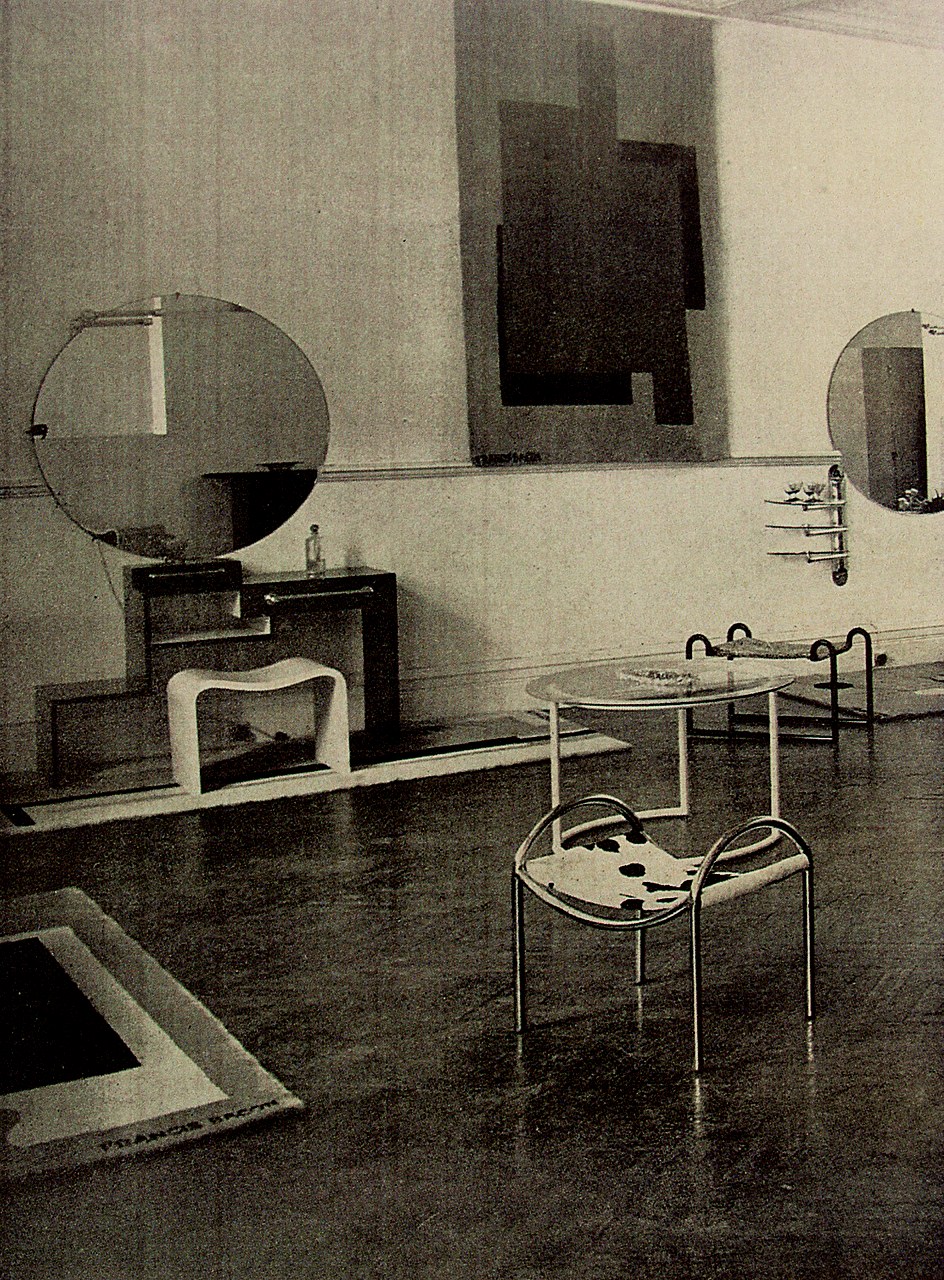
44. Francis Bacon’s studio containing furniture and rugs by him, 1930. From The Studio, August [1930], p. 141.
A head of a young man identified as Francis Bacon drawn in charcoal by Jean Shepeard
The curse of the drinking classes
Soho in the Fifties, a doomed, boho world, photographed by John Deakin and painted from his photos by Francis Bacon. As an exhibition of Deakin’s work opens, one of the few survivors, Henrietta Moraes, recalls her racy encounters with both men
HENRIETTA MORAES | FEATURES | THE INDEPENDENT MAGAZINE | SATURDAY, APRIL 6, 1996
It was 1951, and Soho was alive and kicking, full of people, and credit was easy. We led a vagrant life. We never had one single meal at home, since two people could lunch at the Gay Hussar for ten bob in those days.
Soho was run by a gangster called Billy Hill, and his men were everywhere, collecting protection money from the dutiful, and carving up the faces of the obdurate. We were outside the circle of extortion and were either left alone or chatted up. If you lived in Soho, it was like living in a village. Sid the Swimmer delivered our logs. We knew, every shopkeeper, every pub and club — Italian, French, Spanish, Polish, Swiss and African. The new Hi-Ho down the alleyway was full of deviant whores and their protectors. Big Jean and Stout Sally fought with dustbin lids on Friday evenings. And the Lagos Lagoon opposite our drawing-room windows was packed with gambling-crazy Africans.
I saw a bleeding body with a knife stuck in its back erupt from the club like a clay pigeon and thud to the pavement one night. Once, I came home at four in the morning without my latchkey, and so I was nonplussed. But those lissom black bodies silently formed a pyramid and, taking my hands, ran me up the side of it, on top of their bended backs, to enter through the first floor window, then went on their way laughing.
Every night, we went to the Gargoyle in Dean Street. The sun was going down on the Gargoyle; it was like the end of the Café Royal. You took a lift up to the top floor and then walked down a flight of steps into a ballroom designed by Matisse in the Thirties. The walls and pillars were covered in glass squares which endlessly reflected people, things and events. Here and there, the glass had dropped away, and the overall picture was one of shattered grandeur, an aged beauty unable to visit the dentist. The band, a bunch of Greek Cypriots named Alexander’s Ragtime Band, liked to play the Charleston and the Black Bottom.
The same people went there every night: Cyril Connolly, Angus Wilson, Brian Howard, Simon Asquith, Humphrey Slater, Philip Toynbee, Francis Bacon, Robert Newton, his sister Joy and wife Natalie, Michael Wishart, Lucian Freud, Johnny Minton with 20 sailors, Colquhoun & MacBiyde, Elizabeth Smart, Isabel Lambert and John Deakin.
John Deakin was a small, dapper man, with enormous ears that made him look like Mickey Mouse. He always wore an ancient British “warm” (a kind of short overcoat), and had a West End picture gallery owner for a lover called Arthur Jeffress. He had an acid tongue, was virulent and mischievous in conversation, and a thoroughly unreliable friend; but he was also a talented photographer, and had graduated to Vogue magazine, which was as smart as you can get. Two people that I was determined to make friends with, because I felt so drawn to them, were Lucian Freud and Francis Bacon. They were both quite young, not particularly well-known painters, but Lucian’s hypnotic eyes and Francis’s ebullience and charming habit of buying bottles of champagne proved irresistible. I was dancing with Lucian in the Gargoyle one night and said to him, “I want you.” We made a date to meet at lunchtime the next day in a basement off Brewer Street, and there consummated our friendship, on the edge of an unwieldy kitchen sink. I fell in love with Lucian, and was soon going to his studio in Paddington to be painted every day.
Deakin provided a sensation one morning. He went into the Golden Lion at opening time, as was his wont, and asked for his usual, a large glass of white wine, which he drained to the dregs in one enormous gulp. He fell to the floor unconscious. Panic and consternation. What had happened? A new barman had served him with a large glass of Parozone, which he had not realised was always kept on the bar in a white wine bottle. A lesser man would have died at once. Not Deakin. He was flown to Charing Cross Hospital, stomach pumped, and he emerged later in the day, chirpy as ever and demanding drinks.
One afternoon in the early Sixties, I was having a drink in the French Pub with Francis Bacon, Deakin and others. Francis said, “I’m thinking of painting some of my friends, and I’d like to do you, but I can only really work from photographs, so, if it’s OK, Deakin will come round to your house and take them. I’ll tell him what I want. You are beautiful, darling, and you always will be, you mustn’t worry about that.”
Deakin arrived at my house in Apollo Place a few days later. We had some drinks, and a little bit later retired to my bedroom. Deakin said, “He wants them naked and you lying on the bed, and he’s told me the exact positions you must get into.” Feeling a little shy of stripping in front of someone who definitely did not desire me, and for all I knew might never have seen a female body in its entirety, might even be disgusted by it, I sat on the edge of the bed with my arms and legs crossed.
“For God’s sake, sweetie, that’s not exactly inspiring. I mean, he’s not into the Pieta phase.”
“Well, what shall I do then?" I squeaked.
“Throw yourself back on to the bed and abandon yourself. Open up your arms and legs wide.” He started snapping wide-angle shots between my legs.
“Deakin, I know you’ve got it wrong! Francis can’t possibly want hundreds of shots of these most private parts in close-up. I just don’t believe that is what he is interested in painting. It can’t be so.” In the end, he overrode me. After all, Bacon had told him, not me, what he was after, and so forth. I had a couple more drinks and gave in. Snap, snap, snap, and on and on he went. “That’s it,” he said finally.
“Yeah, I should think that you’d have just about covered every angle,” and, eventually, “Shall we go and have a drink?”
I was having a drink with Francis Bacon and Deakin in the Colony Room, Muriel Belcher’s establishment. Francis said, “Look here, Henrietta: this blithering idiot has reversed every single shot of you that I wanted!”
“Ho,” I said. “You astonish me!”
“Well, look here, Henrietta,” — Francis shot his cuffs, displaying enormously strong-looking wrists — “would you mind letting him do the whole thing all over again, but the other way up this time?”
I gazed at him. When I was 18,1 had spent all my mornings, afternoons and evenings with him, dined alone with him at Wheelers (oysters and Chablis), gone with him to the Gargoyle, listened to the wit and wisdom which flowed almost continuously from his lips. Sometimes I was aghast at the scathing sarcasm which bubbled out of him, but it had never been directed at me. At every meeting, I had learned something new from him, been captivated, spellbound. Wherever he appeared, the air brightened, groups of people were animated, electricity buzzed, and bottles of champagne appeared. I had learned so much of the ways of the world from him, and though, at times, I had not properly understood half of his teaching, it had nevertheless, willy-nilly, been assimilated.
“No, of course I don’t mind. Any time.”
So Deakin and I had a reverse performance, and this time it was at the right angle. “One day I’ll give you a picture,” Francis said.
One afternoon about a week later, I wandered into a Soho club, a bit off my beat, but in I went. The room was full of sailors, all of them crowding round a familiar figure — Deakin. His hands were full of the original photographs he’d taken of me, and he was selling them off for ten bob a time.
“Deakin,” I yelled. “I don’t care, really, but don’t you think you should buy me a large drink?”
John Deakin was never at a loss. His leathery face grinning, he bought me several.
‘John Deakin Photographs’ is published by Schirmer Art Books on Thursday, £40 hardback (£20 paperback).
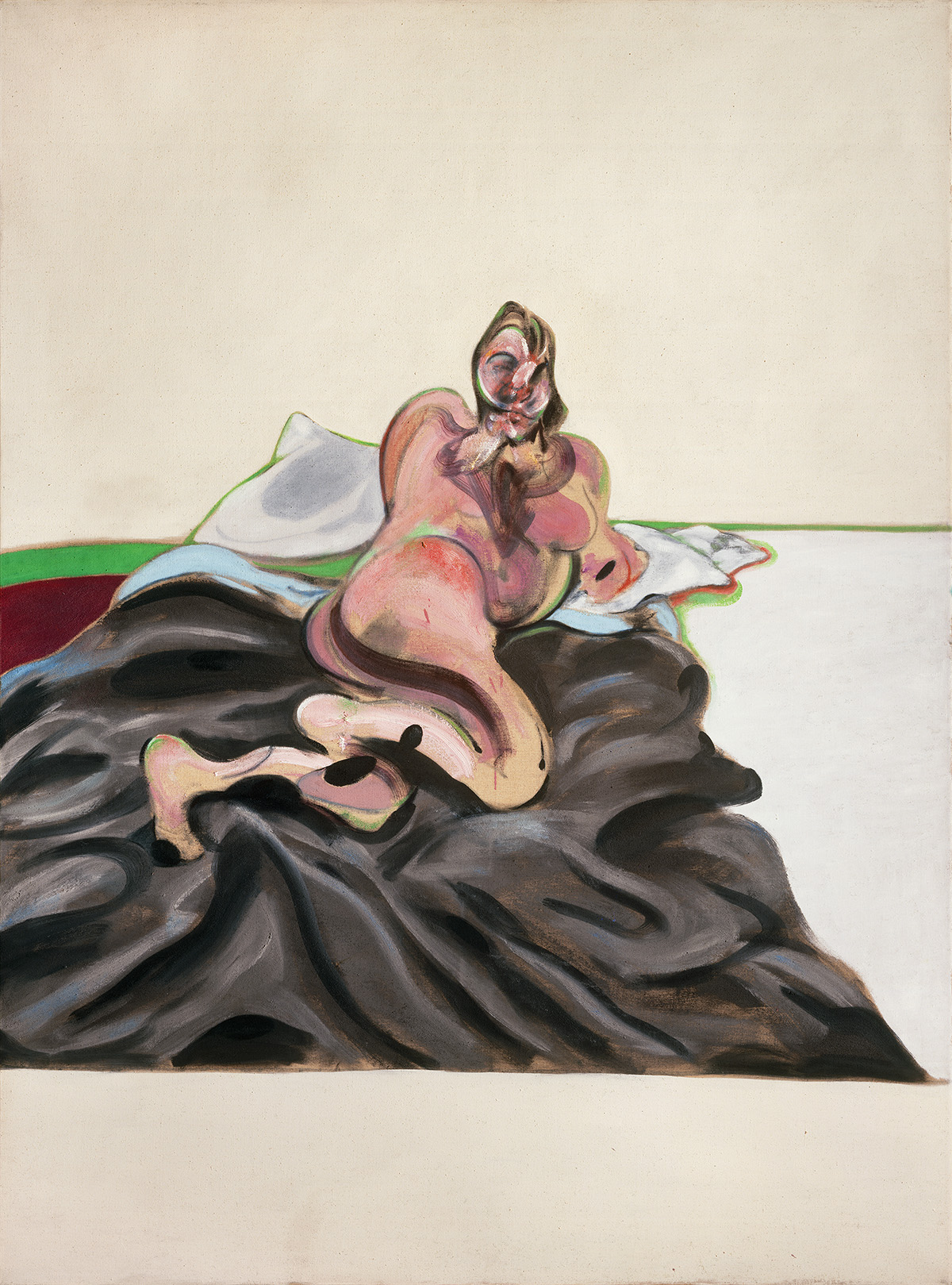
Francis Bacon, ‘Study for Portrait of Henrietta Moraes on White Ground’, 1964.
Portraits of the artists
A remarkable new show should improve the reputation of Soho
reprobate John Deakin, says Martin Gayford
MARTIN GAYFORD | ARTS | THE DAILY TELEGRAPH | WEDNESDAY, APRIL 24, 1996
JOHN DEAKIN, George Melly once wrote, was “a vicious little drunk of such inventive malice and implacable bitchiness that it’s surprising he didn’t choke on his own venom”. “And yet,” Melly went on, “his vitality, his wit”, and “his delighted relish in his own self-destruction” were irresistible. The Woolworth heiress Barbara Hutton, who suffered from his devastating candour, thought Deakin “the second nastiest man” she bad ever met (tantalisingly failing to reveal who was the first).
This, on the whole, has been Deakin’s reputation to date: inebriate, sponger, reprobate, hero of innumerable Soho anecdotes of the Fifties and Sixties. But the current exhibition at the National Portrait Gallery (until July 14) reveals that be was also a photographer of remarkable powers.
Deakin’s career in photography was brief Horn in 1912. he took it up late, having spent most of his youth as the companion of a rich homosexual. And after his sacking by Vogue magazine in 1954 — the second time Deakin had been ejected from that publication, a record of which he was proud — his use of the camera was sporadic. Instead, he devoted his non-drinking hours — which seem to have been increasingly few — to producing surrealist collages and paintings in a deliberately primitive style that could be dubbed faux-naif. He died in 1972.
Therefore the bulk of his prolific photographic output came from a few years in the early Fifties. It was varied, including a few fashion shots — not his forte — plus celebrity portraits. Parisian down-and-outs, and Roman scenes, all of which are excellent of their kind. But the core of his work consists of pictures of his fellow denizens of artistic Soho: Lucian Freud, Francis Bacon, Dylan Thomas and Jeffrey Bernard among them.
Bacon, whose opinion of Deakin’s work seems to have varied wildly, once wrote that he thought him a portrait photographer in the class of those 19th-century masters, Julia Margaret Cameron and Nadar. This gives a clue to Deakin’s achievement: in his work, the Soho of those days comes to life just as the Paris of Delacroix and Baudelaire does in the portraits of Nadar. At their best, these are images of raw power — an intensity that matches the personal force of many of the subjects.
The most characteristic are cropped very’ close, so that the viewer is brought uncomfortably close to the subject. Daniel Farson compared these pictures to prison mugshots taken by an artist, and in fact they may have had an origin in art — Lucian Freud used the same device in his painted portraits of the period.
Deakin even used it on Freud himself in an extraordinary picture from 1952 — the most electrifying of his many photographs of Freud. Freud’s own later painting of Deakin is included in the show. The portrait of Bacon. another frequent subject. from the same year is, if anything, even stronger and starker. These photographs, with their deep blacks and staring, possessed eyes, do more than record faces; they give the feeling of that place and time, an ethos which is summed up in Bacon’s phrase, “exhilarated despair”.
Deakin wrote that in his photography he wanted to make a “revelation” about, the human race, “so my sitters turn into my victims. But I would like to add that it is only those with a daemon, however small, and of whatever kind, whose faces lend themselves to being victimised at all”.
Slightly different, and less charged, are the photographs that Deakin took in the Sixties on instructions from Bacon. The painter did not work from live models, since sitters tended to find the distortions in his work too disconcerting. So he asked Deakin to take photographs which he would use as an aide-memoire. One of these, a nude study of Henrietta Moraes, hangs next to a related Bacon.
In her autobiography, Moraes relates that Deakin — typically — misunderstood Bacons instructions, so that all the poses had to be reshot. Later she discovered him selling the first, more revealing, set to sailors in a Soho drinking dive for 10 shillings each. He was, of course, unrepentant.
These photographs obviously saw heavy use in Bacon’s studio, emerging torn, frayed and spattered with paint. Many of the other prints are in similar condition thanks to Deakin’s own casual approach to his work. and the mulching effect of Vogue’s files. And this, strangely, improves them greatly. Thus battered, they look like stray memorials retrieved from the floor the morning after some vast, chaotic party. Which, in a sense, is exactly what they are.

Francis Bacon photographed in 1952 by John Deakin
Bacon at last meets the pope
The National Gallery will display portrait of Pope Innocent X with
Bacon’s reinterpretations
ROGER BEVAN | EXHIBITIONS | THE ART NEWSPAPER | TUESDAY, 30 APRIL, 1996
In a new gloss upon the posthumous career of Francis Bacon, the National Gallery is using the occasion of the current loan of Velázquez’s “Portrait of Pope Innocent X” from the Doria Pamphilj Gallery, Rome, to create a juxtaposition with four compositions of popes that Bacon executed under its inspiration.
It is a comparison well rehearsed in the classroom but one which was deflected by Bacon himself who worked from reproductions and refused to consult the original painting on his occasional visits to Rome. The “confrontation”, as it has been described by the National Gallery, will take place during the closing days of the current exhibition of “Masterpieces from the Doria Pamphilj Gallery” (2-19 May). Bacon’s versions, “Head VI” 1949, the celebrated caged and screaming bust in the collection of the Arts Council, “Pope I” 1951, a full-length treatment in the Aberdeen Art Gallery, and two later pictures of 1961 and 1965, both of which are owned by unidentified British private collections, will be hung on the wall facing Velázquez’s portrait in Room 30, rather than displayed to either side of it, so that the comparison will slightly less insistent
They belong to a series of some forty portraits of popes that the artist executed over a fifteen-year period. It is a characteristically bold gamble by the gallery which created a precedent when it juxtaposed Raphael’s “Portrait of Pope Julius II” with a “Woman” composition of de Kooning in an exhibition on the subject of colour
It will undoubtedly attract considerable attention, but the suspicion remains that the occasion will support Bacon’s own opinion that his pope series was a failure when it finally appears in the company of the most awesome portrait of the seventeenth century.
The scream of consciousness
A new report has it that Francis Bacon’s Popes reveal his
childhood anguish. PETER LENNON reports
UNTIL now, it has been assumed that Francis Bacon’s Screaming Popes — inspired by Velázquez’s 17th-century portrait of Pope Innocent X — was a metaphor for the despair of the post-war years. Bacon did more than 30 of these paintings in the late 1940s and early 1950s: figures glassily boxed or behind bars whose dominant characteristic is a screaming mouth, often no more than a black hole of terror.
Now Darian Leader, a psychoanalyst, claims that although the formal inspiration maybe Velázquez’s, “Bacon’s Popes aren’t screaming at the injustices of the 20th century; they are echoing the passions of a personal history.” Bacon was really depicting his authoritarian father, Major Edward Bacon, says Leader.
In a BBC programme, The Name of the Father, to be shown on May 7, Leader suggests that the figure in Bacon’s paintings may not be screaming, but gasping for breath. Bacon was asthmatic.
His father, Major Edward Bacon, an officer in the Boer war, settled in Ireland at the beginning of the century and trained racehorses, without notable success. He was said to be ferociously bad tempered.
Velázquez’s Pope maybe frowning or scowling, but he is not screaming. So, Leaders asks, what turns Bacon’s Popes into screaming creatures?
“What he paints is the voice, the breath, the cry,” Leader claims. “Breathlessness and breath are at the centre of the memories that link father to son.”
The relationship with his father was never good. The only moments of tenderness Bacon remembered were when Major Bacon administered morphine during his terrible asthma attacks as a child. The asthma has been interpreted as an aversion to the father, but Leader challenges this.
Arts Council Chairman Lord Gowrie, says in the programme that while Bacon “enormously disliked his father, the twist is he was sexually attracted to him.”
Francis was the weakling of family and allergic to horses, the centre of his father’s world. Later, Major Bacon was horrified when Francis wanted to be an artist. Then, when he discovered the youth dressing up in his mother’s underwear, he banished him from the house — ironically to 1920s Berlin, where Bacon’s homosexuality had full rein.
But Bacon refused to attach his work to any specific incident, or even to a particular environment. He would not admit that wartime experience, with an ambulance crew transporting the maimed and bleeding during the Blitz, had any influence on his gruesome style of painting.
When asked if he painted under the influence of emotions in his own life, he replied: “No. I don’t really know what I am doing. I just put down the images and I hope that I will be able to excite myself.”
Asked by the critic David Sylvester if the shouting figure was concerned with any aspect of anguish said: “It’s not anguish. I hate expressionist painting.” And were the open mouths always meant to be a scream? “Most of them,” Bacon said, “but not all.”
“I have always been very moved by the movements of the month and the shape of the mouth and the teeth. I like the glitter and colour that comes from the mouth and I have always hoped in a sense to be able to paint the mouth like Monet painted a sunset.”
His favourite book was one he bought, aged 18, from a bookstall on the quais in Paris. It had “beautiful, hand-coloured plates of diseases of the mouth.” He confessed once: “I have never succeeded in painting a smile.”
The Velasquez portrait is currently on exhibition at the National Gallery.
Two masters pay their papal dues
William Packer discuses the popes painted by Velazquez and Francis Bacon
The portrait of Pope Innocent X painted by Velazquez is one of the greatest psychological portraits ever painted. The pope looks out at us, fixing us with his implacable gaze, daring any challenge to his God given authority. It has been the star item in Room 30 of the National Gallery, London, as part of a selection of great paintings on loan from the Doria Pamphili Gallery in Rome.
The selection includes works by Caravaggio, Raphael, Claude and Guercino but even in this distinguished company, Velazquez’s pope, all white and crimson silk in his gilt-and-red-plush chair, fills the canvas, as he fills any room it occupies, with his powerful and brooding presence.
The portrait fascinated Francis Bacon. The story is that he knew it only in reproduction, even though he spent some time in Rome. Was he, too, afraid of its almost palpable and troubling power? Who can say? Some find it a strong coincidental likeness to Bacon’s own hated and sadistic father, who had him whipped in public by his groom.
The fact is that Bacon first adopted the ambiguous image of a caped prelate in 1949, boxed as though within the notional space commanded by a chair. The top of the head is cut off, the mouth open and screaming in direct quotation of the famous image from Eisenstein’s film Battleship Potemkin. Screaming or otherwise, in versions large and small, the idea and image continued to occupy him, off and on, for nearly 20 years.
Four of these paintings are known to have remained in England, in public and private hands. Two are early in the sequence, that small first screamer of 1949, and a larger, more fully if loosely-stated and rather thoughtful Pope, clearly worked from the original, though rather wonky and off-centre, dating from 1951.
Both are low-toned, grey and purple, which suggests the black-and-white reference available at that time. The other two are from 1961 and 1965, the first rather modish in its flat and schematised green throne against a dark background and fluid working of the pink and crimson pope, the other richly expressionist and yet closest of all to the original in colour and pose.
The opportunity has now been taken to hang them with their inspiring for the final three weeks of its stay. This proves to be a bold and successful stroke. As with the paintings by Lucian Freud that were hung within the Dulwich Collection the year before last, to compare is not to compete. Here is no question of better or worse, but only of distinction and connection.
What is made clear is that the Bacons hold their own in the company, different as they are and of their own time, but part of that continuum of practice that brings artists together across the ages.
Once the imagery is accepted, as with all good painting, they bring us back to the surface and the stuff of the paint itself as the artist has laid it on the surface: Bacon delicate for all his urgency and impulsiveness; Velazquez so soft and swift of touch, so economical and exact.
There is a passage under the nearer arm of the Velaquez’s Pope, partly in shadow, where the white surplice, with its pleats and fringe of lace, falls across his thigh and round the pillar of the chair, strokes of white on white on white — as inventive, radical and minimal a piece of painting as one could ever see.
Over in Room 4, more debate, if not controversy, as Holbein’s huge double-portrait, “The Ambassadors”, returns to view after its lengthy restoration. Should such things ever be cleaned, let alone restored? It seems a matter of common sense in the first instance to prevent deterioration; and if there is extraneous matter on the surface, it seems not unreasonable to remove it. Is previous restoration thus extraneous matter? That depends on how well it was done, but where possible it is as well to get down to the original surface to determine the extent of any loss. No restoration should ever be irreversible. And if what was lost is known and can be replaced, replace it.
This case is a wonderful vindication of such a policy, and a personal triumph for the gallery’s chief restorer, Martin Wyld. The luck was that after 19th-centiry work was removed, the principle damage was low down on the left, and along the cracks between the ten oak planks that made up the panel — which it was Holbein’s compositional trick to dodge where possible.
The colours are now rich and fresh, but never gaudy, and what has come back is all the subtle shadowy space beyond the two men, beneath the bench and on the floor, and the skull now reads as the proper skull it was not before.
Wonderful.
Velazquez and Bacon - paintings of Popes: National Gallery, Trafalgar Square WC2, until May 18; Holbein’s The Ambassadors Restored: on permanent view.

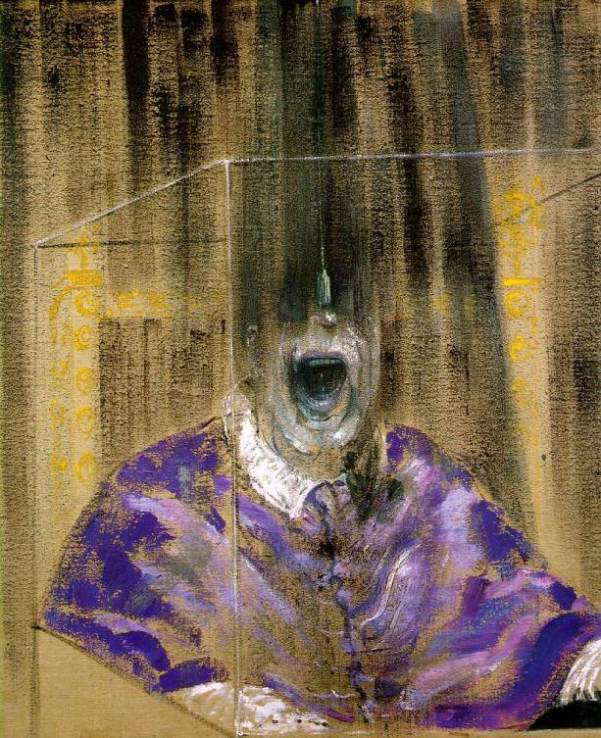
Portrait of Pope Innocent X painted by Velazquez; and Francis Bacon’s 1949 ‘Head VI’
Framed! Owner of Bacon portrait
WILLIAM HICKEY | DAILY EXPRESS | FRIDAY MAY 10 1996
I CAN reveal the identity of the owner of the newly-discovered and controversial self-portrait of Francis Bacon, the superlative British artist who died in 1992. The mysterious figure, known in art circles as “H”, is Barry Joule, a friend, neighbour as a and occasional handyman to the artist. And Joule is also sitting on a multi-million pound treasure trove of previously unknown Bacon paintings.
These were given to him by Bacon to incinerate after they enjoyed an evening’s heavy drinking in 1982. Forty-something Joule chose to defy the painter’s wishes and secreted them in his London flat. Joule, who has a talent for striking up friendships with important people — he was also very chummy with the late ballet dancer Rudolf Nureyev — is a striking figure around Bacon’s South Kensington stomping ground.
A tallish, gangly character not unlike a dish-mop in appearance, his thin frame is topped with a hairstyle which has attracted interest from passing tourists. Thatch-coloured, it resembles a bundle of hay which has been kept in a hairnet. His defiance of Bacon (the artist later contacted Joule and asked him to return the portrait, eventually giving it to him 10 years later) has attracted a mixed reaction.
“He did a very commendable thing not burning them,” says Brian Sewell, the art critic. “I don’t think any artist who says ‘burn my works’ while approaching a drunken stupour should be listened to. It is too important.
“The art market is so bloody corrupt, for an innocent like Barry to make a few tens of thousands is perfectly acceptable. At least the pictures are genuine.” Even this is a contentious point among Bacon’s old cronies. “I’m 90 per cent certain the portrait isn’t his work. It has a kind of crudity Bacon wasn’t capable of,” says one.
“Bacon could have been testing the friendship in a curious way — after all, he could have destroyed the canvases. But if he said he wanted something chucked out, he would have meant it.”

MYSTERY: Bacon
JAMES HALL
VELAZQUEZ AND BACON
Paintings of Popes National Gallery
JAMES HALL | ARTS | THE TIMES LITERARY SUPPLEMENT | FRIDAY MAY 17 1996
A four-way struggle for the soul of a Pope has been orchestrated by the National Gallery It is being fought between two painters — Diego Velázquez and Francis Bacon — and two sculptors — Alessandro Algardi and Gianlorenzo Bernini. The three baroque masters all made portraits of the famously ugly and cunning Pope Innocent X, while Bacon painted several homages to Velázquez’s version over a twenty-year period. Four of Bacon’s Popes have been put face-to-face with the Velázquez in an intriguing and moving confrontation.
Velázquez’s portrait is widely regarded as one of the greatest ever painted and is in London as part of an exhibition of works from the Doria Pamphilj collection in Rome. It was executed during the painter’s second visit to Rome around the same time as the National Gallery’s Rokeby Venus. Although it marks the high point of Venetian influence on Velázquez’s art, the glow of the sumptuous fabrics is thoroughly glacial.
Velázquez went to great lengths to flatten out virtually everything in the picture except for the powerfully modelled face which sits up alarmingly like a tinted life mask. He switched a letter from the Pope’s right hand to his left, so that the white paper could cantilever into empty space parallel with the picture plane. Even the Pope’s right ear has been flattened by wrenching it forward ward. Most spectacular of all, however, is the vertiginous glacier of white lace which cascades from beneath his velvet robe. The result is that the eye can move relatively freely across the picture surface before coming up against the craggy, ruthless reef of the Pope’s face.
Bacon painted his first Pope picture, “Head VI”, in 1949. It is a reduced version, which shows the head and upper torso framed in a transparent parent box, with the mouth opened exaggerativelv wide. The downward rush of lace seems to have been transferred to the background, which is a series of black, vertical slashes. A tassel hangs from the top of the picture to within tickling ling distance of the Pope’s nose. We cannot tell whether the Pope is sneezing, screaming or yawning. Although the transparent cage partially quarantines the image, the mouth threatens to swallow up the heretical artist, and the viewer. The subsequent pictures are much larger nearer to the size of the original and show the Pope fulllength length In the most recent from 1965, the Pope’s immovable physiognomy melts as though he were being partially fried in an electric chair.
In these pictures we see Bacon coming to terms with two catholic authority figures — the Pope and Velázquez. He claimed that even when he visited Rome, he never saw the picture because he was afraid of seeing the “reality” of it after his “stupid” tamperings. Later, he dismissed missed his series: “ ‘The Pope’ [Velázquez’s] is like Egyptian art; factual powerfully formal and unlocks valves of sensation at all different levels. My paintings of the Pope are a great failure.” He seems to have regarded these cloying mixtures of iconoclasm and idolatry as rather infantile.
The exotic allure of Velazquez’s picture must have been enhanced for Bacon by its confinement in a relatively inaccessible gallery in Rome That said the Doria Pamphilj portrait, albeit seen only in reproduction, is not necessarily the starting point for Bacon’s work. The catalyst may be much closer to home. There is a reduced copy of Velázquez’s portrait, showing the head and upper torso, in the Wellington Museum Apsley House. It is one of more than 200 looted pictures captured by the Duke of Wellington from the fleeing French army during the Peninsular War. It was thought to have been a copy made by Velázquez and given to the King of Spain, but is now only ascribed to him. Most scholars believe the head is autograph, but there is doubt about the robe and background.
The bust format, the dark background, and the size (82cm by 71.5cm) correspond much more closely to Bacon’s earliest Pope picture, “Head VI” (93 x 77 cm), than Velázquez’s original. The Wellington Museum only opened to the public in 1952, but part of the collection was exhibited at the V & A from June, 1947, for almost two years, and then a small selection of the finest pictures was featured in an Arts Council exhibition, Eighteen Paintings from the Wellington Gift, in 1949. The portrait was listed as number 15 (“ascribed to Velázquez”) in the catalogue compiled by Ellis Waterhouse, together with three autograph works (including the “Waterseller of Seville”), and one executed in his studio.
It was in 1949, of course, that Bacon painted “Head VI”, so Velázquez was topical. We may never know for certain whether Bacon saw the Wellington Gift bul as his studio was across the road from the V & A, the odds are quite high. It would be a nice irony if the starting point for one of Bacon’s most punitive artistic offensives had itself been a prisoner of war.
Letters
A film to intrigue Francis Bacon
IN YOUR report, ‘Bacon love-film funding blocked’ (last week), you state that I and David Sylvester tipped off Lord Gowrie about the film, ‘sensationalising Bacon’s life’, which resulted in his refusal to grant lottery funds from the Arts Council. In my case, at least, this is entirely mistaken. The film is based, however loosely, on my biography, The Gilded Gutter Life of Francis Bacon, and the director, John Maybury, has my support.
Lord Gowrie was gracious enough to send me a generous letter about my book, suggesting that Francis would have ‘bitched’ but secretly he would have liked it. I believe the same applies to the film. Bacon was too big a man to condone any form of censorship of a film yet unseen. Fascinated by cinema, I am sure he would have been intrigued to see the outcome whether he liked it or not.
Bacon’s reputation has no need of such protection. Far from being ‘concerned’, as Richard Brook’s report indicates, I am convinced the film should go ahead.
Daniel Farson,
Appledore, Devon
A vision in the distance
Sculpted by Giacometti and Epstein, painted by Bacon and Picasso, Isabel Rawsthorne
is the unsung muse of 20th-century art, says Martin Gayford
MARTIN GAYFORD | ARTS | THE SUNDAY REVIEW | THE SUNDAY TELEGRAPH | MAY 26 1996
IN 1937, the artist Alberto Giacometti saw a gir with whom he was in Love in the H distance on Boutevard Saint-Michet. It was a vision that stayed with him for years, finally leading to some of his finest and most characteristic works. But before then, it had drawn him into a lengthy and disconcerting period during which, do what he might, his work shrank to infinitesimal dimensions.
It is a strange story. Stranger still, the English woman — then Isabel Delmer — who inspired this obsession in Giacometti, became one of the most frequent subjects of another great artist, Francis Bacon. She also modelled for Epstein and Derain, and was painted several times by Picasso.
Isabel Nicholas — later Isabel Delmer, Isabel Lambert and Isabel Rawsthorne as the result of successive marriages — was herself a painter and a stage-designer of some renown. She was also a notable beauty who lived a life of impressive energy, enterprise and zest. But she is likely to be remembered as someone who served as subject to more important artists than any one else in the 20th century.
Part of the clue to this lay in her appearance, the rest perhaps in her personality. In her youth she was, according to James Lord, the biographer of Giacometti, a being of catlike grace: “Tall, lithe, superbly proportioned, she moved with the agility of a feline predator. Something exotic, suggesting obscure origins, was visible in her full mouth, high cheekbones and heavy-lidded, slanting eyes, from which shone forth a gaze of exceptional, though remote intensity.”
The cat was certainly a creature with which she had an affinity, sometimes signing her letters in later life with a cat-drawing, and painting the mice captured by her pets.
The daughter of an officer in the Merchant Navy, she was born in 1912 and brought up in London and Liverpool. Her father died abroad and her mother and younger brother emigrated, leaving her a lone and sensationally beautiful art student. Knocking on the door of the great Jacob Epstein, she was immediately invited in to pose. Among other works, she sat for a bust in 1933 which shows her bare-breasted, imperious and a little unnerving. little unnerving. It makes believable James Lord’s description of her as having “a prodigal exuberance, a fierce animal confidence in her right to do as she pleased”.
She encountered Giacometti in mid-1930s Paris, at which time she was the wife of a Daily Express foreign correspondent, Sefton Delmer. They lived luxuriously in a flat overlooking the Place Vendome. But Isabel also liked to mingle in the artistic circles of Montparnasse. It was at this stage that she sat for Derain.
At first her relations with Giacometti were casual. Bit by bit, however, he fell in love. But love for Giacometti was not straightforward. His relations with women were complicated by impotence and by his fear of a conventionally settled relationship. He abhorred the notion of a “clinging woman” and had early on formed the habit of frequenting brothels and spending time with prostitutes.
By then in his early thirties, Giacometti had recently broken with Surrealism and was attempting to sculpt heads from life — a simple enough task, one might think, especially given his technical brilliance. But he could not do it. The trouble was that Giacometti was aiming at something far more difficult than simple academic representation. He wanted to make sculptures that would reflect the full psychological complexity of seeing: “The more I looked at the model, the more the screen between his reality and mine grew thicker . . . One is no longer sure of his appearance or of his size, or of anything at all.”
The task seemed impossible. and few works, including two heads of Isabel, survive from this period. He and Isabel saw a lot of each other. “Alberto worked all night,” she told Daniel Farson, a friend in post-war Soho days. “But at five every morning we drank at the Lipp. Picasso used to sit at the table opposite, and one day, after staring at me particularly hard, he jumped up and said to Alberto, ‘Now I know how to do it.’ He dashed back to his studio to paint my portrait with little red eyes, wild hair.” In view of Picasso’s vulpine sexual habits and aesthetic fertility, there is something menacing about this intervention. Giacometti, on the other hand, could neither bring himself to make a decisive advance nor to break off the friendship. His artistic frustration was mirrored by a romantic one.
Eventually, in 1938. while walking Isabel home after an evening spent with the painter Balthus, he decided to make a clean break. In fact, he didn’t manage to get the words out. But shortly after leaving her at her hotel in the Place des Pyramides. his foot was crushed by a speeding car.
Strangely, Giacometti was exhilarated by this, often describing the incident. Feet were important to Giacometti. Shortly before the accident, he had described his dilemma to Isabel in terms of lacking a “footing”. Much later, when his figures became extraordinarily tall and thin, they also developed huge feet. The injury to his foot seemed to give Giacometti renewed confidence and sense of purpose.
The next year, 1939, he began working not from the model but from memory, and a bizarre thing happened. As he wrote to the dealer Pierre Matisse, “To my terror the sculptures became smaller and smaller. These dimensions revolted me, and I kept on beginning, only to end up a few months later at the same point.”
In the case of the recurrent female figure, there was a visual reason for the minuscule size of these works. The woman was based on that glimpse Giacometti had had of Isabel, remote and inaccessible. It was “you,” he wrote to her in 1943, “when I caught a momentary glimpse of you, a very long time ago, standing in the Boulevard Saint-Michel one evening, not moving.” He later explained how, because he was trying to sculpt this “very precise vision”, he “tended to make her the size she looked when she was at that distance”, with “the enormous expanse of darkness above her”.
WITH the invasion of France in 1940, Isabel had to return to England, although she delayed her departure for as long as possible. even missing the last commercial flight from Paris on which Sefton Delmer had booked her a seat. On her last night, Giacometti drew her lying naked in her hotel room, after which, he told the art critic David Sylvester, they went to bed for the first time, and he was impotent. The next day she left for England.
He continued to make his sculptures, which, do what he might, almost invariably dwindled away to almost nothing, when he would usually destroy them. At the end of 1941 he departed for his native Switzerland, promising not to return until his sculpture was less absurd in size. But it refused to grow. For the next three years he worked in a cheap hotel, caked in plaster dust, whittling away at sculptures scarcely larger than a pin which almost never satisfied him. He returned in September 1945 with three years’ work in six matchboxes. He and Isabel met again and lived together for a short period in Giacometti’s exceptionally spartan studio on Rue Hippolyte-Maindron.
But life with Giacometti was not easy, especially at this point when he was making and selling very little, and desperately worried about money. That Christmas at a party she abruptly got up and left with a handsome young man. “Well.” said Giacometti, “what about that?”
Subsequently, she lived with the young man, a musician. for a time. Then she returned to England where she married the conductor and composer Constant Lambert. and after him his friend and fellow composer Alan Rawsthorne. She also became a close friend and frequent subject of Francis Bacon. In 1946 Giacometti found the power to stop his sculptures shrinking, though he found that when tall, they grew correspondingly thin, and in the late 1940s he produced some of his greatest work. They remained friends until his death in 1966.
Isabel Rawsthorne continued. according to Daniel Farson, to lead “a life of uninhibited exuberance until the onslaught of age”. In her last years she lived quietly with her cats in East Anglia, dying in 1992.
Alberto Giacometti 1901-1966 is at the Scottish Gallery of Modem Art. Edinburgh, from June 1 to September 22
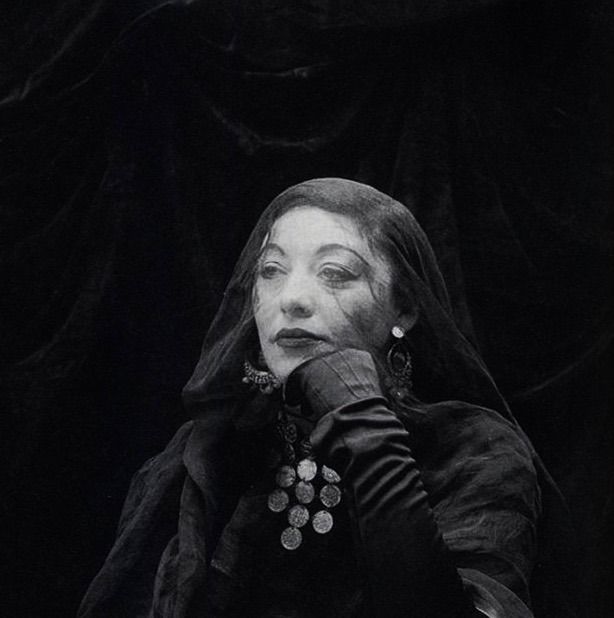
Uninhibited exuberance Isabel photographed by John Deakin in 1952.
Her relationship with Giacometti was never easy
Bacon by daylight
Exceptional new Bacon survey on show at the Pompidou
An Italian designer and considerable use of natural light for David Sylvester’s new survey
of nearly ninety paintings, which includes working studies never previously exhibited
ROGER BEVAN | EXHIBITIONS | THE ART NEWSPAPER | FRIDAY 31 MAY 1996
The most comprehensive survey of Francis Bacon’s work to take place in ten years opens this month at the Centre Georges Pompidou, Paris (27 June-14 October), the city of the artist’s greatest personal triumph and tragedy.
Comprising seventy-nine paintings, including seventeen large and six small triptychs, as well as seven works on paper, it handsomely eclipses other exhibitions in Moscow (1988), Washington and New York (1989-90), Lugano (1993), Venice (1993) and the Fondation Maeght (1995), and is surpassed, in terms of scale, only by the Tate Gallery’s retrospective exhibition of 1985, the event which launched the series of recent studies and commemorations of the artist’s career.
Selected by David Sylvester, with assistance from Pompidou curator Fabrice Hergott, it coincides with the twenty-fifth anniversary of the Grand Palais exhibition which created, or at any rate confirmed, Bacon’s stature in international contemporary art circles. The significance of that occasion, an unprecedented honour for a living artist, was matched by the drama of the suicide of Bacon’s companion, George Dyer, during the preview days of the exhibition, an episode well known to every student of Bacon’s art since it inspired one of the greatest works that he ever painted, “Triptych May-June 1973”.
The importance of the present exhibition is underlined by the loan of “Three Studies for Figures at the Base of a Crucifixion” (1944), which the Tate Gallery’s conservators had deemed too fragile to lend to any of the other surveys organised since 1985. It will be shown with the “Second Version of Triptych 1944” (1988), his final triptych and a fascinating reassessment of the work which the artist designated as the beginning of his official career.
Bacon’s biography is not, of course, as neat as this perfect circle of activity implies, and one of the intriguing features of the present exhibition will be the inclusion of three compositions and two gouache studies dating from 1933-36, a decision that would never have been countenanced while Bacon was alive, since he disowned, and had indeed attempted to destroy, his entire production of this period from which less than fifteen works appear to have survived. They form a distinct chapter or preface to this career, but reveal certain unexpected links with the mature work and deserve fresh consideration.
An equally novel curatorial decision is the inclusion of five working drawings in ink or crayon on paper of single figures. Bacon did not usually make preparatory studies and these must have been given to, or salvaged by, friends with access to his studio. It may be relevant that none of these sheets is dated after 1962 but the presumption that his large compositions were only invented on the canvas will need to be reexamined in the light of this new evidence
The second factor that will distinguish this exhibition from previous surveys is the unprecedented amount of bright summer light that will be permitted to flood into the top floor of the Centre Georges Pompidou. Fully one-third of the exhibition will be illuminated by daylight, a decision encouraged by the successful experiment at the Museo Correr, Venice, three years ago, when shutters were opened to permit the famed Venetian light to play over the artist’s canvases. Gabriella Ferretti, who was responsible for devising that arrangement with Mr Sylvester, has been retained as a consultant for the present project, which appears to reflect the preference of the artist who, according to Mr Sylvester, painted by daylight and liked his work to be seen under daylight conditions, even if its subjects dealt with the darker side of humanity.
To surround an exhibition with views of the most beautiful skyline of any European city is a calculated gamble and may prove to be a distraction. Or will Bacon’s figures, for so long stranded on beds and sofas, or marooned in glass boxes, be read as portrayals of loneliness in a wider urban context, like the sculpture of Giacometti?
There is a second destination for the exhibition, the Haus der Kunst, Munich (4 November-31 January 1997), a building with such a sinister history in the Nazi period that it can not fail to set up resonances with Bacon’s haunting and tortured work. In the context of an exhibition hall inaugurated by Hitler in 1937, “Crucifixion” (1965), the triptych, which contains the notorious detail of a swastika armband, will come to have an even deeper resonance.
Dan Glaister on club habitué Francis Bacon’s portrait of a singular hostess
BY DAN GLAISTER | THE GUARDIAN | SATURDAY, JUNE 15, 1996
IT MIGHT be the title for a new work by Damien Hirst: Mother and Daughter Reunited. Yesterday Mother, as Muriel Belcher was called by Francis Bacon, and Daughter, as she called him, came together when Bacon’s portrait of Belcher was shown at one of Soho’s legendary drinking clubs, the Colony Room.
Bacon was a regular at the club, which Belcher founded in 1948 and ran until her death in 1979. Bacon’s portrait of Belcher, Head Of A Woman, is to go on sale at Christie’s on June 27. The picture, painted in 1960, is expected to sell for between £550,000 and £750,000.
“I don’t know if she ever saw the picture,” said the club’s present “caretaker”, Michael Wojas. “She was interested in painters, not paintings. They had a very special relationship.”
Other regulars at the Colony Room during Bacon and Belcher’s heyday included Lucian Freud, Frank Auerbach, and John Minton. Today’s luminaries include Jeffrey Bernard, artist Marc Quinn, and singer Lisa Stansfield.
Regulars crowded the tiny bar yesterday to pay tribute to Bacon and Belcher.
Bacon, according to Soho legend, worked behind the bar at the club. He was recruited by Belcher the year after it opened: she paid him in champagne in exchange for introducing new clients.
“You’re asking us to remember Muriel and none of us can bloody remember anything,” said Eddie McPherson. “After drinking here for 36 years, I can only remember back four hours.”
Belcher was known for her ferocity toward her clients. Bacon first painted her in 1959 as an aggressive figure. The painter, who died in 1992, once said: “If they were not my friends, I could not do such violence to them.” The portrait on show yesterday shows a more haunted figure, features blurred and distorted.
Clem Crosby, an artist, said he did not think the portrait was one of Bacon’s best. “It is interesting because it is transitional,” he said. “It is one of the first examples of Bacon distorting and stretching features.”
Crosby is a member of the younger generation which now frequents the Colony Room. “When I started coming here nine years ago, people used to talk about the fifties and how good they were. Now we talk about the seventies,” he said. “It used to be taboo to mention success here, which is why Bacon liked it, I think.” Above the bar, a picture by another of the Colony Room’s young habitués, Damien Hirst, looked down.
Steven Lees said that Belcher made the club unique. “Muriel was able to mix the gifted with the ungifted, the famous with the infamous, artists with businessmen, gays with straights. The club is the total sum of its members.”
The writer Zinovy Zinki recalled how he had first come to the club. “I interviewed Bacon at the Marlborough Gallery. We sat down with a bottle of whisky and he didn’t say anything interesting at all. When I turned my tape recorder off, he started talking. I realised we had drunk a bottle of Grouse in 90 minutes. Then we came here. Do you want another drink?”
Back Bacon
P.H.S | THE TIMES DIARY | THE TIMES | SATURDAY, JUNE 15, 1996
THE GHOST of Soho matriarch Muriel Belcher returned to the Colony Room yesterday in the shape of a Francis Bacon portrait. Christie’s chose the bohemian venue, founded by Belcher, to publicise its contemporary art auction later this month at which the painting is estimated to fetch up to £750,000.
It was the first time that a picture by Bacon, who called Belcher “Mother”, has been on the premises and the present manager, Michael Wojas, was keen to organise a whipround to buy it. Certainly, Colony Room member John Edwards, and the main beneficiary of Bacon’s £11 million estate, could afford it.
Other members present were aghast at the elderly security guard provided by Christie’s. “Such a shame,” said Marsh Dunbar, a member since 1949. “Francis loved handsome young men in uniform. ”
P.H.S
SLICE OF BACON
NEWS | THE DAILY TELEGRAPH | SATURDAY, JUNE 15, 1996
SLICE OF BACON: This 1960 Francis Bacon portrait of Muriel Belcher, former owner of the Colony Room, Soho,
is expected to fetch up to £750,000 at Christie’s on June 27. Bacon was given a weekly “salary” of free drinks at
the art world watering hole in exchange for bringing in new customers

Bacon & Giacometti: Likeness and Difference
David Sylvester introduces the exhibition in which he brings together two relatively isolated artists
DAVID SYLVESTER | FEATURES | MODERN PAINTERS | A QUARTERLY JOURNAL OF THE FINE ARTS | SUMMER 1996
Outstanding artists are not as a rule isolated figures. Think of their situation since the time of Impressionism only. Some have been members of a major group — the Nabis, the Cubists — which has included several figures of consequence; others, like Mondrian, have been acknowledged leaders f a narrower school, even an artist as separate as Duchamp had useful allies. This has continued in our own time. It is possible to find a context whether a professed group, like Cobra, or a widespread trend, like Pop Art — for most of the leading artists of the period — and finding a context becomes a necessary game when works by different artists have to be distributed among the spaces of a museum.
The exceptions, the mavericks, in this half-century, mostly turn out to be artists working to capture appearance — artist such as Bacon, Balthus, Antonin Artaud, Lucian Freud. In the nineteenth century that activity was a common pursuit. Artists of consequence took part together in the enterprise, sometimes in close conjunction and always with mutual awareness and rivalry. Something of that has survived into our own time in cases like like that of David Bomberg and his pupils Frank Auerbach and Leon Kossoff, and that of William Coldstream and his pupils Michael Andrews, Euan Uglow and Patrick George. But by and large trapping appearance has become a lonely activity, against the grain. It is significant that Giacometti’s work of the first half of the 1930s is readily classifiable as part and parcel of a movement, Surrealism, but that, when he turned away from invention towards the re-creation of his sensations of reality, he became an isolated figure.
Works by two of these isolated artists are brought together in the present exhibition. It is not at all unusual for groups of works by Francis Bacon and Alberto Giacometti to be juxtaposed. They often appear in the same room — and the same eyeful — in installations of the permanent collections of museums. And in Jean Clair’s important polemical anthology of modern figurative art, 'Identita e Alterita', at the Venice Biennale of 1985, a long row of bronzes of standing women by Giacometti stood facing a long wall of paintings by Bacon. The present exhibition, it seems to me, takes a more constructive approach in placing the works so that, while both groups are in the same space, they are not visible simultaneously. It is like a concert the first half of which is dedicated to one composer, the second half of another, rather than a concert in which works by two composers are heard concurrently.
Bacon was a painter, Giacometti a sculptor and painter and a prolific draughtsman and a print-maker. Bacon worked from life for a few years in the 1950s, but for the most part from memory and photographs; Giacometti did almost all of his drawing and painting and a good deal of his sculpture from life (though his greatest sculptures were probably some of those done from memory between 1945 and 1955 — and also some of his abstracted figures and heads of 1927-29, and surrealist sculptures of 1930-34). These are certainly good reasons for putting them with each other rather than with anyone else among their contemporaries. For one thing, Balthus and Freud work, as did Giacometti’s friend Francis Gruber, within a treatment of form and space that is traditional, whereas Bacon and Giacometti both felt that there was no point in making art that used idioms already explored. On the other hand, Dubuffet, while also creating an innovatory figurative art, conveyed a human presence without trying to achieve a likeness to its appearance.
With regard to Bacon’s position on this map, he often described his artistic practice as a tightrope-walk between illustration and abstraction That could be said of Giacometti’s too. And also of de Kooning’s, with the difference that his tightrope ran along a middle route between those extremes, whereas with Bacon and Giacometti representation given priority over abstraction. Consequently, their figuration, while rich in ambiguities, is more specific than de Kooning’s: their human images, whether of heads or bodies, whether clothed or nude, are closely based on particular individuals — mostly friends or relations or partners — in short, are more-or-less portraits.
A further resemblance was that they were both acutely self-critical and given to destroying a large part of their production, and another was that their sense of failure came not so much from agonising about about a personal insufficiency as from a realisation that they were trying to do something that was near enough impossible — in other words, it came from high ambition rather than from modesty. It was their ambition, indeed, that made them go on and on working on paintings in an attempt to take them further, thereby often ruining them irretrievably. That didn’t matter to them; they would try again. They both thought of their individual works as members of a series of provisional attempts to solve ongoing problems, not as definitive statements, and the works were presented and promoted in ways that made this attitude clear. By the same token, and also because both artists were obsessional in the pursuit of their aims, they tended to work over and over again from the same models — whether they were working from life or memory or from photographs.
They were also repetitive and limited in the types of work they produced. Giacometti’s sculptures, from the time he became involved in appearance, are mostly either a woman standing still or a walking man or the bust of a man or a combination of these types (say, four standing women in a row or a single standing woman with four men walking here and there); his paintings are mostly frontal views of a single seated or standing figure, nude or clothed or a bust. Bacon’s paintings are mostly either small canvases with a single head, or big canvases with a single figure — nude or clothed, reclining or seated or standing, or, indeed, crucified, or moving around — or a couple having sex — so that the postures and gestures at least have a wide range. But the scale could not have a narrower range: form 1945 on the images are always about three-quarters life size, whether the pictures are big or small. (One notable exception is a beautiful painting of 1952-53 which is in this exhibition a back view of a male nude posed like a diver that is one eighth life size.) And the works, with two or three exceptions, are invariably upright in format. They acquire a landscape format when Bacon has put together three canvases, big or small, separately framed, to form a triptych. There are nearly 30 big triptychs extant and the best of them are probably Bacon’s greatest claim to fame, along with his few surviving works of the 1940s.
And then both Bacon and Giacometti were deeply indebted to Picasso. Giacometti’s surrealist works, such as Suspended Ball and Slaughtered Woman, had a formal vocabulary that came straight out of Picasso’s pictures of the late 1920s presenting assemblages of bone-like shapes. Bacon’s crucial 1944 triptych was a homage to Picasso’s pictures of the late 1920s in which biomorphic figures turn tiny keys in the doors of bathing huts. Bacon’s subsequent work often borrows forms or devices from Picassos of various periods, from the time of the Demoiselles d’Avignon to that of Dora Maar; Giacometti’s subsequent work was a comprehensive rejection of Picasso’s values. Except for one value, also subscribed to by Bacon — namely, that an artist did well to borrow freely, eclectically and blatantly from existing art. Giacometti’s most visible exemplars are certain Egyptian, Sumerian and Cycladic sculpture, certain Oceanic sculpture, mostly Melanesian, Byzantine mosaics and paintings, Tintoretto’s drawings and Cézanne; Bacon’s are Egyptian sculpture, Michelangelo, Velázquez, Rembrandt, Degas, and a wide variety of photographs ranging from the action shots of Muybridge and of newspaper and magazine photographs, especially of sport, to photos in medical books.
The likeness between the two artists touched on so far are all very concrete evident in the work itself or in methods of working or of exhibiting. A more intangible affinity is that their work seems to hare a certain mental atmosphere — the atmosphere of post-war Europe, full of menace, guilt, disquiet, doubt, a sense of nearness to death.
Their personal lives had several important things in common. They were both childless Bacon was homosexual; Giacometti was left sterile by an illness in his youth. They were both creatures of habit, living their lives out in shabby surroundings with tiny studios long after they could have afforded luxury, space, or both. Neither possessed a car. Neither accumulated art or other chattels. Both lived very expensively and handed out huge tips. Giacometti haunted brothels and, in their absence, bars frequented by prostitutes; Bacon, homosexual bars. Both had a taste for good restaurants, though Giacometti could take o leave them, while Bacon really cared about food and drink; indeed, he was a good coo himself, whereas Giacometti was probably incapable of boiling an egg. Giacometti, who was extremely handsome, tended to dress shabbily; Bacon, who had an attractive but odd face, dressed well. Both were free of any hankering for respectability or official honours. Both were entertaining talkers and good listeners, with a love of gossip as well as sustained intellectual discussion. Both were exceedingly generous friends, materially and spiritually. Both were deeply attracted to Isabel Rawsthorne (Giacometti was in love with her and for a short time they lived together): the exhibition examples of the several portraits each of them did of her. Neither took drugs, contrary to report. Bacon was a very heavy drinker, which Giacometti was not, but Bacon kept in close touch with his doctor, which Giacometti did not: Bacon died at 82, Giacometti at 64.
Continuing with their differences, I begin with their politics. Giacometti, an extreme Leftist in the 1930s, always remained firmly on the Left, while Bacon was simply cynical: ‘I just want the best kind of atmosphere to work in,, And so in politics I have tended to vote for the Right because they are less idealistic than the Left and therefore one is left freer than one would be if encumbered by the idealism of the Left. I always feel that for me the Right is the best of a bad job.’ His unabashed pragmatism was sometimes a stumbling-block in his relations with French intellectuals.
The two artists were poles apart in their points of departure. Giacometti cam from a family of distinguished painter, was highly precocious as both a painter and a sculptor, was given every encouragement and help to devote himself to art, including a long academic training. Bacon came from an upper-class English family and grew up in grand houses in Ireland and the West Country. In Paris when he was about twenty he saw an exhibition of Picasso, ‘and at that moment thought, well, I will try and paint too’, an ambition which provoked the strongest parental discouragement. He started designing furniture and rugs and immediately showed a mastery of these edis; teaching himself to paint was rather more difficult — though as images his paintings were interesting from the start. It was surely difficulty that led him to give up trying to work from the model and become entirely dependent on photographs and on reproductions of past masters, for these provided him with ready-made translations of the three dimensions of life into the two dimensions of a picture. Giacometti, on the other hand, had, from an early age, an exceptional facility in working from life — as well as from memory — as a draughtsman, as a painter and as a sculptor, and this was enhanced by years of practice in his father’s studio and in art schools. Indeed, his addiction to creating difficulties for himself, his tormented scrupulosity, could well be interpreted as a reaction against the boredom of easy mastery.
The most obvious difference in their actual work is that Giacometti’s art is quiet, while Bacon’s is loud, even in its silences. It is bigger in scale, has far more contras in colour and tone, and is much more express of specific emotions. Giacometti’s art, while pervaded by an elegiac mood, does not eek to convey emotions: he used, indeed, to say that he felt it was a shortcoming in his work that, whereas the brothers Le Nain were able to communicate particular emotions while achieving a likeness to reality, he himself was too focused on getting a likeness to be able to do more. Bacon’s art, in contrast, is dramatic, dealing intensely with death and copulation and other convulsive forms of action. He none the less tended to play down the idea that his work was ‘saying’ something. ‘I’m not really saying anything, because I’m probably much more concerned with the aesthetic qualities of a work than, perhaps, Munch was.' Moreover, he was always anxious not to fall into the trap, as he saw it, of ‘telling a story’, so that ‘the story talks louder than the paint' and 'the boredom sets in’. And he certainly didn’t tell a story in the explicit sort of way in which Munch or Kirchner or Kokoschka or Beckmann did. This distinction, however, did not occur to Giacometti when in 1955 he saw Bacon’s work for the first time and dismissed it as ‘expressionist’. By 1960 he was becoming more sympathetic towards it, and a year or two later he met and became friendly with Bacon. Their liking and admiration for each other as human beings was boundless. But Giacometti still used the label 'expressionist' to distance himself from the work, while saying wryly that his own work must seem very old-maidish to Bacon. The word Bacon did in fact apply to Giacometti’s sculptures was ‘arty’. On the other hand, he wrote in 1975 that for him ‘Giacometti was not only the greatest draughtsman of our time but among the greatest of all time’.
The question of how expressionist Bacon’s art is, of how far it has ‘meaning’, remains extremely tangled. For example, it has to be asked whether his insistence that his work did not have ‘meaning’ was compatible with his use of subjects such as the Crucifixion and the Orestia, or with his stated belief that ‘the greatest art always returns you to the vulnerability of the human situation’. One the other hand, there are examples o his working attitude which demonstrate that he was much more mindful of formal qualities than of meaning. In one of his triptychs of the Crucifixion he put a swastika on the arm of a figure, and this, understandably, was widely interpreted as indicating that the figure was a Nazi. But this had not been in mind. ‘I wanted to put an armband to break the continuity of the arm and to add the colour of this red round the arm. You may say it was a stupid thing to do, but it was done entirely as part of trying to make the figure work — not work on the level of interpretation of its being a Nazi, but on the level of its its working formally.’ And when he made paintings of a particular girl lying on a bed with a hypodermic syringe stuck in her arm, it was not because she was a drug addict (though she did become one later). ‘I’ve used the figures lying on beds with a hypodermic syringe as a form of nailing the image more strongly into reality or appearance. I don’t put the syringe because of the drug that’s being injected but because it’s less stupid than putting a nail through the arm, which would be even more melodramatic. I put the syringe because I want a nailing of the flesh onto the bed.’
Giacometti’s work, for all of its greater affective neutrality, was also subject to melodramatic misinterpretations, especially in the sculpture. When the extremely attenuated figures which he started making around 1946 emerged from the studio in 1948, they were taken to have an intended relationship to the emaciated prisoners at Belsen and Buchenwald. Even after this wave of fantasy had passed, they continued to be seen as incarnations of isolation and despair and alienation of post-war mankind. This was assumed to be the reason for their thinness, rather than the formal considerations that had made Giacometti whittle them down. It was forgotten that similar degrees of attenuation are to be found in a wide range of antique and tribal sculpture. A liking for such sculpture was one of the causes of the unconventional proportions of Giacometti’s figures. Another was an instinctive fastidiousness that compelled him to fine things down. Another was his response to the conclusions he reached through thinking about the problem of representation in art. Giacometti was a philosophical artist who pondered on the semantics of sculpture as deeply and radically and to as much practical purpose as Cézanne on the semantics of painting. For example:
Even Rodin still took measurements when making his busts. He didn’t model a head as he actually saw it in space, at a certain distance, as I see you now with this distance between us. He really wanted to make a parallel in clay, the exact equivalent of the head’s volume in space. So basically it wasn’t visual but conceptual. He knew it was round before he began: that’s to say, he started from the conventional idea of a head that had prevailed in all European sculpture since the time of the Greeks, and made a volume in space unlike anything he actually saw, because in the ordinary way it would never occur to me to get up and walk around you. If I didn’t know that your skull had a certain depth, I wouldn’t be able to guess it. So, if I made a sculpture of you according to my absolute perception of you, I would make a rather flat, scarcely modulated sculpture that would be much closer to a Cycladic sculpture, which has a stylised look, than to a sculpture by Rodin or Houdon, which has a realistic look. I think we have for so long automatically accepted the received idea of what a sculptured head should look like that we have made ourselves completely incapable of seeing a head as we really see it.
The effect upon the work of that sort of thinking was what gave Giacometti’s art its originality. And that sort of thinking was deeply rooted in the experience of working from life. Perhaps Giacometti could have reached the same conclusions purely from memory, but there is no way of confirming that because in fact his spells of doing it from memory followed on or coincided with doing it from life. Working from life was the foundation on which all Giacometti’s art was built. Working from life was a method tried for a time by Bacon and abandoned. That must be the most fundamental difference between them.
The exhibition does, however, include three trophies which have survived from a unique sustained effort by Bacon to work continuously from a particular live model. They are portraits of Lisa Sainsbury painted in a room in Battersea and completed respectively in October-November 1955, May 1956, and early 1957; five others were started and destroyed at some stage or another in their progress. There were other sitters during and around this time, including Robert Sainsbury and the present writer, but most of the work was painted from reproductions and photographs, among them photographs of a life mask of William Blake. What is interesting is that Bacon got Lisa Sainsbury to sit regularly over a period of eighteen months, rather like a Giacometti model, even if it was only once a week as against everyday. And the pose, most unusually for Bacon, has the frontality that was almost de rigueur for a Giacometti painting. Unlike Giacometti. Bacon habitually went on with the picture when the mode; was not present. The fist of these three portraits is a masterpiece, one of Bacon’s very finest paintings of the 1950s. It resembles the sitter faintly; it strongly resembles Queen Nefertiti. Here, like Giacometti in some of his sculptures of standing women, Bacon made the head of someone he knew coalesce with that of an ancient Egyptian sculpture in all its formal rigour and monumental grandeur.
‘Trapping Appearance, Portraits by Francis Bacon and Alberto Giacometti from the Robert and Lisa Sainsbury Collection’, 25June-15 September, Sainsbury Centre for Visual Arts, University of East Anglia, Norwich.
Bacon for sale: as ugly as a picture
MANDRAKE | THE SUNDAY TELEGRAPH | SUNDAY JUNE 23 1996
ART aficionados are slinging verbal pastels and palettes over a portrait by Francis Bacon (detail left), expected to raise £750,000 at Christie’s this week. The auction house contends that the picture is of the late Muriel Belcher (above left), who founded the Colony, the notorious Soho dive.
Both Dan Farson, Bacon’s biographer, and critic Brian Sewell insist that it is not of Belcher, who kept Bacon in champagne in return for finding customers.
“How it could ever be taken as Belcher is quite beyond me,” says Sewell. “It is a cruel and spiteful portrait of Isabel Rawsthorne (above right), one of Bacon’s favourite subjects. Rawsthorne was a big-boobied woman, and this is a woman with enormous breasts. She also had a thick and rather ugly nose.”
This is rejected by Christie’s: “It’s a moving, very private and sympathetic portrait of Belcher. They had a very intense relationship, and it’ obviously her.”
Sewell surely has a point about the painting’s beauty. I wouldn’t hang it above my four-poster bed at Mandrake Towers. It’s enough to frighten the chambermaid.


Truth lays a ghost in Paris
Daniel Farson is thrilled by
a look back at Francis Bacon
DANIEL FARSON | INSIDER | SUNDAY EXPRESS | SUNDAY JUNE 30 1996
On Tuesday the French welcomed the British to Paris for a great retrospective of Francis Bacon. He is the British artist they understand. Bacon loved Paris and Paris adopted him with crowds chanting “Bac-on, Bac-on” at an exhibition. Thousands of admirers poured into the Pompidou Centre for the largest retrospective since the Tate’s in 1985.
The selection by David Sylvester is brilliant. He includes the famous work: the assassinations, the Heads, Van Gogh, the Screaming Popes and those tremendous landscapes of North Africa, which are less known. He reveals Bacon as a colourist equal to Matisse with daring cyclamen pinks, orange and mustard yellow. Look at the Study for Lucian Freud, with swirls of emerald green yet instantly recognisable.
When I told Bacon that a critic condemned his revision The Three Studies for the Base of a Crucifixion as evil he laughed: “I thought they were rather beautiful,” We knew of Bacon’s obsession with human blood but here we have the “sheer beauty” as he might have called it, mockingly. Bacon’s previous Paris retrospective at La Grand Palais in 1972 was marred by tragedy. Bacon arrived with George Dyer, his model and lover over ten turbulent years.
On the eve of the exhibition, as Bacon entered a reception given by Madam Pompidou, he got a whispered message that Dyer had been found on the lavatory in his bedroom, blood pouring out of him. I asked Bacon if it really was suicide: “Are you foolish? Think of the timing, it was his last aggressive gesture.”
Later he painted his only narrative triptych: Dyer on the lavatory; in drunken despair under a naked light bulb; vomiting blood into a washbasin. It sold for £3.9 million in New York. Exhibited here, the power is poignant in the knowledge of the truth. Triptych May-June 1973 is one of the classics of 20th-century art. Seen as Bacon’s tribute to Dyer, I felt that in Paris last week his ghost had been laid to rest.
Bacon Retrospective Pompidou Centre
*****
FRANCIS
BACON
Five thousand people a day are going to see the new Bacon retrospective in Paris,
the city which the artist always thought of as his mecca. Here, the show’s curator
reflects on the contradictions and the mystery in the work
DAVID SYLVESTER | ARTS | CULTURE | INDEPENDENT ON SUNDAY | SUNDAY 14 JULY 1996
Francis Bacon was an old-fashioned militant atheist who always seemed to be looking for pretexts to issue a reminder that God was dead and to bang a few nails into his coffin. Nevertheless, Bacon’s paintings — especially the big triptychs — tend to have a structure and an atmosphere which make them look as if they belonged in churches. Within the tradition of European religious painting God appears, of course, in numerous guises — as creator, as vengeful judge, as merciful father, as the son sacrificed and reborn, as king of the universe, and here as dead and gone. So Bacon’s art has a momentous quality that has won him a widely perceived role as something like a successor to Picasso; it’s not his formal qualities that have given him this exalted place but his creation of images that are seen as apocalyptic.
He himself said: "Really, I think of myself as a maker of images. The image matters more than the beauty of the paint . . . I suppose I’m lucky in that images just drop in as if they were handed down to me . . . I always think of myself not so much as a painter but as a medium for accident and chance . . . I think perhaps I am unique in that way, and perhaps it’s a vanity to say such a thing, but I don’t think I’m gifted; I just think I’m receptive. . ." This extremely sophisticated, intellectually acute man, with a deep realism about life, saw himself as a prophet.
While allowing that "the image matters more than the beauty of the paint", Bacon felt that painting tended to be pointless if the paint itself were not eloquent. He aimed at the "complete interlocking of image and paint" so that "every movement of the brush on the canvas alters the shape and implications of the image". All sorts of ways of putting paint on and taking it off were used to bring into being something unforeseen; it was a question of "taking advantage of what happens when you splash the bits down". Painting became a gamble in which every gain made had to be risked in the search for further gain. Winning, as always, was largely a question of knowing when to stop. For many years Bacon hardly ever stopped in time.
We walk into a bar or a party and suddenly people are there occupying spaces we might have moved into. They surge up in our field of vision and every movement they make seems to set off vibrations that impinge on us. They are expansive, anarchic presences, and we cannot avoid paying attention to them.
A similar raw immediacy emanates from the figures in Bacon’s paintings. And with it a smell of mortality. But also an easy grandeur which suggests that they are demigods or kings. These epic figures are mostly depictions of individuals in Bacon’s life — his erotic life or his drinking life. Bacon had something of Picasso’s genius for transforming his autobiography into images with a mythic allure and weight.
Was Bacon an expressionist? He didn’t think of himself as one: "I’m just trying to make images as accurately off my nervous system as I can. I don’t even know what half of them mean. I’m not saying anything. Whether one’s saying anything for other people, I don’t know. But I’m not really saying anything, because I’m probably much more concerned with the aesthetic qualities of a work than, perhaps, Munch was. But I’ve no idea what any artist is trying to say, except the most banal artists."
At the same time, he was convinced that "the greatest art always returns you to the vulnerability of the human situation".
FB: I was thinking about your bedroom — that just to have Holland blinds would be better aesthetically but that curtains make sex more comforting.
DS: Well, I’m sure curtains go very well with sex because they’re there so often in pictures of sexual scenes. You yourself used to have curtains in your earliest pictures of having sex but now the backgrounds are starker and the sex seems just as good.
FB: Yes, but in the more recent pictures it’s pure sex. You know, I don’t really like the billing and cooing of sex; I just like the sex itself. Do you think that’s a homosexual thing?
DS: No. I think it can go right across the board.
His choice of art: Egyptian sculpture. Masaccio. Michelangelo — the drawings above all, perhaps. Raphael. Velasquez. Rembrandt, mainly the portraits. Goya, but not the black paintings. Turner and Constable. Manet. Degas. Van Gogh. Seurat. Picasso, especially where he is closest to Surrealism. Duchamp, especially the Large Glass. Some Matisse, especially the Bathers by a River, but not wholeheartedly: "he doesn’t have Picasso’s brutality of fact." And Giacometti’s drawings, but not the sculpture.
His choice of literature: Aeschylus. Shakespeare. Racine. Aubrey’s Brief Lives. Boswell’s Johnson. Saint-Simon. Balzac. Nietzsche. Van Gogh’s letters. Freud. Proust. Yeats. Joyce. Pound. Eliot. Heart of Darkness. Leiris. Artaud. He liked some of Cocteau but generally had a positive dislike for homosexual writing, such as Auden and Genet.
Bacon was almost the only important artist of his generation anywhere who behaved as if Paris were still the centre of the art world.
Even today Bacon is widely thought of as an artistic leper. People like to say complacently that they are afraid to go near the work. They decline to cope with its "violence". Well, of course, Bacon’s work is violent, in the sense that a Matisse or a Newman is violent in the force and incisiveness of its impact: it is aesthetically violent. ("I think that great art is deeply ordered. Even if within the order there may be enormously instinctive and accidental things, nevertheless I think that they come out of a desire for ordering and for returning fact on to the nervous system in a more violent way.")
But the main objection that seems to emerge from the muddy controversy about Bacon’s violence is that it is something more specialised — that it’s a "morbid" taste for real violence. There is certainly a very convulsive quality in many of Bacon’s figures, and convulsion is a sign of violence. But not necessarily of a horrific violence. Convulsions of sexual pleasure are something most of us undergo as often as we can.
In the monumental spaces of the retrospective at the Centre Pompidou the balance of power in Bacon’s work between convulsion and order seems remarkably different from what it has previously seemed (and will no doubt seem again in other installations). Here the dominant attributes are grandeur and calm.
Some peculiarities of Bacon’s paintings:
(1) They are intended to be seen through glass — always, not just when they are partly in pastel.
(2) All the extant canvases are upright in format, with two exceptions; all others with a landscape format are triptychs.
(3) There is normally a single mass on a canvas unless it depicts a couple coupling and coalescing into a single mass.
(4) Human beings are always shown on roughly the same scale: the small canvases depict heads and these are about the same size as the heads on the figures which the big canvases depict — about three-quarters life-size.
(5) Even when the space is a perspectival stage in the Renaissance tradition, there are often elements such as arrows or dotted lines which are clearly not meant to be read as parts of what is depicted but as diagrammatic signs superimposed upon the image. Another indicator of the work’s artificiality is a dichotomy between the handling of figures and that of settings: the figures are realised with highly visible brushmarks, the settings with a flat layer of thin paint.
(6) The paintings have titles like Study from the Human Body, Study for Portrait, Study for Crouching Nude, Study of a Figure in a Landscape, Study after Velsquez’s Portrait of Pope Innocent X. So there are studies from, studies for, studies of, studies after, as if to say that at least some of the works were preliminary sketches for more definitive statements. What is in fact being said is that the artist wishes all his works to be regarded as provisional.
According to a curator’s wall text at the Tate, "Bacon’s view of existence strips life of purpose and meaning". So much for wall texts. Bacon’s view of existence was that life was not empty merely because it was bereft of an afterlife and a deity. "We are born and we die, but in between we give this purposeless existence a meaning by our drives." The paintings are a huge affirmation that human vulnerability is countered by human vitality. They are a shout of defiance in the face of death.
"And what about the great silent figures of Aeschylus?" he suddenly said one day, apropos of nothing.
The Aeschylean menace and foreboding, the feeling — despite the humanism — of the immanence of higher and decisive powers, are there all of the time.
Francis Bacon, organised with the collaboration of the British Council, continues at the Centre Pompidou, Paris (00 33 1 44 78 12 33), to 14 Oct (not Tues).
On 28 Oct, the exhibition will open at the Haus der Kunst, Munich (00 49 89 21 12 70), to 31 Jan 1997.

Prophet and maker: Francis Bacon, top left, in his studio,
created images that have been seen as apocalyptic
Drunk and disorderly
If you had lived like Jeffrey Bernard, you might be forgiven for seeking an answer to life’s riddles in the contents of a glass. Jeffrey Bernard this week celebrates his continuing existence with a new book and the screening of a documentary about his life. In these extracts from Reach For The Ground, the scribe of Soho looks back at his first tastes of London’s pleasures
JEFFREY BERNARD | LIVING & LEISURE | SUNDAY INDEPENDENT | SUNDAY, 30 JUNE, 1996
THERE was a mystique about pubs in my imagination, since they were at once forbidden, enjoyed and somehow wicked and therefore somehow magical. Like the first cigarette, the first few drinks made me choke, but I had embarked on a downhill commando course of the soul, and with great impetus.
In the beginning I drank half-pints of bitter, didn’t like it much, and felt cut out for better things. I was shy, aggressive and had a lack of self-esteem, an aching cavity. With a drink I could face a female. With two drinks I could talk to her and with just one or two more than that I could say what I thought and not reel back nearly mortally wounded.It was my introduction to Soho which gave me a taste for idleness and loafing on the fringes of Bohemia — a lifeboat of sorts for the deserter from accepted convention. From the very beginning I never really enjoyed being drunk, and never have. It was only the process of becoming so that appealed and particularly that half-way stage which is all too brief. Drunkenness was and is merely an inevitable accident at the end of every day. It was the company I kept in the pubs of those days that was such heady stuff for me.
I first came to Soho in 1948 when I was 16 years old. It was love at first sight. I found myself in the midst of would-be poets and painters, writers, layabouts, café philosophers, bums, a few genuine Bohemians, a vanished breed, actors and some very pretty girls. It represented everything I was brought up to think was wicked so, of course, it was magic. I was introduced to sex, drinking and horse-racing in no time at all. In Dean Street the York Minster (sometimes known as the French) had a genuine feel of Parisian café society. In the morning the local tradesmen and shopkeepers, plus the mostly French prostitutes, would come in, sip the Amer Picon or Ricard and chat and gossip and discuss the village of Soho.
It was charming. The French girls were elegant, polite, bought their round and never solicited for custom. Madame Valerie who owned the patisserie around the corner held court and poured great quantities of Guinness into her gigantic body. Later on, and for quite a while, I would have a routine drink with Dylan Thomas, who was usually a bit hungover. Nice man sober, impossible drunk. But most of the poets and writers used the Highlander further up the street. And what a different bunch they were to the mostly awful advertising yuppies who use it now. Apart from Dylan there was Louis McNeice, George Barker, John Heath Stubbs, David Wright — I can’t remember them all, but it’s a who’s who of modern poets.
Then there were the painters Robert Colquhoun and McBryde, John Minton, Lucian Freud, Keith Vaughan, Francis Bacon, all of them now represented in the Tate. Nearby there was the famous Colony Room Club, known to all as Muriel’s. It was oddly enough a rather smart club then and expensive for its time. Muriel only really liked famous and rich people in there, and I think she allowed me in there because I could make her laugh. And what an odd assorted bunch it used to be. It was largely a homosexuals’ watering hole and I have drunk with Noel Coward, E.M. Forster and Tom Driberg in there. More recently the Kray Twins used it. I didn’t realise who they were when I first met them and was rather rude to Ronnie. I sometimes wonder how I am still alive.
It was Johnny Minton who had the money to be able to introduce me to spirits, and it was whisky that helped him to suicide and much later, 25 years on, was to land me in the addiction unit of a mental hospital in Hanwell called St Bernard. Right spelling, wrong pronunciation. In those days the undercurrent of anger, sexual frustration and the resulting self-pity were what came quickly to the surface with drink. I was difficult and a bloody bore in the way that any drunk can be, and the nights ended in fights and tears and the days began with guilt and remorse. At the time it didn’t seem to me to be particularly excessive. After all, I was surrounded by people who were more judgmental about art, or a man’s willingness to buy his round, than they were about the — bad behaviour of their friends and acquaintances. As time went by, and it took me 40 years to grow up a bit, the drink made me bolder, a little more outrageous, but finally often desolate.
A NASTY and tedious stage of the descent towards rock bottom is the business of attempting suicide. It makes me cringe and curl up with embarrassment to think of it now, but I tried it a handful of times 30 years ago, and I meant every attempt at the time. If I ever did cry for help it was done once and finally for real and it led straight to St Bernard’s Hospital. Wandering through Kensington one morning at an extremely low ebb, I called into a tobacconist to buy some cigarettes. The man behind the counter asked, “Can I help you, sir?” and in reply I just burst into tears, and because to both our horror I couldn’t stop crying he went over the road to fetch a conveniently placed doctor who turned out to be also very conveniently an Irishman, a racing fanatic and a man not averse to a gargle himself. He arranged for the addiction unit at the hospital to accept me as an in-patient immediately. I was met there, still in tears, by a male nurse who looked like Joe Frazier who turned out to be a King Kong with a heart of gold.
I was to learn that the types in these addiction units varied very little. There is always, for example, the obligatory BBC producer, a sprinkling of Celtic ne’er-do-wells, sometimes a journalist like myself, and there was a panic-struck Indian civil servant who thought he had gone over the top when he had just three lagers for lunch one day. The women I met in group therapy sessions from the middle ward were usually rather respectable, mostly middleclass women whose guilt revolved around having given their bodies to almost anybody in return for a drink. A notable exception was a young woman who had been a sister in the emergency department of a hospital, fond of secretly sipping vodka all through the horror of her shifts, and who had been tumbled one day when she inadvertently sprayed the face of a patient with very bad eczema with vaginal deodorant.
Eventually, when I came out at the end of the three-month stint, I went straight to the French House for a drink to celebrate the fact that I no longer drank. From then on, in spite of my good and sincere intentions, I began to use phrases such as “Just the one” more and more and I began to keep drink at home and to know that if I went out and wherever I went that there would be a drink there at the end of whatever journey I made, were it round the corner or miles away. I went back to whisky and drank even more than I had before my spell in St Bernard’s.
One day I woke up lying on my sofa in the sitting-room of my cottage in Suffolk. The place seemed almost empty and after a few minutes of looking and searching I real-ised that my wife and daughter had left. The finality of it, the realisation that all attempts had failed, the emptiness, the desolation and the too-lateness of yet one more chance, one more new leaf to turn over, made my chest ache so much that I as good as gasped for breath. Love ebbs, but on that occasion it was wrenched away like a rotten tooth. From that moment on I drank for oblivion.
Scrambled heads and Bacon
Shocking, unpredictable, patch but brilliant—there’s more to theFrancis Bacon
exhibition in Paris than heads and tales
WILLIAM FEAVER | ART | THE ARTS | THE OBSERVER REVIEW | SATURDAY, 30 JUNE, 1996
We cannot but be struck by the way images are routinely abused by Francis Bacon for their greater good. A normal reaction is to come out with synaesthetic jargon, to talk about the horror that he so graphically felt and the pain expressed in painterly wince and slapdash. These people are gutted. Quite literally devastated, some might say.
But what struck me last week, during a preliminary look around the tremendous Bacon exhibition at the Centre Pompidou, was something I’d not noticed before. The heads are all the same size. Heads were Bacon’s forte. For all his failings in later years (stock paroxysms and gold-framed triptychitis), with heads he never lost his touch. Yet, whatever the scale of the painting, any head involved could only be so big, it seems: as big as he felt it to be, or took it to be, defying him in the mirror.
Unexpected constraint, inhibition even, or at any rate a sort of detachment, runs through the exhibition. The paintings — selected by David Sylvester — are installed in calm grey halls and cells. This brings out their solitude. The heads, strongest in close-up or when treated as soft targets, are persistently vivid, though eventually they degenerate into quick-fits. Towards the end it’s debatable whether Bacon considered that his new-found slickness represented profound despair or not.
Sylvester includes, perhaps out of a desire to plumb the dregs, one Bacon so grotesquely bad it could be the winning entry in a spoof Bacon contest: the prehensile squidge that was his design for the 1990 Chateau Mouton Rothschild label. It can be seen as a neat representation of a rule of thumb. That’s to say: headless Bacons, or Bacons in which heads don’t feature are inferior.
Bacon’s sensationalism, the flowering of his intuitive greatness, was triggered, surely, the image of the head. With him it’s not that the eyes follow you round the rooms but that the paintings are headstrong. This is so even in the the melee of lines and wallpapers in Interior of a Room, one of the few pre-war paintings that survive, It’s not a trashed Vuillard. Given the dog, bottom tight, the attendant shapes and hints of easel and nether spaces, it must (I guess) be Bacon’s take on Las Meninas. The interrogative spook at the easel has to be Velázquez.
Bacon’s phantom Velázquez, and the X-ray traces of Picasso in a crucified wishbone of 1933, are terrific false stars. Then, in 1944, comes the orange hell with vile bodies of Studies for Figures at the Base of a Crucifixion, the first triptych, the first synchronized outburst. This remained Bacon’s constant hell, right through to the Club Class version of 1988 which he presented to the Tate, thinking it an improvement on the first.
Flashes of brilliance start appearing. The scalp of grass, trodden by the baying runt; the suffocating tweed coat; the nasty pistons and acid hydrangea. Things begin dissolving. Safety-pin shower curtains become raging torrents. Teeth gleam in thick grey paint, possibly Himmler’s teeth (taken from a photograph of the corpse) but also fetishistic.
It’s not necessary to identify the heads. The death mask of William Blake, eyes closed like a shower victim, is powerless. That differentiates him from the businessmen with their headaches. Velázquez’s Pope, sprung from a trap and shoved into a confessional, is brainwashed, whoopee-cushioned and flattened against the glass. Bacon’s figures are easily characterised and their actions readily described. Bertie Wooster synonyms slot into place. These men are intrinsically tipsy, blotto, smashed and sloshed. A papal arm reaches across to pull the light-cord. Goodnight World.
Stray dogs, roving Van Gogh, the poses of men from Muybridge photographs, gave Bacon fresh targets for impetuosity during the Fifties. I tend to prefer his earlier images to the more Punch and Judy (or more Judy than Punch) set-tos that developed, the heavier curtainings and wider floor areas, and arm-jerk reactions drawn from a repertoire of startling denouncements.
Popes on trolleys remained viable well into the Sixties. Rubbery profiles and bent shadows now cupped the images. George Dyer, riding a bicycle, fails to perform a tight turn and is caught teetering, splattered with the ejaculatory streaks — cream de passion, so to speak — that his friend used again and again to denote spontaneity. Pop-up mannerisms, figures tagged and ready-pierced for crucifixion, began emblazoning themselves on glam showroom decors. Often this worked and occasionally masterpieces occurred. In one of these Isobel Rawsthorne, former mistress of Giacometti, stands befuddled in a blue Sixties Soho, amazed to see pre-war traffic.
Compositionally, Bacon found it easiest to arc the foreground and set things centrally, as in theatre in the round. That way he could go for the planted instant of surprise or, alternatively, the visual buzz of the spinning top. For epic, or cinemascopic, projects there was the triptych format.
Triptych Inspired by T..S. Eliot’s ‘Sweeney Agonistes’, 1967, is a key work. In ambition and assurance it’s the end of the beginning; the souped-up production values the beginning of the end. What once had been achieved with a few rasps of the brush in a blackout was now given the five star treatment Rutting couples, to left and right, copulate in a hotel suite while someone tries to get through on the phone. In the centrre, violence occurs on the Blue Train, blood spreads across the shoulders of a jacket. It’s black outside.
Dyer retching and flinching, Dyer lost, Dyer encountering the ruffian on the stairs, Dyer finishing himself off; for a while — after Dyer’s death in 1971 — triptychs were right for Bacon. With them he could enlarge on his misery and enfold his guilt. The repetitive devices — the bared neck, the cocked leg, the lick of forelock and white-collar beefcake — served as refrains. But they became a kit of parts. The bare light bulb, the lilac flesh, umbrellas hoisted on airless sands, lost their novelty and potential.
On the back of his triptychs Bacon was apt to write ‘Keep Under Glass’. This was for conservation reasons (his use of pastel with oils meant fragile surface). Also he liked glazing because it gave a photographic gloss to the images and reflections of the onlooker added ghostly movements. He even tried painting glass doors behind the glass and behind that (in Sleeping Figure, 1974) himself gasping on a bed. Hospitalisation, sex and dentistry, spittle or sperm, rinse, spew and flush, were tried: every permutation, plus flecks of peppery Letraset cultivated under glass.
Even as the triptychs expanded from Soho to Knightsbridge proportions, ever more blandly Baconian, there were occasional flexings and spasms of invention. The cricket pads strapped to stumpy bodies (lower halves only), on orange ground, are to tap-dance what tea-dances were to his more camp crucifixions. Bacon’s power of derision faltered, though. The image of Woodrow Wilson in a top hat descending a step is illustrative only, a reaction perhaps to the Larkin line, ‘Postmen like doctors go from house to house’.
In a triptych from 1986, Bacon takes the stage alone, seated on a bar stool, himself as a trio. All for one and one for all, with red arrows pointing to his jaw to indicate pain or silence, this is Me Me Me facing the final curtain. Thankfully, there’s no pathos. There is instead the impression that the game is up, that this same head that thought Velázquez and thought Picasso, that thought up such showdowns, has nothing more of consequence to show.
Francis Bacon to 14 Oct, Centre Pompidou, Paris (0031 44 78 1233)
A Mystery Livens London Art Auctions
By CAROL VOGEL | ARTS | THE NEW YORK TIMES
A mysterious German-speaking collector went on a wild shopping spree at Sotheby’s last week, buying approximately $22 million worth of paintings by Chagall, Renoir, Klee, Miro, Dubuffet, Freud and Bacon, among others. She bid by telephone to Agnes Husslein, Sotheby’s Vienna representative, who was here for the Impressionist, modern and contemporary art auctions. Since the buyer asked that the auction house not reveal her identity, Sotheby’s would say only that she was a woman who lived in Europe.
While there has been frenzied speculation among experts as to who she is, the name that has surfaced most is that of Heidi Charmat, the widow of Helmut Horten, a Viennese owner of a department-store chain, who died in 1987, leaving her a reported $3 billion.
One of the sale’s highlights was Francis Bacon’s Head of Woman, a 1960 portrait of Muriel Belcher, the proprietor of the Colony Room, a famous Soho drinking club, which sold to an unidentified telephone bidder for $832,370, just above its low $800,000 estimate.
A major Francis Bacon show in Paris
RICHARD CORK | VISUAL ART | ARTS | THE TIMES | TUESDAY JULY 9 1996
After major artists die, their reputations often suffer an eclipse. Unwieldy memorial exhibitions are held, burying the kernel of their achievements in an excess of repetitive images. Impatient with the aura of pious pomposity, critics recoil and puncture the veneration with relish. So the Francis Bacon show at the Pompidou Centre in Paris, the first full-scale retrospective since his death four years ago, is a testing occasion. It could easily have been an indulgent affair, battering the viewer with a wearisome urge to overwhelm through sheer bulk But the selector. David Sylvester, has refused to bombard us. Restricting the exhibits to a well-judged total of 95 images, including a surprising duster of little-known works on paper, he concentrates on presenting the essential Bacon alone.
The outcome is enormously powerful and moving, a triumphant exhibition which establishes Bacon beyond doubt as the finest British painter of the 20th century. Each canvas is given plenty of space, often hanging isolated on a waU. But the rooms themselves are never so large as to diminish the paintings’ impact. Bacon’s pictures draw us into an intensely private realm, a world of disclosure and often painful intimacy. We are confronted, above all by recurrent images of solitary human figures. Marooned within clinical interiors, they seem at once exposed and trapped by their surroundings. However violently their bodies may twist and writhe, they cannot burst out of the boundaries enclosing them. The wonder is that they retain so much animal energy. Even at their most desperate, when they scream, the convulsive heads possess formidable latent strength.
Why did Bacon take so long to develop such’ a single-minded vision? The earliest exhibit in the Paris show, a small Crucifixion painted when he was only 24, proves that the young Bacon already knew what his imaginative priorities would be. Christ is more like ectoplasm than a solid body. White against a nocturnal ground, and clasped by an equally blanched mourner, this attenuated figure seems lost in the void. Only months after it was painted. Crucifixion was reproduced by Herbert Read in his 1933 book Art Now. But this precocious recognition proved stillborn. Only two other paintings from the 1930s are included in the exhibition, and Bacon did not establish himself as an artist until the late 1940s.
Perhaps his lack of conventional training made him uncertain of his abilities before then. Perhaps, too, he was mortified by the gulf between his lack of success and his ambition to become an outstanding painter. Just how prodigious his talent really was emerged, with sudden finality, near the end of the Second World War. The triptych he exhibited in 1945 has lost none of its searing power. Taking the crucifixion as his theme once again, he decided this time to concentrate on three disconsolate figures at the base of the cross. In a Renaissance altarpiece, they would bewail the suffering of the martyr above them.
But he is nowhere to be seen. Bacon dearly could not bring himself to acknowledge Christ’s existence any more. The protracted brutality of the war years had reinforced his conviction that the world was godless. So the three lurching figures, each stranded on a parched orange panel, can only yell out at the savagery of a universe without meaning. Half human and half reptile, they deplore their plight. And the hybrid in the centre, eyes covered with a cloth, rails against the cruelty of those responsible for blinding him.
Like the 1933 Crucifixion, this triptych awed a debt to Picasso’s alarmingly deformed bathers of the late 1920s. But Bacon had by then established himself as an artist of harrowing individuality. During the next few years, he elaborated his vision with awesome eloquence and conviction. Although die figures remain isolated, they gradually move towards the contemporary world. The hybrid becomes human, wearing a 20th-centuiy hound’s tooth overcoat and burying his face in flowers. Bacon’s fascination with the scream persists, and yet it erupts now in curtained bedrooms redolent of anonymous hotels. The first face based on Velazquez’s portrait of Pope Innocent appears, proclaiming against the masters of the European tradition. But this Pope is just as agonised as all the other yelling mouths, and he finds himself imprisoned within an ominously modern cage.
By 1949, Bacon is prepared to disclose something of his erotic infatuation with the male body. In a superbly confident and subtle painting he shows a pale, bull-necked nude passing through grey curtains towards blackness beyond. Compared with Hockney’s lyrical images of tanned Californian men in the shower 15 years later, this nude seems sinister. He could easily be aggressive, and the white safety-pin painted so surprisingly on the curtains adds to the sense of unease. At this stage, Bacon stops short of confirming these implications. He prefers to hint at than, just as he suggests in a-tall 1950 canvas that the figures glimpsed through a door or window might be caught up in a crime. His reliance on photographic sources helps to account for this feeling for snatched, unexplained events.
By this time, he must have come to regard his lack of art-school education as an advantage. The exhilarating willingness to improvise gives these early paintings a terse sense of danger. Bacon takes extraordinary risks, often leaving ample expanses of canvas bare and disdaining all conventional notions about “finish”. He makes most. other British painters of the period look timid. Often the brush is dragged raspingly across the picture, like chalk ona blackboard. But Bacon is now just as able to invest other areas of the same painting with sumptuous, seductive brushmarks. His readiness to veer between these two extremes gives his work its unique quicksilver tension, and helps to explain why this retrospective is so enthralling.
On occasions, he paid the price for his audacity. Bacon’s aversion to “finish” can look scrappy, while his innate sense of theatre sometimes looks melodramatic. As the 1960s though, he gains a greater breadth and assurance. His fascination with the triptych format grows, leading him towards a heightened grandeur. However anguished his figures may become, their suffering is offset by a vivacity even more irrepressible than before.
When I first met Bacon in 1971. just before his retrospective at the Grand Palais, he told me that “after the Paris show. I’m going to deliberately set about painting an autobiography”. He never fulfilled this ambition, but the gruesome death of his partner, George Dyer, on. the eve of the Grand Palais exhibition, did trigger a profoundly impressive sequence of grieving triptychs. The autobiographical impulse takes on a confessional character in these great lamentations. Dyer is seen, successively, as a clothed and silhouetted figure pushing a key in a door-lock, naked on a chair in front of a black opening, and slumped in the hotel bathroom where he died. Bacon removes the simplified surroundings from any narrow fidelity to recognisable places, but Dyer’s face remains unmistakable and so does the elegiac emotion behind the paintings.
An awareness of mortality had always been evident in Bacon’s work, even when his figures were at their most vital. At this juncture, however, the presence of death is inescapable. After the Dyer threnodies end. the bodies in Bacon’s work gradually shed their solidity. Signs of tiredness are detectable in his late canvases, yet I also believe that the ageing artist was searching for a way to convey a new obsession: corporeal disintegration. Even a sitter as youthful as John Edwards seems about to dissolve into the encircling darkness.
The prospect of extinction must have been especially galling to someone with Bacon’s inexhaustible appetite for life. But he did not flinch from defining the dissolution of himself and his friends, just as he had exposed the final fragility of Christ in that spectral little Crucifixion more than half a century before.
RICHARD CORK
• Francis Bacon is at the Pompidou Centre, Paris until October 14
Bacon, Giacometti and the Sainsbury family in Norwich
ISABEL CARLISLE | VISUAL ART | ARTS | THE TIMES | TUESDAY JULY 9 1996
Timed to coincide with, and complement, the Francis Bacon exhibition currently in Paris is Trapping Appearance at the Norwich Sainsbury Centre. It brings together works, mainly portraits, by Bacon and Giacometti from the Robert and Lisa Sainsbury collection and displays the artists in counterpoint. Walking down the aisle of display screens in one direction, ail that is visible is Baron, in the other, all Giacometti.
The immense ceiling height in Norman Foster’s building gives a feeling of space to the Sainsbury Centre’s exhibition area, but no monumentality. The screens create domestic scale settings that have the effect of softening the rawness of the Bacons and. seeing them up close, heightening the quiet intensity of Giacometti. It is a deft juxtaposition which serves to point up the powerfully sculptural quality of Bacon’s art.
Both these great postwar artists were mends of the Sainsburys. who introduced them to each other, and were collected by them in the 1950s and early 1960s. The three portraits of Lisa by Bacon are survivors of two years of sitting for him “as an act of friendship" which produced eight canvases, five of which Bacon destroyed. The portrait of Robert Sainsbury was a commission from Lisa, in 1955. In no sense is this show a survey. Taken as a whole the works are segments of two artistic careers, segments that coincidentally catch the inspirational power of the painter Isabel Rawsthome in a bronze portrait head by Giacometti and a triptych of heads by Bacon — perhaps the most moving works in the show.
Bacon was famously reluctant to paint portraits, fearing complaints from his sitters: achieving a good likeness was not his aim. People were fodder in his search for emotional states of being, generally the extremities of emotions released in sex or death. Trapping appearances was not a primary concern for either artist: both were seeking an emotional or spiritual reality behind the facade. It is this appeal to deeper instincts, present in the work of Baron and Giacometti, that characterises the entire Sainsbury collection across its huge global range.
Robert and Lisa Sainsbury insist that they never originally set out to form a collection. “I have never collected. I may be a passionate acquirer, but all by accident.” Robert Sainsbury says. The acquiring started in the early 1930s when Robert bought his first piece, the bronze Head of an Infant by Epstein. In about 1935 he saw the African Fang mask in Paris and bought that too.
Picasso. Epstein and other artists also collected primitive, mainly African, art before the Second World War and through their own work gave it a 20th-century context. It was. however, extraordinary at that timer to see a Fang head as art, on a par with Western art and to mix the two cultures together. “We have always been considered quite mad in terms of our collecting,” says Lisa. Just as they were considered mad to sit for the unflattering Bacon, or to commission a building from the then almost unknown Norman Foster to house their collection at the University of East Anglia in 1978. The Sainsbury Centre was Nor¬ man Foster’s first public commission and. although there was no brief, the object was to house the collection (which has grown to 1,200 objects) and the School of Art History under one roof. Architect and clients virtually designed the building together. The result was a glass and aluminium box that was entirely unconventional in having very few enclosed spaces but acted as a tent for the collection, a library, teaching areas, offices and a restaurant.
When it came to displaying the collection. Robert Sainsbury explains that “Norman and his staff had very definite rules: no wall cases, all objects should be able to be walked around and the tops of the cases should all be the same height. l wanted chairs and tables in the living area to encourage people to come in and sit down.”
Today, walking through the honeycomb-like spaces that group the collection you encounter surrealist artist Leonora Carrington opposite a Zairean dance mask sewn with cowrie shells and beads, or a 1909 drawing by Picasso of a seated nude next to a roughly contemporary housepost figure from New Guinea. “I would love to have done a book of objects from different civilisations comparing objects from different dates and different parts of the world,” says Robert. The Sainsburys’ belief in the importance of visual cross-culturalism was behind then gift of £4 million to the British Museum earlier this year.
ISABEL CARLISLE •Trapping Appearance: portraits by Francis Bacon and Alberto Giacometti from the Rower and Lisa Sainsbury Collection is at the Sainsbury Centre for Visual Arts, UEA. Norwich, until September 15
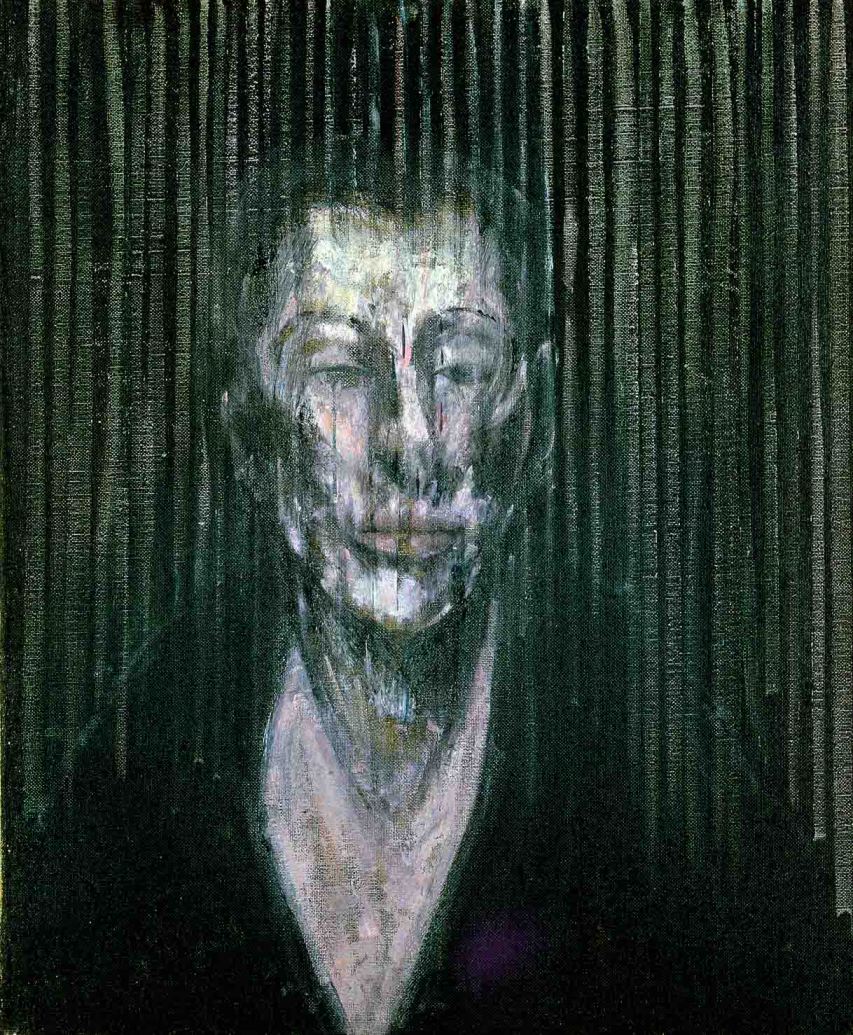
Bacon’s Sketch for a portrait of Lisa, 1955
Closer look at Bacon
William Packer visits an important retrospective exhibition in Paris
WILLIAM PACKER | ARTS | FINANCIAL TIMES | TUESDAY JULY 9 1996
Francis Bacon died four years ago at the age of 82, though by the apparent vigour of his work to the last, he hardly seemed so old. Yet he had been a central, if singular figure in British art for almost 50 years, and already a marked and coming man for some time before that.
Such people are well able to sustain their own myth, and Bacon evidently relished and cultivated that singularity. He was clearly the most famous and internationally successful British painter in his lifetime but, more than that, he was defiantly the odd man out — a figurative painter, symbolist, surrealist and expressionist in a world of cooler abstraction and conceptualism, and living a life to match.
But as time goes on, so we begin to see his oeuvre from first to last, despite its contradictions and shifts of emphasis, as all of a piece. He may have destroyed most of his early work and stopped painting for a while: he may seem consciously to have set his mature career and reputation on the still extraordinary triptych of 1944, “Three Figures at the Base of a Crucifixion”, by which he marked the moment he began to paint again and first came before a wider public. Even so, enough of the earlier work survives and, piece by piece, comes back into the light, to qualify that self-presentation.
Artists have their own position, which is not necessarily ours. They are not always the best judges of their own work, standing so close to it, perhaps, as to see the trees but not the wood. The true artist will always do more than he knows, let alone intends, and Bacon himself insisted upon the primary importance to the painter of chance and intuition and pure luck. “That is why real painting is a mysterious and continuous struggle with chance," he wrote in 1953.
Three years ago at Venice the critic David Sylvester effectively reintegrated Bacon’s work after 1965 with that of the previous 20 years or so, testing the view that Bacon’s greatness rests on that earlier work. Now in an ampler selection for the Centre Pompidou, he throws that question open again, and makes if anything, and perhaps unconsciously, the further point that Bacon was never at all the eccentric and isolated figure of received opinion.
Which brings us back to the young Bacon of the 1930s and his work of the time. Few as the examples are, they are more prominent here than ever before. Here is the Bacon of the avant-garde circles of Moore, Sutherland, Pasmore and de Maistre, the Bacon who turned down Roland Penrose’s invitation to show in the Surrealist Exhibition of 1936. And here is the small “Crucifixion” of 1933, that Herbert Read reproduced alongside a surreal and grotesque Picasso “Baigneuse” in his book, Art Now.
Here then, in the common stock of 1930s surrealism, lie the origins of that “Crucifixion” triptych of 1944, and all the disembodied figures, gaping mouths, bared teeth, screaming Popes, that were so soon to follow. But there are also two quieter, more ambiguous paintings of about 1936, an “Interior of a Room" and “Figures in a Garden”, that are no less significant. For already they describe the shallow, angular pictorial space that was to be Bacon’s device of a lifetime — the open space-frame, the enclosing screen. And with as yet no idiosyncratic horrors to register, they sit happily at the centre of cosmopolitan modernism, looking to Matisse and Braque on the one hand, and to incipient British neo-romanticism on the other, to Sutherland — with whom a creative association lasted throughout the 1940s — Ceri Richards and Eileen Agar.
Thus primed, the comparisons come thick and fast, and not necessarily one way. The crouching and sitting figures of the later 1940s summon up Magritte; a grey figure study (1957) suggests Giacometti; a mountain landscape (1956), David Bomberg. And such current luminaries as Penke, Baselitz, Clemente and Salle are all prefigured in the images of the 1950s. To say as much takes not a whit away from Bacon’s interest, originality or importance as an artist, but only from that supposed isolation.
Bacon remains unquestionably a remarkable and major artist, and the better for the loss of his splendid isolation. His faults we can live with — his feeble drawing more than made up for by the often exquisite delicacy and subtlety of his touch as a painter. The later works remain for me a problem, more for the over-blown scale on which they are too often set, which exposes the drawing and overextends the paint upon the surface, than for their actual imagery. The sets of small portrait studies, close and intense, early or late, are as strong as ever. And the heavy cloud of his bleak, dark, despairing humanism hangs over it all.
Francis Bacon Retrospective: Centre Georges Pompidou, Paris, until October 14, then on to the Haus der Kunst, Munich: exhibition organised by the Centre Pompidou in collaboration with the British Council.
The art world continues to neglect our native genius
COMMENT | THE TIMES | TUESDAY JULY 9 1996
When Francis Bacon died four years ago the obituaries were unanimous. Here was a painter of towering individuality, one of the greatest that this country has ever produced. Since then, interest in his harrowing but mesmerising canvases has, if anything, increased: witness the extraordinary excitement, and the passion of the subsequent critical debate, over the discovery in February of a supposed early self-portrait by the artist.
So it is disappointing, to say the least, that Paris rather than London should have seized the initiative and mounted the first large-scale retrospective of Bacon’s work since his death. As our chief art critic reports today, the show curated by the art historian David Sylvester at the Pompidou Centre is an immensely powerful survey of 95 of Bacon’s t works. They have been borrowed from collections around the world (including from the Tate in London), and range across the whole of Bacon’s dark and lonely adult existence — from an extraordinary Crucifixion, painted when he was 24, to the sequence of grieving triptychs that he created late in life.
This remarkable show remains in Paris until October then it travels to Munch. Britain will not have it. Britons must either travel abroad after or make do with a small complementary exhibition in Norwich of Bacon portraits from the Sainsbury collection. Though welcome and useful, it scarcely counts as an alternative.
Bacon’s reputation remains high on the Continent; that should be a matter of pride in this country. We have sat back and allowed other nations to take the lead in celebrating his genius; that should be a cause of regret.
When the Vermeer exhibition was seen in Holland but not in Britain, and the Matisse exhibition was put on show in Paris but not in London, we could at least offer ourselves the consolation that these artists were being displayed in countries from which they drew inspiration. But Bacon was a Londoner through and through, as closely associated with the demi-monde of Soho as Toulouse-Lautrec was with Montmartre or Cézanne with Provence.
London’s galleries may argue that only 11 years have passed since the Tate mounted a magnificent show of 124 Bacons. They may also point to plans to put Bacon’s triptychs on show at the Hayward Gallery. But when the foremost British painter of the century dies, those who lead our artistic life have a special duty to mark his achievement in a fitting and monumental manner. They have signally foiled to do that here and British exhibition-goers are the losers.
Coming so soon after the luke-warm and tardy attempt to keep the Becket casket in Britain, this latest instance of art-institution apathy is unwelcome. To lose one superb piece of national heritage in a month may be regarded as a misfortune. To be beaten into third place when it comes to celebrating a modem British genius suggests that a sharp wake-up call is needed.
By ALAN RIDING | ARTS | THE NEW YORK TIMES
PARIS July 9 — Like
many other cities, Paris now routinely uses blockbuster shows to revive
interest in artists ranging from Poussin to Cezanne. But what distinguishes
the major retrospective of Francis Bacon that just opened at the Georges
Pompidou Center is that the British artist died only four years ago.
Already, it seems, his work is considered ripe to be rediscovered.
Not that Bacon lacked for attention in his lifetime. In fact, one of the most important exhibitions of his works was held at the Grand Palais in Paris in 1971. France nonetheless always viewed him as something of an outsider, a figurative painter when abstract and then Conceptual Art were all the rage, a man whose distinct visual language seemed to owe nothing to French artistic tradition.
For a new generation, then, the show at the Pompidou Center, the largest Bacon exhibition in a decade, is indeed a discovery. And it has been received here as such, with extensive coverage in newspapers and magazines and the publication of a comprehensive 336-page catalogue. The exhibition, which closes on Oct. 14, has 79 paintings, including 16 of Bacon’s 30 triptychs, and 7 works on paper.
“Bacon at last!” Jean-Marie Tasset wrote in Le Figaro. “If he had not been a millionaire, he would no doubt have been our martyr of contemporary art. For so long he was scorned as reactionary and conventional by the official thinkers of the day. Long excluded, he is now recognized by all. Through his life and work, Bacon showed that individual courage is the best way of fighting prejudice.”
Bacon made no effort to reach out to most of his contemporaries. For many years he was a close friend of the painter Lucian Freud, although he disliked being grouped with Mr. Freud, Leon Kossoff, Frank Auerbach, R. B. Kitaj and Michael Andrews in a so-called School of London. He also dismissed Jackson Pollock and Willem de Kooning and made no secret of his deep distaste for the whole range of nonfigurative postwar art movements.
What becomes apparent in this exhibition is that from the moment he created his Three Studies for Figures at the Base of a Crucifixion in 1944, Bacon found his own tormented vision of art. And until his death in 1992 at the age of 83, he continued to explore the disturbingly deformed images of the human face and body that distinguish his work from anything before or since. His favorite subject in his later years was John Edwards, the friend to whom he left $16.9 million. Bacon liked to consider the 1944 triptych, with its monstrous semi-human figures set against an acid orange background, as marking the start of his career as an artist. In truth, he began drawing and painting more than 15 years earlier, but he destroyed almost everything he did. Of 10 surviving pre-1944 paintings, three are in the show here, including his ghostly Crucifixion of 1933, which was well received at the time.
Bacon was born in Dublin of English parents in 1909 and moved with his family to London in 1914. In 1925, at 16, he left home after a fight with his father and began what became an infamously bohemian life. He began work as a decorator and furniture designer and often went to Europe. In 1928, he visited a Picasso exhibition in Paris that inspired him to start drawing.
By the mid-1930’s, he had given up decorating for painting but had had little success. He showed his work in some collective exhibitions and did odd jobs to make ends meet. The two other early works on display here point the way to his lifelong use of rich, almost garish colours, although their styles are derivative, Interior of a Room (1935) of post-Cubism and Figures in a Garden (1936) of Surrealism. Two of the works on paper, one an homage to Picasso, also date to this period.
In 1944, recognition of Bacon as an original began to grow. His personal life was tumultuous: he was an inveterate gambler, he always drank heavily and he flaunted his homosexuality. But his provocative way of life seemed to inspire him to create. He was an avowed atheist, yet he returned frequently to the theme of crucifixion, always calling his works “studies,” as if one day he planned to paint a complete crucifixion. The howling mouths or silent screams that characterized much of his work through the 1950’s soon appeared, with a series of isolated heads giving way to his many studies inspired by Velazquez’s majestic portrait of Pope Innocent X. In this series and in his studies for a portrait of van Gogh, his tributes to the artists were direct. Elsewhere, he quoted more subtly from Monet, Michelangelo, Turner and Degas.
In the 1960’s, Bacon began to use friends, among them Mr. Freud, as models, although working from photographs because he liked to work alone in his studio. And even here, the photos were merely to remind him of certain features. What counted was the image they projected to him, and it was this he would paint, often mangling faces or twisting bodies to catch their “appearance.”
“The image is a kind of tightrope walk between what is called figurative painting and abstraction,” he once told David Sylvester, an old friend and distinguished British art critic who organized the Pompidou exhibition. “It will go right out from abstraction but will really have nothing to do with it. It’s an attempt to bring the figurative thing up onto the nervous system more violently and more poignantly.”
With these portraits, Bacon also began to reduce competing images in his canvases to a minimum, apparently eager to focus all attention on the pain or sex or violence or solitude he was trying to convey. Obsessed with geometric forms, he introduced lines as “glass cages” to create frames within frames. In Triptych Inspired by T. S. Eliot’s Poem ‘Sweeney Agonistes’ (1960), the flanking panels show two nude women and two nude men on beds inside "glass cages," while the central panel shows a bloody corpse in a train compartment.
In many of his works of this period, he used his lover, George Dyer, as his model, as in Three Studies of the Male Back. And after Dyer committed suicide in 1971 (just before Bacon’s Paris exhibition that year), Bacon continued to paint him, as if anxious to purge himself of responsibility for his friend’s death. Triptych: In Memory of George Dyer is particularly touching, with the central panel showing Dyer holding the key to the door of an apartment.
Bacon’s sense of the continuity of his work was underlined in 1988 when he repainted his 1944 triptych, now somewhat more stylized and with a dark red background replacing the original acid orange. And until the end of his life he continued to probe himself in studies for self-portraits. But he always insisted that his purpose was not to shock or disturb.
“My figures are not twisted or tortured by torture,” he said in a 1971 interview with a French magazine. “I do not deform bodies for the pleasure of it, rather in order to transmit the reality of the image in its most poignant phase. Perhaps it is not the best way, but it is the only way I know of to get to something that is as close as possible to life.”
Paris has taken Francis Bacon as one of its own, a European painter with a vision of the
uncertainties and fragmentation of the twentieth century, says Andrew Graham-Dixon
ANDREW GRAHAM-DIXON | THE COMMENTATORS | THE INDEPENDENT | TUESDAY, JULY
16, 1996
The Francis Bacon retrospective, which opened a fortnight ago at the Centre Georges Pompidou in Paris, has been attracting approximately 5,000 visitors each day. That is a remarkable figure. Picasso and Matisse apart, it is hard to think of another 20th-century artist capable of drawing such crowds. It is impossible to think of another British 20th-century artist capable of doing so.
As far as the French are concerned, we are to understand that Bacon is not British at all, but European. According to Jean-Jacques Aillagon, the president of the Pompidou Centre, he is one of the quintessentially European artists of modern times. Indeed, Aillagon adds, the exhibition may be counted upon to reveal the "profonde Europeanite" — the profound Europeanness — of his painting. It is very unusual for the French to consider a British artist as one of them, as part of the mainstream, in quite this way.
The desire to recruit Bacon as a "European" is not entirely perverse because, at the level of its technique, Bacon’s art does speak long and lovingly about the art of the Italian, Spanish and Dutch masters he admired (above all Titian, Velázquez and Rembrandt). Yet the Pompidou exhibition and its popularity surely says as much about the the times in which we live as it does about Bacon’s art.
The readiness or the desire to see this difficult, refractory boundlessly vital individual as an emblematic trans-national European figure may be symptomatic of something else; part of a broader quest for some binding sense of European identify, perhaps. But there is a paradox here, because Bacon’s grand subject is the troubled and fugitive nature of identity itself. Bacon’s art teaches us to admit that we do not know quite who we are, nor quite what is going on, nor why. Could it be that modern Europe is prepared to embrace him because it sees in his work a reflection of its own uncertainties and fragmentation?
The images confronting those 5,000 daily visitors to the Pompidou Centre are neither pleasant nor comforting. In Bacon’s art the Pope screams, the newsreader, in his glass box, laughs the laugh of a maniac; while the politician grins, melts and collapses into an incoherent puddle of matter. The dissolved, blurred and otherwise deformed people we see in Bacon’s paintings have lost their coherence and have metamorphosed into projectiles of flesh and energy, going God knows where. They embrace each other. They eat each other. Often, we see them in the process of turning into animals.
Bacon’s is an art of breakdown, meltdown and entropy — a fact he makes plain by taking the classic forms of Western European religious art (the triptych, the icon) and twisting them to his own ends. One of the first pictures to be seen in the exhibition is that with which the artist made his London exhibiting debut, in 1944: Three Studies for Figures at the Base of a Crucifixion. The writer John Russell, who went to see the painting in an exhibition at the Lefevre Gallery just a month before the end of the Second World War, has left a fine description of the appalling impact it made on the fragile optimism of its first audience.
"Immediately to the right of the door were images so unrelievedly awful that the mind shut snap at the sight of them. Their anatomy was half-human, half-animal and they were confined in a low-ceilinged, windowless and oddly proportioned space. They could bite, probe and suck, and they had very long, eel-like necks ... Common to all three figures was a mindless voracity, an automatic unregulated gluttony, a ravening undifferentiated capacity for hatred. They caused a total consternation. We had no name for them, and no name for what we felt about them."
Yet the mood at the Pompidou Centre is one of reverence. The paintings are hung within spaces and arranged in configurations that suggest the sacredness of the chapel. There is even, perhaps, a sense in which Bacon has now come to seem all too easily accessible an artist. These days Three Studies for Figures at the Base of a Crucifixion does not seem to prompt shock but (and this may itself be shocking in another way) an almost straightforward sense of recognition. On the day when I visited the exhibition, I saw a young couple approach Bacon’s howling, sneering, squatting maenads, consider them for a moment or two in silence, nod sadly and move on. Yes, the choreography of their bodies seemed to say, yes, this is what the world is like. Ghouls like these ones lurk everywhere — in corners of the mind best left unvisited, in the shadow lands of society, in war zones.
Bacon originally seemed a disturbing artist because he insisted on emphasising those aspects of humanity — transgressive, violent, bestial — that most of his audience had spent their lives attempting to suppress or ignore. Once, his work scandalised those who saw it. Now, many seem to find in it cause for consent, even consensus. One generation’ s revelation has become another generation’s given.
Perhaps it is in this sense, then, that Bacon has become a "European" artist. In his visions of the ego perpetually succumbing to the id, of the humane succumbing to the bestial, of the coherent being swallowed up by the incoherent, we now simply see a convincing account of the way things are — especially in central and Eastern Europe. Yet, while the troubled modern European sensibility finds it tempting to see itself and its own predicaments so uncannily reflected in the deformations, apparent violence and the heightened sense of mortality expressed by Bacon’s work, this does not necessarily make it any easier for us to see his strengths and weaknesses as an artist. Bacon himself, it ought to be remembered, passionately disliked overt symbolic interpretation of his work. Indeed, few things horrified him more than the notion that his pictures might be taken for allegories of the political, moral or other ills of the 20th century.
The danger is that our own historical circumstances, and our own sense of history, may persuade us to see Bacon’s work as merely a form of higher illustration; a series of cartoon diagrams depicting such abstractions as the Human Condition or Late Twentieth Century Anxiety. Yet at his very best, and particularly in his earlier work, which looks more impressive with each passing year, Bacon gave expression to his undoubted morbidity and pessimism with a pictorial inventiveness — an originality in the actual handling of paint itself — unmatched in the art of any of his contemporaries.
His paint had a visceral quality, and a perverse beauty, that sets itself against the apparent horror of his imagery. He once said, a propos of the screaming face that so fascinated him as a motif that he wanted to paint the glitter and the life of the human mouth as if he were Monet painting a sunset.
To see Francis Bacon as a great describer of what it means, now, to be a European, may be in one sense to pay him his due. But it is also to risk ironing out the unevenness in his work, and seeing almost everything he touched as a masterpiece — which is almost the same as forgetting what made him great, when he was great, in the first place. The moment when we begin to find Significance in an artist’s work may, also, be the moment when we begin to lose sight of the work itself.
Francis Bacon continues at the Pompidou Centre, Paris, until 14 October.

Above, a portrait of Bacon taken in his studio in 1971. Photograph: Francis Goodman
High anxiety maybe — not high art
A Francis Bacon show in Paris is drawing crowds, but
Richard Dorment is repelled by the artist’s work
RICHARD DORMENT | THE ARTS | THE DAILY TELEGRAPH | THURSDAY, JULY 18, 1996
IN Study of the Human Body of 1982 Francis Bacon presents us with an image of a mutant creature composed of a man’s genitals and buttocks, standing on two bare legs covered from feet to knees in cricket pads. To be frank, the picture strikes me as too silly for words. But the reason it is high camp and not high art has less to do with its subject than its composition.
Bacon is giving visual form to a sexual fantasy, depicting another person not in terms of his humanity but as fragments of his body. Since those cricket pads reek of fetishism, the painting may interest students of abnormal psychology. But artistically it is a failure. Instead of limiting the amount of space around the central motif (as Magritte and Courbet instinctively did in their tightly cropped close-ups of women’s sexual organs), Bacon places the body parts on a pedestal in the middle of the canvas and surrounds them with space, asking us to regard them as objects of aesthetic contemplation, not of fetishistic fascination. The result invites ridicule.
It may be unfair to judge Bacon by a painting done 11 years before his death in 1992. For most people it is the work of the first half of his career that places him among the most important British artists of this century. But is this division between the early and later work really so acute? The occasion of the British Council’s retrospective of his work at the Pompidou Centre in Paris (until October 14) gives us a chance to revise the received view by taking a long, hard look at the career as a whole.
The show has been selected and installed by Bacon’s formidable advocate, the critic David Sylvester. My enormous admiration for Sylvester means that this exhibition represents the best and probably the last opportunity I will have to come to terms with an artist who has always left me cold. Before seeing it, I had always thought that Bacon’s paintings perfectly captured the angst of the post-war period, but that his work did not transcend his own time in the way that, say, Polllock’s has, and Jasper Johns’s surely will. Having now seen the show, I wish I could say it changed my mind. But, though Bacon at his best ranks as the most gifted painter of the School of London, seen from an international perspective he is the most overrated artist since Bouguereau.
Where to begin? Technically, Bacon is such a limited painter. He found it nearly impossible to sustain the visual interest in a picture over the entire surface of a canvas, from the central motif to the edges. A face or figure may contain ravishingly painted passages, but it will typically be surrounded by vast areas of dead, flat pigment. It isn’t that Bacon didn’t try, in works like the Study for a Portrait of 1953, to create space and atmosphere with modulations of light and dark, but that, having tried, he soon lost interest, and eventually gave up. In the later works he simply used a can of spray paint.
As early as the Self-Portrait of 1956 it feels to me as though he was working on too large a scale — too large, that is, for a neo-Romantic artist who was no draughtsman and had no technical training. As the paintings get bigger, they flare into life only in isolated passages, usually where impastoed paint is used to evoke gobs of viscera, spattered brains and smeared bloodstains.
Another problem is Bacon himself, as we know him through his pictures. When Three Studies for Figures at the Base of a Crucifixion was first seen by the British public in 1944, the three armless and legless torsos howling with rage or pain were seen as symbols of spiritual despair of suffering humanity. But Bacon was not happy with that interpretation.
When he retuned to the subject on a much larger scale in 1988, he made changes which conveyed a much nastier message: that these were not timeless archetypes, but sado-masochistic fantasies, creatures who, in order to feel anything at all, offer their bodies to be violated and mutilated. You have to conclude that Bacon finds pain erotic. Because his paintings are so often filled with lovely colours, Bacon aestheticises physical and emotional suffering.
There are two outstanding paintings in this exhibition. The pit bull terrier in Man with Dog of 1953 is set against a nocturne of silvery blacks and blues beautifully painted with a dragged brush. Against an uptilted plane, the animal becomes as mysterious and threatening as a Cerberus guarding the entrance to the underworld, here suggested by a sewer. And the Study for a Portrait of Van Gogh III of 1957 is wonderfully voluptuous, colour-saturated painting, demonstrating that Bacon might have been a de Kooning, if not a Van Gogh, if only he had not been so desperate to enter the pantheon of great artists by taking on ever more portentous subjects.
But what are we to make of the succession of enormous triptychs in which men in their underpants defecate or vomit or look as though they’ve just been beaten to a pulp? The answer is: quite a lot if your are a psychoanalyst treating them purely as material for interpretation. I have no objection to this approach if, as with some contemporary conceptual artists, this is how the viewer is invited to respond to the work. But to do that, you first have to set aesthetics aside. Bacon wanted his work to be judged as painting, he was asking us to see beauty in paint and death. This to me is repellent.
But what I dislike most about Francis Bacon’s art is that in both earlier and later paintings he manipulates his viewers. I hate being told what to feel in front of a picture. It is like the difference between Grand Guignol and Chekov. The first is crass and crude and admits of only one possible response: revulsion. Real art is more complex. It allows us to bring our own thoughts and feelings to it. I just don’t understand an artist who pitches the level of anxiety in all his pictures so high that it crowds out anything remotely resembling a real thought or feeling. You can do one of two things in front of an image of unadulterated horror: either you go along with it and scream, or you say “this has nothing to do with my experience.”
Since 4,000 people a day are pouring into the Paris show, and Bacon is one of the most revered of all British artists, I realise that his work says something to them that I just can’t hear.
The Francis Bacon retrospective, organised in collaboration with the British Council, is at the Pompidou Centre in Paris until October 14. Information: 00 33 1 44 78 12 33.

Overrated: Francis Bacon
Go East for Sainsbury’s best Bacon
BY LESLEY GARNER
| PREVIEW | ART | DAILY EXPRESS | FRIDAY JULY 19 1996
THE trapped figure in a Francis Bacon portrait looks out at you through its left eye. The rest of the face maybe a maelstrom of bruised plum and raw vermillion paint, the bones knocked out of place by the sheer violence of being alive. But from many of his faces, the left eye, clear and undistorted, looks out through the battered mask like the one moment of clarity in a night of distorted dreams. The longer I spent among the portraits on display in the Sainsbury Centre for Visual Arts in Norwich, the more I felt that this unflinching eye was Bacon’s itself. You can travel to Paris this summer to see a major Bacon retrospective, or you can stay closer to home and visit Norwich instead. In the hangar-like spaces of Norman Foster’s building on the university campus, there is enough variety of artistic experience to make a good day out.
Walk one way down the gallery and you are face to face with the Bacon portraits. Turn the other way and you are in the world of his contemporary, Giacometti. Both artists struggled to present the human being in their work at a time in the 20th century when other artists were working with abstraction. Giacometti’s solitary figures are trapped in a web of lines. Bacon’s figures seem to be undergoing some titanic inner struggle that forces their features apart, such as his series of screaming Popes. If they are not imploding, Bacon people are trapped, like Giacometti’s, behind a spectral screen of faint lines and veiled paint.
The portraits are mesmerising and haunting. Part of the art of Bacon lay in creating a personal world of unforgettable images. He was obsessed by two images from the past — Velazquez’s portrait of Pope Innocent X and a shot from Eisenstein’s film The Battleship Potemkin of a screaming nurse, her spectacles shot away, right eye blinded, left eye staring in horror. At the heart of this exhibition are the portraits of themselves that Sir Robert and Lady Sainsbury had painted by Bacon. They traded the vanity of having photographic likenesses painted by a society flatterer to be transmuted into dreamlike images by a friend.
Sir Robert, although he wears the suit and tie of City portraits, is a spectral figure; his face, apart from the left eye, erased in a chalky blur. Lady Sainsbury gazes first through a rain of pale lines then, in two more paintings, gains colour and substance. There are two more good reasons for visiting the Sainsbury Centre. One is the permanent collection of tribal art displayed with works by some of the 20th-centuary artists it inspired, such as Picasso and Modigliani. The other is East 96, the annual display of contemporary art by rising artists.
Trapping Appearance: Portraits by Francis Bacon and Giacometti is at the Sainsbury Centre for Visual Arts, University of East Anglia, Norwich, Tuesday-Sunday, 11am to 5pm. Tel: 01603 456060
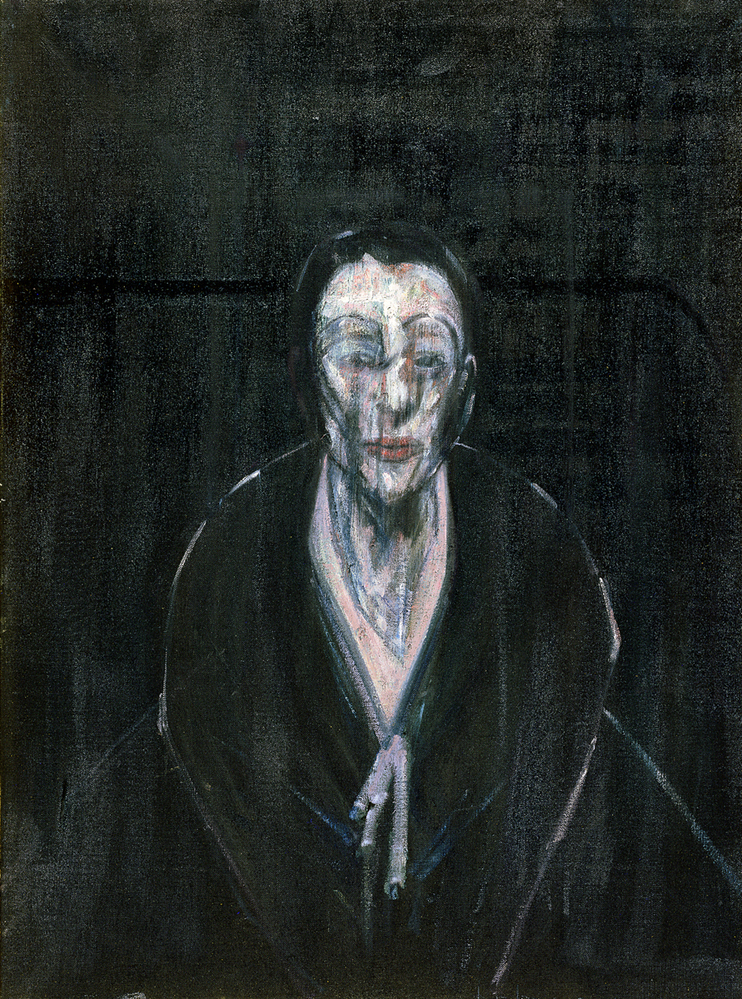
ALTER IMAGE: Bacon’s view of Lisa Sainsbury
Bacon in Paris
NICHOLAS SEROTA | LETTERS TO THE EDITOR | THE TIMES
From the Director of the Tate Gallery
Sir, Francis Bacon was, indeed, one of the great painters of the 20th century, as David Sylvester’s magisterial exhibition in Paris confirms.
However, contrary to the views expressed in your leading article of July 9, he has not been a prophet entirety without honour in his own country.
Of the four major exhibitions of his work held during his lifetime, two were initiated by and shown at the Tate in 1962 and 1985.
We expect to celebrate his achievement here in many ways over the next decade.
Yours faithfully,
NICHOLAS SEROTA, Director,
Tate Gallery, Millbank. SW1.
July 17.
Cooked up emotions
By EDWARD LUCIE-SMITH | ARTS | EXHIBITIONS | THE SPECTATOR
The Bacon retrospective at the Centre Pompidou in Paris is about the best representation of the artist which can be imagined — intelligently selected and flawlessly hung: no surprise, this, when the curator of the show is David Sylvester, a close friend of the artist, the major expert on Bacon’s work, and a man who has turned the making of exhibitions into an art form in its own right. The question the event raises, and in even more acute form since the exhibition itself is so well done, is whether Bacon is all he is cracked up to be.
Few contemporary artists have attracted the support of intellectuals to the same extent. From the great anthropologist Michel Leiris in Paris to Marta Traba, founder of the Museo de Arte Moderns in Bogota, they have all sung Bacon’s praises. Traba’s book Los cuatro monstruos cardinales, published in Mexico City in 1965 (the other 'monsters' were Dubuffet, De Kooning and Jose Luis Cuevas), was enormously influential in spreading Bacon’s reputation throughout Latin America. It is a major omission from the Centre Pompidou’s otherwise very thorough bibliography. The attitude of these intellectuals towards Bacon’s work is summed up in the titles of two essays by the veteran French poet and critic Alain Bosquet. One, published in Le Quotidien de Paris in 1987, was called 'Francis Bacon ou le terreur de soi'. The other, published in Le Figaro four years ago, was called 'Francis Bacon, le terreur d’être'. That is, the artist is seen as some- one who teaches us about that favourite 20th-century concept, existential fear of the void. A militant atheist all his life, Bacon emerges from the writings of his admirers as a quasi-religious figure. Can one accept this? Equally, can one accept the view that Bacon is a technical wizard, one of the few artists of his generation who actually understood what paint could be made to do on canvas?
At this point, I think it must be said that I already have a fairly prominent place amongst the sceptics. I reviewed Bacon’s first retrospective at the Tate for the Listener in 1962, and I reviewed his work again for the Evening Standard in 1978. On both occasions, if I remember correctly, I compared him to Johann Heinrich Fuseli, painter of that wonderfully hysterical, but also rather comic, near-masterpiece The Nightmare', and central figure in the late 18th-century Sturm and Drang. Bacon, I thought, was technically hit-or-miss, just as Fuseli was. I also felt that, like Fuseli, he dealt in cooked up emotions — rushing around saying boo to any goose he could find.
Has the current exhibition caused me to change my mind? The answer must be 'a little bit, but not as much as I hoped'. This is the first would-be comprehensive survey of Bacon’s work mounted since his death in 1992. Sylvester has not had to consult the artist, and it shows in the choices he has made. There are 88 single paintings and triptychs in the catalogue. Sixty-two of these date from before the year 1972. Thirty-five date from before 1960. Clearly the curator thinks that the early years produced Bacon’s most significant work. Going round the show, it is hard to disagree with this verdict. 'Figure in a Landscape' of 1945, and the two 'Figure Studies' of 1946 — apparitions conjured up from an old tweed overcoat and a few other props — are disturbing, masterly paintings which evoke a state halfway between sleeping and waking, when familiar objects seem sinister and alienated. Some of the paintings dating from the early 1950s based on images made by the Victorian photographer Eadweard Muybridge are scarcely less good.
These were also the years when Bacon courageously faced the subject of his own homosexuality, in images whose meaning could scarcely be misconstrued. 'Two Figures in the Grass', of 1954, is present in the Pompidou exhibition. The even more forthright 'Two Figures on a Bed', of the 'Study of a Figure in a Landscape' by Francis Bacon, Phillips Collection, Washington previous year, is absent, but reproduced full-page in the catalogue. Post-Wolfenden, post-Hockney, post-Gay Lib, these paintings have lost a great deal of their original impact. In the repressed climate of the 1950s, they had the force of an explosion. People talked about them, though they were little seen. When the Institute of Contemporary Arts gave Bacon a retrospective in 1955, featuring only 13 pictures, 'Two Figures in the Grass' was included, but prudently not reproduced in the catalogue.
Perhaps because the imagery carried such a serious freight of meaning, this was also the epoch when Bacon’s actual technique was at its most secure. As everyone knows, he was not a trained artist, and the three paintings done in the 1930s which are included here (Bacon destroyed a number of others) are not models of technical refinement. Indeed, it wouldn’t be going too far to call them slightly ham-fisted. His best technical achievements came when he learned to use the 'wrong, unprepared, side of the canvas. This led to the vaporous, dream-like look typical of the series of Popes (paraphrases of Velazquez’s 'Portrait of Pope Innocent X'), the paintings which, more than any others, supplied the bedrock of Bacon’s early reputation. In the 1960s, there is a change, and not for the better. Now only the figures are freely brushed, against linoleum-like grounds of flat, unarticulated colour. As if to compensate for deadness of a large part of the picture-surface, Bacon also elaborated the whole decorative apparatus which already played a role in his works — platforms, transparent boxes, screens, bath- room fittings, distorted items of modernist furniture. Even where the paintings commemorate real, tragic events, like the suicide of the artist’s lover George Dyer on the eve of the triumphant opening of Bacon’s first Paris retrospective in 1971, there is something cooked up about them — a shrill, forced, sensationalist element which would only strengthen as the years went on. Even the most personal works became scenes from a melodrama.
If one considers Bacon’s career as a whole, one is struck by certain things. He relied on a very small store of key images, most of them borrowed — from the Velazquez just mentioned (a painting he never dared to see in the original), from Muybridge, from medical textbooks, from Eisenstein’s Battleship Potemkin. Equally, he mythicised a small group of friends and lovers, whose likenesses appear again and again — Dyer, Isabel, Rawsthome, Lucian Freud, Muriel Belcher (proprietress of the Colony Room in Soho), Henrietta Moraes. With the exception of Freud, few of these were personalities of general interest, though as anyone who encountered some of them in the flesh can say, they did have a certain arrogant confidence in their own bohemianism, just like Bacon himself. Whether you can actually found a universal myth about the splendours and horrors of contemporary life on such specialised and scanty materials must, I think, remain in question.
It remains to say something, briefly, about the other 'British' show in Paris, A Century of British Sculpture at the Jeu de Paume. Alluding to the exhibition in these pages (6 July), Leslie Geddes-Brown seemed to think it was rather a good thing. Alas, this is not the case. Epstein, Moore, Hepworth, Ben Nicholson, Caro, Paolozzi are crammed into small spaces downstairs. Upstairs, in the larger galleries, is a parade of currently fashionable names — Flanagan, Long, Cragg, Kapoor, Rachel Whiteread, Damien Hirst. It is British sculpture seen through the eyes of leading international art magazines: a hierarchy of what is 'important' which has everything to do with current hype and almost nothing to do with a sense of history or with individual judgment. Better not to publicise national achievement at all than to publicise it in these terms.
Francis Bacon (Pompidou Centre, 14 October)

‘Study of a Figure in a Landscape’ by Francis Bacon, Phillips Collection, Washington
David Sylvester, connoisseur of life’s sweetnesses
He is a great writer on modern art, as his new collection of essays proves, and
the most sought-after mounted of exhibitions, such as the current Bacon show
in Paris. And to Grey Gowrie, he is a guru and friend
GREY GOWRIE | ARTS | THE DAILY TELEGRAPH
DAVID Sylvester is very much an Englishman and a London intellectual of his generation and background. He likes jazz, cricket, gambling, claret and talented women. He is resolute for the sweetnesses of life which only those of us whose earlier lives were touched by the drab deprivations of war can appreciate without taking for granted. He is also a Russian Jew, increasingly rabbinical in appearance, and a melancholy autodidact with tinges of paranoia and insufficient knowledge of his worth.
He is expert in English and European literature, post-Renaissance music, carpets, the civilisations of France and Italy (both countries have honoured him more than we have done), English furniture, Islamic art and Greek and Egyptian antiquities. He has influenced some of the best postwar acquisitions at the Tate.
He is the best living writer in English about modern art and, less subjectively, the most sought-after mounter of exhibitions. He is himself a very funny man and, if you are patient with the prickles and the paranoia, you can laugh at as well as with him. In cultural matters he is my guru, the person whose judgment I need to overcome even when I disagree with it. He is also my best friend among the generation immediately preceding my own. This cannot be an objective appreciation.
Sylvester’s career rides high at the moment. Perhaps his mildly Eeyore-ish temperament, combined with the generalised pessimism of our eighth decade, will be soothed by this burst of intense intellectual energy. It is bearing fruit in revised and selected essays such as the newly-published About Modern Art: Critical Essays 1948-96; in work in progress, like a book on Francis Bacon; and in two magnificent exhibitions this year alone.
The Serpentine Gallery is, with Charles Saatchi’s gallery, the best place to look at modern art in London. Sylvester’s display of William Turnbull’s paintings and sculptures corrected a puzzling neglect of one of our most intemationa admired artists. If you catch the Chunnel train, you can visit the Centre Pompidou in Paris, lunch well and be back again for supper. The Centre Pompidou is a very successful building for intriguing and attracting visitors. Yet its greatest advocate would be pushed to commend it as a place to consider paintings.
Sylvester’s Francis Bacon exhibition, which President Chirac opened three weeks ago (how unlike the home lives of our own dear heads of state), overcomes the difficulty. It is a masterpiece of concentrated selection of work by a great artist who painted a large number of “dreadful paintings”, in Bacon’s own account as well as Mrs Thatcher’s. Distil Bacon and the effect is wholly liberating and intoxicating. He becomes a humanist master who has looked with existential ferocity at the Renaissance tradition of celebratory grandeur. The exhibition is even better than the Museo Correr show in 1993. Sylvester received an unprecedented accolade in being awarded Venice’s Golden Lion for his criticism. Hitherto it had always gone to artists.
The new selection of essays is mesmerically absorbing. Arterati of my generation first read David Sylvester in our teens and early twenties when he was the regular critic of The New Statesman. A particular fascination was his ability to write like a travel writer, charting the movements of mind and eye. Sylvester did not mind changing his mind or engaging in a continual argument with himself. The reader participated in the debate and extended it.
Here was a writer who met Holden Caulfield’s test of excellence in The Catcher in the Rye: you wanted to call him up the moment you put him down. In this respect, Sylvester echoed the dynamic of modern art itself, its Wagnerian cycles of building up in order to destroy. Here he mirrors especially the career of its greatest exemplar, Picasso:
... Picasso himself is still the question, probably because Matisse is a great artist in the same sort of way as many great artists of the past, whereas Picasso is a kind of artist who couldn’t have existed before this century, since his art is a celebration of this century’s introductions the practice of art. In any event, Picasso is the issue, Picasso is the one to beat, Picasso is the fastest gun in the West, the one every budding gunfighter has to beat to the draw in order to prove himself. And, for those of us who are not involved in the life-and-death struggle of the game of art but only in the sham heroics of the game of criticism, Picasso is again the one to beat. The young critic cuts his teeth on Picasso. He proves his manhood by putting down Picasso, which is quite easy because he is so flawed an artist, is such a colossal figure that he has several parts that are clay. probably including his feet, but not his balls. I started being hostile to Picasso in print in 1948 ...
The passage comes from Sylvester’s introduction to About Modern Art, in a chapter he calls Curriculum Vitae. This constitutes the only disappointment of the book — frustration, rather — because it is a too brief account of Sylvester’s own intellectual journey. It is garnished with so many interesting anecdotes and references that you want it to develop into a full autobiographical banquet.
Sylvester was a close friend of Giacometti, who painted him, and Bacon, with whom he collaborated in a seminal text of postwar art, The Brutality of Fact. These men taught him not to be stuffed or padded: to try to overcome the protective carapace of life beyond the shtetl. Sylvester overcame, too, the very English characteristic of reticent hesitancy where talking about the arts is concerned — our terror of being eligible for inclusion in Pseuds’ Corner. Picasso, after all, was not risk averse.
Sylvester is a man who can wobble and dither in private — if endless calls to his friends, occasions both of delight and misgiving, can be called private. When I worked in politics, he agonised endlessly about voting Conservative, but said he always did so, not least because he would have fallen in love, were he homosexual, with Lord Carrington. Few days goby now without a call wondering where exactly I stand on such matters as Blake, TS Eliot (his master), Palestrina, Count Basie, Bertolucci and Mrs Bertolucci (with whom, like so many of us, he has been in love), anti-Semitism among Jews, Brendel versus Schnabel or the desirability of buying off-year Lafite.
I am reasonably sound in all these disciplines, but a sad disappointment over cricket. I have not yet had the nerve to confess that when my grandfather was President of the MCC, I was given, and have lost, bats signed by Bradman, Hutton, Compton and others. To me, watching or playing cricket is like being made to do alegbra out of doors. Sylvester agonises in conversation. Pen in hand, he is purged and decisive. His ability to write very well, although always painfully, sharpens his concentration into the judgments guiding his pilgrimage.
About Modern Art is contextual rather than definitive Sylvester. It charts his stations along the way. There are founding fathers like Monet, Cezanne and Bonnard; masters like Matisse and Picasso; maverick masters like {&r KIcT S? and S^s tavdylnyestedln the art which followed the last war: in Europe, Giacometti, Bacon and (early) Dubuffet; and in America, the great generation of Rothko, de Kooning, Pollock and Guston. Living in England, and knowing most English artists well, allows him to concentrate on the Englishness of modern English art, to adapt Pevsner’s phrase. Although I happen to loathe almost all Pop art, I can see why it is fun, if a bit too easy, to write about.
I join Sylvester gratefully once more when he describes Barnett Newman as producing “what seemed the most indispensable paintings of twentieth century” — not a common view — and learn from this book, rather than in conversation, the fascinating news that Sylvester’s major work of critical scholarship, his Renée Magritte and the five-volume Catalogue Raisonne of Magritte, co-authored with Sarah Whitfield, was triggered by conversations about Magritte with Rothko and Jasper Johns. Magritte occupied him for nearly a quarter of a century. As he himself wryly puts it: “I still love the work; but the fact remains that I spent years of my life, like Swann, on someone who was not my type.”
People who may be thinking of buying About Modern Art, but who feel there will be names unfamiliar or uninteresting to them, need have no fears. Sylvester neither patronises nor indulges in cultural name-dropping. But he does not talk down. Good writing about cricket could get me interested in cricket and here, above all, is a writer. The book has, too, the priceless advantage of not being illustrated. Your imagination seized by his account of the war, you will have to visit the battlefields for yourself.
About Modern Art: Critical Essays 1948-96’is published by Chatto at £25.

David Sylvester: ‘a particular fascination is his ability to write like a travel writer, charting the movements of mind and eye’
THE SWANN WHO LIKED BACON
BY CANDIA MCWILLIAM
A new collection of David Sylvester’s writings on art demonstrates
an awe-inspiring scope and luminous vision writings
CANDIA McWILLIAM | BOOKS | INDEPENDENT ON SUNDAY
ONE of the pleasures offered by such a collection as David Sylvester’s About Modern Art, with its long range over time, is the opportunity to watch the development of the critic’s relationship with his material. Such is Sylvester’s access to his own and an artist’s vision and so direct and luminous his expression of it that the reader is able to watch a sensibility develop and define itself, as in the miraculous films of Picasso painting on glass, where one sees the fleet thoughts and decisions of the artist without being distracted by his thinking person.
Sylvester in his early pages acknowledges the rare quality of editing he has enjoyed from Karl Miller, first on the New Statesman and later on the London Review of Books, J R Ackerley (“diffident to a fault... I always longed for him to iron out all my clumsiness”) and others. He is spot-on about American sub-editors:
They probe you here, they grope you there, insinuate themselves elsewhere; when you protect yourself in one place, they paw you in another; when you protest, they tell you what to do to give them pleasure and use emotional blackmail till you do; it’s all a long struggle to preserve a shred of your virginity. And yet they’re somehow so endearing in their desire for logic and intelligibility that you feel guilty about your anger. The worst villainy occurs when they bypass consultation. You receive the published work and find sentences totally rewritten, inevitably missing the point, and it’s like having been abused while asleep.
He goes on to say, later in the same essay, that “the attraction of editing is that it is much easier but equally gratifying at the time of a birth to be a father than a mother”. Since he is speaking here of his own editing, in concert with his teaching, committee, and curatorial work, there is a nice self-subversion.
Bold use of metaphor, extended as above like the trailed serifs of thick paint — “those delightful skeins” — he admires in the work of Kossoff, or used locally to highlight, comes naturally to Sylvester. A metaphorical spin in a good writer can be innate; it is how he sees the world, not how he overlays it. A writer born with a metaphorical vision interprets the world as does a painter or sculptor in his characteristic use of his medium. Sylvester’s metaphors have a fidelity and transforming attention that pay implicit tribute to Cezanne’s constantly renewed combination of these qualities. The sense of illumination — lightness, too — achieved by continual inordinate work is common to both.
Sylvester’s peculiar achievement is to interpret one immensely complicated created thing — an artefact or a vision — through another — good prose — and to align and clarify the two for us. This authority is the product of knowledge of the past, a rage for vigilance as well as for looking, and an intolerance of the intervention of veils of theory. In 1949, in a review of an exhibition of Frank Auerbach’s work at the Beaux Arts Gallery, Sylvester listed the qualities that “make for greatness in a painter — fearlessness; a profound originality; a total absorption in what obsesses him; and, above all, a certain authority and gravity in his forms and colours”.
Although it is with Bacon and Giacometti that Sylvester is perhaps most immediately linked in the public mind, the artist of whose work he spent several years co-authoring a catalogue raisonné was Magritte: “more of a painter, less purely an image maker, than his enemies and friends supposed. And I still love the work; but the fact remains that I spent years of my life, like Swann, on someone who was not my type.”
This swoop across the arts recurs rewardingly; he observes in his essay on Anthony Caro that the sculptor’s feelings about the human body did not disappear “merely because he turned from the ‘figurative’ to the ‘abstract’, (any more than the human voice disappeared from Mozart’s voice when he turned from writing an opera to writing a piano concerto)”. And of Cezanne: “In some of the landscapes there is a great silence and emptiness and at the same time a throb, a pulse. It’s like the experience of certain polyphonic music, such as Bach’s chorale preludes — an uncanny equation of relentless onward movement and total stillness.”
While writing a review in January 1953 (of a small Matisse exhibition at the Tate), David Sylvester “made a resolve that my career as a critic was to be dedicated above all — even more than to the promotion of a Giacometti-Bacon axis — to establishing that Matisse was a greater artist than Picasso”. Self-knowledge and moral clarity combine in Sylvester, who declares a preference more than once for “tentativeness” over “patness”. “My standpoint was undoubtedly much influenced by devotion to Giacometti’s work and approach. Picasso was a quintessential finder, Giacometti a quintessential seeker, and it seemed more virtuous to be the latter.” Elsewhere, he refers to Giacometti as the saintly knight without armour who had come to redeem art from facility and commercialism.”
This elegiac prelapsarian note is constant behind these essays, whether they touch on De Kooning’s slithery nudes, the “big machines” of Guernica and Les Demoiselles d’Avignon, the rich subject of the work of the artist in age, the “strange transcendent note” it has that is, Sylvester observes, surprisingly often present in the late work of those who die young, or on the effect of wars on art.
The entire world of art had the kind of creative energy, in the years before 1914, which is often said to be the prerogative of the genius who is shortly to suffer an early death. It was to be the death, as has often been said, of everything that Europe took for granted — of all kinds of values and beliefs and hopes that were now seen to be ill-founded, presumptuous, and naive. The wisdom that comes from disenchantment is not a climate that suits the growth of art: art, it seems, thrives on innocence. In this it only follows the principle that the more one knows the less one tends to do.
This wide lucidity coexists with an intimate understanding of the small (the “all-overness” of Klee) and even the parochial — “It seems to be the misfortune of British painters to be born with more in them of Shelley than of Keats” — the “reasonableness” that distinguishes Moore from Picasso. The beautiful poise of Sylvester’s consideration lies in that subtly undermining yet Englishly decent adjective. No page is with out at least two such felicities, and the collection is stuffed with aphorisms that are neither stiff nor apt to come to bits when you think about them. “Every clown wants to play Hamlet, no Hamlet would prefer to be a clown”; Miro “feigns a superb spontaneity”; the art of the “wine culture” (Europe) versus that of the “Coke culture” (America); “For a woman, the horror of ageing resides in no longer attracting; for a man, in no longer acting”. There is some toothsome art-critical cattiness evident in the short prologues to the essays, and, once or twice, in them: “To praise [Richard Long] now is to take a food parcel to someone who is in the middle of eating his dinner at the Ritz.” (The thorn may perhaps be retracted by the comparison Sylvester makes between Long and Caspar David Friedrich.)
The different colours of black in Spanish art, the “heroism of the real in Cezanne and Poussin”, the art criticism of Adrian Stokes, the unanimous affirmation of Jewish painters that “art has no business to exist if it does not speak to the onlooker of the miseries and occasionally the triumphs of human existence”, the slippage of Pop into Zen, the truth about Bonnard’s Marthe and her baths, Mondrian’s artificial tulip, each is given its proper weight and attention. Because we come to trust him almost as soon as we open the book we read of Gilbert and George’s more extreme exhibitions or of Warhol or Twombly and see that there are more ways of seeing than we know. abstract
‘About Modern Art’ by David Sylvester is published by Chatto & Windus at £25

Firing at the nervous system
Animal humanity and private violence in the work of Francis Bacon
FRANCIS BACON
Centre Georges Pompidou
MARK HUTCHINSON | ARTS | THE TIMES LITERARY SUPPLEMENT | FRIDAY AUGUST 2 1996
At the centre a kind of mentula dentata on a mounted block slouches towards us its lips painted its teeth bared suspended pended over the elegant base of a table it is poised on something resembling a pair if compass legs and might be walking or might se perched. Can it see us Is it blind Again we don’t know where the eyes might be a bandage has been attached its ragged edges hanging lamely down. To the left a more muted but no Less unsettling figure likewise mounted leans helplessly across from the formless drapery-like folds in which it is cupped in the direction of its companion it too has a head all but faceless time (only a nose is visible and seems >mothered beneath a wig of hair if the figure in he central canvas is openly aggressive its partner to the left seems paralysed with anxiety as though trying to struggle free of some suffocating morphological strait-jacket The third of the three canvases is equally unrelenting and again presents an animaloid figure with a vaguely human head resting on a single limb that is itself embedded in a patch of bristling spiked scrub is a kind of elongated partly ribbed scrotum from which a conger-like neck juts out the jaw of its head sprung open at right angles like a trap. All three figures have some of the colouring and texture of beach stones are openly sculptural in inspiration and are set off against a rough painted but sumptuous orange background that is lightly traced with grids.
Though not the actual opening to the exhibition “Three Studies for Figures at the Base of a Crucifixion” is the first thing you see as you approach the ticket-stiles. The inspiration for the figures according to Bacon were the Eumenides the avenging Furies that fell on the land after the long and bloody struggle between Athens and Sparta. Most commentators set it against the background of the war evoking material as diverse as Bacon’s brief spell in the ambulance corps pulling corpses from the rubble or post-war press rumours of a group of Nazi resistants the Werwolf still at large. Anyway, there it is for all its crude picture-play on male genitalia one of the most savage images ever to have survived translation on to canvas by comparison with which Picasso’s “Guernica” seems almost genteel old-worldly, in inspiration.
This raucous little triptych was painted in 1944 and is Bacon’s foundation myth the work he chose to open any major exhibition held in his lifetime It is not difficult to see why. Though all three icons (given their invested religious intensity sity what other term can we use still bear traces of the influence of Picasso their savagery sets the tone for much of Bacon’s subsequent earlier work while the contrast between the actual figures and the rich monochrome background ground looks ahead to the triptychs of the 1960s For this retrospective however Bacon’s first ambassador David Sylvester has decided to move the clocks back ten years and start with the ghostly “Crucifixion” from 1933. In one sense, it is the more natural candidate, since it was the reproduction of this work in Herbert Read’s Art Now that first brought Bacon to the public’s attention as a painter Once again, though the influence of Picasso is immediately apparent (this time, like the gouaches from the same period further on in the show, by way of Henry Moore), the eerie presence that radiates from this small canvas, as though Bacon had taken an X-ray of the human body and found, not a skeleton, but the proliferating cells of a crucifixion, is quite unlike anything being painted anywhere else at the time. Together with two further works from the 1930s of more scholarly interest, this and the “Three Figures” make up the antechamber chamber to the exhibition as we prepare for the onslaught of the first ten years of work.
One of the reasons for dwelling at such length on these two works is that they are among the very few early pieces that rival in force and intensity the paintings that make up the heart of Bacon’s achievement nearly all of which in my view were made over a ten-year period starting some time around 1962. The difference between the two periods equally well represented in Sylvester’s selection is striking their only common denominator, it seems, being the violence which shifts away from the subject-matter of the painting to the matter of paint itself and the way it is handled. Judging from the reputation they enjoy and an excellent critical anthology included in the catalogue these earlier works had a resonance for Bacon’s contemporaries that I am far from sure they possess today. Grim they might be — and it is certainly difficult to see the naked figure parting the curtains in “Study for the Human Body” as anything but an executioner — but there is something too gimmicky and systematic about the contrast between the violence of the thing depicted and the coolness of the composition the pictures are simply too staged ever really to involve the spectator Nowhere is this more evident than in the “Study after Velazquez’s Portrait of Pope Innocent X”, where you seem to be peering in at some deathly papal peep-show yet for all that are left curiously cold Part of the fascination these works held for their contemporaries can clearly be put down to the times as Bacon observes at one point in Michel Archimbaud’s Francis Bacon Entretiens (Gallimard 36fr), “I have the impression that people of my generation can’t really imagine a humanity without war”. Yet even in the 1950s there were dissenting voices including ing (as the catalogue admirably reveals the young John Berger who compared the kind of fascination exercised by Bacon’s caged popes to that of a puppet in a Punch and Judy show where the spectator can enjoy the violence precisely because he is at a comfortable remove.
Though Bacon’s fascination with the human body, and the male body in particular, are constant throughout his work the jump in style that occurs in the early 1960s is so abrupt that one wonders where it all began. The turning point seems to have been the Van Gogh series of which there is frustratingly only one on show (and not to my eye a particularly interesting one after which we approach the heart of the exhibition — the long run of luck as Bacon would put it — in which nearly everything works in his favour. What sparked off the new interest in colour and the semi-autobiographical focus on portraits of his friends was probably a combination of things his time in the South of France and Tangiers must have played a part as one imagines must feelings of remorse after the death of Peter Lacy. The whole mood of Bacon’s work shifts around this time the influx of warm colour is accompanied by a diffuse but marked sense of pathos (it would be interesting to know at exactly what point that distinctively Baconian adjective “poignant”, began to acquire the burden of connotation notation it carries in the recorded conversations).
It was Gilles Deleuze, I think whose compendious Francis Bacon Logique de la Sensation is now in its fourth edition (Editions de la Difference 198fr), who first compared Bacon’s fondness for gambling on three tables at once to his use of the triptych whether this tips the odds in the player’s favour in either case is anybody’s guess but what is certain is that it raises the power of a painting not merely three but three hundred-fold. Not all of these come off the “Triptych inspired by T S Eliot’s Poem Sweeney Agonistes” is too saturated to breathe properly and feels like three separate paintings while “Three Studies for a Crucifixion” allusions to Cimabue’s crawling worm notwithstanding standing has too much random interference coming in from strip-cartoons to get within firing range of the nervous system (the Munich leg of the exhibition where this will be replaced by the more provocative 1965 “Crucifixion”, will be better served in this respect, though even here the central panel seems much too crude for its intended target. When they do however the results are so splendid that many of his single paintings seem orphaned by comparison. One of the most surprising rooms in the exhibition is that with the series of three studies of heads works I had always found disappointing in photographs and which unlike the large canvases clearly do not reproduce well. Of the five series presented here the studies of Muriel Belcher and Henrietta Moraes (the latter also serves as the model for two surprisingly voluptuous female nudes along with the “Three Studies for Self Portraits” including “Self-Portrait” are marvellous examples of the sheer presence that Bacon’s turbulent brushwork creates at its best whereas in his full-length portraits he often seems to be engaged in a furious struggle to shift the locus of the human figure from the face the customary focus for the mystery of human presence to the body in these little series he seems to be concerned not only with investing the face with some of the animal force of the body but with seeing just how unnatural he can make a portrait trait while at the same time achieving a likeness. As Milan Kundera puts it in his preface to Bacon Portraits et Autoportraits (Les Belles Lettres 365fr), “Jusqu’a quel degre de distortion un individu reste-t-il encore lui-meme?
The highpoint of the exhibition however must be the “Triptych—In Memory of George Dyer”. The circumstances of Dyer’s death are well known — his suicide coincided with the opening of Bacon’s first major retrospective in Paris — and the painting may be said to speak for itself Nevertheless a number of observations can be made. First of all though a triptych tends to imply a hierarchy with the eye moving back and forth from the central panel around which the other two revolve I’m not sure that in this case it shouldn’t be read like a printed page from left to right The left-hand panel shows a contorted figure in a boxer’s boots and shorts improbably poised on a rim or bar to which he appears to have pinned himself in some kind of head-lock his body merging at one point with an abstract form that’s vaguely reminiscent of a painter’s palette. This is the most puzzling of the three panels and all the commentaries I have seen on it including those in the catalogue tend to assume that the figure like the other two represents resents Dyer yet turn a reproduction of it upside down and you will see first that the head bears no particular resemblance to Dyer and second that the figure in question appears to be smiling.
In the much-discussed central panel — which as Sylvester observes in the catalogue combines Dyer’s death with two of Bacon’s favourite touchstones Eliot’s The Waste Land (“I have heard the key . . .” and Picasso’s paintings of bathers before their beach-huts at Dinard — the figure holding a key in a lock, unlike so many of his predecessors in Bacon’s work, no longer drags his shadow behind him but is himself all shadow. Beneath his one foot is one of those illegible fragments of newsprint that litter Bacon’s canvases from time to time, and that one is tempted to read as a latter-day symbol of vanitas, an acknowledgement of the circumstances stances of Dyer’s death at the very hour of Bacon’s triumph. (In Les Passions de Francis Bacon, one of several handsome albums published to coincide with the exhibition, Philippe Sollers notes the irony of Dyer’s name, but not the specific echo it is likely to set up in an English sensibility, namely of Shakespeare’s Sonnet: CXI “. . . And almost thence my nature is subdued/To what it works in, like the dyer’s hand”, with its overtones of responsibility and remorse.)
Though the central panel could indeed be seen to embody the empty enigma of death about which the other two revolve, the force and dignity of the right-hand panel is such that it inevitably draws the other two in its wake. On it we see a bust of Dyer — his head smeared with blue and white markings like some warrior tricked up for his final voyage reflected in an autumn-blue table-top from where it leaks down into the pedestal to form a dark pool at the base that must be the nearest Bacon ever came to a conventional likeness. The catalogue describes the right-hand panel as a spatial continuation of that on the left which is true enough yet focus on the central panel and you will notice that the bars in the panels to either side appear to dip slightly so that the three together make a wave movement with the central panel acting as a trough from which the right-hand panel emerges.
Finally, all three panels play on the idea of “both sides at once”; the left-hand figure has one leg wrapped impossibly round both sides of the rim, while, in the central panel, the figure’s head and right shoulder are painted as though placed on different sides of the door; in the right-hand panel, the same conceit is stated twice over, the bust and its reflection being both inside and outside the rectangles by which they are framed That poetry acted on a number of occasions as a catalyst for Bacon’s work is well known Yeats’s “The Second Coming” for example with its falcon and blood dimmed tide its rough beast and the pitiless gaze of its sphinx seems to have exercised a persistent tent hold on Bacon’s imagination here one is reminded of the closing lines of Auden’s “The Secret Agent” (“parting easily two who were never joined”) — lines Bacon would almost certainly have known, if only because he gave a copy of Auden’s poems to a tenant of his in 1937, Mollie Craven. At the same time, the breadth and serenity that this right-hand panel gives out are all but unique in Bacon’s work; it is as though, for want of a plausible after-life for Dyer, he had concentrated all his energies and sense of dignity on enshrining his friend, with a minimum of facial distortion this time, in a painted paradise.
Inevitably, the Dyer triptych, like so much of Bacon’s work, leads one to reflect on the painter’s rather ambiguous involvement with religion and violence. Given the unusual climate in which Bacon grew up (two world wars and a childhood in Ireland at the time of the Easter Rising and a father who appears to have been an out-and-out sadist (Bacon is said to have been horsewhipped as a boy in his father’s presence it is hardly surprising that so much in Bacon’s vision should read like a lifelong vengeance of the son on the father; Greek tragedy, to which Bacon was so attached, is pre-eminently, of course, a history of family disasters perpetuated from generation to generation (the Eumenides one might also note were notorious for punishing crimes against the family). That for so much of his adult life his sexual proclivities should have been illegal under English law cannot have helped matters either.
What is surprising on the other hand is that he should not only have survived all this but gone on to invent an objective idiom for it in paint In his Bacon (Cercle d Art 19Ofr). Philippe Dagen points up the striking contrast in many of Bacon’s portraits between the manhandling to which the head is subjected and the impassivity of the eyes as though Bacon was constantly rehearsing some private drama of violence and his or the sitter’s resurrection not through but despite the violence Dagens extended essay is also interesting for the parallels it draws between Bacon’s work and certain texts by Adorno and Bataille’s remarks for example on the way in pain or anger the neck will be extended so as to bring the mouth in line with the spinal column throw a very interesting light on the deliberate confusion of animal and human forms in some of Bacon’s more disturbing early works.
As for the crucifixions though Bacon never painted the Crucifixion only crucifixions or studies for a crucifixion and though it would obviously be senseless to interpret his work in any specifically Christian sense one cannot help noticing that the only point in the many interviews views Bacon gave at which his tone departs from its customary lucidity and becomes openly aggressive is when religion is invoked a crucifixion as Bacon liked to insist is indeed a particularly powerful example of man’s cruelty to man but it can hardly be a coincidence that it is also an image of a father who betrays a son like Artaud and Bataille, Bacon is one of those artists who is rather too dependent at times on the worlds they reject for one to feel altogether confident in their work. This doubtless explains why he should have felt so at home with French writers of his generation, such as Michel Leiris, whose Francis Bacon (Albin Michel 58Ofr) has been republished for the exhibition, along with a handsome little pocket book Francis Bacon ou la Brutalite des Faits (Le Seuil 6Ofr), containing four of his essays and five previously unpublished letters to Bacon. It also sheds light on the famous altercation with Auden, in which the latters attitude to religion — as principled and absolute as Bacon’s equally vehement rejection — seems to have touched a nerve in the painter. His obsession with Velazquez’s “Portrait of Pope Innocent X” hardly needs comment.
In describing Bacon’s world, Pierre Schneider once borrowed a very striking image from Tettullian that of the refrigerium interim, the glacial three-day gap between the Crucifixion and the Resurrection. The choice of an image coined by a pagan-bom Christian who first formulated the doctrine of the Trinity is very suggestive if only because so much of Bacon’s work can be read like a resurrection of life from the mutilations imposed by violence By the time we reach the work of the late 1970s and 80s and the closing stages of the exhibition, one cannot help but feel that Bacon’s resurrection through paint was behind him In an interview in 1984 in Francis Bacon Entretiens (Edition Carre 35fr he spoke of wanting to “casser les styles a commencer par le mien”, but none of the late works on show here convince me that he did Does it matter. At one point in his book Deleuze asks rhetorically: “Qu’est ce qui restera de Bacon selon Bacon Peut-etre quelques series de tetes un ou deux triptyches aeriens et un large dos d’homme Guere plus qu’une pomme et un ou deux vases.” Though the culture circus would like us to think otherwise very few artists have left us more And perhaps the last word for once should go to the curator Bacon often bemoaned in conversation the lack of anyone to talk to, a fellow painter whose judgment he could trust or someone who might do for his own work what Pound did for “The Waste Land”, and it may be that he never really wanted one; if so many artists grow apart over the years from their friends and contemporaries, it is less a question of vanity one suspects than of aesthetic instinct. Yet in a sense he did find someone to play that role for the editorial montage which David Sylvester made of their fascinating conversations is itself an important landmark in Bacon’s career and begins one notices (the first interview in the book took place in 1962 around the same period that Bacon was to come into his own as a painter .Whatever quarrels one might have with Sylvester’s rigorously even-handed selection for my part, I would gladly have sacrificed some of the earlier and later work to allow room for more paintings on the same theme (the Van Gogh series, for example or the female nudes and Lucian Freud portraits), not least because the importance of taking up the same model time and again is an aspect of modem painting that Bacon shares with Giacometti and Picasso among others — the exhibition is also a homage to the man who has been pondering and defending Bacon’s work for the better part of fifty years.


Three Studies of Muriel Belcher oil on canvas 1966
He hung himself on a hook
MARTIN GAYFORD | ART | THE SUNDAY REVIEW | THE SUNDAY TELEGRAPH | AUGUST 18, 1996
FRANCIS BACON fills the main exhibition rooms at the Pompidou Centre this summer (until October 14). How many other British artists would be accorded similar prominence in Paris? Turner, and Constable, no doubt, and Henry Moore, and that’s about it. To most art lovers in continental Europe the above is an exhaustive list of significant art from this island, and Bacon is a key element of it: the 20th-century English painter. But, back in his own country, Bacon is not necessarily awarded so much honour.
Several critics have come out over the last couple of months with admissions that, frankly, they can’t see what all the fuss is about. To many people, not necessarily philistines either, Bacon what he was to Mrs Thatcher: the man who painted those horrible pictures. This impeccably hung and selected exhibition offers an opportunity for an interim assessment of Bacon’s reputation. How good was he really?
The case against him comes in two parts, one moral and one aesthetic. Let’s take the first first. According to this his view of the world was too warped for his paintings to count as major art. Bacon, this line goes, was a Johnny One-note of art, offering a repetitive Hobbesian diet of visual nastiness and brutishness. Bacon’s vision of human existence therefore requires, in the words of the late Peter Fuller, "a moral refusal". In other words, life simply isn’t like that.
To this Bacon had an answer. In the course of his interviews with David Sylvester he described his aims as an artist thus: "I’ve always tried to put things over as directly and rawly as I possibly can, and perhaps, if a thing comes across directly, people find that it is horrific. Because people tend to be offended by facts, or what used to be called the truth."
This exhibition substantiates Bacon’s opinion of his own work.
Thus Bacon, in his own mind, was by no means a master of modernist Grand Guignol; on the contrary, he was a sort of realist. His work was an attempt to make images which would have the most intense possible effect on his nervous system, images which would affect the viewer "more violently and poignantly". True or false?
It seems to me that this exhibition substantiates Bacon’s opinion of his own work. Bacon was not an expressionist, but a painter who was out to capture how real people looked and, included in the way they looked, inevitably, the feelings that they gave him. He did this, however, in a highly idiosyncratic way. Many great figurative artists of the last century — from Cézanne to Kossoff, Auerbach and Freud — have slogged their way through a fresh vision by working directly from nature. Others have used drawings, or photographs.
Bacon worked from his memories. He used photographs, true, but the resulting image did not look photographic. Bacon looked at photographs, as he explained, to jog his memory — as one would look up a word in a dictionary. It was the memories he was after.
That explains a great deal about his paintings — their slightly dream-like quality, the impression they sometimes give of being not quite there, and at the same time tremendously vivid. There is an ectoplasmic feel, for example, about the Three Studies of the Human Head from 1953, one of his best paintings of the period, which is easily comprehensible as a memory, a powerful, probably drunken memory, rather than as an image of a sitter in front of the artist.
Essentially, he was trying to find an equivalent in paint to his own emotional reactions to people — and he clearly had an overpowering sense of the animal nature of man. Most of us scarcely think of ourselves as made up of muscle, which is meat. Bacon clearly never lost that awareness.
His distortions are no more radical than those employed by many 20th-century artists.
He was always surprised, he said, when he went into a butcher’s shop, not to find himself hanging up on a hook. This visceral sense of the beast in man evidently struck Bacon as both alarming and touching — "violent and poignant" — because it is linked so clearly with mortality.
Thus there is a feral blur — as if of something caught in the act of pouncing — not just about his paintings of animals, for example the Dog of 1952, but also about his pictures of people, such as the Study for Nude from the previous year. Some of his pictures of people have an air of sardonic menace — Study for a Portrait 1953 is an example — which one associates with gangland villains in films. Could Bacon sometimes be humorous? It’s a strange thought.
On the other hand, some of his people - the reclining man on the right section of the triptych Three Figures in a Room 1964 — have an air of nobility. But to see that you have to get over the shock value of his idiom. In fact, his distortions are no more radical than those employed by many 20th-century artists.
Thus Turning Figure from 1962 has a good deal in common with the running figure, Unique Forms of Continuity in Space, by the Futurist, Umberto Boccioni. His heads are often dissected into curving planes in a way that brings Picasso to mind, or the Russian sculptor Antoine Pevsner.
The difference is that with Bacon there is a far greater sense that his figures are actually made out of living flesh. Indeed, one or two give the impression that the sitter has been rearranged along modernist lines with a chain saw. But that shock — not so much the shock of the new as the shock of the real — was exactly what Bacon was after. To the extent that he produced it, he succeeded.
The other charge against him is that the paintings do not work as art. In the later work there is certainly sometimes a jarring dislocation between the figures executed in meaty swirls of oil paint and the crisply clean, brightly-coloured settings which are close to geometric abstract painting. But that, arguably, is part of Bacon’s expressive purpose. It dramatises the contrast between messy, organic, mortal man and his clean, dead, manufactured environment.
A few years after his death, the best of Bacon’s painting looks sure to last.
It is less easy to acquit Bacon of the charge of repetitiousness. After the early surreal period of Three Studies for Figures at the Base of a Crucifixion, and the succeeding period of Screaming Popes, the classic Bacon man — and sometimes woman — evolved. The format to an extent became standardised. There was a saminess about his work which perhaps resulted from its lack of direct contact with reality.
Towards the end (he died in 1992) there was a clear falling off. Few paintings from the last decade of his life work, with the exception of the moving Study for Self-Portrait: Triptych from 1985-86. Some — especially those that examine the sexual potential of the cricket-pad — are not so much raw and shocking as preposterous.
But repetitiousness is a common fate of late 20th-century artists of all varieties — figurative, abstract, conceptual. Now, a few years after his death, the best of Bacon’s painting looks sure to last. But, as he said himself, it takes 75 to 100 years for a reputation to settle down. "Time is the only great critic."
Francis Bacon
Centre Georges Pompidou
HARRY BELLETT | ATELIER INTERNATIONAL | NUMBER 829 | AUGUST/SEPTEMBER 1996
The retrospective dedicated to Francis Bacon by the Georges Pompidou Centre in Paris from June 27, until October 14, is the first organised in France since 1972. It is a gathering of 86 works painted between the 1930s and the artist’s death.
It falls in with an already long tradition. His first exhibition in Paris took place in 1957 at the Rive Droite and was a success as the exhibit held at the Maeght Gallery ten years later. But above all, in October 1972, Bacon benefited from a retrospective at the Grand Palais, inaugurated by the then President of the Republic, Georges Pompidou. The public shared the tastes of the state power, which is unusual in France. In 1977 an exhibition on rue des Beaux Arts provoked the beginnings of a riot. The crowd was so dense that police had to close the street to traffic. But in France his strongest support came from the writer Michel Leiris, of whom Bacon painted several portraits. Paradoxically, this love of the French for the Englishman was not shared by his fellow country men. Two of Bacon’s characteristics offended the British His homosexuality shocked. During Bacon’s youth, it was considered a crime in Great Britain. But the more serious in Londoner’s eyes was probably his painting of absolute pessimism.
Richard Dorment’s article in The Daily Telegraph of February 3, 1989 testifies: “It is a cliché to say that Francis Bacon’s lifelong theme has been despair. But in the light of this latest painting I think we should begin to look back on his work and ask whether the cliché is really true. There is something here more deliberate, more chosen and more willed than despair. Something vicious, and purely evil.” Same side of the story for The Times. On the occasion of the retrospective dedicated to Bacon by the Tate Gallery in 1985, Bernard Levin entitled his article: “A genius? I say rotten.” He hammered it in continuing: "The puffing and booming of Francis Bacon seems to me one of the silliest aberrations even of our exceptionally silly time.”
Francis Bacon was born on October 28, 1909, in Dublin. His father bred horses in an Ireland already devastated by the Civil War. Around 1927, Francis Bacon lived for a time in Berlin before settling down in Paris, where he visted a Picasso exhibition at the Paul Rosenberg Gallery Standing before the works of the Spaniard, he decided to become a painter. However in 1929, he returned to London as a decorator. Painting then was only a hobby among others. He nevertheless shone there very early. His Crucifixion (1933) was reproduced by Herbert Read in his book Art Now and purchased by the art collector Michael Sadler. But his first exhibition in 1934 was a total flop. Painting was, however, a serious matter for him. Around 1944, he destroyed almost all his works. Only ten canvases of his first period remain. An autodafé is never insignificant, especially when it is the prelude to a crucifixion. The one he exhibited at the Lefevre Gallery in 1945, Three Studies for Figures at the Base of a Crucifixion, scandalized. Bacon was launched. The director of the Hanover Gallery, Erica Brausen, had Alfred Barr purchase Painting, 1946. Two years after it was painted, the canvas entered the Museum of Modern Art in New York. During this period, Bacon started his series of “Heads”, which foreshadowed the litany of “Popes’ Portraits”.
Erica Brausen organized in 1953 his first exhibition in the United States at the Durlacher Gallery in New York. Most canvases represented portraits of open mouths.
This subject comes from the Soviet film by Eisenstein, The Battleship Potemkin, where a nurse is shot down, letting a baby carriage hurtle down he stairs in Odessa harbor. “I hoped to [...] make one day the best painting of the human scream.” confided Bacon to David Sylvester. “I was not able to do it and it is far better by Eisenstein, that’s all! [...]. Another thing made me think over the human scream, a book I bought [...] on mouth diseases, beautiful drawings showing the open mouths and examinations of the interior of the mouth; they fascinated me, and I became obsessed with them. [...] I love, you may say, the glitter and color that comes from the mouth, and I’ve always hoped in a sense to be able to paint the mouth like Monet painted a sunset.”
The Bathing in Asnières by Seurat, hanging in the National Gallery was one of his favourite paintings.
He confessed to David Sylvester that another work impressed him very much: “You must know the beautiful Degas pastel in the National Gallery of a women sponging her back. And you will find at the very top of the spine that the spine almost comes out of the skin altogether. And it gives such a grip and twist that you’re more conscious of the vulnerability of the rest of the body than if he had drawn the spine naturally up to the neck. He breaks it so that this thing seems to protrude from the flesh. Now, whether Degas did this purposely or not, it makes it a much greater picture, because you’re suddenly conscious of the spine as well as the flesh, which he usually just painted covering the bones.”
Flesh was again at the origin of his admiration for Velasquez. The eight portraits executed during summer 1953 for his first exhibition in the United States at the Durlacher Gallery in New York are variations of a painting by Velasquez in 1650, representing the Pope Innocent X. When David Sylvester questioned him about the portrait painted by Velasquez, Bacon answered: “I’ve always thought this was one the greatest paintings in the world and I’ve had a crush on it”.
Besides Ingres, whose Oedipus and The Sphinx he reproduced, Bacon paid also a pointed homage to Van Gogh. In March 1957, he exhibited at the Hanover Gallery canvases of a series of eight inspired by a painting of the Dutchman dated 1888, The Painter on the Road to Tarascon. Its exhibition caused a sensation, mostly because of the new manner inaugurated by Bacon, the rapid brushwork sweeping across the surface in broad strokes, and high-keyed colors in clearer harmony. The subject, less sulphurous than usual, also was appreciated. Lastly, Alberto Giacometti had a strong influence on Bacon and probably was the only one of his contemporaries to find favor with him. Their paintings share a reduction of space, by means of a kind of cage. To David Sylvester, who spoke about “heads or figures painted inside a sort of space-frame and it’s been supposed that you were picturing someone imprisoned in a glass box”. Francis Bacon answered: “I use that frame to see the image. For no other reason [...] I cut down the scale of the canvas by drawing in these rectangles which concentrate the image down. Just to see it better.” Giacometti used the same process. Asked by Pierre Schneider in 1965, he explained it by putting forward reasons very close to Bacon’s: “Why do I paint frames around the the figures in my canvases? Because I determine the true space of the figure once it is completed. With the vague intention of reducing the canvas [...] and also because my figures need a kind of no man’s land. The smaller the figures are, the larger space around them should be”.
Save cinema and painting, Bacon’s best catalyst was photography. Bacon owned the book Animal Locomotion published in 1878 by a pioneer of movement study, Eadweard Muybridge. He used it as a repertory of forms.
Francis Bacon’s friend, John Deakin, fashion photographer and portraitist for Vogue, had besides built up for him a large gallery of portraits in which Bacon could draw all the more conveniently since his studio floor was littered with these photographs. Visitors regularly trampled them, which according to Bacon "is an addition to the image..."
His models came from all horizons and made up the shady world of Soho in the ’50s: Muriel Belcher, the proprieties of the Colony Room, the bar where he had his lasting habits. Isabel Lambert, wife of the composer Alan Rawsthorne, painter herself and former assistant of Jacob Epstein. Henrietta Moraes, who posed, with Deakin’s intervention for torrid nude figures. Lucian Freud, one of the rare talented painters Bacon admitted into his circle. And his closest friends, George Dyer then John Edwards, pale louts from the East End for some, the only ones to to have known how to love Bacon for the others.
Dyer committed suicide in a hotel in Paris in 1972, at the time of his lover’s retrospective at the Grand Palais. Muriel Belcher died in 1979. These deaths fed Bacon’s natural pessimism: "I’ve done a lot of self-portraits, really, because people have been dying around me like flies and I’ve nobody else left to paint but myself. [...] I loathe my own face and I’ve done self-portraits because I’ve had nothing else to do [...] It is true to say... One of the nicest things that Cocteau said was ’Each day in the mirror I watch death at work.’ " Death worked slowly.
It caught up with Bacon in the spring, on April 28, 1992, in Madrid. He was eighty-two.
Francis Bacon ‘tax return’ painting goes on view
BY JOE QUINN |
GAZETTE | THE SCOTSMAN | FRIDAY, 1 SEPTEMBER, 1996
A PAINTING by Francis Bacon went on display in Edinburgh yesterday after being given to the nation to settle a £680,000 tax bill on his estate. His Study for a Portrait, 1991, painted the year before he died, went on show at the National Gallery of Modern Art. Bacon, one of the most significant figures in postwar western art, died in 1992.
The painting, handed over in settlement of an inheritance tax demand under the Government’s artworks-for-taxes scheme, as an oil and pastel on canvas, 78 inches by 58 inches, and depicts a man with a camera tripod.
The Scottish arts minister, Lord Lindsay, said he was “delighted” the painting was to have a permanent home in Edinburgh. He added: “This is the first work by Bacon, arguably Britain’s most important 20th-century artist, to enter the collections of the National Galleries of Scotland, where it will remain secure for the enjoyment of present and future generations,” he said.
Francis Bacon
CENTRE GEORGES POMPIDOU
LINDA NOCHLIN
LINDA NOCHLIN | FOCUS |
PARIS |
ARTFORUM | VOLUME
35 | NUMBER 2 | OCTOBER 1996
On entering this major Francis Bacon retrospective, curated by David Sylvester, one was immediately confronted by the memorably horrific Three Studies for Figures at the Base of a Crucifixion, 1944. These weird sisters, phallic in inspiration, ambiguously maleficent in pose and identity, seem to have been inspired by the vengeful Eumenides who, in Aeschylus’ drama, pursued Orestes after Athens lost the Peloponnesian war. Writhing before a stark orange background, mouths either hardly visible or wide open in a vagina dentata-esque howl, these creatures are nevertheless oddly domesticated, more demons of the middle-class parlour than mourners at a crucifixion. With its obvious references to World War II, this triptych initiates the thematic and formal intensities that were to mark Bacon’s career as a whole; it was the work he invariably chose to inaugurate all his retrospectives after 1962.
It is hard to recapture the existentialist aura that surrounded Bacon’s imagery in postwar Europe: the comparisons with Jean-Paul Sartre and Albert Camus, the references to the Blitz and the horrors of Auschwitz; the grandiose overreadings and philosophical generalizations that his work almost inevitably attracted in the ’50s and early ’60s. Yet, another reading of these early paintings is also possible. The first work of Bacon’s that I really got to know well was one in the series of variations on Velazquez’s Portrait of Pope Innocent X, 1650, which was best represented in the Pompidou show by Study for Portrait, VII, 1953. Now generally condemned as "too obvious" or "too illustrative," it seemed at the time that, far from being an image of generalized postwar angst, the papal portrait constituted an exemplum virtutis of sardonic concreteness. Despite the usual reading of the pope’s open mouth as a sign of existential nausea — universal scream on the order of Edvard Munch’s famous image — I always read it, in the Vassar version with which I was familiar at any rate, Study for Portrait, IV, 1953, as a sneeze, which reduced the papal being, or rather, Velazquez’s famous image of Innocent X, to a modern photo-op, the pope’s partially covered mouth agape in a vigorous and nonexistential kerchoo. In Bacon’s portrait, temporal immediacy and mere physical reflex wittily undermine the pictorial effects of hierarchy and permanence. And this not merely in the captured gesture, but in the very transparency of the physical substance of the image itself, its reality as a chance instant enhanced by the neat lines of gold that encase the quivering papal form.
Almost from the beginning, Bacon’s work has been engaged with temporality, making, at the very least, a flirtation with narration almost unavoidable. Or one might say, more accurately, that Bacon’s imagery, his considerable formal gifts and his technical bravura have been harnessed to change - sexual struggle, the metamorphosis of man into meat, or vice versa; the disruption or coagulation of the structure of face and body, the blatant reduction of the dignity of human form to a trickle or a puddle of paint; and, at the end, time’s grimmest depredation, the horror, bestiality, and meaninglessness of death. His whole oeuvre, with rare exceptions, can be seen as a gigantic figure of meiosis, a rhetorical belittlement of the human condition, except that, as Lawrence Alloway pointed out many years ago, it so often makes reference and aspires to the Grand Manner of traditional High Art: Velazquez, Michelangelo, Rembrandt, Degas. Yet such references are always ironized, pulled to earth by the intervention of more "factual" imagery — photography, most explicitly Eadweard Muybridge’s series of the human figure in motion, medical illustrations, movie stills, snapshots — and also by the artist’s furious yet controlled will to debasement, his stated wish to create painting which, in its very materiality, its lack of idealism or transcendence might touch the nervous system directly.
As early as 1953, Bacon turned to one of his most obsessively reiterated subjects: men engaged in sex. Although the famous Two Figures of that date, "one of the most provocative homosexual images of our epoch," according to Daniel Farson is not included in the Pompidou show, the equally innovative Two Figures in the Grass, 1954, is. Here, Muybridge’s photograph of two wrestlers serves as the basis of a hallucinatory image of intercourse. The men seem to be going at it in a kind of grass-covered boxing ring (another reference to wrestling, perhaps?), and the fragile and activated substance of the nude figures seems almost to merge with the windblown grass carpet on which they lie. These spasms of passion are bordered by a stark black band at the bottom of the canvas and something that looks like pleated curtains above.
Although Bacon certainly was drawn more frequently to the male nude than to the female variety, he nevertheless created several important paintings of nude women, most notably the 1970 triptych Studies of the Human Body, which featured three sculptural and voluptuously mutilated figures posed on a kind of ramp-armature against a flat, continuous, mauvish pink background, the central, frontal figure incongruously haloed by a large bottle-green umbrella. No less striking, Lying Figure, 1969, was based on a series of photographs depicting Henrietta Moraes naked on a bed. In the painting, the model is presented head down, legs up, her head and face aggressively eradicated by bold swishes of paint, her arm nailed to the bed by an extremely businesslike syringe, whose presence Bacon explains as a kind of formal and iconographic necessity: "I included the syringe not because she was injecting herself with drugs, but because it is less stupid than putting a nail through her arm, which would have been even more melodramatic." The uptilted figure, offered to the spectator as though on a tray, is surrounded on the one hand by a series of sordid, realistic details — an ashtray, cigarette butts, a light switch, a bare lightbulb — and then, as though to deny the reality of the setting, by almost abstract circular forms like that of the striped mattress, the blue appendages of the bed, the yellow oblique oval of the "light" in the background.
It was in the late ’60s and the ’70s that Bacon created his great triptychs, not all of them successful but many of them powerful and disturbingly original. According to Gilles Deleuze, in Francis Bacon: Logique de la sensation (Francis Bacon: the logic of sensation, 1981), the triptych form enabled the artist to engage with the human figure without being drawn into the conventional storytelling mode. "It’s not only that the painting is an isolated reality, and not only that the triptych consists of three isolated panels and the fundamental rule that they never be united into a single frame: it’s rather that the Figure itself is isolated in the painting. . . . And Bacon has often told us why: in order to avoid the figurative, illustrative, and narrative character that the Figure would necessarily assume if it weren’t in isolation." In one of the most memorable of the great triptychs of the ’70s, Triptych, May-June 1973, Bacon is, however, less set than usual on staving off demon narrative. Here, contrary to Deleuze’s assertion that the triptych form serves an isolating function, it seems to me that the images beg to be read as a story, from left to right. And the story, at once personal and melodramatic, is riveting: the suicide (right before the opening of a major retrospective of Bacon’s work in 1971-72 at the Grand Palais in Paris) of the artist’s lover, George Dyer, at the Hotel des Saint-Peres. Here, the ignoble furniture of daily recuperation — the toilet, the sink — become the instruments of Dyer’s Passion. To the left, he shits; to the right, he vomits; to the center, he hovers against the black background which is transmuted into a giant shadow, his shadow. In the opaque darkness, death itself assumes the form, however inchoate, of a giant bat, a demon, a revenging angel. Sex, death, and the throes of creation are at one here, as Jean-Claude Lebensztejn points out in his brilliant catalogue essay, an extensive analysis of the recurrent squirt of white paint streaking across the surface of many of Bacon’s most intense canvases of the period. Figured as a kind of materialized sexual spasm, a jet of sperm, the white spurts up in the final, right-hand images of the triptych, in which Dyer, who has overdosed, spews his soul into the hotel washbasin.
One may ask: Why this persistent "fear of narrative," permeating not only Bacon’s own statements about his work, but most of the critical analyses of his work both pro and con? Almost everyone who has discussed Bacon — most prominently Deleuze — hastens to defend the artist from charges of illustrativeness, jumping in with an account of his antinarrative strategies, strategies in which the format of the triptych, the isolation of the human figure, and the patent flatness of the pictorial sitting play an important role. This defensiveness is understandable enough in the heady days of Abstract Expressionism (which Bacon ostensibly hated but which obviously exerted a certain seductive power on his formal language), an era when "illustration" and "decoration" figured as the two sides of artistic failure. Nevertheless, nobody really explains just why illustration and narration are such terrible sins, temptations to be avoided at all costs. After all, British art, from Hogarth to the pre-Raphaelites and later, has had a considerably positive engagement with narration — and with narration in the service of morality at that. Perhaps that is why Bacon and his supporters have been particularly avid to separate the artist from this tradition, to make sure that he is seen and judged as a player in the game of International Modernism, as a painter whose formal inventiveness and up-to-date anguish sever his work completely from all connection with the fuddy-duddy past of pre-Roger Fry and pre-Clive Bell British achievement.
Finally, it would be interesting to compare some of Bacon’s late, kinky, often campy male nudes, such as Study of the Human Body, 1982 — a rear view torso, isolated against a reddish-orange background, adorned with cricket pads, no less — with Warhol’s extensive repertory of the same subject created at almost the same time. The Bacon-Warhol comparison is never attempted, but should be taken seriously. Bacon’s male nudes, though less deadpan, share with Warhol’s an equivocal delight in the body, a fascination with the seductiveness of technical finesse, and with the scars of an incorrigible materialism.
—Linda Nochlin
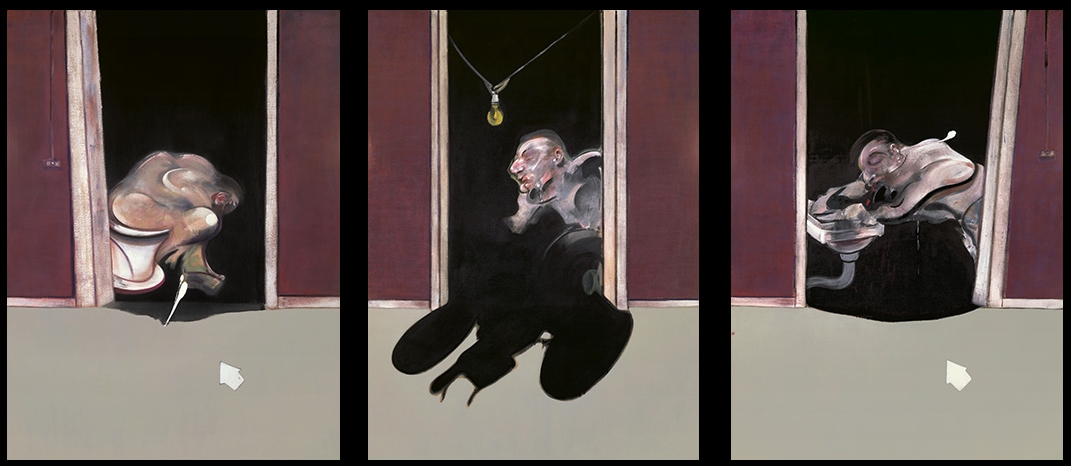
This page: Francis Bacon, Triptych May-June 1973, 1973, oil on canvas, each panel 78 x 58".
Francis Bacon
High anxiety maybe — not high art
A Francis Bacon show in Paris is drawing crowds,
but Richard Dorment is repelled by the artist’s work
Pompidou Centre, Paris, 27 June — 14
October 1996
RICHARD DORMENT | THE DAILY TELEGRAPH | THURSDAY 18 JULY 1996
IN Study of the Human Body of 1982 Francis Bacon presents us with an image of
a mutant creature composed of a man’s genitals and buttocks, standing on two
bare legs covered from feet to knees in cricket pads. To be frank, the picture
strikes me as too silly for words. But the reason it is high camp and not high
art has less to do with its subject than its composition. Bacon is giving visual
form to a sexual fantasy, depicting another person not in terms of his humanity
but as fragments of his body.
Since those cricket pads reek of fetishism, the painting may interest students
of abnormal psychology. But artistically it is a failure. Instead of limiting
the amount of space around the central motif (as Magritte or Courbet
instinctively did in their tightly cropped close-ups of women’s sexual organs),
Bacon places the body parts on a pedestal in the middle of the canvas and
surrounds them with space, asking us to regard them as objects of aesthetic
contemplation, not of fetishistic fascination.
The result invites ridicule. It may be unfair to judge Bacon by a painting done
11 years before his death in 1992. For most people it is the work of the first
half of his career that places him among the most important British artists of
this century. But is this division between the early and later work really so
acute? The occasion of the British Council’s retrospective of his work at the
Pompidou Centre in Paris (until October 14) gives us a chance to revise the
received view by taking a long, hard look at the career as a whole.
The show has been selected and installed by Bacon’s formidable advocate, the
critic David Sylvester. My enormous admiration for Sylvester means that this
exhibition represents the best and probably the last opportunity I will have to
come to terms with an artist who has always left me cold. Before seeing it, I
had always thought that Bacon’s paintings perfectly captured the angst of the
post-war period, but that his work did not transcend his own time in the way
that, say, Pollock’s has, and Jasper Johns’s surely will. Having now seen the
show, I wish I could say it changed my mind. But, though Bacon at his best ranks
as the most gifted painter of the School of London, seen from an international
perspective he is the most overrated artist since Bouguereau.
Where to begin? Technically, Bacon is such a limited painter. He found it nearly
impossible to sustain the visual interest in a picture over the entire surface
of a canvas, from the central motif to the edges. A face or figure may contain
ravishingly painted passages, but it will typically be surrounded by vast areas
of dead, flat pigment.
It isn’t that Bacon didn’t try, in works like the Study for a Portrait of 1953,
to create space and atmosphere with modulations of light and dark, but that,
having tried, he soon lost interest, and eventually gave up. In the later works
he simply used a can of spray paint. As early as the Self-Portrait of 1956 it
feels to me as though he was working on too large a scale
—
too large, that is, for a neo-Romantic artist who was no draughtsman and had no
technical training. As the paintings get bigger, they flare into life only in
isolated passages, usually where impastoed paint is used to evoke gobs of
viscera, spattered brains and smeared bloodstains.
Another problem is Bacon himself, as we know him through his pictures. When Three
Studies for Figures at the Base of a Crucifixion was first seen by the
British public in 1944, the three armless and legless torsos howling with rage
or pain were seen as symbols of spiritual despair or of suffering humanity. But
Bacon was not happy with that interpretation. When he returned to the subject on
a much larger scale in 1988, he made changes which conveyed a much nastier
message: that these were not timeless archetypes, but sado-masochistic
fantasies, creatures who, in order to feel anything at all, offer their bodies
to be violated and mutilated. You have to conclude that Bacon finds pain erotic.
Because his paintings are so often filled with lovely colours, Bacon
aestheticises physical and emotional suffering.
There are two outstanding paintings in this exhibition. The pit bull terrier in
Man with Dog of 1953 is set against a nocturne of silvery blacks and blues
beautifully painted with a dragged brush. Against an uptilted plane, the animal
becomes as mysterious and threatening as a Cerberus guarding the entrance to the
underworld, here suggested by a sewer. And the Study for Portrait of Van Gogh
III of 1957 is wonderfully voluptuous, colour-saturated painting,
demonstrating that Bacon might have been a de Kooning, if not a Van Gogh, if
only he had not been so desperate to enter the pantheon of great artists by
taking on ever more portentous subjects.
But what are we to make of the succession of enormous triptychs in which men in
their underpants defecate or vomit or look as though they’ve just been beaten to
a pulp? The answer is: quite a lot if you are a psychoanalyst treating them
purely as material for interpretation. I have no objection to this approach if,
as with some contemporary conceptual artists, this is how the viewer is invited
to respond to the work. But to do that, you first have to set aesthetics aside.
Bacon wanted his work to be judged as painting, he was asking us to see beauty
in pain and death. This to me is repellent.
But what I dislike most about Francis Bacon’s art is that in both earlier and
later paintings he manipulates his viewers. I hate being told what to feel in
front of a picture. It is like the difference between Grand Guignol and Chekhov.
The first is crass and crude and admits of only one possible response:
revulsion.
Real art is more complex. It allows us to bring our own thoughts and feelings to
it. I just don’t understand an artist who pitches the level of anxiety in all
his pictures so high that it crowds out anything remotely resembling a real
thought or feeling. You can do one of two things in front of an image of
unadulterated horror: either you go along with it and scream, or you say "this
has nothing to do with my experience". Since 4,000 people a day are pouring into
the Paris show, and Bacon is one of the most revered of all British artists, I
realise that his work says something to them that I just can’t hear.
The Francis Bacon
retrospective, organised in collaboration with the British Council, is at the
Pompidou Centre in Paris until October 14. Information: 00 33 1 44 78 12 33.
The making of an artist — from
weakling to an enigmatic master
FRANCIS BACON
REVEALED
MICHAEL PEPPIATT | FEATURES | THE TIMES | MONDAY OCTOBER 7 1996
What makes Bacon’s childhood exceptional, and exceptionally interesting, is the fact that we tend to see it through his eyes — in his occasional references to it, and above all through his painting. The artist’s temperament was fuelled by a need for high drama and extremity to feed his painting, and it coloured everything that came within reach.
At one point or another. Bacon referred to specific incidents of cruelly that had impressed themselves on his mind. Most disturbing, because the cruelty was so specific and was suffered by Bacon personally, is the story about his father arranging to have his small son regularly horsewhipped by the grooms — a punishment which reflected the father’s desire to make a man of his sickly boy. just as he forced him to join a fox hunt in spite of the fact that horses and hounds triggered off the child’s asthma. This illness undoubtedly strengthened Bacon’s resolve, once he had grown up. to keep as far away as possible from any kind of animal and, with some rare exceptions, to shun the countryside entirely.
Bacon’s lifelong asthma is an important key to his childhood and to his adult sensibility. For an asthmatic, the simple process of breathing is a struggle, each attack is an ordeal to be overcome, and during Bacon’s childhood little existed to alleviate the protracted suffering.
Nevertheless, asthmatics generally acknowledge that their condition sharpens die will to live, making mere existence — what Bacon called “conscious life” — a pleasure in itself, since it has been so arduous to achieve. The asthmalic tends as a result to have a special fond of optimism, simply in order to surmount a new attack; and once the attack has passed, the optimism does indeed seem justified. Bacon himself referred all the time to his “optimistic nervous system” (while qualifying it atheistically as “optimism about nothing”), and this can be understood more folly in the context of his permanent struggle with asthma.
If this early ordeal gives the asthmatic unusual resilience and reserves of stoicism, it also tends to form a character that appears aloof from the daily miseries of living. A certain unfeeling superiority or ruthlessness certainly characterised much of Bacon’s behaviour in later life, to the extent that many people who came into contact with him failed to see the instinctive compassion and the sometimes startling generosity.
The other, even more dominant factor in the boy’s life, especially as he approached adolescence, was the growing awareness of his homosexuality. Its importance to Bacon’s development, to his later life and to his vision as a painter cannot be overstated: one might reasonably say that, along with his dedicated ambition as an artist, his sexuality was the most important element in his life. Bacon would refer to himself as “completely homosexual", someone for whom no doubt or wavering had ever existed. He himself recounted one banal youthful attempt at heterosexuality — with a prostitute who apparently ate chips while her client attempted intercourse: and he is reputed to have had sex, once and unsatisfactorily, with one of his favourite female friends and models, Isabel Rawsthorne.
These, however, were the exceptions that proved the absolute homosexual rule. “From as far back as I can remember I used to trail about after the grooms at home,” Bacon would say. “I just liked to be near them.” That these grooms, with whom he admitted to having sex in his early teens, were also the ones who horsewhipped him is a tempting conjecture in the light of Bacon’s sado-masochism and the tangibly violent sexuality that suffuses so much of his imagery. If indeed his father, to whom he was sexually drawn, ordered and witnessed the floggings carried out by the grooms, themselves a source of erotic excitement. then the complexity of emotions — of pain, thrill and humiliation — is sufficiently extreme to make any later violence, in life or on the canvas, almost too easy to explain.
Frankness about himself and his “tastes” was a constant in Bacon’s conversation. But although he accepted his homosexuality fully and made no attempt to disguise it, he openly regretted it on occasion. “Being a homosexual is a defect” was the way he put it in certain moods. “It’s like having a limp.” It is not clear whether his initiation to sex came from the stableboys or from encounters at boarding school; but from around the age of 15, Bacon would have been more precisely aware of the nature of his sexuality than most of his contemporaries
His early schooling was chaotic and intermittent, firstly because of his asthma and general sickliness, and secondly because Francis repeatedly ran away from the schools he had been sent to. “I just couldn’t seem to stay.” was his disarming summary of the situation, and he seemed to imply that his parents were not much concerned whether he received a proper education or not.
In the event, for long periods of his childhood, Francis was simply left to his own devices: as lone as he avoided his father, he could wander about the large house and extensive grounds at will. If he was not trailing after the grooms he was often to be found day dreaming — an activity which remained with him all his life and which (as with the Surrealists who were so central to his development) enabled him to conjure up and “work" on the images he wanted to create. But Francis was always a thorn in his father’s side. It was bad enough that he had choking fits and turned blue in the His face whenever he came into contact with hounds or horses. It was worse when he began mentioning the fact that he might want to become an artist of Will some kind, because that in the captain’s mind, could only signify unmanly decadence and penury. Worse still were the rumours that Francis had been about to be expelled from his school. Dean Close, for “going” with other boys. Relatives had already remarked “how like a girl” Francis could look.
For fancy-dress parties in the family circle, he would appear as an Eton-cropped flapper, complete with backless dress, beads, and a cigarette holder so long it readied to the candles in the middle of the table. Dressed as a curate, his father stared uneasily and said nothing as Francis rolled his eyes, shook his earrings and made all the women laugh; he was too confused to know how to react. But finally, when Captain Bacon came across the effeminate, wayward 16- year-old trying on his mother’s underwear, his self-righteous wrath knew no bounds: Francis would have to go. He had been obliged to leave school. Now he would be “expelled” from home.
Francis Bacon regularly recounted this final break with his father as if nothing could be more hilarious — a particularly absurd chapter in what he called his “ridiculous and ghastly” life. But his father’s disgust and dismissal wounded him deeply, in away that he was never able to forget. Before his life had really begun, he had been rejected by his own kin and branded an outsider. The extreme humiliation. in someone who even as an adolescent was not un¬ aware of his superior gifts, would find expression in an equally potent rage — which encouraged him to rebel against his father’s world and cause a shock as sharp and enduring as the pain it had given him.
Determined to put as much distance between himself and his punitive father as possible. Francis made for London where he embarked on a bizarre series of brief odd jobs — many of them no doubt coming his way through the homosexual underworld.
“I can’t say I was what’s called moral when I was young.” Bacon said, describing his early stay in London through the autumn and winter of 1926. “Morality is a luxury that has come on me with age. I think I just did whatever I could to get by. I’d always stolen money from my father whenever I could. And when I got to London I’d often lake a room and not pay the rent. And then, although my parents had always told me that I was ugly, I found that some people were attracted to me and thought that I was pretty at that age. So I decided to do everything to get people to take a fancy to me, and I didn’t very much care what happened after that. I remember once, when I was broke. I got myself picked up by a man in Dover Street He was Greek but he’d been living in London for a long time. And he was obviously a rich man. “Well, after we had been in his bedroom, he went out into the bathroom. And I started going through his pockets. He must have been watching me in the mirror, because suddenly he came out and said. “What are you doing Francis?” and I said, “Well you know what I’m doing”. Then he said. “You don’t have to do that just ask”. And he took me down to a bank and drew out one hundred pounds, which was a very large sum then, and gave it to me. It was a marvellous way to behave, and I’ve never forgotten it.”
Passing encounters of this kind became a staple of Bacon’s first Stay as a young man in London. But he could not count on them to generate enough cash for a way of life that was already characterised by impetuous extravagance: while still an adolescent, he developed a taste for the most expensive restaurants and hotels.
Having learnt a certain amount about cooking from his mother, he put himself forward as a domestic servant and was taken on by a solicitor and his wife who lived in Mecklenburgh Square in Bloomsbury. Francis’s duties consisted of arriving early in the morning to prepare breakfast and clean the house, then returning in the evening to cook the couple’s dinner. Although he enjoyed the cooking, Francis soon got bored and handed in his notice. “I don’t know why he’s going.” he overheard the solicitor saying to his wife, “he never does anything.” Another domestic position came to a rapid end when the new employer found Francis on his evening off having dinner with a friend at the Ritz. However chequered his attempts to supplement his weekly allowance, Francis was succeeding in his main ambition which he called “simply to drift and follow my instinct — to drift and see”.
As Francis drifted through London’s homosexual underworld, with its special glances and its meeting places, its codes and its clubs, his father decided to make one last attempt to stop his son from going completely to the bad. Among ftrs few friends there was a relative on his wife’s side called Harcourt-Smith, renowned for his manliness, who was about to leave on a trip to Berlin. Why not entrust Francis to this man’s man. Eddy Bacon reasoned. With little warning. Francis found himself plucked out of the back streets of Soho and en route with his upstanding uncle to Berlin.
DRIFTING IN BERLIN AND PARIS
Berlin in the waning years of the Weimar Republic presented the most extreme contrasts of wealth and poverty, high-bourgeois sophistication and Lumpenproleiariat misery. These contrasts were t0 mark Francis for life. But Berlin was. above all. a place of sexual liberation and indulgence. The tough uncle with whom Francis had departed with his father’s blessing turned out to be indiscriminately virile. “My father thought he would change me. But of course it changed absolutely nothing, because a bit later we were in bed together.” Bacon recounted. Unusually tolerant, not to say encouraging, towards all manner of sexual tastes, Berlin had evolved a nightlife capable of titillating the most jaded appetites and satisfying the least conventional desires. Naughiy-girl routines featuring the ubiquitous Josephine Baker or home grown striptease acts were commonplace, and these were supplemented by sideshows of nude dancing and female wrestling.
The city’s real speciality was homosexual clubs and cabarets. male and female, and particularly what was most perverse and decadent. Boys parading in outrageous drag and Eton-cropped girls in while tie and monocle set the tone in the fashionable West End
Bacon later claimed that his two months in Berlin had been a period of pure “drifting" of exploring his sexuality. But being unusually perceptive about life in general, he could not have failed to absorb the extraordinarily potent cultural atmosphere ofthe city. “Don’t forger that I look at everything,” Bacon used to point our once he was an established artist and in the mood to tantalise critics writing about his work. “And everything I see gets ground up very fine. In the end one never knows, certainly l myself never know, what the images in my paintings are made up of.”
The visually alert young would have been conscious of the attention painters were paying to a precise rendering of reality, and he may have visited the influential “Neue Sachiichkeit” (New Objectivity) exhibition at the Galerie Nierendorf early in 1927. The only full-length photograph of this period of Bacon’s life shows a slim youth standing by a statue in the park of Schloss Charlonenburg. on the west side of Berlin. Carefully attired in a formal suit with a neat waistcoat, and clutching a dark homburg hat and gloves in his hand. Francis looks Jess like the roaring boy of his own legend and much more like the gentleman’s gentleman. The hair impeccably parted just to the left of centre, the high white collar and tightly knotted tie all convey an impression of respectability.
Francis’s unde had moved on some time before. “He soon got tired of me, of course, and went off with a woman.” Bacon recounted in mock dismay. “I didn’t really know what to do. so I hung on for a while, and then, since I’d managed to keep a bit of money, I decided to go to Paris.” When Bacon arrived in the French capital, in the early summer of 1927, no city could have been more seductive. After the architectural dourness of Berlin, with its heavy 19th-century facades, the elegance and excitement of Paris left a lifelong impression on Bacon, causing him to visit the city regularly later on and to live there for a while. If he had chosen to go to Paris, it was because he was aware, like anyone with an interest in the arts at that time, of its pre-eminence as a cultural centre and the undisputed capital of style. He was drifting. to be sure, as far as possible from the constraints of his upbringing; but he was drifting with instinctive purpose towards what he needed most; the awareness and realisation of himself as an artist.
The 17-year-oid boy had already begun to visit the galleries within the first few weeks of his arrival. He appears to have conquered his shyness sufficiently to have gone to certain openings and mingled with the sophisticated Paris art world. It was at one of these that he met Yvonne Bocquentin, a pianist and connoisseur of the arts. Intrigued by Francis’s curiosity and charm, Madame Bocquentin decided to take him in hand. She offered him a room in her comfortable house near Chantilly, a short train ride from Paris, where her husband managed several large estates. She also undertook to give Francis a good grounding in French and to introduce him to all the aspects of Paris she herself found fascinating.
It was the beginning of what Madame Bocquentin’s daughter. Anne-Marie Crete de Chambine, calls an amitie amoureuse. An instinctive sympathy and understanding grew between the elegant femme du monde and the diffident but clearly gifted youth. It was a mother-son relationship with the extra excitement of shared interests and the ambiguity that arose out of the pleasure they took in being constantly in each other’s company. When they were not studying French (which Francis picked up with impressive speed), they would spend the day in Paris, visiting exhibitions and going to concerts or the theatre.
What is remarkable is the uncanny single-mindedness with which the intuitive but barely-educated adolescent homed in an the images that mattered most to him. If Francis had not seen Eisenstein’s film Battleship Potemkin in Berlin, he certainly did so in Paris; in that masterpiece, it was the nurse’s bloodied face and terrified scream in the Odessa Steps sequence which riveted him. Shortly after he settled in Paris, this obsession led him to find a medical book with hand-painted illustrations of diseases of the mouth.
The “beautiful colours” which it showed of the inside of the mouth fascinated him: he bought the book and later kept it to hand in his studio, referring to it constantly when The “beautiful colours” which it showed of the inside of the mouth fascinated him: he bought the book and later kept it to hand in his studio, referring to it constantly when he came to paint his own versions of the human cry. From this point on, however sporadically, he began to draw arid make watercolours by himself, without any technical training.
When the “wild boy from Ireland” returned to London in 1929, he was set on a course that would not only scandalise conventional sexual and social morality. He had something far more subversive to do; to disrupt all notions of what art was and what it could express he instinctive sense of purpose led him to a crucial revelation in Paris; the exhibition of drawings by Picasso which the art dealer Paul Rosenberg put on in the summer of 1927 at his gallery. Bacon repeatedly cited the 1927 exhibition of Picasso drawings as the first definitive catalyst in his development as an artist: “They made a great impression on me and I thought afterwards, well, perhaps I could draw as well.”
SELF-DOUBT OVER DRAWING ABILITY
IN 1991, on the last occasion I talked to Francis Bacon, he told me “I don’t think I can draw. I mean, if you asked me to draw something. I don’t think I would be able to.” The paintings he produced often have a pronounced linear quality, as if drawn with paint. But Bacon rarely made drawings for their own sake.
The study of a raised chair with owls, reproduced here, is dose in style and subject to his paintings. But the other drawing is more surprising. He based it on a 1916 Picasso portrait of the poet Guillaume Apollinaire, whose head had been severely wounded in the First World War. Picasso drew his great friend in a highly controlled, neo-classical style. But in Bacon’s version Apollinaire becomes far more agitated. Bacon reveals a vulnerable figure, who was killed by influenza when Paris was celebrating the Armistice.
RICHARD CORK

Bacon at Cannyconrt House, the family’s rented home in Co Kildare
Two men, and nanny made three
FRANCIS BACON
REVEALED
Day two: The curious ménage a trois that survived Bacon’s chaos
and provided a lover and housekeeper
MICHAEL PEPPIATT | FEATURES | THE TIMES | TUESDAY OCTOBER 8 1996
Within a year of returning to London, Francis Bacon managed to absorb the basic painting techniques he needed, move from watercolour and gouache to oil and organise two exhibitions. He also found a benevolent lover and an eccentric housekeeper who de¬ voted their lives to him.
His female companion was Jessie Lightfoot, who had looked after Francis from his infancy in Ireland and who came closer to him than anyone else in the family. A determined and capable woman, she would have been in her late fifties when Francis returned to London from Paris. The Bacon family had dismissed her once they no longer had need of a children’s nurse, and in the worsening economic climate, when domestic servants were less in demand, she had been unable to find other employment. By 1931. Jessie Lightfoot had moved in with Bacon at his Queensberry Mews studio.
The third member of the odd ménage created by Francis was Eric Hall. During their long, relatively stable relationship. Hall helped Bacon in numerous ways. First and foremast he provided the paternal encouragement and advice which the younger man felt he had so sorely lacked. A patron of the arts. Hall had a comfortable private fortune which he spent freely on his pleasures and interests, and in his company Bacon was able to supplement his erratic, piecemeal education. Together they went to concerts, the cinema and the theatre; and although Bacon had developed his own interests since adolescence, he became more aware of the theatre, and of Greek tragedy and Shakespeare especially, during this period. It is likely, too. that his reading became more sophisticated under Hall’s influence. In this belated and unorthodox education special attention was paid to the best food and wine. Eating and drinking remained high priorities for Bacon, and he credited Eric Hall with making him aware of their importance.
It is difficult to know how this curious threesome worked, since Bacon himself made a point of subsuming specific oddities in his life into the larger madness of existence. “My life has been so ridiculous in these ways.” he would say as he recalled a curious incident, “but then all life is really ridiculous — ridiculous and futile — if you (oak at it clearly." However, the simple fact that this domestic arrangement lasted for many years, withstanding all kinds of strain including frequent changes of address, shows how deep the attachment ran. In fact, no other relationship in Bacons life ever approached it in terms of domestic stability and duration. It says a great deal for Nanny lightfoot that she could fit into the emotional and financial chaos Francis whipped up around him. and that she accepted the consequences of his unusual tastes and talents. Francis was manifestly fonder of Jessie than he had ever been of his own mother and it was no coincidence that whenever he wanted an alibi he styled himself “Francis Lightfoot”. An alias came in handy during the years that this odd duo lived together, since they were often as light of finger as of foot.
To provide extra money and also because he enjoyed the excitement and uncertainty it involved, Francis began to advertise himself in The Times — its front page being then reserved entirely for various messages and insertions — as a “gentleman’s companion”. This was a well-known ploy in the homosexual world, and it appealed to Francis’s keen sense of die absurd that he could make illegal solicitations through such a respectable medium. “The replies used to pour in,” he recalled with glee years later, “and my old nanny used to go through them all and pick out the best ones. I must say she was always right.”
Whenever Francis set out to find a new lover, he used artifice to maximum effect From the transvestite bars of Berlin to die male prostitutes on display around Pigalle in Paris, he had seen every device and disguise imaginable. He himself had no fear of appearing outrageous, and his extravagant use of lipstick was a matter of general comment.
What Nanny Lightfoot made of these and subsequent goings-on is not recorded, but it is obvious that she was beyond being shocked by anything that brought in the money. The subject closest to the old lady’s heart was capital punishment: she longed for the day, she (old Francis’s visitors, when the gibbet would be re-erected at Marble Arch, with the Duchess of Windsor as the first public enemy to be hanged, drawn and quartered there. Pronouncements of this kind, together with the fact that Nanny slept on the kitchen table (there being nowhere else), did nothing to make the Bacon-Lightfoot relationship appear less strange.
As for Eric Hall, he would probably have remained in decent obscurity had he not fallen so conspicuously — and in some ways disastrously — in love with Francis Bacon. His life up until that point appears to have been a model of respectability. After Malvern and Oxford, he had served in the First World War, then worked as a banker and a director of Peter Jones, the department store; later he became a Justice of the Peace and a member of Chelsea Borough Council, showing a strong interest in education and the arts. But his outwardly staid life was turned upside down by his passion for the young, charming and feckless painter. Over the 15 years or so that their friendship lasted, the sexual side presumably became less central. Bacon may well have had other affairs during this time, but it is dear that he depended on Hall’s support — emotional, moral and financial — and remained lastingly grateful to him.
Eric Half remained married but his wife and son were made increasingly aware of the liaison, not least because neither of the lovers made any attempt to conceal it Out of a mischievous desire to epater les bourgeois, the two men once went together to visit Hall’s son while he was at Eton, and took him out to tea, braving the outraged stares of the other boys and their families.
The real victim of the affair, in fact, was Hall’s sort, Ivan, who became severely deranged, and later blamed Bacon for his mental condition. Bacon himself recalled the episode with more guilt than mirth: “I can see now that the whole thing must have looked very odd. After Eric died, I don’t know whether it was really because of his friendship with me, but the son went completely mad. He used to come round to where I lived and shake his hands at me and shout 'It’s because of you I’m like this!’ Then later, when he was in a hotel somewhere, he jumped out on a woman in the corridor and broke her arm. After that they put him in one of those homes.” Ivan appears in 1953 as a certified patient at Holloway Sanatorium, Virginia Water; unlike Hall’s other dependants, no provision was made for him in his father’s will. Hall and Jessie Lightfoot seem to have coexisted quite happily, though sharing the chaos and countless shifts in fortune on which the young artist thrived can hardly have been a bed of roses. Jessie found contentment in taking care of Francis. She also had a chance to shine during the gaming parties Bacon and Eric Hall organised at Cromwell Place. After taking hats and coats, she made sure everyone had plenty to eat and drink, cheerfully augmenting the house’s takings with her tips. She also kept the flat’s lavatory locked and had to be prevailed on whenever somebody had need of it. Gambling was illegal at this time and, if detected, severely punished. Bacon’s precaution was to keep four lookouts on the pavement outside dressed as housepainters complete with ladders and buckets. Not only did he and Hall escape arrest, (hey made a financial success of the whole venture. Around 1950 the delicate balance the artist had set up in his life between roaring rebel — atheist, homosexual, drinker, drifter, gambler — and deeply wounded, artistically gifted son no longer satisfied his needs. Vital and healing as the relationship with his two chosen “parents” had been over the previous decade, its limitations became more clearly marked as the mature man began to emerge. Francis’s real father had been dead for ten years. Eddy Bacon’s presence extended well beyond the grave, but the son had to some extent freed himself from its shadow by bringing out a succession of “Heads” howling their rage and pain.
The success of these pictures emboldened him aesthetically and emotionally over the next few years to confront the image of paternal authority par excellence, the Pope, and execute a magnificent series of paraphrases — or parodies — of Velazquez’s portrait of Innocent X: rarely can a father figure have been pilloried and rejected with such ferocity. In fact Francis rejected all father figures, in life if not in art, around this date. Exactly how the relationship with Eric Hall ended is a matter of conjecture, but it seems likely that the artist tired of it. One suspects that he enjoyed Hall’s encouragement and protectiveness as well as the relative luxury of their life together. But these advantages had dwindled, along with Hall’s fortune, depleted by obsessive forays into the Monte Carlo casino. As Bacon gained a more secure footing in the art world and began to earn a certain amount of money for himself. Hall may have begun to seem more like an impediment to his foil enjoyment of life. The older man may well have accepted his young friend’s promiscuity, but his constant presence would certainly have made it difficult for Francis to begin another “serious” affair.
“There it is,” Bacon often said once he had recounted episodes from his past “I decided when l was very young that l would have this extraordinary life, going everywhere and meeting everyone. But of course,” he would add, not unguiltily. “I used everybody along the way.”
He may well have had Hall in mind, because although the break between them did not destroy their very real affection for each other, it did leave Hall in an appalling situation. For love of Francis, he had abandoned wife and family, and in the process he had set off or at least accelerated the mental instability of his son. Ivan; he had squandered much of his inheritance, as his will makes plain; and when Francis left him he had nowhere to go. Eventually, he moved into the Bath Club, haunted by feelings of loss until his death.
Ruthless and even cruel though he could be, Bacon never forgot the kindness of others. The caustic or flippant way he referred to the end of their affair did nor preclude a deep remorse. But soon his life was to be shattered by a far greater pain.
Bacon’s relationship with Jessie Lightfoot had been all-accepting: he of her growing frailty, her lack of education and her manifold oddities; she of his apparent fecklessness, his instability, his godless amorality. So when Jessie Lightfoot died of heart failure, aged 80, Bacon’s world fell apart. His distress made it impossible for him to continue living in the studio he had shared with Nanny and Hall. For several years thereafter, Bacon lived a kind of self-imposed exile, constantly on the move from one rented roam to another. He had been in Nice at the time of Jessie’s death. Was his grief compounded by guilt that he had let her die alone? Certainly the impulse to give up Cromwell Race and live like an urban nomad could be seen as a form of punishment — all the more so since, despite his frequent moves, the artist rarely strayed far from the immediate area and the memories it was bound to evoke.
TOMORROW Bacon makes his definitive entry into the art world

Francis Bacon set up a delicate balance in his life between roaring rebel
— atheist homosexual, drinker, gambler — and wounded, gifted son
The howl of an iconoclast
After a 15-year apprenticeship Bacon finds his voice
FRANCIS BACON
REVEALED
MICHAEL PEPPIATT | FEATURES | THE TIMES | WEDNESDAY OCTOBER 9 1996
The war years were a period of intense germination for Bacon. Because of his chronic asthma, he was pronounced unfit for active service. The artist nevertheless was acutely sensitive to the suffering he saw around him. The unfulfilled artist in Bacon, who was now in his early thirties, was forced to think in terms of the images he wanted to paint.
He started with Figure Getting out of a Car. The painting shows a fowl-like, fleshy creature laying its long, bandaged, penis-like neck on a pile of ammunition, which is also unmistakably phallic-looking. The neck ends in a pair of meticulously painted teeth, bared in a snarl: and the whole spectre uncoils out of an open car drawn from one the artist had seen in a news photograph of Hitler’s arrival at a Nuremberg rally. This impressively aggressive image, which was probably painted in 1939-40. was recorded by Peter Rose Pulham, a photographer of the period and a friend of Bacon’s, in the artist’s studio in 1946: shortly thereafter. Bacon repainted the canvas almost entirely, so that ’ everything hut the bared teeth of the biomorph vanishes beneath a mass of vegetation. Only the Nazi car survives more or less intact, and the new version, with its toned down but more insidious atmosphere of threat, was entitled Landscape with Car.
The snarling, bandaged “penis demata" of the original image directly predicts the middle panel of the Three Studies for Figures at the Base of a Crucifixion, the work that announced resoundingly Bacon’s definitive entry into the art world. Similarly, a Study for a Figure, painted later in the war, that belongs to the “abandoned” canon of Bacon’s works, dearly foreshadows the left-hand panel of the triptych in its crouched position, its outstretched head and the great, diagonal, upward sweep — whether of flesh or fabric — from which it juts. A third abandoned image, sketched out in oil on composition board during the Petersfield interlude, consists of little more than a head, its upper half shadowed by a peaked cap. its lower split into a scream. Floating over a mess of random marks and such vestigial forms as a ghostly sketch of a hand, the mouth acts as a precisely defined exit for the inchoateness of the picture. The outpouring from this dark orifice neatly rimmed round with teeth conveys a specific threat, since it was clearly inspired in part by photographs of the Nazi war leaders. One likely source for the unfinished Petersfield image was a Picture Post snapshot of Goebbels, his mouth wide open in full public harangue. that Bacon kept in his studio for years.
Hindsight undoubtedly helps to disentangle die many elements that went into the making of Three Studies for Figures at the Base of a Crucifixion. Yet even now, a half-century later, nothing really prepares the viewer for the triptych’s rawness, as it glowers from the mid-century with the memory of injury and the prophecy of more evil to come. What sets the Three Studies apart is its scale and its deliberateness. The searchings of 15 years’ sporadic apprenticeship come to a dramatic conclusion. It is as if, freed from self-doubt and inhibition, the artist had been goaded into making a statement of exacerbated authority. If Bacon may be said to have found his own voice in these ‘ panels, it is the scream of his open-mouthed monster on the right. But the basic questions continue to return, after decades of attempted interpretation. What does this howl mean? How did these ungainly, menacing figures come about? What gives the whole triptych, with its roughly delineated space and suffused orange background, its power as an emblem of brute suffering, ravening greed and generalised evil?
Despite the rawness, and for all the artist’s lack of formal education, the work grew out of a higher developed visual and literary culture as well as out of emotional urgency. The most important source for this picture, as for those that led up to it was Picasso. In 1938, at the London Gallery, there had been an exhibition of drawings and collages by Picasso that Bacon would have seen. More significantly, in October of that year, Guernica went on show at the New Burlington Galleries. Bacon absorbed Guernica with the single-minded concentration he had given to the older artist’s biomorphic period. In a sense, the Three Studies was his Guernica, a savage outburst and a decisive statement, albeit not provoked by any specific event or linked to any political cause.
Shaky and intermittent as his first efforts as a painter had been. Bacon now experienced with great gusto the world opening up around him. In a series of inspired accidents. his Painting 1946 was about to materialise, confirming his presence as a disturbing iconoclast in the mild mannered English art world. Bacon was to follow this with a series of Heads, brought together in a one-man show in 1949, that were to establish his mastery of oil paint and his uncanny ability to provoke chance effects within the infinitely malleable medium. The following year, he rounded off the period with a Fragment of a Crucifixion, which showed that his power to shock was in no way diminished by an increasingly sophisticated technique: it had simply become more insidious.
TOMORROW Francis Bacon falls in love for the first time
Bacon falls violently in love
Day Four: Bacon’s obsessive affair with the self-destructive Peter Lacy takes him to Tangier,
where the artist, tortured by sexual jealousy, finds comfort in casual beatings in dark alleys
FRANCIS BACON
REVEALED
MICHAEL PEPPIATT | FEATURES | THE TIMES | THURSDAY OCTOBER 10 1996
Bacon was near 40 when he fell in love for the first time. He met Peter Lacy m the Colony Room, a newly opened Soho drinking club, and as Bacon described it. Their mutual attraction was anomalous from the start. “What Peter really liked was young boys. He was actually younger than me. hut he didn’t seem to realise it. It was kind of mistake That he went with me at all. Of course, it was the most total disaster from the start. Being in love in that extreme way — being totally, physically obsessed by someone — is like having some dreadful disease. I wouldn’t wish it on my worst enemy.”
Lacy had I he advantage, like Eric Hall before him. Of inherited money, which allowed him for most of his life not to work. Because of this, according to Bacon, “he felt the futility of life all the more clearly”. Lacy had also been a fighter pilot in the Battle of Britain, and afterwards he became a test pilot for a while. “All these things obviously shatter your nerves,” Bacon ’reflected, long after Lacy’s death. “Most of rite time Peter was terribly neurotic, even hysterical.”
Part of the most intense period of their relationship (which Bacon characterised as “four years of continuous horror. with nothing but violent rows”) was lived — again uncharacteristically for "the artist — in the country, not far from Henley-on-Thames. Bacon recalled Lacy’s invitation to come and live with him there: “Of course, he hated my painting right from die beginning, and he said. “You can leave your painting and come and live with me.’-And I said: “What does living with you mean? And he said: “Well, you could live in a comer of my cottage on straw.” He wanted to have me chained to the wall. Peter was very lanky in all sorts of ways. He liked to have people watching as we had sex. But he was so neurotic that living together would never have worked.” Even if 'Bacon did not accept the invitation to move in. he was a frequent visitor, and he even managed to get some work done by setting up a makeshift studio in a conservatory.
Bacon's need to paint, then, had proved even stronger than his obsessive passion for Lacy. In 1953, Bacon completed 21 paintings, the most he had ever painted in a year. It was now that Bacon's obsession with the Pope theme took hold. Study for Portrait became the first in a series of eight fully recognisable pontiffs — caught as if in successive frames on a film. This was the longest series Bacon had ever undertaken, and it confirmed his bent for working in variations on a theme, a practice that came naturally to someone of his obsessive temperament. The first portrait remains the most precisely descriptive, with its steady, mournful gaze, and. As the series continues, so the portraits grow freer, until the figure radiates a kind of wild hysteria. In this respect, it is tempting to think that as Bacon worked he transposed some of his feelings about his alarmingly neurotic lover. Lacy, whose surface calm would suddenly erupt into uncontrollable rage.
When questioned about this series. Bacon replied, jocularly, that he had nothing against Popes, and that he merely “wanted an excuse to use those colours”. In retrospect, this sounds deliberately disingenuous, as if the artist wanted to avoid any explanation. It may be that he himself did not know why he was so obsessively drawn towards depictions of the Pope. but it indubitably went beyond the attraction of a particular colour.
In the Pope, one might say, the two must important elements in life for Bacon, the erotic and the aesthetic, were intertwined, and it seems reasonable to suppose that is why he was drawn to the theme so repeatedly and why it gave rise to some of his greatest images, such as the magnificent Study of a screaming Pope done after the Velazquez portrait in that same productive year, 1953. In this picture, the pleated curtains of the backdrop are made to fail through the Pope’s face, as if its flesh hung in folds: this is a peculiarly Baconian conceit, like the use of safety-pins and blind tassels or, later, lightbulbs and arrows.
Although he enjoyed being physically dominated. Bacon instinctively sought the upper hand in ail his important relationships. He could be whipped and physically abused, but by his toughness and intelligence he kept ultimate control. With Lacy, he had lost it spectacularly. He could withstand the violence and the rows, the scenes which ended with him being beaten up, his clothes destroyed and his paintings slashed: there were sides of it he positively relished. But he was kept, mentally as well as physically, in thrall: being less in love, Lacy seemed stronger and freer, and the pangs of sexual jealousy tormented Bacon as intensely as any Furies he had known. Naturally promiscuous but above all devoted to his own destruction, Lacy kept always slightly out of reach. The folie à deux raged within its own pain and degradation. By the time of the first Van Gogh portraits, it had readied an inevitable impasse. But when Lacy left for Tangier, that did not stop Bacon from following him.
Tangier acted like a magnet for homosexuals during the 1950s. The Moroccan port offered not only acceptance but widespread acquiescence in matters of sexual preference. The sight of crowds of native men in brilliantly coloured jellabas strolling hand in hand together through the town would have been particularity alluring to foreign homosexuals forced to hide their affections.
Bacon’s hangout in Tangier was Dean’s Bar. Dean was a mellifluously spoken black man of mysterious origins who seemed born to run a bar. For Lacy. Dean’s had become a place of near enslavement; and it marked the beginning of his last rapid decline. Whatever his means when Bacon first took up with him in the early 1950s, they had dwindled to the point where he was obliged to “tinkle die ivories" in Dean’s virtually day and night in order to eke out an existence.
“Periodically Peter got very drunk,” recalls David Herbert, a long-time resident of Tangier, “and on one of his benders he took a knife and slashed three-quarters of the paintings that Francis had been working on the previous six months. Francis took it quite calmly; in fact he seemed almost pleased.” The British Consul-General in Tangier, Bryce Naim, became worried because “Francis was frequently found by the police beaten up in some street in Tangier in the early hours of the morning”. Herbert goes on, “Bryce complained to the chief of police and asked to have more police on duty in the darker alleys. A few weeks passed; the beatings continued. Then the chief called on Bryce and said, ‘Pardon, Monsieur le Consul-General, mais il ny a rien à fiaire. Monsieur Bacon aime ca’ ”.
Bacon brought back very little from his lengthy stays in Tangier: he abandoned numerous works in progress and either he or Lacy destroyed most of the others. But the whole atmosphere and the luminosity of Morocco marked him deeply. There can be no doubt that the explosion of strong colours in the Van Gogh series is at least partly attributable to Bacon’s experience of the North African light (just as Van Gogh’s own palette took on a new intensity after his arrival in Arles). In Van Gogh in a Landscape. Bacon has actually used a view of the countryside outside Tangier, which impressed him so much that it later became the sole subject of a wonderfully mysterious painting called Landscape near Malahara, Tangier. Dated 1963 and painted in London, this picture in fact had a deeply persona importance for the artist.1 it was in that landscape that Lacy had been buried
The Tangier interlude and Bacon’s affair with Lacy was to last for another couple of years. “Peter had been very tough when I first knew him. Then he fell for this Moroccan boy, and after he went off and lived in Tangier he lost that toughness. I think it had something to do with the Arab men. He had also always been the most terrible kind of drunk, but by this time he was completely out of control. The boy had left him and so on. Anyway he said he never wanted to see me again. Then one day he just telephoned and said. “From now an. consider me as dead.” And I was very upset, because I had been deeply fond of him. And then much later, he sent this telegram asking me to go out and stay with him again in Tangier, and like a fool I went. Peter wasn’t there when I arrived. But there was this Arab boy, sitting up in a fig tree in the courtyard, and he asked me whether he could pick the figs. I said yes, certainly he could. And in the end he climbed in through the window, and he was terribly good-looking”.
“Then Peter came back and found us both in bed, and he got so absolutely mad he went round and broke every single thing in the place. I had to go out and try and spend the night on the beach”.
“Peter by that time was drinking three bottles of whisky a day, which no one can take. He was killing himself with drink. He set out to do it, like a suicide, and I think in the end his pancreas simply exploded. After that disastrous trip. I had no news of him until that exhibition at the Tate.”
News of Lacy’s death was among the telegrams that arrived to congratulate the artist on the opening day of his Tate retrospective. Bacon had never come to terms with die self-destructive passion that had drawn him to Lacy nor with the latter's rejection of him: and now that he was dead. Bacon was inconsolable. He saw Lacy’s death as a suicide, and he interpreted the fact that it had coincided with his opening as a deliberate extra punishment, as if he had to atone for the violence of his an in personal misfortune. The artist was convinced that the voracious Fury-like shapes on an orange ground that dominated the first room of the exhibition still pursued him.
In his grief, Bacon attempted several times to bring his dead friend back to a kind of life through the act of portraying him. In both named and unnamed portraits. Lacy seems to be struggling lo surface through the damaging smears of paint that blind an eye or excise an ear. Lacy himself had become part oft he artist's own myth of guilt and retribution. He began to picture himself too. in his first acknowledged self-portraits, in a last spasm of raging pink flesh and black shadow before dissolution. Indeed, from this point in his development when portraits of people became so central lo his work, each portrait wits painted as if il might be the last.


The doomed and damaged Peter Lacy, left, dominated the younger Bacon, right, and his death continued to haunt the artist in his portraits
‘Lost’ Bacon painting expected to fetch £1.5m
By DALYA ALBERGE
ARTS CORRESPONDENT
DALYA ALBERGE | HOME NEWS | THE TIMES | SATURDAY OCTOBER 12 1996
A PAINTING by Francis Bacon not seen in public for 35 years and known to scholars only from a black and white photograph is expected to fetch £1.5 million at auction. Seated Figure (Red Cardinal), which dates from I960, is one of 20 images from Bacon's Papal series. Most are in museums. After being exhibited in 1961,it was purchased by an American collector and on his death was sold in the 1970s to an anonymous European. The painting's whereabouts remained unknown until its appearance at Christie’s.
The image was inspired by Velazquez’s Portrait of Pope innocent X in Rome. Bacon contorted the image into a threatening, disfigured character that reflected the pain and bleakness of human existence. Brett Gorvy, director of contemporary art at Christie’s, said: "The pope’s face is acid burned and purple-bruised and has the texture of rotting flesh. Frustration, impotence and agony are all registered." The picture will be shown in Antwerp, Zurich. Paris and New York before being auctioned in London on December 4.
Bacon’s meaning, page 18
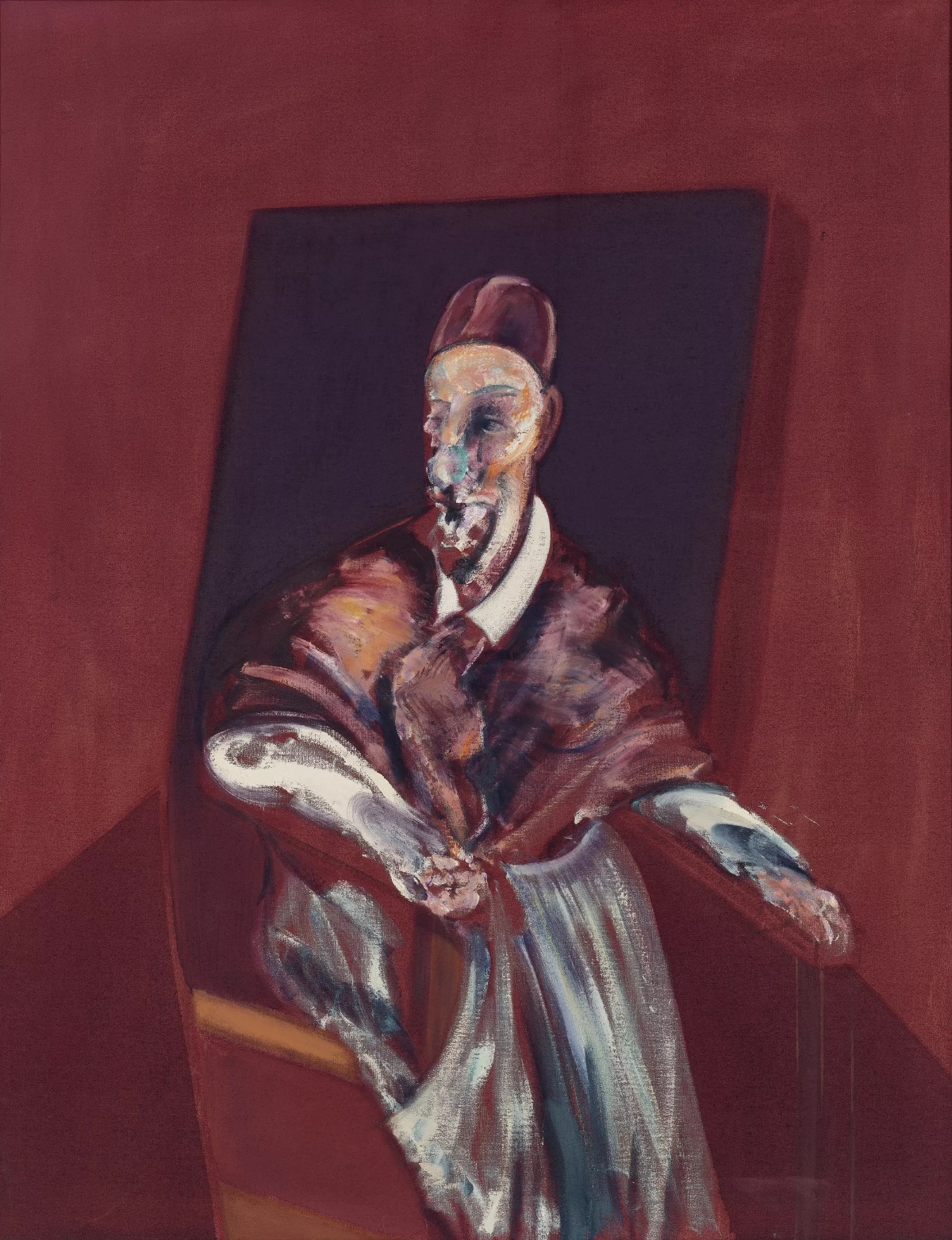
Bacon’s Seated Figure (Red Cardinal), “frustration, impotence and agony”
Francis Bacon and the meaning of life
We have been slow to celebrate our greatest contemporary artist,
says Rachel Campbell-Johnston
RACHEL CAMPBELL-JOHNSTON | ARTS | THE TIMES | SATURDAY OCTOBER 12 1996
Towards the end of the 1950s, rumours began to leak to the outside world that a nest of bibulous painters had been uncovered in Soho. A squadron of critics dashed to the scene, cordoning off Wheeler’s and the Colony Room, corralling Michael Andrews and Frank Auerbach, Lucian Freud and Francis Bacon into a so-called School of London.
But although the label served its purpose in sane ways, focusing attention away from the abstract art of America and towards the figurative painting that was going on in England, it was a misleading one. The artistic explosion had already occurred, launching each of the painters on his separate trajectory. And of these, none was to prove more powerful or individualistic than Francis Bacon.
Bacon’s talent was marked by an imperious solitude. Lucian Freud once described him as the wildest and wisest person he had ever known. Bacon himself said in an interview that he had flouted conventional standards, working on his character to make himself as unnatural as he possibly could.
When an artist pours his talent as much into his life as his art biography becomes an important means of understanding the work. Bacon’s painting — more than that of any other artist of his generation — is illuminated by accounts of his life. Of the handful of biographies that have been published since his death in 1992, Michael Peppiatt’s Anatomy of an Enigma, which has beat serialised in The Times this week, is the most serious and comprehensive.
Bacon did not start painting in earnest until the relatively late age of 35. It was only through his life, he said, that he found his subjects. Among the formative influences were his upbringing, virtually without formal education, in Irish country houses, the decadence of urban life in Paris and Berlin: his drinking, gambling and almost sado-masochistic homosexuality.
But simple correlations between life and art are always reductive, and never more so than in Bacon’s case. His central philosophy was that man is an accident who plays out the game of existence without reason. He dedicated himself to futility with an almost religious fervour. But since life for him seemed in essence so banal, he thought that he might as well make some sort of grandeur of it.
“I am greedy for life ... for what chance can give me far beyond anything I can calculate logically,” he once said. As a young man staying in Monte Carlo he ended up one night winning £1,600 at the casino. This was then an enormous amount But Bacon did not believe in making provision for the future. He used the money instead to take a villa which he staked with wine and food and friends. Ten days later he had scarcely enough money to buy a ticket back to London.
His attitude to painting was similarly volatile. “All art,” he said, “has now become completely a game by which man distracts himself.” He shrugged off critics who sought to find in his work allegories of 20th-century life. Rather, he was determined to preserve “the vitality of accident”, to create images “with the foam of the unconscious” locked around them. Hurling fistfuls of paint at his canvases, sweeping them with rags, pitching turpentine over their surfaces, he allowed each image to grow spontaneously.
As he attacked and brutalised human appearance, mashing and twisting it in bruised hues. Bacon tried to escape illustrational aspects of the image and evoke instead a “brutality of fact”. His aim, to use Valery’s words, was “to give the sensation without the boredom of conveyance”. He sought to “unlock the valves of feeling” so that the onlooker would return to life more violently and more poignantly.
An example of this was Bacon’s discovery in Paris of a hand-coloured book of buccal diseases which lies behind his fascination with the open, screaming mouth. He wanted to paint its glittering colours, he said, with all the shimmering beauty with which Monet painted landscapes. He was haunted by the images of Muybridge’s photographs, and they became a source of ideas. His passion for the Old Masters of Flanders, Spain and Italy can be traced in many of his paintings. And the Greek tragedian Aeschylus was an inspiration to him — he always regretted not being able to read the Oresteia in the original. “The reek of human blood is laughter to my heart,” was one of the lines he liked to quote, and became a focus for his themes.
Ultimately it is the visceral beauty of the paintings that matters. This year Paris seized the initiative, staging die first large-scale retrospective of Bacon’s work, since his death. It has attracted some 5,000 visitors a day. Although Peppiatt’s biography is a welcome addition to the body of work on our greatest contemporary artist, we have been too tardy in celebrating modem British genius.
Rare sight of Pope portrait
NEWS EXTRA | SATURDAY EXTRA | BELFAST TELEGRAPH | SATURDAY OCTOBER 12, 1996
A STARTLING work by the artist Francis Bacon was shown in public for the first time in 35 years today.
Seated Figure (Red Cardinal), in which he reinterpreted a famous painting of a Pope, was displayed at Christie’s in London, where it will be sold on December 4 — and is expected to fetch around £1.5 million.
Bacon, born in Dublin in 1909, started his series of frenzied popes in 1949.
£1.5m tag for pope portrait
NEWS LETTER | BELFAST | SATURDAY, OCTOBER, 12 1996
A startling work by the artist Francis Bacon was shown in public yesterday for the first time in 35 years.
Seated Figure (Red Cardinal), in which he reinterpreted a famous painting of a pope, was displayed at Christie’s in London, where it will be sold on December 4 and is expected to fetch around £1.5 million.
The work, dating from 1960, was exhibited briefly the following year. Bacon, born in Dublin in 1909, started his series of frenzied popes in 1949. He died in April, 1992.
Bacon figure may be £1.5m
DAN GLAISTER | ARTS CORRESPONDENT | THE GUARDIAN | SATURDAY, OCTOBER 12, 1996
A PAINTING by Francis Bacon which has not been seen since 1961 is to go on sale at Christie’s in London in December. Known only from a black and white photograph in a 1964 catalogue, Seated Figure is expected ro sell for £1.5 million.
The portrait, known as the Red Cardinal, was one of a series which Bacon painted between the late 1940s and the early 1960s. He died in 1992. The painting is based on Velázquez’s Portrait of Pope Innocent X.
Bacon’s interpretations of Velázquez has been described as a transformation of “the crafty and smug prince of the church into a threatening, even depraved, modern image”.
The last Bacon painting of similar provenance to come on the market was sold at Sotheby’s for £1.8 million in 1991, when the market was at its lowest.
Bacon’s cardinal
steps into the light
By MARIANNE MACDONALD | NEWS | THE INDEPENDENT | SATURDAY 12 OCTOBER 1996
A major portrait from Francis Bacon’s famous Papal series, in which he transmuted papal images into visions of insanity, has come on to the market for the first time in decades.
Seated Figure (Red Cardinal) has been known to experts only from a black and-white photograph and has not been seen by the public for 35 years. Its sale at Christie’s on 4 December — for an estimated £1.5m — is hailed as a return to confidence in the art market.
Bacon painted Seated Figure in 1960. It resided in an American collection until the 1970s, and was then bought by a European collector.
Bacon died in April 1992; a new biography by Michael Peppiatt, Anatomy of an Enigma, details the artist’s love affair with Peter Lacy, and tells how many of his works were destroyed.
Startling pope art on show
NEWS | SHROPSHIRE STAR | SATURDAY, OCTOBER 12, 1996
A startling work by the artist Francis Bacon was shown in public for the first time in 35 years.
Seated Figure (Red Cardinal), in which he reinterpreted a famous painting of a pope, was displayed at Christie’s in London, where it will be sold on December 4 — and is expected to fetch around £1.5m. The work, dating from 1960, was exhibited briefly the following year.
It was in an American collection until the 1970s and later acquired by a European collector, and was known to experts only through a black and white photograph.
The work, from the Papal series largely responsible for the artist’s recognition today, stemmed from his obsessive need to reinterpret Velasquez’s Portrait of Pope Innocent X which is hanging in Rome. He corrupted the image of an arrogant, magisterial 17th Century Pope — the ultimate establishment figure — and introduced the neuroses and doubts of modern society.
Visiting Paris and then Kendall in Cumbria for two of this summer’s most exciting exhibitions, Martin Gayford considers
the achievement of Francis Bacon ad Lucian Freud, painters committed in their different ways to a sense of reality.
MARTIN GAYFORD
Francis Bacon and Lucian Freud are two pillars of post-war British figurative painting. After Bacon’s death it was widely thought that Freud would succeed him as top British painter. They painted each other — Freud creating on extraordinary image of Bacon, stolen a few years ago in Germany; Bacon painting Freud, from photographs, frequently. Both are subjects of important exhibitions this summer. Beyond that, they are painters who have little in common, perhaps, except a commitment to transmit the facts in paint. That and a tendency to attract critical misunderstanding.
FRANCIS BACON
At the moment, Bacon fills the main exhibition rooms at the Pompidou Centre. How many other British artists would be accorded similar prominence in Paris? Turner and Constable, no doubt, and Henry Moore, and that’s about it. To most art lovers in continental Europe the above is a comprehensive list of significant art from this island, and Bacon is a key element in it: the twentieth-century English painter. But, back in his own country, Bacon is not necessarily awarded so much honour.
Several critics have come out over the last couple of months with admissions, that, frankly, they can’t see what all the fuss is about. To many people, not necessarily philistines, Bacon remains what he was to Mrs Thatcher; the man who painted those horrible pictures. This impeccably hung and selected exhibition offers an opportunity for an interim assessment of Bacon’s reputation. How good was he really?
The case against him comes in two parts, one moral and one aesthetic. Let’s take the moral first. According to this, his view of the world was too warped for his paintings to count as major art. Bacon, the line goes, was a Johnny One-note of art, offering a repetitive Hobbesian diet of visual nastiness and brutishness. Bacon’s vision of human existence therefore requires, in the words of the late Peter Fuller, ‘a moral refusal’; life simply isn’t like that.
To this Bacon had an answer. In the course of his interviews with David Sylvester, he described his aims as an artist thus:
I’ve always tried to put things over as directly and rawly as I possibly can, and perhaps, if a thing comes across directly, people feel that that it is horrific... because people tend to be offended by facts, or what used to be called the truth.
So Bacon, in his own mind, was by no means a master of modernist grand guignol; on the contrary, he was a sort realist. His work was an attempt ‘to make images off my nervous system as accurately as I can, images which would affect the viewer, ‘more violently and poignantly’. True or false?
It seems to me that this exhibition substantiates Bacon’s opinion of his own work. Bacon was not an expressionist, but a painter who was out to capture how real people looked, and included in the way they looked, inevitably, were the feelings they gave me. He did this, however, in a highly idiosyncratic way. Many great figurative artists over the last 100 years — from Cézanne to Kossoff, Auerbach and Freud — have slogged their way through to a fresh vision by working directly from mature. Others have used drawings or photographs.
Bacon worked from his memories. He used photographs, true, but the resulting image did not look photographic. Bacon looked at photographs, as he explained, to jog his memory — as one would look up a word in a dictionary. It was the memories he was after. That explains a great deal about his paintings — their slightly dream-like quality, the impression they sometimes give of being not quite there, and at the same time tremendously vivid. There is an ectoplasmic feel, for example, about the Three Studies of the Human Head from 1953, one of his best paintings of the period, which is easily comprehensible as a memory — a powerful, possibly drunken memory — rather than an image of a sitter in front of the artist. These phantoms summoned up in the studio naturally often had a crepuscular, spectral quality.
In conversation with Sylvester, Bacon accepted the description — by Michel Leiris — of himself as a ‘sort of realist’. But he went on immediately to point out that
realism has to be reinvented. In one of his letters van Gogh speaks of the need to make changes in reality, which become lies that are truer than the literal truth. This is the only possible way the painter can bring back the intensity of the reality he is trying to capture.
And that ‘reality’, as he explains again and again, will no longer come, he believes, from a literal representation, but only from radical distortions.
These, with luck, might capture the ‘emanation’ of a person, the ‘pulsations’, their ‘energy’. And it really was luck he depended on. He played a game of chance with paint. Bacon’s method involved the exploitation of fortuitous smudges, blots and spatters, sometimes thrown at the canvas, to reveal unforeseeable, novel ways of conjuring up face and features.
Indeed, the wilder these become, the more like the sitter, in the deeper sense, the result might be Bacon wonders to Sylvester, why, of two portraits of Michel Leiris, the one that looks more radically unlike the sitter is actually more like him. Leiris had a round face, as does the duller of the portraits (not in the Paris show), the one which is most life-like in Bacon’s sense, has a long thin head. How can this be?
It is noticeable that Bacon generally leaves some figurative ’handle’ by which the image can be decoded, as first, a human head, then the image of a particular person. Thus, in at least two out of each trio of portrait studies of Isabel Rawsthorne, the subject’s distinctive brow-line is clearly there; with Muriel Belcher it is the profile which is identifiable (the Pope hung opposite seems to have acquired her nose0. With Leiris, it is the left eye which dominates the portrait of 1976 — which is one of Bacon’s most remarkable.
Thus Bacon tended to make his portraits by retaining certain key ingredients of the subject’s appearance while intuitively rearranging the rest. In this way he could find an image that brought to mind the person in question far more strongly — ‘violently’ — than a more literal depiction. It was the wildness and the rawness that made the image more immediate and hence more lifelike.
At the same time, the rearrangement of human features into swirl and blur powerfully suggests that the subject is a living, breathing creature constantly moving and changing, slowly dying. In this way Bacon found an equivalent in paint for the impression that his friends and lovers made on him It is worth noting that he considered himself novel not in his technique as a painter but his ’sensibility’.
I always think of myself not so much as a painter but as a medium for accident and chance... I don’t think I’m gifted. I just think I’m perceptive.
Probably Bacon did have a heightened sensuous awareness of his surroundings. He was an unusually energetic individual, completely unable to relax, and also an asthmatic who would consequently have a vivid sense of the precariousness of life. Clearly he had, too, an overpowering sense of the animal nature of man. Most of us scarcely think of ourselves as made up of muscle, which is meat. Bacon clearly never lost that awareness. He was always surprised, he said, when he went into a butcher’s shop, not to find himself hanging up on a hook. This visceral sense of the beast in man evidently struck Bacon as both alarming and touching — ‘violent and poignant’ — because it is linked so clearly with mortality. Thus there is a feral blur — as if of something caught in the act of pouncing — not just about his paintings of animals, but also about his pictures of people.
As a young man he was tormented for months, he recalled, by his realisation of mortality, and the meaninglessness of life ‘till I came to, as it were, accept that here you are, existing for a second, brushed off like flies on a wall’. This sounds bleak, but his outlook did not exclude energy, creativity and defiant relish Bacon once described his attitude as ‘exhilarated despair’ — with equal emphasis on both words. ‘After all, as existence is so banal, you may as well try and make a sort of grandeur of it.’ In a way, he was a perfect Nietzschean superman — cheerfully accepting the meaninglessness of life.
Once you’ve adjusted to his idiom it is obvious that many of his pictures have great beauty, particularly colouristically. The earlier rooms of the exhibition are filled with rich romantic colour and shadowy romantic gloom. And for all the emphasis on lavatories and vomiting, his naked depictions of George Dyer often have an air of nobility. The figures in the centre and right sections of the triptych Three Figures in a Room (1964) are examples of this. In the course of the interviews, Sylvester remarks that he suspects the influence of Michelangelo in some of Bacon’s nude figures There certainly seem to be echoes of the ignudi from the Sistine Chapel. There are other naked figures in Triptych — Studies of the Human Body (1970) and Lying Figure in a Mirror (1971) which put one in mind of Henry Moore (the Studies have been connected Bacon’s unexecuted projects for sculpture).
But to see such relationships you have to get over the shock value of Bacon’s idiom. In fact, his distortions are no more radical than those employed by many twentieth-century artists. Thus Turning Figure from 1962 has a good deal in common with the running figure by the Futurist, Boccioni. Bacon’s heads are often dissected into curving planes in a way that brings to mind the Cubist Picasso.
The difference is that with Bacon there is a far greater sense that his figures are actually made out of living flesh. Indeed, one or two give the impression that the sitter has been rearranged along modernist lines with a chain saw. And of course on occasion — as in the central section of the Triptych Inspired by T S Eliot’s ‘Sweeney Agonistes’ — the human body reduced to meat, blood and severed tubing. Perhaps Bacon’s peculiarity was to be both a modernist and a realist.
From time to time, then, in Bacon’s work there is real horror — though that is not on the whole his most successful mode. He is generally at his best when when being his own special kind of realist — in the portraits and straight figure studies. Two of the most triumphant of those are the full length portraits from the ’60s, George Dyer on a Bicycle and Isabel Rawsthorne in a Street in Soho. There is a distinction in Bacon’s work between the works which are essentially based in life — even if in life reflected in memories and photographs — and those which are essentially fantastic. Into the first category go, obviously, the portraits, and the figure paintings of George Dyer and Henrietta Moraes.
Then there are paintings such as the stunning Three Studies of Figures at the Base of a Crucifixion, with its unforgettable leering, guffawing sightless bird-like Fates. These seemed to have been compiled partly of images that ‘dropped into’ the artist’s mind, as he put it, partly of images that suggested themselves as the work proceeded. The difference is that those works that came from life maintained their strength until the end: the Study for Self-Portrait — Triptych (1885-86), with its air of desolate resignation is among his most moving images of people.
But Bacon the Boschian fantasist did not wear well. The Figures at the Base of the Crucifixion and a few others from the ’40s have a compelling poetic force (far greater than the rather hysterical screaming Popes). But as time went on, the purely imaginary works coarsened. Three Studies for a Crucifixion of 1962 is already teetering on the edge of absurdity for all its sensational impact. The hunched figure on the bed in the central panel, all teeth and spattered gore, is close to the cartoon world of Scarfe or Steadman (doubtless two Bacon followers). The two silent watchers on the left are more impressive. The later triptych can be weaker still — perfunctory in technique, too, thanks to the spray can. The little bird-like creature with mammalian paws in the left section of Triptych Inspired by the Oresteia of Aeschylus (1981) is no longer grim, terrifying and unforgettable, but a preposterous, bright-eyed escapee from a surrealist pets’ corner.
This brings us to the second charge against him that the paintings simply do not work as art. In conversation, the late Clement Greenberg complained that he found Bacon ‘too crisp’, by which I think he meant that the works remained too thin and linear, insufficiently realised in solid juicy paint. David Sylvester wrote in 1962 of the way ‘the intensity that Bacon achieves in certain passages of a large number of the canvases has not been sustained throughout the whole area of any them’.
In the later work there is generally a jarring dislocation between the figures executed in meaty swirls of oil paint and the crisp, clear, brightly coloured settings which are close to geometric abstract painting. Although he professed little interest in Matisse, one wonders how much he might have been influenced by the latter’s Red Studio which hung in the Gargoyle Club in Soho, one of Bacon’s haunts. In that painting space is created out of flat patches of colour in a very similar way to Bacon’s practice of the ’60s and ’70s.
The difference is that he used such space to offset his figures. He talked about the way he used an ‘armature’ to frame the images in his paintings — by which he presumably meant those cage-like or furniture-like constructions that often turn up. He also spoke of how ‘I would like the intimacy of the image against a very stark background. I want to isolate the image and take it away from the interior and the home’. The result was to trap his figures like so many specimens in the lab (how much influence did Bacon have on Damien Hirst’s vitrines?).
There is a worrying disjunction between two kinds of painting and two kinds of special illusion. The way the figures are painted descends ultimately from the baroque illusionism of Rembrandt and Velazquez, their settings from Matisse and geometric abstraction. But that, arguably, is part of Bacon’s expressive purpose. It dramatises the contrast between messy, organic, mortal man and his clean, dead, manufactured environment.
It is less easy to acquit Bacon of the charges of repetitiousness. After the early surreal period of the Three Studies for Figures at the Base of a Crucifixion, and the succeeding period of screaming Popes, the classic Bacon man — and sometimes woman — evolved. The format to an extent became standardised; there was perhaps a limit to what he could do. For his people — painted with distortion, smear and spatter — to stand out with the effect of heightened reality he wanted, they needed to be set against a stark backdrop. But his painterly energy clearly focused on the head or figure — the background being merely so much neutral scene-setting. To have painted with that freedom all over the surface would have led to a very different sort of result — something more like a de Kooning.
When all such allowances have been made, however, there is a sameness to his work which perhaps resulted from its lack of direct contact with reality. Towards the end there was a clear falling off. But repetitiousness is a common fate of late twentieth-century artists of all varieties — figurative, abstract, conceptual. Late twentieth-century painters do not throw off one masterpiece after another like masters of the seventeenth century.
Bacon produced perhaps twenty images that look sure to last. That, by contemporary standards, makes him a very significant figure. He created a genuinely fresh way of seeing human beings. Even so, as he said himself, it takes 75 to 100 years for a reputation to settle down. ‘Time is the only great critic.’
Bacon sliced
MANDRAKE | THE SUNDAY TELEGRAPH | OCTOBER 20 1996
THOUSANDS of copies of a book on Francis Bacon, the overrated British artist, have been withdrawn from the bookshops. The reason: one of his best known works, the Study for a Portrait of Van Gogh, has appeared in the book, called Francis Bacon — Anatomy of an Enigma, upside down.
It is a permissible blunder given the oddness of the painter’s work, which is confusing when not absurd. For obvious reasons, the author Michael Peppiatt and his publishers, Weidenfeld & Nicolson, have attempted to hush up the mistake.
“Who told you about this?” a very surprised Peppiatt inquired when I called. “Nobody’s actually spotted it yet.”
Peppiatt, who wisely blames the printers for the howler, sees a commercial opportunity, however: “I am disappointed, but I think it will make the book a collector’s item.”
Bacon for the Bavarians
Bacon survey makes its way to Munich
David Sylvester’s comprehensive survey includes
works which Bacon himself tried to destroy
ROGER BEVAN | EXHIBITIONS | THE ART NEWSPAPER | FRIDAY 1 NOVEMBER 1996
The current survey of Francis Bacon’s paintings, curated by David Sylvester and already shown with great success at the Centre Georges Pompidou, Paris (see The Art Newspaper No.60, June 1996, p.7), is opening at its second and final venue, the Haus der Kunst, Munich (until 26 January 1997). For this new occasion, there are ten substitutions so that the exhibition will have a slightly different personality, but it remains the most comprehensive study of the artist’s work to have been undertaken in eleven years and displays seventy-nine paintings, including seventeen large and six small triptychs, as well as five preparatory drawings in ink or crayon, the existence of which Bacon had strenuously denied.
Another unprecedented curatorial decision is the inclusion of three surviving oil compositions and two gouache studies dating from 1933-36, a period which the artist had attempted to eradicate from his biography, but which forms a fascinating and distinctive preface to his mature career.
The most significant additions to the second leg of the exhibition are: “Study for portrait of Van Gogh VI” (ex-catalogue, Arts Council of Great Britain), which will be united with version III of the same series (Hirshhorn Museum and Sculpture Garden); “Three studies of figures on a bed” (cat.64, private collection); and a second large triptych, “Crucifixion” (cat.43, Staatsgalerie Moderner Kunst, Munich), which includes, in its right wing, the haunting detail of a naked figure wearing a swastika armband.
This single act of pictorial flamboyance underlines the delicious paradox of presenting Bacon’s work in the halls formerly reserved for the National Socialist art favoured by Hitler and his colleagues. For Bacon was attracted to the glamour of violence as it was perpetrated by the Nazi party and yet would have been persecuted as a prime exponent of the “Entartete Kunst” which Hitler sought to discredit in the infamous exhibition of degenerate art staged in Munich in 1937.
Life with thugs
BY DAVID SYLVESTER
FRANCIS BACON: Anatomy of an Enigma
by Michael Peppiatt, Weienfeld & Nicholson £15.99
DAVID SYLVESTER | BIOGRAPHY | BOOKS | THE INDEPENDENT ON SUNDAY | 3 NOVEMBER 1996
When it came to Bacon’s other highly destructive long relationship, the one with George Dyer — a petty crook with a drink problem — Peppiatt was often a witness at close quarters, and here his report is still more moving. It brings back what a profoundly nice and utterly hopeless creature Dyer was and the depth of Bacon’s despair in trying to cope with him when he was alive and that of his remorse after his suicide. When Bacon first took up with Dyer after Lacy’s death he told me: “I don’t care whether they’re upper-class thugs or working-class thugs so long as they’re thugs.” Dyer may have been a thug in the bedroom — or may not — but as a member of the criminal class he was a Ferdinand the Bull.
The publication of Peppiatt’s account of the Bacon-Dyer affair is extremely timely inasmuch as the BFI and the BBC and David Puttnam have been showing some determination to bring into being a feature film about that affair to be called Love is the Devil. If they will only read this book and get a scent of how Bacon and Dyer actually behaved and talked, they may realise before it’s too late that they’ve been backing a squalid travesty.
In other respects the book is not timely. It shows several signs of having been rushed into print, presumably in order to cash in on a currently hot subject. For one thing, it could have done with more rigorous editing. It is shamelessly repetitive, and while that may help over serialisation, it’s a bit of an insult to buyers of a book. Then there’s the problem of the quality of the writing. It can be effective (even if ungrammatical) when Peppiatt concentrates:
“Yet there can be little doubt that Bacon’s interest in the open mouth was due in large part to its sexual suggestiveness; and that the cry itself is an example of pure ambiguity, betokening rage, pain, fear or the pleasure of release without the slightest degree of differentiation. It is this enigmatic combination which fascinated the sado-masochistic artist. It was the one moment at which human nature could be perceived wholly naked, undisguised by civilised restraint; the spasm that made man indistinguishable from beast. For Bacon, whose genius dictated the shortest way to the heart of existence, the cry was the one indisputable moment of truth.”
But on the whole the writing has to get by through the strength of the author’s obsession with the subject. Still, it would have been worthwhile to take another look at the passages which are too embarrassingly pedestrian, like:
“Outside the studio, Bacon dressed immaculately. Even when he wore a sweater with jeans and a leather jacket, the clothes were of the best quality; and his suits impressed many of his contemporaries by their expert tailoring”
. Or too vulgar, like:“It was at Ann Fleming’s that Bacon got to know a whole segment of London society including such ubiquitous personalities as the poet Stephen Spender and the legal wizard Lord Goodman, who later defended the artist against charges of drug possession. These frequentations, with or without a Teddy boy in tow, certainly did no harm to Bacon’s career”.
Further work might also have corrected some of 20-odd factual errors. For instance, there is a failure to pick up on Bacon’s own error in believing that he first saw Eisenstein’s Strike, which so much impressed him, before the War, rather than in the 1950s. Other examples are that Louise Leiris wasn’t exactly Kahnweiler’s daughter and that Isabel Rawsthorne, though at first a professional model, didn’t give all those sittings to Giacometti because she needed money: she was married then to a highly-paid foreign correspondent.
Such mistakes tend to arise because Peppiatt’s knowledge of the art world is sketchy. For example, six million dollars is a high but not an “astronomical” auction price for an outstanding painting about two metres by five by a leading international artist. Mention of “a Mr and Mrs Bomford” as the surprising owners in the 1950s of 19 Bacons signifies unawareness of their fascinating existence as eccentric collectors who also owned a private racing stable with a string of National Hunt horses whose star was the great Colonel Bagwash. There is no mention whatever of Blaise Gauthier, the inspired prime mover of the Grand Palais retrospective in 1971 of which Peppiatt makes so much, nor of Lilian Somerville who, as art commissar of the British Council, not only gave Bacon a show at the Venice Biennale in 1954 but had the cheek to give him the best room in the pavilion and, under protest, Ben Nicholson a back room. And he writes about Bacon’s complicated dealings with Erica Brausen of the Hanover Gallery in ignorance of published details as to how he double-crossed her. In short, Peppiatt needed time for more thorough research.
Some of the gaps in the book are strange. Dennis Wirth-Miller, who for the last 40 years of Bacon’s life was his closest friend, and Nadine Haim, probably his closest friend in Paris, get three passing mentions between them. It seems arbitrary whether people who mattered to Bacon are there or not. Among those missing are Peter Watson, Joan Leigh-Fermor, Janetta Parladé and Gilbert de Botton and several artists he was friendly with, such as John Piper, Richard Hamilton, Mark Boyle, Clive Barker and Karel Appel.
As to artist friends who are present, Peppiatt could have been much more precise on Bacon’s complicated and volatile views about the work of Freud and Auberbach and Michael Andrews. Nor is there enough about his views on dead artists. Nothing is said about the admiration he constantly expressed in the 1950s for Bonnard and the Soutine of the Céret period, admiration that related to the development of his own painterliness.
I called the book a “portrait” earlier because it is only a draft for a biography, not a “definitive Life” the publisher claims it to be. I do hope that Peppiatt will find the time and energy and funding to produce a fuller version of this essential book.
David Sylvester’s latest book is ‘About Modem Art’ (Chatto & Windus £20).
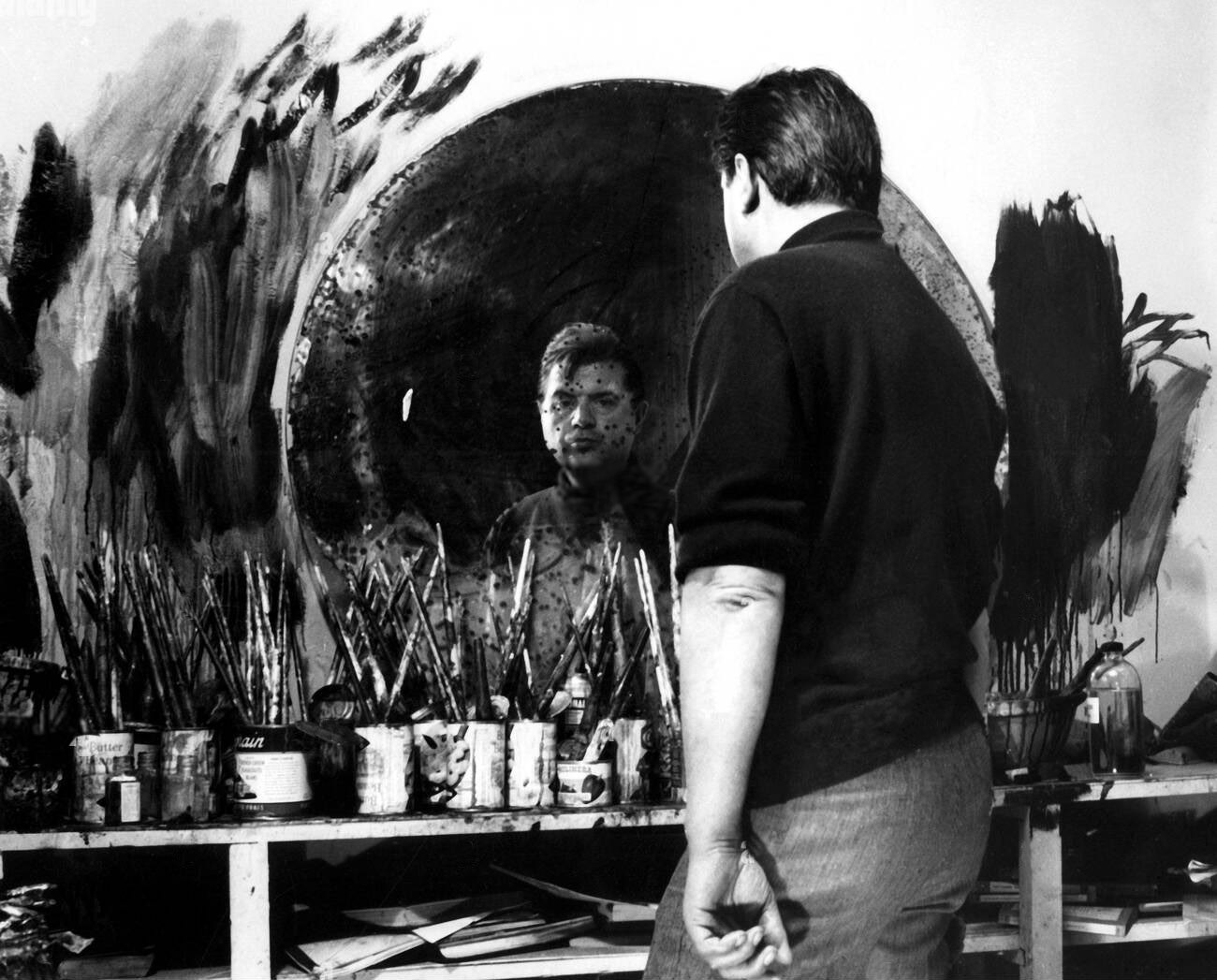
The painter in pain
Martin Gayford on the fascinating character of Francis Bacon
MARTIN GAYFORD | BOOKS | SUNDAY TELEGRAPH | NOVEMBER 3, 1996
“You see,” Francis Bacon was wont to remark, “I myself and the life I’ve led happen to be more profoundly curious than my work.” There is a tantalising challenge to the biography of Bacon: he is of interest not only as, arguably, one of the major artist of this century, but also as a man fascinating and unique in himself.
Bacon was a dandy of nihilism, a gambler, a sado-masochistic homosexual and near-alcoholic who lived deliberately as close as possible to the edge. “Only too much is enough” he would insist when others questioned whether yet another drink was altogether wise.
Since his death in 1992 there have been two book-length biographies of Bacon (at least one more is forth coming). This new book is the third, and so far, by a long way, the best — although Daniel Farson’s memoir remains the liveliest evocation of Bacon as a Soho character. Michael Peppiatt, the author, has two vital qualifications for the task of writing about Bacon: he knew the painter well for many years, and is a practicing art critic who has clearly pondered Bacon’s work deeply.
Even so, there is a provisional air about sections of the book. Much of what is said about Bacon’s early life remains in the hypothetical realm of “could well have”, and “might have”. More crucially, much of Mr Peppiatt’s interpretation of the work, and what was rally going on in Bacon’s mind, is speculative. But this is an inevitable consequence of Bacon’s personality.
Part of the existential game of chance that, for Bacon, constituted human life, was constant mutability. He was a wearer of masks — almost literally, since he had a life-long habit of using make-up. Apparently the most open and outrageously uninhibited of men, in reality Bacon controlled the image he presented to the world with great care. During his lifetime, the publication of several books about him was prevented, in some cases by legal action.
Evasive by nature, Bacon also delighted in contrast, moving rapidly — often in a single evening — from alcoholic Bohemia to the Ritz, from East End thieves’ dens to intellectual dinner parties. With these different groups he was, it seems, to some extent a different person. “Francis Bacon”, Michael Peppiatt writes, “was always more complex than he appeared even to his closest friends. He showed certain sides of himself to some people, but all of them to no one.”
All this adds up to something approaching a biographical mission impossible. The difficulty of pining Bacon down is compounded by the thinness of his literary remains. The painter’s brilliant conversation naturally disappeared into the air, to be reconstructed only if his auditors’ hangovers permitted. Like many of us today, Bacon wrote few letters, and what survives consists in part of postcards and telegrams. Otherwise there are interviews, films and memories. This leaves the biographer with far less to work on than is the case, for example, with the indefatigably self-recording Bloomsberries.
Michael Peppiatt succeeds in giving a more rounded picture of this multi-faceted artist than we have had before. Inevitably, he goes over a good deal of the same ground as the previous books, but there is plenty of new material in Francis Bacon: Anatomy of an Enigma. Also, Peppiatt has more to say about Bacon’s psychological make-up, art and intellectual interests than his predecessors.
He lays stress on Bacon’s sado-masochism (which led to innumerable injuries, from which the resilient painter rapidly recovered). “To what extent,” Peppiatt wonders, “were the Crucifixions — and indeed the whole flayed population of Bacon’s pictures — the voluptuous product of a strong sado-masochistic fantasy?” Bacon’s father, an irascible horse trainer, apparently had Francis horse-whipped by grooms, and later threw him out of the house when he was discovered dressed in his mother’s underwear.
Here, indeed, may be the key to the painter’s connection of sex and pain, guilt and violence. But, a the title of this book indicates, Bacon remains enigmatic — which is just as he would have wished.
Francis Bacon: Anatomy of an Enigma by Michael Peppiatt Weidenfeld & Nicolson, £20
FRANCIS BACON by Michael Peppiatt — Weidenfeld, pp. 366
By RICHARD SHONE
Francis Bacon was one of the most arresting personalities in post-war Britain. Few others can hold a candle to his striking affirmation of individuality. He conferred on British art its sharpest international edge, raising its profile beyond the earthy sobriety of Moore and the genteel anxieties of Sutherland. His direct influence as a painter was always dangerous but his example as liberator and free spirit was cherished by a wide range of artists
Although the vision Bacon bequeathed is somewhat narrow and the tally of his innovations restricted, he created an instantly recognisable Bacon-scape that has captured successive generations. That particular perfume of catastrophe founded on a repertory of salient images, mostly hit upon in his early years, stood him remarkably well over nearly half a century. Such images were continually transformed by the circumstances of what he called his 'extraordinary life'. He was an unmitigatedly autobiographical painter who cannibalised events, friends, lovers and places almost before they were dry on the page of his life. Inevitably his personal history will go on being scrutinised for any key that might unlock the potent imagery of his work.
From several, mostly recent publications, we already know a good deal about Bacon. Michael Peppiatt’s biography has two advantages — he knew his subject for over 25 years and he knows something about art. Of these new books, his is the most reliable. He may not have that affinity with the gilded gutter that was Daniel Farson’s trump card or the contextual sweep that upholstered Andrew Sinclair’s 1993 biography, but he has laborious merits of his own. Future books on Bacon will owe him a solid debt.
As he grew older and more celebrated, Bacon tailored his life story with all the economy of the sharp Italian suits he liked to wear; much of the established local colour — the gambling and drinking and fetishistic sexuality - comes from other people’s reminiscences. Not unreasonably, Bacon felt that giving away too much ,source material’ would bring down a screen between his work and its public (he once burnt two sacks of documentation which the Tate Gallery was after). Peppiatt unravels layers of meaning in the paintings in a consistently illuminating way. Whether or not his interpretations are correct is another matter: his tidying mind tends to underestimate those elements of chance and accident which weave themselves into an artist’s work. Bacon himself was self-protectively disingenuous about the origins of his imagery: not many painters would account for a swastika armband on a figure by saying that a red accent was needed at that particular point on the canvas. As for his biography, although Bacon was often frank about what he did vouchsafe, he had a reticence about revealing personal detail, especially when one remembers how much of his life was lived beyond the pale of the law and outside conventional morality.
From the start, Peppiatt established Bacon’s extreme individuality and personal magnetism. He sifts facts from legend in the early years to achieve the most convincing portrait yet published of this dissolute, amoral, asthmatic, immensely intelligent sprig of a well-to-do, unattractive English family living in Ireland. To escape his punitive and anti-social father whose only advice to his son was 'If anyone talks to you, run and get the police', the teenage Bacon began several years of self-education in London, Berlin and Paris. A weekly allowance from his mother was supplemented by short-lived domestic jobs, thieving and the generosity of older men. In 1929 we find him established in a mews in South Kensington as a swish interior decorator specialising in modernist steel and glass furniture. He began to paint and draw, diffidently exhibiting in the 1930s and 40s works in which sensationalism and high camp contributed to his blazing images. He was nourished by selected Old Masters, by Van Gogh and Picasso, by wide reading (Peppiatt is good on the influence of Eliot, for example), by the cinema and news photographs, by his masochistic sexual preferences, and above all by his being constantly on the look-out for 'the dog beneath the skin'.
From the early 1950s which saw the screaming Popes, grimacing heads and men in claustrophobic rooms where curtains are closed and blinds down against the prying glare of orthodox morality, Bacon’s professional career went from strength to strength. More feted in Europe than in the United States, he became one of the few post-war painters who inched forward the European figurative tradition in an era of triumphant abstraction. In Britain he was viewed as an isolated and subversive artist: his lines of compatibility snaking out to Giacometti and Fautrier, Picasso and de Kooning, were frequently underestimated. The ambitiousness of the true dandy and the longing for aesthetic certainties of a man obsessed by transience and nihilism came together to produce some of the unforgettable images of post-war art. Peppiatt is good on Bacon’s ill-starred lovers and their effect on his life and work. Less happy are his portraits of Bacon’s circle, those friends and models who were essential to his existence and to several of whom Bacon was lavishly generous. Peppiatt’s long residence in Paris gives conviction to his picture of Bacon in the capital he loved, but his evocations of Soho are lacklustre, partly because his style is serviceable rather than vivid. For pertinent illustrations, much needed in a book that examines a mass of the artist’s work, we must look elsewhere: they are in black and white, one is upside down and several are printed in reverse or with a triptych’s panels in the wrong order. But a bonus is the painter’s reported conversations with his tenacious Boswell. They are authentically Baconian in their 'exhilarated despair'.
Pigment at its limits
Francis Bacon: Anatomy of an Enigma
MICHAEL MCNAY | BOOKS | THE GUARDIAN | THURSDAY, NOVEMBER 14, 1996
FRANCIS BACON was singularly well-equipped by his upbringing to express a bleak view of life in his paintings. His father was a brutal retired military man and failed racehorse trainer, his mother was indifferent to her son, young Francis was whipped and buggered by the stable boys, he was ejected from the family home when his father caught him trying on his mother’s underwear; he hawked his body around the fleshpots of Europe, thieving from his clients as he went, he subsisted throughout his long life on a more or less uninterupted flow of booze, creating some of his most potent images when he was hung over.
Bacon’s first start in life was as an interior designer. Patrick White commissioned him to design some furniture for his London flat. “I like to remember his beautiful pansy-shaped face, sometimes with too much lipstick upon it,” he recalled in his memoirs.
But Bacon had seen some drawings by Picasso and wondered whether he might not do as well. Some hope. There is a reproduction of a previously unpublished copy by Bacon of Picasso’s pen-and-ink portrait of Apollinaire. It was made in 1956, when Bacon was already famous, but on this evidence he would be hard put to make it on to a foundation course.
In truth, the real enigma of Michael Peppiatt’s subtitle is how Bacon’s work sustains its high reputation. Certainly his vision caught the imagination of the age. His work is, in Clement Greenberg’s perspicacious phrase, a precious curiosity of our period. “The discrepancy between impact and substance in Bacon does not altogether compromise his art,” said Greenberg, “but it does make him something less than the major artist he presents himself as being.” Neither judgment is quoted by Peppiatt, though we are reassured that an arts minister considered him the best British painter since Turner.
One of the central themes of painting since the Post-Impressionists has been how to treat the picture plane as a totally integrated surface. Bacon was too shrewd not to realise this, but though he taught himself to handle pigment well enough for Lawrence Gowing to compare his painting of human flesh to Renoir’s, his attempts to solve the problem how to treat the canvas beyond the central image were peremptory and unconvincing. Worse, his grasp of anatomy was uncertain, so his broad smears of paint and swipes of the brush are at heart dishonest painting and the sweeping curves that too often describe the outline of his figures are a cop-out from the real difficulties. He had come from nowhere and achieved success too suddenly.
Peppiatt compares Bacon’s art to Marlowe’s and Webster’s, but he might better have quoted a different Elizabethan, the other Francis Bacon, from whom the painter’s family claimed collateral descent: “It was prettily devised of Aesop. The fly sat upon the axle-tree of the chariot-wheel, and said, What a dust do I raise!”

One of three studies for a portrait of Mick Jagger 1982 taken from Bacon: Portraits and
and Self-Portraits, with an introduction by Milan Kundera Thames and Hudson £39.95
Violent need to walk on the wild side
George Melly has mixed feelings about the latest Life of a mischievous painter
GEORGE MELLY | BOOK REVIEWS | ARTS & BOOKS | THE DAILY TELEGRAPH | SATURDAY, NOVEMBER 16, 1996
DID Francis Bacon’s mad ex-military father order his stable lads to flog his effeminate son? Did he throw him out of the house when he caught him trying on his mother’s underwear? Michael Peppiatt rightly remains sceptical about such tales unless confirmed by a reliable witness. Bacon was given to Gothic embellishment, especially when drunk, and to dramatic variants: he told the Tate’s director Sir John Rothenstein that he was brought up as an illiterate farm boy.
Why did Bacon feel the need to do this? Could it be that he, who despised narrative in art, hoped to explain the abyss from which emerged the creatures of his imagination? More likely it was just pure mischief. In reality his own life was, you would have thought, extreme enough. Peppiatt covers the early years with commendable thoroughness: the “drifting” (Bacon’s own word) through Berlin in the Weimar years, and through surrealist Paris, the Genetlike criminality, the Art Deco decors, the protection of older men, the asthma, the desperate gambling, the need for rough trade.
Where Peppiatt fails (but then, everyone has failed) is to explain the transformation in Bacon’s work: his prewar work, what there was of it, seems tentative at best; but, after pupating for 10 years, he emerged as the creator of the astonishing “Three Studies for Figures at the Base of a Crucifixion”. Remarkable, too, that, while predictably reviled by the established critics, he was almost immediately recognised, admittedly within a restricted circle, as the master.
With more confidence (there are more living witnesses) Peppiatt traces the established pattern of his subject’s life: the struggles in the lonely studio ankle-deep in a “compost” (the author’s apt word) of visual stimulants; the Soho afternoons in Muriel’s womb-like Colony Room; the expensive meals; the effusive welcome of the casinos. There were the trips abroad; the tragic love affairs; the risky one-night stands; and, given all this distraction, the near-miraculous production of some of the greatest icons of our time.
But none of these aspects of Bacon is exactly a revelation. And, although Peppiatt’s conscientious detective work has thrown up some new evidence, and despite the fact that he knew Bacon from 1963, in my view Daniel Farson’s The Gilded Gutter Life of Francis Bacon — which Peppiatt rather dismissively describes as “amiable” and “rambling” — is a far more evocative portrait of Bacon in his Soho persona. David Sylvester’s Interviews, which Peppiatt admits to be of “sustained brilliance”, challenge even Van Gogh’s letters as a revelation of how great art is distilled.
Not that the author is inept in these areas or any others, yet somehow he seems to stand a little to one side. I have the impression of looking at a series of interesting photographs slightly out of focus. Perhaps I am being over-subjective: having been there; having listened to Bacon at his most dismissive and lyrical; haunted the Colony Room; attended both of his retrospectives at the Tate — I am slightly disturbed by the sensation of watching what was once everyday life ossifying into history.
Also, a few more anecdotes would not have gone amiss. Bacon had a wicked tongue, but, although this is mentioned several times, it is never illustrated.
Where Peppiatt is at his best, however, is in describing the work in such a way as to make you want to go and look at it, not only again but right now. This is, after all, perhaps the most important function of a critic, and when Michael Peppiatt is writing about the pictures his sometimes anodyne prose takes fire.
But he is over-generous about the later work, presumably from a reluctance to slap a dead man. There is no need for such reticence. Once Bacon’s need to walk on the wild side died down, he fell back on formula, on turning his own inventions into clichés; the fragments of newsprint, the arrows, the black holes.
There are very few painters (Titian and Picasso are among them) who re-ignite in old age. Francis Bacon was not one of them, but nor is there any call to blame him and no need to pretend otherwise. Better think how lucky he was, at the end of a violent and tragic love life, to have found two charming, much younger companions who loved him dearly. Better to celebrate a genius in his heyday.
Francis Bacon: Anatomy of an Enigma by Michael Peppiatt Weidenfeld, £20
Painting pictures in Soho and Greenwich Village
Richard Davenport-Hines reviews two artistic Lives
RICHARD DAVENPORT-HINES | BOOKS | THE INDEPENDENT | SATURDAY, NOVEMBER 16, 1996
Biographies of painters are especially difficult. A painter’s job is “to get the essence without being positive about factual shapes,” as Francis Bacon said. The greatest painting in the 20th century has been anomalous and parabolic; it has not told literal truths, but has provided mystifying hybrid images, repudiating the sort of pictorial story-telling about which spectators can make pedantic guesses and pride themselves on their cleverness in deciphering secret messages. As a result, modern painting can be trivialised if viewed biographically, and painters rightly fear that their images may be sterilised by a reductive or literal-minded biographer. The possibilities of a sympathetic, interpretative biography are shown in Michael Peppiatt’s account of his friend Francis Bacon. The results of humourless, arrogant biographical interpretations are exemplified in Jill Johnston’s rant about Jasper Johns.
Bacon’s life followed a series of fractured literary models: childhood in a horsey Anglo-Irish family from Elizabeth Bowen, in youth a prostitute- thief from Genet, then a Baudelairean dandy, a Dostoevskyan gambler, a Soho boozer from Colin MacInnes, a masochist with Rimbaud’s fascination for violence who ended in a senescent sexuality from Proust. Keith Vaughan’s description of Bacon as a “spiv-existentialist” is wonderfully apt, for he never abandoned the fashionable nostrum of Soho and Greenwich Village in the 1940s that the key to a productive and amusing life was submission to chance and abasement before the consequences of arbitrary decisions. The result was a fractured, destructive life which, by the intensity of its abandonment to extreme instincts, gave Bacon superb powers of visual inventiveness.
Peppiatt first met Bacon in 1963, and though his memories of their conversations add a keen edge to his biography, he never forgets that Bacon surpasses him in both interest and achievement. Peppiatt hints that Bacon’s need of emotional extremism to stimulate his creativity led him to exaggerate the desolation of his childhood, and writes with unprurient cheerfulness about Bacon’s masochism, which is surely more basic to his painterly vision than homosexuality. His account of the evolution of Bacon’s artistic ideas is confident, amusing and thought-provoking. Peppiatt is fascinating about the literary influences on Bacon’s work such as T S Eliot’s play The Family Reunion (1939). Though he tells us that Bacon often re-read Proust and declared that the first section of Sodome et Gomorrhe “said everything there is to say about homosexuality”, he should perhaps have compared Bacon’s pictures of men shrieking in pain and roaring with pleasure with Proust’s most terrifying volume, Le Temps Retrouve, in which the narrator and characters endure the final saturnalia of a Baconian hell.
Bacon’s images of previously unimagined horrors seemed outrageous in the 1940s and 1950s. The early pictures of Jasper Johns like White Flag (1955), Green Target (1955) and Gray Alphabets (1956) created equal scandal by playing with familiar designs like the Stars and Stripes or firing-range targets. The huge, abrupt success of his 1958 show broke the hegemony of Abstract Expressionism in the USA and prefigured the Pop Art movement. As one might expect from a painter whose most vital work has been an ironic teasing of famous emblems, Johns has said: “I’m interested in things which suggest the world rather than the personality.” His discreet, self-reliant persona is mistrusted, if not resented, in the confessional America of Oprah Winfrey, and has brought him the attention of Jill Johnston.
Johnston’s agenda is for the “autonomous, incorruptible art object” which she calls “virtually a freak of culture” to be “nudged into the open, no longer a fugitive from important truths.” Predictably in our age of tabloid Feudianism, the important truths from which Johnston implies that Johns is a fugitive are sexual, and most of her suggestions are exceedingly trite. She has made one interesting observation, identifying Mathias Grunewald’s 16th-century Isenheim altarpiece (much admired by Bacon) as a profound influence on Johns’ later work. But her account of this is overblown and unnecessarily mysterious. It climaxes with a simplistic connection between the depiction of a monster and plague victim in Grunewald’s altarpiece and the carcinomas associated with HIV. The rest of the book is discursive, incoherent, pompous drearily literal-minded and ill-written. Unsurprisingly, Johns refused permission for his work to be reproduced in it.
Francis Bacon: Anatomy of an Enigma by Michael Peppiatt, Weidenfeld, £20
Jasper Johns: Privileged Information by Jill Johnston, Thames & Hudson, £16.95
‘His highly defined sense of the absurd could disperse, for a while,
his own doubts as he laughed and as the champagne fizzled’
Francis Bacon was a good friend who dispelled gloom, writes Jeffrey Bernard
JEFFREY BERNARD
OF ALL the people I have meet who are now dead and who I hope were friends, I think of Francis Bacon today more frequently than any other. We were not particularly close, but he was a fixture close to my heart. Past days in Soho when he didn’t appear were like arriving at a party before the other guests had arrived. He set light to the days, his presence evaporated gloom at the bleakest of times, and his highly defined sense of the absurd could disperse, for a while, his own doubts as he laughed and the champagne fizzled. Michael Peppiatt’s biography, Francis Bacon: Anatomy of an Enigma, (Weidenfeld Stg£20), puts his story kindly and, I think, accurately down on paper for the record. For anyone who knew Bacon, it opens floodgates that bring back teeming memories — mostly bizarre — which personify the variations of the man whom Peppiatt calls an enigma.
If you knew him, Bacon was very much like the Most Unforgettable Person You Ever Met, to borrow the title of the horrible homespun series once run by Reader’s Digest, but, unlike their subject, he was no cracker-barrel philosopher. There were aspects of his life, and one of his drunken affectations was to trivialise life, calling it, "But a short interval between birth and death."
I first met Bacon in 1950, when John Minton took me to see him in his studio in South Kensington. When we walked into the room, I beheld a sight that is still vivid in mind. Bacon was at the top of a stepladder doing a spot of home decoration. He was splashing the ceiling with quantities of white paint in a slapdash way. It transpired that he was dressed for work in a brand-new Saville Row suit and he looked, of course, as though someone had thrown a bucket of the paint over him. He couldn’t care less. Sadly, and shortly after, Minton’s envy of Bacon’s great talent distanced them, but Peppiatt is wrong to say that they ever competed for the spotlight as resident, champagne-buying, exhibitionist comedian of Soho’s Colony Room Club in the afternoons.
As time went by, Bacon began to take me over and more frequently to Wheelers in Old Compton Street. The restaurant had great ambience then, and both management and staff put up with, and enjoyed, some of the verbal outrages that often broke out at Bacon lunch parties. Not so the tourist customers, though. At one lunch we had together, he was quizzing me in his usual way about my being heterosexual (he liked to feign naivety on the subject and to tease me about it) and he asked me which woman I fancied most in the world. I told him it was a daft question and that I didn’t know. Then I ventured Ava Gardner, and asked him which man he fancied most in the world. In a loud voice, and with exaggerated camp, he said: "You know, I’d really rather like to go to bed with Colonel Gadaffi." A party of Americans at a near by table got up and left in disgust. We never worked out whether their displeasure was caused by his politics or by his sexuality.
Beneath the joke though, the choice of Gadaffi was not such a surprise. One of the great loves of Bacon’s life was Peter Lacey, a man as far removed from rough trade as you could imagine, who exuded charm and what may be called upbringing. In his idle moments, Lacey was a cocktail pianist of considerable merit. He usually dressed immaculately in smart pinstripe suits, and when he played gave the strange appearance of a merchant banker tickling the ivories. Both Lacey and Gadaffi had the looks of power and the looks of men who knew where they were going and Bacon liked that.
At the time, I had just lent Bacon a biography of Ataturk by Lord Kinross and he was fascinated by the great man as well as by the fact that he died of a combination of syphilis and sclerosis. Bacon had little time for lame ducks. At one lunch in wheelers, characteristically picking a natural silence in the restaurant, he asked me in a loud voice and with a large smile: "No w that you’ve lost your looks, what are you going to do?" We laughed a lot about that.
Some of Bacon’s jokes though, drew a veil over moments of unhappiness and also near-despair. In 1969, we met by chance in New York, when he was staying at the Algonquin with his then companion, George Dyer. Bacon asked me round every morning for breakfast, which consisted of a bottle of Don Perignon, but one day George wasn’t to be seen. I asked Bacon where George was and he told me that he was in hospital. He had tried to commit suicide that pervious night by overdosing, and Bacon had found him unconscious. "What did you do?" I asked him. "Phoned the doctor, told him George was still alive and asked him to bring more pills around."
But when George did eventually die, some years later, I believe that Bacon was more upset than he may ever have been in his life. He had an underbelly alright, but he could be surprisingly cruel as well. One of his best women friends and models, Isabel Rawsthorne, was loved by Bacon in his way, and was frequently lunched at Wheelers. After her husband, Alan, died in 1970, and when Isabel’s eyes were going (she was blind at her end), he quite coldly ignored her and became very short if I mentioned her. Yet she was very special. How can she have offended him? Bacon could also be vitriolic from time to time. Mention of the painter Graham Sutherland, for example, would stir up the acid, but he was kind, too, and I am not talking through my pocket, into which he often stuffed a £50 note. Anyway, according to Bacon, I was an honourary poof. I think he may have been grateful that I never attempted to talk to him about painting. Bu then you wouldn’t talk to Einstein about mathematics, would you?
Paris and Munich
Francis Bacon
RICHARD SHONE | EXHIBITION REVIEWS | THE BURLINGTON MAGAZINE | NUMBER 1125 | VOLUME 138 | DECEMBER 1996
The first full retrospective of Francis Bacon’s work since he died in 1992 might well have been an occasion for trepidation. Would the old warhorse be plunged into that limbo of indifference or derision that is often the fate of celebrated painters not of the first rank, in the period immediately following their death? The exhibition recently at the Centre Georges Pompidou, Paris (closed 14th October and now, with modifications, at the Haus der Kunst, Munich, to 26th January)1 was planned with the mixed blessing that the artist himself was no longer there to censor or tailor the selection, as has been his habit with earlier shows. A further advantage was that the selector, David Sylvester, was given the opportunity to test, in prestigious circumstances, his long-pondered evaluation of the painter’s development. Both these factors ensured the success of the project as a whole, making it far more revealing than, for example, the 1985 Tate Retrospective with its rump of later works and its lean catalogue, cut down at Bacon’s insistence.
With some eighty paintings ranging from 1933 to 1990, two years before Bacon’s death, and a handful of works on paper, the Paris showing was arranged chronologically. The early work was hung in small, booth-like spaces, the exhibition gradually opening out into a series of increasingly larger rooms culminating in the display of the big late triptychs. The crowds and the light were the hazards of seeing the show, the former overwhelming in the early part, and the changes in the latter considerably inflecting Bacon’s colour and the amount of reflection in the uniformly glazed exhibits. Suddenly to see oneself superimposed full-length on top of a naked Henrietta Moraes with a syringe in her arm is a mortifying experience.
The paintings up to the mid-1960s held hardly a dud and the swift establishment of Bacon’s particular world was enthralling.2 The now recognisable sources — in Muybridge, Eisenstein, Poussin, Bunuel, Picasso — are submerged in Bacon’s personal mise-en-scène derived from modernist interiors, hotel rooms and the curtained platforms of press conferences seen in magazines and on news-reels. The memory of people’s legs distorted under glass table tops of the kind Bacon himself designed, must have remained with him as surely as their spare tubular steel geometry. The ghoulish Head I and Head II (1948 and 1949; cat. no.8 and 9) reminiscent of the blurred living statues in Chien Andalou, evoke the operating theatre and cameras on tripods (even more apparent in a destroyed painting of c. 1936). Figures are caged, barred or boxed a la Nuremberg, sometimes raised on platforms like a model’s throne, on scarcely indicated chairs or divans, railings restricting their movement. Closed curtains and drawn blinds, shallowing the picture space, provide backgrounds, as though the figures had to be screened from the gaze of a more orthodox world. In the early paintings, Bacon’s figures are male and dominate, whether Velasquez’s Pope Innocent X or tough-looking besuited men, their grin crossed with a snarl, neat collars, ties and shirt cuffs adding a frisson of orderliness to their alarming presence (as in Study for a portrait of 1953; no.21; Fig.80, and Man in blue I of 1956; no.28).
Bacon’s colour at this time is at its most direct, influenced by newsprint photos and reproductions of paintings. It sometimes has a grand edge to it with its papal purples and golds, heraldic oranges and midnight blues trimmed with white ermine. At others it is post-war threadbare or even decisively crude. The paint is dry and sparely handled, unprimed canvas showing through in the dark backgrounds that Bacon generally preferred from c. 1952 through to the end of that decade. There is great finesse and delicacy in some of the heads and figures, as though wounds were being tenderly dressed. The influence of photographs is seen in the unfocused mobility with which Bacon invests his figures where light thins volume to render the subject insubstantial yet vivid. Nowhere is this better seen than in the enigmatic Study from the human body (1949; no.11), the Three studies of the human head (1953; no.26) and the beautiful Study for portrait III (After the life mask of William Blake) of 1955 (no.30). Like any other painter, Bacon was engrossed in the technicalities of his medium, made more urgent by his lack of early formal training. But his stint as an interior designer obviously gave him a grounding in textures and finish, even influencing the choice of gold frames and glazing in which his works were invariably shown. This elegance of handling and presentation disclosing imagery that is unusually but not uniquely disturbing (particularly in the 1960s) provides consistent tension. It is astonishing how often Bacon clears this highjump of violence and chic. There are only a few works in the show which fail in this respect. One or two others fail for different reasons — an ill-judged spatial relation between figure and setting as in the Pope-inspired Study for portrait VII (1953; no.23) or a disastrous deviation into painterly ‘abstraction’ as in Figure in mountain landscape (1965; no.32).
The first paintings in the exhibition are two canvases, Interior of a room (no.1) and Figures in a garden (no.2), both from the mid-1930s and thus are rare survivors of Bacon’s later blitzes on his early work. The Interior, though not especially successful, contains several elements which, separated out, became part of Bacon’s familiar imagery.3 Figure in a garden (Fig.78) is more interesting in that it shows the figure — surely only one? — in an attitude of nervous contemplation, its teeth and ear aggressively highlighted, the head and shoulders against three bands of colour, the broad central one being a very dark green. The tree and dog seem to be later editions and were the sort of commonplace details Bacon was ruthlessly to eliminate. Picasso and to some extent Matisse are both detectable in the two works but the influence of Bacon’s mentor in the 30s, Roy de Maistre, is strong in the first painting (compare the de Maistre reproduced in the Pompidou catalogue, p.289). The second shares several characteristics avant la lettre with Neo-romantic painters of the 40s. Though Bacon far outstripped their tinted anxieties, there are obvious connexions with their reformulations of the human figure as seen in the work of Sutherland, Colquhoun and Ceri Richards.
Sutherland was close to Bacon in the post-war period and the nature of their aesthetic relationship has yet to be fully explored — a question not helped by Bacon’s sharp repudiation in later years of Sutherland’s work. The influence certainly went both ways The anthropomorphic thrust of Sutherland’s thorny boughs and tapering tree trunks of 1940 is of the same aesthetic world as Bacon’s Three studies for figures at the base of a Crucifixion (1944; no.4); the flat panelling in the background of this and other works (Figure study II; 1945-46 no.4) appears in paintings by Sutherland both before and after its occurrence in Bacon, notably in the Northampton Crucifixion (worked on in 1944-46) and in the 1954 Portrait of Edward Edward Sackville-West (Fig.79) which in turn seems indebted to Bacon in its dissolving legs, sharply-drawn suit and air of high anxiety.
In his years of celebrity, Bacon became so obsessively self-isolating, flinging derogatory epithets at the head of every contemporary artist, that much evidence which might have clarified his sources was destroyed. The example of Sickert’s, both early and late, has on several occasions been tied to Bacon’s evolution and there is a rumour, so far unverified, that he once owned a Camden Town period painting.4 There were numerous opportunities for Bacon to have seen Sickert’s work of all periods in the 1930s and 40s in London galleries which Bacon knew and where he occasionally exhibited. The use of photography with its adventitious permissions was crucial to both artists but it is only one of many remarkable similarities in pose, setting, facture and feeling.
There comes a moment in the exhibition, just under the half-way mark, when the familiar later Bacon emerges from the long-hatching chrysalis as the international figure of the triptychs, the Marlborough Galleries artist with world-wide exhibitions and a fat catalogue raisonné to himself. The change occurred when Bacon’s technique suddenly leapt forwards, enabling him to capture the kind of figurative mobility he had long been chasing, now achieved through risk and accident rather than linear repetition and and spectral handling of paint. Although there are earlier hints off this change (in the 1959 head of Muriel Belcher, for example; no.35) it is with the Guggenheim Museum’s Three studies for a crucifixion (1962; no.37; Fig.81) that it becomes most grandly apparent. This was Bacon’s first triptych since 1944. It is more complex in its disposition of images than Three studies ... (no.4) and announces those painterly smears and swipes that define, through elimination of expected description, Bacon’s sense of organically spontaneous images as against ‘willed articulation’ of earlier works which he had begun to find oppressive. From then onwards Bacon’s technical prowess, a gymnastic conflation of chance and intention, was assured and there are passages throughout the rest of the show in which heads and bodies are miraculously vouchsafed.
The Guggenheim triptych is also a spectacular example of Bacon’s grievous bodily harm, the blood-spattered figure on a bed in the central canvas hardly less horrific than the upside-down human carcass on the right. The word horrific (often used witha whiff of moral turpitude) repeatedly occurs in the literature on Bacon, as was to be expected in the generally tame world of British art in the 1950s and early 60s. Today the work seems less minatory; we have become, in Henry James’s phrase, ‘consenting victims’ of the horror. Even so, only a handful of works in Paris — the Guggenheim triptych was one — seemed especially gory (and the appalling Muybridge-inspired paralytic child at the Stedelijk, Amsterdam, was not included). What became increasingly apparent in the later rooms was the anguish of Bacon’s personal world, including both the self-confessed riskiness of his ambitions as an artist — an old-fashioned European figurative artist at that, desperate for aesthetic certainties and his abrasive confrontations with a meaningless existence. It was ‘on with the show’, no matter how unmitigatedly awful the show might be; old aged, private tragedies and loneliness were faced, on canvas at least, with Bacon’s customary ‘exhilarated despair’ and a frozen dignity. After the fine early 70s triptychs memoralising his dead lover George Dyer, anti-hero of this part of the exhibition, some of the later works, in spite of a volley of mannerisms, repetitions and chronically theatrical rhetoric, achieve a resigned though not complascent grandeur. The 1985-86 triptych of self-portraits (no.82) is hardly serene but it has an authentic gravity of mood and unaffected simplicity. One of the perhaps not even incidental pleasures of this show was the revelation of Bacon’s gifts as a portraitist. Such works as Three studies for portrait of Isabel Rawsthorne (1965; no.45) and Three studies of Muriel Belcher (1966; no.49) along with later images of Dyer and John Edwards (the features of both these models are alarmingly merged in the 1986 portrait of the later; no.83) give Bacon an honourable place in the history of portraiture.
Bacon’s place in the history of art is another matter, He is perhaps overrated as a universal commentator on the human predicament and underrated as a brilliant and innovatory technician. The superb Paris show revealed a painter of wider scope than is customarily perceived but also one with an often unsympathetic sensibility, too caustically narrow to swing him into the first flight of artists. But he created a world that is as precise in its pungent imagery as is the world of Eliot’s Sweeney or the menacingly erotic landscape of Pinter.5 It has its limits but, at best, its vitality of attack and plunge into unchartered territory are uplifting.
RICHARD SHONE

Study for a portrait, by Francis Bacon. 1953
Bacon painting sells for £1.5m
LONDON — British painter Francis Bacon’s The Seated Figure (Red Cardinal), which has not been seen by the public for 35 years, was auctioned yesterday by Christies for £1.5 million.
The 1960 work, from the celebrated papal series which is largely responsible for Bacon’s reputation today, was known to experts only from a black and white photograph.
Friends of Francis Bacon fail to prevent film of his sex life
JOHN HARLOW
THE sadomasochistic adventures of Francis Bacon, one of Britain’s greatest modern painters, are to be made into a film with the aid of £300,000 of lottery money, despite fierce objections from the late artist’s friends and heirs. Lord Gowrie, chairman of the Arts Council, has lost a behind-the-scenes battle to have the film shelved. Last week he was overruled by the council’s panel of independent advisers, which voted to contribute to the Elm production.
The film, Love is the Devil, which is also financed by the BBC and the British Film Institute (BFI), is due to start production in April. Its schedule could be delayed by objections from the Bacon estate. John Edwards, Bacon’s former model who inherited paintings valued at £11m when the artist died in 1992, is believed to have instructed the estate’s administrators that if they do not like the script they should be “very wary” about licensing the film-makers to show any of Bacon’s paintings. This echoes the tactics employed by the family of Pablo Picasso when it objected to the script of Surviving Picasso by Ismail Merchant and James Ivory, which is due to be released in Britain next week.
Paloma Picasso, the Spanish artist’s daughter, disliked Sir Anthony Hopkins’s portrayal of her father as a domestic tyrant. She could not stop the film but the estate refused Merchant — Ivory permission to show any Picasso works, so reproductions had to be created. While Picasso stands accused of mental cruelty towards his wives and mistresses, Bacon favoured physical abuse of himself, a taste that has been laid at the door of his father, who used to order his servants to whip the young Dubliner to toughen him up.
The script of Love is the Devil, written by John Maybury, whose cinematic apprenticeship included making pop videos of Sinead O’Connor, opens with the suicide of George Dyer, Bacon’s lover, in 1971 and then follows the artist back through his escapades in Germany, Tangiers and the homosexual drinking clubs of Soho in the 1950s.
Michael Peppiatt, a friend of Bacon for 30 years and his most recent biographer, said he feared the film would sensationalise Bacon’s most extreme behaviour without showing his gentler side. “I understand it shows Bacon carrying on at the opening of the 1971 Paris retrospective of his works, hours after the death of Dyer. In fact, the death of Dyer affected him dreadfully,” he said. Love is the Devil is set to be a lurid, almost tabloid, exploitation of Francis Bacon and his work.” It is not the first attempt to film the artist’s life. Dan Farson, whose 1993 biography, The Gilded Gutter Life of Francis Bacon, was both acclaimed and condemned for its “warts and all” revelations about the artist ’s Soho habits, first persuaded Ken Russell to take it on.
When Russell aborted the project, Farson tried to get John Boorman to take it on before signing up with John Maybury earlier this year. A lottery panel member at the Arts Council said: “We wanted to see this film made. Maybe there is room for more than one Francis Bacon film, but after some minor tinkering with the script, this one scored highly on both financial and artistic merit with our advisers, and we have backed it.”
Love is the Devil will join a flood of Hollywood “gay romance” films due to be released next year, including In and Out, with Kevin Kline as an “outed” teacher and David Thewlis and Leonardo Dicaprio as the French poets Verlaine and Rimbaud in Total Eclipse. Lesbians, too, are hot box office, with Tilda Swinton winning acclaim for her gay role in Female Perversions and Jennifer Tilly, the Oscar-nominated actress, in the thriller Bound.
Bringing home Bacon off the beaten track
GLYN HUGHES
FROM the Tate Gallery’s second retrospective of the paintings of Francis Bacon — the largest ever, Michael Peppiatt tells us — I shall always remember the assault on my senses. An assault was what Bacon intended. No Matisse-like comparisons of art to a comfortable armchair here.
It is
interesting, then, to see Bacon’s art in terms of his sado-masochism. Much of
what he painted is a projection of sado-masochistic practices, though, as if by
some consensus of propriety, his pictures were never viewed in this light during
his lifetime, as Peppiatt says, who brings it on stage without being prurient
about it.
In the tragic equation which sado-masochism so easily becomes, Bacon was persistently a masochist looking to be assaulted. He claimed that he painted to “excite” himself, dismissing the notion that he was making a social comment when-ever his inner world and our outer one coincided; as, unfortunately for us, they mostly did. “The Interpreter of our contemporary nightmare,” as Kenneth Clark put it.
It cannot be denied that this is the best “life” of Bacon we have, largely because biographical information is remarkably scarce. Bacon spun a veil. His friends and lovers have rewarded his famous largesse either with silence, or with ritual homilies to his good companionship. (This biography has spawned another crop of them in the press).
In any case, his three main lovers died tragically and miserably, largely as a result of having known Francis Bacon, who often admitted that his relationships had been disasters. His psychology is largely explained through Peppiatt’s descriptions of the cool mother and the psychotic brood of killer-aristocrats who reared him in Ireland, up to the point when his father, who used to have young Francis whipped by the grooms, cast him out for wearing his mother’s underwear.
What goes unexplained is what is always inexplicable, but of which we have to remind ourselves: how Bacon became a great painter. On a more required level, as a biographer Peppiatt is maddeningly incomplete sometimes. An example is his treatment of the artist’s relationship with Peter Lacey. “Being in love in that extreme way — being totally, physically, obsessed by someone — is like having some dreadful disease” Bacon said of himself in that relationship.
Lacey was what Bacon truly wanted: a lover who would regularly beat him up. Once started on describing this important episode, Peppiatt drops it to give us more dry details about exhibitions and so forth. then picks it up merely to sketch Lacey’s sordid death.
Bacon's devotion to his nanny, Jessie Lightfoot, who lived with Francis and his extraordinary menage until her death, is treated with similar slightness. She was presumably a mother-substitute. Or maybe she Just had nowhere else to go? It all remains vague. Although Bacon was obsessed with the Oresteia, especially with the Furies, the one trip that he made to Greece is dismissed in a parenthesis of a dozen words.
Bacon the man requires a Dostoevsky to deal with him. However, by means of tentative involvement (although he knew Bacon well) Peppiatt does avoid sensationalism, fleshing a skeleton with many illuminations.
Bacon presented himself as an atheist and nihilist. His images desecrate religious archetypes — the Pope, the Crucifixion. It is my belief that art means little without spiritual content. Art that is an intellectual or aesthetic exercise is ultimately boring, art as social comment does not outlast its day.
Peppiatt is the first writer I have come across, not only on the one hand to open the door a little on Bacon’s life in certain ways, but also to make the case for him as, in the end. a creator of numinous Images of a mystery that goes beyond rational explanation. This is a necessary book and Peppiatt does, I think, see Bacon right.

Mystery: Francis Bacon
ART | TIMES HIGHER EDUCATION | FRIDAY, DECEMBER 27, 1996
Francis Bacon appreciated what was expected of a great artist by his public and gave it to them with great style. In this book the publisher sets out to do something along the same lines. Like one of Bacon’s paintings, it is constructed with confidence, full of quotes from its guests, and dripping with references to chance and gambling. Like one of Bacon’s paintings, it forces us to ponder things we should disapprove of, carefully picking its way with a smooth magic towards a well-framed and sumptuous object: 220 colour illustrations of portrait heads cut at the neckline and three big photographs of the artist’s studio framed by two essays.
The introduction "The painter’s brutal gesture" by the Czech novelist Milan Kundera builds up on one side of the colour plates an equivalent in words to one of Bacon’s canvases. In doing this, Kundera manages to juxtapose Jesus, Shakespeare, Picasso and Beckett. At the other end of the book an essay by the Belgian art historian France Borel entitled Francis Bacon: the flayed face takes us elegantly from the Colony Room via the artist’s palette to the Apocalypse. Both essays share Bacon’s relish for chaffing raw meat and rough trade into an elegant and apparently aristocratic dish.
Bacon’s portraits are small by modern standards, allowing the photographer to go in close and focus on the tooth of the canvas. The result is that we can see quite clearly how the picture is made. This is what makes the book. To get some idea of the quality of the plates, compare the 1976 portrait of Michael Leiris with the same image in the 1985 Tate Gallery catalogue (also by Thames and Hudson). The comparison shows the benefits of new advances in photomechanical reproduction.
Bacon’s paintings are usually trapped under plate glass which brings with it reflections and enhancements. Unglazed they are dry and rough like pastel drawing by Degas or paintings by Kitaj. Details become blurred; a half-tone is built into the brush stroke with dry paint dusting the surface of the canvas. The camera has caught this and allows us to see Bacon as a rebel taxidermist, a mature surgeon stitching away at his operations, a carnal consultant who blends in my mind with Henry Tonks, who trained as a surgeon then turned to art but kept a foot in both camps by practising plastic surgery during the first world war. Kundera expresses surprise at Bacon’s ability to achieve a likeness through his distortions. If he had seen Tonks’s images of disfigured soldiers he would see that likenesses survive the most extreme upheavals. The only one of Bacon’s subjects I know well enough to comment on is Richard Chopping. I look at the small black and white illustration of him and compare it to Bacon’s portraits. The real thing wins out. The photograph is more as I remember him. The painting makes him look too handsome, too nice. No psychological surgery seems to have taken place, just magenta cross-hatchings which on this occasion go across the sitter’s lips like a barrier. More fetish than likeness. This book does not enquire into meanings or begin to question why Bacon’s work is so highly valued. It celebrates, through the craft of making a book, the work of an important 20th-century artist and through new technology makes it more visible.
Stephen Farthing is an artist, painter and Ruskin master of drawing at University of Oxford.
Bacon: Portraits and Self-Portraits
Editor - Milan Kundera With essay by France Borel
ISBN - 0 500 092664
Publisher - Thames and Hudson
Price - £39.95
Pages - 216
On seeing the Bacon exhibition he had curated in Paris,
David Sylvester discovered something unexpectedly serene
DAVID SYLVESTER | TATE | ISSUE 10 | WINTER 1996
Francis Bacon clearly didn’t spend sleepless nights wondering whether Matisse or Picasso was the greatest artist. "I have never had the strong feeling that many people have about Matisse; I’ve always found him too lyrical and decorative. I think he is less so than usual in some of the late papiers découpés but nevertheless for me there is very little realism in Matisse. I think it’s the reason I have always been so much more interested in Picasso Because Matisse never had the — what can one say? — the brutality of fact which Picasso had. I don’t think he ever had the invention of Picasso and I think he turns fact into lyricism."
In that particular statement of his position, recoded in March 1982, Bacon was more vehement than usual when expressing his preference for Picasso over Matisse: it was as if he had forgotten that he had ever had a positive view of Matisse. This must have been because the conversation had been entirely focused on a problem raised in its opening question: "Michel Leiris speaks of ways in which your work is a form of realism. What do you think yourself that 'realism' means today? Bacon had got involved in talking about realism in Picasso, so that I must have appeared provocatively gratuitous or casually irrelevant when I suddenly asked: "And speaking of realism in the way you do, where do you put Matisse’s late papiers découpés especially those single nudes, one or two of which you’ve told me you admired?" A discussion on realism was not an expected context in which to talk about Matisse, though I would certainly argue that it was a valid one. I could argue too that the marvellous phrase that Bacon came out with, "the brutality of fact", designated a quality that could also be found in Matisse, though in some of the masterpieces of 1970-1917 rather than among the papiers découpés.
In any case, Bacon did admire Matisse more than any other twentieth-century artist apart from Picasso. He especially liked 'Bathers by a River', the canvas two-and-a-half metres high and four metres wide probably started in 1909 and completed in 1916; he often spoke of having seen it in Paris around 1930 when it still belonged to Paul Guillaume. And a number of his pictures could well have been influenced by its wide bands filled with or at least dominated by one colour, the most emphatic of which is a lush black. The first of them was 'Painting', 1950, which presents a profile view of a standing male nude cut off just below the knees — as if he were standing up in a bath flanked on either side by black bands with the same sort of width as the one in 'Bathers by a River'. This was a crucial work in Bacon’s development — only the second painting of a nude that he had completed and allowed to survive. The first had been the 'Study from the Human Body', 1949, which presents a back view, and also cut off just below the knees, of a man departing through a pair of curtains. The figure here may well have been the first of the many painted by Bacon which reflect his fascination with a particular Degas, a back view of a nude woman. "You must know the beautiful Degas pastel in the National Gallery of a woman sponging her back. And you will find at the very top of the spine that the spine almost comes out of the skin altogether. And this gives it such a grip and a twist that you’re more conscious of the vulnerability of the rest of the body than if he had drawn the spine naturally up to the neck. He breaks it so that this thing seems to protrude from the flesh." The protrusion of the spine in the 1949 nude is less emphatic than in many later Bacons, but it is present (though not very evident in reproductions).
There is a huge difference between the 1949 nude and that of 1950. To begin with, there is the format. Whereas the 1949 painting measures 147 by 134.2 cm, the 1950 picture is 198.1 by 132.1 cm and was Bacon’s first completed and preserved work since the great butcher’s shop 'Painting' of 1946 to use a canvas of that size. This clearly influenced everything else: the squarer format — though not all that smaller in terms of centimetres — suited an intimate work, the taller demanded an heroic work.
The 1949 picture is a pure grisaille, dependent on soft nuances of vaporous colour and tone; so the figure is flanked by diaphanous curtains. The 1950 painting presents strong contrasts of colour and tone in its brightly coloured background and flanking bands of solid black And the possible influence upon of of 'Bathers by a River' goes beyond those long black upright rectangles. While the figure, with its heavy musculature and its right arm raised and bent at the elbow, is an obvious homage to Michelangelo, it also resembles the figure with an arm raised on the extreme left of the Matisse. Furthermore, Bacon’s figure has a curious shadow beyond it, perhaps a doppelgänger rather than a shadow, for it bends toward as if it has an identity of its own, and the position of the head is not unlike that of the first figure from the right in 'Bathers by a River'. There is even a resemblance between the tubular rail in the Bacon and the serpent in the Matisse.
One very conspicuous feature of the Bacon is not matched in the Matisse: the red and blue vertically striped wall. It is a regular and polychromatic version of the striations that appear, often as folds in curtains, in most of Bacon’s pictures of the late 1940s and early 1950s. Such striations generally derive from those Bacon found so significant in Degas pastels. But the form they take here, with their close proximity and their bright colours, could easily have been borrowed directly from a device that is always occurring in Matisse paintings between 1919 and 1924, though usually with red and white stripes only.
There is no later work by Bacon that is so broadly reminiscent of Matisse. But there are those which could have been influenced by one of the most distinctive features of 'Bathers by a River'. Every picture by Bacon that has a horizontal format (apart from an oil and a pastel of the late 1930s and a piece of commercial art) is a triptych, meaning that it is very wide and is divided by vertical lines. 'Bathers by a River' presents a single wide canvas firmly divided by vertical lines. These create a series of wide bands, the most assertive of which are black or off-white, each with a figure in front of it. That is to say, Matisse used his vertical lines to separate the figures one from another as Bacon separates them by generally placing one figure (or a copulating couple that has become like one figure) in each panel of a triptych.
Furthermore, the composition of 'Bathers by a River' may well have had a specific influence on the form of two of the greatest triptychs both of them commemorations of George Dyer which show the colours of mourning: 'Triptych, August 1972' and 'Triptych, May-June 1973'. In the first of these the outer panels present a single figure and the central panel a copulating couple, in each case on a background of a black rectangle flanked by off-white rectangles; in the second, where the resemblance is even stronger, each panel presents a single figure on a background of a black rectangle flanked by a narrow band of off-white and then a rectangle in Indian red.
A slightly earlier triptych looks as if it had been inspired by another of Matisse’s most brilliant translations on to a flat surface of a variety of forms in a space — 'The Red Studio', of 1911, where a single colour filling the canvas represents both the walls and the floor of an interior, with some of the objects (mostly paintings and sculptures) solidly realised while others (mostly furniture) are transparent. , depicted by outlines on that ubiquitous ground. In 'Triptych — Studies from the Human Body'. 1970, the entire area of the three canvases is a flat orange ground; the figures in the space, and also a bed in the centre panel, are realised solidly, while the room’s architectural features are depicted by outlines. Also, certain individual figures in Bacon resemble those in painting by Matisse, especially of 1907-1917. Foe example, the man seated on top of a bed in 'Study for Figures II', 1953 and 1955; the first self-portrait, painted in 1956; and the figure in the left-hand panel of 'Study for Self-Portrait — Triptych, 1985-1986, seem echoes of the seated figures in 'Music', 1909-1910, especially the one in the centre. The similarity of pose is only approximate, but it is close enough to point to a recurrent affinity between some of Bacon’s figures and some of Matisse’s. The precise form of Bacon’s figures is, of course, most often derived from photographs by Muybridge — or, with the female nudes, from photographs by John Deakin — while the style tends to come out of Michelangelo or Degas. A source that is surprisingly absent from his treatment of the body is Picasso, whose influence on Bacon’s treatment of the head, his main focus of attention, is so very crucial to his vision. His bodies are often less evocative of Picasso than of Matisse: compare, for example — not only in the drawing of the body but in its relationship to the space — the figure in the left-hand panel of 'Three Figures in a Room', 1964, with 'Bathers with a Turtle', 1908.
There also seems to be a crucial indirect relationship between Bacon and Matisse. It concerns the use of long vertical straight lines, and Barnett Newman is the link. Quite a number of Bacon’s paintings from the mid-1960s onwards suggest that he had looked at Newman, the most striking case being 'Study for Self-Portrait Triptych, 1985-86, where in each of the panels a pale warm ground is vertically traversed on either side by a pale cool narrow band, a configuration that calls to mind such paintings by Newman as 'The Voice' of 1950 and 'Ninth Station' of 1964. Bacon never had a good word to say for Newman, but he was capable of being totally reticent about his sources as he was of being altogether forthcoming about them. Yet it is also possible that, while being vaguely aware of what Newman had done, he never focused firmly on it: it is possible because Newman’s zips were so latent in Matisse’s verticals.
These speculations have not been prompted by a mere desire to play the game of hunt the influence. In the Pompidou retrospective Bacon’s work was seen in monumental spaces of a kind that can easily subdue a painter. It rose to this challenge in a remarkable way, helped by dense grey walls which — especially in the day lit sections gave full value to its colouristic qualities, and revealed a stunning grandeur and nobility and stillness It did not thereby lose its tragic brutality of fact, but it did bring to mind Van Gogh’s words in his last letter to Theo about works that retain their calm even in the catastrophe. Bacon’s art suddenly seemed to have less of the immediacy of Picasso than of the serenity beyond pain of Matisse. But the point is not whether Bacon is more like Picasso or more like Matisse. It is that he contains something of both of them. He described himself as a "pulverising machine": in the process of finding, Picasso is like a crane, picking up individual things and removing them for a treatment which somehow transforms them; Bacon takes a variety of things and incorporates the into a mixture in which their separate identities are glimpsed, more or less changed, sometimes changed hardy at all, but which has a perfectly individual style. It is very like what Eliot did and a consummation that could have happened only in our age, because it depends upon our unprecedented breadth of reference. Fragmentary memories of many times and places, of many myths and styles, are brought to mind, some clearly, some vaguely, as we look. It seems that that all human history is present. The poignancy is that those echoes from the store of common experience are brought to us by a voice that is utterly personal and singular.
"Francis Bacon", Haus der Kunst, Munich, 30 October—31 January
Francis Bacon’s Use of Photography
“John Deakin—Photographs” at the National Portrait Gallery, London; and
“Velázquez and Bacon: Paintings of Popes” at the National Gallery, London
PETER HAY HALPERT | PEOPLE & IDEAS | APERTURE | NUMBER 145 |
FALL 1996
They were a particularly ambivalent yet strangely
fitting pair of friends. Francis Bacon was one of the pre-eminent post-modernist
painters of our times, while John Deakin, despite a prolific career as a
photographer for British Vogue, remains a relative unknown. Now, a series
of exhibitions in London and a new book are providing an opportunity to reassess
Deakin’s work, in the process shedding significant light on the influence and
inspiration photography had on Bacon’s painting. “John
Deakin — Photographs,” at National
Portrait Gallery, and curator Robin Muir’s accompanying catalogue
(Schirmer/Mosel), represent the most significant contribution towards this
reappraisal, but another Deakin show at the Zelda Cheatle Gallery fleshes out
the picture of his career, while “Velazquez
and Bacon: Paintings of Popes,” at the
National Gallery also contains important clues to understanding the substantial
role photography in general, and Deakin’s photographs in particular, played in
Bacon’s work.
A self-taught painter, with no real formal art education, Bacon made conflicting
claims about his use of photographs. In a conversation with Michel Archimbaud
which took place in 1991, he said that “Photographs
are only of interest to me as records. I know people think I’ve often used it
[photography], but that isn’t true. But when I say that to me photographs are
merely records, I mean that I don’t use them at all as a model. A photograph,
basically, is a means of illustrating something and illustration doesn’t
interest me." However, in the same discussion, Bacon explained that “Since
the invention of photography, painting really has changed completely. We no
longer have the same reasons for painting as before. The problem is that each
generation has to find its own way of working. You see here in my studio, there
are these photographs scattered about the floor, all damaged. I’ve used them to
paint portraits of friends, and then kept them. It’s easier for me to work from
these records than from the people themselves, that way I can work alone and
feel much freer. When I work, I don’t want to see anyone, not even models. These
photographs were my aide-memoire, they helped me to convey certain features,
certain details.”
Bacon’s disingenuousness at this stage in his
life (he died a year later, in 1992), seems designed to contradict earlier
statements made in a noteworthy series of interviews with his friend, the art
historian David Sylvester. In those discussions, which began in 1962 and
continued through 1974, Bacon spoke much more specifically about his use of
photography. “The thing of doing series
may possibly have come from looking at those books of Muybridge with the stages
of movement shown in separate photographs. I’ve also always had a book of
photographs that’s influenced me very much called Positioning in Radiography,
with a lot of photographs showing the positioning of the body for the X-ray
photographs to be taken, and also of the X-rays themselves.” Later,
referring to photographs by Marius Maxwell which he admired in the 1924
publication, Stalking Big Game with a Camera in Equatorial Africa, Bacon
acknowledges that "one image can be deeply suggestive in relation to another. I
had the idea that ...textures should be very much thicker, and therefore the
texture of, for instance, a rhinoceros skin would help me to think about the
texture of human skin.” In addition,
Bacon was well aware of Documents, one of the great European magazines of
the late 1920’s and early ’30's; one issue in particular featured photographs of
slaughterhouses, which became a recurring motif in several of his paintings.
He also alludes to different, more oblique role photography had on his approach
to looking at things. “Photographs are
not only points of reference; they’re often triggers of ideas...I think one’s
sense of appearance is assaulted all the time by photography. So that, when one
looks at something, one’s not only looking at it directly, but also looking at
it through the assault that has already been made on one by photography. I’ve
always been haunted by them [photographs]; I think it’s the slight remove from
fact, which returns me onto the fact more violently.” From
these comments, it becomes clear that Bacon was discussing not just with the
influence specific images had on his work, but also the inspiration he derived
from the particular regard of photography.
Even when creating works that referred to other paintings, Bacon preferred to
work from photographs. The Velázquez and Bacon exhibition at the National
Gallery imparts a sense of reunion that is misleading. Bacon’s four studies from
Velázquez’ portrait of Pope Innocent X all derive from photographs and
reproductions of the earlier masterpiece rather than any first-hand experience
with the actual painting. Despite traveling to Rome, Bacon never saw the “Innocent
X” in
the Doria-Pamphilj Collection. He spoke, instead, of "a fear of seeing the
reality of the Velázquez after my tampering with it.” Andrew
Sinclair suggests that Bacon’s use of photography in this regard derives from a
Surrealist approach to picture-making, in which the artist finds inspiration in
the objet-trouve, the random thing or postcard or photograph.
Interestingly, Bacon rarely refers specifically to his use of Deakin’s portraits. Deakin started photographing in 1939 and continued to work intently if intermittently through the mid-1960’s. His heyday occurred during the ’50's when he was under contract to Vogue (where he had the dubious distinction of being the only staff photographer ever fired twice by the same administration). Although his tenure there was short-lived, in a period of approximately 4 years he produced more work than his contemporaries at Vogue, including Norman Parkinson, Clifford Coffin and Cecil Beaton.
Deakin photographed everything for Vogue, including fashion and beauty,
but his forte was portraiture. The poet and novelist, Elizabeth Smart, remarked
that Deakin had “tyrannical
eyes,” and the art critic, John Russell,
wrote that Deakin “rivaled Bacon in his
ability to make a likeness in which truth came unwrapped and unpackaged.
Deakin’s portraits, like Bacon’s, had a dead-centered, unrhetorical quality. A
complete human being was set before us, without additives.” Deakin’s
portraits were characterised by a monochromatic austerity and raw clarity that
wasn’t in keeping with the buoyancy of the work done by Parkinson or Beaton;
indeed, it precedes the nearest thing to it — the photographs of David Bailey
and Richard Avedon — by a decade. “Whoever
the sitter, Hollywood actor, celebrated writer or valued friend,” writes
Robin Muir in his catalogue essay, “Deakin
made no concessions to vanity, his portraits are never idealised or evasive, and
typically contain no pretense to flattery. There is no soft focus, no blurring
or retouching. At their most extreme these images are cruel depictions.
And even now, over forty years later, his prints are still defiantly modern.”
Despite creating a memorable body of work, Deakin remains largely forgotten. His
prints were outsized and consequently not easily archived. Deakin himself
distrusted their worth. “He really was a
member of photography’s unhappiest minority whose members, while doubting its
status as art, sometimes prove better than anyone else that there is no doubt
about it,” recalls his friend, Bruce
Bernard. His greatest undoing, though, is evident in his portraits. Many of his
subjects were his friends and drinking companions from the pubs and clubs of
Soho; Bacon and Deakin, along with Michael Andrews, Frank Auerbach, and Lucian
Freud comprised a group (virtually a subset of R.B. Kitaj’s “School
of London”), that would frequently gather
for drinks at Muriel Belcher’s club, the Colony Room, a setting described as “a
place you could take your grandmother, and possibly your father, but not your
mother.” But while Bacon would regularly
return to his studio from a late night out and religiously put in several hours
painting, drinking affected Deakin’s work and led to his dismissal from Conde
Nast. His career as an independent photographer was not a success and his life
devolved into a series of trips abroad.
Deakin’s portraits did have a life, albeit largely unacknowledged, in Bacon’s
paintings. Bacon commissioned many of Deakin’s portraits as reference points for
his own work. “Even in the case of
friends who will come and pose,” Bacon
said, “I’ve had photographs taken for
portraits because I very much prefer working from the photographs than from
them. I think that, if I have the presence of the image there, I am not able to
drift so freely as I am able to through the photographic image. This may just be
my own neurotic sense but I find it less inhibiting to work from them through
memory and the photographs than actually having them seated there before me. I
don’t want to practise before them the injury that I do to them in my work.”
Bacon’s studio was notoriously chaotic and cluttered. “My
photographs are very damaged by people walking over them and crumpling them and
everything else, and this does add other implications to an image,” he
stated. To see the exhibition of Deakin prints from Bacon’s estate consequently
becomes an experience in watching the figure deconstruct according to the state
of destruction in which the print has settled, much as the figures in Bacon’s
painting appear tortured, convoluted and deconstructed. While Bacon spoke about
the ways in which he used photography, he rarely specifically cited Deakin’s
photography by name. Nor did he comment on the inspiration he drew from these
torn and crumpled prints. However, in the same manner in which photographs of
Velazquez’ portrait of Innocent X had an object quality and presence for Bacon
above and beyond that of the work itself, it is not inconceivable that Deakin’s
photographs, transformed by the damage sustained while in his studio, came to
represent much more than simple aide-memoire for him.
In a different context, Bacon once commented that “his
[Deakin’s] work is so little known when one thinks of all the well-known and
famous names in photography — his portraits to me are the best since Nadar and
Julia Margaret Cameron.” Deakin’s
photographic output essentially ended in 1961, yet he and Bacon retained some
semblance of a friendship. It was Bacon who was listed as Deakin’s next of kin
during his last hospital stay and it was Bacon who paid for his convalescence in
Brighton where Deakin died of heart failure in 1972. But the kinship seems
strongest in the work. The prints of Deakin’s photographs which Bacon held in
his studio, set alongside Bacon’s painted portraits, are evidence of the
influence and inspiration photography provided for Bacon. Deakin could have been
speaking for Bacon as well when he said “Being
fatally drawn to the human race, what I want to do when I photograph it is to
make a revelation about it. So my sitters turn into my victims.”

John Deakin, Muriel Belcher, 1964
His life was a commitment to excess.
So it’s nosurprise that some portraits
had two heads
FRANCIS BACON: ANATOMY OF AN ENIGMA
by Michael Peppiatt
Weidenfeld £20, pp366
BACON: PORTRAITS AND SELF-PORTRAITS
Essay by France Borel
Thames & Hudson £39.95, pp215
JONATHAN MEADES
Michael Peppiatt’s is the third biography of Bacon to have been published in the four-and-a-half years since he died in Madrid, an atheist wittingly in the care of nuns. This circumstance of terminal hospitality hardly amounts to a request for extreme unction but does, none the less, suggest a softening of his antagonism towards the delusory system whose creed he scorned but whose paramount image was at the very core of his art. It was also, with farcical aptness, present in his early posthumous existence: Francis Bacon was buried with no ceremony in an off-the-peg coffin with a lid bearing a metal representation of Christ crucified. Peppiatt makes nothing of that; whatever else he has learnt from his prodigiously perverse subject, he has quite ignored the compulsion to connect and conflate.
What he has picked up, however, is the elderly Bacon’s insouciant tendency to repeat himself over and over. Peppiatt is actually quite astute about the way he turned himself into a one trick pony, how in the later years his studio was adorned with reproductions of his greatest works, how he cannibalised them as he had once fed on Velásquez and Muybridge and photos of Hitler. The germ of this reductionist programme is there from the start, from the 1933 Crucifixion which was followed by a protracted hiatus and eventually by Three Studies for Figures at the Base of a Crucifixion in 1944. This was the triptych from hell, which was vulgarly assumed to be ‘saying something’ about man’s inhumanity to man, the horrors of the age and so on, but which increasingly appears in retrospect to say nothing at all; its job is not to talk, but to be.
Bacon loathed illustration, a mode which is dependent on an already defined world, and which obviously has a pre-resolved end in sight: it obviates discovery and chance. He was equally dismissive of abstraction, which he considered unexceptionably to be mere pattern making. Peppiatt records the life – theft, screwing for money, lurches between the lower depths and high bohemia, lipstick and gambling, search for a father figure, as though there is some deterministic link between it and the painting. He does not heed the epigraph by Harold Rosenberg which he places at the start of an early chapter: ‘An artist is a person who has invented an artist.’ Bacon’s canon is autonomous.
He is not, in this regard, comparable to such contemporary bottom feeders as Genet, Burroughs or Kerouac whose work is propped up on the dodgy armature of their ‘legends’ and on an audience’s appreciative knowledge of the shooting, the shooting up, the slopping out, the swilling. Bacon’s self-exposure was more oblique, more English; he enjoyed secrecy, compartmentalising his life. He was by no means alone in suffering a nostalgia for an era when homosexual congress was against the law. It is, of course, fascinating to read of anyone with such a commitment to excess. It is no doubt salutary to learn the details of the macerative programme he devised for his liver and synapses. But the gift remains unexplained and so, to an extent does the man.
Bacon: Portraits and Self-Portraits is mostly pictures with little text: Milan Kundera’s introduction is elegant and tends to take the artist at his own estimate. France Borel’s essay, The Face Flayed is dizzy, delirious and aspirantly synergetic. It hopes to convey the paintings and provide an exegesis of them through rhetoric, hyperbole, truism, verbless sentences and meditative screams. It is of course an exercise in pure futility, and the writer knows it. The portraits which precede them are no more susceptible to such frenzied euphemism than they are to Peppiatt’s dogged plod. Freud (Sigmund, whose later relationship with Bacon is skipped over by Peppiatt) is famously flawed because he attempted to depict dreams in the rational prose of diurnal description. Bacon’s celebrants and critics are similarly flawed. What happens on those canvasses is extra-verbal.

Study for a self-portrait, 1973
Censors fail to save Bacon
DANIEL FARSON
YOUR report that the Arts Council has reversed an earlier decision and will now contribute to the film about Francis Bacon, Love is the Devil, is excellent news (Friends of Francis Bacon fail to prevent film of his sex life, News, last week).
Understandably, certain friends of Bacon are possessive but the previous veto smacked alarmingly of censorship, which Bacon would have deplored.
The young director, John Maybury, is an artist in his own right and his work deserve to be seen by a wide public. Admittedly, I am prejudiced because the story is based loosely on my biography: The Gilded Gutter Life of Francis Bacon. When this was published Lord Gowrie was gracious in writing to me that he thought Francis might have “bitched” about the book but would privately have liked it. Later, Gowrie opposed the film but I believe that Bacon would have felt the same way about that.
He was fascinated by film-making and anything new.
The film may well be sensational but so was Bacon. He was a fiercely free spirit, resilient and rebellious. His life and work have no need of protection.
Daniel Farson, Appledore, Devon
THE DUALIST: FRANCIS BACON
The late Francis Bacon, the subject of a retrospective now on view in Germany,
was vehement in his disdain for abstraction and illustration.
And yet, the author suggests, these techniques were integral
to his presentation of violent imagery
DAVID COHEN | ART IN AMERICA | WEDNESDAY 1 JANUARY 1997
Francis Bacon offers a strange feast for the eye. Abundant painterly pleasures were to be had at the sumptuous retrospective at the Centre Georges Pompidou, Paris (the show which comes four years after the artist’s death, is now at its second venue, the Haus der Kunst, Munich), but such pleasures are necessarily tinged with a frisson of guilt. To marvel at Bacon’s manipulations of material and form, anatomy and perspective, innovation and convention is to delight, at the same time, in the representation of extraordinary states of mutilation and pain. To enjoy – as one is enticed to enjoy – such adventures in representation, one must divorce the form of content. And yet one cannot: to separate them would be like pulling apart Siamese tins, leaving limbs and torsos bloodied as any in the paintings of Francis Bacon. To enjoy Bacon is, inevitably, at some imaginative level, to participate is injury.
Just as there is an aesthetic compulsion to look more and more closely at Bacon’s paintings – especially when they are gathered “in the flesh” at a major exhibition of this kind – so there is a moral exhibition of this kind – so there is a moral imperative to come to terms with Bacon’s violence. In a way, though, these two levels of attention are mutually exclusive. The work’s painterliness enjoins us to estheticize any extremities of depiction, such as the way faces are mashed by unexpected twists of the brush, just at the very moment when we might be groping for psychological or political excuses for such distortions. Pondering Goya’s etchings, “Disasters of War,” Jean Genet describes a similar quandary: “We are so absorbed by the lightness and vitality of Goya’s line that the beauty of the spectacle makes us forget to condemn the war it represents.”
There is a standard interpretation of Bacon as an artist who reflects the violence of his century, but this has come to seem inadequate precisely because it fails to confront the ambiguity of the violence in his work, as well as the fact that the word “violence” operates on different levels in the artist’s own statements. Andrew Sinclair exclaims in his recent biography, Francis Bacon: His life and Violent Times (1995), that the artist “read the entrails of his half-century, pulverized them and vomited his three Eumenides in paint” [see A.IA. , Dec. ’94]. This is a reference to Three Studies for Figures at the Base of a Crucifixion (1944), which Bacon identified as a depiction of the furies in the Orestia of Aeschylus. Sinclair is able to draw upon plenty of reserves of violence in Bacon’s life, from his childhood in Ireland during the Troubles and in London during the zeppelin raids of World War I (He was born in Dublin in 1909 to English parents), through an adolescence all the more turbulent because of his homosexuality and his ambiguous relationship to his tyrannical, racehorse-trainer father. He follows Bacon’s more to the seedy Berlin of the Weimar Republic and Paris of the 1920s, where the artist came of age and defined his outlook (it was after seeing a Picasso exhibition in Paris that he resolved to become a painter). During the 1930s Bacon was predominantly a designer of innovative modern furniture; he never darkened the door of an art school, but experimented during these years with current French artistic avant-garde as his models. Sinclair also draws liberally upon the historical calamities that marked the years of Bacon’s public emergence. The artist was excused from the military service on account of his asthma, but World War II nonetheless had a galvanizing effect on him. As he launched his painting career in earnest towards the close of 1944, Auschwitz and Hiroshima were godparents of his painted furies. But Sinclair’s biographically and historically casual view can be countered with Mark Roskill’s contention – ever fresh from his 1963 essay “Francis Bacon as a Mannerist” – that “if both Rosso Fiorentino’s art and Bacon’s look ‘sick’ to us, this is because they play upon our sensations in parallel ways, not because their periods gave them relevant imagery and mood.
Bacon’s use of the word “violent” in his interviews with David Sylvester (who, along with Fabrice Hergott, curated the current retrospective) was not always literal, despite enough blood-and-guts in his images to warrant such use. The “violence” of images – apart from specific scenes of mutilation or torture – can as often mean, to Bacon, the abruptness or keenness with which such images present themselves. He can thus speak of making things “more clearly, more exactly, more violently.” Violence is as much what happens to images as within them. Bacon’s people don’t always suffer from their mutilations; many are quite able to go about their usual business. It is in this sense that he is a mannerist: violent distortion is just his way of doing figures, of painting faces. His stylistic distortions of body or visage – the mangled, lacerated features, the radical contortions or mutilation of limbs – as often accentuate aliveness as portend death.
But Bacon has it both ways with violence: he elevated and sanitizes injury to the level of style, but he also trades on the emotionally charged resonance of injury, exploiting the repulsion and fascination that such wounds – were they real – would elicit. Bacon exhibits an ambivalence toward violence not only in his finished paintings but also in the procedures underlying them. For instance, he said that he preferred to develop his portraits from photographs rather than have a person actually sit for him. The living presence of his sitters would inhibit him, he told Sylvester, “because, if I like them, I don’t want to practise before them the injury that I do to them in my work. I would rather practise the injury in private by which I can record the fact of them more clearly.”
Bacon was famously and consistently disdainful of abstraction. He told Sylvester that “it can convey very watered-down lyrical feelings, because I think any shapes I can. But I don’t think it can really convey feeling in the grand sense.” Elsewhere he insisted that “the image matters more than the beauty of the paint.” Invariably, however, viewers must adopt a point of view diametrically opposed to the painter’s if they are to survive the assault of his art. At some conscious or unconscious level, every admirer of Bacon has to say to himself or herself: the paint matters more than the ugliness of the image.
An anti-epicurean stance comes through in Bacon’s avowed preference for Picasso over Matisse. Matisse was “to lyrical and decorative….he doesn’t have Picasso’s brutality of fact.” And yet Matisse springs to mind on seeing the first painting of the Paris exhibition, Interior of a Room (ca. 1935). When Bacon fully embarked on his painting career in 1944-45 (with the Three Studies) he destroyed his previous output. Those few early pieces which were already in other hands, and thus survived, would be omitted from exhibitions during his lifetime. The exception to this rule was the ghostly Picassoid Crucifixion (1933), which had been reproduced by Herbert Read in his landmark 1934 book, Art Now, marking Bacon’s first official recognition as an artist. (Read had wanted to include Bacon in the 1936 International Surrealist Exhibition at the Burlington Galleries, but bizarrely his co-selectors deemed him “not surrealist enough.”)
An accurate reckoning of his pre-1944 output within the context of his entire career is now possible, and is one of the things that makes the Paris/Munich show so significant – and the most comprehensive Bacon retrospective to date, even though there were more pictures in the 1985 Tate survey, and at the Grand Palais, Paris, in 1971. Another of the artist’s own myths exploded by this exhibition is that of his not having made drawings. The curators have gathered several revealing works on paper – in gouache, pen and crayon – as well as his paintings over photographs in books.
The 1935 Interior of a Room is richly prophetic on a number of counts. It already announces Bacon’s love for spatial ambiguity and somewhat nauseating colour. Structurally, the composition is probably too ambitious for its own good, but it is telling that t here is (loosely speaking) a tripartite division, anticipating his adoption of the triptych format. And there is evidence of another consistent trait, the desire to do subversive things with paint, smudging and smearing it to gain disconcerting effects. But with all the cubistic complications of space and the intrusions of both oddly biomorphic elements ad irregular rods, there is an unfamiliar decorative intensity in the lozenge shapes we can read as wallpaper in the center of the image, and in the luscious red and purple stripes to the right. The way the lozenges – yellow and green on green- are “written” in a pinched, abbreviated, uneven handwriting seems pure Matisse. What would happen in subsequent work is that a dualism of living matter and inanimate surroundings would sharpen: the dog at the bottom right is the only living thing depicted, but it is passive and inert; there is more life in the ambiguous forms in the opposite corner. The vitality invested in these lozenges will be reinvested in organic forms (the dog will spring into action, so to speak). Backgrounds will become exactly that – background, consigned to a secondary role – and they will be forced to take on an intentionally deadpan quality, creating all t he more heightened contrast with the main event, the concentrated, centered living form. Sometimes the background will be painted in “dead” acrylic, the figures in “fleshy” oil, to intensify the dichotomy.
The decorative element, so joyously bodied forth in the painting of the young interior designer, would be subordinated, once he relaunched his career, but not expunged. The stripes of the top right corner of Interior reassert themselves in Painting (1950). Here they look more Bonnard than Matisse, perhaps because the nude – of uncertain gender – is standing in a bathtub. The stripes are the second subject, but only just. Although they and the blue and red rectangles topping and tailing the composition can be read as depicting the wall and the side of the bath, there is an unnerving consonance between this figure painting and then-contemporary American abstraction.
Various considerations conspire to block appreciation of the decorative aspects of Bacon’s work: his disdain for abstraction; his status as (apart from Giacometti, whom he much admired) quite probably the greatest reinventor of figuration after Picasso; the sheer brutality of his subject matter. And yet, the abstract qualities are an indispensable component of the paintings. However compelling the central figure in Portrait of Isabel Rawsthorne Standing in a Street in Soho (1967), however intriguing the ambiguous animal-cum-automobile form behind her, the first and last memory of the work is of the rich blue flapping shapes at the top of the composition and the swerving spiral that arcs below. Of course, these can be “read” – as awnings and road respectively – but this does not distract from their autonomy as abstract shapes, their right to be regarded as flat shapes on the canvas. Likewise, the brushwork m the decorate flooring/plush carpet of the 1973 triptych Three Portraits: Posthumous Portrait of George Dyer, Self Portrait, Portrait of Lucian Freud (1973), with its gay abandon, is too involved in its own lyricism to be explained away in descriptive terms. Often in Bacon one senses an abstract painting bursting to escape from the figurative space it is enlisted to describe.
But this is to discuss abstraction as if it is a quantifiable state apart from figuration. Bacon’s argument with abstraction is not that he despises the abstract, but that he takes it to be inextricably linked to other facets of painting. “I think painting is a duality,” he explained, “and that abstract painting is an entirely aesthetic thing. It always remains on one level. It is only really interested in the beauty of its patterns or its shapes.” The patterns and shapes in the two paintings just mentioned, admired for their abstract, “esthetic” qualities, can also be absorbed within denser, more multifaceted readings of the images they serve. The billowing awnings in the Isabel Rawsthorne painting rhyme with the swelling of Rawsthorne’s skirt, the voluptuous tightness of her clothing. The very involvedness of the ground in the triptych intensifies the isolation of three figures depicted within the same space. That the pattern arises from undisciplined doodles, with colors that are loosely flesh tones, lends to it a sexual suggestiveness.
Bacon’s suspicion of the “entirely aesthetic thing” and his plea for another level of meaning recall Ruskin’s famous distinction between “aesthesis” and “theoria,” between “mere animal consciousness of the pleasantness” and “exulting, reverent and grateful perception.” Of course, Ruskin’s moral universe is turned upside down by the time this dualism reaches Bacon: his outlook is so imbued by a Nietzschean sense of vitalism that “mere animal consciousness” is actually the “exulted” condition he seeks. Ruskin’s projected state beyond the aesthetic, with its overtones of moral rectitude, would have smacked to Bacon of “illustration,” to which he was just as hostile as he was toward “decoration” and “abstraction.”
Illustration, according to Bacon, transports imagery along a cumbersome route through language, association, meaning. His ideal was to bypass such laborious stages of cognition in a brutal assault directly upon the core of our physical being: “Some paint,” he said, “comes across directly into the nervous system and other paint tells you the story in a long diatribe through the brain.” He is ever the inverted Cartesian, rooting for the body in its dualistic struggle with the mind. (“I masturbate, therefore I am,” as Donald Kuspit once put it apropos of Bacon’s men.) To Bacon, the physical being is more real, more true than any more or social being. A line from Andre Gide’s The Immoralist making similar Nietzschean plea for the authentic in raw physicality suggests itself as almost prophetic of Bacon’s art: “The layers of acquired knowledge peel away from the mind like a cosmetic and reveal, in patches, the naked flesh beneath, the authentic being there.”
Bacon the dualist is as prone to play form against meaning as meaning against form. He is even capable, at times, of talking like a true formalist, as when he came to justify his use of a swastika armband in the right-hand panel of Crucifixion (1965). This motif, appearing in a work, moreover, belonging to the Staatsgalerie in Munich, naturally gave rise to fanciful historical and political interpretations of precisely the kind Bacon preferred to avoid for his work. Pressed on the matter of the armband in his second interview with David Sylvester, Bacon disconcertingly replied that he wanted to “break the continuity of the arm and to add the colour …. You may say it was a stupid thing to do, but it was done entirely as part of trying to make the figure” work – not work on the level of interpretation of its being a Nazi, but on the level of its working formally.” The swastika happened to present itself to him, he claims because he had just been studying photos of Hitler and his entourage.
When Bacon made his distinction between illustrational and nonillustrational form, his preference was obviously for the latter, for the form which works upon the nervous system, bypassing memory and expectation. And yet he is a realist in the sense that he paints immediately recognizable objects and forms from the observed world in a pictorial language that is predominantly accessible, and when ambiguous, deliberately and contrastively so. The dichotomy of real versus illustrational has one status in his statements, another in his work, for it is in fact the distorted, ambiguous forms – usually the figures – which are the more vital and urgent forms, the more “real.” As with the way Bacon paints background very differently from foreground, so in this respect his work presents a duality of different kinds or degrees of realism. There are the moments of radical distortion and painterly spasm, but these are offset by surrounding passages of blandness, in which the mode of depiction is as deadpan as the paint-handling. Everyday objects – furniture, baseboards, mirrors, roller blinds, fight bulbs, door knobs, etc. – are often achieved with the studied simplicity of a commercial artist, of a cartoonist or (dare one say it) an illustrator. This makes all the more forceful the explosions of flesh, the deformative smudges, or the onanistic ejaculations of paint which are allowed to intrude upon and puncture this otherwise innocuous surface. Opposite in execution as in appearance, these heightened moments stand apart from the calculated banality of what surrounds them – the real as in the actual substance of paint is pitted against “realism” as in pictorial representation.
“I want a very ordered image, but I want it to come about by chance,” Bacon once said. Chance, with its risk of spoiling everything, is a sort of violence committed against Bacon’s own meticulousness, a rude interruption of the smooth, measured surface. His infatuation with chance has none of the idealism of Surrealist or Abstract-Expressionist notions of automatism, which link spontaneity to freedom or truth. Instead, his chance is imbued with a nihilistic, existentialist sense of the arbitrary. Flung and frenzied marks declaim the violence of their moment of becoming.
It would be a mistake, though, to think of the miraculous splurges as the authentic Bacon, and the rest as the painter marking time. This is not just because the distinction between the two modes is frequently blurred. It also has to be stressed that the background Bacon is often Bacon at his most lyrical; that his design is capable of compelling compactness (as with the blue in the Rawsthorne portrait); that even the shorthand details and illustrational passages can have the sort of mesmerizing hold of such masters of the deadpan as Hopper and Magritte. But there is another reason not to overrate the chance effects, namely that they are not as “chancy” as they might appear. Bacon was in actual fact a compulsive gambler, losing large sums at the roulette wheel, but in the act of painting, the wheel can be said to have been weighted. Through his studio risk taking, he could simulate the thrill of the wheel knowing that each “gamble” would eventually pay off: time and an unlimited supply of paint and canvas were on his side. He could keep working until he won.
In a painting done toward the end of his career, Jet of Water (1988), life is seen to imitate art: a burst of water from a faucet in an anonymous street provided Bacon with a perfect subject to pursue his connection of the fluid, the violent and the effects of chance. In general, Bacon’s work of the last 20 years had neither the disturbing power of the paintings of the 1940s and 1950s nor the compelling design quality of the 1960s canvases. Relative to his earlier work, a diffuseness bordering on sterility began to set in; the sharpness of contrast between figure and ground was a casualty, even as the dead-centered figure became almost ubiquitous, making the contrast especially needed. But, with a burst of the old energy, Jet of Water – and several other quietly sumptuous works from the last years gathered in the Paris/Munich exhibition – defied the impression of talent going to seed. This image redramatizes the dichotomy between an almost fey and punctilious background – actually very reminiscent of Pittura Metafisica, with its pale blue sky, delicately drawn architectural elements, characteristic dry-brush fines and edges – and a vigorous foreground, here very literary a ‘splash’ of paint.
Bacon, who rightly insisted that he was not an expressionist, is arguably at his most canny when the materials seem most freely handled and invested with personal feeling and surprised response. It is telling that these qualities should emerge so forcefully in one of the numerous works done in homage to Velazquez, that master of control: Study for Portrait of Pope Innocent X (1965), with the brushiness of the flame- and limb-like folds of the backcloth, the diaphanous whiteness of the pontiff s frock, the unfinish of his oddly misshaped throne, the bravura economy of his cape. An almost love-hate ambivalence towards the very stuff of paint comes through in Study for Portrait of Van Gogh (1957) with its voluptuous yet disdainfully fluid dollops of red and white, and blue and black, mixed as much on the brush as on the sickly yellow ground.
There is actually a sort of violence in the way Bacon cannibalizes historic sources; his attitude toward the old masters mixed awe and contempt. As with his depictions of contemporaries, he was more comfortable working from photographs of past art than from the originals. (Numerous creased, paint-splattered art reproductions and photographic portraits recovered from the floor of Bacon’s studio are included in the Pompidou catalogue.) Just as the 16th-century Mannerists subverted the classical perfection of Raphael so Bacon repeatedly took up artists of calm and measure in seeming contrast to his own sensibility – the unaffected naturalist Velazquez, the restrained classicists Poussin and Ingres, the rationalist pioneer photographer Eadweard Muybridge – twisting their images around for his own expressive purpose. (The contrast in sensibility was admittedly less when he borrowed from van Gogh.) Idealism and positivism are turned on their head when a pair of Muybridge’s male wrestlers, for instance, naked for the purpose of documenting movement, metamorphose into male lovers. “Bacon’s compulsive emotion would break Poussin’s precious, porcelain mouth to pieces” says Donald Kuspit, referring to Bacon’s appropriation in countless images of the aghast mother’s expression from Poussin’s Massacre of the Innocents.
Bacon’s willful misreading of the old masters can border on the deconstructive as he homes in upon unconscious lesions and incongruities which make the images so alive for him. Citing Degas’s After the Bath in London’s National Gallery, he delight in the way “the top of the spine almost comes out of the skin … this gives it such a grip and a twist that you’re more conscious of the vulnerability of the rest of the body than if he had drawn the spine naturally.” But there is no arrogance in his exploitation of the masters. On the contrary, talking with David Sylvester he wonders, looking at a favourite Rembrandt, why any modern should bother competing with such an image. Logically speaking, his actual connection with the old masters is tenuous: he never trained academically, after all, never drew in life-class or copied in museums. And yet his relationship with them is more profound than the staginess of his appropriations would at first allow, and more meaningful than that of most self-conscious traditionalists: experience of Bacon’s work puts one in mind of great paintings of the past. I have often detected in my own response to Bacon a marked discrepancy between attitudes in the presence of actual works and memories of them. In memory, as indeed in photographic reproduction, the image out-balances its conveyance, and one thinks of the paintings in iconographic or narrative terms. Seeing an immaculately hung and judiciously selected retrospective such as the Paris/Munich show restores the extraordinary sense of design and scale, the sheer painterliness, of Francis Bacon. But still, the images come across even more strongly. His estheticized violence, like that of Titan’s Flaying of Marsyas or Rape of Lucretia, of Goya, Delacroix, of Manet’s Execution of Maximillian, genuinely invokes what Bacon called “feeling in the grand sense.”
(1.) A fragile work belonging to the Tate Gallery which is rarely allowed to travel, it is included in the Paris/Munich show.
(2.) The Listener, London, July 25, 1963, quoted from Art International, September 1963, p. 44.
(3.) Conducted between 1962 and 1986 and collected in a third edition as The Brutality of Fact (1987). Reviewing an earlier edition, the novelist Graham Greene reckoned that these dialogues "rank with the journals of Delacroix and the letters of Gauguin." All the quotes from Francis Bacon in this article come from the Sylvester interviews.
(4.) Donald Kuspit, Francis Bacon: The Authority of Flesh, Artforum, Summer 1975, p. 50.
(5.) From the translation by Richard Howard, New York, Knopf, 1970.
(6.) This triptych was only exhibited in Munich; the Guggenheim’s Three Studies for a Crucifixion (1962) was its substitute in Paris.
(7.) The painting is at Chantilly and was actually seen by Bacon (unlike the Velazquez portrait of Pope Innocent, in Rome, which he only knew from reproduction) when he was living in Chantilly as a language student in 1928. Another acknowledged source for the gaping mouth form which so fascinated him was a still from the scene of massacre on the steps from Eisenstein’s movie Battleship Potemkin (1925).
The Francis Bacon retrospective appeared at the Centre Georges Pompidou, Paris [June 27-Oct. 14, 1996], and is currently on view at the Haus der Kunst, Munich [Nov. 4, 1996-Jan. 31, 1997]. It is accompanied by a 335-page catalogue with contributions by the exhibition’s curators, David Sylvester and Fabrice Hergott, as well as Jean Louis Schefer, Jean-Claude Lebensztejn, Herve Vanel and Yves Kobry.
Fat chance
P.H.S | DIARY | THE TIMES | THURSDAY MARCH 6 1997
NO RISK of typecasting for the forthcoming film of Gilded Gutter Life, the memoirs of the art historian Daniel Farson. Decades of inspecting the bottoms of wine glasses around Soho have taken their toll on Farson’s jowls. Yet the rather more chiselled Rupert Everett, star of Another Country and The Comfort of Strangers, has been asked to play him.
“I was very impressed by Everett,” Farson tells me, “but he was not quite me. I was very naive when I first hit Soho and Rupert certainly isn’t that. What’s more, he’s far too angular.”
Happily, the choice of Derek Jacobi to play Francis Bacon wins Farson’s approval: “Jacobi is spot on for the role. He bears a remarkable resemblance to the artist.”
Jacobi tipped to save Bacon
MARK INGLEFIELD | MANDRAKE | THE SUNDAY TELEGRAPH | SUNDAY MARCH 9 1997
A FILM about the artist Francis Bacon, described by one of his biographers and friends as “lurid”, has run into problems. The man who was to play the painter, Malcolm McDowell, has pulled out.
"He was into it at first, but when he read the book, which includes passages about a young Bacon being horsewhipped by stable lads on the instruction of Bacon’s father, he went off the idea,” I am told by one involved in the film, called Love is the Devil, loosely based on Dan Farson’s brilliant biography of the artist. “I think he also got worried when he discovered the film was going to concentrate on one of the artist’s homosexual relationships.”
This is a shame. McDowell, famous for gunning down teachers and sundry boys in If, Lindsay Anderson’s pleasing survey of English public school life, would have made a fine Bacon. But a replacement, as yet unconfirmed, has come forward. Sir Derek Jacobi, who, by way of compensation, bears a likeness to Bacon. He seems to have the stomach for that sort of thing.

So louche, lush and loveable
BY PETER LEWIS | BOOKS | DAILY MAIL | SATURDAY, MARCH 15, 1997
MANY men contrive to be the hero of their autobiography, however modest they are careful to sound. It takes special courage to present yourself in the role of the fool, the reprobate, the victim of your own life, which is what Dan Farson does with unsparing candour.
Never apologise, never explain — and never feel sorry for yourself: that is his demanding motto. He lives up to it to the very last page. “I should not be taken too seriously,” he declares both at the beginning and at the end. This strikes me as true, not false modesty.
We are invited to relax and enjoy the mess he has made of so much of his life without a reproving dear-dear or tut-tut. What a huge relief.
The book begins in mid-hangover. Alcohol runs through it as his never failing companion and undoing. As he entertainingly describes, he has wrecked several promising careers with its help — in journalism, photography, television, in the Merchant Navy and even running a famous pub. Not that he lets himself off by blaming the demon drink: he simply acknowledges it.
Most alcoholics, I hear you say, are bores. Not Farson. On the page he never fails to be intoxicatingly good company. You can’t write this well out of a bottle, so I suspect that he must have spent many lucid intervals of hard application.
He had the fortune, both good and ill, to be the son of a well-known writer, Negley Farson, a gifted American foreign correspondent who was also a Hemmgwayish traveller, adventurer arid big-game hunter as well as a drinker whose binges sometimes landed him in hospital.
“The trouble was, my extrovert father eclipsed everyone around him.” Who knows whether being eclipsed by an overwhelming father might have brought about the son’s ceaseless binges and the homosexuality which he never dared acknowledge to him?
HIS FATHER haunts the book. Nearly 40 years after his death, Farson forces himself to climb an arduous mountain in the Caucasus in order to follow in his father’s footsteps. His father’s best-selling autobiography was called The Way Of A Transgressor. This would have made an ideal title for his son’s chronicle — but once again, father got there first.
The book is rich in cameos. Somerset Maugham entertains the young Dan meanly and chillingly for Christmas at his villa, then, when he is leaving, stammers how sorry he is — so unhappily that Farson wants to hug him. He enters the House of Commons as a humble Press Agency reporter aged 17 — younger than Dickens was — after the 1945 defeat of Churchill. Wonderingly he conjures up its roughhouse atmosphere in three or four brilliant pages. Watching Churchill and Ernest Bevin strolling arm in arm smoking cigars only moments after a slanging match in the Chamber, “I realisecflt was all a game”.
As a Picture Post photographer he obtained privileged glimpses of such lions as Orson Welles, Noel Coward, Salvador Dali and Brendan Behan. It is curious how the celebrated let their hair down to a photographer in a way they would never do to an interviewer.
He became a star television interviewer in the early days of ITV — but, as usual, just when he could have gone on to become a national figure, he left under a cloud.
He espoused the East End of the Krays, living on the river in Limehouse and acquiring the Waterman’s, Arms, a run-down pub on a derelict stretch of the Isle of Dogs. Under his tenancy it blossomed briefly into a fashionable night out for music hall artistes and visitors, such as Judy Garland, who would entertain for nothing.
Needless to say, it all ended in financial disaster, which any landlord more businesslike and less inclined to tipple might have avoided.
The other leitmotiv of the book is Soho. Not the Soho of Paul Raymond but the Soho of the Fifties, when it was London’s only true bohemian village, a free society where age, class and money counted for nothing — so long as someone could buy the next round.
Farson is the ideal guide to the disreputable denizens of the French pub, the York Minster, followed by lunch at Wheelers in Old Compton Street, where his friend, the painter Francis Bacon, ran up an astonishing bill of some £1,500 with the owner’s permission.
The liquid afternoons would be spent at the Colony Room, known as Muriel’s, where Muriel Belcher ruled the revelry with a cruel wit and a line of unprintable putdowns for those who displeased her. In this mostly male atmosphere she insisted on calling everyone “she” and awarding them such nicknames as Kate or Clara.
SOME of the regulars in the Soho village were rapacious, treacherous and prepared to do anything for another drink while others were delicate, faded blossoms heading for sad ends. Farson sees them all with clarity and charity. His tolerance is total — and for someone who passed so much time in a haze, his memory is piercingly vivid.
It was an artists’ Bohemia whose stars included Lucian Freud, Frank Auerbach, and John Minton as well as the ever-genial enigma of Francis Bacon, the genius who confided his strange views on life and art to Farson. Despite having already written Bacon’s biography, he has more fascinating observations to offer us here.
Everyone seems to have confided in Farson because he has the charm as well as the eye of the innocent. “I have not done well,” he admits. No. You cannot write such a book without having lived an unruly, drunk and disorderly life. Somehow such lives are more human and absorbing to read about than tales of steady achievement. And, after all, Farson has done well by making this tale of what might have been despair so insightful, funny, hugely enjoyable to read and, despite everything that went wrong, ever hopeful. How Chekhov would have loved him.
NEVER A NORMAL MAN by Daniel Farson (HarperCollins, £25)

Francis Bacon with Daniel Farson at the first Soho Fair in July 1955
Priest of a dark cult
TIMOTHY HYMAN
Michael Peppiatt
FRANCIS BACON
Anatomy of an Enigma
TIMOTHY HYMAN | ART | THE TIMES LITERARY SUPPLEMENT | FRIDAY APRIL 4 1997
If Francis Bacon was in his lifetime an “enigma”, it was because he very deliberately made himself so, constantly suppressing even the most basic biographical information, and discouraging all interpretation. “Slowly”, Michael Peppiatt writes, “an effective barrier of non-elucidation grew up around the work.” The two lurid biographies which appeared shortly after Bacon’s death are now joined by a much more substantial book, part of whose project is to break that barrier.
“I have had the most extraordinary life”. Bacon once declared. “The life is more extraordinary than the painting.” At sixteen, after a childhood hood spent mostly in Ireland, a brief spell at an English boarding-school, Dean Close, where he soon ran into boy trouble, and his father’s discovery of him, back at home, trying on his mother’s underwear, Bacon was free of his family, “tossed out into the world”. An allowance of £3 a week failed to match the boy’s already expensive tastes, and we glimpse him in the London of the late 1920s as intermittent prostitute and thief. Then, after some crucial months in Berlin and Paris, he sets up as an interior designer By 1933, at the age of twenty-four, he has emerged as a painter, whose central subject matter is — already — the crucified self,
The mainstay of Bacon’s childhood, Nanny Lightfoot, rejoined him almost as soon as he settled in London and proved invaluable, “advising him on his choice of lovers and helping him out with a little shoplifting.” She became a kind of parody mother, alongside Bacon’s long-term “father”, Eric Hall — Justice of the Peace, director of Peter Jones, a well-established family man. But their ménage was only occasionally productive, and Bacon exhibited nothing for seven years prior to completing his first substantial work (the Three Figures at the Base of a Crucifixion 1944). Hall finally renounced his own family in 1947, but Bacon no longer needed him; he retired to the Bath Club, where, aged sixty eight, he died alone. (He had meanwhile purchased chased “Three Figures” and presented it to the Tate). Nanny Lightfoot’s death in 1951, aged eighty, devastated Bacon; he abandoned his studio, and Eisenstein’s image of the screaming nurse from Battleship Potemkin immediately entered his paintings.
Many of Bacon’s subsequent lovers were dangerous He recalled his liaison with Peter Lacy as “four years of continuous horror”:
Of course, he hated my painting right from the beginning, and he said, “You can leave your painting and come and live with me.” And I said, “What does living with you mean?” And he said, “Well you could live in a corner of my cottage on straw. You could sleep and shit there”“ He wanted to have me chained to the wall . . . . And then he liked to have someone bugger me, and then bugger me himself right after . . . .
But out of this inferno of rhino whips and fishnet stockings, with Lacy destroying most of his work, came Bacon’s most compelling pictures, the sequence of “Van Gogh on the Road to Tarascon”. (Despite his denial of any special identification with Van Gogh, we’re told that he constantly read and reread the Letters.) Bacon sought out dangerous milieux — such as that of the Kray brothers — where he believed people “behaved closer to their own instincts”; and it was, Peppiatt writes,“almost a point of honour for Bacon to take whatever drugs he was offered in bars or nightclubs”. But in 1971 the police were tipped off by a vengeful ex-lover, George Dyer, cannabis was found in the studio, and Bacon needed Lord Goodman’s help to gain an acquittal.
Once Peppiatt’s own friendship with Bacon gets under way, the tone becomes more intimate, and we have a stronger sense of him — his generosity and wit, as well as his vanity and cruelty — as as they pass together through the nightworlds of London and Paris Peppiatt is especially useful at mapping out the French connection: Merleau-Ponty, Michel Leiris and Gilles Deleuze all play their parts in his rising fame. (Leiris, who wrote an exceptionally feeble monograph on Bacon, is told by him, “You are the greatest writer of our time.”) There are many anecdotes of the bottle, some of them very telling:
And if the sommelier tried respectfully to explain that he was drinking the dregs Bacon would rear back in mock astonishment and say loudly “But I love the dregs The dregs are what I prefer.”
Peppiatt s interpretation of Bacon hinges on his crucifixion imagery. “In choosing the agony on the cross as his central subject matter Bacon was surely driven to express a wound at the core of his being.” Peppiatt traces his lifelong involvement with Picasso’s most tormented Dinard phase. He quotes convincingly certain lines from the Oresteia which Bacon said “bred” images in his work such as “the reek of human blood smiles out at him”. T S Eliot, especially Sweeney Agonistes, was also important — and having, like Eliot, much to hide, Bacon latched on to that dishonest doctrine of the impersonal voice, regularly disparaging all mention of narrative in his painting. Yet Peppiatt sees Bacon’s entire life-work as embodying a narrative of the self; hence the intimations of “something thing unspeakable repeatedly spelt out”, of a “dreadful secret”. At one point he asks, but does not quite answer, the obvious psychoanalytical questions. When we come to the 1962 Three Studies for a Crucifixion (in my view Bacon’s masterpiece), Peppiatt bravely essays a detailed “elucidation” of the narrative - but one which I find unconvincing and which is not helped by the reversal of the relevant illustration.
Predictably, then, the “enigma” remains uncracked. We may have to be content with more modest speculations: that Bacon’s use of the triptych was based less on medieval, or modern German, exemplars, than on Abel Gance’s three-screen Napoléon, which he saw on his first trip to Paris; or that his carcasses may relate less to Rembrandt and Soutine, than to his wanderings in Harrod’s food halls. Since Peppiatt’s book was written, new evidence has emerged of Bacon’s working procedures and no doubt much more will eventually become clear about his sources. But the most acute questions, largely unlaced by Peppiatt, relate to a widely perceived falling-off in the quality of Bacon’s work in his last twenty-five years.
Part of Bacon’s modernity was his equalization of all imagery; in the “ankle deep strew” of photographs covering his studio floor, his “compost”, Michelangelo carried no more weight than Muybridge. But by the 1960s, he had become not so much an artist as an emblem, especially in Europe, signposted in Pasolini’s transgressive Theorem of 1968, and in the titles of Bertolucci’s Last Tango in Paris. This satanic Bacon was a deliberate creation; Peppiatt calls him “the priest of his own dark cult”.
“I’ve worked on myself a great deal”, explained Bacon. “I’m probably the most artificial person there is.” The late triptychs project an elaborate composite design, a steel-and-glass self, smeared with Flesh, spattered with Blood, etched with graphic signs — arrows, gun sights. They seem to me, nearly always, hollow formulaic kitsch — as though someone had read a particularly melodramatic and glamorized account of Bacon’s life, and were now providing images for it. And the difficulty in Peppiatt’s Francis Bacon is that he both challenges and eventually succumbs to that dark legend. The lucid, self-critical voice that is so admirable in David Sylvester’s Interviews with Francis Bacon (1975) is mostly absent here, as is the quiet, solitary Bacon I sometimes times glimpsed sitting at — of all places — Cranks Healthfood Restaurant. To separate the work from the life, the life from the legend, may be impossible for many years ahead.
Nowt so queer as an old queer
BY IAIN FINLAYSON
NEVER A NORMAL MAN: An Autobiography
by Dan Farson, HarperCollins £20
IAIN FINLAYSON | LIVES | BOOKS | THE INDEPENDENT ON SUNDAY | APRIL 6 1997
THERE is a dour old Scots saying, honed to a double edge: “I kent his faither” Implicit in this gnomic statement is the dilemma that the son is judged by the old man’s reputation, for good or ill. Dan Farson is the son of the distinguished journalist and writer Negley Farson (about whom he writes with affection and understanding). His own journalistic and authorial career, therefore, is shadowed by that of Farson senior And it is also overshadowed by his own reputation as a sexual reprobate and spectacular drunk.
If “sexual reprobate” strikes us nowadays as offensive, particularly in terms of homosexuality, it is justified by Farson’s tide for his autobiography – Never A Normal Man – which seems particularly incongruous in the aftermath of The Normal Heart, the Larry Kramer play which helped to close perceived differences between gay and straight life and love. But Dan Farson is an old-fashioned, unreconstructed queer – even though that word, since its rehabilitation by gay activists, makes him sound too modern. Farson is not ideologically or actively part of the post-Stonewall generation of gay men. Rather, he is a hangover from the Victim Generation, a bit-part player in the demi-monde of pre-Wolfenden West End homosexuality. The tendency then was for toffs and haut-bohemian punters to pick up bits of rough, sailors, Guardsmen or gangsters, mostly heterosexual, and to idealise their drunken violence and sexual opportunism in a romantic haze of alcohol and sentiment.
Though he was one of the first to colonise Docklands, before low-life loft living became fashionable, Farson’s attitude was, and remains, one of winkle-picking gaiety, a Joan Littlewood knees-up jollity, in Limehouse or on the Isle of Dogs, where he ran of one of the last pub music halls – built it up and ran it into the ground. This is the autobiography of a Nearly Man – nearly a distinguished documentary-maker, nearly a music-hall impresario, nearly a famous journalist, nearly a best-selling author, nearly a brilliant photographer, but in the end a dilettante. Being an artistic all-rounder can occasion? ally pay off, though: note the coincidence of Farson’s being once a neighbour of Cecil Beaton in Pelham Crescent. Beaton, far from being a dilettante, was the antithesis of Farson – always narrowly focused, ruthlessly ambitious, prepared to ditch love in favour of career. But the result was much the same: both end up disappointed in old age, in lonely, remote retreat from London and metropolitan life and gossip.
Farson’s autobiography is a jar of pickles. Put in a hand and pull out that old meanie Somerset Maugham; the doyenne of the Colony Room, Muriel Belcher; the journalist Beverly Nichols; that prissy queen Godfrey Winn, disrespectfully known as “Winifred God”; Brendan Behan, perpetually in his cups; Caitlin Thomas playing up on live television and being faded out; Henry Williamson in sad old age; Kenneth Tynan at his most dandyish; John Osborne, both mild and bitter; and just about everybody else from Sloane Square to Soho, from the French Pub to the Ivy.
Everyone has a terrible friend – some of us have several, and some of us are someone else’s terrible friend. Farson had John Deakin, the sometime Vogue photographer, referred to occasionally as his “evil genius”. That seems to be pushing it a bit, since there is no Mephistopheles without a corruptible Faust. Not that Deakin offered Farson anything – it is interesting to note that the Devil never pays for his own drinks.
There is a faint smell of must, of the dead, sour grape, about these reminiscences; though, to his credit, Farson in this book manages to maintain the tone of Archy the cockroach, amanuensis and soda-water sermoniser to himself in his earlier persona, the Farson who adopted Mehitabel the cat’s high-stepping attitude when she comes home bedraggled with her tail between her legs, given the bum’s rush from her high-tone ambitions. “Toujours gai, toujours gai,” Mehitabel would say, tottering along the back alleys in search of a fish head or a dish of cream after another disappointing night on the tiles.
After too many disappointing nights on the tiles, Farson gives us a number of lively set-pieces, but many – particularly those featuring Francis Bacon – are spent fireworks, reconstructed from previous writings. One would rather have had more of the interview with James Baldwin, say, referred to but not pursued, than the regaling of Bacon’s gutter life (though it was worth telling the story about Margaret Thatcher at a Bacon private view). We could also have done with more, please, about Farson’s private life: he skates too lightly over his last substantial relationship, with a young blond named Peter Bradshaw – with whose widow he has remained close friends in retirement.
Farson’s has been a life measured in bar-room optics, a rattle-bag of gossip, entertaining and lively. Thankfully, he has taken his cue from Mr Song, the Chinese chef at Wheeler’s who, when Lucian Freud made a point of always asking him how he was, invariably replied, “Mustn’t grumble”.
Francis Bacon —Taking Reality by Surprise
by Christophe Domino (Thames & Hudson, £6.95)
COLIN DONALD | PAPERBACKS | BOOKS | THE SCOTSMAN | SATURDAY, 12 APRIL 1997
HANDY and attractively produced pocket guide to the work of one of Britain’s most important artists – also one of the greatest decadents, gamblers and all-round wrong ’uns. All sorts of drivel has been written (much of it by David Sylvester) about Bacon’s “Aeschylian” vision of the world as a sort of hell of horrible motel rooms, bits of meat, and joyless couplings, but there is no doubt that his way of looking at the world was too consistently nightmarish and powerful to be anything other than the genuine article. Some favourite Bacon stories are not included; the time when Princess Margaret insisted on singing at a party and Bacon booed.
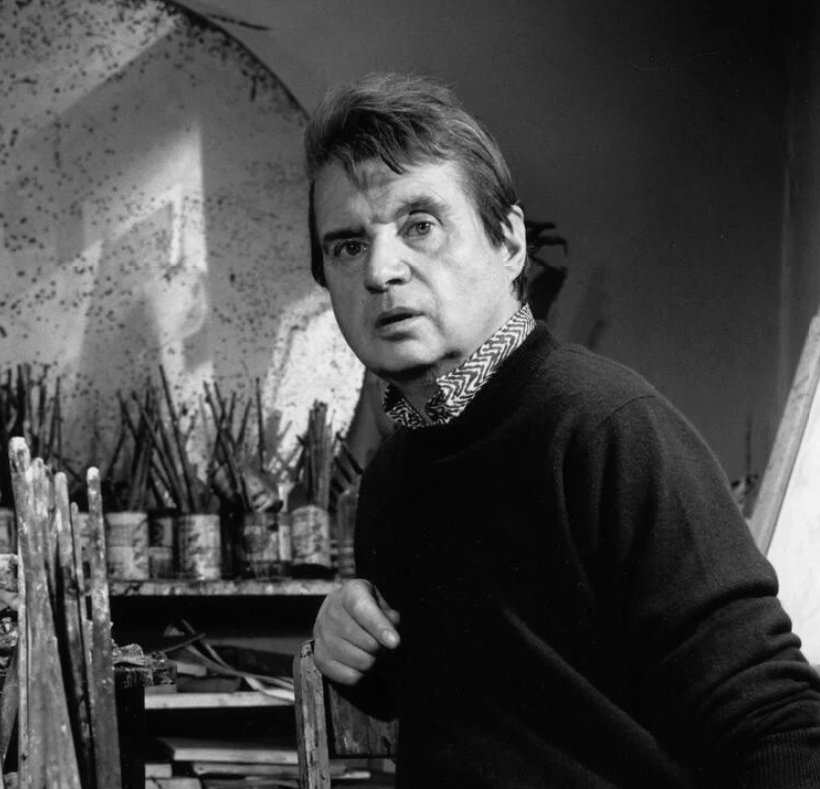
Free SPIRIT
Writer and photographer Daniel Farson has certainly been around — but he can't be he separated from the bohemian pleasures of Soho, writes Rachel Campbell-Johnston
RACHEL CAMPBELL-JOHNSTON | ARTS | THE TIMES MAGAZINE | SATURDAY APRIL 12 1997
IT WAS THE EVE of the Francis Bacon retrospective at the Pompidou Centre in Paris. Dan Farson was in London, prostrate on his back. "He used to be on television," he heard someone murmur, before sliding back into senselessness.
By the time he had come round again it was three o’clock in the morning. He had just discharged himself from University Hospital and was gazing smudgily down the road for a taxi. There was a bandage round his head and dried blood all over his suit — "my favourite mail-order tropical suit," he recalls wistfully. "I had two options; either to crawl home to Devon, or take the shuttle to Paris and drink champagne all the way." He chose the latter. "Between the crisis and the catastrophe there’s always time for a glass of champagne."
Sitting amid the gentility of Brown’s Hotel in Mayfair, Farson chuckles the ice round a tumbler of gin. He takes an impish glee in the story. "And when I arrived at the Bacon opening," he says, "with a bandage still swathed round my temples and a pair of dark glasses not even trying to hide a terrible black eye, who should I meet but Nicholas Serota [director of the Tate Gallery]. ’My God, Dan,’ he exclaimed. ’What have you done? You look like a Francis Bacon!’"
Farson’s delight at being compared to a painting by Bacon, his friend and drinking companion for more than 40 years, far outweighs the horrors of a car accident and a hospital casualty ward. "Anyway ," he says, "I found out later that I hadn’t been knocked over by a car at all. I had fallen down the steps of the French House, a little the worse for wear."
"I am a complete fatalist," Farson declares. Reading his autobiography, published last month, it does indeed appear that he has handed over the steering wheel to some recklessly optimistic sprite. But then, as he himself writes, "One of the more bizarre aspects of my life is the way it has veered from triumph to disaster without my seeming to notice the change."
As the only child of Negley Farson, a legendary foreign correspondent for the Chicago Daily News, Dan Farson travelled the world and its watering holes at his father ’s side. He remembers Ghandi coming to their house in Walton Street, and being patted on the head by Hitler who praised him as "a good Aryan child" when his father was covering a speech at Garmisch .
Evacuated during the war, he was "handed round like a begging letter" between Canada and the United States. He was pursued by the Bishop of Hong Kong — "the Bish was a great one for kissing and though I thought this a bore it did me no harm" — and introduced to Somerset Maugham by his wealthy, homosexual godfather, Tom Seyster, who later, unfortunately, left all his money to a sailor.
At the age of 17, working for the Central Press Agency, Farson was younger even than Dickens had been when he went to work as a lobby correspondent. He followed Churchill on his campaign trail and reported the inaugural assembly of the United Nations. But a year later, called up for National Service found himself instead covering the birth of a staff-sergeant’s baby in an army news sheet.
Studying at Pembroke College, Cambridge, Farson’s intention was "to squander every precious second to my advantage". Yet Panorama, the magazine which he founded, unearthed some of the greatest talent of the forthcoming decades, that of Peter Shaffe, Kenneth Tynan and Norman St John-Stevas included.
He went on to work as a staff-photographer for Picture Post, meeting such people as Noel Coward, Graham Greene, Brendan Behan and Robert Graves. His portrait of Salvador Dali was awarded a prize. "Bloody marvellous, a surrealistic photo of the great surrealist. How did you manage it?" Farson’s editor asked. Farson bluffed. But the double exposure which had made the picture "surrealistic" was the result of a jammed camera. Yet Farson was a master of snap images. His photographs, on show last month at the Roy Miles Gallery, capture with a throwaway loveliness the essence of their subjects.
Farson was sacked from Picture Post after a particularly ludicrous assignment in which he unwisely took along his lover — a navy deserter — to photograph a pair of disgruntled girls and their donkeys on the Sussex Downs. Casting the last shreds of reticence aside in his autobiography, Farson informs his readers that it was the very day that he first discovered he had crabs.
After circumnavigating the globe, dishcloth in hand — he was a utility steward in the merchant navy — Farson returned to England in 1956 to find work with the then fledgling ITV. "The public’s insatiable appetite for documentaries allowed a freedom of speech unthinkable today," Farson writes. He himself aimed for spontaneity as he interviewed people across the spectrum of life, from a couple of adventurers who had tried to cross the Atlantic in a cockleshell to a drunk and belligerent Caitlin Thomas. He soon found himself a nationally famous personality.
But Farson is quick to dismiss any flattery. "Television fame is spurious, so artificial," he declares. "What matters," he says, "is laughter and a good lunch."
In the Sixties he bought a house beside the Thames in the East End — "still gloriously alive then" — where, lolling in bed with a stranger, picked up at a party the night before, he would hear the loudspeaker announcements from passing tourist boats: "And this is Limehouse, notorious for its haunts of vice and opium dens and now the home of TV personality Daniel Farson." With impetuous enthusiasm he bought a pub, the Waterman’s Arms, where he tried to recapture "the boisterous bawdy spirit" of music hall entertainments.
Then in 1964 Farson threw everything in. "I wanted to see if I could write." He was broke at the time. The pub, ironically, had been such a success that no one had been able to get to the bar to buy a drink. Farson is hopelessly feckless with his finances. But he is undaunted. "Vicissitudes help. They concentrate the mind. As my father always told me one shouldn’t let one’s life get smothered with mayonnaise."
His writing is the one thing which he appears to treat with gravity: "I remain sober to write." His published works include a biography of his great-uncle Bram Stoker, the author of Dracula, a study of Jack the Ripper, and portraits of London feand Fifties Soho. His biography The Gilded Gutter Life of Francis Bacon, if not the most comprehensive portrait of the artist, is certainly the one which best captures the spirit of the man and his era. A film, loosely based on it, is about to go into production and Farson is to act as consultant.
"I have had some very, very lean years," he admits, "but let’s have some levity, no weeping violins, I have also "had luck, tremendous luck ... and how wonderful ... to have known all the people I have known. I suppose people would say I am a terrible celebrity snob... and I am.
"But my greatest luck is to have met, and not just to have met but to have really known, someone like Francis Bacon ... the man by whom this age will be judged. I used to ask him if it gave him a slight thrill to think that the next century would know us by his work. ’Oh don’t talk such rubbish,’ he would say."
Soho is the matrix in which Farson’s life has been set. "I can hardly bear to go back to the East End now ," he says. "But Soho has the capacity to swing with the punches. It is still like the great railway station it was during the war. Many of the old people have gone, of course, but there are always new ones coming along." Recently Farson met Damien Hirst and recognised him as belonging to the same "exuberant tradition" which he loves so well.
It was the "whiff of true Bohemia" which first attracted Farson as a young man to Soho. "Few places," he writes, "would have accepted my gaucherie so charmingly, which made me feel less of a misfit." Farson has dedicated his autobiography Never a Normal Man "to those who don’t belong". As a homosexual growing up at a time when homosexuality was illegal, he has always been haunted by the sense of "not being quite right. "It doesn’t even occur to today’s gays to have any doubt. There’s even the ludicrous idea that its better to be gay than straight. But one is, of course, absolutely racked by guilt."
Does he regret his alcoholism? "Well, there is absolutely no doubt that I have missed a hell of a lot through drink. I have missed opportunities. But equally, getting drunk with some - one can give you a rapport with them in 40 minutes which it might otherwise take 40 years to achieve, by which time they would have become too boring to you anyway."
Farson knows he is drinking himself to death "in a slow form of suicide". But it is too late to change. "I have not mellowed," he declares triumphantly, "I am still behaving badly and I still intend to do so."
It is three o’clock by the time we move on to the Colony Room, the tiny upstairs drinking club , once the centre of a bibulous Soho bohemia. On a quiet Tuesday afternoon an air of nostalgia seems to seep through the cracks between the mementos of bygone decades. Farson is either oblivious or determined not to notice it. He raises a glass of champagne. "Cheerio," he announces, in imitation of Francis Bacon’s habitual toast, delivered in his distinctive "mock-cockney Mayfair whine".
"I was good-looking in my youth," he muses, as his picture is being take , "I always wondered why more people didn’t fancy me." "They probably did," mutters the barman gallantly. "Perhaps," rumbles Farson, "but that’s all over now. And what a relief. The end of one’s sex life is such a relief — it’s like being unchained from a lunatic."
For a moment I think I have at last discovered the wistfulness of advancing age. But I am wrong. The photography session over, we weave our way down the road towards the nearby French House. Farson inclines towards me and mutters wickedly: "I suppose that photographer was rather handsome, wasn’t he?"
"Champagne," declares Farson, the moment he arrives at the bar. Behind his back a kind of semaphore goes on. "Is he still sober?" a friend mouths. "Still on fine form," a gesture indicates in return.
Clearly Farson is looking forward, not back. "You reach 70," he says, "and everything is completely different. It’s not an extension. It’s a complete change of gear. This is suddenly Farson’s year. I can feel it. I had a terrific parry, needless to say, in the local pub in Devon." Along with his other projects, he has also been invited to write a travel book on Turkey, a country he adores, and to write the official biography of the artists Gilbert and George. "And best of all, a bar in Devon is going to be named after me. Imagine that. The Daniel Farson."
Then suddenly, a few minutes later, Dan Farson has gone. He has crossed the border into the blissful world of drink. "Just going for a pee," he mutters. But scrambling off his stool he disappears out of the door, a small thickset figure in a now rumpled suit. Around the bar of the French House, where everybody talks and nobody listens, no one much notices that he has gone. I slip out after him and the last I see he is slowly climbing the steep flight of steps up to the Colony Room.
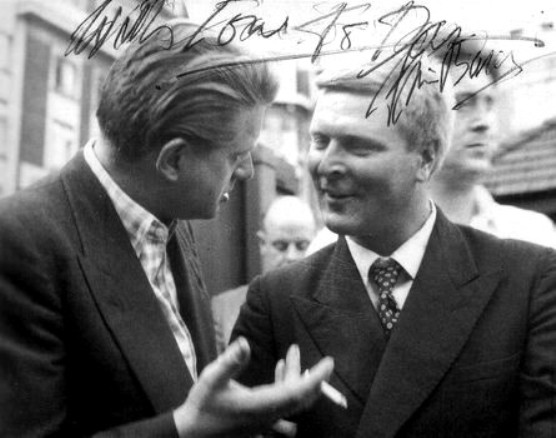
Daniel Farson (right) with Francis Bacon in Soho Square in 1952
Bacon film hit by dispute over who owns artist’s words
Dalya Alberge in Cannes reports on a copyright wrangle over Francis Bacon’s spoken phrases
DALYA ALBERGE | NEWS | THE TIMES | FRIDAY MAY 9 1997
A FILM being made about the artist Francis Bacon, starring Derek Jacobi may be halted by the administrators of his estate. The film’s director says they are claiming ownership not only of his images but also his spoken words. Bacon; widely considered to be the greatest British artist since Turner, died in 1992 aged 82. Filming has begun in east London on Love is the Devil – which is being publicised at the Cannes Film Festival the British Film Institute.
John Maybury, the director, said that a year ago he showed a draft of the screen-play to the estate administrators, who objected to the entire script. “They claimed they owned everything in the script, meaning all my creative writing. They were saying you can’t use them. (Bacon’s words).”
Maybury said the administrators — his lover John Edwards and the Marlborough Gallery in central London, which was the aitists dealer — told him that he would be taking a risk if he went ahead with the project. The director is receiving legal advice from the BFI, which is co-producing the film with the BBC.
Ben Gibson, the head of BFI production and executive producer of Love is the Devil, said: “We are about to have a meeting with the estate’s lawyers on Monday. They have no grounds for an injunction. The estate has never been keen on the project. They have seen the script, and dialogue has begun.”
The estate administrators have asked to see the finished screenplay. Much of it is based on interviews with Daniel Farson, Bacon’s friend and biographer. He owns the copyright to the interviews and is an adviser to the film. He removed direct quotes the artist had made to another interviewer.
A British copyright expert said yesterday that Bacon’s literary and artistic works were protected by copyright, but not his casual conversations.
Robin Fry, a partner with the solicitors Stephens Innocent, of central London, which specialises in intellectual property law, said: “There is no copyright in a life, only in artistic works for 70 years after death. So the film-makers would have to have the consent of the Bacon estate to use imagery depicting his works in a film, as was the case with the recent film about Picasso.”
When it came to spoken wends, there was no copyright in short sentences, he said. Public lectures, prepared talks or long discourses on a particular subject might be protected in the same way as literary works.
“So, if you listen to a prepared speech and write it down, then the copyright is still with the author. The same applies if Daniel Farson had asked Bacon his views on various matters and Bacon had held forth for some time without interruption.”
Interviews were a moot point. “But if the film script is based on m Farson’s recollection of what Bacon said, rather than specific tape recordings in which Bacon sat down and extemporised or dictated his views, then I would say these were not protected.”
Mr Fry added that such legal disputes were generally not about copyright but about censorship. “What they usually represent is the wish of one person to protect a reputation, or the views of one person of another’s life.”
Mavbury, whose Remembrance of Things Fast was acclaimed at the Berlin Film Festival in 1994, said that, while other film biographies had attempted to rewrite history, his script did not. “This is the first film about Bacon. I really don’t think it will be the last. He is far too significant to be left untouched.”
The film focuses on the 1960s and 1970s and the Turbulent relationship between Bacon and his lover George Dyer, who committed suicide on the eve of Bacon’s triumphant retrospective at the Grand Palais in Paris. Maybury emphasised that it was not a gay film and that there were no raunchy sex scenes. Nobody from the Marlborough Gallery was available for comment.
Arts
Bacon, Francis (illus.) & Milan Kundera & France Borel (text).
Bacon: Portraits and Self-Portraits. Thames & Hudson, dist.
by Norton. 1997. 216p. tr. from French by Ruth Taylor & Linda Asher.
illus. filmog. bibliog. LC 96-61101. ISBN 0-500-09266-4. $60.
Peppiatt, Michael. Francis Bacon: Anatomy of an Enigma.
Farrar. Jun. 1997. c.368p. illus. bibliog. index. ISBN 0-374-10494-8. $32.50.
HEIDI MARTIN WINSTON | BOOK REVIEWS | ARTS & HUMANITIES | LIBRARY JOURNAL | MAY 15 1997
FINE ARTS
These two books enrich the already substantial Bacon bibliography with different but equally successful approaches. While Peppiatt’s biography fleshes out, with lucidity and scholarship, biographical and contextual details heretofore unexplored, Bacon: Portraits and Self-Portraits is a lavishly produced treat with a sharp focus, carefully chosen reproductions, and inspired writing. Peppiatt (editor of Art International) brings both a critical and a personal perspective to his subject, as he was a close friend of the artist. Bacon’s haunting images almost beg for psychological exploration; likewise, one is tempted to search for elements of the artist’s hidden, exceptional life (and lifestyle) in his work. The new information Peppiatt provides about Bacon’s early years enlarges the already complex portrait of the artist, and the interplay of persona and paintings adds up to a compelling and readable study.
Bacon: Portraits and Self-Portraits is composed of Bacon’s representations of people-ranging from Lucian Freud to Mick Jagger-with many details and photographs that unveil the remarkable likenesses retained in studies that on the surface are gross distortions. Kundera’s essay explores links with Picasso and Beckett and is wonderfully perceptive, while Belgian art historian Borel’s prose is provocative-albeit a bit ponderous, possibly in part because of the translation. Both titles are highly recommended for 20th-century art collections, although the latter is more of a luxury.
— Heidi Martin Winston, NYPL
Students who brought home the Bacon
NEWS IN BRIEF | UK NEWS | DAILY MAIL | FRIDAY, MAY 16, 1997
A PAINTING bought by Oxford students for £150 may make £700,000 at auction.
The undergraduates at Pembroke College acquired Man in a Chair (pictured) by the then little-known Francis Bacon in 1953 shortly after it was painted.
It will be sold at Sotheby’s in London on June 26 with the money going to revive the college art club. About 150 students had paid £1 each to buy pictures for the junior common room and the Bacon purchase came after advice from the late Sir Kenneth Clark, director of the National Gallery.
The students were so impressed with the picture of a male nude in a throne-like chair that they spent a year’s money on it.

University art club saved by its Bacon
By Kate Watson-Smyth
KATE WATSON-SMYTH | NEWS | THE DAILY TELEGRAPH | FRIDAY MAY 16 1997
A GROUP of Oxford undergraduates hope to make more than £500,000 by selling a painting which ha belonged to their college Junior Common Room for nearly 40 years.
Man in a Chair, by Francis Bacon, was bought by Pembroke College’s Junior College Room in 1958 when the artist was relatively unknown. It has been housed in the university’s Ashmolean Museum for the last seven years.
It will be sold at Sotheby’s next month and is expected to fetch between £500,000 and £600,000, which will make the JCR the richest student body in the country.
It plans to use the proceeds to preserve and revitalise its collection of contemporary art and to set up a new “acquisitions fund”.
The decision to sell the painting, described as “really horrible and not very attractive” by Richard Janoo, the JCR president, was taken in a student ballot.
Elena Geuna, head of Sotheby’s Contemporary Art Department in Europe, said: “We are honoured to be asked to sell such a fine, early example of Bacon’s portraits.
“His psychological intensity, which has made him one of the greatest British artists of the 20th century, gives this portrait its tremendous impact.
“It is remarkable that a committee of undergraduates had such a refined eye to acquire this work nearly 40 years ago, long before Bacon was generally recognised in the art world.”
Pembroke’s art collection was started in 1947 by Anthony Emery, an undergraduate of the college, and the sale of the painting is part of the 50th anniversary celebrations.
Bacon portrait could fetch £500,000
HOME NEWS | THE GUARDIAN | FRIDAY MAY 16 1997
A Portrait bought by Francis Bacon which hung in a student common room for nearly 40 years ago is expected to sell at auction for more than £500,000.
The 1952 painting — Man in a Chair, (right) — was bought for £150 the following year by undergraduates at Pembroke College, Oxford.
The art committee spent its entire annual acquisition budget on the painting although the artist was unknown at the time. It hung there until seven years ago when it was lent to the Ashmolean Museum in Oxford for safekeeping.
It is included in Sotheby’s, contemporary art sale on June 26. Proceeds from the portrait will be used to buy more works of contemporary art for the common room collection.
Elena Geuna, of Sotheby’s said: “Sotheby’s is honoured to be asked to sell such a fine, early example of Bacon’s portraits. Bacon’s psychological intensity, which has made him one of the greatest British artists of the 20th century, gives this early portrait its tremendous impact.
“It is remarkable that a committee of undergraduates had such a refined eye to acquire this work nearly 45 years ago, long before Bacon was generally recognised in the art world.”

Painting bought in 1953 may earn students £700,000
Sale price vindicates undergraduates who blew year’s cash to acquire an early Bacon
PETER FOSTER | HOME NEWS | THE TIMES | FRIDAY MAY 16 1997
A PAINTING bought by a group of art-loving students or £150 more than 40 years ago is expected to fetch up to £700,000 at auction next month.
Man in a Chair, a portrait by Francis Bacon, was acquired by undergraduates at Pembroke College, Oxford in 1953, when Bacon was establishing his name. About 150 students each paid £1 into a kitty to buy pictures for the junior common room art society which was founded in 1947.
The shrewd investment was made after a visit to a Bacon exhibition in the basement of the Beaux Arts Gallery in London’s West End. The student buying committee was so impressed that it spent an entire year’s acquisition money on the canvas showing an unknown male nude slouched in a throne-like chair.
The picture is to be auctioned in London on June 26 by Sotheby’s, which says the £150 price is equivalent to about £5,000 today.
The purchase was not simply an impulse buy by lucky students. They were advised by Sir Kenneth Clark, the former director of the National Gallery who later won acclaim for the BBC series Civilisation. It was Sir Kenneth who suggested the students see the Bacon show.
The painting hung in the junior common room until 1990 but, with Bacon by now internationally famous, the college could not afford the insurance. It gave the painting to the Ashmolean Museum in Oxford for safekeeping.
It is now recognised as a fine example of Bacon’s early work which looks forward to similar paintings such as Study for a Portrait and the major series of works based on Pope Innocent X after Velázquez. “It was a pretty sharp buy,” said Elena Geuna, head of Sotheby’s European contemporary art department. “Ii is remarkable that a committee of undergraduates had such a refined eye to acquire this more than 45 years ago.
“Bacon’s psychological intensity, which made him one of the great British artists of the 20th century, gives this early portrait its tremendous impact.” she added.
Richard Jannoo, president of Pembroke junior common room, said the proceeds of the sale would go towards cataloguing and restoring the remainder of the JCR’s big collection, which includes modernist works by Graham Sutherland, John Piper and Victor Pasmore. The committee also hopes to set up bursaries to help less well-off students studying fine art at Oxford. Mr. Jannoo said: “Our aim is to continue the work of founders of the collection who wanted to enhance the education of students.”
It is not uncommon for the junior common rooms of Oxford colleges to own large and valuable art collections. In many colleges students rent out pictures for a small fee and hang them in their rooms. In one memorable case s student at New College was rooting through a cupboard in the early 1980s for a vacuum cleaner. Instead he found a Singer Sargent watercolour.
The painting was dusted off and exhibited for several years and was sold recently in New York for £60,000.
The sale of the picture comes at the end of two years of often fraught deliberations by the college which is one of the least wealthy in Oxford. In 1995, when students went on a rent strike after a 21 percent increase, college authorities advised the undergraduates to sell their painting. Students resisted at the time and are adamant that the proceeds of next month’s sale will be spent within the spirit of the art society rules.
Move to save Oxford’s Bacon
R. G. ALTON | LETTERS TO THE EDITOR | THE TIMES | FRIDAY MAY 24 1997
From Mr Reginald Alton
Sir, No one ran fault die taste and rustic acumen of the undergraduates of Pembroke College, Oxford, in the decade after the end of the Second World War.
Not only did they purchase a Bacon painting in 1953 (report and photograph, May 16) but their subscription and loan scheme was the model and inspiration fur many other colleges. Nor can we doubt their generosity and community spirit in 1990. when they solved the problem of security by lending the Bacon to the Ashmolean Museum where it could be seen and valued by all citizens of Oxford as well as by members of the university.
However, the sale — originally proposed in order to mitigate a likely rise in college charges — will inevitably be interpreted by the public as yet another example of Oxford University’s embracing a culture of self interest rather than of the public good.
No amount of talk about bursaries for poor students of the fine arts will disguise the impression that, for gain, the present-day undergraduates of Pemhroke College are about to deprive the city, the university and themselves of access to an important work of art whose purchase exemplified the cultural aspirations of a generation emerging from war.
Is it too late to hope that some resource may be found to keep the painting in the Ashmolean?
Yours faithfully, R. G. ALTON, St Edmund Mall, Oxford, May 17.
Move to save Oxford’s Bacon
P. R. MILLEST | LETTERS TO THE EDITOR | THE TIMES | FRIDAY MAY 24 1997
From Mr P. R Millest
Sir, I was secretary of the Junior Common Room at Pembroke College. Oxford, in 1947 when the “kitty” scheme for buying paintings was initiated, by a huge majority, under the inspiration of one Tony Emery who had access to Sir Kenneth Clark. Tony was an enthusiast for contemporary British paintings and persuaded Clark to select the First half dozen for us.
Over the years the collection has had no easy ride. Some years ago a heathen generation of undergraduates threw out the paintings and they were relegated to a cellar to rot.
However, a few years ago they were rescued by a more enlightened generation and" a selection was beautifully exhibited during Eights Week.
By this time the collection had come again to the notice of the Senior Common Room, at a time when the college was in dire financial straits. There was a suggestion that the collection should be sold for the benefit of the development fund, but this was scotched by Sir Frank Cooper, my contemporary and by then an honorary fellow, who convinced the SCR that the paintings belonged to the undergraduates.
Needless to say the eminent legal eagles from amongst us have been concerned with the legal rights of ownership by a shifting population (ie. of undergraduates).
But, with the forthcoming auction of the Francis Bacon, all, by the grace of God, appears now to have been resolved.
I am, Sir, your obedient, P. R. MILLEST, The Old School, Hogshill Street, Beaminster, Dorset, May 17.
Oxford’s Bacon
ROBERT STEVENS | LETTERS TO THE EDITOR | THE TIMES | FRIDAY MAY 24 1997
From the Master of Pembroke College, Oxford
Sir, No doubt there are two views of the Pembroke Junior Common Room’s decision to sell its Bacon. Mr P. R. Millest’s letter (May 24), however, contains inaccuracies and I feel obliged to respond.
In addition to the Bacon, which was on loan to the Ashmolean, the JCR collection also included a number of excellent examples of paintings by a remarkable generation of post-1945 English artists. These were displayed in a modest room reserved for that purpose in the college itself. Those not being exhibited were kept in a specially designed area which, while far from perfect, was certainly neither neglected nor forgotten.
Some of the paintings from both groups were exhibited, together with paintings that belong to the college, at Eights Week last year. That was a joint effort between the Senior and the Junior Common Rooms.
At no time has the SCR suggested the collection belonged to the college or should be sold for the benefit of the college’s endowment. Certainly in the four years since I have been Master no one has queried the ownership being in the JCR, and indeed the fellow responsible for the college’s art collection, together with the law fellows, has worked closely with the JCR as they have thought through the future of their collection.
Faithfully yours, ROBERT STEVENS, Master, Pembroke College, Oxford
Small revelations only on lives of Duchamp,
Johns, and Bacon
The recent biographies of these art-world giants promise much but
aside from anecdotes little is shown of the subjects’ inner lives
JAMES MALPAS | BOOKS | THE ART NEWSPAPER | SATURDAY 31 MAY 1997
Duchamp, Johns and Bacon are significant modern masters, by any account, which leads to wonder that so much of what is written about them here is inconsequentiality.
All three books point up the perils of being friends with the subject of the biography. At least Mr Peppiatt’s in-the-know account of Bacon rounds out knowledge of the subject rather than the author and is particularly moving towards the end. Its direct, robust narrative is engaging, despite repetitiveness (a shared feature in all three)—but why the portentous subtitle? It only serves to underline that Mr Peppiatt does not really close in on the Baconian enigma (thankfully) but there is plenty of entertainment on the way in grand guignol tales of the artist’s Soho scrapes—such as fleeing from a violent lover into the street wearing only fishnet stockings—as well as portraying the legendary slipperiness of a character who moved with consummate ease through different social worlds.
The genesis of Bacon’s will-to-artistic-power is charted through dysfunctional family life, the lure of the theatrical (more Marat/Sade than Greek tragedy perhaps) and most effectively, a vivid understanding of mid-twentieth-century existential solitude perhaps beyond that of any of his British contemporaries.
Nothing like the same balanced approach prevails Miss Johnston’s serio-comic dealings with Jasper Johns. She is snooty about the fact that he had fled his loft to dine with the rich and famous, which leads us to query why it is only business people who should be allowed to gorge themselves and remain morally undamaged?
The author has not been allowed to reproduce Johns’s work and so has to provide extended descriptions, a cruel task, making the text woefully overwritten. Grim latinisms like “exsanguinate” puncture the meaning, which is sometimes hard to discern; “For Johns himself between 1954 and 1958 or any time later, there was perhaps no sense whatever of a ‘perpetual waiting...(for something) to be turned.’”
The so-called “Privileged Information” (whatever that means) would seem to be that the hidden “text” in Johns’s work deals with various identity crises: of names and sexuality; repression in Fifties America; national and racial gulfs dating back to the Civil War; the meaning of heroism, all of which can be charted behaviourally.
Doubts as to whether the pursuit has been worth it are temporarily allayed in effective sections on Hart Crane’s poetry and suicide as well as on Johns’s contemporary and friend, the poet Frank O’Hara. Miss Johnston’s flair for literary criticism ironically shows up her turgidity when the paintings are evoked.
Calvin Tomkins, our third biographer, has a bit part in Miss Johnston’s run-through and-down of the American art-erati, while his friend Duchamp is very much the ghost in the machine-like thought of late-1950s and early-60s American artists. The problem for Mr Tomkins is that Duchamp’s life was, no so much uneventful, as oddly undirected. Too much Ready-made perhaps. There is no titanic struggle, no Baconian lapse of taste embellishing or tarnishing the passing years
Oozing Gallic charm, Duchamp glided and hovered with elegant restlessness, ever witty (though few bons mots survive) while maintaining discreetly vampiric relations with elderly American heiresses (who so wanted to be vampirised!). Apart from one, calculated and short-lived, marriage, and that urinal, there was little to shock the bourgeois or anyone else. This reticence leaves a void at the narrative’s centre and there is in relief for Mr Tomkins cameos of the supporting cast: lusty playboy Francis Picabia, or equally lusty, less rich, playgirl Peggy Guggenheim, who always made dramas out of crises and vice versa, in contrast to Marcel, whose motto seems to have been “it’s of no importance.”
Again, as with Miss Johnston, the writing is pitched schizoidly, veering between the dense analysis of the “Large glass” with which the book opens and subsequent Hello-like accounts of New York 1920s parties. Nevertheless, Mr Tomkins’s hatred of the Freudians is amusing and he also manages the enviable feat of making André Breton, so apparently lacking a sense of humour, appear sympathetic among all the Duchampian acolytes for at least believing in something, as Duchamp himself recognised. “He was the lover of love in a world that believes in prostitution.”
The enigma of Duchamp resides in the monklike abstinence that governed so much of his life, areligious though it was. In America, land of consumers, this must have seemed both touching and weird, as did his refusal to be “packaged” for art consumers there. That sense of distance does have something exemplary about it, but in their hugger-mugger ways, all these books err on the side of being, as Poe said of Duchamp’s great passion, chess, “complicated without being profound.”
Anatomy of an Enigma.
By Michael Peppiatt. Farrar, Straus & Giroux. 384 pp. $30
CLIVE DAVIS | BOOK REVIEWS | ARTS & LETTERS | THE WILSON QUARTERLY | VOLUME 21 | NUMBER 3 | SUMMER 1997
“I have had the most extraordinary life,” the British painter Francis Bacon once remarked to his biographer, Michael Peppiatt. “The life is more extraordinary than the paintings.” Quite so. Bacon (1909–92) is conventionally viewed as one of the greatest artists of the 20th century. But his ironic pronouncement on his own life and work has a way of echoing through the pages of even this sympathetic biography.
If Bacon’s canvases seem to be populated by mere slabs of meat, his most intimate relationships suggest why. To Peppiatt’s credit, he provides glimpses of Bacon’s turbulent and bloody sexual adventures, most of which had all the romance of a gruesome bareknuckled boxing match, without indulging in prurient sensationalism. Though his prose lacks the vigor and lowlife relish of John Lahr’s study of that other homosexual extrovert, the playwright Joe Orton, Peppiatt diligently outlines the philosophical and erotic impulses that nourished (if that is the right word) Bacon’s impossibly bleak vision.
The editor of Art International, Peppiatt has the advantage of having been for 30 years part of Bacon’s notoriously broad social circle. (Even by the standards of bohemia, the painter moved in mixed company; as Peppiatt notes, here was a man who would dine with a duke before going off to be beaten by a bruiser.) And while it is obvious that Peppiatt remains an unabashed admirer, he seldom lapses into hyperbole or opaque curator-speak.
Given the paucity of documentary evidence—Bacon appears to have preferred saloon conversation to letterwriting—the book persuasively hints at such formative experiences as a disastrous relationship with a distant upper-class father and a youthful foray into the sexual maelstrom of Weimar Berlin. Pablo Picasso was a dominant artistic influence, but Bacon also found inspiration in a less likely source: Nicolas Poussin’s Massacre of the Innocents (1626–28).
How will Bacon’s work fare with posterity? As might be expected, Peppiatt regards him as a modern master. More revealing is Peppiatt’s quotation from a 40-year-old review by another of Bacon’s champions, the distinguished critic David Sylvester: “Many of the things that make Bacon exciting today may render him laughable for future generations.” Five years after his death, Bacon’s reputation still stands, especially in France. But for how much longer? Despite its scholarship and reasoned advocacy, this book may ultimately be most valuable for the light it throws on the spiritual exhaustion of the mid-20th century.
—Clive Davis
Auction
Francis Bacon painting
JAMES JOHNSTON | AUCTION | GAZETTE | THE SCOTSMAN | WEDNESDAY, 25 JUNE, 1997
A PAINTING of a man sitting in a chair by a then virtually unknown artist which was purchased in 1953 by undergraduates of Pembroke College, Oxford, to hang in their common room is expected to fetch more than £500,000 when it is offered for sale by Sotheby’s in London tomorrow.
Members of the junior common room art collection fund were recommended in 1953 to see a small one-man exhibition of paintings by Francis Bacon in the basement of a London gallery. Impressed by what they saw, the students used their entire year’s acquisition money to buy Man in a Chair, painted in 1952.
It proved a wise decision because Bacon rose from obscurity to become one of the finest British painters of the 20th century. The picture hung in the junior common room of Pembroke College in Oxford until seven years ago when it was removed into the care of the Ashmolean Museum in Oxford.
It is being sold by the trustees of the junior common room art collection fund, which this year celebrates its 50th anniversary, to raise money to preserve and revitalise the collection, the aim of which is to display interesting examples of contemporary art for the benefit of the undergraduates.
In a statement Sotheby’s said it was “honoured to be asked to sell such a fine, early example of Bacon’s portraits. Bacon’s psychological intensity, which has made him one of the greatest British artists of the 20th century, gives this early portrait its tremendous impact.”
CONTEMPORARY ART
PART 1
SOTHEBY’S | LONDON | THURSDAY 26 JUNE 1997
LOT NUMBER 16
Francis Bacon (1990—1992) Man
in a chair
Oil on canvas 60.5 by 50cm., 23⅞ by 19¾ in.
Painted in 1952
Estimate: £500,000—700,000
PROVENANCE
The Art Collection of the Pembroke Junior Common Room, Pembroke College, Oxford.
EXHIBITED
New Paintings by Francis Bacon, Beaux Arts Gallery, London, 12 November 1953—09 December 1953.
Pictures and Sculptures from some Oxford Junior Common Rooms, Leicester Museums and Art Gallery, December 1962—January 1963.
Francis Bacon Gemälde 1945-65, Kunstverein, Hamburg, 23 January 1965—21 February 1965.
Francis Bacon: Målningar 1945-1964, Moderna Museet, Stockholm, 27 February 1965—04 April 1965.
Francis Bacon, Municipal Gallery of Modern Art, Dublin, April—May 1965.
Francis Bacon: Paintings 1945-1982, The National Museum of Modern Art, Tokyo, 30 June 1983 — 14 August 1983.
LITERATURE
Ronald Alley, John Rothenstein, Francis Bacon: Catalogue Raisonné and Documentation, Thames & Hudson, 1964.
Daniel Farson, The Gilded Gutter Life of Francis Bacon,Vintage, 1994.

ART WINDFALL
Bacon worth saving
THE EVENING TELEGRAPH | PETERBOROUGH |
THURSDAY, JUNE 26, 1997
A PAINTING by Francis Bacon bought by far-sighted Oxford University students to hang in their common room before the artist was famous is expected to fetch £500,000 when it is sold at auction today.
Man in a Chair, which depicts an unknown sitter, was acquired for a pittance by Pembroke College in 1953.
The purchase was made after members of the Junior Common Room attended a one-man exhibition at a basement of the Beaux Arts Gallery in London’s West End on the advice of then chairman of the Arts Council, Sir Kenneth Clark.
So impressed were they with the power of the virtual unknown’s work that the committee decided to spend everything it had — an entire year’s acquisition money — on it. The picture hung on the walls of the common room until 1990.
In the meantime Bacon became one of the most important British artists of the 20th century and the value of his works spiralled beyond the wildest imagination of the students.
It was eventually removed in 1990 when security and insurance costs became too high and was placed in the care of the Ashmolean Museum in Oxford.
Art windfall for students
NEWS FOCUS | EVENING HERALD | DUBLIN | THURSDAY 26 JUNE 1997
A PAINTING by Francis Bacon bought by far-sighted Oxford University students to hang in their common room before the artist was famous was expected to fetch £500,000 at auction today.
Man in a Chair, which depicts an unknown sitter, was acquired by Pembroke College in 1953, after members attended Bacon’s one-man art show in London on the advice of Sir Kenneth Clark, and were so impressed they spent an entire year’s acquisition money on it.
*In 1953, the Junior Common Room, Pembroke College Oxford, acquired Francis Bacon’s Man in a Chair. Peter Triffett, Chairman of the 1953 Art Committee, said of the purchase: “On the verge of exhaustion, after we had visited many unsatisfactory exhibitions, we went into a basement gallery off Bond Street [New Paintings by Francis Bacon, Beaux Arts Gallery] where a man called Francis Bacon had a small one man show. The impact of the painting was immediate and powerful, so powerful that we decided to spend the entire fund for that year on the one painting.”
However, the purchase was not well received. A remembered comment was: “Who on earth would want that sort of painting in their rooms!” Remarkably, the JCR actually censured the Art Committee for “wasting” its funds. In 1997, the JCR decided to transform the Art Collection into a registered charity known as The Pembroke College JCR Art Collection Fund.
The Francis Bacon Man in a Chair that was bought in 1953 for £150 was sold at Sotheby’s for £518,000 to endow the charity and facilitate its mission of relieving student hardship, supporting student charitable endeavours, acquiring new works of art, and maintaining the existing Collection.
Bacon painting fetches £518,000
WORLD NEWS AND ANALYSIS | IRISH INDEPENDENT | FRIDAY, 27 JUNE, 1997
A PAINTING by Francis Bacon, which hung in the common room of an Oxford college for 45 years, was sold at auction last night for £518,500.
Man in a Chair was acquired by students at Pembroke College in 1953 — when the artist was a virtual unknown — for just £150.
Bacon went on to become one of Britain’s leading 20th Century artists with the value of his work spiralling.
Bidding at Sotheby’s in London opened at £300,000 but soon climbed to above the expected asking price of £500,000.
The powerful portrait, which depicts an unknown sitter, was purchased by a telephone bidder.
Art for art’s sake
Buy what you love, and don’t expect to make money, advises Antony Thorncroft
Unless you have surplus cash coming out of your ears, an intrinsic eye for art and antiques honed over many years, and can tell a Titian from a Tintoretto at 20 yards, never, never invest in art.
There are hundreds of shrewd Japanese bankers sadly contemplating indifferent paintings by Renoir, Marie Laurencin and Utrillo, among other “big name” artists, which they paid excessive prices for in the late 1980s and which are now worth less than half what they cost. There are even more modestly affluent British collector-investors who were persuaded to buy artists of the Newlyn School, Scottish “Colourists” and other fashionable coteries in the same period, which have suffered similar deflation.
In the last few months, after more than six years of recession, art prices are rising again – or rather, good works in fine condition by the top artists are increasing quite steeply in value. And, once again, stories appear in the newspapers of shrewd purchases of paintings, bought for a few pounds and now sell6ng for thousands. A speculative bubble is forming which should be burst before it causes financial pain to many.
In 1953 the students of Pembroke College, Oxford, bought Man in a Chair, a panting by Francis Bacon, for £100 or so to decorate their JCR; at Sotheby’s last week it sold for £518,500. But the students had been advised by Sir Kenneth Clark – and Bacon is regarded internationally as one of the three great British artists of the past half century, the others being Lucian Freud and David Hockney. All three sold works for less than £500 30 years ago; all can now top £500,000 for a painting. The pictures they sold a generation ago went to keen collectors who loved art and recognised talent. It is only committed art lovers, who buy with no thought of investment, who are likely to end up making good. investment decisions.
A handful of the young hopefuls leaving the top art schools this summer will end up as commercially successful artists, commanding ever rising fees. These are the likely success stories of the future. So people buying the work of prizewinners at institutions such as the Royal College of Art improve their chances of emulating the students of Pembroke College. However, just as many bankable artists, like Francis Bacon, never went to art school.
There are problems buying at art college summer shows. Students tend to dislike the market, and rarely paint decorative works with popular appeal.
Indeed, the most fashionable young British artists, recent winners of the annual Turner Prize such as Damien Hirst, Rachel Whiteread and Douglas Gordon, create in media – dead animals stored in formaldehyde, concrete, and videos – that are not naturally designed to last, or fit into homes, or give endless pleasure. Their creations are basically museum pieces, or aimed at a small group of very rich private collectors.
Although the prices of major works by Hirst and Whiteread now exceed £100,000, and they have international reputations, they hardly look like good investments. On the other hand, the even younger generation artists such as Sarah Lucas and Tracey Emin are even more conceptual, less saleable. Already Hirst and Whiteread are becoming staid and predictable. But if you fall in love with their creations – buy.
There is no link between artistic reputation and value in the art market. The most durable investments in recent years have been the creations of artists with no critical reputation whatsoever. The wildlife pictures of David Shepherd, the marine scenes of Montague Dawson, the demure nudes of Sir William Russell-Flint have all maintained their value over the last seven difficult years. Some artists such as L.S. Lowry, who appeals to a small number of committed collectors, have risen steadily in value: a good Lowry now sells for more than £150,000.
Anyone who wants to buy art to decorate a home, or to give pleasure, but would like the work to at least hold its value, should contact a reputable dealer, preferably a specialist in a certain fled, who will often guarantee to buy back a painting at its sale price. Anyone trusting their own judgment should go along to the Summer Exhibition at the Royal Academy, where over 1,000 works of art are for sale, both by Royal Academicians, in theory the best of the bunch, and by the top weekend artists.
If you want the advice of an expert, Julian Agnew of Agnews, which has just celebrated 180 years in the business, points out that Italian Old Masters now seem cheap compared, with Dutch, and that 18th century British pictures are underpriced compared with those of the 19th century. Indeed, Old Masters are remarkably inexpensive, at least when set against the Impressionists and Modern Masters. Last week in London a Van Gogh watercolour sold for £8.8m, and a Freud portrait set a record of £891,500. You could buy a considerable number of excellent Old Masters, and even more works by interesting contemporary artists, for these sums. But whether they will appreciate in value over time should not affect your critical judgment.

Bacon’s Man in a Chair, bought for £100 in 1958, fetched £518,000 at Sotheby’s last week
A CRITIC AT LARGE
BY ANTHONY LANE
ANTHONY LANE | THE NEW YORKER | SUNDAY, JULY 6, 1997
All of which is enough to confirm John Deakin as one of the best scouts of the century; he mapped out a certain territory and prepared the way for someone more formidable than he was. Where, after all, do the rounded and wounded features of Deakin’s subjects — his victims — return to haunt us, their flesh thickened into aggressive swipes of paint, if not in the mature work of Francis Bacon? It is a matter of record that Bacon turned to Deakin’s photographs as source material for his own creations, in the way that other artists employ sketches. How serious, let alone sober, Deakin was in these crucial transactions is another matter. Having taken some nude shots of the model Henrietta Moraes, a prominent figure in Bacon’s painting, the photographer was discovered hawking them to sailors in a London pub. When Deakin needed a drink, the history of art could go hang.
Francis Bacon: Anatomy of an Enigma
Francis Bacon is an artist whom viewers have strong feelings about: His work is love-it-or-hate-it kind of stuff. His powerful signature compositions of gnarled, tortured flesh against backgrounds painted in lush, queasy tones aren’t exactly pretty. It’s difficult, however, to deny this British artist’s skill.
Despite the often controversial nature of his work, Bacon’s startling paintings have earned him a place as one of the great artists of this century. He was also openly gay. Still, Bacon, who died in 1992, was never the type to flaunt his inner feelings. Particularly not in his art. “Bacon insisted that his painting be viewed in a kind of biographical vacuum,” writes Michael Peppiatt in Francis Bacon: Anatomy of an Enigma, his engaging and often dishy new biography.
Bacon’s veiled strategy of distancing his personal life from his art is not surprising given that he was part of a generation of gay men who faced legal persecution for their sexuality, But though his public persona may have been shrouded in secrecy, that doesn’t mean he wasn’t enjoying himself in private, The book presents him as a generous, erratic, and appealing character with contradictory tastes. Bacon led what he called a “gilded gutter life” — one that included swank gambling sprees in Monte Carlo, lavish art openings, and quick sexual encounters with street studs.
As a longtime friend of the artist, Peppiatt had access to intimate personal details regarding Bacon’s life, and he balances them with art historical readings of Bacon’s work. The artist’s early years are particularly fascinating because his development as a painter was tied to his budding sexuality. At 16 he was expelled from home after his tyrannical military father caught him in his mother’s panties. After drifting through London’s homosexual underworld, he was sent with an uncle to late-’20s Berlin, where the young artist found an even more vibrant gay scene. As Bacon ended up with various sex partners — including his uncle — he also witnessed the kind of economic inequity and social injustice that may have sparked some of his raging images.
Although Bacon encountered tragedies and low points throughout his life, here his history seems richly layered with experiences of joy and artistic triumph, In his preface Peppiatt quotes Bacon saying, “It would take a Proust to tell the story of my life.” It’s a daunting message to any biographer, but Peppiatt approaches his subject confidently. If not exactly Proustian, the book is an intimate portrait of the artist as a brilliant and complex gay man.
Francis Bacon is undoubtedly one of the most important painters to emerge from post-World War II Europe. As a young artist I didn’t like his work as much as I do now. I didn’t get it. I thought it was too expressive, too theatrical, too narrative, too illustrative, too Catholic, too European. Not to mention too figurative. My particular historical affinity was toward artists who were more transcendental, more American. Artists like Mark Rothko and Barnett Newman — artists who were trying to break their way out of the fragmentation and claustrophobia of (European) easel painting to make their way toward a new (American) abstraction with all the freedom and expansiveness that it implies.
What I don’t get now is why I was so doctrinaire about it. I mean, what was it that I really didn’t like? Why should abstraction serve as another mental hegemony for somebody whose work is barely even formed? The point is to be open, to be messy, to make the game a little more complicated. That’s what Bacon did. That’s also what made his work a little scary to me. I couldn’t separate the mental picture of him that was in my head — drunk and bloated and ugly-from the pictures of his paintings that were in my head — explicit, sadomasochistic, bloody, scatological — from the paintings themselves — raw and powerful. Bacon’s work is intensely human in a way that makes us confront and deal with things and feelings that are often repressed — especially for me, when I first encountered his images in the early 1970s.
In Edmund White’s lecture at the AIDS and Literature Conference in Key West, Fla., last January, he made the point, which I agree with, that one doesn’t have to choose between the idea of art being a "promise of happiness" or an "idea of pure 'disinterested contemplation.' " In other words, Bacon’s "messiness" collapses the dichotomy between the transcendental and the real. It seems more appropriate to think of art as a wayward mirror: convoluted, multiple, inverted, simultaneous, continuous, distorted, like life.
The immediacy and beauty of so many impulses and images recorded together and operating simultaneously as if a mind were opening outward is what makes Bacon such an important artist. That opening outward is what I understand today to be the truest accomplishment possible as an artist.
Striking a violent chord
A BRITISH COMPOSER GETS VIOLENT | MOREOVER | THE ECONOMIST | JULY 12 — JULY 18, 1997
PEOPLE have been moaning for ages about violence in the movies. and for even longer about violence in art (Hieronymus Bosch’s horrific fantasies preceded Damien Hirst’s mutilated cows by more than four centuries). Violence in classical music has a long history too, but it has been given vicious new twists by Mark-Anthony Turnage, one of Britain’s most highly-regarded young composers.
Britain’s influential Aldeburgh Festival opened this summer with the premiere of an opera he had composed. It was inspired by the killing of an abusive husband his wife stabbed him, in the words of the title, “Twice Through the Heart”. Now only 37, Mr Turnage first came to international attention in 1988, when his opera “Greek” (Argo CD 440 368-2), was premiered at the Munich Biennale. A visceral version of the Oedipus story, it is set in London’s East End, where yobs sing football chant, bash each other and are bashed by the police, and yuppies claw their way to fortune.
Since then, Mr Turnage has concentrated on orchestral works. As composer-in-association with the City of Birmingham Symphony Orchestra in 1989-93, he produced “Three Screaming Popes”, which was inspired by Francis Bacon’s angst-ridden painting of the same name, and “Drowned Out”, which was based on William Golding’s novel “Pincher Martin” and its hero’s death by drowning.
Yet, unlike most film directors with a penchant for violence, Mr Turnage is a great artist. capable of depth and richness in his compositions. Consider his most recent orchestral work. “Blood on the Floor”, first performed in London last year and scheduled to be presented at the Salzburg Festival in August (when it will be released on Argo CD 455 292-2). Again inspired by a Francis Bacon painting, its first movement was described by Mr Turnage as “probably the nastiest thing I’ve written”. But the nine-movement whole is also full of gentler sounds, containing such pieces as a moving “Elegy for Andy”, in memory of Mr Turnage’s younger brother, who died of a drug overdose.
Initially trained in the 12-tone system of classical music. Mr Turnage abandoned its strictures when he discovered such free-spirited jazz musicians as Miles Davis, a trumpeter, and Gil Evans, a composer-arranger. Now he freely combines the textures and procedures of jazz and classical music and in his pieces the two really do cohere, instead of jostling unconvincingly as in the work of so many composers. “Blood on the Floor” featured three jazz musicians and included space for improvisation. Though “Twice Through the Heart”, left no room for improvisation, its hovering, bitter-sweet sonorities had a jazz flavour.
Mr Turnage’s blending of violence, emotional depth, and catchy music is no better illustrated than in “The Country of the Blind”, his companion premiere opera at the Aldeburgh Festival. Based on a short story by H.G. Wells, it tells the tale of a mountaineer who discovers a land inhabited by sightless people, falls in love and is invited to join them at the cost of his eyes. Though much of the score is compelling. its high point is a poignant duet between the hero and the blind woman he loves. One critic called it “ravishing”; another said wryly, “while I don’t want to destroy Turnage’s reputation. you really do come out humming the tune.”
That there was a book to be written about the life of Francis Bacon (1909-92) was never in doubt. No one who had seen Bacon in the street, let alone in a crowded room, could forget his spring-heeled tread, his pink, pulpy and most often convivial features, and his cannonading diction. Quite apart from the paintings that made his name, and eventually his very large fortune, he was one of the great English originals of this century. As such, he was talked about, argued about and speculated about.
The problematic element was that ever since he had been banished from his father’s house at the age of 16 — reportedly for trying on his mother’s underclothes — Bacon lived a layered life. Secrecy, make-believe and a flamboyant mischief were fundamental to it. From adolescence he referred to himself as ''completely homosexual,'' and at 17 he learned his way around two great cities — first Berlin and then Paris — in which appetites of every kind could be satisfied. ''To find yourself,'' he said to his biographer, Michael Peppiatt, ''you need the greatest possible freedom to drift.'' Bacon enjoyed that freedom. But how, where, when and with whom?
The answers to these questions were as if written in the sand dune of which Bacon was to paint an amazing picture late in his life. But almost all of them could have been washed away by the equally amazing jet of wild water he painted in 1979.
Among those who knew Francis Bacon most vividly — some for half an hour, others for half a lifetime — many were never known by name to anyone but him. Almost all those who were known have lately died off, one after another. Others, still living, have refused to speak about him and are not going to change their minds now. Than that there is no greater compliment.
So there is a huge disparity between the recorded and the unrecorded. Bacon handled these matters to perfection. In what passes for formal society, he had beautiful manners (inherited from way back) and appeared to give his whole self to any company he was in. But there almost always came a moment at which other people elsewhere had priority, and he was suddenly gone. Few men have been at home in so many worlds, or so adroit in adjusting from one to another.
When talking about himself, he could dazzle and confuse, seduce and stun. But when he was bored or provoked, he could carry on like an intelligent windup toy whose every word torched the air. His friendship, once given, was so irresistible, inventive and generous in spirit that when he withdrew it, as he sometimes did, the loss was very hard to bear. These were private matters, but they make life difficult for a biographer.
All this notwithstanding, Michael Peppiatt’s Francis Bacon: Anatomy of an Enigma is pleasurable reading on the whole. It has a good, steady beginning, in which the reader learns that one of Bacon’s maternal great-great-grandfathers founded a small steelworks in Sheffield that grew into ''one of the world’s biggest suppliers of castings for guns.'' (It was, in Bacon’s view, the prospect of a residuary fortune from Sheffield steel that persuaded his father to propose to his mother.)
His great-aunt Eliza married the heir to a shipbuilding fortune, and Bacon as a boy spent summer holidays in her mammoth neo-Gothic mansion near Newcastle. From his mother’s mother he inherited a sense of fete and a gift for cosmopolitan and open-handed hospitality. Peppiatt also reminds us, though Bacon himself never did, that Byron dedicated ''Childe Harold'' to one of Bacon’s paternal great-grandmothers.
He gives a good account of Bacon’s early career in London as a designer of furniture, rugs and other domestic incidentals, some of which had a second life in his paintings. Much of the story told here about his life after that is already familiar — and not all the gossip reported is substantiated. But the story is skillfully sewn together and rebuttoned (or, in some cases, unbuttoned), even if a little too much comes inevitably from memoirs that are malicious or self-serving.
Peppiatt first met Bacon in 1963, when he was editing a student magazine called Cambridge Opinion, and they got on well. In 1966, Peppiatt went to live in Paris, where he eventually became editor and publisher of Art International. In the 1970’s, when Bacon decided to live in Paris and see how he liked it, Peppiatt was always at hand. He therefore had a 30-year acquaintance with his subject and made good use of it. (Bacon’s late-night soliloquies in Paris ring particularly true.) His book is also enriched by echoes, all of them duly credited, of the many tributes to Bacon that were printed after his death. (In many of these, one can sense a feeling of relief that Bacon would never read them.)
Peppiatt has also been able to draw on what will from now on be an indispensable biographical source. It is unique in its kind, consisting of the sumptuous mulch of photographs, newspaper cuttings and leavings of every kind that Bacon had trodden into the floor of his studio. It has since been taken apart, piece by piece.
Among the treasures on the floor was a long series of beat-up photographs by Bacon’s friend John Deakin. When rescued not long ago, these were shown at the National Portrait Gallery in London. In those battered images, Bacon himself lives again, as do his favourite subjects — Isabel Rawsthorne, Muriel Belcher, Henrietta Moraes, Lucian Freud, Peter Lacy, George Dyer and others from intellectual, social and artistic circles in London.
Without Deakin’s photographs, Bacon’s portraits of those same people could seem weird, perverse, even hostile. But as he said himself: ''I terribly don’t want to make freaks, though everyone seems to think that that’s how the pictures turn out. If I make people look unattractive, it’s not because I want to. I’d like them to look as attractive as they really are.''
Also — and unlike most of Bacon’s boon companions — Peppiatt has done some original work. He tracked down, for example, the daughter of a French woman of the world, a pianist and connoisseur of the arts called Yvonne Bocquentin, who had taken the 17-year-old Bacon in hand in 1927 — a daughter with an excellent memory. Not only did Mme. Bocquentin invite Bacon to lodge in her house in Chantilly; she made sure he made the most of all that Paris had to offer in the way of high culture.
When it comes to the art, neither Bacon nor Peppiatt is well served by the boilerplate jacket copy of this book, in which we read of Bacon’s ''canvases of screaming popes,'' which are said to be ''defining images of 20th-century anguish.'' ''Get real!'' is the only answer to this phrase, which is the equivalent in marketing to friendly fire in warfare. These ancient fallacies do no honour to the publisher.
Where are these ''screaming popes''? Anyone who looks with a fresh eye at the Head VI of 1949 or theof 1953 — classic pieces, both — may conclude that the Pope figure is not screaming at all. He may be singing along, in full-throated Italian style. He may be yawning after a long day at the office. He may also be roaring with laughter. Bacon left his options open, no matter how often others preferred to ignore them.
After all, what did he actually say? ''I am not a preacher,'' he said. ''I have nothing to say about 'the human situation.' '' What he wanted, among other things, was to reinvent the language of portraiture in ways that summoned the rest of us to reinvent the language of criticism.
Peppiatt does not quite do that, but he has one or two enviable inspirations. One of them is to quote at the end of his book a passage from Marcel Proust that might have been written with Bacon in mind. ''People do not die immediately for us,'' Proust said, ''but remain bathed in a sort of aura of life. . . . It is as though they were traveling abroad.''
Anatomy of an Enigma. By Michael Peppiatt. Illustrated. 366 pp. New
York: Farrar, Straus & Giroux. $30.
John Russell writes frequently about art and culture for The New York Times.
After Henry Moore, Francis Bacon (1909-1992) is the most celebrated British artist of the 20th century. But whereas monumental bronzes by Moore decorate public and corporate plazas all over America, Bacon’s grotesque paintings of human beings disfigured by passion or suffering still meet with critical and popular ambivalence.
Michael Peppiatt’s "Francis Bacon: Anatomy of an Enigma" may spark a reassessment of Bacon’s art, which is sparsely represented in American museums. (The Berkeley Art Museum owns a painting, shown here, which is currently on display.) Peppiatt’s unwavering conviction of the greatness of Bacon’s work is less persuasive, though, than his portrait of the man himself.
As editor of the magazine Art International and a longtime friend of Bacon’s, Peppiatt has critical credentials. His characterizations of Bacon’s art are perceptive and sympathetic, but before long his rhetoric of appreciation starts to sound too well matched with the mannerism that eventually afflicted Bacon’s own work.
Ironically, the most vivid account of a Bacon painting in Peppiatt’s book is given by Cecil Beaton, who rashly commissioned a portrait. In the finished picture, Beaton saw "an enormous coloured strip-cartoon of a completely bald, dreadfully aged — nay, senile — businessman. The face was hardly recognizable . . . for it was disintegrating before your eyes . . . a swollen mass of raw meat and fatty tissues. The nose spread in many directions like a polyp but sagged finally over one cheek. The mouth looked like a boil about to burst."
What leaves the reader wanting a fresh look at Bacon’s painting is Peppiatt’s portrayal of him as a man gripped by self-destructive compulsions that he was singularly fit to withstand. Bacon’s daredevil life authenticated his art’s grim vision, Peppiatt argues.
Bacon’s seriousness about art and life are never in doubt, although he was self-taught and almost suicidally devoted to what he called "frivolity": drinking, gambling and sadomasochistic homosexual adventure.
"Bacon revelled in living beyond the pale," Peppiatt writes. "In addition to his punishable sexuality, in which he had left no vice unturned, he had engaged in prostitution and theft of various kinds, as well as a range of other illicit practices, such as keeping a gaming house and assuming a false identity. As for drugs, Bacon would have tried most things at one time or another, out of curiosity or bravado."
Although capable of the most outrageous behavior, Bacon was strangely reticent about sharing the story of his life with critics or would-be biographers. The reason, Peppiatt believes, is that he did not want lurid personal anecdote to dilute the "enigma" or impact of his art, which he saw as something quite objective.
Yet when Peppiatt discussed with Bacon the inevitability of shocking biographical revelations, the painter said, "Well, yes of course, you must be as indiscreet as you want. . . . After all that’s what people are most interested in. The more indiscreet you are, the better the book will be." Peppiatt took him at his word.
The son of a tyrannical military man, Bacon spent much of his childhood on the stud farm in Ireland to which his father had retired. Bacon’s father disowned him in his teens when he was caught trying on his mother’s underwear. "Women’s underwear and, notably, fishnet stockings, were part of the artist’s wardrobe for most of his life," Peppiatt notes.
Before he was 20, the young Bacon had already lived by his wits and his looks in Berlin, Paris and London, learning how to charm and how to con. He followed his curiosity whether it led to transvestite bars or to reading Proust and Joyce.
While in Paris, he had been thunderstruck by the work of Picasso and the surrealists, but Bacon made his first career as a decorator and furniture designer. His reputation flourished briefly in London before it succumbed to his restlessness and profligate habits.
He made a run at painting, but gave it up for seven years of "drifting," after which he settled into an odd household comprised of a rich older lover, Eric Hall, and Jessie Lightfoot, his childhood nanny, who would live with Bacon until her death in 1951.
From the mid-1940s until his death, Bacon enjoyed a slow ascent to world fame and riches that enabled him to indulge his vices — and his generosity — to the fullest.
Bacon loved extreme states — of intoxication, pain, pleasure, danger and concentration — both for their own sake and because they erupted in images he could paint, images he claimed were as mysterious to him as to anyone.
Peppiatt is very good on the influences interpreters have seen in Bacon’s work, from his memories of London during the world wars to the art of Velázquez, Picasso and Titian.
Peppiatt tells a wealth of stories about Bacon’s life and delicately overlays the art with them, but never pretends to have the key to the man or his work. His Bacon is both extraordinary and completely believable.
Francis Bacon professed never to read the reviews of his work.
"If I did," he said, "I’d probably never paint again."
Bacon may have sought attention with a passion (he talked about himself and his work as much as any artist has), but if he ever cared about what people thought of him, he rarely showed it. Seen in this detailed biography by his friend and longtime admirer, the critic Michael Peppiatt, Bacon was a thoroughgoing contrarian. Born in Ireland to an English family, he was an avowed homosexual who rejected bourgeois propriety for a life anchored in London’s pubs. Peppiatt’s tour of Bacon’s travels through those haunts is vivid. Too vivid, perhaps. After providing Peppiatt with most of the material in the book in the 1970s, Bacon forbade the author to publish. Now, five years after the painter’ s death in 1992, the truth has come out.
Toward the end of his life, Bacon, not one to minimize his own importance, declared that only Proust could do justice to his colourful biography. With a touch more modesty, Peppiatt calls himself the Boswell to Bacon’s Samuel Johnson, the amanuensis who tags along just about everywhere and records his mentor’s every word. Overblown as it might sound, this is just what Peppiatt has achieved. The result is not a critical biography, but a closely observed account of what Bacon thought of himself. Readers eager to learn about Bacon’s art or about the evolution of the London art scene of this century will not be disappointed.
Largely self-taught, Bacon rejected modern art’s glacial drift toward abstraction by painting the human figure, which he in turn disfigured with a vengeance. He would have been delighted to witness the art world’s current vogue for grotesque figurative painting and no doubt would have claimed paternity.
The author calls Bacon an enigma. Paradox is a better word. An esthete and fastidious dresser, he would nonetheless roam the public lavatories for rough trade. He fell into art largely by accident. A magnanimous host and drinking companion who visited sick friends and paid their hospital bills, he spoke derisively of most of the artists who got his career going. The man later acclaimed as the world’s greatest living painter placed ads in the 1920s seeking work as a "gentleman’s companion" on the front page of The Times. At the same time, the elderly nanny who had raised him was living with Bacon and a male companion in London, in bohemian quarters so cramped that she slept on the kitchen table. She would live with him until she died. Artists with glaring contradictions are nothing new, yet even by the standards of artists’ lives, Bacon’s life was an odd one. It’s no surprise that a movie is being made of it. If that movie, now in production, includes even half the detail presented in this biography, it could be a nonstop orgy.
Born in Dublin in 1909, Bacon spent most of his unhappy childhood in sprawling Irish country houses. His mother’s family made a fortune from a colliery in northern England. His father, retired from the British cavalry, was a failed horse trainer, loathed by Francis. The father banned alcohol from the house (Bacon grew to be a prodigious drinker), threw angry fits over trivial details and sought to toughen up his frail eldest son by having Irish grooms horsewhip the boy. Bacon got his revenge by inaugurating his legendary sex life at an early age with the same grooms.
As Bacon would often recall, he saw himself from an early age as "completely homosexual." In fact, his adult life began when his father, upon discovering this truth about his son, expelled Francis from the family home. Sex, as much as anything, came to rule Bacon’s life as a young man. Convinced by his father that he was ugly, Bacon learned that in a city such as London, all sorts of men found him attractive. Prostitution supplemented his low wages from odd jobs. In pre-Nazi Berlin, where he visited an uncle, that uncle became one of many sexual encounters. In Paris, Bacon found his element among the artists and hangers-on in Montparnasse’s demi-monde.
Bacon began his art career as an interior decorator, an activity for which he displayed an innate flair despite a complete lack of training — the same as it would be with painting. His room designs, published in 1930, pointed to the vision that would turn up in his paintings: cagelike spaces, sparse furnishings, severe curtains. It was as if he were already defining the background against which he would paint, Peppiatt argues, "the interior in which he would later set his drama of mid-century man caught in an animal awareness of his futility and despair."
Later in life, Bacon spoke only reluctantly about his decorating, because he thought that the experience would detract from his respectability as a painter. That design work did put him in a milieu with painters such as Ben Nicholson and Roy de Maistre, who helped nurture his drawing skills. Eventually, he would surpass all of them.
After he became a celebrity, Bacon was mysterious about the influences on his work. One transfixing visual experience was his first sight of Poussin’s 17th-Century Massacre of the Innocents at the Chateau of Chantilly outside Paris in 1927, where the 17-year-old Bacon had been taken in by an older, worldlier woman. What struck Bacon in the image of a frenzied mother fighting to keep a soldier from killing her child was her mouth in a scream, "probably the best human cry ever painted." Bacon would spend his life trying to better it.
Yet Peppiatt makes it clear that Picasso was the prime mover behind Bacon’s style, "Bacon’s first and most important father figure." It was Picasso’s bone-like grotesque exploration of the human figure in the late 1920s, including his Crucifixion of 1930, that inspired Bacon’ s notorious 1933 Crucifixion, the first of many crucifixions that he would paint, which Peppiatt calls "an image strung like a bat on a primitive cross." That kind of figure, and other morbid fixtures of Spanish painting, would haunt Bacon, a steadfast atheist, until his death on a trip to Spain.
The prospect of death also haunted him. As a weak, asthmatic child, the only one of his parents’ four sons to survive past the age of 30, Bacon was made to watch an uncle torture and kill animals. Also, during his childhood in rural Ireland at a time of violent anti-British upheaval, his family lived in fear of attacks from the Irish nationalists who regularly burned estates owned by the English. And for the rest of his life Bacon remembered hearing the cries of Irish prisoners as they were whipped by British police. Yet death retained a special allure for him. Slaughterhouses were among his favourite places to visit.
In literature, as well as painting, Bacon was an accomplished autodidact. He knew Shakespeare well and loved the Oresteia so much he could quote it from memory, but much more elementary drives ruled his life. The word "anatomy" in the book’s subtitle is crucial. "Total abandonment to instinct, above all sexual instinct, was an idea which Bacon maintained with astonishing vigour to the end of his days," Peppiatt writes. "If he had a sustaining belief, it was in the supremacy of instinct as the only guiding principle in life. And when he said he 'painted to excite himself,' he surely meant: to recreate certain extreme sexual sensations."
This biography has already been attacked for failing to make connections between Bacon’s jam-packed personal life and his chilling art. The critics are not entirely wrong. Not all of those connections have been made. Yet Bacon’s art has been published and scrutinized over decades, while the events of his life have never been presented so extensively or systematically. If Peppiatt has not gone far enough in drawing life and work together, readers now have Peppiatt to thank for the raw materials to do so.
Francis Bacon: Anatomy of an Enigma
This biography has a lot going for it: an urbane, insightful author and a famously flamboyant, risque subject who simultaneously is and isn’t one of the signal forces in twentieth-century art. Michael Peppiatt, to his credit, does not fully conceal a certain ambivalence about the masochistic and controlling Francis Bacon, who lost two lovers to suicide — each just before the opening of a major exhibition — and kept house with his old nanny until he was forty-two, nor about the sometimes contrived-seeming terribilita of the Baconian oeuvre. The leitmotiv of Dorian Gray, invoked either to emphasize the artist’s remarkably enduring if rather pickled boyishness or to conjure up the splenetic wonders of the portraits, serves Peppiatt well on both scores.
Even Bacon’s detractors might agree that the artist at his best succeeded brilliantly in realizing his goal of getting pictures "to look as if a human being had passed between them, like a snail, leaving a trail of the human presence and memory trace of past events, as the snail leaves its slime." There has been much less consensus, however, about the passing importance of that accomplishment, never mind its profound resonance. Peppiatt does not exactly bring the gavel down on this issue. Instead, he plea-bargains, in a sense, emphasizing the single-mindedness of an artist who so powerfully declared his loyalty to the human figure during the postwar decades — a period Peppiatt himself seems to identify almost exclusively with abstraction. (The cameo appearances in this book of the painter Lucian Freud, one of Bacon’s frequent sitters, do little to cloud his view.)
Certainly, Bacon was a bit of a one-note trombonist. The mood of existential futility and ferocity so thoroughly associated with his work was pretty well in place from the very start, around 1930, which is when the artist, barely in his early twenties, gave up a promising first career as a self-styled interior decorator and furniture designer. (He largely stopped painting for nearly a decade soon after he began, however, and for the most part acknowledged only work dating from this second beginning, right before World War II.) Bacon seems, in general, to have been one of those people who were hatched fully formed. At fifteen or so, he was already well into women’s underwear, a lifelong preference that in the short run proved to be a fast one-way ticket out of the house of his sclerotically hotheaded father. Once he returned to London from more than a year’s sojourn abroad — on the loose in Weimar Berlin and prewar Paris, between the ages of seventeen and nineteen — he remained as out as out can be. There is indeed a hint of irony lurking about the notion that a man who spent hardly any time at all finding himself could be responsible — along with, say, Beckett, Sartre, and Camus — for some of the most widely recognizable symbols of postwar angst and doubt.
At times, Bacon’s trademark flick-of-the-wrist-and-blur-of-the-brush facial distortions seem merely to be tricks, effective formal gimmicks, with a dash of Surrealist horror a la early Bunuel, derived from Picasso’s Marie-Therese portraits, de Kooning’s liberated licks of paint, and from the artist’s longstanding skill at applying makeup to his own face. Many of his figure-ground relationships, in turn, seem to have evolved out of the combined principles of Muybridge’s photographic studies of wrestlers and of AbEx gravitas as delivered by painters such as Motherwell, Newman, and Rothko. Yet we learn that the erstwhile decorator dismissed abstraction as "decorative" pattern-making and was witheringly snooty about its practitioners, referring to Pollock as "that old lacemaker" and comparing de Kooning’s "Woman" paintings to "playing cards." According to Peppiatt, however, Bacon "also understood that taking a figurative image to the verge — but just short — of abstraction gave it a mysterious and compelling tension."
Something about the central emotion conveyed — the career-long fixation on themes of nihilism, carnal decay, and the primal sexual combat of males - screams adolescence. So did the artist’s cloaked and cultivated aura — he played down his more or less upper-class background and was attracted to working-class men — and his society-flouting, sex-rebel stance. It appears that I am not alone in having first discovered and embraced this artist while still in my teens. By the ’70s, Bacon had become a cult hero second only to Warhol among alienated youth all over Europe and the United States, but nowhere more than in Paris, where, as Peppiatt informs us, "These groupie-like followers had been building up . . . ever since Bacon’s retrospective at the Grand Palais," in 1971. (Bernardo Bertolucci — that connoisseur of raffish chic — also saw the exhibition, just before he started shooting Last Tango in Paris, and "was so impressed by the paintings that he went back to the Grand Palais to look at them with his leading man, Marlon Brando." Thus, the film not only features Bacon images in its opening credits, but has a main character directly inspired by the classic Baconian physiognomy — "faces," as the director put it, "eaten up by something that comes from within.")
For a show at Galerie Maeght Lelong more than a decade later, in 1984, the groupies "turned out again in almost unmanageable force, with a strong punk addition that made them look more threatening. . . . His status was neatly confirmed when the words 'ONLY FRANCIS BACON IS MORE WONDERFUL THAN YOU' appeared on the graffiti-covered house where Serge Gainsbourg, the anarchist poet-cum-singer, lived."
Peppiatt met Bacon in Paris in 1963, while on assignment for a Cambridge University student magazine, and remained a friend until the artist’s death in 1992. He is a remarkably unobtrusive observer. Although writing intimately and knowledgeably about an artist whose importance and popularity are inextricable from the ’70s zeitgeist of sexual, especially homosexual, liberation — Bacon, in this respect, plays Lucifer to Hockney’s happy angel — Peppiatt reveals nothing, even through his dedications, about himself. What he does offer are wonderful, pithy descriptions of louche as well as luxurious living in Berlin and Paris during the late ’20s, the time of Bacon’s defining wanderjahren; of Bacon’s bizarre London menage, which for many years consisted of the artist, his older lover, and the memorable Nanny Lightfood, who did a bit of shoplifting for the household and had a vociferously expressed penchant for capital punishment (she wanted to see the duchess of Windsor hanged); and best of all, of that indiscriminate deployer of the pronoun "she," the artist. Bacon can be heard loud and clear in this keenly pitched book. No mean feat for a dead queen.
Lisa Liebmann writes frequently for Artforum.
F R A N C I S B A C O N:
anatomy of an enigma
In a 1985 interview with Melvyn Bragg for British television’s South Bank Show, the painter Francis Bacon said, “We are born, and we die, and that’s it.” There’s less torment in those words, though, than there is acceptance that life can be a pretty bleak proposition. If you don’t see much point in worrying about what awaits you in the next world, or if you don’t even believe there’s a next world, chances are you’ll be able to get on with things free of the anxiety that hounds so many. In Michael Peppiatt’s new biography, Francis Bacon: Anatomy of an Enigma, Bacon’s acceptance translates into a weird capacity for enjoying life. Among friends and drinking acquaintances, he was spontaneous, generous, engaged in a hunt for the next pleasure that nightly took him from fine restaurants to seedy Soho drinking clubs to rough streets in search of rough trade. That he could also be cruel and cutting spoke not only of the sudden mood shifts induced by his large and lifelong capacity for alcohol, but of his refusal to blunt his opinions, even if it meant hurting or jettisoning people who had been his friends for years.
Peppiatt met Bacon in the early ’60s when he interviewed him for a student newspaper. He stayed friends with Bacon for the rest of the artist’s life, and his account benefits from clear-eyed fondness. Given the details Peppiatt makes public here, we can be grateful that he hasn’t written a sensationalistic book, though many of the details are juicy. In addition to the most complete view to date of the upbringing that Bacon referred to only obliquely (even to close friends), Peppiatt fills in the details of the young Bacon’s travels through ’20s Berlin and ’30s Paris. (Bacon was kicked out of his home at 16, after his father caught him trying on his mother’s underwear.) We find out that the only person from his upbringing with whom Bacon stayed close was his nanny, Jessie Lightfoot. When she couldn’t find work, he took her in, and she lived with him and his various lovers until her death, in 1951. When money was really tight, Jessie shoplifted food or scanned the offers Francis received after advertising himself in the Times as a “gentleman’s companion.”
Nothing is presented moralistically here. Peppiatt doesn’t gloss over the way Bacon took advantage of some lovers or the sharp-tongued remarks that left even longtime friends wounded, any more than he sentimentalizes the generosity that led Bacon to press large sums on friends who had hit hard times. Best of all, Peppiatt doesn’t present Bacon’s fondness for drinking or masochistic sex as sad or self-destructive. (Perhaps that’s because he recognizes Bacon’s extraordinary discipline.) And he doesn’t shortchange the grief in Bacon’s memorial triptychs to his lover George Dyer, who committed suicide on the eve of Bacon’s 1971 retrospective at Paris’ Grand Palais (among living artists, an honour that had been accorded only to Picasso).
Peppiatt’s judgment of how the events of Bacon’s life played out in his paintings feels very sound, if at times a bit too Freudian. The problem he faces is similar to the one Bacon said figurative painters face in the age of photography. With photography taking over the function of illustration, it is up to figurative painters to find a reality beyond literal representation. Peppiatt does an admirable job of laying out the facts of Bacon’s life, and a superb job of painting a portrait of the man with both affection and perspective. But the facts cannot alone account for the shock and the mystery of Bacon’s work. Peppiatt’s real accomplishment is that he makes you feel Bacon as a living presence. Like any biography worth its salt, Francis Bacon: Anatomy of an Enigma makes you grieve for its subject.
Charles Taylor is a regular contributor to Salon.
THE ECONOMIST | THURSDAY JULY 10 1997
PEOPLE have been moaning for ages about violence in the movies, and for even longer about violence in art (Hieronymus Bosch’s horrific fantasies preceded Damien Hirst’s mutilated cows by more than four centuries). Violence in classical music has a long history too, but it has been given vicious new twists by Mark-Anthony Turnage, one of Britain’s most highly-regarded young composers.
Britain’s influential Aldeburgh Festival opened this summer with the première of an opera he had composed. It was inspired by the killing of an abusive husband: his wife stabbed him, in the words of the title, “Twice Through the Heart”. Now only 37, Mr Turnage first came to international attention in 1988, when his opera “Greek” (Argo CD 440 368-2), was premièred at the Munich Biennale. A visceral version of the Oedipus story, it is set in London’s East End, where yobs sing football chants, bash each other and are bashed by the police, and yuppies claw their way to fortune.
Since then, Mr Turnage has concentrated on orchestral works. As composer-in-association with the City of Birmingham Symphony Orchestra in 1989-93, he produced “Three Screaming Popes”, which was inspired by Francis Bacon’s angst-ridden painting of the same name, and “Drowned Out”, which was based on William Golding’s novel “Pincher Martin” and its hero’s death by drowning.
Mr Turnage is a great artist, capable of depth and richness in his compositions. Consider his most recent orchestral work, “Blood on the Floor”, first performed in London last year and scheduled to be presented at the Salzburg Festival in August (when it will be released on Argo CD 455 292-2). Again inspired by a Francis Bacon painting, its first movement was described by Mr Turnage as “probably the nastiest thing I’ve written”. But the nine-movement whole is also full of gentler sounds, containing such pieces as a moving “Elegy for Andy”, in memory of Mr Turnage’s younger brother, who died of a drug overdose.
Initially trained in the 12-tone system of classical music, Mr Turnage abandoned its strictures when he discovered such free-spirited jazz musicians as Miles Davis, a trumpeter, and Gil Evans, a composer-arranger. Now he freely combines the textures and procedures of jazz and classical music; and in his pieces the two really do cohere, instead of jostling unconvincingly as in the work of so many composers. “Blood on the Floor” featured three jazz musicians and included space for improvisation. Though “Twice Through the Heart”, left no room for improvisation, its hovering, bitter-sweet sonorities had a jazz flavour.
Mr Turnage’s blending of violence, emotional depth, and catchy music is no better illustrated than in “The Country of the Blind”, his companion première opera at the Aldeburgh Festival. Based on a short story by H.G. Wells, it tells the tale of a mountaineer who discovers a land inhabited by sightless people, falls in love and is invited to join them—at the cost of his eyes. Though much of the score is compelling, its high point is a poignant duet between the hero and the blind woman he loves. One critic called it “ravishing”; another said, wryly, “while I don’t want to destroy Turnage’s reputation, you really do come out humming the tune.
NICHOLAS FOX WEBER | BOOK REVIEW | LOS ANGELES TIMES | SUNDAY, JULY 27, 1997
"The more indiscreet you are, the better the book will be," Francis Bacon counseled Michael Peppiatt about this biography. The English painter believed in laying things bare. The bold brushwork of his canvases presented screaming popes, anguished figures crouched on toilets, nude male wrestlers in a frenzy of violent sex. Discretion, clearly, was not the better part of valour for the octogenarian who, after more than the usual accord that most artists enjoy in their lifetimes — blockbuster exhibitions at the Grand Palais in Paris, the Tate in London, the Metropolitan and the Museum of Modern Art in New York; the sale of one of his paintings at Sotheby’s for more than $6 million dollars — told Peppiatt, "My life hasn’t changed much, you know. I still masturbate."
Yet for all of Bacon’s license with him, and licentiousness in life, Peppiatt has been remarkably restrained in Francis Bacon: Anatomy of an Enigma. Five years after the painter’s death, and some 20 years since that initial discussion in which Bacon advised indiscretion, the editor of Art International and writer on modern European art has produced a balanced, intelligent book that illuminates Bacon’s paintings with an objectivity and perceptiveness for which the work cries out.
Bacon’s art will never seem the same to us if, instead of thinking of its violence as gratuitous or imposed—as the twisted bodies and howling mouths sometimes seem — we consider the human suffering a result of "the tension that plagued Ireland throughout his childhood." Peppiatt supports the point well. Bacon was Anglo-Irish. His family and his beloved nurse were Protestant, while "their domestic staff and seven of their nine grooms were Irish and Catholic." Bacon’s maternal grandfather, a police officer, was a likely target for IRA violence at the time of the Civil War. One evening when Bacon was about 10 years old, the two were driving home when their car got stuck in a bog that conveniently trapped such vehicles for local rebels. Bacon and his grandfather scrambled to a large house whose owners cross-examined them with guns before taking them in. "An awareness of life as a perpetual hunt—the stalker and his prey, the aggressor and his victim — was to be fundamental to Bacon," Peppiatt tells us. That sort of insight helps clarify the art.
The theme of aggressor and victim was crucial to Bacon’s sexuality as well. Nearing the age of 50 and living in Morocco, he would periodically be found "beaten up on some street in Tangier in the early hours of the morning." And it wasn’t only toward Bacon’s person that Peter Lacy, Bacon’s lover of the mid-’50s, was brutal. Lacy slashed most of the artist’s work of the previous six months with a knife. The assaults prompted the British consul-general in Tangier to ask the police chief to increase the patrol of the city’s dark alleys. But after a few weeks, and several more beatings, the police chief- came back to the consul-general with the explanation that there was nothing he could do; Bacon liked this state of affairs. That self destructiveness clearly showed up in his work.
Bacon cherished artifice as well as outrageousness. These tastes permeated his statements, both verbal and artistic; his personal appearance as well as the look of his art. There were no boundaries. "All life is really ridiculous—ridiculous and futile," the artist declared. So he willingly invented, or reinvented himself, just as he developed a hitherto unknown world in his work.
To demonstrate Bacon’s "uninhibited love of Original effects," Peppiatt provides a description from one of the artist’s close friends, the painter and writer Michael Wishart;
"I enjoyed watching Francis make up his face. He applied the basic foundation with lightning dexterity born of long practice. He was more careful, even sparing, with the rouge. For his hair he had a selection of Kiwi boot polishes in various browns. He blended these on the back of his hand, selecting a tone appropriate for the particular evening, and he brushed them through his abundant hair with a shoe brush. He polished his teeth with Vim. He looked remarkably young, even before this alchemy."
As for lipstick, we hear of another observer "wondering whether she should tell him he must have sucked his paintbrush and got red paint all over his mouth." Peppiatt’s skill is that he does not just provide such vivid descriptions but connects them accurately to Bacon’s art, "The array of idiosyncratic cosmetics he used to change his appearance was not unlike the variety of personally adapted techniques he came to employ in his paintings."
Sometimes, however, Peppiatt’s detached approach and his scholarly art-historical tone are inappropriately clinical for Bacon’s deliberate lack of restraint. Time and again "Francis Bacon, Anatomy of an Enigma" meanders from accounts of the artist’s preferred perversions to tales of his lavish lifestyle, as he hosted dinners with vintage wines at Lucas-Carton in Paris and the Ritz and the Connaught in London, to descriptions of his paintings-all without either, the slightest change of pace or any sense of Peppiatt’s own reactions. Peppiatt’s account too often sounds like a lab report. "Women’s underwear and, notably, fishnet stockings were an essential part of the artist’s wardrobe for most of his life. He also ’became well-versed in the literature’ of sadomasochism, but theory was the least part of his interest, and at one point he owned a collection of 12 rhino whips." One longs for a bit more style, some Wildean irony, instead of the implicit throat-clearing of words like "notably." And how does Peppiatt get from that description, so lurid in content if dry in tone, to the observation that "Bacon’s own preferences ... can be sensed with such immediacy in his own paintings"? I do not consider myself naive for having known Bacon’s paintings for many years without ever before having deduced that he liked to wear fishnet stockings and collect whips.
Given the boldness and directness of his subject, Peppiatt is sometimes far too obtuse. He proffers too many statements of the sort that weigh down art history journals, "Slowly, an effective barrier of non-elucidation grew up around the oeuvre." If you take the time to translate and dissect the claim, it means something, but Peppiatt had already far more effectively made the simple point that Bacon refused to explain his work.
Bacon has been the subject of many books and articles, as well as of some excellent interviews, and this book contributes significantly to the literature. While covering some of the same ground as Daniel Farson’s The Gilded Gutter, Life of Francis Bacon, which appeared in 1994, it is more thorough and informative. But there is still something missing in Peppiatt’s effort. It provides ample knowledge of Bacon’s life and artistic . growth, his tastes and distastes, but nowhere do we adequately feel passion-either the writer’s or his subject’s. Just as Bacon preferred, strangely, to see Velazquez’s work in reproduction rather than in actuality, this book keeps its material one step removed and emotion too distant.
The lacuna is not a flaw one can readily pinpoint; it is not as if Peppiatt has made errors or hazarded risks for which we might call him to task. In fact, unlike Bacon, he has taken few chances; nor has he adequately uncovered the layers. (Why did the artist never want to look at his favorite Velazquez, even When, in 1954, he was minutes away from it in Rome?) This is an interesting, well-ordered biography, but it’s too stolid; the writing is too leaden, especially given the vigor of the subject. "Anatomy of an Enigma"? Perhaps, but where is the celebration or dismay, the courage to evaluate, the engagement and imagination essential to a great biography?
Nor have we yet had ample consideration of what Bacon’s work unleashed in modern English art. Bacon, Peppiatt conscientiously informs us, was fascinate with "photographs of all kinds of disasters, from a car accident with bodies lying in pools of blood to a huge crowd fanning out m terrified flight as soldiers fire into it." He also loved gazing at meat on display in Harrods’ Food Hall. Since then, Damien Hirst has exhibited dissected cows and sharks in formaldehyde; Marc Quinn has incorporated his own frozen blood into his sculpture; and Mona Hatoun has videoed the inside of her body. Most recently, the British sculptor Anthony-Noel Kelly has been using dead body parts, from corpses allegedly acquired from the Royal College of Surgeons, to make plaster casts.
The explanation for the development of this morbidity in the art of our times may lay in an morbidity in the art of our times may lay in an understanding of both the shortcomings and the power of Francis Bacon’s work—and a real probing of the mind behind it. Such a penetrating analysis has yet to be written.
Nicholas Fox Weber, executive director of the Josef and Anni Albers Foundation, is currently writing a book about the painter Balthus.
Bacon’s cleaned-up gutter life
Geoffrey MacNab goes on the set of a film that will feature a lifelike
portrayal of the artist — and bowdlerised language
I T IS LATE at night in the Colony Room, a private drinking club in London’s Soho. Muriel Belcher, the owner, is sitting at the bar blowing smoke rings. East End boy George Dyer is two or three stools along from her, his head buried in his hands. Dyer’s lover, the painter Francis Bacon, lurks in the shadows behind him.
"Feelings?" Bacon is whining. "Feelings? I prefer to show two men fucking, the fact of it, cut out all the talk and go straight, so to speak, to the action."
I’m on a small film set in London, watching the shooting of Love is the Devil. The movie, about Bacon’s life, captures the sordid, boozy atmosphere of the clubs.
But what really impresses everyone on set is Derek Jacobi’s resemblance to the artist. Whether through make-up or mannerism, the actor has acquired precisely the same rounded cheeks, soured half-smile and doleful, disdainful eyes that stare out from the famous photographs of Bacon by John Deakin.
Besides Bacon and Deakin, the film portrays other postwar London bohemians, such as the journalist, Daniel Farson, and that Sixties icon, Anita Pallenberg. Oddly, there are cameos, too, from contemporary fashion designers (Stella McCartney, Paul Smith) and from some leading young British artists, Sarah Lucas and Gary Hume among them, even though the script covers only Bacon’s life from 1962 to 1972. "The anachronism works because we want atmosphere, not historical detail," says John Maybury, the writer-director of Love is the Devil.
Back on set, the camera is trained on Tilda Swinton as Belcher. "Oh, you are a piece of cake, daughter!" she cackles at a joke from Bacon, in what sounds like a grotesque parody of Joyce Grenfell. She was supposed to say, "Oh, you are a cup of tea, daughter!" So the scene is reshot, this time to the director’s satisfaction.
Although Maybury has an easy rapport with the actress, Swinton does not seem an automatic choice as Belcher. She is younger and more elegant than the tyrannical, foul-mouthed middle-aged woman depicted in Farson’s colourful memoir, The Gilded Gutter Life of Francis Bacon. But Farson approves of the casting: "Muriel was very attractive, very beautiful, when she was young."
Love is the Devil (coproduced by the BBC and the British Film Institute) is having a troubled gestation. Last year, when Maybury was trying to raise finance, the Arts Council said it was "too soon" to be making a film about Bacon, and turned down the application for funding. Then, claims, Maybury, Lord Gowrie, the Arts Council chairman, insisted that Belcher’s filthy language was toned down before the film received £250,000 of Lottery money Bacon’s cleaned-up gutter life, goes on the set of a film that will feature a lifelike portrayal of the artist — and bowdlerised language, Sarah Lucas and Gary Hume among them, even though the script covers only Bacon’s life from 1962 to 1972. "The anachronism works because we want atmosphere, not historical detail," says John Maybury, the writer-director of Love is the Devil.
"The complaints I’ve had from the establishment have all been about facts. They’ve asked me to remove facts, because they were offended. I do feel that somebody like Bacon would be horrified to know that such gatekeepers of the culture were trying to pretty up his work. Belcher was a monster, but then all these people were monsters," says Maybury.
Script changes were made, but, just as they were to begin shooting, Malcolm McDowell, Maybury’s original choice to play Bacon, pulled out. Derek Jacobi, one of Britain’s most distinguished stage actors, was drafted in as the last minute replacement. "Initially, I hadn’t even thought about approaching him. I thought he was way too grand and important for something like this."
JACOBI’S performance had a startling effect on the Colony Room regulars recruited as extras. One was so astounded by the likeness to Bacon that she burst into tears on her first day on set, hugging Jacobi and refusing to believe he wasn’t Bacon come back to life.
Even Bacon’s old friend, Farson, describes the similarity as uncanny: "It’s not just the physical likeness, which is amazing — but the movements, the mannerisms, the alertness of Bacon... the way he quickly turned and walked — aspects of him I had almost forgotten about."
Love is the Devil focuses on the artist’s romance with Dyer (Daniel Craig, best known as Geordie Peacock in Our Friends in the North). Dyer was a minor East End villain who hung around on the fringes of the Kray gang before meeting Bacon in the early Sixties.
Through this apparently unlikely love affair, Maybury casts light on a murky aspect of British society. "Until recently, there was a strange camaraderie between the upper classes and lower classes which excluded the middle classes, certainly in homosexual culture."
Bacon was always one of the most socially mobile of artists, somebody who could slip from the Ritz to a Soho dive in the course of an evening spent in pursuit of young men. This was a man who would dress formally and then dye his hair with black shoe polish.
Back in the Colony Room, Belcher and her chorus are bitching about Dyer, and Bacon is whining away about his fascination with other people’s misery. It’s a scene of drunken desolation. How, I ask Farson, did anyone ever manage to do any work in such an atmosphere?
"Some of us never did any work," he laughs. "We dreamt and drank the afternoons away. But Bacon had this incredible stamina, helped by a hangover..."
This is an edited extract of an article that first appeared in 'Sight and Sound' magazine.
Jeffrey Bernard was his own Boswell. From 1976, when he was taken on at the Spectator by Alexander Chancellor, he wrote in hundreds of columns, week after week, ostensibly about low life in Soho and on the racecourse: but all the time he was writing about himself. He had the rare gift of making the reader, once he had begun a column, want to go on to the end. And his writing was funny.
He wrote a spoof obituary of himself in 1978, which is acute but unfair, being self-deprecatory, presumably from motives of self-defence. "In 1946 (aged 14) he paid his first visit to Soho and from that point he was never to look upward. It was here in the cafes and pubs of Dean Street and Old Compton Street that he was to develop his remarkable sloth, envy and self-pity."
On any day in the mid-1980s Bernard would arrive in the Coach and Horses public house, in Greek Street, Soho, a few minutes after opening time. He would be grey and trembling (his shakes amplified by the broadsheet of the Times in which he checked the racing). He would ask for a paper serviette to blow his nose into and take his seat on a tall stool at the deep end of the bar, near the lavatories. Then he would begin to converse. Latterly it seemed sometimes a rehearsal for his column, though most of the run-throughs were forgotten.
One day in September 1987, a Soho eccentric, now murdered, known as the Red Baron came up to him and asked, "Do you know what Randolph Churchill said when he first read the Bible?" Jeff said, "No, and I don’t fucking want to know. Why do you treat me like I don’t know anything or anybody?" His voice rising to a shout, he continued, "I knew Dylan Thomas, I knew Ian Fleming and Anne Fleming . . ." and, turning to the stage-door keeper next to him, "I even know Gordon Smith.!
All his stories have to be understood within the context of Soho, which had been dying at the same rate as Bernard for 40 years or more. Within that little world a dramatis personae of a few hundred characters collided with each other. One day someone used the word "collate". Bernard said, "Don’t use that word. The collator from Vine Street once arrested me in here. He was sitting down there just behind us and just said, ’You’re under arrest.’ He was very nice about it, just doing his boring job.
"I knew they knew a lot about people in Soho, but I didn’t realise how much. We were walking past the Swiss on the way to the station and he said, 'You’ve been knocking off the landlord’s daughter there.' Now how did he know that? I thought the landlord would kill me or break my legs or something, but all he said was, 'I’ll give you pounds 150 to marry her.' I said, 'No, it’s not on.'
" 'All right,' he said, 'make it pounds 300.' He must have been pretty desperate to get rid of her."
He liked people to talk back and carry the conversation on, and he was good at providing openings. He once said to Graham Mason, a former television journalist, "You know those fish in Richard’s in Brewer Street, haddock particularly. You can tell if they’re fresh by the eyes. Well, if you were a haddock I’d leave you on the slab."
Sometimes the openings could be startling. "When I went to the lavatory this morning, the bowl was full of blood." He had been diabetic for many years and once said, "My thigh’s like the triple 20 on a dart board." Or, when a friend and doctor came into the pub, "Oh, there’s Neil. I’ll ask him to come into the lavatory with me and look at my cock. I think I’ve got thrush." On that occasion there did indeed seem to be something wrong, and he followed it up by getting a prescription from a GP who turned out to be a woman: "When she looked at my cock she said, 'Oh, that’s interesting.' No one ever said that before. I felt like saying, 'Well, it’s been in some interesting places.' "
Oddly enough I do not think that the increasing impingement of medical matters as a topic stemmed from self-pity. One of his great qualities was courage. He was dreadfully ill: his thighs ended up thinner than his knees; he had agonising pancreatitis, neuropathy, failing eyesight, insomnia, eczema and, of course, amnesia. He had an operation to remove two cysts the size of apples from his neck. One leg, gangrenous from the complications of diabetes, was amputated below the knee. He would wave the stump to emphasise a point in conversation. His kidneys finally failed, and he lived until he decided to give up dialysis. But he was constantly fascinated by the strange and horrible things that were happening to him.
Until his fifties he was tremendously good-looking and charming, both to men and women, in his own theory attracting the latter with his "little boy lost'' manner. He always laughed at people blaming their childhood for what went wrong with their lives, but he referred to his own often.
His father, who died in 1939, when Jeffrey was seven, was a self-made stage and interior designer whose work is in the Victoria and Albert Museum. His mother, Fedora Roselli, was an opera singer. Jeffrey had a good voice, but hated singing "Oh for the Wings of a Dove" for her friends. Mrs Bernard also dabbled in Christian Science. Jeffrey went to Sunday school in Curzon Street from their house in Holland Park. At public school he was confirmed in the Church of England, since he was too scared to mention the fact that he had never been baptised. This school was Pangbourne, which he loathed. His brothers went to the intellectual Westminster and the liberal Bedales. Pangbourne was neither, though perhaps there he learnt to be neat about his dress and lodgings.
"I remember school holidays being pretty ghastly. I spent every day dreading the return to school and the anxiety made me feel quite ill. Anyway there was little to do in Holland Park in the Forties apart from trying to destroy it." He sent a rocket down a chimney into a drawing-room where his mother and a bridge club were enjoying a quiet evening. He was surprised and felt betrayed when she immediately surmised the culprit and told the police.
Already at home he was half in love with his mother, "a cross between Maria Callas and Ava Gardner". At school there came smoking, worth the risk of a beating, then racing and drink. He was asked to leave Pangbourne and fell with delight into the haven of Soho, where one of his brothers was an art student. He met Peter Arthy, who nearly 30 years later gave him a room to live in.
Bernard went Awol from military service, but got off relatively lightly thanks to the intercession of his brother Bruce. He worked as a miner, attracting the ridicule of his fellow miners by wrapping his "snap" in sheets of the Times. He was often skint when not working on a building site or washing up in a restaurant. He accepted drinks and money from rich "queers", as they were then known, including Francis Bacon and John Minton, who took him on a tour to Spain. At one time he qualified as a professional boxer.
In place of halves of bitter, whisky became his tipple, taken seriously when he was working for Michael Tobin on the tour of Expresso Bongo in 1962. By 1972 he had been sacked from The Sporting Life and was in St Bernard’s (no relation, as he said) Hospital, Ealing, to "start again". He was dry for two years. But boozing had become his "first loyalty — that’s why marriage is impossible. Drink is the other woman." He turned from whisky to vodka, ice, soda and lime. His doctor advised him to cut out the lime, because of his diabetes. In 1986 I remember a conversation about how much he might drink a day. The consensus was one and a half to two bottles of vodka.
Unless a woman shared his drinking habits, it is hard to see how he could have stayed married. (The last of his four wives said that she thought he would change and settle down.) But he continued to retain the affection of women, not just many old flames, but also generous souls who washed, ironed and cleared up for him. One of his former landladies wrote an article for the Spectator about how depressing it was to have him for a lodger. He was shown it and gave permission for its publication unchanged. Wisely, for the sake of privacy, the editor decided not to use it.
Bernard was moved and momentarily helped, if not fulfilled, to see a successful play about him, Keith Waterhouse’s Jeffrey Bernard is Unwell (1989), produced in the theatre where he once worked as a stage-hand. Indeed he could have been an actor. His voice was good and he enjoyed working for Joan Littlewood in his friend Frank Norman’s play A Little Kayf Up West.
Waterhouse’s play did a marvellous job, using extensively the text from The Spectator "Low Life" columns. Bernard had known Peter O’Toole, who played him but did not imitate him on stage, since The Long and the Short and the Tall at the Royal Court in 1959. Jeffrey Bernard is Unwell played best with O’Toole in the title role. Sandwiched between his triumphant runs in 1989 at the Apollo and in 1991 at the Shaftesbury, the season in which Bernard was played first by Tom Conti, then by James Bolan, never had the same appeal.
During the three decades in which he kept up his contributions to the Spectator Bernard began to collect more commissions from other papers. The Sporting Life took him back for a time. He appeared in increasingly alarming picture features in Sunday magazines, and in television documentaries about old Soho. He was delighted to be listed in Who’s Who, like his father, and to be invited to choose his eight favourite records for Desert Island Discs; the programme turned out to be a tour de force of wryly melancholic introspection. He produced two books of racing anecdotes, Talking Horses (1987) and Tales from the Turf (1991).
Although his "Low Life" columns numbered some 1,000 he never wrote the autobiography that publishers invited him to undertake. Matthew Evans, of Faber, tempted him with the promise of pounds 1,000 per chapter, each chapter to be completed in a month, but he wouldn’t take the plunge. Instead, in 1991, Graham Lord, then literary editor of the Sunday Express, began his biography. It was published as Just the One: the wives and times of Jeffrey Bernard in 1992. Though full of facts it was a negative study, seeming cruel in exposing every incident of spitefulness, questioning his virility and clothing all in a cloud of misery.
Bernard did not quite invent Norman Balon, the cantankerous but golden-hearted landlord of the Coach and Horses, who figured in his column. Balon was a Frankenstein’s monster waiting to be brought to life in print. A glimpse of the relationship between them could be gained from that day, 20 September 1986, when the police and Customs and Excise swooped on the Coach to arrest Bernard for acting as a bookmaker and evading betting duty of pounds 31.12. At Vine Street police station where they had taken Bernard, Balon fearing for his licence, said, "Jeff Bernard’s a cunt; he’s stitched me up for life." By half past six, when we were all back in the Coach, Balon bought him a drink.
Balon remained a friend to the end, cloaking his own emotions by glib references to him as a "bastard". He took lobster salads to him at his flat in Berwick Street; he prowled the wards of hospitals, inspecting fellow patients with damning amateur diagnoses. Though Balon said another Soho character would replace Bernard in his pub he knew in his heart that the supply was running low and Jeffrey Bernard was impossible to follow.
Bernard always lived in one room — at someone else’s house, whether Geraldine Norman’s or Peter Arthy’s. Even his last flat was organised round the room where he spent all day. This room always had a few fixed points: a bed, an Anglepoise, an electric typewriter, an overflowing ashtray, a bottle of vodka, a bust of Nelson, but, above all, photographs on the walls.
Bernard was a good photographer himself and chose well. I remember about 50 photographs, mostly black and white, mounted in black frames: Jeffrey with Francis Bacon, Lester Piggott, Bruce Bernard, Terry Jones, Richard Ingrams, Fred Winter, his daughter, Graham Greene; other solo shots of wives, friends and himself. At a party once, a girl asked, "And is this Jeff’s room?" His brother answered, "Well, it’s either his or someone’s who likes him very much."
Christopher Howse
Jeffrey Joseph Bernard, journalist: born London 27 May 1932; columnist, Spectator 1976-97; married four times (one daughter); died London 4 September 1997.
Jeffrey Bernard is dead
JEFFREY Bernard, Soho’s alcoholic Bohemian and the improbable subject of a hit West End play, has died after years of ill health which he chronicled in his weekly Low Life column in The Spectator.
Family and friends said yesterday that Bernard, 65, and a chronic diabetic, decided last weekend to stop his thrice weekly dialysis sessions at the Middlesex Hospital after discussing the consequences with his doctors.
“He had been very ill for a long time and suffered an awful lot.” his niece, Kate Bernard, said yesterday.
"He didn’t want to go on living life like that any more. “He didn’t want to die being rushed to hospital on a hospital trolley without dignity. He avoided that elegantly by choosing to die at home,” she added.
Bernard, a legend in Soho for his drinking and sexual exploits over the last four decades, died surrounded by members of his family in his small council flat in Berwick Street on Thursday.
He had said his farewells to many friends during the week and, in some contrast to his turbulent life spent in public houses. Miss Bernard said he died peacefully after being unconscious for 24 hours.
Friends said that it was a tribute to his constitution that his life had lasted so long.
The man who had spent his years drinking with Graham Greene, Francis Bacon, Lucian Freud and hundreds of Soho friends had been seriously ill tor 10 years with pancreatitis and diabetes. In 1994 the lower half of his right leg was amputated.
One of his many doctors once brought a group of students to his hospital bedside, and declared: “This, gentlemen, is Mr Jeffrey Bernard, who closes his veins with 60 cigarettes and then opens them up again with a bottle of vodka.”
In his Spectator column, which he began in 1978, he chronicled his sexual, alcoholic and medical adventures with an honest and generally jaundiced eye.
His notoriety spread outside the small worlds of Soho, journalism and racing. when Keith Waterhouse turned his life story into the play Jeffrey Bernard is Unwell.
It opened at the Apollo Theatre in 1989 with the actor, Peter O’Toole. playing the self-destructive Bernard and became an instant hit.
Waterhouse gave Bernard a third of his royalties which kept the columnist in his vices for the last years of his life.
Born in Hampstead, north London, the son of an architect, Bernard did not follow life’s conventions. He was variously a fairground boxer, a dishwasher, a labourer, a miner, a forester, a barman, a racing journalist and a columnist.
The broadcaster, Ned Sherrin, who directed Jeffrey Bernard is Unwell, yesterday described him as “a brilliant writer” and “a total bum”.
Graham Lord, the author of Bernard’s biography, described him yesterday as “the original Devil-may-care Jack-the-Lad Peter Pan”. He said: “He was utterly irresponsible and utterly selfish. He was also a wonderful writer who made a lot of people laugh.”
Miss Bernard said yesterday that the family planned a private funeral but expected to hold “a big vulgar Soho” memorial service later.

Jeffrey Bernard in characteristic pose at the Coach and Horses, Soho, which featured in many of his weekly columns
Suicide note in instalments comes to an end
Alexander Chancellor remembers the columnist and dedicated drinker whose death is no surprise
THE death of Jeffrey Bernard yesterday came as no surprise. It was, in tact, the most predictable and the most predicted of deaths — predicted by him in a thousand columns. The only surprising thing about it was that it had not happened earlier.
In 1965, when he was only 35 years old, he was told by St Stephen’s Hospital in Chelsea that he would die if he ever had another drink. He was being treated then for acute pancreatitis, Despite several more such attacks and several more such warnings in the years that followed, he continued to drink — and to live.
His Low Life column in The Spectator, once described as “a suicide note in weekly instalments”, came into existence by chance. In 1976, shortly after I had been made editor of The Spectator, I hired him to write a television column.
This didn’t last long: he was too busy drinking to watch television. But rather than lose him altogether, for he was a marvellously readable and funny writer, we eventually found him a slot in which he needed to do no research of any kind, but could write exclusively about his favourite subject, himself.
Jeff was not an easy contributor. Almost as a matter of principle, he was always nail-bitingly late with his copy and committed to biting the hand that fed him. When drunk., which he was every day, he could be dreadfully rude; and on several occasions I was woken in the middle of the night by a torrent of vulgar abuse down the telephone.
But there was also much mutual affection between us, and his devotion to The Spectator grew as his column there brought him an unexpected cult status which was crowned by Keith Waterhouse’s play, Jeffrey Bernard is Unwell, the phrase that was used to announce his frequent absences from the magazine.
When this announcement changed in 1994 to “Jeffrev Bernard has had, his leg off”, I rushed to visit him in hospital and found him irrationally terrified that The Spectator was going to fire him.
There was never any danger of this. None of the four editors under which Jeff served failed to recognise his value to the magazine and he died, as it were, in the saddle. I last saw Jeff — the first time for ages— on the last day of July when I decided to visit him in his council flat in Soho.
He looked and obviously felt ghastly, but was uncharacteristically cheerful and free of self-pity. When I asked him if there was anything that he needed, he suggested a subscription to Country Life.
He made this sound like a request for something truly wicked.
Bacon sliced
AMID much recrimination, scenes of sexual extravagance depicting the homosexual awakening of the late artist Francis Bacon have been cut from the forthcoming film of his life story, Love is the Devil.
Friends of Bacon are furious that the celluloid, portrait, starring Sir Derek Jacobi, has been sanitised to satisfy the sensibilities of the British Film Institute. The key sequence, based on an incident in Daniel Farson’s biography, The Gilded Gutter Life of Francis Bacon, shows Bacon’s father walking in on the teenage artist dressing in his mother’s clothes. His father then orders stable lads to horse whip the boy and the participants retire to a stable from where bewildering noises are heard.
All a bit fruity for the BFI and its co-backers, the BBC, both of which are concerned that the young Bacon is played by a 14-year-old schoolboy. “It is extremely louche and irrelevant to the story,” says a spokesman. “I can think of no reason whatsoever to include it.”
Farson and his friends are incandescent. “It formed an essential part of Bacon’s character,” says Farson. “I am very distressed that it has been cut.” Other survivors from Bacon’s circle are less reserved. “It’s outrageous,” says the art dealer, James Birch; “The BBC is being quite hysterical.”
.jpg)
Bacon: whipping boy
Control Freak
An asthmatic from birth, Francis Bacon was
fascinated by death, pain, and suffering.
But how sick was he really, asks Iain Gale
WHEN the art world woke up on the morning of 28 April 1992 it found itself a changed place. “The painter Francis Bacon”, read the headlines, “has died in Madrid. He was 82.” The tributes followed quickly, heaping eulogy on eulogy. Bacon became, by turn, “the greatest British painter of his generation” ... “one of the outstanding artists of the post-war era” ... “the greatest British painter since Turner”.
He may have been all of these things. But what he was essentially, the man who died in that Spanish hospital, cared for, as in his worst nightmare, by a couple of nuns, was a diminutive, portly, homosexual masochist with a history of asthma, alcoholism, drug abuse and a recurrent heart condition which finally did him in. That, at least, is how the doctors saw him. That was his real post-mortem. And it is this picture of Bacon the man, Bacon the piece of appropriately putrefying flesh, which comes over more than anything in the television film Post Mortem which goes out on Channel 4 later this month.
The premise of the film is that Bacon’s chronic asthmatic condition may have had a powerful effect on his art. “All Bacon’s paintings are airless” suggests his biographer Michael Peppiatt. Its hard to disagree. Always, in his Pope paintings and portraits, those ghastly distorted faces seem to be pressed up close to the viewer, against some invisible glass screen. The painter Jenny Saville suggests that they even make you feel breathless yourself. In a practical way, suggests Peppiatt, it was his asthma which made him “a very tough weakling” , which actually fired his initial decision to be an artist.
Bacon was born in Dublin in 1909, one of five children of an English expatriate racehorse trainer. His childhood was spent amid faded grandeur, surrounded by dogs and horses. Born with asthma, he was allergic to the latter and a disappointment to his father, a retired army officer of the old school who had hoped to breed a strapping heir. The indirect effect of his asthma upon his art is imponderable in its immensity. For Bacon’s art was fuelled by his own sexuality, a sexuality influenced by his relationship with his father who ejected him from the family house at 16, having caught him wearing his mothers clothes and having sex with the grooms. The ‘cure’, a trip to Berlin in 1928 with a ‘sober’ uncle who soon revealed his own homosexual leanings, was surely the true catalyst of Bacon’s art. Here, in the Weimer Germany of Dix and Beckmann, Grosz and Kurt Weil, lie the roots of the grotesqueries through which he achieved fame.
Later it was asthma that was responsible for Bacon’s exclusion from military service during the war. Thus it was the origin of what may have been his most formative experience. He haunted the London of the Blitz, and if he did not actually help pull the corpses from the debris, as some accounts have it, then at least he was familiar with the sight. It is impossible to say whether this affected his development as an artist any more than a spell of square bashing and an assault on the beaches of Normandy would have. But the idea of death arriving unseen from the night sky seems horribly, claustrophobically draconian.
What the programme fails to point out, though, is the important truth, revealed by Bacon’s friend Dan Farson in his biography, that it was Bacon who contrived to use his asthma to evade the army, sleeping next to an Alsatian dog on the night before his medical, to ensure that on the day he would a mess of groaning, streaming misery, unfit for anything. His condition also came in very useful (again, this is not in the programme) when, at the time of his Moscow retrospective, worried that he might be “manipulated,” he used it as an excuse not to attend the opening.
This knowingness and the ability to control his own physical condition is perhaps the greatest revelation that Bacon’s asthma can provide for his art. For he was sexually, personally and artistically what we might call a control freak. In thrall to a chronic condition, he liked to believe that he had the power to mould his own destiny, just as his father had believed he could mould the lives of his children as he did his bloodstock. Bacon liked to take risks. To prove to himself that he could do it; that he was immortal. And so he drank, smoked and indulged in masochistic sex and ‘scraps’ which could result in lasting injuries.
Although as a social creature, Bacon was highly convivial, frequenting the cultural melting pot that was post-was Soho, his art was a very different place. It stinks of death; of the putrefaction of diseased orifices; of bodily functions. He was fascinated by illnesses, particularly those of the mouth, and as the critic Richard Cork recounts, once showed him a grisly book of colour photographs he had bought on the subject. Ilmess, suffering, disfigurement and pain. Here were the common factors he found in the artists, photographers and film-makers commonly cites as his inspiration — Grunewald, Picasso, Muybridge, Eisenstein, Bunuel. Like Eisenstein’s nurse in Battleship Potemkin, Bacon’s Popes are open-mouthed. Might this not be merely a scream but a fight for breath? He said himself “one of the things I have wanted to do was record the human cry — that whole coagulation of pain and despair”. Bacon’s portraits too are suffused with such feelings — the symptoms of the asthmatic — shortness of breath, suffocation, anxiety, panic. Despite the convincing testimony on view here (the only expert witness not to appear was the coroner) this post-mortem must necessarily record an open verdict. There is no medical explanation for genius.
Post Mortem: Francis Bacon, Saturday October 25, 9pm Channel 4

The purple of putrefaction: Even in these ‘Three Studies for Self Portrait’ (1972),
Bacon displays his abiding fascination with illnesses, particularly those of the mouth.
OBITUARIES
Daniel Farson
Television interviewer, writer and photographer who
turned into a monstrous drunk in his beloved Soho
DANIEL FARSON, who has died aged 70, was a talented television journalist, writer and photographer; he was also a nightmare drunk.
Farson was a prime specimen of Soho at its height, the Soho of Francis Bacon. Dylan Thomas, John Minton, John Deakin, Jeffrey Bernard, Muriel Belcher and other strange characters. To Farson, Soho meant home, and he, convinced he was a misfit, never felt at home anywhere else.
From middle age on Farson was a fat man — the solid kind rather than sagging jelly. He never lost his hair, which was fair; in old age he presumably dyed it. In London he dressed in a smart suit with sleeves cut long to cover the tattoo of a fish on the back of one hand that he had had done in the merchant navy.
He was a brave man even when sober and strong enough to make an antagonist think twice. He would go off at night to such places as a pub nicknamed The Elephants’ Graveyard. It was some surprise that, with his alarmingly risky sex life, he had not been murdered.
To meet Farson at nine in the evening in the Colony Room Club, for example, was to witness a transformation that any film actor in Dr Jekyll and Mr Hyde would have thought strained credibility. Within minutes, fuelled by a rapid series of large gins scarcely diluted by tonic, his polite talks about his great uncle Bram Stoker or his interlocutor’s latest book would turn into a rant of increasing volume and decreasing intelligibility: “I loathe you, I can’t stand you,” he would roar, gargling in his podgy throat. “You’re so clever, so patronising.” Sometimes the late Ian Board, the club’s proprietor, would chase him down the steep, dark stairs, belabouring him forcefully with an umbrella.
Often, the morning after. Farson would appear with a cut face, from a fall, a fight with a rent boy or some forgotten tussle with a policeman. But he would return immediately to the alcoholic fray and the never-ending job of seeking work from newspapers or publishers.
Farson could take good photographs. He caught the changing moment and his pictures were often of interest for their subjects — a hungover Jeffrey Bernard, head in hands under the statue of King Charles in Soho Square, or the smoky French pub, with Gaston Berlemont opening another half bottle of champagne for a crowd of overcoated and hatted men and women. Others had poignancy, such as the little boy with a dirty face and a dart in one hand at Barnstaple Fair or the handsome beggar with two peglegs in Barcelona.
Farson, in his books, photographs and conversation, idealised Soho, though he was aware from experience of its destructive power. In Soho in the Fifties, one of his better books, he described the round of drinking: from the French pub to Wheeler’s for lunch — with luck in the company of Francis Bacon — then on to the Colony Room Club during the afternoon (when the pubs were shut from 3pm to 5.30), back to the Coach and Horses perhaps, and on into the night, at the Mandrake or some shabby homosexual club. Farson was fortunate enough usually to have money to pay his way, and was closer to the oysters and champagne side of things than the cadged halves of bitter familiar to the likes of John Deakin.
Farson had an annoying way of claiming intimacy with famous people and writ ing about them on the strength of it. It was not that he did not know them, but that he wrote, often inaccurately, about private conversations from past years. His book about Bacon was called The Gilded Gutter Life of Francis Bacon — which sounded silly, though it was a quotation from a joking telegram that Bacon had once sent him. More recently, Farson set great store by his acquaintance with Gilbert and George.
In later years he lived in moderate peace in Devon (though he was barred from all but one pub in Appledore), writing books. Every now and then, on the pretext of an interview, he would make increasingly suicidal raids on London, getting drunk earlier and earlier in the day. He would miss his train back to Devon, and perhaps return to the country two or three days late.
Over and over again Farson’s assaults on London meant drinking all day, picking up a rent boy and very often being robbed by him at his hotel. He was barred from several hotels for trivial offences such as being found with his trousers round his ankles in the corridor. One Sunday afternoon in the Coach and Horses an angry rent boy (aged about 30) came into the pub and tried to shame Farson into paying him for his afternoon’s services. Farson was shameless: “But you didn’t bloody do anything,” he shouted back. “And I bought all the drinks.”
The two most admirable things about Farson were his energy and his determination to start his life again each time he ran into a cul-de-sac.
DANIEL Negley Farson was born on Jan 8 1927. His father Negley Farson was an American-born journalist who would bring the boy an elephant’s tooth or an embryo alligator from his trips abroad. During one trip on which little Dan accompanied him, the boy was patted on the head by Hitler as a “good Aryan boy”. Negley resigned suddenly from The Chicago Daily News in 1935, but then made money from his autobiographical books. The Way of a Transgressor being the best known.
Of Negley, Dan was to write: “He was a stronger man than I am, free from the taint of homosexuality.” But he was also an alcoholic. Daniel Farson described how he set off with his parents in 1935 to drive across Europe: “I crouched underneath a blanket on the floor at the back, pretending to be asleep — impossible with the arguments raging in the front, my father constantly wanting to stop, seizing any excuse for a drink, while my mother implored him not to. Occasionally he lost his temper, sometimes violently, followed by angry silence and the utter desolations of my mother’s sobs, when I did not dare to move. Then there were whispers as they remembered I was there.” Dan lived up to his parents’ tortured example for the rest of his life.
In 1940, Dan’s prep school, Abinger Hill, was evacuated to Canada. During the holidays he was sent to stay with variously unsuitable relations and friends of his father’s in the United States. One day he was collected in a car by Somerset Maugham and his secretary Gerald Haxton. They took him to visit another homosexual. Tom Seyster, who, for some reason, was in fact his godfather. Nothing untoward occurred. The two younger men drank a great deal; Maugham synmpathised with the boy’s loneliness and responded later with a kind letter to some poetry he had shown him.
In 1942 young Daniel sailed back to wartime England, feeling more comfortable amid its dangers and shortages than in untroubled America. He was sent to Wellington, a ridiculous misjudgment. After a year he persuaded his parents to let him leave.
He desultorily set about learning Russian, but soon landed a job at the Central Press Agency. This decrepit organisation was staffed by an aged skeleton staff during the war, but it had the privilege of sending a lobby correspondent to Westminster. The head of the agency, Guy L’Estrange, had not been to the Commmons since the end of the 19th Century, and Farson, aged 17, was sent to cover Parliament. This blond-haired youth was a strange sight in the corridors of Westminster, down which he was pursued without success by the predatory MP Tom Driberg.
For a while, though, his career almost progressed backwards. He served in the American army, during which time he was sent on a journalism course. He went with the army to Germany, where he discovered the possibilities of photography in the ruins of Munich. He then went up to Pembroke College, Cambridge, aged 21. Though he took a degree, he thought he had wasted his time academically. He did learn about the realities of sexual relations, but never found a satisfactory way of accommodating his own preferences.
Farson spent a short time at an advertising agency and then in 1951 joined Picture Post as a staff photographer. At this time he made such friends as the impossible, drunken, annoying photographer John Deakin, who had utterly broken with his Liverpudlian background on coming to London. Deakin, arrested for indecency when a night club was raided, was asked in court if he had not thought it odd to see men dancing together. “How could I possibly know how people in London behave?”, he replied; he was acquitted. Farson was sacked from Picture Post at about the same time Deakin was sacked from Vogue.
In the 1950s, Francis Bacon took to Farson, despite occasional differences. One night in the Gargoyle club, a male friend with whom Farson was infatuated butted in on Bacon’s conversation. Farson apologised to Bacon, only to be met by: “It’s too bad that we should be bored to death by your friend and have to pay for his drinks, but now you have the nerve to come over as well, when you’re not invited.” But next day, Bacon bought Farson champagne in the Colony Room Club: “If you can’t be rude to your friends. who can you be rude to?”
Farson’s next bright idea was to join the merchant navy. He joined the crew of 634 on the 30,000 ton Orcades and sailed 50,000 miles around the world, crossing the equator four times. He thought for a moment that he had got Soho out of his system. He next found work with The Evening Standard and The Daily Mail; he persuaded Colin Wilson, the author of The Outsider, to speak unguardedly, and published the damaging interview in Books and Art. Then he was commissioned to interview Cecil Beaton for This Week on television, and a new chapter opened.
FARSON could have been made for television of that period. He was quick-thinking, still handsome, with enough charm to beguile interviewees. He drew out Dylan Thomas’s widow in a live broadcast which had to be faded out when he provoked her to fury.
Farson went from strength to strength. He caused outrage with a programme, Living for Kicks, about coffee bar teenagers, dubbed “Sexpresso Kids’ ” by The Daily Sketch. He produced a series Farson’s Guide to the British. He was fascinated by misfits. His series Out of Step dealt with oddities from witchcraft to nudism.
Farson was in the middle of filming a programme about lonely old people at Christmas when he was called to the phone and heard that his mother had died after falling down stairs at the end of a lunch with Lady d’Avigdor Goldsmid. A man in a pub told him he had just heard the news on television: “Daniel Farson’s mother dies in fall.”
In 1962. with money left him by his parents. Farson bought the tenancy of a pub on the Isle of Dogs, on the Thames in the Fast End of London. The pub was given a boost by a television documentary Farson made called Time Gentlemen Please! The idea ofthe Waterman’s Arms was to stage old-fashioned music hall, but the scheme also appealed as a chance to play the host, drink and meet attractive men. But whatever money the pub made never found its way into Farson’s pockets.
The venture lasted a year. In all he lost perhaps £30,000 — enough in 1963 to buy a row of houses. His days in television were numbered too. A documentary he made, Courtship, proved “dull”. Farson thought he had gone stale and threw in the towel, though many thought he had been sacked for drunkenness or emotional instability.
He moved to Devon, living in his parents’ house near the sea, and made an income from journalism and books. He also contrived a television quiz show on art called Gallery. He was hit badly when his younger friend, Peter Bradshaw. who lived with his girlfriend in Farson’s house, died in 1992. There was life in Farson yet. He traced his father’s footsteps over the Caucasus and went to Moscow for a show by Gilbert and George. He went frequently to Turkey, always getting drunk and picking up men there.
Farson knew he was dying of cancer when his autobiography Never a Normal Man was published just after his 70th birthday. It begins: “Two nights ago I flew into Istanbul to sort out my life. So far I have not done well,” In it he confessed all — or rather confessed to a larger audience than he had been confessing to for years late at night in Soho.
At the same time he held an exhibition of photographs in a Mayfair gallery and went on Radio 4’s Midweek with such a hangover that his voice sounded as if it came from inside a wardrobe. The title of the book, the reader soon discovered, was a remark made about his father, not him.
On the day of the funeral of Diana, Princess of Wales, Farson went to the Coach and Horses in Soho, straight from a trip to Sweden. He stood at the bar, noisily impersonating a friend, Sandy Fawkes, bursting into tears. Behind him young people told him to shut up because they were trying to hear the speech of Earl Spencer on the television. Such had become the bohemia that he was shortly to leave for the last time.
OBITUARIES
DAN FARSON
A self-confessed celebrity snob, Dan Farson was a rumbustious alcoholic whose fortune it was to have known many of the most famous artistic figures of his day. His startlingly frank autobiography, Never A Normal Man, published in 1997, resembles a heap of heterogenous jigsaw pieces, each a part of the puzzle of someone else's life. Farson counted among his acquaintances such people as Noel Coward, John Osborne, Graham Sutherland, Orson Welles, Tennessee Williams, Colin Wilson and Somerset Maugham.
But it was for his association with London’s Soho and his friendship with Francis Bacon, which was nurtured there, that Farson was to become best known. In the 1940s Soho was a bohemian outpost undisturbed by the war, a place as alive and exciting in its way as Isherwood’s Berlin or the Rive Gauche in Paris. For a homosexual, growing up in an era when practising homosexuality was a crime, it was a paradise. “There were no rules to be broken because there were no rules and none of the conventions regarding money, age, class or sex which curbed the rest of Britain,” Farson wrote.
In the dens and drinking houses of this island of liberalism, Farson cemented an enduring friendship with Bacon and with the circle of painters who, during the 1950 at least, associated with him — Lucian Freud, Michael Andrews and Frank Auerbach. “I consider it my greatest luck,” Farson once said, “to have known Francis Bacon, to have really known the man by whom our times will be judged.” His biography of Bacon, The Gilded Cutter Life (1993), if not the most comprehensive portrait of the great painter, was certainly the one which best captured the spirit and essence of the man. A film of Bacon’s life, to be released next year, has been based on it.
Yet, though customarily self-deprecating, Farson had himself enjoyed a diverse and successful career. A pioneer of the live interview, he became a nationally recognised television personality in the 1950s and 1960s. “You ’re my son’s favourite,” a woman once wrote to him. “As soon as he knows you are coming on, he shaves and puts on a clean shirt to watch you.” But Farson shrugged off small screen fame as “spurious and artificial”.
Recklessly optimistic and financially feckless, Farson time and again cast his fate to the winds. His life see-sawed between triumph and adversity — both swilled down alike with a glass of champagne. Perhaps the only thing which he treated with seriousness was his writing — it was certainly the only thing for which he remained sober. He was a considerable (if careless) journalist, as well as a biographer and author of travel books.
Soho always remained Farson’s spiritual home. Even in his last years, living and writing in a fisherman’s cottage in North Devon, he would make periodic journeys back there. Old friends, and newer aficionados eager to meet the man who once knew Bacon, would find him in one of his habitual haunts, a small, sturdy figure slumped on a bar stool, his jowls snuggling comfortably into his neck, as he slowly drank himself into unintelligibility and then oblivion.
The only child of Negley Farson (in his time an author, American foreign correspondent and alcoholic of some reknown), Daniel Farson travelled the world and its watering holes at his father’s side. He remembered Gandhi coming to his family home in Walton Street, and Hitler patting him on the head as “a good Aryan child” when his father was covering a speech at Garmisch and the streets of Munich were fluttering with swastika flags.
During the Second World War Farson, then at Abinger Hili School in Dorking, was evacuated along with such schoolfellows as Nicholas Mosley and Peregrine Worsthorne to Canada. Starting off at Ashbury College, Ottawa, he found himself passed around like a parcel between Montreal, Chicago, New York and Oregon. He was introduced to Somerset Maugham by his wealthy homosexual godfather Tom Seyster (who later, unfortunately, left all his money to an American Marine). Farson returned from the encounter blithely untarnished and quite unaware of the sexual tensions his outing had caused.
Returning to England in 1942 — on the ship he was pursued by a lascivious Bishop of Hong Kong — Farson completed his education at Wellington College. The school, with its militaristic values, was an “aberration”, he said, and he persuaded his parents to allow him to leave in 1944 to study Russian at the School of Slavonic Studies instead. There he discovered that he had little gift for languages.
At the age of 17, in a stroke of luck, he was offered a job with the Central Press Agency and sent, as probably the youngest ever lobby correspondent, to the House of Commons — “the best club in London,” Farson said. He followed Churchill on his 1945 election campaign and, in 1946, reported the inaugural assembly of the United Nations.
“One of the more bizarre aspects of my life,” Farson once said, “is the way it has veered from triumph to disaster without my recognising the difference.” A year later, called up as a draftee into the American Army Air Corps — he had dual nationality which he wished to preserve — he found himself instead reporting the birth of a staff sergeant’s baby in a US Army news-sheet. But he enjoyed his military service and it left him with, if nothing else, an abiding delight in men in uniform.
Under the GI Bill of Rights, Farson was sent to Pembroke College, Cambridge. “The degree meant little to me and I realised at once that the whole point of university was to squander every precious second to my advantage.” Yet the magazine that he founded there, Panorama, unearthed some of the writing talent of future decades, Peter Shaffer, Julian Slade and the Oxonian Kenneth Tynan included. It gained sufficient reputation to be launched as a national magazine but, despite a tentative offer from a publisher, Farson decided to call it a day, whether “from cowardice or the dread of being caught in a rut,” he later said, he did not know.
On the strength of his success, however, Farson was offered work as a staff photographer on Picture Post — a job which brought him into contact with such figures as Noel Coward, Graham Greene, Brendan Behan, Robert Graves (whom he detested as a domineering bully) and Salvador Dali. He took a prize-winning photograph of the last, a double exposure which seemed a deliberately surreal shot of the great Surrealist, but in fact, Farson later admitted, was the accidental result of a jammed camera. He made a name for himself as a master of the quick-witted snapshot and was later to be given exhibitions of his work.
When eventually Farson was sacked after an imprudent photoshoot involving his naval deserter boyfriend, two cantankerous girls and a pair of donkeys, he decided, after a brief spell working for Harper’s Bazaar, to join the Merchant Navy. Over-age and under-experienced, he could find work only as utility steward — “the lowest of the low” — and as such he, circumnavigated the globe, dishcloth in hand. He acquired a tattoo on his hand, of a great white shark, disparagingly referred to by Francis Bacon as “Dan’s sardine.”
Returning to England in the mid-1950s, Farson had another lucky break when he gained employment with Associated Rediffusion. On the weekly current affairs programme, This Week, he made a name for himself as an interviewer who pulled no punches. “The public’s insatiable appetite for documentaries allowed a freedom of speech unthinkable today,” he subsequently explained. He himself aimed for spontaneity, interviewing, as he did, across the broadest spectrum of life.
He confirmed his reputation with the groundbreaking series, People in Trouble, which was followed by Out of Step, a light-hearted look at minorities In 1960 he made Farson’s Guide to the British and later he had a series called Dan Farson Meets.
Meanwhile, Farson had made his home on the Thames at Limehouse in London’s East End. Lying late in bed on Saturdays he would hear the loudspeaker announcements from passing tourist boats: “And this is Limehouse, notorious for its haunts of vice and dens of opium and now the home of TV personality Dan Farson.” His study of Jack the Ripper arose from his exploration of the area. He also made a programme, Time Gentleman Please!, on pub entertainment in the East End.
With impetuous enthusiasm he himself bought a pub, The Waterman’s Arms, which he ran with old-fashioned musichall entertainments. Customers included Bacon, William Burroughs, Jacques Tati, Clint Eastwood, Judy Garland, Lady Diana Cooper, the Kray twins and throngs of locals. Then in 1964, growing weary of the world of television, Farson gave everything up to write. He was broke at the time. The pub, he claimed, had been such a success that no one had been able to get to the bar to buy a drink.
His parents by now dead, he went to live in their old home, The Grey House in Devon, selling off his possessions — including paintings by his friends which, had he waited, would have sold for hundreds of thousands — to finance his writing. Eventually, and with great reluctance, he had to sell the house itself, moving to a cottage in Apledore with views over Baggy Point and sands where he daily bathed and walked his dogs. He still worked, somewhat desultorily, as a journalist: he had IS months as the first food writer for The Sun, and in 1986 he joined The Sunday Times as a profile writer. later he was the television critic for The Mail on Sunday and in 1990 became its art correspondent.
He still maintained a strong interest in the arts, accompanying Gilbert and George to Moscow in 1991, a trip which he recorded in a book. He continued to travel even in his last years. An exhibition of his photographs was held earlier this year at the Roy Miles gallery in London.
Darnel Farson, writer, broadcaster and photographer, died on November 27 aged 70. He was born on January 8,1927.

Regulars at the bar of the York Minster pub (“the French House”) in Soho (left), a typically evocative photograph of bohemian life
OBITUARIES
Mythomaniacal, egotistical, and often unable to tell the truth or the difference
between it and fiction, the character of Daniel Farson — photographer, writer,
and drunk — is redeemed by at least one grace: that of self-awareness: "One of
the more bizarre aspects of my life is the way it has veered from triumph to
disaster without my seeming to notice the change."
Farson was the son of Negley Farson, a renowned American foreign correspondent, author of the Thirties bestseller The Way of a Transgressor and, like his son, an alcoholic. "My father’s guilt made me guilty," wrote Farson, as much about his sexuality as his addiction to drink. He remained in thrall to his father’s fame, even when his own exceeded it: while Francis Bacon taunted his friend by declaring Negley’s books "second-rate", Farson was proud enough of them to send one as a calling card to the reclusive aesthete Stephen Tenant.
Farson’s childhood was a peripatetic one: he was evacuated to Canada during the Second World War, and spent holidays in the United States. At 17 he became the youngest ever Parliamentary and Lobby Correspondent for "an ancient press agency where no one else was young enough to be mobile". He spent his National Service years in the American Army Air Corps, and at 21 relinquished his dual nationality in favour of Britain, while taking advantage of the GI Bill of Rights to go up to Cambridge.
There he started the magazine Panorama with Anthony West. An article satirising the Picture Post had Farson summoned to that magazine’s offices, only to leave them with the post of staff photographer. He was soon photographing the likes of Noel Coward, who happily struck all manner of attitudes for the blond newcomer’s lens.
But it was at the age of 23 that Farson was launched fatefully into the world of Soho Bohemia, a world of dives and drunks whose tentacles would never let him go. He had been innocent until then, unmoulded: "Soho cast me. All too quickly, I made up for lost time." It became his second home, "often my first", and introduced him to Francis Bacon: "I moved out of my father’s shadow and into Bacon’s." Farson admitted his role of hanger-on; and yet, as a photographer and writer of some talent, his value lies in observations of a world whose habituees were too busy drinking to document themselves. Conversely, he was unable to write a book without putting himself in it; an attempt to render himself as part of the Soho myth. Friends wondered how he remembered in-depth conversations from the night before. He probably didn’t: he was already being barred from the French House for behaviour he could not recall.
From photo-journalism Farson moved via the Merchant Navy (crossing the Equator four times) and newspaper journalism (writing for the Evening Standard and the Daily Mail) to television, joining Associated-Rediffusion "in the exciting early days of TV when no boundaries were set and we were able to explore". Such a brief suited Farson, and explorations included having to cut off a drunken Caitlin Thomas in full flow, and an equally drunken interview with Bacon for The Art Game, filmed on 27 August 1958. During the long delays between changing film magazines, Bacon and Farson consumed large quantities of oysters and champagne, and when the three hours of film was edited to 15 minutes, "the startling effect was an instant transformation, from two sober Jekylls into two alcoholic Hydes".
Farson went on to appear in a series of shows, from This Week to Living for Kicks, ending, as his fame declined, with an art game show called Gallery in which he called upon the talents of old friends such as Michael Wishart. It was bizarre to see such sacred monsters of Bohemia dragged out on afternoon television, Wishart answering banal questions in his catatonic drawl while a studio audience was ordered to applaud. Television fame made Farson’s half-handsome, prefect-fat face nationally recognisable. It also gave an added frisson to the encounters with rent boys; like Wilde and Coward, Farson was feasting with the panthers of the East End.
He discovered the charms of the sailors and barrow boys of Limehouse — an area which seemed to operate outside the law — and set up home at 92 Narrow Street, to be joined by Bacon and other figures such as the writer Andrew Sinclair and, later, the struggling doctor David Owen. Here not even the Kray Twins (with whom Farson was intimate) descended to "renting", i.e. homosexual blackmail. Like Wilde, Farson saw his East End boys as a race apart, describing them in a letter to Stephen Tennant as having "a real sense of chivalry . . . these young men looked and behaved like true aristocrats".
In 1962, using money left by his parents, Farson set up a "singing pub", The Waterman’s Arms, on the Isle of Dogs; he was, as Colin MacInnes recognised, "realising his own dream". His celebrity summoned an extraordinary mixture of names to this muddy loop in the lower Thames. Bacon brought William Burroughs to join Jacques Tati, Shirley Bassey, Clint Eastwood, Judy Garland or Groucho Marx. "Finally, The Waterman’s Arms was killed by its own success," wrote Sinclair, ". . . in a way, Farson was like [David] Owen, destroying the culture he loved by introducing into it the glamour and power of other parts of other cities".
By 1964 Farson had made his break with London, decamping to the Grey House, Braunton, North Devon, also a legacy of his parents’. There he wrote his books — 27 in total, rather belying his reputation of drunken ineptitude — on subjects ranging from Jack the Ripper and Bram Stoker (his great-uncle) to historical fiction and, well, historical fiction, as many regarded his own memoirs of life in Limehouse and Soho to be.
Perhaps his greatest achievement was his best-selling The Gilded Gutter Life of Francis Bacon (1993), originally commissioned in 1982 but delivered ten years later, after Bacon’s death. Farson’s subjective biography is full of Farson, his life blended with that of his subject: the effect is to render the author as an adjunct to the artist’s self, rather than securing his — Farson’s — place in art history. His 1991 book on Gilbert and George in Moscow had a similar agenda, whilst bringing Farson into the modern world of Sohoitis. From Devom he made roaring forays into Soho, lost weekends during which he would succeed in beguiling, and offending, a whole new generation of Sohoites.
Perhaps most extraordinary is a last, almost libellous portrait of Farson in Robert Tewdwr Moss’s posthumously published travelogue, Cleopatra’s Wedding Present (1997), in which the author encounters the apoplectically drunken Farson in a Syrian hotel and is accused of all kinds of calumny — most egregiously, seduction of the local youth, a misdemeanour of which Farson himself was much more likely to be guilty. Cornering Tewdwr Moss in a restaurant over a plate of roasted sparrow, a red-faced Farson splutters, " ’And by Jove, sonny, if I see you again, I shall make it my job to destroy you and your career.’ In between threats he was snatching up the bodies of the birds and stuffing them into his mouth — naked little ornithological corpses, sliding down into the maws of hell."
s guilt made me guilty," wrote Farson, as much about his sexuality as his addiction to drink. He remained in thrall to his father’s fame, even when his own exceeded it: while Francis Bacon taunted his friend by declaring Negley’s books "second-rate", Farson was proud enough of them to send one as a calling card to the reclusive aesthete Stephen Tennant.
Somehow Dan Farson managed to escape the maws of hell by recycling his incontinent life in his books, making a living out of myth. He kept abreast with a sometimes cruel cast of solipsists whose only loyalty was to themselves and their kind; and then not always to be relied upon. What he leaves behind, in photographs and words — perhaps most notably in his book Soho in the Fifties (1987) — is a record of that world which, while doubtless wild, inaccurate and full of his own hyperbole, is probably as close to the truth as we will ever get. His autobiography, Never A Normal Man, was published early this year, shortly after his 70th birthday. It was a final, bloodshot eye-witness report from the edge before he tottered over it.
— Philip Hoare

Francis Bacon with Daniel Farson at the first Soho Fair
DANIEL FARSON
Dan Farson, who died at the age of 70 on November 27, had many claims to being a famous personality. A larger-than-life figure, usually seen in the bohemian bars of London’s Soho holding court with the literary and theatrical, he was also an accomplished writer, broadcaster, film maker and natural raconteur. He was also the greatest name dropper in London and on a good day you could expect him to mention Somerset Coward, Tennessee Maugham, Noel John Osbome, Williams, Orson Welles and Francis Bacon all in the same breath. In the case of Francis Bacon this was true — he knew the man, more than well, and wrote a stunning biography of the wayward genius which is shortly to be made into a film.
As a young man he became a journalist, starting with the Central Press Agency and later went to Cambridge, where he started the magazine Panorama, which discovered such theatre names as Peter Shaffer, Ken Tynan and Julian Slade. He was also a noted photographer and worked for Picture Post, where he shot pictures of Salvador Dali, Brendan Behan and Robert Graves.
In the fifties, he joined Associated-Rediffusion where, as an interviewer, he masterminded the live topical and controversial programme This Week. Farson was a formidable inquisitor. Later programmes included People in Trouble, Out of Step and in the sixties these were followed by Farson’s Guide to the British and Dan Farson Meets.
Music hall and variety were subjects close to his heart and for a while he made his home in the East End, which proved the ideal place to make the programme Time Gentlemen Please!, a look at pub entertainment through the ages. Theatrically, he will best be remembered for owning and running the famous Waterman's Arms. Situated near the Isle of Dogs, the place was packed to overflowing every night, with resident artists welcoming the mass of celebrity customers. On stage were Mrs Shufflewick and Kim Cordell and there in the bar you were likely to bump into Judy Garland, Frank Sinatra, the Kray twins, Clint Eastwood, even Lady Diana Cooper.
Before selling up, he wrote what many would describe as the definitive biography of Marie Lloyd, including memories of the Waterman’s Arms and the show he co-produced in the sixties, Nights at the Comedy, with Jimmy James, Mrs Shufflewick and Jackie Carlton. In the seventies and eighties, he lived in semi-retirement in Devon but continued to write despite his failing health.
Patrick Newley
There have been numerous books about Bacon in the past decade, most of them ephemeral, but this is on a higher level and is based on a good deal of personal contact.
Though Peppiatt only got to know Bacon in the 1960s, the painter talked to him freely about his childhood in Ireland, and about his early life in general, including much which is unfamiliar.
There is also much of interest about Bacon’s struggle to establish himself as a painter in postwar London, his love affairs, his gambling (unavoidably) and his later world fame.
Written by an art critic and respected journalist, the book is knowledgeable without pedantry, and readable without muckraking.
Francis Bacon: The Human Body
HAYWARD GALLERY February 5 — April 5
RICHARD SHONE | PREVIEWS | ART FORUM | VOLUME 36 | NUMBER 5 | JANUARY 1998
The comprehensive 1996 Francis Bacon retrospective organized by the Pompidou didn’t make it to the painter’s homeland of Britain, but this concise anthology of his works devoted to the figure and the human head at least represents partial compensation.
In works ranging from 1945 to the mid-’80s and from single canvas paintings to triptychs, most of the players in Bacon’s human circus are present—his lover George Dyer, Lucian Freud, Isabel Rawsthorne, and, from his earlier years, the Popes.
David Sylvester has selected the paintings and distilled his long-ruminated thoughts on the artist’s work in the catalogue essay. For those who harbor skepticism over the upcoming biopic on Bacon, here’s the real thing.

Fatum as Theme and Method
in the Work of Francis Bacon
JOHN G. HATCH | ARTIBUS ET HISTORIAE | VOLUME 19 | NUMBER 37 | 1998
“As flies to wanton boys are we to the gods; They kill us for their sport.”
Gloucester1
The elusiveness of Francis Bacon’s paintings to critical analysis are a measure of their success. As much as one is tempted to examine a particular influence on Bacon’s work, and the temptation is great since Bacon has been quite forth-coming in acknowledging sources, it is practically impossible to draw direct and, consequently, revealing parallels. Furthermore, focusing on any single element in one of Bacon’s paintings usually undermines the meaning of the work rather than clarify it. In a sense, though, this was Bacon’s objective. In one of his last interviews, Bacon observed:
Most of the time when one talks about painting, one says nothing interesting. It’s always rather superficial. What can one say? Basically, I believe that you simply cannot talk about painting, it just isn’t possible.2
Yet, Bacon’s paintings have been talked about a great deal with varying success, as one might expect. Part of the problem is that Bacon himself could not refrain from talking about them, fueling an interest in possible links between his work and that of painters like Van Gogh and Degas, or writers such as Aeschylus, Shakespeare and T. S. Eliot. That poets and playwrights are mentioned frequently by Bacon is rather curious since he prefaced the passage cited above by noting: "Painting is a world of its own, it’s self-sufficient."3 In addition, his desire to allow narrative to play only a very minor role in his work seems to preclude any parallels with literature.4 But Bacon stressed his favourite authors too often for them to simply be ignored in the context of his own work.
The key to understanding the influence of writers like Aeschylus or Eliot is supplied by Bacon himself:
...I’ve hardly ever done things directly inspired by particular lines or poems. I admire them and they excite me and they goad me to try and work much more. That is the way they influence me. It’s very difficult to use any poetry for one’s painting: it’s the whole atmosphere of it that affects me.5
In large part what Bacon admired of the writers he read was not what could be appropriated and re-formulated through the language of paint, but rather what could not. Certainly, what the writers had to say was of great importance to Bacon and their message is echoed in his work. However, he was particularly fascinated with the manner in which their message was conveyed. This is made evident in an oft-quoted passage of Bacon’s where he paraphrases the poet Valery: "...I want very, very much to do the thing that Valery said-to give the sensation without the boredom of its conveyance."6 An important aspect of Bacon’s desire to emulate someone like Valery is that what the French writer says in poetry cannot be translated into any other linguistic form, even prose. In other words, the manner in which Valery conveys what he wishes to say is unique to the medium he is working with: as Bacon put it with reference to music and painting, "they represent two modes of expression which have nothing to do with each other, and that each artist in his field is confronted with very different problems."7 And this is what Bacon sought to emulate, of creating imagery which is unique to painting and cannot, in turn, be translated directly into poetry, for example. Certainly the message itself could be appropriated but the means and manner of its conveyance could not. It is this unusual relationship between the message transcending the medium and its expression as unique to to the medium that has led recent writers, like Ernst van Alphen, to label Bacon as both a Modernist and Postmodernist, illustrating well Bacon’s success in eluding categorization while highlighting the inherent problems of a Postmodernist approach.8
The particular literary references found in Bacon’s paintings are never direct in the sense where one can simply chart the events portrayed in a painting according to the narrative of the text which inspired it. Bacon himself sought to diffuse any such correspondence between text and image; for example, Triptych-Inspired by T S. Eliot’s Poem "Sweeney Agonistes" [Fig. 1], according to Bacon, was given its title by the Marlborough Gallery after he told them he had just been reading Sweeney Agonistes.9 More importantly, though, the very nature of the literary sources Bacon drew upon made it impossible to simply translate text into image. Eliot’s poem, Sweeney Agonistes, which is presented as a fragment of a play, lacks any type of character description or stage direction to allow it to be visually/physically recreated on stage. Even a more traditional Eliot stage work like The Family Reunion saw its 1939 London production soundly criticized for its personification of Eumenides, which fell far-short of the powerful and evocative literary description presented in the text; as one critic of the 1939 production put it: "...it is one thing to suggest an eerie presence in fiction, quite another to present the Eumenides in evening dress in the window embrasure."10 In terms of Aeschylus’ Oresteian Trilogy, the problem is similar. How does one translate in visual terms Aeschylus’ famous line, "the reek of human blood smiles out at me"? This is a powerful literary simile which if one were tempted to translate it in visual terms would certainly appear banal if not ridiculous. This may partly be why Bacon preferred the Surrealist writers to the painters, or William Blake the poet rather than Blake the painter, in that the painters too often tried to literally translate the imagery of the writers.11 Bacon was not interested in translating from one medium to another for the simple reason that any translation involves some sort of interpretation, which Bacon wanted to avoid at all cost:
Explanation doesn’t seem necessary to me, either of painting or of other artistic fields, such as poetry. I don’t believe that it’s possible to give an explanation of a poem or a painting.12
Furthermore, translation involves a loss in terms of the original meaning which, for Bacon, is conveyed in large part by the manner in which a particular language is used.13 He does not dismiss the use of other media as a source of inspiration or stimulus (and one can certainly be affected by the "atmosphere" of a work) but, as Bacon states with reference to music and painting, "to transcribe the language of painting into the language of music or vice versa, to me seems quite impossible... they are two such different fields."14
In stressing that it is not any particular detail of a poetic work that inspired him but rather the atmosphere generated, Bacon was describing his own work as well. In the opening pages of the published interviews with David Sylvester, Bacon remarks: "the other day I painted a head of somebody, and what made the sockets of the eyes, the nose, the mouth were, when you analyzed them, just forms which had nothing to do with eyes, nose or mouth; but the paint moving from one contour into another made a likeness of this person I was trying to paint."15 In other words, meaning emerges in the totality of the image rather than in any one of its constituent parts. But even this is not entirely correct since the seriality of many of Bacon’s paintings and the re-emergence of certain figures and themes indicates that if one is to make sense of Bacon one has to look at the totality of his work and not at a single image; as Bacon himself pointed out: "one image against the other seems to be able to say the thing more."16 This presents a daunting task for anyone wishing to write about Bacon, but it is not an impossible one. What it means is that any aspect of Bacon’s work one wishes to de-contextualize and examine must eventually be re-contextualized to be of any value. In essence, if one is going to examine Bacon’s work one must approach it in a manner similar to how Bacon created it.
The manner in which meaning is conveyed is why Bacon is interested in certain writers and painters; it is an aspect of his own work which he focuses on almost exclusively in his interviews. For Bacon, how one paints is just as important as what one paints; but too often the technical aspects and imagery in his work have been treated separately.17 His interviews often convey an exasperation with questions pertaining to the images used in his paintings, and understandably so, since the imagery is simply a manifestation of the theme embodied in the act of painting itself. When Bacon speaks of how he paints he is equally addressing what is painted and one must examine the crucifixion theme, Aeschylus’ Oresteian trilogy, or Eliot’s poetry and plays, for example, as painted subjects that are tightly interwoven with how they are painted. As with most of us, Bacon was attracted to certain stories, themes, painters, writers, etc., because what they expressed paralleled in some way his own views on the human condition. These views were inevitably a magnification of his own experience and would be constantly acted out every time he painted.
Painting 1946 (Museum of Modern Art, New York) is the work most often cited in any discussion of Bacon’s working methods. As Bacon has often related, he began with the intention of painting a bird alighting on a field:
but suddenly the lines that I’d drawn suggested something totally different, and out of this suggestion arose this picture. I had no intention to do this picture; I never thought of it in that way. It was like one continuous accident mounting on top of another.18
Here, Bacon describes what became a highly productive interaction between intentionality and accident that dictated his painting technique for the rest of his artistic career. Even as late as 1992, a year before his death, Bacon still approached the canvas with a certain idea of what he wanted to do only to witness this idea transformed with the application of paint.19 At times Bacon toyed with the Surrealist idea of simply letting chance or accident completely determine the appearance of his works, but this would have undermined their essential theme, namely that of "the interaction of... accidents and the will of the artist..."20
Bacon is extremely cautious in using the terms accident or chance and often phrases the dialogue between will and accident in Freudian terms of the conscious and unconscious:
What does finally appear on the canvas, in the best of cases, is probably a mixture between what the painter wanted and... accidents... It seems to me that in painting and perhaps also in the other arts, there’s always an element of control and an element of surprise, and that distinction perhaps comes back to what psychoanalysis has defined as the conscious and the unconscious.21
It is Bacon’s emphatic distaste for metaphysical explanation which accounts for his use of the terms accident or chance; he is quite explicit in dismissing ideas of divine inspiration, muses, or any such other-worldly terms in explaining his working method.22 In a discussion of the combination of will and accident, Michel Archimbaud asks Bacon: "A sort of mysterious alchemy in a way?" To which Bacon replies, in predictable fashion:
No, it’s more chemistry really; it’s the natural phenomenon of substances mixing to give new substances. There’s no mystery...23
Yet, there are times when Bacon’s guard is down, when there is a great deal of mystery involved which Bacon is, more often than not, at odds to explain.24 He comes close to admitting an independent volition on the part of paint itself which the artist interacts with:
When I was trying in despair the other day to paint the head of a specific person, I used a very big brush and a great deal of paint and I put it on very, very freely, and I simply didn’t know in the end what I was doing, and suddenly this thing clicked, and became exactly like this image I was trying to record. But not out of any conscious will, nor was it anything to do with illustrational painting. What has never yet been analyzed is why this particular way of painting is more poignant than illustration. I suppose because it has a life completely of its own. It lives on its own, like the image one’s trying to trap; it lives on its own, and therefore transfers the essence of the image more poignantly.25
One is hesitant to characterize Bacon’s formal technique in terms of a conflict between individual will and fate but the above clearly implies it. In addition, Bacon often remarks in published interviews his pleasure at witnessing the sort of inevitability chance marks can give:
...what so-called chance gives you is quite different from what willed application of paint gives you. It has an inevitability very often which the willed putting-on of the paint doesn’t give you.26
There is, though, an element of control at work in this process which relates to Bacon’s characterization of the interaction between will and accident as one between the conscious and unconscious. The artist does not simply take all the chance marks produced, but only interacts with those which in a very Freudian sense are uncanny.27 Nevertheless, herein lies Bacon’s attraction to such subject matter as the crucifixion of Christ, Aeschylus’ Orestes, or Eliot’s work, each deals in some form or another with the interaction between free will and 'fate.'
Bacon would never have approved of the use of the term 'fate', especially given how vehemently anti-religious he was.28 But there is no doubt he believed in some kind of secularized notion of fate on a number of different levels, all revolving around conflicts between individual volition and events that appear to be beyond our understanding and control; they become fate when we ascribe meaning to them, or as Bacon put it with reference to life in general: I think of life as meaningless; but we give it meaning during our existence. We create certain attitudes which give it a meaning while we exist, though they in themselves are meaningless, really.29
For Bacon, religion is a system of attitudes which creates and imposes meaning upon life in order to give it some sense or purpose and, not surprisingly, it is one of the first subjects of his work.30 Three Studies for Figures at the Base of a Crucifixion [Fig. 2] is an incomplete work, as Bacon himself admitted, and one which he had intended to complete.31 John Russell has argued that this triptych does not relate specifically to the crucifixion, but it seems inevitable that the death of Christ is the first thing one would think of upon hearing the word 'crucifixion' and Bacon must certainly have known this.32 The story of Christ represented, for Bacon, that of the penultimate tragic hero: an individual who has, as Bacon himself put it, "been forced by circumstances into a unique situation."33 To ensure the fulfillment of Christ’s fate, Bacon has the Eumenides present at the Crucifixion, Greek mythological figures who ensured the carrying out of divine justice.34 What is particular- ly interesting about the Eumenides is that they were specifically enforcers of divine justice in cases of familial murder, and thus are quite relevant for an image depicting the sacrifice of a son by his father.35 Whether Bacon was aware of the specif- ic role of the Eumenides and did not simply look upon them more generally as enforcers of divine rule is difficult to determine. But why should they be depicted as witnesses to the Crucifixion? One would assume that Christ was willing to accept his fate and that the Eumenides need not be present; but Bacon may have had in mind Christ’s rather curious last words, "Father, father, why hast thou forsaken me," introducing an element of doubt which could have required the services of the Eumenides.36 Three Studies for Figures at the Base of a Crucifixion was soon followed by the Pope series. These works, inspired by Velázquez’s Pope Innocent X (1650: Galleria Doria Pamphili, Rome) and photographs of Pope Pius XII, also deal with tragic figures in unique situations. The Pope is an individual who must relinquish all sense of self-identity (including his family name) in order to become the representative of a system of beliefs that no human being could ever be expected to adhere to completely. Like Christ, the Pope has very little opportunity to cheat fate because he is such a visible or public figure; as Bacon put it: "He’s in a unique position by being the Pope, and therefore, like in certain great tragedies, he’s as though raised onto a dias on which the grandeur of this image can be dis- played to the world."37 The tragedy of the situation in the Pope images for Bacon, a devout atheist, is that the individual has relinquished himself completely to a stifling system of beliefs and one which is an illusion veiled as an ultimate truth, i.e., a human creation which has been ascribed to some higher order of being which does not exist.38 More importantly, as will be suggested in Bacon’s later works, the system itself denies the basic biological instincts that lie at the heart of human nature. This is the source of the violence Bacon often portrays, one which is mental rather than physical, although it can ultimately manifest itself in physical violence.39
In Study After Velázquez’s Portrait of Pope Innocent X [Fig. 3] Bacon literally portrays the veil of illusions that mentally traps the Pope and elicits his cry of horror.40 But Bacon had toyed with another visual device that could more successfully convey the message of mental entrapment or isolation, namely his space-frames as found, for example, in Head VI [Fig. 4]. On a formal level, these frames act to isolate the image and minimize any potential narrative.41 However, this formal device does equally serve as a metaphor for psychological entrapment, highlighted by the fact that the skeletal outline of the frame could never function as a physical barrier. A further irony is found with the number of times isolated figures in space-frames are surrounded by a vast, open spatial setting, generating a "perverse space", as David Mellor characterizes it.42 One wonders why Bacon’s figures do not simply walk out of their prison. A similar idea is presented in Bacon’s anthropomorphized images of animals and, specifically, Study of a Baboon (1953: Private Collection) where the primate is fenced in and emits a cry of despair at being trapped, echoing the numerous human cries found in Bacon’s paintings. Yet, the fence only closes-off the top portion of the picture and the baboon could easily make its escape into the open landscape beyond. Again, the point is that the barrier is mental rather than physical.43 The space-frame as a visual metaphor of mental entrapment is used in a number of contexts to comment on the different strictures that are imposed upon us and that, ultimately, we impose upon ourselves. Bacon condemned any establishment which served to stifle individuality or the expression of individual will.44 This was an aspect of Surrealism that appealed to Bacon, as he pointed out in his interviews with Archimbaud: "I think I’ve been influenced by what the movement represented in terms of revolt against the establishment, in politics, religion and the arts..."45 But he also attacked our blind acceptance of society’s rules as outside of our control, i.e., as something which is in the hands of fate. Bacon’s Man with Dog (1953: Albright-Knox Art Gallery, Buffalo), inspired by an Eadweard Muybridge photograph and Giacomo Balla’s Dynamism of a Dog on a Leash (1912: Albright-Knox Art Gallery, Buffalo), shows a dog on a leash walking by a gutter. It presents yet another comment on the human condition, namely that of the domestication of our basic biological/ani- malistic instincts which are suppressed in the name of civilization, religion, etc. The leash is held by the lower half of a shadowy figure whose identity is unknown, but this oppressor’s shadow suggests a human presence. In essence, the oppressor is ourselves or rather the social structures which we create and endorse.46
There are a number of figures in Bacon’s work which elude the trappings of society’s conventions. In large part, these figures have done so because they have been rejected by society. Vincent van Gogh is one such figure whom Bacon admired and painted in a series of four works based on Van Gogh’s The Painter on His Way to Work or The Road to Tarascon (1888: destroyed during World War II). In Bacon’s Study for Portrait of Van Gogh II [Fig. 5] Van Gogh is depicted walking along a road which is shouldered by a space-frame. Significantly, the Dutch artist is presented outside this frame. What is unusual, though, is that Bacon seems to have toyed with the idea of putting Van Gogh in the space-frame since there is the shadow or pentimenti of the back line of the frame having extended fully to the bottom of the road on the left. This momentary indecision on Bacon’s part may have resulted from the fact that Van Gogh had nevertheless suffered at the hands of fate by simply being rejected by society; in other words, Van Gogh had not made a conscious choice to reject society. What may have tipped the scales in favour of Van Gogh’s placement outside the frame was that he still managed to fulfill his artistic ambitions despite the obstacles.47 A similar ambiguity in terms of figures on the margins of society is found in Paralytic Child Walking on All Fours [Fig. 6]. Based on photographs taken by the nineteenth-century photographer Eadweard Muybridge, Bacon depicts a paralytic child who, because of its disability, could never be an active participant in society. That child is presented against a plain, dark back-ground except for an oversized window frame on the right which again does not enclose the figure. The child’s placement against the plain background implies an isolated existence free from the conventions of society symbolized by the window frame, a variant of Bacon’s space-frames. However, its walking toward that frame suggests nevertheless a desire to be part of that society.
The connection between fate and society’s conventions and beliefs is made explicit in Bacon’s paintings inspired by Greek tragedy. The shadow of Greek tragedy looms over most of Bacon’s work in terms of the repeated presence of the Eumenides. Their role and reason is made explicit in Triptych Inspired by the Oresteia of Aeschylus [Fig. 7]. In the central panel one finds a seamlessly mutilated figure which may be that of Agamemnon or a composite of the trail of bodies which began with Agamemnon’s sacrifice of his daughter, Iphigenia. In the left panel is found a composite figure of the Furies or Eumenides seen emerging through a doorway into a space- frame. In the right panel is Orestes who is attempting to escape out of a space-frame and through a doorway. In this work, the space-frame represents divine order which Orestes transgressed by murdering his mother and that the Fury is attempting to enforce. Significantly, in Aeschylus’ account, Orestes does escape thanks to the intervention of the Goddess Athena, despite an impassioned plea on the part of the Furies. Bacon possibly relished this aspect of the tale since, as he told David Sylvester, he would prefer to find himself in the Christian hell "because, if I was in hell I would always feel I had a chance of escaping.’"48 Perhaps Bacon’s interest in Orestes was that he successfully escaped or finally acted outside of divine or societal structures, a goal which Bacon himself strove for and which he sought out in the people he befriend.
But one must question whether Orestes did escape fate. His assumed exit through the door leading out of the space-frame makes one wonder where that door leads. The blackened doorway found in the Orestes triptych had become a recurring feature in Bacon’s work after the death of his companion George Dyer in 1971. Significantly, in Triptych May-June (1973: Private Collection, Switzerland) we find one of the rare instances of a figure actually placed within the blackened doorway: the three panels depict Dyer’s death in a Paris hotel, with the middle one casting a shadow in the form of a Fury. In a sense, Orestes as well could not escape the ultimate fate we all face, that of death. The goddess Athena may have intervened to save Orestes from the furies but this represented only a postponement of the inevitable.49
As Bacon grew older and more of his friends died, he questioned our ability to escape fate despite one’s best efforts. A couple of years after his Oresteian triptych Bacon painted Oedipus and the Sphinx after Ingres (1983: Private Collection, California). In this ancient Greek myth Oedipus demonstrates his cunning in answering the sphinx’s riddle, but the doorway he will proceed through reveals the ominous presence of a Fury. The answering of the riddle is but the prelude to the tragic unfolding of Oedipus’ fate (that of murdering his father and marrying his mother) which had been predicted before his birth and which his parents sought to escape. The injury to Oedipus’ foot is a continual reminder of his parent’s failed attempt at avoiding the tragic destiny that befell them. Bacon had alluded to the Oedipus story in an uncharacteristic earlier work, Three Studies from the Human Body (1967: Private Collection). In this painting, two figures are shown falling into a void while a third hangs on to a horizontal shaft. The two falling figures may be acting out the desire for total freedom, one which Bacon had often toyed with in those moments where he wanted to simply throw a bucket of paint at the canvas in the hope that an image would appear,50 but the injured foot of the right figure is a subtle reminder of Oedipus’ fate whose every action was unknowingly predestined.
By the 1960s Bacon began to focus on how we are controlled by our own internal drives. This theme was implicit in a number of earlier works and, especially, those dealing with animal imagery. Bacon uses animal imagery to comment on our basic and fundamental biological nature and how we often try to conceal it under the veil of culture or civilization. Bacon’s images of human defecation, figures crouched in a landscape, even the primal cry, are all directed to illustrating what Sylvester described as "moments of acute awareness of [our] animal nature."51 Bacon views civilization as having domesticated those primal urges that we share with the animal world and which are the root cause of human violence. Like Georges Bataille (whom Bacon was certainly aware of since he owned copies of Documents and was close friends with one of its editors), the English artist admired past civilizations which acknowledged those basic instincts we share with animals.52 This is why he periodically produced images inspired by Egyptian sphinxes, like Sphinx I (1953: Private Collection, California).53
The theme of entrapment and our persistent desire for escape is probably nowhere better summed-up than in one of Bacon’s better known passages which relates the slaughter of animals to the Crucifixion and, in turn, to humanity in general:
I’ve always been very moved by pictures about slaughterhouses and meat, and to me they belong very much to the whole thing of the Crucifixion. There’ve been extraordinary photographs which have been done of animals just being taken up before they were slaughtered; and the smell of death. We don’t know, of course, but it appears by these photographs that they’re so aware of what is going to happen to them, they do everything to attempt to escape. I think these pictures were very much based on that kind of thing, which to me is very, very near this whole thing of the Crucifixion.54
What is fascinating in all this is that Bacon himself uses traps in his paintings to capture his subject and bring out its true character.55 The geometric structures found in the back- ground of his paintings, as well as the space-frames, are often such traps, paralleling the artificial structures used by the Greek and Classical poets which Bacon admired so much.56 The reason is rather simple for Bacon in that it is only in extreme situations that the reality of the image can manifest itself; where the veils of idealization or rather attitudes, as Bacon would put it, are completely removed.57 However, this does put Bacon in a rather awkward situation as observer and sometimes tormentor of his subjects. Bacon was fully aware of this as is reflected in his inability to paint from a live model and his self-portrait with camera in the right panel of Triptych—Studies from the Human Body (1970: Private Collection).58 As spectators of his work we are accomplices in this voyeuristic world, as Bacon never ceases to remind us, by way of the intimacy of the scenes he publicly displays to us and the manner in which he physically presents his works by the mid-1960s- behind glass and elaborately framed.59
Bacon never sets forth the ideal of a world devoid of artificiality: he would remark: "...all life is artificial: social justice makes it more pointlessly artificial."60 On the one hand, one cannot escape death as the ultimate fate of humanity and, on the other hand, there are those basic instinctual drives which we must struggle with just as Bacon struggled with his unconscious in the creation of a work; as Bacon himself pointed out: "...we are born and we die, but in between we give this purposeless existence a meaning by our drives."61 In Triptych—Inspired by T S. Eliot’s Poem "Sweeney Agonistes" death is presented in the central panel but is framed on each side by eros: pairs of naked figures are shown in bed with the right couple fornicating before us. Sexuality is certainly one of the most instinctual of our drives and also the one which Western society has worked the hardest at suppressing as Bacon would have learned from his reading of Freud. The latter was further magnified in Bacon’s case as a homosexual living in Britain. The figure on a telephone in the right panel watching the scene is society’s judge or the spy who reports on such acts of indecency, while ironically acting out the voyeuristic urge that exists in all of us. But while there is the problem of society’s judgment on sexuality there is also the awareness on Bacon’s part of the destructive nature of letting our instinctual drives act without restraint. Bacon never calls for a complete liberation of our instinctual urges, just as he would never simply fling a pot of paint at the canvas, despite how strong the temptation. For Bacon, there always had to be an equitable dialogue between the conscious and the unconscious, whether in painting or in life. He saw the consequences of the domination of either as destructive.
In the end, the conflict between the social and the individual, for Bacon, is simply an expression of the constant struggle between the conscious and unconscious. The infamous Eumenides which torment so many of Bacon’s figures can be viewed as either enforcers of social justice or as the conscious mind acting to control the unconscious. In fact, there is some ambiguity as to whether the Eumenides in Greek tragedy are not simply an objectification of our conscious mind acting on the unconscious; in T. S. Eliot’s The Family Reunion this is exactly how the Eumenides should viewed and interpreted. In terms of Bacon’s painting technique, the conflict between our drives and our conscious mind presents itself initially in terms of a preconceived idea of what the painting should look like and then facing the frustration of never achieving that goal because the paint appears to have a will of its own; it also emerges in the contrast between the geometric structures and the figures which populate them, or between the illustrational features of the faces of his figures and the abstracted distortions. Yet, for Bacon, that will of the paint is really a manifestation of the unconscious. The conflict itself is resolved, although never fully, by fine-tuning the conscious mind to be able to respond to the demands of the unconscious in a favourable and productive manner, or as Bacon put it, to be receptive to accident. Bacon never abandons conscious control when painting, but he never gives it absolute control, just as he would never want to give society absolute control over his life. In a sense, Bacon’s critique of society is essentially one of forcing individuals to take control over their own life, mediate their own urges, rather than leaving it completely in the hands of fate.
Notes
1 Cited in, David Sylvester, Interviews with Francis Bacon, 3rd ed. (London: Thames and Hudson, 1993), p. 133.
2 Francis Bacon: In Conversation with Michel Archimbaud (London: Phaidon Press, 1993), p. 171.
3 Francis Bacon: In Conversation..., p. 171.
4 Too often, in the literature dealing with Bacon, the assumption is made that Bacon wanted to completely eliminate narrative or storytelling from his work. However, this was never the case. Bacon sought simply to diminish its role in favour of the sensations his works are meant to convey. Even David Sylvester assumed Bacon wanted to avoid telling a story in his paintings, to which Bacon replied: I don’t want to avoid telling a story, but I want very, very much to do the thing that Valery said-to give the sensation without the boredom of its conveyance. And the minute the story enters, the boredom comes upon you. (Sylvester, p. 65) Nevertheless, the myth of Bacon’s anti-narrative stance persists and plays an important part in Ernst van Alphen’s recent book on Bacon. Ernst van Alphen, Francis Bacon and the Loss of the Self (Cambridge, Mass.: Harvard University Press, 1993).
5 Sylvester, p. 152.
6 Sylvester, p. 65.
7 Francis Bacon: In Conversation..., p. 100. In his interviews with Michel Archimbaud, Bacon notes that context is important for understanding an artist and may explain some of the changes that occur in the arts, but it is also a question, for Bacon, of new techniques being introduced which are crucial in the development of the arts. In essence, for Bacon, the subject matter is always the same and the instincts to which an artist responds are the same, what changes are the materials and images one responds to, or, as Bacon put it: "...the only persistent problem for the artist is to express a subject which is always the same and which cannot be changed, by finding a new form of expression each time." Francis Bacon: In Conversation..., p. 80 & 73-77.
8 Van Alphen, 49-57.
9 Sylvester, p. 197.
10 Rolf Laessoe, "Francis Bacon and T. S. Eliot," Hafnia, Copenhagen Papers in the History of Art (vol. 9, 1983), p. 119.
11 Francis Bacon: In Conversation ..., pp. 121 & 127.
12 Francis Bacon: In Conversation.... p. 74.
13 In his conversations with Archimbaud, Bacon notes his frustration with translation and how it is impossible to regain the power of the original language when translated. (Francis Bacon: In Conversation..., pp. 112-113).
14 Francis Bacon: In Conversation..., p. 101.
15 Sylvester, p. 12.
16 Sylvester, p. 22.
17 In the interviews with Sylvester, Bacon speaks almost exclusively about technique and often diverts any of Sylvester’s questions about themes and subject matter back to formal issues. In the interviews conducted by Archimbaud, Bacon undergoes a barrage of questions relating to influences with Bacon more often than not simply acknowledging his admiration for a particular writer or painter. Archimbaud has little success in drawing out any information beyond this. As with many of Bacon’s contemporaries, technical aspects are the best place to start in order to understand the work; Post-World War II art in general has frustrated critical analysis because meaning is so tightly interwoven with technique (Jean Dubuffet and Alberto Giacometti are two obvious examples). The current state of scholarship, which is reeling from the excessive formalism of the recent past, has yet to reconcile itself fully to the possibility of a fruitful relationship with formalism; recent work on European Post-World War II art is beginning to rectify this situation.
18 Sylvester, p. 11. In 1993, Sylvester noted that Painting 1946 had started out as a depiction of a chimpanzee in long grass, then changed to a bird of prey alighting on a field. I do not wish to question Sylvester’s account, especially in light of his long-standing friendship with Bacon, but to my knowledge Bacon’s published accounts of the work make no mention of his intention of painting a chimpanzee. (David Sylvester, "Bacon’s Course," in Achille Bonito Oliva (ed.), Figurabile: Francis Bacon (Milano: Electa, 1993), p. 26)
19 Francis Bacon: In Conversation..., p. 83.
20 Francis Bacon: In Conversation..., p. 86. In the Sylvester interviews, Bacon expresses it in the following terms: "You know in my case all painting—and the older I get, the more it becomes so—is accident. So I foresee it in my mind, I foresee it, and yet I hardly ever carry it out as I foresee it. It transforms itself by the actual paint." Sylvester, Interviews..., p. 16. Dawn Ades clarifies the distinction between Bacon’s use of chance and that of the Surrealists in her essay, "Web of Images," in Dawn Ades and Andrew Forge, Francis Bacon (London: The Tate Gallery and Thames and Hudson, 1985), p. 12.
21 Francis Bacon: In Conversation..., pp. 83-84. The first explicit reference to Freud made by Bacon is found in the Sylvester interviews (p. 170) and it is in the Archimbaud interviews that Bacon actually confesses to being an avid reader of Freud (p. 84). For discussions on some of the Freudian aspects of Bacon’s work, see Ades, pp. 15-17, and Andrew Forge, "About Bacon," in Ades and Forge, p. 26.
22 Francis Bacon: In Conversation..., pp. 80 & 86. See also, Lorenza Trucchi, "The Delirium of the Body," in Oliva (ed.), p. 114.
23 Francis Bacon: In Conversation..., p. 88.
24 Bacon admits as much in a 1973 interview with Hugh Davies: "In my things I’d like them to be in one sense very exact but you couldn’t tell what the exactitude is, mysterious because how they come about is mysterious, images which unlock other images." Hugh Davies and Sally Yard, Francis Bacon (New York: Abbeville Press, 1986), p. 110. He makes a similar confession to Sylvester at around the same time as the Davies interview. (Sylvester, Interviews..., p. 100.)
25 Sylvester, Interviews..., p. 17.
26 Sylvester, Interviews..., p. 99.
27 Andrew Forge touches on the possible connection of Freud’s notion of the uncanny and Bacon’s work. See Andrew Forge, "About Bacon," in Ades and Forge, p. 26.
28 Archimbaud, p. 121.
29 Sylvester, Interviews..., p. 133.
30 Sylvester, Interviews..., p. 134.
31 Sylvester, Interviews..., p. 112; Francis Bacon: In Conversation..., p. 166; and, Davies and Yard, p. 16, n. 18. It should be pointed out, though, that Bacon never really considered any of his works as completed.
32 John Russell, Francis Bacon, rev. ed. (London: Thames and Hudson, 1993), p. 11.
33 Sylvester, Interviews..., p. 26.
34 Sylvester, Interviews..., p. 112.
35 Rolf Laessoe proposes a biographical reading of this work based on Bacon’s difficult childhood relationship with his father viewing the The Three Studies... as a secularized projection of Bacon’s personal feelings toward his father. Rolf Laessoe, "Francis Bacon’s Crucifixion’s and Related Themes," Hafnia. Copenhagen Papers in the History of Art (vol. 11, 1987), pp. 19-23.
36 Laessoe, "Francis Bacon’s Crucifixion’s and Related Themes," p. 23 & n. 41. In the Sylvester interviews, Bacon mentions his fascination with a Cimabue image of the Crucifixion (Crucifixion, 1272-74, Chiesa di Santa Croce, Florence), describing it "as a worm crawling down the cross." (Sylvester, Interviews..., p. 14) Implicit in this statement is the notion of escape.
37 Sylvester, Interviews..., p. 26.
38 At this juncture, it is important to point out the probable influence of Sigmund Freud’s The Future of an Illusion (1927) on Bacon’s thoughts regarding religion and civilization. Freud’s text examines the formation and function of religious ideas within culture and condemns religion which he feels should be replaced by a more scientific/materialistic approach to the problems of human society. This line of thought is further expounded upon in Civilization and Its Discontents (1929), which Bacon may have also been familiar with.
39 Attempts have been made to identify the source of the horror which elicits the screams expressed by a number of Bacon’s figures, yet there really is no object or scene which generates such a reaction. The anguish is one of mental entrapment rather than a response to some scene of horror occurring outside the frame of the paintings. Bacon has always defended himself against being a painter of violence in the literal sense of the term. He admits his images are violent, however, the violence he seeks to portray is that of the destruction of the self by the structures which humanity creates and imposes, i.e., a mental or psychological violence. The more confining the system, the more destructive its results, explaining, in part, Bacon’s fascination for the dictators of Nazi Germany. (Sam Hunter, "Francis Bacon: The Anatomy of Horror," Magazine of Art (vol. 95, Jan. 1952), p. 12; and, Davies and Yard, pp. 16-17.)
40 Interview with Hugh Davies (June 26, 1973), cited in Davies and Yard, p. 110; and, Sylvester, Interviews..., p. 82.
41 Sylvester, Interviews..., p. 23. One of the reasons why Bacon may have wanted to minimize the role of narrative in his work is that narrative does involve implicitly explanation or structured meaning, which is what Bacon saw as the main cause of the destruction of self- identity.
42 David Mellor, "Francis Bacon: Affinities, Contexts and the British Visual Tradition," in Oliva (ed.), pp. 100-101.
43 The connection between the fence in Study of a Baboon and the space-frame is made explicit in Chimpanzee (1955: Staatsgalerie, Stuttgart) where the partially enclosed fence is complemented by the presence of a space-frame.
44 Bacon declared himself a conservative in terms of politics because, for him, the Right endorses a less socially interventionist type of government. As he put it: I want my life to be as free as possible... And so in politics I have tended to vote for the Right because they are less idealistic than the left and therefore one is left freer than one would be if encumbered by the idealism of the Left. I always feel that for me the Right is the best of a bad job. (Sylvester, Interviews..., p. 199)
45 Francis Bacon: In Conversation..., p. 128.
46 The few paintings of children Bacon produced also involve this notion of entrapment by the conventions of society, something Bacon himself was quite familiar with given the difficulties he had with his father. The forcing of the child by the parent to conform to the conventions of society is partly the message Bacon wished to convey in such works as Man Carrying a Child (1956: Private Collection, New York) and Man and Child (1963: Louisiana Museum, Humleback). In the Sylvester interviews, Bacon comments on child art as loosing all its spontaneity and vitality once "they’ve been influenced by their environment." (Sylvester, Interviews..., p. 178)
47 There is the possibility that William Blake is yet another of these figures presented outside the margins of society, whom Bacon painted in a series of portraits based on a life mask. But Bacon is rather ambiguous about his interest in Blake. (Francis Bacon: In Conversation..., pp. 120-122)
48 Sylvester, Interviews..., p. 200.
49 In Nietzsche’s Birth of Tragedy, a book which Bacon admired, the author recounts Midas’ inquiry as to what fate is best for humanity to which the seer Silenus replies that the best fate is unattainable, not to be born, second is to die early.
50 Sylvester, Interviews..., p. 107.
51 To which Bacon responded: "But surely any art is always made up of those qualities?" (Sylvester, Interviews..., p. 80). In another part of the Sylvester interviews, Bacon notes how human locomotion in his imagery is continuously linked with animal movement. (Sylvester, Interviews..., p. 116) It may have been this that attracted Bacon to Muybridge’s photograph of the paralytic child. These parallels between animal imagery and human figures are the basis of Gilles Deleuze’s elucidating description of Bacon’s work. See G. Deleuze, Francis Bacon: Logique de la sensation (Paris: Editions de la Difference, 1984).
52 Ades, pp. 13-18.
53 On Bacon’s admiration for Egyptian art, see, Sylvester, Interviews..., p. 176.
54 Sylvester, Interviews..., p. 23.
55 Bacon noted: "as an artist you have to, in a sense, set a trap by which you can hope to trap this living fact alive. How well you can set the trap? Where and at what moment will it click?" (Sylvester, Interviews..., p. 57)
56 Francis Bacon: In Conversation..., p. 167.
57 In an interview with Hugh Davies, Bacon observed: Great art is always a way of concentrating, reinventing what is called fact, what we know of our existence-a reconcentration... tearing away veils that fact acquires through time. Ideas always acquire appearance veils, the attitudes people acquire of their time and earlier time. Really good artists tear down those veils. (June 26, 1973: cited in Davies and Yard, p. 110)
58 Lawrence Gowing, "Francis Bacon: The Human Presence," in Lawrence Gowing and Sam Hunter, Francis Bacon (London & Washington: Thames and Hudson, Ltd. and the Hirshhorn Museum and Sculpture Garden, Smithsonian Institution, 1989), p. 18. See also, Trucchi, p. 114.
59 Davies and Yard, p. 115; and, Sylvester, Interviews..., p. 87.
60 Sylvester, Interviews..., p. 125.
61 Sylvester, Interviews..., p. 134.
Bringing home the Bacon
RICHARD INGLEBY | VISUAL ARTS | THE INDEPENDENT | SATURDAY 03 JANUARY 1998
From Augustus Egg to Francis Bacon, from the 17th to the 20th centuries, from painting to sculpture, London’s public galleries are offering arts for all tastes and interests in 1998.
It had to happen. Sooner or later someone had to devise an exhibition to include the 19th-century painter Augustus Egg alongside modern masters Lucian Freud and Francis Bacon. “The Art Treasures of England”, as they have called it — I can’t help but think of it as “Freud Egg and Bacon” — gathers some 450 artworks from 100 museums around the country in celebration of the richness of our regional collections and ought to be the first unmissable show of the year. It opens at the Royal Academy (0171-300 8000) at the end of this month and runs through to the middle of April.
Meanwhile, there’s plenty more Bacon at the Hayward Gallery (0171-921 0600) in February and March in the first major showing there of his work for 10 years while at the Tate Gallery (0171-887 8000) from February to May an exhibition devoted to the altogether gentler pleasures of Pierre Bonnard will include several amazing pictures of his wife Marthe in the bath.
1998 is the centenary of Henry Moore’s birth, so we can expect a host of anniversary exhibitions around the country. One of the simpler and more intriguing tributes is at the National Gallery (0171-747 2885) in April where the sculptures by Moore will be placed alongside a selection of his favourite works from the National Collection. Come the summer the Tate swaps the high-coloured brilliance of Bonnard for that of Patrick Heron. He’s 78 this year and as time rolls by he looks like one of the major British artists of the last 50 years.
On a rather different note, if, like me, you missed the once-in-a-lifetime Vermeer exhibition a couple of years ago, there is a small consolation at Dulwich Picture Gallery (0181-693 5254) in August and September in the shape of a Pieter de Hooch exhibition, apparently the first ever devoted to this subtle second master of the 17th century.
Other highlights of the autumn include a show of new work by Will Maclean at Art First (0171-734 0386) in October and back at the Tate, an exhibition of the great late 19th-century stylist John Singer Sargent runs from November into January 1999. It looks as if we're in for a good year.
To shock is not enough
Francis Bacon may express 20th-century despair, but does that make him
one of our greatest painters? BRYAN APPLEYARD remains unconvinced
BRYAN APPLEYARD | COVER STORY | CULTURE | THE SUNDAY TIMES | 18 JANUARY 1998
Six years after his death, Francis Bacon’s reputation has begun to take on the lineaments of myth. Here, it seems, is the supreme embodiment of contemporary artistic genius.
The biography is so apt that it reads like fiction. Lonely and persecuted as a child, Bacon drifted aimlessly through the world before finding his vocation. Fleeing his domineering father, he travelled at 19 to Berlin and then to Paris, before returning to London, where he forged references to become a gentleman’s gentleman. Asthma saved him from military service and left him free to frequent private gambling parties, all the while being looked after by his faithful nanny.
He painted sporadically in the 1930s, and also attempted to embark on a career as an interior designer. Then, in 1945, he burst on to the scene with Three Studies for Figures at the Base of a Crucifixion, a tantalising and, romantically shocking flash of angry genius that seemed to spring directly from the Holocaust revelations emerging at the time — the art critic John Berger said in 1952 that people looked at Bacon pictures instead of going to Belsen. After that his life consisted of an austere, monomaniacal pursuit of a single harsh and disturbing artistic vision, combined with bouts of drink, gambling and violent homosexual debauchery that are still discussed in awestruck whispers in Soho pubs.
A number of familiar themes emerge from this story: the lonely child, the drifter, the flash of inspiration, the anguished, despairing and yet decidedly relevant artistic vision and the dissident, chaotic life. Tell the story to the man in the street and the response will almost certainly be: “Well , artists are like that.”
This year the myth is to be reinforced . An exhibition at the Hayward Gallery — Francis Bacon: the Human Body — is to run from February 5 to April 5. Soon after that, a film — Love Is the Devil: Studies for a Portrait of Francis Bacon, written and directed by John Maybury — is to be premiered at Cannes. The film stars Derek Jacobi as Bacon and centres on his affair with George Dyer, who died in 1971. This incident again emphasises the almost absurdly dramatic nature of the biography. Bacon heard of Dyer’s death when he was waiting to meet President Pompidou at the Grand Palais in Paris. Fate delivered its memento mori at the very height of his artistic success.
Now Bacon is routinely hailed as one of the 20th century’s finest artists, the “greatest British painter since Turner”. His life and work are viewed as one seamless expression of the contemporary condition. He said he wished to record the human cry, “the whole coagulation of pain and despair”. And this, in our time, is taken to be the truest, deepest thing an artist can do. The truth, it is assumed, leads you to despair; the wreckage of the life legitimises the vision.
The contemporary directness of his message seems overwhelming. Lord Gowrie said he was “unique in this century in his ability to render the indoor, overfed, alcohol-and-tobacco-lined flesh of the average urban male”. The Hollywood director Jonathan Demme drew on Baconian imagery for his film The Silence of the Lambs. In the first Batman movie, Jack Nicholson’s Joker desecrates every painting in a gallery except for a Bacon. And the French poet Michel Leiris wrote: “Francis Bacon expresses the human condition as it truly and peculiarly is today — man dispossessed of any durable paradise and able to contemplate himself clear-sightedly.” The message seems to be that a Bacon picture shows what it is really like to be alive. It is what William Burroughs called “the naked lunch”, the horrible, fleshly reality at the end of your fork.
The problem with all this is that it makes it difficult to say anything remotely coherent about the art. As with Sylvia Plath, Salvador Dali or Ezra Pound, the life always intrudes. Criticism becomes so biographical (Plath’s neurosis and suicide) or so tightly chained to contemporary events (Pound’s embrace of Italian fascism), that it becomes almost impossible to imagine the works standing alone. But stand alone they must if they are to survive. In a hundred years’ time, neurosis, fascism and Soho revels are going to seem pretty marginal considerations. So, for Bacon, as for these other artists, the question becomes: will they survive? The answer is, I think, that Pound will, the rest won’t.
In the case of Bacon, this may seem shocking. There is little room for dissent in the current climate of adulation. In addition, I don’t think there can be any doubt that Bacon’s paintings are immensely effective. People were stunned, revolted, even frightened when they first saw Three Studies, and the visceral charge of his smeared bodies and faces is undeniable. But shock, disgust and ensuing despair are not of themselves aesthetic responses. A work needs to do more than that if it is to be called art. Does Bacon do more?
Understanding his Englishness is crucial in any answer to this question. When he first began seriously looking at paintings in the 1930s, English modernism was teetering on the verge of collapse into ghastly good taste. Abroad, there was the energy and apparently limitless fecundity of Picasso; here, there were the increasingly pallid abstractions of Ben Nicholson and, subsequently, Victor Pasmore. Late modernism in England must have seemed peculiarly bloodless, utterly devoid of sensuality and, when the time came, quite unable to cope with the shocks that were to be administered to the contemporary soul by Nazism.
So Three Studies, when placed in context, becomes an obvious gesture of defiance towards a certain type of English art. Gone was the landscape and pastoral, the cosiness of St Ives, and in their place were howling monsters. And we could not soften our sense of their anguish by consoling ourselves that, on the third day, Christ rose from the dead. At this crucifixion, God really was dead. This was an obvious assault on creepy English gentility and a statement that, as Bacon was to say again and again, painting should act directly on the nerves. “Painting,” he said, “is the pattern of one’s nervous system being projected on the canvas.”
Others also rebelled against Little England. There was John Osborne and the rest of the Angry Young Men. And, from another perspective, there were pop artists such as Richard Hamilton and Eduardo Paolozzi who imported new content from the rich, mass culture of America. Pop, in fact, was to be the precursor of what came to be regarded as the overthrow — or, if you prefer, murder — of painting by the avant-garde. Increasingly , through conceptualism, installation and “earth art”, painting was discarded as a form of expression that had outlived its usefulness. Now, of course, this supposedly dissident view has become the most solidly Financially underpinned establishment orthodoxy.
Yet Bacon kept on painting. And he did so without, apparently, the slightest flicker of interest in these other developments. Having found his subject matter with Three Studies, he never deviated from his vocation of painting the human cry. His technique broadened into the familiar smears and tortured poses of his mature work. But even that froze at a relatively early stage. Late Bacons are staggeringly similar to early ones.
Oddly for such a radical artist, this made him a very conservative hero. Here was a man who still believed in the power of paint and who — especially in his borrowings from Velazquez’s portrait of Pope Innocent X — remained a recognisable heir of the expressive fine-art tradition. When, in the marketplace of the 1980s, painting suddenly became fashionable again, he was redefined as the leading figure of a School of London that included such other “conservative” painters as Frank Auerbach, Leon Kossoff and Lucian Freud.
All of which is to say that British art needed Bacon and still does. He fills an essential niche comparable to that occupied by Jackson Pollock in America. Both were modernists with romantically dishevelled lives who flung themselves at the ancient problem of paint and canvas with raw, existential heroism. Both were a type of genius that has become instantly recognisable to modern eyes. And both were held up by their fans as national justifications — Pollock as the creator of an American art that had freed itself from Europe, and Bacon as proof of the continuing vitality of British figurative painting. David Hockney may also be said to have fulfilled this latter role, but his cosmopolitanism and his obvious lack of anguish meant that he did not provide the full, weighty, existential seriousness required of our resident genius.
Bacon was, in short , the right man at the right time, and a good deal of his current reputation depends on this. The rave reviews go beyond the mere contents of the canvases and exude a kind of sigh of relief that here is somebody who stands for this recognisable set of values, this visceral directness of contemporary appeal. In reality, the paintings do not bear this kind of adulation, though his admirers try very hard to give them real depth. “The paintings are a huge affirmation,” the critic David Sylvester has written, “that human vulnerability is countered by human vitality. They are a shout of defiance in the face of death.”
Mere vitality, as expressed by the act of bothering to paint at all, becomes the one positive to be discerned in the work. This, I fear, suggests a high degree of critical impoverishment.
It is the kind of view often supported by a comparison with Samuel Beckett. But the comparison reveals the relative thinness of Bacon’s oeuvre. Painting the human cry would have seemed an absurdly inadequate artistic programme to Beckett. His works are spiritual and universal in the deepest sense — even his shortest fragments of prose are replete with comedy, tragedy, poignancy and a profoundly sensitive humanity. They are entirely lacking in the passive, self-indulgent self-obsession of Bacon’s canvases, so well expressed by his often quoted remark: “We live, we die and that’s it, don’t you think?” Well, yes, but, more importantly, no; something happens in between, something more than merely a scream.
So I am afraid I do not see the affirmation Sylvester celebrates. I see rather the morbid repetition of an elementary insight about the decentred, deracinated self trapped in a cage of flesh. This may be the primary inspiration o f much modern art, but it is not enough to make the art itself. That requires a full realisation of the human implications of the insight, not its mere description. There is, in the end, less to Bacon than meets the eye, not more, and the constant critical striving to accredit him with depth, with a reason to linger over the paintings, only draws attention to that fact.
But the myth of the wild genius remains intact and is now set to be inflated even further. This is a problem for our aesthetic health as it reinforces a deeply unhistorical view of the vocation of the artist. Far from being dissolute renegades, most great artists have been highly ambitious, socially integrated individual. Their depth more often comes from a sublimated yearning to belong rather than a rebellious desire to shock and escape from human society — Bach, Mozart, Chaucer, Shakespeare, Michelangelo and T S Eliot all played the social game or aspired to a clear role in society. If we insist that the opposite is the truth, then we shall inevitably miss or suppress the best that our age has to offer
It is probably an even greater problem for painting itself. For Bacon has become the last great British hope for the art, the very embodiment of the idea that the interaction of paint and canvas can still move and deepen us. If he does not fulfil that role, then the very viability of painting is called into question. And perhaps that, finally, is the issue. Is it now possible to paint as Titian and Degas once painted? Or has that wonderful combination of technique , depth and fullness been lost for ever? I hope not.

Bacon: expressing the human condition today?
Reminder of treasures on our own doorstep
ARTS AND ENTERTAINMENTS | HUDDERSFIELD DAILY EXAMINER | FRIDAY, JANUARY 23, 1998
THE fact that four works of art from Huddersfield have travelled down to the Royal Academy for the Art Treasures of England exhibition is a reminder of the strengths of the Kirklees Permanent Collection writes David Hammond.
As well as Time, Death and Judgement, by G F Watts, Kirklees Cultural Services has loaned the Henry Moore bronze sculpture, Falling Warrior, Harold Gilman’s Tea In The Bedsitter, and George Morland’s Easy Money.
The most valuable painting in the collection, Francis Bacon’s Figure Study II, has not gone to the Royal Academy, though the curators there wanted it in the show. It had already been promised as a loan for a Bacon exhibition at the Hayward Gallery starting next month.
In the meantime, it is on exhibition for the time being in the Huddersfield gallery, which, said Daniel Farson, is “fortunate indeed to possess such a memorable example of Francis Bacon’s work.”
Mr Farson, who died recently, was the presenter of Channel 4’s art series, Gallery, and author of an excellent book with the same title, in which he reported on his tour of regional art galleries throughout the country.
Huddersfield was one of the surprises, he admitted. “Without meaning to patronise, Huddersfield is not the place where I would expect to find a fine collection of 20th century British art,” he wrote.
But on his visit to the town, he found the range of paintings “impeccable.” There was an early work by Pissarro, The Garden At Cookham Rise by Stanley Spencer, a View Of Ramsgate by Sickert.
Other well-known names represented in the collection are David Bomberg, Duncan Grant, Matthew Smith, Frank Auerbach, John Bellany, Robert Bevan, John Minton, Christopher Wood, Graham Sutherland and Wilson Steer.
To complement the Art Treasures Of England exhibition, the Royal Academy has published a 36-page booklet, with lots of colour pictures, which provides a very useful visitors guide to the 100 regional museums and art galleries which have supplied work for the exhibition.
Moore’s Falling Warrior forms one of the illustrations.
The Academy exhibition opens seven days week, 10am to 6pm. Inquiries 0171-300-8000.
I can’t draw, said Bacon
Pages from Francis Bacon’s sketchbook bought by the Tate
shed new light on his genius, says Richard Cork
RICHARD CORK | ARTS | GALLERIES | THE TIMES | MONDAY JANUARY 26 1998
Only a year before he died in 1992, I asked Francis Bacon about his attitude to drawing. “I can’t draw,” he said flatly. I found such a sweeping declaration hard to believe, but Bacon refused to qualify his remark. “If you asked me to draw something,” he replied, “I don’t think I would be able to. And very often people have said: ‘Well, he can’t draw, so there it is. That’s why they’re such awful paintings.’ ”
Since his death, though, Bacon’s wholesale denial has begun to be challenged. He wanted his paintings to stand alone, and maintained that drawings played no part in their preparation. But the fact is that both pen and pencil did have a role in Bacon’s art. We will probably never know precisely how many images he executed on paper, nor in what way they helped him to plan his work on canvas. He never wanted them to be displayed in public, and had many of them destroyed. Now, however, the Tate Gallery has acquired for £359,000 some 42 sheets, most of them from a hitherto unknown spiral-bound sketchbook. Purchased with the aid of lottery money (one of several grants to be announced by the Heritage Lottery Fund on Wednesday) and the National Art Collections Fund, they are bound to alter our view of Bacon’s achievement.
Next week an exhibition of his work opens at the Hayward Gallery in London. Just as he would have wished, it will contain nothing but paintings on canvas. But they probably owe more to preparatory work on paper than he cared to admit. Four of the most important Tate purchases can be linked with major paintings of the period. The earliest, freely handled in oil and gouache, shows a figure lurking in tall, wind-blown grasses. Shadowy and sinister, this near-silhouetted presence is akin to Bacon’s 1952 painting Study of Figure in a Landscape, now in the Phillips Collection, Washington. They share a predatory air, suggesting that Bacon had been influenced by his encounters with wildlife on a recent trip to South Africa.
This preoccupation with pent-up aggression never left him, arid in another of the new Tate pictures, Turning Figure, it takes a convulsive form. Executed in oil and pencil, the female nude writhes and shudders on her own. The wall-like lines brushed in behind her indicate a bare room, within which she might be trapped. But the woman retains a formidable amount of energy, and seems capable of breaking free from her confines.
No such vigour can be found in the other two pictures. Closely related to each other, they show figures reclining on beds or sofas. The furniture is difficult to identify, for Bacon has reduced it to an heraldic series of,coloured stripes. Brushed horizontally across the paper, they reveal his awareness of abstract art. But humanity, as ever, is the true focus. Although they recall the Tate’s own 1961 painting, Reclining Woman, the figures are both male and clearly homoerotic.
The men’s languorous bodies are outlined in ballpoint pen, and their contours are deftly played off against the gouache sweeping around them in brilliant hues. The sheer verve of these pictures recalled another re - mark Bacon made in an earlier interview. After agreeing with my observation that “you are, in a sense, quite a linear artist”, he described how “when I paint, I draw directly with the brush”.
Those words apply to 36 newly discovered sheets of paper, torn from sketchbooks and dating from the end of the 1950s. Executed in various media, among them oil paint, ink, ballpoint pen and pencil, they concentrate with obsessive frequency on single figures. Whether crawling, crouching, sitting or lying, they are usually brushed in with an oriental sense of economy. They must have been done very quickly and impulsively. The paint almost seems to have been poured on to the paper at times, giving these isolated men an extraordinary, instinctive vitality. But Bacon does not appear to have looked after the sheets very well. One bears the imprint of a shoe, indicating that he left it on the studio floor.
Another image, of two figures suspended on ropes over a tank, is mysteriously inscribed in Bacon’s scrawled, impetuous handwriting: “Collapsed Image of Christ — Pool of Flesh”. Most of them, though, defy any religious interpretation. The figures seem to be caught in a state of transition, half human and half animal. A book once owned by the artist has been acquired by the Tate as well, and it illuminates this preoccupation. Called Introducing Monkeys, it contains a brief text and a wealth of arresting, black-and-white photographs by V.J. Stanek.
The book’s cover is spattered with paint, and on two pages at the back Bacon has written a fascinating list of “ideas for paintings”. They include, “Chimpanzee standing in middle of carpet” and “Man pulling screaming child in centre of circle”. His scribbled words testify to the pulse of his imagination . Violence, never far from the turbulent centre of Bacon’s work, is openly explored in two pages of boxing photographs. Torn from a book or magazine, they have both been painted over. In one, the full-length figure of Jack Dempsey has been entirely obliterated by Bacon’s alternative, dark against an orange background. He is a Neanderthal apparition reminiscent of the “rough beast” in Yeats’s The Second Coming , a poem Bacon admired.
In the other boxing photograph, the British heavyweight Joe Beckett sprawls at the feet of Georges Carpentier in their 1919 fight. Ignoring the battered Beckett, Bacon brushes a rectangular frame around the triumphant Carpentier and partially replaces him with a writhing figure in blue-black paint.
When the Tate exhibits this astonishing cache of material later in the year, it will throw revelatory light on even the most impenetrable recesses of Bacon’s imagination. While helping to provide a fuller understanding of Britain’s finest 20th-century painter, these largely unknown images also prove that artists should never be expected to tell us the whole truth about the way they work.


The dog-eared sheets torn from Bacon’s book often display an oriental sense of economy or an awareness of
abstract art — yet as in all his work, Crawling Nude (left), and Bending Nude have humanity as their focus.
A slice of lean Bacon
RICHARD INGLEBY | VISUAL ARTS | THE INDEPENDENT | SATURDAY 31 JANUARY 1998
Despite huge exhibitions in Germany and France, the work of Francis Bacon has not received a proper airing in Britain for over 10 years. Yet in just 23 paintings, the new show at the Hayward Gallery has managed the impressive job of summarising Bacon’s complex career.
It is some time since we in this country have had a chance to see a major exhibition of work by Francis Bacon, the man most often billed as the century’s greatest British painter. Recent years have seen several large-scale shows further afield, including enormous exhibitions in Paris and Munich, but there has been nothing of consequence here for at least 10 years.
Whichever way one looks at his work, Bacon could not be called an intimate artist — yet, somehow, a veil of intimacy has snuck into the Hayward Gallery’s current show. It’s partly the scale of the thing (just 23 paintings made over 40 years) and partly the selection, which concentrates on self-portraits and pictures of his friends and familiars such as Lucian Freud, Henrietta Moraes and the tragic George Dyer.
This exhibition, which is titled The Human Body (as if Bacon ever painted anything else) succeeds, surprisingly, in capturing the essence of a complex career in a couple of dozen pictures. It’s a good deal less extravagant than the recent shows in France and Germany, and all the better for it. The credit for this success belongs to David Sylvester, whose excellent selection is accompanied by a pithy catalogue composed of pointed observations about the man and his work. It’s a format which allows Sylvester to touch on all the main themes: on Bacon’s curious androgyny; on the balance between grandeur and grotesqueness in his images; and on the various references which appear and reappear, from Velasquez and Degas to Eisenstein and Muybridge.
It’s one of the best bits of writing about Bacon to appear for many years, but the over-riding sense that emerges from the catalogue, and to a lesser extent from the choice of paintings, is of Sylvester himself growing old with Bacon’s work. It is not an inappropriate tone, as, over the years, Sylvester has done as much as anyone to cement Bacon’s reputation, and it’s his involvement here which defines the unexpected intimacy of the occasion. Don’t miss it.
The Human Body, Hayward Gallery, SE1 (0171-928 3144) 5 February-5 April
AGONY OR ECSTASY?
Francis Bacon’s work has been regarded as gloomy and nihilistic.
Martin Gayford hears a different view
MARTIN GAYFORD | ARTS & BOOKS | THE DAILY TELEGRAPH | SATURDAY JANUARY 31 1998
WALKING round the Tate Gallery, the critic David Sylvester came upon one of those wall texts that galleries like to put up these days. This one announced that Francis Bacon’s work "strips life of purpose and meaning". So much for wall texts, concluded Sylvester. The truth about his late friend, perhaps the most significant British painter of the century, was very different. "The paintings," he retorted, "are a huge affirmation that human vulnerability is countered by human vitality."
A huge affirmation? Can he really be talking about the painter of those screaming popes? The creator of those feral figures copulating in a blur and splatter of paint, those nightmarish creatures who cry out, sightless and appallingly toothy, in the Three Studies for Figures at the Base of a Crucifixion? The portraitist whose subjects’ features seem to dissolve and re-combine in front of our eyes like Dr Jekyll in progress towards Mr Hyde?
A widespread opinion of Francis Bacon has been that he was an unremittingly gloomy and gruesome painter (as in Mrs Thatcher’s unauthenticated reference to "the dreadful man who paints those horrible pictures" ). His celebrated Popes of the late Forties and early Fifties were greeted as visualisations of the agony of existential man beneath the shadow of the bomb. Some of the painter’s most publicised pensées — that we are all, for example, Damien Hirst-style, lumps of meat — add to his reputation as a nihilist.
He was and is, of course, an unavoidable figure in post-war British art. Born in 1909, he did not make his mark until he was in his mid- thirties; from that point, he rose to become the most celebrated living British artist. A film about his life, Love is the Devil, starring Derek Jacobi, is to be premiered at the Cannes Film Festival in May.
All the same, for many he remains, as Sylvester has put it, an "artistic leper" — a painter too nasty, too violent to contemplate.
But there has always been another view of Bacon, a view Sylvester takes. Those who knew him are at one in describing the magical charm of his company, the exhilarating excitement of his presence, his wisdom, his intellectual daring. (Among many other things, Bacon was the presiding spirit of Soho, an outrageous bohemian wit and drinker, and most distinguished habitue of the Colony Room.) Painters discussing his work talk not about grand guignol, but about beauty and classicism.
And who is in a better position to judge Francis Bacon than David Sylvester? He is enormously respected as a maker of exhibitions. As long ago as the Sixties he was dubbed "Mr Art". Sylvester was Bacon’s friend for many years, the Boswell-like collaborator on the famous book of Interviews with Francis Bacon, and the curator of highly acclaimed Bacon exhibitions in Venice, Munich, Paris and now one which is to open next month at the Hayward Gallery.
Before the crates of paintings arrived at the South Bank, and the final arrangement began, I talked to him about Bacon — and how his view had changed since the painter’s death in 1992.
Sylvester continues to reflect on his friend’s character. In a recent essay, to describe Bacon’s character, he uses the images of Tiresias, the Greek seer, who lived as both a man and a woman. The way in which the two sexes met in the painter, Sylvester feels, "did more than anything else perhaps to make his presence so famously seductive and to make him so peculiarly wise and realistic in his observation of life".
ADMITTEDLY, all this coincided with an attitude to existence as unsentimental as it is possible to be. "When I’m dead," Bacon once remarked to the barman at the Colony Room, "put me in a plastic bag and throw me in the gutter." Asked by Lord Rothermere what he did, he replied: "I’m an old poof."
As Sylvester puts it, he "had a marvellously, what you might call cynical, but you might also call simply realistic, view of how people behave towards one another. He went through life enormously aware of the imminence of death. But that heightened his sense of exhilaration at being alive. And I think it’s there in the painting — the sense that life is on the edge, but, at the same time, it’s wonderful to be alive."
In many ways, the painter himself liked to live on the edge — he was a passionate gambler, losing and, less often, gaining large sums at the tables. Famously, he was thrown out of the family house aged 16 when his horsy, Army-officer father found him dressed in his mother’s clothes. From then on, Bacon fearlessly, often outrageously, did as he chose.
He was, as Sylvester puts it, "interested in crisis. He would always tend to consider how people behaved, or might behave, in an extreme situation, when people’s real quality was put to the test. So he was interested in violence and the extreme. But I think violence, as against horror."
This love of extremity was balanced by a fastidious, hypercritical streak — just as important to him as an artist and a man.
"One thing about Francis that I very much disliked was his tendency to dismiss the work of virtually every other artist. He didn’t like much art. He didn’t even like much of the art of the artists he most admired, such as Picasso, Velazquez and Rembrandt. But then he didn’t much like his own work, which was, in a sense, the excuse."
Bacon himself believed that the difference between artists was often not one of talent, but of critical judgment, and he pruned his own work ruthlessly (once, finding a painting of his own he didn’t like on sale in a gallery, he is said to have bought it on the spot for a large sum, taken it outside, and jumped on it).
"He was hard to please. For example, we’d go out to dinner, and he’d pass the wine list to me and ask me to choose. And, not wanting to spend too much of his money, I’d often tend to choose claret from one of the great second growths of a decent year, costing £80 — £100, something like that. And he would always complain, and insist that the next bottle should be Lafite or Latour.
"It’s ridiculous to have a bottle of Latour opened and drink it immediately: it should be decanted some time in advance. But there was none of that: he always left it in the bottle and drank it immediately. He tended to love the good things of life, but, at the same moment, to undermine them."
Bacon frequently said that he would like to paint pictures that affected his nervous system with the raw violence of life itself — what he once called, in a famous phrase "the brutality of fact". "We nearly always live through screens," he told Sylvester. "When people say my work looks violent, perhaps I have been able to clear away one or two screens."
Simultaneously, he wanted his art to have the formal structure of a Michelangelo. A tall order, but sometimes he brought it off. Even when Bacon’s figures seem to have been assailed with a chainsaw, they may be beautiful, and in a strange way calm — just as a grisly old master martyrdom may be, or Poussin’s The Massacre of the Innocents (one of Bacon’s favourite pictures).
A lot of people have missed that beauty. "I think Bacon has been misunderstood, " Sylvester insists. "But, after all, most art is misunderstood because people think it’s like story-telling."
Sylvester takes the case of the paintings which deal with the ghastly suicide of Bacon’s lover, George Dyer, found dead seated on the lavatory. "The thing about them which is so amazing is that even when somebody is being sick into a basin, there’s a kind of serenity in the composition. This is the tradition of great art."
He talks of how Bacon has emerged as a "great colourist" when his work was seen in natural light two years ago in the great exhibition at the Pompidou Centre in Paris. In that Parisian setting, Sylvester saw something he had not expected: a serene beauty of form and colour which he calls "Matissean grandeur". "The realisation that there is Matisse there in Bacon, as well as Picasso, has made me admire him more than ever in the last few years."
Just as there are unexpected aspects of the paintings, so too there were unpublicised intellectual depths in the painter himself. In literature, Bacon’s tastes ran to the classical — but a harsh, tragic classicism. The Greek tragedian, Aeschylus, was a favourite writer. But then, as Sylvester asks, "Who was more terrible than Aeschylus? He always tended, when talking about Shakespeare, to quote from Macbeth. He was involved in the tragic."
But, literary parallels and high ambitions aside, how good was Bacon? Sylvester was critical at the time of some periods of his work, and remains so. "But I think, you know, that we mustn’t judge artists by their batting average but by their highest score. If you can make 200 in a Test match now and then it’s worth more than a solid average of 68.2 in county matches."
His final assessment is that Bacon was perhaps the greatest European painter of his generation, but not quite the equal of the great Americans Newman, Pollock and De Kooning.
Bacon gambled with paint, and didn’t always win, but Sylvester admires his nerve. "I like about Bacon that craziness and courage and lack of fear of being absurd. He really didn’t care what people thought. Well, he cared and he didn’t care. I think that’s a tremendous force in an artist." So, as time goes on, Bacon doesn’t get smaller? The answer is clear: "Oh, he gets bigger, for me. He gets bigger."
‘Francis Bacon: The Human Body’ is at the Hayward Gallery, London SEI (0171-960 4242), from Feb 5 to Apr 5.

Photographed on a London street in 1970, Bacon was an outrageous bohemian wit,
despite his work’s reputation for nihilism
Bacon’s diet of oysters and despair
Margret Thatcher called him ‘that dreadful man who paints horrible pictures’,
and even a cursory glance at his art revealed the hidden turmoil of Francis Bacon’s life.
Since his Irish childhood, Bacon’s sexuality had been fuelled by images of brutal abuse
by his father’s grooms. As a new film on the artist runs into controversy,
Stephen Dodd considers the angst behind the genius.
STEPHEN DODD | PEOPLE | SUNDAY INDEPENDENT | SUNDAY, FEBRUARY 1, 1998
HIS most enduring lover arrived through the bedroom window. Francis Bacon was in bed, alarmed by a sudden noise, when he realised there was a burglar in the house. When the stranger stepped through the door, Bacon was ready with his response. " Take all your clothes off," he commanded, "and get into bed with me. Then you can have all you want."
There is evidence that Francis Bacon, homosexual since early boyhood, treated sex with the same bleak honesty that he treated life itself. He once claimed that man’s existence was an accidental act, a "game without reason". He told an interviewer he had an epiphanic moment when he saw a dog defecating on a pavement. "I suddenly realised, there it is," he said, "This is what life is like"
Bacon’s paintings, powerful and confident, filtered by a darkly disillusioned mind. From the outset he had suffered guilt, for his tastes more than anything he had actually done. Brought up with a disciplinarian father in a horsy establishment in Co. Kildare, Bacon was a fragile child, suffering the scourge of asthma and with no liking for the rough games of his contemporaries. He was both repulsed by and attracted to his father.
The complex force of the dilemma wrought an inner havoc which he later projected into his art. Childhood in Ireland was unsettling and occasionally traumatic. Once he was caught dressing up in his mother’s clothes. On another occasion Bacon was horsewhipped and abused by the grooms, while his father oversaw the punishment.
IT HAD been claimed that this single cruelty would torment the painter throughout his life His father’s servants, having carried out their duties with the whip, took the boy into the stables and molested him. The images of the day were indelibly drawn into Bacon’s subconscious, and would later merge with adult horrors to mould the current screams on the faces produced by his brush.
Bacon’s escape from Ireland brought a new freedom, but little in the way of personal deliverance. He had discovered he was resolutely homosexual after having several affairs with the same grooms who had earlier beaten him. Aged 19 he travelled to London and then Berlin and Paris, where he revelled in the discovery that homosexuality could be openly declared.
Francis had always suffered from guilt about his sexual preference. He was afraid both of his father and the law. Oscar Wilde’s prison sentence was still recent history, while one MP openly claimed to hold a blacklist of 47,000 secret homosexuals. The young Bacon saw his homosexuality almost as a curse, a dangerous urge that could not be suppressed. Though he realised his guilt was society’s fault and not his own, the necessary subterfuge of his sexuality turned a frail child into a sometimes devious man.
In Paris the untrained Bacon turned to art after visiting an exhibition of paintings by Picasso. By day he worked, producing pictures that won little critical acclaim and which he later destroyed. At night he threw himself into gay Paris, described vividly in the words of Brassaï, who chronicled the more colourful characters of the time.
"I saw many enigmatic, unidentifiable creatures," he wrote, "floating at the the poorly drawn barrier between the sexes in a sort of no-man’s land. There were long, fragile necks, smooth doll-like faces, peaches-and-cream complexions, platinum hair set off by camellia or a red carnation."
Though he enjoyed his idyll among such company, Bacon returned to London to work, and found a different, repressed existence. He took lovers, often older men. He moved from lodging to lodging to escape paying overdue rent. He stole or borrowed from friends. His contemporaries were now pressing for homosexuality to be legalised, but Bacon shrunk back, retreating into the rougher margins of sexual preference.
As the reputation of his violent, visceral images slowly grew, Bacon’s sexuality found ever more exotic means of expression. On a trip to South Africa he elected to travel in the poorer quarters of the ship: "Far more fun among the stokers," he explained.
He spent time in Tangiers, where he did little work but enjoyed himself in the company of an ex-pat tribe of cultural outcasts, such as Allen Ginsberg and Paul Bowles. Bacon confided to Ginsberg that he had once placed a bizarre bet with a man. If he lost he would allow himself to be whipped, "with a bonus for every stroke that drew blood".
Ginsberg wrote to Jack Kerouac, telling him of Bacon: "He wears sneakers and tight dungarees and black silk shirts and always looks like going to tennis, and paints mad gorillas in grey hotel rooms drest (sic) in evening dress with deathly black umbrellas. He said he would paint big pornographic pictures of me."
BACON could be, by turns, both amusing and belligerent. Once, after he was asked by a fellow painter what he would have been if not an artist, he replied "a mother". Later, when the painter quoted the reply, Bacon denied he had ever said it. He turned to the painter’s sons and asked if they liked their father. When they assured him they did, Bacon said: "Well, I don’t. I think he’s an absolute bastard."
Bacon’s work and life are now being re-examined. A retrospective exhibition in London is about to open, while Derek Jacobi plays the artist in Love is the Devil, a new film based on the biography written by Daniel Farson, one of Bacon’s Soho friends. The movie has already run into controversy; a scene showing the sexual abuse by the grooms has been cut, on the insistence of the backers, who include the BBC.
Though it has been claimed the scene is not vital to Bacon’s story, the opposite appears to be true. Bacon himself admitted that his mixed feelings towards his father continued to affect him. "I disliked him, but I was sexually attracted to him," he said. "It was only later, through the grooms and the people in the stables I had affairs with, I realised that it was a sexual thing towards my father."
Bacon’s later sexual appetites were considerable, though his emotional involvement with his partners has been questioned. One young lover wrote in his diary, after a night in the artist’s bed: "I emerge parched, barren and dizzy from his clutches ... this is not love, not truth, but rotting physicality."
In his later years in Soho, and in the English country house Bacon bought as a retreat, there were further crises that would eventually be consumed by his work. His lover and frequent model George Dyer — the man who had stepped into his life as a burglar — committed suicide in Paris. His body was found slumped on a toilet bowl; his final posture was one in which Bacon has posed him at the beginning of their liaison.
News of Dyer’s death reached Bacon with blunt directness. When he went back to the hotel where he had been staying with Dyer the concierge told him what had happened. "I have something terrible to tell you," she said; "Your friend’s committed suicide. He’s in the mortuary now. The death added to Bacon’s store of grief. He confided in a friend that time had never heeled his most bitter memories.
"You concentrate on something which was an obsession, and what you would have put into your obsession with the physical act you put into your work. Because one of the most terrible things about so-called love, certainly for the artist, I think, is the destruction."
As homosexuality became more tolerated in Britain, Bacon began to contribute towards the move from secrecy. His exhibitions frequently showed paintings of naked men performing sexual acts. He even used the real names of his lovers in the titles of his works. Though he was never a political campaigner for homosexual reform — becoming rather more right-wing as he grew older — his personal preference was no longer in doubt.
A few months before his death in Spain in 1992, Bacon told an interviewer his life had been lived in extremes. His finances had run from poverty to considerable wealth, and his mental state veered between depression and relative ease. "My life had been divided between the gutter and the Ritz," he said, "I have lived on a diet of oysters and despair."
Bacon’s lasting gift, as many critics saw it, was his ability to reconcile the two disparate sides of his nature, which he believed were forces mirrored through our existence Once, in France, he came upon the scene of a road accident. "There was blood and glass all over the road, but I remember thinking that there was a beauty about it. I didn’t feel the horror of it, because it was part of life."
After his funeral, his friend George Melly commented that Bacon "was able to use his paint not to imitate reality but to make it real". Through his own troubles, through the forced secrecy of his childhood, Bacon believed he could see both joy and pain for what they were, no more than equal partners in any honest appraisal of life.

Francis Bacon, the master of tortured images: JOHN MINIHAN
Bringing Home Bacon — again
JANE BURTON | EXHIBITIONS | THE ART NEWSPAPER | SUNDAY 1 FEBRUARY 1998
After the massive retrospective in Paris and Munich in 1996, one could be forgiven for assuming that we had seen the last of Francis Bacon for a while. However this month two new exhibitions open: one at the Hayward Gallery in London and one at the Louisiana Museum of Modern Art in Denmark. Coincidentally, both focus on Bacon’s obsession with the human figure.
David Sylvester, who curated the retrospective and is to hang the show in the lower galleries of the Hayward, is not a man to divulge his plans in advance of the event; but Martin Caiger-Smith, the Hayward’s head of exhibitions, points out that theirs will not be a diluted version of the blockbuster that London missed. “The Hayward has never had a Bacon show and has long wanted to do so. Obviously after Paris and Munich it wouldn’t have been possible to stretch the limits of lenders to assemble a retrospective, so it was always in our mind to do something more focused, a medium-scale show.”
He adds, reasonably enough, that the majority of the Hayward’s visitors will not have seen the retrospective anyway, and that the last serious show of Bacon’s work in this country was at the Tate in 1985.
As for Denmark, this is the first major exhibition of Bacon’s work in Scandinavia and it has been long in the making. Curator Steingrim Laursen says he began formulating the idea when he met Bacon in Paris, five years before the artist’s death, and that Bacon gave him his consent
Although both exhibitions eschew Bacon’s landscapes and animals in favour of the human body—which inevitably led to a certain overlap in the curators’ wish lists—they are slanted quite differently. The Louisiana museum has chosen, in particular, to highlight Bacon’s series of paraphrases of Van Gogh, including one from a private collection, which has not been seen in public since 1981, “Study for a portrait of Van Gogh II” (1957). Bacon felt a strong affiliation with Van Gogh, whom he regarded as the ultimate outsider. In these paintings, which might be read as a type of self portraiture, his formerly subdued palette explodes into violent, expressionistic hues—within a year he had moved on again to the strong fields of colour he used for the rest of his life
David Sylvester’s selection of twenty-three paintings for the Hayward is the more tightly concentrated of the two shows, dealing simply with the full length human figure, ranging from 1943 to the mid-1980s. Nine of the paintings were not included in the Paris retrospective, and the earliest work, “Study for Figure at the Base of a Crucifixion”, (1943/44)—a variant of the right-hand panel of the famous triptych in the Tate—has never before been shown, which lends weight to the argument that this will be quite a different experience from Paris or Munich
The specific shape for the exhibition began to emerge in the wake of last summer’s Howard Hodgkin show, which Sylvester also helped to hang, removing the partition walls so that the paintings resonated across the open gallery space to memorable effect. He intends to do the same for Bacon. The walls are to be grey, as in Paris—although unfortunately the Hayward cannot supply the daylight which illuminated Bacon as a colourist at the Pompidou.
The material in his new catalogue essay might be described as spin-offs, if that were not to trivialise it. “Utterances” is perhaps more accurate, a mixture of loosely related paragraphs, with some familiar snippets drawn from his well-known interviews with Bacon, but also fresh reminiscences, and intriguing, tangential thoughts—postcards from a lifetime of Baconology. He clearly has not run out of things to say quite yet.
“Francis Bacon”, Louisiana Museum of Modern Art, Humlebaek, Denmark, 23 January—26 April; “Francis Bacon: the human body”, Hayward Gallery, London, 5 February—5 April

Francis Bacon “Study for a Pope IV” 1961
Bacon vs Bacon:
Debate over the authenticity of Christiano Ravarino’s drawing’s goes to court
The case is particularly difficult given the scarcity of drawings by the artist
NEWS | THE ART NEWSPAPER | SUNDAY 1 FEBRUARY 1998
On 10 February, a Bologna court is considering whether a group of pencil or ballpoint pen drawings (right) on A4 typing paper that surfaced in 1996 are by Francis Bacon or not. They were bought by a Bologna doctor, Francesco Martani, from one Cristiano Ravarino who claims to have been given them by Bacon on one of his stays in Italy.
People who knew Bacon well, such as Valerie Beston of Marlborough Gallery, not only say that these drawings are fakes but doubt Ravarino’s account of Bacon’s time in Italy.
Until very recently, however, almost no drawings by Bacon were known with which a comparison could be made. This month the Tate Gallery in London has announced the acquisition of two groups of drawings by Bacon, mostly from the 1950s (above), one from the widow of Sir Stephen Spender, the other from an anonymous friend of the artist.
As illustrated by the images here, there is no relationship between these two drawings. The curious situation is that the worried Italian owner, Dr Martani, turned in his drawings to the carabinieri in order for them to be investigated because he believes that if the court finds the drawings authentic, it will establish their credentials in perpetuity.
An Italian novelist, Giorgio Soavi, is so taken by this debate that he is writing a mini-mystery story about these drawings.
Sweeney among the screaming popes
As a new Francis Bacon exhibition opens in London,
David Sylvester talks about the painter’s love of poetry
DAVID SYLVESTER | BOOKS | SUNDAY REVIEW | THE INDEPENDENT ON SUNDAY | 1 FEBRUARY 1998
WHEN I asked Bacon whether he felt he might have worked in a medium other than painting, he said he might make a film of all the images that had crowded into his brain and not been used. But he wondered whether he would be able to find the images if he were not working in paint; he doubted whether in another medium "things would come to me as easily as they are thrown down to me in my painting".
"That does seem to mean that painting is your medium." "I certainly couldn’t have been a poet." "What makes you think that?" "Well, because, much as I love poetry, much as it has influenced me, I don’t feel, myself, that that is the way my imagination works."
His very interviews, however, show how well his imagination did work verbally. In their description of his aims and methods they are not especially accurate — often because he didn’t want them to be — but they evoke the creative process marvellously through telling cadences and a vivid, unexpected use of words. "You see, all art has now become completely a game by which man distracts himself; and you may say it has always been like that, but now it’s entirely a game." Or: "To me the mystery of painting today is how can appearance be made. I know it can be illustrated, I know it can be photographed. But how can this thing be made so that you catch the mystery of appearance within the mystery of the making?"
Such turns of phrase didn’t always come on the spur of the moment. Right up to the end of his life there was sometimes a telephone call at eight in the morning trying out some formulation of a thought. He had obviously been working on it and wanted to get the wording just right. That is not the behaviour of a man who is not something of a poet. It is true that being "something of a poet" does not involve the energy or care that it takes to be a poet, but the phrase does at least put Bacon firmly in the ranks of those brought up in Ireland for whom the use of language is equivalent to driving a racing car rather than taking a bus to get from one place to another.
As to his love of the poetry of others, I suspect that it resembled his love of other people’s painting. He had a short attention span, was quick to take what he needed from something that touched him. He never looked at a painting in a gallery for more than a few minutes, though he was possibly more patient with reproductions. He famously never bothered during a long stay in Rome to visit the Palazzo Doria to see the Velázquez Innocent X that he loved. Reproductions had given him what he needed: not the physical presence but the idea. And he was used to loving artists for a small proportion of their work: most of Picasso bored him; so did most of Rembrandt
So I think he was always probably more moved by a great line than a great canto, and, when reading plays, more by a great speech than a great scene. I suspect that in his passion for Aeschylus in translation he did not read the whole plays or even substantial parts of them so much as re-read or recall the quotations so wonderfully translated in Stanford’s Aeschylus in his Style, such as "Dust is mud’s thirsty sister" and "The reek of human blood smiles out at me". And I suspect that again with Racine (which he read in French) and even with Shakespeare, he read fragments.
It may have contributed to his preference for Eliot among modern poets that Eliot is such a master of compression and fragmentation. On the face of it, we might suppose that Bacon’s love for Yeats would have surpassed his love for Eliot, that no quality in Eliot would have moved him as much as the majestic colloquialism of Yeats’s language or his constant realisation of Bacon’s own avowed ambition "to make the animal thing come through the human". But he had an addiction to Eliot that overcame the defects and the qualities that he must have found really hard to take, largely because of his militant anti-Christianity. It could not have been easy for Bacon to achieve enough suspension of disbelief to be able to say: "I often read the Four Quartets, and I think perhaps they’re even greater poetry than The Waste Land, though they don’t move me in the same way.
Eliot, of course, was as remote from him temperamentally as he was ideologically. But there was an obsession they shared: the Oresteia. Eliot’s obsession was manifest in "Sweeney among the Nightingales", in one of the epigraphs to Sweeney Agonistes and above all in The Family Reunion, where the hero is tormented by the Furies called up by his guilt over his belief that he has murdered his wife. In the Bacon triptych of 1973 showing three moments in the death of George Dyer (above), the foreground of the central panel is filled by the silhouette or shadow of a phantasm which is surely (in Bacon’s iconography) a Fury and can be interpreted as confronting the beholder of the scenes, the first of whom was the person who brought them into being. Bacon confessed that this and other triptychs arising from Dyer’s death were a conscious attempt to exorcise his guilt over the part he felt he had played in bringing it about. And it does seem more than likely that writing The Family Reunion served a similar purpose: pace Ackroyd’s objections to the banality of the equation, the guilt of the play’s hero must surely be a reflection of the author’s personal feelings over the part he had played in destroying his wife Vivien’s life.
The exhibition 'Francis Bacon: The Human Body', curated by David Sylvester, opens at the Hayward Gallery, SE1, on 5 Feb (to be reviewed next week).
This too, too
squalid flesh
Francis Bacon filled his paintings with ordinary bodies
doing ordinary things.
That’s half the horror, says Adrian Searle
ADRIAN SEARLE | ARTS | THE GUARDIAN | WEDNESDAY FEBRUARY 4 1998
A suspicious-looking cove sidled out of the gloom at the Hayward’s latest show and whispered “La Comédie Humaine?” as he passed. Francis Bacon exhibitions attract these unsavoury types, especially on press days. “Grand Guignol,” I instantly replied, an old hand at rebuffing these critical come-ons. That, for most of us, just about does it for Bacon, as cliché upon cliché agglutinates to Bacon’s reputation in much the same way that skids of paint stick to the artist’s portraits.
All that existential anguish stuff is old hat, but what more is there to say?David Sylvester, who has curated more Bacon shows than most, and written more about Bacon, has an even harder time wrestling something new from the artist’s work. Sylvester last Bacon curatings — in Venice in 1993, and in the Pompiduo Centre in Paris in 1996, were both mammoth retrospectives. For the first proper show in Britain since the artist died in 1992, only the lower half of the Hayward Gallery has been set aside, and the show contains just 23 paintings.
The earliest is a variant of one of the panels for the Tate’s seminal 1944 Studies For Figures At The Base Of A Crucifixion, while the last is a grand, blond self-portrait triptych completed in 1986. In between are portraits of Lucian Freud, paintings of men in suits, the horror-show pictures of George Dyer on the toilet, Henrietta Moraes stuck with a syringe and squirming on a mattress, early nudes, and convulsive bodies perched against lilac nothingness.
The lighting is low, and what there is of it gleams dully on the gold frames of the paintings and on the brass handrail of the Hayward’s ramp. Sylvester, who made much of the daylight illumination in the Paris show, is playing up the dark side of Bacon here. Bacon the colourist is evidently more at home in the artificial flare of the light-bulb than in the warmth of the sun. The Hayward has been stripped back, dividing walls removed and the works given plenty of room to breathe, or choke, or what ever it is that Bacon’s paintings do; against austere grey walls. What do Bacon’s claustrophobic paintings breathe — ether? Sylvester has given us a spare, sparse show titled Francis Bacon: The Human Body.
Apart from a few dogs, a monkey or two, the occasional sphinx and the odd mangled monster from the collective unconscious, Bacon never painted anything but the human body, or bits of it. Sylvester’s latest pitch — interestingly — has the critic quoting Joshua Reynolds on Michelangelo: “I think I have seen figures by him, of which it was very difficult to determine whether they were in the highest degree sublime or extremely ridiculous.” This is apt. Nowadays we have problems with the sublime. Where is it? Do they do charter flights? Bacon’s work, on the other hand, is altogether too trapped in bodies and rooms and edgy, frantic moments to take us out of ourselves. A figure nailed to a mattress with a hypodermic, a man hunched on the toilet or being sick in a sink, are clearly intimations of something other than the sublime.
In Bacon’s paintings people lie around on beds, sit in chairs, walk into the shower and go to the lavatory. But there’s nothing of the everyday about them. Or, at least, their everydays are worse than yours or mine, we hope.
Sometimes Bacon’s figures have all the vividness of the living. At other times they seem no more than cartoons of wretchedness, frenetic smears, piles of brushwork. And things that shouldn’t work — a bendy-toy, vaguely Japanese calligraphic curvaciousness, filled in with gritty, curdled, compound, overpainted gestures — manifestly do. That’s one of the things about Bacon: his painting — as painting — is even more perverse than his subjects. Of course, some pictures just don’t come off: Bacon can be great and terrible, and just terrible, all at once.
The more we learn about the artist’s life, the more we notice the subtexts of anger and loss. The dark-suited figures on even darker grounds turn out to be Peter Lacy, a dissolute fighter pilot who played piano in bars in Tangiers, and with whom Bacon had a difficult affair in the fifties. Or George Dyer, the artist’s lover and subject f many later paintings, who died on the toilet in Paris on the eve of Bacon’s first French retrospective, in 1971. The ghastly (in the best sense) Triptych May-June 1973 is Bacon’s record of the event. This painting is a squalid lament, a record of confrontation with the most awful tragedy. The human comedy, indeed.
In some of the works the body itself is all but invisible — dressed in dark suits, or flounced up in papal drag and showing us only the head and hands. The fact that this isn’t quite the show it purports to be, however, is neither here nor there. They could have called it Bacon And Interior Design: From Soft Furnishings To Wall Coverings, and it wouldn’t make a jot of difference.
For all that, this is a more memorable Bacon show than most, and I’ve a feeling that this is a show Sylvester has hung largely for himself: the curator’s fantasy Bacon show for a given space. It looks great. It also contains some paintings unfamiliar to British audiences, including the strangest of Bacon’s Velázquez-inspired Popes, Study For A Pope IV, 1961, is how one imagines Edvard Munch would have painted King Lear. The Pope has a skull-like idiot grin, and looks down at his peculiarly extruded, madly (or badly) painted hands. There’s something frightening in the very thinness of the paint, the sickly swooning curves of the papal skirts, the lividness of the figure against the blackened-green severity of the minimal throne.
As much as Bacon’s figures are trapped in their cloying interiors, they are also trapped behind their glazed frames. Sleeping Figure, from 1974, is doubly framed, first by the actual frame itself, secondly by a painted window that frames the image. We look in from the outside. A man flops off a bed that is very like an ironing board. The figure is very flaccid, boneless, and seems to be floating between the window and the bedclothes. The painting gives the sensation not so much of a dreamer but of someone sick, in delirium. There’s crumpled newspaper stuck under his arse.
It seems to be a picture of vulnerability and illness, a painting meant to convey the sense of how it is to be in a fever. And how horrible it is to watch. All the elements and doubts that work against the painting — the indeterminacy of the figure’s position, the wonkiness of the bed, the annoying Letraset stuck on to the paint to render the newspaper — all these inconsistencies in the painting end up working for it, in terms of the reading of the image and the sense it convey.
Perhaps one of the best things about Bacon is that he could pull off images that in many respects could not possibly succeed. Even his ludicrous cricketers (there’s one here, with a cricket pad that looks like a Greek column strapped to his leg) succeed by a kind of bravado. Bacon’s work is amazingly seductive (even in its repulsiveness), artificial and utterly shameless. But does it tell us anything about ourselves, does it evince the human malaise? I think it’s too theatrical for that, too much a self-dramatist’s diary. But art is artificial — a representation of the world rather than the world itself.
That said, a strange unease came over me as I popped into the toilet at the Hayward on the way to see Henri Cartier-Bresson’s photographs. The space was claustrophobic. The toilet bowl threatened. I felt like a Bacon figure trapped in an overlit space. I closed the door and heard someone shuffling on the other side, a tap being run. A cough, and then a voice. “Grand Guignol” it said.
Francis Bacon: the human body is at the Hayward Gallery, London SE1 (0171-928-3144) from tomorrow till April 5. Also showing: Henri Cartier-Bresson’s Eurpeans.
RICHARD DORMENT | ARTS | THE DAILY TELEGRAPH | WEDNESDAY FEBRUARY 4 1998
I have never really liked Francis Bacon’s work. While I recognise his great gifts as a colourist and handler of paint, the content of his pictures has always struck me as melodramatic and self-pitying. But the exhibition that opens at the Hayward Gallery tomorrow, Francis Bacon: The Human Body (until April 5), has made me look again. By focusing on his figure studies, and isolating them from his landscapes and portrait heads, the show brings us closer to Bacon’s complex and compelling personality than any I’ve seen so far.
In his representations of the human body, Bacon, who died in 1992, was, of course, describing his own psychological dilemma. What I hadn’t realised is that he was doing so in images so precise that they could almost be described as clinical.
Our sense of reality begins with our own bodies. Contact with the real world starts in childhood with a struggle to accept facts so basic that as adults we never give them a second thought: that we are either male or female, for example, or that, belonging to one sex, we can’t belong to the other. The task of maturation in childhood is to distinguish between our own bodies and those of others, to work out that our bodies not only have weight and mass, but also boundaries, limits, perimeters. Crucial to this lifelong struggle to achieve a separate and secure identity is a sense of our own corporeal existence.
But look at the figures in most of Bacon’s paintings. There is no solidity in their wobbly outlines, no corporeality in the way the bodies and faces are partially erased by smears of dragged paint. The naked man sitting on the lavatory in the left-hand panel of the 1964 triptych Three Figures in a Room is boneless, distorted, and looks as though his body could be poured into a container to keep him from oozing away. His hands and feet don’t end in contours, they simply fade away.
In their lack of substance, and in the uncertainty of their perimeters, Bacon found in these figures a poignant way to suggest the plight of a person whose body does not feel real. In their contorted poses and blurred outlines, he suggests the exhausting — and ultimately unsuccessful — struggle of such a person to create a sense of identity. In most of these canvases, the figures are shown in isolation, as though the effort is so all-consuming that it prevents contact or interaction with other people.
Often, the bodies look flayed, or partially dissected. In the most abject of them, it is impossible to know whether we are looking at the inside of a body or the outside, as though the two had become so confused in Bacon’s mind that he hardly distinguished between them. But sanity depends on learning to tell the difference between our feelings (which are subjective and hidden) and our bodies (which have an objective reality and are visible). And here what we know about the violence, drinking and sexual excess of Bacon’s life becomes relevant.
Without that fundamental distinction between inside and out, feelings lead inexorably to deeds: anger is enacted as violence, and the need for love experienced as desperation leading to promiscuity. That is why these pictures are seeped in actual or potential violence, even when a hideously maimed figure is physically incapable of an aggressive act and is alone on the canvas; that is why both women and men display their bodies in poses that suggest sexual surrender.
Often, the bodies look flayed, or partially dissected. In the most abject of them, it is impossible to know whether we are looking at the inside of a body or the outside, as though the two had become so confused in Bacon’s mind that he hardly distinguished between them. But sanity depends on learning to tell the difference between our feelings (which are subjective and hidden) and our bodies (which have an objective reality and are visible). And here what we know about the violence, drinking and sexual excess of Bacon’s life becomes relevant.
Without that fundamental distinction between inside and out, feelings lead inexorably to deeds: anger is enacted as violence, and the need for love experienced as desperation leading to promiscuity. That is why these pictures are seeped in actual or potential violence, even when a hideously maimed figure is physically incapable of an aggressive act and is alone on the canvas; that is why both women and men display their bodies in poses that suggest sexual surrender
BACON himself denied that his figures were based on his own body, but in his catalogue essay the critic David Sylvester clearly implies that he doesn’t believe it. Neither do I. My own feeling is that, lacking a secure sense of his masculine self, Bacon had difficulty in maintaining contact with reality. In the harrowingly honest self-portraits that make up the great triptych of 1985-86, you see him alternate between a masculine and feminine identity, sometimes tucking his legs primly under the chair like a lady covering her knees with her skirt, at others emphasising the massive arms, broad shoulders and macho boots. In other pictures it can be hard to determine the sex of the person depicted.
"The two sexes met in Francis Bacon," writes Sylvester, "more than in any other human being I have encountered. At moments he was one of the most feminine of men, at others one of the most masculine. He would switch between these roles as suddenly and as unpredictably as the switching of a light."
All this matters because it affects our interpretation of these pictures. If Bacon’s figures are seen as broken and defeated, once-whole bodies that are now decomposing, melodramatically breaking up in front of our eyes, they are what all the clichés say they are: the "cries of pain" that I frankly find tiresome and self-indulgent in a great deal of Expressionist art, beginning with Edvard Munch. If instead they are seen as embryonic shapes desperately trying — and failing — to form a single, secure identity, then they speak of a universal human condition, the aboriginal calamity with which we struggle all our lives — and this is the stuff of the greatest art.
Too often, however, Bacon made the wrong artistic decisions, and these tended to trivialise what should be paintings of terrifying grandeur. At his best Bacon can create a sense of immanence that Sylvester rightly compares with the monumental abstractions of the American Mark Rothko. But in other works, as though frightened to cut himself adrift from a tenuously held reality, Bacon constantly made the mistake of adding naturalistic details to pictures that would have been stronger without them.
It is interesting to hear how he justified the addition of a hypodermic syringe in one of his portraits of Henrietta Moraes. Claiming that its use was "purely formal", he described it as "a form of nailing the image more strongly into reality". You understand exactly what he meant, but it would have been as though Rothko had added a little figure at the bottom of one of his canvases, because he didn’t trust the picture to hold together without it.
With five triptychs and 18 single canvases dating from 1943 to 1986, this is the perfect size for a Francis Bacon exhibition, avoiding the sense of repetition that for me marred last year’s retrospective in Paris. The show looks wonderful at the Hayward.


Bacon alternate between a masculine and feminine identity, tucking his legs primly under the chair like a lady covering her knees with her skirt or emphasising the broad shoulders and macho boots
Self-preoccupied and revelatory, Francis Bacon faced
Middle England with a sensibility it could barely tolerate.
This is raw, embarrassing, nihilistic.
JONATHAN MEADES | THE NEW STATESMAN | FRIDAY, FEBRUARY 6, 1998
Francis Bacon was sui generis. He didn’t even have precursors in the Borgesian sense of the word — meaning precursors who were "created" by him, whose work is amended and endowed with previously unperceived meaning because of what it has inadvertently engendered. He does not cause us to scrutinise Velázquez in a new light because the gap between Bacon and Velázquez is chasmic. Bacon didn’t steal the way great artists are supposed to. He took and joyrode and trashed. He was indifferent to the status of his sources: they might be works of the first magnitude, such as Velázquez’s Pope Innocent X, or they might be medical illustrations. They were reduced to mere catalysts.
Nor did Bacon have successors. There was no school of Bacon. He fomented no fashion, suffered no disciples, occasioned no print other than his own, went against the grain. He was a figurative dissenter at the height of his powers during the hegemony of abstraction (which he regarded, scornfully, as mere pattern-making). He was just about inimitable.
This is a peculiar and rare situation, which affects Bacon’s posthumous reputation just as it affected his reputation while alive. The history of painting and indeed of all creative endeavour is so lopsidedly biased towards —isms, movements, bogus groupings and distantly perceived alliances, that great originals are not so much overlooked as demonstratively sidelined. They have no place in the pageant of progress and continuous development. They inhabit culs-de-sac of their own making whence they are occasionally dragged to join a platoon of convenience, such as the School of London, which even by the extravagant standards of critical packaging is spectacularly spurious. Nabokov’s dictum that there is only one school, the school of talent, is unexceptionable yet unheeded.
Bacon came from nowhere and led nowhere; indeed he might have elected to take such a course. His boasts of bibulous gregariousness and his aptitude for acquaintanceship hardly disguise his solitariness nor his concomitant lack of solidarity with other painters. He painted what he had to paint, what chose him. More wittingly, he painted what other painters didn’t. He disliked the illustrative, the "literary" and the narrative as much as he did abstraction. It was the gap between these poles that he occupied.
Bacon was, however, part of a tradition of representational experiment and of painting as something more than drawing by other means. He was even perhaps the culmination of that tradition, the last great modern painter, a manipulator of marks and thence of sentience, of visceral and dorsal antennae. He addressed the core questions of human existence with a grotesque wit and a high seriousness that are entirely atypical of English practice.
Wilde’s contention that "English art is a meaningless expression. One might just as well talk of English mathematics" is neat but wrong. English art — I know, there are exceptions — has tended towards the decoratively precise, the fastidious, modest, untroublingly pretty, above all towards the slight. It is not for nothing that the English medium was watercolour, with its unrivalled capacity for suggesting no colour.
Bacon did more than fling a pot of paint in the public’s face. Technique, subject, sensibility: they may not have been dliberately gauged to offend but they most surely did offend and continue to offend to this day. A former editor of the New Statesman, the Sunday watercolourist Paul Johnson, is particularly sensitive to Bacon’s buggering, blasphemous tours de force.
Middle England, that beige vacuum of dry niceness where all that’s interesting is beneath the carpet, can cope with queers as long as they’re camp and frivolous. But when they’ve got shit under their fingernails and cock cheese behind their ears and are piled on top of each other in sodomitical collisions which look like (and often are) war — well, that’s not on.
And it can also cope with the nonobservance of religious rites — but to render the Virgin Mary as something between a lamprey’s sucker and a toothy foetus is going too far, even if the woman did commit adultery with God.
That famous English tolerance has narrow limits. It is hardly surprising that Bacon is much more revered in France, a country less prone to squeamishness and more appreciative of (or more used to) emotional candour and self-revelation.
It is arguable that Bacon never painted anything but himself. When in La Nausee Jean-Paul Sartre describes an ink bottle’s box as a rectilinear parallelepiped, he is not telling us much we don’t know about such a box but he is, as Alain Robbe-Grillet has pointed out, telling us something about the kind of writer he is to use such a locution.
Bacon’s portraits and self-portraits are perhaps the least successful part of his oeuvre. Not because they fail to achieve a likeness — despite the multiple mediations, the likeness is always there — but because they are Bacon’s genre paintings, his most stylistically consistent works and the ones in which his propensity for self-cannibalisation is most damagingly evident. Among the photographs and prints he kept around him in his famously chaotic studio, the photographs which were his perennial props, were several postcards of his own work which he fed on with masturbatory indiscriminacy. This should not surprise us, for this was a painter whose off-white taches across finished canvases were expressions of emissive enthusiasm, of what the President of the United States calls baby-gravy.
Bacon’s auto-plagiarism in areas other than portraiture had less deleterious consequences. Nonetheless the 1988 version (or near copy) of the great 1944 Crucifixion Triptych is the lesser work: it is slicker, more polished and it evinces a greater ease with paint. But it lacks the terrible rawness of the original. The introduction of more space around each figure renders the composition centripetal. The backgrounds are now elaborated, defined and bereft of the garish, grating poison orange of 1944.
It was the advent of this slickness and smoothness in the handling of paint that marked the onset of Bacon’s long autumn — from the early 1970s onwards. But before that is 30 or so years’ work whose intensity and compelling reinvention of the human body reward devoted scrutiny.
Of course Bacon represented humans as pieces of meat. Of course he created unforgettable tableaux of epic sordor. Of course he embarrassed both himself and his audience. But he did all this with such energy, such nihilistic glee, such earnest and such concentration that the work trespasses beyond the normal boundaries: not to say things that were previously unsaid, but to address senses of which we were formerly insensible and which politeness might bid us keep buried.
Richard Cork on 40 years of work by Francis Bacon at the Hayward
RICHARD CORK | GALLERIES | ARTS OPINION | THE TIMES | FRIDAY FEBRUARY 6 1998
In the smallest painting at the Hayward Gallery’s Francis Bacon exhibition. a naked man prepares to dive. His pallid arms, raised taut above his bead, look like broken chalk-marks smudged on a blackboard. On every side a shadowed immensity underscores his isolation, and the cage-like structure surrounding the pool makes it seem ominous rather than inviting. But the figure balanced so precipitously on the water’s edge retains ms poise, and seems, determined to plunge into the darkness.
Although the man is unknown, he could well be seen as the artist himself. For Bacon thrived on risk-taking. The human body remains at the centre of this enterprise, just as it does in his painting of the lone swimmer. But the Hayward survey, expertly curated by David Sylvester, discloses just how compelling Bacon’s vision of the figure remained throughout toe show’s 40-year span.
At first, in the earliest painting on view, toe form standing mi a rough patch of grass defies identification. Previously unexhibited, the picture is dose to the right-hand pond of the Tate 1944 triptych, Three Studies for Figures at the Base of a Crucifixion. The ear attached to the head to toe newly discovered painting is human enough. But the gaping mouth, with its voracious blackness inside, belongs to a predator. The distended neck, attached to the humped, stunted trunk bears no resemblance to man or woman. It is a hybrid creature, shaped partly by Bacon’s reaction to the barbarity of war. Bacon leaves the image ambiguous, but anger, grief and disgust all conspire to make toe monster yell.
After these excoriating images of suffering in a godless universe, he calmed down for a while. By die late 1940s he was able, with the aid of photographs culled from a promiscuous variety of sources, to paint a recognisably human nude. The pale, heavily built body moving through a parted curtain is an object of desire. Bacon applies the paint sparingly, often allowing expanses of bare canvas to show through and emphasise the body’s provocative nakedness. He has turned away, and the darkness gives his incommunicative back a melancholy, thwarted air.
Bacon had a horror of story-telling. He deliberately withheld information, preferring to tantalise if it enabled him to avoid narrative complications. That is why his paintings of the early 1950s, including toe solitary diver, are handled with such economy. In the superb Study for Nude, a crouching figure is brushed in with the utmost deftness. The broken marks evoke his fleshy form and at the same time remain patches of pigment. A few audacious vertical sweeps of the brush summarise toe folds of a curtain behind, but that is all. Bacon knows precisely when to stop, so that understatement becomes eloquent.
Not all the paintings from this period command the same mastery’. The 1951 Portrait of Lucian Freud is surprisingly slapdash, and utterly fails to bear a persuasive resemblance to his subject. Maybe Bacon was aware of this weakness, for he returned to Study for Figure II and altered it two years later. Hence, presumably, the contrast between the offhand treatment of the lower half and the concentrated intensity above, where a densely worked face opens in a scream nobody else can hear.
The authority of those parted lips shows how much fascination Bacon felt for toe human mouth. It snarls at us again in his curiously reptilian self-portrait of 1956. where he sits hump-backed on a thinly outlined bed in a room otherwise enveloped by blackness. The only Pope included here smiles rather than howls, but his face is more like a skull than toe well-fed Pontiff who obsessed Bacon in toe Velázquez portrait. The top teeth predominate this time, exposed like a horse in toe stables he frequented during his Irish boyhood. There he had his first sexual experiences with the grooms, and the protracted series of Pope portraits are also bound up with Bacon’s fiercely ambivalent feelings about his horse-trainer father.
Although most of his paintings centre exclusively on toe male nude, he did produce some formidable images of women in the 1960s. By that time his palette had lightened, allowing him to reveal hither to suppressed talents as an unbridled colourist. A strident combination of purple and crimson animates the 1963 painting of his friend Henrietta Moraes. But there is nothing festive about her body. Sprawled on a bed with splayed legs, she seems pinioned to the mattress by a hypodermic syringe. It recalls the equally unexpected presence of a safety-pin on the curtains parted by the naked man in 1949. Now, however, the body is handled with such brusque sweeps of toe brush that it seems mottled and on the verge of decomposition.
Mortality was bound up in Bacon’s response to human bodies. Even at their most vital, they seem dogged by the prospect of dissolution. In the central canvas of his great 1964 triptych. Three Figures in a Room, the nude on the couch is so convulsive that h threatens to wriggle off and fall in an amorphous heap.
Eventually, in 1973. his preoccupation with death led him to paint an openly elegiac triptych. His lover, George Dyer, had committed suicide in a Paris had on toe eve of Bacon’s retrospective at toe Grand Palais. In three harrowing panels, the tragedy is re-enacted. On the right, a man throws up into a sink. On the left, he sits slumped on the lavatory, his skin already turning into a glutinous, near phosphorescent mass. Bacon stiffens these molten images by painting, with unusual firmness, the walls flanking both toe tormented bodies. And in the central panel, below a lightbulb as naked as Dyer himself, the doomed man’s head appears in profile.
He appears to be hovering, caught between an obstinate last surge of vitality and the engulfing shadow of a creature whose wings and beak spill out beyond the doorframe. This grand lamentation hangs on the final wall of the most haunting room in the show. Bacon’s preoccupation with human vulnerability is dramatised wherever you look. Painting the Dyer suicide pictures must haw been, for Bacon, a cathartic experience. At any rate, the final room is far quieter. The paintings of his old age have often been faulted for lacking toe convoluted, high-voltage dynamism of his earlier work, but I found the stillness of his late self-portrait triptych very moving.
The hands, limbs and feet in ail three panels lode perfunctory, suggesting that Bacon was no longer so concerned with the whole body. His faces, however, are explored with the utmost probing gravity. They appear to be caught in the process of changing, from palpable fleshiness to the gaunt armature of skulls. Bones protrude in unexpected places. Portions of cheek and forehead evaporate into blood flecked spray. But Bacon, seated alone an a swivel chair in each panel, accepts the metamorphosis without a struggle. He is still as resolute as toe diver had been several decades before, bracing himself for the descent into the void.
•Frauds Bacon: The Human Body is at the Hayward Gallery 10171-9283144) until April 5
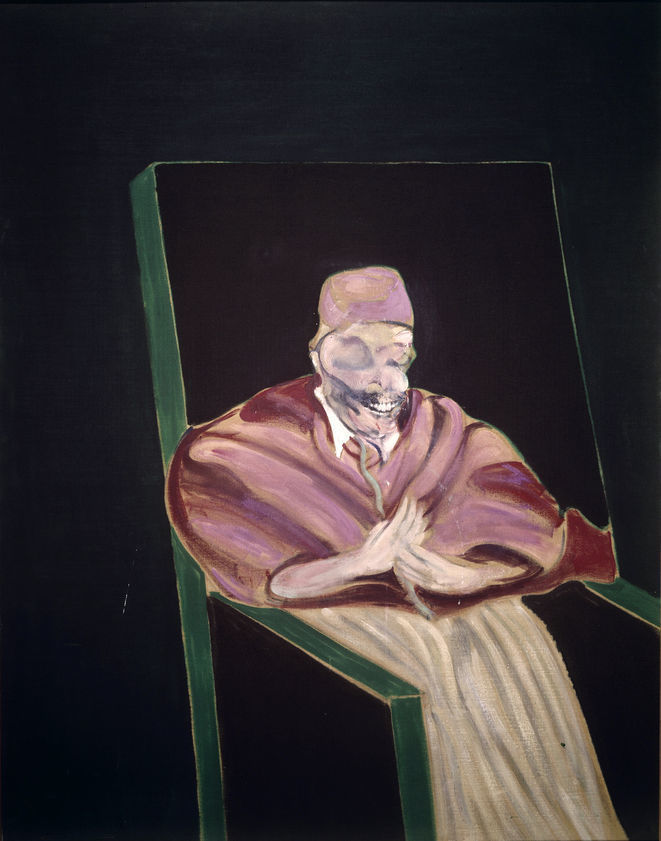
Study for a Pope IV (1961)
It is time to reassess the career of Francis Bacon, writes William Packer
WILLIAM PACKER | ART | THE FINANCIAL TIMES | SATURDAY 7 FEBRUARY 1998
Francis Bacon died in 1992 at the age of 83. He came to himself comparatively late as a painter, and little of his early work survives. But with the appearance in 1944 of his triptych, Studies for Figures at the Base of a Crucifixion, which has been in the Tate since 1950, his was immediately recognised as a remarkable new talent. Nothing quite like it had been done before, and while we can now see, from our more distant view, that he was less isolated in his creative context than perhaps we once thought, he maintained his unique status, first as enfant terrible, finally as it were maestro terribile, until his death.
His, then, is a reputation ripe for serious revision. There has been no major Bacon exhibition in Britain since the full retrospective at the Tate (his third) in 1985, though there have been important exhibitions abroad in the meantime, notably in Moscow, Venice, Munich and Paris. This latest study, now at the Hayward Gallery, is therefore both welcome and timely. Small numerically, at a mere 23 works, it is none the worse for that. Beautifully hung by David Sylvester, Bacon’s long-time apologist, it fills the broad, open spaces of the lower galleries with astonishing ease and conviction. It is altogether a spectacular show. But it does rather flatter to deceive. Questions hang over Bacon in his work and reputation that must soon prove inescapable; but now, any such exercise as this is still informed by the unquestioned assumption of his absolute mastery. The effect is to deflect critical attention away from the work for what it is — the actual paint, line, surface, formal structure and so on — and onto its subject-matter and the emotional and subjective response to it.
In his lifetime, such was the force of his personality and presence that such deference could at least be understood, even excused. But in the longer term it does him little favour, for the uncritical acceptance of everything he did at an equal value actually works against the particular qualities and achievements that made him the artist he was.
I do believe he was a true and remarkable artist, even a great one. And almost in spite of itself, with a rarely-seen variation upon one image of that early Crucifixion, here given an entire wall to itself, and then with a magnificent sequence, hung along the longest wall, of eight paintings from the 1940s and early ’50s, this exhibition makes the very point. Indeed, it is made so sharp that it can only then deflate the bloated pretensions of so much of the later work, laid bare in all its flaccid complacency and formulaic repetition.
A large canvas is an impressive physical object, three together more impressive still, and even more so with each element in its heavy gilt frame. So manifest a thing all too readily commands the fetch across any large gallery, and does so here time and again. But it is still all show: and when we look more closely into such vast works as the Studies of the Human, the triptych of 1970, the May-June triptych of 1973, or the single, portentously titled canvas, Oedipus and The Sphinx after Ingres of 1983, the slackness of the drawing, the inadequacy of the realisation, and the hackneyed, all-but-automatic distortion, once looked-for, are unmissable. Once seen, they refuse to disappear.
But to return to those extraordinary early works is to have one’s faith immediately restored. For there indeed, in that fiercely gaping, flower-chewing creature of the early Crucifixion study, or that strange cloaked figure stooping beneath its umbrella (1946), or again (from the 1950s) the ambiguously wrestling couple, or the figure passing through a curtain, we find again that necessary visual tension that holds the image working upon our imagination in eternal symbiosis with the manner and quality of its statement — that desiccated, dragged surface of the paint, the nervous line, half-suggestion, half-description. Most remarkable of all, perhaps, are the dark full-length portrait figures of the 1950s, grey presences cast into a black space, with Bacon for once allowing invention to spring from observation and the struggle to see and know.
This show is called The Human Body, though Bacon hardly referred in his work to anything else — the animal paintings of the 1950s, and the occasional nominal landscape the rare exceptions. To be so particular is of course to invite particular enquiry, but this show says nothing beyond the truism that Bacon’s essential subject was indeed the body. In fact his true subject was himself, not by any objective or detached approach, though the occasional self-portrait does appear, but rather by subjective experience, a sense of self-being, and being at that all-too-evidently in the flesh.
In the best of the work there is a strength and poignancy to the realisation of this our common predicament, that draws us at once into a deep imaginative sympathy with the work. To recognise as much is to accept Bacon for the true artist he undoubtedly was.
Francis Bacon — The Human Body: the Hayward Gallery, South Bank, London SE1 until April 5.
THE BIG SHOW: FRANCIS BACON
JOHN RUSSELL TAYLOR | EXHIBITIONS | METRO | THE TIMES | SATURDAY FEBRUARY 7 1998
FRANCIS BACON was long notorious for the distortions to which he subjected the human body in his works. And yet people have never ceased to wonder how he managed to produce portraits which were not only recognisable but seemed to capture the essence of the person depicted.
This was probably because he was never the sort of portrait painter one would commission to produce a likeness: all his portraits were of friends such as Isabel Rawslhorne, George Dyer or Lucian Freud, or self-portraits, and were painted to please himself.
He may have been generally misanthropic, but his vision was centred on the human body, such as Study of a Nude (detail, right).
Hence, the confinement of this latest one-man show to the human body excludes virtually nothing from the choice available to its selector, David Sylvester .
The work included demonstrates Bacon's genius at taking visual material from Velazquez, or a film such as Battleship Potemkin and making it his own.
— John Russell Taylor
Hayward Gallery, South Bank, London SEl, 10am-6 pm [Tues and Wed to 3pm), until April 5, £6, cones £3.50 [0171-928 3144).
Hung, drawn and martyred
BY WILLIAM FEAVER | ART | THE OBSERVER | SUNDAY 8 FEBRUARY 1998
In almost every painting by Francis Bacon the indications are that fear leaves you gasping and boredom stifles. Life’s a fear-and-boredom sandwich; layer on layer and yet ... what the hell. Whenever luck struck, there was the off chance of getting beauty and compassion contained in paint.
A martyr to his legend, Bacon bred Bacons until, it seems, they came automatically. His later selves are declared masterly by some. To me they look routine. You don’t have to be a cynic to recognise that he obviously hoped to show a good return on abandon.
Simultaneous exhibitions, one in Denmark and the other at the Hayward, offer differing takes on Bacon. By and large the Danish-selected Bacons come across as more edgy, more amazing, more enthralled, than those paraded in solemn show at the Hayward.
Francis Bacon (to 26 April) at the Louisiana Museum for Moderne Kunst, 10 miles south of Hamlet’s Elsinore, has 34 paintings, five of them duds; the Hayward’s Francis Bacon: The Human Body a David Sylvester presentation (to April 5) has nine duds out of 23.
First, Louisiana. Bacon liked to convey the impression that his figures were dreamt up or smoked out. The popes are spectral yet worldly, constricted by robes of office. Satin cap or dark suit, it hardly matters what such men wear; they are summoned to bare their teeth and grin in the dark. No laughs here, though there is wit in the way characters are summarised: clean-collard but thick-wristed, for example.
The use of photographs enabled Bacon to paint like a snoop, snatching images. Two Figures in a Window (1953) a marvellous picture, reads like a negative, siesta daylight turned black as the pallid men — two Americans remembered from a Rome hotel — engage in an embrace. Veils of charcoal grey close in on a vignette. That’s Bacon reclaiming the initiative for painting. Photography had captured action and facilitated porn; why shouldn’t the painter lift those images and make them even more arresting? Degas had tried it, as had Sickert, and Bacon, with the blundering dash of the self-taught, had no inhibitions.
Using Muybridge photographs he skimmed the tones and minimised the rest. He morphed Muybridge and Velázquez, Muybridge and Goya, producing that special blend, Bacon Confidential. Then he got John Deakin to take photographs of people for him. With them scattered on the floor for reference he could jog his memory while detaching himself from irksome facts.
One of his Deakin subjects, Isabel Rawsthorne, is stood in a street, like a cardboard cut-out photograph model outside the chemist. Irate at this interruption of drinking time, she hardly notices the merry-go-round of Soho traffic that Bacon has laid on, a swish mix of bullfight and pre-war roadster.
The Louisiana exhibition proceed in threes: trios and triptychs sustain Bacon’s apparent calculation that life’s troubles come in threes, and what better proof of this than the three crosses of the Crucifixion? The size of his studio door dictated the maximum size of a canvas, so to work in widescreen, as it were, he had to paint in sequences: each triptych a batch, each central image flanked by related scenes.
The format enabled him to spread the risks. Which was good when he had crisis to assuage but ghastly when he set himself spaces to fill and nothing to go in them but more of the same. The best paintings have reaction and flashback, frozen characteristics, stunned recollections.
Van Gogh is set tramping again along the road to Tarascon, mired in the paint. George Dyer, the lover found dead the night before the opening of Bacon’s 1971 Grand Palais retrospective, is commemorated at all stages in the relationship, chain-smoking, fidgeting, and afterwards a cold body still posed on the chair, a pathetic triple echo. Elaborations on feeling led to some feeble contrivances. Letraset samplings peppered foregrounds that would otherwise have been conspicuously empty.
Bacon coped with loss of sensation by lingering on details such as the teeth of an unzipped sports bag, giving them the sort of prominence afforded to leading brand names in the Lillywhites window. Chance was still a fine thing in 1979 when he painted Two Seated Figures, the last — though not the most recent painting in the Louisiana show. Two men in a lounge, business class, have run out of small talk as they await their flight. Could they be the two Americans from the Roma hotel, 25 years older? One of them consults his watch. Time to make a move.
At Louisiana it’s an abrupt exit and one that puts Bacon smartly into context. Up some stairs, past a pope and an honour guard of Giacomettis. The fixations linger. On the clifftop lawn outside, overlooking the Rungsted Sound and Sweden beyond, a Calder mobile stirs.
At the Hayward, reverted to open plan for the occasion, Bacon is edited into being, ultimately, a colour-field painter manqué The idea seems to be that, without the figures, Bacon could have been another Barnett Newman.
What a fate. This slant means that the vacuous pink and buff expanses of what Bacon was apt to refer to in auction parlance as his ‘more important triptychs’ are presented as crucial works, not major embarrassments.
There’s an initial surprise: a discarded version of the baying mutant from the Tate’s Three Studies for Figures at the Base of a Crucifixion, identical except that this one is being smacked in the jaw with a bunch of roses. Torture or accolade? Rutting, meatiness and vulnerability have equal potential.
The paintings falter when Bacon fails to charge them with the screech of accident and near-disaster. Equally, it’s when he’s barely capable that he brings off the most poignant effects. Such as the bared back of the man stepping through curtains (Study from the Human Body, 1949), an image tweaked by the addition of a safety pin painted in near trompe l’oeil on the curtain.
The first of Bacon’s many paintings of Lucian Freud ended up as a clumsy likeness of Kafka. Later he figured him out vividly, using Deakin photographs as prompts and treating the restlessness as a seizure. Twisted expression could strike to the heart.
Bacon at his most suddenly brilliant pulled off fusions of stage presence and clinical examination; at his worst he did what was expected of him, camping it up, leering at the keyhole, asserting copyright on the Human Condition couched in bright colours and with layers of Letraset going BRAGPF and vvvvpffff. Sadly, the exhibition pursues him into the injury time of his last years when he milked the mannerisms and painted himself like a washed-out template.
JOHN McEWEN | ART | THE SUNDAY REVIEW | ARTS | THE SUNDAY TELEGRAPH | 8 FEBRUARY 1998
THERE is such a flurry of "museum" shows at the moment that a mere mention must sometimes suffice. The double-bill of Francis Bacon: The Human Body and Henri Cartier-Bresson: Europeans at the Hayward Gallery (until April 5) is the most heavyweight; Bacon, even during his lifetime, internationally regarded as the greatest British artist since Turner. His friend Cartier-Bresson, whose 1952 photograph of Bacon provides a catalogue frontispiece, has long been a legend, every photographer’s favourite photographer. Both shows consolidate these claims.
The critic David Sylvester, Bacon’s Boswell, has curated and catalogued his friend’s exhibition with admirable spareness. Bacon had a well-known aversion to explanatory words about art so he would surely have approved the economy of the text, a dozen or so self-contained musings on the man and his work. And the paintings are hung with an extravagant use of space, which emphasises their solemnity. Bacon is popularly thought of as a painter of powerful but ugly pictures of modern man in torment, but the sensation reveals how magisterial his best work can be.
Bacon was a grand man, in his courtesy, his disdain for politicking and sense of destiny. The selection reveals that this grandeur was there from the start but grew with the years, as did the other salient characteristic of his art - his ravishing and inventive use of colour.
Colour bloomed in his old age into triptychs of an ecclesiastical scale and lavishness, with vivid figures convulsed against great spreads of magenta, lilac, terracotta or, in perhaps the most stunning combination of all, the ochre and green of Triptych — Studies from the Human Body, 1970. No wonder he was puzzled when even supposed admirers disliked his work. These Bacons, especially the later works so badly under-estimated by the critics during his lifetime, are above all sumptuously beautiful.
This - and the extreme, even miniaturist care and pleasure with which they are painted — makes them uplifting celebrations of life despite their often gruesome subjects: figures stripped of dignity, reduced to animality, tortured by guilt. "I believe in nothing but the sensation of the moment," he said once. "I drift."
The remark described his life but is an exact description of his method, with its galvanised grindings of the brush and delicate drifts of sprayed tinges. Such attention to hue and touch makes his equivalence with Turner all the more apposite. Ambivalence is also in keeping with his delight in the "gilded squalor" of existence. His favourite photograph of himself was Philip Thomas’s secret shot of him on the tube wearing a very expensive overcoat.
Bacon was a dandy in the full Baudelarian sense; a man who made "a cult" of his emotions, of "opposition and revolt", "of combating and destroying triviality".
"Dandyism", wrote Baudelaire 150 years ago, "appears above all in periods of transition, when democracy is not yet all-powerful and aristocracy is only just beginning to totter and fall."
What better description could there be of the 80 years of British history Bacon lived and painted through? He was indeed an aristocrat, by birth, nature and in the scale of his talent. Turner heralds the industrial and imperial glory of British power. Bacon no less magnificently symbolises its decline.
Bacon and Cartier-Bresson are united by more than friendship. Both deal with realism but often verge on abstraction, both are concerned with the Divine Comedy of human affairs. Where they differ intellectually is in emotional range. There is no disgust in Cartier-Bresson’s sensuality and, unlike Bacon, his work is full of humour. One of his funniest masterpieces is Ski lift, Switzerland 1991. The time is summer and a man, who might be the lift’s operator, leans against a concrete post apparently oblivious to a vast block of concrete lethally dangling just above his head — the end-product of what looks like the most elaborate mechanism for killing someone ever devised.
To make a funny picture is the rarest feat in art, as anyone who has ever been to those secular churches that we call galleries will know. And things are going to get worse, with every object "accessed" (the Secretary of State for Culture’s buzz-word) in ways and terms dictated by the lowest common denominator.
Thank God for Cartier-Bresson. No need for explanations with him. The picture says it all. Cartier-Bresson is a passionate advocate of visual education in schools. How much better if Mr Smith had fought for the defence and extension of that, rather than letting it be cut to virtual extinction. So much for "access".
This year marks Cartier-Bresson’s 90th birthday and London is doing him proud with a series of museum shows throughout the year, beginning with the most general at the Hayward Gallery, a retrospective of his work, carried out in various European countries, including England and Ireland, from the early 1920s to the present.
As he has said, photography "appears to be an easy activity" and, when practised merely to record in the normal way, it is. Nor has it changed in origin, only technically, and Cartier-Bresson is not much bothered with technique in the sense of gadgets. Taking a photograph for him "is putting one’s head, one’s eye and one’s heart on the same axis".
It is no surprise to learn that he looks at old master paintings more than photographs, that he has always drawn assiduously and that he values intuition as highly as Bacon or the Surrealists. "In photography, one must learn a visual grammar. What reinforces the content of a photograph is the sense of rhythm, the relationship between shapes and values. To quote Victor Hugo: ’Form is the essence brought to the surface.’ "
Cartier-Bresson is categorised as the master of the "snapshot", taken with a pocket Leica; but it is what and when he snaps that distinguishes him from his thousands of dull documentary followers. That is where his visual education aids the precarious axis of head, eye and heart to such unique effect.
His best photographs are so perfect in their geometric proportion, so precise in the rhythmic or dramatic positioning of figures — even to mere points in the distance — it seems they must be pre-planned and posed. In fact I was told on very good authority that his most famous photograph of picnickers, On the Banks of the Marne, France 1938, was indeed a posed shot taken for Vogue. I now have it on the authority of Cartier-Bresson that the only posed photograph in Europeans is of a female-impersonating male prostitute between two female prostitutes, taken in Alicante, Spain, 1933.
This exhibition is an awesome and moving event, the summation of the photographic life’s work (next to come will be his drawings, at the Royal College of Art in March) of the last survivor of the old masters of modern art, for whom "genius" is not too strong a description.
Cartier-Bresson is his own harshest critic and reckons some of his best photographs were his earliest and that an "exceptional" photograph is always a rare event. His English pictures, typically for a Frenchman, are the most disengaged and disappointing; but at his incomparable best these images of our time are not just slices of life but glimpses of eternal truth.
Europeans is published by Thames & Hudson
Francis Bacon: the man who put the pain into painting?
Oh-oh, it’s that man again. Mad Frankie’s back in town. But what, asks our
Art Critic, does he look like this time round?
BY TOM LUBBOCK | VISUAL ARTS | THE INDEPENDENT | TUESDAY 10 FEBRUARY 1998
It’s nearly six years since Francis Bacon died, aged 82, with a good 50 years of
painting behind him, and that might well be period enough for views to settle.
They haven’t at all. Bacon unquestionably remains a presence, a figure and a
force to be reckoned with, but estimates of his work, even positive estimates,
diverge radically — and, by way of reintroduction, here’s the range, roughly.
There’s the savage view (still probably the standard view), which sees in
Bacon’s art an outcry of agony and a nausea of mortality, a terrible vision of
the human state generally, but with special reference to the 20th century (the
camps, the death of God). Or there’s the skittish view, a kind of irreverent
take on the previous, which finds rather an expert flesh-creeper and
monster-maker, a shock-horror merchant with a macabre sense of fun. Then there’s
the social view, which stresses a much more urbane and various talent, a
virtuoso player and portrayer of metropolitan-Soho life, a painter of wit and
character. Finally there’s the sublime view, which praises the vitality, the
grandeur, the exaltation of his art, its ultimate life-affirmation in the face
of torment, its triumph of the human spirit. Here Bacon becomes practically a
candidate for a Nobel Prize.
It’s hard to decide, and I’d like to. Bacon is obviously a big deal. But
whichever view you try out, the others seem to have truths that can’t be
ignored. No doubt one could say the sheer range of possible responses is itself
a sign of Bacon’s greatness, or of his abiding power to unsettle. But that seems
too easy a summary. Anyway, we now have the chance to look and think again.
Francis Bacon — The Human Body is the rubric for the Hayward Gallery’ s
mini-retrospective. It sounds pretty inclusive — what else did he paint? — but
actually the focus is tight. It means the full figure only. It leaves out not
just his landscapes and animals, but also his many head-portraits. Curated by
Bacon’s foremost interpreter, David Sylvester, the show has five triptychs and
18 single paintings, from 1942 to 1986. It’s not a comprehensive showing but
it’s enough: enough to bring the big unsettled questions of Bacon’s art jumping
back to life.
For instance, you still need to ask, in a literal-minded way, whether Bacon
really does deal in images of stark violence, damage, torture, disgust and
rebarbitive horror. And you still have to ask, more elevatedly, if Bacon really
is in the great tradition of flesh-painting, the last in the glorious line of
Titian, Rubens, Rembrandt, Velzquez. But simply to state the issues suggests the
peculiar Bacon-effect. Here’s a painter who seems to mix torment with high
spirits, and high art with low art, and how the mix works out is the crux. I
can’t adjudicate it; I can only throw out these miscellaneous and rather
contrary thoughts.
Start with a technical point. One thing that’s strikes you, besides any horror,
is the straight, eye-teasing puzzle of these ectoplasmic swerves of flesh, so
physical yet so ungraspable. How’s it done? What’ s going on exactly?
There seem to be three elements (I don’t say they went down in this order). The
first is a quite solid and clear depiction of a face or body, albeit often
severely caricatured and fractured — something you could make a model of. The second: some very fugitive dissolves and fades, by which one part of the
flesh melds and sucks into another part, while others suddenly vanish away or
cut off into the void. You can see much of Bacon’s work in the Fifties as
practising these shimmering lights and transparencies, which bring bodies out of
thin air and flick them back again. (Look at the Nude Study from 1951.)
Then the third element: brush swipes and blots and splashes, where the paint no
longer depicts anything, is just an energy, an attack, a twirl. But, because
these gestures of real paint take off from the gestures that mean flesh, the
effect is of the flesh literally breaking or smearing the picture’s surface,
becoming tangible. So the painting is in continuous transition: real
paint — fugitive flesh — solid flesh, back and forth between them.
The great painterly tradition? No, I don’t see it; rather, a brilliant
impersonation or promise of painterliness. You approach a Bacon expecting rich
rewards, but, at close quarters, the paint-work isn’t interesting, is often very
crude; no touch. It’s only interesting for the image it coalesces into, its
illusion of flesh-in-action. The intimacy only works long distance.
The cartoon aspect: long ago, John Berger acutely noticed Bacon’s likeness to
Walt Disney, his bounding lines and bouncy curves. Indeed, this is part of his
shockingness — the conventional invulnerability of the cartoon figure is
violated. On the other hand, the irrepressible vitality of Bacon’s figures,
their "triumph of the human spirit", may just lie in their resilient cartoonish
ability to bounce back.
Or put that in modern art terms: the question is whether Bacon’s bodily
"distortions" should register as form-variations, or maybe
energy-expressions — or as actual bodily harm. Do they give pain, or do they
save the figures from pain? Henry Tonks’s delicate, realistic watercolours of
the faces of WWI wounded are incredibly painful. A fractured Cubist portrait is
totally painless, couldn’t represent physical pain if it wanted. What is Bacon?
Cubism carnalised?
Bacon has his figurative tics, anatomical twists that become repetitive: so
often that same orbital explosion around the eye, that arc that sweeps the
cheek, the way the jaw swings out or the calf bulges, the dumpy feet. But also
he’s the most inventive shape-maker, his blobs are terrific: look at the satanic
shadow that spreads in the central panel of Triptych May-June 1973, or the
foetal lumpy thing on the right of Triptych — Studies from the Human
Body 1970 (and if you look at the dark area where its face should be, you can
catch, dimly, a perfectly realistic and sweet toddler’s face, as if it were
floating inside).
The flat backgrounds, those stage sets in which Bacon’s bodies are isolated, are
in really gorgeous, sumptuous colour-schemes (the opulent juxtaposition of deep
magenta and buff-grey in that 1973 Triptych, say). The harmonies are
superb — but the key is always, so to speak, C Major. One thing that draws us to
Bacon’s pictures is that their dominant colours are so straightforwardly
attractive: great design; no pain there.
Would the bodies be so painful if they weren’t coloured flesh-pink and
blood-red? If, like Frank Auerbach’s, they were messed about, but
multi-coloured? But then the recurring combination is actually red, pink and
white, a strawberries-and-cream complexion, which can also be very tasty; or,
in Three Figures in a Room, 1963, the figure sitting on the loo has a delicious
peache-Melba mix; or sometimes it’ s red, white and blue, like a lambent
tropical fish. Lovely stuff.
The big triptych format is boring, a short-cut to equilibrium and grandeur. The
props — the umbrellas, the cricket pads — which probably have only a formal
motivation, can look very silly.
Bacon often spoke of "illustration" as the thing to be avoided in figurative
painting, and was rightly sensitive to this word, because, if you imagine away
all the messing about, you’re left with a very facile and frankly cute
illustrator; and in the later work this comes more and more to the fore. He
needed the disruption.
No good painter has taken Bacon as its example (his imitators are awful); the
only people his work has directly influenced in a profitable way are cartoonists
and illustrators — Scarfe, Steadman, Ian Pollock, H Giger’s designs for Alien,
the monsters in graphic novels.
So what’s the score between beauty, terror, energy, brilliance, slickness,
cruelty, invention, crudeness, gaiety, cuteness, good taste, silliness, cliché,
a fantastic box of tricks and something ineradicably memorable? Hm... Maybe I’ll
know next time round.
To 5 April, Hayward Gallery, SBC, London SE1 (1071-960 4242)
BRIAN SEWELL | THE EVENING STANDARD | THURSDAY 12 FEBRUARY 1998
Francis Bacon, painter, drinker, gambler, lecher, died in April 1992, almost six years ago, but in spite of the general recognition that he is indisputably the greatest of British painters of the post-war half century, only now are we offered an exhibition that pays homage to his world-wide reputation as the last of the old masters of the canvas and the brush.
Since his death, Paris has bowed the knee to him with a major retrospective, Munich has saluted him, and in Venice all the denizens of the contemporary art world trekked to the Biennale of 1993 to see a valedictory exhibition with the title Figurabile. It is a revised and smaller version of this last, the title now The Human Body, with which we at last honour the debonair old boy at the Hayward Gallery.
Twenty-three works are too few. Bacon needs more with which to explain himself and be explained, and impoverished by weak paintings the selection seems not only small but ill-considered, random and superficial; nor is it helped by hanging that is careless and disorderly. Many who have never seen an exhibition devoted to Bacon will, drawn by his reputation, flock to see these pictures, only to experience, not the expected wonder, astonishment and awe, but disappointed questioning. Are these the pictures for which critics claim Bacon as the last of the Renaissance masters, heir to the ancestral traditions of all western art, the man whom Grünewald, Goya, Velasquez and Degas would recognise as peer? Is this the great gambler with paint, the man of such fine temperament and fierce self-criticism that he ruthlessly purged his work of everything that he saw as the dross of inconclusion and confusion? Is this the genius to whom David Sylvester, luminary of post-war art criticism, has devoted so much selfless perception, subtlety and skill as exegesist and apologist?
The answer to all these questions is both yes and no; given only these pictures, Bacon’s reputation must seem absurdly inflated, the consequence of corporate delusion on the part of critics, dealers, collectors and curators, but to those who have pursued the painter since his first serious emergence onto the London art market in 1949, and who saw in London and Turin in 1962 his first major retrospectives, there is the Bacon possessed of a menacing and unruly talent. In the work of little more than a decade, Bacon demonstrated in these exhibitions the fierce fertility of his imagination — the screaming popes and snarling dogs, the baboons, businessmen and buggers, the isolated heads, owls and self portraits, the full-length nudes and images inspired by Velasquez and Van Gogh. He demonstrated, for all the uncomfortable errors of drawing and construction, that he could delve beneath the skin with the torturer’s contempt for pain, and that he had learned to handle paint with something approaching mastery, the length, breadth and pressure of the loaded brushstrokes accurate and powerful, containing all the essential information about the structure, character and movement of the thing painted, as well as its more obvious colour and texture.
Bacon turned to the human body to make comments on the torments of our day that are astute, perceptive and horrifying. His figures are often caged; the effect can be as aloof and remote as the appearance of a bland politician on a television screen, but the same device can turn into a trap, with its violated occupant screaming for release. He defines small spaces on his canvases within which his bodies must perform, the larger space often as featureless as the backdrop in a fashion photographer’s studio, described only by a curve and change in colour; the performing bodies are human, but often have animal references in the way they walk or lie or squat, often distorted far beyond our ape relatives or translated into half-butchered carcasses. Paired figures on a bed are never seen in any affectionate contiguity, but always in attitudes of erotic violence; they stem from the newspaper and magazine photographs of footballers, boxers and wrestlers that Bacon so feverishly re-worked, bringing them close to hard-core pornography, and then elevating them with his vision and painterly technique into abstracted allegories with which he makes a savage, soulless, visceral comment. He is the master of the solitary struggle, the emptying of bowels into a lavatory pan, the clenched reaction to an unseen act of violence, the tension of the little death of masturbation — these are the narratives to which he reduces the traditions of Christ’s crucifixion and the martyrdom of saints, the ferocious secular images of the nihilist to whom the past is a necessary instrument.
The 23 works in this exhibition range from 1944 to 1985, with such considerable gaps (particularly in the late Fifties, early and late Seventies, and early Eighties) that they offer no clear picture of Bacon’s development, either as painter or in temperament. The newcomer to his work will recognise that the earlier paintings are rich and robust in texture and colour (orange a favourite) unevenly applied, the forms sculptural (recalling Moore and Picasso), the details graphic (in something of Sutherland’s manner). By the end of the Forties, the paint had thinned, much of it applied to raw canvas in the long vertical parallel strokes that were the mannerism of his friend Denis Wirth-Miller, with whom he is known to have worked on shared canvases; the limbs, buttocks and musculature of nudes are drawn with the brush — though Bacon has long been said, in ignorance and error, never to have drawn anything — and the volume of the figure and the fall of light are then sketchily described with short dabs of the brush within these outlines. By the early Fifties, he had begun the smudge that within 10 years was to become the smear — the deliberate spoiling, particularly of faces that, according to Sylvester, suggests disintegration and the consuming worm, though to others it must seem an illogical and futile vandalism of work that is often an extraordinary fusion of intellectual and painterly devices — but then, from time to time, Bacon was given to futile and disruptive pictorial clichés.
In the Sixties, he produced a series of thoroughly unpleasant images of figures, distorted and contorted, the familiar poses of the classic nude rendered gauche and even indecipherable, set against coloured grounds from which almost all the traces of the comparatively rough painting of the earlier work had been eliminated. As the surfaces became a more and more immaculate and delicate fusion of oils and water-based pastels, caressed with his fingertips as colour was rubbed into texture, leaving much raw canvas bare, varnishing impossible, the protection of plate glass became essential, adding layers of accidental illusion with reflections that embrace the spectator and the lights and other pictures in the gallery — an effect that pleased Bacon and that he deliberately sought. Throughout this course he developed mannerisms of drawing and brushwork, some of which became permanent, so that in the late work the vile terribilità was replaced by a vile serenity that was effortless, accomplished, familiar, and empty of all but a contrived emotional charge, the work of a man who had become an exquisite hack.
David Sylvester, too, shows signs of exhaustion with his role as managing director of the cottage industry that Bacon has become for him. His catalogue is not a continuous text compensating for the paucity of pictures, but a series of world-weary, disconnected musings from which we learn that Bacon admired Bonnard and dreamed of sharing a canvas with Karel Appel (what a disorderly conjugation that would have been, with Bacon’s delicacy drowned by the Dutchman’s wild impasto). Bacon’s art, he tell us, is not companionable, by which he means that his pictures should not be shown in partnership with those of Giacometti, Balthus or de Kooning, though they might fit well with Warhol’s images (and with Augustus Egg, perhaps?). Why did Bacon persist in painting figures at three-quarters life-size? — Sylvester asks. Why indeed? But why ask, if after a lifetime spent playing Boswell to Bacon’s Johnson, he cannot answer? And why damn other men’s books on Bacon for their reproductions in colour when his own illustrations in black and white are of ill-cut details overblown, smeared, smudged and useless? This catalogue is no more than an indulgence to an acolyte so long soaked in the theology of Bacon that his perception has grown stale.
This disappointing little exhibition is paired with one of Cartier-Bresson’s photographs; claiming no artistry, compassionate, intuitive, incisive and observant, he is, though only by these of Bacon’s tokens, much the better artist.
Francis Bacon: The Human Body
(Hayward Gallery, till 5 April)
MARTIN GAYFORD | EXHIBITIONS | THE SPECTATOR | SATURDAY 14 FEBRUARY 1998
Asked who he thought was the greatest French poet, Andre Gide famously replied,
‘Victor Hugo, helas.’ A considerable portion of the British art-public might
echo his words if asked to name the most significant artist this country has
produced in the last half century, ‘Francis Bacon, alas.’ He is widely regarded — by
critics, as well as members of the public — as an exponent of the Grand Guignol,
indulging gratuitously in violence and horror, a self-indulgent expressionist
possessed eternally with adolescent morbidity and existential gloom. In fact,
few artists have been so systematically and persistently misunderstood, as is
suggested by the exhibition Francis Bacon: The Human Body.
Of course, all artists look different as time moves on, and it’s over a decade since we in this country had a full look at Bacon. A lot has happened since then. The artist himself has died. New movements in art have appeared, and it has become apparent that Bacon is a key reference point for Damien Hirst, leader of the Young British Artists, and also for Gilbert and George (to whom the Young British Artists look up). There have been grand-scale Bacon retrospectives in Paris and Munich (both organised by David Sylvester, the curator of the present exhibition). Now we in Britain have a chance to take a new look, not at the full range of Bacon’s painting, but at 20-odd attempts at a perennial subject — the human form. What do we see?
There, at the Hayward, if one cares to look, one can see a very different Bacon from the shabby visual shocker of so much received opinion. On the walls of the gallery is evidence of a Bacon who could be tender, grand, elegiac, a painter who was a highly individual kind of classicist, as well as a unique species of realist. Not only does he have unexpected virtues, he also has unexpected faults. It’s not a gruesome distortion that leads him astray — and he was an extremely uneven artist as appears even in this fairly small and tightly selected show — but a tendency to slip into Victorian academicism.
The way Bacon is rooted in tradition is quite obvious — and a point to which he returned frequently in interviews. He was an extremely learned painter, soaked in Velazquez and Rembrandt, Picasso and Michelangelo. Nonetheless, it may come as a surprise to see how directly he paraphrases the nudes from the Sistine Chapel ceiling in Three Figures in a Room from 1964. In fact, all three are clearly his lover of those years, George Dyer, although the central figure has a chance resemblance to John Major. At the left, Dyer sits naked on the lavatory with all the nobility of a figure on a temple pediment. In the other two panels he reclines in the manner of Michelangelo’s Ignudi.
There is, of course, a big difference. Bacon’s paint is smeared and spattered, Dyer’s features and anatomy re-combined in startling ways. But the aim of this is not expressionism — an emotional effusion but realism. As Bacon said again and again, his object was to make an image that would strike his nervous system with the force and violence of experience. And this he believed he could do best not by making a literal copy of appearances, but by conjuring up with swirling paint and blurred forms something of the animal energy of real, living beings.
Here there is genuine Baconian shock. He was a man of enormous energy — he claimed not to be able to relax — an asthmatic, a drinker on a gargantuan scale, a liver of a disorderly bohemian life. Clearly, he lived a great deal closer to the ends of his nerves than most of us. Hence the impression of something wild caught on the hoof, perhaps about to pounce, that many of his subjects have. Baconian man appears at his most primal and disquieting in the marvellous Study for Figure II 1953/55, seated in business suit and tie on a bed, his mouth open in a simian yell.
But it is one of the jobs of art to open our eyes, and another to show us the world as the artist sees it. Bacon, when he’s on form, does exactly that. The shock comes from the fact that, as he put it, most of us live surrounded by screens and tend to be offended by 'facts, or what used to be called the truth'. There is emotion in Bacon’s work, but it is not — as often said — easy disgust and revulsion. The mood of his late Study for Self Portrait—Triptych 1985-86 is deeply serious, filled with a sense of human vulnerability. The painter’s face seems to be being erased before our eyes, dissolved as if by some acidic gas. The same is true of the Triptych May-June 1973 which is concerned with Dyer’s squalid suicide (he was found dead on the lavatory, as foreshadowed in the earlier painting).
Those two triptychs are among Bacon’s greatest works. But the standard of the exhibits is by no means so uniformly high. With the exception of that three-part self-portrait, the products of his last decade are weak and oddly decorative (and, in the case of those inspired by photographs of David Gower and featuring cricket pads, simply odd). Earlier, he often missed. The combination he was after — classical solidity of design, those writhing, feral figures — was inherently unstable. The surprisingly dud Portrait of Lucian Freud 1951 suggests why Bacon had such an aversion to clichéd copying of appearances — he obviously had a tendency to relapse into it himself.
There are outstanding absent paintings that should ideally have been present in such a survey. But there are many beautiful and revealing works on view in an admirably spacious hang. Study from the Human Body, 1949 — a male nude seen from behind — reveals a Bacon who could be tender and delicate in his use of paint. It suddenly makes sense that Bonnard was his favourite 20th-century painter. Painting, 1950, next door, a nude standing between patches of blue and red, in front of stripes, as if in an early Rothko, explains why painters regard Bacon as a wonderful colourist. The small Study of a Nude, 1952 — about to dive into a cube of space — is magical and mysterious, more qualities one might have thought unBaconian.
He is a difficult painter to get to know. Immediate impressions can be deceptive, as can his own words. He always claimed to make no sketches for his paintings, and to work in an improvisational frenzy. But recently a number of such studies has turned up and has been bought by the Tate, where the sketches will eventually go on show. There may be more to find out still about Bacon.
Lady Thatcher is widely credited with articulating a common view of Bacon, ‘Not that horrible man who paints those dreadful paintings.’ But, taxed with this by the artist’s biographer, the late Daniel Farson, at The Spectator summer party of 1993, she adamantly denied ever having said any such thing. On the contrary, she told Farson, she was an admirer of his work. 'See, see, see,' she went on, jabbing Farson in the chest, 'learn, learn, learn.' This is good advice, with Bacon or any artist.
The Weasel
CHRIS HIRST | THE WEASEL | THE INDEPENDENT SATURDAY MAGAZINE | 14 FEBRUARY 1998
It is humanity as Plasticine. The truncated figures twist in the centre of the canvas. In many cases, they are all but unrecognisable, deliquescing into fleshy blobs. Their heads are smeared, squashed, mangled. Yet the overall effect is undeniably impressive. Who else but the incomparable Francis Bacon? His work has never looked better than in the Hayward exhibition devoted to studies of the human body. Dodging round the bossy film crews on the press day, I found myself intrigued by the curious variety of props that Bacon chose to include with his subjects. He was particularly drawn to umbrellas and toilet bowls (Bacon painted the plumbing with fastidious care, including U-bends and pipe joints). In one work, a drastically scalped figure wears a pair of cricket pads.
But the most frequently recurring motif is metal tubing, formed either into rectangular boxes or huge circulate hoops. It seems to me that these mysterious devices stem from Bacon’s brief spell as a furniture designer in the late Twenties. A surprising photograph in David Sylvester’s book Interviews with Francis Bacon reveals that this dark master of distortion produced rather desirable pieces in the art deco style: stainless-steel stools with cow-hide seats, circular glass tables on metal stands, and vast oval mirrors. Although Bacon later denigrated them, the same shapes crop up over and over in his paintings.
If you happen to find yourself consumed with desire for one of the works in the Hayward, don’t despair even though you lack the requisite zillions. It is easy to produce your own Bacon — or at least a large section of one. A study of his technique by Andrew Durham in 1985 revealed that for the background of many of his works, “he used emulsion house paints which are fast-drying and convenient for the large expanses of flat colour which provide the setting for the image”. A trip to my local Homebase offered an interesting insight into the artist’s palette.
For example, around three-quarters of Triptych—Studies of the Human Body (1970) — which would probably sell for upwards of £3 million if it came on the market — appears to be a lavender shade of Crown Solo One Coat called “Sweet William”, retailing at £14.99 for a 2.5 litre tin. Similarly, the garish backdrop of Triptych—Studies from the Human Body (1970) could well be a tone of Dulux Vinyl Soft Sheen called “Orange Tropics” (£11.99). In Study for Self-Portrait—Triptych (1985), Bacon may have gone for bulk with a 5-litre pot of Dulux Trade Matt Emulsion (£24.99) in a colour called “Serenade”. After all, anyone described as “the greatest British painter of this century” could certainly count himself as “trade”.
How to freeze the human body
A mood of sombre, rather tedious repetition pervades the
new retrospective of Francis Bacon’s figure paintings
EXHIBITIONS
By TIM HILTON
TIM HILTON | ARTS | THE INDEPENDENT ON SUNDAY | 15 FEBRUARY 1998
ONE’S FIRST impression of the Francis Bacon retrospective at the Hayward Gallery is that it’s by an even and uniform artist — and we also leave the gallery with this feeling, for his paintings lack variety, and depend on an internal scaffolding that was obviously habitual. No one is better qualified than David Sylvester to put on a Bacon exhibition. He has hung the paintings with his usual style and fine judgement. However, this show is less exciting, and also less informative, than the one that Sylvester devised for the Museo Correr at the 1993 Venice Biennale.
The full title of the Hayward exhibition is “Francis Bacon: the Human Body”. It contains nothing but figure paintings. Fair enough, for Bacon was above all a painter of the human presence. On the other hand, his art was more diverse than the display we see at the Hayward. This is not a large show. It occupies the Hayward’s three lower galleries (Henri Cartier-Bresson’s photographs are upstairs) and contains only 23 works. The intention must have been commemorative rather than historical. The installation does not attempt to give any step-by-step account of the artist’s career. The atmosphere is hushed, even funereal. It seems that Sylvester has organised a final memorial to a painter who was also a personal friend, trying to communicate decent grief in a majestic and also private way.
I have never seen a Bacon exhibition that looked quite as sombre. There’s an atmosphere of sacramental repetition which comes both from Bacon’s subject matter and his pictorial habits. A feeling of death is inescapable. One cannot imagine any Bacon painting without some sense of disaster, doom or terminal illness. It’s a puzzle to know how he maintained this mood. Surely Bacon was helped by the camera? There are numerous stories of the way he liked to paint from a photograph of the model, even though he or she was sitting for him in the same room. I think this was because the photograph had frozen a previous aspect of the model, never to be recovered. For Bacon, the camera was a convenient portable mortuary. It fed his imagination with images of life that had been and gone.
Usually, one can tell whether a portrait has been painted from a photograph. In a Bacon picture this is more problematic. First, he wasn’t a portraitist in the normal sense of the word: he didn’t aim to reproduce the way a person looked. Second, he couldn’t draw, so there was no hope of alighting on any telling feature or making his smeared and inexpert paint more precise. In numerous ways Bacon was a handicapped artist. Photography helps his handicaps, even turning inadequacies into the hallmark of a personal style. Note, for instance, the characteristic distance between Bacon and the person he paints. It is not the space between easel and model but the distance established by the camera when a person is photographed from a few feet away (I think, of course, of the domestic camera of 40 years ago).
Hence the paradox of Bacon’s paintings of the nude, whether male or female. They depict intimate situations but are not intimate pictures. He could never give character to his subjects. Instead, he generalised them. Such generalisation was the route to his familiar blend of pomp and pessimism. No doubt unconsciously, Bacon wished to be an academic artist. Just like an academic, he would not dream of straying from a format that he had established to his own satisfaction. See, for instance, how many paintings in the Hayward measure 198 x 147 cm. They constitute by far the majority of the works in the exhibition. Bacon found this size and upright shape around 1950, and scarcely deviated from it until his death in 1992. His smaller paintings (not in the present show) also have identical shapes and sizes. He never used a landscape-shaped canvas.
The only way of making this format a little more inventive was to put three paintings side by side. There are five triptychs in the exhibition; that is to say, 15 linked though separate paintings, for they are individually framed (and always in the heavy gold that Bacon preferred). The triptych form spreads interest sideways, but still these 198 x 147cm canvases have the same general look. There’s a body at the centre, rather smaller in size than one would expect from a figure painter, hunched or writhing; and this body is surrounded by an armature of lines that might represent cages, glass boxes or sanatorium equipment. These lines are also reminiscent of the style of interior design that Bacon practised in the late 1930s, before he became a painter.
Incidental motifs include beds, couches, light bulbs and hypodermic syringes. The best of these pictures is Sleeping Figure (1974). And yet I am not overwhelmed, or horrified, or even particularly engaged. Bacon has a reputation for making the spectator shudder. He gained this sort of fame in the early 1950s, when he first became widely known. Today, we have seen so much more violent and deliberately unpleasant art that it is hard to imagine how Bacon became controversial. Was it because of his screaming Popes, or his evidently homosexual couplings, or because his paint quality seemed so negligent? Whatever the answer, it’s clear that Bacon’s early work is more authentic than are most of the paintings he produced after the mid-1960s. What? ever the continuing dramas and tragedies of his personal life, Bacon’s paintings fail to trap the viewer after 1969. In that year he was 60. General fatigue, booze, and lack of self-criticism probably contributed to his decline as an artist.
People remember him as a generous man who laughed a lot, bought champagne for everyone, and could afford to spend a lot of time at the gaming tables. He was none the less nervous about life in general. Perhaps his position as an old master of modern art helped Bacon to keep his equilibrium. His paintings certainly maintained a stately presence. Rather unfairly, painters of a later generation said they were nothing but bombast. It is true that there are slack passages, and also that his brush could not follow the contours and volume of the naked form.
The most surprising work in this exhibition is also its earliest, a variant of the right hand panel of the triptych Three Studies for Figures at the Base of a Crucifixion (which is in the Tate, though not in the Hayward show). This little work on board was painted in 1943 or 1944 and has never previously been exhibited or reproduced. It’s a war painting. Bacon the artist was a child of the Blitz. Asthmatic, he did not see military service but experienced the fires in London and imagined the sufferings of people elsewhere. One of his professional aims was to be recognised as a European rather than a British artist. If we were to put his Forties and Fifties pictures alongside the work of post-war " establishment artists such as Graham Sutherland, Ceri Richards or Keith Vaughan, I have no doubt that Bacon would chase them off the wall. The ferocious Figure Study 11 (1945-6) proves that he then had no equal for daring and emotionalism.
But it was a theatrical use of emotion that led to Bacon’s undoing. In the theatre, you rehearse, perform many times, pitch your voice at the same level and know how to generate applause for the same exits and crescendos.
Visual artists should not proceed with similar dramas. Bacon (who was influenced by theatre) did. He was not sufficiently thoughtful. Compulsive gamblers never are, and Bacon’s gambling was not merely a part of his character but a continual danger to his vocation as a fine artist. Above all he should have thought about colour. Bacon’s palette is unmediated and, especially in his later years, vulgar. His pinks and buffs give us a higher form of vulgarity, to be sure, yet we are always convinced that his paintings are those of a rich man delivering a certain sort of goods to other rich people. They have an air of great wealth and squandered talent. I like the paintings — squarish, not 198 x 147cm — of Lucian Freud and Henrietta Moraes. They show that Bacon needed to match himself against vivid characters who were likely to talk at him while he looked at their photographs.
‘Francis Bacon: the Human Body’: Hayward Gallery, SEI (0171 960 4242), to 5 Apr.
Francis Bacon’s honesty makes him the Rembrandt of our age,
writes Duncan Macmillan
Signposter on the way of all flesh
DUNCAN MACMILLAN | ARTS | THE SCOTSMAN | MONDAY, 9 MARCH 1998
“OH that this too, too solid flesh would melt!” said Hamlet in famously poetic self-loathing. And so did Francis Bacon, at least when you look at his work in reproduction. That is what it seems to say; angst, lonely, deliquescent bodies in agonies of isolated despair; the coiled-up self terrified by its own mortality.
But when you see the real thing it seems very different. Angst there may be, and convoluted corruption of the flesh too, but his paintings are quite beautiful. That melting, twisted flesh is rendered with an astonishing delicacy of touch. The surface is exquisite. Colour is gorgeous. Even black is rich and resonant.
His greatness lies in the way he accommodates this paradox of beauty and despair in a single image. As so often in life, polarities come together: anguish and joy, love and hate, the exaltation of the senses and the agony of self-disgust. Twenty-three of his major works are currently on show at London’s Hayward Gallery in an exhibition called Francis Bacon: the Human Body (it would be pretty hard to make a Francis Bacon exhibition without the human body). This is an excuse for a Bacon exhibition without the obligations of a retrospective imposes, but that does not matter. We can ignore the excuses and enjoy the painting. And it is a retrospective in structure anyway, starting back in 1943.
Although he had been painting for a decade or more, it was only then he produced his first mature works, masterpieces even, like two studies for Figures at the Base of a Crucifixion. Strange figures — half man, half beast, blind, eyeless — crouch against a fierce orange background, mouths agape in an expression between a scream of agony and the ravening maw of shark or piranha. One of the figures is incongruously half-screened by a potted palm with a tweed overcoat draped over its backside and carrying an umbrella; all this pain belongs in the everyday world, not in some remote, religious realm.
For all their expressive force, however, and the formative influence of Picasso, these are still very English works. There is much in them that Bacon shares with Graham Sutherland and Henry Moore, for instance. And, stark and shrill, they reflect vividly, too, the bleakness of those years in this country.
In France they were the years of existentialism. Giacometti was master of the visual expression of the loneliness oat the heart of that lifestyle philosophy which matched the mood of the time so well. And looking at these pictures, one can see how it was Giacometti lifted Bacon above the narrow horizons of English painting, taught him the metaphor for a whole world view incorporating time and space together; showed him how the unresolved image really does reflect the way we see and feel, that ultimately it never can be resolved because art, like life, is a process not a state.
Like Cézanne, some of Bacons very greatest pictures are still called simply “studies”. The shift in Bacons work begins around 1949. There is a Study from the Human Body painted then, a white figure disappearing through curtains. It is in monochrome, just black and white and shades of grey, but tellingly, too, the warm, soft colour of unprimed canvas. Over this the curtains are just veils of paint like veils of rain drifting through a distant valley. And the figure itself is no more substantial, moving through the plane they suggest into darkness beyond: the flesh itself no more than a veil.
Such a Christian metaphor would seem out of place if it was not that mortality and the tension between flesh and spirit were so much Bacons theme as his art evolved. There is an extraordinary picture here, Study for Nude, that states this definitively as early as 1951. Monochrome again, but black not grey, a shadowy, twisted male figure, half-defined, crouching at the centre of a huge space, for the black is brushed over bare canvas so that it is transparent and suggests indefinite depth in the darkness. He is located only by white paint worked into the black and by a shadowy curtain of streaked white behind him.
His fragile substance is about to dissolve in the surrounding blackness. But at the centre of this measureless void, he is holding a measuring rod, a gigantic foot rule calibrated backwards. Measuring what? Space, time his own mortality? And backwards? Even as a literary image of futility it would be potent enough, worthy of Beckett. But this is not a literary idea translated. It is truly the paint that is the metaphor in the way it evokes both substance and absence by its transparency, and above all in the visible sense of touch. This is sensibility, not sentiment and in all the work that follows it is this visible sensibility that is constantly astomishing.
Bacon’s use of unprimed canvas is the key. It means he is painting, like some of the great American abstract painters who followed him, in a way that leaves no room for error, no opportunity to take the thing apart and rebuild it. Each touch is direct, from the heart and must be right. So the artist’s sensitivity is visible.
Those curving shapes flowing into each other that by 1961 have become the hallmark of his figure painting are not just an image of humanity dissolving in hopeless tortured despair. They are also the gestures with which he draws the figure out of the surrounding space. They are shaped precisely by the arcs of his hand’s movement. But reaching out to touch another being, even in the image, those gestures become caresses.
The image they create also conveys his sense of disgust of the desolation of the flesh, and there is that paradox again. In Lying Figure with Hypodermic Syringe, for instance, a body is lying eviscerated as though on an operating table, brutally nailed to it my the hypodermic in her arm. The background is an indefinite space of clashing red and purple, but her figure is painted all the same with supreme delicacy.
Or take one of the first great triptychs which became the definitive form of his art, Three Figures on a Room from 1964. All hideously distorted, each is aloe in a separate space. One is on a lavatory, one on a couch and one on a bar stool; utterly mundane and painted like Velasquez. Even more breathtaking on its concentrated economy is the 1970 Triptych: Studies of the Human Body. Three baked female figures dance like tightrope walkers on a long arc that runs across the three canvases against a plane lilac ground. The central one has that umbrella again, a sinister jagged black shape. They are each truncated, distorted, taken apart and put together incomplete and yet, painted a they are with a loving touch and beautiful as dancers, something else shines through. Beauty and mortality are reconciled.
Rembrandt achieved this. So it is perhaps not just that it is a self-portrait that makes one think of Rembrandt looking at the last picture here, Study for Self-Portrait Triptych 1985-86. There is the same acceptance of the human condition in which all the grandeur and the degradation, the limitless possibilities of the imagination and deaths full stop, are finally reconciled.
Francis Bacon: the Human Body is at the Hayward Gallery until 5 April.

Modern master: Bacon’s best art is never fully resolved
NOISES OFF
RASSELAS | DIARY | THE SUNDAY TIMES | SUNDAY 22 MARCH 1998
For all the wide-open spaces at the Hayward Gallery, the most unnerving reaction to the Francis Bacon paintings there comes when you step up close. I felt distinctly disturbed to be involuntarily drawn in by the self-portraits in his triptych of 1985-86.
The phenomenon is described well in an essay on The Embrace by the critic John Berger, and accounts for the intense intimacy of Rembrandt’s portraits. Berger identifies the “corporeal space” that defines the private zone of vulnerability around every one of us: into it, we invite our lovers; for an invalid, it is accentuated by pain and is well recognised by nurses, who take care before intruding. In a figure painting such space is emphasised by dislocating key elements on the canvas, often making proportions absurd.
In A Woman Bathing in the National Gallery the effect affirms the tenderness of Rembrandt’s love for his mistress, Hendrickje; in Bacon’s self-portraits it invokes horrible, undefeated demons.
Day I almost cooked my own Bacon
BY CAROL BRISTOW | DAILY MAIL | TUESDAY, MARCH 24, 1998
OVER a cup of coffee in a gay bar in the King’s Road, an informer called George — a handyman for some rich employer — whispered that his boss was dealing in cannabis. “He entertains young men and gives out cannabis like sweeties,” he said.
A detective sergeant at Chelsea, I applied to the local magistrates for a search warrant and rallied the troops I needed to gain entry to the suspect’s address. He lived in a beautiful studio flat over some stables in Reece Mews, South Kensington. Everything seemed very peaceful when I arrived at eight the following morning with sniffer dogs and their handlers.
Warning the uniformed officers to keep an eye out round the back, I banged on the door and shouted: “Open up! This is the police.”
There was silence inside for a moment and then I heard shuffling, as someone wearing slippers ambled down the stairs. The door opened a few inches. Wedging my foot into the gap, I showed the dishevelled-looking occupant the warrant.
“Just who do you think you are?” he suddenly asked me. I told him exactly who I was and, forcing the door wide open, I brushed past him with the others.
“May I call Lord Goodman?” the man asked. “You can call the Queen Mother when we’re back at the station,” I replied.
I heard a yell from a bedroom. “In here, sarge, the dogs are on to something.” I walked into what looked like an artist’s studio and watched as the dogs’ tails wagged furiously by some paintboxes on the floor.
In the bottom of one of them, we uncovered some cannabis wrapped in silver paper. A few minutes later, a 12-inch pipe stem was also found. Despite the suspect’s protestations, I arrested him and took him back to Chelsea nick.
I booked him into the custody area and thanked the dog handlers for their help. “It was a pleasure, sarge,” one of them responded. “We don’t get involved in the big league that often.” I wondered what on earth he meant and thought he was being sarcastic.
Cannabis
However, when my detective inspector called me into his office the muck hit the fan. “Do you know who you’ve just arrested?” he asked me, an agitated expression on his face. I nodded, confused. “Of course, sir,” I said. “He goes by the name of Francis Bacon.”
“And do you know who Francis Bacon is, DS Bristow?” he asked me impatiently.
“As a matter of fact, sir,” I said, cautiously, “the only Francis Bacon I’ve ever heard of, prior to nicking this one, is dead. All I know about this chap is that he deals in cannabis and entertains young men in his flat.”
The Dl sighed. “He also happens to be one of the world’s greatest living artists. His works hang in the Tate, for God’s sake.
“He’s a man whose connections go right to the top, a man whose arrest will be plastered all over newspapers. A man who is to be legally represented station by Lord Goodman.”
I gulped. I had heard that name before. “Yes, sir. Mr Bacon asked for him back at his flat. Who is this Lord Goodman?”
The Dl shook his head unbelievingly. “You must have heard of Harold Wilson?” he asked, rather disparagingly.
“Of course, sir. He’s the Prime Minister.”
“Too right he’s the bloody Prime Minister. Lord Goodman is the Prime Minister’s personal solicitor.”
For once I was lost for words. “What should I do now, sir?” I asked meekly.
“Just carry on as normal,” he instructed. “But for Christ’s sake make sure you dot the Is and cross all the bloody Ts.”
To his credit, the Dl gave me every support. Having established that I had acted entirely within the law, he assured me that he would back me all the way.
As I stepped from his office to await the arrival of Lord Goodman and an entourage that would have filled a copy of Who’s Who, he called after me: “Be careful out there.”
When the trial started at the Inner London Crown Court months later, I found myself in the witness box being ruthlessly cross-examined by Basil Wigoder QC, one of the most brilliant criminal barristers in the country. It was an experience not to be recommended.
Faced with the full might of the Prime Minister’s personal legal advisers, and my informant George’s rather murky and unstable past, the jury acquitted Bacon.
Suicide
Two years later I read that George had committed suicide and had been found dead sitting on the lavatory of his hotel bedroom in Paris.
Bacon had apparently forgiven George for the drugs bust and had invited him to the opening of an exhibition at the Grand Palais. Among Bacon’s works was a painting of George sitting on a lavatory. Strange people, the Chelsea set.
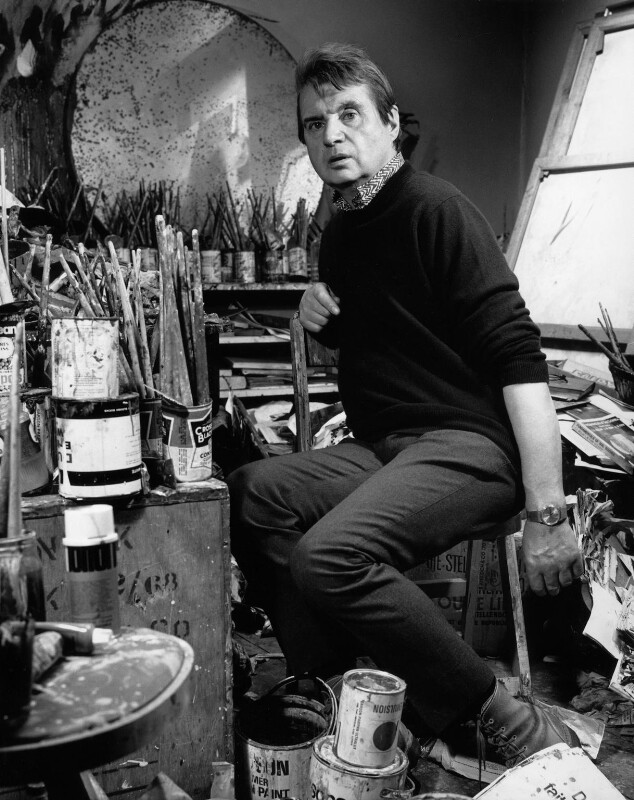
Carol’s introduction to art — “nicking” Francis Bacon
Their Inward Parts
CHRISTINE SCHWARTZ HARTLEY | BOOKS IN BRIEF | THE NEW YORK TIMES | SUNDAY, MARCH 29, 1998
At first, there seems to be no trace of a smile in Francis Bacon’s 'Study of Henrietta Moraes Laughing' (1969), one of many portraits of Moraes that Bacon (1909-92) painted over the years. All one sees is a distorted face with eyelids closed over deep-set eyes, the face in shades of white, ocher and black, overlaid in patches with marks in red and magenta like bloody fingerprints. Yet in the mangled lower half of the face (where violent white brushstrokes and superimposed volumes compete for attention and hint at turmoil), the viewer eventually can distinguish what may be a row of pearly white teeth; to their left, perhaps, is Moraes’s restrained smile a moment before (or after) laughter; to their right, an ominous black patch, like a bullet hole.
With 233 colour reproductions illustrating Bacon’s variations on a theme — series of three (or two) studies for a portrait or self-portrait, single portraits and studies, diptychs portraying different subjects, as well as details of all of the above — BACON: Portraits and Self-Portraits (Thames and Hudson, $60), by France Borel, a Belgian art historian, provides ample opportunity to examine the ways the artist had of delving into his subjects — friends, lovers, admirers and himself. Most of these approaches appear violent, involving painterly renditions of flayed skin; cheekbones, jaws and necks defined by savage brushstrokes; hollowed eye sockets; torn ears; extreme dislocation of features, all in a riot of spurting colours, except for one constant: the portraits’ solid background. Again and again, Bacon returned to the same subjects — Moraes, George Dyer, Isabel Rawsthorne, Lucian Freud, Peter Beard and Muriel Belcher — in an effort to capture and convey their inner turmoils, secrets, beauty and mortality.
He directed the same relentless attention to his own features (his ample cheeks, his squarish jaw) with the same purpose. In one series from 1967, his face seems to be sucking itself in; in a 1979 study, the contours of his eyes and lips, and the line that joins his nostril to the corner of his mouth, are ghoulish, drawn in purple on a bluish-white face; and in a 1980 series, bloody marks cover large areas of his emaciated self-portrait. In his introduction, Milan Kundera writes that Bacon was in search of an ''infinitely fragile self shivering in a body.'' As this book makes clear, Bacon’s search never ended.
Reputations on the line
BRIAN FALLON | THE IRISH TIMES | WEDNESDAY, APRIL 1, 1998
Pierre Bonnard and Francis Bacon may be suffering from posthumous downgrading, if reactions to two recent exhibitions of their paintings in London are anything to go by. Yet, both remain artists of the highest rank For some reason, or combination of circumstances, the Bonnard exhibition at the Tate Gallery does not seem to have touched off as positive a reaction as might have been expected. Attendance has been quite high — on my own visit there I sometimes found it hard to see the paintings properly because of intervening heads and bodies; but the enthusiasm scarcely compares with what the Monet exhibition of a few years ago generated. Some people even claim to have found it all rather an anti-climax.
It was always on the cards that Francis Bacon would pay posthumously for the rather feverish and uncritical praise heaped on him in his middle and later years. He took New York by storm, he was almost idolised in Paris (very rare for an English painter) and near the end of his life he enjoyed a triumph in Leningrad. Virtually every public gallery which could afford to buy him did so, and he was widely acclaimed as the greatest living painter, whose round face became as familiar through photographs as Picasso’s sombre gaze and bald head.
Bacon the artist became almost submerged in his personal legend — the flaunted homosexuality, the drinking and drugging, the Soho pub-crawls and the semi-recognisable portraits of his friends and fellow-bohemians. Some of his encomiasts reached heights or depths of nonsense, particularly those who claimed that he was really a religious artist, the painter of "God’s absence." The fading clichés of Existentialism were also dragged out to prove that he was the painter of le néant and the Void, expressing modern man’s spiritual alienation and anxiety and psychological loneliness. (To be fair to the artist, he himself never made any such claims and in general avoided pseudo-metaphysics).
Human nature, however, likes to tear down what it built up, so that the Hayward Gallery exhibition has been getting some stick, and an anti-Bacon tone seems to be surfacing in various places (about ten years or so ago, I noted a similar reaction against Ben Nicholson). It is called Francis Bacon: the Human Body and carries a eulogistic catalogue by Bacon’s old buddy David Sylvester, who has curated the exhibition. Many or most of the pictures are familiar, which is no surprise considering the number of Bacon retrospectives there have been in recent decades, and the proliferation of books and articles about him.
My own feeling is that they represent — to be blunt- a very mixed bag, and that Bacon was an exceptionally uneven painter who rose or sank in inspiration from one work to the next. His whole method of working could scarcely have produced anything very different from this shifting level. He was a gambler who cultivated chance and the creative accident, he didn’t make drawings (certainly I have never seen any) and preferred to 'attack' the canvas in order to find his crucial image through the sheer potency of paint, he was a 'bout' worker rather than a regular, disciplined one, and he probably relied too much on photographs to trigger off his imagination. Bacon was also, of course, a semialcoholic, like Augustus John, and alcohol and painting go badly together since artists need not only unclouded brains, but steady hands.
All this may explain why he was at times such a bad, slovenly technician, forcing the paint brutally and clumsily rather than making it obedient to his vision. It is also undeniable that he was rather a poor pictorial architect, relying on certain devices which he repeated a good deal. In the earlier work, that of the Fifties and early Sixties, he often enclosed his figures in a kind of spectral 'box'; like luminous wires. Later, he placed them in a circular space rather like a small stage set, often against a monochrome background — Henrietta Moraes, in one 1963 painting, sprawls naked on a bed with a purple-violet background and a black foreground. And in the big triptychs, he relied on tension and contrast rather than on constructive power.
Bacon was also an uncertain colourist, capable of achieving some utterly original effects alongside much tonal dullness and sheer bad taste. His paintings are, for the most part, miniature dramas or stage-settings, close to the Theatre of the Absurd and Artaud’s Theatre of Cruelty, and they also exude an atmosphere close to film noir with its mood of big-city menace. In fact, his Paris influences are strong, including those of Giacometti and middle-period Picasso. Though a certain percentage of the Hayward show already looks dated or tired, and a number of works (including most of the triptychs) now seem inadequately realised, the originality and rather sinister spell of certain pictures are still hypnotic in their impact. Even now that their old shock element has largely evaporated, the Fifties paintings have a shadowy, tense, slightly menacing tonality and ambience which remain unique, while certain of the later works have a compelling power and originality. For example, the Figure in Movement from 1978, and the Oedipus and the Sphinx after Ingres, from 1983, must rank among the genuine masterpieces of their time; both stop you in your tracks. Bacon may sometimes give the effect of a man shooting in the dark, but he does so at a target which he alone could have envisaged.
Sizzling Bacon on legs
Blood n the Floor
Queen Elizabeth Hall
CLIVE DAVIS | SOUTH BANK CONCERTS | ARTS | THE TIMES | WEDNESDAY APRIL 8 1998
Francis Bacon to the right of us, Francis Bacon to the left. Not content with smearing gore across the walls of the Hayward Gallery, the old reprobate loomed large next door at the QEH as the composer Mark-Anthony Turnage gleefully scrambled the jazz-classical boundaries with the suite that takes its title from a Bacon painting.
When Turnage and Germany's Ensemble Modern brought this work to the South Bank almost two years ago, the reviews were so ecstatic that the sceptics among us were put on our guard. When critics begin whooping about an artist's bleak vision of social disintegration, you can be forgiven for the ungenerous thought that the closest some of them have come to urban alienation is being turned away by the maitre d’ of the Pont de la Tour.
It is impossible to ignore all the extra-musical trappings of Turnage’s nine-movement piece; part of the original inspiration came, after all, from his brother’s death from drugs. Yet the real centre of interest lies not in the existential Angst — modishly packaged with a picture of a used syringe on the new recording on the Argo label — but in the way that Turnage has so cleverly harnessed the cadences of jazz improvisation.
There is no underestimating John Scofield and Peter Erskrhe’s contribution to the success of the piece. Scofield’s role has already received ample attentions. Turnage, like, Miles Davis before him, knows how to draw the best out of a guitarist who is both funky and thoughtful.
But from the opening movement Erskine’s precise, self-effacing drumming emerged as an equally important factor, even in the sections where he largely confined himself to hi-hat cymbal patterns reminiscent of Davis’s album In A Silent Way.
Later, in the penultimate section, Crackdown, he unfurled a sly shuffling figure underneath a bass clarinet riff from the reeds player Martin Robertson who, at this point, sounded closer to Benny Maupin than Eric Dolphy.
Clive Davis
He’s so modern
He’s been in a rock band, he once got drunk with Francis Bacon, and his
latest piece tackles drug abuse. Mark-Anthony Turnage is Britain’s hippest
composer, as a current celebration of his work shows. Mike Bradley met him
MIKE BRADLEY | MUSIC | METRO | THE TIMES | APRIL 11-17 1998
Photographs of Mark-Anthony Turnage always make the composer look like a younger, more intense Francis Bacon, a bizarre physical coincidence given the inspiration he has drawn from so many of the painter’s works. Before our meeting at the Festival Hall, on London’s South Bank, I inquire of his publicist: “Is he as fierce and tortured as he looks?” “Oh no,” she replies, “he’s quite cuddly really.”
And so he is, you could say. A diminutive, thin man with circular spectacles and a flat-top haircut dressed in a striped T-shirt , jeans and worn Converse trainers, he greets me with a warm smile and a delicate handshake. He is a little nervous but eager to talk.
He is at the South Bank preparing for Fractured Lives, a festival of his work on until April 18, which includes a new staging of his contemporary opera Greek and several world premieres, among them Invention on Solitude for the Nash Ensemble and Still Sleeping for the Ealing Youth Orchestra.
But first a brief introduction to Turnage who, at the ripe old age of 38, ranks as one of Britain’s most accomplished contemporary composers. An Essex man, he was born in Corringham, near Basildon, but soon moved to Stanford-le-Hope, where he lived until he was 17. He played the piano from the age of six. “My parents were into music, not professionally, but they were very encouraging,” he explains. “I didn’t really enjoy the piano — the reason I started composing, at around nine, was because I was bored with practising. I began improvising on Beethoven and Mozart, and wrote reams of passable stuff when I was nine or ten.
“Musically, I had a terrible time at school,” he continues. “I really believed that I wanted to be a composer, but the response I got was scathing. I was told, ‘You’ve seen Andre Previn on the TV and you want to be famous.’ That was crushing to a child. Ironically, it was my English teacher who encouraged me and allowed me room for my obsession.”
In Turnage’s later youth, both he and his future wife Helen were regulars at the Canvey Island disco where they met. “I was a soul boy then — a drinker and a dancer. I even went on a soul weekender, once — not the sort of thing you expect of a contemporary composer. But it was through all that music that I came to fusion. I began listening to Herbie Hancock, Freddie Hubbard, Donald Byrd. Then I found out about Miles ...”
Forsaking the lager and the likes of George Clinton and Parliament Funkadelic, Turnage eventually found himself studying composition with John Lambert and Oliver Knussen, his mentor, at the Royal College of Music in London, where he subsequently proceeded to win all the major composition prizes.
Simultaneously, though, he was doing something about which he has never spoken before: “I was the keyboard player in a rock band called Kibbutz,” he reveals. “I also played a bit of sax, rather badly. The singer sounded a bit like David Sylvian — it was around the time when Japan were taking off. We had a couple of residencies: one upstairs at Ronnie Scott's and one in a goth club in Romford, where they hated us. I think we also played the Embassy club. I could already perform to some extent, since I’d played organ in church in my teens and, of course, I'd played the piano for school plays.”
Today he and Helen live in Highbury, north London, with their two sons: William, one-and-a-half, and newborn Edward. Ragged nights are leaving the composer bleary-eyed as he reports for rehearsals to tweak the Fractured Lives works to perfection.
Next door to the Festival Hall, in the Hayward Gallery, is an exhibition of works by Francis Bacon entitled The Human Body. Knowing of Turnage’s fondness for Bacon I inquire how he first came across the artist. “I got very obsessed when I first discovered his work at a Tate Gallery exhibition in 1985,” he says. “I just tuned in and connected. I also met him a couple of times. The first time the composer Hans Werner Henze arranged for us to meet at a restaurant. Bacon was with the art critic David Sylvester, and meeting two cultural heavyweights like that at once was scary. We got completely drunk. He was very nice to me and, even though he was in his seventies, he still helped me into a taxi. Like Sir Michael Tippett, he was very interested in younger people. I was particularly impressed by how driven he seemed. He was self-critical and hated his Pope paintings on which, ironically, I had based a piece called Three Screaming Popes.”
That was the piece which — after its premiere in 1989 with the City of Birmingham Symphony Orchestra conducted by Sir Simon Rattle — marked the beginning of Turnage’s four-year spell as Radcliffe Composer in Association with the CBSO. During that period he also wrote works for the Birmingham Contemporary Music Group, of which possibly the most successful is Kai. Scored for a jazz-based ensemble, Kai contains a slow final movement which is a requiem for the German cellist Kai Scheffler, a former member of the Ensemble Modem. Turnage still maintains contact with the CBSO, the BCMG and his friend Rattle: “I shouldn’t tell you this, but Simon is very keen on doing Blood on the Floor,” he says of his nine-movement jazz-based work. “A while back in an interview Rattle said, ‘I’ve always felt Mark’s got this big jazz piece in him.’ And look what happened.”
Blood on the Floor draws on modern and personal themes. Turnage explains: “The piece is drugs-related in that my younger brother Andy died of a heroin and cocaine overdose. Junior Addict and Elegy for Andy are dedicated to him. I wanted the work to be a memorial but not entirely about him, which would have made it too personal and specific to me. In a way the work is more about the problems of living in the city than about drugs.”
Discussing his painting Blood on the Floor, Francis Bacon said, “I have reached the stage at which I realise that nine-tenths of what people commit to canvas is irrelevant, leaving a tenth which is the essence.” I suggest to Turnage that his work displays a similar ‘pared-downness’. He agrees he has become better at editing his music, but says of Blood on the Floor that he still feels unhappy with certain sections. “I’m very fond of the first and last movements,” he explains, “particularly the coda at the very end of Dispelling the Fears. I’m really proud of that, despite the fact that it took me so little time to write. Junior Addict and Sweet and Decay I feel are the strongest and most popular movements, and Elegy for Andy is made good by John Scofield’s playing.”
Of Still Sleeping, one of the works premiered at the festival by the Ealing Youth Orchestra, Turnage says, “It began as a lullaby, a piano piece I wrote for my son William when he was three months old. Then I used it as the basis for the last scene of the opera County of the Blind. Finally I made an orchestra version.”
Turnage is currently Composer in Association with English National Opera, by whom he has been commissioned to compose an opera based on Irish playwright Sean O’Casey’s The Silver Tassie. Written in 1928, it is an anti-war play set in Dublin and the trenches of France during the First World War. “I’ve written two of the four acts in vocal score so far,” says Turnage. “It’s a massive undertaking, but I have until February 2000. And I’m being assisted by Amanda Holden, a fantastic librettist.”
The hero of The Silver Tassie starts out as a footballer in Dublin and the opera will include scenes on the terraces. As an Arsenal season-ticket holder, this could prove all the easier for Turnage to get right. “I’m not a fanatic,” he says, “but I know about chanting.”
Within earshot of the hallowed turf of Highbury is the former Islington home of Tony Blair. I ask Turnage for his opinion of the Government’s attitude towards music. “I am appalled and I think a lot of people feel very let down,” he says. “I was euphoric on May 1. We all went out to celebrate. We were thinking, “This is so fantastic but that feeling’s completely gone now. In the past I’ve been invited in my artistic capacity to turn out for the Labour cause, but I wouldn’t dream of doing that now. I think this Government could be even worse than the Tories with regard to the arts. Look at the way they handled the ENO. Ignorant, blundering fools.”
Turnage is lucky to be able to earn his living from composition, “I’m getting more performances now,” he explains, “so I’d like to spend more time on certain pieces and maybe not do so many ‘bread and butter’ commissions.”
I am curious to know the origin of Turnage’s grand Christian name. A parent with a love of Classics perhaps? “My name’s just Mark, but my grandmother used to call me Mark Antony as a joke when I was a kid,” he says. “I started using it when I was writing my first pieces, around the time when she died, so it’s sort of a tribute to her really. It seems to be quite memorable, which does me no harm. In fact, only last night my wife Helen noticed a Manchester United player whose surname was Butt. ‘That’s a terrible name,’ she said. ‘Just imagine if your name was Butt. Do you think you’d still be having a festival of your work at the South Bank?’ ”
Somehow I suspect he might.
Greek, with the London Sinfonietta, will be performed on April 17 and 18 at 7.45pm in the Queen Elizabeth Hall; Release, This Silence and Kai with the Birmingham Contemporary Music Group will be performed on April 18 at 4pm in the Purcell Room (0171-960 4242).
Blood on the Floor, featuring jazz musicians John Scofield and Peter Erskine, saxophonist Martin Robertson and Ensemble Modern, is released on Decca Records, price £14.99.
Making his Mark
The Turnage festival traces the development of an
intriguing composer, says PAUL DRIVER
PAUL DRIVER | CULTURE | THE SUNDAY TIMES | 12 APRIL 1998
Though under 40, the Essex-born composer Mark-Anthony Turnage (b 1960) has produced a sizable and weighty oeuvre that has won wide acclaim. His 1988 opera Greek, based on the Steven Berkoff play, made an extraordinary impact. His four-year residence with the City of Birmingham Symphony Orchestra produced a succession of increasingly expert works, and his writing for such ensembles as the Nash, the London Sinfonietta, the Birmingham Contemporary Music Group and Frankfurt-based Ensemble Modern has been prolific and assured. His music is extensively recorded, notably on the Argo label.
The South Bank is currently devoting a festival to Turnage’s work. The above ensembles, together with the London Philharmonic and Philharmonia Orchestras, plus the Ealing Youth Orchestra, are all involved in Fractured Lives. This is a detailed exploration of Turnage’s musical world of urban alienation, drug abuse and social violence, appropriately culminating (on Friday and Saturday) in the first British staging of Greek since its English National Opera premiere. The Nash Ensemble, under Martyn Brabbins, gave the first performance of An Invention on Solitude, for clarinet and string quartet, and of Turnage’s memorial for its late cellist, Cortege for Chris (van Kampen), for clarinet, cello and piano. Conversely, the youth orchestra under Mark Gooding premiered Still Sleeping, a lullaby for Turnage’s baby son.
Well received orchestral essays written since Greek were revisited in three other concerts. The young composer’s abiding interest in the paintings of Francis Bacon was made explicit in Three Screaming Popes (1989), a CBSO commission played by the Philharmonia under Leonard Slatkin at the Festival Hall. Turnage’s range of artistic influences is wide, but shrewd. A third illustrious B, after Bacon and Berkoff, is Samuel Beckett, the informing spirit of Your Rockaby (1993), a concerto for amplified soprano saxophone and large orchestra, performed by the London Philharmonic under Ingo Metzmacher in the same hall. This is one of Turnage’s many vehicles for the artistry of Martin Robertson who, like Turnage’s music itself, inhabits an intriguing middle ground between jazz and modern-classical idioms with evident ease. It is a region of blasting tuttis, tense undertones, and intermittent lyrical opulence; a sound-world further enriched here by the use of dusky cimbalom and a large rack of handbells.
The concerto is a continuously active, multilayered single movement lasting 22 minutes, orchestrated with a deftness that prevents big-band exuberance from obliterating individual, sometimes tender detail, and it came off well. The intimate “rockaby” element is most apparent at the beginning and in a passacaglia entitled Lullaby for Charlie (Robertson’s young son) towards the end. The soloist’s part here is a quasi-vocal “setting” of lines from Beckett’s 1981 monologue Rockaby, in which a “prematurely old” woman lulls herself, after a fashion, with her own recorded voice.
This sort of suppressed vocalisation, influenced, I think, by Hans Werner Henze and Oliver Knussen, two of Turnage’s teachers, is the basis of at least one of the movements in his nine-part, evening-long (80-minute) sequence, Blood on the Floor, for three jazz soloists and 32 players, which Ensemble Modern under Peter Rundel gave in a packed Queen Elizabeth Hall, building on its successful premiere there nearly two years ago. That movement, the second, is a rendering for soprano saxophone, backed by mellow electric guitar, of Langston Hughes’s poem Junior Addict, and Turnage inscribes it to the memory of his younger brother, who died of an overdose. The guitar comes into its own in the sixth movement, Elegy for Andy, which sustains the bleak but moving tribute.
There is a wild, jazzy prologue inspired by the bare Bacon canvas after which the work is named, while the last of the punchy but poignant movements, Dispelling the Fears, is a fantasia, featuring solo trumpets, on yet another B (the Australian abstract painter Heather Betts). William Forman and Bruce Nockles projected their ornately intertwining lines with acute sensitivity, and the ever-resourceful jazz soloists — Robertson again, with the celebrated guitarist John Scofield and drummer Peter Erskine — played a large part in creating the work’s atmosphere of permanent dramatic expectancy. But it is primarily Turnage’s achievement to have found not only a wordless equivalent of song but a startlingly plausible way of condensing an entire smouldering opera into a purely instrumental structure. This is his quintessential work.
T. S. Eliot’s violence
LETTERS TO THE EDITOR | THE TIMES LITERARY SUPPLEMENT | APRIL 17 1998
Sir, — Stephen Romer’s judicious review (April 3) of Christopher Ricks’s edition of T. S. Eliot’s early notebook, Inventions of the March Hare, begins by usefully setting the context of Eliot’s present standing He might perhaps have drawn attention to David Sylvester’s moving meditation on Francis Bacon, printed in the catalogue to the Bacon exhibition currently on show at the Hayward Gallery.
As Sylvester shows Eliot’s poetry haunted Bacon’s imagination throughout his life, and a useful corrective to the sterile argument about Eliot’s alleged anti-Semitism might be to ask why this should be so and what Bacon’s work and Eliot’s have in common. This would remind us of what half a century of academic study of Eliot has served to occlude: that, at his best, he is one of the strangest, most violent and aggressive poets in the English language, something from which we would no doubt like to shield ourselves but which a painter like Bacon perfectly understood.
G
ABRIEL JOSIPOVICI
60 Prince Edward’s Road I ewes Sussex
Town out to save its Bacon
NEWS | YORKSHIRE EVENING POST | THURSDAY 30 APRIL 1998
A CAMPAIGN has been launched to return an art treasure worth more than £3m to Batley.
The painting, by the late Irish-born artist Francis Bacon, was given to Batley in the 1950s.
But the huge picture, Figure Study II is currently gathering dust being stored in Huddersfield.
Batley and Spen Labour MP Mike Wood is now campaigning for it to be returned to its rightful resting place.
It was given to Batley in 1952 by the Contemporary Arts Society in recognition of the work of Mr Ronald Gelsthorpe, who was curator of Batley’s Bagshaw Museum.
Mr Wood said he was outraged it was kept in Huddersfield and had been loaned out to the London gallery.
A QUESTION OF ATTRIBUTION
BY LEE MARSHALL
Francis Bacon was one of the greatest artists of his time, and one of the most unpredictable.
But is it really possible that even he would give 500 key works away? And, if so, why?
LEE MARSHALL | THE SUNDAY REVIEW | THE INDEPENDENT ON SUNDAY | SUNDAY 3 MAY 1998
CHRISTIAN RAVARINO, an Italian-American journalist, has hundreds of drawings by the English painter Francis Bacon. Some of them are in the boot of his Audi. But he’s having trouble with the central-locking system.
Bacon was not just screaming popes and butchered triptychs, says Ravarino. He was not just "the world’s greatest living painter" — a label he was already learning to live with when Ravarino first met him in 1980. He was also, says Ravarino (who likes to talk), a great draughtsman. A great wielder of the pencil and the blue Biro, on sheets of typing paper which his Italian friend provided.
Bacon in Italy in the last 12 years of his life (he died in 1992, aged 82) is not an impossible scenario. He travelled constantly, alone or with an ever-changing group of friends; and travel, for Bacon, meant putting the Channel far behind him. Bacon drawing is another thing altogether. The official line is that he just didn’t do it, at least not after his career as a painter had taken off. Michael Peppiatt, a longtime acquaintance, and author of the 1996 biography Francis Bacon: Anatomy of an Enigma, is adamant that Bacon "did almost no drawings — and the ones that we do have are very painterly. He was a painter through and through."
The drawings owned by Ravarino are currently at the centre of a legal wrangle in his home town of Bologna. The case was instigated by his main customer, a Bolognese dentist and art collector called Francesco Martani, who bought a job lot of around 50 drawings in 1992 for what Ravarino says was "a few million lire each" (3m lire is currently around £1,000). Ravarino says that he was forced to sell them off in a hurry because his mother had just died and he needed the money to pay the US death duties. "In any case," he says, "they were by no means the best." A few years after his purchase, Martani began to get cold feet. He says that he hopes the drawings turn out to be authentic — but he is convinced that bringing in Italy’s Art Police (the Nucleo tutela del patrimonio artistico) and accusing Ravarino of having sold him a bunch of fakes is "the only way of getting at the truth."
The case will rumble on for at least another year. In the meantime Ravarino, like the Ancient Mariner, is desperate to get the story off his chest.
Ravarino says that he first met Bacon in Calderino, a village in the wine-growing hills west of Bologna, in November 1980. The artist was staying in the holiday villa of a certain Bernard Sellin (or Sellen), who claimed to be "a pediatric surgeon at the Great Ormond Street Hospital in London". Ravarino was 28 at the time. He was introduced by a friend of his mother’s who knew both Bacon and Sellin.
He got five articles out of their meetings, including an interview published in Italian Italian Penthouse in April 1982. In 1996 he gathered these articles together in a book published by a small Bologna press, with reproductions of some of the drawings and a rambling afterword.
Later, when Bacon visited the ski resort of Cortina d’Ampezzo in the Italian Dolomites, and again in Venice, Ravarino was a hanger-on. He also talks of trips to Rome and Florence "sometime in the mid- to late Eighties", including one visit to the Uffizi Gallery during which Bacon tried to wrench Artemisia Gentileschi’s gory painting of Judith Slaying Holofernes off the wall. The police let Bacon off with a warning. He couldn’t see what all the fuss was about: "I would have given them one of mine in exchange," he explained to Ravarino.
SINCE THE early Eighties, when Bacon apparently praised his boyish good looks and his pert bottom, Ravarino has — by his own admission — gone to seed. In fact, it’s difficult to connect him in any way with the cherubic passport photograph he shows me, dated 1972.
The frayed brown overcoat, the scuffed supermarket trainers, the long hair, streaked with grey, the puffy face — Ravarino looks like a method actor three months into preparation for his role as Down-At-Heel Writer And Italian Friend Of Bacon. He drives a clapped-out Audi with a rattling gearbox. He talks earnestly and incessantly in great arcs of free association that lead from Velazquez to the Mafia. He hangs a right when he sees a police car up ahead ("Shit, what are they doing here? They don’t normally wait on that corner"). But he can also be calm and cultured, with the smooth, persuasive voice of a breakfast radio host.
The only time I hear Ravarino stumble is when I ask him if he ever had sex with Bacon. Um, well, basically, the thing is ... he doesn’t remember. Sorry? "You have to realise just how much these people drank, and how much you had to drink if you didn’t want to offend them ... I was often in a kind of alcoholic coma." He goes on to tell me a story about Bacon putting a rose on the breakfast table one morning, in some hotel, he doesn’t remember where or when. Or why.
Ravarino — whose English is far from fluent — holds an American passport. He also claims to act as an advisor to the US Department of State, and talks of an uncle who works for the Planning Organization Board — "the decision-making body of the National Security Council, which controls the American President". He writes the way he talks: leaping from one conspiratorial hub to another, even when he is ostensibly discussing Bacon. Aldo Moro is in there, of course, and the Kennedy assassination. So is the Pont de l’Alma in Paris, Blackfriars Bridge in London and the omnipresent Licio Gelli (former head of Italy’s P2 Masonic lodge). They’re all connected, deep down.
Such things fascinated Bacon, according to Ravarino, and he claims to have spent hours talking to the painter about espionage, terrorism and the Mafia. In a long memoir he wrote in 1995, Ravarino recalls an episode which took place in the Hotel Danieli in Venice in 1991. Bacon was watching a TV interview with Mafia godfather Michele Greco, and was enchanted by the fact that his Italian nickname was Il Papa (The Pope) — so much so that he immediately ordered Ravarino to send the man a drawing. Like most of the other Bacon drawings that Ravarino claims to have posted to eminent personages (the former Italian Prime Minister Giulio Andreotti, among others), this one was stolen by an unscrupulous assistant before it reached the great man.
The problem with Ravarino’s "Bacon and I" stories is that there are no photographs, no tape recordings and few witnesses. No one seems to have heard of Bernard Sellin — the surgeon friend Bacon was supposed to have been staying with in Calderino. The Great Ormond Street hospital has no record of him. Paul Brass, who was Bacon’s personal doctor, never once heard Bacon mention Sellin. The other important claim made by Ravarino — that at this time Bacon believed he was dying of cancer, hence the "urgency" of the drawings — baffles Brass. But he concedes that Bacon "did tend to worry about his health".
Just as one is beginning to believe in some magnificent fictional construct, a few Italian sightings come to Ravarino’s rescue. Calderino wine producer Carlo Gaggioli remembers a visit to his cellars by a "very merry" group of foreigners, including an older English artist. He has a drawing similar to those owned by Ravarino, "which was given to me by the artist — or by Ravarino, I don’t remember. But they definitely gave it to me that same day." Bacon was also spotted in Cortina d’Ampezzo, the ski resort where Ravarino claims to have interviewed him "towards the end of the Eighties". Gloria Pagani remembers Bacon’s rowdy visit to her restaurant, La Siesta - which was followed the next day by the gift of a drawing. And Vincenzo Lucchese, an architect who teaches at Venice University, has testified that he saw Bacon and Ravarino together at a Venetian Carnevale party "at the end of the Eighties" (though Ravarino, in one of his few stabs at precision, sets this meeting in 1991).
According to Ravarino it was during this Venetian visit, when Bacon was around 80, that the artist presented him with the bulk of the drawings. Bacon was staying with "some rich English friends" who owned an apartment in Venice, and Ravarino remembers that "he wasn’t feeling very well".
As usual with Ravarino’s stories, the Venetian scenario comes complete with theatrical mise-en-scene. "Bacon said to me: 'I told my friends that you would go round to the flat to tidy up.' I was a bit put-out by this, but I said, 'Fine'. Then Bacon said: 'But make sure you don’t steal anything.' That was one of the few times I ever got angry with him — I really blew a fuse. He quite liked it when people shouted at him. Anyway, he said he’d been joking, and that he only meant I should be careful with the crystal glasses. So along I go to the flat, which is really something — Sebastiano del Piombo paintings on the wall, the whole works. And I find that it’s spotlessly clean. Then I notice a big package sitting on a table, with a typewritten note: 'Per il dottor Ravarino.' Inside were hundreds of drawings.
The last time he talked to Bacon, says Ravarino, was when the artist rang him a few weeks later. When Ravarino asked him why he had bothered to type out the note, Bacon replied: "So you don’t have anything on me. I don’t want anyone to recognise my handwriting. I don’t want you to make this into a book. And I haven’t decided what I want you to do with the drawings yet."
So why, then, did Bacon sign the drawings? Ravarino says that he talked the artist into signing them "when I brought them to him in Rome". His chronology — unreliable at the best of times — goes very fuzzy around this point. It’s unclear, for example, whether this "last meeting" took place before or after the phone-call referred to above. "I was shaking all over. He was drunk, and I was worried he was going to destroy them. Instead, he started signing them. Some he initialled, some he signed with his full name, some just with an 'F' — like those early paintings that were published recently in a book with a preface by Milan Kundera — paintings which nobody had ever seen before." Ravarino has certainly done his homework.
There is no doubt that these are the kind of drawings a clever forger would turn out if he was trying to "do a Bacon". They are all heads, done in two different styles. The first type is aggressively pointilist, like a join-the-dots puzzle for schizophrenics. Clustered entrails mess up the mouth and nose, or hang down from the chin. The eyes are insect-like. One of these heads looks like a child’s drawing of a caterpillar; another like Darth Vader with acne.
The second type of drawing is more fluent, more convincing. The bare essentials of a face have been jotted down, and then overlain by long, rapid, curving strokes of the pencil. The effect is that of long grass in a strong wind, seen from above, as in Bacon’s painting Landscape 1978. The focal point (always a face) is worked on and worked over obsessively, nearly erased. The rest is clean, confident and geometric: a suggestion of shoulders and collar, enclosed —in some cases — in one of the box-frames that we recognise from Bacon’s paintings.
Since Bacon’s death in April 1992, various "official" early sketches have turned up. A group of four scrappy studies for paintings from the Fifties and Sixties was included in the major Pompidou Centre show in 1996. More interesting perhaps is the group of 42 works on paper acquired by the Tate Gallery earlier this year. Dating from the early Fifties to the early Sixties, these include a few sketches in ballpoint pen and pencil as well as others in gouache, oil paint and ink. The style is not particularly close to that of the Ravarino drawings, but the press release put out by the Tate to announce the acquisition makes an interesting point: "Though few post-war works on paper by [Bacon] were known, it has now become clear that this is only because he did not wish the existence of this type of work to be revealed beyond his own circle."
The works acquired also include some pages from a boxing magazine overpainted by the artist. Ravarino, too, has a group of sketches done on the flyleaves of various English and Italian books. Sometimes these take up hints from their surroundings: a rapidly sketched portrait on the title page of Reginald Berkeley’s The Lady With a Lamp seems a parody of the portrait of Florence Nightingale on the facing page.
Ravarino believes that the Bacon establishment has closed ranks to keep him out. If so, they have understandable reasons for doing so. The Marlborough Gallery, which represented the artist from 1958 onwards, has had to act on Bacon’s behalf more than once in the past when false or abandoned paintings turned up in the marketplace. There is even an Italian precedent: in the mid-Seventies a group of left-wing students in Milan painted and sold a number of fake Bacons, using the proceeds to finance the Glorious Revolution.
Kate Austin voices the official Marlborough Gallery line when she says that "stylistically it seems impossible that these drawings are authentic. The hand is very tight — it’s certainly not Bacon’s." She also claims that "the artist knew about these drawings and was very upset about them". As for Ravarino, she says that "it is debatable whether he ever knew Bacon personally".
British art critic David Sylvester was (and is) Bacon’s Boswell. His conversations with the artist — first published in 1975 — have become the Baconologist’s bible. Sylvester has also curated most of the important Bacon exhibitions since the artist’s death in 1992, including the recent Hayward Gallery show. He is emphatically not part of the Ravarino camp; in fact, the whole story irritates him. "This is about the eighteenth time I’ve been asked about these drawings," he says. "They’re fakes — you only have to look at them to see it. There is absolutely no documentary proof that they are Bacon’s — so in the end you just have to trust your eye."
An assiduous collector of testimonials, Ravarino has his own list of friendly critics and collectors. His chief supporter is Italian writer and self-taught art critic Giorgio Soavi, who has written a book about the whole affair, Viaggio in Italia di Francis Bacon (Umberto Allemandi, Turin). Soavi has also bought two drawings from Ravarino — so he could be said to have a vested interest. Soavi became excited, he says, by "the fictional potential" of parts of the story — including Ravarino’s most extravagant claim, that Bacon was involved in the death of a male prostitute in Rome — an "accident" which was immediately covered up by the US secret services.
So convinced is Soavi that the drawings are authentic that he agreed to appear as an expert witness for the defence in the first Bologna hearing on 10 February. Paul Nicholls, an English art dealer based in Milan, was enlisted by the court as a witness for the prosecution. He declared that "the drawings in question were not carried out by Bacon, and are foreign to his whole way of working". Nicholls also believes that "this whole thing should be deflated. I don’t think it does Bacon any good.
More than once, Ravarino himself refers to Bacon’s legacy as a "curse". He says that his next move will be to "go to England with a couple of hundred drawings and take them around the most important critics". But he is reluctant to do this, he says, because "it’s depressing to think that I have to go to ask a bunch of critics whether my story is true, when I know for a fact that it is".
One gets the impression that it is the way Ravarino has dealt with the drawings as much as anything else which, in the absence of any definite proof that they are by Francis Bacon, annoys the critics. There is an etiquette to authentication, and Ravarino has not respected it. He has exhibited his drawings in third-class galleries and hotels around Italy. He has published them in obscure local magazines. He has given them away to lovers and politicians, and sold them outside the gallery circuit at prices which, he says, range from £1,000 to £12,000. If the drawings were authenticated, the best could fetch at least £50,000. Ravarino is coy about numbers, but he hints that he has more than 500 drawings still in his possession.
It would be easy for the experts if Ravarino really was the likeable charlatan he appears to be. But there’s a problem here. Reliable witnesses saw Bacon and Ravarino together in Italy, and drawings purported to be by Bacon were given away on those occasions. Ravarino may, of course, have been going around with a Bacon look-alike who was under strict instructions to get drunk and play the crazy Eengleesh artist. Alternatively, he may have been tracking Bacon around Italy and popping up the next day with forgeries to distribute to restaurant owners and wine producers as gifts from il maestro. "Either way," says Bolognese journalist Luigi Spezia, who has been following the case for La Repubblica, "the man would have to be a genius."
So far the only person to have approached Ravarino’s claims with any degree of forensic rigour is the writer and art critic Enzo Rossi-Roiss. He has been following Ravarino’s sales of the drawings since they began in 1981. He has photocopies of 150 drawings plus, in some cases, copies of the cheques paid for them. According to Rossi-Roiss, Ravarino’s own figures are too high: "He’s been selling off sketches for as little as 500,000 lire [£170] each." Rossi-Roiss is working on a book about the case, due out this autumn. He believes Bacon did indeed visit Calderino in 1980, where he met Ravarino and left behind a few drawings. He believes that Ravarino then appropriated these, forged Bacon’s signature, and used them as models for hundreds of fakes, which were carried out by more than one artist — hence the difference in style.
IN 1975, Bacon wrote a brief tribute to Giacometti, one of the contemporaries he most admired, for a show of his drawings at the Galerie Claude Bernard in Paris. "For me," he wrote, "Giacometti is not only the greatest draughtsman of our period, but one of the greatest of all time." Giacometti himself considered drawing to be fundamental to both painting and sculpture: "I think only about drawing," he once said. French critic Jacques Dupin believes that Giacometti’s admiration of Bacon’s paintings was tempered by the fact that "he was uncomfortable that Bacon didn’t draw".
If Bacon was prompted into trying to produce finished drawings in the last decade of his life, his decision to leave them in Ravarino-limbo could have been a reflection of his own lack of confidence in them. At the same time, though, he would have been reluctant entirely to destroy these traces of an activity in which his masters — Giacometti, Picasso, Michelangelo, Guercino, Velazquez — all excelled.
We know that by the time Ravarino claims to have met him, Bacon was weary of the whole gallery circus. In an interview published in Art International in the autumn of 1989 — soon after one of his triptychs had sold in New York for US$6m — he said: "The whole thing has become so boring and bourgeois. Art is just a way now of making money."
Giorgio Soavi believes that these drawings were left behind as a spanner in the works. At the end of his semi-fictionalised account of the affair, he has a ghostly Bacon return to earth to say: "I left them in the hands of this long-haired rocker simply to annoy my dealers ... to take my revenge on them.
It could just be that these drawings were left behind as a spanner in the works. Bacon loved using calculated chance in his paintings, and the choice of such an unreliable messenger as Ravarino as the repository of his final secret — or last laugh — would do for his life what a careless smudge of paint did for a painting. "I think that painting today is pure intuition and luck and taking advantage of what happens when you splash the stuff down," he wrote in 1953.
Up there in orbit, 500 drawings are still waiting for splashdown!
Francis Bacon
Hayward Gallery, London UK
BY NEAL BROWN | REVIEWS | FRIEZE | ISSUE 40 | TUESDAY 5 MAY 1998
Bacon’s work doesn’t comply neatly with attempted divisions between portraiture and explorations of the body, and this exhibition, The Human Body, is to a degree an artificial contrivance, especially for an artist who in many ways considered the head as just another limb on a torso. The works are hung strangely close to the floor in the Hayward’s artificially lit lower galleries, against sad, grey walls and a threatening dark ceiling. Light levels are low because of the artist’s improvidence of technique and the consequent delicacy of the work: the raw canvas he left exposed is vulnerable to darkening and embrittlement. Overall, the repressive effect makes the works look gaily pretty and cheerful.
This is the first significant opportunity to consider Bacon’s work since Michael Peppiatt’s critical biography of 1996, and makes the artist’s rigid withholding of his co-operation from any biographer understandable. Peppiatt is not party to the strange collaboration between those that accord the artist a greater singularity than is the case, and he makes an evaluation of Bacon that is neither characterised by either adulatory homage (to a Soho Disneyland of romanticised Existentialism) nor by kneejerk disgust. His book is more fondly querying of Bacon’s art than his many (equally committed but perhaps more constrained, credulous, or misinformed) predecessors. David Sylvester, who curated this exhibition and wrote the catalogue essay, has begun — just — a well-earned relaxation from the artist’s royal grip.
Details of Bacon’s upbringing, sexuality and relationships have autobiographical correspondences in the paintings which make them (in what would be an absolute anathema to the artist) much more narrative than intended. Bacon’s deliberate insistence on a non-analytical and non-narrative reading of his work (and potent enigma resulting from this), is now less possible to sustain. For example, Untitled (1943 or 1944), a work never exhibited or published before, (a variant on one of the triptych panels for Three Studies for Figures at the base of a Crucifixion, 1944) seems particularly hectoring. Elsewhere, Bacon’s narrative is by degrees inarticulate and confused, but certainly present. This is most clearly seen in Triptych May-June 1973 (1973). The painting depicts the undignified suicide of the artist’s lover in cartoon strip style. The spiritual details of Bacon’s story of abuse, repressions and counter-repressions may be seen, with increasing clarity, elsewhere in the show.
Bacon’s outlook of religiosity (both absolutist, irreducible intent and frequent religious subject matter), politics and sexuality (of pain) may now be considered without constraint. The various biographies, newly revealed work and the simple passage of time allows us to consider him in relation to various traditions other than just a Modernist one. These might include the art of the right wing, 19th century Christian art, as well as the history of artists concerned with sexualised control, such as Richard Lindner, or even Aubrey Beardsley. Bacon’s use of raw canvas left in reserve is like Beardsley’s use of white paper, seen in his illustrations of Edgar Allen Poe, for example. There may even be a case for consideration of Bacon in relation to the English nonsense tradition in literature.
Bacon’s often very beautiful, grandee swirlings and sexualised skidmarks of paint are depictive of certain principal categories of subject. These are either other right-wing libertines like himself, or suicides and alcoholics — alcoholics, of course, just being suicides in slow motion. The libertine theme, and its policy of non intervention toward the emotionally or spiritually disadvantaged, can be seen in the falling freemarket of souls on the canvases, and their hierarchy of vulnerabilities in relation to each other, reflected within the structural devices the artists used.
The good paintings in this show have a continuing magic power, effecting an almost involuntary response. As Bacon’s often strained theatrical intensity becomes more painfully obvious though, his successes may perhaps be due more to his fabulous colourist skills and consummate fluency with paint than his existential pronouncements. As the duration of induced sensation in the viewer becomes diminished, through habituation and an increased tolerance to his devices, either complacency or a discriminating embarrassment at the accrued defects in the paintings sets in.
The Human Body further qualifies the reasonable objections to be made against the grandeurs and pomp claimed for Bacon’s work, but it also confirms his merits. Importantly, it also provides an opportunity to reconsider Bacon’s considerable influence on much contemporary art practice, and therefore to consider aspects of contemporary art practice itself.
Bacon’s insistent references to Paul Valéry’s — ‘the sensation without the boredom of its conveyance’ — is seen reflected in the repeated significance of ‘sensation’ in much contemporary art practice, and its analogues in advertising, recreational drug use and the entertainment media. Bacon’s outsider status, ruthless survival strategy and self mythologising, as well as his great talent, also have correspondences in younger artists’ makings and marketings of art, although many of these are now safely institutionalised themselves. The bonds between Bacon and many contemporary artists may expose those working in his wake to stresses and counterbalancings dependent on the rise or fall of his retrospective fortunes.
THERE’LL ALWAYS BE A LONDON
DOUGLAS CRUICKSHANK | SALON | WEDNESDAY, MAY 13, 1998
"It’s a monstrosity," the cabby tells me. He’s talking about South Bank Centre, the massive architectural calamity perched next to the Thames at the end of Hungerford Bridge. We’ve just pulled up in front. The Centre is a giant concrete arts and theater complex built in the 1960s. The cabby is right. It’s magnificently ugly. One building is the Hayward Gallery, where I’m about to catch the last day of Francis Bacon: The Human Body, a major retrospective of paintings by the artist – he died in 1992 – whose emotionally ferocious oils make the work of Hieronymus Bosch look like Muzak for the eyes in comparison. The show has attracted over 120,000 people in its two-month run. As I walk in, there are about 400 waiting in the ticket line, all of whom glare at me bitterly as I skip up to the will-call table, collect my previously purchased ticket and leisurely saunter into the gallery, glancing back just once with a guess we’ve learned a little something about planning ahead haven’t we now smile. They all look back at me with a consolidated interstellar death beam, but it’s too late, I’m already inside.
Bacon’s work is majestic and wrenching – famously so. But the dazzling nightmare solemnity of his subject matter – the screaming popes that most people know him by, and the anguished figures, some based on the early sequential photographs of Eadweard Muybridge – is lightened and made bearable, even beautiful, by Bacon’s eloquent use of colour. Standing in the middle of a room surrounded by his giant gilt-framed canvases makes it possible to imagine what the woodcuts of Japan’s ukiyo-e period might have looked like if they’d been conjured in the nether world by an Irishman under siege from the hellhounds.
Still, though Bacon’s imagery is often grim, it can also be funny, bittersweet and bawdy in the street opera sense of Kabuki. Often the paint is applied so sparingly that there is a distinct Shroud of Turin effect (if the Shroud could shriek), as if the faces or figures were photographically blasted onto the canvas the way silhouettes were imprinted on the walls of Hiroshima by the flash of the atomic bomb. However, the detonation in this case took place inside Bacon’s ground zero brain. "I would like my pictures to look as if a human being had passed between them," he once remarked, "like a snail, leaving a trail of the human presence and memory trace of the past events as the snail leaves its slime." And they do.
Love Is the Devil – Study for a Portrait of Francis Bacon
DAVID ROONEY | FILM REVIEWS | VARIETY | MONDAY, MAY 25, 1998
Unconventional, audacious and uncompromising in every sense, John Maybury’s Love Is the Devil is a very personal interpretation of the destructive relationship between British painter Francis Bacon and his lover and muse, George Dyer. This provocative film’s unflinchingly unsympathetic portrayal of the artist — ferociously played by Derek Jacobi — and its often distancing, experimental style, make it clearly an item for niche audiences. But it nonetheless looks certain to become a talked-about release backed by plenty of critical heft and a benchmark for future films about artist.
Opening with Bacon’s crowning success, a 1971 retrospective at the Grand Palais in Paris, the film backtracks seven years to recount his meeting in London with Dyer (Daniel Craig), a small-time criminal from the lower-working-class East End. Dropping through a skylight to rob Bacon’s studio, Dyer instead is ordered by the painter to remove his clothes, come to bed and then take what he wants. He does as instructed and becomes Francis’ “new tart,” soon being introduced to the coterie of bitchy friends whom Bacon carouses with at Soho’s Colony Room and whom the painter describes as “the concentration of camp.”
Bacon’s sexual proclivity for masochism — conveyed with great restraint by Maybury — is matched by his emotional sadism, which is put on hold during the relationship’s early stages as he relishes his lover’s mix of amorality and innocence. But as time passes, his contentment seems to fade. He begins belittling George in public for his lack of sophistication, locks him out while he entertains other rough trade and is scornfully dismissive about his suicide attempts
Jacobi’s remarkable performance depicts Bacon as supercilious and cruel but also quietly appalled by his own life and behavior. He clearly loves George, but while able intermittently to acknowledge this to himself and select friends, he’s unwilling to express his feelings to his partner.
Increasingly more locked into drug- and alcohol-induced altered states, George finally does kill himself, as Francis is toasted at the exhibition in which his lover is the subject of some of his most celebrated paintings. The contrast between Bacon’s derision when David Hockney offers his condolences and his private grief — shown succinctly in a desolate opening shot — makes the artist both a monster and a tragic figure.
Echoes of Bacon’s art are everywhere in cinematographer John Mathieson’s swimming, distorted visuals and grotesque, up-close angles, as well as in specific constructs: a mirrored triptych as Bacon applies makeup, a seafood dinner, tortured sexual couplings and George’s pained visions of a bloody, agonized body. The unsettling tone of the material carries through to Ryuichi Sakamoto’s dense soundtrack of music, droning and noise.
The film is dedicated to Bacon’s friend and biographer Daniel Farson, who wrote what is considered the definitive tome on the artist, The Gilded Gutter Life of Francis Bacon and served as consultant here prior to his death.
Love Is the Devil — Study for a Portrait of Francis Bacon
PRODUCTION: A Strand Releasing (in U.S.)/Artificial Eye (in U.K.) release of a BBC Films and British Film Institute presentation, in association with Premiere Heure (Paris), Uplink (Tokyo), Arts Council of England, of a BFI production in association with Partners in Crime and with the assistance of state. (International sales: BFI Films, London.) Produced by Chiara Menage. Executive producers, Frances-Anne Solomon, Ben Gibson, Patrice Haddad, Takashi Asai. Directed, written by John Maybury.
CREW: Camera (color), John Mathieson; editor, Daniel Goddard; music, Ryuichi Sakamoto; production designer, Alan Macdonald; costume designer, Annie Symons; sound (Dolby), Ken Lee; sound designer, Paul Davies; special consultant, Daniel Farson; line producer, Yvonne Isimeme Ibazebo; assistant director, Deborah Saban; casting, Mary Selway.
Reviewed at Cannes Film Festival (Un Certain Regard), May 18, 1998. Running time: 91 minutes.
WITH: Francis Bacon ..... Derek Jacobi, George Dyer ..... Daniel Craig, Muriel Belcher ..... Tilda Swinton, Isabel Rawsthorne ..... Anne Lambton, Daniel Farson ..... Adrian Scarborough, John Deakin ..... Karl Johnson, Henrietta Moraes ..... Annabel Brooks, Blond Billy ..... Richard Newbold.
Bringing home the Bacon artistry
ARTS & ENTERTAINMENT | HUDDERSFIELD DAILY EXAMINER | FRIDAY, JUNE 5, 1998
AN important Francis Bacon painting which was the subject of controversy some weeks ago, is now on view in an exhibition from the permanent collection at Huddersfield Art Gallery writes David Hammond.
Figure Study II, which Bacon painted in 1945-6, and is now worth a seven-figure sum, has been returned to Huddersfield from the Hayward Gallery, London, where it was borrowed for the recent Bacon retrospective exhibition there.
Batley and Spen MP Mike Wood claimed in April that the Bacon painting should be displayed in Batley – it was originally a gift to Batley Council from the Contemporary Art Society.
But Robert Hall, Kirklees principal officer for visual arts, said there were no adequate storage facilities in Batley, and Huddersfield offered much better security. t
Redemption from the horror of existence
CATHERINE WOOD | DISSECTING ROOM | THE LANCET | VOLUME 351 | NUMBER 9104 | JUNE 7, 1998
Francis Bacon (1909–92) is widely acknowledged as the greatest British painter of this century, and this exhibition, the first major showing of his work in the UK for 10 years, asserts the continuing relevance of that reputation. Bacon’s Studies for Self-Portrait: Triptych (1985–86) consists of three consecutive depictions of the artist’s face and uncomfortably twisting figure.
Imposingly large and gold-framed, the canvases engulf the man portrayed. He perches precariously on an undersized kitchen stool in a flatly rendered beige arena, his painted features evolving into grotesque bulgings and refracted biomorphic forms before our eyes. If exploration of the human condition begins with serious exam[1]ination of oneself, as the artist’s hero T S Eliot said it should, Bacon’s self-portraits prepare solid ground for his continuing obsession with the body. These are, as the exhibition leaflet describes them, “merciless acts of self recognition”. And (he knows) he’s no oil painting.
The title and theme of the show, The Human Body, could not be more universal. The depiction of the human figure has always been a central preoccupation with artists, and Bacon tackles the domain of the human subject with intrepid intensity. What makes his work unsettling, and profoundly relevant to contemporary life, is his visualisation of that uncomfortable strain of 20th century thought (of Sartre, Beckett, and others) that recognises man’s insignificance in an unknowable and indifferent universe. Unlike Leonardo da Vinci’s Vitruvian Man (1498) who, as “the measure of all things”, stands perfectly proportioned in his circle, Bacon’s figures rattle and spin in harshly stripped spaces, sparsely furnished with isolated domestic objects, which bring no comfort and seem out of context. The figures appear disoriented amidst structures and spaces that are not to their scale: accidental rather than placed. Study for Nude (1951) references the work of Victorian photographer Eadweard Muybridge whose photographic classifications of bodily movement framed the body with gym equipment and measuring devices. Bacon’s compositions include similar props, but in his hands they are suggestive of prison bars or animal cages—the figures like trapped victims in some dank pit.
Version II of Lying Figure with Hypodermic Syringe shows what is barely recognisable as a body pinned to what appears to be an operating table. Behind the meat-like form is a metallic shuttered screen that jars the nerve endings, since it seems to cut into the naked flesh. The outer shape of the physical body is not sacred. Bacon pushes, pulls, and pierces its delineation, attempting to manipulate the outward form so as to express what is within. It is the essence, rather than the superficial appearance, that he seeks. The artist is famously quoted as saying, “I would like my pictures to look as if a human being has passed between them, like a snail, leaving a trail of the human presence . . . as the snail leaves its slime”. Bacon is fascinated with both the increasing transparency of the physical body in the 20th century via radiography, ultrasonography, and fibreoptics and the extent to which the notion of individual identity can be distorted before the self is lost.
Redemption from the horror of existence seems, for Bacon, to come in the act of painting. Symbolic in the physical scraping and pushing around of paint is a wiping away of surface identity to give us a glimpse of a shared (if terrifying) reality beneath. Most piercing in these images are the occasional points of near photographic reference to the person painted: an exquisitely described eye or mouth with perfect individual teeth amidst the flurry of marks on the canvas crystallises our connection, momentarily, with the subject. They lock us into Bacon’s struggle with the surrounding brutality, intensifying the effect of the distortion, intimating a knowing connection between artist, sitter (though in fact he painted from photographs, claiming to be distracted by a person’s presence), and spectator beneath the confused and horrible, or sometimes jokily ham-horror, image surface.
With 18 individual paintings and five triptychs arranged in more or less chronological order, The Human Body charts the development of Bacon’s painting style, and the Hayward Gallery shows the work to maximum advantage, allowing space to view both at close range and from a considerable distance. We see the paintings progress from the heavier distorted forms of the 1950s and 1960s to later canvases such as Figure in Movement (1985), which sings with the luminous quality of subtly multilayered oils and lucidly juxtaposed colours. Reproductions of his paintings do them little justice.
Forget the numerous books and articles and go and see it. That there are no information panels to accompany the works sums up how eloquently Bacon’s paintings speak for themselves.
Catherine Wood
Interim Art, 21 Beck Road, London E8 7RE, UK
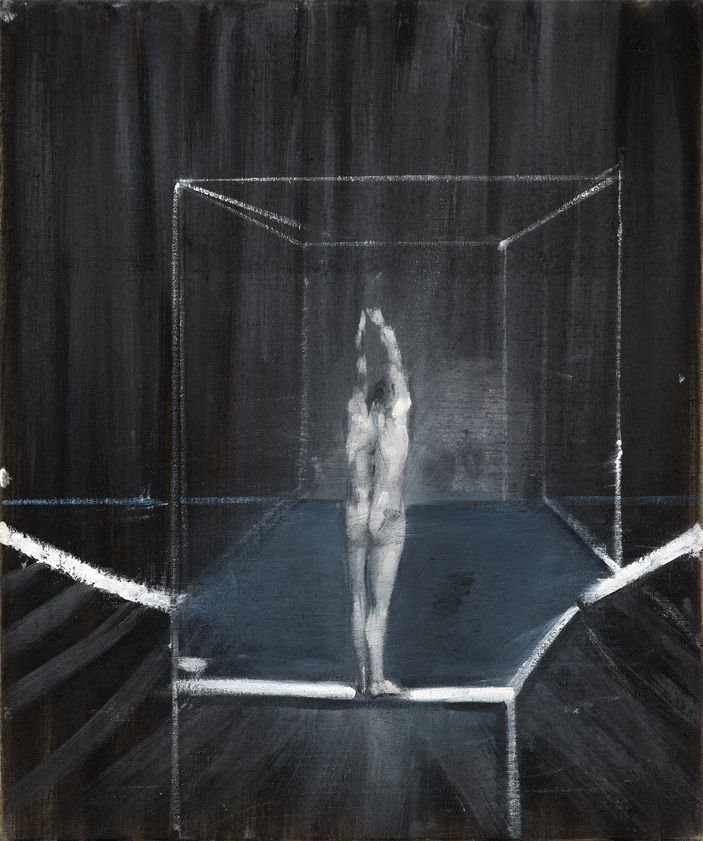
Bacon’s Study of a Nude (1952–53)
Powerful opener to theatre festival
LEISURE EXTRA | ST NEOTS WEEKLY NEWS | CAMBRIDGESHIRE | THURSDAY, JUNE 25, 1998
CAMBRIDGE Experimental Theatre’s Figures at the Base of a Crucifixion opened the 4th Grass Roots Festival of New Theatre on Tuesday. The play promises a “palpitating and unforgettable evening” as it focuses on the barbaric execution that became the centrepiece of the world’s most powerful religion.
During the year’s preparation for the project, visual influences as diverse as Grunewald and Francis Bacon have combined with the music of Bach to create an astonishing vocal visual experience.
Figures at the Base of a Crucifixion is presented at the Cambridge Drama centre until this Saturday. Tickets are priced at £6.75 (£4.75 concessions) and are available from the Box Office on (01223) 322748. The show starts at 8pm.
The Grass Roots Festival, which runs until July 18, features six premieres by local writers in the Cambridge area.
|
Early Bacon work may sell for £500,000
FORTHCOMING AUCTIONS | CULTURE | THE IRISH TIMES | SATURDAY, JUNE 27, 1998
An early example of Francis Bacon’s work comes up for sale at Sotheby’s in London next Thursday evening. Interior of a Room, dating from 1935, was included in the Bacon retrospective at the Centre Georges Pompidou in Paris two years ago and it is now expected to fetch £300,000-£500,000 sterling. Another Bacon work in the same sale is a double portrait of the artist’s friend, American wildlife photographer and author Peter Beard; called Studies for Portrait — Diptych, 1976, it has a pre-sale estimate of £200,000-£300,000. Both pictures are included in a contemporary art sale which opens with a group of significant work by German and Austrian artists. Among those represented are Gerhard Richter (Seestuck from 1969/70) and Anselm Kiefer (1981’s Die Meistersinger); both pictures carry the same estimate of £300,000-£400,000. Other artists in this section include Baselitz, Beckmann, Kandinsky, Kokoschka and Schumacher. There is also substantial representation by major names from the British, European and American art world this century. Two portraits by Lucian Freud are on offer, for example, as are four of Andy Warhol’s silkscreen portraits (one of them showing German artist Joseph Beuys), together with work by Warhol’s protege JeanMichel Basquiat, Gilbert and George, Damian Hirst, Cy Twombly, Piero Manzoni (subject of a recent retrospective at London’s Serpentine Gallery), Yves Klein and Nicolas de Stael.
Bank vault art hoard reveals Bacon’s big lie
JOHN HARLOW | ARTS CORRESPONDENT | NEWS | THE SUNDAY TIMES | 19 JULY 1998
AN UNKNOWN hoard of 500 works by Francis Bacon is to go on show, revealing Britain’s greatest post-war artist’s most closely guarded secret: he could draw. Bacon, who died in 1992 aged 83, maintained that he was such a hopeless draughtsman that he could not prepare preliminary sketches for his large-scale works. He claimed he just “dashed them off” like a truly romantic artist should. Yet one of his best friends, Barry Joule, a Canadian businessman, is about to shatter this myth by unveiling hundreds of heavily worked sketches and photographs taken from magazines which Bacon painted over., Until now only a few art experts have seen the works, which Bacon is said to have wanted destroyed, and they were divided about their authenticity. But Philip Dodd, director of the Institute of Contemporary Arts (ICA), has taken soundings from the art world and made the decision to show the pictures to the public as genuine. This transforms them from unsellable “curiosity items” to works valued at £2m or more. The public will get a first glimpse of the hoard next month when four photographs of Greta Garbo, “overpainted” by Bacon in excitement after a memorable day when he shared a car with her from Wiltshire to London, go on show at Ferens art gallery in Hull. The British Council may show a few others in South America in October. However, the main public unveiling will be in a Bacon retrospective exhibition to be held at the ICA in London in January. Joule, who splits his time between homes in London and France, where he breeds horses, says he has no intention of selling any of the works but he wants them to be acknowledged as part of the Bacon legacy. Joule met Bacon in 1978 when they were both living in the same South Kensington mansion block: Bacon shouted down from his balcony to his neighbour walking underneath asking him to describe what had fallen onto his roof during the night. It turned out to be a television aerial belonging to his neighbour, the dancer Lionel Blair. Joule, a writer and art-lover, happily took on many of Bacon’s handyman tasks, a role which grew into slashing discarded canvasses to prevent scavengers looting them from his dustbin. Even then, before the myth of the debauched Soho artist grew up, Bacon’s violently coloured studies of human torment were selling for more than £lm each. His Soho studio would be littered with discarded works, but Bacon maintained the fabrication that these were not related to finished paintings. Fifty years earlier Pablo Picasso attempted to peddle the same story until it was exposed that he, too, worked from photographs and was a skilled draughtsman. Joule’s job was to clear tie studio of ankle-deep piles of photographs of athletes, lovers and riots upon which Bacon used to work out his grim imagery. “He told me ‘you know what to do with them’ but I did not want to destroy them so I piled the works up at home,” said Joule this weekend. The collection includes a 68-page scrapbook given to Bacon by his beloved nanny in the 1940s, which over the next 20 years he filled with sketches of subjects that would later appear in his greatest works — screaming popes, Van Gogh pastiches and a portrait of the glamorous heiress, Lisa Sainsbury. Earlier this year the Tate gallery in London paid £400,000 for a few paintings that “suggested” exploration for future works: sketches in the Joule collection, say art experts, confirm the connection. There is one sketch that appears to be a direct ancestor of a famous 1966 painting of Bacon’s long-term lover George Dyer riding a bicycle, now in a private collection and valued at £4m. Bacon’s reputation has grown since he died in Madrid in Easter 1992. The British Film Institute has overcome “questions of taste” raised by the Arts Council to fund Love is the Devil, a biography starring Derek Jacobi due to be released in September. The film explores Bacon’s taste for drunken cross-dressing in semi-Nazi regalia and lust for beatings with leather belts, habits about which he was open. However, John Maybury’s film, which was acclaimed at the Cannes festival last May, does not touch upon what really mattered to Francis Bacon: how he painted. Remy Blumenfeld, producer of Arthouse: Francis Bacon, which will be broadcast on Channel 4 next month, said he was amazed when he sorted through the Joule archive: “Our film shows Bacon was not the great risk-taker who just threw paint onto the canvas, win or lose. Instead, he endlessly rehearsed his spontaneities on paper first. "This archive is Bacon’s biggest secret. The works have been kept in a bank vault since his death, kicked to the back of the closet by critics who protected him and printed his lies and by dealers who had their own interest to protect.” George Melly, the jazz singer and art collector, said he did not know whether the Joule archive was genuine. “But if it is, it does not diminish the artist. It just shows Francis was more complex than even we, as his friends, suspected.”
Myth peddler: Bacon claimed he could not draw.
Pallant House Gallery
Cross-section of art heritage
Works by Francis Bacon and Peter Blake go on display.
BY STEVE PRATT | ART | THE NEWS | PORTSMOUTH EVENING NEWS | THURSDAY, JULY 23, 1998
The summer exhibition at Pallant Gallery, House Chichester, is a first a rare chance to view one of the finest collections of modern British art in the country.Painters Progress’ features work from the Royal College of Art Collection, which is not open to the public.
The exhibition includes works by this century’s most eminent artists created at a time when they were students or tutors or students who became tutors – at the Royal College of Art. Among those represented are Francis Bacon, Peter Blake, John Bratby, David Hockney, L S Lowry, Paul Nash and Stanley Spencer.
Pallant House director Stefan van Raay says: “It’s wonderful to see such a diversity in all the stages of British painting through the century.”The exhibition is a fine example of just how successful art education in this country has been, and will give enormous encouragement to young people who work in the creative professions. He also sees Painters’ Progress as a tribute to Paul Huxley, who has inspired many students since becoming the Royal College’s professor of painting in 1986 and who's returning to full-time painting this year.
Huxley is giving a talk relating to the exhibition tonight at 6pm. Tickets £3 at the door. Painters’ Progress continues until September 6.
Pallant House has also received a remarkable gift from Hans Feibusch, the only-known survivor of those who exhibited in Hitler’s Degenerate Art Exhibition of 1937.
Feibusch – who is 100 this month – has given the contents of his North London studio to Pallant House Gallery. The gift covers sketch-books, brushes, paints, jars, even furniture and potted plants. It includes the sketches for his famous church murals, including The Baptism Of Christ in Chichester Cathedral and his 1962 work in the church of St Ethelburga in the city of London which was destroyed by the Bishopsgate bomb.
Feibusch belonged to an avant-garde group of young artists in Frankfurt in the early 1930s. Following Hitler’s edict forbidding all Jews from practising art and told that his work would never be seen again, he escaped to England in 1933.
As a Jewish refugee, he came into contact with Bishop Bell of Chichester who became a great friend and patron. He commissioned the artist to paint The Baptism Of Christ for Chichester Cathedral – the oil sketch for which is in the Pallant House collection.
An exhibition at Pallant House three years ago gave the British public a first chance to see his wide range of work. It also allowed the artist to learn about the gallery and its the pro-posed extension. The Feibusch studio will be housed nearby as an educational resource for schoolchildren studying at the gallery.
Fake or find: sketches that may
blow the Bacon myth
Sadomasochism we knew about, but lying about his art?
JANE BURTON on the ones Francis prepared earlier
JANE BURTON | ART | WEEKEND | THE EXPRESS | SATURDAY, JULY 25, 1998
“IT IS just six years since Francis Bacon died, and already his reputation has taken on mythic proportions. He has been called the greatest British painter since Turner.” his visceral images of the human body sell for millions.” Now a hoard of some 500 unknown works has emerged which could profoundly challenge the way we understand his art. Throughout his life, Bacon insisted he couldn’t draw, that he never sketched ideas, but painted directly on to the canvas.
Yet his friend of 14 years, Canadian businessman and writer Barry Joule, has revealed hundreds of sketches and painted-over photographs which give the lie to Bacon’s claims about his working process. If they are genuine, Bacon is exposed as his own biggest myth-maker. If they are genuine, Bacon is exposed as his own biggest myth-maker.
If they are fakes, it is one of the most elaborate art hoaxes yet conceived. The discovery has riven the art world. Bacon’s principal champion, the writer and curator David Sylvester, was initially enthusiastic, but then changed his mind. Critic Brian Sewell, however, has few doubts: “If there is a heaven or some vantage point from which Francis can now look down on us, he is hooting with laughter at the present state. We have discovered the truth. He did draw and he did prepare the paintings. We know now we've all been duped for 40 years.”
A Channel 4 film about Bacon, to be broadcast next Sunday, will give the public its first glimpse of the controversial images, and a taste of the critical jousting behind the scenes.
Authenticating works is a precarious business and, as the film’s producer Remy Blumenfeld points out, there are vested interests at stake: “One only has to ask oneself how it would affect the Bacon market if 500 new works by him were to be up for sale.”
Earlier this year, the Tate Gallery spent £350,000 of lottery money to acquire 42 works on paper by Bacon -which, although less astonishing than the Joule collection, also strongly suggest that Bacon made sketches for some of his paintings.
Barry Joule insists he is not in it for the money: “You could say I am independently wealthy,” he told me from his 15th-century farmhouse in Normandy. “Bacon was the most important person in my life and also the most generous. I didn’t want to bring it out if it was going to denigrate or diminish his art in any way. But I’ve become convinced that it doesn’t and, hopefully, the public will see it and make up their own minds.”
JOULE first met Bacon in 1978 when, as a young man, he was living in a flat in Kensington, West London, near Bacon’s own mews house. As he tells it, he was out washing his car when Bacon called down to him asking him to look up at his roof. Something had fallen on it during the night. “It was a TV aerial belonging to Lionel Bart, the playwright,” says Joule. “I went up and fixed it. He invited me in for a drink.”
Joule went on to develop a close relationship with Bacon. “I did handyman jobs and drove him a lot of place places. I'm heterosexual, so I wasn’t a lover. I probably have an intellectual side to me that some of his friends, East End boys, didn't have; he liked that.”
One of his chores was clearing up Bacon’s studio. He says most of the works he now has were handed to him by Bacon in 1992, when the artist was leaving for a trip to Spain, where he died at the age of 83. The bundle included an album given to Bacon by his much loved Nanny, which he had filled with sketches. “I think he gave the album to me because he couldn’t bring himself to destroy it. It had come from a Harrods Safety Deposit box. I think it was something very precious to him. He said, ‘You know what to do with it.’ ”
Joule’s decision not to burn the papers and to show them to the world lifts the lid on the one spectacular secret that Bacon never told — the fact that he was not the completely spontaneous painter he pretended. Bacon was a complex character, a charmer and arch manipulator. He could be remarkably candid about aspects of his colourful life — he was a nihilist, a gambler and a drinker, a homosexual sadomasochist with a penchant for wearing fish-net stockings and women's knickers.
But Bacon didn’t deny. and even cultivated, this dangerous image. “You see,” he once remarked, “I myself and the life I’ve led happen to be more profoundly curious than my work.” When it came to his work, however, he exercised rigid control, even going so far as to buy back canvasses he didn't like and slashing them.
This is one reason why Bacon’s biographer Michael Peppiatt is not convinced by the Joule archive: “He wanted to present himself as coming ready-made on to the scene, so why would he have kept all these works and then just before his death have given them to someone? Everything’s conceivable, but it doesn’t sound plausible.”
Critic David Lee, on the other hand, is a firm believer: “I can’t see how anybody could have faked all this material. Maybe some of it is by other people, but I am sure that some of it is by Bacon and can only be by him because it is very, very beautiful indeed.”
Bacon would have enjoyed the critical rumpus. If they’re genuine, he is unmasked as a fabulist, who hoodwinked the experts — although no less of an artist for all that. And if they’re fake? Michael Peppiatt remembers Bacon being shown a transparency of a fake painted in his style. “He took it and looked at it very, very carefully against the light and there was a long silence, and he said: ‘You know, it’s not bad, it’s not bad at all. I think I’ll use that staircase.’ ”
Channel 4’s film Arthouse: The Other Francis Bacon is at 9pm on August 2
BREAKING THE SILENCE: Francis Bacon, left, entrusted his close friend Barry Joule, with a package of never-before seen sketches which Joule has now revealed
More than a face to remember
She inspired Picasso, Giacometti and Bacon, among others. But Isabel Rawsthorne was not just a model and she was a distinctive artist in her own right.
Martin Gayford reports from an exhibition of her work muse
MARTIN GAYFORD | ARTS & BOOKS | FEATURES | THE DAILY TELEGRAPH | SATURDAY, JULY 25, 1998
THERE are careers which are Napoleonic without being military. One such was that of the painter Isabel Rawsthorne; her milieu was not the battlefield, but artistic bohemia, and there she conquered the commanding heights as model and muse to not merely one great artist, but several. Her own work, of which there is currently an exhibition at the Michael Parkin Gallery, Motcomb St, London SW1, is little known. But her face and figure live on in the works of Epstein, Derain, Picasso, and — abundantly, even obsessionally — in those of the two artists closest to her, in very different ways: Alberto Giacometti and Francis Bacon Rawsthorne made an overwhelming physical impression on people. Sir Edouardo Paolozzi remembers her entering a restaurant in the Forties with an equally striking friend, Anna Philips: “The diners were transfixed by their beauty and all the raised forks remained suspended in the air until the glamorous pair were seated.” Her effect on the sculptor Giacometti was even more profound. The memory of a glimpse he once caught of her standing at midnight on the Boulavard Saint-Michel — remote, imperious — lies behind all his sculptures of extraordinarily thin, unreachable women. Her relationship with Francis Bacon was quite different, that of friend and drinking companion; yet hers is one of the faces that haunts his work. One remembered sight of her lay behind one of his finest pictures, Isabel Rawsthorne Standing in a Street in Soho (1967). According to James Lord, the biographer of Giacometti, she was “tall, lithe, superbly proportioned” and “moved with the agility of a feline predator. Something exotic, suggesting obscure origins, was visible in her full mouth, high cheek-bones, and heavy lidded, slanting eyes, from which shone forth a gaze of exceptional, though remote, intensity.” Exotic though she might appear, she was born Isabel Nicholas in east London in 1912, the daughter of a master mariner, and brought up in Liverpool. She attended Liverpool School of Art, and the Royal Academy Schools, and worked as a painter and designer of ballets. The current exhibition reveals her to have been a minor but distinctive member of the neo-Romantic movement, an artistic personality distinct from any of her famous circle. Little survives from her early days. In the late Forties, bird skeletons were her subject (she always kept the bones of a bat, presented to her by Paolozzi). In the Fifties and Sixties, she designed sets and costumes for a number of ballets, starting in 1951 with Tiresias, the last composition of her third husband, Constant Lambert. Ballet dancers became a favourite subject. Then, after a trip to Africa in 1961, she produced African landscapes that put one in mind of the Australian painter Sidney Nolan. During her lifetime, however, it was largely as a personality that she made her impact. As much as the way she looked it was an inner vitality, an attitude to life, that impressed people. Lord noted “a prodigal exuberance, a fierce animal confidence in her right to do as she pleased”. Daniel Farson, the chronicler of Soho, wrote in her obituary of a less alarming, more engaging quality. “She wore the surprised expression of someone who has just heard a marvellous joke and wishes to share it.” This striking being was depicted by different artists in radically different ways. Her first artistic incarnation was as a model for Jacob Epstein, for whom she modelled and worked as a studio assistant in the early Thirties. His bronze bust Isabel of 1933, in which she is barebreasted but wearing enormous squiggly ear-rings, is a work of strident sensuality. It served, however, as an introduction to her first husband, the foreign correspondent Sefton Delmer. As he writes in his autobiography, Trail Sinister, the Epstein was “the latest passion of my imagination. ‘You,’ I said to the bust, ‘are the girl I am going to marry.’ ” In September, 1934, on her first evening in Paris, whom should she run into but Delmer. “Isabel gazed at me with wide-open, friendly eyes and then the bronze that had turned to flesh spoke. Instead of the resonant musicality with which I had endowed her in my dreams came sounds emanating, so it seemed to me, from a larynx made of tin.” (The “metallic shriek” of her laugh was noted by Lord.) Then began a splendid period. Married to Delmer, she was installed in a luxurious apartment in Place Vendome, and immediately plunged into artistic and intellectual Paris. (“How I loved Paris,” she told Farson. “It gave me everything.”) The first painter she intrigued was Andre Derain: “He was the most French person you could hope to meet. That’s how I learned the language.” Derain’s Portrait of Isabel (1963), included in the Michael Parkin exhibition, is the gentlest, prettiest image of her. Next, Alberto Giacometti conceived a Proustian passion for her, exacerbated by uncertainty both about their relationship and his ability to produce work corresponding to his feeling of reality. Simultaneously — possibly to torment Giacometti — Picasso started to take an interest in her. “Alberto worked all night,” she told Farson. “But at five every evening we drank at the Lipp. Picasso used to sit at the table opposite and one day, after staring at me particularly hard, he jumped up and said to Alberto: 'Now I know how to do it.’ He dashed back to his studio to paint my portrait with little red eyes, wild hair and a vertical mouth — one of five he painted from memory.” The result, savagely distorted in the manner of Picasso’s Guernica period, is radically different from the delicate beauty of Derain’s portrait. The relationship with Giacometti was left unresolved when the war parted them in 1939. She joined him again in 1945, the marriage with Delmer having fallen apart. but she lived with him in his spartan studio for only a matter of weeks. Subsequently, she married the composer Constant Lambert; after Lambert had died, suffering from delirium tremens and diabetes, in 1951 she married his friend and fellow composer Alan Rawsthorne. Her friendship with Bacon was less intense than with Giacometti, although he once boasted to the magazine Paris Match, “You know I also made love to Isabel Rawsthorne, a very beautiful woman who was Derain’s model and Georges Bataille’s girlfriend.” (This, if true, would have been a very rare heterosexual deviation from Bacon’s otherwise strongly homosexual path.) Part of her interest for Bacon was probably her connection with Giacometti; she arranged a meeting between the two at which Bacon, fearing he was boring the great man, overturned the restaurant table. In the forthcoming Francis Bacon film, Love is the Devil, which opens in America in September, Isabel’s part will be played by Anne Lambton. According to Farson, she continued to enjoy “a life of uninhibited exuberance until the onslaught of old age”. Her last years, spent in a cottage near Thaxted, were quieter and devoted to painting the natural world. It is, however, as the personality behind an image in other artists’ work that her name will survive. G John Lanchester is away.
Memorable: Francis Bacon chose Rawsthorne as a drinking companion
Sex and death: getting to the art of Bacon
John Maybury’s Francis Bacon biopic breathes new life into a tired genre
By Roger Clarke
ROGER CLARKE | FILM | THE THURSDAY REVIEW | THE INDEPENDENT | 23 JULY 1998
JOHN MAYBURY says he “didn’t set out to write a biographical piece” on the subject of Francis Bacon, the soak and artist of genius who died in 1992. But Love is the Devil follows a long line of cinematic hommages to painters, and proves there is life in the old genre yet Directors — so often artists manques — often empathise with painters. Derek Jarman (a mentor of Maybuiy’s) idolised Caravaggio as “the most homosexual of painters”, Robert Altman, according to his biographer Daniel O’Brien, found the much-filmed life of Van Gogh attractive because “the theme of the neglected artist punished for living before his time" struck quite a chord with the maverick American Altman’s Vincent and Theo (1990) revived his ailing film career and gave Tim Roth a pre-Tarantino boost, playing the part of the tortured one-eared painter, suicidally quaffing tins of paint like so much absinthe. Roth was followed by the red-headed Sixties singer-song? writer Jacques Dutronc, almost comatose in the same role in Van Gogh (1992), the biopic by Maurice Pialat, with its suffocating portrait of French bourgeois life, enough to make anyone reach for a gun. Not that either Dutronc’s solemn portrait of lethargic but acute alienation or Roth’s carpet-chewing mania is strictly right or wrong. When Kirk Douglas attempted a portrayal of Van Gogh in Vincente Minnelli’s Lust for Life (1956), he merely managed to be earnest, irresponsible and rather pathetic. Ten years later, Hollywood still had not learnt how to cast such movies, and Carol Reed allowed Charlton Heston to play the role of Michelangelo in The Agony and the Ecstasy (1965). Heston’s humourless foil to Rex Harrison’s camp Pope Julius II is one of the most glorious mistakes in movie history, two temporarily major stars given entirely inappropriate roles. Heston — who these days is an apologist for the American gun lobby — hams it up as the artist who wrote a sonnet at? tacking the Pope for his war-mongerng. Carefully contrived bouts of heterosexuality relieve the audience from all thoughts of sexual anxiety. Above all this was a paeon to Kenneth Clark notions of high art (a lengthy initial introduction to the works of Michelangelo runs like a trailer for Italian holidays) that were about to become obsolete, with Andy Warhol ready to subvert US arts culture. Warhol has himself been the subject of biopics and he features in Julian Schnabel’s Basquiat (1996). Jean-Michel Basquiat was the black superstar of the overheated Eighties art market in New York: it seems he was unable to cope with his fame and overdosed on heroin. Schnabel is a fellow painter and his portrait of the complex Jean-Michel is underrated, and worth a look, if only to glimpse a bewigged and bonkers David Bowie finally getting to be Andy Warhol. This is a long, long way from the earnest tributes to men of genius offered by previous generations, though the long-running romantic theme about the suffering artist re? mains completely intact and clearly of interest to the modern audience. Basquiat is depicted by Schnabel as a man, like Van Gogh, driven and unable to conduct a normal life in any sense of the words. He drifts from drug to drug, lives in a cardboard box, but still finds time to schmooze Warhol and other important art figures in a way that would have been anathema to the “pure” artist such as Van Gogh. Indeed, Basquiat and Derek Jarman’s Caravaggio (1986) have resonances in the kind of film that Maybury has made. The air of Jacobean tragedy that is intrinsic in the title, Love is the Devil, suggesting a heretical and topsy-turvy world played out on the realm of shadow and threat, perfectly evokes what Daniel Farson called “the gilded gutter life” of Francis Bacon. Love is the Devil opens with the suicide of his lover George Dyer, gobbling pills on the lavatory of a French hotel while his lover conducts himself in an opening of his work at the Grand Palais with all the insolent élan of Louis XIV strolling the foppish galleries of Versailles. Derek Jacobi as Bacon is uncanny (his look was so authentic, a tired and emotional member of Bacon’s old watering hole, the Colony Room, burst into tears on seeing him) and — as is so often the case — restrictions imposed on the nature of the production have in fact worked in its favour. It appears that the administrators of the Bacon estate refused to allow Maybury permission to reproduce Bacon’s paintings, and consequently Maybury was obliged to recreate some of Bacon’s night-marish imagery on screen (naked actors hanging from gym bars, that kind of thing). Since Maybury completed the film, evidence has come to light that Bacon actually carefully prepared his painting projects in great detail (his friend Barry Joule has just shown off a hoard of 500 preparation sketches to journalists, and the ICA is preparing to exhibit them). But, despite this, he is shown, in true romantic fashion, as a careless genius who sloshed paint on canvas and worked rock star hours. The way the painting process itself is depicted varies from director to director. Classically, we are shown close-ups of single brush-strokes; in Korda’s Rembrandt (1936) the painter — played by Charles Laughton — is shown merely signing his name and the work in progress is never revealed. Pialat shows Van Gogh using an intense impasto technique, layering paint thickly on the canvas with a vicious-looking palette knife. Altman is more restrained — though unlike Pialat, he shows Van Gogh’s suicide attempt while painting in a field of corn — Roth striking a single chilling black line across his, canvas, before abandoning it to shoot himself in the chest a few yards away. Painting is about sex and death: that is why directors love showing it. Most biopics depict painting as a means of seduction, especially when a model is involved. In the case of Bacon, his paintings of George Dyer were the means of stealing his soul. Maybury learnt much from Jarman — editing and art directing many of his films — and the sadomasochistic relationship between Caravaggio and his chief male model (played by Sean Bean) is taken up and expanded in Love is the Devil. What is the future of the biopic? Maybury has apparently refreshed a tired genre, but whether it is sustainable is anybody’s guess.
VITAL INGREDIENTS Five things you must have in an artist biopic: 1) The artist must attack the canvas at some point: slashing is fine, though covering it with paint is preferred. 2) The artist must daub paint on his face like a savage and gaze mournfully at a mirror. 3) He must always seduce his models. 4) He must be misunderstood, hopelessly emotionally inadequate, and prepared to spend his last penny on paints rather than food. 5) Don’t go into that wheatfield, Vincent.
Mystery of the half-baked Bacons
MATTHEW BOND | REVIEW | TELEVISION | THE DAILY TELEGRAPH | MONDAY, AUGUST 3, 1998
IT would have tantamount to failure if, in a long-running documentary series about fine art, at least one programme hadn’t gone whizzing straight over my ignorant, philistine head. I was confident that last night’s contribution to Arthouse (C4) was going to be it. As far as I could gather the question under discussion in The Other Francis Bacon was — did Bacon draw? As someone who’s never come to a firm view on the simpler but related “could Bacon paint?” question, I settled back — smug in the certain knowledge that I wouldn’t make it to the first commercial break. But I did. And to the second. In fact, I made it all the way to the final credits, despite the horribly ill-judged gimmick of everyone being interviewed next to a distorting mirror. Once might have made some sort of Bacon-esque point, umpteen times will just have put people off. But what kept me watching was, as so often in this series, a cracking good story. The words “seducer”, “manipulator” and “conman” were never used in the same sentence, but they came round quickly enough for even me to realise that Bacon’s reputation was under serious attack.The allegation was that Bacon was not the artist of spontaneity that he always insisted he was. He rehearsed, he prepared and — whisper I softly — he may even have drawn. The evidence for this was the so-called "Joule archive" — over 500 works that Bacon gave to his “handyman and friend” Barry Joule, in the mistaken belief that they would be destroyed. They weren’t. To the untrained eye they look like photographs that have been scratched and daubed with paint. To the trained eye... they were the subject of much, fruity-vowelled debate. Being neither signed nor dated, they could, of course, be fakes — although no one seemed be very confident about this. Who would bother to fake 500 not-very-like Bacons? They could be preparatory musings, in which case you might subscribe to the Maggie Hambling view —that they were nobody’s business but Bacon’s. Or they could be real preparatory sketches, proving — to the delight of some — that Bacon did draw but not very well. He needed photographs to help him. Between rounds of this enjoyably lively debate, Nicola Roberts, the director, provided us with the sort of salacious details that no artist’s life, should be without (masochism, makeup, women’s underwear — you know the sort of thing) and mined the archives to good, black polo-necked effect. But what I shall take with me from her film was nothing to do with whether the Joule pictures were fake or real, finished or half-baked, but the marked absence of anyone brave enough to say whether they were good or bad. I think we should be told.
‘I seem to be made of India rubber’
Frances Partridge, at 98 the last survivor of the Bloomsbury Group, talks to Michael Shelden about her sixth published volume of diaries
MICHAEL SHELDON | ARTS & BOOKS | FEATURES | THE DAILY TELEGRAPH | SATURDAY, AUGUST 8, 1998
“I SEE THEM all as a great wave of faces,” Frances Partridge says of her dead, “Like an army that has marched in and out of my life. There have been so many, and I’m frightened more will join them before I do.” At 98, she has to her credit six published volumes of diaries which vividly capture large remnants of that army of lost faces. A close friend of Lytton Strachey, Dora Carrington and Vanessa Bell, she is the last survivor of the Bloomsbury Group. But her diaries are not a musty record of a tight little circle of aesthetes wearily discussing what Duncan told Virginia about Clive. In fact, they are not really a record of that world at all, but a poignant, loving account of her post-Bloomsbury existence. At the centre of this more recent part of her long life is a of characters whose interests and experiences are anything but narrow. Some are famous — Cyril Connolly, Lawrence Gowing, Stephen Spender, Julia Strachey — but many are simply the private people whose friendship Frances Partridge has cherished for years. "If I learnt anything from Bloomsbury, it was the importance of deep and lasting friendship. I’ve always been fortunate enough to have good and true friends, It’s the one thing that has made life worth living.” And she has lived so long that even the children of old friends — such as Vanessa Bell’s son, Quentin — have died. “It’s awful, really, to see the children go before me. I seem to be made of India rubber.” She lives simply in an attractive flat near Belgrave Square. When we meet, she is sitting on a sofa near her famous painting of Lytton Strachey, which Carrington painted 70 years ago. She is bright and alert and her speech is clear and confident. Her hair has grown white and wispy, but she still has a fondness for stylish dress and jewellery. Today, she is wearing red slippers, checked trousers, a pink and-white blouse and a scarf round her neck. With the help of a large magnifying glass, she tries to read at least part of each day. Until a few years ago, she used to drive a Mini, but she had to give it up when her eyesight grew worse. “I did love driving and I’m sorry I can’t sorry use a car to explore London. I was saving bits of it to investigate. But I knew I would have to sell the car eventually. People were always looking at me fishily when I offered them a lift.” Now, when she goes out, she walks with a black stick and rarely ventures beyond her favourite gardens in nearby Cadogan Place. She seems to have spent much of her life enjoying the peace of London’s most beautiful squares. She was born in 1900 in Bedford Square, and can still recall the view from her nursery window. “I would sit on my rocking horse and look out at the London plane trees and the summer house in the square. You could also see the horse buses going down the Tottenham Court Road." The only trouble is that the friends keep dying. So many have gone that sometimes she forgets and puts them in the present tense. Of an artist who designed a tile screen for her fireplace, she says: “He’s a great friend of mine , he’s been dead for years. ” Her father was a Victorian sportsman who was in the men’s final at the first Wimbledon tennis tournament. Her mother was a suffragist who took her to a protest march when she was only six. After reading English at Newnham College, Cambridge, she took a job in a Bloomsbury bookshop and met all the intellectual heavyweights of the time, from John Maynard Keynes to EM Forster. “In those days, I wasn’t good at very many things. I wouldn’t say that I was terribly clever. I suppose the only thing I did well was dance. If you don’t mind my saying so, I was a good dancer. I loved it and I’m sorry I can’t dance anymore.” She never thought that the life she began in the penultimate year of Queen Victoria’s reign would still be in progress near the end of the century. Though the world has changed so much since her birth, she does not think her own outlook has altered much over the years. “I still see the world much as I saw it when I was a child. It’s the same thing going on inside my mind since I was six and began to think. I was asking difficult questions about life back then, and I’m still not satisfied with the answers.” “When I was 11,I decided that God didn’t exist. I just couldn’t see any evidence of his presence. But, if he does exist, I think he’s a pretty bad operator.” For at least 20 years, she has been quietly waiting for a date with death. “I’ve lived in three flats in the same street because I always take short leases and have to move. I keep thinking I’ll be dead and won’t need a longer lease.” As the many devoted readers of her diaries will know, she has not had an easy life. The death of her husband, Ralph Partridge, is something that still troubles her, even though it happened almost 40 years ago. Their relationship of more than 30 years was intense and satisfying, and she misses him enormously. LIKEWISE, she still feels the pain of her friend Dora Carrington’s suicide in the Thirties, and has yet to recover fully from the shock of losing her only son, Burgo, who died in the early 1960s of a brain haemorrhage. He was only 28. The first volume of her diaries ends with Ralph’s death and the touching entry: “Now I am absolutely alone and for ever.” Nothing can replace the love she shared with him, but her many friends have helped to fill the void. One is the beautiful Janetta Parlade, whose charm and casual grace have been celebrated in the letters and diaries of Evelyn Waugh and Cyril Connolly. Janetta is the dominant character in Frances Partridge’s diaries. “Ralph and I discovered Janetta in Spain when she was only 14, and we were taken with her at first sight. She has been a part of my life ever since.” Indeed, she became a sort of surrogate daughter, and gave to Frances all the love and attention a mother might expect. One of the joys of the diaries comes from following Janetta’s remarkable adventures as a great and desirable beauty. Rich and famous men fall at her feet, and she confides all to Frances. One of the most amusing — and exasperating — characters to come into her life was Janetta’s great friend and admirer, Cyril Connolly. “Oh, he was an impossible big babv. But somehow we got along and enjoyed each other’s company. I suppose that, being older. I wasn’t of interest to him sexually, and that removed one potentially troublesome complication. We could just accept each other as friends.” All the same, Connolly was never an easy friend. In a diary entry from 1962, Frances dreads the prospect of entertaining the volatile writer: “I am expecting 6 or 8 people to drinks — good God, and Cyril one of them! I suppose I shall survive.” She has been amazingly indulgent with her friends. In one of her diary entries, she records a harrowing encounter with the difficult alcoholic, Sonia Orwell, who appeared at a party in a pitiful condition. Frances describes her as “desperate, deplorable and drunk”. Yet, in her kind and gentle way, poor Frances patiently stood for 20 minutes and listened to Sonia’s thunderously loud and boring pronouncements on Flaubert’s, “use of tenses”. FRANCES is still ready to make new friends. Her diaries have brought her a great deal of fan mail and some of the fans have become friends. “I had a very nice letter one day from an American stewardess who flies transatlantic flights. I invited her to come to my flat and she has been coming to see me ever since. She just left a new American novel for me to read. But I’m afraid it’s becoming harder for me to read such things. They make the print so small. "If I try to read for a long time, I get something which looks like wire netting covering my eyes. I can’t see clearly and it gives me a terrible headache.” It is certainly understandable that the job of editing her diaries is difficult for her. The latest volume covers the early Seventies and she thinks she has enough material for three more volumes. “But, you know, I didn’t begin keeping a diary with the intention of publishing what I wrote. It was a just a record of my life as I lived it. But others urged me to bring them out in print and there still seems to be interest in them. “Now, I look in the clothes cupboard where I keep the manuscripts and the unpublished diaries seem to stare back at me and demand to know why I haven’t put them in print. But it really is a big job and I don’t know if I’ll be up to it again.” At her request, her publisher is not giving her a launch party. “Oh, no. I could never go to one of those things. I had a bad throat condition a year ago, and my doctor says I mustn’t go to big parties with lots of people. You know how those launch parties are: there are so many germs floating about. Everyone comes up and talks right into your face. I’m afraid it would be the end of me.” So how is she feeling now? “That’s easy to answer. I feel less good all the time. As far as I can see, its downhill all the way. But somehow I survive. At this point, I’ve almost given up thinking about death. I suppose one morning I just won’t wake up.” If the sparkle in her eyes is any indication of her real health, I think Frances Partridge will be with us a lot longer. And, if we’re lucky, the rest of those diaries pleading with her for publication will soon join the six splendid volumes already in print. ‘Life Regained: Diaries — January 1970—December 1971’ is published on Monday by Widenfeld at £18.99
Bacon battle
UK NEWS | THE SUNDAY TELEGRAPH | SUNDAY AUGUST 23 1998
THE London art world, or at least those who have made a good living out of the late Francis Bacon, is in turmoil. For I learn that all of his unsold paintings, some 80 canvases worth as much as £100 million pounds, are now in the hands of Tony Shafrazi, a racy New York art dealer who once attempted to destroy Picasso’s masterpiece Guernica with a tin of spray paint. The works had been entrusted to the Marlborough Gallery, Piccadilly, Bacon’s dealer for some 30 years. But I understand that John Edwards, the artist’s former companion and the key beneficiary of his multi-million-pound will, has fallen out with the gallery. A costly mistake. “Edwards was not pleased with Marlborough,” I am told. “They’re paying dearly for that.” As are we. The work, which was often on public display at the London gallery, has now been shipped to New York. “No one can quite believe what Edwards has done,” I am informed. “It’s a huge loss for the London art market. Edwards may have been motivated by the quest for big bucks.” Maybe. But Shafrazi is convinced the New York market will enhance Bacon’s international reputation. “I’m terribly proud,” he tells me. “We can bring a fresher look to Bacon by placing him in the context of contemporary artists.”
Francis Bacon’s multi-million pound works head for the U.S.
DOMINIC CONNOLLY
THE MAN who inherited the bulk of Francis Bacon’s estate has agreed to transfer work by the artist worth tens of millions of pounds from London to be sold in New York. John Edwards, Bacon’s long-time companion and the artist’s sole beneficiary, has withdrawn Bacon’s estate from Marlborough Fine Art in Mayfair and handed it to the Tony Shafrazi Gallery in Manhattan. The move is a massive blow to London’s art market, already reeling under the pressure of high VAT and the prospect of a new European tax. No one connected with the move would discuss why it happened, but it is believed that Mr Edwards and Marlborough had a row. Evening Standard art critic Brian Sewell said: "These things don’t happen without a falling out." He said works sold in America incurred less tax than those sold in the UK, and added: "It’s a shrewd move. It’s another nail in the coffin of the London art market and a rather dramatic one at that." Bacon’s works, which have reached prices of £3.9 million, were handled by Marlborough for almost 40 years. Mr Sewell said: "Francis was quite content with Marlborough’s treatment of his paintings and showed evidence of being quite fond of the people there." Tony Shafrazi is currently preparing for an exhibition of an undisclosed number of the artist’s paintings at his gallery. Mr Shafrazi denied Mr Edwards and Marlborough had had a row. "There’s no falling out," he said. "Things move on. The estate has decided to exhibit the works with us. I don’t know why. "The Marlborough gallery has done years of wonderful work with Bacon. We owe it to the estate to carry on this job." The Department of Culture, Media and Sport said there were no restrictions governing the export of works less than 50 years old. A spokesman said the present rules prevented the Government from intervening even though Bacon was widely regarded as one of the finest British artists of the 20th century. Mr Edwards was handed the artist’s £10.9 million fortune when Bacon died in 1992. Mr Edwards had regularly accompanied Bacon on visits to pubs, clubs, restaurants and casinos before the artist’s death from a heart attack at the age of 82. Mr Edwards, a former East End publican, now lives in Suffolk but still keeps Bacon’s South Kensington flat. He was unavailable for comment. Bacon’s life is due to come under the spotlight with the cinema release of a film - Love Is The Devil - based on the biography The Gilded Gutter Life of Francis Bacon. The film, which stars Derek Jacobi as Bacon, has already attracted controversy because of its sexual content. It also had to be made without showing any of Bacon’s paintings or drawings after Marlborough Fine Art refused the producers permission. Bacon’s controversial paintings have failed to win over everyone. He used to tell the story that Margaret Thatcher replied to being told that he was Britain’s greatest painter by saying: "Not that horrible man who paints those dreadful pictures." Bacon, in turn, cared little for politicians and turned down a knighthood. He was well known for his socialising and hard drinking in Soho. He once summed up his life as: "Going from bar to bar and drinking and that kind of thing." He was born in Ireland to English parents and was banished from home at 16 when they became aware of his homosexuality. He started painting in 1929 but destroyed nearly all of his earlier works. In the Seventies he met Mr Edwards in Soho’s Colony Club. When Bacon died Mr Edwards said that the artist’s spartan two-room South Kensington home would eventually be left to the nation. Marlborough Fine Art refused to comment.
Entire Bacon studio gifted to city gallery
AIDEEN SHEEHAN | NEWS | IRISH INDEPENDENT | SATURDAY, AUGUST 29, 1998
DUBLIN’S Hugh Lane Municipal Art Gallery has scored a major coup in acquiring the studio contents of artist Francis Bacon (above) in the face of hot competition from galleries around the world.
The bequest, which includes unfinished paintings and the entire studio contents, is one of the biggest art donations in Irish history.
The Dublin-born artist, whose work now sells for millions, died in 1992. He left his entire estate — a £10.9m fortune — to his close friend former London publican John Edwards, who has now decided to give the studio to the Hugh Lane, despite strong interest from London’s Tate Gallery and a top Japanese gallery.
The decision was made after months of negotiations between gallery director Barbara Dawson and the administrators of Bacon’s will. Arts and Culture Minister Sile de Valera also met with the administrators earlier this year to discuss the bequest.
The walls of the Kensington, London studio — which will be taken apart and reassembled in its entirety in the Hugh Lane Gallery are — covered with paintings and the bequest includes books, notebooks, letters, drawings, easels and a broken mirror used by Bacon.
Although work on transporting the studio will begin shortly, its expected to be some time before it will be completed for viewing. A factor in the decision may have been that Bacon exhibited his work in the Hugh Lane Gallery in 1967. He said then it was very moving to bring his work back to Dublin.
His flamboyant, swirling works are among the most sought after of all modern artists and he has been called “the greatest British artist since Turner” — while others, including Margaret Thatcher, called his work “obscene.”
Bacon was born in Dublin in 1909 and brought up in Co Kildare. His violent English father was a former army officer and a failed racehorse trainer.
The famed, entirely self-taught artist was kicked out of home at 16 for wearing women’s underwear and having sex with the grooms. He travelled to Berlin before settling in London where he lived a wildly Bohemian existence.
A film about his relationship with his lover George Dyer, Love Is The Devil, opens in Dublin next month. They met when Dyer climbed through a skylight to burgle the artist’s London flat and was promptly invited into bed.
Anger as Bacon studio is moved to Dublin
BY GEORDIE GREIG & JOHN HARLOW | NEWS | THE SUNDAY TIMES | SUNDAY 30 AUGUST 1998
THE studio of Francis Bacon, where for 30 years Britain’s most famous post-war artist created dozens of important paintings, has been secretly dismantled and moved from London to Dublin. John Edwards, who inherited Bacon’s entire £I0m-plus estate, said he first offered the collection to the Tate in London for nothing but gallery executives had spurned him. The transfer has caused outrage among scholars and politicians who say that Chris Smith, the culture secretary, should have intervened and saved the studio for the nation. The cluttered mews bedsit in South Kensington, west London, where Bacon worked from 1961 until his death in 1992, has been dismantled by “archaeologists” from the Hugh Lane Gallery in Dublin, the artist’s birthplace. It will take months to reassemble the studio in the gallery for a permanent exhibition. It will mean reconstituting walls as well as repositioning his minor, piles of books, easels and an unfinished self-portrait left by Bacon, who suffered a fatal heart attack while visiting Madrid. The studio also contained hundreds of photographs ranging from pictures of surgical operations to charging rhinos, male nudes and raw meat; that Bacon used as a stimulus for his art. Throughout his life Bacon was condemned as too sexually disturbing by his Irish contemporaries. He made his home in bars in Soho, central London, where his bohemian lifestyle fitted in more easily. Yesterday Nicholas Serota, director of the Tate, was unavailable for comment However, Jeremy Lewison, acting director, said the gallery took a keen interest in the artist. “The Tate recently purchased a rare group of Bacon drawings with assistance from the national lottery. Since Bacon’s death we have expressed concern to his estate that the studio should survive but, as far I am aware, no offer has been made to the Tate,” he said. Michael Peppiatt, author of Francis Bacon: Anatomy of an Enigma, said: “This was one of the magic spaces of 20th century art. It is impossible to discuss Bacon’s paintings without thinking about his Studio.” Peter Airisworth, Conservative culture spokesman, said he was staggered that such a collection should be lost to the United Kingdom. The controversy coincides with the discovery of several unknown Bacon paintings from the artist’s private storeroom in, southwest London which will be exhibited in New York in October. Bacon’s studio leaves town, Culture, pages 8-9
Graham Wood
Change of frame: Bacon’s London studio is now in Ireland
Francis Bacon’s studio leaves town
The cluttered rooms where the artist worked for three decades are heading out of the country — the random mess and disorder of the studio will be painstakingly reconstructed in Dublin. GEORDIE GREIG reports.
GEORDIE GREIG | ART | CULTURE | THE SUNDAY TIMES | SUNDAY 30 AUGUST 1998
T hese are some of the last pictures ever I taken of Francis Bacon’s London studio. It has now been dismantled, piece by piece, and transported to Ireland. By a twist of fate these photographs are also among the last to be taken by Linda McCartney, who secretly visited the studio once it was known that it was going to leave Britain.The entire contents of the studio, half-finished canvases, scrawls on scraps of paper, well-thumbed books and reference photographs, the famous circular mirror, even a door and part of a wall, have been given to the Hugh Lane Gallery in Dublin, Ireland’s equivalent of the Tate Gallery in London, by Bacon’s heir, John Edwards, after the Tate failed to respond to the same offer. Edwards, who first met Bacon in the mid-1970 s and became the subject of many of his late portraits, has not made any public comment about the gift. He prefers to remain a very private benefactor, shuttling between his homes in Thailand and New York. The finding of a new home for the studio in Dublin owes much to the influential American lawyer John Eastman, who, having represented the Beatles and Andrew Lloyd Webber as well as being the executor of Willem de Kooning’s estate, became an advisor to Edwards following Bacon’s death in April, 1992. Eastman was surprised that the Tate failed to respond to Edwards’s offer, particularly as the gallery had been one of Bacon’s great patrons, holding two retrospectives of his work during the artist’s life-time. When the studio’s fate became apparent last autumn, Linda McCartney, Eastman’s sister, visited the studio — unaltered since Bacon’s death — to record it for posterity. Few people were invited inside the cramped South Kensington studio into which Bacon had moved in 1961. “For some reason the moment I saw this place I knew that I could work here. I am very influenced by places — by the atmosphere of a room,” he once said. It remained his home as well as his place of work for more than three decades. The studio will be reconstructed in Dublin exactly as Bacon left it. As the source of many of his ideas and catalyst for his great works, its importance can hardly be overstated. It contained the detritus of his life as well as the stimulus for his art. Entering that anarchically cluttered room, one felt that it was as if a lorry stacked with a random collection of oddments — canvases, easels, bunches of old brushes, a heap of books, an abandoned table, torn pages from magazines and newspapers and a pile of old copies of Paris-Match — had dumped the lot through the roof. The cracked circular mirror caught his own reflection for the self-portraits. The empty bottles of Krug were evidence of his extravagant lifestyle. The slashed canvases, cut by violent swipes of a razor, are testimony to the ruthless self-editing he imposed on his output. The gruesome images of surgical operations and photographs of charging elephants and male models were all sources of inspiration. Yet Bacon always seemed to know where to find the image he was after among the hundreds lying around, so perhaps there was some sort of private method in the apparently random approach. Bacon felt it was necessary to be surrounded by disorder. “I feel at home here in this chaos because it suggests images to me. And in any case I just love living in chaos,” he said. He recognised that his studio reflected his life. “The places I live in, or like living in, are like an autobiography. I like the marks that have been made by myself, or other people, to be left. They’re like memory tracks for me. I could do them up each time an cover them up again. For instance, my door, somebody broke it in a rage over something. Well, I’ve left it because I like it like mat, also the broken mirror and the papers on the floor.” Barbara Dawson, the director of the Hugh Lane Gallery, feels Ireland is an appropriate final destination for the studio as Bacon was born at 63 Lower Baggott Street, Dublin, in October, 1909. His father, a former British army officer, had moved to Ireland to train horses. The export of the studio will surprise the art world, which had assumed that the studio would either be preserved in situ or be taken on by the Tate. “Why a British gallery like the Tate would turn down a gift of such magnificence and generosity is a mystery. The Bacon studio is one of the great 20th-century artists’ treasure troves,” said one dealer. Even the walls shed light on Bacon’s work, as they were used as a palette to experiment with colours. The reconstruction will also incorporate the sailors’ rope he used as a banister to haul himself up the narrow wooden stairs to his cramped bedroom-cum-sitting room and galley kitchen (with a bath in the middle ) next to the studio. Moving every single object in the studio turned out to be an extremely complicated task. Thousands of objects all randomly arranged had to be surveyed, tagged, numbered and photographed so that they could be reconstituted in Dublin in their exact position. The Hugh Lane Gallery has treated the studio like an archaeological site. Each layer — some books and papers were piled 3ft high — was moved painstakingly inch by inch. A team of seven archivists and surveyors spent 10 days on site dividing each square foot into different numbered zones. “We know the angle of every piece of paper, its height from the ground and actual position in the room. This is an exercise in precision removal,” said Mary McGrath, the gallery’s chief conservator. The gallery will extract some Bacon drawings from the chaotic melee to display separately. There is also an unfinished self-portrait. Dawson believes that the studio will provide a useful insight into Bacon’s mind and art as well as his bohemian lifestyle. Everything had a purpose. Images of wild animals, for example, though rare in his work, remind us of his remark: “One of the problems is to paint like Velazquez, but with the texture of hippopotamus skin.” Other illustrations include close-up photographs of mouth diseases, amputations, surgery, dead zebras and bullfights as well as Velazquez paintings. These lie alongside jars of hair gel, leather jackets, pornography, Eadweard Muybridge’s classic photographs, dressing gowns, copies of T S Eliot’s poems and newspaper clippings. Some items have lain untouched since the early 1960s. Dawson plans to open the studio to the public as part of a larger exhibition in 2001. “John Edwards told me that Bacon once said that he would like to come home to Ireland but that he did not want any fuss,” she says. Bacon, renowned for his own bons mots (“Champagne for my real friends; real pain for my sham friends,” he once remarked) would have appreciated the comment on the moving of his studio to Ireland: bringing home the Bacon.
Digging in: ‘The Hugh Lane Gallery treated the studio as an archaeological site. A team of archivists and surveyors divided each square foot into numbered zones’
Bacon’s Dublin studio to cost £1m
BY GRAINNE CUNNINGHAM | NEWS | IRISH INDEPENDENT | MONDAY AUGUST 31 1998
IT WILL cost up to £1m to reconstruct the London studio of artist Francis Bacon at Dublin’s Hugh Lane Gallery, it was revealed yesterday, writes Grainne Cunningham.
The donation of the studio is a “hugely important archive” and a “fantastic bequest” to the Irish public, Gallery Director Barbara Dawson said.
The reconstruction of the dismantled studio, which is already in storage in Dublin, is due to open to the public in 2001, Dublin’s Lord Mayor Joe Doyle will officially confirm today.
Ms Dawson said the bequest from Bacon's sole legatee John Edwards was one of the most important donations to be received by the Hugh Lane Gallery since it opened in 1908.
Francis Bacon studio, with his last works,is given to Hugh Lane Gallery by heir
FRANK KILFEATHER
The studio of the internationally-renowned artist Francis Bacon has been donated to the Hugh Lane Municipal Gallery of Modern Art in Dublin by Mr John Edwards, his sole heir. Bacon was born in Dublin but lived most of his life in London. The bequest is considered the most important to the gallery since it was established by Sir Hugh Lane in 1908. It is seen in the art world as a major coup for Ireland. The studio in South Kensington is being dismantled and reconstructed in Dublin just as Bacon left it. The studio walls are covered in murals; even the door has paintings on it. There is also an Aladdin’s Cave of half-finished canvases, books, drawings, notes, easels, old brushes, an abandoned table and the cracked circular mirror which he used for his self-portraits. One of the most important items is an unfinished self-portrait of the artist. The Minister for Arts, Heritage, Gaeltacht and the Islands, Ms de Valera, welcoming the bequest, said: "This generous gift is an important contribution not just to the Hugh Lane Gallery but to Irish cultural life. I would like to express my appreciation of the generosity of John Edwards, whose representatives I met earlier this year." The Lord Mayor of Dublin, Mr Joe Doyle, described it as a great coup for Dublin and the Hugh Lane Gallery. "John Edwards’s very generous bequest is a significant addition to the cultural life of the city. Francis Bacon was born in Dublin and we are delighted he has returned." Ms Barbara Dawson, director of the Hugh Lane Gallery, said the contents of the studio chronicled the private world of Bacon, making the gift the most important archive on the artist. It would be a cornerstone of the gallery’s collection. "As well as the studio we have received Bacon’s last unfinished self-portrait, which was on the easel when he died . . . This painting will go on public view for the first time in the gallery on Tuesday, September 1st". Bacon was born in Dublin in 1909. His parents had moved to Ireland from London after their marriage in 1903. His father ran stables in the Curragh, Co Kildare, and young Bacon’s life is understood to have been lonely and his formal education patchy. The family moved to and fro between Ireland and England, eventually settling in Abbeyleix, Co Laois. Tensions between father and son grew and Bacon left home in 1925.
Surprise Move
The heir to the British painter’s works changes galleries from Marlborough to Tony Shafrazi
LOUISA BUCK | NEWS | THE ART NEWSPAPER | MONDAY AUGUST 31 1998
In a move that has surprised many on both sides of the Atlantic, Marlborough Fine Art in London has been replaced by Tony Shafrazi Gallery in Wooster St, New York as the sole representatives of the estate of Francis Bacon. “I can confirm that we are representing not only the copyright aspects of Francis Bacon’s work, but also the interests of John Edwards, the sole beneficiary of the estate of Francis Bacon”, Hiroko Onoda, director of the Tony Shafrazi Gallery, told The Art Newspaper. “It has been official since April, but we have been keeping a low profile.” While the Tony Shafrazi Gallery will now handle the Bacon estate worldwide, it will be operating in close association with Gerard Faggionato, director of Faggionato Fine Arts, London, who has a long history of dealing in the work of Francis Bacon. “Gerard Faggionato will be operating with us in Europe”, stated Ms Onoda, “He has a great knowledge of Bacon’s work; he is very well versed and we will be relying on his expertise. However, Shafrazi Gallery are representing the estate.” When Francis Bacon died from a heart attack on 28 April 1992, he left his entire estate, valued at the time at just under £11 million but now estimated at considerably more, to his long-time companion and frequent model John Edwards. The circumstances surrounding Mr Edwards’ decision to transfer the Bacon estate from Marlborough Fine Art to Tony Shafrazi Gallery remain shrouded in secrecy. Certainly, the style of the two galleries could not be more different. The Marlborough Gallery had represented Francis Bacon since 1958 and had overseen his rise to international stardom, whereas the Tony Shafrazi Gallery made its name in the 1980s, with a stable of graffiti artists which included Kenny Sharf and Keith Haring. More controversially, Tony Shafrazi attracted attention a decade earlier when, in 1973, he spray-canned “Lies.All.Kill.” onto the surface of Picasso’s “Guernica”. Plans are now afoot for a major exhibition at Tony Shafrazi Gallery of works from the estate of Francis Bacon. These, according to sources who wished to remain anonymous, will include many pieces dating from the late 1940s up until his death which have never before been publicly seen, published or exhibited. “We do plan to have an exhibition shortly—I can’t disclose any dates but it will be in the near future”, Ms Onoda says. “I believe it will include works from the estate but we are still making the selections.” At the time of going to press no one from Marlborough Fine Art was prepared to comment.
|
It Ain’t the Meat
FRANCIS BACON
THE MOVIE
On the heels of the blood-and-gutsy Britpack invasion, filmmaker John Maybury
offers up the life of British gore’s favorite forefather, Francis Bacon.
Replete with cameos from the YBA likes of Gary Hume and Sarah Lucas,
Love Is the Devil is set to open next month on both sides of the Atlantic.
Here, art historian Richard Shone appraises Maybury’s cinematic portrait.
RICHARD SHONE | FILM REVIEW | ARTFORUM | VOLUME 37 | NUMBER 1 | SEPTEMBER 1998
A FILM ABOUT FRANCIS BACON was bound to happen. The particular odour of catastrophe that exudes from the major players of his pictorial dramas demands both key and explanation. He was an unmitigatedly autobiographical painter, cannibalizing friends and lovers in a ceaseless search for potent images. His life was lived outside the pale of morality, swinging between extremes of risk and certitude, high living and old-fashioned squalor. John Maybury’s Love Is the Devil focuses on just eight years of that life (1964–71), when Bacon’s lover was George Dyer, a petty crook from the East End of London whose manly, sharp-suited exterior belied a more than usually neurotic and tangled temperament. A failure as a criminal, he made drinking his occupation.
In the film, Daniel Craig is better looking and better built than the man he portrays. When he speaks, which is rarely, the weird strangled cockney of Dyer’s speech impediment is not attempted. For the sexually masochistic Bacon, Dyer was a gift: bedtime dominance was allied with untutored ignorance. Bacon wanted to get beaten by Dyer and be seen with him, not talk to him about Aeschylus or Velázquez. It’s an old story. For Dyer, Bacon was a liberation. He launched him into the hard-drinking, amoral Soho of the ’60s, he wined and dined him, and he took him abroad; he made him the subject of paintings which, if incomprehensible to Dyer, appealed to his need for attention. Eventually, the relationship dwindled into recriminations, skirmishes, and temporary separations. Bacon’s exasperation turned to boredom. The affair ended with Dyer’s “accidental” suicide in a Paris hotel room, where he collapsed from pills and liquor between toilet and sink, on the eve of Bacon’s retrospective accolade at the Grand Palais. A consummate actor, Bacon smiled and talked his way through the ceremony, and it is this macabre scene, a poisoned madeleine for what follows, that acts as preface: immediately after it we jump back seven years to Bacon and Dyer’s first meeting. Chronology is then more or less respected, and the film ends with Dyer’s suicide—if such it was—and its aftermath.
In making Love Is the Devil, Maybury worked under several disadvantages. Bacon’s estate refused him permission to reproduce the painter’s work on film. Whenever the presence of paintings is unavoidable in the movie, we are treated to pastiches—though fortunately those moments are few. Secondly, several of Bacon’s friends and colleagues refused to help, feeling that the events to be portrayed were still painfully recent and that Maybury’s purpose was sensationalism. Instead, the late Daniel Farson, author of The Gilded Gutter Life of Francis Bacon, was appointed consultant, and some of his book’s garrulous inconsequentiality seeps into the film. It is also noticeable that Farson, when he appears, is presented pretty straight, whereas almost all the other secondary characters are grotesques, which, like Farson, they were in real life, especially John Deakin, the photographer, and Muriel Belcher, the notoriously imperious and foulmouthed proprietress of the Colony Room (an after-hours drinking club in Soho), for whom “Hello, Cunty” was a habitual greeting and who described one of her regulars as the “the sphincter without a secret.” This big-hearted woman is played with aplomb by Tilda Swinton, star of Derek Jarman films and of Orlando. Such casting leads us to the credit side.
Here, Maybury’s ace was to engage Sir Derek Jacobi to play Bacon. Although the film is by no means slavish in its period re-creation, Jacobi is uncannily like Bacon in physical presence and gesture, even to the plumply rounded forearms and pear-shaped face. I knew Bacon only slightly but can vouch for Jacobi’s performance (although, as with Craig/Dyer, he doesn’t attempt his master’s voice, that singular mixture of clear Anglo-Irish enunciation and East End whine). Others who knew Bacon better may have holes to pick (there are one or two moments when Quentin Crisp rather than Francis Bacon comes to mind—crispy bacon, in fact), but one extra who had known Bacon found Jacobi so upsettingly like the artist that, seeing him in action, she dissolved into tears (which of course a good many people did when confronted by Bacon himself). Yet, paradoxically, this close likeness hardly matters. The film is really about a middle-aged queen falling for a younger man who comes from a completely different world. Their back-to-back social assumptions provide the comedy; their contrasting values, the tragedy. It is a stock idea (English cultural life is riddled with such affairs and their often grisly consequences), and after the suicide sequence at the end you are left with the Peggy Lee–ish feeling of “Is that all there is?” The narrative is tritely episodic within an uncomfortably voyeuristic frame, as though Maybury had never quite sorted out his own obsessions from those of Bacon and his entourage.
There are further clichés. There’s the voice-over from Jacobi, which is like the commentary of a Greek chorus; although it isn’t too intrusive, it could easily have been scrapped. Then there’s the “atmospheric” score, including the dreaded sound of gongs, by Ryuichi Sakamoto (who won prizes for his sound track to Bernardo Bertolucci’s The Last Emperor [1987]). Lastly, Maybury’s intention was to evoke not Bacon’s day-to-day world but the physical appearance of his work—its colour and texture, set pieces of figures in rooms, the smeared complicity of human movement and brute paint. There are strongly lit close-ups shot from below that then crane up to look down from above or dolly to the side; bodies seen from high vantage, on crumpled bedsheets under a naked lightbulb. We move from definition to blur like a lump of sugar dissolving in a glass of blood. I found all this far too “clever,” the work of a precocious film-school graduate. Of course, this filmic imitation of an artist’s work is a tempting ploy—Jarman did it in Caravaggio (1986), Vincente Minnelli in Lust for Life (1956), and Alexander Korda in Rembrandt (1936) (perhaps, in sheer visual terms, the most underrated of artist biopics). But because Love Is the Devil is a body snatcher’s view of an episode in Bacon’s life, such visual emulation remains tricky. Even Minnelli, heavy-handedly perhaps, at least tried to relate Van Gogh’s art and life. With Bacon we are dealing with a perverse, contradictory, and (frank though he could be) elusive man whose wayward background and chameleon charm make all biographical explanations of his work highly tentative. His life obviously fueled his art, but he made the great decision never to confuse their aims. He was self-protectively disingenuous about the origins of his imagery; he didn’t want to disclose too much about sources often rooted in chance and accident. Although Maybury cannot show Bacon’s paintings, there is an implicit tendency toward explanation—the paintings are like this because his life is like this—and the presumption that, by filming in this imitative way, we are offered a key to the work. This is, I think, a fatal flaw.
A feature of the film that may go unrecognized by a general audience is the parallel Maybury draws between the artist’s social life of the ’60s with that of London now. There are glimpses throughout—in scenes set in pubs, clubs, and restaurants—of Gillian Wearing, Tracey Emin, Angus Fairhurst, Sarah Lucas, and a host of faces with familiar names. Gary Hume even gets to speak as a tiresomely importunate painter whom Bacon squashes with a bitchy put-down (and, judging from this cameo appearance, Hume shouldn’t quit his day job). The big difference of course, besides the demographic one (in Bacon’s time few artists lived in East London) is the pervasively gay element of ’60s Soho as opposed to the predominantly hetero tone of the Britpack. It was by no means exclusively gay, of course, but the anarchic freedom of camp talk electrified the atmosphere, opened doors and put things in perspective. Today’s social tone, in spite of outward excesses, is puritanical and materialist. If Muriel Belcher set the standard with her references to the Führer as Miss Hitler; Bacon, known to Muriel as “daughter,” had an exhilarating flair for scathing abuse and throwaway realism, as when, in the film, he sensibly warns Dyer against the predatory photographer John Deakin: “Don’t let him pick your pocket while he’s fiddling with your cock.” I wish there had been more of this local colour instead of the ersatz Baconian palette that threatens to upstage the cast. Perhaps one day Muriel Belcher herself will inspire a film. Now, there’s a subject with which a director could feel free to go to town, for she left neither paintings nor books, but only memories behind.
Richard Shone is associate editor of Burlington Magazine and a regular contributor to Artforum
Putting Bacon in the pictures:
‘Love is the Devil’ to be released 18 September
LOUISA BUCK
Francis Bacon’s sado-masochistic love affair with minor criminal George Dyer is the central theme of a controversial new film about the artist which goes on release this month. “Love is the Devil: study for a portrait of Francis Bacon” stars Sir Derek Jacobi as the middle-aged Bacon and Daniel Craig as the small time crook from London’s East End who was the artist’s constant companion for eight years, between 1964 and 1971. “I didn’t want to make a conventional bio-pic”, John Maybury, writer and director of “Love is the Devil”, told The Art Newspaper. “There’s enough documentary material in circulation already, so I wanted to create atmosphere, not historical detail. My favourite paintings are the paintings of George Dyer and so it seemed logical to look at that part of Bacon’s life”.
“Love is the Devil” opens with George Dyer’s fatal overdose on the opening night of Bacon’s retrospective at the Grand Palais in 1971, and traces their doomed relationship back to the night that they met in 1964, when George Dyer fell through the skylight of Bacon’s studio in an unsuccessful burglary attempt. “Sexually Bacon was a masochist and Dyer a sadist, but, of course, psychologically exactly the opposite was the case” says Mr Maybury. “To a great extent the film is an exploration of relationships in general: between artist and muse, lower and upper class, as well as between sadist and masochist. It’s not specifically a gay film—anyone who has been in any kind of intense relationship will recognise a lot of the horrors that go on.”
The art establishment has not been so comfortable with the film’s emphasis. Even before shooting started, Lord Gowrie, then chairman of The Arts Council, personally intervened to block Arts Council funding, which was only reinstated after some script adjustments.
The Marlborough Gallery, who were then handling Bacon’s estate, also threatened legal action if the film reproduced any images from Bacon’s paintings or included any direct quotations from the artist himself.
“I was shocked by the response I got from the cultural gatekeepers,” Mr Maybury admits. “Bacon himself was always completely open about his sexual practises and, anyway, it’s all there in the canvases—they go much further than I ever could; my film is tame in comparison. If I’d included all the dirt that I really got on Francis Bacon and his private life, then the film would have been unshowable”.
This embargo on Bacon’s images has not prevented the film from being steeped in his work. “Bacon was our ultimate production designer—the paintings told us exactly what to do”, says Mr Maybury, “The mirrors, the triptych forms, the claustrophobia of all the rooms, the alcohol and cigarette-stained skin: it’s all there, it’s like a gift.”
As well as looking like a giant Francis Bacon painting, “Love is the Devil” has also been given a contemporary spin by using as extras many figures from the current cultural scene, including Tracey Emin, Gary Hume, Gillian Wearing and Rifat Ozbeck, as well as some of Bacon’s original Colony Room drinking companions. The part of Muriel Belcher, the formidable owner of the Colony Room is played by Tilda Swinton.
“Artists, fashion people and writers still drink in the same places as Bacon, and since I know these people, it seemed obvious to put them in”, says Mr Maybury. “Rather than go for slavish period recreation, I’d rather add a layer of realism.”
New Bacon drawing conundrum: fake or real
The troubled progress of “Love is the Devil” is just one of a number of controversies that have arisen around Francis Bacon and his work since the artist’s death in 1992. In February this year The Art Newspaper reported that a Bologna court was considering whether a group of pencil and ballpoint drawings purchased by a Bologna doctor was the genuine article, and a verdict has still to be reached. More recently, there has been feverish debate among critics over the authenticity of an archive of some 500 pieces of worked-over photographic material, allegedly given by Bacon to his friend and handyman, Barry Joule, a few weeks before the artist’s death. The works are neither signed nor dated, and while Evening Standard art critic Brian Sewell, and Arts Review Editor David Lee are convinced that the works are genuine, others, including the Times art critic Richard Cork and Bacon expert, David Sylvester, are not. “I am among those who cannot see Bacon’s hand on these pages”, declared Mr Sylvester in a statement earlier this year.
Any works on paper by Bacon are extremely rare, since he did not want it to be known beyond his close circle that he produced such preparatory material, preferring instead to imply that his paintings sprang directly from instinct onto the canvas.
In a Channel 4 “Arthouse” film on the subject broadcast on 2 July, Barry Joule claimed that he had offered the archive to the Tate, and received no response. But when contacted by The Art Newspaper, a Tate representative claimed that no formal offer by Barry Joule to donate the works had been made. However, the Tate have already acquired two groups of works on paper by Bacon, one from the widow of Sir Stephen Spender, and one from an anonymous donor, and among these works are a number of photographs which have been overpainted by the artist in a very similar manner to pieces in the Joule collection. The Tate confirm that they intend to mount an exhibition of this collection next year.
Film script clip — “Francis Bacon” says
“Can tenderness ultimately only manifest itself in the motion of a brush? The visceral reach, running fingertips along the curved notches of a spine, the line of a femur, the curl of tendon into muscle. The smell... to violate, to desecrate, to examine a person from the inside... The girth, the solids, the sack of flesh—just offal bags, ruminating intestines, fine wines filled and swilled with rich food.”
“Loneliness...my only true companion, will always rival any lover. It’s greedy desire will always drive a wedge between me and any contender for my company. Do I possess some inner destructive demon?”
Making Bacon Sizzle Again
RUPERT CHRISTIANSEN
DON’T take your Aunt Edna to see Love Is the Devil, because she won’t like it. The title may suggest a Mills & Boon novel, but it’s actually what used to be described as “an art film”, and unsuitable for matinee audiences. The subject is a dismal episode in the louche private life of the painter Francis Bacon (who died in1992), told in a style much influenced by Derek Jarman, with fancy camera-work (much of it emulating the distorted perspectives of Bacon’s own paintings), a weirdly pulsating soundtrack, and images of extreme sexual depravity and blood-stained violence.
But what will more deeply upset Aunt Edna — who, being no fool, will probably end up acknowledging that the film is also beautifully made and emotionally powerful — is that the role of the foul-mouthed, masochistically homosexual Bacon is played by her favourite actor, that nice Sir Derek Jacobi, always so good at Chichester Festival Theatre and so amusing on the box as that medieval detective monk Cadfael. Now what does Sir Derek think he is up to, taking his trousers off and bending over for punishment in such very dubious company?
In fact, he’s ventured into X-certificate territory once before, he confesses. Thirty years ago, he appeared in a raunchy film called Blue Blood, based on the orgiastic goings-on of the present Marquess of Bath. “It also starred Oliver Reed. I had long hair and did some naked sex scenes,” Jacobi recalls with amusement. “No, it wasn’t my finest hour.” Fortunately, it only ever appears nowadays on obscure satellite channels at 2am, well past Aunt Edna’s bedtime.
Love Is the Devil (which opens on 18 September) is a vastly superior affair that has already won enormous praise on the film-festival circuit and looks set to win Jacobi a further raft of awards and plaudits. With some help from the hair and make-up department, his physical likeness to Bacon becomes so close that it’s surprising to discover he wasn’t writer-director John Maybury’s first choice for the role (the honour originally fell to Malcolm McDowell, who subsequently withdrew), and that he has little taste for Bacon’s visceral, embittered painting. “Oh, I’ve always found it striking, but it’s not the sort of thing I’d want on my walls,” he says. “Bonnard is more my style.”
Nevertheless he jumped at the challenge, mainly because he was so impressed by Maybury’s total command of the subject. John is a painter himself and seems to know it all from the inside. He’s the sort of director an actor can feel complete confidence in.” But he didn’t find the part easy, and struggled to find a way into an exceptionally complex and neurotic personality.
“Bacon’s not really ‘me’ at all,” Aunt Edna may be relieved to hear. “I don’t think I would have liked him one little bit if I’d ever met him, and I certainly don’t have a drunken Colony Club side to my life. But I suppose we’re both loners, both creative artists living in the imagination: perhaps that became the starting-point.”
There was a lot of research too. “I looked at his art, of course, read all the books, talked to those who knew him, watched the videos and a South Bank Show interview.” A major source of information was the last of Bacon’s great Soho cronies, Daniel Farson, author of The Gilded Gutter Life of Francis Bacon and a consultant to the film, who sadly died shortly before it was completed. But the character Jacobi finally came up with isn’t an exact impersonation. “I’m not Rory Bremner. I tried to copy Bacon’s body language, and I picked up some of his mannerisms, like the tic he had of clearing his throat the whole time. But I can’t quite do his voice – very high-pitched and aristocratic, he even said ‘where’ for ‘were’ – and developed my own approximation of it.”
Love Is the Devil focuses on Bacon’s relationship in the Sixties with a petty crook called George Dyer (strongly played by Daniel Craig). Their affair is known to have involved an intense sexual compulsion, with Dyer as the dominant partner, but what degree of companionship they also enjoyed is unknown.
“It went on for ten years or so,” explains Jacobi, “and although in public Bacon would get drunk and attack Dyer quite cruelly, my feeling is that must have they got on domestically at some level. I don’t know how much overt affection there was between them, but it’s my instinct as an actor to put some warmth into a character, and I think that’s what emerges in the film.”
Dyer eventually commits suicide, unable to live with the gap between his own uselessness and Bacon’s acclaimed genius. It’s a depressing story, from which nobody emerges with much moral credit: did Jacobi find any redemptive light at its end? "Only that some extraordinary paintings of Dyer came out of it all. But perhaps that’s not enough.”
To date, Jacobi hasn’t had a particularly exciting film career (though he retains great fondness for Christine Edzard’s Little Dorrit, in which he played Arthur Clennam), and he’s plainly thrilled by the buzz about Love Is the Devil. Suppose he hits the jackpot, and ends up being tempted to prostitute himself for a million dollars to some ghastly Hollywood epic? “I’m afraid I would have no hesitation in saying yes to any such call.”
Nevertheless he remains one of those actors who feels the need to return to live theatre at regular intervals, “partly because if I don’t, I worry I may lose the knack of it altogether.” His last stage appearance was in the 1996 Chichester production of Uncle Vanya; his next foray into the West End will be a new play by Hugh Whitemore (who wrote Breaking the Code, in which he gave such a memorable performance as the tormented
mathematician Alan Turing), due for the end of this year.
Further down the line, he knows that King Lear awaits, and he’d like to have another bash at Prospero: “But I’ve already appeared in 29 of Shakespeare’s plays, so I’m not exactly desperate on that front.”
His most recent television success is Cadfael. “There are two more episodes waiting to be shown, but that will be the lot. I’ve enjoyed it enormously, but I’m not sorry – the situations were beginning to repeat themselves, and that’s a point when as an actor I begin to feel uncomfortable. The great joy of Love Is the Devil is that it wasn’t repeating anything, and I didn’t feel uncomfortable at all.”
Gallery brings home the Bacon
REVIEW
THE London studio of artist Francis Bacon is to be recreated in an art gallery in Dublin, the city of his birth.
The studio in South Kensington – its walls covered in murals, paintings on the door, and including an unfinished self-portrait – is to be dismantled and put together again in Dublin’s Hugh Lane Gallery of Modern Art.
It has been given to the gallery by John Edwards, who was Bacon’s sole heir. Bacon was born in Dublin in 1909, but lived most of his life in London, and died there.
The studio gift was welcomed by Eire Arts and Heritage Minister Sile de Valera as “an important contribution to Irish cultural life”.
Lane brings home the Bacon
MARY CARR
THE Irish art world’s most exciting coup in a long time has to be the donation of Francis Bacon’s studio and contents to the Hugh Lane Gallery. Today Bacon’s final self-portrait – one of the more important aspects of the bequest will be uncovered in the presence of Arts Minister Sile de Valera and the Lord Mayor.
But it will take another two years for the studio, which has been dismantled from Bacon’s London mews house, to be reassembled in the Hugh Lane.
NEGOTIATIONS
Gallery Director Barbara Dawson who won the bequest after year-long negotiations with Bacon’s sole heir John Edwards says they are looking at the possibility of installing it in their new gallery space, which still is to be completed.
Bacon who is shortly to be the subject of a new biopic starring Derek Jacobi, lived here on and off until he was 16 but the half-finished canvases, drawings, easels, brushes, books and photographs are the debris of the last 30 years of his life.
Dawson promises that Francis Bacon’s messy studio – a monument apparently to the idea of organised chaos – will be reconstructed as authentically as possible.
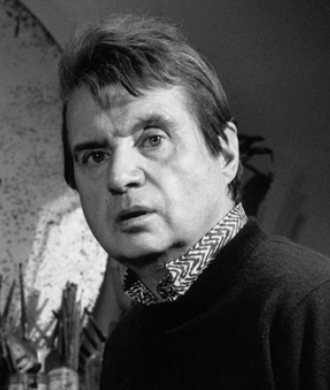
Bacon: Studio move
Cruelly cut
In: Derek Jacobi; out: Stella McCartney
SIMON DAVIS
IT IS a ghastly business, the world of film; a long boulevard of countless shattered hopes and dreams. This would now seem to be the case for Stella McCartney, talented designer and daughter of Sir Paul.
She, along with many others from the world of art and fashion, was invited to appear in the forthcoming Francis Bacon bio-pic, Love Is The Devil. And, indeed, she did. marking her cinematic debut alongside Derek Jacobi (who plays Bacon) and Anita Pallenberg. But now she faces dreadful disappointment; her appearance has ended on the cutting-room floor.
“Stella was meant to be in the film, but will not be appearing,” a lachrymose spokesman for the production company tells me. “I'm not sure what the exact reason was, but it is usual that, when they edit, some people end up missing out.” A bad, bad business.
Donation coup for Ireland
AIDAN DUNNE
The donation of the contents of Francis Bacon’s studio to Dublin’s Hugh Lane Municipal Gallery represents a remarkable coup not only for the gallery but for the country. It also leaves London’s Tate Gallery with egg on its face, if reports that it looked the gift horse in the mouth when it originally received an offer prove to be correct.
The notion of recreating an artist’s studio in a gallery may sound slightly perverse, and in the case of many artists the exercise would be fairly pointless. A studio at its most prosaic is just a place of work, and what counts is the work done there, not the place. Some studios, however, acquire a certain mystique, and the so-called School of London painters have done rather well in the mystique stakes. There’s Lucian Freud’s spartan interior with its bare boards and over-stuffed couch, Frank Auerbach’s crumbling, icy chamber with its outside toilet and, not least, Bacon’s messy domain. The room in Reece Mews where he worked from 1961 until his death in 1992 is famously crowded and chaotic.
But it’s not just, as appearances might suggest, a product of the disorder attendant on an anarchic lifestyle. It is in itself a nutritive mulch out of which blossomed the strange visions of his painterly world. Unlike Freud, Bacon preferred to paint from secondhand sources – he said the slight removal from reality of a photograph spurred him all the more to try and capture the real – and the books and photographs that litter the studio are the raw material of the paintings. So much so that a catalogue of this jumbled archive would undoubtedly shed great light on his references, his working methods and his thought.
To some extent this has already happened in the documentation of his use of an Eisenstein film still, Muybridge’s The Human Figure in Motion, an old medical text book on radiography and John Deakin’s photographs of Henrietta Moraes, but there is certainly much more to be learned. The primary importance of the donation is likely to reside in this material, together with the striking physical presence of the working environment, with its paint-encrusted furniture and fittings, its walls and doors pressed into service as impromptu palettes. Beyond the apparent chaos, Bacon’s output was monitored and well documented so it is extremely unlikely that, for example, there would be a treasure trove of neglected works languishing in a corner.
With the exception of a single unfinished self-portrait, the work that remained in the studio is likely to be not so much incomplete as abandoned and rejected – sometimes violently, for he was known to slash unsatisfactory paintings with a razor. That the studio is being preserved reflects well on John Edwards, the sole inheritor of Bacon’s estate.
At the time of the artist’s death, a value of £60 million was mooted, though a much more conservative £11 million was eventually agreed. The discrepancy had to do with the unpredictability of the market value of paintings. About a year and a half later, Edwards spoke to Bacon’s biographer, Andrew Sinclair. "I am going to keep the house and studio exactly as it is," he said. "I am going to live in it until I die and then donate it to the nation when I pop off. Then it’s up to them what they do with it." It didn’t quite work out like that, but in all essential respects he has been as good as his word.
Bacon’s final art work on display in Dublin
BY AIDEEN SHEEHAN
ARTIST Francis Bacon’s final work was displayed in its new home at the Hugh Lane Municipal Gallery of Modern Art yesterday.
The unfinished self-portrait, which was unveiled by Arts Minister Sile de Valera and Lord Mayor Joe Doyle, is part of the bequest of the Dublin-born artist’s studio and its contents. The canvas was still on the easel when he died six years ago.
The studio, which will open to the public in 2001, will be a very strong attraction internationally and will be a tremendous boost for the north inner city, Arts Minister Sile de Valera said.
Museum Curator Mary McGrath estimated the total value of the bequest at £50m. Francis Bacon is the highest selling post war artist in the world, with finished paintings currently fetching £5m to £6m, she said.
COMPETITION
The Hugh Lane Gallery won out against heavy international competition with Japanese and US galleries offering substantial sums to gain the studio from its owner, Bacon’s close friend and heir, John Edwards.
The studio will be recreated exactly as it was when the artist died in 1992. As well as unfinished paintings and drawings, the studio includes books, photographs and equipment.
An exhibition of photos of the studio and a collection of his artworks will open in the Hugh Lane early next year, as a taste of what is to come.
Bacon back in a city that still ignores him
Saturday Profile: Francis Bacon
ROISIN INGLE | THE IRISH TIMES | SATURDAY, SEPTEMBER 5, 1998
If Picasso had been born in Dublin, would we have erected a plaque to mark his place of birth? It is a question that seemed poignant after reports that Francis Bacon’s messy London studio is to be dismantled and reconstructed in the Hugh Lane Municipal Gallery of Modern Art — right down to every last spent tube of cadmium red. The answer of course is yes. Similarly, in most other countries in the world, 63 Lower Baggot Street, Dublin 2 (then a private nursing home), where Bacon was born, would be adorned with a discreet piece of brass. Engraved on it would be Francis Bacon, artist, born in this house, October 1909. As it is, the house is now occupied by O’Rourke, Reid and Co solicitors. Not surprisingly, a receptionist in the office this week said she had no idea that such a luminary breathed his first somewhere in the building.
Such sniping is not to suggest that Bacon, hailed as one of the most intelligent men to ever hold a brush, ranks quite up there with Picasso. He is generally regarded as one of the most significant painters of the 20th century but one critic thought he ranked more alongside Stanley Spencer than the revered Spanish painter.
The combination of flamboyant genius and what some politely describe as an emancipated lifestyle, however, meant he was afforded mythical status long before he died.
He lived in Ireland for 16 years. His father was a horse trainer, with whom Francis had a somewhat strained relationship. He seldom if ever visited the country after he left but it did hold some endearing memories. In a rare interview which took place in his small house in London’s West End he told Irish Times critic Brian Fallon he could still remember the tramp of hooves and the ring of trumpets as the British cavalry trained at the Curragh Camp.
The strain grew too much to bear. At the age of 16 his father ejected Francis from the house in Laois. He had been caught trying on his mother’s underwear. The tapestry of myths surrounding Francis Bacon was already being designed.
From Ireland he went to Berlin and then to Paris. While on the continent he began to appreciate art and in Paris saw an exhibition of Picasso whom he later accepted was an early and solitary influence. When Bacon himself began to paint seriously, though, his single-minded originality was never in question. He started off designing furniture when he returned to London to supplement a £3 allowance sent weekly by his mother. Between the first World War — as an asthmatic he was exempted from military service — and the second World War he began to develop as much as a bohemian as a painter.
Fame found him before his artistic genius had blossomed. He was a central figure in the Soho set. The Colony Club, which was frequented by an elite arty crowd including poets George Barker and Sydney (W. S.) Graham was his stomping ground. He held an enviable position within Muriel Belcher’s club. "She was a unique woman," he told Brian Fallon. "She thought I knew a lot of monied people, so she said she would pay me £10 week to bring them in and all drinks paid." By the late 1940s, the Screaming Popes series had singled him out as an artistic force to be reckoned with. He was self-taught, he claimed, and left much to chance in his work. According to critic Michel Leiris, his paintings "help us, most powerfully, to feel the sheer fact of existence as it is sensed by a man without illusions".
To others they were profoundly disturbing, his stark triptychs coming decades before the bisected formaldehyde creations of Brit Art’s Damien Hirst. Gaynor Duffy, an artist with a site dedicated to Bacon on the Internet, said his preoccupation with headless torsos and hanging flesh "suggests he studied Grays Anatomy whilst high on something".
He was feted in the art capitals of the world and contracted to Marlborough Fine Arts. The prices for his work soared and by the 1960s he was part of the existentialist movement – a roving intellectual with a fondness for the writings of Yeats and Beckett. The media coverage of him was extensive and world-wide but in the main unsolicited.
A typical day for Bacon would start with furious painting. He did not draw but painted directly on to the canvas, sometimes merely raising his brush and splashing at it for inspiration. Lunch would be in Soho seafood restaurant Wheelers, where he would stand everyone champagne. His generosity and antipathy towards the immense fortune he was amassing were legendary. Later he and his friends would retire to the Colony Club for more champagne. A spot of gambling usually followed. One Irish Times letter writer suggested that he had picked up his gambling habits in a Baggot Street bookies and added that despite his British parentage his preoccupation with sex and religion were uniquely Irish.
Bacon’s homosexuality certainly piqued the public’s interest although he was not known to flaunt his sexual orientation often. Once though he did turn up at an exhibition with a string of the type of tough-looking men he preferred trailing behind. There are stories that he often paid for this predilection with severe beatings. He also had his share of perfectly stable relationships, although his boyfriend, George Dyer, killed himself the night before Bacon’s retrospective in Paris in 1972.
In the late 1970s he met John Edwards, now his sole heir. It is he who has donated the studio to the Hugh Lane Gallery. He said the Tate turned it down. The Tate says it was never offered the studio. Bacon died and was cremated in 1992. His life story has been made into a film, to be released before the end of the year, in which Derek Jakobi takes the title role.
And now a slice of Bacon is coming home to a country he never really cared for, to a city that does not deem him significant enough to mark his place of birth.
In the art world it is seen as a major coup but one can’t help speculating that if ashes could spin, that’s what Francis Bacon’s would be doing.
The sleazy side of Bacon
Francis Bacon’s sado-masochistic love affair with an East End villain is the subject of
John Maybury’s Love is the Devil Insight into a tortured mind or plain muckraking?
By James Mottram
JAMES MOTTRAM | ARTS | THE WEDNESDAY REVIEW | THE INDEPENDENT | 9 SEPTEMBER 1998
Francis Bacon’s sado-masochistic love affair with an East End villain is the subject of John Maybury’s Love is the Devil. Insight into a tortured mind or plain muckraking.
"WHAT I wanted to do with this film was make a Powell and Pressburger Carry On, which I think I’ve done," says John Maybury, the director of Love is the Devil.
Francis Bacon, denizen of the late 20th century art world and subject of Maybury’s Impressionistic rendering, doubtless would have approved. At home with culture and class at both ends of the spectrum, his work is a crossbreed of the lush and the grotesque: Bacon the man, and the artist, is once more the centre of controversy.
Subtitled "Study for a Portrait of Francis Bacon", Maybury’s film is no biopic, eschewing most of the painter’s 83-year existence in favour of his short-lived and tragic love affair with muse and marginal East End villain, George Dyer. "It’s not a film about painting," says Maybury. "If you want to find out about Bacon there are dozens of great documentaries: you can go and watch them. It would have been really pointless to have made a Wilde, for instance. It would have been hugely disrespectful to Bacon, and also to the modernness of his achievements, to do something like that. It needed a more abstract approach to be worthwhile."
Opening, in 1971, with Bacon’s triumphant retrospective at the Grand Palais in Paris (just as Dyer is fatally cramming pills and booze down his throat in a nearby hotel), the film crawls back through the mire of the late Sixties Soho drinking elite, setting itself for the most part in the squalid Colony Room club, presided over by the frighteningly vile Muriel Belcher.
With Derek Jacobi and Tilda Swinton on hand vividly to bring to life Bacon and Belcher, Maybury sets out to show the dark side of the man: Bacon the sado-masochist, the humiliator, dragging Daniel Craig’s Dyer through the gossip and verbal barbs until, as the director puts it, "he just fell apart".
"There was something inherently disruptive in the nature of Bacon’s relationships. There is a certain pre-destined inevitability in Dyer’s demise. He is almost sacrificed to fertilise the art. By the end, even his sub-conscious no longer belongs to him," says Maybury. That, a decade before, Bacon’s previous lover, Peter Lacy, died on the night of the artist’s Tate gallery retrospective fittingly satisfies this inexorable wheel of Greek tragedy. A subject, of course, that influenced Bacon’s work tremendously.
Preferring to visually represent the Bacon/Dyer dynamic as a shifting canvas, Maybury uses film the way Bacon uses paint. "I wanted to make the film look like Bacon’s paintings. His work told us how to design the film: the claustrophobia; the airless rooms with white, lardy English flesh; the cigarette-stained, drink-sodden beings – it’s all there."
Such a warts-and-all approach was bound to stir up trouble. Not what the BBC had in mind when hiring Maybury for the project. One executive even ludicrously suggesting the film be given a happy ending. Early script drafts were deemed "prurient"; Malcolm McDowell, Maybury’s first choice for the role for over a year, dropped out without reason; the critic David Sylvester denied access to his definitive interviews with the painter.
Lord Gowrie, Chairman of the Arts Council and one-time friend of Bacon, objected to the use of the word "cunty" in the script, insisting on its removal before access to a pounds 250,000 lottery grant would be given (Maybury did so, only to replace it upon shooting). Unsurprisingly, the Bacon estate also refused permission to use his paintings in the film, while Bruce Bernard, brother to Jeffery and one of Lucien Freud’s models, maintained that not enough time had elapsed since Bacon’s death in 1992 to assess his life properly.
"There is a great sense of ownership over Bacon," says Maybury. "People who had a vested interest in him – whether it be the estate or people who have made careers out of him – wanted to protect their investment. The irony of that is that Bacon was one of the most honest public figures I can think of – about who he was and what he got up to. They didn’t want it dug up again. It suits certain people to isolate Bacon from his life, because it’s a bit messy. People wanted me to show Bacon as this great intellectual figure."
As for Dyer, Maybury drew a blank from most of the people he spoke to for a character reference: "He was like a cipher. It was like he didn’t really exist. The only tangible thing I could grasp was the sort of envy people felt towards him because he was being painted by Bacon. The funny thing is, I underplayed a lot of what went on, but to pretend it did not happen at all would be dishonest."
A hallucinogenic nightmare committed to celluloid, Love is the Devil is as radical in its own way as any of Maybury’s previous works. Friend and collaborator with the late Derek Jarman, working as a costume and set designer on Jubilee, and editor on War Requiem and Last of England, Maybury himself has known what it was like to be the darling of the avant-garde. The recipient of retrospectives at the ICA, he produced "dirge- like" Super 8mm essays, alongside work for the Michael Clark dance company and performance artist Leigh Bowery. He supplied designer Rifat Ozbek with a kaleidoscopic tape of his models in lieu of a catwalk presentation, and produced Remembrance of Things Fast, a treatise on Aids and the media.
Fascinated by Bacon’s work from his time as a fine arts student at North London Polytechnic, Maybury’s film is a reckoning with this past existence. Skirting Bacon’s world 20 years ago when first introduced to the Colony Room ("I never met him, I was too terrified"), Maybury’s deliberate cameos, from Turner Prize contender Gary Hume to Stella McCartney and Anita Pallenberg, suggest a critique of the art world, as much as of the artist. A world, of course, to which Maybury has attached himself.
"There are people there who are all too ready to rip you to shreds. If you can hold your own in that company, you’re one of them," recollects Maybury of the Colony Room. "There’s an enormous warmth in that bitchy humour, which I think people have missed. It’s not evil, it’s inclusive. If they make an effort to be vile to you, it means 'Come on in!’ " Comparisons between chronicler and chronicled become too tempting: Love is the Devil is an invitation to an exclusive netherworld.
Love is the Devil opens next Friday.
The culture of ugliness
Francis Bacon’s art is perversion framed and hung upon a wall, and
instead of cooing over it we should reject it, writes Mary Ellen Synon
MARY ELLEN SYNON | PEOPLE | SUNDAY INDEPENDENT | SUNDAY, SEPTEMBER 13, 1998
YOU may not know the work of Francis Bacon, the English painter who died in 1992, but you would have heard his name these past few weeks: for Bacon’s studio has been donated to the Hugh Lane Municipal Gallery, and the Dublin intellectuals have been cooing – and cooing in just the manner one knew they would.
The studio is “a prize”, they said, not just for the gallery, but for the country. It is the “most important bequest ever” for the gallery; and it is “a significant addition to the cultural life of the city”. All of which only demonstrates that Irish intellectuals, like most intellectuals, are wilfully blind.
Anyone who has ever looked at Bacon’s work, and considered its moral implications, can reach only one conclusion: Bacon was an artistic degenerate. Though perhaps that is why our intellectuals embrace him. Consider what Bacon presents for us to view. He paints nudes with the look of decayed carcasses; women with faces reduced to entrails (one woman with her flesh pinned to a bed by a hypodermic needle); men with no more form than a frog embryo, hunched on lavatories; human heads reduced to animal mouths screaming in glass boxes.
And do not, amid all this degeneracy, tell me to notice how well Bacon handles paint. To have talent and to use it for an immoral end only makes the degeneracy worse. If one wants to admire the use of paint, then go instead to the National Gallery and observe the 17th-century head of an old man, which may be by Rembrandt. While I have reservations about Rembrandt’s philosophy, at least his pictures are not an overwhelming moral hazard.
Yet the intellectuals tell us that Bacon’s clear degeneracy is art, and the crowds pour into galleries around the world to see such things.The thought of which disturbs me so much that I must return for an hour’s thumb-sucking over the great Max Friedlander’s book, On Art and Connoisseurship, before I can settle again. The great Friedlander, even in the dawning years of this degenerate century, saw such things: “Since it has been successfully conveyed to the public that it must praise what displeases it, the public agrees to everything.” Let me go back to a definition of the work of an artist which I have presented before: the work of an artist is to choose some part of existence which he thinks is significant and to transform it into a work of art for others to contemplate.
SIGHT is what an artist does with his eyes, but vision is what he does with his mind. It is his job to take that vision of existence from his mind and to make a work of art which conveys that same vision of existence from the artist’s mind to our own. In Bacon’s case, when “the public agrees to everything”, they agree to accept a vision of Man as no more than a decaying side of beef. The intellectuals tell us to accept such a vision for this underlying reason: they wish to destroy the concept of values, they wish to deny what reason tells us that there are ideas, concepts, philosophies, visions which are objectively superior to others.
By holding up a vision of Man which is degenerate, and asking us to contemplate it as art, to value it, to absorb it, to introduce its concept into the furniture of our minds, these intellectuals are saying that we ought to embrace the notion that Man is no more worthy than a carcass of beef – that a vision of a man who is no more than a screaming mouth is as valuable, as worthy of contemplation, as a vision of a man who is whole, rational and victorious. This is moral relativism. This is saying that the best is of no more objective value than the worst. And that notion is the key perversion of the 20th century.
That is why one ought to reject Bacon’s art. It is perversion framed and hung on a wall. And by perversion, I make no reference to his colourful private life. I discount Bacon’s sluttishness when I look at his work in the same way I discount Caravaggio’s murderous nature when I look at his: though of course the intellectuals do not
It now appears that Bacon's way of life he was a promiscuous sado-masochistic sodomite is one of the reasons the intellectuals rush to praise the man, and for the same reasons they praise his pictures: for, again, they say that all ways of life are to be valued equally, so that the best, the most moral, is of no more value than the worst. (The cliché is, “All life-style choices are equally valid.”)
I WOULD always support the right of a man such as Bacon to decide for himself how to live. But the intellectuals now insist that I value that choice as well. I do not; I abhor it. And I will no more accept Bacon’s life as a subject worthy of contemplation than I will accept Bacon’s pictures.
Yet his life, too, is about to invade Dublin. A film is out now which traces his relationship with George Dyer, an East End burglar with whom Bacon began a violent sexual relationship on the night Dyer tried to burgle his house. This is the sort of man whom the intellectuals think is worthy to be the hero of a film: “a drunk, gambler, sado-masochistic homosexual, emotional monster and millionaire who worked in a tiny squalid studio”. Bacon’s life, like his work, was morally ugly.
This shrine to Bacon, this grotto of relics that the Municipal Gallery is about to bring to Dublin, ought to be rejected, for it is just that – a shrine, a grotto to the 20th-century cult of the ugly.
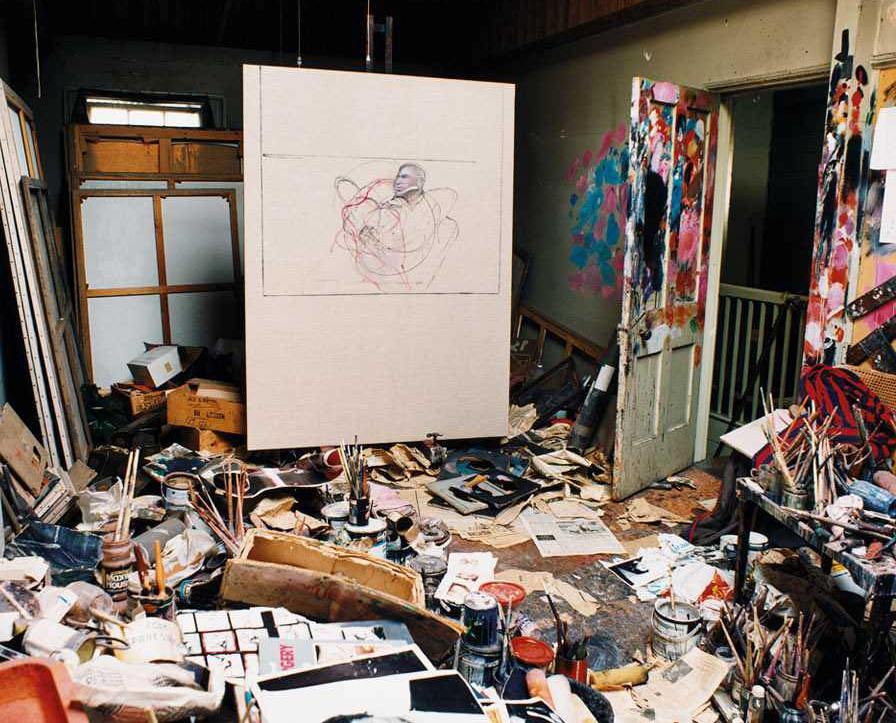
BOOBY PRIZE? Francis Bacon (inset), whose studio (above) is being given to Hugh Lane Gallery
Bringing home the Bacon
Marianne Hartigan views Francis Bacon’s studio in all its messy glory
MARIANNE HARTIGAN | ART REVIEWS | THE TRIBUNE MAGAZINE | SUNDAY 13 SEPTEMBER 1998
Many a teenager round the country will be glad to get a glimpse of Francis Bacon’s studio when it is finally on display to the public. It is such an amazing mess, an incredible assemblage of brushes, paints, books, newspapers, clothes and canvases that it would make most youngsters’ rooms appear pristine in comparison.
Painter Francis Bacon (1909-1992) worked in this room in Reece Mews, from around six am till early afternoon almost every day he was in London for over 30 years. Even if one was not aware of his highly original, disturbing, artistic output which made him one of the most important artists of the 20th century it is obvious from the innumerable jars stuffed with paint brushes, the mounds of half-squeezed tubes, half-full cans of colour, the sponge rollers, the vibrant paint bespattered walls and doors where colours were tried out, that this room was witness to years years of intense to years of intense creativity.
And now this kaleidoscopic hive of industry, including his last unfinished work, is to come to Dublin, birthplace of Francis Bacon, as a gift from his heir John Edwards to the Hugh Lane Municipal Gallery of Modern Art. (Rumour has it that The Tate Gallery refused it and are now kicking themselves, although they deny they were offered it.)
Though at first it appears almost incredible that anyone managed to get any work done in here, there is method in this madness. It is discriminate chaos. His sources of reference, his books which he used repeatedly, his huge collection of photographs, were all near at hand, says Barbra Dawson, director of the Hugh Lane Gallery.
This room is like a diary of the last 30 years of his life. He was a flamboyant extrovert. But he seldom let people into his studio, and this room reveals the other side of him. And indeed, on closer examination, the layers of accumulated material give an intimate insight into the workings of this extraordinary painter.
We can see how he stood at his easel with the light coming in from behind him. How he mixed his colours – sometimes on the wall – and how he painted directly and furiously onto the canvases. In the midst of this jumble are crumpled drawings, photos of young men, books on African animals, photos of friends such as Muriel Belcher, Isabel Rawsthorne, Henrietta Moraes, Lucian Freud, George Dyer and others with whom he shared his flamboyant lifestyle, as well as a number of canvases with areas deliberately removed.
Before his death he asked John Edwards to destroy a number of canvases, but these were not among them. The significance of these mutilated works is not really known. He was very exacting, as a painter, very demanding of himself, says Dawson. He was very aware of the vulnerability of the person.
He felt his works were part of him. He was very aware of the hair’s breadth between living and dying. Perhaps he didn’t want to part with these works. When the studio contents are documented and the invaluable archival material gleaned from it the whole lot (minus the drawings which will be framed and hung alongside other Bacon works on loan) will be reassembled to the original shambolic state so the public can see for themselves the studio of the artist who in his works strove for the most elemental state: so that you have the very precise story, which is deeply complicated, and so difficult to find.

The bequest of Francis Bacon’s studio to the Hugh Lane Gallery is Dublin’s gain and London’s loss
Which Tate are we in?
HUGH PEARMAN | THE SUNDAY TIMES | SUNDAY 13 SEPTEMBER 1998
Interviewing Nick Serota, director of the Tate Gallery, is what I imagine consulting the oracle at Delphi to be like. Serota fills the role of interpreter, the one who put into measured but still puzzling stanzas the frenzied utterances of the entranced Delphic priestess. You go, you pose questions, you take note of the gnomic utterances, and then you return home to try and work out what it all means.
You examine his words, line by line, and it becomes possible to make an informed guess. Does Serota really say that he thinks the hugely acclaimed new Guggenheim Museum in Bilbao is a seriously deficient museum? That our leading sculptor, Sir Anthony Caro, was a bit of a troublesome old codger as a Tate trustee? That he expects the Government to give him a lump-sum payment of £10m to buy new art for his new Tate Gallery of Modern Art at Bankside? That he fears the crowds may vote with their feet and decamp to international modernism in Bankside in 2000, leaving his revamped Gallery of British Art at Millbank the poor relation? No, he does not. He does not say any of these things directly. He is a master of the oblique.
Neither does he acknowledge outright that the Tate has a rather poor collection of classic European modernism, compared with other leading museums – though he comes close. He does not say that the annual conceptualists’ shindig, the Turner Prize, has become a Frankenstein’s monster, distorting public perceptions of what the Tate and its collections is about. He does not say that he regards the Chelsea studio of the late Francis Bacon – which has now been snapped up by a Dublin gallery – as a poor thing, not worth the Tate’s patrician consideration. He does not admit in as many words that some people half-expect him to move on, once the big London reorganisation of the Tate has been completed in 2001. But despite not saying these things – or not in those words, anyway – he touches on these subjects. You are left with the impression that these may well be his views.
Now the Tate has commissioned the corporate identity specialists Wolff Olins to come up with ideas as to how to present the impending dual-identity London Tate and to come up with snappier, more memorable, names than the two on offer at present: respectively the Tate Gallery of British Art (Millbank) and the Tate Gallery of Modern Art (Bankside). There is the potential for confusion, no doubt about it. Serota says: "The question that’s always asked is – where will I find Francis Bacon, or Damien Hirst? – and the answer is really quite simple: in both. What you will find here at Millbank is 20th century British art in the context of a tradition of British art going back to 1500 – and there at Bankside you’ll find 20th century British art in the context of an international 20th century".
All clear, everyone? Right: here’s the Serota line on the weaknesses in his international modern collection: "One answer is that museums are only partly about the inherent quality of the collection. As important, in my view, is the way in which they use that collection. So you can have a brilliant collection, but display it rather poorly, and your museum will not flourish." The implication being that the Tate has a rather poor collection compared with some, but will display it brilliantly: however, he does not say this. The remark puts into context his desire for a £10m gift to buy new art for Bankside. "An imaginative gesture of that kind would make a big difference," he muses, while allowing he will probably be told to try the Lottery again, with uncertain success.
The affair of Bacon’s studio puts him especially on guard. The Tate was never approached with a formal offer for it, he says. He had sporadic conversations with John Edwards, inheritor of the Bacon estate, but it never came to anything. Did he regret the loss, I ask? He replies at a tangent. "The priority for us has to be showing Bacon’s paintings rather than his studio." He then praises the "whole experience" of Brancusi’s studio in Paris, or the Tate’s Barbara Hepworth studio and garden in St. Ives. So is the Bacon studio not up to that standard, I inquire? Serota sits up and stares straight at me. "Well – we’ll see," he replies, with a short laugh.
Just blood, sweat and fears
LOVE IS THE DEVIL (18) DIRECTOR: JOHN MAYBURY (90 MINS)
STARRING DEREK JACOBI AND DANIEL CRAIG
RYAN GILBEY | THE BIG PICTURE | THE THURSDAY REVIEW | FILM | THE INDEPENDENT | 17 SEPTEMBER 1998
FRANCIS BACON never ventured into film, though his work was informed by cinematic possibilities, and cinema could happily be inhabited by his spirit. He’s there in Last Tango in Paris, where his paintings are employed to usher in the mood of disquiet, while Donald Cammell admitted to arranging Bacon-esque compositions for Performance. The artist’s own tastes were raw and eclectic. It was said that he harboured a passion for the Rocky series — for its hyperbolic amplification of the wet, leathery thwack of fist on flesh.
This suggests a romantic fusion of art and man, but Love is the Devil, John Maybury’s film about Bacon, goes one step further. It mixes up his life and work as though the two were squiggles of paint on a palette, combined to achieve a pungent, unfamiliar new shade.
Love is the Devil distances itself from the territory of tortured artist biopic by virtue of its modest subtitle — Study for a portrait of Francis Bacon. While the film has discernible momentum, charting the dismal trajectory of the relationship between Bacon (Derek Jacobi) and George Dyer (Daniel Craig), his lover of seven years, it is closer to a collection of sketches or brief nightmares, each ending on an ambiguous cut or a tantalising fade-out. This is Maybury’s first feature, though his experience as an experimental film and video artist, not to mention former collaborator with Derek Jarman, has taught him to search out the soul of a subject without being cramped by narrative demands.
Cinema has never been shy of investigating homosexual desire provided that it all ends in tears, and preferably blood and sweat too, but Love is the Devil will frustrate those audiences seeking another Killing of Sister George or Prick Up Your Ears because it withholds explicit data on its characters’ pathology.
This sparseness backfires only once, when a passing reference to Bacon’s relationship with his father gives no indication of the regime of horrific abuse which passed for paternal affection. Mostly, the paucity of information effectively reduces love to appetite — a hunger for hunger’s sake. George simply tumbles into Bacon’s studio while botching a burglary. Bacon invites him to bed. The next thing you know, they have assumed the positions of a married couple: one languishing in the bath, the other poised at the shaving mirror. True, they don’t lunch with the in-laws or trundle around the Co-op together, but they share their own quaint, comforting rituals. Bacon kneels by the bed, and George lashes him with a belt. Lit cigarettes are also involved.
As with any great love affair, there is an ugly clash of backgrounds. Bacon lounges around in drinking clubs with an entourage of cackling, upper-class show-offs led by Muriel Belcher, whom Tilda Swinton plays as someone trapped midway through a transformation into a werewolf. George has his own surrogate family of Brylcreemed East End gangsters, and it’s a sweet touch that these minor Krays should be the only ones to express concern about George falling in with the wrong crowd.
Daniel Craig’s portrayal of this hopeless boy clambering after manhood is a glorious mess of poignant contradictions. George is a thug whose means of survival suddenly count for nothing in his new social circle. He quickly realises that if you slit the throat of one of Bacon’s taunting friends, you’ll be judged not on the efficiency with which you make the incision, but whether you’ve selected the correct knife.
The realisation imprisons George; when self-consciousness pervades this most fundamental level of behaviour, instinct is snuffed out. In fact, the film is full of images of imprisonment, self-imposed or otherwise. A recurring feature is the crane shot in which the camera slowly rises to peer down on Bacon from the top of a room which had appeared to be of normal dimensions but is actually revealed to resemble a cell.
For Cocteau, the mirror was a magical gateway to other dimensions, but in Maybury’s film it traps those whose likenesses it bears. Many of the shots are composed as fractured or multiple reflections in mirrors and silverware, or distorted images spied through the curve of a brandy glass. Maybury was refused permission to incorporate Bacon’s paintings in the movie, yet this restriction has granted him an unexpected freedom. Set alongside examples of the artist’s own work, the film’s evocation of its essence might appear tame. On their own, Maybury’s approximations of Bacon’s grotesquely beautiful style create the sensation of the celluloid being infected by the art, as though the film stock had been left too close to one of Bacon’s canvases.
This goes for Derek Jacobi too. He bears an eerie physical resemblance to Bacon — the eyes dead but for an occasional spasm of rage or lust, the face puffed as though from a jellyfish sting. He’s very good at translating Bacon’s sexual and creative restlessness into physical movement too, and the actor is helped here by Maybury, who often simply fixes the camera on him like a spotlight, magnifying every twitch and squirm.
The movie is not so much filmed from Bacon’s perspective as shot through the hairs of his paintbrush, just as A Man like Eva or Mishima: A Life in Four Chapters scrutinised their respective subjects through the fabric of their art.
At a boxing match, Bacon is elated by the collision of bodies and the spray of sweat; when a plume of blood is splashed across his face, he releases an ecstatic gasp, his expression mirroring the shot of the wounded nurse from Battleship Potemkin which had earlier inspired him. At other points, Maybury plays violently blurred close-ups in stuttering slow-motion to echo the thrashing, fleshy chaos of Bacon’s painting. It might seem paradoxical for the moving picture to struggle to replicate the effect of a portrait, but Bacon’s work was charged with a physicality that doesn’t so much lend itself to cinema as test the medium’s mettle.
It is fitting that Love is the Devil seems to be unfolding within a Bacon canvas given Maybury’s eloquent argument that both the artist and his model were trapped inside the work. There is no governing reality. Even outside the cluttered studio, there is a heightened artificiality which the real world cannot penetrate. During a television interview, the studio camera zooms into Bacon’s bloated mouth as though suddenly possessed by an attack of Baconitis.
It could be that Maybury plays his trump card too early, during a scene of Bacon plotting the composition of a new painting. He picks up a battered dustbin lid, paints around it and then turns to face us, wearing the lid on his arm while wielding a dripping paintbrush in the other hand. The makeshift sword and shield provide a piercing metaphor for a man whose art both reflected his world and protected him from it.
A beautiful but empty portrait
Martin Hoyle finds a self-consciously clever film about Francis Bacon alienating
MARTIN HOYLE | CINEMA | THE ARTS | FINANCIAL TIMES | THURSDAY SEPTEMBER 17 1998
Love is the Devil is so clever that it alienates you. This account of the painter Francis Bacon’s relationship with the petty East End criminal who literally dropped in on him (through the skylight) in the pursuance of burglary, is, appropriately, visually striking; but intellectually undernourished.
John Maybury’s first feature consists of beautifully composed frames, whether naturalistic dark interiors — such as the recreated Soho drinking club, the Colony Room — or the distorted spoon reflections and angular visions that echo the painter’s tortured style. But the dialogue is no great shakes, especially when evoking the brittle world of alcoholically arty cliquishness in the 1960s.
Bacon’s social assets amount to a camp bitchiness couched in the irritating terminology still found among homosexuals of a certain age, where other males are referred to as “she”. What attracted the rough George Dyer to Bacon — for, as the film emphasises, the attraction was deep and complex — is never made clear.
From Daniel Craig’s not-quite-convincing cockney to Tilda Swinton’s jaw-breakingly pukka Muriel Belcher (legendary dragon of the Colony Room), one vacillates between admiration at the cleverness of it all and the realisation that true cleverness should not be so self-conscious.
The air of calculation that permeates the movie is summed up by the use of present-day artists, and merely arty, as extras. Spot Maria Bjornson! Clock Anita Pallenberg! The implication that today’s bohemians correspond to their 1960s counterparts is tosh.
Derek Jacobi looks uncannily like the puffy-faced Bacon. Presumably the image of a cold, distant user of people is intentional, however diminishing the returns when applied to an unlike able central character. The film is as chill and detached as its protagonist; and leaves you as emotionally indifferent.
LOVE IS THE DEVIL (18) John Maybury
Bacon shows an unpleasant streak
CHRISTOPHER TOOKEY | FILM | THE DAILY MAIL | FRIDAY 18 SEPTEMBER 1998
THE week brought two exercises in fashionable camp The more respectable, Love Is The Devil, won the Michael Powell Award for Best New British Feature at the Edinburgh Film Festival.
Its leading actors, Derek Jacobi and Daniel Craig, won the Pathe British Performance Award, as the alcoholic, sado-masochistic painter Francis Bacon and his suicidal burglar boyfriend, George Dyer.
They inhabit their roles with conviction, but first-time writer-director John Maybury has no idea how to make their relationship appealing, or even interesting. Bacon comes across as a bitchy old queen with snobbish, drunken friends, and we never get to understand his craving to be used as a human ash-tray.
Maybury’s direction Is tiresomely tricksy, and he finds it Impossible to imitate Bacon’s nightmarish artistic style photographically.
This is really an inadequate South Bank Show which leaves us none the wiser about Bacon’s art, the importance of which we have to take on trust. Despite the financial support the film gained from the usual suspects (the British Film Institute, BBC, Arts Council, European Script Fund), it represents yet more Lottery money down the drain.
GREGG ARAKI’S anti-heroes in The Doom Generation are even less salubrious.
Two gormless teenage junkies (James Duval, Rose McGowan) go on the run after their friend, a bisexual drifter (Johnathon Schaech), blows the head off a Korean convenience store clerk. The drifter introduces them to kinky sex and the delights of serial killing.
This astonishingly brutish movie starts as if it were going to be a comic parody of Oliver Stone’s Natural Born Killers but ends up glorifying its anti-heroes with equal pretentiousness.
The plotting is puerile, if that, and the film is repellently detached from the crimes, inviting us to laugh in a desensitised fashion as more and more people are bloodily murdered, decapitated and dismembered. Pointless and sickening.
Love Is The Devil (18) Verdict: Portrait of Bacon falls to sizzle
The Doom Generation (18) Verdict: Moronic rubbish
RICHARD WILLIAMS | FILMS | THE GUARDIAN | FRIDAY 18 SEPTEMBER 1998
I came out of John Maybury’s Love Is the Devil, which is rather coyly subtitled “Study for a portrait of Francis Bacon”, feeling I’d never seen a film that makes such direct and illuminating connection with the eye of an artist. On the other hand, I didn’t know Francis Bacon, so I can’t tell whether the story Maybury tells us is true, in the literal sense. That bothers me. But if you want a brilliantly sustained imagining of how, according to some of the best available evidence, Bacon saw his world, and how he rendered that vision on to canvas, then Love Is the Devil is a very remarkable film indeed.
Their first encounter is handled with deft humour. When Dyer falls through the skylight, an amused and aroused Bacon invites him to bed. Maybury, best known for his design work on the films of Derek Jarman and his video clips for the likes of Neneh Cherry, Morrissey and Sinead O’Connor, gets the narrative off to a good start, and handles the tricky combination of story and reflection — in other words, the life itself and the life transmuted into art — with lucidity and a sure sense of cadence.
Adrian Scarborough as the creepy Farson and Karl Johnson as the pathetic Deakin make a fine pair of stooges, and a witches’ chorus is provided by Tilda Swinton as the foulmouthed Muriel Belcher, Anne Lambton as the perceptive Isabel Rawsthorne and Annabel Brooks as the cheerily libidinous Henrietta Moraes. Unwise cameos by the painter Gary Hume and the fashion journalist Hamish Bowles — as a Moraes conquest and a limp-wristed David Hockney, respectively — momentarily contradict but cannot do real damage to the prevailing seriousness of an exceptional film.
A secret side of Bacon
When Francis Bacon died he left everything to a man
who has become one of the great mysteries of the art
world. Mark Irving reports.
MARK IRVING | FEATURES | THE SCOTSMAN | SATURDAY, 19 SEPTEMBER 1998
When Francis Bacon died he left everything to a man who has become one of the great mysteries of the art world. Mark Irving reports Only in Britain can the reputation of an artist be improved by revelations of bondage and sado-masochism. Francis Bacon is one of the few British artists this century who can be said to enjoy genuine international acclaim, but while several of his paintings are undoubted masterpieces, the scandalous accounts of his lifestyle have had a huge influence on the way his work has been received by art buyers and the general public alike.
The feature film Love is the Devil: Study for a portrait of Francis Bu con, opened this week. Directed by John Maybury, it will only cement Bacon’s reputation as the brilliant bad boy of British art, the man with a cast-iron liver, a viper tongue, and an unrelenting taste in rough trade. The film focuses on the artist's relationship with his lover George Dyer, the brutishly handsome young man who, prone to depressive night mares, died of a drugs overdose just as the 1971 retrospective of Bacon’s work opened in Paris. Poor George has become a modern equivalent of Manet’s Olympia — an identity made famous through art — and it is evident that his inadequacy in coping with the massive emotional and intellectual imbalance of his relation-ship with Baron has underpinned Maybury’s study of Bacon’s private life
Outside this snapshot, however, stands another, shadowy figure, one that shies away from public scrutiny, It is the figure of John Edwards, the man who, after Dyer’s death, filled Bacon’s emotional horizon, and to whom he bequeathed his entire estate after his death in 1992. At the time it was said to amount to almost £12 million, but it has since been variously valued at £20-£60 million. He now owns and controls what must be the largest and single most important collection of works by Bacon in the world the refused Maybury’s permission to show any of the paintings on film).
Nobody outside his immediate family knows what’s in this collection, nor where it is held, which is rather like saying that no-one knows where the biggest private collection of Van Gogh or Monet works might be. Edwards, who has homes in Suffolk, Thailand and New York evades the press. The few photographs of him with Bacon he must now be in his late forties reveal him to be of fairly unexceptional appearance. And yet he inspired some of the artist’s most dynamic portraits, one of which even appeared on the French five franc postage stamp in 1992. In these portraits, Edwards is seen in various stages of facial deconstruction, but sometimes his resemblance is never quite as subsumed to the demands of the brushstroke as in the portraits of other models, even though his body is seen through the familiar distorting lens.
But then Bacon viewed the male human body as an instrument for sexual pleasure, rather than an object of aesthetic interest. Born into an ordinary farming family in North Essex that also had management interests in a number of East End pubs, Edwards met Bacon in 1974. His brother David runs an antique shop in Long Melford, while another brother, Leonard. lives nearby. Unable to read or write, Edwards wasn’t so much a lover of Bacon’s, but perhaps served as a filial figure for the artist, who had no children of his own. He is seen walking with Bacon in the opening sequence of a South Bank Show programme on Bacon in 1985.
His nickname for Bacon was Eggs, which implies a straightforward sense of humour which must have appealed to the artist, surrounded as he was with endless hangers-on, down-and-outs and bitchy bohemians. He came to play an increasingly important role in Bacon’s later years. as his confidant and major dorno, representing the artist on trips to Moscow, where Baron’s work was shown at the New Tretyakov Gallery in the autumn of 1988. Although Bacon died in Madrid, where he had gone to visit a young Spanish man he had been seeing. John Edwards remained the most important person in his life.
Being the single largest beneficiary of Bacon’s will made him the target of considerable envy from those “close” to the artist, and according to the art critic Brian Sewell: “it was a deliberate slap in the eye for those who were expecting at least a painting. He was obviously the least worthy person to receive the estate because he just didn’t have any eye for painting and wouldn’t care what happened to the works.”
This somewhat uncharitable view contradicts other people’s perception of Edwards. The late Daniel Farson, the journalist friend of Bacon for many years, wrote in his biography, The Gilded Gutter Life of Francis Bacon, of his visit to the Edwards home in East Anglia, where he saw a splendidly appointed and landscaped estate hidden behind “a magnificent high wall of flint.
Inside hung a 7ft by 5ft full-length portrait of Edwards, worth at least £2 million alone. Farson’s impression was of a man deeply respectful of Bacon and his work and aware of the extraordinary responsibility laid on his shoulders. He thought Francis had depended on John so much because in old age he had turned against many of his former friends.
Edwards’s hand in the dissemination of material relating to Bacon has become highly evident of late, Barbara Dawson, director of the Hugh Lane Gallery of Modern Art in Dublin, had direct dealings with Edwards concerning the gift in August of Bacon’s studio and its contents to the gallery in Ireland, the country where Bacon spent the first 16 years of his life. The Tate Gallery in London claims it was never formally offered this gift. But it has also been suggested that it did not consider the studio to be of much importance. Dawson underlines the key role Edwards had in Bacon’s decision-marking processes: “John was a collaborator in the editing process Francis put his work through. He ensured that those which were discarded were slashed and disposed of.”
The removal of the artistic management of the estate from the Marlborough Gallery earlier this year is another significant act on Edwards’s part. Marlborough, who had handled Bacon’s work for 25 years, has been replaced by the Tony Shafrazi Gallery in New York. Shafrazi is “excited by the prospect of showing works by Bacon with those of younger, contemporary. artists: This is a highly significant statement, alongside that of John Eastman: the American attorney to whom Edwards has given some executive authority over the estate, who says that any such show at the gallery of Bacon works from the estate is all about showing him being a great artist. It was East man’s sister, Linda McCartney, who took the last pictures of the Bacon studio in situ, the last pictures she took before her own death:
Any such exhibition — it is rumoured it will take place in November — is bound to cause an enormous stir, since most of the works would not have been seen in public for many years. Whether there are any financial motives on Edwards’s part is unknown. The estate is mute. And where does this leave the UK? The Tate, which has a dozen Bacon paintings, cannot but be interested to know what might be in the exhibition. In answer to charges raised by friends of Bacon that the Tate should be reflecting the international and national importance of the artist’s work by giving him a separate room at the gallery, Nicholas Serota will not say more than that Bacon “will be represented in a major way when the Millbank site is reorganised over the next year or so.
And Edwards? It seems the art world would do best not to underestimate the once-illiterate farmer’s son from Essex.

Francis Bacon in a rare picture with John Edwards.
Paint it black
It’s a good likeness of Francis Bacon, but an unpleasant portrait to view
TOM SHONE | CULTURE MAGAZINE | THE SUNDAY TIMES | 20 SEPTEMBER 1998
John Maybury’s Love Is the Devil (18) tells the story of Francis Bacon’s relationship with George Dyer, a petty criminal who tried to burgle Bacon’s flat and ended up staying the night and becoming his lover, before finally being driven to suicide, in 1971, by Bacon’s cruel treatment of him. Such at least is the meat of the story; although if that suggests a resemblance to the life-and-loyes curvature of the traditional biopic, the resemblance ends there. As its subtitle — Study for a Portrait of Francis Bacon — suggests, the film consists of a loose-leaf assembly of sketches of Bacon drinking, gambling, bitching — everything except painting — interleaved with hallucinatory flashes from the butcher’s shop of Bacon’s mind. The meat, in other words, gets minced.
In theory, nothing could be more appropriate. Bacon himself spoke of “deforming” his portraits into a likeness of his sitters, with the result that they all looked as if they had had a recent close call with Hannibal Lecter. If nothing else, Maybury’s attempt at a Baconian portrait of Bacon has you hoping he will one day try his hand at a biopic of Damien Hirst — neatly bisected down the middle and playing in two cinemas simultaneously, one would hope. It should also be good news for anybody who believes the biopic to be long overdue for a kick in the pants. Is there any more wretched genre? With a few notable exceptions, cinema tends to cringe in the face of genius — all those cries of “Great play, Oscar” and “Nice yellow, Vincent” — but relaxes in the company of lesser talents: the Salieris, Basquiats, and Camille Claudels.
In a way, that’s true here, too: Maybury’s film works best as a Brueghelian portrait of the various gargoyles and grotesques who propped up the bar with Bacon, pouring drink down their throats and scorn on one another. “I’ll only speak to you when you’ve shaved,’” John Deakin (Karl Johnson) snarls at Muriel Belcher (Tilda Swinton). Poor old George stands no chance with this bunch. It doesn’t help his case much that the movie’s deranged style — good on atmospheric fug, bad at peering through that fug at actual people — treats his ordeal as no more than an excuse to mount a slide show of images, and some pretty hackneyed ones at that: George in the bath, H watching his life go down the plughole; George descending a spiral staircase to meet his personal hell; George waking from a nightmare of bloody writhing figures, which is presumably what happens to you if you go to bed with Francis Bacon. “Christ, you’re a bore even in your sleep,” snaps Bacon. I must say I agreed with him. Much as the film encourages us to view George as a tragic figure, the guy couldn’t overdose fast enough in my book.
As for Bacon himself, Jacobi starts off with an uncanny visual likeness — he’s got just the right pasty man-in-the-moon face — and then proceeds to keep his distance. I loved the details of Bacon’s daily ablutions: brushing his teeth with bleach, dying his hair with boot polish, and caking his face with an impasto of foundation. Apart from one brief scene, the film spares us the acute embarrassment of actually watching him at work; would that the same were true of listening to him talk about his work. Jacobi has to deliver one hell of a lot of lines expressing the futile void of the negative nullity within our eternal nothingness. He sounds like an Adrian Mole rewrite of David Sylvester’s famous book of interviews with Bacon.
As a portrait of Bacon, Sylvester’s book still cannot be bettered — both for the terrier-like tenacity with which he goes at his subject, repeatedly and from all angles, and for the almost cubist rendering of Bacon that results. Maybury’s film, I fear, ends up falling right into the hands of Bacon’s detractors. Those who think him an arch pseud, surrounded by suckers and sycophants, his reputation propped up by the ailing myth of Soho’s gilded gutter society, will leave this movie with their snobberies pretty much intact. When Deakin peeled himself from the bar and announced: “I have had enough of gossiping about Francis’s private life. I want some air,” I was almost second out the door.
Rough trade fell through the skylight
Cinema
CHRIS PEACHMENT | ARTS | THE SUNDAY REVIEW | THE SUNDAY TELEGRAPH | SEPTEMBER 20 1998
DAUBING paint on canvas is a surprisingly photogenic activity, and there have been enough biopics of painters to constitute a minor genre in its own right. And painters also traditionally have had tormented lives so there is plenty of melodrama to go with the paint work. Just think of all those actors lopping off their left ear.
Francis Bacon didn’t go in for much self-torment. He preferred to do that to others. With his famous battle cry of “Champagne for my real friends. Real pain for my sham friends”, he said into whomever crossed his path with a tongue-lashing that amounted to sheer sadism. And John Maybury’s unflinching Love is the Devil (18) depicts the malice and cheap spite of Bacon’s demi-monde with lip-smacking relish.
The film concentrates on flacon’s seven-year relationship with East End wide-boy George Dyer, played with considerable sympathy by Daniel Craig. Dyer was a not very successful house-breaker who came crashing through Bacon’s mews skylight one dark night in 1964. Bacon took one look at this nice piece of rough trade and told him to take his clothes off and come to bed, after which he could have anything he wanted.
Dyer duly complied, but as the film slowly reveals, he didn’t get what he wanted, which was love. What he got was a lonely death on a toilet with a handful of pills. Bacon paid for a wardrobe of fancy suits for him, took him to all the right places, introduced him to the Colony Club in Soho, gave him a lot of money, plied him with drink, and even used him as a model for some of his most famous canvases. But love was not on the agenda, because Bacon didn’t believe in it. As far as the title goes, it seems clear that it was not love that was the devil, it was Francis Bacon.
As you might guess from the smeared, battered faces in his portraits, Bacon was mad about boxing and (something the film doesn’t pick up on) a fan of all the Rocky films. There is a telling exchange when he takes Dyer and some of the Colony Club down to the East End to watch a bout.
One of Dyer’s bent-nosed cronies advises him to watch out for his new friends: “They look like a right bunch of wankers to me” Later Henrietta Morses is recounting the Club’s bit of slumming and describes all the East Enders as “sad little men with their shabby little women”. In the general scheme of things, the gangster had the measure of the other party, and Henrietta did not.
Much has been made of how closely Derek Jacobi resembles Bacon, and it is true that he manages all the right details, from the floppy hair, dyed with boot polish, to the rounded face and pouched eyes. But he looks for the most part like a big camp baby, and anyone who ever saw Bacon will testify to the air of viciousness about him.
We know the stuff of Bacon’s art. But there is another film which captures his themes much better that a bio-pic ever could. If you want bodies made to look like carcasses of sexual meat, or animal couplings in bare unfurnished rooms, or the torment and cruelty of figures imprisoned by their brutish desires, then look out for a rerun of Last Tango in Paris, which incidentally had two of Bacon’s paintings in the credit sequence. Maybnry’s film may pull its punches on that score, but it is still compelling enough, and a dire warning about ever getting mixed up with an artist.
MATTHEW SWEET | CINEMA | THE INDEPENDENT ON SUNDAY | 20 SEPTEMBER 1998
Derek Jacobi has finally managed to find himself a film part that measures up to his talents. At a time when most of his acting contemporaries — the McKellens, the Holms, the Hawthornes — are the darlings of Hollywood, he’s been left behind, stuck in Cadfael’s cassock, and rather too reliant on the favours of Kenneth Branagh (who cast him in Dead Again and Hamlet) for film roles.
This might be because he’s never truly been part of the theatrical establishment, having always preferred to work outside the big subsidised companies. Or it might just be the toll that age has taken on him: the shape of his face has changed a lot in the past few years. It has filled out, and taken on a look of raddled helplessness that probably makes him more difficult to cast.
Not that this is a bad thing. He might have lost his cheekbones, but age has lent Jacobi’s distinctive mixture of airy wistfulness and veiled savagery a new depth. As Francis Bacon in John Maybury’s avant-garde biopic of the painter, he is monstrously good, resisting all temptation to romanticise the role. We see him watching the carnage of the Odessa Steps sequence from Battleship Potemkin, giggling and spluttering uncontrollably. We see him brushing his teeth with Vim and combing boot polish through his hair with such a calm assurance, you’d believe Jacobi did it every morning of his life.
Maybury’s film is loosely based on Daniel Farson’s memoir of Bacon, and focuses on the years the artist spent in the company of George Dyer (played by Daniel Craig), an East End bad boy who became his lover and dependant. The relationship ended in disaster: Dyer killed himself with alcohol and pills in a Paris hotel room, while his mentor was being honoured by the French arts minister at the Grand Palais. Farson’s life of Bacon is rather like Frank Harris’s life of Wilde: the biographer is the only one of Bacon’s hangers-on who emerges with his dignity intact. Maybury reproduces this view.
Bacon’s Colony Club cronies are a hideous brood of failures. The photographer John Deakin (Karl Johnson) is a seedy social misfit, and the club matriarch, Muriel Belcher (Tilda Swinton), is a dragon with a mouthful of rotting teeth. It’s only Farson (Adrian Scarborough) who doesn’t have some Hogarthian problem to do with gin or orthodontics.
Maybury has an expert eye for the charnel-filled sensuality of Bacon’s work, using wide angles and smudgy visual effects to achieve a near-perfect cinematic analogue for his subject’s brushwork. He ensures that the paint on Bacon’s palette has the colour and consistency of pureed flesh. And when Jacobi mixes his colours, the soundtrack slops and slurps as if he’s rummaging around in a sackful of liver. But, if I may quote Tina Turner, what’s love got do with it? Maybury’s film has a chilly vacuum at its centre, and watching it is a withering, glacial experience. “Pleasure is difficult to define, and I feel horror occupies much the same territory,” Bacon says in the script’s most direct comment on his art and his masochistic sexuality.
Even so, Maybury provides no moment of tenderness to help you comprehend the relationship between these men. The sex scenes, for instance, are a strange mixture of viciousness and timidity: in one, Jacobi bends over the bed in a pair of baggy Y-fronts, while Craig slips his belt and wraps it around his fist. A lit cigarette inches towards Jacobi’s skin. And cut. Even if Maybury had shown Craig beating seven shades of burnt sienna out of Sir Derek, I would have been more persuaded of their passionate engagement. But when things threaten to become intimate, Maybury dissolves into surrealism or social comedy, giving us more screaming popes or screaming queens. Considering that the film tells the story of how Bacon devoured Dyer, expressions of appetite and desire are oddly absent.
As I watched this film, I found myself clinging rather desperately to Jacobi’s performance, hoping to see him crack, willing him to betray a hint of regret, guilt or sentiment. Rather bravely, Maybury and his star have chosen to deny their audience that easy satisfaction. Instead, they offer you something that’s more difficult to appreciate than romantic tragedy: an icy portrait of a man who gulped people down like an oysters.
Love Is the Devil 18
JOHN MAYBURY
COLIN FRASER | INTERVIEW | CAMPAIGN AUSTRALIA | ISSUE 271 | OCTOBER 1998
John Maybury is a former art student, protégé of filmmaker Derek Jarman and avid fan of Francis Bacon (the painter, not explorer). Accordingly, when the BBC were working on a biopic of Bacon’s life, it was Maybury they turned to. In order to maintain the avant-guerilla filmmaker’s involvement, his demands to rework the project from original concepts of docudrama were met. Consequently Love Is The Devil stands as a work with grand artistic vision on a solid commercial foundation. Greenaway meets Peter Weir. And Colin Fraser meets John Maybury.
Maybury’s first love is fine art and it’s from that perspective which Love is filmed. That and certain legal challenges. “All the way down the line there was a lot of opposition to this film from the cultural gatekeepers. They said that I would damage Francis Bacon’s reputation which is bizarre since I don’t think a tiny film like mine could actually have any impact. Having said that, I understand their situation simply because they didn’t have any idea who the fuck I was: a young punk idiot who was fucking with Francis. So I sort of sympathised but at the same time any objection like that turned into an advantage.”
One of which was being prevented from using any of Bacon’s paintings within the film. Consequently Maybury adopted a visual style which mirrored the artists work without use of that work, freeing him to employ a contextual approach unimpinged by questionable reproductions.
“I had enormous opposition from the Estate of Francis Bacon who didn’t want this snot-nosed little git tampering with him. But it was an interesting experience even if only in visual terms. I’m under no illusions, obviously the film’s not for everyone. It’s not Crabtree & Evelyn bonnet-fatigue cinema. I’m an artist and I’ve no shame about saying that. This film is, I think, a work of art. But it’s also very funny in places, very miserable and depressing in others. It’s hard work. But most people are intelligent enough to walk into a cinema and engage in a piece of work that is difficult. We don’t always need to be stroked by Leonardo Di Caprio going down with Kate Winslet.”
Although Maybury has yet to see Wilde (for fear of bonnet-fatigue syndrome), comparisons to it and other biopics of leading artistic figures abound. Basquiat is one. Prick Up Your Ears is another.
“I read a lot of Orton before I started writing, just to get me in the mood. He’s a great touchstone for that period and kind of humour. There’s a wonderful anecdote in one of Orton’s diaries where his landlady comes in and says – ‘Oh, I had a terrible time the other day. I spilt a cup of tea on my lap and my vagina came up like a grapefruit!’ That’s really sick but it’s also fantastically funny. When writing Love Is The Devil, half way through the process I was sitting back smoking a joint on my second bottle of wine and realised how I hated these fucking people. They’re horrible, really vile. It started to bring me down but in a way it’s also the truth. It’s who these people are. A lot of what’s nasty in this film is very funny, black comedy.”
So what did friends, family and Bacon’s estate make of this representation?
“I was accused of being tabloidy despite Pappiat’s official biography which is so prurient and gratuitous; so obviously written by a straight bloke feigning horror at how gay men carry on in private. To me it’s nothing to get knocked about while having sex. Actually, I quite like it. But this film is deliberately restrained to make sure that it got onto screen. I didn’t want a Passalino Salo situation where I’d made a film no one would ever see.”
The principle narrative is the story of Bacon and his long term relationship with George Dyer. Beyond that, Maybury explores the cruelty of Bacon’s social circle, themes of cross-class attraction as well as S&M sex.
“I don’t think it’s a gay film. I think anyone whose been in a relationship should find something and if they don’t then they’re probably not in a real relationship. I think that’s the point. In the end, all relationships are power struggles of some kind; even passiveaggressive situations like Bacon and Dyer. It was important to tell the story of their love affair and that they have a sado-masochistic relationship. But what is interesting is that the psychologically it is actually opposite. That runs the story, that contradiction is all the way through it. It’s what interests me about S&M sex: the masochist is always in control because he or she can destroy the illusion at any moment. Fuck it right up. It’s all about fantasy and construct. You have to play the game and as soon as one partner stops, inevitably the person in control is the masochist. Just laugh at them and that ruins it.”
Out on the PR treadmill, Maybury, like so many artists, is forced to become an honorary spokesperson for all things gay.
“The LA leg of this trip has made me really quite reactionary, very anti-gay myself. I encountered a lot of people who said that we need more positive images of gays. Positive as in HIV or as in sunshine, lollipops and roses? Life’s not like that. I want the kind of cinema which makes me sit down and do some work. If an audience is prepared to take the film on, no matter how uncomfortable it might make them feel, then there’s something to be had from that experience.”
LOVE IS THE DEVIL Directed by John Maybury, With Derek Jacobi, Daniel Craig and Tilda Swinton
Biopics are usually a courageous step for any filmmaker. Largely turgid explorations of (sometimes though not always) extraordinary characters are frequent and seldom offer anything relevant to an audience. Basquiat springs to mind. There are a few exceptions (Prick Up Your Ears is one) and its pleasing to note that Maybury’s Love Is The Devil is another. Primarily concerned with the relationship between the painter Francis Bacon and his wrong-side-of-the-tracks lover, George Dyer, it’s a challenging film on many levels. Not only for its stylised vision but also because it is populated with extremely ugly people. While Bacon’s jealous entourage accepted Dyer into their world, they kept him from their hearts. Thus their fiery, S&M tinged romance was a difficult one with tragic results.
Unable to incorporate any of Bacon’s work in the film, Maybury was forced to adopt a graphic interpretation of his art, challenging the filmmaker in ways which have paid huge dividends. He was also fortunate to enjoy the talents of Swinton, Craig and especially Jacobi in the title role. The result is a highly textured film which forces the cinema-goer to examine the subject matter from a very unique perspective. Rather like watching the world through the bottom of a bottle while still making sense of it. A rudimentary knowledge of Bacon is not necessary to understand this film. In fact, it probably helps. ****
Inside an Artist’s Mind In a World of Torment
By STEPHEN HOLDEN | FILMS REVIEW | THE NEW YORK TIMES | WEDNESDAY, OCTOBER 7, 1998
Anyone who subscribes to the sentimental fallacy that great artists are nicer people than the rest of us (the reasoning goes that because they supposedly feel more than ordinary mortals, they must be nobler and more caring) hasn’t met many great artists. If anything, the reverse tends to be true: the obsessive pursuit of an artistic idea more often than not involves a ruthless tunnel vision that screens out anything that isn’t useful to the work or to the career.
Love Is the Devil, John Maybury’s searing portrait of the English painter Francis Bacon (Derek Jacobi) at the height of his fame in the 1960’s, is one of the nastiest and most truthful portraits of the artist-as-monster ever filmed. Its story of the colossally self-absorbed painter a self-destructive younger lover, George Dyer (Daniel Craig), begins when Bacon awakens in his studio one night to discover a burglar on the premises. Sizing up the thief as an appetizing piece of rough trade, Bacon makes a proposition: if the robber sheds his clothes and comes to bed with him, he promises, he can have anything he wants. The next thing you know, they’re a couple.
Bacon craves being totally dominated by other men, but the most you see of him acting out this fantasy is in an early scene where Bacon kneels over a bed while George knots a belt around his fist and aims a lighted cigarette at his bare back. Later in the film, he attends a boxing match where he watches intensely as one fighter smashes the other in the head, splattering a jet of blood onto Bacon’s ecstatic face.
But the movie also makes clear that the dynamics of dominance and submission work both ways. Outside the bedroom, Bacon is relentlessly controlling of his lover, who falls to pieces. Bacon refers dismissively to George as his ''odd job man,'' and locks him out of the house when he’s entertaining other sexual partners. When George tells Bacon he loves him, the artist wonders out loud what bad television show those lines came from.
Bacon is similarly high-handed with his circle of friends, whom the movie portrays as a viperish nest of supercilious hangers-on. ''Champagne for my real friends; real pain for my sham friends,'' Bacon caustically announces in one of several scenes of nocturnal carousal.
When a young painter who idolizes Bacon begs him to come see his work, Bacon retorts that the young man’s taste in neckties is proof he couldn’t possibly have any talent. In Mr. Jacobi’s uncompromising hard-edged performance, you can feel the cold fury burning behind Bacon’s glare.
What makes Love Is the Devil more than a disturbingly rancid love story is John Mathieson’s brilliant cinematography, which saturates the film with Bacon’s corrosive artistic vision. Although ''Love Is the Devil'' doesn’t show any of Bacon’s work, the look of the entire film resembles a Bacon painting.
Acidic lighting throws the characters’ faces into harsh relief, often shadowing their eyes and making their flesh appears to crumble. Certain images become Baconesque diptychs and triptychs through the use of mirrors. Some scenes are photographed through distorting lenses that stretch faces into sinister masks that dissolve and decompose. In a recurrent fantasy image of George, he is a flayed, bloodied figure leaping from a diving board into the void.
Here and there, the movie stumbles, and you can sense the budgetary constraints (a trip to the United States is indicated only by a picture of an American flag in the background). But in presuming to take you inside the mind and heart of a major artist, confronting the demonic aspect of the human condition, Love Is the Devil, which opens today at the Film Forum, goes as far and as deep as any movie has dared.
LOVE IS THE DEVIL
Written and directed by John Maybury; director of photography, John Mathieson; music by Ryuichi Sakamoto; production designer, Alan MacDonald; produced by Chiara Menage; released by Strand Releasing. At Film Forum, 209 Houston Street, South Village
Francis Bacons life examined in ‘Love is the Devil’
by Mark J. Huisman
FRONT ROW | ARTS & ENTERTAINMENT | GAY & LESBIAN TIMES | ISSUE 563 | 8 OCTOBER 1998
“The most interesting thing to me about Francis Bacon is his relationship with George Dyer,” says filmmaker John Maybury. His first feature, Love is the Devil, examines the life and work of one of modem art’s most celebrated painters. It opens at the Hillcrest Cinema on Friday, Oct. 9, (619) 299-2100. “In all the books I read, including the Bacon biography, Dyer is hardly mentioned. Most artistic muses in history have had biographies written about them. But not Dyer. It’s as if he’s been erased from everything. It is, I think, a form of homophobia.”
Sitting in a SoHo restaurant, Maybury’s trim frame and slight features belie his conversational ferocity, which is hinted at only by his spiky bright bond mop of hair. He takes a drag on his cigarette and blows the smoke out with a grand gush. “I’m not supposed to smoke in here am I?” Another drag. Another gush. “The Bacon estate and the critics who were Bacon champions really didn’t want the film to be made,” he continues. “They are trying to sanitize him, because he’s this great artist. But this element of his life is part of what made him great.”
Maybury based the film in part on longtime Bacon intimate Daniel Farson’s biography, The Guilded Gutter Life of Francis Bacon, but the estate would not allow any his canvases to appear in the film or be photographed for it. Maybury, however, found freedom in this limitation. "How interesting is it to watch paint dry? Or look at a canvas? When the estate refused permission, that was the most liberating thing of all.”
Maybuiys film, which fashions a dissection of Bacon’s approach to painting, may not traditional storytelling, but it’s gripping nonetheless. Maybury cites influences from the poems of T.S. Eliot — “The fragmentation of shots has the same fragmentation of language in The Wasteland” — and Greek Tragedy — “The Colony Club people are the Greek chorus, commenting on things as we go along.” Maybury immersed himself in writing by gay authors from Jean Genet to Oscar Wilde. He re-read all the plays of the famously irreverent, sexually daring Joe Orton, “to try and get myself in that mindset. That transgressive, weird, homo attitude.” But, Bacon reigned supreme.
“The shots and sequences are like brush strokes. And at the end, you have an entire composition. It didn’t need to have a flow the way linear narratives flow. It’s not a mystery. It’s about the dynamic, the sexual masochism and sadism and all of it they had with one another. But I also like the idea of moving toward something but never really getting there." Something like the sexual relationship between Dyer and Bacon who, in one scene, spots a squabbling couple and sighs: "Oh, they’re not happy. That’s what love is.” Is this a real Baconism?
“No, it’s me-ism,” Maybury says through a deafening laugh. “There’s as much of me in the film as there is of Bacon. I think that really pisses some people off. Especially my friends, who are a bunch of evil, vicious queens. They recognize me in the film, but they also recognize themselves.” Those very words deftly describe some of the film’s characters, people for whom mum would probably not like to pour tea.
“When I was researching the work, about three weeks in, I thought: ‘Why am I making a movie about these hideous fucking people? I hate these people!’ ” says Maybury. “But in the end, it’s about Dyer and Bacon.” Maybury, who wrote his first screenplay for the film, trusts his audience to follow the story.
“There’s a kind of visual language, with more abstraction, that people are able to understand now audiences are as smart as you let them be. I very much wanted to put the relationship between George and Francis in a film that visually did them justice, and I think 1 quite carried it off.” The accomplishment was decades in the making.
A London native who celebrated his 40th birthday last spring, Maybury attended art school at North London University in the 1970s and began making Super 8 films. He also met two people pivotal to his eventual artistic path. "I was great friends with Siouxsie and the Banshees, so I was hanging around that scene, making films. And I met Derek, who was also making Super 8s. That changed everything.”
This is the legendary late filmmaker Derek Jännän, whose films like Caravaggio and Edward II (both of which starred Swinton) are renowned for their visual style and politically informed texts. Maybury was set designer on Jarnan’s Jubilee (1977), edited The Last of England (1987) and designed and edited the war sequences for the directors highly acclaimed version of Benjamin Britten’s War Requiem (1988).
“The thing I learned most from Derek was generosity of spirit. He had an amazing ability to leave everyone to do what they did best. When I worked on War Requiem he never even came to see what I was doing or asked about it. He trusted me and just left me alone. That was extraordinary. I’m just so terribly sad he can’t be here to see this film. I think he’d quite like it.” (Jarman died of AIDS-related complications in February of 1994. Although we were not acquainted at the time, Maybury and I discovered during this conversation we had both attended his funeral that March, in a beautiful sunlit stone cathedral on the Kentish coast near his weekend cottage.)
After his first solo film and painting shows at London’s prestigious ICA in the mid-1980s, Maybury turned to music videos for badly needed cash. By 1990, he’d racked up a slate of work with Everything But the Girl, Boy George and, most famously, Sinead O’Connor, winning four MTV Awards for “Nothing Compares 2 U.” Maybury returned to making his own videos and films early in this decade, including an experimental film called Remembrance of Things Fast for Channel 4, one of Britain’s national networks, in 1993.
“They got more complaints than anything ever shown before,” he smiles, cigarette smoke again swirling about his head, the gold ring on one forefinger flashing in the light. “My favorite comment was ‘This director should burn in a lake of fire.’ Which is quiet poetic, really.” A seasoned traveler on the European film circuit, Maybury is not the least bit worried about his stateside debut.
“It’s almost shocking how much interest there is and how well the film is doing. It’s number four in the box office in London. Those two words have never really come out of my mouth before — box office.” Maybury quivers, momentarily racked by a disapproving twitch. “And the negative reaction we’ve gotten, well, you have to expect as well. I’d be kind of worried if there were none. There are a lot of intelligent people here who would like to be treated better by the arts in general. And this film’s for them.‘” Good buzz, bad buzz. Maybury is perfectly willing to live with the dilemma, and is already plotting his next cinematic tricks.
“Tilda and I are thinking of doing an electronic version of Medea. I like the idea of coupling with my new discovery of actors with a classic text and a modem medium. I’d like to apply the visual techniques of my video work to a narrative and see what happens.” Rather than set his sights on Hollywood, Maybury is looking just to the north. “I’ve optioned a book about the early years of counterculture in Haight/Ashbury. I actually think I could do something quite interesting with that.” A final drag. A final gush. ‘‘I like the idea of filming someone falling down the DNA strand.”
Bringing home the Bacon
‘Love Is the Devil’ biopic
BY GARY MORRIS | FILMS | BAY AREA REPORTER | 8 OCTOBER 1998
In a typical moment in John Maybury’s artful biopic of Francis Bacon, the ultra-queer painter strolls into his favorite pub, eyes the motley crowd of queens and fag hags, and grandly toasts, “Welcome to the concentration of camp!” Love Is the Devil is filled with such sentiments, apparently trawled from Bacon’s own words, which like his personality could be vicious or inspiring, and sometimes both at once.
Bacon was a charismatic figure in real life, but at first glance too enigmatic and — like his paintings — too downright creepy to be an obvious choice for the subject of a feature film. Audiences who have trouble grasping anything more complex than cars exploding and meteors hurtling to Earth will surely bristle at this Film’s bald treatment of an often unlikeable British aesthete who happily bares his ass for the brutal ministrations of an army of rough trade. Then there are those pesky timeshifts, which force the viewer to ponder precisely where and when the action is occurring, not to mention sudden interpolations of gruesome images from the unconscious of Bacon’s psycho boyfriend George. Those who don’t know Bacon’s work will be puzzled by the film’s playful, subtle recreations of it in the staging of scenes. The fact that Love Is the Devil is as good as it is, which is to say good indeed, is a testament to director Maybury’s skill in manipulating this tricky material and Derek Jacobi’s brilliance in interpreting the role of Bacon.
Wisely, the film doesn’t follow the rules of the standard artistic bio; it ignores the birth, youth, and death of Bacon in favor of a steamy seven-year chunk of his life, from the night in 1964 when he takes up with petty criminal and working-class hunk George Dyer to their divorce by suicide in 1971. Their meeting happens when the painter discovers his future husband preparing to rob him, and instead of calling the police invites him in for a night of S&M thrills. Jacobi plays Bacon as a reluctant Svengali, hiring George as model, fucktoy, and butch Boy Friday, succumbing nightly to George’s assaults, but angry and bored the next day at how needy he is. (George establishes decisively the mirror image of the “pushy bottom” in his “timid top.”) Daniel Craig plays the character as a desperate, demented Trilby whose immersion in a scene he has no real part in drives him to abusive rent boys, drink, and drugs.
Flesh and blood
Director Maybury, an artist himself who worked with Derek Jarman, immerses the viewer in the interior world of his subject. Bacon’s innovative portrayals of the human figure as a screaming shell of flesh and blood are the obvious inspiration for much of what we see — strobe-lit, blood-drenched images, distorted faces, autopsy photos, a mysterious naked gymnast always perched on the edge of a fall. When Bacon and his pals attend a boxing match, he practically has an orgasm when a spray of blood from the ring splashes his face. The painter’s inner world, it seems, is as grim as the paintings, and he’s the first to acknowledge it in dialogue that has the force of aphorism: “Sometimes a man’s shadow is more in the room than he is,” and a phrase that exactly mimics the paintings, “Who if I cry out would hear me?” Of course, George brings it all back to earth with his pitiful plaint about Bacon and his friends: “These people I’m running with ... they’d push me under a bus as soon as look at me!”
When Bacon isn’t getting solace from George’s teary-eyed buttfucking, or a beating by a blonde waiter who looks like a walking Nazi recruitment poster, he’s ensconced in the airless space of the local gay bar. This is the arena in whose nervous, brittle energy he seems to be most at home. Churlish fag hag Muriel (Tilda Swinton looking inexplicably like her mouth was mauled by a grizzly) reassuringly calls him ‘“daughter”; she in turn is dished by another, disfavored queen who tells her, “I’ll talk to you after you have a shave.” All the while, Bacon pontificates, regales, and insults this jaded coterie, raising even their eyebrows when he gives a toast worthy of James Joyce: “Champagne for my real friends; real pain for my sham friends.”
Director Maybury took a welcome risk in portraying Bacon’s “lifestyle” without apology, with numerous tableaux of S&M lust, and a lingering full-frontal nude scene for George (in a bathtub). (See Adrian Lyne’s atrocious Lolita and the gay-sanitized 54 for contrasting examples of films that are sex-apologetic.) There’s no attempt to make Bacon lovable — he wasn’t in real life — but the film does make him understandable, to the extent possible with a subject so devoutly elusive.
Love Is The Devil opens Friday, October 9 at the Embarcadero Cinemas in San Francisco
Andrew Lambirth on the value of interviewing artists as a means to
understanding their work
ANDREW LAMBETH | EXHIBITIONS | THE SPECTATOR | SATURDAY 10 OCTOBER 1998
Recently rereading David Sylvester’s endlessly fascinating book Interviews with Francis Bacon (Thames & Hudson, first published in 1975, reprinted 1995), I was struck anew by how easy it is to assume that its effortless flow is due to the brilliance of Francis Bacon’s talk. However marvellous a conversationalist Bacon was, people do not talk ordinarily in perfectly structured sentences filled with polished clauses. The success of the Bacon inter- views lies first of all in Sylvester’s skill in asking questions, and then in his subtlety as an editor. However much he may have adapted the text, he manages to preserve the artist’s voice, by identifying his speech rhythms and distinctive verbal habits. Thus the text, carefully edited into coherence, still has enough rough edges to sound convincingly like someone talking.
Compare another book of Bacon interviews — Francis Bacon in conversation with Michel Archimbaud (Phaidon, 1993). This was published posthumously (would Bacon have happily authorised it, I wonder?) and was originally written in French, the language in which the interviews were conducted. Bacon liked to speak French, but self-deprecatingly referred to his 'patchy and inadequate grasp' of the language. He even went so far as to state, in one of these Archimbaud interviews, that 'because I think you can only talk about your work in your own language, or at least in a language you have totally mastered, I’ve always felt that the conversations I have in French would be limited'. Remarkable, then, that Archimbaud should have persevered with a project so obviously doomed. The end result is a distressingly trivial book in comparison with Sylvester’s, rather journalistic in tone, and crass through ignorance.
Archimbaud covers a lot of the same territory as Sylvester though less sensitively. His text is both less penetrating and less revealing, but then Archimbaud quite evidently did not enjoy the same unique relationship with Bacon as Sylvester did. On page after page of Sylvester’s book, trust, respect and genuine affection shine through; and they’re mutual. With Archimbaud, Bacon could be mischievous. At one point this famously articulate artist comments airily (in translation, of course): 'Most of the time when one talks about painting, one says nothing interesting. It’s always rather superficial. What can one say? Basically, I believe that you simply cannot talk about painting, it just isn’t possible.' Well, you can see his point — he’d said it all already to Sylvester.
If David Sylvester’s book has the true ring of authority, its 'narrative' is still susceptible to new discoveries. Bacon, like most artists and indeed most people, recounted the version of his life which most suited him. Since his death in 1992 it has come to light that Bacon, contrary to popular belief, made drawings at different times (and very regularly, if we accept all that have been brought forward as genuine) throughout his career. Yet the Bacon legend admits of no drawings. There is a marvellous story recounted against himself by the rather academic draughtsman, painter and writer, and sometime Spectator art critic, Michael Ayrton. Ayrton had once asserted that Bacon could not draw, and, encountering Bacon in a bar, he rashly maintained his view. 'Is drawing what you do?' Bacon silkily enquired, pausing before the kill: 'I wouldn’t want to do that.'
A wickedly witty response on Bacon’s behalf, and fuel for the myth. In the Sylvester interviews, towards the end of the book, Sylvester says: 'I suppose it’s because you improvise so much that you’re exceptional in doing figurative paintings as big as yours without any kind of preliminary drawing or oil sketch.' Bacon replies: 'Well, I sketch out very roughly on the canvas with a brush, just a vague outline of something, and then I go to work ...' No mention, you see, of any other kind of drawing, which we now know Bacon frequently made. Does this evasiveness in any way invalidate or cast doubt upon the veracity of the interviews? What is the truth? In the end, it’s always partial, it’s always a matter of interpretation. The sheer weight of comment and elucidation — of, dare I say it, wisdom — in the Bacon/Sylvester dialogues, will continue to compensate for any lapses. As Bacon said, 'all art has now become completely a game by which man distracts himself. No doubt by modifying his own truth, Bacon was only deepening the game.
Over the years I have learnt more from interviewing artists about the practice of their art than from any book of theory or criticism. Besides visiting artists' studios socially or to view new work, I also conduct interviews for the National Sound Archive. This involves talking to an artist about their life and work from the very beginning. What colour were the walls at home where You grew up? What toys did you have? That sort of thing, modulating into questions about first attempts at art and other seminal experiences. The Artists' Lives section of the National Life Story Collection is located in the British Library, and is available, with certain restrictions, to any member of the public with a Reader Pass from the BL. This is oral history at its best, replete with riveting digressions and scabrous anecdotes.
Listening to tapes of an artist talking — the more informally the better — is a little like eavesdropping. As you respond to phrasing and inflection, you feel more closely tuned to the character of the speaker than in most written dialogue. Written interviews often seem deliberately constructed, edited or angled in a particular way. At the opposite pole is the unexpurgated transcript: the worthy but rambling record of every 'um' and 'er', the kind of document that earnest historians claim to be more authentic than any edited interview. In fact, there’s nothing more tedious than most pure transcription: it’s guaranteed to stifle the most ardent enthusiasm after very few minutes. That’s why the Bacon/Sylvester interviews constitute such a glittering artefact.
One of their peculiar uses is as a benchmark for readers, who can test Bacon’s remarks against their own experience, or try to imagine themselves in his place, or use him as a role model Good interviews are more rewarding and more revealing in these ways than any biography — they have the immediacy of (largely) unmediated response. Suzi Gablik in her remarkable book Conversations Before the End of Time (Thames & Hudson, 1995) demonstrates that dialogue is one of the most potent forms of cultural exchange currently available to us. In society in general, the art of conversation has decayed somewhat; it needs now to be practised, renewed and reinvented. It’s a great civilising force, and we need as many of those as we can get.
Entering an Empire of Pain
KRISTINE McKENNA | THE LOS ANGELES TIMES | SUNDAY, OCTOBER 11, 1998
A star was born when I, Claudius premiered on PBS in 1977. A 13-part adaptation of Robert Graves’ saga of corruption in the Roman empire, the BBC series starred British actor Derek Jacobi as a stuttering, twitching boy who grows up to be emperor. Jacobi was 37 when the series was shot and was already an acclaimed stage actor in England. He was virtually unknown to Americans, however, who were thunderstruck by his exquisitely nuanced performance. It seemed unlikely that Jacobi would ever get a screen role as meaty as Claudius, so it’s not surprising that he’s devoted most of the last two decades to theater, much of it classical. A part worthy of Jacobi’s talent came his way in 1994, however, when a scruffy young painter named John Maybury offered him the lead in a low-budget film about Francis Bacon.
Anyone who knows a bit about modern art knows that this is a lot for an actor to take on. Born in Dublin in 1902 to British parents, Bacon began painting in the ’20s, and by the ’40s had developed his signature style. Imbuing human flesh with the quality of flayed meat, Bacon’s paintings are tormented evocations of loneliness, isolation and the human capacity for inflicting pain. Regarded as one the most significant artists of the 20th century, Bacon is credited with bringing the human figure back into painting at a point when it had been almost totally eclipsed by abstraction. Alcoholic and a sadomasochist, Bacon had a rather untidy personal life. It was there, however, that Maybury found the linchpin for his film, Love Is the Devil, which focuses on Bacon’s affair with George Dyer, a petty criminal who was the subject of some of the flamboyantly homosexual artist’s greatest paintings. The affair ended in 1971 with Dyer’s suicide.
Amateurs obviously need not apply for the job of portraying this complex and brilliant man, but Maybury never dreamed Jacobi would take it on. 'I assumed he was way too grand for my little movie, but I sent him the screenplay anyway,' the director says. 'He responded that it was one of the best screenplays he’d read in years and would love to do it. Needless to say, I was thrilled.'
Dining on the patio of a West Hollywood hotel, Jacobi, 59, comes across as elegant and self-effacing to a fault. Having recently sat enraptured through the entirety of 'I, Claudius,' a reporter tells him she’d knight him herself if Queen Elizabeth II hadn’t already done it. He threatens to blush. Jacobi’s modesty demands that he change the subject, so he says, 'When I met John, my instinct told me he was totally on top of his subject. John’s a painter himself, so he knew what he was doing, and he wrote a very literate, intelligently structured script.'
The film is essentially a chronicle of the disintegration of Dyer, who’s played by Daniel Craig in his first major role. Maybury recalls that 'Daniel was extremely intimidated when he heard that Sir Derek Jacobi would be playing Bacon — in fact, I had to beg him to take the part.' 'It’s true I was nervous, but thank goodness John persuaded me to do it,' says Craig, who’s currently in Africa shooting Hugh Hudson’s I Dream of Africa with Kim Basinger. 'It’s always a danger to meet your heroes, but Derek was fantastic. He threw himself into it completely and was an absolute sweetheart.'
Having lined up his cast, Maybury then had to contend with some self-appointed keepers of Bacon’s flame who were determined to derail the film. 'The most problematic people were those who’ve made careers off their connection with Bacon,' says Maybury, whose film went into development two years after Bacon’s death in 1992. 'John Edwards [Bacon’s sole heir] gave his full support, but the Marlborough Gallery [the former executors of Bacon’s estate] forbade us to show any of his paintings. Edwards eventually took the estate out of Marlborough’s hands because they were being destructive on several fronts. [Critic] David Sylvester also said that if I used one word from some interviews he’d done with Bacon that he’d sue me off the planet.'
These constraints were matched by constraints Maybury imposed on himself. 'There was no point in doing a bio-pic because there are documentaries on Bacon,' he says. 'Nor did I want to make a dodgy film about painting. I focused on the relationship with Dyer because the paintings of George are my favourite. George Dyer is like Manet’s 'Olympia.' He’s one of the great icons of 20th century art, yet it’s as if he never existed. He has no family I’m aware of, and very little is known about him.' Maybury was free to take poetic license with his characterization of the mysterious Dyer, but such was not the case with Bacon. The subject of three biographies and several documentaries, Bacon was an intensely social man, and Maybury discovered an endless parade of people who’d crossed paths with the artist and had an anecdote to tell. 'Bacon was very much on the scene, and I often saw him at parties and bars,' recalls the 40-year-old director, who was born in London and attended art school there from 1975-80. 'As a student, I lived in a squat in Kensington around the corner from his studio, so I’d see him at the tube station, too. There he’d be, this funny, mad little queen.'
As to how Jacobi and Maybury arrived at their interpretation of the artist, Maybury says, 'We watched tapes of TV interviews Bacon had done, and decided Derek shouldn’t attempt a pantomimic impersonation of Bacon. Derek doesn’t do Bacon’s voice, for instance, which had a plummy, upper-class sound, and occasionally lapsed into Cockney for effect. If Derek had attempted to do Bacon’s voice, the picture could’ve slipped into something comedic. What he did instead was master Bacon’s body language, his funny little gestures and mannerisms.' Jacobi says the transformation was unsettling. 'Bacon wasn’t a looker, so it was a bit disconcerting how easily I was made to look like him,' he says of the artist, who brushed his teeth with sink cleanser and colored his hair with boot polish. 'What concerned me more than how I looked, however, were the scenes that show Bacon painting. We’ve all seen bio-pics of painters, and when the actor picks up a brush and approaches the canvas, the heart sinks because you know that what you’re about to see won’t be believable. So, there are only two scenes where I’m painting, and the canvas is always off screen in those.'
Shot in 6 1/2 weeks for $900,000, Love Is the Devil looks astonishingly good considering its budget. Lit with naked lightbulbs — a recurring image in Bacon’s work--the film has an artificial, overtly cinematic look. Images flutter, blur and dissolve into grotesque distortions. 'A film about a visual artist should be visual, so we were extravagant with the production design,' Maybury says. 'My production designer, Alan MacDonald, and I spent a long time looking at Bacon’s paintings, and they told us how the film should look: the claustrophobic, airless environments, nicotine stains, the skin tones — it’s all in the pictures. 'We restricted the colour palette of the film the way Bacon does in his paintings, and devised all sorts of visual tricks. Some images are shot through large chunks of glass, others are shot with a boroscope lens, which is a scientific tool usually used for studying nature.' Curiously enough, all this flash converges to create a film with a morbid weight remarkably evocative of Bacon’s art.
'Francis was pessimistic about life, and often said it was 'nothing but a short period of consciousness between two blackouts,' ' Jacobi says. 'I agree with him about the blackouts, but not with his dismissal of life. Life is filled with suffering, but it’s also miraculous and wonderful. He prided himself on his wit, but his wit was always tinged with the lash, and I wouldn’t want to have been a friend of his,' Jacobi adds. 'I doubt we would’ve gotten on well because there was an element of the monster in Francis. That, of course, had its roots in his horrendous childhood. He was physically, emotionally and mentally abused by his father, and the only person who gave him any love was his maternal grandmother.'
Such was not the case for Jacobi, who adored his parents. 'My father [Alfred Jacobi] left school when he was 14 and managed a department store, and my mother [Daisy Jacobi] was a secretary prior to her death in 1980,' Jacobi says. 'Neither of them had any knowledge of the theater, but they were wonderful people who were totally supportive of me. I have no idea where my appetite for acting came from because I wasn’t an especially self-confident child, but as far back as I can remember, that’s what I wanted to do.' Making his stage debut at 19 as Hamlet in an English National Youth Theatre production, Jacobi was awarded a full scholarship to Cambridge. He made his professional stage debut in 1960 as a member of the Birmingham Repertory Theatre, where he spent three years. Sir Laurence Olivier spotted Jacobi playing the lead in a Birmingham production of Henry VIII, and invited him to join the National Theatre Company, where Olivier was director.
'It was astounding to get to work with him,' recalls Jacobi, who was with the National from 1963-71. 'It’s an example of the luck that’s dogged my career; this is a profession with 85% unemployment, so to get to work is luck.' It was through Olivier that Jacobi made his film debut, in a 1965 adaptation of 'Othello' that was staged by Olivier, who starred in the film, and directed by Stuart Burge. A few years later came 'I, Claudius,' and a new chapter of Jacobi’s career began. Among those who came to revere Jacobi while watching I, Claudius was Kenneth Branagh, who subsequently worked with Jacobi in several plays and three films, including Branagh’s 1989 directorial debut, 'Henry V.'
'Derek has an amazing facility for naturalism and for lyric poetry,' says Branagh, who’s currently in L.A. shooting a western. 'I saw him on Broadway in the 1984 production of Cyrano de Bergerac, and I remember thinking at the time, 'This is what great acting can do--it can transform an entire room.' It really was as if Derek was unveiling Cyrano’s soul.'
Critics have theorized that part of what makes Jacobi such an effective actor is that he doesn’t project a strong persona off-screen that conflicts with the characters he plays. 'I suppose it’s true,' Jacobi says and sighs, 'but it’s only because I simply don’t have the facility to be a celebrity — and it’s too late to get it now.' Jacobi laughs heartily when one comments that it’s never too late to sell out. 'No, I don’t think I can sell out because I don’t know the script,' he replies. 'I marvel at actors who go on chat shows — I could never do that because I don’t have the gags. I’d be totally intimidated.' This could prove problematic in light of the shift Jacobi hopes to make in his work. 'I’ve spent most of my career in classical theater and television, but for the last third I’d like to work in film. That may require compromises of a sort I haven’t had to make thus far, but at the moment I’m prepared to make them.'
Next year, Jacobi can be seen in Up at the Villa, Philip Haas' adaptation of Somerset Maugham’s novella about a group of people in Florence, Italy, before World War II. 'I play a sort of Quentin Crisp character,' says Jacobi, who co-stars with Kristin Scott Thomas, Sean Penn, Jeremy Davies and Anne Bancroft. 'I haven’t played many villains, but that may be my forte in movies,' Jacobi says. So, was Francis Bacon a villain? 'Francis was a masochist who needed to be hurt sexually, but on an emotional level he was quite sadistic. He had to know he was destroying George Dyer. Everyone saw the state George was getting himself into, and people warned Francis that he was dangerously unstable. A villain? I don’t know about that. But what he inflicted on George was far more destructive than physical pain.'
By CAROL VOGEL | THE ARTS | THE NEW YORK TIMES | MONDAY, OCTOBER 12, 1998
For several weeks, the basement of Tony Shafrazi's Soho gallery has been transformed into a makeshift photography studio where scores of high-wattage lights and large-format cameras mingle with paintings of mostly distorted, screaming figures.
The paintings are unmistakably by the hand of Francis Bacon, the Irish-born artist best known for his macabre, twisted images, according to two leading Bacon experts. There is Bacon’s well-known figure of a pope boxed inside the canvas, crying out as if trapped in his own anxiety; there is also a triptych of blurred wrestling figures, half human, half animal, and a brilliantly coloured landscape that recalls the flat, heavy brush of van Gogh.
The subjects are familiar; variations on these Bacon paintings hang in the collections of major museums around the world, and in the last decade some have fetched as much as $6 million at auction. And the works at Shafrazi’s gallery are considered an important find, although the circumstances of their discovery are mysterious.
The artist was thought to have destroyed some of them before his death in 1992. Some were found rolled up in his cluttered London studio, others at a local framer where Bacon used to store paintings and supplies.
Their existence has been a carefully guarded secret for nearly two years. John Eastman, the lawyer for the Bacon estate, said he did not want to let the world know about the works until he had a plan for how to handle them.
Many will go on display on Oct. 31 at the Tony Shafrazi Gallery on Wooster Street.
Besides Shafrazi, who was recently asked to represent the artist’s estate along with the well-known London gallery Faggionato Fine Arts, only John Edwards, the artist’s friend and sole heir, Eastman and two of the world’s leading Bacon experts have seen the paintings.
Ten are from the 1950’s, one is from the 1960’s and the rest are from the 1980’s and 1990’s, including the triptych of abstracted figures.
David Sylvester, an English art historian, curator and author of a book of penetrating interviews with Bacon, who recently saw 11 of the 17 works, said, "Two are absolute masterpieces, and most of the rest are very interesting." One of those two is Study After Velázquez, a 1950 image of a screaming pope set against a gray striped background that resembles a curtain. The other is Study for Landscape After Van Gogh, from 1957.
Sam Hunter, a professor emeritus of art history at Princeton University who has written extensively about Bacon, said he was thunderstruck when he saw some of the works. "They’re very powerful," he added. "I think these works are a real find."
New Territory for the Dealer
Sylvester said he believed many of the newly discovered paintings were works the artist considered unfinished. For that reason, other experts who have not seen the works question how important they are, believing that some may be paintings the artist discarded. Bacon was often dissatisfied with his work, and until the 1960’s he routinely destroyed some of his best paintings, Sylvester said.
It seems strange that they have been revealed only now, six years after Bacon’s death. Stranger still, many experts say, is the choice of Shafrazi as the dealer handling the estate, instead of the Marlborough Gallery, which had represented Bacon since 1958.
Edwards is notoriously reclusive and speaks through Eastman, a Manhattan lawyer whose clients include Paul McCartney, his brother-in-law; Rosie O’Donnell and Billy Joel. Eastman also represents the estate of the painter Willem de Kooning.
"Eighteen months ago, these works were uncovered and sent to Marlborough, who immediately turned them over to John Edwards," Eastman said. Since then, the lawyer has taken charge of putting things in order. In August, the estate gave the contents of Bacon’s London studio, in a mews house in South Kensington, to the Hugh Lane Municipal Gallery of Modern Art in Dublin, where the studio is to be recreated and opened to the public in 2001.
Shafrazi became the estate’s dealer at the request of Edwards, Eastman said. The two first met in 1970, and both were friends of Robert Fraser, a London dealer, who died in the late 1980’s.
Among contemporary art experts, both the choice of Shafrazi and the reason Marlborough lost the estate and the artist are a source of curiosity and speculation. No one close to the estate was willing to speak for attribution. Officials at the Marlborough Gallery have little to say.
A spokeswoman in New York said, "Marlborough’s association with Francis Bacon came to an end with his death." She added, "Marlborough International has the largest stock of top-quality paintings by Bacon in private hands, which they acquired directly from the artist during his lifetime." The directors of Marlborough’s New York and London galleries would not comment further. Eastman also declined to discuss the change of galleries.
Shafrazi, born in Iran, wanted to be an artist and studied at the Royal College of Art in London before coming to New York in 1969. In the 1970’s, he helped Cameron Diba, the director of the Teheran Museum of Contemporary Art, put together its vast collection. In 1974, he became notorious as the artist who walked into the Museum of Modern Art and spray-painted the words "Kill Lies All" across Picasso’s "Guernica." He was charged with criminal mischief. In 1979, Shafrazi opened his first gallery, and within a few years he had made his reputation handling talents like Donald Baechler and then-hot graffiti artists like Jean-Michel Basquiat, Keith Haring and Kenny Scharf.
"Last night I stayed up until 4 in the morning poring over pictures," Shafrazi said recently, gazing at the lineup of Bacons on his basement walls. He also has boxes of carefully preserved and documented photographs from Bacon’s studio, which have become a source of information about the paintings. "Every day I discover new things," he said. "So much of this is uncharted territory."
Mystery, Myth and Monetary Value
Shafrazi said he was not sure how many works he would show until he actually began installing the exhibition. But among the most important will be two 1950’s studies after Velázquez. One is the image Sylvester calls a masterpiece; the other shows a screaming man sitting with his legs crossed, an outline of his foot drawn as if it were kicking out of the canvas, perhaps the artist’s metaphor for the soul.
Also on view will be the Landscape After Van Gogh, as well as Two Figures in the Grass, also from 1950, a frenetic painting of crouching figures contained in a box-like configuration, a well-known spatial device in Bacon’s work. As in the studies after Velázquez, the foreground has long streaks of paint like a curtain. A white arrow points toward an unrecognizable head. Arrows and circles — devices the artist used to lead the eye — keep cropping up as Shafrazi studies the paintings. "The longer you look at these, the more you see," he said.
A tattered cover of an old magazine that features Ayrton Senna, the Brazilian race car driver, haunted Shafrazi, who recognized Senna’s face in the last figure of Bacon’s 1991 triptych.
"Bacon was one of the first artists who acknowledged the cinema and photography," he said. "As early as 1949, he was looking at the world through magazines. The next artist to do that was Warhol."
Like Warhol, Bacon was surrounded by mystery and myth. He had a dark view of life. (One of his best-known sayings was "You can’t be more horrific than life itself.") This view was reflected in his sharp wit and the twisted figures he depicted on canvas. Stories and speculation about Bacon’s work — how much of it he destroyed, what remains that hasn’t already been snapped up by a museum or major collector — and sordid tales about his private life have continued since his death.
A new film, Love Is the Devil, starring the English actor Derek Jacobi as Bacon, has stirred up more interest, although it deals little with art and more with Bacon’s penchant for masochistic homosexual relationships, drinking and violence.
As is generally the case with artists’ estates, no one will say precisely how much art is left, both in the estate and in Marlborough’s stock, for fear of devaluing the work. But people close to Bacon’s affairs estimate that Edwards inherited art worth $100 million. These values vary depending on where the artist’s work is on offer.
Though long heralded in Europe as one of the greatest postwar artists, Bacon has never been so popular in America, despite several major exhibitions here. Two years before his death, a retrospective of his work opened at the Hirshhorn Museum in Washington, then traveled to the Los Angeles County Museum of Art and to the Museum of Modern Art in New York.
In January, another retrospective, with 74 works, organized by the Trust for Museum Exhibitions in Washington, is to open at the British Center for Art in New Haven. It is to travel to the Minneapolis Institute of Arts, the California Palace of the Legion of Honor in San Francisco and the Modern Art Museum of Fort Worth.
Shafrazi and Eastman see their job as giving Bacon more exposure in the United States.
"This is an estate post-taxes, so it’s not a matter of creating a market to raise money," Eastman said. As a result, few of the works in Shafrazi’s show are for sale. Rather, both dealer and lawyer see the exhibition as public relations. "It’s about showing the public what we’ve discovered," Eastman said. "And about creating an aura."
By JAN STUART | ARTS & MEDIA | THE ADVOCATE | TUESDAY, OCTOBER 13, 1998
Those of us who cannot afford to buy art take endless pleasure in entertainments that portray artists as unworthy of the money we can’t give them. From Lust for Life to I Shot Andy Warhol, artists are shown as emotional adolescents who create their own rules — mopey, mercurial, obsessive, enamoured of the brawling hoi polloi, and noncommittal in affairs of the heart. "Artists are bizarre, fixed, cold," sang Seurat’s lover Dot in Sunday in the Park With George. And And that was a compliment.
If she pined after Francis Bacon instead, she might have downgraded the "cold" to "cruel." This is a man who, upon finding his lover unconscious on the floor, coolly checks the fellow’s breath with a compact mirror and then flops in a chair to begin the tedious wait for him to stir. This is a man who watches his lover toss in the agony of a nightmare rather than wake him up.
John Maybury’s Love Is the Devil is a nihilist’s wet dream, a portrait of the artist as an aging man without a redemptive bone in his body. As played with poisoned fangs by Derek Jacobi, Bacon is a prince of darkness who has constructed an inverted world in which, as one friend says, "no good deed goes unpunished." A public sadist and a bedroom masochist, Bacon shudders with orgasmic pleasure at the taste of a boxer’s blood on his face or the tragic spectacle of the Odessa Steps massacre in The Battleship Potemkin.
Love Is the Devil zeroes in on Bacon’s destructive relationship with George Dyer, a hunky, unsophisticated thief with whom Bacon traded a home and hefty allowances for modeling rights and kinky sex. (For a change, the artist’s muse is not of the opposite sex, a convention of the genre that even gay writer Christopher Hampton couldn’t resist in Carrington.) Dyer (a devastating Daniel Craig) is a rough-hewn angel doomed from the moment he falls, quite literally, from the skies and into Bacon’s life.
"Welcome to the concentration of camp? says Bacon as he introduces his new boyfriend into his vipers’ nest of drinking buddies, and the Nazi resonance is altogether apt. Bacon and his grotesque circle annihilate everyone around them as well as each other: They are grown-up versions of the little monsters who disemboweled cats in The Sailor Who Fell From Grace With the Sea. This "twilight world of unhappy poofs" perfectly embodies the spirit of horror-equals-pleasure that informed Bacon’s aesthetic.
Maybury was denied access to the paintings by the artist’s estate, a lucky happenstance as it resulted in a stunning deployment of slow-motion, fisheye-lens, and fun-house-mirror effects to re-create the disturbing mood of Bacon’s canvases. The result is perhaps the most sensual evocation of an artist’s milieu since John Huston’s dazzling nightlife tableaux for the opening of Moulin Rouge.
But Maybury’s trendily impressionistic structure of short, time-hopping scenes (the film is subtitled Study for a Portrait of Francis Bacon) is thin camouflage for the film’s basic cliché. For all its visual elan, this is yet one more take on the heartless artist and his neglected muse. As it bangs home the ironic contrast between the public acclaim and the private tortures, Maybury’s film eventually collapses under the weight of its redundancy. I’d trade all of Love Is the Devil’s gorgeous cruelties for a single shot of Bacon trapped in the purgatory of a supermarket checkout line, waiting for the manager to bring the override key.
Stuart is theater critic and senior film writer for Newsday.
For services to hedonism
CLANCY GEBLER DAVIES | ASSOCIATED PAPERS | THURSDAY, 22
OCTOBER, 1998
The Colony Room Club, Soho’s infamous watering hole for artists of all descriptions, is marking its half-century with a suitably bizarre exhibition — including this bronze head, which contains the ashes of its model.
At 50 years old the Colony Room Club has survived longer than many of its members — but then membership of this Soho drinking den was never the sort of thing you’d want to own up to on life insurance forms. So it’s a relief for those of us sick of hearing that Soho isn’t what it used to be to find the Colony in surprisingly good shape after all those years of serious service to hedonism.
It is marking its birthday vigorously by putting on an anniversary art exhibition with work from members such as Damien Hirst and Justin Mortimer who weren’t yet born when it opened. This is both a celebration of the club’s remarkable longevity and a follow-up to the 1982 Michael Parkin exhibition which showed works by members Francis Bacon, Lucian Freud, Frank Auerbach and Eduardo Paolozzi. Club proprietor Michael Wojas hopes it will show just how wrong the infamous late Soho drinker and diarist Jeffrey Bernard was in 1996 when he said that "hardly anyone worthwhile goes to the Club any more".
By that time Bernard was wheelchair-bound and could no longer ascend the well-hidden, rickety stairs to the small first floor room in Dean Street — barnacled with paintings, photographs and dubious "objets d’art" (like the perished mink-tail-trimmed jockstrap and the foot-long phallic candle behind the bar) — where such industrial quantities of alcohol are consumed by such a motley collection of drinkers masquerading as writers, painters and ne’er-dowells that it seems astonishing that anyone ever gets anything done.
But the Colony Room has always been as rich in artists as it has been in piss-artists — some combining both roles — since founder Muriel Belcher paid Francis Bacon £10 a week and free drink to procure rich customers for her new club back in 1948 — an era immortalised in member John Maybury’s recent film starring Derek Jacobi as Francis Bacon, Love is the Devil.
Now Francis is dead and Lucian Freud prefers to prowl pastures new, but a new generation has joined the Colony to be seen happily propping up the bar and falling down the stairs. It has become a watering-hole of BritArt stars such as Damien Hirst, Marc Quinn, Tracey Emin and Daniel Chadwick as well as the older guard including Barry Flanagan, Patrick Caulfield, David Remfry, Chris Battye, Nic Tucker and others, many of whom have drunk there for years and whose work adorns what you can see of the bilious green walls — and all of whom are in the show.
For Damien Hirst the Colony was a revelation — literally so. "There’s no sign of it from the street, and I was amazed it was there. I loved it as soon as I walked into the room. I felt at home. It was fantastic. Artists like it so much simply because artists like drinking."
By the time Hirst pitched up the stairs, Ian Board, famously ferocious and foul-mouthed, had taken over from Muriel. "I think I was too drunk to be frightened," says Damien, "but meeting Ian for the first time was pretty terrifying - and also pretty amusing as long as you weren’t on the receiving end."
But the Colony Room has always had a reputation for nurturing its artist members, as a haven for those either drowning their sorrows or celebrating some triumph, and the mantelpiece always sports a row of invitations to members’ private views. Hirst liked it so much that he chose to film his inter-view for his first Turner Prize nomination at the club, a move which, according to Michael Wojas, the club’s barman before he took over on Ian Board’s death in 1994, the artist blames for losing him the prize that year (he got it in 1995).
"Damien had been up at the Colony getting very pissed the evening before," recalls Michael, who is nursing a port and a hangover, "and he seemed rather fragile during the filming next lunchtime. He had to start talking about his work and Ian listened for a bit and then said, ’Actually, it’s a load of bollocks, isn’t it?', which was broadcast on the Channel 4 show about the Turner.
"That would have been quite good now," thinks Michael, "but at the time it was a bit much. Damien was very shaky. I had to keep feeding him large whiskies."
Since then Michael and Damien have become firm friends and Damien’s son Conor is the youngest person ever (at eight days) to have visited the seamy Dean Street den, being granted honorary membership to mark the occasion.
Damien has also added one of his spot paintings to the club’s rather eccentric art collection. At first Michael covered it in clingfilm to protect it from the dense fug of fag smoke, but now it is clad in bubblewrap, which Michael says "makes it look more interesting". But instead of just putting that in the show (with or without the bubblewrap) Damien decided to create a new piece, one he feels complements the club’s "living-room" feel.
"I went out with Damien on a little drinks binge to various places," explains Michael, "finally got the chance to talk to him about the show, and at about six in the morning he came up with the idea of three flying ducks in formaldehyde. We both went, 'Yes, yes, that’s it!' and when I asked him if it was possible he said, 'Don’t be silly, it’s done. I’ve had the idea, it’s just a phone call now.'"
Called Up, Up and Away, the ducks weigh half a ton in their glass cases — and would probably demolish the club if anyone tried to show them there.
Perhaps the secret of the Colony’s success and longevity is that it has always been a mixture of the famous, the infamous and — by far the largest group — those who couldn’t give a damn. Princess Margaret has popped in, columnist Taki got thrown out and David Bowie is the only person to have survived asking for a cup of tea (not that he got it).
"In the old days Lucian Freud and Lord and Lady Muck would be mixing with Brian the Burglar and barrow boys from Berwick Street Market," says Michael, "and Francis Bacon and Dan Farson were particularly fond of them. The club is just too small not to mix and I’ve reflected that by using the hot-shots of the day with people who have been members of the Colony for quite a few years but aren’t so well known."
Damien is not the only one to have made a special place for this show — so have Marc Quinn, Danny Chadwick, Brian Chalkey, Kathy Dalwood and Catherine Shakespeare Lane. Kathy has made special anniversary club ashtrays (her father Hubert made the last lot) which Michael Wojas dare not put on the bar as they cost a fortune to cast, and Catherine’s photo-montage triptych uses the infamous snatched photograph of Francis Bacon’s body on a mortuary slab which will, no doubt, upset as many people as it is intended to.
Lisa Stansfield, the Rochdale-born chanteuse and Colony Room regular, has also contributed a piece designed to ruffle a few feathers. On a small square canvas painted in the trademark murky green paint which covers every surface of the club (and which Michael Wojas had the temerity to lighten one shade when he redecorated last year), Lisa scratched a four-letter word beginning with 'w' and proudly presented it to the Colony a few years ago. "I think it was Lisa’s comment on the contemporary art scene at the time," says Michael.
The singer was one of many with the coveted round, green invitation to the private view at which an enormous quantity of Absolut disappeared and which turned out to be one of the biggest Soho events in years — even though it was held in Clerkenwell.
She was there, tears rolling down her cheeks, with Michael Wojas, most of the artists in the show and many club members to witness the laying to rest of her friend Ian Board’s ashes. They were taken from their temporary home in a Sake jar above the club’s till and poured by artist Kate Braine into the head which she had sculpted of this irascible, raspberry-nosed demon before it was sealed and returned to the club, a move contrary to Board’s last wishes.
"He wanted me to chuck his ashes out over Dean Street or roll them up and smoke them in a joint," explains Michael. "If I’d chucked them out the window they would have gone into just one person’s plate of spaghetti, so I phoned the club’s solicitor and asked if there were any laws or by-laws about scattering human remains on a public highway.
"I thought I’d tip them through the club’s air extractor, but the solicitor said I could only do it if I didn’t tell anyone and Ian would have hated that, but I think he would have approved of this."
He surely would have. It was the end of an era — and the beginning of a new one.
‘LOVE’ IS BLIND TO ARTIST’S ESSENCE
BY MICHAEL O
’SULLIVAN | LIFESTYLE | THE WASHINGTON POST | THURSDAY, NOVEMBER 12, 1998
WHICH IS MORE interesting — an artist’s art or his private life?
When it comes to the late English painter Francis Bacon (1909-1992), who is the subject of a new film biography, writer-director John Maybury weighs in on the side of his private life, the lurid details of which are explored — but without illumination — in the visually stylish but ultimately obscure “Love Is the Devil.”
Some of this lopsidedness is due to the fact that Bacon’s estate did not allow the filmmaker to use any of the artist’s actual works in the movie. Hence, Maybury was forced to limit the screen time he could devote to Bacon’s creative output, showing mere snippets of ersatz canvases and a few seconds of thick, sloppy paint handling — atypical for a painter whose smooth, controlled surfaces belied their wild content. What’s strangely missing in this story of a great but troubled artist is the art itself.
What’s left is the tawdry but closely observed tale of an utter jerk — a man for whom friends seem like so many tubes of paint to be squeezed dry and then discarded in his notoriously cluttered studio.
The chief victim of his low regard is George Dyer (Daniel Craig), a Cockney burglar seduced by Bacon (Derek Jacobi) with the blunt (and unlikely) line “Take off your clothes,” when the painter encounters him in his studio in the middle of the night.
Lo and behold, the two become an item, lasting some seven years. I hesitate to use the term “lovers,” since affection seems to have little to do with their relationship. Dyer caters to Bacon’s tastes for pain and rough sex involving lighted cigarettes and leather belts, while Bacon returns the favor by condescendingly introducing the low-class Dyer to the supercilious toffs he drinks with as his handyman. Not only that, but he locks him out in the rain while entertaining other nocturnal companions.
Without using much obvious make-up, Jacobi’s physical transformation into Bacon is remarkable — he has his scornful, penetrating eyes and the downturned mouth of a man who has tasted something bitter. The uncanny likeness, however, is all the more frustrating because the chilling impersonation affords little insight into what made this monster tick
Equally entertaining but empty are the performances of Bacon’s circle of acerbic drinking buddies: of particular note are Tilda Swinton as the viperish and often incomprehensible Muriel Belcher, den mother to the snarling asps who frequented Soho’s Colony Room Club, and Karl Johnson as photographer John Deakin. Their nasty and pitiful banter corrodes without etching a decipherable image.
The very strength of “Love Is the Devil,” ironically, is in its murky but distinct look, rather than the nonexistent message of its narrative. As shot by John Mathieson, the film itself attempts to echo the emotionally flayed but cryptic look of a Francis Bacon painting. Thick lenses smear and distort people’s flesh and faces, evoking the carcass-like torsos and blurry physiognomies of his subjects. And Bacon’s trademark cage-like structures and triptychs are replicated literally with surreal scaffolding and mirrors.
“Love Is the Devil” is artistic as heck, although the statement it makes, like art, is one of pictures not words. In the disappointing end, however, the one artist on whom Maybury’s spotlight shines most brightly is Maybury himself.
LOVE IS THE DEVIL (Unrated, 90 minutes) — Contains profanity and implicit sadomasochistic sexuality. At the Cineplex Odeon Inner Circle 3.
‘LOVE IS THE DEVIL’: PORTRAIT OF THE ARTIST AS A BRUTE
BY STEEPEN HUNTER | REVIEWS | THE WASHINGTON POST | FRIDAY, NOVEMBER 20, 1998
Love, a poet once said, is a dog from Hell. But in a new film, that force of exquisite human bondage gets a promotion. “Love,” the movie’s title maintains, “Is the Devil.”
The movie is a highly stylized re-creation of the ferocious and ultimately fatal relationship between the late great British painter Francis Bacon and his working-class lover George Dyer, set in 1971 at the height of the former’s success and the depth of the latter’s pain. It has the sick fascination of a document from the further extremes of sadomasochism as a lifestyle, except that the various tortures inflicted by the stronger upon the weaker are all verbal.
Francis — played with high glee and savage self-assurance by a porcine Derek Jacobi — regularly lashes George with the whip of his wit. The welts are invisible, but painful nevertheless and finally terminal. It reminds one of the old saw: Boys throw stones at frogs in sport, but the frogs die in earnest.
But then what might be expected from an artist whose favorite book was a French medical text on diseases of the mouth? Bacon was evidently a walking disease of the mouth, certainly one of the premier weirdos of the century, a man obsessed with scenes of violence, grotesque posture and pornographic possibility. His favorite themes: orifices and popes in cages. His creed: Ecce homo: carnum. That is, behold man: meat.
And George was quite a piece of meat, in that brutish, peasant way. His voice quavered when he uttered his banalities and his fingers shook, but he had a minor football god’s torso and curly black hair. Thus his presence galvanized the artist to higher and yet more frenzied spasms of creativity, even as he was happily abusing the poor man.
Possibly George (played by Daniel Craig) had no reason to expect a more romantic kind of love. They hadn’t even met very cute: Dyer, a low-on-the-food-chain East End burglar, was apprehended by the painter as he fell through the skylight into the painter’s studio. The painter offered to take him not to jail but to bed. It’s hardly Doris Day meeting Rock Hudson, although possibly it was Rock Hudson meeting Sal Mineo.
Anyhow, what follows is clammily fascinating. Bacon is rich and famous. His lifestyle consists of accepting worship from a fawning circle of worthless, bitchy sycophants of apparently all nine genders. Everybody is always drunk and everyone brays and preens for his attention, which he pays out only when so moved. But the whole sick crew takes one look at the studly but weak-minded George and it’s all-out war. Poor George the pet boy: He becomes the circle’s whipping boy.
Queasy as all this is, it’s fascinatingly filmed. The director, John Maybury, sees the film almost as a series of pictures at an exhibition: The scenes unreel slowly with little camera movement, spaced between long camera blackouts as if to equal the walk between the frames in a gallery. And he’ll frequently torment his images so that they duplicate the Bacon oeuvre, with its abundant sense of flesh as expressed in gobs of gorgeous paint. (No surprise: The Bacon estate refused to allow him to use the actual work.) Against these near still lifes, the brittle brutality of the dialogue is wildly unsettling. The movie has the dank sense of the abattoir to it.
But it finally asks a question that is not without its relevance to this very moment in American historical time. That is: Do we forgive “great men” their private squalor because their greatness is so great? That the mighty Bacon was great is hardly in doubt; all the critics say it’s so, so therefore it must be. That the sickness of his soul was a part of the genius of his vision is an eternal paradox: You can’t have one without the other. The question becomes: Does he warrant forgiveness? Hmmm, isn’t that a tough one?
Love Is the Devil (90 minutes, at the Cineplex Inner Circle 3) is not rated, but it is full of scenes of sexual energy and grotesque emotional pain.
LOVE IS THE DEVIL
By ROGER EBERT | REVIEWS | THE CHICAGO SUN TIMES | FRIDAY, NOVEMBER 20, 1998
I almost climbed the stairs to the Colony Room once. I wanted to see what it looked like inside. I’d read Daniel Farson’s Soho in the 1950s and knew that in a shabby room over Trattoria Otello on Dean Street, a woman named Muriel Belcher had long presided over the maintenance and upkeep of a generation of Soho alcoholics. After her death, Ian Board continued the tradition, but did not insult the inmates as much.
I knew that painters Francis Bacon and Lucien Freud, the writer Jeffrey Bernard, the disgraced Vogue photographer John Deakin and Farson himself had frequented the club, along with such celebrity visitors as Peter O’Toole and Richard Harris. In a time when the London pubs closed in the afternoons and again at 11 p.m., it was a place where you could get a drink pretty much whenever you waned one.
I didn’t climb the stairs. I felt too acutely that I didn’t belong. I was not and never would be a member. No matter all the books I’d read, all the things I thought I knew about the Colony Club, I would be seen as a tourist, a foolish grin on my face. That was something I could not abide. I stood on the street and looked upstairs, and walked on.
"Love Is the Devil," the new film by John Maybury, takes me at last up those stairs, and back in time to the decades when Francis Bacon presided over a scruffy roomful of bohemians — some rich, some poor, some gay, some straight, all drunks. The movie is loosely inspired by Farson’s The Gilded Gutter Life of Francis Bacon, which documents the life of the greatest modern English painter as a dour and bitter ordeal, the bitchiness relieved intermittently by a good vintage and the Dover sole at Wheeler’s. (Bacon liked a crowd at lunch and didn’t mind picking up the check.
To look at a Francis Bacon painting is to get a good idea of the man who painted it. In the era of Abstract Expressionism, he defiantly painted the figure, because he wanted there to be no mistake: His subject was the human body seen in anguish and ugliness. Flesh clung to the bones of his is models like dough slapped on by a careless god. His faces were often distorted into grimaces of pain or despair. His subjects looked like mutations, their flesh melting from radiation or self-loathing. His color sense was uncanny, his draftsmanship was powerful and unmistakable, his art gave an overwhelming sense of the artist.
There are no paintings by Francis Bacon in "Love Is the Devil." Permission was refused by the estate. What are they waiting for, a film that shows him as a nice guy? It is an advantage to the movie, actually, to do without the actual work; Maybury doesn’t have to photograph it devoutly, and the flow of the film is not interrupted by our awareness that we are looking at the real thing. Instead, Maybury and his cinematographer, John Mathieson, make the film itself look like a Bacon. They use filters and lenses to distort faces. They shoot reflections in beer mugs and ashtrays to elongate and stretch images. They use reflections to suggest his diptychs and triptychs. A viewer who has never seen a Bacon would be able to leave this film and identify one instantly in a gallery.
Bacon is played by Derek Jacobi (Claudius in Kenneth Branagh’s "Hamlet") as a cold and emotionally careless man, a ginger-haired chipmunk who occupies a studio filled with the debris of his art. (He worked from photographs that fell to the floor and built up into a mulch beneath his feet.) One night while he is sleeping, a burglar breaks in through the skylight. The paintings inside are worth millions, but this burglar, named George Dyer (Daniel Craig), knows nothing of Bacon or his paintings. He’s looking for pawnable loot. Bacon awakens and makes him a deal: "Take your clothes off and come to bed. Then you can have whatever you want."
He stays on as Bacon’s lover. Bacon is a masochist in private, a sadist in public; at first he is touched by George’s naïveté ("You actually make money out of painting?") but eventually he tires of him. George is neurotic, always obsessively scrubbing his nails, and when he threatens suicide, Bacon leaps to the attack, referring to "the beam in the studio screaming to have a rope thrown over it."
Whether "Love Is the Devil" is an accurate portrait of Bacon, I have no idea. It faithfully reflects the painter as he is described in Farson’s book, which is cited as a source for the movie. No one who has seen a Bacon painting expects a portrait much different from this one. From glimpses of the same Soho haunts in books by the late, celebrated drunk Jeffrey Bernard (whose weekly column in the Spectator was described as the world’s longest-running suicide note), I recognized Belcher and Board and all the others who used the Colony Room as a refuge from an outer world in which they were always two or three drinks behind.
Sympathy for the Devil
SPIRO ECONOMOPOULOS | FILM | SPIN OUT | MELBOURNE STAR OBSERVER | FRIDAY, NOVEMBER 20, 1998
John Maybury’s film career got off to an auspicious start when at the age of 18 friend and mentor Derek Jarman (Edward II) gave him his first super 8 camera. Heavily influenced by the seventies London punk scene, Maybury’s background as ä painter and an experimental filmmaker soon found him ap- plying those skills as the director of some of the more impressive music videos of the eighties and nineties. He has worked with the likes of Morrissey, Boy George, Neneh Cherry and Sinead O’Connor, a collaboration which produced the award winning video for Nothing Compares 2 U. Ultimately it was all these varied elements which convinced the BBC that Maybury would be the perfect choice for the Francis Bacon biography. Love is the Devil. The film is, a visual triumph, using the essence of Bacon’s disturbing, primordial work to explore his relationship with muse and long-suffering lover, George Dyer.
Spiro Economopoulos: Your approach to the biography film is hardly conventional, for example we don’t really see any of Bacon’s work?
John Maybury: The estate of Francis Bacon was very hostile to the film from the beginning and they refused us permission to use any of his paintings. But in fact that solved the problem that I always had with the kind of art biographies that I’d seen, which is that I hated the dodgy facsimiles of paintings, and when you see a hand, which is meant to be that of a brilliant artist, with this tentative, reticent brushwork going on, it’s always so unconvincing, so I wanted to avoid that. But my main agenda was actually that the film itself should look like a Bacon painting.
What was more important to you, to do a film about his work or Bacon himself?
When I said I don’t want to do a conventional biography, I thought about what I did want to do. The paintings I’d always loved were the paintings of George Dyer, they had always stood out for me. So I thought what would be interesting would be to actually tell that story and in a way that’s what the film is. The film is the George Dyer story as much as it’s the Francis Bacon story. And that’s what interested me, that dynamic in their relationship, this thing of where Bacon sexually is the masochist and Dyer is the sadist but psychologically exactly the opposite is; the case. That jockeying for position between the two of diem is constant.
Derek Jacobi is amazing as Bacon. Was he attached to the project right from the beginning?
No, in fact I asked Malcolm McDowell. I had this idea of Alex the droog from A Clockwork Orange and the anarchist teenager in If, and if you put those together they kind of grew up into Francis Bacon. McDowell was all ready td go, and I had a meeting with him in his house, and he read the script for me. I was really excited because I really thought he was a great actor who hasn’t done anything good for years, but he bottled out at the last minute, I still don’t know why. And of course it was. the best thing that could of happened because then my agent suggested that I send the script to Derek! Derek called straight back once he read the script and said that it was one of the best screenplays he ever read, and that he would love to do it.
How did the screenplay evolve?
Daniel Parson [author of the biography The Gilded Gutter Life of Francis Bacon] introduced me to lots of Bacon’s friends, and I got great anecdotes from them. We had a kind соrrespondence, we would write letters and he would send stuff to me, with, little anecdotes and things and most of that ended up in the script. The script is a fictional drama but it is all based on real events, almost everything you see in the film did happen at one time or another but I compressed stuff.
.Was your background as a painter important in how you conceived the film?
Obviously I think it was essential for a degree of realism in the film, me being an artist but also the look of the film. I wanted each image to have its own power and its own impact and almost every shot to have a painterly compositio. My production designer Alan MacDonald and I worked, for months looking at the paintings and designing how the film was going to look. We storyboarded the whole thing just to guarantee that somewhere in each scene there was some aspect of Bacon’s paintings, right down to the claustrophobia of all of the sets, the distorting lenses.
How has the gay media reacted to the film?
In California they were very like, ‘it’s not a very positive image of gay sexuality’, and I’m like,‘well actually it’s a true story’. I’m not creating a reassuring fantasy, for you to-sit at home With your adopted baby, in your dungarees and rainbow clogs! The dumbing down process, which is the general malaise of all cultures these days, to see that taking place in gay culture iş really disturbing. What always excited me about being a poof was difference and decadence and danger — I always associated iţ with punk· It was all about getting on people’s nerves and being aggressive, not trying to be nice and to fit in. ★
Love is the Devil is screening at the Longford Cinema, Sţh Yarra, and Cinema Nom, Carlton.
The vindication of Bacon’s Canadian
Handyman’s hoard of harsh and lurid sketches finally accepted
as the work of late British artist Francis Bacon.
JOHN HARLOW | THE TORONTO STAR | SUNDAY, NOVEMBER 22, 1998
The lost works of London artist Francis Bacon, kept by his Canadian handyman, are to be restored to their rightful place in the painter’s oeuvre.
The "Joule hoard", 500 sketches and drawings disowned by Bacon experts since the artist’s death six years ago, have been accepted as genuine by his heir.
As recently as six months ago, the Institute for Contemporary Arts (ICA) in London scrapped plans to become the first British gallery to show the sketches because it suffered last-minute doubts about their authenticity. Bacon used the sketches as tryouts for greater works such as the Screaming Popes series.
Many other galleries, including the Tate in London, also shunned the revelatory collection, bowing to the influence of the leading expert on Bacon, art historian David Sylvester, who maintained that the Soho artist never needed such sketches.
It has taken a specialist magazine, Art Review, to change all that with plans to publish hitherto-unseen pictures from the collection this week. This has prompted lawyers acting for the Bacon estate to stake a copyright claim to the pictures and thus acknowledge their authenticity.
The lurid and harsh sketches are held in a bank by Barry Joule, a Canadian who lives in London and France and was Bacon’s plumber and general handyman for many years.
He claimed that Bacon gave them to him shortly before his death, saying: "You know what to do with these'' — Bacon’s code for a gift. Joule said Bacon asked him to destroy many other sketches because, like Picasso, he did not want the outside world to know how he worked.
Joule offered to donate the entire collection to a Bacon museum that fans wanted to create in the artist’s mews studio-flat in the Kensington section of London.
That offer has lapsed with the wholesale removal of the flat to a museum in Dublin, where Bacon was born.
Even with an uncertain background, dealers were willing to pay up to $4 million for the sketches, which are largely contained in a diary given to Bacon by his nanny in the 1940s. Now the value will increase, but Joule said he did not want to profit from them: "I merely want them recognized as part of Francis’ work, which the estate appears to be finally doing.'''
John Butcher, London spokesperson for the estate, said that John Edwards, Bacon’s sole heir and last lover, did not necessarily accept Joule’s title to the works, which may have to be determined by a court.
"We have not yet seen the works held by Mr. Joule, but at the moment we are accepting that they are probably by Francis Bacon,'' he said last week. David Lee, editor of Art Review, said this was a significant breakthrough for the estate, which has become more active in protecting Bacon’s legacy since it replaced the Marlborough Galleries in London with an aggressive New York dealer.
"We are not getting involved in the question of who owns these works, but we think they have been hidden away long enough and will fascinate anyone interested in one of the most important British artists of the century,'' Lee said last week.
The scene is set for a long legal battle between Joule and the notoriously reclusive Edwards, who is represented in New York by John Eastman, a Manhattan lawyer whose clients include his brother-in-law, Sir Paul McCartney, singer Billy Joel and talk show host, Rosie O’Donnell.
Queer Francis:
Life, death and anguish in the work of Francis Bacon
EMMANUEL COOPER | ARCHIVE | QUEER ARTS RESOURCE | DECEMBER 5 1998
Paradoxically, both the life and work of Francis Bacon is both highly conventional and iconoclastic. As an artist he painted on traditional easel canvases — though preferring the roughened untreated back to the smooth front — using oil paint, and demanded that his work when shown in galleries be given respectful gilt frames. At the same time there was a powerful subversive element in his compositions with much of his chosen subject matter searingly autobiographical. These often dealt with his own homosexuality, his intimate and often anguished relationships, and his own uneasy association with the world in general. Although Bacon may have described himself as queer in the old-fashioned sense he can with some justification be described as a queer artist, using Philip Derbyshire’s concept of "this violent rejection and despoliation of the norm by the exiled."
The death of Francis Bacon at the age of 82 in 1992 stands as a significant moment, a turning point, in our understanding not only of the concept of queer, but of how artists felt able to operate if they were to be both true to themselves yet find a measure of acceptance in a society by and large hostile to homosexual expression. Margaret Thatcher, Tory Prime Minister, reflected a popular view when in reference to Francis Bacon she described him as “that artist who paints those horrible pictures.” A well known philistine — Thatcher’s artistic interests seem to be limited to collecting pretty ceramic figurines — the remark could be read as referring to both Bacon’s often violent style of painting and to his usual subject of the interaction between two men, which in Bacon’s view was neither affectionate nor relaxed but turbulent and traumatic.
In terms of critical writing about his work, Bacon’s death signaled the end of the traditional school of politeness, and the start of a new, fresher appraisal. To all intents and purposes Bacon often appeared like a latter day Edwardian gentleman. As a young man he was handsome and despite what is reported to be a heavy social life of drink, he retained (and tinted) his hair and striking looks. Invariably in public Bacon the bachelor was smartly dressed, appearing wealthy, debonair and vaguely aristocratic; he was fond of booze, food, gambling and sex. His success as an artist enabled him to lead a privileged, and despite massive publicity in recent years, a remarkably private life. The media, public and friends conspired with the artist to ensure a veil of secrecy was cast over the stormy events of his life, and on any specific queer reading of his work.
Anxiety of Analysis
Bacon’s death was a significant moment, a turning point, the end of a convention in which respected writers and experts on Bacon’s work such as Michel Leris and David Sylvester felt able at last to address major issues around his work and life. Hitherto the life of this highly acclaimed artist was discreetly passed over in favour of the discussion of form, use of colour, historical precedents and such like. On his death the floodwaters, pent up for years, broke, and a spate of obituaries, and biographies were only too ready to give graphic, often explicit details of his life and loves of which there had previously been little more than hints and nods.
Discussion of Bacon’s life — and death — is important not only because of the queerness of his art in subverting and making the fact of homosexual desire a real if often highly coded presence in art, but because of the often fabulous claims made for his status. In his tribute to Bacon after the artist’s death, Grey Gore, later a respected Chairman of the Arts Council, described Bacon as “the greatest living painter and greatest British painter since Turner,” a view endorsed by many critics, artists and writers. Nicholas Serota, Director of the Tate Gallery, though more circumspect, was still fulsome in his praise, saying “Bacon was not only the greatest British painter of his generation, but also recognized as one of the outstanding post-war artists.” More recently such extravagant praise has become more muted. The catalogue for the latest exhibition of Bacon’s oeuvre of works on paper (Tate Gallery, London, February 1999) describes Bacon as “one of the most important painters of the figure in the second half of the twentieth century” — a far more modest though not unsubstantial claim.
Within the art world glowing praise is rarely offered lightly, and seems even more surprising given that in many ways Bacon was an old fashioned and very conventional easel painter. Although Bacon preferred to work on the back of the canvas because he liked its raw, untreated surface (and I also suspect because it carried a frisson of difference), he used the traditional materials and form of the artist, working in oils. His insistence on expensive gilt frames gave the work status, suggested worth and the conventional — all important facets of combining subversion with respectability. Bacon also liked to have his paintings shown under glass, which whether intentional or not, often resulted in the viewer’s own reflection being mirrored in the image and thus involved in the action portrayed.
Almost as significant as the presentation of Bacon’s work was his use of academic composition. Generally he restricted himself to a limited range of colours with black and red predominating (maybe a hang over from his days as an interior designer in the 1930’s), with the paint often being used to suggest form as much through line as solid colour. The figurative compositions, however widely interpreted, meant that Bacon resisted abstraction, drawing for ideas on artists as diverse as Velázquez, Van Gogh and Picasso, often for their bold, confrontational choice of subject matter.
As the artist aged so respect for his work increased. Prices for his paintings rose dramatically, prompting many critics to devote many column inches to his work and his often enigmatic utterances, leaving journalists to focus on his dissolute but exciting life of drinking and gambling rather than his affairs with men. Press attention increased as he approached his 80th birthday. Bacon showed little reluctance to be photographed, invariably appearing in a smart leather bomber jacket and posed, like the phoenix, amongst the piles of detritus in his studio, or in his favourite Soho drinking hole, the Colony Club. Melvyn Bragg’s now infamous South Bank Show, broadcast on British television in 1985 did eventually make Bacon’s sexual interests clear if viewers were paying attention when the artist pointed out that as far as models went his taste lay in the direction of his own sex.
While in later life Bacon generally claimed that his sexuality was public knowledge, and that it was no secret, the press had severe problems dealing with his private/public life; some journalists even managed to come up with conflicting views in the same article. The greatest difficulties have been over the exact nature of Bacon’s 'private life,' and the extent to which he had, or had not gone public about his homosexuality, and the 'content' of his art. Caroline Lees, reporting on the beneficiary of Bacon’s will, claimed that Bacon “made no secret of his homosexuality,” while adding in the same article that “the artist’s reluctance to have his personal affairs discussed in public was legendary.” She presumably did not see the two statements as contradiction. In a report on his death the Daily Telegram described Bacon dismissively as “the homosexual artist,” an identification in terms of sexuality they would never dreamt of running before his death.
Homosexuality lay at the heart of the enigma about Bacon. While his sexual preferences were a fact well known within the art world and a small coterie of friends and acquaintances with whom he drank and gambled, it was not placed within the public domain until Bacon was well into his 70s, and even then in such understated ways that would be easy to miss. There seems to be two aspects to this decision. One was Bacon’s own contradictory attitude towards talking about his work. “If you talk about it, why paint it,” was a favourite diverting device; if that did not seem sufficient, he often presented a fatalistic view, saying “We live, we die, and that is all.” The other aspect was Bacon’s own attitude towards, and understanding of, his homosexuality.
Two of his often told anecdotes were about his childhood and homosexual adventures as a youth in Ireland. Eventually he was banished from his home by his brutish father (who also had him beaten) after being caught dressing in his mother’s clothes, and also discovered having sex with the grooms who managed his father’s stable. Apart form these melodramatic incidents, Bacon said little in public about his sexuality, and the obituary notices had few direct quotations from the artist on the subject.
In his obituary in The Guardian, Lord Gowrie wrote:
“He told me that he (Bacon) had come to the view that homosexuality was an affliction, that it had turned him, at one point in his life, into a crook. The crookishness, not the sex, was a source of shame and if he talked at all, it was his nature to tell everything. We both liked Proust and agreed that the beginning of Cities of the Plain [2] said all that needed to be said about being homosexual.”
In an interview in 1991 with art critic Richard Cork shortly before his death, Bacon was more blunt and direct about his sexuality, when, commenting on the public reception of his work in this country, said
“Oh they don’t like my work here at all. Maybe it’s the savagery they find in it, or maybe it’s the homosexuality which I suppose is in my work. I don’t go about shouting that I’m gay but AIDS has made it all much worse. People are very, very odd about it.”
As important as Bacon’s own ambiguity towards discussing his work was the difficulty the art establishment had in acknowledging Bacon’s subject matter. This was partly because critics did not want to see what was implied by the work, and partly because, just as in the work of David Hockney, they did not have an established language to use. Modernist orthodoxy had put forward the view that to be meaningful art had to be abstract, that it should avoid depicting particular events or people, but had to seek out some essence which could be conveyed as much spiritually as literally. Clearly Bacon’s work presented a dilemma. It was self-evidently about particular events depicted with violence and passion, and while the emotional impact of the work could be acknowledged, the specific subject matter was more problematical.
Peter Lennon could only hint at Bacon’s subject matter saying "what painters and poets do for you is unlock the valves of sensation and bring you nearer to a kind of reality.” It was not a reality Lennon chose to identify. Nor was this acknowledged by Michel Leiris, the distinguished chronicler of Bacon’s work, who comments that Bacon’s 'searing' paintings express the human condition as it truly and peculiarly is today; man dispossessed of any durable paradise.” [3]
For the painter R. J. Kitaj, such generalizations would not do. Quoting Picasso, he wrote that “It is not sufficient to know an artist’s work. It is also necessary to know when he did them, why, how, under what circumstances,” adding "Bacon might not agree with that, but I do.” Ironically perhaps, Picasso was one of the few artists whose work Bacon openly admired, and like Picasso he invariably worked from memories of people (or photographs) rather than from actual life.
'Why, how and under what circumstances,' are aspects of Bacon’s work which have been thoroughly raked over in the flood of biographies and articles published since the artist’s death, though none have been incisive about the artist’s close involvement with his subject matter. For Bacon’s retrospective at the Tate Gallery in London in 1989, he collaborated in the preparation of a commentary on each painting, giving background information and any relevant autobiographical details. In the event, the artist withdrew this material at the last moment and sadly the commentary has never been issued.
Deprived of, or choosing not to acknowledge the 'facts' which inform particular pieces of Bacon’s art, critics have been only too ready to fall back on generalities which reinforce the mystery and mysticism of the work, rather than offering any real analysis of it. For example, Brian Morton, writing in The Times Educational Supplement said that his painting “communicates a tremendous physicality, both of paint and its image," and that "much of his work has had to do with the uneasy relationship between the physical body and the spiritual nature,” while the plastic qualities of paint are “thoroughly humane and wholly sympathetic." A convenient ploy to suggest that this is all there is in Bacon’s work, which, under a veneer of art historical generalizations, subverts a closer discussion of the sort of tremendous physicality, with which the artist grappled.
The late Peter Fuller, always a controversial critic, had little sympathy with Bacon’s subject matter which he slightingly parodies as “lonely figures still throwing up in lavatory bowls beneath naked light bulbs, (who) occasionally...hunch together on couches for some barbarous act of congress, or be sprawled disgorging their abdomens. “Nor did Fuller admire Bacon’s use of paint, saying that he “applied pigment as if he hated the stuff, dragging it across the raw, unsized canvas which drains it of beauty and of all semblance of life.” Lest we feel the homophobic boot is not well and truly slammed home he added, "Bacon’s technical inadequacies seem to me to be inseparable from his spiritual dereliction.”
Fuller’s rejection of Bacon’s art and, I suspect, all that Bacon stood for, was a view not shared by other critics. More problematic is how Bacon, and the critics, regarded Bacon’s homosexuality. At least the art critic Tim Hilton acknowledged the sexual dimension of Bacon’s art, writing in purple prose that “Bacon’s art is about risk, catastrophe, murder and an abandoned but private sexuality.” Cautiously, he made no attempt to identify what the ’private sexuality’ referred to. Richard Cork was less ambiguous, writing grandly “With characteristic honesty, Bacon has never made any attempt to hide his homosexuality. Some of his finest and most erotic paintings depict male figures embracing and making love,” something of an understatement for the energetic and often violent actions pictured.
Queer
Francis Bacon was a queer artist in the old fashioned sense when queer was a term of abuse, a recognition and disapproval by society of divergent sexual tastes. In his own words he was not gay — he disliked the word — and preferred to be labelled queer. There is little indication to suggest that he was touched by the ideas and concepts of gay liberation, but rather that the movement brought an unwelcome intrusion in what he regarded as his private life. At the time of the Stonewall riots in 1969, he was nearly 60 and his lifestyle was resolutely pre-liberationist in style and attitude. To change this would have involved great effort on his part. 'Going public,' would not have seemed the thing to do at a time when his international reputation was well established. Yet by the late sixties Bacon had completed some of his queerest paintings. The relatively straightforward image Study from the Human Body, (fig 1) of a naked man behind a transparent curtain is sensuous and enticing, offering a glimpse of some quiet, personal moment.
Contrast the intense privacy of this Study, with a number of paintings depicting two men on a bed, such as Two Figures, 1953, (fig 2) which is based on a photographic study of wrestlers by Eadweard Muybridge. Surrounded by a cage-like structure that both protects and entraps, the two naked figures who appear more male than female, grapple and engage, thrown into sharp silhouette by the whiteness of the sheets and the darkness of the background. The exact nature of their physical closeness may be enigmatic, possibly part of a struggle, perhaps an expression of sexual desire, but the intimacy and vulnerability remains undisputed. It, and such later images such as Three Studies of Figures on Beds, 1972, (fig 7) are very queer paintings.
There is a similar ambiguity in Two Figures in the Grass, (fig 3) carried out a year later. Here the two naked bodies, again more male than female, are engaged in some intimate activity, some wild abandon in which decorum and pose are far less significant than energy and emotion. Whatever they are doing they are doing it with great passion and involvement. The grass suggests an outdoor pursuit, but the caging and framing could just as easily be inside some sort of cage — suggesting animal-like behaviour. Nature is also a powerful component in the composition Figures in a Landscape, 1956/57 (fig 4). Here it is difficult to see exactly what the involvement is between the two figures, but the sense of interaction is powerfully expressed.
As much as any artist and more so than most, Bacon poured his emotions and feelings into his art, often basing them on specific incidents in his life. His love affairs were often stormy, and frequently ended in violence. One of his former lovers, Peter Lacy, an ex RAF pilot who played the piano in Dean’s Bar, Tangier, died on the opening day of Bacon’s 1962 Tate Gallery show. Undeterred, Bacon attended the opening and publicly at least acted as though nothing untoward had happened. There was a similar catastrophe some 10 years later when Lacy’s successor, George Dyer, also died a violent death at his own hand on the day of Bacon’s larger and even more important retrospective which opened at the Grand Palais in Paris in 1971.
While Bacon, the urbane and ultra-cool artist, acted out his part, his paintings continue to offer some idea of his inner turmoil and anger. His paintings of Dyer regularly present his lover as twisted, distorted and virtually disembodied. The Portrait of George Dyer in a Mirror, 1967-68 (fig 6) shows Dyer sitting in what looks like a swivel office chair, his disembodied face, split down the center, reflected in a lectern-like stand. On the painting are two splurges of white paint splashed across the surface reminiscent of semen defacing the image. Whether indicative of the sexual dimension of their relationship, or of the need to assert a particular personal expression of possession, even in an image, it was Bacon going public on a profound and deeply important aspect of his emotional life.
Bacon could almost have said, as his acknowledged mentor Picasso had claimed some time before, “My work is like a diary. To understand it, you have to see how it mirrors my life.” Without any precise commentary by Bacon to point us in the right direction we need to have to relate the events in the artist’s life with the scenes he creates in his compositions. In some there is a suggestion of the body twisted and tortured, a dream-like state in which the reality of the flesh and the odder corners of the imagination seem to have full sway. In Triptych, 1973 (fig 8) there is an element of self-portraiture, of a figure looking critically at himself, at who and what he is. Although such powerful paintings are highly personal, they suggest a great deal about the 'human condition' in general. Observing the figure as it sleeps such as in Sleeping Figure, 1974 (fig 9) imbues the viewer with some of the power of the artist. We can observe without being seen, we can scrutinize the body, note it’s form with an admiring or critical eye, secure in the knowledge of anonymity.
Certainly the starting point for any real assessment of Bacon’s queer art — art which for all it’s establishment form, continued to explore deviant, highly personal and transgressive emotions — is the work itself and a knowledge of his life. But such work is only effective if it succeeds not only in communicating the artist’s own feelings and emotions, but in conveying a meaning to which we all can relate, and to recognize the sort of language being used. However reticent Bacon was in disclosing the specific subject of his work, he was totally uncompromising when he came to putting it on canvas. It is there to be seen, and from it we get not only an indication of the turbulent emotional life of the artist, but more importantly an insight into our troubled times.
Emmanuel Cooper is a writer, critic, potter and broadcaster. He is a regular contributor to a wide range of journals. His books include Henry Scott Tuke, A Monograph, GMP: The Sexual Perspective: Homosexuality in Art in the Last 100 Years, Routledge, 2nd edition: Fully Exposed; The Male Nude in Photography, Routledge, 2nd edition (1995): People’s Art; Working Class Art 1750 to the Present Day, Mainstream. He lives and works in London.
"Queer Francis," is based on "Queer Spectacles," which appeared in Outlooks: Lesbian and Gay Sexualities and Visual Cultures, edited by Peter Horne and Reina Lewis, Routledge, London and New York, 1996.
Notes
[1] The first biography was by Daniel Farson, a long-standing friend of Bacon’s, The Gilded Gutter Life of Francis Bacon, Century, London 1993 which drew on his friendship with the artist and his intimate knowledge of Soho. Andrew Sinclair’s Francis Bacon: His Life and Violent Times (Sinclair-Stevenson, London 1993) is a more serious and detached study.
[2] Marcel Proust Remembrance of Things Past: Cities of the Plain Trans C. K. Scott Montcrief and Terence Kilmartin, Vol. II, Penguin, London 1983 pp623-656. This incident describes a casual sexual meeting between M de Charlus 'whose ideal is manly precisely because (his) temperament is feminine,' and Jupien, a tailor. The 'objective' account identifies the sort of sexual signals involved and the (often) crossing of social boundaries. Proust goes on to identify different sorts of homosexual liaisons, though the overall picture is distanced and objectified.
[3] Michel Leiris Bacon Phaidon quoted in Peter Lennon The Times 15/9/83
Bacon sizzles in New York as newly discovered
works go on display at the Tony Shafrazi Gallery
The exhibition notably shuns the Marlborough gallery, which represented the artist throughout his life
EXHIBITIONS | THE ART NEWSPAPER | TUESDAY 1 DECEMBER 1998
Over the past few months, we have reported on the recently rediscovered works by Francis Bacon (1909-1992), which are now on view in Manhattan’s Tony Shafrazi Gallery (The Art Newspaper, No. 84, September 1998 pp. 1 and 6 and No. 85, October 1998, p. 56).
The seventeen paintings are the property of John Edwards, Bacon’s companion and the sole heir to the estate of the Irish-born artist famous for his images of contorted figures and heads, screaming from their invisible cages. Ten of the works are of the 1950s, one is of the 1960s and the rest are late works of the 1980s and 90s. David Sylvester, the English art historian and Bacon expert said of them, “Two are absolute masterpieces and most of the rest are very interesting.”
However questions remain regarding the unusual circumstances of the works’ rediscovery—some paintings are unfinished, some were found rolled up in his London studio and others were left at a framer where Bacon used to store paintings—and whether or not these are works which Bacon intended to sell.
Bacon was not a prolific artist and work usually left his studio the moment it was completed. Some of these works were thought to have been discarded by the artist, who notoriously destroyed his own work. A lot of money is riding on the answers to these questions: paintings by Bacon have fetched as much as $6 million at auction and Bacon experts estimate that the estate could be worth $100 million.
Mr Edwards’s choice of the Shafrazi Gallery over the Marlborough Gallery, which represented Bacon from 1958 until his death and still holds the largest collection of his works in private hands, has also caused surprise in the contemporary art world. The reasons for this switch remain shrouded in secrecy. The Bacon estate is represented in London by Gerard Faggionato, Shafrazi’s European partner.
Few of the works in this show are for sale; instead the dealers view this exhibition as a way to give Bacon more exposure in the US, where he has never been as popular as he is in Europe.
Anguished Existential Cries That Rattle Scared Icons
By GRACE GLUECK | ART REVIEW | THE NEW YORK TIMES | FRIDAY DECEMBER 18 1998
In Velázquez’s 1650 painting of Pope Innocent X, the worldly pontiff sits
calmly in his regal chair, radiating confidence and power. Three hundred years
later, as portrayed by Francis Bacon in “Study After Velazquez” (1950), Innocent
X is a frantic figure in his surplice and biretta, trapped behind a drab gray
curtain that hangs in stiffened folds. A helpless prisoner, his mouth is open in
a horrifying scream. Bacon’s forceful, iconoclastic appropriation makes the Pope
a victim, no longer the supreme interpreter of God to man but a symbol of
existential anguish, caught up in the era’s cataclysmic events.
Obsessed with what he considered one of the greatest portraits ever made, Bacon (1909-1992) did about 30 versions of Velázquez’s “Innocent,” dragging him headlong into the terrible 20th century. “Study After Velazquez” and a companion canvas, “After Velazquez II” (also from 1950), are recently found paintings from the series, long thought to have been destroyed by the artist. They are the centerpiece of “Francis Bacon: Important Paintings From the Estate” at the Tony Shafrazi Gallery. The two, never before exhibited, are from a planned group of three canvases, the third of which is unaccounted for.
In the second painting, the howling Pope has become a businessman in a dark suit, one leg crossed over the other, slightly obscured by a boxy curtain of red stripes. At the bottom is a diagrammatic cage, as in Bacon’s earlier Pope study, that separates the Pope from the viewer while at the same time inviting entry. Bacon derived the open mouth from such images as the shrieking, wounded nursemaid in Eisenstein’s 1925 film “The Battleship Potemkin, and the primal scream of a mother torn from her child in Poussin’s “Massacre of the Innocents” (1630-31), described by Bacon as “probably the best human cry in painting.” And possibly he drew from the terrified, whinnying horse in Picasso’s “Guernica” (1937).
Although presumed lost, nearly 50 years later the two pope paintings turned up in the warehouse of an artists’ supplier in London, where Bacon had sent them along with other paintings to have new canvas stretched on their frames. Whether he had given orders to destroy the originals or not, the supplier had saved and stored them. The discovery coincided with the transfer of the Bacon estate, long handled by the Marlborough Gallery in London, to the Shafrazi gallery, a shift that this show celebrates.
The rediscovered “Innocent” paintings are the standouts of the exhibition, which includes a dozen other works dating from 1949, the year of Bacon’s first one-man show, to 1991. The popes and other angst-ridden canvases of the 1950’s, depicting morphed and creepily contorted grotesques that seem to comment on the despair of the war years and after, are the most compelling.
In “Crouching Nude on Rail” (1952), a hunk of human flesh hangs like a side of meat between two curving steel supports, its ghostly head bowed, its arms almost joined to the rails. The pallid pink of the flesh is tempered by gray; the vague background of vertical lines that splay out in diagonals at the bottom of the picture is similar to that of the pope paintings. The image was derived from a figure in a photographic motion study by Eadweard Muybridge (1830-1904). But there is something Beckett-like in Bacon’s rendition. It seems to speak of both the end and the tenacity of human hope.
“Two Figures in the Grass” (1950-53) depicts a pair of struggling nudes, again confined by a sketchy cage, on a ground of slashing blue-green brush strokes. The dun-colored figures are ambiguous, amorphous and hard to read; are they fighting, making love or devouring each other? They were inspired by Muybridge’s photographs of wrestlers and by trips Bacon made to Africa, where he saw animals in the wild. One could infer that they, too, have to do with the negative view of humanity that pervaded the postwar period. But if they evoke the disasters of war and oppression, they also reflect a rebellion against the legacy of Western art that saw the human figure in ideal terms. Bacon, of a classical bent but influenced by Picasso and Surrealism, liked the shock factor of attacking traditional icons.
A rare shift from his preoccupation with the figure is “Study for Landscape after Van Gogh” (1957), a highly charged canvas that shows three bare (and, come to think of it, humanoid) trees in a field of tall, windswept grasses. The intensity of van Gogh’s emotional renderings is conveyed by urgent, diagonal brush strokes and a complex color orchestration: blue-green, whites and yellows for the grasses, with touches of berry red, on an ocher field. Behind the stark, severely pruned trees lies a long, low line of bushes topped by a sky of exhilarating blue. To match passions with van Gogh is a challenge indeed; in his chutzpah Bacon rises to it.
The most recent work in the show is the cinema-screen-size “Triptych” (1991), painted in the smoother, more relaxed but harder-edged style that is the hallmark of Bacon’s later paintings. The triptychs exploit his interest in serial imagery and also suggest mock altarpieces. Each panel of this one combines a stark Minimalist format with lush figure drawing. In each, a big black square is placed at the top of a blank tan field. In the two end panels, a smaller square within the black one bears the likeness of a head painted from a photograph; at left, the sexy Brazilian race-car driver Ayrton Senna; at right Bacon.
Each photographic head sits on the bottom half of a male nude, one leg within and one outside the black square. In the middle panel lies a crumpled nude figure, part of it hanging out of the square in a pool of black, a reprise of an image Bacon had used before in referring to the suicide, in 1971, of his friend and model George Dyer. As a whole, the triptych is a beautiful example of a personal script staged with clever stylization. But for all its ingenuity, it lacks the impassioned tension of Bacon’s earlier works.
An estate show is not a retrospective, although this one
gives a robust look at the basics of Bacon’s work. It’s surprising how, after
all these iconoclastic years, his paintings no longer seem such a distance from
the classic figurative tradition of Western art.
Francis Bacon: Important Paintings From the Estate is at the Tony Shafrazi
Gallery, 119 Wooster Street, SoHo, through Jan. 16.
A Convulsive Beauty That Defies the Laws Of the Natural World
By JOHN RUSSELL | ART REVIEW | THE NEW YORK TIMES | FRIDAY 25 DECEMBER 1998
The year 1998 in the galleries could not have ended better than with the small, provocative and hugely rewarding mixed exhibition at Cheim & Read. Organized and commented upon by Jean Clair, the director of the Picasso Museum in Paris, the show is strong on sheer astonishment. It has no one focus, but darts back and forth through the history of ideas.In that context, Mr. Clair has a prodigious gift. Who else would have spotted the affinity of Homer’s Penelope at her loom and an artist of our own day, Louse Bourgeois, "weaver, mender, spinner and, from the outset, a person raised in the art of high and low warp"?
This is how it stacks up. On the left, as we come in, a long line of busts of men and women stands high above us. They were sculpted in lead by Franz Xaver Messerschmidt (1736-83), an Austrian sculptor of the Baroque period. Normally to be sought out above all in the museum in Bratislava, capital of Slovakia, they have never before been seen in such numbers in this country.
Sweet and silky as the modeling of these busts may be, every one subverts our expectations. These are people who are at odds with themselves and with life. By convulsive sneezing, yawning, weeping, grinding their teeth and emphasizing their disquiets, they eat away at our own self-satisfactions. ''Our pain,'' they seem to say, ''will one day be yours." It is a fact of life, though one often passed over quickly, that pictures that travel a lot get tired. So this show is all the stronger for the loan from a private collector of an early painting by Francis Bacon that has rarely been seen.
It is a variant, raised to a new dimension of terror, of the figure on the right in the ''Three Studies for Figures at the Base of a Crucifixion'' (1944) in the Tate Gallery in London. This picture has never been subjected to the enormous familiarity of the Tate ''Studies.'' It has not been gaped at, year by year. It has not been reproduced, large and small. Still less has it been shunted from country to country. For that reason this is one of the rare occasions on which a new public can recapture the original shock of the Tate ''Studies.'' And we can even guess, this time around, what the hideous creature is having for lunch.
These works have not been chosen at random. Somewhere in time between Messerschmidt and Bacon, there was incorporated into the possibilities of art what Mr. Clair calls in the catalogue ''a tremendous repertory, a warehouse filled with the new models of the contemporary world.'' He continues, ''Once assembled and deciphered, they would become what the statues of antiquity had been to academic teaching: the foundation of a new science, a science not of the beautiful but of the true."
That repertory came to a certain extent from learned or pseudo-learned theoretical studies. But it came above all from the medical museums that were created at the end of the 19th century in Paris, Turin and elsewhere. Doctors, psychiatrists and neurologists felt it their duty to put on view the heterogeneous masses of material that had come their way. What had been produced by men and women locked up in asylums and prisons often seemed to justify the Surrealist war cry that ''beauty will be convulsive, or it will cease to be."
The pre-eminence of hysteria was a matter not of dogma but of universal evidence. The neurologist Jean Martin Charcot published an elaborate iconography, complete with photoengravings, that was widely bought and read. Freud’s ''Studies on Hysteria'' (1895) got in early. There was the literature. There was also the terrifying evidence of individual cases.
As Mr. Clair puts it in the catalogue: ''What bodily pattern commands the hysterical individual when he transgresses the laws of anatomy? For hysteria does indeed defy these laws.'' He continues: ''The living organism displays a stupefying plasticity. The deformations and distortions, the incredible combinations to which modern art has accustomed us, cannot but reflect this revolution of the mind."
These sensational effects do not occur in good order, or at any appointed time. But there are artists who can maintain these transgressions at a high level of intensity. One of these is Ms. Bourgeois, whose ''Arch of Hysteria'' (1993) is one of the great exemplars of its kind. It looks very well in the present exhibition. In it, as Mr. Clair says, ''the living organism displays a stupefying plasticity.'' Another, more recent piece, ''Cell: Hands and Mirror'' of 1995 displays Ms. Bourgeois at the top of her powers as a wordless, motionless dramatist whose work stays with us in the way that the last scene in great theater does.
Despite its title, this is not ''a Bourgeois show.'' It is an exploration of the ''libertarian dynamics'' that have dominated so much of 20th-century art. Bizarre objects of many kind abound, but they share a certain collegial liberty. And we come away convinced that in this particular field Bourgeois is still the great artificer.
'Francis Bacon, Louise Bourgeois, Franz Xaver Messerschmidt: A Juxtaposition of the Three Artists'' remains at Cheim & Read, 521 West 23d Street, Chelsea, through Jan. 9 (closed today through Tuesday).
THE SUPREME PONTIFF
IMPORTANT PAINTINGS FROM THE ESTATE
DAVID SYLVESTER | TONY SHAFRAZI GALLERY | NEW YORK | 31 OCTOBER 1998-16 JANUARY 1999
Francis Bacon’s first painting of a pope was Head VI of 1949, a head‑and‑shoulders image which already presented the inspired conflation between the Velázquez portrait of Pope Innocent X and the close‑up of the nanny shrieking from Eisenstein’s Battleship Potemkin. While that conflation was often repeated, not all Bacon’s popes have open mouths, nor are these necessarily shrieking. There are times when the open mouth looks as if it is silent, is the mouth of an asthmatic trying to take in air or that of an animal in a threatening or defiant pose.
Furthermore, not all Bacon’s popes are based on the portrait of Innocent X, though most of them are. He had a tremendous drive to make variation after variation on this image. Velázquez was his preferred painter and this particular portrait could have been expected to have an especial appeal to him in that the paint is freer and looser and the whites more flickering than in any other Velázquez, almost as in a Gainsborough. But Bacon never in fact saw the work in the original, not even when he spent some weeks in Rome in 1954; he knew it only in reproduction, and reproductions convey no hint of its freedom of handling.
Was Bacon, then, drawn to this particular Velázquez by its subject? The Pope is Papa and Bacon had very strong feelings about his father. ‘I disliked him, but I was sexually attracted to him when I was young. When I first sensed it, I hardly knew it was sexual. It was only later, through the grooms and the people in the stables I had affairs with, that I realized that it was a sexual thing towards my father.’ Painting popes in their isolation could well have been, among other things, a way of bringing back his father, of spying on him, of demolishing him. Bacon believed or said merely that the Velázquez Pope was ‘one of the greatest portraits that have ever been made’ and that he was obsessed by it because of ‘the magnificent color of it.’ But in the forties and fifties he toned down the magnificent scarlet to a muted purple. It was not until the sixties that he was able to bring himself to match the scarlet.
Of all the innumerable popes, the greatest, it seems to me, were painted at the beginning—Head VI and then the earliest of the versions in which the Pope is shown seated, Study after Velázquez, 1950. Behind the Pontiff is a heavy curtain with deep parallel folds; a second curtain, attached to a curved rail, is spread out across the foreground. This curtain, of course, alters the composition radically. The Velázquez is a seated three-quarter length portrait, cut off at the knees, and therefore still a medium close‑up. This Bacon Pope is cut off just above the knees, but then the foreground curtaining intervenes and, animated by the thrust of its radiating folds, pushes us back and creates a gap like an orchestra pit between audience and scene. We are made to keep our distance.
The figure is at once monumental and evanescent. Its majestic composure is frayed at the edges by a flicker that could mean both an emanation of its own nervous energy and a bombardment by pressures in the atmosphere. The mouth is immense in power and anguish. As we zoom in, it threatens to engulf us, to swallow us up. This is a mouth that is breathing in, or trying to. It is uttering no sort of cry. It is open and silent.
Magnificent and vulnerable, this personage has the withdrawn look of many Velázquez portraits, for instance, of the late head‑and‑shoulders of Philip IV in the National Gallery, London—and not only the withdrawn look but the elongated Bourbon features. Velázquez is also there in the beautiful dryness of the paint. For me, this picture’s closest rival among the three‑quarter‑length popes is the gorgeous version done in 1953 which belongs to Des Moines, one of those Bacons that is peculiarly evocative of Titian, a painter in whom Bacon was not greatly interested. When we were talking about Titian once, he said: ‘When I think of the Pope painted by Velázquez, of course.
OBITUARIES
HENRIETTA MORAES
Henrietta Moraes, artists’ model,
died on January 6 aged 67.
She was born in India in 1931
OBITUARIES | THE TIMES | FRIDAY JANUARY 8 1999
A bohemian beauty, Henrietta Moraes had the luxuriant looks which seduced the imaginations of Britain's greatest postwar painters. She was the muse of Francis Bacon, the lover of Lucian Freud. Her face has been admired by millions ever since she first posed.
As queen of London’s high-spirited Soho set, Moraes led a louche, romantic life, untramelled by discipline or domesticity. Soho in the 1950s was an artistic oasis, a liberated haven in a drab postwar world. Moraes made its unconventional characters her drinking companions and friends. The tales of their exploits and their alcoholic adventures were to take on the glamour of contemporary legend.
Moraes would often talk of the time that Bacon wanted to paint her and, because he only worked from photographs, sent John Deakin round with camera and film. “Spread your legs wider,” Deakin kept insisting, as Moraes sprawled lasciviously on the rumpled bed. Later Moraes was to catch him at the bar of the now fabled French, selling the pictures to sailors for a few shillings apiece.
The painting which Bacon did at this time is now famous as Lying Girl with Hypodermic Syringe. Moraes is portrayed, her outflung arm pinned to the mattress with a drug-taker ’s needle. Bacon would never explain why he added this particular detail, but it had a sinister prescience. As she grew older, the heavy drinking Moraes turned increasingly to the consolations of intravenous drugs.
What had begun as a wild and glamorous party slowly turned sour. And at the end Moraes stood alone, a lingering presence among the old fag ends and broken glasses of a shattered circle. “Darling you are beautiful and you always will be,” Lucian Freud had once told her. But age and her heavy drinking took their inevitable toll on her looks.
Henrietta Moraes was born Audrey Wendy Abbott in Simla, India, the daughter of “Ginger”, a serviceman in the Indian airforce who disappeared, never to be seen again, between her conception and birth. Her 17-year-old mother could not cope, so Moraes was brought up from the age of 18 months in London by a severe and increasingly sadistic grandmother, who took a vicious pleasure in tormenting her charge, regularly beating her with leather trunk straps. One of the reasons why she later turned to drink and drugs, Moraes said, was to escape the pain and shame of this early cruelty. But her harsh upbringing also instilled in her the wilfulness and fierce independence which was to give force to her exotically idiosyncratic life.
As soon as she was old enough, Moraes was boarded out to stark convent schools and not until she was 11 did she return to live with her mother, who was by then working as a nanny in a country house near Oundle. Moraes was sent to Queen Anne’s School in Caversham where, despite rebellious high spirits, she read voraciously and did well in her exams.
At 18 she was packed off to a South Kensington secretarial college but, detesting the dreary routine of office life, she walked out into the street one morning and finding a phone box rang up every art school she could think of to offer her services as a life model.
At this time she met Michael Law, an out of work film maker, 15 years her senior, and, moving together into a little house in Dean Street, she was introduced to Soho for the first time. “I’d found my home,” she later said. She lived a carefree vagabond life among its myriad drinking dens. “We’d wake up and drift down to Torino’s, and then over to the French when it opened at eleven, then over to the Colony when Gaston closed at three. Or maybe, if I was lucky, I’d get taken to Wheeler’s for lunch. Then back to Gaston’s till closing.” Later she would be off to the Gargoyle, drinking almost until dawn, returning as the water cart sloshed through the streets.
With her sultry beauty and tomboyish she became his lover before, exasperated charm, she struck up quick friendships, by his infidelities, eventually returning to “I’d go anywhere and do anything at any time. I’d rattle around Soho and they found me very easy to put up with.” Lucian Freud mesmerised her and, having consummated their relationship on the edge of a precarious kitchen sink, she became his lover before, exasperated by his infidelities, eventually returning to Law and marrying him in Rome.
This marriage, however, foundered when she met Norman Bowler, the body-building lover of the painter John Minton, with whom she was to live an erratic heavy-drinking life and have two children, before leaving him too.
John Minton died and bequeathed Moraes his house in Apollo Place, Chelsea, where she set up home, eking out a living in a small advertising agency while her children were cared for by a nanny. She counted these years as among the happiest and most settled in her life.
In 1961 she was married, for a third time, to Dom Moraes, an Indian poet. It was he who named her Henrietta. But again the marriage was shortlived. “I was too. neurotic for his delicate nervous system, and we both drank too much," said Moraes. One day he went out for a packet of cigarettes and never returned.
Disturbed by the breakup, Moraes awoke one morning and, deciding that she didn’t want to spend the rest of her days dreaming up ways to sell consumer tat, stayed in bed with a supply of whisky. Unanchored, she fell prey to drugs and, having squandered what little money she had, she had to sell her home and move to Battersea, where, in a state of amphetamined psychosis, she briefly made a living as a cat burglar.
“There was a breathless excitement to be had from entering another’s stronghold,” she said. “I adored the danger. It was like living in a Marvel comic.” Inevitably she was caught — by a man in striped pyjamas who chased her down the street calling “Stop Thief!” — and a brief period in the hospital wing of Holloway ensued. “The place was rather like my first convent,” she laconically observed.
Holloway weaned her off drugs only temporarily. Soon after her release she was back on the streets scoring Methedrine and, as her life became increasingly unmanageable , her children were taken into care by a friend. By 1966 she had discovered acid and its hallucinatory escapism. She was the first to admit that she had always refused to grow up, that life to her was always one long party.
Drifting loose of her old Soho world she fell in with a feckless bunch of aristocrats, with whom she eventually set off on a shambolic four-year journey across Britain in a gypsy caravan, camping in laybys, wintering in the grounds of stately homes, “before ending up in a commune on the Welsh borders.
But when, in the early 1970 s, the group of hippy friends broke up, she went first to Hay-on-Wye to work in a bookshop, and then to the home of the singer, Marianne Faithfull, as a companion and home help. She was still drinking heavily when, driven by a voice in her head, she uprooted again for Leixlip Castle in County Kildare to house sit and exercise the horses of an old friend.
She returned to London in the late 1980s, but by then her intemperate lifestyle was beginning to take its toll. In 1989 she was diagnosed with cirrhosis of the liver.
Alcoholics Anonymous became Moraes’ lifeline in later years. And as part of her recovery she wrote her autobiography, Henrietta, published in 1994. She lived in a single room, with her dachshund for company, and although she would occasionally visit her former friends, most members of the old Soho circle were either dead or dispersed. Lucian Freud no longer wanted to see her. But she was posing for the artist Maggi Hambling in the weeks before her death. And she kept her sense of humour, dying as she joked on the telephone with her doctor.
The last glimpse she had of her wild youth was in John Maybury’s film biography of Francis Bacon, released last yea . Derek Jacobi was excellent as Bacon, she thought, but she did not like Anabel Brooks’s portrayal of herself. “She’s very quiet in the film, and I was always a chatterbox,” she said.
Henrietta Moraes is survived by her son, Joshua and daughter Caroline.
Obituary:
Henrietta Moraes
Life on a broad canvas
BY TIM HILTON
Henrietta Moraes, who has died at the age of 67, was one of those people whose life was divided into two periods: the first devoted to drink or drugs (both, in her case), while the second half was clean and sober. Her autobiography Henrietta, published in 1994, surveyed her dissipated past and ends with the brave, contrite sentence 'My grandchildren and my dog have never seen me drunk, and I trust and pray that they never will.' This dog, Max, who survives her, is a long-haired dachshund of equable temperament, who accompanied his volatile mistress in the routines of her later life. Henrietta, infirm and poor, lived in one room in Chelsea. Rising later than many of her neighbours, she and Max would set off for the King's Road in search of the Daily Mail (the only paper she liked) and three packets of Camels. Charity shops were monitored for her gorgeous, dowdy clothes which she sometimes stole, on the grounds that she herself deserved charity. In various chemists' shops, pills were bought, not of the dangerous variety. She simply liked taking pills. In her last illness there was a horrible professionalism in the way she shook open the various packets of painkillers and swallowed them down.
She was born Audrey Wendy Abbott in Simla in 1931. Her father, who was in the Indian Air Force, deserted her mother. Little Audrey was brought up in England by a horrific grandmother, who disciplined her with a leather strap. There was an education, of sorts, then a spell at a secretarial college. She thought of becoming an actress, but by 1950 was working as a model in various London art schools.
In this year she met her first husband, the film-maker Michael Law, who gave her the name Henrietta. They set up home in an attic in Dean Street. Now began her career as the queen of Soho’s artistic life. Her haunts, besides many others, were the Carlisle (nowadays the Nelly Dean), the Cafe Torino, the French Pub (which also functioned as her bank), the Gay Hussar and the Gargoyle Club. At the Gargoyle, where she was always the youngest person present, she mixed with such notables as Cyril Connolly, Brian Howard, her best friend Francis Wyndham, Philip Toynbee and Donald Maclean; but was more at home in the company of artists, who included Michael Wishart, ‘Johnny Minton and 20 sailors’, Francis Bacon and Lucian Freud. She drank all day and her love life was uninhibited.
Henrietta was close to Minton, who financed her in many ways and introduced her to his friend, the body-builder Norman Bowler, whom she shortly married. Bowler was the father of Henrietta’s children, Joshua and Caroline, who survive her. During their childhood she was intermittently employed running a coffee bar in David Archer’s bookshop in Greek Street. It was through Archer, always interested in young writers, that she met the elfin Indian poet Dom Moraes. This was in 1956, when her marriage to Bowler ended. Moraes was 18, and on his way to Oxford.
In 1957, the rich, generous, alcoholic Minton bequeathed Henrietta a house in Chelsea, just off Cheyne Walk. Here she seduced Moraes, to give him a good start to his undergraduate career, and began the short, best years of her life. She was often in Oxford and (Ved Mehta’s autobiographical Up At Oxford tells us) was an alarming visitor to the university. The bohemia of Soho and Chelsea was her true home, and perhaps she was the muse of that society. Certainly she is commemorated in many paintings, particularly in canvases by Francis Bacon.
Henrietta sat to Lucian Freud in the early 1950s. He painted slowly: there may not be more than three of her portraits from his brush. Bacon worked quickly. Henrietta thought that he painted her 18 times. When she told me this, she could not remember clearly, and in any case the situation is confused. For Bacon’s portraits were derived from pornographic photographs of Henrietta taken by their mutual friend John Deakin. Though he used these photos, Bacon also needed Henrietta’s naked presence in the studio, for reasons apparent to anyone who ever met her. Some models inspire painters by their looks, others by their personality. Henrietta was foul-mouthed, amoral, a thief, a violent drunkard and a drug addict. Yet she was witty, wonderfully warm and lovable. Her presence in any room immediately told you that life is more thrilling than we dull folk imagine. She had a good heart. Never was a woman less demure, but other women liked Henrietta and often got her out of scrapes. And her aura of danger must have helped the mood of Bacon’s paintings.
Henrietta married Dom Moraes in 1961, and lived with him, on and off, until he left the Chelsea house one day to buy cigarettes and never returned. In the early 1960s she began to take drugs, as though the immense intake of booze was not enough to satisfy the cravings of her addictive personality. Normally forthcoming, she was quiet about the origin of her drug habits. From odd remarks I gathered that it began after the Eichmann trial in Jerusalem in 1961. The Times of India had sent her new husband there to report. Every day she sat with him in the courtroom. A more devastating honeymoon can scarcely be imagined. Henrietta, not by nature a political person, was a great hater of prejudice and of people in power. In the next years she moved from the art world to the hippy scene. Every drug, except heroin, was eagerly consumed. The Chelsea house was lost. There were long expeditions in gypsy caravans to new age shrines in the Celtic West Country. In the late 1960s Henrietta and some companions took four years to travel from London to Wales. She enjoyed life in Ireland, where there were young, upper-class addicts in ramshackle mansions. For a time — she could not remember how long — Henrietta was a general assistant to Marianne Faithfull. Many other things about these times were forgotten.
Back in London, her head buzzing with amphetamines and Carlsberg Special Brew, she had an unsuccessful career as a cat burglar. After her release from Holloway prison she settled down somewhat. She became sober, with only one or two backslidings, when doctors found cirrhosis of the liver. Alas, she did not write enough in recent times. Short stories remain unpublished. A further volume of memoirs was to be called Encore Henrietta. Another putative title was Fuck Off, Darling, her famous catch phrase from the old Soho days. She spent last Christmas Day with her agent and helper Alexandra Pringle. She was as exciting and as beautiful as ever, also very kind to all the children. Max is safe with Maggi Hambling.
Henrietta Moraes (Audrey Wendy Abbott), bohemian, born 1931; died January 6, 1999
Henrietta’s eyes looked into one’s soul, at the same time exposing her own. She posed for me most Mondays for the last seven months until two days before she died.
However arthritic or, on occasion, hung over, she courageously climbed onto the table, raw, intense, vulnerable and commanding. I became her subject rather than she mine. Her inspiration for me was a powerful mixture of attack, encouragement and wit her defiant spirit of rebellion. After a day’s work we walked the dogs in Battersea Park. Her constant companion, the distinguished dachshund Max, propelled himself along the ground in pursuit of my terrier Percy.
On Wednesday morning her front door was for once jammed, and from the bathroom window she enjoyed complaining how ludicrous it was that she couldn’t get out. Max was lowered in a travelling bag on a length of electric cable and Henrietta then challenged me to enter the house through a very small high window.
In her room, from her bed, she asked how long before he died Oscar Wilde had said those funny things. I said the exact timing of the ‘wallpaper’ remark was unknown. She quoted it perfectly. I furiously said she needed medical help. She responded by demanding I calm down, give her a hug and another cigarette. She died in an instant, joking to her doctor on the telephone.
She was the most glamorous corpse I’ve ever seen. I miss her profoundly, but
Max’s fleas are safe with me.
Maggi Hambling
January, 1999
ART GUIDE Galleries: SoHo
THE NEW YORK TIMES | FRIDAY, JANUARY 8, 1999
FRANCIS BACON, Important Paintings From the Estate, Tony Shafrazi Gallery, 119 Wooster Street, (212) 274-9300 (through Jan. 16).
Velazquez’s 1650 portrait of Pope Innocent X so fascinated Bacon (1909-1992) that he did some 30 versions of it, recasting it into his own 20th-century terms.
Trapped behind vague screens or curtains, the popes are seen screaming in existential anguish, worlds away from the confidence and power that Velazquez’s “Innocent” radiates.
Two long-missing paintings from this series are included in this show of more than a dozen works from the Bacon estate, dated from 1949 to 1991.
There is also an exhilarating landscape after Van Gogh that matches his painterly passion. Although not a retrospective, the show gives a robust look at the basics of Bacon’s work (Glueck).
OBITUARIES
HENRIETTA MORAES
Soho beauty who was painted by Bacon and Freud,
lived fast, married thrice and sought a new start
OBITUARIES | THE DAILY TELEGRAPH | SATURDAY, JANUARY 9, 1999
HENRIETTA MORAES, who has died aged 67, found her home in Soho and was painted by Francis Bacon, Lucian Freud and, much later, Maggi Hambling.
When she arrived in London aged 18, she went under Wendv Welling, her mother’s surname. She at once took to the bohemian life of Soho, drinking in the York Minster in Dean Street, known as the French pub, and, in the afternoons when pubs were closed, in the Colony Room Club. She was not unlike other habitués of Soho in her heroic drinking, but she was distinguished by her beauty, wit and surface toughness.
It was the world described by Julian Maclaren Ross in Soho in the Forties and by Daniel Farson in Soho in the Fifties, of macintoshes. men in hats, cigarette smoke, gangsters, tarts, petty criminals, cold nights, sailors and no money. There was a rough and tumble in conversation, plenty of unconventional sexual liaisons, and a camaraderie between refugees from suburban conventions that sometimes developed into kindness or love. She embraced it all ’
At the Gargoyle nightclub she would meet the same crowd night after night: Brian Howard, Cyril Connolly, Philip Toynbee, Francis Bacon, Michael Wishart, Lucian Freud, John Minton, Robert Colquhoun and Robert MacBryde. At the beginning of the Fifties she met and fell in love with another Soho fixture, the film-maker Michael Law. It was he who suggested she find a better name, and for the rest of her life she was known as Henrietta. They married and in the early Fifties lived in a house in Dean Street.
Henrietta now sat for Lucian Freud, whose portrait of her she later put on the dustjacket of her memoirs. Soho life moved fast. from the Coach and Horses to an afternoon drinking club, to the French when it opened again for nightclub. All along the way were strange, witty, unreliable, dangerous and sexually active characters. “In the Fifties, everyone was extremely rude to one another,” she remembered. All this time money was short, as it was for most Soho people.
Among her friends was John Minton. the painter. He had good looks, talent and friends, but was haunted by a melancholy streak and troubled by his homosexuality. She also fell in with Norman Bowler, who had been living in Minton’s house in Apollo Place. Chelsea.
Among her friends was John Minton, the painter. He had good looks, talent and friends, but was haunted by a melancholy streak and troubled by his homosexuality.
She also fell in with Norman Bowler, who had been living in Minton’s house in Apollo Place, Chelsea. She became pregnant by him and they married: they were to have a boy and a girl. Some time later, just before his 40th birthday, Minton committed suicide. Henrietta Bowler heard the news when she was in hospital, pregnant, and suffering from typhoid. Many had assumed that Minton would leave his house to Norman Bowler, whom he loved, but he left it to Henrietta.
During her marriage to Norman Bowler she took a job with David Archer, the unpractical patron of literary talents. He had just opened a new bookshop, in Greek Street, and Henrietta worked at the coffee bar inside the shop, making egg and watercress rolls.
“All David Archer really wanted.” she recalled, “was a sort of salon. Strangers would come in off the street, and he would not want them to buy a book. He’d say: ‘Hey, don’t ask me. I mean, there’s a very good bookshop up the road called Foyle’s, go there.’ ”
One of the writers that David Archer tried to help was Dom Moraes. He was a smooth-tongued Indian, a great young hope of Commonwealth poet the Hawthornden Prize. Henrietta was later to refer to him ambiguously as “that 24-hour poet". His first volume of poetry, A Beginning. was dedicated to her. Quite soon, in who later won,1961. she married him. Dom Moraes spent three years at Oxford, which Henrietta enjoyed: she made new friends such as Peter Levi, the poet. But settled back in London. Dom Moraes went out one day to buy some cigarettes and never returned.
About this time. Francis Bacon was painting her. He explained that he would like to paint her from photographs. These were supplied by John Deakin. an impossible friend of Archer’s vv ho managed to get sacked as a photographer by Vogue twice. He took a fine series of images of Henrietta Moraes lying naked on a bed. which Bacon used. But she was surprised to find that Deakin was soon offering spare prints for sale to sailors at 10 shillings each.
In the Sixties, as well as drinking hugely. Henrietta Moraes used drugs more and more. Though one of Bacon’s paintings of her shows a naked body with a syringe stuck in one arm. she did not use heroin. But, along with the usual pills, she eventually took to LSD. Her life became increasingly ramshackle: the spell of Soho was broken.
Henrietta Moraes vvas born Audrey Wendv Abbott in Simla on May 22 1931. Her father, whom she Indian Force officer nicknamed Ginger. When she was 18 months old her mother returned to England to work as a nurse; at three Audreywas sent to board at a convent.
She remembered her childhood as cruelly unhappy. Her largely absent mother she called “Mummy Judy”. When she was sick over her bed in the school dormitory she ate up every bit again lest she be detected’. When staving with her grandmother at Bedford, taking dull walks beside the flooded Ouse, she would hear how her father was an “absolute monster, a really wicked man”. She was shuttled from grandmother (who she said beat her with a strap) to schools Always on theedge of expulsion he eventually left to take a secretarial course in London, and her life in Soho began.
After the end of her marriage to Dom Moraes. drugs and drink drove her to burglary; she failed and went to prison. Once out she drifted away from Soho, and for four years travelled Britain in a gipsy caravan. She had friends with country houses, many of whom. like her, were captivated by drugs.
She drifted ever westward, via Hay-on-Wye and a job in a bookshop, to Ireland. By the end of the Eighties she was back in London. poor and sick from drink. She found a way out of the vicious cycle of drink through Alcoholics Anonymous.
At the end of her life, living in a room in Chelsea with her dachsund, Max, she sat for Maggi Hambling, who became a friend.
Christopher Gibbs writes: Brave chaotic, heroically self-indulgent, wild yet cosy, Henrietta Moraes will be mourned by a wideband of friends, whom she terrorised and enchanted over the years.
She made a bridge between the raffish twilight of Muriel Belcher s Colony Room Club with its cynical. hard drinkers, to the hip parade of young Chelsea chancers and their exodus to the hills of the West in the late Sixties.
She was blessed with zest for new experience, thirst for ecstasy and oblivion, a bold eye for a promising encounter, (disregarding sex or age), and uncanny antennae for alcohol or drugs that might, unbeknown to her hosts, be lurking in some unlikely corner. Wolf those pills, drain that glass — or jug. She was ever a stranger to moderation.
Transformed by Michael Law’s decree into Henrietta, creature of carnival, the tawny voluptuous beauty, she sprawls, legs apart, across the canvases of Francis Bacon.
After Dom Moraes left her for another woman. Henrietta would. after the pubs closed, shy milk bottles at their Chelsea houseboat before moving on to wake a few friends and kill the night.
The gentler, more lyrical atmosphere of the Acid years in the Sixties changed her life. She felt an instant harmony with the new friends she made and soon left London, riding off with Mark Palmer and his rainbow cavalcade, threading the green lanes that led to the wilderness.
Older than most of them (in Soho she had been the younger one). licensed to frolic after years on the road, she found in the Welsh Marches a tiny cottage. The Den, hidden and forgotten, and moved in with her dog, Leaf, and an occasional lover, emerging like a great ripe tomboy to liven the pub.
Friendship with Penny Guinness. forged on the road, led her to Ireland and efforts to live alone. For a year she acted as guardian for the Irish Georgian Society of lonely Roundwood in County Wicklow, but her vigour was beginning to succumb to excess and eventually she returned to a council flat in Chelsea, given touches of glamour by her friend David Mlinaric.
She became a jobbing gardener. and could be seen astride her bicycle. festooned with the implements of her calling, dog at wheel, weaving through the traffic.
Francis Wyndham, her old friend and generosity and a constant midwife to good writing, spurred her to a book of memoirs, which after long agonies appeared in 1994. Henrietta chronicled her adventures with warmth -her sharp wit vvas never unkind. Her last attachment, to Maggi Hambling, was a fresh outpouring of passion and tenderness, exasperating, delighting, uplifting and completing.

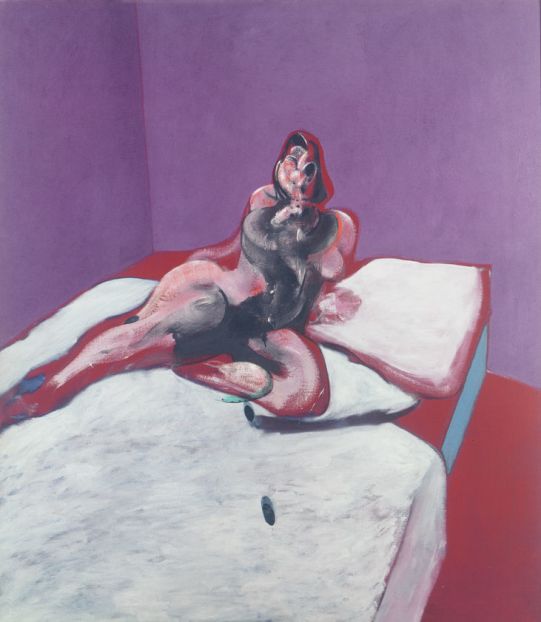
Henrietta Moraes photographed (left) at the beginning of the Sixties by John Deakin, in a print creased by use in Francis Bacon’s studio. The relation between Deakin’s photograph and the finished painting can be seen from Bacon’s Nude Portrait of Henrietta Moraes (1963), which hangs in the Galerie Beyeler, Basle
A Few Prized Obsessions
Curator Hugh M. Davies brings together a series of Francis Bacon’s papal
portraits from the U.S. and abroad to form an intimate exhibition.
LEAH OLLMAN | ART & ARCHITECTURE | LOS ANGELES TIMES | SUNDAY, JANUARY 10, 1999
SAN DIEGO — In the summer of 1953, British painter Francis Bacon invited his friend, art critic David Sylvester, to sit for a portrait in the "gilded squalor" of his studio. Sometime during the fourth sitting, Sylvester’s likeness mutated (as Bacon’s images were prone to do) into a sombre, ghost-like portrait of the pope. Obsessed as he already had been for years with a portrait of Pope Innocent X painted by Velázquez in 1650, Bacon launched feverishly into a series of eight variations on the papal portrait.
Twenty years later, the series itself sparked a new obsession. Hugh M. Davies, director of the Museum of Contemporary Art, San Diego, was just beginning research for his doctoral dissertation on Bacon in 1973, when he noted to himself that the papal portrait series of 1953 had never been exhibited in its entirety. The notion of organizing such a show gestated quietly until just a few years ago, when Davies actively started to hunt for the eight paintings, which had landed in both private and public collections, in the U.S. and abroad. Through aggressive courtship and delicate pressure, Davies negotiated the loans, with the eighth lender signing on only last fall, to avoid, he said, "being the skunk of the party." Next Sunday, Francis Bacon: The Papal Portraits of 1953 opens at the museum’s main facility in La Jolla.
"It’s the longest series in Bacon’s career," Davies explains from his office facing a panoramic expanse of the Pacific. "It’s the one series that dates from what I consider his strongest year. It’s when he really hit his stride. The intersection of his technical ability and his vision were at a critical moment. And this is the subject which was the signature theme of his career."
Bacon (1909-1992) made his first painting in response to the Velázquez in 1949, and continued with the theme, off and on, through 1972, painting a total of 25 versions of the papal portrait. A photocopied chronology of the paintings is taped to the wall in a small foyer outside Davies’ office, and will be reconstructed in an information gallery as part of the show.
Most of the paintings by Bacon resemble the Velazquez in structure, with the pope in traditional vestments, seated in a chair trimmed with gold finials and turned at a slight angle away from the viewer. Bacon made the image his own, made it work directly and violently on the nervous system, as he put it, through his distinctively raw handling of paint, veiling the figure behind curtain-like stripes and often painting him with his mouth agape in a frozen scream.
A self-professed nonbeliever, Bacon was legendary for disavowing any social content in his work, preferring to link its violence and "exhilarated despair" to his own psyche and not to the human condition in general or the horrors of the 20th century. Though he was fixated on the image of the pope (as well as the crucifixion), he denied that his paintings had anything to do with religion.
"Some people say that the pope [represents] Bacon’s father, and he’s wrestling with the whole Oedipal thing, which is probably true," Davies says. "Other people have said the obvious, that this is a very powerful masculine figure in feminine clothes--laces, a dress and pretty colors. There is something hilarious, particularly to a gay man" — as Bacon was — "to see the pope in drag."
Bacon himself said that the Velazquez image haunted him, that he was obsessed with the grandeur of its color and the role of the pope.
"Pope Innocent X was the most powerful man in the world at that time, in 1650," Davies says, recalling conversations he had with Bacon, "and it is a very powerful, official portrait. He was a very strong individual, but also very corrupt, and Velazquez shows you that. What is brilliant in the portrait is that you can look at this guy’s face and see that he misused his power. He’s so haughty. Velazquez pleased the client and at the same time passed on the fact that the guy’s corrupt. It’s all there."
Bacon, who never attended art school, taught himself to paint by looking at Velazquez, Rembrandt, Van Gogh. He loved "the glitter and color that comes from the mouth" and hoped one day, he said, "to be able to paint the mouth like Monet painted a sunset." But he was also intrigued by the power of photography and its various manifestations, such as film and X-ray imaging.
"I see every image all the time in a shifting way and almost in shifting sequences," Bacon once said, accounting for the feel of cinematic progression in his serial work. He often quoted 19th century photographer Eadweard Muybridge’s pioneering motion studies of humans and animals. The scream motif, too, originated from a photographic source, a scene from the 1925 Eisenstein film "Battleship Potemkin," in which a nanny who has lost control of her young charge is seen in a tightly framed close-up, her eyeglasses askew and her mouth stretched open in an agonizing cry.
ARTISTS’ MODEL HENRIETTA MORAES DIES AT 67
BY RICHARD PEARSON | OBITUARY | THE WASHINGTON POST | MONDAY, JANUARY 11, 1999
Henrietta Moraes, 67, a glamorous model whose fun-loving and explosive personality and blazing bohemian beauty befuddled and charmed some of the greatest artists of postwar Britain, died Jan. 6 in London. She had a liver ailment.
Her death made headlines across Britain and the art world, not only for her accomplishments as a model to legendary artists, but also for her adventurous life and the memory of her as one of the great beauties and characters of 1950s Britain.
Mrs. Moraes may be best remembered as the favored model of the late British artist Francis Bacon, who died in 1992. More than a dozen of his major works include Mrs. Moraes. Perhaps their most famous collaboration was Lying Girl With Hyperdermic Syringe in which she was sprawled nude on a bed with an outstretched arm stuck to the mattress with a drug-takers needle.
Bacon was widely known to work largely from photographs, many of which he commissioned, rather than live models. However, when painting Mrs. Moraes from photographs, he also insisted that she pose. Among the photographers who worked for Bacon was the well-known John Deakin. Before painting Mrs. Moraes the first time, he sent Deakin around to take nude photos of her. Mrs. Moraes later recalled the event as consisting largely of Deakin repeatedly urging her to “spread your legs wider. ” Later, Mrs. Moraes claimed she caught Deakin selling the pictures to sailors in a bar.
But Mrs. Moreas was no sheltered innocent. As the British newspaper The Guardian said in her obituary Friday:
"Some models inspire painters by their looks, others by their personality. Henrietta was foul-mouthed, amoral, a thief, a violent drunkard and a drug addict. Yet she was witty, wonderfully warm and lovable. Her presence in any room immediately told you that life is more thrilling than we dull folk imagine. ”
The Times of London, in its Friday obituary, called her “the queen of London’s high-spirited Soho set” who “led a louche, romantic life, untrammeled by discipline or domesticity.”
She was born Audrey Wendy Abbott in Simla, India, in the twilight of the Raj. Soon after her birth, her father, a British serviceman, disappeared. Her mother sent her to London to be raised by an aged and by all accounts brutal grandmother. Mrs. Moreas attended a convent school, where she received high grades, and then attended secretarial school, which she left out of boredom and became an artist’s model. Still in her teens, she met Michael Law, a filmmaker 15 years her senior, and discovered the artist’s life.
She took the famous artist Lucian Freud as a lover, then returned to Law, whom she married in Rome. After that marriage failed, she married Norman Bowler, a bodybuilder and companion of the painter John Minton. After her marriage to Bowler ended in divorce, she married Dom Moraes, an Indian poet, in 1961. Her explanation for the failure of that marriage was that “I was too neurotic for his delicate nervous system, and we both drank too much.”
In the 1960s, Mrs. Moreas took to both amphetamines and burglary. Caught by a man who ran her down in his pyjamas, she served a three-month sentence, largely in a hospital. She later claimed the accommodations were strangely akin to one of the convent schools she had attended. Following her release, she took to the “hippie” life with a vengeance. She started taking LSD and spent four years wandering Britain in a kind of caravan, then lived for a time in a Welsh commune.
In the 1970s, she lived with her friend, the singer Marianne Faithfull, before eventually returning to London. In 1989, she was diagnosed with cirrhosis of the liver. Since then, she had lived a quieter life and had belonged to Alcoholics Anonymous. In 1994, she published her autobiography, “Henrietta,” which received favourable reviews.
Last year, a John Maybury film biography of Francis Bacon was released, with Derek Jacobi in the title role and Anabel Brooks as Mrs. Moraes. The model was somewhat critical of her portrayal by Brooks. “She’s very quiet in the film, and I always was a chatterbox,” she maintained.
In recent months, she had been a model for the artist Maggi Hambling, who wrote in The Guardian that “However arthritic or, on occasion, hung over, she courageously climbed onto the table, raw, intense, vulnerable and commanding.”
NEWS | THE LONDON EVENING STANDARD | WEDNESDAY, JANUARY 13, 1999
For a moment we were back in Fifties Soho, a bohemian world of tarts and gangsters, artists and drunks. This was the world of Henrietta Moraes, somewhere long gone now but remembered today at the funeral of the woman who captured the imagination of Britain’s greatest post-war artists. She was painted by Francis Bacon, Lucien Freud and, though much later, Maggi Hambling, but she was more than just an artist’s model.
As Maggi Hambling, who was painting her two days before her death last week at the age of 67, said: "I became her subject rather than she mine. Her inspiration for me was a powerful mixture of attack, encouragement and wit - her defiant spirit of rebellion."
She was famed for her wit and voluptuous beauty, as well as her staggering appetite for sex, drink and drugs. As the art critic Tim Hilton recalled after her death, "Henrietta was foulmouthed, amoral, a thief, a violent drunkard and a drug addict. Yet she was witty, wonderfully warm and lovable."
Her funeral at St Andrew’s Church, Park Walk, Chelsea, was a fitting reflection of her life — a gathering of the young and old, the beautiful and the no-longer beautiful, the rich and the downright louche. Some mourners arrived at the church after a swift visit to the pub beforehand, others waited for the wake at her old friend Christopher Gibbs’s gallery.
Jerry Hall was there — and a bouquet of lilies from "Mick and Jerry and Family" — and Sir John Paul Getty, Ned Sherrin as well as a handful of Guinnesses and Maggi Hambling, who has taken care of Henrietta’s beloved dachshund Max. The one notable absentee was Lucien Freud, Henrietta’s lover in the Fifties until she tired of his infidelities and went off to marry the first of her three husbands: but then Freud makes few public appearances these days.
The funeral was, it need hardly be said, an idiosyncratically stylish affair. The hearse arrived drawn by two black plumed horses, while the coffin was plain and unvarnished, a hand-made effort by one of her friends. Its only decoration was some horse shoes on the side.
The service began with music from Purcell’s Dido and Aeneas, prompting Henrietta’s old school friend Jane Brown to recall her performance as a witch in a school production of that very opera — a fitting role, she said, for someone so full of mischief.
Jane Brown also recalled some other memories which might have seemed a touch surprising to those who knew the Henrietta of the Soho years and later. She played lacrosse and cricket for her school teams and was renowned for her fast bowling. In a fathers match she once bowled out the eminent Shakespearean actor Sir Donald Wolfit.
Her friend and literary agent Alexandra Pringle read from an extract from her autobiography, Henrietta, describing the days when Soho was ruled by the gangster Billy Hill the streets were full of "deviant whores" and Henrietta lived opposite the Lagos Lagoon, a club full of "gambling crazy Africans".
Her day would begin mid-morning at the Cafe Torino, followed, inevitably, by a visit to the French Pub. Here there was a particular ritual involving the borrowing of money from the publican, Gaston Berlmont "Good morning, Gaston. Could I have a glass of Pernod? I mean, could you possibly lend me a fiver." A drink, and the change from a fiver, would then be handed across the bar.
That Soho is only a memory now and most of the characters who inhabited it are dead: no one can stay that drunk for that long. But as Jane Brown said of her old friend "I shall not hope for her to rest in peace — she will find it much too boring. She is much more likely to enliven heaven with her glamour and sense of humour and, above all fun."
The Sabine Durrant Interview
Frances Partridge, Bloomsbury groupie
She loved Ralph, who loved Dora, who loved Lytton, who loved Ralph...
now she looks back on a century of art, gossip and loss
SABINE DURRANT | INTERVIEW | THE GUARDIAN | MONDAY, JANUARY 11, 1999
The last surviving member of the Bloomsbury Group lives in a flat in a quiet street in Belgravia. Here, among such signals of advanced age as a giant magnifying glass on wheels and a surfeit of carefully placed sidelights, is a mini-shrine to a movement dedicated, among other things, to “the enjoyment of beautiful objects”.
The windows are huge, the walls are pink, the bookshelves (Byron, Virginia Woolf's Letters, A Guide to the Flowering Plants of Great Britain) pale green. There is a mosaic of a cat in the fireplace and paintings by Vanessa Bell, Duncan Grant and Dora Carrington, including her famous portrait of Lytton Strachey. And there is Strachey's furniture: an armoire (now stuffed with diaries and letters), a chest of drawers (appropriated for personal items) and his favourite wing-backed armchair.
“He would sit like this,” said the Oldest Member, throwing her arms up so that her hands clasped the wings in a gesture between insecurity and abandonment. “Isn’t the light nice here? The sunlight comes in until lunchtime. And all the books shine up; I’ve just had the leather ones cleaned. I don’t know why Lytton sat like this. Perhaps he was showing off his hands. Perhaps he didn’t know what to do them. They were so very extraordinarily long.”
Frances Partridge was born a Victorian, in March 1900. Her father, an architect who played in the first final at Wimbledon, knew Darwin. Her mother was a suffragette. Partridge, then Marshall, went to Cambridge, before getting a job at the bookshop owned by the writer David Garnett, a lover of Duncan Grant. Garnett married Frances’s sister Ray, and then later Angelica Bell, supposedly the daughter of Vanessa and Clive Bell, but actually of Vanessa and Garnett’s former lover, Grant. The daughter of Garnett and Angelica was later to marry Burgo, the son of Frances... Already committed to Bloomsbury tenets such as atheism, socialism, pacifism and rationalism, Frances was soon to be tangled up in the social and romantic intricacies that were the true passport to the clique. She became a Bloomsbury
There were dinner invitations from Woolf: “a formal little letter: ‘Dear Miss Marshall’... I went with hands trembling.” And heart-to-hearts with EM Forster: “very gentle and friendly and homosexual. Had a laugh like a sneeze, a sort of neh". And parties thrown by Maynard Keynes: “It doesn’t make sense to say he was a homosexual. He adored his wife. He was bisexual.” And weekends at Charleston with Vanessa Bell and Clive Bell, her husband, and Duncan Grant, her lover: “I wasn’t socially confident at first. But I do remember saying these are the people I want to spend my life with, these are the people I want to know.” And so to Ham Spray, the Wiltshire farmhouse, the scene of a second Bloomsbury menage. Strachey was living here with Carrington and her husband Ralph Partridge, a vaguely literary figure, in a strangulated triangle – Carrington loved Strachey, who loved Partridge, who loved Carrington – when Frances turned up. “I was a spanner in the works.” Before Strachey’s death in 1932 and Carrington’s suicide soon after, Ralph left and set up home with Frances in a London flat. They were asleep together when the gardener rang to tell them that Carrington had shot herself. Later, Ralph and Frances married.
Was Strachey jealous of their relationship? “No. He was realistic. I’m an accepted fact. He was a civilised man. Though I had this famous interview with him, when he threatened to leave Carrington if I took Ralph from him." And Carrington? Quentin Bell once said her Sapphic interest in Frances softened the blow. “Well... ” mused Partridge. “I think she had leanings that way, but I wasn’t. I preferred male company when I was young, but we got on perfectly well. She wasn’t like anyone else. You couldn’t describe her. She describes herself in her letters, which are awfully good. She was very funny... one seems to want funniness in this dreary life.” She had moved chairs – “my legs are not very long” – and was perched in the corner of a threadbare green sofa, a glass of Evian trembling between bruised hands (“it does make a difference, doesn’t it, water?”), but otherwise, in tartan trousers, pink shirt and a red silk scarf, as striking to look at at the end of her life as at the beginning. Elements in her looks have become accentuated by age: the strong lower jaw, the brown beady eyes, and the wrinkles like a crumpled piece of paper which someone has tried to stretch out. She is a Navajo Indian chief, in a diamante brooch.
She lives on her own, with the help of “My dear Vera” who comes in at 10am and does her cooking and shopping. “I used to cook, you know how people of my sort did mostly cook oneself, but I got rather hysterical. I set fire to a frying pan... On the whole I invite people to tea or drinks.” She goes for a walk every day, unless it’s wet or windy: “I’ve been blown over a few times.” Her sight is still fine (though she says her eyes seem to crave more and more light) and her hearing tiptop. Only her voice, she says, has gone. “I used to talk at a screech, but it breaks up as you get older. And I have done rather a lot of talking over Christmas.” She has done a lot of talking over the last 100 years. She has published six volumes of diaries, from the servant problems of her ‘pacifist’s war’, through the loss of her husband in 1960 and her only son Burgo in 1963, to the comfort of friends in the early 1990s. There is much about life and death in them, of art, love and suffering, and gossip. One extract of 1945 reads: “To lunch with Clive Bell at the Ivy: conversation fast and furious... About what did we talk? I hardly remember. Politics, Flaubert, Anthony and Kitty West.” At Ham Spray, where she lived with Ralph until his death, they instituted the Charleston regime of spending the morning independently, “otherwise the constant talk would finish us off". She and Ralph “had lots to say to each other”.
As she perched on her sofa, with the morning sunlight slowly disappearing over the rooftops, her voice one minute strong, the next a birdlike croak, her conversation followed a similar pattern. There were general musings about life: "It’s the relation of one generation to another that’s always changing. The young are very nice to one. I expect to be seated by the samovar like in a Tolstoy novel, but they treat one like an equal.” And she dipped her toe (clad in smart leather slippers) into politics: “Unlike my friends, many of whom have got more rightwing with age, I’m still a socialist, but I think politics is a murky business. I followed New Labour at the election, but I was fed up by the way they didn’t carry out things and when they asked for money as usual, I wrote ‘please note that I am no longer a member of the Labour Party’, but they paid no attention.” When she talks about people, she sometimes seems to forget who’s alive, who’s dead. Cyril Connolly, she once wrote, looks like a china pug on a mantelpiece: “Yes, it’s true. He does.” Did she agree that Virginia Woolf wasn’t very nice to women? “Oh, you thought she wasn’t?" Partridge replied, with cocktail party tact. “I thought she didn’t much like girls. I was a girl when I got to know her and she didn’t like girls to be educated. I was pretty well read, too much her world. Virginia liked to make a picture.” Leonard, who “rowed horribly” with Ralph when they worked together at Hogarth Press, “was a dear”.
“Everyone is dead now,” she said suddenly. Her mother died “some time in the 70s. Or was it when she was in her 70s?” Her five siblings? “They all came rather in a rush.” Her grand-daughter, Sophie – “my only relation now living" – and her great-grand-daughters want her to see out the millennium: “Everyone wants me to get the Queen’s telegram, but I don’t care a button whether I do.” She still feels the sharpness of the death of her husband and son. "Very much so. I feel more lonely,” she said. “I don’t like life as an old person. But I don’t groan when I wake up. I still enjoy the stuff that life is made of. I love nature, the countryside. I enjoyed both my Christmas holidays.” She divided the time between her grand-daughter in Devon and Patrick Leigh Fermor’s house in the Cotswolds. “And at New Year we had a very nice lunch at Cyril Connolly’s married daughter’s. Cressida. Husband was called Charles. I can’t remember the surname. Awfully nice people.” She had said her voice would last an hour, but she still insisted after that on giving a guided tour of her bedroom, where we gazed on a Vanessa Bell still life and a frosty Carrington landscape of the view from Ham Spray. A picture of a New York skyline caught her eye.
"That," she said, "was painted by Angelica [Bell]. It’s the result of a curious episode when she went to America and had a passing affair – which nearly broke up her marriage to Bunny [David Garnett] – with a painter, whom Duncan Grant had once been in love with. And Duncan was her father...” And the last Bloomsbury gazed into the middle distance with a half smile on her face.
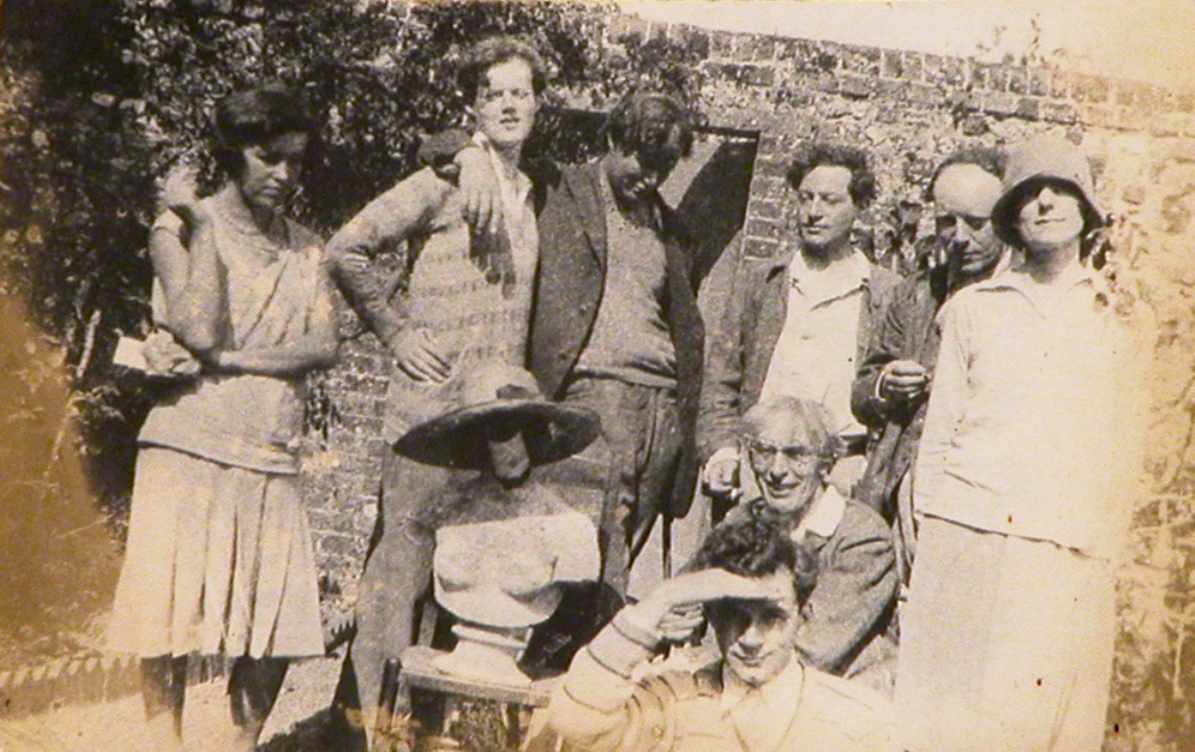
Frances Partridge (1900-2004), Quentin Bell (1910–1996), Duncan Grant (1885-1978), Julian Bell (1908-1937), Beatrice Mayor (1885-1971),
Roger Fry (1866-1934), Raymond Mortimer (1895-1980) in the garden at Charleston Farmhouse, taken from Vanessa Bell’s ‘family album’.
Famed gay painter exhibited at the MCA
Gallery brings together Francis Bacon’s ‘Papal Portraits’
by A. L. Cyphers at the Gallery
A. L. CYPHERS | ARTS & ENTERTAINMENT | GAY & LESBIAN TIMES | ISSUE 577 | JANUARY 1 1999
From Jan. 17 to March 28, the Museum of Contemporary Art in La Jolla will be hosting a remarkable exhibit titled Francis Bacon: The Papal Portraits of 1953. Hugh Davies, director of the museum and renowned Bacon scholar, has managed to bring eight paintings from Bacon's haunting Papal Portraits series to La Jolla. The MCA’s exhibit is a landmark, as it’s the largest number of Papal paintings ever assembled in one place, ever — Bacon himself never even saw this many together at once.
Why should this matter to you? Undeniable art-historical value aside, this show should be an incredible experience. Even for those not familiar with the name Francis Bacon, it’s unlikely that his "screaming pope" images have escaped many people’s notice, or subconscious. This exhibit is the perfect opportunity and likely the only chance San Diegans will have to see such affecting works up close and personal for a long time to come. Whether you like Bacon’s work or loathe it, it’s guaranteed you won’t be able to ignore it.
Recently, the Gay & Lesbian Tunes talked with Davies, who became acquainted with Bacon as an art student in London, about this enigmatic artist and the MCA’s exhibit.
Gay & Lesbian Times: Why have the eight paintings in the Papal Portrait series never been displayed together?
Hugh Davies: When they were first painted, they were done in anticipation of an exhibition in New York. It was the artist Francis Bacon’s first exhibition outside of his native England and a big occasion for him. They shipped all eight paintings to New York, but they only showed five of them. I haven’t yet been able to determine why they didn’t show all eight paintings, but the theory I have is that the deafer didn’t want to have eight paintings that were so similar as the first exhibition for this painter He wanted to show the variety of things he could paint. The show met with great success. Critically, it was well received and, even more importantly, the paintings sold. So immediately four of the five paintings went into American collections.
Tell me a little about the Papal Portraits.
The series is just a sort of cinematic sequence of the Pope going through all these various gyrations as he gets more animated, until finally he’s screaming and dismiss¬ ing the viewer. It’s an amazing, almost flip-book of the way he reacts. The way I plan to install these paintings is to build a nine-sided room, so that if you stand in the center, you’ll be no more than 14 feet from each painting, so it wifi be an incredibly intense experience. I’m looking forward to seeing all eight of the paintings in the series exhibited together for the first time, in this very concentrated space. For me, the thrill (s to put k these paintings together that have never been seen together before. When Bacon painted them, his studio was so small that he could never have more than two or three of them in the studio at any one time. There just wasn’t room. So even he never got to see them all arrayed in this sort of way. I understaiul there will be some unexpected additions to the show, two paintings that were thought to have been destroyed. What happened? We thought Study After Velasquez and Study After Velasquez П had been destroyed, but they showed up in London last year. They’re now being shown at Tony Shafrazi Gallery in New York, and he’s given us permission to add them to our show. But the show in New York closes the day after ours opens, so Study After Velasquez and Study After Velasquez II will actually arrive a week into our show and be added.
Francis Bacon, by Ronald Alley and John Rothenstein, catalogues all of Bacon’s paintings, including an appendix of destroyed pictures. It says that in November 1950, after Bacon had gone to Africa, the Hanover Gallery offered on his behalf to lend Study After Velasquez to the Arts Council for inclusion in an exhibition. It was accordingly listed in the catalogue, but as soon as Bacon returned he destroyed it together with its companion.
But obviously he didn’t destroy it. He just rolled it up and told them that he did. It’s all part of the myth. Like Warhol and like Salvador Dali, the same way they have their finger on the pulse of the public for aesthetic and cultural reasons, they also have their finger on the pulse for advertising purposes; Warhol’s genius was to find that scene, like the perfect image of Jackie O, before anybody else came to it. Bacon had a sense of theater too. Cultivating the idea that he destroyed a lot of his work would make it more valuable, prized more highly, if it had survived his destructive impulses.
How has your view of his work changed over the years?
I feel that as I have matured, the pictures have matured and the initial hook or punch has been replaced by a much more profound, deep meaning and resonance than what initially drew me to them. They get you with an initial impact, but they have staying power. They are timeless and have international resonance. There is a passionate following for Bacon in a way that doesn’t happen for a lot of artists. A lot of artists are very successful in the art world, and they influence other artists, but they don’t have resonance for a wider audience. Bacon’s paintings don’t have to be interpreted — you don’t have to know the score, you just deal with them one on one.
You’ve managed quite a lot for one exhibition. What do you think the test part about it will be?
In a lot of so-called blockbuster shows these days, they have to hang the paintings very high so you can see over people’s heads and you kind of wait for the herd to go by before you can see the paintings. I love the idea that this is a small-focused show with very rigorous art historical and intellectual underpinnings to it, and that the individual can go in and have this intimate experience with these great paintings. If it gets crowded on the weekends, people can watch a video or look at other things in the museum and just take their time before they go in there. I’m very excited about providing that sort of primary aesthetic experience that you so rarely have, unless you have it with a horde of people. I think that’s how we’re lucky here in San Diego. In some ways, our greatest asset is that we can continue to do these things and we don’t have to worry about creating blockbuster exhibitions to keep our turnstile turning to pay for our overhead, because we’re a modest-sized institution. And yet we can do shows of this kind of quality and not have to worry about being mobbed. It’s still a place where somebody thoughtful can have that aesthetic experience in a very intimate way, rather than having to go to L.A.
For more information on the exhibit call (619) 454- 3541.
Obituary: Henrietta Moraes
PHILIP HOARE | CULTURE | THE INDEPENDENT | SATURDAY 16 JANUARY 1999
AS THE model for Francis Bacon’s Lying Figure with Hypodermic Syringe (1963), Henrietta Moraes was a voluptuous icon of the Soho subculture of the Fifties, sprawling across an unmade bed posing for photographs taken by John Deakin for Bacon’s painting.
“He was a horrible little man,” she told Michael Peppiatt in 1990. He came round and told me to lie on the bed with my legs open. And he began taking photos from the wrong end. I said, “Deakin, I don’t think that’s what Francis wants. I don’t think that would interest him.” “Oh no,” said Deakin, “this is the way Francis wants it.” But of course he didn’t, so we had to start all over again.
Later on I found Deakin selling copies of the first lot of photos to some sailors in Soho for 10 shillings a time. A timeless incarnation of the Bohemian artist’s model, she may have been painted by Bacon and bedded by Lucian Freud, but Moraes could equally well have been a model — and mistress — for Augustus John or Toulouse- Lautrec.
She was born Audrey Wendy Abbott in Simla, in 1931; her father was in the Indian Air Force: “He tried to strangle my mother when she was pregnant and then took off to parts unknown and was never seen again.” Brought to England, she was educated in a series of convent schools, leaving with ambitions to be an actress, only to be sent to a secretarial college in South Kensington. Introduced to London night life, she was soon frequenting the 100 Club in Oxford Street, where she met Michael Law, “an out-of-work documentary film director” — 35 years old to her 19. They married in Rome a year after their first meeting.
Pursuing a new career as a model, she plunged into the dissolution of Soho life: the French Pub, the Cafe Torino and the Gargoyle Club. She fell in love with Lucian Freud, who seduced her over a kitchen sink and painted her perhaps three times; Bacon produced two dozen studies by her reckoning. She also fell in love with the painter John Minton, but he was besotted by a body builder named Norman Bowler — by whom Henrietta became pregnant. Her friend Patrick Garland notes that “the real love of her life was Johnny Minton. He was in love with Bowler, and the nearest Henrietta could get to Minton was to marry Bowler.” Her agent in later years, Alexandra Pringle, agrees: "Her great loves were for gay men, and for women.”
Henrietta, already eight months pregnant with her son, Joshua (to be followed by a girl, Caroline), divorced Law and married Bowler. She was running a coffee bar in David Archer’s bookshop in Greek Street in 1956 when a "slender, fawn-eyed boy" wandered in: the Bombay-born poet Dom Moraes. Aged 18 and waiting to go up to Oxford, he was already, by virtue of the patronage of Stephen Spender, well acquainted with Soho. “I first saw her perched on a stool at the bar,” he wrote “surrounded by men, whose remarks she punctuated with a noisy, emphatic laugh. She was 25. She had the same pale skin, long dark hair, and intensity of the eyes as Dragika [Moraes’ previous love]. Her escort was a tall handsome young man with a kind and serious face. When he asked her to have a drink, she turned and said with a dramatic flicker of the eyes, “Piss off, darling. Can’t you see I’m busy?” In her high-pitched voice, which emphasised certain syllables as an actress does, the words brought back an atmosphere of the Twenties, with their bored young people in bars.
She and Dom Moraes went to the cinema:
Deprived of a large audience, she was quiet and rather unsure of herself, and I began to feel a protective warmth towards her. . . She told me that she had had an unhappy childhood, and I felt deep pity for her. When, exuberantly, she threw bread at strangers in restaurants, I was rather gratified, since it proved she was now happy. Her insecurity made it impossible for her to allow herself not to be the centre of attention in any room
Soon after, Moraes went up to Oxford, but was besotted with Henrietta; an affair he dissects with painful emotion in his autobiography, My Son’s Father (1968).
In 1957 Minton committed suicide, and left Henrietta Moraes his house in Chelsea; at the same time, she discovered Bowler was having an affair. She left him, moved into Minton’s house, took a job in an advertising agency, and seduced Dom Moraes. Together they “surrendered whole days to alcohol”. Having gone up to Oxford, he received word that she had taken an overdose. Discharged from hospital, she came to visit him.
Bringing Henrietta to Oxford was like taking Cruella de Vil to Battersea Dogs’ Home. Patrick Garland, also at Oxford at that time, recalls: “She cut a great swathe. . . through the impressionable undergraduates of the late Fifties, a heady whiff of Bohemian Soho. She was an almost Parisian figure in those inhibited, repressed times. We were virginal — and she wasn’t.” Dom Moraes appeared to be an exotic, poetic trophy to her.
“I felt she picked him up expecting him to be the young Rimbaud,” says Garland. “She partly doted on him, partly tormented him. She saw her role as a femme fatale.” Garland remembers a drunken party when Dom climbed out of a window and fell a long way down a grating . . .We went to the Radcliffe [Hospital] where Henrietta was in attendance — in one way very devoted; but part of me felt that she was enjoying walking in the footsteps of Caitlin Thomas — enjoying the melodrama. She was rather self-regarding as a Bohemian.
The relationship remained tempestuous, destabilised by Henrietta’s insecurity and Moraes’s youth. “Now, looking back, I realise that . . . I was too young for [Henrietta]”, wrote Dom Moraes.
Apart from my poems, I had then no means of earning money whatsoever. She seemed to look on my inability to take her out to dinner, or to pay a bill for the house, as further proof of my lack of love. We were too different as individuals to live successfully together. But at that moment we were locked together too violently for release, like fighting hawks that fall, claws fastened in each other’s flesh, in a long slow spin, with the ignored reality of earth banking itself below.
In 1958 Dom Moraes became the youngest poet to win the Hawthornden Prize. Relations with Henrietta were difficult; she was working as a copywriter, and again attempted suicide, “chipping away at her wrists with a razor blade. . . When I appeared, she looked up and said, ‘You made me do this.’ ” She now had frequently to visit the provinces on her firm’s business; each visit allowed me a day or two’s rest. One day, as I indulged myself thus, the telephone chirped. It was a friend who told me, in the kind way friends have that [she] was madly in love with another man.
Rather than rage, Moraes felt an incredible, enormous sense of freedom. I did not wait to see [Henrietta], but went out to a literary pub, selected a pretty young woman . . . and went to bed with her. That day I left [Henrietta], and went back to Oxford.
Henrietta’s account has it that Dom Moraes went out for a packet of cigarettes and never came back. Moraes, for his part, makes no mention in his memoirs of the fact that they were actually married in 1961 — although even Henrietta Moraes herself doubted this fact when she went to the Chelsea Register Office and found no record of it. “I could not understand Dom’s need to tell lies,” she wrote, but admitted, “I was much too neurotic for his delicate nervous system, and we both drank too much.”
Henrietta Moraes lost her house and began a descent into drug abuse: “I picked up bad habits like a magnet does iron filings.” She used her experiences to write articles on addiction for The Sunday Times whilst living out her “amphetamine psychosis” phase “which turned life into a Marvel comic”. She became a cat burglar, as much for the adrenalin kick as for the material profits. Caught, she spent two weeks on remand in Holloway, and, on release, found herself injecting methedrine with a black-leather-garbed lover called Rebel from District 6 in Cape Town: he subsequently died of heart failure in her house. Meanwhile her children were being looked after by a friend, and their mother began attending a Chelsea clinic.
“It was 1966, and there were the strains of a prolonged party in the air.” For Moraes, the party was LSD-fuelled, and full of new friends: Christopher Gibbs, David Mlnaric, Mark Palmer and Catherine Tennant. With Palmer and Tennant she set off on a four-year gypsy caravan trek to Wales. Henrietta ended up working at Richard Booth’s bookshop in Hay-on-Wye, where she met Marianne Faithfull — whose secretary she became.
She stayed with Penny and Desmond Guinness at Leixlip, and moved into Roundwood, an 18th-century house owned by the Irish Georgian Society. But lack of money, and excessive drinking, resulted in her decampment back to London, signing on, living in a tiny flat on Edith Grove, and gardening for friends of friends, drinking cans of Special Brew the while. When she later managed to adhere to the Alcoholics Anonymous regime, however, she was ironically diagnosed with diabetes, necessitating a strict diet.
Late in life, Moraes found two champions: Alexandra Pringle, who published her memoirs, Henrietta, in 1994 and became her agent; and Maggi Hambling, who painted her and was with Moraes when she died. “I found her intensely moving," says Hambling. “I learnt an enormous amount from her. The whole of her life was in her face.” Hambling sketched her subject on her death-bed, and in her coffin.
A colourful funeral service was held in Chelsea last week, Moraes’s hearse pulled by plumed horses. The whole of Fulham Road was brought to a standstill — “Henrietta would’ve loved it,” says Pringle, who notes that Moraes has left behind a handful of “devastatingly well-written” short stories, heavily autobiographical. “The day before she died she was bursting with excitement about the second volume of her memoirs,” adds Pringle. “She had found the title on a bottle of mineral water — Delightfully Still, by Henrietta Moraes.”
Audrey Wendy Abbott (Henrietta Moraes), artists’ model: born Simla, India 22 May 1931; married 1951 Michael Law (marriage dissolved),
1956 Norman Bowler (one son, one daughter; marriage dissolved), 1961 Dom Moraes (marriage dissolved); died London 6 January 1999
OBITUARIES | THE DAILY TELEGRAPH | SATURDAY 16 JANUARY 1999
HENRIETTA Moraes, who has died aged 67, found her home in Soho and was painted by Francis Bacon, Lucian Freud and, much later, Maggi Hambling.
When she arrived in London aged 18, she went under the name of Wendy Welling, her mother’s surname. She at once took to the bohemian life of Soho, drinking in the York Minster in Dean Street, known as the French pub, and, in the afternoons when pubs were closed, in the Colony Room Club. She was not unlike other habitués of Soho in her heroic drinking, but she was distinguished by her beauty, wit and surface toughness.
It was the world described by Julian Maclaren Ross in Soho in the Forties and by Daniel Farson in Soho in the Fifties, of macintoshes, men in hats, cigarette smoke, gangsters, tarts, petty criminals, cold nights, sailors and no money. There was a rough and tumble in conversation, plenty of unconventional sexual liaisons, and a camaraderie between refugees from suburban conventions that sometimes developed into kindness or love. She embraced it all.
At the Gargoyle nightclub she would meet the same crowd night after night: Brian Howard, Cyril Connolly, Philip Toynbee, Francis Bacon, Michael Wishart, Lucian Freud, John Minton, Robert Colquhoun and Robert MacBryde. At the beginning of the Fifties she met and fell in love with another Soho fixture, the film-maker Michael Law. It was he who suggested she find a better name, and for the rest of her life she was known as Henrietta. They married and in the early
Henrietta now sat for Lucian Freud, whose portrait of her she later put on the dustjacket of her memoirs. Soho life moved fast, from the Coach and Horses to an afternoon drinking club, to the French when it opened again for the evening, to a nightclub. All along the way were strange, witty, unreliable, dangerous and sexually active characters. "In the Fifties, everyone was extremely rude to one another," she remembered. All this time money was short, as it was for most Soho people.
Among her friends was John Minton, the painter. He had good looks, talent and friends, but was haunted by a melancholy streak and troubled by his homosexuality.
She also fell in with Norman Bowler, who had been living in Minton’s house in Apollo Place, Chelsea. She became pregnant by him and they married; they were to have a boy and a girl. Some time later, just before his 40th birthday, Minton committed suicide. Henrietta Bowler heard the news when she was in hospital, pregnant, and suffering from typhoid. Many had assumed that Minton would leave his house to Norman Bowler, whom he loved, but he left it to Henrietta.
During her marriage to Norman Bowler she took a job with David Archer, the unpractical patron of literary talents. He had just opened a new bookshop, in Greek Street, and Henrietta worked at the coffee bar inside the shop, making egg and watercress rolls.
All David Archer really wanted," she recalled, "was a sort of salon. Strangers would come in off the street, and he would not want them to buy a book. He’d say: 'Hey, don’t ask me. I mean, there’s a very good bookshop up the road called Foyle’s, go there.' "
One of the writers that David Archer tried to help was Dom Moraes. He was a smooth-tongued Indian, a great young hope of Commonwealth poetry who later won the Hawthornden Prize. Henrietta was later to refer to him ambiguously as "that 24-hour poet". His first volume of poetry, A Beginning, was dedicated to her. Quite soon, in 1961, she married him. Dom Moraes spent three years at Oxford, which Henrietta enjoyed; she made new friends such as Peter Levi, the poet. But settled back in London, Dom Moraes went out one day to buy some cigarettes and never returned.
About this time, Francis Bacon was painting her. He explained that he would like to paint her from photographs. These were supplied by John Deakin, an impossible friend of Archer’s who managed to get sacked as a photographer by Vogue twice. He took a fine series of images of Henrietta Moraes lying naked on a bed, which Bacon used. But she was surprised to find that Deakin was soon offering spare prints for sale to sailors at 10 shillings each.
In the Sixties, as well as drinking hugely, Henrietta Moraes used drugs more and more. Though one of Bacon’s paintings of her shows a naked body with a syringe stuck in one arm, she did not use heroin. But, along with the usual pills, she eventually took to LSD. Her life became increasingly ramshackle; the spell of Soho was broken.
Henrietta Moraes was born Audrey Wendy Abbott in Simla on May 22 1931. Her father, whom she never knew, was an Indian Air Force officer nicknamed Ginger. When she was 18 months old her mother returned to England to work as a nurse; at three Audrey was sent to board at a convent.
She remembered her childhood as cruelly unhappy. Her largely absent mother she called "Mummy Judy". When she was sick over her bed in the school dormitory she ate up every bit again lest she be detected. When staying with her grandmother at Bedford, taking dull walks beside the flooded Ouse, she would hear how her father was an "absolute monster, a really wicked man". She was shuttled from grandmother (who, she said, beat her with a strap) to schools. Always on the edge of expulsion, she eventually left to take a secretarial course in London, and her life in Soho began.
After the end of her marriage to Dom Moraes, drugs and drink drove her to burglary; she failed and went to prison. Once out she drifted away from Soho, and for four years travelled Britain in a gipsy caravan. She had friends with country houses, many of whom, like her, were captivated by drugs.
She drifted ever westward, via Hay-on-Wye and a job in a bookshop, to Ireland. By the end of the Eighties she was back in London, poor and sick from drink. She found a way out of the vicious cycle of drink through Alcoholics Anonymous.
At the end of her life, living in a room in Chelsea with her dachsund, Max, she sat for Maggi Hambling, who became a friend.
Christopher Gibbs writes: Brave chaotic, heroically self-indulgent, wild yet cosy, Henrietta Moraes, will be mourned by a wide band of friends, whom she terrorised and enchanted over the years.
She made a bridge between the raffish twilight of Muriel Belcher’s Colony Room Club with its cynical, hard drinkers, to the hip parade of young Chelsea chancers and their exodus to the hills of the West in the late Sixties.
She was blessed with zest for new experience, thirst for ecstasy and oblivion, a bold eye for a promising encounter, (disregarding sex or age), and uncanny antennae for alcohol or drugs that might, unbeknown to her hosts, be lurking in some unlikely corner. Wolf those pills, drain that glass - or jug. She was ever a stranger to moderation.
Transformed by Michael Law’s decree into Henrietta, creature of carnival, the tawny voluptuous beauty, she sprawls, legs apart, across the canvases of Francis Bacon.
After Dom Moraes left her for another woman, Henrietta would, after the pubs closed, shy milk bottles at their Chelsea houseboat before moving on to wake a few friends and kill the night.
The gentler, more lyrical atmosphere of the Acid years in the Sixties changed her life. She felt an instant harmony with the new friends she made and soon left London, riding off with Mark Palmer and his rainbow cavalcade, threading the green lanes that led to the wilderness.
Older than most of them (in Soho she had been the younger one), licensed to frolic after years on the road, she found in the Welsh Marches a tiny cottage, The Den, hidden and forgotten, and moved in with her dog, Leaf, and an occasional lover, emerging like a great ripe tomboy to liven the pub.
Friendship with Penny Guinness, forged on the road, led her to Ireland and efforts to live alone. For a year she acted as guardian for the Irish Georgian Society of lonely Roundwood in County Wicklow, but her vigour was beginning to succumb to excess and eventually she returned to a council flat in Chelsea, given touches of glamour by her friend David Mlinaric.
She became a jobbing gardener, and could be seen astride her bicycle, festooned with the implements of her calling, dog at wheel, weaving through the traffic.
Francis Wyndham, her old friend and a constant midwife to good writing, spurred her to a book of memoirs, which after long agonies appeared in 1994. Henrietta chronicled her adventures with warmth and generosity — her sharp wit was never unkind. Her last attachment, to Maggi Hambling, was a fresh outpouring of passion and tenderness, exasperating, delighting, uplifting and completing.
For half a century, the tiny Colony Room bar has been a second home
to some of the great names in British art.
Today, the faces have changed, but its boozy charm remains.
OLIVER BENNETT | LIFE & STYLE | THE GUARDIAN | SATURDAY 16 JANUARY, 1999
You walk up a dingy, stygian stairwell into a small, slightly claustrophobic room full of paintings, posters, yellowing cuttings and artworks. A piano lies on one side, a bar the other. The green carpet has fag burns all over it. If the ageing banquettes could talk, they’d insult you.
This is the Colony Room, a private-members club in London’s Soho that recently celebrated its 50th anniversary. It is a small and rather intense place, with an intimidating reputation for rudeness.
Its walls — where they can be seen behind the jumble of artworks — are painted bright green, which compounds the sense of being in a world apart; one that is either restful, womblike and gemütlich, or intense and claustrophobic, depending on your bent.
The Colony has a small but unique position in British post-war culture, despite being a place that, as its incumbent manager, Michael Wojas, puts it, is "just a front room with a bar in it".
It is best-known for being the second home of Francis Bacon — much of John Maybury’s recent film about Bacon, Love Is The Devil, was filmed in a Colony Room set. It has also been the bar of choice for Lucian Freud, Michael Andrews, the Roberts Colquhoun and MacBryde, the Johns Deakin and Minton, Barry Flanagan, Frank Auerbach, Patrick Caulfield; many of whom became known, to use Ralph Kitaj’s 1976 soubriquet, as the "School Of London".
Over the years, it has also attracted bibulous journalists such as Dan Farson and Jeffrey Bernard, as well as a rich, maverick pageant: odd names include Tom Baker (the best ever Doctor Who); Labour MP Tom Driberg; Suggs from Madness, and his mother; actor Trevor Howard; singer Lisa Stansfield. "Licorice Allsorts," is Wojas’s word for them, and he adds that "everyone is treated with equal contempt". The Chairman (a regular who wishes to be called just that) calls them "non-conformists". Like other places with arty-boho reputations, such as Paris’s Les Deux Magots, the Colony has international word-of-mouth.
"Sometimes students from art schools or abroad turn up in groups to look around," says Wojas. Unlike Deux Magots, however, it is not on tourist heritage trails. You can’t just walk in, which is why, says George Melly, "it hasn’t turned into a place where a coffee costs £40". Not even its 250 members, who currently pay £75 a year, can all come at once; it is far too small.
It has a certain heaviness of atmosphere, which, says Wojas, divides its visitors. "They either walk in and go, 'Wow, this is brilliant', or sit there with their head in their hands." In his waistcoat, dark glasses and scar up one cheek, Wojas is continuing the club’s reputation for colourful proprietors, as the luminous figure in Colony legend remains Muriel Belcher — "A handsome, Jewish dyke," as one member recalls — who started the club in 1948 and ran it till her death in 1979.
"She had been running a war-time club called the Music Box in Leicester Square, got together some independent means, found the room and secured the 3pm-11pm drinking licence," says Wojas. "Pubs closed at 2.30pm then, and you had to have somewhere to go." That club licence persists to this day, and, while London’s opening hours have been liberalised, a sense of iniquity in the afternoon still pervades the Colony. It somehow turns the day into night, rather than Soho’s new glossy pubs, which turn the night into day.
Belcher had a charisma that attracted people, and the Colony’s older clientele still refer to it as "Muriel’s". "Its reputation was all initially down to her impact," says Melly. "Muriel was a benevolent witch, who managed to draw in all London’s talent up those filthy stairs. She was like a great cook, working with the ingredients of people and drink. And she loved money."
Belcher attracted many gay men to the club — a lot of them brought in by her Jamaican girlfriend, Carmel - and the Colony became one of a few places where it was safe to be openly homosexual. Julian Cole, who, with Akim Mogaji, is making a film about the club, says, "She realised the power of the pink pound in the Fifties, 30 years before everyone else. It was a forerunner of gay Soho." Eminences such as Christopher Isherwood drank here.
But, as Wojas says, "It has never been a gay club as such. It is better to have a mix." Ian Board [Belcher’s successor from 1979 to 1995] was homosexual, and used to say, "I don’t mind those poofs, as long as they keep their distance." The same dyspeptic formula applied to artists. "There’s always been that tendency, probably due to Francis," says Wojas. "But it would be really boring if it was just artists talking about art all night long. Muriel always said, 'I know fuck all about art.'"
By some strange symmetry, the Colony Room now attracts the Sensation! generation of Young British Artists (or YBAs, as the acronym has it). Members include Tracey Emin, Damien Hirst and Marc Quinn, while Sarah Lucas once worked as a bartender here for a couple of months. "It just came about as an idea between me and Michael [Wojas]," she says. "I’d been going there for quite a time, and had always liked the way it has been going on for so long and was that traditional and historical." Their patronage has helped to renew the Colony.
"Two-thirds of the selection committee are young artists, which is lovely," says the Chairman. Indeed, the youngest member is Damien Hirst’s son, Connor, given an honorary membership at three weeks old.
Could this be an example of what the art critic Matthew Collings, in his YBA chronicle, Blimey, calls "retro-bohemianism"? All the Colony’s manifestations of Fifties épatant la bourgeoisie — the boozing, the smoking, the swearing - have now been given a certain continuity. "They’re paying homage to Francis," says Melly. "People are nostalgic about the idea of old Soho, and the Colony is the last of the lot."
Also, the club retains the allure of discovery. Art dealer James Birch, who recently put on a 50th anniversary Colony Room show at his Clerkenwell gallery, says, "It’s like a secret society, which is why Julian Schnabel, Jeff Koons and Dennis Hopper all wanted to go there when they came to London."
Perhaps it should be made an annexe of the Tate Gallery, as over the years it has built up quite an art collection, including a nicotine-stained Michael Andrews mural (there is an Andrews painting at the Tate called The Colony Room) and various newer pieces, including Gavin Turk’s blue plaque, made for his graduation show. But space is limited. "When Damien [Hirst] wanted to give us a picture, I said you’ve got to size it accordingly," says Wojas, who keeps the overspill at his home.
The real thread that runs through the Colony’s 50 years, however, is drink. "In the Fifties, we drank all day long and went to Muriel’s every day," said the late Henrietta Moraes, an ex-Colony regular. "Muriel was a very powerful personality. She was so funny, and could keep up the wit for hours at a stretch. She sat on a mock-leopardskin high chair, and she would vet everyone that walked in." Fatefully, one of those people was Francis Bacon. "There was an immediate affinity," says Wojas. "Francis didn’t have money at that time, but he had an outrageous streak."
Belcher had good antennae for interesting people, gave Bacon free drinks in return for new custom and established the Colony’s close-knit member profile. "She loved money, and people who spent money," says one long-standing regular. "'Put your hand in your handbag,' she would cry," recalls the Chairman. Older members also recall her as kind-hearted, raising funds raised for the local school and ailing confrères.
She also established a cult of rudeness. Belcher’s favourite word was "cunt", delivered in ringing tones, and a hierarchy of insults ensued. "'Cunt' was a term of abuse, 'Cunty' was meant affectionately," says the Chairman. "And if she called you 'Mary', you were really in." Men would be called "she". "Muriel made everything sound good, even when it wasn’t exactly a Wildean epigram," says Melly. "She was camp, and the very delivery of camp makes your sentences sound witty." The Colony thus became a kind of anti-Cheers, where everyone may have known your name but instead called you "cunty".
When Belcher died, her protégé, Ian Board, took over, and the Colony sustained its withering reputation. "You had to be resilient, and you’d gain respect," says the Chairman.
"If you weren’t tough, it was harsh. There would be cries of 'boring'." Melly says Board was as rude as Belcher, but not as witty, and many walked out, despising the place and its large, red-nosed proprietor. Now, though the Colony retains a forbidding edge, those days are gone.
"The people here are very friendly and interested in new people," pleads Wojas, and members laud it as a place where strangers talk to one another. "It’s gentler now, and that’s not such a bad thing," says the Chairman.
In the early Eighties, it had a sticky patch. "Ian was finding it difficult," says Wojas. "He was worried about whether he could cope, and was drinking very heavily. Also, the generations changed one lot had died and drifted off, and the younger ones hadn’t yet come along." This coincided with the era when Soho’s new members clubs such as the Groucho and Black’s were opening. The landlord wanted to change its use, and a petition was drawn up to save it.
But then new members started to come, and, at Francis Bacon’s funeral wake-cum-party at the Colony in 1992, a new generation became evident. "The fucking worms crawled out of their holes, but the extraordinary thing is that the younger generation came in full fucking bloom," recalled Board in Dan Farson’s biography of Francis Bacon, A Gilded Gutter Life. When Board died in 1995 — "He had a scarlet nose, just like WC Fields," says member Christopher Moorsom, "and when he died his nose went white" — he received huge obituaries, and it showed that the Colony had become a national institution.
The world has changed outside, but the Colony has militantly remained the same: no late licence, cocktails, draught beer, coffee, tea or ciabatta sandwiches — though Wojas admits, he "begrudgingly serves the odd glass of mineral water". As for Soho, Wojas says that he doesn’t particularly like it on Friday or Saturday night any more. "All those drunken idiots on their night out up West."
The Colony now lures acolytes and drinkers with the promise of an oasis of authenticity in the midst of office London. And all the people who walk in — some drawn by its reputation, some drunk, some thinking it’s a clip joint — will be subject to the same routine. "I sit on the perch [as Belcher’s chair is still called] and suss each person as they arrive," says Wojas. "You’ve got to catch them at the door. Once they’re in, you’ve lost them."
At the MCA, Innocence Long Gone
By RYAN P. HURD | THE SCENE | UPDATE | ISSUE 892 | JANUARY 27, 1999
It takes some time to warm up to the unusual exhibition now at the Museum of Contemporary Art in La Jolla — but, for followers of the erratic march of modern art, it’s probably worth a try.
“Francis Bacon: The Papal Portraits of 1953” is a culmination of the scholarly and curatorial efforts of Hugh M. Davies, the MC As director, whose career interest in Bacon’s art — and these portraits in particular — reaches back 25 years to his doctoral dissertation*at Princeton.
The eight paintings in the British artist’s Study for Portrait I-VIII, which depict a ghoulish papal figure in various moments of distress, aplomb and glee, are a strange set of works. The present exhibition marks the first time all eight “pope paintings’’ have been shown together since they were made almost a hall-century ago.
Bacon’s noted fascination with the Portrait of Pope Innocent X— a reassuring, conventional work by the 16th-century painter Velázquez — was somehow injected into an attempt in 1953 to paint the likeness of one of his friends. The resulting efforts, each more disturbed and arguably more papal than the last, show a technical and psychological evolution that’s immediately fascinating — and eventually a bit unnerving. Though formal variations in this series are few, Bacon (who died in 1992) figures his subject in a vast range of agitated states that move to evoke the anxiety of captivity.
At first glance, some of the portraits could easily seem whimsical. Here our pope sits coolly bathed in billowing raiment; there he flashes a Cheshire Cat grin. Here the pontiff seems to scratch his nose; there he frantically tears at his cloak. But from whimsy emerges absurdity — that trump card of existentialism — and down the slippery modern slope of alienation and angst we go. As if this revealing array were not enough, the MCA also presents Bacon’s Study after Velázquez's Portrait of Pope Innocent X, the tormented piece (effectively turning its inspiration inside-out) that prompted that summer’s papal series. Several other of the artist’s works, painstakingly culled from around the world by the good Dr. Davies, provide a welcome bit o| perspective for the Bacon expert and the novice alike.
A January 15 media preview of the exhibition featured an appearance by His Excellency Sir Christopher Meyer, the British ambassador to the U.S., who hailed the papal series as “a unique contribution to art history” and its creator as “one of the greatest artists of the 20th century.”
Neither the ambassador nor the curator chose in his remarks to highlight the fact that Bacon was gay. But a study room adjacent to the Bacon gallery bristles with biographical matter that documents (sometimes obliquely, in footnotes) the painter’s long relationship with George Dyer, and many other facets of his life and work. (That relationship was the subject, most recently, of Love is the Devil, a movie by the gay filmmaker John Maybury.)
To fair-weather fans of the art of our time, these works by Bacon might seem a tad arcane — a lurch too far into an academic haunt where howling popes evoke post-war ennui and torture the limits of representation. And such concerns might have their merit. But with unflinching attention and a little dark wit, one can begin to appreciate this brilliant artist’s highly personal idiom, and the honest, awful vision of the soul that it lays bare.
“The Papal Portraits” will he on display at the Museum of Contemporary Art (700 Prospect St., La jolla) through March 2H. For more information, call (619) 451 V4I
HELEN MEANY | CULTURE | THE IRISH TIMES | THURSDAY, JANUARY 28, 1999
The Irish Museum of Modern Art has announced plans to exhibit, for the first time, work from a collection of drawings, photographs and collages controversially said to be the work of Francis Bacon.
The collection, which includes close to 500 pieces, is owned by Barry Joule, a trusted friend of Bacon. His announcement that Bacon had entrusted this veritable archive of material to him caused a furore last year in the London art world.
Some commentators doubted the works actually were by Bacon. Many of the pieces look as if they are preparatory studies for paintings, and Bacon professed never to use such studies.
If the Joule works were accepted as authentic, they would force a fundamental reevaluation of accounts of the painter’s working methods provided by writers such as David Sylvester.
The weight of opinion among informed observers seems to be shifting towards acceptance of the works as genuine.
They will go on view next year in a suite of galleries in the newly restored Deputy Master’s House at Kilmainham. The exhibition is likely to attract a great deal of attention and marks the second major Bacon coup for Dublin galleries.
The artist’s studio, donated by his heir, John Edwards, is due to go on show early next year at the Hugh Lane Gallery.
Also on show in the new galleries at Kilmainham will be a collection of drawings on photographs by Picasso.
By KEN JOHNSON | ART REVIEW | THE NEW YORK TIMES | FRIDAY, JANUARY 29, 1999
NEW HAVEN, JAN. 22 — After closing for a year to spruce up its Louis Kahn-designed home, the Yale Center for British Art has reopened with a trio of exhibitions devoted to three giants of modern British art: Francis Bacon, Lucian Freud and Henry Moore. The last two are minor sideshows: one dedicated to Mr. Freud’s etchings, the other a survey of small bronze studies for monuments produced by Moore from the 1930’s to the 1970’s. But the Bacon show, an imperfect but ultimately dazzling 60-painting retrospective, makes a trip to Yale well worth it.
The Bacon exhibition, whose curator is Dennis Farr, the director emeritus of the Courtauld Institute of Art’s galleries in London, starts with a rare piece from the 1930’s, a small, ghostly, abstracted Crucifixion, and a couple of full-size studies for Bacon’s 1944 triptych ''Three Studies for Figures at the Base of a Crucifixion.'' This was the work that horrified and disconcerted viewers when it was exhibited in London in 1945 and put Bacon, then in his mid-30’s, a self-taught painter with little formal education, on the map of the British art world.
In one of the panels, a fleshy, dinosaurlike creature with a long serpentine neck and a gaping, toothy maw snaps at a bouquet of roses thrust in its face by an unseen hand. With its intense orange background and richly sensuous paint, this work introduces the primary poles of Bacon’s art: the comically melodramatic horror and the seductive surface.
If you identify Bacon mainly with his ''Screaming Pope'' of the 1950’s, several versions of which are included here, you may be surprised that the most compelling part of the exhibition is devoted to the last two decades of Bacon’s life, when he produced a series of big, vibrant, wonderfully animated triptychs. (He died in 1992 at 82.) Compared with his late output, the works from Bacon’s early years seem dour and constricted. A better selection might have changed that impression, but in any event, the ''Screaming Pope'' is still his most memorable creation from the early period.
Attaching a face, taken from the image of a wailing, bloodied woman with broken spectacles in Sergei Eisenstein’s ''Battleship Potemkin,'' to a three-quarter-length sitting portrait of Pope Innocent X by Velazquez, Bacon created a great 20th-century icon, a crazy, evil father figure for a mad world.
Still, the screaming pope image is like an editorial cartoon. Bacon is famous for abhorring illustration, but that is what most of his work from the 1950’s resembles. Tormented men isolated in dark spaces, lone dogs or spectral sphinxes dressed up with artfully blurry brushwork serve all too obviously as symbols of existential dread.
At the end of the 1950’s there was a shift. In a catalogue essay, Sally Yard suggests that this may have been partly inspired by Bacon’s exposure to new American painting, Barnett Newman’s in particular. Bacon disapproved of pure abstraction, but increasingly at this point, his expanding canvases give themselves over to fields of unmodulated color. From here on, it is hard to see Bacon as the artist of ''isolation, despair and horror,'' as he is characterized in an exhibition brochure. He seems more a joyfully, wickedly perverse hedonist, which is what he was in real life, too.
In ''Portrait of George Dyer Talking'' (1966), Bacon poses his subject, who was his lover at the time, naked on a stool at the center of an empty room under a bare, dangling light bulb. Oddly, a sheaf of papers splays out at his feet. The man is a melting, lumpy mass of flesh made of sinuous brush strokes and his eyes bug out, as though he felt trapped within his own body.
But if this is horrible, it is not reflected in the environment: a rosy, pink-hatched rug; a curving violet rear wall and a moss-green ceiling. Take away the figure and the light bulb and you’d have a wholly pleasurable 60’s-style Color Field painting. With the figure, you have a voluptuous, hallucinatory cartoon of desire on the brink of gratification.
The earliest of the triptychs, a triple portrait of Mr. Freud, was made in 1969; the last, executed in 1988, is a version of the 1944 Crucifixion triptych in which the harsh orange of the earlier piece has become a deep velvety red and the bestial figures have been softened to diaphanous chimeras. The triptychs all measure 6 1/2 by 15 feet and occupy most of one floor of the exhibition, to glowing and almost disorientingly enveloping effect. They are deceptively clear yet oddly confounding amalgams of color fields, erotically distorted or fragmented bodies and sharp, linear articulations of space, with, here and there, pieces of furniture or still-life objects.
In the portraits, the repetition of the picture of a man on a stool in an empty room three times, with only slight variations, creates a powerful formal amplitude and a clinical gaze that recalls the sequential photographs of Eadweard Muybridge, an important influence on Bacon’s visual imagination.
But the most engaging of the triptychs offer enigmatic narratives, sequences of disquieting glimpses like lurid images from barely remembered dreams or nightmares. In one from 1970, two naked Muybridge-inspired men grapple on a round green bed; in flanking panels, shadowy figures look in from open doors and bizarre, misshapen homunculi, barely evolved from puddles of dark paint, seem to writhe on the floor. It’s all embedded in a great field of intense reddish-orange and, contrary to the sense of Dionysian urgency, the overall composition is one of symmetrical elegance, almost Asian in its exactingly balanced delicacy.
That each panel of the triptychs is contained by a shiny gold frame and isolated behind a great sheet of glass may bother viewers who want to get closer to Bacon’s dry and thin yet sumptuous surfaces. But the grandiose Old Masterish framing is in keeping with the Bacon vision, which always embraced extremes of high estheticism and low carnality.
It is unfair that Mr. Freud’s etchings should be viewed alongside the Bacon show. As a painter, Mr. Freud shares with Bacon, his old friend, a fascination with the body and a huge ambition for the medium. It would be interesting to compare directly his aggressively painterly, warts-and-all realism with Bacon’s deftly edited surrealistic expressionism. But this presentation of the Paine Webber collection of all the 42 prints Mr. Freud has made since taking up etching in 1982 does not show him to best advantage. With the exception of a formally and psychologically impressive head of ''Lord Goodman in His Pajamas,'' the works are wooden, doggedly laborious and colorless exercises in the drawing of inert models.
As for Henry Moore, it’s a relief to turn away from the vacuous, overly familiar biomorphic Cubism of his reclining nudes, fallen warriors and mothers and children to Bacon’s nasty, delirious beauty.
''Francis Bacon: A Retrospective,'' ''Lucian Freud: Etchings From the Paine Webber Art Collection'' and ''Henry Moore and the Heroic: A Centenary Tribute'' remain at the Yale Center for British Art, 1080 Chapel Street, at High Street, New Haven, through March 21. Information: (203) 432-2800.
The market muscles its way back onto the agenda,
with Bacon and the body keeping pace
TOM FLYNN | BOOKS | THE ART NEWSPAPER | MONDAY 1 FEBRUARY 1999
Academia has traditionally tended to look down its nose at the art market, dismissing its concerns as essentially venal and infra dig., but things have begun to change in the past two or three years with the arrival of a string of useful texts exploring the development of the market for Modernism. Recent studies such as Michael Fitzgerald’s excellent Making Modernism: Picasso and the creation of the market for twentieth-century art (California) have thrown valuable light on a largely neglected area of Modernist culture and in the process dispelled a few well-worn myths about artistic purity and autonomy.
While Barry Joule’s “archive” of Bacon “drawings” and “acted-upon” photographs remains suspended in a soup of scepticism and controversy, the Bacon post-mortem publishing machine continues apace. Among the more prominent forthcoming titles from Abrams is Francis Bacon: A Retrospective produced to accompany the US touring exhibition and containing essays by Bacon scholars Michael Peppiatt, Dennis Farr and Sally Yard (March $65.00, £40.00).
Claiming to be “a complete departure from anything published in the past”, this volume provides individual picture commentaries (something Bacon always outlawed in previous exhibition catalogues) and promises to “shed light on Bacon’s private life…and working methods, about which he was particularly secretive.”
Finally, interest in medieval attitudes to the body continues to bring forth texts of great interdisciplinary relevance (see also the Reaktion list in the UK round-up). Although ostensibly emerging from within the realm of medieval studies, Jody Enders’s new book from Cornell University Press, The Medieval theater of cruelty: rhetoric, memory and violence ($45.00, £33.50, cloth) is also likely to capture the interest of art historians, cultural studies specialists, and the lit-crit crowd. Why did medieval dramatists weave so many scenes of torture into their plays? asks Professor Enders, who goes on to analyse the consequences of torture for the history of aesthetics in general and of drama in particular. Doubtless future historians will look back on our own cultural preoccupations with bodily mutilation with the same mixture of wonder and curiosity.
Bacon Between The Lines
The Tate unveils its previously unknown Bacon drawings to the world while
two US museums present new views of the blockbuster British artist
SARAH GREENBERG | THE ART NEWSPAPER | MONDAY 1 FEBRUARY 1999
Following the recent unveiling of unknown paintings by the artist last year, as well as the release of the film based on his torrid love life, Francis Bacon has become blockbuster material again, with exhibitions of his work opening in London and the US this month.
The one show the artist might not be pleased to see and the most important in terms of new material is Francis Bacon: works on paper and paintings at the Tate Gallery. London (16 February 2 May). Bacon always insisted that he made no drawings, so the appearance of drawings from the collection of the widow of the writer Stephen Spender came as a surprise to those who saw them for the first time at the Bacon survey in Paris in 1996. The artist gave the drawings to Spender, a friend, as a gift and the Tate acquired them last year from the family.
A second group of Bacon drawings came from an anonymous friend of the artist, who was given them by the artist in the 1950s. They were acquired by the Tate from the Marlborough Gallery. All of the works on paper were acquired through anonymous donors with the assistance of the National Lottery through the Heritage Lottery Fund and the National Art Collections Fund.
“Since both groups of drawings were acquired directly from Bacon himself, we are absolutely certain that they are originals,” said Jeremy Lewison, head of Collections at the Tate Gallery. “They are the first known drawings by Bacon. No one knew of any Bacon drawings until those in the Spender’s collection were shown in Paris.”
Even a cursory glance at the Tate’s drawings shows that they bear no relation to the contested Bacon drawings which have been circulating in Italy. They are alleged to be fakes and are now the subject of a court case in Bologna. These pencil and ballpoint pen drawings were bought by a Bologna doctor, Francesco Martani from one Cristiano Ravarini, who claims to have been given them by Bacon on one of the artist’s stays in Italy. Until recently, however, almost no drawings by Bacon were known by which a comparison could be made. The court case is still pending.
The Tate’s exhibition of over forty sketches made in pencil, ball point pen, gouache and oil paint is significant in terms of the Tate’s collection of paintings by Bacon, which are also on view. “Despite what Bacon said about not drawing, he may have worked out his first ideas on paper and they give us insight into his artistic process.” said Mr Lewison.
In the US two Bacon exhibitions open this month. Francis Bacon: the Papal portraits of 1953 at the Museum of Contemporary Arts in San Diego (until 28 March) gathers together for the first time all of the nine ‘pope paintings” which Bacon painted in 1953, the most famous of which is Study after Velazquez, Portrait of Pope Innocent X now in the Des Moines Art Center. Bacon made these works in the summer of 1953, when attempting to paint a portrait of his friend, the art critic David Sylvester. Instead of depicting Sylvester, however, Bacon transformed the picture into an image of the pope and then, working feverishly, completed the seven variations which make up the virtually cinematic progression of images. A related work from a private collection in La Jolla will also be on show. San Diego is the only venue.
The more comprehensive Francis Bacon: a retrospective exhibition begins its US tour at the Yale Center for British Art (until 21 March). It contains seventy four paintings, including a number of the famous triptychs and will be the first overview of Bacon in the US since his death in 1992 at the age of eighty three. It offers a view into the brutal recurring imagery of the caged and contorted human figure. Bacon’s paintings often seem to writhe and melt on canvas-their power is lost in reproduction so the idea behind this exhibition is to bring American viewers face to face with the real thing. Organised by the Truss for Museum Exhibitions and curated by Dennis Farr, curator emeritus of the Courtauld Institute Galleries, the Bacon retrospective will travel to the Minneapolis Institute of Arts in Minnesota, the California Palace of the Legion of Honour in San Francisco and the Modern Art Museum of Fort Worth in Texas.
Francis Bacon
TONY SHAFRAZI GALLERY
By DONALD KUSPIT | ART FORUM | VOLUME 37, NUMBER 6 | FEBRUARY 1999
“In old age,” psychoanalyst Anthony Storr rote, “there is a tendency to turn from empathy toward abstraction; to be less involved in life’s dramas, more concerned with life’s patterns.” This is certainly the case in Francis Bacon’s Triptych, 1991—one of the most astonishing paintings in the recent exhibition of paintings from the artist’s estate—in which the painter subdues the drama of his lifelong themes while at the same time showing their basic character. Among the last paintings Bacon made, the quasi-religious work distills his art and attitude in a way appropriate to the solitude of old age.
Triptych is in effect a crucifixion (a favorite theme of the artist’s): two figures nailing each other to the cross of sexuality, flanked on either side by good and bad thieves. In the center, one of Bacon’s familiar wrestling male couples in turbulent Muybridgean motion symbiotically merge. The naked bodies ill-formed and peculiarly embryonic here, at once fresh and soiled—innocent and guilty—revealing Bacon’s ambivalence towards the human figure. Similarly deformed bodies turn up in other panels as well: On the right, Bacon has put his own face and, on the left, that of a Spanish friend. In contrast with the vividly rendered rosy pink bodies, the men’s heads are painted mostly black and white, almost as if they were photographs. With this coloration Bacon seems to ask whether the head determines the body’s sexual violence or whether the body has a wild will of its own. One recalls Freud’s famous metaphor of the ego/rider thinking it directs the id/horse, but the later going where it wants. The same is true of in Triptych: The body clearly dominates, as the grim, isolated faces seem to suggest.
These faces are unusual for Bacon because their mouths are closed (unlike Pope Innocent X’s dramatic visage in the two Studies after Velázquez, 1950, on view here). The signature anguished scream, with the sadistic display of teeth, has collapsed, as if to acknowledge that rage will do nothing to solve the problems of sex and death, to which Bacon finally resigns himself with detachment. More crucial is the distance between Bacon’s early Pope works and these later “endgame canvases”, in which the brusque streaks of paint that cage the figure have congealed into deft planes. Transparent, intense gesture has become pure, opaque, and meditative.
Apart from reminding us that we all live in a small hell of our own making, Bacon’s aesthetic importance has to do with his use of abstraction, geometrical as well as gestural, in the service of what Clement Greenberg dismissively called “human interest.” By using abstraction to allegorical ends, Bacon prevented it from becoming a dead end, as it did in the post-painterly abstraction Greenberg advocated. Bacon also suggests that abstraction must be alloyed with representation to keep the image of suffering—usually the domain of the old masters—convincing and fresh. More than any other artist since van Gogh, his idol as an adolescent, Bacon is a master of narcissistic injury. If van Gogh used the religion of nature to express his suffering, Bacon embeds his pain in a distorted Christian iconography. Both verge on but avoid theatrical kitsch because of the abstract aesthetics that render their explosive imagery somehow peculiarly astringent. Bacon’s art is a triumph of contradiction, but in these taut last works he has struck a balance between the extremes (without reconciling them), suggesting that he had finally found contemplative peace. His eschatological masterpieces convey inevitable truth without sacrificing personal meaning.
Conversion of a Skeptic
By VIRGINIA BUTTERFIELD | SAN DIEGO MAGAZINE | FEBRUARY 1999
We are seated in the director’s office of the Museum of Contemporary Art, San Diego, looking out at the La Jolla ocean view. I am puzzled by an exhibition due to open, “The Papal Portraits of Francis Bacon.” I know it is dear to the heart of museum director Hugh Davies, who wrote his doctoral dissertation on this very subject and who has waited a long time to bring these eight portraits together.
“
Why did Bacon paint the same portrait eight times? Why was he so fascinated with this subject?” I ask.“Because if you were painting a portrait,” Davies explains, “wouldn’t you like to see it from all directions? And in all moods? And also because it was a series. Think of Warhol and his Marilyn Monroes. It was the influence at that time—the early ’50s—of films and photography.”
“But to do a portrait over and over again, with the same clothes, the same pose—but different heads. The heads are very different. Were they different models?” The heads are distorted—one, toward the end, with an agonized, shrieking mouth.
Bacon began with Diego Rodriguez da Silva Velázquez’s portrait of Pope Innocent X, done in 1650. “It was a perfect painting,” says Davies. “Enthroned in papal garb, the pope was the most powerful figure of his day. Yet look at his cruel eyes.
“Bacon knew the painting only in reproduction. He never wanted to see the original.” But haunted by the image, by its perfection, he sought to reinvent Velázquez’s painting.During the summer of 1953 in London, while attempting to paint a portrait of his friend David Sylvester, the 43-year-old Bacon transformed the picture into an image of the pope. Over the next two weeks, working feverishly, he completed the seven variations comprised in the series. In the intervening 45 1/2 years, they have become landmarks in art history, symbols of the post-war age.
The papal figures appear to be set in a glass box in a dark ecclesiastical setting. Pope I is a static image; Pope II is a profile; the face of Pope III is blurred; Pope IV’s features are almost indistinguishable. Pope V has a kind of sneer; Pope VI’s mouth has dropped open; Pope VII is screaming; and Pope VIII throws his arms up in a defensive gesture. The image always changes. The hands become balled fists; the open mouth and mangled pince-nez come from Sergei Eisenstein’s screaming nurse (with one eyeball shot out—from the film Potemkin). The final Pope throws his hands up as if to say, “That’s it. Enough.”
No one quite knew how to take these paintings. A critic wrote: “Bacon has tried ... for one continuous cinematic impression of his Popes—an entirely new kind of painting experience.” Another wrote that it looked like the Pope had been strapped into an electric chair.
While a student at Princeton, Davies became enamored of Bacon. He offered to write about him in his doctoral dissertation but was told he needed to have access to the artist because of the scarcity of material about him. As a result, he arranged for 16 interviews while he studied at the Courtauld Institute in London. Davies found Bacon to be an intelligent man, articulate about world affairs, a pleasure to talk to.
His studio was an absolute mess, says Davies. But his home was a model of perfection. As the artist would prepare to leave his studio—full of brushes and props and baskets, boxes and cans, piled untidily on one another—he would carefully remove every spot of paint from his hands. “You know painters who leave the paint where it will show, on their hands and clothes, so people will know they’re painters,” says Davies. “Well, Bacon was the opposite.” If he was going out to dinner, he presented himself accordingly.
“My relatives in England thought I was wasting my time,” Davies says. Very few people had heard of the artist. At the time, there were only two books on Bacon (Davies, along with Sally Yard, has since written a third, Bacon, published by Abbeville Press as part of the Modern Masters series). Davies kept up his friendship with the artist, seeing him again and again over the years—and always admiring his work.
“How can you like things that are so ugly?” I ask. “The legs end in deformed bones; the heads are bashed in or daubed with enormous smears.”
“Ugly?” asks Davies in surprise. “It’s all a matter of perception. I would never use the word ‘ugly’. When I first saw a Bacon painting, I thought it the most interesting thing I’d ever seen. Among all the ‘pretty’ art, I could hardly wait to see more. I can hardly wait for his paintings to get here. I could sit and look at them forever.”
But, I protest, the subject matter is grotesque. Faces simply don’t exist. A mouth is all one can see, usually at the end of a pole-like formation. It snarls; it wails. Bacon himself described his compulsion: “I have always been very moved by the movements of the mouth and the shape of the mouth and the teeth. People say that these have all sorts of sexual implications...”
Davies and
I look together at Bacon’s Painting,
1946 of a powerful, brooding figure with a huge, bull-like neck. Behind him is a
split carcass, suspended like a crucified human body. A railing is skewered with
cuts of meat. Because the painting was purchased by a famous dealer—for perhaps
only $2,000 —Bacon’s reputation was made. He immediately took off for Monte
Carlo, so the story goes, where he made a killing at the tables. He took a small
villa and squandered his money in two weeks, having a splendid time and making
many friends. Fine, I say. But the painting is ghoulish.
Davies sees much more in it than I do. The figure is a dictator with a bloody
mouth, he says. He is in the same pose as the Popes, but the setting is
different. An umbrella probably refers to Neville Chamberlain. The figure
reflects Bacon’s familiarity with news photos of Joseph Goebbels, Heinrich
Himmler and Benito Mussolini, as well as of Franklin Roosevelt in his cape at
Yalta. The headless carcass hanging above him is the crucifixion, which
fascinated Bacon as an emblem.
“Was he religious?” I ask.
“No, he was not religious. He was an atheist. But the emblem
fascinates him.”
“Was Bacon anti-Pope? Did he take a position on the subject?”
“He wasn’t referring to any particular Pope, although he had been raised in
Ireland and knew the lore. The Crucifixion was curious to him—as a myth—as all
artists are confronted with this myth.”
I begin to see my revulsion as superficial. Bacon’s portraits of Isabel
Rawsthorne are not necessarily hideous—though nothing like the model herself.
Rawsthorne was a lady who kept a bar where young servicemen drank. She had a
habit of tossing her head, a motion Bacon caught in a famous portrait that is
largely a smear—such a smear, it obliterates her face. But that was his
objective. In her portraits, scraped, blotted and dragged strokes of paint
obscure her nose and mouth.
IT IS DECEMBER, and Davies has sent for the eight paintings from Switzerland,
England and the United States, plus a ninth, Study, done in February 1953. His
emissary is waiting in London, as we speak, to accept the European works.
The photo on the cover of Davies’ book is called Self-Portrait 1969, and it,
too, shows a grossly distorted mouth. This seems to be a recurrent element in
Bacon’s work. Davies and I argue about the face.
“I can see the wonder of the eyes,” I say. “But the mouth?”
“Ah, that’s the part I love,” says Davies. “He’s taken a red sweater and daubed
the chin—you can see the ribbing of the sweater—and maybe used the little caps
on the paint tubes to make two round objects at the chin.” But it’s the smear he
loves.
Bacon himself said it best: “I think if you want to convey fact, this can only
be done through a form of distortion. You must distort to transform what is
called ‘appearance’ into image.”
“Once in a while, in this business, we get to travel to Europe,” Davies says.
But it’s not all glamour. The emissary must keep the paintings in view at all
times. He must wait in a hotel in London, accompany the paintings to the cargo
section of a plane, meet them at unloading out on the tarmac, see them safely
into the cargo area of the airport, watch them loaded on a truck and then ride
with the truck across the country to California. He can’t let them out of his
sight, because “They might stand in the rain at the airport, or perhaps the hot
sun,” says Davies.
He’s thinking of how he will exhibit the paintings. He will build
a small room within the Farris Gallery, so that if you stand.
in the center, you will never be more than 14 feet from a painting. They will
hang on eight walls, with the final painting inspired by Velázquez on a ninth
wall just through the door. Two auxiliary works, gathered for the show, will
complete the offering.
“And how do you imagine people will react to them?” I ask.
“That remains to be seen. If they see them as you do, without knowing the
history and the value, they won’t like them. If they see them as I do...” His
voice trails off.
There will be a video to introduce the painter to the audience, as well as an
on-line presentation, and there will be other educational functions. One is a
gathering of curators—about 150—from around the country. People will talk, and
the word will get out.
Once, in the fall of 1953, it was planned that all eight of Bacon’s papal
paintings would be shown at the Durlacher Gallery in New York City, but only
five portraits (numbers I, II, IV, V and VII) were included in the show. This
exhibition in the United States was very well received, both critically and with
sales, and the paintings were dispersed. Four are now ensconced in major public
collections in the United States (the Museum of Modern Art, the Minneapolis
Institute of Arts, the Hirshhorn Museum in Washington, D.C., and the Loeb Art
Center at Vassar College). The remaining four are in private collections: one in
the United States and three in Europe.
The present exhibition, on view only in San Diego through March 28, brings this
series together for the very first time since they were painted by Bacon in
1953. It has been endorsed by a major grant from AT&T, a California Challenge
Grant from the California Arts Council and a Federal Indemnity Grant from the
National Council on the Arts & Humanities, and has received support from the
British Council in London.
Go see them. Take along Davies’ book, so that you may know the history of the
artist (1909-92). And with luck, your own introduction to the meaning of
violence will improve with the experience.
Sketchy about the details
A new show of Francis Bacon’s drawings reveals that he lied about his working methods.
Martin Gayford asks what this means for the artist’s reputation, while, below, critic David Sylvester
— one of Bacon’s closest friends — explains how he was duped
MARTIN GAYFORD
| ARTS & BOOKS | FEATURES | THE DAILY TELEGRAPH | SATURDAY, FEBRUARY 13, 1999
THE writer and artist Michael Ayrton once encountered Bacon in a bar. “He accused me, with the greatest good nature,” Ayrton remembered, “of having asserted that he could not draw.”
Ayrton admitted the offence. “Is drawing what you do?” Bacon asked. A characteristic pause followed before he added: “I wouldn’t want to do that.” It was a typically feline putdown, and — in retrospect — a significantly ambiguous one.
Bacon himself always maintained that, in practice, he did not draw, he just painted, attacking the canvas with the recklessness of a gambler throwing dice. He said this repeatedly, notably in a famous series of interviews with David Sylvester that is counted a classic in the literature of art. Since the artist’s death, however, authentic, undeniable Bacon drawings have turned up, a few in exhibitions organised by Sylvester; soon 42 will be on show in a new display at the Tate Gallery (February 16 to May 2). Clearly, the great man was being economical with the truth. But how big a lie was he telling?
There are those who have claimed that the whole affair makes Bacon look thoroughly dishonest. They claim that in suppressing the truth about his drawings, he was falsifying the truth about the nature of his art — trying to make himself out a more recklessly daring painter than he actually was, concealing the fact that he laboriously worked up his pictures in a rather old-fashioned way. That is. he depended on these drawings. But David Sylvester, one of the greatest authorities on Bacon, and also a close friend, does not agree. “He was lying,” he insists, “but he was lying about something relatively unimportant. Obviously, since he lied to me in the course of a book of interviews that’s been quoted and quoted all over the place, I have an interest in minimalising the importance of the lie. But in my heart of hearts I don’t believe that it was tremendously important.”
Sylvester knew that Bacon drew — he had seen little drawings in a book, as he describes below — although he didn’t realise quite how much Bacon drew. In fact, it still isn’t clear how much he did draw, since a second large group of works on paper (including some collaged photographs) have also surfaced, reproduced extensively in the magazine Art Review. fuelling a sharp controversy. Sylvester explains that he is “among those who do not see the same hand” in these as in the ones that the Tate has acquired (from two separate sources).
Others question that judgment. The critic Edward Lucie-Smith has argued that if this archive is ever authenticated, it will reflect badly not only on Sylvester and other Bacon experts for failing to recognise it, but also on the Tate for “missing the opportunity to put its Bacon holdings almost on a par with its Turner archive”. To complicate matters further, a third batch of alleged Bacon drawings, looking different again, has surfaced in Italy, and is now the subject of a court case in Bologna. But plainly, whatever the truth about this sheet of paper or that, Bacon did draw — so he did lie. On the other hand, despite the sketches, the way Bacon actually painted really was unplanned, open to chance and risk; the way the paint fell on the canvas was highly improvised, highly spontaneous, and trusted a lot to luck. That is obvious from looking at them.
Does that mean that Bacon’s was only a smallish, whiteish lie? Lucie-Smith feels it was more serious, that the disputed drawings, if genuine, reveal Bacon as someone “prepared to go to great lengths to deceive many of his closest associates, as well as critics, museums and the public, in the interest of constructing a legend which the sketches would now reveal as fictitious”. Like another case in Washington, it all turns on what you mean by certain words. In this case, what you mean by "depended” in the charge that “Bacon concealed the fact that he depended on drawings”.
MG

Bacon: maintained he just painted
Why he kept his methods a secret
This essay by David Sylvester introduces the catalogue for the new Tate Gallery exhibition
DAVID SYLVESTER
| ARTS & BOOKS | FEATURES | THE DAILY TELEGRAPH | SATURDAY, FEBRUARY 13, 1999
BACON was not the only artist who used sketches on paper in making his pictures, and pretended that he didn’t. Miro, in the heyday of Surrealism, secretly made very precise compositional studies, often squared up and sometimes containing indications of intended colours and size. When they came to light 50 years later and Jacques Dupin, Miro’s close friend and leading expositor, asked him why he had never mentioned them, Miro said he had forgotten about them.
It is easy to understand why Mird had to dissemble. His career as a Surrealist had taken off at the time of the birth of the movement. In that religious sect, automatism was the order of the day, for artists as for writers. Certainly, the drawings themselves were splendid exemplifications of automatism, but it wasn’t acceptable in the movement to make automatic drawings and then enlarge them rather faithfully into paintings. The finished products themselves were supposed to have been realised automatically.
Miro finally owned up; he wanted to show the drawings. Bacon never did. In 1984, in the course of our 18th and last recorded interview, I said: “I suppose it’s because you improvise so much that you’re exceptional in doing figurative paintings as big as yours without any kind of preliminary drawing or oil sketch.” He responded: “Well, I sketch out very roughly on the canvas with a brush, just a vague outline of something, and then I go to work, generally using very large brushes, and I start painting immediately and then gradually it builds up.”
This was the truth but not the whole truth. He could have told the whole truth by adding: “But that doesn’t mean I don’t sometimes do a drawing beforehand.” At the same time, I, for my part, wasn’t being entirely truthful with him when in that interview, as in others from 1962 on, I courteously refrained from mentioning a series of small pencil-sketches for paintings which I had seen in the end papers of his copy of a paperback edition of poems by TS Eliot. However, I had been gullible enough not to have realised that these were but the tip of an iceberg.
In not speaking out, Bacon wasn’t even prevaricating, in a sense. For it does seem perfectly likely that, when he had made a drawing, he didn’t actually bother to look at it once he had started to sketch his “vague outline” on the canvas. There is a huge difference between his sketches and Miro’s in that the latter’s are precise studies and the canvases are more or less precise enlargements of them, whereas with Bacon the sketches are quick, expressionistic and summary.
What counted for him was what happened when he was putting on the paint. The sketches were no more than try-outs for layouts and, as he said to me in 1979, “I don’t think the layout of pictures is, to me, really that important. I mean, you can use the same layout for the whole of your life. It’s the way they are painted that matters.”
Bacon was extremely insistent, with all his talk of accident and chance, upon the importance and value of sudden and unexpected events in the course of his pictures’ execution. And he doubtless feared that owning up to making sketches might have lessened the force of such talk. This ignores the possibility that Bacon was aware that his rival, Willem de Kooning, was famous both for his sketches and for the spontaneity of his paintings — and Bacon’s drawings are not all that unlike de Kooning’s, in subject and in style.
However, it is self-evident that he did feel that owning up would do his reputation no good; even though there was that broad gulf between the sketches and the paintings; even though these sketches were fragmentary hints and guesses; and even though, as to his pride in his habit of throwing or spurting paint at the canvas, these sketches were no impediment to improvisation and accident. But then, if he had confessed to making sketches of some sort, he would have had to spell out how sketchy those sketches were, and he had too much style to want to get involved in boring defensive explanations. So he would have had to exhibit some of the sketches.
There would have been practical advantages in this. There must have been a market for the drawings of an artist whose canvases were very expensive. When Bacon showed in Parisian dealers’ galleries, their costs were high and their hopes of selling paintings at the required prices were not.
They therefore published limited editions of factory-made lithographic reproductions of the paintings, and got Bacon to sign them as if they were original artist’s prints. In order to be helpful to his dealers, Bacon was prepared to involve himself in this degrading business rather than make sketches available for sale.
He insisted on destroying them instead, because he believed that they were worthless except to himself as working tools. He was forever asserting that he couldn’t draw, and this was not a pose. It is true that as a draughtsman he had neither facility nor training nor any evident concern with producing pieces that would be interesting in themselves, as against the interest of their usefulness to him. For us they do have value — not only their inevitable academic value for the light they shed on his mental processes, but often an aesthetic value in their vitality and immediacy, grasp of essentials and springiness of line.
Bacon was someone who tended to get set in his ways. Early on, he stopped using the canvas horizontally and thereafter used it upright. Early on, he decided that he preferred to paint on the reverse side of the canvas and never broke with the habit. Early on, he started to work on a certain scale and stayed with it. Early on, he found particular formats for his canvases, big and small, and thereafter hardly departed from them. Early on, he decided that he liked his pictures glazed, and never changed his mind. Early on, he took a liking to a certain type of wide, gilded frame and, in the face of considerable opposition, used it till the end of his life. Early on, he decided that he couldn’t draw and thereafter pretended that he didn’t.
A painter friend, having read the above, proposed a further reason. The art public find it more interesting to dwell on the processes by which a work is made than to get involved with the completed work. If they are shown material relating to the making of a work, they will tend to give way to the temptation to focus on the relationship between that material and the finished product, rather than on the product itself. Bacon therefore chose not to distract them with elements of its preparation.
I find my friends argument altogether convincing. It ties up with the fact that Bacon — unlike Matisse, Picasso, Miro, Giacometti, Pollock, de Kooning and many other artists — refused to be filmed in the act of painting. He may have loved talking about his creative processes, but he preferred to keep their reality to himself.
DS
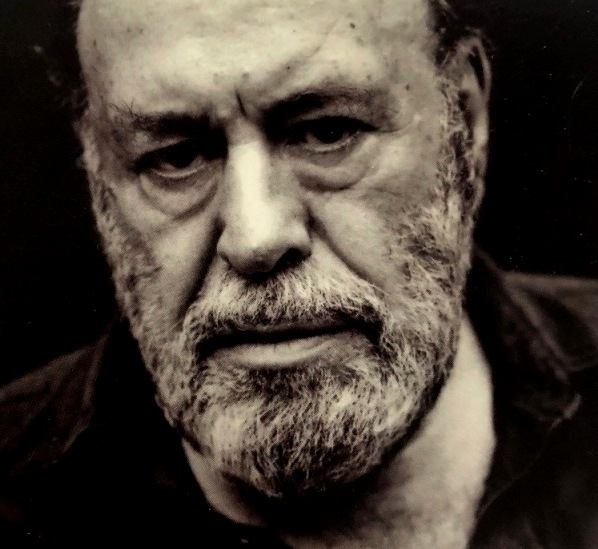
Sylvester: first spied a sketch in a paperback of Bacon’s
Art: Private View
Francis Bacon, Tate Gallery, London SW1
JAMES HALL
| CULTURE | THE INDEPENDENT | SATURDAY 13 FEBRUARY 1999
Francis Bacon may have been the leading light of the so-called School of London, but he always stood out from his fellow figurative painters thanks to his disdain for drawing. Whereas Auerbach, Freud, Kitaj and Kossoff had an almost religious devotion to pencil and paper, Bacon, who was self-taught, gave the impression that he always charged up to a bare canvas and chucked paint on with alcohol-fuelled abandon
But in 1996, four years after Bacon’s death, it was discovered that he had been economical with the truth. The enfant terrible had, in fact, made preparatory drawings throughout his career, and some had been given to the writer Stephen Spender, and to another friend of the artist. More than 40 of these sketches – made in pencil, ballpoint pen, gouache and oil paint – have now been acquired by the Tate, and will be shown alongside their collection of paintings by the artist. It will be a revelatory show all right, but disappointing, too: it surely can’t be long before we’re told he was teetotal, celibate and a fan of the Queen Mum, too.
Francis Bacon, Tate Gallery, Millbank, London SW1 (0171-887 8000) to 2 May
Art world torn over Bacon
’s sketches
BY LOUISE JURY | NEWS | THE INDEPENDENT ON SUNDAY | SUNDAY 14 FEBRUARY 1999
ONE OF the closest friends of Francis Bacon has become embroiled in an extraordinary feud with the lawyers acting for the artist’s estate. They have begun legal action, demanding that he hand over a collection of 500 drawings given to him when he and the painter were neighbours. The lawyers claim that the artist would have wanted them destroyed because he always denied making such preparatory sketches, and that the neighbour, Barry Joule, was “in blatant breach of Bacon’s trust” by preserving them.
Despite the criticisms made of him, the row lends support to Mr Joule’s claim that the works are by Bacon. Last year the Tate Gallery in London refused to display the collection, rejecting its authenticity. David Sylvester, a leading Bacon expert and Tate adviser, disputed its provenance. John Edwards, Bacon’s former companion, inherited the bulk of the estate. Mr Joule, Bacon’s neighbour for many years until the artist’s death in 1992, believed the works were given to him as a present.
“Francis was always very categoric. If he wanted something destroyed, he was very straightforward about it. Over the years I destroyed many paintings for him that he didn’t want kept.” But on this occasion, Bacon said: “You know what to do with it.” Mr Joule said he had understood that the works were his to do what he wanted with them. He added: “If they claim that it was Francis’s wishes to destroy them, are they going to destroy them? Certain scholars are saying it’s a very important archive.”
Legal action permitting, the Irish Museum of Modern Art in Dublin intends to show parts of Barry Joule’s collection in an exhibition early next year. The estate’s lawyers, solicitors Payne Hicks Beach, last week refused to discuss the claim on the material. Tony Shafrazi, the owner of the New York gallery now handling Bacon’s works, did not return calls.
David Sylvester has said that many of the pages must have come from Bacon’s studio because they included personal photos and material others could not have possessed. But he added: “I am among those who cannot see Bacon’s hand in the rather banal brushstrokes and scratchings on these pages.”
Yet Mr Joule believes his archive is as significant as the nearly 40 works — bought by the Tate for a rumoured six-figure sum last year — which go on display at the gallery this week. He has his supporters. David Lee, the editor of Art Review magazine, said: “The interesting thing about the show coming up at the Tate is the opportunity it will present to compare the works they paid a lot of money for with the ones they rejected.”
Both the Tate and Joule collections contain sketches which appear to relate to known paintings. This raises the prospect that Bacon deliberately misled biographers and interviewers by denying that he ever sketched for his large post-war oil paintings.
The first many people knew of any sketches was when four owned by the poet Sir Stephen Spender were shown at an exhibition in Paris in 1996. They, too, are to be shown in the Tate show. But Dr Matthew Gale, curator of the exhibition, said: “When people asked Bacon in a direct way, he simply said he didn’t make drawings or sketches.”
The Tate’s works were bought last year from Paul Danquah and Peter Pollock, friends of the artist in the 1950s and 1960s. The sketches seem to have been done quickly and show figures crawling, crouching and reclining. Dr Gale said it was unclear whether they were preparatory drawings for the giant oils or sketches carried out afterwards as a route to creating new works.
What seemed certain was that Bacon’s post-war works were more carefully planned than had previously been thought. Also acquired by the Tate were photographs and a book in which Bacon wrote lists apparently of potential subjects. Dr Gale said: “That gives the impression to me, at least, that he is looking at his old paintings and thinking of reworking them for new paintings.”
An art expert, who did not wish to be named, said the Joule material appeared very “puzzling and disturbing” and different from the Tate works. “All I would say (about the Joule archive) is it really does deserve significant inquiry rather than dismissal.” One of the possibilities to be explored, the expert said, was whether Bacon might have encouraged one of his lovers to experiment on art with him.
Nothing but bums and drunks
Francis Bacon’s bottoms are at the Tate. Picasso’s happy snaps
are at the Barbican.
Adrian Searle doesn’t know where to look...
ADRIAN SEARLE | NEWS | VISUAL ARTS | THE GUARDIAN | TUESDAY 16 FEBRUARY 1999
Francis Bacon and Pablo Picasso are the two artists that the critic is most often obliged to return to and reconsider. Both led fascinating lives that were inextricably linked to their work. With Picasso, there is always more to discover. With Bacon, there’s probably not much more to say. Personally, I think it is time for a Bacon moratorium. The Tate’s latest re-hang pitches the gallery’s Bacon collection against Damien Hirst’s Pharmacy, a room-filling installation much like a chemist’s shop, albeit one free of corn plasters, diabetic sweets or condoms. Ooh-er.
I assume I’m supposed to think about mortality and the human condition as I shuttle between the two adjacent rooms, but somehow the thoughts won’t come. Next to the Bacon display is another low-lit space, where framed sketchbook pages of drawings by the artist, which he gave to two friends with whom he lived in the mid-fifties, are on show for the first time, along with a small number of drawings that he gave to Stephen Spender. These are not the cache of disputed Bacon drawings in the possession of the artist’s former handyman and neighbour, over which scholars have fretted in recent months; they are undoubtedly the real McCoy, by a man who professed never to draw.
Never say never. The paint-spattered art books, monographs, magazines, photographs of Nazis and that famed volume Diseases Of The Mouth that littered Bacon’s studio attest to his stockpiling of images. It should come as no surprise that Bacon did sometimes draw, even if the results were not something that he returned to or seemed to value.
Some of Bacon’s sketchbook drawings look like try-outs for figures — bendy-toy manipulations of poses. Most took only a few seconds to execute, using thinned-down oil paint (maybe there was a bit of paint left over on a brush, and rather than throwing the brush in the corner or smearing the paint on the wall, the artist unloaded it onto paper).
Some are looping hieroglyphs of oil-paint — figures constructed in five or six scribbly strokes, or fewer. Sometimes Bacon would go back and draw in a cursory space-frame around the figure, or a ball-point sofa or horizon line, and very occasionally he would colour in a background, and actually get involved in picture-making on a small scale.
The four drawings that Bacon gave to Stephen Spender look much more managed and self-consciously ‘complete’ than the rest. A figure reclines on a sofa in a red room. The sofa is made-up of three horizontal bands in greyish purple. It is as if Bacon has used a prototype Rothko as a setting for a figure. They’re like painted postcards.
Some of them, too, show a drawing style faintly reminiscent of David Bomberg and Frank Auerbach — a kind of lean, angular look that delineates the tension of the body, the vectors that connect a foot, a knee, the ribcage, an upstretched arm, the twist of the torso. But they are instantaneous rather than analytical — signs for the figure rather than developed images.
Elsewhere, Bacon’s line is more rounded and bulbous, almost a self-parody of a figure that might appear in the paintings. These drawings are nearly nothing, in terms of either the time taken or the degree of invention. Some, nevertheless, have an undeniable charge, a kind of pained, abject feel. One shows a crawling figure, like a giant adult baby, making its way across a blue plane.
Bacon’s drawn figures have a horrible sort of dim-witted lumpenness, as though their fleeting appearance on the soiled page is the only life they have, a life reduced to almost nothing. They stretch, they bend over, they crawl about, they wave arms and arses in the air.
He seems especially interested in showing their bums. Some figures he has gone back to and filled in with dirty colour, and these are almost obscenely fecal. We get glimpses, too, of his wandering thoughts, little written aide-memoires where he imagines new images or re-amalgamates old ones: ‘Figure in centre of room looking into mirror, as in study of apes’... ‘Figures fucking in middle of carpet possibly’... ‘Chair as in Vatican picture at side’... ‘Owls with meat in circle’.
All of which conjures an image of the artist in the studio, talking to himself, mumbling about, leaving his wretched trace as he goes. The drawings are like toilet paper for the by-products of the artist’s imagination. Then he lets the paper fall, adding to the self-imposed chaos, and forgets about it. Or, in the case of the drawings here, passes them on to a friend, in lieu of rent or friendship.
And what token does he choose to give away? His artistic disjecta and excreta. I feel another Bacon book coming on, something dark and Freudian, as if we haven’t had enough of that already.
A terrific exhibition called Picasso And Photography: The Dark Mirror, is ending its international tour at the Barbican Centre. Curated by Anne Baldassari, in charge of the photographic archives of the Musee Picasso in Paris, the exhibition delves into the archive and shows us the extent to which Picasso was indebted to, reliant on and fascinated by photography.
Picasso was as much a devourer of images as a creator. He learned not only to take photographs, but also to develop and print them. Is there anything he did that showed him other than inquisitive, inventive and in control — whether in his work, his love life, or even his poetry and plays? I hate the word genius. Picasso was a genius.
Picasso collected photographs, postcards and the trifles of the burgeoning media age. He copied photos and he worked back into them. He made hilarious, sexy adjustments to a Vogue photo-spread of 1950s bridal wear and he drew with light for the camera, with a torch in his hand. His collection of photographic material numbers over 17,000 items
The exhibition sets items from the collection beside paintings and drawings that relate to them in various ways, and the juxtapositions are nearly always telling, in that one begins to be able to read the artist’s working process. Unlike Bacon’s drawings, which are truly miserable by comparison, almost everything Picasso did — and everything he chose to collect — was useful on several levels. Including, of course, his mistresses, wives and lovers.
And so we have Picasso’s own photographs: portraits of friends (his 1904 portrait of Ricardo Canals shows Picasso himself, reflected in a mirror); Georges Braque and Fernande Olivier in a bar in 1910; shots of Picasso’s studio and works at various stages of completion; self-portraits (often ridiculously self-aggrandising); photos taken in order to paint; photos for fun; and photos as souvenirs. How close some of the artist’s painted and drawn images are to the photos and postcards that inspired them — but this does not diminish Picasso in any way, and instead testifies to his resourcefulness.
Picasso’s collection of Edmond Fortier’s ethnographic postcards of semi-naked Africans found their way, via drawings, into Les Demoiselles d’Avignon; Picasso’s own photographs of the Horto de Ebro were almost directly transposed into his Cubist paintings; a kitsch programme illustration of the Ballets Russes in Les Sylphides was copied, with minor adjustments, in Ingres-like drawings. And this led to another drawing, then another.
Picasso posed Olga in an armchair in a pose reminiscent of Ingres’s Madame Riviere, and then painted from the photograph that was derived from the Ingres painting... It all goes to show how the artist keeps on making connections and leaps between one thing and another, and another, and another, and shuffles real life and art history, the advertising image and the photograph he took himself, collapsing all the material together in order to invent something new and fresh.
Picasso And Photography is an endlessly rich exhibition, and Baldassari’s accompanying book is wonderful. It is intimate, funny, a glimpse into the studio and of Picasso at play — witness the crayoned-over photos of the ageing Picasso and his friend Manuel Pallares, redrawn as bibulous Greek gods in togas.
One thinks of Francis Bacon in his photogenic squalor, surrounded with his image-hoard, doing a horrible little drawing in a sketchbook, and claiming that he never did any such thing. For some inexplicable reason, I begin to feel sorry for him.
Picasso And Photography is at the Barbican Art Gallery, London EC1 (0171-588 9023), till March 28.
Francis Bacon: Works On Paper And Paintings is at the Tate Gallery, London SW1 (0171-887 8000), till May 2.
Sketches of pain
Real painters, Francis Bacon insisted, don’t doodle.
But he was fibbing.
Charles Darwent looks at the intriguing truth.
BY CHARLES DARWENT | CULTURE | NEW STATESMAN | FRIDAY, 19 FEBRUARY, 1999
When Giotto was challenged to prove his genius by an emissary of Pope Benedict IX, he responded by drawing a perfect circle freehand. When Francis Bacon, never fond of being outdone, set out to prove his, he went one better and drew nothing at all. The story, put about by Bacon himself in numerous biographical interviews, was that he had no need of sissy things like preliminary sketches in creating his portraits of screaming popes or sodomic boyfriends. Such was the sulphurous nature of his genius that they appeared fully formed on canvas, as if by magic.
As with much else in the self-made myth of Francis Bacon, tales of his spontaneous working method turn out to have been something less than the truth. A small but intriguing exhibition at the Tate Gallery shows that Bacon worked on at least one sketchbook in his studio during the late 1950s and early 1960s, years that also saw his elevation to the ranks of international art stardom. Sold to the Tate Gallery last year by two ex-flatmates of Bacon’s before the artist’s removal to his studio at Reece Mews in 1961, the 40-odd sketches from the book — in gouache, pencil, Biro and oil paints — reveal Bacon to have been not merely an obsessive sketcher, but something of a fibber as well.
Although it is difficult to draw direct parallels between the sketches in the Tate’s show and specific pictures by Bacon in the gallery’s collection, the typological links are clear. One series of drawings is based on photographs of fencers by Eadweard Muybridge, the source of much of the subject matter in Bacon’s paintings of the 1950s. Another appears to be of a boxer leaning on the ropes of a boxing ring — a well-known object of fascination to the painter, but one that apparently never made it as far as the canvas. (Except, perhaps, in the form of the linear boxes with which Bacon began to surround many of his finished figures at much the same time.)
As well as offering tantalising glimpses of these unknown subjects in Bacon’s oeuvre, the Tate’s show also reveals an unexpected dynamism in his doodling on paper. Where the power of his finished pictures lies in the worked-out, static nature of their horror — sides of dead meat, frozen screams, figures inert on a bed — the sketches show the motive means by which this stasis was reached. One set of sketches of a reclining nude has legs that begin as a squiggled blue line and then migrate around the subject’s body over the course of several sketched pages, like the hands of a clock. The buttocks of another study have the kind of muscular vitality that Bacon seems studiously to have banished from his canvases.
Given the importance of these works, the Tate’s show raises two questions. First, why did Bacon lie about his sketchbooks? The show’s catalogue suggests that, as an untrained artist, he may have been ashamed of his inability to draw. Shame not being a virtue one automatically associates with Francis Bacon, a more likely answer may be that a fondness for drawing did not fit in with his carefully fostered image of satanic genius. In an age when spontaneity had come to be seen as an artistic end in itself, drawing and sketching were an art-market no-no. Bacon, ever sensitive to market forces, may simply have lied to keep up with the Pollocks. That he referred to his finished paintings as “studies” suggests that he recognised the value of spontaneity when he saw it.
The second question is whether the knowledge that Bacon was a closet sketcher should change the way we view him. The short answer to that one is no. Whatever their links to his finished paintings, the Tate’s sketches are not miniature Bacons: they are fascinating more as artefacts than as art. And if they show that Francis Bacon did not always tell the truth about his work, anyone who finds themselves shocked by that should probably not be looking at it in the first place.
Francis Bacon: works on paper runs at the Tate Gallery (0171—887—8000) until 2 May
By WILLIAM ZIMMER | ART | THE NEW YORK TIMES | SUNDAY, 28 FEBRUARY, 1999
IF the structural changes made to the Yale Center for British Art’s building in New Haven are almost imperceptible to visitors, it’s clear that the three exhibitions in the gallery’s reopening after a year of construction and repairs give the place a dynamism that shouts its comeback.
The shows have an obvious common thread; they are devoted to three major British artists of the 20th century whose art was once controversial: Francis Bacon, Lucian Freud and Henry Moore. The Bacon exhibition is drawing the most comment and rightfully so. It is a splashy retrospective containing about 70 paintings.
But the earliest, from 1933, is a small Crucifixion whose bony figure derived from Surrealism presages Bacon’s patented distortion of the human body. Bacon (1909-1992) evidently found his potent idiom early, and progressed by stuffing it with more raw, tortured energy. What might be called early surrogates for familiar human figures include not only the Sphinx but also animals, especially a baboon given a remarkably evanescent silvery fur coat.
The 1952 painting of the baboon is called a study, yet it measures 78 inches by 54 inches. The expansive size of postwar American paintings is often remarked on, but Bacon more than holds his own on any scale of expansive. The public’s fascination with the writhing and contortion of Bacon’s figures might have obscured the realization of his brilliance as a colorist.
The plight of his figures is made all the more harsh when played out against backgrounds often tropically hedonistic. Bacon’s sense of theater has always been recognized; his characters are often confined to what seem like cramped, dimly lit stages, or circus arenas — and sometimes barred windows are indicated.
In addition to illuminating the anxiety of modern life, or perhaps to intensify it, Bacon occasionally savaged art history masterpieces, the most famous being variations on Velázquez’s portrait of Pope Innocent X. Bacon’s pope is an angry prisoner of his office. Van Gogh is evoked twice in the exhibition; his wistful idealism is offset by the climate in which Bacon places him, largely indicated through an intense red and green.
In 1982 Bacon painted Oedipus and the Sphinx after Ingres, which he heats up through a shocking pink background. Oedipus’s foot, injured when he was a child, is still bandaged and bleeding in Bacon but the painting contains an annoying device: Bacon tended to indicate significant parts of a painting by either putting a circle around them or pointing at them with an arrow. But Bacon mastered the multi-panel mode, which he began to explore in the 1960’s.
Sometimes he does triple the intensity. An early portrait triptych, Three Studies for a Portrait of George Dyer (On Light Ground), features his longtime partner and illustrates Bacon’s peculiar brand of distortion. He smears paint to get a Picasso-like look, and Dyer looks like he’s been subjected to something more than an analytical faceting of form; he looks as if he’s been beaten up. To some extent most of Bacon’s figures share this sensation of a pummeling.
Doing what made him a singular painter seems to have come easy for Bacon in the 80’s. Paint isn’t used in such a bravura way, and his tormented expressions seem to have acquired ball bearings.
Lucien Freud, who was born in 1922, is sometimes seen as a successor to Bacon because his figure paintings are exaggeratedly fleshy. But his more decorous etchings — 42 from the collection of Paine Webber having the bad luck to share a floor with part of the Bacon show — have a different emphasis. Freud’s line is firm, and the figures, even the grosser ones, seem solid and oddly alike. About the only variety in the show is a thistle, masterfully rendered, and a small tattoo on a woman’s arm.
It’s not so much the similarity of the figures that goads a viewer to hurry through the show, but the fact that most of the figures loll about. An alert self-portrait is a rare exception to the general soporific mood.
It’s tempting to say that, in the explosion of art, Henry Moore is relegated to the entrance lobby. But that space is advantageous because its dimensions allows viewers to circumnavigate the sculptures, and if any sculpture needs to be seen in the round, it is Moore’s.
The show, which marks the artist’s centenary, is titled, Henry Moore and the Heroic. A couple of the most compelling pieces reflect this: they evoke soldiers of ancient Greece who have fallen in battle. Representing the bronze age, they are made of bronze with a green patina. A related work is ''Helmet Head, No. 3'' from the center’s collection; a head with vigilant eyes lurks out through an opening in the front of the shell.
But another strong theme, peace, is the counterpart of war. The exhibition is especially strong in family groupings, including tender Mary Cassatt-like mothers and children. In other hands such sculptures would be sappy, but the heroism attributed to Moore affects these works, too.
The exhibitions of works by Francis Bacon, Lucian Freud and Henry Moore remain at the Yale Center for British Art in New Haven through March 21.
Draughtsman comes out of the closet
A collection of recently discovered drawings by a Bacon who never drew.
WILLIAM PACKER | EXHIBITION | REVIEW | THE FINANCIAL TIMES | TUESDAY 2 MARCH 1999
Francis Bacon a draughtsman? Who would have thought it? The discovery of a great many drawings among the mass of material and detritus that he left unsorted in his studio at his death in 1992 has generated a certain amount of heat, not to say actual excitement. For it was always understood — and Bacon himself was always at pains to make sure it was understood — that he never drew. “I often think I should (work from sketches and drawings), but I don't,” he said in 1962. “It’s not very helpful for my kind of painting.” Whom, then, was he deceiving: the public or him-self?
But it is hard to see what all the fuss is about. Leaving aside the view of those who take it as self-evident that he couldn’t draw in any case, it all depends upon what is meant by drawing. There is the objective study directly from life or nature for purposes of information and understanding, whether for immediate use or for its own sake; there is the sketch or proposal for the larger work, more or less finished in itself, testing and resolving problems of composition and effect; and there is the general toying with ideas, sometimes hardly more than doodling, to see what stimulus, chance or the subconscious might throw up. Add to that the long-established if loose convention of regarding anything worked on paper as a drawing, and the question grows ever more tangled.
Few of Bacon’s early works survive, and the transition from interior designer to mature artist remains obscure — though what has come to light suggests a more sophisticated painter than was once supposed, and who knows what help he may have had from his artist friends. Whatever the case, it was with the small triptych of 1944, Three Studies for Figures at the Base of a Crucifixion, that he woke one morning at the age of 35 to find himself famous.
To look at this quite remarkable work, in the new display of seven of his earlier paintings, dating variously from 1944 to 1963, it is hard to believe that drawing had no part in it. We should only remember, perhaps, Bacon’s working friendship with Graham Sutherland, who drew and worked on paper all the time.
Bacon’s denial — or rather, his studied dissembling — on the matter of drawing may well reflect the awareness borne in on him then that, though his essential image was and would remain the figure, it was the academic disciplines of the life room that were so conspicuously absent from his experience. It was that objective study, perhaps, based upon direct observation and analysis, that he meant by the drawing he always said he didn’t do. Working close to an artist as sophisticated as Sutherland, steeped as he was in just such academic discipline, yet moving at that time into an expressive freedom beyond it, he was readily persuaded that it didn’t matter.
Bacon always jealously guarded his expressive freedom in his work, to improvise and react spontaneously. He was, so critic David Sylvester tells us, “extremely insistent, with all his talk of accident and chance, upon the importance and value of sudden and unexpected events in the course of his pictures’ execution. And he doubtless feared that owning up to making sketches might have lessened the force of such talk.” Sylvester goes on to confess, somewhat wryly: “I courteously refrained from mentioning a series of small pencil-sketches for paintings which I had seen in the endpapers of his copy of a paperback edition of poems by T.S. Eliot. However, I had been gullible enough not to have realised that these were but the tip of an iceberg.”
The Tate is now showing the works on paper by Bacon which it has lately acquired. The period they cover is roughly consonant with that of the paintings in the next room, all but one, a Figure in a landscape of 1952, dating from the late 1950s and early 1960s, the bulk of them coming from two spiral-bound sketch-books filled between 1957 and 1961.
It is manifestly working material, much of it scrappy, mucky, often tatty in its present state, made to be used, thought about, and then discarded. One or two of the drawings are taken a little further, all but small paintings in themselves, but most are mere fragments and suggestions made variously in Biro, pencil and oils. A number of them relate directly to known paintings, but most do not. All in all, they constitute a fascinating and valuable find — valuable for the truer insight they afford into the mind and processes of the artist.
EXHIBITION FRANCIS BACON SKETCHES/TATE GALLERY
Bacon: the rough guide
TOM LUBBOCK | CULTURE | THE INDEPENDENT | TUESDAY 2 MARCH 1999
Because something has been kept secret, needn’t mean it holds a secret. Francis Bacon always said that he never drew, he only painted. But since his death in 1992 a lot of pictures have turned up that undermine this claim. Their value and status are still disputable and the smallish show at the Tate Gallery, Francis Bacon: Works on Paper, is, in some ways, premature. Still, the topic is obviously of note to anyone interested in Bacon, and this glimpse is worth catching. What sort of revelation it offers is another matter,
The drawings at the Tate are dated to about 1957-61. A good moment: Bacon was about 50 years old and — a late beginner — on the brink of what is now seen as his mature style. There are pencil sketches on paper, and oil-paint sketches on paper, and Biro sketches on paper. There are also a couple of examples of his drawings over photographs, where Bacon has taken a photo-reproduction from a book or a magazine and worked over it in paint, sometimes completely obliterating it, sometimes altering it only slightly.
Now, there’s nothing here that could be called a finished drawing. Almost all of them are figure studies, quite loose sketches, generally involved with working out some body pose or — if that sounds too anatomically correct — some body shape. Some of them can be related, and quite closely, to paintings; some not. And though it would be presumptuous to say that they’re just what you would expect Bacon’s drawings to look like, I don’t think anyone seeing them will get a big surprise, or say “wow, so that’s how he drew”.
No. They figure. And as for the altered photos — well, they’re interesting, because they show Bacon disrupting an existing image, and in his paintings he’s often disrupting his own images — but they’re almost not news. We know from photos of his studio and his interview with David Sylvester that he worked from, and among, torn-out and trampled-on photos — Eisenstein film stills, Muybridge motion studies, fine-art reproductions, natural history shots. The fact that he worked on them, too, doesn’t seem such a big difference.
I don’t say these drawings lack value or enlightenment. They’re often graceful in the way that Bacon himself was graceful. They stress the cartoony side of his art, which is always worth stressing. But I do say: if we’d known them all along, I don’t think we’d now give them a lot of attention. And if you’re looking for revelations, you have to see them in quite another way.
You may remember a TV programme on Channel 4 last year about a large haul of these drawings-over-photos, in the possession of a friend of the artist. They’re not in this show. But these, it was said, the Tate had at one point taken an interest in — they were offered without charge, apparently — but then the gallery got cold feet, and the affair was made to sound mysterious and conspiratorial, as if the Tate wanted to hush up the very existence of these pictures.
The problem, I gather, is that another, non-Bacon hand had been detected in the pictures, and that made them dodgy. But now it’s thought possible that this other hand belonged to Bacon’s boyfriend of the time, and that the drawings aren’t so much inauthentic as collaborative. Whatever value that might give them, it seems likely that many visitors will have seen the programme, and could do with more information here. All we get is a tiny mention in the catalogue — “substantial quantities of comparable material have recently been attributed to the artist” — a briskness that suggests the issue remains tricky.
The TV programme, of course, and others, too, have gone on to suggest that the existence of any Bacon drawings is more than tricky, it’s damned awkward. It wasn’t just that the old dog had been caught telling lies. No one could be surprised or shocked by that, as such. And it’s not that Bacon mightn’t have had good reasons for keeping his drawings quiet. As David Sylvester says in his preface, he probably didn’t think they were much good in themselves, and he didn’t want to encourage an irrelevant interest in his creative process, as opposed to his painting.
Fine. But he may have had bad reasons, too. And what’s suggested is that discovery of these drawings touches his paintings very damagingly. By denying them, Bacon was really trying to deny the fact that he had a creative process at all. For didn’t he always claim to work in an entirely unplanned and quasi-random manner? And doesn’t the power of his art involve a sense of this spontaneity? But these studies and try-outs sink that story — and expose the painting as a kind of con. That’s the dreadful secret they reveal.
Not quite. But it is a slightly difficult issue. I think the right answer goes like this. The above line of thought is quite wrong; the existence of the drawings damages the painting not at all. But on the other hand, Bacon himself probably believed something rather like that, and it was a reason for him to deny his drawings. After all, the Bacon myth, partly self-constructed, tends to picture the artist as fighting drunk, flinging himself and several pots of paint at the canvas. There follows a great Andy Capp-style dust-up, a cloud of energy with hands, brushes, rags, and sponges flying everywhere. At the end of it all, things settle, and there on the canvas is the image — the skid-mark of the impact, so to speak.
What I’m getting at is that Bacon did half-want to elide the act of painting. There are all those vivid and memorable phrases in the interviews with Sylvester — about making images straight off his nervous system, or leaving a trail like a snail leaves its slime, or making images that didn’t look as though they’d been interfered with. They don’t all say the same thing, but the general idea is of images that emanate, materialise, just happen — sort of splurge themselves out of him.
And the thing is, you can half-believe it, too. Bacon’s images do have paint skid-mark aspects, and the bodies he depicts have lost their boundaries and they blend into those skid-marks; and then you can imaginatively transfer this feeling on to the painter’s own body and its contact with the canvas. This, indeed, is the illusion the paintings often achieve. Bacon is careful to conceal any traces of too deliberated paint-work — and conceals them in the same spirit as he concealed his drawing.
But remember, it is an illusion, and he is careful. True, the paintings have randomly thrown splats of paint in them, and wild strokes, but they are incorporated very cunningly. This spontaneity is, unavoidably, a matter of work. And the existence of drawn studies should be no more of a revelation to us than the "revelation" that Bacon was an extremely skilful operator.
If you really wanted a posthumous revelation about Bacon’s art, that would be its subject: Bacon’s skills in operation, and operating in one particular area. For there’s one notable omission from the Tate’s drawings. There are body studies, but there are no head or face studies. I suppose half Bacon’s fame rests on what he did to heads and faces. Who wouldn’t like to see how that was done? So the revelation I’m imagining is a hitherto undiscovered reel of film, close up on the middle of a Bacon canvas, showing the artist doing his first strokes, his solid modelling of forms and then his blur-smears, dissolves and sudden fade-outs, his chancy, flung blots and splashes and his seamless blending of them into the image, his finishing touches. Bacon-wise, I can’t think of a more valuable or curious document. There’s almost certainly no such thing. But you never know.
'Francis Bacon: Works on Paper', Tate Gallery, Millbank, London SW1 (0171-887 8000). Daily to 2 May, admission free
The drawings he didn’t want you to see
Francis Bacon: Works on Paper and Paintings
Tate Gallery, London
LYNN MACRITCHIE | EXHIBITIONS | CULTURE | THE INDEPENDENT ON SUNDAY | SUNDAY 7 MARCH 1999
For Francis Bacon, only the very best or the very worst in life would do.
Whether he was enjoying a glass of the finest champagne or a beating from a
street tough, in his art as in his life there seemed to be no middle ground. Of
course, he did not always live at life’s extremes, but he made it appear as if
he did, and his circle of friends, lovers, collectors and critics adored him for
it.
Initially inspired to take up painting by seeing the work of Picasso when he was
living in Paris between 1926-28, Bacon did nothing so mundane as go to art
school. Rather, back in London in 1929 aged 20, he set up a studio and began to
work. Sixteen years later the triptych Three Figures at the Base of the
Crucifixion was hailed by the critic John Russell as "a watershed in British
painting."
This was a remarkable achievement, made all the more so by Bacon’s insistence – and
its acceptance by those who talked to and wrote about him – that
he never made any preparatory studies for his large oil paintings, but worked
straight on to the canvas. This impression of work successfully achieved without
any form of intermediate struggle was reinforced by his habit of destroying any
paintings which did not satisfy him.
Bacon readily acknowledged the inspiration he found in photographs, including
Eadweard Muybridge’s studies of the figure in motion, and film stills such as
the famous Odessa Steps sequence from Battleship Potemkin. The working
process by which such sources became his final, painted images might perhaps
have been revealed had David Sylvester, during any of the interviews he
conducted with the artist between 1962 and 1984, ever mentioned the series of
small pencil sketches he had noticed in the endpaper of Bacon’s paperback
edition of the works of T S Eliot. But the foremost Bacon authority "courteously
refrained" from asking about them while their creator sat before him denying
that he ever did any drawing other than directly on to his canvases.
The existence of other drawings should be a surprise to no one except those who
believe artists to be magicians rather than makers. In this sense, Bacon obliged
his audience. He too believed in the magic of painting, its ability to tell a
lie that revealed a greater truth. In pursuit of such profundity, what did it
matter if a few drawings were destroyed along the way? Those now to be seen at
the Tate seem to have been an unusual exception, given to his friends Peter
Pollock and Paul Danquah, in whose Battersea flat he lived and worked from 1955
to 1961. Four other drawings were a gift from the artist to the poet Stephen
Spender, who had written three articles about him in 1961-62. That he would give
drawings as gifts suggests that he did indeed value them, if not as works of art
in themselves then certainly as something sufficiently personal to stand as
tokens of the esteem in which he held their recipients.
The drawings are perhaps best understood not as any form of academic studies,
but as notes, differing little from the written notes which sometimes accompany
them. In a sprawling, open hand, they listed possible subjects for compositions
in general or, in one case, specific components of a particular painting, which
might well have resembled Seated Figure (1961), one of the selected
paintings hung in the adjacent gallery.
Anyone who thinks that so tightly balanced and complex a composition was
achieved entirely without premeditation is simply not seeing what is on the
canvas before them. For, despite his lack of training in figure drawing, Bacon
was certainly skilled in organising the pictorial space of his paintings. In his
early years, Bacon worked briefly as an interior designer, and his compositions
always suggest an ease with the arrangement of things and planes in space. In Seated
Figure, a few spare, thin black lines set up a kind of spatial box. At the
very centre of this, the true raison d’etre of the picture is addressed,
that "pool of flesh" identified in a pencil note in the margin of his sketch Two
Owls. In paint Bacon does seem to work by instinct, scraping and dragging
and spattering until the mess of blobs and smears at the epicentre of the canvas
resolves into a recognisable, undeniable, human face.
It could be said that Bacon was not dissembling when he denied that he made
drawings, for he had no interest at all in producing drawings as finished
products. The pages from his sketchbook show figures sitting, falling, lying and
twisting, forming a vocabulary of figures in motion.
Some of the drawings certainly have that familiar Baconian power to send a
shudder of spontaneous revulsion through the spectator. The extraordinary
violence of those blobs of pigment heaped up on sheets of grubby, oil- smeared
paper, is startling, their unruly life controlled within a cage of swift pencil
or ball-point pen strokes. But the magnificence of Bacon’s paintings is in no
way undermined, as he may have feared, by seeing these few traces of what may
have been their genesis. In fact it is reassuring to see how consistent Bacon’s
thinking process was. "Great art is deeply ordered," he observed, and his was.
The links between the found images which intrigued him enough to be noted down
in these quick sketches and those in his finished canvases seem unambiguous. It
is perhaps not surprising that Bacon’s belief in order was overlooked by those
who experienced the dazzling disorder of his working conditions – the
famous paint-spattered studio, knee deep in drifts of torn books and magazines,
photographs and papers.
Looking closely at, say, the study after the life mask of William Blake, the
image appears to materialise on the canvas from within a welter of random marks
and splatters which somehow become form. Ultimately, it is the product not of
any particular process but of the artist’s will to somehow, anyhow, pin down the
soul within that "pool of flesh". For Bacon, nothing else – especially
the niceties of academic drawing – mattered.
Francis Bacon: Tate, SW1 (0171 887 8000), to 2 May.
Yale reopens its key Anglo file
VISUAL ART: The great benefactor Paul Mellon would have
loved his beautifully refurbished Yale Centre for British Art,
says Richard Cork
RICHARD CORK | VISUAL ART | ARTS | THE TIMES | MONDAY MARCH 8 1999
Paul Mellon’s recent death robbed us of an outstanding benefactor, whose enthusiasm for British art transformed its representation in his native America. But Mellon’s legacy is set to endure, above all in the great museum he founded and endowed at Yale University. The Yale Centre for British Art, housed in a luminous building designed by Louis Kahn, contains the finest historical collection of British painting to be found anywhere outside the UK.
Sadly, Kahn’s building was closed all last year. The roof needed urgent attention; and while its 56 domes were being refitted, the galleries were supplied with new backing wallboards, linen and carpets. Now it has reopened, with an interior as pristine as it was when inaugurated in 1977. Kahn’s architecture, dominated by concrete, steel and glass on the austere facade, becomes far richer within. The Entrance Court, surging up through the full height of the building so that it benefits from the glazed domes’ top lighting, offers a spectacular welcome. Not that Kahn relinquishes his Corbusian love of concrete inside. It remains visible wherever you look, and takes on an awesome authority in the cylindrical staircase.
With considerable daring, Kahn exposed the outside of this great drum to anyone gazing down from above. It looks like minimal sculpture at its most uncompromising, above all when viewed from the well of the Library Court. But the wood in panelling and floor, as well as a magnificent rug spread between the sofas, off-set any threat of gloom.
Moreover, the walls of the Library Court have been rehung to dramatic effect. Now the cream of the paintings by George Stubbs, an abiding favourite of Mellon, are displayed around the room. Previously, the two largest and most provocative Stubbs canvases, Horse Attacked by a Lion and Lion Attacking a Stag, were hung far above visitors heads. Now they confront us at eye level.
The main sweep of the collection, though, can be found on the fourth floor. Rearranged in a series of themes, it tells a broadly chronological story of British painting from Tudor times to the early 20th century.
Mellon bought Gainsborough at an early, captivating stage, when the young artist lived in Sussex and painted the Gravenor family at ease on the edge of a sunlit cornfield. The outcome is the quintessence of freshness, bathing the Ipswich apothecary with his wife and delectable daughters in a luminosity Gainsborough would never surpass. Mellon did not stint when he had the chance to acquire masterpieces by celebrated artists. Nothing could be more vibrant than Turner’s large, immaculately preserved panorama of Dordrecht, while Constable is seen at his most agitated in a headlong canvas of Hadleigh Castle.
Although the centre’s collection does not extend very far into the present century, its ebullient director, Patrick McCaughey, has ensured that the reopening is marked by three stimulating shows devoted to pre-eminent modern artists. The Entrance Court is filled us at eye level. The main sweep of the collection, though, can be found on the fourth floor. Rearranged in a series of themes, it tells a broadly chronological story of British painting from Tudor times to the early 20th century. The Entrance Court is filled with carvings and bronzes by Henry Moore, concentrating on his preoccupation with the “heroic” figure. Some of the finest pieces were made between the wars, when Moore concentrated on carving. The Reclining Woman, loaned by Ottawa, hewn from Green Hornton stone in 1930, is among the most satisfying of all his attempts to fuse female and landscape forms.
But most of Moore’s exhibits are post-1945 , when he began to favour bronze and embarked on a sequence of family groups. Inspired perhaps by the birth of Moore’s own child, they look like an attempt to affirm optimism after the Holocaust. After a time, though, disquiet breaks out. In a small Mother and Child from Washington, the offspring seems bent on biting the proffered maternal breast. And two large Warrior figures, among Moore’s few attempts to explore the male form, show brutally severed victims scarcely capable of holding shields to protect themselves from further assault.
In this respect, they are surprisingly close to the emotions generated by another show upstairs Francis Bacon retrospective. The range of Bacon’s art is here, from a phantom like Crucifixion painted in 1933 to a mysterious, impulsive Jet of Water painted a few years before his death. The Yale survey does compelling justice to the flowering of the artist’s vision, displayed in intimate spaces that intensify the theatricality of Bacon’s art.
Anther painter who came to maturity after the war, Lucian Freud, is scrutinised in the third show. It concentrates on his etchings alone, lent by the Pairie Webber Art Collection. They provide a remarkably absorbing insight into Freud’s achievement, even though he abandoned etching for three decades after an initial involvement with the medium during the 1940s. Starting with his resumption of interest in 1982, the survey charts Freud’s probing, alert scrutiny of heads and bodies alike. Most of them close on the sitter, fascinated above all by the human face’s capacity to disclose individuals at their most stoical, contemplative and solitary. Freud’s mastery increases as the exhibition proceeds, and his latest prints arrive at a magisterial command of a medium he was born to explore.
• Bacon, Freud and Moore at the Yale Centre for British Art (001-203 m 2800), 1080 Chapel St. New Haven, Connecticut, until Mar 21,
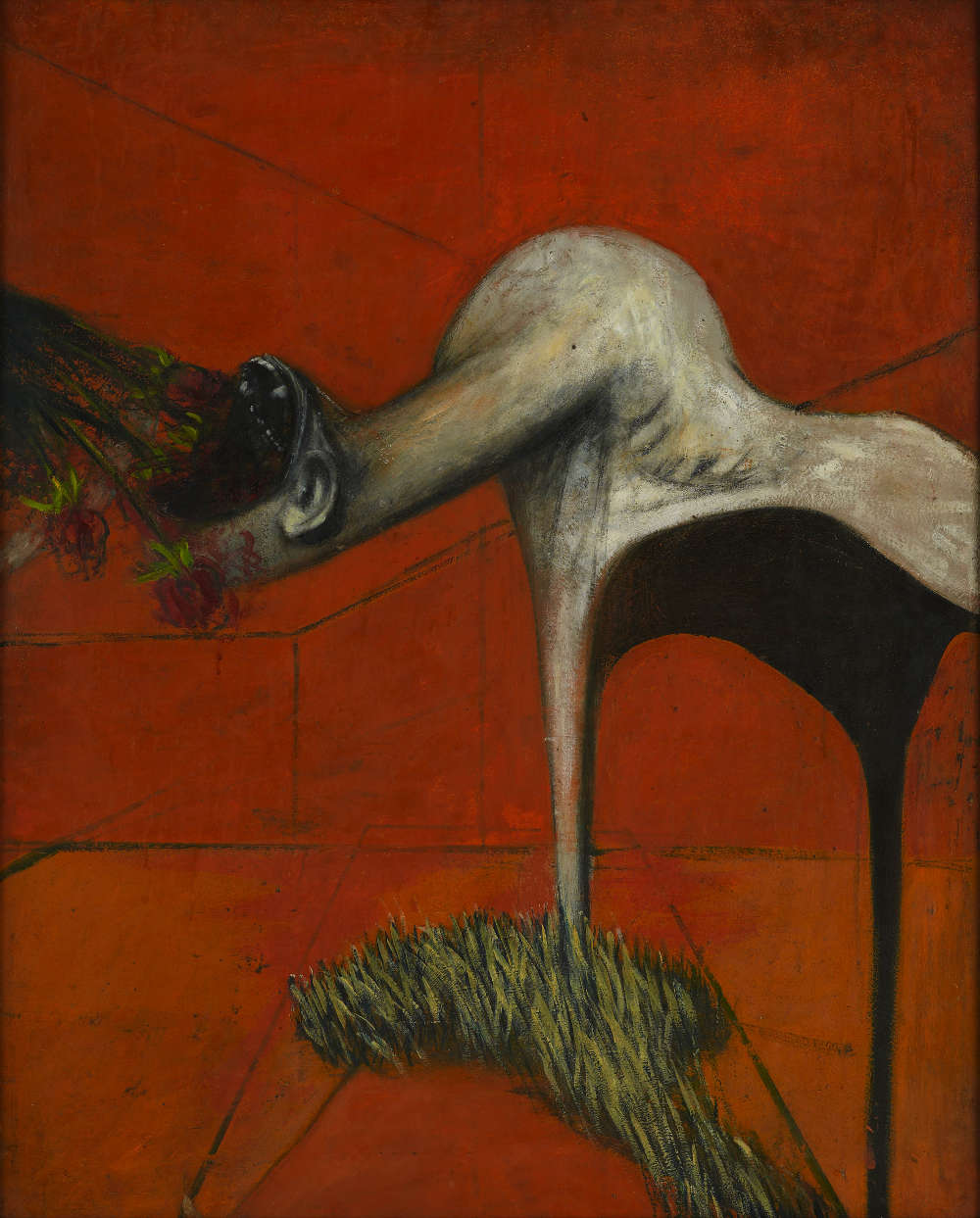
The full range of Francis Bacon’s work is on show at Yale University in Connecticut, including Untitled (1943 or 1944)
Ways to fix daydreams on paper
Francis Bacon: Works on Paper and Paintings Tate Gallery
MARTIN GAYFORD | EXHIBITION | ARTS | THE DAILY TELEGRAPH | WEDNESDAY, MARCH 10, 1999
FRANCIS Bacon often said that drawing wasn’t part of his working method. But since his death in 1992, a number of authentic sketches on paper have turned up. So was he a shifty character? Or was he merely being excusably economical with a minor bit of truth? Indeed, can these scrawls really be called drawings at all? In the midst of this controversy, the Tate Gallery exhibition (until May 2) raises some intriguing questions about the artist and the way he worked.
As works of art, Bacon’s little sketches on paper aren’t very substantial. They have a raw vitality, an almost violent brusqueness, but that’s about all. Most are hastily executed in oil paint over a few, quick lines in pencil or Biro, some are just in paint, only a few would qualify for a strict definition of “drawing” — that is, purely linear works — and they are quite slight.
A good friend of Bacon’s said to me last week that though he often saw the artist “doodling”, he didn’t think of him as drawing. What he understood Bacon to be saying was not that he didn’t draw, but that he couldn’t draw. And it is true, in comparison with the kind of highly wrought graphic images produced by a contemporary such as John Minton, Bacon really didn’t and couldn’t draw. These little sheets look more like the kind of vague outline he claimed to put on his canvases as a starting point.
If we want to acquit Bacon of lying on the grounds that these aren’t drawings, as the critic Brian Sewell has suggested, I suppose we could. It’s one of those “It all depends on what you mean by” issues. And really there is no hard and fast distinction between painting and drawing (Cézanne said that when he was painting, he was also drawing). It is more interesting to debate what Bacon was up to when he made these little designs, whatever you want to call them.
In the famous interviews with David Sylvester, the critic and a close friend of the artist, Bacon said two things about the origins of his works. He described how images would “Just fall into my mind like slides” — “I can daydream all day long and see rooms full of paintings”. Also, though, he emphasised how important photographs were for him. He added: “Through the photographic image I find myself beginning to wander into the image and unlock what I think of as its reality. Photographs are not only points of reference, they are often triggers of ideas.”
Bacon worked from a rich compost of imagery that littered his studio — including reproductions of paintings, some of them his own, and such unexpected sources as Eric Hosking’s photographs of birds, and the plates from Marius Maxwell’s Stalking Big Game with a Camera in Equatorial Africa.
Bacon would draw over photographs that took his fancy, and also lift figures and creatures — a couple of owls snapped by Hosking, for example — and play around with them on paper. As Matthew Gale argues in the Tate’s catalogue to this show, perhaps this was a way of fixing some of those ideas for pictures that “dropped into his mind” — daydreaming on paper.
This might seem to contradict another of Bacon’s claims — that his painting was spontaneous, chancey, a sort of gambling with a brush. But there isn’t really a contradiction. The element of chance occurred in the way he painted the face and the flesh; and there he is quite right. How could you possibly prepare those spatters, swirls and dollops of paint with a drawing?
If one looks at a painting such as Study of a Dog, hung in the room next to this exhibition, it is obvious that Bacon must have known very well what he was going to do. Much of the picture is brushed confidently on to raw canvas, but he couldn’t possibly have planned the bit that really makes it: the spectral, feral smear of the dog’s head.
Some of the great masters of fleshy realism — Caravaggio and Velazquez, for example — don’t seem to have drawn much. Their effects also depended on smears and swirls of paint. But Bacon was a realist, who was also a fantasist, which may be why he did do drawings, but didn’t think they really counted.
MARTIN GAYFORD
Think of ju-ju
MICHAEL PEPPIATT
FRANCIS BACON
Works on paper
Tate Gallery
MICHAEL PEPPIATT | ARTS | THE TIMES LITERARY SUPPLEMENT | FRIDAY MARCH 19, 1999
Francis Bacon has proved quite as provocative in death as in life While most artists fade away at least for a time after their demise Bacon has stayed firmly centre stage — which had always been his intention. Over the past seven years, the man and his art have been continuously explored and reassessed in books, films and exhibitions, with public interest regularly revived by newspaper stories of “unknown” works coming suddenly to light.
What is, or is not, a Bacon has become an unusually complex affair. There are works said to be by his hand that are patently fake. There are also works by him — abandoned, partially destroyed, or even apparently forgotten — that are undoubtedly by him but not fully recognized as such because they have not yet been accepted into the official canon. While he was alive, the situation was simple, albeit bizarre. Whichever canvases the artist rejected — because he had discarded them or given them to artist friends to paint on the reverse side — hung in limbo; most of them became known as Bacons, but were not acknowledged by the artist. There is one other category: works that have surfaced in considerable able numbers since the artist's death, and which divide opinion sharply as to their authenticity.
Of these, only two series of drawings have been unequivocally authenticated. They were recently acquired by the Tate Gallery, where they are now on display. The first series consists of four quite fully worked studies of human figures in oil, pencil and ballpoint, on paper which Bacon had given to Stephen Spender in the early 1960s, when the poet was writing about the artist’s work. The other set includes thirty eight sketches, which range from the most summary notation to fluent and evocative images of the body. They have been dated c1957-61, and their provenance is incontestable. They were given by Bacon to Peter Pollock and Paul Danquah, two old, close friends who let him live and work in their flat overlooking Battersea Park during the 1950s, when the artist plied between London and Tangier, living through his tortured love affair with Peter Lacy.
The first group of drawings were clearly made as studies on individual sheets of paper for specific paintings on canvas. Although rapidly executed, they convey a sense of completeness, as though the image Bacon sought had been essentially caught and defined. The other set, which Bacon had torn from sketchbooks, also contains studies for paintings. But they are altogether together more exploratory, with the artist trying out ideas that often abort into an exasperated (but quite recognizably Baconian) scrawl. A couple of them have a strong presence in themselves. The half-human half-sphinx-like form in the oil sketch listed as “Blue Crawling Figure, no 1”, for instance, suggests in a minor mode the ambiguity of Bacon’s most disturbing, full-scale images. There is also an intimacy and unguardedness in the drawings rarely found in the pictures By their very medium they come close to the “shorthand of sensation” Bacon claimed as his ideal.
These drawings were apparently given to Bacon’s Battersea hosts in a book of the sort which the artist kept lying in heaps round his studio entitled Introducing Monkeys. What gives this volume its particular interest is that Bacon used its endpapers to note down all kinds of ideas for paintings. Throughout his career, the artist made lists, in diaries or on scraps of paper, of the pictures he had in mind, often for a show that had to be filled But these, dated at intervals between 1957 and 1959, are the most complete descriptions of images that Bacon intended to paint to have appeared so far. Some of the notes immediately conjure up a particular painting, often executed much later, such as the “bed of crime in centre of circular room or the landscape with old newspapers”. Others are exhortations, at times as specific as “use figure volante of Rodin in sofa arms raised”, or more general, as in “Concentrate all ideas for paintings / in back of book into studies / Images of the human body”. Other references like Figure under beach umbrella think of /ju-ju figures”, spark off intriguing associations for anyone involved with the sources and meaning of Bacon’s imagery.
A great deal has been made of the fact that Bacon regularly denied that he drew, and that the existence of these drawings indicates not only that he lied but that all his talk of creating an image by manipulating the “accidents” of oil paint as he worked it on the canvas is now questionable. Bacon undoubtedly overstressed the spontaneousness of his image-making. But if the Tate’s works on paper prove anything, it is that Bacon’s approach to drawing (mostly, it should be noted, with a brush in hand) could not have been more summary. Sketching was the quickest way of trying out an idea, whether on paper or (a practice to which he openly admitted) on canvas. I suspect that he did fewer and fewer of these sketches as he grew older and more technically self-assured. Certainly, beyond one or two notations on the back of an envelope, I myself never saw any kind of drawing in his London studio or in the Paris one, which I used to visit, often on a daily basis, over the period (1974-85) that he worked there.
More important, I think Bacon himself genuinely did not believe that he had any graphic ability, and that whatever he “drew” had no interest compared to what he could achieve in paint. When one sets these handfuls of small sketches beside the huge painted oeuvre, there seems little doubt that he was right; the significance of the drawings derives entirely from the pictures they evoke. That said, they arc moving and occasionally beautiful filled with an unexpected expected sinuous grace. They will also provide a benchmark by which to judge the large quantities of other so-called drawings and ovcrpainted illustrations currently being put forward as being by Bacon’s hand.
Story by Gilbert Gignac
Gay gutter paintings by Francis Bacon are in-your-face.
GILBERT GIGNAC | ON THE WALLS | ARTS | CAPITAL XTRA | NUMBER 67 | MARCH 19, 1999
There is no denying it, that to many people, Francis Bacon was a shit. Most
people feel an ice cold shiver run right up their spine when they see his
pictures. Their minds instantly snap shut.
Nevertheless, in his own lifetime, he was recognized as one of the 20th
Century’s greatest painters and a very homosexual one at that. As a gay man and
artist Bacon was out with a vengeance, before it was even thinkable. His work
was gloriously celebrated in huge exhibitions throughout Europe, including
Moscow and New York, and eventually everywhere else on the globe. In April of
1992, at age 83, he died of a heart attack, alone in a hospital in Madrid.
A fragment of Bacon’s long life is now the subject of a recent film: Love
Is The Devil. Bacon is played by (look-alike), Sir Derek Jacobi. The film is
directed by John Maybury, a protégé of the late Derek Jarman of Edward II fame.
The film is loosely based on Daniel Farson’s 1993 intimate biography of Bacon: The
Gilded Gutter Life. This almost-experimental film visibly claims him as part
of 20th century gay life, and proclaims it for the entire world to see. I can’t
help but feel that Bacon would have loved the book, but would have been furious
about the movie. Definitely not because both honestly discuss that nasty and
cruel kernel about him, but simply because the film excludes his paintings.
Unfortunately, this is due to complications with the estate, which was left
to his last lover, John Edwards. Perhaps because the film was about Bacon’s
relationship with his previous lover, George Dyer, rather than about him. Still,
for anyone to pay that much attention to his life rather than to his work would
have annoyed the irascible Bacon no end. In short, to Bacon, painting was his
life. As for the rest, he often said dismissively: “When I am dead, put me in a
plastic bag and throw me in the gutter. That about sums it up, don’t you think?
Cheerio!”
Just as with all of his paintings, the pronouncement had the desired effect: people realized he was deadly serious and got upset.
Ottawa faggots do enjoy a special privilege when it comes to the work of this
famous/notorious homosexual painter. It remains astonishing that the National
Gallery of Canada is the only public collection in Canada to own and exhibit an
original oil painting from his hand. The painting is one of a series most often
referred to as “the Popes”, entitled: Study for Portrait No 1,
1956. Allan Jarvis, then gay director of the National Gallery, acquired it from
Bacon’s gallery in London in 1957. The work has been on public display in Ottawa
for 32 years.
Bacon was born on Oct 28,1909 of English parents in Dublin, Ireland, just round
the corner, as it happens, from where Oscar Wilde was born on Oct 16 in 1854. He
was a direct descendant of the brilliant and illustrious Sir Francis Bacon,
renowned philosopher/statesman and a pre-eminent Elizabethan faggot. In his
lifetime, the artist Bacon refused several proffered decorations, because he
intensely disliked the society they symbolized.
In the beginning, his family went back and forth between England and Ireland.
During his childhood, he spent the war years in England. A lifelong asthmatic
prevented Francis from getting a formal education. Back in Ireland, he was
sexually abused at age 15 by the grooms and stable-hands of his father’s
horse-training farm. A year or so later, in 1925, his father caught him in
make-up and dressed in his mother’s underwear. Francis was subsequently thrown
out of the house, and on a weekly allowance of 3£ paid by his mother, he went to
live in London where he took on odd jobs.
For a while in 1927, he lived and played in the gay world of Berlin and
especially Paris, which was to remain his favorite city. His first encounter
with French culture marked him significantly; he learned the language. Later, he
owned an apartment in Paris and lived there for awhile. In the late ’20s while
in Paris he had the intense experience of an exhibition of Picasso charcoal
drawings which kindled the raging fires of his own creativity.
Back in London, he refused to attend art schools. Instead, he had the good
fortune of learning his craft by becoming the protégé of the now obscure
Australian painter Roy de Maistre, who was surrounded by a small coterie of
young artists. All were to become famous: painter Graham Sutherland, sculptor
Henry Moore, and writer Patrick White, among others. Bacon was highly
intelligent and a voracious reader of French and English literature, with a
strong penchant for Greek drama which inspired most of his work.
He spent the next decade or so trying to understand ideas surrounding drawing
and painting but he systematically destroyed everything he produced at that
time, which included hundreds of canvases and thousands of drawings. Ten years
later, at a group show after the war, he exhibited the now famous triptych: Three
Studies for Figures at the Base of a Crucifixion (1944). The world had never
seen such astounding painting of such a horrid image. People who understood and
appreciated painting immediately purchased his work. Bacon had arrived.
Almost 30 years later, he considered the 1972 exhibition of his work at the
Grand Palais in Paris to be the crowning achievement of his career. On opening
day, his then-lover George Dyer committed suicide by drug overdose in a hotel
just down the street. The incident was kept quiet for fear that the press would
give more attention to the drama of the suicide, than to the man who was being
celebrated as one of the world’s greatest living painters. The horrid tragedy of
that ribbon cutting was that more than half of the paintings at the exhibition
were of figures inspired by Dyer.
If you have seen or intend seeing Love Is The Devil, then you owe it
to yourself to take the time to go to the National Gallery to see the painting.
The image is familiar but the painting is beautifully-strange. The work is a
large midnight-blue canvas under glass in a bright gold frame. At its dark
center hovers the image of an enthroned Pope, faintly but precisely caged in.
Bacon has transformed the magnificent portrait of Pope Innocent X, painted in
1649 by the great Spanish painter Diego Velasquez. It is one of the most
enduring images of Western art and hangs to this day in the Palazzo Doria in
Rome. Bacon was enthralled by this image, but only in a small postcard
reproduction. Later, when briefly in Rome, he said he couldn’t take the time to
look at the actual portrait. I sympathize, for the hours of access to this
exceptional but private collection do not invite spontaneity. By then, he had
made consummate use of the portrait in his own paintings for almost 20 years.
To this day, the significance of his treatment of this famous painting has been
greatly debated. Bacon would have a hissy fit when people asked him to explain
his paintings. He would often impatiently answer: “If I could say it, then I
wouldn’t have to spend an entire lifetime painting it, don’t you think?” He
hated it when any one meaning was given to any of his paintings. He was not a
religious person; he despised the very notion. Although the pictures have a
definite subject that is given to us in paint with the precision of a surgeon,
to look for a fixed narrative or literal meaning in any of his pictures is
pointless. He invites us to accept their mystery and to continually reconsider
how we feel about them.
He was his own most severe critic and would become enraged when he later chanced
upon any of his Pope studies. He felt that they were ghastly and should all be
destroyed, claiming that he could now do them much better.
The painting in Ottawa remains filled with the dark poetry of menacing
shadows. It is undeniable that the unimaginable carnage of two world wars left
inner scars and Bacon seems to have had no illusions as to what a dictator or
tyrant felt like, even when one was hypocritically dolled up in religious drag.
It amazes me how the Catholic Church has not protested its assaulting presence.
Now, more than ever, with the opening up of war archives all over Europe, the
implication of the Vatican’s acquiescence to the Third Reich is undisputed. The
image of a Pope, in its prefigured Eichmann-like glass box is wonderfully
unforgettable
The National Gallery has hung Bacon’s large picture on a tiny wall at the end of
the small gallery of mostly 20th century English paintings. It also happens to
be installed right outside of what can only be described as the "holy temple" of
late 20th Century American Art, where solemnly hangs the controversial stripe
painting Voices Of Fire. What makes this all so amusing is the well-known fact
that Bacon simply loathed abstract art. Always of strong opinion, he loved to
state quite categorically that he thought it all to be merely decorative rubbish
and boring as hell. To mischievously introduce the Bacon into that gallery would
undoubtedly eclipse all of the others and certainly contaminate and ruin the
purity of what he saw as their infinite boredom. One can easily imagine a huge
grin sweep across his face revealing immeasurable delight at the very thought of
letting the jackal into that temple.
In 1975, Bacon showed his recent works (1968-74) in New York at The
Metropolitan Museum of Art. I remember walking away from this exhibition feeling
that, unlike any other painter, Bacon’s paintings came into the world seemingly
thrust whole. His is a unique alchemy of drawing and paint, where it is
impossible to separate the paint from the drawing of the image on the canvas.
Although the image looks like it has simply been flung there, no painter worked
with more diligence to make it look like it was all so simple. It is the
rigorous structure of the image which is magnificent and which usually trips up
any foolish imitator. His in-your-face gorgeous slathers and oozes of paint are
guided by a profound architecture of drawing and by an impeccably classical if
risky sense of composition. He surpasses all the more because the paintings are
uncontestably constructed with the energy and passion for painting the human
figure. Nothing can detract from that.
Ten years ago, a Russian viewer who was attending an exhibition of Bacon’s
more recent work at the Tretyakov Gallery in Moscow entertained an acerbic
opinion that circulated swiftly. Bacon considered it a compliment of the highest
order, no doubt because of its discriminating, yet unflinching honesty. The
visitor stated emphatically: “I don’t like it! I don’t think it’s possible for
great art to be so unpleasant!”
The National Gallery’s painting certainly lives up to that!
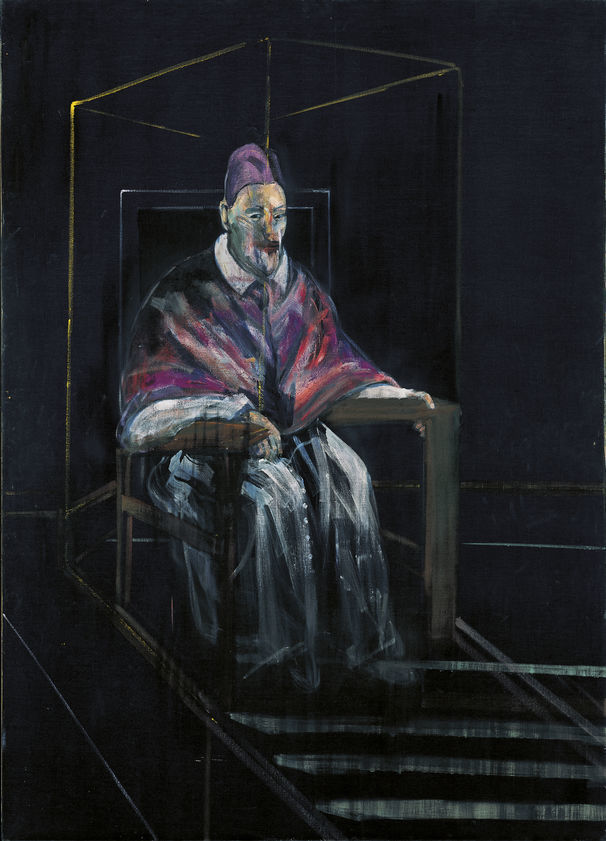
“THE POPES.” Bacon was guided by a profound architecture and an impeccably
classical, if risky, sense of composition. Shown here, Study For Portrait No 1
Court Cuts Gallery’s Ties To Francis Bacon Estate
WARREN HOGE | THE ARTS | THE NEW YORK TIMES | TUESDAY, MARCH 23, 1999
LONDON, March 22 – Marlborough Fine Art, the gallery that handled the artistic management of the British painter Francis Bacon for virtually his entire career, has had all association with his estate ended by England’s High Court.
In a decision that has gone unreported until now, Justice David Edmund Neuberger ruled in late December that an executor of the multimillion-dollar estate who was a director of the gallery should be removed and replaced by a new independent representative.
The new trustee is Brian Clarke, 45, a well-known British architectural artist who was a friend of Bacon and of John Edwards, 49, the painter’s closest friend, to whom Bacon willed his entire estate. Bacon, widely accepted as the greatest British painter of his generation, died of a heart attack at the age of 82 in 1992.
Mr. Clarke had been responsible for shifting the representation of Bacon’s works from Marlborough to Faggionato Fine Arts in London and the Tony Shafrazi Gallery in New York, an arrangement that drew sudden attention last October when the Shafrazi Gallery mounted a show of 17 previously unseen Bacon paintings and photographs of his famously cluttered London studio. Marlborough’s loss of the prestigious Bacon account and the reasons behind it became a subject of curiosity and speculation among contemporary art experts in London and New York.
Mr. Clarke would say only that lawyers looking into the administration of the estate had found "certain anomalies" in actions by Marlborough that compelled them to take their court action.
They had become alert to possible problems when, on making their first inquiries to Marlborough London, Bacon’s gallery since 1958, they were told that the Bacon paintings were being handled not in London but by Marlborough Liechtenstein.
The explanation set off alarms since the Liechtenstein office had been central to a scandal in New York in the 1970’s over the estate of the American painter Mark Rothko that led to the ousting of executors; heavy fines against Marlborough; the conviction of its head, Frank Lloyd, for tampering with evidence and the end of its membership in the Art Dealers Association of America.
Liechtenstein is also known as a place that affords corporations high levels of secrecy and protection against demands for disclosure.
The Rothko case exposed sinister inner workings in the supposedly genteel art world and cost Marlborough its pre-eminence in contemporary art. Among other abuses, Marlborough was found to have sold paintings to favored clients at less than market value and to have collected inflated commission.
Lawyers for the Bacon estate are busy in four European countries and the United States tracking assets that the estate believes should go to Mr. Edwards. "They are currently putting together a case that may at some point in the near future come to court," Mr. Clarke said. His whole purpose, Mr. Clarke said, was to "get John everything that Francis left him."
The principal lawyer for the estate, John L. Eastman of New York, said in a telephone interview from St. Barts that "the defining question for the estate is what is there beyond what we already have." The argument presented to Justice Neuberger for the removal of Valerie Beston, a director of Marlborough London, was that entrusting fiduciary responsibility to an official associated with the gallery whose actions were being examined by the estate presented a conflict of interest.
Neither Mr. Clarke nor Mr. Eastman would specify what activities of Ms. Beston’s or the gallery’s they had questioned.
Geoffrey Parton, a director of Marlborough London, said the gallery would not discuss any aspect of the Bacon estate. Mr. Parton said "no comment" six times during a brief telephone conversation on Monday, including to questions about whether Ms. Beston had been a Bacon trustee or was a director of the gallery. Court documents confirm that she was both.
There were originally two other trustees of the Bacon estate, Gilbert de Botton, a financier well known in art collecting circles who was a former director of Marlborough Zurich, and Dr. Paul Brass, Bacon’s personal physician. Mr. de Botton never took up his commission, and Dr. Brass was replaced in the same Dec. 18 action that removed Ms. Beston. Dr. Brass, Mr. Clarke said, had acted "impeccably" but was simply overwhelmed by the size and complexity of the task.
Mr. Clarke and Mr. Eastman both resisted putting any value on the overall Bacon holdings. Individual paintings have fetched up to $6 million, prompting outsiders to estimate the worth of the whole estate at more than $100 million. The estate has paid its taxes and does not need to raise any money with sales of major works. "We may sell a number of pictures as time goes on, but we have no plans for any kind of big sale," Mr. Clarke said. "Not even a small sale, for that matter," he added
Bacon’s friends have found that the painter was even more prolific than they had known. "Even though everybody thought that they’d been through the studio with a fine-tooth comb, we found a number of paintings dating from the 50’s," Mr. Clarke said. "Since Francis died, I had been in his studio probably a hundred, a hundred and fifty times, and I had missed them. John Edwards had missed them."
The studio where Bacon worked for the last 30 years of his life was a giddy jumble of half-finished canvases, books, rags, drawings, notes, twisted paint tubes, encrusted brushes and broken furniture with bare bulbs dangling from the ceiling and smears of paint on the doors and walls. It occupied two rooms of a South Kensington mews house and is being disassembled, measured, catalogued and documented for reconstruction in Dublin, where Bacon was born and spent the first 16 years of his life.
It will be reassembled in the Hugh Lane Municipal Gallery of Modern Art for public show beginning in 2001. The dismantling has been done in archaeological fashion, with highly detailed and enumerated placement charts so that the creative chaos that Bacon wrought in London can be precisely recreated in Dublin.
More Bacon works emerged when Barry Joule, 44, a Canadian writer who was one of the painter’s neighbors, came forth with 500 oil sketches, drawings, and worked-on photographs from 1945 to 1965 that Mr. Bacon had given him. There have been reports in the British press of disputes and threatened legal action between the estate and Mr. Joule, but Mr. Clarke said that Mr. Joule shared the estate’s interest in abiding by the painter’s wishes that Mr. Edwards receive everything.
He said that talks with him were "perfectly amicable." Mr. Joule agreed with that characterization, saying, "Things are being worked out in a friendly fashion." Last year the Tate Gallery purchased 42 similar works on paper from the 1950’s and 60’s in gouache, oil paint, ink, ballpoint pen and pencil from Paul Danquah and Peter Pollock, friends of the artist, and the estate of Sir Stephen Spender. The works, compelling early visions of the twisted figures, blurred faces, screaming popes and butchered carcasses that were to become Bacon’s signature repertory of postwar angst, are on display at the Tate until May 2.
Mr. Edwards, a reclusive and simple man currently living in Southeast Asia, was Bacon’s closest friend for the last 16 years of his life. Born within the sounds of the bells of St. Mary-le-Bow Church in East London and therefore a genuine Cockney, Mr. Edwards never learned to read or write and maintained a relationship with Bacon that friends described as filial.
Mr. Clarke said he became involved four years ago when Mr. Edwards approached him perplexed about delays and problems in dealing with the estate. "He asked if I would help him to try to understand why the estate was not being wound up, and he asked me to become his power of attorney. I thought it would be a very short thing, but after a while I discovered that there were, let’s say, certain anomalies, problems without the resolution of which the estate could not be wound up.
Mr. Clarke took on the assignment without the knowledge of the executors, and when he found the task more daunting than he had anticipated, he turned to Mr. Eastman, a lawyer with broad experience in the worlds of art and entertainment. Mr. Eastman’s sister, Linda, the wife of Sir Paul McCartney, had been a friend and collaborator of Mr. Clarke’s, and the photographs of Bacon’s studio that were displayed in New York last fall were the last pictures she shot before her death last April.
While he declined to get into the details of his preoccupation over Marlborough’s management of Bacon, Mr. Clarke explained why he thought the painter’s estate required special attention. "Francis Bacon was famously disinterested and uninterested in money," he said. "He lived the life of an essentially simple man in a tiny bed-sit that was heated when very cold by leaving the gas door open. He had a tiny kitchen that contained an open bath, and a room with a bed and a chest of drawers.
"He was the last great existentialist. If you are an art gallery representing such a man whose chief legatee can neither read nor write and hasn’t even had his own lawyer until recent years, your fiduciary obligations are all the greater because such a man could be described as 'easy pickings.' "
In litigation mode
Interview with Brian Clarke on the Bacon estate
LOUISA BUCK | INTERVIEW | THE ART NEWSPAPER | WEDNESDAY 31 MARCH 1999
The new sole executor of Bacon’s estate talks in his first public interview about the teams of lawyers now working to see that the artist’s beneficiary, John Edwards, receives precisely what Francis intended him to receive. And that is everything.
Just before last Christmas, the British High Court replaced the executors of the Francis Bacon estate (which included a director of Marlborough Gallery) and named Brian Clarke as sole executor and personal representative of the estate. He is an internationally acclaimed artist in his own right, who has produced large scale designs in stained glass, tapestry and mosaic, working with leading architects such as Norman Foster, Arata Isozaki, and Zaha Hadid. To look after the interests both of the Bacon estate and of his sole beneficiary, former lover John Edwards, Mr Clarke has appointed the American lawyer, John Eastman, who has also acted for de Kooning, Josef Albers, Robert Motherwell and other famous artists. In his first interview since his nomination, Mr Clarke told The Art Newspaper that “he has a group of lawyers working in several countries putting together a case that may, at some point in the near future, come to court...at the moment our attentions are focused on litigation matters”
Could you explain the current situation?
Brian Clarke: Last year, just before Christmas, the High Court in London replaced the executors of the Francis Bacon estate with myself. One executor was Dr Paul Brass, who was Francis’s doctor, and who has done an excellent job for the estate during the period of his incumbency, but the volume of work was simply overwhelming and he is not acquainted with the art world, and—with all the gratitude that he is genuinely due—the situation has now moved on and he was happy to be relieved of his duties. The other executor was Miss Valerie Beston, who had a clear conflict of interest in that she is a director of the Marlborough Gallery and also an executrix. So, for a multiplicity of reasons, the court decided to appoint me as sole executor and personal representative of the Francis Bacon estate. This appointment was made entirely unopposed; none of the interested parties or their lawyers made any opposition to that appointment—that’s an important point.
Who were the interested parties?
The lawyers representing the executors and the lawyers representing John Edwards.
How did your name get put forward?
I knew Francis since the late 70s—we were friends—but my long term and great friendship has been with John Edwards. At John’s request I have been given his power of attorney for a considerable time and then I agreed to help out with the estate. It was the unanimous decision of the lawyers and John Edwards himself, and it came at a time when it was necessary for someone else to take over the reins.
What does being a “personal representative” actually involve?
A personal representative is empowered by the High Court with all the authority over his own affairs that Francis Bacon had in his lifetime, and so, as executor I now have that authority and it is my job to administer and tie up the estate.
Was the estate in good order when you first got involved?
I was assuming that it was a simple matter of resolving a number of outstanding issues and then the estate would be wound up, but before very much time had passed it was clear that it was a much more complicated affair than I had first realised. First, I am able to tell you that the estate is more extensive in terms of its holdings of paintings than has generally been assumed. Even though everybody thought that they had been through the studio with a fine toothcomb, we found a number of paintings dating from the Fifties. Since Francis died, I had been in his studio probably a hundred times, but I had missed them and John Edwards had missed them.
So where were they?
It was such chaos in there and one was very frightened of moving too much for fear of disturbing things and creating the wrong impression for when the Hugh Lane Gallery [which now owns Bacon’s studio] came to disassemble it archaeologically. But when they came and, section by section, piece by piece, dismantled this extraordinary thing, we found these paintings. It also turned out that there were one or two works in other places—paintings that the Marlborough Gallery never saw that came out of that studio that we didn’t know existed, John Edwards didn’t know that they were there. It is undeniable that the body of work that is in the estate constitutes the greatest collection of Bacons in the world, and it contains some unequivocal masterpieces.
Have you had any problems reclaiming works for the estate?
I can’t discuss that. What I can say is that we have a group of lawyers working in several countries currently putting together a case that may, at some point in the near future, come to court. The press at the moment seems to assume that the case is with Barry Joule [Bacon’s friend and handyman to whom Bacon allegedly gave a large quantity of works on paper which Mr Joule then attempted unsuccessfully to donate to the Tate Gallery the Art Newspaper, No.84, September 1998, p.6]. I can now unequivocally tell The Art Newspaper that the estate is not preparing a case against Barry Joule. Barry Joule and I are having a perfectly amicable exchange now, and we both want what is best for Francis. I accept at face value from Barry Joule that his interest is Francis, and Francis’s reputation to be protected and advanced as much as possible though the vehicle of this collection of works. The estate and its lawyers are now in amicable discussion with him as to how this might best be achieved.
Francis Bacon’s will was fairly uncomplicated, wasn’t it? Didn’t he leave everything to his friend John Edwards?
The will was straightforward; John Edwards gets everything and it is now my job to make sure that that happens. The current complications have made it necessary to employ professionals—dealers, lawyers and administrators who know this world inside out—and it fell to me to choose lawyers, an accountant and dealers for him and for the estate.
Can you explain your choice of John Eastman as the legal representative?
John Eastman is the brother of the late Linda McCartney, and Paul and Linda have been my friends and collectors of my work for over twenty years. John Eastman is my lawyer. He is, or has been, the lawyer for Willem de Kooning, Josef Albers, Robert Motherwell, Philip Guston and Naum Gabo. He knows his way around the art world and is very experienced. About eighteen months ago I had a meeting with John, who was at that time negotiating the stained glass and mosaic project I was doing in New York City for the Pfizer World Headquarters. I explained the problem of the Francis Bacon estate and he became lawyer for both John and the estate.
Since last April, Tony Shafrazi Gallery in New York City has been handling the Francis Bacon estate (The Art Newspaper, No.84, September 1998, p.6). Why did you decide he was the right man for the job?
Tony Shafrazi is my art dealer and has been for some years. I have had a lot of experience of art dealers, and for the last five years Tony Shafrazi has handled millions of dollars annually on my behalf. Because I have a long relationship with Tony and because we already had a successful business relationship going ourselves, I knew that he was trustworthy. Tony has a reputation for being ruthlessly honest and it is a well deserved one—and that was very important. Unfortunately a number of supposedly blue-chip galleries who made approaches to us had chequered histories. We looked at a lot of options; we considered about twenty galleries and Tony provided all the criteria we wanted. A key factor was that the dealer for the estate should be somebody who was prepared to get behind Francis to reintroduce him, not to the bourgeois world of art collectors in New York—that’s easy, all you have to do is throw a cocktail party on Park Avenue. I wanted Americans to be aware of Francis Bacon. I wanted kids with their baseball hats on back to front carrying skateboards to walk into the gallery. There is no dealer, I would venture, in the world who is more dovetailed into youth culture than Tony Shafrazi. You must also remember that Tony has great links with England; he was educated at the Royal College. In the twenty years I have known him, Tony has expressed his obsession with Bacon 1,000 times.
Were any works sold from the Tony Shafrazi exhibition last October of paintings from the Francis Bacon estate?
We may sell a number of pictures as time goes on, but we have no plans for any kind of big sale—or any kind of small sale, for that matter. We realised that the paintings in the estate—many of which had never been shown before—had to be shown together. Do you know we had between two and three thousand visitors a day to that exhibition—including kids and young students? David Sylvester said it was one of the greatest painting shows he had ever seen, and probably the greatest Bacon show of all time. He already controls about a dozen Bacon paintings; he has an encyclopaedic knowledge of Bacon and we needed somebody in London because a lot of activity is generated from there. In general, we are very fortunate. The estate is very close to David Sylvester, to Michael Peppiatt, to Sam Hunter and to all the principal Bacon people. We are listening to their counsel and also very carefully to what Tony Shafrazi and Gerard Faggionato have to say.
What are your future plans for the Francis Bacon estate?
At the moment our attentions are rather focused on litigation matters, but a programme is being drawn up, and it is mainly a museum programme. We’ve already lent a triptych to the exhibition at Yale; two “Popes” to the exhibition at San Diego and we are currently planning exhibitions in France, in Switzerland and there will certainly be a show at Faggionato Fine Art in June. Gerard Faggionato has a long history of working with Francis Bacon.
Do you receive any payment for your role as executor and personal representative?
No. This is a labour of love. Although it is embarrassing to say so, I enjoy great financial success through my own work. At the moment it is my profound wish that my involvement in the estate will not be onerous for very much longer. Later on, once we have resolved the legal matters, there will be ongoing business of the estate and ongoing decisions to be made, but right now, my only role as an executor and personal representative is to regularise the affairs of Francis Bacon in order that the estate can be tied up—and in order that the sole beneficiary legatee receives precisely what Francis intended him to receive. And that was everything.
Correction
The Art Newspaper apologises unreservedly to John Edwards for having stated in the last issue (No. 91, April 1999, p. 53) that he was once Francis Bacon’s lover. The newspaper recognises that this was never the case and is very sorry for any embarrassment this may have caused him.
Court cuts gallery’s ties with Francis Bacon
By CATHERINE MILNER | ARTS CORRESPONDENT | NEWS | THE SUNDAY TELEGRAPH | SUNDAY, APRIL 4, 1999
MARLBOROUGH Fine Art, the gallery in London that represented the painter Francis Bacon for more than 30 years, has had its ties with the artist’s estate severed by the High Court.
When he died in 1992, Francis Bacon left everything he had—an estate worth more than £61 million—to John Edwards, an illiterate recluse who was Bacon’s friend for the last 16 years of his life.
At the end of last year responsibility for the artist’s work was moved from Marlborough Fine Art to Faggionato Fine Arts London, and Tony Shafrazi in New York, after Mr Edwards detected what are described as "certain anomalies" in the way the account was being handled.
In a separate move, the High Court ordered the removal of all the trustees of the Bacon estate, including one who had also worked as one of the directors of the gallery, Valerie Beston.
Although it is unclear what the anomalies are, lawyers in four European countries and the US are said to be tracking assets that trustees believe "should go to Mr Edwards."
Power of attorney has gone to Brian Clarke, an architectural artist, who was a friend of both Bacon and Mr Edwards and is now the sole executor of the estate—replacing all the trustees including Dr Paul Brass, Bacon’s doctor, and Gilbert de Botton, a financier.
Lawyers were alerted to possible anomalies by the disclosure that many of the Bacon paintings have been sold not in London but through another Marlborough Gallery outlet in Liechtenstein—a place favoured by a number of art dealers because it allows businesses to conduct their affairs in great secrecy.
Since Bacon died a number of works have come to light that were unknown when he was alive—hidden in his studio, or stored at the framer.
According to Mr Clarke, in an interview published this week in The Art Newspaper, his main intention is to ascertain the full extent of the estate, and "to get John everything Francis left him".
He said: "We have a group of lawyers working in several countries putting together a case that may, at some point in the near future, come to court.
"The will was straightforward: John Edwards gets everything, and it is now my job to make sure that that happens."
The fact that Mr Clarke has been interviewed in the art press has suggested to some that he is seeking information about the whereabouts of Bacon paintings that may not have been recorded.
"Even though everybody thought that they’d been through the studio with a fine tooth-comb, we found a number of paintings dating from the fifties." Mr Clarke is reported as saying.
Georgina Gibbs, a representative of the gallery, said yesterday that Marlborough Fine Art had "never knowingly retained or withheld any work that belonged to the estate. We have provided the information required about the archives. We don’t know what they want.
"Because he sold works himself directly it was a lot harder to catalogue things—the Marlborough did not know the extent of the estate."
Although the exact value of the estate is difficult to ascertain, a single painting has exchanged hands for more than £3.7 million, and there are also large sums to be made from reproduction and copyright fees for postcards, books and films.
Richard Moyse, solicitor for Ms Beston, said that he "didn’t know what the claim would be" and that all queries should be addressed to Marlborough Fine Art’s solicitors, who did not comment. Acting on behalf of Mr Edwards is John Eastman, a New York-based lawyer and the brother of Linda McCartney.
"Whether we take Marlborough Fine Art to court will depend on how they respond." was all that Mr Eastman would say last week.
Art institute takes walk on dark side
Horror is visualized in Bacon’s brutal, beautiful paintings
MARY ABBE | STAR TRIBUNE STAFF WRITER | MINNEAPOLIS STAR TRIBUNE | 9 APRIL 1999
An encounter with the paintings of Francis Bacon is not for the faint of heart. The dominant British painter of the late 20th century, Bacon was a theatrical alcoholic whose bleak assessment of life's potential was shaped by his brutal childhood, the horrors of World War II and his voracious appetite for rough sex. Biography invariably intrudes into any encounter with Bacon’s work, since many of his paintings depict friends and lovers who were apparently undisturbed by the characteristic distortions of his painting, a retrospective of which opens Sunday at the Minneapolis Institute of Arts.
Relentlessly nihilistic, his images provide a virtual catalog of 20th-century despair: solitary men screaming in claustrophobic boxes; eyeless monsters gnashing fierce teeth; dissolving bodies twisted into knots of inhibition and coiled rage. Isolated against velvety black backgrounds or posed under bare lightbulbs in empty rooms, Bacon’s tortured subjects appear both violated and self-absorbed, condemned to live out their bleak existences as bit players in a theater of grotesques.
Yet for all their nastiness and brutality, there is something undeniably beautiful, even serene in these paintings. Especially in the last 20 years of his long career, Bacon (1909-1992) achieved a kind of lyricism that makes even his most horrific subjects compatible with the drawing rooms in which many of them hung. Backgrounds of boudoir pink, persimmon, lilac and aqua combine with the calligraphic grace of his fleshy figures in images of stylized elegance. The cultivated decadence of Bacon’s life eventually made him something of a cult figure and attracted the attention of filmmakers. As exhibition photos show, he lived and worked in a chaotic London studio cluttered knee-deep with books, newspapers, whiskey cases and paint paraphernalia (cans, tubes, brushes, rags, canvases and smeared walls).
Descriptions of the studio apply to many images he painted there: “There
were no carpets on the plain wooden floors, no pictures on the whitewashed
walls, and no shades on the lightbulbs that hung down like malevolently glowing
fruit from the ceiling, heightening the sensation of defiance and threat that
Bacon’s own presence often radiated,” his friend Michael Peppiatt recalled in
the exhibition catalog (Abrams, $40 paperback).
Fodder for feature films
In his controversial 1972 film Last Tango in Paris, the Italian director Bernardo Bertolucci modeled Marlon Brando’s character on Bacon’s tortured figures, and ran the opening credits over Bacon imagery. Last year the movie Love is the Devil recounted Bacon’s tormented relationship with his longtime model and lover George Dyer, a depressive alcoholic who committed suicide in a Paris hotel on the eve of Bacon’s 1971 show there. (The Institute will show both films during the exhibition.)
By Bacon’s account, Dyer was a burglar whom he seduced after the man broke into his flat. The artist’s first sexual encounters were apparently with stableboys to whom his horse-trainer father had entrusted Francis for “disciplinary whippings.” Not surprising, then, that Bacon summed up his expectations of human relations thusly: “I always think of friendship as where two people can really tear each other to pieces.”
For obvious reasons, virtually every account of Bacon’s art detours into
his life story, and this exhibition is no exception. While Bacon’s story
provides handy pegs on which to hang images, it really doesn’t define or explain
his art, however. There’s a distinctive 20th-century look and feel to his
paintings, but they always transcend our tragic era and attach themselves to the
history of European painting, especially to the work of 17th-century Spanish
portraitist Diego Velázquez and that of Pablo Picasso.
Screaming popes and harpies
The Institute’s show is arranged more or less chronologically, beginning with a 1988 reprise of the 1944 painting that established Bacon’s fame. Called “Three Studies for Figures at the Base of a Crucifixion,” the original triptych is now at London’s Tate Gallery. This second version is much larger than the original and executed in a suave, regal style that belies the subject matter: three deformed creatures howling from awkward perches. Armless and sightless, they have fleshy humanoid bodies, eel-necks and the crouch of vultures.
In his brilliant 1993 book on Bacon, London art critic John Russell recalled that when the original triptych was first shown in April 1945, the creatures “caused a total consternation.” With the war nearing its end after six years of unrelenting slaughter, the British were eager to return to normal life and reluctant to be reminded of humanity’s bottomless capacity for evil. Bacon’s beasts assaulted them like harpies, shrieking that the old world was gone and nothing would ever be normal again.
The images were “so unrelievedly awful that the mind shut snap at the sight of them,” Russell wrote. In their 1988 incarnation, the birds are nasty but not horrific enough to give children nightmares. Subsequent galleries of screaming popes, autistic businessmen, feral dogs and sphinxes are their grim compatriots.
Inspired by a Velázquez portrait of Pope Innocent X, the pope paintings come from a series of about 25 works in which Bacon shows the pontiff trapped in a glass box and growing increasingly distraught until he screams with rage and despair. An existentialist horror, the pope’s plight dramatizes that of Everyman in a century when God is dead and, as Woody Allen put it, “We’re all in this alone.”
Among the show’s most beautiful paintings are a pair of huge self-portraits from 1973, two years after Dyer’s death, in which Bacon appears immobilized by doubt. A decade later, he seems to have achieved a measure of peace in his three “studies” of his last lover and heir, John Edwards. A calm, muscular man lovingly rendered in pastel hues, Edwards has a typically blurred face, a reminder that likenesses are futile if you believe, as Bacon did, that “We live, we die and that’s it, don’t you think?”
Hugh Lane gallery profits from
‘ghastly misunderstanding’
over Bacon studio
CULTURE | THE IRISH TIMES | SATURDAY, APRIL 10, 1999
When it was announced last year, the donation was greeted as one of the most significant in the history of the State. Bacon, who was a wealthy man from the sale of his work, lived and worked in spartan conditions in Reece Mews in London.
His cramped studio was cluttered and untidy, its walls spattered with paint. It will be painstakingly reconstructed in the Hugh Lane Gallery exactly as he left it and opened to visitors in 2001.
Meanwhile, in June next year, the gallery will feature a major exhibition of his paintings, curated by the leading authority on his work, Mr David Sylvester.
Bacon died in 1992, and Mr Edwards was his closest friend for the last 16 years of his life. This is his first visit to Ireland, though there is a family link: his maternal grandmother, Rosie O’Shea, was born in Dublin.
A Cockney who never learned to read or write, he has been described as shy to the point of being reclusive. He was accompanied by the artist Brian Clarke, a friend of both his and Bacon’s, who since late last year has been the sole executor of the Bacon estate.
“I think it’s an extremely important event for Ireland,” Mr Clarke said later. “And it’s very appropriate. I’m convinced Francis would have loved it. After all, he was born here, and he said once that he couldn’t come back until he was dead — the fuss would be too much.”
Mr Clarke also said the estate was totally behind the Hugh Lane in carrying through the reconstruction of the studio and various related exhibits. “It’s the intention of the estate that as much material as possible relating to Francis and his studio finds a home in the Hugh Lane.”
But is it true that the studio was offered to the Tate Gallery in London before it was offered to the Hugh Lane?
It is extremely difficult to put a value on the estate, of which Mr Edwards is the sole beneficiary, partly because it is dependent on the art market and partly because its full extent is a matter for speculation. Previously unknown paintings and drawings have already come to light.
Last December the High Court in London dramatically removed the existing executors and appointed Mr Clarke as sole executor and “personal representative” of the estate. The court also severed the estate’s links with Marlborough Fine Art, the gallery which represented Bacon for over 30 years.
In fact, since last April paintings from the estate had been handled by the Tony Shafrazi Gallery in New York and Faggionato Fine Arts in London.
These moves follow the appointment of Mr John Eastman as principal lawyer for the estate, and for Mr Edwards. Mr Eastman, a high-profile New York arts lawyer whose clients have included the painters Willem de Kooning and Robert Motherwell, is the brother of the late Linda McCartney. He and his associates are currently engaged in tracking assets of the estate in several countries.
Mr Clarke did not want to be drawn on the nature of the disagreement between the estate and Marlborough, though the revelation that Bacon’s works were being handled by Marlborough Liechtenstein, and not by London, is said to have caused alarm. “I will say that, should the Bacon estate enter into any litigation, I confidently expect that it would be successful.”
Tony Shafrazi Gallery, New York, USA
RONALD JONES | FRIEZE MAGAZINE | ISSUE 46 | MAY 1999
History gives and it takes away. The number of verified Rembrandts has diminished recently, while the importance of Francis Bacon has increased with the discovery of several paintings. When history ‘gives’ in this way, it creates the same sense of surprise as being given a second car. The inevitable historians are trotted out, glowing like proud new mothers. For this exhibition, Sam Hunter, David Sylvester and John Russell have written the exhibition catalogue. Discrimination from a special jurisdiction is required: that old time religion, connoisseurship, must be dusted off and put into service. Three questions are asked in quick succession: A. Are the pictures genuine? (beyond a doubt); B. What were the artist’s final intentions towards works of art that were not acquired from him during his lifetime? (the key question); C. What do they add to the oeuvre? (because they always add up to something).
The most engaging paintings from this ‘new vein’ are from the 50s and early 60s, a period when Bacon was known routinely to destroy canvases with which he wasn’t satisfied. Amongst this group are four relative spellbinders: Study for Nude Figures, Study after Velázquez, Study After Velázquez II (all c.1950), and Pope and Chimpanzee (1962). All of these explore the howling subjects with which Bacon struggled — Existentialism, Abstract Expressionism and the primal drama of a world newly acquainted with the Bomb. The Velázquez studies and the Pope/chimp canvas in particular elaborate on a theme that especially preoccupied Bacon: the obliteration of faith by instinct.
The painting of Innocent X’s screaming face, (Study After Velázquez II) flickering between the grey ribbons cascading all around him (which better recalls Titian’s Portrait of Archbishop Filippo Archinto, 1561-62), broadcasts unbridled terror. But whereas Velázquez so perfectly depicted Innocent’s hands at ease on the arms of his magnificent throne, Bacon presents them like the white-knuckled hands of the condemned prisoner in the electric chair whose Christian serenity has seized up at the instant of the switch, unsure of what is poised to take over. It’s an awful truth that faith is always vulnerable. In Pope and Chimpanzee, feral instinct is hurled toward the personification of Catholic faith. The clinging savage viciously grapples with an inert papal body crowned by a holy, repulsive, mangled face: faith made mush.
These pictures are undoubtedly part of Bacon’s oeuvre, but what part? Where will they finally find their place in the language of Bacon? One of them, Study after Velázquez II (1950) was assumed destroyed. And now, either through oversight or Bacon’s revised artistic insight, it is here with us and he is not. Is it useful and appropriate to ask if this discovery causes any revision of our appreciation and understanding of Bacon. I think not; these paintings don’t add up to enough to justify a revision — they’re not as substantial as those that formed our judgements of Francis Bacon so many years ago. It is clear that the new Study After Velázquez (1950) is not as realised or even rectified as Study After Velázquez’s Portrait of Pope Innocent X made just three years later, and that Figure in Frame (1950) adds little to our understanding of Dog (1952). In the final analysis, if there are breaches in the oeuvre, these pictures do nothing to illuminate them.
Sutherland brings home the Bacon
William Packer explores the relative values of the two artists’
reputations at an important retrospective of the former’s work
WILLIAM PACKER | ARTS | WEEKEND FT | FINANCIAL TIMES | MAY 8/MAY 9, 1999
Reputation is a curious thing, and comparative reputation more curious still. Some 40 years ago no modern English painter stood in higher general regard than Graham Sutherland. Bacon? yes: Nicholson? yes: Freud? perhaps; but Sutherland seemed to generate the greater excitement with his mixture of graphic confidence and formal invention all at the service of a romantic Surrealism founded upon natural imagery — animal, vegetable, mineral. Whose should be the work to dominate the new cathedral at Coventry, which was to be the showcase of English modern art? It was no contest.
Yet by the time of his death in 1980, at the age of 77, Sutherland's reputation was at best equivocal. He had continued to show regularly, but his prints had become, it seemed, merely repetitive and, direst of epithets, commercial, his Sutherland’s mixture of graphic confidence and formal invention generated greater excitement than any other contemporary work paintings dryly formulaic; and of course there were the portraits. No matter that Nicholson was nothing if not repetitive - and which artist is not? Nor is there anything wrong in wishing to make a living. As for that “formulaic”, there has been no British artist more reliant upon a personal formula than Francis Bacon, and he, even seven years dead, can critically do no wrong.
Sutherland’s portraits began promisingly enough, with the Somerset Maugham in 1949 and then most notoriously the Winston Churchill, the destruction of which now seems inexplicable, indeed unforgivable. But they did then slip into a photo-derivative manner that became ever more predictable, even as they became more profitable in likeness to the sitter, and certainly they came to dominate the later career. We should not forget, however, that the young Sutherland was first of all a print-maker, and the processes of order, preparation, squaring-up and conscientious rendering remained instinctive.
But no artist should be nailed as critical victim to his later work, least of all Sutherland to his portraits, or Bacon for that matter. And it is the professional relation between the two, at an earlier and crucial period in their development as artists, that turns out to be the the sub-plot, as it were, of the small but remarkably strong retrospective now at Crane Kalman.
If Sutherland is undoubtedly its hero, Bacon is the absent guest. For it is the received opinion — well, mine at least — that had Bacon’s career finished in 1964 rather than in 1992, his work of the previous 20 years would still have been enough to secure his place as one of the most significant artists of the 20th century. Yet this was the period of Sutherland’s own ascendancy, and if by the end his position primus inter pares had slipped somewhat, that does not mean that it had not been fully deserved at the outset.
We are inclined to overlook just how close the working relationship was between Bacon and Sutherland during the 1940s. And if Bacon's work was potentially the more explosive, sinister and unpredictable, Sutherland's was unquestionably then the more mature, the more consistently achieved. Surreal-Expressionist though Bacon became, it was always within the context of English neo-romanticism; and it was through Sutherland, by six years the older, that the connection was initially secured.
The show begins with a single landscape painting of the late 1930s, with Sutherland moving away from etching and the Samuel Palmer-like concentration of scale and detail that went with it, into a more open, painterly and schematic manner which still retained the Palmerian richness of paint and colour, and intensity of feeling. But the substance of the show rests upon Sutherland in the 1940s and into the '50s, with the continuation of the landscapes, especially in water-colour, through the war years, and the subsequent development of the organic and animal imagery, the roots and thorns, the fruit and veg, and the iconic menagerie, all taken close-up and in isolation, that would stay with him for the rest of his life (a few later prints make the point). Bacon, too, in the years after 1944, moved into the same territory — the weird figures in the bushes, the sets of animals, the tortured, fractured forms.
Only who the chicken? Who the egg? Who indeed? A signal curiosity in the show is a study of a tethered cow of 1944, a charmingly lugubrious image against a deep orange sky, with the beast's lowered head turning from the post and pulling away at the taut rope — and we think at once of Bacon's magnificent grotesque of the same year which made his reputation — his “Three Studies for Figures at the Base of a Crucifixion”, with their lowered, grimacing heads against an orange ground, and the left-hand figure turning and stretching away. Was one a wry comment upon the other, or the stimulus the other way about? Who would dare say?
Sutherland's “Variation” (1953), a monstrous, mutilated, abstracted figure, stares out at us for all the world like a mouthless Bacon Pope. His “Men Walking” (1952) stride off in step through a bright, palm-grown southern landscape, dark against blue and gold, and who is to say there is no echo of Bacon's eerie “Figure in a Landscape” of that same year, or prefiguring of the “Van Gogh” paintings of the later 1950s? All one would say is that the relation bears much closer study, with Sutherland by no means the disregarded partner he has been too long. As for his paintings, not for many years have they appeared so strong, so interesting, and, in all their variety, so good. More than timely, this is an important show.
Graham Sutherland 1903-1980 - a retrospective: Crane Kalman Gallery, 178 Brompton Road, London SW3, until June 5.
Bacon’s Paintings’ Edge Dulled With Age
But his technique retains power in retrospective
KENNETH BAKER | ENTERTAINMENT | SAN FRANCISCO CHRONICLE | JUNE 11, 1999
Early in his career, Francis Bacon was rejected from a major exhibition because the jurors found his paintings “insufficiently surreal.”
Knowing that, it is hard not to suspect him of overcompensating sometimes as we survey Francis Bacon: A Retrospective, which opens tomorrow at the California Palace of the Legion of Honor.
Bacon (1909-1992) is famous for his bleak view of the human condition. He thought that a few emotions — abjection, morbidity, self-loathing — were fundamental and inescapable. Yet, like Samuel Beckett, he also believed that we are doomed to muddle on in spite of all we know.
“One’s basic nature is totally without hope,” Bacon said, “and yet one’s nervous system is made out of optimistic stuff.”
His punishing routines of drinking, gambling and rough sex were, he suggested, his method of preparing to paint with every nerve exposed.
The last Bacon retrospective in America was a decade ago. It now seems that his statements about his art are aging better than the work itself. For contrast, think of another, older European modernist of similar pessimism: Max Beckmann (1884-1950). Beckmann’s paintings look stronger than ever at century’s end: They are as haunted as Bacon’s and we feel the painter’s moral reflexes in them everywhere, but Beckmann varied his expressive pitch far more than Bacon did.
The early works in the Bacon exhibition’s first room still have some of the caustic power that viewers felt in them when they were new. Bacon’s insistence on decking out his pictures old-master-style — behind glass in gilded frames — adds irony to their grotesquerie.
Head I (1948) is an awful icon of torture: a gray animal head, hooked by its one human ear, its fanged mouth fallen open in agony or lifelessness. We can hardly imagine the impact this painting must have had in Britain in the aftermath of World War II. Not only were the war’s hardships and images fresh in people’s minds, but nothing had been seen before in British painting to match the horrific directness of Head I or Figure Study II (1945-46) and of paintings that would soon follow, such as Study for the Head of a Screaming Pope (1952).
But we have seen much despair and terror in world events and in culture since the first decade of Bacon’s mature work. Advances in moviemaking have made us connoisseurs of violence, fear and futility. Our very sophistication as consumers of images makes us unable to enter into Bacon’s paintings as spontaneously as his contemporaries did. The most affecting thing today about a picture such as Head I is not its description of torment, but its suggestion that sympathy is pointless. Most of Bacon’s paintings strive for an emotional immediacy that we no longer believe is possible, at least not in painting. The silent, static monstrosities of Bacon’s art will look quaint to people accustomed to being steamrolled by big-screen special effects and sound.
The homoerotic suggestiveness of paintings such as Triptych—Studies From the Human Body (1970) was still mildly scandalous when the work was new, but no longer. Postmodernist eyes may respond most to Bacon’s replays of art classics, such as the papal portraits of Velazquez and Titian. The import of a Velazquez-derived painting such as Study for Portrait VI (1953) — that the human face of modern power is a clownish mask — may once have seemed didactic, but it seems like a home truth now.
Perhaps the only way to resharpen the edge that Bacon intended his pictures to have is to bear down on their details. Look closely at how the paint moves in a picture such as Portrait of George Dyer Talking (1966). Great, flat expanses of violet and green and a thatch-work of rose brush strokes offset the contortions that form the central nude figure. We can make out the stuff of limbs and face, but the figure’s flesh seems to churn before our eyes, as if tormented by its own visibility. Try to imagine the gestures and tools with which Bacon formed this figure, whose every feature seems to writhe independently.
The staged quality of Bacon’s big, late paintings can make them fall flat, but most of them have some passage in which we see a transfiguration we cannot imagine anyone repeating. Most of his paintings live now by their unpredictable, seemingly inexplicable details, not by the long-view impact that once seemed to be their essence.
In his search for direct expression of human torment, Bacon sometimes isolated the point at which paint becomes the flesh of imagination. Of that mystery, we can never see too much.
FRANCIS BACON: A RETROSPECTIVE. Paintings. Through August 2. California Palace of the Legion of Honor, Lincoln Park, San Francisco. (415) 863-3330.
Bacon’s final works unveiled
An exhibition of Francis Bacon paintings that have never been seen before opens next week.
There is no denying their quality, says Colin Gleadell, so why has it taken until now, seven
years after the artist's death, for them to be shown?
COLIN GLEADELL | ARTS | THE DAILY TELEGRAPH | FRIDAY, JUNE 18, 1999
NEXT Friday, eight barely known paintings by Francis Bacon, most of which have never been shown publicly before, will be unveiled at Faggionato Fine Art, a small, spartan gallery up one flight of stairs in Albemarle Street, central London. Seven are in Bacon’s customary large-scale format, and three of these, you are forewarned, are erotically charged male nudes. All were painted during the last, fruitful years of the artist’s life, between 1980 and 1991, and have come from his estate. As a result, the exhibition will provoke intense curiosity, and take its place in the evolving saga of revelations, rivalries, recriminations and legal wrangles which have blossomed since Bacon’s death in April 1992.
From his window, director Gerard Faggionato can see the entrance of Marlborough Fine Art, the gallery which had represented Bacon since 1958 but was unceremoniously dumped early last year. Faggionato’s connection with all this dates back to the early Eighties, when he worked for the Robert Fraser gallery in Cork Street in London. Among those who exhibited there was the stained-glass artist Brian Clarke, a personal friend of Bacon’s, and Bacon’s model, John Edwards, who became the sole heir to the Bacon estate.
When Edwards decided to move the estate away from Marlborough, he appointed Clarke as his sole executor. Clarke appointed the two galleries that exhibit his work — Faggionato in London and Tony Shafrazi in New York. To complete the chain, he engaged the services of New York lawyer John Eastman, who represents the valuable Willem de Kooning estate. Eastman is the brother of the late Linda McCartney, who collected Clarke’s work and took the last photographs of Bacon’s studio before it was removed to Dublin.
Once legally appointed, Shafrazi and Faggionato set about planning how best to present the work Bacon had left. Nobody knew precisely how many paintings were involved or how good they were. When Bacon’s will was published, his estate in England, including the studio, was valued at almost £11 million. This was a low valuation because the paintings were commonly supposed to be unfinished or “abandoned” — an adjective employed by the Tate Gallery’s Ronald Alley when cataloguing Bacon’s work in 1963. Since then, any unexhibited work by Bacon has been regarded as potentially “abandoned” and therefore difficult to sell.
The first revelations came in October last year, when Shafrazi showed 16 previously unseen paintings (including two which have come to London) in New York. One, a Study after Velázquez (1950), from the “screaming pope” series, had been described as “destroyed” by Alley, but was found rolled up in a framer’s storeroom. After Shafrazi’s show, it was lent to the Museum of Contemporary Art in San Diego, for an exhibition of Bacon’s papal portraits. However, some critics and art dealers, still loyal to Marlborough, believed most of the work to be unfinished, and not worth the full market prices which Shafrazi, they said, was asking. (A 1973 Bacon triptych has sold at auction for just over $6 million, and a large early single canvas went for $3 million.)
SHAFRAZI, on the other hand, had secured the invaluable support of the art critic most closely associated with Bacon’s name, David Sylvester, who wrote supportive texts in the catalogue about the earlier rediscovered portraits. From his perch in Albermarle Street, Faggionato is all too aware of the frictions, but pleads, “Forget about the disputes. Just look at the paintings.” And, having gone to a warehouse in Battersea to look at the paintings he will exhibit, I find it hard to see what could be in question.
All but one are signed and dated on the reverse, signifying completion from the artist’s point of view. On one painting some under-drawing is visible; a small Study for Portrait looks unresolved. But overall, the show has been carefully selected by Faggionato, not only to celebrate Bacon’s late work but, one suspects, to defuse the tension of debate about the estate’s paintings by showing how exhibitable many of them are. The male nudes, truncated like classical sculptures, and the bleak, blood-spattered urban landscapes are typical of his lean, late style. Some visual gaps are filled. Painting, 1980, recalls his meetings with the Kray twins, who both fascinated and terrified him. Some questions are asked. What does an untypical, unsigned Street Scene with Car in Distance refer to?
THIS is all part of Faggionato’s job. Filling gaps, asking questions, getting the work shown and written about. In the catalogue he has published some original research on Bacon’s visual sources by photography historian Martin Harrison. There is no supportive text on the paintings by Sylvester this time, perhaps because it was not needed, but we are promised his final judgment in a new book on Bacon, in which some of the estate’s paintings will be illustrated. Faggionato says there are some paintings still to be shown (approximately 24 have already been seen) but he will not reveal how many.
At least two thorny issues remain unresolved. Collectors, scholars and dealers are all anxious to see the publication of the planned, updated catalogue raisonné of all know Bacon paintings. The problem is that Marlborough Fine Art has the essential archive, compiled by Valerie Beston at Bacon’s request. While Faggionato says he hopes that the phrase “abandoned paintings” will be forgotten, Beston is likely to take a different view. She is currently contactable only through her lawyers, but Faggionato says, “Bacon destroyed everything he didn’t like. Something has to be done, but I don’t know how.”
Meanwhile, the market for Bacon, which is small and rarefied, has its own mind. Some of the paintings in Faggionato’s exhibition are for sale, but there will be stubborn resistance to paying top dollar for paintings which Bacon may have thought unsuitable for exhibition. The real test for these works will be the auction room.
To bump up attendance, you dumb down content
Abracadabra
Victor Willing
Francis Bacon
JOHN McEWAN | ART | REVIEW | THE SUNDAY TELEGRAPH | SUNDAY JULY 18 1999
TODAY is the last chance to have a laugh at the dysfunctional When Robots Rule: The Two-Minute Airplane Factory (sponsor American Airlines), a large piece of industrial equipment intended to mass-produce cheap model airplanes, which for the past two months has dominated the Duveen Sculpture Galleries at the Tate Gallery. Devised by the American Chris Burden, it currently has a notice concocted by the Gallery’s “thought police”, or interpretation department, which reads: “It is a work which makes us reflect on the aspiration of flight, on human endeavour and mechanical production.”
Dream on! As the notice adds: “The technical team has encountered several unforeseeable problems which have delayed the full operation of the assembly line. We apologise for the inconvenience this has caused.” In fact the machine has hardly produced a single airplane and is rumoured to have squandered in the region of £160,000.
But what is this rudimentary — and how! — introduction to the mass production of toys doing in the Tate at all? The answer is simple: to bump up the attendance figures. To bump up you dumb down — and down, until you descend to the gallery’s latest offering, Abracadabra: International Contemporary Art (until September 26), which for pure silliness beats even Burden’s effort. Think of a combination of those idiotic TV game shows laughed at by Clive James and Channel 4’s Eurotrash and you will get the picture. It really is the pits.
The show begins at the entrance with three life-size toy soldiers, followed by a staffed horse dangling above the rotunda — a mean end for a noble animal — and concludes with several galleries knocked into one big rumpus room full of jokey things to do. There is not a bouncy castle but there is a version of Monopoly for the unemployed, a table-football game for 22 players, and a video of a transvestite being lewd with a plank. It is the witless idea of a French curator, as the Eurotrash content and absurdly serious catalogue might suggest.
Who needs a director with a programme so directionless? The Tate was intended to be a museum of art, not a fun palace, as the overdue memorial tribute to Victor Willing, 1928-88 in Room 20 of New Displays (sponsor BP, until November) reminds us.
Willing was a man of formidable intelligence, whose art, conversation and courage inspired a younger generation when he returned permanently to England in the 1970s, invalided by multiple sclerosis, after living in Portugal with his wife, Paula Rego, since the mid-1950s. The climax of his resurgent career was the retrospective that Nicholas Serota, then director of the Whitechapel Art Gallery, gave him in 1986.
There are only five paintings — including a triptych, called Place — but their impact is undiminished. Willing gave a timely boost to the need for art to have its poetic root in common experience beyond the cloud-cuckoo-land of formal or cerebral conceits.
His pictures invite storytelling because they have drama. Their power lies in the strength of imagery and atmosphere, and at the same time the enigmatic, even mysterious, nature of both. He paints apparently inhabited spaces, often like stage sets, but the occupants or actors never appear. What one sees — a hut, a chair, a potted palm, a cube, and so on — is plain enough, and yet there is a dreamlike quality. They are visions of the mind’s eye rather than observations of the real world.
“All my life I’ve tried to recapture the intense pleasure in painting and drawing that I had as a child, when I did battles with people going ‘Aaargh!’ ” he said. That he succeeded is obvious.
He delights in unusual combinations of pure colour, applied With minimum fuss but pleasingly scumbled to leave a loose mesh of marks. Each painting, its image often inspired by a daydream, was invariably derived from a sketch, the spontaneous origin deliberately emphasised by enclosing the painted subject in a roughly drawn border, a trick stolen from Giacometti.
“We all have an inner reality,” he said, and that is what he painted. Sometimes the result is comforting, more often disturbing. Sell-Portrait at 70 is immediately unsettling when one considers that he died at 60. He visualises himself as the old man he never became. The eyes of the ghostly head are the same pale blue as the background. Inner and outer are one — a premonition of death.
Place with a Red Thing is particularly nightmarish. A calm and resolved world of spheres and cubes appears rudely interrupted by a red and dripping “thing”. “Thing” exactly describes its threatening indescribableness, which might be a poisonous plant or the flayed tail of a whale. Willing can out-Bacon Francis Bacon, an early friend and influence, in his poetic ability to create purely pictorial dramas, depictive but beyond words. He must be a priority for a major show at either branch of the Tate when space becomes available.
IN the context of this show it is instructive to see Francis Bacon, Paintings from the Estate 1980-1991 at Faggianato Fine Arts, 49 Albemarle Street, W1 (until August 26). People dismiss the late work of famous artists at their peril. Picasso had the last laugh and so has Bacon, although there are still plenty of pundits who think he just churned it out in his final years. This small but magnificent selection of eight previously unexhibited late paintings should make them eat their words.
“Magnificent” is the word for the imposing size, imaginative daring and sumptuous colour. In every sense it is a command performance. The associations with Willing, a generation younger, are striking. In a study for a portrait Bacon too uses Giacometti’s sketchy device of an outline; and two paintings succeed in being intensely dramatic yet devoid of people.
Blood on Pavement is just that. It is an extraordinary image; as if someone has recently been killed on a Rothko. The Rothko reference is quite blatant, the predominant bands of black and grey similar to those in the Ameri-,can abstract painter’s last works. In the glaucous middle band there is a scrupulously described blood-stain with touches of white glimmer.
It is the care with which Bacon describes it, using an air-brush and uo doubt cloths as well as the brush, which makes it so creepy. I met a surgeon once who said one of the pleasures of the job for him was the sweet smell of blood. Mark Rothko painted bands of increasingly lugubrious colour until he committed suicide. Bacon’s painting is surely a reflection on his death, the violence and despair that, for Bacon, made life worth living.
The impact of the painting is due in part to its sense of immediacy. One feels almost party to the violence, as one does in the street arriving at the scene of an accident after the body has been removed. This immediacy is inseparable from the way Bacon paints. These are big canvases but every inch of their detail is done with the eye of a miniaturist. The effect is not dreamlike but of suspended reality, the drama of countless decisions. This wonderful show further confirms Bacon as indeed the greatest painter from these islands — he considered himself an Irishman — since Turner.
Is there more than meets the eye?
Newly revealed works by Francis Bacon and a Bridget Riley retrospective
set WALDEMAR JANUSZCZAK reassessing reputations
WALDEMAR JANUSZCZAK | ART | THE SUNDAY TIMES CULTURE | 27 JULY 1999
Dying is a crucial part of an artist’s career. So much can happen to an artistic legacy once its creator is no longer there to protect it. Heirs can pop up out of the toaster of obscurity to fight over it, or control it; and usually do.
Things come out of your studio that you never wanted to come out. Your trade secrets are revealed. If you are really unlucky, the movie industry concludes that you led a fascinating life and makes a film about it. Most importantly of all, the world can reappraise your work without you and decide that it no longer admires it nearly as much as it did while you were alive. Or vice versa. It can take weeks, or centuries, but eventually you are seen properly for what you were.
Francis Bacon’s departure in 1992 has certainly ushered in a period of entertaining action in the Bacon industry. At the time of his death, he was surely the most celebrated artist in the world. So the dreaded film got made: Derek Jacobi played him well in a bad movie. Fascinating bundles of overpainted photographs and newspaper cuttings emerged from Bacon’s studio and, since he was never supposed to have done any “drawings”, they immediately became the subject of fierce disagreements about their authenticity. Because Bacon copied from photographs, was he a less creative artist than we had art assumed? Books were written. Former kissers began their telling. Bacon’s last lover, John Edwards, the heir who popped up, made the interesting decision to remove the estate from the hands of the mighty Marlborough Gallery, which had shown Bacon’s work since the 1950s, and divide it between the Tony Shafrazi Gallery, in New York, and Faggiona to Fine Arts in London.
The Tony Shafrazi Gallery I know. Shafrazi was an Iranian artist who expressed his love of art by spraying Picasso’s Guernica with red paint in 1974 as some sort of belated protest against the Vietnam war.’ Newly infamous, he started a SoHo gallery. Faggionato Fine Arts I did not know.
It turns out that it is situated across the road from the Marlborough, in Albemarle Street , Mayfair, but whereas the Marlborough has a big window in which to display its pictures and its public face, Faggionato Fine Arts is a name on a buzzer, the pressing of which lets you into a narrow hallway, and up a tight staircase to a tiny gallery that must once have been a living room. It’s cosy, all right .
Into this tight space have been squeezed seven large paintings and one small one from the estate of Francis Bacon, all painted between 1980-1991, five of which have never been shown before. One is a full-length portrait of John Edwards in his underpants. One appears to be some sort of portrayal of the Kray twins pointing a shotgun at us. Three are nude studies of bits of men that emphasise their sexual organs. The small picture is a dark head and shoulders, of John Edwards again, I presume. And the last two are unusual city views with an air of late-night criminality about them: a pavement with blood on it, and a car disappearing up a road. I asked the man at the gallery if there were more such new paintings to come from the Bacon estate, and he went all cagey on me. Yes. But how many, and in what state, is yet to be announced.
So this must pass for a representative sample of Bacon’s interests achievements in the last decade of his life. The small, dark head and shoulders is disappointing ly conventional. The spongy blackness around the face does its best to evoke some psychological darkness, but there is none of that terrible rebuilding of the features, that cruel tampering with the rules of physiognomy, that made Bacon’s small portraiture of the 1950s and 1960s such truly savage stuff.
The various male nudes, whole or in bits, are much larger and more intriguing. The strangest of them I’ve seen before, for it was shown at the 1992 Kassell Documenta, and features a sideview of one of those naked middleweights whom Bacon came to favour in his art, and his life, hence his unlikely pictorial obsession with Ian Botham, celebrated in that weird wad of cricketing nudes featured in the 1985 Tate retrospective.
This particular hunk is standing on tiptoes and leaning forward. A red arrow points out the direction of his genitals, a handy bit of road-marking, typical of late Bacon. The really curious thing about the picture is the inexplicable appearance of another male foot protruding from beneath the middleweight’s shoulders, as if he had once been bending over a prostrate body on a bed, but this had now been painted out, except for the foot. The assumption that we are surveying the enigmatic remnants of some energetic sexual action is unavoidable.
More than most artists, Bacon dealt in the inexplicable. The two outstanding qualities he brought to painting were savagery and mystery. Each aided the other. Had the screaming popes not been imprisoned inside their inexplicable conceptual cages they could not have been as compelling. Screaming is obvious. Conceptual cages are not. The emergence from Bacon’s studio of his preparatory photographs and overpaintings reveals, in my view, too many of his pictorial secrets.
Knowing that this painting or that was inspired by such and such a press cutting is not the problem. The role played by photography in provoking Bacon has hardly been kept from us. What has been suppressed — by him — and what is worrying, is the banal use he sometimes made of his source materials to engender the aforementioned sense of mystery. Basically, in the transfer from source to painting, Bacon left things out that would have explained what we were looking at. That may not be wrong. But it is easier.
The strangest of the new paintings crammed into Faggionato Fine Arts features a typical orange room, in the corner of which we see the thighs and waist of a nude man. A helpful arrow points him out. It’s surely Botham again, in style and date, another of the meaty, male lower-halves inspired by Bacon ’s unlikely infatuation with cricketers and their thighs. The two striking white roundels on his lower belly and left leg are the remnants of what used to be — and remain so in other images in the series — the rolls of his batting pads. But Bacon has turned them into bandages. One of them, just next to the penis, is seeping blood.
Thus a heavy-metal sensibility is setting us some subtle pictorial puzzles. Whenever these are are solved totally and conclusively, Bacon will certainly emerge as a lesser artist. I hate to predict, but must, that posterity will not be as impressed by a melodramatic fascination with blood and lowlife as we are. The opposite will happen to Bridget Riley. She will be rated more highly, and rightly so. I am certainly guilty of having underestimated her career-long inventiveness, and the strength of purpose behind her careful deployment of dots, lines, squares and waves to wake up your eyes and make them aware. A Serpentine celebration of Riley’s work from the 1960s and 1970s is a joy to walk around and interact with. When assorted fashion designers of the times achieved the signature look of the 1960s by stealing Riley’s op art designs and turning them into dresses, she was understandably aggrieved. But they were simply paying a crude tribute to the sheer visual effectiveness of her ideas.
The first rooms are strikingly black and white and packed with movement, as the paint refuses to act like paint and comes careering towards you in waves, shudders and shimmies, grabbing handfuls of the space between you and the wall and dancing all over it. Op art was a way of turning paintings into kinetic sculptures, without having to build a thing.
Later on, Riley reveals much clearer signs of a romantic fascination with the French postimpressionists and their methods. In a set of huge stripy canvases, she evokes the shimmer and twinkle of beautiful outdoor spaces without describing a thing. Wonderful.
Francis Bacon at Faggionato Fine Arts until August 25; Bridget Riley at the Serpentine until August 30
ARTS
AROUND THE GALLERIES
JOHN RUSSELL TAYLOR | AROUND THE GALLERIES | ARTS | THE TIMES | WEDNESDAY JULY 7 1999
THERE would seem to be little in common between Francis Bacon and David Hockney. But they are figures in 20th-century British art, and it is a matter of remark when they both turn up with selling exhibitions in London at the same time.
The Bacon show at his estate’s newly nominated dealer, Faggionato Fine Art, is in many respects the more interesting. It consists of just eight substantial paintings, all dating from the last 11 years of the artist’s life. We are getting far enough away from Bacon’s presence on the art scene to start packaging his career into phases and periods, and the new show suggests that in his last years he entered a new period of relative tranquillity and started again to paint exquisite, distantly sensuous landscapes. The title Blood on the Pavement (c 1988) speaks for itself, but the tensions seem to be resolved into something like a philosophical calm, and the contemporary Street Scene with Car in Distance is so untypical as to make one wonder in what direction Bacon, even pushing 80, might have gone next.
Faggionato Fine Art, 49 Albemarle Street, W1 (00171-409 7979) until Aug 26
JOHN RUSSELL TAYLOR
The Grotesque in Bacon’s Instinctive Paintings
LUIS MARIANO AKERMAN | ABSTRACT | M.A. THESIS | THE HEBREW UNIVERSITY | JERUSALEM | JULY 1999
Bacon’s paintings are both mysterious and suggestive. They are ambiguous and constitute symbols of multi-levelled significance, which is conveyed through the artist’s manipulation of the grotesque.
As configurations of the ambiguous, Bacon’s instinctive paintings engender both curiosity and perplexity, and often also attraction and repulsion at the same time. Because a well-balanced yet disquieting interplay between fear and desire, vulnerability and cruelty, suffering and apathy is characteristic of Bacon’s instinctive paintings.
Tension and intensity, the combination of incompatible elements, and suggestions of the monstrous or the inhuman abound in the artist’s imagery. Bacon uses the grotesque as a means of self-expression which enables him to ambiguously communicate not only his fascination with power and violence, but also his haunted condition. The grotesque is used as both a means of purgation and transcendence.
Despite their grotesque appearance, Bacon’s instinctive paintings are far from being ornaments. On the contrary, they are inalienable personal reports encapsulating a private truth, namely, the artist’s contradictory feelings and sensations, which are neither decorative nor entirely evasive.
Essentially paradoxical, Bacon’s grotesque art is at once profound and superficial. And if the grotesque often involves the ridiculous, then the instinctive paintings are inclusive up to the point of mixing up the nonsensical with the serious. For Bacon’s is an art of simultaneous witticism and unreasonableness.
Through his instinctive paintings, Bacon willingly walks along the border of an emotional precipice, suggesting his obsession with sex and death, his apathy in matters of vulnerability and suffering, and his total fascination with power and aggressiveness. The deep impact and suggestiveness of Bacon’s imagery simultaneously reveals and conceals the artist’s ultimate intentions in such a blurred way that identity itself becomes problematic in the paintings.
Moreover, by depicting the ambiguously combined and the equivocally suggestive Bacon disorients the viewer, who cannot establish precise meaning in his ever-changing images. Various readings are thus possible and they seem all equally valid. Considering that instinct implies the abolishment of morals, at the time of contemplating Bacon’s imagery, we are to arrive at our own moral conclusions — certainly irrelevant to the artist and his calculated lack of concern. At this point everything melts under our feet, because in Bacon’s grotesque realm the only safe given is insecurity.
His instinctive paintings, on the other hand, are certainly not the sole product of accident or chance, as the artist claimed. They constitute carefully planned compositions which are suggestively related to the artist’s own life and function as mysterious, anti-illustrational traps suggesting the monstrously cruel. As a whole, the painter’s imagery persistently suggests a monstrous, double-edged reality.
In this context, today we realize Bacon’s manipulation of the grotesque and the artist’s fundamental intervention in turning it into a useful vehicle for self-expression. Bacon’s instinctive images thus prove to be profound but problematic — a New Grand Manner of Painting merging the defiantly powerful, the disquietingly extraordinary, the suggestively monstrous, the sarcastically allusive, the theatrically manipulative, and the extremely personal.
As a species of confusion par excellence, the grotesque suspends belief and
invites a search for meaning. Pushing us to consider alternative possibilities,
the grotesque paralyses language and challenges categories.
Grotesque art is essentially thought-enlarging art. This is true in Bacon’s
case, whose grotesque art conveys immediacy and suggests multilayered ideas,
granting us an active role as both spectators and interpreters. This is possibly
the ultimate meaning of the artist’s pictorial freedom, which he has achieved
through a singular manipulation of the grotesque.
Indeed, the entirely personal element that inhabits Bacon’s instinctive paintings has an immense capacity to open the valves of feeling. It is this expressive, ever-changing element of Bacon’s suggestive art which I find extraordinarily rich: pictorial instinct is a provocative, grotesque element which coherently unites Bacon’s truth and our freedom.
Francis Bacon A Retrospective
BOOKS | READER’S CAFÉ | CNN | WEDNESDAY, JULY 28, 1999
(CNN) — Francis Bacon insisted critics and admirers of his work stay mum on his exhibits while he was alive, according to a new book about the artist. But more than seven years after his death in 1992 at age 82, the book "Francis Bacon: A Retrospective" provides an opportunity to analyze his work and life.
Published to accompany a 60-painting retrospective touring the United States this year, the book is an excellent quick reference on the artist, whom the book’s jacket labels as "perhaps the most eminent British painter of the twentieth century.
Three art historians offer views on Bacon, including Dennis Farr, the director emeritus of the Courtauld Institute of Art’s galleries in London and curator of the exhibition. In an essay, Farr notes that while the artist, a descendant of the statesman Sir Francis Bacon (1561-1626), didn’t want commentary in exhibition catalogs, Bacon himself was willing to talk freely, if not always candidly, about his work.
For example, Farr said that while Bacon always insisted he never made preparatory sketches for his pictures, historians now know that was not true. The book also contains insights into Bacon’s personal life, which Farr said the artist censored until his later years.
The book also has essays by art historian Sally Yard and by Bacon’s friend and biographer, Michael Peppiatt.
The bulk of the book is a color catalog of Bacon’s work. It starts with the 1933 painting “Crucifixion” and progresses chronologically to a foldout of the second version of “Triptych 1944,” painted in 1988, just four years before the artist’s death at age 82.For readers interested in tying events in Bacon’s life to his work, the book has a chronology. The retrospective exhibition of Bacon’s work will be at The Fine Arts Museums of San Francisco until August 2. It opens at the Modern Art Museum of Fort Worth in Texas on August 20 and closes October 15.
High Life, Grim Work
HILARIE M. SHEETS | BOOKS IN BRIEF | THE NEW YORK TIMES BOOKS REVIEW | SUNDAY, AUGUST 22, 1999
“In a painting that’s even worth looking at, the image must be twisted if it is to make a renewed assault upon the nervous system,” Francis Bacon (1909-92) once quipped, hinting at the core of his brutal, visceral, distorted portraits of man and beast and shrieking popes. His friend and biographer Michael Peppiatt and two art historians, Dennis Farr and Sally Yard, build a revelatory composite portrait in FRANCIS BACON: A Retrospective (Abrams/ Trust for Museum Exhibitions, $65).
Yard’s cogent essay gives essential biographical information: Bacon was thrown out of his home at the age of 16 by his father after being caught in his mother’s underwear, and thereafter moved peripatetically among the homosexual underworlds in Berlin, Paris and London, where he finally settled.
He was a notorious high liver and an atheist who found in subjects like the Crucifixion a way to convey man’s butchery. Farr points out that Bacon, who was assigned to clear corpses from bombed houses during World War II, had plenty of ready-made examples for his Crucifixion studies. He also underscores how fiercely Bacon controlled his images, destroying any he thought unsatisfactory and forbidding written commentary on specific paintings (Farr provides such analysis here, with each color plate).
In rousingly animated prose, Peppiatt recounts how Bacon was
able “to
transmute paralyzing amounts of drink into creative energy,” rising
at 6 each morning to grapple with his canvases while his companions (including
Peppiatt) were incapacitated. And while Bacon excoriated religion, Peppiatt
trenchantly observes his near-religious fervour about painting, belying
nihilistic statements Bacon was prone to make like: “I
have nothing to express.”
Francis Bacon: A Retrospective Exhibition
PREVIEW | ARTS NEWS | ABSOLUTE ARTS | SUNDAY, 22 AUGUST, 1999
Organized by the Trust for Museum Exhibitions in Washington, D.C. and guest curated by Dr. Dennis Farr, former Director of The Courtauld Institute Galleries, London, this retrospective constitutes the first major comprehensive exhibition of Francis Bacons work in the United States since the artists death in 1992.
British painter Francis Bacon defies neat categorization, both as a man and as an artist. Throughout his life Bacon perceived himself as, and propagated the image of, an outsider. Unlike previous retrospectives, this exhibition offers an in-depth view of the development of Bacons imagery and of his growth as an artist and human being.
Francis Bacon: A Retrospective Exhibition examines the increasing popularity of this self-taught artists works, from the early post-cubist pieces, through the crucifixion, papal and portraiture series of his later years. Approximately fifty significant paintings from collections in Europe and the United States are showcased in this special exhibition.
Seen within the context of this chronological scholarly exhibition, the importance and impact of Bacon on modern art is clarified and more fully explored than it has been in the past thirty years.
This exhibition is supported by an indemnity from the Federal Council on the Arts and the Humanities.
Modern Art Museum, Fort Worth, TX, August 20 — October 15, 1999
Exhibition of top artis
t’s treasures hit by year delay
NEWS | IRISH INDEPENDENT | MONDAY SEPTEMBER 6, 1999
A MAJOR collection of top artist Francis Bacon’s work, which the Hugh Lane Gallery beat off international competition to secure, will not go on show for another year — two years after it was obtained.
Archivists say the sheer amount of cataloguing required has delayed exhibition of the famous artist’s work. However an exhibition next year, featuring important paintings from around the world, will be held as a prelude to the unveiling of a reconstruction of the artist’s studio.
From June 2000, his flamboyant paintings — worth many millions of pounds — will go on show at the Hugh Lane Gallery in Dublin, which fended of competition from galleries in London and Japan to win the contents of Bacon’s studio.
Archivists have spent a year cataloguing them and expect to take another year before their mammoth task is completed. The studio contained 20,000 items and range from a broken looking glass used by Bacon to furniture, clothes, slashed paintings, easels and letters. Part of the bequest included his last unfinished self-portrait.
Experts at Hugh Lane will reconstruct his London studio late next year after the cataloguing is complete. The walls of Bacon’s Kensington mews were shipped to Dublin for reassembling.
“With a bequest this large it takes quite an amount of time to do it properly. There are photos, books, artists materials, brushes — it’s a long list,” said Dr Margarita Cappock, head of the Francis Bacon database project.
“Two years isn’t particularly long — it took 10 years to catalogue 40,000 items in Pablo Picasso’s estate. The purpose of the exhibition is to flag the opening of the reconstructed studio, which can’t happen until we’ve finished cataloguing everything. We’ll put it all on database and it will eventually go on a CD-Rom.”
The three-month exhibition will feature such works as Head 1, Fragment of a Crucifixion, and Triptych Studies from the Human Body.
The self-taught artist was born in Dublin in 1909 and grew up in Kildare, where his English father was a failed racehorse trainer and former army officer. Bacon was kicked out of home at 16 for wearing women’s underwear and having sex with grooms. He travelled to Berlin before settling in London, where he embraced a Bohemian existence with some enthusiasm.
He died in 1992 and left his entire estate, an £11m fortune, to his friend John Edwards. The former London publican decided to pass the studio contents on to Dublin — a factor may have been that Bacon exhibited his work in the Hugh Lane Gallery in 1967.

The interior of Francis Bacon’s studio in Reece Mews, London
Brining home the Bacon
Photographer John Minihan reflects, in words and pictures,
on painter Francis Bacon’s life-long relationship with the lens.
By JOHN MINIHAN | REVIEW | FEATURES | THE SUNDAY TRIBUNE | SUNDAY, 12 SEPTEMBER, 1999
PHOTOGRAPHY has been a salient influence in the work of many painters this century, among them Francis Bacon, who died in a Madrid clinic, aged 83, in 1992, having spent his last days being looked after by nuns belonging to the Order of the Sisters of Mary. My first encounter with Bacon, who was born in a nursing home in Lower Baggot Street, Dublin in 1909, was outside the Marlborough Magistrates Court in London in 1971. The artist had been acquitted on drugs charges and in his defence he told the magistrates that he could not have smoked cannabis found in his home because he was asthmatic.
Afterwards, outside the court, Bacon was in an ebullient mood and agreed that I could take some pictures. I was working at that time for the London Evening Standard as a photographer. After he had posed for my camera away from the precincts of the court, I walked a short distance with the painter who was going to meet friends at the Colony, a late drinking club in Dean Street, Soho. For the next 20 years I would see Francis Bacon at various drinking houses, from Kettners Champagne Bar to the Chelsea Art Club, and of course, at the Colony, which was his port of call. He was always surrounded by friends, looking much younger than his years, and casually but expensively dressed in leather jacket and tight-fitting trousers. It became something of a personal obsession to get pictures of the Irish painter.
I made contact with the Marlborough Fine Art Gallery in Piccadilly who represented the artist. A charming lady called Valerie Beston who looked after Bacon made the first appointment for me to photograph the painter at his home in South Kensington which was also his studio.
I arrived there, knocked at the green door of the mews cottage, Francis greeted me from an overhead window and invited me up. You reached his living quarters by trying to navigate a steep staircase with the help of a rope handrail. At the top was the kitchen-cum-bathroom where I photographed him. On the walls were coloured reproductions of his own paintings. At this time in the early ’70s Francis Bacon was at the height of his fame, his most important collaboration being with the photographer John Deakin who was born in Bootle in Merseyside in 1912.
Deakin lived for a time in Dublin in 1930, working as a window dresser but his interest in photography began in Paris during the late ’30s. His most prolific years were when he was under contract to British Vogue in the early ’50s when, preferring the twin lens Roleifelx camera and always shooting with available light, he photographed the habitués of the pubs and clubs that were proliferating in London’s Soho.
Deakin’s friends were Muriel Belcher, who owned the Colony club, and other members at the time were both Francis Bacon and Isabel Rawsthorne, whom Deakin photographed at the request of Bacon who in turn used the pictures as an aid memoir for his portraits. In 1971 when Deakin accompanied Bacon to his exhibition at the Grand Palais, Paris, he was not in the best of health and died the next year at the Old Ship Hotel, Brighton where he had been sent by Bacon to recuperate after an operation. An exhibition of Deakin’s photographs, called 'The Salvage of a Photographer' was shown at the Victoria and Albert museum in London in 1985, only a stone’s throw from Bacon’s studio in Reece Mews, South Kensington. The exhibition was a wonderful collection of Deakin’s post war London, and portraits that were part of Soho life in the ’50s, among them Dylan Thomas, the Bernard Brothers, Lucian Freud, and the poets George Barker and John Heath-Stubbs. In the catalogue to the show Francis Bacon calls Deakin’s portraits the best since Nadar and Juila Margret Cameron.
John Deakin was a photographer of remarkable perception, a true original, who like André Kertész has taken images that will haunt the viewer for ever Particularly memorable are his images of Bacon holding carcases of raw meat, images of the poet Luis MacNeice and of a young JP Donleavy, looking very pleased with himself.
The photographs that really caught Bacon’s attention were of movement and violence such a a still from Sergei Eisenstein’s 1925 film Battleship Potemkin of a screaming nurse on the Odessa steps. Samuel Beckett was also influenced by the Eisenstein film.
Photographs of Francis Bacon chronicle a life that takes him from Ireland in 1925 to Berlin, Paris, London and Tangier. He was photographed by some of the world’s most distinguished photographers from Cecil Beaton to Henri Cartier-Bresson — many of the photographers were his friends, like Daniel Farson and Peter Beard. I was among the privileged that photographed him both in London and Paris — the Paris show of 1977 being among his favourites, held at the Claude Bernard Gallery, on the Rue Beaux-Arts, a busy little street, in which Oscar Wilde lived out his last days.
Bacon always appealed puzzled by the adulation he received — sometimes I saw him coming out of Marks & Spencer on Kensington High Street just carrying a shopping bag. It was hard to believe that even at this time, in the late ’80s, his paintings were were selling for millions He was just as happy standing at a bus stop or catching a tube train as being chauffeured around London.
I organised an exhibition of my photographs called 'Bacon, Beckett and Burroughs' at the October Gallery in 1089. Francis sent a note telling me that he was very pleased to see the photographs of William Burroughs whom he knew in Tangiers years ago. Bacon loved looking at books about photography, notably the pioneering photographer Eadweard Muybridge (1830-1902) who produced the first serial photographs of humans and animals in motion by successive exposures using 12 to36 cameras at regular intervals. Muybridge was a big influence on Bacon. For many of his self-portraits he would use the automatic photo-booth in South Kensington tube station, pulling facial expressions, then waiting the few minutes for the four exposures to appear. Indeed, such was Bacon’s interest in photography that cameras even appear in some of his pictures. Last year John Edwards, who is the sole legatee of the painter’s estate, donated Bacon’s 'Studio' to the Hugh Lane Gallery in Dublin. It was a very generous bequest by Edwards who features in many of Bacon’s paintings, and has been a good companion to the artist since the late ’70s. I don’t know when the Hugh Lane Gallery is going to replicate the 'Studio' for public viewing, but there is a show of Bacon’s paintings at the Hugh Lane Gallery planned for next summer, with many borrowed pictures and some that were found in Bacon’s studio after he died.
It really is a case of bringing home the Bacon.

Francis Bacon and William S. Burroughs in London (1989). Photograph by John Minihan
Schools cancel visits to Francis Bacon exhibit
NATIONAL NEWS | GAY & LESBIAN TIMES | ISSUE 612 | THURSDAY 16 SEPTEMBER 1999
FORT WORTH, Texas (АP) — School officials have canceled elementary school field trips to an exhibit of Francis Bacon paintings they have deemed inappropriate for young students.
Administrators from the Fort Worth school district reviewed the paintings at the Modern Art Museum after getting complaints from the parents of fifth-graders who saw the show.
Additional visits by middle and elementary schools have been canceled, and high school students who were scheduled to see the exhibit now must have parental permission to attend.
The exhibit features nearly 50 paintings created between 1933 and 1990 by Bacon, one of the century’s most acclaimed British artists. His paintings include distorted human faces and figures, including nudes.
After viewing the Bacon show, the school officials decided to send employees to see any further art exhibits before scheduling field trips, Associate Superintendent Nancy Timmons told the Fort Worth Star-Telegram.
"I’m concerned that children have protected eyes at times,” said the district’s art program director, Beverly Fletcher. “It’s not age-appropriate. It’s an emotionally charged show. It has references to homosexuality ... and umpteen frontal nudity views.”
Catalina Starnes said her son, a fifth-grader at Luella Merrett Elementary School, came home asking about homosexuality and violence and saying he was afraid to go to sleep.
Starnes said she went to see the exhibit herself before she complained to school officials.
“I’ve taken my child through the Kimbell Art Museum, and it has nudity — but it wasn’t like this.”
Starnes said. “In descriptions, it says he is engaged in homosexual sex with his lover. I was really disturbed that my child was exposed to that without my knowledge.”
But the district has raised the ire of other parents.
“I’m upset. This smacks of censorship,” said David Kay, whose eighth-grade daughter attends a middle school whose trip was canceled. “Who says they know what’s appropriate. It’s fine for parents to make the decision, but not for one person to dictate morality or their particular beliefs.”
Associated Press (c). All rights reserved
Fort Worth Independent School District officials cancelled field trips to a modern art exhibit after some parents expressed outrage. The district received several angry complaints after students visited a showing at the Fort Worth Museum of Modern Art. The exhibit features about 50 paintings by British artist Francis Bacon. Bacon’s work features dark and distorted human faces, including some nudes.
Fifth graders at Luella Merrett Elementary saw the paintings. Some parents there complained that this art is inappropriate for children. They say they should have been warned. “Usually, they send home forms, papers on what they’re going to see, but this time there were just forms on going to the museum, but nothing actually specific on the type of art being displayed,” said Mart Weaver. “I really wouldn’t have sent my son if there was something posing nudity stuff like that. I don’t appreciate that, you know.”
Another parent, Betty Ortiz, agreed. “Whether it’s art or not, I don’t think kids should be exposed to that,” she said. “I think we should keep them as innocent as possible for as long as we can.”
Fort Worth ISD officials agree. They have cancelled all elementary trips to the Francis Bacon exhibit. High school students scheduled to visit the museum will have to get parental permission. Other parents say the district’s decision smacks of censorship, but in the future, school district officials say they’ll screen exhibits before scheduling field trips.
The show that dares not speak its name
Francis Bacon estate intervenes in new Dublin show
MARTIN BAILEY | NEWS | THE ART NEWSPAPER | MONDAY 1 NOVEMBER 1999
The Francis Bacon estate is refusing to allow the Irish Museum of Modern Art to hold an exhibition entitled “Drawings by Bacon”. But following lengthy negotiations, it has been agreed that the Dublin museum can to go ahead with the show, as long as the drawings are only attributed to Bacon. Next February’s exhibition will comprise nearly a hundred works from the controversial Joule archive, which belongs to Bacon’s former neighbour, Barry Joule.
When the Irish Museum of Modern Art (IMMA) initially told the Bacon estate that it would be exhibiting the Joule material, the estate said that it would not allow the artist’s name to be used at all. This would have put the museum in a curious position, in that the exhibition could only go ahead if the works were ascribed to an anonymous master. The resulting show would have gone down in the annals of art history as one of the more bizarre episodes in modern art.
The title of the exhibition, the explanatory panels, the labels, the catalogue, advertising and press publicity would not have named the artist, although there would have been some fairly elementary clues. The owner’s name would have featured prominently and Mr Joule’s one claim to fame is as a friend of Bacon. The works themselves are certainly Baconesque, with swirling lines and distorted bodies. The press would have been quite free to speculate on the identity of the artist. Few art lovers in Dublin would have missed the connection and everyone would have been able to point out that the works were Bacons (or Baconesque), except for the curators who were actually organising the exhibition. The Art Newspaper can reveal the astonishing story behind what promises to be one of the most controversial art shows of the Millennium year.
A year ago IMMA director Declan McGonagle first saw the Joule archive and he immediately realised it would make a fascinating exhibition. “There has been a great deal of discussion about the Joule material, but very few people have actually seen it,” he explained. Bacon had claimed that he never drew, and if these works are authentic, then it would mean changing our perception of the artist’s working methods. Since Bacon was born and brought up in Dublin, he was an ideal subject for the Irish Museum of Modern Art and it seemed just the right show to inaugurate its New Galleries early next year.
Barry Joule had met Bacon in 1978 and soon afterwards became his handyman, driver and friend. A few days before his death in 1992, Bacon gave Mr Joule a bundle of papers, which included nearly 700 drawings, many of them done on photographs. These dated from the late 1940s and early 1980s. Mr Joule kept the material in a bank vault until three years ago, when he began showing it to selected art historians. Despite initial hints that it might be accepted, leading Bacon specialist David Sylvester soon became doubtful of its authenticity and this created tensions with Mr Joule.
After seeing the Joule material, Mr McGonagle contacted the Bacon estate about the coming exhibition and received a very negative reaction. Over the past year there have been difficult discussions between the museum, Mr Joule and the estate, “with the ball going back and forth over the net, with some degree of animosity.” More recently, negotiations have been constructive, finally leading to a recent agreement. The IMMA director is pleased with the resulting compromise, although he admits that “quite frankly, I would have gone ahead even if the estate had not agreed.”
The full title of the exhibition will be “The Barry Joule archive: works attributed to Francis Bacon”. Mr McGonagle agrees that IMMA is in an unusual situation. Although museums often exhibit individual pictures “attributed to” an artist and less scrupulous venues sometimes hold entire exhibitions of questionable items, it is very rare for a museum to mount a monographic exhibition in which all the works are openly only “attributed” to the artist.
It was also agreed that IMMA would not produce a “book”, but a “catalogue”. The estate argued that a book suggests a more definitive publication than a catalogue, which it admitted was a legitimate adjunct to the exhibition. The 120-page publication will therefore be sold at museum bookshops across the world, but not in general bookstores. “In London, for example, you should be able to buy it at the Tate bookshop, but not at Waterstones,” an IMMA spokesman explained.
Brian Clarke, sole executor of the Bacon estate since last December and also an artist, told us that he is delighted with the agreement. “I accept IMMA’s assurance that this will be a serious exhibition and welcome the opportunity for the Joule archive to be publicly viewed. We are concerned that any unnecessary controversy should be avoided and we are in amicable liaison with Mr Joule and the IMMA.” Although happy with the accepted wording of works “attributed to” Bacon, he confirms that “at this stage we would not have allowed it to be called an exhibition of works by Bacon.”
Mr McGonagle says that although not a Bacon specialist, he believes there is a growing consensus in the art world that the Joule archive is authentic. While not courting controversy, his message to art lovers is simple: “There is a debate over the Joule archive. Here is the material. Form your own view.”
Solving the puzzle
Exhibitions often help solve attributional questions (through research or bringing works together), but in the case of the Joule archive a quite separate and parallel investigation is to be launched. The Bacon estate has decided to appoint an expertise panel, to examine the Joule drawings and advise on their authenticity. Although the panel will probably be appointed shortly before the IMMA exhibition opens on 20 February, its work will not be finished until after the show closes. The findings will then be passed to Mr Clarke, as executor. If the panel’s advice is unanimous, then it will almost certainly be accepted, but otherwise he will have to make the estate’s decision.
The expertise panel is likely to comprise a handful of experts, selected by the estate, in consultation with Mr Joule and others. David Sylvester will almost certainly be on the panel. Others who might serve include IMMA catalogue author Professor David Mellor, Martin Harrison, Professor Dawn Ades and possibly experts from the Tate Gallery (Matthew Gale) and the Hugh Lane Municipal Gallery of Modern Art.
But in the case of the Joule archive a quite separate and parallel investigation is to be launched. The Bacon estate has decided to appoint an expertise panel, to examine the Joule drawings and advise on their authenticity. Although the panel will probably be appointed shortly before the IMMA exhibition opens on 20 February, its work will not be finished until after the show closes. The findings will then be passed to Mr Clarke, as executor. If the panel’s advice is unanimous, then it will almost certainly be accepted, but otherwise he will have to make the estate’s decision.
In the meantime Mr Clarke is not commenting on the authenticity of the Joule archive. “It would be grossly irresponsible for the estate to make any claims either for or against without having the benefit of considered and expert opinion.” However, Mr McGonagle regrets that the expertise panel was not appointed earlier, so that it might have reached a decision before the opening of the Dublin exhibition. “In an ideal world, that would have been more satisfactory,” he explained. Mr McGonagle rebuts any suggestion that he is courting controversy: “We are not a museum that attempts to pass on authoritative views and we are interested in generating a debate. The exhibition will present work that is conceptually contested within the artist’s practice, as well as contested in terms of attribution.”
Mr Joule has revealed to The Art Newspaper that if the Bacon estate accepts his collection as authentic, then he will eventually donate 90% of it to the Hugh Lane Gallery in Dublin. The plan is that the collection would remain under his control for three years (with ownership transferred to a charitable trust). The works would probably tour to other venues and among those interested are the Picasso Museum in Paris, the San Francisco Museum of Modern Art and the Barbican Art Gallery in London. The donation would then be made to the Hugh Lane in late 2003, provided that the museum had established and funded the projected Bacon study centre. Of the remaining 10% of the archive, Mr Joule says that he would like to donate drawings related to paintings in the Tate to the Tate Gallery and would retain a small number of works in his private collection. It is not clear what will happen to the Joule Archive if the estate eventually refuses to authenticate the material.
The Hugh Lane Gallery is the natural home for the Joule archive, since it has already acquired the contents of Bacon’s London studio, which comprises 10,000 items. The studio contents was a donation from Bacon’s sole heir, his former companion John Edwards (who received an estate worth well over £10 million). The contents were fully recorded and will soon be assembled in a special room in the Hugh Lane, alongside a display of a changing selection of works from the studio. The studio and the accompanying display are due to open in November 2000. Before that, a major retrospective of Bacon paintings, selected by Mr Sylvester, is being held at the Hugh Lane, from 1 June to 30 August.
The Liechtenstein connection
In a quite separate move, the Bacon estate is suing the Marlborough Gallery, which handled the artist’s work from 1958 for forty years. In 1998 the estate moved to the Tony Shafrazi Gallery in New York and Faggionato Fine Arts in London. Mr Clarke told The Art Newspaper that the estate’s lawyers have recently mounted “a very serious investigation in seven countries and this has alerted us to many extraordinary anomalies” during the Marlborough era. He also pointed out that sales of Bacon’s pictures had not gone through the UK gallery (Marlborough Fine Art London Ltd), but through their Liechtenstein subsidiary (Marlborough International Fine Art Establishment).
Marlborough did not want to speak publicly about the case, but the sales were apparently done through Liechtenstein at Bacon’s request, to reduce tax liabilities. If some monies from the sale of paintings appear to have disappeared, these sums were presumably diverted at the behest of Bacon.
The case is expected to come before the High Court in London.
Richardson talks about his mentor and one time lover, Douglas Cooper
—fiendish and funny art historian, aesthete and champion of Cubism
DAVID D’ARCY | INTERVIEW | THE ART NEWSPAPER | MONDAY 1 NOVEMBER 1999
Before he met the art historian and collector Douglas Cooper (1911-84), John Richardson asked his friend Francis Bacon about Cooper’s eye for modern art. “She’s only got one, so it better be good,” was Bacon’s campy reply. As for Cooper’s much admired collection of Cubist works by Picasso, Braque, Léger and Juan Gris, Bacon warned, “Take a look at your own risk. She’ll try to lure you into bed and then she’ll turn on you—she always does.” John Richardson’s memoir, The Sorcerer’s Apprentice: Picasso, Provence and Douglas Cooper explores the prophetic truth in Bacon’s words.
Cooper’s eye (he had sight in only one because of an accident) initiated the young Mr Richardson into modern art from studios to the marketplace to the savage gossip of insiders. Son of a department store manager, Mr Richardson studied painting briefly at the Slade School. He encountered Cooper at a London party in the spring of 1949 and drove off at high speed for a night of revelry that led to a twelve-year bond in which Cooper was Mr Richardson’s lover, surrogate father, teacher, and social guide. Through Cooper, the young man would meet Picasso and later write two volumes of a planned four-volume biography. Many of the book’s reminiscences are set at Castille, the ramshackle Provençal château that Cooper bought for a song and restored as a showcase for his collection of Cubist works. We see Picasso and Cocteau at the bullfights and around the dinner table. W.H. Auden is visited on Ischia, whence Mr Richardson is banished after a bout of lovemaking with a young poet on the lawn beneath Auden’s window. Graham Sutherland, the only British painter championed by the anglophobic Cooper, is portrayed as a petty social climber.
Cooper was paradoxical, a rotund, rubicund aesthete with a merciless tongue and “a dislike of passing unperceived”, who often expressed his attraction for things and people by attacking them. Thanks to a special loathing for England—at Queen Elizabeth II’s coronation, he denounced her as the “bitch of Buckingham”—Cooper never left a single work of art to a British institution, although his hatred shifted to France after Minister of Culture Michel Guy forced him to keep some works from his collection in that country.
When Mr Richardson was in his 30s and began seeking a life beyond Cooper’s grasp, the young writer fled to New York and fell in love with Manhattan, fuelling Cooper’s wrath. The elder man burned most of Richardson’s possessions, and the author gives a detailed account of burgling Castille to recover some of the art that he left behind. A jealous Cooper had denounced him to the police.
There are some tantalising revelations here. Cooper, a prodigious linguist, was responsible after World War II for tracking down and interrogating Nazis and collaborators who looted art from Jews. One predator, a Herr Montag who built up a collection of art from works that had been seized for Hitler, was released soon after Cooper arrested him following a long pursuit, on orders from a high British official. It turned out that the Nazi had been Winston Churchill’s painting teacher.
We also see Picasso meet and court his last wife, Jacqueline Roque, and we witness a torturing evening in which the painter is reunited with his melancholy mistress, Dora Maar.
By the book’s end, Cooper is addled by drink, and working on a Gauguin catalogue for Georges Wildenstein, the dealer whose collaborationist misdeeds he had so famously exposed. Yet Mr Richardson concedes that his recollections of life with Cooper are not the final word on the Falstaffian art historian. Cooper’s correspondence remains largely lost and unexamined. Rather than his scholarship, “It is by his letters, if they are ever published, that he deserves to be remembered,” Mr Richardson writes, “Douglas could turn out to be a twentieth-century Vasari.”.
Douglas had backed the wrong horse. I think that he genuinely did not like abstract painting, and Douglas felt that the logical development after the war, Social Realism, would triumph. Douglas was convinced that abstraction had had it. He liked Mondrian and Malevich, but he felt that it was all pre-1939, and that was finished. He looked in his crystal ball and came to the wrong conclusions. Also, he was a backer of the Paris School and the New York School, in his eyes, was competition, and to be put down whenever possible. We used to go and stay with Peggy Guggenheim in Venice, and Peggy had a lot of Pollocks left. We could have bought them for $10,000 each. I said to Douglas, “For Christ’s sake, why don’t you branch out?” He’d say, “I hate that sort of thing.” If I had had $10,000, I would have bought one like a shot and been a rich man today. He was very narrow in his tastes. The four great Cubists constituted the yardstick by which everything else was judged.
Restitution of art looted by the Nazis is very much in the news these days. How did Cooper view his role in that effort?
One of the really good things about Douglas was his passionate feeling that these Nazi looters had to be put behind bars, and that the art had to be rescued. Douglas was one of the most effective people in the Fine Arts Commission. When he went after somebody, he damn well got him. It was outrageous what he unearthed. He was very idealistic about that.
What do you think was Cooper’s most important contribution to art history?
Douglas wrote to Lord Amulree (Basil MacKenzie) at least twice a week for around fifty years. I knew some of the letters because Douglas would read bits out or I would see them. These letters are one of the great art-world correspondences of all time. Everything that happened was told to Basil, absolutely everything. If these letters come to light, they will constitute something absolutely crucial. The letters are totally fascinating. He was the most formidable letter writer—fiendish, funny, outrageous. So much of Douglas’s published writing is too scholarly in style, but when he came to writing the letters, he would let rip. They’re not all negative; a lot of them are positive and he wrote at considerable length about everything: his relationship with Picasso, with me, with Juan Gris; marketplace gossip, our trips; all very, very pungent. The Getty has an enormous number of Douglas’s letters to the historian Francis Steegmuller, to which you can get access but the correspondence with Basil has disappeared. Let’s hope that one of these days it materialises. It would have showed Douglas’s vitriolic side more sharply and vividly, and also his wit.
What is different about the art world now compared to the days about which you’re writing?
The painters Douglas wrote about, with the exception of Picasso, had a difficult time at the beginning. Léger, in order to earn enough money when he was starting out, used to fake Corots. A really gifted young artist today doesn’t have to fake Corots. He’s taken up by a major gallery in five minutes flat and suddenly making a million dollars a year. From the Kahnweiler sales of the early 1920s, when three-quarters of four artists’ Cubist output was flung on the market, prices did not change until 1939 or 1940. Douglas bought Léger’s “Contrasts of forms,” the big gouaches, from Leonce Rosenberg, for the equivalent of $25 each, and he bought the great “Josette Gris,” the portrait of Juan Gris’s wife, for less than £100 at Christie’s, twenty years after it had been painted. These days, within six months people become stars and he’s flung out. There’s a paradox here. The angel in him wants to do something good, but it backfires, so his devil makes him turn on Picasso. It’s so very self-destructive.
John Richardson, The Sorcerer’s Apprentice: Picasso, Provence and Douglas Cooper (Alfred A. Knopf, New York, 1999), 306 pp, 121 b/w ills, $26.95
ON THIS DAY
NOVEMBER 13, 1953
Francis Bacon’s new paintings:
extraordinary use of photographs
ON THIS DAY | THE TIMES WEEKEND | SATURDAY NOVEMBER 13 1999
MR FRANCIS BACON always paints on the wrong, the unprimed, side of the canvas and perhaps this may be considered typical of his whole approach to his art and of the way in which he always makes difficulties for himself.
Difficulties for himself but not, of course, for those of his admirers who remain fascinated by the wilfulness of his imagination, the cryptic unpleasantness of his iconography, and his seemingly inexhaustible capacity for discovering yet more perverse and unpromising themes for large and monumental compositions.
In the pictures now exhibited at the Beaux Arts Gallery, Bruton Place, he makes yet more obvious than before his dependence on photography, and no painter, it is safe to say, has ever used photographs in a more extraordinary way. Instead of merely taking them as a guide to construction and drawing, he actually seeks, as is particularly obvious in a triptych of three heads which seem to be taken from American Press photographs showing some politician in the most agitated moments of a speech, to give the picture the horrible look, and even the disagreeable colour and texture, of a photographic enlargement.
When at the same time the third of this series of heads has undergone that mysterious disintegration which is one of Mr Bacon’s favourite methods of making one’s flesh creep, the effect becomes almost unbearable unpleasant.
The exhibition includes one of Mr Bacon’s compositions based on Velázquez’s Pope, but with the face contorted by a scream, and a very large painting of the Sphinx against a background which is taken, it is said, from a photograph of the stadium prepared for the Nuremberg rally.
The effect of these is to suggest that one is in the cinema, but that the film has suddenly stopped being wound; the dramatic tension is at its height, and then suddenly frozen and fixed. This does not leave the mind in a fit state for aesthetic contemplation or judgment, but a small picture of a man chewing a chicken bone, though also taken from a photograph, is sufficiently undramatic and unalarming to make it possible for the spectator to see some much more genuinely pictorial qualities.
Bachelors of art
Anthony Julius finds that John Richardson’s The Sorcerer’s Apprentice is best
read as a novel which sheds some light onto the economics of the art world
ANTHONY JULIUS | BIOGRAPHY | REVIEW | THE OBSERVER | 5 DECEMBER 1999
This is a comic, bitter account of the relationship between a talented young art critic, John Richardson, and an overbearing older man, art collector Douglas Cooper. Richardson is well known as the biographer of Picasso; Cooper is forgotten, save by those who knew him. Richardson’s reputation could not be higher; to the extent that Cooper still has a reputation, it is low. Richardson’s writing will survive him; Cooper’s art collection has been dispersed.
Francis Bacon warned Richardson against Cooper, a warning which turned out to be prophetic. ‘She’s even more loathsome than she looks. She’ll try to lure you into bed, and then she’ll turn on you.’ The book makes little attempt to understand Cooper and he comes out of it very badly. Cooper was, apparently, arrogant and bullying, but had an eye for modern masterworks and possessed the means to buy them. (His money was supposed to have originally come from sheep dip; Australian sheep, it was joked, bleated ‘Bra-a-a-aque’.)
The two men took up together some time after the last war and lived for 10 years or so in Provence, restoring a large, wonderful building known as Castille. Cooper taught Richardson all he knew, but they then fell out. Cooper made an error in attribution; Richardson immediately and correctly diagnosed the work as a fake. ‘It was not the meddlesome apprentice who had screwed up,’ remarks Richardson with relish, ‘it was the silly old sorcerer.’ Things were not the same thereafter, and a little while later they parted amid much bitterness and recrimination. Richardson had failed, he says, to transform Cooper from a toad into a prince.
During their years in France, Cooper and Richardson met many celebrated artists (Picasso, Braque, Sutherland, de Staël), and writers (Cocteau, Auden) and befriended several of them. Picasso was a frequent visitor and he figures in many of the photographs reproduced in the book, at first looking wiry and then robust. Though Richardson tells some amusing stories about these times, the overwhelming impression one has is of huge social energy expending itself rather pointlessly in gossip and intrigue. He therefore writes particularly well about Anthony Blunt’s intrigues on behalf of the Soviet Union. Only someone such as Blunt, says Richardson, who had been born and raised in the icy bosom of the British Establishment, would have worked so tirelessly in both its service and its disservice.
The Sorcerer’s Apprentice is best read as a novel. It is bitchy and engaging and it doesn’t matter at all when one’s reading it that the characters had parts to play in the culture and politics of the time. It tells a very familiar story — young person taken up by an older mentor, whom he then repudiates, which just happens to find its particulars in post-war London homosexual life (it feels anachronistic to write ‘gay’). The story has been told many times before, with different particulars.
In this version of the story, written entirely from the perspective of the younger man, there is very little conveyed of Richardson’s debt to his mentor, but a great deal about Cooper’s imperfections and his bad behaviour when they split up. Clothes were burned, paintings withheld, attempts made by Cooper to trash Richardson’s reputation. No detail, however slight or ignoble, is overlooked by Richardson in this work of belated retaliation.
Read as non-fiction, then, the book has two deficiencies. First, and most importantly, it does practically nothing to illuminate our understanding of the art-making of the time. Cooper was a great collector, and scholar, of cubist art. Though Richardson notes (as if with regret) that Cooper’s contributions to cubist scholarship have been forgotten, he makes no attempt to revive them in this book; he merely remarks that Cooper’s art criticism was too formalist.
There is very little art criticism of any kind in the book (though Richardson is good on Francis Bacon’s work, and interesting about de Staël). Anyone wanting to understand cubism or Picasso, or any other artist who appears in the book’s index, will have to look elsewhere.
Second, it rakes over some seedy, unattractive behaviour. The book reads like a long exercise in the settling of scores. But with Cooper dead and Richardson independent and successful, what, one wonders, is the point? Does it really matter now that Cooper, for example, failed to encourage Richardson to learn German when they were touring Austria (‘That was his field of expertise’)? Was Richardson really so innocent and good and Cooper so awful?
As a novel, part of the pleasure would be in one’s exposure as a reader to an unreliable narrator, revealing himself in the course of characterising the monstrous older man. As it is, Richardson’s lack of self-knowledge is just irritating (the hardest judgment he makes on himself is merely that he was insecure and out to please). Evidently, great biographers do not necessarily make great autobiographers.
The book does, however, give certain insights into the art world. In the aftermath of the Booker Prize, what is most striking is how much more money is at stake there than in literary life, where there are no dealers or galleries, just agents and bookshops (quite a different and more modest thing). No one makes money out of authenticating writers’ manuscripts in the way that fortunes are made (and lost) authenticating paintings.
By comparison with the art world, the literary world is pure and poor. In the debate that has taken place since the eighteenth century about the differences between literature and the visual arts, the economic difference has been overlooked. If only by implication, this book is a contribution towards remedying that deficiency.
Plaque marking birthplace of Bacon unveiled
ROBERT O’BYRNE | NEWS | THE IRISH TIMES | FRIDAY, DECEMBER 10, 1999
A plaque marking the birthplace in Baggot Street of Dublin artist Francis Bacon has been unveiled by the city’s Lord Mayor. The ceremony was be performed yesterday by Cllr Mary Freehill before an audience including Bacon’s companion and heir, Mr John Edwards.
Yesterday afternoon was the first time Bacon’s Irish origins were given such public acknowledgment. Although born there in October 1909, he never lived in the house at 63 Lower Baggot Street and remained in this country only until the age of 16, when he moved to Berlin and Paris, before settling in London.
The artist, who died in Madrid in April 1992, often talked about Dublin, “but I didn’t listen to him too much”, said Mr Edwards. This was only Mr Edwards’s second visit to Dublin but last year he donated Bacon’s studio and its contents to the Hugh Lane Gallery. These will go on exhibition in November following a major exhibition of the artist’s work in the gallery. Although he once said he could still remember the sounds of Ireland, Bacon seems never to have returned to the country after his departure in 1925.
Another old friend at yesterday’s ceremony, the Hon Garech Browne, said the artist often spoke of Ireland “and, contrary to popular opinion, he also spoke very highly of here”.
At Mr Browne’s suggestion, the party adjourned to a hotel for a glass of champagne before moving on to the Mansion House, where the Lord Mayor hosted a lunch for Mr Edwards and other members of his party, including Mr Brian Clarke, executor of the Bacon estate.
At the end of the meal, Mr Clarke made an impromptu speech in which he stressed the importance of the late artist’s Irish origins. “All Francis’s working life had its genesis here in Dublin.” The unveiling ceremony was not without incident. Moments before Ms Freehill arrived to unveil the plaque, Mr Edwards, together with a number of other people present, could be found struggling to close the curtains covering it. These had been inadvertently opened during a check to ensure all would run smoothly when required to do so.
Brutus
CHRISTOPHER SILVESTER | BRUTUS | THE EXPRESS | MONDAY, DECEMBER 20, 1999
I SEE from a catalogue produced by Maggs Brothers that the archive of the late Daniel Farson — photographer, broadcaster, art critic, and Soho flaneur is being offered for sale at £27,500, a price that would no doubt have astonished Farson. The painter Francis Bacon, who was a friend as well as the subject of a biography by Farson, once wrote him a letter to reassure him. “About ruining anybody’s life I shouldn’t worry too much,” he explained. “Most people don’t have the chance of having their life ruined.” A sentiment that will be of comfort to Lord Archer, I dare say.
Mike McKenzie
The king of cocktail pianists who looked as if he
owned the Savoy and just played for fun
OBITUARIES | THE DAILY TELEGRAPH | WEDNESDAY, DECEMBER 29, 1999
MIKE McKENZIE, who has died aged 77, was London’s most renowned and respected cocktail pianist; it was said there was no popular tune he could not instantly recall and play in any key.
He was also an excellent jazz musician, an engaging singer and an authoritative bandleader. In a career spanning half a century, McKenzie’s reputation grew to such an extent among patrons of London’s first-class hotels and restaurants that the rich and famous would follow him from one to another.
Oscar Grenville “Mike” McKenzie was born in Georgetown, British Guiana, on September 17 1922. His mother was a pianist and his father a violinist, and he learned both instruments from them. On leaving school he played piano professionally in Georgetown, before emigrating to London in 1949. His first job was at the Starlight Room, with the Jamaican bandleader Joe Appleton, and he soon became a leading figure among emigre Caribbean musicians.
The British jazz scene first noticed McKenzie in 1952, in recordings by the Grant-Lyttelton Paseo Jazz Band, a “fusion” band combining jazz and West Indian music, formed by Humphrey Lyttelton and the British Guianian saxophonist, Freddie Grant. One record featured McKenzie in his own composition, Mike’s Tangana.
About this time McKenzie,Mike McKenzie at the piano, singing Cole Porter in a smoky whisper took a one-week relief engagement, replacing Yorke de Souza at the Colony Room Club. It was the beginning of a close relationship with the club and its bohemian membership that was to last for two decades.
The author Colin MacInnes acted as best man at McKenzie’s wedding, in 1952, and Francis Bacon claimed that his favourite song was Strange Love, composed by McKenzie and his actress wife, Lizzie. Muriel Belcher, the first proprietor of the Colony, became more a friend than an employer, encouraging him to take advantage of any opportunity that came along.
During the 1950s he played as a guest artist with Ted Heath’s band, toured with the show Jazz Wagon, and appeared on stage with such popular entertainers as Lonnie Donegan, Benny Hill and Dorothy Squires.
Eventually succumbing to increasingly tempting offers, McKenzie left the Colony Room to lead a small band at a series of clubs and restaurants — Crockfords. the Milroy, the Hungaria, the Caprice, and a notable four years at the White Elephant On The River.
Show-business personalities would come there to unwind, often getting up to deliver an off-the-cuff-performance. During his time at the White Elephant, McKenzie played in this way for, among many others, Liza Minnelli, Johnny Mercer, and Ella Fitzgerald.
In 1976 he moved to the Empress Club, in 1979 to the Dorchester, and in 1986 to the American Bar at the Savoy.
Writing in The Daily Telegraph in 1992, Nick Thomas described McKenzie as “so happy at the piano that he looks as if he owns the Savoy and just plays in the bar for fun. He’s having such a good time that he wants to share it with everyone, singing his favourite Cole Porter or Irving Berlin in a smoky whisper, improvising with perfect, gentle elegance. This man is the best.”
McKenzie retired in 1997. He is survived by his wife, Lizzie, a son and a daughter.
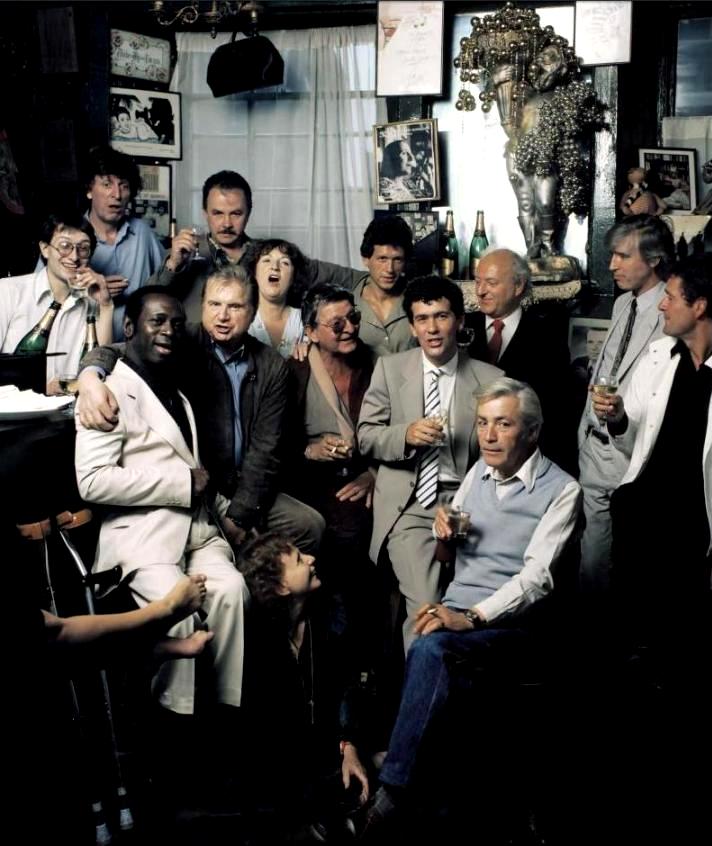
Mike McKenzie, Francis Bacon, Thea Porter, John Edwards, Jeffrey Bernard
Bacon drawings under consideration
The drawings will be displayed as “attributed to F. Bacon”
CORRECTION | THE ART NEWSPAPER | SATURDAY 1 JANUARY 2000
The subtitle of the article on the Francis Bacon drawings exhibition at the Irish Museum of Modern Art (The Art Newspaper, No.97, November 1999, pp.1 and 4) has been taken to imply that the Francis Bacon Estate had rejected the drawings held by Barry Joule as being by Francis Bacon.
We would like to point out that the Francis Bacon Estate has agreed that the Joule archive drawings may be displayed in the exhibition in Dublin as “attributed to F. Bacon” and is still considering these drawings. We apologise for any difficulties the inference caused Mr Joule.
Bacon in his place
NEWS | THE IRISH TIMES | SATURDAY, JANUARY 8, 2000
This is Francis Bacon year at the Hugh Lane Municipal Gallery. In 1998, Bacon’s sole heir, John Edwards, donated the complete contents of the artist’s studio to the gallery. A certain mystique surrounds the studios of great artists, and Bacon’s modest mews room, with its famously chaotic jumble of paint and personal effects, is no exception. In November 2000 the studio, meticulously recorded, disassembled, packed, transported and reconstructed in the Hugh Lane, will go on view to the public.
Around this event, the gallery has organised an extensive programme of related exhibitions, the highlight of which is Francis Bacon in Dublin. This will be a major retrospective, curated by the leading authority on the painter, David Sylvester, spanning his entire career and including many of his most important works.
The studio at No 7, Reece Mews was documented in superb colour photographs by Perry Ogden, and they will form an exhibition, Organised Chaos, opening in September. Finally, when the studio goes on view in November, The Private Diary of Francis Bacon will feature the artist’s drawings, collages, photographs and other materials. A database documenting the studio contents will eventually be accessible in a Francis Bacon study centre at the gallery, and already the indications are that it is likely to contribute significantly to our understanding of his sources and working methods.
In a piece of scheduling that has raised some eyebrows, the Irish Museum of Modern Art is planning its own Francis Bacon show at the end of February, thereby stealing a march on the Hugh Lane. Based on Barry Joule’s controversial archive of hundreds of works on paper attributed to the artist (Joule was a neighbour), the show promises to let viewers make up their own minds. It will go on display with Picasso: Working on Paper in IMMA’s newly refurbished 1,000 square metre gallery space in the Deputy Master’s House. The Picasso will be an archive-style show of newspaper-collages, drawings and painted-on photographs.
Through the inverted keyhole
Biography and the biomorph: an unruly round table at the court of Picasso
TIM HILTON | ARTS | TIMES LITERARY SUPPLEMENT | FRIDAY JANUARY 14 2000
John Richardson’s memoir of his life with Douglas Cooper is written with such ease and humour that it is easy to forget that he is dealing with important and controversial affairs. His book has three main subjects. First, he describes Cooper’s work and character. This is an original and fascinating account of a man who made many enemies and is remembered with horror by most of those who crossed his path. No doubt for this reason Cooper has not been commemorated, except by the odd paragraph, in the literature of modem art. Richardson repairs the omission without lingering on Cooper’s publications. Secondly though with less originality he recalls the network work of friends and sycophants of the Picasso circles he entered as Cooper’s boyfriend. Thirdly The Sorcerer’s Apprentice – with just the right amount of diffidence and self-deprecation – lets us know how Richardson became Picasso’s biographer.
To date, two volumes of his Picasso A life have appeared. They bring the story of the artist’s career to 1917. Picasso died in 1973. Richardson’s book is set to become the longest biography of an artist that has ever been written ten. It is already a major work excelling not only in length but in intimate personal detail Everyone who cares about Picasso is eager to read its next volumes. Although The Sorcerer’s Apprentice does not discuss the biography we are bound to read the memoir as an introduction to Richardson’s labours on the larger book. Sometimes it is revealing about Picasso A life at other times puzzling. On what principles is the biography being composed? Would its dedicatee have liked the book’s approach, its use of evidence and sometimes unorthodox interpretations?
The Sorcerer’s Apprentice suggests that Cooper would have disliked the book that is inscribed to him. He would have rejected it, we are led to assume, in a rage of jealousy. He would have condemned the book in revenge for his lover’s departure from their Provencal home at the chateau of Castille. Or Cooper might have attacked Picasso A life simply because he felt like causing a rumpus; or because he was drunk; or wished to gain the credit for Richardson’s work which he might well have claimed to have been stolen from his own files.
The Sorcerer’s Apprentice genial and even loving though it is makes it clear that these were Cooper’s standard reactions to people who entered intellectual territory he regarded as his own. One boggles at Cooper’s capacity for unpleasant academic behaviour, and one asks for more. A delight of the book is the way that Richardson recalls Cooper’s intolerable antics as though it were all part of a comedy. We imagine a tyrannical Mr Toad, Picasso’s superior by far in the field of wayward ward egotism and spite. And yet Richardson knows better than anyone that Cooper was an art historian of genuine distinction. He persuades us that he was right to become, and remain, Cooper’s apprentice.
Neither man had much truck with conventional further education. Richardson was at Stowe in the late 1930s, then had a spell at the Slade during its wartime exile at the Ruskin School in Oxford. This period in Slade history is remembered with affection by some, though not by Richardson, who found the teaching below the standard he expected (he was seventeen and left). During the war, he worked as a designer and as an air-raid warden His duties did not interfere with hours in night clubs. In these respects Richardson’s life during the Blitz resembles that of his South Kensington neighbour Francis Bacon, though the two men did not meet until 1946, when the painter warned him against “that treacherous woman” – ie, Cooper – “She’s even more loathsome some than she looks.”
Richardson’s first tutor in cultural affairs was Cuthbert (T. C. Worsley) then literary editor of the New Statesman, who encouraged his writing gave him lessons in style and saw that his work was published. Richardson is a little ungracious about Worsley who seems to have adored him. There is a telling anecdote about their visit to W H Auden and Chester Kallman in Ischia where the poet was beginning to elaborate his code of formality in art and life Richardson behaved badly by moonlight with another guest Auden watching from an upstairs window “Better go and pack” said a tightlipped Worsley at breakfast Richardson laments that he had fallen foul of “Wystan’s exacting sense of the right thing”. Otherwise his book contains few comments on etiquette, or the rights and wrongs of life.
In this summer of 1949, Richardson ditched Worsley for Cooper with whom he was to live for the next twelve years. A hunkish photograph of the author when young Worsley gripping ping his shoulder, has its own eloquence Cooper’s attraction was not only in his money and generosity abundant though these were. In his unbalanced way he was a gifted teacher Richardson does not explain how Cooper himself had been taught after an early departure from Cambridge in probably, 1931 or 1932. He simply states that Cooper who inherited a fortune at the age of twenty-one took himself off to study the history of art “at the Sorbonne and Marburg-in-Hessen” He no doubt refers to the Phillips University at at Marburg, which welcomes comes moneyed foreign students. There is a renowned art-history department founded in the 1880s. No doubt Cooper learnt his kunsthistorische historische methodology and excellent German in Marburg. Paris gave him his life’s ambition. He decided to study Cubism, and furthermore to codify his findings while giving a complete account of the Cubist works of the movement’s masters, Picasso, Braque, Léger and Gris.
The Cubist literature was scant academic studies non-existent Cooper’s wealth allowed him to begin his catalogues by purchasing canvases by the artists he wished to study. He did so in quantity By 1939, when he was twenty-eight, Cooper owned no fewer than 137 Cubist paintings. He also came to acquire work by Impressionist artists and by Klee, Mir6, Matisse and other modern masters. The boldness and indeed rapacity of this collecting surely has no parallel, for Cooper’s operations were helped by the circumstances of his time. He had a greedy, calculating eye for bargains in the chaos of the European art market in the late 1930s and the post-war years Some of his paintings came directly from the artists who had painted them many more were purchased from Swiss and German sources Richardson’s account of these matters points to the need for further research Someone could write a valuable book about the procedures and philosophy of reparation Richardson’s inside knowledge might help such a scholar, all the more so because his anecdotes are characteristically suggestive rather than conclusive.
The Sorcerer’s Apprentice is a personal memoir. It is also history written by a raconteur At the end of the war, we learn, Cooper acted as the interrogator of captured Nazis. “Torquemada could hardly have done better”. Richardson murmurs, though he was not himself self present at sessions which are said to have astonished Cooper’s fellow officers. As The Sorcerer’s Apprentice proceeds one comes to relish the descriptions of Cooper’s gargantuan awfulness Nobody could better describe the bully and braggart than Richardson, who adds personal matter of rare interest. It was disconcerting, we learn from the man who had gazed into Cooper’s eyes, to find that one of his pupils was in the shape of an inverted keyhole. In bed, Richardson found Cooper’s body to be “as rubbery as a Dali biomorph”. This exact connoisseur liked huge sporting cars and yellow checked clothes His desire to terrorize people in high places had no upward limit In 1953 he manoeuvred his way to a seat in Westminster Abbey from which he loudly booed the Queen at her Coronation ceremony.
The story of the fist fight between Cooper and Sir John Rothenstein, then the Director of the Tate Gallery, is well known. Richardson views the fracas as a minor passage in a much larger canvas Cooper was one of those Anglophobes who hated the British Establishment, yet wished to be part of that Establishment and to receive its honours. The Cooper philosophy, which by its nature was ferocious, could not allow the existence of a more genteel art world He was appalled by British ignorance of twentieth-century French painting Cooper was certain that his knowledge of modern art exceeded that of any British museum curator and that his scholarship was more precise than that of any British academic in the field He was right on both counts Thus the hapless Rothenstein stein became the victim of his vendetta.
In the 1950s, Cooper began to think – with what degree of seriousness it is hard to judge – that he would give his paintings to some British museum. A French gallery would not be the right place for his benefaction People make bequests to museums for a number of reasons most of them altruistic. In Cooper’s case it looks as though he envisaged his gift as an instrument with which he might inconvenience and perhaps humiliate the nation which had given him birth. The Tate had a place in Cooper’s plans and he therefore had much interest in its trustees. But the Courtauld Institute of Art could have been a more amenable depository for a few hundred modern paintings. Its gallery belonged to a parent institution which was the University of London but the Courtauld Gallery had no trustees and was effectively controlled by Anthony Blunt the Institute’s Director who happened to be a friend of Cooper’s and an annual summer guest at his castle in the South of France.
From this point in its narrative the anecdotes dotes of The Sorcerer’s Apprentice are less beguiling. The problem is not only that reality spoils the farce Richardson is too casual airy when he invokes a society to which his readers do not belong. So he writes that Blunt s Soviet controller was seemingly a Hungarian publisher we all knew. Here is a superior form of name-dropping. It may be relevant that Richardson had a courtier’s role during his years in Provence. He has the manner of someone who has known court secrets Richardson son is glad to report the indiscreet royal stories with which Blunt enlivened Cooper’s dinner table though in fact these tales are not very interesting. A far better story is his account of Picasso’s sudden whimsy in deciding that Princess Margaret would make him a suitable bride. In a characteristic ex-courtier way he allows us to know that many years later I told Princess Margaret the story of Picasso’s quest for her hand. Like her great-great-grandmother Queen Victoria she was not amused.
The most significant court known to Richardson son was ruled by Picasso. He met the artist through Cooper, and they were neighbours in southern France in the later 1950s. This must have been the period of the gestation of Picasso: A life and was also obviously the time when Richardson developed his personal and social strengths. He became much more than Cooper’s live-in boyfriend. His wide reading amusing conversation and knowledgeable love of art were apparent to all. Picasso was a monarch who liked to promote quarrels and jealousies among his entourage yet Richardson skilfully found his paths through minefields of cattiness and envy He made friends as easily as Cooper made enemies. And all the time he was assembling notes.
Richardson had a fine vantage point in the 1950s. He had learnt art history from Cooper In these years, Picasso was probably more confessional in his conversation than ever before Richardson gained the confidence of Jacqueline Roque, Picasso’s mistress and later his wife, and listened to the many people who claimed to know Picasso well The Sorcerer’s Apprentice now reveals that Richardson was making a catalogue of Picasso’s portraits. If Cooper thought that this was a lightweight exercise then he was wrong. A catalogue of the portraits would include the likenesses of many men and women (mainly women who were still living in the 1950s and could be interviewed It was the perfect way to begin a biography.
As Richardson’s acquaintance grew so did his fund of anecdote The Sorcerer’s Apprentice shows that stories about Picasso have much more to do with human life than have stories about Cooper Some of them appear to take us close to the artist’s most intimate feelings Richardson writes of
the all-important secret that Picasso told only to the women in his life – the secret of his childhood hood vow to God. When his younger sister Conchita was dying of diphtheria he made a vow that he would never paint again if his sister’s life was spared. He did paint again and her life was not spared. This explained Picasso’s identification with the Minotaur to whom women had to be sacrificed.
This is not the first time that Richardson has told us about Picasso’s childhood vow. The story was recounted with different emphases, in the first volume of Picasso: A life published in 1991. We now understand from The Sorcerer’s Apprentice that Richardson heard the story from Jacqueline Roque in 1957. By 1988, he had independent confirmation of the story for it then appeared in Arianna Stassinopoulos Huffington’s Picasso Creator and destroyer. Huffington’s account derived from her interviews views with Francoise Gilot, Picasso’s companion between 1944 and 1953 and therefore Roque’s immediate predecessor in Picasso’s affections. Richardson therefore has two good sources for the “all-important secret”, though in logic he cannot claim that it was told solely to women. He might also have thought of the caveats in Picasso Art as autobiography (1980 by Mary Mathews Gedo who had also interviewed Gilot Gedo pointed to Picasso’s tendency to fantasize or misremember the events at Corunna in 189S when Conchita died while also reporting Gilot’s comment that, even fifty years after the death of his sister, Picasso was still torn by “guilt and remorse”.
Conchita’s death might explain the symbolism of the Minotaur in Picasso’s art (in which it first appears in 1928), or it might not Richardson’s interpretation is not too far-fetched, but lacks the precision that Douglas Cooper would certainly have demanded. Cooper was a cataloguer by nature, at least while he remained at his desk. Richardson is a listener and conversationalist. His memoir is remarkably and pleasantly aural Reports of conversations have always been important to Picasso studies and have become a matter of dispute since the publication in 1963 of the fullest record of the artist’s talk, Françoise Gilot’s Life with Picasso. When Picasso: A life in a future volume, assesses the years that Gilot has already described – the decade before Richardson son won the friendship of Picasso and Jacqueline Roque – we will hope to learn more about the elusive nature of anecdote.
John Richardson, THE SORCERER'S APPRENTICE: Picasso Provence and Douglas Cooper, 320pp Cape £20
A Bacon Year for Dublin
DAVID EBONY | EXHIBITIONS | ART IN AMERICA | FEBRUARY, 2000
This year the city of Dublin hosts a number of Francis Bacon exhibitions which have already generated heated controversy in Ireland and the U.K. Although the Irish-born artist lived in London for most of his life, Dublin is shaping up to be the focal point of new Bacon scholarship. Kicking off the excitement is “The Barry Joule Archive: Works Attributed to Francis Bacon,” which inaugurates a series of new galleries at the Irish Museum of Modern Art (IMMA), Feb. 20-Aug. 27. The exhibition features a selection of some 100 drawings (many done on photographs) on loan from the collection of Barry Joule, Bacon’s former neighbour, handyman and driver. Joule said that just a few days before Bacon's death in 1992, the artist gave him a bundle of some 700 works on paper. Since experts believed that the artist had almost never produced drawings, news of their existence aroused considerable suspicion. The works were supposedly kept in a bank vault until 1996, when Joule began to show them to art historians and Bacon experts.
The reaction to the drawings has been mixed; initially, certain key figures such as art historian David Sylvester, who has curated a number of important Bacon exhibitions, expressed doubts about their authenticity, while artist Brian Clarke, executor of the Bacon estate, has withheld comment on the works. IMMA director Declan McGonagle was more enthusiastic about the collection and approached Joule and the Bacon estate about a possible exhibition. At first the estate refused to allow the artist's name to be used at all in connection with the works. But, after intense negotiations, it finally allowed the museum to describe the works as “attributed to Bacon.” Meanwhile, the estate recently announced plans to set up a panel of experts to issue a definitive judgment on the authenticity of the drawings. The panel begins its examination around the time of the show’s opening. According to London’s Art Newspaper, Joule plans to donate 90 percent of the works to Dublin’s Hugh Lane Municipal Gallery of Modern Art if the works are accepted by the estate as authentic. Of the remaining drawings, he would give London’s Tate Gallery those that relate to paintings held by the museum. Joule would keep other drawings as his personal collection. He declined to say what would happen if the estate rejects the works.
The Hugh Lane Gallery is the logical repository for the works since that institution will be the permanent site of the Francis Bacon Studio, set to open to the public in November. Donated by John Edwards, Bacon’s sole heir, the entire contents of the artist’s London studio at 7 Reece Mews are currently being disassembled and catalogued by a team of archeologists. Bacon worked best in the chaotic surroundings of the messy studio, and, after his death, the inches-deep layers of detritus, including photos, scraps of notes and pages torn from newspapers and magazines, were preserved. Much of this material relates directly to his paintings, so the project could have a significant impact on future research.
Organized by Hugh Lane director Barbara Dawson and Margarita Cappock, project manager of the Francis Bacon Studio, the endeavour entails making careful sketches and photo studies of the exact location and arrangement of all the items in the room. The material will then be carefully packed and shipped to Dublin, where the reassembly process will begin. An important facet of the project is the creation of the Francis Bacon Database, for which some 10,000 items from the studio will be digitally photographed and catalogued for archival purposes. As a prelude to the studio’s public debut, many of the artist’s best-known paintings will be on view at the Hugh Lane this summer. A major retrospective of Bacon works, selected by David Sylvester, appears there June 1-Aug. 30.
PERSPECTIVES
Lively relic a remarkable set of friends
Frances Partridge, last surviving member of the Bloomsbury group,
turns 100 on| Wednesday. James Beechey finds she has lost none of
her enthusiasm for life
JAMES BEECHEY | LUNCH WITH THE FT | FINANCIAL TIMES WEEKEND | MARCH 11/MARCH 12, 2000
On the morning of our lunch Frances Partridge had been woken by a horrible gurgling noise from the pipes in her Belgravia flat. A quick telephone call to her landlord, the Grosvenor Estate, had produced a plumber and by the time I arrived to pick her up, a few minutes before 1pm, the problem had been fixed and the plumber departed.
She was relieved it was not more serious, she had explained to him, because his employer – and her landlord – the Duke of Westminster had been in touch to ask if he could call on her this week on the day of her birthday and she wanted to be sure that everything was in order.
The Duke is obviously not in the habit of visiting all his tenants on their birthdays, but then this is no ordinary celebration. On Wednesday, Partridge, the last surviving member of the Bloomsbury group, will be 100.
The plumber was amazed by this information: he had never seen anyone, he exclaimed, who was 100. “It does make me feel rather like a freak show,” she says.
She recounts this episode as we walk the few hundred yards from West Halkin Street to Lowndes Square where our chosen restaurant, Zafferano, at the corner of Motcomb Street, is evidently popular with Belgravia’s weekend shoppers. Partridge has lived in this genteel quarter of London since 1961.
It is easy to sympathise with the plumber’s reaction. When Partridge was born, Queen Victoria was still on the throne; as a child, she was held in the arms of Henry James. Yet it is hard to believe that she really belongs to that distant age. She makes few concessions to frailty and she remains a familiar figure in the neighbourhood, dressed, as she is today, in her. distinctive tartan trousers, beret and red velvet slippers. She still enjoys weekends away from London, and outings to the opera and concerts.
On her birthday she is being entertained to a small lunch at The Ivy; and the following evening there will be a party for 150 friends at the Saville Club. Is she looking forward to it?
“I shall do what I’m told, I expect,” she says, but admits: “I do feel rather crushed by the whole thing.”
In fact, the celebrations are already underway. London University has awarded her an honorary degree and she was made a CBE in the New Year’s Honours List for services to literature. Sipping a glass of sherry, she describes her visit to Buckingham Palace a fortnight ago to collect her insignia (“an extraordinary great big whopping piece of metal”).
“I always feel sorry for the Queen. She couldn’t think what to say,” she comments.
She remembers “fearful arguments” about honours among her friends in Bloomsbury. Many of them – Virginia and Leonard Woolf, Clive Bell, Duncan Grant – declined theirs and she recollects how scornful they were of John Maynard Keynes when he accepted a peerage towards the end of his life.
Partridge does not share their reservations. “I found their prejudice against titles earned by merit rather pompous, really.” When the food arrives she warns me: “I’m not a great eater. One isn’t at my age. I’ve had enough for my lifetime.” Nevertheless, she eats enthusiastically as we talk.
She finds herself obliged more and more to relive her past, the relic of an extraordinary circle of friends who influenced her enormously and continue to fascinate new generations. A few years ago she had the unnerving experience of seeing herself played on film in Christopher Hampton’s Carrington; she is in continual demand for interviews from historians and fetishists of Bloomsbury; and lately the writer Ann Chisholm has been commissioned: to write her life story.
“You see, without any effort on my part, a lot is being promulgated,” she says.
She has been a lifelong Labour supporter but has never sought the company of politicians. Her own political activity has centred almost exclusively on her forthright opposition to hatred and violence.
She was converted to pacifism as a young girl during the first; world war – at much the same. time as her future husband Ralph Partridge, a hero of the trenches, was moving towards his own conviction that all wars were futile and ethically unjustifiable.
These beliefs have not always been comfortable to uphold, particularly during the second world war when many friends argued that the defeat of Hitler outweighed their objections to fighting.
Never afraid to criticise those of whom she was fond, she says she found Bloomsbury’s attitude to pacifism, with one or two exceptions, “pretty thin”. But she stuck to the beliefs steadfastly then, and still does today.
“The bomb to destroy all hasn’t gone off yet. Are you prepared to say it won’t?” she asks. “I think the world will end in an explosion. I’d bet on that if I put money on anything.”
During the early months of the second world war Partridge began keeping a diary. “The war was going to be bloody boring,” she reasoned, and her journal was a means of relieving various emotions aroused by it.
She has continued to write it ever since – though now, her eyesight deteriorating, she finds it difficult to make more than an occasional entry. “You experience life more acutely when you’re writing a diary.”
While she never intended them for publication, she is delighted at the success that the six volumes she has published so far have brought.
In other respects her long life has been one cruelly marked by tragedy. Even the circumstances that allowed her the period of greatest contentment – the 27 years of her marriage to Ralph Partridge – are painful to recall.
When she first met her future husband, he was married to the artist Dora Carrington, living alone in London during the week and at weekends at Ham Spray in Wiltshire, the house he shared with Carrington and Lytton Strachey.
Strachey died in 1932; his death was followed by Carrington’s suicide two months afterwards.
When Frances and Ralph married in 1933 they moved in to Ham Spray, where she was blissfully happy – she still misses what she describes as “the most marvellous view in the world” across the Wiltshire Downs – and where they brought up their only son, Burgo.
“I’ve always been after happiness, I believe in it. There’s Splenty going, but you have to make a lot of it yourself.”
If Ralph’s death in 1960 was a shock, the death from a brain haemorrhage two years later of their 28-year-old son, newly married and the father of a month-old baby, was a disaster out of the sky. She still feels their losses terribly: “Anybody who’s loved somebody very much goes on regretting them. Something around the corner can destroy anything.”
She wrote in her diary after Burgo died: “I have utterly lost heart: I want no more of this cruel life.” For several months she contemplated taking her own life. (She remains a firm supporter of the right to euthanasia.)
Her will to live again, heroically regained, has been strengthened by the enduring consolations of her life: work (she has been a prolific translator of French and Spanish literature); her passion for music; her amateur interests in philosophy and botany; and, above all, her legion of friends.
She is touchingly moved, too, by the simple kindnesses of strangers: “I, an old lady of 100, hover on the edge of the road and someone comes up and offers to help me across. That’s sheer magnificence.”
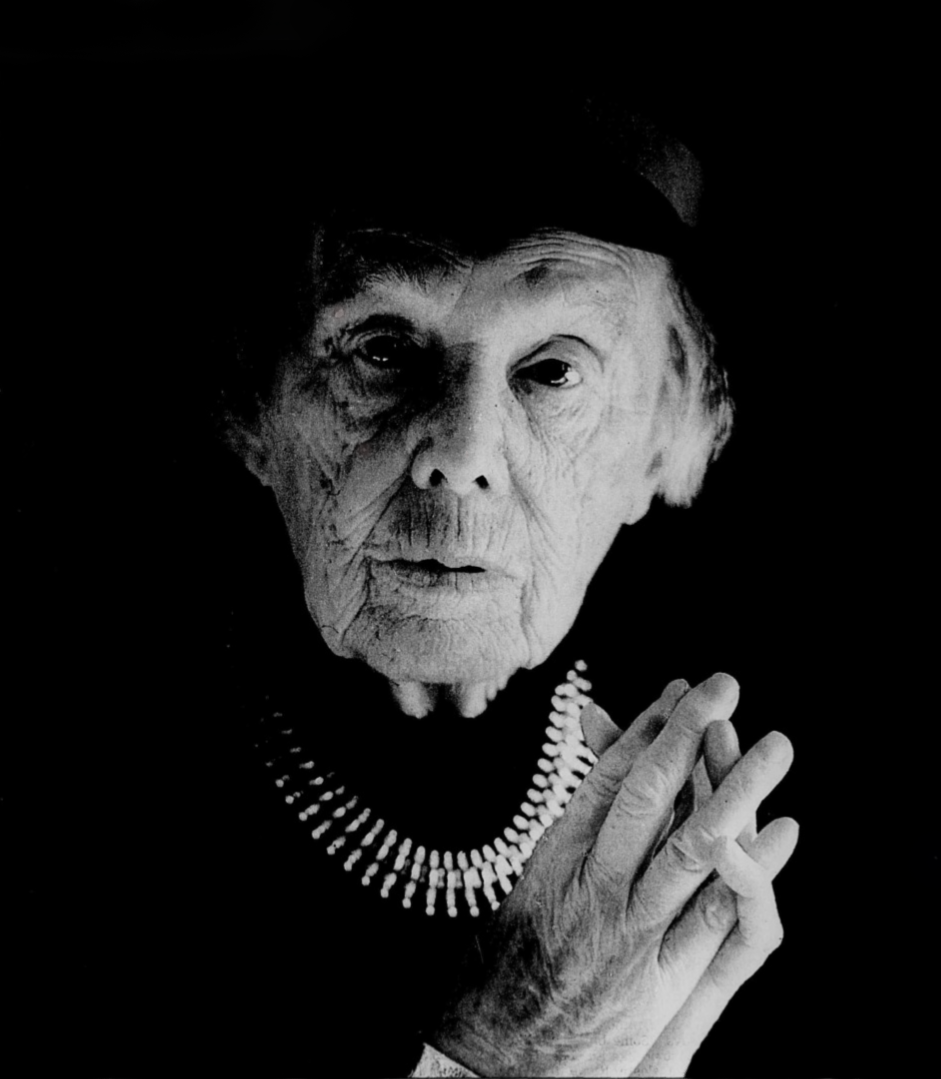
Bloomsbury survivor Frances Partridge: feeling rather crushed by imminent celebrations for her 100th birthday day
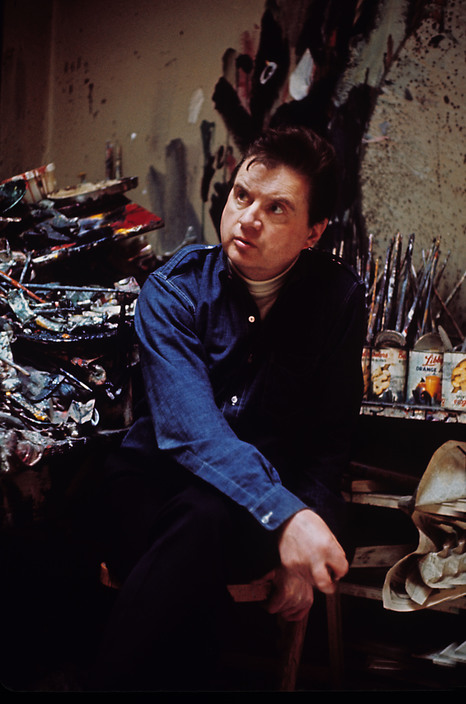
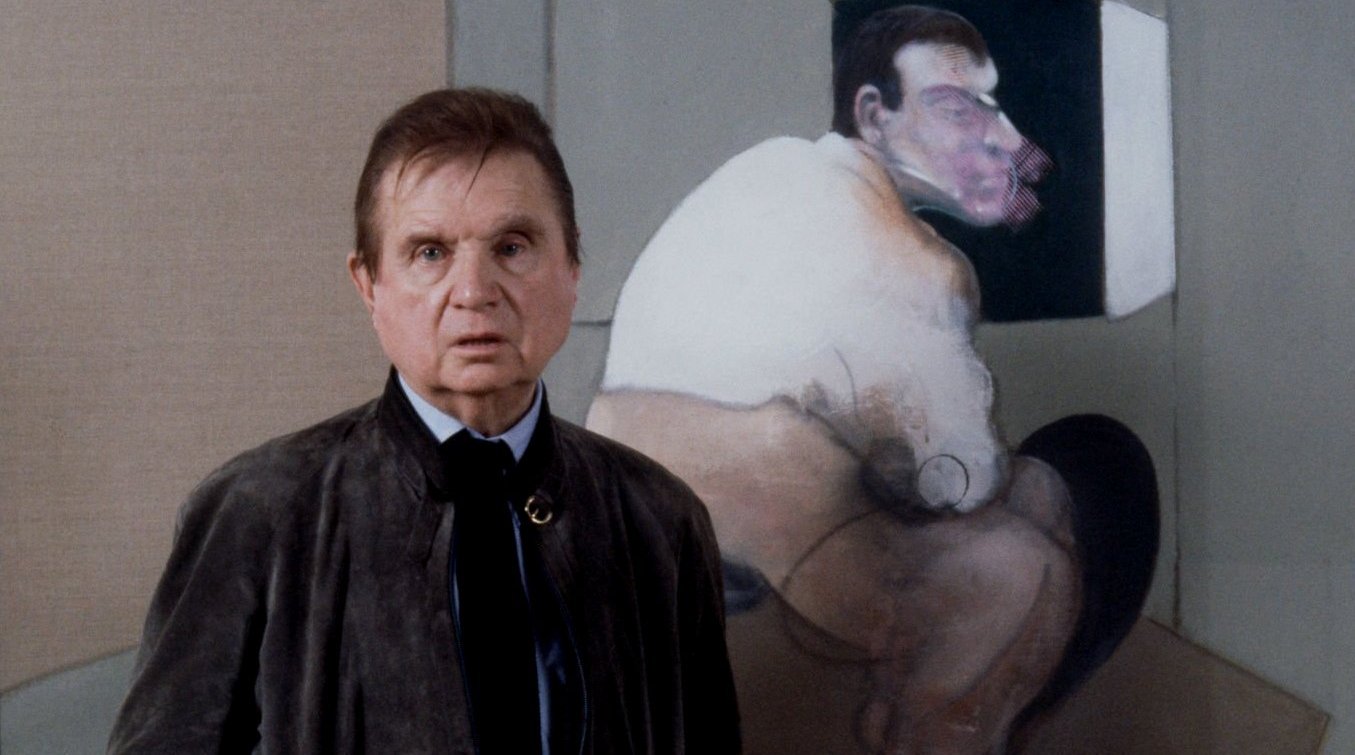
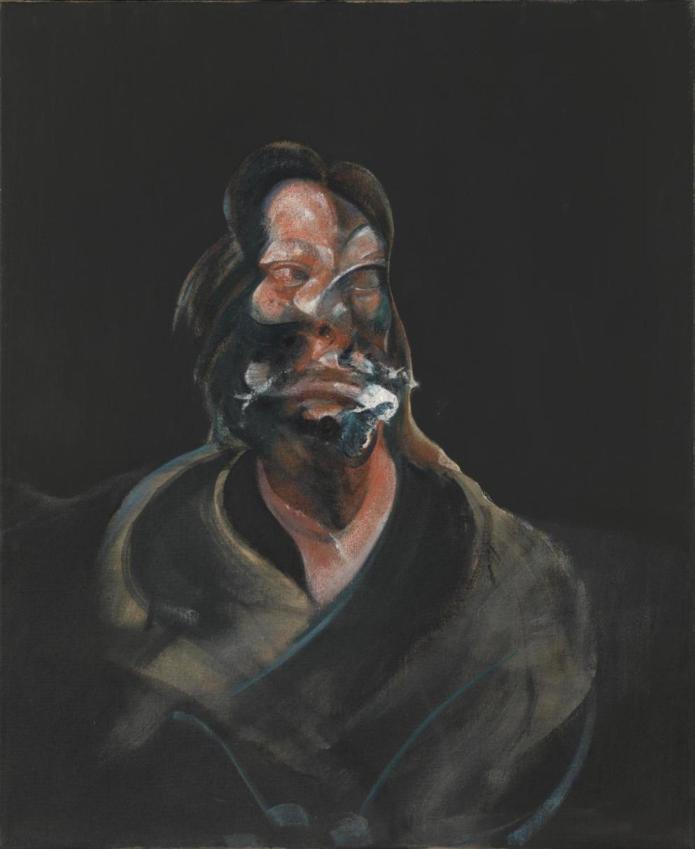

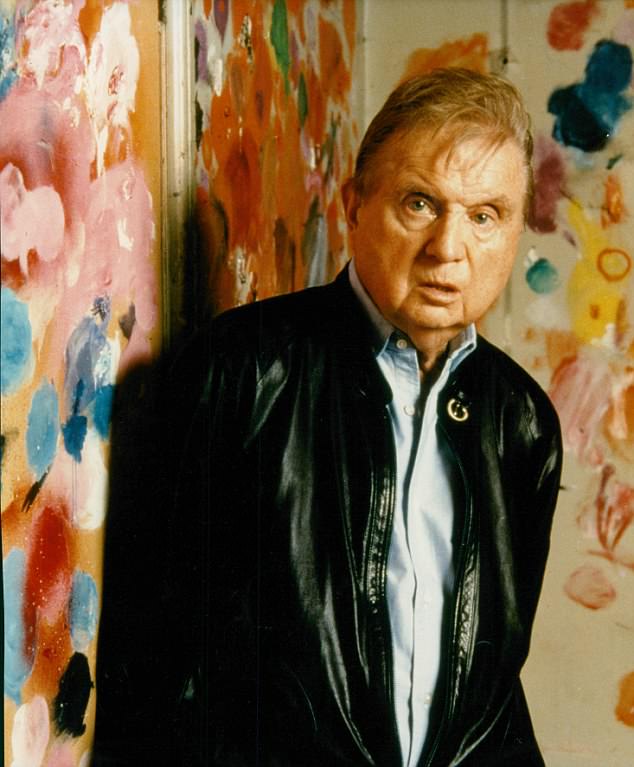
.jpeg)
.jpeg)